Revised: 27 June 2026
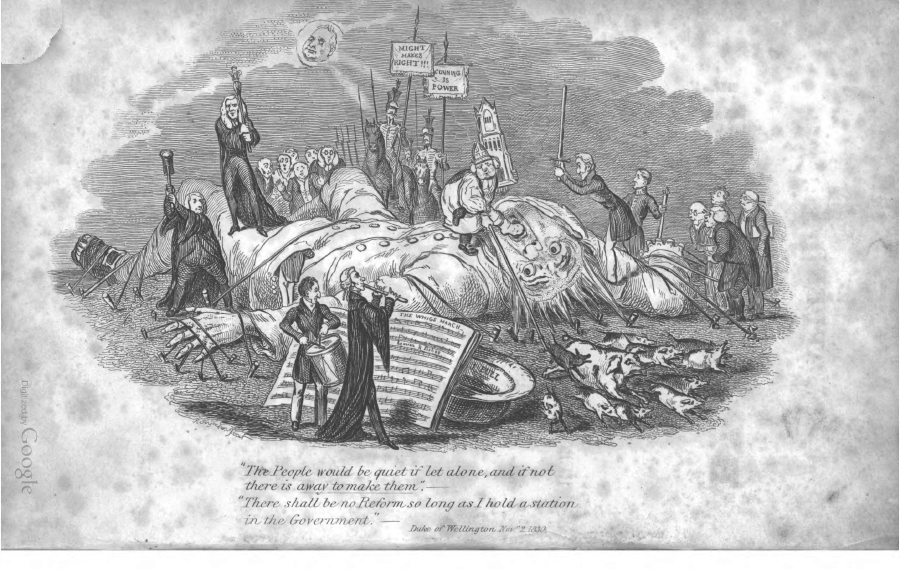
[Above: This is one of the illustrations from Wade’s Extraordinary Black Book (appendix to 1834 edition) showing John Bull (the typical Englishman) being tied down like Gulliver in order to be abused and tormented by his enemies, which include the Crown, the Army (holding banners which state that "Might Makes Right" and "Cunning is Power"), lawyers (playing "The Whig March"), an official who has his head stuck in one of John Bull’s pockets, the Church (who is pulling John Bull’s tongue so he cannot talk), and members of parliament holding a sword over his head. A group of equally horrified citizens are watching the entire proceedings. To see a larger version of this picture [JPG 2.4 MB].]
![JPG 2.4 MB].](http://davidmhart.com/wordpress/wp-content/uploads/2026/03/Wade_1834Appendix-GulliverLG.jpg)
Introduction | Further Reading
Introduction
The classical liberal tradition has a long history of thinking about class analysis which goes back at least to the English proto-liberals known as the Levellers in the 1640s, but this tradition is either not well known or has been dismissed because people have associated class analysis with the left, in particular with Marxism.
Radical liberals viewed the exploitation of one class of people by another as essentially coercive and political in nature, where those who had access to the coercive power of the state, “the ruling class”, exploited those who did not, “the exploited class”, by means of taxation, regulation of the economy, and the granting of monopolies and other privileges to certain favored groups.
The heyday of classical liberal class analysis (CLCA) not surprisingly coincided with the heyday of CL thinking and political activity during the 150 years between 1750 and 1900. Some of the important theorists include:
- Charles Comte (1782-1837) and Charles Dunoyer (1786-1862) developed a theory of "industrialism" dervided from J.B. Say’s economic theory in which the "industrial class" was exploted and ruled by a parasitic ruling class
- James Mill (1773-1836) with his distinction between “ceux qui pillent" (those who pillage) or “the ruling Few” and “ceux qui sont pillés” (those who are pillaged) or “the subject Many”.
- Frédéric Bastiat (1801-1850) with his distinction between “la classe spoliatrice” (the plundering class) and “les classes spoliées” (the plundered classes)
- Gustave de Molinari (1819-1912) with his distinction between “the governing or ruling class” and “the governed or ruled classes”
- Herbert Spencer (1820-1903) with his distinction between the “militant class” and the “industrial classes”
- William Graham Sumner (1840-1910) on “the Forgotten Man and Woman” (Sumner 1918) and “the plutocratic class”
- Vilfredo Pareto (1848-1923) on “the governing elite class” (Pareto 1900) and the “the subject or governed class”.
Later, both CL and CLCA went into a deep sleep during the first half of the 20th century before enjoying a renaissance in the post-Second World War period when a new group of thinkers emerged under the aegis of Murray Rothbard (1926-1995) and his Circle Bastiat in NYC – especially the historians Leonard Liggio (1933-2014), Ralph Raico (1936-2016), and Walter Grinder (1938-2022) – who built upon what had gone before but incorporated a number of new insights drawn from the Austrian school of economics, inter-war American individualist thinking (such as Albert J. Nock), late 20th century libertarian political thought, Public Choice economics, and aspects of New Left historiography, in what might be called the “Rothbardian synthesis.” This has stimulated a new generation of libertarian scholars (historians and economists) to apply CLCA in their own work.
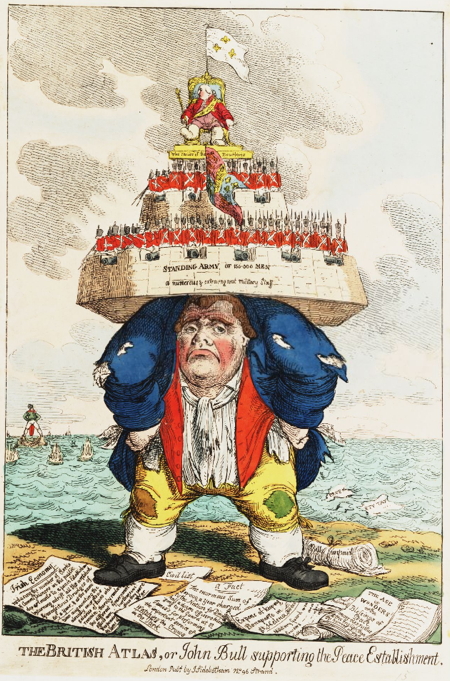
[John Bull as the British Atlas supporting the Establishment]
Further Reading
Introduction | John Trenchard (1662-1723) and Thomas Gordon (1691–1750) | Adam Smith (1723-1790) | James Mill (1773-1836) | Charles Comte (1782-1837) and Charles Dunoyer (1786-1862) | John Wade (1788-1875) | Frédéric Bastiat (1801-1850) | Gustave de Molinari (1819-1912) | Herbert Spencer (1820-1903) | William Graham Sumner (1840-1910) | Vilfredo Pareto (1848-1923)
 |
IntroductionI provide a summary of this way of thinking in
See also the following blog posts:
More detailed material:
|
 |
John Trenchard (1662-1723) and Thomas Gordon (1691–1750)In the modern era two early users of CLCA were the English “Commonwealthmen” John Trenchard (1662-1723) and Thomas Gordon (1691–1750) whose pamphlets and journalism were influential in bringing these ideas to the colonists in North America in the decades leading up to the American Revolution. They turned to Roman history to criticize the practices of the British state after the settlement of 1688 brought William of Orange to the throne. In their Cato’s Letters (1721-23) the landed, financial, and military aristocracies (the oligrachy) which were the foundation stone of the expanding British Empire were likened to the tyrants of ancient Rome and their court of “hangers-on”. The King’s ministers were corrupt, “factions” and “parties” within the court contended for power (the “Ins” vs. the “Outs”), the court parasites plundered the people, and a standing army kept them and the colonies under control. It was the journalism of Trenchard and Gordon which brought this notion of class to the English colonists in North America who readily adopted it as part of their critique of the British Empire, seeing their struggle very much as a tax revolt by the tax-payers in the colonies against the tax-consumers of the metropole. We have online: |
 |
Adam Smith (1723-1790)Smith’s thinking about class was largely implicit in that he accepted the general Enlightened idea that history evolved through various economic stages (namely, the stages of hunting, pasturing, agriculture, and commerce) which he expressed in his Lectures on Jurisprudence (1762, 1766), that societies were structured according to one’s rank and order each of which had their own “powers, privileges, and immunities”, which he discussed in Theory of Moral Sentiments (1759, 1790), and that a complex “system of government” in which “factions” competed against each other for access to power and the benefits power brought, had emerged under mercantilism which granted legal and economic privileges to some manufacturers, slave-owners, and agricultural producers at the expence of other consumers and producers, in The Wealth of Nations (1776). On Smith and class, see:
|
 |
James Mill (1773-1836)The Philosophic radical James Mill made a distinction between “ceux qui pillent” (those who pillage) or “the ruling Few” and “ceux qui sont pillés” (those who are pillaged) or “the subject Many”. The former were a “sinister interest” which controlled the British government for their own selfish purposes. The governing Few’s control of the government both at home and abroad created what Mill described as “a vicious government” which ruthlessly sacrificed the interests of the many to the “sinister interests” of a small minority. Thus, Mill came to view politics as a struggle between these two classes. Mill’s works in which which class and exploitation is discussed:
|
 |
Charles Comte (1782-1837) and Charles Dunoyer (1786-1862)Under the influence of the writings of Jean-Baptiste Say the French lawyers and journalists Comte and Dunoyer added to their political and constitutional opposition to Napoleon and the restored Bourbon monarchy a new economically and sociologically informed opposition based upon their theory of class rule and exploitation of the “industrial class” of peaceful producers by a parasitic non-producing aristocratic, political, and military class. In the journals Le Censeur (1814-1815) and Le Censeur européen (1817-1819) and then in a series of books they published during the 1820s and 1830s they developed these ideas into a detailed “industrialist” theory of history and class which had a great influence on later writers like Frédéric Bastiat and Gustave de Molinari. On Comte and Dunoyer see:
Their main works:
|
 |
John Wade (1788-1875)Like James Mill the English radical John Wade was influenced by Jeremy Bentham (1748-1832) concerning the endemic corruption within the British state. He meticulously documented the money amount of this corruption in the form of salaries, pensions, grants, privileges and other payments and benefits paid unnually to the government, the Church, the royal family, the military, the courts, and many others who constituted the ruling elite in his best-selling book The Black Book (later called the “Extraordinary” Black Book) which was published in many editions between 1820 and 1835. The full title of the first edition of 1820 describes clearly his purpose:
I have put online the expanded 4th edition of 1835 along with its Appendix:
|
 |
Frédéric Bastiat (1801-1850)Much influenced by Comte and Dunoyer’s writings Bastiat distinguished between “la classe spoliatrice” (the plundering class) and “les classes spoliées” (the plundered classes). He applied this analysis to his critique of protection first to the English system in his “Introduction” to Cobden and the League (1845) and then to the French system in a series of works beginning with Economic Sophisms (1846, 1848) and which culminated in his long pamphlet on La Loi (The Law) (1850). He did not live to complete his projected “History of Plunder” but its outlines can be pieced together from the many things he did write on this matter. See in particular my Introduction to an anthology of his essays on Plunder. See my papers:
Bastiat’s works in which which class and expoloitation is discussed:
|
 |
Gustave de Molinari (1819-1912)As a young journalist in Paris Molinari first developed his ideas about class and exploitation in his writings on tariffs (1847) in which he described the beneficiaries of tariffs as being no better than so many “bandits” who waylaid travellers in the remote hills of Italy. He developed his ideas further in a series of entries in the Dictionnaire de l’économie politique (1852-53) in which he expanded his analysis to include the emergence of coerced labour under slavery, feudalism, and the rise to power of the nobility. He would later write several long books on the rise of the modern state, the mechanisms it used to exploit the productive classes, the ruling class and its allies as “les mangeurs des taxes” (tax-eaters), the role war played in the evolution of the state, how the ruling class used the state as a kind of profit making “firm”, and how in the future societies will gradually move towards free competition in all areas of activity including all so-called “public goods”, even the provision of police and defence services. See my papers:
Molinari’s works in which class and exploitation are discussed:
|
 |
Herbert Spencer (1820-1903)In his sprawling multi-volume work which took decades to complete (1874-1896) Spencer developed a detailed sociology of the state which centred around the two different ways wealth could be acquired and around which societies were structured: the “militant type” of society which was based upon coercion and the taking of what others had produced, and the “industrial type” of society which was based upon voluntary cooperation, production, and exchange with others. See in particular “Part V. Political Institutions” of Volume II of The Principles of Sociology.
|
 |
William Graham Sumner (1840-1910)Sumner was a professor of sociology at Yale University who wrote on free trade and protection, sound money and banking, and was an outspoken member of the American Anti-Imperialist League. In his work on classical liberal class analysis he championed the interests of “The Forgotten Man and Woman” who paid the taxes which made it possible for the various vested interest groups, both large (plutocrats and party bosses) and small (those who sought government jobs and contracts), to enjoy their privileged position. Sumner also wrote several works against the theory and practice of socialism. In his view the great clash of the future would be between socialists from below and plutocrats from above, with the “forgotten” man and woman caught in the middle. We have online four volumes of his collected essays (see the table of contents of the collected essays), his major treatise on sociology, and several other works:
|
 |
Vilfredo Pareto (1848-1923)Pareto is known for his theory of “elites” but within this broader category is a theory of a more specific kind of elite, namely the political “ruling elite” which was based upon a theory of plunder and class which was much influenced by the writings of Bastiat and Molinari. This aspect of his thought is less well appreciated. See my paper on
and my translations of his works:
The most detailed statement of his theory can be found in my Multi-Pane Reader version of
|