
Revised: 3 April 2026
Introduction | Further Reading
Introduction: Ideas, Interests, and Human Action
At the most fundamental level the liberal reformer needs to know what the connection is between the ideas that people hold, the interests which they have, the relationship which exists between ideas and interests, the actions people take to pursue those interests and ideas, and the outcomes of those actions (whether they are a success or a failure).
I have attempted to trace how ideas are created, transmitted, and implemented in a paper on “the production and distribution of ideas” entitled “Entrepreneurs, Investors, and Scribblers: An Austrian Analysis of the Structure of Production and Distribution of Ideas.” Southern Economics Association, New Orleans, November 21–23, 2015. Online. I base the idea upon the Austrian idea of the “structure of the production of capital” and apply it to “intellectual production.
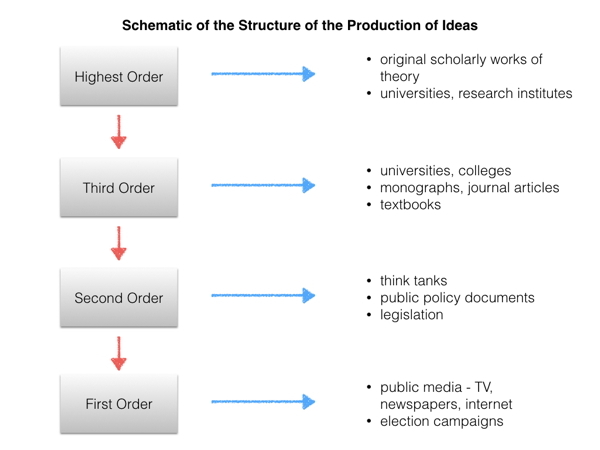
Others who have approached the matter from much the same direction include:
- Ed Lopez’s book on “Academic Scribblers” (2013): Wayne A. Leighton and Edward J. Lopez, Madmen, Intellectuals, and Academic Scribblers: The Economic Engine of Political Change (Stanford University Press, 2013).
- Richard Fink’s address at APEE 2015 on “Ideas into Action: Applying Hayek”: Richard Fink’s Plenary Address, ”Ideas into Action: Applying Hayek,” The Association of Private Enterprise Education, 40th Annual Conference, Cancun, Mexico, April 12–14, 2015.
Classical Liberal Reform Movements
The classical liberal reformer (or revolutionary) needs four things to achieve their goals:
- a critique of what is wrong with the current state of affairs and why – “What Classical Liberals were Against” RLP (August 12, 2021) Online
- a vision of a better society which does not have these problems and would allow more human freedom and thus more flourishing – see “What Classical Liberals were For” RLP (August 13, 2021) Online and “What CLs were For – Part 2: Ends and Means” RLP (October 19, 2021) Online (and why), as well as an inspiring “vision of the future free society”. On the CL perhaps “utopian” vision of the future see “Hayek on a Liberal Utopia” RLP (September 11, 2021) Online; “Classical Liberal Visions of the Future I” RLP (August 27, 2021) Online; “Classical Liberal Visions of the Future II: The Contribution of Gustave de Molinari (1819-1912)” RLP (August 29, 2021) Online; and “Classical Liberal Visions of the Future III: Liberal Experiments, Frameworks, and Archipelagos” RLP (October 11, 2021) Online
- a way of persuading others of the soundness of their critique of the old order and the plausibility of their vision of the new order of things – in other words to have some notion of how ideas and emotions can be used to change peoples’s minds and thus “the world” – do we follow Bastiat, Hayek, Goodrich, Rothbard, Boettke?
- a means or a strategy of achieving the goal of removing /changing the old regime and introducing the new regime or state of affairs with a minimum of damage and hardship to by-standers (if possible)
I have argued elsewhere that CL was (and still is) an “ideology of emancipation” – “Classical Liberalism as a Revolutionary Ideology of Emancipation” RLP (October 13, 2021) Online and “Classical Liberalism as the Philosophy of Emancipation II: The “True Radical Liberalism” of Peter Boettke” RLP (October 17, 2021) Online – which was very successful in getting rid of the oppression of serfdom, slavery, absolutist monarchs, mercantilism, and censorship (to mention only a few things). The problem today is how to take this “emancipation” to the next level, given the new oppressions and restrictions we currently live under, and the indifference or even hostility towards the idea of individual liberty and free markets held by many people.
Some Historical Examples to Consider
Historians can draw upon a number of very instructive examples from the past to help understand and guide liberal reformers in the present. The key question is to ask what “actions” have liberal reformers taken in the past to achieve their goals, and what have been their successes and failures in doing so? And how useful are these examples for present-day liberal reformers?
These examples include (some liberal and some not so liberal):
- the activities of the early Christian church in its first 3 or 400 years before it became the state religion of the Roman Empire
- the efforts of reformers during the Reformation to challenge the monopoly of the Catholic Church
- the activities of critics of the “old regime” (whether France or British North America) which lead to the outbreak of revolution in 1776 and 1789 respectively
- the anti-slavery movement and the strategies followed by the Abolitionists
- the spread of free market and free trade ideas in the late 18th and early 19th century which led to the Abolition of the Corn Laws in England in 1846
- the spread of socialism iin the late 19th century leading up to the Bolshevik Revolution in Russia in 1917
While I was Director of Liberty Fund’s Online Library of Liberty website I hosted a monthly discussion forum called “Liberty Matters” where we discussed the issue of strategy on several occasions. These include two specific examples and a more general one. The goal was to examine two successful attempts to change “the climate of opinion” (in J.S. Mill’s phrase) and to think about what might be learned from them:
- John Blundell, “Arthur Seldon and the Institute of Economic Affairs” (November, 2013) OLL
- Stephen Davies, “Richard Cobden: Ideas and Strategies in Organizing the Free-Trade Movement in Britain” (January 2015) OLL
- David M. Hart, “On the Spread of (Classical) Liberal Ideas” (March 2015) OLL
Other successful movements which began with an “idea” and ended up bringing about significant political changes inlcude the American abolitionists in the 1840s and 1850s, James Mill and his group of Philosophic Radicals in the 1820s and 1830s, and Vladimir Lenin in the 1900s and 1910s (by no means liberal but nevertheless very instructive). On these movements see in particular:
- Aileen S. Kraditor, Means and Ends in American Abolitionism: Garrison and his Critics on Strategy and Tactics, 1834–1850 (New York: Pantheon Books, 1969).
- Joseph Hamburger, Intellectuals in Politics: John Stuart Mill and the Philosophic Radicals (New Haven: Yale University Press, 1965).
- Vladimir Lenin, What Is to Be Done? Burning Questions of Our Movement (1901, 1902). In Lenin’s Collected Works (Foreign Languages Publishing House, 1961, Moscow), Volume 5, pp. 347–530. Online or PDF Online.
The Paucity of Thinking about Strategy by Modern CLs/Libertarians
Whereas Lenin spent day and night thinking about strategy and plotting how to carry out his strategic plans, modern-day libertarians have sadly neglected this important dimension to the liberty movement. We might mention Friedrich Hayek, John Blundell, and Murrary Rothbard as notable exceptions.
Friedrich Hayek wrote his pathbreaking essay “The Intellectuals and Socialism” (1949) at the time of the founding of the Mont Pèlerin Society and the renaissance of the classical liberal movement after WW2, in which he reflects on why socialist ideas had been able to achieve so much in 100 years or less: F.A. Hayek, “The Intellectuals and Socialism” (1949) in Studies in Philosophy, Politics, and Economics (Chicago: University of Chicago Press, 1967), pp. 178–94.
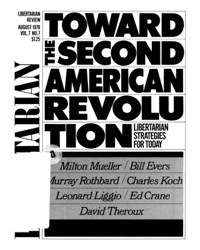
Murray Rothbard wrote a long memorandum on strategy (1977) when the Cato Institute had been founded (1974) and when Rothbard was working within the Libertarian Party (founded 1971), and forming the Centre for Libertarian Studies (1976): Murray N. Rothbard, “Toward a Strategy for Libertarian Social Change” (April, 1977). – PDF and HTML versions; and Murray Rothbard, “Strategies for a Libertarian Victory,” Libertarian Review, Special Issue on “Strategies for Achieving Liberty” Aug. 1978, vol. 7, no.7, pp. 18–24, 34. HTML version; PDF version.
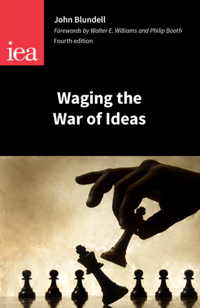
John Blundell wrote a book on “waging the war of ideas” (2001) for the institute of Economic Affairs: John Blundell, Waging the War of Ideas. Fourth edition. (London: The Institute of Economic Affairs, 2001, 2015).
I have written of the topic of strategy as part of my work as Director of Liberty Fund’s Online Library of Liberty Project which was designed to implement a modified Hayekian long term stragety of ideas influencing political action and policy over a decades-long period of dissemination and discussion. See for example:
- my reconstruction of the thoughts of PFG on what his foundation should do and how it should do it: “Pierre F. Goodrich’s Goals and Strategy for the Liberty Fund: A Reconstruction” (2018)] Online
- “How the Online Library of Liberty follows the Strategies outlined by Pierre F. Goodrich” (Feb. 2018) Online
And again at some length in my retirement upon returning to Australia in 2020. (See below).
Further Reading
Titian, “Sisyphus” (1548) |
My blog posts:
Papers and Essays:
|
|
Other Works:
|
|
Rothbard on Strategy for Change:
|