
Revised: 4 May 2026
Introduction | Further Reading
Introduction
(This page is being redesigned and reorganised. In the meantime, see these pages from the old website on this topic.)
I have used films in my teaching and lecturing ever since I began teaching at University in 1986. They were a regular feature in my first year introductory courses on Modern European history, my upper level courses on “German Europe” and “The Holocaust,” and most extensively in my course “Responses to War: An Intellectual and Cultural History” in which, over a period of a decade, I showed about 100 different films. [See "The Politics and History of/in Film" for more details of the films I have used.]
My more mature thoughts on the connections between film and history can be found in the Honors level seminars I taught on ”Reel History: History IN Film and Film AS History” and “Film and the History of Occupation, Collaboration, and Resistance in WW2”; and the guide I wrote on “The Study of War, History, and Film”.
The week long Summer Seminars organized by the Institute for Humane Studies during the 1990s on “Liberty in Film and Fiction” gave me an opportunity to show and discuss films with a group of students who were in creative writing and film studies programs. This experience encouraged me to eventually write my own screenplay for a “political” movie of ideas and the life of the French political economist Frédéric Bastiat during the 1848 Revolution in Paris; as well as to attempt to apply Austrian economic insights into “human action” and the ideas which motivate this “action” to the analysis of film. [This of course prompts one to make the obvious pun on the traditional cry of the film director to begin filming with a call for “Action!” i.e. "human action".]
Further Reading
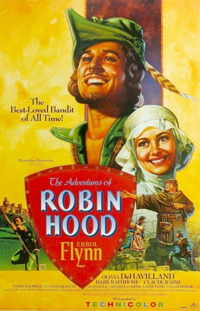
Michael Curtiz, “The Adventures of Robin Hood” (1938) – a man who “speaks treason fluently” to tyrants |
A selection of things to look at:
|