
Revised: 5 May 2026
Introduction | Further Reading
Introduction
Since the political spectrum of what is broadly known as “liberalism” is fairly wide I think it helps to divide it into three sectors in order to make clear the differences which separate them. These differences arise because of the consistency with which liberal principles are applied and one of the most important the principles I have have in mind is the abhorrence of the use of physical coercion or violence against another non-violent person.
Those who are the most consistent are termed “radical” liberals (also “radical individualists”, “voluntaryists”, “anarcho-capitalists”, “haters of the state”, and in an earlier period “levellers”).
Those who occupy the middle ground, who are willing to make compromises with state power on the grounds of “utility”, “moderation”, “practicality”, sometimes “tradition”, and so on) are called “classical liberals” as they were the larger and more influential group in the early and mid-19th century.
Those who were the least consistent, and who were willing to make even greater compromises with state power, either moved into the camp of the social democrats, socialists, and the labour parties and were called “social liberals” or “new liberals”; or they moved into the “nationalist” camp and were “national liberals” or “national conservatives”.
Here I am interested in exploring the first group of “radical liberals”, many of whom cannot be fitted into the “classical liberal” camp yet who none-the-less are strong believers in and defenders of all forms of individual liberty. Such as the following individuals (I ignore for the moment those thinkers who wrote in the post-WW2 period; I also note that they were not always internally consistent themselves – but such is life and such is human nature):
Further Reading
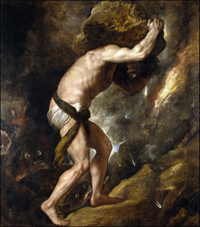
Titian, “Sisyphus” (1548) |
Readings:
|