|



|
Papers I am working on:
- [to come]
The 250th Anniversaary of the American Declaration of Independence
2026 is the 250th anniversary of a number of important publications, such as the following:
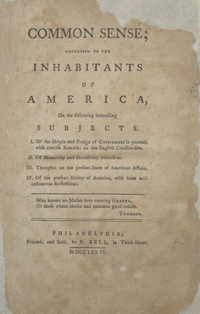
- the publication of Thomas Paine, Common Sense; addressed to the inhabitants of
America (10 January, 1776) in [enahanced HTML] and
[facs.
PDF]
- the first edition of Adam Smith, The Wealth of Nations (9 March, 1776). We have
this online in a "near replica" version of the first edition [enhanced HTML and
facs. PDF vol1 and
vol2] as well as
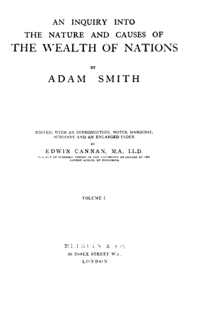
Edwin Cannan's edition of the 5th edition of 1789 (the last to appear in Smith's lifetime) [enhanced HTML and multi-pane
HTML; and facs. PDF vol1 and vol2].
- That same year Condillac published Le Commerce et le Gouvernement (Commerce and
Government) (1776) which we have online in a near replica edition. [enhanced HTML and
facs.
PDF]
- George Mason's (and others), "The Virginia Declaration of Rights" (May and 12
June, 1776). We have online Mason's draft and the final official version. [enhanced HTML
and facs.
PDF and facs.
PDF]
- Thomas Jefferson's (and others), "The Declaration of Independence" (4 July, 1776).
We have online the following versions of this important document (see below for the opening
sentence of each version ...):
- Jefferson's draft and the final official version. [enhanced
HTML and facs.
PDF and facs.
PDF]
- a German translation which was published in Philadelphia the next day. [enhanced
HTML and JPG]
- the standard French translation done by La Rochefoucauld in 1783 in [enhanced
HTML]
- a French version we have done in the style of Jefferson in [enhanced
HTML]
- a Latin version we have done in the style of Cicero in [enhanced
HTML]
- a Latin version done by an unnamed member of Harvard University in the 1820s in [enhanced
HTML]
- a version "translated" into the American vernacular (1921) by H.L. Mencken in
[enhanced
HTML]
- a version we have "translated" into modern Australian English in [enhanced
HTML]
- another version we have "translated" into more colloquial Australian English -
the "backyard BBQ" version - in [enhanced
HTML]
- my own updated version of a Bill of Rights written in time for this coming
"Australia Day" (26 January, 2026) - "Libertas utrimque maris"
(Liberty on both sides of the sea) in [enhanced
HTML]
It seems only fair to allow King George III, whose government was so harshly criticised by
Thomas Jefferson and his colleagues, the "right of reply". So we have constructed a
rebuttal which he might have made, concerning both the principles which lay behind the
Declaration as well as the specific charges made against him. [HTML]
It is also worth noting that in 1975 (the 199th anniversary of the American Declaration) the
Australian libertarian "Workers Paty" published its Party Platform which
included a Bill of Rights which we have here.
- see the sections "The Fundamental Principle", "I.1. Individual Rights",
and "I.2. Rights, Justice and the Law" and the proposed Amendment of the
Constitution concerning a "Bill of Rights" [enhanced HTML]
And to celebrate the 200th anniversary, since we don't have one of our own, I have written my
own "Declaration of Independence" and a "Bill of Rights" in time for
"Australia Day" (26 January, 2026).
- "A Declaration of Independence from the State" (26 January, 2026) [enhanced
HTML and PDF]
- "A New Bill of Rights and the Enumerated Powers of a Limited Government" (26
January, 2026) [enhanced
HTML]
We should add these to the larger collection of 28 Declarations of Rights and Liberties which I
put together in 2024:
- On Limiting the Power of the State: A Collection of Petitions, Charters, Decrees, and
Declarations of Rights and Liberties (1215-1848) (The Pittwater Free Press, 2024). In
[enhanced HTML].
Additions to the Library:
- I have a new series of books online which use a new format to display text with complex and
long footnotes, marginal notes, and glossaries which are placed side-by-side in order to make
reading easier. This "Multi-Pane Reader" has been designed to make complex texts
easier to navigate and read. Typically, these texts have glossaries, tables, indices, foot or
end notes, and bibliographies which can only be consulted by interrupting the flow of reading
and turning to the back of the book where they are usually located. In this Reader they are
instead displayed in a 4th "pane" on the right-hand side while keeping the text
visible in the larger central pane. In addition there is a "Contents" pane on the
left which contains the table of contents, a "Main Text" pane where the body of the
text (the chapters) is displayed in the widest pane, an "Endnotes" pane which
contains the endnotes, and a "Resources" pane which contains other material. I have
seven texts so far in this collection:
- an anthology of 47 entries from Pierre Bayle's Dictionnaire historique et
critique (1697, 1702, 1820) - selected because of its complex format of a main
dictionary entry with long notes below it and marginal notes at the side; with the large
notes having their own marginal notes off to the side [multi-pane
HTML]
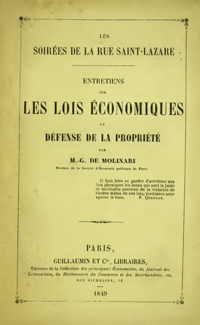
- my new translation of Les Soirées de la rue Saint-Lazare; entretiens sur les lois
économiques et défense de la propriété (1849): Soirées on the rue Saint-Lazare:
Discussions about Economic Laws and a Defence of Property. [multi-pane
HTML]
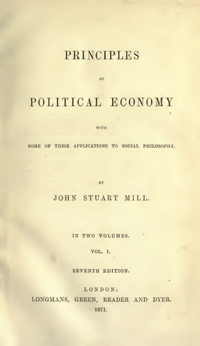
- John Stuart Mill, Principles of Political Economy with some of their Applications to
Social Philosophy (1871) - the last edition published in Mill's lifetime. [multi-pane
HTML]
- my translation of Gustave de Molinari, L’évolution politique et la Révolution
(Political Evolution and the Revolution) (1884) - selected because of its large number of
very long footnotes. [multi-pane
HTML]
- Vilfredo Pareto, Les systèmes socialistes (1902-03) - selected because of its
large number of footnotes, additions to the text, and extensive analytical tables and
indices [multi-pane
HTML]
- The Edwin Cannan edition (1904) of the 5th edition (1789) of Adam Smith, The Wealth
of Nations - selected because of Cannan's extensive notes, marginal summaries, and
expanded index. [multi-pane
HTML]
- Vilfredo Pareto, Traité de sociologie générale (1917-19) - selected because of
its large number of footnotes, additions to the text, and extensive analytical tables and
indices. [multi-pane
HTML]
The opening sentence of the Declaration of Independence in various languages:
- When in the course of human events it becomes necessary for a people to advance from that
subordination in which they have hitherto remained, & to assume among the powers of the
earth the equal & independant station to which the laws of nature & of nature’s god
entitle them …
- When in the Course of human events, it becomes necessary for one people to dissolve the
political bands which have connected them with another, and to assume among the powers of the
earth, the separate and equal station to which the Laws of Nature and of Nature's God entitle
them …
- Wenn es im Lauf menschlicher Gegebenheiten für ein Volk nöthig wird die Politische Bande,
wodurch es mit einem andern verknüpft gewesen, zu trennen, und unter den Mächten der Erden
eine abgesonderte und gleiche Stelle einzunehmen, wozu selbiges die Gesetze der Natur und des
Gottes der Natur berechtigen …
- Lorsque, dans le cours des événements humains, il devient nécessaire à un peuple de
dissoudre les liens politiques qui l’unissaient à un autre, et de prendre, parmi les
puissances de la terre, le rang séparé et égal auquel les lois de la nature et du Dieu de la
nature lui donnent droit …
- Lorsque, dans le cours des événements humains, il devient nécessaire à un peuple de
dissoudre les liens politiques qui l’unissaient à un autre, et d’assumer, parmi les puissances
de la terre, le rang séparé et égal auquel les Lois de la Nature et du Dieu de la Nature lui
donnent droit …
- Cum in humanarum rerum cursu fiat interdum, ut populus alter ab altero dissolvat vincula,
quibus inter se coniuncti sunt, atque inter nationes terrarum potestates sibi pares et
separatas obtineat, ad quas Leges Naturae et Dei Naturae eum ius habere
concedunt …
- Quum in rerum humanarum cursu contingat, ut populus aliquis necessitate coactus vincula
politica, quibus cum alio coniunctus fuit, dissolvat, atque inter terrarum potestates locum
separatam et aequalem, ad quem eum naturae leges et naturae Deus vocant …
- When things get so balled up that the people of a country have to cut loose from some other
country, and go it on their own hook, without asking no permission from nobody, excepting
maybe God Almighty, ...
- and in the cause of "Libertas utrimque maris" (Liberty on both sides of the sea),
a couple of Australian versions for your edification and amusement:
- When it becomes necessary for one people to break away from another, to cut the
political ties that bind them, and to take up an equal and independent place in the
world—as the laws of nature and the Creator entitle them to do …
- Look, sometimes in life you’ve just gotta cut the cord. One lot of people decides
they’ve had enough of being bossed around by another, so they break free and stand on
their own two feet. When you do that, you’ve gotta give the world a heads-up why. …
- WHEN, in the course of human events, it becomes necessary for every person to reclaim
that sovereignty which nature vested in them from their first breath, and which no
compact, no parchment, no vote of the many, nor decree of the few can justly alienate, …
"Libertas sub Cruce Australis"
(Liberty under the Light of the Southern Cross)

|