| The Digital Library of Liberty & Power incorporating the Guillaumin Collection of the Great Books of Liberty |
Home | New | Authors | Works | Papers | Blog | About | Email | Search |
 |
|
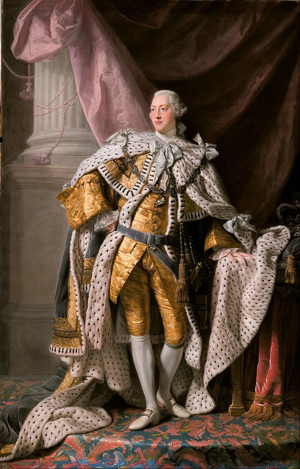
KING GEORGE III
"The Vindication of Authority"
His Reply to the American Declaration of Independence
|
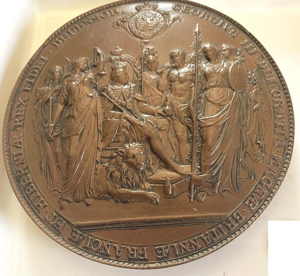 |
| King George III (1738-1820) | The Royal Seal |
|
[Created: 24 January, 2026]
[Updated: 24 January, 2026] |
Source
, "The Vindication of Authority". His Reply to the American Declaration of Independence, followed by his "A Particular Answer to the Accusations Exhibited Against the Crown" (1776, 2026).http://davidmhart.com/liberty/ClassicalLiberalism/Rights/1776-DeclarationIndependence/George-III/Reply.html
King George III, "The Vindication of Authority". His Reply to the American Declaration of Independence, followed by his "A Particular Answer to the Accusations Exhibited Against the Crown" (1776, 2026).
This document is part of a collection of works on Rights and Declarations.
The Royal Reply to the Declaration of Independence of the Colonies
By the Grace of God, George the Third,
King of Great Britain, France, and Ireland,
Defender of the Faith, &c.
When subjects, forgetting the duties of obedience and gratitude, presume to arraign their lawful Sovereign before the tribunal of their own passions, it becomes necessary—not for the vindication of authority, which stands secure in God’s ordinance—but for the instruction of the misled and the correction of error, that the Crown should speak plainly.
I. Of Authority and Divine Right
It is a truth established not by novelty or speculation, but by the uninterrupted testimony of Scripture, law, and history, that Kings rule by the providence of Almighty God, and not by the mutable opinions of men. Authority descends from Heaven; it does not rise from the multitude.
Subjects, whether in Britain or in her colonies, possess no inherent right to call into question the legitimacy of their Sovereign. Obedience is not a matter of convenience but of duty; resistance is not a remedy but a crime.
To deny this principle is not merely to dispute a monarch—it is to challenge the order established by God Himself.
II. Of the Constitution and the Wisdom of Ages
The constitution of the British state—uniting Crown, Church, Parliament, Courts, and Army—is not the contrivance of a single age, but the inheritance of centuries. It has been tested by war and peace, by prosperity and adversity, by rebellion and restoration.
This system has secured to Britons, at home and abroad, a degree of liberty, property, and security unknown to most nations of the earth. To assault it in the name of abstract theory is the arrogance of the inexperienced and the folly of the ungrateful.
What has endured for ages is not to be overthrown by the impatience of a generation.
III. Of the Bulwarks of the Realm
In attacking the authority of the Crown, the authors of this Declaration strike at the very pillars that uphold civil society:
- The Crown, which unites the realm and restrains faction
- The Church, which preserves moral order and divine law
- Parliament, which balances counsel with authority
- The Courts, which administer justice under established law
- The Military, which defends the realm against foreign and domestic enemies
These institutions are not usurpations but safeguards. Those who seek to weaken them do not advance liberty—they invite anarchy.
IV. Of Protection and Paternal Rule
The King is not the enemy of his people but their protector. His duty is to secure peace, order, and justice, not to indulge sedition or reward disorder.
It is not the Crown that has disturbed tranquility in the colonies, but agitators and demagogues, who inflame discontent, defy lawful authority, and substitute passion for reason.
The Sovereign governs for the good of all his subjects, not for the ambition of a faction.
V. Of Lawful Redress and Established Remedies
The British constitution has never denied its subjects the means of complaint or reform. Petitions, representations, and parliamentary deliberation are the proper instruments of redress.
To abandon these lawful paths in favor of threats, violence, and unilateral declarations is not reform—it is rebellion.
Grievances presented with humility may be examined; grievances enforced by arms are crimes.
VI. Of Crimes and Sedition
Many among the leaders of this movement have committed acts that no government, however patient, can tolerate:
- The incitement of armed resistance
- The obstruction of lawful officers
- The seizure of royal property
- The encouragement of insurrection and disorder
Such acts are not the exercise of liberty but violations of allegiance, punishable under the laws of the realm.
VII. Of the Fiction of “Natural Rights”
The assertion that men possess rights independent of God and law is a dangerous falsehood.
There are no rights in nature—only powers and instincts. Rights arise from divine ordinance, interpreted and administered through lawful authority. God does not govern mankind through abstractions, but through institutions.
To claim rights against the Sovereign is to misunderstand their very source.
VIII. A Reply to the Enumerated Accusations
The acts now alleged as tyranny—taxation, regulation, enforcement of law, maintenance of order—are not injuries but duties of government. Measures taken to preserve the unity and security of the empire have been represented as oppression only by those who resent restraint.
What has been done has been done for the benefit of the whole realm, including the colonies themselves.
Conclusion and Royal Admonition
We therefore declare that these proceedings are unlawful, groundless, and dangerous; that they threaten not only the peace of the empire but the foundations of civil society; and that those who persist in them do so at their peril.
Let all our subjects lay aside this misguided course, return to their allegiance, and seek redress by lawful means.
Failing this, the full force of the law and the power entrusted to Us by God will be employed to restore order and obedience.
Given at Our Court, in the Sixteenth Year of Our Reign,
God Save the King.
A Particular Answer to the Accusations Exhibited Against the Crown
George III, by the Grace of God, King, &c., to his deluded subjects in the American Colonies
You have thought fit to catalogue acts of government as if they were crimes. We therefore reply in the same order, that your errors may be exposed not in generalities but in particulars.
1. “He has refused his Assent to Laws, the most wholesome and necessary for the public good.”
- No law proposed by colonial assemblies acquires force by mere desire. The royal assent is not ceremonial but deliberative. Measures inconsistent with imperial unity, justice to other subjects, or the authority of Parliament cannot be approved merely because they are locally convenient.
- That which is denied is denied for the good of the whole empire, not from caprice.
2. “He has forbidden his Governors to pass Laws of immediate and pressing importance…”
- Governors act under commission, not impulse. Temporary laws of consequence properly await royal consideration, lest haste produce disorder. Delay is not tyranny; it is prudence.
3. “He has refused to pass other Laws… unless those people would relinquish the right of Representation…”
- No subject may condition obedience upon demands that contradict the constitutional order. Representation in Parliament is not a natural entitlement but a historical arrangement. The empire is not governed by bargaining with assemblies.
4. “He has called together legislative bodies at places unusual, uncomfortable, and distant…”
- Assemblies are summoned where order and security permit. When assemblies have abused their privileges to foment sedition, it becomes necessary to restrain their convenience in order to preserve the peace.
5. “He has dissolved Representative Houses repeatedly…”
- No representative body possesses an indefeasible right to exist while it defies lawful authority. Dissolution is a constitutional remedy against obstruction, not an act of vengeance.
6. “He has refused for a long time… to cause others to be elected…”
- When elections become instruments of faction rather than governance, restraint is required. Government exists to preserve order, not to indulge perpetual agitation.
7. “He has endeavoured to prevent the population of these States…”
- Regulation of settlement is an imperial matter, not a local indulgence. Expansion without order invites conflict, lawlessness, and war. The Crown restrains settlement to protect subjects, not to oppress them.
8. “He has obstructed the Administration of Justice…”
- Courts cannot function where law is defied. Judicial reforms require stability, not intimidation. Where courts are resisted or undermined, delay follows as a natural consequence of disorder.
9. “He has made Judges dependent on his Will alone…”
- Judges are appointed by the Crown so that justice may be impartial, not captive to local passions. Independence from faction is not dependence upon tyranny.
10. “He has erected a multitude of New Offices…”
- Administration grows with population and commerce. Offices exist to govern, not to flatter republican sensibilities. Those who resent lawful authority resent all governance whatsoever.
11. “He has kept among us, in times of peace, Standing Armies…”
- An empire exposed to foreign powers and internal unrest requires defense. Troops are stationed not against loyal subjects but against disorder. If peace were maintained, arms would rest.
12. “He has affected to render the Military independent of and superior to the Civil power.”
- The military remains subordinate to lawful authority. When civil authority is defied, force becomes its necessary instrument. The blame lies not with the Crown, but with those who provoke resistance.
13. “He has combined with others to subject us to a jurisdiction foreign to our constitution…”
- Parliament is not foreign. It is supreme. To deny this is to deny the constitution itself.
14. “For imposing Taxes on us without our Consent…”
- Taxation is the prerogative of sovereignty. Protection, defense, and administration impose costs. Those who enjoy the benefits of empire cannot refuse its burdens.
- Consent is given through allegiance, not through perpetual negotiation.
15. “For depriving us in many cases, of the benefits of Trial by Jury…”
- Juries exist under law, not in defiance of it. Where crimes against the state are committed, special jurisdictions are required to ensure justice.
16. “For transporting us beyond Seas to be tried…”
- Crimes against imperial authority are properly tried where impartial justice can be ensured. Local sympathies cannot be allowed to defeat law.
17. “For abolishing the free System of English Laws in a neighbouring Province…”
- Different provinces require different laws. Uniformity is not liberty. Adaptation is wisdom.
18. “For taking away our Charters, abolishing our most valuable Laws…”
- Charters are grants, not eternal compacts. They exist by royal authority and may be amended when abused.
19. “For suspending our own Legislatures…”
- Legislatures that cease to legislate and instead conspire cannot be permitted to paralyze government.
20. “For declaring us out of his Protection and waging War against us.”
- Protection cannot be extended to those who reject allegiance. Resistance dissolves protection by its own act.
21. “He has plundered our seas, ravaged our Coasts…”
- Acts of war follow rebellion. Responsibility rests with those who initiated hostilities.
22. “He has excited domestic insurrections amongst us…”
- The Crown does not incite disorder. Those who destroy lawful authority invite consequences they cannot control.
23. “He has endeavoured to bring on the inhabitants of our frontiers… the merciless Indian Savages…”
- Frontier conflicts arise from unlawful expansion and broken treaties. The Crown has sought restraint; agitators have sought conquest.
My Final Judgment
These accusations are not proofs of tyranny but evidence of impatience with law, order, and restraint. You mistake authority for oppression, discipline for despotism, and obedience for servitude.
Let this be understood plainly:
The Crown governs by divine and constitutional right.
Allegiance is not a prerogative of any particular individual.
Resistance is nothing more than rebellion aginast our most cherished institutions and customs.
Return to obedience, or accept the consequences ordained by law, sanctified by God, and enforced by arms.
God save the King.