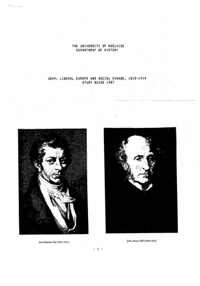
Liberal Europe Course Guide (1987)
 Goya, “The Sleep of Reason produces Monsters” (1797)
|
Teaching about Liberty and Power
In my teaching of modern European history one of the themes I have pursued is the conflict between liberty and power over the centuries, between those who pursue peaceful and productive activities and engage in voluntary trade with each other for mutual benefit; and those seek, gain, and exercise political power which they use for their own benefit at the expence of those who do not. This study involves two things: the evolution of the social, political, legal, and political institutions by means of which these productive and unproductive (exploitative) activities are carried out (markets vs. the state); and the ideas which are used to justify or critise these institutions and activities. I have taken this approach in several courses I have taught such as the following. In these courses I have also made us of works or art, music, and film to illustrate the points I am making. Many of the course guides I developed were lavishly illustrated with relevant examples of art and film:
- Undergraduate level:
- “Liberal Europe and Social Change (1815-1914)”;
- “The Old Regime, the Enlightenment and Revolution in 18th Century Europe”;
- “Revolution and the Struggle for Emancipation in Europe: The Long 19th Century (1789-1914)”;
- “German Europe: From the French Revolution to Reunification”,
- “Responses to War: An Intellectual and Cultural History”.
- Honours level:
- “The Enlightenment: Ideas of Criticism and Reform in an International Context”;
- “Film and the History of Occupation and Resistance in WW2”;
- “Reel History: Film and the Study of History”;
- “Responses to War: An Intellectual and Cultural History”
|

Frontisepiece to Hobbes, Leviathan (1651)
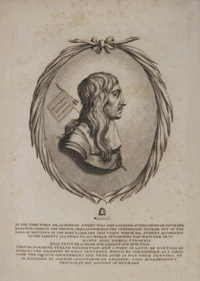
Hollis etching of Algernon Sidney (1763)

Hyacinthe Rigaud, “Louis XIV” (1701)

“Liberty killing the Hydra of Tyranny” (1793)

Barralet, “The Apotheosis of Washington” (1802)

Revolutionary Playing Card (1793)

The British Atlas
|
Liberty and Power in Art
Over the years I have written dozens of what I call short “illustrated essays” in which I explore the political and economic ideas depicted in works of art (broadly defined). I am interested in the way the state used images to glorify the position and authority of the leader, and used propaganda to justify its actiions and to rally support among the people. On the other hand, critics of the regime also used imagery to make their case and to appeal to their readers and supporters. Many of these essays were written while I ran the Liberty Fund’s Online Library of Liberty. The links to these essays may or may not work if the URLs have been changed. Others I have posted on my blog or are stored on this website.
Illustrated Essays at my Blog “Reflections on Liberty and Power”
- From Bayeux to Guernica: The Depiction of Power, Destruction, and Suffering in War Art (August 19, 2023) [essay]
- Mao waves “hello” in his Bathrobe (March 9, 2022) [essay]
- An Allegory of War and Peace (July 19, 2021) [essay]
- The Myth of a liberal “Australian Way of Life” (June 20, 2021) [essay]
- “God save us from the King”: or the Problem of Regal Vice (June 16, 2021) [essay]
- Making and Breaking the Image of King Charles I (May 27, 2021) [essay]
- James Gillray on Debt and Taxes during the War against Napoleon (February 23, 2021) [essay]
- One Volume Surveys of Classical Liberal Thought (January 11, 2021) [essay]
- Thomas Hobbes’ Iconography of the Leviathan State (December 18, 2020) [essay]
- The Cover Art of Voluntary Servitude (November 29, 2020) [essay]
- Plutology II: Disney Plutology vs. WB Bugsology (November 19, 2020) [essay]
- Picasso and the Anti-Vietnam War Movement 1969 (July 12, 2015) [essay]
- Slavery and the Hypocrisy of July 4 (July 7, 2015) [essay]
- Pablo Picasso’s “Guernica” (1937) (June 25, 2015) [essay]
- So-called New Socialist Ideas in the 1848 Revolution (July 16, 2014) [essay]
Illustrated Essays at this Website (this page lists the essays with a summary and a link to the full essay):
- “The Art of the Levellers” – a collection (with commentary) of some of the more interesting title pages of Leveller pamphlets from the 1640s, some of which contain striking woodcuts as illustrations [essay]
- A Lecture on Art and Propaganda: “The Culture of Obedience and the Subversion of State Propaganda” (IHS Summer Seminar, June 2015) [PDF of lecture overheads]
- Images of the Ruling Class and The State: some of the caricatures and other images which depict the ruling class and the state in a classical liberal manner [essay]
- Images of the Ruled as “Atlas”; some images which depict “the ruled” as Atlas with the burden of the world on his shoulders [essay]
- Images of the Anti-Tax Smuggler Louis Mandrin (1725-1755) – the 18thC French Robin Hood (Jan. 2017) – [longer essay]
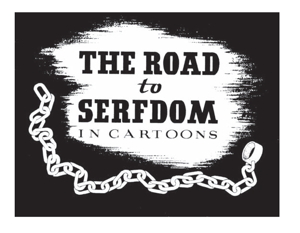
- Look magazine’s illustrated version of Hayek’s The Road to Serfdom (1945) (Jan. 2017) – [the complete collection of 18 images]
- Illustrations for a “sampling” of Bastiat’s The Law (1850) (Jan. 2017) [more]
- “Eugène Delacroix on Press Censorship and Liberty during the Restoration (1815-1830)” (Sept. 16, 2001) [More]
- “An Anti-Socialist Cartoon from 1848 : Amédée de Noé, dit Cham, “Ce qu’on appelle des idées nouvelles en 1848” (What are called “New Ideas” in 1848)” (15 July, 2014) – [More]
- “The Burdens on the Modern Atlas (early 21stC)” (September 29, 2011) – [more]
- “Béranger’s Song of “The Smugglers”” (October 27, 2011) – part of a longer essay on “Béranger’s “Songs of Liberty”” [More]
- “Spying by the State: Jeremy Bentham’s plan for a “Panopticon” (all-seeing) penitentiary, and Covers for Penguin editions of George Orwell’s dystopian novel Nine-Teen Eighty Four (1949)” (12 July, 2014) – (there is no longer essay)
- “Women & Children on Voting Day: An anti-“Votes for Women” Poster (c.1909)” (Nov. 8, 2010) – [more]
- “Republican & Imperial Leaders (Washington & Napoleon) in their Studies” (Nov. 19, 2010) – [more]
- “The Divine Right of Kings or Regal Tyranny?: Frontispiece to Thomas Hobbes, The Leviathan (1651)” (Dec. 1, 2010) – [more]
- “Liberty Slaying the Monster of Tyranny and Oppression: Pierre Paul Prud’hon et Jacques Louis Copia, “Liberty overthrowing the Hydra of Tyranny (1793)” (Dec. 3, 2010) – [more]
- “Monuments to Two 19th Century Free Traders: Frédéric Bastiat (1801-1850) & Richard Cobden (1804-1865): Gabriel-Vital Dubray, “Frédéric Bastiat” (1878)” (Dec. 4, 2010) – [more]
- “Images used by the British Abolitionist Movement in the 1780s: “Am I not a Man and a Brother?” Official Medallion and Motto of the British Society for Effecting the Abolition of the Slave Trade (1787)” (Jan. 2, 2011) – [more]
- “Thomas Hollis’ Imagery of Liberty. “Thomas Hollis, Fellow of the Royal Society, Member of the Society of Antiquaries 1767,” by Giovanni Battista Cipriani [c.1767]” (Feb. 4, 2011) – [more]
- “New Playing Cards for the French Republic (1793-94): The Spirit of Commerce (Motto: “Wealth”)” (Feb. 9, 2011) – [more]
- “Presidents Day and the Apotheosis of Washington: John James Barralet, “The Apotheosis of Washington” (1802)” (Feb. 21, 2011) – [more]
- “Tax Return Filing Day and the Tax Eaters: Honoré Daumier, “Gargantua” (1831)” (April 10, 2011) – [more]
- “An anti-Gaddafi Mural in Benghazi” (June 27, 2011)
- “Thomas Nast and the Slavery of the Income Tax (1878)” (Nov. 13, 2010) – [More]
A Selection of Illustrated Essays from the OLL website:
- “New” Socialist Ideas in the 1848 Revolution
- Abraham Lincoln as the “Federal Phoenix” (1864)
- Adam Smith and J.B. Say on the Division of Labour
- Algernon Sidney (1622-1683) and the Thomas Hollis Library of Liberty
- Art of the Levellers
- Brueghel, Taxes, and the Numeration of the People of Bethlehem (1566)
- Cobden and the Anti-Corn Law League
- Declaration of the Rights of Man and of the Citizen
- Eugène Delacroix on Press Censorship during the Restoration (1814-1822)
- Images of the British Abolitionist Movement
- Jacques Callot, Hugo Grotius, and the Miseries of War in the 17th Century
- James Gillray on War and Taxes during the War against Napoleon
- Liberty slaying the Monsters of Tyranny and Oppression
- Lilburne quoting Coke on English Liberties at his treason trial (1649)
- Ludwig von Mises on Rationing in WW2
- Mises on Gresham’s Law and Ancient Greek Silver Coins
- Monuments to Free Trade: Bastiat and Cobden
- New Playing Cards for the French Republic (1793-94)
- Ngrams and the Changing Vocabulary of Class Analysis in 19th Century Classical Liberal Thought
- Presidents Day and the Apotheosis of Washington
- Samuel warns the Israelites of the Dangers of Kings
- The Divine Right of Kings or Regal Tyranny? (Hobbes and Lilburne)
- The People and the Ruling Elite in Caricatures (Wade and Daumier)
- The Spanish-American War and the Anti-Imperialism League (1902)
- The Très Riches Heures du Duc de Berry (1416)
- Thomas Clarkson and the Abolition of the Slave Trade
- Thomas Hollis and John Locke
- Thomas Jefferson in the Cyclopedia
- Tocqueville and Bastiat on the 1848 Revolution in Paris
- Washington and Napoleon in their Study
- William Blake’s Illustrations of the Book of Job
|
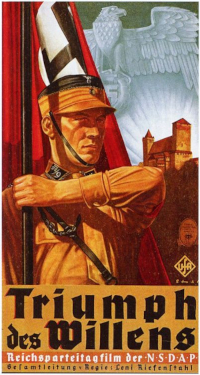
Leni Riefenstahl, “Triumph of the Will” (1935)
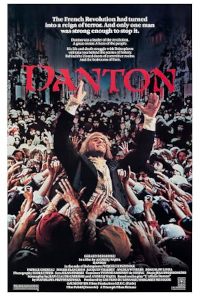
Andrez Wajda, “Danton” (1982)
|
Liberty and Power in Film
My main interest has been in the depiction of war in film and art which has its own separate page here. Concerning the broader issue of politics and economics in film I have the following items. The week long Summer Seminars organized by the Institute for Humane Studies during the 1990s on “Liberty in Film and Fiction” gave me an opportunity to show and discuss films with interesting political and economic content with a group of students who were in creative writing and film studies programs. These films included:
- Georg Wilhelm Pabst, Kameradschaft (Comradeship) (1931) 1hr 32 mins [HTML]
- Leni Riefenstahl, Triumph des Willens (Triumph of the Will) (1935) 1hr 49mins [HTML]
- Akira Kurosawa, Rashomon (1950) 1hr 27 [HTML]
- Claude Autant-Lara, Le Rounge et le noir (The Red and the Black) (1954) 3hrs 10 [HTML]
- René Clément’s Gervaise (1956) – 1hr 50mins [HTML]
- Miklos Jansco, The Round Up (1965) 1 hr 24 mins [HTML]
- Vojtech Jasny, All My Good Countrymen (1968) 1 hr 55 mins [HTML]
- Sam Peckinpah, The Wild Bunch (1969) (Director’s Cut 1996) 2 hrs 25 mins [HTML]
- Rainer Werner Fassbinder, Effi Briest (1974) 2 hrs 20 mins [HTML]
- Werner Herzog, Woyzeck (1978) 1 hr 20 mins [HTML]
- Andrzej Wajda, Danton (1982) 2hrs 16mins [HTML]
- Daniel Vigne, The Return Of Martin Guerre (1982) 2hrs 3 [HTML]
- Istvan Szabo, Colonel Redl (1984) 2 hrs 29 mins [HTML]
- Richard Bonynge conducts Mozart, The Magic Flute (1791) (1986) The Australia Opera 2hrs 40m [HTML]
- Claude Berri, Jean de Florette (1987) 2hrs 2 and the sequel Manon des Sources (1987) [HTML]
- Volker Schloendorff, The Handmaid’s Tale (1990) 1hr 49 [HTML]
- Norman Jewison, Other People’s Money (1991) 1hr 41 [HTML]
This experience encouraged me to eventually write my own screenplay for a “political” movie of ideas and the life of the French political economist Frédéric Bastiat during the 1848 Revolution in Paris; as well as to attempt to apply Austrian economic insights into “human action” and the ideas which motivate this “action” to the analysis of film. The depiction of economic ideas in film is particularly difficult to do well.
- “Broken Windows”. A Screenplay about the Life and Work of Frédéric Bastiat (1801-1850) [HTML] with an accompanying “Illustrated History of the Life and Work Frédéric Bastiat” [HTML].
- “Bastiat goes to the Movies, or “Filming Freddie”: How to Popularise Economic Ideas in Film” (2017). A paper I gave at the APEE Annual Conference, April 2017. [HTML].
- “Some Thoughts on an ‘Austrian Theory of Film’: Ideas and Human Action in a Film about Frédéric Bastiat” (Sept. 2019) [HTML]
|
