
The New Website
The Digital Library of Liberty & Power has been redesigned. What you are now reading is the new “front end” to the website which has been in existence since June 2010. We have kept the old website (davidmhart.com/liberty) as the Repository of the texts in their various formats (HTML, facsimile PDF, and ePub) and my essays and papers, but we are also making use of WordPress for its content management tools and its blogging feature which have ben modified to suit the needs of an academic and educational website (davidmhart.com/wordpress/).
You can still access the legacy front pages here:
- the introduction to the site
- the “Recent Additions” page
The Key Features of the Website
The “Intellectual Diary” of Additions to the Collection
For the past six years I have been keeping an “intellectual diary” to chronicle the new books and essays I have put online. The additions for this year are listed on the front page. The additions for the previous years can be found here: 2020 | 2021 | 2022 | 2023 | 2024 | 2025.
Blog: “Reflections on Liberty & Power”
I have been blogging since December 2011 where I post my occasional “Reflections on Liberty & Power”. See the full list of posts and categories in the WordPress format and an alternative list in my preferred format here.
“Groups of Authors” and “Collections of Works”
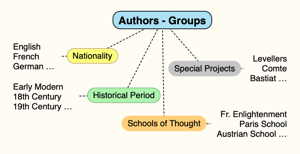
The library is organized around “Authors” and their “Works”. The authors are organised into “groups”, such as
- their nationality (or the language in which they wrote),
- the historical period in which they lived,
- the schools of thought to which they belonged, and
- “Special Projects” in which I have a particular interest (such as Charles Comte and Charles Dunoyer, Frédéric Bastiat, Gustave de Molinari, the Levellers, and the Monarchomachs)
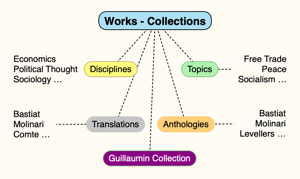
Their works are organised into “collections”, such as
- disciplines,
- topics, (such as essays and bibliographies on the History of the CL Tradition, Critics of Socialism, CL Class Analysis, “illustrated essays” on Images of Liberty and Power, Strategies for Achieving a Free Society)
- anthologies I have edited
- translations I have done
- and other specific collections of various kinds, especially the “Guillaumin Collection of the Great Books about Liberty”
We believe that a better understanding of liberty can be achieved by studying the connections, networks, and currents of influence which link both individual authors and activists, and the texts in which liberal ideas were expressed and propagated. To show these connections and relationships is one of the purposes of the Digital Library. Many of the pages for these Groups of Authors and Collections of Works are accompanied by an introductory essay which explains their significance and a guide for further reading.
Wherever possible we include an image of the author and the title page of the book as we strongly believe that it is important to keep in mind that particular individuals, at particular historical moments, wrote particular books, and engaged in particular debates, all of which liberals at the present time should be interested in understanding and appreciating.
Formats of the Works
In the Library texts of various kinds can be found. Most are books, but there are also pamphlets, political documents, and declarations in which ideas about liberty and power have been vigorously discussed and debated. We also have online a large number of images, such as works of art, book illustrations, and propaganda which express political ideas. See the “illustrated essays” we have written under “Topics / Images of Liberty and Power” in the top navigation bar, or directly here.
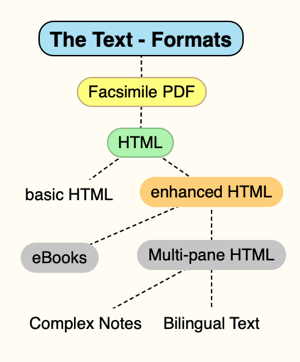
Our philosophy is to provide the written texts in a variety of formats which can be read online or downloaded. These include:
- a facsimile PDF of the original work, which is the foundational version of the text,
- an HTML version of the facsimile PDF which we have “enhanced” by including the original page numbers of the book, the inclusion of a citation tool to aid scholars (for more information about this see the “Guide to Using the Citation Tool“, and a format which is easier to read online (based on the design ideas of Edward Tufte). The texts are now 600px wide (instead of 750 which was the standard previously), there is more spacing between the lines and the paragraphs, and the background colour is an off-white.
- an ePub version which can be read on portable devices
- and for more complex works we have developed a multi-pane framework in which to read the texts which have large numbers of notes, appendixes, and glossaries, or to view translations of key texts side-by-side with the original. (See the collection of “Multi-pane Readers” and “Bilingual Readers” here.)
Anthologies and Translations
To assist those interested in exploring the classical liberal and libertarian tradition of thought we have many Anthologies of writings by key authors, and we have begun a Translation project to bring less well-known texts (especially the French classical liberal tradition) to the attention of our readers.