The Art of the Levellers

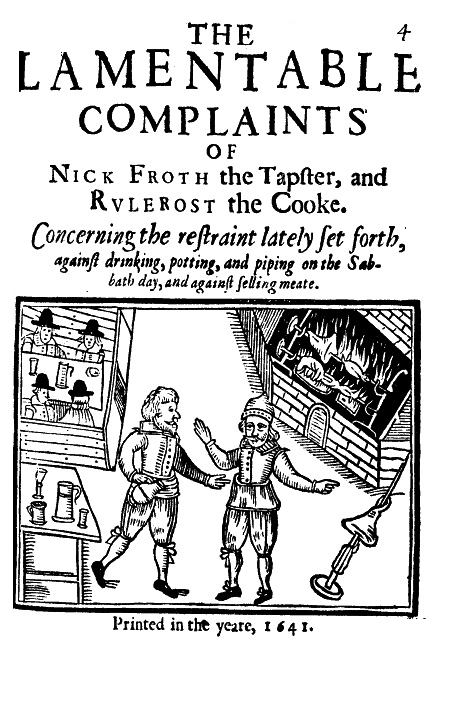
In the course of putting together a multi-volume collection of over 300 Leveller Tracts I came across some very interesting title pages which used typography and occasionally woodcuts to add graphical force to the political and economic arguments being made by the authors. The pamphlets were published in their thousands during the 1640s and 1650s … Read more

Richard Overton on Tyrants

About Richard Overton Richard Overton (c. 1599–1664) is one of the intellectual and political leaders of the Levellers during the English Revolution. Little is known about his early life although he probably graduated from Queens College, Cambridge and worked as an actor before becoming involved in political pamphleteering at which he excelled. He wrote dozens … Read more

The Leveller Tracts Collection: Chronology of Events for 1647

The year 1647 was a very important one for the Levellers as it brought their demands for political reforms to a head. In March William Walwyn wrote the “Petition of March” (The Large Petition) (T.92) which presented the main demands of the Levellers within the Army. This was followed in October by a more radical … Read more

Leveller Tracts vol. 7 (1650-1660)

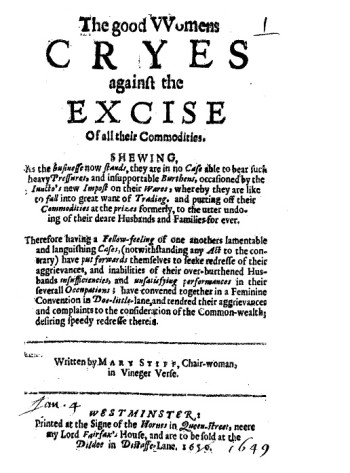
1650-01-04-Stiff_AgainstExcise_TP516

The uncorrected HTML of volume 7 of the Leveller Tracts (1650-60) is now online at the OLL. There are 42 pamphlets which have a total of 1,055 illegible words and characters which need to be corrected before it will go into the main OLL library. It covers the period of the Commonwealth, the rise of Cromwell’s Protectorate, and the gradual defeat and dispersal of the Leveller movement.

Highlights include more tracts on economic matters (such as taxes and free trade), Sexby’s notorious pamphlet advocating the killing of Cromwell as a tyrant, and the pamphlet by Margaret Fell Fox advocating the right of women to speak in Church:

  • Mary Stiff, The good Womens Cryes against the Excise of all their Commodities (4 January 1650)
  • Anon., The Soap-makers Complaint for the losse of their Trade (24 September 1650)
  • William Walwyn, Walwyns Conceptions; for a Free Trade (May 1652)
  • William Prynne, A Declaration and Protestation against New Taxes (18 October, 1653)
  • James Freize, A Moderate Inspection into the Corruption of the Common Law of England (17 June, 1656)
  • Edward Sexby, Killing, No Murder (21 September, 1657)
  • Margaret Fell Fox, Womens Speaking Justified (c. 1666)
Read more