Œuvres complètes de Gustave de Molinari

The Institut Coppet has recently published volume 9 of the Œuvres complètes (Complete Works) of Gustave de Molinari, thus completing the first 10 years of his long and very productive life. Only 60 more years to go! See a comprehensive (though probably still not complete) bibliography of his works which consists of 73 Books, Printed … Read more

Molinari on War and Peace

Introduction Towards the end of his very long life, the French economist Gustave de Molinari (1819-1912) said that he had spent his entire life fighting in one form or another, protectionism, socialism, slavery, statism, and militarism. He went to Paris as a young man and would-be journalist in 1841 from his native Belgium and began … Read more

The Institut Coppet’s Collected Works of Molinari

Institut Coppet, Oeuvres complètes The Institut Coppet is a fabulous resource for material on the very rich and fascinating French classical liberal tradition. It was founded in 2010 by Damien Theillier, a philosophy teacher in Paris, its current president is Mathieu Laine, and its very active publishing program is headed by the indefatigable Benoît Malbranque. … Read more

Gustave de Molinari and the Story of the Monopolist Grocer

Let us follow our hypothesis to the end. To the extent that the progress of competitive industries makes the lack of improvement of monopolized commerce more noticeable and more damaging, consumers will complain more about this monopoly. However, if it is protected by some ancient superstition, if everybody is convinced that it is the nature … Read more

Papers given at the Libertarian Scholars Conference, NYC, 21 Sept. 2019.

Was Molinari a true Anarcho-Capitalist? (1.) “Was Molinari a true Anarcho-Capitalist?: An Intellectual History of the Private and Competitive Production of Security”. A paper given at the Libertarian Scholars Conference, NYC, 21 Sept. 2019 [Full paper HTML and PDF – Slides – Handout ]. See the abstract of the paper below. Some Thoughts on an … Read more

Was Molinari a true Anarcho-Capitalist?

As part of the bicentennial celebrations of the birth of Gustave de Molinari, the world’s first true anarcho-capitalist, I wrote the following paper: “Was Molinari a true Anarcho-Capitalist?: An Intellectual History of the Private and Competitive Production of Security” a paper given at the Libertarian Scholars Conference, New York City, 28 Sept. 2019. http://davidmhart.com/liberty/Papers/Molinari/ProductionSecurity/index.html>] The … Read more

Frédéric Bastiat (1801-1850) and Rethinking Classical Economics in the mid-19th Century

Talk given to a Conference on “A Brief History of Economic Thought,” Institute for Liberal Studies, The University of Toronto, Bahen Centre Friday 29 September, 2012 Online here Abstract: The decade or so 1845-1856 saw a major re-thinking taking place in the nature of classical economic thought in France. The first generation of 19th century … Read more

Gustave de Molinari and the Future of Liberty in 1901: ‘Fin de Siècle, Fin de la Liberté’?

Online here Abstract: This paper examines Molinari’s assessment in two articles he wrote at the turn of the 20th century of the achievements of liberty in the 19th century and his prognosis for liberty in the coming 20th century. Concerning the latter, he successfully predicted two related things: firstly, that anti-liberal policies being introduced in … Read more

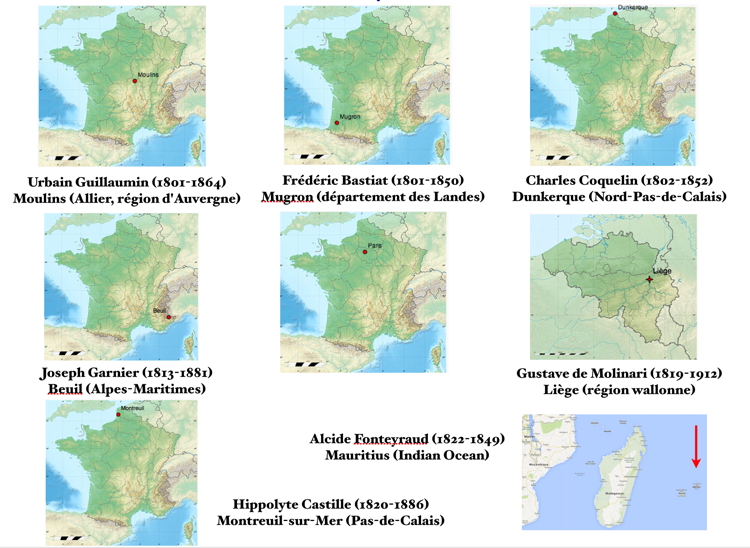
Gustave de Molinari and the Seven Musketeers of French Political Economy

7Musketeers

See the full paper at my main website.

This is part of a book-length “introduction” (300 pp.) I have written to the translation of Molinari’s Les Soirées de la rue Saint-Lazare (1849). It includes a brief biography of Molinari; a discussion of the struggle against protection in France from the 1820s to the late 1840s; the socialist attack on private property and the legitimacy of profit, interest and rent in the 1840s; a brief history of the popularisation of economic theory and the role played by the “conversation” format; Molinari’s and the economists’ activities during the 1848 Revolution; and Molinari’s theory of liberty and the “natural laws” of political economy which he presents in Les Soirées.

Abstract: In Paris in the 1840s there emerged a very special and unique collection of individuals who came together to promote classical liberal and free market thought and to fight socialism and interventionism. I call them “the Seven Musketeers” of French political economy. The term “Musketeer” comes from Gérard Minart’s new biography of Gustave de Molinari (2012) in which he described Frédéric Bastiat, Molinari, and 2 other colleagues (Guillaumin, Coquelin) as “The Four Musketeers”. This is quite appropriate as Dumas’ popular novel came out in 1844 [it was serialised in Le Siècle] and Bastiat, like D’Artagnan, came from the south-west province of Gascony. These economists formed a close band of liberal intellectuals and activists in Paris who were fighting protectionism and socialism not the Protestant enemies of the King of France as the original Musketeers were. My research has revealed that 7 individuals actually fit this description. They are made up of two generations who were key figures in the classical liberal and political economy movement. The 1st were born around 1800 and were in their mid to late 40s in 1848; the 2nd were born around 1820 and were in their late 20s in 1848.

Read more

Molinari’s “Eleventh Soirée” on the private provision of security

Date: 6 April, 2015

Molinari_Soirees_0383_TP

A revised translation of Molinari’s “Eleventh Soirée” on the private provision of police and defence will be published in an anthology on Panarchy: Political Theories of Non-Territorial States edited by Aviezer Tucker and Gian Piero de Bellis for Routledge (2016). I updated the translation and added many footnotes.

Read more