
Revised: 4 May 2026
Introduction | Further Reading
Introduction
I am interested in two very different sets of "the great books". The larger and more traditional set is the so-called "Great Books of the Western Tradition" as it has evolved over the past hundred years, beginning with Columbia University’s "the Core" undergraduate program developed in the 1920s, to the version conceived by Robert Hutchins and Mortimer Adler at the University of Chicago in the 1940s and 50s, and then an offshoot of the Chicago collection created by the founder of Liberty Fund, Pierre Goodrich also in the 1950s.
I spent 20 years putting online and curating Pierre Goodrich’s collection of the great books (by some 100 authors) and encouraging their use by the members of the Association of Core Texts and Courses who taught them at the college level.
The second set of great books is one developed by me over the past few years which is a subset of the larger sets of books, namely "The Great Books of Liberty." I differ from the more traditional approach in stressing the importance of the historical context in which the text was written, the ongoing debates with which the author of the text engaged or triggered as a result of their ideas, the importance of economic thought as a key aspect of the "western tradition" which is one more thing which makes it different from other "traditions" or "civilisations," and the fact that the outcome of these debates was not foreordained. In other words, many ideas which we take for granted today as "western" were hotly contested at the time and the course of history could have and often did go in other directions depending upon which ideas won out. The fact that the great English classical liberal John Stuart Mill (1806-1873) and the founder of revolutionary socialism ("communism") the German Karl Marx (1818-1883) were both products of "western civilisation" poses a problem which needs to be resolved. To attempt to see this problem more clearly I have drawn up a list of more than twenty pairings of texts, what I have termed "provocative pairings", which I believe shows how "contested" and "contentious" fundamental "western" ideas have actually been.
Further Reading
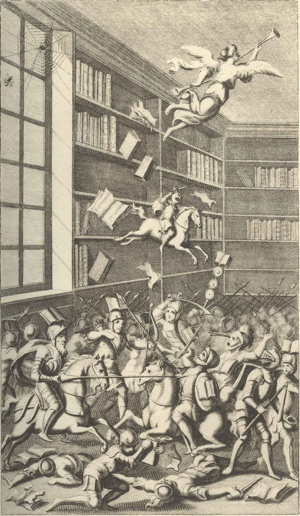
Jonathan Swift, The Battle of the Books (1704) |
Readings:
|