| The Digital Library of Liberty & Power incorporating the Guillaumin Collection of the Great Books of Liberty |
Home | New | Authors | Works | Topics | Papers | Blog | About | Email | Search |
 |
|
“A MONUMENT TO FRENCH POLITICAL ECONOMY:
THE DICTIONNAIRE DE L'ÉCONOMIE POLITIQUE (1852-53).
THE CONTRIBUTION OF GUILLAUMIN, COQUELIN, AND MOLINARI”
By David M. Hart
|
[Created: 2 Sept., 2025]
[Revised: 2 September, 2025] |
This is part of a collection of Papers by David M. Hart
Abbreviations used:
- [Online] - the text is available online at this website
- [Online elsewhere] - the text is available online at another website.
- DEP - the Dictionnaire de l'économie politique (1852-53)
- JDE - the Journal des Économistes
Approximate word count: text = 8,500w and Endnotes = 4,000 w
Table of Contents
- I. Introduction: the 19th century mania for Dictionaries
- II. The Guillaumin publishing Dynasty: Gilbert-Urbain Guillaumin (1801-1864) et filles (Félicité and Pauline)
- III. The Guillaumin Network
- IV. The DEP Project
- V. The Contribution of Gustave de Molinari
- VI. Conclusion: The DEP gets "Indexed"
- Endnotes
I. Introduction: the 19th century mania for Dictionaries (2101w)↩
The nineteenth century saw several efforts to codify and summarise economic knowledge in the form of an all-ecompassing "dictionary" or "encyclopedia". The Dictionnaire de l'économie politique (henceforth DEP) was an impressive French effort, which combined in two large volumes, economic theory, history, data, and extensive bibliographies. [1] The first edition was published in 1852-53 [2] under the editorship of the indefatigable publisher of economic books and journals Gilbert-Urbain Guillaumin (1801-1864), the economist and government official Ambroise Clément (1805-86), the economist and free banking theorist Charles Coquelin (1802-1852), and the young journalist and economist Gustave de Molinari (1819-1912) who stepped in to fill the gap when a sudden heart attack took the life of the main editor Coquelin just as volume one had appeared in print. A second edition appeared 40 years later, as the Nouveau dictionnaire d'économie politique (1891-92) [3] edited by Léon Say and Joseph Chailley. One item of interest in these endeavours was the role of the descendents of Jean-Baptiste Say, the doyen of French political economy, with the contributions of his son Horace Say (1794-1860) [4] to the first edition, and his grandson Léon Say (1826-96) [5] to the second.
However, the DEP was not Guillaumin's first attempt at publishing an "encyclopedia". Following the example of McCulloch's Dictionary (1832) his firm published an Encyclopédie du commerçant. Dictionnaire du commerce et des marchandises (Encyclopedia of Commerce. Dictionary of Commerce and Merchandise) in 1839 [6] which was a commercial success for the firm and was followed by another one in 1859, the Dictionnaire universel théorique et pratique, du commerce et de la navigation. [7] Since it was aimed at businessmen and merchants the sections on economic theory and history were less detailed than would be the case with the DEP. They were written by the economist Adolphe Blanqui (1798-1854) who was one of the first editors of the JDE (1842-43). [8]
Many other "dictionaries" of political economy would appear during the course of the century. In English, there was McCulloch's A Dictionary, Practical, Theoretical and Historical, of Commerce and Commercial Navigation (1832) in two volumes of 1,143 pages, [9] which was the first and the inspiration for other dictionaries in the main European languages. Across the Atlantic John Lalor published a three volume, 3,088 page Cyclopedia of Political Science, Political Economy, and of the Political History in 1881-84 [10] which relied heavily on translations from the first edition of the DEP. And of course in 1894-99 came the famous Palgrave Dictionary of Political Economy, also in three volumes, with 2,400 pages. [11]
In German, hot on the heels of McCulloch, came the very large 15 volume Staats-Lexikon oder Encyklopädie der Staatswissenschaften (1834-1843) edited by Rotteck and Welcker. Each volume was about 4-500 pages in length making a toital of about 6,750 pages. It went through several editions over the course of the century. [12] In Italian, Gerolamo Boccardo published a Dizionario della economia politica e del commercio (1857-1861) in four volumes of 2,794 pages, with a second edition in 1875-77 in two volumes with 2,300 pages. [13]
All these efforts were "monumental" in the sense of their sheer size and in many cases because of their importance to the discipline by attempting to set in stone, as it were, the established orthodoxy at a given historical period. They were usually at least 1,000 pages long, comprehensive in their scope, consisting of hundreds if not thousands of entries written by scores of authors, and requiring financing and signicant editorial co-ordination in order to hit the shelves of the bookstores and libraries.
In the case of the DEP of 1852, it was a two volume, 1,854 page, double-columned, nearly two million word encyclopedia of political economy and in my view is unquestionably one of the most important publishing events in the history of 19th century French liberal political economy. [14]
The editors and contributors of the DEP recognised at the time that what they were building was indeed a "monument" to political economy. As proud Frenchmen they were aware of Diderot's Encyclopédie and that it had contained a small number of economics articles, something that they wanted to improve upon with their own monument to the discipline. A false start at creating a new economically inclined encyclopedia may have been attempted in 1826 with the publication of Encyclopédie progressive (Progressive Encyclopedia) which contained four essays two of which were on economic matters, one by J.-B. Say on "Économie politique" and another by Adolphe Thiers on "Law (et de son systeme de fiances)." [15] The opening essay "Encyclopédie" was by the editor, François Guizot, on why they are written and why they are read. He likened them to "un vaste bazar intellectuel" (an immense intellectual bazaar) where new ideas were spread out on tables in the hope that passing consumers will stop, have a closer look, and perhaps "buy it". [16] No more volumes were published and the effort petered out until some twenty five years later when it was taken up again by Guillaumin.
In what follows, I want to discuss the role of the publisher Guillaumin, the network of people around the Guillaumin firm who provided him with both a body of authors he could draw upon and the readership of the DEP, the editors Clément and Coquelin who saw the project to fruition, and the specific role of one of the young economists and a major contributing editor to the project, the thirty three year old Gustave de Molinari. Molinari not only stepped into the shoes of the recently deceased Coquelin, but also wrote 30 articles (the 4th highest number), some of which were strikingly original in their application of economics to new fields of anlaysis. Later in the century he would play a leading role in political economy circles, most notably as the editor of the flagship journal, the Journal des Économistes between 1881 and 1909, and the author of over 40 books on political economy and the newly emerging field of "economic sociology", most of which were published by the Guillaumin firm).
II. The Guillaumin publishing Dynasty: Gilbert-Urbain Guillaumin (1801-1864) et filles (Félicité and Pauline) - (1,719w)↩
The focal point for the group of liberal political economists in Paris was the office of the Guillaumin publishing firm on 14 rue de Richelieu. Gilbert-Urbain Guillaumin (1801-1864) [17] was born in Couleuvre in the département of Allier in central France and had become involved in the radical republican Carbonari movement and then after 1830 in liberal politics in Paris. He worked in a bookshop before founding his own publishing firm sometime in 1835-37. Two early successes which helped make his name and put his firm on a solid financial footing was an edition of the songs of the radical "goguettier" Pierre-Jean de Béranger (1780-1857), whose song about the virtues of the "smugglers" was very popular among free traders like Frédéric Bastiat, [18] and his French version of McCulloch's Dictionary, the Encyclopédie du commerçant (Encyclopedia of Commerce) (1839).
Guillaumin not only organised the publication of hundreds of books, dictionaries, and journals but also used his contacts in the business world to raise money for his more ambitious and hence expensive projects (like the DEP). He cleverly set up up each major project as a separate legal entity to ensure that in case one failed it would not bring down the entire firm. The firm's office and near-by restaurants were also important meeting places for those in journalism, economics, business, and government to come together to meet, talk about ideas, and plan their future activities, both political as well as academic. This loose group of people constituted what has been called "le réseau Guillaumin" (the Guillaumin network). [19] For example, it was out of the Guillaumin office that the Société d'Économie politique (1842-1920) was run and the minutes of its meetings published; that the Journal des Économistes (1841-1940) and the Annuaire de l’économie politique et de la statistique (1844-99) were published; and that a total of 2,356 books and dictionaries were published between 1837-1910.
One of his great skills was as an "intellectual entrepreneur" who could bridge the gap between the academic, business, and political worlds in order to achieve the goals of the broader liberal movement of liberalising the French political and economic system. He was also clever at identifying a market for relevant books during periods of political or economic crisis, such as the 1848-49 Revolution, the period of liberalisation at the end of the Second Empire (1867-68), and the debate about the constitution of the new Third Republic (1873-75) (see below the graph of titles published each year). For example, while the 1848 Revolution was underway the firm issued a special catalog of 40 anti-socialist writings featuring the work of Bastiat, Molinari, Joseph Garnier, as well as Michel Chevalier, Léon Faucher, Antoine-Elisée Cherbuliez, Ambroise Clément, and others, many of which were collections of speeches in the Chamber or journal and magazine articles which were rushed into print for the occasion.
We can trace the steady growth of its publishing activities from its catalogues which were often included at the back of the books they published. The size of the Guillaumin catalog kept expanding throughout the 19th century. In 1847 it was 20 pages long and listed over 120 titles; and by 1886 it was 32 pages and listed over 200 titles.
He also published a broad range of other material in addition to the firm's main focus on political economy, such as publishing translations of John Stuart Mill’s Principles of Political Economy (1854) [20] and On Liberty (1864), [21] Charles Darwin’s Origin of Species, and Hugo Grotius’ The Laws of War and Peace and many others. [22]
However, the firm became reknowned for its concentration on economic related material, such as its academic journal, its large collection on the history of economic thought, works of economic history, encyclopedias, annual collections of data and government documents, and dictionaries, the scope of which would have challenged many other publishing firms. We can summarise this under the following five main categories:
- large scale, more business-oriented projects such as dictionaries of commerce
- Encyclopédie du commerçant. Dictionnaire du commerce et des marchandises, 2 vols. (1837-39)
- Dictionnaire universel théorique et practique du commerce et de la navigation (1859-61).
- large scale projects of a more intellectual or academic nature:
- the 16 volume collection of the history of economic thought: Collection des principaux économistes (1840–48) edited by Eugène Daire.
- the Dictionnaire de l’économie politique (1852-53) (co-edited by Guillaumin, Ambroise Clément, and Charles Coquelin)
- other titles of a scholalry nature: Bibliothèques des sciences morales et politiques (1857–)
- the Nouveau Dictionnaire d’Économie Politique (1891,1900) (co-edited by Léon Say and Joseph Chailley)
- journals and annual series of the minutes of the Political Economy Society, or of economic data:
- Journal des économistes (1841–1940) - the monthly journal of some 347 volumes
- L’Annuaire de l'économie politique (1844–99)
- Annales de la Société d'Économie Politique (1846-1899): minutes of the monthly meetings of the SEP
- other mongraphs and books
- journal article reprints, mainly from the JDE
Mention should be made here of another "monumental" publishing effort by the Guillaumin firm which appeared shortly before the DEP, namely its collection of works in the history of economic thought edited by Eugène Daire (1798-1847). The Collection des principaux économistes, Avec Commentaires, Notes, et Notices (1840-48) [23] consisted of 15 "tomes" (but in fact 16 separate volumes) of 11,169 pages with extensive notes and commentaries and in some cases new translations into French by Blanqui (of Adam Smith) and Alcide Fonteyraud (of Ricardo). The theorists included in the collection were several 18th century writers on taxation and finance, the Physiocrats Turgot and Quesnay and others, Adam Smith, Thomas Malthus, David Ricardo, Jean-Baptiste Say, and a "mélange" of other writers such as Hume, Forbonnais, Condillac, Condorcet, Lavoisier, Franklin, Necker, Galiani, Montyon, and Bentham.
The ebb and flow of the activities of the Guillaumin publishing firm over some 70 years can be seen from this graph which shows the number of titles published each year between 1837 and 1910 (when it was taken over by the Alcan publishing firm): [24]
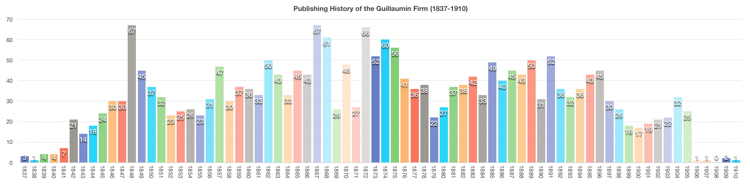
In all some 2,356 titles were published at an average rate of 31.8 titles p.a. over the entire period. There were however spikes when 60 or more titles were published on average per year - 1848 (67), 1867 (67), 1872 (66), 1868 (61), and 1874 (60). And years when between 50 and 59 titles were published - 1875 (56), 1873 (52), 1891 (52), 1862 (50), and 1869 (50).
It should be noted that in 1852 and 1853 when the DEP was published the number of titles were significantly lower than the average with 23 and 25 titles respectively. This was due most likely to the financial and logistical problems associated with such a large publishing project.
Thus we can see that Guillaumin père created a successful publishing dynasty which published over 2,000 books over the course of its existence, and which was successfuly continued after his death in 1864 by his two daughters. The administration of the firm immediately after his death was continued by his oldest daughter Félicité who managed the firm for 20 years (1865-85), and after her death it was handed over to his youngest daughter Pauline who managed it for another 20 years (1886-1905). They were able to maintain or even increase the pace of the firm's publishing activity begun by their father as the following table shows:
| Directorship | Number published | average p.a. |
|---|---|---|
| Father 1837-1864 | 774 | 29 |
| Félicité 1865-1885 | 914 | 46 |
| Pauline 1886-1905 | 663 | 35 |
| between its founding and the publication of the DEP 1837-1853 | 385 | 23 |
III. The Guillaumin Network (1821w)↩
The Guillaumin firm was the center of a rich network, which Minart has called "le réseau Guillaumin", of like-minded individuals, social groups, societies, associations, and clubs which pursued the common goals of liberalising French society. They socialised together in salons, raised money to fund certain projects and associations, met to give papers and discuss ideas, wrote articles and books, attended protest meetings, and even joined some of their younger and more radical colleagues to hand out leaflets on the streets of Paris.
This network became quite visible in the late 1840s and early 1850s when a series of political and economic crises erupted which prompted many members of the network to take action, either by speaking out themselves (whether in print, in the Chamber, or on the streets) or by raising money so that others could speak out on their behalf. These crises included the crop failures of 1847, the growing political opposition to the July Monarchy, the rise of socialism during the Second Republic, and then the rise of the authoritarian and interventionist President, then Emperor Louis Napoléon.
The DEP, which was conceived in early 1849 and was completed by late 1853, is only one product of the vigorous activity undertaken by members of the Guillaumin network during this period but its sheer size, intellectual significance, and complexity is what interests us here.
To be specific, the Guillaumin network consisted of the following groups, bodies, and individuals, many of whom belonged to multiple groups which are depicted graphically in this flow chart and then discussed below in more detail.
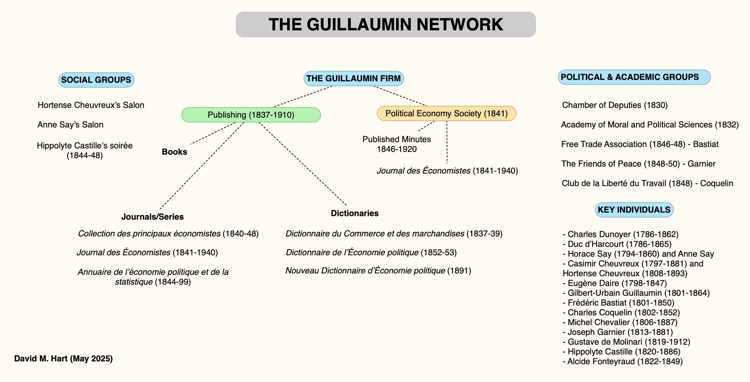
(see a larger version of this image 2145px)
- the private "salons" and "soirées" organised by wealthy individuals with large homes which could
accommodate large groups of people:
- the salons organised by the wives of two leading figures in the circle of the economists, firstly Madame Hortense Cheuvreux (wife of the manufacturer Casimir Cheuvreux) and
- secondly, Anne Say (née Cheuvreux) who was married to the rich mechant and son of J.-B. Say, Horace Say. Say and Cheuvreux were also the main financial backers of the Guillaumin network, especially in funding the DEP project, and in the case of Mme Cheuvreux, in arranging funding so Bastiat could complete his magnum opus Harmonies Économiques before he died of throat cancer.
- the journalist Hippolyte Castille who owned a large home on the rue Saint-Lazare (1844-1848) where he hosted a regular soirée for other journalists and intellectuals
- the private Political Economy Society which was founded in 1842 by Adolphe Blaise, Joseph Garnier, and Guillaumin, and its related journal the Journal des Économistes which was published by the Guillaumin firm. [25] In its early years the Society was managed by two presidents (Charles Dunoyer and Hippolyte Passy), two vice-presidents (Horace Say and Charles Renouard), a permanent secretary (Joseph Garnier), and a treasurer (Guillaumin). The Society met monthly and the minutes of its formal meetings were published in the JDE. [26] The formal meeting was held after a dinner in the Maison-Dorée restaurant which attracted regular customers such as Honoré de Balzac and Alexandre Dumas and had a very sizable wine cellar. Its membership was drawn from members of the Institute, ex-parliamentarians, educators, journalists, judges, and several active in commerce and industry. By the end of 1849 its membership numbered about 80.
- the Journal des économistes was the journal of the Société d'économie politique (Political Economy Society) and appeared from December 1841 and then roughly every month until it was forced to close following the occupation of Paris by the Nazis in 1940. The total number of volumes of the JDE published during this period was 347.
- many of the Guillaumin circle of economists were also members of the the government run and funded scholarly organisation the "Academy of Moral and Political Sciences" which had a Political Economy section (restarted in 1832 after being shut down by Napoléon). They made up a sizable group within the Academy, but not all of its members were sympathetic to the economists. Members who were economists included (with the year they were elected): Charles Dunoyer (1832); Joseph Droz (1832); Charles Comte (1832); Pellegrino Rossi (1836); Alexis de Tocqueville (1838); Hippolyte Passy (1838); Adolphe Blanqui (1838); Gustave de Beaumont (1841); Léon Faucher (1849); Louis Reybaud (1850); Michel Chevalier (1851); Louis Wolowski (1855); Horace Say (1857); Augustin-Charles Renouard (1861); Henri Baudrillart (1866); Joseph Garnier (1873); Frédéric Passy (1877); Léon Say (1881). [27]
- the French "Free Trade Association" (1846-1848) was modelled on the English Anti-Corn Law League and founded on 1 July 1846. The president was the Duke François d’Harcourt ; Frédéric Bastiat was the secretary of the Board, and Molinari was its deputy secretary. Among its members were Michel Chevalier, Auguste Blanqui, Joseph Garnier, and Horace Say. The journal of the Association was called Le Libre-Échange and was edited and largely written by Bastiat.
- the “Club de la Liberté du Travail” (The Club for the Liberty of Working) (March 1848) was organised by Charles Coquelin and Alcide Fonteyraud and included in its membership Joseph Garnier and Gustave de Molinari. With the ending of censorship following the overthrow of King Louis Philippe in February many of the economists joined the socialists in arguing for economic reforms in both the political clubs and in magazines which they handed out on the streets of Paris. Their political club was designed to challenge the socialists' demand for the government "organisation of labour" as promoted by Louis Blanc in the National Workshops program. At the same time, Karl Marx and Friedrich Englels were attending a German Workers Club where they were handing out freshly printed copies of their "Communist Masnifesto". Also in February and March 1848 Bastiat, Molinari, and Castille published and handed out on the streets a small magazine which they called La République française which contained many articles dealing with free market ideas written to appeal to ordinary people. Again, in June 1848 they published another magazine called Jacques Bonhomme with similar articles. They had to close it down when they got caught in the firing line of troops called in to put down the June Days violent uprising..
- Joseph Garnier’s "Friends of Peace" association - the third "International Congress of the Friends of Peace" was organised by Joseph Garnier and held in Paris in August 1849. [28] There were 21 delegates from the U.S. (including two ex-slaves), over three hundred from England, 230 from France, 23 from Belgium, and a small number of delegates from other European countries. The meeting was chaired by the novelist Victor Hugo. Richard Cobden and Frédéric Bastiat gave speeches; while Molinari represented the JDE for which he wrote a lengthy report on its proceedings.
- liberal members of the Chamber of Deputies and other branches of the French government. This list
was drawn up by Michel Leter (2006): [29]
- three ministers: Victor Destutt de Tracy, Léon Faucher, and Hippolyte Passy;
- four Peers of France: François d’Harcourt, Hippolyte Passy, Charles Renouard, Pellegrino Rossi;
- 13 elected deputies: Alexandre Annisson-Dupéron, Frédéric Bastiat, Adolphe Blanqui, Charles Comte, Victor Destutt de Tracy, Léon Faucher, Henri Fonfrède, François d’Harcourt, Édouard Laboulaye, Hippolyte Passy, Charles Renouard, Louis Reybaud, and Louis Wolowski;
- four members of the General Council: Alexandre Annisson-Dupéron, Frédéric Bastiat, Michel Chevalier, Horace Say;
- five members of the Council of State: Michel Chevalier, Jean-Gustave Courcelle Seneuil, Hyppolite Dussard, Charles Renouard, and Horace Say;
- two Prefects of departments: Charles Dunoyer and Hyppolite Dussard: and
- two ambassadors: François d’Harcourt and Pellegrino Rossi.
The importance of the Guillaumin network in developing and spreading liberal free market ideas was increased by the fact that it was so hard to break into the government monopoly of higher education. The audience they were trying to reach was the intellectual and political élite (what Bastiat referred to as “la classe électorale” (the electoral or voting class)) which consisted of the very small minority of tax payers who were allowed to vote under the July Monarchy of Louis Philippe. They wanted to influence the thinking of this elite in a more liberal and free market direction in the hope that this would influence government policy. As there were only two or three chairs of political economy in France at that time (the prestigious Collège de France (Michel Chevalier held this chair from 1841), the Conservatoire national des arts et métiers, and the engineering school the École des Ponts et Chaussées (which only began teaching economics in 1846)), the opportunities for academic work within the state universities were very limited. [30] This forced the French political economists to work outside the university system such as lecturing at the private Athénée royal de Paris , writing for the quality journals (such as the Journal des Débats and the Revue des Deux mondes ), or getting appointed to the non-teaching Academy of Moral and Political Sciences. The Guillaumin publishing firm provided them with an opportunity to get their work published and thus reach a wider group of readers than they would otherwise have had.
The DEP was in many ways a declaration that they had arrived as a distinct school of thought and that they had a formidable arsenal of intellectual weapons to defend their point of view.
IV. The DEP Project (2854w)↩
Introduction: the importance of Say
Fifty years after Jean-Baptiste Say published his Traité d'économie politique (1803) a veritable "monument" to the intellectual tradition he had begun in France was erected by some of his followers, in the form of the Dictionnaire de l'Économie politique (1852-53). It should be noted that the first two titles in the masssive "Collection of Principal Economists" which the Guillaumin firm undertook soon after its founding had been Say's Cours complet d'économie politique pratique (1840) [31] and the Traité d'économie politique (1841). [32] Both works were revised, expanded, and edited by his son Horace from his father's papers (Say had died in 1832), and the Traité was now in its 6th edition. These were published ahead of works by Turgot and Adam Smith which suggests their importance to the firm and its network of economists.
Say also merited one of the longest biographical entries in the DEP, some five and a half pages, written by the first editor Ambroise Clément. [33]
Molinari used the term "monument" quite explicitly to describe the project in his summation of it which he wrote for the JDE soon after the completed volumes had appeared in print in October 1853. He used the word four times in this article. He said that they believed that their discipline needed "élever en commun un monument à la science" (to erect a monument to their science) [34] in recognition of what they had been able to achieve in spite of the hardships they had had to endure since Say published the first edition of the Traité in 1803, such as censorship under Napoleon, the relatively few teaching positions that were available, and the most recent banning of Michel Chevalier from his post in 1848 for teaching material which went against the views of the recently installed Republican government. Not to mention the lack of understanding of economic ideas among the voters, a group which had been dramatically expanded in size after the overthrow of the July Monarchy and the creation of the Second Republic.
We should also note that one of the innovative entries Molinari had written for the DEP was on monuments of a different kind, namely "Monuments publics" (Public Monuments or Buildings). [35] Here he strongly criticised the waste of tax-payers' money by governments and politicians in building "monuments" to the state or to themselves. In stark contrast, the Guillaumin publishing firm had raised private funds by means of donations and by public subscriptions to build a monument to themelves and the cause they believed in, partly because they had been excluded from teaching in the publicly funded universities. He and the others in the Guilaumin network must have felt some kind of triumph and vindication when they saw these large volumes finally in print.
The DEP Project
The DEP project had been conceived in late 1848 or early 1849 when it became clear to the political economists that they were losing the intellectual battle in the months immediately following the February Revolution of 1848 and the first few months of the Second Republic. The statements by the publisher Guillaumin, the original editor Ambroise Clément (1805-86), and by the senior editor Molinari make it very clear that this was the main reason for undertaking the project at this time. [36]
The DEP was first announced in the May 1849 Catalog of the Guillaumin firm as a new title “in preparation” with the title Dictionnaire d’économie politique (Dictionary of Political Economy). It was announced along with a title called Bibliographie générale de l’économie politique (General Bibliography of the Political Economy) which was slated to appear in installments beginning in January 1850. The latter never appeared as a separate volume but was merged into the DEP project which would eventually take its name from the Bibliographie and appear in print in 1852 as the Dictionnaire de l’économie politique.
It should be noted that in keeping with the Economists’ practice of referring to themselves as “The Economists” the DEP was called the “Dictionary of the Political Economy” as if to reinforce the idea that there was only one correct form of political economy which was liberal and free market and not socialist or protectionist. Guillaumin explained the reasoning behiand this in his Introduction. [37]
To help raise money for the project the volumes were issued in parts as they were completed and sold to subscribers. The final volumes were then sold as a set as they were completed. [38] The first installments were announced in the Parisian press in August 1851 at a price of 1 fr. 25 each. The first complete volume (A-I) went on sale in September 1852. The second complete volume was published in October 1853. According to Guillaumin catalogues of the period the price for the two volume set was expensive at 50 fr. This compares with other Guillaumin books such as Bastiat's Sophismes économiques for 2 fr. and Molinari's Les Soirées for 3 fr. 50.
Guillaumin’s great skill was his ability to act as a kind of intellectual entrepreneur who could bring together skilled editors and writers to produce material on time for what were often very large projects, to arrange funding by his backers like businessmen Horace Say and Casimir Cheuvreux, and to see the books through the complex stage of typesetting and printing. According to Joseph Garnier, Guillaumin was part diplomat, part entrepreneur, part salesman, part editor, and part printing craftsman. He was also entrepreneurial in setting up separate legal entities to oversee large projects such as the Journal des Économistes in order to keep any losses which might eventuate from bringing down the entire publishing edifice. Guillaumin also seemed to have the knack for spotting a potential market for his products, such as his first publishing success the Dictionnaire de Commerce et des marchandise (1837) which, even if they did not make him rich at least kept his firm afloat for several decades. In his obituary of Guillaumin in January 1865 Joseph Garnier described the extraordinary set of skills which Guillaumin had which made his publishing and editing projects so successful and so crucial to the liberal movement in France. [39]
The broad aim of the editors of the DEP was to assemble a compendium or an encyclopedia of the state of knowledge of liberal political economy in the middle of the 19th century, with articles written by leading economists on key topics concerning economic theory as well as government economic policies, biographies of important economic thinkers and economic reformers, extensive annotated bibliographies of the most important books in the field designed to encourage further reading, and tables of economic and political statistics. These articles and the many cross references between them enabled the editors to codify political economy in a format that would make its ideas more “user-friendly” to the politicians and bureaucrats who ran the French state, as well as to the intellectuals who wrote for the serious periodical press.
At the end of volume two there were tables which listed the often quite long "Principal Articles" with their author's names (335 entries), [40] the short "Biographical Articles" (I estimate about 1,352), and the "Principal Bibliographcial Articles" (50 entries).
The volumes also included 8 "portraits" of what the editors called "des Économistes les plus éminents, de ceux auxquels la science doit le plus" (the most eminent Economists to whom economic science owes the most). They were François Quesnay, Turgot, Adam Smith, Thomas Malthus, Jean-Baptiste Say, Simonde de Sismondi, Pellegrino Rossi, and Frédéric Bastiat.
The DEP went through four reprints in 1854, 1864, and 1873. A second revised edition in two volumes with 2,520 pages was published in 1891-92; and reissued with a Supplementary volume in 1900 with 2,744 pages.
There were five key collaborators on the project. In addition to the overall editing responsibilities exercised by the publisher Guillaumin, the first editor Ambroise Clément (1805-86), and the second editor Charles Coquelin (1802-1852) one can rank their contributions by the number of principal articles they wrote. [41] In order they are:
- the economist and businessman Charles Coquelin who wrote 70
- the businessman, politician, and son of J.-B. Say, Horace Say (29)
- the economist Joseph Garnier (28)
- the journalist and economist Gustave de Molinari (25)
- the economist and civil servant Ambroise Clément (22)
- the economist Courcelle-Seneuil (22)
- and the statistician and economist Maurice Block who wrote most of the short biographical entries.
The First Editor, Ambroise Clément (1805-86)
The first editor was Ambroise Clément (1805-86) who was an economist and the secretary to the major of Saint-Étienne (southwest of Lyon in central France). He was a member of the Société d’économie politique from 1848, a regular writer and reviewer for the Journal des économistes, and was made a corresponding member of the Académie des sciences morales et politiques in 1872. In the 1840s he wrote on poverty and labour matters, and was one of the few economists to extend Bastiat's theory of "la spoliation légale" (legal plunder), in an article which was published in the JDE during the height of the 1848 Revolution, [42] and his theory of the state, in particular the theory of "fonctionnarisme" (functionaryism, or rule by functionaries) in the entry on "Fonctionnaires" (Functionaries) in the DEP. [43]
As the first editor he would have worked closely with Guillaumin to plan the contents of the DEP, to organise the dozens of writers involved in the project, and the timely publication and sale of each installment for the subscribers. However, he had to withdraw from being editor because of other work commitments and was replaced by Charles Coquelin. Nevertheless he was able to write 26 of the principal articles, including three of the important "Bibliographical Articles" on "Administration publique" (Public Administration), "Apprentissage" (Apprentices), and "Association" (Association). He also wrote the main "Introduction" to the DEP which clearly stated its intended purpose. This was very much along the lines articulated by Bastiat in his writings about "economic sophisms", that it was the duty of the economists to not only counter the false beliefs which were used to justify bad economic policies (such as tariffs and protectionism) but also to expose the self-interest which lay behind these policies and which was often kept hidden from the public.
The Second Editor, Charles Coquelin (1802-1852)
The replacement editor was Charles Coquelin (1802-1852) who was one of the leading figures in the Political Economy movement in Paris before his untimely death from a heart attack. [44] He had come to Paris from Dunkirk to study law but got distracted by political economy, especialy the problem of business cycles and banking crises following the depression of 1825-26. In the early 1830s he turned to banking policy in the United States, especially in New England where there were liberal laws governing the creation of banks. In the early 1840s he wrote a series of articles for La Revue des Deux-Mondes on banking in which he toyed with the idea of the competitive issue of currencies by banks competing for business in the market. These ideas were further developed in his major book on the subject published by Guillaumin, Du Crédit et des Banques, which appeared in 1848. [45]
Coquelin was a key member of the Free Trade Association serving as one of its Secretaries, writing many articles which were published in its journal Libre-Échange, and was also one of their key public speakers. Like Molinari Coquelin became a regular contributor to the JDE during 1847 and wrote 30 articles and book reviews before his sudden death in 1852. According to Molinari, Coquelin was one of the most eloquent and best debaters among the economists who had honed his skills before large and sometimes rowdy audiences in Montesquieu Hall where the Free Trade Association held its Paris meetings. [46] Like Bastiat who sprinkled his Economic Sophisms with references to the plays of Molière, the fables of La Fontaine, William Dafoe’s Robinson Crusoe, and the political songs of Béranger, he was able to stand before a boisterous and hostile audience and weave references to Racine and Molière with passages from the masters of political economy like Adam Smith, J.-B. Say, and Ricardo. Molinari described his memory as “une bibliothèque où les poètes et les orateurs avaient leur place à côté des économistes” (a library where poets and orators had their place beside the economists). [47]
Coquelin was asked by Guillaumin to be the editor of the DEP project because of his knowledge of banking, his photographic memory, and his organizational skills which he had acquired while working in the textile industry. In addition to administering the project he also wrote 71 of the 185 major articles in volume one including the key articles on “Ateliers nationaux" (The National Workshops), “Banque" (Banks), “Capital" (Capital), “Crises commerciales" (Commercial Crises), “Commerce" (Commerce), “Concurrence" (Competition), “Crédit" (Credit), “Harmonie industrielle" (Industrial Harmony), “État" (The State) (largely based upon Bastiat’s essay from 1849), [48] and the all important article on “Économie politique" (Political Economy) which tied the entire project together. [49] When Coquelin died suddenly from a heart attack on 12 August 1852 he was half way through editing the DEP.
V. The Contribution of Gustave de Molinari (3570w)↩
Bio of Gustave de Molinari (1819-1912)
Gustave de Molinari (1819-1912) was born in Liège, Belgium but spent most of his working life in Paris, becoming the leading representative of the laissez-faire school of classical liberalism in France in the second half of the nineteenth century. [50] He came to the attention of the Guillaumin network with some magazine articles he wrote for La Nation in 1843-44 and Le Courrier Français in 1844-45 on railways (the construction of which began in earnest in the eary 1840s) and the laws against workers forming trade unions. [51] His first article for the JDE on English agriculture was published in January 1847 [52] and he would go on to publish a total of 234 articles for the journal over the next 53 years. [53] He would become the journal's editor in 1881, upon the death of Joseph Garnier, until his retirement in 1909. His first book for the Guillaumin firm was a two volume history of tariffs in 1847. [54] His second were the book-length introductions and notes he wrote for two volumes of the Collection des Principaux Économistes on miscellaneous economic authors. His third was the highly controversial book Les Soirées de la rue Saint-Lazare (1849) in which he argued that all public goods could and should be provided privately and competively, including police and national defence. [55]
Molinari on "the economics of everything"
One of Molinari's early trademarks which singled him out from his colleagues was his willingness to apply economic analysis to everything. By this is meant his idea that everything was "an industry" which had "producers" and "consumers", a "cost price" and a "selling price", profit opportunities for "entrepreneurs", and when the government intervened to ban or regulate the industry there were the same inevitable negative consequences.
This approach first became apparent in 1849 in his article for the JDE in February on "the production of security" in which he argued that "security" was "produced" by producers and consumed by "consumers" at a particular price for a given set of "services". [56] The issue which concerned him in particular was whether this "production" should be done by a monopoly (either government or private) or competively on the free market. He argued "no" for the former and "yes" for the latter. He made the case again in "Soirée 11" in his book Les Soirées de la rue Saint-Lazare published by Guillaumin in September that year, and extended it to every other government provided public good, and other banned or heavily regulated industries, in the other chapters. [57] For example, he believed that there was a "prostitution industry" in which there were "entrepreneurs" who sold services to consumers. Likewise in the "water supply industry", the "education industry", "the funeral industry", and so on. These ideas of course were disputed vigorously in the monthly meetings of the Political Economy Society held in late 1849 and early 1850. [58]
When it came time to allocate topics for inclusion in the DEP Molinari was not asked to write on the private and competitive production of security, prostitution, or the funeral business, but he was asked to write the key entry on "Free Trade" (Liberté du commerce, liberté des échange) which he kept within the theoretical limits which were acceptible to the PES. [59] His own personal view was that the prinicples of free tade and free markets logically should also apply equally to these other industries on which he had written.
For the DEP he wote five biographical articles and 25 "principal articles", six of which were major bibliographical articles, thus making him one of the top contributors to the DEP. [60] He wrote the very important series of articles on the key topics of free trade and tariffs on which he had made a name for himself in 1847, [61] namely "Céréales" (Grain), "Liberté des échanges (Associations pour la)" (Free Trade Associations), "Liberté du commerce, liberté des échanges" (Free Commerce, Free Trade), "Tarifs de douane" (Customs Tariffs), "Union douanière" (Customs Union), and the biogaphical article on Sir Robert Peel, which reveals the high standing in which he must have been held by the editors. [62] These entries were not controversial so they will not be discussed here.
He was however given some lattitude to write on other, more controversial topics where he was given free rein to explore some innovative applications of economic theory in two areas. The first was the exploration of a liberal theory of class analysis and the economic and political evolution of the state and the emergence of markets. The second was a continuation of the application of economic analysis to entirely new areas, such as "Beaux-arts" (Fine Arts), “Mode" (Fashion), and "Monuments publics" (Public Buildings/Monuments).
The Economic Analysis of Class and the State
In his entries on “Civilisation,” “Nations,” “Noblesse” (The Nobility), "Paix, Guerre" (Peace and War), "Servage" (Serfdom), and “Villes” (Towns) [63] he argued that invasion, conquest, and slavery had created a class of "plunderers" who lived off what was produced by the "industrious class" over whom they ruled. This "conquest" and "predatory" theory of the state and the ruling class was not new to Molinari as it had been previously articulated by a number of theorists working within the tradition established by Jean-Baptiste Say, such as Charles Comte, Charles Dunoyer, Augustin Thierry, and Frédéric Bastiat. [64] His contribution was to greatly expand the theory in half a dozen books written over the next 50 years.
One of Molinari's contributions to this theory was to consider the conquerers and rulers as "profit-seeking" entrepreneurs who "owned" the state and operated it like a "firm". [ 65] It was in these entries in the DEP where he first put forward these ideas in embryonic form and would later develop in much more detail in several major works. The first step was to see the rulers as profit seekers and maximisers, who "produced security", less for the benefit of those who were ruled than for those who were doing the ruling. For example in the DEP entries the ruling class, he argued, realised that if they protected their subject population from other marauding tribes and allowed them to keep more of their output they would produce more for the rulers in the long run. In other words, if they became what Mancur Olson called "stationary bandits" instead of "roving bandits." [66] Related to this was the "monetisation" of dues by converting forced labour or the requisitioning of goods into annual cash payments which might leave a small surplus for the labourers, and the creation of towns with defensive walls behind which the "bourgeoisie" could shelter from the depradations of both the old and the new marauders by striking deals with the most powerful feudal lord or king to provide annual tribute (taxes) in exchange for being left alone by the lesser exploiting nobles. Over time the medieval "communes" or towns competed with each other in order to attact inhabitants, and hence producers and taxpayers, by providing better terms such as lower and more predictable dues and better protection.
He would develop the insights first put forward in these DEP entries over the coming decades into a more elaborate theory of the state as a profit-seeking "firm" which was owned and run for the members or "shareholders" of the firm who sought profits, the expansion of their market, and ways to deal with competitors (both internal and external). He did this in a pair of books he published in the 1880s - L’évolution économique du XIXe siècle (Economic Evolution and the 19th Century) (1880) and L’évolution politique et la Révolution (Political Evolution and the Revolution) (1884) - and another pair he published in the late 1890s - Grandeur et decadence de la guerre (The Greatness and Decline of War) (1898) andEsquisse de l’organisation politique et économique de la Société future (A Sketch of the Political and Economic Organisation of the Society of the Future) (1899). [67]
The Economics of Fine Arts, Fashion, and Public Monuments
The second area in which he offered some strikingly innovative insights was the application of economic analysis to literally everything, in a manner which had not been undertaken before. He did this in the following entries in the DEP: "Beaux-arts" (Fine Arts), "Émigration" (Emigration), “Mode" (Fashion),” "Monuments publics" (Public Buildings/Monuments), “Théâtres" (Theatres), and "Voyages" (Travel). [68]
For example, one theme was the gradual extention of a good or service which had been the preserve of a small, wealthy, and aristrocratric elite to a mass market of consumers. In "Fashion", risk-taking entrepreneurs have to anticipate what will be popular in the coming year's fashions. If they make the right decision there are large profits to be made; if not, they will have to bear the losses. The flow-on to less well off consumers comes in the following year when this year's expensive fashions are heavily discounted and thus become more affordable to less well off consumers. Similarly with "Travel" which had been the preserve of the well-to-do making the "grand tour" of Europe. First there comes "les voyages d'affaires" (business travel) where business firms pay travelling salesmen to go city to city selling their goods. Then there comes "les voyages de plaisir" (travel for pleasure) by the new middle classes, and when cheap rail travel appears, there are are now affordable "excursions" to the seaside for the working class.
Another theme is whether certain "goods" can only or should be provided by governments, such as "Fine Arts" and "Public Buildings or Monuments". Concerning "Fine Arts", Molinari argues that there exists an industry in "la production du beau" (the production of beautiful things) and that these things have a value and constitute a kind of capital which he calls "le capital de ses facultés physiques, intellectuelles et morales" (the physical, intellectual, and moral capital). [69] As he always does, he asks whether this capital is best created by government intervention or left to "la libre activité des individus, comme tous les autres genres de production" (the free activity of indiduals as in all other kinds of production). [70] In both the case of "Fine Arts" and "Public Buildings/Monuments" he concludes that neither politicians nor bureaucrats have the specialised knowlewdge to make decisions on these issues, that they are not easily (if at all) accountable to the taxpayers for the decisions that are made, that they have no sound basis for estimating what is the "correct" number of these goods to produce or at what cost, and that their own self-interest will play a predominant role (his "public choice" insight) as they seek to expand their budget, the size of their department, and their public fame. He concluded the entry on "Public Building" with the statement which applied to so much of what he had to say about government intervention in the economy: [71]
| … que les gouvernements sont tenus de se laisser guider, en cette matière, bien plutôt par les conseils des économistes que par les plans et devis des architectes ou par les dithyrambes des poètes lyriques. | … that governments must allow themselves to be guided in this matter far more by the counsel of economists than by the grand designs of architects or the effusive praise of lyrical poets. |
He would make this argument more explicit in another work he published in October 1852, just as the first volume of the DEP was hitting the bookshops, where he concluded that the role of the economist was to act as the "book keeper" of society (les teneurs de livres de la politique) who kept a ledger or account book of the costs and benefits, losses and profits, and liabilities and assets regarding, not just private economic activity, but all government activities and policies as well, and to keep the taxpayers and consumers aware of what was going on by issuing regular "financial statements". [72]
The fact that Molinari was willing to stray outside the hitherto very narrowly defined boundaries of the discipline of political economy, and that the publisher and editors were willing to allow him to do so, lies at the heart of what the DEP was trying to achieve. As the first editor Clément stated in his Introduction: [73]
| l'Économie politique, en concentrant plus spécialement ses investigations sur les phénomènes par lesquels se produisent, se distribuent et se consomment les richesses, ne saurait négliger l'influence qu'exercent sur les phénomènes de cet ordre les institutions politiques, la législation et les mœurs, qu'en se renfermant dans de stériles abstractions. | (P)olitical economy, by concentrating its investigations more particularly on the phenomena by which wealth is produced, distributed, and consumed, could not disregard the influence exerted on these phenomena by political institutions, legislation, and customs without confining itself to sterile abstractions. |
| Cette connexité des sciences sociales empêchera toujours que l'on puisse donner de chacune d'elles en particulier une définition qui la renferme dans une circonscription exclusive et rigoureusement déterminée; car, encore une fois, on ne pourrait lui interdire toute excursion au delà des limites qu'on lui aurait assignées, qu'à la condition de la mutiler. Cela est, d'ailleurs, aussi vrai de la Législation, de la Politique ou de la Morale que de l'Économie politique. | This interconnectedness of the social sciences will always prevent each of them from being defined in a way that confines it within exclusive and strictly determined boundaries. For, again, to prohibit it from making any excursions beyond the limits assigned to it would be to mutilate it. This is as true for Legislation, Politics, and Morality as it is for Political Economy. |
VI. Conclusion: The DEP gets "Indexed" (564w)↩
The Catholic Church regarded the Economists and their DEP (1852-53) as grossly immoral and it was thus put on the Index of Banned Books on 12 June 1856 by Pope Pius IX for "religious reasons." [74] The DEP was not alone as J. S. Mill’s Principles of political economy (1848) was also "indexed" that year. [75] There are many things the Church found to dislike in the DEP. For example, Joseph Garnier in the article on "Malthus" and the main entry on "Population" which he co-wrote with Legoyt [76] discussed the idea of "moral restraint" in order to limit the size of one's family. Molinari was also a strong Malthusian and wrote lengthy chapters on population in the book based upon his lectures given in 1855. [77] In addition to his economic analysis and tolerance of prostitution Molinari also wrote several other things shortly after the DEP appeared which would also have angered the Church, such as his ideas concerning the economics of planning and raising a family (seeing it as a "firm" and children as a form of human capital), thinking that the Church should be seen as a "protected industry" (religious ideas were the "goods" whose production, sale and distrubution were protected by the state) which tried to stifle its competion by "prohibitions" and monopoly privileges, [78] and that education should be privatised, [79] thus further reducing the Church's involvement in the education of children.
The Church thus also recognised the DEP as a "monument", but rather one that should be pulled down or have its entry barred, not celebrated.
Endnotes↩
[1] This paper was conceived as a companion piece to my translation of Molinari's collected entries in the DEP. This anthology of his entries, along with the Introductions by two of the editors (Clément and Molinari) and the publisher (Guillaumin) are available in both French and English versions: Gustave de Molinari, The Collected Articles from the Dictionnaire de l'Économie politique (1852-53). Edited and translated into English by David M. Hart (2025) Online in French and Online in English.
[2] Dictionnaire de l’Économie Politique, contenant l’exposition des principes de la science, l’opinion des écrivains qui ont le plus contribué à sa fondation et à ses progrès, la Bibliographie générale de l’économie politique par noms d’auteurs et par ordre de matières, avec des notices biographiques et une appréciation raisonnée des principaux ouvrages, publié sur la direction de MM. Charles Coquelin et Guillaumin. (Paris: Librairie de Guillaumin et Cie, 1852), 2 vols. Tome premier A-I, 999 pp.; Tome second J-Z, 906 pp. Editions: 1st ed. 1852-53; 2nd ed. 1854; 3rd ed. 1864; 4th ed. 1873.
[3] Nouveau Dictionnaire d’Économie Politique, publié sur la direction de M. Léon Say et de M. Joseph Chailley (Paris: Librairie de Guillaumin et Cie, 1891), 2 vols. Vol. 1 with 1,170 pp. and vol. 2 with 1,350 pp. for a toitla of 2,520 pp. A second edition was published in 1900. See also the additional volume: Supplément au Nouveau Dictionnaire d’Économie Politique de M. Léon Say et de Joseph Chailley-Bert (Paris: Guillaumin, 1900). Vol. 1 with 1,168 pp., vol. 2 with 1,349 pp., and the Supplement with 227 pp. for a total of 2,744 pp.
[4] Horace Émile Say (1794-1860) was the son of Jean-Baptiste Say. He married Anne Cheuvreux, the sister of the businessman Casimir Cheuvreux. Say became president of the Chamber of Commerce of Paris in 1834, a councillor of state (1849-51), and headed an important inquiry into the state of industry in the Paris region (1848-51). In 1857 he was nominated to the Académie des sciences morales et politiques but died before he could join it formally. He also wrote two important works, Paris, son octroi et ses emprunts (1847) which was analysis and critique of the octroi tax on imported goods into the city of Paris, and on behalf of the Chamber of Commerce of Paris a detailed analysis of the state of industry in the city, Statistique de l’Industrie à Paris résultant de l’enquête. Faite par la Chambre de commerce pour les années 1847-1848 (1851).
[5] Léon Say (1826-96) was the son of Horace Say and the grandson of Jean-Baptiste Say. He worked in banking and railway companies before becoming a journalist for the Journal des Débats. He entered politics in 1869 and was the Minister of Finance several times in the Third Republic during the 1870s. During the 1880s he taught public finance at the École libre des sciences politiques. His publications include a work on Turgot (1887) and editing the Nouveau Dictionnaire d'économie politique (1891-92).
[6] Encyclopédie du commerçant. Dictionnaire du commerce et des marchandises, contenant tout ce qui concerne le commerce de terre et de mer. Publié sous la direction de M. Guillaumin (Paris: Guillaumin, 1837, 1839). 2 vols. 2,252 pp.
[7] Dictionnaire universel théorique et pratique, du commerce et de la navigation (Paris: Guillaumin, 1859, 1861). Vol. 1 has 1,438 pages; vol. 2 has 1,828.
[8] Jérôme Adolphe Blanqui (1798-1854) was a liberal economist; brother of the revolutionary socialist Auguste Blanqui. He became director of the prestigious École supérieure de commerce de Paris, succeeded Jean-Baptiste Say to the chair of political economy at the Conservatoire national des arts et métiers, and was the editor of the Journal des Économistes between 1842 and 1843 and often wrote articles under the nom de plume of "Adolphus." He was elected deputy representing the Gironde from 1846 to 1848. Among his many works on political economy and sociology are the Encyclopédie du commerçant (1839-41), Précis élementaire d’économie politique (1842), and Les classes ouvrières en France (1848).
[9] J.R McCulloch, A Dictionary, Practical, Theoretical and Historical, of Commerce and Commercial Navigation (London: Longman, Rees, Orme, Brown, Green, & Longman, 1832), 2 vols., pp. 1,143. There was a corrected and enlarged edition published in1852.
[10] Cyclopaedia of Political Science, Political Economy, and of the Political History of the United States by the best American and European Authors, ed. John J. Lalor (New York: Maynard, Merrill, & Co., 1899). 3 vols. with 3,088 page. 1st ed. 1881. The editors translated 89 entries from the DEP and included them in their dictionary.
[11] Robert Harry Inglis Palgrave, ed. Dictionary of political economy (London: Macmillan, 1894-99). 3 vols. Vol. 1 A-E pp. 800. Vol. 2 F-M pp. 847. Vol. 3 N-Z pp. 762, for a total of 2,400 pages.
[12] Carl von Rotteck and Carl Welcker (Hrsg.). Staatslexikon : Enzyklopaedie der Staatswissenschaften, 15 Bde., (Altona 1834–1843). There was a Supplemente zur ersten Auflage des Staats-Lexikons oder der Encyklopädie der Staatswissenschaften, Altona 1846–1848, 4 Bände. The second editon: Das Staats-Lexikon. Encyklopädie der sämmtlichen Staatswissenschafen für alle Stände, (Leipzig 1845–1848), 12 Bände.
[13] Dizionario della economia politica e del commercio, così teorico come pratico, utile non solo allo scienziato ed al pubblico amministratore ma eziando al commerciante, al banchiere, all'agricoltore ed al capitalista. Opera originale italiana de professore Gerolamo Boccardo. (Torino: Sebatiano Franco e figli e comp.: 1857-1861). 4 vols. pp. 746, 688, 778, 582, for a total of 2,794 pages. A second edition appeared in 1875-77.
[14] I say French "liberal political economists" to distinguish them from other streams of economic thought which emerged later in the century and began to exclipse them in terms of political and intellectual influence especially after the formation of the Third Republic. On the "Paris School" of political economy see my paper "The Paris School of Liberal Political Economy, 1803-1853". A Paper given at the History of Economic Thought Society of Australia Annual Conference, Melbourne VIC, 22 Sept. 2022. For a recent detailed but rather dismissive account of this school see the two chapters by Alain Béraud and Claire Silvant, in A History of Economic Thought in France: The Long Nineteenth Century. Edited by Gilbert Faccarello and Claire Silvant (The Routledge History of Economic Thought, 2024), "3. Liberal economists after Say," pp. 40-77 and "7. Tradition and innovation at the turn of the twentieth century," pp. 162-94.
[15] Encyclopédie progressive; ou, Collection de traités sur l'histoire, l'etat actuel et les progrès des connaissances humaines, avec un manuel encyclopédique, ou Dictionnaire abrégé des sciences et des arts (Paris: Bureau de l'Encyclopédie progressive, 1826). The essays in the book were: "Encyclopédie," by Guizot (mai 1826), pp. 1-48; "Law (et de son systeme de fiances)," A. Thiers (mai 1826), pp. 49-128; "Irritation," by Broussais (mai 1826), pp. 129-192; "Religion," by Benjamin Constant (Mai 1826), pp. 193-215; and "Économie politique," by J.B. Say (mai 1826), pp. 217-304.
[16] François Guizot, "Encyclopédie", p. 13.
[17] Guillaumin and his family await their biographer. For some details see Joseph Garnier, “Guillaumin. Ses funérailes, - sa vie et son oeuvre.” JDE. Sér. 2. T.45 (Jan-Mars 1865). No. 133. Jan. 1865, pp. 108-21; Lucette Levan-Lemesle, “Guillaumin, Éditeur d’Économie politique 1801-1864,” Revue d’économie politique, 96e année, No. 2, 1985p ,p. 134-149.
[18] Béranger was a poet and songwriter who rose to prominence during the Restoration period with his funny and clever criticisms of the monarchy and the church, which got him into trouble with the censors who imprisoned him for brief periods in the 1820s. His material was much in demand in the singing societies or "goguettes" which sprang up during the Restoration and the July Monarchy as a way of circumventing the censorship laws and the bans on political parties. Béranger moved among the Guillaumin network, even joining Bastiat’s Free Trade Association. He should be regarded as the poet and songwriter of the political economists. See his "Les Contrebandiers" (The Smugglers) (1829) in Oeuvres complètes de P.-J. de Béranger. Nouvelle édition revue par l’auteur. Illustrée de cinquante-deux belles gravures sur acier entièrement in édites, d’après les dessins de MM. Charlet, A. de Lemud, Johannot, Daubigny, Pauquet, Jacques, J. Lange, Pinguilly, de Rudder, Raffet (Paris: Perrotin, 1847), vol. 2, pp. 250-54.
[19] Gérard Minart, Gustave de Molinari (1819-1912), Pour un gouvernement à bon marché dans un milieu libre (Paris: Éditions de l'Institut Coquelin, Charles. 2012), p. 56.
[20] John Stuart Mill, Principes d'économie politique, avec quelques-unes de leurs applications à l'économie sociale, par M. John Stuart Mill, traduits par MM. H. Dussard et Courcelle-Seneuil, et précédés d'une introduction par M. Courcelle-Seneuil. 2e édition (Paris : Guillaumin, 1861). 2 vol. 1st edition 1854.
[21] John Stuart Mill, La Liberté. Traduit et augmenté d’une Introduction par M. Dupont White (Paris: Guillaumin, 1864).
[22] See the list of titles in the Bulletin de la Librairie. Guillaumin et Cie. No. 2. Mai 1866. 32 pp.
[23] Collection des principaux économistes, Avec Commentaires, Notes, et Notices; par MM. Blanqui et Rossi (de l'Institut), Eugène Daire, H. Dussard, J. Garnier, M. Monjean, H. Say. (Paris: Guillaumin, 1840-48), 15 vols. The entire collection was reprinted in facsimile by O. Zeller, Osnabrück, 1966
[24] We have taken our information from the list compiled by Benoît Malbranque for the Institut Coppet in Paris and modified it somewhat. See Benoît Malbranque, "Liste complète des titres publiés par Guillaumin (1837-1910)", Institut Coppet (janvier 2, 2017), Online elsewhere; and David M. Hart, “Gilbert-Urbain Guillaumin (1801-64) and the Guillaumin Publishing Firm (1837-1910)”, with links to the texts which I have on my website. Online.
[25] A history of the Society can be found in Breton, Yves. "The Société d'économie politique of Paris (1842–1914)." In The Spread of Political Economy and the Professionalisation of Economists: Economic Societies in Europe, America and Japan in the Nineteenth Century, edited by Massimo M. Augello and Marco E. L. Guidi. London: Routledge, 2001.
[26] Summaries of the meetings were published by Joseph Garnier, the permanent secretary and vice president of the society, in the Journal des économistes. More detailed minutes of the meetings were published in 16 volumes between 1889 and 1896 by the perpetual secretary Alphonse Courtois and cover the years 1846-1887. It was followed by annual issues of the Bulletin de la Société d'Économie Politique (Paris: Guillaumin, 1888). In 1889 summaries of the Society's meetings were published by Guillaumin: Annales de la Société d'Économie politique (1889). See, Annales de la Société d'Économie Politique publiées sour la directions de Alph. Courtois fils, secrétaire perpétuel (Paris: Guillaimin, 1889-1896), 16 volumes covering the years 1846-1887; and Bulletin de la Société d'Économie Politique sous la direction du secrétaire perpétuel (Paris: Guillaumin, 1888-1920).
[27] See the Academy of Moral and Political Sciences website [Online elsewhere].
[28] Joseph Garnier, Congrès des amis de la paix universelle réuni à Paris en 1849 : compte-rendu, séances des 22, 23, 24 Aout … précédé d'une Note historique sur le mouvement en faveur de la paix, par M. Joseph Garnier. (Paris: Guillaumin, 1850).
[29] Michel Leter, “Éléments pour une étude de l’École de Paris (1803-1852), in Histoire du libéralisme en Europe, eds. Philippe Nemo and Jean Petitot (Pais: Presses Universitaires de France, 2006), p. 433.
[30] See Martin S. Staum, “French lecturers in political economy, 1815-1848: Varieties of liberalism,” History of Political Economy , Spring 1998, 30, 1, pp. 95-120.
[31] Collection des principaux économistes, T. X and XI. Cours complet d'économie politique pratique. Ouvrage destiné à mettre sous les yeux des hommes d'état, des propriétaires fonciers et les capitalistes, des savans, des agriculteurs, des manufacturiers, des négocians, et en général de tous les citoyens, l'économie des sociétés, par Jean-Baptiste Say, Seconde édition entièrement revue par l'auteur, publiée sur les manuscrits qu'il a laissés et augmentée de notes par Horace Say, son fils (Paris: Guillaumin, 1840). 2 vols.
[32] Collection des principaux économistes, T. IX. Traité d'économie politique, ou simple exposition de la manière dont se forme, se distribuent et se consomment les richesses. Par Jean-Baptiste Say. Sixième édition entièrement revue par l'auteur, et publiée sur les manuscrits qu'il a laissés, par Horace Say, son fils (Paris: Guillaumin, 1841).
[33] Ambroise Clément, "Say (J.-B.)," DEP, T2, pp. 591-96.
[34] Gustave de Molinari, ”Dictionnaire de l’économie politique, par M. G. de Molinari,” JDE, T. 37, N° 152. 15 Décembre 1853, pp. 420-32. Online in French and Online in English. Quotation on p. 426.
[35] Gustave de Molinari, "Monuments publics", DEP, T. 2, pp. 237-8. Online in French. Online in English.
[36] See “Préface de l’éditeur (Guillaumin),” DEP, T. 1, pp. v-viiiOnline in French and Online in English; and “Introduction (Ambroise Clément),” DEP, T. 1, pp. ix-xxvii Online in French and Online in English.
[37] Guillaumin's "Préface de l’éditeur", DEP, p. v.
[38] See Benoît Malbranque, "Essai de datation du Dictionnaire de l’Économie politique (1851-1853)" (juin 22, 2022) Online elsewhere.
[39] Joseph Garnier, “Guillaumin. Ses funérailes, - sa vie et son oeuvre.” JDE. Sér. 2. T.45 (Jan-Mars 1865). No. 133. Jan. 1865, pp. 108-21.
[40] The Principal Articles and their author's names are listed in DEP, T.2, pp. 885-96.
[41] The list of entries written by these key figures can be found in the Appendix to my HETSA Conference paper of July 2025: "A Monument to French Political Economy': the Dictionnaire de l'Économie Politique (1852-53). The Contributions of Gilbert-Urbain Guillaumin (1801-1864), Charles Coquelin (1802-1852), and Gustave de Molinari (1819-1912". A Paper given at the annual conference of the History of Economic Thought Society of Australia, the University of Western Australia, Perth, 17-18 July, 2025. Appendix Online.
[42] Ambroise Clément, “De la spoliation légale,” (On legal plunder) Journal des économistes, 1 July 1848, Tome 20, no. 83, pp. 363–74.
[43] Ambroise Clément, “Fonctionnaires," DEP, Vol. 1, pp. 787–89.
[44] On Coquelin: Philippe Nataf, “La vie et l’oeuvre de Charles Coquelin (1802-1852),” in Histoire du libéralisme en Europe , eds. Philippe Nemo and Jean Petitot (Pais: Presses Universitaires de France, 2006), pp.511-30.
[45] Charles Coquelin, Du Crédit et des Banques (Paris: Guillaumin, 1848, 1st edition). A second edition with a biographical essay on him by Molinari appeared in 1859: Du Crédit et des Banques. 2e Édition, revue, annotée, augmentée d'une Introduction par J.-G. Courcelle-Seneuil. Et une Notice Biographique par M. G. de Molinari (Paris: Guillaumin, 1859). See also the Bibliography of Coquelin's works at the Institut Coppet Online elsewhere.
[46] Molinari, “[nécr.] Charles Coquelin,” JDE, N(os) 137 et 138. Septembre et Octobre 1852, pp. 167-76. Quote from page 167.
[47] Molinari, “[nécr.] Charles Coquelin,” JDE, N(os) 137 et 138. Septembre et Octobre 1852, pp. 167-76.
[48] The first short version was published in June 1848 and a revised and enlarged version in September 1849: Frédéric Bastiat, “L’État,” Le Journal des débats politiques et littéraires (25 September 1848), pp. 1-2. See my A Comparative Edition of Frédéric Bastiat's essay on "The State" (1848-49). Translated, edited, and with an Introduction by David M. Hart (The Pittwater Free Press, 2025). The essays are in French and English. Online
[49] Charles Coquelin, “Économie politique" (Political Economy), DEP, T. 1, pp. 643-70.
[50] There has been renewed interest in the work of Molinari with the planned publication of his complete works by the Institut Coppet in Paris. The project began in 2019 which was the bicentennary of his birth. In mid-2025 it has reached vol. 22 "De Bruxelles à Paris (1867-1868)". See Œuvres complètes de Gustave de Molinari, sous la direction de Mathieu Laine, avec le soutien de M. André de Molinari, et avec des notes et notices par Benoît Malbranque (Paris: Institut Coppet, 2019-). Online elsewhere.
[51] These early works have been identified and republished in the Œuvres Complètes: Volume 1 "Avant la conversion au libéralisme (1842-1845)" (Before his Conversion to Liberalism (1842-1845) (2020) which contains his articles from Le Courrier français and La Réforme.
[52] Gustave de Molinari, “De l’agriculture en Angleterre,” Journal des Économistes, S. 1, T. 16, N° 62, janvier 1847. This can be found in Volume 4 of his Œuvres Complètes "L’entrée au Journal des Économistes (1846-1847)".
[53] The full list of his articles in the JDE can be found here Online.
[54] Gustave de Molinari, Histoire du tarif (Paris: Guillaumin, 1847). Vol. 1: Les fers et les houilles; vol. 2: Les céréales. Online in PDF - vol1 and vol2.
[55] Gustave de Molinari, Les Soirées de la rue Saint-Lazare; entretiens sur les lois économiques et défense de la propriété (Paris: Guillaumin, 1849). Online in French and English. See Gustave de Molinari, Soirées on rue Saint-Lazare: Discussions about Economic Laws and a Defence of Property. Translated, edited, and with an Introduction by David M. Hart (Pittwater Free Press, 2025). Online in English.
[56] Molinari, “De la production de la sécurité,” Journal des Économistes, S. 1, T. 22, N° 95, 15 février 1849, pp. 277-90. Online in French and Online in English.
[57] Molinari, "Onzième Soirée", in Les Soirées de la rue Saint-Lazare (1849), pp. 303-37.
[58] See the minutes of the "Séance de 10 oct. 1849," in "Chronique," JDE, T. 24, no. 103, October 1849, pp. 315-16; also ASEP (1889), pp. 82-86; "Séance de 10 jan. 1850," in "Chronique," JDE, 15 January 1850, T. XXV, pp. 202-205; also ASEP (1889), pp. 94-100; "Séance de 10 fev. 1850," in "Chronique," JDE, T. XXV, no. 107, 15 fev., 1850, pp. 202-5; also ASEP (1889), pp. 100-5.
[59] His long article of "Free Trade" was slighlty shortened and translated for Lalor's Cyclopaedia (1881), Vol. 3 Oath - Zollverein. “Protection,” pp. 413-23. This then made Molinari's essay a key part of the late 19th century American debate about free trade and protection. The reverse happened in 1891 when the Nouveau Dictionnaire d'économie politique was published in France. Molinari's article was replaced by the leading American defender of free trade, William Graham Sumner's article “Liberté des Échanges” (Free Trade). I have not been able to find the English original of this essay. For the French version, see William Graham Sumner, “Liberté des Échanges” (1899–92) in Nouveau Dictionnaire d’Économie Politique (Paris: Guillaumin et Cie., 1892), vol. 2, pp. 138–166. Online in French.
[60] After the editor Coquelin, who wrote 70 entries, Molinari was the third highest contributor with 25 principal articles, after Horace Say with 29, Joseph Garnier with 28.
[61] See Céréales (Cereals), T. 1, pp. 301-26; Liberté des échanges (Associations pour la) (Free Trade Associations), T. 2, p. 45-49; Liberté du commerce, liberté des échanges (Liberty of Commerce, Free Trade), T. 2, pp. 49-63; Tarifs de douane (Customs Tariffs, T. 2, pp. 712-16; Union douanière (Customs Union), T. 2, p. 788-89; and Peel (Robert), T. 2, pp. 351-54.
[62] See my anthologies of his DEP entries in French and my English translation. See Gustave de Molinari, Gustave de Molinari, The Collected Articles from the Dictionnaire de l'Économie politique (1852-53). Edited by David M. Hart (The Pittwater Free Press, 2023). Online in French. And The Collected Articles from the Dictionnaire de l'Économie politique (1852-53). Edited and translated into English by David M. Hart (March, 2025 draft). Online in English. They have also been republished in the Institut Coppet edition of his Œuvres Complètes, vol. 9 "En Exil dans son propre pays (1852)" (2022) and vol. 10, "Deux années de transition (1853-1854)" (2023).
[63] Civilisation, T. 1, pp. 370-77; Nations, T. 2, pp. 259-62; Noblesse (Nobility), T. 2, pp. 275-81; Paix, Guerre (Peace and War), T. 2, pp. 307-14; Servage (Serfdom), T. 2, pp. 610-13; and Villes (Cities and Towns), T. 2, pp. 833-38.
[64] Molinari wrote the entry on Charles Comte (1782-1837): Comte (Charles), T. 1, pp. 446-47. On their theory of "industrialism" and class see Mark Weinburg, "The Social Analysis of Three Early 19th Century French Liberals: Say, Comte, and Dunoyer, Journal of Libertarian Studies, 1978, vol. 2. no. 1, pp. 45-63; David M. Hart, Class Analysis, Slavery and the Industrialist Theory of History in French Liberal Thought, 1814-1830: The Radical Liberalism of Charles Comte and Charles Dunoyer (King's College Cambridge, 1994) Online; and Robert Leroux, Aux fondements de l'industrialisme: Comte, Dunoyer et la pensée libérale en France (Paris: Hermann, 2015) and in English as The Foundations of Industrialism: Charles Comte, Charles Dunoyer and Liberal Thought in France (New York: Peter Lang, 2016).
[65] Molinari was a pioneer in the theory of "the predatory state" before modern rational choice theorists like Margaret Levi, Douglas North, and Robert B Ekelund, and others like Mehrdad Vahabi, Peter Boettke, Roberto Candela, and Randall Holcolme. See Margaret Levi, Of Rule and Revenue (Univdersity of California Press, 1988); Mehrdad Vahabi, “A positive theory of the predatory state.” Public Choice, (2016) 168 (3/4), 153–175; Peter Boettke and Roberto Candela, "Productive specialization, peaceful cooperation and the problem of the predatory state: lessons from comparative historical political economy". Public Choice 182, 331–352 (2020); and Randall Holcombe, "Progressive Democracy: the ideology of the modern predatory state," Public Choic, 2020, vol. 182, issue 3, No 4, 287-301.
[66] On "The Stationary Bandit" see Mancur Olson, Power and Prosperity: Outgrowing Communist and Capitalist Dictatorships (New York: Basic Books, 2000), pp. 6ff.
[67] For a discussion of Molinari's theory of the evolution of the state and free markets, see “An Introduction to a new Translation of Molinari's A Sketch of the Political and Economic Organisation of the Society of the Future (1899)” Online. The first pair of texts are L’évolution économique du XIXe siècle: théorie du progrès (Paris: C. Reinwald 1880) Online in French and L’évolution politique et la Révolution (Paris: C. Reinwald, 1884)Online in French. The second pair are Grandeur et décadence de la guerre (Paris: Guillaumin, 1898) Online in French and Online in English and Esquisse de l'organisation politique et économique de la Société future (Paris: Guillaumin, 1899). Online in French and Online in English.
[68] See Beaux-arts (Fine Arts), T. 1, pp. 149-57; Émigration (Emigration), T. 1, pp. 675-83; Mode (Fashion), T. 2, pp. 193-96; Monuments publics (Public Buildings/Monuments), T. 2, pp. 237-8; Théâtres (Theatres), T. 2, pp. 731-33; and Voyages (Travel), T. 2, pp. 858-60.
[69] Beaux-arts (Fine Arts), T. 1, pp. 150, 151.
[70] Beaux-arts (Fine Arts), T. 1, p. 152.
[71] Molinari, "Monuments publics" (Public Buildings/Monuments), DEP, T. 2, p. 238. In French Online
[72] Gustave de Molinari, "Les Révolutions et le despotisme envisagés au point de vue des intérêts matériels" (Revolutions and Despotism seen from the point of view of material interests) which was a speech given at the Museum of Industry in Brussels, on October 4, 1852. Gustave de Molinari, Les Révolutions et le despotisme envisagés au point de vue des intérêts matériels; précédé d'une lettre à M. le Comte J. Arrivabene, sur les dangers de la situation présente, par M. G. de Molinari, professeur d'économie politique (Brussels: Meline, Cans et Cie, 1852). Deuxième Partie, pp. 81-152. Online in French. Also my English translation Online. Quote, pp. 115-16 Online.
[73] Clément, “Introduction,” DEP, T. 1, p. x, in Online in French and Online in English.
[74] See the "Beacon for Freedom of Expression" database of banned books and the entry for the DEP Online elsewhere.
[75] Mill's book was translated and published by Guillaumin in 1854 and 1864.
[76] Garnier wrote the biographical entry on Malthus T. 2, pp. 126-29; and with A. Lexgoyt the main entry on "Population", T. 2, pp. 382-420.
[77] Molinari wrote extensively on Malthus and the issue of population in several of his works. See two chapters in his treatise Cours d'économie politique (Paris: Guillaumin, 1863), 2nd revised edition, vol. 1, Quinzième leçon and Seizième leçon, "Théorie de la population; "Introduction", Du principe de population. 2. éd. précédée d’une introduction et d’une notice par M. G. de Molinari, augmenté de nouvelles notes contenant les faits statistiques récents et les débats relatifs à la question de la population. Avec un portrait de l’Auteur (Paris: Guillaumin, 1885); “Introduction” to Malthus, Essai sur le principe de population de Malthus (Paris: Guillaumin, 1889; Paris: Alcan, 1907); and his late work on La Viriculture. Ralentissemnt du movement de la population. Dégénérescence - Causes et remèdes (Paris: Guillaumin, 1897).
[78] He argued this in a series of articles he wrote for his magazine L'Économiste belge which he wrote and published while living in Brussells between 1855 and 1868. These have been republished in the Institut Coppet edition of his Oeuvres complètes vols. 11 and following.
[79] Molinari had a spirited debate with Frédéric Passy over compulsory education in the pages of L'Économiste belge during 1859. They disagreed over Molinari's claim that the state should require parents to educate their children, but they both agreed that the state should not provide education at tax-payers' expence. See De l’enseignement obligatoire. Discussion entre G. de Molinari et Frédéric Passy (Paris: Guillaumin, 1859). This has been republished in OC, Volume 17 "Pour l’instruction obligatoire (1859)".