| The Digital Library of Liberty & Power incorporating the Guillaumin Collection of the Great Books of Liberty |
Home | New | Authors | Works | Topics | Papers | Blog | About | Email | Search |
 |
|
THE LEVELLER TRACTS PROJECT
An Anthology of Protests of
"The Little People" (1641-1652)
|
[Created: 7 October, 2025]
[Updated: 15 October, 2026] |
The Leveller Tract Project: Anthologies
    |
This anthology of pamphlets and tracts is part of a large collection of Leveller Tracts which are listed in detail here (in the form of a stortable table). As of April, 2026 there are 331 items, of which 185 are in HTML format. It is one of several anthologies which include:
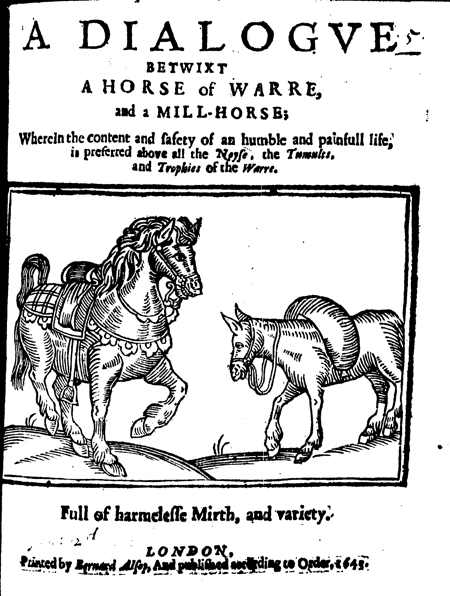
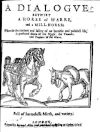
The images on the left are of John Lilburne in jail with the ironic title of "The Liberty of the Freeborne English-Man" (July, 1646); the title page of Richard Overton's pamphlet "An Arrow against all Tyrants and Tyranny" (12 Oct. 1646); the title page of "The First Agreement of the People" (3 November 1647); and the title page of "Dialogue betwixt a Horse of Warre and a Mill-Horse" (2 January, 1644). |
Introduction
Bibliographic Details
, An Anthology of Protests of "The Little People" (1641-1652). Edited by David M. Hart (The Pittwater Free Press, 2025).http://davidmhart.com/liberty/Levellers/Anthologies/ProtestsLittlePeople/index.html
An Anthology of Protests of "The Little People" (1641-1652). Edited by David M. Hart (The Pittwater Free Press, 2025). It contains 17 items and 182 pages.
Editor's Note
The page numbers in square brackets in bold refer to the page numbers in the original pamphlet. Sometimes page numbers were missing or there were duplicates. We have attempted to correct this where possible.
On many occasions the text in the margin notes is unreadable as a result of poor scanning of the original. In some tracts with large numbers of marginal notes, or very long ones, they have been changed into endnotes.
If there is no author's name given in the tract but we have other sources of information about the name of the author we have put the name in square brackets, as in [Lilburne].
Clicking on the text in the paragraph will bring up the citation tool to the left. Clicking on the "anchor" will reveal the URL for that paragraph; clicking on the "star in the circle" will reveal the full bibliographical details along with the URL for that paragraph.
The Image used Above
The illustration above comes from a charming anonymous "dialogue" between a "war horse" and a "mill horse" about their relative contributions to the welfare of the people during the Civil War (dated January 1644). This is included below.
Table of Contents
- Anon., The Lamentable Complaints of Nick Froth the Tapster, and Rulerost the Cooke (May 1641)
- Anon., The Actor's Remonstrance, or Complaint: For the silencing of their profession, and banishment from their severall Play houses (24 January, 1643)
- Anon., A Dialogue betwixt a Horse of Warre and a Mill-Horse (2 January, 1644)
- Thomas Johnson, A Discourse on Freedome of Trade (11 April, 1645)
- Anon., The World is turned Upside Down (8 April, 1646)
- John Taylor, The World turned Upside Down (28 January, 1647)
- Anon., A Remonstrance of the Shee-Citizens of London (21 August, 1647)
- Richard Overton, The Mournfull Cryes of many thousand Poore Tradesmen, who are ready to famish through decay of Trade (22 January, 1648)
- Anon., Women Will Have their Will (12 December, 1648)
- John Lilburne et al., The Hunting of the Foxes (21 March 1649)
- Elizabeth Lilburne, The humble Petition of diverse wel-affected Weomen (5 May, 1649)
- [Six Soldiers], The Levellers (falsely so called) Vindicated (20 August 1649)
- John Lilburne, An Outcry of the Youngmen and Apprentices of London: or, An Inquisition after the lost Fundamentall Lawes and Liberties of England (29 August 1649)
- Mary Stiff, The good Womens Cryes against the Excise of all their Commodities (4 January 1650)
- Anon., The Soap-makers Complaint for the losse of their Trade (24 September 1650)
- Anon., A Declaration of the Commoners of England (13 February, 1652)
- Anon., The Vindication of Christmas (22 December, 1652)
THE TRACTS AND PAMPHLETS
1. Anon., The Lamentable Complaints of Nick Froth the Tapster, and Rulerost the Cooke (May 1641)↩
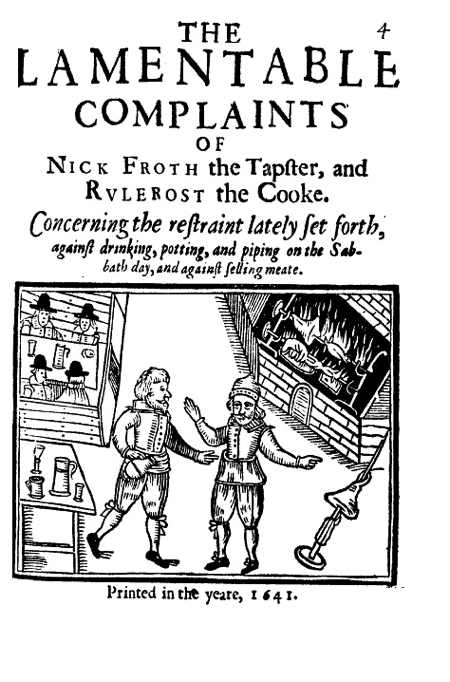
Title ID: T.007 [1641.05] Anon., The Lamentable Complaints of Nick Froth the Tapster (May 1641).
Estimated Date of Publication: May, 1641.
Thomason Tracts Catalog Information: TT1, p. 14; Thomason E. 156. (4.)
Full Title
Anon., The Lamentable Complaints of Nick Froth the Tapster, and Rulerost the Cooke. Concerning the restraint lately set forth against drinking, potting and piping on the Sabbath Day, and against selling meate. Printed in the yeare, 1641.
The Lamentable Complaints of Nick Froth the Tapster, and Rulerost the Cooke
[3]
Concerning the restraint lately set forth, against drinking, potting, and piping on the Sabbath-day, and against selling meate.
Froth. MY honest friend Cooke Ruffin well met, I pray thee what good newes is stirring.
Cook. Good news (said you?) I, where is’t? there is such newes in the world, will anger thee to heare of, it is as bad, as bad may be.
[4]
Fr. Is there so? I pray thee what is it, tell me whatsoever it be.
Co. Have you not heard of the restraint lately come out against us, from the higher Powers; whereby we are commanded not to sell meat nor draw drink upon Sundays, as we wil answer the contrary at our perils.
Fr. I have heard that some such thing was intended to be done, but never before now, that it was under black and white: I hope there is no such matter: Art thou sure this thy news is true?
Co. Am I sure, I ever roasted a fat Pig on a Sunday untill the eyes dropt out, thinke you. S’foot, shall I not credit my owne eyes.
Fr. I would thine had dropt out too, before ever thou hadst seen this, and if this be your news, you might have kept it, with a pox to you.
Co. Nay, why so chollerick my friend, you told me you would heare me with patience, whatsoever it were.
Fr. I cry thee heartily mercy, honest Rulerost, I am sorry for what I said, it was my passion made me forget my self so much: but I hope this command as you speake, will not continue long, will it thinke you Master Cooke?
Co. Too long to our greife I feare, the Church-Wardens, Side-men, and Constables, will so look to our red Lattices, that we shall not dare to put our heads out of doors on a Sunday hereafter. What think you neighbour, is it not like to prove so?
Fr. Truely it is much to be feared; but what do you think will become of us then, if these times hold?
Co. Faith, Master Froth, we must shut up our doors and hang padlocks on them, and never so much as take leave of our Land-lords.
Fr. Master Rulerost, I jumpe with you in opinion [5] for if I tarry in my house till quarter-day, my Land-lord, I feare, will provide me a house gratis. I am very unwilling to trust him, he was alwayes wonderfull kind, and ready to help any of his debtors to such a curtisie; to be plaine with you, I know not in which of the Compters I shall keep my Christmas, if I doe not wisely by running away prevent him.
Co. Thou hast spoke my owne thoughts, but I stand not so much in danger of my griping Land-lord, as I doe of Master Kill-calfe my Butcher, I am run into almost halfe a yeares arrerages with him; I do owe him neare ninety pounds for meat, which I have had of him at divers and sundry times, as by his Tally, may more at large appeare.
Fr. I my selfe am almost as farre in debt to my Brewer, as you are to your Butcher; I had almost forgotten that, I see I am no man of this World; if I tarry in England: He hath often threatned to make dice of my bones already, but ile prevent him; ile shew him the bagg, I warrant him.
Co. He had rather you would shew him the money and keep the bagge to your selfe.
Fr. I much wonder, Master Rulerost why my trade should be put downe, it being so necessary in a Common-wealth: why, the noble art of drinking, it is the soule of all good fellowship, the marrow of a Poets Minervs, it makes a man as valiant as Hercules, though he were as cowardly as a French man; besides, I could prove it necessary for any man sometimes to be drunk, for suppose you should kill a man when you are drunk, you shall never be hanged for it untill you are sober; therefore I thinke it good for a man to be alwayes drunk: and besides it is the kindest companion, and friendliest sin of all the seven; for most sins leave a man by some accident or other, before [6] his death. But this will never forsake him till the breath be out of his body: and lastly, a full bowle of strong beere will drowne all sorrowes.
Co. Master Nick, you are mistaken, your trade is not put downe as you seeme to say; what is done, is done to a good intent; to the end that poore men that worke hard all the weeke for a little money, should not spend it all on the Sunday while they should be at some Church, and so consequently there will not be so many Beggers.
Fr. Alack you know all my profit doth arise onely upon Sundays, let them but allow me that priviledge, and abridge me all the weeke besides: S’foot, I could have so scowred my young sparks up for a peny a demy Can, or a halfe pint, heapt with froth. I got more by uttering halfe a Barrell in time of Divine service, then I could by a whole Barrell at any other time, for my customers were glad to take any thing for money, and thinke themselves much ingaged to me; but now the case is altered.
Co. Truely Master Froth, you are a man of a light constitution, and not so much to be blamed as I that am more solid: O what will become of me! I now thinke of the lusty Surloines of roast Beefe which I with much policy divided into an innumerable company of semy slices, by which, with my provident wife, I used to make eighteene pence of that which cost me but a groat (provided that I sold it in service time,) I could tell you too, how I used my halfe Cans and my Bloomesbury Pots, when occasion served; and my Smoak which I sold dearer then any Apothecary doth his Physick: but those happy dayes are now past, and therefore no more of that.
Fr. Well, I am rid of one charge which did continually vex me by this meanes.
[7]
Co. I pry thee what was that?
Fr. Why Master Rulerost, I was wont to be in fee with the Apparitors, because they should not bring me into the Bawdy Court for selling drinke on Sundayes. Ile assure you they used to have a Noble a quarter of me, but now they shall excuse me, they are like to have no more quartridge of me, and indeed the truth is, their trade begins to be out of request as well as ours.
Co. I, trust me neighbour, I pity them; I was as much troubled with those kind of Rascals as your self, onely I confesse I paid them no quartridge, but they tickled my beefe, a stone of beef was no more in one of their bellies, then a man in Pauls; but now I must take occasion to ease my self of that charge; and with confidence I will now bid them, Walke knave, walke.
Fr. Truely Master Rulerost, it doth something ease my mind when I thinke that we have companions in misery. Authority I perceive is quick sighted, it can quickly espie a hole in a knaves coate. But Master Cooke we forget our selves, it groweth neare supper time, and we must part, I would tell you what I intend to doe, but time prevents me, therefore ile refer it untill the next time we meet; And so farewell.
FINIS.
2. Anon., The Actor's Remonstrance, or Complaint: For the silencing of their profession, and banishment from their severall Play houses (24 January, 1643)↩
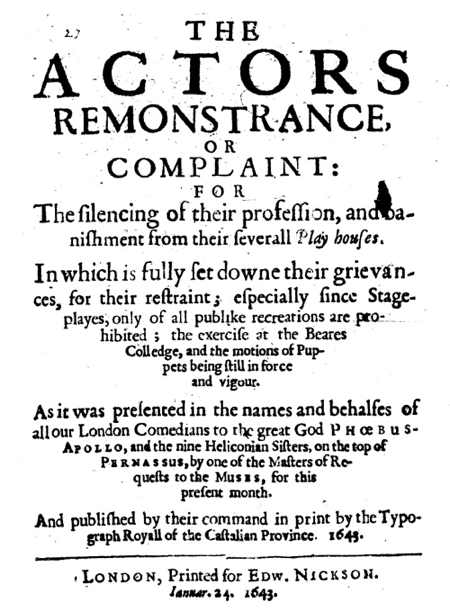
Title ID: T.024 [1643.01.24] Anon., The Actors Remonstrance (24 January, 1643).
Estimated Date of Publication: 24 January, 1643.
Thomason Tracts Catalog Information: TT1, p. 225; Thomason E. 86. (8.)
Full Title
Anon., THE ACTORS REMONSTRANCE, OR COMPLAINT: FOR The silencing of their profession, and banishment from their severall Play houses. In which is fully set downe their grievances, for their restraint; especially since Stage-playes, only of all publike recreations are prohibited; the exercise at the Beares Colledge, and the motions of Puppets being still in force and vigour. As it was presented in the names and behalfes of all our London Comedians to the great God PHOEBUS-APOLLO, and the nine Heliconian Sisters, on the top of PERNASSUS, by one of the Masters of Requests to the MUSES, for this present month. And published by their command in print by the Typograph Royall of the Castalian Province. 1643.
LONDON, Printed for EDW. NICKSON. Ianuar. 24. 1643.
The Actor's Remonstrance, or Complaint
[3]
OPpressed with many calamities, and languishing to death under the burthen of a long and (for ought wee know) an everlasting restraint, we the Comedians, Tragedians and Actors of all sorts and sizes belonging to the famous private and publike Houses within the City of London and the Suburbs thereof, to you great Phœbus, and you sacred Sisters, the sole Patronesses of our distressed Calling, doe we in all humility present this our humble and lamentable complaint, by whose intercession to those powers who confined us to silence, wee hope to be restored to our pristine honour and imployment.
First, it is not unknowne to all the audience that have frequented the private Houses of Black-Friers, the Cock-Pit and Salisbury-Court, without austerity, wee have purged our Stages from all obscene and scurrilous jests; such as might either be guilty of corrupting the manners, or defaming the persons of any men of note in the City or Kingdome; that [4] wee have endevoured, as much as in us lies, to instruct one another in the true and genuine Art of acting, to represse bebawling and railing, formerly in great request, and for to suite our language and action to the more gentle and naturall garbe of the times; that we have left off for our owne parts, and so have commanded our servarits, to forget that ancient custome, which formerly rendred men of our quality infamous, namely, the inveigling in young Gentlemen, Merchants Factors, and Prentizes to spend their patrimonies and Masters estates upon us and our Harlots in Tavernes; we have cleane and quite given over the borrowing money at first sight of punie gallants, or praising their swords, belts and beavers, so to invite them to bestow them upon us; and to our praise be it spoken, we were for the most part very well reformed, few of us keeping, or being rather kept by our Mistresses, betooke our selves wholy to our wives; observing the matrimoniall vow of chastity, yet for all these conformities and reformations, wee were by authority (to which wee in all humility submit) restrained from the practice of our Profession; that Profession which had before maintained us in comely and convenient Equipage; some of us by it meerely being inabled to keepe Horses (though not Whores) is now condemned to a perpetuall, at least a very long temporary silence, and wee left to live upon our shifts, or the expence of our former gettings, to the great impoverishment and utter undoing of our selves, wives, children, and dependants; besides which, is of all other our extremest grievance, that Playes being put downe under the name of publike recreations; other publike recreations of farre more harmfull consequence permitted, still to stand in statu quo prius, namely, that Nurse of barbarisme and beastlinesse, the Beare-Garden, whereupon their usuall dayes those Demy-Monsters, are baited by bandogs, the Gentlemen of Stave and Taile, namely, boystrous Butchers, cutting Coblers, hard-handed Masons and the like, rioting companions, resorting thither with as much freedome as formerly, [5] making with their sweat and crowding, a farre worse stinck than the ill formed Beasts they persecute with their dogs and whips, Pick-pockets, which in an age are not heard of in any of our Houses, repairing thither, and other disturbers of the publike peace, which dare not be seen in our civill and well-governed Theatres, where none use to come but the best of the Nobility and Gentry; and though some have taxed our Houses unjustly for being the receptacles of Harlots, the exchanges where they meet and make their bargaines with their franck chapmen of the Country and City, yet we may justly excuse our selves of either knowledge or consent in these lewd practices, we having no propheticke soules to know womens honesty by instinct, nor commission to examine them; and if we had, worthy were these wretches of Bridewell, that out of their owne mouthes would convince themselves of lasciviousnesse: Puppit-plays, which are not so much valuable as the very musique betweene each Act at ours, are still up with uncontrolled allowance, witnesse the famous motion of Bell and the Dragon, so frequently visited at Holbourne-bridge; these passed Christmas Holidayes, whither Citizens of all sorts repaire with far more detriment to themselves then ever did to Playes, Comedies and Tragedies being the lively representations of mens actions, in which, vice is alwayes sharply glanced at, and punished, and vertue rewarded and encouraged; the most exact and naturall eloquence of our English language expressed and daily amplified; and yet for all this, we suffer, and are inforced, our selves and our dependants, to tender our complaint in dolefull manner to you great Phœbus, and you inspired Heliconian Virgins: First our House-keepers, that grew wealthy by our endevours, complaine that they are enforced to pay the grand Land-lords rents, during this long Vacation, out of their former gettings; instead of ten, twenty, nay, thirty shillings shares which used nightly to adorne and comfort with their harmonious musique, their large and well-stuffed pockets, they have shares in nothing [6] with us now but our mis-fortunes; living meerly out of the stock, out of the interest and principall of their former gotten moneyes, which daily is exhausted by the maintenance of themselves and families.
For our selves, such as were sharers, are so impoverished, that were it not for some slender helps afforded us in this time of calamitie, by our former providence, we might be enforced to act our Tragedies: our Hired-men are disperst, some turned Souldiers and Trumpetters, others destin’d to meaner courses, or depending upon us, whom in courtesie wee cannot see want, for old acquaintance sakes. Their friends, young Gentlemen, that used to feast and frolick with them at Tavernes, having either quitted the kin in these times of distraction, or their money having quitted them, they are ashamed to look upon their old expensive friends. Nay, their verie Mistresses, those Buxsome and Bountifull Lasses, that usually were enamoured on the persons of the younger sort of Actors, for the good cloaths they wore upon the stage, beleeving them really to be the persons they did only represent, and quite out of sorts themselves, and so disabled for supplying their poore friends necessities. Our Fooles, who had wont to allure and excite laughter with their very countenances, at their first appearance on the stage (hard shifts are better than none) are enforced, some of them at least to maintaine themselves, by vertue of their bables. Our boyes, ere wee shall have libertie to act againe, will be growne out of use like crackt organ-pipes, and have faces as old as our flags.
Nay, our very Doore-keepers, men and women, most grievously complaine, that by this cessation they are robbed of the priviledge of stealing from us with licence: they cannot now, as in King Agamemnons dayes, seeme to scratch their heads where they itch not, and drop shillings and half Crowne-pieces in at their collars. Our Musike that was held so delectable and precious, that they scorned to come to a Taverne under twentie shillings salary for two houres, now [7] wander with their Instruments under their cloaks, I meant such as have any, into all houses of good fellowship, saluting every roome where there is company, with Will you have any musike Gentlemen? For our Tire-men, and others that belonged formerly to our ward-robe, with the rest, they are out of service: our stock of cloaths, such as are not in tribulation for the generall use, being a sacrifice to moths. The Tobacco-men, that used to walk up and downe, selling for a penny pipe, that which was not worth twelve-pence an horse-load; Being now bound under Tapsters in Inns and Tippling houses. Nay such a terrible distresse and dissolution hath befallen us, and all those that had dependance on the stage, that it hath quite unmade our hopes of future recoverie. For some of our ablest ordinarie Poets, in stead of their annuall stipends and beneficiall second-dayes, being for meere necessitie compelled to get a living by writing contemptible penny-pamphlets, in which they have not so much as poetical licence to use any attribute of their profession; but that of Quidlibet audendi? and faining miraculous stories, and relations of unheard of battels. Nay, it is to be feared, that shortly some of them; (if they have not been enforced to do it already) will be encited to enter themselves into Martin Parkers societie, and write ballads. And what a shame this is, great Phœbus, and you sacred Sisters; for your owne Priests thus to be degraded of their ancient dignities. Be your selves righteous Judges, when those who formerly have sung with such elegance the acts of Kings and Potentates, charming like Orphens the dull and brutish multitude, scarce a degree above stones and forrests into admiration, though not into understanding with their divine raptures, shall be by that tyrant Necessitie reduced to such abject exigents, wandring like grand children of old Erra Paters, those learned Almanack-makers, without any Mæcenas to cherish their loftie conceptions, prostituted by the mis-fortune of our silence, to inexplicable miseries, having no heavenly Castalian Sack to actuate and informe their spirits almost [8] confounded with stupiditie and coldnesse, by their frequent drinking (and glad too they gan get it) of fulsome Ale, and hereticall Beere, as their usuall beverage.
To conclude, this our humble complaint great Phœbus, and you nine sacred Sisters, the Patronesses of Wit, and Protectresses of us poore disrepected Comedians, if for the present, by your powerfull intercessions we may be re-invested in our former Houses, and setled in our former Calling, we shall for the future promise, never to admit into our six-penny-roomes those unwholesome inticing Harlots, that sit there meerely to be taken up by Prentizes or Lawyers Clerks; nor any female of what degree soever, except they come lawfully with their husbands, or neere allies: the abuses in Tobacco shall be reformed, none vended, not so much as in three-penny galleries, unlesse of the pure Spanish leafe. For ribaldry, or any such paltry stuffe, as may scandall the pious, and provoke the wicked to loosenesse, we will utterly expell it with the bawdy and ungracious Poets, the authors to the Antiodes. Finally, we shall hereafter so demeane our selves as none shall esteeme us of the ungodly, or have cause to repine at our action or interludes: we will not entertaine any Comedian that shall speake his part in a tone, as if hee did it in derision of some of the pious, but reforme all our disorders, and amend all our amisses, so prosper us Phœbus and the nine Muses, and be propitious to this our complaint.
FINIS.
3. Anon., A Dialogue betwixt a Horse of Warre and a Mill-Horse (2 January, 1644)↩
Title ID: T.32 [1644.01.02] Anon., A Dialogue betwixt a Horse of Warre and a Mill-Horse (2 January, 1644).
Estimated Date of Publication: 2 January, 1644.
Thomason Tracts Catalog Information: TT1, p. 303; Thomason E. 80. (5.)
Full Title
Anon., A Dialogue betwixt a Horse of Warre, and a Mill-Horse; Wherein the content and safety of an humble and painfull life, is preferred above all the Noyse, the Tumults, and Trophies of the Warre. Full of harmelesse Mirth, and variety.
London, Printed by Bernard Alsop, and published according to order, 1643.
[1]
A discourse between the Cavalliers Warre Horse, and the Country-mans Mill-Horse
Cav. hors.
WEll met old Mill-Horse or indeed an Asse,
I must instruct thee before we doe passe
How to live bravely; look on me and view
My Bridle and my Saddle faire and new;
Warre doth exalt me, and by it I get
Honour, while that my picture is forth set
Cut out in Brasse, while on my back I beare
Some Noble Earle or valiant Cavallier.
Come therefore to the Wars, and doe not still
Subject thy selfe to beare Sacks to the Mill.
Mil-hors.
Despite me not thou Cavalliers War-Horse
For thouogh to live I take an idle course,
Yet for the common-wealth I alwayes stand,
And am imploy’d for it, though I’m nam’d
A Mill-Horse, I am free and seem not under
Malignants that doe townes and houses plunder.
Transported on thy back, while thou must be
Valse guilty of their wrong, and injurie.
Done to their country, while without just cause,
Thou fightest for the King against the Lawes.
Against Religion, Parliament and all,
And least the Pope and Bishops downe would fall.
Thou art expos’d to battle, but no thanks,
Thou bast at all when thou dost break the Ranks
Of our stout Muskettiers, whose bullets flye
In showres, as in the fight at Newbery,
And force thee to retreat with wounds, or lame,
Is this the glory of thy halting fame.
Whereof thou dost so bragge [Editor: illegible word] beside thy fault
Of fighting for them who have alwayes fought,
Against the common-wealth, is such a sin,
That doth stick closer to thee then thy skin,
What though upon my back I carry sacks;
Thy meat is plunderd out of barnes and stacks;
While thou dost feed on stolen Dates and Hay
The wronged Farmers curse the strength away
Of all thy Diet, often wishing that
Diseases may consume thy ill-got fat. [2]
Therefore recant and never more appeare
In field a Champion for the Cavallier;
Let not his spurre nor false fame prick thee on
To fight in unjust warres as thou hast done.
Cav. hors.
Fame is not what I aime at, but the knowne
Right of the King, the trumpet that is blowne
Unto the Battell doth not give me more
Courage, then what I had in him before,
As if we did partake of more then sense
And farre exceeded mans intelligence,
In stooping unto Kings, and doe prove thus
Our selves descended from Bucephalus,
That Horse who did no loyall duty lack
But kneeling downe received on his back
Great Alexander, while men kick and fling
Against the power of so good a King
As time hath blest us with, O let this force
A change in thee who art a dull Mill-horse.
Thou art no Papist being without merit,
Nor zealous Brownist, for thou dost want spirit.
But with a Halter ty’d to block or pale,
Dost pennance, while thy master drinks his Ale
In some poore Village; such a poore thing are thou
Who Gentry scorne, beare till thy ribs doe bow
Burthens of corne or meale, while that Kings are
My Royall Masters both in Peace and Warre.
Mil-hors.
Boast not of happy fortune, since time brings
A change to setled States and greatest Kings,
England was happy; peace and plenty too
Did make their rich abode here, but now view
The alteration, Warrs hath brought in woe.
And sad destruction doth this land o’flown
Now thou art proud, but if this warre in peace
Should land thy high ambition would then cease;
Thy strength and courage would find no regard,
Thy plundering service should get no reward,
Although in warrs thou trample down and kill
Thy foe in age thou shalt beare sacks to Mill
As I doe now, and when thy skinne is grizzle
Groan underneath thy burthen, fart, and fizzle [3]
Like an old horse, a souldier of the Kings,
“All imploy’d valour sad repentance brings,
When thou art lame, and wounded in a fight
Not knowing whether thou dost wrong or right,
Or what is the true ground of this sad warre
Where King and subjects both ingaged are;
Both doe pretend the justnesse of their cause.
One for Religion, Liberty, and Lawes;
Doth stand, while that the King doth strive again
His Right and due Prerogative to maintaine;
The king keeps close to this, while subjects be
Growne mad to eclipse the sonne of Majestie
By enterposing differences; how canst thou judge
Where the fault is: both at each other grudge,
I know that this discourse is farre too high
For us, yet now to talke of Majesty;
In boldest manner is a common thing
While every cobler will condemn a King,
And be so politick in their discourse.
Yet know no more then I a poore Mill-horse;
Who for the common-wealth doe stand and goe,
Would every commonwealths man did doe so.
Cav hors.
Mill-horse in this thy space and speech agree
Both wanting spirit dull and tedious bee;
The King and commonwealth are vexed theames
Writ on by many; prethee think on Beanes
And Oates well ground, what need hast thou to care
How the deplored commonwealth doth fare;
For policy this rule in mind doth keep,
“Laugh when thou hast made others grieve and weep
What care we how the State of things doe goe?
“While thou art well, let others feele the woe.
If I have store of provender I care not,
Let Cavalliers full plunder on and spare not,
When Ockingham was burned I stood by
And like each widdowes wept at ne’re an eye,
When the town burnt a fellow said in leather
“He lov’d to see a good fire in cold weather;
And with the simple clowne I doe say still
“If I doe well I care not who doth ill;[4]
For with the Cavalliers I keep one course,
And have no more Religion then a Horse,
I care not for the Liberty nor Lawes.
Nor priviledge of Subjects, nor the cause,
Let us stand well affected to good Oates,
While that the ship of State and Kingdome floates
On bloody waves, the staved rack shall be
Crammeed with hey, a commonwealth to me.
Mill-hors.
Alasse I pitty thee thou great war-horse
Who art like Cavalliers without remorse:
The sad affliction which the Kingdome feeles,
Regarding not, thou caste it at thy heeles
And so dost prove that horses have no braine
Or if they have they little wit containe.
Unto the Kingdomes tale thy prick eares lend
Whose griefe I will describe, and right defend.
Cav-hors.
Thou defend right, thy right to the high way
Is lost, as sure as thou dost live by hey,
In telling of a tale without all doubt
Thou needs must stumble, and wilt soon run out
Of breath and sense, good Mill-horse, therefore prethee
Leave tales, there are too many tales already,
That weekly flye with more lies without faile
Then there be haires within a horses taile;
And if the writers angry be I wish,
You would the Cavalliers horse arse both kisse,
Not as the Miller thy back doth kisse with whip,
But as a Lover doth his Mistresse sip;
For know the Cavalliers brave warlick horse
Scornes vulgar Jades, and bids them kisse his arse.
Mill-hors.
Thou pamperd Jade that liv’st by plunderd oates
My skin’s as good as thine and worth ten groates,
Though slow of foot, I come of a good kind,
Of Racers, gotten by the boistrous wind
When the mare turned her back side in the mouth
Of Boreas, being Northerne breed not South.
The Millers horse before the warres began,
Would take the way of Lord or Gentleman;
And when Peace shall Malignants keep in aw,,
I shall see thee in Cauch or Dung-cart draw,
[5]
Cav. hors.
I scorne thy motion, after this sad Warre,
Perhaps I may draw in some Coach or Carre;
And which doth grieve me, Cavaliers most high-born
I may be forced to draw on to Tiburne:
In time of Peace my blood shall not be spilt,
But like to Noble Beere, shall run at Tilt.
In Peace I serve for Triumphs, more then that
I shall be made a Bishop, and grow fat,
As Archey said, when Bishops rul’d ’twas worse,
That had no more Religion then a Horse.
But thou shalt weare thy selfe out, and be still
An everlasting Drudge unto some Mill.
Mil-hors.
No matter, I wil spend my life and health,
Both for my Country and the common-wealth,
And it is Prince-like (if well understood)
To be ill-spoken off for doing good,
And if a horse may shew his good intent,
Some Asses raile thus at the Parliament.
Scorn is a burthen laid on good men still.
Which they must beare, as I do Sackes to Mill:
But thou delighted to bear trumpets rattle.
An animall rushing into lawlesse battle;
If thou couldst think of those are slain and dead,
Thy skin would blush, and all thy haires look red
With blood of men, but I do with for peace,
On that condition Dogs might eate thy flesh.
Then should the Mil-horse meat both fetch and bring.
Towns brew good Ale, and drink healthe to the King.
Cav. hors.
Base Mill-horse have I broke my bridle, where
I was tyed by my Master Cavaliere
To come and prattle with thee, and doest thou
Wish Dogs might eat my flesh? I scorn thee now.
My angry sense a great desire now feeles.
To kick thee into manners with my heeles.
But for the present I will curb my will.
If thou wilt tell me some newes from the mill.
Mil-hors.
If thou wilt tell me newes from Camp & Court,
Ile tell thee Mill-newes that shall make thee sport.
Cav. hors.
If Country news thou wilt relate and shew me,
Halters of love shall binde me fast unto thee,
[6]
Mil-hors.
It chanced that I carried a young Maid
To Mill, and was to stumble much afraid,
She rid in handsome manner on my back,
And seem’d more heavie then the long meale sacke
On which she sate, when she alighted, I
Perceiv’d her belly was grown plump and high;
I carried many others, and all were
Gotten with childe still by the Cavaleer,
So that this newes for truth I may set downe,
There’s scarce a Maid left in a Market towne;
An woman old with Mufler on her chin,
Did tell the Miller she had plundered been
Thrice by the Cavaliers, and they had taken.
Her featherbeds, her brasse, and all her bacon,
And she her daughter Bridget that would wed
Clodes sonne was plundered of her maidenhead,
Besides I heare your Cavaliers doe still,
Drinke sacke like water that runs from the Mill;
We heare of Irish Rebels comming over,
Which was a plot that I dare not discover.
And that the malignant Army of the King,
Into this Land blinde Popery would bring.
Cav. hors.
Peace, peace, I see thou dost know nothing now,
Thy fleeting jests I cannot well allow;
And there are Mercuriés abroad that will,
Tell better news then a horse of the Mill;
But I will answer thee, and tell thee thus,
Thou lyest as bad as ere did Aulicus.
Who though he writ Court-newes ile tell you what,
Heele lye as fast as both of us can trot.
You tell of Maydens that have been beguild,
And by the Cavaleers are got with childe,
And hast not thou when thou wast fat and idle,
Often times broke thy halter and thy bridle,
And rambled over hedge and ditch to come,
Unto some Mare, whom thou hast quickly wonne
To thy desire, and leapt her in the place,
Of dull Mill-horses to beget a race;
While that the Cavaliers when they do fall
To worke, will get a race of souldiers all.
It had been newes whereas I would have smilde,[7]
If the maids had got the Cavalliers with childe.
Mill-hors.
I ramble over hedge, thou meanst indeed
The Cavalliers, who were compelt’d with speed
Both over hedge and ditch away to flye.
When they were lately beat at Newbery.
The Proverb to be true is prov’d by thee
That servants like unto their masters bee;
Those plundering devills on thy back doe ride,
Have fill’d thee with a pamper’d spirit of pride,
And thou hast eaten so much Popish Dates,
That in thy belly thou hast got three Popes;
The great Grand-father of that race did come
That bore Pope Joane in triumph through Rome
I beare to Mill of corne a plump long sack.
Thou carried a great Pluto on thy back.
Oh Cavallier, and who can then abide thee.
When that malignant Fooles and Knaves doe ride thee.
From town to town, and plunder where they come,
The country is by Cavalliers undone.
And these thy masters are, who fight and kill
And seek the blood of Protestants to spill;
For thus the newes abroad both alwayes runns,
That the Kings forces are in horse most strong.
Whereby it doth appeare the war-horse are
Guilty of blood-shed, in this cruell war
And yet the Cavalliers horse as I beare
At Kenton field beshit themselves for feare.
And the Cavalliers being kill’d, they run about
The field to seek another master out,
Therefore love war, and have of wounds thy fill.
While I in Peace doe walk unto the Mill;
I will be alwayes true unto my selfe,
And love the Kingdome and the Commonwealth.
Cav. hors.
Mill-horse, because thou shew’st thy railing wits
Ile give thee a round answer with some kicks,
Which Ile bestow upon thee, but I am undone,
Yonder my master Cavallier doth come
To fetch me back, and Yonder too I see
The Miller comming for to take up thee;
If thou lik’st not my discourse very well,
Mill-horse take up my taile, and so farwell.
FINIS.
4. Thomas Johnson, A Discourse on Freedome of Trade (11 April, 1645)↩
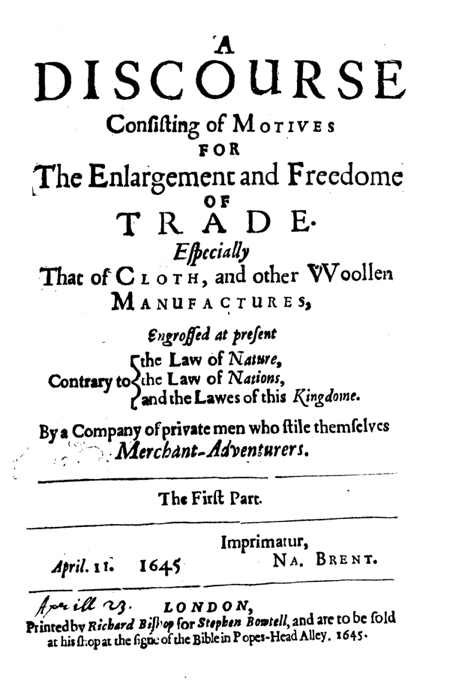
Title ID: T.45 [1645.04.11] Thomas Johnson, A Discourse on Freedome of Trade (11 April, 1645).
Estimated Date of Publication: 11 April, 1645. (Listed in TT as 23 April).
Thomason Tracts Catalog Information: TT1, p. 373; Thomason E. 260. (21.)
Full Title
Thomas Johnson, A DISCOURSE Consisting of MOTIVES FOR The Enlargement and Freedome OF TRADE. Especially That of CLOTH, and other Woollen MANUFACTURES, Engrossed at present Contrary to the Law of Nature, the Law of Nations, and the Lawes of this Kingdome. By a Company of private men who stile themselves Merchant-Adventurers. The First Part..
Imprimatur, NA. BRENT. April. 11. 1645
LONDON, Printed by Richard Bishop for Stephen Bowtell, and are to be sold at his shop at the signe of the Bible in Popes-Head Alley. 1645.
[i]
A Discourse consisting of Motives for the Enlargement and Freedome of Trade
To the Right Honourable the Lords and Commons in Parliament assembled.
Right Honourable,
THE scope and substance of this following Discourse, is to demonstrate by clear and unanswerable Arguments, the Illegality of the Incorporation of those who soly ascribe unto themselves the names of Merchants Adventurers, though they Trade but unto two Townes only, and those hard by: and to shew further how their Patent trencheth upon the native Rights of the freeborn subject: which Patent hath been often complaind of and clamord against from time to time, as an universall greevance to Town and Countrey, tending to the diminution of Trade, and of all sorts of Manufactures at home, and to the dis-repute of the Policy of this Nation abroad, the sayd Patent being accounted no lesse amongst all people, then a Monopoly, [ii] a word odious all the world over. This Incorporation hath bin like an Ulcer upon the Body politique of this Kingdome a long time, which hath beene often rub’d and lanc’d, yet it clos’d againe and gatherd more corruption then formerly, and now requires a greater cure then ever..
Therfore in all humblenesse it is prayed, that this Honourable Court and highest Councell of the Kingdom, who have already done so many glorious things for the publike Liberty, Rights and Immunities of the free borne Subject, would be pleased to peruse the ensuing Discourse, and poise the weight of the Reasons, Arguments, and proofes therein produced, which are derived from true fountaines, and so to doe therein what in their high wisedome and justice they shall think expedient for the redresse of such a Nationall grievance..
[1]
A DISCOURSE Consisting of Motives FOR The Enlargement and Freedome of Trade, Especially That of Cloth and other Woollen Manufactures,
Engrossed at present.
| Contrary to | { the Law of Nature, |
| { the Law of Nations, | |
| { and the Lawes of this Kingdome, |
By a Company of private men who stile themselves
Merchant-Adventurers..
THe Terrestriall Globe is cut out into Islands and Continents, both which are created to be a Mansion for men; and although they be severd by the work of Nature, yet they may be said to be joynd together by Commerce, which is that great link of humane Society, that golden chaine which unites all Nations; And though the Earth and Sea be of themselves, [2] as differing Elements as any of the rest, yet the Divine Providence by a speciall foresight hath so indented as it were, and embosomd them one in the other, that they make but one perfect Globe, to render them thereby more apt for the mutuall Commerce and Negotiation of Mankinde.
Of all parts of the Earth, Islands (which by the violence of the Sea are torne off from the rest of the world) stand most in need of Commerce, as well for the encrease of shipping, whereon their security and strength doth principally depend, as for divers other advantages conducing to wealth, to the expence of the superfluities of their owne native Commodities, and the importation of forreigne, to intelligence, and prevention of dangers, and lastly to the improvement of civility and knowledge.
And this our Island (for ought any one knoweth) might have remaind to this day in her first simplicity and rudenesse, had she not refined and civilized her selfe by Commerce with those of the next Continent, and they of the next Continent, had they not crossed the Alps to Italy; and the Italians themselves, had they not had practise with the Levantines, and other Eagle-eyed Nations who dwell nearer the Sun rising.
Amongst the Islands of the old world, Great Britain hath beene cried up for the biggest, and best-replenished with those Commodities that are most [3] materiall and usefull for the life of man, whereof she hath not only a competency for her selfe, but enough to spare her neighbours, which by way of surplusage she useth to disperse to most Countreys, whereby she beates a generall Trade, and makes rich returnes with her owne home-growne goods: which Trade may bee termed the prime sinew, and chiefest support both of her strength and riches..
Now there is nothing so advantagious and commendable in a Trade, as Community and Freedome; for in this particular (as in most things else) the topique Axiome holdeth, Bonum quò communius, eò meliùs; the more common and diffusive a good thing is, the better it is.
The most substantiall and staple Commodity that our Countrey affords for the maintenance of Trade is Cloth, with divers Manufactures besides arising from Wooll, which makes other Nations call Wooll, Englands Golden Fleece: and (questionlesse) the principall reason why in time of Parliament our Iudges (who are the Oracles of the Law) do sit in the House of Peeres upon Wooll-Sacks, was to put them in minde of preserving and advancing the Trade and Manufactury of Wooll: Therefore to barre any freeborn subject from the exercise of his Invention and Industry, to convert this universall native Commodity to his best advantage at home, or abroad, is to deprive him of part of his [4] birth-right, and of that which God and Nature ordaynd for his subsistence; and not only so, but it is to set a mark of strangenesse, or rather, of a kinde of slavery upon him in his own Countrey.
Hence it may well be inferrd, that for one Company, or Incorporation to arrogate to it selfe, and to engrosse the mannaging, expence, and vending of this necessary inmated Commodity, is an injury to publike right, and no lesse then a meere Monopoly: And it is held an undoubted principle of State, that there is nothing more pernicious and destructive to any Kingdome or Common-wealth, then Monopolies, which like Incubusses doe suck the very vitall spirits, and drive into one veine that masse of blood which should cherish the whole body: Nor doth this word Monopoly (according to its true Etimology) referre only to one individuall person, but also to any one Town, where many men are incorporated or aggregated into one body, who have hooked to themselves the sole exercise and emolument of such and such a trade, whereby they only enrich themselves, and admit no others to enter into their Society without some exaction.
The fellowship and Charter of them that terme themselves Merchant-Adventurers (under favour) is a Monopoly of this kinde, and is repugnant both
- To the Law of Nature,
- To the Law of Nations,
- To the positive Law of the Land.
[5]
First, it is repugnant to the Law of Nature, in regard that Wooll, and the draping and merchandizing thereof, being the Cape Commodity wherewith Nature, the handmaid of God Almighty, hath furnished this Island, and wherein she hath given every freeborn Inhabitant equall interest, as matter for his industry to work upon; Surely she never intended that a thin handfull of men, a small contemptible number in comparison of the whole (being but a few trading members, though their Company consists of a greater number) should appropriate to themselves the disposing and venting of the two thirds of this generall grand Commodity, as by diligent computation the Merchant-Adventurers are observed to doe.
Secondly, it is against the Law of Nations, in regard that no Monarchy or Kingdom, whether elective or successive, nor any other Commonwealth or State throughout Europe hath the like example. What a hubbub would there bee in France, if the vent of Wines were passed over to some peculiar men to furnish England withall? or in Spaine, or Naples, were the fruits and oyles of the one, and the silks of the other (being their prime Commodities) engrossed by a few hands? But admit there were some extraordinary restraints in trading to remote Countreys, and that there were joynt stocks, it maketh nothing to justifie the Company of Merchant-Adventurers. [6] Which yet hath beene lately questioned in Parliament as a Monopoly, & their Charter there disclaimed by themselves as illegall. We know our East-India Company here, and in Holland, have limitations, and have a Bank of their owne, because the Purses of private men cannot extend to set forth Ships for making of such long, adventurous, costly, voyages. But the Trade which is beaten by our Merchant-Adventurers to Hamburgh and Rotterdam, is of another nature, for it is hard by home, and as it were at our doores, and may be performed by Ships of any seize, the transfretation being short; so that though they seeme to arrogate soly to themselves the names of Merchant-Adventurers, there are none that deserve it lesse, their hazard being so small, and their voyage so short.
Thirdly, this Incorporation is repugnant to the, positive Lawes of this Land, as manifestly appears by Magna Charta, Petition of Right, Statutes of Monopolies, and severall others; but for brevity sake, let it suffice to insert here that famous Statute which was enacted by one of our wisest Kings, Henry the seventh, which continueth yet in full force unrepealed, and runnes thus.
[Editor: illegible word] H. 7. 1. 6.To the discreet Commons in this present Parliament assembled, sheweth unto your discreet wisdomes the Merchant-Adventurers inhabiting and dwelling in divers parts of this Realm of England out of the City of [7] London, that where they have their passage, resort, course and recourse with their goods, wares, and merchandize, in divers coasts and parts beyond the Sea, aswell into Spain, Portugall, Britain, Ireland, Normandy, France, Civill, Venice, Dansk, Eastland, Freezland, and other divers and many places, regions, and countreys, being in league and amity with the King our Soveraign Lord, there to buy and sell, and make their Exchanges, with their said goods, wares, and merchandizes, according to the Law and Custome used in every of the said Regions and places; and there every person freely to use himselfe to his most advantage, without exaction, fine, imposition, or contribution, to bee had or taken of them, or of any of them, to, for, or by any English person, or persons. And in semblable wise they before this time have had, used, and of right owen to have, and use their free passage, resort, and recourse into the coasts of Flanders, Holland, Zealand, Brabant, and other places thereto nigh adjoyning under the obeysance of the Arch-Duke of Burgoyn: In which places the universall Marts be commonly kept and holden foure times in the year, to the which Marts all English men, and divers other Nations in time past have [8] used to resort, there to sell and utter the commodities of their Countreys, and freely to buy again such things as seemed them most necessary and expedient for their pofit, and weale of their Countreys, and parts that they be come fro, till now of late, that by the Fellowship of the Mercers and other Merchants and Adventurers dwelling and being free within the City of London, by confederacy made among themselves, of their uncharitable and inordinate covetousnesse, for their singular profit and lucre, contrary to every English mans Liberty, and to the Liberty of the said Mart there, which is, that every person of what Nation that he be of, should have their free liberty there to buy and sell, and make the commutations with the Wares, Goods, and Merchandizes at their pleasure, have contrary to all Law, Reason, Charity, Right, and Conscience, amongst themselves, to the prejudice of all English men, made an Ordinance and Constitution, that is to say, That no English man resorting to the said Mart, shall neither buy nor sell any goods, wares, or merchandizes there, except he first compound and make fine with the said Fellowship, Merchants of London, and their said Confederates, at their pleasure, [9] upon paine of forfeiture to the said Fellowship, Merchants of London, and to their Confederates, of such merchandizes, goods, or wares, so by him bought, or sold there: which Fine, Imposition, and Exaction, at the beginning when it was first taken, was demanded by colour of Fraternity of Thomas Becket Bishop of Canterbury, at which time the said Fine was but the value of an old Noble sterling, and so by colour of such feigned holinesse, it hath beene suffered to be taken for a few yeares passed, and afterwards it was encreased to an hundred shillings Flemish, and now it is so, that the said Fellowship and Merchants of London take of every English man, or yong Merchant, being there at his first comming, forty pound sterling for a fine, to suffer him to buy and sell his owne proper Goods, Wares, and Merchandizes that he hath there: By occasion whereof, all Merchants, not being of the said Fellowship and Confederacy, withdraw themselves from the said Marts, whereby the woollen Cloth of the Realm, which is one of the greatest Commodities of the same, by making whereof the Kings true Subjects be put in occupation, and the poore people have most their living, and also other divers Commodities [10] of divers and severall parts of this same Realm is not sold ne uttered as it was in times past, but for lack of utterance of the same in divers parts, where such Clothes be made, they be conveyed to London, where they be sold farre under the price that they be worth, and that they cost to the makers of the same, and at sometime they be lent to long dayes, and the money thereof at divers times never paid; And over that, the Commodities and Merchandizes of those parts, which the said Fellowship, Merchants of London, and others their Confederates bring into this Land, is so sold to your said Complainants and other the Kings true Subjects, at so deare and high exceeding price, that the buyer of the same cannot live thereupon, by reason whereof, all the Cities, Towns, and Burroughs of this Realme in effect be fallen into great poverty, ruine, and decay, and as now in manner they without hope of comfort, or reliefe, and the Kings Customes and Subsidies, and the Navy of the Land greatly decreased and minished, and daily they be like more to decay, if due reformation be not had in this behalfe. Be it therefore enacted by the King our Soveraigne Lord, by the advise and assent of the [11] Lords spirituall and temporall, and the Commons in this present Parliament assembled, and by authority of the same, that every English man, being the Kings true Leigeman, from henceforth have free passage, resort, course and recourse into the said coasts of Flanders, Holland, Zealand, Brabant, and other places there to nigh adjoyning, under the obeysance of the said Archduke, to the Marts there hereafter to be holden, with his or their Merchandizes, Goods, and Wares, there to buy and sell, and make their exchange freely at his or their pleasure, without exaction, fine, imposition, extortion, or contribution to be had, leavied, taken, or perceived of them, or of any of them, to, for, or by any English person or persons to his or their own use, or to the use of the said Fraternity or Fellowship, or of any other like, except only of ten Mark sterling. And that no person English, as is afore rehearsed, hereafter take to his own use, or to the use of the said Fraternity or Fellowship thereof, any other English person of what estate degree, or condition that he be of, so alway that he be the King our Soveraigne Lords true Leigeman, any fine, exaction, imposition, or contribution for his liberty or freedome to buy [12] and sell Goods, wares, or Merchandizes in or at any of the said Marts, more or above the said summe of ten Mark sterling only, upon paine of forfeiture to our Soveraigne Lord for every time that he doth the contrary of this Act 20. l. and also to forfeit to the parties so grieved in this behalfe tenne times so much as he contrary to this present Act, taketh of him: And that the parties so aggrieved shall have in this behalfe an Action of debt for the said forfeiture of tenne times, in any of the Kings Courts within this Realm by writ, Bill, Plaint, or Information, and such processe to be made in the same, as is or ought to be made in or upon an Action of debt at the Common Law, and the triall thereof to be had in such Shire, City, or Place, where the said Action is commenced or sued; and that the Defendant in any Action bee not admitted to wage his Law, nor none Essoine or Protection be for such Defendant admitted or allowed in that behalfe.
This Act of Parliament is in full force and validity to this day; for there is none can deny, that the vertue of an Act of Parliament is such, that no Power can repeale or abrogate it, but the same Legislative Power that made it. Now that a private Charter procured by [13] gratuities, favour, and other clandestine wayes (as shall be proved) should have power to suspend and stop the execution of an Act of Parliament, we beleeve no Iudge in the Land will affirme, especially considering that this Charter doth authorize a few men to exercise both at home and abroad an extrajudiciall sway both over the consciences, the bodies, and estates of his Majesties leige people, by oathes, imprisonments, amercements, and taxes.
Touching the Oath they use to impose, it runs thus, being couched in this odde forme.
YOu sweare by Almighty God, to be good and true to our Soveraign Lord the King that now is, and to his Heires, and Successours, Kings of this Realme. You shall be obedient and assistant to Mr Governour or his Deputy, and Assistants of Merchant-Adventurers in the parts of Holland, Zealand, Brabant, Flanders, and within the Townes and Marches of Calais, as also in East Freezland, or any other Countrey or place on this or that side the seas, where the said Company are or shall be priviledged. All Statutes and Ordinances not repealed, which have beene made, or shall be made by the said Governour, or his Deputy and Fellowship, you shall to your best knowledge truly hold, and keep no singular regard to your selfe in hurt or prejudice of the Common wealth of the said Fellowship, or else being condemned, and orderly demanded, shall truly from time to time content [4] and pay unto the Treasurer for the time being, all and every such mulcts and penalties which have and shall be limited and set for the transgressors and offenders of the same. The secrets and privities of the aforesaid Fellowship you shall heal, and not bewray: and if you shall know any person or persons that intend any hurt, harme, or prejudice to our Soveraigne Lord the King, or unto his Lands, or to the Fellowship aforesaid, or the priviledges of the same, you shall give knowledge thereof, and doe it to be knowne to the said Governour or his Deputy. And you shall not colour or free any Forreigners goods, which are not free of this Fellowship of Merchant-Adventurers of England. So help you God..
By the words of this extravagant Oath, one may see what high, illegall and transcendent power they assume to themselves to make Statutes, which is proper and peculiar only to Parliaments: Moreover, they stile themselves a Commonwealth, in so much that though they cannot be termed Regnum in Regno, they may be well termed Dominium in Dominio. Besides this Oath there is another called the purging Oath, whereby one is bound to confesse whether he hath offended in such and such particulars, and to accuse himselfe, which is point blank against Law, being a thing abhorring to nature; and for which kinde of Oath some of our Courts were lately put downe by this present Parliament; and touching their Impositions [15] and Fines, they lay them ad libitum, which they convert afterwards to their owne benefit, whereas the King de jure partakes of all Fines: but they passed an Order, by which (to use their owne words) they were pleased to allow him the one moity; The true copy of which Order shall be inserted here with others, by which one may guesse at the rest.
At a Court holden March 4. 1603.
THe Brethren of this Company assembled together, doe hold it very requisite, for the better carriage of their Trade, that suite should be made unto the Kings Majesty, by the meanes of my Lord Chancellor to be preferred, that in the confirmation of the Companies Charters of Priviledges, this also might be added and inserted, that the Company, in their Courts as well in England as beyond the Seas to bee holden, may impose reasonable fines and penalties upon such Subiects of this Realme, not free of this Company, that shall ship Woollen Commodities into the Countreys and Places where they are priviledged, thereby to cause such intruding subiects to desist from that trade, which properly appertains to the Company of Adventurers. In consideration whereof, and in hope of the more favour in some other suites they meane to move hereafter, they are pleased that the Kings Maiesty may have and receive the one moity of all such fines and penalties as shall be imposed upon such intruders; and [16] further they agreed to yeeld to his Maiesty, in respect aforesaid, an annuall Rent of 50 l. or 100 Marks per annum.
As before by the recited Act, so likewise by this order it appeares that Merchants would not submit nor come into their Companie (as they had just cause so to doe) therefore suit must be made to suppresse them, but the illegall power which the Companie used, begat a Petition for free Trade in Parliament against the Companie, in Anno 1606, which was judged in that Supreme Court so just and right, that there passed a Bill for a generall libertie of trade, with great applause of the House, scarce fortie dissenting from it. But the Companie finding that the said Bill would have dissolved their Patent, they made a crosse presumptuous Order, which for that they have dared to doe, they may be truly termed Adventurous Merchants..
At a Court holden April 5. 1606.
THe Bill of generall liberty of Trade was now read, and this Court hath consented that learned Councell shall be entertained, and the enormities of the Bill laid open, with a manifestation of the necessity of a government in Trade. It is also further agreed, that all reasonable charges expended about the crossing of that Bill shall be defrayed by the Treasurer here..
[17]
The transcript of this oath and orders were truly extracted out of their owne Register, and is concordant with the originall. Touching the first, which is a kinde of oath of allegiance unto them, and hath touched the consciences of some, it is worth the observing how they mention a power they have to make Statutes, and it is proper for them so to doe, if they be a Commonwealth, as they terme themselves in the same Oath. And for the orders by these and the following, one may finde upon what a tottering foundation their Charter stands, and by what indirect meanes they support it, being borne by strength of Purse and Court Donatives, which in true English are but complementall bribes, which dare not appeare among their publique accompts, as is obvious by the following order.
At a Court holden Decemb. 23. 1622.
ACcording to the Order of the generall Court, this day they tooke into consideration the businesse of the Accompt required by the Commissioners, which this Court concerning to be a matter that may concerne divers great personages whom the Company have upon divers occasions presented with gratuities: It is not thought meet to give any such accompt as may any way touch the said great Personages, but rather to a void the accompt by some good courses, to which end it is agreed that Master Governour and [18] Master Deputy, or one of them, doe take some such course as they shall thinke convenient..
At a Court holden Novemb. 16. 1623.
THe Court had consideration according to the season of the yeare, of their yearly presents to such Honourable Personages as they have received favours from; and first forasmuch as they have beene extraordinarily bound to the favours of the Lord Treasurer, the remembrance it now to be enlarged at Newyeares tide, and that they shall present his Lordship with 200. peeces of 22.s in gold, and a peece of Plate, as an acknowledgement of his Lordships speciall favours..
Moreover, to the Lord Duke of Buckingham.
To the Archbishop of Canterbury.
To the Lord Treasurer.
To the Lord Keeper.
To the Lord President.
To M r. Secretary Calvert.
To M r. Comptroller, &c..
Having made it apparent by the premisses how this fraternity of Ingrossers is repugnant to all Laws both of Nature, of Nations, and of those of this Kingdome, as not being able to produce any municipall right thereunto; it remaines now to prove further, that this selfe-enriching society derogates from the repute and honours of the English Nation abroad, [19] for they are esteemed (as indeed they are) no other then a Monopoly, which being odious every where makes them lose both love and respect as well in Germany as the Netherlands, for though they enjoy some immunities where they come for their diet and lodging, it is not for any love unto them, but for the encrease of Customes and other advantages they bring along with them to that particular place. And it is observed, that they setled themselves no where yet, but there hath beene jarring betwixt them and the Towne at last, which hath made them remove their Tents so oft, and shift from place to place: besides there is commonly ill blood bred, and matter of contestation and envie betwixt that Town where they seat themselves, and other circumjacent Towns, as happened of late yeares betwixt Rotterdam and Amsterdam. Out of the precedent discourse and the circumstances thereof, this Inference doth necessarily follow, That the Company of those who stile themselves Merchants Adventurers ( in statu quo nunc ) take them in the condition they are now in, is not only against the hereditary priviledges, but also a pressure and a grievance of a high nature to the freeborne Subjects of this Realme of England. But in regard it is a common saying, that one tale is good till the other be told, let us examine and answer the arguments they produce for their owne vindication and defence.
[20]
The Arguments which the Merchants Adventurers alledge for their justification, may be all reduced to these three heads.
First, they cry up the Antiquity of their Company.
Secondly, the Ability of it.
Thirdly, the Necessity of it.
1.Touching the Antiquity thereof, they affirme their Charter to have beene granted them above 250. yeares past.
2.Touching their Ability, they alledge that they are of sufficient wealth to take up and buy all the White Clothes yearly made in this Realme for readie money; therefore there is no need to have a greater number added to them.
3.Touching the necessitie of their Company, they declare how by meanes of the same, and by their discreet government, the commodities issuing from Wooll have beene highly advanced, alledging that Clothes in the time of King H 7. being worth but 3. 1. are now sold for twice as much. Moreover they say, that if libertie should be granted every man to trade as he pleaseth, the unskilfulnesse of the traders meeting with the subtiltie of the people with whom they are to deale, great losse would ensue thereby to the Subjects of this Kingdome, besides the confusion that would inevitably follow.
[21]
To the first of these concerning their Antiquitie it is answered, that
As it is a rule in Divinitie, that Prescription cannot priviledge an errour, no more can it doe in civill government. It is true, when Edw. 3. by his extraordinarie wisedome had procured Cloth to be made so plentifully within this Realme, he incited and stirred up his subjects to the venting of those Clothes by transportation of them to forraine parts, whereby he granted them many favours: and Henry the fourth erected them to a Company that went by the name of a Brotherhood of Tho: Becket, Bp. of Cant. yet with this proviso, that any man paying the Haunce of an old Noble might freely consort and trade with them. But in the reigne of Henry the seventh the said Companie out of self-love and desire of lucre sought to appropriate the said priviledges so granted to all soly unto themselves, and attempted to exclude their Neighbours and Countrimen from the benefit of that trade, contrarie to the freedome and orders of all Mart Townes, which being complained of in Parliament, that famous Statute before inserted was made by that wise Legislator Henry the seventh; whence if one looke backward, he will finde that they cannot plead above 100. yeares antiquitie.
The Staplers were far more ancient, yet we know to what a reformation they submitted themselves; besides, in the carriage of all mundane affaires, the quality [22] of the times, and the face of things doe alter ever and anon. Those Immunities which were granted in the Infancy of trade, to incite people to the encrease and improvement of it, are not so proper for these times, when the Trade is come to that height of perfection, and that the mystery of it is so well known: and it is daily found by experience, that what was good and profitable to a State, by the alteration of times becomes prejudiciall; as for instance, it was lawfull for the Company of Staplers to transport Woolls, but when we attained to the knowledge of making Cloth, it was not good, and therefore prohibited.
Touching the second allegation, that their ability can extend to buy and vend all the Clothes that are made yearly. For the first part of this Argument that concernes their ability, it is too well known by what extrajudiciall, and monopolizing wayes they have thus enabled themselves to swallow up the market; for it hath beene by a constant engrossing of the Trade so many yeares, to the impoverishing and prejudice of their fellow Subjects, and to the feathering only of their owne nests. The strength of a Kingdome consists in the riches of many Subjects, not of a few, in so much that were this Trade enlarged, it would tend to the multiplying of able and wealthy Merchants, it would disperse it to a greater latitude, and further ennobling the Trade, and prevent the encrease of poore men and beggars [23] up and downe the Land: for it is one of the maine reasons why there are fewer beggars seene in Commonwealths then in Kingdoms, because of community and freedome of trading, by which meanes the wealth of the Land is more equally distributed amongst the Natives. But suppose they be able to buy all the Clothes, is it not against common reason, and the Subjects birth-right, that therefore they should be permitted so to doe and others debard.
Concerning the necessity of this Incorporation, it is enforced by a twofold reason.
First, they pretend that the sale of our Manufactures is more advanced, and the esteeme and price thereof borne up by their guidance and government, which is now double from what it was.
For answer, it is true that the rates of our woollen Commodities, as of all other sorts of Merchandize, are much raised from what they were, but this is an act of time, as in all other Countreys where Trade is free, in so long a tract of time, the prizes of all things change, especially since the discovery of the West-Indian Mines, which have so exceedingly encreased the plenty of money through all parts of Europe..
There be divers other reasons why the rates are raised, as the alteration of value in Coines and exchanges. Secondly the raising of Rents. Thirdly the endearment of victuals, which rise still with the [24] encrease of people. And lastly the chiefe reason is, because there hath beene such vent for our Cloth abroad, and that is the maine cause why our Cloth and other woollen Commodities are so much risen; but grant the Company beare up the prices of commodities abroad, may they not by the same power and policy keep up the prices of forreign commodities at home, by which meanes the Kingdome suffers both wayes?
Secondly they say, that if Trade were free, all would suddenly fall to decay, both Merchant and Clothier would be beaten out of trade by the Dutch; for if our Merchants who transport Cloth were not ordered by the Company, they would send such abundance into all parts, as they would not be able to gaine thereby: and so the Merchant would be discouraged to send any more, or if he doe send he will be sure to give the Clothier every time lesse for his Cloth, so that the Clothier nor Merchant will bee able to live by it; and by this overclogging of the market, our Cloth will be brought into dis-esteeme and not so regarded, as it is now by this Government.
This Objection at first fight carrieth a specious shew, but if it be cast into the ballance of truth, it will beare no weight at all, it is rather a conceit then an Argument, for they cannot prove it by any act of [25] experience, only they imagine such a thing. It is confessed that regularity and government is commendable in all things, otherwise disorders and a promiscuous kinde of confusion will follow. The French and Spanish Companies sang the same note before Tertio Iacobi when they were dissolved. There bee generall Lawes to regulate trade, and to preserve it from confusion; we desire still a government, but not a Monopoly, that so few should engrosse the whole masse and bulke of the prime trade of England to two Townes only. Trade (though the comparison be homely) is like Dung, which being close kept in a heap or two stinks, but being spread abroad, it doth fertilize the earth and make it fructifie; nor need we any forraign hands to spread it, wee have enough of our owne were they permitted. Touching the over-glutting of the market, it might well fall out, that if free Traders were confind to two Towns only, they would peradventure surcharge them, but having the choice of so many Ports, and such a variety of places, there is no such feare of a glut. As touching the esteeme and rates of our Cloth, which they pretend would bee prejudiced, let them know, that it is not the high price but plenty that propagates Trade; and for the high rates of our Cloth, we may impute that not so much to their Government, as the policy of the Dutch themselves, who to make Dutch Cloth more vendible, hoise up the price of ours, and that [26] our Cloth and other woollen Commodities are endeared by the Company here, shall be proved afterwards.
There are two main things that conduce to make a trade flourish, plenty of Merchandize and multitude of Merchants. Now it can be proved that in the yeare 1633, before that strict Proclamation for restraint came out, there were neere upon 600 Traders in those commodities: and in the yeare 1639 not above 180; and in Holland before that Proclamation when they made most, they made not above two thousand Clothes yearly, but since they have made some yeares twentie thousand, and they fell also to the making of Perpetuanoes, which they had never done before; so that trade is insensibly stolen away from us, our workmen by hundreds going over to set up their manufactures in other Countries, because they were discouraged to exercise their ingenuitie at home, and have freedome to make away to their best advantage any new-fashioned stuffe, by reason of the said Proclamation of restraint, whereat there was much discontentment abroad, as wel as at home, for Amsterdam and other Townes did stomach extremely, that his Majestie of Great Britaine should exclude them, and that Rotterdam should be only priviledged to be Mistris of the Trade.
But they seeme to object further, that such a generall freedome of trade might give libertie to become [27] Merchants without an apprenticeship, which is an injurie to them that have served, and may hurt them who have not served, who adventuring unskilfully shall be sure of losse.
It is answered, that the losse of the new Merchant may be conceived to be more the hopes then the feares of this Companie. They that have served have the advantage of knowledge and skill for their time and moneys. And touching capacity and skill it might be urged, that by the same reason young Gentlemen should be kept from their sands for want of experience to manure them. But touching apprentices, it is not the least abuse amongst them, that taking such a considerable summe, as two or three hundred pounds with some, it makes the masters lesse careful to expect duty from them, and it makes the Apprentice more presumptuous, and take greater liberty. And on the other side we hope it will appeare, that were there a freedome of trade permitted and published for Holland, Zealand, Flanders, Brabant, East Freezland, West Freezland, Hamburgh, and the territories of the same, and into all Germany, it would not only be a great benefit to this Kingdome in generall, but also an extraordinary incouragement to all active and industrious spirits, to seeke more Ports, and make quicker returns, and wind the penny sooner; whereas the affections of many are now dampt, because they must be subject to the [28] Company in a servile kinde of obedience, and are illegally sworne to obey all their unjust and unorderly Orders, whereof we shall here insert a few.
First, let us take notice of the Taxes and Impositions, which the Merchants Adventurers doe lay or leavie upon all Woollen commodities which they transport, viz.
| All Loner white Clothes pay per Cloth | 4.s. | 6.d. |
| Short white Clothes per Cloth | 3. | 0. |
| Loner coloured clothes Saffron, Kentish and Redding per Cloth | 2. | 0. |
| Clothes died & drest forth of Whites per colour | 2. | 0. |
| Plunkets | 2. | 3. |
| Clothes died and dressed of Spanish making. | 2. | 0. |
| Kerseys cont | 0. | 6. |
| Elbroad Perpetuanoes per peece | 0. | 6. |
| Yardbroad Perpetuanoes | 0. | 4.0b |
| Double Bayes | 0. | 9. |
| Single Bayes | 0. | 4.0b |
| Devons dozens single | 0. | 4.0b |
| Northerne dozens double | 0. | 9. |
| Northerne dozens single | 0. | 4.0b |
| Short Worsted hose for men pay per dozen | 0. | 4.0b |
| Long Worsted hose | 0. | 6. |
| Woollen hose for men | 0. | 5. |
| Woollen hose for children | 0. | 1.0b |
| Short Kersey stockings | 0. | 1.0b |
| Long Kersey stockings | 0. | 6. |
| Meniking bays and Frizidoes per peece | 0. | 1.0b |
| Buffins narrow, Moccadoes, and Norwich Grograns per peece | 0. | 1.0b |
| Buffins broad Philip and Cheaney | 0. | 2.q. |
| Carols of Norwich making | 0. | 1.0b |
| Buffins double | 0. | 4.0b |
| Cottons the hundred goads | 0. | 9. |
| Double Durances and Cameleons | 0. | 5. |
| Single of the same cont: 14 yards. | 0. | 2.0b |
| Flannell the hundred yards | 0. | 7.0b |
| Freezes | 0. | 9. |
| Venetian Fustians | 0. | 3. |
| Parogans of Norwich mixt and plaine | 0. | 4.0b |
| Pyramides and Floramides | 0. | 2.q. |
| Porops Damosolos, broad Damas | 0. | 6. |
| Middles Sayes broad | 0. | 9. |
| Narrow | 0. | 4.0b |
| Narrow Linsey Woolsey drest the hundred yards | 0. | 5. |
| Cloth Rashes broad per peece | 0. | 9. |
| Narrow | 0. | 4.0b |
Now it must be confest that these taxes do endear the goods, and therefore the Company cannot afford as cheap as other Merchants might doe.
Secondly, their order for stinting or limiting their [30] members to transport but a certaine quantitie of Cloth, runs thus.
At a Court holden Octob. 11. 1606.
LEtters from the Brethren of Middleburgh of the fourth of October 1606. were now made publique, they give knowledge that they have agreed to the augmentation of the generall stint, and of the yearly and monethly number of Clothes to be shipped out upon the free licence, referring us to the specification of every mans proportion of stint sent with their letters, and now read; which proportion of stint all the trading Brethren are enjoyned not to exceed within the compasse of any one year, upon the penalty of 40. s. per Cloth. And to prevent abuse, they ordaine every Brother that shall ship any woollen commodity, shall be yearly purged upon his oath, the forme whereof was now sent and read also: and in case any should refuse or neglect to take the said Oath by the last day of August every yeare, then he to pay 20. pound sterling, and to have no benefit of the free Licence till he hath taken the said Oath..
Much might be said of this stinting Order, but we shall say but little for brevitie sake: how prejudiciall it is for any man to be stinted that would trade more freely if he were permitted, is best known to the members of that Company, and what an injury it is to the Clothiers, their Petitions depending in this Parliament can sufficiently witnesse.
[31]
Thirdly, their order for shipping in no other ships then the Companies Ships, the substance of which Order is as followeth, viz.
27. April 1605. restraint of shipping but onely in two ships, upon paine of forfeiture of 40. s. per Cloth..
Orders of stint revived, and no newes to be sent over of any more Cloth to be sent till hereafter, and men should forbeare wholly shipping for a time..
27. Aprilis 1605. Richard Fox Cloth-worker, condemned to pay 40. s. a Cloth for mis-shipping..
At a Court holden the 11. of September 1605. divers masters of ships made suit for taking in of goods, and were refused, and if any of the Company would lade as could, were restrained by order..
This order tends to the destruction of the Navigation of this Kingdome, and the undoing of sea-faring men, and this is the language of the Parliament in his late Majesties reigne, and the generall complaint of the Mariners now; moreover, to ship in the Companies ships will cost almost double freight, which is no small matter.
Fourthly, their order for shipping but thrice a yeare is to this effect.
At a Court holden the 9 of February 1604. no shipping out of Cloth to Middleburgh but three times in a yeare, February, May, September..
This order is of a threefold prejudice, in generall to the Kingdome, in particular to the Merchant, and especially to the Clothier, who cannot sell but when [32] the Merchant will buy, and the Merchant will not buy but when he may transport, and if he may not transport when he pleaseth, the cloth must lie unsold either upon the Clothier or Merchants hands, which losse of time endeareth the commodities. It is to be feared this Company might for their private lucre also make an Act, that the members of their Company should be stinted in the price they should give for cloth, as well as the quantity they must buy or transport, and indeed they are come very neare to it, as manifestly appears by this following Order.
At a Court holden April. 19. 1634.
MAster Withers did exhibit two severall Papers to this Court to be considered of, concerning what abatements should be made for all defects of Cloth, whether in weight, length, or breadth, as also some points for the ordering of tarre, which he desired might be commended to the Courts of Hamburgh and Delph, that they might consider thereon, and further advise of any other course, and it was accordingly ordered; but the Court of Hamburgh is to be desired to make no Act in this businesse, till they have acquainted this Court with their opinion therein. As for that Mr Withers desired might be considered here, to wit, that no brother should buy any white cloth that is made in Gloucestershire, Wiltshire, Oxfordshire, and the Easterne limits of [33]Somersetshire, without abatements for all faults in which they shall be found defective: It was now by generall advice and approbation ordered and enacted, that every brother of the Company who doth buy cloth contrary to that effect, shall forfeit 20. s. upon every cloth so bought, toties quoties without favour or pardon; and to the end that every brother may bee acquainted with the contents of the said Draught now published, and whereupon this Order is made, it is thought fit that the said Draught be printed, and one given to each brother; but this is to be done after the Lords of his Majesties privy Councell shall have by their Order given countenance to this Act, to which end their Lordships are to be petitioned, and MrDeputy accompanied with some of the Committees for trade, is appointed to present the same: After these things the Court did take into consideration the paines which Mr Withers hath taken in their businesse the last yeare, and have gratified him with 500 Marks, his time being to end with his accompt the 25 of March, hee did now thankfully accept thereof..
It is worth the observing when this Order was made, even about that time when they had by their often gifts at New years tide, and other left handed meanes, got their Authority to be proclaimed for restraining all Merchants, not free of their Company, from transporting any woollen Commodities, or [34] to pay 100. l. and come in to the Company; then they make this Order to curb the poore Clothier to abate for defects as much as they please; and though that Order was not to bee enacted by them before the Lords of his Majesties privy Councell had given countenance thereunto, yet notwithstanding at a Court holden the 21 of May 1634, the said Order was confirmed without consent of the Lords. Thus wee see how illegally the Company proceeds in their owne Courts, against their owne Orders, and molested the Clothiers by many suites in Law, and not only them, but also others, and were at vast expences to get their own ends.
At a Court holden March. 4. 1634.
THe Committees that were appointed to deale with Mr Withers touching his entertainment, now brought back that businesse to this Court, for that they found his accompt of charges to bee such, as they conceived it meet the Court should be made acquainted therewith before any resolution were taken touching his allowance of the same; for they finde in one yeare, viz. since our Lady day last, being now almost one whole yeare, a matter of 270. l. laid out upon ordinary charges, and about 150. l. laid out in charges of Law suites, whereof some 100 Marks in a Star-chamber suite against Sir Edward Bainton, whereupon the Court had consideration, and conceiving that the Company might bee brought [35] into some disrepute by suits against clothiers, or taking the benefit of forfeitures of penall statutes, but especially might perhaps be brought into some danger for maintaining that suit in the Starchamber, it was for present ordered, that the allowance of Mr. Withers said accompt should for a while be held in suspence untill the Company were well satisfied what to resolve therein. In the meane while because Mr Withers is forthwith to goe into the Country, it was ordered that Mr Treasurer should imprest unto Mr Withers 200. l. upon accompt of his ordinary charges, untill further audit of his accompt, and MrDeputy and Mr Peter Jones are desired to counsell in the Companies behalfe with MrAttorney Generall, what is safe and fitting for the Company to doe in bearing or forbearing the meddling with the charge of Lawsuits, upon returne of whose opinion the Court will resolve herein as they shall finde cause..
Here we see the cunning dealing of this Companie, that when they had done their worst in Law, and perceived they could not prevaile, then they seeme to be very cautious to meddle with the accompt of charges.
At a Court holden the 29. of August 1635.
THis Court did proceed to consider of the gratification of Mr. Withers for his lost yeare, and for paiment of [36] his bills of charges in the same, as also for his entertainment for the yeare to come, in which they desired to include his further charges whatsoever, and he not to accompt as hitherto he hath done; and having found that his bill of charges for the last yeare came to 420.l. whereof 150.l. was for Law-suits in the Star-chamber, and other Courts of Iustice, it was agreed and consented unto, that the 270l. for ordinary charges should be paid, but for the other 150.l. they would deferre the payment thereof untill the cause betweene him and Sr Edward Baynton were ended; and if then MrWithers were loser thereby, then he should have recourse to this Court, who would then further consider thereof..
Note the precedent order, the 150l. expended in Law and Star-chamber suits, Mr Withers must not have untill the Company doth see which way the scale will turne, and if Sir Edward Bainton be cast, then the Company will owne the cause, if not, they will seeme to disclaime it, and finde out some back doore or private way to pay or gratifie Mr Withers..
Fiftly and lastly, the Company tieth their Members to trade to two Towns only, viz. Hamburgh and Rotterdam. First, it is well knowne that to goe to Rotterdam is but the entrance of Holland and other parts, and although the Merchant may transport his commodities as farre againe and deeper into the Countrey for the same freight, yet he may not; neverthelesse before the commodities doe come to the [37] Retailers hands it must be transported from Rotterdam, and then it costs more freight and other charges then is paid from London to Rotterdam: thus unnecessarily they charge our commodities.
Secondly, it is prejudiciall in the highest nature to the sale of our commodities, for the pettie Shopkeepers and Retailers will not come so farre to buy our Commodities. It is too chargeable, costly, and sometimes dangerous travelling, and will not quit cost to travell so farre to buy small quantities. Now this inconvenience is fallen upon it, that the great traders or buyers of our Cloth, which the Dutch call Grossiers, (and it is a proper name for them, because they are engrossers of our Commodities ) doe come and buy great quantities together, and when these men are come to Amsterdam and other remote places, then they furnish all those smaller Shopkeepers and other Chapmen with our commodities, and these men get a competent gaine thereby; which if trade were free, our Merchants might gaine so much the more, or afford our Cloth so much the cheaper unto the Retailer, and by cheap selling we should the sooner beat the Dutch from making. But there is a greater harm in it then this; for the chief makers of Cloth in Holland and those parts thereabouts be those great buyers or Grossiers, who aime at ingrossing our cloth for two reasons; first, because they get good gaine upon our commodities in selling them, as aforesaid, to smaller tradesmen; but secondly and principally, to advance the sale of their owne home-made [38] cloth before our English, which is easily done having the sale of both in their owne hands, none can hinder them; and seeing it is so, that the Dutch do make great quantity of cloth and other woollen commodities, there is a far greater necessity of a free trade and selling cheape then heretofore, when the Hollanders made none, or but few; for then it was easie to make them give what price we pleased for cloth; but now we must not onely endeavour to sell our commodities, but should chiefly aime to sell so cheape, as might cause the Dutch to desist from making of cloth.
The greatest bane which ever the commerce of this Kingdome received, was, that the Hollanders and others fell to the making of cloth, and other woollen manufactures; and if the Flemming should come to set up woollen Loomes as the Hollander doth, to what a low ebbe our trade of cloth would sinke unto, it is an easie thing to be a Prophet..
Therefore there is no one thing that requires the policie of England more, then to draw the one, and prevent the other from making of cloth and other woollen commodities in that abundance. Now there is no way under Heaven to doe it but by devising wayes to sell our Manufactures at cheaper rates, and disperse them more up and downe the Countrey, which cannot be otherwise effected then by a free Trade, and multitude of Merchants, and by fitting all places and remote parts with such kind [39] of Manufactures as are most proper for them: These reasons no doubt will give good satisfaction to indifferent men, who (under favour) cannot deny but this Company of Merchant-Adventurers is as prejudiciall to this Kingdome as ever the French or Spanish Companies were, and to prove they were so, it will be requisite here to insert an Act of Parliament in tertio Jacobi, by which they were dissolved; the Act runs thus.
VVhereas divers Merchants have of late obtained from the Kings most excellent Majesty under the Great Seale of England, a large Charter of Incorporation for them and their Company to trade into the Dominions of Spaine and Portugall, and are also most earnest suiters to obtain the like from his said Majestie for France, whereby none but themselves and such as they shall thinke fit, as being meere Merchants, shall take the benefit of the said Charter, disabling thereby all others his Majesties loving Subjects of this Realme of England and Wales, who during all the time of her late Majesties warres were in divers respects greatly charged for the defence of their Prince and Countrey, and therefore ought indifferently to enjoy all the benefits of this most happy peace, and also [40] debarring them from that free enlargement of common Trafficke into those Dominions, which others his Majesties Subjects of his Realmes of Scotland and Ireland doe enjoy, to the manifest impoverishing of all owners of Ships, Masters, Mariners, Fishermen, Clothiers, Tuckers, Spinsters, and many thousands of all sorts of Handy-crafts men, besides the decrease of his Majesties Customes, Subsidies, and other impositions, and the ruine & decay of Navigation, together with the abatement of the prices of our wools, Cloth, Corn, and such like commodities arising and growing within this his said Majesties Realm of England, and the enhancing of all French and Spanish commodities, by reason of the insufficiency of the Merchants, they being few in number, and not of ability to keep the great number of our Ships and Seafaring men a work, and to vent the great store of commodities which this his Majesties Dominion of England, doth yeeld. And by meanes that all Owners and Mariners with divers others (if these Incorporations should continue) shall bee cut off from their ordinary meanes of maintenance and preserving their estates. And finally, by reason that all French and Spanish [41] commodities shall be in a few mens hands: In respect whereof, as for many other manifold inconveniences growing thereby, much hurt and prejudice must needs redound to all his Majesties loving Subjects of this his Highnesse Realme of England, if reformation for the prevention of so great an evill be not had in due time: For remedy whereof, be it enacted by the Kings most Excellent Majesty, the Lords Spirituall and Temporall, and Commons in this present Parliament assembled, and by the Authority of the same, That it shall and may be lawfull to and for all his Majesties Subjects of this his Highnesse Realme of England and Wales, from henceforth at all times to have free liberty to trade into and from the Dominions of Spaine, Portugall, and France, in such sort, and in as free manner as was at any time accustomed sithence the beginning of this his Highnes most happy Reign in this his Realm of England, and at any time before the said Charter of Incorporation was granted, paying to the Kings most Excellent Majesty, his Heires, and Successors, all such customes, and other duties, as by the Lawes and Statutes of this Realme ought to be paid and done for the same. The said Charter of Incorporation, [42] or any other Charter, Grant, Act, or any thing else heretofore made, or done, or hereafter to be done to the contrary in any wise notwithstanding. Provided alwayes, that this Act or any thing therein contained shall not be of force to enable, or give liberty to any person or persons to goe over Seas without licence, who by the Laws and Statutes of this Realme, or by any Statute hereafter to be made, shall be restrained from going beyond the Seas without licence, any thing to the contrary notwithstanding.
Were there nothing more said then what this Act of Parliament relates, it is sufficient to convince any rationall man of the unsufferable wrong the Kingdom receives by such illegall Incorporations: severall Parliaments have found and adjudged them so, and particularly this Company of Merchant-Adventurers, against which there passed also two Votes in full Parliament a little before his late Majesties death, extracted out of the Parliament Records as followeth.
Die Veneris 30. Aprilis, 22 Iacobi.
UPon a Report this day made to the Commons House of Parliament from the generall Committee for Trade, concerning the imprest money set by the Company of Merchant-Adventurers [43] of London upon Cloth, and after long debate thereof in the House, It is resolved and declared by the said House of Commons, that the opinion of the House is, that such setting of the said imprest money upon Cloth is unlawfull, unjust, and a grievance to the people, and is to bee taken off, and no longer to bee continued by them: And upon further Report from the said Committee, and like debate in the said House, It is further declared, that the House thinks fit, that as well the Merchant Adventurers, as all other Merchants promiscuously, may transport to all places all Northern and Western Dozens, Kerfies, and new Manufactures..
H. Elsyng Cler. Dom. Com.
Die Lunæ 10. Maii, 22. Iacobi.
UPon a Report this day made to the House of Commons from the grand Committee for Trade, concerning the freedome of exportation of died, and dressed, and all coloured Clothes into the parts of Germany and the Low Countreys, by other Merchants besides the Merchant-Adventurers, and after long debate thereof in the House, It is resolved and declared by the said House of Commons, that the opinion thereof is, that other Merchants besides the Merchant-Adventurers, may freely trade with died, and drest, and all sorts of coloured Clothes into Germany and the Low Countreys.
H. Elsyng Cler. Dom. Com.
[44]
But to this they seeme to object the Ordinance of this present Parliament for the continuance of their Company: This, under correction, cannot hold plea, for the said Ordinance passed with this proviso and clause of reservation by the wisedom of both Houses, That all rights confirmed by Act of Parliament, or ancient Charters, should be thereby saved; so that it is rightly conceived that that Ordinance is not binding nor of a restraining nature.
Therefore it is most humbly desired, that the aforesaid Patent of the Company of Merchant-Adventurers may not be binding to others not free of their Company, in regard it is
Illegall,
Vnusefull,
Prejudiciall,
Abusive..
It is illegall, because it is repugnant to expresse Acts of Parliaments.
It is against the naturall right and priviledge of free born Subjects, as appeares by Magna Charta, and Petition of right. It is a meere Monopoly both in the intention and the execution, for by paying money the Subject enjoyes his right, and denying payment he is debard of it.
It is a grievance of the highest nature, in regard it gives an extrajudiciall power to imprison the Subject without baile or mainprize, to take away his [45] goods, to contrive and impose oathes, to lay and levy taxes without limitations, and convert them to private profit to the prejudice of others, which is the truest badge of a Monopoly..
It is grounded upon Prerogative, not warranted by Common Law, or Act of Parliament, but directly opposite to all.
The pretence of it is the same that all monopolizing Patents have, viz. Regularity and Conformity, but indeed to usurp a right, and liberty, and to restore it againe for money.
The Patent is obtained by some particular men, without the knowledge or consent of others; and it is a rule that no man is bound to observe that Law, which himselfe consents not to bee made against him.
It is Unusefull, because that this Trade, and every other profession in England, is subject to regularity, either by laudable customes confirmed by Acts of Parliaments, or by Statute Lawes; and it is strange that a Projector should see a better way for regularity of trade, then ever was thought on by Act of any Parliament.
That other Merchants have no such need of regularity, onely they are subject in generall to the Lawes and Customes of the Land, yet they flourish and prosper; and in Flanders, Brabant, Artois, Henegow, and other Provinces under the King of Spaine, [46] there hath beene no government by the Company for about fourscore yeares together, yet the trade of our Manufactures thrive farre better there, then in Holland, or Germany where regulation in trade hath beene, and our Nation is farre more beloved and respected.
That those moneys which are leavied, are not any wayes employed for the benefit of King or Kingdome, or for bettering the Trade, but serve only for bribes to preserve the ill-begotten Patent, and punish such as endeavour to enjoy their naturall right against the said Patent, which ends with this odde clause, That every thing in it shall be taken, construed, and adjudged most strongly against us (that is the King) our Heires, and Successors, and most benignly, favourably, and beneficially for the said Governour, Assistants, and Fellowship of Merchant-Adventurers..
The Patent is prejudiciall and abusive, for that they have done and doe this Kingdom the greatest detriment that ever befell it in point of trade, by instigating the Dutch to make a vertue of necessity, by making them fall to the draping of Cloth and other woollen Manufactures, out of the hatred they conceive to their Monopoly. It is too well knowne what clashings and contestations have happened from time to time betweene them. To instance in one amongst others, about the yeare 1634 there was such a contention betwixt them and the [47] Dutch about Tare, that the Company kept their ware-houses shut up about seven or eight months, which made the Dutch, in meere despight, to set up his looms and to fall a draping, and so continueth.
But were it not for the restraint they make, and the power they arrogate to themselves of appointing the place where, the proportion what, the manner how, the time when our woollen Manufactures should be transported, the Gentleman would have more Clothiers for his wools, the Clothier would have more Merchants for his cloth, and the Merchant would have more chapmen for his ware.
And although the Company receive some Immunities from the Towne where they seat themselves, yet are they prejudiciall to the Kingdom in generall, for in lieu thereof those Dutch in London and other places, who terme themselves members of the Intercourse, receive the like Immunities here. And observable it is, that though the Company have such priviledges both at home and abroad, whereby they engrosse the trade of the Kingdome in such a high measure, yet are they liable to pay no greater taxes then others that have neither Charter nor priviledge. If they will have all the trade, it is reason they should pay all the taxes; but they are farre from paying more then ordinary taxes, although the taxes which the Company receives from their members are extraordinary; for as it is extracted out of their owne books, that from the yeare 1616 to 1641 they received [48] in taxes 182295.l.and odde moneys, besides what they received beyond the seas.
The Company of Merchant-Adventurers doe keep up their Patent for one of these three reasons,
| Either | { for the generall good of this Kingdom, |
| { for the benefit of Merchants in generall, | |
| { for the profit of their particular members. |
To the first, if it were good for this Kingdom in generall, it is almost impossible but this Company would have beene established by Law, the conveniences and inconveniences thereof having been so oft debated in Parliaments, as is clearly proved for above 150 yeares past; but on the contrary, it never was complained of, but it still was condemned by the wisedom of the Kingdom, and freedom declared for all Merchants to trade.
To the second, if it were for the benefit of Merchants in generall, then for a certaine those Merchants of old time, and the succeeding ages, and the Merchants of these times would not have opposed and complained of them (as it appeares they have) but they would have soone discerned the benefit, which would have been sufficient inducement for Merchants to have joyned with the Company, and needed not to have been forced or beaten into that which is for their owne profit, nor need the Company constrain Merchants to grow rich against their will, especially by indirect meanes.
[49]
To the third, if it be for the profit of their particular members (as it cannot be otherwise conceived) then no doubt, but the Company will speed as in former Parliaments, which God grant..
For were there a freedome of Trade, it would be the onely meanes to cause the Dutch to desist from making of Cloth; and there is nothing that conduceth more to the inlargement of selling any commodity then cheapnesse, for the Dutchman alwayes goeth to the cheapest, though from a Christian to a Iew..
All the premises impartially considered, it is humbly conceived, that it will stand with the policie of this Kingdome to disanull, and cancell the Patent of those that ascribe unto themselves the sole name of Merchants-Adventurers, in regard it is already proved illegall, unusefull, prejudiciall, and abusive..
To conclude, this is not a new Complaint, but an old grievance, having been petitioned against above 150. yeares agoe, and complained of since from time to time, and in this present Parliament there are Petitions depending against the Company, as a Nationall grievance, of Merchants of London, the Clothiers of Worcester, Essex, Suffolke, Norfolke, Kent, Colchester, Norwich, &c. Whereupon it pleased the Honorable House of Commons to appoint a Committee to consider of the Pattent of the said Merchants Adventurers, who being permitted to bring [50] in their learned Counsell, yet they could not prove the legallity thereof.
Thus without any aime of particular interest, but for the generall welfare of the Kingdome, with sincere hearts, and out of the deepest sence of sorrow and griefe of mind, having long observed their miscarriages, we are emboldened to present this generall grievance, as being thereunto bound by a two-fold tye of duty. First, as free-borne Subjects of this Kingdome our birth-right and hereditary Priviledges are neerly concerned, and therefore we ought in conscience to endeavour to preserve them for our posterity, as they have been transmitted to us.
Secondly, for that by the Protestation and Covenant lately taken by us at command of this Parliament, we are againe ingaged so to doe: And truly those two vowes (if remembred) will cause every true-hearted man at least to pray for that which hee is bound to defend and maintaine with the utmost hazzard of his life and fortunes.
FINIS.
5. Anon., The World is turned Upside Down (8 April, 1646)↩
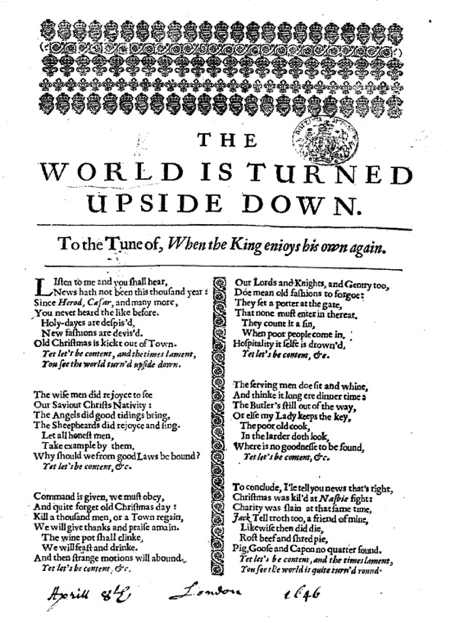
Title ID: T.61 [1646.04.08] Anon., The World is turned Upside Down (8 April, 1646).
Estimated Date of Publication: 8 April, 1646.
Thomason Tracts Catalog Information: TT1, p. 431; Thomason 669. f. 10. (47.)
Full Title
Anon., The World is turned upside down. To the tune of, When the King enjoys his own again.
THE WORLD IS TURNED UPSIDE DOWN.
LIsten to me and you shall hear,
News hath not been this thousand year:
Since Herod, Cæsar, and many more,
You never heard the like before.
Holy-dayes are despis’d,
New fashions are devis’d.
Old Christmas is kickt out of Town.
Yet let’s be content, and the times lament,
You see the world turn’d upside down.
The wise men did rejoyce to see
Our Saviour Christs Nativity:
The Angels did good tidings bring,
The Sheepheards did rejoyce and sing.
Let all honest men,
Take example by them,
Why should we from good Laws be bound?
Yet let’s be content, &c.
Command is given, we must obey,
And quite forget old Christmas day:
Kill a thousand men, or a Town regain,
We will give thanks and praise amain.
The wine pot shall clinke,
We will feast and drinke.
And then strange motions will abound.
Yet let’s be content, &c.
Our Lords and Knights, and Gentry too,
Doe mean old fashions to forgot:
They set a porter at the gate,
That none must enter in the rear.
They count it a sin,
When poor people come in.
Hospitality it selfe is drown’d.
Yet let’s be content, &c.
The serving men doe sit and whine,
And thinke it long ere dinner time:
The Butler’s still out of the way,
Or else my Lady keeps the key,
The poor old cook,
In the larder doth look,
Where is no goodnesse to be found,
Yet let’s be content, &c.
To conclude, I’le tell you news that’s right,
Christmas was kil’d at Nasbie fight:
Charity was slain at that same time,
Jack Tell troth too, a friend of mine,
Likewise then did die,
Rost beef and shred pie,
Pig, Goose and Capon no quarter found.
Yet let’s be content, and the times lament,
You see the world is quite turn’d round.
6. John Taylor, The World turned Upside Down (28 January, 1647)↩
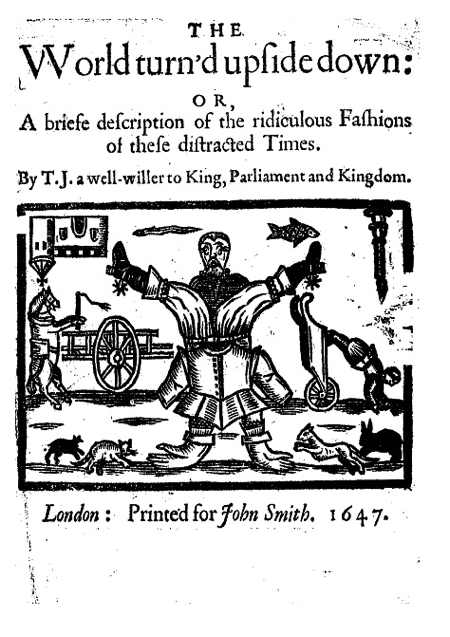
Title ID: T.086 [1647.01.28] John Taylor, The World turned Upside Down (28 January, 1647).
Estimated Date of Publication: 28 January, 1647.
Thomason Tracts Catalog Information: TT1, p. 490; Thomason E. 372. (19.)
Full Title
John Taylor, The World turned upside down: OR, A briefe description of the ridiculous Fashions of these distracted Times. By T. I. a well-willer to King, Parliament and Kingdom.
London: Printed for Iohn Smith. 1647.
The World turned up-side-down
[1]
THe Picture that is printed in the front
Is like the Kingdom, if you look upon’t:
For if you well do note it as it is,
It is a Transform’d Metamorphosis.
This monstrous Picture plainely doth declare
This Land (quite out of order) out of square
His breeches on his shoulders do appeare,
His doublet on his lower parts doth weare;
His boots and spurs upon his armes and hands,
His gloves upon his feet, (whereon he stands)
The Church o’re-turn’d, (a lamentable show)
The Candlestick above, the light below;
The Cony hunts the Dogge, the Rat the Cat,
The Horse doth whip the Cart, (I pray marke that)
The Wheelbarrow doth drive the man (oh base)
And Ecles and Gudgeons flie a mighty pace.
And sure this is a Monster of strange fashion,
That doth surpasse all Ovids Transformation.
And this is Englands case this very day,
All things are turn’d the clean contrary way;
For now, when as a royall Parliament,
(With King, and Peers, and Commons whole consent)
Have sate above six years, with paines and cares,
And charge, to free us from our griefs and feares;
For when many a worthy Lord and Knight,
And good Esquire (for King and Countreyes Right)
Have spent so much time with great toyle, and heed,
All Englands Vicious garden how to weed.
[2]
So like a Wildernesse ’twas over-runne,
That though much hath been done; all is not done.
The Devill doth perswade, entice and lurke,
And force bad men to set good men aworke.
That whilst the Worthies strive to right our wrongs,
And give to each man, what to him belongs;
Whil’st they take paines to settle all things heere,
An Irish Devill doth madly domineere.
From Hells blacke Pit, begirt with Romish Armes,
Thousands of Locusts are in Troups and Swarmes,
More barbarous then the Heathens, worse then Jewes,
Nor Turkes or Tartars would such tortures use,
Sure that Religion can no waies bee good,
That so inhumanely delights in Blood:
Nor doth that Doctrine from the Scriptures spring,
For to rebell against God and the King.
Nay (further) murder, ravish, spoile, deflowre,
Burne and lay wast depopulate, devoure,
Not sparing Infants at the breast or wombe,
(To die where first they liv’d, their birth, their tombe)
’Tis said no Serpent, Adder, Snake, or Toade,
Can live in Ireland or have their aboade:
’Tis strange that she those Vipers doth not kill,
That gnawes her bowells, and her blood doth spill,
Can Irish Earth kill all things venemous,
And can shee nurse such Vermin Mischievous:
Her owne sonnes Native, worse then strangers borne,
They have their Mothers Entrailes rent and torne,
Yet still her indulgencie, harbours those,
And feeds those Rebells that do breed her woes:
God (in thy mercie) give her strength and ayd,
And courage, make her foes and ours dismay’d,
Thou Lord of Hosts, thine owne cause take in hand,
Thy foes (thine Antichristian foes) withstand;
[3]
Defend thy truth, and all our Armies guide;
Our Enemies to scatter and devide.
Thus leaving Ireland (with my hearty prayers)
To Btitaine backe againe my Muse repaires:
Where I perceive a Metamorphosis,
Is most preposterous, as the Picture is,
The world’s turn’d up-side-downe, from bad to worse
Quite out of frame, The Cart before the Horse.
The Felt-maker, and sawcie stable Groome
Will dare to pearch into the Preachers roome;
Each Ignorant, doe of the Spirit boast,
And prating fooles brag of the Holy Ghost,
When Ignoramus will his Teacher teach,
And Sow-gelders and Coblers dare to preach,
This shewes, mens wits are monstrously disguis’d,
Or that our Countrey is Antipodis’d.
When as the Lords Prayer is almost neglected,
And all Church Government is quite rejected,
When to avoid a Romish Papists name,
A man must be unmannerly, past shame,
When he that doth shew reverence, doth offend,
And he seemes best, that will not bow or bend,
When he that into Gods House doth not come,
As to a Stable, or a Tipling Roome,
Is counted for a Popish Favorite,
And branded so, despis’d, and scorn’d with spite.
When he that (of his waies) doth conscience make,
And in his heart doth world, flesh, feind forsake,
Loves God with all his soule; adores no pelfe,
And loves his Neighbour, as he loves himselfe;
This man is rare to finde, yet this rare man
Shall have the hatefull name of Puritan:
When execrations pierce the firmament,
And oathes doe batter ’gainst heavens battlement:
[4]
When imprecations, and damn’d blasphemies,
In sundry cursed volleys, scale the skies,
When men more bruitish then the Horse or Mule,
Who know not to obey, presume to rule,
Thus Church and Common-wealth, and men, all are
(Much like the Picture) out of frame or square.
And if ’twere possible our fathers old
Should live againe, and tread upon this mould,
And see all things confused, overthrowne,
They would not know this Countrey for their own.
For England hath no likelihood or show
Of what it was but seventy years ago;
Religion, manners, life, and shapes of men,
Are much unlike the people that were then,
Nay, Englands face, and language is estrang’d,
That all is Metamorphis’d chop’d, and chang’d,
For like as on the Poles the World is whorl’d,
So is this Land the Bedlam of the World;
That I amazed, and amated am,
To see Great Britain turn’d to Amsterdam,
Mens braines and wits (two simples beat together)
From thence, mix’d and compounded, are sent hither.
For Amsterdam is landed (as I heare)
At Rye, or Hastings, or at Dover Peere,
At Harwich, Ipswich, Sandwich, or at Weymouth,
And at Portsmouth, Dartmouth, Plymouth, Falmouth,
At Yarmouth, and at the Ports of Tinmouth,
And Westward unto Bristow, and to Monmouth;
From all these Mouthes, and more, mad sects are sent,
Who have Religion all in pieces rent,
One would have this, another would have that,
And most of them would have they know not what.
God give us peace, and ease us of our paine,
And send those Sects, from whence they came againe.
[5]
The Papist and the Schismatique; both grieves
The Church, for shee’s like Christ (between two Thieves)
I tooke the Covenant twice of late,
Where I protested not to innovate.
T’avoid all Popish Rite, and to express
Obedience to what Englands Church profess,
My Loyalty unto my King is bent
With duty to the Peeres and Parliament,
With Prayers, and my best service for them all,
That on them may heavens chiefest blessing fall,
That with one heart, as one man, with one mind,
(For Gods great glory) they may be combinde,
And never vary, but go boldly on,
To end the good worke which they have begun.
This is the Sum (with ne’er shall be forsooke)
Of what I in the Covenant have tooke,
But, for all this, I may be mannerly
In Gods House, and be free from Papistrie;
I hope I may put off my hat, and bee
Allow’d to kneel, and pray, and bow my knee,
When as divine Command bids, onely then
I’le bow to God, and not to Saints or Men,
And from those duties I will never vary,
Till death, or order do command contrary.
Th’ Almighties Name be ever prais’d and blest,
That Romish Superstition is supprest,
We have no Abbies, Abbots, Friars or Monks,
Nor have we Nuns, or Stews allow’d for Punks,
We have no Masses, nor no Mas-Priests heere,
But some are hang’d, and some are fled for feare.
All those that are so bold to stay behind,
I wish they may like entertainement find;
Beades, Bables, Relliques, Tapers, Lamps or Lights,
We have no superstitious Romish Rites,
[6]
We seeke our Pardons from our heavenly hope,
And not by workes or favour from the Pope;
To Saints we make no prayer or intercession,
And unto God alone we make Confession;
We hold no reall Presence in the Bread.
And wee doe know King Charles our supreame head
(Beneath God, who hath plac’d him in his Throne)
For other Supreame, we acknowledge none.
No purgatory, Image, Wood, or Stone,
No Stocke, or carved Blocke, we trust upon,
Nor is our Church discretion here so little,
As to baptize with creame, with salt and spittle.
We have as many Sacraments, as Heaven
Ordain’d; which are but two, and Rome hath seven.
We doe not christen Bells, and give them Names
Of Simon, Peter, Andrew, John, and James;
We use no Pilgrimage, or Holy water,
Nor in an unknowne tongue our prayers scatter;
All these, and many more, in Rome are us’d,
Which are by us rejected and refus’d.
And yet too many faults, alas remaines,
Which are the Churches, and the Kingdomes staines,
The Church Tryumphant is most cleare from spots,
The poore Church Militant hath still some blots,
Here’s all unperfect, something’s still amisse,
And nothing’s blest, but in Eternall Blisse.
Meane time, till wee amend, and leave our crimes,
The Picture is the Emblem of the times.
FINIS.
7. Anon., A Remonstrance of the Shee-Citizens of London (21 August, 1647)↩
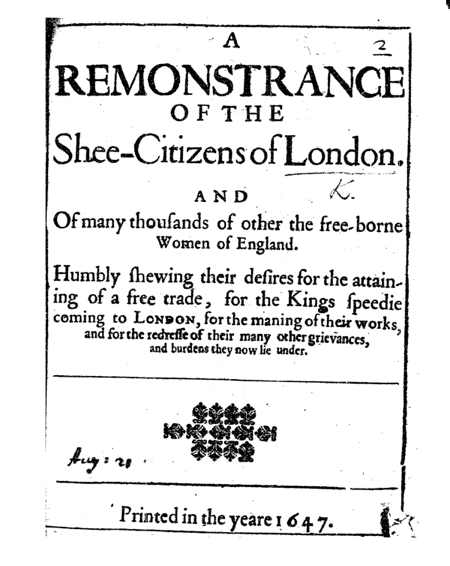
Title ID: T.108 [1647.08.21] Anon., A Remonstrance of the Shee-Citizens of London (21 August, 1647)
Estimated Date of Publication: 21 August, 1647.
Thomason Tracts Catalog Information: TT1, p. 548; Thomason E. 404. (2.)
Full Title
Anon., A Remonstrance of the Shee-Citizens of London. And of many thousands of other the free-borne Women of England. Humbly shewing their desires for the attaining of a free trade, for the Kings speedie coming to London, for the maning of their works, and for the redresse of their many other grievances, and burdens they now lie under.
Printed in the yeare 1647.
A REMONSTRANCE OF THE SHE-CITIZENS of LONDON, And of many thousands of other free-borne women of England
[1]
WE the assistants and co-equalls of the famous Citizens of London, the better parts of the Trained Bands, and Common Councell men, having of a long time beheld the many infranchisements, Donatines and immunities attained by our fellow-feelers, the City of London and the parts adjacent, and for our selves in particular, have purchased nor archieved any thing worthy to be recorded and talked of by posterity as an act of speciall grace and concernment, though we confesse that under our husbands wee have been often comforted as with those sweet watry distillations which hath as from a limberk issued from them, yet we must give notice that your blandum mysterium acted by one man alone, cannot content each of us, being inspired with heroik thoughts, such as famous Messalina and Cleopatra owned, we meane that we should bee tied by the leg with the feeble cords of one only mans [2] hamstrings, who through continuall exercise are become most faultringly feeble, for through the hardnesse of these times denying them their former height of nourishment, they grow worse and worse daily in their occupation, and even by nature are debarred to spend so freely on us as in times past, for the removall of which severall inconveniencies, we shall humbly remonstrate.
That whereas this sterrill maladie is occasioned by a strict subjugation of us the free-borne women of England, by a law strictly forbidding any of us to scan the tremeter of any but to each of them to whom we are bound and obliged, we conceive that this prohibition tendeth to the detriment not onely of us but of the whole Kingdom, & that wanting that free commerce which nature licenseth, the Kingdome cannot choose but be disappointed of many generous soules, which if otherwise it is likely to be enriched with, in case of a free propagation, and which doth pierce us through with an earnest and longing contrition; this Island is now thinly inhabited, by reason of the late warres, wherein so many well-tried and able proficients have been untimely massacred, so that not onely themselves are perished for the present, but wee are also utterly deprived of the hopes wee were in of their after able performances for the good of the Kingdome, which consisteth in nothing more then in being fully replenished with people; we therefore with joynt consent, having taken into our consideration, the great decay of Males, that is likely inevitably to happen, if timely prevention, be not thought on, have thought fit to remonstrate that for the future, we shall [3] not beare such seared soules about us, as one woman, to live by the daily and nightly sweat of onely one mans browes when he perhaps though doing his utmost, is not able to satisfie nature, but shall for our owne contentments, the ease of men and for the speedie peopling of the Kingdome, shall every one of us desire the assistance of so many (of whose abillitie we are sufficiently assured) as may produce numerosa proles, a vast Generation, not only to defend us at home, but also to prevent invasions from afarre, and we desire also (since to us by consequence) according as that stiffe slander for the subjects Liberties Col. Lilburn hath noted, belongeth every immunitie of Magna Charta, that in case of our husbands defaults, or debillities, we may our selves trade a broad in the Country, and utter our warres to our best advantage for it is not, as in the youth of the world when Lot was so free of his flesh, that he begot Moab, and Ammon, in his sleep nature, is now growne old, and stoopeth under the weight of time, we must have Eringoes, and Lobsters, to beget that, which in the worlds infancie, a carrot or a crab-fish equalled every thing decaies, and there is a generall declining in all things, there is an alteration, and defect in the condition (of bodies) over the whole frame, and sisteme of nature, the clouds doe forbare to raine downe their geniall showers, neither doe the flowers blush, with such perfumed fires as in the first morning of the world, the fire, which heretofore, was the mother of May creatures, as the Salamander the Pirausta and others, is now growne quite fruitlesse and barren, the ayre, doth not bestow such a vitall, and broodall incubation upon the earth, [4] and if this decay be in the greater Microcosme of nature, it must needs be in the lesse Microcosme of man, and therefore we who are of a substance hot and drie, and every whit as vigorous, as in the first nonage of the world ought not to be debarred of that right, to which we were created, but that the disabillities of one man should be supplied, with the abillities of another, which cannot be attained unlesse we shift our condition, and be licensed a free trade.
Which that we may the sooner attain, we conceive no way conducing more to our desire, then that his Majestie speedily come to London, there to reside with honour and safetie; for let the world know, to our unspeakeable grief, we have these many yeares missed the societie of his retainers, those imbroidered Courtiers, who heighten their longings at more charge, then if each of them constantly kept at rack and manger foure Flanders mares, and the heavenly dew that they were wont daily to water us with, and to our infinit joy, jog us, when we were coacht jogging to mile-end, to Islington, and Braineford, stuffing our bellies with cakes, and creame; and while our husbands good men, were either handselling their wares, or canselling their bonds, not dreaming that we also, were bartering their commodities for our best advantage: we therefore desire, that his Majestie may with all speed repaire to London, as the primary way for us to attaine our wishes, and till then, like the thirstie earth chapt for lack of rain, wee wait for-------
But least preturbances should arise & we sleep too supinely and though the royall partie be subjugated, we be any way damnified, by a wounded foe, we shall not [5] carelesly levell aud let our works be entred by those, of whose trust and fidelitie we have not ample experience, for some may give us an alarum, and yet want ammunition to maintain the fight; may charge us once, and yet afterward prove so lumpish, that afterward they must be forced, and dandled to the incounter; and whom we may be constrained to provoke to the skirmish, defying them with hot trenchers and warme napkins, applied to our bodies; we therefore doe desire that such should man our works, and sleep in our quarters, who shall bee sufficient, not only to please, but defend us from the incursions, of any craftie and disabled enemie; and should it so happen, (as who knowes the issue of things) that we should be surprized, our hopes and assurance is this, that though their onset be never so hot and fierce, yet we shall occasion their retreat, to be coole and tame: yea were they as strong as Sampson or Milo, we shall soone quaile their Courage, if not at the first, yet the second incounter; but this, if they should gaine our works; but we assure our enemies, which may serve as a terror to disswade them from daring, to give an assault; that if we shall not find them well weaponed, (for we hate Souldiers that are not for the punctillo) but either dulled with often service, or their weapons broken near the handles, through their former fool-hardinesse and desperate valour, in daring to scale, though incountered with S. Anthonies Fire, that we shall give to such no quarter, but shall reserve them as Pageants for mirth, at our pleasures to transluce.
[6]
Postscript.
NOw if to these our desires our husbands prove refractorie and opposite, we entreat them to consider that wee neither for prayers or threats will any longer be debarred of our just rights, and that they would neither remember that Lucullus Cæsar, Pompey, Anthony, Cato, and divers other gallant men, were--- and knew it, though they would not make a stirre about it, and that there was in all that time but one gullish coxcombe Lepidus that died with anguish.
FINIS.
8. Richard Overton, The Mournfull Cryes of many thousand Poore Tradesmen, who are ready to famish through decay of Trade (22 January, 1648)↩
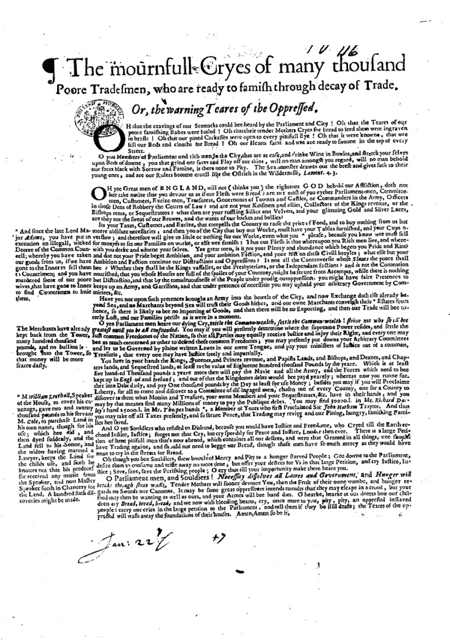
Title ID: T.130 [1648.01.22] [Richard Overton], The Mournfull Cryes of many thousand Poore Tradesmen (22 January, 1648).
Estimated Date of Publication: 22 January, 1648.
Thomason Tracts Catalog Information: TT1, p. 586, n 669. f. 11/116.
Full Title
The Mournfull Cryes of many thousand Poore Tradesmen, who are ready to famish through decay of Trade. Or, the warning Teares of the Oppressed. (22 January, 1648)
The mournfull Cryes of many thousand Poore Tradesmen, who are ready to famish through decay of Trade. Or, the warning Teares of the Oppressed.
OH that the cravings of our Stomacks could bee heard by the Parliament and City! Oh that the Teares of our poore famishing Babes were botled! Oh that their tender Mothers Cryes for bread to feed them were ingraven in brasse! Oh that our pined Carkasses were open to every pittifull Eye! Oh that it were knowne, that wee sell our Beds and cloaths for Bread! Oh our Hearts faint and wee are ready to swoone in the top of every Street.
O you Members of Parliament and rich men in the City, that are at ease, and drinke Wine in Bowles, and stretch your selves upon Beds of downe, you that grind our faces and Flay off our skins, will no man amongst you regard, will no man behold our faces black with Sorrow and Famine, is there none to Pity. The Sea-monster drawes out the brest and gives suck to their young ones, and are our Rulers become cruell like the Ostrich in the Wildernesse, Lament. 4. 3.
OH yee Great men of ENGLAND, will not (thinke you) the righteous GOD behold our Affliction, doth not hee take notice that you devour us as if our Flesh were Bread? are not most of you eyther Parliament-men, Commitee-men, Customers, Excize-men, Treasurers, Gouernours of Townes and Castles, or Commanders in the Army, Officers in those Dens of Robbery the Courts of Law? and are not your Kinsmen and allies, Collectors of the Kings revenue, or the Bishops rents, or Sequestrators? what then are your ruffling Silkes and Velvets, and your glittering Gold and Silver Laces, are they not the sweat of our Browes, and the wants of our backes and bellies?
Its your Taxes, Customes, and Excize, that compells the Country to raise the price of Food, and to buy nothing from us but meere absolute necessaries; and then you of the City that buy our Worke, must have your Tables furnished, and your Cups overflow; and therefore will give us little or nothing for our Worke, even what you [1] please, because you know wee must sell for monyes to set our Families on worke, or else wee famish: Thus our Flesh is that whereupon you Rich men live, and wherewith you decke and adorne your selves. Yee great men, is it not your Plenty and abundance which begets you Pride and Riot? and doe not your Pride beget Ambition, and your ambition Faction, and your faction these Civill broyles; what else but your Ambition and Faction continue our Distractions and Oppressions? Is not all the Controversie whose Slaves the poore shall bee? Whether they shall be the Kings vassalles, or the Presbyterians, or the Independant factions? and is not the Contention nourished, that you whose Houses are full of the spoiles of your Countrey, might be secure from Accompts, while there is nothing but Distraction, and that by the tumultuousnesse of the People under prodigious oppression. you might have faire Pretences to keepe up an Army, and Garrisons, and that under pretence of necessitie you may uphold your arbitrary Government by Committees, &c.
Have you not upon such pretences brought an Army into the bowels of the City, and now Exchange doth rise already beyond Sea, and no Marchants beyond Sea will trust their Goods hither, and our owne Marchants conveigh their [2] Estates from hence, so there is likely to bee no importing of Goods, and then there will be no Exporting, and then our Trade will bee utterly Lost, and our Families perish as it were in a moment.
O yee Parliament men heare our dying Cry, settle the Common-wealth, settle the Common-wealth! strive not who shall bee greatest untill you be all confounded. You may if you will presently de termine where the supreame Power resides, and settle the Iust common Freedomes of the Nation, so that all Parties may equally receive Iustice and injoy their Right, and every one may bee as much concerned as other to defend those common Freedomes; you may presently put downe your Arbitrary Committees and let us be Governed by plaine written Lawes in our owne Tongue, and pay your ministers of Iustice out of a common, Treasurie, that every one may have Iustice freely and impartially.
You have in your hands the Kings, Queenes, and Princes revenue, and Papists Lands, and Bishops, and Deanes, and Chapters lands, and Sequestred lands, at least to the value of Eighteene hundred thousand Pounds by the yeare. Which is at least five hundred Thousand pounds a yeare more then will pay the Navie and all the Army, and the Forces which need to bee kept up in England and Ireland; and out of that the Kingdomes debts would bee payd yearely; whereas now you runne further into Debt daily, and pay One thousand pounds by the Day at least for use Money; besides you may if you will Proclaime Liberty, for all to come and discover to a Committee of dis-ingaged men, chosen out of every County, one for a County to discover to them what Monies and Treasure, your owne Members and your Sequestrators, &c. have in their hands, and you may by that meanes find many Millions of money to pay the Publique debts. You may find 30000. l. in Mr. Richard Darley’s hand 25000. l. in Mr. Thorpes hands [3], a Member of Yours who first Proclaimed Sir John Hotham Traytor. And thus you may take off all Taxes presently, and so secure Peace, that Trading may revive and our Pining, hungry, famishing Families bee saved.
And O yee Souldiers who refused to Disband, because you would have Iustice and Freedome, who Cryed till the Earth ecchoed Iustice, Iustice; forget not that Cry, but cry speedily for Peace and Iustice, Louder then ever. There is a large Petition of some pitifull men that’s now abroad, which containes all our desires, and were that Granted in all things, wee should have Trading againe, and should not need to begge our Bread, though those men have so much mercy as they would have none to cry in the streets for Bread.
Oh though you bee Souldiers, shew bowels of Mercy and Pity to a hunger starved People; Goe downe to the Parliament, desire them to consume and trifle away no more time, but offer your desires for Vs in that large Petition, and cry Iustice, Iustice; Save, save, save the Perishing people; O cry thus till your importunity make them heare you.
O Parliament men, and Souldiers! Necessity dissolves all Lawes and Government, and Hunger will break: through stone walls, Tender Mothers will sooner devoure You, then the Fruit of their owne wombe, and hunger regards no Swords nor Cannons. It may be some great oppressours intends tumults that they may escape in a croud, but your food may then be wanting as well as ours, and your Armes will bee hard diet. O hearke, hearke at our doores how our children cry Bread, bread, bread, and we now with bleeding hearts, cry, once more to you, pity, pity, an oppressed inslaved people: carry our cries in the large petition to the Parliament, and tell them if they be still deafe; the Teares of the oppressed will wash away the foundations of their houses. Amen, Amen so be it.
Endnotes
[1] And since the late Lord Major Adams, you have put in execution an illegall, wicked Decree of the Common Councell; whereby you have taken our goods from us, if we have gone to the Innes to sell them to Countrimen; and you have murdered some of our poore wives that have gone to Innes to find Cuontrimen to buie them.
[2] The Merchants have already kept back from the Towermany hundred thousand pounds, and no bullion is brought into the Tower, so that money will be scarce daily.
[3] M William Lenthall, Speaker of the House, to cover his cozenage, gave two and twenty thousand pounds to his servant M. Cole, to purchase Land in his own name, though for his use; which hee did, and then dyed suddenly, and the Land fell to his Sonne, and the widow having married a Lawyer, keeps the Land for the childs use, and saith he knowes not that his predecessor received any monie from the Speaker, and now Master Speaker sueth in Chancery for the Land. A hundred such discoveries might be made.
9. Anon., Women Will Have their Will (12 December, 1648)↩
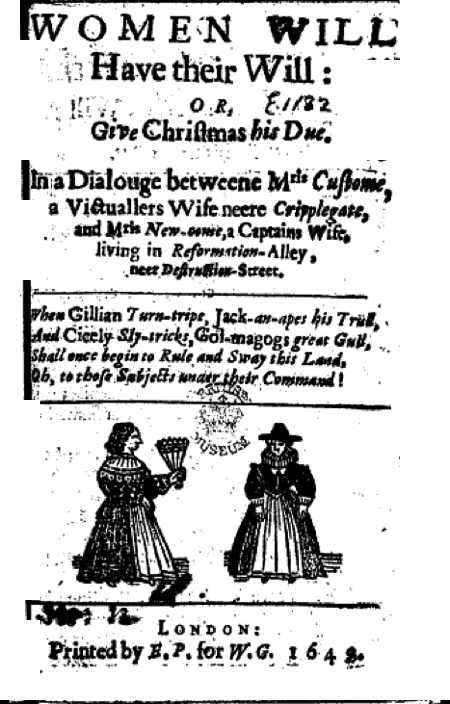
Title ID: T.165 [1648.12.12] Anon., Women Will Have their Will (12 December, 1648).
Estimated Date of Publication: 12 December, 1648.
Thomason Tracts Catalog Information: TT1, p. 701; Thomason E. 1182. (12.)
Full Title
Anon., Women Will Have their Will: OR, Give Christmas his Due. In a Dialouge betweene Mris Custome, a Victuallers Wife neere Cripplegate, and Mris New-come, a Captains Wife, living in Reformation-Alley, neer Destruction-Street.
When Gillian Turn-tripe, Jack-an-apes his Trüll,
And Cicely Sly-tricks, Gol-magogs great Gull,
Shall once begin to Rule and Sway this Land,
Oh, to those Subjects under their Command!
LONDON: Printed by E. P. for W. G. 1648.
Women will have their Will: Or, Give Christmas his Due.
[2]
Mistris New-come.
HOw doe you good Mistris Custome? I man hath to give you a [Editor: illegible word] to see how you doe.
Mistris Custome, M. New-come, pray draw neare and sit downe; come, you are heartily, heartily welcome.
M. New. I shall be a trouble to you, I see you are busie.
M. Cust. No, no, not so busie, but I can spare so much time as to discourse with you a while; how doth your husband doe? what, is he at home? or where is his Rendezvouz?
M. New. I thank you Mistris Custome; he is not at home, nor is his Rendezvouz farre from home but what have you a Feast here suddenly that you are so Decking, Adorning,and Trimming up your house with thisa fine Rosemary and Bayes. I beleeve there is some such doings is there not?
M. Cust. No truely, here is no Feasting but what doth fall out according to that Time.
M. New. Time; pray now what Time?
[3]
M. Cust. Why, Christmas, woman; have you forgot it? Indeed these Wars and Jars would almost make one forget their Christen name, if they were not often called on, to put one in remembrance.
M. New. Indeed Christmas can hardly be beaten out of many folks heads, which is a very strange thing.
M. Cust. Not so strange as true, woman; I should rather, and sooner forget my mother that bare me, and the paps that gave me suck, then forget this merry Time; nay, if thou hadst ever seen the Mirth and Jolitie that we have had at those Times when I was young, thou wouldst blesse thy selfe to see it.
M. New. Nay, undoubtedly I might very well beleeve you without swearing; for surely, there was then excessive Sports, Pastimes, and Revels, that it would make a bodies haire stand on end to heare and see it.
M. Cust. Didst thou never heare of my Grand-father? why, he was second cousin to the Earle of Dum-belly, Cup-bearer to Bacchus, Knight of the Vapour, and Esquire of the Pipe; he was a great Politician, Monopolist, and Project-monger; t'is very strange you never heard of him.
M. New. I have heard of the like, if not the same; but what of him?
M. Cust. What of him; nay, nothing of him, but I say my Grand-father was his second cousin.
M. New. Well, and what of that?
[4]
M. Cust. What of that? Nay, by the masse, I forgot where I was; this ’tis to have such a scurvy head-piece, my Lady I know not what I was going to say.
M. New. It was about your Grand-father at Christmas.
M. Cust. O me, O me, ’tis true, ’tis true; I see you keep your brains warmer then I doe, which makes you so ripe-witted: but for feare I should forget againe, Ile tell thee; my Grand-father kept a brave house at Christmas, (it makes ones teeth dance in ones head like Virginal-Jacks with the very conceit on’t) for according to his owne Verses:)
Then Pell Mell murther in a purple hue,
In reeking blood, did slaughtering pawes imbreu;
Then Cocks Hens, Capons, Turkey, Goose & Widgeon,
Heres, Conyes, Phesants, Partridge, Plovar, Pigeon.
All these were cast into the furious pawes
Of break-neck Powlt’rers, t’undegoe their Lawes:
The Butchers Axe (like great Achillea Bat)
Dings deadly downe, ten thousand thousand flat;
Each Butcher by himselfe makes Martiall Lawes,
Cut throats and kills, then quarters, hangs, and drows.
When this is done, then to the Pot and Spit
’Tis totally committed every bit.
This I say, the very conceit of this is enough to make one chew the Cud; for my part, it makes me me thinks look two yeares younger then I did before, every time I think on’t; indeed they were brave Times, pray God send us such again, and we shall once more have a merry world.
[5]
M. New. This was in the times of old when men were trunck-[Editor: illegible word].
M. Cust. Nay, by Lady (God forgive me for swearing) it is not so long since; for my father kept a brave house to at that Time, though he pinched for it all the yeare after; he had all the Varieties as the earth could afford, for Boyled, Baked, and Roasted.
M. New. I have seen but a little of this Sport, yet of that little I have seen too much; for it would make the stander by ashamed to see what the feeder devoures and what gods they make of their bellies that one would think that people also take in twelve moneths Provision into their pauches, or that they did ballast their bellies for a voyage to Constantinople, or to the East-Indies.
M. Cust. Indeed all this as you speake is true; for I think verily, if it were not for Dancing, Frisking, Playing, Toying, Christmas-Gamboles, and such kind of jogging Exercises to shake it down, it were impossible they should devoure so much as they do. Then to see Cook hot and Cook cold, Cook young and Cook old, Scullion & Scullions mate, all in a sweat, like so many Monarchs of the Marrow-bones, Marquesses of the Mutton, Princes of the Pyes and Pasties, Lords, High-Regents of the Spits and Kittles, Barons of the Griddiron, and so be Commanders of the Frying-panne, during this Festivall. I say, to see them Act their Tragi-comicall Feasts, would make a man or [6] womans stomacke elevate its selfe into another temper.
M. New. And all this hurly-burly is for no other purpose but to stop the greeby mouth of this Leviathan, or Land-whale, Christmas.
M. Cust. Well, ’tis true; but now for sooth Christmas must be cryed downe, Reformation must be cryed up; if they were weighed in a ballance, then I know Christmas would goe downe without crying: but there are some now adayes, a Crew of Tatter-demallians, amongst which the best could scarce ever attain to a Calves-skin-Sute, or a piece of Neck-Beefe and Garrets to dinner on a Sunday, or scarcely ever mounted (before these times) to any Office above the degree of Scavenger or Tything-man at the farthest; and now for sooth these Reformado’s, upon pretence of Reformation, shall destroy and overthrow the most Famous and Commendable Customes of this Land; especially for the observing and keeping of this Great Day: what, are we forsooth wiser then our fathers that brought us up, and educated us in this Wisedom? ’Tis a strange thing to me; it can’t be beaten into my braines, that this can be just and honest.
M. New. M. Custome, you were best to discourse with some of those which thinke it not fitting to keep that Time in such a Revelling way, perhaps and no doubt but they will give you reasons against it; and I partly know you to be a rationall woman and that you will permitt reason to beare the sway.
[7]
M. Cust. Reason, reason; as if any man could shew a reason for not keeping of Christmas, you spake as had as blasphemie: Christmas, that hath been a Custome ever since the world began, should now with a puffe of reason, through the Ramshorne of selfe-conceit, with the walls of Jericho, be layd flat to the ground.
M. New. Nay, M. Custome, although it is a Custome very Ancient, yet it is not so old as the world; there you are somewhat mistaken.
M. Cust. As for the world, I doe not know its age; but for Christmas, I am sure it was kept in my Grand-fathers great Grand-fathers time, in my Grand-fathers time, & in my fathers time, & none of these did ever think it Superstition or Idolatry; and for my part, I will keep it as long as I am able, let all the powers on earth stand to oppose it.
And though the Fields dis-robed be
Of all their Herbs and Fruits,
And the merrie chirping Birds
Are all turn’d tonguelesse mutes;
Yet we will sing and merrie be,
Our time in Sport wee’l passe,
Not weighing how the time shall be,
Nor never how it was.
M. New. Then you are resolved.
M. Cust. I am for that matter, come what will come; ah how (me thinkes) my braines are wher upon the conceit on’t; I could wish now at this Time, that the Valiantest Champion of all the [8] Round-headed Disputants, to encounter with me in this Argument: I tell thee, If I had the tongue of Hermes, who (as my Husband saith) was Prolocutor to the gods; or if I had as many fingers as Camaldus, who was feigned to have an hundred hands. If surging Neptune, was converted into Inke, or the rugged-ragged-face of our antient mother Tellus, were Paper, yet could not the verball, volubilitie, or elocution of my voyce, nor the agilitie, dexteritie, or facultie of my hands, nor the spacious, unmesurable number-lesse, white innocent Paper; no, none of all these could either speak, write, or by any other meanes declare the aboundance of Arguments, comprehended within the notion of my braine for this unlimited Subject.
M. New. For my part, your Eloquence is to harsh for me. M. Cust. Oh, I have it by heart; I have heard my Husband, when Gentlemen have been drinking here at my house, rabble out aboundance of this Fustian-stuffe, which gives them a great deale of content, especially when they have almost seen the Devill in a Prize Jerkin, and every thing look with Janus faces.
M. New. Then I perceive by you that you cannot possibly be wrought on to leave this Old Ceremony, your mind is so unchangeable.
M. Cust. Unchangeable, can the Black-moore change his skin, or the Sunne alter his continued course? Yet sooner can these things be done then [9] my mind changed, for to keep old Christmas once again.
M. New. It is an old saying, and true, That which is bred in the bone, will seldome or never out of the flesh.
M. Cust. Thou sayest true; My great Grand-father, my Grand-father, my father, and now my selfe, these nine and fortie yeares have kept this Festivall Time, and this yeare above all the rest ought to be kept, for it is the yeare of Iubile, as the Bishop of Armagh said, when he preached before the King; and I for my part am fourescore and one yeares old: So that here is Iubile upon Iubile, yeare-Iubile for my birth, and the year Iubile for my keeping Christmas: and therefore shall not we be merry mine owne S. Nichol. a Cod?
We will be merry, let all say what they will,
As we have kept it, so wee’l keepe it still.
M. New. What, will you keepe it in spite of Authoritie?
M. Cust. What Authoritie? I am sure my father and mother had the greatest authoritie over me ever since I was borne, and other authoritie I knew none before I was married, & now it seems I am under a crabbed Husbands authoritie, and besides him I will be subject to none, and I am sure he is as strong for Christmas as the greatest of our Ancestours; and therefore that Authoritie will not curb me.
M. New. Then it seemes you know no other authoritie?
[10]
M. Cust. No by our Lady, not I: neither doe I desire to know any, for he is crabbed enough of any conscience; if I should tell you all, you would say so too: therefore the Devill take all other Authority, if it be no better then a dogged, arossegraine Devillish Husband.
M. New. Why, then you count the Parliament no Authoritie?
M. Cust. I hope Gossip you are not come to pick quarrells with me in my owne house?
M. New. No truely M. Custome, not I, neither would I have you to entertaine such a hard conceit; for my part I was never so well read in such Principles, nor ever took any degree at the Universitie of Billingsgate.
M. Cust. Perhaps you are of your mothers tutor-age then, for I am sure she was an Oyster-woman of that Colledge for one and twentie yeares, to my owne knowledge; and had her tongue as nimble as an Italian Mountebanck.
M. New. What my mother was is nothing to me.
M. Cust. But you are a Chip of the Old Block: for what doe you mean, in telling me of the Parliament?
M. New. I meane the two Houses of Parliament which have jumped together in one Opinion, for the putting downe and destroying of this Romish Beast Christmas; for which, they are to be commended.
[11]
M. Cust. It is a strange thing; let the Devill never so cunningly hide his head, we shall know him by his Cloven foot; nor let the Asse never so craftily hide his feet, yet we may know him by his Eares: and howsoever covertly you have carried your selfe, I know you, both by head & heels: I see you are one of the New Faction, and a great Student in Spittle-Colledge; but that is nothing to me: yet what do you mean by Calling Christmas a Romish Beast? pray explain your self at large.
M. New. To leave all manner of Circumstance, which is not pertinent to our Subject in hand——
M. Cust. By Lady neighbour, I think you are one of these New Teachers, you handle your matter so excellent; but I trouble you, pray proceed.
M. New. The word (Christmas) if learnedly weighed in it we shall and matter of dangerous Consequence: As.
1. If we consider what the word or name is, Christ.
2. If we consider who gave him this name.
3. Where he was Christned, or had the name given him.
4. By what authoritie they gave him this name.
Of which I shall proceed in order, according to my weak abilitie: And first for the word; Christmas to a word which deciphers a Scorpion which is a venomous Beast, which carries a sting at his tayle and so doth Christmas; for the word [12] Masse is a king in the tayle of that Romish Beast: Secondly, we must consider who gave him this name, & that was his God-fathers and God-mothers in Baptisme; from whence ariseth this doubtfull question? who they were, and that was Pope Boniface, Pope Fireface, and Pope Joane; but by reason of their non-residence here in England, the Bishops took that office upon them and stood as shitten Gossips. Thirdly, the place where, this is by the learned held in great Dispute, but I beleeve in his infancie he was sickly; and therefore according to the Church of Englands Tenets he was twice Christned that is to say, at home here in England, and afterwards confirmed at Rome, the Mother Church of all such Antichristian Heresies: but I shall be over tedious, therefore I will come to the fourth Devision, and that is by what authoritie they doe these things: this will take up a greate deale of time to open and explaine unto you, if I should doe it to purpose; therefore I will omit it, onely certifying you thus much, that there is no power under the Sun that hath any authoritie to erect or build up, neither to destroy and pull down any thing, save what is in the will of the two Houses of Parliament.
M. Cust. That word waked me, indeed I was almost asleep; what, you say that the Parliament hath power to pull down Christmas; I pray then what will they put up in the roome on’t, Stage-Playes, [13] Dancing upon the Ropes, & Hocus Pocus. M. New.
No, it shall be like other Times, not one day higher or lower then another; for it is not for us to stand upon Times and Seasons.
M. Cust. Fie upon’t, fie upon’t, away with’t, away with’t, I doe not know this Parliament, ’tis no kin to me; If this is the Authoritie you talked of, God deliver me from such Authoritie; this is worser Authoritie then my Husbands, for though my Husband beats me now and then, yet he gives my belly full, and allowes me money in my purses which as I take it, the Parliament will not; for I remember men come for money, money, and if I aske them what it is, for they still keepe in one tune like the Cockoe, and tell me it is for the Parliament; God deliver me from those that will neither let us eate our victualls and be merry, though they don’t pay for it; nor yet if they could helpe it, leave us any money in our purses.
M. New. Then you doe not regard thesePowers, let them say or doe what they will.
M. Cust. No indeed, not I; is it not fitting I should do what I will with mine own? Cannot I keep Christmas, eate good Chear, & be Merry, without I goe and get a Licence from the Parliament? Marry gap, come up here, for my part Ile be hanged by the neck first; must I be subject to them I never saw in my life? No, no, neighbour, they are mistaken in me; though they set up Scare-Crowes to scare fooles withall, they shall not fright me.
[14]
M. New. Truely neighbour, if these Powers and Authorities will not make you leave off this Superstitious and Idolatrous Feasting, some other sharper and more rigorous power must.
M. Cust. Must, doe you say? How now, you said you did not come to Scold, but I see you will Scold before you goe: I see now by the Masse, there is no making hony of a Dogs-turd; that which is bred in the bone will never out of the flesh; your mother I saith hath taught you your lerry, almost as perfect as she hath it her selfe: must make me?
M. New. Yes, must make you: I do not goe to eate my words Gillian: what I have spoken Ile speake againe, I have those which shall maintaine me in it, I care not who knows it, and that is the honest godly partie of the Armie, of which societie my Husband is a member; therefore take heed what you say.
M. Cust. What have I to doe with the Army, I have nothing to say to the Army.
M. New. But the Armie hath something to say to you then: for if no power will tame you, they can and will tame you; were you as fierce as a Lyon, they will new-mould you into better breeding, and make you leave off your Superstitious Feasting, and turne to Fasting, if you doe not mend your manners.
M. Cust. As for the Armie, no doubt but there may be some honest men amongst them, but all [15] the world knowes what thy Husband was, a poore man which ran out of his Countrey for debt, and afterwards betooke himselfe to be Master Percyes Groome, to rub his Horses heeles in Drury-Land; And now such as he is, must come to tame those which are ten times better then themselves; this is a fine world indeed.
M. New. Huswife farewell; I have with silence heard things of a dangerous Consequence against the Parliament and Armie; therefore looke to it for you shall surely suffer for it; these things cannot be let slip without severe punishment, either with the deprivation of Life and Libertie, or at least the losse of your Goods.
M. Cust. Devill, doe thy worst; if they are honest men they will not doe it: Yet all this Chattring shall not put me off from keeping Christmas.
For as long as I doe live,
And have a Joviall Crew,
I’le sit and Chat, Laugh, and be Fat,
And give Christmas his Due.
[16]
The Epilogue.
CHristmas is the welcommest time,
That does come through the yeares
For’t maketh many joyfull hearts,
and fills the world with Cheare.And though a man a Mizer is,
all the whole yeare beside;
He now begins to hang up Care,
and let the world goe slide.Now Tom and Tib, and Lustie Jack,
the time in Mirth doe passe;
And each in Kitchin or the Hall,
is towsing of his Lasse.The Cards in every corner stirs,
the Dice doe take no rest,
Likewise the frisking Dancers, they
are held in great request.As long as there’t here the flagrant fire
doth spit out its fierce flames,
There is no ceasing of their Mirth,
nor period to their Games.But now the Log of Logs is burnt,
The Hall-Chimney leaves smoaking,
Good folkes farewell, for I will stay
no longer in it poaking.
FINIS.
10. John Lilburne et al., The Hunting of the Foxes (21 March 1649)↩
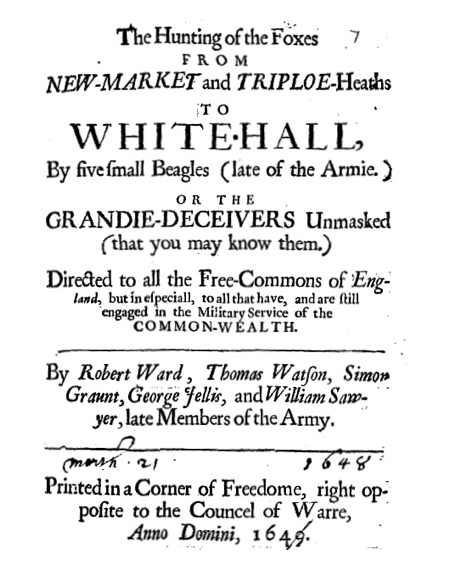
Title ID: T.185 [1649.03.21] [Signed by Robert Ward, Thomas Watfon, Simon Graunt, George Jellis, William Sawyer (or 5 "Beagles"), but attributed to Richard Overton or John Lilburne], The Hunting of the Foxes (21 March 1649).
Estimated Date of Publication: 21 March 1649.
Thomason Tracts Catalog Information: TT1, p. 732; Thomason E. 548. (7.)
Full Title
[Signed by Robert Ward, Thomas Watfon, Simon Graunt, George Jellis, William Sawyer (or 5 "Beagles"), but attributed to Richard Overton or John Lilburne], The Hunting of the Foxes from New-Market and Triploe-Heaths to White-Hall, by five small Beagles (late of the Armie.) Or The Drandie-Deceivers Unmasked (that you may know them.) Directed to all the Free-Commons of England, but in especiall, to all that have, and are still engaged in the Military Service of the Common-Wealth. By Robert Ward, Thomas Watson, Simon Graunt, George Jellis, and William Sawyer, late Members of the Army.
Printed in a Corner of Freedome, right opposite to the Councel of Warre, Anno Domini, 1649.
The Tract contains the following parts:
- The Hunting of the Foxes, etc.
- To his Excellency Tho. Lord Fairfax, and his Councel of Officers
- The Examination and Answers of ROBERT WARD, before the Court Martiall, March 3. 1648 (and others)
- To the Supreme Authority of the Nation, The Commons assembled in Parliament: The humble Petition of the Souldiery under the Conduct of THO. Lord FAIRFAX. (24 March, 1649)
[1]
The Hunting of the Foxes from New-Market and Triploe-Heaths to White-Hall, by five small Beagles (late of the Armie.)
When we remember our solemn Engagement at Newmarket and Triploe-Heaths, and but therewith consider and compare the strange actings that have been, and still are carried on in the name of the Army (as if upon the accompt of that Engagement) we are even startled at the palpable contrariety and disparity that appeareth betwixt them; for the difference is as great and as wide, as betwixt bondage and freedom: So that it hath put us upon consideration to finde out and discover, where the fault lurketh; and upon serious thoughts, wee cannot impute the declinings of the first Principles of the Army, to the Army it self, but rather to some Persons of private and dangerous interests, usurping and surprising the name of the Army; like as it was said of the 11 impeached Members, concerning the Name and Authority of Parliament, imprinting the face and stampe of that Authority upon their prodigious designs, to the great abuse of the Parliament, as this must needs be of the Army. These, as too many such there be, are Foxes of the deepest kinde, more deceitfull and pernitious than their predecessours; and that such there are, wofull experience puts it out of question: and who they are the print of their footsteps is so evident, that you may trace them from step to step, from hole to hole to their Master Den, where you may finde the whole litter of Foxes in conspiracy, and you may know them by their shapes. Thus then to their footsteps.
When in the times of Stapteton & Hollis, the then faction was aspired to that height of tyranny and insolency, as to overtop the authority and native freedom of the People, threatning generall vassalage to the whole Nation, then the private souldiery (to interpose betwixt the people and their destroiers) drew themselves into that solemn Engagement of June 5. 1647. in the attempting and transaction of which they found no small opposition (as may well be remembred) amongst the Officers; and at that time Cromwell [2] highly dissented, notwithstanding the earnest solicitation and importunity of many friends, til he was forced for fear of imprisonment, to fly to the then engaging souldiery (the day after the first Rendezvous) for refuge, and then Cromwell and Ireton, when they saw no other way to preserve themselves and their interest, engaged in the subversion of that domineering, tyrannical faction, and assuming high offices to themselves, acting as generall Officers, without the election of the soldiery, or Commission from the Parliament, being out by the self-denying Ordinance, and the General having no power to make generall Officers.
And being thus seated, even before they were well warmed in their places, they begin to stomack the sitting of the private souldiers in Councel with them; although it is wel known, that the actions of the Army, moving as an Army, in relation to that Engagement, was, first to be concluded of by a Councell, to consist of those generall Officers (who concurred with the Army in their then just undertakings) with two Commission Officers and two soldiers to be chosen for each Regiment; but a Councell thus modelled, was not sutable to their wonted greatnes and ambition, it was somewhat of scorn to them, that a private soldier (though the Representour of a Regiment) should sit cheek by joll with them, and have with an Officer an equall vote in that Councel: This was a thing savoured too much of the peoples authority and power, and therefore inconsistent with the transaction of their lordly Interest; the title of free Election (the original of all just authorities) must give place to prerogative patent (the root of all exorbitant powers) that Councel must change the derivation of its session, and being from Agreement and election of the souldiery to the patent of the Officers, and none to sit there but commission Officers, like so many patentee Lords in the high Court of Parliament, deriving their title from the will of their General, as the other did theirs, from the will of the King: so that the difference was no other, but in the chang of names: Here was (when at this perfection) as absolute a Monarchy, and as absolute a Prerogative Court over the Army, as Commoners, as ever there was over the Common-wealth, and accordingly this Councel was overswarmed with Colonels, Lieut. Colonels, Majors, Captains, &c. contrary to and beyond the tenour of the Engagement.
[3]
Hence followed secret murmurings & whisperings amongst the Prerogative Officers against the session and power of the Agitators, and at length palpable endeavors broke forth to suppress them: & so soon as the Officers had wound up themselvs to a faction, sufficient to overtop them, and finding the privity of the Agitators in their Councels was an impediment to their evil interest and ambition, then it was openly given out, That they stood as souldiers, only to serve the State, and might not as free Commons insist upon their liberty; and that the ground of their refusing to disband, was, only the want of Arrears and Indempnity, which, how contrary to their Engagement, Declarations, Representations, See. Hear, O heavens, and judge, O earth! for doth not their Declaration of Jun. 14. 1647. in their persons thus speak.
Book Decl. f. 39.“We shall before disbanding proceed in our own and the Kingdoms behalf, &c. especially considering, that we were not a Mercinary Army, hired to serve any Arbitrary power of a state, but called forth and conjured by the several Declarations of Parliament to the defence of our own, & the peoples just Rights & Liberties.”
And if of our own, then not to destroy our right of Petitioning, for that is in the number of our own, and so formerly owned by themselves. And further some few lines after they thus proceed.
“The said Declaration stil directing us to the equitable sense of all Laws and Constitutions, as dispensing with the very letter of the same, and being supream to it, when the safety and preservation of all is concerned, and assured us. That all Authority is fundamentally seated in the Office, and but ministerially in the Persons:”
And then to confirm and justifie their motion, as Commoners in behalf of the People, they cite the Presidents of Scotland, Netherlands, Portugall, and others; adding this,
“That accordingly the Parliament hath declared it no resisting of Magistracy, to side with the just principles and law of Nature and Nations, being that Law, upon which we have assisted you; and that the souldiers may lawfully hold the hands of the Generall (and if of the Generall then of Cromwell, Ireton and Harrison) who will turn his Cannon against the Army, on purpose to destroy them; the Sea-man the hands of that Pilot who wilfully runs the ship upon a rock, as our brethren of Scotland argued, and such were the proceedings of our Ancestours of famous memory, &c.”
[4]
Here out of their owne mouths it is contest, That the souldiery are not, nor ought to be mercinary; and that the General (and so consequently all the Officers) may be opposed by the souldiery in case of an immanent destruction to them; and how absolutely destructive it is to them, to be deprived of their right as Commoners, and not suffered upon pain of death or cashierment to petition the Parliament, but to be rendred meerly mercinary to the lusts and ambitions of two or three persons, to serve their pernicious ends, let the world judge: This is a case so plain, so obvious and evident, as none can deny, but that it is a palpable subversion of the Right of the Souldiery; and therfore in such a case they are bound to oppose their Officers, and it is no resisting of the General, nor of the Officers, no more than it is a resisting Magistracy, to side with the just Principles and law of Nature and Nations, as themselves have owned and contest, and if they will not stand to it, they must be kept to it.
And besides, if the equity of the Law be superiour (as they say) to the letter, and if the letter should controll and overthrow the equity, it is to be controld and overthrown it self, and the equity to be preserved, then the rule of the same reason doth tell them, that the Officer is but the form or letter of the Army; and therefore inferiour to the equitable or essentiall part, the Souldiery, and to be controlled and overthrown themselves, when they controll and overthrow the Souldiery in the essentials of their being, life, liberty and freedom, as the souldiery are, when by the Officers rendred meerly mercinary, and denied their right of addresse by way of Petition to the Parliament, for to be tortur’d, enslav’d and opprest, and not suffer’d to complain, but tormented and abused for complaining (although to the Parliament, the undoubted right of an English-man) is the highest cruelty, villany and slavery can be imagined, even Tyranny at the height, and therfore to be opposed by the Souldiery.
And thus, and upon these fundamentals of Nature and Reason the Netherlands made their resistance against the King of Spain. Thus rose the Scots up in arms, and entered this Kingdom, immediately before this Parliament, without [5] all formal countenance or allowance of King or Parliament, since owned and justified by this Parliament. Thus this Parliament took up arms against the King: and thus the Parliament of France now taketh up armes: yea thus this Army enter’d upon their solemn Engagement against the oppressing party at Westminster. And thus may the souldiery renue and revive the same, and even oppose, contradict, dispute and overrule the commands of their Officers themselvs to the contrary, and be equally justifiable with the foregoing presidents. But to return to the matter in hand.
When Cromwell and Ireton, and their faction of self interessed Officers thought they had got the souldiery fast by the brain, as to dote sufficiently upon their transaction and conduct of busines, they then decline the Agitators, decline the Engagement, sleight their Declarations and Promises to the people and Army, rendring the Agitatours but as ciphers amongst them, corrupting some with places, overruling and overawing others, and so bringing the transactions of the Army in order to their solemn Engagement, only to themselves, under the impression and name of his Excellency, and his Councel of War, & so by degrees, step after step they cast out the interest of the souldiery from amongst them, destroied the Engagement, and broke the faith of the Army.
So that the honest souldiery not seeing any redresse, the rights and freedoms of the Nation not cleared or secured, no indempnity or security for arrears, or provision for present pay, no determinate period of time set, when the Parliament should certainly end, no publike vindication of the Army from that most horrid Declaration against the souldiery for petitioning, nor of suppressing and burning Petitions, abusing and imprisoning petitioners, &c.
These things the souldiery beholding and observing, endeavored to restore their Agents to a competent power and ability, to make good the faith of the Army to the people, but then they found the hottest opposition from Cromwell and Ireton with his faction of Officers, as who ever cals but to mind the busines of Ware, when Col. Eyer was imprisoned, and M. Arnold a private souldier was shot to death for promoting and assisting the work of the souldiery in reference to the solemn Engagement of the Army, may know.
[6]
And then it may be remembred how insolent & furious Cromwell deported himself against the honest observers of the faith of the Army, it being then made death to observe the Engagement, or but speak for the Agitators: O let that day never be forgotten! let not the bloud of that innocent person be here had out of remembrance, till justice be had for the same; neither let our Engagement or the perfidious perjured subverters thereof be forgotten; for here the Engagement was utterly cast aside, and the Adjutators laid by, and after that no more Agitators would be permitted, but the sentence of death, imprisonment, and cashierments for all that endeavored the reviving thereof was denounced: here the right of the soldiery was clearly destroied, and the Gen. Officers became lords of the name of the Army, assuming the same to themselves, and fitting the impression thereof upon all their future actings, to the abuse and surprisall of the Army; although in deed and in truth no transacting since by Cromwell, Ireton, and their Officers, though in the name of the Gen. Councel of the Army, wil be accounted or imputed to the act of the Army, for it is no Gen. Councel, neither doth it represent the Army, neither hath it the Authority or Commission of the Army therin; for it is another Councel, differing from that of the Engagement of the Army, that was by election, this is by force and obtrusion, in that the soldiery were represented, in this only the Officers, that is to consist of those Gen. Officers concurring with the Engagement, two Com. Officers, and two soldiers chosen out of every Regiment, this is only a Councel of war, whose power doth extend to no transaction in the name of the Army, as Commoners, but only to matters of war, as souldiers: therefore their propositions and tamperings with the King, their march up to London, their violent secluding of so many members from Parl. their triall and execution of the King, of D. Hamilton, Holland, and stout Capel, their erection of the high Court, of the Counsel of State, and their raigning in, & overruling the House, their stopping the Presses, committing violent outrages and cruelties therupon, their usurpation of the civil Authority, &c. are not to be esteemed as actions of the Army, they are not to be set upon the score of the soldiery, for the soldiery hath no mouth in their Councels, neither have they therin to do.
[7]
Thus it may well be conceived, that their clothing themselves with the glorious Garments of that Engagement, with their manifold Declarations, Remonstrances, &c. was but in order to what time hath since made manifest, to heave out Stapleton and that faction, to grasp the sole dominion into their own hands: for by their fair speeches and fawning dissimulations, they courted the Souldiery and honest party of the Common-wealth into a strong delusion, even to believe their lyes, their enchantments, and sorceries: Never were such Saints, such curious Angels of light; Pharaohs Egyptian Sorcerers were short of these in their Art. And when by that means they had compassed their ends against Hollis and his, they were so far from insisting upon the premises of their former promises and vows, that they resolve upon an Hocas Pocas trick with the King, and so set upon the work (to make him a Pandor to their dominion and power, to make him a skreen betwixt them and the people) and they drive it to a bargain, Cromwel to be made Earl of Essex, and that This was delivered by Lieut. Col. Iohn Lilburn, and offered by him to be made good upon his life, at the bar of the House of Commons. (beside his George and blew Ribband) to be a Knight of the Garter, his own son to be Bed chamber-man to the Prince, and his Son in law Ireton, either Lord Deputy of Ireland, or at least Field Marshal General of Ireland, and his own Son (that commanded the Gen. Life Guard) said that the King had cast himself upon his father and brother Ireton, to make his terms for him, and restore him again: [Margin note: This was delivered by Lieut. Col. John Lilburne, and offered by him to be made good upon his life, at the Bar of the House of Commons.] And to that end, they frame expedients sutable to his Prerogative Principles, cunningly interweaving the same in their business called the Proposals for the selling a just and lasting Peace (as they called it) in the heads whereof were couched the several foundations of Regal Tyranny, seating the whole power and authority of this Nation, fundamentally in the Kings will, making the same supreme, or a law paramount, to all the determinations of Parliament: This is the unanimous voice of the 1, 2, and 3. particulars, under the first general Proposal, and the last is a seal to them all. But this expedient failing them, as to their exorbitant intents, they cast off those robes of Royalty with which they had rendred themselves acceptable with the King’s adherents, and laid aside the King and them, finding the way of an Agreement of the People to be much affected and endeavoured after among the Souldiery, they also invest themselves with that Robe, to hide their deformity from the Army; and the better to allay all motions after the same, they confess and acknowledge the excellency and goodness of the premisses, they only find the same unseasonable; and this was drest out in such taking Saint-like [8] language, as the religious people might best be surprised, not suspecting any venemous thing to be lurking under the leaf of their holy and sacred pretences: they call Fasts (a certain fore-runner of mischief with them) cry, and howl, and bedew their cheeks with the tears of hypocrsie and deceit, confess their iniquity and abomination in declining the cause of the people, and tampering with the King; and humbly, as in the presence of the all-seeing God, acknowledge the way of an Agreement of the People, to be the way to our Peace and Freedom; and even then, as soon as they had wiped their eys and their mouths, they proceed even to death, imprisonment or cashierment of all such in the Army as promoted or owned that Agreement; and to fan and cull all such Asserters of the Peoples Freedoms out of the Army, they proceed to disband 20. out of a Troup; by which the honest party of the Souldiery was very much weakned, and all the promoters of Freedom discouraged, and the people struck into desperation; which gave rise unto the second war amongst our selves, and invasion of the Scots: But the same by the great blessing of God being over, they finding the old affection of the Souldiers not yet quenched or much cooled, and great motions in the several Regiments after the Freedom of the Nation; they then formalize again, and to keep the honest party in suspense, and to wait upon their motions, and to cease from their own; and the better to make way to the ambitious intents of those Grandees, they then as a cloke, take up the way of an Agreement again, to present themselves amiable unto us; and a great pudder they make in their Councel about an Agreement, and one they brought forth, but such an one as was most abhorred by such as most fought after the way of an Agreement; so inconsistant it was with the true foundations of equal Freedom and Right; but by this means they so far prevailed over the most constant and faithful friends to the People, as to beget an acquiescence in them for a season, till they in the mean time so far effected their business, as to the introduction of an absolute platform of Tyranie, long since hatched by Ireton, for it was he who first offered that expedient of Government by way of a Councel of State, which was soon after the Armies engagement neer New-market-heath, and which ever since he hath kept in the vail, but now the vail is taken away, and it is now presented to the view of all men; But no sooner was this Monster born into the world, but it devours up half of the Parliament of England, and now it is about adorning it self with all Regal magnificence, and majesty of Courtly attendance, [9] &c. and like the 30. Tyrants of Athens, to head it self over the people: This is, and yet this is not our new intended King, there is a king to succeed, this is but his Vice-roy: O Cromwel! whither art thou aspiring? The word is already given out amongst their officers, That this Nation must have one prime Magistrate or Ruler over them, and that the General hath power to make a law to bind all the Commons of England: This was most daringly and desperately avowed at White-hall; and to this temper these Court-Officers are now a moulding, he that runs may read and fore-see the intent, a New Regality! And thus by their Machiavilian pretenses, and wicked practises, they are become masters and usurpers of the name of the Army, and of the name of the Parliament; under which Visors they have levell’d and destroyed all the Authority of this Nation: For the Parliament indeed and in truth is no Parliament, but a Representative Class of the Councel of War; and the Councel of War but the Representative of Cromwel, Ireton, and Harrison; and these are the all in all of this Nation, which under these guises and names of Parliament, Army, General Councel, High Court, and Councel of State, play all the strange pranks that are play’d.
Deer Countreymen and fellow-souldiers, you that by your adventerous hazards and bloud have purchased a precedency in your Native and just Rights; Consider and weigh these things in your hearts, for surely none are more deeply concerned than your selves, none are more highly infringed of their Rights than you; You are not so much as suffered (how oppress’d or abus’d your selves, how sensible of the miseries of the publike soever) to represent your desires or apprehensions to the Parliament; while you are souldiers, you (in their account) are no Free-men, neither have an equal right in the Common-wealth with other of your fellowmembers therein. The General now tells us, if we will petition, we must lay down our swords; these were his own words unto us. It seems he hath forgot the contest of the Army (in which he concurred) with Stapleton and Hollis about their right of Petitioning as Souldiers; Why then (if this must be their received maxime) did he and the General Councel (as by usurpation they call it) present their petition, since we presented ours, and not lay down their swords and their high places, and petition as private Commoners? We are confident it would be an happy day for England, would they but practise that doctrine they preach unto others; But alas deer friends, it is but in this case with them as in all others, they [10] condemned Stapleton and Hollis, because they were not the Stapletons and Hollis’s themselves; they condemned privat correspondencies with the King, because they were not the corresponders themselves; they condemned the force offered to the Parliament by the tumult of Apprentices, &c. because they were not the forcers themselves; they condemned that monstrous declaration of the Parliament against the Souldiers petitioning; they condemned the imprisoning petitioners, and burning petitions, because they were not the Declarers, Imprisoners, and Burners themselves: As who, that doth but consider their waies, may not plainly discern.
But to trace the foot-steps of those Foxes yet a little further, we shall discover their dealings with us. When they heard that the Soldiers were about a petition in behalf of themselves and the people for whom they had engaged, they thereat were highly offended and enraged, and desperate motions upon it were made in their Conventicle (by themselves stiled the General Councel) some moved for an Act of Parliament, that they might have power to try, judge, condemn, and punish all such, whether of the Army or not of the Army, as should disturb them (as they now call it) by petition to the Parl. or otherwise; and upon the modest reply of one, who desired that the execution of civil affairs, might be left to the Magistrate, Col. Huson answered, we have had tryal enough of Civil Courts, we can hang 20. before they will hang one, and in the Lobby at the Parl. dore, the said Huson breathing out bitter invectives against us Petitioners, who then were waiting at the dore for an answer to our petition, said thus openly, O that any of them (speaking of the Petitioners) durst come into my Regiment, they should never go out; we shall never be quiet till some of them be cut off for examples, and then the rest will be quash’d; there are 10. about this Town that better deserve to be hanged, than those Lords that are at their Tryal before the high Court. And now the Colonels, Lieut. Col. Maj. Capt. of this Gen. Councel, are now moulding up to that sweet temper, insomuch that about March 6. they concluded on the Act, it must now be death to petition, or for any Countryman to talk to us concerning ours and their Freedom: This enforceth us to put you in remembrance of their former words, for out of their own mouths they are judged.
In the Book of the Armies Declaration, pag. 17. we humbly represent in their and our behalfs, as followeth: 1. That whereas it pleased the Honourable Houses of Parliament, having received [11] information of a dangerous Petition in the Army, to declare and immediately to publish in print to the Kingdom, that that Petition did tend to put the Army in distemper and mutiny, to obstruct the relief of Ireland, and put conditions on the Parliament: And declaring the Petitioners if they shall continue in the promoting and advancing that Petition, shall be lookt upon, and proceeded against, as enemies to the State, and disturbers to the publick Peace.
We cannot chuse, but with sadnesse of Spirit be deeply sensible that so humble and innocent Addresse could beget so strange an Interpretation.
Yet now Stapleton and Hollis being removed, are not they in the same steps? do not they call the Humble and Innocent Addresses of the Souldiers to the Parliament, Disturbance to their proceedings, and to the Publick Peace? And do not they seek for worse than a Declaration, an Act of Parliament, to put to death for Petitioning? And even as Stapleton and Hollis would have divided and broken the Army, under the pretence of relief for Ireland, do not these men now do the like? it was formerly opposed and condemned by them, it is now their own expedient.
In the particular charge against the 11. Members, pag. 83. Article 5. That the said M. Hollis, Sr Philip Stapleton, and M. Glyn, have been and are obstructers and prejudices of several Petitioners to the Parliament, for redresse of publick grievances: And the said Mr Hollis, and Sr Philip Stapleton, in the moneth of May, last past, did abuse and affront divers Petitions, offering to draw their swords upon Major Tuleday, and others of the said Petitioners, causing Nicholas Tew to be imprisoned in Newgate, and to be detained a long time there, for no other cause, but for having a Petition about him, which was to be presented to the House: O how carefull were they then, of, the freedom of the People to Petition!
In the eighth Article, fol. 85. Hollis is charged with procuring of the foresaid Declaration against the Souldiers petitioning, as a thing to the great dishonour of the Parliament, to the insufferable injury, the just provocations, discouragement, and discontent of the Army, &c.
O Crumwell, O Ireton, how hath a little time and successe changed the honest shape of so many Officers! who then would have thought the Councel would have moved for an act to put men to death for Petitioning? who would have thought to have seen Souldiers (by their Order) to ride with their faces towards their Horse tailes, to have their Swords broken over their Heads, [12] and to be casheered, and that for Petitioning, and claiming their just right and title to the same? Such dealing as this was accounted in their Representation of Iune the 4. and 5. 1647. to be against the right both of a Souldier and a Subject. And in pag. 33. it thus saith, And if our liberty of Petitioning for our due be denyed us, and be rendred such a crime (as by the said Order and Declaration.) we cannot but look for the same, or worse, hereafter, not only to our selves, but to all the free-born People of the Land in the like case. And so this President (if it stand good) would extend in the consequence of it, to render all Souldiers under this Parliament the worst of slaves, and all Subjects little better. And though there hath been of late in other mens cases, too many dangerous presidents of suppressing Petitions, and punishing or censuring the Petitioners, &c.
Then they could say, (pag. 35.) Let every honest English man lay his hand on his heart, weigh our case, and make it his own, (as in consequence it is) and then judge for us and himself. But if we now lay our hands on our hearts, and weigh their present case, what may we say for them or our selves? we may forbear pronouncing the sentence they have said for themselves and us.
In the Declaration, Iune 14. 1647. fol. 44. We desire, that the right and freedom of the People, to represent to the Parliament by way of Petition, their grievances may be cleared and vindicated.
In the Remonstrance, June 23. 1647. fol. 58. They account the suppressing of Petitioning in the Army, an infringement of the Rights and Liberties, both of Souldiers and Subjects. And (fol. 60. of the same Declaration,) a putting the faithfull servants of the Parliament and Kingdom out of the protection of the Law. Divers other passages of moment out of their own Declarations, Remonstrances, &c. might be cited: but here is sufficient to condemne their violence against, and justifie the Souldiery in Petitioning.
Was there ever a generation of men so Apostate so false and so perjur’d as these? did ever men pretend an higher degree of Holinesse, Religion, and Zeal to God and their Country than these? these preach, these fast, these pray, these have nothing more frequent then the sentences of sacred Scripture, the Name of God and of Christ in their mouthes: You shall scarce speak to Crumwell about any thing, but he will lay his hand on his breast, elevate his eyes, and call God to record, he will weep, howl and repent, even while he doth smite you under the first rib. Captain Joyce [13] and Captain Vernam can tell you sufficient stories to that purpose.
Thus it is evident to the whole World, that the now present interest of the Officers is directly contrary to the interest of the Souldiery: there is no more difference betwixt them, than betwixt Christ and Belial, light and darknesse: if you will uphold the interest of the one, the other must down; and as well you may let them bore holes through your ears, and be their slaves for ever, for your better distinction from free men: for what are you now? your mouths are stopped, you may be abused and enslaved, but you may not complain, you may not Petition for redresse; they are your Lords, and you are their conquered vassals, and this is the state you are in: If a Souldier commit but a seeming fault, especially if by their tentred far fetcht consequences they can make it but reflect on their prerogative greatnesse: Oh to what an height that crime as they call it, is advanced? what aggravations and load is laid upon it? and if there be never an Article in their out-landish Mercinary Articles of Warre, that will touch them; yet they find one in their discretionary conclave, that will doe the businesse, for there must be no standing against the Officers; they must be impeached only by their Peers, the Souldier must not say Black is their eye; if they say the Crow is white, so must the Souldier; he must not lisp a sillable against their treacheries and abuses of the State, their false Musters, and cheating the Souldiery of their pay, though it be their constant and familiar practise: that Souldier that is so presumptuous as to dare to Article against an Officer, must be casheered: Quartermaster Harby was but the other day casheered, but for delivering in a Charge of Delinquency against Lieut. Col. Ashfield, for his perfideous confederacy with treacherous Lilburn, that betrayed Tinmouth Castle: and dayly honest men are casheered for complaining against their Officers: no interest must now stand in the Army, that is against the interest of the Officers, we must all bow to their Lordships, and lay down our necks under their feet, and count it our honour that they will but be pleased to tread upon us, but like worms we must not turn again, upon pain of death, or casheerment. This makes us call to mind the saying of Ireton to honest Major Cobbett of Snow hill, who for joyning with the Agents of the Army asked him, if he were not deluded in his understanding in joyning with the giddy headed Souldiers: and advised him not to run against the interest of himselfe and the Officers. And now we have plainly found what that interest was, it was long a forging, but is now brought forth: but [14] like a Viper, we hope it will gnaw out their own bowels.
But now dear friends, that you may see that their Conclave of Officers at White Hall hath suckt into it the venome of all former corrupt Courts, and interests that were before them, we shall shew you how the Court of the High Commission, the Star chamber, the House of Lords, the King and his Privy Councel are all alive in that Court, called the General Councel of the Army.
First if you do but remember, the King to his death stood upon this principle. That he was accomptable to none but God; that he was above the Parliament, and above the People. And now to whom will these be accomptable? to none on Earth. And are they not above the Parliament? they have even a Negative voice thereover: Formerly the Commons could passe nothing without the concurrence of the Lords, now they dare passe nothing without the concurrence of the Conclave of Officers: we were before ruled by King, Lords, and Commons; now by a General, a Court Martial, and House of Commons: and we pray you what is the difference? the Lords were not Members both of the House of Lords, and of the House of Commons, but those are Members both in the House of Officers, (the Martial Lords,) and in the House of Commons. The old Kings person, and the old Lords, are but removed, and a new King and new Lords, with the Commons, are in one House; and so under a more absolute arbitrary Monarchy than before. We have not the change of a Kingdom to a Common wealth; we are onely under the old cheat, the transmutation of Names, but with the addition of New Tyrannies to the old: for the casting out of one unclean Spirit they have brought with them in his stead seven other unclean Spirits, more wicked than the former, and they have entered in, and dwell there; and the last state of this Common wealth, is worse than the first.
Now as for their High Commission and Star-chamber practises, if you will be pleased to view over an Epitomy of our several Examinations before them; you may have a perfect Embleme of those Courts before your eyes; and to that end (and not out of any vain-glorious folly,) we have subjoyned an Abstract of their Interrogatives, with our Answers; together with their Sentence they passed upon us. But first we desire you to take notice, that the matter which they made the occasion of advantage to proceed against us, was a Paper which we delivered to the General, a Copy whereof (lest you should not have seen it) we herewith present you: and then we shall proceed to our Examinations.
[15]
To his Excellency Tho. Lord Fairfax, and his Councel of Officers.
May it please your Excellencie, and your Councel of Officers,
We have lately made our humble addresse unto the peoples Representors in Parliament, concerning some relief to our selves and the Commonwealth, by way of Petition, the meanest and lowest degree of an English mans Freedome that we know of, and yet the same (to our astonishment) hath much distasted and imbittered divers of our Superiour Officers (in this Councel convening) against us, as we perceive, and that even unto death.
We therefore being willing to avoid all occasion of offence and division, and to cleare our selves from all imputations thereof, that in Justice and Reason may be conceived against us, desire, that you would be pleased to consider, that we are English Souldiers engaged for the Freedoms of England; and not outlandish mercenaries, to butcher the people for pay, to serve the pernitious ends of ambition and will in any person under Heaven. That we do not imagine our selves absolved from the solemn Engagement at Newmarket Heath, but to be still obliged before God and the whole world to pursue the just ends of the same; and you may remember your many promises and Declarations to the people upon that accompt, which like the blood of Abel cries for justice upon the perfidious infringers and perverters thereof in this Army. You may further remember, that it hath been a principle by you asserted and avowed, that our being Souldiers hath not deprived us of our Right as Commoners, and to Petition the people in Parliament, we do account in the number of our Birthrights; and you may remember that in the time of the domination of Stapleton & Hollis, you complained against their then endeavour to suppresse the liberty of the Souldiers to petition, as an insufferable infringement of the right of the Army and people; and we hope you did not then condemn it in them, to justifie it in your selves: when the power was theirs, it was then condemned; but now it is yours, how comes it to be justified? In the point of Petitioning, we expected your encouragement, and not to have manacles and fetters laid upon it: it is not the bare name or shadow thereof will satisfie us, while we are gull’d of the essence of it self; [18] it is a perfect freedome therein we desire, not therein to be subjected under the Gradual Negative voices of a Captain, a Colonel, your Excllency, or this Councel, to passe the test from one Negative voice to another for its approvement, we account as the most vexatious Labyrinth of thraldom that in this point can be devised, worse then all the opposition and infringements of Stapleton and Hollis; we had rather that in plain terms you would deny us our right of petitioning, and pronounce and proclaim us absolute Slaves and Vassals to our Officers, then secretly to rob us of the right it self. God hath in some measure opened our eyes, that we can see and perceive; and we desire plain dealing, and not to be met half-way with smooth Expedients, and Mediums facing both wayes, with specious and fair pretences, to overtake our sudden apprehensions, and unawares steal upon us, and so be defeated, as too often we have been, to the woe and misery of the people, and of us: but The burnt child dreads the fire.
[19]
Further we desire you to consider. That the strength, the honour and being of the Officer, yea and of this Councel (under God) doth consist in the Arme of the Souldier. Is it not the Souldier that endureth the heat and burden of the day, and performeth that work whereof the Officers beareth the glory and name? For what is, or what can the Officer do without the Souldier? If nothing, why are they not ashamed to deny us our right to petition?
We have long waited in silence, even while we could perceive any hopes of any reall redresse from them. But now finding the Military power in an absolute usurpation of the Civill Jurisdiction, in the place of the Magistrate executing that authority, by which the sword of the Magistrate, and the sword of war is incroached into the self same hands under one Military head, which we disclaim and abhorre, as not having any hand or assent therein at all. And we find a strange and unexpected constitution of a Councell of State, Such as neither we or our fore fathers were ever acquainted with, intrusted with little lesse then an unlimited power, & with the whole force both of Sea and Land, into which is combined the most pernitious interests of our rotten State, Lords, Lawyers, Star-Chamber Judges, and dissenters from the proceedings against the King, And which hath already swallowed up half our Parliament, and we fear to be an expedient to cut off our Parliaments, for ever; for if this Councel of State survive the Parliament, how shall we obtain a new Representative, if the Parliament sit but till a new one be ready to take their places, farwell Parliaments farwell Freedoms.
Further we find, the just and legall way of triall by twelve men of the neighbourhood in criminall cases, utterly subverted in this new constitution of an High Court, a President for ought we know, to frame all the Courts of England by, and to which our selves may be as well subjected as our enemies. And considering not one oppression is removed, not one vexation in the Law abated, or one punctillio of freedom restored, or any fair hopes at all appearing, but oppression heaped upon the back of oppression, double cruelty upon cruelty, we therefore from those many considerations, betook our selves as English men to make our address unto the Parliament, as the proper refuge and authority of the people for our and their addresse, in which by birth we challenge a right, as also by the price and purchase of our hazard and blood; and our Civill Rights we cannot yeeld up, we shall first rather yeeld up our lives.
And thus after the weak measure of our understandings, we judge we have given a rationall and full accompt of the occasion and reason of our Petitioning, and we hope satisfactory to your Excellency and this Councell, humbly praying that you will make a charitable and fair construction thereon.
And we further desire, that you will take speciall notice of the serious Apprehension of a part of the people in behalf of the Common wealth, presented to the House by Lievt. Col. John Lilburn, & divers other Citizens of London, and the Burrough of Southwarke, Feb. 26. now published in print. To the which with due thankfulnesse to those our faithful friends the promoters and presenters thereof, we do freely and cheerefully concur, to stand or fall in the just prosecution thereof, as the most absolute medium to our peace and freedom that hath been produced, and we hope it will produce an happy effect upon this Councell, to prevent the otherwise inavoidable dissolation and devision that will ensue upon us all, which to prevent, shall be the faithfull endeavours of.
Sir,
March 1. 1648.
Your Excellencies most humble
45. Servants and Soulders,
Robert Ward. Symon Grant.
47. Thomas Watson. George Jelles.
48. William Sawyer.
[20]
The Examination and Answers of ROBERT WARD, before the Court Martiall, March 3. 1648.
1. Being call’d in before the Court, the President demanded of him whether he owned the Letter, or no: he answered, Yea; and did admire he should be committed to prison for delivering his judgment to them.
2. They asked him where the said Letter was written, and who was present at the writing thereof: He answered, he thought that Court had abominated the Spanish Inquisition, and Star-chamber practice, in examining him upon Interrogatories, contrary to their own Declarations; and he would rather lose his life, then betray his Libertie.
3. They told him, he had not wit sufficient to compose such a Letter: He answered. The Letter he did own; and as for worldly wisdom, he had not much; but he told the Court, he hoped he had so much honesty as would bear him out in this action; and desired them to remember what Paul spake, how that God did chuse the foolish things of the world to confound the mighty.
4. They said, That notwithstanding what he might think of himself touching honesty, they would not be afraid to proceed in Judgment against him: To which he answered, they might do what they pleased, for he was in their hands, and they might take away his life if they would: but he assured they would bring innocent bloud upon their own heads. They answered, They did not much passe what he did say.
5. They did ask why they did print the Letter: To which hee answered, That he had been in prison, and it was impossible he or they should print in prison.
6. They asked how he proved the Civill and Military sword to be both in one hand. To which he answered. That some that sate in Councel with them, did likewise sit in the Parliament and Councell of State, contrary to what they had propounded to the People in their Agreement.
7. They asked what he had to say concerning the Councel of State. He answered, They did consist of corrupt persons; viz. Starchamber Judges, corrupt Lords, dissenters from the Proceedings against the late King, and of taking away the House of Lords: and trusted with [21] little lesse then an unlimited power: now considering the persons, he told them, it seem’d to him very dangerous.
8. They asked him what he had to say concerning the subversion of our Liberties by the High Court of Justice. He answered: that it was a President (for ought he knew) to frame all the Courts in England by; considering that the lesser doth conform it self to the greater, and to which himself might be brought to tryall as well as others and so deprived of all liberty of exception against Triers.
9. They asked what he said concerning that clause, That no oppression was removed; the King and House of Lords being taken away, the chief cause of all oppression. To which he answered, That it was not the taking away of the King and House of Lords that made us free from oppression; for it was as good for him to suffer under the King, as under the keepers of the Liberties of England; both maintaining one and the same thing; viz. the corrupt administrations in the Law, treble dammage for Tythes, persecution for matter of Conscience, and oppression of the poor.
10. They asked what he thought of the serious apprehension of part of the People, in behalf of themselves and the Commonwealth, delivered to the Parliament by Lieutenant Col. John Lilburn and divers others: To which he being about to answer, they put him forth with confidence that he did own it.
After this they were all committed to prison again: and after three hours call’d again before the Court, and there Sentence read; at which time he told the Court, That they might as well take away his coat as his sword, it being his own proper goods, and never drew it against any but the Nations declared Enemies: and he did appeal from them, to a just God, before whom both they and he should one day appear to give an account of their actions: For the speaking of which, they told him, that by the Articles of War he did deserve death. He told them, it was more than he knew; and so was carried again to prison. And for this deportment, the Marshal General told him he had no more breeding then a Pig.
The Examination and Answers of Simon Grant.
The President asked him whether he did own the Letter: He answered, he did. Then they asked him when he saw the Letter: He told them, before he came to the Generall. They demanded, [23] how long before: Hee told them, two hours. They asked, when, and at what house, and where he did see it first? But apprehending they had not wherewithall to condemn him, but High Commission like sought an advantage out of his mouth, he replyed, if they had any thing against him as matter of Charge, he desired that they would draw it up against him, and if they would give him time, he would answer it. Yes (said Colonel Baxter) and then he that wrote the Letter, would write the Answer. To which he replyed, It was his pleasure to say so. Then the Judge Advocate asked him, whether he did apprehend the Martiall Sword and the Magisteriall Sword were encroached into one another. He answered, he did apprehend it was so; because he did see daily, that many Souldiers did go about to draw and pull men out of their houses, as well as the Civill Magistrate, yea and more. Then he was asked whether he did own all the Letter: He answered, he did own it all. They told him, there were many lyes in it; and asked whether he did own them. But he replyed, that (as he conceived) there was none: he had set his hand to it, and would own it. Many more such like catchizing Interrogatories they put to him; but as frivolous as these.
The Examination and Answers of Tho. Watson.
The President first demanded of him, whether he did own the Letter: He answered, he did own it. Then Col. Huson standing in the Court, told him, he had proclaimed open Wars against the Generall and the Councell. He answered, that Colonel Huson had past sentence upon him, it was in vain for him to say any thing. One of them replyed, that he knew not the practice of the Court. He answered, that they had no reason to accuse or condemn him for declaring his mind in reference to his Freedom, because they had declared in their own declarations, that in such things a man might write and speak his own mind freely. Nevertheless (he told them) if they had a Charge against him, and would produce it, he would answer it, if they would give him time; although they were not capable to judge him, because they declared he had abused the General and the Councel: and he had never heard, that they who were the Accusers, ought also to be the Judges.
Colonel Baxter asked him, Who wrote the Letter. He answered [23] He came not to accuse himself or friends. Then he asked where it was written, and in whose house? He answered, In London. Baxter asked, why he gave orders to have it printed so quickly? He replied, How can you prove that? Then the Judge Advocate told him, it would have been better for him if he had confest, he had found more mercy from the Court, for his obstinacie would gain him nothing. To whom he replied, They had a limited power, and could do nothing but what God permitted them, and they must once appear before a righteous Judge: but as for their Censure, he valued it not. So he was remanded back to prison.
The Examination and Answers of George Jelles.
They demanded if he would own the Letter? He answered, he would, his hand was to it. They asked if he did write it? He answered, he did own it; and desired to know whether they would judge him in matters relating to the freedom of the Commonwealth by their Martial Law? They told him they would, being a Souldier. To which he replied, He was also Commoner of England: but if by their Martial Law he must be judged, he desired to know by what Article, in regard he had broken none? It was answered, upon the Article for Mutinie; and it was death. He replied, he had made no disturbance in the Army; and told them, that in the time of the predominance of Stapleton and Hollis, they then declared the Souldiery might petition the Parliament; but now the power was in their hands, the Souldiery had lost the Liberty thereof; and so desired God and the whole world might be Judge betwixt them. And upon his desiring of them to know whether they had seen the Agreement or no, they answered they had. He replied, it was therein concluded, that the Military sword & the Civil sword should not be encroached under one head. They answered, it was so, but that was left to the next Parliament to alter. But we wish they would tell us when that shall be; it is to be feared, it is never intended; for it is scarce imaginable they will ever venture the test of a new Representative, except they keep it under the sword, as they do this: let us have but a free successive Parliament, and wee’ll run the hazard of it.
Thus he that considereth their catching questions, and but remembreth the High-Commission and Star-Chamber proceedings shall find no difference betwixt these Courts, but in name. Wherefore all [24] English Souldiers or Commoners, that have the least spark of true love to themselves and their Countries freedom, are bound now or never, to unite them selves against those Apostates, those Jesuites and Traitors to the people: Those are the Levellers indeed; for what have they not levelled? There is no trust or confidence ever any more to be had in them: for they have broken their faith with all parties, by which they have advanced themselves to this height of dominion into which they are intruded; and now they reigne as Kings, and sit upon the Throne of their Predecessor, whom they removed, to take succession over the people.
And now we shall give you a Copy of their Sentence they passed upon us, the which Baxter being President (as they call it) pronounced as followeth.
Gentlemen; for so I think I may without offence call you, for as yet you are Souldiers, but truly you are not long to continue so: For you are guilty of high crimes, as your Letter here by you owned doth manifest, being scandalous to the Parliament, Counsel of State, High Court of Justice, and tending to breed mutinie in the Army, for which you have in an high measure deserved death; but through the great mercie of the Court that is waved, and truly they have waved the Sentence again and again, and now they are come as low as possibly they can: and it being late, I shall declare unto you your severall Sentences, which are as followeth.
You shall ride with your faces towards the Horse-tailes, before the heads of your severall Regiments, with your faults written upon your breasts, and your swords broken over your heads, and so be cashiered the Army as not worthy to ride therein; & a Proclamation to be made, that none shall receive you into any Troop, Company, or Garison. And this I would have you look upon as a great mercy of the Court.
Which sentence was accordingly executed upon us, in the Great Palace-yard at Westminster, March 6.
Thus you may see to what passe we are brought. What they have done to us, in the consequence thereof it doth extend equally to you all; for what they have done to us to day, you are liable to suffer to morrow. Thus you may see, they are Wolves in Sheeps clothing, Foxes in the habit of Saints; and their foosteps are in some measure traced and laid open unto you, from their beginning of engageing [25] with the Army to their present Residence in White-Hall: So that from hence we may safely conclude with the saying of Col. Disborrough to Mr. Bull: that they did not intend to keep the Engagement, but provided the Acquiessing businesse at Ware on purpose to make void their engagement, we shall say no more at present, only add a coppy of a petition to the Parliament on which the Soldiers of the Army are proceeding.
To the Supreme Authority of the Nation, The Commons affembled in Parliament: The humble Petition of the Souldiery under the Conduct of THO. Lord FAIRFAX.
Sheweth,
That we esteem the liberty of addresse by way of Petition to this Honourable House, a prime and most essentiall part of Freedom, and of right belonging to the meanest member of this Common-wealth.
That we humbly conceive our being Souldiers to be so far from depriving us of our share in this Freedom, as that it ought rather to be a confirmation thereof to us; we having with our utmost hazard of our lives been instrumentall in preserving the same.
That the power of the Officers doth onely extend to the Marshalling and disciplining of the Army, for the better management and execution of marshall Affairs, and that we submitting thereunto, do perform the utmost of obedience that can be required of us as Souldiers. All which notwithstanding, as we are in the capacity of Common-wealths men, we judge our selves as free as any other of the People, or as our Officers themselves, to represent by way of Petition, to this Honourable House, either our Grievances, Informations, or whatsoever else may tend either to the Right of our selves, [26] or the benefit of the Common-wealth. And this is no more then what our Officers themselves have declared to be our Right, and without which we should be our selves the worst of slaves.
That the extraordinary actings of the Army, distinctly of themselves, in reference to the Common-wealth, are grounded upon our solemn Engagement at Newmarket and Triploe Heath, June 14. 1647.
That the Souldiery by that Engagement hath an equall Right and Propriety in and to the Transactions of the Army as Commoners.
That the Officers in matters of that concernment are not (without a free election and consent) the Representers of the Souldiers, as Commoners; but are onely their Conductors in Military matters.
That by vertue of our solemn Engagement, nothing done or to be done, though in the name of the Army, can be taken as the sense or the act of the Army, so as to be imputed to the Army, that is not agreed unto by a Councell to consist of those generall Officers who concur with the Engagement, with two Commission Officers, and two Souldiers to be chosen for each Regiment; or by the major part of such a Councell.
That if your Honors conceive it meet in your actings to concur with the actings of the Army, then it is necessary that with the sense of the Officers you also require the sense of the Souldiers, else not to account of it, or trust to it as the sense of the Army; and without this, we conceive, you cannot be safe, for it is small security, as to the act or faith of the Army, to receive the sense of the Officers, without the concurrence of the Souldiers in Councel, as aforesaid.
That being ejected and deprived of our Right and property in that Councell, we still conceive our selves at freedom to Petition this House; but yet in the late exercise thereof (amongst some of us) we have been very much abused and menaced; and Orders thereupon made by the Generall-Councell, to interrupt our free access to this honorable House, subjecting our petitions for approvement, to pass the Test from Officer to Officer, by which the sense and understanding of the Souldier is surprised and overawed to the pleasure of the Officer, that he must neither hear, see, nor speak but by the eyes, ears and mouth of the Officer; so that the Souldiers right of petitioning is hereby taken from them; for to Petition [27] in that case, can be at most but the bare sence of a few Officers; inconsiderable in comparison of the Souldiery, and so not the minde of the Army, for the Officers disjunct, make not the Army.
That to our great grief we are inforced to complain to this honorable House, that some of us, to wit, Simon Grant, Robert Ward, Thomas Watson, William Sawyer and George Jelles were sentenced by the Court Martiall, to ride with their faces towards their Horse tails; to have their Swords broken over their heads, and to be cashiered the Army, as unworthy therein to bear any Arms, counting it as a mercy of that Court, that their lives were spared; the which sentence was accordingly executed upon them in the great Palace-yard at Westminster, March the sixth: and all was but for petitioning this House, and delivering a paper of account of that action to the Generall-Councell, which is ready, if call’d for to be produced. The consideration whereof doth exceedingly agrieve us, to think that we should in vain undergo our former hardships, that in stead of addition to our Freedoms, we should in this opprobrious manner be rendred the worst of slaves, for we take it as done to our selves: and that to be deprived of our Rights both as Souldiers and English-men, as unworthy to petition or bear Arms, and that by such as are such glorious pretenders to Freedom, is a matter of amazement to us, considering the Crime (as they call it) was no other then above-mentioned.
Wherefore from these weighty Considerations we are enforced to apply our selves again unto this honourable House, and to desire,
First, That as heretofore and according to Right we may be as free to petition this Honorable House, as other our fellow-members in the Commonwealth, and that we may with free and uninterrupted accesse approach with our Petitions (though by enforcement) without our Officers, as the Officers have done in declining of us; and that for our clear satisfaction you would declare unto us, that it is the undoubted freedome of the Souldiery to Petition the Parliament, either singly of themselves, or joyntly with their Officers, or with any other well-affected of the Nation whatsoever, otherwise we cannot but look upon our selves as vassals and mercenaries, bound up by the pleasure and understandings of other men.
[28]
2. That the power of the Officers and present Councel of the Army may extend only to the Marshalling and Disciplinating thereof; and that in matters which concern the Common-wealth, we may not be concluded by these Debates, or any thing of that nature taken as the Judgment of the whole Army, but of the Subscribers only, unlesse we shall personally or deputatively give our approbation and consent thereunto.
3. That you would require a revocation of their Order prohibiting us from Petitioning, but by our Officers.
4. That our forenamed fellow-Souldiers, by Order of this Honourable House, may berestored to their former places in their respective Regiments.
5. That according to our solemn Engagement, we may not be divided nor disbanded either in part or in whole, or any of us engaged for Ireland, or any service whatsoever, untill full satisfaction and security be given us in relation to our Rights both as Souldiers and Commoners, that we our selves, when in the condition of private men, and all other the free people of England, may not be subject to the like oppression and tyrannie as hath been put upon us.
6. That the desires of our former Petition which in most particulars hath been shadowed forth by a Petition of the Officers, as also the serious Apprehensions of a part of the people, in behalf of the Commonwealth, presented to this House Feb. 26 by Lieut. Colonell Io. Lilburn, may be speedily taken into consideration, and effectually accomplished, that so we may be more and more encouraged to venture our lives in the protection and defence of so good and just Authority.
And your Petitioners shall pray, &c.
FINIS
11. Elizabeth Lilburne, The humble Petition of diverse wel-affected Weomen (5 May, 1649)↩
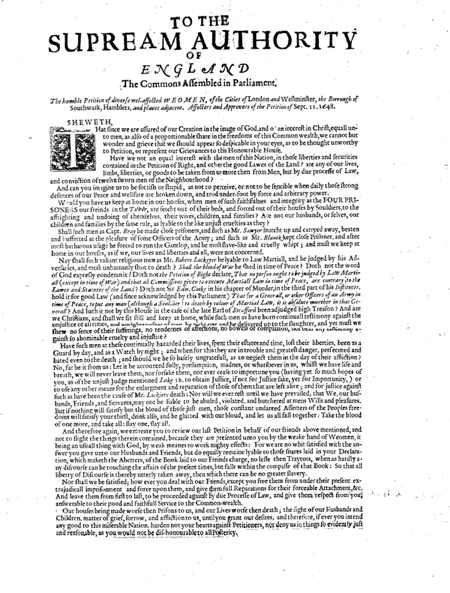
Title ID: T.324 [1649.05.05] Elizabeth Lilburne, The humble Petition of diverse wel-affected Weomen (5 May, 1649).
Estimated Date of Publication: 5 May, 1649
Thomason Tracts Catalog Information: TT1, p. 741 ; 669 f. 14. (27.)
Full Title
[Elizabeth Lilburne or Chidley], To the Supream Authority of England. The Commons Assembled in Parliament. The humble Petition of diverse wel-affected Weomen, of the Cities of London and Westminster, the Borough of Southwark, Hamlets and places adjacent. Affecters and Approvers of the Petition of Sept. 11 1648.
[1]
TO THE SUPREAM AUTHORITY OF ENGLAND. The Commons Assembled in Parliament.
The humble Petition of diverse wel-affected Weomen, of the Cities of London and Westminster, the Borough of Southwark, Hamlets and places adjacent. Affecters and Approvers of the Petition of Sept. 11 1648.
SHEWETH,
THat since we are assured of our Creation in the image of God, and of an interest in Christ, equall unto men, as also of a proportionable share in the freedoms of this Common wealth, we cannot but wonder and grieve that we should appear so despicable in your eyes, as to be thought unworthy to Petition, or represent our Grievances to this Honourable House.
Have we not an equal interest with the men of this Nation, in those liberties and securities contained in the Petition of Right, and other the good Lawes of the Land? are any of our lives, limbs, liberties, or goods to be taken from us more then from Men, but by due processe of Law, and conviction of twelve sworn men of the Neighbourhood?
And can you imagine us to be sottish or stupid, as not to perceive, or not to be sencible when daily those strong defences of our Peace and wellfare are broken down, and trod under-foot by force and arbitrary power.
Would you have us keep at home in our houses, when men of such faithfulnes and integrity as the FOUR PRISONERS our freinds in the Tower, are setcht out of their beds, and forced out of their houses by Souldiers, to the affrighting and undoing of themselves, their wives, children, and families? Are not our husbands, or selves, our children and families by the same rule, as lyable to the like unjust cruelties as they?
Shall such men as Capt. Bray be made close prisoners, and such as Mr. Sawyer snatcht up and carryed away, beaten and buffetted at the pleasure of some Officers of the Army; and such as Mr. Blanck kept close Prisoner, and after most barbarous usage be forced to run the Gantlop, and be most slave-like and cruelly whipt; and must we keep at home in our houses, as if we, our lives and liberties and all, were not concerned.
Nay shall such valiant religious men as Mr. Robert Lockeyer be lyable to Law Martiall, and be judged by his Adversaries, and most unhumanly shot to death? Shall the blood of War be shed in time of Peace? Doth not the word of God expresly condemn it? Doth not the Petition of Righ declare, That no-person ought to be judged by Law Martiall (except in time of War) and that all Commissions given to execute Martiall Law in time of Peace, are contrary to the Lawes and Statutes of the Land? Doth not Sir Edw. Cooke in his chapter of Murder, in the third part of his Institutes, hold it for good Law (and since acknowledged by this Parliament) That for a Generall, or other Officers of an Army in time of Peace, to put any man (although a Souldier) to death by colour of Martial Law, it is absolute murther in that Generall? And hath it not by this House in the case of the late Earl of Strafford been adjudged high Treason? And are we Christians, and shall we sit still and keep at home, while such men as have born continuall testimony against the unjustice of all times, and unrighteousnes of men be pickt out and be delivered up to the slaughter, and yet must we shew no sence of their sufferings, no tendernes or affections, no bowels or companion, nor bear any testimony against so abominable cruelty and injustice?
Have such men at these continually hazarded their lives, spent their estates and time, lost their liberties, been as a Guard by day, and as a Watch by night; and when for this they are in trouble and greatest danger, persecuted and hated even to the death; and should we be so basely ungratefull, as to neglect them in the day of their affiction? No, far be it from us: Let it be accounted folly, presumption, madnes, or whatsoever in us, whilst we have life and breath, we will never leave them, nor forsake them, nor ever cease to importune you (having yet so much hopes of you, as of the unjust Judge mentioned Luke 18. to obtain Justice, if not for Justice sake, yet for Importunity,) or to use any other means for the enlargment and reparation of those of them that are left alive; and for justice against such as have been the cause of Mr. Lockiers death: Nor will we ever rest until we have prevailed, that We, our husbands Friends, and Servants, may not be liable to be abused, violated, and butchered at mens Wills and pleasures. But if nothing will satisfy but the bloud of those just men, those constant undanted Asserters of the Peoples freedoms will satisfy your thirst, drink also, and be glutted with our bloud, and let us all fall together: Take the blood of one more, and take all: slay one, slay all.
And therefore again, we entreate you to review our last Petition in behalf of our friends above mentioned, and not to slight the things therein contained, because they are presented unto you by the weake hand of Weomen, it being an usuall thing with God, by weak meanes to work mighty effects: For we are no whit satisfied with the answer you gave unto our Husbands and Friends, but do equally remaine lyable to those snares laid in your Declaration, which maketh the Abetters, of the Book laid to our Freinds charge, no lesse then Traytors, when as hardly any discourse can be touching the affairs of the present times, but falls within the compasse of that Book: So that all liberty of Discourse is thereby utterly taken away, then which there can be no greater slavery.
Nor shall we be satisfied; how ever you deal with our Friends, except you free them from under their present extrajudicall imprisonment and force upon them, and give them full Reparations for their forceable Attachment, &c. And leave them from first to last, to be proceeded against by due Processe of Law, and give them respect from you, answerable to their good and faithfull Service to the Common-wealth.
Our houses being made worse then Prisons to us, and our Lives worse then death; the sight of our Husbands and Children, matter of grief, sorrow, and affliction to us, until you grant our desires, and therefore, if ever you intend any good to this miserable Nation, harden not your hearts against Petitioners, nor deny us in things so evidently just and reasonable, as you would not be dis-honourable to all Posterity.
12. [Six Soldiers], The Levellers (falsely so called) Vindicated (20 August 1649)↩
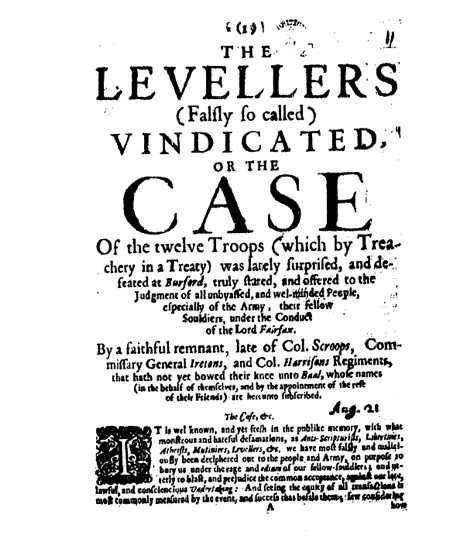
Title ID: T.209 [1649.08.20] Six Soldiers (John Wood, Robert Everard, Hugh Hurst, Humphrey Marston, William Hutchinson, James Carpe), The Levellers (falsely so called) Vindicated (20 August 1649)
Estimated Date of Publication: 14 May 1649.
Thomason Tracts Catalog Information: TT1, p. 744; Thomason E. 571. (11.)
Full Title
Six Soldiers (John Wood, Robert Everard, Hugh Hurst, Humphrey Marston, William Hutchinson, James Carpe), The Levellers (falsely so called) Vindicated, or the Case of the twelve Troops (which by Treachery in a Treaty) was lately surprised, and defeated at Burford, truly stated, and offered to the Judgment of all unbyasses, and wel-minded People, especially of the Army, their fellow Souldiers, under the Conduct of the Lord Fairfax. By a faithful remnant, late of Col. Scroops, Commissary General Iretons, and Col. Harrisons Regiments, that hath not yet bowed their knee until Baal, whose names (in behalf of themselves, and by the appointment of the rest of their Friends) are hereunto subscribed.
The Levellers (falsely so called) Vindicated
[1]
IT IS wel known, and yet fresh in the publike memory, with what monstrous and hateful defamations, as Anti-Scripturists, Libertines, Atheists, Mutiniers, Levellers, &c. we have most falsly and maliciously been deciphered out to the people and Army, on purpose to bury us under the rage and odium of our fellow-souldiers; and utterly to blast, and prejudice the common acceptance, against our late, lawful, and consciencious Undertaking: And seeing the equity of all transactions is most commonly measured by the event, and success that befals them; few considering [2] how God many times suffereth unjust men to prosper, and spred themselves in the world, like the Green Bay Tree; and the just (for their correction and proof) to be subdued and trod under foot for a season. We are thereby at so great a seeming disadvantage amongst men, That in every thing we are fore-spoken, our truths (how palpable and evident soever) are rendred as incredible, and regardless, strength and power being on their side to countenance their actions, our enemies over awing all judgments, and forcing by the might of their lawless Sword, a credit or subjection to their own most perfidious and deceitful ways; so that, as for the fruit or success that we expect, we could still have sat in patience, and not have uttered a word, but the dishonest and treacherous dealings received, with the woful ruine of the Nation, therewith sustained in ours (evidently appearing) do so boyl at our hearts, and so prevalently press upon our consciences, that we are not able longer to rest in silence; but let the hazard to us be what it will, we shall so far presume upon the publike view, as faithfully and impartially, to set down the true state and maner of our whole proceedings in that our late undertaking, hitherto most falsly and deceitfully represented by the ruling Faction of the Army, and so leave the same to the judgment and timely consideration of all honest and consciencious people, especially of the Army, our fellow-souldiers, under the conduct of the Lord Fairfax, and amongst them in a special maner, all those that really in judgment and conscience, took up Arms for the Rights and Liberties of their Native Country, as the whole Army in their Declaration of the 14 of June, 1647. declare they all did. Thus then understanding, that we the Souldiers of Col. Scroops Regiment, and others, were allotted for the service of Ireland, without our consent; or of any of our fellow-souldiers in Counsel for us, we fell into serious debate (as in reason and honesty we could do no less, considering likewise our late solemn Engagement), whether we could lawfully, in safety to ourselves, and our own Native Rights in England, submit unto that forraign Service, or no? And finding by that our old solemn Engagement at New Market, and Triplo Heaths, June 5. 1647. with the manifold Declarations, Promises, and Protestations of the Army, in pursuance thereof, were all utterly declined, and most perfidiously broken, and the whole fabrick of the Common-wealth faln into the grossest and vilest Tyranny that ever English men groaned under; all their Laws, Rights, Lives, Liberties and Properties, wholly subdued (under the vizard and form of that Engagement) to the Boundless wills of some deceitful persons, having devolved the whole Magistracy of England into their Martial Domination, ruling the people with a Rod of Iron, as most mens woful experience can clearly witness; which, with the consideration of the particular, most insufferable abuses and dissatisfactions put upon us, moved us to an unanimous refusal to go, till our Conscience were discharged in the faithful fulfilment of our said Solemn Engagement to our Native Country; in which Engagement, we were expressly and particularly obliged against the service of Ireland, till full satisfaction and security were given to us, as Souldiers and Commoners, by a Councel of our own free Election, according to the rule and tenor of that Engagement, recorded in the Armies Book of Declarations pag. 23, 24, 15, 26, 27. Whereupon we drew up a Paper of some Reasons, by way of Declaration, concerning our said refusal, to deliver to our Colonel; unto which we all chearfully subscribed, with many of our Officers (especially Cornet Den, who then seemingly was extream forward in assisting us to effect our desires) which being delivered a day or two after, immediately our Officers caused a Rendezvous near unto Salisbury, where they declared, That the General intended not to force us, but that we might either go or stay; and so testifying our intents to stay, we were all [3] drawn into the Town again, and the Colonell, with the rest of the Officers, full of discontent, threatened us the Souldiers; and because we were all, or most of one minde, he termed our Unity a Combination, or Mutiny; yet himself upon our request to know, told us, That he could not assure us, that he would go. Which fore-mentioned Paper, with a Letter, we sent to Commissary General Iretons Regiment, who took it so well, That they were immediately upon their march towards our quarters, to joyn with us, for the making good of their and our Engagement, which we, they, and the rest of the Army had engaged at New-Market and Triplo Heaths.
After this, all politike means that could be thought upon, Were put in practice to work us off from our Resolutions, as severing the Troops, and dealing with them apart, not suffering the Souldiers of one Troop to come to any of the other, employing Agents and Preaching Officers from Troop to Troop, to work us to that Service; and craftily, and lyingly, telling each Troop, That the other Troops were listed for the Irish Service, surrupticiously to overreach, and gain us by that deceit. A crime they most maliciously fix upon others, whom they would make the world believe drew us to that undertaking, as in their Declaration of their proceedings against us, published last May 22. is to be seen, where page 6. speaking scandalously of some persons, naming none, yet strongly implying our four worthy Friends in the Tower, they say of them, That they sent their Emissaries and Agents into all parts, pretending from one Regiment to another, that each Regiment had declared, That so by that Artifice, they might draw each to declare. To the Forces in Wales, and the west, they gave assurances, that the forces about London would revolt; to those about London, that those in Wales, and the west, would do the same. Thus to shroud their own vileness, and to effect their own evil ends, they are not sparing to blast innocent persons with their own wicked devices themselves are so apparently and foully guilty of; and yet wipe their mouths, as if no speck or stain were upon them, and raise the report upon others.
All those devices working nothing upon us (there being no satisfaction given to our just exceptions) our Colonel fell to violent threats, and commanded us to put our Horses in a Field two miles from our Quarters; which though at first we did, yet finding the bitterness of his spirit to encrease, and that upon his information, That the General, and Lieutenant General were preparing a force against us: what could we do less, then put our selves into the best posture we could to preserve our selves, which we immediately did (and in this no man was more forward, and violently earnest, then that perfidious Apostate, Cornet Den.) And for our justification therein, we need go no further then their own words in the Armies Declaration of the 14 of June, 1647. where to justifie their own opposition and rebellion to the Orders of a full, free, unforced, unravished and [Editor: illegible word] purged Parliament, they tell us, That the Parliament hath declared it no resisting of Magistracy, to side with the just principles, and Law of Nature and Nations, being that Law upon which the Army assisted; and that the Souldiers may lawfully hold the hands of the General that will turn his Cannon against his Army, on purpose to destroy them.
This being done, we had further Intelligence of the greatness and speediness of the Generals preparations against us, and that, (1) Though none act more directly against the tenor thereof then themselves, as is too manifest by their frequent breaking of all Faith, and Premises, making nothing of Treachery, dissembling, yea, and lying too (which is not once to be mentioned amongst Saints, as they would have men think of them.) O abominable Hypocrites I know ye not, that dissembling Piety is double Iniquity; but we fear, while ye pretend to Scripture, ye believe neither it;, nor the Resurrection: For if ye did, ye would not condemn the Innocent, against Knowledg and Conscience, of those things your selves are guilty. Repent betimes, or else your portion will be with Hypocrites. Though what we had done, did not amount to so much, as the Army had formerly done at Saffron Walden, upon the Parliaments commanding them for Ireland, yet were we strangely represented to our fellow Souldiers, by the Lieutenant General in Hide Park, under the notion of Mutiniers, Levellers, and denyers of the Scriptures, of purpose to make them engage [4] against us; (1) so that now we saw, there was no way of safety left us, but by standing upon our Guard, and capitulating with our Sword in our hands, being encouraged thereto, as well by our own innocency, and the equity of those things, upon which we had grounded our Resolutions: As also for that we could not think our fellow Souldiers of the Army, who with us engaged at New-Market Heath, would fight against us, for upholding the said solemn Engagement, wherein they were equally concerned and obliged with us, both as Souldiers and Commoners to each other, to us, and the whole Nation, with whom it was made. But indeed, this Treacherous Tragedy was principally managed and acted by (that Turn Coat) Reynolds, and his Regiment; who for the most of them were strangers to that Engagement. A Company of Blood-thirsty Rogues, Murderers, Theeves, High-way-men, and some that were taken in Colchester, and such as were cashiered out of other Regiments, for high misdemeanors, being entertained therein. And these were the men principally designed, and to be trusted against us, as most fittest to fight for the truth of the Scriptures, and such Saints as the Lieutenant General. (2) (2) These are of the men that usually asperce the Peoples best Friends with such Language as Atheists, Levellers, Anti-Scripturists, and who lives more like such, then they? for it is they who ruine all, and destroy Propriety, by their Arbitrary and Lawless Power; and who more like Jesuites then themselves for crafty Policy, Lying, and Treachery? and certainly these be the effects, or fruits of Atheism: For by their works you shall know them.
But to return. Hereupon our Officers leaving us, we choose new ones, and disposed of our Colours, and immediately drew up a Declaration, wherein we signified the Resolutions of the General (upon our refusal to go for Ireland) in a slight and unworthy maner to disband us, after our so many yeers hard and faithful Services; which we then knew to have been practised upon many of our fellow Souldiers in Colonel Huesons, and Cooks Regiments; and thereupon, we resolved to stand to our former Engagements made at New-Market; which the proceedings of the General and our Officers, did expressly contradict and make voyd. This Declaration was publikely read at our Rendezvous in old Sarum, where four Troops of Commissaric General Iretons met us, and unanimously assented to by both Regiments: whereupon our conjunction we advanced to Marlborough, and so to Wantage, where Commissioners from the General met us, to wit. Major White, Captain Scotten, Captain Peverill, and Captain Lieutenant Baily, with whom that day we did nothing, but agreed to meet at Stamford Green, the next morning by eight of the Clock, where we were all according to appointment, but the Commissioners not coming, we marched out of the field, on our way towards Abbington; and as we were upon our march the Commissioners came posting after us, and we presently made a Hault; then they overtaking us, and told us, They had Order from the General, and Lieutenant General, to heare our Desires, and endevor the Composure of our Differences; then they read a Letter unto us from the General, which took but little effect upon our Spirits; and so marching a little [5] further, two of Col. Harrisons Troops, to wit, Cap. Pecks and Captain Winthrops were marching to their Quarters, where Cornet Den and divers others met them, And read a Declaration to them, and used many glorious invitations of them to desire them to come and joyn with us, making appeare the lawfulnesse of our cause, telling them that we were resolved to stand to our first principles, and that if there were but ten men that would stand for those just things, he would make the eleventh, with divers such like expressions, the two Troops being very willing to be satisfied in the lawfulnesse of the engagement, telling us they were marching to Thame, and the next morning we should know their resolutions: But as we were marching back againe, before we were half out of the field, we spied a partie of horse, which it seemed was the Apostate Reynolds with his mercenary damme crew (such as in our hearing most desperately swore, That if the Devil would come from hell and give them a groat a day more then the State, they would fight for him against the Levellers or any others) well, upon, this we drew out a Forlorne hope, and thereupon two Troops of Colonel Harrisons marched with us towards them; they retreated towards New-bridge and kept it by force against us, but we unwilling to shed blood, or to be the original occasion of a new war (though they have often branded us with it as if we wholy fought it) but our actions did then cleerly manifest the contrary; for we seeing Souldiers, coming in a Hostile manner against us as aforesaid, did meet them, having forty or fifty of them at our mercy, and could have destroyed them, for we had them two miles from the foresaid bridg, but we did not then in the least offer them any violence or deminish a hair of their heads, but let them go to their body againe, and withall marched to a Ford, because we would not in the least be an occasion of any blood-shed; and having marched through the Ford into the Marsh on the other side, we called our Councel together, who referred the appointment of our quarters to Lieut. Ray, and Cornet Den, who designed us for Burford, where being in the Treatie with the Commissioners, and having intelligence, that the General and Lt. Generall were upon their march towards us, many of us severall times, urged to Major White, and prest upon him, that he came to betray us, to which he replyed, That the Generall and Lieutenant Generall had engaged their Honours not to engage against us in any Hostile manner till they had received our Answer, no not so much as to follow their Messengers or Commissioners with force, and being too credulous to the Generals words, knowing that he never broak ingagement with the Cavaleers in that kind; We gave the more credit to the Major, who seemed extream forward and hastie to make the Composure, pretending so far to approve of our standing for the things contained in our engagement at Triplo-Heath, that himself with our consents drew up a Paper in Answer to the Generall for us, so fully according to our desires as that it gave us satisfaction, so that the Agreement betwixt the Generals Commissioners and us, seemed to be even concluded and at an end; And for full satisfaction take Copie of the said Letter which is as followeth:
May it please your Excellency,
Wee are your Excellencies Souldiers, who have engaged our lives under your Excellencies conduct, through all difficulties and hazards in order to the procurement of Freedom Safety and Peace to this Nation, and our selves [6] as Members thereof, and being lately designed by lot to be divided, and sent over into Ireland for the prosecution of that service, in order to the Peace and safety of this Common-wealth, which we think necessary to be performed, but looking back to take a view of our former proceeding, we finde that we cannot in conscience to ourselves, in duty to God, this Nation, and the rest of our fellow souldiers undertake that service, but by such a decision as is Agreeable to our solemn Engagement made at New-market Heath, the 5 of June 1647. where we did in the presence of God, with one consent solemnly engage one to another, not to disband nor divide, nor suffer our selves to be disbanded nor divided, Untill satisfaction and security was received by the judgment of a counsell consisting of two Officers and two Souldiers together with the Generall Officers that did concur, such satisfaction and security as that engagement refers unto; And being now departed from our obedience to you because you keep not Covenant with us: yet we shall not in the least harber any evill thought or prejudice against you, nor use any act of hostility, unlesse necessitated thereunto in our own defence, which we desire God to prevent; All that we desire (and we speak it in the presence of God, who knowes our hearts) is, that your Excellency will call a Generall Councell according to the solemn Engagement. In the judgment whereof we will acquicsse, and refer ourselves to them to take an account of our late actions. This being assured we will every man with cheerfulnesse returne to our obedience, and submit to your Excellency and the judgment of that Councell in all matters that concern us as Souldiers, or Members of this Common-wealth; this we beg of your Excellency to grant, out of the respect of your duty to God, this Nation, and the Army, that we may therby retain our peace with him and procure the happinesse of this Nation under him, which is the desire of our soules: If you shall deny us this, we must lay at your door all the Misery, Bloodshed and Ruine that will fall upon this Nation and Army; for we are resolved as one man by Gods assistance to stand in this Just desire, and although our bodies perish, yet we shall keep our consciences cleer, and we are confident our soules will be at peace; now till we have a full determination herein, we desire your Excellency will forbear all manner of hostility, or marching towards us for avoyding any inconveniencies that may come to our selves or the Country; these desires with affection being granted, we hope the falling out of friends will be the renewing of love, And we shall subscribe and manifest our selves your Excellencies faithfull Souldiers, and servants to this Common-wealth.
But to returne, during the time of treaty, white the Commissioners thus assured us all security, one of them, to wit, Captain Scotten privately slipt from us, and two others, to wit, Captain Bayley and Peverill left notes at every Town of our strength and condition, whilst Major White held us in hand, and told us, that if they fell upon us, he would stand between the bullets and us: So that when notice had been sufficiently given, and we with all the meanes that could be used, wrought into a secure condition at Burford, and after the setting of our Guard, which was commanded by Quarter-Master More who was thereupon appointed, by his Brother Traytor, Cornet Den (who himself) since his coming to London hath avowedly declared to Ma. W. W. to this effect that his beginning, and continuing with the Burford Troops was out of premeditated and complotted designe, that so at last he might the easier bring on their destruction, holding all the time he was with them, correspondency [7] with the Generalls creatures, which said Quarter-Master More after he had set the Guard in this slight manner, and possest us with as much security as he could, and under the pretence of going to refresh himself and horse, did most villanously and treacherously leave the guard without any Orders, and himself in person posted away to the Generals forces and brought them in upon us, marching in the head of them with his sword drawn against us; And Quarter-Master More being afterward called Traitor by some of the Souldiers, Cap. Gotherd of Scroops Regiment made answer, he was none, for that he did nothing but what he was sent to do; so that most Treacherously, that same night the Generals forces came pouring on both sides of the Towne of Burford, where we had not been above three houres, swearing, Damme them and sink them, and violently fell upon us, and so by a fraudulent and Treacherous surprize defeated us, not expecting it during the Treatie, especially from them with whom we had joyned these seven years for the defence of Englands Liberties and Freedoms, and though divers of us had faire quarter promised us by Colonel Okey, Major Barton and the rest of the Officers then with them, as that not a hair of our heads should perish, yet did they suffer their souldiers to plunder us, strip us, and barbarously to use us, worse then Cavaliers, yea Cromwell stood by to see Cornet Tomson, Master Church and Master Perkins murthered, and we were all condemned to death, although Colonel Okey, Major Barton and others of the Grandees had ingaged that not a hair of our heads should perish, when they surrendred themselves unto them, Tompson being then at the head of a party of two Troops of horse, and the other with their fellow Souldiers made good their Quarters while they had the conditions promised them, and then Cromwel after this horrid murther was committed upon the three forementioned, contrary to Okeys, Bartons and others of their promises at their taking them, came to us in the Church, and making his old manner of dissembling speeches, told us it was not they that had saved our lives, but providence had so ordered it, and told us that he could not deny but that many of the things that we desired were good, and they intended to have many of them done, but we went in a mutinous way, and disobeyed the Generals Orders; but withall he told us that we should not be put off with dishonourable terms, because we should not become a reproach to the common Enemie: but we desire all unbyassed men to judge, whether ten shillings a man, and a peece of paper for seven years Service, be honourable terms: the paper being good for nothing but to sell to Parliament mens Agents, who have set them at work to buy them for three shillings, or four shillings in the pound at most; and we are forced to sell them to supply our wants, to keep us from starving, or forcing us to go to the high way, by reason they will not pay us one penny of our Arrears any other way but by papers, that so they may rob us and the rest of the Souldiers of the Armie of their seven yeers Service, to make themselves and their adherents the sole possessors of the late Kings Lands for little or nothing: and for ought we know, the moneys they buy our Debenters withall, is the money the Nation cannot have any account of. But this their dealing is not onely so to us, whom they pretend disobeyed their commands; but they dealt so basely by other Souldiers who never resisted their unjust Commands, as we beleeve no age can parallel: For in the first place, they turned them off with two months pay. Secondly, they have taken away three parts of their Arrears for Freequarter, though the Country (whose victuals, grasse and corn they eat) be never the better; [8] and do also force them to sell their papers at the rate aforesaid. And deer fellow-Souldiers, think not, because you are in Arms a little longer then we, that you shall speed better then we, which they have disbanded before you; but be assured, that when they have their own ends served on you, as they have already on us, you shall have as bad conditions of them, and may be, worse, if it be possible, then we have had before you; and may also reward you for your good services, by raising a company of mercenary Rogues to cut your throats, as they did trayterously to cut ours at Burford.
But to return, from this sad and long digression: by this their serpentine craft, and our own over credulous innocency, we were overthrown, and our hopefull beginnings for the rescue and deliverie of our selves and the nation from thraldome, blasted and destroyed; and then utterly to break and dash in pieces our spirits, and in us all Assertors of the Freedoms of England, and to put an utter inconfidence and jealousie for ever amongst such upon all future engagements, they made that wretched Judas Den, to that end their pandor and slave: they pretendedly spare his life after his condemnation to death, although now upon good grounds and intelligence, (yea partly from his own confessions as is noted before) we doe beleeve that from the beginnings of our proceedings, he was their appointed Emissary (as well as the forementioned Quartermaster) to be most zealous and forward of any man for us, the better to compasse our ruine and lead us like poor sheep to the slaughter; they enjoyne Den, to preach Apostacy to us in the Pulpit of Burford Church, to assert and plead the unlawfulnesse of our engagement, as much as before the lawfulnesse to vindicate, and justifie all those wicked and abhominable proceedings of the Generall, Lieuetenant Generall and their officers against us, howling and weeping like a Crocadile, and to make him a perfect Rogue and villain upon everlasting Record, to which like the most abhorred of mankind to bring about their pernicious ends upon the people, he willingly submitted, and to this end published a Recantation paper fraught with lies, infamies and most Trayterous assertions of an arbitrary power evidently tending to the introduction thereof upon this Nation in the persons of the cheife Leaders of the Armie, and in that paper at the advantage of this wicked and treacherous overthrow of ours endeavoured to bury our sollemn Engagement at Newmarket heath in our ruines, as if long since cancell’d and of no longer force or obligation, pretending that by petition, we had call’d home our councell of Agitators and so dissolv’d our engagement at New-market heath, And so the Army absolved from all further observation thereof.
Now to this, is to be considered, that the said engagement was radicall upon the grounds of common freedom, safetie, and securitie to the Nation, and upon that account and to that end onely undertaken and solemnly made, and all righteous othes, vows, and covenants are indissolveble and of force till their full and perfect accomplishment; the Apostacy and defection of no man, though of him or those that vowes, or makes such oaths or engagements can absolve or untie them; and this no man that hath any spark of Conscience or Christianitie in him can deny. Therefore it was most deceitfully and corruptly urged, that the same power that gave it a being dissolved it; for till the vowes of that engagement be paid unto the people, it standeth firm and obligatorie, till then the gates of hell are not able to prevail against the being and obliging power thereof; and we are sure none can say, the genuine ends and intents of that engagement are yet obtained, but a thousand [9] times further off, then at the making of that vow: besides, as that engagement enjoynes, what securitie or satisfaction to their private or publick rights, both as Souldiers and commoners, have we or the rest of our fellow souldiers yet received from a councell consisting of two Souldiers chosen out of every Regiment, two Commission officers with such Generall officers onely as assented to that undertaking, when or where was it? Indeed had such a Councell so concluded, and we the souldiers by our unanimous testimony and subscription (as we did to our engagement) testifie our satisfaction, there might have been some plausible pretence for its dissolution; but to this day it is evident to the whole world that no such thing hath been, and this was the expresse letter and intent of that New-market engagement; and to urge a petition for recalling the Agitators is a blind excuse; for put the case that there hath been such an one, and that of generall concurrence yet could it not detract or any way diminish from that righteous engagement; though the defection and subscription were both of Generall, Officers and Souldiers, yet the foundation of that Vow standeth sure to us all, it is immovable till its own proper end, viz. the accomplishment of the righteous end therein contained, affix its period: which we earnestly desire, may be conscienciously and seriously laid to heart by all our fellow souldiers in solemn covenant with us; for there is a God that over-seeth, and one day (when there will be no Articles of War to prevent) will call us to a strict reckoning for the breach of our faith and vows one to another, and the Nation, and account with us for all the blood, ruine, misery and oppression that thereby hath ensued, and still dependeth upon that most monstrous Apostacie. That pretended Petition at that day will be found to be but a broken reed to lean upon, it will nothing abate of the guilt: and how-ever it is now highly urged to wipe off all worldly dishonour from the iron Rulers of our Age, we are not such strangers to the Army, if any such Army Petition were, as not to know it: Sure wee are, no such Petition can be produced from any single Troop, Company, or Regiment, much lesse from the Armie. And though some such endeavours were for the promotion of so wicked and vile an enterprise, and now as evilly made use of; yet it never fell under the cognizance of the Army, neither yet of any single entire Regiment, Troop or Company; and the Engagement by the Army was made as an Army, by unanimous consent, and therefore no otherwise dissolvable, but unanimously as an Army and that neither otherwise then righteously, after the tenour and true intent of that Engagement, as we have clearly evinced, and therein have discharged our Consciences: See further upon this Subject a late Book of Aug. 1649 Lieut. Col. John Lilburns, Intituled, An Impeachment of High Treason against Oliver Cromwell and Henry Ireton Esquires page 4, 5. See also the 40, 41, 42, 43, 81 pages of the second Edition of his Book of the eight of June 1646 Intituled The Legall Fundamentall Liberties of the People of England, asserted, revived and vindicated.
Thus we have truly stated the case of our late proceedings and differences betwixt our Officers and us, and hope sufficiently to beget a right understanding and approvement, especially with all honest and conscientious people, of the equity of our late undertakings: however to those that are and shall come after, we have published and left upon record a perfect view and Prospect of our condition, that if the present Perusers shall not, yet happily that those that are to come may be thereby provoked to consideration thereof, and equall resentment with us of the righteous ends of that now betrayed, deserted, Engagement of the Army, which we chiefly desire and expect at the hands of our Fellow Souldiers, that they [10] may not longer like their Leaders be numbred amongst such as will not be limited or circumscribed within any Bounds, Engagements, Oaths, Promises, or Protestations, but levell, break, frustrate and throw off all, (as if no tyes betwixt man and man were to be on mankind) to bring about the corrupt ends of their ambition and avarice, as not only in this case of ours, but in all others of their publike undertakings since the beginning of the Armies Engagement is clearly manifest, and yet all their successes, and advancements over the People, gaind by their perjury, fraud, equivocations, treacheries and deceipts they ascribe to the immediate approving hand of God, and zeal over their delusions with the glorious exercise of Religious formalities to the eye of the People, by which a thick mist, as thick as the Egyptian darkness is lately come over the eyes of the greatest pretenders to true puritie and Religion, and many conscientious people therewith bewitched into the favour and approvement of their alone jesuitical, wicked, desperate and bloody wayes, even to the opposition and persecution of the most faithfull and constant promoters of, and sufferers for, the just freedoms of the Nation.
But in case our fellow Souldiers will not remember their vows, but still slight and desert the same, their sin be upon their own heads, we have discharged our selves; yet considering they may again possibly incline to their countries redemption (as labouring more under ignorance then willfulnes) we shall offer them and all others that bear good will to the Nation, what in reason and Equity is most conducing to a safe and well grounded peace amongst us, and which by its greatest Adversaries cannot be denyed but to be righteous and just, though contradictory to the lawless Lordship and ambitions of their Officers.
And first, We desire it may be considered, that our Hostile engagements against the late King, was not against him as out of any personall enmity, but simply and singly against his Oppressions and Tyranny on the People, and for their removall, but the use and advantage on all the successe God hath been pleased to give us is perverted to that personall end, that by his removall the Ruling sword-men might intrude into his Throne, set up a Martiall Monarchie more cruell, Arbitrarie and Tyrannicall then England ever yet tasted of, and that under the Notion of a Free State, when as the People had no share at all in the constitution thereof, but by the perjurie and falseness of the Lieutenant Generall and his Son in Law Ireton with their Faction was enforced and obtruded by meer conquest upon the People, a Title which Mr John Cook in his Book Intituled King Charles his Case &c. there confesseth to be more fit for Wolves and Bears then amongst men, and that such Tyrants that doe so govern with a rod of Iron, doe not govern by Gods permissive hand of approbation, and in such Cases its lawfull for a People to rise up and force their deliverance, See page 8, 10.
Now, rather then thus to be vassallaged, and thus trampled and trod under foot by such that over our backs, and by the many lives, and losse of our blood from us and our fellow-souldiers, have thus stept into the chair of this hatefull Kingship and presumption over us, in despight and defiance of the consent, choice and allowance of the free-people of this Land the true fountain and original of all just power, (as their own Votes against the Kingly Government confesse) we will chuse subjection to the Prince, chusing rather ten thousand times to be his slaves then theirs, yet hating slavery under both: and to that end, to avoid it in both, we desire it may be timely and seriously weighed.
That whereas a most judicious and faithfull Expedient to this purpose, hath, as [11] A Peace-offering been tendered to the acceptance of the free people of England, intituled, An Agreement of the People, dated May 1 1649, from our four faithfull Friends, now close prisoners in the Tower of London, we cannot but judge, that that way of Settlement, to wit, by an Agreement of the People is the onely and alone way of attonement, reconciliation, peace, freedom and security (under God) to the Nation; it being impossible by way of Conquest to allay the feud, divisions, parties and Quarrels amongst us, which if not stopt, will certainly devour us up in Civil and domestick Broils, though we should have none from abroad; for the Sword convinceth not, it doth but enforce; it begetteth no love, but fomenteth and engendreth hatred and revenge; for bloud thirsteth after bloud, and vengeance rageth for vengeance, and this devoureth and destroyeth all where it cometh. And though our present Rulers have setled themselves, and their conquest-Government over us; yet are we farther from peace and reconciliation then ever: the discontents and dissatisfactions amongst the people in the Kings time, which at length burst into desperate Warr was not the hundreth part so great as the discontents that are now; and if so much did follow the lesser, can better be expected from the greater? never were there such repinings, heart-burnings, grudgings, envyings and cursings in England as now, against the present Governours and Government; never such fraction and division into parties, binding, biting, countermining and plotting one against another for preheminency and majority then now; and of all this nothing is the cause, but this way of force and martiall obtrusion: And can it be imagined such counterplottings, repinings and divisions can be with safety and peace? it is impossible: Insurrections, tumults, revoltings, war and commotions are the proper issues of the wayes of such violence, and no better is to be expected: none but intruders, usurpers and tyrants can be for the way of force; such as would be but servants to the people, and not make the people their servants, cannot but abhor it, and lay down their glory at the feet of the people: these (that now ramp and rage over us) were they other then Tyrants, could do no lesse: they draw near it indeed in words, but are as far as hell from it in actions; they vote and declare the People the supreme Power, and the originall of all just Authority; pretend the promotion of an Agreement of the people, stile this the First yeer of Englands Freedom, intitle their Government a Free State, and yet none more violent, bloudy and perverse enemies thereto; for not under pains of death, and confiscation of lands and goods, may any man challenge and promote those rights of the nation, so lately pretended to by themselves: if we ask them a Fish, they give us a Scorpion, if bread, they give us a stone. Nothing but their boundlesse, lawless wits, their naked swords, Armies, arms and ammunition is now law in England; never were a people so cheated, so abused and trod under foot; enough to inrage them (as once the children of Israel against Adoram) to stone them to death as they passe the streets; which some could not certainly escape, were it not for the fiery sword, vengeance that surrounds them, which at the best is but the arm of flesh, for their shelter and protection, and may fail ere they are aware: all sorts of people watch but for their opportunity, and if it once come like a raging sea on Pharaoh and his host, they will swallow and devour them up alive: and sure, this kind of constitution of Government thus by force in despite of the people obtruded and setled, thus grutched, cursed and hated, will never bring any peace, quiet or rest unto this Nation, it will be but as a continuall fire in their bones: therefore this conquest Constitution is not the way of Englands peace: There is but two wayes, by Conquest, or Agreement; by fire and sword, or by compact and love; and both [12] these are contrary to each other as light is to darkness, and take their rise from contrary ends; and the way of love must needs be of God, for God is love, and all his ways are love; therefore we are bold of all other ways and Expedients whatsoever, to commend only this way of love, of popular Agreement to the publick consideration for a well founded and safe setled peace: and upon this account, and no other, can any security or enjoyment be expected to any publick transactors in this English Theatry, whether Prince or others. We beleeve, he that now judgeth otherwise, will at the length, it may be, when it is too late, finde himself as much deceived, as lie that lost his head against his own Palace gate.
Therefore considering there can be no sure building without a firm foundation, and for prevention of further homebred divisions and backslidings into blood, we desire our fellow Souldiers for their severall Regiments of Horse and Foot to chuse their respective Agents to consider of this way of Peace, that yet at length they may be instrumentall in saving (as now they are in destroying) this Nation; but considering what unsetledness, and wavering from their principles, hath appeared among them, and how slender grounds we have of their return from Apostacy, we heartily desire that all serious and well-affected people, that have any bowels of compassion in them to an afflicted, distressed nation, any sence of piety, justice, mercy or goodness in them, any hatred to oppression or remorse of spirit, at the afflicted, or desire of deliverance, or freedome from their worse then Egyptian bondage, that they would lay the miserable condition of the Nation to heart and unite themselves in their endeavours for a new, equall and speedy Representative; and we humbly offer this motion as a just expedient to that end that they would chuse two or three or more faithfull persons from their severall and respective Counties of the Land to come up to London to demand the freedom and release of the Owners and Publishers of the foresaid Agreement unjustly detained in Prison by Wil and Force, to debate and consult with them &c. of some way if possible to accomplish the said Agreement, before a deluge of Intestine insurrections and Forraign Invasions from Ireland, Scotland, Swethland, Denmarke, France, and Spain, sweep us away from the Land of our Nativity; and for our parts we doe declare, that though we have been thus abused and defeated, we have still the hearts of Englishmen in us, and shall freely (if there be occasion) spend the Remainder of our strength and blood, for the redemption and purchase of an Agreement of the People, upon the foresaid principles, the which for the satisfaction of such as have not seen it, We have hereunto annexed the forementioned draught of the said Agreement of our 4 imprisoned Friends in the Tower of London, as containing those things our souls like and approve of as the most exactest that our eyes have seen, and commend the effectuall promoting of it to the serious consideration of all the true hearted friends of this miserable and distressed Nation, and rest
The Nations true Friends and hearty Wel-wishers while
we have a drop of blood running in our Veines.
signed at London this 20 of August 1649, by us
| John Wood | Robert Everard | Hugh Hurst |
| Humphry Marston | William Hutchinson | James Carpen |
in the behalf of ourselves, and by the appointment of the rest of our forementioned Friends of the three forementioned Regiments.
FINIS.
13. John Lilburne, An Outcry of the Youngmen and Apprentices of London: or, An Inquisition after the lost Fundamentall Lawes and Liberties of England (29 August 1649)↩
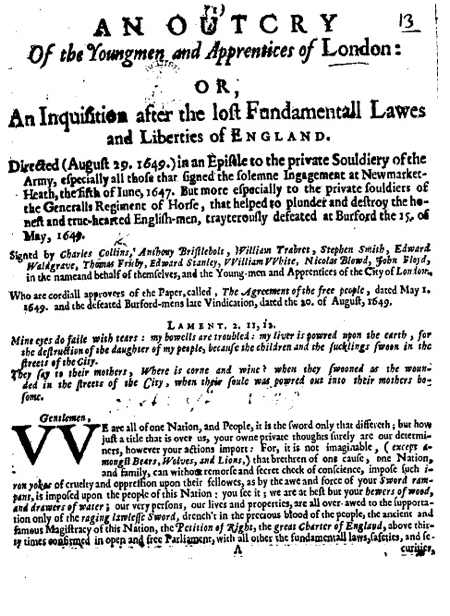
Title ID: T.211 [1649.08.29] [Signed by several but attributed to John Lilburne], An Outcry of the Youngmen and Apprentices of London (29 August 1649).
Estimated Date of Publication: 29 August 1649.
Thomason Tracts Catalog Information: TT1, p. 766; Thomason E. 572. (13.).
Full Title
[Signed by several but attributed to John Lilburne], An Outcry of the Youngmen and Apprentices of London: or, An Inquisition after the lost Fundamentall Lawes and Liberties of England.
Directed (August 29. 1649.) in an Epistle to the private Souldiery of the Army, especially all those that signed the solemne Ingagement at Newmarket-Heath, the fifth of June, 1647. But more especially to the private souldiers of the Generalls Regiment of Horse, that helped to plunder and destroy the honest and true-hearted English-men, trayterously defeated at Burford the 15. of May, 1649.
Signed by Charles Collins, Anthony Bristlebolt, William Trabret, Stephen Smith, Edward Waldgrave, Thomas Frisby, Edward Stanley, William White, Nicholas Blowd, John Floyd in the name and behalf of themselves, and the Young-men and Apprentices of the City of London.
Who are cordiall approvers of the Paper, called, The Agreement of the free people, dated May 1. 1649. and the defeated Burford-mens late Vindication, dated the 20. of August, 1649.
LAMENT. 2. 11, 12.
Mine eyes do faile with tears: my bowells are troubled: my liver is powred upon the earth, for the destruction of the daughter of my people, because the children and the sucklings swoon in the streets of the City.
They say to their mothers, Where is corne and wine? when they swooned as the wounded in the streets of the City, when their soule was powred out into their mothers bosome.
An Outcry of the Youngmen and Apprentices of London: or, An Inquisition after the lost Fundamentall Lawes and Liberties of England
[1]
Gentlemen,
We are all of one Nation, and People, it is the sword only that differeth; but how just a title that is over us, your owne private thoughts surely are our determiners, however your actions import: For, it is not imaginable, (except amongst Bears, Wolves, and Lions,) that brethren of one cause, one Nation, and family, can without remorse and secret check of conscience, impose such Iron yokes of cruelty and oppression upon their fellowes, as by the awe and force of your Sword rampant, is imposed upon the people of this Nation; you see it; we are at best but your hewers of wood, and drawers of water; our very persons, our lives and properties, are all over-awed to the supportation only of the raging lawlesse Sword, drench’t in the precious blood of the people, the ancient and famous Magistracy of this Nation, the Petition of Right, the great Charter of England, above thirty times confirmed in open and free Parliament, with all other the fundamentall laws, safeties, and [2] securities of the people, which our Ancestors at an extraordinary dear rate (as with abundance of their blood and treasure) purchased for the inheritance of us, and of the Generations after us, and for which you pretendedly took up arms against the late King and his party, are now all subverted, broken down and laid wast, the Military Power being thrust into the very office and seat of the Civil Authority, The king not onely most illegally put to death, by a strange, monstrous, illegall, arbitrary Court, such as England never knew; Monarchy extirpated (not rectified) without, and besides the consent of the people, (though the actors of that bloody scene have owned and declared them to be the original of all just humane Authority) but even our Parliaments (the very interest, marrow, and soule of all the native rights of the people) put downe, and the name and power thereof transmitted to a pick’d party of your forcible selecting, and such as your Officers (our Lords, and Rulers) have often and frequently stiled no better then a mock Parliament, a shadow of a Parliament, a seeming Authority, or the like, pretending the continuance thereof, but till a new and equall Representative, by a mutuall Agreement of the free People of England could be elected, although now for subserviency to their exaltation and Kingship, they prorogue, and perpetrate the same in the name, and under colour thereof, introducing a Privy Counsell, or as they call it, a Counsell of State, of superintendency, and suppression to all future successive Parliaments for ever, erecting a martiall Government (by blood and violence impulsed upon us) making souldiers to be executioners of Orders and VVartants, pretending to the Civill Authority, and in every particular (notwithstanding, all your famous and glorious Declarations of Freedom and Liberty) dealing with us, as an absolute, conquered and inslaved People The Law being nothing but a mock protection to our lives, liberties and properties; the Judges set apart, for the executors of it, a meer delusion, our Sheriffs, Mayors, Justices of Peace, Constables, &c. being laid by, or made no better then ciphers, (the choise of them, by will without right) appropriated to a few factious men, while the right owners (the people) are rob’d of their free and popular elections of them) as not daring to execute Justice upon the rudest or meanest souldier in England, although the Law sufficiently warrants them thereunto, but contrarywise, Commoners are forceably convened and tryed before a Councell of VVarr, and some sentenced even unto death, others by a private verball order made to run the gantlop, and whipt most barbarously, for refusing to take false and illegall oaths; and the blood of war (expresly against the Petition of right, and for which amongst other crimes, the Earle of Strafford lost his head as a Traytor, shed in times of Peace, as the blood of Mr. Richard Arnell upon the 15. November, 1647. near Ware, of Mr. Robert Lockier the 17. of April, 1649 (so much bewailed and lamented at London) of Col. Poyer, of Cornet Thompson, Mr. Perkins, and Mr. Church, upon the 16. of May 1649 at Burford, contrary to promises, and solemn ingagements at the taking of them, (as their friends lately defeated with them, in their vindication of the 20. of August, 1649 fully declare, pag. 6. 7.) and others yet fresh in our memory doth witnesse: parties of horse and foot, (contrary and in direct defiance, of the due course and process of Law) sent at unseasonable houres, to hale and pull people out of their beds and houses, from their wives and children, without so much as ever summoning of them, and without any crime or accusation showne, or accuser appearing, or the least pretence or shadow of Law produced, some sent into remote Garrisons, where they have been most barbarously used, and indeavoured to be starved, and took from Garrison to Garrison, others lock’d up close prisoners, with centinels night and day upon their doors, and all due tryalls and help at Law, stoop’d and denyed, and no remedy to be obtained, yet free men most barbarously put out of their legall possessions, by force of arms; without any manner of triall at Law, yea the Law damn’d, and stoopt up against them, for recovering of their legall rights and they threatned severely to be punished, if they desist not their suits at Law; yea, and free-mens states never pretended to be within the compasse of the Ordinances of sequestrations, seized on to [3] so great virtue (by some great mens wills, protected by their swords, to do even what they list, without controul) without any manner of tryall or conviction, or any shadow of legall presence, or ever so much as laying any pretended crime to the parties charge; all which are the very (if not higher) crimes, then the Earle of Strafford principally lost his head for, as a Traytor, as clearly appears by his Act of Attainder, and by his large printed additionall Impeachment, 1640. both in English and Irish cases, as clearly appears in the preamble thereof; and in Article 2. 3. 4. 5. 6. 7. 8. But that which is worst of all, the best and most faithfull maintainers of the English Freedomes, are most maligned, abused, and vilified, that it is now become a crime of the greatest perill and penalty, to be faithfull to the declared interest of Parliaments, or rights of the people therein; a thing so dreadfully complained of by the Parliament, in the beginning of their first Remonstrance of December 1641. New Acts of high Treason, to that end devised to ensnare and intrap the most conscientious, so that we cannot talk or discourse of our lost Freedomes, or open our mouths of our oppressions, but we are in as bad a condition, as our Fore-Fathers were, in the daies of VVilliam the Conqueror, (that thought any fact crime enough to intitle him to their estates,) if not worse by being Treason struck; and besides all this, multitudes of pick pocket, murdering taxes are heap’d, and continued upon the old, and in default of payment, souldiers are put upon straining, seizing and plundering of our Masters goods, and houses, for which violence and villany, they must be largely paid, or else they will plunder over again for that; yea and the late large Act about Excize, so transcendent and insnaring in its penalties, that no man well knows how to behave himself in his trading, for fear of being undone; yea, so numberlesse are our most insufferable cruelties, overspreading and wounding the whole Land and people, that our borders are even filled with the lamentations, mournings, tears, sighs and dolefull groans, of the oppressed and inslaved ruinated people. Trade decayed and fled, misery, poverty, calamity, confusion, yea and beggery grown so sore, and so extream upon the people, as the like never was, in England, under the most tyrannicall of all our Kings, that were before these in present power, since the daies of the Conqueror himself; no captivity, no bondage, no oppression like unto that, no sorrow or misery like unto ours, (of being inslaved, undone and destroyed by our large pretended friends, for whose preservation, we could have even pul’d out our very eyes) the people become desolate and forsaken, wandring, pining, and mourning (like those in Jeremies Lamentations, unto whose sorrows, they said, none was like), after their lost fundamentall Laws, their native, and just freedoms, and rights, and there is none to comfort, none to pitty, none to relieve, none to help or to save. Alas, alas for pitty, For,
Your hearts seem to us as obdurate as the flinty rock, as savage and inhumane, as if the flesh and blood, the bones and marrow of the people, were become your meat, as already it is in effect, and instead of incouragement and support to our true friends, and reall relievers (at least in faithfull desire and indeavour) as shall stand in the gap betwixt our destroyers and us, all waies and meanes are used to impoverish, destroy, and suppresse them, and in them to break and vassallage the spirits of all the English, which in all ages have had the preheminency of other Nations, that there may not be so much of gallantry or courage left amongst the people, that one amongst them shall dare to assert or maintaine their freedomes, (which Act is not a little aggravated by M. John Pym, in his remarkable Speech against the Earl of Strafford, as the highest of Treasons against any Nation in Common wealth,) for if any do but murmure and complain, or seek for remedy, though by way of Petition or Addresse to the House, presently their houses, as with Furies, are beset, with armed mercenary Janisaries, Guards, and Centinels, set upon their doores and passages, no consideration had of the terror or affrightment of our Masters, their wives, children, or servants, or of reason, or law, and their persons as Traytors therefore imprisoned, for weeks, and moneths; yea, and close imprisoned from the society of all their friends, without ever so much as ever seeing either informer, accuser, prosecutor, or witnesse, yea, or ever seeing Indictment, Impeachment, or Charge, yea, or [4] face to face, or in their Mittimus’s, or any other formall or legall way, ever so much as having any crime, or presence of a crime laid unto their charge, by those very men before whom they are brought, and who by the rules of their meer will commit them therefore, although the Parliament in severall Declarations have declared, That they have received Petitions for the removall of things established by Law, and we must say, and all that know what belongeth to the course or practise of Parliament will say, that we ought so to do, and that both our Predecessors, and His Majesties Ancestors have constantly done it, there being no other place, wherein Lawes that by experience may be found grievous and burthensome, can be altered or repealed, and there being no other due and legall way, wherein they which are agrieved by them, can seek redresse, and that it is in tumult to deliver Petitions by popular multitudes, a part book of Parliaments Declarations, pag. 123. 201. 202. 209. 533. 548. 691. 720.
Yea, and your very selves, and your jugling Officers quarrell’d with, and took up armes against the Parliament, your creators and originall Lords and Masters, for prohibiting you to petition, and make knowne your grievances to them, and sufficiently envy and exclaime against them for so doing, and impeach some of them as Traytors therefore, as clearly appears in your own book of Declar. p. 10. 11. 17. 23. 33. 35. 44. 60. 61. 62. 83. 85. 118.
And yet nothing but the boundlesse wills and humors of those fore-mentioned men of blood, inrageth and ruleth over us: and is this all the return and fruit, that people are to expect at your hand doth your solemn ingagement at New-market, and Triplo heath, with your Declaratious, Remonstrances, Vowes and Protestations unto us all, center in this bed-roll of cruelties? we pray you give us leave to make inquiry amongst you after those things, and give losers leave to complain. Remember you not with what cheerfullnesse and alacrity our fellow-Apprentices; the glory and flower of the youth of this Nation, and multitudes of our selves yet surviving, ran in to your assistance or of a conscientious intent, to uphold and maintain the fundamentall Constitution of this Common VVealth? viz. the interest and right of the people in their Parliaments, it being most rationall, and unquestionably just, that the people should not be bound but by their owne consent given to their Deputies in Parliament, which by the Laws and customes of England, ought [wholly new] to bee annuall), to deliver and clear the Land from its heavy pressures and bonds, not ingaging in the least, against the person of the king, as king, or with any thought or presence of destroying, but regulating kingship, but meerly for the removall of all those cruelties and oppressions, he had laid upon the people by his will, contrary to Law; this you know to bee true, your owne papers extant to the world are our record and witnesses, as might plentifully be recited, but they are known to all men, that know your affairs, you cannot deny it; but where is the fulfilment of all your glorious words, registered in your book of Declarations? in which pag. 14. you say, you shall through the grace of God, discharge your duties to the Parliament, &c. and also demonstrate, that the good and quiet of the Kingdome is much dearer to you, then any particular concerament of your own; and in pag. 23. the Generall to both Houses in his Letter of the 6. of June 1647. assures the Parliament, it is his study and care to avoid a new war, and (further thus saith) so I find it to be the unanimous desire, and study of the Army, that a firm peace in this Kingdome may be setled, and the liberties of the people cleared, and secured accordingly, to the many Declarations by which we were invited, and induced to ingage in the late warre, most seriously there promising them, they will not meddle to the advancement of any particular parts or interest whatsoever.
And in your solemn ingagement of the 5. June 1647. pag. 26. you promise and ingage to God, the Kingdome, and to each other, that you will not disband, divide, nor suffer your selves to be disbanded, nor divided (either for Ireland, or any other place else) untill we have first such satisfaction [as you say] to the Army, in relation to our grievances, and desires heretofore presented, & such security. [5] That we of our selves (when disbanded, and in the condition of private men) or other the free-born people of England (to whom the consequence of our case ( about petitioning ) doth equally extend) (had to remain subject to the like oppression, injury or abuse, as in the premises hath been attempted and put upon while an Army.
O that there had been an heart in you, to have made this good before your gross apostacy from all your engagements and promises, that hath already occasioned so much misery, warr and bloodshed. Or, oh that yet there were hearts within you vigorously and effectually to go about the accomplishment and fulfilment thereof (and thereby prevent all the miseries, blood-shed and desolations that for want thereof undoubtedly must and will ensue) which you are bound and tyed unto both before God and man, as is (in our judgments) unanswerably proved in the foresaid treacherously defeated Burford mens Vindication, pag. 8. 9. 10.
But to return, in your said engagement, in the fore-recited 26. page, you positively there disown and disclaim all purposes or designes in our late or present proceedings, to advance or insist upon a particular interest, to the overthrow of Magistracy, &c. neither (by you) would we (if we might or could) advance or set up any particular party or interest in the Kingdom [though imagined never so much our own] but shall much rather [as far as may be within our sphear or power] study to promote such an establishment of common equall right and freedom to the whole, as all might equally partake of.
And in that most choyce and best of Declarations made by the whole Army of Souldiers, as well as Officers June 14. 1647, tendered to the Parliament, concerning their just and fundamentall rights and liberties of themselves and the Kingdom, Book Decl pag. 36. 37. you say, That we may no longer be the dissatisfaction of our friends, the subject of our enemies malice [to work jealousies and misrepresentations upon] and the suspicion [if not astonishment] of many in the Kingdom, in our late or present transactions and conduct of business; we shall in all faithfulnesse and cleernesse profess and declare unto you, these things which have of late protracted and hindered our disbanding, the present grievances which possesse the Army, and are yet unremedied; with our desires, as to the compleat settlement of the Liberties and peace of the Kingdom, which is that blessing of God, then which (of all worldly blessing) nothing is more dear unto us, or more precious in our thoughts, we having hitherto thought all our present enjoyments [whether of life or livelihood, or neerest relations] twice but sufficient to the purchase of so rich a blessing, that we, and all the free-born people of this Nation may lie down in quiet under our vines, and under the pious administration of Justice and Righteousnesse, and in full possession of those fundamentall Rights and Liberties, without which we can have little hopes (as to humane condition) to enjoy either any comforts of life, or so much as life itself, but at the pleasure of some men, ruling meerly according to will and power.
And in the same Declaration pag. 38. 39. you further say thus; Nor will it now (we say) seem strange or unreasonable to rationall and honest men, who consider the consequence of our present case, to their own and the Kingdoms [as well as our] future concernment, in point of right, freedom, peace and safety (if from a deep sense of the high consequence of our present case, both to our selves [in future] and all other people) we shall, before disbanding, proceed in our own and the kingdoms behalf, to propound and further some provision for our and the kingdoms satisfaction and future security, in relation to those things especially, considering that we were not a meer mercenary Army, hired to serve any arbitrary power of a State, but called forth and conferred by the severall Declarations of Parliament, to the defence of our own and the peoples full Rights and Liberties: and so we took up arms in judgment and conscience to those ends, and have so continued them, and are resolved, according [6] to your first just desires in your Declarations, and such principles as we have received from your frequent informations, and our own common sense, concerning those our fundamentall Rights and Liberties, to assert and vindicate the just power and rights of this Kingdom in Parliament for those common ends promised against all arbitrary power, violence and oppression, and against all particular parties and interests, whatever. The said Declaration is still directing us to the equitable sense of all Laws and Constitutions (and, as dispensing with the very letter of the Law, and being fundamental, where the safety and perturbation of all is concerned: and assuring us that all authority lies fundamentally vested in the Office, but administerially in the Persons.
And on page 96, speaking in general of purging some evil members out of the Parliament, you declare, “your carriage towards them shall be such, as that the world shall see we aim at nothing of private revenge and animosities but that Justice may have a free course, and the Kingdom be eased and secured, by disenabling such men [at least] from place of Judicature, who desiring no advantage and set up themselves and their party in a generall confusion, have endeavoured to put the Kingdom into a new time of Warr, then which nothing is more abhorrent to us. And in the same Declaration, spending the 42 and 43 pages in most excellent expressions, of the excellency and benefit of frequent and successive Parliaments [totally new] and the mischief, bondage and vassallage of the long continuance of any Parliament, at pa.44 you say, And thus a firm foundation being laid in the authority and constitution of Parliaments, for the hopes at least of common and equitable Right and Freedom to our selves, and all the free born people of this Land; we shall for our parts freely and cheerfully commit our stock or share of interest in this Kingdom into this common bottom of Parliaments, and though it may [for our particulars] go ill with us in one voyage, yet we shall thus hope, [if right be with us] to fare better in another.
And in the last end of that transcendant Declaration, pag. 46. you conclude thus: “We have thus freely and clearly declared the depth and bottom of our hearts and desires in order to the Rights, Liberties and peace of the Kingdom; wherin we appeal to all men, whether we seek anything of advantage to our selves, or any particular party whatsoever, or to the prejudice of the whole; and whether the things we wish and seek for, do not equally concern and conduce to the good of others in common with our selves, according to the sincerity of our desires and intentions (wherein as we have already found the concurrent sense of the people in divers Countries, by their petitions to the General, expressing their deep resentment of these things, and pressing us to stand for the interest of the kingdom therein; so we shall wish and expect the unanimous concurrence of all others, who are equally concerned with us in these things, and wish well to the Publick.
And in p. 52. being writing to the Lord Mayor Aldermen, and Commons of the City of London in Common Councel assembled, it is thus said To conclude, we say from our hearts that our especiall ends are the glory of God, and the good of this whole Land, so my endeavour shall be to prosecute the same without prejudice to the being or well being of Parliaments in generall; the maintenance whereof we value above our own lives or (as we have formerly said) of this Parliament in particular, but together in order to the good and Peace of the Nation, and wish a most tender regard to your City.
And in page 57, 58. its said that, In our last Representation it may appear what desires are, as Members of the Common-wealth in behalf of our selves and all others the cleering, setling and securing of the rights, liberties and Peace of the Kingdom; for justnesse, reasonableness, necessity and common concernment whereof unto all, we dare appeal to the whole Kingdom, and to the world.
[7]
And in page 76 to the Lord Mayor of London, &c. it is said, “ That it is a sudden and substantial settlement of the whole we desire in a generall, safe, and well grounded peace, and the establishment of such good Laws, as may only and readily render to every man their just rights liberties; and for the obtaining of these, not only our intentions had led us too, but we think that all the blood, treasure and labour spent in this War, was for the accomplishing those very things, which are of that concernment both to our selvs and propertie, that neither we nor they can live comfortably without them, and therefore their help is much pressed for to bring things to a happy conclusion, to the satisfaction of all honest mens expectation, and that in all our undertakings we shall be found men of truth, fully and singly answering the things we have held forth to the kingdom in our severall Declarations and Papers, without byas or base respects to any private end of interest whatsoever.
And in page 97. is recorded a notable Proposall to the Parliament from Redding, July 12. 1647. which doth sufficiently condem your late tyrannicall dealing with some of the very parties therein mentioned; The Proposall thus followeth; “Wee doe earnestly desire, That all persons imprisoned in England or Dominion of Wales, not for Delinquency in relation to the last Warre, but for other pretended misdemeanours,) and whose imprisonment is not by the regulated course of Law, but by Order from either Houses of Parliament, (or of Committees flowing from them) may be put into a speedy regular and equitable way of Triall, (or if the necessity of setling the generall affairs of the Kingdom admit not their present triall) then they may have present libertie (upon reasonable security) to their apppearance at a certain day, to answer what shall be charged against them in a Legall way, and that when they should be tryed, if they appear wrongfully or unduly imprisoned, they may have reparation according to their sufferings.
In particular we desire this may be done in behalfe of L. Colonel John Lilborn, Master John Musgrave, Master Overton and others (in their condition) imprisoned in and about London. Read also more fully to this purpose p. 101. 105. 110. 112. 118. 128. 132. 137. so also the large Remonstrance from Saint Albans of the 16. of November 1648. pag 6. 89 12. 14. 15. 22. 23. 29. 43. 45. 47. 48. 57. 62. but especially 65. 66. 67. 68. 69.
But after this large (but yet profitable and necessary) digression, let us seriously expostulate with you and put you in mind of your most wicked and grosse apostacy (such as the world never see or read of before, from men that professe God and godlinesse in a strict manner, and would be reputed the CHOICEST SAINTS in England) and cry out unto you with astonishment and admonition; and thus interrogate your very consciences (where God alone ought to sit King) Oh heare you not the blood of our dear fellow Apprentices, and of the rest of the good People of England spilt for the redemption of this inthraled Nation (especially since your first contest with the Parliament) cry aloud in your ears and hearts (where ever you goe) for vengeance upon you, the peoples perfidious abusers, betrayers and destroyers? Oh do not you hear them cry out unto your very conscences; O give our Fathers, or Mothers, our Brothers, our Sisters, and others of our neer and dear relations, the full and speedy accomplishment of all your forementioned inravishing promises and engagement, by vertue of the power and efficacy of which you stole away their heart, and spirits from all their relations, and made them with willingnesse and cheerfullnesse become sacrifices for your assistance; for that end principally (if not only) that they that survived might enjoy the full and ample fruition of all your glorious promises and engagements, for common freedom, distributive Justice and righteousnesse upon the earth; Oh do you not hear their blood cry unto you? O mock not (nor dally with) God any longer, but without delay, give our friends and country-men the promised price of all our blood, by the full and speedy paying of all your vows, and engagements made unto God [8] for that end, lest for all your perjury, apostacy, and perfidiousnesse he create a mighty and irresistible spirit of revenge amongst the people, and knit together (their otherwise divided hearts, in one, is one man to rise up in one day to destroy you, with a more fatall scouring destruction then you have already destroyed others (yea the highest in the Nation) pretendedly for oppressions, breach of Oaths, Faith and Covenants) yea to sweep you away from the land of the living; with an overflowing deluge of destruction, as the enslaved women about six or seven hundred years agoe, did the Danes in one night throughout England.
Oh do not your hearts at all relent? can you consider this your forecited unparalleled and horrible defection and apostacy, and not tremble and be amazed, and even confounded? Is there lesse remorse of conscience in you then was in Belshazzar, who at his seeing the hand writing upon the wall, hanged his countenance, and his thoughts troubled him, so that the joynts of his loins were loosed, and his knees smote one against another, (though otherwise in as great Jolity and prosperity as any of yourselves or Officers) or have you lesse apprehension of the Majesty of God then was in the heathen Roman Governour Felix, who when he heard Paul reason or Preach of rightousnesse, temperance and Judgement to come trembled and feared, and durst not proceed in fury against him, although much thereunto provoked by his adversaries, Act. 24. since all sense and compunction of conscience is not totally departed from you; hear us therefore in the yearning bowels of love and kindnes we intreat and beseech you with patience and do not abuse us for complaining and crying out, for the knife hath been very long at the very throats of our Liberties and Freedoms, and our burthens are too great and too many for us, we are not able to bear them and contain our selves, our oppressions are even ready to make us despair, (or forthwith to fly to the prime Lawes of nature, viz. the redolent remedy at hand, light it where it will, or upon whom it will) they are become as devouring set in our bones, ready to burn us up, rendring us desperate and carelesse of our lives, prising those that are already dead, above those that are yet living, who are rid of that paine and torment, that we do & must indure, by sensibly seeing and beholding not only the doing, but the daily burial of our native Liberties and Freedoms, that we care not what becomes of us, seeing that we are put into that originall state or chaos of confusion; wherein lust is become a law, envy and malice are become laws, and the strongest sword rules and governes all by will and pleasure; all our ancient boundaries and land-marks, and puld up by the roots, and all the tyes and bonds of humane society in our English horizon totally destroyed and exterpated. Alas for pity.
We had rather die then live this life of languishing death, in which our Masters possesse nothing (to buy themselves or us bread to keep us alive) that they can call their own; therefore it is no boot for us to serve out our times, and continue at our drudging and toyling trades while these oppressions, cruelties and inhumanities are upon us, and the rest of the people; exposing thereby the Nation not only to domestick broyles, wars and blood-sheds (wherein we insure our bodies must be the principall bars) but to forraign Invasions by France, Spaine, Denmark, Sweathland, &c. as was well observed by our endeared and faithfull friends of the forementioned late treacherously defeated party at Burford in their Book of the 20 of August, 1649. Intituled the Levellers vindicated, or the Case of their 12 Troops truly stated, pag. 11. which we cannot but seriously recommend (with them) to your serious perusall and judgement and desire to know of you (but especially the private souldiery of the Generals Regiment of horse, what we understand had a hand in seasing upon and plundering our true friends at Burford) whether you do own the abominable and palpable treacherous dealings of your Generall and Lieutenant Generall Cromwel and their perfidious Officers with them or no? (that so we may not condemn the innocent with the guilty, and may know our friends from our foes) as also to tell us, whether we do approve of the totall deflection of your Army under which it now lyeth, from their Faithful solemn engagement made at Newmarket-heath, June the 5 1647, not one of those righteous men in behalf of the Parliament and people, on which your vow was made, being yet fulfilled or [9] obtained; but on the contrary (as we have before rehearsed) a whole flood-gate of tyrannies are let in upon us, and even over-whelme us; and whether you justify all those actions done in the name of the Army upon your account, and under pretext of that Engagement since the Engagement it self was broken, and your Councill of Agitators dissolved? And whether you will hold up your Swords to maintaine the totall abolition of the peoples choicest interest or freedom, viz. frequent and successive Parliaments, by an Agreement of the People, or obstruct the annuall succession? Whether you doe allow of the late shedding of the blood of war in time of peace, to the subversion of all our Laws and Liberties? And whether you do countenance the usurpation of the fundamental Freedoms of this Commonwealth? as their revocation or nullity of the Great Charter of England, The Petition of Right, &c And whether you do assent to the erection of Arbitrary prerogative Courts that have or shall overrule, or make void, our ancient way of tryals in criminal Cases, by a Jury of 12 men of the neighbourhood? and whether you will assist or joyne in the forcible obtrusion of this Martial and Tyrannical Rule over us? Also whether you will fight against and destroy those of our friends that shall endeavour the composure of our differences, together with the procurement of our Freedoms and settlement of our peace (your plenty and prosperity) accordingly as it was offered by the 4 Gentlemen prisoners in the Tower of London, upon the first of May 1649 (as a peace-offering to this Nation) by the Agreement of the People?
Lastly, We earnestly beseech you to acquaint us, whether from your hands (to your power) we may expect any help or assistance in this our miserable distressed condition, to the removall of those iron bands and yolks of oppression, that have thus inforced us to complain, and addresse our selves thus to your serious consideration.
For we cannot chuse but acquaint you, that we are seriously resolved, through the strength and assistance of God, (with all the interest we have in the world) to adhere to the righteous things contained in our treacherously defeated freinds forementioned late vindication; very much approving of that unparalel’d expedient (of an agreement of the free people,) they propose in the latter end thereof, for the firm setling of the peace, Liberties and Freedoms of this distracted nation, which hath so much justice, righteousnesse and safety in it, that we hope it will in a very short time levell all self interests before it & make it clearly appear to him that claims the greatest personall share in the government of this Nation, that there is no way to obtain the true love of the understanding English people (without which he will never obtain his desired Crown) but by a cheerefull, hearty and reall promotion of such principles therein contained as doe sufficiently tye his hands from cutting the peoples throats, at his will and pleasure, the endeavouring of which, exposed his father to that fatall end that befell him; which may be a seasonable caveat to all Princes &c, to take heed of that desperate rock, viz. the attempting to govern the people by will, and not by Law; by force, and not by love; the onely and alone durable and permanent tie or bond amongst the sons of men; We say that expedient of an Agreement of the free people appears to us to have so much equity righteousnesse and common safety in it, that we are resolved to bury all by-past DISTASTS at the greatest of Englishmen that shall heartily and cordially, signe and put forth their power and interest, to promote the establishment of the principalls therein contained; and in the ADHERING TO, AND STANDING BY, all such as shall be in any danger for walking in such paths, we shall through the strength of the Lord God Omnipotent (to the uttermost of our power and abilities) resolvedly hazard our our lives and all that is dear to us.
For the effectuall promotion of which said Agreement we are necessitously compeld, to resolve in close union to joyn our selves, or our Commissioners (chosen for that end) the Counsel with our foresaid Burford friends, or their Commissioners, and to resolve to run all hazards, [10] to methodize all our honest fellow Prentices, in all the Wards of London, and the out-Parishes, to chuse out their Agents to joyn with us or ours: to write Exhortative Epistles, to all the honest hearted freemen of England, in all the particular Countries thereof, to erect severall Councels amongst themselves, out of which we shall desire (and exhort them) to chuse Agents or Commissioners (impowered and intrusted by them) speedily to meet us and the Agents of all our, (and the Agreement of the People) adherents at London, resolvedly to consider of a speedy and effectuall method, and way how to promote the Election of a new and equall Representative or Parliament, by the Agreement of the free People, seeing those men that now sit at Westminster, and pretendedly stile themselves the Parliament of England, and who are (as they say (although most falsly) in the Declaration for a Free State, dated March 17. 1643, p.17. intrusted, aund authorized by the consent of all the People of England whose Representatives they are) make it their chiefest and principallest work, continually to part and share amongst themselves, all the great, rich, and profitablest places of the Nation, as also the Nations publike treasure and Lands, and wil not ease our intolerable oppressions, no nor so much as of late receive our Particular Petitions having upon Thursday last, August 23 1649. rejected that most excellent of Petitions ready at their door to be presented to them by divers honest men (our true hearted neighbours of Surrey) the true Copie of which for the worth of it although it be at large already printed in Friday Occurences and the Tuesday Moderate,) we desire here to insert.
To the supreme Authority of this Nation, the Commons of England assembled in Parliament:
The humble Petition of the oppressed of the County of Surrey, which have cast in their Mite into the Treasury of this Common-wealth.
SHEWETH,
THat as the Oppressions of this Nation in time foregoing this Parliament were so numerous and burdensome, as will never be forgotten; so were the hopes of our deliverance by this Parliament exceeding great, and full of confidence, which as they were strengthened by many Acts of yours in the beginning, especially towards conscientious people, without respect unto their judgments or opinions; did the gratitude of the wel-minded people, exceed all presidents or example sparing neither estate, limb, liberty, or life, to make good the authority of this honorable house, as the foundation and root of all just Freedom, although we many times observed (to our grief) some proceedings holding resemblance rather with our former bondage: yet did we impute the fame to the troublesomness of the times of War, persistently and silently passing them over, as undoubtedly hoping a perfect remedy, so soon as the Warres were ended: But perceiving our expectations in some particulars frustrated: and considering some late dealings with some of our friends, &c. the consideration of which lies so heavy on our spirit that for prevention thereof, we conceive our selves bound in conscience and duty to God, to set before you once more, the generall grievances of the Commonwealth, and the earnest desires of the ingenious and well-minded people.
First, That the Petition of the Eleventh of September last, and the Agreement of the People may be reassumed, and the particulars therof speedily established.
Secondly, we most earnestly beg, with many other of your faithfull friends in all the Counties of England that that most irksome and intolerable oppression of Tythes, which is retained in no reformed Church, neverthelesse more firmly established then ever by your Ordinance for treble dammages, made in the Parliaments corruption, and yet no Act against it, which causes our hearts to be discouraged, and brought into much fear and doubt of the removall of these and other bondages by this Representative: Wherefore we cannot passe it by, but again intreat, that the Ordinance for Tythes may be speedily revoked, and that a more equall way of maintenance be provided by the publique Ministery.
[11]
Thirdly, That all proceedings in law may be in English, that a short time may be inserted for the tryall of all causes, and that by Twelve men of the Neighborhood, and that none may be debarred of Freedom to plead his own or his Neighbours Cause, [ as by Law any man may and ought to doe, as clearly appears by the Statute of 28 Edw 1 ch.11. ] before any court of Justice, although no Lawyer. And that no member of your House be suffered to plead as a Lawyer, whilst a member thereof.
Fourthly, That some course may be taken for the future, to pay the Army; not laying such intolerable Burthen and taxes on its people which we are not able to bear, And so we shall for ever stand by you an all Representatives for the freedom of the Nation, as formerly. Desiring that we may obtain speedily a new and equal Representative.
We say, considering what is before premised, we are necessitated and compeld to doe the utmost we can for our owne preservations; and for the preservation of the Land of our Nativity; and never (by popular petitions) addresse our selves to the men sitting at Westminster any more, or to take any notice of them, then as of so many Tyrants and Usurpers, and for time to come to hinder (as much and as farr as our poor despised interest will extend to) all others whatsoever from subscribing or presenting any more popular petitions to them: And only now as our last Paper-refuge, mightily cry out to each other, of our intolerable oppressions in Letters and Remonstrances, signed in the behalf, and by the appointment of all the rest by some of the stoutest and stiffest amongst us that we hope will never apostasize, but be able through the strength of God, to lay down their very lives for the maintaining of that which they set their hands to.
You our fellow-Countrymen (the private Souldiers of the Army) alone, being the instrumentall authors of your own slavery and ours; therefore as there is any bowels of men in you, any love to your Native Country, Kindred, friends or relations, any sparks of conscience in you, any hopes of glory or immortality in you, or any pity, mercy, or compassion, to an inslaved, undone, perishing, dying people, Oh help, help! save and redeem us from totall vassalage and slavery, and be no more like brute beasts, to fight against us or our friends, your loving and dear brethren after the flesh: to your own vassalage as well as ours.
And as an assured pledg of your future cordialnesse to us (and the true and reall liberties of the Land of your Nativitie) we beseech and beg of you, (but especially those amongst you that subscribed the solemn engagement at Newmarket heath and the of June 1649) speedily to chuse out from amongst your selves, Two of the ablest and constantest faithfull men amongst you in each Troop and Company, now at last, (by corresponding each with other, and with your honest friends in the Nation) to consider of some effectuall course (beyond all pretences and cheat) to accomplish the real end of all your engagements and fightings, viz. the settling of the Liberties and Freedoms of the people, which can never permanently be done, but upon the sure foundation of a POPULAR AGREEMENT: who (viz. the people) in Justice, gratitude, and common equity, cannot choose but voluntarily and largely make better provision for your future subsistance (by the payment of your ARREARS) then ever your Officer, or this pretended Parliament intends, or you can rationally expect from them; witnesse, their cutting off three parts of your Arreares in four for Free-quarter and then necessitating abundance of your fellow-Souldiers (now cashiered, &c.) to sell their Debenters at two shillings six pence, three shillings and at most four shillings per l. by meanes of which you that keep your Debenters being necessitated to vie with the greatest bidder, in the purchase of the late Kings Lands, they are able to give above 30 years purchase, for that you cannot give a years purchase for; and if you will not give with the most you must have no Land, so that the most of your Debenters are likely to prove waste papers, and those that purchase will have but a slippery security of their possessions, by reason of generall discontents amongst all sorts of people, and particularly by so extraordinarily disengaging and cheating so many Souldiers as they have done, of their just expected recompence of reward.
[12]
And also, as a further demonstration of the cordialnesse of your hearts to us, OUR BURFORD FRIENDS, and our own and our Liberties; we desire you to take some speedy course for the faithfull restoring to the right Owners, all such Horses, Money, Clothes, &c. as you, any of you, plundered or stole from our true friends, (cheated and defeated) at Burford, publish some kinde of Demonstration of your or any of your remorse of Conscience for your being instrumentall in destroying of them there, that stood for your good, freedomes and ARREARS, as much, (and as well) as their own, especially considering they have in their foresaid Vindication made it evident and apparent (and we understand they are at face to face to prove) That both our Generall, and Lieutenant Generall Cromwell broke their faith with them, and treacherously surprised them; and so dealt worse and more vilely with them, then ever they did with the worst of Cavaliers, with whom in that kinde they never broke faith with, in their lives; but more especially we desire the last fore-mentioned thing in your hands; because upon that Trayterous and wicked defeat of those our true Friends, (and wilfully murthering of three of them) that really stood for the Nations interest, Liberties, and Freedoms your Generall and Cromwell, with the rest of their faction made a most transcendent Feast, to insult over the Liberties and freedoms of the servants of the most high God as though by that most vile act, they had subdued and buryed all the Liberties of the Nation in eternall oblivion, and FOYL’D the Lord of life and glory himself, from distilling any more Spirit of Courage and Resolution into any to stand for them; and in that wickedest of Feasts, not onely a great measure imitated Belshazzar, Dan. 5. That made a great Feast to a thousand of his Lords, and fetched out the vessels, that by the spolie of the people of God, his father Nebuchadnezzar had gone to the Temple of the Lord, and drank wine in them, and praised the gods of gold and of silver, of brasse, of iron, of wood, and of stone, but also imitated the greatest of the enemies of Christ, who at the slaying of the two witnesses, Rev. 11. rejoiced over them and made merry and sent gifts one to another (as in Gold and Silver plate, &c. was most largely done to your General Fairfax and Lieutenant-General Cromwell) the reason of which is there rendred, which is, because the two Prophets (of Truth and Justice) tormented them that dwelt on the earth; but with comfort and joy we cannot but serve the next words to them, which is, That within a little season after, the Spirit of life from God entred into them, (as we hope and doubt not, but it will abundantly now doe upon the true defenders for justice and righteousnesse amongst men) and they stood upon their feet, and great feare fell upon them that saw them, and great Earthquakes followed, in the nick of which is proclamation that the Kingdoms of this world are become the Kingdoms of our Lord and of his Christ; and he shall reign for ever and ever; unto which we heartily say, Amen, Amen. So with our hearty true love remembred to you all, expecting your, or some of your speedy answer, we commit you to God, and rest
London this 29. August, 1649.
Your faithful, though abused Countrymen.
Signed in the behalf of our selves, and the unanimous consent of the Agents of the Youngmen and Apprentices of the City of London, that love and approve of the Agreement of the People, dated May 1. 1649. the Vindication of the late defeated men at Burford entituled, The Leveller, vindicated.
| Charles Collins | Anthony Bristlebolt |
| William Trabret | Steven Smith |
| Ed. Waldegrove | Thomas Frisby |
| Ed. Stanley | William White |
| Nicholas Blowd | John Floyd. |
FINIS
14. Mary Stiff, The good Womens Cryes against the Excise of all their Commodities (4 January 1650)↩
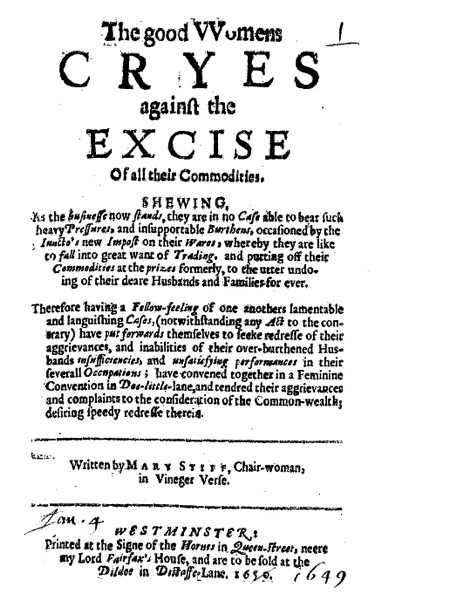
Title ID: T.218 [1650.01.04] Mary Stiff, The good Womens Cryes against the Excise of all their Commodities (4 January 1650).
Estimated Date of Publication: 4 January 1650.
Thomason Tracts Catalog Information: E. 589. (1.) TT1, p. 782.
Full Title
Mary Stiff, The good VVomens Cryes against the Excise of all their Commodities. Shewing, as the businesse now stands, they are in no Case able to bear such heavy Pressures, and insupportable Burthens, occasioned by the Iuncto’s new Impost on their Wares, whereby they are like to fall into great want of Trading, and putting off their Commodities at the prizes formerly, to the utter undoing of their deare Husbands and Families for ever. Therefore having a Fellow-feeling of one anothers lamentable and languishing Cases, (notwithstanding any Act to the contrary) have put forwards themselves to seeke redresse of their aggrievances, and inabilities of their over-burthened Husbands insufficiencies, and unsatisfying performances in their severall Occupations; have convened together in a Feminine Convention in Doe-little-lane, and tendred their aggrievances and complaints to the consideration of the Common-wealth; desiring speedy redresse therein. Written by Mary Stiff, Chair-woman, in Vineger Verse.
Westminster. Printed at the Signe of the Hornes in Queen-street, neere my Lord
Fairfax’s House, and are to be sold at the Dildoe in Distaffe-Lane, 1650.
[1]
The good VVomens CRYES against the Excise, on all their Commodities.
Good People all that heare our Cryes,
Pitty poore Womens Miseries.
WE cannot now set on the Pot, with a Sheeps-head dyd of the rot, Oynon nor Oatemell use God-wot; (pox take them:) When that we goe to salt our meat, or to make Pyes to bake and eat, this damn’d Excise lies in the heat that bakes them: We cannot wash our Smocks or Shirts, when we have gilded them by squirts, but straight in an Excise-man blurts, and smells too’t. Excise for Soape the Knave requires, Excise for Log-wood us’d by Dyers, to maintain Rogues, Knaves, Flooks, and Lyars, pray looke too’s. Tobacco two shillings the pound, the Devill sure will them confound, good people pray come curse them round, and spare not. [2] Excise on Ale, Excise on Salt, Excise on Cloath, Excise on Malt; Excise on what so ere you call’t, and feare not. All Linnen fine or course must pay, Excise, or else they’l tak’t away, Lord who ere thought to see this day, in England? for Feather-beds, for Chairs, for Stooles; for Childrens Babyes, Caps for Fooles, and for all handy-crafts-mens tools, these Knaves stand Excise for Paper I must pay, or else my Muse must pine away; they care not what I write or say, in anger. Excise they have for Pots and Pans, for Pigins, Noggins, and for Cans, yet Harry Martins ware free stands, to bang her Excise as strong as Aquvaite the Juncto hath to make them mighty; and when they’r warm’d, O then they’l fight ye, with ten whores: Excise on Sugar browne and white, Excise on Candles that wee light, but when King Charles comes, then wee’l fight, and quit scores. Excise on Spirits they doe lay, but from such Spirits Lord we pray, deliver us and chase away, these vermin; they doe Excise Wine by the Tun, and all the Liquors that doe run, a Halter catch them, or a Gun, that harme men: Sweet Sugar-Candy cannot scape, no more then can the juice of Grape; Ferriting, Shoostrings, Laces, Tape, they get by: Hatbands, Ribands, Gloves, and Hats; and for our Beds the very Mats, Tinder-Boxes and Rat-Traps, they live by. Excise for Pepper, Currans, Figs; for Capons, Rabbits, and for Pigs, for Childrens Tops and Whirlygigs, pox rate them. For Earthen Ware and Skins of Leather, a Halter tye them fast together, that they may hang in wind and weather, to state them: Excise on Cheese and Butter too, the more for to augment our woe, good God what will these Rebells doe? to begger’s. Excise on Glasses brittle Ware; Excise on all save of our care, we must lie hard, and hardly fare, guds doggers: Excise on Pewter, Tin, Lead, Brasse; to furnish out each ignorant Asse; and Assessments for Sir Thomas, and Cromwell: thus doe they rack, thus doe they rave; the more we give, the more they crave; else plundered by each Rogue and Knave, and Rake-hell. The Bishops Lands and all their store, they’ve lately sold, and yet are poore, and like the Horse-Leach cry more, more, and threaten. But if all things hit but aright, and Charles the second comes to fight; the Rebells will be hang’d downe-right, or beaten: Tom Ladle then will rue his folly, and Bradshaw Jack be melancholly, the Loyallists be briske and jolly, to heare it; Though these have murthered the King, they must not thinke to scape the string; a joyfull sight to see them swing, ne’re feare it. The roguerie that these Knaves have hatch’d, in all the world cannot be match’d, but in their snare they will be catch’d, in halters: Wee’l Bonfires light with Cromwells Nose, and Tyburne deck with Charles I is foes, and Gregory shall have all their Clothes, when’t alters . Then will the Sisters snot and snivell, and all the Saints make pittious drevil, when Cromwel marches to the devil in earnest Corbet will close Mourner bee, and Mildmay swing in a whimsie; Hie then quoth Lenthall, up goe we, in true jeast. Such Hypocrits can never scape, that murther, steale, and commit Rape; for them the mouth of hel doth gape, wide ope; were ever people deceiv’d thus? [3] was ever King so glorious? or Religion reform’d thus? by Pope: Gun-powder Traytors did but intend, to bring their King to such an end; but that the Devill was not their friend, betray’d them; but these have in an open Hall, with impudence gone beyond all; nor did those bloody Traytors fall, dismay them. They butcher’d Charles at his owne gate, they tooke his Jewells, Money, Plate; and call themselves a Free State, by plunder: They sold his Haire, his Blood, and Crowne; they keep the Prince too from his own, were ever such damn’d Traytors knowne, O wonder! They sold his Houshold-stuffe & Goods, his Mannors, Forrests, Chases, Woods; yet seek to shed his Childrens bloods, like Devills: They damn’d their souls by treacherie; sacriledge, and perjurie; of covetousnesse no end we see, of evills. Our Husbands they no work can get, our Children starve for want of meat, and all we earne must make Knaves great, in bravery; whilst Cromwells Trull sits like a Queen; in Cloath of Silver, Sattin green, eats all the dainties can be seen, by slavery: Then doth her Stallion feed his fill, and of his Lust then has his will; Morley must make, and Noll must kill, ’tis pretty: each stinking Pusse, that t’other day, served the Hogs, and went to hay, now’s clad in the Queens rich aray, ’th’City Whilst Fairfax with’s bable-Nose, weares the Kings rich Gloves and Cloaths, and of his Hangings doth dispose, God save us: his Fro that came from Rotterdam and makes the simpleton a R— as proud as is the Devills Damme, out-brave us: whilst Mistris Pride, that stinks of graines, must have two maids beare up her traines, although her legges be full of Blaines, and itchie. These be the Nobles of our Land, greatest in power and command; for which you worke, you fight, you stand, they’l sit ye. When Bradshaw’s Doxie doth lie in, she has the Queens Childbed linnen, as if the Brat to Charles were Kin, her Bastard: That great Lollpoop’s no sooner up, but has his Caudle in the Kings Cup; and like his blood, doth swallow’t up, base dastard: Then doth he unto White-hall hie, with brace of Pages hanging by, to invent more tyranny and treason: but if good women, you’l be rul’d, wee’l be by him no longer fool’d, and that his courage should be cool’d, is reason. Ione Burnet then upright did stand, and silence with her voice command, would take the businesse in hand, to pox him: to Westminster straight she hies, under the Cloister where he lies, and all her cunning there she tries, to crosse [4] him precending great busines she had; of which he said he should be glad, but in the end it proved so to Bradshaw into a roome he tooke her then, and soone commanded out his men; and stoutly they fell to it then, without Law. Ione Burnet then came back a pace, when Iack had quibl’d her Law-Case, & shriv’d Ione like a-Babe of Grace, and after, to the Committee Ione back did come, and told them the great worke was done; they gave her thanks, and home she run, in laughter. The Women then did chuse a Cryer; and so adjourn’d unto the fire, and did Iones witty trick admire, with wonder; this was the businesse of that day, they all adjourn’d and went their way; and met again the next Thursday, like thunder. The first thing that they took in hand, was the abuses of the Land, and how in haste they might disband, the Army; Then up stood Dall, and Sis, and Sue; and said, that Women the Lurdanes slew, that rob’d good people of their due; and harm ye: Quoth Iudeth then, one of my name kill’d Holofernes of great fame; and Ioel did doe the same to Sisera: did not Ester the Iews preserve; when Haman did from Justice swerve? more lies upon us when we starve, O Mordecay Hang Haman up agen I cry, that hath sentenc’d us Iews to dye, revenge is fit for tyranny, a Gallowes. Iack Bradshaw shall the same fate feele, and so shall Cooke, Wild, Iermin, Steele, all drunk into perdition reele, what follows? I dare not them with Hell affright, the Worm of Conscience so doth bite, they cannot rest by day nor night in quiet: and when that they doe goe to eat, they still feare poyson in their meat, their jealousie is wonderous great in diet. When they doe think to rest in bed, some bloody vision frights their head, of righteous Charles they murthered at White-hall; but if we doe not end the strife, which must be with their cursed life; of Children, Father, Sonne and Wife, be hang’d all. The Independent race we know, hold Tenents tending to our woe, and Englands fatall overthrow, do study: but if we cannot understand, how they have late overcome the Land, and now have all at their command, w’are mudds. No Law but th’Sword they will rule by, their boundlesse wills &c tyranny; good women all their Acts desie, and curse them: their Father Lucifer and Pride, with Cromwell that damn’d Regicide, and the Citie hath them supply’d, and nurst them. The Common Cuckolds of Guild-hall, with Atkins, fob, Tychburn, and all, that Canaans Grapes hath turn’d to [5] Gall, and VVorm wood; Caryl, Carter, Gouge; and Nye, that can sweare, forsweare, fawn, and lye, to every wind their sayles they’l try, were nere good: Then in come Meg and loyall Doll, and bid a pox of God take Noll, and all the Rebells in VVhite-hall, confounded; quoth Meg the Devill take them all; quoth Doll I hope to see them fall, or else be hang’d before VVhite-hall, each Roundhead. Quoth Sis, a plague take Bradshaw Iack, quoth Sue, the devill take the pack; Heaven grant they ne’re may hanging lack, nor curses: and when they’r at the point to die; Heaven nor Physitian hear their cry, all Ministers comfort them deny, and Nurses. Quoth Moll, some plague give them their hire, that they may dye like Pym their Squire, like Dortslaw, or like Macquire, be hanged: quoth Besse, a while Ide have them stay, till. Destruction makes them way; and when the King shall win the day, be hanged, Quoth Kate, my wishes they shall have, each perjured Rebell, Foole, and Knave, may hang in Chaines and want a grave, to bury: quoth Ruth, professe I doe not think, but that the Knaves begin to stink; being even now at Destructions brink, to ferry. Quoth Prue, Charon will surely take then in, and Furyes whip them for their sin; not sparing VVeaver, not Evelyn, nor Grimston: quoth Deb, may Fairfax, Pride, and Rich, Hewson, and Ioyce, that lowsie stitch, have fire and scorpions at at their breech, and Brimston; quoth Peg, good Sisters I could curse, but ’twill but make them worse and worse, like Foxes they thrive better thus, in Treason: give them but Rope, they’l hang themselves, and wrack their hopes on Rocks and Shelves, and thats the end of all such Elves in Reason. Lets all set forwards and redresse our grievances, quoth Madge and Besse, and snatch these Sonnes of Wickednesse, in sunder: content (quoth Meg) my Distaffe shall upon their pates so heavy fall, that Ile goe neere to beat them all, with wonder. Lets chuse a Generall (quoth Kate) and we their Pride will soone abate; it is not done with talke and prate; but action: they then proceeded to a Choice, and every Woman had her Voice, and so they chose them lusty Joyce, call’d Blackston. A Virago strong and stout that had bin try’d full many a bout, and ne’re would turne tayle, nor give out, but forward: shee’d made an Asse of many a man, that none before her long could stan: when she but drew, away they ran a full yard. They all agreed to raise new force, Side-saddles, Pistols, [6] women, Horse, with Spits, and Fire-forks, to take course, with the Army. This news came quickly to VVhite-hall, and did so fright the Rebells all, that they to Counsell straight did fall, to harme ye: one said ’twas fit that women should, take the Engagement, if they would, or else they should by them be fool’d, and flouted. Their Members too, that were but weake, would be disabled to speake, and then their Trade must surely breake, when outed. Let Bradshaw be made High-Constable, and Denby President of State-Table, and then, come women we are able, to stand too’t; quoth Denby, I accept the place, ’cause the black patches in my face, will make the women run apace, and ne’re doo’t. Quoth Harry Mild-may it is fit, that straight we doe new forces get, one beat me in the Gravill-pit, and craz’d me: quoth Martin, I will never turn, although they did my weapon burne, and once in fight my heart did earne, they maz’d me. But let them come, Ile fight againe, and so I hope will Harry Veine, it is not fit such queans should reigne, and vapour: and though my Body be not sound, I still have force to keep my ground, & with half weapon can them wound, then caper. Quoth Weaver, pray be not dismayd, I fear we are all on’s betrayd, the plot’s discovered by my Maids great belly: A lack quoth Bradshaw, as you are men, lets make an Act to banish them, ten miles from London, surely then, Ile tell ye: we may sit still by free consent, gather Excise and Assessment, and all live Kings by Praliament ev’rlasting. Pray here me though, quoth Baron Wild, Mr. Weavers Maid that seems with Child, I search’d her and my shirt desoyl’d, ’twas fasting: I sent her then to Justice Lowder, left in her breech shee carried powder, and hee got her a place to shroud her, till layed. But if you take it for a plot, referre her case to Mr. Scot, least the House and Tower should God-wot, betrayed. A generall feare surpriz’d them all, they doe like Babels builders call; who sayes that Pride won’t have a fall deceive us: now they have rob’d us of our Gold, murther’d our King and his Goods sold, they will ’tis thought run from their Hold, and leave us.
Pray stop them not, give them free way to goe,
The longer they stay here, the more’s our woe.
Mary Stiff, Cler. to the House.
FINIS.
15. Anon., The Soap-makers Complaint for the losse of their Trade (24 September 1650)↩
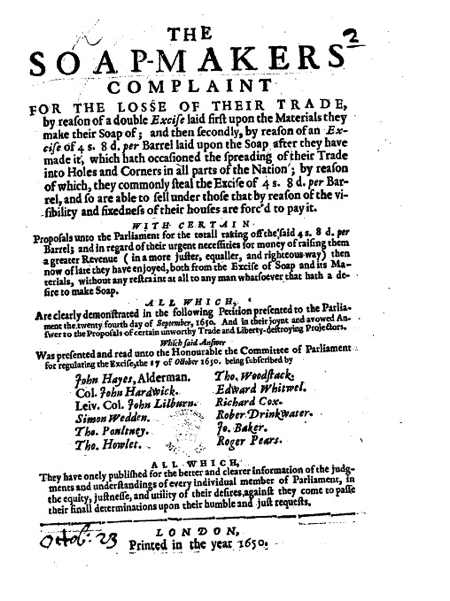
Title ID: T.222 [1650.09.24] Anon., The Soap-makers Complaint for the losse of their Trade (24 September 1650).
Estimated Date of Publication: 24 September 1650.
Thomason Tracts Catalog Information: TT1, pp. 812–13; E. 615. (2.)
Full Title
Anon., The Soap-makers Complaint for the losse of their Trade, by reason of a double Excise laid first upon the materials they make their soap of; and then secondly, by reason of an Excise of 4s. 8d. per barrel laid upon the soap after they have made it, which hath occasioned the spreading of their Trade into Holes and Corners in all parts of the Nation; by reason of which , they commonly steale the Excise of 4 s. 8 d. per Barrel, and so are able to sell under those that by reason of the visibility and fixedness of their houses are forc’d to pay it.
With Certain
Proposals unto the parliament for the totall taking off the said 4s. 8d. per barrel; and in regard of their urgent necessities for money of raising them a greater Revenue (in a more juster, equaller, and righteous way) then now of late they have enjoyed, both from the Excise of Soap and its Materials, without any restraint at all to any man whatsoever that hath a desire to make Soap.
All which,
are clearly demonstrated in the following petition presented to the Parliament the twenty fourth day of September, 1650. And in their joynt and avowed answer to the proposals of certain unworthy trade and liberty-destroying projectors.
Which said answer
was presented and read unto the Honourable the Committee of Parliament for regulating the Excise, the 17 of October 1650. being subscribed by
John Hayes, Alderman. Col. John Hardwick. Leiv. Col. John Lilburn. Simon Wedden. Tho. Poultney. Tho. Howlet. Tho. Woodstack. Edward Whitwel. Richard Cox. Rober. Drinkwater. Jo. Baker. Roger Pears.
All which,
They have onely published for the better and clearer information of the judgments and understandings of every individual member of Parliament, in the equity, justnesse, and utility of their desires, against they come to passe their finall determinations upon their humble and just requests.
London, Printed in the year 1650.
This text contains the following parts:
- The Petition
- Answer
- Proposition to the Grand Commissioners of the Excise
- Answer Oct. 17, 1850
- Acount or Certificate of the Commissioners
[3]
To the Supreme Authority, the Parliament of the Common-wealth of England.
The humble Petition of the Sope-makers of London, whose names are hereunto subscribed.
Sheweth,
THAT one of the greatest means (under God) of the comfortable subsistence of this Island in all ages, hath been the giving encouragement to the industrious mannagers of Trade and Traffick: which by reason of those long and many continued troubles, both at home and abroad upon the Nation, and those extraordinary Imposts upon most Commodities, hath bred such consumption in the Trade of the Nation, that it hath brought thousands of Families (that formerly lived comfortably) into extraordinary wants and straits: And amongst all the Trading people of this Land, your Petitioners humbly conceive, that none whatsoever groan under a more insupportable burthen then your Petitioners do, as appears by these particulars following.
First, For that being Sope-makers, they pay Excise for all imported materials they make their Sope of; as for Pot-ashes, Oyl, and Tallow, and not onely so, But
Secondly, As if they with some few others were strangers to the Commonwealth of England, and not capable of the enjoyment of the Liberties and Freedoms thereof; A heavy and grievous burthen is laid upon their shoulders, when as it toucheth not the little fingers of the Generality of the people of this Nation: viz. That after they have with a great deal of hazard, labour, and toyl, made their materials into Sope, then they are constrained to pay 4s. 8d. Excise out of every Barrel they make; so that thereby in effect. they pay Excise for the sweat of their browes, and the labour and toil of their hands; and this is required of them, and that whether they gain or lose by their Commodity; which is a burthen so intollerable, as (if not speedily removed) will unavoydably ruine them; of which, about five years since they most grievously complained, and were thereupon largely promised ease thereof, but never enjoyed it to this day: And therefore now they are necessitated humbly to tender these following reasons for the speedy removal of it for ever.
First, Because, that although by the late wars in Poland by the Tartars, Pot-ashes (by reason of their scarcity) grew of late years to so great a price, that many in England were incouraged to make Pot-ashes, for which they neither pay Excise nor Custome; and yet by reason of the late plenty of Out-landish ashes, by means of which at London, not being able to get their accustomed price for theirs, that for two or three years by past, they have borne, they make them in holes and corners in the Country into Sope, where constantly (as partly may appear by the books of Excise at the grand Office thereof) stealing the Excise of the 4s. 8d. per Barrel, and paying originally no Custome nor Excise, either for their Pot-ashes, or their Tallow, by reason whereof (although for want of skil &c. They make base [4] and unmarchantable Soape) they are able so much to undersel your Petitioners, as that of late they are much impoverished in their trade, the chief means of their livelyhood: And therefore though it have formerly appeared unreasonable to your Honors to lay Excise upon Native Commodities; we hope it will now, much more, appear unreasonable to continue Excise upon Native and bare handy labour, and the sweat of the browes of English men, denominated in words, to be free by birth.
Secondly, Because by the aforesaid meanes the Excise of Sope is so decayed, as that the new incomb of the revenue of it is humbly conceived to add little advantage to the publick purse.
Thirdly, And principally, your Petitioners are English men by birth and breeding, and pay all other manner of taxes freely and willingly, with other people of their Neighbourhood; And several of them also have freely and resolutely with their swords in their hands adventured their lives, and all that is dear to them for the Common Liberties of the Nation, and in the eye of the Law are guilty of no manner of Acts, that renders them either in reason or Justice worthy of being punished with a punishment above the generallity of the Nation; neither can they in any sense, see any reason at all why an Excise should be set upon the sweat of their browes, when almost the whole people of the Land go free in that particular.
Therefore, forasmuch as you have altered the Government of this Nation, from a Kingdom to a Common-wealth, and stiled the last year, the first year of England’s freedom, by God grace: And forasmuch as by your primitive Declarations you declare, that the meanest Commoner of England is equally intituled by birth-right unto the common enjoyment of the Liberties of the Nation with the greatest Subject: And forasmuch as by your late Declaration in Feb. 1648. You positively declare, you are firmly resolved to maintain, preserve, and defend the fundamental Lawes of the Nation, with all things incident and belonging unto the lives, liberties, and properties of the people: Amongst all which Fundamental Laws they are sure of it) this is one of the chiefest; that no one little handful of people shall be burthened in bearing, or contributing to the common charge of the Nation in such a way, as that the Universality, are not touched at all in that kinde.
Wherefore they most humbly pray, (and the rather, for that you are now about settling new Commissioners or Governors of the Excise) that you would make them like the universallity of their brethren, the freemen of England, and totally for ever of your selves, without referring them any more to any Committees whatsoever, take off the Excise of the sweat of their browes, and the labour of their hands; (viz) the aforesaid 45. 8d. per Barrel Excise upon Sope; that so they may thereby once again look upon themselves, as Denizens, and not Aliens to England, and thereby be incouraged, without murmuring, or secret repining of heart, to venture their all, for the common preservation of the Land of their Nativity.
For which they shall ever pray, &c.
[5]
The Copy of the forementioned Answer thus followeth:
TO THE HONOURABLE, the Committee of Parliament for the Regulating the NEW IMPOST of EXCISE where Colonel George Thompson hath the Chair.
The humble Answer of the Soap-makers of London, whose names are hereunto subscribed in behalf of themselves and all the rest of the Subscribers of their late Petition to the Parliament.
MAy it please this Honourable Committee to vouchsafe unto us without offence the same liberty with our pens, that you have before (we humbly thank you therefore) already granted us with our tongues, viz. free liberty to speak for our selves and for the removall of our burthens.
So it is, may it please your Honours that by wofull experience we finding our Estates and Trades daily sinking by reason of a double Excise upon the things we trade in, after we have born the burthen of it for seven years together, as long as it was possible for us to stoop under it and not to have our backs broke by it; for the prevention of which, we lately presented our humble Petition to the Parliament, truly stating our case and humbly craving relief in our oppressions, the copy of which is hereunto annexed; which said Petiton was read in Parliament the 24 day of September last: upon the reading of which, they were pleased to make an Order, the Copy of which thus followeth:
Die Martis 24 September 1650.
ORdered by the Parliament, that it be referred to the Committee of Excise, to take into consideration as well the Excise set upon the materials whereof Soap is made, as also the Excise upon Soap it self, and what is fit to be done in both or either, and report their opinions therein to the House.
Henry Scobell Cler. Parl.
[6]
By which Order the state of our business is referred to the consideration of this Honourable Committee; upon whom tending the third of this present October, which time you were pleased to afford unto us liberty to open unto you the equity and justice of our Petition, and more fully to state unto you our grievances, as also to answer severall of your Objections, arising from the losse that would upon the removal thereof accrue unto the State in its Revenue; and upon the whole you were then pleased to make an Order that the Commissioners of the Excise should be authorised to send up unto your Honours an accompt what Excise hath been made of Soap, and the materials it is made of every year since the first imposition of Excise upon it, and that we should tend upon your Honors the tenth day of this present October to hear your further result upon our businesse, which we did accordingly; and then instead of receiving satisfaction for the removall of the grievances complained of in our Petition, you were pleased to shew and read unto us certain Propositions made unto you by persons whose names certainly we cannot learn, though we earnestly entreated the knowledge of them from you, and from whom we desire no other favour, but that they will with us appear face to face before you, where we doubt not but by word of mouth to make those propositions (when they have said for them what they can) to appear unto your judgments to be as irrational unjust, and as inconsistent with the peace, safety and freedom of this Nation as the principals and habitual practice of those persons that made them are, (if they be the men that by private hands are told us to be) but upon our giving to your Honors a present and considerable satisfactory answer to the said propositions, and upon our earnest desire that we might have from your Clark copies of papers, and a weeks time to present unto you a written Answer to them, you were honorably pleased to grant it; for which we return you our most humble thanks, and therewith tender unto you a copy of the said propositions, and our humble and joynt avowed answer unto them, which thus followeth.
Propositions made to the grand Commissioners of the Excise Anno Dom. 1650. Annoque secundo Libertatum Angliæ.
First, that till the totall of so much be advanced as was the last year, we the undertakers will expect no Sallary.
Secondly, that to make that double which we will engage to do, we shall onely expect 2. s. per l. and that not out of that bare sum, but out of the overplus which shall be produced above the double.
Thirdly, that whatsover we do bring in unto the State or Commissioners above the double of the last years produce, we for our extraordinary pains and industry in it may have a fourth part.
Fourthly, that there be a reasonable allowance for under Officers as the Commissioners shall think fit.
[3]
Whereby these ensuing benefits will inevitably follow, viz.
-
23.
- To the State a far larger advance of the Excise then formerly. 24.
- To the Trade, the great ones shall not be so much as formerly enabled to destroy the inferiour sort. 25.
- That upon no man whatsoever, there shall be any oppression or injury to him, but a communicative justice shall flow equally to all, according to the true intent and meaning of all former Ordinances and Acts of Parliament in that kind provided. 26.
- That nothing shall be altered in the former constitution by Ordinance and Acts of Parliament.
Unto all which we most humbly and submissively answer.
And first, to the title Propositions made, &c. Propositions, what are they? many times, if not most times fictious Chymeraes or the like, more then realities or undeniable truths; and if these propositions had carried in them from just, honest, and good men well-affected to the common and just tranquillity of this Nation, a certain assurance to the State (from able men that never broke and compounded three or four times over in a few years) that they should have had a revenue out of the Excise of Soap double to what they have lately enjoyed without prejudice to the whole and present makers of Soap, (all but themselves) or without hazard of losse of the Soap Trade to the Hollanders and those Sea-men that have already attained so much art as to supply with Holland Soap a great part of the great trade of New Castle and Lynn, and steal their Soap ashore without paying any considerable proportion of Excise or Custom therefore, which inables the to sel much under the price that those can afford it that pays both, or without running the apparent hazard of doing ten times so much prejudice to the State then the losse of all the revenue of Excise of Soap comes to, there had been something in their Propositions worth regarding, and we could have born with their endeavours, (viz. the parties that we suppose and are informed made the said propositions) to have made up their broken and re-broken fortunes, and all their by-past engrossing of commodities, as well to the sufficient burning of their own fingers as prejudicing the Common-wealth and all their by-past and visible malignity against the Parliament upon the late Kings score, for which one of them hath pretty wel smarted; but if to us the quite contrary of all fore-mentioned doth so clearly appear, as that we hope and are confident undeniably to make it appear to the judgements and understandings of this Honorable Committee, we hope you will freely bear with our zeal and detestation against the said Propositions, and the persons that we suppose to be the Authors of them; which that we may undeniably doe, we in their own method thus proceed.
And to their first Proposition, viz. That they desire no salary till they have advanced asmuch as was made of Soap the last year, which was 2801 l. 1 s. 2 d. and the year before that it was 2557 l. 17 s. 1 d.
[8]
To which we answer, it is an easie matter to raise money upon the Excise of Soap, but the difficult thing to do it, is to do it justly, without oppression to the whole, and without the particular ruine of those in their Trades and Estates that pay it; which they never look after or speak of; it being their maxim or principle, as appears by their propositions; so they get money they care not how unjustly they come by it: It’s true, the King made the Soapmakers pay him for the Excise of soap in his time above Thirty Thousand pounds per Annum, and there is no doubt but upon the same principals he went upon such men as the proposers are; might raise the Parliament now as much, but God forbid that ever our eyes should see that fatal ruine upon the Parliament, that we have beheld upon the person of the King and his Posterity, for that and things of the like nature, that need no other prospective glass to behold the mischief of; but what is to be found in your own first and grand Remonstrance to the whole Nation, of December 1641. and indeed and in truth, we know not what more truly to stile their proposals, then a perfect and compleat shooing horn, or introduction to a designe (under the pretence of getting the State money) to make the Parliament as odious as ever the King was; and so by consequence, fit the people with as earnest desires to shake off the Parliaments Government, as ever they were to shake off the Kings; in and by which, they might not onely accomplish their own particular ends (in getting money enough (although they collected 2801l.01s. 02d. for nothing) but also the Princes in laying designes by hightned discontents, to bring him to reigne upon his Fathers Throne; to which we are sure of it some of their principles leads them sufficiently (if they be the men whose names are given unto us) and so much for their first proposition.
And as for the second, which is to make the forementioned sum of 2801l.1s. 2d double, which amounts to 5602l.2s. 4d per Annum, and to have 2s. per pound for it, which whether by it be meant the whole 5602l.02s. 4d. or the moetic we know not; which sallarie shall onely arise out of the sum that they will raise and collect more then the double. In answer to which in the first place, we beseech you with us seariously to consider in probability, which way they must go to worke to do it, if it be not first in the Roard the King troad in; which you your selves have already condemned, both in his practice of it, and also in his Person by executing him for it, &c. or, Secondly they must reduce (by way of restraining all others) the whole Trade into certain fixed know hands and houses, where they may keep a man in every house, of their own confiding in to take an exact account of every halfe firkin of Soap that is made; and how dangerous and clamorous this would be, we leave it to be determined by the words declared in your own Declarations: or Thirdly, admit they leave every man free in City and Countrie, to make it as now they do; it is impossible for those in London that have fixed houses, to pay the excise exactly and not to break, as the proposers have done, because there are so many makers of it in the Countrie, in holes and corners (one Brasier in London within these twelve months or little more, having made above a hundred small boyling pans to be set up in obscure places) that pay little or no Excise, as by the Excise books may easily appear, although they make amongst them all, a very large quantity of Soap, the names of [9] which its possible they may find out, and get power enough to break open their dores at all houres in the night, and to break all their vessels in peeces, in case they ever catch them stealing the Excise of one Barrel of Soap, the which will be a total beggeting of them, and an absolute exposing of them to some desperate madd courses, or starve, either of which in these troublesome times, may prove of more dangerous consequence to the State then now can be imagined, and principally will be gain to the proposers in a double capacity; First in regard they are both as we are informed, Soap-makers, and in process of time, their proposals and Acts upon them, may drive all or the greatest of the Trade of Soap-making for England into their own hands, and being their own searchers they will sweetly lick their own fingers, and soundly raise their prizes at their pleasures, being men as is too plainly evident by their actions of no manner of honesty or conscience: or Secondly, if they cannot get the greatest part of the Trade into their own hands, yet we do beleeve that with rigorous courses, they may get as much money by some of the three forementioned wayes, as will raise them 5602l. 2s.4d. and as much overplus as will pay them 2s.per l. for their Salarie, which Salarie will amount to their particular selves (for in their fourth proposition, they desire Salaries for their under Officers) to 560l. per Annum. besides a fourth part of their overplus, if they raise more, which it’s possible they may in some of the foresaid wayes, which Salarie with 2 or 3000l. of the States money they may possibly get into their hands, will make their broken Estates pretty whole, and enable them to live beyond sea for a time, in as ruffling a way as they have done in England, for both of them being not justly worth two groats (God blasting them in all their wicked and shirking wayes) we are confident they will not stand by it, nor can put in no honest and responsible security for the true performance of what they propose.
And as for their third proposal, which to our understanding thus runs, That what by their crooked and rigorous wayes, they bring in by way of Excise upon soap more then 5602l. 2s. 4d.per. Annum; they may have first 5s.per. l. for a fourth part out of it to themselvs; and then their Salarie of 560l. per Annum out of the remainder of it, and out of the remainder of that the Sallaries of their officers; so that suppose by their extraordinary ridged wayes (for such they must run or be totally ruinated and their security, especially if they put in good security to the State, absolutely to bring into their purses double the last years Excise) they collect 2000l. per Annum, over and above the forementioned 5602l. 2s. 4d. they must have out of it 500l. for the fourth part, and 560l. for their 2s. per l. sallarie which makes up 1060l. besides the sallaries of their under officers, which to our understandings will annually, well nigh take up the remaining 940l. of the said 2000. If they exactly provide an Excise man to search and keep accompt in all places of this Nation where Soapmaking is lately set up; there being at New Castle besides the Holland Trade, one or two already, the like at Yorke, Hull, Gainsborough, Lynn, Yarmouth, Norwich, Ipswich, Colchester, Titchfield, Southampton and Plimouth, besides scoares of places in Countrie Market Townes, and small Villages, as Rading, Newbury, Coventrie, &c.
Yea within these few dayes, a mault man at Bowl, hath bought a Pan to [10] boyle Soap in; so that whatsoever the State seems to gaine, they themselves will be sufficient gainers (for worke for nothing, it is undeniable they neither will nor can) having by their Propositions propounded at least 500l. per Annum, for each of themselves, besides what they are likely to get by boyling Soap themselves, in their large offices they already have, where being their own overseers for Excise, it is not to be questioned but they will thereby be enabled to drive a great Trade, and save themselves from paying little or no Excise; by meanes of which we are sure of it they will thereby become the great ones they speak of (in their forementioned second proposal under their beneficial head) that absolutely will be able to eat up the little ones. And at the most the State by this account, will have but 5602l. 2s. 4d. which how jestly or advantagioussy got, we crave leave here in writing (as well as formerly we have done by word of mouth) a little to insert unto this Honorable Committee; and in the first place as then we did, so now we humbly desire you to take notice, that when the Excise of Soap was first laid upon us, it was in the year 1643. when the Parliaments straights were very great, by reason the King had then the greatest part of the Nation under his command, by meanes of which it was impossible for the Parliament to raise a support of money in that ordinary and laudible long accustomed way of subsidies and Fifteens, and therefore were necessitated & compelled for preventing the then unavoidable ruine of themselves and their adherents, to flie to that extraordinary way of Excise, to raise their supportation from the Trading people of the Land, which made the Trades-men the more chearfully pay it, in regard they universally hoped it should continue no longer upon them, then that the lands of the Nation could come regularly to be taxed in that usual and accustomed way of subsidies and fifteens, at which first beginning, the Excise of our Soap was but 3s. per barrel, which for the first year brought in as appears by the aforesaid certificate of the Excise Commissioners 5058l. 05s.01d. and for the second year 4181l.10l. 12d. since which time it hath been raised to 4s.8d. per Barrel, and the last year brought but in 2803l.01s.02d. and the year before that 2557l.17s. 1d. which Excise as we have truely declared in our foresaid Petition, hath in a manner destroyed our Trade, and wasted our Estates, and if continued, must unavoidably force us to give over the way of our livelyhood (to which most of us have been brought up unto from our youth, and served toyling Apprentiships for) or begger us, which we humbly conceive you cannot but apprehend, must sorrowfully cause many sighings, mournings, groanings, and bitter complaints amongst us and our families, but if after we have humbly petitioned for the removal of our said sad insupportable burthens, and be by the Parliament (as by the reading of their Order we hoped and beleeved) referred to you for ease and redress, and instead thereof shall meet with proposals, which if by you countenanced, makes us far worse for our complaining then we were before, and you in the consequence of it no gainers, but absolute losers by raising up such a world of clamours and mournfull outcryes, as must of necessary follow upon the execution of that the proposers clearly drive at; and so much for the third and fourth proposals.
And now most Honorable and Noble Senators, as you have the hearts and [11] spirits within you, of compassionaters of your Countryes miseries, and affections to its welfare and prosperity, as our adversaries have assumed the boldness to propose, fictious, uncertain, and loosing wayes of advance of money to the State (as if they were well-willers to the Nations happinesse, which their actions never gave clear demonstrations of) so we beseech you give us leave without offence most humbly to propose to you, reall, certain, and gaining ways of advance of money to the Nation in such a way as no man in his trade, or calling, or manner of living, shal have any just occasion to except against. For the equality of it, which way we verily beleeve you must come to or else totally destroy the whole Trade of the Nation, and make absolute beggars of all the industrious Trading people of the Nation, the consequences of which, our souls even tremble to think of; but having been we fear too large already, and this being a thing of universall and generall concernment, and wil take up more time then we have allotted to us to bring in this our Answer in, therefore wee humbly crave leave to averre at our utmost perils our ableness within lesse then fourteen days after the presentation hereof, to prescribe in writing to your Honours, if commanded thereunto, what we have said a few lines above, and that it may at present clearly appear unto you that we are no haters of your supplies, nor neglecters of the studying of all just ways to doe it, in answer to your own grand Objection against our desires contained in our said Petition, which is, that your publique charges are great at present, and your straits are many, and therefore to take off our Excise would not onely be a president to the rest, of evill consequence to you, but a lessening of your Revenue, which your present affairs cannot admit of.
In answer to which, we humbly present to your consideration (although we conceive that those that presse the screwing up Excise to the highest, are no well-willers to the durable peace and tranquillity of England, but the quite contrary) that our materials pay but 6 d. per l. when Grocery, &c. pay 12 d. per l. Excise, and then when we have made it into Soap it pays 4 s. 8 d. per Barrel, which at our last being before your Honours, we truly illustrated and declared to you came now upon some sorts of Soap very nigh to 4 s. per l. Excise, which was intollerable to visible fixed houses, especially considering the Trade is so universally defused into the Countrey as now it is, which is truly and particularly declared before, and therefore we humbly entreated you that you would totally take off the 4 s. 8 d. per Barrel Excise upon Soap after it is made, and use us like the generality of the rest of the people of England, by compelling us to pay no more then 12 d. Excise [12] upon every 20s. worth of our materials we buy, so long as you shall continue Excise upon the Nation; by which proposition we humbly enforce the acceptance therof with the following reasons.
First, because we doe verily believe (upon the perusall of our notes and papers since our last being before you) to make it evident, and that you shall finde it by experience, that if you please to lay 12d Excise upon every pounds worth of our materials, viz. Outlandish Pot-Ashes and all imported Oyls and Tallow, it will clearly bring you in as great a sum as for these two last years you have enjoyed from both the materials and Soap, which we humbly conceive will be equall to all, and free many Soap-makers from those indirect means that sometimes they are forced to use for their livelihood, and also from that bondage and slavery they are in thereby to their Apprentices and Journymen, and then with all our hearts let all those that have a minde whereever they are boyle Soap as well as we; and that it will do this, we illustrate from the Custome-house Books, thus:
1. It is supposed that all imported materials belonging to Soap, as Pot-Ashes, Oyls, and Tallow, cannot be brought into the Port of London, &c. (being of so grosse a body as they are, and usually put into such great Casks as they are) and be stoln ashoar without being Customed, and so consequently Excised, which may be collected within the common charge of your ordinary Officers, and so save that 8 d. per l. that by the foresaid Certificate of the Commissioners of Excise is confessed Soap stands in.
2. We find that the Port of London hath heretofore (when the Trade was free from intanglements) vented yearly for many years together 2000 fats of Pot-ashes at the least, which estimated at thirteen hundred weight a fat one with another, make twenty six thousand hundred weight, and reckon them at the medium price of 30 s. per cent. it will come to in money 35000 l. the Excise of which at 12 d. per l. will amount unto 1950 l. besides the quantity of English Pot-Ashes then spent, which we reckon nothing for.
The Port of London hath heretofore vended of all sorts of Fish Oyls in making Soap per Annum, at the least two thousand tuns, besides Oyl Olive, and that two thousand tun at the medium price calculating it at 18 l. per tun, will amount unto at 12 d. per l. Excise, to 1800 l. and the Excise of sweet Oyl considering the quality of its price that is spent in Soap, may be computed about 500 l.
Tallow of all sorts imported from beyond Sea hath been about 300 tun per Annum, and which at the medium price as it hath usually been about 36 l. per tun, the Excise of which at 12 d. per l. will amount to 540 l. in all which is reckoned no other Oyls that is spent in other uses in the Nation, the addition of 6 d. per l. to its Excise, would make up the same about 6000 l. per Annum, which with the saving of the charge of 8 d. per l. the collecting of Soap Excise stands in, would put a full ballance to all that in point of present gain or losse can rationally and justly be said in the present controversie [13] for the whole Excise of Soap and its imported materials for these three years last past by the foresaid Certificate amounts but to 16545 l. 4 s. 11 d. into which is reckoned the Excise made of all sorts of Oyl spent in all England for all other uses as well as Soap, and divide it equally into three years proportion, and it amounts but to 5515 l. 1 s. 7 d. per Annum. which comes but to an equivalent proportion to our foresaid Proposition, and by computation rather fals short of it then otherwise.
But if it should be objected, that it is apparent by the foresaid Certificate of the Commissioners of the Excise, that there is not Annuall for these late years any such quantities of Soap-materials comes in as will in any reasonable proportion raise the sums you speak of for Excise at 12 d. per l. and so you put but a fallacy upon the State.
Unto which with all humility we answer, it is true, by reason of the wars, for divers late years in Poland (the chiefest place from whence Pot-Ashes came) it hath made them scarce, and sometimes raised from the usuall price of betwixt 20 s. and 30 s. per cent. to 7 l. 8 l. 9 l. and 10 l. per hundred, the greatness of which price raised Soap sometimes to 9 d. and 10 d. per l. in which regard the Hollander hath stept into a great part of our Trade, and cannot be prevented by verbally laying double Excise upon his Soap, in regard the Sea-men that usually transport it hither, doth it commonly upon their own accompt, and usually steal, both the Custome and Excise of it, by which means if Excise be kept at its height, the common Sea-man (if he play the good husband, and tread not in the road way of a common spend-thrift) will in a little time become a better Merchant then his Master that fraights him, and in process of time exhaust both his Purse and Trade, and so break his back.
But secondly, This scarcity and dearness of Pot-ashes in Poland, made many here in England aswel as in Denmark, Russia, New England, Virginia, and several places of Germany, rush with violence upon the making of Pot-ashes, which occasioned such a glut all of a sudden, as hath brought down of late the best, Poland Pot-ashes to about 40s. per centum, and will in probability so continue, if not fall in one years time to be a great deal cheaper, which will in an extraordinary measure (as in a large proportion is already visible to be seen) cause that vast quantity of English Pot-ashe, that of late years have been made in England to cease, (that hitherto hath paid no Excise at all) in regard in England they cannot make them to affoord them so cheap, in proportion to Out-landish ashes, seeing the peace in Poland hath restored them to a full capacity of enjoyment of the fulness of their usual Trade of making Pot-ashes, which with that large addition is likely to come out of Germany and other parts, is likely to make them as cheap as ever they were; and so by consequence fill the Custom-house books, with as large quantities of entries as used to be, which will not onely add to your present Customs, but encourage the cloath Trade, which hath heretofore been the onely commoditie bartred for the bringing in of Pot-ashes, which hath of late been usually beyond sea, bought onely for ready money (which is not [14] at all done by any Pot-ashes that is made in England, and which will by consequence restore us to the free enjoyment of our Trade, especially if the Excise of 4 s. 8 d. per Barrel be totally taken off, that so fixed houses do not pay and bear all the charge, and holes and corners nothing; which is easily prevented, and your incombs by Excise onely (besides the increase of much Custom) made in probability, as much if not more, if the charge be laid totally upon the materials at 12 d. per l. as Grocers, &c. pay for their Commodities; and truely, seeing Soap is in a manner as essentially necessary and useful to the sons of men of all sorts, and kinds of both rich and poor, as victual and fireing are, which are some of the essential and necessary supports of man kinde; we see no reason, but that as tender a regard should be had to it as the other; all which we tender to the grave judgement of this Honorable Committee, not doubting but you will grant us our reasonable desires and totally for ever, take off all and every part of the 4 s. 8 d. per barrel Excise upon Soap, and for the future be satisfied with the receipt of 12 d. per l. upon all the imported materials, and totally throw aside the propositions as fictions or dangerous proposals, or else if you do any more upon them, we humbly desire that the authors of them and we may be brought face to face before your Honours to argue out the utility, equity, and justice of each of our proposals; for which favour we shall ever be bound to remain
Your Honours humble and devoted Servants
October 17.
1650
| John Hayes | John Hardwick | |
| John Lilburne | Tho. Howlet | |
| Ja. Barker. | Tho. Woodstack | |
| Roger Peares | Edward Whitwel | |
| Tho. Poultney | Richard Cox | |
| Simon Wedden | Rob. Drinkwater. |
[15]
The forementioned Account or Certificate of the Commissioners of Excise, thus followeth.
In obedience to an order of the Honorable Committee for Regulating the Excise or New-Impost, dated October 3. 1650. to certifie unto the Committee what sum and sums of Money have been yearly received for the Excise of Soap, Potashes, sweet Oyl, Whale, and Train Oyl, and of Tallow, since the Duty of Excise was first imposed thereupon; The account of the said Excise to be particular and distinct each from other, with the Charges for Collecting of the same each year.
The Commissioners for Excise do by their Accomptent humbly certifie by the account books in London certainly, and from the Sub-Commissioners accounts, as near as can be collected by estimate.
| That there hath been Received for Excise of } |
Soap | Potashes | Sweet Whale } Oils Train |
TallowNota the into first years Seap paid Excise but 3s. per Barrel. | |||||||||||
| London, from Sept. 11. 1643. to Sept. 11. 1644. |
l. | s. | d. | l. | s. | d. | l. | s. | d. | l. | s. | d. | |||
| 4658. | 05. | 01 | 328. | 06. | 05 | 1240. | 17. | 11 | 00. | 00. | 00 | ||||
| The several Counties from the Sub-Commis. viz. the said year. |
|||||||||||||||
| l. | s. | d. | 400. | 00. | 00 | ||||||||||
| Bristol | } | ||||||||||||||
| Linn Regis | 28. | 00. | 00 } | 02. | 06. | 00 | 25. | 00. | 00 | ||||||
| Colchester | 14. | 10. | 06 } | 05. | 00. | 00 | 33. | 16. | 00 | ||||||
| Exeter | 17. | 18. | 06. } | 03. | 06. | 00 | 26. | 10. | 00 | ||||||
| Norwich | 48. | 07. | 00 } | 06. | 07. | 06 | 15. | 04. | 06 | ||||||
| Newcastle | 26. | 04. | 04 } | 12. | 00. | 00 | 23. | 09. | 00. | ||||||
| Weymouth | 30. | 06. | 08 } | 02. | 06. | 06 | 30. | 01. | 09 | ||||||
| York | 28. | 06. | 00 } | 01. | 00. | 06 | 43. | 06 | 03 | ||||||
| Southampton | 43. | 09. | 00 } | 02. | 02. | 00 | 12. | 18. | 00. | 00. | 00. | 00First Year. } | |||
| Dartmouth | 27. | 7. | 06 } | 00. | 16. | 06 | 55. | 01. | 09. | ||||||
| Hull | 16. | 19. | 06 } | 03. | 05. | 04. | 49. | 16. | 00 | ||||||
| Yarmouth | 12. | 16. | 00 } | 01. | 00. | 00 | 36. | 05. | 09 | ||||||
| Boston | 13. | 05. | 00. } | 01. | 10. | 00 | 15. | 10. | 00.Note the Excise of Tallore commenced July 8. 1644. | ||||||
| Bridgwater | 15. | 00. | 01. } | 02. | 05. | 00 | 29. | 00. | 00 | ||||||
| Dover | 13. | 06. | 06. } | 00. | 06. | 08 | 36. | 06. | 00 | ||||||
| Isle wight | 24. | 01. | 06. } | 03. | 06. | 00 | 08. | 15. | 00 | ||||||
| Plymouth | 40. | 01. | 02. } | 03. | 02. | 00 | 09. | 00. | 00 | ||||||
| Total of the Counties 400.l. | 400. | 00. | 00 | 50. | 00. | 00 | 450. | 00. | 00 | 00. | 00. | 00 | |||
[16]
| That there hath been received for Excise of } |
Soap | Potashes | Sweet Whale } Oils Train |
Tallow | |||||||||||
| London from Sept. 11. 1644. to Sept. 29. 1645. |
l. | s. | d. | l. | s. | d. | l. | s. | d. | l. | s. | d. | |||
| 3681. | 10. | 11.½ | 521. | 1. | 1.½ | 1675. | 17. | 10 | 100. | 7. | 05 | ||||
| The several Counties from the Sub-Commis. viz. the said year. |
|||||||||||||||
| l. | s. | d. } | 500. | 00. | 00. | ||||||||||
| { Bristol | |||||||||||||||
| { Linn-Regis | 30. | 16. | - } | 2. | 9. | - | 36. | 10. | - | ||||||
| { Colchester | 17. | 15. | 6 } | 6. | 00. | - | 56. | 12. | - | 9. | 5. | 6 | |||
| { Exeter | 26. | 4. | 6 } | 3. | 01. | - | 13. | 9. | 6 | 10. | 3. | 5 | |||
| { Norwich | 53. | 7. | - } | 6. | 9. | 6. | 26. | 15. | 9 | ||||||
| { Newcastle | 29. | 6. | 4 } | 13. | 00. | - | 51. | 6. | 3 | ||||||
| { Weymouth | 32. | 10. | 8 } | 2. | 8. | 6. | 66. | 1. | 9 | ||||||
| { York | 29. | 7. | - } | 1. | 5. | 6. | 3. | 7. | 6. | 00. | 16. | 4 | |||
| II. Year. { Southampton | 47. | 12. | - } | 2. | 5. | - | 64. | 6. | 3. | 5. | |||||
| { Dartmouth | 28. | 13. | 6 } | 1. | 15. | - | 53. | 12. | - | 5. | 6. | - | |||
| { Hull | 20. | 1. | 6 } | 4. | 2. | 6 | 42. | 9. | |||||||
| Nota, Sope paid Excise the 24: Novemb: 1645 4 s. 8d. per Barrel. { Yarmouth | 20. | 6. | - } | 1. | 12. | - | 11. | 6. | - | ||||||
| { Boston | 26. | 1. | - } | 1. | 15. | - | 15. | 9. | - | ||||||
| { Bridgwater | 31. | 11. | 6 } | 2. | 00. | - | 26. | 5. | 6 | 2. | 00 | 9 | |||
| { Dover | 26. | 12. | 6 } | 1. | 9. | - | 10. | 12. | 1. | 5. | - | ||||
| { Isle Wight | 34. | 7. | - } | 2. | 19. | - | 5. | 9. | - | 00. | 18. | - | |||
| { Plymouth | 45. | 8. | - } | 2. | 9. | - | 6. | 8. | 6 | ||||||
| Total of the Counties 500. l. | 500. | 00. | 00 | 55. | 00. | 00 | 500. | 00. | 00 | 30. | 00. | 00 | |||
| London from the 29 Septemb. 1645. to the 29 Septemb. 1646. |
4701. | 12. | 4 | 315. | 10. | 11 | 1199. | 6. | 6 | 154. | 2. | 2 | |||
| The several Counties from the Sub Commissioners viz. the said year. |
|||||||||||||||
| { Bristoll | 245. | 6. | 4 } | 1200. | 5. | 1. | 0 | 0 235. | 6. | 6 | 25. | 11. | ½ | ||
| { Lynn Regis | 180. | 5 | 2. | 11. | 0 | 0 36. | 9. | 9. | 0 | 1. | 10 | ||||
| { Colchester | 64. | 8. | 5. | 16. | 0 | 0 59. | 10. | 0 | 18. | 9. | 6 | ||||
| { Exeter | 30. | 6. | 8 } | 3. | 12. | 6 | 0 9. | 6. | 6. | 21. | 19. | 10½ | |||
| { Norwich | 86. | 15. | 6. | 13. | 9 | 0 22. | 3. | 3. | 0 | 0 | 0 | ||||
| { New Castle | 52. | 2. | 2. | 0 | 0 39. | 16. | 0 | 0 | 0 | 0 | |||||
| { Weymouth | 32. | 16. | 8 } | 3. | 9. | 4 | 0 51. | 11. | 6 | 0 | 0 | 0 | |||
| { Yorke | 36. | 18. | 9 } | 2. | 3. | 1 | 0 5. | 7. | 10 | 0 | 0 | 0 | |||
| III. Year. { Souththampon | 80. | 9. | 9 } | 2. | 16. | 0 | 0 69. | 10. | 4. | 0 | 0 | 0 | |||
| { Dartmouth | 86. | 16. | 10 } | 2. | 6. | 0 | 0 19. | 6. | 6 | 0 | 0 | 0 | |||
| { Hull | 40. | 9. | 0 } | 5. | 4. | 0 | 0 32. | 6. | 6 | 0 | 0 | 0 | |||
| { Yarmouth | 86. | 15. | 0 } | 1. | 16. | 0 | 0 12. | 12. | 6 | 0 | 0 | 0 | |||
| { Boston | 34. | 8. | 0 } | 1. | 19. | 0 | 0 15. | 6. | 0 | 0 | 0 | 0 | |||
| { Bridgwater | 36. | 0 | 0 } | 2. | 3. | 6 | 0 12. | 8. | 9 | 0 | 0 | 0 | |||
| { Dover | 56. | 4. | 0 } | 2. | 11. | 9 | 0 9. | 16. | 4 | 0 | 0 | 0 | |||
| { Isle Wight | 20. | 0 | 0 } | 2. | 16. | 3. | 0 3. | 0 | 3 | 0 | 0 | 0 | |||
| { Plymouth | 30. | 1. | 0 } | 3. | 0 | 6 | 0 9. | 10. | 9 | 0 | 0 | 0 | |||
| Total of the Counties 1100. l. | 1200. | 56. | 1. | 10. | 643. | 9. | 3. | 66. | 3. | 2 | |||||
[17]
| That there hath been received for Excise of } |
Soap | Potashes | Sweet Whale } Oyles Train |
Tallow | |||||||||||
| London from the 29 of Septem. 1646. to the 29 Septem. 1647. |
l. | s. | d. | l. | s. | d. | l. | s. | d. | l. | s. | d. | |||
| 2957. | 19. | 4. | 524. | 1. | 3. | 1763. | 19. | 3½ | 322. | 3. | |||||
| The several Counties from the Sub Commissioners viz. the said year. |
|||||||||||||||
| Bristoll | 255. | 11. | 2 } | 1082. | 17. | 1 | 3. | 2. | 0 | 200. | 9. | 9 | 27. | 9. | 9 } |
| Lynn Regis | 120. | 16. | 10 } | 2. | 8. | 29. | 6. | 6. | |||||||
| Colchester | 74. | 12 | 0 } | 5. | 10. | 46. | 8. | 15 | 19. | 3 } | |||||
| Exeter | 66. | 8. | 0 } | 3. | 8. | 8. | 3. | 3 | 12. | 6. | 0 } | ||||
| Norwich | 34. | 5. | 2 } | 4. | 10. | 4 | 20. | 6. | 6 | ||||||
| Newcastle | 82. | 12. | 0 } | 9. | 5. | 26 | 6. | 9 | |||||||
| Weymouth | 36. | 15. | 0 } | 3. | 6. | 6 | 49 | 8. | 3 | ||||||
| Yorke | 52. | 12. | 0 } | 2. | 1. | 3. | 2. | 2. | |||||||
| Southampton | 20. | 5. | 6 } | 2. | 15. | 71. | 6. | 6 | 4. | 5IV. Year. | |||||
| Dartmouth | 28. | 10. | 0 } | 1. | 10. | 10. | 9. | 9 | |||||||
| Hull | 35. | 5. | 4 } | 3. | 2. | 26. | 3. | 3. | |||||||
| Yarmouth | 25. | 6. | 0 } | 1. | 10. | 14. | 2. | 9 | |||||||
| Boston | 40. | 9. | 0 } | 1. | 2. | 6 | 36. | 8. | 7 | ||||||
| Bridgwater | 55. | 9. | 1 } | 2. | 10. | 26. | 9. | 9 | |||||||
| Dover | 64. | 0 | 0 } | 2. | 3. | 16. | 3 | ||||||||
| Isle Wight | 30. | 0 | 0 } | 1. | 25. | ||||||||||
| Plymouth | 60. | 0 | 0 } | 19. | 5. | 3. | 12. | 1 | |||||||
| Total of Counties 1082. 17. 1 | 1082. | 17. | 1 | 50 | 600. | 60. | |||||||||
| London from 29 Sept. 1647. to 29 Sept. 1648. | 2418. | 3. | 5. | 443. | 12. | 11 | 1161. | 4. | 10.½ | 167. | 18. | 3½ | |||
| The several Counties from the Sub Commis. viz. the said year. |
|||||||||||||||
| Bristoll | 230. | 9. | 9 } | 800. | 2 | 186. | 9. | 6 | 16. | 18 | |||||
| Lynn Regis | 80. | 5. | 5 } | 1. | 10. | 23. | 4. | 4 | |||||||
| Colchester | 56. | 10. | 3. | 5. | 39. | 6. | 14. | 10. | 6 } | ||||||
| Exeter | 34. | 16. | 7 } | 4. | 6. | 6 | 3. | 5. | 6 | 5. | 9. | 6 } | |||
| Norwich | 25. | 5. | 9 } | 00. | 7. | 16. | |||||||||
| New Castle | 10. | 12. | 2. | 19. | 10 | 12. | 5. | 6 | |||||||
| Weymouth | 16. | 4. | 1. | 17. | 8 | 39. | 5. | ||||||||
| Yorke | 26. | 2. | 12. | 1. | 1. | ||||||||||
| Southampton | 56. | 5. } | 1. | 15 | 9 | 45. | 6. | 6. | |||||||
| Dartmouth | 17. | 6. } | 2. | 6. | 8. | 9. | 9 | 3. | 2V. Year. | ||||||
| Hull | 40. | 3. | 6. | 16. | 2. | 3. | |||||||||
| Yarmouth | 16. | 0. | 18. | 17. | 8. | 1. | |||||||||
| Boston | 25. | 8. | 8 } | 1. | 17. | 26. | 9. | 7 | |||||||
| Bridgwater | 44. | 1. | 2. | 16. | 8 | 36. | 9. | 9 | |||||||
| Dover | 48. | 3. | 18. | 7 | 24. | 3. | 5 | ||||||||
| Isle Wight | 33. | 1. | 2. | 16. | 2. | 3. | |||||||||
| Plymouth | 40. | 4. } | 1. | 8 | 2. | 10. | 3 | ||||||||
| Total of the Counties 800l. | 800. | 40. | 500. | 40. | |||||||||||
[18]
| That there hath been received for Excise of } |
Soap | Potashes | Sweet Whale } Oils Train |
Tallow | |||||||||||
| { London, from Sept. 29. 1648. to Sept. 29. 1649. |
l. | s. | d. | l. | s. | d. | l. | s. | d. | l. | s. | d. | |||
| 1907. | 17 | 1½ | 54 | 8 | 3 | 13 | 9 | ½ | 139. | 00. | 6½ | ||||
| { The several Counties from the Sub-Commis. viz. the said year. |
|||||||||||||||
| l. | s. | d. } | 650. | 00. | 00 | ||||||||||
| { Bristol | 239. | 05. | 05 } | 01. | 12. | 00. | 130. | 5. | 9 | 12. | 8. | 5. | |||
| { Linn Regis | 60. | 03. | 03 } | 01. | 06. | 00 | 19. | 06. | 06 | ||||||
| { Colchester | 45. | 00. | 06 } | 02. | 10. | 00 | 25. | 03. | 00 | 07 | 09. | 07 | |||
| { Exeter | 22. | 08. | 04. } | 03. | 05. | 00 | 02. | 03. | 03 | 06. | 06. | 00 | |||
| { Norwich | 15. | 03. | 03 } | 01. | 18. | 00 | 14. | 16. | 00 | ||||||
| { Newcastle | 17. | 08. | 06 } | 01. | 06. | 00 | 09. | 06. | 00 | ||||||
| { Weymouth | 23. | 19. | 11 } | 00. | 18 | 06 | 25. | 05. | 09 | ||||||
| VI. Year. { York | 23 | 07. | 00 } | 02. | 05. | 00 | 00. | 15. | 00 | ||||||
| { Southampton | 10. | 03. | 03 } | 01. | 06. | 00 | 35. | 05. | 00. | 00. | 00. | 00 | |||
| { Dartmouth | 04. | 06. | 06 } | 01. | 15. | 00 | 06. | 06. | 03. | 03. | 16. | 00 | |||
| { Hull | 16. | 08. | 00 } | 02. | 03. | 00 | 12. | 03. | 06 | ||||||
| { Yarmouth | 19. | 06. | 00 } | 01. | 05. | 00 | 15. | 09. | 05 | ||||||
| { Boston | 23. | 06. | 07 } | 00. | 19. | 00 | 22. | 09. | 01 | ||||||
| { Bridgwater | 33. | 15. | 00 } | 01. | 16. | 00 | 24. | 06. | 04 | ||||||
| { Dover | 28. | 16. | 00 } | 02. | 17. | 06 | 16. | 18. | 05 | ||||||
| { Isle wight | 30. | 01. | 00 } | 01. | 08. | 00 | 15. | 00. | 06 | ||||||
| { Plymouth | 40. | 01. | 06 } | 01. | 10. | 00 | 25. | 00. | 03 | ||||||
| Total of the Counties 650.00.00 | 650. | 00. | 00 | 30. | 00. | 00 | 400. | 00. | 00 | 30. | 00. | 00 | |||
| London from the 29 Septemb. 1649. to the 29 Septemb. 1650. |
2103. | 1. | 2 | 350. | 17. | 6½ | 1938. | 1 | ½ | 228. | 17. | 7 ½ | |||
| The several Counties from the Sub Commis. viz. the said year. |
|||||||||||||||
| { Bristoll | 249. | 6. | 4 } | 700. | 1. | 19. | 0 | 0 153. | 6. | 3 | 13. | 9 | |||
| { Lynn Regis | 76. | 8. | 6. } | 1. | 12. | 0 | 0 26. | 9. | 9. | 0 | 0 | ||||
| { Colchester | 66. | 10. | 3. | 6. | 0 | 0 23. | 05. | 0 | 6. | 15. | 6 | ||||
| { Exeter | 34. | 9. | 4. | 5. | 6 | 0 15. | 8. | 0. | 7. | 8. | 0 | ||||
| { Norwich | 26. | 5. | 5 } | 1. | 19. | 0 | 0 17. | 9. | 3. | 0 | 0 | 0 | |||
| { New Castle | 28. | 6. | 8 } | 1. | 18. | 0 | 0 11. | 9. | 0 | 0 | 0 | 0 | |||
| { Weymouth | 33. | 9. | 9 } | 1. | 16. | 6 | 0 36. | 10. | 10 | 0 | 0 | 0 | |||
| { Yorke | 42. | 5. | 2. | 16. | 0 2. | 9. | 0 | 0 | 0 | 0 | |||||
| VII. Year. { Souththampon | 26. | 3. | 3 } | 1. | 17. | 9 | 0 46. | 7. | 0. | 0 | 0 | 0 | |||
| { Dartmouth | 16. | 8. | 8. } | 2. | 5. | 0 | 0 19. | 15. | 0 | 2 | 7. | 6 | |||
| { Hull | 26. | 5. | 5 } | 3. | 6. | 6 | 0 26. | 9. | 3 | 0 | 0 | 0 | |||
| { Yarmouth | 24. | 3. | 3 } | 1. | 5. | 3 | 0 22. | 7. | 7 | 0 | 0 | 0 | |||
| { Boston | 26. | 5. | 5 } | 1. | 14. | 0 | 0 34. | 9. | 6 | 0 | 0 | 0 | |||
| { Bridgwater | 7. | 6. | 0 } | 2. | 12. | 0 | 0 16. | 19. | 0 | 0 | 0 | 0 | |||
| { Dover | 16. | 3 | 2 } | 3. | 16. | 0 | 0 23. | 9. | 5 | 0 | 0 | 0 | |||
| { Isle Wight | 6. | 1. | 0 } | 2. | 9. | 0 | 0 12. | 9 | 1 | 0 | 0 | 0 | |||
| { Plymouth | 8. | 3 | 0 } | 1. | 2. | 0 | 0 11. | 7. | 1 | 0 | 0 | 0 | |||
| Total of the Counties 700. l. | 700. | 40. | 500. | 30. | 0 | 0 | |||||||||
| Total of they years for London & the Countrey } |
27761. | 6. | 5. | 3352. | 0. | 13932. | 1374. | 9. | 4. | ||||||
[19]
The charges of Collecting the same each year cannot be certainly known or computed, for that Potashes and Oyls are contained within the Office for Grocery, Druggestry, Saltery, those two Commodities being under the general article of Saltery in the Schedule of rates: and the Commodities under Saltery, together with those under Grocery & Druggestry, are so numerous, as not to proportion any particular Commodity for the charges of it distinctly, from any other Commodities; The like for Tallow under the first Additional; And for Soaps is the like.
But by estimate Soap is about 8 d. in 20 s. received for the charges, And for Pot-ashes, Oyls, and Tallow, each of them is about 7 d. charges in Collecting of every 20 s.
Excise Office in Broadstreet
London, Octob. 10.
1650.
Tho. Smith, Accomptant
to the Chief Commissioners for Excise.
Nota, That whereas Robert Booth late Salter, and John Walker Silk-man, now Soap-makers, did appear before the Honourable Committee for Regulating the Excise, Octob. 23. 1650. And there did own the proposals to be theirs, and that the Answer thereunto was scandalous: Unto which it was averred, that every perticular in the said Answer should be made good against the said Booth and Walker
By Lieut. Colonel
John Lilburne.
Finis
16. Anon., A Declaration of the Commoners of England (13 February, 1652)↩
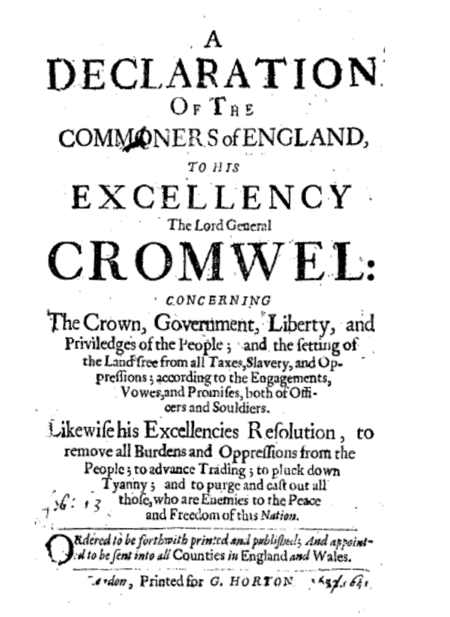
Title ID: T.229 [1652.02.13] Anon., A Declaration of the Commoners of England (13 February, 1652).
Estimated Date of Publication: abc
Thomason Tracts Catalog Information: abc
Full Title
Anon., A Declaration of the Commoners of England to the Lord General Cromwell concerning the Crown, Government, Liberty and Priviledges of the People; and the setting of the Land free from all Taxes, Slavery, and Oppressions; according to the Engagements, owes, and promises, both of Officers and Soldiers. Likewise his Excellencies Resolution, to remove all Burdens and Oppressions from the People; to advance Trading; to pluck down Tyranny; and to purge and cast out all those, who are Enemies to the Peace and Freedom of the Nation.
Ordered to be forthwith printed and published; And appointed to be sent into all Counties in England and Wales.
London, Printed for G. Horton.
A Declaration of the Commoners of England to his Excellency the Lord General Cromwel
[3]
THe Government of a common-wealth is the uniting of the people of a Nation into one heart and mind; And blessed is that People, whose Earthly Government is the Law of common Righteousness. When Israel was under a common-wealths Government, they were a terror to all Oppressing Kings in all Nations of the World; and so will England be, if this righteous Law become our Governor: But when the Officers of Israel began to be covetous and proud, they made a breach; and then the Government was altered, and fell into the hand of Kings like other Nations, and then they fled before their Enemies and were scattered. But if we look upon the customs of the Law it self, it is the same it was in the Kings dayes, onely the name is alter’d; as if the Commoners of England had paid their Taxes, Free-quarter, and shed their bloud, not to reform, but to baptize the Law into a new name, [4] from Kingly Law, to State Law; by reason whereof the spirit of discontent is strengthned, to increase more Suits of Law, then formerly was known to be And so as the Sword pulls down Kingly power with one hand, the Kings old Law builds up Monarchy with the other.
And whereas if an Army be raised to cast out Kingly oppression, and if the Heads of that Army promise a Commonwealths freedom to the oppressed people, if in case they will assist with person and purse; and if the people do assist, and prevail over the Tyrant, those Officers are bound by the Law of Justice (who is God) to make good their Engagements: And if they do not set the Land free from the branches of the Kingly oppression, but reserve some part of the Kingly power to advance their own particular Interest, whereby some of their friends are left under as great slavery to them, as they were under the Kings; Those Officers are not faithful Commonwealths souldiers, they are worse Tyrant and Thieves then the King they cast out; and that honor they seemed to get by their Victories over the Common wealths Oppressor they lose again, by breaking promise and engagement to their opressed friends who did assist them. For what difference is there between a professed Tyrant, that declares himself a Tyrant in words, laws and deeds, as all Conquirors do, and him who promises to free me from the power of the Tyrant if I’le assist him; and when I have spent my estate and bloud, and expect my bargain by his Engagements to me, he sits himself down in the Tyrants chair, and takes the possession of the Land to himself, and calls it his, and none of mine, and tells me he cannot in conscience let me enjoy the freedom of the Earth with him, because it is another mans right?
[5]
Such a souldier as this Engagement-breaker is neither a friend to the Creation; nor to a particular Commonwealth, but a self-lover, and a hypocrite; for he did not fight to set the Earth free from the bondage of the Oppressor, as he pretended by his Engagements; but to remove that power out of the others hand into his own. And this is just like the Beasts who fight for mastery and keeps it, not relieveing, but still Lording and Kinging over the weak. These are Monarchical souldiers, not Common-wealths souldiers; and such a souldier is a murderer, and his warfare is unlawfull. But souldiers of true noble spirits will help the work, and set the Oppressed free, and delight to see the Common-wealth flourish in freedom, as well as their own gardens.
There is none of this true Nobility in a Monarchical Army, for they are all self-lovers; the best is as a bryar, and the most upright amongst them is as a Thorn: speak your Prophets of old if this be not true.
A Monarchial Army lifts up Mountains, and makes vallies, viz. Advances Tyrants, end treads the Oppressed in the barren lanes of poverty.
But a Common-wealths Army is like John Baptist, who levels the Mountains to the Valleys, pulls down the Tyrant, and lifts up the Oppressed; and so makes way for the spirit of Peace and Freedom to come in to rule and inherit the Earth.
And by this which hath been spoken, an Army may see wherein they may do well, and wherein they may do hurt. Therefore you Army of Englands Commonwealth look to it; the Enemy could not beat you in the field, but they may be too hard for you by policy in Councel, if you do not stick close to see Common Freedom established.
[6]
WHereas many of Our Privy Councel have with preposterous rigor, and unreasonable severity, endeavored to kindle and blow up those horrid flames, the sparks of Discontent, which want not the least of pre-disposed fewell for an absolute Rebellion; and like some Cyclopick Monsters, whom nothing will serve to eat and drink, but the flesh and bloud of Our own Subjects; in whose common welfare Our interest lies, as much as some mens doth in their perturbations: who think they cannot do well but in evil times; As for Our resigning up the Crown and Government to the Prince Palatine, We are cleerly of another Judgment; And truly it is the unfeigned Desire of Our Heart, to wear the Crown and Scepter no longer, then that His Glory may be Our End; and His Word Our Rule: And upon that Glorious Account We shall leave the successe of all to God, who hath many many wayes to teach Us those Rules of true Reason, and peaceable Wisdom, which is from above, tending most to God’s glory, and his Churches good; which we think Our Self so much the more bound in Conscience to attend with the most judicious zeal and care, by how much we esteem the Church above the State; the glory of Christ above Our own; and the salvation of mens souls above [7] the preservation of their Bodies and Estates.
Since the publishing of this Declaration, there hath been high Disputes amongst the Nobility; and some have declared for the King of Scots, desireing a contract of Marriage, the calling in of his person, the day prefixed, and the general Attributes thereof to be solemnly declared, throughout the cities of Heidelburgh, Switzaon, and other places: But others of the Nobility are resolved to the contrary: However her Majesty hath declared, that she desires nothing more then the free Vote, and reall Consent, of her People: touching which, many of the Nobility inclines to her Majesties gracious will and pleasure; but others again seem to be of a contrary judgment.
[8]
And now the Commoners of England in this Age of the world are risen up in an Army, and have cast out that Invasion of the Duke of Normandy, and have won their Land and Liberties again by the Sword, if they do not suffer their Councels to be fool them into slavery again upon a new accompt. For if so be that Kingly Authority be set up in your Laws again, King CHARLES hath conquered you and your Posterity by policy and won the field of you, though you have seemingly cut off his head. For the strength of a King lies not in the visible appearance of his body, but in his Will, Laws, and Authority. But if you remove Kingly Government, and set up true and free Common-wealths Government, then you gain your Crown, and keep it, and leave peace to your Posterity.
FINIS.
17. Anon., The Vindication of Christmas (22 December, 1652)↩
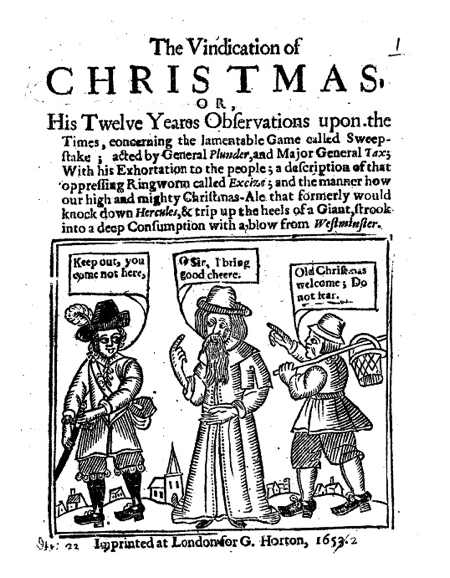
Title ID: T.235 [1652.12.22] Anon., The Vindication of Christmas (22 December, 1652).
Estimated Date of Publication: 22 December, 1652.
Thomason Tracts Catalog Information: TT1, p. 894; Thomason E.684 [1].
Full Title
Anon., The Vindication of Christmas, or His Twelve Yeares Observations upon the Times, concerning the lamentable Game called Sweepstake; acted by General Plunder, and Major General tax; With his Exhortation to the people; a description of that oppressing Ringworm called Excise; and the manner how our high and might Christmas-Ale that formerly would knock down Hercules, & trip up the heels of a Giant, strook deep Consumption with a blow from Westminster.
Imprinted at London for G. Horton, 1653.
The Vindication of Christmas; OR, His Observations upon the Time.
[3]
IN the name of the King of Kings, and Prince of peace; in imitation of my great and glorious Lord and Master Jesus Christ, and in love to them that hate me, I am come to them that love me not. And as my good Master did know how coursly he should be dealt withall (by misbelieving hard-hearted Jews) yet he came on this day from whom I have my name of Christmas, or Christs Day: Even so, when I come this 25 of December, though I know I shall be hardly welcome to a great many; yet I am sure that as many as love my Master, will rejoyce to see this Day: The holy Patriark rejoyced, and Christ allowed it, but he dislik’d the unbelieving Jews that believed not. The Jewes did not, (and do not) observe it; but all christians did, do, and will celebrate it, and acknowledge it, for no christian will blot, or scrape Christs day out of the Kallender. This day mercy and truth met together. This day Righteousness & peace kist each other. This day the Lord chief Justice of Heaven [4] and Earth, brought Truth and Righteousnesse to judge, and Mercy and Compassion to save. This day divine Clemency shew’d himself a good Master to Misery. This day he came in Colours that wil come in Clouds. And, as God is manifested in the flesh, justified in the spirit, seen of Angels, preach’d to the Gentiles, believed on in the world, and received up in glory; so this was the sum and substance of all figures, shadows, and types, and the accomplishment of all prophecies. Thus my Master (who had no beginning) did begin this day to come and dwell amongst sinful men; the son of God, the King of Glory came this day, and this day was the first day of Christianity to all Christians, and as many as have true Faith in Christ. For, as the old year was before my Master, when misbelieving Jews & Gentiles lived in the darknesse of of ignorant Idolatry under the Law, or without the Law; so the new year came when the Father of Light sent my Master, who by the glorious light of his Gospel expelled & dispersed the black clouds and raists of Egyptian blindnesse. Therefore with the old year let us shake off our old faults, (the deeds of disloyalty and darknesse) and with the new year let us reverence & yield obedience to that bright Star of Majesty, who sacrificed his life, as a Priest, Prophet, and Martyr, for the freedom of his people; Yet notwithstanding in these our dayes of tribulation, by wofull experience we find that there were some over-curious hot zealous Brethren, who with a superbian predominance, did do what they could to keep Christmas day out of England; they did in divers places preach me for dead in Funeral Sermons, and labour’d tooth and nail to bury me alive in the grave of oblivion, by infusing an heretical opinion into the hearts of the people, to wit (or with little wit) that plum-pottage was meer popery, and Roast beef Antichristian. In detestation of which, they assum’d to themselves power and authority to plunder pottage-pots, to ransack ovens, and to strip spits stark naked, and tryumphantly carry to be disposed of as they pleased, for the profit and nodification of the righteous, and chastisement of the Ungodly. But know, that I am old and bold to tell the Zealots of these critick dayes, that my great Master is King of Kings, & Lord of lords, and chief President of all States and Parliaments; nay he is the ancient of dayes, who never had beginning, and never shall have end: therefore, ye Lordlike Mortal Earth-worms, no longer separate the Head and Members. O the fact is great, and the sin [5] unpardonable! Neverthelesse, although my Master was usher’d unto his Throne in tryumph: yet his Vice-gerent is expos’d to banishment; for alas! the times are chang’d, and the Government is altered; Christ and Christmas are both alike welcome to many; and if Christmas may be so bold as to ask those fiery spirited people the same question as my Master might have asked the Jews, For which of my good works that I have done do you stone me? So may I say to England, what harm have I ever done unto you? I am sure I never perswaded you to be so uncharitable as to cut one anothers throats, and to starve and famish the poor (as you have done continually) and do still ever since you banished me from your Territories, and it is to be feared that you will never be quiet; or have a happy peace amongst you, till you do give me better welcome for my Masters sake; he is the Prince of peace, and his peace you will never have that do unthankfully despise and neglect to solemnize the Day of his most blessed Nativity.
It is a lamentable and too long a story to relate in what a pitifull quandary I have been in any time these twelve yeares, when we came into this lamentable, pitiful, dejected, and headlesse countrey: I was in good hope that so long a misery would have made them glad to bid a merry Christmas welcome. But welcome or not welcome, I am come; and at my coming (a little before day) I heard the Cock crow merrily, which I took for a good Omen, or preface of a most free and jovial accommodation, which rejoyced me much, for I was as hungry as a Hawk, and as cold as a snow ball: the sable curtaines of the night being drawn, I gazed to and fro to make choice of the best houses, and house-keepers, to take up my quarters amongst them. But alas! the comfort that I found was colder then the weather; indeed I saw many stately buildings, but very little smoak from the Chimnies, for most of the Owners did carry their Kitchins in Boxes, and the best and dearest part of the Roast meat in pipes. Besides, there was a great complaint that Mr Tax, and Mr Plunder had plaid a game at sweep stake amongst them and that they would willingly have provided good cheir for me, but that they are so miserable poor, that they were not able to feed themselves.
A lamentable Reformation!
[6]
This was no good news to me and my company, which inforced us to a pilgrimage up to the city of London, where I entred a fair house that had bin an Aldermans, but it was now possest with a grave Fox fur’d Mammonist, whom I found sitting over a few cinders to warm his gouty toes; from head to heel he was fur’d like a Muscovite, & instead of a Bible he had a Bond in his hand, which he poar’d upon to see if it were forfeit or no; but when he espyed me, he cry’d Traytor, Traytor; this reminded me of the Western Tragedy against my Masters Vicegerent; insomuch that I desired him to be patient, saying, Sir, my name is Christmas; and I come onely to make merry with thee. But this old Muckworm cast as dogged a look upon me, as if I had had a privy seal to have borrow’d money, and at last he open’d his mouth and said, Thou old saucy intruding fellow, me thinks one of thy age should have left off thy coltish tries: dost thou see any one that hath a care to live and thrive in the world, to be so mad as to mind thee or thy gambles; we are grown somwhat wiser in 12 yeares, then our Fathers were in twice 800. There dwels my worshipful Neighbor Sir Achitophel Pinchgut, and M. Miser, it is neither they, nor my self, that had ever come to have any estates, if we had not been Timists; therefore, be gone; nothing can change my heart, neither am I in the giving humor; I tell thee, I must follow the Rules of those that have served almost twice 7 years for their policy, for by the cross I have as little hospitality as honesty. I could have answer’d him with divine commandements and precepts; but every vertue (in this Age of Vice) is between two extremes, (as my Master was betwixt two Thieves) liberality in the middle, but prodigality on each side.
At my departure from this all Penny-wise, his son Mr. Pound-foolish, desired his crabbed Sire to bid me stay and [7] dine with him; at which the miserable Curmudgeon was even half mad with anger, calling his son spend-thrift, and prodigal Jack-an-Apes. Thus was poor Christmas used in the city, and wandring into the countrey up and down from house to house, found small comfort in any; some would only smile at me, and (because I should not piss at their doors) they would give me a cup of single, slender; lean, smal Beer, or Ale, which had the vertue to cause a man to make an Alphabet of faces, for it would have warmed a mans heart like pangs of death in a frosty morning. This merry memory (or sad remembrance) of Ale, caused me to ask the reason of this alteration; to which question, an honest Smith made this answer. Alas father Christmas (qd. he) our high and mighty Ale, that would formerly knock down Heacules, and trip up the heels of a Gyant, is lately strook into a deep consumption, the strength of it being quite gone with a blow which it received from Westminster, and there is a Tetter and Ringworm called Excize, doth make it look thinner then it would do. Indeed (to speak truth) my best and freest welcome with some kinde of countrey Farmers, was in Devonshire, where though both the Armies had been with them, and given them several visits, insomuch that if the Cavaliers had taken their horses, the other party made bold with their Oxen; if the one had their sheep, the other plaid sweep-stake; so that (according to the countrey phrase) great crock and little crock, all was ago; yet as soon as they spied me, they saluted me with much love and reverend courtesie.
A, ha, quoth I, this piece of the World is well mended; our dinner is better then our breakfast; this was as Christmas would have it; here is neither too much cost, nor too little meat: here is no surfet on the one side, or hunger on the other; they are alwayes the best feasts where the poor [8] are relieved, for the Rich can help themselves. After Dinner we arose from the boord, and sate by the fire; where the Harth was in brodered all over with roasted Apples, piping hot, expecting a bole of Ale for a cooler which immediatly was transformed into warm Lambwool. After which, we discoursed merily, without either prophaness or obscenity; some went to cards; others sung carols, and pleasant songs (suitable to the times) then the poor laboring Hinds, and Maid-servants, with the plow-boys, went simply to dancing; the poor toyling wretches being glad of my company, because they had little or no sport at all till I came amongst them; and therefore they skipped and leaped for joy, singing a carol to the Tune of hey,
Lets dance and sing, and make good chear,
For Christmas comes but once a year:
Draw Hogsheads dry, let Flagons fly,
For now the Bells shall ring;
Whilest we endeavor to make good
The Title ’gainst a King.
Thus at active Games, and Gambols of Hotcockles, shooing the wild Mare, and the like harmless sports some part of the tedious night was spent; and early in the morning, I took my leave of them, promising they should have my presence again the next 25 of Decemb. 1653. in the interim, I left this christian Exhortation, to all people in general.
Love one another, as my Master lov’d you, relieve the oppressed, call home Exiles, help the Fatherless, cherish the Widow, and restore to every man his due.
Vale, For Twelve Moneths.