| The Digital Library of Liberty & Power incorporating the Guillaumin Collection of the Great Books of Liberty |
Home | New | Authors | Works | Papers | Blog | About | Email | Search |
 |
|
CHARLES COMTE,
"[CR] "The Traité d'économie politique by Jean-Baptiste Say"
Le Censeur ((Sept. 1815))
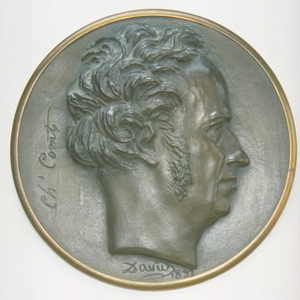 Charles Comte (1782-1837) |
 |
|
[Created: 8 May, 2026]
[Updated: 26 May, 2026] |
Source
, [CR] "The Traité d'économie politique by Jean-Baptiste Say," Le Censeur T.7 (Sept. 1815), pp. 43-77.http://davidmhart.com/liberty/FrenchClassicalLiberals/Comte/CenseurAnthology/C1-15-en.html
Charles Comte, [CR] "The Traité d'économie politique by Jean-Baptiste Say," Le Censeur T.7 (Sept. 1815), pp. 43-77.
This is a translation of [CC??], [CR] “Traité d'économie politique par J.-B. Say,” Le Censeur T.7 (6 septembre, 1815), pp. 43-77.
It is also available in French in a facsimile PDF of the original and in HTML.
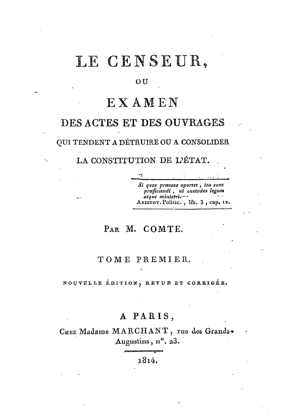
This essay is part of a collection: Charles Comte and Charles Dunoyer, Censoring the State: An Anthology of Articles by Charles Comte and Charles Dunoyer from Le Censeur (1814-1815) and Le Censeur européen (1817-1819). Edited and translated by David M. Hart (Pittwater Free Press, 2026).
The anthology is available in the following formats:
- all 35 essays in one file in French [HTML] and in English [HTML]
- the 17 essays from Part 1 Le Censeur (1814-1815) in French [HTML] and in English [HTML]
- the 18 essays from Part 1 Le Censeur européen (1817-1819) in French [HTML] and in English [HTML]
- all the essays listed in a sortable table with links to the individual French and English language versions.
Comte, [CR] "The Traité d'économie politique by Jean-Baptiste Say" (Sept. 1815)
The Traité d'économie politique by Jean-Baptiste Say
[43]
Treatise of Political Economy, or Simple exposition of the manner in which wealth is formed, distributed, and consumed, by M. J. B. Say, former member of the Tribunate. (2 vols., Paris, Renouard, bookseller, rue St.-André-des-Arts.)
Always on the lookout, as we are, for every idea, every work that might exert a favorable influence on the [44] condition of the nation, M. Say’s Treatise of Political Economy could not escape our attention. We have read it with the attention it deserves, and we can affirm that we know few books that contain so many sound ideas, and so many immediately applicable and useful insights. We declare that this work seems to us to have entirely removed political economy from the domain of opinions based upon a theoretical system. It makes you see—it forces you to observe—facts that occur every day, and which, for that very reason, are not better understood; it shows the relationship of these facts to one another, the link they have with their causes, with their effects; and these facts are the most interesting for man, since they concern his fortune, his existence, and the goods that can make it agreeable. Finally, one finds here more than anywhere else that truth so well characterized by Lamotte:
…. That truth of which every mind
Holds in itself the seed,
Long neglected to its cost, and which surprises all
By seeming true once thought about.
[45]
The work is preceded by a lengthy introduction, whose purpose is first to clearly define the subject political economy has for its inquiries; then to recount the history of the progress of this science, and to present the new method the author has followed; to show the importance of its study, and the obstacles that hinder it; and finally to offer a forecast of what might be expected from its further advances. Some extended quotations will have, in addition to the advantage of justifying our judgment, that of presenting to our readers ideas now profound, now lofty, always useful, and which, under whatever regime one may live, can give rise to further thought-provoking ideas. We shall choose preferably those passages that can stand on their own.
On the opposition which is sometimes established between theory and practice.
"It is a very vain opposition, that of theory and practice! What is theory, if not [46] the knowledge of the laws that link effects to causes, that is to say, of facts to other facts? Who better knows the facts than the theorist, who knows them from all sides and understands the relationships between them? And what is practice without theory, that is, the use of means without knowing how or why they act? It is nothing but a dangerous empiricism, by which the same methods are applied to opposite cases believed to be similar, and by which one ends up where one never intended to go.
"Thus it was that, after the exclusive system in commerce (that is to say, the opinion that one nation can only gain what another loses) came to be almost generally adopted in Europe since the rebirth of the arts and sciences; after having seen constant and ever-increasing taxes imposed on certain nations, to frightening sums; and after having seen these nations richer, more populous, more powerful than when they engaged freely in trade and bore scarcely any burdens, the ordinary person concluded that they [47] were rich and powerful because private incomes had been taxed; and the ordinary person claimed that this opinion was based on facts, and relegated every differing opinion to the realm of hollow and systematic imaginings.
"It is quite evident, on the contrary, that those who held the opposite opinion knew more facts than the ordinary person, and knew them better. They knew that the marked flourishing of industry in the free states of Italy during the Middle Ages, and in the Hanseatic cities of northern Europe, the spectacle of the wealth which this industry had brought to both, the upheaval caused by the Crusades, the progress of the arts and sciences, that of navigation, the discovery of the route to the Indies and of the American continent, and a host of other circumstances less important than these, are the true causes that have multiplied the wealth of the most industrious nations on the globe. They knew that if this activity encountered successive impediments, it was also relieved, on the other hand, [48] of even more burdensome obstacles. The authority of barons and lords, in decline, could no longer prevent communication from province to province, from state to state; roads became better and more secure, legislation more consistent, the liberated towns depended only on the royal authority, which had an interest in their progress; certain prejudices, such as the idea of usury attached to interest-bearing loans, or the idea of nobility linked to idleness, were beginning to weaken. And that is not all: sound minds have noted not only all these facts, but also the influence of many other analogous facts; they better understood the operation and results of industry, the effects of taxes—these too are facts—and they were in a position to conclude, with far more certainty than the ordinary person, that if several modern states have prospered despite constraints and taxes, it is not because of the taxes and the constraints, but in spite of them, and that their prosperity would be much greater had they been subject to a more enlightened regime [1].
[49]
"Thus, in order to arrive at the truth, it is necessary not to know many facts, but rather the essential and truly influential ones, to consider them from every angle, and above all to draw just conclusions from them—to be certain that the effect one attributes to them really comes from them, and not from elsewhere. Any other kind of knowledge of facts is a heap from which nothing results, a kind of almanac learning. And note [50] that those who possess this meager advantage, who have a clear memory and a muddled judgment, who rail against the most solid doctrines, which are the fruits of vast experience and sound reasoning, who cry ‘system’ whenever one departs from their routine, are precisely those who most firmly believe in systems and who defend them with the stubbornness of stupidity—that is, with the fear of being persuaded otherwise, rather than with the desire to arrive at the truth.
"Thus, if you establish from the whole range of the phenomenaof production and from the most thorough experience of commerce, that free communication between nations is mutually beneficial, and that the manner of settling accounts with foreigners that suits individuals best is also that which suits nations best, narrow-minded people full of self-importance will accuse you of believing in a "system". Question them about their motives, they will talk to you about the balance of trade; they will tell you it is obvious thT one ruins oneself by giving hard currency in exchange for merchandise… and that too [51] is a system. Others will tell you that the circulation of money enriches a state, and that a sum of money that passes through twenty different hands is worth twenty times its value… that again is a system. Others still will tell you that luxury benefits industry, that thrift ruins all commerce… and that too is a system; and all of them will say they have facts on their side, like that shepherd who, trusting in his eyes, affirms that the sun he sees rise in the morning and set in the evening travels across the entire span of the heavens during the day, and who calls all the laws of the planetary system mere fantasies."
On the usefulness of political economy.
"As these applications (those that can be made of its principles) become easier and more widespread, or in other words, as the course of things is better understood and is increasingly used as a guide to conduct, we shall take surer steps toward prosperity and happiness, which are the true ends of the social art. [52] Although several European nations appear to be in a rather flourishing state, and although some of them spend fourteen or fifteen hundred million francs a year on their public needs alone—or on what they believe to be such—we should not therefore persuade ourselves that their situation leaves nothing to be desired. A wealthy Sybarite, residing at will in his city palace or country estate, indulging at great expense, in both places, in every refinement of sensuality, moving comfortably and swiftly wherever new pleasures call him, commanding the labor and talent of a great number of servants and flatterers, and exhausting ten horses to satisfy a whim, may think that things are going quite well, and that political economy has reached perfection. But in those countries we call flourishing, how many people are there who can enjoy such pleasures? One in a hundred thousand at most; and perhaps not even one in a thousand who is enjoys what one might call [53] a decent comfort. Everywhere we see the emaciation of misery next to the plumpness of opulence, the forced labor of some compensating for the idleness of others, hovels next to the colonnades (of mansions), the rags of poverty mixed with the signs of luxury—in short, the most useless extravagance amid the most urgent needs.
"Surely, if political economy discovers the sources of wealth, if it shows the means of making it abundant, and teaches the art of drawing more from it each day without ever exhausting it; if it proves that the population can be at once much larger and incomparably better provided with the goods of this world; if it results from all its demonstrations that a host of evils once thought incurable are—not just curable, but even easy to cure—and that we will suffer from them only so long as we choose to, then it must be admitted that there are few studies more important, more worthy of a noble heart and an elevated mind.
"Some of those who have managed to secure a good share in a flawed order of things [54] never lack arguments to justify it in the eyes of reason; for what cannot be justified when things are presented from only one point of view? Yet perhaps, if they had to draw anew tomorrow the lots that assign them their place in society, they would find much to object to.
"Other people, whose minds have never glimpsed a better social order, proudly affirm that none can exist; they acknowledge the ills of the established order and console themselves by saying that things cannot be otherwise. This recalls the emperor of Japan, who nearly choked with laughter when told that the Dutch had no kings. The Iroquois and the Algonquins cannot conceive of war without roasting their prisoners."
If the antiquity of opinions is proof of their correctness.
"It has been said in support of old errors [55] that there must be some foundation for ideas so generally adopted by all nations; should one not be suspicious of observations and reasoning that overturn what has until now been held as constant, what has been accepted by so many men whose enlightenment and intentions were commendable? This argument, I admit, is worthy of making a deep impression, and could cast doubt even on the most indisputable points, if one had not seen the most false opinions—now generally recognized as such—successively received and professed by everyone over long centuries. It is not long since all nations, from the most ignorant to the most enlightened, and all men, from the porter to the most learned philosopher, accepted the existence of four elements. No one would even have thought to question this doctrine, which is nevertheless false; so much so that today there is not a single apprentice naturalist who would not discredit himself if he regarded earth, water, air, and fire [56] as elements [2]. How many other reigning, unassailable opinions will pass the same way! There is something like an epidemic in the way the opinions of mankind spread; there are moral maladies that infect the entire species—but they are not indestructible, or rather, they invariably come to an end.
"On seeing this fluctuation of successive opinions, one might be tempted to accept nothing as certain. One would fall into a just as condemnable excess—universal doubt. But facts which are observed[57] repeatedly by men in a position to view them from every angle, once well established and well described, pass out of the realm of opinion into that of truth. However old the discovery that heat epands bodies, this truth has never been shaken. The moral and political sciences offer truths that are harder to demonstrate, but just as incontestable, though far more contested. Everyone believes himself entitled to make discoveries in them and to judge the discoveries of others; yet there are only a very few who possess enough acquired knowledge and sufficiently broad views to be certain that they understand, in every respect, the subject they claim to judge. One is astonished, in society, to see the most thorny questions decided as lightly as if everyone knew everything that can be known and everything which ought to influence the judgment one forms. It is like watching a company of people who, passing hastily before the façade of a splendid château, believe themselves [58] crazy enough to tell us everything that goes on inside it."
Whether it is useful for enlightenment to be widespread.
"It was long believed that political economy was only for the use of the small number of men who manage the affairs of the state. No doubt the government has an interest in seeing wealth multiply, since it can only take its share in proportion to the wealth which exists in society; but private individuals have an even greater interest in this, since the comfort and very existence of their families depend on it [3]. I know that it [59] is important for men who are raised to exercise power to be more enlightened than others; I know that the mistakes of private individuals can never ruin more than a few families, while those of the great spread desolation across an entire country. But can the great be enlightened when the ordinary people are not? This question is worth asking. It is in the middle class—equally removed from the intoxication of grandeur and the forced labor of indigence; in the class where honest fortunes are found, where leisure is combined with the habit of work, where friendship[60] fosters free communication, where there is a taste for reading and the means to travel—it is in this class, I say, that enlightenment is born; it is from there that it spreads to both the great and the people; for the great and the people have no time to reflect; they only adopt truths once they come to them in the form of axioms and no longer need proof.
"And even if a monarch and his principal ministers were familiar with the principles on which the prosperity of nations is founded, what would they do with their knowledge, if they were not supported at every level of the administration by men capable of understanding them, of sharing their views, and of realizing their plans? The prosperity of a city or a province sometimes depends on a single clerical decision, and the head of a very small administration, by provoking an important ruling, often exerts greater influence than the legislator himself.
"Finally, supposing that all those who take part in the conduct of public[61] affairs, at every level, could be competent without the nation being so—which is entirely improbable—what resistance would not the best of their intentions encounter? What obstacles would they not face in the prejudices of those very people whom their policies would most favor?
"For a nation to enjoy the benefits of a sound economic system, it is not enough for its leaders to be able to adopt the best plans of every kind; it is also necessary that the nation be in a condition to receive them."
What may be expected from the progress of enlightenment.
"How ignorant and barbarous still are the nations called civilized! Travel through entire provinces of this so-glorious Europe, question a hundred people, a thousand, ten thousand: out of this number, you will scarcely find two, perhaps even one, who has any acquaintance with those lofty kinds of knowledge [62] in which the age takes such pride. Not only are the higher truths unknown—which would not be surprising—but even the most basic elements, those most applicable to each person’s own condition. What is rarer still than the qualities required to learn? How few people are capable even of observing what they see every day, or of doubting what they do not know!
"Thus, higher knowledge is still far from having procured for society the benefits one has the right to expect from it, and without which it would amount to nothing more than a set of curious riddles. Perhaps it is to the nineteenth century that the task is reserved of perfecting its applications. We shall see superior minds, in moral as in physical sciences, after having extended the bounds of their theories, discover methods that place important truths within reach of ordinary minds. Then, in the everyday events of life, people will be guided not by transcendent insights, but by sound notions. They will judge everything, not by hearsay, but by [63] a better understanding of the nature of things. In this way, people will habitually and naturally return to the source of all truth. They will no longer be dazzled by empty words; they will no longer be led by false notions. Deprived of the weapon of charlatanism, wickedness will lose its principal strength and will no longer obtain those sad successes that afflict honest people and ruin nations."
From these passages, drawn from the preliminary discourse, one may judge the spirit in which M. Say’s work was conceived. We shall now provide an analysis of the work itself.
To understand what wealth is, M. Say begins by examining what makes up the inventory of a rich man’s possessions. This inventory includes all the things in his possession that have value. These things, among which gold and silver often form only a small part, appear in the inventory only by virtue of their value; his total wealth consists in the sum of their values. Wealth is thus the same thing as [64] value; the wealth of a nation is therefore the total sum of the values possessed by the individuals who make up that nation.
We shall now see how fruitful this idea becomes in the hands of M. Say.
Whence comes this value that turns things into wealth and which is called their price when measured in money? We see that some things have a price because they serve directly to satisfy one of man’s many needs, like all the objects used for food, clothing, or shelter; others, such as land, have a price only because they can contribute to the production of the former. It is thus, in the final analysis, the utility that things have for man which gives them value or price; and by utility, the author takes care to explain, he means the capacity to satisfy any kind of need—even our vanity, which is itself a kind of need.
The very natural consequence of all this is that since utility is enough to confer value, and value is wealth, [65] to create utility—or even simply to increase the degree of utility that a thing already possesses—is to create wealth. Such is the miracle accomplished by human industry.
Note well that in all this, we are not speaking of forming matter: it is no more in man’s power to create it than to annihilate it; but he can give value to matter that previously had none.
"The farmer, by sowing one grain of wheat, makes twenty others germinate; he does not bring them out of nothingness: he uses a powerful tool, which is the earth; and he directs an operation whereby various substances, previously scattered in the soil, in the water, and in the air, are transformed into grains of wheat… Gallnuts, iron sulfate, gum arabic are substances scattered throughout nature: the industry of the merchant and manufacturer combines them, and their mixture produces that black liquid [4] which enables us to transmit useful knowledge."
The different ways of giving utility and value to things are countless; but for the convenience of [66] the observer, they may be grouped under three principal headings. When industry provokes the action of natural forces, or simply collects the spontaneous products of nature, it is called agricultural industry; when it separates, combines, or shapes natural products to suit our needs, it is called manufacturing industry; when it brings objects of need within our reach, it is called commercial industry.
Now if we go further into the subject and seek to know the processes common to all forms of industry, we find that the whole of industrial capacity—of man or rather of men in association (for what is needed here is not individual but social capacity)—consists first in correctly observing the course and laws of nature: this is the task of the scholars. Then, in obtaining the necessary materials and tools, and in applying this acquired knowledge to some practical use: this is the task of the farmer, or the manufacturer, or the merchant. Finally, it is necessary [67] to carry out the manual labor indicated by the preceding two classes: this is the work of the laborer.
That is not all. Man and his industry could not be exercised without materials and tools. Some of these materials and tools are supplied free of charge by nature, such as land, water, the heat of the sun; others are the products of human industry, and already have a value at the moment when they are to be used for the creation of new values. In this latter case, the value of these materials and tools is what is called capital.
Thus, industry, raw materials, and capital are the elements with which value, or wealth, is produced.
The consequences that M. Say draws—or allows one to draw—from these very simple premises are, so to speak, innumerable, for their chain of reasoning leads to far more results than he can express in two volumes. Among those he marks as important, we shall cite only a very small number, but [68] which are sufficient to justify our claim.
If wealth can be created from nothing, then it is not exclusive; what one person gains is therefore not necessarily lost by another. Two individuals can become wealthy together; two nations can do the same; and indeed, how else could one explain the simultaneous progress of all the nations of Europe since the time when they ate acorns to the time we see them in now? And what should we then think of that so-called Balance of Trade, for which so many deadly wars have been waged over the last hundred years?
Here is another consequence. If creating value is creating wealth, then destroying value is destroying wealth. Wealth can thus be undone, so to speak, by a process contrary to the one that brought it into being. Consumption is therefore not simply a displacement of wealth; it is a genuine destruction of it. And this helps us to assess those ancient sophisms, which claim that the rich, through their enjoyments, and governments, through their expenditures, give back with one [69] hand what they take with the other, and that this splendid circulation is the source of a nation’s prosperity.
But what happens to gold and silver in all this? What happens to money, which some regard as the only form of wealth, and others as the representative sign of all the wealth in society? Gold and silver money is composed of material that commerce brings from the places where it is produced, and to which the mint-worker’s industry adds some additional value through the stamping process. A coin is a piece of the goldsmith’s work, which derives its value from its substance and its workmanship; and what gives that substance and that workmanship any value? It is again the uses to which the coin is suited. In the end, money is only one part of overall wealth—and a very small part; for its value is quite negligible compared to the sum of all other values.
One might also wish to form accurate ideas concerning property. M. Say, who applies scrupulous care to simplifying [70] every question and trimming away everything not essential to his subject, seems to relegate to the realm of idle speculation those questions that deal with the origin and right of property. He regards it as a matter of fact—and, as such, it is so essential to the multiplication of wealth that without it, one cannot even conceive of wealth. For who would invest in cultivating a field if he were not to reap its fruits? Who would accumulate capital—values set aside for reproduction—if possession of them were not recognized and guaranteed? But also, for the very reason that our author views property only as a matter of fact, he sees property only where it is not merely recognized but also secured.
"One can easily see," he says, "that it would be in vain for laws to sanctify property, if the government itself did not know how to respect the laws; if it lacked the power to repress robbery; if it engaged in robbery itself; if the complexity of legislative provisions and the subtleties of legal quibbling made everyone uncertain about their possession."
[71]
But also, when a government respects and protects property, it provides nations with the greatest of blessings:
"Without this protection, which lends the aid of all to the needs of one, it is impossible to conceive of any significant development of the productive faculties of man, of land, or of capital; it is impossible to conceive of the existence of capital itself, since capital is merely accumulated value put to work under the safeguard of authority. This is why no nation has ever attained any degree of opulence without being under a regular government. It is to the security provided by political organization that civilized peoples owe not only the innumerable and varied production that satisfy their needs, but also the fine arts, the leisure—fruits of accumulated wealth—without which they could not cultivate the gifts of the mind, nor therefore rise to the dignity that the nature of man allows."
A particularly important part of M. Say’s work is the one in which he discusses the influence [72] of government action on the production of wealth. He explains what happens when administrative regulations aim to influence the choice of products to be created; when the same regulations attempt to dictate the mode of production; and when the administration seeks to engage in production itself. It is clear that the detailed analysis the author has made of production provides him with the means to precisely determine the influence of these actions on production itself.
The chapter in which he examines colonies and their impact on national wealth yields highly important results, and offers France more than one reason for consolation when she finds herself deprived of nearly all her colonies.
To illustrate how many different perspectives from which this author examines national wealth, we shall pause for a moment to consider the chapter in which he explores how it can be affected by travel and migration.
"Always departing," says M. Say, "from the principle that the only real value is that which [73] appears in the form of metal, people would see, at the arrival of a foreigner, a value of ten thousand francs brought in gold or silver, and they would call this a gain of ten thousand francs; as if the tailor who clothed the foreigner, the jeweler who adorned him, the caterer who fed him, had given him no value in exchange for his money?"
The developments that follow show that the gains made in such cases are of the same nature as those made in advantageous trade with foreigners; and that, though they should not be scorned, it is unwise to purchase them at the cost of sacrifices that exceed the advantage received—and especially not by means of sumptuous festivities.
"Is it even certain," he adds, "that a festival or spectacle, no matter how magnificent one imagines it, really draws many foreigners from abroad? Are foreigners not rather drawn by commerce, by climate, by rich collections of antiquities, or by the desire to visit places made famous by great events and to learn a widely spoken language? I would be inclined to [74] believe that the enjoyment of some trivial pleasures has never drawn many people from far away. A spectacle, a festival, may entice someone to travel a few leagues, but rarely to undertake a full journey. It is unlikely that the wish to see the Paris Opera is the reason so many Germans, Englishmen, and Italians come in peacetime to visit this great capital—which fortunately has far more legitimate claims to general curiosity. The Spaniards regard their bullfights as extremely entertaining; yet I do not think many Frenchmen have traveled to Madrid just to witness them. These sorts of amusements are frequented by foreigners who have been drawn to the country for other reasons—but they are not the reasons for their coming."
The much-vaunted festivities of Louis XIV had an even more unfortunate effect. It was not the money of foreigners that they caused to be spent—it was that of the French themselves, who came from the provinces only to squander, in a few days, what could have sustained [75] their families for an entire year: so that the French lost not only what was consumed by the king's own hand—an amount which had been raised through taxation—but also what was consumed by private individuals. What was lost was the principal of the things consumed, in order that a few merchants might gain their profit on that principal.
What is a true and valuable gain for a state is when a foreigner comes to settle in it, bringing his fortune along with him:
"He brings at once two sources of wealth: industry and capital. It is like adding fields to the territory; not to mention a precious increase of population, when he also brings affection, talents, and virtues."
But this also highlights the considerable harm that emigration of the same kind cause a country. This is the harm that Louis XIV inflicted on France. Only those wholly unfamiliar with the ways of commerce and the principles of political economy can imagine that individuals can be prevented from removing their [76] capital when they wish. The value of this capital, exported in the form of goods whose export is permitted, is just as much lost to the country as if it had left in money. It is an export that will bring no return.
"The best way to attract men and retain them," says M. Say on this subject, "is to be just and good toward them, and to guarantee to all the enjoyment of the rights they regard as most precious: the free disposal of their persons and property, the ability to go, to come, to stay, to speak, to read, and to write with complete security."
Thus, strict morality once again aligns with our true, well-understood interests.
We hope to have said enough, if not to make fully known the complete system of political economy—which in M. Say’s hands has become a science of observation and facts—then at least to convince our readers of the solidity and importance of this study. We shall end by citing the following passage:
"It has been said that nations and individuals know perfectly well how to increase their [77] wealth without understanding the nature of wealth, and that this is purely speculative and useless knowledge. That is like saying that one knows very well how to live and breathe without anatomy and medicine, and that these sciences are therefore superfluous. Such a proposition is not defensible; but what would one say if it were upheld by doctors who, while denouncing medicine, subjected you to treatment based on ancient practices and the most foolish prejudices?—if they rejected all methodical and regular instruction?—if they performed bloody experiments on your body against your will?—if their prescriptions came with the force and authority of law?—and finally, if they enforced them with armies of clerks and soldiers?"
Endnotes
[1] This explains also why nations almost never benefit from the lessons of experience. To benefit from them, the multitude would have to be capable of grasping the connection between causes and effects — which presupposes a very high degree of enlightenment and a great capacity for reflection. When nations are in a condition to benefit from experience, they no longer have need of it. This is one of the reasons that place them under the necessity of being constantly governed, and that establish the importance of this great political problem: Given the character and the needs of men as they are, to find by what means they can be constantly governed by the most enlightened among them. This problem appears even more important to those who know that the more enlightened the rulers are, the more convinced they become that it is in their interest to govern according to the interest of the governed.
[2] All our knowledge, even the most important, dates only from yesterday. The famous agronomist Arthur Young, after carefully trying to gather everything that had been observed on crop rotation—that is to say, on the most important part of agriculture, the one that teaches by what succession of crops the land can be kept constantly in use and to the greatest advantage—says that he was unable to collect any notion that dated from before the year 1768. There are arts no less essential to human happiness about which we still have no accurate idea.
[3] "Independently of the harm caused to families by the faults of the administration, they are all too often the victims of the incompetence of private individuals. These sometimes provoke the most disastrous public undertakings; and in private undertakings, it cannot be denied that sound notions concerning the nature and the movement of value offer great advantages: for soundly judging the enterprises in which one is involved, whether as a principal party or as a shareholder; for anticipating their needs and their outputs; for discerning the means to make them prosper and asserting one’s rights; for choosing the most secure investments, anticipating the outcome of loans and other acts of the administration; for improving land at the right time, for weighing advances and returns with informed judgment; for understanding the general needs of society and choosing an occupation; for distinguishing the symptoms of prosperity or decline in the social body, etc., etc."
[4] [EN: "la liqueur noire" is used in the making of paper.]