| The Digital Library of Liberty & Power incorporating the Guillaumin Collection of the Great Books of Liberty |
Home | New | Authors | Works | Topics | Papers | Blog | About | Email | Search |
 |
|
CHARLES COMTE AND CHARLES DUNOYER,
Censoring the State (Part 1):
An Anthology of Articles from Le Censeur (1814-1815)
English edition.
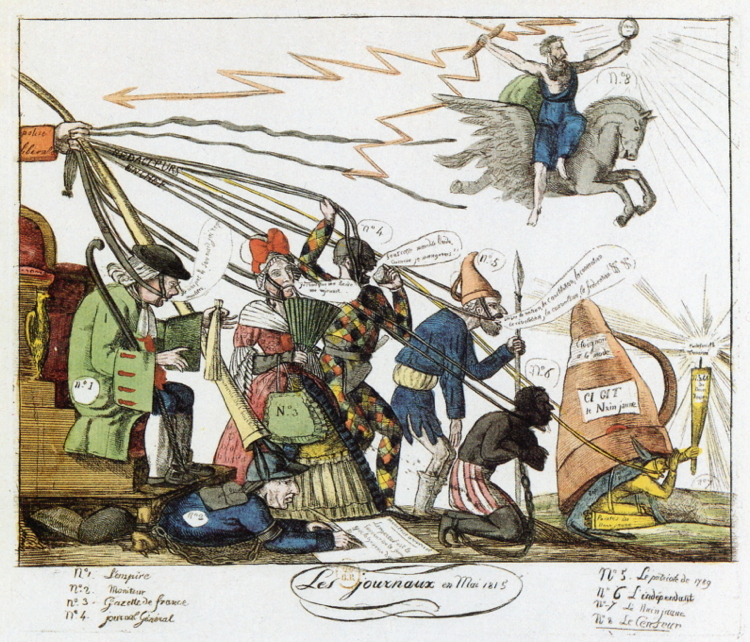 |
| Anon., "Les Journaux en Mai 1815" (Journals in May 1815) ("Le Censeur" is numbered 8 in the top right corner) |
|
[Created: 6 May, 2026]
[Updated: 19 August, 2026] |
Source
, Censoring the State Part 1: An Anthology of Articles from 'Le Censeur' (1814-1815). Edited and translated by David M. Hart (Pittwater Free Press, 2026).http://davidmhart.com/liberty/FrenchClassicalLiberals/Comte/CenseurAnthology/index1-en.html
Charles Comte and Charles Dunoyer, Censoring the State Part 1: An Anthology of Articles from 'Le Censeur' (1814-1815). Edited and translated by David M. Hart (Pittwater Free Press, 2026).
This is a translation of the first part of a larger, two part anthology of the writings of Charles Comte and Charles Dunoyer from their journals Le Censeur (1814-1815) and Le Censeur européen (1817-1819). The anthology is available in French and English.
- the collected table of contents in a sortable table format, with links to the individual items (some 35) in facs. PDF and HTML [Online]
- the essays in French: the collected 35 essays in [HTML]; Part 1 with 17 items from Le Censeur (1814-1815) in [HTML]; Part 2 with 18 items from Le Censeur européen (1817-1819) in [HTML]
For other material by Comte and Dunoyer, see the Special Projects page for Charles Comte (1782-1837) and Charles Dunoyer (1786-1862) [Online].
Taken from the Original Source
Le Censeur, ou examen des actes et des ouvrages qui tendent à détruire ou à consolider la constitution de l’état. 7 volumes 1814-1815, (Paris: Marchant, 1814-15). See the full table of contents of this journal. [Online]
Le Censeur européen, ou examen de diverses questions de droit public, et des divers ouvrages littéraires et scientifiques, considérés dans leurs rapports avec le progrès de la civilisation. Par MM. Comte et Dunoyer (Paris: Au Bureau de l’administration, 1817-1819). The journal appeared in 12 volumes from February 1817 until April 17, 1819. Location: Au bureau du Censeur européen, rue Git-le-Coeur, no. 10. The journal had the motto of "Paix et liberté." See the full table of contents of this journal. [Online]
Note
Some articles are unsigned and others use anonymous intitials. We have assigned authors according to the style and information from authorities such as Éphraïm Harpaz and Robert Leroux:
- Éphraïm Harpaz, Le Censeur. Le Censeur européen. Histoire d'un Journal libéral et industrialiste (Genève: Slatkine Reprints, 2000).
- Robert Leroux, Aux fondements de l'industrialisme : Comte, Dunoyer et la pensée libérale en France (Paris: Editions Hermann, 2015).
We plan to add editorial notes to this anthology. A start has been made and these notes are marked as "EN" for "Editor's Note".
Illustration
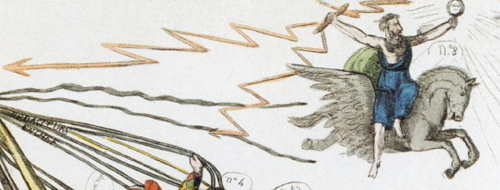
Detail from Anon. "Les Journaux en mai 1815" (Newspapers in May 1815). [The Liberal Pegasus escapes the Reins of the Censor]
This detail comes from an anti-censorship caricature from 1814-15 (shown in full above) which depicts how the opposition liberal press reacted to the crackdown on press freedom by the restored French monarchy. Here we see a figure representing the liberal journal Le Censeur edited by Charles Comte and Charles Dunoyer. They have broken free of the muzzle and reins of the government censors and continue to hurl lightning bolts and shine the light of criticism on the regime.
For more details see the illustrated essay "Eugène Delacroix on Press Censorship and Liberty during the Restoration (1815-1830)" [HTML].
Table of Contents
Le Censeur (July/Sept. 1814 - 6 Sept. 1815)
- Charles Comte, "Letter to the Minister of the Interior, On the freedom of the press, considered in its relation with civil and political liberty" (July, 1814)
- Charles Dunoyer, "On the public spirit in France, and particularly on the spirit of public officials" (July, 1814)
- Charles Dunoyer, "On Public Opinion in France, and particularly on the Opinion of Public Officials (Part 2)" (August 1814)
- Charles Comte, "Announcement" (Sept. 1814)
- Charles Comte, "On Political Sects. A Dialogue between a Pure Royalist, a Constitutional Royalist, a Republican and a Metaphysician" (July, 1814)
- Charles Dunoyer, [CR] "Essay on the Political Disadvantages of the Slave Trade, by Clarkson" (Nov. 1814)
- Charles Comte, "If it is permissable to kill a tyrant" (Nov. 1814)
- Anon., "Considerations on the situation in Europe, on the cause of wars, and on the means to bring an end to them" (Dec. 1814)
- Charles Dunoyer, "On Revolutions in general, and on contemporary revolutionaries" (Dec. 1814)
- Charles Comte, "On Legitimate Authority and Parliamentary Government" (March, 1815)
- Charles Comte, "On the Reorganisation of European Society, by Saint-Simon and Thierry" (March, 1815)
- Charles Comte, "On the Trade and Slavery of Blacks and Whites, by a friend of Men of all Colours (Grégoire)" (Mar. 1815)
- Charles Dunoyer, "On the influence of public opinion on the stability of governments" (June, 1815)
- Charles Comte, [CR] "On the French Monarchy from its Establishment to the Present Day (Montlosier)" (June 1815)
- Charles Comte, [CR] "The Traité d'économie politique by Jean-Baptiste Say" (Sept. 1815)
- Charles Comte, [CR] "The Principles of Politics which are applicable to all representative governments by Benjamin Constant" (Sept. 1815)
- Charles Comte, [CR] "On the French Monarchy since the return of the House of Bourbon on 1 April 1815 (Montlosier)" (Sept. 1815)
Censoring the State (Part 1):
An Anthology of Articles from Le Censeur (1814-1815)
1. Charles Comte, "Letter to the Minister of the Interior, On the freedom of the press, considered in its relation with civil and political liberty" (July, 1814)↩
Source
A translation of Charles Comte, "Lettre au ministre de l'intérieur, sur la liberté de la presse, considérée dans ses rapports avec la liberté civile et politique." Le Censeur No. 3. (5-13 juli 1814), pp. 75-110.
Text
[75]
Should the freedom of the press be maintained, or must censorship, on the contrary, be re-established?
If this question had been proposed, three days ago, to a wise man and a friend of his country, I dare believe, Monseigneur, that he would have refrained from examining it, or at least that he would have been very careful not to make his examination public. He would have said that it was not fitting to suppose that one of the most sacred rights of the people, without which the exercise of all the others will always be precarious, could be presented as doubtful. The constitution has just been born; we must respect even its imperfections, [76] and forbid ourselves any discussion that could make people think it is possible to destroy it.
But if this man had known the present state of mind, and if he had been called to the honor of enlightening the prince on his interests and those of France, he would have firmly rejected the desire to undermine a work which henceforth must be sacred; he would have made him understand that, having been deceived for twenty years by all Governments, the French had become suspicious and mistrustful; that, whatever the greatness of his soul and the purity of his intentions, France would have suspected him as soon as she believed she saw him following in the footsteps of that man who presented a constitutional charter to the French only in order to seize more easily the reins of Government, and who overthrew it as soon as he believed himself to be firmly established on the throne; finally, he would have made him understand that he would inevitably ruin himself, if, like that madman, he thought to consolidate his power by undermining the laws which were its sole foundation.
To these general considerations, and if the minister’s own interest had not silenced the citizen, he would have added still more powerful ones, to induce him to respect particularly the freedom of the press. He would have reminded him that after the fall of the imperial Government, the senate believed it could calm the uneasiness and agitation which were beginning to appear in men’s minds, only by proclaiming the fundamental prinicples of a new constitutional charter; that [77] the faculty granted to all Frenchmen to make their opinions public, through the press and without any prior censorship, had been given as the first of these principles; and that the draft constitution, presented by the provisional Government and adopted by all the bodies of the State, had guaranteed to all citizens the free exercise of this faculty.
You yourself, he would have said to him, you thought you should not enter the heart of France except after having given us the same guarantee; this guarantee, which you confirmed by a constitutional charter, to which you publicly swore to be faithful: it would therefore not be prudent to deceive the expectations of the French, and to present a draft law to re-establish censorship. This project, proscribed in advance by the most express decision of all the bodies of the State, would be rejected by the entire Nation, and perhaps it would have the effect of leading suspicious minds to consider all your promises as so many acts of duplicity, the object of which was to subject France to a yoke still more humiliating than the one from which she has just been delivered.
You know as well as we do, Sire, that the law can only be the expression of the general will, and that any act tending to constrain this will would be considered an act of violence and despotism. If, at a moment when the fermentation of minds is manifesting itself in a manner so little reassuring for the friends of order, you alienate [78] by such acts the wise and enlightened men who alone, by the force of their example, can impose silence on the discontented and maintain public peace, it will be easier to foresee the disorders into which we shall be dragged, than it will be to stop their consequences.
Beware of those cowardly men who have successively sold themselves to all governments, and who now come to swear fidelity to you under the livery of the last master they betrayed; beware also of those men who seek only to take your good faith by surprise, in order to abuse with impunity the authority you will have entrusted to them: in fear that, from the midst of the crowd, some voice may rise up to accuse them, they will want to force you to condemn the entire nation to silence; fortunate, if, to prove to you the necessity of censorship, they do not fabricate in the shadows libels against you, and then seek to make them fall into your hands! In the fear of losing the favors of the head of our last government, they constantly concealed the truth from him, and they ruined him in order to make their fortune: be very sure that they will conceal it from you with the same care, and that they will ruin you likewise if it serves their purpose.
Such are, Monseigneur, the reasons that a wise and enlightened man like you might have given to the prince, to divert him from the project of asking for the re-establishment of censorship, one who [79] would have better known public opinion, and the danger there is in increasing the alarms of a very numerous class of citizens, whom the suppression of the freedom of the press will make defenseless against the vengeance of their enemies. But you did not know the wishes held by the French, for you would not have scorned them. You therefore call into question those of our rights which seemed to us the most inviolable, and you oblige us to fight again for the defense of our liberty: a painful combat for men who feel the necessity of supporting the Government, at the very moment when it seems concerned only with forging chains for us!
It is therefore necessary to examine this famous question so long agitated for, and so often resolved; it must be known whether the agents of the Government, who alone can have the desire and the power to become oppressors, will also be the only ones who will have the right to raise their voices to complain; it must be known whether men who are always ready to overstep the limits which the laws place on their authority, and who overstep them publicly even when all citizens have the faculty of denouncing them, will be much more restrained when the entire Nation is condemned to silence; it must be known whether the French will be well informed about the choice they must make of their representatives, when they will learn what takes place in assemblies called public [1] only through the voice of those who are [80] always interested in deceiving them; it must be known whether men who seek only to hide in the shadows, and who would perhaps not be sorry to see us stupid, will take much care to spread light, and to make us know our rights; it must be known, finally, whether it is fitting, whether it is even decent, that our scholars, our magistrates, our representatives, in short all those men who, by their talents, are the honor of France, should not be able to print two lines without the authorization of an individual whom they might perhaps disdain to take for their secretary.
But to whom, Monseigneur, will you propose the establishment of an inquisitorial censorship? To men who cannot subscribe to it without placing their honor at the disposal of the ministers whom they will often have to combat; without renouncing, in some sort, the sublime faculties which distinguish the human species from the vilest animals; without degrading themselves finally in their own eyes, and even in the eyes of the whole of Europe; for you cannot be unaware that they pronounced the downfall of the Emperor and of his family, because he had established a censorship far less alarming than the one you propose to them. Ah! Monseigneur, Buonaparte did indeed despise us; but when, after having drenched with every sort of humiliation the foremost bodies of the State, he wished to [81] degrade them entirely, by reducing them with us to the servile condition of not writing anything without the authorization of the low-ranking agents of his police, he did not have the courage to make them subscribe to this ignominious degradation.
Nevertheless, it will be necessary that the chamber of deputies, and perhaps even that of the peers, examine the question, since you have proposed it to them. I shall therefore examine it also, and I hope it will be easy for me to demonstrate that, without the freedom of the press, enlightenment can only go backwards in France; that from the moment censorship is established, neither civil liberty nor political liberty will exist any longer; that the constitution will be overthrown, if the ministers take the trouble to attack it; that morals, far from being purified, will end by becoming completely corrupted, and that, if civil war has not destroyed us in the face of so many misfortunes, we shall fall into a state worse than the one from which we have just emerged.
Subject like all other animals to a multitude of physical needs, man appears to differ from them only by a more advantageous organization; and still this organization is not always so different that one cannot be mistaken, and put into question whether such an animal should be classed among men rather than among beasts. What then distinguishes him from all other species? It is thought; that is to say, the faculty of feeling, of paying attention to things, of comparing, of [82] judging, of reasoning, and of penetrating in some sort, by his perseverancce, the most hidden secrets of nature.
But, without the aid of speech, his most precious faculties would be in vain, or rather they would not exist. Continually struck by the objects which surrounded him, the sensations he experienced would only be repeated in the presence of the very objects which had given rise to them. As he would only know in nature these individual things, and as he would have no symbol to which he could attach his ideas, he could never generalize from them; he might indeed form some judgments, but he would remain incapable of perceiving the relations that existed between them: he could therefore not reason, because he would have no general ideas. It is then to the invention of symbols, it is to speech that man owes the development of all his faculties, of all his knowledge. [2]
However, speech, that fleeting symbol of our thoughts, would always have remained imperfect and coarse if it had not itself had a symbol to which it could be attached; [83] writing was therefore as necessary to its development as speech itself was to the development of our first faculties. With the help of writing men could acquire, and in fact have acquired, a great number of kinds of knowledge. But this art which fixes our thoughts, develops them only slowly: it suffices no doubt for the improvement of some individuals who can easily communicate with one another; but it cannot spread light among a whole people, and still less among several nations at once. Look at Greece: it first resembles a meeting room full of enlightenment; some great men appear there as if to enlighten the world; a multitude of disciples gather around to receive their ideas: but after their death, these ideas begin to be altered; there are soon formed almost as many sects as there are writers; philosophy, leaving Greece, goes to throw some rays of light in Rome; the despotism of the emperors appears, and Europe plunges again into darkness.
That, without the aid of printing, the sciences and the arts were born and perfected in the bosom of Greece, I can believe: free and happy men, enclosed within narrow limits, could give themselves peacefully to research of every kind, and communicate their discoveries with ease. But that in States of vast extent, subject to the government of a single man, enlightenment could have been born and [84] propagated without the aid and without the freedom of the press, that seems to me impossible. Governments of this nature, whatever Montesquieu may say, are always more or less despotic: now, despotism has too much interest in keeping men in ignorance, and in dividing them among themselves, to allow them to undertake the research and the gatherings that the progress of the sciences makes necessary. Besides, the people are so miserable in States of this nature, and the enjoyment of the goods they can procure by laborious toil is so precarious, that they have neither the time, nor the desire, to make discoveries of which they would not be sure to profit.
Here one can raise an objection: it will be said that the freedom of the press has never existed in France, and that nevertheless enlightenment has made rapid progress there. Far from proving the falsity of what I assert, this objection will furnish me the occasion to make its truth felt. When printing was discovered, the first use made of it was to reproduce the works of antiquity; and as these works were not written in the popular language, and as minds were much more inclined to undertake research of pure erudition, or analytical observation, than to seek any practical application of the truths they discovered, the government did not think of preventing their publication; and this was assuredly a great fault committed by the despotism of our kings.
What was at first most generally admired [85] among the ancients was poetry: and as poets willingly become courtiers, authority allowed them fairly free rein. But when minds turned toward religious and political discussions; when the truths that Plato and Aristotle had gathered were presented under a new light, the priests and the governments, who feared the light equally, hastened to establish censorship; and to prove that reason was on their side, they shut the mouths of their adversaries. One may therefore affirm, without fear of being contradicted, that it is to despotism and to religious fanaticism that censorship owes its origin. Everyone knows what happened when it was established; every book that appeared with approval and privilege was considered as a matter of course to be a foolish book, unless the subjects treated there were foreign to religion and politics: everyone also knows that most of the works of our greatest writers were banned and burned by the hand of the executioner.
But what was the result of this banning? To make men seek with avidity the very works that had been banned, and to render odious the authority which banned them. It was evident in fact that, when the government forbade a book which contained a great number of useful truths, in the midst of which were some errors imperceptible to the eyes of the public, one could only suppose it acted with bad intentions; that, when it suppressed [86] a work in which the malfeasances of its agents were denounced, one could only see in this suppression a very marked intention of maintaining the abuses of which men complained, and of making itself, in some sort, an accomplice in the exactions or vexations committed by its agents; that when useful books had been forbidden, those in which irreligion and immorality were professed were eagerly read by all men of worth, because they knew that the usefulness of a work was sometimes a cause for its condemnation. Then bad works were all the more dangerous, because it was not even permitted to refute them publicly. Thus censorship became a very active cause of the corruption of morals, and, if it kept some ministers in place, it undermined the foundations of government.
However dangerous censorship was for the government, it was much less so then than it would be today. The people taking no part in any manner in the making of laws or in the administration of public affairs, the ministers had little interest in leading them astray, and contented themselves with preventing them from becoming enlightened. It was enough therefore that the government fix the most obvious acts of oppression, and kept the others in the shadows, in order not to displease the nation; and it was only repeated acts of tyranny which could exasperate the people, and make them desire the overthrow of the constitution then existing. [87] But the condition of France has so changed, that the freedom of the press is now as essential to the maintenance of the constitution and of government, as it would be contrary to the maintenance of despotism, if it were established.
The Ancients never had the idea of exercising sovereignty through representatives. This idea could not even be born among them; for in giving themselves representatives, they would have given themselves masters who would have sold them, or who, if they had not wished to sell them, would not have been able to exercise any useful influence on the decisions taken by the heads of their governments. Thus we see that they constantly passed from the popular state to the despotic state, without any intermediary. When the Romans, for example, lost the faculty of assembling in the public squares, they were as enslaved as they could be; and neither their senate, nor their patrician families, ever had enough strength to oppose the despotism of the emperors. If the people had had representatives, they would not have been more advanced; and their misfortune was such that their best emperors could never restore to them even the appearance of liberty.
In France, we have equally experienced that a senate, representatives and a nobility were powerless institutions for stopping arbitrary power. Some have believed, and others have pretended to believe, that all our misfortunes should be attributed to the vices or weaknesses of the members of the foremost bodies of the State. I do not wish [88] to say that these causes did not enter very much into it; but even if the senate had been composed only of the most enlightened and virtuous men of France; even if they had all been men such as G... or L..., I believe things would not have gone differently. For what indeed can two or three hundred men do against one who holds in his hand all the treasure and all the armies of the State, and who can have them secretly denounced by his agents in every part of his vast empire, without their having the faculty of replying? If the senate had at first opposed resistance, the government would have stopped; it would then have had the senators denounced in whispers, the journals would soon have proved to us that they were useless; the emperor would have performed some act agreeable to the nation, and the next day he would have dissolved the senate and the legislative body without the least obstacle, declaring to us that his council of state was more than sufficient to make the laws respected. If the senate had resisted its dissolution, the agents of the police would have discovered a conspiracy in which it would have been proved that the senators had taken part; and, by a singular favor, the august monarch would have had them deported; which would have been a new subject of congratulations from all our speechmakers.
But, it will be said, if the senate, the legislative body and the nobility could not defend the liberty of the Nation, what means shall henceforth be employed? There is but one; it is to place the representative bodies [89] under the eyes and under the protection of the people; all citizens must know almost at the same time what is happening in the heart of the public assemblies, and they must hear the orators at the tribune, as the Romans heard them in the Forum; they must know the representatives who betray them, and those who fulfill their duties; they must finally know whether the laws are freely discussed and adopted by the assembly. Now, the journals are the only channel through which the citizens can acquire promptly and simultaneously this knowledge.
It must therefore be that the representative bodies enjoy the freedom of the press, it will be said; but this does not prove that all citizens must enjoy it: I reply that if all citizens do not enjoy it, nothing can guarantee to the nation that it is not deceived; and if it has not this guarantee, it remains indifferent to all that is done in the assemblies. As soon as one individual or one body alone has the right to write, what he writes loses all its force, because, no one being able to say the contrary, there is no means of assuring oneself of the truth. Destroy the journals or place them in the hands of government, and you strip the representative bodies of all their strength; it is in vain that they open to the public the place of their sittings, they will never have more than a hundred-thousandth part of the citizens for witnesses of their debates; and the government will be able easily to deceive all the others.
[90]
Let us suppose that the press had been free when Buonaparte wished to have the consulate conferred on him for life, I am persuaded that writers as commendable for their virtues as for their enlightenment would have risen with such force against that dangerous magistracy, that the French would never have dared confer it on the ambitious man who demanded it. What I say of the consulate, I could say of the empire, of hereditary nobility, and of so many other acts which passed without obstacle, because no one was permitted to make others aware of their flaws or their absurdities. But to bring us a little closer to current events, let us suppose that the freedom of the press had existed at the time when the legislative body held its last session, and that its sittings had been public; it is certain that the nation would have expressed itself with such energy and promptness, that the emperor would have been forced to defer to its wishes. Instead of that, what happened? that the legislative body, which fought in the shadows, was not supported, I do not say by the whole of France, but even by the city of Paris. It was therefore dissolved without opposition; and if, as it is said, some ministers of the emperor had demanded, the members of the commission had been put on trial and shot, they would hardly have been granted any pointless pity.
What happened in Paris would equally have happened in London, in Rome and in every country of the world; because in every country the people act only when they are put into motion. The freedom of the [91] press, and above all the faculty of creating journals, is therefore as necessary to our political existence as air is to life. Suppress this freedom, and we shall be in the same position in which the Romans found themselves after the overthrow of the republic: we shall even be in a worse state; for if the Romans had some public newspapers, they did not have, as we do, gazettes always ready to deceive them; and Tacitus does not tell us, I think, that after the burning of Rome all the magistrates of the empire had placed speeches in the journals to compliment Nero for it, or that the journalists attempted to demonstrate that the dismemberment of the empire by the barbarians was a very glorious thing for the Romans.
The suppression of the freedom of the press will therefore inevitably have the effect of isolating the deputies from the rest of the French; and it would perhaps be better to make them hold their sittings in a desert, under the empire of bayonets, than to leave them in the midst of Paris, while depriving them of the faculty of corresponding with their constituents. The aim then is to paralyze all their energy, and to place them at the discretion of the Government, when it is proposed to them to suppress the freedom of the press; the aim is still to have the faculty of proposing to them iniquitous or vexatious laws, without the citizens being able to demonstrate their iniquity, and enlighten them about the snares that will be laid for them.
“Before the law is made,” says M. Benjamin de Constant, “the publication [92] of writings that would be contrary to it is suspended, because one must not discredit in advance what one wishes to try out. The suspension seems a simple and gentle means, a temporary measure; when the law is made, publication is forbidden, because one must not write against the laws.”
But if there does not exist political liberty without the freedom of the press, it is very evident that there does not exist civil liberty either. Citizens may therefore be thrown into dungeons by ministers who wish to carry off their daughters or their wives, or who wish to exercise some private vengeance, [3] without its being possible for them to make their complaints heard, or for their friends to assist them. To whom indeed could they address their claims? to the deputies. No; for these, whose energy will have been destroyed, will find themselves in the same position as all the other citizens. Shall the ministers be denounced to the public by means of journals or pamphlets? even less; for the gentlemen censors will never allow libels defamatory of their excellencies to be published.
What I say of individual liberty, I could say of taxes, of loans, of requisitions, in short of all the arbitrary acts which weigh so heavily on the citizens, but cost the ministers so little.
[93]
The government of Napoleon, as is known, produced on the French two entirely opposite effects: it made the poorest and least enlightened class get into the habit of accepting arbitrary behaviour and bullying; it broke, so to speak, the resilience of all weak souls; but it inspired in enlightened men and in strong souls such a violent horror for despots and their agents, that the very shadow of arbitrariness terrifies them. If the freedom of the press is suppressed, soon we may see renewed most of the tyrannical acts of the former Government. The ministers, under pretext of urgency, may raise taxes and harass the citizens in a thousand ways. Weak and ignorant men, misled by the writers whom the ministry will have paid, will obey in silence; but the enlightened and courageous men, to whom the faculty of sharing their enlightenment with their fellow citizens will have been taken away, will be indignant at these acts of violence, and will perhaps see in revolt the only means of making them cease. The Government will then always have to fear becoming the victim of the harrassment committed by its agents, without its participation; because it will have sanctioned them all in advance, by depriving the citizens of the faculty of complaining about them. It will no doubt be said that I exaggerate the vices of the principal agents of the Government, and the ignorance of a part of the nation; but the confidence we have in the present ministers is a further reason for taking precautions against the ministers to come; and if the freedom [94] of the press is taken from us by a Sully, must we hope that it will be restored to us by a Richelieu? Besides, can it not be said, with M. the duke de Lévis, that when one speaks of the baseness of courtiers and of the credulity of the people, one nevers says the whole truth?
The destruction of all liberty, or, what is the same thing, to the establishment of despotism, will be followed by demoralization, ignorance and barbarism.
“Extreme obedience,” says Montesquieu, “supposes ignorance in him who obeys; it supposes it even in him who commands: he has no need to deliberate, to doubt, or to reason; he has only to will.
“In despotic States, each house is a separate empire. Education, which consists principally in living with others, is there very limited: it is reduced to putting fear into the heart, and to giving to the mind the knowledge of some very simple principles of religion. [4] Knowledge there will be dangerous, emulation ruinous; and as for virtues, Aristotle cannot believe that there is any one proper to slaves; which would much limit education in that government.
“And why should education seek there to form a good citizen who would take part in the public misfortune?[95] If he loved the State, he would be tempted to relax the springs of Government: if he did not succeed, he would be lost; if he succeeded, he would run the risk of ruining himself, the prince, and the empire. [5]
“In despotic governments,” adds this illustrious writer, “everything must turn upon two or three ideas, therefore no new ones are needed. When you train a beast, you take good care not to change its master, its training, or its gait: you instill in its brain two or three movements, and no more. [6]”
It will no doubt be objected that France has never had a despotic government, and that the worst that can happen to us is to return to the point where we were before 1789. I reply that this return, which would already be a very great evil, is impossible; that it is perhaps not impossible to make an enlightened people fall into brutishness and barbarism, but that it is as difficult to make it return to the point from which it started, as it would be to make a river run back to its source; finally, that after all the violent commotions we have experienced, our leaders must either be only simple magistrates subject to the laws like us, or they must be as absolute as the despots of Asia.
Under our former governments, there existed a great number of institutions which owed their [96] origin only to ignorance, and which were maintained only by habit and by prejudices received at birth. The clergy and the nobility had a force and a brilliance which they can never acquire again; because, if it is possible to establish new prejudices, it is not possible to revive prejudices once they have been destroyed. This force, it is true, weighed heavily on the nation: but since every evil must be considered good as soon as it stops a greater one, and since the worst of all evils is despotism, it is clear that all the bodies which stopped its progress had a very real utility. On the other hand, religion, sometimes pushed as far as fanaticism, gave souls an energy which, although ill-directed, still served as a barrier to arbitrary power; the love, or rather the passion, for philosophical works which succeeded the religious spirit, put new obstacles in its way; finally, the art of deceiving and oppressing peoples had not arrived at the point of perfection to which our modern ministers have brought it; and, after the example of the wise Solomon, our good kings still oppressed us with prudence.
But everything has changed in the last twenty-five years. The nobility, which had already lost its standing, was abolished. They wanted to give it a new existence; but as the laws do not command opinion, the Government, which thought to restore its former grandeur, could give it only ribbons and parchments. The clergy, which had [97] entirely debased itself under the imperial Government, appeared only the more ridiculous when it wished to resume its former importance. Irreligion has made such great progress, that men of the lowest class preach impiety with a disgusting cynicism. The love of letters and of philosophy has been considerably weakened since governments ceased to burn philosophical books; finally, morals have become so corrupt, that there remain only two motives which move men: gold and vanity. If in such a state of things morality and liberty do not give France a new existence; if one wishes to bring us back to the regime of the imperial government, and condemn to silence the men who have preserved themselves from corruption, and who by their energy alone can draw the nation out of this state of abasement into which despotism has plunged it, it seems obvious to me that before long oriental despotism will again be established in France, if the Government is not overthrown.
I like to support myself here with the opinion of Montesquieu, because no one better than he knew how to observe the corruption of the various governments.
“Most of the peoples of Europe,” he says, “are still governed by morals. But if by a long abuse of power, if by a great conquest, despotism were established to a certain point, there would be no morals nor climate that could resist; and in this beautiful part of the world human nature would suffer, [98] at least for a time, the insults which it suffers in the other three.” [7]
One would be wrong to think, moreover, that the corruption of morals, and the habit of arbitrariness that has taken hold in part of the nation, make the freedom of the press dangerous; for men enervated by softness, and always occupied with making their fortune, could not be much to be feared; and he who, with mediocre talents, should come to preach to us irreligion and immorality, no longer having the merit of courage, and being able to say nothing new, would not find the means to make himself listened to. He would be as despised as he who would preach to us undertake crusades or the persecution of heretics. If the freedom of the press were suddenly granted to men long accustomed to despotism, does one believe that the first use they would make of it would be to preach revolt or insurrection? It would be absurd to think so: to incite citizens to insurrection requires a kind of courage which is not that of slaves.
All the French, it is true, have not contracted the habit of slavery; there is even a very great number, especially among the young, who now regard it in horror; but these, far from being someone to be feared by a good government, will on the contrary become its firmest supports; they will [99] always be the first to provide an example of obedience to the magistrates, as long as the magistrates wish to command only in the name of the laws; and as long as the laws, instead of degrading the human species, tend to elevate it and make it feel its dignity. They will not lavish praise on the head of the State, because adulation is the mark of cowards; but they will serve him with zeal as soon as they are convinced that he seeks only the public good; and they will defend him with courage, if ever he needs their assistance.
But if they were deceived in their hopes; if the insult were done to them of regarding them as factious men whom one cannot chain too promptly, they would not incite their fellow citizens to civil war, because civil war is the most cruel of all scourges. They would not also join foreign hordes to wage war on France; because, in their opinion, to take up arms against one’s country is a crime that nothing can justify. But they would flee; they would flee a fatal land which could no longer offer to their eyes anything but the hideous spectacle of crime, oppression and misery; and, shedding tears over the fate of their unhappy fatherland, they would go to expire on a foreign soil, with the regret of not having been able to serve it.
The suppression of the freedom of the press would therefore bring with it the overthrow of the constitution and the establishment of despotism; yet it would only produce this effect slowly, if the State were [100] governed by a gentle prince and by enlightened ministers. But in the situation in which France finds herself, it would have much more immediate effects.
The constitutional charter was published on the fourth of June: if, a month after its publication, one destroys one of its fundamental provisions, nothing guarantees to the French that in a few days others will not be attacked: so that one may reasonably fear seeing the State reverse itself in less than a year. This uncertainty produces in all minds a hesitation which kills at once the arts, the sciences, agriculture and commerce. [8] If the Government wishes to repair the disasters that France has experienced, and not to let her fall into a state of languor that would bring her ruin, it must then take a course so assured and so unchanging, that all the citizens may pursue the execution of their projects with the certainty that they will not be diverted from them by new revolutions: now, it is evident that they will never have this certainty, if the law promulgated yesterday is repealed today.
Let us add that the suppression of the freedom of the press will bring terror into the soul of all those who have taken part in the revolution. It is in vain [101] that the Government will proclaim the forgetting of the past; as it will always remain master to keep or to violate its promises, if the citizens have not the faculty of loudly demanding their execution, there will always be the fear that it will be pushed to vengeance by individuals who believe they can profit from it; moreover it is not in the nature of man to believe in the loyalty of those whom one has offended, and whom one regards as his enemies.
Already our journals, although subjected to prior censorship, have they not sought to present to our admiration men in whom nine-tenths of the French can see nothing but enemies of France? Do they not speak to us constantly of the good cause and of the just right, as if in political debates the good cause were not always the cause of the Fatherland! But if writers who submit their writings to the prior censorship of the agents of Government, do not respect today article 11 of the constitutional charter, which prescribes to all citizens the forgetting of the past; if, by the praises, well or ill deserved, that they give to certain individuals, they seek to brand in public opinion not only the men who took part in political affairs during the course of the revolution, but also the soldiers who believed they were only fulfilling their duty in repelling armies who, vengeance in their hearts, came to overthrow the laws of their country, can one expect that they will be much more restrained when no one will have the [102] faculty of replying to them? [9] And if the men against whom these writings are directed see in them a beginning of persecution, must we not fear, we who are strangers to the revolutionary troubles, to see in them the germ of civil war?
In this respect, the re-establishment of censorship could therefore produce the most disastrous results. It would also produce very bad effects on public morals: first, in that it would give value to immoral works that it proscribed without being able to destroy them; and secondly, in that it would impose silence on writers who joined to some literary talents a great delicacy of feeling. I believe, in fact, that a man who would be irreproachable, but who would not have virtues above humanity, would abstain from a good action, if, before doing it, he were obliged to prove that he is neither an incendiary, nor a murderer, nor a thief. Now, such is the trial to which writers are subjected by being placed under censorship: they must prove, before obtaining permission to say useful things, that they will not be either immoral men, or slanderers, or seditious. And so, [103] what happens then? that the State has nothing but mercenary writers, who do not even feel what humiliation censorship has in it, or who, if they do feel it, resign themselves to everything in the hope of making money; but is it permissible to expect that anything good will come from a venal pen? Besides, when the censors unjustly stop a work, the author finds himself in some sort defamed by their judgment; and can one conceive that the sensible man, who sets more value on probity than on literary talent, would wish to run such a risk? See what happened under the imperial government: they wanted to award a prize to the best work of morals that had appeared in ten years, and they were obliged to give it to a work of grammar, because not a single moralist had had the courage to take up the pen.
That the extinction of enlightenment must be the consequence of the establishment of despotism and of the destruction of morality is something that needs no demonstration. However, I shall offer here some reflections which will render the thing more striking. I have already remarked that the sciences were able to be born and to be perfected in the bosom of Greece without the aid of printing, because the liberty which the Greeks enjoyed, and the habit they had of public assemblies, gave them all possible facilities for communicating their thoughts and their discoveries; that if they penetrated into Europe, it was solely because kings were [104] at first too ignorant to see the results that would be produced by the study of the works of antiquity, and were afterwards too weak to stop the soaring of minds. [10] But today the works of our great writers have lost the charm of novelty; and it is not unknown that for a long time now our journalists, subject to censorship, neglect nothing to disparage them; one must not therefore hope that they will produce upon future generations the effect they produced at their birth. On the other hand, men not being able to gather as the ancients did, or the gatherings which may take place being useless for the mass of the people whom the journalists will continue to mislead, it is clear that France will finish by falling into brutishness, if the freedom of the press is not maintained, and if independent writers cannot enlighten their fellow citizens.
I shall perhaps be accused of having exaggerated the inconveniences of censorship, and of having concealed its advantages. I will agree to that, when one has demonstrated to me that the censors will all be the most honest, the most impartial, the most enlightened, the most courageous, the most independent, the most [105] laborious and the least jealous of all men; for if they lack honesty, they will let themselves be corrupted, and will permit the publication of useful or harmful works, as their interest requires; if they are not the most impartial, they will suppress everything contrary to their party, and let be published everything which can favor it; if they are not the most enlightened, they will destroy everything that offends their prejudices; they will correct works without understanding them, and one knows what will result from that; if they are not the most courageous, powerful men will intimidate them, and oblige them to suppress useful works, or to allow harmful ones to be published, as that may compromise or favor their interests; if they are not independent, the fear of losing their post will make them suppress all that might displease their superiors, their friends, and the friends of their friends; the same reason will oblige them to allow the publication of the works whose publication their superiors and the friends of their superiors will demand; if they are not the most laborious, the works that should appear at a given time will appear only when they are no longer of any use: if they are not the least jealous, they will stop what wounds their jealousies, and allow to be printed whatever may disparage their rivals. But where will these divine men be found...? At court, or in the antechambers of the ministers.
But must not slander be prevented? Ah! without [106] doubt, it must be prevented if that is possible; but does it follow that one must prevent everyone from speaking, because one may slander in speaking? The press is a dangerous instrument, I grant; but is iron and fire without danger, and must their free use be forbidden because assassins and incendiaries may exist? Under the imperial Government, a law was passed forbidding all citizens to carry arms: the brigands applauded this law, because it delivered to them all honest men without defense. Such would be the effect of a law which would establish censorship; it would disarm only those citizens incapable of making a bad use of the freedom of the press.
Slander is feared! and, to prevent it, one wishes to give to powerful men the faculty of slandering the weak, without it being permitted to the latter to defend themselves! Slander is feared! and to prevent it, one wishes to organize a vast system of deception, to demoralize the entire nation, and to plunge it once more into despotism! Ah! it is not when the freedom of the press exists that slander is to be feared, it is when it has ceased to exist. A man whose conduct has always been irreproachable may today brave with impunity the hatred or the vengeance of the powerful man who has him slandered in whispers by his agents; but let the freedom of the press be suppressed, and the journals will defame him without his being able to reply.
Seditious writings are feared: but does one believe that an [107] individual resolved to brave death in order to excite sedition will be restrained by the fear of the fine he will incur by not submitting to the law on censorship? Moreover, one must believe that a Government is founded upon very fragile foundations to fear that a pamphlet may overthrow it. The patience of people should have reassured these men who seem so timid; for they are not ignorant that it requires at least eight centuries of oppression and misery to force them to stir themselves. Besides, whatever may be the supposed vivacity attributed to the French, they are not as inflammable as it is said; and the towns where the fewest pamphlets are published are perhaps not those in the kingdom where minds are the most calm. It seems, on the contrary, that pain is increased by the impossibility of complaining; one thinks oneself avenged for the evil one suffers when one can name its author.
To better feel the strength of the reasons that may be given in favor of the re-establishment of censorship, let us suppose that the ministers of a King gather together all the scholars, all the magistrates, finally all the writers of the nation, and that they speak to them in these terms: You all have the right to publish your thoughts, and to denounce those of our agents who oppress you; this right is very precious, and no one disputes either its justice or its advantages; however, as you are all inclined to slander, and you might defame one another mutually; as you are scatterbrains who might [108] revolt without motive, if one of you made the proposal; as an immoral book might corrupt your morals or trouble your little brains, we propose a measure which will prevent all these inconveniences. You are going to renounce, in our favor, the right which was common to us; but we do not wish that your renunciation be gratuitous; for we promise you to let you publish your works as long as it pleases us, [11] and to tell you the truth every time it may be useful to us. If one of you believes he has cause to complain about us or our agents, he will nevertheless not be able to make his complaints public until we have granted him permission; by this means, you will always be polite with one another, you will all live happy and tranquil, and you will trouble neither our repose, nor that of our agents.
Here, it seems to me, are all the reasons that are given to us when the reestablishment of censorship is demanded.
However, Monseigneur, if you show yourself severe toward all the poor authors, you [109] show yourself quite indulgent toward the men of the Church; you authorize them to publish, without any sort of prior censorship, catechisms and prayer books. But do you believe, Monseigneur, that these works cannot be just as dangerous as philosophical writings? Religion, no doubt, cannot itself be harmful; but its ministers sometimes abuse it in a very cruel manner. When they announce to us, for example, that, when the hour has come, heresies and schisms will flee like the enemies and usurpers of the French throne, [12] are they not declaring to us that the spirit of persecution, by which they were once animated, is quite ready to be rekindled? You authorize the free publication of prayer books; but do you think that a collection of prayers like those that Jacques Clément addressed to heaven before the assassination of Henri III would be a very edifying collection? Besides, what cannot be turned into prayers or pastorals?
Thus, from whatever angle one considers the bill intended to establish censorship, it is clear that it cannot be adopted without the greatest danger: first, because the suppression of freedom of the press would essentially compromise the freedom of the nation, and that of individuals; second, because it would hinder all the truths that the King [110] would have the greatest interest in knowing; finally, because it would increase the value of immoral or seditious books that managed to escape censorship. One must therefore hope that this bill will not be adopted.
I am, etc.
Paris, this 9th of July, 1814.
COMTE
Endnotes
[1] The galleries of the hall in which the Chamber of Deputies holds its sessions can contain only one hundred and twentieth of the French population.
[2] If there is any reader so far removed from the enlightenment of his age as to contest this truth, let him try the experiment on himself: let him attempt, for example, to perform in his mind the simplest calculation or reasoning without the aid of any symbol; and if he cannot succeed, let him explain to us how men could have reasoned without such assistance.
[3] See the Historical Overview of State Prisons in France under the Reign of Buonaparte; by M. Eve, known as Démaillot, state prisoner for ten years.
[4] That is doubtless why the Minister of the Interior exempts only pastoral letters, catechisms, and prayer books from censorship.
[5] Spirit of the Laws, Book IV, Chapter 3.
[6] Ibid., Book V, Chapter 14.
[7] Spirit of the Laws, Book VIII, Chapter 7.
[8] This uncertainty in the conduct of government produces an effect perhaps worse than despotism; for it is not impossible for a despot to have a fixed purpose and to succeed in inspiring confidence in the nation.
[9] I am not speaking here of those shameful prints or libels that are publicly displayed, or allowed to circulate without any attempt to identify their authors: people think they are dishonoring men who cannot defend themselves, and they are mistaken; they dishonor only themselves.
[10] I am not speaking here of frivolous arts, because it is well known that all governments have encouraged them, and for good reasons; I am speaking of the sciences that have aimed at the improvement of the human species in the art of self-government.
[11] “A work is subject to seizure and sequestration if it is referred to the courts because of its content.” (Article 13 of the proposed law.) Now, since the public prosecutor can arbitrarily refer all works to the courts, and since seizure precedes judgment, it is clear that all of them could be seized.
[12] Pastoral Letter of the Very Reverend Vicars General of the Metropolitan Chapter of Paris, June 3, 1814, page 10.
2. Charles Dunoyer, "On the public spirit in France, and particularly on the spirit of public officials" (July, 1814)↩
Source
A translation of "O" (Charles Dunoyer), "De L’esprit public en France, et particulièrement de l’esprit des fonctionnaires publics." Le Censeur. No. 4. (33(sic)-28 juli 1814), pp. 156-72.
Text
[156]
Nothing is more different, one might even say more opposed, than the social spirit of modern people and that of the people of antiquity. The most striking and profound trait of the character of ancient people is their patriotism. This sentiment, which serves as the foundation of their morality, blends with all their personal affections [157] and in some sense identifies them with the political bodies to which they belong. Love of country, by contrast, forms only a barely perceptible feature in the moral physiognomy of modern people. They are connected to the State only remotely, by an extremely weak thread; all the activity of their soul is exercised within the narrow circle of their individual affections and is exhausted upon petty personal interests. The citizens of the ancient republics were particularly bound together by their shared attachment to the homeland; those of modern states are connected to public affairs only through the private sentiments that unite them with one another, and in exact proportion to the strength of those sentiments. A citizen in the ancient world referred everything to the State; a citizen in the modern world brings everything back to himself or to the small number of individuals with whom he shares affections or interests. The ancients possessed public spirit; the moderns have rarely risen above the spirit of caste, sect, or clique, and for a long time now egoism has isolated the great majority of men.
This essential difference between the morals of ancient and modern times had to be an inevitable consequence of the difference in the political institutions of the two eras. Not only had the legislators of antiquity recognized the sovereignty of the people, but they had even left them the direct exercise of sovereign power; and as this exercise had become their most habitual occupation [158] and their keenest pleasure, one easily understands how they came to regard public affairs as their most personal affair, and the interest of the State as their most immediate interest.
In our modern times, by contrast, not only have very few people exercised sovereignty, either directly or by delegation, but their governments have almost always denied that sovereignty resided in them; they have made the most sustained and best-coordinated efforts to prevent them from seizing supreme power or sharing in its exercise. They have called them their subjects, and often treated them as slaves. From that point on, the people of modern states, having no public existence and being connected to their governments by no immediate interest, were bound to withdraw back upon themselves and concern themselves only with their domestic and private lives.
On the other hand, whereas the institutions of the ancient states formed a coherent system, all parts of which, conceived in the same spirit, acted upon men in a uniform manner and led them to a common goal, those of our modern governments, crafted at different times and often with contrary intentions, push them in a thousand opposing directions, producing only diverse interests and sentiments. Finally, while among the celebrated people of antiquity all institutions aimed to form citizens, [159] the sole common objective of those in modern states has almost always been to prevent men from becoming such. With this in view, governments have proscribed everything that might enlighten men as to their political rights; they have favored the prejudices most apt to keep them in ignorance or error on this point; they have granted special support to vain sciences and frivolous arts, to everything that can distort the mind or soften the heart; and they have succeeded in producing clever and corrupt men, who know everything except how to conduct themselves; civilized men who can be bound with ribbons; compliant and polished men who sacrifice the interests of the State to their most trifling self-interest without the slightest remorse; charming men, in short, who seem animated by a spirit of universal benevolence, and whose narrow and arid souls form no great or generous thought.
The French people are said to be the most civilized, the most polished, and the least capable of patriotism among all people. Even if that were true, it would be scarcely surprising, considering the particular circumstances in which they have found themselves and the efforts that have been made, over fourteen centuries, to enslave and corrupt them. Their history demonstrates clearly that public spirit could never take root among them at any time, and that their government, their laws, their religion, their prejudices, and their customs have consistently opposed its development and its progress.
[160]
The Franks formed a national body before their establishment in Gaul. Upon settling among the Gauls, the bond that had united them until then began to loosen and soon broke entirely. For a time they did not mix with the conquered; but while several causes kept them separate, other causes drew them closer together. As a result, without yet forming a single body with the people of Gaul, they were nonetheless less tightly united among themselves. The immediate effect of the conquest, then, was to weaken their national spirit. Soon, new factors further contributed to this weakening; the Franks, instead of remaining together in a single region, spread out and settled here and there in various provinces; as they thus mixed with the Gauls, their national character faded, their patriotism grew tepid, they no longer felt the common interest that bound them, and they eventually ceased to form a distinct national body.
However, they could not form one with a people who had been shaped by long domination under the yoke of slavery, and who for nearly five centuries had thought and acted only as it pleased the emperors of Rome. Thus, by blending in with the Gauls, they lost their character without acquiring a new one. Love of ease and riches subdued their once independent spirits; they took on all the weaknesses of the conquered people and became as suited to servitude as they. Their chiefs took advantage of these tendencies to [161] seize the sovereign authority they alone had exercised until then; from that moment the government became nothing but a tyranny, the nation was divided into two classes: the rulers and the ruled; and since their interests were no longer shared, any national spirit became in a sense impossible.
Soon, contrary interests multiplied within the State and made the birth of a public spirit ever more difficult. The great lords, whom the kings had showered with wealth because they had needed their help to subjugate the people, believed themselves powerful enough to resist the kings and to free themselves from their authority. The priests, who had contributed no less than the great lords to establishing the kings’ dominion on earth by attributing their power to heaven, and who had received immense rewards for this service; the priests, who had engaged in such a lucrative trade in divine justice with them, thought themselves able to follow the example of the great lords and proclaimed their own independence. From that moment, kings, nobles, and priests waged furious wars against one another; and amid their bloody disagreements a new kind of domination formed, which soon produced new disorders. The leudes (a land owner who owed services to a lord), the bishops, and the abbots introduced seigneuries (feudal domains) on their lands; these seigneuries multiplied and became so many subordinate tyrannies, tyrannies all the more severe as [162] their action was more immediate and the oppressed was placed closer to the oppressor. France was then divided into as many enemy states as there were individual seigneuries; and within each of these small despotic states, there still existed two opposing interests: that of the masters and that of the slaves. Finally, a way was found to perpetuate the divisions and to embed anarchy within the heart of France. The privileges granted to or usurped by individuals were made hereditary within families. Benefices and seigneuries became hereditary; as a result, the children of a leude were considered leudes, the children of a seigneury (feudal lord) were considered seigneuries (feudal lords); certain individuals thus found themselves endowed from birth with a certain preeminence, and their families, called nobles, formed a privileged caste that was to remain forever separate from the rest of the French.
Such is our history under the kings of the first dynasty. It is one of the periods in which the formation of a national spirit encountered the greatest obstacles, owing to the number, harshness, and violence of the opposing interests.
The institutions of Charlemagne gave legal sanction to distinctions of orders which until then had existed only in fact among the French. To form national assemblies, he divided the nation into three classes: the clergy, the nobility, and the people, a distinction which, it would seem, was to be eternal and to form an invincible obstacle to the union [163] of interests and to the birth of a public spirit. At the same time, he allowed seigneurial courts and benefices to continue. Nevertheless, he considerably modified the effect of these anarchic institutions. He curbed the abuses of judicial power exercised by the lords and, through his example, encouraged them to renounce the most odious of the rights established on their lands. By including the people in national assemblies, he sought to bring them closer to the great lords, to enlighten them as to their rights, and to rekindle within them the sense of their dignity and independence. Had our ancestors been less brutalized by slavery and poverty, perhaps this great man would have succeeded in restoring to them some virtue and inspiring them with some patriotism. But although he spared them many abuses, and although in certain respects his institutions were quite mild, they were still too strong for the French of that time, and they proved incapable of bearing them. On the other hand, the successors of this prince, far from supporting his work, only hastened its ruin through their weakness and incompetence.
As soon as disorders reemerged, with renewed violence, the nobles cast off all forms of subordination, and the people fell back into their former servitude. It was then that the monstrous system of feudalism took shape, a system that gave a semblance of order to the anarchy reigning among the lords, and which, of all the particular tyrannies, formed an immense chain of oppression, the [164] first link of which was attached to the throne, and which descended to weigh down even the lowest classes of the people. In this system, the King was the suzerain lord of the great men who held their fiefs from the crown, and these great men were his direct vassals; the King’s vassals in turn were suzerains of lesser nobles, to whom they granted lands as fiefs; these latter were again suzerains of new vassals to whom they had likewise ceded fiefs, and so on. This arrangement, which seemed destined to unite all the holders of fiefs by placing them in a sort of hierarchical dependence, not only further separated them from the people by tightening the chains upon the latter, but also became a new cause of dissension among themselves. The great vassals of the crown, emboldened by the weakness of the kings, made a mockery of the obligations imposed by their feudal engagements; the lesser vassals imitated their example and sought as well to become independent of their suzerains; they all set themselves up as sovereigns on their own lands; the yoke they imposed on their subjects grew heavier than ever; they formed coalitions, they waged war against the King, and against each other, they constantly encroached on one another's domains, in a word, the conduct of our petty lords of the time was a complete parody of that of so many great princes who, in all ages, have thought only of maintaining servitude within their states and waging war abroad to enlarge their suzerainty.
[165]
This state of violence, dissension, and brigandage lasted as long as the Carolingian dynasty, whose fall it brought about, and for two more centuries, the population of France consisted only of two equally degraded classes, some degraded by the tyranny they exercised, others by the yoke they bore, and all equally incapable of forming any idea of a (patrie) homeland or the public good. One could compare this period and the one preceding it, in terms of the utter absence of national spirit, only to our own era, an era in which the French, though outwardly more united, are perhaps in reality even more divided, and in which egoism, which separates men even more effectively than anarchy and civil war, has succeeded in making every individual the secretly irreconcilable enemy of all whose interests conflict with his own.
Feudalism persisted for a long time under the kings of the third dynasty, it even grew stronger under the early Capetians. Its code took shape then; the lords, weary of settling their disputes by the sword, established customs to regulate their relations with one another and with their vassals. These customs confirmed all their previous usurpations. They secured their independence from the king and the subjugation of their subjects; they invested them, within their domains, with all the attributes of sovereignty: legislative power, judicial authority, the right to mint coins, the right to make war or peace at will, and to compel their vassals and subjects [166] to take up arms for their quarrels, in short, they organized within the state countless mini-states and entangled interests in a thousand ways.
We say that the lords had the right of justice. Since they knew only how to fight and understood nothing of the science of law, they introduced into their feudal courts the monstrous practice of judicial duels and other ordeals known as judgments of God, a practice that placed right in physical strength, and crime or innocence in the way one endured equally absurd and barbaric trials. This completed the demoralization of the spirit (minds) and closed them, for centuries, to all ideas of legislation, justice, and order, without which there can be neither homeland nor patriotism. The practice of judicial duels had the additional effect of maintaining barbaric manners and a culture of fighting; it remained a constant cause of quarrels, banditry, and division among the citizens.
It is this practice of judicial duels that gave birth to that infamous notion of the point of honor, which has ever since been one of the chief rules of conduct for the French. Pride and ferocity dictated its earliest rules. Vanity of rank determined what would count as an insult, and the barbarism of manners dictated how it would be avenged. Since commoners or villeins, in legal disputes, could only use a staff, while gentlemen used their swords, to strike [167] someone with a staff was to commit an injury that demanded blood, because it meant treating him like a commoner. Since only commoners fought with uncovered faces, to slap a man was an insult that could only be washed away with blood, because it was again treating him like a commoner. Thus, according to the principles of the point of honor, an offense is an offense to the person receiving it only because he is treated like a commoner. From this it is clear that the point of honor is nothing but a false and exaggerated sentiment of the superiority of rank, that it reveals, with obnoxious intensity, the contempt of the upper-classes for those of lower classes, and that it establishes insurmountable barriers between citizens. That is all I will say about it here: I will later show how this sentiment, so quick to be outraged by a trivial word, tolerates things far more dishonorable, how many base acts it can coexist with, and in how many other respects it harms the public spirit.
The order of chivalry, which originated under the early Capetians, greatly encouraged the use of duels and, from this point of view, was, like judicial combat, a cause of disorder and division among the French. It extended the code of the point of honor and enriched it with some useful and noble principles; but it also introduced several false or bizarre rules and preserved within it the antisocial principle on which it was based. — The gallantry [168] that the knights invented, and which became one of their foremost duties, was a puerile and exaggerated sentiment that distorted their minds, diminished their souls, led them to perform with great flourish a thousand trivialities, many foolish extravagances, sometimes criminal acts, and gave their most heroic feats a motive that was almost always ridiculous. I will show elsewhere more clearly the influence that gallantry, and the refinement of manners that it gave us, have had on our public spirit.
Religion had not been the least of the factors which, since the beginning of the monarchy, helped prevent the birth of public spirit in France. The clergy had at first preached passive obedience; soon after, it gave the example of the most unbridled insubordination. Always orthodox in belief, it showed itself even more depraved in morals, and its conduct presented the monstrous alliance of purity of faith with all the vices of the soul. It preached control of the body and set the example of a licentious life; it preached humility and exercised with pride a usurped domination; it preached contempt for riches, and its insatiable greed threatened France with universal usurpation. [1] There were no efforts it did not make, no means it did not employ, to grab all the wealth of the State. It persuaded the people that there were no crimes so heinous they could not be expiated by gifts to the churches. [2] It got heaven to intervene directly in the establishment of the [169] tithe, [3] and ensured its payment by filling the souls of the faithful with pointless terrors. It instituted penance as a means of expiation, and these penances became a commercial resource for the monks, [4] who undertook them for money; finally, it employed the force of arms and stained itself with blood in order to acquire new riches or retain those it had plundered from the citizens. Thus, to become rich and powerful, it gave rise to the most pernicious moral errors and simultaneously reinforced ignorance, barbarity of manners, and the habit of every vice; causes which, as we can see, had the most harmful influence on public spirit.
Plundered of its property by Charles Martel, compensated for its losses by Charlemagne, but plundered a second time by the nobles under that prince’s successors, the clergy lost its preeminence during the second dynasty. It schemed to recover it under the early Capetians. Judicial duels offered the opportunity. It loudly condemned them in the name of heaven; and under the pretext that in every trial one of the litigants defends an injustice, that every injustice is a sin, that every sin concerns religion, and that everything concerning religion falls within the competence of its ministers, it usurped from the lords the right to render justice, and this right soon became for it a fertile source of wealth and authority. In this way, it succeeded in forming once again a power within the State, and thus a [170] new source of division in sentiments and interests.
This skillful usurpation by the clergy encouraged another, even more remarkable, on the part of the popes. As the temporal power they had acquired since Charlemagne had allowed them to assert absolute authority over the bishops of all Catholic countries, they demanded that all judgments made by the ecclesiastical courts of the kingdom be submitted for their review, and they thus became among us the supreme judges of all affairs and the highest magistrates of the State. It was then in particular that the ultramontane spirit began to reign in France, and we know how little that spirit was suited to the formation of citizens.
Such, up to the beginning of the twelfth century, are the causes that opposed the unification of sentiments, interests, and opinions, and the birth of a patriotic spirit in France. Here begins a great revolution in government, a revolution carried out over nearly five centuries with as much skill as perseverance, and which ends by transferring into the hands of the successor of Capet all the power that the lords had seized from the descendants of Charlemagne. In this slow transition from feudal anarchy to the almost absolute authority of our later kings, beneficial changes were made in our institutions; yet they were far from taking a direction suited to the formation of citizens. Previously useful to the tyranny [171] of the nobles, they now served only to protect the power of kings, and left the nation in its dependency, its apathy, and its eternal indifference to itself.
However, alongside this revolution in government and political institutions, another gradually unfolded in opinions and manners, a revolution whose terrible climax, after six centuries, was to throw out the descendants of the Capets from the throne, to raise the long-oppressed Third Estate above the nobles and the kings, and to invest it in turn with sovereign power; a revolution accomplished in the name of the homeland and the public good, and one whose results were perhaps as damaging to morals and to patriotism as the ones that came before.
I will briefly follow, in a second article, the progress of both these matters. I will show the obstacles that the formation of public spirit continues to encounter during the course of their development. I will show the state in which the last government left our morals. I will expose, without disguising the fact, the particular degradation of most public officials, and the impossibility that anything solid can be established as long as they make the care of their own fortunes their first duty. Finally, I will demonstrate that a faithful observance of the laws is the only regime capable of giving us a truly national character and of allowing us at last to enjoy real and lasting happiness.
O.
Endnotes
[1] Every man who died without giving a portion of his property to the Church, which was called dying déconfès, was deprived of communion and burial. If one died without making a will, the relatives had to have the bishop appoint, jointly with them, arbiters to determine what the deceased ought to have given, in case he had made a will. One could not lie together on the first night of the wedding, nor even on the two following nights, without having bought permission: it was indeed those three nights that had to be chosen, for as to the others, one would not have paid much money. Esprit des lois, Book 28, Chapter 48.
[2] … Alms were especially the penance of the rich. They erased their sins by increasing the wealth of a church, or by founding a monastery. When Charlemagne gave the Exarchate of Ravenna to the pope, he believed he was working for his salvation. Histoire moderne de Condillac, Book 2, Chapter 1.
[3] The clergy preached in support of the tithe; they preached it in the name of Saint Peter; the monks even made Jesus Christ speak in its favor. They forged a letter that the Savior was writing to the faithful, in which he threatened the pagans, the sorcerers, and those who did not pay the tithe, to strike their fields with barrenness, to overwhelm them with infirmities, and to send into their houses winged serpents who would devour the breasts of their wives. Ibid.
[4] … Penances became a source of income for the monks, who undertook to perform them in exchange for a certain sum. Thus, a rich man sinned, and a monk administered the discipline to himself. Ibid.
3. Charles Dunoyer, "On Public Opinion in France, and particularly on the Opinion of Public Officials (Part 2)" (August 1814)↩
Source
A translation of Charles Dunoyer, "De L’esprit public en France, et particulièrement de l’esprit des fonctionnaires publics," Le Censeur. No. 6. (3-14 August 1814), pp. 217-29.
Text
On Public Opinion in France, and particularly on the Opinion of Public Officials. [1]
[217
France, during the reign of feudalism, presented, from a certain point of view, the aspect which Europe presents today. Its kings, reduced to a mere right of suzerainty that the insubordination of the lords rendered even illusory, exercised real power only in their capacity as lords over the inhabitants of their private domains. Each province, each seigneury formed a separate state, and all these small states were, either in themselves or in relation to one another, in a situation roughly similar to that in which the various European states have long found themselves. The authority of the lords rested, as [218] that of the kings did later, on the sovereignty of their jurisdiction, on the passive obedience of their subjects, on the balance existing between the powers of the principal fiefs, a balance which ensured the independence of the lesser lords in much the same way that the balance established between the great powers of Europe protects the authority of the lesser princes. A powerful lord who might have wished to become sole ruler of France would thus have had to undertake roughly what a prince aspiring today to universal monarchy would have to undertake in Europe.
This task did not deter the policy of the descendants of Hugh Capet. They focused on understanding the flaws of the feudal system, and they skillfully exploited them to destroy all of its supports. They took advantage of the state of distress and want in which the lords found themselves, as a result of their domestic wars, to persuade them, by their own example, to emancipate, for a sum of money, the inhabitants of their lands, and to sell them communal charters; they took advantage of the state of servitude and poverty in which they had always kept them, to persuade them to place themselves under royal protection, and to accept the king as the guarantor of the commitments the lords made to them. They used the rivalries between the lords to make them all subject to their special courts, and to have judgments carried out by some lords which was used to strip others of their credit and [219] wealth. The barbarity of judicial duels offered them the most fortunate pretext for establishing procedures for the conduct of trials in writing and with witnesses, which disgusted the lords at the thought of having to take on the role of judge; the doctrine of appeals to the suzerain, which led all cases gradually to the king’s supreme court; the bailiwicks, which were tasked with reviewing the judgments of the lords, and which, through the clever doctrine of royal cases, completed the ruin of the seigneurial courts. They justified themselves by the disorder caused by the oddities and contradictions of the customs established in the various seigneuries, to enact general laws, and they enlisted the lords’ greed in the observance of these laws by granting them the proceeds of fines imposed upon violators. Taking advantage of the discontent aroused by the successive debasements of coinage imposed by the lords, they stripped them of the right to continue minting them. In short, there was no abuse from which they did not cleverly draw some benefit to extend their authority, and in the progress it made, they found the means to ensure it advanced further each day.
As the power of the kings expanded, the quarrels among the lords lost their intensity, the people’s servitude became less harsh, and institutions and manners ceased to be as barbaric. However, this change did not favor the development of public opinion, because the kings were more concerned with making subjects than citizens. Far from seeking to unite the French, they used the very clever skill of dividing them in order [220] to subjugate them more effectively. Louis the Fat armed the communes against the lords; Philip Augustus set the lesser nobility against the great lords; Philip the Fair, aware of the resentment that clergy, lords, and communes bore toward one another, summoned the Estates-General, to which he called the three orders, and he brought them together only to divide them more thoroughly. While rejecting all their demands on the pretext that they were not in agreement, he sold to each, at a high price, charters that served only to intensify their mutual hatreds. Finally, at the same time that the kings maintained the disunity of the different classes within France, they sought to bring them all under their power, or rather, they divided them only in order to make them all equally interested in currying favor with them and seeking their protection: thus, at the Estates-General convened by Philip the Fair, the three orders, in the midst of their disagreements, made equal efforts to win over this prince and obtain his support, so that the Nation seemed to have been assembled only to acknowledge his supreme power. The policy the kings used to extend their authority thus posed no less of an obstacle to the birth and progress of patriotism through the jealousies and hatreds it fomented among the different orders of citizens, than through the spirit of servitude it inspired in them all.
This cunning approach was too useful to the authority of the kings for them not to [221] persevere with it. Already in the reign of Philip the Fair, it had transferred into their hands the highest prerogatives of sovereignty, legislative power, judicial power, the exclusive right to mint coins, to make peace and war, to recruit armies, along with the means of having them regularly in their pay. It was by means of the same tactic of opposing bishops against popes and popes against bishops in turn that they had succeeded in almost entirely ruining the power of both, and in stripping them of the right of justice which they had usurped from the lords at the beginning of the reigning dynasty; it was by this conduct, in a word, that they had succeeded in wresting from the lords nearly all their prerogatives, in seizing all powers, in securing recognition of their authority from citizens of all classes, and in having in France hardly anything but subjects, even among their most powerful vassals.
To preserve their power and to make it gain further ground, they used the same means they had employed to acquire it. They turned to its profit even those things that seemed most likely to destroy it. The reckless, capricious, and harsh administration of the early Valois, the violent rumours it aroused, and the civil war it eventually ignited, served, in the end, only to render their authority more absolute. If the nation wished to take steps to recover its rights, being insufficiently enlightened to do this wisely, it was turned against them to its own misfortune and disgrace; and [222] its resistance to oppression was no less harmful to its liberty than its submission to arbitrary power.
Soon the great lords, who had been completely defeated by the ascendency of royal power and who no longer dared to exercise sovereignty within their own domains,changed their views and conduct, and gave their ambition an entirely new direction. They aspired only to extend and strengthen the power of the kings, which they had made so many efforts to destroy, and to become their ministers after having been for so long their rivals; hoping thereby no doubt to exercise in their name the authority they had lost, and perhaps to regain it. At the same time, the clergy broke away from the nation, and conspired with the great lords to increase the authority of the kings, from whom alone henceforth they could hope for honors and wealth.
However, while the great lords and the clergy acted in concert to extend the royal prerogative, a humble group of magistrates, envious of their influence, dared to conceive the idea of halting its progress and taking over one of its most important functions. The Parlement, which the kings had established solely to judge lawsuits, claimed the right of subjecting the laws to its approval and to the formality of registering them as a condition without which they could have no force. They were able to do this by using with skill the respect it had earned by its learning, the prestige that the kings had conferred upon it by holding the "lits de justice" (the sitting of judges/court) in his presence and ruling upon the greatest affairs of state, the popularity it had acquired by receiving petitions from individuals and provinces who appealed to it against arbitrary acts of authority, and especially [223] the habit ministers had formed of having their ordinances published by it, and of getting them transcribed into its registers to give them greater force. It thereby associated itself with legislative power, and succeeded in having this usurpation recognized. Later, it also succeeded in subjecting the great lords to its jurisdiction and in having itself acknowledged as the Court of Peers of the kingdom. These two high prerogative powers placed it in a position to struggle against the great lords to its benefit; but this struggle, in which both parties cloaked themselves in the king’s name, and from which the king skillfully took advantage to keep both in check, served only to consolidate his power; and the nation, which the Parlement did not defend in good faith, and whose interest was sacrificed to all its ambitions, found itself more surely oppressed than ever, and each day further away from possessing any public mindedness.
Such was the state of France at the end of the 15th century. At that time, the princes of Europe gave their politics an entirely new direction, and this revolution succeeded in making the authority of our kings absolute.
Feudal anarchy had reigned in all the states of Europe just as in France, and everywhere it had inflicted the same damage on royal prerogative. As long as kings were forced to struggle against their vassals and to contest their authority, they [224] remained neighbors without thinking of waging war on one another; but as soon as they succeeded in recovering their power and establishing it within their states, they wanted to make themselves great abroad, and to expand their empires by force of arms. The successes that France, Spain, and Austria achieved in turn during the war of conquest that Charles VIII conducted in Italy suddenly gave rise in nearly all the crowned heads to the mad passion for conquest.
"Miserable ideas of fortune, of aggrandizement, and of defense were conceived," says Thouret, "and all Europe was swept away by the rapid movement of a ruinous prejudice which has neither been suspended nor calmed by two centuries of fruitless wars."
This revolution gave rise to a kind of public opinion in France; but it took such a false direction, it so greatly reinforced our chains, and made the birth of true patriotism so difficult, that it might have been better for the nation had it not emerged from its habitual state of torpor and apathy. Far from this being the case, the nation shared in the delirium of its leaders and allowed itself to be swept away entirely by the shallowest ideas of grandeur and glory. It believed its honor to be bound up in seeing its kings dominate foreign nations. It seemed to seek to elevate them to a very high level in order to make its dependence less humiliating, even to cloak itself in a certain splendor, and to console itself for its domestic servitude by having a great empire beyond its borders. This moral condition, which disposed the nation to obedience through admiration, [225] and thus ennobled its dependence, was suited only to make it ever less capable of patriotism. On the other hand, war, by putting at the disposal of our kings large armies composed of men accustomed to the most blind obedience, it put into their hands a terrible instrument, which they could use to subject France as they pleased. The spirit of war and conquest [2] thus offered our princes two equally powerful means of making their authority absolute. Accordingly, they gave all their attention to sustaining war; they placed military virtues above all other virtues; they shone upon them the brightest luster; they were the first to set an example for it; and nearly all sought to make the nation triumph abroad in order to subjugate it more easily at home.
This new policy advanced royal authority so greatly that, already under the reign of Francis I, it crushed everything around it and encountered almost no obstacles. This prince was powerful enough to treat all the orders of his kingdom as a master would. He dismissed without consequence the great men who cast a shadow over him; he repressed the ambition of the Parlement, reminded it of its origin, and forced it to return to the purpose of its creation; he wrested from the popes the power they had usurped in France to appoint bishops and abbots; he had at his disposal, under cover of that power, the prelates of his kingdom, and assured himself through them of the submission of the entire clergy; [226] in a word, he held all the French equally in dependence and gave an entirely new force to what has since been called the spirit of the monarchy, a spirit which was certainly anything but patriotism.
The successors of this prince did not know how to retain a power that would have been so easy for them to preserve. Their extreme weakness gave rise to civil wars that threatened to drive their family from the throne—wars kindled by fanaticism in the service of ambition, and which, for nearly half a century, caused dreadful divisions in France without improving public opinion.
The ideas of Luther had entered the kingdom during the reign of Francis I, and the protection that this prince extended to it in Germany contributed no less than the depravity of his court to gaining it some adherents in France. As the contagion could not be stopped by the example of morals and piety, it was necessary to oppose it with fire and sword, and the violence of these means served only to make it more active. The successors of Francis wished to combat the evil in the same way, and like him, they did nothing but spread and intensify it. Persecution made it gain ground more rapidly each day; it inflamed equally those who inflicted it and those who suffered it; and France found itself divided into two enemy nations, equally eager to tear each other apart. Factions took advantage of these conditions to try to seize power. [227] The Guises placed themselves at the head of the Catholics; Condé became the lead of the Huguenots; the leaders of both parties vied at first to wrest the sceptre from the hands of the Valois; later the Guises sought to push the Bourbons away from the now vacant throne to which heredity called them; and while the people believed they were shedding their blood for religion, they served only the ambition of a few great men. In the midst of the excesses to which they were driven, their disordered minds retained no idea of homeland or of public good. If a few men, who remained calm in the midst of the general frenzy, dared to consider a reconciliation between Catholics and Reformers, and to try to make their bloody quarrels be used for the establishment of liberty and public happiness, their party became an object of horror and scorn for the other two, and the nation emerged from its pious frenzy only to fall once again, under Henry IV, into the languor of servitude.
This prince made use of the same policy that his predecessors had so skillfully exploited to restore royal authority. He took advantage of the divisions among the Leaguers to conquer the throne; he took advantage of the rivalries among the great lords to bring them all back into obedience; he left, in the famous edict intended to pacify the two religious parties, some grounds for anxiety and discontent for both sides, in order to make them both feel the necessity of his protection and the need to seek it; and he succeeded in making his power as absolute as that of Francis I. Thus, although Henry [228] sincerely desired the good of his people, the blind submission he required of them did not allow public opinion to develop under his reign. He allowed all the principles of disorder that had accumulated in the State since the origin of the monarchy to persist: the mutual hostility of the three orders, the ambition and rivalries of the great lords, an equal disposition of the people to servitude and revolt, the particular ambition of the Parlement, and the poorly extinguished hatreds born of religious quarrels.
All these elements of disorder fermented simultaneously under the regency of Marie de Médicis and during the early years of the reign of Louis XIII; and they would inevitably have produced new civil wars, had there not appeared in the king’s council a man capable not of destroying them—for despotism is always itself a more or less immediate cause of anarchy—but at least of halting their development.
The Edict of Nantes inspired in the Calvinists anxieties that kept them in a perpetual state of insurrection. Richelieu calmed their agitation by undermining their strength; he thus deprived the great nobles of the only support that remained for their ambition; he broke all those he could not bend, or forced them into exile; he deeply humiliated the Parlement; he enslaved minds both by the charm of the arts and by the terror of his tortures; he overwhelmed the nation with all the ascendency that he gave it over the other powers of Europe, and bowed it so thoroughly beneath [229] despotism that after his death it continued to be docile under the uncertain hand of Louis XIII, and that the seeds of discord it still harbored could produce, during the minority of Louis XIV, nothing but the ridiculous war of the Fronde.
The reign of this last prince is, in many respects, only a continuation of Richelieu’s ministry. His despotism is less grim, but no less forceful. Never has a prince held his people in chains at once more brilliant and more unbreakable; never has absolute power appeared under forms more grand, more noble, more seductive—I would almost dare say more corrupting; and so the nation under this prince lost any idea of independence, and the will of the monarch became for it the supreme law.
To be continued in a future issue.
D….r.
4. Charles Comte, "Announcement" (Sept. 1814)↩
Source
A translation of Charles Comte, "Avertissement" Le Censeur T.1b (Sept. 1814), pp. iii-vi.
Text
[iii]
When Napoleon Bonaparte had seized the reins of government, he presented to the French a constitution which guaranteed them the free exercise of their civil and political rights, and which would have ensured their happiness if he had not taken care to introduce into it all the vices he thought fit to favor his ambition. Since the men whom he had called upon to draft it (and whom he afterwards appointed to uphold it) had had no other object than to seize sovereign authority, they continually impaired it, and overthrew it entirely as soon as they [iv] believed they had attained their goal, by proclaiming that Bonaparte was the supreme and ever-living law, and that the senate itself was above the laws. If a courageous man had then raised his voice in defense of the constitution, the police, after having denounced him in the newspapers as a seditious person and a traitor, would have sent him into one of the dungeons where Pichegru was strangled.
That reign of violence and oppression has ceased, and a new order of things has succeeded it. Most of the vices which were to be found in our constitution have disappeared; but it is necessary to prevent them from being introduced again; it is above all necessary that it be respected, and respected alike by the ministers of the prince and by the very last French person. This respect, which all citizens owe to the laws of their country, can exist only through public opinion, and opinion can only be formed through education, or by periodical writings that are within the reach of everyone. [v] In this regard journalists could be of great utility; but the high importance they attach to mere literary discussions, the indifference they show for all that concerns morals or legislation, and the habit of servile adulation which most of them adopted under the last government, do not allow us to hope that they will concern themselves with enlightening the citizens about their true interests. How could one expect, indeed, that men who always prostrate themselves before power could ever have the courage to speak the truth and denounce to the public the errors or arbitrary acts of a minister?
What they do not do, I dare to undertake. A stranger to all the governments that have succeeded each other in France during the space of twenty years, I have, in writing, no other interest than that which ought to animate all Frenchmen, that of seeing my fellow citizens obey the laws, respect public morals, and resist oppression. Let men of such and such a party, of such and such a sect, [vi] not therefore seek in this work anything to feed their passions; for they will find nothing in it that can please them.
Every month there will appear four booklets of at least three sheets each.
5. Charles Comte, "On Political Sects. A Dialogue between a Pure Royalist, a Constitutional Royalist, a Republican and a Metaphysician" (July, 1814)↩
Source
A translation of [CC??], "Des sectes politiques. Dialogue entre un Royaliste, un Royaliste constitutionnel, un Républicain et un Métaphysicien," Le Censeur T.1 (juli, 1814), pp. 41-57.
Text
[41]
Dialogue between a Pure Royalist, a Constitutional Royalist, a Republican and a Metaphysician.
Philosophy, religion and politics have produced a great number of sects; but the first is, I believe, the only one whose divisions have not stained the earth with blood. This proves, it seems to me, that if philosophers have often gone astray, they are at least the only ones who have sought the truth in good faith, and who have not been guided in their inquiries by the thirst for riches and dignities. Locke and Condillac appeared; and before their wise writings, the philosophical sects dissolved like shadows before the light. Banished without return from France and England, they have, it is said, taken refuge in Germany, from where they will again be banished, as soon as the writers of that nation condescend to assess the value of the words they employ.
The religious sects have not been so gentle; as the sectarians had to discuss mysteries, riches and honors, it was a little more difficult for them to come to an understanding and to renounce their [42] claims. However, after many discussions, insults, excommunications, assassinations, massacres and civil wars, the rage has calmed; and, according to the usual course of affairs, they ended where they should have begun; that is to say, being unable to come to an understanding, each remained in his belief without troubling himself about that of others. One day perhaps some rays of the light which Locke and Condillac brought into philosophy will fall upon the religious sects; then they will in their turn disappear, and men will be reunited under the same religion. That must happen, let us not doubt it, for every sect is the daughter of error, and no error can be eternal.
The rage of the religious sects have been followed by the rage of the political sects; and we have had pure royalists, constitutional royalists, aristocrats, democrats, Jacobins and sans-culottes. Most of these sectarians have been neither less ardent in their persecutions nor in taking their revenge than the religious sectarians; for, while the strongest were busy proscribing the weakest, the latter, in order to uphold altar and throne, went to stir up civil war, or to plunder the stagecoaches. Finally, after having committed many crimes and shed much blood, they all laid down their arms, less out of reason than out of weariness! Now each presses around the throne, and steps forward to demand a reward for the noble services he has rendered to the fatherland.
[43]
This time of calm gives rise to a new kind of war; it is that of pamphlets. There is not a writer, however puny he may be, who does not wish to expres his thoughts on the government which suits France. Some, and they are the most fanatical, proclaim themselves to be Pure Royalists, and maintain that the French committed an abominable crime, when they had the audacity to present a constitution to their legitimate master. The others, who do not believe in kings by the grace of God, are strongly persuaded that we must have a King; but they maintain that we have no legitimate masters; that kings exist only for the interest and by the will of the people; and that thus it belongs to the people alone to determine the rules according to which they wish to be governed. These have written upon the banner that precedes their innumerable phalanxes, CONSTITUTIONAL ROYALISTS. There is a third sect which does not produce many pamphlets, and which bears no banner: it is that of those stern men whom the name of King makes them recoil in horror, and who would have banished even the King from the sacrifices if they had had the happiness of being born Romans. This last group call themselves republicans.
As a witness to a discussion which arose on the very day when the constitution was promulgated, between a pure royalist, a constitutional royalist, a republican, and a metaphysician who wished to reconcile them, I am going to share it with the public; this will spare me the need to examine of all the individual works [44] which, during the last few days, have appeared on this subject.
The Pure Royalist. At last we have returned to the ancient government of our fathers, to that gentle and paternal government which made possible their happiness and their glory for fifteen centuries.
The Republican. What! you want to live under a monarchical government! Don't you know that, according to Montesquieu, in monarchies, politics gets great things done with the least amount of virtue it can; that the State exists independently of the love for the fatherland, of the desire for true glory, and of self-renunciation; that the laws there take the place of all those virtues of which there is no need and from which the State now exempts you; that if among the people there happens to be some unfortunate honest man, Cardinal Richelieu, in his political testament, hints that a monarch ought to be wary of employing him. Since this is so true, adds Montesquieu, virtue cannot be the driving force of this kind of government.
The Pure Royalist. It is true that, in a monarchical government, virtue is useless; but is it not replaced by honor, that is to say by the self-importance (prejudice??) held by each individual and person with any social position?
The Republican. What then is this miserable honor of which you speak; and what good can it produce, since it is compatible with all vices? Open the Spirit of Laws, and you will read in chap. V of book III:
"Ambition in idleness, baseness in [45] pride, the desire to enrich oneself without labor, aversion for truth, flattery, treachery, perfidy, the abandonment of all engagements, contempt for the duties of the citizen, fear of the virtue of the prince, hope in his weaknesses, and more than all that, the perpetual ridicule cast upon virtue, these all form, I believe, the character of the greater number of courtiers, marked in all places and at all times. Now, it is very difficult that most of the principal men of a State should be dishonorable men, and that the inferiors should be men of worth; that those should always be deceivers, and these consent to be nothing but dupes."
Here are the morales of a nation which is subject to a monarchical government: and with such morals, it is impossible that the people should not be miserable, and that the government should not end by being overthrown. It was believed, it was the belief of Montesquieu, that a government could be sustained by the self-importance of each person and of each social position. But what has happened? It is that enlightenment has dissipated prejudices like these; that from then on the throne was found to be without support; that it collapsed almost of itself; that it dragged down in its fall everything which surrounded it, and that the men who had lost their prejudices, but who had retained their bad morals, tore each other to pieces like wild beasts. To reestablish the monarchy, it would be necessary to reestablish these prejudices, and that is impossible; it is therefore [46] necessary that we should have a republican government.
The Pure Royalist. "What! Jacobinism again? and the purest Jacobinism, at the very moment when France flattered herself that it had reached the end of the disasters and crimes which she owed to that infernal sect! Ah! you are a shameless man, a pedant, an ignoramus, a monstrous Jacobin who... let us move on … [1]" (With these words the pure royalist cast frightening looks at the republican, anger suffocated him, and vox faucibus haesit.)
The Constitutional Royalist. We must no longer think of establishing a republic in France: the experience we have already had of it have made us disgusted with it forever. But neither must we have a monarchy such as it was formerly, founded on the uselessness of virtue, on the self-imporatnce of each person and of each social position, and on the vices which Montesquieu blames on the courtiers of our ancient Kings. We need a constitution freely discussed by the representatives of the people, and presented for the acceptance of the King whom it shall designate; we need, in a word, a constitutional monarchy.
The Pure Royalist. Ah! what are you proposing! Do you not know that to impose conditions upon a legitimate King is to abase him; that to make him submit to taking an oath to maintain it is to make him call heaven to witness the most shameful of [47] capitulations. We wish him to reign by force, and that he should never cease to be invested with the most absolute power; [2] that the church whould repel from its bosom those who dare to dictate the laws to him from whom they ought to receive them [3]; that Louis XVIII himself cannot give us a new constitution; that he may, if he will (may God preserve us from it!) renounce his title of King of France; but that the crown of the Bourbons is hereditary by a constitution which exists today in all its force; that he cannot deprive his worthy brother and his worthy children of the heredity to which a true right calls them [4]; finally that we all desire a pure monarchy.
The Metaphysician. You say very fine things, I do not doubt it. However, I must confess to you that I have not enjoyed the pleasure of understanding you. You pronounce the names of King, of legitimate King, of pure monarchy, of constitutional monarchy, of republic, of right to the crown; would you explain to me the meaning of each of these words?
The Pure Royalist. Open the latest work of M. de Chateaubriand, and you will read there, page 57, that the functions attached to the title of King are so well known to the French, that they have no need to have them explained; that the King immediately represents to them the idea of legitimate authority, of order, of peace, of [48] legal and monarchical liberty. The memories of old France, religion, ancient customs, family morals, the habits of our childhood, the cradle, the tomb, all are attached to this word King.
The Republican. What strange gibberish! And what can the functions of a King have in common with cradles and tombs? The word King recalls, you say, the memories of old France; but feudalism, torture, ordeals by red-hot iron or by boiling water recall them also, is that a reason to return to them? This word represents the idea of legitimate authority; but what is legitimate authority, and how does the idea of this authority attach itself to the word King rather than to the word Republic? How can this word recall the habits of our childhood? Do you believe that we have lived only with Kings and that the republican government, under which all the men who are today in the prime of life have been brought up, gave them teachers to inspire them with the love of royalty? That the definition of M. Chateaubriand may be good for some old courtiers, brought up with princes, I can understand; but admit that it is absurd for all the French.
The Constitutional Royalist. The definition of M. C..... does not give an exact idea of the monarch; Montesquieu gave a more just one in saying that the monarchical government is that where one alone governs, but by fixed and established laws.
The Metaphysician. This definition is neither [49] clearer nor more exact than the preceding one; for if the monarch governs by fixed and established laws, it follows that these laws are independent of his will, and that consequently it is not he who makes them. There therefore exists in the State a power anterior to his; and this power cannot perish, since, if it perished, the Monarch, or the King, would no longer govern by fixed and established laws. What moreover are the ideas attached to the word Government? If this word signifies only he who sees that the laws are executed, it is clear that, in all possible states, there must be a chief who governs by fixed and established laws.
The title of King has not an absolute meaning; for the ideas attached to it are more or less extended, according to the more or less limited rights granted to the man who is invested with them. Sparta had hereditary Kings who governed by established laws, and yet it is said that Sparta was a republic. France had hereditary Kings who also governed by established laws, and yet France was a monarchy. Now, suppose that the power of the Kings of Sparta had gradually increased, or that of the Kings of France had gradually diminished; what would be the precise moment when Sparta would have become a monarchy, and when France would have been changed into a republic? The solution of this question is without doubt of the highest importance; for, if Montesquieu is to be believed, at the moment when the State should cease to have the title of republic to take that of monarchy, the [50] citizens must lose their virtues, acquire honor, that is to say the prejudice of self-importance, and contract all imaginable vices.
One does not therefore know what one says when one asks for a King: and one knows it no better when one asks for a republic. Montesquieu indeed defines republican government as one where the people in a body, or only a part of the people, have sovereign power. But in no country has the people ever had the sovereign power in its entirety; they have always been obliged to leave a part of it to their magistrates; now, if it suffices that a part of the people share in the sovereign power for the State to be a republic, it is evident that France and England are today republics, since without the concurrence of the people, no law can be made there. Why then did the French so cruelly tear each other apart during the revolution? For words - some wanted France to be called a Kingdom, others wanted to give it the name Republic; and it is the difference of two or three letters which was the original cause of the death of five or six million Frenchmen. It is so true that they fought only for words, that if today someone wished to give to France the name republic and to the King the title of consul or of president, without changing anything in the substance of our institutions, he would probably occasion a civil war.
Yet listen to our grave legal theorists, and you will hear them reasoning about these two words [51] king and monarchy, as if in nature there existed beings of this name, independent of human institutions. One will tell you gravely that justice is an emanation of the King, another will maintain that it is of the essence of monarchy to have nobles, feudal rights, and seigniorial and ecclesiastical jurisdictions; a third will say that by their nature Kings are always minors; in a word, they do nothing but realize abstractions, and give them attributes which ought to result, not from this or that word, but from the constitutional laws of the State.
The Pure Royalist. Are you claiming, like so many others have done, to contest the rights and authority of the legitimate King, in order to establish those of the usurper?
The Metaphysician. I contest nothing, and if I dared to claim something, it would be that one should seek to understand one another when disputing something. I believe I have demonstrated that the word king does not recall of itself any determined idea; and it seems to me that the meaning of the word legitimate is not much better fixed. Until now I had thought that this word meant conform to the law; whence I had concluded that a King could only be legitimate insofar as his authority was founded on the laws of the State; and as it seemed to me that the laws were anterior to the legitimate Kings, and that they had not made themselves, I had thought that they ought to be the work of nations; which naturally brought me to this conclusion, that if the people had had the right to make the laws and [52] the legitimate Kings, they could also unmake them and make others at their will. I held all the more to this opinion, since it would have been cruel for me to think that our fathers had committed an enormous crime in driving from the throne the unworthy descendant of Charlemagne to place Hugh Capet there, and that I could not bring myself to consider that illustrious Monarch as a usurper.
But for two months my ideas have changed considerably; our writers, great and small, have taught me that I was in error: I see clearly today that a legitimate king is a man who holds the reins of government and who gives out places, pensions and ribbons; and that a usurper is one who has been driven from the throne and who can give nothing more. It is true that not everyone attaches the same meaning to these words; but one must hope that, since our writers and our magistrates have reformed the language, the members of the Institute will hasten to reform the vocabulary.
The Pure Royalist. You slander our writers, our magistrates, and above all our illustrious nobility; for you cannot be ignorant of the fact that, if they have served the cause of the usurper, if they have lavished praises upon him, they none the less desired, in secret, the return of our legitimate princes. Besides our great writers, such for example as M. de Chateaubriand, have never praised him, as you can be convinced by reading his latest work.
The Republican. Open the Genius of Christianity, [53] that famous work in which it is proved that Racine would not have written his tragedy of Phèdre if he had not believed in the Holy Virgin; and you will read in the preface:
"I think that every man who can hope to find some readers renders a service to society by trying to rally minds to the religious cause; and, even if he should lose his reputation as a writer, he is obliged, in conscience, to join his strength, however small it may be, to that of the powerful man who has pulled us out of the abyss.
"He, says M. Lally-Tolendal, to whom all strength has been given to pacify the world, to whom all power has been entrusted to restore France, has said to the prince of priests, as formerly Cyrus: Jehovah, the God of heaven, has given me the kingdoms of the earth, [5] and he has commissioned me to rebuild his temple. Go, ascend the holy mountain of Jerusalem, rebuild the temple of Jehovah.
"At this order all the Jews, even to the least among them, must hasten to gather the materials for the reconstruction of the edifice. Obscure Israelite, I today bring my grain of sand."
You see that the obscure Israelite, M. de C.., who hastened to second the new Cyrus to whom heaven had given the kingdoms of the earth, did not then consider him as a usurper; which would indeed seem to prove that a usurper is a dethroned King in modern language.
[54]
The Pure Royalist. Ah! no doubt, when M. de C.... wrote that, the tyrant had not assassinated the Duke of Enghien, strangled Pichegru, exiled Moreau, arrested the King of Spain, etc., etc.
The Republican. I do not know; but here is what one reads in the famous speech which was to have been given before the Institute, and in which M. de C... showed so much courage against M. de Chénier, when he was dead.
"But what a time have I chosen, Gentlemen, to speak to you of mourning and funerals! Are we not surrounded by festivals? As a solitary traveller, a few days ago I meditated upon the ruin of destroyed empires, and I see a new empire rising. I hardly leave the tombs where nations lay buried, and I perceive a cradle laden with the destinies of the future. On all sides resound the acclamations of the soldier. Cæsar prepares his triumph; the people recount wonders. The monuments raised, the cities embellished, the frontiers of the fatherland bathed by the beneficent seas which bore the vessels of the Scipios, and by the distant seas which Germanicus did not behold.
"While the victor advances, surrounded by his legions, what will the peaceful children of the muses do? They will march at the head of the chariot to remind him that he is a man, and to mingle with the warlike songs the touching images which made Paulus Æmilius weep over the misfortunes of Perseus.
"And you, daughter of the Cæsars, come forth from your palaces with your young son in your arms, come to add [55] grace to grandeur; come to soften victory, and temper the splendor of arms by the gentle majesty of a queen and a mother."
The Pure Royalist. All these speeches prove nothing, and I am well persuaded that at the very moment when he wrote them, M. de C..... was saying at the bottom of his heart:
"Buonaparte is a false great man; the magnanimity which makes heroes and true kings is lacking in him. Hence it is that no one cites from him a single one of those words which announce Alexander and Cæsar....... Shall France be a forfeited property? Must she belong to a Corsican by right of escheat? Ah! for God’s sake, let us not be found in such disloyalty as to disinherit our natural lord, to give his bed to the first companion who asks for it... And are the Bourbons there? Where are the princes? are they coming? Ah! if one should see a white banner... The horror of the usurper is in every heart. He inspires so much hatred that..... [6]"
Here the pure royalist was interrupted by a person who came to give us a reading of the constitutional charter: and, as might well have been expected, it satisfied neither the republican, nor the constitutional royalist, nor the pure royalist. What! said the first, the nineteenth year of our reign...! Ah! what indignity! said the second; we have conceded, made concessions and given way… God! said the third, all is therefore lost; the property of the church and the property of the émigrés will not be restored; and, [56] to crown the horror, the king will not be able, at his will, to levy taxes upon his subjects, to reward his faithful servants. No, this cannot last... Let us go find M. Dard or M. Falconet, they have talent and courage, and they will know how to demonstrate to the nation that this constitutional charter is contrary to divine law, and that it cannot be reconciled either with canon law or with the decisions of the popes.
Gentlemen, said the metaphysician, do not go and rekindle civil war again for words, or for property which you cannot obtain. You are distressed that the King has dated the constitutional charter from the nineteenth year of his reign; but what does that mean? If the drafter wished to say by these words, that it had been nineteen years since the prince who governs us had taken the title of King of France, I do not see why you should be so grieved at it; for this fact, which is absolutely foreign to you, can wound neither your rights nor your interests. But if the drafter of the constitutional charter wished to say that the King had governed us for nineteen years, all that we can conclude is that this man, whoever he is, probably has just arrived from some desert island, where he must have been ignorant of all that has passed in Europe for twenty-five years.
You complain that the preamble states that the King grants and concedes the constitutional charter: but that again is only an error of fact. Read the constitution of 1791 accepted by Louis XVI, [57] and the constitution of the year VIII, and you will see that they guarantee to the French all the rights which are consecrated by the new charter. Do not then entangle yourselves in new disputes; keep in mind that the time you spend in defending the constitution will be more useful to France than that which you would spend in criticizing it. And if you believe that it contains some defects, you can solicit their correction from the Chamber of Deputies; but, in the meantime, obey the laws and serve the fatherland. As for you, monsieur the pure royalist, you should be afraid that you will soil your purity by showing all of France that the signs of fondness you have shown for the legitimate King have no other purpose than to hide your greed.
Endnotes
[1] From Du principe de l’Obstination des Jacobins by Abbé Barruel.
[2] Address of the city of Nîmes.
[3] Speech of the bishop of Mende.
[4] From Du principe de l’Obstination des Jacobins by Abbé Barruel.
[5] He did not therefore usurp them.
[6] De Buonaparte et des Bourbons, by M. de Chateaubriand.
6. Charles Dunoyer, [CR] "Essay on the Political Disadvantages of the Slave Trade, by Clarkson" (Nov. 1814)↩
Source
A translation of Charles Dunoyer, [CR] "Essai sur les désavantages politiques de la traite des nègres, par Clarkson" Le Censeur T.2 (15 novembre,1814), pp. 156-75.
Text
[156]
Essay on the Political Disadvantages of the Slave Trade, by Clarkson, Translated From The English On The Last Edition Which Appeared In London In 1789.
"If I had to defend," says Montesquieu, [1] "the right we have to make the negroes slaves, here is what I would say:
"The peoples of Europe having exterminated those of America, they had to enslave those of Africa, to use them in clearing so much land. Sugar would be too dear, if the plant which produces it were not cultivated by slaves. Those [157] in question are black from their feet to their heads, and their noses are so flattened that it is impossible to feel pity for them. One cannot imagine that God, who is a very wise being, has put a soul, and especially a good soul, into an entirely black body. It is so natural to think that color constitutes the essence of humanity, that the peoples of Asia, who make eunuchs, always deprive blacks of the relationship they have with us in a more marked manner. One can judge the color of the skin by that of the hair which, among the Egyptians, the best philosophers in the world, was of such great consequence that they put to death all the red-haired men who fell into their hands. Proof that the negroes have no common sense is that they prize a glass necklace more highly than gold, which among civilized nations is of such great importance. It is impossible for us to suppose that these people are men, because if we were to suppose they were men, one would begin to believe that we ourselves are not Christians. [158] Small minds exaggerate too much the injustice done to the Africans; for if things were as they say, would it not have occurred to the princes of Europe, who make so many useless conventions among themselves, to make one general in favor of mercy and pity?"
Montesquieu, as we see, could not bring himself to combat seriously the slavery of the negroes; and to make one feel how odious and absurd this practice is, he chose to defend it. It was difficult to compose a satire more bitter; it would have been still more difficult to compose a more serious critique. One cannot conceive, in fact, how this monstrous practice, considered in itself, could survive the examination of reason. Must it be proved that it revolts humanity, that it dishonors laws, morality, religion? But what man, informed of the manner in which the trade is carried out, and of the cruelties exercised against the Blacks in the colonies, could in good faith require such proof? Goodness! you see men violently torn from their homeland, from their [159] family, from their habits, from all their affections; piled up like animals, chained to one another in narrow, dreadful prisons; forced in this condition, and almost deprived of air and food, to make a crossing of several months; then sold to colonists sometimes more barbarous than their kidnappers; condemned to perform throughout their lives a labor more arduous than that of our galley slaves, without any other salary than lashes of the whip, without any other consolation than contempt, without any other hope than that of an approaching death, and you ask if humanity suffers from the fate of these unfortunates! Goodness! divine and human laws forbid slavery in the metropolis, but you have no doubt that they should permit it in the colonies! Our laws punish the Frenchman who would voluntarily alienate his liberty, but you do not doubt that they can burden an African with chains, and make him a beast of burden? They forbid you to mistreat your servants, but you ask if a Colonist should not have the right to make his slave expire under the whip?
[160]
It is not depriving, you say, the Africans of liberty. They are almost all slaves and unhappy in their homeland. If they are so much to be pitied there, why do they not leave? Why do they not hasten to board your ships, and seek a happier fate in some other place? Why does one not see them in Europe or in your colonies, having voluntarily abandoned Africa? I would indeed find in the evils by which you say they are overwhelmed a reason for improving their situation; but then don't you have the audacity to take advantage of their misery to excuse your barbarity?
The negroes, you add, are fierce peoples; they constantly make war on one another, and they would devour their prisoners if they did not sell them to you; it is therefore performing an act of humanity to buy them, since it is to preserve them from certain death. A great act of humanity indeed! You save them from death, and you make them beasts of burden; you save them from a swift death, and you are going to make them perish on a foreign soil of a slow and [161] cruel death; you save them from death, and it is almost always you who have put their lives in peril. Is it not, in fact, in order to be sold to you, is it not in order to provide things for your consumption, that they have been made slaves? Surely, would the African princes wage constant war, if they had less interest in having prisoners; and would they be so interested in having prisoners, if they could not sell them to you? Also as surely, would they devour their prisoners or massacre them in vengeance, if they did not sell them to you; and do you truly buy only men sentenced to death or condemned to slavery? How many free men do you get from the hands of violence or greed?
You say that the Africans are fierce men, and, instead of softening their manners, you inflame their ferocity; you call them a stupid people, and, instead of enlightening them, you work to brutalize them. One cannot, you say, civilize negroes: if it were true, would that suffice to make them [162] slaves? How do you know, moreover, that they cannot be civilized, if you begin by enslaving them? What have you done thus far to change their governments and their manners? Far from seeking to civilise them, you have not even attempted to subdue them. You have arrived among them only like ravenous wolves, like wild beasts who flee after having seized their prey. You have taught them only the lessons of pillage, violence and brigandage; and yet, despite these fatal lessons, you have not been able to destroy in them the seed of the virtues which most honor humanity. The most certain reports, the most respectable testimonies, prove that they are, in general, tender, hospitable, generous, grateful, upright, especially in the countries where they have had little communication with whites; they prove equally that they do not lack the aptitude to be instructed and to imitate our arts. How, endowed with such dispositions, should they not be capable of being civilized? When the colony of Cecrops arrived on the coasts of Argolis, [163] it found there men perhaps more barbarous than the negroes of Senegal, and yet it is from these men that were born the people of Greece.
So stop trying to justify an odious practice by pretexts still more odious; and if you must continue to traffic in the blood and liberty of men, do not pretend that justice and humanity approve of what you do; no longer seek to make them accomplices of this infamy; and be content to draw your excuses from the interests of a false political practice and from vain reasons of state.
This is also the course taken by most of the defenders of the slave trade and of the enslavement of the negroes. They admit, with an edifying candor, that this practice outrages humanity, morality and religion. But can France, they ask, do without colonies, and can the colonies prosper without the aid of the slave trade? They do not hesitate to declare in the negative. From then on they find it childish that one wishes to oppose what they call matters of public interest on the grounds of morality and [164] religion, and they cannot conceive that one can be so humane and religious to wish to jeopardise the future of our coffee trees and our sugar canes.
It is thus by putting the interests of politics against those of morality and of religion, that one claims to legitimize the slave trade. This manner of reasoning is common enough among our writers, our jurists and our moralists. These men have a multitude of rules for determining what is good and what is evil; one sees them invoke, according to circumstances, civil reason, political reason, religious reason; and although each of these reasons is necessarily subordinated to a common end, that is to say, to the good of the state, it often happens that they find politically excellent a thing which appears to them morally detestable.
We shall not dwell here on making one appreciate the vice and absurdity of this metaphysical jargon; we will, on the contrary, adopt for a moment this language, and, consulting only political reason, we [165] will examine, with the author of the work whose translation we announce, whether the trade in negroes is truly useful or harmful to the state.
Mr. Clarkson thinks that this commerce is not only iniquitous and cruel, but even that it has great political disadvantages. In his first work on the commerce in the human species, this writer had in particular insisted on the injustice and inhumanity of the trade; in this work he has endeavored to demonstrate that it is also as formally condemned by politics as by morality.
He divides his work into two parts. In the first, he seeks to establish, on the one hand, that the slave trade offers no advantage to Great Britain, that it is not profitable to its inhabitants, that it is the tomb of its sailors; and, on the other hand, that the trade in the natural produce of Africa, if it replaced the trade in its inhabitants, would be of equal advantage for the nation and for individuals, while at the same time offering the best means of training the sailors who were needed by the state. He endeavors to prove, in the [166] second part of his work, that the abolition of the slave trade, far from being for the colonies, and consequently for the metropolis, the cause of any detriment, would on the contrary become for them a more certain means of prosperity, and the mainstay of great advantages for the future.
These are the propositions which are put forward in this work. They are supported by numerous facts, which appear to have been gathered with much care and exactitude. The truths which the author proposed to establish emerge from these facts quite clearly. They prove in a manner which has seemed to us completely definitive, that England would find more profit in trading the products of Africa than in trading its inhabitants; that she would lose far fewer sailors in this trade than in that of the negroes; and finally, that she has no need whatever of the latter to maintain the population of her Antilles. The author has concluded successfully from these proofs that Great Britain, in considering only her political interests , ought to hasten the abolition of the trade in negroes.
[167]
This conclusion, which is very just with respect to England, would it be equally so with respect to France? Several conditions seem to us indispensable for that to happen. It would be necessary first that we could trade in the products of Africa with the same advantage and the same liberty as England. It would be necessary, moreover, that we could as easily as she dispense with the aid of the slave trade for the prosperity of our colonies. Now, under these two points of view, our position differs essentially from hers. She has, on the coast of Africa, a considerable number of trading posts, and France possesses none. She rules there with a policy of despotism, as she does everywhere where she has such trading posts, and it is very doubtful that she would allow us to do the same alongside her. No doubt no one has forgotten the excesses which were committed by the English in 1792, against the trading post which a French captain, named Landolphe, had founded at Ouarè.
"Three slave merchants fromLiverpool," says Mr. Malte-Brun, "inflamed with rage at the idea of seeing French philanthropy and commerce [168] establish themselves on a coast where until then their frightful traffic alone was known, arm, in a time of peace, a small squadron, surprise the French colony, burn the houses, plunder the warehouses, and massacre the negro cultivators. Mr. Landolphe alone escaped the fury of these assassins."
Does one think that the abolition of the slave trade would today be a sufficient motive for the English to conduct themselves with more honor towards the colonies which we might attempt to found on the coast of Africa? Surely, we do not know where such confidence would come from.
On the other hand, while the islands which England possesses in America are all supplied with a sufficient number of cultivators, those of our Antilles which she has restored to us are every day languishing for lack of the labour necessary for their cultivation. It appears, moreover, demonstrated that, if France wished to regain possession of St. Domingue, she could only reestablish this colony by replacing, at least in great part, the immense number of cultivators she has lost [169] over the last twenty-five years, a replacement which could evidently not be effected, for many long years at least, without the aid of the slave trade. It is therefore certain that the political reasons which, according to Mr. Clarkson, could make the abolition of this traffic advantageous to Great Britain, do not exist for France, and that in this regard we find ourselves in a position much less advantageous than the English.
This is not all: even if we could, as freely as England, trade in the products of Africa, and attempt to restore our colonies without transporting new cultivators there, we would still be far from finding ourselves in a position as favorable as England’s for renouncing the trade in Africans, and her example would be, still speaking politically, only a very weak reason to induce us to abandon this commerce. Just as much, in fact, as our Antilles are important to us, just so little are those of England important to her, so that, even if her American colonies [170] were to suffer as much as ours from the abolition of the trade, she would nevertheless find herself losing very little, while we would have lost everything.
Indeed, it is well known that she has immense possessions in India. The resources which they offer to her commerce and her industry are so considerable, that she can easily dispense with those she gets from her Antilles. Her islands in America, excepting Jamaica, are of no importance to her, relatively to her commerce and her industry. Most are necessary to her only as places for restockingsupplies and a stopover, or as positions which make her mistress of the communications between the continental metropolises of Europe and their American colonies. Thus, when, as a consequence of the abolition of the slave trade, the prosperity of her Antilles begins to decline, her interests would not suffer in the least, while the same cause would be fatal to ours.
It is seen then that England [171] imposes upon herself no sacrifice in abolishing the commerce in blacks. She can, on the contrary, anticipate drawing great advantages from it. She gives to the world a great example of disinterestedness and humanity, without it costing her anything; she thus puts the finishing touch on her reputation for philanthropy, and adds much, consequently, to the popularity she aspires to acquire among the people of Europe. But these advantages are nothing in comparison with those she may expect to gain from this great measure, if she succeeds in obtaining from the other metropolises of Europe the imitation of her example, and the renunciation of the commerce in African slaves. She alone then, in fact, will be able to carry on this commerce, without being accused of engaging in the trade, since she alone has possessions on the coast of Africa; and her trading posts in Senegal and in Guinea will prosper all the more. On the other hand she will probably have the satisfaction of seeing the colonies of all the states of Europe decay, or at least those of France, while the prosperity of her [172] possessions in India and of her trading posts in Africa will continue to increase. Thus she will find at once in this measure her advantage and our ruin, and the fundamental object of her policies will be fully accomplished.
It seems to us that these considerations must shed great light on the writings which are being published at this moment in England, relative to the slave trade, and particularly on what the London newspapers contain on this subject. The sentiments displayed there are admirable no doubt; but how can one believe that they are sincere? And how can one fail to see the selfishness and ambition which pierce everywhere through the veil of philanthropy with which England claims to cover herself? The power of this nation extends with immense ramifications into the four parts of the world; she counts nearly a thousand warships; her flag floats on all the seas and in all the ports of the known world; and yet her ambition is not satisfied, and she seems still to envy us, [173] and she is irritated to see that we wish to regain possession of the colonies she has taken from us, and that we hope to see them revived and thus provide some feeble resources to our commerce and our industry. She resembles a miser who, seated on heaps of gold, would covet a crown which he saw in the hands of an unfortunate man. The prosperity of every foreign nation excites her hatred and her jealousy; every happiness which is not her own becomes a calamity for her. She would like to be the sole center of the commerce of the world, the only manufacturing power of the world: she would like to be able to go everywhere, get at a low price the material necessary for her industry; to be able, moreover, to flood the whole earth with her manufactured goods, to attract gradually to herself, in this way, the treasure of all peoples, and thus to have always at her disposal the means of corrupting them, of dividing them, of weakening them against each other, and of keeping them all in a state of dependence and abasement.
Such is the greedy, cruel, immoral spirit [174] which lurks beneath the policies of Great Britain. One would have to be very blind not to see that she did not intend to yield us anything in restoring our colonies; and that she is disposed to use her power to prevent us from restoring them and securing possession of them. If Article 12 of the treaty of May 30 could leave some doubts in this regard, the behaviour shown since then by the British parliament must have completed the work of dissipating our uncertainties.
In this sad state of affairs, the question of the slave trade presents itself to us under a very particular aspect. It is not a matter of knowing whether it is condemned by morality, nor whether it is approved by politics; there arises a preliminary question much more pressing to resolve. Our colonies, placed by the peace treaty in a position of impotence of doing anything for their defense, and with our navy in its state of ruin, are they not entirely at the discretion of Great Britain? Is it not possible that we may again have a war with this power, and, if that happens, [175] have we any means of preventing her from seizing them from us once more? How then could one entertain the thought of extracting, at great expense, cultivators from Africa in order to transport them to our Antilles? In undertaking such expenditure would one have any hope of gathering the fruit of it? One would indeed increase the wealth and prosperity of our colonies; but would one add to their strength and to their means of defense? Let us not be afraid to say it, if there is a means of preserving them, it is not by carrying new slaves there; it is, on the contrary, by destroying slavery there; it is by freeing the cultivators, by giving them a homeland, and by interesting them in its defense. It is thus the only way that Saint-Domingue could be preserved from the domination of the English; it is by freeing it that we could keep it; it was by wanting to reimpose its chains that we lost it; and it is difficult to believe that one will succeed in recovering it, if one does not renounce enslaving it.
D……R
Endnotes
[1] Esprit des lois, t. 2, p. 58.
7. Charles Comte, "If it is permissable to kill a tyrant" (Nov. 1814)↩
Source
A translation of [CC??], "S’il est permis de tuer un tyran, ou Observations sur l'ordonnance du la octobre 1814, qui anoblit le père de Georges Cadoudal," pp. 267-80 Le Censeur T2 (15 novembre, 1814), pp. 267-80.
Text
[267]
IF IT IS PERMISSIBLE TO KILL A TYRANT, or Observations on the Ordinance of October 12, 1814, which ennobled the father of Georges Cadoudal.
When, in a society, an individual manages to seize, by trickery or by violence, an unlimited power, all the citizens find themselves at once in a condition worse than the state of nature; for they do not only lose the protection they once found in the laws, they are also deprived of the faculty of flight or of self-defense, a faculty which peoples can never lose.
The more the advantages of a good system of law are known, the more hateful therefore must be the men who strive to deprive their fellows of it; and that is why the hatred [268] which people feel toward tyranny always follows the progress they make in the improvement of the art of living in society; that is why the Greeks, who knew so well the advantages of liberty, cried out: O tyranny beloved of barbarians!
We are still very far from possessing the enlightenment necessary for the formation and maintenance of a good social organization; however we have already made some progress, if one judges by the aversion inspired in us by the maxims professed in past centuries. What ministries would dare today to follow in the footsteps of Richelieu or Mazarin? What king would not fear to shake the very foundations of his throne, if he were to declare, like Louis XIV,
"that kings are absolute lords, and naturally possess full and free disposal of all goods that are possessed as well by churchmen as by laymen, in order to use them at all times as wise stewards and according to the general needs of their state?"
[269]
But whatever the hatred tyranny inspires in us, it is still very weak in comparison with that which the ancients had for it. The Greeks had come to hold tyrants in such horror, that they considered them less as men than as wild beasts, and that the most glorious action, in their eyes, was to put them to death.
Laarchus, tyrant of Cyrene, wanted to obtain Erixo in marriage; this woman, whom Plutarch presents to us as a wise, gentle and humane person, lures the tyrant to her house, and has him massacred. She is summoned to Egypt to give an account of this act before the King who protected Laarchus; she put forth the motives for her conduct, and the most powerful men of the state openly approvd what she has done.
The wife of Alexander, tyrant of Pherae, drew up a plan to liberate her country; she plotted a conspiracy against her own husband; had him stabbed in his bed, and abandoned him to the inhabitants of the city, who, after trampling his corpse underfoot and [270] dragging it through all the streets, had it devoured by dogs.
Harmodius and Aristogiton, outraged by one of the two sons of Pisistratus, who had succeeded their father’s tyranny, drew up a plan to liberate their country. In the midst of a public festival, they succeeded in stabbing one of them. They were put to death by the one they could not reach; but three years later, Athens, having become free, erected statues of them in the public square, and decreed that their names should be celebrated in perpetuity.
Timoleon exposed himself to death to save his brother who had fallen into the hands of the enemy. Soon after, that brother seized power; Timoleon went to him with two of his friends, to exhort him not to become the tyrant of his country; unable to dissuade him, he withdrew in tears; his friends struck down the tyrant, and the people applauded the courage and generosity of a man who knew how to sacrifice his private affections in the interest of the State.
This hatred which the people of Greece [271] bore toward tyranny, manifested itself especially in the sayings of their philosophers. The worst of wild beasts, says Bias, is the tyrant, and of private men, the flatterer. Someone asked Thales what he had seen that was most extraordinary in his long travels; he replied that it was an old tyrant. Dionysius asks Antiphon what is the best bronze statue known; it is that, replied the philosopher, which was made by melting the statues of Harmodius and Aristogiton. Finally the Greeks had developed a system of philosophy based upon the nature of man, that whoever admitted the truth of its principles was obliged to conclude that a tyrant was nothing but a stupid or ferocious beast. [1]
To kill a tyrant was therefore not merely a lawful action among them; it was a glorious deed, reserved only for great souls. The Romans shared in this respect all the opinions of the people of Greece; and from J. Brutus, who condemned his sons to death for having wished to restore the Tarquins to the throne, to M. Brutus, [272] who punished Caesar for having enslaved the republic, no citizen, with the exception of Sulla, aspired with impunity to establish tyranny.
This sentiment of hatred for oppressors could only produce good results under republican governments, because the rights and the duration of the functions of the chief magistrates being clearly determined by the law, each citizen could judge without difficulty whether the individuals invested with public authority exceeded their powers, or remained within the limits prescribed for them.
But, in a monarchical government, the maxim that it is noble to kill a tyrant can have fatal consequences, especially when the ministers are not responsible, and when the powers of the prince are not clearly determined by the constitution of the state. Cannot each then say what Seneca said to Nero:
Quid interest inter tyrannum et regem? Species enim ipsa fortuna ac licencia par est, nisi quod tyranni in voluptate sœviunt, reges non nisi ex causa ac necessitate…. [273] Tyrannus autem a rege distat factis, non nomine. [2]
"What difference is there between a tyrant and a king? In outward appearance, in fortune and in license, they are the same, except that tyrants rage in pleasure, while kings only from reason and necessity…. A tyrant, however, differs from a king by his deeds, not by his name."
It must however be admitted; whatever may be our respect for the people and the philosophers of antiquity, we would never have dared to take upon ourselves, especially under a wise and moderate government, to decide that it was permitted for each citizen to kill a tyrant, and to judge for himself that such and such a chief of government was a tyrant. We would have feared, in professing such maxims, that some madman, like Ravaillac, might authorize himself in accordance with them to plunge his dagger into the breast of some excellent prince; and that fear would have sufficed to restrain us.
But the Chancellor of France is less timid than we. Not only does he decide that it is permitted for a private person to rid himself of the head of a government; he even believes that it is a meritorious action. It can in fact only be as a consequence of this opinion that he requested and obtained letters [274] of nobility for the father of Georges Cadoudal.
However rigorous the principles of the Chancellor may be on this matter, we shall admit, if one wishes, that they are just, and that today, as formerly, it is noble to attempt to take the life of a tyrant. But what we shall not admit equally, is the justice of the application he has made of this maxim.
Without doubt, when Bonaparte seized by force the reins of government, he committed an act of tyranny that deserved to be punished with death; and if, in that moment, Georges Cadoudal had struck him a mortal blow, there is no one who would not have applauded his courage. But when, to its misfortune, France had recognized the constitution of the year VIII, the authority of the consul became legitimate, and no one could attempt to destroy it by violence without making himself guilty of a crime.
We shall admit however, if one wishes, that acquiescence to the Consular government was not given in a legal manner and that it did not, consequently, [275] destroy the defect of usurpation with which the authority of the Consuls and of all the other bodies of the State was tainted. On that supposition, it is certain that Bonaparte was nothing but a tyrant, and that thus anyone could destroy him without committing a crime in order to liberate his country.
But does that justify Georges Cadoudal for having attacked his person or his authority? Brutus, Timoleon, Harmodius and several others put tyrants to death, and they covered themselves with glory in the eyes of their fellow citizens, because in their actions they considered only the salvation of their country and of liberty. But if Brutus had stabbed Caesar in order to make Pompey triumph; if Timoleon had authorized the murder of his brother in order to remove this or that magistrate from office; if Harmodius had assassinated Hipparchus in order to appoint an Archon who had been expelled by the republic, their fellow citizens would have considered them to be miserable brigands, worthy of the ultimate punishment.
"Crillon," says Montesquieu, "refused to assassinate the Duke of Guise, but he offered [276] to Henry III that he would fight a duel with him. After the Saint Bartholomew’s Day massacre, Charles IX having written to all the governors to have the Huguenots massacred, the Viscount d’Orte, who commanded at Bayonne, wrote to the king: ‘Sire, I have found among the inhabitants and the soldiers only good citizens, brave soldiers, and not one executioner; thus, they and I beg Your Majesty to employ our arms and our lives in things that are possible."
This great and generous courage considered cowardice to be an impossible thing to engage in.
It will no doubt be said that there is glory in serving one’s king as in serving one’s country; and that thus Georges Cadoudal deserves no less our praise than those great men of antiquity. This requires a distinction: to serve one’s king in the interest of one’s country, is a most glorious action; but to serve him in his purely individual interest, is an action that may be good, indifferent, or criminal. It is good, if, out of affection for his person, one renders him services which, in themselves, are not blameworthy; it is indifferent if, out of interest, one serves him [277] in things which are not reprehensible, as one would serve any other person; it is criminal, if, for whatever motive, one renders him services contrary to the laws, to morality, or to the interest of one’s country. Sully, Dubois, and the assassin of the Duke of Guise, all served their king; but if the first is a great man, the second is infamous, and the third a scoundrel; and we do not see, in history, that the ministers of Henry III ever procured letters of nobility for the latter.
Besides, if Georges Cadoudal considered Louis XVIII as the legitimate king of the French when he attempted to overthrow the consular government, it is certain that Napoleon Bonaparte also considered himself to be the legitimate consul; and this error, if it was one, was shared not only by France, but also by all the powers of Europe. [3]
[278]
Now the question is whether, when a people recognizes the legitimacy of its government, and when all neighboring people recognize it with them, it is up to an individual to conclude that this government illegitimate, and to seek to overthrow it in order to put another in its place.
If one decides that such a right cannot belong to a simple private person, one must admit that Georges Cadoudal was nothing but a brigand, and that he justly perished on the scaffold; if one decides on the contrary that each citizen has the right to pronounce on the legitimacy of a government, and to destroy it when he believes it illegitimate, I ask what one would have to reply to him who, denying the legitimacy of the present government, should seek to overthrow it?
It is therefore evident that the ordinance [279] obtained by the Chancellor consecrates maxims destructive of all society, or that it has for its object the rewarding of the attempt of a crime which, at the time it was undertaken, could not even be useful to the persons in favor of whom it is claimed it ought to have been committed.
But, considering it under this last aspect, is not this ordinance essentially contrary to the laws and to morality? If individuals who have been justly punished as brigands under one reign, are honored under another for the very acts which motivated their condemnation, what rule shall we have to judge the actions of men? Must the same acts be considered as crimes or as virtuous actions, according to whether or not they are favorable or contrary to the passions of the powerful? One has indeed seen men hire traitors or assassins; but has one ever seen men seek to found nobility upon murder or upon treason?
Nobility is a reward intended [280] for men who have rendered great service to their country; but what virtuous man will wish to merit it, if it is employed to reward equally criminal actions or virtuous ones? There are in France a great number of ancient families whose founders distinguished themselves by the services they rendered to the State; yet would they be proud of their origin, if their ancestors had had only the merit of Georges Cadoudal? When the Athenians abused ostracism against a man without merit, they ceased to employ it; if nobility is granted to dishonored men, far from being a reward, it will be only a mark of ignominy, and no one will wish to receive it.
Moreover, when one wishes to consecrate the maxim that it is noble to kill a tyrant, one should, at least out of prudence, give us an exact definition of that word.
Endnotes
[1] This is indeed the conclusion that Plato would draw: De republicâ vel de justo, book 9.
[2] De Clementia, book I, § 11 and 12.
[3] When the allied armies entered Paris, they recognized and proclaimed that the French had the right to give themselves whatever government they judged suitable: and how should we not have had, after the fall of the Directory, the same right that we had after the fall of the imperial government?
8. [Anon.], "Considerations on the situation in Europe, on the cause of wars, and on the means to bring an end to them" (Dec. 1814)↩
Source
A translation of (Anon.), "Considérations sur la situation de l’Europe, sur la cause de ses guerres, et sur les moyens d’y mettre fin", Le Censeur T.3 (Dec. 1814), pp. 1-41.
Text
PREFACE.[1]
I shall sometimes speak of arbitrary laws, of despotic kings, of enslaved nations, of barbarous institutions. I warn the reader that [2] I do not intend to describe our laws, or our king, or our institutions in this way.
Our laws are the work of the three legislative powers. Our king has had the generosity to give us a royal ordinance that serves us as a constitution, which he has promised to observe, and which guarantees our liberty. If we were to lose it, it would be only through the fault of the Chamber of Peers and that of the Deputies of the departments. They have the power to propose laws, to amend them, to reject them. If these laws were to take from us the concessions the king has granted, it would be necessary for the Peers, the foremost body of the State, to lower themselves from their rank; it would be necessary for the members of the Chamber of Deputies to allow themselves to be corrupted by the court and by the ministers, without fearing the loss of public esteem and the indignation of their fellow citizens.
I am far from thinking this will come to pass; but what seems evident to me is that the government moves in one direction and public opinion in another. Let us take note that the authority of government has [3] no other force than the general will; that the number of particular wills contrary to its authority are so many forces which lessen this; that when wills are divided, the State is threatened with turmoil. Our revolution has so far shown much resemblance to the English revolution. We have had a Cromwell, let us avoid having a King James. If unity was ever necessary, it is more so now than ever, in this moment when Europe, discussing its interests, may become divided: if France must choose a side, let us be united in embracing the same one.
I want here to explore the cause of the evils that trouble some states of Europe; I will try to discover the remedy and to show this to those who can put it into practiuce. The subject I will treat seems to me to concern all men, kings as much as peoples. The progress of the human spirit, which nature, irresistible in its advance, has brought forth despite all obstacles, the fatal experience of the past, and the fears inspired by the future, requires changes in the laws and in governments. Public opinion, which governs the [4] world, has long been preparing them for this. If kings were as enlightened as the educated men of their century, they would avoid upheavals and would themselves direct the civilization of their peoples. They ought to do so out of zeal for their own preservation and interest, even if they were not stirred to do it out of love of humanity and of duty; but by a disastrous destiny, they remain far behind the enlightenment of their age. Born to the throne, they have had little contact with the rest of men; their education has given them only false ideas suggested by flatterers or by artisans of despotism: truth cannot reach them; and if a revolution occurs, on the eve of the destruction of their power, they will have read in the newspapers flattering praises, and speeches solicited or commanded by their ministers; they will have heard, around their palace, the applause of a few paid cliques; they will have seen prostrated at their feet the base courtiers who, in a few hours, are to abandon them in search of a new idol.
[5]
If some ministers or slaves with titles read these pages, they will judge me too bold for having dared to treat a subject which, they say, is entirely foreign to one who ought to remain in the lowly realm of obedience, and not presume to judge the institutions and the actions of authority: but am I not a man? have I not suffered from the errors of our governments and the vices of our institutions? shall I not again be swept up in the misfortunes that threaten us? I am taught by the experience of the past, and I fear the future; I see it arriving under a dark veil; I will reveal it to my fellows, to my companions in misfortune; I would like to persuade kings and ministers to avert the storm; that is why I write.
§ I. Causes of the wars that have devastated the peoples of Europe.
In reading history one finds on every page descriptions of wars and [6] battles. Almost all the men whose memory has come down to us are conquerors who have ravaged the earth and massacred their fellow men. For every Confucius, every Minos, every Solon, one finds a hundred monsters with the title of hero, who have sacked cities, ravaged countrysides, and sown terror and death far and wide. Are men then destined to battle one another eternally? Can nations never live in peace; and is this species of animal that dares to call itself exclusively rational, the only one that slaughters its own kind on earth, in spite of the reason it always invokes to assert its superiority?
The fierce lion prowls like a despot over the burning sands of Africa; he tears apart, to satisfy his needs, animals of a different species, but he spares the lion, his own kind; the tiger does not devour the tiger; the eagle, soaring through the air, casts his piercing gaze into the darkest forests, he swoops upon his prey, but he respects the nest and the family of the neighboring eagle. The social man, the man [7] who has been refined by institutions he dares to praise, sometimes as a gift of the divinity, sometimes as the finest which thought has to offer, this man arms himself against man, his fellow; he goes forth to attack him in distant lands, sets fire to his cities, ravages his countryside and reduces him to hopeless poverty. Must this excess of ferocity then be attributed to nature? Has she been more ungrateful toward man than toward other animals? Might not this fury, on the contrary, be the bitter fruit of our institutions and our governments which deprave us and divide us?
I can understand that tribes of savages should wage war to seize the fish of a lake, the beast of a forest: they are placed between war and famine, they must fight or perish. But we—French, English, Germans, Italians, Spaniards, Russians—why do we wage war on each other? Nature has given all of us enough to satisfy our needs in abundance: she has even given us the means of exchange to increase our mutual enjoyments and [8] to establish among us bonds of harmony and mutual attachment; we all love science, the arts; we share with each other our ideas and discoveries; we read and admire the same authors; the same philosophy circulates secretly from Cadiz to Petersburg, from Naples to London; where then do the wars come from that divide us and cause our misfortune?… They come from the ambition of those who govern us, they come from our enslavement. Indignant nature punishes people for having allowed themselves to be brutalized by despotism; she seems to say to them:
"Degenerate and brutalized species, I had endowed you all equally, and you have renounced the equality in which I had placed you; I had given you natural law, you have forgotten it; you abandoned truth to follow error; I had given you justice to govern you, you have driven it out, and you have set despotism upon its throne! You shall be punished for having forsaken the path I had traced out for you. The men you have given yourselves as masters will enslave you; they [9] will strip you of the fruits of your labor and your industry; they will arm you one against the other, and you will slaughter each other for their ambition; they will brutalize you beneath their despotism; they will hold you in contempt; they will leave you nothing but the shameful lot of serving their passions and their fury. They will hurl you unceasingly into fresh misfortunes, until you restore the natural course of civilization which, from its very origin, has taken a false path; until you have placed just laws, founded on your nature, in the place of the arbitrary will of a man who divides you instead of uniting you, who deceives you in order to enslave you, and who finally treats you like herds of animals which he plunders and slaughters at his pleasure."
§ II. New wars are being prepared as disastrous as the previous ones.
We are scarcely out of a bloody war [10] that set Europe aflame, when new clouds are gathering, when new wars are being prepared. They will be as disastrous, as terrible for the people as the last war. The sovereigns, by a fatal experience, have learned to bring to bear all the arms of their subjects. In earlier centuries, they sustained their quarrels with bands of human-faced hounds whom they called soldiers, and who sold themselves for this degrading and shameful trade; but today they will arm all our children. We shall no longer have the sweet hope that they might support us in our old age; their hands will not close our eyes; they will end their days far from us, on battlefields or in pestilential cesspools called hospitals; they will perish from fatigue or cold, and their scattered bodies will remain unburied, exposed in the fields or on the roads; they will be prey for wild beasts.
Formerly, people risked in war only a part of their fortune; when sovereigns could no longer find [11] in their own states the money needed to sustain it, they made peace, or rather a truce which gave their subjects time to amass through their labor and industry new wealth that would one day be torn from them to sustain a new war. The weakness of the armies did not allow for great invasions, the blows were struck at the frontiers; a few strips of country were, it is true, ruthlessly devastated; but defeats and victories made one lose or gain only a few miles of ground.
Today, innumerable armies penetrate deep into the heart of states; to subsist, they plunder everything in their path, leaving behind them vast deserts strewn with corpses, debris, and ashes. Women, the aged, and children are scattered, and have for their refuge only the caves of the forests; and when, after the passage of the devastating torrent, they emerge from their retreat to return to their homes, they find only smoking ruins, air made pestilent by the exhalation of the filth [12] left behind by the vast armies.
People of Europe!These are the misfortunes that threaten you, this is the terrifying prospect that presents itself before you. I seek in vain some glimmer of hope; the future seems to me dark and grim. The only remedy for these evils would be to return civilization to its natural course, to replace the arbitrary yoke of princes with that of the laws; only free people can live in peace. When all people have adopted representative government, and when they have a larger share in shaping their legislation, only then will nations be capable of civilization, only then will they be able to bind themselves together by the code of the law of nations, and only then will Europe form but one family, a single confederation.
Before uniting nations by just and equal laws, it is necessary that the men who make up the nations obey only just and equal laws, founded on nature and on the true aim of civilization. So long as they are subject [13] to arbitrary laws, what hope is there that sovereigns will wish to submit to the code of the law of nations! Will they want to recognize among themselves the equality they refuse to admit among their subjects? Will the strong wish to be just toward the weak? Will they renounce their ambitious projects? Will they change their nature at last? No, let us not give in to this hope. It is not the people who want war, it is the kings. And what does it matter to them whether their masters are the victors or the vanquished—are they any less miserable? Does a province added to the kingdom bring them any reduction in taxes? Are glory, triumphs, and monuments, meant to flatter the pride of the subjects, or that of the princes? The latter triumph when the others have purchased victory at the price of their fortune and their blood; they increase their luxury and their expenses, while the burdened people crawl about in poverty.
[14]
§ III. Napoleon could have established the confederation of Europe.
A philosopher-warrior who had held in his hands the power of Napoleon would have established the civilization of Europe on its true foundations. He would have introduced social institutions and beneficent laws wherever he carried his devastating arms; instead of imposing new chains on the peoples, he would have given them liberty. As the first magistrate of the French nation, he would not have usurped absolute power; he would on the contrary have employed his power to make her free. Once he had arrived at the Niemen river, this philosopher-warrior would have proclaimed the liberty of Europe and would have given it the code of the law of nations; he would have assigned to nations the boundaries that nature, customs, and their interests seem to have mapped out; he would not have treated them as miserable herds to be handed over to shepherds to be sheared and slaughtered. [15] I seem to hear this benefactor of the human race giving the following speech to the people and to the kings:
"People and kings of Europe, you have seen me before this day, arms in hand, spreading death and terror everywhere; you have believed that I was a conqueror greedy for power and vain glory; you have compared me to those who, before me, ravaged the earth and left behind only a hated name; but you have misjudged me. I have wished to acquire, by the force of arms, the power to command Europe—not to enslave it, but to make it free. I waged war upon you to establish a lasting system of peace. I formed the vast and useful project of laying the foundations of Europe’s civilization upon its true base. The art of printing has enlightened the people, they now need different legislation; commerce has drawn them closer together; they must be united by the code of the law of nations: let justice govern nations as it does individuals; let there be no more war among us; let the peoples have a great share in [16] their legislation, and they will willingly submit to the laws given to them by their representatives: they will be content and tranquil; the kings will be more firmly seated on their thrones; they will have the power to do good and not the power to do harm. Each people must have the choice of its political association, of its laws, of its government. Nature seems to have distributed rivers and seas so that nations might share equally in the advantages of maritime commerce. If anyone dares to dispute our rights, let him be declared the enemy of Europe."
Such conduct would have aroused the admiration of all the people, and the philosopher-warrior would have been proclaimed the benefactor of Europe. But events turned out quite differently. Napoleon, abusing his power, brought upon himself the hatred of all the nations he oppressed; he was defeated, and his power dissolved like a shadow.
[17]
§ IV. The fall of Napoleon’s empire must give rise to new wars.
The collapse of Napoleon’s empire must give birth to new discord. The borders of the old states had disappeared; the interests of many people had become intertwined. Each now wants to seize what he regards as his former domains: the strongest wish to usurp the weakest; kings who were driven out or dethroned claim their old thrones, which they call the inheritance of their fathers; the new sovereigns who had broken with Napoleon wish to maintain their power. The English want to possess a vast state on the continent; they want to retain exclusively the sovereignty of the seas and the advantages of commerce; they wage war against their American brothers because the latter want to enjoy the rights that nature seems to have granted to all people. In such a state of affairs, can peace be hoped for? Will the [18] great continental powers concede to England the dominion of the seas and exclusive right to commerce? But in that case, English power will be no less burdensome and no less fatal to them than was that of Napoleon. Can one flatter oneself that England will renounce its claims? But how could it maintain its credit and pay the interest on its enormous debt?
Besides, has it ever been seen that a power renounced its advantages when it was safe from any harm? If war breaks out between England and the sovereigns of the continent, the former will have all Italy on her side. The king of Naples can only maintain himself by allying with her. Genoa is in her hands; Corfu is occupied by an English garrison. The people of Lombardy, discontented, will revolt when she pleases. In that part of Europe, an army of a hundred thousand men will fight for her cause. She can easily bring Sweden and Denmark to side with her interests. An army ready for action is gathered in Holland and in the Netherlands. Turkey cannot [19] maintain her position in Europe except with her alliance; the Turks will again send arms to her side. In Spain, she will support the party of the Cortes and will organize civil war. In France…! Kings of Europe, you feared the power of Napoleon, you overthrew him; but your situation has not become better: you will have only changed your master. Your union alone could save you; but it is impossible; opinion is too divided and interests are too divergent. Only free people can form a confederation. England will have the means to corrupt the ministers of sovereigns; she will divide their interests; will arm them against one another; we will fight on the continent; we will grow poor, while they remain tranquil on their island and grow rich. The people will fall into despair; they will see no remedy to their ills but revolt; they will be driven toward liberty by the excess of their misery, and they will obtain through the horrors of a revolution what their sovereigns should have [20] granted them out of prudence and even out of self-interest. It is therefore only from the excess of their misery and their despair that people may expect to gain their social regeneration and peace. O wretched condition of the human species! must good, then, be born only out of the excess of evil?
§ V. Only England can undertake to unite Europe in a confederation.
England, if she were rightly inspired and if she understood her true interests, would place herself at the head of a European confederation; she would unite sincerely with France, which has just adopted some of her institutions; with the United States of America, who are as free as she is and are her children; with Holland, the Netherlands, Sweden, Norway, Italy, and with all the people of Europe who wish to be free and to submit to the laws of the [21] confederation. She ought to renounce her exclusive selfishness, and consent to share with all the united people the benefits of commerce and of colonies. England would thereby avoid the misfortunes that the nations of the continent could one day bring down upon her, driven by her provocations, her injustices, and her dreadful policy, which cannot fail over time to isolate her and separate her entirely from the rest of Europe. But can one hope that she will suddenly change her conduct? Still, let her carefully weigh up her interests; and, casting her eyes over what has just taken place, let her examine the fate Napoleon met for having attempted to provoke and oppress Europe; and let her tremble for her own future if she does not learn to be just and generous. If, on the contrary, she renounces the insane plan of dominating the seas, of seizing all branches of commerce and of fanning the flames of war in Europe out of mere self-interest, if she is willing to be just and generous, she deserves the honor and the glory of placing herself at the head of a confederated and free people; she is the richest, the [22] most powerful, the most industrious; she extends her relations far and wide: it is she who created true liberty in Europe, who perfected the representative system and worked out how the various powers of government should act. She has been free for a century; whereas the French are still children who crawl between liberty and despotism. This truth is hard for the nation to accept; but it is too evident to be concealed.
§ VI. Plans of the popes and Jesuits, of Henry IV, Louis XIV, and Napoleon.
The popes and Jesuits once dared to undertake to unite the nations by the bond of religion, and to govern the world by theocracy: they controlled the thinking of Christian nations, and this thinking controlled the kings. But this bond, founded on superstition, could not endure longer than superstition itself. Luther [23] broke it, and the progress of enlightenment has overthrown all of its supports. So too must fall all the institutions that are not founded on the real utility of the people. Under such a government, men would have lived in peace like flocks of sheep which shepherds lead quietly to pasture, but shear and slaughter at their pleasure. The people, brutalized by ignorance and superstition, would have dragged on their existence in misery amid phantoms and terrors, without activity, without industry, hoping for happiness only in the life to come. Moreover, such a system could apply only to the people of the Roman religion, but civilization must extend over the whole globe.
Henry IV had formed the plan of uniting Europe; but death took him before he could attempt to carry it out. He would not have succeeded, because a confederation of kings is impossible. It can only take place among free people who have a representative government, and who can use this as a means to establish outside themselves a center of general [24] representative government, which, by bringing together their individual views, would itself have only a general perspective.
After this good king, two ambitious men appeared who wished to found a universal monarchy: one was Louis XIV, the other was Napoleon. The first paid for his extravagance with the humiliation of the end of his reign: he left France exhausted, and died without being mourned. We know what fate befell Napoleon. The misfortunes he brought upon France will be felt for a long time to come.
§ VII. Probable outcomes of the Congress of Vienna.
All the powers of Europe are at this moment discussing their respective interests: what will be the outcome of their discussions? Will they be able to come to an understanding and reach an agreement? Each will undoubtedly discuss its particular interests, and none will present any general views. Russia, Austria, and Prussia will enlarge themselves, each [25] as it suits them; England will obtain on the continent what she desires for herself and for Holland, which is, properly speaking, only an English province. The fate of France is decided. Spain has nothing to ask. The interests of the smaller powers may provoke some discussion; they will eventually be settled. But will not the continental powers wish to obtain freedom of trade and of the seas, and will this not become a bone of contention between England and the continental powers?
If supremacy of the seas is granted to England, and consequently the commerce of the world, that island, peopled with free men, will be the sovereign of the globe, and all other nations will be its slaves and the tools of its fortune. She will divide them at her pleasure, arm one against the other, according to her interests, to weaken and dominate them.
If England, unwilling to abandon any of her maritime claims, brings war upon herself, she will be attacked in her [26] continental possessions. To defend herself, she will form alliances; but what allies could she have? She will have Italy, Sweden, Norway, Denmark, Hanover, the Netherlands, and Turkey. She could have three great armies on the continent; she has nothing to fear from France or Spain; she could even leave to these two powers only the choice between joining her alliance or facing civil war. I shall not attempt to reveal what means she might employ; they are well enough known that I may refrain from mentioning them.
§ VIII. What ought to be the policy of France and Spain.
If war should break out between England and the powers of the North, the interest of France and Spain is to ally themselves with England; but this alliance can be lasting and advantageous to these two nations only if it is founded on a [27] confederation based on justice, equality, moderation, and the sharing of the benefits of commerce and colonies. However, since a confederation can exist only among free people, Spain must adopt a constitution akin to the English constitution. France already has a nearly similar constitution. It is only a matter for her to follow it and maintain it. By taking this course, France would rise again from her prostration; she would recover her borders from the Rhine to the frontiers of the Netherlands, the seeds of dissension would gradually be destroyed, we would turn our efforts to commerce and colonial establishments. The partisans of liberty would no longer fear the encroachments of absolute authority, and we would see a vast horizon open before us in which to give free rein to national activity. Philosophy and freedom of the press would no longer be the terror of the government; the former would guide the progress of civilization, which must gradually extend over the globe; the latter, by giving free scope to all [28] ideas, would enlighten the government and make it aware of public opinion, which legislation must always closely follow.
§ IX. On the organization of a confederation of free peoples.
Only free people can unite in a confederation: and they must also have analogous constitutions so that they may proceed, in a uniform manner, to the creation of a central government that will hold them together. I shall not dwell on the form to be given to this government nor on the mechanism of its constitution; I will confine myself to saying that it must be representative, and of the same nature as the particular governments of each confederated state. It must possess the power of all the states, and have none exclusively of its own. It must be constructed in such a way that it can have no views other than the general interest of the confederation. The individual states must [29] possess only the force necessary to maintain their internal order. The internal and administrative laws of each state must be regulated by the particular governments. General affairs must be regulated by the general government. It ought to be, in several respects, similar to the government of the United States of America.
§ X. What should be the goal of this confederation?
The goal of the confederation must be union, peace, the happiness, and prosperity of all the confederated states; for these are the motives that are the reason for its formation. But the general government must have still other aims, such as the commerce of the world, the civilization of the globe, and the colonies.
The commerce of the world alone can sustain activity, bring about wealth, make the arts flourish, extend civilization by establishing relations with all people. Colonies can populate the parts of the [30] globe that are still deserted. They are necessary to absorb the surplus population that inevitably results from the liberty of people; for look at England—during nearly a century in which this island has enjoyed liberty, its population has grown by several millions, despite the continual wars it has sustained, despite the losses at sea. She has peopled the United States of America, Canada, several points on the coasts of Africa, the coasts of India, from the mouths of the Indus to Bengal. She has several colonies in America and establishments on the coasts of Africa and Europe.
War must not be the profession of united free people; they must wage it only for their defense.
The confederation ought to concern itself with great works of general utility, establish major lines of communication, open canals, cut through isthmuses, plant colonies among barbarous peoples, in order to hasten civilization and extend the relations of commerce: such should be the great purpose of a confederation of free people.
[31]
§ XI. Advantages of liberty.
In reading history, one finds that all free people have prospered and that despotic governments have depopulated the earth. England, free for a century, has developed her wealth and power to the highest degree. A population of thirteen million people, occupying only a point on the globe, is master of the world’s commerce and dictates laws to Europe. America has been free for thirty years; and in that interval, its population has more than tripled. She is rich and powerful and plays a great role among the nations. Holland, when free, was once able to struggle against all the forces of Spain, and against Louis XIV, whom she humbled. Enslaved peoples, admire the power of liberty, and say to your masters: Why are we not free? We would be rich and happy!
But whence comes it that liberty has such influence on the prosperity and power of [32] states? It is because people multiply only when they are rich and happy; and they become so only when their property and individual liberty is protected by laws and shielded from the whims of arbitrary power.
Free people are powerful, because they have a great share in government; because laws are supposed to be the expression of the general will; because the authority of government, being supported by the opinion of all, can employ the force of all.
In an absolute monarchy, legislation has no other force than that inspired by fear. The people may be submissive, but they are without energy, without patriotism. They are forbidden to concern themselves with the prosperity of the State: to obey and keep silent is the duty prescribed to them. If enlightenment and knowledge penetrate among the people, and they come to perceive the vices of the government, then discontent arises, along with the spirit of revolt and sedition; the State is divided; the government is obliged to employ one part of the public power [33] to restrain the other; it no longer has the strength for its external defense. If it is attacked, it is defeated.
It is with these reasons that one can explain why the free people of Greece were once able to resist the attacks of the kings of Persia, why Holland could resist the forces of Spain, Switzerland those of Austria; why, at the beginning of the Revolution, France was able to resist all the powers of Europe; why Napoleon was able to make such great conquests, and why he fell so swiftly when he was no longer supported by public opinion in France and the general will. If kings truly studied history, they would prefer the rule of law to the rule of absolute authority.
§ XII. A confederation of kings would be horrendous. It is impossible.
There has been talk of a confederation of the princes of the continent, whose aim would be the mutual guarantee [34] of their states against any foreign attack, and of their thrones against sedition and revolution by the people. But what force would ensure the carrying out of the regulations of this confederation? Would the kings establish a king above themselves to be its chief? But this king would doubtless be the most powerful among them; he would always have his particular interest in view, and he would soon be master of the others. Moreover, such a monstrosity would prepare their ruin; the people would see in it nothing but a coalition against themselves. Such a project is too revolting and too much disapproved by the opinion of the age. Goodness! If the king of France were to call the French rebels because they demanded the maintenance of the constitution, Cossacks would come, lance in hand, to police Paris and all of France! Slaves would come to fasten our chains! And if the Russian peasants should one day wish to become men, a French army would go to slaughter them at home! If the janissaries struck off the head of the Grand Seignior, a crusade of all Europe would go to avenge this [35] assassination! The Most Christian King would commit himself to upholding the religion of Luther in Prussia! If a papal bull were rejected in France by public opinion, against the will of the king, a prince of Prussia would come to publish it at the head of an army of Lutherans! An Ottoman army would come to support the Inquisition in Spain!
I will say no more to prove the absurdity of such an association; moreover, according to such a hypothesis, sovereigns would no more faithfully observe their treaties than they have done until now.
§ XIII. How should France conduct itself if England refuses to consent to the establishment of the confederation.
Nevertheless, whatever the events may be, should France ally with England if she is not admitted to a share of commerce and of the colonies? It is not by ordinary treaties that she can have such a guarantee; it is only through the establishment of a [36] confederation of free people. Without that, England, following her deceitful policy, could use the arms of France against the other powers of the continent, and refuse to keep her promises if her interest advised otherwise; for what means would there be to constrain her? She is isolated, beyond reach; she has naval forces superior to those of the entire world. The weak can have no guarantee against the strong when not supported by an intermediate power charged with upholding justice.
But if England, unwilling to consent to the establishment of the confederation, should find herself at war on the continent, what course should France then adopt?
She must act with the utmost prudence toward the belligerent parties, without taking part in their quarrels, work to restore her finances, supply her arsenals, fortify her strongholds, establish a system of conscription favorable to the formation of a national army, prepare imposing forces, and await the favorable opportunity to enter [37] the field. But what matters most to her is to rally all parties and form some public mindedness.
But why are we divided, why do we not have any public mindedness? The ministers must know it better than we do. One would have had to have emigrated in order to remain true to one's principles (avoir suivi la ligne droite) ; that is to say, that the émigrés alone did their duty, and that in the rest of the nation there are only seditious elements. The freedom of the press brought to light important truths: censorship was established; and to prove that it conforms to the spirit of the reform ordinance, we are told that to prevent and to repress are synonyms. Could contempt and insult have been pushed so far? Napoleon’s government was detested because of its despotism; but what he did through violence has been done, since his fall, through cunning. It would take too long to report here all the acts of the ministry that have outraged public opinion; they are so numerous that one would have to be blind not to perceive that we are being led back to absolute monarchy, and that the Revolution is being put on trial—that is to say, [38] the mass of the nation that carried it out; for it is not, as they would have us believe, the work of a handful of rebellious men. Could a few agitators have defeated all of Europe armed against the liberty of France? Must we believe that all the French nobility fled shamefully before a few seditious men, abandoning the king; and that they went beyond the Rhine to join the Prussians and the Germans in order to return with them to subjugate a handful of rebels?
But I have said enough. To put an end to the evil, we must destroy its cause. Let the ministers seek it out, let them consult public opinion, and let them follow it; then the harm will soon be repaired; and the French, united, will form but one family, of which the king will be loved like a good father who treats all his children well, without distinction; for marked preferences divide the state as they divide families.
France, reunited under the Bourbons and guided by correct policy—that which tends to bring peoples together and make them happy—could still aspire one day to the [39] immortal glory of placing herself at the head of the European confederation, which alone can maintain peace and prepare the civilization of the whole globe.
§ XIV. Conclusion.
I have shown the cause of the wars that have devastated Europe for so many centuries; I have demonstrated that it lies in the form of our governments and in the absolute authority of kings; that it arises from the state of nature in which the people still remain, who have no rule of justice among them, and whose disputes are settled by violence and force.
This state can only change through the reform of governments and through a great plan of civilization that unites nations; and only a European confederation can achieve this goal. This marvellous and beneficent institution, which would maintain happiness and peace among [40] people, and which would swiftly spread civilization across the entire globe, must meet the opposition of all sovereigns. How can one hope that their arbitrary and prideful will should submit to the yoke of justice and of legislation?
If Napoleon, child of the French Revolution, had not been carried away by his ambition, if he had known his true interests, if he had been humane, he would have regenerated Europe and subjected the nations to the great civilization that they must one day reach, but which probably will be born only from the misery and despair of the people.
One scarcely dares to hope that England, which alone is capable of carrying out this great work, will wish to renounce her selfishness, her false policy, and the advantage conferred upon her, in a sense, by her position, enabling her to be unjust with impunity, in order to share with other peoples that which one cannot hope to wrest from her. Let us then prepare for new wars; let us not be frightened by the disastrous events that the future has in store for us, since it is certain that there is [41] no remedy except in the excess of misery and despair.
Let the writers of the age apply themselves to spreading among public opinion the ideas that must one day unite the people of Europe, and let them show them the harbor where they will be safe when a favorable wind permits them to seek refuge there.
Endnotes
[1] An article sent to us.
9. Charles Dunoyer, "On Revolutions in general, and on contemporary revolutionaries" (Dec. 1814)↩
Source
A translation of Charles Dunoyer, "Des Révolutions en général, et des révolutionnaires actuel" Le Censeur T.3 (20 décembre, 1814), pp. 42-65.
Text
[42]
There are for nations two extreme conditions which seem equally deplorable: one is that of a people in a state of absolute stagnation; the other, that of a people in a state of complete revolution. The immobility of the first is usually a sure sign that it is held in the chains of despotism and superstition. The convulsive movements of the second indicate clearly enough that it is subject to all the disorders of anarchy. The former has fixed morals and a physiognomy that is its own; but there is usually mixed in with its morals many harmful prejudices, and its physiognomy always bears some coarse or bizarre features. The latter has no prejudices; but it does not even have morals, and its character has nothing solid about it. The former [43] clings strongly to its most childish customs, to its most superstitious practices; the latter does not even adhere to the most fundamental maxims of social order; the former is blindly driven by habit; the latter yields only to the unregulated movement of its passions. Both, moreover, are extremely wretched, and often it is hard to say which is more worthy of pity.
The comparison we have just drawn already indicates what we must think of revolutions. One sees that a people can be just as pitiable in a state of absolute rest as in the midst of complete anarchy. These two conditions have, moreover, a great similarity to each other, and extreme revolutions are often a natural consequence of extreme servitude. If ever a revolution were to occur in the governments of Asia, it is quite probable that it would be carried out with great violence and would overturn everything.
There is only one way for people to avoid great revolutions: it is, in a sense, to place themselves in a state of permanent and wisely regulated revolution; there [44] is for them only one truly secure and happy condition of rest, and that is one which includes great and useful activity. This proposition needs to be explained and boiled down to its essential terms.
All living beings are born with the desire to be happy, and with the faculties necessary to satisfy this desire which preserves their existence. These faculties, in all animals other than man, are directed by a sure instinct, and almost from the moment they are born, they quickly acquire all the improvements of which they are capable. In man, on the contrary, these same faculties develop slowly and with difficulty; but they are capable of indefinite improvement; and as new needs constantly arise from the new satisfactions they provide, man is constantly impelled to exercise, extend, and strengthen them, and thus he is led, by the attraction of happiness to which he constantly aspires, toward all the improvement of which he is capable.
These ever-renewing needs of man, and this aptitude for improving the faculties [45] he has received from heaven to satisfy them, must necessarily keep his ideas in constant motion, give rise to continual changes in his tastes, in his morals, in his knowledge; and it may be said that, by his nature, man is drawn into endless revolution.
The purpose of social institutions is to place him in a condition in which these revolutions, to which he is driven by his needs, are carried out safely and without upheaval; in a condition in which his faculties can be exercised, developed, and lead him, step by step, to all the happiness and improvement of which he is capable. Unfortunately, this task is far from easy to fulfill; and the laws meant to regulate human conduct and to prevent those violent revolutions into which the poorly regulated use of his faculties might cast him, are themselves subject to continual and inevitable revolution. All that a wise government can do in this regard is to direct these revolutions in such a way that they take place slowly, with the greatest possible benefit and the least possible violence.
[46]
Now, two conditions seem indispensable for that to happen. The first is that social institutions must always be directed toward the well-being and improvement of the people for whom they are made; and the second, that governments must know how to observe and follow the impulse which these institutions give to the human mind, and correct their defects as experience reveals them, or as they arise from the progress of time and knowledge. Nonetheless, their greatest care must be to make these changes with the utmost caution and delicacy; for if there is a way to prevent violent revolution, it is without doubt by maintaining the sacred authority of the laws; and nothing is more dangerous, in attempting to correct them, than to weaken their force.
Unfortunately, this has rarely been the aim or method of governments. It cannot be denied that they have too often misunderstood the nature of man and his noble destiny. Most seem to have regarded people as tools placed in their hands to be applied[47] to the ends dictated by their passions or whims; and the laws they have given them have often had no other object than to render them suitable to these particular ends, almost always contrary to the people's true interests. That is not all; after giving the people institutions which are contrary to their happiness, they wanted these institutions to be eternal; having disregarded the interests of the people, they also disregarded the perfectibility of the human mind, and wanted to take no account of the progress of enlightenment. They defended institutions which were detestable in principle with an ardor and stubbornness that one should not exert even in defense of institutions which were excellent in their aim but whose utility had been made doubtful by the march of time or by particular circumstances. Or rather, after having denounced reason at the outset, they could not acknowledge it after it had progressed, and the more their laws were originally opposed to the goal they should have had, the more effort they had to make in order to shelter them from any kind of innovation or reform. For that to occur, it [48] was necessary to surround the laws with illusion and mystique; and politics became a second religion, with its dogmas, its mysteries, and its articles of faith. That was still not enough; since men who were more enlightened and more daring than the others could strip certain institutions of the religious mask with which they had been adorned in order to make them sacred in the eyes of ordinary men, precautions had to be taken against what they might attempt to do—and hence the inquisition and censorship, monstrous institutions which were created in times of violence and barbarism, were introduced in order to halt the progress of enlightenment, or to give it a direction which conformed to the particular views of governments—views which were too often contrary to the true interests of the people and to the development of their faculties. Everyone knows the obstacles these institutions put in the way of the progress of the sciences, and the false direction they gave to the human mind under their fatal influence. Errors became so numerous and they created such dreadful disorder in the minds of [49] men, that a profound ignorance would have been a thousand times preferable to the false knowledge they had acquired, and would perhaps have made less difficult and less belated the discovery of good methods of thinking and the birth of true science.
Nevertheless, all these obstacles were not able to halt the natural progress of the human mind. It succeeded in breaking through the barriers raised by despotism and superstition between itself and the truth. It advanced amid the pyres of the Inquisition and the quarantines of censorship. Then, alongside the lying doctrines invented by governments to chain the people, new doctrines were formed—taught by reason and experience—destined to place man in a state of affairs in which his faculties could develop without effort and without danger. The opinion of the people gradually rallied to this new order of ideas; and as governments sought to block its progress instead of directing and following it, a secret struggle [50] emerged between them and the opinion of all enlightened men—a struggle that eventually produced a terrible explosion and dreadful ruptures.
We do not propose here to point out all the violent revolutions that have arisen, in various governments, from the vices of their constitutions and from their resistance to reforms demanded by the progress of enlightenment. We will content ourselves with saying that such was the cause of our recent political storms. It is known how the groundwork of the French Revolution was laid; how the old institutions gradually fell into contempt, and how, having lost all support in public opinion and being defended only by the pride and greed of a few men—who were the only ones who had an interest in maintaining them—they were overthrown along with their defenders. It is also known how the power of opinion that destroyed them was formed, and to what distant causes the new order of political ideas now governing France and Europe must be traced. One must go back to the invention of gunpowder and the printing press, to the discovery [51] of America and the Reformation of Luther, to find the primary causes of that revolution whose movement has not ceased since then. If it has produced violent upheavals, weakened public morals, overthrown or shaken thrones, and caused great crimes to be committed, perhaps we should blame these misfortunes only on the pride, the short-sightedness, or the deceit of governments which, instead of wisely drawing closer to its principles, going down the paths of justice and humanity that it had opened, restraining it and guiding it with prudence and firmness, at first employed all their strength and cunning to stop its advance, and—when they despaired of mastering it—hurled it into every excess that could disgrace and discredit it.
But we must not blame the revolution for the crimes of its enemies. One can no more criticise it for their outrages than one can hold religion responsible for the massacres of St. Bartholomew or for all the excesses for which fanaticism and ignorance have used it as a [52] pretext. The noble and generous principles of this revolution could not be dishonored by the most unbridled demagoguery, nor stifled by the most violent despotism. They triumphed equally over the royalists and the Jacobins, over Robespierre and Bonaparte; and they are now so firmly established in the minds of the people of Europe that to destroy them or even to suspend their influence would require the destruction of entire generations. The force and justice of these principles is today so widely recognized that every wise and enlightened prince in Europe feels the need to yield to their ascendency and to enshrine those very maxims against which they had vainly conspired. Thirty years ago, the French government would have burned by the hand of the executioner any book in which one dared to profess the principles of liberty, equality, and religious tolerance that are now consecrated by the constitutional charter.
Europe will soon owe to the French Revolution the fact that it has been placed in the situation most favorable to preventing henceforth any [53] violent revolution. This is a truth that must inevitably result from the establishment of the representative system in the governments of the states that compose it. The reader will see, in the article that follows this one, [1] how well this system fits with the extent of enlightenment among modern people and the weakness of their morals; how it allows them to enjoy the only kind of liberty of which they are jealous and capable of supporting; how, in a word, being essentially directed toward their happiness and the improvement of their faculties, and possessing within itself the means of always bringing the laws into harmony with the current state of their needs and their knowledge, it offers to the highest degree the two qualities necessary to prevent great revolutions. This system lacks only one thing to accomplish all the good that the people of Europe may expect from it: it must pass from their charters and their books into their habits. It is true, it is not opposed by these habits; but neither is it supported by them. If they do not put up [54] any resistance to it, they give it only feeble support: the morals of almost all the people of Europe are presently non-existent; those that upheld the old order no longer exist; those that could protect the new institutions do not yet exist; and they can be created only by those institutions themselves. And for these institutions to bring forth the morals that could defend them, they must be scrupulously maintained. Now, there exists in France, and in several other European states, a party whose every effort tends to prevent the establishment of the new institutions.
The revolutions that take place in the laws of people are not always the result of the progress of enlightenment. They are more often the work of violence, pride, and ambition. For example, those that arise from conquest, when the victor imposes his laws on the conquered; also those that may occur within a state, brought about by some powerful faction [55] that seeks to overturn the established order and change the form of government.
Our history, for the past twenty-two years, has offered several memorable examples of this latter kind of revolution: for example, the one that replaced the monarchy with the Republic, and the one that replaced the Republic with the Consulate. It also offers several examples of attempted revolutions of the same nature: such as the one formed by the faction of Coblentz to reestablish absolute monarchy—if indeed that faction truly had a coherent plan and was not merely the blind and pitiful tool of France’s enemies; later, another was the uprising in the Vendée; and today, the plan that one may suppose that certain men have, namely to restore the old order of things.
One would vainly attempt to hide from oneself the intentions of these same men. It is impossible to doubt that they have been—and still are—preoccupied with the idea of reviving institutions long since destroyed. To be sure, the extravagance of this design and the [56] frightening number of interests and opinions that would need to be neutralised in order to carry it out seem to offer sufficient guarantees that its execution will not be attempted. It is also true that the promoters of this project have not yet dared to make any bold demonstrations of their intent. Finally, it is well known that they could not make any overly audacious attempt with impunity. But it is also known that their pride feeds on the wildest fantasies, and that their recklessness and profound ignorance prevent them from seeing the danger that would await any attempt to realize them. What is certain, in any case, is the convergence of ministerial acts, all tending, in one way or another, toward the overthrow of the constitution—and the persistence of the ministerial newspapers in professing principles contrary to constitutional ideas.
Yet some people see in this convergence of circumstances no legitimate cause for concern, and seem to believe that one should neither worry about the arbitrary acts of ministers nor the seditious principles of certain of their newspapers. What does it [57] matter to us, they say, if public contempt is a just response to the statements of those newspapers? Why be so alarmed by the usurpations of the ministers if they cannot maintain them, or by the progress of their authority if their actual power is diminishing? How many times have they already been forced to retreat? Were they able to enforce their ordinance on the observance of public holidays? Were they not forced to repeal the one concerning the orphans of the Légion d'honneur and the one concerning the military schools? Finally, far from adding to the king’s power through all their encroachments, is it not fair to say that they have weakened it? Have not the Chambers shown that they are truly the masters, and is not the preponderance of force on the side of the opposition? The ministers’ schemes inspire our irritation and fears; they should only arouse our pity.
It seems to us that none of these considerations are particularly reassuring. It is true that the ministers have been several times forced to reverse course; and one [58] cannot doubt that the anxiety and discontent provoked by their irregular administration have greatly weakened royal power over the past six months. But is that truly a reason to feel secure? Can we really be at ease with the injuries done to the constitution merely because they tend to diminish the respect owed to the king and the just power he must possess to ensure the prompt and faithful execution of the laws? Is that not, on the contrary, a serious disorder in itself, and a major count in the indictment against the ministers? We do not know whether the Chambers have gained all the power that the ministers have made the king lose; but if power resides in them, it must be admitted that they keep it well hidden—and it would be quite difficult to say when they have proved themselves to be the masters. It is true, the Chamber of Deputies once permitted itself to censure the report made by a minister; but it so thoroughly repented of that act of firmness that it later allowed several of its members, notably M. Lainé, to [59] say things far more reprehensible than those it had condemned in the minister's speech, and it ended up granting more than had even been requested. Moreover, it is a matter of public record that the Chambers have until now done nearly everything the ministers have wanted, and it would be hard to see in such extreme compliance any evidence of the power attributed to them.
The king’s power has therefore been weakened without the power of the Chambers becoming any more firmly established. The preponderance of force, it is said, is on the side of the opposition. But what opposition is meant? That of the Chambers? It has just been shown to be nearly non-existent, at least in its effects. Does one mean the opposition of public opinion? Its influence cannot, it is true, be denied; the facts speak for themselves, and one cannot rejoice enough at the nation’s outcry for the preservation of the laws that guarantee its independence, and at the wise resistance it has shown to certain unconstitutional acts by the ministers. But unfortunately, the habit of arbitrariness that our governments have [60] instilled in us, and our limited knowledge of our own laws, lead us to allow to pass, without resistance, many acts against which resistance would not only be a right, but a duty. Thus, despite the backward steps they have several times been forced to take, the ministers consistently follow the same course; and if the favorable disposition of public opinion may inspire some confidence, the ministry's persistence in its schemes against the constitution is enough to arouse the most justified alarm.
But where, one may ask, are the proofs of this shameful persistence? And how dare we doubt the ministers’ respect for the constitution after the resounding homage paid to it lately in their newspapers, after so ministerial a writer as M. de Châteaubriand has taken up its defense in such grand terms, and after his work received universal applause among the ministerial journalists? These official demonstrations would certainly be very reassuring, if they had been preceded [61] by some acts of an administration frankly constitutional, and if they offered clear proof of a change of principle in the conduct of the ministers. But what confidence can one place in the sincerity of such a profession of faith when it is contradicted by past and ongoing actions? How can we be persuaded that they truly intend to uphold the Charter when, at the very moment they are paying homage to it, they present to the Chambers bills such as the one concerning the Court of Cassation; when, at the same time, they neglect to guarantee the irremovability of judges, thereby keeping all the nation’s tribunals indefinitely under the hand of government through the ever-active threat of "purging"? When, at the very time the government shows such zeal to pass the laws it needs, it drags its feet in passing those demanded by the nation’s interest and the maintenance of the Charter? When, after hastening to shackle the liberty of the press, they let six months pass without having secured the [62] responsibility of the ministers? When nothing is decreed concerning civil liberty or the formation of electoral colleges? When the oath is still made to the king and not to the constitution, to edicts and ordinances and not to the laws of the state? When the French are still distinguished by party labels, and, depending on the passions of the moment, some are granted titles of honor and others titles of banishment? When monuments are raised to Frenchmen who died defending their privileges—monuments that insult the memory of Frenchmen who died for the fatherland? [2] When the intent is still [63] made manifest to expel from public office all those who took part in the Revolution and did not oppose it, no matter what their merits or what services they may have rendered to the state? What meaning can be attached to such acts—acts of the moment—beside a belated and sterile homage to the constitution? What weight can empty speeches carry against such an accumulation of facts, and how could they dispel the justified apprehension that these facts naturally inspire?
We have already explained elsewhere [3] the tactics of the party that may be accused of seeking to bring about a change in our new institutions. To weaken, as much as it can, the suspicions constantly aroused by its reckless conduct, the moment one speaks of its revolutionary designs, it cries out Jacobinism, demagoguery, and the defenders of the constitution are labeled revolutionaries and disorganizers by the very rebels who wish to destroy it. We hope that henceforth this impudent and crude manoeuver will deceive no one, and that this article [64] will leave no doubt as to the sense in which the word revolutionary ought to be understood and applied. The people who are devoted to our new laws are revolutionaries, if one likes, in the sense that these laws are a consequence of the Revolution and enshrine all its sound principles. They are also revolutionaries in the sense that they believe these same laws may, in the future, be corrected to remove the defects that long experience may reveal in them, or those that may arise from the progress of time. But these revolutionaries are most honorable men and deserve only praise; whereas the enemies of the constitution, the men who labor to weaken and destroy it, and all those who would like to overthrow the established order, are revolutionaries who deserve to be loathed by all good people—true rebels [4] worthy of the harshest punishments. No doubt, we need not fear that these men will ever succeed in enslaving France; enough strong and sufficient considerations exist to [65] reassure us on that point. But they can prevent the laws from taking hold, prevent morals from being reborn—and with them, order and tranquility. They can perpetuate the state of uncertainty, agitation, and anxiety in which the nation has languished for several months, and perhaps end by provoking new crises. We shall not, in truth, be fully sheltered from any violent revolution until the government puts an end to this troubling state by sincerely rallying itself to its own institutions, and by working in good faith to consolidate its own creation.
D…..R
Endnotes
[1] EN: "On the Representative System," pp. 66–111.
[2] What would the government say if someone opened a subscription to raise, for the republicans who perished at Quiberon fighting against the émigrés, a monument similar to the one by which it seeks to consecrate the memory of the latter? What could it say further if army officers, justly indignant at seeing men called officers in our ministerial newspapers—men who were chouans, who were Vendéens—chose instead to call themselves republican officers or sans-culottes?
[3] EN: (where?)
[4] EN: He says "factieux".
10. Charles Comte, "On Legitimate Authority and Parliamentary Government" (March, 1815)↩
Source
A translation of [CC??], "De l'Autorité légitime et du gouvernement parlementaire" Le Censeur T.4 (1 mars, 1815), pp. 32-52.
Text
[32]
The ministerial journals and the writers of the day, partisans of absolute royalty, make the words "legitimate authority" resound almost in every sentence, without explaining to us what this authority is. We know only that those who hold it in their hands claim to derive it from God: they repeat it in all their acts, so that no one may doubt it; but, instructed by history that the grossest errors have in turn clouded the human mind, we are aroused by mistrust; and, following the principles of Descartes, we wish to examine something before we believe it.
The strong men of the land [1] imposed these things upon our ancestors by means of auguries and oracles; the most unjust tyrants, the monsters who brought misery to generations, have [33] always associated themselves with God in order to inspire submission and fear. Alexander had himself declared the son of Jupiter Ammon; even in our own day a bottle of oil which descended from heaven made our kings sacred and inviolable. It would take too long to recount all the errors that have been employed up to this day to support despotism; but let us quickly pose the question.
What is a legitimate authority; or, to phrase it better, what is authority?
Authority is the right to command joined to the power of securing obedience; right must always be accompanied by power; for the effect of authority ceases as soon as power is lacking; but authority ought to have no other power than that held by the individuals over whom it is exercised, and these individuals grant it only so long as authority acts according to their will and for their benefit. Every authority therefore presupposes the consent of those over whom it is exercised; and when that consent ceases, power must also cease, and authority vanishes, unless he who holds it in his hands [34] establishes a force which is outside society but which should belong to it. It is a force of this kind which always constitutes the authority of tyranny and despotism. This is the authority which conquerors have over conquered peoples; the authority of the Alexanders, the Tamerlanes, and the Nadir Shahs; the authority of tyrants, such as Nero, Caligula; of brigands, such as the pirates of Algiers and Morocco, and of assassins and highway robbers. Can this authority be called legitimate? Is this what one wants to have descend from heaven? Does one want to make it the accomplice of all the horrors it has committed? It is, in truth, founded on force, and force comes from God! But the power of he who assassinates a tyrant also comes from God! But the power of a desperate people who drive out a king or have him killed on the scaffold also comes from God! Must one then associate God with all the crimes of the earth, and is it enough to be the strongest in order to have the right to commit the most horrible crimes? What a morality! what consequences it will lead to! If God had entrusted authority to someone to command [35] men, that person should be of a superior nature; and his particular interests should never come into opposition with the interest of his subjects; he would be just by his nature; he would have the inherent strength to ensure obedience. Let those who tell us they have a mission from heaven give us proof of it. Are they not men? are they more just? Let one read some history. Would they have documents of their Commission ("des lettres de commandement")? Let them have them registered. But no; they can give no proof, and they order us to believe them on their word!
To know what authority ought to govern man in society, one must examine what his nature is. Each man in isolation possesses the faculty of looking after his own preservation and of seeking his own well-being. To choose the means to do this, he has his reason; to apply them, he has his individual strength. Men, by uniting in society, have not changed their nature; they have collectively preserved the same faculties; they have put in common their reason and strength to look after their preservation and their well-being; [36] common reason must choose the means; common strength must apply them, common reason must therefore make the law; and the magistrate who has been approved by this common reason to enforce it, has no right to replace it with his arbitrary will; he can only command in its name; he can employ no other force than the common force: if he replaced it with a force which lay outside the nation, [2] he would be dangerous to the state, and he might acquire the authority of a despot and oppress the nation.
The force which supports the authority of despotic governments is of three kinds; that of mercenary soldiers, that of corruption, and that of ignorance and prejudice. It is with this triple driving force [3] that some thirty men have seized the whole human race to make it their property; it is from this that flows all the misfortunes of civilization; but these springs must be broken by the progress of the human mind and of reason, when enlightenment has spread through all the classes of society. The force of mercenary soldiers disappears before the national force which is set in motion [37] when there is general discontent. The force of corruption is checked by the mass of enlightened men whom the government has no means of corrupting. The force of ignorance and prejudice disappears before the progress of enlightenment and reason. From this we dare flatter ourselves that Europe cannot remain much longer subjected to absolute authority. Kings may still attempt to use their ultimate resource by seeking to arrest the progress of the human mind; they may abolish the freedom of the press, restrict public education, recall the monks, favor the priests, restore all their former wealth and privileges (at this price, these pious personages will ally themselves with the kings in order to obscure reason and revive prejudices); they may attempt to accumulate property in the hands of certain privileged classes; they may enact fiscal laws, establish monopolies, in order to destroy commerce and industry, and to plunge the people back into brutalizing poverty; but do they think they have any hope of succeeding? Would such an [38] undertaking not cause all the people to rise up in revolt? It would face even more obstacles; all kings would have to act in concert for the execution of such a project, but they are divided in their interests, and their union is impossible; besides, there are free nations on the globe, they would have to be put back under the yoke of despotism, which is not in their power to do; without that, the proud masters of enslaved peoples would themselves be nothing but the crowned slaves of the merchants of London, and of the citizens of the United States of America.
Let the writers who defend absolute royalism therefore cease preaching this doctrine to us; they cannot make the human mind go backwards, they cannot even stop its march, it is not in their power to prevent printing, navigation, or gunpowder from being invented; that time is past, when a handful of nobles, encased in their iron armor and mounted on heavy horses, crushed without danger the herds of peasants who had no means of fighting them with [39] equal weapons. The progress of the human mind is the work of nature; the sciences and the arts have flowed from it, it is as impossible to plunge them back into oblivion as is would be to make the rivers flow back towards their source. The state in which we are would be the worst of all; we might regret times past with its pure or impure royalists, but we would have to submit to the rigors of our destiny. However, is the liberty of the people, which the current age brings us, such a great evil? would despotic government be the best of governments? Was Linguet right? would the inhabitants of Constantinople be happier than those of London and Philadelphia?
Let us return to the question: we have said that the law alone was the legitimate authority; that, when the magistrate who was charged with carrying it out replaced it with his own arbitrary will , authority ceased to be legitimate, and the nation fell under despotism; but what is thought to be a law is not always a true law. The true law must be the expression of the general will, [4] or at least that of [40] the majority. If a people could assemble en masse, and could vote with full knowledge of the facts and without being deceived or influenced, the law would always be the expression of the general will [5]; since this is impracticable, one is obliged to resort to representation, but representation is often distorted: it is distorted if the representatives allow themselves to be corrupted by the ministers, if they have interests opposed to those who they represent, finally if there is any class of men that is not represented. These vices can be remedied by publishing the records of the representatives’ meetings, by the right accorded to every citizen to submit petitions and statements, by the complete freedom of the press, which is necessarily part of what representation is. Before putting forward a bill for discussion, it ought to be made public, so that every citizen, after having considered it, could communicate his observations to his representatives. Ministers should be held responsible for the crime of corruption; for they are no less guilty when they buy laws that destroy liberty than they [41] do when they set an army corps in motion to achieve the same goal; between these two crimes there would be at most only the difference there is between a robbery on a highway, committed with violence, and a theft carried out with skill at the entrance of the opera. The electoral colleges, at each meeting, should be authorized to publicly praise or censure their representatives who, once having ended their mission, have now returned to the class of humble individuals.
One cannot take too many measures to ensure the soundness of representation. If it is distorted, there is no liberty; what am I saying, is that despotism is all the more frightful when it is hidden under the deceptive mask of institutions. The people, who are burdened by so many taxes which are absorbed to pay for the luxury of the government and the uselessness of many offices, are furthermore forced to provide, at the expense of their own sweat, the means which are used to corrupt the very people who ought to protect them.
The nation which is badly represented is not safe from shocks; on the contrary it marches from revolution to revolution, for public opinion does not support its laws; and [42] the partisans of despotism, who have become strong through the harm they have caused, then say that liberty is an abstraction, and that absolute power alone can govern men. On the contrary, the nation which is well represented lays the foundations for an unshakable legitimate authority; it is safe from every revolution, or, to put it in other words, it establishes itself in a state of permanent revolution, but one which is gentle and progressive, so as to follow without causing any shocks the progress of reason and the variations in public opinion.
It is easy to distinguish true representation from false. True representation produces only laws which conform to public opinion. Thus, whenever a law appears of which public opinion disapproves, one can say with certainty that the representation which produced it is false.
It follows from what we have just said, that, in order to establish an unshakable legitimate authority, there must be a good system of representation which is always the organ of the general will or of common reason, which alone has the right to make the law. But, for this [43] common reason to be able to express itself or to form itself into a body of public opinion, there must be a good system of public education, and freedom of the press, so that scattered individuals may communicate their ideas to each other, and bring them to the attention of their representatives. There must also be a well-organized common force; without it, the laws might be hindered in their execution and the magistrate charged with applying them might, by employing a force which came from outside the nation, replace them with his own arbitrary will. The nation must also be able to defend itself against external enemies, and it can only be safe from all danger when there is a good organization of the common force. One must suspect the intentions of a chief magistrate who, under the pretext of wishing to give peace to the nation, would have only mercenary and foreign troops under arms, and who would have these troops commanded by men who are privileged and different from the rest of society; thus every foreign force must be regarded with suspicion by a nation which wishes to maintain its liberty.
After having set forth what a [44] legitimate authority is, and having indicated the means of establishing it on a solid basis, we will nonetheless agree that, in the present state in which the people of Europe find themselves, there must be in the government a moderating counterweight to public opinion. Its march, if too bold, could plunge us into anarchy; it must be moderated, but it must not be forced to go backwards nor stopped entirely. Parliamentary government, such as the one we have, perfectly fulfills the praiseworthy aim of moderating the spirit of reform, and of reaching the height of public opinion without causing shocks. If the representatives wish to march too quickly, the king and the Chamber of Peers slow their march. A parliamentary constitution may be compared to a cart that must descend a slope; the carter blocks one wheel, puts horses behind to hold it back; but he does not stop entirely the march of the cart, it makes its way little by little towards its stable, he does not harness all his horses to pull it backwards. This comparison has seemed to us apt to explain the mechanism of the three legislative powers [45] of parliamentary government, which we believe to be the one best suited to the people of Europe. It is therefore necessary, with such a form of government, that there be two parties, one which wishes to move forward, and another which restrains it; but since public opinion must be followed, the moderating party must give way at the right moment. But if the representation of the Chamber of Deputies is false, either through corruption, or through party spirit, or through weakness, and it joins the ministerial party, then everything pulls in the same direction, the government goes backwards towards despotism, and public opinion, becoming alarmed, places the state again upon the volcano of revolution. If the ministers wish to avoid this danger, let them cease trying to corrupt or influence it; let the representatives, before they vote, examine whether the law proposed is approved or rejected by public opinion, and let them vote with the knowledge of this fact and without regard to any other consideration.
If the present system of representation were a true one, we would have to agree that the spirit of liberty must be quite widespread in [46] France. Even though the vote was made under the tyrannical influence of Bonaparte, amongst this large population there were still not enough supporters of absolute power for him to create an assembly of deputies as large as he wanted, in order to give his legislation an appearance of legitimacy. It is evident that this assembly bears the mark of the vices of its selection; yet it must be admitted that there is still a sufficiently imposing mass which moves in the direction of public opinion, and which has thwarted the projects of the ministers on several occasions.
But if the law is the only legitimate authority, what then is the role of the king in a parliamentary government?
The king is the supreme magistrate charged with executing the law and directing the common force. His functions are great, important, and sacred; he is the social lever, the point of support for order, security, and stability; he must be surrounded by respect and love. The steps up to the throne must be made inaccessible by heredity, so as to limit all political ambition, and to [47] give the state unchanging stability. But this worship, this respect, this hereditary prerogative must never become a form of status which is harmful to liberty. That is why the king must have the power to do good and not to do harm; and, to attain this end, royalty must be divided into two parts. The royalty of representation and of political religion, [6] which is entirely in the person of the king; and the executive royalty which belongs to the ministers. In the royalty of representation and political religion, one worships, so to speak, in the person of the king, the common reason or the law and the common force, just as one once worshiped Time in Saturn and Wisdom in Minerva. But in order that the king be sacrosanct, and that the worship given to him not be absurd and dangerous, it is necessary that the executive royalty, or the ministers, be responsible to the nation; without this, the government, whatever it may be, would be nothing but a despotism more or less disguised by deceptive institutions. From this it must be concluded that the king cannot place himself personally at the head of the armies, [48] because the ministers cannot give orders to him; if he undertook anything which went against the liberty or the security of the state, responsibility could not be held by them. According to this hypothesis, the king would cease to be sacrosanct, as would also be the case whenever the ministers would be relieved of any responsibility.
The Chamber of Peers, in a parliamentary government, is the aristocratic part of this government. It is lies between the royal part and the democratic part, which is the Chamber of Deputies. The aim of its institution is to check the tendency of royalty to move towards despotism, and the tendency of the chamber of representatives to move towards pure democracy. It is this chamber which has to swallow up those with great fortunes, with ambitions of every kind, and with great reputations, who could disturb the state if they were admitted into the chamber of representatives: the peerage is therefore a sort of political ostracism. The destiny of the peers must be so brilliant and so assured, that they have nothing more to desire than to stay there; [49] heredity seems to us to be necessary so that they may properly fulfill the purpose for which they are established. They must have no need of the favor of the king or that of the people; their existence must be independent. In this respect, it seems to us that something is still lacking in the peerage of France, for example, possession of great entailed estates, and above all a sense of their own dignity, which can only come from their complete independence. It is unbecoming that peers should solicit at court functions which are infinitely below their rank. A peer must be nothing but a peer; all other functions degrade him, except the ministry, which forms part of royalty.
It might be possible to find a form of government which is theoretically better than the parliamentary one; but one must govern men as they are and not as they ought to be. That is why we do not hesitate to believe that parliamentary government, such as we have described it, is that which best suits the old nations of Europe, which are corrupted and divided by [50] ancient institutions, ancient habits, and prejudices which cannot be destroyed all at once without harming civilization.
What prolonged the troubles of France was the impossibility of establishing the peerage from the very beginning of the revolution. Under Louis XVI, the possessors of great fortunes and of great names were opposed to changes in government and could not be employed to check the tendency of royalty towards despotism; they would on the contrary have given it new strength; and, with such a peerage, the liberty of the nation could not have been established. The Chamber of Peers therefore had to be left out of our first institutions; and for that reason alone, the democratic part of the government had to overthrow the royal part. France is today in a better position. The course of our revolution has brought to light names once unknown, and new reputations have been justly acquired which can provide the elements of the peerage. Some famous names from the old monarchy may be mixed in this institution with [51] the new ones; but if the balance is not in favor of the latter, the peerage will incline too much towards royalty and will seek to overthrow the democratic part; thus the purpose would be missed, and we would fall into despotism, or we would be dragged into a new revolution.
In comparing the revolution of England with the French revolution, one can see that England was better served than we were only by chance. The nobles and the people were united against royalty; thus the English immediately had the elements needed to form their peerage; and if their revolution was prolonged so long, it was because royalty would not stay within the limits of its power; its obstinate struggle drove out the Stuarts and called to the throne the prince of Orange, who, being a stranger to all parties, left each chamber with its powers, and knew how to keep himself within the limits of parliamentary royalty; it is he who consolidated the English government, which today stimulates our envy, and which has carried that nation to the highest degree of glory and prosperity. The history of the past [52] can give rise to many reflections; and France should profit from the lessons which the experience of a neighboring people teach us. We have no fear of falling back under despotism: the declared opinion of the nation and that of all the people of Europe who are moving towards improving their governments give us a sure guarantee of this; but we may yet face new shocks which would prolong our misfortune, and probably they would bring no change in our institutions; they would only displace the elements which are harmful to the march of parliamentary government which seems to us to have stabilised the wishes of the nation.
Endnotes
[1] [EN: he says "les *forts* de la terre".]
[2] [EN: he suses the term "une force étrangère" - a foreign oir "alien" force, or a force which lay came from outside the nation??]
[3] [EN: he says "ressort" - the spring of a watch, hence driving force.]
[4] [EN: he does not use rousseau's term "la volonté générale" but "le voeu général".]
[5] [EN: here he does use rousseau's term "la volonté générale.]
[6] [EN: he says "la culte politique".]
11. Charles Comte, "On the Reorganisation of European Society, by Saint-Simon and Thierry" (March, 1815)↩
Source
A translation of [G.F. = CC], [CR] "De la Réorganisation de la société européenne, etc., par M. le comte de Saint-Simon et de Thierry" Le Censeur T.4 (1 mars, 1815), pp. 63-87.
Text
[63]
ON THE REORGANIZATION OF EUROPEAN SOCIETY, or On the necessity and the means of uniting the people of Europe into a single political body, while preserving for each its national independence, by the Count de St.-Simon, and by Thierry, his pupil.
Politics is divided into two very distinct parts, which one must not confuse under penalty of being regarded as outrageous , even [64] though one is a philosopher, or for seditious, although one is orthodox in one's views; in a word, under penalty of incurring ridicule and of appearing to be unreasonable although one has reasoned well. These two parts are general politicsand particular politics; the former, is purely theoretical, and delves into the great questions of public law, the nature of the social pact/contract, [1] and the reciprocal rights of governments and people. The latter is occupied with the interests of such or such a nation, with certain institutions which it wishes to support or improve; it is occupied, if one will, with the interests of the whole of Europe, but of Europe at a particular time, in a particular situation and in a particular set of circumstances. It differs essentially from the former, although it must constantly strive to draw as near as possible to the principles and to the improvements offered by a good theory. The former builds rapidly on paper with a compass and ruler; the latter builds laboriously, by dint of time and patience, on uneven ground, with poor materials which most of the time have been prepared for other uses.
[65]
Can the plans of the former and the latter be the same, and what can one say of the architect who is rash enough to attempt to subject the latter to the rigorous designs of the former?
Nevertheless that architect may have, like Count de Saint-Simon, great talent and excellent ideas. But if he proposes to the European potentates to remedy the bad constitution of the congress which is now assembled in Vienna, by replacing it with a European parliament which strips them of all their arbitrary powers, and which presupposes the reorganization of most of the existing governments, then he confuses general politics with particular politics. By wanting to apply the former to the latter, he will in vain pre-empt the slow march of the centuries; he will turn a good system in theory into a bad work in practice; finally, he will inspire in his readers a mistrust which will too often result in injustice. This injustice inflicted on the public will be pushed still further when the officials in the ministries, in their instructions to journalists, [66] authorize the commission of all the evil, and expressly forbid all the good that they might have to say about the matter under discussion.
We shall therefore consider the ideas of M. de Saint-Simon as purely speculative; they are without doubt capable of being realized one day, otherwise they would not merit examination; but one must leave their execution to that natural progress of things which one does not hasten without great danger, and which is not the work of a single man and a single year, but of men and centuries.
Here are the questions which M. de Saint-Simon proposed to resolve. We believe that he has succeeded in great part; the reader will be the judge.
1.) Is a federal constitution between several independent governments possible?
2.) What conditions would be necessary for Europe to adopt this constitution?
3.) What must be the form of this constitution for it to be strong and long-lasting?
[67]
The simplest and most definitive answer that one can give to the first question, is that from the Amphictyonic League down to the diets of Switzerland and of Germany, history gives us a sufficiently large number of examples of federal constitutions, so that the possibility of these constitutions cannot be called into doubt.
But reason, in showing us that this possibility has already been proven to exist by historical experience, can gradually lead us to the solution of the second question.
Common interests unite men, and it is contrary interests which divide them. Why should people not be capable of forming a social pact/contract among themselves, out of the same motives of common utility which form the political bond of each state in particular? When the first men assembled together to combat hunger, wild beasts, or any other scourge which threatened them all, they doubtless obeyed the same principle of association which once united the people of Greece against Xerxes, the Low Countries [68] and Holland against Spain, the the English colonies of North America against the tyranny of their metropolis; and, more recently still, all the nations of Europe against the most ambitious of men.
Human action can be shaped by two kinds of interests or needs: firstly, the needs of the moment which produce actions of the moment, unforeseen changes, and sudden revolutions; and secondly, constant, habitual, and uniform needs which produce habits, laws, and institutions. Societies would dissolve quickly if they had no other aim than to rid themselves of a wild boar, a ferocious tiger, or a particular conqueror; but they became enduring and permanent when prudence extended these fears over time, and when men learned in advance to fear the tigers, the robbers, and the conquerors who were yet to come. From this came the institution of political societies and of permanent confederations such as those of America, of Holland and of Switzerland, which are themselves [69] only political societies, having for members nations, which are to the whole body what citizens are to a particular state.
Why have these federal constitutions not been extended and multiplied further? Yet it is very certain that all people have a common need for peace and tranquillity; that the more civilization, commerce, industry and the arts are improved, the more war becomes harmful for them, without being in any respect beneficial or useful to them, as one may claim with some reason, that it was for the ancient tribes of Greece and Italy. These tribes, by their location, by their customs, and as a consequence of the extreme backwardness of their commerce and of their industry, had to love war dearly: it was upon war above all else that they established the foundation of their public revenue, and almost their entire way of life. But as far as we are concerned, what a difference there now is! what urgent need have we to go and get ourselves slaughtered? The Greeks and the Romans were born soldiers: we are born [70] artisans, manufacturers, merchants, and farmers. We do not see, as they did, the fatherland exposed to continual dangers. Yes, we can say it loudly, the general interest, and, which is the same thing, the general will of the people of Europe, demands peace constantly. Of all the wars which have ruined modern nations, there are very few which the national will has not condemned; and if the intervention of a supreme tribunal had been possible, there is no one who would not have preferred to submit to its ruling rather than undertake even the most just war. Ask the good inhabitants of Prussia and Austria if, in good faith, they earnestly desire that Saxony and Italy be added to the vast domains held by their monarchs; ask them if they are impatient to return to work in the fields in order to support these absurd claims; if they want to die for this noble cause and get their their descendants ready for all the new wars which this one might cause in the future. You will see what answer they will give you, provided that it is not William, [71] Francis, or their ministers.
It is therefore not to the will of the people that one must attribute this horrible series of disasters and massacres without any utility, without any legitimate cause, and almost without any apparent motives; it is rather to the silence of this sacred will, to the unjust superiority of private interest over public interest, that is to say to the vice of absolute governments, that we must attribute so many misfortunes.
Since it is true that wars would be infinitely rarer, if they depended upon the national will, it follows that they will be rarer as the usurped authority of absolute kings gives way in the various states of Europe to legitimate governments, such as ours and that of England, where the national will dominates. [2]
Now, it is certain that the progress of [72] knowledge, the good example provided by certain nations, the universally felt need for order, the daily developments of the various parts of the social economy, [3] leads the people still subjected to illegitimate governments to call continually for the great reforms which France has just undergone. It is a necessary revolution, but one which must be slow, moderate, and imperceptible. It would be foolish to want to decide in advance on the way or the time this will happen, which, alas, is still so far off in the future for us. But until it has been accomplished, how many wars shall we see, we and our descendants, waged for motives of ambition as arbitrary, and for trifles as frivolous, as those which today divide the congress which is assembled in Vienna!
Third question: What must be the form of the European constitution for it to be strong and long-lasting?
The European constitution of the Abbé de [73] Saint-Pierre [4] was founded on this hypothesis: that kings would consent voluntarily to renounce, in favor of a congress, their arbitrary power. Rousseau has shown that this hypothesis would always be unacceptable to them, and it takes but a little common sense to be persuaded by this argument.
The project of Henry IV was in no way hypothetical; he based its execution on the force of arms and on the private interests of most of the Christian powers. The prudent Sully had calculated the impact of all its measures, and had to overcome some strong prejudices before approving it. But this project, assuming it could be carried out, would, like that of the Abbé de Saint-Pierre, have given Europe a solid organization; but would the bond have been strong enough to contain so many powers which were otherwise free from any other kind of bond? No, without doubt. This tribunal of kings, proposed by the two projects of which we speak, would not have provided the slightest guarantee (of peace) for the future. The same virtue, the same disinterestedness which the Abbé de Saint-Pierre assumed existed, and which Henry IV alone had in his [74] heart for the establishment of this permanent congress, had to exist in perpetuity among all the members of this congress, in order that it might be maintained. Who cannot see, in fact, that this assembly of kings who recognize no common superior, who are impatient to distinguish themselves and to make their real or presumed advantages prevail over the others, who are all-powerful at home, and who are dependent abroad only upon a council composed of their peers, their rivals, and their inferiors, would succumb to too many intrigues and be blinded by too many passions not constantly to tend towards dissolving itself? This democracy of the kings of Europe would without doubt have served only to inflame their quarrels even more, by putting all the interested parties into close proximity with each other; it would have been in some sense a way of organizing diplomatic warfare and perhaps the result of this dangerous kind of warfare might have lead to more battles than one wished to prevent.
The project of Count de Saint-Simon rests on an assumption which is much more natural than that of the Abbé de Saint-Pierre. I have already criticised him for [75] ignoring the centuries it will take to realize it, when he states that he brought forward the publication of his work in order to influence the outcome of the congress of Vienna; whatever stretch of time he wants us to jump over, we can still let our imagination make that leap in order to resolve one of the most significant questions which politics poses. Let us return to the facts which we mentioned above.
Although this free constitution, which is appropriate to be called parliamentary and whose gradual establishment we consider to the surest path to achieving general peace, [5] grants the king, in positive terms, the faculty of making war and peace; nevertheless this clause is extremely restricted, as indeed it ought to be, by all the other articles of this same constitution. We do not yet know in France what the spirit of the government which we have just adopted will be, because we have not yet seen any of its actions. It is therefore to England that we must turn our eyes, if we wish to learn anything more than the words in our charter. This [76] terrible right of making war and peace, which (in France) is granted to a single man, whom pride, ambition, flattery, prejudices, and the desire to increase his power abroad and at home, leads to war; is in England, as in every well-constituted state, only an almost nominal prerogative. Let us pass over some abuses which the French often like to exaggerate; it is certain that in England, when a minister declares a war, it is because he is supported by the majority of the nation, otherwise he could neither obtain the means of conducting it, nor even keep his political position. Now, let us suppose that all the great powers of Europe were governed by a representative system which was as well established, and as well developed as it is in England, (then) the great task of general pacification would be almost accomplished. One must admit, in fact I repeat it, that there are very few people in Europe whose national interests are mutually exclusive, and are incompatible with, or even different from each other. Even England, which is the only power interested in despotism because its natural weakness makes it fear [77] being enslaved if it does not dominate others; even England would then lose its ambition along with its fears; it would certainly gain as a result. If it didn't it would run the risk of one day being cut off from the great political society, like a contaminated limb, or like a devouring ulcer. [6] But this same nation has quite recently given us a fine proof of the happy influence which national representation could exercise over the external relations of a government. Who has not read with admiration the eloquent motions of Mr. Whitbread, in the House of Commons, on the appalling usurpations which are being coldly prepared in the congress of Vienna? Couldn't one conclude that, if in France the Flaugergues, the Bedoch, the Raynouard; and if in Russia, in Prussia, in Spain, in Austria, men of this same stamp, who were vested with the same representative powers (as in England), had responded (positively) to the noble motion put forward by the English opposition, then this intervention of the people whose interest is in justice, would not have ended in the most desirable manner the quarrels between kings who have an [78] interest in pursuing their pride and their ambition?
In pursuing our hypothesis, it is easy to see that the public law of Europe would thus become the subject of free, frank, and open discussion, and essentially devoted to the common good of the parliaments of the various nations. A European confederation would exist from then on.
By what means could such a state of things be improved still further?
It is a unique thing and one which I criticise M. de Saint-Simon for not having pointed out to us in his work! History gives us a model, which is quite small in size but complete in all its parts, of the system of organization which he proposes in order to bring European society to its highest level of perfection.
Before the United States of America had formed themselves into a single permanent federal government, each of its states was, as it still is today, governed according to a parliamentary form. The governor of each province is the king of it, elective to be sure; but one understands how, [79] in such limited states, only elective and ministerial royalty is needed, and how they would be embarrassed by having an hereditary honorific royalty. [7] The legislative power in which the government takes part is entrusted principally to two chambers, a senate and a legislative body, whose constitution differs from ours only by local circumstances and not at all in substance. Some states which are more attached than others to the republican form, at first wished to content themselves with a single representative body; but they soon retreated from this error.
Well then, these seventeen small American provinces, before the time of the great union and after the war against the English, found themselves in the same situation and at the same level of political development which we believe Europe to now be in, when they went about establishing a federal government.
What could have been, in all appearance, the relations of these divided states, [80] but all equally directed by the national will? Conquering ambition is not the vice of commercial people, nor of any modern people; conquests are for them only a resource, a last resort, as we ourselves experienced during the sufferings of anarchy and despotism. The American states would therefore have sought before all a peaceful existence. If one of them had wished to dominate at the expense of some other, the interest of all the states would immediately have been compromised, a league would have been formed and would soon have re-established that equilibrium, which would not be regarded as a chimera, if it had other guarantees than the moderation and probity of kings.
Thus, each particular parliament could have been considered as a portion of a great American parliament, composed of all those of the different states. Only this great senate, thus dispersed, could not have dealt with general affairs with enough promptitude and ease. It was natural that these nations should seek to simplify their diplomacy by bringing their representatives closer together; [81] thence this noble idea of the American union. We are going to give here an account of this masterpiece of political institutions, and also an analysis of the views of M. de Saint-Simon.
What men shall be charged with representing each nation? Will it be someone who is a confidant of the head of each government, known for his talents at court, who is provided with the full powers of his master, and will support behind closed doors the so-called interests of his country, sowing everywhere division, lies, and corruption? Or will it be instead, an elite of good citizens, recognised as such by their nation; and chosen by it, a choice of enlightened, virtuous men; and if one does not regard disinterested virtue and proven talents as a sufficiently good guarantee, why should not farmers and merchants who support the greatest good of their country as a result of their position, and consequently to peace, be called, as in our particular chambers, to the solemn discussion of general interests of which theirs form part?
Such are the members of the highest government of the American states.
[82]
Now it must be considered that, when great interests are joined to the irrevocable decision of a single assembly, intrigue, discord and ambition may find their way in much more easily than when the decision of that assembly is subjected to the serious examination of another assembly, which is independent and well shielded from the intrigues, pretensions, and prejudices which agitate the first, simply by the fact that it is separate.
The wise legislators of the United States divided the supreme government into two chambers.
As these two chambers would likely develop and pursue their own interests which were different from those of the governed, if their members were appointed for life, these legislators wanted them to be renewed at fixed and very short intervals.
Nevertheless it was important not to renew them entirely at the same time, in order to avoid shocks, sudden revolutions, and the errors of inexperience. Thus the senators are elected, in the [83] United States, at longer intervals than the representatives.
It was necessary to restrict as tightly as possible the execution of the will of the united nations, and consequently to entrust it to a single person. But it was equally necessary that the highest officer who is called president, and who might have been called king if he were not temporary, should be better informed than anyone about the means and needs of public matters and current affairs in all their details, should be able to take some part in the resolutions which he is charged with executing. Thus the president of the United States has almost the right to reject the bills which are presented for his sanction, since he is able to return them for a new examination by the chambers, with the observations which he judges to be appropriate.
A city and its territory must belong in its own right to the parliament, like Washington in America, so that no particular province can be its residence, and exert an influence on its deliberations.
Such is the plan of the great European constitution proposed by Count de [84] Saint-Simon. Let us not say that the great states of Europe are not capable of the same forms and the same needs as the small united provinces of America. We suppose the same particular government in each of these great states as in each of those provinces, and experience shows us that this similarity can exist; now, similar relations must exist between similar governments. As for the needs of the European peoples, it is just as certain that France needs to be at peace with Spain and Austria, as it is certain that Pennsylvania needs to be at peace with New York and Massachusetts.
We shall not tire of repeating that these considerations are not, for the period in which we live, of practical application. Count de Saint-Simon does not seem to have sufficiently thought about this. Too eager to realize the views which humanity inspires in him, he proposes, while awaiting the formation of the great European parliament, an association of the same kind between the parliaments of France [85] and England, accompanied by the combining of their public debt into one, for which the two states would be jointly responsible. We shall avoid offering a judgment on a proposition which lies outside the circle of the principal ideas which we have just set forth, and which, upon a slight examination, seemed to us rather hazardous.
Nor shall we say anything either about certain parts of detail which are too developed, in relation to the others, in the book of Count de Saint-Simon; for example, in fixing in advance the incomes of the members of the European parliament, he made superficial readers who had grasped only the outline of his project cry out against the system as a whole.
Here is an observation about the possibility of a European organization which, though good in itself, seems to us exaggerated in its consequences. Two things are necessary for this organization to exist; namely, the uniformity of governments and the existence of a common bond which unites them. It is certain that these conditions were fulfilled in the twelfth, thirteenth, fourteenth and [86] fifteenth centuries, when the whole of Europe had well established feudal governments, and when the will of the popes directed those of the princes and the people. This organization was bad, says the author, but after all it was an organization. We shall readily agree, provided that Count de Saint-Simon does not attribute exclusively to this state of things the absence of the great national wars (except the crusades) which that epoch demonstrated. For it is certain that, even if this ecclesiastical bond had not existed, the great national wars could not have existed, since those nations had not been formed, had no unity, and found themselves divided into a multitude of fiefs which were almost independent of the crown;and finally, since the kings, who had no revenue and no regular troops, were constantly occupied with their own private wars against thjeir vassals who were rivals of their power, could scarcely even imagine the existence of the great foreign nations.
On the matter of the project of a union between France and England, the author shows [87] the dangers to which France would be exposed if the government engaged in conduct which was not faithful to the charter. Although one may criticise him for his excessive warnings of these dangers, which are more like potential threats, nevertheless this part of the work is generally very well treated, and is read with the greatest interest.
This book is written in a firm, simple and precise manner. The grand views of humanity which are presented alone suffice to merit a tone of respect in our criticism. M. Thierry, the pupil and collaborator of Count de Saint-Simon, also desreves our praise for the part he has taken in this work.
G. F.
Endnotes
[1] EN: He says "le pacte social" not "le contrat social". How to best translate this?? "Pact" or "treaty".]
[2] Why is it that the most just expressions are those of which most abuse has been made; and that this word national will presents to many good minds another sense than those of national interest, public interest, common utility? One of the most dire consequences of our revolution is to have discredited for a long time the soundest ideas and their most fitting expressions by the abuse which it made of them.
[3] [EN: he says "l'économie sociale" not "l'économie politique".]
[4] [EN: see molinari's writings on saint-pierre.]
[5] [EN: he says "la pacification" - peace-making, peace-keeping.]
[6] [EN: say and molinari on ulcers]
[7] See in the same work of Count de Saint-Simon this simple and luminous distinction.
12. Charles Comte, "On the Trade and Slavery of Blacks and Whites, by a friend of Men of all Colours (Grégoire)" (Mar. 1815)↩
Source
A translation of Charles Comte, [CR] "De La Traite et de l'esclavage des noirs et des blancs" Le Censeur T.4 (1 mars, 1815), pp. 210-30.
Text
[210]
The author (M. Grégoire, former bishop of Blois) has divided this small work into two chapters. In the first, he gives an outline of the reasons that at different times have been put forward in opposition to the defenders of the slave trade; he argues against the article of the peace treaty which stipulates the prolongation of this awfull commerce for five years.
"While, he says, beyond the Pas-de-Calais and the Atlantic, virtue and eloquence are used in so many efforts to oppose the commerce in human liberty, what a scandal it is for us that there is silence and indifference [211] even amoing the men who are given the title of respectable people! Can one cite a single petition from a city or a corporation against the article of the treaty relating to the trade which, in England, has stirred all souls? On the contrary, we have to deplore the scandal of a petition arriving from Nantes, which solicits the prolongation of Africa’s misfortunes, in order to enrich a few Europeans."
To the extnet that one feels deeply about the dignity of man, one is revolted to hear such cold justifications for the enslavement of a portion of the human race. A multitude of reasons against this come immediately to mind and one is irritated to see how slow one's speech is compared to the speed of one's thoughts. It is doubtless it is this sentiment that Montesquieu experienced, when, instead of developing at length all the reasons that condemn the slavery of the negroes, he made an ironic apology for it. In reading the wretched reasons that grasping greed does not hesitate to put forward to defend the trade in these unfortunate Africans, one thinks that one is reading [212] an ironic apology put forward by that celebrated writer. To confine ourselves here to setting forth one of their strongest reasons, they allege that the labor of cultivating sugar is too hard and too painful for Europeans. That is indeed a very astonishing assertion. That Africans who have been subjected to and numbed by slavery would have more strength to undertake such work than the free, vigorous, and active European! A colonist, who is a good observer and more credible than his colleagues, explained to me the reason for this claim. The European, who is accustomed to the labor that he imposes upon himself, devotes himself to it with all the enthusiasm that the exercise of his own will provides. Since he then finds himself in a climate which is too hot, the excess of perspiration wears down his strength, and the enthusiasm that drives him to work ends by exhausting him. The negro slave, on the contrary, gives only the strength which he cannot absolutely refuse. The blows of the whip cannot elicit the same effect as that internal stimulant which drives the free man to act by himself and for himself; he is more economical with his labour and his more moderate labour spares [213] his body compared to the reckless enthousiam of the European. But it is easy to direct and to moderate this enthusiasm. According to the report of M. Drouin de Bercy,
"the contract workers, or the so-called thirty-six month-ers, who were whites, did at the beginning of the establishment of Saint-Domingue what the negroes do today; even in our own day, almost all the inhabitants of the dependency of Grande-Anse, who are in general soldiers, workers, or poor Basques, cultivate their lands with their own hands. Yes, I insist on this, and I have experience of it: whites can, without fear, cultivate the land of Saint-Domingue: they can plough in the fields from six in the morning until nine, and from four in the afternoon until sunset. A white man with his plough will do more work in a day than fifty negroes with the hoe, and the land will be better ploughed."
This enthusiasm exists not only among the European, but also to men in all the climates whose labor is free. [1] [214] It is this principle of action which develops all the driving forces of man, and which makes him feel the whole dignity of his being; it is through it that he enjoys the full bounty of his existence, and that he can enjoy happiness. To take away from man this primary quality is to take away from him the principle that constitutes a man, and which is so necessary to his existence that, when he is deprived of it, he declines, he collapses; he is nothing more than a machine moved by an impulse that is not his own. Whatever may be the harshness of slavery, it cannot entirely extinguish that sacred fire which kindles all the active faculties of the soul, nor entirely stifle the sentiment of the dignity of his being; this sentiment turns into a deep hatred against the one who oppresses him; he acquires all the attributes which result both from his hatred and from his powerlessness; he becomes deceitful, treacherous, wicked, vindictive, cowardly, lazy; in short, he contracts all the vices which serve as a pretext for Europeans to enslave the negroes, and which they have only because they are slaves.
Not only does slavery blight the soul; [215] it enervates, it weakens, and depresses physical vigor; the slave withers away and produces children who wither away still more; that is why, despite the personal interest of the colonists in providing their negroes with a sufficiently happy future to make them multiply and produce healthy and vigorous children, these unfortunates have never been able anywhere to maintain their population; everywhere it has had to be replenished by the infamous commerce of the slave trade, while those nations which are surrounded by burning sand are still happy enough to supply the dregs of their population to the greed of the European: the unfortunate African victims who are torn from their homes imagine that the Europeans buy them in order to devour them as soon as they arrive in America. This opinion differs from the truth only as regards the timing.
The Africans transplanted from Africa to St.-Domingue reveal a striking difference between the effects of slavery and those of liberty. For a long time, they have not been replenished in number by the slave trade; for a long time their population [216] suffered great losses through their internal divisions and the bloody wars they had to sustain; nevertheless these former slaves, transformed by liberty into energetic, vigorous and battle-hardened men, now present the appearance of a flourishing people who have known how to defend their liberty against the efforts of Bonaparte; their population has increased instead of diminishing. The island of St.-Domingue is now the kingdom of the Haitians who live free and happy under a wisely organized government, have constitutional laws, and a national representative government to support themselves.
To give an idea of the state of this new people and of the spirit which animates it, we shall report the findings of the mission of General Dauxion-Lavaisse, whom the provisional government of France sent to this colony to induce Henri Christophe, king of the Haitians, to submit to the mother-country: Christophe assembled the general council of the nation to inform it about the letter he had received from the French commissioner, in which he was urged to renounce [217] the title of chief of the rebellious slaves in order to submit to Louis XVIII, and in which the French government’s expressed its intention of re-establishing the slave trade in order make up for the losses that the population of St.-Domingue must have suffered, under the threat of exterminating the rest of the population if this colony dared to resist. The reading of this letter produced in the assembly a feeling of indignation which was difficult to express. It voted unanimously in favour of an address to the king which deserves to be reported; it will teach the detractors of the negroes whether they deserve the contempt with which avarice dares to have forthem.
"Sire, the annals of the world present no example of proposals for peace as odious and as outrageous as those which the French government dares to present to us by its envoy General Dauxion-Lavaisse; sovereigns and nations recognize among themselves sacred rights which even the most barbarous people do not dare to infringe; the most abominable tyrants, when they wish to subject people to their odious yoke, at least seek [218] to conceal their perfidious designs under specious pretexts, not daring openly to violate the law of nations: nevertheless an envoy of the king of France dares impudently to violate all these rights and to offer to a free people the most violent of outrages, by proposing to them the alternative of slavery or death.
"And to whom does this vile agent dare to make this proposal? To your majesty, who has never ceased to fight to defend liberty, independence, and the imprescriptible rights of man; to your majesty who has always taken as the rule of his conduct and his actions, the honor and the glory of the Haitian people; they do not fear proposing that you descend from the throne on which the love and gratitude of all the citizens have placed you! What extravagance! what infamy! This insolent commissioner dares to suspect that your great soul is capable of such base perfidy; to whom does he pretend to speak about master and slaves? To us who form a free and independent people; to warriors covered with noble wounds received on the field [219] of honor, and who have poured out their blood to destroy blind prejudices and odious slavery; to warriors who, in a thousand battles, have made our barbarous colonists bite the dust; and now the remnant of these miserable colonists, who have escaped our just vengeance, dares to propose to us to return to that state of servitude from which our valor has delivered us! No, no, never again shall there be in Haiti either masters or slaves.
"Does not this odious behaviour of France separate us forever from that people? And what other people would have dared to propose to us conditions so outrageous? Goodness! in their blind contempt they believe that we are so stupid that we lack that instinct which nature has given to all animals to watch over their preservation! What excess of audacity, or rather what madness leads them to dare to propose to us that we submit to their odious empire! Is it for the benefits we have received from them that they invite us to take up our chains again? Is it to see us once more delivered up to torments or devoured by dogs, that we [220] would renounce our liberty purchased by twenty-five years of combat? What do we have in common with France? Have we not broken all the ties that bound us to her? Everything has now changed between that people and us; it has never stopped persecuting us, and the idea that we would consent to groan under the tyranny of a nation fills us with horror!
"The barbarians have the audacity to despise us enough to believe we are unworthy of liberty; they believe we are incapable of those noble sentiments, of those impulses of the soul which make heroes, and which render us masters of our destiny; but they are mistaken; let them come, they will come to know the energy and courage of a free people whom they dare to outrage. Our will is to be free, and we shall be so, in spite of these tyrants. Or else, if the severity of fate prevails against the justice of our cause, if our tyrants finally end up conquering us, we wish to leave to posterity a glorious monument of the courage and devotion of the Haitian people. We all swear solemnly to perish under the sword of the [221] victor, rather than to renounce our liberty. Let our cities, our factories, our houses submit to the flames! Let the kingdom of Haiti be turned into a vast desert, before any Frenchman can profane this free land by his presence!
"Let each of us multiply his forces, let him redouble his courage and energy to immolate, by the thousands, by our just fury, those ferocious tigers thirsting for our blood! Let Haiti present only a heap of ruins! Let our terrible countenance present everywhere only the image of death, destruction and vengeance! Let posterity, in contemplating these ruins, exclaim with a sigh: Here existed a free and generous people! Tyrants wished to snatch away their liberty; but they preferred to perish with it rather than lose it, and it will applaud their heroic devotion."
Reply of the King.
"Haitians, your sentiments and your resolution are worthy of you; your indignation is at its height; let Haiti form no more than a vast camp; let us prepare to fight these [222] tyrants who threaten us with slavery and death.
"Haitians, the universe has its eyes fixed upon you: your conduct will confound your slanderers, and will justify the opinion that the friends of humanity have conceived of you. Let us rally together, let us have but one and the same will, that of exterminating our tyrants. Upon our union and the concert of our united efforts will depend the success of our cause.
"Let us leave to posterity a great example of courage: let us fight with glory, and let us perish rather than renounce liberty and independence. I am your king; I know how to live and die as a king; you will always find me at your head, sharing your dangers and your glory. If I perish before consolidating your nascent liberty, let the memory of my actions remain engraved in your hearts; and if your tyrants are fortunate enough to endanger your liberty, tear my bones from the earth, they will still lead you to victory, and will render you capable of triumphing over our enemies."
These are the men whose cause M. Grégoire has undertaken.
[223]
In the second chapter of his work, the author talks about the trade in whites. He dwells only briefly upon the great matter raised by this topic, and enlarges especially upon the oppressive and outrageous yoke which the English government imposes upon the Irish Catholics. One may say that the main idea of the whole work is to show the great inconsistency of the English, who, on the one hand, rise up with energy against the trade in negroes, while remaining deaf to the repeated complaints of Irish Catholics whose consciences they persist in enslaving to the Anglican church.
This oppression of Irish Catholics has great similarity to the Inquisition of Spain. Both seek the same end, that of tyrannizing over the thought of others. This sort of tyranny is at once the most unbearable and the most foolish; among a thinking people, it is a monstrosity. One is less astonished to encounter this political aberration where the people's imaginations are more liable to be excited, and where minds are more shaped by superstition.
[224]
To return to the idea of the trade in whites, which the author has only touched upon: if one compares the conduct of most sovereigns towards their people with that of the colonists towards their negro slaves, one finds a striking resemblance; and if one encounters some differences, they are not in favor of the former. The colonists buy herds of negroes [2] in order to extract from them all the labor they can obtain with the whip. Most sovereigns do not buy their herds of soldiers, it is true, but they steal them; they tear them from the bosom of their families, and employ the slaves they have stolen and trained to slavery to do this capturing. The property of the colonist is made up of both the soil and the negroes who cultivate it: likewise, the property of these sovereigns extends both over the land and over those who inhabit it; they reckon their wealth only by the number of soldiers they can extract from it: Bonaparte valued his income at three hundred thousand men, and this prodigal tyrant was always spending two years in advance of his income. And these numerous herds [225] of men are in their hands only machines without a will, who use them to seize or to fight over similar property held by other sovereigns. It is solely for their interests that they force these herds to cut each other’s throats, and, in their transactions with each other, they make their calculations using individuals like so many coins or heads of cattle, which they use to set the terms of their exchanges and their agreements.
It is true that the peaceful families who inhabit the land and cultivate the soil seem to enjoy at least a certain portion of that faculty which constitutes a man, and which consists in acting for oneself and by one’s own will. Here one might find a difference between the negro whose labor is all for the master, and the peaceful man who freely cultivates his field.
Of all the tyrants who figure in the annals of history, there is perhaps none who has more compelled the wills of men in order to fulfill his devouring ambition than Bonaparte; it was not enough for him to drag away the workers necessary[226]for cultivating the fields and carrying out the professions, he wished to establish institutions suitable for absorbing all the activity of the French people, in order to make them serve his designs. He wished for nothing in France but soldiers, and all the labor of the nation had to have war as its ultimate end. He wished then to take from man his entire faculty of acting by his own will, in order to make it the instrument of his. He wished then to reduce the French and Europe to the lowest depths of servitude. In addition, he profoundly despised the human species; men were in his eyes only common cattle destined to be devoured to aid him in enslaving his new victims. But this extravagant colonist ended by ruining and losing his plantation, a result of wanting to exhaust his negroes with labor.
Moreover, whatever the degree of enslavement to which different people are subjected, it is only themselves that they must blame for the state of oppression in which they find themselves. The head of any government has a natural tendency to increase his authority. His will is a spring that tends to act against wills which are stand in opposition. If they do not resist, the spring unwinds [227] and acts always upon them to the degree that they yield. Thus the despot, who encounters minds which have submitted to the empire he exercises, counts as nothing the authority that offers no opposition. He feels the action of his power only in so far as he encounters an obstacle that he can overcome. It is to no avail thatthe will of his subjects continues to yield to him, as his disposition to command will drive him to seek it even in the lowest depths of its collapse; and, so long as he encounters no resistance, he will have to extend the scope of his authority. Oriental despotism shows us an exact picture of what I am describing: let one read in Tavernier the history of Abbas II, shah or king of Persia, and one will have an idea of the lowest depths of tyrannical folly in the despot, and of the lowest depth of servile abasement in the enslaved subjects. The one is the effect of the other.
It is not the same in the different states of Europe; the most despotic governments of this part of the globe outrage the human species less; but this remnant of consideration which is granted to the dignity of man, is due to the resistance which the spring [228] of despotism has encountered. All people feel the dignity of their being with a strength that is always in proportion to their energy and to the enlightenment which follows from this. Every individual experiences a feeling of opposition against tyranny; from this results a general sentiment which forms what is called public opinion, against which all the efforts of despotism come to be broken. It has been rightly said that public opinion is the queen of the world. At all times and among all people, the degree of arbitrary power is always in inverse ratio to the strength of public opinion. In the Orient, where public opinion is non-existent, arbitrary power flourished to its full extent, and despotism has no limits. The tyrant exercises his absolute will upon the first slaves, who are his subordinate despots; these, in obeying servilely, exercise the same empire over despots of the second order; these act in the same way over their subordinate slaves: thus, by a branching out of abjection and oppression, despotism ends by weighing down upon individuals who remain crushed beneath the enormous burden. In this [229] order of things, nothing resists, everything yields and remains in a state of collapse, immobility, and torpor.
In Europe, the most arbitrary governments are still moderate in comparison with these. It is public opinion which has won the day, in some states, and brought about a constitutional charter and national representation. Thus, in the common order of things, men have more or less the government which they can have: if they groan under the rod of despotism, it is their own fault. The despot, by extending his power as far as he can, simply follows his natural impulse, and one may say that he is just doing his job. It is for ordinary men to do his as well in their turn. If they do not make a joint effort to oppose it with public opinion, if this opinion does not subject the cowardly and flattering courtier to withering criticism, if it does not heap scorn upon the political representative who, through despicable acts or ambition, helps to fasten the chains of those whose rights he ought to defend, then despotism will exercise its right of conquest.
One must not, however, conclude from this that [230] public opinion ought to act and to seize power. Public opinion should no more seize power than power should seize control of public opinion. Good order reigns in a state when these two opposing springs are maintained in equilibrium.
To return to the author about whom we have been speaking, gratitude is due to the generous writers who, like him, have as their goal in their writings to recall the principles of humanity, justice, and liberty from which governments have so great a tendency to stray. The oppressed have neither government posts, nor decorations, nor pensions to give to their defenders; the esteem of good men must be their reward.
13. Charles Dunoyer, "On the influence of public opinion on the stability of governments" (June, 1815)↩
Source
A translation of [D…..R], "De l’influence de l’opinion sur la stabilité des gouvernemens; et de la discordance qui existe entre l’esprit des peuples de l’Europe et la politique de leurs chefs," Le Censeur T.6 (1 juin, 1815), pp. 141-60.
Text
[141]
On the influence of public opinion on the stability of governments; And on the disharmony that exists between the spirit of the people of Europe and the policy of their rulers
It has been said, and it has been ceaselessly repeated for centuries, that public opinion is the mistress of the world. Perhaps there is no maxim more trivial, and yet there is no truth that seems to be less appreciated; for there is none that is more constantly misconceived. It is not the case that public opinion directs the course of events and of historical periods; it is not the case that the torrent of revolutions and all the phenomena of the moral world shows [142] its inevitable and irresistible influence: most of our princes conduct themselves as if they were truly the masters of the world, as if they could dispose arbitrarily of hearts and wills, as if nature ought to bend the knee before their vain caprices. Public opinion must either burst forth or remain impassive for them to recognize it; and it is only when it has hurled them down or let them fall from the throne that they begin to understand its power. [1] They resemble navigators who would deny the force of the winds and the waves, and who would only perceive their error at the moment when a dead calm held them captive in the midst of a motionless sea, or when a furious tempest dashed their vessel against rocks. They resemble those weak or stupid men who habitually doubt the existence of God and who can [143] only emerge from this state at the terrifying sound of thunder or at the sight of some prodigious phenomenon. Nothing equals, in this respect, the pride or obstinacy of kings; they have eyes and they do not see; they have ears and they do not know how to hear; they understand nothing but their own will; they believe only in the force of fraud or of violence, in the power of money or of bayonets.
What can one say against so gross an error, and yet, alas! one which is so widely held? What will our feeble reasoning add to the terrible lessons of experience? The best we can do is to recall these lessons, to bring them together, to fortify them one with the other, and to strip them of all that might weaken their beneficial influence.
No, it is neither kings, nor emperors, nor pontiffs, who govern the world; it is neither Alexander, nor Caesar, nor Hildebrand, nor Moses, nor Mahomet, nor Luther, nor Francis, nor William, nor Napoleon; it is, according to the times, the passion for war, the enthusiasm for conquest, the love of liberty, respect for [144] religious beliefs; it is Mosaism, Christianity, Islamism, Papism, the Reformed religion; it is political doctrines, principles, liberal ideas, the spirit of commerce and industry; it is, in a word, the opinions and the interests which are dominant in the period under consideration.
The skill of governments consists in knowing how to discern and appreciate these various tendencies, their wisdom in directing them well, and their strength in following them with perseverance. No prince can firmly establish his power except upon the dominant ideas, nor reign with brilliance except by means of them.
"Each century," says M. Benjamin Constant, [2] "awaits, in a certain way, a man who will serve as its representative. When this representative appears or seems to appear, all the forces of the moment gather around him; if he faithfully represents the general spirit, success is assured; if he deviates from it, success becomes doubtful; and if he persists on a false path, the consent which constituted his power abandons him, and the power collapses."
[145]
History is full of facts that demonstrate with evidence the accuracy of this observation. Of all the princes whose memory it has preserved, those alone have been truly great and powerful who knew how to perceive the spirit of the age [3] in which they lived and to yield to the impulse of their century. The reigns of princes who wished to oppose the general movement have always been weak, troubled, and unhappy. All the energy of their will, all the power of their genius, got them only ephemeral triumphs over the ideas they sought to destroy; and the spirit of the age [4] has always ended by emerging victorious from these unequal struggles. But some examples will make this truth more striking.
Before Christianity was established, pagan mythology, denounced by philosophers, had become the mockery of all enlightened men. The pagan gods had fallen into contempt and had ceased giving oracles in which people had long since ceased to believe. The old cult was neglected. The augurs were greeted with [146] no more than a smile: the whole of the ancient religion was dying of old age and stupidity. Yet religious sentiment was not extinguished in people's hearts. Belief in an invisible God had replaced in many minds the faith that one no longer had in the visible gods of paganism. Deism existed in the speculation of the schools of Rome, of Athens, of Smyrna and of Alexandria; and the numerous followers of this doctrine were waiting only for the establishment of a system that could serve as its foundation and turn it into a religion.
Such was the state of mind at the time when Christianity was born. It is clear that people could not have been better disposed to receive it. The ways were prepared, the time had come, to speak as Scripture does; and no human power could prevent the world from becoming Christian. Thus the emperors of Rome made futile efforts to stop the progress of the new religion. It was in vain that they caused blood to flow, that they multiplied tortures, and surrounded them with everything that could increase their horror. All their [147] power failed before a doctrine of which the people had taken hold and which had come, as it were, to constitute their moral existence; finally, Christianity acquired such influence that the emperors came to believe that they were obliged to lift it up onto the throne and to associate it with the empire. This is what Constantine did first, and this deference to the spirit of his age earned him the surname of Great. Unfortunately the protection he accorded to the religion was far from being very enlightened. The powers which he granted to its ministers, and the wealth he got for them, determined from that time forward the tone of the church and prepared from an early period the establishment of what would become priestly despotism. [5] Papism provides us with a more recent example of the power of public opinion.
It was very difficult for Christianity to acquire great influence in the empire without the constitution being disturbed. It was conceived from views which are entirely foreign to civil institutions and had no relation with them, and so the stronger it became, the more those institutions naturally had to weaken. [148] Its authority therefore had to prevail over that of the laws; and, once it had acquired this superiority over the government, the priests of course found themselves endowed with the same preeminence over the magistrates. To preserve, extend, and strengthen this supremacy, it was enough, so to speak, for them to let themselves be carried along by the movement of the age, and to favor the general tendency of thinking. This is what the bishops of Rome did with great skill. It is well known how successful this policy was for them, and what astonishing ascendancy they ended up obtaining over the public opinion of Europe, of which they then became the faithful representatives. Things came to such a point that, without armies and without wealth, they could, from one end of the Christian world to the other, control everybody's will at their pleasure, proscribe individuals, excommunicate kings, take away, give, and sell crowns, and set all the forces of Europe in motion and hurl them against Asia…: a unique and forever memorable example of the power of a government that has its base in public opinion.
[149]
As long as the ideas on which the authority of the Holy See was founded did not weaken in men’s minds, the bishops of Rome as sovereigns had at their command all the states of Christendom where those ideas were established. It was in vain that kings and emperors sought to ignore their supremacy and tried to escape from their jurisdiction. These reckless revolts against a power consecrated by general opinion suddenly ruined their own power; by rising up against the popes, they aroused their subjects against themselves; and a hundred times they were obliged to atone for their actions against the court of Rome by paying the most degrading reparations. Kings were seen forced, for having dared to resist the pontiffs, to prostrate themselves before them, kiss their feet, cover themselves with sackcloth, fast on bread and water, stoop to providing the lowest kind of sevice, and submit to other penances no less humiliating.
But the ideas which served as the foundation of that power were absurd and too awful to go on forever. They [150] could exist only in centuries dominated by ignorance and barbarism. The rebirth of learning, and above all the shocking abuse which resulted from the pontiffs use of their power, ended by destroying the prestige that subjected all wills to them. A new public opinion emerged, the need for a reform was felt, and when this reform broke out, the court of Rome, which a century earlier had made all the kings of Europe tremble, vainly allied themselves with the most powerful of these kings in order to repel the attack that a monk [6] had just made upon its authority. The establishment of the Reformed religion is another example, no less striking than the preceding ones, of the power of public opinion. It was in vain that powerful coalitions were formed, scaffolds erected, pyres lit, new tortures invented. The new ideas triumphed over the course of a century and a half of wars and furious persecutions, and the Protestant church succeeded in obtaining a share of the empire with Catholicism.
But it is not only in the world of religion that public opinion has manifested its [151] power. Its triumphs in the world of politics have been neither less numerous nor less brilliant; and one may say that for centuries it is public opinion that has decided in the end all the great political affairs of Europe. It is public opinion which, expressed in the demands of a few peasants, founded the liberty of Helvetia, and which defended it against all the forces of Austria; ittore Holland from under the yoke of Spain, and that forced Philip II to recognize the independence of the new republic; it twice threw the Stuarts off a throne from which they wished to exercise powers it condemned. It is public opinion that made Great Britain succumb in her unholy war against the independence of America; that sustained Poland against the ambition of three great powers, and that ceaselessly protests against the partition of that kingdom; that here in France overthrew the absolute monarchy and founded a constitutional monarchy; that made France triumph over all the powers of Europe which had unjustly formed a coalition against her; that saved the independence [152] of Spain; that delivered France, which was guilty of having borne the yoke and assisted a conqueror in his violent fury, into the hands of those very powers she had never failed to conquer so long as she was fighting for her liberty; that deposed Napoleon and overturned the imperial throne; that helped the independence of America triumph a second time over British pride and ambition; that abandoned our last government to all its intrinsic weakness, and forced Louis XVIII to descend from the throne without having been able to obtain from the immense majority of the nation the least effort to keep him on it. Finally, public opinion, which the liberty of the press introduces into all public affairs, has achieved in recent times such an ascendancy that today more than ever governments must give up any hopeof doing anything stable without its assent.
We shall not set out here in detail the influence it has exercised over the great events we have just mentioned. It is enough to remark upon the direction it has taken for several centuries; its persistence in this direction; its constant progress [153] in the midst of obstacles constantly put in its way to oppose its march; its triumphs over the most violent resistance, and, in particular, the instability of all that has been done against its will for the last twenty-five years. We shall then rapidly examine to what extent the policy of Napoleon and that of the allied kings diverges from the course it follows; and the reader will judge whether, on one side or the other, there is any tendency toward an order of things upon which the wishes of France and of Europe may set themselves.
The origin of the ideas that today form the basis of public opinion already dates back more than three centuries. It goes back to the time when letters, industry, and commerce were born in Europe. The revolution that began then to take place in the condition of modern people gradually fixed the traits of their character and determined the direction their feelings and ideas would take. When these people began to enjoy the benefits of science and the fine arts, of industry and commerce; when they saw what fertile sources of [154] pleasure and of wealth they had opened for them, their greatest desire must have been to be able to cultivate the one and to practice the other without opposition and without hindrance, and to enjoy with tranquility the well-being to which they were indebted. The love of peace and of liberty must therefore have arisen in Europe at the same time as learning and commerce; and the more learning has advanced, the more commerce has enlarged and multiplied its relations, the more they have together added to the happiness and prosperity of people, the more this sentiment must have developed, spread, and become more firmly believed.
But the revolution which determined the spirit of modern nations did not have the same influence on that of their governments. The domineering and warlike spirit of kings and nobles, who everywhere formed a group apart in the midst of the people of Europe, could not for a long time be modified by the free and peaceful spirit of the new group who were rising at their side. They resisted the tendency of the age. They scorned the arts of peace and their harmless conquests: the only thing truly noble [155] in their eyes was the art of war and the conquests which were stained with blood and tears. Thus they retained, in the midst of European civilization, the proud and barbarous customs of the feudal ages; and while the people conceived only thoughts of peace and liberty, they always preserved their old ideas of war and domination.
The spirit of governments was therefore altogether opposed to that of the people. Their conduct was no less so. The kings of Europe continued to obey the impulse of feudal manners; being victors over their vassals within their states, they sought rivals beyond the limits of their empire; the theater of feudal anarchy was enlarged; wars were no longer carried on between lord and lord within each state, but between king and king throughout the whole of Europe; and one could see, in a sense, in the heads of European governments, nothing but the great possessors of fiefs, great suzerain lords aspiring, each on his own side, to acquire new domains and to extend the borders of their suzerainty. Everyone knows what [156] long series of murderous wars this puerile and barbarous spirit of conquest, born of the feudal system, engendered. From the first Italian wars down to those which immediately preceded our revolution, there is hardly one which cannot be traced back to this cause.
Yet this was not the only principle which drove our governments to war. While yielding to motives of ambition and desires of vain glory, the kings of Europe also proposed to themselves, in various wars, to combat the tendency of the people toward liberty. This was seen particularly in the wars of Philip II against Holland and in all the wars against the Reformation; in those of the English government against the independence of America, and in that of all the kings of Europe against the French Revolution.
Finally, commerce, which is the principal cause of the people’s tendency toward peace, itself became for governments a very active cause of wars; because their stupid passions entirely [157] perverted its spirit. When they saw what immense riches it could produce, each of them wanted to engage in commerce with the rest of the world all by itself, without considering that the exclusive claims of each one necessarily destroyed it for all. Then the spirit of commerce, which is essentially peaceful, was followed by the spirit of monopoly, which is essentially hostile, and which can give rise to all disorders and all crimes, as the infamous policy of the English government so well proves to the whole world.
Thus while the cultivation of the arts and sciences, the labors of agriculture and industry, and above all the liberty so necessary for commerce made peace the most pressing need of the people and the first object of their wishes, the passion of kings for conquests, their interests in despotism, and their absurd ideas of monopoly constantly dragged Europe into a system of wars which went against all their interests.
On the other hand, the same passions of governments which fought against the tendency [158] of the people toward peace made them just ashostile in their attitude toward liberty. Who can list everything that the spirit of conquest, of despotism, or of monopoly has come up with in the way of regulations and laws which are contrary to the just liberty of modern people? In almost all the states of Europe, all parts of the social order were, in a way, arranged to establish the empire of the passions of governments over this liberty. Almost all institutions were created with this aim, or diverted to this end. Education had to shape the minds of the people according to the demands of despotism; their conscience was regulated according to the same plan by religion; the Inquisition and censorship were placed in charge of guarding thought; an invisible police was tasked with listening to the words and spying on the actions of the people; industry had its guilds, and commerce its customs duties. Finally there was no part of human existence that was not subjected to a more or less oppressive and arbitrary regime; and in the social order one could find neither a sure guarantee of one’s person, nor that of one’s [159] property, nor that of the free and just exercise of one’s faculties.
Such are, since the rebirth of learning, industry, and commerce, the inclination of the people of Europe, and the resistance they have encountered in the spirit of governments and in the established laws.
It remains for us to show how this inclination has overcome almost all these obstacles in a part of Europe, and how it has developed and strengthened everywhere; how, after founding the governments of Switzerland, Holland, England and North America, it gradually acquired in France a power capable of uprooting all the old prejudices, of overthrowing all the institutions that opposed it, and of revolutionizing the entire continent; how, in France, in the short space of twenty-five years, it toppled one after another seven or eight governments that were more or less opposed to it; how it went about surprising and unsettling that gathering of kings who were in the midst of so quietly partitioning [160] Europe amongst themselves; how it must inevitably deliver us from that disgusting mixture of despotism and demagogy which forms the distinctive trait of our new government; how finally it mocks all the projects of the coalition, and how, even if the French might suffer reverses, it would survive the defeat and would pursue the victors into the midst of their own states, and triumph even over victory itself.
We regret that the already excessive length of the first part of this volume does not allow us to discuss these details here. They will be included in the next volume.
D…..R
Endnotes
[1] We see even then that these great lessons are not always enough to make them realise the power of public opinion and the necessity of submitting to it.
[2] On the Spirit of Conquest and Usurpation, etc., p. 2.
[3] [ED: he says "l'esprit de l'époque". compare jsm's essay "the spirit of the age".]
[4] Ed. He says "l'esprit du siècle".
[5] Ed He says "le despotisme sacerdotal". Compare Bastiat on "ecclesiastical plunder.
[6] Ed. Martin Luther.
14. Charles Comte, [CR] "On the French Monarchy from its Establishment to the Present Day (Montlosier)" (June 1815)↩
Source
A translation of [G.F. = CC] [CR] "De la Monarchie française depuis son établissement jusqu'à nos jours, par Montlosier," Le Censeur T.6 (1 juin, 1815), pp. 192-244.
Source
[G.F. = CC], [CR] "De la Monarchie française depuis son établissement jusqu'à nos jours, par Montlosier," Le Censeur T.6 (June 1, 1815), pp. 192-244
Text
[192]
On the French Monarchy from its Establishment to the Present Day, or
Inquiries into the Ancient French Institutions, their Progress, their Decline, and the Causes that Led to the Revolution and its Various Phases up to the Declaration of the Empire, with a Supplement on the Government of Buonaparte, from its Beginnings to its Fall, and on the Return of the House of Bourbon; by Count de Montlosier, deputy of the nobility of Auvergne to the Estates-General. (3 vol. in-8°)
There has hardly appeared, for a very long time, a work as instructive, as forcefully [193] conceived, as original as that of M. de Montlosier. A year after publication, such works still retain their novelty, and in the current circumstances in which this work takes on renewed interest, we do not regret having delayed until now to review it.
The author of this book composed it by order of Napoleon, at the time of his elevation to Emperor, and he published it under the Bourbons just as he had written it at the time when our hopes were high. He did not have to rewrite his history, but only to continue it; a sad supplement was enough to bring the reader to a new era of hope... which was disappointed... Let us await the next supplement that M. de Montlosier will give us in his second edition.
The first parts of the work are especially devoted to the examination of feudal government in its nature, its progress, and its decline. In this treatise one can consider two very distinct objects: the author’s historical critique and his political views; the former is strong, learned, illuminating; the latter [194] at the very least unusual and bizarre, though it is supported by a multitude of particular insights full of sense and usefulness. However original this view may be, it nonetheless belongs to one of the two great sects which, in France, have divided opinion since the eighteenth century, since our revolutions, and in particular since the most recent one. Their well-known spirit gives meaning to our writing, our speeches, and our political factions. It is true that they should not be judged by their effects, for both have disgraced themselves in becoming popular; but both have also been adopted by the most distinguished minds. For one, theory is everything; for the other, the authority of times past; one clings to principles, the other to established institutions; the former want to renew the laws, the latter to recall ancient customs; the speculations of the former receive, at least in appearance, more rigor and clarity from the systematic spirit that guides them; those of the latter, always intermingled with sentiments and ancient memories, retain, under the pen [195] of the best writers, something vague, mysterious, shadowy, which they owe to their lack of cohesion and to the nature of the principles upon which they rest. It is certainly good that the spirit of innovation be continually in conflict with the spirit of conservation, so that they may correct one another in their excesses; moreover, the moral functions that one of the two schools more particularly claims for itself can only be beneficial and deserve respect.
M. de Montlosier loves his country, but he loves it especially in the time of Charlemagne, of Hugh Capet, and of Saint Louis. No author, it seems to me, has known feudalism better than he, and none has shown more affection for that system. M. de Montlosier was a nobleman, and his work appears to be a memoire in favor of the old nobility; but is a mind so elevated susceptible to being dominated by the influence of personal interest? In a few scattered and fleeting phrases, he acknowledges the necessity of the great change that has occurred in our customs and in our government; but every time he [196] returns to speak of feudal organization, he immediately adoptsa tone of admiration and regret, and that of ill-humor and almost of animosity, every time the causes are mentioned that so scandalously stripped the nobility of its former prerogatives.
The personal services of vassals, the seigneurial dues and courts, the servitude of the glebe, even private wars, are the objects of his enthusiasm; he forgets the ecclesiastical tithe, no doubt in favor of the censives (land tax and labour obligations). This state of things presents to him a perfect order, a system as favorable to good morals as to public prosperity. Outside of it, he sees only disorder and confusion; he is nearly outraged by science, industry, and commerce, which have usurped the sacred rights of birth; he maintains, up to the end of his work, the distinction between two groups of people in France, the conquering people, the Franks of Germany, and the conquered people, the inhabitants of primitive Gaul. These are many peculiarities in an otherwise valuable work; [197] what is even more peculiar is that nowhere does the author seek to demonstrate in principle the excellence of the feudal system, and that most of his detailed evidence contain sound and solid ideas.
It is in no way proven that there cannot exist a form of government which is good in itself, and which exists independently of the particular circumstances in which a people may find itself. What is more, no government should be called good so long as human prudence can foresee a change of circumstances capable of making it bad. Indeed society, by giving itself a constitution which is designed not only for the present time but also for an indefinite future, has a duty to constitute itself as well as possible, not with a view to any given time, but under the assumption that it will last indefinitely. It should not lay the groundwork for any future and perhapsinevitable misfortune by establishing an order of things which bears within itself the seeds of its own destruction. What then shall we think of those governments which, like the ancients make [198] virtue their foundation, or, like modern governments make the absolute exclusion of the most numerous classes and the extreme inequality of rights their foundation, and thus reject civilization, enlightenment, and industry, whose influence must sooner or later prevail over their institutions? Such systems are bad from the moment we perceive the internal flaw that must make them perish, and they are essentially perishable, since they are contrary to nature and to the necessary progress of the human race. Hence their fall is usually miserable or disastrous; and surely we have learned enough about the cost to one generation of correcting all the foolishness of previous generations not to be very tempted to feel grateful to our ancestors for their allodial and feudal privileges, their nobility and their common birth, and a thousand other fine inventions so regretted by M. de Montlosier.
If it is not things that are at fault, but men. If it is not events that are blameworthy, but rather the institutions that ought to have prevented them, let us conclude that [199] the feudal regime is bad, whatever partial advantages one may discover in it, since it has fallen, or rather, since we see how it was necessarily bound to fall. A system that, by dividing all men between the profession of arms and the bondage of the soil, condemned the human mind to ignorance and immobility, was incompatible with our nature. Doubtless this system owed its existence only to the imperfect state of development in which it found human society at the time it seized hold of it, and in which it kept it for too long. If the constitution that France now appears to wish to adopt is, in appearance, in some of its fundamental provisions, the least bad of all those known to us, this is above all because it appears less than any other to contradict the progress of enlightenment, industry, and civilization.
These considerations excuse us from going into the details of feudal laws to show their disadvantages; they seem to us simple and decisive; one example [200] will suffice to show the point of view from which M. de Montlosier regards these things. Here is how he presents to us the happy era of the Renaissance of letters, which was one of the first attacks made on the feudal regime:
"The Franks cultivated little beyond courage, honor, devotion, and all the virtues of the heart. They imagined creating competition between the faculties of the mind. Study suited very well the urban population which had leisure, wealth, and sedentary habits: so it was resolved to give great consideration to study..."
(It is fortunate that this resolution was taken; otherwise study, or to express ourselves more faithfully, education, was not a force capable of commanding respect on its own, as much as fencing and other skills of chivalry.)
"The taste for theological law having joined that for Roman law, there was created, along with medicine and the humanities which [201] were already joined together, I know not what pompous and imposing thing, under the name of the four faculties."
(It was not necessary for this to happen that that a conspiracy against the nobility had been plotted. It is the common fault of people just beginning to be educated to believe that they have perceived the limits of human knowledge; hence the name of the four faculties. The rivalry with the nobility had nothing to do with the imposing pomp displayed by the pedantry which is inseparable from Renaissance doctrines.)
"The honor of science thus balanced that of arms. Great feats of memory were placed alongside great feats of courage. The degrees of bachelor and licentiate were set alongside those of squire and knight: thus vanity was seized upon, etc."
This is the tone and spirit that unfortunately make themselves felt in the greater part of the work. We will now look here and there for the motives of the author's preference for feudal government; then we will come to the sound part of [202] the work, by which I mean the critical inquiries into the earliest epochs of feudalism, into the particular causes of its fall, and finally into his thoughts on our recent revolutions.
One of the things that most contributes to giving a specious color to M. de Montlosier’s ideas regarding feudalism is the continual comparison he makes between the order that bound together all of its parts and the disorder and incoherence so easy to observe in the government that succeeded it. This is what led me to say earlier that almost all the particular evidence he provides contain sound and useful ideas. But first, while agreeing with this unity that the author has so well observed throughout the entire feudal system, we will note that when the principles are bad, it is not always advantageous that the consequences be faithfully carried out. And whatever M. de Montlosier may say, we would prefer, if we had to choose, to live under Louis XIV and Louis XV rather than under Louis the Quarrelsome and Philip the Tall, even though the government as a whole, the [203] customs and morals, may present less cohesion and harmony. Next, how has M. de Montlosier neglected to consider that this second French monarchy, which followed the feudal monarchy, was in fact merely the interval of a transition that would lead, through a more or less delayed, more or less violent revolution, to the renewal of our institutions? And yet if this is so, one sees that it is not fair to compare the condition of a government that is decomposing in order to renew itself, with that of a state formed and complete in all its parts.
Despite what some of our old novelists may say, we must acknowledge that the domestic morals of the feudal nobility were honest, serious, and religious; that the education of noble youth was wholly virile, and directed primarily toward submission, devotion, and loyalty. Loyalty, humanity, courage, honor were virtues common to the entire body of nobles; and finally, modesty, joined with all sorts of generous sentiments, had among noblewomen [204] a particular grace and dignity. A perfect hierarchy was established among the nobles, such that the services they rendered one another were always honorable, even those of livery or freed, those of valet, footman, lacquey, etc.
All that is beautiful, no doubt; but goodness! shall there never be any mention here of commoners, who perhaps are also human beings? You do not tell us whether they participated in all these advantages. The commoners, or more properly the serfs, had in France the advantage of not being employed in domestic service and of not being considered entirely as slaves: "French soil being reputed a land essentially generous, upon which every slave became free merely by breathing its air." It is true that they were attached to estates which they could not leave, that they were passed from hand to hand along with the land to which they belonged, and that they could not themselves possess any. In addition to the various taxes they had to pay, [205] they were also bound to perform corvées and duties considered servile. But they owned animals, money, goods which they could dispose of; and "they thus built up fortunes more or less considerable, especially in the towns." Take care: it is these fortunes, the product of industry and commerce, that will by rapid progress soon eclipse the luster of your seigneurial properties, necessitate the emancipation of the communes, and bring down your entire system.
Therefore, to preserve it, you must thwart the will of nature by preventing the society of the greater number from consolidating its position in the cities, by scattering your peasants over the surface of your domains, by destroying the fruits of their peculium (savings), which would soon stifle those of your usurpation. What injustice there is in these principles! What wrongs are committed against entire nations by a small number of men! What will be the morals, the benefits of education, and the effects of personal merit in a [206] multitude you thus sacrifice to your vanity even more than to your ambition? Thus you cast the greater part of the human race into the shadows in order to enhance the brilliance of your artificial glory. The people will one day justly punish this insolent pride which finds freedom only in the slavery of others; at such a price, we would not even want the liberty of the Romans and the Spartans.
To conclude this moral part of M. de Montlosier’s observations, I must say that he makes very good use of these ideas of subordination, of the civil and domestic bonds that are, in his view, necessary for the proper constitution of a state. He applies them very well in particular instances. But I cannot doubt that he abuses them in favor of the feudal system. It is very true that everything is a form of subordination in society: the the son depends on his father; the tenant, on his landlord; the poor man, on the rich man who gives him work, etc.; but it does not follow from this that one belongs to the other. This needs explaining. We must distinguish between two kinds of [207] subordination: one established by nature, the other by men. To be subordinated by the will of nature is to depend upon someone; to be subordinated by the will of man is to belong to someone. The son, the tenant, the poor man depend on the father, the landlord, because nature alone, need alone, compels them to submit. The slave, the citizen belong, the one to his master, the other, under certain aspects only, to his country, by the sole effect of the will of man. The greatest liberty to which we all have the right to aspire consists in depending as much as possible on the needs of our nature, on ourselves in the end, and as little as possible on the will of others.
The necessity of preserving the social state must alone set the strict measure of proportion between these two kinds of dependence; the governments in which one or the other exceeds the measure are either anarchic or despotic. The feudal government is clearly in the latter case. This distinction may, I think, shed some light on the sophisms contained [208] in the following passage:
"Let us beware lest our views of liberty be for certain classes a vain theory or a wretched trap. What does political liberty mean to a man who doesn’t even have a bit of wool to make himself clothes, or a bit of thatch to make himself a roof? May God preserve me from the political liberty of a man five feet ten inches tall who is my neighbor and who has nothing to eat for dinner tomorrow! Instead of concerning ourselves with liberty for certain classes, let us concern ourselves with delivering them from want."
It is certainly right to concern oneself with delivering the indigent classes from want; but it is false that political liberty means nothing to them. That man who lacks bread today may tomorrow, either by his own efforts or in the person of his children, rise by means of industry and talent to the rank of property owner, of representative, of administrator, or of army general. You wrong him by denying to him and to all his race such a possibility. Several times in his work, [209] M. de Montlosier seems to conclude that feudal government is necessary because of the incapacity of non-property-owners to carry out political functions, a principle accepted from time immemorial by free people. This is mockery: no doubt, the proletariat must be excluded; but they must not be condemned to remain so forever, along with all their posterity.
Let us now turn to M. de Montlosier’s understanding of history.
We must be clear when claiming that feudal domination was a usurpation. No doubt, they were usurpations to the philosopher who judges them according to the eternal principles of the rights of man in society; but they were not usurpations to the skilled writer who knows how to trace their origin in the ancient positive law of the Franks and the Gauls. This is what M. de Montlosier has done, if I may speak on matters so difficult, with a success worthy of his talent. If this is so, it turns out that from Philip the Fair to our own time, all powers and rights that have arisen from the ruins of [210] feudalism are nothing but usurpations more or less illegitimate. I see no problem in admitting that they are so many usurpations by time and reason upon positive law. It was necessary for kings to usurp the despotism of the nobles so that it might be possible for the nation to usurp its rights from the despotism thus concentrated in the hands of one person.
M. de Montlosier set out to show the origin of the feudal system while establishing the immemorial antiquity of the elements that composed this system. The distinction of lands and individuals into tributaries and free, the seigneurial courts, the private wars of city against city, and the armed bodies under the leadership of lords, all existed in Gaul before the Roman conquest. Their domination brought no change to the internal regime of the Gauls; only the contagion of Roman morals, the cultivation of the land, and the habitation of cities contributed powerfully to weakening in them the warrior spirit and the energy of Germanic customs, which the Franks brought back [211] in all their purity at the time of their invasion. They (the invaders??) allowed the established order to remain in all things, contenting themselves with the portion of land that was ceded to them and with a certain degree of respect above the free Gauls. This should not surprise us. The victors and the vanquished, whether Roman or barbarian, were not civilized enough for it to be possible at that time to organize a conquest. The ancients had only two ways of invading a country: either to destroy everything and take the entire population into captivity when they took a city or a very small region, or to allow the entire civil and political order to remain, confining themselves to a concession of territory or the payment of some tribute, when it came to a more extensive region.
Nevertheless, this mixture of two peoples united under the same domination presented at first a confusion of laws and customs that M. de Montlosier applies himself to unravel. But soon, the Gauls who owned allods honored themselves with the name of the [212] conquering people; the customs of the two nations mutually influenced one another; the Franks’ aversion to domestic servitude made it disappear throughout all of Gaul; their taste for the countryside made them abandon the towns (castra) and remain on their estates. Castella—fortified manors or castles—multiplied everywhere. Private wars between one estate and another multiplied at the same time. Order and judicial forms underwent some modifications, such as the use of trials by ordeal and of combat, among others. The Germanic assemblies mentioned by Tacitus were introduced into the political order under the name of the Fields of March and of May.
We now come to a new era: the institution of feudalism. The error of Montesquieu and of so many other writers was in believing that this regime was the result of the granting of benefices. But, as M. de Montlosier says:
"If the benefices should be regarded as the principal origin of feudalism, then it would not be in France, nor at the time of the establishment of the Franks, that one should place [213] this origin—it would be at Rome itself. One finds enough of such kinds of concessions in Roman history, where they are also called benefices. These were lands of the conquered that were divided, etc. ... There were dukes and counts under the Roman emperors and under the Merovingian kings; for all that, there was no feudalism. As for the use of either domestic serfs or serfs tied to the soil, which one is accustomed to associate with feudalism, it must have required great blindness or great ignorance to see, in this practice common to all peoples and as old as the world, any resemblance to our modern feudalism."
Here the author distinguishes three kinds of patronage and client relationships established for centuries among three different peoples. One, purely civil, which was adopted by the Romans, bound the patron to the client by reciprocal services of ambition or civil interests. Another, purely servile, which was practiced among the Gauls, transferred to the powerful man the bare ownership (la nue-propriété de la terre) of the weak man’s land, [214] as well as part of the income, on condition of preserving the rest for him. The third, finally, which was wholly military and noble, entrusted to a chief of a group of warriors the faith and courage of his companions, and their mutual commitments were to be rewarded by the sharing of the fruits of war. Through the mingling of these various nations, their various forms of clientage became confused and all assumed the honorable character of the last kind. The subordination of landholdings was to be noble and referred exclusively to military service, just like that of persons, among the Franks once they became landowners. The Gauls, already mixed with them, were to imitate this example or rather take advantage of this alliance of Frankish clientage with their own. "The civil clientage of the Romans, in turn, received a luster it had not had." Why does M. de Montlosier not expand upon the effects of this new insight into the nature of civil clientage, while he insists on the other two? Might it not be because this distinction, though valid in itself, is not reflected [215] in the facts here? Whatever the case may be, we have found feudalism. Solemn acts declare that the submission of persons and property causes no harm to ingenuity (i.e., free birth). The titles vassus and miles, later chevalier, succeed that of client. One no longer gives away one's property; one recommends it. Ceremonies characterize the noble recommendation. It is true that the servile recommendation of the old Gauls still persisted for individuals of the lowest class, when, after having shorn the front of their heads, they presented themselves in the courtyard of a powerful man to offer themselves to him.
Montesquieu and several other authors have found, in the hereditary transmission of benefices established mainly under Charles the Bald, the cause of a great revolution in favor of the feudal system. M. de Montlosier proves that little importance should be attached to this event by distinguishing between the fictitious benefice and the real benefice. The first occurred
"when an allodial property owner came, a branch in hand, to hand over his property to [216] a powerful man who returned it to him with feudal obligations;" the second occurred when a vassal had truly received from the king, a count, or a lord some domain as a benefice. "
Now, in the first case, it was quite natural that the hereditary alleu became a hereditary fief; in the second case, which happened more and more rarely, one ought to follow the precedent set in the first.
Such is the history of the French constitution under the first two dynasties. A few considerations on kingship are necessary to complete it.
The independence of Germanic customs must have confined the power of the Frankish kings within very narrow limits. Thus we see that they could not decide great affairs without consulting the entire nation, and not even minor ones without the advice of the principal officers. They encountered a very different spirit and different customs when they found themselves at the head of a nation long bowed beneath the absolute power of the emperors, and among a clergy accustomed [217] to preaching the divine right of despotism. The influence of the dominant nation kept royal power within its original bounds; only, since kings were no longer leaders of wandering hordes, their care extended to new areas of civil order, but always with the same restrictions. The varying attitudes of the subjects toward royal authority gave rise to a multitude of contradictory testimonies of submission and independence, from which writers of various factions have each drawn advantage according to their views, and which M. de Montlosier assesses at their true value.
From this, he proceeds to establish the true principles of succession to the throne under the first two dynasties, and he demonstrates that although royalty was especially attached to one and the same family, the king had to be elected by the nation, which did not always follow the order of primogeniture. The exclusion of women among the Franks is based first on one of their customs, which consisted in the woman receiving a dowry from the husband instead of bringing one, so that [218] the right of succession would have resulted in a double inheritance falling into their hands; and second, on the need to have male leaders in a nation always armed, always on the move, and in a state of war for so long.
Let us now see what were the causes of the fall of the first two dynasties.
The perpetual granting of benefices drained the resources of the crown day by day. The entire royal domain was already dissipated under Chilperic. "Our fisc (treasury) has nothing left," said this prince; "our riches are possessed by the churches. They live in abundance, and we in misery."
The recommendations, whose usage spread rapidly, took from the monarch the supremacy he once exercised directly over individuals and estates.
"These two causes together lead me to a third, more serious one. On the one hand, it was permitted to recommend oneself to whomever one wished; on the other hand, since the kings had no more concessions to make, the flood of recommendations began to [219] turn toward the mayor of the palace, who, having in his hands the care of the prince and the command of the troops, easily acquired supreme importance. In this way everything escaped from the prince; nothing remained to him of his former kingdom but a palace, whose independent governor was given to him by a handful of leudes."
The slightest commotion was enough to overthrow one of these two powers which were thus undermined at their foundations. The invasion of the Saracens, the triumphs of Charles Martel, the skillful ambition of Pepin overthrew the Merovingian dynasty almost without effort. However, the division of power among the lords increasingly weakened the material resources of the monarch. It required all the genius of Charlemagne to compensate for the loss of royal power. As early as the reign of his successor, his dynasty was in peril. The Duke of France and the invasion of the Normans were for this dynasty what the mayor of the palace and the Saracen invasion had been for the previous one.
"I cannot help," says M. de [220] Montlosier, "but note in this regard the destinies of France. Meroveus laid some foundations there; this was after liberating her, on the plains of Châlons, from the Huns and Attila. Clovis, his grandson, established himself there completely; this was after liberating her from the Alamanni at Tolbiac. The line of Charles Martel rose in place of that of Meroveus; this was after liberating us from the Saracens. The Capetian house next rose in place of that of Charlemagne; this was after liberating us from the Normans. It was decreed by Providence that another house should in turn rise, after liberating us from barbarians of another kind."
This was written in 1806.
Following this survey of the first two dynasties, the author examines, in a wholly polemical dissertation, various opinions of M. de Boulainvilliers, the Abbé Dubos, President Hénault, M. de Valois, and Montesquieu. His refutations seemed to me to be convincing. He effectively combats the modern lectures about [221] private wars, by proving that they formed part of the rights of the Franks, that they were authorized by the edicts of the monarchs and by the customs of the nation. Besides, this practice seems to have nothing shocking in his eyes.
Two grave errors of Montesquieu are here opposed by M. de Montlosier. One, that the feudal government was established in all its parts with the Franks and by the Franks; the other, that the entire French nobility resided in the order of the Antrustions or officers of the crown. M. de Montlosier could have pointed out here the frivolous and erroneous manner in which the author of The Spirit of the Laws supports this latter opinion against the Abbé Dubos, who, at least in this case, did not deserve such a harsh critique. A decree of Childebert, cited by the Abbé Dubos, states that if the judge finds a notorious thief, he shall have him bound to be sent before the king, if he is a Frank (Francus); but if he is a weaker person (debilior persona), he shall be hanged on the spot. The Abbé Dubos understands Francus to mean a Frank, a free man; [222] and debilior persona, a serf. Montesquieu, on the contrary, wishes Francus to mean an Antrustion, and debilior persona, a Frank of a lower condition, but not a serf. "In whatever language it may be," he says, "every comparative necessarily supposes three terms: the greatest, the lesser, the least..."If this principle were true without exception, it would follow that when the Latins said debilior manus, they implied a third hand, like the miser in Plautus. Montesquieu adds: "If it were only a question here of free men and serfs, they would have said a serf, and not a man of lesser power." We can reply to this that debilior persona is the most accurate expression to designate all who were not Franks, whether serfs or free Gauls. A generic term was needed to designate at once the two categories of persons subjected to the same penalty. Let us leave aside this grammatical dispute, and resume with M. de Montlosier the history of France under the third dynasty.
[223]
During the first centuries, the progress of feudal organization, which extended to the smallest properties, brought no change to the institutions. This legislative and judicial chamber, formerly called the Autumn Assembly, takes on the title of Parliament of Peers, or Barons. Succession to the throne remains subject to the same laws; but it is then founded on new principles through the accession of the great fiefs to the crown. The fiefs were hereditary; the crown was not. But the quality of suzerain lord of all the fiefs attributed to the king’s heir necessarily entailed that of king, and gave rise to the hereditary right of the crown. Nevertheless, the formulas of the old law were not abolished and formed, together with those of the new, the most bizarre assemblage. M. de Montlosier finds a striking example of this in an old coronation ceremonial:
"The archbishop says first in his prayer: Lord, multiply the gifts of your blessings upon this your servant, whom, out of humble devotion, we elect together [224] to the kingdom." This is for the king and the elective right. The archbishop, then addressing the prince personally, says to him: "Be steadfast, and long retain the state which you have held until now by the proposal of your father, by hereditary right. That is for the lord and for hereditary lordship."
Women were not called to the throne, though they were to the successions of fiefs. This was because feudal rights, being united in the same individuals, had to correct or alter one another.
A great event will open for us a wholly new era. The emancipation of the communes will produce the most important revolution of modern times. M. de Montlosier announces it to us in these terms:
"We are about to see arise, in the midst of the old state, a new state; in the midst of the old people, a new people; in the midst of old customs, old institutions and old laws, new customs, new institutions, new laws. We shall see a double state [225] emerge, a double people, a double social order, progressing for a long time in parallel, then attacking and fighting one another with fierce tenacity. Such is this great revolution which has itself been the source of a multitude of revolutions; which, spreading throughout Europe, has covered it with wars and turmoil, filled the German Empire with imperial cities, Italy with republics; and has everywhere disseminated a multitude of new rights, new estates, new doctrines, and new constitutions."
To awaken in advance your interest in this unfortunate nobility that will soon be stripped, piece by piece, of all its prerogatives, and to cast odium upon so many usurpations, M. de Montlosier emphasizes with a sort of boastfulness that the abolition of slavery or domestic servitude was a dreadful plague from which the human race had seemed to despair of ever healing! He firmly denies the Catholic religion any credit for this important revolution, attributing it entirely to [226] the nobility of Germanic manners.
"Progress had been slow," he says, "but from the moment it manifested itself, it suddenly displayed two great movements: the first, which brought all slaves to the condition of tributaries and thus abolished true slavery; the second, which brought the luster of greatness and nobility to the functions which other people had sought to stigmatize."
It was an honorable distinction to be called by a lord or a lady of rank to serve within their household. Military service, inseparable from domestic service, lent all its splendor to the latter.
"At the same time that the vassal fought alongside his lord on the battlefield, the son of that vassal or vasselet performed, together with the son of the lord or damoiseau(domicellus), the duties of the household. The lords sent one another’s children in turn to care for horses, serve at table, and fill the offices of page and valet. He among them who, having distinguished himself by his [227] courage and zeal, was chosen especially to care for the master's armor and his warhorse, was held in the highest esteem. His place henceforth was at the master’s side. Squire was for the château the first military rank as well as the first domestic one."
The old offices of constable (superintendent of the stables), chamberlain, cupbearer, etc., combined with the most important state functions, presented this order of noble domesticity in the palace long before it was introduced into the castles of the lords.
To emancipate, in our history, does not mean to release from domestic servitude and elevate to a middle condition, that of the libertini. This word means to confer the condition of Frank. Such an act, until the time of the Crusades, applied only to individuals. The poverty of the crusading gentlemen who returned to their country, the extinction of many noble families, but more than anything else, undoubtedly, the pressing need of civilization, led the [228] communes to purchase their charters for money or to seize them by force. The kings, whose authority was increasing through the losses of feudalism, seconded this movement with all their efforts. They were seen to solemnly invoke this doctrine of the rights of man, which they forgot as soon as they no longer needed it.
"The inhabitants of the countryside, who by these words frank and franchise understood in particular to mean exemption from tributes [1], rose up. They began, as in recent times, to massacre the nobles and to burn the châteaux."
Unfortunately, the disorders of the jacquerie, which were insufficient to destroy the feudal system, were only the precursors of a new jacquerie, more terrible in its effects and more important in its consequences, which was to drag [229] the absolute monarchy down along with the last remnants of feudalism.
The towns and the greater part of the countryside, freed from the yoke of the lords, created for themselves new administrations and new courts. They needed a new body of law; the discovery of the works of Justinian offered them a complete corpus of civil laws, which was received with enthusiasm, studied everywhere with fervor, and carefully propagated by the kings, who had no shortage of good reasons to do so. This new law presented them with a double advantage: the exclusion of feudal law, and the doctrines of monarchical despotism that were to result from it.
At this time, the old people (l'ancien peuple), to use M. de Montlosier’s expression, made an effort to maintain their liberties. The great expeditions to Asia and Africa had led to the arming of tributary militias, who obtained their freedom the moment they joined the military efforts of the nobles; hence the name livrée, which they long regarded as an honor. While [230] in Italy and in England, the nobility gave itself up, in a sense, to the discretion of the cities and the House of Commons, our ancient Franks, entrenched in their castles, resisted the attacks of the new people(le nouveau peuple)with the help of their loyal militias. The Assizes of Jerusalem, the Book of Fiefs, the Establishments of Philip Augustus and Saint Louis, all gave a more regular and more imposing structure to the feudal constitution.
M. de Montlosier observes, with justice and ingenuity, the changes our revolutions have brought to the language of the feudal system. We have seen the titles of lord and vassal succeed those of patron and client; the words noble, nobility, ennoblement, are now adopted by the holders of fiefs to distinguish themselves from the multitude of new Franks; the ideas expressed by these words were formerly conveyed by franchise and emancipation; and it would be a mistake, as President Hénault believes, to think that nobility and ennoblements only began with the use of these two words. It is [231] thus that knights long existed under the names milites, vassi, etc., before taking on the name of chevaliers.
Meanwhile, the French monarchy continues to advance toward a new form of government. We would like to follow step by step, as we have done thus far, the progression that M. de Montlosier, an enlightened though partial interpreter of this long revolution, assigns to it; but our breath might fail us in following in his footsteps. This work is so full of ingenious, true, and profound insights that it would require a pen more skillful even than that of M. de Montlosier to present them all in a rapid and compact analysis without erasing or weakening them. Up to now, we have had too much reason to fear this danger; but we had to insist especially on the difficult aspects of our ancient history that the author has addressed in a way that is uniquely his own. We will now more rapidly survey the picture of the decline of our ancient institutions, and then we will end with his thoughts that relate to the history of the current generation.
[232]
This is then what has happened:justice, reason, the sciences, the arts, industry, and all of human nature have conspired with royal authority to bring about the downfall of the feudal regime. First, the nobility is stripped of its seigneurial jurisdictions. Bailiffs chosen by the king from among the great lords, appropriate a certain number of legal cases known as cas royaux and cases on appeal, and end by taking all of them. Hence it is established that the king alone was the judge in the state, and that all justice emanated from him. Soon, graduates of common birth, associated with the bailiffs as their advisors, take their place and seize control of the courts. Thus, plebeian jurists, first consulted by the parliament of barons, end up sitting on the bench and driving out the high and mighty lords. Hence that questionable institution, at once political and judicial, without mandate as without laws, which was so disastrous for France, by preventing better institutions from emerging …. Ah! if, at that time when a reorganization which was flawed in so many respects was underway, France had been fortunate enough for its various orders to act in concert; and if these [233] great movements had operated uniformly throughout all parts of the monarchy, as happened in a neighboring nation; if the nobility, now stripped of its burdensome privileges, had sought refuge beside the throne, which in turn would have needed to turn it into a solid support against the terrible power of the united communes; then the dual national representation would have formed naturally and from its true elements: we would not, in the end, have waited so many centuries and suffered so much merely to obtain the hope of a good constitution.
Heu! nihil invitis Deus unquam credite divis.
(Alas! No one should place trust in anything against the will of the gods.)
Let us return to the successive losses of the nobility. The king’s peace and the truce of God take away its right to engage in private wars. It is released, willingly or by force, from feudal service; the right to levy taxes and to mint coins is gradually removed from it. The practice of tournaments is abolished. The nobles, long exempt from the taille, are subjected to it under the names of the vingtième and the capitation.
[234]
I repeat, in reading this work the reader is constantly harassed by the author’s regrets, who seems to turn this beautiful history into a brief on behalf of the feudal nobility. Thus, for example, M. de Montlosier seems to console himself for the abolition of private wars by reflecting that the duel became the habitual recourse of our gentlemen, and that all the power of kings could not vanquish this hideous and barbaric custom, worthy, as Rousseau says, of its savage origin.
The emancipated towns had at first claimed important prerogatives; the university had become a power of the first rank in the state. But soon the kings, who had supported their enterprises only to humble the nobility, made every effort to strip them of the spoils of feudalism. Nevertheless, since nothing was done openly against the established order, the various changes in power altered nothing in its external forms, grades, and titles. Royal authority did not make the same conquests in every province; [235] so that the rights of the monarch, those of the nobles, the municipalities, the parliaments, etc., remained until the end equivocal, obscure, unequal, and subject to all the whims of chance. So it was that the French monarchy, until the time of the Revolution, was nothing more than a strange and disordered mixture of new institutions with obsolete ones, of powers without titles and titles without powers, of despotism, liberty, and privilege combined fortuitously and without proportion: sine nomine corpus (a body without a name).
The reign of Louis XIV can be considered as the endpoint of the revolution we have just discussed, and the beginning of another which is still not complete today. It is equally true to say that this reign was not only the point of contact between the completed revolution and the one just beginning, but also the decisive cause of the passage from one to the other. Louis XIV, by surrounding the nobility pressed around his throne with a brilliance that was his own, in order to eclipse it entirely; by seducing our lords so as to make them [236] his courtiers and to destroy entirely the role they still played in the state, seems to have particularly attracted M. de Montlosier’s criticism. That said, we may readily agree that the expression "the century of Louis XIV" is only a flattering phrase foisted upon posterity, since the greatest men of that century had already begun to shine before he could have known them; since he brought misery to the generations over which he reigned, as well as to those that followed, through his arrogant mania for conquest and extravagance, a monarch, moreover, of few personal talents, the melancholy plaything of women, Jesuits, and of fortune.
We are obliged to refer the reader to the work itself for the account of the vices and disorders that filled France under the next two reigns, whether in its administration, its political conduct, or its morals. There was no religion, no patriotism, and not a single institution strong enough to uphold that crumbling edifice.
The need for reconstruction was [237] universally felt. What means should be employed? What do these scaffolds signify, built and torn down endlessly without being able even to delay the great and long-imminent ruin? — the high councils of Chancellor Maupeou, the military reforms of M. de Saint-Germain, the feudal reforms of M. Turgot, the provincial administrations of M. Necker, the cour plénière, the grand bailliages of M. de Brienne? Finally, the decision is made for the Estates-General; the multitude sets to work, leveling difficulties by destroying everything from top to bottom; France will groan for a long time amid trophies and ruins, until a warrior brings back to her order and internal peace by forcefully repressing all the factions he appears to unite. Soon he will lead her again into new disasters, burdened with chains and mourning... and, an unheard-of thing in the annals of the world, after being exiled, he will return to found an empire for the second time, after having, so to speak, shattered it in his own hands.
[238]
M. de Montlosier appears to be an enemy of the doctrine of the sovereignty of the people. We would ask him whether he admits the sovereignty of the public interest. Surely he would not hesitate to grant us that. Well then! when people speak of the sovereignty of the people, they say, or rather, they should mean, nothing other than the sovereignty of the public interest. The expression is proper: it is merely a question of explaining it. It is folly to seek the sovereign people in a revolution. One will not find it there; it exists only in a free and regular government, whatever its particular form, be it the democracy of Athens, the tempered aristocracy of the Romans, or the representative monarchy of England.
Moreover, M. de Montlosier very rightly observes how, as a result of the misunderstood doctrine of the sovereignty of the people, the progress of the Revolution followed the successive meanings given to the word people.
"At the outset," he says, "when people spoke of the French people, they [239] meant all the orders of the state, including the king himself... It was the parliaments who, in the heat of their resistance to the grands bailliages, began to speak of the rights of the people in opposition to those of the king. Louis XVI saw very clearly the danger of this expression; he complained of being separated from his people. Nonetheless, he consented to the Estates-General, which, in the meaning of the time, was a revolution for all the people, minus the king.
"At a second stage, when one came up with the idea that the two privileged orders were nothing, and that the Third Estate was everything; the nobility and clergy in their turn complained that people wanted to separate them from the people. That did not prevent the 14th of July, which was a revolution for the people, minus the king, the nobility, and the clergy.
"After the revolution of August 10, one would think that the founders of the Republic wished to recognize property and property owners as something in the state. Their adversaries [240] very effectively demonstrated to them that this class was no more ‘the people’ than the king, the nobility, and the clergy. This gave rise to the revolution of May 31, which was a revolution for the people, minus the property owners."
We see how the meaning of the word people, altered at each crisis, ended by referring exclusively to what were then called sans-culottes, and thereby gradually delivered sovereignty into their hands.
After the 9th of Thermidor, the statesmen seized the Revolution in order to return it, by taking a backward step, to the system of the Brissotins. This reaction was bound to produce new ones and to lead us back by degrees to the point from which we had started: constitutional monarchy, and previously, absolute monarchy. Thus an excessively violent impulse must be followed by an equally violent recoil. If from so much turmoil we retain only the experience of it, let us at least profit from it for the future.
The errors of the émigrés, those of the Vendée, those of the foreign powers in their first alliance; the vices and [241] disorders of the Directory government are exposed by M. de Montlosier with great force and truth. He then discerns, with a skill worthy of the subject, the clever precautions and the well-devised maneuvers employed by the general of 18 Brumaire to conquer the Revolution (without humiliating it, we have just seen what it cost others to attempt such a thing).
"The stroke of genius was to see, in an extremely complex matter, two points, one of which—the principles—had become untenable; the other—the results—had become unassailable."
Bonaparte then casts his eyes over the various factions; he finds them worn out by so many fruitless trials and divided more in persons than in opinions.
"Amid this ostentatious display of so-called revolutionary zeal, the First Consul may have believed that what people feared was less the counter-revolution than those who wanted to bring it about; that it was less the ranks themselves that were resisted than those who laid claim to them again; that if people appeared [242] to fear the reestablishment of a social order, it was in assuming it would benefit the vanquished rather than the victors. Finally, he may have believed that the Revolution would agree to compromise on its errors as soon as one left it its conquests."
"Thus it was that the First Consul aligned revolutionary interests with himself. He was also able to come to an equally advantageous arrangement with the opposing interests.
"Amid this display of zeal for the old regime, he may have seen that by trimming away certain features of particular hostilities, all that ensemble of views on order, religion, honor, and equity could be of great service to him. He repressed, not, as people sometimes say, all factions, but only what was offensive within each faction. In this way, he united everything around himself—friends and enemies, etc."
The history of Napoleon’s government, presented under two such different aspects in the last two parts of this work, might be compared, like human life [243] in Bernardin de Saint-Pierre, to this terrestrial globe, one hemisphere of which is gladdened by the light of a radiant sun, while the other remains plunged in shadowy horror. In the first part are set forth all the benefits, and especially the hopes, of the consular restoration; in the second, all the vices of despotism, all its errors, and all the seeds of death it bore within itself.
The monarchs of Egypt were judged after their death by their own subjects; Napoleon, in his lifetime, heard his sentence pronounced by his entire century, as M. de Montlosier observes... And here he is, after having given himself time to hear and ponder the judgment of his century and that of M. de Montlosier, calmly returning to begin his career anew.
It is good that this last part of the work exists: it would be inappropriate to reproduce here all the details it contains. We shall content ourselves with recommending it to readers, along with the rest of the book. The style of M. de Montlosier is [244] energetic, rapid, and clear. It often lifts up and is colored with brilliant images. We believe we may criticise him for often descending into familiarity of tone and expression. In general, one might wish for greater breadth and care.
G. F.
Endnotes
[1] Is there not a touch of bad faith in this expression? Were the inhabitants of the countryside wrong to understand franchise as the exemption from their taxes and their most burdensome charges?
15. Charles Comte, [CR] "The Traité d'économie politique by Jean-Baptiste Say" (Sept. 1815)↩
Source
A translation of [CC??], [CR] "Traité d'économie politique par JB Say," Le Censeur T.7 (6 septembre, 1815), pp. 43-77.
Text
[43]
Treatise of Political Economy, or Simple exposition of the manner in which wealth is formed, distributed, and consumed, by M. J. B. Say, former member of the Tribunate. (2 vols., Paris, Renouard, bookseller, rue St.-André-des-Arts.)
Always on the lookout, as we are, for every idea, every work that might exert a favorable influence on the [44] condition of the nation, M. Say’s Treatise of Political Economy could not escape our attention. We have read it with the attention it deserves, and we can affirm that we know few books that contain so many sound ideas, and so many immediately applicable and useful insights. We declare that this work seems to us to have entirely removed political economy from the domain of opinions based upon a theoretical system. It makes you see—it forces you to observe—facts that occur every day, and which, for that very reason, are not better understood; it shows the relationship of these facts to one another, the link they have with their causes, with their effects; and these facts are the most interesting for man, since they concern his fortune, his existence, and the goods that can make it agreeable. Finally, one finds here more than anywhere else that truth so well characterized by Lamotte:
…. That truth of which every mind
Holds in itself the seed,
Long neglected to its cost, and which surprises all
By seeming true once thought about.
[45]
The work is preceded by a lengthy introduction, whose purpose is first to clearly define the subject political economy has for its inquiries; then to recount the history of the progress of this science, and to present the new method the author has followed; to show the importance of its study, and the obstacles that hinder it; and finally to offer a forecast of what might be expected from its further advances. Some extended quotations will have, in addition to the advantage of justifying our judgment, that of presenting to our readers ideas now profound, now lofty, always useful, and which, under whatever regime one may live, can give rise to further thought-provoking ideas. We shall choose preferably those passages that can stand on their own.
On the opposition which is sometimes established between theory and practice.
"It is a very vain opposition, that of theory and practice! What is theory, if not [46] the knowledge of the laws that link effects to causes, that is to say, of facts to other facts? Who better knows the facts than the theorist, who knows them from all sides and understands the relationships between them? And what is practice without theory, that is, the use of means without knowing how or why they act? It is nothing but a dangerous empiricism, by which the same methods are applied to opposite cases believed to be similar, and by which one ends up where one never intended to go.
"Thus it was that, after the exclusive system in commerce (that is to say, the opinion that one nation can only gain what another loses) came to be almost generally adopted in Europe since the rebirth of the arts and sciences; after having seen constant and ever-increasing taxes imposed on certain nations, to frightening sums; and after having seen these nations richer, more populous, more powerful than when they engaged freely in trade and bore scarcely any burdens, the ordinary person concluded that they [47] were rich and powerful because private incomes had been taxed; and the ordinary person claimed that this opinion was based on facts, and relegated every differing opinion to the realm of hollow and systematic imaginings.
"It is quite evident, on the contrary, that those who held the opposite opinion knew more facts than the ordinary person, and knew them better. They knew that the marked flourishing of industry in the free states of Italy during the Middle Ages, and in the Hanseatic cities of northern Europe, the spectacle of the wealth which this industry had brought to both, the upheaval caused by the Crusades, the progress of the arts and sciences, that of navigation, the discovery of the route to the Indies and of the American continent, and a host of other circumstances less important than these, are the true causes that have multiplied the wealth of the most industrious nations on the globe. They knew that if this activity encountered successive impediments, it was also relieved, on the other hand, [48] of even more burdensome obstacles. The authority of barons and lords, in decline, could no longer prevent communication from province to province, from state to state; roads became better and more secure, legislation more consistent, the liberated towns depended only on the royal authority, which had an interest in their progress; certain prejudices, such as the idea of usury attached to interest-bearing loans, or the idea of nobility linked to idleness, were beginning to weaken. And that is not all: sound minds have noted not only all these facts, but also the influence of many other analogous facts; they better understood the operation and results of industry, the effects of taxes—these too are facts—and they were in a position to conclude, with far more certainty than the ordinary person, that if several modern states have prospered despite constraints and taxes, it is not because of the taxes and the constraints, but in spite of them, and that their prosperity would be much greater had they been subject to a more enlightened regime [1].
[49]
"Thus, in order to arrive at the truth, it is necessary not to know many facts, but rather the essential and truly influential ones, to consider them from every angle, and above all to draw just conclusions from them—to be certain that the effect one attributes to them really comes from them, and not from elsewhere. Any other kind of knowledge of facts is a heap from which nothing results, a kind of almanac learning. And note [50] that those who possess this meager advantage, who have a clear memory and a muddled judgment, who rail against the most solid doctrines, which are the fruits of vast experience and sound reasoning, who cry ‘system’ whenever one departs from their routine, are precisely those who most firmly believe in systems and who defend them with the stubbornness of stupidity—that is, with the fear of being persuaded otherwise, rather than with the desire to arrive at the truth.
"Thus, if you establish from the whole range of the phenomenaof production and from the most thorough experience of commerce, that free communication between nations is mutually beneficial, and that the manner of settling accounts with foreigners that suits individuals best is also that which suits nations best, narrow-minded people full of self-importance will accuse you of believing in a "system". Question them about their motives, they will talk to you about the balance of trade; they will tell you it is obvious thT one ruins oneself by giving hard currency in exchange for merchandise… and that too [51] is a system. Others will tell you that the circulation of money enriches a state, and that a sum of money that passes through twenty different hands is worth twenty times its value… that again is a system. Others still will tell you that luxury benefits industry, that thrift ruins all commerce… and that too is a system; and all of them will say they have facts on their side, like that shepherd who, trusting in his eyes, affirms that the sun he sees rise in the morning and set in the evening travels across the entire span of the heavens during the day, and who calls all the laws of the planetary system mere fantasies."
On the usefulness of political economy.
"As these applications (those that can be made of its principles) become easier and more widespread, or in other words, as the course of things is better understood and is increasingly used as a guide to conduct, we shall take surer steps toward prosperity and happiness, which are the true ends of the social art. [52] Although several European nations appear to be in a rather flourishing state, and although some of them spend fourteen or fifteen hundred million francs a year on their public needs alone—or on what they believe to be such—we should not therefore persuade ourselves that their situation leaves nothing to be desired. A wealthy Sybarite, residing at will in his city palace or country estate, indulging at great expense, in both places, in every refinement of sensuality, moving comfortably and swiftly wherever new pleasures call him, commanding the labor and talent of a great number of servants and flatterers, and exhausting ten horses to satisfy a whim, may think that things are going quite well, and that political economy has reached perfection. But in those countries we call flourishing, how many people are there who can enjoy such pleasures? One in a hundred thousand at most; and perhaps not even one in a thousand who is enjoys what one might call [53] a decent comfort. Everywhere we see the emaciation of misery next to the plumpness of opulence, the forced labor of some compensating for the idleness of others, hovels next to the colonnades (of mansions), the rags of poverty mixed with the signs of luxury—in short, the most useless extravagance amid the most urgent needs.
"Surely, if political economy discovers the sources of wealth, if it shows the means of making it abundant, and teaches the art of drawing more from it each day without ever exhausting it; if it proves that the population can be at once much larger and incomparably better provided with the goods of this world; if it results from all its demonstrations that a host of evils once thought incurable are—not just curable, but even easy to cure—and that we will suffer from them only so long as we choose to, then it must be admitted that there are few studies more important, more worthy of a noble heart and an elevated mind.
"Some of those who have managed to secure a good share in a flawed order of things [54] never lack arguments to justify it in the eyes of reason; for what cannot be justified when things are presented from only one point of view? Yet perhaps, if they had to draw anew tomorrow the lots that assign them their place in society, they would find much to object to.
"Other people, whose minds have never glimpsed a better social order, proudly affirm that none can exist; they acknowledge the ills of the established order and console themselves by saying that things cannot be otherwise. This recalls the emperor of Japan, who nearly choked with laughter when told that the Dutch had no kings. The Iroquois and the Algonquins cannot conceive of war without roasting their prisoners."
If the antiquity of opinions is proof of their correctness.
"It has been said in support of old errors [55] that there must be some foundation for ideas so generally adopted by all nations; should one not be suspicious of observations and reasoning that overturn what has until now been held as constant, what has been accepted by so many men whose enlightenment and intentions were commendable? This argument, I admit, is worthy of making a deep impression, and could cast doubt even on the most indisputable points, if one had not seen the most false opinions—now generally recognized as such—successively received and professed by everyone over long centuries. It is not long since all nations, from the most ignorant to the most enlightened, and all men, from the porter to the most learned philosopher, accepted the existence of four elements. No one would even have thought to question this doctrine, which is nevertheless false; so much so that today there is not a single apprentice naturalist who would not discredit himself if he regarded earth, water, air, and fire [56] as elements [2]. How many other reigning, unassailable opinions will pass the same way! There is something like an epidemic in the way the opinions of mankind spread; there are moral maladies that infect the entire species—but they are not indestructible, or rather, they invariably come to an end.
"On seeing this fluctuation of successive opinions, one might be tempted to accept nothing as certain. One would fall into a just as condemnable excess—universal doubt. But facts which are observed[57] repeatedly by men in a position to view them from every angle, once well established and well described, pass out of the realm of opinion into that of truth. However old the discovery that heat epands bodies, this truth has never been shaken. The moral and political sciences offer truths that are harder to demonstrate, but just as incontestable, though far more contested. Everyone believes himself entitled to make discoveries in them and to judge the discoveries of others; yet there are only a very few who possess enough acquired knowledge and sufficiently broad views to be certain that they understand, in every respect, the subject they claim to judge. One is astonished, in society, to see the most thorny questions decided as lightly as if everyone knew everything that can be known and everything which ought to influence the judgment one forms. It is like watching a company of people who, passing hastily before the façade of a splendid château, believe themselves [58] crazy enough to tell us everything that goes on inside it."
Whether it is useful for enlightenment to be widespread.
"It was long believed that political economy was only for the use of the small number of men who manage the affairs of the state. No doubt the government has an interest in seeing wealth multiply, since it can only take its share in proportion to the wealth which exists in society; but private individuals have an even greater interest in this, since the comfort and very existence of their families depend on it [3]. I know that it [59] is important for men who are raised to exercise power to be more enlightened than others; I know that the mistakes of private individuals can never ruin more than a few families, while those of the great spread desolation across an entire country. But can the great be enlightened when the ordinary people are not? This question is worth asking. It is in the middle class—equally removed from the intoxication of grandeur and the forced labor of indigence; in the class where honest fortunes are found, where leisure is combined with the habit of work, where friendship[60] fosters free communication, where there is a taste for reading and the means to travel—it is in this class, I say, that enlightenment is born; it is from there that it spreads to both the great and the people; for the great and the people have no time to reflect; they only adopt truths once they come to them in the form of axioms and no longer need proof.
"And even if a monarch and his principal ministers were familiar with the principles on which the prosperity of nations is founded, what would they do with their knowledge, if they were not supported at every level of the administration by men capable of understanding them, of sharing their views, and of realizing their plans? The prosperity of a city or a province sometimes depends on a single clerical decision, and the head of a very small administration, by provoking an important ruling, often exerts greater influence than the legislator himself.
"Finally, supposing that all those who take part in the conduct of public[61] affairs, at every level, could be competent without the nation being so—which is entirely improbable—what resistance would not the best of their intentions encounter? What obstacles would they not face in the prejudices of those very people whom their policies would most favor?
"For a nation to enjoy the benefits of a sound economic system, it is not enough for its leaders to be able to adopt the best plans of every kind; it is also necessary that the nation be in a condition to receive them."
What may be expected from the progress of enlightenment.
"How ignorant and barbarous still are the nations called civilized! Travel through entire provinces of this so-glorious Europe, question a hundred people, a thousand, ten thousand: out of this number, you will scarcely find two, perhaps even one, who has any acquaintance with those lofty kinds of knowledge [62] in which the age takes such pride. Not only are the higher truths unknown—which would not be surprising—but even the most basic elements, those most applicable to each person’s own condition. What is rarer still than the qualities required to learn? How few people are capable even of observing what they see every day, or of doubting what they do not know!
"Thus, higher knowledge is still far from having procured for society the benefits one has the right to expect from it, and without which it would amount to nothing more than a set of curious riddles. Perhaps it is to the nineteenth century that the task is reserved of perfecting its applications. We shall see superior minds, in moral as in physical sciences, after having extended the bounds of their theories, discover methods that place important truths within reach of ordinary minds. Then, in the everyday events of life, people will be guided not by transcendent insights, but by sound notions. They will judge everything, not by hearsay, but by [63] a better understanding of the nature of things. In this way, people will habitually and naturally return to the source of all truth. They will no longer be dazzled by empty words; they will no longer be led by false notions. Deprived of the weapon of charlatanism, wickedness will lose its principal strength and will no longer obtain those sad successes that afflict honest people and ruin nations."
From these passages, drawn from the preliminary discourse, one may judge the spirit in which M. Say’s work was conceived. We shall now provide an analysis of the work itself.
To understand what wealth is, M. Say begins by examining what makes up the inventory of a rich man’s possessions. This inventory includes all the things in his possession that have value. These things, among which gold and silver often form only a small part, appear in the inventory only by virtue of their value; his total wealth consists in the sum of their values. Wealth is thus the same thing as [64] value; the wealth of a nation is therefore the total sum of the values possessed by the individuals who make up that nation.
We shall now see how fruitful this idea becomes in the hands of M. Say.
Whence comes this value that turns things into wealth and which is called their price when measured in money? We see that some things have a price because they serve directly to satisfy one of man’s many needs, like all the objects used for food, clothing, or shelter; others, such as land, have a price only because they can contribute to the production of the former. It is thus, in the final analysis, the utility that things have for man which gives them value or price; and by utility, the author takes care to explain, he means the capacity to satisfy any kind of need—even our vanity, which is itself a kind of need.
The very natural consequence of all this is that since utility is enough to confer value, and value is wealth, [65] to create utility—or even simply to increase the degree of utility that a thing already possesses—is to create wealth. Such is the miracle accomplished by human industry.
Note well that in all this, we are not speaking of forming matter: it is no more in man’s power to create it than to annihilate it; but he can give value to matter that previously had none.
"The farmer, by sowing one grain of wheat, makes twenty others germinate; he does not bring them out of nothingness: he uses a powerful tool, which is the earth; and he directs an operation whereby various substances, previously scattered in the soil, in the water, and in the air, are transformed into grains of wheat… Gallnuts, iron sulfate, gum arabic are substances scattered throughout nature: the industry of the merchant and manufacturer combines them, and their mixture produces that black liquid [4] which enables us to transmit useful knowledge."
The different ways of giving utility and value to things are countless; but for the convenience of [66] the observer, they may be grouped under three principal headings. When industry provokes the action of natural forces, or simply collects the spontaneous products of nature, it is called agricultural industry; when it separates, combines, or shapes natural products to suit our needs, it is called manufacturing industry; when it brings objects of need within our reach, it is called commercial industry.
Now if we go further into the subject and seek to know the processes common to all forms of industry, we find that the whole of industrial capacity—of man or rather of men in association (for what is needed here is not individual but social capacity)—consists first in correctly observing the course and laws of nature: this is the task of the scholars. Then, in obtaining the necessary materials and tools, and in applying this acquired knowledge to some practical use: this is the task of the farmer, or the manufacturer, or the merchant. Finally, it is necessary [67] to carry out the manual labor indicated by the preceding two classes: this is the work of the laborer.
That is not all. Man and his industry could not be exercised without materials and tools. Some of these materials and tools are supplied free of charge by nature, such as land, water, the heat of the sun; others are the products of human industry, and already have a value at the moment when they are to be used for the creation of new values. In this latter case, the value of these materials and tools is what is called capital.
Thus, industry, raw materials, and capital are the elements with which value, or wealth, is produced.
The consequences that M. Say draws—or allows one to draw—from these very simple premises are, so to speak, innumerable, for their chain of reasoning leads to far more results than he can express in two volumes. Among those he marks as important, we shall cite only a very small number, but [68] which are sufficient to justify our claim.
If wealth can be created from nothing, then it is not exclusive; what one person gains is therefore not necessarily lost by another. Two individuals can become wealthy together; two nations can do the same; and indeed, how else could one explain the simultaneous progress of all the nations of Europe since the time when they ate acorns to the time we see them in now? And what should we then think of that so-called Balance of Trade, for which so many deadly wars have been waged over the last hundred years?
Here is another consequence. If creating value is creating wealth, then destroying value is destroying wealth. Wealth can thus be undone, so to speak, by a process contrary to the one that brought it into being. Consumption is therefore not simply a displacement of wealth; it is a genuine destruction of it. And this helps us to assess those ancient sophisms, which claim that the rich, through their enjoyments, and governments, through their expenditures, give back with one [69] hand what they take with the other, and that this splendid circulation is the source of a nation’s prosperity.
But what happens to gold and silver in all this? What happens to money, which some regard as the only form of wealth, and others as the representative sign of all the wealth in society? Gold and silver money is composed of material that commerce brings from the places where it is produced, and to which the mint-worker’s industry adds some additional value through the stamping process. A coin is a piece of the goldsmith’s work, which derives its value from its substance and its workmanship; and what gives that substance and that workmanship any value? It is again the uses to which the coin is suited. In the end, money is only one part of overall wealth—and a very small part; for its value is quite negligible compared to the sum of all other values.
One might also wish to form accurate ideas concerning property. M. Say, who applies scrupulous care to simplifying [70] every question and trimming away everything not essential to his subject, seems to relegate to the realm of idle speculation those questions that deal with the origin and right of property. He regards it as a matter of fact—and, as such, it is so essential to the multiplication of wealth that without it, one cannot even conceive of wealth. For who would invest in cultivating a field if he were not to reap its fruits? Who would accumulate capital—values set aside for reproduction—if possession of them were not recognized and guaranteed? But also, for the very reason that our author views property only as a matter of fact, he sees property only where it is not merely recognized but also secured.
"One can easily see," he says, "that it would be in vain for laws to sanctify property, if the government itself did not know how to respect the laws; if it lacked the power to repress robbery; if it engaged in robbery itself; if the complexity of legislative provisions and the subtleties of legal quibbling made everyone uncertain about their possession."
[71]
But also, when a government respects and protects property, it provides nations with the greatest of blessings:
"Without this protection, which lends the aid of all to the needs of one, it is impossible to conceive of any significant development of the productive faculties of man, of land, or of capital; it is impossible to conceive of the existence of capital itself, since capital is merely accumulated value put to work under the safeguard of authority. This is why no nation has ever attained any degree of opulence without being under a regular government. It is to the security provided by political organization that civilized peoples owe not only the innumerable and varied production that satisfy their needs, but also the fine arts, the leisure—fruits of accumulated wealth—without which they could not cultivate the gifts of the mind, nor therefore rise to the dignity that the nature of man allows."
A particularly important part of M. Say’s work is the one in which he discusses the influence [72] of government action on the production of wealth. He explains what happens when administrative regulations aim to influence the choice of products to be created; when the same regulations attempt to dictate the mode of production; and when the administration seeks to engage in production itself. It is clear that the detailed analysis the author has made of production provides him with the means to precisely determine the influence of these actions on production itself.
The chapter in which he examines colonies and their impact on national wealth yields highly important results, and offers France more than one reason for consolation when she finds herself deprived of nearly all her colonies.
To illustrate how many different perspectives from which this author examines national wealth, we shall pause for a moment to consider the chapter in which he explores how it can be affected by travel and migration.
"Always departing," says M. Say, "from the principle that the only real value is that which [73] appears in the form of metal, people would see, at the arrival of a foreigner, a value of ten thousand francs brought in gold or silver, and they would call this a gain of ten thousand francs; as if the tailor who clothed the foreigner, the jeweler who adorned him, the caterer who fed him, had given him no value in exchange for his money?"
The developments that follow show that the gains made in such cases are of the same nature as those made in advantageous trade with foreigners; and that, though they should not be scorned, it is unwise to purchase them at the cost of sacrifices that exceed the advantage received—and especially not by means of sumptuous festivities.
"Is it even certain," he adds, "that a festival or spectacle, no matter how magnificent one imagines it, really draws many foreigners from abroad? Are foreigners not rather drawn by commerce, by climate, by rich collections of antiquities, or by the desire to visit places made famous by great events and to learn a widely spoken language? I would be inclined to [74] believe that the enjoyment of some trivial pleasures has never drawn many people from far away. A spectacle, a festival, may entice someone to travel a few leagues, but rarely to undertake a full journey. It is unlikely that the wish to see the Paris Opera is the reason so many Germans, Englishmen, and Italians come in peacetime to visit this great capital—which fortunately has far more legitimate claims to general curiosity. The Spaniards regard their bullfights as extremely entertaining; yet I do not think many Frenchmen have traveled to Madrid just to witness them. These sorts of amusements are frequented by foreigners who have been drawn to the country for other reasons—but they are not the reasons for their coming."
The much-vaunted festivities of Louis XIV had an even more unfortunate effect. It was not the money of foreigners that they caused to be spent—it was that of the French themselves, who came from the provinces only to squander, in a few days, what could have sustained [75] their families for an entire year: so that the French lost not only what was consumed by the king's own hand—an amount which had been raised through taxation—but also what was consumed by private individuals. What was lost was the principal of the things consumed, in order that a few merchants might gain their profit on that principal.
What is a true and valuable gain for a state is when a foreigner comes to settle in it, bringing his fortune along with him:
"He brings at once two sources of wealth: industry and capital. It is like adding fields to the territory; not to mention a precious increase of population, when he also brings affection, talents, and virtues."
But this also highlights the considerable harm that emigration of the same kind cause a country. This is the harm that Louis XIV inflicted on France. Only those wholly unfamiliar with the ways of commerce and the principles of political economy can imagine that individuals can be prevented from removing their [76] capital when they wish. The value of this capital, exported in the form of goods whose export is permitted, is just as much lost to the country as if it had left in money. It is an export that will bring no return.
"The best way to attract men and retain them," says M. Say on this subject, "is to be just and good toward them, and to guarantee to all the enjoyment of the rights they regard as most precious: the free disposal of their persons and property, the ability to go, to come, to stay, to speak, to read, and to write with complete security."
Thus, strict morality once again aligns with our true, well-understood interests.
We hope to have said enough, if not to make fully known the complete system of political economy—which in M. Say’s hands has become a science of observation and facts—then at least to convince our readers of the solidity and importance of this study. We shall end by citing the following passage:
"It has been said that nations and individuals know perfectly well how to increase their [77] wealth without understanding the nature of wealth, and that this is purely speculative and useless knowledge. That is like saying that one knows very well how to live and breathe without anatomy and medicine, and that these sciences are therefore superfluous. Such a proposition is not defensible; but what would one say if it were upheld by doctors who, while denouncing medicine, subjected you to treatment based on ancient practices and the most foolish prejudices?—if they rejected all methodical and regular instruction?—if they performed bloody experiments on your body against your will?—if their prescriptions came with the force and authority of law?—and finally, if they enforced them with armies of clerks and soldiers?"
Endnotes
[1] This explains also why nations almost never benefit from the lessons of experience. To benefit from them, the multitude would have to be capable of grasping the connection between causes and effects — which presupposes a very high degree of enlightenment and a great capacity for reflection. When nations are in a condition to benefit from experience, they no longer have need of it. This is one of the reasons that place them under the necessity of being constantly governed, and that establish the importance of this great political problem: Given the character and the needs of men as they are, to find by what means they can be constantly governed by the most enlightened among them. This problem appears even more important to those who know that the more enlightened the rulers are, the more convinced they become that it is in their interest to govern according to the interest of the governed.
[2] All our knowledge, even the most important, dates only from yesterday. The famous agronomist Arthur Young, after carefully trying to gather everything that had been observed on crop rotation—that is to say, on the most important part of agriculture, the one that teaches by what succession of crops the land can be kept constantly in use and to the greatest advantage—says that he was unable to collect any notion that dated from before the year 1768. There are arts no less essential to human happiness about which we still have no accurate idea.
[3] "Independently of the harm caused to families by the faults of the administration, they are all too often the victims of the incompetence of private individuals. These sometimes provoke the most disastrous public undertakings; and in private undertakings, it cannot be denied that sound notions concerning the nature and the movement of value offer great advantages: for soundly judging the enterprises in which one is involved, whether as a principal party or as a shareholder; for anticipating their needs and their outputs; for discerning the means to make them prosper and asserting one’s rights; for choosing the most secure investments, anticipating the outcome of loans and other acts of the administration; for improving land at the right time, for weighing advances and returns with informed judgment; for understanding the general needs of society and choosing an occupation; for distinguishing the symptoms of prosperity or decline in the social body, etc., etc."
[4] [EN: "la liqueur noire" is used in the making of paper.]
16. Charles Comte, [CR] "The Principles of Politics which are applicable to all representative governments by Benjamin Constant" (Sept. 1815)↩
Source
A translation of [CC], [CR] "Principes de politique applicables à tous les gouvernements représentatifs, et particulièrement à la constitution actuelle de la France; par M Benjamin Constant, conseiller d'état," Le CenseurT.7 (6 septembre, 1815), pp. 78-115.
Text
[78]
PRINCIPLES OF POLITICS. Applicable to all representative governments, and particularly to the present constitution of France;
By M. Benjamin Constant, Councillor of State. [1]
In publishing this work, M. Benjamin Constant appears to have especially intended to prove that, in accepting from Napoleon a position as a councillor of state, he has not deserted the cause of liberty. To reach this goal, he endeavors to demonstrate that the Additional Act, which sanctioned several of the opinions he has constantly professed, is less vicious than the charter granted to us by Louis XVIII. He then reproduces [79] a large number of ideas he had already published, but which, in present circumstances, may serve for the improvement of our institutions.
Those who love liberty only in theory will find, in the work of M. Benjamin Constant, enough to convince themselves that the author has not betrayed their cause. As for those who truly wish to be free, and who judge men less by their speeches than by their actions, they will wait, before pronouncing upon the somewhat sudden conversion of the author, until M. the councillor of state has done, in favor of liberty, something more than a pamphlet. They will think that the hatred of arbitrary power ought not to manifest itself in a man who sits on the council of the prince, in the same manner as in a simple private individual; that if the latter can only record his opinions in his speeches or in his writings, the former must express his in acts more immediately useful to the public.
The detractors of M. Benjamin Constant may accuse him of being hasty in his judgment; but a judgment is not false [80] because it is done in haste. Thus, before pronouncing, one must wait until the future has taught us whether the council of state will continue to be the workshop where the weapons of tyranny are forged; or whether, on the contrary, it will prepare the laws that must establish or consolidate our liberty. If this body is incorrigible, and, if the Boulay (de la Meurthe), who will be its organs, once again proclaim to the face of Europe, that Napoleon is the supreme and ever-living law, and that all laws must be silent when he has spoken, there is no doubt that M. Benjamin Constant will hasten to leave it, and that he will not be held there even by the hope of moderating the violence or injustice of the measures that might be taken there. In this regard, we can rely on his principles.
"We were told in a dreadful epoch, he says, that one only made oneself the agent of unjust laws in order to weaken their severity; that the power of which one consented to become the custodian would have done still more harm had it been placed in those with pure hands. [81] This is a deceitful compromise which has opened a boundless career to every crime! Each person bargained with his conscience, and every degree of injustice found its worthy executors. I do not see why, in this system, one should not become the executioner of innocence, under the pretext that one would strangle it more gently." [2]
The work of M. B. Constant does not form a system of politics; it consists of a series of chapters which often have only a very distant relation to one another, and which could, without loss, be published separately.
The author deals first with sovereignty, and he places it, as do all good writers, in the entire body of the nation. He especially endeavors to demonstrate that it is not unlimited; he points out the dangers which result from systems that give it no bounds; he combats Hobbes, [82] who wished to establish such a system, and Rousseau who, according to him, likewise claimed that sovereignty had no limits. He lays down as a principle that it stops at the individual rights that men possess independently of any social or political authority. These rights are individual liberty, religious liberty, freedom of opinion, including its expression, the enjoyment of property, the guarantee against all arbitrary power.
As a system, however ingenious it may be, changes nothing in the nature of things, and as the question is less to seek what ought to be than to see what actually is, the author finds himself obliged to admit that the limits he gives to sovereignty can exist only as a result of public opinion. It is therefore in forming this opinion that one can keep the sovereign within wise limits.
"If it is recognized, he says, that sovereignty is not without bounds, that is to say, that there exists on earth no unlimited power, no one, at anygiven time, will dare to claim such a power; experience itself already proves [83] it. No one attributes any longer, for example, to society as a whole the right of life and death without judgment: thus no modern government pretends to exercise such a right. If the tyrants of the ancient republics appear to us far more unbridled than the governments of modern history, it is in part to this cause that it must be attributed."
The question raised by M. B. Constant about sovereignty seems to me ill-posed; a sovereign, that is to say a nation considered as a whole, can act only upon foreign bodies or upon itself: as soon as it wishes to act against one or several of its members, it divides itself; and one cannot see the sovereign either in the part that oppresses, nor in the part that is oppressed. The sovereign can dispose only of itself and in a general manner; as soon as it acts upon individuals, it is dissolved, it is no more. This is what made Rousseau say that the sovereign can only make laws; and that the laws must be only the expression of the general will. Considering it in this respect, which is the only one under which one can see it, it is clear [84] that sovereignty has limits; but these limits are of the same nature as those which are set for the power which man has over himself.
If the tyrants of the ancient republics went to excesses unknown in our day, it is not, as M. B. Constant believes, because the opinion of unlimited sovereignty was generally accepted; it is because people had not yet formed precise ideas about the distinction between powers. A people often exercised both the legislative power and the judicial power: and if an individual seized public authority, he exercised it as it had been exercised before him. If therefore he put one of his fellow-citizens to death, it was because he united powers which had never been properly separated, and not because it was admitted that sovereignty being unlimited, the sovereign could send men to their death without judging them; but in such cases, the orders of the prince were true judgments. [3] Without doubt, there are rights [85] which the legislator must not violate. And what are these rights? They are those whose destruction would clearly be harmful to the social order, and which can, in no case, produce anything but an questionable benefit. [4] The number of these rights will no doubt increase as men continue to enlighten themselves as to their interests.
After speaking about the limits of sovereignty, M. B. Constant deals successively with the nature of royal power in a constitutional monarchy, the right to dissolve representative assemblies, the hereditary assembly, the election of representative assemblies, the condition of property ownership, discussion of issues, initiating legislation, the responsibility of ministers, no confidence motions against ministers, the responsibility of subordinate agents, the right to declare of peace and war, the organization of the armed force in a constitutional state, the universality of property ownership, the freedom of the press, religious liberty, individual liberty, and judicial guarantees. He ends his work with [86] some thoughts on present circumstances, and on some criticisms that seem to have been addressed to him concerning his acceptance of the position of councillor of state.
M. B. Constant distinguishes royal power from the executive power exercised by the ministers; the former is a neutral power, the latter is an active power. To make clear the difference that exists between the one and the other, he recalls the distinction of political powers which are already known.
"The executive power, the legislative power, and the judicial power, he says, are three springs that must cooperate, each in its part, in the general movement (of the political mechanism): [5] but when these springs, malfunction, act with cross purposes, clash with and obstruct one another, there must be a force which restores them to their proper place. This force cannot be in one of the springs, for it would use it to destroy the others. It must be outside, it must be neutral, in some sense, so that its action necessarily applies wherever it is necessary that it should be applied, and so that it may be preservative, reparative, without being hostile."
Royal power being thus defined, the author follows [87] the consequences of his definition; he emphasizes the necessity of establishing a neutral power, recalling the continual and useless efforts made by the ancient republics to impose limits on the authority of their magistrates. He establishes that royal power must be hereditary, and that the person of the monarch must be inviolable; finally he compares parliamentary government with republican government, and he proves that, under the former, citizens enjoy a greater amount of civil liberty than under the latter. This difference arises mainly from the fact that, in the one, the men invested with executive power can easily be made responsible, while in the other, the exercise of responsibility must shake the State or compromise public liberty. These ideas, which M. B. Constant had already set forth under the reign of Louis XVIII, in his Reflections on Constitutions, and which we discussed in volume 5 of the Censeur (page 24 and following), we will refrain abstain from discussing this matter any further.
[88]
A provision of the Additional Act to the constitutions of the Empire grants the head of state the right to dissolve the chamber of representatives. This right has aroused the ire of some people, who have considered it as an insult to the nation; and M. B. Constant, in the third chapter of his work, seeks to demonstrate its necessity. He observes that every political organization which did not consecrate this right would become an unbridled and turbulent demagogy, unless despotism, which replaces legal prerogativeswith arbitrary blows, reduced the assemblies to the role of passive, mute, and blind instruments. He adds, that the faculty of dissolving the chambers is the only means either to stop the tendency which all assemblies have to make laws, or to destroy the parties which might be formed in their midst, to obstruct the march of government, or to give it a direction contrary to the public interest.
I think, with M. B. Constant, that the right to dissolve the chambers is an essential prerogative for the existence of a parliamentary government; [89] but I also believe that this prerogative may bring about the annihilation of liberty, if the constitution does not place the prince under the requirement of convening a new assembly as soon as he has dissolved the one which he has found contrary to the general good. In the present state of our legislation, for example, it is evident that if the prince wished to govern without the assistance of national representation, the constitution would provide him with every means to do so. He would only have to issue decrees for the collection of taxes or for the levying of men that he might need, and he would find in his administrators the necessary force to put them into execution. The citizens could not oppose the collection of taxes by means of judicial action, because these actions would be judged by his own agents. They could not oppose it by force either, because special tribunals would be judges of the legitimacy of their opposition. In order that the prerogative of dissolving the chamber of representatives should not be destructive of liberty, it is therefore necessary [90] that all disputes relating to the collection of taxes, the levying of men, and resistance to arbitrary rule, be judged by independent tribunals.
Two questions have also been raised concerning the new constitution; one relates to the heredity of the dignity of peer, the other to the limitation on the number of members of which the chamber of peers must be composed. M. B. Constant has succinctly examined these two questions, or rather he has recalled the opinions he had expressed on this subject in one of his earlier works. He thought that the peerage ought to be hereditary; and he justified his opinion on the reasons we set forth in volume 5 of the Censeur, page 11. He believed that the number of peers should be unlimited. In the same volume, page 15, and in volume 6, page 268, we refuted the grounds on which he had based this opinion. There is one, however, to which we have not given a satisfactory reply. M. B. Constant maintains that if the king does not have the faculty of indefinitely increasing the number of peers, the peerage will become a [91] dreadful aristocracy, whose resistance nothing will be able to overcome if it wishes to subject the other two branches of legislative authority to its opinion. Would not this objection against the limitation of the number of peers prove that one should have the right to create an unlimited number of kings, in order to overcome their resistance to the resolutions of the legislative assemblies? It would not be difficult to find examples of weakness in an assembly such as a chamber of peers; but it would be impossible to find a single example of resistance contrary to the national interest; and this single observation destroys a system founded solely on a hypothesis which has never been realized.
M. B. Constant, after making some observations about the chamber of peers, deals successively with the election of representative assemblies, the condition of property ownership, discussion of issues, initiating legislation, the responsibility of ministers, no confidence motions against ministers, and the responsibility of subordinate agents. What he says on these last three objects is [92] only a repetition of what he had already said in a pamphlet that was reviewed in volume 5 of the Censeur. [6] He has merely extended the scope of responsibility to the illegal acts of ministers which harm the general interest.
His reflections on national representation present no new idea. The author criticizes the mode of election established by the constitutions of the Empire; he thinks that the mode proposed by M. Necker would be preferable in all respects. This mode, which we set forth in volume 6, [7] would consist in having the principal landowners of each district present a certain number of candidates from among whom the citizens would choose their representatives. M. B. Constant, however, would give preference to elections made directly by the people. He thinks that if some slight disturbances might result from the mode of elections, far from being harmful to the State, [93] they must on the contrary be useful to it, by forming public opinion.
"If we wish once fully to enjoy in France the benefits of representative government, he says, we must adopt direct election. It is direct election which, since 1788, has brought into the House of Commons all the enlightened men. It would be difficult to cite a single Englishman distinguished by his political talents whom election has not honored, if he has sought it.
"This mode of election alone can invest national representation with a real force, and give it deep roots in public opinion. The representative appointed by any other mode finds nowhere a voice that recognizes his own. No part of the people gives him credit for his courage, because all are discouraged by the long chain of twists and turns into which their suffrage has been distorted or has disappeared.
"If one fears the French character, whiuch is impetuous and impatient with the yoke of the law, I would say that we are this way only because [94] we have not contracted the habit of restraining ourselves. It is the same with elections as with all that pertains to good order. By unnecessary precautions, disorder is caused or else increased. In France, our spectacles, our festivals bristle with guards and bayonets. One would think that three citizens cannot meet without needing two soldiers to separate them. In England, twenty thousand men assemble, and not a single soldier appears in their midst [8]: the safety of each person is entrusted to the reason and the interest of each person, and this multitude, feeling itself the custodian of public and private tranquillity, watches scrupulously over this trust. It is possible moreover, by an organization more complicated than that of British elections, to bring greater calm into the exercise of this right of the people…
"As a witness of the apparent disorders which [95] agitated England in the contested elections, adds the author, I have seen how much the picture of these disorders is exaggerated. I have indeed seen elections accompanied by brawls, by clamors, by violent disputes; but the choice nonetheless fell upon men distinguished either by their talents or by their fortune; and when the election was over, people returned to their accustomed order. The electors of the lower class, recently obstinate and turbulent, became once more industrious, docile, andeven respectful. Satisfied to have exercised their rights, they yielded all the more easily to their superiors and to social conventions, since they knew, in acting thus, that they obeyed only the reasonable calculation of their enlightened self-interest. The day after an election, not the least trace remained of the agitation of the previous day. The people had resumed their labors; but public opinion had received the salutary shock which was necessary to revive it."
Having thus defended the system of direct elections, M. B. Constant refutes the objections of the method enshrined in the constitution [96] of year VIII; he observes that individual interests are the elements of which the general interest is composed; that the assembly which has a sound knowledge of the former must necessarily also know the latter; that if the electoral college is placed at the top of the edifice, those whom it appoints are called upon to make decisions concerning the public interest whose elements they do not understand; that direct election requires the powerful classes to give ongoing consideration to the interests of the inferior classes; that it forces the wealthy to conceal its arrogance and those who wield power to moderate their actions, which is the result of the less wealthy group of property owners having the right to vote which thereby creates a reward for the exercise of justice and the showing of kindness, and a penalty for acts of oppression; and that this incentive to act charitably may at first be only the result of calculation, but may soon become a habitual virtue.
Direct election granted to the people provides M. B. Constant with the occasion to examine whether one ought to impose property qualifications upon those who are eligible for office. These conditions seem to him unnecessary when the right of election [97] is placed exclusively in the hands of the great landowners; but he considers them necessary when all citizens are called upon to cast their votes. In his system, not every kind of property should confer the right of standing for election; having landed property is the only one to which he attributes this advantage. He bases himself principally on the habits of order and economy adopted by landowners, and on the sentiments they get from their upbringing.
"Landed property, he says, influences the character and the destiny of man, by the very nature of the care it requires. The land-owner devotes himself to steady and progressive activities. Thus he develops regularity in his habits. Chance, which in morality is a great source of disorder, has no part in the life of the farmer. Every interruption is harmful to him, every imprudence is guaranteed to cause a loss. His successes are slow; he can obtain them only by labor; he cannot hasten or increase them by acts of lucky recklessness. He is dependent upon nature and [98] independent of other men. All these things give him a calm disposition, a sense of security, a spirit of order, which ties him to the vocation to which he owes his comfort as much as his income.
"Industrial property influences man only through the positive gain it provides or promises to provide him; it brings less regularity into his life; it is more artificial and less unchanging than landed property. The operations of which it is composed often consist of fortuitous transactions; its successes are quicker, but chance plays a large role in them. It does not have as its necessary element that slow and sure progress which creates the habit of and soon the need for uniformity. It does not make man independent of other men, on the contrary it makes him dependent upoin them. Vanity, that fertile seed of political agitation, is frequently wounded in the industrial proprietor; it is almost never wounded in the farmer. The latter calmly calculates the order of the seasons, the nature of the soil, the character of the climate; the other calculates the fancies, the pride, the luxury of the rich. A [99] farm is a homeland in miniature. One is born there, one is raised there, one grows up there with the trees that surround it. In industrial property nothing speaks to the imagination, nothing to one's memories, nothing to the moral part of man. One never talks about "the shop or the workshop of my fathers". Improvements to landed property cannot be separated from the soil that receives them and of which they become a part. Industrial property is not susceptible of improvement, but of increase, and this increase can be transferred to others."
The author, in granting preference to landed property over industrial or manufacturing property, nevertheless admits that the refusal to grant political rights to those merchants whose activity and wealth double the prosperity of the country they inhabit, would be an injustice and moreover imprudent, since it would set wealth in opposition to power; but he observes that the exclusion does not affect those industrial proprietors whom it would be regrettable to exclude, because they are all at the same [100] time landowners. There is a third kind of property the ownership of which M. Benjamin Constant does not think should grant the right to stand for election to national assemblies: it is intellectual property. A doctor, for example, may draw from his profession profits as real and as considerable as those which a rich landowner draws from his lands; but as it is impossible to have an exact measure of these skills, and as men’s ambitions in this respect are very often without limit, the author finds it wiser not to take them into account.
The royal charter, which was granted to us, in the name of the grace of God, by Louis XVIII, destroyed in great part public accessibility to parliamentary discussion; the additional act which Napoleon imposed upon us, in the name of the sovereignty of the people, restored this public openess. M. B. Constant thinks that elected representatives ought not to be authorized, except in some rare and brief exceptions, to prevent their constituents’ right to know how they treat their interests. But [101] isn't open and public discussion destroyed when pre-written speeches in the Chamber are prevented from being given ? Far from it, it is only when orators begin to speak in large numbers, that a true discussion is engaged.
"When orators confine themselves to reading out what they have written in the silence of their study, they do not discuss anything, they exaggerate things; they do not listen to the others, becauase what they hear would change nothing in what they are about to say; they wait until the speaker whom they are going to follow has finished; they do not examine the opinion he has been defending; they count the time he uses, which seems to thembe a delay in the prceedings. Then there is no more discussion, each speaker reproduces the objections which have already been refuted; each speaker leaves aside everything that he has not foreseen, all that would upset his prewritten speech. The orators succeed one another without engaging with one another; if they refute each other, it is only by chance: they resemble two armies which march past each other, in opposite directions, side by side, scarcely perceiving one another, even avoiding looking at one another for fear of straying from the path which has been irrevocably mapped out for them."
The need to have an impact is another [102] reason to banish from discussion all pre-written speeches. The author affirms that he saw, in the awfull periods of our revolution, representatives looking for subjects for their speeches so that their name might not be absent from the great movements then taking place: once the subject was found and the speech written, they took no interest in the outcome.
"By banishing pre-written speeches, he adds, we shall create that silent majority, which, being "disciplined", so to speak, by the superiority of men of talent, is reduced to listening to them since they are not able to speak in their place; (this silent majority) becomes enlightened because it is obliged to be humble, and becomes more reasonable by keeping silent."
M. Benjamin Constant has often quoted verbatim the opinions he had expressed in his earlier writings, when they happened to be in harmony with the provisions of the Additional Act. Why did he not act in the same way when he treated the matter of the initiation of legislation? It is doubtless because the reasons he gave in 1814, in his Reflections on Constitutions, would have been too just and too [103] bitter a censure of the Additional Act, and because he was in some sense interested in justifying this act, in order to prove that he had not abandoned the cause of liberty. The ability to initiate legislation which is placed exclusively in the centre of representative assemblies is, in our eyes, one of the principal foundations of a constitutional monarchy, or of a parliamentary government; yet M. B. Constant passes over this article with a lightness which would seem to prove that he feared to go deeper into the question.
Communal or departmental administrations are very analogous to national representation; they ought to be to the communes or to the departments what a representative assembly ought to be to the nation. M. Benjamin Constant, in the twelfth chapter of his work, points out some of the advantages that may result from them. He observes that the only means of inspiring citizens with a tie to their fatherland is to inspire them with a tie to the place of their birth. The way to achieve this result is to grant them, in their [104] homes, in the bosom of their communes, in their districts, as much political importance as can be given without injuring the general bond.
"The magistrates of the smallest communes, he says, take pleasure in embellishing them. They carefully maintain their ancient monuments. There is almost in every village a scholar who loves to recount its rustic annals, and who is listened to with respect. The inhabitants take pleasure in everything which gives them the appearance, even a deceptive one, of being constituted as a body of a nation and united by special ties. One feels that, if they were not stopped in the development of this innocent and beneficent inclination, there would soon form within them a kind of communal honor, so to speak, an honor of the town, an honor of the province, which would be at once a joy and a virtue. Attachment to local customs is connected with all disinterested, noble and pious sentiments. It is a terrible policy that turns it into rebellion. And what also happens? That in states where all local life is thus destroyed, a small [105] state forms at the center; in the capital all the vested interests gather; there all ambitious people go to stir things up. The rest of the country is immobile. Individuals, lost in their unnatural isolation, strangers to the place of their birth, without contact with the past, living only in a fleeting present, and cast like atoms on an immense and leveled plain, detach themselves from a fatherland they perceive to be nowhere, and the whole of which they grow indifferent to, because their affections are tied to none of its parts."
These observations of M. B. Constant seem to us full of justness. But we are not of his opinion when, treating the right to declare peace and war, immediately after speaking of municipal power, he endeavors to prove that the exercise of this right must be exclusively abandoned to the executive power. The reasons on which he bases this are that one cannot refuse the head of government the right to defend the State when it is attacked, and that it is easy for him, by insults, by threats, [106] by hostile preparations, to reduce the riskj of his neighbor attacking him. The prince can act only through his ministers; now the aggressions against foreign powers which the latter might be able to authorise, given that they are ministerially responsible, [9] make the reasons M. B. Constant give fanciful. They are all the more so because it is impossible for these aggressions to remain hidden. We know by experience that the terrible right to declare war when placed in the hands of an individual can bring about the greatest disasters; but we are not equally convinced that the deprivation of this right, imposed upon the head of the State, can be harmful to a nation.
The examination of this question led M. B. Constant to offer some reflection on the organization of the armed force in a constitutional State. He observes that the armed force has three goals: the first, to repel foreigners; the second, to repress crimes committed by private individuals within; the third, to suppress disturbances and seditious acts. To repel enemies, the standing army must be placed on the frontiers; there is [107] no need of defense against the enemy where the enemy is not. The force destined to repress crimes must be completely different from the standing army. In America every citizen owes assistance to the magistrate in the exercise of his functions. In France this obligation would have the inconvenience of imposing upon citizens duties which would appear unbearable to them; therefore a class of men must be specially dedicated to the repression of crime. A national guard, composed of citizens and landowners, ought to repress acts of sedition. M. B. Constant does no develop these ideas: one feels nevertheless that the organization of these different classes of the armed force cannot be a matter of indifference. [10]
In the chapter On the Inviolability of Property, the author occupies himself especially with the indirect plunder which governments very often undertake against individuals. He divides thisse plunder into two classes. In the first, he places partial or total bankruptcies, and the reduction of the national debt, [108] whether of capital or of interest; the payment of these debts in securities of a value less than their nominal value; the debasement of the currency, withholdings, etc. In the second, he includes acts of authority against men who have contracted with the government, retroactive laws or measures against those who have recently acquired wealth, extraordinary tribunals, the annulment of contracts, etc.
Governments that allow total or partial bankruptcies usually justify themselves by alleging that public revenues are insufficient to pay the debts of the State. This motive is never more than a bad pretext; for if the entire mass of the nation cannot discharge a debt, it is absurd to pretend that a part of this nation will be able to discharge it by sacrificing all or part of what is owed to it. Is it not indeed a strange means of lightening public burdens, to reduce the number of those who must bear them? Public bankruptcies rest on the same principle as confiscations in [109] despotic governments; when governments have squandered the funds of the State, they find there is less danger for them in ruining creditors whose discontent they can impudently defy, than in making the people pay debts which they did not incur. Every bankruptcy of this nature, being irrefutable proof of the vices or incapacity of rulers, ought always to entail their forfeiture.
M. Benjamin Constant develops with much precision and wisdom all the effects resulting from breaches of faith on the part of rulers; he points out that the arbitrary reduction of a debt, far from increasing public credit, serves on the contrary only to destroy it.
"Such is, he says, the blindness that follows the abandonment of justice, that it has sometimes been imagined that by reducing debts by an act of authority, credit which seemed to be failing would be revived. One started from a principle that was misunderstood and misapplied. It was thought that the less one owed the more confidence one would inspire, because one would be more [110] in a position to pay one’s debts: but one confused the effect of a legitimate discharge with that of a bankruptcy. It is not enough that a debtor can satisfy his obligations, he must also be willing to do so, or one must have the means to force him. Now, a government which profits from its authority to cancel a part of its debt, proves that it has no will to pay. Since its creditors do not have the power to force it to, how imporant then are its its resources?"
The chapter in which M. Benjamin Constant discusses religious liberty is one of those that contain the most just ideas, and which he seems to have treated with the most predilection. To explain all the useful things contained in this chapter, one would need to go into more detail than the nature of our review permits. We shall limit ourselves to citing what M. B. Constant says in order to refute the reasoning of those who claim that religion is useful only to the lowest class of the people.
"This axiom, he says, is false in itself, inasmuch as it implies that religion is more necessary to the laboring classes of society than to the idle and opulent classes. If religion is necessary, it is equally necessary to all classes and to all levels of education. The crimes of the poor and the less enlightened classes have a more violent, more terrible character, but at the same time they are more easily discovered and repressed. The law surrounds them, seizes them, represses them easily, because these crimes directly strike against it. The corruption of the upper classes is hidden, is diversified, eludes the positive laws, plays with their intent by evading their explicit form, and opposes them moreover with their access to credit, influence, and power.
"This is strange reasoning! The poor can do nothing; he is surrounded by shackles; he is bound by fetters of every kind; he has neither protectors nor supporters; he can commit an isolated crime, but everyone arms itself against him as soon as he is found guilty; his judges are always drawn from a hostile class and show him no consideration; in his [112] relations with others who are as powerless as he, he finds no chance of impunity; his conduct never influences the general fate of the society of which he is part, and it is against him alone that you want the mysterious guarantee of religion! The rich person on the contrary is judged by his peers, by his allies, by men upon whom always fall, more or less, the penalties they inflict upon him. Society lavishes its aid on him: all material and moral opportunities are open to him, by the sole effect of his wealth; he can exert wide influence; he can overwhelm or corrupt others; and it is this powerful or favored being whom you would exempt from the heavy yoke which you want to impose upon a weak and disarmed being and which you deem to be indispensable."
M. Benjamin Constant wants everyone to be able to reason freely about religion; for, according to him, to prevent one from reflecting upon his religion is to prevent him from being responsible for it, and thus it is reduced to mere symbols and empty habits.
I do not understand, he says, how the Mongol people, following the doctrine of their religion to offer frequent prayers, were able to persuade themselves that these [113] prayers were pleasing to their gods.
"I know not, he says, what Mongol peoples, instructed by their cult in frequent prayers, persuaded themselves that what was pleasing to the gods in these [113] prayers, They believed that the air, struck by the movement of their lips, continually proved to the gods that man was attending to them. As result, these people invented little prayer-mills, which, by pushing the air in a certain way, constantly maintained the desired movement; and as long as these prayer-mills turned, each person, persuaded that the gods were thus satisfied, went about his business or attended to his pleasure.
"These Mongols are, as one sees, men of much sense; if ever reason makes in Europe the same progress as among them, one must hope that people who practise a religion made up entirely of mysteries, in a language they do not understand, will end by adopting little prayer-mills."
The considerations which close the work are a defence of the conduct which the author undertook in the last days of the Bourbon reign, and in those which followed the occupation of the throne by Napoleon. M. Benjamin Constant recalls that after having remained for ten months without any communication with the government of the former, and after having [114] continually opposed its measures concerning the liberty of the press, the responsibility of ministers, and passive obedience to the régime, he returned to the fold [11], because he thought that under the reign of a weak king liberty would be more easily established than under the immense force with which Napoleon surrounded himself. He adds then that he did not wish to join our enemies and beg for the carnage of Frenchmen in order to raise up once again what would fall again.
"To endeavor to defend a government which surrenders, he says, is not to promise to go into exile with it: to give proof of devotion to weakness without hope and without resources, is not to renounce the soil of one’s fathers: to confront danger for a cause which one hopes to make good after having saved it, is not to devote oneself to this cause when, compleltely corrupted and completley different, it uses the foreigner as an auxiliary force, and massacre and arson as the means to achieve its ends. In the end, not to flee is not to be a defector."
We are assuredly very far from [115] blaming M. Benjamin Constant for not having gone to Ghent to solicit from the English, the Russians and the Prussians the invasion of France; but it seems to us that it was possible to abstain from going to Ghent without accepting a position in the Council of State. Besides, if he was wrong to accept a public position from Napoleon, it is a crime which he shares with so many people, that one would have had to refuse them oneself in order to have the right to complain. Doubtless there are men who find themselves in this latter case; but they are a little less severe than the intriguers whose hopes have been disappointed; they will forget the wrong which M. B. Constant may have committed in this circumstance, in order to remember that he has always defended liberty with as much talent as zeal.
Endnotes
[1] One volume in octavo of 320 pages.
[2] It is not clearly seen whether the author is here speaking of the former imperial government or of the reign of terror.
[3] See, on the distinction of powers, volume 5 of the Censeur, p. 61. [EN: [CC], "Des Limites qui séparent la puissance législative du pouvoir exécutif," (Le Censeur vol. 5, Apr. 1815), pp. 61-77.]
[4] [EN: meaning unclear: "ce sont ceux dont la destruction évidemment nuisible à l'ordre social, ne peut, dans aucun cas, produire qu'un bien équivoque."]
[5] [EN: this is a clock analogy.]
[6] Page 182 and following. [ED: Le Censeur vol. 5.]
[7] Page 264. [Ed.: [CC??], "De l'Acte additionnel aux Constitutions de l'Empire," Le Censeur vol. 6 (June 1815), pp. 245-96.]
[8] In France, thirty thousand national guards are assembled and one does not fear that they will slaughter one another: would it be more dangerous to assemble citizens without arms than citizens armed with bayonets?
[9] [EN: confusing passage: "le prince ne peut agir que par ses ministres; or les agressions que ceux-ci pourraient se permettre contre des puissances étrangères, pouvant donner lieu à la responsabilité, les raisons de m. b. constant sont chimériques";]
[10] See volume 5, p. 90. [Ed.: [CC], "De la Nécessité de la force commune pour maintenir l'autorité légitime, et pour défendre l'Etat contre les ennemis extérieurs," Le Censeur vol. 5 (Apr. 1815), pp. 90-108.]
[11] [EN: "il se rapprocha de ses alentours" ??]
17. Charles Comte, [CR] "On the French Monarchy since the return of the House of Bourbon on 1 April 1815 (Montlosier)" (Sept. 1815)↩
Source
A translation of [G.F. = CC], [CR] "De la monarchie française depuis le retour de la maison de Bourbon jusqu'au 1er avril 1815" Le Censeur T.7 (6 septembre, 1815), pp. 184-214.
Text
[184]
ON THE FRENCH MONARCHY SINCE THE RETURN OF THE HOUSE OF BOURBON. Up to the 1st of April 1815.
Considerations on the state of France at this time; examination of the Constitutional Charter, of its defects, and of the principles on which the social order must be rebuilt; by M. de Montlosier. With this epigraph:
Multa dies variusque labor mutabilis œvi
Retulit in melius, multos alterna revisens,
Lusit … fortuna …
"Many a day, and the varied toil of a changing age,
Has brought back things for the better, revisiting many in turn,
Fortune has played …"
Books also have their destiny; this one is indeed the proof; the first parts, written for Napoleon's government, were published under Louis XVIII; the last, which we announce today, written for the Bourbon government, [185] has in its turn been recently published under the reign of Napoleon.
This volume would undoubtedly have produced quite a strong sensation among the public, if the Bourbons had continued to reign; it might perhaps have caused some serious reflection among the unreformable minds who ruled them, because it is the only work in which the faults of that court are expressed with as much frankness as clarity, without being sharpened with that tone of bitterness and hostility which is natural to the other defenders of a humiliated nation, and so well justified up to the last moment by an insolent and hypocritical ministry. M. the Count of Montlosier, bound as much by his beliefs and his personal situation as by his love for the fatherland to the greatest glory of the royal government, presents himself less as an indignant accuser than as an ardent friend who is intent on forestalling the evils which he had foreseen.
"Certainly," he says, "after the revolution of last March, it was not I who could be astonished by a change of the political scenery. I had already predicted it. I admired the unbelievable security of [186] those princes who believed that they were peacefully established upon soil which, a result of its many mistakes, was sinking day by day and collapsing, etc."
Six weeks ago, the first part of this volume was much less interesting than the second. The first part contains an examination of the government of the Bourbons in 1814; the second, an discussion of the political beliefs of M. de Montlosier. At that time, we had begun the article destined for this publication with an analysis of the second part, believing that it ought to have been the first part, since the second is only a more or less direct application of the principles contained therein, and since it also provides the solution to that long-standing enigma which we had tried to unravel in giving an account, two months ago, of the three preceding volumes. Today, events having madea sudden reversal, take all of our attention back to the first part, which now appears to be more of a work of circumstances, and which leaves us little time to think about pure theory. If this is the case, then we [187] have no need to criticize an author, we scarcely need to do anything more than to listen in silence to the voice of a citizen who is full of good sense, of prudence, and I will even say of impartiality, despite all his patrician theories.
And also, you ill-fated counsellors of a monarch who was unfortunate for having followed your advice and for still following it now, should listen to these reflections of a true French gentleman concerning the national flag.
This passage and all those we shall cite are all the more striking, in that they were written before the event which has so cruelly justified them.
"The first, the greatest difficulty of the House of Bourbon, on returning to France, consisted, I have said, in the double danger of lowering itself by re-entering into the revolution, or of losing itself by remaining outside of it; there was only one way of escaping from this difficulty: first, to separate the revolution from that part which was contemptible; and having done that, to throw oneself wholly into that part which was honorable, glorious, [188] and brilliant; to enter into it completely; to take up from the very first moment its nuances, its different shades of colour.
"In this regard, words are never sufficient. Henri IV is still, on this point, a great example. A Protestant, he could never have done anything favorable for the Protestants without embittering the predominant Catholics and giving them grounds for mistrust and suspicion. Henri IV, a Catholic, was able to issue the Edict of Nantes; if Henri IV, as a Protestant, had attempted it, he would have brought back the League. …
"With a little skill, but above all with much frankness, anold regime king could therefore, if he wished to, govern absolutel revolutionary France. I fear that there is another thought to consider. One would wish to convert France and to change it. This course seems to me very dangerous. It seems to me moreover that in adopting it, one does not do what is needed to succeed. Everything seems arranged in this matter not to instill confidence, but incite fear.
"I cannot say whether the members of the provisional government who deliberated long and seriously on the propriety [189] of abandoning the tricolour flag and taking up the white cockade, felt full importance of this measure, whether they foresaw all its subsequent results. In any case, at least, it was desired that the king, with the understanding and the goodness which characterize him, might appreciate, in its future consequences, this act which was not the result of reflection, but done entirely out of courtesyand respect for him.
"When, following the scenes of the 14th of July, they [1] brought the tricolour flag to us at Versailles, we might have shuddered at the sight of this travesty of the ancient flag of the lilies; but, with time, when this flag had become the emblem of a great change whciuh had taken plkace in the State; when, measuring itself against the old white flag, as well as against all the flags of Europe, it had come forth in triumphant out of these struggles; when, borne into battles, it had been imbued with all the colors of glory; when it had floated with honor upon all the seas, in all the lands of Europe; when it had been saluted by the entire world, and respected by all [190] potentates; it must be said further, when it had come to signify the revolution itself, the upheavals it had caused, and the advantages that had issued from it in favor of the most numerous and most considerable part of the nation; a new government, which had announced itself as entering upon this wholly revolutionary soil, with the sole purpose of maintaining and repairing it, ought to have treated with greater importance a measure which a certain party would naturally be inclined to regard as a triumph. It ought to have foreseen that, as a result of this act, the part of the nation which was alarmed, would believe that it had lost the guaratee of its revolutionary gains, while the other part would imagine it now possessed a guarateee of its complete restoration; it ought to have foreseen that the part of France would see in the new flag a denial of the constitutional charter, and perhaps also support for a contrary charter of counter-revolution; it ought finally to have foreseen that all reparation would henceforth become difficult, in that it would inspire fear; the slightest return to anything of the old regime would become impracticable, in that [191] it would appear to be the beginning of an return to the entire old order.
"Struck by these considerations, I avow, with all my preference and respect for the white flag, that if I had been consulted on the propriety of its restoration, I would have regarded it as a fortunate thing for the service of His Majesty, if, I could have persuaded those closest to the king of the advantage of the course which I will now state.
"It would have been the following: in London, after having accepted the white cockade which had been sent to him with such enthusiasm, to accept it only to surrender it immediately after the entry into Paris. The king would then have gone to the Hôtel-de-Ville; and there, in the presence of the generals and the marshals, he would have laid aside his blue ribbon and his cross of Saint Louis, in order to pick up just the tricolour cockade and the grand cordon of the Legion of Honour. If after that, our youngest princes had agreed to accept the rank of colonel and joined the ranks of the army with that simple grade; and as such were willing to learn the [192] lessons and receive the counsel of our old generals, to learn about the details of their glory and of their feats under arms, some remnant of hope here and there might have emerged out of their sadness. And I also believe that the entire nation would have been very grateful for this act.
"When Henri IV, at the gates of Paris, came to French people to renounce the religion into which he was born, was it because he had been struck down suddenly like Saint Paul by the lightning bolt of the grace of God? It is probable that it was rather out of a sentiment of reason and of goodness. Politics could afterwards say: The kingdom of France is well worth a mass. Louis XVIII, by taking the colors of the revolution and sacrificing his own to it, would have led people to say somethign similar: The kingdom of France is well worth a ribbon.
"The truth is, that with the white cockade Louis XVIII can do almost nothing today without causing danger for his companions in misfortune and for his friends. With the tricolour cockade, he could have done anything that he would have wished."
[193]
"From that moment on, everything had its mirro image; the white cockade had the charter, the cross of Saint Louis had the cross of honour, the revolution had the old regime, the king had the fatherland. By taking up the tricolour cockade, the king would have had no fear that a party would raise up against him the opposing cockade. Today, God preserve us from new political movements, for it seems that one has deliberately wanted to have a standard for revolt."
Here indeed are the oracles of good sense. M. de Montlosier must lament, as we do, to have made so few mistakes. But my goodness, his lessons still remain; and they have become more important than ever!
Parte maliquam, venti, divam referatis ad aures!
Winds, carry some part of her divine words to my ears.
(Virgil's Eclogues (Eclogue 3.8))
This is a vain hope! Haven't we heard the extraordinary address to the army and the discontented people that compelling reasons have prevented the court from adopting the three colours? This recalls one of the most memorable examples of the most insane delusion and of the most [194] obstinate pride, when, surrounded by all the forces of Europe, Bonaparte, doubtless also by compelling reasons, refused to accept the peace that was offered him; while our unhappy France was crumbling on all sides around him.
As it is impossible for us now to consider this work otherwise than in its relation to the miseries of the fatherland, we warn the reader that we shall provide extracts rather than an analysis of this first part, and that we will change the order of the subjects covered according to the degree of their present importance. The question of the national flag leads us naturally to that of national sovereignty, represented by our tricolour cockade. It may be objected to us that Louis XVIII could not accept the sign without admitting the thing signified; that consequently it would have been necessary to sacrifice nineteen years of a reign memorable no doubt, plus the kingdom of Navarre, and the grace of God, which would have lost all its efficacy by being found coupled with the Constitution of the State. It would have been necessary to accept [195] a constitution, the best it is true of all those which have existed until now, but to accept it, instead of granting it! and to accept it from the hands of a Lanjuinais, of a Flauvgergues, of a Lafayette…! One cannot think of it: they are jacobins! It is very true that WE WANT ALL THAT WILL SAVE FRANCE, except however … everything that could save her. In a time of factions, do not speak to us of what could appease the factions; in these times when the divisions within the army and of the government can annihilate France, do not speak to us of that scrap of three colours which could remind us about our soldiers and our brothers. As for the rest, ask us to make any sacrifice; we will make, as stingily as possible, improvements to our charter…; the candidates of the arrondissement colleges, the presidents of the electoral colleges named by us, and the law of a thousand francs of direct taxes, reassure us about our own largesse… Colonel, ask me whatever you wish; but, for my life, that is not possible.
[196]
Frenchmen of all parties, of all opinions, of all classes, I ask you: have we any other sovereign than the safety of the fatherland? That which can secure the safety of the nation, is all that constitutes the sovereignty of the nation, and nothing else ought to be understood by this deadly word which has been so disastrous for us, as a result of the importance that has been put in turn on celebrating it or proscribing it. No - the people has no will, and never has had any. In revolutions, it has only passions and furies; in the ordinary state, it has only the will of its government, good or bad. No - likewise, a monarch is not the absolute sovereign of a nation; a monarch does not control the political rights of his subjects, any more than of their civil rights: cattle have fodder only insofar as the herdsman gives it to them; shall people have liberty only on the same condition? What then is the true origin of governments? It is by chance, the force of things; it is God who causes governments to be born in a manner more or less bizarre, [197] more or less irregular, and who sends despots upon the earth just as he sends brigands and highway robbers? Where then is the supreme law? In the safety of the fatherland; who is the judge? The reason, the conscience of good citizens and of good kings. Let us quickly turn to its applications.
A good prince, like that which we find in any state of Europe you please, reigning in an equal and peaceful manner, by succession, over subjects who all love him equally, with the aid of ancient moral beliefs, the respectable and constantly respected customs of his kingdom, sustained and surrounded by an old nobility which is powerful and esteemed throughout the land, may well, in the midst of the uninterrupted calm of the monarchy, give, grant, bestow, as he pleases, a charter or an ordinance of reformation, which introduces national representation into the system of government; he has no need to think about the sovereignty of the nation, or rather he obeys the will of the people, in that he consults his conscience and his reason about the [198] greatest public good, which is the supreme law, and the sovereign of kings. Nevertheless, he abstains from using all those equivocal and dangerous words, which, if they do not signify what we have just said, signify only horrors or follies, like the sovereigns of 95, or the registers of Napoleon. All the subjects of this good prince bless the paternal intentions and the generosity of their monarch, without any of them taking it into their head to cover themselves with ridicule by invoking national sovereignty.
But, on the contrary, we see a prince who, having been twice exiled from his country, re-enters it twice with the help of foreign armies and of a fanatical party, which is hateful and self-interested like all the parties which have existed in the world; a prince who, brought back into the bosom of his ruined fatherland, has no other means of saving its last remnants than by restoring union there by some meagre sacrifices demanded by honor and opinion, or if you will, by the fanaticism of the opposite party; when a brave and unfortunate army wishes to yield only with the honors of war; when, after a shameful revolution [199], a proud and sensitive people, falling back upon what may be honorable and exceptional [2] in this revolution, at least in its expressions, attaches all of its pride to upholding vain words, vain formulas, in order not to blush so much, and to rest upon the honors of that same revolution; what will this prince do, who is unknown to the army, to the nobility, to the new generation who confronts the previous generation with unpleasant memories; who is slandered especially by the the ambitions and animosities of his own partisans? He will consult, before anything else, his reason and his conscience concerning the safety of the fatherland; and he will recognize, smiling with pity, that all these poor people do not want him to say, I grant, but indeed, I accept, and that the others will all have themselves heroically slaughtered rather than receive from him a white ribbon. After being assured that it is only a matter of words and not of things, he will accept, as solemnly as possible, a cockade and a constitution which is as wise, and as monarchical as he could have made himself. And, gentlemen, the sovereign people is not worth the noise that is made about it; the sovereign people [200] will sign, provided it knows how to write, the registers which will be opened in all the municipalities, and the counting of these registers will be done in the chamber of representatives, as seriously as possible. All that is very ridiculous, but the fatherland has been saved; the nineteenth year of our reign is not much less so, and the peerage has been lost. Let us return to M. de Montlosier; we have lost sight of him less than might be thought.
"We must give thanks to Louis XVIII for wishing to attach the present monarchy to the ancient monarchy, and to count, from the first moment of his return, the years of his reign which have already passed. I say this, not as a simple servant of the king, but as a citizen. I say it in the interests of all the partisans of a hereditary monarchy. I do not use any theory to examine this subject. I put aside the theory of the sovereignty of the people which I do not share; but even using the meaning of that theory, if it were true that [201] as the people, or the French people, we had the right to dethrone Louis XVI and to put Louis XVIII on the throne, once the thing was done, one must hasten, in my view, to disavow this right or to put it into the shade.
"In fact, once it is established that there has been, in the name of the right of the people, a king who has been deposed and another king who been raised up, you may proclaim afterwards a hereditary monarchy as much as you like, you will never again have it with security. I have just re-read, with much attention, the debates on the trial of Louis XVI; it is clearly shown that he was put to death by the very decree which proclaimed, as a concession, that his person was sacred and inviolable. You pretend today to be sovereign people. Well, sovereign people of today! You may do what you will, you can never strip the people of tomorrow, of the day after tomorrow, and of subsequent years, of the sovereignty which you have just seized for yourselves. Proclaimed by a great example, this sovereignty will be pursued without ceasing and will be destroyed without ceasing."
[202]
We have the presumption to believe that we can without difficulty destroy this line of reasoning.
Whether it is legitimate or illegitimate, what is necessary for a government to be maintained? It must have in its hands sufficient force to preserve itself; it must be constituted with enough vigor that it need fear no attack. What does the origin of a power matter, provided that this power exists and is sufficient for its needs? If it is too weak, it will necessarily fall sooner or later; and it is not by virtue of having national sovereignty that it will fall, but by virtue of its own weakness. If, at its origin, its power has not recognized the sovereignty of the people, seditious people will take advantage of the fact that it has not recognized this, and that will be a pretext among a thousand others, of which they could very well dispense. If, on the contrary, it has recognized it, seditious people will not hesitate to say that it was fraudulently recognized, irregularly consulted, tricked, circumvented and betrayed, etc., etc.; but it is quite evident that the sovereignty of the people is, [203] by itself, as incapable of overthrowing thrones as of raising them up. If Louis XVI perished, it was because he had no real guarantee of power, and that the power which his masters left him on paper was too weak. The sovereign nation is and can be only an abstraction which can do harm to no one. It was not this, whatever Napoleon may have said, which had raised him to the positrion of emperor, and which lately had bannished the Bourbons. Whatever M. de Montlosier may say, Napoleon no more feared the sovereign people of tomorrow than that of yesterday. For more than a hundred years this harmless sovereign has been recognized in England by the House of Brunswick, and it has not caused a single moment of uneasiness; and the reason is not very difficult to conceive. It would probably not have been the same if that family had been obstinate in asserting its hereditary rights and had refused to accept the Great Charter and the Bill of Rights. In a word, national sovereignty is nothing without political clubs, without sedition, without armies. Close the clubs, take care of the seditious elelments, [204] get the army on your sideu, and know how to flatter this chimera which is the sovereign people, when this chimera can save the fatherland without taking anything away from your true power.
Let us conclude that we cannot see any wisdom in these statements by M. de Montlosier, which, moreover, contradicts the passage we cited earlier, and a great number of others which we are going to cite, and which are far less in the spirit of his class and his theory than in the spirit of the public good.
Let us pass to the judgment of M. de Montlosier concerning the French army. Such is the folly of parties, that they are always disposed to see in the opposing party legions of monsters and demons. There are very few people reasonable enough never to be astonished at anything on the part of a multitude, to trace back to the natural causes which make it act, and to reserve their hatred and their indignation for the very small number of guilty men who work to seduce it, or who neglect all legitimate means of satisfying it, [205] or who finally irritate it and stir it up by daily injustices and insults.
"I do not know," says M. de Montlosier, "if anyone has taken the trouble to observe accurately the condition of the French army. Under Bonaparte, this army is not only fatigued and tormented; it is apparently neglected in a thousand ways. No depots, it is said, no provisions, no regular ambulance service, no hospitals. This army nonetheless belongs to him and is devoted to him.
"That is not enough: after having abandoned it once on the plains of Egypt, he returns to abandon it again on the deserts of Russia; the part of this army that survives still belongs to him.
"At Leipzig, it is defeated; the mutilated remnants still tie themselves to his destiny. Finally, the population of the whole world throws itself upon the remains of this army, which is again torn to pieces; these pieces are still devoted to him. They still believe that they live in a time of miracles: are these miracles the result of circumstances or of some particular process [206], or is it simply the unique rising up of an old and great, fortunate and glorious, event? What is certain is that, from the first moment of its renunciation, the French army has generally been the object of people's attention. It was surprising that, given that it is not burning to adopt new things, this army had regrets for another government and another time.
"Ah! people do not understand what an army is. Some torment themselves trying to know what it thinks; others see in it only cannons and bayonets; for some, the soldiers are citizens; for others, they are automatons; some think only of their passive obedience, which they continually take to be a mechanical and material impulse; the least reflection in a soldier seems to them to be a disorder, the least observation is a revolt: others would like to introduce into the army political reasoning and liberal ideas.
"All that, in my opinion, is taken from a false point of view. Let us frankly examine [207] what a soldier and an army are.
"When a citizen finds himself standing beside a man dressed like himself, he must naturally be disposed to recognize in that man an equality or superiority of understanding. It will not be the same when he finds himself standing beside a soldier in uniform. He who must fight for us has as his first duty to think like us. Don't complain about the dividing up of values whereby we give to him (the soldier) the highest value, that of courage. France is not made in this way. Feelings here are all considered to be higher than ideas. The forces of the mind may have some importance, but they must yield before the forces of the heart.
"The French army has, more than any other army in the world, been noted for having these tendencies. Never has it known what a principle was, what a system of government was. Never has it been devoted to a faction or to a party. Everything (of value) is in the action; little (of value) is in the thinking. These are a unque group of people within the people at large. They always follow the flag and its nuances of colour. [3]: they are aristocratic under Marshal de Broglie; [208] constitutional under M. de La Fayette; Girondin under Dumouriez; and Jacobin under Robespierre. They have always been what the State has been; and it will always be so.
"Given the lack of understanding about this aspect of its character, I get inquiries every day about the thinking of those in the army. The army has feelings and it has impressions; but it has no opinion. The nation, the State, and the government are charged with doing the thinking for it. If the public thinks one thing then the army will think the same; if the public changes its mind the army will also change its mind immediately.
"At the time of the return of the House of Bourbon, when I passed through Orleans, it seemed to me that the ranks of this army were bristling with lions; I had no difficulty in hearing very distinctly, and repeatedly, the name of the sovereign of the island of Elba being pronounced. "This is a bad army", they told me. Excellent; those lions have now become lambs. They were asked for their flags and they let their flags be torn from them; they were asked for their cockades and they give them up. That is not all: new men [209] from all parts of Frances are added to the ranks, and these men seem in many ways to come from another species. The army accepts these new men and they show them obedience and respect. If these are not good soldiers and good people, then I know nothing about the matter[4]."
"Yet, on this very point, one must [210] exercise caution in going beyond a certain point; the absence of reasoning and the intensity of feelings, which is this double character which I have previously discussed, shows the sort of service that the army can provide, and the sort of management it requires. When Brennus led his Gauls into Greece, he did not concern himself with giving them long harangues, he showed them the rock of Delphi. ‘There,’ he said to them, ‘are the riches of the world.’ We must not forget that, for more than twenty years, Europe has been presented in the same way to the French soldiers. I hope, as does everyone, that this path of ambition is closed forever. But if, at the same time, within the army, in its composition, in its system of organisation, in its customary methods [211] of reward and advancement, one thought one had to close off completely every path, if one wished to return without excercising caution, too quickly or too soon, to the old discredited methods or to a detested regime, one would create in the army a seed of sadness, of weariness, and of discouragement which could grow there in a terrible way, especially if it were warmed up by a similar ferment in other parts of the State.
"In every case, one must well understand the kind of internal service that one can expect to get from this army. I am convinced that with the enlightenment and wisdom of our monarch, we are no longer destined to suffer from internal disturbances. But if (God forbid) there were to spring updivisions among us, one must determine beforehand what service the army will be able to render to those divisions.
"At first sight, if one knows how to manage properly this troop of young officers, enamoured as tney are with the dangers they might face, of their advancement, and of their future adventures, I do not doubt that they would all rush blindly and headlong wherever one [212] might lead them. However, take care not to have to fight only partial and fleeting interests; for if all interests are not suppressed at once; if it is necessary to start fighting a campaign in one’s own fatherland; if you have to quarrel among yourselves, to dither, and to procrastinate, whoever you may be, you need to know that this army will not remain in your hands. It will immediately seek out the State, the nation, the fatherland; as soon as it believes it has found them, it will abandon you. It will thus happen, to your great astonishment, that an army which, at first sight, had thrown itself without hesitation against the bulk of the nation, a week later will align itself with it and fight for it. This defection, which will take place in every case, will be done with great rapidity, if, because of the way one treated in the past certain expectations, conceits, and hopes, seeds of discontent were sown which matched similar discontent which already existed within the State."
Here again are prophecies which one would be tempted to think were made after the event, if M. de Montlosier, in his [213] preface, did not declare that he refrained from making any changes to his book after the revolution of the month of March.
I would like to be able to describe here all the sound reflections and useful and practical ideas that M. de Montlosier has about views held by the different classes in France, and, in particular, by the old nobility; on the thinking and the conduct of the clergy, and the attitudes of the nation towards it; on the character of the murder of Louis XVI, and the way in which it was fitting to recall its memory on the 21st of January; but I can only recommend to the attention of readers this first part of the work where the soundest and simplest views are set out with that vigor and originality which characterize the talent of the author. The subject of the second part is too little connected with that of the first for the analysis of the one and of the other to be merged in the same article. We will content ourselves with observing here that M. de Montlosier is particularly intent on recognizing in the customs, in the organization of the household, of the family and of the lower levels of the administration [214] the true basis of the social edifice; and that he distinguishes himself among most French politicians, in that he wishes finally to get us to understand how mistaken are those people who see the whole State as consisting of constitutions, and rest on everything else once they have regulated the relations of two or three great powers which are placed at the summit of the State.
The style of this last volume deserves the same praise and the same criticism as that of the preceding ones. One finds here speed, vigor, and imagination. One regrets the lack of more study [5] and care: there are a great number of inaccuracies and oversights. It is very unfortunate that our best writers increasingly neglect to speak their own language correctly.
G. F.
Endnotes
[1] M. de Montlosier was deputy to the Estates-General.
[2] [EN: he says "spécieux" (specious) but "special" works better here.]
[3] [EN: he says "les couleurs et les nuances"]
[4] The latest events in no way weaken the truth of this judgment of M. de Montlosier. Napoleon by himself, after an absence of less than a year, was able to get his former companions in arms to break away from the State . Whatever might have been done to offend this brave army in its honor and in its interests, we are persuaded that he alone could have lessened its effect. And if its honor and its interest, which are also in part those of the nation, had not been compromised, Napoleon would never have dared to disembark in France. After having risen up, as we did under Napoleon, against military power, we should not be suspected in declaring that we do not believe in the possibility of a military government among modern nations which are civilized. It is enough to cast a glance on the state of things which favor such a government among the Turks and in the ancient Roman Empire, to be assured that it is in every way incompatible with our institutions, our manners, our enlightenment and our needs of every kind. // But today above all we shall be very careful not to spread such a suspicion over an army in mourning for half its brave soldiers, and which has at last saved France, in spite of everyone, by its noble and firm bearing, by its sublime sacrifices which ought never to have been imposed upon it.
[5] And not of extent, as it pleased the printer to make me say in the preceding volume.