| The Digital Library of Liberty & Power incorporating the Guillaumin Collection of the Great Books of Liberty |
Home | New | Authors | Works | Topics | Papers | Blog | About | Email | Search |
 |
|
THE LEVELLER TRACTS PROJECT
ANON.,
The Soap-makers Complaint for the losse of their Trade (24 September 1650)
|
[Created: 6 October, 2025]
[Updated: 7 October, 2025] |
Bibliographical Information
Source
, The Soap-makers Complaint for the losse of their Trade (24 September 1650).http://davidmhart.com/liberty/Levellers/Other/1650-09-24_T222-Anon_SoapMakersComplaint/index.html
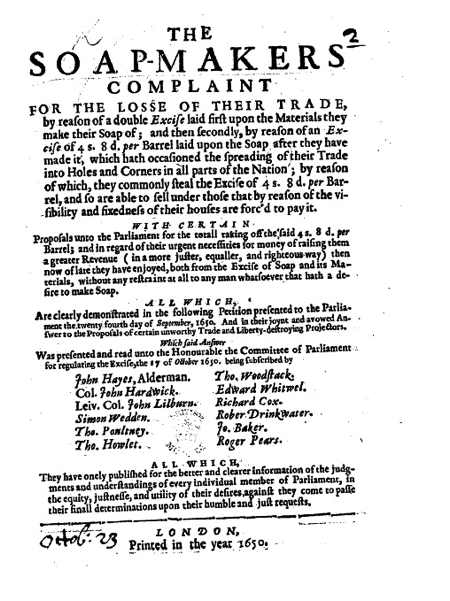
Anon., The Soap-makers Complaint for the losse of their Trade, by reason of a double Excise laid first upon the materials they make their soap of; and then secondly, by reason of an Excise of 4s. 8d. per barrel laid upon the soap after they have made it, which hath occasioned the spreading of their Trade into Holes and Corners in all parts of the Nation; by reason of which , they commonly steale the Excise of 4 s. 8 d. per Barrel, and so are able to sell under those that by reason of the visibility and fixedness of their houses are forc’d to pay it.
With Certain
Proposals unto the parliament for the totall taking off the said 4s. 8d. per barrel; and in regard of their urgent necessities for money of raising them a greater Revenue (in a more juster, equaller, and righteous way) then now of late they have enjoyed, both from the Excise of Soap and its Materials, without any restraint at all to any man whatsoever that hath a desire to make Soap.
All which,
are clearly demonstrated in the following petition presented to the Parliament the twenty fourth day of September, 1650. And in their joynt and avowed answer to the proposals of certain unworthy trade and liberty-destroying projectors.
Which said answer
was presented and read unto the Honourable the Committee of Parliament for regulating the Excise, the 17 of October 1650. being subscribed by
John Hayes, Alderman. Col. John Hardwick. Leiv. Col. John Lilburn. Simon Wedden. Tho. Poultney. Tho. Howlet. Tho. Woodstack. Edward Whitwel. Richard Cox. Rober. Drinkwater. Jo. Baker. Roger Pears.
All which,
They have onely published for the better and clearer information of the judgments and understandings of every individual member of Parliament, in the equity, justnesse, and utility of their desires, against they come to passe their finall determinations upon their humble and just requests.
London, Printed in the year 1650.
This text contains the following parts:
- The Petition
- Answer
- Proposition to the Grand Commissioners of the Excise
- Answer Oct. 17, 1850
- Acount or Certificate of the Commissioners
Title ID: T.222 [1650.09.24] Anon., The Soap-makers Complaint for the losse of their Trade (24 September 1650).
Estimated Date of Publication: 24 September 1650.
Thomason Tracts Catalog Information: TT1, pp. 812–13; E. 615. (2.)
Note
This pamphlet/tract is part of a collection of Leveller Tracts.
The page numbers refer to the page numbering in the original pamphlet. Sometimes page numbers were missing or there were duplicates. On many occasions the text in the margin notes is unreadable as a result of poor scanning of the original.
[3]
To the Supreme Authority, the Parliament of the Common-wealth of England.
The humble Petition of the Sope-makers of London, whose names are hereunto subscribed.
Sheweth,
THAT one of the greatest means (under God) of the comfortable subsistence of this Island in all ages, hath been the giving encouragement to the industrious mannagers of Trade and Traffick: which by reason of those long and many continued troubles, both at home and abroad upon the Nation, and those extraordinary Imposts upon most Commodities, hath bred such consumption in the Trade of the Nation, that it hath brought thousands of Families (that formerly lived comfortably) into extraordinary wants and straits: And amongst all the Trading people of this Land, your Petitioners humbly conceive, that none whatsoever groan under a more insupportable burthen then your Petitioners do, as appears by these particulars following.
First, For that being Sope-makers, they pay Excise for all imported materials they make their Sope of; as for Pot-ashes, Oyl, and Tallow, and not onely so, But
Secondly, As if they with some few others were strangers to the Commonwealth of England, and not capable of the enjoyment of the Liberties and Freedoms thereof; A heavy and grievous burthen is laid upon their shoulders, when as it toucheth not the little fingers of the Generality of the people of this Nation: viz. That after they have with a great deal of hazard, labour, and toyl, made their materials into Sope, then they are constrained to pay 4s. 8d. Excise out of every Barrel they make; so that thereby in effect. they pay Excise for the sweat of their browes, and the labour and toil of their hands; and this is required of them, and that whether they gain or lose by their Commodity; which is a burthen so intollerable, as (if not speedily removed) will unavoydably ruine them; of which, about five years since they most grievously complained, and were thereupon largely promised ease thereof, but never enjoyed it to this day: And therefore now they are necessitated humbly to tender these following reasons for the speedy removal of it for ever.
First, Because, that although by the late wars in Poland by the Tartars, Pot-ashes (by reason of their scarcity) grew of late years to so great a price, that many in England were incouraged to make Pot-ashes, for which they neither pay Excise nor Custome; and yet by reason of the late plenty of Out-landish ashes, by means of which at London, not being able to get their accustomed price for theirs, that for two or three years by past, they have borne, they make them in holes and corners in the Country into Sope, where constantly (as partly may appear by the books of Excise at the grand Office thereof) stealing the Excise of the 4s. 8d. per Barrel, and paying originally no Custome nor Excise, either for their Pot-ashes, or their Tallow, by reason whereof (although for want of skil &c. They make base [4] and unmarchantable Soape) they are able so much to undersel your Petitioners, as that of late they are much impoverished in their trade, the chief means of their livelyhood: And therefore though it have formerly appeared unreasonable to your Honors to lay Excise upon Native Commodities; we hope it will now, much more, appear unreasonable to continue Excise upon Native and bare handy labour, and the sweat of the browes of English men, denominated in words, to be free by birth.
Secondly, Because by the aforesaid meanes the Excise of Sope is so decayed, as that the new incomb of the revenue of it is humbly conceived to add little advantage to the publick purse.
Thirdly, And principally, your Petitioners are English men by birth and breeding, and pay all other manner of taxes freely and willingly, with other people of their Neighbourhood; And several of them also have freely and resolutely with their swords in their hands adventured their lives, and all that is dear to them for the Common Liberties of the Nation, and in the eye of the Law are guilty of no manner of Acts, that renders them either in reason or Justice worthy of being punished with a punishment above the generallity of the Nation; neither can they in any sense, see any reason at all why an Excise should be set upon the sweat of their browes, when almost the whole people of the Land go free in that particular.
Therefore, forasmuch as you have altered the Government of this Nation, from a Kingdom to a Common-wealth, and stiled the last year, the first year of England’s freedom, by God grace: And forasmuch as by your primitive Declarations you declare, that the meanest Commoner of England is equally intituled by birth-right unto the common enjoyment of the Liberties of the Nation with the greatest Subject: And forasmuch as by your late Declaration in Feb. 1648. You positively declare, you are firmly resolved to maintain, preserve, and defend the fundamental Lawes of the Nation, with all things incident and belonging unto the lives, liberties, and properties of the people: Amongst all which Fundamental Laws they are sure of it) this is one of the chiefest; that no one little handful of people shall be burthened in bearing, or contributing to the common charge of the Nation in such a way, as that the Universality, are not touched at all in that kinde.
Wherefore they most humbly pray, (and the rather, for that you are now about settling new Commissioners or Governors of the Excise) that you would make them like the universallity of their brethren, the freemen of England, and totally for ever of your selves, without referring them any more to any Committees whatsoever, take off the Excise of the sweat of their browes, and the labour of their hands; (viz) the aforesaid 45. 8d. per Barrel Excise upon Sope; that so they may thereby once again look upon themselves, as Denizens, and not Aliens to England, and thereby be incouraged, without murmuring, or secret repining of heart, to venture their all, for the common preservation of the Land of their Nativity.
For which they shall ever pray, &c.
[5]
The Copy of the forementioned Answer thus followeth:
TO THE HONOURABLE, the Committee of Parliament for the Regulating the NEW IMPOST of EXCISE where Colonel George Thompson hath the Chair.
The humble Answer of the Soap-makers of London, whose names are hereunto subscribed in behalf of themselves and all the rest of the Subscribers of their late Petition to the Parliament.
MAy it please this Honourable Committee to vouchsafe unto us without offence the same liberty with our pens, that you have before (we humbly thank you therefore) already granted us with our tongues, viz. free liberty to speak for our selves and for the removall of our burthens.
So it is, may it please your Honours that by wofull experience we finding our Estates and Trades daily sinking by reason of a double Excise upon the things we trade in, after we have born the burthen of it for seven years together, as long as it was possible for us to stoop under it and not to have our backs broke by it; for the prevention of which, we lately presented our humble Petition to the Parliament, truly stating our case and humbly craving relief in our oppressions, the copy of which is hereunto annexed; which said Petiton was read in Parliament the 24 day of September last: upon the reading of which, they were pleased to make an Order, the Copy of which thus followeth:
Die Martis 24 September 1650.
ORdered by the Parliament, that it be referred to the Committee of Excise, to take into consideration as well the Excise set upon the materials whereof Soap is made, as also the Excise upon Soap it self, and what is fit to be done in both or either, and report their opinions therein to the House.
Henry Scobell Cler. Parl.
[6]
By which Order the state of our business is referred to the consideration of this Honourable Committee; upon whom tending the third of this present October, which time you were pleased to afford unto us liberty to open unto you the equity and justice of our Petition, and more fully to state unto you our grievances, as also to answer severall of your Objections, arising from the losse that would upon the removal thereof accrue unto the State in its Revenue; and upon the whole you were then pleased to make an Order that the Commissioners of the Excise should be authorised to send up unto your Honours an accompt what Excise hath been made of Soap, and the materials it is made of every year since the first imposition of Excise upon it, and that we should tend upon your Honors the tenth day of this present October to hear your further result upon our businesse, which we did accordingly; and then instead of receiving satisfaction for the removall of the grievances complained of in our Petition, you were pleased to shew and read unto us certain Propositions made unto you by persons whose names certainly we cannot learn, though we earnestly entreated the knowledge of them from you, and from whom we desire no other favour, but that they will with us appear face to face before you, where we doubt not but by word of mouth to make those propositions (when they have said for them what they can) to appear unto your judgments to be as irrational unjust, and as inconsistent with the peace, safety and freedom of this Nation as the principals and habitual practice of those persons that made them are, (if they be the men that by private hands are told us to be) but upon our giving to your Honors a present and considerable satisfactory answer to the said propositions, and upon our earnest desire that we might have from your Clark copies of papers, and a weeks time to present unto you a written Answer to them, you were honorably pleased to grant it; for which we return you our most humble thanks, and therewith tender unto you a copy of the said propositions, and our humble and joynt avowed answer unto them, which thus followeth.
Propositions made to the grand Commissioners of the Excise Anno Dom. 1650. Annoque secundo Libertatum Angliæ.
First, that till the totall of so much be advanced as was the last year, we the undertakers will expect no Sallary.
Secondly, that to make that double which we will engage to do, we shall onely expect 2. s. per l. and that not out of that bare sum, but out of the overplus which shall be produced above the double.
Thirdly, that whatsover we do bring in unto the State or Commissioners above the double of the last years produce, we for our extraordinary pains and industry in it may have a fourth part.
Fourthly, that there be a reasonable allowance for under Officers as the Commissioners shall think fit.
[3]
Whereby these ensuing benefits will inevitably follow, viz.
-
23.
- To the State a far larger advance of the Excise then formerly. 24.
- To the Trade, the great ones shall not be so much as formerly enabled to destroy the inferiour sort. 25.
- That upon no man whatsoever, there shall be any oppression or injury to him, but a communicative justice shall flow equally to all, according to the true intent and meaning of all former Ordinances and Acts of Parliament in that kind provided. 26.
- That nothing shall be altered in the former constitution by Ordinance and Acts of Parliament.
Unto all which we most humbly and submissively answer.
And first, to the title Propositions made, &c. Propositions, what are they? many times, if not most times fictious Chymeraes or the like, more then realities or undeniable truths; and if these propositions had carried in them from just, honest, and good men well-affected to the common and just tranquillity of this Nation, a certain assurance to the State (from able men that never broke and compounded three or four times over in a few years) that they should have had a revenue out of the Excise of Soap double to what they have lately enjoyed without prejudice to the whole and present makers of Soap, (all but themselves) or without hazard of losse of the Soap Trade to the Hollanders and those Sea-men that have already attained so much art as to supply with Holland Soap a great part of the great trade of New Castle and Lynn, and steal their Soap ashore without paying any considerable proportion of Excise or Custom therefore, which inables the to sel much under the price that those can afford it that pays both, or without running the apparent hazard of doing ten times so much prejudice to the State then the losse of all the revenue of Excise of Soap comes to, there had been something in their Propositions worth regarding, and we could have born with their endeavours, (viz. the parties that we suppose and are informed made the said propositions) to have made up their broken and re-broken fortunes, and all their by-past engrossing of commodities, as well to the sufficient burning of their own fingers as prejudicing the Common-wealth and all their by-past and visible malignity against the Parliament upon the late Kings score, for which one of them hath pretty wel smarted; but if to us the quite contrary of all fore-mentioned doth so clearly appear, as that we hope and are confident undeniably to make it appear to the judgements and understandings of this Honorable Committee, we hope you will freely bear with our zeal and detestation against the said Propositions, and the persons that we suppose to be the Authors of them; which that we may undeniably doe, we in their own method thus proceed.
And to their first Proposition, viz. That they desire no salary till they have advanced asmuch as was made of Soap the last year, which was 2801 l. 1 s. 2 d. and the year before that it was 2557 l. 17 s. 1 d.
[8]
To which we answer, it is an easie matter to raise money upon the Excise of Soap, but the difficult thing to do it, is to do it justly, without oppression to the whole, and without the particular ruine of those in their Trades and Estates that pay it; which they never look after or speak of; it being their maxim or principle, as appears by their propositions; so they get money they care not how unjustly they come by it: It’s true, the King made the Soapmakers pay him for the Excise of soap in his time above Thirty Thousand pounds per Annum, and there is no doubt but upon the same principals he went upon such men as the proposers are; might raise the Parliament now as much, but God forbid that ever our eyes should see that fatal ruine upon the Parliament, that we have beheld upon the person of the King and his Posterity, for that and things of the like nature, that need no other prospective glass to behold the mischief of; but what is to be found in your own first and grand Remonstrance to the whole Nation, of December 1641. and indeed and in truth, we know not what more truly to stile their proposals, then a perfect and compleat shooing horn, or introduction to a designe (under the pretence of getting the State money) to make the Parliament as odious as ever the King was; and so by consequence, fit the people with as earnest desires to shake off the Parliaments Government, as ever they were to shake off the Kings; in and by which, they might not onely accomplish their own particular ends (in getting money enough (although they collected 2801l.01s. 02d. for nothing) but also the Princes in laying designes by hightned discontents, to bring him to reigne upon his Fathers Throne; to which we are sure of it some of their principles leads them sufficiently (if they be the men whose names are given unto us) and so much for their first proposition.
And as for the second, which is to make the forementioned sum of 2801l.1s. 2d double, which amounts to 5602l.2s. 4d per Annum, and to have 2s. per pound for it, which whether by it be meant the whole 5602l.02s. 4d. or the moetic we know not; which sallarie shall onely arise out of the sum that they will raise and collect more then the double. In answer to which in the first place, we beseech you with us seariously to consider in probability, which way they must go to worke to do it, if it be not first in the Roard the King troad in; which you your selves have already condemned, both in his practice of it, and also in his Person by executing him for it, &c. or, Secondly they must reduce (by way of restraining all others) the whole Trade into certain fixed know hands and houses, where they may keep a man in every house, of their own confiding in to take an exact account of every halfe firkin of Soap that is made; and how dangerous and clamorous this would be, we leave it to be determined by the words declared in your own Declarations: or Thirdly, admit they leave every man free in City and Countrie, to make it as now they do; it is impossible for those in London that have fixed houses, to pay the excise exactly and not to break, as the proposers have done, because there are so many makers of it in the Countrie, in holes and corners (one Brasier in London within these twelve months or little more, having made above a hundred small boyling pans to be set up in obscure places) that pay little or no Excise, as by the Excise books may easily appear, although they make amongst them all, a very large quantity of Soap, the names of [9] which its possible they may find out, and get power enough to break open their dores at all houres in the night, and to break all their vessels in peeces, in case they ever catch them stealing the Excise of one Barrel of Soap, the which will be a total beggeting of them, and an absolute exposing of them to some desperate madd courses, or starve, either of which in these troublesome times, may prove of more dangerous consequence to the State then now can be imagined, and principally will be gain to the proposers in a double capacity; First in regard they are both as we are informed, Soap-makers, and in process of time, their proposals and Acts upon them, may drive all or the greatest of the Trade of Soap-making for England into their own hands, and being their own searchers they will sweetly lick their own fingers, and soundly raise their prizes at their pleasures, being men as is too plainly evident by their actions of no manner of honesty or conscience: or Secondly, if they cannot get the greatest part of the Trade into their own hands, yet we do beleeve that with rigorous courses, they may get as much money by some of the three forementioned wayes, as will raise them 5602l. 2s.4d. and as much overplus as will pay them 2s.per l. for their Salarie, which Salarie will amount to their particular selves (for in their fourth proposition, they desire Salaries for their under Officers) to 560l. per Annum. besides a fourth part of their overplus, if they raise more, which it’s possible they may in some of the foresaid wayes, which Salarie with 2 or 3000l. of the States money they may possibly get into their hands, will make their broken Estates pretty whole, and enable them to live beyond sea for a time, in as ruffling a way as they have done in England, for both of them being not justly worth two groats (God blasting them in all their wicked and shirking wayes) we are confident they will not stand by it, nor can put in no honest and responsible security for the true performance of what they propose.
And as for their third proposal, which to our understanding thus runs, That what by their crooked and rigorous wayes, they bring in by way of Excise upon soap more then 5602l. 2s. 4d.per. Annum; they may have first 5s.per. l. for a fourth part out of it to themselvs; and then their Salarie of 560l. per Annum out of the remainder of it, and out of the remainder of that the Sallaries of their officers; so that suppose by their extraordinary ridged wayes (for such they must run or be totally ruinated and their security, especially if they put in good security to the State, absolutely to bring into their purses double the last years Excise) they collect 2000l. per Annum, over and above the forementioned 5602l. 2s. 4d. they must have out of it 500l. for the fourth part, and 560l. for their 2s. per l. sallarie which makes up 1060l. besides the sallaries of their under officers, which to our understandings will annually, well nigh take up the remaining 940l. of the said 2000. If they exactly provide an Excise man to search and keep accompt in all places of this Nation where Soapmaking is lately set up; there being at New Castle besides the Holland Trade, one or two already, the like at Yorke, Hull, Gainsborough, Lynn, Yarmouth, Norwich, Ipswich, Colchester, Titchfield, Southampton and Plimouth, besides scoares of places in Countrie Market Townes, and small Villages, as Rading, Newbury, Coventrie, &c.
Yea within these few dayes, a mault man at Bowl, hath bought a Pan to [10] boyle Soap in; so that whatsoever the State seems to gaine, they themselves will be sufficient gainers (for worke for nothing, it is undeniable they neither will nor can) having by their Propositions propounded at least 500l. per Annum, for each of themselves, besides what they are likely to get by boyling Soap themselves, in their large offices they already have, where being their own overseers for Excise, it is not to be questioned but they will thereby be enabled to drive a great Trade, and save themselves from paying little or no Excise; by meanes of which we are sure of it they will thereby become the great ones they speak of (in their forementioned second proposal under their beneficial head) that absolutely will be able to eat up the little ones. And at the most the State by this account, will have but 5602l. 2s. 4d. which how jestly or advantagioussy got, we crave leave here in writing (as well as formerly we have done by word of mouth) a little to insert unto this Honorable Committee; and in the first place as then we did, so now we humbly desire you to take notice, that when the Excise of Soap was first laid upon us, it was in the year 1643. when the Parliaments straights were very great, by reason the King had then the greatest part of the Nation under his command, by meanes of which it was impossible for the Parliament to raise a support of money in that ordinary and laudible long accustomed way of subsidies and Fifteens, and therefore were necessitated & compelled for preventing the then unavoidable ruine of themselves and their adherents, to flie to that extraordinary way of Excise, to raise their supportation from the Trading people of the Land, which made the Trades-men the more chearfully pay it, in regard they universally hoped it should continue no longer upon them, then that the lands of the Nation could come regularly to be taxed in that usual and accustomed way of subsidies and fifteens, at which first beginning, the Excise of our Soap was but 3s. per barrel, which for the first year brought in as appears by the aforesaid certificate of the Excise Commissioners 5058l. 05s.01d. and for the second year 4181l.10l. 12d. since which time it hath been raised to 4s.8d. per Barrel, and the last year brought but in 2803l.01s.02d. and the year before that 2557l.17s. 1d. which Excise as we have truely declared in our foresaid Petition, hath in a manner destroyed our Trade, and wasted our Estates, and if continued, must unavoidably force us to give over the way of our livelyhood (to which most of us have been brought up unto from our youth, and served toyling Apprentiships for) or begger us, which we humbly conceive you cannot but apprehend, must sorrowfully cause many sighings, mournings, groanings, and bitter complaints amongst us and our families, but if after we have humbly petitioned for the removal of our said sad insupportable burthens, and be by the Parliament (as by the reading of their Order we hoped and beleeved) referred to you for ease and redress, and instead thereof shall meet with proposals, which if by you countenanced, makes us far worse for our complaining then we were before, and you in the consequence of it no gainers, but absolute losers by raising up such a world of clamours and mournfull outcryes, as must of necessary follow upon the execution of that the proposers clearly drive at; and so much for the third and fourth proposals.
And now most Honorable and Noble Senators, as you have the hearts and [11] spirits within you, of compassionaters of your Countryes miseries, and affections to its welfare and prosperity, as our adversaries have assumed the boldness to propose, fictious, uncertain, and loosing wayes of advance of money to the State (as if they were well-willers to the Nations happinesse, which their actions never gave clear demonstrations of) so we beseech you give us leave without offence most humbly to propose to you, reall, certain, and gaining ways of advance of money to the Nation in such a way as no man in his trade, or calling, or manner of living, shal have any just occasion to except against. For the equality of it, which way we verily beleeve you must come to or else totally destroy the whole Trade of the Nation, and make absolute beggars of all the industrious Trading people of the Nation, the consequences of which, our souls even tremble to think of; but having been we fear too large already, and this being a thing of universall and generall concernment, and wil take up more time then we have allotted to us to bring in this our Answer in, therefore wee humbly crave leave to averre at our utmost perils our ableness within lesse then fourteen days after the presentation hereof, to prescribe in writing to your Honours, if commanded thereunto, what we have said a few lines above, and that it may at present clearly appear unto you that we are no haters of your supplies, nor neglecters of the studying of all just ways to doe it, in answer to your own grand Objection against our desires contained in our said Petition, which is, that your publique charges are great at present, and your straits are many, and therefore to take off our Excise would not onely be a president to the rest, of evill consequence to you, but a lessening of your Revenue, which your present affairs cannot admit of.
In answer to which, we humbly present to your consideration (although we conceive that those that presse the screwing up Excise to the highest, are no well-willers to the durable peace and tranquillity of England, but the quite contrary) that our materials pay but 6 d. per l. when Grocery, &c. pay 12 d. per l. Excise, and then when we have made it into Soap it pays 4 s. 8 d. per Barrel, which at our last being before your Honours, we truly illustrated and declared to you came now upon some sorts of Soap very nigh to 4 s. per l. Excise, which was intollerable to visible fixed houses, especially considering the Trade is so universally defused into the Countrey as now it is, which is truly and particularly declared before, and therefore we humbly entreated you that you would totally take off the 4 s. 8 d. per Barrel Excise upon Soap after it is made, and use us like the generality of the rest of the people of England, by compelling us to pay no more then 12 d. Excise [12] upon every 20s. worth of our materials we buy, so long as you shall continue Excise upon the Nation; by which proposition we humbly enforce the acceptance therof with the following reasons.
First, because we doe verily believe (upon the perusall of our notes and papers since our last being before you) to make it evident, and that you shall finde it by experience, that if you please to lay 12d Excise upon every pounds worth of our materials, viz. Outlandish Pot-Ashes and all imported Oyls and Tallow, it will clearly bring you in as great a sum as for these two last years you have enjoyed from both the materials and Soap, which we humbly conceive will be equall to all, and free many Soap-makers from those indirect means that sometimes they are forced to use for their livelihood, and also from that bondage and slavery they are in thereby to their Apprentices and Journymen, and then with all our hearts let all those that have a minde whereever they are boyle Soap as well as we; and that it will do this, we illustrate from the Custome-house Books, thus:
1. It is supposed that all imported materials belonging to Soap, as Pot-Ashes, Oyls, and Tallow, cannot be brought into the Port of London, &c. (being of so grosse a body as they are, and usually put into such great Casks as they are) and be stoln ashoar without being Customed, and so consequently Excised, which may be collected within the common charge of your ordinary Officers, and so save that 8 d. per l. that by the foresaid Certificate of the Commissioners of Excise is confessed Soap stands in.
2. We find that the Port of London hath heretofore (when the Trade was free from intanglements) vented yearly for many years together 2000 fats of Pot-ashes at the least, which estimated at thirteen hundred weight a fat one with another, make twenty six thousand hundred weight, and reckon them at the medium price of 30 s. per cent. it will come to in money 35000 l. the Excise of which at 12 d. per l. will amount unto 1950 l. besides the quantity of English Pot-Ashes then spent, which we reckon nothing for.
The Port of London hath heretofore vended of all sorts of Fish Oyls in making Soap per Annum, at the least two thousand tuns, besides Oyl Olive, and that two thousand tun at the medium price calculating it at 18 l. per tun, will amount unto at 12 d. per l. Excise, to 1800 l. and the Excise of sweet Oyl considering the quality of its price that is spent in Soap, may be computed about 500 l.
Tallow of all sorts imported from beyond Sea hath been about 300 tun per Annum, and which at the medium price as it hath usually been about 36 l. per tun, the Excise of which at 12 d. per l. will amount to 540 l. in all which is reckoned no other Oyls that is spent in other uses in the Nation, the addition of 6 d. per l. to its Excise, would make up the same about 6000 l. per Annum, which with the saving of the charge of 8 d. per l. the collecting of Soap Excise stands in, would put a full ballance to all that in point of present gain or losse can rationally and justly be said in the present controversie [13] for the whole Excise of Soap and its imported materials for these three years last past by the foresaid Certificate amounts but to 16545 l. 4 s. 11 d. into which is reckoned the Excise made of all sorts of Oyl spent in all England for all other uses as well as Soap, and divide it equally into three years proportion, and it amounts but to 5515 l. 1 s. 7 d. per Annum. which comes but to an equivalent proportion to our foresaid Proposition, and by computation rather fals short of it then otherwise.
But if it should be objected, that it is apparent by the foresaid Certificate of the Commissioners of the Excise, that there is not Annuall for these late years any such quantities of Soap-materials comes in as will in any reasonable proportion raise the sums you speak of for Excise at 12 d. per l. and so you put but a fallacy upon the State.
Unto which with all humility we answer, it is true, by reason of the wars, for divers late years in Poland (the chiefest place from whence Pot-Ashes came) it hath made them scarce, and sometimes raised from the usuall price of betwixt 20 s. and 30 s. per cent. to 7 l. 8 l. 9 l. and 10 l. per hundred, the greatness of which price raised Soap sometimes to 9 d. and 10 d. per l. in which regard the Hollander hath stept into a great part of our Trade, and cannot be prevented by verbally laying double Excise upon his Soap, in regard the Sea-men that usually transport it hither, doth it commonly upon their own accompt, and usually steal, both the Custome and Excise of it, by which means if Excise be kept at its height, the common Sea-man (if he play the good husband, and tread not in the road way of a common spend-thrift) will in a little time become a better Merchant then his Master that fraights him, and in process of time exhaust both his Purse and Trade, and so break his back.
But secondly, This scarcity and dearness of Pot-ashes in Poland, made many here in England aswel as in Denmark, Russia, New England, Virginia, and several places of Germany, rush with violence upon the making of Pot-ashes, which occasioned such a glut all of a sudden, as hath brought down of late the best, Poland Pot-ashes to about 40s. per centum, and will in probability so continue, if not fall in one years time to be a great deal cheaper, which will in an extraordinary measure (as in a large proportion is already visible to be seen) cause that vast quantity of English Pot-ashe, that of late years have been made in England to cease, (that hitherto hath paid no Excise at all) in regard in England they cannot make them to affoord them so cheap, in proportion to Out-landish ashes, seeing the peace in Poland hath restored them to a full capacity of enjoyment of the fulness of their usual Trade of making Pot-ashes, which with that large addition is likely to come out of Germany and other parts, is likely to make them as cheap as ever they were; and so by consequence fill the Custom-house books, with as large quantities of entries as used to be, which will not onely add to your present Customs, but encourage the cloath Trade, which hath heretofore been the onely commoditie bartred for the bringing in of Pot-ashes, which hath of late been usually beyond sea, bought onely for ready money (which is not [14] at all done by any Pot-ashes that is made in England, and which will by consequence restore us to the free enjoyment of our Trade, especially if the Excise of 4 s. 8 d. per Barrel be totally taken off, that so fixed houses do not pay and bear all the charge, and holes and corners nothing; which is easily prevented, and your incombs by Excise onely (besides the increase of much Custom) made in probability, as much if not more, if the charge be laid totally upon the materials at 12 d. per l. as Grocers, &c. pay for their Commodities; and truely, seeing Soap is in a manner as essentially necessary and useful to the sons of men of all sorts, and kinds of both rich and poor, as victual and fireing are, which are some of the essential and necessary supports of man kinde; we see no reason, but that as tender a regard should be had to it as the other; all which we tender to the grave judgement of this Honorable Committee, not doubting but you will grant us our reasonable desires and totally for ever, take off all and every part of the 4 s. 8 d. per barrel Excise upon Soap, and for the future be satisfied with the receipt of 12 d. per l. upon all the imported materials, and totally throw aside the propositions as fictions or dangerous proposals, or else if you do any more upon them, we humbly desire that the authors of them and we may be brought face to face before your Honours to argue out the utility, equity, and justice of each of our proposals; for which favour we shall ever be bound to remain
Your Honours humble and devoted Servants
October 17.
1650
| John Hayes | John Hardwick | |
| John Lilburne | Tho. Howlet | |
| Ja. Barker. | Tho. Woodstack | |
| Roger Peares | Edward Whitwel | |
| Tho. Poultney | Richard Cox | |
| Simon Wedden | Rob. Drinkwater. |
[15]
The forementioned Account or Certificate of the Commissioners of Excise, thus followeth.
In obedience to an order of the Honorable Committee for Regulating the Excise or New-Impost, dated October 3. 1650. to certifie unto the Committee what sum and sums of Money have been yearly received for the Excise of Soap, Potashes, sweet Oyl, Whale, and Train Oyl, and of Tallow, since the Duty of Excise was first imposed thereupon; The account of the said Excise to be particular and distinct each from other, with the Charges for Collecting of the same each year.
The Commissioners for Excise do by their Accomptent humbly certifie by the account books in London certainly, and from the Sub-Commissioners accounts, as near as can be collected by estimate.
| That there hath been Received for Excise of } |
Soap | Potashes | Sweet Whale } Oils Train |
TallowNota the into first years Seap paid Excise but 3s. per Barrel. | |||||||||||
| London, from Sept. 11. 1643. to Sept. 11. 1644. |
l. | s. | d. | l. | s. | d. | l. | s. | d. | l. | s. | d. | |||
| 4658. | 05. | 01 | 328. | 06. | 05 | 1240. | 17. | 11 | 00. | 00. | 00 | ||||
| The several Counties from the Sub-Commis. viz. the said year. |
|||||||||||||||
| l. | s. | d. | 400. | 00. | 00 | ||||||||||
| Bristol | } | ||||||||||||||
| Linn Regis | 28. | 00. | 00 } | 02. | 06. | 00 | 25. | 00. | 00 | ||||||
| Colchester | 14. | 10. | 06 } | 05. | 00. | 00 | 33. | 16. | 00 | ||||||
| Exeter | 17. | 18. | 06. } | 03. | 06. | 00 | 26. | 10. | 00 | ||||||
| Norwich | 48. | 07. | 00 } | 06. | 07. | 06 | 15. | 04. | 06 | ||||||
| Newcastle | 26. | 04. | 04 } | 12. | 00. | 00 | 23. | 09. | 00. | ||||||
| Weymouth | 30. | 06. | 08 } | 02. | 06. | 06 | 30. | 01. | 09 | ||||||
| York | 28. | 06. | 00 } | 01. | 00. | 06 | 43. | 06 | 03 | ||||||
| Southampton | 43. | 09. | 00 } | 02. | 02. | 00 | 12. | 18. | 00. | 00. | 00. | 00First Year. } | |||
| Dartmouth | 27. | 7. | 06 } | 00. | 16. | 06 | 55. | 01. | 09. | ||||||
| Hull | 16. | 19. | 06 } | 03. | 05. | 04. | 49. | 16. | 00 | ||||||
| Yarmouth | 12. | 16. | 00 } | 01. | 00. | 00 | 36. | 05. | 09 | ||||||
| Boston | 13. | 05. | 00. } | 01. | 10. | 00 | 15. | 10. | 00.Note the Excise of Tallore commenced July 8. 1644. | ||||||
| Bridgwater | 15. | 00. | 01. } | 02. | 05. | 00 | 29. | 00. | 00 | ||||||
| Dover | 13. | 06. | 06. } | 00. | 06. | 08 | 36. | 06. | 00 | ||||||
| Isle wight | 24. | 01. | 06. } | 03. | 06. | 00 | 08. | 15. | 00 | ||||||
| Plymouth | 40. | 01. | 02. } | 03. | 02. | 00 | 09. | 00. | 00 | ||||||
| Total of the Counties 400.l. | 400. | 00. | 00 | 50. | 00. | 00 | 450. | 00. | 00 | 00. | 00. | 00 | |||
[16]
| That there hath been received for Excise of } |
Soap | Potashes | Sweet Whale } Oils Train |
Tallow | |||||||||||
| London from Sept. 11. 1644. to Sept. 29. 1645. |
l. | s. | d. | l. | s. | d. | l. | s. | d. | l. | s. | d. | |||
| 3681. | 10. | 11.½ | 521. | 1. | 1.½ | 1675. | 17. | 10 | 100. | 7. | 05 | ||||
| The several Counties from the Sub-Commis. viz. the said year. |
|||||||||||||||
| l. | s. | d. } | 500. | 00. | 00. | ||||||||||
| { Bristol | |||||||||||||||
| { Linn-Regis | 30. | 16. | - } | 2. | 9. | - | 36. | 10. | - | ||||||
| { Colchester | 17. | 15. | 6 } | 6. | 00. | - | 56. | 12. | - | 9. | 5. | 6 | |||
| { Exeter | 26. | 4. | 6 } | 3. | 01. | - | 13. | 9. | 6 | 10. | 3. | 5 | |||
| { Norwich | 53. | 7. | - } | 6. | 9. | 6. | 26. | 15. | 9 | ||||||
| { Newcastle | 29. | 6. | 4 } | 13. | 00. | - | 51. | 6. | 3 | ||||||
| { Weymouth | 32. | 10. | 8 } | 2. | 8. | 6. | 66. | 1. | 9 | ||||||
| { York | 29. | 7. | - } | 1. | 5. | 6. | 3. | 7. | 6. | 00. | 16. | 4 | |||
| II. Year. { Southampton | 47. | 12. | - } | 2. | 5. | - | 64. | 6. | 3. | 5. | |||||
| { Dartmouth | 28. | 13. | 6 } | 1. | 15. | - | 53. | 12. | - | 5. | 6. | - | |||
| { Hull | 20. | 1. | 6 } | 4. | 2. | 6 | 42. | 9. | |||||||
| Nota, Sope paid Excise the 24: Novemb: 1645 4 s. 8d. per Barrel. { Yarmouth | 20. | 6. | - } | 1. | 12. | - | 11. | 6. | - | ||||||
| { Boston | 26. | 1. | - } | 1. | 15. | - | 15. | 9. | - | ||||||
| { Bridgwater | 31. | 11. | 6 } | 2. | 00. | - | 26. | 5. | 6 | 2. | 00 | 9 | |||
| { Dover | 26. | 12. | 6 } | 1. | 9. | - | 10. | 12. | 1. | 5. | - | ||||
| { Isle Wight | 34. | 7. | - } | 2. | 19. | - | 5. | 9. | - | 00. | 18. | - | |||
| { Plymouth | 45. | 8. | - } | 2. | 9. | - | 6. | 8. | 6 | ||||||
| Total of the Counties 500. l. | 500. | 00. | 00 | 55. | 00. | 00 | 500. | 00. | 00 | 30. | 00. | 00 | |||
| London from the 29 Septemb. 1645. to the 29 Septemb. 1646. |
4701. | 12. | 4 | 315. | 10. | 11 | 1199. | 6. | 6 | 154. | 2. | 2 | |||
| The several Counties from the Sub Commissioners viz. the said year. |
|||||||||||||||
| { Bristoll | 245. | 6. | 4 } | 1200. | 5. | 1. | 0 | 0 235. | 6. | 6 | 25. | 11. | ½ | ||
| { Lynn Regis | 180. | 5 | 2. | 11. | 0 | 0 36. | 9. | 9. | 0 | 1. | 10 | ||||
| { Colchester | 64. | 8. | 5. | 16. | 0 | 0 59. | 10. | 0 | 18. | 9. | 6 | ||||
| { Exeter | 30. | 6. | 8 } | 3. | 12. | 6 | 0 9. | 6. | 6. | 21. | 19. | 10½ | |||
| { Norwich | 86. | 15. | 6. | 13. | 9 | 0 22. | 3. | 3. | 0 | 0 | 0 | ||||
| { New Castle | 52. | 2. | 2. | 0 | 0 39. | 16. | 0 | 0 | 0 | 0 | |||||
| { Weymouth | 32. | 16. | 8 } | 3. | 9. | 4 | 0 51. | 11. | 6 | 0 | 0 | 0 | |||
| { Yorke | 36. | 18. | 9 } | 2. | 3. | 1 | 0 5. | 7. | 10 | 0 | 0 | 0 | |||
| III. Year. { Souththampon | 80. | 9. | 9 } | 2. | 16. | 0 | 0 69. | 10. | 4. | 0 | 0 | 0 | |||
| { Dartmouth | 86. | 16. | 10 } | 2. | 6. | 0 | 0 19. | 6. | 6 | 0 | 0 | 0 | |||
| { Hull | 40. | 9. | 0 } | 5. | 4. | 0 | 0 32. | 6. | 6 | 0 | 0 | 0 | |||
| { Yarmouth | 86. | 15. | 0 } | 1. | 16. | 0 | 0 12. | 12. | 6 | 0 | 0 | 0 | |||
| { Boston | 34. | 8. | 0 } | 1. | 19. | 0 | 0 15. | 6. | 0 | 0 | 0 | 0 | |||
| { Bridgwater | 36. | 0 | 0 } | 2. | 3. | 6 | 0 12. | 8. | 9 | 0 | 0 | 0 | |||
| { Dover | 56. | 4. | 0 } | 2. | 11. | 9 | 0 9. | 16. | 4 | 0 | 0 | 0 | |||
| { Isle Wight | 20. | 0 | 0 } | 2. | 16. | 3. | 0 3. | 0 | 3 | 0 | 0 | 0 | |||
| { Plymouth | 30. | 1. | 0 } | 3. | 0 | 6 | 0 9. | 10. | 9 | 0 | 0 | 0 | |||
| Total of the Counties 1100. l. | 1200. | 56. | 1. | 10. | 643. | 9. | 3. | 66. | 3. | 2 | |||||
[17]
| That there hath been received for Excise of } |
Soap | Potashes | Sweet Whale } Oyles Train |
Tallow | |||||||||||
| London from the 29 of Septem. 1646. to the 29 Septem. 1647. |
l. | s. | d. | l. | s. | d. | l. | s. | d. | l. | s. | d. | |||
| 2957. | 19. | 4. | 524. | 1. | 3. | 1763. | 19. | 3½ | 322. | 3. | |||||
| The several Counties from the Sub Commissioners viz. the said year. |
|||||||||||||||
| Bristoll | 255. | 11. | 2 } | 1082. | 17. | 1 | 3. | 2. | 0 | 200. | 9. | 9 | 27. | 9. | 9 } |
| Lynn Regis | 120. | 16. | 10 } | 2. | 8. | 29. | 6. | 6. | |||||||
| Colchester | 74. | 12 | 0 } | 5. | 10. | 46. | 8. | 15 | 19. | 3 } | |||||
| Exeter | 66. | 8. | 0 } | 3. | 8. | 8. | 3. | 3 | 12. | 6. | 0 } | ||||
| Norwich | 34. | 5. | 2 } | 4. | 10. | 4 | 20. | 6. | 6 | ||||||
| Newcastle | 82. | 12. | 0 } | 9. | 5. | 26 | 6. | 9 | |||||||
| Weymouth | 36. | 15. | 0 } | 3. | 6. | 6 | 49 | 8. | 3 | ||||||
| Yorke | 52. | 12. | 0 } | 2. | 1. | 3. | 2. | 2. | |||||||
| Southampton | 20. | 5. | 6 } | 2. | 15. | 71. | 6. | 6 | 4. | 5IV. Year. | |||||
| Dartmouth | 28. | 10. | 0 } | 1. | 10. | 10. | 9. | 9 | |||||||
| Hull | 35. | 5. | 4 } | 3. | 2. | 26. | 3. | 3. | |||||||
| Yarmouth | 25. | 6. | 0 } | 1. | 10. | 14. | 2. | 9 | |||||||
| Boston | 40. | 9. | 0 } | 1. | 2. | 6 | 36. | 8. | 7 | ||||||
| Bridgwater | 55. | 9. | 1 } | 2. | 10. | 26. | 9. | 9 | |||||||
| Dover | 64. | 0 | 0 } | 2. | 3. | 16. | 3 | ||||||||
| Isle Wight | 30. | 0 | 0 } | 1. | 25. | ||||||||||
| Plymouth | 60. | 0 | 0 } | 19. | 5. | 3. | 12. | 1 | |||||||
| Total of Counties 1082. 17. 1 | 1082. | 17. | 1 | 50 | 600. | 60. | |||||||||
| London from 29 Sept. 1647. to 29 Sept. 1648. | 2418. | 3. | 5. | 443. | 12. | 11 | 1161. | 4. | 10.½ | 167. | 18. | 3½ | |||
| The several Counties from the Sub Commis. viz. the said year. |
|||||||||||||||
| Bristoll | 230. | 9. | 9 } | 800. | 2 | 186. | 9. | 6 | 16. | 18 | |||||
| Lynn Regis | 80. | 5. | 5 } | 1. | 10. | 23. | 4. | 4 | |||||||
| Colchester | 56. | 10. | 3. | 5. | 39. | 6. | 14. | 10. | 6 } | ||||||
| Exeter | 34. | 16. | 7 } | 4. | 6. | 6 | 3. | 5. | 6 | 5. | 9. | 6 } | |||
| Norwich | 25. | 5. | 9 } | 00. | 7. | 16. | |||||||||
| New Castle | 10. | 12. | 2. | 19. | 10 | 12. | 5. | 6 | |||||||
| Weymouth | 16. | 4. | 1. | 17. | 8 | 39. | 5. | ||||||||
| Yorke | 26. | 2. | 12. | 1. | 1. | ||||||||||
| Southampton | 56. | 5. } | 1. | 15 | 9 | 45. | 6. | 6. | |||||||
| Dartmouth | 17. | 6. } | 2. | 6. | 8. | 9. | 9 | 3. | 2V. Year. | ||||||
| Hull | 40. | 3. | 6. | 16. | 2. | 3. | |||||||||
| Yarmouth | 16. | 0. | 18. | 17. | 8. | 1. | |||||||||
| Boston | 25. | 8. | 8 } | 1. | 17. | 26. | 9. | 7 | |||||||
| Bridgwater | 44. | 1. | 2. | 16. | 8 | 36. | 9. | 9 | |||||||
| Dover | 48. | 3. | 18. | 7 | 24. | 3. | 5 | ||||||||
| Isle Wight | 33. | 1. | 2. | 16. | 2. | 3. | |||||||||
| Plymouth | 40. | 4. } | 1. | 8 | 2. | 10. | 3 | ||||||||
| Total of the Counties 800l. | 800. | 40. | 500. | 40. | |||||||||||
[18]
| That there hath been received for Excise of } |
Soap | Potashes | Sweet Whale } Oils Train |
Tallow | |||||||||||
| { London, from Sept. 29. 1648. to Sept. 29. 1649. |
l. | s. | d. | l. | s. | d. | l. | s. | d. | l. | s. | d. | |||
| 1907. | 17 | 1½ | 54 | 8 | 3 | 13 | 9 | ½ | 139. | 00. | 6½ | ||||
| { The several Counties from the Sub-Commis. viz. the said year. |
|||||||||||||||
| l. | s. | d. } | 650. | 00. | 00 | ||||||||||
| { Bristol | 239. | 05. | 05 } | 01. | 12. | 00. | 130. | 5. | 9 | 12. | 8. | 5. | |||
| { Linn Regis | 60. | 03. | 03 } | 01. | 06. | 00 | 19. | 06. | 06 | ||||||
| { Colchester | 45. | 00. | 06 } | 02. | 10. | 00 | 25. | 03. | 00 | 07 | 09. | 07 | |||
| { Exeter | 22. | 08. | 04. } | 03. | 05. | 00 | 02. | 03. | 03 | 06. | 06. | 00 | |||
| { Norwich | 15. | 03. | 03 } | 01. | 18. | 00 | 14. | 16. | 00 | ||||||
| { Newcastle | 17. | 08. | 06 } | 01. | 06. | 00 | 09. | 06. | 00 | ||||||
| { Weymouth | 23. | 19. | 11 } | 00. | 18 | 06 | 25. | 05. | 09 | ||||||
| VI. Year. { York | 23 | 07. | 00 } | 02. | 05. | 00 | 00. | 15. | 00 | ||||||
| { Southampton | 10. | 03. | 03 } | 01. | 06. | 00 | 35. | 05. | 00. | 00. | 00. | 00 | |||
| { Dartmouth | 04. | 06. | 06 } | 01. | 15. | 00 | 06. | 06. | 03. | 03. | 16. | 00 | |||
| { Hull | 16. | 08. | 00 } | 02. | 03. | 00 | 12. | 03. | 06 | ||||||
| { Yarmouth | 19. | 06. | 00 } | 01. | 05. | 00 | 15. | 09. | 05 | ||||||
| { Boston | 23. | 06. | 07 } | 00. | 19. | 00 | 22. | 09. | 01 | ||||||
| { Bridgwater | 33. | 15. | 00 } | 01. | 16. | 00 | 24. | 06. | 04 | ||||||
| { Dover | 28. | 16. | 00 } | 02. | 17. | 06 | 16. | 18. | 05 | ||||||
| { Isle wight | 30. | 01. | 00 } | 01. | 08. | 00 | 15. | 00. | 06 | ||||||
| { Plymouth | 40. | 01. | 06 } | 01. | 10. | 00 | 25. | 00. | 03 | ||||||
| Total of the Counties 650.00.00 | 650. | 00. | 00 | 30. | 00. | 00 | 400. | 00. | 00 | 30. | 00. | 00 | |||
| London from the 29 Septemb. 1649. to the 29 Septemb. 1650. |
2103. | 1. | 2 | 350. | 17. | 6½ | 1938. | 1 | ½ | 228. | 17. | 7 ½ | |||
| The several Counties from the Sub Commis. viz. the said year. |
|||||||||||||||
| { Bristoll | 249. | 6. | 4 } | 700. | 1. | 19. | 0 | 0 153. | 6. | 3 | 13. | 9 | |||
| { Lynn Regis | 76. | 8. | 6. } | 1. | 12. | 0 | 0 26. | 9. | 9. | 0 | 0 | ||||
| { Colchester | 66. | 10. | 3. | 6. | 0 | 0 23. | 05. | 0 | 6. | 15. | 6 | ||||
| { Exeter | 34. | 9. | 4. | 5. | 6 | 0 15. | 8. | 0. | 7. | 8. | 0 | ||||
| { Norwich | 26. | 5. | 5 } | 1. | 19. | 0 | 0 17. | 9. | 3. | 0 | 0 | 0 | |||
| { New Castle | 28. | 6. | 8 } | 1. | 18. | 0 | 0 11. | 9. | 0 | 0 | 0 | 0 | |||
| { Weymouth | 33. | 9. | 9 } | 1. | 16. | 6 | 0 36. | 10. | 10 | 0 | 0 | 0 | |||
| { Yorke | 42. | 5. | 2. | 16. | 0 2. | 9. | 0 | 0 | 0 | 0 | |||||
| VII. Year. { Souththampon | 26. | 3. | 3 } | 1. | 17. | 9 | 0 46. | 7. | 0. | 0 | 0 | 0 | |||
| { Dartmouth | 16. | 8. | 8. } | 2. | 5. | 0 | 0 19. | 15. | 0 | 2 | 7. | 6 | |||
| { Hull | 26. | 5. | 5 } | 3. | 6. | 6 | 0 26. | 9. | 3 | 0 | 0 | 0 | |||
| { Yarmouth | 24. | 3. | 3 } | 1. | 5. | 3 | 0 22. | 7. | 7 | 0 | 0 | 0 | |||
| { Boston | 26. | 5. | 5 } | 1. | 14. | 0 | 0 34. | 9. | 6 | 0 | 0 | 0 | |||
| { Bridgwater | 7. | 6. | 0 } | 2. | 12. | 0 | 0 16. | 19. | 0 | 0 | 0 | 0 | |||
| { Dover | 16. | 3 | 2 } | 3. | 16. | 0 | 0 23. | 9. | 5 | 0 | 0 | 0 | |||
| { Isle Wight | 6. | 1. | 0 } | 2. | 9. | 0 | 0 12. | 9 | 1 | 0 | 0 | 0 | |||
| { Plymouth | 8. | 3 | 0 } | 1. | 2. | 0 | 0 11. | 7. | 1 | 0 | 0 | 0 | |||
| Total of the Counties 700. l. | 700. | 40. | 500. | 30. | 0 | 0 | |||||||||
| Total of they years for London & the Countrey } |
27761. | 6. | 5. | 3352. | 0. | 13932. | 1374. | 9. | 4. | ||||||
[19]
The charges of Collecting the same each year cannot be certainly known or computed, for that Potashes and Oyls are contained within the Office for Grocery, Druggestry, Saltery, those two Commodities being under the general article of Saltery in the Schedule of rates: and the Commodities under Saltery, together with those under Grocery & Druggestry, are so numerous, as not to proportion any particular Commodity for the charges of it distinctly, from any other Commodities; The like for Tallow under the first Additional; And for Soaps is the like.
But by estimate Soap is about 8 d. in 20 s. received for the charges, And for Pot-ashes, Oyls, and Tallow, each of them is about 7 d. charges in Collecting of every 20 s.
Excise Office in Broadstreet
London, Octob. 10.
1650.
Tho. Smith, Accomptant
to the Chief Commissioners for Excise.
Nota, That whereas Robert Booth late Salter, and John Walker Silk-man, now Soap-makers, did appear before the Honourable Committee for Regulating the Excise, Octob. 23. 1650. And there did own the proposals to be theirs, and that the Answer thereunto was scandalous: Unto which it was averred, that every perticular in the said Answer should be made good against the said Booth and Walker
By Lieut. Colonel
John Lilburne.
Finis