| The Digital Library of Liberty & Power incorporating the Guillaumin Collection of the Great Books of Liberty |
Home | New | Authors | Works | Topics | Papers | Blog | About | Email | Search |
 |
|
THE LEVELLER TRACTS PROJECT
JOHN LILBURNE,
His Apologeticall Narration (April, 1652)
|
[Created: 7 August, 2024]
[Updated: 3 October, 2025] |
Source
, John Lilburne, His Apologeticall Narration (April, 1652). http://davidmhart.com/liberty/Levellers/Lilburne/1652-04_T231-Lilburne_ApologeticallNarration/index.html
Title ID: T.231 [1652.04] John Lilburne, His Apologeticall Narration (April, 1652). This is a bilingual edition with the Dutch in one column and the English in another. The online version has only the English version. The Dutch version was in normal font; the English version was in italic, which we have preserved.
Estimated Date of Publication: April, 1652.
Thomason Tracts Catalog Information: TT1, p. 869; E. 659. (30.)
Note
This pamphlet/tract is part of a collection of Leveller Tracts.
For more information about John Lilburne. <http://davidmhart.com/liberty/Levellers/Bios.html>
The page numbers refer to the page numbering in the original pamphlet. Sometimes page numbers were missing or there were duplicates. On many occasions the text in the margin notes is unreadable as a result of poor scanning of the original.
Full Title
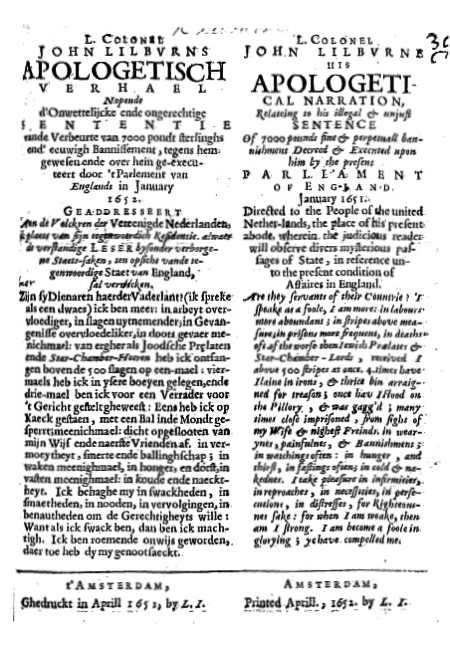
John Lilburne, L. Colonel John Lilburns apologetisch verhael, nopende d’onwettelijcke ende ongerechtige sentenie vande verbeurte van 7000 poundt sterlinghs ond’ eeuwigh bannissement, tegens hemgewesen onde over hemge-executeert door ’t Parlement van Englandt in January 1652. L. Colonel John Lilburne his Apologetical Narration, Relateing to his illegal & unjust Sentence of 7000 pounds fine & perpetuall banishment Decreed & Executed upon him by the present Parliament of England January 1651.
t’Amsterdam, Ghedruckt in Aprill 1652, by L.I. Amsterdam, Printed Aprill., 1652 by L.I.
Apologeticall Narration, Relating to his illegal & unjust Sentence of 7000 pounds fine & perpetuall bannishment Decreed & Executed upon him by the present Parliament of England.
Title page
Apologeticall Narration, Relating to his illegal & unjust Sentence of 7000 pounds fine & perpetuall bannishment Decreed & Executed upon him by the present Parliament of England.
January 1651/52
Directed to the People of the united Nether-Lands, the place of his present abode, wherein the judicious reader will observe divers mystyerious passages of State, in reference unto the present condition of Affaires in England.
Are they servants of their Countrie ? I speake as a foole, I am more: in labours more abundant; in stripes above measure; in prisons more frequent, in deaths oft of the worse than Jewish Prelates & Star-Chamber-Lords, received I above 500 stripes at once. 4. times have I lain in irons, & thrice bin arraigned for treason; once I hav stood on the Pillory, & was gagg'd; many times close imprisoned, from sight of my Wife & nighest Freinds, in wearynes, painfulnes, & Bannishment; in watchings often; in hunger, and thirst, in fastings often; in cold & nakednes. I take pleasure in infirmities, in reproaches, in necessities, in persecutions, in distresses, for Righteousnes sake: for when I am weake, then am I. I am become a foole in glorying; ye have compelled me.
Amsterdam, Printed Aprill., 1652. by L.I.
Generosisime ac Vigilantissimo D: Domine
DE LILBVRNE
Militum Præfecto,
Paternis sedibus ostracismo exuli, aliunde Fortunæ regressum Expectanti,
EPIGRAMMA
In ejus defensionem Apologiticam.
Virescit vulnere virtus.
Quid Lilbvrne times? nullus sine Marte Triumphus:
Si pateris, vincis victus, & exul ovas.
Miles ubique domi est, Patriâ non exulatusquam:
Quo labor est major, Gloria major erit.Externus ad Exurnunt.
Dabit fortuna regressum.
[1]
Lieft. Colonell I. Lilburne his Apologeticall Narration, in reference to his late illegall and unjust Banishment; directed to the people of the united Provinces.
Gentelmen.
GOd the absolute soveraigne Lord of all mankind, who governs and rules the Heavens and the Earth and disposeth of all things therein at his beck and pleasure and for the manifestation of his owne glory & praise, for which all the workemanship of his hand was created, whose various dealeings with the Sonns of men and the certaine and particular grounds and reasons thereof are past finding out by us, raiseing up some and abaseing others according to his owne good will & pleasure; is in all his wayes and dealings with man, faithfull and true, yea most just and righteous, and happy is he amongst men, in the various dispensations of God, in the ebbings and flowings thereof, that is able truly, sincerely and heartily so to say; for in so doeing, there is peace & tranquillitie of mind; in the enjoyment whereof; the poore creature is at rest and content. The possession of which is more excellent then aboundance of riches, and rather to be chosen then much fine gold.
I the penman hereof, have aboundantly tasted of Gods tossing and tumbling dealings with me in this World, which to me as a mere man hath bin nothing but a vale of teares, yea a pilgrimage, full of [2] sorrowes and afflictions to my earthly house of clay. For in my tender yeares, when I was about twentie yeares old, in the yeare 1637, by the Bishops, I was forced to flie out of England into these parts for shelter, the usuall and most noble receptacle among all the parts of the earth of many a brave and gallant christian spirit. And at my goeing back into England, in the same yeare I was apprehended there and imprisoned by them; and after that I was imprisoned by the Lords of the Kings Counsell; after which I was imprisoned by the Iudges of the Star-chamber, by whom for about three yeares together, I suffered the execution of one of the most cruell sentences, that I thinke any of you in any Historie whatsoever, hath read to be inflicted upon a man that lived after the undergoing it. the narrative of which, as it was printed in England Anno 1645, I shall by and by communicate unto you. After all which, being released by the Parliament, in November 1640 (the present Generall Cromwell being the cheifest instrument thereof) I was againe imprisoned May third 1641, by the speciall command of the late King himselfe, and the next day after by his speciall order, was arraigned as a Traitor for my life, in an extraordinarie full house of Peeres at West-minster, where comeing of, with honour and credit, the warrs betwixt King and Parliament shortly after comeing on (be haveing by a speciall act of Parliament made them a perpetuall Parliament, to sit as long as they pleased, and thereby having formally given up to them that power which formerly by Law was invested in himselfe) I according to my understanding and duty in judgement [3] and conscience, tooke up Armes as an officer and Captaine under the Parliament, for the vindication and establishment of the freedomes of our Nation, and war at Edge-hill battle October three and twentie 1642. where I did that which became a man of honour and reputation, valueing the Liberties of his Countrie above his life and blood. After that I was in that bloody shirmith at Brainford the twelfth of November following, where like a man of Principles, that choosed rather to die upon the place, then to betray his engagements and undertakeings, I was one of those 700 that gave a soldierlike opposition to the Kings whole Armie for many houres together, and consequently saved his then takeing of London, at which Skirmish being encompassed by the Kings Army, I my selve being taken prisoner, was led captive to Oxford, where after many courtings from the King by severall great Lords yet alive in England, to alter my principles and leave the Parliaments cause I had engaged in; upon the refusal whereof, I was laid in Irons and in them before the Lord chiefe justice Heath as a traitor arraigned for my Life the second time. After which and allmost a yeares most cruell captivity there. I was honourably exchanged by the Parliaments Generall the Earle of Essex, for a special darling of the Kings, Sir Iohn Smith Knighe Banneret, who was so knighted in the feild by the King, for regaining his standard when lost at Edge-hill battle.
And being at liberty comeing home to London, finding in my apprehension some Kind of persecution in the Earle of Essex his [4] Army, about principles of Religion, unto which the temper of my spirit was very much averse, being in my self a great lover of freedome and liberty, especially Christian Liberty, in which by the Apostle of our supreme Lord and Soveraigne, we are enjoyned to stand fast; as the most transendent and excellencest thing in the world, that a man of virtue and of an ennobled mind can take delight in, nay as a thing of that worth in it selfe simply considered, that the enjoyment of all the earthly delights in the world without it are not worth the regarding or delighting in: I say out of the consideration I left the Earle of Essex and his Army, and all those high obligations that he had put upon me (not only in my exchange but also in furnishing me with almost 300 pound in ready mony and proffering me what command under him I had a mind unto) and I went unto Lieut. Generall Cromwell in Lincolnshire, who I knew seemed to have a spirit for freedome at that time very suitable to mine owne. And there I found him under the command of the Earle of Manchester, under whose command, first as Major in Colonel Kings Regiment, secondly as Lieut. Colonel to the Earle of Manchester his owne Regiment of Dragoones, I served for divers moneths with heartynes, zeale and mettle, till after Marston-Moore-Battle, I was sent with part of my regiment to quarter in Tickle-towne in yorkeshire, with orders to keepe the Enemie in the Castle there, from comeing out to heat up any of the Quarters of our Armie. In stead of the doeing whereof, I drained the Castle-moat, and tooke in the Castle it selfe, without the loss of the blood or life of any of my men. For which my Generall the Earle of Manchester, because I wanted the formalitie of a full and positive commission to doe what I did, would needs [5] hang me, which so discouraged me from continuing to be a soldier, as that from that day, to this houre, it totally spoiled a soldier of me, to fight any more in the Parliaments quarrell. Whereupon, a little while after, in the yeare 1644 I laid downe my Commission, and have continued ever since out of Armes unto this day. But the Earle of Manchester for divers other high Miscarriages, being brought upon the Stage and questioned in Parliament by Lieutenant Generall Cromwell, my then most intimate and familiar bosome frind. Hee very much pressed me and prevailed with me, to put my helping hand to his in prosecuteing against the said Earle of Manchester, which with some Zeale I accordingly die, apprehending him upon very good grounds, to be a Traitor to his trust, which begot me no small indignation from all the Earles interest or freinds, which were then very potent in both houses of Parliament and in the city of London. Whereupon, I was in May 1645 by a Committee of the house of Commons caught by the back, and getting free of that trouble on the 19 of Iuly after by a vote of the House of Commons, (I could never tell certainly what for unto this very day) I was voted a prisoner by them into their sergeans at armes custodie, who after that he had used me very roughly, committed me to one of his deputies, called M. Knight. Where being not a little troubled at my causeles imprisonment, I put pen to paper and complained thereof. Which occasioned a Committee of the House of Commons by their order of the 9 of Aug. 1645 to send me to New-Gate, the usuall prison for theives and murderes & such infamous & debauched malefactors Which Committment the House it selfe by speciall vote August 11 1645 approved of. And afterwards, the said House of Commons, made a speciall order [6] dated August 26 1645 to try and dispatch me for my life, at the Sessions there. But struggleing with my tongue and pen very hard, printing my condition in severall bookes, they paid me an hundred pound of moneyes which they owed me and by their order of the fourteenth of October, they honour ably discharged me from that imprisonment, as a just and innocent man, without any tryall at all. After which, I was without ground or cause, upon the fourteenth of April 1646 arrested by one of the Earle of Manchesters Champions, in an action of 2000 pound, for pretended words. Whereupon, I was forced for my defence to fly to my pen againe, and to write and print a Booke by way of Plea, called the Iust-mans Iustification. Some passages in which, touching a little upon the Earle of Manchesters reputation, be being then Speaker of the house of Peers, got me by their order dated the 10 of Iune 1646 summoned up to the Lords barr, about that booke at whose bar, under my hand and seale, I delivered a protestation, against their assumeing a jurisdiction over Commoners, which I there maintained to be against the 29 chapter of Magna-Charta & the Petition of Right, two of the most principal, knowne, & eminentest Lawes of England, and the absolutest legal safeguards of the Liberties of the People there; and which doe positively and expresly declare, that the Commons of England, shall be tried by none whatsoever, but their equalls. For the delivery of which Protestation, they the same day committed me to New-gate-prison, where the 16 of Iune 1646, I appealed against them to the house of Commons, as destroyers of the Liberties of the Commons of England, and in print intitled it the [7] Freemans freedome vindicated. But the Lords being very angry therefore, by another order of theirs dated the 22 of Iune 1646, forced me againe up to their bar, where I to the height persevered, according to the declared Lawes of England, in a stif deniall of their jurisdiction over me. For which they sentenced me to pay 4000 pound to the King, for ever to be uncapable to beare any office in Church or Common-wealth, either martial or civil, & to lye seven years a prisoner in the Tower of London, unto which place accordingly I was committed, where I remained till about the latter end of the yeare 1648. during which Imprisonment, the Lords haveing for 16 or 17 weekes divorced me from the society of my VVife, and other waies used me most barbarously, which did not a little trouble me, and made me the more eagerly pursue my Study, and print severall treatises against the Lords illegal dealeing with me. In which time it fell so out, that by the Rebellion or Contestation of the Army against the Parliament, which was about May 1647, Leiutenant Generall Cromwell grew to have power enough in his hands, at his pleasuer to redeeme me out of my illegal and unjust captivity; which was originally occasioned, by his importunate ingageing me in his quarrell against the said Earle of Manchester. But he, to my understanding, shakeing hands with the said Earle (who then was serviceable enough to his ends) (rather complied with him to keepe me in prison, unless I would acknowledge the Lords jurisdiction over me, then any way in the least to improve his interest for my freedome. VVhich dealing of his with me, I looked upon (to speake as civilly as I can) as a most abominable and detestable peice of unhandsomnes and unworthynes; and with my pen fell point blanck upon him therefore, and printed severall high discourses against him, which beget [8] the first quarrell between him and me. But being that yeare, vix. 1648 (by a petition to the house of Commons, signed by many thousands of my frinds in London, that intirely loved me, for standing for their English freedomes and native rights,) freed by an ordnance of both houses of Parliament from my said unjust imprisonment, by the house of Lords and every part of their forementioned sentence.
Afterwards, the difference betweene Lieutenant Generall Cromwell and my selfe, seemed very fully to be composed. And after the warrs (occasioned in England, by Duke Hamiltons invasion &c.) were over, the Armie besides many former declarations, published a large Remonstrance, dated at Saint Albanes, the 16 of November 1648, about bringing the King to Iustice, and breaking or dissolveing the Parlament. At which my selfe and divers others of my acquaintance, being very fearfull, that they intended to pull up by the rootes all the civil power and Magistracy of the Nation, & for the future to governe us by their wills and swords, as a conquered people; we laid our heads together and sent four commissioners downe to them at Windsor, whereof my selfe was chosen one, the other three being Major Iohn Wildman, Mr. William Walwijn, and Mr. Maximilian Petty. Where, and in their journeying towards London, we had many large & gallant promises from them, for the speedy and immediate establishing of successine and bounded Parliaments, upon a firme and popular agreement, to be signed by the People of England Which was then by themselves printed & declared to be the only rational, just, & firme way to settle & establish the Liberties of England. But, within few daies after their comeing to London judgeing that Comissary Generall Ireton (Litely [9] dead) (who what then the axelres upon which all the affaires of the Army turned) with others of the great officers of the Armie, had visibly declined, that which they engaged to us to performe; I for my part, made my protest to their faces against them, and in faithfullnes to those that sent me, gave them at a publique meeting, assembled for that end, an exact account of what had passed betwixt them of the Army, and us their commissioners, upon which, divers of them being much unsatisfied; severall of the cheifest of them, joyned with my selfe, and drew up and signed a serious Adress, and delivered is to Generall Fairfax, the 28 of December 1648; which they immediatly caused to be printed, with their names thereunto annexed, and about the next day after, I tooke my journey into the North, to mine owne Countrie, being 200 miles from London, and at my comeing home to London againe (which was after the King had bin tried and executed) upon discourse with my freinds, who valued their freedomes as their most choisest jewells; to our understandings, we found the State of things as in reference to our freedomes (for which principally we had bin fighting) in a very dangerous, sad, and deplorable condition. VVhereupon, being chosen by my said freinds; the 26 of February 1648, I presented at the bar of the Parliament, a large representation of their sad apprehensions, whereunto an abundance of their names were annexed: which afterwards we called in print, Englands new chaines discovered.
But finding no redress at all thereby; we had prepared and were getting subscriptions to a second part, full of mettle & gallantry, but, before we could present it to the Parliament, they haveing knowledge of it, voted it treasonable, upon which March 27, 1649, three of my freinds [10] were fetched out of their beds vid: Mr. VVilliam VVallwin, Mr. Thomas Prince, and Mr. Richard Overton, and my selfe was fetched by four a clock in the morning out of my bed from my wife and children by above an hundred armed horse and foot, and in a most disgracefull manner carried captive through London streets: although I had waited the very day before and severall daies before that, at the Parliament doore about my occasions, as was very well knowne to the cheifest of those which procured the foresaid vote (my Lord Generall Cromwell being the principall) and caused my apprehension to be in such a hostile manner, VVhich was done on purpose to amuse, daunt and fright the spirits of the People, that they might not dare any more, so much as humbly petition or supplicate for their freedomes. And being brought before the Councel of State, unto whom the Busynes by Parliament was referred, after a large and a resolute expostulation of the Busynes with them (since printed and reprinted in England, and called the Picture of the Councel of State) they committed me and my three Comrades to the Tower of London for treason, and within a little while after my committment, Sir Arthur Haselridg by his will and pleasure, seazed upon all my estate in the North-Country that he could lay his hands on, without due process of Law, or any command of Parliament so to doe. And I was also locked up close prisoner, and at the beginning of my close imprisonment, not suffered to enjoy so much as the sight of my wife and children, and had not a penny allowed by them which dealt them with me, to buy me bread, till I was forced to make many loud and bitter out cries of the barbarous crueltie exercised upon me of which my adversaries in the Parliament, takeing advantage (which [11] were principally the intrest, freinds and creatures of my Lord Generall Cromvvell) they caused me upon the five and twenty and six and twenty of October 1649 in an extraordinary manner, to be arraigned at the guild or towne Hall in London, before about fourty Iudges as a traitor, for pretended breaking of their Lawes, made divers Moneths after the first day of my Imprisonment, and never laid unto my charge at all the thing for which I was first committed, but only things pretended to be done by me, after so many insufferable provocations and burthens laid upon me, as it was almost impossible for the strength of a man to beare or undergoe. Yet through the goodnes and loveing kindnes of God the constant support of all innocent and just men in distress, after allmost two whole daies dispute in Law, betwixt my selfe singly on the one parte, and the Iudges, the Attorney Generall & other Councel for my Adversaries on the other; and after they had denied me all those legall liberties and priviledges, that by the declared Law of England were and are my undoubted Birth-right; and which they never denied to the greatest traitor, or the archest Irish Rebel that ever was arraigned in England, since the first day of this Parliaments sitting, which began November the 3, 1640; I was most gloriously delivered, by the cleare and entire verdict of a Iury of twelve Londouers, being my Peers and equals (the Law requireing me to be tryed only by such a number of legal and good men of my neighbourhood) of their owne choosing, with the greatest acclamations and shoutings for joy by the people (although many and strong guards both of horse and foote were, to overawe the People, placed in the Towne-Hall, Court-yard and in the streets and lanes round about the said place of tryall) [12] that I beleivs have bin heard in London for soms ages past. which Ioy and rejoyceing of the People, they further expressed by their immediate makeing of an abundance of Bone-fires, through all the streets of London. Which so terrified, amazed and affeighted the guilty Consciences of my corrupt Iudges, (who made it plainly appeare by the whole mannage of their Busynes against me, that they were resolved right or wrong, if possible, to take away my life) that they were forced to procure themselves to be guarded by troopes and Companies of Horse and Foot to their Houses. The Narrative of which triall is in England since printed in two parts, in about thirtie sheets of Paper.
And thorough the wonderfull providence of God, and beyond the expectation of all my friends and relations; my life was given me as a prey, and my deliverance from Imprisonment, thereupon followed. After which, Generall Cromwell comeing out of Ireland, delivered my petition to the Parliament for me; to procure me about sixteene hundred pound sterling, being the remainder of my legal satisfaction, formerly ordered me, for my Barbarous and cruell sufferings by the Byshops and Star-chamber. and the afternoone of the same day, he tooke order with his speciallest freinds in the Councel of State, to perfect my Buysines for me in his absence, being the next day himselfe to goe into Schotland. which actings of his being made knowne unto me by a Colonel, seent unto me (as he told me) from one of the cheifest members of the Councel of State and my very loveing freinds; with a desire from the said member, that out of Gratitude, Respect and complement, I would wait upon the Generall, and accompanie [13] him some miles on his way, in his journey towards Scotland. which in the most respective manner, which I could, I did, (to the extraordinary advantage of him and his affaires at that season) being accompanied with some of my Comrades, one of which was & is reputed a man as able in parts, as any is in England. And as Tomam-high-Cross which is about 5 miles from London, the Generall lighting out of his Coach, did with much show of respect and Complement salute us. & after we came to VVare, which is 20 miles from London, he invited us to sup with him, which we did accordingly at his owne table. and the next morning, we accompanied him five miles further, and takeing my leave of him, in the open view of his traine of followers, he imbraced me in his Armes, with the most solemnest protestations, that likely could be made by a man; That if God blessed him, & that ever he returned to England againe in peace and health, he would put forth all his power and interest that he had in the world, to make England enjoy the real fruit of all the Armies promises in their declarations (the chiefest of which are successive Parlaments, equally chosen by the People, as in severall their owne declarations has bin avowed) and to make the People of England, the most absolute free Nation on the Earth, not in words but in deeds. And after he had sufficiently imbraced or cajoled me, he also embraced and cajoled my Camerades and declared the same to them.
From which time after, being before wearyed with tossings & tumblings in the world, and very much put into a beleife, by the Generalls transcendent promises (which I judged reall & faithfull & conscientious, measuring them by the integrity of mine owne heart, which has alwayes hated dissembling) that there needed no more strugleings in England by us for our Liberties, if the divine hand of Providence should bless him [14] with victory and conquest in his present undertakeings. And besides; haveing many entreaties to sit still, from my faithfull and endeared wife, that haveing unweariedly laboured to the often hazard of her life, for my releife and preservation, dureing the whole course of all my former troubles; was at my last tryall with insupportable greife and care for my Life, which she by her often fruitles journyes, petitions and sollicitations to the Parliament & Members thereof, judged to be no other then absolutely lost, little less then perfectly distracted; I totally thereupon devoted my selfe to the mannageing of my private affaires, & neither openly nor secretly medled or made with the Generall or the Parliament, in any manner of way to seeke for the establishment of the peoples long promised and expected Liberties, that might in the least give them any ground of suspicion to interpret, surmize, or pretend that I went about any thing, that might aime at the undermineing of their Authoritie, disturbe their peace, or put the least seeming affront upon them, or either of them: but was as observant of them to the uttermost of my understanding as ever I was of the nighest relations I had in the World; and as carefull to walke uprightly and evenly before them, as ever I was of any thing I did in my life; and to the distast of some of my faithfull freinds, avoided to come at all manner of meetings, that might give them ground in the least to grow jealous of me And yet have they lately fined me seven thousand pound sterling, and for ever bannished me out of my native country, upon paine of death never to returne thereunto againe. But yet in their [15] votes of the fivetienth of Ianuary, and their Act of Parlament of the thirtienth of Ianuary 1651 Olde stile, by which I am bannished, they lay no more breach of any of their Lawes unto my charge, then I am able to lay to the charge of the child in the mothers wombe: Although England be a Nation for many Ages and generations by past, bounded with, and governed by, a written knowne and declared Law; the encroaching upon which, was the onely pretended ground of the Parlaments Quarrel, fighting with, and proceeding against the late King Charles, so far as to the takeing away of his life.
And in aboundance of their declarations, published to the view of the People of England, They have most solemnly declared before God and the World, to maintaine their Lawes and and governe them thereby, and not to rule, over them arbitrarily; wishing themselves accursed, when they should breake this their promise. And they have declared by their Authority, that the Law is that, which puts a difference betwixt good and evill, betwixt just and unjust; if you take away the Law all things will fall into confusion, every man will become a Law unto himselfe, which in the depraved condition of humane nature, must needs produce many greate Enormities. Lust will become a Law, and Envy will become a Law, Coveteousnes & Ambition will become Lawes; and what Dictates, what Decisions such Lawes will produce, may easily be discerned. And also, That the Law is the Safeguard, the Custody of all private Interests. your Honours, your Lives, your Liberties, and Estates, are all in the keeping of the Law, without this, every man hath a like right to any thing.
[16]
Yea, and though in their charge which they exhibited against the late King Ianuary 20, 1648, upon which they tooke away his life, they charge him that he indeavoured to erect & uphold in himselfe a unlimited and Tyrannicall power, thereby to rule according to his will, and to overthrow the Rights and Liberties of the People. Yet to sweeten themselves in the affections of the People after the Kings death, in their Declaration of February the 9th 1648, they positively declare, that they are fully resolved to maintaine, and shall and will uphold, preserve and keepe the fundamentall Lawes of the Nartion, for and concerning the preservation of the Lives, Properties and Liberties of the People, with all things incident thereunto. And in their Declaration shortly after that, dated March. 17, 1648, they doe the same and goe to particulars; stileing the petition of Right that most excellent Law (as indeed it is being the most transcendent and choycest jewell, that English men have in reference to their legal rights and privileges, and which was our forefathers knowne Inheritance, before the Conquest of William Duke of Normandy) as in the last recited declaration page 23 they declare.
And besides, it is two of the undoubted privileges of the English People, and two of the undoubted maxims of their Law; First, that their crimes are only to be punnished by the rules of their Law in being, printed and publicly declared before their facts were committed.
2. That their punnishment is only to be decreed, to be executed upon them by the sworne and declared executors of the Law, constituted and set up in the Courts of Iustice for that end and who are to walke an act, only by the rules [17] prescribed by those Lawes, and not in the least, by the unsvvorne arbitrary Lawmakers the Parliament; who by the declared Law of England, cannot in the least meddle with the inflicting punnishment upon the meanest and most seemingly vilde or contemptible English Man, who is without the verge of their owne dores. Neither can they legally or rationally erect or set up a new Court of Iustice, to appoint any Iudges whatsoever, on purpose to try one, two, or three individuall persons and no more. Because it is against common sense equity and the implyed rules of their trust, all English men or people being all horne free alike, and the Liberties thereof equally entayled to all of them alike, and therefore in common sense, equity and Iustice, one two or three individuall Persons, ought not to be burthened whith an iron yoake, when the Vniversality are only burthened with a wooden one.
And suitable to these most righteous Maximes of the Law of England, are the most glorious and righteous dealings of the Soveraigne Lord of Heaven & Earth, Who abhorred to punish his subjects (or the workemanship of his hands) the sonns of men, before he had given them a Law, and declared it to be their Rule to walke by. And therefore Genesis the 2 the 17 and 18, Saith God to Adam in Paradise, of every tree of the Garden thou mast freely eat, but of the tree of the Knowledge of Good and evill, thou shalt not eat of it, for in the day thou eatest thereof, thou shalt surely die. And saith the Apostle Paul, who spake by the Spirit of God, where there is noe Law, there is no [18] transgression Rom. 4. 15. And saith the Apostle Iohn, Sinn is the Transgression of the Law 1. Iohn 3. 4.
2. As God gave Man a Law before he punnished him, so, as man encreased, he gave it universally unto all, Gen. 9. Whosoever sheds mans blood, by man shall his blood be shed, for in the image of God made he man &c. So likewise, when he came to give a Law to the Israelites, as a Nation in whom he tooke a speciall delight, he doth not only give them a Law in plaine words without ambiguous termes, short and in their owne tongue, unto which they were required to give their consent, and gave it: but he also declares it universally given to al men and woemen, rich and poore, Without any exception. All which is evident; plame and cleare in Exod. Chap. 20. and chap. 24. and Chap. 31. and Chap. 34. And Deuteronomy Chap. 5. Chap. 6 Chap. 9 and Chap. 11, Chap. 27. and Chap. 30. & 31.
But that the Lord Generall Cromwel, whith whom I had so faire a correspondency, as I imagined I had, and who in his owne Gallorie, about three moneths agoe, upon a serious and long discourse betwixt him and me (none benig present then but us two) did declare Solemnly to me, he had buryed the remembrance of all by past things, betweene him and me, in the Grave of forgetfullnes, and assured me that I should upon all Iust occasions which I had to use him, find him readie to doe me all frindly Offices. That hee I say should be so Zealous! to have the foresaid unjust Sentence currantly to goe on and pass against me, is to me matter of wonder and astonishment. And that the Lord Generall Cromwel [19] was Zealous, to have the said Sentence of 7000 pount fine and perpetuall bannishment to be decreed against and executed upon mee, I have these grounds to beleve.
(1) Because, a familiar acquaintance of his, within a few daies after the Sentence was passed against me, told me at West-Minster, that severall daies before it past in the Parliament house, the General in a Cabal of seven or eight Parliament men, decreed my Sentence in his owne-chamber.
(2) But secondly and Principally because upon the delivery of a large Petition (the coppy whereof you shall finde at the Conclusion hereof) on my behalfe to the Parlament the 20 of Ianuary last, signed & presented, by great store of my friends, it being the very day in vvhich I was called to their Burr, to have the Sentence read against me, a Parliament man told me, that two or three days after, he conceived there were some-flaggings in the Spirits of some that had showed themselves formerly very Zealous for my Sentence: to animate and hearten whom to presevere, the Generall speakeing upon an other subject nothing relating to my busines, openly in the Parliament House, brought in a Parenthesis by head and shoulders, (when clapping his hand upon his brest,) he expressed him-selfe in these very words or to this effect. M. Speaker, upon my Conscience, the Sentence of this House, which you have lately passed against Leiutenant-Colonel Iohn Lilburne, is as just and as righteous a Sentence, as ever was passed by this house. I say ! I am much to seeke to render the reasons, why the [20] Generall should be so Zealous, for this unrighteous illegal Sentence to be executed upon me, it benig scarcely to be imagined, that a man of such honour and Conscience as he professeth him-selfe, and by some is beleeved to be, should carry revenge so long in his mind, after severall serious, formall and every way seemeing reconciliations. But the more doe I wonder, that it should burne so hot in his brest, as not to suffer him to waite for some hand some and at least semingly just occasion, to express it against me, but that he should choose such an occasion to execute it upon me, when I am confident of it, he had no pretence of a provocation given him by me, in any sense whatsoever. Surely there must be something else in hatching by him, which peradventure he might imagine, might receive some opposition by me, should I remains in England at the declareing of it. And when it was lately told me, by some of understanding, in Office in his oune Army, that some of his new Sycophants made it their worke, to solicithe Officers of the Army, to improve their interest in the Army, to get them to declare Generall Cromwell King of England; I could scarcely beleeve it then, but since, laying the Princely State, that his House is lately arrived to, and the Kingly State, that his sonn in Law Ireton lay in at Somerset House, And afterwards was buryed in (which a Knowing man belonging to the Parliament House told me would cost 50000 pound Sterling,) with other circumstances together. I doe not now stagger in my beleef, that such a thing hath bin and still is in present designe by him, and cannot now render a more probable reason of the ground of his desire to bannish me, [21] then his feare of my opposition to that very thing.
But how ever bannished I am from my native Countrey, and of all the places of the whole Earth, I could not imagine with more safety and content of mind whereto ratire my selfe unto in a condition of so much intended mischeife against me, as mine is, but into the united Provinces, the common receptacle of wearyed, tossed and bannished men: being a place, which to your honour and praise, I must needs in truth say, is of the greatest free dome, that I have red or heard of any upon the whole Earth. And amongst all the Citties thereof, I choos out Amsterdam, more famous for freedome, and flourishing thereby, more then all therest.
And since my arrivall in these parts, have met with some things which in my judgement make it absolutely necessary for me thus to Apologize, and thus to lay open my condition unto you. The first was at my being in Middelboroug; where one of the Magistrates askeing a freind of mine for me, he told him I was lately bannished by the Parlament. Yes; saith the Gentleman, a verie good pretence for the Parliament to send over a man of braines at this time, to spie out our doeings, and thereby the less to be discerned, in his giveing them Intelligence.
(2) Since I came to Amsterdam, lieing at an English Inne or Harbour, the first night I came; I have since had word brought me, that the next day there came to that House, two or three English Gentlemen, supposed to be some of the Kings party, and diligently enquired, calling aloud and demanding, where is that rogue and traitor Lilburne, uttering many other unhand some speeches concerning me.
[22]
(3) And thirdly, I have by some that I have very good cause to beleive, really wished me well, bin told that some of the natives and inhabitants of this place, very much to them reproached me, as a meane, base and unworthy fellow, as if I were a rogue and had bin whipt therefore.
In serious consideration of all which; in order to my oune safety, I judged my selfe bound to make this Apologie, and in this place to add in answer to the last of the three things: that it is not the thing or punnishment, that a man suffert, which renders him base and unworthy; but the evill and wickednes, that is the cause wherefore he suffers that punnishment. For the whole current of the volumne of truth declares; that the best, most virtuous and choisest of men, have suffered the greatest of Punnishments (witness Ioseph, Moses, David, Ieremy, Daniel and his three Camerades; Paul, our Lord him selfe, some of his Apostles, in a word all that cloud of Martyrs mentioned in the 11 to the Hebrewes) not for their evil and wickednes, but for their virtue, uprightnes and Integritie. Which whether my whipping were upon the last mentioned score, yea or no, I present unto you heere a short Narrative of the manner and cause of it, and other my sorrowes therupon depending, as it was printed and published in England in the yeare 1645; which I beseech you, without præjudice, seriously read and then judge. And it thus followeth.
[23]
A true relation of the materiall passages of Lieut. Col. Iohn Lilburnes sufferings, as they were represented and proved before the Right Honourable, the House of Peeres, in Parliament assembled, the 13. day of this instant Feb. 1645. Unto which is annexed their Lordships order, made upon the hearing, of the cause.
MR. BRADSHAW, and Mr. COOKE being assigned for Counsell with the said Mr. Lilburn; Mr. BRADSHAW, having succinctly, and so truly opened the case, as if he had been an eye-witnesse of his Clyents sufferings; and acquainted their LORDSHIPS, that the same had received a full and solemn heaving before a Committee of the honourable HOVSE of COMMONS: upon whose report it was by that honourable HOSVE, May 4. 1641. Resolved upon the question, That the sentence of the Star-Chamber given against Iohn Lilburne, is illegall, and against the liberty of the Subject, and also, BLOODY, WICKED, CRVEL, BARBAROVS, and TYRANNICAL, and likewise furt her Resolved upon the Questions; that, reparations ought to be given to Mr. Lilburne, for his inprisonments, sufferings, and losses, susteyned by that illegall sentence, And now my LORDS they have transmitted them up to your LORDSHIPS, by whose noble favour and justice we are now before your Honours, to lay open the illegallity [24] of that sentence, and all the procedings thereupon, and to crave your Lord ships justice for reparations, proportionable to our Clyents sufferings.
And in the first place he presented an order, whereby Mr. Lilburn was first illegally attached, and committed to the prison of the by shops Gate-house by the members of the high commission court; which was reade in those wards.
Sexto Decemb. Anno Dom. 1637.
| Emanavit Attach. Direct. Wragge, & Flaamsteed, pro Corporis Capt. Iohannis Lilburne de Civitate London, ad immediate admittend &c. Signat per Lambe, Gwyn & Aylett. } | Ex directione Baker Cleri. Cappellani Lond. |
Exam. Edwardus Latham Reg. Regij. Deput.
The English of wich thus followeth, The sixt of Decemb. 1637.
| There issued an attachment directed to Wragge and Flaamsteed, for the taking of the body of Iohn Lilburn, of the City of the Lond. and to bring him imediatly, &c. Signed by Lambe, Gwyne, and Aylett. } | By direction of the Court. Baker Clark chapline. |
Examined by Edward Latham Deputy of the Register.
Which order being read, Mr. Bradshaw observed, that the original imprisonment it self, was illegal; because they never convented Mr. Lilburn to speak for himself, nor examined him upon any crime, but my Lords, it is no marvel that such kind of injustice as this, proceeded from those High Commissioners, because it was their usuall practice to be attachers, judges, jaylors, [25] and executiones themselves, without regard of any legal way of proceedings, then M. BRADSHAW in the second place desired their Lordships, that the sentence against M. Lilburn in the Star-chamber, might also be read, which was accordingly done. viz.
In Cam. Stel. coram Conc. Ibidem 13. Die Feb. Anno Decimo tertio Car. Reg.
Lord Coventry, Lord Keeper, &c.
Whereas upon information to this Court, the 9th of this instant Febr. by Sir IOHN BANCKS knight, his Maiesties Aturney general, that Iohn Lilburn, and Iohn Wharton then present at the Barre, were the 24. of lan. last, ordered to be examined upon interrogatories, touching their unlawfull printing, publishing, and dispersing of libellous and seditious bookes, contrary to the decree of this Court, which was verified by Affidavitt, and being brought up to the Office to appear and be examined, the saith Lilburn refused to [1] appear, &. both of them denyed to take an oath to make true answer to the interrogatories, as appeared by the certificate of Mr. Goad, Deputy, Clark of this Court. The Court did on that day order, that their appearances should again be recorded, they being present in Court as aforesaid; And that in respect the said delinquents did then again contemptuously refuse, to take their oaths, tendred unto them in open Court, they should be remanded to the prison of the Fleet, there to remain close prisonners, until they conform themselves [26] in obedience to take their oaths, and be examined, and that unlesse they did take their oaths, and yeild to be examined by munday night then next following, and now last past, their LORDSHIPS would on this sitting day, proceed to a censure against them for their contempts therein.
Now this day the said Lilburn and Wharton, being again brought unto the Barr; his Majesties said Atturney informed this Honourable Court, that they still continued in their former obstinacy, and contemptuously refused to take their oaths, to make true answer to the [2] interrogatories, although they had been sent for, and their oaths offered to be give unto them, by M. Goad Deputy, Clerk of this Court; who now certified the same in Court. And therfore his Maiesties said Aturney humbly prayed on his Maiesties behalf, that their Lordships would now proceded to censure against the said Delinquents for their great contempts and Disobedience therein. Whereupon their Lordships endeavoured by fair perswasions to draw them to conformity and obedience, and withall offered, that if yet they would submit and take their oathes, their Lordships would accept thereof, and not proceed to censure against them, but such was the insufferable disobedience and contempt of the said Delinquents, that they still persisted in their former obstinacy, and wilfully refused to take their oaths: In respect whereof, [27] the whole Court did with an unanimous consent, declare & adiudge the said Lilburn & Wharton guilty of a very high comtempt, & offence of dangerous consequence, and evill example, and worthy to undergoe a very sharp, exemplary and severe censure, which may deterre others from the like presumptuous boldnes, in refusing to take a legal [3] oath, without which many great & exorbitant offences to the prejudice and danger of his Majesty, his Kingdoms, and loving Subiects might go away undiscovered, and unpunished, & therefore their Lordships have now Ordered, Adjudged, and Decreed, That the said Lilburn, and Wharton, shall be remanded to the Fleet, there to remain untill they conform themselves in obedience to the Orders of this Court, and that they shall pay five hundred pounds a peece, for their severall fines to his Majesties use. And before their in largements out of the Fleet, become bound with good sureties for their good behaviour: And to the end that others may be the more deterred from dareing to offend in the like kind hereafter, The Court bath further ordered and decreed. That the said Iohn Lilburne shall bee whipt through the streets from he Prison of the Fleet unto the Pillors, to be erected at such time, and in such place as this Court shall hold fitt and Direct, and that both he and the said Wharton shall be both then set in the said Pillory and from thence be returned to the Fleet, there to remaine according to this Decreet.
Iohn Arthur Dep.
At the concluding of which M. Bradshaw, [28] observed that this sentence was Felo de se guilty of it’s owne death, the ground whereof being be cause M. Lilb. refused to take an oath to answer to all such questions as should bee demanded of him, it beeing contrary to the awes of God, nature, and the Kingdome, for any man to be his own accuser, the execution of which cruel and bloody sentence was prooved by severall witnesses of quality and good repute upon oath at their Lordships barre, the substance of whose testimony was. In the first place, M. Thomas Smith Marchant, upon his oath declared to their Lordships, that he saw M. Lilb. tyed to a Cart at Fleetbridge being stript from the wast upward, and whipe from thence to West-minster, and that so neare as hee was able to judge every 2. 3. or 4. steps he had a lash, with a whip, that he was sure had 2 or 3 cords tyed full of knots, and for the number hee did not judge them so few at 500. and he thought that if he should say 500. and 500. he should not say amisse; but 500. he was confident was the least, and that he saw him set upon the Pillory, &c. the officers being very cruel towards him, or any that spoke unto him.
The next witnesse was Mrs. Mary Dorman, the substance of whose testimony upon hath was, that the saw Mr. Lilburne whipt from Fleet bridge to West-minster, in such a barbarous, and cruell manner, that she was not able to expresse it, and that thee did beleeve both his shoulders were swelled almost as big as a penny loase, with the bruses of the knotted Cords: and that she did see him set upon the Pillory immediately, above the space of 2 hours bare head, the sunne shining very hot, and he took occasion to declare the [29] unjustnesse of his sentence, upon which the warden of the Fleet caused him to bee gagged, above an hour, and did it with such cruelty, that he made his mouth to bleed.
Mr. Higs his Chirurgion testified upon oath, to this effect, that he did not see his patient Mr. Lilburne whips, but being desired to performe the office of a Chirurgion to him, be that day drest his backe, which was one of the miserablest that ever he did see: for the wheales in his back, made by his cruel whipping, were bigger then Tobacco-pipes, and that he saw him set in the Pillory, and gagged.
And Mr. Thomas haws upon oath testified to this effect, that he did see Mr. Lilburn set upon the Pillory above (as he judged) the space of 2. hours, the Sunn shining very hot, and they would not suffer him to have any cover upon his head, and he taking occasion to speake of the Bishops cruelty towards him, and how unjustly they had caused him to be deale with, the warden of the Fleet caused him to be gagged in such a cruel manner, as if he would have torne his jawes in peeces, in so much that the blood came out of his mouth.
In the next place, A second Sentence made in the inner Star-Chamber was read, which thus followeth.
At the inner Starr-Chamber the 18 of April, Anno Dom. 1638 present. Lord Arch-Bishops of Canterbury; Lord Keeper; Lord Treasurer: Lord Privy seale: Earle Marshall: Earle of Salsbury; Lord Cottington; Lord Newburge, Secretary Cooke, and Secretary Windebanke.
Whereas John Lilburne Prisoner in the Fleet, by Sentence in Star-Chamber, did this day suffer Condigne punishment [30] for his severall offences, by Whipping at a Cart, and standing in the Pillory; and as their Lordships were this day informed during the time that his body was under the said execution, Audaciously and wickedly, did not only utter sundry Scandalous speeches, but likewise scattered divers Coppies of sedicious Books amongst the People that beheld the said execution, for which very thing, amongst other offences of like nature, he hath beene Censured in the said Court, by the aforesaid sentence; It is therefore by their Lordships ordered, that the said Iohn Lilburne, should de laid alone with yrons, on his Hands and Leggs, in the wards of the Fleet, where the basest and meanest sore of Prisoners are used to be put; And that the Warden of the Fleet, take especial care to hinder the resort of any persons whatsoever unto him; And particulary, that he be not supplyed with money from any friend: And that he take especiall notice of all letters, writings and Books brought unto him, and seiz and deliver the same unto their Lordships: And take notice from time to time who they be that resort unto the said prison, to visite the said Lilburne, or to speake with him, and informe the Board thereof. And it was lastly ordered, that all persons that shall be hereafter produced to Receive Corporal punishment, according to the decree of that Court, or by order of the Board, shall have their garments, searched before they bee brought forth and neither writing nor other things suffered to be about them; and their hands likewise to be bound, during the time they are under punishment, wheretogether with the other premisses, she said Warden of the Fleet, is hereby [31] required, to take notice, and to take especial care, that this their Lordships order be accordingly observed.
Examined per Dudley Carleton.
And the execution of this latter Sentence in a most Barbarous and inhumane manner, was punctually proved by sufficient witnesses: the substance of which thus followeth. viz, Mr. Higs his Chirurgion testified, that that night Mr. Lilburne suffered, he was had back to the Fleet, & repaireing to D. Grant, to crave his advice, he advised him to let his patient blood, to prevent a Feaver, and hee accordingly came the next morning to the Fleet to let his patient blood and dresse his sores, but he found him locked up close in a room, and was by the Officers of the Fleet denied accesie unto him: whereupon he immediatly went to the warden being then at Westminster, who denied him accesse to the said Mr. Lilburne, till the afternoone that he came home; which was a great act of Crueltie, and much to the danger of Mr. Lilburns health and welfare, and the next day they removed him downe to the Common Goale, where they laid him in Irons, and severall times wounded him to the extreame hazard of his life, and severall times denied me accesse to him in his extremity.
Dr. Hubbart Iust of the Peace, made oath to this effect; that when Mr. Lilburne mas prisoner in the Fleet, he was desired as Phisition to visite him, and going so to do, hee was againe and againe denied accesse to him, but upon much importunity to the warden, he was admitted to him, whom he found in an extreame violent Feaver, [32] lying in Irons upon both hands and leggs, to the extreame hazard of his life.
Mrs. Mary Dorman further declared that after Mr. Lilburne had suffered, thee went often to visit him; who was laid in yrons, and his freinds denyed accesse to him; and that the officers of the Fleet strongly indeavoured to starve him; so that many times his freinds were forced to bring his meat to the poor mans bag, and give them mony to convey it to him through a hole in a wall betwixt them and him.
M. Th. Haws further declared that after Mr. Lilburne suffered, he often went to visit him, and was beate by the Iaylors and was in danger to have lost his life for so doing, and that they so strongly laboured to starve Mr. Lilburne, that they were forced to convey his dyet to him by the the poor men that begged at the grate, but the Iaylors finding out that Mr. Lilburne got his diet that way, they dealt so cruelly with the poor men, that Mr. Lilburne was deprived of that way of reliefe and then his friends got the sonne of one Archer, that was a prisonner in the next room to him, (for accusing the Deputy of Yreland for murthering one Esmond,) to convay his victuals to him: which was done by stealth through a hole where a board was pul’d up in his fleore, when the rest of the prisoners were at the Chappel at service; And my Lords divers times the conveying of his meat to him, cost him and his friends upon the prisoners, &c. more then the meat it selfe.
[29]
Robbert Ellis late fellow prisonner with Mr. Lilburne in the Fleet, declared upon oath before their Lordships, than the Officers of the Fleet having brought him into the common Goale of ye prison, dealt with him very Barberously & cruely, laying him for a long time in jron chaines, detaining his friends and his dis from him, and at divers times had very neere kild and murdered him, had he not assisted him. Because of which they took his bed from him and cast him out of the Charity and kept him the space of 5 weekee in a filthy hole or dungion and had almost murdered him & afterwards sent him to the Kings Bench prison, that so they might the better have their wills on M. Lilb. &c.
The honorable Lords being satisfied about th’ unrigteousnesse and illegallity of these proceedings, M. Bradshow said that he conceaved that there was no man in the Kingdome whose sufferances were so great, as these of his Clients. For a Gentleman to be so cruely tortured, and whipt, pillored, gaggad, shut up close prisonner, loden with yron chaines, beaten and wounded, & that against all lawes, is an unheard of cruelty, and therefore it is to be hoped, that for such unparralled sufferances and oppressions, the good hand of your Honorable Lordships justice wil allow & affoord him unparralled Dammages, & although many of his judges, who did him these injuries are now dead, nevertheles that he hoped that the good of your Lordships justice, jointly with the House of Commons, shal wel reach so farre; as to seize upon their remaining goods & estats and to make him a speedy, rich and unparalled satisfaction.
For by force hereof, that with followeth and much more might have been alledged and noted, as indeed Mr. Cooke had purposed to doe, except the Counsell had perceived that upon the meere relation [30] of those terrible torments and suffrances inflicted on him, there was already a noble spirit of Iustice flowing in their Honorable Lordschips veines: For what hert so hard but must meeds mels, to heare of a poore Gentleman so cruely dealt withsmuch more there Honorable Lordschips, whose blood is so noble, must therefor meeds be more sensible of such an unchristian dealing and dishonour unto a poore Gentleman, than ignoble spirits kan have.
The punishment inflicted on him may be reduced to 4 Heads.
1. His Imprisonement, wherby a man is buried alive, looseth his comfort & the enjoyment of his five senses, and is made Corpus immobile legis. True it is, that this in himselfe is the easiest of all corporal punishments: but the continuance there of makes it such a lingering consumption, that it is better to lay one houre one the racke, then to lay one year in prison. It is better to be once wet unto the skin, than to stand continualy under a dropping canal. Especialy for an active and liuely spirit there is nothing so painefull, as to be deprived of his freedome, and therefore that same actiue Theseus was condemned alone to sit stil. Of this misery there is no end, as the heathen persecuting tyrants said Nondum tibi redii in gratiam. To deliver man out of paine had alwayes ben accounted a favour: But the imprisonement of M. Lilburne was aggravated with three further degrees.
The first, A clot imprisonment, where his nearest friends meight not come to him. We find not, that any of the primitive Christians were soe dealt with by the Tyrants, for than that heavy charge in the Scripture, I was in prison & thou hast [31] not visited me, could have been answered Iea, & sometimes the Chirurgien himselfe was deined to come to Mr. Lilburne to care him; as alsoe the Phisician when he laid in a burning feaver; a cruelty unheard of even amongst Turks, for they ever haue a care of their slaves in their sicknesses, & fatten them that the better they may be enabled to beare their labour and beatings: but it is more than excident enough, that those that were Mr. Lilburnes malicious ennemies, were but too much thirsting after his blood.
The second, Those which kept him, had order to have a care that no mony be conveyed to him; which was a signe they intended to have starved him. The Prophet sayes: It is beter to die be the Sword than by famine: which is the greatest of all torments. For al torments can yet be boren with patience except onely famine; for the more man thinks on it to beare it patiently, the more it rules violently: Doubtesse had not some poore fellow prisonners been stirred up with compassion, Mr. Lilburne had been starved. A farre more grieveous punisment than any of the 4 usual amongst the Romains, as lapidatio, combustio, decollatio & strangulatio. That is to say, stoneing, burning, beheading and hangingh. How severely, yet justly, have ofter times the same judges punished, when onely a man had a purpose to impoison or to murther another? The inducements to murther, yea the giueing a man the lye, as being a preparatiue to murther, by provoking to strife and quarrel, how censurable was that in that Court? a multo fortiori, how much more, and with how much stronger reason in this case, where already so many crueltys were exercised, that in all likelyhood death had followed, had not God through his extraordinary mercy supported him in these grieveous sufferances. These [32] unjust judges for this their transgression not onely of all the bounds of humaine equity, but alsoe all the rules of their owne ordinary preceedings, ought to give Mr. Lilburne just satisfaction.
Thirdly, this Imprisonment lasted about there years, til he acquainted the Parlement with his Cause & was delivered by them. The first motions of anger are often times not in the power of man: Because he would not accuse him selfe as they would he should doe, (which was at his offence) They maight in an heat of passion have caused him to be committed, & meight have suffered the sunne to goe downe upon their anger; Yea the Moone meight have made once her Circuit or prearroganation, or the heat of the Summer meight haue melted their frozen conscience, or the cold winter meight yet have assuaged the fervancy of their indignation: But no, their indignation and malice continued three yeares, and had he not been rescued by the Iustice of the Parlement, very like he had continued for ever in that condition.
2. His whipping, a very paineful and thamefull punishment. To be beaten with a whipp or a rod, is for slaves and sturdy rogues and knaves. In the eleventh jeare of Elisabeths reigne, there was one Cartwright that had brought a slave out of Russia and would cruely whipp him: for which he being cald in Question, it was concluded, that England was too pure an aire, for slaves to dwel in. And often hath it been resolved in the Star-chamber that no Gentleman whatever offence he meight have committed meight be whipt; yet it is known, wel enough, that the Ancestors of John Lilburne are ancient Gentlemen; where of his judges alsoe could not be ignorant: Especialy the Earle Marshal; who hath it is presumed the meanes of knowing antienst families of the Kingdome, And yet they have caused him to be whipt in such a manner, that the like me never read of amongst the Assirians, Persians, Greecks and Romains.
For First, It was from the Fleet to West-minster (aboue an houres going) where a great multitude and concourse of people looke on him, as though he had been some poore & base slave.
Secondly, he receaved every two or three steps a stroke, in all at least 500 strokes: For a certain merchant M. Smith, that went along with him, testified, that as much he could judge, Mr. Lilburne receaved 500 or 1000 strokes: of the formost he was sure and certain: and that with a whip of three cordes, having at least 20 knops upon it.
Amongst the Romaines never any mælofactor received aboue 40 strokes and each strippe was accounted for three strokrd: for the whip had three cordes and but one knot at the end of each corde of every thong, [4] S. Paul received 39 stripes, which was but thirteen blowes. Not long since in Orleans A Priest was sentenced to be whipt for fornication, having abused a poor maid, telling her that their popish St. Francis would come and lie with her such a night, at which time he personated and feigned himself to be St. Francis, and was taken in bed with her; and it was earnestly pressed by the Kings Advocates, that he might receive fourteen blowes with a three corded whip, which is constantly used for such castigations because it was an abbominable wickenes: but the Iudges would not suffer him to have above thirteen blowes, because ampliandi sunt favovores favours are to be inlarged, and in doubtfull matters it must all allwayes be presumed for clemency and [34] gentlenes, according to which accompt, Mr. Lilburne received 10000 stripes: For in every blow there was twenty stripes, by reason of the twenty knots, which being multiplied, is 10000, and in every stripe there was shame and pain, compression of the flesh, brusings and effusion of blood.
3. The Pilory, a punishment something painfull, but exceeding shamefull, and most terrible to a generous nature, to stand two hours in the open vieu of all men, as if he had been unworthy to tread upon the earth, the sun shining very hot upon him, and not suffered to keep on his hat, and this immediately after his cruell whipping, that so they might put him to all the torture and pain that they could, argues abundance of wrath and malice.
This punishment of standing upon the pilory, was first invented for Mountebancks and cheats, that having gotten upon bancks and formes, to wrong and abuse the people, were exalted in the same kind, to stand conspicuous to the view and open shame of the people, but for a Gentleman to be so served, was never heard of, unlesse by that cruell Court.
4. Gagging, an unmanly and barbarous cruelty, to be exercised upon beasts, not men, for man differs from brutes, both ratione & oratione, in reason, & speech, A punishment never heard of in any age, cutting out of tongues, and perforation in cases of blasphemy have been heard of, but never in a matter of such a nature; and this to continue for above an hour till the blood [35] gucht out of his mouth, as if they would have pluckt his jawes in peeces, and all this for nothing, O insufferable torments!
So that by his imprisonment he was made a stock, a dead trunk, or picture of a man, that hath eyes and sees not, hands and handles not, &c. by whipping they indeavoured to make him a rogue, or a slave, by the third punishment of the pilory, to make him a cheater, guilty of forgery and perjury, and by gagging, to make him a beast, and so upon the whole matter to deprive him of his reasonable soul, such cruelties that were never invented but by Tygers and Wolves, in humane shapes, feritas Luporum, in humana figura. But then the persons that were so cruel and Tyrannicall aggravates the offence.
This cruelty was commanded to bee executed by an eminent Court of Iustice, professing Christianity pessima est injustitia quę fit sub colore justitie: Tis the greatest injustice to oppresse and doe injurie under a pretence of justice, how often was it resolved in that Court, that for a Iustice of Peace or Constable to commit a riot, was Tenne times more severely punishable then in a common person, Because it is to use or rather abuse that sword of Authority, to commit or countenance an unlawfull action, which was ordained and put into their hands to suppresse it.
2. The Eminency of the persons augments the offence, qualitas persone auget peccatum; for a Gentleman to act against the rule of the Law and Gentility, is more reprehensible then in vulgar persons; It was called the Court of Star-Chamber, from the eminency of [36] the persons, which were judges Stars of the greater magnitudes, as being the highest Court of ordinary Iustice; but M. Lilburnes judges instead of putting on the garment of Iustice, were cloathed from head to Feet and their conscience oyled and moistned with cruelty and injustice, mixed with the most poysoned malice that ever entred into the hearts of any judges.
And though some of them be dead, yet justice lives though the party bee dead, whatsoever becomes of them, their estates ought to make satisfaction according to their own rules, qui non luet in corpore solvat in bursa, be that suffers not in his body, must suffer in his purse.
A principall actor in this bloody Tragedy, was the Lord Keeper Coventry, not lesse eminent in cruelty then in place, judge of the highest state of mercy, the Chancery, which abated the edge of the Law, when it is too keen; For the chiefe judge of mercy to degenerate into a savage cruelty, not heard of amongst the Barbarians, how haynous is it? Not to speake any thing of the decapitated Arch-Bishop, that monster of cruelty and subtlety, whose estate we feare is dead with him, and therefore litle can bee expected from it.
The Bishop of London then Lord Threasurer, was a principall sentencer of Mr. Lilburne; by their own Cannons; no Bishop ought to have a hand in blood, because they pretend to be mild Shepheards, But Cruelty was their Genius.
3. The Earl of Arundel was of an in bittered spirit against Mr. Lilburne, nothing but Corporell punishment would alay the heat of his malice, who being Earl Marshal, could not be ignorant that Iohn Lilburne was a Gentleman & that of an [37] anncient & worthy family, For him that by his place was to protect all Gentlemen from injuries & scornes, to bee active in the infflicting such Corporall Ignominoue cruel punishments upon a Gentleman! is a transcendent transgression against the Lawes of State and Honor. It hath beene Censurable in that Court, to speake Contemptious words of a Gentleman, and how often had hee ordered satisfaction, for saying such a one is no Gentleman, and yet the same Court & persons not onely to say a Gentleman is a Rogue, but so to use him as Mr. Lilburne was, is the greatest scandall to the publick Iustice of the Kingdome, that hath been heard of.
4. The Iudges Assistants that are called the Fathers of the Law, and are said to carry the Law in their breasts, for them to begin and promote such an unjust and illegall sentence, For them that are set as Centinels to watch over and preserve the peoples liberties, to betray a poore Gentleman into the hands of mercilessemen, was an offence of an exceeding high nature, for had they declared the Illegallity of those proceedings, and protested against it, as by vertue of their places (in duty) they ought to have done, it might have prevented the sentence. If the proceedings had beene regular by informations, and examinations, or ore tenus, as it was not, unlesse there had beene some direct proofe or speaking Circumstance or very probable presumption, that Mr. Lilburne had been Guilty of some high crime, it had been a grievous thing in them to have assisted in so cruel punishments: but when the pretence was no other, but concerning some of Doctor Bastwicks, Mr. Burtons, or Mr. Prynus Booker, which they knew could not be any breach of the [38] peace, and that in the Star-Chamber, wherethere was no information, as in Mr. Lilburnes case to administer an oath was all one, with the High Commission, and directly contrary to the Petition of Right made in 3 Car. and Justice Iones had no reason for insticting the Corporall punishment.
But because Mr. Lilburn was a young man, therefore it was fit he should be punished. Is not his to turn Iustice in to Wormwood? such Iudges have ever been the most dangerous posts to a State and Kingdomes and in former times for lesse offence, most severely punishe in their persons and estates. The Lord Cottington thirsted exceedingly after the blood of this poore Gentleman, and the High Commissioners had their hands as deep as any of the rest, in regard that by their warrant he was first committed; the most unjust and Tyrannicall that ever was heard of, to command a poore Gentlema to bee sent to prison, without conventing him before them, or asking him whether hee was guilty of any misdemeanor; a meer usurpation of authority, taking the Sword of Iustice into their own hands, not Caring to destroy a poore Gentleman, so as they might Curry favour with the Prelates their Grand Patrons, those high Commissioners making themselves Iudges, Iaylors, and Executioners, and what not? to destroy the innocent?
It is considerable what punishment the Iaylors and excutioners of this cruel sentence have deserved; for however if a writ be directed to a Sheriffe Commanding him to take the body of one who is a Peere of the Realme, or a priviledged person, the Officier is excused by his warrant, yet when punishments are clearly [39] against the Law of God, Nature, and Nations, which prohibit all such cruelties and inhumanities: To make them bleed for the blood of Mr. Lilburne, would bee an honourable peece of Iustice, and a President of much safety to the subjects in after times, and officers would not dare to be so unmercifully Cruel; as the Sheriffs smarted for the Ship-mony, though they had processe from the Exchequer.
Mr. Lilburnes sufferings are beyond expressions, and no honest heart but is feelingly sensible of every blow that was-given him; In his Imprisonment, Wipping, Pillory, Gagging, Beatings, Hongerbiteings, and the Trons laid upon him. Every true hearted Englisman, that stands for the Laws and Liberties of the Subject, was so used, and abused; for it might have beene any such mans case, as well as his. His estate quite exhausted by their cruelties. His Trade lost, whereby he gained his livelyhood, beeing before that time in a hopefull way of a marchant, and well known to bee very industrous in his calling; A man Active for the publique, and by his Merits hath procured the title of Lieutenant Colonel in the present wars in the yeare 1644. What dammages the Parliament will be pleased to adjudge and order him, hee humbly submits to their great wisedomes and Honourable Iustice: Certainly not any of them would have suffered so much for ten Thousand pounds.
It is the Lords great mercy that he is yet alive, having conflicted with, & gone through such a sea of Punishments & [40] miseries: True it is, that in point of reparations, there is no proportion between monies and such corporall punishments, to a generous spirit: yet as there was never more indignity and a greater dishonour to the justice of the Kingdom, then by this wicked sentence, and the cruel execution thereof, thereby proclaiming it to all the world that an English Gentleman must be made a slave to satisfie the malicious and verulant humors of a Tyrannicall Court of Iustice.
So it will be a very great honour and reparation to the publique justice of this Land, to give and adjudge Mr. Lilburne exemplary and proportionable dammages to be levied out of the estates of his unjust and malicious Iudges, through whose injustice he not onely suffered such cruelties for three yeares, that not one of them would have suffered the like, nor received one of his stripes for many thousands, but loft his trade and livelyhood.
The judiciall law, was blood for blood, an eye for eye, tooth for tooth, &c. Daniels accusers were cast into the Den of Lyons, with their wives and children, though Daniel had no hurt, by a miracle of mercy, by the equity and morality whereof, Mr. Lilburne ought to have good and proportionable reparation out of the estates of his unjust judges and tormentors who sought for his blood: but that God preserved him by his extraordinary love and favour.
If the Reader desire to know what necessity there is in exposing this to publike view, It is answered. That all men may be hereby incouraged to praise God, and return thanks to the Parliament, for suppressing that Tyrannicall Court of Star-chamber, which was worse then that of Pluto or Rodomanthus, for those punishments [41] are supposed to be just: The Romans will give twenty pounds for a model or picture of Nero, Heliogabalus, Caligula, or those monsters of mankind, that so they may take occasion to praise God that they live not in the times of such cruell Tyrants.
Secondly, that all drooping spirits may chear up and be incouraged that Iustice will run down like a mighty stream, when it shall be executed upon the greatest offenders: as now there is good hopes that M. Lilburne shall by Ordinance of Parliament have speedily good dammages, answerable to his great sufferings, ordered and adjudged him to be raised out of the estates of his unjust Iudges, that may be paid unto him without further expence, who hath been at such extraordinary charges about the same, that so his reparation may be not onely just, but seasonable, by which he shall be obliged to venter his life, and all that is dear to him, as formely he hath done (to the incouragement of others) and for his honorable Iudges in Parliament assemble.
The aforementioned Order thus followeth:
Die Veneris, 13. Febr. 1645.
Where as the cause of John Lilburne Gentleman came this day to a hearing at the Barre by his Counsell, being transmitted from the House of Commons, concerning a sentence pronounced against him in the Star-chamber 13. Febr. anno 13. Car. Reg. and after an examination of the whole proceedings, and a due consideration of the said sentence, It is this day adjudged, ordered, and determined by the Lords in Parliament assembled; That the said Sentence, and all proceedings thereupon, shall forth with be for ever [42] totally vacuated, obliterated, and taken of the file in all Courts where they are yet remaining, as illegall, and most unjust, against the liberty of the Subject, and Law of the Land, and Magna Charta, and unfit to continue upon Record. And that the said Lilburne shall be for ever absolutely freed, and totally discharged from the said Sentence, and all proceedings thereupon, as fully and amply, as though never any such thing had been. And that all estreat and proces in the Court of Exchequer for leveing of any fine, (if any such be) shall be wholy cancelled and made void, Any thing to the contrary in any wise notwithstanding.
JOH. BROWNE,
Clericus Parliamentor.
What hath bin before already said, I suppose may be sufficient to evince, the manner, ground & cause of my whipping & that it was not executed upon me, as the recompence of that which the Law of England calls roguery or vilany in the least, but only arbitrarily inflicted upon me as a meanes to terrifie others and to breake & debase my spirit, because I would not like a fole betray mine owne innocency & the Liberties of the English Nation, into the mercyles & encroaching hands of the cruell Bishops & Starr-chamber Lords. And so much for that point.
Now a word or two in the second place to those Gentlemen that enquired for me at my lodgeing & with open mouth reproached me as a traitor & vilaine, to whom I say no more but this. It is true I [43] was a zelot & in armes for the Parliament, against the late King, in the beginning of the ware; & I am yet of Opinion I had verie good grounds in Law & Equity to justifie me therein. But yet while I was in Armes, I was a manly & a faire adversarie & never base or uncivil to anie man whatever that fell into the power of my mercy, or became my prisoner, (and they were not few who came into such a condition) allwayes judgeing it so infinitely below a man of Conscience, honour or gallantrie to be cruell or unhandsome to his adversarie, when his wheapon it out of his Land, or he any other way at his mercy: That I have scarce judged him so much as a man, that hath practis’d it, and still can give him whatever he bee, no other name, but either a perfect unmanly coward, or a base insulting Tyrant, that doth practice it.
Its true, I doe confidently beleive that the greatest designe of the chiefest of my adversaries in Banishing of me, was their hopes, that the remembrance of my former zeale for the Parliament might cause me in my travailes by some desperate Roialist or other in some base way to be murthered. At which I beleive they would not a litle rejoyc that they had so got rid of me, & bin so handsomly reveng’d of me, for the late foile that was given to their malice through the goodnes of God, at my late triall & acquittall at the Guild or Towne-Hall of London. But unto them & all such, as those, that it may bee they hope may doe me a mischeife, I say no more but this, That although Paul by his preaching & Doctrine, pluckt up all the Heathen worship by the rootes & in that respect could not choose but be steemed by them as [44] the pestilentest of their adversaries: yet in the day of his great distrest, when that by his Shipwrack he was fallen into the hands of the Barbarians, he himselfe or the author of that History gives this testimony of them, That the Barbarous people shewed him & his companie no little kindnes. For they kindled a fire & received them every one, because of the present raine & because of the cold, Act. 28. 2. & saith he verse 7, in the same quarters were possessions of the cheife man of the Island, who received us & lodged us three days courteously. And I know that Pauls God is my God & therefore shall stay & comfort my selfe with that saying of his, Rom. 8. 31. If God be for us who can be against us, for it is hee that hath the hearts of all the sonns of men in his hands, & as the rivers of water he turneth them whither soever he pleaseth, Proverbes 21. 1. And he hath ability enough in him, when a mans waies are pleasing before him, to make his greatest Enemies to be at peace with him. Proverbes 16. 7. And so much to this second head.
But thirdly & that principally & mainly; I heere desire to say a litle, to take of any surmise of the Parliaments being in yest in their passing their Sentence upon me; & rather passing it upon me for some cloake, the more easily to enable me without being discerned to serve their ends in being a spye & to give them intelligence, then out of any reall designe of mischeive to me.
Vnto which I shall now alledge something to the contrary & in the first place; to be a spie upon any termes in the world, is so contrary to my disposition & frame of spirit, that I had rather be hanged [45] then give reall cause to be judged so absolute a knave & dissembler as a spie must be. Who if he be an Artist indeed in that profession, & will corne a large salarie from his Master that exemploies him; hee must with his tongue & expressions & seemeing zealous protestations seems highly visibly to be that, to which in his heart he is the quite contrary, & must hugg that man in his bosome, as his most indeered freind & seeme to unbowell his verie soule unto him, at the same time he intends to betray him & to cut his throate. And all this I the more know to be true, because I my selfe have been served so, in my last imprisonment in the tower, by severall of my adversary Mr. Scot his spies.
And also a spie must be a raniing Company-keeper & spend at no aime, on purpose to get men high into drinks, that thereby he may the easilyer know the bottome of their heart, it being not so common as true a proverbe; that, when drinke is in witt is out. All which are so contrarie to my genius & temper of spirit, that I have not poison more than Practiseing of any of them.
True it is I beleive Mr. Scot, Secretary of State to the Councel of State in England, hath abundance of agents or spies in this Country & France, yea & in all the Counties of England it selfe, & divers of them as high Cævaliers & Presbyterians, as any men in the Earth that have fought against the Parliament, & also men of other principles, one of which I believe I found at Middleborough & some other Citties in this Land, since my comeing into those parts. All or most of whom, may peradventure say as much for themselves & with as much confidence, as I have yet done. And therfore in order to mine owne peace & safety [46] I shall take liberty to insert that here, that I believe will put the point out of all doubt.
I was Councelor Proctor for my Vncle George Lilburne Esquire, & one Mr. Josiah Primate, &c. About a Colliery taken from them, in the County of Durham, by force & violence by Sir Arthur Hasilrig, which he by his Certificate computes to be morth 5 thousand Pounds Sterling per Annum, about which Colliery the said, Mr. Primate preserred a Petition to the Parliament upon the 23 of December 1651. in the Delivery and mannagement of which I appeared, as by the declared Law of England I might justifieably doe. The Copie of which Petition thus followeth.
To the supreme Authority of this Nation, the Parliament of the Commonwealth of England, The humble Petition of JOSIAH PRIMATE of London Leather-Seller.
Sheweth,
That your Petitioner by his under Tenants, George Lilburne Esquire and George Gray the younger Gentle-man, both of the Countie of Durham, being in the yeare 1647, 1648 & 1649 in a just & quiet possession of the Colieryes or Scames of Coale in Harraton in the Countie aforesaid, called the five-quarter and nine-quarter Coale (& haveing spent neere two thousand Pound to win the same) which lay drowned and lost from 1642 to 1647. Sir Arthur Hasilrig in September 1649, procureing [47] Colonel Francis Wren one of the Committee of that Countie, and Colonel George Fenwick, to joyne with him; made an Order (against which the rest of the said Committee present protested) to sequester the said Collieries, under colour of an untrue suggestion, that Sir William Armyn had sequestred the same in 1644, as belonging to one Thomas Wruy a Papish delinquent, & thereupon the said Sir Arthur, violently dispossessed your Petitioners Tenants & seazed their goods, & let the said Colliaryes to Colonel Francis Hacker and severall of the Officers of his owne Regiment.
That your Petitioner hath petitioned to the Commissioners for compounding, for releife; but by the power & Influence of the said Sir Arthur, upon most of the said commissioners, your Petitioner hath bin delayed & deined the ordinary course of proceeding in all Courts of Iustice; and at last comeing to heareing, the said Sir Arthur, appeared every day of the heareing, & tooke upon him, not only to plead against your Petitioner (which is humbly conceiv’d to be contrary to Law, he being a member of the supreme Authoritie) but also autoritatively to prejudge your Petitioners case, and to direct the said Commissioners, what to judge therein; and by his power & influence upon the said Commissioners, he overawed most of them, and after full heareing, judgement being respited from day to day, the said Sir Arthur kept private correspondency, with some of the said Commissioners, about finding some new colour or pretences to detaine your Petitioners possession from him: whereupon he produced new-pretended evidence after full heareing, and thereupon the major part of the said Commissioners, not dareing (as is humbly conceived) to oppose the will and pleasure of the said Sir Arthur, [48] have contrary to cleare evidence before them, for your petitioner, refused to releive him, and have punctually pursued in their judgement the direction publickly given them by the said Sir Arthur.
That the said Commissioners being the only persons authorized by the Parliament to heare and determine all cases about sequestred Estates, your Petitioner can not be releived from the oppression and Tyrannie of the said Sir Arthur, save by the Parliament or their speciall order and direction. And your Petitioner hath bin kept from his possession above two yeares, and the said Sir Arthur hath declared the said Colliaries, to be worth at least five thousand pound per Annum.
May is therefore please the Parliament in respect to the public Iustice of the Commonwealth, to cause the truth of the præmises to be speedily examined; and to provide for your Petitioners releife, from the oppression and Tyrannie of the said Sir Arthur Hasilrig, and for the dispensation of Iustice, without feare or favour, as to your wisedomes shall seeme most just,
And your Petitioner shall pray, &c.
Josiah Primate.
Which petition being by the Parliament referred to a Committee to Examine it, who spent twelve or thirteene large heareings thereupon, and upon the 15 of Ianuary 1651 new style, the Chairman thereof Mr. Hill made his report to the house, but what it was we never were permitted to see nor to heare red. And as some Members of Parliament have since told me, he made his report quite contrary to, or short of the evidence that was given in, whereupon the Parliament, [49] the said fifteenth day of Ianuary, voted the foresaid Mr. Primates petition to be false, malicious and scandalous, and voted Mr. Primate to pay seven thousand Pound, or to lie in Prison till he pay it; which is all his punishment. And then the same day they passed certaine votes against me, which as they themselves by speciall order of the 17 of Ianuary have Printed them, verbatim thus follow.
Resolved, &c.
That the fine of three thousand Pounds be imposed upon Lieutenant Colonel John Lilburne, to be paid to the use of the Commonwealth.
That he be fined 2000 Pounds more, to be paid to Sir Arthur Hasilrige for his dammages; & 2000 Pounds more to be paid to James Russel, Edward Winslow, William Molines, and Arthur Squib Esquires, foure of the Commissioners for compounding, that is to say, to each of them 500 Pounds for their dammages.
Resolved, &c.
That Lieut. Col. John Lilburne be banished out of England, Scotland and Yreland, and the Yslands and Territories thereunto belonging, and not to returne into any of them, upon paine of being proceeded against as a felon and in case of such returne shall suffer death accordingly.
Resolved, &c.
That Lieut. Col. John Lilburne, doede part out of England, Scotland and Yreland and the Yslands and Territories [50] thereof, within 30 daies now next comeing, and in case the said John Lilburne, shall after the said thirtie dayes, be found within England, Scotland or Yreland, or the Yslands and Territories thereunto belonging, or any of them; the said Lieut. Col. John Lilburne, shall be proceeded against as a felon, and shall suffer the paines of death, accordingly.
Resolved, &c,
That the Sergeant at Armes attending the Parliament, do apprehend the said Lieut. Col. John Lilburne, and bring him to the barr of this House, upon tuesday morning next, to receive the judgement of Parliament aforesaid, and that Mr. Speaker doe direct a warrant to the Sergeant at Armes accordingly.
But being my selfe at the Parliament doore when these votes past, & understanding what they had done, although they sate (to my remembrance) a good while after candle-light: I staid, and when the Sergeant at Armes came forth with his mace and the Speaker, I spoke to him in these words, or to this effect. Mr. Sergeant, I understand, the House hath this day passed some votes against me, in which regard I staid on purpose, to soe if you have any thing to say to me, unto which he replied, No Sir, I have no warrant yet to meddle with you, and therefore you may goe whether you please. Well, Sir, if you have none to night, I will promise you, to wait upon you to morrow morning, to see whether then you will have any or noe: & being as good as my word, the next day being Fry-day Ianuary the 16, he Committed me to the Custodie of his Deputie Mr. Parsons, where I remained till Tuesday morning next (as it was ordered in the last vote) which was Ianuary the 20, and comeing to the Parliament doore I [51] was ushered into the bar by the Sergeant at Armes, haveing his more upon his shoulder, where Mr. Speaker, as the month of the House, expressed himself in these words or to this effect.
Lieut. Col. Lilburne, you are Commanded by this House to kneele, unto which I answered in these words, or to this effect: Sir, with all submission to this honorable House, I desire first a little Libertie to Speake. No Sir, said hee, you are not permitted to speake at all, but commanded to kneele. Well then, Sir, said I, with all submission I stoope unto your Sentence, that you have allreadie past upon me, but I can not kneele.
Lieut. Col. Lilburne, said hee, the House commands you to kneele. Well then, Sir, said I, to be short with you, I neither can kneele, nor will I kneele; withdraw then said hee, which I die accordingly, makeing them two or three congies at my goeing out, the which also I die as I came in. Whereupon, as I was informed, seeing that I would not kneele, at their bar to receive my Sentence, they voted to draw up an Act of Parliament to bannish me; and passed another vote by way of punishment, to take of ten dayes of the time, they had formerly given me to depart the land in. Although upon the Fryday at night before, I with my keeper went to the Sergeants House, and spoke to him to this purpose. Mr. Sergeant, I understand the Parliament Sitts to morrow, to choose the Commissioners for regulateing the Law, and I know it is their usuall manner, to Command all men that comes to their bar, (that they looke upon as delinquents or offenders,) to receive their Sentence at their bar kneeling. And truly, Sir, I have no desire at all to affront them, or to vexe them more then they are, for I beleive they are vexed enough allready at me. And therfore I beseech you, oblige me so far [52] unto you, as to tell the Speaker & some other Members, whom you please, from me, That when upon Tuesday I shall come to their bar, to receive ther Sentences I shall not kneele, although they should Order you with your mace at their bar to knock my braines out, and Sir if you please to give me leave, I will render you my reason, and it is this. I know when any kneeles at your bar to receive a Sentence, the Parliament lookes upon that action or gesture of kneeling, us a demonstration of a mans owne convincement in his owne conscience, that he is Guiltie: and therby does deserve such a Punnishment, as by that Sentence is past upon him; the which if I should doe, I were in my owne understanding the veryest Rogue in the world, because my conscience & soule tells me, that I have done no evill, nor broke none of the Parliaments Lawes, but followed (as by the Lawes of England I may justifieably doe) an honest just and righteous busynes, in a just & honest way, without useing any base or wicked ungodly meanes, to effect my designe in it. And what ever Mr. Hill hath reported to the House, I am sure of it, we have fully proved every clause and circumstance contained in our Petition, save only that clause, of Sir Arthur Hasilrige his private corresponding with some of the Commissioners of Haberdashers Hall. But if we had not proved the Petition, there is no Law extant in England to inable the Parliament in the least, to pass such a Sentence upon mee: And therefore for me in words, actions or gesture, to doe the least circumstance, to make the Parliament beleive that I in myne owne Conscience was convinced that they had passed a just Sentence upon me; I had rather, Mr. Sergeant, be cut in ten thousand peices, then be such a Rogue and Traiter, [53] to myn owne liberties and the Nations; & therfore I beg of you before hand to tell them as much from mee, that so they may avoid, if they please, their forceing me on Tuesday next to affront them & he afterwards assured me, that the next day being Saturday, he told twentie or thirtie of the Members of Parliament of it, so that they put the affront upon themselves and not I. But upon the said tuesday, after that I was withdrawne out of the House and set at libertie to be gone as soone as I pleased, there being great store of Cityzens my very good freinds as the doore, (who were persons that had allwayes faithfully adheared to the Parliaments cause) with a Petition for the revokeing of my bannishment: the Petition being called for in, was red and debated, but laid aside, without giveing any answer to the Petitioners. The Copie of which Petition as since it is Printed in England, thus followeth.
TO THE Svpreme Avthority The PARLIAMENT Of the COMMON-WEALTH Of England,
The Humble Petition of many well afected people inhabting the City of London, Westminster, Soutwark and parts adjacent, in behalfe of the just Liberties of the free People of England highly concerned in the Sentence against L. Col. Iohn Lilburn.
Hvmbly Shewing,
THat if the manyfold Services, and extreme Sufferings, of Lieut. Col. John Lilburne, in oposition to Tyrany, [54] and Oppression, and how instrumentall he hath been in the removall of divers sorts of oppressors, his wonderfull Deliverances and clear acquitments by leagall Tryalls, from all former axusations, without the least stayne to his reputation; if all these could be forgotten, and that he stood in our thoughts, but as the meanest of well affected persons, (and such as the least we must allow him, having in all times adhered to Parliaments) yet in your late proceedings towards him, and heavy Censure upon him, wee aprehend out native rights so much concerned, that wee never conceived a greater cause of speedy application to you for redress, then upon this sad occasion.
For certainly, it cannot be denied, but if he be really an offender, he is such by the breach of some law, made and published before the fact, and ought by due processe of Law, and verdict of twelve men to be thereof convict, and found guilty of such Crime, unto which the Law also hath prescribed such a punishment agreeable to that our fundamentall Liberty; which enjoyneth, that no freman of England, should be adjudged of Life, Limbe, Liberty, or Estate but by Iuries; a freedome which Parliaments in all ages Contended to preserve from violation; as the Birthright, and Chief inheritance of the People, as may appeare most remarkably in the Petition of Right, which you have stiled, that most excellent Law.
And therefore we trust upon second thoughts (being the Parliament of England) you will be so far from bereaving us (who have never forfeited our right) of this our native right, and way of [55] Tryalls by Iuryes, (for what is done unto any one may be done unto every one) that you will preserve them entire to us, and to posterity, from the encroachments of any, that would inovate upon them. And if the originall of the unhapy differences betweene Sir Arthur Haslering and Mr. Lilburne, be duly weighed, (being as wee are informed) it will appear, that Sr. Arthurs stoppage of monies due to Mr. Lilburn, without Legall process, was the first occasion thereof.
And it is believed, that if Mr. Primats cause [wherein Sir Arthur and Mr. Lilburne have been ingaged: had as any time either as first or last been admitted to a Tryall at law, and had passed any way by verdict of twelve sworne men; all the trouble and inconveniences arising thereupon had been prevented: the way of determination by Major votes of Committees, being neither so certaine nor so satisfactory in any case as by way of Iuries, the benefit of Challenges and Exceptiones, and unanimous Consent, being all essentiall Priviledges in the latter: whereas Committees are tyed to noe such rules, but are at liberty to be present or absent at pleasure; besides Iuries being birthright, and the other but new and temporary, men doe not, nor [as wee humbly conceive] ever will acquiesse in the one as in the other; from whence it is not all together so much to be wondered at, if upon dissatisfactions, there have been such frequent printing of mens cases, and dealings of Committees, as there have been; and such harsh and inordinate heats, and expressions between partyes interested, such sudden and importunate appeales to your Authority, being indeed all alike out of the true English roade, and leading into nothing but trouble and [56] perplexity, breeding hatred and enmities betweene worthy families, affronts and disguste betweene persons of the same publique affection and interest, and to the rejoycing of none but publique adversaryes, all which and many more inconveniences can only be avoyded, by referring all such cases to the usuall tryalls and finall determinations of Law.
And whereas you have censured M. Lilburne 7000 l. fine and to perpetual Banishment, and to dye as a fellon if he return, we are exceedingly afflicted in our spirits thereby, not onely because he hath not had the usuall way of tryall by Iury, which yet weight very much with us; nor for that we beleeve he hath followed Mr. Primats cause out of strong persivasion of the justnesse thereof, (the Cause in it selfe as we have been informed being very intricare and hard to be understood, and so did not willfully or intentionally carry it out against his Conscience, some of the Commissioners wishing to God it had therefore never came before them,) nor for that we believe him innocent of any willfull breach of Parliament priviledge, in delivering printed Petitions, before the Original was presented unto you, [that being never before published, to be a breach though all these adde to our grief, yet the main of our affliction ariseth from the destructivenesse of the Sentence, as being therein contrary to that other our fundamentall native right, which injoyus that Fines should have regard to the qualities of the persons: a plowman savting his wainage, [57] and a merchant his merchandise; whereas, this if relating to his Estate, we believe it so ferre from preserving him in his quality, as that it leaves him self, his wife and children without sustenance, if in relation to his person, his affection to Parliaments, and zeal to publick freedome; renders all forreigne Nations so unsafe to him, as that in effect he is banished into a Wildernesse, and exposed naked to the fury of bears and lious.
The premises duly weighed, and for that (as we are informed) the parties accused and censured, have had no means to see what report hath been made by the Honorable Committee, not have had the Liberty of exceptions thereunto, in like Cases granted, and in that many well affected people that heard the Dabates, and Evidences on both sides, are unsatisfied both in point of possession, and title to the Collary in question; that the honor of Parliament may stand immaculate, our native fundamentall rights inviolable, and all those Gentleman concerned in this Cause left, without any the least grudging, or just complaint.
We have deemed our selves bound in Conscience in most humble manner to intreat,
I. That you will be pleased to recall your forementioned grievous Sentence upon Lieut. Col. John Lilburn, and the rest concerned therein.
II. To give free Liberty to Mr. Primate to prosecute his Cause, both for Title, and possession at the Common Law, & therein to make use of what counsell he shall think fit.
[58]
III. That Sir Arthur Haslering be referred to take his course at Law, for whatsoever injuries conceived to be done unto him by Lieut. Col. John Lilburn or any others, as was granted in M. Musgraves Case with the said Sir Arthur; and that Mr. Lilburn or any others may have the same liberty against Sir Arthur, if they conceive any cause.
IV: That you will appoint some speedy course for the receiving and answering of Petitions, that so men through long attendance, be not enforced unto wayes displeasing or inconvenient.
V. That you will very tenderly regain, and maintain every one of our fundamentall Native rights, as you would the very being and just constitution of Parliaments, that being a principall part of our Native-rights.
Lastly, that you will be pleased to conceive rightly of this our humble application to you at this time, upon this weighty occasion; and to admit no harsh construction, or sinister suggestion thereupon, but to believe that in the sincerity of our consciences, we have aimed onely herein at the glory of God, the honour, peace, and safety of Parliament and Commonwealth. And if by your favourable acceptance we shall be made any wayes instrumentall to those just ends, it shall dessolve us into true thank-fullnesse, and as in duty bound,
We shall ever pray, &c.
Presented January
the 20. 1651.
AFter which the said freinds of mine drew up another as they hoped much more effectuall, then that foregoeing. [59] & upon the Tuesday after being Ianuary the seven and twentieth went up with it to the Parliament House, but could not that day get it reed. Vpon which I that night sup’t with about two hundred of them, as an House behind the Exchange in London, and the next morning went to the Speaker of the Parliament and told him, that ou the morrow being Thursday, I intended by Gods assistance, to take my journey for beyond sex, and therfore intreated him to give me his pass, but he told me he durst not for his hanging give me a pass, unto which I replied; Sir, that is very strange that your house will command me, upon paine of death to leave England by such a day [which I am willing to doe] and yet you will not enable me by your pass to be gone. For want of which it is very probable, when I come at the sea-side, your officers of the Custome-house, will stop me, and yet because I am not gone out of England, before such a day, I must be hanged. What is this else, but to lay a snare for my life? for you command me upon paine of death to be gone, and yet you will not give me your pass to enable me to goe, although it be almost impossible, without it for me to get away.
Wel saith the Speaker, I dare not for my Life give it you. So I was forced to depart without it. And the next morning being Thursday Ianuary 29, I tooke horse at Finsbury-Stables by Moore-feildes & rid through London & South-warke, being accompained with great store of my friends on horse-back, who brought me divert miles on my yourney. And the next day I came to Dover, from whence I wrote a Letter to London, to divers honest and Religious men of severall opinions, who are very zealous for the speedie electing of a New Parliament in England, [60] at the maine & principal part, of that libertie they have bin so long contesting for & which hath bin often promised by the Generall & his Army [see the booke of their Declarations page 42, 43, 44, 112, 129, 142, 156. See also their large Remonstrance from Saint Albans, dated November 16. 1648. page 15, 45, 46, 52, 65, 66, 67. See also their printed Agreement presented to the Parliament on Saturday Ianuary the 20. 1649] & about which the said religious persons upon Tuesday after intended to keepe a public fast, which I knowing of wrote thus unto them.
For his much honored Freinds Mr. JOHN SIMSON Mr. Feake, Mr. William Kiffin or any one of them, to be communicated to the rest of their freinds that are to meet on tuesday next at Alhallowes in London, to keepe the fast there, these.
Gentlemen,
THe wise providence of God being so pleased, as to permit so harth a Sentence to be Executed upon me as bannishment out of my native Countrie: though I bless God I have peace and tranquillitie in my owne mynd: yet being but flesh, as wellas other of the sonns of Adam, in whom heere below dwells no perfection, I doe make it my serious & earnest desire to you all, in your supplications to God, at your next meeting at All-hallowes & in other places, as God shall lead out your hearts, to mind my condition at the throne of Groce & to desire of the Lord [the Rock and portion of his chosen ones] to be an hideing place unto [61] me in my exilement & to keepe my soule upright & sincere before him and to sweeten his chasticeing & correcting hand unto me out of it, & to bring glorie & honour to his great name & good unto his chosen ones: and in my absence, to be an husband and father, unto my nighest & tenderest relations, that I leave behind me. So with my truest Love in the sweetnes of Iesus Christ presented unto you all, desireing the Lord to bless & prosper you in all your righteous & just undertakeings; & to make you valiant, couragious and undanted for the truth of God, & not by or for the frownes of men, to be so overawed, as to hold your peace, in the day that the power of God is upon any of your spirits, to convince you that God is about the spreadeing and displaying the bright beames of his glory and excellency, amongst the Sonns of men. I commit you to the safe and almighty protection, of the most high & rest
Dover the 31 of January
1651 old style
at 10 aclock in the
night.
your faithfull
Freind and
Conntryman
J. Lilburne.
ANd being forced at Dover to make use of the Parliaments printed votes about my bannishment, for my pass, I was by the Officers let goe, and in a few houres time I arrived safe at Oftend; & upon the 8 of February last, arrived (by Gods blessing) at Amsterdam, the place of my desired rest & abode, where within a few dayes after, I found at printed act of Parliament, which as is it exprest, in the notablest of English newes books, called Mercurius Politicus thus foloweth.
[62]
Januarie the 30 the Parliament passed an Act for executeing of the judgement against Lieut. Col. J. Lilburne as foloweth,
WHereas upon the 15 day of Ianuary in the yeare of our Lord 1651, a judgement was given in Parliament, against the said Lieut. Colonel John Lilburne, for high crimes and misdemeanours by him committed, relateing to a false, malicious & scandalous Petition, & the judgement thereupon given, as at large appeareth: Be it therefore enacted by this present Parliament, and the Authoritie of the same, That the fine of three thousand pounds imposed upon the said John Lilburne to the use of the Commonwealth, by the judgement afore-said, shall be forthwith levied by due process of law, to the use of the commonwealth accordingly. And be it further enacted, That the sum of two thousand pounds, likewise imposed by the said judgement upon the said John Lilburne to be paid to Sir Arthur Hasilrige for dammages, & the sum of two thousand pounds likewise imposed by the said judgement upon the said John Lilburne, to be paid to James Russel, Edward Winslow, William Molins & Arthur Squib, in the said judgement named; that is to say, to each of them five hundred pounds for their dammages, shall be forthwith paid accordingly: and that the said Sir Arthur Hasilrige, James Russel, Edward Winslow, William Molins and Arthur Squib, their Executors and administrators, shall have the like remedy and proceedings at Law respectively, against the said John Lilburne, his heirs, Executors, Administrators and Assignes, for the respective sums so given to them by the said judgement, as if the said respective sums had been due by several Recognizances in the nature of a [63] statute staple, acknowledged unto them severally by the said John Lilburne upon the said 15 day of Ianuary in the yeare of our Lord 1651. And be it likewise enacted by the Authority aforesaid, that the said John Liblurne shall, within 20 dayes to be accounted from the said 15 day of Ianuary 1651, depart out of England, Scotland, Yreland & the Yslands territories & Dominons thereof. And in case the said John Lilburne at any time after the exspiration of the said 20 dayes, to be accounted as aforesaid, shall be found, or shall be remaining within England, Scotland, Yreland or within any of the Yslands, Territories or Dominions thereof: The said John Lilburne shall bee & is thereby judged a felon and shall be executed as a felon, without benefit of Clergie.
And it is lastly enacted by the Authoritie aforesaid that all & every person & persons, who shall after the exspiration of the said 20 dayes, wittingly relative, harbour, or conceale the said John Lilburne, he being in England, Scotland or Yreland, or any the territoreis, Yslands or Dominions thereof, shall be hereby judged accessorie of felonie after the fact. & all Iudges, Iustices, Majors, Bailiss, Sherifs & all other Officers, as well military as civil, within their respective places, are hereby required to be aiding & assisting in apprehending the said John Lilburne & in putting this act in due Execution.
The laying of all which the forementioned præmises together, I am confident, to any understanding rationall man, will be a cleare convincement, that the Parliament hath bannished me in good earnest & intended it as the greatest mischeif to me; that with any colourable pretence [64] they could inflict upon me & never in the least by the whole, or any part of them intended it as a cloake or colour to enableme the better to be a spie for them. All which duly and seriously considered; I hope I shall in these parts find a quiet & peaceable aboad in your Land, while I walke honestly, civilly & peaceably; without medling or makeing with any of your affaires, in the least, either directly or indirectly; whith thorough the strength and assistance of the most high, shall be my earnest study & endeavour.
But least I should fall short, in this my Apologie to you, in expressing all that rationally might procure from you a good opinion towards me, or at least not so evil an one as peradventure some that wisheth me evill may endeavour to beget in you towardomes give me leave, without being judged tedious; before I conclude, shortly at present to answer but two objections, that may be made against me, & the.
First is, that it can scarse be imagined possible, that so wise & understanding a people as the Parliament of England are commonly reputed, & would be thought to be; would bannish & sine a man seven thousand pound, especially one of their owne partie, as they have done me, but upon cleare & evident grounds in Law, inableing them thereunto, and for some notorious wickednes.
Secondly, It may be imagined (because amongst many it is commonly brusted & reported) that I am a Leveller, that is to say, one that would have all things common and have no Magistrates at all, and therfore very fit for the Parliament, not to suffer me to alide under their government.
Vnto the first of which I answer, that [65] the Parliament hath nosin all that they have passed against me, exprest any crime at all that they judge me guiltie of for which they have bannished me. Its true; in the fore mentioned act of the 30 of Ianuary last, they say a judgment was given against me in Parliament, for high Crimes & misdemeanours by me committed, relateing to a false, malicious and scandalous Petition, heretofore presented to the Parliament, by one Josiah Primate of London, &c. But they doe neither in their said act nor any where else particularly name, what those high Crimes and misdemeanours are, which I have committed in reference to that Petition, and generall Charges by the Law of England, signifie nothing, as all in the Parliament, that understand the first rudiments of the Law of England, verywell know, the which they themselves have often so declared, as particularly in the Case of the Lord Kimbolton (now Earle of Manchester) & the five Members impeached with him by the King, in Ianuary 1641. as appeares by the first part of the Booke of their Declarations, page 35, 38, 53, 67, 77, 101, 123, 201, 203, 210, 278. the same they did in their vindication of Sir John Hotham, who was declared Traitor by the King, as appeares in the same booke page 162. The which is also evident, in the vindication of Isaac Pennington, Lord Major of London, Alderman Foulke, Colonel Ven and Colonel Manwareing; who being declared Traitors by the King in generall termes; in the foresaid booke page 345 it is positively averred in their behalfe, that it is against all the rules of Law & Iustice, so much as to imprison a man upon a Generall Charge, much more to fine or bannish him. All which, divers of those Parliament men, who now sit in the house at Westminster have fully cleared & [66] put out of all doubt, in their late votes passed in the Case of Mr. Hollis, Sir Philip Stapleton, and the rest of those eleven impeached Members of Parliament: who being the fifteenth of Iune 1647 impeached of treason by the Armie in a Generall way; the then house of Commons, voted that Charge, to be no Charge in Law, which vote the present Generall & the rest of the Officers of the Armie, did then rest in, as a legal and just vote, & accordingly waved their Generall Charge, & brought in, in Iuly after, a particular one, all which appeares by the booke of the Armies Declarations page 47, 48, 70, 79, 80. Also, the knowne and declared Law of England is cleare in this point, that Generall Charges in Law art nothing, as clearly appeares by that Oracle of the Law of England my Lord Cooke, in his fourth part of his Institutes Chap. High-court of Parliament fol. 39. And the second part of his institutes fol. 591, & 614, 615, 616. in which last three pages is recorded, the deliberate & resolved opinion of all the judges in England in the third yeare of King James, upon a verie high contest with & against all the Clergie of England which judgement doth absolutely & aboundantly confirme the point.
And both the foresaid bookes, by the house of commons special order, about teen yeares agoe were published to the English people, for good & sound law. See also to this purpose, that notable printed argument in Law, made by Sergeant Bramston, late Lord cheif Iustice of England and by Mr. Selden, and Mr. Calthrop and by Mr. Noye, all famous and learned men in the Lawes of England, upon the writ of habeas corpus in the Court of Kings Bench, in the third yeare of the late King Charles; in those famous [67] and remarkeable cases, of those then Heroique Champions for Englands liberties, Sir John Elliot, Sir Thomas Darnel, Sir John Corbet, Sir Walter Earle, Sir John Henningham & Sir Edward Hampden.
So that by the cleare and distinct voice of the Law of England, as also by the voyce of this Parliaments and Armies declarations; the Parliament of England have laid no Crime in Law unto my Charge, for which they have fined me 7000 pounds and Bannished me for ever out of my native Countrie upon paine of death never to returne againe. And I am sure of it they themselves, in the first part of their booke of Declarations, page 660, doe declare, It is their duty to use their best endeavours that the meanest of the people of England may enjoy ther owne birth-right, freedome and libertie of the Lawes of the Land, being equally intitled thereunto, with the greatest Lord or Earle in the Nation. yea the Lawes of England in the Law-bookes thereof, are called the great Inheritance of every English man, yea the inheritance of inheritances, without the enjoyment of which inheritance, an English man hath no inheritance at all. For by the Lawes of England comes to every English man a greater inheritance then by his parents, Edward 6 fol. 36. and Lord Cookes commentary upon the Englis Magna Charta, called his second part Institutes fol. 51. 63. 97. But fully to Anatomize the illegalitie of the Parliaments Sentence so past upon me, would require many sheetes of paper; which by Gods assistance shall be my next taske after the printing of this; where if it be possible shall be a narrative of the whole proceedings of the Parliament and their Committee in almost those 20 dayes, that betwixt them, they spent upon that busynes, about which I am bannished.
[68]
Where I doubt not but by the strenght of God, all circumstances considered, clearly by the Law of England to evince and fully to prove, that the Sentence of this Parliament (whose actings say it is in their hearts never to rise or suffer a new Parliament to sit in England, though by the Law yet in force, there ought to be one every year, or oftner if need require) which they have past upon me is equivalent, or equall in wickednes, illegality & injustice, with that Sentence of the Starr-Chamber which the Bishops & the Lords there passed against me, and which is mentioned before in this Apologie page 23. which they themselves the 4 of May 1641 voted not only to be illegall and against the libertie of the subject, but also bloor die, wicked, cruell, barbarous and tyrannicall. and so much at present to that point.
Now, as for my levelling of proprietie & Magistracy, I answer: I have now bin about 15 yeares upon the public stage of troubles and sorrowes; and little and great I have writ with mine owne hands and caused to be printed about 40 bookes. in which if there be one page, argument, line or syllable in them all, or any one of them, so much as tending to such a thing, I will be willing to loose my life therfore: nay if in them all put together there be not the highest and most rationall arguments to the contrarie, that Law, reason, or experience can afford: let me lie under this grandbrand of infamie, to perpetuity.
Nay; in my opinion and judgement, this Conceit of Levelling of propriety and Magistracie is so ridiculous and foolish [69] an opinion, as no man of braines, reason or ingenuitie, can be imagined such a sot as to maintaine such a principle, because it would, if practised destroy not only all industry in the world, but raze the very foundation of generation, and of subsistence or being of one man by another. For as for industry and valour by which the societies of mankind are maintained and preserved, who will take paines for that which when he hath gotten is not his owne, but must equally be shared in, by every lazy, simple, dronish sot? or who will fight for that, wherein he hath no other interest, but such as must be subject to the will and pleasure of another, yea of every coward and base low spirited fellow, that in his sitting still must share in common with a valiantman in all his brave and noble atcheivements? The ancient incouragement to men that were to defend their Countrie was this; that they were to hazard their persons for that which was their owne, to wit, their owne wives, their owne children their owne Estates. And this give me leave to say, and that in truth, that those men in England, that are most branded with the name of Levellers, are of all in that Nation, most free from any designe of Levelling, in the sense we have spoken of only, divers of those reputed Levellers are men of a strong and sound reason and of an upright and just conscience, and persons that highly long for the true and reall freedome of the English Nation. Some of the cheifest of whom haveing often argued at a place called Putney about foure miles from London, and and severall other places, with the present Generall and the cheife Officers of the Armie, and maintained amongst other things, That their late warrs and late fightings with the King and their late extraordinary actions in opposeing the [70] Parliament (their Masters) and purgeing of them, by takeing out from amongst them with force of armes whom they pleased, could never be justified in the least measure, either before God or man, save by a speedie and actuall instateing the English people in the highest and purest of freedomes, that the prime Lawes of Nature or reason, could instate them in. The want of the doeing of which, would fill the Nation with nothing but continuall heart-burnings and warre, the which experience hath since proved.
But in the doeing of that for which they so strongly argued, the Generall very well knew, it would Level that princely greatnes and absolute Dominion more then Imperiall, that his unsatiable ambition swell’d after the perfect injoyment of, a thousand times more then the preservation of the nation from blood and future warrs.
Therefore to blast and bassle all their strong reasons, and answer all their fortified arguments, he makes it his worke to render their persons odious in the eyes of the people of England, and he and his crafty subtil son Ireton (lately deceased) in the yeare 1647, baptized them Levellers at Putney, the place where at that time the Armies head-quarters lay and where these foresaid disputes were most frequently and commonly held, in the Church or meeteing place thereof.
[71]
The discoverie of the said great Officers Apostaties and Juggleings there, is lively set forth in a treatise printed at London in the same yeare, being writt by one John Lawmind and intitled Putney-projects, or the old Serpent in a new forme. Which ere long may probably be translated into Dutch.
And the said Generall and his sonn-in-law Ireton, haveing both the public power and the public purse of England at their command, did by their agents toungs and penns quickly disperse the said slanders that they my foresaid freinds would levell all propriety in the Nation, which was for a great while strongly by the people of England beleived, and that wee were men in our Principles, really Levellers of Wives, Magistrates, Estates, and all relations whatsoever; till in the imprisonment of my three fore-mentioned Camerades, Mr. Walwyn, Mr. Prince, Mr. Overton, which my selfe, we were forced for our owne vindication to publish two sheetes of paper with all our names to them and print the greatest part of 20000 of them and send them gratis all over England.
The one is called a Manifestation dated April 14. 1649. The other is intituled an Agreement of the free people of England, dated May 1, 1649. In the last of which are contained the full and whole desires of us and our foresaid freinds, in reference to civil Government; in the enjoyment of which, we should fully acquiess. The which discourses you may please to expect in Dutch, for to give you them at this time, would make this Apologie too large and therfore with my hearty [71] salutes presented to you all, I take leave to subscribe my selfe,
Gentlemen,
Your freind in all just & honest
wayes to serve you, being a true
bred & a plaine hearted Englis-man,
that honours all men in the
world that love their liberties
& freedomes,
John Lilbvrne.
From my studie in the
Holy-way streat in Amsterdam
this present 3
of Aprill 1652.
FINIS.
Endnotes
[1] Lilb. did enter his name but refusing to give them money, they put out his name.
[2] they never shewed the interrogatories to Lilburn, though be desired the sight of them, that so he migt know what he did sweare too.
[3] The sum of which was, you shal swear to make true answer to all things that are asked you, so help you God.
[4] M. Godwyn, Moses, and Aaron.