| The Digital Library of Liberty & Power incorporating the Guillaumin Collection of the Great Books of Liberty |
Home | New | Authors | Works | Topics | Papers | Blog | About | Email | Search |
 |
|
THE LEVELLER TRACTS PROJECT
JOHN LILBURNE,
Rash oaths unwarrantable: and the breaking of them as inexcusable (31 May, 1647)
|
[Created: 6 May, 2023]
[Updated: 3 October, 2025] |
Source
, John Lilburne, Rash Oaths unwarrantable (31 May, 1647). http://davidmhart.com/liberty/Levellers/Lilburne/1647-05-31_T097-Lilburne_RashOaths/index.html
Title ID: T.97 John Lilburne, Rash Oaths unwarrantable (31 May, 1647).
Estimated Date of Publication: 31 May, 1647.
Thomason Tracts Catalog Information: TT1, p. 513; Thomason E. 393. (39.)
Note
This pamphlet/tract is part of a collection of Leveller Tracts.
For more information about John Lilburne. <http://davidmhart.com/liberty/Levellers/Bios.html>
The page numbers refer to the page numbering in the original pamphlet. Sometimes page numbers were missing or there were duplicates. On many occasions the text in the margin notes is unreadable as a result of poor scanning of the original.
Full Title
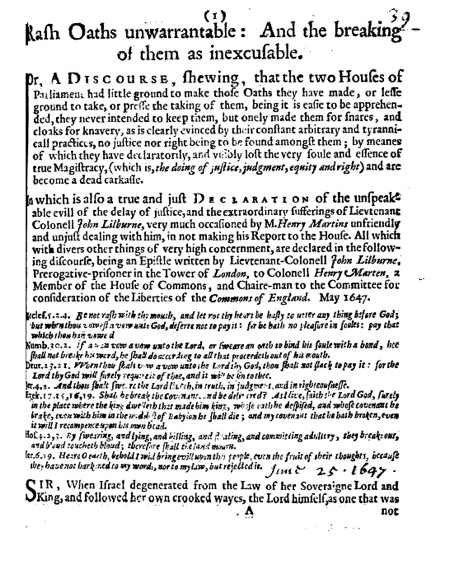
Rash Oaths unwarrantable: And the breaking of them as inexcusable. Or, A DISCOURSE, shewing, that the two Houses of Parliament had little ground to make those Oaths they have made, or lesse ground to take, or presse the taking of them, being it is easie to be apprehended, they never intended to keep them, but onely made them for snares, and cloaks for knavery, as is clearly evinced by their constant arbitrary and tyrannicall practices, no justice nor right being to be found amongst them; by meanes of which they have declaratorily, and visibly lost the very soule and essence of true Magistracy, (which is, the doing of justice, judgment, equity and right) and are become a dead carkasse. In which is also a true and just DECLARATION of the unspeakable evill of the delay of justice, and the extraordinary sufferings of Lievtenant Colonell John Lilburne, very much occasioned by M. Henry Martins unfriendly and unjust dealing with him, in not making his Report to the House. All which with divers other things of very high concernment, are declared in the following discourse, being an Epistle written by Lievtenant-Colonell John Lilburne, Prerogative-prisoner in the Tower of London, to Colonell Henry Marten, a Member of the House of Commons, and Chaire-man to the Committee for consideration of the Liberties of the Commons of England. May 1647.
Eccles. 5.2.4. Be not rash with thy mouth, and let not thy heart be hasty to utter any thing before God; but when thou vowest a vow unto God, deferre not to pay it: for he hath no pleasure in fooles: pay that which thou hast vowed
Numb. 30.2. If a man vow a vow unto the Lord, or sweare an oath to hind his soule with a bond, hee shall not breake his word, he shall do according to all that proceedeth out of his mouth.
Deut. 23.21. VVhen thou shalt vow a vow unto the Lord thy God, thou shalt not slack to pay it: for the Lord thy God will surely require it of thee, and it will be sin to thee.
Jer. 4.2. And thou shalt sweare the Lord liveth, in truth, in judgment, and in righteousnesse.
Ezek. 17.15,16,19. Shall he break the Covenant, and be delivered? As I live, saith the Lord God, surely in the place where the king dwelleth that made him king, whose oath he despised, and whose covenant he brake, even with him in the middest of Babylon he shall die; and my covenant that he hath broken, even it will I recompence upon his own head.
Hos. 4.2,3. By swearing, and lying, and killing, and stealing, and committing adultery, they breake out, and bloud toucheth bloud; therefore shall the land mourn.
Ier. 6.19. Heare O earth, behold I will bring evill upon this people, even the fruit of their thoughts, because they have not harkened to my words, nor to my law, but rejected it.
This tract contains the following parts:
- Rash Oaths unwarrantable
- To the right honourable and supreme Authority of this Nation, the Commons in Parliament assembled. The humble Petition of many thousands, carnestly desiring the glory of God, the freedome of the Common-wealth, and the peace of all men ("THat as no Civill Government is more just in the constitution, then that of Parliaments")
- To the honourable the Committee of Parliament sitting in the Queens Court at Westminster, Colonell Lee being Chaire-man (19 March, 1646)
- To the Right Honourrable, the Commons of ENGLAND assembled in PARLIAMENT. The humble Petition of divers well-affected Citizens ("THat as the oppressions of this Nation, in times fore-going this Parliament were so numerous and burthensome")
- TO THE RIGHT HONOVRABLE THE COMMONS OF ENGland assembled in Parliament. The Humble Petition of divers well affected people in and about the City of London. ("THat as the Authority of this Honourable House is intrusted by the people for remedie of their grievances")
- To the Right Honourable the Commons of England Assembled in Parliament. The humble Petition of many thousands of well affected People ("THat having seriously considered what an uncontrouled liberty hath generally been taken")
- The Armies Petition. TO HIS EXCELLENCY SIR THOMAS Fairfax, Generall for the Parliaments Forces. The humble Petition of the Officers and Soldiers of the Army under your Command ("THat ever since our first ingagement in the service for the preserving the power of this Kingdome in the hands of the Parliament")
- A Declaration of the Lords and Commons assembled in Parliament (30. March, 1647)
- Endnotes
Rash Oaths unwarrantable: And the breaking of them as inexcusable↩
[1]
SIR, When Israel degenerated from the Law of her Soveraigne Lord and King, and followed her own crooked wayes, the Lord himself, as one that was [2] not delighted in her destruction, but rather with her preservation, cries out again her, to make her ashamed of the evill of her wayes. How is the faithfull city become a harlot? it was full of judgement, righteousnesse lodged in it, but now murderers. Thy silver is became drosse, thy wine mixt with water. Thy Princes are rebellious and companions of theeves: every one loveth gifts, and followeth after rewards; they judge not the fatherlesse, neither doth the cause of the widdow come unto them. Therefore saith the Lord, the Lord of hosts, the mighty one of Israel, ah, I will ease me of my adversaries, and avenge me of my enemies, Isa. 1.21,22,23,24.
Sir, an enemy to you he is not, that shall cordially and heartily tell you of your faults, with a desire to reclaim you from the evill of your wayes by so doing, Psalm 141.5. which task though unpleasant in it selfe, he that never in his life knew how to flatter, nor play the hypocrite and dissembler, is urgently necessitated now for his own preservation, to undertake.
And therefore Sir, to give you your due and right, I must ingenuously acknowledge, that I have for a long time looked upon you, as one of the great pillars of the Liberties of the Commons of England, and your name amongst all just and unbiassed men, hath been extraordinary famous this present Parliament therefore, and for this you suffered an expulsion of the House, and a reproachfull and unjust imprisonment in the Tower of London, by the guilded men of the time who (you then discovered) carried two faces under one hood; & many moneths (if not some yeares) you continued an ejected person from your just place in the House: And since your re-admission again, have there in your Speeches behaved your selfe so gallantly for your Countrey, that your name and fame hath loud been spread abroad by it: Yea give me leave to tell you, that one of your own Members esteemed very honest, but by me too prudentiall; that is to say, too cowardly, and too much for himselfe and his selfish interest, in a time when a Northern tempest was likely to arise, told me in the Tower, that the true lovers of their Countrey in England were more beholden unto M. Henry Marten for his sincerity, uprightnesse, boldnesse and gallantry, then to halfe, if not all those that are called conscientious men in the House. And truly Sir, having had the happinesse (for so I esteemed it) often to be in your company, I have admired those gallant discourses for the Liberty of this Nation that have flowed from you so that when I first made my appeale to the House of Commons the 16. of June 1646. and heard that my businesse was referred to a Committee where M. Marten had the Chaire, I was not a little refreshed, being even where I would have wished and desired to be; thinking that you, of all the men in the House of Commons, would have been the most sensible of me and my condition: But must deale truly with you, I found it otherwise: For after, by the earnest sollicitation of my wife and friends, you and the Committee had examined my businesse,[3] and passed (as I was informed) gallant and excellent Votes upon it; but yet you (by your negligence and delay, if not wilfulnesse) exasperated the spirits of the House of Lords against me, and exposed me to their mercilesse fury and devouring indignation, by delaying my Report: And truly Sir, I must give this commendation of them, That the tender mercies of the House of Lords are cruelty: For, upon your examining my businesse, and not reporting it, they tooke courage to themselves, and lock'd me up most illegally, barbarously and tyrannically in New gate above three weeks close prisoner, from the society of my wife, children, or friends; and would neither suffer me to receive either meat, drink, money, nor any other necessaries, from the hands of my wife, maid, or friends; nor suffer my wife to come into the Prison-yard to speake with me before my Keepers out of my window; the story of which you may more fully read in the 23, 24, 25, 26, 27, 28, 29, 30. pages of my late printed Book called Londons Libertie in chaines discovered; and in my Speech before your selfe (at the Committee) now in print, and called An Anatomie of the Lords tyrannie, pag. 3, 4, 5, 6. and in the second Edition of the Outcries of oppressed Commons, pag. 21, 22, 23. All this while my wife and friends following you day by day, with all the importunity in the world, to beg and intreat of you to make my Report, for want of which I was likely to be destroyed by the devouring House of Lords; but you would not do it: so that in some sense I may complaine with Iob (in reference to you, and the rest of my timorous friends in the House) My kinsfolke have failed me, my familiar friends have forgotten me, and mine acquaintance are verily estranged from me, Job 19.13,14. which did hearten the tyrannicall House of Lords, further to go on with their cruelty and tyrannie towards me; and then upon the 11. of July 1646. at their Barre, past a most lawlesse, illegall, and unjust sentence against me, To pay foure thousand pound to the King, to be seven yeares a prisoner in the Tower of London, and for ever to be uncapable to beare any Office or Place in military or in civill government, in Church or Commonwealth, as more at large you may read in the Sentence it selfe, printed in the 30, 31, 32, 33, 34. pages of a little book called Vox Plebis: and what illegall cruelty and tyrannie I have since suffered and indured in my imprisonment in the Tower of London, even to the hazzard of my life and being, and the destruction of my wife and helplesse children, you may largely read in severall printed Books; as Liberty vindicated against Slavery, pag. 16, 17, 18, 19, 22, 23. Londons Liberty in chaines discovered, pag. 31, 32, 33, 34. Regall tyranny discovered, pag. 1, 47, 48, 49, 62, 63, to 78. but especially in my late Epistle to Col. West the Lievtenant of the Tower, called, The oppressed mans oppressions declared.
And after the fore-mentioned Sentence, being committed to the Tower, there to be kept onely in safe custody for seven yeares, as by the Warrant you [4] may read printed in Vox Plebis, pag. 34, 35. I was by the Lievtenant thereof with out ground or cause, most illegally divorced from the society of my wife, first by himselfe, who afterwards obtained by his owne solicitation, an Order for his indemnity from the Lords, the severity of which by him was executed upon me for above eleven weeks together, as by the fore-mentioned Books you may fully understand, and when by my wives Petition, and my owne, both of which you may read in the 65, 66, 67. 68, 69, 71, 72. pages of my Book called, Londons Liberty in chaines, I had obtained the just priviledge to be heard before a Committee appointed by the House of Commons on purpose, where you your selfe againe (to my then great refreshment) was in the Chaire, before whom I had two hearings upon two severall dayes, and I must ingenuously confesse, I had as faire and just play before you, as any man in England could desire, having free liberty, with out interruption, to speake whatsoever I in my owne understanding, conceived might be for my benefit and advantage, to your praise and honor, in that particular of your well doing I desire to speake it, and my last discourse then with you and the Committee, was so abundantly satisfactorie and well pleasing unto you that your selves by speciall order the 6. Novem. 1646. commanded me to bring it in unto you in writing, upon the 9. of Novem. next, which I accordingly did and since printed it, not doubting then but within fourteen daies after, I should have been a freeman, freely set at libertie as unjustly imprisoned, and against the good and knowne Law of England, for as high as this, if not higher, I have been informed was the result of the Committee then, and the temper of your House towards justice a thousand times better then now it is.
Sir, I must confesse, I desired you then upon some weighty reasons which gave you, to forbeare the Report foure or five daies, but when I see that thing fell not out according to my expectation, I sent immediately to you with all earnestnesse speedily to make my Report, and you gave those I sent to you very faire words, which truly I must tell you, would not fill the bellies of me, my wife nor children, nor procure us money to buy bread to doe it; whereupon having high thoughts of your honesty, and your gallant integrity to the love of the Liberties of the Commons of England, grounded (as I conceived) upon a good foundation, and backed with high and resolved resolutions, I did not onely with all the honourable respect I could, send my wife unto you, to beseech and intreat you, to be sensible of my trying condition, and to doe me and all the Commons of England (who were and are not a little concerned in me) that justice and right, as without further delay to make my Report to the House for me, but I also sent unto severall of my friends in the House and City, in the most candidest manner I could, that I knew had a familiar acquaintance with you, earnestly pressing them to improve all their interest in you, to get you to make my Report, [5] and when I could not prevaile with you that way, I writ a few importuning lines to you, and the like to others of my friends, which I knew were dear unto you, and when that would not doe, I sent some of your owne Countrey-men unto you, whose Commissioner and representer you are, to improve their utmost interest in you, and I also gave you a gentle touch or two in print of my great suffering by your neglect. Sir, in short, wanted I a wife, I should not I am confident of it, use so much wooing to the fairest and vertuest woman in England, though with a rich portion in Lands and money, to obtaine her for my wife, as I have done to you to make my Report, having (I protest it before the presence of God) left no just meanes (and others though I perish, I will never take) unattempted, that all the wits and braines I have could think of, to obtaine this peece of reasonable justice at your hands to make my Report for me to the House, which you are bound in duty, conscience, justice and honour to doe for mee long since, without one tenth part of that importunate solicitation, that I for the greatest part of a yeare together have used to you.
Sir, I pray remember the 29. Chap. of Magna Charta, which requires you not only to doe impartiall justice, but speedie justice without delay: the unrighteous Judge though at last he did justice, yet he is called the unrighteous Judge because he would not do it speedily, but suffered the poor widdow to pump and importune him for it; but say I to you, I wish my Judges were not worse then the unrighteous Judge.
But Sir, seeing it is to no purpose, I can no longer now forbeare, but must write you my mind to the purpose, cost it what it will, being now at present as carelesse of you, as you are and have been of me, and my long (but I will not say unsupportable) sufferings, though I might truly say it, if it were not that I had a full, faithfull, and soule-satisfying God, to rest and rely upon, and the distresses and hardly to be undergone portion of my wife and little infants: But Sir, I beseech you, give me leave, before I lansh into the deep, a little mildly to expostulate with you, in a friendly way before we fall out, and to demand this question of you, what I have said or done to you, to give you any tolerable cause to deale thus with me, as you have done, as by your delay of your duty to destroy me, and given me too just cause in reference to you, to say with David, Psal. 55.12,13,14. For it was not an enemy that reproached me, then I could have borne it: neither was it he that hated me, that did magnifie himself against me, then I would have hid my self from him; but it was thou, ah man, mine equall, my guide, and mine acqaintance, we took sweet counsell together: And truly Sir, the evill doings of a friend are the most piercing and wounding, and the least to be indured, and the most odious to God, and detestable amongst all rationall and gallant men, Jer. 9.4. to the 9. Ch. 12.6. and Ch. 20.10,11,12. But Sir, if you have nothing to lay to my charge in reference to your self, I desire to know if you have any thing to accuse me of in reference to the[6] publike, have I deerted my interest? or betraid the Liberties of my fellow Commons of England? or have I been sluggish, slothfull, or cowardly in mannaging the businesse I have in hand? or have I been impatient in my sufferings, & by my madness and folly destroyed my business? or given grounded advantage to my adversaries? If all or anie of these can be justly laid to my charge, I desire not to be spared.
But Sir, if you can say nothing against me by way of miscarriage to you in particular, or the publike in generall, then I pray you give me leave to demand of you this question, What have you to say for your selfe, that you have thus delayed to make my report, and thereby over and over, againe and againe have hazzarded my destruction and utter ruine, contrary to law, honesty, justice, reason and conscience?
If you should say, it is not seasonable, and that the temper of your House is such that to make it, it would do me nor the Kingdome no good, but rather a mischief, in hazzarding the confirmation of the Lords tyranny towards me by a vote of your House, whose spirits are extreamly exasperated against me above all men in England. To answer which, what do you else then hereby give me too just cause to say of your House, in which so many that professe honesty sit, though it bee but little demonstrative by their actions, that you are a corrupted and degenerated generation of men, that are fallen from doing of Justice to the executing of Tyranny, and from maintaining, defending, and protecting (according to your duty, and the end of your sitting where you do) the Lawes and Liberties of the Commons of England, to the betraying, subverting and destroying them, and so have all of you forfeited your trust, and your Parliamentary power, which (as you your selves say, 1. par. Book Decl. p. 150.) was given you to provide for the Peoples weales, but not for their woes, and have thereby absolutely absolved and discharged the people from all subjection to you, and given them cause that sent you, to call you home, and chuse honester men in your places, to call you to a strict accompt for all your tyranny, oppression and trechercy, and know what you have done with all their money; which they may justly (by your own arguments against the King) do: See the second Edition of the Outcries of oppressed Commons, p. 4, 5, 6, 7, 14, 15, 16, 17, 18.
And in case of disobedience from you to your trusters, and impowers the severall Shires, Countreyes, and Corporations that choose you, what do you else, then thereby give them cause to look upon you, as you have this foure or five years looked upon the King, and deale by you, as you have dealt with the King, even to wage war against you, for betrayers of your trust, which they and the whole Kingdome reposed in you, who are now degenerated from a just House of Parliament (the end of calling of which by the Law, is to redresse mischiefs and grievances that daily happen, 36. E. 3.10. but not to augment and wholly increase them) into a conspiracy and consederacy of lawlesse, unlimited, and unbounded [7] men, that have actually destroyed the Lawes and Liberties of England, and that will have no rule to walke by but their owne corrupted and bloody wills, and thereby have set up the highest Tyranny that can be set up in the world, against which, by your owne principles, the Kingdome may justly rise up in Armes as one man, and destroy all the fore-said conspirators without mercy or compassion, as a company of devouring Lions, ravening Wolves, and crafty Foxes, that would destroy the poore flocks of lambs, and sheep of this distressed Kingdome, the people and Inhabitants thereof; for take away Law (as the Parliament in a transcendent measure hath done) and deny us justice and right, as is constantly in a great measure done unto us by the Parliament: And what are we now better then the brute beasts of the field? the weakest of which are torne in pieces, devoured, and destroyed by the strongest, for remedies of which the Parliament against the King took up Armes, and when they had no Law of the Kingdome to warrant them in so doing, they make use of the law of nature and reason, and tell the King, Book Dec. 1 part pag. 207.
That this Law is as old as the Kingdome, that the Kingdome must not be without a meanes to preserve it selfe; but in which of our Statutes this is writ, I never yet could heare, see, nor read of, and am very sure it is no where but in their own Declarations, and ingraven in the heart of man as a principle of nature and reason, which as they very well and justly say, teacheth a man or Kingdome to preserve its selfe, 1 part Book Dec. pag. 84. 93, 94. 112, 123. 202. 465. 466. 726, 728. see 2. Edition of the Outcries, pag. 12, 13.
And if this Doctrine be true, as you avouch it is, then it will much more serve against your selves then the King, because the King is so fenced about with the Lawes of the Kingdome, that it is impossible for a man or Magistrate to bee more, and if you are but a betrusted power, impowered protempore, by the people, for no other end in the world, but to provide for their weale and happinesse, and to redresse their mischiefs and grievances unfortified at all, by the established knowne and declared Law of the Kingdome, degenerate from your trust, destroy their Liberties, and trades, overthrow their Lawes, and the Bounds that establish meum & tuum, and tyrannize over their persons ten times worse then ever the King did, or his wicked and evill Ministers of Justice, the Judges and Patentee Monopolizers, especially all of whom you cannot deny but he at the beginning of your Session surrendred up to you to be punished by you according to Law & Justice, which in them you extreamely perverted and tooke bribes, for the acquitting the capitallest of them, and otherwise made use of them to do more mischiefe since to the Common-wealth then ever they had done before, by assuring any thing for Law that you would propound to them, by meanes of which you with your wicked and unbounded Priviledges, have dared to exercise the absolutest [8] and grandest tyranny over the lives, liberties, trades, properties, and estates of the Freemen of England, that ever was, I dare positively aver it, since it was a Nation, governed by an established and declared Law, to your eternall and everlasting shame I speake it: so that truly, if the Freemen of England seriously look upon all your late publike, and to us visible actions, and compare them with their former enjoyments, they may justly take up Miach's lamentation and say with him to you, The good man is perished out of the earth, and there is none upright amongst you men: they (or you) all lie in waite for blood: they (or you) hunt every man his brother with a net: that they, or you, may do evill with both hands earnestly, the Prince asketh and the Judge asketh for a reward, and the great man he uttereth his mischievous desire, so they wrap it up, (therefore woe unto the Parliament, for) the best of them is as a briar, the most upright is sharper then a thorne hedge, the day of thy watchmen, and thy visitation cometh, now (with a vengeance) shall bee their perplexity; therefore, O all ye understanding Commons of England, in reference to your Parliament Trustees, trust ye not in a friend, put ye no confidence in a guide, for your enemies are the men of your owne House, Micah 7.2,3,4,5,6.
Therefore M. Martin, I professe it before you, and all the world, that were I rationally able, I would make no scruple of conscience to help forward with my sword in my hand, the distruction of every lawlesse, tyrannicall, treacherous man amongst you, that I should groundedly know to be a ring-leader in the fore-said transcendent vilenesse, then I should to help to destroy so many rats or devouring vermin; and by your owne fore-mentioned Principles, Declarations, Protestations, Oathes, Actions and doings, it will undeniably be justified to be lawfull for all the Commons of Englands to do the same towards you.
But now Sir, let us come to some particulars, in the first place the 29. Chap, and the most excellent Petition of right, which I call the English-mans legall treasure, doth clearly condemne all the practises amongst you, for they expressely say, that no Freeman shall be taken and imprisoned, or be disseized of his freehold or liberties, or free-customes, or be out-lawed, or exiled or any otherwise destroyed, nor we will not passe upon him nor condemne him, but by lawfull judgement of his Peers, (that is to say equalls, or men of his owne condition) or by the Law of the Land. We will sell to no man, we will not deny or defer to any man either iustice or right, and that no man be imprisoned without cause shewed, or expressed in his Warrant of Commitment, nor no man refused Habeas Corpus's for any cause whatever, nor no man taken by Petition, nor suggestion made to our Lord the King, nor his Counsell, unlesse it be by Indictment or Presentment of his good and lawfull People of the same neighbourhood where such deeds be done, (25. E. 3.4.) in due manner, or by Processe made by Writ Originall at the common Law; nor that none be put out of his Franchises, nor of his Free-holds, unlesse he be duly brought in to answer, and fore-judged of the same by the [9] course of the Law, and that no man hereafter be compelled to make or yeeld any guift, bond, benevolence, taxe, or such like charge, without common consent by Act of Parliament; Now compare your daily and hourly actions to those good, just, and unrepealed Laws, and blush for shame.
But to wipe all this off, you will it may be say the same, that is said in your Declaration of the 17 of Aprill 1645, Booke Decl. 2 part pag. 879. That the end of the Primitive institution of all government, is the safty and weale of the people, which is above all Lawes, and therefore the Kingdome being imbroyled in warre, necessitated, nacessitie compells you to doe many actions contrary to the knowne Lawes of the Land, without the doing of which actions, wanting the puntillo of the Kings consent, you could not save your selves, nor the kingdome, will admit all this for a truth, I pray then why doe you impose such illegall, devilsh, impossible to be kept, contradicting Oaths, and Covenants, upon all the Freemen of England? upon such sever penalties that all men must be disfranchised or destroyed that will not take them, and in them without any provisoes, cautions, limitations, or declared exceptions, and reservation, tye them to maintaine the Law of the Land, and the lawfull rightes and liberties of the Subjects of England, is not this to force men to sweare to contradict and oppose to the death all your actions, and to destory you for doing those actions, because they are contrary to the Law, and Liberties of England? O yee, forsworne men, for so I may call you all, that have taken these illegall, damnable, hellish, and soule insnaring Oaths, because ye do your selves, and suffer to be done daily, such things as tends to the absolute distruction of the Lawes, and the lawfull Liberties of the freemen of England, which by all these Oaths you have sworne to maintaine and defend, with all your might, and yet there is not one just, nor righteous man amongst you, that dare avowedly and publiquely, to the whole Kingdom protest against all the rest, but by parsilent patient and constant seting there owne approve of all their actions: O ye unworthy forsworne men in the highest degree, for this may too justly be the stile, and title of all, and every one of you without exceptions, in the condition of the visablest best of whom, for Millions of Gold I would not be, for if perjuries, swearings, and false swearings be so odious, abominable, and detestable unto God as in Scripture he declares they are, read Exod 20.7. Lev. 19.11.12 Num. 30.2. Deut. 23.21.22.23. Psal. 15.4. Eccl. 5.4.5. Ezek. 17.13.14.15.16.17.18.19. Jer. 24.10, Zek. 5.3.4.9.8.16.17.
Then woe, woe, and vengance upon earth is your undoubted portion, it and everlasting woe, and indignation in the world to come.
[10]
But that I may not be sentenced for rashnes in saying this which is not in your Oaths, and Covenants, I will site your owne words, and leave them to your judgement to passe sentence upon them.
First, in your Protestation of the 5 of May 1641, I find you sweare in these words, To maintaine and defend the lawfull Rights and Liberties of the Subject, and every person that maketh this Protestation, in whatsoever he shall doe in the lawfull pursuance of the same.
And secondly, in your Vow and Covenant, which you commanded to be taken throughout the whole Kingdome, You vow in the presence of Almighty God the Searcher of all hearts that you doe in your Conscience beleeve, that the forces raised by the two Houses of Parliament, are raised and continue for their just defence, and for the defence of the true Protestant Religion, (which what that is I thinke never a one of your selves knowes,) And Lawes and Liberties of the Subject, against the Forces raised by the King and a little below you all that tooke that Oath, declare, vow, and covenant, to assist all persons that shall take this Oath, in what they shall doe in pursuance thereof and if so, then I aver it for a truth, that all the men of England that have taken this Oath, are bound to assist me, or any other whatsoever that shall oppose the Lords and Commons sitting at VVestminster, for their apparant indeavoring the distruction of the Liberties of the Subject.
And in the third place, in the preamble to the League and Covenant, fram'd in Scotland, and most basely, illegally, and unjustly, obtruded upon England, and the Freemen thereof, with an unsupportable penalty, I find that amongst the things, the Fraimers of it had before their eyes, this is one, viz.
The true publique Liberty, safety and Peace of the Kingdome, wherein every ones private condition is included, And in the third Article of the Covenant, you and all those that took it, sweare sencerely, really, and constantly, in your severall conditions, to endeavour with your estates and lives, mutually to preserue the Rights and Privileges of the Parliament; and the leiberties of the Kingdome, and I am sure the Parliament hath often declared (though in action; they have visablely denied it) that they have no Privileges for the destruction of the Kingdome, but for the preservation of it, nor no Privileges for the over-throwing of good and wholsome Lawes, but [11] for the defending and preseruing of them, nor no Privileges for the trampling under their feet the Liberties of the Kingdome, but to maintaine them in their luster and glory, and what they are, you may in part read before, and in your owne Declaration.
First part booke Decl. page 6. 7. 38. 39. 77. 123. 201. 202. 209. 277. 278. 458. 459. 548. 660. 720. 845. see the second edition of the out-cryes of oppressed Commons. page 8.
I shall give you but one notable instance, of the most rememberable Vengence of God upon the Hungarians for breaking and violating their Faith and Covenant, made with the Turke, and it is in the Turkish History made of the Life of Amurath the second, the sixt King of the Turkes: In which History the fourth edition, printed by Adam Islip, 1631, I read that the Hungarians, were much distressed by inrods and spoyles made by the said Amurath, whereupon the States and great men of Hungary chused Vladislaus King of Polonia, for their King, and Captaine Generall, and he made that, famous man Huniades his Generall in Transliluania, who obtained severall most notable Victories against the Turkes as you may read in the foresaid History folio 267. 269. 273. 277. one of which is extraordinary remarkable; that Huniades with 15000. fought a pitcht-field with about 80000. Turkes and after five houres there fell a feirce and bloody fight, totally overthrew the Turkes by [Editor: illegible word] dint of sword, and just about that time Scanderbeg that famous Warrier, and wonder of his age for gallant achevements, revolted from the Turke, which with his great losses be the valiant Hungarians, so terrified old Amurath, that in a very great feare of himselfe and his Kingdome, he made a peace, (to his owne particuler great losse,) for ten yeares with the Hungarians, the capulations whereof were, First, that Amurath withdraw all his forces and garrisons, should clearely depart out of Seruia, and restore the same unto the possession of George the late Dispot, the right Lord and Owner thereof. (then in armes and confideracy with the Hungarians) Delivering also freely unto him his two sonnes Stephen and George, who was bereft of their sight, he had long time keept in straite prison. Also, that from henceforth he should make no claime unto the Kingdome of Moldavia, nor to that part of Bulgaria, which he had in the late Warres lost, And finally, that he should not invate nor molest the Hungarians, nor any part of the kingdome, during the whole time of that peace, and to paie 40000. Duckats for the Ransome of Carambey one of his Generalls, which conditions by solome Oath were confirmed, King, Vladislaus taking his Oath upon the Holy Evanglets, and Amurath (by his Ambassoders) upon their Turkish Alcoron,[12] inviolable to observe the ten yeares peace, and Amurath forthwith faith fully performed those things that he was presently to doe, follo 292. but by the perswadtion of divers Princes, but especially of Iulian the Cardinall, the Popes Legat, who in his large and set speech in a full convention, urged that against a perfidious enemie, (as the Turke was) it is lawfull for a man to use all cunning, force and deceit, deluding craft with craft, and fraud with fraud, and saith he, by craft the Turke first passed into Europe, and by little and little he crept into that Kingdome, and never kept faith with any. It is sometimes lawfull for the common-weale sake, neither to stand to our Leauges, neither to keepe our faith with them that be themselves faithlesse; lawfull saith he it is to breake unlawfull Oaths, especially such as are thought to be against right reason, and equitie, therefore saith he make no conscince of the League you made with the Infidell, upon which the King Vladislaus condescended to be absolved by the Cardinall, from his Oath and Covenant, and prepaires for wars against the Turkes, and the Turke with his army met him, and pitched battle within Arvarna, that fatall place to the Hungarians, and when the battle came close to be joyned, it was cleare of the Christians sides, who had put to flight both the wings of the Turkish armie, insomuch that Amurath dismayed with the flight of his Souldiers, was about to have fled himselfe cut of the maine battle, had he not bin stayed by a common souldier, who laying hands upon the raines of his bridle stayed him by force, and sharply reproved him for cowardize: And Amurath seeing the great slaughter of his men, and all brought into extreame danger, beholding the picture of the crucifix in the displayed ensignes of the voluntarie Christians, pluckt the writing out of his bosome, wherein the League was comprised, and holding it up in his hand with his eyes cast up to Heaven, said.
Behold thou crucified Christ, this is the League thy Christians in thy name made with me, which they have without cause violared. Now if thou be a God, as they say thou art, and as we dreame, revenge the wrong now done unto thy Name, and me, and shew thy power upon thy perjurious people, who in their deeds deny thee their God. Whereupon there began a most cruell and feirce fight, the successe of which within alittle while wholy fell to the Turkes, who having slaine King Vladislaus, and discomforted his Army, Huniades that most valiant Captaine was forced to fly for his life, and it is observable, that in this battle were destroyed all the chiefe Authors and Actours (yea Iulian himselfe) in breaking the Oath, Covenant, and League, they had made with the Turke, Folio 297. 298. which overthrow proved a fatall and dismall blow to the Hungarians, which may be a good warning to all men in the world, [13] not rashly to enter into an Oath or Covenant, but delibrately, and with a resolved resolution enviolably to keepe and observe it, which is impossible for any man breathing to do yours.
For first I read in the 1 Eliz. Chapter 1 that all and every Arch-Bishop, Bishop, and all and every other Ecclesiasticall Person, and other Ecclesiasticall Officer, and Minister, of what estate, dignity preheminence, or degree, soever he or thay be, or shall be, and all and every temporall Judge, Justice, Mayor, and other lay or temporall Officer, and Minister, and every other person having your highnesse sees or wagges within this Realme, or any your Highnesse Dominions &c. shall take that Oath following, viz.
THat the King is the onely supreme Governour of this Realme, and of all other his Highnesse Dominions and Countries, as well in all Spirituall or Ecclesiasticall things or causes, as Temporall.
And a little below all that takes it (which all you Parliament men) must and ought to doe, or else you cannot sit, as by the Statute of the 5 Elz. 1. appeares, sweares and promises, that from henceforth I shall beare faith and true Alleagence to the Kings Highnesse, his Heires, and lawfull Successors, and to my power shall assist and defend all jurisdictions, priviledges, prehemanencies, and authorities, granted or belonging to the Kings Highnesse, his Heires, and Successors, vnited and annexed to the imperiall Crowne of this Realme.
And by the Oath of Allegiance inacted the 3 of Jam. chapter 4. which principally and originally was made for Popish Recusants to take and for such men of England as traviled beyond the Seas to serve any Forraigne State, or Prince, though of late yeares as I am informed, imposed upon all Members of Parliament before they are admitted to sit there, in which Oath, you and every one that takes it, sweares and declares in your Conscience before God and the World▪ that our Soveraigne Lord King Charles is lawfull and rightfull King of this Realme, and of all other his Majesties Dominions and Countries, and that the Pope, neither of himselfe, nor by any Authority of the Church on Sea of Rome, or by any other [14] meanes with any other, (marke the last clause well) hath any power or authoritie to despose the King, or to dispose any of his Majesties kingdomes or dommious, or to authorise any Forraigne Prince to invade or annoy him, or his countries, or to give lisceuce or leave to any of them to beare Armes, raise Tumults, or to offer any violence or hurt to his Majesties Royall Person, State, or Government, or to any of his Majesties Subjects within his Dominions.
And a little below, he that takes that Oath sweares, I will beare Faith and true Allegiance to his Majestie, his Heires, and Successors, and him, and them will, defend to the uttermost of my power, against all conspiracies and attempts whatsoever, (marke the word whatseover) which shall be made against his or their Persons, their Crowne and Dignitie, by reason or colour of any such Sentence or Declaration, or otherwise, (make the word otherwise well,) and will doe to my best endeavour to disclose or make knowne unto his Majesty, his Heires, and Successors, all treasons and treacherous conspiricies, which I shall know or heare of, to be against him or them, And below the Oath saith, I do beleeve, and in conscience am resolucd, that neither the Pope, nor any person whatsoever, (note the foure last words well) hath power to absolue me of this Oath, nor any part thereof, which I acknowledge by good and full authoritie to be lawfully ministred unto me, and doe renounce all Pardons and Dispensations to the contrary, and all these things I do plainly & sincerely acknowledge and sweare, according to these expresse words by me spoken according to the plaine and common sence, and understanding of the same words, without any equevocation, or menthall evation, or secret reseruation, whatsoever: And I doe make this recogniction and acknowledgemeni heartily, willingly and truly, upon the true faith of a Christian. So helpe me God, And adde unto these your fore-mentioned Covenants, and upon them all I conclude it is impossible for any man breathing to keepe them.
Now Sir, set aside the evill ingredients of these two Legall or Statute Oaths fore-mentioned, which were easie in my judgement to be evinsed, especially that clause of the Oath of Supreamicy, recorded 1 Eliz. 1 the expresse words of which are, That the King is the onely Supreme Governour of this Realme, and of all other his Highnesse Dominions and Countries, as well in all Spirituall or Ecclesiastiall things or causes, as Temporall.
To say nothing of the Temporal part of it, I will desire you to satisfie me in two or three things of the Spirituall.
First, whether or no Jesus Christ, by God the Father was not appointed [15] to be the perfect Law-maker, and Law-giver, unto his visible Church on earth under the Gospell? and so to settle it, that there should be no roome at all left for Kings, Parliaments, or any other power on earth to adde to, or detract from what he by the eternally and everlasting assigament of his Father was to doe in that particuler?
Secondly, whether or no he hath beene faithfull in executing fully the will of his Father in this particuler?
Thirdly, whether or no, to deny his faithfulnesse, or to set up in the Spirituall Church, House, or City of Jesus Christ; the dictats, lawes, or injuntions, or commands of Kings, Parliaments, or any other earthly power whatsoever be not an absolut denyall of the faithfulnesse of Jesus Christ, a calling the Scripturea lie, and false thing and a Declaration that he that we owne of our annointed Mesias or Seviour is a Theese Deluder, and false Prophet, and not the true reall and great Prophet, professed of old to be sent into the world, as the Atoner of man unto God, the King of Saints, as well as the King of Kings, unto whom all power in Heaven and Earth was to be committed, to make absolute, perfect, sperituall Lawes. unalterable, unchangable, by any King, Parliament, or Potentats whatsoever?
Fourthly, whether there can be greater treason committed on earth, by man against Jesus Christ, then to disclaime and renounce him and his absolut Kingship? by swearing that either the Pope, or any King, Parliament, or Potentats, are the head, or onely supreame Governour in their severall Kingdomes Dominions, or Jurisdictions, in all Sperituall or Ecclesiasticall things or causes?
Lastly, whether Kings, Parliaments, and Magestraites, as Kings, Parliaments, and Magestrates, have any thing at all to doe with the Sperituall House, City, or Church of Christ on earth? and whether that if any of them clame any interest, power, or authority, in the Church of Christ, it be not by vertue of their Saintship? not Kingship, and whether or not the worship and service of the soule, spirit, or inward renewed man, be not the absolute alone and onely right of God? and as much his single due without compettitors, as the obedience and subjection of the body, outward man, and estate is the right and due of Caesar, Kings, Parliaments, or Potentats?
But Sir to returne back againe unto the Oath; I beseech you let me aske you, whether are not those men forsworne that have taken the formentioned [16] Oaths, and then within a little while after give men commissions to fight with, kill and slay the very same man they had so sworne unto, for the tenor of the Earle of Essex Commission was to kill and slay all those that opposed him, and in the head of that Army who opposed him was the King, who was as possibly to have been killed in the battle as any other in the Army. Nay Sir, is it not the highest of contradictions, that when you have authorized men three or foure yeares to fight against the King and have taken him prisoner and so keep him, yet you shall force men, (although they be freely chosen by their Country before you will admit them to set in your house,) to take the fore recited Oaths to be true to the King: truely for my part the Oaths to me are so notablely penned, that I know not with what evasions or distinctions, you, or any of you that have taken the said Oaths, are able rationally to free your selves, (considering your actions) from being forsworne and perjured if a man may so call it befor conviction. I pray you Sir, give me leave here to recite your late negative Oath, and so whether it be not point blank against the Oaths of Allegience and Supremisie, before recited, the negitive Oath begins thus,
I A. B. do sweare from my heart, that I will not directly nor indirectly adheare unto or willingly assist the King in this Warre or in this cause against the Parliament, nor any forces raised against the two Houses of Parliament in this Cause or Warre, and I do likewise sweare that my comming and submitting my selfe under the power and protection of the Parliament, is with any manner of designe whatsoever, to the prejudice or proceeding of this present Parliament, and without the direction, privity, and advise of the King, or any of his counsell or Officers other then what I have now made knowne, so helpe me God, and the contents of this Booke.
This is the Oath that all the Cavaliers take (or by your orders ought to take.) before they can make their composition, therfor I pray you let me aske you these question.
First, whether or no this Oath called the Negative Oath, be not absolutly point blanke opposit against the Oaths called the Oaths of Suppremisie and Allegience?
Secondly, whether or no, are not all those Cavaliers that take this Negative Oath that have taken the two former absolutly forsworne and perjured, [17] and what trust or confidence is to be put in perjured Persons, I leave you to judge;
Thirdly, Whether or no, are not the Parliament it self the maine instruments of these mens perjury, in forcing many times this negative Oath and others upon them against their wills, mindes, and consciences, and so for any thing they know, send them headlong to the devill, which is one of the most wickedest actions in the world:
Now Sir to conclude this point; I would faine in the third place know, how it is possible for any of you to swaer in truth, in judgement, and in righteousnesse, as you ought. Iere. 4.2. When you take or make Oaths by formes, the ingredients of which admits in your own understandings of various interpretations, so that you are but in a doubting condition, whether that sense you take it be the true sense, or no? and so hereby the end of an Oath is frustrate in you, for by Gods appointment, it ought to be the end of all controvercy and strife. Heb. 6.16. but to you these Oaths are but the beginning of them, and so in that preticular alone altogether unlawfull.
Fourthly, Seeing Iesus Christ in the fist of Matth. 34.35,36,37. expresly saith, Sware not at all, neither by heaven, for it is Gods throne; nor by the earth, for it is his foot-stool; neither by Hierusalem, for it is the city of the great King. Neither shalt thou swear by thy head, because thou canst not make one haire white or black. But let your communication be yea, yea, nay, nay; for whatsoever is more then these, commeth of evill. and the Apostle Iames, chap. 5 12. saith, but above all things my brethren, sware not neither by heaven, neither by the earth, neither by any other Oath: but let your yea, be yea; and your nay, nay; lest ye fall into condemnation.
And seeing that in all the New Testament, there is not the least rule at all, for any that professe the fear of God, to forsware at all, in any case whatsoever, unlesse it be, that a ground for swearing can be fetched from that of the sixth of the Hebrewes. 16. which if it can, it is but in one case only, namely, for confirmation of that truth which a man delivers for the ending of all strife, as I conceive betwixt party, and party, but that which a man swears, he must be sure of it, and that hee knowes it in his own knowledge to be true, or else hee sweares not as God requires, as before is truly observed.
[18]
Now Sir, these things premised and seriously considered, I desire to know of you, from whence you, or any Parliament upon earth fetcheth and derives your Power, Ground, or Authority, to make and impose such formes of Oathes, as the Oathes of Supremacy and Allegiance are? or the Oathes of your Vowes and Covenants before mentioned are? that have not only so many dubious things in every one of them, but also are expresly against the positive command of Christ, the Anointed King of Saints as well as King of kings, and by whom Kings rule; for my part I protest it freely before the God of heaven and earth, I think it as lawful for me to cut mine own throat, as to take all or any of your fore nentioned unwarrantable Oathes, for he that hath said, Thou shalt not kill. hath also said, thou shalt not in that manner swear. And I would fain know of you, what confidence the Parliament upon sollid grounds, can put upon any men in England that are so ready and willing to swallow your oathes? that now are become nothing else but cloaks of knavery, and breeders of strife and mischief? therefore for shame say them all down and presse them no more upon any man whatsoever for he that consciensiously maks nothing of an Oath, will make as little of breaking his Oath whensoever it shall make for his profit, ease or preferment, whereas to him that conscienciously scruples an Oath, his bare word, promise, or ingagement, is the sencerest tye in the world, which he would not willingly violate for all the earth.
But Sir, to return to your forementioned grand Objection, That your Houses are not in a temper to hear my report and to do me justice upon it, I pray Sir what is the reason of it? Is it because there is a Faction of great men in it that hates my person? and therefore though my cause be never so just, yet they will do me no right? and if so, then I tell you plainly without fear they are a company of Factious knaves, and not a company of righteous Judges, who ought in judgement to be so impartial that they should not regard or respect persons, but the justnesse of their cause.
Or Secondly, it is because I have not the Law of the Land sufficiently on my side, and if so, it is the easier judged against me, but why did you receive and approve of my appeple to your house at first, but know Sir, that although I be no Lawyer, yet I dare throw the gantlet to all the Lawyers in England; and against them all before any Legall Barre in England will plead my own cause my selfe, and justifie and prove the Lords proceedings with me, to be point blanke against the good, old, and unrepealed [19] Law of England; and this I will do at my at most, perrell, yea let the Lords (in the front) put their lying Champion William Prinn, the basest and lyingest of men who in less then eight lines, hath told and printed twelve or thirteene notorious lyes against me, see Inocencie and truth justified, page 4. 5. 6. and hath such a firey zeale to my distruction that in his late booke called, The Sword of Christian Majestracy supported, hee would have the two Houses without Law, by the power of their owne wills to hang me, for no other cause in the world, but for being zealous and couragious in standing for the Laws and Liberties of England: which you and he have sworne, vowed, and covenanted, to maintaine, preserve, and defend, and for which you have shed (at least in pretence) so much English blood Oh brave Prinn! a fit man indeed to be a Privy-Counseller to the great Turke. whose will is his Law.
Or in the third place, it is because the Lords are so great that you dare not do me justice and right? for feare of displeasing them, and if so, why doe you not tell the Kingdome so (for it is not a little conserned in the contest betwixt the Lords and my self) that we may follow your former pattren, to know the names of them, among them that are enemies to our Liberties and just Freedome, and so indeavour to give them their just deserts: For I read in the 547 548. pages of the first part book Declaration, that upon a lamentable Petition of many thousands of pore people in and about the City of London, the House of Commons appoynted a conference with the Lords, where Mr. Hollis, whose actions demonstrats thereby his ambition is not to be lesse then a Duke, or a petty King, though not in title yet in power and domination one of the chiefest stickler then against the King, in the whole house, (and one of the chiefest Beginners, Causers, and Promoters of the by-past warres against the King) pressed the Lords at there Barre, to joyne with the house of Commons in their desire about the Militia, and further (with many expressions of the like nature) desired in words to this effect, that (if that desire of the House of Commons were not assented too) those Lords who were willing to concur in would find some means to make themselves knowne, that it might he knowne who were against them, and they might make it knowne to them who sent them: yea in page 557 ibim it is positively aver'd, that he required the names of all those of that House which would not discharge that they then called ther Kingdom, so the Juncto?? notable Declaration at Oxford, the ninteenth of March 1643. page 10. 11. 12. and Mr. Hollis his owne printed Speech, and if this fore recited practis were just then, it is also in the like case just now, yea and the rather[20] because our case is ten times worse now then it was then, and our Lawes and Liberties (principally by the House of Lords means, and their Arbitrary confederates in the House of Commons) are now a giving up (to the eyes of all rationall and knowing impartiall men) their last breath; yea, and verily there is but one step betwixt Us the Commons of England and perfect and absolute slavery, which I for my part had rather be hanged, if it were possible, ten thousand times over then indure; but Sir, remember that you in your excellent Declaration of the 19. May 1642. 1. part book Declaration. pag. 207. tell us, that this law is as old as the Kingdom, that the Kingdom must not be without a means to preserve it self; and I say by your own declared principles, that if you, our ordinary and legall means, will not preserve us, but rather destroy us, we may justly by extraordinary and rationall means preserve our selves, and destroy you our treacherous destroyers.
Or lastly, is it be cause your House hath already done the last Act of Justice that ever they intended to doe for the Commons of England, (there Impowerers, Lords, and Masters,) and therefore I cannot expect the making of my report: indeed Sir, I ingniously confesse unto you, I think this is the true reason indeed, though you do not in plain English words tell us as much, yet by your actions you undeniablely declare it; for truly many say that there is no Iustice nor right to be had at your hands; and for our Laws, they only serve you to destroy us at your pleasure, or to serve your ends, when your hot burning malice is incensed against us; which if they serve for your ends, they shall be your engines tu undoe us. But they do not in the least serve to defend or protect us against you, but when we should use them against any of you, as justly we may: See your own excellent Declaration of the 26. May 1642. 1 part book Declar. p. 278. Sir Ed. Cookes 4. part institut. chap. of the High Court of Parliament; they are esteemed and made by you of no more worth and strength, then Samsons green withes, with which he was bound, which at his pleasure he brook, as a thred of tow is broken, when it toucheth the fire. Iudg. 16.9.
As for instance by the 1. Eliz. cap. 2. it is inacted, That whosoever shall [21] not diligently and faithfully, having no lawfull or reasonable excuse to be absent, indeavouring themselves to resort to their Parish-Churches or Chappels accustomed, or upon reasonable let thereof, to some usuall place where Common Prayer, and such service of God (marke it well) shall be used, shalbe dealt with as is contained in the foresaid Statute, which Statute is confirmed by the stat of the 23, Eliz cap. 1. and the penalty increased, as there you may read, which Statutes are also confirmed by 29. Eliz. 6 & 35. Eliz. 1.3. Jam. 4. Now Sir, I pray you take notice that these and the like laws, doth not say, He that will not come to Church to hear Sermons, or Directory, but he that doth not come to some usuall place where Common Prayer, and such, (marke that) service of God shall be used, shall be punished so and so, as in 1. Eliz chap. 2 and by the 23. Eliz. chap 1. He that doth not repaire to some Church, Chappell, or usuall place of Common-Prayer, shall forfeit 20 l.a moneth, and be bound to his good behaviour, &c.
And the other Statutes all refer still, to the place where Common-prayer is used, see the Statute of Conventicles, being the 35▪ Eliz. chap. 1.
Now Sir the present Parliament having taken away the Common-Prayer, and set up a Directory, which these lawes never knew, nor mention; the sting of these Lawes are gone in that particular; for how can I in Iustice, be Indited for not comming to heare Common-Prayer, when the Parliament (that now exerciseth an absolute law-making, and regall power) will not suffer it, under severe penalties to be read or remain in being in Parish Churches.
And that the Parliament hath taken away Common prayer appears, by their printed Ordinance of the third of January 1644. and by their Ordinance of the twenty three of August 1645. Booke Declaration 2 Part, Folio 715. 716. yea in the last recited Ordinance, the Parliament ordaines, that the said Booke of Common-Prayer should not remaine, or be henceforth used in any Church, Chappel, or place of publick Worship within the Kingdom of England and Dominion of Wales, and that the Directory for publick Worship should be from thenceforth use, pursued and observed; And is further ordained there;
That if any Person or Persons whatsoever, shall at any time or times hereafter use, or cause the aforesaid Book of Common-Prayer to be used, in any Church, Chappell, or in any other publick place of Worship, or in any other private place or Family whatsoever within [22] the Kingdome of England, and Dominion of Wales, that then every free Person offending therein, shall for the first offence forfit the sum of 5. l.for the second offence the sum of ten pound, and for the third offence, shall suffer one whole yeares imprisonment, without baile or main prise.
And is it therefurther ordained, that all Common-Prayer Bookes remaining in Churches or Chappells, shall within a moneth after the pulishing of this Ordinance, be by the Church-Wardens, &c. under the penalty of forty shilling carried unto the Committes of the respective Countries, where they shall be found, to be disposed of as the Parliament shall direct.
And besides the Parliament by Order and Ordinance, hath not as yet to this day appointed any punishment at all, for men that doe not come to their parish Churches or Chapples to heare sermons, or the Directory, or that meet in privat houses, commonly called Convinticles: Therefore though I stay seven yeares from Church, and constantly meet in private houses, there is by the Parliaments principalls neither Law nor Ordinance in force for any Judge or Justices of the Peace to indict me or any other, or any otherwise to molest or trouble me.
And as for the Ordinance of the 26 of Aprill 1645 and the Order of the House of Commons, the 31 of December 1646 they onely declare they dislike and their intentions to proceed against all such persons as shall take upon them to preach, or expound the Scriptures in any Church or Chappell, or any other publike place, except they be ordained either here, or in some other reformed Churches, &c. but it saith not a word to any of those that heare them, or any that comes not to their parish Churches but meet in privat houses, neither doth it authorise any Judges, Justices of peace, or any other persons whatsoever, to punish those unordained preaching persons, but reserves the power of punishment to themselves, without declaring as yet what it is.
And yet notwithstanding all this, That all men that use the Common-Prayer, are liabell to the punishments before recited, multitudes of honest, godly consciencious persons well-affected men to the Parliament, & who have ventred al they have for its preservation, are continually indicted and punished by the Parliaments Judges and Justices of peace, for not comming to there Parish Churches to heare common prayer, for there are no other Statutes to authorise them to punish any for not comming to their parish Churches, but those very Common prayer Statutes, O brave Parliament Justice, what is this else but perfect iugling, or playing at Hocus pocus?
[23]
Sir, I beseech you let me aske you this question, if an Ordinance of Parliament be not as strongly valievd, and as forciable to take away a Law, as coutrary to the Law, to create and impower a Judge or Justice to execute a Law in force? and whether or no that Judge that is made by Ordinance of Parliament be not an absolute Murtherer, and a Contemner of the Parliaments authoritie. (in the opinion of all that hold the present Parliaments principalls,) if he shall take away a mans life, or otherwise punish him for transgressing of a Law, which the Parliament by Ordinance hath taken away, and I said a sever penalty upon any man that shall obserue or doe the thing injoyned and commanded by that Law? & how can a Judge in truth and righteousnesse sweare to execute the Law when hee hath not [Editor: illegible word] power in him, but is made by a power opposet to the Law, see the 27. Hen. 8.24.
In the second place by the Statutes of 1 Edw. 6 chap. 12. &. 39. Eliz. chap. 15. the stealing of Horses, Geldings, or Mares, and the fellonous taking away in the day time (as well as the night,) of any money, goods, or cattle, being of the value of five shillings, or upwards, in any dwelling house or houses, or any part thereof, or any out-house or out-houses be longing, and used to, and with any dwelling house or houses, although no person shall be in the said house or out-houses, at the time of such fellonie committed, shall in both cases loose the benifit of their Clergy, and die without Mercy.
And yet the present Parliament gives authority to divers persons; to doe both the forementioned things, that is to say, to take horses and goods away by force, against the wills and minds of the Owners, and that before they be legally convicted, of any crime, which although they sweare to maintaine the Law, yet this is absolutly against the Law, as Sir Edward Cooke there owne magnified author in his third part instituts chapter 103. folio 228. declares, which Booke is published by their own authority and command, and he there expressely saith, that regalarly the goods &c. of any Delinquent cannot be taken and seized to the Kings use, before the same be fofited.
Secondly, the same cannot be inuentoried, and the Towne charged therewith before the Owner be indicted of record.
And amongst other authorities, as Britton, Fleta, Bracton, &c. which he there makes use of, he sites the 1 Richard the third chapter 3. by which it is inacted and declared that neither Shriffe Escheater Bayliffe, [24] of franchise, or any other person take or seize the goods of any person arrested, or imprisoned for suspiton of fellony, before he be convicted or attaint of the fellony, according to the lawes of England, or before the goods be other wise lawfully forfeited upon paine to forfit double the value of the goods so taken to the party grieved.
From which and the other Authorities he there makes use of, he saith these two conclusions are manifestly proved.
First, that before indictment, the goods or other things of any Offender cannot be searched, inventored, or in any sort seized, nor after indictment seized, and removed, or taken away before conviction or attainder.
Secondly, that the begging of the goods or state of any Delinquent accused or indicted of any treason, fellony, or any other offence, before he be convicted and attainted, is utterly unlawfull, because before conviction and attainder, as hath been said, nothing is forfeited to the King, nor grantable by him: And besides it either maketh the prosecution against the Delinquent more principitate, violent, and undue, then the guiet and eqaall Proceeding of the Law and Justice would permit, or else by some under-hand compossition and agreement stop or hinder the due course of Justice, for examplary Punishment of the Offender.
And lastly, (saith he) when the Delinquent is begged, it dischargeth both Judge, Jurour, and Witnesse, to doe their duty.
And yet for all this, many times the Souldiers imployed by the Commanders of the Parliaments presents warre, are commanded and inioyned be their Commanders authorised thereunto by authoritie derived from the Parliament, to take away Horses goods, &c. for the supportation and preservation of the present forces, which it may be at that time were in great necessitie and danger, and the souldiers refusing in that particuler to obey his or there Commander might by the Articles of Warre made by Ordinance of Parliament hazard his life, yea and it may be actually hanged first, yet poore men when the Parliament have served their turnes of him or them, to pay him his Arreares, for all his hazards and dangers, hee is by their Judges and Ministers (made be the Parliament it[25] selfe) for the very fore-mentioned actions done in obedience to their commands, arraigned, indicted, and hanged as a fellon therefore; see the Marginall Notes of the second Apology of Sir Thomas Fairfax's Souldiers, (this is just as the builders of Noa's Arke were served) for (or after) their making it: Oh admirable Parliamentary Justice! worthy for their praise to be recorded to future Generations, as an everlasting memoriall of their unpresidented justice and gratitude; and yet if any particular man of the Parliament, or any of their vermine Catchpoles, have a spleen at a man, it is easie for him to get a Warrant from the Chaire-man of some particular private Committee, to go and search such a mans house that never professed enmity against the just proceedings of Parliament, and breake open his doors, and take away (at their pleasure) so many or much of his proper goods, as they please; Oh pure Justice! without spot or blemish!
Nay, any of their Catchpole Rogues or Caterpillars can forceably enter any freemans house, when none is in it, and load away divers Porters with his proper goods, and that without the seeming Authority of any Law or Statute, Order, or Ordinance of Parliament, nay without the Warrant of any private Committee, though in Law such a Committees Order is not worth one straw; yea, and when this is complained of to a Committee of Parliament, not one dram of justice can be had for it: And truly Sir, besides other instances of this, I will onely aver it to be lately my owne, for one of M. Corbets and Justice Whitakers Catchpoles (Whitaker the Bookseller in Pauls Church-yard London) did the very forementioned thing to me, of which I complained at my last being before a Committee of your House, but could not have one dram of Justice, though I pressed it hard; see the relation of it in print, called The resolved mans Resolution, pag. 12. 13.
Sir, I pray, is not this unspotted Justice? and yet, is it not as good as the generality of that which now adaies flowes from both Houses?
In the third place, by the Statute of the 27. Eliz. Chap. 2. it is inacted that all and every Jesuites, Seminary Priests, and other Priests whatsoever (marke the word whatsoever) made and ordained out of the Realme of England, or other her Highnesse Dominions, or within any of her Majesties Realmes, or Dominions, marke well the word within, by any Authority, Power or Jurisdiction, derived, challenged, or pretended from the See of Rome since the first yeare of her Reigne, shall within forty daies after the end of that Session of Parliament, depart out of the Kingdome, &c.
And be it further enacted, That it shall not be lawfull to or far any Jesuite, Seminary Priest, or other such Priest, Deacon, or religious or Ecclesiaslicall person whatsoever, being borne within this Realme, or any other her highnesse Dominions, and [26] heretofore since the said Feast of the nativity of S. John Baptist, in the first yeare of her Majesties Reigne, made, ordained, or professed or hereafter (marke the word hereafter) to be made, ordained, or professed by any Authority, or Jurisdiction, derived, challenged or pretended from the See of Rome, by or of what name, title or degree soever the same shall be called or known, to come into, be or remaine in anie part of this Realm, &c. (mark the last sentence well) after the end of forty daies, otherwise then in such speciall cases, and upon such speciall occasions onely, and for such time only as is expressed in this Act: and if he doe, that then every such offence shall be taken and adjudged to be high Treason, and every person so offending, shall for his offence be judged a Traytor, and shall suffer losse, and forfeit as in case of high Treason.
And it is there further enacted, That whosoever shall wittingly or willingly receive, relieve, comfort, aid or maintaine any such person before-mentioned, being at liberty out of prison, knowing him to be such as before is expressed, shall also for such offence be adjudged a fellon, without benefit of Clergie, and suffer death, lose and forfeits, as in case of one attainted of Fellony.
And this Parliament hath made a solemne League and Covenant, and voted, that no man shall sit in Parliament without taking it, nor no man beare any Office without taking it, and you have voted, and in severall places made the Freemen of England uncapable to give a voice to choose an Officer, if they will not take it; in the second Article of which unjust, unrighteous and wicked contradicting Covenant, all those that take it, sweare to extirpate Popery, 1 part Book Deel. fol. 425. and yet notwithstanding the Judges and Justices of peace made by the present Parliament, force the Freemen of England against their wills and minds, and the Allegation of the fore-mentioned Law and Covenant, to pay Tythes (the root and support of Popery) to a generation of new upstart Romish Priests, (or Synodian Sion Colledge Jure divino men) that have no other Authority and Power to stand by in their function of Presbyterie, but what they challenge and derive from Rome, having alreadie avowedly in print renounced and scorned any Jurisdiction, either from the Parliament, or the people of their Parishes, by vertue of which their owne avowed claime, they are ipso facto, within the lash and reach of the fore-mentioned Statute, and may by any Freeman of England be indicted at the Assizes or Sessions, for Traytors, and ought without mercy (by the strength of that Law) to suffer as Traytors; and all those that pay Tythes or otherwise maintaine them, after they know they have renounced the deriving of their Power and Jurisdiction from the Parliament, and challenge it Jure divino, derivitive from the Pope, may be indicted as Fellons, and ought to die as Fellons.
Now Sir, is it not a piece of gallant justice in the Parliaments Judges, Justices, and illegall Committee-men? to put freemens persons in prison without Baile or Maineprize, and to plunder (and I think I may say rob) divers of them [27] of their goods and cattels, for refusing to support Popery (after they have sworne to extirpate it) by paying of Tythes to a company of Popish Presbyterian Priests, that scorne to derive any power from the people of their Parishes, and have already publikely and avowedly renounced the Parliaments Power and Authority, and doe actually and really claime and assume unto themselves an Ecclesiasticall or Clergie Authority derivitive from Rome.
Fourthly the Law of England hath provided an universall remedy, for all the men of England to recover their debts by, from those that are indebted to them, the benefit of which Law, the present Parliament both doe and will injoy, and at their pleasure will sue anie freeman in England that is not one of themselves, but are so fortified with their big swolne priviledges, that no man shall dare to meddle either with their persons or estates, though they owe never so much, and yet divers of them will neither (of themselves) pay use nor principall, although originally the exemption of their persons from Arrests be not a priviledge given them for themselves in reference to their particulars, but for the good of the Kingdome and People that choose them, that so by the malice of any prerogative man, or enemy to the just Libertie of the Commons of England, they might not by malicious Arrests be molested, troubled diverted or hindered, for doing their Countrey faithfull service in the place they had chosen them unto: But when this priviledge was first given them, (which in its selfe is just in its institution, though now by the present Parliament-men abused in its execution, it remained in them but for certaine weeks, for then Parliaments were very short, being by the ancient and just unrepealed Law of the Land, to be chosen once every year or oftner if need required, 4. E. 3.14. & 36. E. 3.10. it being impossible to be conceived that ever they thought then, that any Parliament in England should remaine seven years to the cheating, cozening, and devouring of particular multitudes of men of their particular debts, which now are likely by some Parliament-men, to be so long owing them, that they will not be claimable or recoverable by Law, when this Parliament is ended, which by its long sitting is, and is more evidently like to be the greatest subversion of Englands Lawes, Liberties, and Freedomes, of any thing that ever was done in England: King Charles his seventeen years mis-government before this Parliament (as you in your Declarations call it) was but a flea-biting, or as a mouldhill to a mountain, in comparison of what this everlasting Parliament already is, and will be to the whole Kingdome, and therefore I say, and will maintaine it upon the losse of my life, that the Commons of England may bid adieu to their Lawes, Liberties, Freedomes, Trades and Properties, unlesse they speedily take a course for the electing of a new Parliament, for the Members of this Parliament (many of them to my knowledge) judge themselves subject to no rule, nor to be governed by any law, but say, [28] that they are above Magna Charta, and the most excellent Petition of Right, and may abolish them, although there be divers things in them so founded upon the principles of pure reason, (which by the fundamentall Maximes of the Law are unalterable, Doctor and Student, Ch. 2. fol. 4, 5. see Innocency and truth justified, p. 62.) and the Morall Law of God, that it is impossible for any power whatsoever to abolish them, that is not greater then God, or hath not derived a just power from him to dispence with his unchangeable Lawes, one of which is, That Justice shall never be sold▪ nor impartially administred, which is with other most excellent, rationall and unalterable things ratified expressely, in the 29. Ch. of Magna Charta, besides all the rest of most excellent things in those two Lawes confirmed, many of which are of universall concernment to all the sons of men, under any just Government in the world: and as for those things contained in them, that are rationally in processe of time upon just experimentall grounds alterable, and changeable, if you will give us better in their places, doe when you will, without the doing of which by your own grounds and principles, you cannot justly change them, being impowered and chosen by us to provide for our weale, but not for our woe, to provide for our better being, but not for our worse being. 1 part Book Dec. p. 150.
Againe, fifthly, the Law of England hath provided, That whosoever breaks the peace shall be punished, or whosoever layes violent hands upon a man, and if any man doe it to a Parliament-man he will trounce him for it, but they themselves can breake the peace, and lay violent hands without cause upon the Freemen of England, and then make what lying reports to the House they please, and get their bodies committed to prison, and that without hearing them, and all this did M. Hollis and Sir Walter Earl the other day to Major Tuliday.
Againe, sixthly, you your selves have declared, that you have received Petitions for the removall of things established by Law, and (say you) we must say, that all that know what belongeth to the course and practice of Parliament will say, that we ought so to doe, and that our Predecessors and his Majesties Ancestors have constantly done it, there being no other place wherein Lawes that by experience may be found grievous and burthensome can be altered or repealed, and there being no other due and legall way, wherein they which are aggrieved by them can seeke redresse; 1 part Book Dec. p. 720. Yea, and in severall of your Declarations you have defended and maintained, that the concourse of people at Westminster to deliver and waite for answer to their Petitions is both just and lawfull, 1 part Booke Dec. p. 123. 201. 209.
And yet now of late you are growne to that passe, that you reject and will not receive Petitions if they crosse your humours, although they be for nothing but the obtaining Justice, according to the just and unrepealed long practised Law [29] of England, and this was the case of the honest Buckinghamshire and Hartfordshire men in their late Petition: see the scond Edition of the Outcries of oppressed Commons, p. 9, 10, 11, 12.
Yea, and when divers honest Citizens of London, and as firme friends to you in the day of your straits as any was in England, were about a Petition for the redresse of divers things amisse, and the establishment of their just Lawes and Liberties, for which divers of them by your command, have freely ventured their lives: the Petition by one of your informing Catchpoles, was stollen out of M. Thomas Lamb's house, and by M. Glyn Recorder of London, and one of your owne Members brought into your House, and there in a great heat voted (as I am informed) a seditious paper, which whether it be so or no, let the world judge by the copie of it, which thus followeth.
To the right honourable and supreme Authority of this Nation, the Commons in PARLIAMENT assembled.↩
The humble Petition of many thousands, carnestly desiring the glory of God, the freedome of the Common-wealth, and the peace of all men.
Sheweth,
THat as no Civill Government is more just in the constitution, then that of Parliaments, having its foundation in the free choice of the people; and as the end of all Government is the safetie and freedome of the governed, even so the people of this Nation in all times have manifested most heartie affections into Parliaments as the most proper remedie of their grievances; yet such hath been the wicked policies of those who from time to time have endeavoured to bring this Nation into bondage; that they have in all times either by the disuse or abuse of Parliaments deprived the people of their hopes: For testimony whereof the late times foregoing this Parliament will sadly witnesse, when it was not onely made a crime to mention a Parliament, but either the pretended negative voice, (the most destructive to freedome) or a speedie dissolution, blasted the fruit and benefit thereof, whilst the whole Land was overspread with all kinds of oppressions and tyranny, extending both to soule and body, and that in so rooted and setled a way, that the complaints of the people in generall witnessed, that they would have given any thing in the world for one six moneths freedome of Parliament. Which hath been since evidenced in their instant & constant readinesse of assistance to this present Parliament, exceeding the Records of former ages, and wherein God hath blessed them with their first desires, making[30] this Parliament the most absolute and free of any Parliament that ever was and enabling it with power sufficient to deliver the whole Nation from all kinds of oppressions and grievances, though of very long continuance, and to make it the most absolute and free Nation in the world.
And it is most thankfully acknowledged that ye have in order to the freedome of the people suppressed the high Commission, Star-Chamber, and Councelle Table, called home the banished, delivered such as were imprisoned for matters of conscience, and brought some Delinquents to deserved punishment. That you have suppressed the Bishops and Popish Lords, abolished Episcopacy, and that kind of Prelatick persecuting government. That ye have taken away Ship-money and all the new illegall Patents, whereby the hearts of all the well-affected were enlarged and filled with a confident hope, that they should have seen long ere this, a compleat removall of all grievances, and the whole people delivered from all oppressions over soule or body: But such is our miserie that after the expence of so much precious time, of blood and treasure, and the ruine of so many thousands of honest families in recovering our Liberties, we still find this Nation oppressed with grievances of the same destructive nature as formerly, though under other notions; and which are so much the more grievous unto us, because they are inflicted in the very time of this present Parliament, under God the hope of the oppressed. For, as then all the men and women in England were made liable to the summons, attachments, sentences, and imprisonments of the Lords of the Councell-boord, so we find by wofull experience and sufferings of many particular persons, that the present Lords doe assume and exercise the same power, then which nothing is, or can be more repugnant and destructive to the Commons just liberties.
As then the unjust power of Star-Chamber was exercised in compelling of men and women to answer to Interrogatoties tending to accuse themselves and others; so is the same now frequently practiced upon divers persons, even your cordiall friends that have been, and still are punished for refusing to answer to questions against themselves, and nearest relations. As then the great oppression of the high Commission was most evident in molesting of godly peaceable people, for non-conformity, or different opinion and practice in Religion, judging all who were contrary-minded to themselves, to bee Hereticks, Sectaries, Schismaticks, seditious, factious, enemies to the State, and the like; and under great penalties forbidding all persons, not licenced by them, to preach or publish the Gospel: Even so now at this day, the very same, if not greater molestations, are set on foot, and violently prosecuted by the instigation of a Clergy no more infallible then the former, to the extreame discouragement and affliction of many thousands of your faithfull adherents, who are not satisfied that controversies[31] in Religion, can be trusted to the compulsive regulation of any: And after the Bishops were suppressed, did hope never to have seen such a power assumed by any in this Nation any more.
And although all new illegal Patents are by you abolished, yet the oppressive Monopoly of Merchant-adventurers, and others, do still remain to the great abridgement of the liberties of the people, and to the extreme prejudice of all such industrious people as depend on cloathing, or other woollen manufacture, (it being the Staple commodity of this Nation,) and to the great discouragement and disadvantage of all sorts of Tradesmen, Sea-faring-men, and hindrance of Shipping and Navigation. Also the old tedious and chargable way of deciding controversies, or suits in Law, is continued to this day, to the extreame vexation and utter undoing of multitudes of Families; a grievance as great and as palpable as any in the world. Likewise, that old, but most unequall punishment of malefactors, is still continued, whereby mens lives and liberties are as liable to the law, and corporall pains as much inflicted for small as for great offences, and that most unjustly upon the restimony of one witnesse, contrary both to the law of God, and common equity, a grievance very great, but litle regarded. Also tythes, and other enforced maintenance are still continued, though there be no ground for either under the Gospel; and though the same have occasioned multitudes of suites, quarrels and debates, both in former and latter times. In like maner, multitudes of poore distressed prisoners for debt, ly still unregarded, in a most miserable and wofull condition throughout the Land, to the great reproach of this Nation. Likewise Prison-Keepers, or Goalers, are as presumptuous as ever they were, both in receiving and detaining of Prisoners illegally committed, as cruell and inhumane to all, especially to such as are well-affected, as oppressive and extorting in their Fees, and are attended with under-officers, of such vile and unchristian demeanour, as is most abominable. Also thousands of men and women are still (as formerly) permitted to live in beggery and wickednesse all their life long, and to breed their children to the same idle and vitious course of life, and no effectual meanes used to reclaim either, or to reduce them to any vertue or industry.
And last, as those who found themselves aggrieved formerly at the burdens & oppressions of those times, that did not conform to the Church-government then established, refused to pay Ship-money, or yeeld obedience to unjust Patents, were reviled and reproached with nicknames of Puritans, Hereticks, Schismaticks, Sectaries, or were tearmed factious or seditious, men of turbulent spirits, despisers of government, and disturbers of the publike peace; even so is it at this day in all respects, with those who shew any sensibility of the fore-recited grievances, or move in any manner or measure for remedy thereof, all the reproaches, [32]evills, and mischiefs that can be devised, are thought too few or too little to bee said upon them, as Roundheads, Sectaries, Independents, Hereticks, Schismaticks, factious, seditious, rebellious disturbers of the publike peace, destroyers of all eivill relation, and subordinations; yea, and beyond what was formerly, nonconformity is now judged a sufficient cause to disable any person though of known fidelity, from bearing any Office of trust in the Common-wealth, whilest Neuters, Malignants, and dis-affected are admitted and continued. And though it be not now made a crime to mention a Parliament, yet is it little lesse to mention the supreme power of this honourable House. So that in all these respects, this Nation remaineth in a very sad and disconsolate condition; and the more, because it is thus with us after so long a session of so powerfull and so free a Parliament, and which hath been so made and maintained, by the aboundant love and liberall effusion of the blood of the people. And therefore knowing no danger nor thraldome like unto our being left in this most sad condition by this Parliament, and observing that we are now drawing the great and weighty affaires of this Nation to some kind of conclusion, and fearing that ye may ere long bee obstructed by somthing equally evill to a negative voice, and that ye may be induced to lay by that strength, which (under God) hath hitherto made you powerfull to all good workes: whilest we have yet time to hope, and yee power to help, and least by our silence we might be guilty of that ruine and slavery, which without your speedy help is like to fall upon us, your selves and the whole Nation; we have persumed to spread our cause thus plainely and largely before you: And do most earnestly entreat, that ye will stir up your affections to a zealous love and tender regard of the people, who have chosen and trusted you, and that ye will seriously consider, that the end of their trust, was freedome and deliverance from all kind of temporall grievances and oppressions.
1. And that therefore in the first place, ye will bee exceeding carefull to preserve your just authority from all prejudices of a negative voice in any person or persons whomsoever, which may disable you from making that happy return unto the people which they justly expect, and that ye will not be induced to lay by your strength, untill ye have satisfied your understandings in the undoubted security of your selves, and of those who have voluntarily and faithfully adhered unto you in all your extremities; and untill yee have secured and setled the Common-wealth in solid peace and true freedome, which is the end of the primitive institution of all governments.
2. That ye will take off all Sentences, Fines and Imprisonments imposed on Commoners, by any whomsoever, without due course of Law, or judgement of their equalls: and to give due reparations to all those who have been so injuriously dealt withall, and for preventing the lke for the time to come, that yee [33] will enact all such Arbitrary proceedings to bee capitall crimes.
3. That ye will permit no authority whatsoever, to compell any [person or persons to answer to questions against themselves, or nearest relations, except in cases of private interest between party and party in a legall way, and to release all such as suffer by imprisonment, or otherwise for refusing to answer to such Interrogatories.
4. That all Statutes, Oathes and Covenants may be repealed so farre as they tend, or may be construed to the molestation and ensnaring of religious, peaceable, well-affected people, for non-conformity, or different opinion or practice in Religion.
5. That no man for preaching or publishing his opinion in Religion in a peaceable way, may be punished or persecuted as hereticall, by Judges that are not infallible, but may be mistaken (as well as other men) in their judgements, least upon pretence of suppressing Errors, Sects or Schisms, the most necessary truths, and sincere professors thereof may be suppressed, as upon the like pretence it hath been in all ages.
6. That ye will, for the encouragement of industrious people, dissolve that old oppressive Company of Merchant-Adventurers, and the like, and prevent all such others by great penalties for ever.
7. That yee will settle a just, speedy, plaine and unburthensome way, for deciding of controversies and suits in Law, and reduce all Lawes to the nearest agreement with Christianity, and publish them in the English Tongue, and that all processes and proceedings therein may be true and also in English, and in the most usuall Character of writing, without any abreviations, that each one who can read, may the better understand their owne affaires; and that the duty of all Judges, Officers, and practicers in the Law, and of all Magistrates and Officers in the Common-wealth may be prescribed, and their fees limited understrict penalties, and published in print to the view and knowledge of all men: by which just and equitable meanes, this Nation shall be for ever freed of an oppression more burthensome and troublesome then all the oppressions hitherto by this Parliament removed.
8. That the life of no person may be taken away, under the testimony of two witnesses at least, of honest conversation; and that in an equitable way ye will proportion punishments to offences, that so no mans life may be taken, his body punished, nor his estate forfeited, but upon such weighty and considerable causes as justly deserve such punishments; and that all prisoners may have a speedy tryall, that they be neither starved, nor their families ruined, by long and lingring imprisonment; and that imprisonment may be used onely safe custody untill time of triall, and not as a punishment for offences.
[34]
9. That tythes and all other enforced maintenance, may be for ever abolished, and nothing in place thereof imposed; but that all Ministers may be paid onely by those who voluntarily contribute to them, or chuse them, and contract with them for their labours.
10. That ye will take some speedy and effectuall course to relieve all such prisoners for debt, as are altogether unable to pay, that they may not perish in prison through the hard-heartednesse of their Creditors; and that all such as have any estates, may bee inforced to make paiment accordingly, and not to shelter themselves in prison to defraud their Creditors.
11. That none may be Prison-keepers, but such as are of approved honestie, and that they may be prohibited under great penalties to receive or detaine any person or persons without lawfull warrant: That their usage of prisoners may be with gentlenesse and civility, their fees moderate and certain, and that they may give security for the good behaviour of their under-Officers.
12. That ye will provide some powerfull meanes to keep men, women, and children from begging and wickednesse, that this Nation may be no longer a shame to Christianity therein.
13. That ye will restraine and discountenance the malice and impudency of impious persons, in their reviling and reproaching the well-affected, with the ignominious titles of Round-heads, factious, seditious and the like, whereby your reall friends have been a long time, and still are exceedingly wronged, discouraged, and made obnoxious to rude and prophane people, and that ye wil not exclude any of approved fidelity from bearing office of trust in the Common-wealth for non-conformity; but rather Neuters and such as manifest disaffection or opposition to common freedome, the admission and continuation of such being the chief cause of all these our grievances.
These remedies, or what other shall seem more effectuall to your grave wisdomes, we humbly pray may be speedily applied, and that in doing thereof, ye will be confident of the assistance of your Petitioners, and of all considerate well-minded people, to the uttermost of their best abilities, against all opposition whatsoever, looking upon our selves as more concerned now at last to make a good end, then at the first to have made a good beginning: For what shall it profit us, or what remedy can we expect, if now after so great troubles and miseries this Nation should be left by this Parliament in so great a thraldome, both of body, mind, and estate?
We beseech you therefore, that with all your might whilest he have time, freedome and power, so effectually to fulfill the true end of Parliaments in delivering this Nation from these and all other grievances, but none may presume or dare to introduce the like for ever.
[35]
And we trust, the God of your good successe, will manifest the integrity of our intentions herein, and that our humble desires are such, as tend not onely to our owne particular, but to the generall good of the Common-wealth, and proper for this Honourable House to grant, without which this Nation cannot be safe, or happy: And that he will blesse you with true Christian fortitude, suitable to the trust and greatnesse of the worke yee have undertaken, and make the memory of this Parliament blessed to all succeeding Generations.
Shall ever be the fervent desire o your humble Petitioners.
And the Prerogative-men of London, which are ready to be Associates with you in inslaving the people, petition against it, and had thanks returned to them for it; and M. Lamb sent up for to a Committee as a Delinquent, and divers hundreds of his Fellow-petitioners came up with him, with a Certificate to avow the Petition, which was as followeth.
To the honourable the Committee of Parliament sitting in the Queens Court at Westminster, Colonell Lee being Chaire-man,↩
The humble Certificate of divers persons here present interested in, and avouching the Petition lately referred to this Committee by the right honourable the House of Commons:
Humbly certifying,
THat the Petition entituled, The humble Petition of many thousands earnestly desiring the glory of God, the freedome of the Common-wealth, and the peace of all men; and directed to the right honourable and supreme Authority of this Nation, the Commons in Parliament assembled, Is no scandalous or seditious Paper, as hath been unjustly suggested, but a reall Petition, subscribed, and to be subscribed by none but constant cordiall friends to Parliament and Common-wealth, and to be presented to that honourable House with all possible speed, as an especiall meanes to procure the universall good of this long inthralled and distracted Nation. And we trust this honourable Committee will in no measure dishearten the People from presenting their humble considerations, reasons, and petitions to those whom they have chosen, (there being no other due and begall way wherein those that are aggrieved can find redresse [1]) but rather that you will be pleased to give all incouragement therein: In assured hope whereof we shall pray, &c.
But the Citizens with their Certificate could not be permitted to deliver it, but were with violence thrust out of the Committee-Chamber, and a Guard called for to set them packing with a vengeance: and being below in the Court of Requests, some of them desired M. Nicolas Tew audibly to read the Certificate to the whole company, that so all of them might fully understand it; for which [36] action he was by the said Committee (without any authority at all then from the House) committed prisoner to the Serjeant at Armes, where to this day hee remaines; a most unjust and illegall action, and tending to the utter destruction of the greatly impoverished man, by his often late and most illegall and unjust vexatious imprisonments, first, by the House of Lords to the Fleet, secondly, he was most illegally by the present Lord Mayor of London, fetched out of his shop and committed to New gate, for having had in his custody one of the Petitions promoted by the Citizens of London: and now thirdly, most illegally committed by M. Hollis, and the rest of his arbitrary and tyrannicall Committee, who had not the least power either by Law or from the House so to doe it.
And when the said Committee rise, the said Citizens by M. Denzill Hollis Sir Philip Stapleton, Sir Walter Earle, and reverend Sir Samuel Luke, with other of their right worthy comrades, the planters of tyranny, injustice and oppression, were abused and called by some of them rogues, villains, seditious, factious fellowes, and violent hands laid upon them, offering to beat and cane them, and to draw their swords upon them, and haled and pulled some of them to make them prisoners by the law of their owne will, and then the fore-mentioned Members of the House made a most false, unjust and untrue report the next day unto the House of the said Citizens carriage, and particularly of Major Tulidah, by meanes of which the House of Commons outstripped the Pagan Judges of Paul in injustice, Act. 25.17. and past a vote to commit or condemne Major Tulidah to prison, without hearing or examining any witnesses against him, or so much as hearing him to speake one word for himselfe, although he waited then at the door of purpose expecting to be called in to speake for himselfe, which was not affoorded unto him, (his fore-mentioned adversaries being both Informers, Jurors and Judges) but without any more adoe clapt by the heels.
Which act of the House of Commons is an act of so much basenesse and injustice, that the very Heathen and Pagan Romanes will rise up in judgement against these imaginary pretended Christians, who by the single light of nature were able to answer Pauls adversaries, when they would unjustly have had judgement against him, that it is not the manner (or Law) of the Romanes (then Infidells, Pagans, and Heathens,) to deliver any man to die, before that he which is accused, have the accusers face to face, and have license to answer for himself concerning the crime laid against him, Act. 25.17.
But Major Tulidah being in prison as well as M. Nicholas Tue, their fore-said friends and fellow-Citizens the next day framed a Petition to the House of Commons.
Upon the reading of which Petition, M. Denzill Hollis, and Sir Philip Stapleton, knowing their owne guilt and how basely and unworthily they had abused [37] not onely the said Major Tulidah and his friends, but also the House, in telling and reporting unto them such lies and falshoods of them as they themselves had done, they themselves being the truly guilty persons, and knowing very well that if Major Tulidah, &c. had comed to the Bar, as both he and his friends desired, their basenesse, lies, and falshoods, would have been laid open to their faces before the whole House: to prevent which they themselves became and were the principall instruments at the hands of the House to get him his liberty, although themselves were the principall instruments to get the House to clap him by the heels, yea and have set their agents and instruments also upon honest M. Tue, to get him to frame a few lines by way of Petition to the House for his liberty, which he absolutely refusing, to this very day remaines in the messengers hands a prisoner at Westminster, to the apparent ruine and destruction of the poore man, contrary to all Law and Justice, there being no colour of law or justice for his first commitment, and as little law fot the continuation of it; which clearly appeares by the Speakers arbitrary and tyrannicall Warrant, which thus followeth.
BY vertue of an Order of the House of Commons, these are to require you, that Nicholas Tue now in your custody, be continued in safe custody untill the pleasure of the House be signified to you to the contrary: And for so doing this shall be your Warrant.
Dated the 19. of March, 1646.
William Lenthall, Speaker.
To Edward Birkhead Esquire, Serjeant
and Armes attending the House of Commons.
I do nominate and appoint George Brag,and Henry Radley, Gentlemen, to be my lawfull Deputies, for the due execution of this Warrant, dated the 19. of March, 1646.
Edward Birkhead Serjeant at Armes.
I pray Sir, be judge your selfe, whether this Warrant of M. Speakers be not absolutely point-blank against the Law, (which you have all sworne to maintaine) and against the very words of the most excellent Petition of right, made in the third yeare of the present King, which expressely requires, that in all commitments, the cause of the commitment shall be expressed, which is not in this, and so poor M. Tue is deprived of his legall and hereditary priviledge, to seek at Kings-Bench Barre, &c. for a habias corpus, and the rather because this tyrannicall warrant hath no legall conclusion as it ought to have, viz. and him safely to keep untill he be delivered by due course of Law, as Sir Edward Cook your owne learned Oracle of the Law declares in his 2. part of Institutes fol. 52. which is printed by your own special order, and yet by your House (or at least your Speaker) who ought to bee the Conservators of the Law, and severe punishers of the violators of it, poor M. Tue must be without the least shadow of cause disfranchised, spoyled and robbed of [38] the benefit of the Law, and must by your wills remaine in prison till it be the pleasure of your House to do justice, which I am confident in the way you goe, and have lately gone, must be till doomes-day in the afternoone, for I am sure, you have lost the very soule, essence, and being of true Magistracie, which is to doe justice, judgement, and right, and to relieve the afflicted, the helplesse, fatherlesse, and widdow, and to let the oppressed goe free; and are I will maintaine, degene rated into the notoriousest packe of Tyrants that ever in the world were assembled together since Adams creation, that professed Humanity, Morality, and Christianity, minding visibly nothing in the world, but pleasure, oppression, tyranny, cheating and couzening the whole Kingdome of its treasure and revenue, trades, lives, bloods, liberties, and properties; for which (I protest before the Almighty God) in my judgement, you deserve nothing but to be pulled out by the eares, and throwne out to the dunghill, and be trodden under-foot by all men that have but the least sparks of justice, honor, conscience or honesty in them, & I profess I cannot fully acquit one man of you that sits there, being all of you (in the eye of both law and reason) Accessaries unto the Principals, by your base, silent, tame and patient sitting there, and not protesting against their Actions professedly and publikely to the whole Kingdome, Acts 7.58. compared with Chapter 8.1, & Ch. 22.24. where Paul positively accuseth himselfe, for being guilty of the murder and blood of righteous Stephen, although wee read not that he either was an actor in throwing him out of the City, or stoning him, but only that he stood by and see it, but declared nothing against it; therefore say I to you, partake not with them in their evills by continuing with them, but be divided from them, least you partake of their plagues, which must unavoidably, speedily, and powerfully come upon them, to their transcendent and exemplary destruction, if God be (as undoubtedly he is) a God of righteousnesse, justice, and truth.
But now Sir, seeing that to maintaine the good Lawes of the Land and to abolish the bad ones, and to redresse the mischiefs and grievances that daily happen, 4. E. 3.14. & 36. E. 3.10. see The resolved mans Resolution, pag. 19. are the maine and principal ends wherefore Parliaments are called, and being it is impossible for you the peoples chosen and betrusted Stewards or Commissioners to know the grievances of the people, your Empowerers, earthly Creators, Lord and Masters, if you take away the liberty of declaring them unto you, which you have done, let me a little demonstrate, whether or no that you, by your late burning their Petitions &c. refusing to hear their grievances, have not positively and visibly declared that you have forfeited your essence and being, & absolutely nullified the end of your sitting, and are from a company of faithfull and carefull Shepheards, appointed to preserve the being and well-being of this poore Common-wealth, become to be a company of devouring Lions and ravening Wolves[39] who deserve to have all the Mastie Doggs in the Kingdome let loose about your eares, to worry and pull you in pieces, and so destroy you, before you have totally wasted and destroyed this poore Kingdome, already in the hie rode way to be destroyed by you.
But to returne to the Citizens Petitions to your House, after they had been so sleighted about their Certificate, by the aforesaid Committee, and so abused by M. Hollis, Sir Philip Stapleton, and Sir Walter Earle, that base coward, that ran away, betrayed, or at least in a ground lesse pannick feare, deserted Dorchester in Dorsetshire, when it was well and plentifully provided with Ammunition, &c. and also so behaved himselfe at Corfe-Castle, that he deserves to bee stiled the chiefe of base, unworthy, and cowardly men; and after that M. Nicholas Tue, and Major Tuliday, was (as is before declared) most unjustly imprisoned, the said honest Citizens presented the House with a Petition, which thus followeth:
To the Right Honourrable, the COMMONS of ENGLAND assembled in PARLIAMENT. The humble Petition of divers well-affected Citizens.↩
Sheweth,
THat as the oppressions of this Nation, in times fore-going this Parliament were so numerous and burthensome, as will never be forgotten; so were the hopes of our deliverance by this Parliament, exceding great and full of confidence, which as they were strenthned by many Acts of yours in the begining, specially towards consciencious people, without respect unto their judgments or opinions; So did the gratitude of well-minded people exceed all president or example, sparing neither estates, limbs, liberties, or lives, to make good the authourity of this Honorable House, as the foundation and root of all just freedome.
And although we many times observed to our grief, some proceedings holding resemblance rather with our former bondage, then with that just freedome we expected: yet did we impute the same to the troublesomenesse of the times of war, patiently and silently passing them over, as undoubtedly hopeing a perfect remedy so soon as the warres were ended: but perceiving our expectations altogether frustrate, we conceived our selves bound in conscience, and in duty to God,[40] to set before you the generall grievances of the Common-wealth, and the earnest desires of ingenuous well-minded people: and for that did ingage in promoting the Petition in question, in the usuall and approved way of gathering subscriptions, with full intention to present the same to this Honourable House so soon as it should be in readinesse: but as it appeareth, a Copy thereof was unduly obtained, and tendred to this Honourable House under the notion of a dangerous and seditious Paper: Whereupon this House was pleased to order the Petition to the Committee, whereof Col. Lee is Chairman; and Mr. Lambe at whose House it was said to be found, to be there examined concerning the same.
Whereupon your Petitioners conceived it their duty to own and avouch the said Petition, & for that end, in a peaceable manner attended that Committee with this humble Certificate herunto annexed, to be offered ro their wisdomes as oppor tunity should be ministred: but through some small miscarriage of some few persons (for which your Petitioners were much grieved) your Committee took so suddain and high displeasure, as to command your Petioners to withdraw threatning to remove them with a guard, before they had time to turn themselves.
Whereupon your Petitioners caused the Certificate to be publikely read in the Court of Requests, to take the sence and allowance of many persons who had not before seen the same, with intent still to present it; which though endeavoured to be utmost, was absolutely refused to be received, but to our astonishment, occasion was taken against our friend M. Nicholas Tue that read the same, so far, as that he stands a prisoner to that Committee, and much harsh language, with threatnings and provocations issued from some of the Committee, towards some other of our friends purposely (as we verily beleeve) to get some advantage, to represent us odious to this Honorable House, whose persons and authority hath been as deare in our esteeme as our very lives. And therefore, wee have just cause to complaine to this Honorable House,
1. Of unjust usage from those that endeavoured to interrupt the gathering of hands in a peaceable way, or to possesse this Honorable House with evill suggestions concerning the intention and purpose of the said Petition.
2. Of hard measure from your Committee in the particulars fore-mentioned contrary to what we have deserved, or should have found in former times.
3. Neverthelesse, our liberties, to promote Petitions to this Honorable House is so essentiall to our freedome, (out condition without the same being absolute slavery) and our hope of justice from this Honorable House, is so essentiall to our freedome, our condition, without the same being absolute slavery: And our hope of justice from this Honorable House so great, in protecting us therein that we are not discouraged by what hath passed, but in confidence thereof, do humbly intreat,
[41]
First, That ye will be pleased to declare our freedome, to promote, and your readinesse to receive the said Petition, which we cannot but still looke upon, as tending to the generall good of this Nation.
Secondly, That our friends may be inlarged and that Ye will discountenance the officiousnesse of such over-busie informers, as have disturbed the iust progresse of that Petition.
We are not ignorant, that we have been, and are like to be represented unto you, as Hereticks, Schismaticks, Sectaries, seditious persons, and Enemies to Civill-government, and the like: but our said Petition is sufficient to stop the mouthes of such calumniators, and declare us to be not only sollicitors for our own particulars, but for the generall good of the Commonwealth, and will minister a just occasion to suspect the designes of those, that so frequently asperse us, though their pretences be never so specious. And we trust your wisedomes will timeously discover and prevent any evill intended against us.
And whereas Major Tuledah stands committed by Order of this Honourable House, for some conceived misbehaviour towards some Members of your said Committee; we humbly intreat, that he may be forthwith called to your Barre, and be permitted to answer for himselfe, and that witnesses may be also heard on his behalfe, which justice could never yet be obtained, that so this honourable House may be rightly and fully informed, concerning his cause and demeanour of those Members, the suddain imprisonment of our friends being very grievous unto us.
And your Petitioners shall pray.
The specified certificate you will read before in pag. 35.
But finding no benefit to themselves by this Petition, although they followed it extraordinary close, and at the doote presented it to all the Members in print, and therefore imediately upon it they frame another, and having got a competent number of hands to it, they presented it in writing, And afterwards in print, to all the Members that would receive it, the true copy of which thus followeth.
TO THE RIGHT HONOVRABLE THE COMMONS OF ENGland assembled in Parliament. The Humble Petition of divers well affected people in and about the City of London.↩
Sheweth,
THat as the Authority of this Honourable House is intrusted by the people for remedie of their grievances, so hath it been their uncustomed and undoubted liberty in a peaceable manner to present unto this House what [42] soever they deemed to be particular or generall grievances: And as ye gave encouragement unto others in the use of this just Liberty, reproving such as endeavour to obstruct the peaceable promoting of Petitions, so did we verily hope to have found the like countenance and protection in promoting our large Petition: but no sooner was the promoting thereof discovered, but Mr. Glin Recorder as is commonly reported, hastily and untimely brought it into the House, exclaiming against it, as a most dangerous and sedition, paper, and shortly after the Common Counsel in like manner prejudged it, as guilty of danger and sedition, though both without any grounds or reasons affixed, that we know of.
And as the worke of Mr. Recorder was the occasion (as we conceive) of an inquiry after the promoters, so also of the hard measure we found at Col. Lieghs Committee, where occasion was suddenly taken to threatten or remove by guard, to imprison Nicholas Tew, one of the Petitioners, the rest being reviled with odious titles of factious and seditious Sectaries and Major Tulidah another of the Petitioners, not only reviled and reproached as the rest, but violently hauled, and most boysterously used by Sir Philip, Stapleton, and Col. Hollis, who made offer as if they would draw their Swords upon the Petitioners, and Sir Walter Earle lifting up his Caen in a most threatning manner, took another by the shoulder: all which is ready to be certified by sufficient witnesses, and which we doe verily beleeve was done purposely, out of their hatred to the matter of the Petition, to render us as a turbulent people to this Honourable House, to begit a mislike of our Petition, and to frustrate our endeavours in promoting thereof.
Unto which their misinformation of this honourable house, as we have cause to suspect, may be imputed the occasion of the sudden imprisonment of Major Tulidah without heating of him, and our so long and tedious attendance for answer to our last Petition and Certificate, and the misapprehension of this honourable house of our desires in that Petition: For we did not desire (as your answer importeth) that this house should declare their liking or disliking of our large Petition, being not then promoted nor presented by us, but that you will be pleased to vindicate our Liberty, to promote that Petition, notwithstanding the hard measure we had found, and the aspertions cast upon it, to release the party imprisoned by the Committee, meaning Nicholas Tew, to discountenance those that obstructed the gathering of subscriptions, to call Major Tulidah to your Bar, and to heare witnesses on his behalfe, that so he might be also rightly informed, as of his cause, so of the demeanor of some members of that Committee.
Now for as much as the more we consider the generall grievances of the [43] Common wealth, the greater cause we still find of promoting of the large Petition, as not discerning any thing of danger therein▪ except in some corruptions yet remaining, nor of sedition, except as before this Parliament it be in some mens esteemes seditious to move, though in the most peaceably manner for remedy of the most palpable grievances; and for as much as we are hopefull this Honourable House will in due time have good use thereof, for the discovery of such as are ingaged either directly or by Relations in those corruptions, for removall whereof the Petition is intended, and not knowing for what end so great an effusion of the blood of the people hath been made▪ except to procure at the least the particulars desired in that Petition, and that we might know our selves so farre at least to be free men and not slaves, as to be at liberty to promote Petitions in a peaceable way, to be Iudges of the matter thereof, and for our time of presenting them to this Honourable House, without let or circumvention.
We humbly intreat that ye will be pleased
1. To weigh in equall Ballance the carriage of Mr. Recorder, and that of the Common Counsell in this weighty cause of prejudging Petitions, and to deale with them as the cause deserveth.
2. To consider of how evill consequence it is, for your Committees to to assume a power of imprisoning mens persons, without your Commission, and that ye will not passe over this in this Committee.
3. To receive the Testimonies concerning Sir Philip Stapleton, Col. Hollis, and Sir Walier Earle, and to deale with them according to the ill consequences of their violent demeanour, and misinformation of this Honourable House, tending to no lesse then the obstruction of Petitions the gleatest mischiefe that can befall a people in time of Parliament.
4. That Nicholas Tew may be wholly inlarged, and that no man may hence forth be committed by an Arbitrary power, as he at the first was, nor without cause shewed, though by lawfull Authority.
5. That ye will as yet suspend your sense of our Large Petition, untill such time as the Petitioners shall judge it fit to present the same as a Petition unto your wisedomes.
And as in duty bound we shall pray, &c.
But this Petition being against Mr. Hellis, and Sir Philip Stapleton, the Captains and heads of the subverters of our Lawes, liberties, and freedomes, after it was debated, it was, as your Diurnall tells me, upon the 20 of May, [44] 1647 Voted, 1. To be a high breach of Priviledges. 2. That it was seditious. 3. That this Petition and the former, intituled, The humble Petition of many thousands, &c. should be burnt at the Exchange in Cornewell, and the Pallace yard at Westminster, Saterday next. Which as I am informed was accordingly done, by the hands of the common hang-man.
Vpon which the petitioners not being willing to be bafled out of their liberties in making known their grievances; (without the injoyment of which they are perfect [2] slaves) they resolve to attempt a Petition once more, though divers of them rather desired to remonstrate against you to the whole Kingdome, for a company of tyrannicall destroyers, and treacherous betrayers (contrary to your oaths, and the duty of your places) of the Lawes, Liberties, and Freedomes of England And having discoursed my selfe with some of them, and perceiving they were resolved to petition once again, I told them I conceived they had nothing else to petition for, as things at present stood with your house, but these two things, viz. That seeing the House had voted they had broken their priviledges, by petitioning unto them for redresse of their grievances, without declaring wherein, how▪ or after what manner, or giving any reasons at all, wherefore they burnt their honest Petition, that therefore they would be pleased forthwith, publiquely and distinctly to declare unto the whole Kingdome, what their priviledges are, and when, how and after what manner they came by them, that so in future time through ignorance, in not knowing their priviledges, they might not run upon the pricks of their iudignation, and the Hang-Mans.
2. That they would also be pleased to declare and dictate to them, what, (how and after what manner) they should petition for; the next time they would vouchsafe to give them leave to Petition to them, that so their Petition might not againe be burnt by the hands of the common Hang-man; and I withall told them the house of Commons answer to their last Petition, did necessarily and iustly lead them as it were by the hand, to such a petition as this; but they rejected it, and framed one of their owne, the Copy of which thus followeth.
To the Right Honourable the Commons of England Assembled in Parliament. The humble Petition of many thousands of well affected People.↩
Sheweth:
THat having seriously considered what an uncontrouled liberty hath generally been taken, publiquely to reproach, and make odious persons of eminent and constant good affection to Parliament and common wealth, [45] how prevalent indeavours have been, to withhold such from being chosen into places of trust or Counsell, how easie to molest, or get them into prisons, how exceedingly liable to misconstruction, their motions and Petitions in behalfe of the publique have lately been.
When we consider what grudgings and repinings, have sinistrously been begotten, against your most faithfull and successefull Army: what arts and devises, to provoke you against them and to make you jealous of them; what hard measure some of them, both Officers and Soldiers have found in divers respects in sundry places?
When we consider, what change of late hath importunately (though causlessely) been procured of the Committee of Militia in the City of London, and how that new Committee hath already begun to remove from Command, in the Train'd bands and Auxiliaries, persons not to be suspected of disaffection or newtrality but such as have been most zealous, in promoting the safety of Parliament and City.
When we consider how full of Armies our neighbour Countries are round about us, and what threatning of forrain forces, wee are even astonished with griefe as not able to free our selves from apprehension of eminent danger, but are strongly induced to feare some evill intentions of some desperate and wilfull persons, yet powerfully working to blast the just ends of this Parliament, and re-imbroile this late bleeding and much wasted Nation in more violent warres, distempers and miseries.
And as our earnest desires of the quiet and safety of the Common wealth, hath necessitated these our most sad observations: So are we constrained to beleeve, that so dangerous an alteration, could not so generally have appeared, but that there is some great alteration befaln, both in Counsels and authorities throughout the land; which we verily conceive ariseth from no other cause, but from the treacherous policie of enemies, and weaknesse of friends, in chusing such thereinto, as have been unfit for those imployments, some whereof (as is credibly reported) having served the enemie in Armes, some with moneys, horse, ammunition, or by intelligence, some in Commission of Array, some manifesting constant malignity in their actions, speeches, or standing Newters in times of greatest tryall, some culpable of notorious crimes; others lying under heavie accusations, some that are under age, or such who are at present ingaged in such courses as in the beginning of this Parliament were esteemed Monopolies.
Now may it please this honourable House, if such as these should remain, or may have privily crept into our Counsells or Authorities (as by the forecited considerations, we humbly conceive cannot but be judged) what [46] can possibly be expected, by those who have been most active and faithfull in your service but utter ruine or the worst of bondage.
For prevention whereof, and of those dangers, warres and troubles that are generally feared: we are constrained earnestly to intreat.
1. That you will be pleased instantly to appoint a Committee of such worthy members of this honourable House, as have manifested most sincere affections, to the well affected, and to authorize them to make speedy and strict inquirie after all such as are possessed of places of Counsell, trust, authority or command, who according to law, Ordinances, Reason, or safty, ought not to be admitted: and that all persons without exception may be permitted and incouraged, to bring in accusations, witnesses, or testimonies for the more speedy perfecting of the worke: and that you will forthwith exclude all such out of all offices of counsell, trust Authority or command, against whom sufficient cause shall be proved, without which we cannot see how it is possible for the well affected to live either in peace or safety.
2. That you will countenance, protect, and succour the cordiall well affected in all places, according to their severall cases and conditions, especially in their addresses with petitions.
3. That you will be pleased to condiscend unto all the just and reasonable desires of your Commanders▪ Officers, and Soldiers, by whose courage and faithfulnesse▪ so great services have been performed, and severely to punish all such as have any way sought to alienate you from them.
4. That the Militia, of London may be returned to the custody and disposing of those persons of whose faithfullnesse and wisedome in managing thereof, you have had great experience, and that none may be put out of Command in the Trained Bands, or Auxiliaries, who have been and are of known good affection to the Common wealth.
All which we humbly intreat may be speedily and effectually accomplished, according to the great necessity and exigency of these distracted times, and as in duty bound, we shall pray, &c.
And having presented it in writing, a day, two or three after they presented it publiquely in print to the members of the House, the issue of which as I have it out of your own Diurnall was thus.
Die Mercuris 2 Junii. 1647
A Petition stiled, the humble Petition of many thousands of well affected people, was this day read.
[47]
The question being put, whether an answer shall be given to this Petition at this present, the house was devided the yeas went forth
Sir John Evelin of Wilts, Sir Michael Levisay tellers for the yea, with the yea, 112.
Mr. Hollis, Sir William Luis, tellers for the no, with the noes 128 so that the question past with the negative.
But the Petitioners going up some few dayes after for an answer to their petition, and being extreamly in base provoking and insufferable language abused by that worshipfull Gentleman, Major Generall Massie, &c. which provoked divers of them to send in a paper to Mr. Speaker as their last farewell, the copy of which thus followeth.
Mr Speaker, divers Citizens have been here attending for an answer of a Petition delivered by Sir William Waller on Wednesday last, their desire is that the house may be acquainted that the petitioners have seen the Vote of the House, and have discharged themselves from further attendance for the present, and will notwithstanding still seeke just and equitable meanes for to ease the grievances of this poore distracted Kingdome, and comfortably put an end to the groanings of this miserable distressed nation.
And having sent it in, away they came, and now in my apprehension have no other course to take, but to remonstrate and justly to declare to all the Commons of England, and the Army, the unpartaleld, illegall and tyrannicall dealing of the House of Commons with them, and to presse them by force of Armes to root up and destroy these tyrants, which without any scruple of conscience they may doe, if it were lawfull for the two Houses to levie warre against the King for tyranny declared by them, seeing I am sure there is a hundred times greater and more visibler, and if it be true as Sir Simon Synod, and the John of all Sir Johns now cryes out and sayes that it is not lawfull in any case to fight against the legall Magistrate, then I am sure Sir John and Sir Simon are a company of grand Traytors, and ought principally to be hanged, for being the chiefe Incendiaries in their Pulpets, &c. to the by past warres against the King, who I will justifie it upon the losse of my life, by the established law of England, the declared government thereof, is a thousand times more fenced about and secured, (so farre as Law can secure) then the unjust, law and liberty destroying Lords and Commons assembled at Westminster are.
And secondly, I will justifie it, that if the principalls, or law of reason and nature for preservation take be a sufficient ground to take up Armes against the King and his party as the Houses of Parliament have declared they are, then the Kingdome and Arm, have much more true grounds to take up [48] Armes against them for tyranny visibly, avowedly, and professedly acted, a hundred times more higher and transendent then ever he did, that is yet declared. And a most reall difference there is betwixt the action of them two in this particular.
I clearly find by all that J can yet read of either side, published to the view of the Kingdome, (and J thinke that I have read and wayed almost all that is extant) that the King by the law of his will did not impose Monopolies and Ship money, &c. vpon the free men of England, but was made to beleeve by his Judges and Counsell at Law, (being those helpes or assistance that the law of the Kingdom had appointed him to be counselled by out of Parliament) that he might impose those things by right, or force of the Law of the Kingdome. See the dispute in Mr. Hamdens case of Ship-money, in the latter end of Judge Huttons Judge Crookes arguments against Ship money, pag. 2 3. 4, 5 printed by authority of this present Parliament, and the Declarations of both sides, 1. and 2. part Col. Decl. And indeed to speake according to the declared Law of England, the Iudges and his counsell at Law were principally to be blamed, and not the King. See your own Remonstrance of the 19 May, 1642. 1. part book Decl. pag. 199. 304. and the reason in Law is because,
"the Law commands the Judges and Justices of peace, and all the rest of the Administrators of it, not to delay or disturb common Iustice and right, for any command from the King, for any other) signified by the Great Seale, or privie Seale, or any other wayes, and though such commands doe come the Iudges and Iustices shall not therefore leave to doe right in any point, but shall doe common right, according to the common Law, as though never any such command had been, see the 29 chap of Magna Charta, and 2. E. 3 8. and 14. E. 3.14. and 11. R. 2.10
And to performe this in every particular, every Iudge and Iustice of peace is sworne, as appeares by their oathes recorded in Poultons book of Statutes, folio 144. and made in the 18. yeare of Edward 3. Anno; 1344. which also you may verbatum read, in the 29: pag. of a late printed book called Regal tyranny. And it was the duty by law that this Parliament ought to the whole Kingdome, to have made all those false and wicked Ship-money Judges examples of terror to future generations. (As King Alfred before the conquest did for as Andrew Horne in his miror of Iustice pag. 296. saith,
"that Iudges and their Ministers who destroy men by false judgement, ought to be destroyed as other murtherers, which King Alfred did, who hanged in one yeare 44.
Iudges as murtherers, for their false judgements against the Law, whose particular crimes and names he specifieth pag. 296. 297 298 299 300. &c. But to your everlasting shame be it spoken, you [49] took bribes of some of them, after the King had surrendred them up to your justice, and after that you had impeached them of high Treason, and imprisoned them, you set them at liberty to sit upon the seat of justice [3] to passe sentence upon the lives, liberties and properties of the free-men of England, and if I mistake not, one of them continues a Judge in your Commission to this very day, by meanes of which base and wicked practises of yours, (I meane the two Houses) this poore Kingdome under the pretence of Law, hath bin by you fild with more oppression & injustice, then ever it underwent in so short a time since the Norman Conquest, there being neither pure Iustice nor Right to be had according to law at the hands, either of your Iudges or Iustices of peace, being in every particular as corrupt as either the House of Lords or Commons, Tyburne, or at least to row at Oares as slaves, being the fittest portion for the most part of them, there being never such out-cryes in the Kings time against has Judges and Justices, as yours denying dayly the benefit of Magna Charta, and the Petition of Right, to any free-man that a knavish Parliament man appears against; as I could easily enumerate divers instances if it were seasonable, but I will keep it in banke for a representation for the Army or the next Parliament, where I hope they will take speciall care, what ever they doe with the present base Judges and Iustices of peace; to provide an act of Parliament, that we may have our lawes (where they are ambigues and doubtfull) made as plaine as can be made, and all our proceedings in law in English, briefe and short, in plain English words, and quickly to be discided. And that it shall be treason in any Iudge, or Iustices, by vertue of any command whatsoever, to pervert the Common law, and the Common Iustice of the Kingdome, and without such a law, and an Annuall Parliament to see it executed, the constitution of which in point of Elections, had extraordinary need to be amended, for now some Counties chusing about 50. As Cornewell and others none, as the County of Durham, and their corporations many times made by bribes given to corrupt Courtiers, to obtaine the Kings Letters, patents, (which meerly flowes from his will) to inable them to chuse two Burgesses for Parliament, in divers of which petty and paultery Corporations throughout the Kingdome, any base fellow, for 20. or 30 l. may by so many voices as will make him a Burgesse of Parliament▪ and divers of these corporations, consisting for a great part of Inns and Ale houses, will be sure to chuse no other Parliament men▪ but such as are given to deposednesse, expensivenesse, wickednesse, and drinking, or at least some Ninnie and Grose, wrictor by a great man, that as Dr. Bastwick [50] saith, hath no more wit in him, then will reach from his nose to his mouth. And this is the true reason why our Parliament men in all ages have so little regard to the Common and iust liberties of the Kingdome, or to the iustice and equity of the lawes they make. And therefore as I said in the 54. pag. of Londons Liberties, so I say now to you, that it would be more rationall and a great deale fuller of justice and equity, to destroy all these illegall Corporations, and fix upon them the certain number of Parliament men, be they 600. 500. or 400. or more or lesse, as by the common consent shall be thought most fit, and equally to proportion to every Country, to chuse a proportionable number, sutable to the rates, that each County by their bookes of rates, are assessed to pay towards the defraying of the publique charge of the Kingdome, and then each County equally and proportionably, by the common consent of the people thereof, to divide it selfe into Divisions, Hundreds, or Weapontacks, that so all the people (without confusion or tumult) may meet together in their severall divisions, and every free man of England, as well poore as rich, whose life estate &c. is to be taken away by the law, may have a Vote in chusing those that are to make the law, it being a maxim in nature, that no man iustly can be bound without his own consent, and care taken that this may be once every yeare without faile, and to hold for a certain number of dayes, without which this Kingdome will never be free from warres, misery and commotions; but from this present Parliament, I neither looke for good to my particular selfe, or the Kingdome in generall, the constant and uninterrupted serious of all your visible actions, being a visible and cleare demonstartion to the eyes of every unbiosed, impartiall and rationall man in England, of an absolute violation of the lawes and liberties of England, and setting up a perfect tyranny, declaring thereby both in the sight of God and man, that you have sold, and given up your selves to worke and act all manner of wickednesse and impietie, admitting no other rule either of reason, law, or justice, to square your actions by, but your own perverse and crooked wills, being an absolute kind of monsters of the Divells, but not of Gods creation, who never made any man lawlesse as you avowedly professe your selves to be, robbing and poling the poore Kingdome by all manner of illegall taxations, Excise, &c. and then sharing it amongst your selves, making nothing of fifty thousand pounds at one breakfast in one morning, for ten of your owne Members, viz. Mr Denzel Hollis. Mr Walter Long, &c. and for all your Hypocriticall, cheating, and selfe denying Ordinance, within a little while after, (as I am informed) in state Mr. Long (as I am told) worth five thousand pounds per Annum, viz. the Register of the Chancery, and make the two Speakers, (both of whom have been impeched if not of treason, yet of high misdemeanors, & were never yet iustly [51] cleared and acquitted) keepers of the great Seale of England, to raise up their justly lost repute with the people, thereby declaring that it is your study and delight, to make use of the corruptest and basest of men amongst you, to tyrannize over the people, and yet the worst amongst you are so pure and holy, that you must not be touched, questioned, or called to an account for any thing that you say or doe, so that your pretence to all our liberties, estates, trades proprieties and lives, is not the law of the kingdome, [4] but your owne inherent corrupt lusts, and unbounded wills, so that the difference betwixt you and the King is visible enough, and that we have got by our exchange of our former government for your tirannicall domination, for I never read not heard that the King in the worst of his raign, within it selfe simply considered, was I thinke bad enough and not to be justified, and which I my selfe felt as much as any man in England, (yet compared to yours was glorious and beautifull) for did he ever cause to be burnt by the hands of the Common hangman, the Petitions of those that he by his Declarations had invited to Petition to him, and who in his greatest straites, had been most hazardous for him, and truest and firmist to him, both of which you have done, as is before proved. Neither in the second place, did I ever read that he did proclame and declare such men to be Rebells and Traitors, but for going about to make their just and pressing grievances knowne, which you have done to the Army, (yea, to such an Army, as I thinke I may iustly say in every particular the world never had any) as may larger appeare by their Petition, and your declaration, which as it is printed by themselves, or some of their friends, thus followeth.
The Armies Petition. TO HIS EXCELLENCY SIR THOMAS Fairfax, Generall for the Parliaments Forces The humble Petition of the Officers and Soldiers of the Army under your Command.↩
Sheweth,
THat ever since our first ingagement in the service for the preserving the power of this Kingdome in the hands of the Parliament, we have in [52] our severall places served them with all faithfullnesse, and although we have laine under many discouragements, for want of pay and other necessaryes, yet have we not disputed their commands, disobeyed their Orders, nor disturbed them with petitions, nor have there any visible discontents appeared amongst us, to the incouragement of the enemie, and the impediment of their affaires, but have with all cheerfullnesse done Summer service in Winter seasons, improving the utmost of our abillities, in the advancement of their service, and seeing God hath now crowned our indeavours with the end of our desire (viz. the dispercing of the pulique Enemie, and reducing them to their obedience) the King being now brought in, our brethren the Scots now satisfied and departed the Kingdome, all danger seemingly blown over, and peace in all their quarters.
We (imboldned by the many fold promises and Declarations to defend and protect those that appeared and acted in the service) doe herewith humbly present to your Excellency, the annexed Representation of our desires, which we humbly beseech your Excellency to recommend or represent in our behalfe unto the Parliament, and your Petitioners shall ever honour and pray for your Excellency, &c.
The humble Representation of the desires of the Officers and Soldiers of the Army, under the command of his Excellency Sir Thomas Fairfax, presented first to his Excellency, to be by him presented to the Parliament.
1. Whereas the necessity and exigency of the warre hath put us upon many actions, which the law would not warrant, nor we have acted in a time of setled peace, we humbly desire that before our disbanding, a full and sufficient provision may be made by Ordinance of Parliament, to which the royall affent may be desired) [5] for our indemnity and security in all such cases.
2. That Auditors and Commissioners may be speedily appointed and authorized to repaire to the Head quarters of this Army, to audite and state our accompts, as well for our former service, as for our service in this Army, and that before the disbanding of the Army, satisfaction may be given to the Petitioners for their Arrears; that for the charge trouble and losse of time, which we must otherwise necessarily undergoe in attendance for obtaining of them, may be prevented, we having had experience that many have been reduced to miserable extremity, even [53] almost starved for want of reliefe, by their tedious attendance, and that no Officer may be charged with any thing in his accompts, that doth not particularly concerne himselfe.
3. That those who have voluntarily served the Parliament in the late war, may not hereafter be compelled by presse or otherwise, to serve as Soldiers out of this Kingdome, nor those who have served as Horse-men, may be compelled by presse, to serve on foot in any future case.
4. That such in this Army, as have lost their lives, and the wives and children of such as have been slaine in the service, and such Officers and Soldiers as have sustained losses. or have been preiudiced in their estates, by adhering unto the Parliament, or in their persons, by sicknesse or imprisoment under the Enemy, may have such allowance, and satisfaction, as may be agreeable to iustice and equity.
5. That till the Army be disbanded as aforesaid▪ some course may be taken for the supply thereof with money, whereby we may be inabled to discharge our quarters, that so we may not for necessaries be forced to be beholding to the parliaments Enemies, burthensome to their friends, or oppressive to the Country, whose preservation we have alwayes indeavoured, and in whose happinesse we shall still reioyce.
Courteous Reader,
[Editor: the following section is very poorly scanned and parts are unreadable.]
The foregoing is a true copy of the Petition promoting in the Army, which the Parliament are too much offended with, and therefore let the righteous God and all ingenious men iudge, if the desires of this Army be not rationall, iust and equitable, and let the Lord of Heaven and Earth behold what here is desired, to occasion such a Declaration against this innocent Army or any the Officers thereof, as is here unto annexed, and let men that love just freedome and hate tyrants, looke about and consider if it be not the ??? of those few men that abuse the Parliament, maliciously making odious reports to the House of the actions of that Army, in the worse sence they can devise, as Stapleton, Hollis, Luke, and Earle, lately did in the like ??? abominable act of cōmitting Ma. Tulidah without ever hearing what he had to say for himselfe, an iniurie so much formerly complained of by the officers and an act of the highest iniustice in the world to condemn ... ??? and when both his friends and himselfe did most ??? might be brought to their barre, that the ... ??? informed of the demeanor of these Members ... ??? that Major Tulidah should discover them at the ... ??? enemies to the legall and iust liberties of the[54] people, (which to prevent) they became the only instruments to get him his liberty, and without hearing they forthwith got him released.
A Declaration of the Lords and Commons assembled in Parliament.Die Martis, 30. Martii. 1647.
THat the two Houses of Parliament having received information [6] of a dangerous Petition, with representations annexed, tending to put the Army in a distemper and muteny, to put conditions upon the Parliament, and obstruct the reliefe of Ireland, which hath been contrived and promoted by some persons in the Army. They doe declare their high dislike of that Petition, their approbation and esteem of their good Service, who first discovered it and of all such Officers and Soldiers as have refused to joyne in it, and that for such as have been abused, and by the parswasion of others drawn to subscribe it; if they shall for the future manifest their dislike of what they have done, by forbearing to proceed any further in it, it shall not be looked upon as any caus to take away the remembrance & sence the houses have of the good service they have formerly done, but they shall still be retained in their good opinion, and shall be cared for with the rest of the Army in all things necessary and fitting for the satisfaction of persons that have done so good and faithfull service, and as may be expected from a Parliament, so carefull to performe all things appertaining to honour and justice; as on the other side it is declared, that all those who shall continue in their distempered condition▪ and goe on in advancing and promoting, that petition shall be looked upon and proceeded against as enemies to the State, and disturbers of the publique peace.
Die Martis 30. Martii. 1647.
Ordered by the Lords assembled in parliament, that this Declaration be forthwith printed and published.
John Brown Cler. Parliamentorum.
Now Sir to conclude the tyrannicall house of Lords having most illegally, barbarously, tirannically, and unjustly committed me to prison, and sentenced me, under whose tyranny you are willing to suffer me to perish and then by your and their whisling, and barking Curs to bespatter and reproach me in print, thereby strongly indeavouring to make me as odious in the eyes of the sons of men, as Job was in all his botches, and alasse poore I, must [55] be kept in prison ... ??? without pen or inke, accesse of friends or any ... ??? and so deprived of all means to vindicate my ... ??? write in my owne behalfe, and set my name to ... ??? alwayes ready to owne and iustifie my lines, and to seale then with my ??? blood, yet my wife must be made a prisoner, and fetched up to your arbitrary Committees for dispersing of my bookes, and the book women in Westminster Hall that sell them, must have then shops and houses searched and rob'd of all my bookes, by your Catch poules, and if you suspect any for printing of them, they must be sure to be dealt worse with then if they were Traytors and enemies to their Country, and have their houses rob'd, and spoyled of their goods and presses, with which they earne bread for them and their families and carried away by force, before any legall tryall, or conviction of any crime, contrary to the lawes of the land, which possitively declares, that no free man of England forfeits his lands, goods or livelyhoods, tell he be convicted of a crime. 1 R. 3.3. Cookes 2. part institutes, chap 103. fol. 228. 229. See the Petition of Right, yea and their bodies imprisoned most tyrannicall and illegally, without baile or maineprize, although there be no collour in law for the pretended cause of their commitment, nor no power in law for any Committee of your house to commit a printer, or any other free man in England to prison. See the law authorities mentioned in Judge Jenkins late printed papers. And when the prisoner according to the law of the Kingdome sues for a Habias Corpus, which legally cannot be denyed to any prisoner whatsoever, and by vertue thereof be brought before the present Judges of the Kings bench, Justice Bacon, and Justice Rowles yet contrary to law and their owne oathes (which oaths are before mentioned) they refuse to deliver the prisoner so uniustly imprisoned, or to take baile for his forthcomming, but returne him back to prison againe, there contrary to law and iustice to be kept without bail or maineprize. Oh horrible tyrannie oppression, and iniustice, and yet as I am certainly informed, this was the case of Mr. Thomas Paine a Printer the last tearme.
Nay your Catchpoules by their owne power, can and have forceably entered and felloniously and illegally carried away my proper and truly com'd by goods to a large value, for which though I complained to your Committee, yet could I not obtaine from their hands one dram of Justice, See my examination before them, called the resolved mans resolution, pag. 12.
Nay, this is not all for when your members and the Lords and their catchpoules creatures, have sufficient railed at me, and reproached me, and tyed up my hands; by depriving me of all meanes (as they thought) to publish any thing for my owne defence, then they as I conceive ioyne together, and git[56] some lying Presbyter assemblie man or other, (for the Author concealing his name, and I not able to find it out, I apprehend, and iustly conceive I have iust cause to lay it to them, it being so sutable to the constant meanes, they and their Creatures, use to set up their new reformed Kingdome) to frame, contrive and publish to the view of the world, a Recantation in my name (that J my selfe, though my name be to it, had not the least finger in, or knowledge of) thereby to render me odious to the purpose, and to declare me a weather cock follow, and as ???, and easie in changing my former avowed just principles, as the Lords and Commons, and assembly men at Westminster are, to change theirs; But Sir, if God permit, I shall take a more fit oppertunity to anotomize that grosse peice of Parliamentary, assembly knavery. And therefore I must plainly tell you, seeing the Lords and Commons at Westminster have dealt so barbrously and illegally with me as they have done, [7] and are worse then the unrighteous Iudge, that upon no importunity will doe me Justice, I am now in good sober resolved earnest, determined to appeale to the whole Kingdome and Army against them, and it may be thereby come quittance with them, and measure unto them as they have measured to me, and doubt not but to make it evident, that though some of your members call the Army Rebells and Traitors, for contesting with those that gave them their power and authority; that they themselves are reall Rebells and Traitors, to the trust reposed, in them by the free people of England, their Emperors, Lords, and Masters. And that the Army are really and truly a company of Rogues, Knaves, and traiterous Villains to themselves and their native Country, if they should disband upon any tearmes in the world, till they have brought them to examplary Justice, and made them vomit up the vast sums of the publiques money, that they have swallowed down into their devowring canniball mawes, and firmly setled the peace and iustice of the Kingdome, which that they may faithfully and cordially doe is and shall be the daily prayer of him that hath been and will be againe, your true friend if you will repent of your remissenesse and slacknesse, and manifest your selfe to be more firme, active, and valourous for the good of your Country, Iohn Lilburn.
From my uniust Captivitie in the Tower of London, for the (visably almost destroyed) Lawes and Liberties of England, which condition I more highly prize though in misery enough outwardly, then the visiblest condition of any member whatsoever, that sits in either or both houses, being all and every of them, apparently, palpably and transendently forsworne, having all of them taken Oaths upon Oathes, to mainetaine the lawes, liberties and freedome of the land and yet in their dayly practice overthrow and destroy them, of which sin and wickednesse, they are all of them guilty, in regard you all sit there in silence, and doe not publiquely and avowedly to the whole Kingdome according to your duty, manfully protest against, and declare your dislike of their crooked, uniust and Englands destroying wayes,this 31. of May 1647.
FINIS.
Endnotes↩
[1] Declarat. 2. Novemb. 1642. 1. part book Decl. p. 720
[2] Read your owne words, in Col. decl. pag. 720.
[3] Which if they had bin made examples of terror you would have got no Iudges to have executed your arbitrary, illegall and tirannicall commands.
[4] For Col. Burch a Member of the House of Commons, before another Member and the Lieutenant of the Tower, did aver before them the other day to iudge Ienkins when he questioned the legality of their proceedings, that they did not stand upon the Law, nor warrant their actions thereby, but saith he we have conquered you by the Sword, and by the Sword we will hold it. Therefore looke about you Free men of England, give the Tyrants their deserts.
[5] In this we desire no more then the City and Parliament have done before us, notwithstanding their many notable and home Declarations against the King
[6] The informers are said to be Col. Rossiter, and Col. Harlow, both members of the House of Commons, and the Army likewise.
[7] And not with me, but also with M. Overton his wife and brother, and Mr. Larners man and maid, who are all yet in person, and can have nor obtain any iustice from either of your houses.