| The Digital Library of Liberty & Power incorporating the Guillaumin Collection of the Great Books of Liberty |
Home | New | Authors | Works | Papers | Blog | About | Email | Search |
 |
|
CHARLES DUNOYER,
"On the influence of public opinion on the stability of governments"
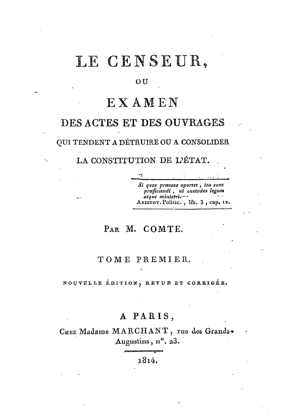
Le Censeur (June, 1815)
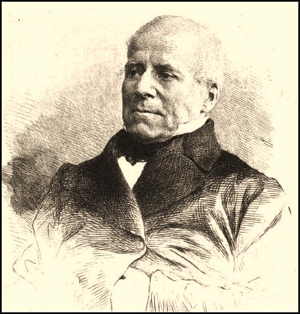 Charles Dunoyer (1786-1862) |
 |
|
[Created: 8 May, 2026]
[Updated: 26 May, 2026] |
Source
, "On the influence of public opinion on the stability of governments, and on the disharmony that exists between the spirit of the people of Europe and the policy of their rulers," Le Censeur T.6 (June, 1815), pp. 141-60.http://davidmhart.com/liberty/FrenchClassicalLiberals/Comte/CenseurAnthology/C1-13-en.html
Charles Dunoyer, "On the influence of public opinion on the stability of governments, and on the disharmony that exists between the spirit of the people of Europe and the policy of their rulers," Le Censeur T.6 (June, 1815), pp. 141-60.
This is a translation of [D…..R], “De l’influence de l’opinion sur la stabilité des gouvernemens; et de la discordance qui existe entre l’esprit des peuples de l’Europe et la politique de leurs chefs,” Le Censeur T.6 (1 juin, 1815), pp. 141-60.
It is also available in French in a facsimile PDF of the original and in HTML.
This essay is part of a collection: Charles Comte and Charles Dunoyer, Censoring the State: An Anthology of Articles by Charles Comte and Charles Dunoyer from Le Censeur (1814-1815) and Le Censeur européen (1817-1819). Edited and translated by David M. Hart (Pittwater Free Press, 2026).
The anthology is available in the following formats:
- all 35 essays in one file in French [HTML] and in English [HTML]
- the 17 essays from Part 1 Le Censeur (1814-1815) in French [HTML] and in English [HTML]
- the 18 essays from Part 1 Le Censeur européen (1817-1819) in French [HTML] and in English [HTML]
- all the essays listed in a sortable table with links to the individual French and English language versions.
Dunoyer, "On the influence of public opinion on the stability of governments" (June, 1815)
On the influence of public opinion on the stability of governments
[141]
On the influence of public opinion on the stability of governments; And on the disharmony that exists between the spirit of the people of Europe and the policy of their rulers
It has been said, and it has been ceaselessly repeated for centuries, that public opinion is the mistress of the world. Perhaps there is no maxim more trivial, and yet there is no truth that seems to be less appreciated; for there is none that is more constantly misconceived. It is not the case that public opinion directs the course of events and of historical periods; it is not the case that the torrent of revolutions and all the phenomena of the moral world shows [142] its inevitable and irresistible influence: most of our princes conduct themselves as if they were truly the masters of the world, as if they could dispose arbitrarily of hearts and wills, as if nature ought to bend the knee before their vain caprices. Public opinion must either burst forth or remain impassive for them to recognize it; and it is only when it has hurled them down or let them fall from the throne that they begin to understand its power. [1] They resemble navigators who would deny the force of the winds and the waves, and who would only perceive their error at the moment when a dead calm held them captive in the midst of a motionless sea, or when a furious tempest dashed their vessel against rocks. They resemble those weak or stupid men who habitually doubt the existence of God and who can [143] only emerge from this state at the terrifying sound of thunder or at the sight of some prodigious phenomenon. Nothing equals, in this respect, the pride or obstinacy of kings; they have eyes and they do not see; they have ears and they do not know how to hear; they understand nothing but their own will; they believe only in the force of fraud or of violence, in the power of money or of bayonets.
What can one say against so gross an error, and yet, alas! one which is so widely held? What will our feeble reasoning add to the terrible lessons of experience? The best we can do is to recall these lessons, to bring them together, to fortify them one with the other, and to strip them of all that might weaken their beneficial influence.
No, it is neither kings, nor emperors, nor pontiffs, who govern the world; it is neither Alexander, nor Caesar, nor Hildebrand, nor Moses, nor Mahomet, nor Luther, nor Francis, nor William, nor Napoleon; it is, according to the times, the passion for war, the enthusiasm for conquest, the love of liberty, respect for [144] religious beliefs; it is Mosaism, Christianity, Islamism, Papism, the Reformed religion; it is political doctrines, principles, liberal ideas, the spirit of commerce and industry; it is, in a word, the opinions and the interests which are dominant in the period under consideration.
The skill of governments consists in knowing how to discern and appreciate these various tendencies, their wisdom in directing them well, and their strength in following them with perseverance. No prince can firmly establish his power except upon the dominant ideas, nor reign with brilliance except by means of them.
"Each century," says M. Benjamin Constant, [2] "awaits, in a certain way, a man who will serve as its representative. When this representative appears or seems to appear, all the forces of the moment gather around him; if he faithfully represents the general spirit, success is assured; if he deviates from it, success becomes doubtful; and if he persists on a false path, the consent which constituted his power abandons him, and the power collapses."
[145]
History is full of facts that demonstrate with evidence the accuracy of this observation. Of all the princes whose memory it has preserved, those alone have been truly great and powerful who knew how to perceive the spirit of the age [3] in which they lived and to yield to the impulse of their century. The reigns of princes who wished to oppose the general movement have always been weak, troubled, and unhappy. All the energy of their will, all the power of their genius, got them only ephemeral triumphs over the ideas they sought to destroy; and the spirit of the age [4] has always ended by emerging victorious from these unequal struggles. But some examples will make this truth more striking.
Before Christianity was established, pagan mythology, denounced by philosophers, had become the mockery of all enlightened men. The pagan gods had fallen into contempt and had ceased giving oracles in which people had long since ceased to believe. The old cult was neglected. The augurs were greeted with [146] no more than a smile: the whole of the ancient religion was dying of old age and stupidity. Yet religious sentiment was not extinguished in people's hearts. Belief in an invisible God had replaced in many minds the faith that one no longer had in the visible gods of paganism. Deism existed in the speculation of the schools of Rome, of Athens, of Smyrna and of Alexandria; and the numerous followers of this doctrine were waiting only for the establishment of a system that could serve as its foundation and turn it into a religion.
Such was the state of mind at the time when Christianity was born. It is clear that people could not have been better disposed to receive it. The ways were prepared, the time had come, to speak as Scripture does; and no human power could prevent the world from becoming Christian. Thus the emperors of Rome made futile efforts to stop the progress of the new religion. It was in vain that they caused blood to flow, that they multiplied tortures, and surrounded them with everything that could increase their horror. All their [147] power failed before a doctrine of which the people had taken hold and which had come, as it were, to constitute their moral existence; finally, Christianity acquired such influence that the emperors came to believe that they were obliged to lift it up onto the throne and to associate it with the empire. This is what Constantine did first, and this deference to the spirit of his age earned him the surname of Great. Unfortunately the protection he accorded to the religion was far from being very enlightened. The powers which he granted to its ministers, and the wealth he got for them, determined from that time forward the tone of the church and prepared from an early period the establishment of what would become priestly despotism. [5] Papism provides us with a more recent example of the power of public opinion.
It was very difficult for Christianity to acquire great influence in the empire without the constitution being disturbed. It was conceived from views which are entirely foreign to civil institutions and had no relation with them, and so the stronger it became, the more those institutions naturally had to weaken. [148] Its authority therefore had to prevail over that of the laws; and, once it had acquired this superiority over the government, the priests of course found themselves endowed with the same preeminence over the magistrates. To preserve, extend, and strengthen this supremacy, it was enough, so to speak, for them to let themselves be carried along by the movement of the age, and to favor the general tendency of thinking. This is what the bishops of Rome did with great skill. It is well known how successful this policy was for them, and what astonishing ascendancy they ended up obtaining over the public opinion of Europe, of which they then became the faithful representatives. Things came to such a point that, without armies and without wealth, they could, from one end of the Christian world to the other, control everybody's will at their pleasure, proscribe individuals, excommunicate kings, take away, give, and sell crowns, and set all the forces of Europe in motion and hurl them against Asia…: a unique and forever memorable example of the power of a government that has its base in public opinion.
[149]
As long as the ideas on which the authority of the Holy See was founded did not weaken in men’s minds, the bishops of Rome as sovereigns had at their command all the states of Christendom where those ideas were established. It was in vain that kings and emperors sought to ignore their supremacy and tried to escape from their jurisdiction. These reckless revolts against a power consecrated by general opinion suddenly ruined their own power; by rising up against the popes, they aroused their subjects against themselves; and a hundred times they were obliged to atone for their actions against the court of Rome by paying the most degrading reparations. Kings were seen forced, for having dared to resist the pontiffs, to prostrate themselves before them, kiss their feet, cover themselves with sackcloth, fast on bread and water, stoop to providing the lowest kind of sevice, and submit to other penances no less humiliating.
But the ideas which served as the foundation of that power were absurd and too awful to go on forever. They [150] could exist only in centuries dominated by ignorance and barbarism. The rebirth of learning, and above all the shocking abuse which resulted from the pontiffs use of their power, ended by destroying the prestige that subjected all wills to them. A new public opinion emerged, the need for a reform was felt, and when this reform broke out, the court of Rome, which a century earlier had made all the kings of Europe tremble, vainly allied themselves with the most powerful of these kings in order to repel the attack that a monk [6] had just made upon its authority. The establishment of the Reformed religion is another example, no less striking than the preceding ones, of the power of public opinion. It was in vain that powerful coalitions were formed, scaffolds erected, pyres lit, new tortures invented. The new ideas triumphed over the course of a century and a half of wars and furious persecutions, and the Protestant church succeeded in obtaining a share of the empire with Catholicism.
But it is not only in the world of religion that public opinion has manifested its [151] power. Its triumphs in the world of politics have been neither less numerous nor less brilliant; and one may say that for centuries it is public opinion that has decided in the end all the great political affairs of Europe. It is public opinion which, expressed in the demands of a few peasants, founded the liberty of Helvetia, and which defended it against all the forces of Austria; ittore Holland from under the yoke of Spain, and that forced Philip II to recognize the independence of the new republic; it twice threw the Stuarts off a throne from which they wished to exercise powers it condemned. It is public opinion that made Great Britain succumb in her unholy war against the independence of America; that sustained Poland against the ambition of three great powers, and that ceaselessly protests against the partition of that kingdom; that here in France overthrew the absolute monarchy and founded a constitutional monarchy; that made France triumph over all the powers of Europe which had unjustly formed a coalition against her; that saved the independence [152] of Spain; that delivered France, which was guilty of having borne the yoke and assisted a conqueror in his violent fury, into the hands of those very powers she had never failed to conquer so long as she was fighting for her liberty; that deposed Napoleon and overturned the imperial throne; that helped the independence of America triumph a second time over British pride and ambition; that abandoned our last government to all its intrinsic weakness, and forced Louis XVIII to descend from the throne without having been able to obtain from the immense majority of the nation the least effort to keep him on it. Finally, public opinion, which the liberty of the press introduces into all public affairs, has achieved in recent times such an ascendancy that today more than ever governments must give up any hopeof doing anything stable without its assent.
We shall not set out here in detail the influence it has exercised over the great events we have just mentioned. It is enough to remark upon the direction it has taken for several centuries; its persistence in this direction; its constant progress [153] in the midst of obstacles constantly put in its way to oppose its march; its triumphs over the most violent resistance, and, in particular, the instability of all that has been done against its will for the last twenty-five years. We shall then rapidly examine to what extent the policy of Napoleon and that of the allied kings diverges from the course it follows; and the reader will judge whether, on one side or the other, there is any tendency toward an order of things upon which the wishes of France and of Europe may set themselves.
The origin of the ideas that today form the basis of public opinion already dates back more than three centuries. It goes back to the time when letters, industry, and commerce were born in Europe. The revolution that began then to take place in the condition of modern people gradually fixed the traits of their character and determined the direction their feelings and ideas would take. When these people began to enjoy the benefits of science and the fine arts, of industry and commerce; when they saw what fertile sources of [154] pleasure and of wealth they had opened for them, their greatest desire must have been to be able to cultivate the one and to practice the other without opposition and without hindrance, and to enjoy with tranquility the well-being to which they were indebted. The love of peace and of liberty must therefore have arisen in Europe at the same time as learning and commerce; and the more learning has advanced, the more commerce has enlarged and multiplied its relations, the more they have together added to the happiness and prosperity of people, the more this sentiment must have developed, spread, and become more firmly believed.
But the revolution which determined the spirit of modern nations did not have the same influence on that of their governments. The domineering and warlike spirit of kings and nobles, who everywhere formed a group apart in the midst of the people of Europe, could not for a long time be modified by the free and peaceful spirit of the new group who were rising at their side. They resisted the tendency of the age. They scorned the arts of peace and their harmless conquests: the only thing truly noble [155] in their eyes was the art of war and the conquests which were stained with blood and tears. Thus they retained, in the midst of European civilization, the proud and barbarous customs of the feudal ages; and while the people conceived only thoughts of peace and liberty, they always preserved their old ideas of war and domination.
The spirit of governments was therefore altogether opposed to that of the people. Their conduct was no less so. The kings of Europe continued to obey the impulse of feudal manners; being victors over their vassals within their states, they sought rivals beyond the limits of their empire; the theater of feudal anarchy was enlarged; wars were no longer carried on between lord and lord within each state, but between king and king throughout the whole of Europe; and one could see, in a sense, in the heads of European governments, nothing but the great possessors of fiefs, great suzerain lords aspiring, each on his own side, to acquire new domains and to extend the borders of their suzerainty. Everyone knows what [156] long series of murderous wars this puerile and barbarous spirit of conquest, born of the feudal system, engendered. From the first Italian wars down to those which immediately preceded our revolution, there is hardly one which cannot be traced back to this cause.
Yet this was not the only principle which drove our governments to war. While yielding to motives of ambition and desires of vain glory, the kings of Europe also proposed to themselves, in various wars, to combat the tendency of the people toward liberty. This was seen particularly in the wars of Philip II against Holland and in all the wars against the Reformation; in those of the English government against the independence of America, and in that of all the kings of Europe against the French Revolution.
Finally, commerce, which is the principal cause of the people’s tendency toward peace, itself became for governments a very active cause of wars; because their stupid passions entirely [157] perverted its spirit. When they saw what immense riches it could produce, each of them wanted to engage in commerce with the rest of the world all by itself, without considering that the exclusive claims of each one necessarily destroyed it for all. Then the spirit of commerce, which is essentially peaceful, was followed by the spirit of monopoly, which is essentially hostile, and which can give rise to all disorders and all crimes, as the infamous policy of the English government so well proves to the whole world.
Thus while the cultivation of the arts and sciences, the labors of agriculture and industry, and above all the liberty so necessary for commerce made peace the most pressing need of the people and the first object of their wishes, the passion of kings for conquests, their interests in despotism, and their absurd ideas of monopoly constantly dragged Europe into a system of wars which went against all their interests.
On the other hand, the same passions of governments which fought against the tendency [158] of the people toward peace made them just ashostile in their attitude toward liberty. Who can list everything that the spirit of conquest, of despotism, or of monopoly has come up with in the way of regulations and laws which are contrary to the just liberty of modern people? In almost all the states of Europe, all parts of the social order were, in a way, arranged to establish the empire of the passions of governments over this liberty. Almost all institutions were created with this aim, or diverted to this end. Education had to shape the minds of the people according to the demands of despotism; their conscience was regulated according to the same plan by religion; the Inquisition and censorship were placed in charge of guarding thought; an invisible police was tasked with listening to the words and spying on the actions of the people; industry had its guilds, and commerce its customs duties. Finally there was no part of human existence that was not subjected to a more or less oppressive and arbitrary regime; and in the social order one could find neither a sure guarantee of one’s person, nor that of one’s [159] property, nor that of the free and just exercise of one’s faculties.
Such are, since the rebirth of learning, industry, and commerce, the inclination of the people of Europe, and the resistance they have encountered in the spirit of governments and in the established laws.
It remains for us to show how this inclination has overcome almost all these obstacles in a part of Europe, and how it has developed and strengthened everywhere; how, after founding the governments of Switzerland, Holland, England and North America, it gradually acquired in France a power capable of uprooting all the old prejudices, of overthrowing all the institutions that opposed it, and of revolutionizing the entire continent; how, in France, in the short space of twenty-five years, it toppled one after another seven or eight governments that were more or less opposed to it; how it went about surprising and unsettling that gathering of kings who were in the midst of so quietly partitioning [160] Europe amongst themselves; how it must inevitably deliver us from that disgusting mixture of despotism and demagogy which forms the distinctive trait of our new government; how finally it mocks all the projects of the coalition, and how, even if the French might suffer reverses, it would survive the defeat and would pursue the victors into the midst of their own states, and triumph even over victory itself.
We regret that the already excessive length of the first part of this volume does not allow us to discuss these details here. They will be included in the next volume.
D…..R
Endnotes
[1] We see even then that these great lessons are not always enough to make them realise the power of public opinion and the necessity of submitting to it.
[2] On the Spirit of Conquest and Usurpation, etc., p. 2.
[3] [ED: he says "l'esprit de l'époque". compare jsm's essay "the spirit of the age".]
[4] Ed. He says "l'esprit du siècle".
[5] Ed He says "le despotisme sacerdotal". Compare Bastiat on "ecclesiastical plunder.
[6] Ed. Martin Luther.