| The Digital Library of Liberty & Power incorporating the Guillaumin Collection of the Great Books of Liberty |
Home | New | Authors | Works | Papers | Blog | About | Email | Search |
 |
|
CHARLES COMTE,
"On Legitimate Authority and Parliamentary Government"
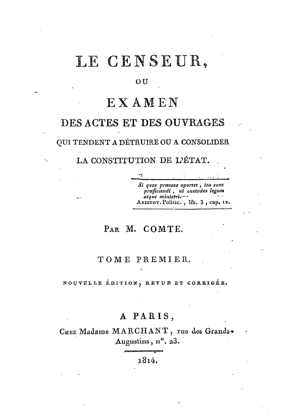
Le Censeur (1 March, 1815)
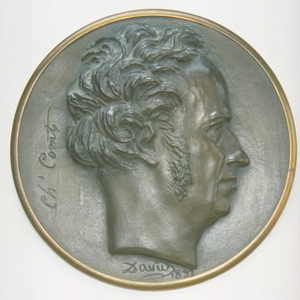 Charles Comte (1782-1837) |
 |
|
[Created: 8 May, 2026]
[Updated: 26 May, 2026] |
Source
, "On Legitimate Authority and Parliamentary Government," Le Censeur T.4 (1 March, 1815), pp. 32-52.http://davidmhart.com/liberty/FrenchClassicalLiberals/Comte/CenseurAnthology/C1-10-en.html
Charles Comte, "On Legitimate Authority and Parliamentary Government," Le Censeur T.4 (1 March, 1815), pp. 32-52.
This is a translation of [CC??], “De l'Autorité légitime et du gouvernement parlementaire,” Le Censeur T.4 (1 mars, 1815), pp. 32-52.
It is also available in French in a facsimile PDF of the original and in HTML.
This essay is part of a collection: Charles Comte and Charles Dunoyer, Censoring the State: An Anthology of Articles by Charles Comte and Charles Dunoyer from Le Censeur (1814-1815) and Le Censeur européen (1817-1819). Edited and translated by David M. Hart (Pittwater Free Press, 2026).
The anthology is available in the following formats:
- all 35 essays in one file in French [HTML] and in English [HTML]
- the 17 essays from Part 1 Le Censeur (1814-1815) in French [HTML] and in English [HTML]
- the 18 essays from Part 1 Le Censeur européen (1817-1819) in French [HTML] and in English [HTML]
- all the essays listed in a sortable table with links to the individual French and English language versions.
Comte, "On Legitimate Authority and Parliamentary Government" (March, 1815)
On Legitimate Authority and Parliamentary Government
[32]
The ministerial journals and the writers of the day, partisans of absolute royalty, make the words "legitimate authority" resound almost in every sentence, without explaining to us what this authority is. We know only that those who hold it in their hands claim to derive it from God: they repeat it in all their acts, so that no one may doubt it; but, instructed by history that the grossest errors have in turn clouded the human mind, we are aroused by mistrust; and, following the principles of Descartes, we wish to examine something before we believe it.
The strong men of the land [1] imposed these things upon our ancestors by means of auguries and oracles; the most unjust tyrants, the monsters who brought misery to generations, have [33] always associated themselves with God in order to inspire submission and fear. Alexander had himself declared the son of Jupiter Ammon; even in our own day a bottle of oil which descended from heaven made our kings sacred and inviolable. It would take too long to recount all the errors that have been employed up to this day to support despotism; but let us quickly pose the question.
What is a legitimate authority; or, to phrase it better, what is authority?
Authority is the right to command joined to the power of securing obedience; right must always be accompanied by power; for the effect of authority ceases as soon as power is lacking; but authority ought to have no other power than that held by the individuals over whom it is exercised, and these individuals grant it only so long as authority acts according to their will and for their benefit. Every authority therefore presupposes the consent of those over whom it is exercised; and when that consent ceases, power must also cease, and authority vanishes, unless he who holds it in his hands [34] establishes a force which is outside society but which should belong to it. It is a force of this kind which always constitutes the authority of tyranny and despotism. This is the authority which conquerors have over conquered peoples; the authority of the Alexanders, the Tamerlanes, and the Nadir Shahs; the authority of tyrants, such as Nero, Caligula; of brigands, such as the pirates of Algiers and Morocco, and of assassins and highway robbers. Can this authority be called legitimate? Is this what one wants to have descend from heaven? Does one want to make it the accomplice of all the horrors it has committed? It is, in truth, founded on force, and force comes from God! But the power of he who assassinates a tyrant also comes from God! But the power of a desperate people who drive out a king or have him killed on the scaffold also comes from God! Must one then associate God with all the crimes of the earth, and is it enough to be the strongest in order to have the right to commit the most horrible crimes? What a morality! what consequences it will lead to! If God had entrusted authority to someone to command [35] men, that person should be of a superior nature; and his particular interests should never come into opposition with the interest of his subjects; he would be just by his nature; he would have the inherent strength to ensure obedience. Let those who tell us they have a mission from heaven give us proof of it. Are they not men? are they more just? Let one read some history. Would they have documents of their Commission ("des lettres de commandement")? Let them have them registered. But no; they can give no proof, and they order us to believe them on their word!
To know what authority ought to govern man in society, one must examine what his nature is. Each man in isolation possesses the faculty of looking after his own preservation and of seeking his own well-being. To choose the means to do this, he has his reason; to apply them, he has his individual strength. Men, by uniting in society, have not changed their nature; they have collectively preserved the same faculties; they have put in common their reason and strength to look after their preservation and their well-being; [36] common reason must choose the means; common strength must apply them, common reason must therefore make the law; and the magistrate who has been approved by this common reason to enforce it, has no right to replace it with his arbitrary will; he can only command in its name; he can employ no other force than the common force: if he replaced it with a force which lay outside the nation, [2] he would be dangerous to the state, and he might acquire the authority of a despot and oppress the nation.
The force which supports the authority of despotic governments is of three kinds; that of mercenary soldiers, that of corruption, and that of ignorance and prejudice. It is with this triple driving force [3] that some thirty men have seized the whole human race to make it their property; it is from this that flows all the misfortunes of civilization; but these springs must be broken by the progress of the human mind and of reason, when enlightenment has spread through all the classes of society. The force of mercenary soldiers disappears before the national force which is set in motion [37] when there is general discontent. The force of corruption is checked by the mass of enlightened men whom the government has no means of corrupting. The force of ignorance and prejudice disappears before the progress of enlightenment and reason. From this we dare flatter ourselves that Europe cannot remain much longer subjected to absolute authority. Kings may still attempt to use their ultimate resource by seeking to arrest the progress of the human mind; they may abolish the freedom of the press, restrict public education, recall the monks, favor the priests, restore all their former wealth and privileges (at this price, these pious personages will ally themselves with the kings in order to obscure reason and revive prejudices); they may attempt to accumulate property in the hands of certain privileged classes; they may enact fiscal laws, establish monopolies, in order to destroy commerce and industry, and to plunge the people back into brutalizing poverty; but do they think they have any hope of succeeding? Would such an [38] undertaking not cause all the people to rise up in revolt? It would face even more obstacles; all kings would have to act in concert for the execution of such a project, but they are divided in their interests, and their union is impossible; besides, there are free nations on the globe, they would have to be put back under the yoke of despotism, which is not in their power to do; without that, the proud masters of enslaved peoples would themselves be nothing but the crowned slaves of the merchants of London, and of the citizens of the United States of America.
Let the writers who defend absolute royalism therefore cease preaching this doctrine to us; they cannot make the human mind go backwards, they cannot even stop its march, it is not in their power to prevent printing, navigation, or gunpowder from being invented; that time is past, when a handful of nobles, encased in their iron armor and mounted on heavy horses, crushed without danger the herds of peasants who had no means of fighting them with [39] equal weapons. The progress of the human mind is the work of nature; the sciences and the arts have flowed from it, it is as impossible to plunge them back into oblivion as is would be to make the rivers flow back towards their source. The state in which we are would be the worst of all; we might regret times past with its pure or impure royalists, but we would have to submit to the rigors of our destiny. However, is the liberty of the people, which the current age brings us, such a great evil? would despotic government be the best of governments? Was Linguet right? would the inhabitants of Constantinople be happier than those of London and Philadelphia?
Let us return to the question: we have said that the law alone was the legitimate authority; that, when the magistrate who was charged with carrying it out replaced it with his own arbitrary will , authority ceased to be legitimate, and the nation fell under despotism; but what is thought to be a law is not always a true law. The true law must be the expression of the general will, [4] or at least that of [40] the majority. If a people could assemble en masse, and could vote with full knowledge of the facts and without being deceived or influenced, the law would always be the expression of the general will [5]; since this is impracticable, one is obliged to resort to representation, but representation is often distorted: it is distorted if the representatives allow themselves to be corrupted by the ministers, if they have interests opposed to those who they represent, finally if there is any class of men that is not represented. These vices can be remedied by publishing the records of the representatives’ meetings, by the right accorded to every citizen to submit petitions and statements, by the complete freedom of the press, which is necessarily part of what representation is. Before putting forward a bill for discussion, it ought to be made public, so that every citizen, after having considered it, could communicate his observations to his representatives. Ministers should be held responsible for the crime of corruption; for they are no less guilty when they buy laws that destroy liberty than they [41] do when they set an army corps in motion to achieve the same goal; between these two crimes there would be at most only the difference there is between a robbery on a highway, committed with violence, and a theft carried out with skill at the entrance of the opera. The electoral colleges, at each meeting, should be authorized to publicly praise or censure their representatives who, once having ended their mission, have now returned to the class of humble individuals.
One cannot take too many measures to ensure the soundness of representation. If it is distorted, there is no liberty; what am I saying, is that despotism is all the more frightful when it is hidden under the deceptive mask of institutions. The people, who are burdened by so many taxes which are absorbed to pay for the luxury of the government and the uselessness of many offices, are furthermore forced to provide, at the expense of their own sweat, the means which are used to corrupt the very people who ought to protect them.
The nation which is badly represented is not safe from shocks; on the contrary it marches from revolution to revolution, for public opinion does not support its laws; and [42] the partisans of despotism, who have become strong through the harm they have caused, then say that liberty is an abstraction, and that absolute power alone can govern men. On the contrary, the nation which is well represented lays the foundations for an unshakable legitimate authority; it is safe from every revolution, or, to put it in other words, it establishes itself in a state of permanent revolution, but one which is gentle and progressive, so as to follow without causing any shocks the progress of reason and the variations in public opinion.
It is easy to distinguish true representation from false. True representation produces only laws which conform to public opinion. Thus, whenever a law appears of which public opinion disapproves, one can say with certainty that the representation which produced it is false.
It follows from what we have just said, that, in order to establish an unshakable legitimate authority, there must be a good system of representation which is always the organ of the general will or of common reason, which alone has the right to make the law. But, for this [43] common reason to be able to express itself or to form itself into a body of public opinion, there must be a good system of public education, and freedom of the press, so that scattered individuals may communicate their ideas to each other, and bring them to the attention of their representatives. There must also be a well-organized common force; without it, the laws might be hindered in their execution and the magistrate charged with applying them might, by employing a force which came from outside the nation, replace them with his own arbitrary will. The nation must also be able to defend itself against external enemies, and it can only be safe from all danger when there is a good organization of the common force. One must suspect the intentions of a chief magistrate who, under the pretext of wishing to give peace to the nation, would have only mercenary and foreign troops under arms, and who would have these troops commanded by men who are privileged and different from the rest of society; thus every foreign force must be regarded with suspicion by a nation which wishes to maintain its liberty.
After having set forth what a [44] legitimate authority is, and having indicated the means of establishing it on a solid basis, we will nonetheless agree that, in the present state in which the people of Europe find themselves, there must be in the government a moderating counterweight to public opinion. Its march, if too bold, could plunge us into anarchy; it must be moderated, but it must not be forced to go backwards nor stopped entirely. Parliamentary government, such as the one we have, perfectly fulfills the praiseworthy aim of moderating the spirit of reform, and of reaching the height of public opinion without causing shocks. If the representatives wish to march too quickly, the king and the Chamber of Peers slow their march. A parliamentary constitution may be compared to a cart that must descend a slope; the carter blocks one wheel, puts horses behind to hold it back; but he does not stop entirely the march of the cart, it makes its way little by little towards its stable, he does not harness all his horses to pull it backwards. This comparison has seemed to us apt to explain the mechanism of the three legislative powers [45] of parliamentary government, which we believe to be the one best suited to the people of Europe. It is therefore necessary, with such a form of government, that there be two parties, one which wishes to move forward, and another which restrains it; but since public opinion must be followed, the moderating party must give way at the right moment. But if the representation of the Chamber of Deputies is false, either through corruption, or through party spirit, or through weakness, and it joins the ministerial party, then everything pulls in the same direction, the government goes backwards towards despotism, and public opinion, becoming alarmed, places the state again upon the volcano of revolution. If the ministers wish to avoid this danger, let them cease trying to corrupt or influence it; let the representatives, before they vote, examine whether the law proposed is approved or rejected by public opinion, and let them vote with the knowledge of this fact and without regard to any other consideration.
If the present system of representation were a true one, we would have to agree that the spirit of liberty must be quite widespread in [46] France. Even though the vote was made under the tyrannical influence of Bonaparte, amongst this large population there were still not enough supporters of absolute power for him to create an assembly of deputies as large as he wanted, in order to give his legislation an appearance of legitimacy. It is evident that this assembly bears the mark of the vices of its selection; yet it must be admitted that there is still a sufficiently imposing mass which moves in the direction of public opinion, and which has thwarted the projects of the ministers on several occasions.
But if the law is the only legitimate authority, what then is the role of the king in a parliamentary government?
The king is the supreme magistrate charged with executing the law and directing the common force. His functions are great, important, and sacred; he is the social lever, the point of support for order, security, and stability; he must be surrounded by respect and love. The steps up to the throne must be made inaccessible by heredity, so as to limit all political ambition, and to [47] give the state unchanging stability. But this worship, this respect, this hereditary prerogative must never become a form of status which is harmful to liberty. That is why the king must have the power to do good and not to do harm; and, to attain this end, royalty must be divided into two parts. The royalty of representation and of political religion, [6] which is entirely in the person of the king; and the executive royalty which belongs to the ministers. In the royalty of representation and political religion, one worships, so to speak, in the person of the king, the common reason or the law and the common force, just as one once worshiped Time in Saturn and Wisdom in Minerva. But in order that the king be sacrosanct, and that the worship given to him not be absurd and dangerous, it is necessary that the executive royalty, or the ministers, be responsible to the nation; without this, the government, whatever it may be, would be nothing but a despotism more or less disguised by deceptive institutions. From this it must be concluded that the king cannot place himself personally at the head of the armies, [48] because the ministers cannot give orders to him; if he undertook anything which went against the liberty or the security of the state, responsibility could not be held by them. According to this hypothesis, the king would cease to be sacrosanct, as would also be the case whenever the ministers would be relieved of any responsibility.
The Chamber of Peers, in a parliamentary government, is the aristocratic part of this government. It is lies between the royal part and the democratic part, which is the Chamber of Deputies. The aim of its institution is to check the tendency of royalty to move towards despotism, and the tendency of the chamber of representatives to move towards pure democracy. It is this chamber which has to swallow up those with great fortunes, with ambitions of every kind, and with great reputations, who could disturb the state if they were admitted into the chamber of representatives: the peerage is therefore a sort of political ostracism. The destiny of the peers must be so brilliant and so assured, that they have nothing more to desire than to stay there; [49] heredity seems to us to be necessary so that they may properly fulfill the purpose for which they are established. They must have no need of the favor of the king or that of the people; their existence must be independent. In this respect, it seems to us that something is still lacking in the peerage of France, for example, possession of great entailed estates, and above all a sense of their own dignity, which can only come from their complete independence. It is unbecoming that peers should solicit at court functions which are infinitely below their rank. A peer must be nothing but a peer; all other functions degrade him, except the ministry, which forms part of royalty.
It might be possible to find a form of government which is theoretically better than the parliamentary one; but one must govern men as they are and not as they ought to be. That is why we do not hesitate to believe that parliamentary government, such as we have described it, is that which best suits the old nations of Europe, which are corrupted and divided by [50] ancient institutions, ancient habits, and prejudices which cannot be destroyed all at once without harming civilization.
What prolonged the troubles of France was the impossibility of establishing the peerage from the very beginning of the revolution. Under Louis XVI, the possessors of great fortunes and of great names were opposed to changes in government and could not be employed to check the tendency of royalty towards despotism; they would on the contrary have given it new strength; and, with such a peerage, the liberty of the nation could not have been established. The Chamber of Peers therefore had to be left out of our first institutions; and for that reason alone, the democratic part of the government had to overthrow the royal part. France is today in a better position. The course of our revolution has brought to light names once unknown, and new reputations have been justly acquired which can provide the elements of the peerage. Some famous names from the old monarchy may be mixed in this institution with [51] the new ones; but if the balance is not in favor of the latter, the peerage will incline too much towards royalty and will seek to overthrow the democratic part; thus the purpose would be missed, and we would fall into despotism, or we would be dragged into a new revolution.
In comparing the revolution of England with the French revolution, one can see that England was better served than we were only by chance. The nobles and the people were united against royalty; thus the English immediately had the elements needed to form their peerage; and if their revolution was prolonged so long, it was because royalty would not stay within the limits of its power; its obstinate struggle drove out the Stuarts and called to the throne the prince of Orange, who, being a stranger to all parties, left each chamber with its powers, and knew how to keep himself within the limits of parliamentary royalty; it is he who consolidated the English government, which today stimulates our envy, and which has carried that nation to the highest degree of glory and prosperity. The history of the past [52] can give rise to many reflections; and France should profit from the lessons which the experience of a neighboring people teach us. We have no fear of falling back under despotism: the declared opinion of the nation and that of all the people of Europe who are moving towards improving their governments give us a sure guarantee of this; but we may yet face new shocks which would prolong our misfortune, and probably they would bring no change in our institutions; they would only displace the elements which are harmful to the march of parliamentary government which seems to us to have stabilised the wishes of the nation.
Endnotes
[1] [EN: he says "les *forts* de la terre".]
[2] [EN: he suses the term "une force étrangère" - a foreign oir "alien" force, or a force which lay came from outside the nation??]
[3] [EN: he says "ressort" - the spring of a watch, hence driving force.]
[4] [EN: he does not use rousseau's term "la volonté générale" but "le voeu général".]
[5] [EN: here he does use rousseau's term "la volonté générale.]
[6] [EN: he says "la culte politique".]