| The Digital Library of Liberty & Power incorporating the Guillaumin Collection of the Great Books of Liberty |
Home | New | Authors | Works | Papers | Blog | About | Email | Search |
 |
|
CHARLES DUNOYER,
"On Revolutions in general, and on contemporary revolutionaries"
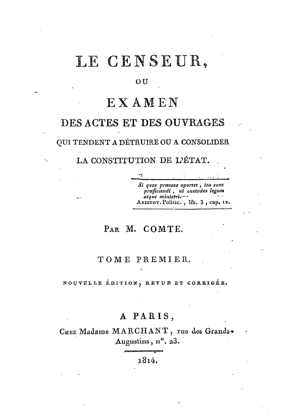
Le Censeur (20 Dec. 1814)
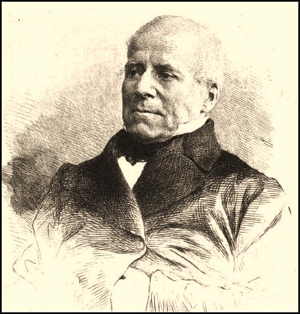 Charles Dunoyer (1786-1862) |
 |
|
[Created: 8 May, 2026]
[Updated: 26 May, 2026] |
Source
, "On Revolutions in general, and on contemporary revolutionaries," Le Censeur T.3 (20 Dec. 1814), pp. 42-65.http://davidmhart.com/liberty/FrenchClassicalLiberals/Comte/CenseurAnthology/C1-09-en.html
Charles Dunoyer, "On Revolutions in general, and on contemporary revolutionaries," Le Censeur T.3 (20 Dec. 1814), pp. 42-65.
This is a translation of Charles Dunoyer, "Des Révolutions en général, et des révolutionnaires actuel,” Le Censeur T.3 (20 décembre, 1814), pp. 42-65.
It is also available in French in a facsimile PDF of the original and in HTML.
This essay is part of a collection: Charles Comte and Charles Dunoyer, Censoring the State: An Anthology of Articles by Charles Comte and Charles Dunoyer from Le Censeur (1814-1815) and Le Censeur européen (1817-1819). Edited and translated by David M. Hart (Pittwater Free Press, 2026).
The anthology is available in the following formats:
- all 35 essays in one file in French [HTML] and in English [HTML]
- the 17 essays from Part 1 Le Censeur (1814-1815) in French [HTML] and in English [HTML]
- the 18 essays from Part 1 Le Censeur européen (1817-1819) in French [HTML] and in English [HTML]
- all the essays listed in a sortable table with links to the individual French and English language versions.
Dunoyer, "On Revolutions in general, and on contemporary revolutionaries" (Dec. 1814)
On Revolutions in general, and on contemporary revolutionaries
[42]
There are for nations two extreme conditions which seem equally deplorable: one is that of a people in a state of absolute stagnation; the other, that of a people in a state of complete revolution. The immobility of the first is usually a sure sign that it is held in the chains of despotism and superstition. The convulsive movements of the second indicate clearly enough that it is subject to all the disorders of anarchy. The former has fixed morals and a physiognomy that is its own; but there is usually mixed in with its morals many harmful prejudices, and its physiognomy always bears some coarse or bizarre features. The latter has no prejudices; but it does not even have morals, and its character has nothing solid about it. The former [43] clings strongly to its most childish customs, to its most superstitious practices; the latter does not even adhere to the most fundamental maxims of social order; the former is blindly driven by habit; the latter yields only to the unregulated movement of its passions. Both, moreover, are extremely wretched, and often it is hard to say which is more worthy of pity.
The comparison we have just drawn already indicates what we must think of revolutions. One sees that a people can be just as pitiable in a state of absolute rest as in the midst of complete anarchy. These two conditions have, moreover, a great similarity to each other, and extreme revolutions are often a natural consequence of extreme servitude. If ever a revolution were to occur in the governments of Asia, it is quite probable that it would be carried out with great violence and would overturn everything.
There is only one way for people to avoid great revolutions: it is, in a sense, to place themselves in a state of permanent and wisely regulated revolution; there [44] is for them only one truly secure and happy condition of rest, and that is one which includes great and useful activity. This proposition needs to be explained and boiled down to its essential terms.
All living beings are born with the desire to be happy, and with the faculties necessary to satisfy this desire which preserves their existence. These faculties, in all animals other than man, are directed by a sure instinct, and almost from the moment they are born, they quickly acquire all the improvements of which they are capable. In man, on the contrary, these same faculties develop slowly and with difficulty; but they are capable of indefinite improvement; and as new needs constantly arise from the new satisfactions they provide, man is constantly impelled to exercise, extend, and strengthen them, and thus he is led, by the attraction of happiness to which he constantly aspires, toward all the improvement of which he is capable.
These ever-renewing needs of man, and this aptitude for improving the faculties [45] he has received from heaven to satisfy them, must necessarily keep his ideas in constant motion, give rise to continual changes in his tastes, in his morals, in his knowledge; and it may be said that, by his nature, man is drawn into endless revolution.
The purpose of social institutions is to place him in a condition in which these revolutions, to which he is driven by his needs, are carried out safely and without upheaval; in a condition in which his faculties can be exercised, developed, and lead him, step by step, to all the happiness and improvement of which he is capable. Unfortunately, this task is far from easy to fulfill; and the laws meant to regulate human conduct and to prevent those violent revolutions into which the poorly regulated use of his faculties might cast him, are themselves subject to continual and inevitable revolution. All that a wise government can do in this regard is to direct these revolutions in such a way that they take place slowly, with the greatest possible benefit and the least possible violence.
[46]
Now, two conditions seem indispensable for that to happen. The first is that social institutions must always be directed toward the well-being and improvement of the people for whom they are made; and the second, that governments must know how to observe and follow the impulse which these institutions give to the human mind, and correct their defects as experience reveals them, or as they arise from the progress of time and knowledge. Nonetheless, their greatest care must be to make these changes with the utmost caution and delicacy; for if there is a way to prevent violent revolution, it is without doubt by maintaining the sacred authority of the laws; and nothing is more dangerous, in attempting to correct them, than to weaken their force.
Unfortunately, this has rarely been the aim or method of governments. It cannot be denied that they have too often misunderstood the nature of man and his noble destiny. Most seem to have regarded people as tools placed in their hands to be applied[47] to the ends dictated by their passions or whims; and the laws they have given them have often had no other object than to render them suitable to these particular ends, almost always contrary to the people's true interests. That is not all; after giving the people institutions which are contrary to their happiness, they wanted these institutions to be eternal; having disregarded the interests of the people, they also disregarded the perfectibility of the human mind, and wanted to take no account of the progress of enlightenment. They defended institutions which were detestable in principle with an ardor and stubbornness that one should not exert even in defense of institutions which were excellent in their aim but whose utility had been made doubtful by the march of time or by particular circumstances. Or rather, after having denounced reason at the outset, they could not acknowledge it after it had progressed, and the more their laws were originally opposed to the goal they should have had, the more effort they had to make in order to shelter them from any kind of innovation or reform. For that to occur, it [48] was necessary to surround the laws with illusion and mystique; and politics became a second religion, with its dogmas, its mysteries, and its articles of faith. That was still not enough; since men who were more enlightened and more daring than the others could strip certain institutions of the religious mask with which they had been adorned in order to make them sacred in the eyes of ordinary men, precautions had to be taken against what they might attempt to do—and hence the inquisition and censorship, monstrous institutions which were created in times of violence and barbarism, were introduced in order to halt the progress of enlightenment, or to give it a direction which conformed to the particular views of governments—views which were too often contrary to the true interests of the people and to the development of their faculties. Everyone knows the obstacles these institutions put in the way of the progress of the sciences, and the false direction they gave to the human mind under their fatal influence. Errors became so numerous and they created such dreadful disorder in the minds of [49] men, that a profound ignorance would have been a thousand times preferable to the false knowledge they had acquired, and would perhaps have made less difficult and less belated the discovery of good methods of thinking and the birth of true science.
Nevertheless, all these obstacles were not able to halt the natural progress of the human mind. It succeeded in breaking through the barriers raised by despotism and superstition between itself and the truth. It advanced amid the pyres of the Inquisition and the quarantines of censorship. Then, alongside the lying doctrines invented by governments to chain the people, new doctrines were formed—taught by reason and experience—destined to place man in a state of affairs in which his faculties could develop without effort and without danger. The opinion of the people gradually rallied to this new order of ideas; and as governments sought to block its progress instead of directing and following it, a secret struggle [50] emerged between them and the opinion of all enlightened men—a struggle that eventually produced a terrible explosion and dreadful ruptures.
We do not propose here to point out all the violent revolutions that have arisen, in various governments, from the vices of their constitutions and from their resistance to reforms demanded by the progress of enlightenment. We will content ourselves with saying that such was the cause of our recent political storms. It is known how the groundwork of the French Revolution was laid; how the old institutions gradually fell into contempt, and how, having lost all support in public opinion and being defended only by the pride and greed of a few men—who were the only ones who had an interest in maintaining them—they were overthrown along with their defenders. It is also known how the power of opinion that destroyed them was formed, and to what distant causes the new order of political ideas now governing France and Europe must be traced. One must go back to the invention of gunpowder and the printing press, to the discovery [51] of America and the Reformation of Luther, to find the primary causes of that revolution whose movement has not ceased since then. If it has produced violent upheavals, weakened public morals, overthrown or shaken thrones, and caused great crimes to be committed, perhaps we should blame these misfortunes only on the pride, the short-sightedness, or the deceit of governments which, instead of wisely drawing closer to its principles, going down the paths of justice and humanity that it had opened, restraining it and guiding it with prudence and firmness, at first employed all their strength and cunning to stop its advance, and—when they despaired of mastering it—hurled it into every excess that could disgrace and discredit it.
But we must not blame the revolution for the crimes of its enemies. One can no more criticise it for their outrages than one can hold religion responsible for the massacres of St. Bartholomew or for all the excesses for which fanaticism and ignorance have used it as a [52] pretext. The noble and generous principles of this revolution could not be dishonored by the most unbridled demagoguery, nor stifled by the most violent despotism. They triumphed equally over the royalists and the Jacobins, over Robespierre and Bonaparte; and they are now so firmly established in the minds of the people of Europe that to destroy them or even to suspend their influence would require the destruction of entire generations. The force and justice of these principles is today so widely recognized that every wise and enlightened prince in Europe feels the need to yield to their ascendency and to enshrine those very maxims against which they had vainly conspired. Thirty years ago, the French government would have burned by the hand of the executioner any book in which one dared to profess the principles of liberty, equality, and religious tolerance that are now consecrated by the constitutional charter.
Europe will soon owe to the French Revolution the fact that it has been placed in the situation most favorable to preventing henceforth any [53] violent revolution. This is a truth that must inevitably result from the establishment of the representative system in the governments of the states that compose it. The reader will see, in the article that follows this one, [1] how well this system fits with the extent of enlightenment among modern people and the weakness of their morals; how it allows them to enjoy the only kind of liberty of which they are jealous and capable of supporting; how, in a word, being essentially directed toward their happiness and the improvement of their faculties, and possessing within itself the means of always bringing the laws into harmony with the current state of their needs and their knowledge, it offers to the highest degree the two qualities necessary to prevent great revolutions. This system lacks only one thing to accomplish all the good that the people of Europe may expect from it: it must pass from their charters and their books into their habits. It is true, it is not opposed by these habits; but neither is it supported by them. If they do not put up [54] any resistance to it, they give it only feeble support: the morals of almost all the people of Europe are presently non-existent; those that upheld the old order no longer exist; those that could protect the new institutions do not yet exist; and they can be created only by those institutions themselves. And for these institutions to bring forth the morals that could defend them, they must be scrupulously maintained. Now, there exists in France, and in several other European states, a party whose every effort tends to prevent the establishment of the new institutions.
The revolutions that take place in the laws of people are not always the result of the progress of enlightenment. They are more often the work of violence, pride, and ambition. For example, those that arise from conquest, when the victor imposes his laws on the conquered; also those that may occur within a state, brought about by some powerful faction [55] that seeks to overturn the established order and change the form of government.
Our history, for the past twenty-two years, has offered several memorable examples of this latter kind of revolution: for example, the one that replaced the monarchy with the Republic, and the one that replaced the Republic with the Consulate. It also offers several examples of attempted revolutions of the same nature: such as the one formed by the faction of Coblentz to reestablish absolute monarchy—if indeed that faction truly had a coherent plan and was not merely the blind and pitiful tool of France’s enemies; later, another was the uprising in the Vendée; and today, the plan that one may suppose that certain men have, namely to restore the old order of things.
One would vainly attempt to hide from oneself the intentions of these same men. It is impossible to doubt that they have been—and still are—preoccupied with the idea of reviving institutions long since destroyed. To be sure, the extravagance of this design and the [56] frightening number of interests and opinions that would need to be neutralised in order to carry it out seem to offer sufficient guarantees that its execution will not be attempted. It is also true that the promoters of this project have not yet dared to make any bold demonstrations of their intent. Finally, it is well known that they could not make any overly audacious attempt with impunity. But it is also known that their pride feeds on the wildest fantasies, and that their recklessness and profound ignorance prevent them from seeing the danger that would await any attempt to realize them. What is certain, in any case, is the convergence of ministerial acts, all tending, in one way or another, toward the overthrow of the constitution—and the persistence of the ministerial newspapers in professing principles contrary to constitutional ideas.
Yet some people see in this convergence of circumstances no legitimate cause for concern, and seem to believe that one should neither worry about the arbitrary acts of ministers nor the seditious principles of certain of their newspapers. What does it [57] matter to us, they say, if public contempt is a just response to the statements of those newspapers? Why be so alarmed by the usurpations of the ministers if they cannot maintain them, or by the progress of their authority if their actual power is diminishing? How many times have they already been forced to retreat? Were they able to enforce their ordinance on the observance of public holidays? Were they not forced to repeal the one concerning the orphans of the Légion d'honneur and the one concerning the military schools? Finally, far from adding to the king’s power through all their encroachments, is it not fair to say that they have weakened it? Have not the Chambers shown that they are truly the masters, and is not the preponderance of force on the side of the opposition? The ministers’ schemes inspire our irritation and fears; they should only arouse our pity.
It seems to us that none of these considerations are particularly reassuring. It is true that the ministers have been several times forced to reverse course; and one [58] cannot doubt that the anxiety and discontent provoked by their irregular administration have greatly weakened royal power over the past six months. But is that truly a reason to feel secure? Can we really be at ease with the injuries done to the constitution merely because they tend to diminish the respect owed to the king and the just power he must possess to ensure the prompt and faithful execution of the laws? Is that not, on the contrary, a serious disorder in itself, and a major count in the indictment against the ministers? We do not know whether the Chambers have gained all the power that the ministers have made the king lose; but if power resides in them, it must be admitted that they keep it well hidden—and it would be quite difficult to say when they have proved themselves to be the masters. It is true, the Chamber of Deputies once permitted itself to censure the report made by a minister; but it so thoroughly repented of that act of firmness that it later allowed several of its members, notably M. Lainé, to [59] say things far more reprehensible than those it had condemned in the minister's speech, and it ended up granting more than had even been requested. Moreover, it is a matter of public record that the Chambers have until now done nearly everything the ministers have wanted, and it would be hard to see in such extreme compliance any evidence of the power attributed to them.
The king’s power has therefore been weakened without the power of the Chambers becoming any more firmly established. The preponderance of force, it is said, is on the side of the opposition. But what opposition is meant? That of the Chambers? It has just been shown to be nearly non-existent, at least in its effects. Does one mean the opposition of public opinion? Its influence cannot, it is true, be denied; the facts speak for themselves, and one cannot rejoice enough at the nation’s outcry for the preservation of the laws that guarantee its independence, and at the wise resistance it has shown to certain unconstitutional acts by the ministers. But unfortunately, the habit of arbitrariness that our governments have [60] instilled in us, and our limited knowledge of our own laws, lead us to allow to pass, without resistance, many acts against which resistance would not only be a right, but a duty. Thus, despite the backward steps they have several times been forced to take, the ministers consistently follow the same course; and if the favorable disposition of public opinion may inspire some confidence, the ministry's persistence in its schemes against the constitution is enough to arouse the most justified alarm.
But where, one may ask, are the proofs of this shameful persistence? And how dare we doubt the ministers’ respect for the constitution after the resounding homage paid to it lately in their newspapers, after so ministerial a writer as M. de Châteaubriand has taken up its defense in such grand terms, and after his work received universal applause among the ministerial journalists? These official demonstrations would certainly be very reassuring, if they had been preceded [61] by some acts of an administration frankly constitutional, and if they offered clear proof of a change of principle in the conduct of the ministers. But what confidence can one place in the sincerity of such a profession of faith when it is contradicted by past and ongoing actions? How can we be persuaded that they truly intend to uphold the Charter when, at the very moment they are paying homage to it, they present to the Chambers bills such as the one concerning the Court of Cassation; when, at the same time, they neglect to guarantee the irremovability of judges, thereby keeping all the nation’s tribunals indefinitely under the hand of government through the ever-active threat of "purging"? When, at the very time the government shows such zeal to pass the laws it needs, it drags its feet in passing those demanded by the nation’s interest and the maintenance of the Charter? When, after hastening to shackle the liberty of the press, they let six months pass without having secured the [62] responsibility of the ministers? When nothing is decreed concerning civil liberty or the formation of electoral colleges? When the oath is still made to the king and not to the constitution, to edicts and ordinances and not to the laws of the state? When the French are still distinguished by party labels, and, depending on the passions of the moment, some are granted titles of honor and others titles of banishment? When monuments are raised to Frenchmen who died defending their privileges—monuments that insult the memory of Frenchmen who died for the fatherland? [2] When the intent is still [63] made manifest to expel from public office all those who took part in the Revolution and did not oppose it, no matter what their merits or what services they may have rendered to the state? What meaning can be attached to such acts—acts of the moment—beside a belated and sterile homage to the constitution? What weight can empty speeches carry against such an accumulation of facts, and how could they dispel the justified apprehension that these facts naturally inspire?
We have already explained elsewhere [3] the tactics of the party that may be accused of seeking to bring about a change in our new institutions. To weaken, as much as it can, the suspicions constantly aroused by its reckless conduct, the moment one speaks of its revolutionary designs, it cries out Jacobinism, demagoguery, and the defenders of the constitution are labeled revolutionaries and disorganizers by the very rebels who wish to destroy it. We hope that henceforth this impudent and crude manoeuver will deceive no one, and that this article [64] will leave no doubt as to the sense in which the word revolutionary ought to be understood and applied. The people who are devoted to our new laws are revolutionaries, if one likes, in the sense that these laws are a consequence of the Revolution and enshrine all its sound principles. They are also revolutionaries in the sense that they believe these same laws may, in the future, be corrected to remove the defects that long experience may reveal in them, or those that may arise from the progress of time. But these revolutionaries are most honorable men and deserve only praise; whereas the enemies of the constitution, the men who labor to weaken and destroy it, and all those who would like to overthrow the established order, are revolutionaries who deserve to be loathed by all good people—true rebels [4] worthy of the harshest punishments. No doubt, we need not fear that these men will ever succeed in enslaving France; enough strong and sufficient considerations exist to [65] reassure us on that point. But they can prevent the laws from taking hold, prevent morals from being reborn—and with them, order and tranquility. They can perpetuate the state of uncertainty, agitation, and anxiety in which the nation has languished for several months, and perhaps end by provoking new crises. We shall not, in truth, be fully sheltered from any violent revolution until the government puts an end to this troubling state by sincerely rallying itself to its own institutions, and by working in good faith to consolidate its own creation.
D…..R
Endnotes
[1] EN: "On the Representative System," pp. 66–111.
[2] What would the government say if someone opened a subscription to raise, for the republicans who perished at Quiberon fighting against the émigrés, a monument similar to the one by which it seeks to consecrate the memory of the latter? What could it say further if army officers, justly indignant at seeing men called officers in our ministerial newspapers—men who were chouans, who were Vendéens—chose instead to call themselves republican officers or sans-culottes?
[3] EN: (where?)
[4] EN: He says "factieux".