| The Digital Library of Liberty & Power incorporating the Guillaumin Collection of the Great Books of Liberty |
Home | New | Authors | Works | Papers | Blog | About | Correspondence | Search |
 |
|
CHARLES COMTE,
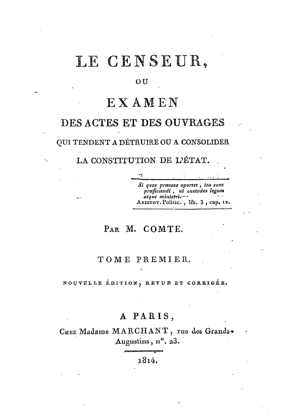
"On Political Sects. A Dialogue between a Pure Royalist, a Constitutional Royalist, a Republican and a Metaphysician"
Le Censeur (July, 1814)
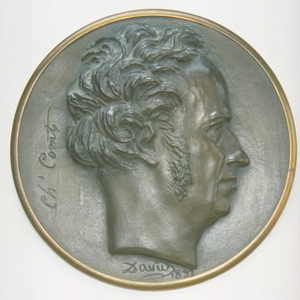 Charles Comte (1782-1837) |
 |
[Created: 8 May, 2026]
[Updated: 26 May, 2026] |
Source
, "On Political Sects. A Dialogue between a Pure Royalist, a Constitutional Royalist, a Republican and a Metaphysician," Le Censeur T.1 (July, 1814), pp. 41-57.http://davidmhart.com/liberty/FrenchClassicalLiberals/Comte/CenseurAnthology/C1-05-en.html
Charles Comte, "On Political Sects. A Dialogue between a Pure Royalist, a Constitutional Royalist, a Republican and a Metaphysician," Le Censeur T.1 (July, 1814), pp. 41-57.
[CC??], “Des sectes politiques. Dialogue entre un Royaliste, un Royaliste constitutionnel, un Républicain et un Métaphysicien,” Le Censeur T.1 (juli, 1814), pp. 41-57.
It is also available in French in a facsimile PDF of the original and in HTML.
This essay is part of a collection: Charles Comte and Charles Dunoyer, Censoring the State: An Anthology of Articles by Charles Comte and Charles Dunoyer from Le Censeur (1814-1815) and Le Censeur européen (1817-1819). Edited and translated by David M. Hart (Pittwater Free Press, 2026).
The anthology is available in the following formats:
- all 35 essays in one file in French [HTML] and in English [HTML]
- the 17 essays from Part 1 Le Censeur (1814-1815) in French [HTML] and in English [HTML]
- the 18 essays from Part 1 Le Censeur européen (1817-1819) in French [HTML] and in English [HTML]
- all the essays listed in a sortable table with links to the individual French and English language versions.
5. Charles Comte, "On Political Sects. A Dialogue between a Pure Royalist, a Constitutional Royalist, a Republican and a Metaphysician" (July, 1814)
On Political Sects
[41]
Dialogue between a Pure Royalist, a Constitutional Royalist, a Republican and a Metaphysician.
Philosophy, religion and politics have produced a great number of sects; but the first is, I believe, the only one whose divisions have not stained the earth with blood. This proves, it seems to me, that if philosophers have often gone astray, they are at least the only ones who have sought the truth in good faith, and who have not been guided in their inquiries by the thirst for riches and dignities. Locke and Condillac appeared; and before their wise writings, the philosophical sects dissolved like shadows before the light. Banished without return from France and England, they have, it is said, taken refuge in Germany, from where they will again be banished, as soon as the writers of that nation condescend to assess the value of the words they employ.
The religious sects have not been so gentle; as the sectarians had to discuss mysteries, riches and honors, it was a little more difficult for them to come to an understanding and to renounce their [42] claims. However, after many discussions, insults, excommunications, assassinations, massacres and civil wars, the rage has calmed; and, according to the usual course of affairs, they ended where they should have begun; that is to say, being unable to come to an understanding, each remained in his belief without troubling himself about that of others. One day perhaps some rays of the light which Locke and Condillac brought into philosophy will fall upon the religious sects; then they will in their turn disappear, and men will be reunited under the same religion. That must happen, let us not doubt it, for every sect is the daughter of error, and no error can be eternal.
The rage of the religious sects have been followed by the rage of the political sects; and we have had pure royalists, constitutional royalists, aristocrats, democrats, Jacobins and sans-culottes. Most of these sectarians have been neither less ardent in their persecutions nor in taking their revenge than the religious sectarians; for, while the strongest were busy proscribing the weakest, the latter, in order to uphold altar and throne, went to stir up civil war, or to plunder the stagecoaches. Finally, after having committed many crimes and shed much blood, they all laid down their arms, less out of reason than out of weariness! Now each presses around the throne, and steps forward to demand a reward for the noble services he has rendered to the fatherland.
[43]
This time of calm gives rise to a new kind of war; it is that of pamphlets. There is not a writer, however puny he may be, who does not wish to expres his thoughts on the government which suits France. Some, and they are the most fanatical, proclaim themselves to be Pure Royalists, and maintain that the French committed an abominable crime, when they had the audacity to present a constitution to their legitimate master. The others, who do not believe in kings by the grace of God, are strongly persuaded that we must have a King; but they maintain that we have no legitimate masters; that kings exist only for the interest and by the will of the people; and that thus it belongs to the people alone to determine the rules according to which they wish to be governed. These have written upon the banner that precedes their innumerable phalanxes, CONSTITUTIONAL ROYALISTS. There is a third sect which does not produce many pamphlets, and which bears no banner: it is that of those stern men whom the name of King makes them recoil in horror, and who would have banished even the King from the sacrifices if they had had the happiness of being born Romans. This last group call themselves republicans.
As a witness to a discussion which arose on the very day when the constitution was promulgated, between a pure royalist, a constitutional royalist, a republican, and a metaphysician who wished to reconcile them, I am going to share it with the public; this will spare me the need to examine of all the individual works [44] which, during the last few days, have appeared on this subject.
The Pure Royalist. At last we have returned to the ancient government of our fathers, to that gentle and paternal government which made possible their happiness and their glory for fifteen centuries.
The Republican. What! you want to live under a monarchical government! Don't you know that, according to Montesquieu, in monarchies, politics gets great things done with the least amount of virtue it can; that the State exists independently of the love for the fatherland, of the desire for true glory, and of self-renunciation; that the laws there take the place of all those virtues of which there is no need and from which the State now exempts you; that if among the people there happens to be some unfortunate honest man, Cardinal Richelieu, in his political testament, hints that a monarch ought to be wary of employing him. Since this is so true, adds Montesquieu, virtue cannot be the driving force of this kind of government.
The Pure Royalist. It is true that, in a monarchical government, virtue is useless; but is it not replaced by honor, that is to say by the self-importance (prejudice??) held by each individual and person with any social position?
The Republican. What then is this miserable honor of which you speak; and what good can it produce, since it is compatible with all vices? Open the Spirit of Laws, and you will read in chap. V of book III:
"Ambition in idleness, baseness in [45] pride, the desire to enrich oneself without labor, aversion for truth, flattery, treachery, perfidy, the abandonment of all engagements, contempt for the duties of the citizen, fear of the virtue of the prince, hope in his weaknesses, and more than all that, the perpetual ridicule cast upon virtue, these all form, I believe, the character of the greater number of courtiers, marked in all places and at all times. Now, it is very difficult that most of the principal men of a State should be dishonorable men, and that the inferiors should be men of worth; that those should always be deceivers, and these consent to be nothing but dupes."
Here are the morales of a nation which is subject to a monarchical government: and with such morals, it is impossible that the people should not be miserable, and that the government should not end by being overthrown. It was believed, it was the belief of Montesquieu, that a government could be sustained by the self-importance of each person and of each social position. But what has happened? It is that enlightenment has dissipated prejudices like these; that from then on the throne was found to be without support; that it collapsed almost of itself; that it dragged down in its fall everything which surrounded it, and that the men who had lost their prejudices, but who had retained their bad morals, tore each other to pieces like wild beasts. To reestablish the monarchy, it would be necessary to reestablish these prejudices, and that is impossible; it is therefore [46] necessary that we should have a republican government.
The Pure Royalist. "What! Jacobinism again? and the purest Jacobinism, at the very moment when France flattered herself that it had reached the end of the disasters and crimes which she owed to that infernal sect! Ah! you are a shameless man, a pedant, an ignoramus, a monstrous Jacobin who... let us move on … [1]" (With these words the pure royalist cast frightening looks at the republican, anger suffocated him, and vox faucibus haesit.)
The Constitutional Royalist. We must no longer think of establishing a republic in France: the experience we have already had of it have made us disgusted with it forever. But neither must we have a monarchy such as it was formerly, founded on the uselessness of virtue, on the self-imporatnce of each person and of each social position, and on the vices which Montesquieu blames on the courtiers of our ancient Kings. We need a constitution freely discussed by the representatives of the people, and presented for the acceptance of the King whom it shall designate; we need, in a word, a constitutional monarchy.
The Pure Royalist. Ah! what are you proposing! Do you not know that to impose conditions upon a legitimate King is to abase him; that to make him submit to taking an oath to maintain it is to make him call heaven to witness the most shameful of [47] capitulations. We wish him to reign by force, and that he should never cease to be invested with the most absolute power; [2] that the church whould repel from its bosom those who dare to dictate the laws to him from whom they ought to receive them [3]; that Louis XVIII himself cannot give us a new constitution; that he may, if he will (may God preserve us from it!) renounce his title of King of France; but that the crown of the Bourbons is hereditary by a constitution which exists today in all its force; that he cannot deprive his worthy brother and his worthy children of the heredity to which a true right calls them [4]; finally that we all desire a pure monarchy.
The Metaphysician. You say very fine things, I do not doubt it. However, I must confess to you that I have not enjoyed the pleasure of understanding you. You pronounce the names of King, of legitimate King, of pure monarchy, of constitutional monarchy, of republic, of right to the crown; would you explain to me the meaning of each of these words?
The Pure Royalist. Open the latest work of M. de Chateaubriand, and you will read there, page 57, that the functions attached to the title of King are so well known to the French, that they have no need to have them explained; that the King immediately represents to them the idea of legitimate authority, of order, of peace, of [48] legal and monarchical liberty. The memories of old France, religion, ancient customs, family morals, the habits of our childhood, the cradle, the tomb, all are attached to this word King.
The Republican. What strange gibberish! And what can the functions of a King have in common with cradles and tombs? The word King recalls, you say, the memories of old France; but feudalism, torture, ordeals by red-hot iron or by boiling water recall them also, is that a reason to return to them? This word represents the idea of legitimate authority; but what is legitimate authority, and how does the idea of this authority attach itself to the word King rather than to the word Republic? How can this word recall the habits of our childhood? Do you believe that we have lived only with Kings and that the republican government, under which all the men who are today in the prime of life have been brought up, gave them teachers to inspire them with the love of royalty? That the definition of M. Chateaubriand may be good for some old courtiers, brought up with princes, I can understand; but admit that it is absurd for all the French.
The Constitutional Royalist. The definition of M. C..... does not give an exact idea of the monarch; Montesquieu gave a more just one in saying that the monarchical government is that where one alone governs, but by fixed and established laws.
The Metaphysician. This definition is neither [49] clearer nor more exact than the preceding one; for if the monarch governs by fixed and established laws, it follows that these laws are independent of his will, and that consequently it is not he who makes them. There therefore exists in the State a power anterior to his; and this power cannot perish, since, if it perished, the Monarch, or the King, would no longer govern by fixed and established laws. What moreover are the ideas attached to the word Government? If this word signifies only he who sees that the laws are executed, it is clear that, in all possible states, there must be a chief who governs by fixed and established laws.
The title of King has not an absolute meaning; for the ideas attached to it are more or less extended, according to the more or less limited rights granted to the man who is invested with them. Sparta had hereditary Kings who governed by established laws, and yet it is said that Sparta was a republic. France had hereditary Kings who also governed by established laws, and yet France was a monarchy. Now, suppose that the power of the Kings of Sparta had gradually increased, or that of the Kings of France had gradually diminished; what would be the precise moment when Sparta would have become a monarchy, and when France would have been changed into a republic? The solution of this question is without doubt of the highest importance; for, if Montesquieu is to be believed, at the moment when the State should cease to have the title of republic to take that of monarchy, the [50] citizens must lose their virtues, acquire honor, that is to say the prejudice of self-importance, and contract all imaginable vices.
One does not therefore know what one says when one asks for a King: and one knows it no better when one asks for a republic. Montesquieu indeed defines republican government as one where the people in a body, or only a part of the people, have sovereign power. But in no country has the people ever had the sovereign power in its entirety; they have always been obliged to leave a part of it to their magistrates; now, if it suffices that a part of the people share in the sovereign power for the State to be a republic, it is evident that France and England are today republics, since without the concurrence of the people, no law can be made there. Why then did the French so cruelly tear each other apart during the revolution? For words - some wanted France to be called a Kingdom, others wanted to give it the name Republic; and it is the difference of two or three letters which was the original cause of the death of five or six million Frenchmen. It is so true that they fought only for words, that if today someone wished to give to France the name republic and to the King the title of consul or of president, without changing anything in the substance of our institutions, he would probably occasion a civil war.
Yet listen to our grave legal theorists, and you will hear them reasoning about these two words [51] king and monarchy, as if in nature there existed beings of this name, independent of human institutions. One will tell you gravely that justice is an emanation of the King, another will maintain that it is of the essence of monarchy to have nobles, feudal rights, and seigniorial and ecclesiastical jurisdictions; a third will say that by their nature Kings are always minors; in a word, they do nothing but realize abstractions, and give them attributes which ought to result, not from this or that word, but from the constitutional laws of the State.
The Pure Royalist. Are you claiming, like so many others have done, to contest the rights and authority of the legitimate King, in order to establish those of the usurper?
The Metaphysician. I contest nothing, and if I dared to claim something, it would be that one should seek to understand one another when disputing something. I believe I have demonstrated that the word king does not recall of itself any determined idea; and it seems to me that the meaning of the word legitimate is not much better fixed. Until now I had thought that this word meant conform to the law; whence I had concluded that a King could only be legitimate insofar as his authority was founded on the laws of the State; and as it seemed to me that the laws were anterior to the legitimate Kings, and that they had not made themselves, I had thought that they ought to be the work of nations; which naturally brought me to this conclusion, that if the people had had the right to make the laws and [52] the legitimate Kings, they could also unmake them and make others at their will. I held all the more to this opinion, since it would have been cruel for me to think that our fathers had committed an enormous crime in driving from the throne the unworthy descendant of Charlemagne to place Hugh Capet there, and that I could not bring myself to consider that illustrious Monarch as a usurper.
But for two months my ideas have changed considerably; our writers, great and small, have taught me that I was in error: I see clearly today that a legitimate king is a man who holds the reins of government and who gives out places, pensions and ribbons; and that a usurper is one who has been driven from the throne and who can give nothing more. It is true that not everyone attaches the same meaning to these words; but one must hope that, since our writers and our magistrates have reformed the language, the members of the Institute will hasten to reform the vocabulary.
The Pure Royalist. You slander our writers, our magistrates, and above all our illustrious nobility; for you cannot be ignorant of the fact that, if they have served the cause of the usurper, if they have lavished praises upon him, they none the less desired, in secret, the return of our legitimate princes. Besides our great writers, such for example as M. de Chateaubriand, have never praised him, as you can be convinced by reading his latest work.
The Republican. Open the Genius of Christianity, [53] that famous work in which it is proved that Racine would not have written his tragedy of Phèdre if he had not believed in the Holy Virgin; and you will read in the preface:
"I think that every man who can hope to find some readers renders a service to society by trying to rally minds to the religious cause; and, even if he should lose his reputation as a writer, he is obliged, in conscience, to join his strength, however small it may be, to that of the powerful man who has pulled us out of the abyss.
"He, says M. Lally-Tolendal, to whom all strength has been given to pacify the world, to whom all power has been entrusted to restore France, has said to the prince of priests, as formerly Cyrus: Jehovah, the God of heaven, has given me the kingdoms of the earth, [5] and he has commissioned me to rebuild his temple. Go, ascend the holy mountain of Jerusalem, rebuild the temple of Jehovah.
"At this order all the Jews, even to the least among them, must hasten to gather the materials for the reconstruction of the edifice. Obscure Israelite, I today bring my grain of sand."
You see that the obscure Israelite, M. de C.., who hastened to second the new Cyrus to whom heaven had given the kingdoms of the earth, did not then consider him as a usurper; which would indeed seem to prove that a usurper is a dethroned King in modern language.
[54]
The Pure Royalist. Ah! no doubt, when M. de C.... wrote that, the tyrant had not assassinated the Duke of Enghien, strangled Pichegru, exiled Moreau, arrested the King of Spain, etc., etc.
The Republican. I do not know; but here is what one reads in the famous speech which was to have been given before the Institute, and in which M. de C... showed so much courage against M. de Chénier, when he was dead.
"But what a time have I chosen, Gentlemen, to speak to you of mourning and funerals! Are we not surrounded by festivals? As a solitary traveller, a few days ago I meditated upon the ruin of destroyed empires, and I see a new empire rising. I hardly leave the tombs where nations lay buried, and I perceive a cradle laden with the destinies of the future. On all sides resound the acclamations of the soldier. Cæsar prepares his triumph; the people recount wonders. The monuments raised, the cities embellished, the frontiers of the fatherland bathed by the beneficent seas which bore the vessels of the Scipios, and by the distant seas which Germanicus did not behold.
"While the victor advances, surrounded by his legions, what will the peaceful children of the muses do? They will march at the head of the chariot to remind him that he is a man, and to mingle with the warlike songs the touching images which made Paulus Æmilius weep over the misfortunes of Perseus.
"And you, daughter of the Cæsars, come forth from your palaces with your young son in your arms, come to add [55] grace to grandeur; come to soften victory, and temper the splendor of arms by the gentle majesty of a queen and a mother."
The Pure Royalist. All these speeches prove nothing, and I am well persuaded that at the very moment when he wrote them, M. de C..... was saying at the bottom of his heart:
"Buonaparte is a false great man; the magnanimity which makes heroes and true kings is lacking in him. Hence it is that no one cites from him a single one of those words which announce Alexander and Cæsar....... Shall France be a forfeited property? Must she belong to a Corsican by right of escheat? Ah! for God’s sake, let us not be found in such disloyalty as to disinherit our natural lord, to give his bed to the first companion who asks for it... And are the Bourbons there? Where are the princes? are they coming? Ah! if one should see a white banner... The horror of the usurper is in every heart. He inspires so much hatred that..... [6]"
Here the pure royalist was interrupted by a person who came to give us a reading of the constitutional charter: and, as might well have been expected, it satisfied neither the republican, nor the constitutional royalist, nor the pure royalist. What! said the first, the nineteenth year of our reign...! Ah! what indignity! said the second; we have conceded, made concessions and given way… God! said the third, all is therefore lost; the property of the church and the property of the émigrés will not be restored; and, [56] to crown the horror, the king will not be able, at his will, to levy taxes upon his subjects, to reward his faithful servants. No, this cannot last... Let us go find M. Dard or M. Falconet, they have talent and courage, and they will know how to demonstrate to the nation that this constitutional charter is contrary to divine law, and that it cannot be reconciled either with canon law or with the decisions of the popes.
Gentlemen, said the metaphysician, do not go and rekindle civil war again for words, or for property which you cannot obtain. You are distressed that the King has dated the constitutional charter from the nineteenth year of his reign; but what does that mean? If the drafter wished to say by these words, that it had been nineteen years since the prince who governs us had taken the title of King of France, I do not see why you should be so grieved at it; for this fact, which is absolutely foreign to you, can wound neither your rights nor your interests. But if the drafter of the constitutional charter wished to say that the King had governed us for nineteen years, all that we can conclude is that this man, whoever he is, probably has just arrived from some desert island, where he must have been ignorant of all that has passed in Europe for twenty-five years.
You complain that the preamble states that the King grants and concedes the constitutional charter: but that again is only an error of fact. Read the constitution of 1791 accepted by Louis XVI, [57] and the constitution of the year VIII, and you will see that they guarantee to the French all the rights which are consecrated by the new charter. Do not then entangle yourselves in new disputes; keep in mind that the time you spend in defending the constitution will be more useful to France than that which you would spend in criticizing it. And if you believe that it contains some defects, you can solicit their correction from the Chamber of Deputies; but, in the meantime, obey the laws and serve the fatherland. As for you, monsieur the pure royalist, you should be afraid that you will soil your purity by showing all of France that the signs of fondness you have shown for the legitimate King have no other purpose than to hide your greed.
Endnotes
[1] From Du principe de l’Obstination des Jacobins by Abbé Barruel.
[2] Address of the city of Nîmes.
[3] Speech of the bishop of Mende.
[4] From Du principe de l’Obstination des Jacobins by Abbé Barruel.
[5] He did not therefore usurp them.
[6] De Buonaparte et des Bourbons, by M. de Chateaubriand.