| The Digital Library of Liberty & Power incorporating the Guillaumin Collection of the Great Books of Liberty |
Home | New | Authors | Works | Papers | Blog | About | Correspondence | Search |
 |
|
CHARLES COMTE,
"Announcement"
Le Censeur (Sept. 1814)
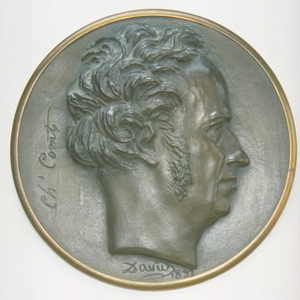 Charles Comte (1782-1837) |
 |
[Created: 8 May, 2026]
[Updated: 26 May, 2026] |
Source
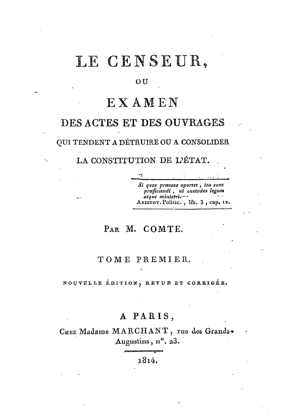
, “Avertissement,” Le Censeur T.1b (sept. 1814), pp. iii-vi.http://davidmhart.com/liberty/FrenchClassicalLiberals/Comte/CenseurAnthology/C1-04-en.html
Charles Comte, "Announcement," Le Censeur T.1b (Sept. 1814), pp. iii-vi.
This is a translation of Charles Comte, “Avertissement,” Le Censeur T.1b (sept. 1814), pp. iii-vi.
It is also available in French in a facsimile PDF of the original and in HTML.
This essay is part of a collection: Charles Comte and Charles Dunoyer, Censoring the State: An Anthology of Articles by Charles Comte and Charles Dunoyer from Le Censeur (1814-1815) and Le Censeur européen (1817-1819). Edited and translated by David M. Hart (Pittwater Free Press, 2026).
The anthology is available in the following formats:
- all 35 essays in one file in French [HTML] and in English [HTML]
- the 17 essays from Part 1 Le Censeur (1814-1815) in French [HTML] and in English [HTML]
- the 18 essays from Part 1 Le Censeur européen (1817-1819) in French [HTML] and in English [HTML]
- all the essays listed in a sortable table with links to the individual French and English language versions.
4. Charles Comte, "Announcement" (Sept. 1814)
Announcement (Sept. 1814)
[iii]
When Napoleon Bonaparte had seized the reins of government, he presented to the French a constitution which guaranteed them the free exercise of their civil and political rights, and which would have ensured their happiness if he had not taken care to introduce into it all the vices he thought fit to favor his ambition. Since the men whom he had called upon to draft it (and whom he afterwards appointed to uphold it) had had no other object than to seize sovereign authority, they continually impaired it, and overthrew it entirely as soon as they [iv] believed they had attained their goal, by proclaiming that Bonaparte was the supreme and ever-living law, and that the senate itself was above the laws. If a courageous man had then raised his voice in defense of the constitution, the police, after having denounced him in the newspapers as a seditious person and a traitor, would have sent him into one of the dungeons where Pichegru was strangled.
That reign of violence and oppression has ceased, and a new order of things has succeeded it. Most of the vices which were to be found in our constitution have disappeared; but it is necessary to prevent them from being introduced again; it is above all necessary that it be respected, and respected alike by the ministers of the prince and by the very last French person. This respect, which all citizens owe to the laws of their country, can exist only through public opinion, and opinion can only be formed through education, or by periodical writings that are within the reach of everyone. [v] In this regard journalists could be of great utility; but the high importance they attach to mere literary discussions, the indifference they show for all that concerns morals or legislation, and the habit of servile adulation which most of them adopted under the last government, do not allow us to hope that they will concern themselves with enlightening the citizens about their true interests. How could one expect, indeed, that men who always prostrate themselves before power could ever have the courage to speak the truth and denounce to the public the errors or arbitrary acts of a minister?
What they do not do, I dare to undertake. A stranger to all the governments that have succeeded each other in France during the space of twenty years, I have, in writing, no other interest than that which ought to animate all Frenchmen, that of seeing my fellow citizens obey the laws, respect public morals, and resist oppression. Let men of such and such a party, of such and such a sect, [vi] not therefore seek in this work anything to feed their passions; for they will find nothing in it that can please them.
Every month there will appear four booklets of at least three sheets each.