| The Digital Library of Liberty & Power incorporating the Guillaumin Collection of the Great Books of Liberty |
Home | New | Authors | Works | Papers | Blog | About | Email | Search |
 |
|
THOMAS GORDON,
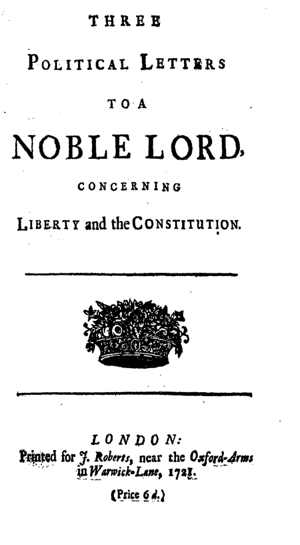
Three Political Letters to a Noble Lord,
Concerning Liberty and the Constitution (1721)
|
|
 |

The Guillaumin Collection
 |
This title is part of “The Guillaumin Collection” within “The Digital Library of Liberty and Power”. It has been more richly coded and has some features which other titles in the library do not have, such as the original page numbers, formatting which makes it look as much like the original text as possible, and a citation tool which makes it possible for scholars to link to an individual paragraph which is of interest to them. These titles are also available in a variety of eBook formats for reading on portable devices. |
Source
, Three Political Letters to a Noble Lord, Concerning Liberty and the Constitution (London: Printed for J. Roberts, near the Oxford-Arms in Warwick-Lane, 1721).http://davidmhart.com/liberty/EnglishClassicalLiberals/Gordon/1721-PoliticalLetters/Gordon_TheePoliticalLetters1721.html
Thomas Gordon, Three Political Letters to a Noble Lord, Concerning Liberty and the Constitution (London: Printed for J. Roberts, near the Oxford-Arms in Warwick-Lane, 1721).
This title is also available in a facsimile PDF of the original and various eBook formats - HTML, PDF, and ePub.
This book is part of a collection of works by Thomas Gordon (c. 1691–1750).
Editor's Note
The names of persons and places have not been italicised as they are in the original text. Foreign phrases (in French and Latin) are in italics.
Table of Contents
Three Political Letters to a Noble Lord
[1]
LETTER I↩
My Lord,
It is a just Reflexion that Livy makes, That Mankind are much more sensible of the Interruption made in their Liberty, than of the utter Loss of it. Acriores, says He, Sunt Morsus Libertatis interruptae, quam Amissae. When Men have been Slaves for some time, they have no sense of the Blessing of Freedom; Liberty has no Charms: And Oppression, like a Dead Palsie benumbs them, that they can feel no weight, let it be never so great. But a free People can never be Ruin'd, without some Violent and Glorious Struggles for their Privileges. The least approach of Arbitrary Power alarms them, and animates them with Noble and Generous Resentments for the Publick Good. And 'tis fit indeed it should; for the Infringement of one Fundamental, encourages, the [2] the breach of another: The Passions of Men have no bounds, and he that can gratify one Appetite with impunity, will be sure to indulge another. But certainly we can never Guard enough against every Violation of our Rights, nor Punish the Offenders with too much severity. At present we are the only Nation of Europe that have preserv'd the Liberties transmitted to us from our great Forefathers; the noble Gothick Constitutions are All destroyed, and the Rights of Millions sacrificed to the Pride, Ambition, and Caprice of Vicious, Ignorant, or Obstinate Statesmen. Spain, France, and Denmark, are no longer Free, who but some Ages ago had their Representatives and Parliaments as well as we: The name of Liberty is no more heard amongst them, and Slavery is taught to be an Inheritance by Divine Right. One would wonder how Nations so Brave, and Great as they were, should suffer themselves to be so opprest; that now they have a Property in nothing, but the Chains they wear; How their Princes, who were originally their Creatures, and in those Times chosen for their Virtue, Wisdom, and good Qualities, should be capable of destroying what was the Interest of All to preserve, would seem very odd, and unaccountable, if History did not fully discover the Methods, the Ministries of those Princes took, for Ruining those Respective Constitutions. Sallust and Livy both observe, that the Ruin of [3] the Commonwealth was owing to the Introduction of Luxury. This debauch'd Mens Morals, and made them fit Instruments for Ambitious Men to Enslave their Country. The same Inlet of Corruption has subverted the Constitutions of other Free Nations: Extravagance in all kinds of Expence has been always encourag'd by Ministers that had a Design upon the Publick Liberty. Costly Equipages, Balls, Masquerades Gaming, and Luxurious Entertainments have been constantly celebrated and extoll'd by them, on purpose to corrupt Mens Virtue, and introduce Poverty: From hence came Pensions, and Dependance; and from hence Slavery and Oppression. Ab hoc Forte Derivata Clades, in Patriam Populumque fluxit. This was the Case of France and Span. Commines observes, that Lewis the Eleventh, who first laid the foundation in France of Arbitrary Power, gain'd most of his Advantages by his Bribes; He had always a strong Band of Pensioners, and His Money never fail'd of persuading, where His Reasoning did not always carry that apparent Evidence of Publick Good. In Spain we find noble Remonstrances made by some Great Men in their Cortes, which were the same as our Parliaments, about the Invasion of their Rights and Privileges: They bravely told Charles the Fifth, That they were a Free People, and would be Govern'd as such; That their Allegiance was no longer due, than the [4] Laws were observ'd; And that the Power of his Northern Ministers, for so his Germans and his Flemmings were call'd, was contraary to the Fundamental Rights of the Subiect, of not being Govern'd by Foreigners; They Gloriously complain'd, that Spain was made a Province to Germany, and their Treasures exhausted in support of Power which in all probability would destroy them. This was the spirit of those Great Men ; and the Effect of their Remonstrance was a Generous and Laudable Asserting of their Rights by Arms: And tho' they had the misfortune of being overpower'd by foreign Forces, and the Corruption of a majority in one of their Parliaments, yet they had the satisfaction of having done their Duty, and leaving their excellent Protestations for Publick Liberty on Record, to condemn the infamous Iniquity of those Parricides, that sold themselves, their Posterity, and their Country for Money. Thus fatal has been Corruption and Bribery : And can we think the Advisers of such Methods can be punish'd too severely ? Can such Conduct in Ministers be too strictly examin'd into? For to their Counsels are we to attribute in a great measure the Actions of Princes. 'Tis more than probable that Charles the Fifth had never acted as he did, had not he been instigated by his Foreign Ministers; for we find him in the latter part of his Life, condemning his former Conduct. The Oath he made [5] the Hollanders take to his Son Philip, of defending their Liberties against the Invasions of Arbitrary Power, and the Admission of Foreigners, prove undeniably the Notion he had of that Accursed Policy of Enslaving hs Country. It would be happy for every Free Nation, if they had Sumptuary Laws to restrain Men from Excess in their Expences. Where Men have a competency they will be free; Want makes dependance, and he that has nothing to lose, will think nothing worth preserving. In James the First's time, there was an attempt made to introduce some sumptuary Laws among us: But that Prince, who had little Craft, and ill-nature enough, to desire to see Men Slaves, tho' he had not the Courage to make them so, discountenanced every thing that had the Face of publick Good. To his Reign, and Charles the Second's, are we to attribute the Corruption of our Morals. Luxury and Vice, produced very fruitful Harvests, under such diligent Husbandmen. Our great Men were Impoverish'd, and forc'd to become Pensioners for a sublistance: And how fatal that had like to have been to our Constitution, particularly in Charles the Second's time, we can only consider with Horror, and Indignation. So Degenerate, and Abandon'd were we, that Wars were made upon a Nation, for whom we should have fought, in Alliance with a Prince that was the growing Terror of Europe. Vast Sums were rais'd on the People, to [6] maintain Pimps, Pensioners and Whores; and this for a poor stipend. Nay, so far were some corrupted, that I have been well inform'd, they would give a Vote on which the Fate of Europe depended, for a Dinner at the Green-cloth. Many of these Wretches were only Day-Labourers, that work'd Jobs of Villainy occasionally, while the Craftiest Knaves and Demagoues, where taken into Service by the year. But God be prais'd, those days are over, Mankind are too full of Abhorrence and Detestation of such Villainies, to bear any such Practice again. A Pensioner is now become Infamous, and no Man that has the least regard for Honour and Reputation, would be thought liable to such an Imputation. We have now a Spirit of Virtue and Liberty reigning among us; we have a good and gracious Prince, and a noble Constitution guarded by excellent Laws, particularly an Act of Settlement, which Religiously observ'd in the parts yet unrepeal'd, must make us all Happy. It is so Glorious an Act, that I can't forbear tranisribing it: 'Twas an Act contriv'd by that truly great and able Statesman, and worthy Patriot, the Lord Sommers ; and past by that Admirable Man, King William, a Prince rais'd by Providence, to be the Scourge of Tyranny, and to save and protect the Rights of a Brave and Injur'd People, and to continue them, as far as Human Wisdom and Virtue can provide, Inviolable to Posterity.
[7]
The Words are,
THAT whosoever shall hereafter come to the Possession of this Crown, shall join in Communion with the Church of England, as by Law Establish'd. In Force.
THAT in case the Crown and Imperial Dignity of this Realm, shall hereafter come to any Person, not being a Native of this Kingdom of England, this Nation be not obliged to engage in any War, for the Defence of any Dominions, or Territories which do not belong to the Crown of England, without the consent of Parliament. Yet in Force.
THAT no Person, who shall hereafter come to the Possession of this Crown, shall go out of the Dominions of England, Scotland, or Ireland, without consent of Parliament. Repeal'd I G. His Majesty, as the Preamble sets forth, having a Son.
THAT from, and after the time the Limitation shall take effect ; all matters relating to the well Governing of this Kingdom, which are Properly Cognizable in the Privy-Council, by the Laws and Customs of this Realm, shall be transacted there; and all Resolutions taken thereupon, shall be signed by such of the Privy-Council as shall advise and consent to the same. In Force.
THAT after the Limitation shall take effet, no Person born out of the Kingdoms of [8] England, Scotland, or Ireland, or the Dominions thereunto belonging, (although he be Naturalized, or made a Denizen, except such as are Born of English Parents) shall be capable to be of the Privy Council, or a Member of either House of Parliament; to enjoy any Office or Place of Trust, either Civil or Military; or to have any Grant of Lands, Tenements, or Hereditaments from the Crown to himself or to any other, or others in trust for him. Yet in Force.
THAT no Person who has an Office, or Place of profit under the King, or receives a Pension from the Crown, shall be capable of serving as a Member of the House of Commons. Repeal'd, or Explain'd since his Majesty's Accession; I can't tell which.
THAT Judges Commissions be made Quam dia se bene Gesserint, and the Salaries ascertain'd and establish'd: But upon the Address of both Houses of Parliament, it may be Lawful to remove them. In Force.
THAT no Pardon under the Great Seat of England, be pleadable to an Impeachment by the Commons in Parliament. In force.
WHAT a Glorious and Wise Provision is here, for the Liberties of a People ? With what Intrenchments are we guarded against any attempts from Arbitrary Power? These Barriers nothing can force while we are true to our selves: These Laws shall still preserve [9] us: Not even the Villainy of the South-Sea Directors, nor the more wicked, and shameful Screening these Villains, and their Accomplices from Justice, shall be able to overturn this Great, this Glorious and Antient Constitution. Tho' the violent Invasion of our Property has been so Impudent and Barefac'd, that might be thought, (did not we well know our Ministry) to be design'd to introduce Arbitrary Power; and alarm us by this preparatory Calamity, to expect something still more terrible to come. But while these Laws remain, and are Executed, we have Liberty; and while we have Liberty, we shall certainly do our selves justice upon these Miscreants, that are considerable only by their Villainies. Such Crimes can never go unpunish'd; and should the Laws, and Legislature be supposed Capable of suffering them to Escape, (the contrary of which, we find in the noble Spirit, and Zeal of both Houses,) yet the Law of Nature would demand Satisfaction, should such a defection from common justice and Honour ever happen: Every Man, says Grotius might right himself; and Execute the Sentence his own uncorrupt Judgment should dictate to him. I am,
My Lord,
Your Lordships, &c.
[10]
LETTER II. ↩
My Lord,
AS we judge of the Wisdom and Happiness of a People from the form of their Government, and the due Execution of Good and Useful Laws; so we take our Notions of a Minstry, from the Prosperity, Quiet and Glory which a Nation enjoys from their Policy, and the Beneficial Acts made under their Administration. If a State encreases in Wealth, if its Trade Improves, if 'tis Considerable Abroad, and Easy at Home, if proper Regulations are made tor the equal Liberty of All, and Defence of Property; Then we pronounce a Ministry Wise and Able, and Distinguilh them by the glorious Name of Patriots. But if on the contrary, Commerce decays, if Discontents and Murmurs arise on every side, it foreign Courts show but little or no Regard to it, and fatal or insignificant Statutes are Enacted, What can we think of a People under such a Ministry, or not expect from their Administration ? Certain it is, the Miseries and Calamities of a People are to be imputed to them; and they stand Accountable for their Ignorance, Negligence, or Corruption. They are Guardians of our Liberties, and entrusted with our Interests: For this we Hoour, and give them Precedence ; and for this [11] support them in their Dignity. And indeed a Good Minister can never be esteem'd too much. The Post he fills requires great Application and Integrity : He is to devote himself to the Publick Good, and neglect his own Profit, Ease, and Pleasure; He is to have no Ambition but to serve his Country; nor any views but those of Honour, Virtue, and Liberty. He is to sacrifice his Private Resentments to the Publick Interest; and Reward Men of Merit without Partiality to Friendships or Relations. He is to watch over the Morals of the People, and take care of all Attempts against the Virtue of the Commonwealth; and, like some Wise Law-Givers, punishing with Death the Offerer as well as the Taker of a Bribe; Rightly judging, that such a Practice must end in the utter Ruin of the Constitution. This we expect from a Patriot: But if a Minister is Corrupt, if he little understands the Business he is entrusted with, or if he understands it, neglects it for his Pleasures; it he is Irresolute in what is Laudable, or Obstinate in what is Wrong; if he Philippises, or is Govern'd by Counsels destructive of the Interests of his Country, or Corrupts the Morals of others by the irresistable temptation of a Pension, What shall we say to such a Person, or how treat him with sufficient Scorn and Indignation? Shall we call him a Patriot? or rather shall we not call him a Betrayer of his Country, and cry, [12] aloud for Justice. Yes, surely we shall; 'tis a Debt we owe our Selves and our Country 'tis a Debt all Nations have demanded, and Ministers been oblig'd to pay. Of this Truth, our own Histories will give us abundant proof: Our brave Fore-Fathers would always Vindicate their Liberties, and punish the Violation of their Rights; They gloriously Remonstrated against the Government of Foreign Ministers in the Reigns of Stephen, Henry the Third, and Edward the Second, and Curs'd the Direction of Spanish Counsels in the time of James the First. Those noble Parliaments were justly jealous of their Privileges: And tho' weak Princes would sometimes protect their Favourites against the Bent and Inclination of the People; yet the People never left Prosecuting those Favourites, till they were sacrific'd to their just Rage and Resentment. Even the Two Spencers, those Darlings of their Princes were at last Master'd and put to Death, tho' their Obstinacy and Ambition involv'd the Nation in a Civil War. Indeed in the Reign of Charles the Second, we were Universally corrupt; a wicked Ministry made a wicked Nation; our Representatives were most Pensioners; and our Legislature was in the House of Bondage. French Counsels infected our Cabinet; and the true Interest of England was no more regarded. Dunkirk, a Place almost as important as Gibralter, Or Port-Mahon, was basely sold, and deliver'd up; our Fleets fought the Battles of [13] others; and violent Seizures and Invasions were made on our Property: Thus all things tended to Arbitrary Power, and the Ruin of the Constitution. But of a sudden the Nation was alarm'd ; God open'd the eyes of the Parliament to perceive the Danger of their Liberties; The Antient English Virtue reviv'd in them, and call'd up the memory of their Ancestors that died in the Cause of Liberty; Those that had been Pensioners for so many Years, became Patriots, and zealous Assertors of their Laws and Privileges; They now abhorr'd themselves, and the Court, and ever after signaliz'd their Virtue in opposing their Impious Designs: So that after a long Sessions of Eighteen years, they had the Honour and Glory to be Disolv'd; notwithstandihg the alluring promises of the Ministry to make them Perpetual, would they change their Measures, and be subservient to the Court, But they rejected the offer with the utmost Disdain and Indignation, as an Attempt to subvert the Constitution. And indeed they did well; For how far the Body of the People might think That an Absolute Breach of Trust and what might be the Consequences of such an Opinion, would perhaps be very difficult to Determine: These Things were done for our Instruction. 'Tis true, nothing of this Nature is like to happen to Us: But yet as Tacitus lays, We should Inservire Posteris. Where may a Prince and Parliament arise, that [14] may not attend so nicely to such Transactions; and a wicked Ministry may prevail again, as it has often done before. We indeed have Great Reason to be Thankful; for certainly never was the English Nation Govern'd by such a Ministry; nor will Posterity, I believe, ever see the like again. I humbly ask Pardon if I offend their Modesty: But I should not do them that justice which all Sober, and Dispassionate Men desire to see done, if I did not Congratulate my Country upon so wonderful a Constellation of Great Men; Persons so universally admir'd and esteem'd for their Probity, Publick Spirit, Understanding, and good Conduct, that 'tis yet a Doubt, whether they are more belov'd by their Country than they Love and wish well to it. Indeed 'tis our Peculiar happiness, to have some Great Men, of such singular Abilities, that they can discharge Posts of different Natures, and which require different Talents, with equal skill, integrity, and success; Persons that can shift and change Offices, and Execute all with the same Address; and, as was said of Cato the Censor, When you see them in one Employment, you'd swear they knew little of any thing else. Rare and admirable Endowments! We have had the Blessing of seeing one great Man, First Commissioner of the Treasury, Lord President of the Council, Secretary of State, Groom of the Stole, and Lord Privy-Seal successively, and, [15] yet with what Honour, Dexterity, and Applause, has He acquitted himself in all these Places ? We have seen a Person advanced to be Secretary of State, like another De Wit, at an Age, when others are but setting out into the World, But his Knowledge of the Arts of Peace and War, and of the Interests and designs of Foreign Princes, his extraordinary Abstinence from Pleasures, and application to Business, made him absolutely necessary, to act in Concert with Persons that design'd nothing but the Glory and Happiness of the Nation. But his Death, Lamented by all good Men, has destroy'd the Hopes we had conceiv'd of so valuable and uncorrupt a Patriot. But why dwell we upon particulars ? 'Tis with Us, as with a fine Face; where its Beauty does not consist in this or that Feature, but in the Symmetry, and Harmony of the whole. The Glory and Security of the Nation does not depend upon the Integrity and Conduct of one Minister, but upon the joint Endeavours of all in the Administration: 'Tis this Concurrence that makes us thus happy. 'Tis this Union that expedites the most difficult Affairs, and removes those Embarrasments and Perplexities, that might otherwise be Fatal; this Agreement and Correspondence does not affect Us only; the effects are Diffusive and Universal. All Europe Extol their Policy, and feel the Influence of their Counsels. Fain would I know, when she Englsh Nation made so great a [i6] Figure as it makes now? Has not the Swede, and even the Mighty Emperor of Germany Sollicited for our Assistance? Has not Spain felt the fury of our Fleet, and the Czar own'd the dread of our Naval Preparations? Should any be so weak or perverse to disbelieve it, let him repair to Bremen, and visit the Territory of Verdune, and he'd learn the Glory of the English Nation, and perceive the Terrors of our Baltick Squadron. We are the Arbiters of Peace and War: And all the Sons of Men content to fear us, except the States of Brabant, who are safe only by being inconsiderable. Tell me when were there such few Discontents, Murmurs, and Remonstrances? When fat People more contented, more easy, and more submissive? And whatever Plots some persons might alarm us with, yet with how little noise, hurry, and tumult have they been supprest ; that many have suspected that there have been none at all. Yet will I ask again, when Flourish'd the Nation under such excellent and useful Laws, as have been pas'd since his Majesty's Accession to the Throne, and during the present Administration ? Should I give a Summary of these Acts, how would Envy and Destraction be silenced ? I shall mention the chief, and leave the rest to the curious and intelligent Reader. In this noble Collection of Laws, where shall I begin first ? We have many admirable and necessary Acts to Attaint Traytors in open Rebellion ; and multitudes for the better [17] Regulation and Payment of the Army, and to prevent Mutiny and Desertion, and others for supplying the Deficiencies of the Civil List. We have an Act to enable his Majesty to go abroad; and another for the Importation of Turbets in Forreign Bottoms. We have a Bill to restrain the Running of Brandy; and another to keep the South Sea Directors within the Land. We have a Perpetual Riot Law, by which every Justice may keep the Peace, by commanding upon pain of Death, any Twelve Persons that are met together, to disperse; and another for the Preservation of the Game, and the security of Salmon. We have Statutes for suspending the Habeas Corpus Act, by detaining Persons in Prison during Pleasure; and others against Wears, Nets that are too large, and illegal Practices in catching of Fish. We have Acts for Repealing and Explaining parts of the Act of Setlement, and others for Explaining Branches of the Game Act. We have a South-Sea Bill, and an Act against Frauds in Colouring of Snuff. We have an Act for confirming the Charters of Assurance; and another against the Combination of Journey-men Taylors, and to discourage Cloth-Buttons. And lastly, we have an Act, to Qualify Pensioners at Will, to Vote in the House of Commons, and another which immediately follows, to restrain Carmen from riding in their Carts. These Laws show the Happiness of such an Administration. Indeed the South-Sea Bill has not answered so fully as [18] might have been wish'd; but to whom shall we impute it ? Not to the Ministry. The Power indeed they had by that Act, of checking the Villainous designs of the Directors, unfortunately was given up by the Treasury, to the Directors themselves. But such a Breach of Trust could never have been expected from Men of their Character, and known Integrity. Indeed by this means, they and their Accomplices have got the Wealth of the whole Nation into their Hands, but what signifies that ? The Encouragement given to the Weavers and the late Button Act, will soon restore the Trade and Credit of the Nation, to the utter confusion of all Callicoes, whether Stain'd or Unstain?d. After all, as the best of Men are subject to Censure, if I might Presume to blame the Ministry, I think with great Submission, I might observe, that they have not sufficiently encouraged the Discovery of the Longitude, nor taken proper measures to get a Protestant Pope. But this I must submit to the Judgment and Consideration of Wiser and Abler Men than my Self. I am,
My Lord,
Your Lordships, &c.
[19]
LETTER III. ↩
My Lord.
THE Question your Lordship is pleas'd to ask about the Nature of Prerogative and the Extent of the Legislative Power, has perplex'd many Great and Learned Men and might in a Nation that did not enjoy that perfect Liberty that we do, be thought perhaps a little dangerous to Answer: But however I shall endeavour to give your Lordship all the satisfaction I am able. Prerogative, and the Legislative Power, were allowed, and settled by the Body of the People, for the better security and advantage of Society: They are Trusts for the Publick Good, and have their bounds in Reason, and the Law of Equity. The End of them, was the Liberty and Safety of the Community ; and for the Maintenance and Improvement of Property. They were the Creatures of the People ; and rais'd for their Defence, and design'd for their Happiness; notwithstanding what the Folly, the Flattery and Corruption of some have vainly asserted to the contrary. Prerogative is nothing but Unwritten Law, left to the wisdom and discretion of the Prince, to be made use of by him on all extraordinary Emergencies of State : 'Tis not a Lawless Extravagant Power of acting Arbitrarily; but 'tis rather an allowed [20] Complimental Power, that the Prince may better show his Wisdom, Courage, and Condudct, in the Government of his People, in Cases that can't be foreseen. Could Men have provided against every Mischief, there had been no such thing as Prerogative; and were Princes always and unavoidably Wise and Good, there would be no occasion for written Law: But the Vices, Weakness, and Follies of Mankind, make both absolutely necessary. The Legislature is the whole force of the Community lodg'd in such and such Hands: 'Tis a Delegation of the Rights of All to the Execution of a Few, whose Probity, Virtue, Wisdom, and superiour Qualities, have recommended to the esteem and choice of the Multitude: This is the Foundation of their Being. The Powers they are arm'd with, are the Peoples; and all that Omnipotence they are invested with, is still but the Collective Authority of the several Individuals. The Enacting, and Execution of the Laws is indeed lodg'd with them; but that Original Power thus to Enact and Execute, came wholly from the People. 'Tis a matter meerly Confidential and Fiduciary; and whenever a Legislature acts against the important Interests, and original Compact of the People, so far they are guilty of a Breach of Trust, so far they act without Authority, and are Answerable to their Principals for the violation of their Engagements. The Dernier Resort, [21] and Summam Imperium, is still in the People; and they are Accountable for the Usurpation of any extravagant and pernicious Powers, In such a Tyranny, and unjust Dominations Mankind have a Right of Demanding Satisfaction from their Representatives. They may Enquire into their Notorious Misconduct and Examine into their Fatal Corruption. This we find done in the Time of Edward the Second: The Lords and Commons had made a delegation of their Power, to some of both Houses, to transact the Business of the whole Nation. The joint Authority of the Legislature was devolv'd into a few hands; and the Personal Confidence that the People placed in, their Representatives, was transferred to others; to be Executed by them; This Conduct the People justly resented; and the subsequent Parliament declar'd their proceedings illegal, and contrary to the Fundamental Constitution of the Nation. And indeed it seems highly reasonable it should be so; for such a voluntary Abdication from Parliament, and Absenting from Business, must needs be Fatal, in giving Designing and Ambitious Men an opportunity of Imposing on the Publick, and passing such Laws as may be Destructive of the common Liberty. Whatever Artifices crafty Men may make use of to colour their Arbitrary behaviour, yet a Free People will know when they are oppress'd, and show their Indignation whenn the Commission they have [22] given, is not exactly and rightly pursued: They won't admit of an overbearing and unsatisfactory Reply, That they are not proper Judges of such Transactions ; they have still the same Reason and Understanding to judge of the Conduct of Men, as they had at first to judge of their Abilities. If their Expectation is not answer'd, they will murmur; and those murmurs all Wise Men will think it worth their while to endeavour to appease and remove. When the Roman People made their Decemvirs, they arm'd them with the Tribunitial and Dictatorial Power. They gave them the whole Authority of the Commonwealth, and invested them with the absolute Disposal of their Lives and Fortunes. Never had any set of Men a greater Extent of Jurisdiction; and yet what deference did those first Decemvirs pay to the judgment of the People, and what regard to their Opinion and Direction? They well knew for what end they were instituted, and how their Conduct would be Scann'd after the expiration of their Office, which was to continue for a Year. They saw the Eyes of the Common wealth were upon them, and that the Favour or Contempt of the Community would be bestow'd upon them, as they behav'd themselves in the Exercise of this unbounded Power. Livy, that admirable Historian, and Wise Politician, commends their deference to the Judgment and Direction of the People, and transmits them, [23] to Posterity, in an Advantagious and Honourable light, and sets them in an happy opposition to those Vile Decemvirs that succeeded in the Administration, and who are Infamous for Subverting the Constitution, and Invading the Liberties of their Country. These Decemvirs, as we have observed, were chosen for a Year and no longer, to compile a Body of Laws for the better Government of the State. The Roman People were then only Honest, plain Men. They had no Luxury, and no Subtleties, and Finenesses of Policy. They had a mind to have their Property, and their Liberties secur'd; for this reason, they resolv'd to have a standing Body of Laws to resort to, to ascertain their Rights, and take away that Vagum jus, that may be apply'd to every occasion that a corrupt Judge shall think fit. Accordingly Decemvirs were chosen, and the Decem Tabulae that were brought from Grece, were confirm'd. These Laws were so well approv'd, that upon the Report that there was a Deficiency of two Tables, other Decemvirs were appointed, who were to continue for a year and no longer, to make the Collection still more compleat. This was an admirable design; but the Decemvirs that were chosen, were different from the first in their Virtue and Moderation; as the method of their Election was contrary to the order and regularity of the Precedent. Faction and Ambition prevail'd: They were no sooner in Possession of their Office, but the [24] sweets of unbounded Power put them upon trying the Extent of that Power. The Interest of the People was no more regarded; Their Properties were invaded, and their Liberties insulted. Freedom of Speech was now a Crime, and Virtue Fatal. Fundamentals gave way to Tyranny, and every Right and Privilege fell a Sacrifice to that Power, for whose very sake that Power was created. The shortness of their duration gave new force to their oppression. But at last necessity put them upon establishing themselves; And they Resolv'd to continue this exorbitant Authority, beyond the express Agreement and Limitation of the People. Livy's Words are so Admirable and Elegant, that I beg leave to transcribe them. Opinio, says that excellent Author, etiam sine Auctore exierat, non in praesentis modo temporis eos injuriam conspirasse sed foedus Clandestinum inter ipsos jure jurendo ictum, ne Comitia haberent ; Perpetuoque Decemviratu, Possessum semel obtinerent imperium ; Circumspectare tum Patriciorum vultus, Plebeii. & inde Libertatis captare Auram, unde servitutem timendo, in eum statum Rempublicam adduxerant. Primores Patrum odisse Decemviros, adisse Plebem , nec probare quae fierent, & Credere baud indignis Accidere. Avide ruendo ad Librtatem, in Servitutem Elapsos juvare nolle cumulre quoqe injurias ut taedio presentium, Pristinus rerum Status in Desiderium ventat. That is, There was a Report (which after appear'd to be true) but the Author could not [25] be known, that the Decemvirs not only affected a present Tyranny, but design'd to continue themselves for ever, and accordingly made a solemn and secret Combination by Oath for this purpose. The People cast their Eyes on the Nobles for Relief, and hoped they would lead the way to the recovery of their Liberty, and the Antient Constitution. But the cheif of the Nobility hated the People as well as the Decemvirs: And tho' they disapprov'd of what was done, yet they thought these Calamities were justly fall'n upon the People, for the Methods they had taken for their supposed Freedom; so would give them no help, hoping that this Oppressor would make them long after their old Form of Governmenr. Thus Miserable were the People: And when the time for creating new Magistrates was come, yet the Decemvirs still exercis'd their Power, and refused to Assemble the People for a new Election. Idos, says Livy, majae venere. Nullis subrogatis magistratibus. Privati pro Decemviris ; neque animus ad imperium inhibendum imminutis;neque ad speciem honoris insignibus Prodeunt. Id Regnum haud dubbie videri. Deploratur in perpetuum Libertas. Nec vindex Quisquam esistit, aut Futuris videtur. Nec ipsi solum desponderant animos, sed Contemni caepti erans a finitimis poplis. But this Arbitrary Power did not hold long. The People gloriously asserted their Liberties; and severely punish'd the Infamous Authors of their [26] Oppression. Thus ended the Decemvirat, a Power that had been capable of doing infinite Service to the Publick, had it kept within due bounds: But being strain'd beyond the Limits the People had prescribed for its Exercise and Duration, it was abolish'd by them; and a solemn Resolution taken never to create another Magistrate, from whom there could be no Appeal to the People, that so by their intervention, they might Prevent or Redress any Encroachments that should be after made upon their Constitution. And indeed the Roman People were so jealous of their Rights, that they never thought themselves truly safe till a Law was pass'd, that no one should be Consul two years together; they thought the compass of a Year sufficient to continue any Man in the same Employment; and had rather suffer the inconvenience of a good Consul's leaving his Designs unfinish'd, than endanger the Constitution by the prolongation of Power in vicious or ambitious Hands. And this Tacitus observes was the Conduct of Tiberius, no inconsiderable Politician, in relation to his Governours of Provinces: He well knew that the continuance of Power made Men unable to resist the sollicitations of Avarice and Ambition, and would put them upon Daring what otherwise they had not thought of; and of Executing what less time must necessarily leave Imperfect. But the Roman People religiously observ'd this Maxim til Marius's time; And [27] then their Fear of the Cimbrian Invasion made them break in upon their Constitution, to choose Marius their Consul two years successively, and by that means gave him an opportunity of Ruining the Commonwealth, and paving the way for a Perpetual Dictator. Many wise Nations have likewise acted according to the Rules of this Policy; the Goths had their Annual Meetings, and formerly our Elections of Parliaments were every year: but some Inconveniencies appearing, our present Septennial Act has at length been introduced, and established. But to return from whence we have digressed: The Collective Body of the People have always expected that their Pacta Conventa should be observ'd; they have show'd their Resentments upon every Violation ; and discover'd the fatal Power of an injur'd and incens'd Multitude. 'Tis dangerous making Experiments how much they will bear; Their Love and Good-will may be easily gain'd; Gentle and Just usage will make them Friends: And a Regard to their Fundamentals will inspire them with the utmost Veneration for their Patriots. Look into the Histories of Grece, and take away Ambition to alarm them, and Actual Attempts upon the Constitution, and you'll find the People quiet, easy, and submissive: Touch that, or make any approaches to Innovation, and you raise their fury and indignation. Would, any Man apprehend the Athenians had common Sense, [28] for the uproar and confusion they were in upon the Maiming of their Mercuries? But won't He commend their Jealousy, and applaud their Resentments, when He knows this Action was design'd as an Introduction to Tyranny, and to try how far the People would admit of an Alteration in their Form of Government ? They were Tenacious of their Privilegs, and abhorr'd the least tendency to Slavery: And whoever attempted to continue his Power beyond the time that was allow'd by Law and common Consent, was sure to perish in the undertaking, however Great and Formidable was the Interest of the Conspirator, and whatever Reasons of Publick Good were pretended for the necessity of such Conduct, either from the Apprehension of Forreign Enemies, or the Dread of Civil Commotions. Thus, my Lord, I have obey'd your Commands, and told you what my Sentiments are concerning Government: That it was rais'd by the People for their Benefit, and design'd for their Happiness; That All might enjoy Liberty, and the Comforts and Conveniencies of Life: That they might be free from the attempts of Crafty and Designing Men, and better resist Oppression by the Union of their Hands, and Counsels. That Laws made by common Consent, should be punctually observ'd; That their Rights might be Protected; and Avarice, Corruption and Ambition be timely and severely Punish'd. [29] These were Mens Notions in Antient times, When Flattery had not as yet prevail'd, nor Corruption enslav'd Mens Virtue. With what Contempt had those brave and honest Men treated a Wretch that should have dared to Assert, that Mankind were made for the Tyranny and Lawless Rule of One, every way perhaps Inferior to the rest? One Peradventure, that had not any one good Quality, but meerly the Accidental good Fortune of being Descended from Worthy and Illustrious Ancestors, whofe Wisdom and Virtue had deservedly rais'd them to the highest pitch of Power and Authority. Would such a Wretch have been suffer'd? Or rather would not he have been expell'd Society, and lose the Benefit of that Institution whose end was Liberty and Protection from Injustice. 'Tis my Lord, our Peculiar Happiness to have all excellent Constitution, where the Rights and Privileges of all are settled, and Wisely secur'd ; where the claims of Power are nicely adjusted, and Fundamentals Establish'd. We have enough of Prerogative, and not too much of Liberty. Our Body of Laws are the Wisest, and best Calculated for, that aqua Libertas so much celebrated by Politicians, that the Value of them should be more than Gold, and the Price of them, more than much Fine Gold. And 'tis a greater Happiness to see these Laws executed, and our Liberties defended. We have a Bill of Rights, which all our Kings must Recognize at their Coronation, [30] that is full of Wisdom, Virtue, and Liberty. 'Tis such an invaluable Collection of our Privileges, that it should be read Solemnly by us. as the Law of Moses was by the Children of Israel. 'Tis a Law of that Importance that it can never be inculcated enough, nor the observation be too strictly requir'd. From hence We may draw early Notions of the Incomparable Blessing of Liberty, and have proper Detestations of Tyranny; From hence we may dread the Terror of a standing Army, and rejoice in our freedom of Elections of our Speech, and of Petitions. Let Us often read this Sacred Despositum of our Rights, and bring up to our Imagination, those Noble Patriots that establish'd them, as Addressing themselves to us in these Emphatical Words; tho' spoken on a more Solemn occasion.
"This Bill of Rights, Thou shalt teach diligently unto thy Children; and shalt talk of them when thou Sitteth in thy House, and when thou walkest by the way, and when thou liest down, and when thou risest up. And thou shall bind them for a sign upon thine Hand, and they shall be as Frontlets between thy Eyes; and thou shallt write them upon the Posts of thy House, and on thy Gates." These my Sons are your Rights, These are your Privileges, We have asserted and Establish'd.
THAT the pretended Power of Suspending Laws, or the Execution of Laws by Regal Authority without the consent of Parliament, as it hath been assumed and Exercised of late, is Illegal.
[31]
THAT the pretended Power of Dispensing with Laws, or the Execution of Laws, by Regal Authority, is Illegal.
THAT the Commission for Erecting the Court of Commissioners for Ecclesiastical Causes, and all other Courts, and Commissions of like Nature, are Illegal and Pernicious.
THAT Levying Money for or to the Use of the Crown, by pretence of Prerogative, without Grant of Parliament for longer time; or in other manner than the same is or shall be granted, is Illegal.
THAT it is the Right of the Subject to Petition the King, and all Commitments and Prosecutions for such Petitioning, are Illegal.
THAT the raising and keeping a standing Army within the Kingdom in time of Peace, unless with Consent of Parliament, is against Law.
THAT the Subjects which are Protestants, may have Arms for their defence suitable to their Conditions, and as allow'd by Law.
THAT Election of Members of Parliament ought to be free.
THAT the Freedom of Speech, and Debates of Proceedings in Parliament, ought not to be Impeach'd, or Question'd in any Court or Place out of Parliament.
THAT Excessive Bail ought not to be required; nor Excessive Fines imposed, nor Cruel nor unusual Punishments inflicted.
[32]
THAT Jurors ought to be duly Impannell'd and Return'd; and Jurors which pass on Men in Tryals of High-Treason, ought to be Freeholders.
THAT all Grants and Promises of Fines, and Forfeitures of particular Persons before Conviction, are Illegal and Void.
AND that for Redressing all Grievances, and for the Amending, Strengthning, and Preserving of the Laws, Parliaments ought to be held frequently.
THESE are the Rights that we have purchased with our Blood, and defended against Arbitrary Power, and the Corruption of wicked Ministers. Do you preserve them with the same Courage and Virtue, and piously Transmit them to your Children. Think not that Liberty can be bought too dearly, or that Oppression can be feared too much. Be still your Country's. Let not Hopes or Fears, Rewards or Punishments; seduce or deter you from its Glorious Service. Let your Deaths be Honourable, or your Lifes Free: Frequently repeating this noble Sentiment, What Pity is it, that we can die but once to serve our Country? But before I conclude, let me here pay my grateful Acknowledgments, to those Heroes that died at Evesbam for the Expulsion of Foreigners, and to those that fought for Liberty, in the Plains of Barten. Let me Remember those Patriots that past the Exclusion Bill; Establish'd the bill of Rights, and confirm'd the [33] Act of Settlement. Let me Honour the Memory of those brave Penitents, that forsook with Indignation, the fatal Pensions of Charles the Second; that had the virtue to be Dissolv'd, and Gloriously asserted the Cause of Liberty in the Deposal of King James. Let the Memory of there Patriots be ever dear to Us; But let Us Curse the Spensers, and detest the Gavestons. Let Us abhor the Treachery and Corruption of some, and the mean Submission of others to the Oppression and Ruin of their Country. Let the Empsons and the Dudleys be ever thought on by Us, with Infamy and Execration, that could raise their Fortune on the Pillage and Plunder of their Fellow Subjects, But still, as a Consolation, let Us Remember and Rejoyce, that the Wages of these Crimes were Death. I am,
My Lord,
Your Lordships, &c.
[34]
POSTSCRIPT. ↩
My Lord,
Humbly ask Pardon for detaining you any longer: But on Reading the London Journal, I could not but observe with pleasure, how many of the W---s are in Places of the Greatest Power and Advantage, and rejoyce that one Family is capable of serving the King and Nation, in all these Important Posts. Such an Instance is not often to be seen: Formerly a Prime Minister would think He had done and deserv'd sufficienty, if he had brought Three or Four of his Relations into part of the Administration : But now we have a Generation, like the famous Fabii in Rom, that appear All together in the Defence of their Country: Men of such Spirit and Resolution, as to Dare, notwithstanding the Envy or Opposition of their Enemies, to undertake Employments so full of Trouble and Difficulty; and in the Execution of which their Behaviour will be so stricly Examin'd. Some Persons indeed may think that this Conduct is not altogether so proper; and that the Policy of enlarging their Interest, would be more suitable to their Wisdom, and the Expectation, or Vanity of the World, which is apt to flatter itself in such Cases, with having a share in the Profits and Honours of the State. These [35] opinions, I must own, are something plausible, and they are only so; for no one, I believe, will give any great regard to them. Would Men come unprejudic'd, and dispassionate, I would venture to ask them, whether this Conduct is not highly Reasonable and Proper for the end that is proposed, The better Government of the Nation ? The knowledge of Mens Manners, Capacities, and Inclinations, creates a particular Trust and Confidence; it adds new Strength, and gives a greater Force to their Union. Such a Concert is irresistible, and like the Magick of Mechanicks, produces Miracles from the disposition of its Engines, and the knowledge of their Forces. When the Latines had Revolted from their Obedience to the Romans, each Man says Livy, chose his Relation or his Neighbour for his Companion in the War: They made a solemn Oath to be true to each other, and Resolv'd to Conquer or to Die together. This confederacy consisting all of Relations, or Friends, whose Virtue, Valour and Abilities, were known to each other, raised and animated their Courage, and inspir'd them with such Sentiments, as had like to have prov'd fatal to the Roman Power. Distrust and Jealousy obstructs, or defeats the best Designs; but mutual Confidence arising from the knowledge of your Associate's abilities, from his Virtue, Courage, and other necessary Qualities; must surmount the Greatest Difficulties, and gain every Advantage: [36] Such a Combination makes the Interest of One, the Interest of All. Their Motives and their Ends are all the same; their Counsels are regularly directed; and their Conduct from thence is so uniform, that no Ambition or Confederacy can disturb them. When we see one Brother in the T---ry, another S---ry of S---te, and and a Third P---M---r G--ral, What Invasions can we fear from Abroad, or what Disturbances at Home? How will the vigilance of One be beneficial to All ? and the Intelligence of a S---y be improv'd by the care and assistance of the Super Intendant of the Post Office? What apprehension can we have of Treasonable Correspondences, or Seditious Letters, when 'tis once known that G---s W---land R---t, W---l, Esquires, are both Brothers; and that one is first Com---r of the T---y, and the other P---st M---r G---l ? 'Tis Happy for us that we have Men for such Posts, and Posts for such Men. As for Mr. W---'s Sons, or Grandsons, if he has any, we can never take enough care of them; they should be early initiated in the Service of their Country, and improve those Seeds of Virtue, and Publick Spirit that they inherit from their Noble Father: Let one be Clerk of the Pells, and the other Inspector of the Customs; Let them Learn betimes to imitate his unconquerable contempt of Money, and Practice his Generous Defence of Innocence in Distress: [37] And may these Sons beget many others in the same likeness, till at last, like Barzillai, there may be Seventy of them to appear before the King. As for my part, I rejoyce to see so many worthy Men in Office, and am pleas'd, like the Noble Spartan in Plutarch, to find so many better Men than my self in Publick Employments. I can see these Patriots, I thank God, without Envy; and reflect that I have no share of Power, without any concern. It has formerly, indeed, been made an Article of Impeachment against some Great Men, that they advanc'd only their Creatures and Relations but that arose probably from the hatred the Nation has always had against Favourites; or perhaps the Persons thus Advanced, were really unfit for their Employments; They might have no Abilities, or Experience of Business , or perhaps, what is worse, they were dishonest in the Execution of their Office; but 'tis otherwise with us. The Illustrious Family of the W---s are as well known to us as they are to each other, their Views are the same, and their Regard to the Publick equally Generous and Laudable; And tho' the Profit arising from these Places is very considerable, yet that is meerly accidental, and has no weight with Persons so disinterested and attacht to their Country; And I dare Answer for them, that they would continue their Service, were their Salaries reduc'd; so much do they Love the power of doing good. I can't make an [38] end, without desiring your Lordship to inform whether R---t Walpole Efq; a Country Gentleman, that was Expell'd the House of Commons some time ago, and committed to the Tower, for his vigorous opposition of Arbitrary Measures, has the Honour to be Related to R---t W---e Esq; now first Commissioner of the Treasury, for I protest I can't tell; If he is, All true Lovers of their Country hope He will be taken great Care of. I am,
My LORD,
with the greatest Respect,
Your Lordship's, &.
FINIS.
ERRATA ↩
LEtter II. Pag. 16. If any should be so Weak or Perverse to disbelieve it, Let him Repair to Bremen, Read any One, Let. III. p. 21. Verdune, Read Verden; in Edward the second, Read Richard the second.