| The Digital Library of Liberty & Power incorporating the Guillaumin Collection of the Great Books of Liberty |
Home | New | Authors | Works | Papers | Blog | About | Email | Search |
 |
|
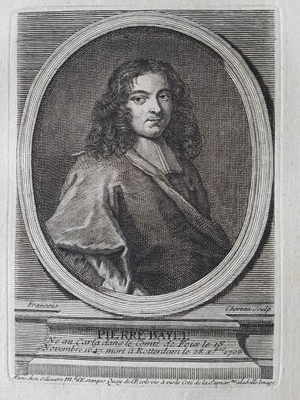
PIERRE BAYLE,
A Philosophical Commentary on these Words of the Gospel, "Compel them to come in, that my House may be full" (1708)
Volume 2
|
 |
The Guillaumin Collection
 |
This title is part of “The Guillaumin Collection” within “The Digital Library of Liberty and Power”. It has been more richly coded and has some features which other titles in the library do not have, such as the original page numbers, formatting which makes it look as much like the original text as possible, and a citation tool which makes it possible for scholars to link to an individual paragraph which is of interest to them. These titles are also available in a variety of eBook formats for reading on portable devices. |
Source
, A Philosophical Commentary on These Words of the Gospel, Luke XIV. 23. Compel them to come in, that my House may be full. Translated from the French of Mr. Bayle, Author of the Great Critical and Historical Dictionary. In Two Volumes. (London: J. Darby, 1708). Volume 2.http://davidmhart.com/liberty/OtherLiberals/Bayle/1708-PhilosophicalCommentary/index2.html
Pierre Bayle, A Philosophical Commentary on These Words of the Gospel, Luke XIV. 23. Compel them to come in, that my House may be full. Translated from the French of Mr. Bayle, Author of the Great Critical and Historical Dictionary. In Two Volumes. (London: J. Darby, 1708).
This title is also available in enhanced HTML of volume 1, volume 2, and 2-volumes-in-1; as well as a facsimile PDF of the original [vol.1 and vol.2]; and various eBook formats - HTML, PDF, and ePub.
See also the original French edition from 1686-88 in facs. PDF - Parts 1-2, Part 3, Supplement.
This book is part of a collection of works by Pierre Bayle (1647-1706).
- Part III.
- I.: St. Austin’s Words
- II.: St. Austin’s Words
- III.: St. Austin’s Words
- IV.: St. Austin’s Words
- V.: St. Austin’s Words
- VI.: St. Austin’s Words
- VII.: St. Austin’s Words
- VIII.: St. Austin’s Words
- IX.: St. Austin’s Words
- X.: St. Austin’s Words
- XI.: St. Austin’s Words
- XII.: St. Austin’s Words
- XIII.: St. Austin’s Words
- XIV.: St. Austin’s Words
- XV.: St. Austin’s Words
- XVI.: St. Austin’s Words
- XVII.: St. Austin’s Words
- XVIII.: St. Austin’s Words
- IX.: St. Austin’s Words
- XX.: St. Austin’s Words
- XXI.: St. Austin’s Words
- XXII.: St. Austin’s Words
- XXIII.: St. Austin’s Words
- XXIV.: St. Austin’s Words
- XXV.: St. Austin’s Words
- XXVI.: St. Austin’s Words
- XXVII.: St. Austin’s Words
- XXVIII.: St. Austin’s Words
- XXIX.: St. Austin’s Words
- XXX.: St. Austin’s Words
- XXXI.: St. Austin’s Words
- XXXII.: St. Austin’s Words
- XXXIII.: St. Austin’s Words Letter 164, to Emeritus.
- XXXIV.: St. Austin’s Words Letter 166, to the Donatists.
- XXXV.: St. Austin’s Words. Ibid.
- XXXVI.: St. Austin’s Words Letter 204, to Donatus.
- XXXVII.: St. Austin’s Wordsibid.
- XXXVIII.: St. Austin’s Words. Ibid.
- XXXIX.: St. Austin’s Words. Ibid.
- XL.: St. Austin’s Words Letter 167, to Festus.
- I.: St. Austin’s Words
- The Fourth Part, Or a Supplement to the Philosophical Commentary On These Words of Jesus Christ,compel ’em to Come In.
- The Preface
- Chapter I: General Considerations On St. Austin’s Argument In Defence of Persecution; Shewing, That He Offers Nothing Which May Not Be Retorted, With Equal Force, Upon the Persecuted Orthodox.
- Chapter II: A Confirmation of the Foregoing Chapter, Chiefly By a New Confutation of the Answer Alledg’d At Every Turn Against My Reasonings; to Wit, That the True Church Alone Has a Right to Dispense With the Natural Rule of Equity, In Her Proceedings against Hereticks.
- Chapter III: The New Confutation of the Fore-mention’d Answer Continu’d, and Supported By Two Considerable Examples.
- Chapter IV: Another Way of Considering This Second Example.
- Chapter V: An Answer to the First Disparity Which May Be Alledg’d Against My Examples; to Wit, That Hereticks, In Giving an Alms, Do Well, Because They Give It to Those to Whom God Intended It Shou’d Be Given; But Do Ill, In Compelling to Come In, Because this Command relates only to those who are in Error. I here shew, by just Examples, that Heretick Judges wou’d obey God in punishing the Orthodox, if the Principle of Persecutors hold good.
- Chapter VI: A Parallel Between a Judg Who Shou’d Punish the Innocent, and Acquit the Guilty, From an Error In Point of Fact, and a Heretick Judg Who Shou’d Condemn the Orthodox.
- Chapter VII: Whether Heretical Ecclesiasticks May Be Blam’d For Having a Hand In the Trials and Condemnation of the Orthodox.
- Chapter VIII: An Abstract of the Answer to the First Disparity.
- Chapter IX: That a Judg Who Condemns an Innocent Person, and Acquits a Malefactor, Sins Not, Provided He Act According to Law.
- Chapter X: An Answer to a Second Disparity; to Wit, That When a Judg Gives Sentence Against a Person Falsly Accus’d of Murder, It’s an Ignorance of Fact; Whereas If He Condemns As Heresy What Is Really Orthodox, It’s an Ignorance of Right. I Shew That it’s as hard to discover the Truth in Charges of Heresy, as in those for Murder.
- Chapter XI: An Answer to a Third Disparity; Which Is, That In Criminal Trials, the Obscurity Arises From the Thing It Self; Whereas In Those of Heresy, It Proceeds From the Prepossession of the Judges. I Answer, That Even Disinterested Judges, As the Chinese Philosophers for example, wou’d find our Controversys more intricate, and harder to be decided, than Civil or Criminal Causes.
- Chapter XII: A Particular Consideration of One of the Causes Which Renders the Controversys of These Times So Cross and Intricate; to Wit, That the Same Principles Which Are Favorable Against One Sort of Adversarys, Are Prejudicial In Our Disputes With Others.
- Chapter XIII: An Answer to the Fourth Disparity; Which Is, That When a Judg Is Deceiv’d In a Cause of Heresy, He Is Guilty In the Sight of God; Because the Error In This Case Proceeds From a Principle of Corruption, Which Perverts the Will: an Evil Not incident to a Judg, who is deceiv’d in Trials for Murder or Adultery. I shew, that were this the Case, each Sect wou’d be oblig’d to believe, that those of other opposite Sects never pray’d for the Assistance of God’s Spirit to direct ’em in reading his Holy Word.
- Chapter XIV: Examples Shewing That Men Continue In Their Errors Against the Interests of Flesh and Blood, and Their Own Inclinations.
- Chapter XV: That the Persuasion of the Truth of a Religion, Which Education Inspires, Is Not Founded On a Corruption of Heart.
- Chapter XVI: That the Strong Belief of a Falshood, Attended Even With the Rejecting Those Suspicions Which Sometimes Arise In Our Minds, That We Are In an Error, Does Not Necessarily Proceed From a Principle of Corruption.
- Chapter XVII: An Answer to What Is Objected, That All Errors Are Acts of the Will, and Consequently Morally Evil. the Absurdity of This Consequence Shewn; and a Rule Offer’d For Distinguishing Errors, Which Are Morally Evil, From Those Which Are Not.
- Chapter XVIII: A Discussion of Three Other Difficultys.
- Chapter XIX: The Conclusion of the Answer to the Fourth Disparity.
- Chapter XX: The Conclusion and Summary View of the General Consideration, Hinted At In the Title of the First Chapter.
- Chapter XXI: An Answer to a New Objection: It Follows From My Doctrine, That the Persecutions Rais’d Against the Truth Are Just; Which Is Worse Than What the Greatest Persecutors Ever Pretended.
- Chapter XXII: That What Has Bin Lately Prov’d, Helps Us to a Good Answer to the Bishop of Meaux Demanding a Text, In Which Heresys Are Excepted Out of the Number of Those Sins, For the Punishing of Which God Has Given Princes the Sword.
- Chapter XXIII: A Summary Answer to Those Who Fly to Grace For a Solution of These Difficultys.
- Chapter XXIV: Whether the Arguments For the Truth Are Always More Solid Than Those For Falshood.
- Chapter XXV: A New Confutation of That Particular Argument of St. Austin, Drawn From the Constraint Exercis’d By a Good Shepherd On His Sheep.
- Chapter XXVI: A Small Sketch, Representing the Enormitys Attending the Doctrine of Compulsion By Some New Views, As the Destroying the Rights of Hospitality, Consanguinity, and Plighted Faith.
- Chapter XXVII: That Sodomy Might Become a Pious Action, According to the Principles of Our Modern Persecutors.
- Chapter XXVIII: An Examination of What May Be Answer’d to the Foregoing Chapter.
- Chapter XXIX: The Surprizing Progress Which the Doctrine of Compulsion Has Made In the World Over Many Centuries, Tho So Impious and Detestable. Reflections On This.
- Chapter XXX: That the Spirit of Persecution Has Reign’d, Generally Speaking, More Among the Orthodox, Since Constantine’s Days, Than Among Hereticks. Proofs of This From the Conduct of the Arians.
- Chapter XXXI: That the First Reformers In the Last Age Retain’d the Doctrine of Compulsion.
- Endnotes to Volume II
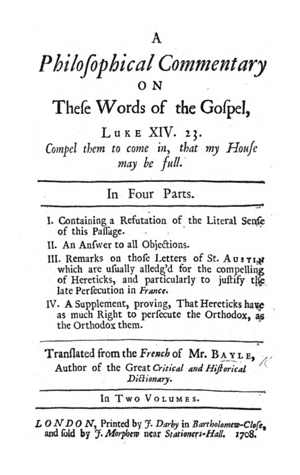
THE SECOND VOLUME
[II-367]
A Philosophical Commentary on These Words of the Gospel, Luke XIV. 23.
Compel them to come in, that my House may be full.
The Second Volume.
containing
Remarks on those Letters of St. Austin which are usually alledg’d for the compelling of Hereticks, and particularly to justify the late Persecution in France.
with
A Supplement, proving, That Hereticks have as much Right to persecute the Orthodox, as the Orthodox them.
Translated from the French of Mr. Bayle, Author of the Great Critical and Historical Dictionary.
LONDON, Printed by J. Darby in Bartholomew-Close, and sold
by J. Morphew near Stationers-Hall. 1708.
[II-369]
A Philosophical Commentary upon Those letters of St. Austin, which contain an Apology for the compelling of Hereticks.
As in the Entrance of the first Part of this Commentary I said, I wou’d not dwell on any particular Circumstances of the Text which I design’d to give a Comment on, but confute the literal Sense consider’d in it self, and attack it upon general Principles: so in the Entrance on this Third Part I think fit to signify, that I shall have no regard to any particular Circumstances of St. Austin, of the Donatists, of the Century, or the Country in which they liv’d; but endeavor, from the most general Heads of Proof, to shew, that St. Austin’s Reasons, consider’d in themselves, and abstracted from all their disparaging Circumstances, are nevertheless false. It’s nothing to me if St. Austin was formerly of Opinion, that no one ought to be constrain’d in matters of Religion; or if he chang’d his Opinion purely upon seeing the Successes of the Imperial Laws [II-370] in bringing in Hereticks, which is one of the wretchedest ways of Reasoning that can be imagin’d; it being just the same as saying, Such a Man has heap’d up much Riches, therefore he has employ’d only lawful Means. Nor does it concern me, that St. Austin was of such or such a Spirit, of such or such a Character; nor yet, that the Donatists were a ridiculous Set of Men who separated from the Church upon mere trifles. My design is to examine St. Austin’s Reasons as if they were drop’d from the Clouds, without regard to Persons or Partys; tho I shou’d rather incline to defend so great a Man against those who accuse him of Insincerity and Unfairness in this Dispute. I am quite of another Opinion, and believe verily he spoke as he thought: but being a well-meaning Man, and carry’d away by an overardent Zeal, he readily caught at any thing that seem’d to support his Prejudices, and believ’d he did God good Service by finding out Arguments at any expence for what he believ’d to be the Truth. He had a great share of Intelligence, but he had more Zeal; and so much as he indulg’d his Zeal (now he indulg’d it very freely) so much he fell away from solid Reasoning, and from the purest Lights of true Philosophy. This is the real state of his Case: a Spirit of Devotion and Zeal is undoubtedly a great Blessing, but ’tis sometimes at the expence of the Reason and Judgment; the Party grows credulous, he takes up with the wretchedest Sophisms, provided they advance his Cause; he paints out the Errors of his Adversarys in the frightfullest colors: and if he be of a hot Spirit withal, what ground can he stand upon, what Efforts will he not make to [II-371] wrest Scripture, Tradition, and all sort of Principles? He’l find his own account in all, he’l strain all; in short, he’l mar all. I don’t think ever any one made a juster Judgment of St. Austin than one P. Adam a Jesuit, let P. Norris say what he please to the contrary in his Vindiciae Augustinianae. But as I said before, it’s nothing to me, whether St. Austin was this or that; my business is to examine his Arguments abstractedly from all Prejudices. Let’s begin then and examine the two Letters of this Father, lately printed by themselves, according to the last French Version, by the Archbishop of Paris’s Orders, with a Preface at the head of ’em, part of which we have already confuted in the Preliminary Discourse; the whole is entitl’d, The Conformity of the Conduct of the Church of France for reuniting the Protestants, with that of the Church of Africk for reuniting the Donatists to the Catholick Church. The first of these two Letters is the 93d of the new Edition, and the 48th of the old, written in the Year 408. to Vincentius, a Donatist Bishop, in answer to one from him, expressing his Surprize at the Inconstancy of this Father; who having formerly bin of Opinion, that it was not lawful to employ the Secular Arm against Hereticks, nor any other means besides the Word of God and sound Reason, had chang’d from white to black on this important Point. Let’s hear St. Austin’s first Remark.
I.: ST. AUSTIN’S WORDS↩
I am even much more a Lover of Peace now than when you knew me in my younger days at Carthage; but the Donatists being so very restless [II-372] as they are, I can’t but persuade my self, that it’s fit to restrain ’em by the Authority of the Powers ordain’d by God.
ANSWER↩
Here’s surely one of the scurviest Lead’s that ever was seen, and the most capable of begetting a Suspicion of St. Austin’s Honesty: for this plainly is talking like a Man who had a mind to hide the true state of the Question, who endeavor’d to change the Dice upon his Readers, who is loth to speak out; in fine, who wou’d stick at no Artifice to gain his point. Wou’d not a Body infer from the plain and obvious meaning of these words, that the Reason upon which St. Austin believ’d it lawful to call in the Secular Arm against Hereticks, was the Restlesness of their Temper tending to disturb the publick Peace? If so, ’twas unreasonable applying to the Prince against such of ’em as liv’d retir’d in their own Houses, and gave no manner of Disturbance; this is what might fairly be collected from the words before us; yet this was far from being St. Austin’s true Opinion: he was intirely for making Laws against all Hereticks, even the most meek and inoffensive, in hopes the smart of temporal Punishments might oblige ’em to come over into the Unity of the Church; and had he not bin of this Opinion, nothing wou’d be more needless or more pitiful than the Reasons which he here lays out with so much Pomp. It’s plain then he has made use of an artificial and fallacious Preamble, or, which to me seems much more probable, fallen into a thought the wrongest, and the most opposite in the World [II-373] to the Justness of one who knows how to write and reason solidly.
For did ever any one doubt, that it was the Duty of Princes to enact wholesom Laws against Hereticks who disturb the publick Peace, who are of a turbulent persecuting Spirit, and so forth? Did ever any one doubt, but the best Men may and ought to exhort Princes, who are slack in providing the proper Remedys, to restrain such Men by the Sword which God has given into their Hands? ’Tis the Duty of Princes to repress not only Hereticks of a factious, turbulent and restless Spirit, but those of the Orthodox Party too, who fall into the same Irregularitys. What does St. Austin mean then when he says, he thinks it very fitting to restrain by the Authority of the higher Powers, the Boldness of Hereticks in forcing the World, and oppressing their Neighbor? Was this the Point in question? Cou’d any one have the least ground to wonder at this Father’s being of such an Opinion? Is there any need of writing Apologys in defence of it? Nothing therefore cou’d be more foreign than the laying down such a Principle at the head of such a Work, in which the business in hand was to justify, not any Laws restraining the Insolences of the Donatists, but those directly and immediately enacted against their Errors; seeing they condemn’d ’em all indiscriminately to temporal Punishments, in case they persisted in their Opinions.
This the [27] Sieur Ferrand, one of the chief[II-374] Advocates for Persecution, has own’d, and prov’d too by a Passage from St. Austin. He has shewn, That the Insolence of the Donatists was indeed the Source and first Occasion of the Imperial Laws against ’em; yet that there was another, and which one may call the next and immediate Cause, or to speak more properly the principal Motive which inclin’d Honorius to enact severe Laws against the Donatists, to wit, the Horror he had conceiv’d for their Heresy and Schism. The Proofs he alledges are very convincing: for he observes, that Honorius makes no mention of their Crueltys, that his Laws are general against all the Donatists; that he does not say, the Punishments ordain’d shall be inflicted unless they forbear their Violences; but on the contrary, declares he’s resolv’d to extinguish the Sect, to condemn ’em to these Punishments unless they return to the Catholick Church, and inflict ’em as oft as they exercise any Act of Worship in their own way. These Proofs, I say, are convincing, the thing speaks it self; for when the design is only to restrain the Insolences of any Set of Men, the Lawgiver contents himself with appointing Punishments for such as offend, and ne’er means to punish even those who refrain. What rare Management wou’d it be, if to put a stop to the circulating Lampoons and scandalous Libels, the Government shou’d appoint Punishments for those who religiously forbore, either reading or vending ’em; or if to check the mutinous temper of a County or Province, the Prince shou’d threaten to ravage it even when it kept within Duty, and the very Citys within such a District, which never had a hand in the Rebellion? I say further, that had the Emperors meant [II-375] no more than just restraining the Boldness of the Donatists, and the Fury of the Circoncellions, there had bin no need of enacting new Laws: there were Laws enough ready made to their hand, and known to every Magistrate of the Empire, against Robbers, Ruffians, against all in general who exercise any Violence on their fellow-Citizens. Nothing more was needful than giving the Judges a Charge to put the Laws in execution against the Circoncellions; as now in Italy it’s sufficient to bid the Magistrates proceed against the Banditti according to the rigor of the antient Laws in that case. For my part, shou’d a Revolution happen suddenly in France, I can’t think there wou’d be any need of enacting particular Laws against those Officers of Dragoons, who had plunder’d the Hugonots Houses: ’twere sufficient to look into the common Law-Books or Statute-Book, under the heads which relate to the punishing Robbers, or House-breakers; and in case they cou’d produce no Edict or Order of Court for sacking of Houses, they might legally be punish’d as Infringers of the most sacred Laws of Civil Society. So notorious is it, that every private Person, who does wrong to his Neighbor, who smites him, who robs him of his Goods, who forces him to Actions which he has an Abhorrence for, is ipso facto guilty of the Violation of the Fundamental Laws of the Commonwealth, and consequently obnoxious to Punishment, without any need of new Laws in his behalf. This wou’d be understood of course, tho there were no written Laws in a State; all Society essentially supposing a Disturber of the publick Peace, and whoever abuses his fellow-Citizen, justly punishable.
[II-376]
But here it will be proper to obviate a Difficulty; to wit, that by a Disturber of the publick Peace we are not to understand those who are an accidental Cause of mighty Combustions and Revolutions in the world: for in this case Jesus Christ and his Apostles had bin justly reputed Disturbers of the State, as they attack’d the establish’d Religion, and set up Altar against Altar, whence infinite Disorders must of necessity have happen’d in human Society. I mean then by Disturbers of the publick Peace only those who scour the Country, plunder Villages and Towns, and rob upon the Highway; they who stir up Seditions in a City; they who smite and buffet their Neighbor, as soon as they have got an advantage of him; in a word, they who won’t suffer their Fellow-Citizens to live in the full and peaceable Enjoyment of all their Rights, Privileges, and Property. It’s evident on this foot, that neither Jesus Christ nor his Apostles were Disturbers of the publick Peace; for they contented themselves with shewing Men the Falseness of certain Opinions, and the Iniquity of certain Actions; they whom they converted became more dutiful and more obedient to the Laws of the Empire than ever, and therefore the progress of their new Doctrine cou’d not directly prejudice the State. ’Twas lawful for every one to continue Jew or Pagan if he pleas’d, nor were they who quitted Judaism or Paganism allow’d to misuse those who did not: Thus it was wholly in the World’s power to be as much at peace under these new Preachers as it was before; and consequently the Laws of the Emperors against ’em were unjustly founded. [II-377] From the same Principle it were easy to shew, that neither Wickliff, nor John Huss, nor Luther, nor Calvin, nor Zuinglius, ought to have bin treated as Disturbers of the publick Peace, tho they brought their Actions against Doctrines which had enjoy’d a long and profound Peace in the world: and unless it were prov’d, that they actually forc’d those to come in to ’em whom they found averse to a Reformation (in which case they had bin more detestable for their Character of Persecutors, than venerable for that of Reformers) the World cou’d have nothing to alledg against ’em upon this particular Article which concerns the publick Tranquillity.
The better to establish my Opinion, I observe, that we must never render a Doctrine odious which we believe false, by exposing it on such a side as is common to it, with that Doctrine which we believe true. Seeing Error therefore and Truth have this in common, that when they make their first appearance in a Country where People are settled in a contrary Religion, they equally occasion Stirs and Disturbances; ’twere absurd to maintain, that they who come to preach an erroneous Doctrine are punishable, for this reason only, that they endanger the Peace resulting before from an Uniformity of Worship and Opinion; because this Peace and Uniformity in a Country which had slumber’d in Error, had bin altogether as much endanger’d and disturb’d by sending Preachers of Truth and Righteousness among ’em: We must therefore equally acquit Truth and Error of the Consequences which accidentally attend ’em. Whence it appears, that [II-378] had the Donatists bin guilty of no other mischief than the making a Schism in the Church, which before was perfectly united, the Emperor’s treating ’em as Disturbers of the publick Peace had bin very ill founded, and so had their compelling ’em by violent methods to return into the bosom of the Church. All the Constraint these Emperors cou’d lawfully have exercis’d on the Donatists, was the punishing very severely such of ’em as oppress’d the Catholicks, or who reducing ’em to Beggary, extorted a feign’d Consent to receive a second Baptism. If their penal Laws had had no other view than the restraining Attempts so opposite to the Law of Nature and Nations, and destructive of the most sacred and inviolable Rights of human Society; St. Austin might not only have spar’d himself the trouble of an Apology to justify his Approbation of ’em, but wou’d really have bin very much to blame if he had not approv’d ’em. But as Mr. Ferrand has fully prov’d, the Laws of these Emperors had quite another view, and aim’d at constraining the Donatists to forsake their Sect, from the apprehensions of leading a miserable and melancholy Life. Now this is it, which is not only opposite to Christianity, but even to Reason and Humanity; insomuch as St. Austin’s undertaking the Defence of it is scandalous to the last degree. But let’s return to the Examination of the Letter.
II.: ST. AUSTIN’S WORDS↩
Accordingly we have the satisfaction of seeing several oblig’d by this means to return to the Catholick Unity.
[II-379]
ANSWER↩
Here’s a fresh Symptom of that Something, I don’t know what, which obliges Men to hide the flaws and faulty sides of a Cause. St. Austin durst not speak out at first dash, that ’twas very fitting to have recourse to the Secular Arm for the obliging Hereticks to sign a new Formulary; this wou’d have look’d odious, if propos’d nakedly and without any varnish: How does he order it then, I don’t say from any dishonest Principle, but purely from the power of his Prejudices? He turns his Reader’s eyes off of this Object, and entertains him with another; which, far from being of a shocking nature, carries its own reason with it, to wit, That it’s fitting and commendable to call in the Authority of the Magistrate, for keeping the Peace against the Attempts of a pack of factious, seditious, persecuting Hereticks. But he betrays himself, or rather he owns the Fact in indirect terms, when he boasts that the Imperial Laws had oblig’d a great many Donatists to change sides. ’Twas for this end then that these Laws were enacted; and ’twas on the Donatists as persisting in their Sect, that the temporal Punishments were inflicted, and not simply as exercising Violences on the Orthodox. Now this is what he ought to have declar’d at first, and promis’d roundly to have justify’d; and then there had bin some meaning and drift in his Discourse; whereas, as it now stands, it’s only a jumble of Sayings and Sentences, very ill plac’d and very ill put together, scopae dissolutae: He ought, I say, to have declar’d, that it’s fit to [II-380] have recourse to earthly Powers for the obliging Men to change Religion; and then the words cited from him in the second Paragraph had had some color of an Argument either good or bad; for then St. Austin’s Reasoning might have stood thus:
Those Laws which oblige a great many to return to the Unity of the Church, are wholesom and good.
Now the Laws commanding the Donatists to return to this Unity, upon pain of incurring the severest Punishments, have oblig’d many to return:
Therefore they are wholesom and good.
No one will wonder for the future, that all the mercenary Pens employ’d by the modern Convertists shou’d shift and double so often, without ever daring to come to the true state of the Question; when St. Austin, the great Patriarch of these unhappy Apologys, is so loth to speak out, that he’l say only by halves, and as ’twere faltering, what the Substance of the Dispute is between him and the Person he wou’d confute.
III.: ST. AUSTIN’S WORDS↩
The Power of Custom was a Chain never to be broken by ’em, if they had not bin struck with a Terror of the Secular Arm, and if this salutary Terror had not apply’d their Minds to a Consideration of the Truth, &c.
ANSWER↩
Here’s the grand Common-Place, and if I may use the Expression, the Hackny Argument of all our [II-381] modern Convertists. I refer ’em, if they please, to the first and second Chapters of the Second Part of my Commentary; and promise, if they answer what’s urg’d there, to confute this grand Maxim of theirs anew. But in good earnest I don’t think they can ever offer any thing of weight against it: for what is there to be said against a thing as clear as Noon-day? to wit, That all who set up for making penal Laws against Sectarys, will plead with as good a face as St. Austin and the Convertists of France, that they intend no more than just rouzing the World out of that Lethargy into which it is fallen, and breaking the Chain of Error by the fear of temporal Punishment? Will they say, that they who turn this Maxim against the Orthodox miss their aim, and consequently can’t make the same boasts as St. Austin and the booted Apostles of France? To this I have but one word to offer. Were the Catholicks of England Orthodox in the days of our glorious Queen Elizabeth, or not? And did they change from Inclination, or from some degree of Constraint? They dare not pretend either that they were not Orthodox, or that Queen Elizabeth brought ’em over purely by methods of Lenity and Instruction: They must therefore own that such Effects as their Violences have upon others, such the Violences of others have upon them. To which I might add this one Question more: The Christians whom the Saracens oblig’d to change Religion, were not they Believers? How then came the Armys of Mahomet and his Successors to make such numbers of ’em abjure? The truth of the matter is this; There are new Converts of all sides, [II-382] who pretend to be mightily pleas’d with their new Religion: This is one sure way of making their court, and a fair step it is to Preferment.
IV.: ST. AUSTIN’S WORDS↩
If a Man saw his Enemy ready to throw himself down a Precipice in the Paroxisms of a raging Fever, wou’d it not be rendring him evil for evil to let him take his own way, rather than with-hold and bind him hand and foot? Yet this frantick Person wou’d look on such an Act of Goodness and Charity only as an Outrage, and the Effect of Hatred for him: But shou’d he recover his Health and Senses, he must be sensible that the more Violence this mistaken Enemy exercis’d on him, the more he was oblig’d to him. How many have we even of the Circoncellians, who are now become zealous Catholicks, and who had never come to themselves, if we had not procur’d the Laws of our Emperors to bind ’em hand and foot, as we do Madmen?
ANSWER↩
It’s one of the greatest Infirmitys of human Nature, that nothing will go down with Men but popular Notions, and these prov’d to ’em from popular Topicks, which they are so powerfully accustom’d to, that no Reason which is not popular will move; and whatever is so, will perfectly run away with their Senses. Herein lies the main Strength of St. Austin, and of most others of his Profession: They erect themselves an Empire or Palace, inhabited only by Swissers, lofty Common-Places of a popular strain, Similitudes, [II-383]Examples, and Figures of Rhetorick; by these they lord it over the People, they work ’em up and lay ’em again at pleasure, as Aeolus did the Sea by the Ministration of the Winds. The Comparison is very just, for it’s no more than a Puff of Wind which produces all these effects o’ both sides. Let ’em shut up then, and bluster in these Mansions as much as they please; Illa se jactet in aula, Aeolus & clauso ventorum carcere regnet: still I shall endeavor to shew that there’s nothing in it more than mere Wind.
Can any thing be thought on less just at bottom, or less solid, than this Comparison of St. Austin’s between a frantick Person bound hand and foot to keep him from throwing himself out at a window, and a Heretick forcibly restrain’d from following the Motions of his Conscience? I must repeat it once again: Had they only procur’d Laws for curbing the Fury and Insolence of the Donatists, and punishing the Injurys done by ’em to the Catholicks, for example, by condemning those to the Gallys who beat a Catholick, or rob’d him of his Goods; nothing were more commendable, nor had it bin at all necessary to fly for succor to the Comparison alledg’d: but the Question in dispute was concerning the Justice of certain Laws which decreed Servants and Laborers to the Bastinade, to Whipping, to the Forfeiture of a third part of their Wages; and the better sort to Fines which utterly ruin’d ’em, which alienated and transfer’d Estates upon the death of the Father into other Familys, with Clauses incapacitating ’em from buying or selling, or giving a night’s lodging to the dearest Friend; depriving others of [II-384] all their Estate movable and immovable, and condemning others to perpetual Banishment. These were the Laws which ty’d down the Donatists; with these Chains they were drag’d into the Communion of other Christians, and kept from leaving: which, according to St. Austin, was doing ’em much a greater service than one does a frantick Person, by binding him hand and foot for fear he shou’d throw himself down a Precipice. A very lame unexact Comparison! because to save the Life of a Madman, who is ready to throw himself down a Precipice, it’s wholly indifferent whether he consent or no; he’s equally preserv’d from the danger with or without his consent, and therefore a wise and charitable Act it is to frustrate his Intentions, and bind him tightly if need be, how great a reluctance soever he shews: but as to the Heretick, there’s no doing him any good with regard to Salvation except his Consent be had. They may please themselves with bringing him by force into the Churches, with making him communicate by force, with making him say with his lips, and give under his hand while the Cudgel is over head, that he abjures his Errors, and embraces the Orthodox Faith; so far is this from bringing him nearer to the Kingdom of Heaven, that on the contrary it removes him farther from it. Where the Heart is not touch’d, penetrated and convinc’d, the rest is to no purpose; and God himself cannot save us by force, since the most efficacious, and the most necessitating Grace, is that which makes us consent the most intirely to the Will of God, and desire the most ardently that which God desires. How much Illusion then, and how much childish Sophistry [II-385]is there in pretending that a Man may be sav’d from Hell, and put in the road to Heaven, by such another Expedient, as that by which we preserve a Man in a raging Fever, when upon the point of throwing himself down a Precipice? The only way of saving a Man who drives full-speed and with a mighty zeal in the road to Hell, is by changing his Passion for the road he is in, and inspiring him with a love for the quite contrary road: and generally speaking, neither Banishment, nor Prisons, nor Fines, are of any service in this respect. They may indeed prevent his doing that outwardly which he was accustom’d to do, but never prevent his acting the same things inwardly; and ’tis in this part of him that the strongest and deadliest Poison lies. That Saying of a Latin Poet, Invitum qui servat idem facit occidenti, is ne’er so true as with regard to Persecutors. The pains they take to prevent a Heretick’s running headlong to what they call Death, and the violence they do him, are worse than if they actually slew him.
V.: ST. AUSTIN’S WORDS↩
You’l tell me, there are those on whom we don’t gain an inch of ground by these methods; I believe it: but must we forgo the Medicine, because there are some incurable Patients?
ANSWER↩
If the Donatist propos’d this Objection as weakly as St. Austin represents, he was but a poor Reasoner. Why wou’d not he represent to this Father the Effects which the Persecutions of the Pagans had in St. Cyprian’s days, that of [II-386] the Emperor Constantius, and the Vigilance of Pliny the younger in his Government of Bythinia? Is it not well known, that very great numbers sunk under the Trials of those days; and ought not one to conclude from thence, that violent methods are very capable of making the Body comply with what the Conscience inwardly disavows, and of filling the persecuting Society with multitudes of the Worldly-minded, Covetous, Hypocrites, Temporizers, whose lot had faln in the persecuted Party? And this being incontestable when fairly reflected on, it’s plain that St. Austin’s second Comparison is not a jot happier than the first. I shall readily grant him, that a Remedy, whose good Effects have bin often experienc’d, ought not to be laid aside because it does not recover every Patient: yet that such an Application as has turn’d a thousand times to the rankest Poison, and which is the ordinary recourse of the Enemys of Truth, by which they overwhelm its Followers, shou’d be taken up by Truth as a sovereign Remedy against Error; is certainly against all the Rules of good Sense, and the Precepts of Wisdom. Besides, that St. Austin supposes the thing in question, to wit, that Persecution is in effect a Remedy. The only Proof he alledges, is, that it had converted many a Donatist. But 1. how was he sure that these were all so many Donatists truly converted? 2. This pretended Medicine, had it not kill’d great numbers of the Orthodox under the former Persecutions? 3. If its medicinal Power was discover’d only by the Event, at least it must be own’d that the Experiment was rash; and yet [II-387] he praises those who had ventur’d to administer it, before its Effects were known.
I must offer one Remark in this place, which to me seems of some weight. He who makes but the least use of his Reason, is very capable of knowing that all Remedys ought to be adapted to the Nature of the Disease; consequently Error being a Distemper of the Soul, requires Applications of a spiritual nature, such as Argument and Instruction. Revelation, far from contradicting this Maxim, confirms and recommends it powerfully: He therefore who makes use of this kind of Remedy towards those in Error, has done his duty; and if he has not bin able to convert Men by this means, he may safely wash his hands of ’em; he has acquitted himself in the sight of God of the Blood of these Men, and may commit the whole matter to him. Now if after all Arguments and Instructions, our Reason shou’d suggest an Expedient which appear’d proper for recovering a Man from his Heresy, what must be done in this case? I answer, that if the Expedient be a thing in its own nature indifferent, and which if the worst came to the worst cou’d have no ill consequence, he ought forthwith to try it: but if it be a thing pernicious in its Consequences, and tending to force into a Crime the Person for whose sake it was employ’d, I maintain, that in this case it were a very great Sin to use it. Now all Laws condemning Men to very heavy Punishments who won’t change their Religion, are of this nature: for it can’t be deny’d but the taking from a Man the Patrimony of his Ancestors, or the [II-388] Estate he has acquir’d with the Sweat of his Brow, is downright Robbery; or that a Prince who did as much, who went for example to a Fair, and order’d all the Goods and Merchandizes to be swept away, merely because so was his Will and Pleasure, wou’d be guilty of Rapine and Robbery. The taking away a Man’s Goods and Liberty then, and condemning him to Banishment, are not Actions indifferent in their own nature; they are necessarily Crimes if committed against an innocent Man: and I’m confident ’twill be granted me, that if all the Laws made against the Donatists had bin made against a Sect of Philosophers, who believing all that the Church believes as to Faith and Manners, shou’d hold this particular Opinion, That the proper Object of Logick are Beings not real, but existing in the Mind only; ’twill be granted me, I say, that such Laws enacted against these poor Philosophers, good Subjects and good Christians in other respects, wou’d be not only very ridiculous, but extremely criminal and tyrannical: consequently the Medicine St. Austin speaks of is not a thing in its own nature indifferent; and the best that can be said of it, is, that from evil and criminal, unless directed to the good of Religion, it becomes exceeding good and wholesom by being happily apply’d to this end. It’s evident on the other hand, that it’s a most dangerous Temptation, and that it’s morally impossible but Multitudes must be driven by it to act against Conscience. It carries then the two special Characters upon it which ought for ever to exclude it from the business of Conversion; it’s criminal in nature before it is entertain’d in the service [II-389]of Religion; and they who wou’d make use of it find it in the same class with Rapine, Robbery, Tyranny, before they do employ it: and then it’s a Snare very likely to plunge the Patient from a less degree of Evil into a greater. I have [28] elsewhere shewn what a frightful Precipice they are led into, who go upon this Supposition, that what might be a Sin unless apply’d for the service of Religion, becomes a good Work by such an Application. So I shall insist on this no longer.
VI.: ST. AUSTIN’S WORDS↩
Did we only lift the Rod over ’em, and not take the pains to instruct ’em, our Conduct might justly appear tyrannical; but on the other hand, did we content our selves with instructing ’em, without working on their Fears, they’d ne’er be able to surmount a kind of Listlessness in ’em, contracted by Use and Custom.
ANSWER↩
I’ll allow St. Austin, that the joining Instruction to Threats is a lesser Evil than threatning and smiting without offering any Instruction; but here I shall stick, till the Gentlemen Apologists will be pleas’d to answer, if they can, to what was laid down in the first and second Chapters of the second Part of this Commentary, and which amounts to this: 1. That the filling Men with the Fears of temporal Punishments, and with the Hopes of temporal Advantages, is putting ’em in a very ill state for discerning the true [II-390] Reasons of things from the false. 2. That joining Threats to Instruction with this condition, that if, at the expiration of a certain term of time, the Persons under Instruction declare they’l continue in their former Persuasion, they shall suffer all the Punishments they were threaten’d with in the utmost rigor; is a Conduct which plainly shews there was a direct, tho somewhat a more remote, Intention of forcing Conscience, and plunging ’em into Acts of Hypocrisy. Now this absolutely cancels all the Merit they wou’d have us suppose in this mixture of Violence and Instruction. It’s plain, what lately pass’d in France, where the Dragoons and the Missionarys play’d into one another’s hands, those by ransacking the Houses, these by preaching the Controversy; was a very odd Medly, which savor’d much more of the Stage itinerant, or the Mummerys of a Carnival, than of the Conduct of Men in their sober Senses.
VII.: ST. AUSTIN’S WORDS↩
All those who sooth and spare us are not therefore our Friends, nor all who chastize us our Enemys. [29] Faithful are the Wounds of a Friend, but the Kisses of an Enemy are deceitful. The Severitys of those who love us are wholesomer than the soft Addresses of those who deceive us; and there’s more Charity in taking a man’s Bread from him, be he ever so hungry, if while he is full fed he neglects the Dutys of Righteousness, than in spreading his Table with the greatest Daintys to make him consent to a Sin.
[II-391]
ANSWER↩
Another Common-Place, and poor vulgar Conceit! All the world has heard of the difference between a Friend and a Flatterer. A Friend is not afraid of telling his Friend disagreeable Truths, of reproving him roundly, of contradicting him for his good, and of resisting his Appetites in a provoking manner; whereas the Flatterer applauds him in every thing, and so decoys him into the Pit of Destruction. All this is justly observ’d, and we have reason enough to conclude, that they who love us most are sometimes harsher with us than they who have not the least concern for us. But we must have a care of stretching this Maxim too far. I own it may in some cases be extended to Religion; nothing being more certain than that a Pastor, who is sincerely zealous for the Salvation of his Flock, will rebuke ’em sharply, and instead of sowing Pillows under their Arms, will rattle and teaze ’em out of their lives, in hopes of recovering ’em from their Vices; what a lazy luke-warm Hireling will not do, being fully resign’d as to the eternal Damnation of his Flock, and very loth to make ’em uneasy with a Representation of the Mischiefs which flow from a Corruption of Manners. But shou’d a Pastor behave himself the same way towards Strangers, with regard to their particular Tenets or Doctrines, I question whether it wou’d do so well as a milder Address and exact Civility; Men being much more apt to be embitter’d and confirm’d in their Opinions by harsh Treatment, than determin’d to change and forsake ’em. Be that how it will, still it’s [II-392] most certain that there’s no arguing from the Liberty of wholesom Reproof, for a Right of inflicting such Punishments as the Emperor’s Laws ordain’d. Reproofs are allowable between Friends and Enemys; and therefore any one may make use of ’em, when he thinks he has a proper occasion: but Robbery and all the ways of Violence are of another strain; it is not lawful to make use of these either with Friends or Enemys, either directly or indirectly. We can neither take away our Neighbor’s Goods by our own Authority, nor prompt others to do it, nor approve those that do; much less may we drive him from his House, and Home, and Country, or procure his Expulsion by the power of others. And therefore how allowable soever it may be in us to thwart and rudely to oppose the unlawful Pleasures of our Friends, it does not from hence follow that we ought to importune the Prince to deprive ’em of their Property, to imprison or banish ’em; and shou’d the Prince do this, we are in conscience oblig’d to look on it as a tyrannical Abuse of that Power with which God has entrusted him. For in the End I always come back to this: If the confiscating any private Party’s Goods were a tyrannical Invasion, supposing him Orthodox in his Principles; and if it becomes a most righteous Action from hence only, that he happens not to be so, it follows that the same Action of a Sin becomes a Vertue from this single Circumstance, that it’s perform’d for the Interest of Religion, which plainly overthrows all Morality and natural Religion, as I think I have fully demonstrated. There’s no ground then for maintaining that Banishment, [II-393] Prisons, Confiscation of Goods, and such-like Penaltys, are as warrantable on account of the Advantages we may promise our selves from ’em, as friendly Reproofs, and a want of Complaisance.
What St. Austin adds, that it’s better in some cases to take away a Man’s Bread than give him some, is a kind of a Simily which will never amount to a demonstrative Argument: for in the first place he ought to have given it this Restriction; That however ’twere a greater Sin to let a Man starve and perish, than to give him a morsel of Bread, even after we had discover’d in him an invincible Resolution of persisting in Error. ’Tis never allowable nor excusable to let a Man perish, how dissolute soever his course of Life may be; and therefore ’twere a Sin in those who had Bread to spare, if they saw him starve for want of it. But this is not St. Austin’s thought: his meaning is, that if Superfluity be an occasion of a Man’s falling into Sin, it’s friendlier to take away this Superfluity, than endeavor to procure it him. But there’s still this difficulty in the case; Who shall take away this Superfluity? Not Persons in a private station; for in them to be sure it were unlawful to seize a man’s Substance because he’s prodigal and debauch’d. Shall the Prince then take it? but I don’t find that this is customary: ’Twas never known that any Man was fin’d, or banish’d, or imprison’d for living high and at a great expence: And shou’d this really be practis’d, as I think it may, for the good of Society, it does not follow that Princes have the same right over mens Opinions as their Actions; because Opinions are no way[II-394] prejudicial, as sometimes Actions are, to the Prosperity, Power, and Quiet of a State.
VIII.: ST. AUSTIN’S WORDS↩
To bind one in a Phrensy, or awake one in a Lethargy, is vexatious indeed; yet it’s friendly at the same time. God loves us with a truer Love than any Man can do; yet he joins the salutary Terrors of his Threats to the Lenity of his Counsels, and we find that he thought fit to exercise the most religious Patriarchs by a Famine.
ANSWER↩
St. Austin continually changes the Question; we are not now examining, whether one may love those whom he chastises, (who ever doubted it?) but whether it be lawful to take away a Man’s Liberty and Property, because he does not believe with his Prince in all matters of Religion. Besides, the Example of his Frantick and Lethargick Person, with which he comes over us once more, is nothing to the purpose: We may love these Men, and yet do things which we know will vex ’em; nor do we regulate our Treatment by the Thoughts of what may be pleasing or displeasing to ’em, because we know there’s no need of their Consent, in order to its being helpful and profitable to ’em. But cou’d we be sure, that all our Endeavors wou’d do ’em no good, or that whatever Methods we took with ’em wou’d only turn to their prejudice, unless done with their own Consent and Approbation; in this case so far wou’d it be from Friendship, that ’twere downright Cruelty to bind or waken ’em against their Will. And this alone utterly [II-395] ruins all St. Austin’s little Comparisons. Imprison a Heretick, pour in a Shoal of Dragoons upon him, load him with Chains; you’l ne’er promote his Salvation by all this, unless his Understanding be enlighten’d, unless he acquiesces in your Will. Now as it’s scarce credible, that the Convertists are quite so stupid, as to imagine, that Prisons and extreme Misery enlighten a Man’s Understanding, and make him strangely in love with the Religion of his Persecutors; one can hardly persuade himself, that these Men act from any other Principle than that of Vanity, Brutality, and Avarice. As to the Chastisements with which God is pleas’d to visit his Servants, they conclude nothing for St. Austin. God, who is the first Mover, as well as the Searcher of Hearts, may make his Chastisements avail to the inward Conversion of the Party: but since he has no where promis’d to send his Grace with the Persecution we inflict on Hereticks, to afflict ’em with sundry temporal Punishments in order to convert ’em, is not only a Temerity and notorious tempting of God; but the proposing the example of God in this case to Princes, is moreover a Degree of Impiety. Wou’d the Convertists take it kindly, that as God exercis’d the Patriarchs of old by a Famine; so the most Christian King wou’d exercise his Clergy, seize their Revenues, and diet ’em with Bread and Water in order to convert ’em? Ridiculous! The World wou’d laugh at us shou’d we say, in case the King of France seiz’d all the Treasure of the Churches, that ’twas an instance of Tenderness for his Clergy, and that he treated ’em at this rate only to make ’em live more becoming [II-396] their Christian Profession. The World wou’d say, we insulted over the Miserys of our Neighbor; and yet our reasoning wou’d be just the same as St. Austin’s. Another ridiculous thing is, that Opinions only are what Men must be fin’d for in order to make ’em change; but they alledg no Laws, nor instance any Dragoon Crusade for the Reformation of Manners. It is a Scandal and sore Disgrace of Christianity, to tyrannize over Men on account of their Opinions, to call in the Secular Arm against ’em, whilst they think it sufficient to preach against Vice; for never was a profest Convertist of Manners heard of, who sollicited Edicts against Luxury, Evil-speaking, Gaming, Fornication, Leud Discourse, &c. or call’d for the help of the Soldiery to make Catholicks change their Manners.
IX.: ST. AUSTIN’S WORDS↩
You are of opinion, that no one shou’d be compel’d to do well; but have you never read, that the Father of the Family commanded his Servants to compel all they met with to come in to the Feast? Han’t you seen with what Violence Saul was forc’d by Jesus Christ to acknowledg and embrace the Truth? … Don’t you know, that Shepherds sometimes make use of the Rod to force their Sheep into the fold? Don’t you know that Sarah, according to the Power committed to her, subdu’d the stubborn Spirit of her Servant by the harshest Treatment, not from any hatred she bore to Agar, since she lov’d her so far as to wish that Abraham wou’d make her a Mother, but purely to humble the Pride of her Heart? Now you can’t be ignorant, [II-397]that Sarah and her Son Isaac are Figures of spiritual, and Agar and Ishmael of carnal things. Notwithstanding, tho the Scripture informs us that Sarah made Agar and Ishmael suffer a great deal; St. Paul does not stick to say, that ’twas Ishmael persecuted Isaac, to signify, that tho the Catholick Church endeavors to reclaim carnal Men by temporal Punishments, yet it is they persecute her, rather than she them.
ANSWER↩
There are four things to be consider’d in this Discourse. 1. The Words of the Parable, Compel ’em to come in. 2. The Violence which Jesus Christ exercis’d on St. Paul, taking away his Eye-sight, and throwing him on the Ground. 3. The Conduct of Shepherds sometimes to their Sheep. 4. The Conduct of Sarah towards her Servant Agar. I have said enough to the First of the four, in the former Parts of my Commentary. The second is sufficiently answer’d by what I have lately said, that God, being the first Mover as well as the Searcher of Hearts, seconds the Punishments he inflicts on us with the Efficacy of his Grace as often as he sees fit. He thought fit to manifest his Power particularly in the Conversion of St. Paul; he appear’d to him in Person, he flung him on the Ground; in a word, he conquer’d this Soul by a mighty Hand, and a stretch’d-out Arm. But does it hence follow, that Men ought to imitate this Method when they wou’d convert a Heretick? Let ’em in God’s Name, provided they have the Gift of turning the Heart, as the[II-398] Almighty may, at the same time that they afflict the Body; but as they are not thus qualify’d, they shou’d take care how they meddle in so nice an Affair. Punishments in the Hands of God himself, don’t always produce the Conversion of Sinners; they only serv’d to harden Pharaoh’s Heart, tho God manifested his Power on him in the most extraordinary manner. The Punishments he dispenses in an ordinary way, either by the Mediation of Men, or of other created Beings, operate very differently; they very rarely change Mens Opinions about the Worship of God: on the contrary, they rather make the better sort more zealous in their own Religion; for which reason there being such a Probability, that temporal Punishments shall ne’er persuade a Man of the Falseness of his Religion, but rather of his want of Zeal for it, nothing can be more absurd than proposing the Conduct of God in chastising his Children for their good, as a rule for Princes. Besides that if once we stick by this example, ’twill follow, that Princes may from time to time set fire to Fields of Corn, to the Hay and Vines, and Woods of their Subjects, and send their Officers thro all their Dominions to decimate the Children, and send away their Fathers and Mothers to the Mines and Gallys. For as God sometimes makes use of Pestilence and Famine, those Scourges of his Wrath, to express his Love towards his Children, in order to bring ’em to Repentance; so Kings, who are his Vicegerents on Earth, may by the advice of their Clergy do all I have said within their Dominions, out of stark Love and Kindness to their Subjects; and from a Prospect of making ’em [II-399] look home to themselves, and awake out of that Lethargy and Death of Sin in which they lie bury’d. Did Kings really do this, wou’d not they find their Justification ready drawn to their hands in St. Austin, and in the Examples of Emperors, who have shackl’d their Sectarys with Penal Laws; not, say they, from any hatred to their Persons, but out of pure Charity, and in hopes of converting ’em? It’s plain then, that the Result of this Doctrine of St. Austin is the turning all Morality into ridicule, since it offers Expedients for justifying the most criminal and the most extravagant Actions.
The Example of the Shepherds, who sometimes drive their Sheep into the Fold with Rods, is as unhappy as that of the frantick Person; for to make it of any weight, ’twere necessary that the counterpart of the Comparison shou’d relate to Creatures void of Liberty, and whose Conversion depended not essentially on a Consent of the Will. They alledg the constraining of Sheep into the Fold, to save ’em from the Thief or the Wolf; the Shepherd, who sees ’em refuse the Door, or not in a hurry to get in, acts very wisely in pressing ’em forward either with his Foot or with his Crook, and even dragging ’em in if there be need. Why is this Conduct wise in him? because it fulfils all the Dutys, and answers all the Ends the Shepherd can propose. His only aim is to save his Sheep from the Jaws of the Wolf, or any other outward Danger; and provided he can but get ’em into the Fold, the Work is done; the Sheep are safe whether they come in freely or by force. But the case is very different with regard to a Shepherd [II-400]of Souls; he does not save ’em from the Power of the Devil, he does not heal ’em of the Scab, by transporting the Heretick into a certain House call’d Notre Dame, St. Peter’s, St. Paul’s, &c. or by sprinkling some Drops of Holy Water on his Face. This is not the thing which decides his Destiny; he must have a sense of his Errors, he must be willing to abjure ’em, and embrace wholesomer Doctrine: thus he may be rescu’d out of the Clutches of the Devil. But if these means be wanting, they may drag him with a Cord about his Neck at the Feet of the Altars, they may cram a hundred Hosts down his Throat, they may guide his Hand to sign a form of Abjuration; they may force him, on pain of the Boot, or of having his Flesh torn off with red-hot Pinchers, to declare a hundred times over, that he believes all the Church believes, and renounces Luther and Calvin: Still he’s in the suds as much as ever, notwithstanding all this Cookery; and what’s yet worse, of an Orthodox Christian, as he was in my Opinion before, he becomes a perfidious Hypocrite, and a Slave of the Devil, unless God in his Mercy recover him from his Fall. It’s prodigious to me that there shou’d be so many Men of good Sense in the Church of Rome, who can’t see the monstrous Absurdity of all these Similys.
Let’s endeavor to give ’em one on our part, which may help ’em to a juster Idea of this matter. Shou’d I see a Man standing at my door in a heavy Shower, and from a sense of pity shou’d desire to shelter him from the Rain or Storm, I might make use of one of these two means; either I might invite him civilly into my House, and pray [II-401] him to sit down, or if I were stronger than he, I might pull him in by the Shoulder. Both these means are equally good with respect to the propos’d end, to wit, the preventing this Man’s being wet to the Skin: it signifys very little how he comes under my Roof, whether freely or by force; for whether he comes in of his own mere Motion, or upon a civil Invitation, or whether he be pull’d in by main force, he is equally shelter’d from the Rain by one way as much as t’other. I own, were the case exactly the same as to our being sav’d from Hell, the Convertists might justify their forcible Methods; for if the getting under the Roof of a Church were sufficient to this end, ’twere not a pin matter whether the Party came in of his own accord, or whether he were thrust in by head and shoulders: and in this case the best way wou’d be to have a Set of the brawniest Street-Porters in town always at ready hand, to seize Hereticks the moment they appear’d in the streets, and heave ’em away upon their backs into the next Church; nay, burst open their doors with Petards if need were, and take ’em out of their Beds piping hot into the next Church or Chappel. But by ill luck for our Gentlemen Convertists, they are not quite so extravagant, nor so much out of their Senses, as to say, this is all that’s requisite to the saving a Soul: They confess, that the Heretick’s consent to his being brought over from one Communion to another is so necessary, that without it not a step can be made towards saving him. And if so, how absurd is it to compare the Violence done a Man who falls [II-402] into the Fire or Water, and whom we drag out by the very hair of the head, without the least scruple, with the Violences exercis’d on a Calvinist, by holding a Dagger to his Throat, or quartering a hundred Dragoons on him till he abjure his Religion: this, I say is extremely absurd, not only because it’s naturally to be suppos’d, that a Man who falls into the Fire or Water desires nothing more than to be sav’d at any Price whatsoever; but also because the danger is of such a nature, that his consent is no way necessary in order to the preserving him from it: the Man is equally preserv’d, tho drag’d out against his Will and in spite of him.
But to shew the Impertinence of those who pretend, People are extremely oblig’d to ’em for tearing ’em from a Communion in which they were bred and born, and which they believe much the best, tho the Convertists think it stark naught; I must desire ’em to imagine a Man enjoin’d by his Father Confessor to stand two hours by the Clock at such a door, in a soaking Shower of Rain, and this by way of Penance. If the Master of the House, not content to invite him in, shou’d send out his Footmen to pull him in by head and shoulders, wou’d he do him a Kindness pray, or a Pleasure in this? It’s plain he wou’d not; but on the contrary, do him a very ill Office by interrupting his Devotion: Invitum qui servat idem facit occidenti. The case is the same with regard to those violent Convertists who tear Men from the Exercises of their own Religion. I’m tempted to think, that the cursed Maxims of these Quacks of Conscience spring[II-403] intirely from this ridiculous Opinion, that in order to be intitl’d to the Grace of God, one must be indispensably matriculated in such a certain Communion, and that this is all that’s requisite. In consequence whereof they deal by Hereticks just as Men do with their Cattel when they wou’d save ’em from a storm of Rain or Hail, and with regard to whom it’s all one, whether they go into the Hovel or Stable of themselves, or whether they are drub’d in with a Wattle.
As to St. Austin’s Conceit about Sarah, and her Maid-servant Agar, for my part I think it can serve no other purpose than exposing Scripture to the Railerys of the Profane. For in fine, if, in the way St. Austin intends, Sarah be a Type of the Children of God, and Agar a Type of the Children of the World, what will follow, but that the Children of God may constrain the Children of the World to seek for Refuge in Desarts, unable to bear the Rigor of their Discipline; and yet the Children of the World shall be they who persecute the Children of God. Was ever any thing in Farce or Droll more a Bull than this? I say nothing of St. Austin’s unaccountable mistake in representing, purely to make out the Wedlock of Charity and Persecution; Sarah as treating Agar in a very harsh manner, and at the same time loving her with so much tenderness, as even to desire she shou’d share her Husband’s Bed. The Scripture represents this matter quite otherwise; nor does it speak of Sarah’s ill humor to Agar, till the latter finding her self big with Child, grew saucy upon’t, and slighted her Mistress.
[II-404]
X.: ST. AUSTIN’S WORDS↩
The Good and the Bad do and suffer very often the same things; nor ought we to judg of the nature of their Actions by what either does, or what either suffers, but from the Motives on which they act or suffer. Pharaoh oppress’d the People of God with excessive Labor. Moses, on the other hand, punish’d the Transgressions of the same People by the most severe Punishments. The Actions of each side were much alike, but their Ends very different: One was an errant Tyrant, bloated with Pride and Power; the other a Father, fill’d with Charity. Jezabel put the Prophets to death, and Elias the false Prophets; but that which put Arms into the hands of one and t’other, was no less different than that which drew on the deaths of each. In the same Book, where we find St. Paul scourg’d by the Jews, we find the Jew Sosthenes scourg’d by the Greeks for St. Paul; there’s no difference between ’em if we only look at the Surface of the Action, but there’s a great deal of difference if we look at the Occasion and Motive. St. Paul is deliver’d to the Jailer to be cast into Irons, and St. Paul himself delivers the incestuous Corinthian to Satan, whose Cruelty much exceeds that of the most barbarous Jailers; yet he delivers this Man to Satan only that his Flesh being buffeted his Soul might be sav’d. When the same St. Paul deliver’d Philetus and Himeneus to Satan to teach ’em not to blaspheme, he did not intend to render Evil for Evil, but judg’d it an Act of Goodness to redress one Evil by another.
[II-405]
ANSWER↩
Here’s another new Flight of those little Reasonings which pass well enough in a Croud, where not one of a thousand has the Skill to distinguish where the Comparison holds, and where it does not. St. Austin breaks his heart to prove what no body living denys, That the same Action may be good or bad, according to the difference of Circumstance. If a Prince punishes a seditious Province to the rigor, from no other design than just to hinder its revolting anew, this is an Action of Justice; but it’s an Act of Cruelty and Avarice, if he rigorously punishes a slight Offence in the same Province, in hopes an unreasonable Severity may make it rebel, and give him a Pretence of reducing the People to Beggary. I’l allow St. Austin then, that Moses did well in punishing the Israelites, and Pharaoh as ill in oppressing ’em; a difference which arose not purely from Moses’s proposing, as his end, the Reformation of this People, and Pharaoh its Ruin; but from their being punish’d without any demerit by Pharaoh, and not by Moses. But to unhinge St. Austin’s Comparisons all at once, I need only shew, that he instances on one hand in certain violent Proceedings arising from Aversion, or some other unjust Passion, and compares these with other Actions, afflictive indeed to our Neighbor, but at the same time enjoin’d by a special Revelation from God, and consequently operating under Circumstances, in which the Agent or instrumental Cause might be sure of their producing a good Effect. I speak with relation to Moses, Elias, and St. Paul. These were all Prophets, [II-406]who understood by an immediate divine Inspiration that ’twas proper to proceed in a way of Punishment; and in this case ’twas allowable in them to exercise Severity, because there was no room to doubt but God, who ordain’d the means, had a purpose of turning it to his own Glory in a singular and extraordinary manner. In this case one has an assurance both of the Justice of the Action, and of the right Disposition of the Circumstances, and of the good Success. Can any one say as much for Theodosius’s persecuting the Arians, or Honorius the Donatists? What assurance had either, that God wou’d give a blessing to their Violences, or make ’em an efficacious means of enlightning the Understanding, or turning the Hearts of those in Error? It’s evident they had no such assurance, and that the Probability was much stronger on the other hand, that these methods wou’d rather rivet ’em in their Errors, and produce false Conversions rather than any real Change; so that ’twas the highest Temerity to venture on the ways of Violence in such a posture of Affairs. As to the Case of Sosthenes, I can’t imagine what St. Austin wou’d infer from it; since ’twas an Act of the Rabble, who without the least regard to the Proconsul there present, or the place they were in, rush’d in a tumultuous manner on the Head of the Synagogue.
I have one Remark more at hand, which will absolutely demolish all these Arguments of St. Austin. It’s plain that the whole force of his Reasonings turns on this Supposition; That when Men treat Hereticks hardly in hopes of converting ’em, they act from a Principle of Charity, a [II-407] Motive which changes the nature of hard usage in such a manner, that it presently becomes a Good-work; whereas it’s downright Sin, if proceeding from Hatred, Insolence, or Avarice. It’s plain likewise, that the reason which makes Men imagine there’s a Motive of Charity in the case, can be no other than this, or something very near it, to wit, That they look on ill usage as a very proper means for making a Heretick think of getting instructed, and entring on a Search after Truth and the right way to Salvation. So that St. Austin’s Reasoning amounts to this:
Treating one’s Neighbor ill, from a Principle of Charity, is a Good-work.
Now it’s treating him ill from a Principle of Charity, to give him such ill Treatment of any kind, as may oblige him to get instructed and heal the Diseases of his Soul.
It’s therefore a Good-work to give him this sort of ill Treatment.
This is one of the most dangerous, and at the same time the most absurd Sophism in Morality that e’er was fram’d; for by this rule one might justify the most execrable Actions. Shou’d I see my Neighbor puff’d up with Pride, shou’d I see his Vanity fed by a vast Estate, and by an extraordinary Esteem and Respect for his Person; I might safely endeavor to lessen his Fortune and blast his Reputation: To this end I might set fire to his House, invent and raise a thousand Calumnys of him; and if one in a private station might not lawfully do this, yet the Prince may; as St. Austin maintains he may justly keep a Heretick poor, in hopes of awakening him out of his slumber. The Prince, I say, might justly beggar [II-408] this proud Man, and eat him up with his Soldiers, or get him falsly impeach’d of High Treason, declare him attainted in his Blood, and brand him as a Traitor. Shou’d any one murmur at this hard usage of the Man, we might tell him upon St. Austin’s Scheme, that truly it wou’d be unjust, if proceeding from any other Motive than that of Charity; but since it’s only design’d to rescue the Man from Damnation, into which his Vanity, founded on his Opulency and Honors, drove him head-long, it was perfectly just. I desire no more of my Readers, than calmly and impartially to compare the Effects which Jails, Fines, Chicanes, and a continual Anxiety of Life, might produce on a Heretick, in order to make him renounce his Opinions from Heart and Mouth; with the Effects which the taking away his Substance and Good Name might have upon this proud Man: and I persuade my self they’l allow, that if the Treatment in the first case be capable of changing the Heart of a Heretick, the Treatment in the second case must likewise change the Heart of this proud Man; and consequently he may be rob’d of his Goods and Good Name from a Principle of pure Charity (according to the Minor of my Syllogism) which will become a Good-work according to the Major of the same Syllogism. So that here’s a Sophism for justifying the most execrable Actions; which was the thing to be prov’d.
The more one examines this matter, the more he discovers the Illusion good St. Austin was under. He imagin’d, that as those things which are absolutely indifferent, and left to our own discretion, become good or evil according to the [II-409] Motive or Intention; so those which are expresly commanded or forbidden are subject to the same alteration, by virtue of the different Motives upon which we act. But as from hence it wou’d follow, that Robbery, Murder, Perjury, Adultery, wou’d cease to be Sins, when practis’d with a design of humbling our Neighbor, and bringing him to Repentance, or in general when practis’d from any Motive of Charity; it manifestly follows, that we must distinguish between Dutys of Obligation, and those which are left to our own Choice. Now refraining from the Goods or Good Name of our Neighbor, not swearing a false Oath, not debauching our Neighbor’s Wife or his Daughter, not smiting, reviling, or insulting him, are all matters of Obligation; and therefore whatever Benefit he may be suppos’d to reap from our calumniating, or from our smiting him, &c. what Benefit soever, I say, he may reap from hence with regard to Salvation, it’s by no means allowable to treat him after this manner. God does not require us to endeavor the Salvation of our Brethren at the expence of his Laws; and we wou’d do well to leave it intirely to his Providence to reclaim ’em if he sees fit, either by Poverty, or Sickness, or Shame, and make ’em sensible of the ill use which they have made of their good Fortune. This altogether shews how much of Illusion there is in this pretended Charity, which prompts us to do evil to our Neighbor with a design of bringing him to good; and consequently, that Princes are grosly misled when they ruin their Subjects, when they banish, imprison, and expose ’em to [II-410] a thousand Straits and Vexations, under pretence of obliging ’em to get themselves instructed. An Apology therefore for Persecution, built on so rotten a Foundation, can never stand.
There’s only one Case, as I can think of, in which a Man may dispense with the Precepts of the Decalogue in hopes of procuring the spiritual Good of his Neighbor; and that is, where the Party finds himself favor’d with the Gift of Prophecy and that of Miracles, and led immediately and extraordinarily by the Spirit of God. In this case he may kill a Man, as St. Peter kill’d Ananias and Saphira his Wife; he may maim him, he may cover from head to foot with Leprosy and Ulcers, get the Ship cast away in which he has all his Effects, &c. because, as I have already observ’d, he acts from the express Order of God, who by the transcendent Eminence of his Nature is exempted from all Rule, and by his Quality of Searcher of the Heart and Reins is able to perceive the Sutableness and Congruity of Circumstances and corporeal Actions, to the Inflexions and Modifications of the Soul; insomuch as there’s no room to doubt of the good Success of these violent and acute Remedys. And therefore it is that St. Paul positively assures us he deliver’d the incestuous Corinthian to Satan, only in order to save his Soul; and Himencus and Philetus, that he might teach ’em not to blaspheme. But as for any Underling, or mere common Man, confin’d within the Sphere of human Knowledg, and incapable of foreseeing what effects Poverty and Anguish may have upon the Mind of a Heretick; for him, I say, to take upon him to spurn the Commands against Stealing, against smiting [II-411] his Neighbor, &c. upon a pretence that the Party, to deliver himself from Hunger and Pain, will set about examining his Errors, and o’ course perceive ’em; is undoubtedly the greatest Presumption, and the most ridiculous Pretension in the world.
By the way ’twill be useful to observe, that in the case of Moses’s punishing the Israelites he had to deal with a People who were under no Error of Conscience; for they well knew that the Actions for which they were punish’d, were evil and unjustifiable. St. Paul in like manner did not excommunicate Persons who believ’d they had acted aright. The incestuous Corinthian was no such Fool as to maintain, that Incest was an Action commanded or indulg’d by Jesus Christ; and as for Himeneus and Philetus, the Apostle affirms they had not only cast away the Faith, but also a good Conscience: consequently their Error was not attended with Sincerity, as the Errors of those are whom Princes take upon ’em to persecute, at the abominable instigation of Priests and Monks.
I wou’d likewise have People once more to observe what I have said in other Parts of this Commentary, to wit, that Men having receiv’d a standing Rule of their Actions from God, are by no means allow’d to depart from this Rule, on pretence of imitating the ways of God himself, or the Methods he makes use of either by the Intervention of natural Causes, or of Men endu’d in an extraordinary manner with the Gift of Miracles. For example, God shall make use of Tempests, Earthquakes, Infections, Hail, Mists, Locusts, &c. for punishing the People of a Country, [II-412]and awaking ’em to Repentance; or perhaps he shall commission a Moses to inflict all these Plagues. Does it therefore follow, that Kings or other Men may set whole Fields of Corn on fire, poison the Fountains, and create as much as in them lies a Dearth or Sickness, in a Country whose Inhabitants are wicked and impenitent? Another Example; God sends his Apostle a Thorn in the Flesh, he permits a Messenger of Satan to buffet him, and this for the good of his Servant, and most certainly knowing that his own Power shall be manifested thro the Apostle’s Infirmity. Have we now any right of imitating this Conduct towards those whom we see puff’d up with the great Talents which God has vouchsafed ’em? Is there a King upon earth, who hearing of a famous Doctor in his Dominions, admir’d for his Learning and Eloquence, and holy Life, has a right of sending him a Thorn in the Flesh to humble or to mortify him; such as suborning false Witnesses to blast his Reputation in some inferior Court, or giving him a Potion to weaken his Body and Mind? We make no doubt but there are Women in the world, who, thro the special Favor of God, have had the sad mortification in their Childhood of losing their Beauty by the Small-Pox. God who has a love for ’em, and who knows they wou’d make an ill use of their Beauty, and that the loss of this Jewel will engage ’em more intensly to the solid Contemplations of the World to come, disfigures ’em most justly, and from a Motion of pure Grace. May a King lawfully imitate this Conduct? And when he sees a fair Lady pride her self in her Beauty, [II-413] catching all the Men in her way, and caught her self in the Snares of Love, may he without a crime destroy all her natural Charms? May he in charity hire a Ruffian to mangle her Face; may he send her a Box, which in the opening shall set fire to a Preparation of Sulphur or Gunpouder, and for ever ruin her Bloom and lovely Complexion? May he bribe her Physician to prescribe her a Pouder or Potion, which shall throw her into a languishing Sickness, end in a frightful Jaundice, ghastly Looks, and an offensive Smell? It’s plain he cannot; and that this Prince wou’d make himself ridiculous to all the World, shou’d he gloss such a Conduct with the specious pretence of Charity; as that he design’d to preserve this fine Woman from the Dangers to which her Soul was expos’d, and sequester her from the Vanitys and Pleasures of the World to think only upon things above. There’s infinitely a greater probability, that the disfiguring such a Woman, and throwing her into a languishing Sickness, wou’d mortify her Vanity, and accomplish her Conversion, than that the quartering a hundred Dragoons on a Hugonot shou’d put him in the right way of perceiving he is a Heretick, and of sincerely embracing the Romish Faith. Yet the World wou’d hiss such a Prince, or his Directors of Conscience, who took these methods of converting the Ladys; and yet they applaud his endeavoring to convert Protestants the same way.
I shall conclude this Article with the following Remark; That nothing is more groundless than St. Austin’s Distinction of those Cudgellings, ransacking of Houses, and other ways of Violence [II-414] which proceed from a Motive of Charity, and those which are exercis’d without this Principle of Charity. True Charity is that which inclines us to keep those Laws of God which forbid Robbery, Blood-shed, and Battery: for by the same Distinction a Prince might innocently set fire to all the Citys in the Kingdom, and every year destroy a great part of the Harvest; still pretending that his Design was to humble his Subjects, who don’t think enough upon God in convenient Houses and great Plenty.
XI.: ST. AUSTIN’S WORDS↩
If the being persecuted were always a sign of Merit, Jesus Christ wou’d only have said, Blessed are they who are persecuted, and not have added, for Righteousness sake. In like manner, if persecuting were always a Sin, David wou’d not have said, [30] Whoso privily slandereth his Neighbor, him will I persecute.
ANSWER↩
I am very unwilling to believe what I see with my own eyes, that St. Austin shou’d apply some Scripture-Passages so much amiss. Who disputes but the whole Merit of Persecution depends on its being suffer’d for Righteousness sake? Who doubts but a vain Man who chose to be eaten out of house and home, rather than acknowledge his Error, and who in his heart convinc’d of the Badness of his Cause, shou’d notwithstanding [II-415] persist in it in hopes of gaining a Reputation of Constancy and Steddiness of Soul; who doubts, I say, but such a Man loses all the Fruits of his Sufferings, and is besides in a very ill state? To what purpose then shou’d this Father stand to confute so trifling an Objection? There is not a Man of tolerable good Sense, but knows that to be blessed in Persecution, the first and main Condition is the suffering it from a love of Truth and Righteousness; which is very consistent with an Error of Sincerity and an honest Mind. But how wicked soever he may be who draws Persecution on himself, because he’s too proud and stately to retract, or to own to his Persecutors that their Cause is best; still it’s certain, that they are both wicked and unjust. Here then is a Distinction of somewhat a better kind than that which St. Austin gave us just now. It’s possible the persecuted Party may be wicked, but it’s certain the Persecutor is; [31] for the Passage from David alledg’d to prove there may be pious Persecutors, proves nothing in the Case before us, where the Question is only concerning Persecutions for Religion. David sets forth in this Psalm, that he’l have no Fellowship with the Wicked; and names in particular that Pest of Civil Society, worthy of the Execrations of all honest Men, to wit, those poison’d Tongues which wickedly slander their Neighbor. If David speaks here as a King, he can say nothing more becoming the Wisdom and Justice which belongs to [II-416] his station, than declaring he’l employ the Authority of the Laws, and the Sword which God has given into his hands, for the chastizing those vile Slanderers, these idle Poisoners of human Society. If he speaks here only to give us the Character of a righteous Man, he means to inform us that we ought to have no fellowship nor dealing with the Backbiter and Slanderer. But how does this tend to authorize the Convertists, who won’t suffer Folks either to die or live in Peace, good Subjects, good Citizens in the main, only because, they have certain Opinions different from theirs? On the whole, can it be suppos’d that St. Austin thought before he spoke, when in this matter he alledges Punishments ordain’d by a King against Slanderers and false Accusers, where he ought to have given examples of Punishments inflicted purely on the score of speculative Doctrines or Opinions.
XII.: ST. AUSTIN’S WORDS↩
The Wicked have never left persecuting the Good, nor the Good the Wicked: but these act unjustly herein, and only to do mischief; those charitably, and so far as the necessity of correcting requires. … As the Wicked have slain the Prophets, so the Prophets have sometimes slain the Wicked; as the Jews were seen with Scourge in hand against Jesus Christ, so Jesus Christ was= seen with Scourge in hand against the Jews. Men deliver’d the Apostles to the earthly Powers, and the Apostles deliver’d Men to the infernal Powers. What then ought we to consider in all these Examples? only this, which side acts for the Truth and Righteousness, and [II-417] which for Iniquity and a Lye; which acts only to destroy, and which to correct.
ANSWER↩
Here’s a rare Maxim of Morality indeed, the most detestable in its Consequences that e’er was broach’d: for provided you act in favor of the true Opinion, and have no other design than that of correcting your Neighbor, you may lawfully, as to any thing else, imitate the ways of the Wicked; and whereas these shall have committed a Sin, you shall have perform’d a heavenly Action. Accordingly let’s imagine two Persons, the one an Orthodox, and the other an Heterodox. The first sees a great Lord in the opposite Party, very zealous in its cause, and supporting it by his great Riches, his Credit, and good Sense. The second sees such another great Lord in the Orthodox Party. The first contrives how to ruin his great Lord, and starts so many scurvy Affairs upon him, that running the risk of his Honor and Estate, he has not the leisure to mind the Interests of his Party. All this while he has no intention of doing this great Lord the least mischief; he only wou’d prevent his Lordship’s doing any, and bring about his Conversion. Here’s an Action now fit to be canoniz’d, or at least perfectly innocent, if we judg of it by St. Austin’s Principles. It’s no matter if he ruins this honorable Person, by setting fire to his Barns, to his Mills, to his Castles, by poisoning his Cattel, and involving him in Law-Suits, which he’s sure to lose: All this is very fair, provided it’s from no other Intention than that of working on him to get himself instructed, and forsake [II-418] his Errors. Yet if the other acts against his great Orthodox Lord the same way, he’s a Villain and a Monster. And why so? Is it because he commits Actions repugnant to the Decalogue? No, but because he commits ’em with a design of doing prejudice to the Orthodox Party, and to his Orthodox Neighbor. This, without my mentioning it expresly, must appear to all the World to be a Confirmation of what I have so much urg’d against the literal Sense, at the fourth Chapter of the first Part; to wit, That it overthrows that holy and fundamental Barrier, which God has fix’d betwixt Virtue and Vice; and leaves us no other Character of Vertue than the Gain of those who follow certain Opinions, and no other Character of Vice than their Loss. I wou’d not willingly charge St. Austin with having seen this Consequence; but it is plainly contain’d in these Words: What then ought we to consider in all these Examples (that’s to say Murders, Scourgings, Captivity) only this; which side acts for the Truth and Righteousness, and which for Iniquity and a Lye; which acts only to destroy, and which to correct?
One can hardly here avoid thinking of some Maxims of loose Morality, condemn’d by the Court of Rome, under the present Papacy; and truly St. Austin’s Distinction is not a jot better than that of these wicked Casuists, who teach, 1. That one may, without the guilt of mortal Sin, be sorry and repine at the Life of another, provided he carrys it with Decency and due Moderation; and even rejoice at his death, desire and wish for it by a Wish which has no effects, provided this proceeds not from any prejudice to his Person, but from a [II-419] Prospect of some temporal Advantage to himself. 2. That it is lawful to wish the death of one’s Father by a positive Wish, not as an evil to the Father, but as an advantage to him who wishes, and as it lets him into the Possession of a fair Estate. 3. That it’s lawful for a Son to rejoice even in a Parricide committed by him when drunk, if upon the misfortune of killing his Father he succeeds to great Hoards and a noble Estate. These Casuists, we see, make so great a difference between two Persons who rejoice at the death of their Fathers, or even at Parricide if committed in drink; that one’s innocent, if his Joy proceeds not from any motive of Hatred to his Father, but from a Love for himself; and the other sinful, where his Joy is founded on the evil befaln his Father. Is this very much worse than the difference St. Austin makes between two Persecutors: one of which, gives his Neighbor a hundred Strokes of a Cudgel, with a mischievous design; the other lays him on as many, not to do him a Mischief, but purely with a design to convert him? Must not we, to reason consequentially, say in like manner, that of two Men, each of which kills his Neighbor, one from a Principle of Malice, the other to deliver him from Want; the first is guilty of a Sin, and the second not? Or rather, to avoid all Cavil by putting one case more, must not we maintain, that of two Men who kill’d each his Neighbor, one out of a personal dislike; the other, because seeing him in a State of Grace, just after confessing and receiving the Sacrament, he considers, that dying in such a State his Neighbor must go strait to Heaven, and that if he liv’d any longer he might possibly relapse and [II-420] die in his Sins: must not we, I say, maintain, that the first is guilty, and the second innocent; and consequently, that ’twere a pious and charitable part in the Priest, to knock his Penitent on the head, as soon as he has absolv’d and given him the Sacrament, provided he does not act from any Malice or Rancor, but purely to make sure of his Predestination, by delivering him from the Temptations of the World, which he might afterwards sink under, and possibly not rise again by Repentance. Upon the same Principle, a Nurse or Maid-servant, who strangl’d or over-laid all the Children in her Care, not from any Ill-nature or Cruelty to the Children, but o’ purpose to send ’em infallibly to Heaven, at an Age in which they have not yet forfeited the Benefits of Baptism; wou’d perform a good Action. So that St. Austin’s Distinction over-throws all Morality, and makes the Decalogue the Sport of our Distinctions, our Intentions, and our Caprices.
Two Sons wish the Death of their Fathers; they are therefore sinful and wicked. I deny the consequence, says any one who’l go upon St. Austin’s Distinction: One of ’em wishes the death of his Father, because he is a Pillar of the Orthodox Party, or because he bears a strict hand upon his Son; this is a wicked Child: The other wishes it, because his Father favors Hereticks, or because he wou’d have his Father enjoy the Felicitys of Heaven, which are incomparably beyond those of the present Life; here’s a good and an innocent Child.
Two Men kill each of ’em a Passenger; they are therefore each guilty of a Crime. Hold there, [II-421] may any one say on St. Austin’s Foundation, not so fast; we must examine, whether they have kill’d in behalf of the Truth, or in behalf of Heresy, to hurt or to reclaim their Neighbor. For if one has kill’d a Passenger, who was an Enemy to the Truth, or purely with a design of delivering him from a languishing Distemper, which might hang upon him for several Years, he has done well; but if the other has kill’d a Passenger, who was a Promoter of sound Religion, or from any personal Malice, he is guilty of a Crime.
Two Men have taken a Purse on the Highway; they are therefore a couple of Robbers, and deserve to be hang’d. I deny the consequence, may any one still insist, I distinguish: for if they have taken it from any of the Orthodox, such especially as freely contribute to carry on the Interest of the Party, or with a design of vexing those they took it from, I allow they are punishable; but if they have stript a Heretick, who was going to see his Lawyer or Attorny in a Law-suit against an Orthodox, which now happens to be lost for want of a Fee, they have perform’d a Good-work: or if they have not taken it out of any Ill-will to the Owner, but on the contrary to ease him of the Burden; or in hopes, by this Disaster, to make him retrench his superfluous Expences, and abate his Vanity.
Thus one might elude all the Dutys which the Law of God prescribes; and before we cou’d say, that a Man taken in a flagrant Adultery were guilty of a Sin, it ought to be known, whether he had bin induc’d to this, not to satisfy his own brutal Lust, but to assuage a craving[II-422] Appetite in the Woman, and assist the Husband to fulfil the too weighty Functions of his Duty to such a Wife: for shou’d it appear, that he had acted not from any formal Intention of prejudicing either the Wife or Husband, or from his own sensual Inclinations, but purely to correct a craving Constitution, and for the common Benefit of the marry’d Couple, ’twere a truly Christian Act of Charity in him.
Is it not very strange, that our Gentlemen Convertists, who so clearly perceive the abominable Absurdity of these Consequences, and the necessary Connexion between those Principles and them; shou’d notwithstanding be eternally telling us, That smiting, imprisoning, pillaging, and vexing a poor Christian, are good Works, provided the Party acts not from any personal Malice, but purely to recover ’em from their Errors? Confess then, say I to ’em, that the same Discipline, how repugnant soever to the Decalogue, shall be warrantable in order to reclaim a Coquet, or rich Beau; such as, seizing their Revenues and Equipage, taking away their best Clothes and Jewels, fleaing or mangling their fine Faces, enlanguishing and weakning ’em by poisonous Potions, provided it be done from a Motive of Charity; or, which is all one in this place, with a design of recovering ’em from their evil Courses.
I might here take notice of St. Austin’s Inaccuracy, in making use of the general and indefinite Terms of annoying and correcting, to denote the different Characters which distinguish the good Persecutors from the bad. For what, pray, does he mean by this? Does he mean, that [II-423] the good Persecutors persecute only to work Hereticks to an Abjuration of their Errors; whereas the purpose of your wicked Persecutors is to ruin and grieve their Neighbor: Or does he mean, that the pious Persecutors punish in Measure and Moderation; whereas your wicked Persecutors put to death those whom they persecute. If we are to take his Terms in the first sense, ’twill follow, according to him, that Hereticks who persecute the Orthodox don’t act with a design of making ’em change Opinion, and abjure what to these Hereticks appears a capital Error. Now this is manifestly false: for, not to mention the very Pagans, who put a stop to all violent Proceedings against those who pretended to renounce the Jewish or the Christian Religion; is it not well known, that the Arians, and all others in general, whom the Church of Rome brands as Hereticks, never did exercise any Violence on other Sects, but with a design of obliging ’em to embrace their own? If he understands ’em in the second sense, he’s mistaken again, because it’s plain, not only that there are Persecutors of that Stamp which he calls good, that is, which he believes Orthodox, who inflict death; but also because the Heterodox Persecutors most commonly content themselves with Punishments, as moderate as those of the other Class of Persecutors. So that upon the whole, I can see but one reasonable meaning in these Words of St. Austin, to wit, That the end of the Heterodox Persecutors, being constantly that of bringing Men over to an Error; and the end of the Orthodox Persecutors, the bringing ’em to the Truth; these promote only [II-424] the Advantage, those the Damage of such as they persecute. But this again is characterizing things amiss, and pointing principally at what is only accidental in ’em. It’s purely by accident, that Persecutors who are themselves in error do any prejudice, or that those who are Orthodox do good: each Party have equally a design of delivering his Neighbor from what they deem amiss, and of instructing him in what they believe the Truth. So as we can’t justly say, That the first have a design of prejudicing their Neighbor; their declar’d purpose being manifestly, that of saving him from Hell: and if it happen, that by turning an Orthodox, they put him in the strait way to Hell, it’s purely accidental, and wholly beside their Intention. They are both then upon an equal foot with regard to the Intention; and if sometimes the success of the Orthodox Party’s Persecutions, be better than that of the Heterodox, ’tis purely by accident, and for the most part tends only to make the State of the Persecuted worse, by leading to Hypocrisy and Sins against Conscience. So that, strictly speaking, the Character which St. Austin proposes for distinguishing the good from the bad Persecutions, amounts only to this; that the Orthodox Persecutors persecute for Orthodoxy, and the Heterodox for Heterodoxy: a ridiculous Tautology, of no manner of Service for coming at the Knowledge of that which is under Enquiry!
XIII.: ST. AUSTIN’S WORDS↩
But, say you, it no where appears from the Gospel, or from the Writings of the Apostles, that they ever had recourse to the Kings of the Earth [II-425] against the Enemys of the Church. True; but the reason is because this Prophecy, Be wise now therefore, O ye Kings: be instructed, ye Judges of the Earth. Serve the Lord with Fear, and rejoice with Trembling; was not as yet accomplish’d.
ANSWER↩
This Passage of St. Austin, and his Nebuchodonosor Type of the Christian Church persecuted, as he ordain’d the worshipping his Image; and Type of the same Church persecuting, as he ordain’d the punishing those, who blasphem’d the God of the Hebrews: is pretty much the same with what the Canonists tell us, That if the first Christians did not take up Arms against the Pagans, ’twas because they were too weak to make the Attempt. It’s certain, St. Austin does plainly insinuate, that had Tiberius embrac’d Christianity, the Apostles wou’d have gone directly to him, and demanded Edicts of Constraint and Vexation; such as those of Honorius against the Sect of the Donatists. And one must forfeit common Sense to pretend that the Apostles, in this case, wou’d not have proportion’d the Rigor of the Penal Laws to the Resistance they shou’d meet with: for it’s absurd to suppose, that Confiscations, Banishment, Dragoonery, Cudgelling, Prison, Gallys, shou’d be agreeable to the Spirit of the Gospel; but not the death Penalty, where the Obstinacy of the Distemper requir’d a desperate Remedy. I shan’t repeat what I have already sufficiently urg’d, against the Inequality of Conduct ascrib’d to the Son of God, by those who imagine his Intention was, that there shou’d be [II-426] no Constraint, till after such a period of time: I refer my Readers back to the latter end of the fifth Chap. of the first Part. There they’l see that this wou’d be exactly the Original of Pope Boniface VIII, of whom ’tis said, that he riggled himself in like a Fox, and reign’d like a Lion: Intravit ut Vulpes, regnavit ut Leo.
XIV.: ST. AUSTIN’S WORDS↩
As it is not impossible, but that even among those Christians, who have suffer’d themselves to be seduc’d, there may be some of the true Sheep of Jesus Christ, who soon or late shall come back to the Fold, tho ever so far gone astray; for this reason we mitigate the Severitys appointed against ’em, and use all possible Lenity and Moderation in the Confiscations and Banishments, which we are oblig’d to ordain, in hopes of making ’em enter into themselves.
ANSWER↩
Observe St. Austin’s Language, while he is only to make the Apology of certain Laws, which did not carry things to an Extremity against the Donatists! Had it bin the Emperor’s Will and Pleasure to condemn ’em to death, he had undoubtedly alter’d his Note, and invented Excuses for it altogether as plausible. And in effect, if once it be suppos’d lawful to exercise any Violence at all, we have no Rule left of more or less, but what the Circumstances of Time, and Place, and Persons do constitute; as I have fully prov’d in the third Chapter of the second Part: and a Man shall sin altogether as soon by not carrying the Punishment to the last Extremity, [II-427] as by not stopping short of this Severity. What St. Austin says in this Place, concerning those stray Sheep which soon or late shou’d come back to the Fold, makes nothing for him; because if they stand in need of Fines, Prisons, Gallys, and such other Punishments to make ’em enter into themselves, and seek Instruction, there’s no manner of doubt but the fear of Death wou’d be still more conducive to this end.
XV.: ST. AUSTIN’S WORDS↩
There is not a Man among us, nor yet among you (Donatists) but approves the Laws of the Emperors against the Sacrifices of the Pagans; yet these Laws ordain much severer Punishments, and punish those with Death who are guilty of these Impietys: whereas in the Laws enacted against you, it’s visible they have study’d much more how to recover you from your Errors, than how to punish your Crimes.
ANSWER↩
’Twere a hard matter to reckon up all the Errors in point of Judgment, which occur in these words. Let’s remember that St. Austin had said not long before, 1. That the good Persecutors differ from the bad in this particular, that those keep within the Bounds of Moderation, these abandon themselves to Rage and Fury; those aiming only at the Health and Recovery of their Patients, have a care what they cut away; these aiming at his Destruction, ne’er mind where the Stroke lights: those have a design only upon the Gangrene, these against the Life. 2. That altho the Prophets [II-428]have slain the Wicked, as the Wicked have frequently slain the Prophets; and tho Nebuchodonosor Type of the different States of the Christian Church, denotes that Christians under believing Kings, shou’d inflict the same Punishments on the Wicked, as they inflicted on the Christians under unbelieving Kings; yet they mitigate the Severity, and use all possible Moderation: because among even those Christians, who suffer themselves to be seduc’d, it’s possible there may be some who are predestinated. Let’s think, I say, on this, and see how St. Austin will be able to reconcile it with what he says in this place, that all sort of Christians approve the Laws which punish Pagans with Death for exercising their Religion.
In the first place, What will become of this differencing Mark of ungodly Persecutors, that they strike at the Party’s Life, that they lay about ’em without Fear or Wit, and ne’er mind where they cut and slash; and this other distinguishing Mark of godly Persecutors, that they aim only at the Cure, that they only attack the Gangrene: what, I say, will become of these differencing Marks, if the good Persecutors, the Persecutors approv’d by St. Austin, and by the whole Body of Christians, put those to death without Mercy who adhere to Gentilism? In the second place, if the reason why they don’t exercise the whole of that Severity prefigur’d by Nebuchodonosor Type of the Christian Church persecuting, as also of the same Church persecuted, be, that even among those Christians, who are drawn away into Schism or Heresy, there are Sheep who shall soon or late return to the [II-429] Fold: if, I say, this be their reason for mitigating the Punishments, why shou’d they not mitigate ’em towards the Pagans? Is’t because there can be none of those predestin’d Souls among them; those Sheep which God has given to his Son, and which shall soon or late be brought home to the Fold? But this were strange Doctrine indeed; a Doctrine which must destroy all Endeavors in the Ministers of the Gospel of converting Infidels: For according to the System of Predestination, commonly ascrib’d to St. Austin, ’tis only for the sake of the Elect that the Gospel is preach’d to Mankind; so that its Ministers wou’d not preach it at all to a People, they were assur’d, had none of those predestin’d Souls among ’em. Now it’s plain, ’twas not impossible but Paganism might have had some of those Predestin’d; since ’tis to them principally, that the Apostles preach’d the Gospel: and what are we our selves, but the Posterity of those Pagans who were converted to the Gospel? Besides all which, St. Austin, in this very Letter confesses, that the Laws of the Emperors against Idolaters had converted great Numbers of the Pagans, and converted others daily.
It looks, says such a one, as if St. Austin made use of this Expression; It is not impossible, but that even among those Christians, who have suffer’d themselves to be seduc’d, there may be some Sheep of Jesus Christ; only to signify, that those Christians who forsake the Communion of the Church, are in a more deplorable state than the Pagans. This is what Divines generally pretend: They’l needs have it, that a Man, who having once known and profess’d the Truth, falls [II-430] afterwards away, is in much a worse condition than he, who having never heard of the Gospel, has likewise never made profession of it. And for this reason it is, that St. Austin ranks it in the number of things barely not impossible, that there shou’d be any of the Predestin’d in a Society of Schismaticks or Hereticks; but won’t speak of it as a thing very likely, or very reasonable, much less as certain. Now if this be a thing which at best is only not impossible, St. Austin must have believ’d it much more reasonable, that there shou’d be Sheep among the Pagans, who might one day come into the Fold, and to whom the Particle even, which he here makes use of, has a relation. But that such a one, who shou’d talk at this rate, wou’d talk too refin’d. St. Austin himself declares a little lower, that they look on the Donatists at a less distance from the Church than Idolaters, and that this is the reason of their punishing ’em less rigorously. But waving all these Subtiltys, who sees not that nothing can be more void of the Justness of a Man of good Sense, than saying on one hand what St. Austin remarks concerning the Character of ungodly Persecutors, and the Reasons for mitigating the Punishments of the Donatists; and on the other hand to approve all the Laws which condemn’d the Pagans to death, for sacrificing to their Gods, according to the immemorial Rites of their Ancestors.
A modern [32] Author, after having cited a great many Passages from St. Austin, shewing, that he [II-431] us’d all his Interest with the higher Powers to prevent their punishing Sectarys with death; says, That the Character of the most humane and the best-natur’d Man, can’t be deny’d him without Injustice. But it’s most certain it may, without any Injustice; seeing he openly approv’d the murdering such Pagans as wou’d persevere in the Religion of their Fathers. I say nothing of his approving a world of other Laws, which, tho they did not come up to the spilling of Blood, and to Death, were yet exceedingly hard, exposing to Infamy, Banishment, Confiscations, and Forfeiture of all the Privileges and Advantages of Society; but I must say, he reason’d not the most consequentially, and that there is not the least Justness or Consistency in his Principles. Better tho he shou’d be guilty of reasoning unconsequentially, than of carrying the Cruelty so high, as to demand the punishing Hereticks with death no less than Pagans. Be that how it will, one of the [33] Apologists of the modern Convertists has bin simple and unadvis’d enough to publish, that all the Maxims of Moderation, with regard to the converting Men, concern the Pagans only, and by no means those Christians who have rent the Unity of the Church; and at the same time to quote St. Austin, with regard to that Constraint which is to be made use of towards those in Error. The poor Man cou’d not see, that if he has reason of his side, St. Austin knows not what he says, and consequently his Authority in these matters deserves to be hiss’d; but that if [II-432] St. Austin has reason, he himself deserves to be hooted. St. Austin approves Violence with regard to Hereticks, and with regard to Pagans; but with regard to these he approves it even to death, as being farther off from the Church, whereas he won’t allow Hereticks to be punish’d to that Extremity: On the contrary, the Sieur Brueys pretends, that the Church ought to make use of no other means than Instruction and Persuasion with the Pagans, but may punish Hereticks as rebellious Children with death, over whom she has infinitely a greater Right than over Strangers and Infidels; without reckoning, adds he, that the Pagans keep off only because of the Incomprehensibility of the Church’s Doctrines, whereas Hereticks separate from pure Aversion.
What a strange Idea do the Clergy form of Lenity and Moderation? P. Thomassin extols the Gentleness and Lenity of St. Austin, as something very transcendent, because he wou’d not have People dye their Hands in the Blood of the Donatists, but only punish ’em smartly some other way: and it’s well known, that [34] St. Bernard, who passes for Meekness it self, approv’d the Zeal of a heady Rabble, who fell upon a parcel of Hereticks, and dispatch’d ’em out of the way. Approbamus zelum, sed factum non suademus; quia Fides suadenda est, non imponenda: We approve their Zeal, says he, but don’t advise the Practice; because Faith ought to be infus’d by Persuasion, and not by Constraint. The good Abbot had a [II-433] Sense on his Mind of the Truth and Holiness of this Maxim, yet cou’d not forbear praising the Zeal of those who violated it most barbarously; and he scarce utters this Maxim, when, as tho he had gone too great a length, he seems willing to recal his words: for he tells us in the very same breath, Quanquam melius proculdubio Gladio coercentur, illius videlicet, qui non sine causa Gladium portat, quam in suum errorem multos trajicere permittantur: Tho there’s no doubt but ’twere better restrain ’em with the Sword, of him, I mean, who bears not the Sword in vain, than suffer ’em to seduce many other Souls to their Errors. In another place [35] he says, ’twere better indeed overcome Hereticks by Reason; but if this won’t do, they ought to be banish’d or imprison’d. Are not these very illustrious Instances of a Spirit of Lenity and Moderation? Yet let’s rather wonder, that a Doctor bred up in the Romish Communion, tho naturally meek and tender-hearted, shou’d preserve the least Remains of Humanity, than that he shou’d mingle such Lessons of Injustice and Hard-dealing with his Clemency. A modern [36] Author has handl’d the Ecclesiastical Clemency as it deserves.
XVI.: ST. AUSTIN’S WORDS↩
As to the solliciting the Emperors to make Laws against Schismaticks or Hereticks, or to enforce ’em, and enjoin their being put in Execution; you’l be pleas’d to remember the Violence with [II-434] which the other Donatists egg’d on, not only the Maximinasts, &c. but above all, you won’t forget how in the Petition, by which they implor’d the Authority of the Emperor Julian against us, they tell this Prince, whom they knew to be an Apostate and Idolater, That he was wholly mov’d by Justice, and that nothing else had any Power over him.
ANSWER↩
These words don’t at all concern me, seeing they are only an Argumentum ad hominem, or a Recrimination. The Donatists may have done all the irregular things he pleases, still this won’t excuse the Catholicks, except Sin is to be authoriz’d by Examples. Besides, as I propos’d to examine only the general Question, and the Arguments which St. Austin offers for forcing the Conscience; I have nothing to do with these Retorsions, or Reasons founded on Retaliation. I shall only say, that if I were not under some sort of Engagement to my self, not to charge St. Austin with Insincerity, I cou’d hardly forbear saying, that he here wou’d slur not only little Artifices of Rhetorick, but even downright Sophistry, upon us. For how else can we qualify his saying, that the Donatists, by giving Julian the Praises alledg’d, were either guilty of an abominable Lye, or own’d Idolatry to be a righteous thing? How little does this look, how strong does it smell of the Cavil! Had the Popish Priests, in a Petition to the late King, told his Majesty, that he hearken’d only to Reason and Justice; common Sense wou’d tell us, they did not hereby mean to say, the Church of England, which the King [II-435] was a Member of, was the rightful and true Church; but only, when the Question was about Settlement of a Dispute, that his Majesty consider’d the Rights of the Parties without any respect of Persons. So nice was the Emperor Julian in this particular, and in all other moral Dutys, that he might very safely be prais’d in a Petition, without the Partys touching upon the string of Religion, or importing, that even in this respect too, he suffer’d not himself to be struck by any other Light than that of Justice. Had St. Austin seen the Elogys of Pope Gregory the Great, on the Emperor Phocas, and the Queen Brunehaud, he’d perhaps have compounded with the Donatists, and engag’d never to reproach ’em more with their Petition to Julian, on condition they wou’d spare the great Flatterer St. Gregory.
Another Quibble of St. Austin’s, at least something very like it, is his arguing, A dicto simpliciter ad dictum secundum quid. His Adversarys complain’d of the methods of flying to the Secular Power, and oppressing ’em with the Imperial Penal Laws; and as it is usual to talk in general, or at least in indefinite Propositions, where we take a thing ever so little to heart, there’s no reason to doubt but their meaning was, that it was not proper to appeal to the Secular Power in Disputes about Religion, and that the Church ought not to have recourse thither. St. Austin, willing to ruin this Principle by the Absurdity of its Consequences, takes the Proposition in the strictness of the Letter, and the very utmost Extent; and from it wou’d conclude, that we must never appeal to the Secular Power, not even in criminal Cases, or for the determining Causes [II-436] purely Ecclesiastical: and as the Donatists themselves had had recourse to it in like Cases, he charges ’em with confuting their own Maxim. But with Submission to this great Bishop of Hippo, he takes the matter wrong; for tho the procuring an Order or Law for punishing a Bishop or Minister who abjures not his Belief, is a very bad Practice, yet it is very proper to apply to the temporal Power for the preventing any Man’s intruding into Ecclesiastical Preferments, and keeping ’em by wicked means; or appealing in any difference arising upon a matter of this nature, which cou’d not be decided by the ordinary course of Law. In a word, it’s lawful to desire the Prince, that he wou’d not suffer a Bishop, whether guilty, or only suspected of a Crime, to be exempted from clearing himself by due course of Law.
XVII.: ST. AUSTIN’S WORDS↩
By this time you must, I’m sure, be sensible, that we ought not so much to consider, whether People are forc’d, as what they are forc’d to; that is, whether to Good or to Evil. Not that any one becomes a better Man by mere Force; but the dread of what People are loath to suffer, makes ’em open their Eyes to the Truth.
ANSWER↩
And I, for my part, shall tell my Readers, that by this time they must, I’m sure, be sensible, we ought never to examine what People are forc’d to in matters of Religion, but whether they are forc’d; and from this very Circumstance declare it a wicked Action, and most opposite to the [II-437] Nature and Genius of all Religion, and especially of the Gospel. But after all, was St. Austin simple enough to imagine that the Adversarys he then had to deal with, and those which he might have in after-times, wou’d all be weak enough to be impos’d on by this kind of Reasoning? Here it is drawn up in Mood and Figure.
People don’t do ill in forcing others, unless when they force those, who are in the Interests of Truth, to pass over to Error.
Now we have not forc’d those, who were in the Interests of Truth, to come over to an Error; (for we, who are the Orthodox, have forc’d you, who are Schismaticks or Hereticks, to come over to our side.)
Therefore we have not done ill.
And you only wou’d have done ill, if you had forc’d us.
Is not this manifestly that kind of Sophism, which the Logicians call Petitio Principii? To which I can think of no shorter an Answer at present, than converting the Minor in the Syllogism from a Negative to an Affirmative, and concluding the direct contrary. ’Tis in this view of it, that one may justly say of Christianity what Mr. de Meaux wou’d infer from the Supposition of Protestants, concerning the Fallibility of the Church; to wit, That it is assuredly the most helpless Society upon earth, the most expos’d to incurable Divisions, the most abandon’d to Innovators and factious Spirits: For if they who have the Truth of their side may lawfully exercise Violence against all other Religions, behold a Right in being which shall be challeng’d by all the Sects, and which each shall exert with precisely the [II-438] same Reason and Excuses for so doing, without a possibility of ever applying any other Remedy to such an Evil, than the discussing all the Controversys between ’em from the very Source and Beginning; a Discussion which wou’d take up the Life of Methusalem upon any one Article. So that if, under an Impossibility of mutually convincing each other, they won’t consent to the common Laws of Society and Morality; I mean to abstain from Robbery and Murder, and other ways of Violence with regard to one another; it’s impossible but Christianity shou’d be a Scene of Blood, and a continual Source of Civil War and Violence.
As to that Fear which makes Men open their eyes to the Truth, I refer to the first Chapter of the second Part of my Commentary.
XVIII.: ST. AUSTIN’S WORDS↩
I cou’d instance you not only in private Persons, but intire Citys, which of Donatists, as they formerly were, are become good Catholicks, and detest the diabolical Sin of their old Separation; who yet wou’d never have bin Catholicks, but for the Laws which you are so displeas’d with.
ANSWER↩
This kind of Reasoning is so very unworthy of any Confutation in a Philosophical Commentary, that I shou’d truly be asham’d to expose it by all its weak sides: and in good earnest St. Austin moves my pity by his Ingenuousness, in confessing that his Collegues had brought him off from his first Opinion, which was that which I maintain, by alledging to him the good Successes of Constraint. [II-439]Just so we find Ecclesiasticks and bigotted Laicks in France, who imagine that all the infamous Practices of the Dragoons have bin amply rectify’d and compensated by the accession of so many thousands of Souls, who are re-united to Popery. These Men must needs be very short-sighted, since they can’t perceive that they reason on this Principle, That every thing which is attended with good Success is just. Whence it will follow, that Mahomet’s Religion and his Constraints were just; whence it will also follow, that a Roman Catholick ought to conclude, that the Laws under Edward VI and Q. Elizabeth were as just as those in Q. Mary’s Reign: and consequently, that Utility being the sole Rule of Justice, things diametrically opposite shall be equally just.
I take no notice of the account St. Austin gives of what the re-united Donatists us’d to say touching the Causes which had hinder’d their Reunion, nor of the Gratitude which they profess’d for those who had bin Authors of the Constraint. Mr. Arnaud has made the Application of this to the Protestants of France, who had abjur’d before the Dragooning: And a certain [37] Author, whom I have cited in another place, has made his Remarks on him. For my part I wave it, because I only propose to confute the general reasons and grounds of Constraining, not such as are peculiar to the Donatists: if any one will take the pains of applying ’em to all who yield under Constraint, he shall form from ’em a Set of Common-places which shall confute one [II-440] another; serving as an Argument for the good Persecutors here, and for the wicked Persecutors there, and as a Jest to all the rest of the world, who look on things without prejudice.
XIX.: ST. AUSTIN’S WORDS↩
Ought I to prevent the confiscating what you call your Goods, while you with impunity proscribe Jesus Christ? The barring you the liberty of disposing ’em by your last Testament, according to the Roman Law, while you by your slanderous Accusations tread under foot the Testament which God himself has made in favor of our Fathers, &c.?
ANSWER↩
St. Austin runs on here in seven or eight Antitheses or Clenches of this kind, which may be alledg’d by all sort of Persecutors more or less; for each supposes that the Party it persecutes are Enemys to God: so that if this Supposition is a sufficient ground for persecuting, we are all ready arm’d at all seasons against one another, and always with the same pretence. To say, that only they who can reasonably make the Supposition, have a right to persecute, is saying nothing; because till such time as the ungodly Persecutors are made sensible that they believe they act upon a sure bottom, but really do not, they’l persecute without remorse: so that this will be only wrangling about the main thing in dispute, and not assuaging that horrible Storm which shall overwhelm here the true Church, there the false, and every where occasion a Concatenation of Insult, Cruelty, Sacrilege, and Hypocrisy: [II-441] Not to insist, that one may turn all these fine Antitheses upon the Catholicks who lead wicked Lives, upon the Slanderers, the Covetous, the Tiplers, &c. Shou’d Princes think fit to seize their Estates, or hinder their disposing of ’em to their Children, might not any one say in defence of such a Proceeding, Why shou’d you think it hard to be deny’d the Privilege of making your last Will and Testament, when by your disorderly courses you shew so little regard for your heavenly Father’s Testament?
XX.: ST. AUSTIN’S WORDS↩
If there be any among us who abuse the Laws which the Emperors have enacted against you (Donatists) and who make ’em a handle for exercising their private Spite, instead of employing ’em as an instrument and means of Charity to rescue you from Error; we disapprove their Proceedings, and think of ’em with grief. Not that any Man can call this or that thing his Property, at least unless entitled to it by a divine Right, by the which all belongs to the Just; or by a Right founded on human Laws, and which depends on the Pleasure of the temporal Powers: so that you, for your parts, can call nothing your own, because not entitled to it, as being of the number of the Just, and because the Laws of the Emperors deprive you of all: consequently you can’t properly say, This thing is ours, and we have got it by our Industry; since it is written, [38] The Wealth of the [II-442] Sinner is laid up for the Just. Notwithstanding, when under color of these Laws men invade your Possessions, we disapprove the Practice, and it troubles us exceedingly. In like manner, we condemn all those who are mov’d more by Avarice than Zeal, to take from you, either the Funds for your Poor, or the Places of your Assemblys; tho you enjoy neither one nor t’other but under the Notion of the Church, and tho only the true Church of Jesus Christ has a true Right to these things.
ANSWER↩
This Passage contains Paradoxes so mysterious, so odious, and so absurd, that it will not be improper to range my Reflections on it in some kind of order.
I. I affirm then in the first place, That it’s a vain Excuse, and a pitiful palliative Remedy, to tell People persecuted and molested in their Persons and Estates, that we disapprove the Proceedings of those who abuse the Prince’s Laws; for beside, that tho no one strain’d or abus’d these Laws, the poor People under Persecution must be expos’d to a thousand Distresses, and the Authors no way disapprov’d by the Gentlemen Ecclesiasticks; so that the Persecuted have no such mighty Obligations to ’em, for their disapproving only the Abuse of these Laws: besides this, I say, is it not mocking the world, to sollicit Laws with Earnestness and Ardor, the Execution of which we know must inevitably be attended with a thousand Excesses; and then think to come off by saying with a grave Air, That we disapprove these Abuses? And if you really [II-443] disapprove ’em, why, wretched Men as you are, don’t you demand the proper Redress with the same Earnestness as you demanded the Laws themselves? Why are you the foremost in dissembling, in disowning these Abuses, in publishing thro a whole Kingdom, that there were none committed? This I thought fit to remark by the by, against those base mercenary Pens, who speak so soothingly of the late Dragoon-Conversions in France.
II. In the second place, Is it not an abominable Doctrine, tho veil’d with a big mysterious Air, that all belongs to the Godly by a Divine Right? What Nonsense is this? What, the Effects which a Jew has bought and paid down his Mony for, and which he has transported from Asia to Europe with a deal of hazard, and at a vast expence, don’t belong to him; no, it’s downright Robbery in him, and an Usurpation in prejudice of the Members of the true Church? It shou’d seem now quite contrary, that as Jesus Christ had not the common Privilege of Foxes and Fowls, which have Nests and Holes to lie down in, while he had not a place wherein to lay his head, his Members ought not to have had all the Good things of the World shar’d amongst them; yet by this Theology, no less chimerical than the Stoicks’ wise Man, a small Handful of Men, call’d Catholicks, are put in possession of all the Earth, and of all the Goods and Estates, movable and immovable, personal and real, of Jews, Turks, Pagans, and Sectarys. In good earnest these are strange Visions; and at the same time here’s a plain foundation laid for the Pretensions of the Pope over the Temporals of Kings; [II-444] for if every thing belongs to the Church by divine Right, the Monarchys and Principalitys of the Earth must o’ course fall to his share; and accordingly he may dispose of ’em in the old Continent, with the same Authority as in the new.
III. Yet even this destroys the Alternative which St. Austin proposes: for if every thing be suppos’d the Property of the Godly by a Divine Right, it follows that Princes cou’d not dispose of the Goods of the World in favor of the Profane and Ungodly, without the notorious Invasion of a Right vested in the Godly by the Donation of God. It’s false then, that what a Jew enjoys by his Prince’s Gift or Permission belongs properly to him: for the Prince’s Grant being only a Robbery or Pillage committed upon the Godly, renders not a Jew the rightful Possessor; and consequently St. Austin blunders inexcusably, when he allows there are two ways of becoming the lawful Possessor of an Estate, one when the Party is of the number of the Godly, the other when the Prince makes a Grant of it, or suffers the Party to enjoy it. All he cou’d in good reason allow, was, that the Godly not having force enough to put ’em in possession of all that belongs to ’em, permitted those Usurpers whom Princes had vested to enjoy the mean Profits. And are not the Jews now finely met with for their chimerical Pretensions, the Original and Model of those of St. Austin! Their Doctors maintain, that none but Israelites possess any thing rightfully, and that the Estates of all others are like a Common, which the next Comer may seize on, and become the lawful Possessor; they mean, provided he’s a Jew.
[II-445]
IV. In the fourth place, Let’s not lose the benefit of this Father’s Talent at finding out Expedients: he’s for having all the Godly let their Rights sleep, and be so complaisant to their Princes, as not to take ill that they confirm that Partition, which has taken place in the World from Time immemorial. What will follow from hence? why this, That any Prince who destroys this Partition, without a very cogent Reason, is a Tyrant and a Robber. Every one will allow, that ’twere Robbery, strictly speaking, in a King, to take away a Merchant’s fine Stuffs and Silks, and not pay him the full value. I except one Case, where a whole Kingdom may be in danger, unless some particular Person’s Effects were seiz’d and made use of: But once more ’twill be granted me, that ’twere Robbery in a King to sweep away all the Mony out of the Bankers Shops, and all the Jewels from the Goldsmiths, for his own private use, or for his fancy, without ever making restitution. ’Twere Robbery likewise and Tyranny in him, to take away his Estate from John o’ Nokes or John o’ Stiles, to annex it to the Crown-Revenues, or bestow it upon Mistresses, Favorites, or Buffoons: ’Twere the same, shou’d he do the like upon the pretext of such a Disobedience, suppose, as this; to wit, That the Prince having enjoin’d by a solemn Edict, that all his Subjects shou’d be of such a Stature at such an Age, shou’d have blue Eyes, a hawk Nose, black Hair, shou’d love Musick, Hunting, Books, like such a Dish better than such a Dish, believe firmly that Snow is not white, nor Fire hot, in the sense of the Peripateticks, and that the Earth moves round the Sun, &c. several of [II-446] ’em shou’d not conform to his Will: I say then, that shou’d a Prince punish Disobediences of this nature by Confiscation, Fines, or by a general Change in the Settlements and Freeholds within his Dominions, he’d be a most unjust Tyrant, and might be said to rob his Subjects of their lawful and rightful Property. Whence it follows, as I have prov’d at large in another [39] place, that to the end a Disobedience be justly punishable by loss of Goods, it’s necessary the Law disobey’d be just; at least that it be of such a nature, that the disobeying can only proceed from Perverseness or inexcusable Neglect. Now as all Laws ordaining the Belief of this or that in the Worship of God, or of doing this or that in discharge of the Dutys of Religion, are not of this nature; for it’s manifest, that a Man persuaded he ought not to believe concerning God otherwise than he already believes, nor honor him otherwise than as he had bin taught to do in his Father’s House; and who, do what he will, finds himself irresistably convinc’d, that by believing or acting otherwise he must draw on himself eternal Damnation, disobeys not such a Law from inexcusable or unreasonable Neglect: it follows then, that a Prince who punishes a Disobedience to such Laws by Confiscations, Prisons, Banishment, makes a tyrannical use of the Power lodg’d in him; and consequently St. Austin has no ground for saying, that where a Man conforms not to his Prince’s Laws, condemning the Estates of those to his own use who won’t conform, he has no longer any Right vested in him, either to [II-447] what he enjoy’d by Descent, or to what he has acquir’d by the Sweat of his Brow. He ought at least to have added this Proviso, that the Laws be such as the Subjects might in Conscience comply with. But this is what cannot be affirm’d of those Laws which relate to Religion, and which enjoin one Party of the Subjects to abjure what they believe to be the true and divine Faith. They therefore, who might disobey ’em, continue lawful and rightful Possessors of their Goods as much as they were before, nor can they be outed any fairer than those may be, who obey’d not their Prince enjoining to believe, that such a Sauce was better than such a Sauce, that Mr. Des Cartes had assign’d the true Cause of the Phenomena of the Loadstone, &c. or rather let’s say, they’d be outed with exactly the same Justice, as Naboth was turn’d out of his Inheritance.
This Example carries something awful in it. Achab, as wicked a King as he was, wou’d come by Naboth’s Vineyard no otherwise than in a way of fair Bargain between Man and Man, that is, by Purchase or Exchange; and even offer’d the Proprietor a better Vineyard in another place, in case he lik’d that better than ready Mony. So far the Conduct of this King was perfectly reasonable; nor is it besides unfair in a Prince, who has built him a Seat for his Pleasure, to desire a larger Garden to it than ordinary, for which it seems Naboth’s Vineyard lay very commodiously: Yet this Man had not the least Complaisance for his King; he told him very drily, that he cou’d not part with the Inheritance of his Fathers; wherein, it’s pretended, he acted from Reasons [II-448] of Conscience, and from a fear of breaking some Precepts of Leviticus. Nothing less cou’d have clear’d him from the height of Brutality. Achab had no more to say, but left him, and took on heavily. His Queen, tho much the hardier Spirit of the two, yet durst not advise him to seize the Vineyard by his mere Authority; but got Naboth sentenc’d to death upon another pretext, to wit, that of blaspheming God and the King: and so the Vineyard fell to Achab. There’s no doubt, had the King, upon the refusal of the Proprietor to comply with his Proposal for an Exchange or fair Purchase, confiscated this Vineyard, but the Prophet Elias wou’d have censur’d it as a very unjust Action. An Example which serves to shew Princes, that they ought never to disturb any one in the possession of that Estate which he’s come honestly by, and which he’s entitled to by the municipal Laws, at least unless the urgent Occasions of the State require; but by no means as a Punishment on those who follow the Motions of their Conscience, without doing any injury to the Publick, or to their Fellow-Citizens.
There are very great Men who maintain, that Kings are so far from having a Right of alienating or transferring Estates at pleasure from one Family to another, or impoverishing those to enrich these, that they can’t justly lay even a Tax upon their People without their [40] Consent. Hear how the famous John Juvenal des Ursins, Archbishop of Rheims, speaks in a Remonstrance [II-449] to Charles VII. Whatever any body may tell you of your ordinary Power, you have no right at all to take away any thing of mine. What’s mine is not yours: In matters of Civil Justice you are indeed supreme, and the last Appeal is to you; you have your Domain, and every private Person has his. John [41] Gerson says, It’s an Abuse, to tell a King he has a right to make use of the Estates or Persons of his Subjects at discretion, without any farther pretence of the publick Good or Necessity, imposing Taxes as he thinks fit: for to do this without any other reason, were playing the Tyrant, and not the King. The Author of the Maxims, cited in the Margin, proves in the same place, That Princes not only sin grievously, when they don’t prevent, by all kind of means, the Rapines and Oppressions of the Soldiery; but also that they are in Conscience oblig’d to repair the Losses and Damage which their Subjects sustain by the Army. And truly, continues he, I wonder this Point shou’d be so much neglected, and that Confessors and Directors of Conscience shou’d have so much Complaisance; as in matters of such importance, and so very notorious, to be loth to grieve the Souls under their direction, by injoining the proper Penance. A fine Lecture, not only for the Molinist Confessors of Kings, but also for St. Austin, Molina’s Antipode! St. Austin, I say, who vends the most corrupt Morality that can be imagin’d, to wit, that whenever a Prince thinks fit to issue Edicts relating to Religion, and constraining the Conscience of the Subject by Fines and Confiscations, they who don’t obey forfeit all Right to their Estates and Inheritances; [II-450] which consequently may become as much a Prey to the Soldiers, if the Prince delivers it into their hands, as to any other.
V. But in the fifth place, Who can forbear admiring this Father’s Application of Scripture-Passages, as if Solomon, in foreshewing that the Riches of the Wicked shou’d not long abide in their Familys, but become the Possession of the Righteous, had meant this in a way of Seizure and arbitrary Confiscation? Does not every one see, that all these fine Sentences of Scripture relate not to those who err in matters of Religion, but to those who are guilty of Immoralitys; else what had become of all the Riches out of the Borders of Judea, since no one abroad was in the true Religion, to whom, according to the Principles of these Convertists, they ought to be bestow’d. What Godly were there in Persia, in Greece, in Italy, &c. to possess the Wealth which the Ungodly in these Countrys had heap’d up? It’s a mere Chimera then, to appropriate to what they call Orthodoxy, that which is promis’d only to Uprightness and Honest-dealing. Is it that there’s no sound Morality out of the Pale of that Society which St. Austin believes the Orthodox? Another Chimera! We believe the Papists in an Error, and they believe the same of us; yet they and we wou’d be errand Fools to fancy, they, that there were no vertuous People among us, and we, that there are none among them.
VI. In the sixth place, Let’s admire St. Austin’s Good-nature: He approves with all his heart the Laws which deprive the Donatists of their Estates, and disapproves the Proceedings of the Catholicks [II-451]who seize upon these Estates. This is pleasant enough, to blame him who executes, and praise him who enjoins the Execution of the Law.
VII. What he says in the last place, That the Churches of the Donatists, and the Funds for the Maintenance of their Sick and Poor, belong’d to the true Church, is so wretched, that I scorn to confute it. Is not there a Right of Nature and Nations for founding Hospitals; is it not a necessary Emanation of all Society, and an inseparable Appanage of incorporated Humanity? May not every State, Kingdom, Commonwealth, consecrate certain Sums for the Subsistence of their indigent Poor, and of all other Poor; and certain Places for celebrating the Ceremonys of Religion: and must these Endowments belong o’ course to the Christian Religion? What, do all the Mosks of Constantinople belong to the Christians? And had they power enough to seize ’em in spite of the Turks, might and ought they to do it, together with all the Revenues of the Mahometan Religion? In good truth, this is rendring Christianity justly odious; and on such Maxims as these, Infidels ought to look on the Christian Missionarys only as so many Spys, thrusting in to prepare the way for an Attempt on their temporal Possessions, upon a persuasion that all the rest of Mankind are Usurpers, who with-hold their Birthright from ’em, tho they very often have not as much as heard that there are Christians in the world.
[II-452]
XXI.: ST. AUSTIN’S WORDS↩
But tho you will always be complaining of this kind of Treatment, you find it a hard matter to prove it upon any one; and tho you shou’d, it is not always in our power to correct or punish those you complain of, and we are sometimes oblig’d to tolerate ’em.
ANSWER↩
This is the very Answer now-adays to the Complaints of the French Protestants. Let ’em prove, say they, from the Tenor of the Edicts or Injunctions, that they were pinch’d, cudgel’d, kept awake, &c. they can’t do it: But why? because the Convertists gave only verbal Instructions on these heads. They were not such Fools, as to leave it in any one’s power, to preserve publick Monuments, to all Generations and all Ages to come, of their pernicious Maxims, ever impregnated and stain’d thro with Insincerity and Perfidiousness. But there are other as authentick Proofs, besides those taken from an Act of State enrol’d and recorded. As to the necessity of tolerating those Excesses, I say it over and over, that the Excuse is frivolous: They might have prevented ’em if they wou’d, or if they cou’d not, they might at least have punish’d some of the Authors for a terror to the rest; nothing had bin easier than this. Lewis XIV is so absolute in his Dominions, and so punctually obey’d, that we may truly apply to him in an eminent manner that Saying of the Historian Nicetas: Nihil est quod ab Imperatoribus emendari non queat, nec ullum peccatum quod vices eorum[II-453] peret, & suquicquid permittunt facere videntur.
Henceforward let’s see what is to be seen in St. Austin’s Letter to Boniface. It’s the 185th in the new Edition, and was the 50th in the old. ’Twas wrote about the Year 417.
XXII.: ST. AUSTIN’S WORDS↩
When Nebuchodonosor ordain’d, That whoever blasphem’d the Name of the God of the Hebrews, shou’d be destroy’d with his whole House; had any of his Subjects incur’d the Punishment, by the violating this Law, cou’d they have said, as these (Donatists) do now, that they were righteous, and alledg’d the Persecution by the King’s Authority, as a Proof of their Innocence.
ANSWER↩
Since an occasion fairly presents of speaking of this Edict of Nebuchodonosor, St. Austin’s favorite Model, and the Type, as he imagines, of the Christian Church, under the Christian and under the Persecuting Emperors; it mayn’t be amiss in this place to shew, that this is not a fit Model to be follow’d. In order hereunto, it is necessary we observe these two things; first, That the Pagan Religion admitting a plurality of Gods, and supposing, that those which were never before ador’d or known, might make themselves so conspicuously known in due time, that it wou’d be for the Interest of the establish’d Religion to take ’em in; the Pagan Princes had not the same Reasons against making Laws, for obliging People in matters of Religion, as the Christian Princes had: and when [II-454] they did make such, they had much juster grounds to believe, that the Dissenters were Men of factious Principles, who differ’d not upon any Motives of Conscience. I’l suppose, that the Babylonians had a contempt for the Divinity which was worship’d in Judea; but after this Divinity had once manifested its Power in the Miracle of the fiery Furnace, ’twas very highly probable, that they wou’d make no scruple of speaking of it with Esteem, and of thinking, that it had a Sway in the World as well as the rest, and the means of protecting its Votarys. So as the Court might reasonably judg, that whoever comply’d not with these Sentiments when notify’d by the Royal Injunctions, was a seditious Spirit, and a Brute who deserv’d to suffer the threaten’d Punishment. In the second place we are to observe, that the Law of the King of Babylon impos’d not a necessity on People, of paying any Worship to the God of the Hebrews; but only of abstaining from all reviling and blasphemous Expressions against him, which it is very easy to conform to, how much persuaded soever the Party may be of the Falseness of his Worship; for no sober Man is in Conscience oblig’d to ridicule or sing Ballads in the Streets, or elsewhere, upon the Divinity of the Country where he is tolerated: all that he is in Conscience oblig’d to, is offering his Reasons against this or that Worship with Modesty, Calmness, and Honesty.
By this we perceive the great difference between this Law of Nebuchodonosor, and the Laws lately enacted in France, and in a hundred other Countrys for several Ages past; forasmuch as these concern Christians instructed in the Unity [II-455] of one holy Religion, and persuaded that God will damn all those, who shall depart from the way which he has mark’d out in his Word; and ordain, not only that all Men demean themselves fittingly towards the establish’d Religion, but likewise make open Profession of it, and declare it the only true.
But I shall make no scruple to say, pursuant to what I have so often prov’d and explain’d, That had any Babylonian, convinc’d in his Conscience, that the God of the Hebrews was a false God, declar’d so much before the proper Judges, who enjoin’d him upon Oath, to speak his Thoughts; or had he done this from a Persuasion, that this Religion requir’d his making such an open Declaration, and bin punish’d for it with Death: the King of Babylon had actually committed an unjust Action, seeing that he had usurp’d a Right over Conscience, which did not belong to him, and for the exercise of which he had no special Vocation, such as that of Moses. And this more and more discovers St. Austin’s want of Judgment in the choice of so many Examples, which he has collected with so happy a Memory. But to answer the drift of ’em in this place, and to confine my self precisely to the point under Consideration in this passage, I shall repeat what I have already insinuated in another place; to wit,
That if he has any ground for censuring the Reasonings of the Donatists, upon their pretending, that the Persecutions they endur’d were an Argument of their being the People of God, we have ground enough at least to say, that they who persecuted ’em were guilty of an ill Action, [II-456] and so far were estrang’d from the Nature and Essence of all true Religion, and principally of the Christian.
XXIII.: ST. AUSTIN’S WORDS↩
Was not Agar persecuted by Sarah? Yet she that persecuted was holy, and she who suffer’d Persecution was wicked.
ANSWER↩
Still the same Illusion, of confounding Punishments inflicted for Crimes of a moral Nature, with those inflicted for Opinions of Religion! What shou’d we say to one who went about to prove the Lawfulness of persecuting Protestants, from the Practice in all well-order’d Commonwealths of persecuting Highway-men, and raising the Country upon ’em; and who shou’d add, that as in this instance the Persecuted are wicked, and the Persecutors the Ministers of Justice, so likewise are the persecuted Protestants wicked, and their Persecutors good Men and true? We shou’d only laugh at such piteous Reasoning. To be frank, the example here alledg’d of a good Woman, pious indeed and vertuous in the main, but not altogether free from Fits of Jealousy, and domestick Ill-humor, or the Freaks which a too saucy Maid might easily work her to; is not a jot more to the purpose. Sarah was a Saint, I allow, but not as she persecuted Agar: ’twas not her Goodness which operated in this occasion, but her Jealousy, her Chagrin, her Spite, her Spleen; in a word, the Failings of the Sex, supported, if you please, by a Right she had of not keeping a Maid in her Family, who had us’d her ill.
[II-457]
I have already taken notice of an Equivocation which runs thro St. Austin’s Letter, while he confounds the Accusations given in against a Bishop for his Vices, or want of Ordination, with Punishments inflicted for Opinions. He makes use of this Equivocation, to prove Injustice upon the Donatists from their own Principles; for, says he, they had persecuted Cecilian, and yet they say it’s never lawful to persecute. A weak Retorsion, consider’d in the general; since there’s so vast a difference between accusing a Man, or endeavoring to convict him of Crimes, which he denys; and punishing him for Opinions, which he does not deny, and which he rather glorys in. But having spoke to this point already, I shan’t insist on it any longer, tho St. Austin wou’d beat it into us by saying the same thing over and over.
XXIV.: ST. AUSTIN’S WORDS↩
If the Good may not persecute, and if they are only to suffer Persecution, he was neither a good Man nor a Saint, who speaks thus in the 17th Psalm, I will persecute my Enemies, I will pursue them and attack them and will give them no Rest &c.
ANSWER↩
Still a falser Application than any of the former! for David speaks in this place only of his Military Exploits, and of a Victory gain’d by him over his Enemys. I must own, that if once Abraham pursuing the four Kings who had spoil’d Sodom, Joshuah destroying the Canaanites, David winning the Battel against the Philistines, [II-458] &c. be Precedents for Persecution in Religion, we shall every where find enough ready to our hand; but at the same time, who can forbear mocking or murmuring, to see Scripture wrested at this rate, or apply’d so very injudiciously.
St. Austin’s Description of the Fury of the Donatists, and the strange havock they made among the Catholicks, is perfectly surprizing, when one considers that the Laws for which his Apology was wrote, condemn only to Banishment, Fines, &c. but what he subjoins, The Church then being reduc’d to these Extremitys, with what reason can any one pretend, that we ought to suffer all, rather than implore that Protection, which God has afforded us by means of the Christian Emperors; or how cou’d we excuse our selves towards God for such a neglect? This, I say, is imposing on us a second time the Sophism, Ignoratio Elenchi, which I have confuted at the beginning of this third Part. For was there a Man upon Earth who cou’d pretend, that they were to blame in desiring the Emperor to restrain all the Murderers and Incendiarys in the Sect of the Donatists? Was not the whole Complaint concerning those Laws alone, which reach’d the peaceable Party among ’em, and which punish’d ’em purely on the score of Religion? Why then wou’d he change the Dice so grosly, upon all intelligent Readers, tho with slight enough for those who were strongly prepossess’d or void of Penetration?
I don’t know whether I might venture to say, that there’s ground to think the Catholicks exaggerated things very much, when they describ’d the Fury of the Donatists; for one can hardly comprehend how Honorius, with all his Softness, [II-459] shou’d be quite so patient, especially when sollicited so earnestly by the Churchmen. But this is constantly the way of those who are the strongest Side, and of those who persecute: They extenuate their own Severitys as much as possible, and even ballance ’em with Accounts of the Long-suffering and Patience, which they pretend they had exercis’d. They describe the Persecuted with all the Arts of Rhetorick, as guilty of an insupportable Insolence, unheard of Crueltys, furious Rebellions. I’m much mistaken, if there ben’t something of this nature in the Account of the Donatists and their Sufferings. The Authors set forth the Behavior of the Circoncellions in very tragical Expressions; and instead of telling, that they were punish’d according to their Demerits, speak only of Corrections, and moderate Chastisements of the Donatists in general. What a disproportion is there in these things? We don’t see in ’em the Highways and publick Places full of Gibbets and Faggots for the Circoncellions, who richly deserv’d these Punishments, if they were really such Men as they are represented; but we see Confiscations, Banishments, and a thousand other ways of Punishment for the Donatists of sober Life and Conversation. How rare a thing is a faithful History among Convertists and their Apologists!
XXV.: ST. AUSTIN’S WORDS↩
The Service which Kings perform to God as they are Men, is one thing; and that which they perform as Kings, is another. As Men they serve him, by leading Lives as becomes the truly Faithful; but as Kings they serve him, only [II-460] by enacting righteous Laws, which tend to the promoting Good, and punishing Evil; and by maintaining these Laws with Firmness and Vigor.
ANSWER↩
This Passage may be all allow’d, if taken in an equitable sense; but the Mischief is, that it abounds with Equivocations towards the latter end: for by righteous Laws, St. Austin understands Laws in favor of his own Party; and by Good, he understands whatever’s conformable to his own Ideas; as by Evil he understands what’s repugnant to ’em: So that Maxims so indefinite, and capable of a thousand different Interpretations, according to the different Notions of Partys, offer nothing which is capable of enlightning Mens Understanding, or of putting a stop to the reciprocal Persecutions of the uppermost Sects in the several Countrys. To make these Maxims of any use, ’twere necessary to agree upon some common Principle, for the definition of righteous Laws, for that of Good, and of Evil; and this can only be found in the Hypothesis of Toleration: because then we might say, that righteous Laws are such as tend to the Advantage of the State and of Religion, by means suited and proportion’d to the Natures of each. Whence it will follow, that Religion shall be promoted only by Instruction and Persuasion; and the publick Good of the State only by the Punishment of those, who won’t suffer their Fellow-Citizens to live in quiet. It’s certainly the Duty of Kings, as such, to maintain Laws of this nature with Firmness and Vigor; and as to the promoting the Practice [II-461] of moral Good, as they can’t with all their Power be instrumental this way, unless they promote the Practice of that which is apprehended as Good, it’s evident that their Duty is limited to the making this Good understood by the Methods of Instruction. Nor can they prevent Evil, unless they previously take care to make it understood to be such: for so long as a Soul takes that to be Good which is really Evil, it will embrace this Evil; and if it be outwardly constrain’d to renounce it, the consequence will be its committing two Faults instead of one, because it must fall o’course into Hypocrisy: So that no other Hypothesis, but that of Toleration, can put Princes in a way of reducing this Maxim of St. Austin’s into Practice. The Reader will find the full Solution of this Passage of St. Austin in the sixth Chapter of the second Part of our Commentary.
XXVI.: ST. AUSTIN’S WORDS↩
One must be void of common Sense, to tell Princes, Take no thought whether People trample upon, or whether they revere, within your Dominions, the Church of him whom you adore. What, they shall take care to make their Subjects live according to the Rules of Vertue and Sobriety, without any one’s presuming to say, that this concerns ’em not; and yet they shall presume to tell ’em, that it is not their business to take Cognizance within their Dominions, whether Men observe the Rules of the true Religion, or whether they give themselves over to Profaneness and Irreligion? For if from hence, that God has given Man a Free-will, Profaneness were to be permitted, why shou’d Adultery be punish’d? [II-462] The Soul which violates that Faith which it has plighted to its God, is it therefore less criminal than the Wife which violates the Faith she owes her Husband? And tho Sins, which Men thro Ignorance commit against Religion, are punish’d with less Severity; must they therefore be suffer’d to subvert it with Impunity?
ANSWER↩
This is all very specious, and deserves so much the more to be consider’d with Order and Exactness.
I. I’l allow St. Austin, that one must be void of common Sense, to think it amiss in Princes to concern themselves, whether Men trample upon, or whether they revere, within their Dominions, the Church of him whom they adore. So far ought they to be from being wholly unconcern’d about the Church, that on the contrary, it’s their Duty to keep a watchful eye over it; but after what manner? for here’s the whole Difficulty, and the sole ground of the difference. Why, if their Religion be attack’d by Arms, they ought to defend it by Arms; if attack’d by Books and by Sermons, they ought to defend it by the same Weapons. So that if a Sect springs up in their Dominions, which wou’d seize the Churches, and take People by the Collar to force ’em to follow ’em; they ought to dispatch their Missionarys of the short Robe against ’em, their standing Troops and Militia, to fall foul on these Sectarys, to restrain their Insolences, and chastise ’em according to the nature of their Offence. But if this Sect employ only Arguments and Exhortations, they ought only to get ’em confuted [II-463] by better Arguments, if they can, and endeavor to inform ’em of the Truth: For it’s plain to any Man who considers this matter aright, that if they employ Wheel and Scaffold against Men who back their Arguments and Exhortations with Scripture-Proofs, they violate the Reverence due to Reason and Scripture: and that if they extort Subscriptions from ’em by a dread of Death, they constrain ’em to deny with their Mouth, what their Heart adores as Truth; which is plunging ’em into much a greater Sin than their Error.
II. From hence it appears, that it is their Duty to enquire, whether People observe the Rules of the true Religion within their Dominions, or whether they are guilty of Profaneness and Irreligion. But the great Question is, how they ought to behave themselves when they are inform’d, that a Party of their Subjects follow not that Religion which their Princes believe to be true, but exercise another Worship which they look on as impious and damnable. I think I have already most evidently prov’d, to all who are not utterly blinded by their Prejudices, that Princes ought in this case to content themselves with letting the Controversy play, and convincing ’em, if it be possible, by sound Arguments and Instructions. Having done their Duty this way as much as in them lies, they ought to think themselves acquitted before God; and for the rest take care, that this Sect, which differs from their own, contain themselves within Bounds, and live like good Subjects, and good Citizens. But, say they, this Sect is daily committing the horriblest Impietys and Profanations. Yes, say I, [II-464] if you define things by your Notions of ’em, but not if you consider ’em according to the Definitions of the Sect; for they pretend, that the Impietys and Profanations are all of your side, and that their own is the only true and perfect Worship of God. This brings me again to the applying a Thought of the Bishop of Meaux, as I did once before; That if each Sect of Christianity assumes a Right of defining Blasphemy, Impiety, Profaneness, by Principles peculiar to themselves, and decree Punishments on Men as Blasphemers, and Profaners of holy things, convicted upon a Definition of the Crime which they don’t allow; Christianity is the weakest of all Societys, and the most obnoxious to incurable Evils: For whilst the Protestants burnt the Catholicks in England as Blasphemers and Profane, these might burn the Protestants in Italy and France as Blasphemers and Profane: the same Opinions being treated at the same time as pious and impious, as holy and blasphemous; and what’s the very Excess of Horror, we shou’d see Men expire in Flames as Blasphemers of God and his Truth, who protested with their last words, that they died only because they cou’d not say any thing that they believ’d displeasing to God; and to testify, that the Truth reveal’d to Mankind, in his Holy Word, was dearer to ’em than Life. The only means for preventing all these Confusions wou’d be, to define Blasphemy and Profaneness, by Principles common to the Accuser and the Accused; and then a Man fairly convicted of Blasphemy or Profaneness, might be hang’d out of the way, or burnt, or broil’d; and they, who delight in the death of Hereticks, have Content. Thus a Christian is [II-465] justly punish’d who renounces God, or robs the Vestry, the Poor-box, &c. because by his own Principles he is guilty of Blasphemy and Sacrilege. But the truth is, it were too hard upon St. Austin, to desire he wou’d qualify things otherwise than from the Instinct of his own Prejudices.
III. My third Remark arises naturally from the second. ’Tis all the reason in the world, that Princes shou’d ordain Penaltys and Chastisements for the obliging Men to the Observation of the Laws of Honesty and Sobriety, because all their Subjects acknowledg the Justice of these Laws, and consequently every Transgression against ’em is malicious, wilful, and under the Conscience of its being displeasing to God. But as to the Tenets of Religion, and the Laws enacted by Princes concerning the Worship of God, all their Subjects acknowledg not the Justice of ’em alike; there are those who believe ’em impious and abominable: so that their disobeying ’em proceeds not either from Malice, or a Spirit of Rebellion, or a Contempt of their Sovereign, but from a fear of disobeying God, the great Lord and common Master of Prince and People. This, this is the great and capital Circumstance which makes the difference between Civil Observances, and Religious, with regard to the Prince’s Jurisdiction; and the reason why he may justly enforce the Laws concerning those, with temporal Punishments and Rewards, but not punish the Infringers of such Laws as determine concerning these.
IV. The Answer is now very plain to St. Austin’s Comparison between Profanation and Adultery. Why, says he, shou’d they punish Adultery and [II-466] not Profaneness? Because, he who commits Adultery is agreed with his Accuser and his Judg, that it is Adultery and a wicked Action; but far from agreeing with ’em, that he is guilty of Impiety or Profaneness, in serving God according to the Principles of his own Sect: he thinks he’s in the Discharge of a pious Work, and shou’d think himself guilty of Impiety and Profaneness, shou’d he worship God according to the Principles of his Judg or Accuser. The Judges find nothing, in the case of an Adulterer, that challenges their regard. They find the Motive evil, and a Sense and certain Knowledg in him of his acting wickedly; consequently that he had not any manner of regard in it to God, or to his Neighbor, so that every thing crys for Vengeance against him. But when a Catholick Judg wou’d punish what he calls Impiety, Blasphemy, and Sacrilege in a Calvinist, maintaining that the consecrated Host is no more than Bread, and refusing it Adoration; he discovers a Motive in the Soul of this Heretick which merits his regard, to wit, a fear of offending God, a horror of Idolatry, and a stedfast purpose of incurring the Detestation of Men rather than do that which he believes God has forbidden. A Disposition of Mind like this, ought it not to be an inviolable Asylum against all human Jurisdiction; and is it possible, there shou’d be Men of Blood and gigantick Boldness enough, to put a Man to death, because he makes that the Rule of his Actions, which he takes to be the Law and express Will of God?
V. As to the Parallel between a Wife who violates her conjugal Faith, and a Soul which[II-467] perseveres not in a rightful Persuasion (and this St. Austin calls, violating the Fidelity which we owe to God) I have little more to say than that this Father cou’d not possibly mark out his Camp in worse ground; he cou’d not maintain this Post a moment against a modern [42] Author, whom I have cited elsewhere, and approv’d in part, and in part disapprov’d. I refer him therefore to this Author; he’l shew him, by the Example of a Wife, who, deceiv’d by the Likeness, and persuaded that an Impostor, who personates her Husband, is her lawful Spouse, receives him into her Bed without offending God in the least; that a Heretick, who mistakes a Falshood for the Truth, ought to pay it the same regard as if it really were the Truth, and is answerable in the sight of God only for the Neglect or Malice, by the means of which he might be led into the Mistake. So that one can never enough blame St. Austin for his want of Exactness and Accuracy in all these Parallels. He runs on with his Comparison very demurely, and as if he had to deal with mere Ideots; between a Wife who lies with a Man whom she knows not to be her Husband, and a Soul which entertains false Opinions, but entertains ’em only because it’s fully persuaded they are true; insomuch that the whole Influence and Power they have over the Man, proceeds from no other Cause, than the firm and sincere Disposition of his Soul to the loving and reverencing the Truth.
[II-468]
XXVII.: ST. AUSTIN’S WORDS↩
We must own, that Children, who are drawn by Gentleness and Love, are much the best; but these don’t make the greatest number: there are incomparably more of another sort, whom nothing will work upon but Fear. Accordingly we read in Scripture, [43] That a Servant will not be corrected by words; for tho he understand he will not answer: which supposes a Necessity of employing some more powerful Means. It informs us in another place, that we must employ the Rod, not against evil Servants only, but untoward Children. It is true, says the Scripture again, [44] Thou shall beat him with a Rod, and shall deliver his Soul from Hell: and elsewhere, [45] He that spareth his Rod, hateth his Son; but he that loveth him, chasteneth him betimes.
ANSWER↩
Pergis pugnantia secum, frontibus adversis componere, may one in some measure tell St. Austin; for surely never was any Man more unhappy in Comparisons than he, tho he finds a power of ’em, fit enough to impose on Understandings which look no farther than the Surface of things. Let’s see now, whether the Education of Children, and the Conversion of Hereticks, ought to be carry’d on the same way.
I say not; and I ground it on this substantial Reason: That Children being unable to form any deliberate or reasonable judgment upon their [II-469] own Actions till such a certain Age, but obeying the Impressions of the Machine, and those Sensations of Pleasure or Pain which Objects produce in ’em; what we are principally to require at their hands, is the Practice of certain Actions: but as they are very little sensible of any Motives of Honor, and can’t see far enough into the depth of a Reason to give it the preference to their Passions, they must be threaten’d, and sometimes whip’d, before they can be brought to perform these Actions. Now it answers our end sufficiently, if they only perform ’em, even tho we shou’d not just then enlighten their Understandings to know the benefit of ’em, nor endue ’em with any one just Notion of things. For example, a Father has a mind that his Son shou’d learn to write, and orders him to write so many hours a day; the Son wou’d much rather play, whatever Lectures his Governors may read him to the contrary: What must be done in this case? He must be whip’d if he does not write. ’Twere better, I own, to possess his Mind before-hand with this Point of Knowledg, It’s my Interest and Advantage to write, for such or such a reason; and give him this as the Rule of his Obedience to his Father’s Will, who desires he shou’d write: but if his Mind be not at a maturity to take the impression of this Idea, he must notwithstanding be made to write; because whether he thinks Writing an Accomplishment, or whether he does not, the Father equally gains his point, which is the teaching him to write: For it’s sufficient to this end, if he only practises Writing, and if for fear of a whipping he endeavor to write a fair hand: there’s no great need of any [II-470] Thought or Opinion of his own as to this particular Design; the whole matter lies in his being under the fear of a whipping, unless he finishes his Task.
We are to say the same of the Actions of Servants, always making the due Allowances and Abatements. A reasonable Master wou’d be very glad he cou’d make ’em understand the Obligations of their Station, and quicken their Diligence by Motives worthy of human Nature; but if this won’t do, he employs his Threats and Stripes, and makes ’em get the knowledg of their Duty well enough, in the ordinary and vulgar way. Why does the Master do well in this? Because with regard to the Actions which he requires of his Servants, ’tis all one to him, whether they perform ’em from such or such a sense of the Reasons of ’em, or whether they perform ’em without any such sense at all. Accordingly let a Cook persuade himself as much as he please, that his Master is not fit to live, and that he deserves to have his Dinner spoil’d; yet if the Dread of a Horse-whip hinders his dressing it ill, is not this all his Master aims at? Wou’d his Ragoo be better or more savory, if the Cook had better thoughts of him? We see the reason then for threatning and chastising untoward Children and Servants, because we are not concern’d about their Opinions, but about their Actions; and that it signifies very little, whether these Actions be conformable to their Opinions or no, provided they be done.
But the case is quite different in the Conversion of Hereticks: We do nothing at all, unless we change their Opinions; and consequently attain [II-471] not the end we ought to propose, if we only prevail with a Heretick to frequent such and such Assemblys, assist at Divine Service, and conform outwardly to the King’s Religion. Our propos’d End ought to have bin the delivering him from the Power of Prejudice and false Persuasions, and filling his Mind with the Knowledg of the Truth; and nothing of this kind is done: we have only outward Actions in the room of it, which in the order of Nature shou’d have bin the Result and Consequence from the main End and principal Design. I shan’t lose time in proving over and over, that Menaces and Blows are not a means of enlightning the Understanding, and that all they can do is agitating the Machine by the Passions of Fear or Pain arising from ’em in the Soul. What remains then, but saying that St. Austin join’d things together which are intirely different in that point at least, wherein they shou’d exactly have answer’d, to ground a just Parallel?
They’l undoubtedly tell me over again what I have sufficiently confuted elsewhere, That Stripes are intermediately instructive, by making the Mind apply more intensly to the Consideration of the Truth: and I, in answer, shall refer ’em to my former Solutions.
If Fear of any kind be necessary in order to a Man’s Conversion, ’tis certainly that of the Judgments of God; but as no body apprehends that God will chastise him for things which he believes to be good, and every one believes his religious Opinions such, it follows evidently, that the threatning a Heretick with the Wrath of God, is of no manner of service towards[II-472] undeceiving him; he never will believe that this Wrath shall be reveal’d on him for any other cause than his Indevotion and disorderly Life: so that all the effect it can naturally have, is the confirming him in his Heresy. Yet St. Austin has taken care not to omit, among his many faulty Parallels, that of some rebellious Children of God, who have profited by the Afflictions with which God has visited ’em. I believe there may be many such cases, but then it’s with regard to Manners only; or if Opinions have ever bin the cause, ’twas only where God interpos’d in a very singular manner. Now we must not presume to make those particular Cases a Rule for our Conduct, nor tread under foot the most sacred Laws of the Decalogue, on so vain an Imagination.
XXVIII.: ST. AUSTIN’S WORDS↩
Jesus Christ himself exercis’d Violence on St. Paul, and forc’d him to believe: let these Men then never say more, as their custom is, Every one is at liberty to believe or not to believe.
ANSWER↩
It truly tires one’s Patience, after having met with so many Sophisms already, still to meet with more. For is it not an Illusion unworthy this great Doctor of Grace, to imagine that because Jesus Christ converted not St. Paul till after he had flung him on the ground, blinded, and fill’d him with astonishment; therefore Honorius might convert the Donatists, by depriving ’em before-hand of their Liberty, and Property, and Country? But had Honorius Grace [II-473] at hand, as well as Jesus Christ, to give his Chastisements the wish’d Success? Did he know the critical Seasons and Circumstances for tormenting and vexing? Had he any assurance that his Violences wou’d be efficacious? ’Tis nonsense, from all that God does, to conclude that Princes may do the same. God made use of Afflictions for the converting of Pharaoh’s Heart, and yet Pharaoh harden’d in his Sin: but his Chastisements produc’d quite a contrary effect on the Persecutor Paul. This shews us, that all kind of Instruments are good in the hands of God, whensoever he pleases; yet Men must not presume to imitate this Conduct: else why might not they imitate God’s sending St. Paul a Thorn in the Flesh, to hinder his being puff’d up? Why not force those, who make an ill use of their Youth and Beauty, to take Pouders or Potions to destroy their Complexion and Vigor, or get defamatory Libels against ’em publickly dispers’d, that they might never dare shew their faces abroad? Why not slay the Children to punish their Parents, and wean ’em from the World, as God often does; and so go on in all the other ways of Plague and Affliction with which he promotes the Salvation of his Elect? Had Princes the two Characters with which Jesus Christ is invested, they might in God’s name disquiet and grieve People as much as ever St. Paul was griev’d. But have they the same Prerogative as Jesus Christ, of afflicting whom they think fit by Sickness, Shipwreck, Loss of Children and Substance? And can they, like him, assure and inwardly convince those whom they afflict on the score of their Opinions, that these Opinions [II-474] are displeasing to God? The Prerogative of Kings in this respect is the lowest in the world: for shou’d they tell a Heretick a hundred times a day, Your Opinion is stark naught, this were not so good a reason to him as a Priest’s telling him so; because it’s to be presum’d, that a Priest has examin’d into the ground of different Religions much more than a King. Consequently, the Punishments he inflicts are no way likely to create the least Doubt in the Mind of the Persecuted, tho they may produce a Desire of conforming unworthily to the Time and Season.
XXIX.: ST. AUSTIN’S WORDS↩
Why shou’d not the Church have the Privilege of employing Constraint for recovering her lost Children, and bringing ’em home into her bosom; when these wretched Children make use of the same means for bringing others into Perdition?
ANSWER↩
This Question is easily answer’d by saying, that Examples don’t authorize Sin, and that a Mother who committed an Indiscretion, because her Daughter was guilty of the same, wou’d make her self much more ridiculous than if she had not used that reason. If the Donatists committed any Outrages on their Brethren, were not there Laws enough in the Roman Code for trying ’em, and Courts of Justice enough in the Empire for condemning ’em to the Punishments which their Crimes deserv’d? Must the Church, instead of exhorting the Judges to discharge their Duty against these Persecutors, [II-475] become her self a Persecutress of those who had no hand in their Crimes? St. Austin was at first for requiring no more than Security and Protection for the Catholicks, but he chang’d his mind.
XXX.: ST. AUSTIN’S WORDS↩
Shou’d we, for example, see two Men in a House that we knew was ready to fall down about their ears, and that whatever pains we took to warn ’em out, they shou’d obstinately resolve to abide in it; wou’d it not be a degree of Cruelty, not to drag ’em out by main force.
ANSWER↩
This, with a very small alteration, is the Objection of the Frantick or Lunatick, hinder’d by main force from throwing himself out at a window. We have shown so unanswerable a Disparity between the Cases, that there’s no danger of its ever rising in judgment against us. The Sum of it is this: When a House is ready to fall, we equally prevent a Man’s being crush’d to death by it, whether we persuade him to get out, or whether we drag him out by main force. But we don’t save a Man who is in a false Religion, unless we rationally persuade him to quit it. Do with him what you please, yet without this you do nothing; consequently all Constraint, all dragging as by a halter into the Churches of the Faithful, is lost labor, and the most unprofitable Attempt in the world, with regard to Salvation.
[II-476]
XXXI.: ST. AUSTIN’S WORDS↩
As to what they say, that we have a design upon their Estates, and wou’d fain have the fingering of ’em; let ’em turn Catholicks, and we assure ’em they shall not only enjoy what they call their own Estates, but also come in for a share of ours. Passion has blinded ’em to such a degree, that they don’t perceive how they contradict themselves. They reproach us with exerting the Authority of the Laws for constraining ’em into our Communion, as if it were the most odious Action: and shou’d we take this pains, if we had a design upon their Estates?
ANSWER↩
This is a very fine Turn; but it can never prevent People’s believing, that a great many of those who advise Kings to confiscate the Estates of Sectarys, are acted by Avarice; because they are sure a great many will always be found, who’l chuse to part with their Estates rather than their Religion. Many an Officer and Soldier, during the late Dragoonery in France, was vex’d at the heart to find that their Landlords wou’d sign so soon, and not give ’em time to make up a small Purse. How many of the Catholicks of that Kingdom wou’d be e’en distracted, shou’d the Refugees return, and take possession of their Estates? Wou’d any one collect accounts of all the Collusions and pick-pocket Innuendo’s, which have operated in the procuring ’em private Passports to depart, he might have plenty of matter.
[II-477]
XXXII.: ST. AUSTIN’S WORDS↩
The Canaanite shall ne’er rise in judgment against the People of Israel, tho these drove them out of their Country, and took away the Fruit of their Labor; but Naboth shall rise up against Achab, because Achab took away the Fruit of Naboth’s Labor. And why one, and not the others? Because Naboth was a just Man, and the Canaanites Idolaters.
ANSWER↩
This is the last Article I shall examine in this Letter of St. Austin to Boniface. The Passage before us is very remarkable: He advances this Principle in it, expresly and without disguise, That Hereticks in seizing the Goods of Catholicks commit a Sin, and that Catholicks seizing the Goods of Hereticks perform a Good-work. Did ever any one see a more Jesuitical Morality? Is not this the very Chimera and Frenzy of several abominable Sects, who have boasted that what was a Sin in other Men, was lawful and innocent in their Communion. For my part I own, I know not where-abouts I am, when I find Men annex such Privileges of Impeccability to the Profession of the Orthodox Faith. I always thought that the more one was Orthodox, the more he was oblig’d to be just towards all Men; but here’s St. Austin’s Authority, that invading the Property of our Neighbor, and seizing the Fruit of his Labor, is a Good-work, provided the Seizer is an Orthodox, and the Sufferer a Heterodox. I can see no reason for stopping here; for why shou’d Robbery be more privileg’d than Murder [II-478] and Calumny? We must therefore say, that smiting and slaying Men, blackning ’em by all kind of Calumny, betraying ’em by false Oaths, are all good Actions in a Member of the true, against a Member of a false Church. If a Man were dispos’d to make moral Reflections, might not he here say, that God in his Justice permits those who depart so egregiously from the ways of Righteousness, and the Spirit of the Gospel, in favor of Persecutors, shou’d fall from depth to depth into Maxims of Morality, whose Impiety gives the utmost horror. By this rule the Sin of David, in taking away the Wife of Uriah, was no farther a Sin, than as Uriah was a Jew; and if by chance he had bin a Native of Tyre, who had sought for Refuge in Judea, the Action had bin lawful: at least, in case David had only taken from him what Mony and Jewels, or other Effects he had sav’d from Tyre, or Lands purchas’d by him at the usual Value with the King’s Consent. What Sanctions are there, in the Law of Nature and Nations, that the Christian Religion won’t cancel at this rate? that Religion which ought to support and strengthen ’em!
Here’s all I have to say to these two Letters of St. Austin, printed apart by the Archbishop of Paris’s Orders, to justify his own Conduct by the Sense of this Father. And here I might stop, justly believing that this is all the Convertists have to say for themselves of any great weight: however, as there are some other Letters of St. Austin, in which he has treated the same matter, I think it mayn’t be amiss to answer these likewise, that we may leave no Enemy in our Rear.
[II-479]
XXXIII.: ST. AUSTIN’S WORDS
Letter 164, to Emeritus.↩
If the Temporal Powers stretch forth their hand against Schismaticks, ’tis because they look on their Separation as an Evil, and that they are ordain’d by God for the Punishment of Evil-doers, according to that Saying of the Apostle, Whosoever therefore resisteth the Power, resisteth the Ordinance of God; and they that resist, shall receive to themselves Damnation: For Rulers are not a terror to Good-works, but to the Evil, &c. The whole Question then lies here, whether Schism be an Evil, and whether you have not made the Schism; for if so, you resist the Powers, not for any Good, but for Evil. But, say you, no one shou’d persecute even bad Christians. Allow they ought not; yet how can this secure ’em against the Powers ordain’d by God for the Punishment of Evil-doers? Can we cancel that Passage of St. Paul, which I have just now cited?
ANSWER↩
One can hardly imagine what St. Austin cou’d be thinking of, when he applies his Scripture so very wrong. Cou’d not he see, that he gave it a strain beyond what the Apostle ever dream’d of? For at his rate of quoting St. Paul, he makes him plainly affirm, that Subjects who conform not to the Prince’s Laws are wicked and worthy of Punishment, and Resisters of the Ordinance of God; the most impious Falshood that ever any one advanc’d! since it charges all the [II-480] Martyrs and Confessors with Rebellion against God, and a punishable Untowardness, and in general all the Christians of the primitive Church, and the Apostles in the first place, who obey’d not the Heathen Emperors forbidding by their Laws the Profession of Christianity. We must of necessity take up with this abominable Consequence, or own there are Limitations essentially understood in St. Paul’s words; such as except those Cases at least, wherein we can’t conform to the Prince’s Laws, without deeming it better to obey Man than to obey God. Now he who conforms to the Prince’s Laws, when persuaded in Conscience that God ordains the contrary, chuses to obey his Prince rather than God (there’s no cavilling against the Evidence of this Proposition, for those who weigh the Terms of it ever so little) consequently St. Paul must be understood to except all those Cases, wherein one is persuaded that God ordains the contrary of what Princes ordain. And so the Schismaticks, which St. Austin had to deal with, being within this case, the alledging this Passage of St. Paul cou’d be of no force against them, without proving, as it must if taken in this latitude, that one ought to be a Turk at Constantinople, an Arian under Constantius, a Pagan under Nero, a Protestant in Sweden, a Papist in Rome, &c.
If the temporal Powers stretch forth their hand against Schismaticks, ’tis because they look on their Separation as an Evil, and that they are ordain’d by God for the Punishment of Evil-doers. Let’s put this Argument of St. Austin’s in form.
[II-481]
If it were [46] a Sin in Princes to stretch forth their hands against Schismaticks, ’twou’d be a Sin in ’em for this reason only; That they did not look upon Schism as an Evil, or that God had not ordain’d ’em for the Punishment of Evil-doers.
But they do look upon Schism as an Evil, and God has ordain’d ’em for the Punishment of Evil-doers.
Therefore it is not a Sin in ’em to stretch forth their hands against Schismaticks.
We now perceive how this formidable Syllogism shrinks to a wretched begging the Question; I persecute you justly, because I am Orthodox: and by the same rule I kill, I slander, I cheat, I betray you justly, because I am Orthodox.
Let’s suppose an Arian Bishop under Constantius reason the same way.
If it were an ill thing in the Emperor, to stretch forth his hand against those who hold the eternal Divinity of Jesus Christ, the reason must be, that he did not look on this Opinion as an Evil, and that God had not ordain’d him for the Punishment of Evil.
But he believes this Opinion Evil, and that God has ordain’d him for the Punishment of Evil.
Therefore it’s no ill thing in him to stretch forth his hand against the Patrons of this Opinion.
Suppose, I say, an Arian Bishop reason’d thus, what cou’d St. Austin say for himself? Nothing [II-482] but this, That Constantius look’d upon that as Evil which really was not so, and that God had not ordain’d him for the Punishment of that which is no Evil. Nor must he henceforward say a word more of the Passage from the Apostle, which he had cited as an invincible Argument. The whole Dispute for the future will turn upon the ground of the Separation: and if either convince t’other, well and good; if not, each must stand upon his own bottom, and serve God according to his own Principles. This Remark alone is sufficient to shew, that the Secular Power has no right to interpose in religious Differences, so far as to constrain any one to the Belief of this or that: The getting all contested Points stated and explain’d, is the most that Princes ought to do; or taking care, that the publick Peace is not disturb’d by the Differences in Opinion.
To return to the Arian Bishop’s Syllogism, I say that whoever wou’d effectually answer it, must deny that the Emperor, because he looks on a thing as evil, has a right to punish it, or to exercise that Authority which St. Paul speaks of, when he says, God has ordain’d the Powers which are, for the Punishment of Evil-doers. But the denying of this, puts St. Austin quite out of sorts, and lays him under a necessity of changing his first Proposition into this which follows; The Emperor stretches forth his hand against you, because your Separation is an Evil, and because God has ordain’d him for the Punishment of Evil. Now this is manifestly supposing the thing in question, because the Donatists maintain’d that their Separation was very just; and consequently St. Austin’s Argument amounts to no more than this, [II-483] You are wrong, and I am right; which the long Passage he has cited from St. Paul has undoubtedly nothing to do with, one way or other.
He well saw, that what he had bin all along urging amounted to no more, since he adds; The whole Question lies here, whether Schism ben’t an Evil, and whether you have not made the Schism. If this be all the Question, it ought to be decided by Reasoning; and if St. Austin offers Arguments of weight enough to convince the Donatists, there will be no more need of Fines or Prisons, they’l re-ingraft on the old Stock with all their heart. But if St. Austin’s Reasons convince ’em not, the Question and Contest will still subsist; and consequently ’twill be manifestly begging the Question, if St. Austin reasons at this rate:
You have committed an ill Action.
The Emperor is oblig’d to punish those who commit ill Actions.
Therefore the Emperor is oblig’d to punish you.
Now it’s absurd arguing upon a bare begging the Question, and much more absurd to inflict Punishments, banish, imprison, pill and pillage Folks on a bare begging the Question: consequently St. Austin’s Cause is stark naught in this part of it.
For since the whole Question, as he himself owns, amounts to this; Is Schism an Evil, and have the Donatists made the Schism? the Laws of good Order and right Reason require, that the Partys examine this Point, and dispute it fairly, before either condemns what either affirms or denies. What will be the issue of this Discussion or Dispute? Why one of these three things [II-484] must necessarily happen; either each Party will persist in its own Opinion; or one of ’em, convinc’d it’s in the wrong, will comply with what the other proposes; or, last of all, tho convinc’d of its Error, will yet obstinately refuse to change sides. If we suppose the Donatists, or any other Sect accus’d of Heresy, within the first Case, the Question and Ground of the Dispute is still on foot; and consequently St. Austin ought not to fly to the Prince’s Authority, because he can’t suppose the Right of his own side, but by manifestly begging the Question, and because there’s no common standing Rule between him and his Adversarys, by which he may justly pronounce ’em Evil-doers. If we suppose ’em under the second Circumstance, there’s no need of calling in the Secular Power against ’em. In the third Case we may very justly have recourse to the Authority of the Prince, provided we have a certain and undoubted knowledg of their persisting contrary to the Lights of their Conscience: but how shall we come by this Knowledg; we have not the Gift of searching the Heart, and we ought to suppose that a Man is not convinc’d of his Error as long as he protests he is not: and whatever Conjecture we may have to the contrary, we have no right to act by him according to our Conjectures, rather than according to his own Protestation. So that we can’t possibly imagine a Case, which, in pure Disputes about Religion, authorizes our arming the Secular Power against Schismaticks, and solliciting penal Laws.
But I can’t well comprehend what St. Austin means in this place, when he says, That allowing [II-485] no one ought to persecute even the worst Christians, yet this cou’d be no Protection to them against the Powers ordain’d by God for the Punishment of Evil-doers. To me it looks like a Contradiction: for if bad Christians shou’d not be persecuted, this is a strong Reason in their favor against those Princes who wou’d bring ’em to Punishments from which they are exempted; I mean such Punishments as the Powers ordain’d by God may inflict on Evil-doers. But to pass over this want of Consistency in our Author, I shall only observe, that Christians who are no otherwise bad than as they believe and mistake certain false Doctrines for Divine Revelation, are not to be reckon’d among those Evil-doers, for the Punishment of whom Princes have receiv’d the Sword from God. This Sword concerns only such as are guilty of Crimes, and of violating the politickal Laws of the State, Murderers, Robbers, False Witnesses, Adulterers, &c.
This Passage of St. Austin is, I suppose, the Fountain from whence the Bishop of Meaux has drawn his Query to one of his Diocesans; Tell me, says he, in what place of Scripture do you find Hereticks and Schismaticks excepted out of the number of those Evil-doers, against whom St. Paul tells us, God himself has armed the Princes? There was no need of an Exemption: for it’s plain to any one who consults the Genius of the Gospel, that this sort of Evil-doers ought not to be treated like the rest. What they do, they do with an intention of serving God more perfectly, and of avoiding what they think displeasing to him; they therefore ought only to be undeceiv’d and better inform’d: and none but Brutes and [II-486] Savage Natures, or stupidly blinded by senseless Prepossessions, can have the cruelty to punish Misdemeanors committed involuntarily, or from such an intention. Beside, that all the Arguments which I have urg’d at large in my Commentary on the words, Compel ’em to come in, are so many demonstrative Proofs, that God design’d not to arm Princes with the avenging Sword, Gladio Ultore, against Errors of Conscience.
And here I can’t but call to mind a Passage of St. Paul, which I have elsewhere made my use of; Do good unto all, but especially to those who are of the Houshold of Faith: and I maintain it’s a sufficient Answer to the Bishop of Meaux’s Query. For it’s plain, this Precept of the Apostle concerns all Christians, and consequently Sovereigns; and that by it Princes are oblig’d to do good unto others beside the Houshold of Faith, otherwise ’twere absurd to bid ’em do good especially to the Houshold of Faith: but if from the time that one ceases to be of the Houshold of Faith, he commences an Evil-doer of that kind which human Justice is oblig’d to pursue, and for the Punishment of whom Princes have receiv’d the Sword from God; it’s as plain, against the Precept of the Apostle, that they can do good to none but those of the Houshold of Faith. Whence we infer, that the Apostle design’d they shou’d make an essential difference between their Nonconformist Subjects; and Murderers, Robbers, False Witnesses, Adulterers, and all other Disturbers of the publick Tranquillity, on whom God won’t have Magistrates exercise any other good than that of punishing their Crimes. So that this single Passage of St. Paul is demonstration that [II-487] God exempts Hereticks and Schismaticks, demeaning themselves civilly otherwise, and living according to the Laws of the Land, out of the number of those Evil-doers, whose Punishment is enjoin’d on Princes upon their receiving the Sword from God.
XXXIV.: ST. AUSTIN’S WORDS
Letter 166, to the Donatists.↩
Must not he be abandon’d to all shame, who won’t submit to what Truth ordains by the Voice of the Sovereign?
ANSWER↩
I own, he must be abandon’d, that refuses submitting to a Sovereign when persuaded he enjoins nothing but the Truth: yet, if I may presume to say it, he exposes himself on the other hand to the Laughter of all reasonable Men, who censures, as abandon’d to shame, such as refuse to submit to what Emperors, in his opinion Enemys to the Truth, ordain against the Light of his Conscience. Now this is the case of all the Persecuted; it’s therefore ridiculous to tell ’em, they refuse submitting to the Truth, speaking by the mouth of the Sovereign. This can properly reach only those who, persuaded of its being the Truth, refuse obstinately to submit to it.
XXXV.: ST. AUSTIN’S WORDS
Ibid.↩
If the care we take to rescue you from Error and Perdition be what inflames your Hatred so much [II-488] against us, you must lay the blame upon God, who has given this terrible Reproof to the slothful Pastors, Ye have not brought back the Stray or looked for what was lost &c.
ANSWER↩
St. Austin is so fond of Persecution, that he chops upon it in infinite Passages of Scripture, which yet have no more relation to it, than they have to the Interests of the Great Mogul. The lowest of all Mankind might easily apprehend that God, in this passage, complains only of those Pastors who neglecting the Salvation of those committed to their charge, interpos’d not by their Instructions, Censures, and Exhortations, to check their evil Courses, and preserve ’em from Heresys, into which fallacious Reasonings, Ambition, a Marriage, &c. might have betray’d ’em. But it’s a palpable Chimera, to imagine that God addresses those fearful Threats to Pastors who implore not the Assistance of the Secular Power, or don’t bring into the field a Force of Provo’s with their Archers, Dragoons, Cuirassiers, and the rest of the awful Tribe, to croud their Sheepfolds for ’em. If so, the Pastors of the Church of Rome, and those who have best discharg’d the pretended Duty towards the Calvinists of France in this last Dragoon Crusade, wou’d still be answerable to God, and chargeable with Connivance and wicked Neglect, in not prevailing with the King to dragoon the Covetous, the Unclean, the Evil-speakers, the Gamesters, the Tiplers, the Gluttons, the Uncharitable, and the rest of the Children of this World, so[II-489] intimately known to ’em, by the means of Confession. According to this fine Maxim of St. Austin, a Confessor who saw a Lady relapse into the Sins of Lasciviousness, and who did not take care to have twenty Dragoons quarter’d on her more or less, according as she was more or less rich, to break her Looking-Glasses, spoil all her fine Furniture, and eat her out of House and Home, till she sign’d an Instrument renouncing all her Vanitys and Vices; wou’d deserve the terrible Reproof, in Scripture, against those Pastors who fulfil not their Duty. What Dreams are here!
XXXVI.: ST. AUSTIN’S WORDS
Letter 204, to Donatus.↩
If you think it unlawful to constrain Men to do good, pray consider that a Bishoprick is a good Office, since the Apostle has said as much; yet there are a great many on whom Violence is actually exercis’d to oblige ’em to accept of it. They are seiz’d, they are hurry’d away by main force, they are shut up and confin’d till they are forc’d to desire this good thing.
ANSWER↩
Here’s an Argument drawn from the days of yore, and which there was no great danger, that either the Archbishop of Paris, or any other Prelate of France, wou’d publish with the rest of St. Austin’s Sophisms; they don’t desire, the People shou’d know they attain to the Episcopacy, by Methods so unlike those of the unaspiring Antients, whom ’twas necessary to [II-490] force; that they run headlong to it, rise by Intrigue, and by making their Court, Year after Year, to P. la Chaize, or some other Idol of the cringing Tribe. But say they, be that how it will, heretofore at least there were those whom ’twas necessary to constrain to be Bishops. Now a Bishoprick is a good thing; therefore they were constrain’d to do good: Such Constraint therefore is not always unlawful.
To dispel the Illusion of this Parallel, I have only one Remark to make, to wit, That they who refus’d a Bishoprick, did not act from an Opinion of its being evil; but from an Opinion of their own Insufficiency and Unworthiness. Such was their Humility and Modesty, that they cou’d not perceive they had Strength enough to support the weight of this Office; and as they knew, that the Glory of God, and the Good of the Church, depended on the filling this Post with fit Persons, they believ’d, that by accepting it they shou’d only obstruct a greater measure of good and greater Benefits from a worthier Hand. They likewise believ’d, that the Person ought to feel an inward Call to this Office, or otherwise not accept of it; but wait God’s Time, till he declar’d himself, either by a Vocation clearly communicated to the Ears of the Soul, or a Conjuncture of Circumstances, by which one might safely conclude, that such was the Will of God. These Circumstances might either be the persevering of those who offer’d the Dignity, in exhorting and pressing to accept it; an Earnestness that he wou’d comply, express’d by Compulsions, and little obliging Captivitys; repeated Commands on pain of Disobedience, and [II-491] other things of a like nature; which, far from grieving or violating the Conscience, might and ought to deliver it from all kind of Scruple: For it’s matter enough of Comfort, upon accepting a Charge which one believes above his Strength, if he accepts it only to give way to repeated instances, and in some measure to the Commands of his Superiors and Directors. He may rest satisfy’d, that by doing his best Endeavors, he shall have no cause to reproach himself on the thoughts of occupying a Station, which might be fill’d by a more deserving Person. So that the Parallel between a Man who is made a Bishop, as it were by force, and a Person constrain’d to abjure his Religion, won’t hold.
1. He who was forc’d to the Bishoprick, was persuaded ’twas an excellent thing: whereas a Heretick constrain’d to abjure, believes the Religion he’s compel’d to exceeding bad.
2. He who refus’d the Bishoprick, refus’d it only from a Principle of Humility and Modesty: whereas the Heretick refuses from an Aversion to the thing propos’d: Accordingly in such a degree as it’s obliging to press the one to accept the good thing, who trembles at the Thoughts of it; in such a measure, is it rude and brutal pressing the other to throw himself headlong into a Pit, which gives him a horror. St. Austin compares these two things together (judg you whether the Comparison be just) the Action of a Man, who keeps another to dinner, seats him at the upper end of his Table, and constrains him to submit to a thousand Civilitys, which he modestly refus’d; and the Action of a Man, who [II-492] goes to another’s House, and drubs him with a Cudgel out of his own Home.
3. The constraining to a Bishoprick, was a proper means of quieting all Scruples upon the Point, and did effectually remove ’em: whereas the constraining a Heretick, does but afflict him in Body and Mind, without affording the least Ray of Light; and exposes him to a thousand distracting Thoughts and criminal Devices.
4. Last of all, there’s this further difference between the two Cases: that he who shou’d peremptorily refuse a Bishoprick, and plead, that the Experience of his own Infirmitys wou’d not in Conscience permit him to undertake such a Charge; that another might sustain it much more gloriously for the Honor of God and the Church; wou’d be sent home again in Peace, and admir’d for his Humility: whereas a Heretick sees no end to his Miserys unless he abjure.
XXXVII.: ST. AUSTIN’S WORDS
Ibid.↩
We well know, that as nothing can damn Men but an evil Disposition of Will; so nothing but their good Will can save ’em: But how can the Love, which we are oblig’d to bear our Neighbor, permit our abandoning such numbers to their own wicked Will? Is it not cruel to throw, as I may say, the Reins loose on their Necks; and ought we not, to the utmost of our Power, prevent their doing Evil, and force ’em to do Good.
[II-493]
ANSWER↩
Undoubtedly we ought to endeavor it to the utmost of our Power; but as it’s impossible to compass this by any other means than Persuasion and Instruction; drubbing and cudgelling having indeed a Power over the Soul, of making it cast the Body into what Posture the Convertist pleases, but not of changing the corrupt Will: it evidently follows, that we ought never to employ such means for the Conversion of Souls. We sufficiently express our bounden Duty towards our Neighbor, and oppose his wicked Will, if we expostulate and reason with him the best we can to make him perceive his Deviations and Errors: if this won’t do, we must commit the Care of him to God, the great Physician of Souls. And if the Heretick endeavors to pervert others, we must encounter him with all our Might; that is, we must oppose an Antidote of sound Reasonings, to the Poison of his: and if he proceed to Violence, we must bring him to condign Punishment, in the ordinary way, as we wou’d any other Malefactor who oppresses his Fellow-Citizen. To force a Man to do good is a contradiction, as much as Cogere voluntatem, unless understood of Good resulting from a Machine, like that of a Fountain, which runs Wine for the Rabble’s drinking. This kind of Good may be fetch’d out of a Miser, by forcing him to give an Alms; yet he does not do a good Work for all this.
XXXVIII.: ST. AUSTIN’S WORDS
Ibid.↩
If we must always leave an evil Will to its natural Liberty, why so many Scourges and[II-494] piercing Goads to force the Children of Israel, in spite of all their Murmurings and Stiffneckedness, to move forward toward the Land of Promise, &c?
ANSWER↩
St. Austin here resumes the formerly-confuted Examples of St. Paul flung to the Ground, of a Father whipping his Children, of a Shepherd running after the lost Sheep, and bringing it home by fair or by foul means; on the neglect whereof God reproaches him with Sloth and Unfaithfulness. I have confuted all this so often, that I am e’en tir’d of it. Will Men never comprehend the essential Difference between Acts where the Good-will and Consent is indispensably necessary, and those where it is not; between Acts committed under a sense of their being displeasing to God, and those perform’d from an Opinion of their being agreeable to his Will? The Israelites who murmur’d, and refus’d to proceed towards the Land of Canaan, were not so brutish as to think their Behavior approv’d by God, or that their Conscience and Religion exacted this Refusal and these Murmurings; therefore they justly deserv’d to be punish’d: and the Punishments God inflicted on ’em were a proper means of reclaiming ’em from their Sin, because they were persuaded, that ’twas God who punish’d ’em for this very Sin. But a Schismatick or Heretick, whom the Convertists load with Chains and Dragoons, is far from believing, that ’tis God afflicts him on the score of his Opinions. On the contrary, he imagines, that God punishes him for his former want of Zeal for those very Opinions; and [II-495] therefore Dungeons, Dragoons, and Galleys can never redress that Evil, which the Convertists wou’d propose by ’em; as the Punishments inflicted on the Israelites might quell their Murmurings and Impatience.
Besides, with regard to the Conquest of the Land of Canaan, ’twas all one, whether the Israelites mov’d freely to it, or whether they mov’d from a Fear of Punishment. And therefore all lay in their marching on, and moving towards it. The Case of the General of an Army will illustrate this: He is not displeas’d, that his Men move to the Assault cheerfully, and with a sense of Honor; but cou’d he be assur’d, that the Fear of Punishment wou’d make ’em braver than their Love and Affection for him, he cou’d easily comfort himself upon their conquering with an Ill-will. If it hinders not their marching up to the Enemys Fire with equal Briskness and Ardor, it’s all that he desires. To consider then only the journying towards the Land of Canaan, and the attacking the Canaanites; ’twas equal to God, whether the People acted freely or from Fear: and therefore ’twas reasonable to punish ’em when they refus’d to march. But the Case is different, with regard to Religion and the Worship of God: here the Persuasion, the Affections and Good-will are essentially requisite; and St. Austin will find no example to the contrary.
I cant see his Reason for bringing St. Paul’s Conversion so often upon the Stage: Perhaps he imagines (which were a very poor Illusion) that if it were not for the Violence, which Jesus Christ exercis’d on his Body, his Mind had not [II-496] bin enlighten’d with the Knowledg of the Gospel. An Error! Jesus Christ cou’d have converted him without the least Bustle, and, as I may say, in his very Sleep. If he thought fit to do it in so remarkable and so signal a manner, ’twas that the Fame of it might have a good Effect and Influence on many others. But what’s all this to the Laws of Honorius, and the Dragoons of Lewis XIV?
If Solomon advises Fathers to chastise their Children, ’tis not with a Design of infusing into ’em such or such Opinions in Religion; (there’s no need of a Rod for this, Children believe all that’s told ’em) but to correct their naughty Humors, their Truancy, their over-eating themselves, their Love of Play; which if suffer’d to grow up to confirm’d Habits, might become incorrigible.
St. Austin writes this Letter to a Donatist, who had attempted to kill himself, but was prevented by some of the Myrmidons of the Convertists: and tells him, that since they had exercis’d a just Violence on him to save the Life of his Body, by a much stronger Reason they might do so, to save the Life of his Soul. To make way for my adding a word or two more in this matter, to what has bin said in another place; I shall consider this Donatist, as designing to kill himself from a Principle of Conscience. It’s plain, say they, on this Supposition, that there was a just Violence exercis’d on Conscience; therefore all constraining of Conscience is not unjust.
I answer, That Conscience may be forc’d two several ways; one way, as when a Catholick is hinder’d from falling on his Knees, as the Host [II-497] passes by, three or four Fellows seizing and holding him in a standing Posture by main force; or else seizing one of the Reform’d Religion, and bending his Knees to the Ground, as the Host passes: The other way, as when the Alternative is set before him of abjuring his Religion, or undergoing such and such Punishments. In the first Case, the Person constrain’d is not made to sin. In the second, he’s brought into a violent Temptation, and the Constraint is very often the occasion of his sinning. They who prevented the Donatist’s killing himself, exercis’d a Violence on his Conscience, in the first way only; and consequently laid him under no Temptation to Sin, so that they ought not to be blam’d for what they did: yet their Case is not to be put in comparison with the Case of those who constrain in the second way, as St. Austin, ever unhappy in his Comparisons, wou’d do. If any one wou’d know my Opinion concerning those, who in the way first represented, shou’d hinder a Catholick’s adoring what he believes his God; or who shou’d force a Protestant on his Knees as the Host passes by: I shou’d tell him, they’d do very ill, tho they did not constrain their Neighbor to the Commission of a Sin; for there’s no Sin in kneeling before an Idol, when this Genuflexion is not an Act of the Will.
XXXIX.: ST. AUSTIN’S WORDS
Ibid.↩
While Jesus Christ was upon Earth, and before the Princes of the World worship’d him, the Church made use only of Exhortation; [II-498] but ever since those days she has not thought it enough to invite Men to Happiness, she also forces ’em. These two Seasons are prefigur’d in the Parable of the Feast: The Master of the Family was content, for the first time, to order his Servants to bid the Guests to his Dinner; but the next time he commanded ’em to compel ’em to come in.
ANSWER↩
The Reader will find the Confutation of this Passage in the two first Parts of the Commentary.
XL.: ST. AUSTIN’S WORDS
Letter 167, to Festus.↩
If any one will compare, what they suffer thro our charitable Severity, with the Excesses to which their Fury transports ’em against us; he’l easily judg which are the Persecutors, they or we. Nay they might justly be denominated such, with regard to us, without all this; for be the Severitys which Parents exercise over their Children, to bring ’em to a sense of their Duty, ever so great; yet they can never properly be call’d Persecution: whereas Children, by following evil Courses, become Persecutors of Father and Mother, tho possibly they may’nt be guilty of any personal Violence against ’em.
ANSWER↩
St. Austin does all he can to excuse the Violences exercis’d by his own side, on those exercis’d by the Donatists; but this is a very ill [II-499] Justification: the rather, beside that Example is no Authority for sinning; because they were not content to retaliate on those who had bin the Aggressors, but also involv’d the Innocent in the Punishment of the Guilty. They shou’d have bin satisfy’d with punishing the Circoncellions, and all others who had murder’d or rob’d their Neighbor; treated ’em as Ruffians and Banditti; and endeavor’d by Gentleness and calm Reasoning to bring over the rest, and not lay a Tax on Religion, nor use it as Farmers do certain Provinces, where they exercise their Depredations without Control. As the knowing whether a Son, who follows ill Courses, persecutes his Father and Mother; or whether the Father and Mother, who turn their Son out o’ Doors, who disinherit him, get him lash’d at a Whipping-Post to make him resume the Doctrines of his Catechise, which he began to suspect were naught, persecute the Son: As this, I say, turns into a Dispute about meer Words, I shan’t bestow any of my time in considering it. I’m persuaded my Readers, if they examine it, will find that a Father and Mother in several Cases deserve the Title of Persecutors, be their Intention in chastising their Son, on the score of any Heresy which he may fall into, ever so sanctify’d. St. Austin was not quite so delicate on this Head, in a former Letter, where he owns, that the Righteous have always persecuted the Wicked, and the Wicked have ever persecuted the Righteous.
[II-501]
A SUPPLEMENT to the Philosophical Commentary on These Words of Jesus Christ,
Compel ’em to come in.
Where, among other things, the last Subterfuge of our Adversarys is utterly destroy’d, by shewing, that Hereticks have an equal Right of persecuting with the Orthodox. The Nature also, and Origin of Errors, is here treated.
[II-503]
THE PREFACE↩
Containing the Reasons for suppressing a large and particular Answer to the Treatise of the Rights of the two Sovereigns, &c. The chiefest of which Reasons is this; That one may in five or six Pages, as shall be seen anon, draw up an unanswerable Defence of what has bin censur’d in the Philosophical Commentary.
Two things might have induc’d me to believe, that I shou’d quickly see an Answer to my Philosophical Commentary: First, if I had allow’d this general Thesis, That Princes ought to proceed in a way of Authority, and by temporal Punishments, against Schismaticks or Hereticks; next, if I had handl’d this matter as jejunely as Castalio did in the last Age, under the name of Martinus Bellius. It must [II-504] be own’d, the true Topick of this Question was not known in those days; I mean, the Principles and Source of the Arguments, by which the Doctrine of Non-Toleration, either total or partial, is to be overthrown. Accordingly it happen’d, that poor Castalio was presently run down at a strange rate, and very roughly handled by Theodore Beza; who, were he now to come into the World, durst not attempt answering today’s Writings in defence of Toleration: so much are they beyond those of former days!
But as I took care not to lay my self open on the side of Recrimination, the only thing which gives the Romish Apologists for Persecution an Advantage over our Divines, ever since the great Lights of the present Age have discover’d the true Topick of this Question (those Divines I mean, who assert, that Princes are bound as Guardians of Religion, by their temporal Authority, to extinguish Heresys, and that my Opinion, touching the Rights of Conscience, leads to Deism) I believ’d my Work wou’d hardly be attack’d, especially with regard to what had bin advanc’d in it concerning the Obligations of acting according to the Lights of Conscience. For tho some Objections, ’tis true, may be made against this, and have actually bin propos’d to my self a hundred times in Conversation; yet it was not probable, that any one wou’d appear in print against a Doctrine which seems to be one of the first Notices of Reason, and suppos’d as a Principle in all Treatises of Morality; all having adopted it, even Hobbs himself, in several places of his Treatise de Cive.
Notwithstanding, I had scarce receiv’d the Account of my Commentary’s being publish’d, when the Post from Amsterdam brought me a Treatise[II-505] concerning the Rights of the two Sovereigns; wherein the Author advances, that Princes are bound to maintain Religion by destroying Sectarys, and that denying this, as I have done, is an Extreme, vicious to a degree of Folly; that besides, my Opinion concerning the Rights of Conscience, leads directly to Deism. The Author of this Treatise seem’d to be a very good Protestant, which makes the matter so much the worse; as it gives ground to suspect, that we are still of the Mind of the first Reformers, as to the punishing of Hereticks, which must needs enervate and pall the greatest part of our Remonstrances against the late Proceedings in France.
At the same time I was inform’d by several Persons here, that before I had quite finish’d my Commentary, a famous Divine of Holland, in an Answer of his, to a Book entitl’d, The pretendedly Reform’d convicted of Schism, had [47] attack’d my Opinion about Toleration, and the Rights of Conscience; which ’twas but fit I shou’d know, that I might satisfy all his Difficultys. I was of the same Mind, but their Advice came too late.
The first Page I look’d into, upon opening the Rights of the two Sovereigns, let me understand, that he imputed it to me as my declar’d Opinion, that nothing a body does, in following the Instincts of Conscience, can be sinful; and happening to cast my eye slightly over it, I can safely say, I never lit upon a Page, having open’d it in several places, where I did not find this false Supposition reign, evidently contrary to the plainest and most express Declarations in several Passages of my Commentary; as, [II-506] not to cite all, particularly pag. 241, 242, 251, 266.
Upon this I took leave of the Treatise of the Two Sovereigns, and contented my self with writing, for the whole Reply, a short Letter to my Bookseller, which was publish’d before the third Part. As to what concerns the Author of the True System, I carefully read over all he had said upon this Question; and tho I found he had manag’d the Argument like a Man of Sense, and practis’d in Dispute, yet I cou’d not see he had offer’d any one Argument which I might not have confuted solidly, and which an intelligent Reader might not answer of himself, by the help of the Solutions, which I had given to most of this Author’s Objections, which are the very same that had bin propos’d to my self a thousand times over in Conversation; for they offer at first sight to whoever meditates on this matter.
Accordingly I thought it needless to write a new Treatise, and pass’d some Months in this Disposition.
But the Advice I soon after receiv’d from Holland, that the Author of the Rights of the two Sovereigns was not, as he pretended, and as I might well have believ’d on his own Word, a young Volunteer, and this his first Exploit; and that the contrary appear’d from some Expressions in his Advice to the Reader, where he tells the World, that he’s afraid he shall be look’d on as a Man posted Centinel to challenge and stop all bad Books, which gives us an Image of an old Stager who has often appear’d in print: this Advice, I say, together with some Objections propos’d to me, which were borrow’d from this Book, and with which I saw some were struck, oblig’d me to read it over with more than ordinary Care; and I own, it then appear’d [II-507] to me much more tolerable than I had judg’d it at first sight. Yet still I dare not affirm, as a great many do, that this is a Work of the Author of the True System of the Church. He had done better, in my Opinion, upon such a Subject as this.
But be it whose it wou’d, I resolv’d to answer the Treatise, and to divide my Book into three Parts. The first to contain some Supplements, which to me seem’d proper for utterly silencing Compellers. The second to be an Answer to the three Chapters of the True System of the Church, cited before in the Margin, and to all the Objections of the Author of the Rights of the two Sovereigns, which consist either in Texts of Scripture, or in horrible Consequences, flowing, as he pretends, from my Opinion; and which, like a Man of Skill in Controvertist Tactick, he has posted in the Outworks of his Book, to startle the Reader at first glance, and put him upon his Guard against me. The third to destroy his whole System, Root and Branch, his Maxims, his Aphorisms, and all he has said directly for his own Opinion.
I press’d the Execution of this Design with so much Ardor, that I had as good as finish’d it by the Latter end of December, 1687. and to redeem the lost time I gave my Translators, or rather, Paraphrasts (for to tell the Truth, they made a full use of the Liberty I allow’d ’em, of accommodating my Thoughts to their own Sense and Stile) my Sheets, fresh from the Pen; and as soon as the first Part was render’d into French, they sent it away to the Printer, with Orders to work it off as soon as possible.
But mark what happen’d, and which I think my self oblig’d to mention in this place, that the World may know the Reasons why only a small part of this Work is like to appear.
[II-508]
Having finish’d my three Parts, and the Translators their Version, I had the Curiosity to look it over, and see all the Sheets together; and then it was, that I began to think they must never see the Light, for in reality they made a Pile which even astonish’d me.
This Prolixity proceeded, I. Partly from my not keeping the Sheets by me as I was writing this Work, so that I cou’d not perceive its swelling to such a prodigious Bulk. 2. Partly from a way I have of endeavoring to bring things to the greatest Evidence possible; which requires the confuting all the little Cavils which an Adversary can be suppos’d to think of, and the strengthening the main Argument by several Proofs, firmly supported and link’d together: a great Variety presenting to my Mind in the heat of the Argument. 3. Partly from my Matter’s having a necessary Connexion with a thousand Incidents which engag’d me in new, profound, and nice Discussions; the want of which might bring an Author under a Suspicion of Disingenuity or Unfairness. 4. Partly from the Circumstances of Time, which have produc’d a great Variety of Arguments here among our selves, for and against the Penal Laws, the taking off the Test, &c. all which I was oblig’d to examine. 5. Partly from hence, that they who translated the Work from the English, cou’d not, as they pretended, purge off its native Air without running into a diffuse Stile; besides, that they were pleas’d to divert themselves with mixing several Notions of their own, sometimes borrowing from one System, sometimes from another, and imitating here one Author’s manner of Thinking, but not his Stile; there the Stile of another, but not his way of Thinking: thus affecting an Inequality in the whole, which makes, say they, the Readers [II-509] ascribe the Commentary to several different Persons, without ever guessing, either at them, or at me; overjoy’d they cou’d disguise so artfully, and puzzle your Finders out of the Fathers of Anonymous or Pseudonymous Books.
The length of the Work, the three Parts of which had each made a Volume of 25 Sheets, was a just Reason for suppressing it; and how was it likely there shou’d be Readers found, much less Buyers, for so bulky a Work, at a time when one can hardly read over the Mercurys, Journals, and stitch’d Pamphlets, which swarm every where in the Booksellers Shops. But when I came to consider the Nature of the Matters treated, and which I have sometimes push’d a little too far, I found a second, and much a stronger Reason for condemning my Work to the shades of the Closet. Accordingly the Bookseller was order’d to put a stop to the Impression; and, as good luck wou’d have it, he was not got so far in the first Part, as the Reflections on the Disposition of this Country, in relation to the Test. A Subject which was not perhaps so seasonable at this juncture, considering the Train which our Affairs seem to take.
What I had said in the third Part, touching the Dispute betwixt us and the Church of Rome, about the Rule of Faith, startl’d my self when I came to consider it all together; for I have shewn, that the Charge of Temerity, which the Author of the Pretendedly Reform’d convicted of Schism, pushes so home, and in short, the insuperable Difficultys in examining Scripture which have bin all along objected against us; are never to be answer’d but by a way of Retorsion, and by putting the same Arms into the hands of Infidels against Christianity: which tending either to[II-510] Pyrrhonism, or to lull Men in an ill-grounded Assurance of Salvation, there’s a necessity of coming into my System. And without this I make appear, that the next and only surest way is to turn Psychopannichist, if one cou’d in this World, or at least Omphalopsyche, or perfect Quietist; and not such as Molinos, who approves, as they say, the most agitating and most polluting Operations of Soul and Body. This likewise had bin somewhat unseasonable.
A Short and Peremptory Answer to all that has bin publish’d against the Rights of an erroneous Conscience.
But what most of all determin’d me to suppress my large Work, was this:
I consider’d, that the chief Reason which shou’d oblige me to reply, was the justifying my self against the odious Imputations with which my Opinion was loaded; as tending to an Indifference for all Religion, and a hundred other wicked Consequences of the same kind. Whoever gives heed to Aspersions of this nature, quits all Claim to the Character of an Intelligent Reader, who judges for himself, and from an attentive Examination of what may be said o’ both sides; and must be content to be rank’d with another sort of Readers, who are govern’d by a way of Prejudice, and who having observ’d, that a Reverend Divine, in very high Esteem for his Zeal, for his Orthodoxy, and for his Capacity too; and another Author, who describes himself as posted on the Pass to challenge all Books, and stop the bad; have treated my Doctrine as pernicious: have ground enough, without informing themselves further, to conclude, that the matter must be so. These are the Men [II-511] with whom I am and ought to justify my self, good Refugees for the most part, and worthy that all occasion of Scandal be taken out of their way; especially considering, that nothing had determin’d me to write the Commentary, but a Sense of the sad Hardships they have undergone.
But what service cou’d a vast Collection of Arguments and Authoritys do me with them; a tedious Train of Reasonings, sometimes a little too abstracted and metaphysical; Clusters of Reflexions on Passages of Scripture, founded on good Sense much more than on the usual beaten Common-places? Wou’d they read a word of ’em, when they saw the Book so bulky? Wou’d they read my Arguments and Discussions all together? Cou’d they always comprehend ’em with that Clearness which is necessary for perceiving the weight of ’em? No, there’s not the least likelihood of this: So that all my pains cou’d be of use only to those who were able before to decide upon this Dispute from the Pieces I have already publish’d, and which to me appear more than sufficient with regard to them. My business therefore was to find out the shortest Proof of the Innocence of my Opinion, and the most obvious to every Understanding; and having had the good fortune to light on it, I thought it best to drop my long Defence.
This Proof is drawn from a Passage of the True System of the Church, whereby it appears that the Author and I are exactly of a mind: Therefore to reason now after this manner.
My Opinion is the same as that of the Author of the True System of the Church.
Therefore it’s Orthodox.
There’s not a Man to be found, among those Readers with whom I stand in need of a Justification, [II-512] who won’t receive the Consequence with open arms: and as to our Conformity, which serves for the Principle, here’s an instance of it, obvious enough to every Capacity.
The Words of the Author of the True System of the Church, p. 307.
Nay, tho we were actually in the wrong, as to all the Points which keep up the Separation betwixt us and the Church of Rome, yet we shou’d be oblig’d in Conscience to separate from her, and persist in our Separation, till persuaded she has Reason of her side. We are convinc’d in our Consciences, that the Bread in the Eucharist is not the true Body of our Lord; and this being the case, we shou’d be Idolaters, Hereticks, and Hypocrites, shou’d we re-unite with the Church of Rome, and submit to the Decisions of its Councils in this matter. This Principle is self-evident to all who have the least Freedom of Thought, and who know what the Empire of Conscience is, and to what a degree one offends whene’er he resists it. [48]
He afterwards examines some Objections; the first of which is, That Hereticks who believe themselves [II-513] unjustly condemn’d by a Church, sin not in separating from her: To which he answers, that this does not follow; “because,” says he, “one always sins in following the Motions of a Conscience either ignorant, or surpriz’d by the Illusions of Error.” Then he shews how these two things may be reconcil’d: first, that one is oblig’d to separate from the true Church when he believes it false; next, that he sins in so separating. “This,” says he p. 308. “happens, because Conscience always obliges, in whatever state it is, to do that in which there’s manifestly less Sin: Now there’s less sin in a Heretick’s separating, than in his persevering in the Orthodox Church, while he believes it Heretical and Idolatrous.”
I shan’t examine how it’s possible to reconcile this to the three Chapters cited above; this is none of my business: I only say, that the words which I have now quoted being subsequent to the three Chapters, are to be reputed the true Sense of the Author, as a Will of a latter date passes for the true Will of the Testator preferably to all former Wills. To which I add, that these very Words contain in substance all that I have said concerning the Rights of an erroneous Conscience.
For it follows from these Passages, that if Luther and Calvin were persuaded of what they spoke against the Church of Rome, they were oblig’d to act as they did, even tho we shou’d suppose the Church of Rome to be really what she pretends, to wit, the Holy Catholick Church mention’d in the Apostles Creed, the Spouse of Jesus Christ, his mystical Body, his Dove, the Ark out of which there is neither Grace nor Salvation.
[II-514]
An erroneous Conscience then lays a Man under an Obligation of revolting against the true Mother Church, of raising the Rabble upon her, seducing as many of her Children as he can, and drawing Citys, Provinces, Kingdoms, into Rebellion against her, spoiling her of her Temples, breaking down her Altars and Images, and defaming her throughout the world for an errand Prostitute, &c. If an erroneous Conscience lays under this Obligation, it lays one by the same rule under that of erecting a new Form of Church-Government and Worship, of establishing Pastors and Consistorys, and all the other Institutions which are necessary for the maintaining Societys, enlarging ’em, making ’em prosper, &c.
Here then we find the very Maxim, against which such a Cry has bin rais’d, contain’d in the Doctrines of the Author of the True System, to wit, That Error in the guise of the Truth enters upon all the Rights and Privileges of Truth; or, which is the same thing, lest any one shou’d take exception at a word, That a Man who’s persuaded such a Doctrine is the pure Truth reveal’d by God, is oblig’d, tho absolutely in an Error, to have all the same Regard and Sollicitousness for this Doctrine, as he ought to have for the celestial Truth who has the good fortune to know it.
For what shou’d it proceed from, that a Heretick is oblig’d, according to this Author, to separate from the true Church; but from hence, that an Orthodox is oblig’d to separate from an Heretical Communion? All the Right the Heretick enjoys is borrow’d, without doubt, from that which belongs to the Truth, for which he’s persuaded he is acting; or, which is the same thing, all his Right consists in this, that he ought to avoid the shock which he must give to Truth and Order, if he did not act according to Conscience; [II-515] which shock is a greater Sin, than that which he may fall into by following his false Conscience.
Now as it’s impossible to grant, that Heresy disguis’d in the colors of Truth obliges to make a breach with the true Church, without granting at the same time that she obliges to all the natural Consequences of Schism, that is, to the establishing in the schismatical Society the properest Regulations that the Scripture prescribes for the maintaining the true Church; it follows, that Heresy engages every one to all that Luther and Calvin had done, that is, to endeavor, as much as in him lies, to gain over from the Church he has quitted those who still persevere in it, by maintaining with Zeal and Power, as well in Preaching as in Writing, what he takes to be the Truth: and if the Scriptures warrant the making use of corporal Punishments and Armys for the converting of Men, Heresy obliges to these methods also; for the building up her self on the Ruins of the true Church.
The Author cannot deny these Consequences; for he that may do the greater, may do the lesser. A Province which has a right to revolt, has that of chusing a Leader, of establishing a Civil Judicature, and in general of following all the Lights of true Policy, for maintaining the publick Peace, and for helping those to shake off the Yoke of Tyranny, whom she believes Reason, and Piety, and Charity, oblige her to have a compassion of.
And this alone destroys what the Author of the Defence of the Reformation, and that of the True System, have advanc’d as a Maxim; That nothing but the Truth has a right to be preach’d: a Principle which they themselves have contradicted, one in a Memoir presented to the King, on occasion of the Declaration making the Conversion of Children of seven [II-516] years of age valid; the other, in the second Volume of the Politicks of the Clergy, on occasion of the same Declaration. They have both laid down as constant Principles, that the Education of Children belongs to the Parents, and cannot be deny’d ’em, without violating the most sacred Laws of Nature. They are in the right; but from hence follows,
That Error has a right to be preach’d and taught: for if it had not such a right, the Orthodox might have a just ground for hindring Infidels and Hereticks to instruct their own Children; and then the taking these Children out of their hands wou’d be a most just Action: whereas both these Authors brand it, when practis’d with regard even to Jews, as a very great Abomination.
Now if Heretical Parents have a right to instruct their Children in their Errors, they have a right to have Schoolmasters of their own, Catechists, Preceptors, Preachers, as well to teach their Children, as to improve themselves more and more by the Conversation of Persons more learned than they.
But here’s something stronger still; to wit, That if an erroneous Conscience obliges to make a Schism, as the Author of the System owns, there’s no Action so enormous, which it does not oblige to the commission of; for we can’t conceive a Crime more heinous than that of Luther and Calvin, upon a supposition that the Church of Rome were really what it pretends. If Luther then and Calvin were oblig’d to do what they did, as this Author owns, tho their Consciences shou’d in reality be as erroneous as the Papists suppose, they ought by a stronger reason to commit any lesser Sin than Schism from the Instincts of their Consciences; for he that may do the greater, may the lesser in all these matters.
[II-517]
Now I don’t know where we can find out Crimes, which are not of a less heinous nature than that of rending the mystical Body of Jesus Christ, that Spouse which he has redeem’d with his Blood, that Mother which begets us to God, which nourishes us with the Milk of that Wisdom which is without guile, which leads us to everlasting Bliss. What fouler Crime can we think of, than rebelling against such a Mother, than defaming her all the world over, endeavoring to stir up her Children against her, tearing ’em from her bosom by Millions, to drag ’em as much as in us lies into everlasting Flames, they and their Posterity from Generation to Generation? Where can we find the first-rate High Treason against the Divine Majesty, unless in Instances of this kind; considering it’s notorious, that a Spouse who tenderly loves his Wife, and perfectly knows her Vertue, judges himself much more affronted by Libels, which make her pass for a Punk prostituted to Dog and Cur, than by any Scandals rais’d of himself?
Of all the Crimes that a Subject can fall into, none is more horrible than that of rebelling against his lawful Prince, and stirring up as many Provinces as he can, with a design of dethroning him, tho by the ruin of all the Provinces which continue faithful.
Now as much as the Divine, the Supernatural, the Heavenly, exceed the Human, the Natural, and the Earthly; so much the Church, the Spouse of our Lord Jesus Christ, surpasses all Societys, Kingdoms, and Commonwealths: And so much all Rebellions against the Church exceed those against the State in Sin. Mr. Daillé has touch’d this matter very worthily in the beginning of his Apology.
Hence one might insist, that were the Church of Rome what she boasts her self, Luther and Calvin [II-518] had sin’d beyond all comparison more heinously in making a Schism, than if they had, I won’t say, cut a couple of Travellers throats in the skirt of a Wood, or bin cutting of Purses for ten years together at a Church-door; but if they had poison’d or stab’d Charles V or Francis I from an Instinct of Conscience, and a false Persuasion that they had an extraordinary Impulse from on high to such a Work.
So that the Author of the System cannot reasonably deny but Luther and Calvin, since they were in his opinion oblig’d to act as they did against the Church of Rome, even tho their Conscience had bin erroneous, and the Church of Rome bin what she pretends; were likewise oblig’d to reach forth their hand against their lawful Prince, if they had felt an inward Impulse of Conscience to such an Attempt: and so of every other evil Action; for, once again, he that may do the greater, may the lesser.
’Twill behove him then, if he please, to answer all the Difficultys, which he and the Author of the Rights of the two Sovereigns, have offer’d against the Doctrine I have advanc’d; for I shall trouble my self about it no further, seeing I may rely on another, who for the future is as much concern’d as I; there being no one ill Consequence imputable to me, which results not from what he has precisely establish’d in Pag. 307. of his System.
I admire the Author of the Rights of the two Sovereigns, wou’d bring Ravillac so often upon the stage, without taking notice of these two things; first, My answering, that ’twas a folly to press me with Consequences of this kind, since the opposite Opinion cou’d not remedy the Evil; it being a Contradiction, that a Man shou’d be persuaded his Conscience obliges him to this or that, and that his Conscience is[II-519] deceiv’d. Thus every one is persuaded his Conscience is true; and since all the World’s agreed, that one ought to follow the Instincts of a true Conscience, don’t they say enough to encourage Ravillac in his execrable Design? Is it pardonable to trump up an Objection a hundred times, which has bin invincibly confuted, and not offer the least word in answer?
The next thing is, That People imagine, without any good grounds, that a Man who believes himself inspir’d by God to excite one Prince to make war upon another, and destroy him root and branch, and cries out till he’s hoarse again for the execution of his Commission; is not as great a Villain, if deceiv’d, as he who believing he has had an Inspiration to kill the same Prince, and, yet deceiv’d, does actually kill him. Let’s suppose Drabicius to have taken for Inspiration what was only a Crack or Disorder in his Brain; did not he design, pray, to cause as much mischief in the world as Ravillac? The latter govern’d himself by the High-Priest’s Maxim, It’s expedient that one Man shou’d die for a great many: On the contrary, Drabicius never thought of finding out the One who shou’d be a Price for the Many, but chose to arm a hundred thousand Men against the Emperor, who in four Campagns must have committed a hundred thousand millions of Sins, Profanations, vain Oaths, Pilferings, Burnings, Rapines, Murders, and utterly ruin’d the Lord knows how many innocent Familys. Yet my Adversarys, do they doubt, if this good Man was sincere, as ’tis very probable he was, but that all the Extravagances of his Imagination, all his Efforts, in following the Instincts of an erroneous Conscience, to stir up a bloody and destructive War, pass’d for very venial Sins in the sight of God.
[II-520]
This is truly what we may call weighing things with unequal Weights, looking only at the Surface, swallowing a Camel, and straining at a Gnat: or if this be not so, let ’em assign a good Reason, I shall be oblig’d to ’em, so it be really a good one; that is, founded on the Reality and intrinsick Nature of Objects, more than on the first Impression, which things make from Custom, and a Contagion of Imaginations: Let ’em, I say, assign such a Reason as this, to shew that a Man falsly persuaded he’s inspir’d, and call’d forth by God to avenge his Church, and who sounds to War by his Writings, by his Sermons, imitating Isaiah and the other antient Prophets to get Leagues and Confederacys form’d, who wishes from his Soul, he had the Power that Pompey the Great once boasted, to raise an Army of a hundred thousand Men with a stamp of his Foot, that he might send ’em away, with his holy and paternal Benediction, into the persecuting States, there to ravage and do their worst; sins less than another deluded Soul, who imagining he has such another Inspiration, to avenge the Church by the Death of his Prince, steals into his Palace, and dispatches him with a Dagger.
Whoever thorowly considers this, will find it hard to justify the first of these, rather than the second: the former designing to involve an infinite number of innocent People, in the Punishment of the guilty; and not being able to alledg in excuse, without exposing himself for a dastardly poor Wretch, who wou’d do mischief at a distance, and without hazarding his own Skin, or putting himself to Trouble (even tho it did not follow, that he must hereby resist a divine Inspiration) that if he had been under the Persuasion of the second, he wou’d not have made the Attempt. [II-521] Happy for one and t’other, might they both appear before the Throne of God, as distemper’d in Brain; having, for Example, each the Pinal Gland set athwart in his Noddle, or expos’d from time to time to the Distillations of a petrifying Humor; which, as overwhelming Cause, might occasion those Paroxisms, and Fits of their pretended Inspiration: their Crimes in this case cou’d no more be imputed to ’em, than to a Frantick or Lunatick; supposing ’em forc’d into ’em by an overwhelming Physical Cause.
Whatever it be, my Opinion and that of the Author of the True System are exactly conformable.
For if I hold, that one is oblig’d to do what his Conscience suggests, as fit to be done; he holds the same.
If he says, that the reason of this is, that hereby he avoids at least the greater Sin; I say the same.
If he says, that it does not from hence follow, that the Party commits an Action void of all Sin; I say so too: and have repeated it so often, that I wonder, how an Author, who has taken upon him to confute me, can pretend any cause of Ignorance.
If I say, that Conscience erring from an invincible Ignorance excuses; he says the same: for I don’t think, he’l disown what his Second, the Author of the Rights of the two Sovereigns, lays down at Page 238. to wit, “That all invincible Ignorance excuses, as well in points of Right as Fact”; and shou’d he disown this, can he disavow what’s to be read at the 189th Page of the System, “That the Truth obliges not, unless where reveal’d and preach’d.” Which plainly imports, That they who obey not a Command, which is neither reveal’d nor preach’d to ’em, are blameless; and by consequence, [II-522] that an Action committed from an invincible Ignorance is exempt from Sin.
All the difference that can be between us in this matter, is, That I have advanc’d several Remarks, by way of Conjecture, to insinuate, that there are abundantly more in an invincible Ignorance, than we imagine. But this makes no difference at all in the Substance of our Doctrines; since it’s evident, I can have nothing particular on this Head, but bare Conjecture: God alone knowing who are, or are not, maliciously in Error. And I shall never be asham’d of being more favorable in my Opinion, to the Salvation of Men, than others are in theirs.
These last Reasons might likewise have determin’d me to suppress my Answer to the Rights of the two Sovereigns; it being notorious, that all the Difficultys and Objections there offer’d against me, all the Authoritys of Scripture, prove no more, than that it does not follow, a Man is acquitted of Sin, on the score of doing what his Conscience suggests. And having shewn, that I don’t maintain the contrary; there’s nothing farther in it, that can touch me. But if these Objections, these Texts of Scripture, import, that a Man is never acquitted of Sin, by following an erroneous Conscience; it must be allow’d me, that this likewise proves, either there’s no such thing as invincible Ignorance, or if there be, yet that it does not excuse. In either case, this Author proves nothing more against me, than against himself, and against the Author of the True System. I have therefore but one Word more to say upon this matter. You’l alledg Examples of some who have bin severely punish’d, for having done things, which they thought were well-pleasing to God. Be it so: What can we infer from this, but that their [II-523] Error was insincere; for you your self allow, that sincere or invincible Ignorance (for I take these two Terms to be synonymous) excuses as well in Fact as Right. Let the following Example serve for all.
In the 116th Page, the Author objects the Example of the Worshippers of the Golden Calf, to prove, that a Man, tho sincerely believing he does God great Honor, and acting from an honest Intention, may yet grievously offend him. To this I shall only ask this short Question, in Answer: Were those Israelites, who worship’d the Golden Calf, under an invincible Ignorance, or were they not? If they were, you were very wrong in affirming, Page 238. That invincible Ignorance excuses as to Fact and Right; and you have contradicted the Author of the True System of the Church, if as publick Fame informs us, he and the Author of the Apology for the Reformation against Maimbourg’s History of Calvinism, be one and the same Person; for he asserts, Chap. 10. of the second Recrimination, n. 6. That the Idolatry of the Jews cou’d not proceed from Ignorance; that the Words of the Law were not subject to various Interpretations; that there was no Ambiguity in ’em: and therefore that their Rebellion proceeded purely from Malice and Obliquity; and therefore deserv’d no Indulgence. One might have seen a great many curious Reflections on this point in my second Part. Yet if the Ignorance of the Israelites; who worship’d, was affected and vincible, I shan’t hinder the Judges, in Ecclesiastical Causes, to condemn ’em as culpable.
I had drawn a strong Confirmation of all the Remarks I now make, in Chap. 27, & 28. of my third Part, from the famous Distinction of Points fundamental and non-fundamental: which besides the [II-524] good Reception it meets with from all Protestants, is so necessary to the Author of the True System of the Church, that one may say, it’s the very Corner-stone or Pedestal of his whole Work. Here’s an Abstract of what I had very much enlarg’d on there, and which I have suppress’d, together with a hundred other things.
Non-fundamental Points, according to the Author of the True System, and the rest of the Reform’d, are of such a Nature, that things being in other respects equal, one is as certainly sav’d by erring in ’em, as by believing the Truth; without the least need of repenting, or asking Forgiveness of God for these Errors at the Moment of Death: for were there any such necessity, the distinction of Fundamental and Non-fundamental wou’d be null. In the number of these Non-fundamental Points, they reckon the real Presence of Jesus Christ in the Eucharist, and the five contested Points between the Remonstrants and the Anti-Remonstrants, ever since the Synod of Dort. You may err in these Points, as the Lutherans and Remonstrants do, according to the Calvinists; or be Orthodox in ’em, as these are; it’s all one as to eternal Salvation: for we make no doubt, and the Author of the True System makes less than others, but one may be sav’d in the Lutheran or Arminian Communions, without the least need of retracting upon a Deathbed. Yet if we consider the Matter and Substance of the Errors of these two Sects, we can’t but qualify ’em with the Name of horrible Blasphemys, outrageous Lyes given to God, grievous Calumnys against the reveal’d Truth. In effect, if it be true, as we believe, that Jesus Christ does not give us his Body to be eaten, the Lutherans who affirm, that we depreciate the Eucharist, that we rob[II-525] Christians of the strongest Pledg of the infinite Love of Jesus Christ, and his adorable Flesh of the glorious Prerogative of being the Instrument of all our heavenly Gifts and Graces; blaspheme God himself most outrageously, by charging the Truth, which he has reveal’d us in his Word, with these three notable Defects.
Likewise, if it be true, that God damns the greatest part of Mankind, without having afforded ’em the necessary means of Salvation, and by leaving ’em under an irresistible necessity of sinning; which God thought fit, that the Sin of the first Man shou’d lay ’em under: they who maintain, that this Doctrine makes God the Author of Sin, and on a Supposition of his punishing this Sin eternally, represents him as a cruel unjust Being, and consequently leads to Atheism; it being impossible and a Contradiction in Terms, that God shou’d be God, unless exempt from every thing that we conceive to be a moral Imperfection, by the clearest and most distinct Ideas: These, I say, who maintain this, affront God himself in the most outrageous manner, rendring that which he judges most worthy his supreme Perfection, incompatible with his Nature, and destructive of it. Yet all these Outrages and Blasphemys hinder not, according to the Author of the True System, but the Lutherans and Arminians are in as fair a way of Salvation as we. He must therefore of necessity own, that Errors, which, consider’d in the matter of ’em, are direct Affronts to the Majesty of God, and Blasphemys against his holy Truth, become most innocent from hence alone, that they are entertain’d from a sincere Persuasion of the Truth of ’em; and from a Persuasion, that the not maintaining ’em, wou’d be injurious to the divine Nature. Add to [II-526] this, that no one is so unjust, as to impute to those he believes in an Error, all the frightful Consequences which are chargeable on it; nor to maintain, that if they were convinc’d their Errors necessarily led to ’em, they wou’d notwithstanding persist: The most that any one does, is shewing ’em, what, in his Opinion, they tend to, hoping, if they cou’d perceive it as he does, that they wou’d immediately forsake it.
This invincibly proves, that if the Author of the True System reasons consequentially, as an Author of good Sense shou’d do, he ought to acknowledg, that there are altogether as many unaffected Errors in Christianity, as there are Non-fundamental Points, and consequently a very great number; and that Sincerity absolves the Erroneous, even where they are most opposite at bottom to what God has reveal’d, concerning his Attributes and Perfections. For let no one deceive himself, an Error’s not Non-fundamental because of its being small, but because of the Obscurity or Ambiguity of the Proofs, which shew the opposite Truth is contain’d in the reveal’d Word. Nor is there any Error which ought not to be reputed Fundamental, how insignificant soever the opposite Doctrine may be towards Salvation, how slight and trifling in its own nature; if it boldly strikes at the clear, and plain, and express Authority of Scripture: as saying, for example, that Noah entred the Ark with four Persons only, or that St. Paul was never a Persecutor of the Christians.
I had almost forgot one short Proof, and possibly more convincing than any other, of the Conformity of my Opinion with that of the Author of the System; by virtue of the Passage already cited from him; to wit, that the Author of the Rights of the two Sovereigns had so fully perceiv’d, that no exception [II-527] cou’d be taken at what I have said, by any one that had taught the Substance of that Passage, that he has taken special care not to make the same Confession: “A conceal’d Heretick,” says he, “who is in the Bosom of the Church, is not oblig’d to separate; because his Separation wou’d be a new Sin added to Heresy: and tho his Conscience shou’d tell him, he ought to separate, yet he is not oblig’d to obey this Conscience, because it’s erroneous.” This is plainly contradicting the Author of the System, and yet there was no avoiding it.
I have one Observation more to make concerning what I had somewhere advanc’d, rather to strengthen a bare Conjecture, or as an Objection for my Adversarys to bite upon, than a formal Assertion; to wit, that after one has sincerely and diligently sought the Truth, he ought to embrace that which appears Truth in his eyes, and that this is instead of absolute Truth to him. This is often cry’d out against in the Rights of the two Sovereigns. But that it might appear to all my Readers, who stand in need of as short a proof of my Orthodoxy (that is, of the Conformity of my Opinions with those of the Author of the True System of the Church) as this which I have now given; I have shewn in my third Part, by a great number of Observations, which are very close to my purpose, that all this Author has answer’d the Objections of Messieurs de Meaux and Nichole, concerning the Rule of Faith, amounting to this: We must give due Attention to the Word of God, and the Truth will by this means draw near to us, and make it self felt to the Soul: it’s plain, all the Distinctions he has invented, unknown to all our Controvertists before him, and consequently a sign he has bin beaten out of the old Track, and forc’d to seek [II-528] for new cover from the storm, contains in Substance no more than this; to wit, that a Christian does his Duty, if he seeks Knowledg with Sincerity and a teachable Mind, and if he holds by that which he feels to be the Truth; and that this Feeling, even as the Tast, with regard to Foods, ought to amount to a Proof to us of what is the the good and wholesome Nourishment of the Soul.
That Christians, who persecute, are more inexcusable than the Pagans who persecuted the Primitive Church.
It remains, that I now say a word or two concerning the following Supplement. I have some reason to fear this Subject, being so very much beaten ever since the late Persecution in France, that my Readers may be tir’d with it. But beside, that I have occasionally handl’d some Matters which are worth the examining, I thought nothing cou’d be more seasonable, than a Dissertation which overthrows the Ne plus ultra of Compellers, to wit, their pretending, that God will one day punish the Persecutors of Orthodoxy, and reward the Persecutors of Heresy. I shew, that this Hope is vain, and that the Doctrine of compelling grants an Impunity to Hereticks, who believing they shall do great Service to God, root up his Church like so many wild Boars: And this, together with the many other Enormitys, which, as I prove anew, are inseparable from this cursed Doctrine, may, and ought to inspire Protestants with a just Horror, and necessary Distrust of that Church, which for so many Ages past has made it the invariable Rule of its Conduct, and still will practise by it here and elsewhere, unless depriv’d of the Means and [II-529] Power. This is the only Security of the Church of England, as Monsieur Fagel has justly observ’d, in that polite and wise Letter of his, worthy the Pen of the first Minister of a well-govern’d Commonwealth, in which he discovers the Sentiments of their Highnesses of Orange, whom we look on at present as the tutelar Angels of the Reformation: A Letter which gives new Life and Spirit to all good Patriots; who moreover wou’d do well continually, to read the Historys of those Persecutions, which Popery has stir’d up in the World, and the Treatises which confute its abominable Theory; or, in Imitation of that King of Persia of old, order one of their Domesticks to come to ’em every Morning, with this Lesson; Remember what has lately bin done in France.
Nothing’s more true, than that Popery is chargeable with whatever’s most odious and infamous in Persecutions; and that of all those she has hitherto stir’d up, none is more inexcusable than this last Persecution, mov’d amidst all the shining Lights which set the present so much above all former Ages.
Say the Pagans persecuted the first Christians, I don’t wonder at it: ’Twas in a great measure pardonable in Men, who cou’d not but look on Christianity as the strangest, the most unaccountable Innovation; to see a parcel of little Fellows, scatter’d thro the Roman Empire, treat their Religion as abominable (a Religion which had subsisted for so many Ages) and pretend to nothing less than the intire Destruction of their Temples, Statues, and Sacrifices. No body cou’d give an instance, how great soever his Reading might be, of any thing like it, either since the Foundation of Rome, or before.
Laws they might have found, and Injunctions made from time to time, to prevent the introducing new [II-530] Ceremonys; but this cou’d mean no more, than that there were sometimes those, who without derogating from the establish’d Religion, had endeavor’d to insinuate the Rites of other Countrys, and practise ’em clandestinely in Rome. An Attempt so new and impious, according to the Prejudices of Pagans, as that of the Christians, how cou’d it chuse but enrage the Emperors and Ministry?
Besides, the Emperors, for the most part, had never handl’d any thing but the Sword, they were utter Strangers to Politeness and Literature; nor had their Ministers of State ever consider’d the Nature of Religion seriously, any more than the Pontiffs, Priests, and Augurs. They were in this respect, and in all others (I speak of the Churchmen) under the grossest Ignorance; those among the Pagans, who had any Knowledge of the Arts and Sciences, being generally of the Laity. On the whole, both sorts contented themselves, as to what concern’d Religion, with following the Doctrines deliver’d from Father to Son, and were of Opinion, that no one Religion ought to destroy another.
What cou’d be expected from such a sort of Men, but the persecuting those who shou’d tell ’em, the Religion of the Empire ought to be abolish’d as ridiculous, infamous, execrable; and that of a God, crucify’d between two Thieves, adopted in its room?
But today, as is known by a hundred Experiences, that the World is divided into various Opinions about the Gospel, and that Conscience won’t allow one’s making Profession of the Doctrines of a Sect which he believes naught; now that it’s known, the Protestants are not wedded to their Opinions by any vain Motives, because, without mentioning other Countrys, the Reform’d Ministers of France have, for more than a [II-531] hundred Years past, held tack with the learnedest of the Romish Communion, in verbal Conferences and controversial Writings; that they have often had the better in these Disputes; that few considerable Books have bin publish’d against ’em, which they have not confuted; that they have publish’d some which have not bin answer’d; that they daily publish new ones, loading the Church of Rome with so many Scandals and Reproaches, and with such loud and insulting Defiances, that since no one appears in its Vindication, there’s a strong Presumption, their Cause won’t bear it; this Communion having too many good Pens, and too much Pride to pass over Injurys: I add, that they have of late Years offer’d such Reasons against the Authority of the Church, that no one can answer ’em directly, nor any other way, than by offering in return as great Difficultys against the Examination of private Judgments: Now, I say, that all these things are well known, it’s altogether inexcusable to ruffle and dragoon ’em.
What I have bin just saying, is enough to shew, that the Question about the Authority of the Church, and the Rule of Faith, are a Rock which they must for ever split upon, as well as we; and I own, this had furnish’d me, in the third Part of this Work, with an Argument for Toleration, which I cou’d not suppress without regret, tho forc’d to sacrifice it to other Considerations. Here’s a small Sketch of it:
The Protestants wou’d be absolutely to blame in compelling Catholicks (I mean, upon any other account than their particular Doctrines of dispensing with Oaths of Allegiance, and extirpating Sects) shou’d these represent, that they cou’d not depart from that Foundation of their Faith, which they find in the [II-532] Authority of Councils, unless a better were propos’d; and that they can’t bring themselves to believe, that a private Interpretation is better than that which, for so many Ages together, has bin given by all those who have govern’d the vast Body of the Romish Communion.
You may fancy this Reason as weak as you will, it’s at least a specious one; the rather, because the Ministers are driven by it to a particular Grace of the Holy Spirit, to compound a greater Certainty of their Faith, than that which the Church of Rome proposes.
This is evident from the Example of two Ministers, who have answer’d to two Works of Port-Royal, about the Rule of Faith. They have bin forc’d, at the very opening of the Scene, to do what the antient Poets did only in the extremest intricacy of the Plot; have recourse ad Deum ex Machina, to the Grace of the good God.
Yet this hinders not but the Papists are very unjust in compelling us, as long as we offer Difficultys against their Rule of Faith, which they can never abso-lutely satisfy; all that they can say in direct Defence, and without Retorsion, not amounting to a quarter part, I won’t say of a Proof, but of a good Color.
Now since we are oblig’d to fly to Grace for an Answer to the Objections of Rome, we can no longer pretend to constrain any other sort of Christians; since they may equally fly to the same Asylum, when unable to answer the Arguments of the opposite Party.
The Papist, the Socinian, the Anabaptist, the Quaker, the Arminian, the Labadist, will answer, when hard prest; I own, the Opinions which I entertain do not carry in ’em a convincing Evidence: But God has had the Goodness to lead [II-533] me into this Sense, either by a subjective Grace, or by the favorable Dispositions of my Temper and Constitution, or by a happy Concurrence of Circumstances, or by turning aside those Objects which might have warp’d me to the wrong side, &c.
Thus Grace might be a Plaister for what it does not touch, and for what it does; it might become a Principle of Concord and charitable Forbearance: whereas there are no kind of Controversys so inextinguishable, as those which Grace has given Occasion.
It’s easily seen that this Demonstration, which I have carry’d very far, comes up to the Remark in the English Preface to Lactantius, De Mortibus Persecutorum; That the Persecutions of Christian against Christian can’t chuse but be unjust, because they have no demonstrative Evidence whereby infallibly to decide who is right and who wrong.
And because this has never bin so clearly discover’d as in our days, therefore I conclude, that the late Persecution in France is more inexcusable than that of the antient Pagans.
Who is not in a Sweat, at reading what a Bishop of France, and two Reform’d Ministers of the same Country, and Heads of the Party, have wrote concerning the Faith of Children: Who, I say, is not in a Sweat, to think what a swadder these Authors must be in, when laboring to prove, either that Children believe the Gospel by Acts of Faith exerted on the Authority of the Church, or that they begin to exert Acts of Faith upon the Evangelick Truths themselves, and in virtue of the Truths themselves.
They may look long enough for what’s never to be found: Children have no Motive of Belief, that has [II-534] any relation to the Objects themselves; for they who believe the Gospel, wou’d swallow the Alcoran, and all the Storys in Amadis de Gaul, if propos’d in the same manner. The Ground of their Belief then at most (for many of ’em know not explicitely why they believe at all) is an Opinion they have, that their Father or Mother tell ’em such and such things in serious earnest, and know very well what they say when they explain the Catechise to ’em; and there’s reason to believe, that of a hundred Men who live to a good old Age, fourscore die without any other reason for their Belief, but a preconceiv’d Opinion of the Capacity and Honesty of their Instructors: They, good People, wisely relying on what the Book-Learned tell ’em, more than on what themselves might judg of matters, not being bred either to write or read, and living almost all their life long among Cows and Sheep, or with the Hammer, or some other such Tool in hand, from morning till night.
What a twirl has the Church-Controversy had! and how wou’d Beza look (were he to come again into the World, with that little Poem of his printed before the singing Psalms, and which the Protestant Children were all oblig’d to get by heart, Petit Troupeau) to find that Extent is now-adays such a Mark, according to us, of the true Church, that we dispute the Church of Rome’s Pretensions, on this very account among others, that it is not extended and universal enough. I speak thus, because I’m assur’d from the mouth of several Refugee Ministers, tho only two of their Body have written upon this new Notion, that for thirty years past the most knowing have held, that the true Church must include either all, or very near all Christian Communions.
[II-535]
How many of our People have died in the Lord heretofore, with an incredible Consolation, to think that the Church of Rome not being the Little Flock, as the Reform’d seem’d to be, the Kingdom of Heaven must belong to these alone? Behold ’em launch’d into the Ocean of Eternity with a hopeful Cargo!
A Thought upon Molinos.
I’m at last come to an end of this long Preface, if yet I ought to make an end of it without saying a word or two to Molinos. They instance this Man black as Hell, and still reeking with the Anathema’s of the Inquisition, as an Objection, he and his Disciples, against what I had positively asserted; That the Truths of Morality are so plain in Scripture, that all Christians discover ’em without any Difficulty or Controversy upon these Points. I answer, either that Molinos must be one of those Visionarys, who, when they are not asleep, reason after the manner of those in Dreams, without the least Coherence in their Words, Principles, or Consequences; or else that he was an errand Impostor, who out of mere Vanity or Singularity (to say no worse) wou’d persuade his Votarys to the strangest and most accommodating of all Paradoxes, to wit, That the most sensual Pollutions are a great Advancement in the purgative, and even in the illuminative way. But besides, the little progress his Doctrine has made, and the pains which a world of People take to prove he never taught such Abominations, sufficiently justify me. Add to this, That having ask’d several why they believ’d Molinos innocent, I found the best reason they cou’d give me, was, because he was condemn’d at Rome: so that they have in a manner own’d to me, that if he had [II-536] bin clear’d there, they shou’d have thought him guilty. [49]
Proh Superi quantum mortalia Pectora caecae
276.Noctis habent! ———
[II-537]
A SUPPLEMENT to the Philosophical Commentary on These Words of Jesus Christ,
Compel ’em to come in.
Chapter I: General Considerations on St. Austin’s Argument in defence of Persecution; shewing, That he offers nothing which may not be retorted, with equal force, upon the persecuted Orthodox. ↩
Persuaded, as I always was, that the literal Sense of the Words, Compel ’em to come in, is indefensible, impious, and absurd; I did not doubt St. Austin’s defending it weakly enough, but never cou’d [II-538] imagine that he’d have help’d it out with so much fallacious Reasoning. Nor did I perceive this, till I was actually in confuting him; and I’m now more sensible than ever, that one’s struck with the false glare of a Paralogism when he reads over a Book only for an Amusement, infinitely more than when he sits down with a design to consider and answer it. I have a hundred times admir’d, while I was writing the third Part of my Commentary, how a Man cou’d have so much Wit as St. Austin, and yet reason so wretchedly; but I’m come at last to this, that nothing is more rare than a Justness of Judgment, and a sound logical Head. Every Age produces uncommon Genius’s, bright and pregnant Wits, who have a rapid Imagination, who express themselves with a deal of Eloquence, and have inexhaustible Sources for maintaining what they please: This was exactly St. Austin’s Character. But we find very few, who have a talent at taking the stress of a Difficulty, and who, when they go about to solve it, suffer not themselves to be dazled by Reasons, as they fancy, of their own finding; and which, far from a satisfactory Solution, are liable to be retorted, prove too much, are wide of the point, or subject to some defect or other of this kind. What wretched things are most of St. Austin’s Comparisons! He cou’d not perceive, that the Counterparts of his Parallels clash like a couple of Loadstones presented by their opposite Poles. This is a mighty Oversight, especially where the Point to be defended is destitute of all direct Proof, for otherwise the use of Comparisons is not blameworthy. Possibly I may often make use of ’em: but beside that they shall be always just, I’l take care not to bring ’em in, [II-539] till after I have fairly prov’d my Thesis from evident Principles. The Reader may see how they lie in my Commentary.
I have all along endeavor’d to keep close to St. Austin, I have follow’d him step by step, and verily think I have not left a place about him, that does not want a Plaister, which ’twill be a hard matter to find: But tho I had offer’d nothing more in answer, than that all his Reasons may equally be employ’d by Heretical Sects, who in the parts where they are uppermost shou’d persecute the Catholicks; this alone were enough to expose the Vanity of his Pretensions. For what more is requisite to convince any reasonable Person of the Vanity of ’em, than shewing that by only changing the Climate or Parallel, one may find twenty times, in the space of a year or two, the same Arguments true and false; true in the Countrys where the Orthodox persecute, and false in those where they are persecuted. Ask a Jesuit of England, whether supposing the Episcopal Party in that Kingdom have the right of their side, as they pretend, they do well to deny the Nonconformists Liberty of Conscience; and whether they might not very well defend themselves by alledging St. Austin’s Reasons? He’l answer you, No: That Conscience shou’d never be forc’d; that we ought only to inform it, and in all cases leave it under the Dominion of God. Cross the Seas, and come over into France, the Jesuits there will tell you quite the contrary: and if you alledg the fine Maxims which their Brethren o’ this side the Water alledg for the Immunitys of Conscience, they’l laugh at you. What will any unprejudic’d Person say to this?[II-540] Without doubt he’l say, he never knew a People so void of common Sense as the Christians; because even in matters of Morality, in which they boast of vast Improvements beyond the rest of the World, they have not any one fix’d Rule or Principle, but explode in one place what they maintain in another. Once more, to use the Bishop of Meaux’s Words, let’s say, That if the forcing Conscience be a Good-work on the part of the Orthodox, the Christian Church is of all Societys on earth undoubtedly the most helpless, the most expos’d to incurable Divisions, the most abandon’d to the Caprice and Cruelty of indiscreet Zealots, and violent ambitious Spirits. It’s plain then, that since St. Austin cou’d not offer an Apology for Persecution without building on Principles authorizing all Heretick Persecutors as well as himself, without a possibility of destroying their Claim, but by appealing for a fair Discussion of the main Ground of the Differences (a Work of much time, and too too slow a Remedy for so imminent and so real an Evil as the Mischiefs of Persecution) or else to the Valley of Jehosaphat, when God at the last day shall declare which side is right and which wrong, in the Interpretation of his Oracles: It’s plain, I say, that St. Austin’s Apology being subject to all these terrible Inconveniences, drops o’ course. For to say, that Hereticks in this case wou’d misapply the Principles which were rightfully employ’d of his side, is telling, for example, a Troop of Dragoons ready to ravage a Protestant Town, to force all the People to Mass; Oh! Gentlemen, you little consider that the Violence exercis’d on your part, is as abominable in you who believe a false Religion, as it wou’d be good and [II-541] holy in us who believe the Truth. Forbear vexing us, at least till your Missionarys in Conference with our Ministers have explain’d to you these three or four huge Volumes of your own Bellarmin, and the Panstratie of our Chamier; and afterwards plague and persecute us as much as you please, if you don’t find that we have reason of our side. Every one sees that such a Discourse, whether address’d to the Executive Power, or to the Ordainers of Persecution, must needs appear ridiculous, at least very useless; because these might reply upon ’em after this manner: Good People, since you are agreed that the Orthodox may justly employ the sharpest methods, you shou’d not think it strange that we, who are undoubtedly the Orthodox, persecute you who are wretched Hereticks. As to Bellarmin and Chamier, we are not now at leisure to hear ’em explain’d; this were drinking up the Ocean: You might die and perish in your Unbelief, before the Missionarys and Ministers cou’d dispatch a quarter part of the first Volume. You must therefore take your Resolution forthwith, with free leave however to complain that we treat you unjustly, if your Ministers hereafter happen to convince us they have the Truth of their side. The Justice of your Complaints depends wholly on the demonstrating this Point; so that while it’s actually in dispute, you only suppose the thing in question, when you complain you are unjustly treated. Is it possible St. Austin, with all the Fruitfulness of his Imagination, shou’d not have seen how extremely improbable it is, that God shou’d have left his Church destitute of any other Remonstrance, than that of praying their Persecutors to examine into a boundless Ocean of Controversys, so entangled with Cavil and Illusion, thro the Knavery and [II-542] false Zeal of Controvertists, that there’s no Patience but must be quite tir’d out with hearing and weighing the Answers, Replys, and Rejoinders of both Partys upon the minutest Point in contest? Is it, I say, to be conceiv’d that St. Austin shou’d think all those fine Maxims of Morality, Principles of Equity and upright Dealing, precious Relicks and inestimable Ruins of the Innocence of the first Man, render’d unserviceable to the Cause of true Religion; and that besides the Patience of its Martys, it ought not to claim any benefit (the better to convince the World of the injury done it) from those Rules of Justice and Humanity, which all Nations of the Earth, tho ever so little civiliz’d, have always respected? Now it is evident, the Church cou’d claim no benefit by ’em from the time she thought herself oblig’d to persecute the Heterodox, by virtue of the Precept, Compel ’em to come in; because beside that [50] she herself wou’d be oblig’d to dispense with these Maxims whene’er she persecuted, and to despise ’em when alledg’d by the Persecuted to move her Compassion, and therefore wou’d deserve to be hiss’d in her turn, if when the day of her own Persecution came she shou’d wish to use ’em: beside this, I say, is it not plain, that all Christian Sects wou’d believe they offended God, if in prejudice to Jesus Christ’s Command of compelling, they shou’d shew any regard for those Principles of Righteousness and [II-543] Humanity which right Reason inspires. Thus you see the Orthodox fairly and deservedly stript of the Protection of these Principles; and accordingly instead of saying, as Jesus Christ himself did, That he was not come to destroy the Law and the Prophets, but to fulfil ’em; we must affirm, if St. Austin be right, That Jesus Christ is come not only to destroy the Law and the Prophets, all the Precepts of the Decalogue, and the holiest Maxims scatter’d in the Psalms, in the Books of Solomon, &c. but likewise that natural Religion, those Irradiations of the Law eternal, those Illapses of unalterable Order, which have shone forth among all Nations, tho ever so little civiliz’d.
There’s no need of any thing further to destroy this wretched Apology of St. Austin, or that of any other Patron or Abettor of Persecution.
Chapter II: A Confirmation of the foregoing Chapter, chiefly by a new Confutation of the Answer alledg’d at every turn against my Reasonings; to wit, That the true Church alone has a Right to dispense with the natural Rule of Equity, in her Proceedings against Hereticks. ↩
Possibly some may tell me, That God might have wise Reasons for depriving his Church, even of the Benefit of the most humble Remonstrances to her cruel Persecutors, founded on the [II-544] general Laws of Equity; because, say they, this is a means of letting us see, that his Church is preserv’d purely by the invisible and extraordinary methods of his Providence, when wholly, as ’twere, abandon’d, or left intirely to the passive Constancy of its Children in the midst of Persecution. But to reason at this rate, People must give very little heed to two things, which yet are very certain:
1. That the holiest Men, and the most zealous Defenders of the Cause of the Son of God, have never omitted all lawful and modest ways of making their Persecutors understand, that they trod under foot the most sacred and inviolable Maxims of Equity. Thus St. Peter remonstrates, on that great and universal Maxim, That it is better to obey God than Men: and in general, we find by all the Apologys which the Christians of the first Ages presented to the Emperors, that they insisted principally on the Innocence of their Morality, and the Injustice of not letting ’em enjoy that Security which the Laws of the State, and those of Nature and Nations, provided in common for all the Subjects of the Empire. Is not this manifestly appealing to the common Right, and claiming the benefit of all the natural and positive Laws observ’d in the State? It’s false then, that God intended the Orthodox shou’d encounter their Persecutors only by one or other of these two ways, either a dumb Patience, or a bare Declaration at most, that they had the Truth o’ their side. We find ’em often reasoning on Principles common to them and the Gentiles: my meaning is, that they urge the Gentiles to think of those universal Dutys, [II-545] which bring Men under a mutual Obligation to each other, and which were not observ’d towards the Christians. This was the speediest way of moving ’em: for while they reason’d only on Maxims deny’d by their Pagan Adversarys, such for example, as telling ’em they paid a false Worship to the Divinity; they cou’d gain very little against an Edict for Persecution, at least unless they prov’d their Assertion by some sensible Argument, founded on Principles evident and allow’d by Pagans as well as Christians. Tertullian is admirable this way. Who knows not that bright Passage of his, in the second Chapter of his Apologetick? “You overturn (says he to the Persecutors) all Methods of Justice with regard to us. You torture other Criminals to make them confess what they deny, and you torture Christians to make them deny what they confess. If the being a Christian were really a fault, we shou’d deny it, and you wou’d force us by Torments to confess it. In the mean time, you can’t abide a Christian shou’d tell you what he really is, and you wou’d have him tell you what he is not. You, who are specially appointed for extorting the Truth from the mouths of other Criminals, leave no means unessay’d to draw a Lye from the mouths of Christians; and whereas you won’t easily give credit to what others say, when they deny what you ask ’em, you’l take us at half a word, if it happen that any of us are wretched enough to deny what we are. Let this so uneven, so preposterous a Conduct, become suspect to your selves, and possess you with a Dread of some hidden Malignity at [II-546] bottom, which tempts you thus to violate all the Rules of Justice in your dealings with us.”
This was giving the thing a right turn, and was an Argument ad hominem, or Representation importing that they did not act consistently with their own Principles: in which, by the way, the Authors of the French Dragoonerys may see some of their own Lineaments.
The second very certain thing which the Authors of the Answer in question don’t give heed to, is their manifestly contradicting themselves. For if Jesus Christ has enjoin’d Constraint, and the extorting the signing a Formulary; if he authorizes all the ways of Violence, employ’d from the days of Constantine down to our own, for enlarging the Borders of the Church: it is not true, that God had a purpose of preserving this Church by the invisible and miraculous Assistance of his Holy Spirit, without the intervention of human means.
I come now to another Engine, which we may properly call the Perpetual Motion, because no sooner is it dash’d on the ground, but it presently rises again with a jerk, and plays with as much activity as ever. God, say they, never meant to deprive the Truth of a right of urging, when persecuted, all the Principles of natural Religion in its own defence, and compassing it self about with ’em as with a Wall of Brass; he only intended that Falshood, when persecuted, shou’d not have the same right. I have answer’d this Exception so often, that I am perfectly tir’d of it. However, because they’l still be repeating it, without taking the least notice of my Confutations, I shall offer ’em a new Answer, which [II-547] lies more on a level with mean Understandings.
I say then in the first place, That it is equally depriving a Man of the benefit of his Arms, whether they be taken clearly away from him, or whether they be left in his hands, when his Adversary is fitted with a Buckler that’s perfect Proof against ’em, and which comes out of the same Forge with the Arms themselves. Now this is precisely the Case. Prove stoutly that Jesus Christ has enjoin’d constraining Conscience, and put this Command in execution on all occasions, you shall infallibly produce these two dismal effects: First, Infidels will look on you as the Pest of human Society, and the infamous Violators of those Laws which are most essentially necessary to the Welfare and Preservation of Human Kind; and consequently will think themselves oblig’d to treat you like so many wild Beasts, when or wherever they are uppermost. Secondly, Christian Schismaticks and Hereticks, thinking themselves no less oblig’d than you to execute the Orders of Jesus Christ, will give you no Quarter, in hopes hereby of forcing you to come over to that Communion which they believe the true: thus each will become inexorable and impenetrable to all your Remonstrances and Apologys; and the beseeching your Persecutors to observe the universal Dutys of Equity and Humanity towards you, will serve only to make you ridiculous as well as miserable.
What kind of Right then, is this you pretend God has especially left you, of urging the common Ideas of Equity in the presence of Tyrants and Persecutors? A Right indeed of no[II-548] manner of use or advantage, a pure Chimera!
What wou’d any Man of good Sense say of Virgil, if having fetch’d his Hero from the Taurick Chersonesus, where ’twas the custom to cut the throats of all Strangers at the foot of Diana’s Altar, he shou’d have put that moving Complaint in his Companions mouths, which we find ’em make, when just sav’d from a Shipwreck on the Coast of Africk, the Natives immediately assaulted ’em: [51] Good God, say they, what a barbarous inhospitable Nation is this, that won’t allow us the privilege of the Sands on the Seashore!
As proper and reasonable as this Complaint is in the mouths of Men who had themselves observ’d the Rules of Humanity, just so ridiculous wou’d it be in the mouths of Persons belonging to the Taurick Chersonesus. So true is it, that the Violators of Faith and Humanity have no reason to take it ill, if they are paid in their own coin.
What will you get then, my Gentlemen Orthodox Persecutors, by saying that God has restrain’d the Right of compelling to the side of Truth alone? Will the ill effects of this pretended Right be hereby render’d less fatal and destructive? As to the bloody Consequences of your Persecutions, from all the Laws of Retaliation and Reprisal, they’l be much the same, whether you say that Falshood has not in reality the same Right in this respect as the Truth, or whether you maintain the contrary. Whence it[II-549] manifestly follows, that had God commanded the Orthodox to force the Heterodox, he had done the most unjust thing in the world on one hand; and the most likely, on the other, to expose the true Church to incurable and insupportable Evils, perpetrated at least with such a plausible appearance of Right, that she cou’d not find a disinterested Judg upon Earth, who wou’d not affirm this Right against her.
But the Church will at least have the Consolation, at the Day of Judgment, of hearing her Persecutors condemn’d. Here again we justle with the Engine of perpetual Motion, the last Resource of our Adversarys, their Sheet-Anchor. What answer can be made? We shall see.
Chapter III: The new Confutation of the fore-mention’d Answer continu’d, and supported by two considerable Examples. ↩
I say in the second place, That it is a matter much to be doubted, on a supposition that Jesus Christ had given orders to constrain, whether Hereticks of sincere Principle wou’d be condemn’d by God, at the last Day, for having put ’em in execution. There are a good many Arguments on this head in the second Part of my Commentary; but I shall add one more, which possibly may make a greater impression on most part of my Readers. I say then, and maintain, That a Man who is in an Error, but who, when [II-550] that’s done, does religiously observe all the Laws of God, shall be punish’d at most on the score of his Error only. This appears from these two Examples.
A Conqueror who possesses himself of a great Kingdom by the expulsion of the lawful Prince, and who after this governs according to the Laws which God has given to Kings, promotes Righteousness and Religion, dispenses exact and speedy Justice, punishes the Wicked, and protects the Innocent, the Fatherless, and the Widow, &c. shall he be condemn’d at the Tribunal of God, not only for his having usurp’d a great Kingdom, but also on account of his religiously observing the Laws of God in the governing the conquer’d Country? It’s plain, he shall not; and that his Obedience to God in this particular shall rather efface the Crime of his Usurpation, than become an aggravation of his Sin. If so, I desire to know, why a Man who banishes the Truth from his Mind, and puts an Error in possession; and who, after this, exactly observes all that God has commanded in his Word, and that Precept among the rest, which they pretend is given by Jesus Christ, of exterminating Sects: shou’d be guilty before God of any more than the first false step, to wit, his forsaking the Truth which appear’d to him an Error, and adopting that which appear’d to him the Truth? If Jesus Christ has enjoin’d the forcing Conscience, as he has Almsgiving, Prayer, &c. has not this Man done very well, if he has had the knowledg of all these Laws, to fulfil ’em all alike to the best of his power?
[II-551]
Another Example. If Solomon had not bethought him of that Stratagem, which so happily discover’d the false Mother, and had she had more Eloquence and a happier Behavior than the true, so as to carry the point, and get the Child adjudg’d to her; we may make the supposition, that about fifteen or twenty years after, a new Contest arose between ’em. The true Mother happening to find out some further means for justifying her Claim, cites the pretended Mother before Solomon, and accuses her of a long Catalogue of Crimes; as, 1. That she had laid claim to a Child that was not her own. 2. That she had nurs’d him with the best Milk. 3. That she had educated him with great care; chiding and caressing him on the proper occasions; in a word, doing every thing for his good, that Nature and Religion teaches a Mother to do for her own Child. Cou’d Solomon in equity or reason pass Sentence in favor of the true Mother, on all these Accusations; and must not he, on the contrary, have pronounc’d the Accus’d quit of every other Offence, but that of setting up a false Title, and rather to be commended in all other respects; since among all the methods of fulfilling the Dutys of a true Mother, she had manifestly chosen the best, by taking the Law of God in this point for her Rule and Model?
To acquit this Woman intirely, we need only suppose a very possible Case, to wit, that she had bin sincerely persuaded at the time of the Contest, and even after, that the Child in reality belong’d to her. Solomon, wise and judicious as he was, had undoubtedly declar’d, knowing the Sincerity of this pretended Mother, that she was [II-552] clear before God and Man; and had condemn’d her no farther, than by adjudging the Child to her, who shou’d prove herself the rightful Mother.
From hence it appears, that they who err in any particular point, are not therefore absolv’d from their Obedience to the Laws of God; but on the contrary, that they do well to observe ’em faithfully, and that they may hereby in a great measure redeem or expiate the Evil, which may possibly be inseparable from their Error. Why then shou’d we damn Hereticks of sincere Intentions for executing the Order of compelling in, together with those of being charitable, chast, sober, and all the rest of the Commandments of God.
Chapter IV: Another way of considering this second Example. ↩
One may come at the knowledg of the Truth by Cases suppos’d at pleasure, as well as by the most real Facts: For which reason, I desire my Reader to consider this false Mother pleading before Solomon; in whose Case I demand the changing of two Circumstances: one, that she in good earnest believe the Child her own; the other, that after the Child was formally adjudg’d to her, she had nothing more at heart than the bringing him up according to the Commandments of God. This gives us a true and very just Image of a sincere Heretick, who does his best endeavors to practise the Gospel-Morality. Education, Prejudices, if you will, a physical Defect or Want of Address in the Understanding, [II-553] adjudg him a false Religion instead of the true. He looks upon this Religion as a Jewel, which he ought to have as tender a regard for, as a Mother has for her Child; that he ought to love and cherish it, settle it in the World, and not thinking it possible to make choice of fitter means for discharging all his Dutys towards it, than those which God himself has prescrib’d, he consults the Scripture, and presently finds (if our Persecutors are in the right) that Jesus Christ has enjoin’d converting Men by Violence, going out into the Highways and publick Places, to compel all those he shall meet with to come into the Church. This Command he obeys; and if he has the Sovereign Power in his hands, he sends forth his Soldiers to force in all who he thinks are not of the true Religion. What has any one to say against all this? Does not he fulfil the Will of Jesus Christ, as much as when he bestows an Alms on a Cheat, who begs it in Christ’s Name, and whom he believes to be truly poor: and at worst, does not his whole Offence lie in taking that for the Child of his Bosom, whom he’s bound in Duty to rear and promote, which really is not; as the false Mother’s only Sin wou’d be, her not knowing that the Child she nurtur’d belong’d to another Woman?
The Comparison wou’d still be juster, if we consider’d the Heretick under the Emblem of a natural Son, and his Religion under that of a Mother; but the Author of the Critique Generale having made the most of these Examples, and it being an easy matter for my Reader to metamorphose the Mother into a Son, I shall let it stand as ’tis. Let’s now only try whether the Cases hold.
[II-554]
Chapter V: An Answer to the first Disparity which may be alledg’d against my Examples; to wit, That Hereticks, in giving an Alms, do well, because they give it to those to whom God intended it shou’d be given; but do ill, in compelling to come in, because this Command relates only to those who are in Error. I here shew, by just Examples, that Heretick Judges wou’d obey God in punishing the Orthodox, if the Principle of Persecutors hold good. ↩
I Fancy my Reader will be pleas’d at seeing this Objection, since he might very well expect, that in Imitation of my Brethren, the Gentlemen Authors, I wou’d content my self with proposing two plausible Examples, without ever taking notice of the strongest Exceptions, which might be offer’d against ’em. But he shall quickly see, that I don’t conceal the best sides of the Cause of my Adversarys. They may tell me very plausibly, that since the Persons, to whom Hereticks give an Alms, are in that rank of Men to which God in his Word has destin’d it; they obey the Law of God: but that as the Persons compel’d to come in, are not in the Circumstances of those whom God design’d shou’d be compel’d; we ought to conclude, that they don’t obey the Will of God in compelling them. This at first sight appears [II-555] somewhat perplexing: let’s see tho, whether it be really as knotty as it appears.
No one can reasonably contest this Maxim, that when God commands us to do such or such an Action to such or such of our Neighbors, he leaves us the liberty of examining, whether they are under the requisite Circumstances: For example, he commands us to relieve the Needy, to visit the Sick, to assist the Orphan; yet it is our part to examine, whether they, who say they are Needy, Sick, Orphans, are really such: and if, upon a diligent Enquiry, but at the same time subject to Error, we believe we have discover’d an Imposture in their Case; it’s certain, our Obligation of assisting ’em as such ceases. There are even Cases, in which our refusing to assist wou’d be no Sin, altho we shou’d be deceiv’d as to the matter of Fact. For shou’d the Confessor of a great Prince represent to him, that a Storm of Hail having laid fourty or fifty Parishes in his Country wast, ’twou’d be an Act of Charity to send some Relief to the ruin’d Peasants: we may suppose, that this Prince wou’d appoint Commissioners to inquire upon the spot into the Damage sustain’d; who betraying the Trust repos’d in ’em, shou’d, from a malicious Partiality, and respect of Persons, make their Report, that such or such a Parish had no need of Relief, having suffer’d little, and having good Stocks before-hand. The Fact may be false; yet it being impossible for the Prince to see every thing with his own Eyes, he may very innocently rely, as to the Distribution of his Charity, on another’s Preference and Choice of the Persons: Whence it will follow, that they, who are really needy, shall go[II-556] unreliev’d; and they, who had sufficient before, run away with that which belong’d only to the Poor. Yet will any one pretend, that the Prince has herein disobey’d the Precept of relieving the Poor and Needy?
The Case is the same, as to a Widow with a great Charge of Children, who shou’d bring ’em day after day into Court, to move the Compassion of her Judges. It’s very lawful for Men in their Post to examine, whether this ben’t an Artifice or Cheat; and it might possibly happen, that the Plaintiffs in a Law-Suit with this Woman may have Credit enough to possess the Mind of the Judges against her, tho otherwise well-intention’d, but subject to surprize from an inseparable Infirmity of human Nature; to possess ’em, I say, with a thousand false Storys, as if this Widow liv’d at a topping rate in her own Country, was very rich, and had but few Children, insomuch that they may afterwards have no Consideration for her Circumstances or Charge of Children, nor consequently be as favorable to her as the Law of God requires. Wou’d they in this Case be answerable for any thing more, than their not having penetrated thro all the Clouds and Darkness industriously spread around ’em? On the whole, it’s a mistake to think, that in order to fulfil the Precept of Charity, those who are the Objects of it must of necessity be Needy or Orphans; it’s enough, if we believe ’em such: and shou’d they happen to be errand Cheats, yet Jesus Christ will accept of the Charity bestow’d on ’em for his sake, upon a Persuasion of their being really what they pretend, that is, Fatherless and Indigent.
[II-557]
What now follows, will satisfy my Reader still more; I’m sensible he is not thorowly satisfy’d with what has bin yet offer’d. One of the most essential Obligations that Magistrates and Sovereigns lie under, is that of punishing the Guilty, and delivering the Innocent; He who justifys the Wicked, and he who condemneth the Righteous, are an Abomination to the Lord, saith the Scripture. Yet is it not for all this incontestable, that the= Laws of God, about punishing the Guilty, and acquitting Persons falsly accus’d, oblige not to punish precisely the Guilty, and acquit the Innocent; but only to punish those who shall appear to us Guilty, and absolve those who shall appear Innocent? All that the Judg is oblig’d to in this Case, is carefully to examine the Facts, and to endeavor, that they, who are in reality guilty or innocent, may appear so to him; but if after all his Endeavors, the Guilty cannot be convicted, nor the Innocence of the Accus’d made appear, I say, and say it over again, that he is not oblig’d to punish the Guilty, nor to discharge the Innocent from Prosecution.
It undoubtedly happens much oftner than it shou’d, that a Person, guilty of several heinous Crimes, Murder, Poisoning, Plundering, &c. being brought before his Judges, nothing can be alledg’d against him but Appearances or violent Presumptions, either that there are just Exceptions in Law to the Evidence against him, or because they are bought off by the Friends of the Accus’d, and prevail’d with to unsay or contradict themselves upon Re-examination. If the Accus’d has the Question given him, he has sometimes the strength to outbrave it, and not confess a tittle. [II-558] What must be done in this case? Must he be condemn’d? No, the Judg cannot exceed his Commission; he can’t condemn a Man to the Gallows upon any Presumptions, how violent soever: the Party must either confess his Crime, or be fairly convicted by Witnesses, of good Reputation, persisting and agreeing in their Evidence against him. Where these Circumstances are wanting, the greatest Malefactor upon Earth must be acquitted, and the Judg not wanting in the least to his Duty: consequently the Command of God, for punishing Malefactors, amounts to this; You shall punish those, who are convicted of the Crimes they stand charg’d with.
Let’s now consider the other Branch of the Judg’s Function, to wit, the acquitting the Innocent. Does this import, that a Person perfectly innocent of a Murder charg’d on him, but accus’d by several Witnesses, who play their Game admirably to the last, without contradicting one another in their Evidence, or faltering in the least, ought to be discharg’d? By no means; provided the Judg has had a sincere Will to discover the Truth of the Fact, and to the best of his Skill has endeavor’d to invalidate the Evidence, and set the Proofs of the Innocence of the Accus’d in the best light: he may sentence him to death without the fear of offending God; and if he did not, wou’d discharge his Duty very ill, since he is to judg secundum allegata & probata. The Supposition may be made, that the Presumption is against the Innocent accus’d, that the Judg gives him the Question, and that he is so sensible of Pain, that to get off at any rate he confesses the Fact. One might add, that [II-559] having produc’d Witnesses to prove his Alibi, the false Witnesses have more Firmness than they, and fairly outface ’em, or that secret Enemys engage ’em to declare, they were suborn’d to swear for the Accus’d (our Country affords but too many Examples of this kind). In all these Cases, it’s evident, an innocent Person may be sentenc’d to death without the least blame on the Judg’s part: consequently I have ground to conclude, that the Command of acquitting the Innocent is restrain’d to this Proposition; You shall acquit those, whose Innocence is clearly prov’d to you.
It’s plain then, that a Judg, who studys nothing more than the fulfilling the Law of God, may, without the least Violation of it, acquit the Guilty, and condemn the Innocent, provided always, that he acquit only such Malefactors as appear not guilty to him, and condemn only such innocent Persons as appear not innocent to him.
It is no less certain, that the Obligation of obeying God, as well with regard to this Law as to that of Almsgiving, of defending the Cause of the Fatherless and Widow, rises and falls, or stands still and remains suspended, according to the degrees of our Knowledg, concerning the Subjects upon which these Laws are to be exercis’d; I mean, even a mistaken Knowledg, but attended with Sincerity.
For the Magistrates or Governors, who shou’d turn out of their Hospitals, or even out of their Towns, in order to make ’em work, a certain number of Poor, whose Recovery and Fitness for Labor were certify’d by the Physician; wou’d not transgress the Precept of Almsgiving, [II-560] altho it shou’d happen, that the Physician were mistaken in some Cases, judging on such and such equivocal signs of Health, that such and such Beggars were thorowly recover’d. Much less wou’d they transgress, tho they maintain’d the merest Vagrants, while persuaded they were not able to earn their Living.
The Judg who, deceiv’d by fair Appearances, and by false Certificates, but carrying an Air of Probability, shou’d not shew a Widow with a great Charge of Children all the Favor she deserv’d, and which he certainly wou’d do, were he not prepossess’d against her, that she is a sly Hypocrite, who sues her Adversary at Law, only to run headlong to a second Marriage, with greater Advantages of Fortune: The Judg, I say, plac’d in such Circumstances, might in a great measure suspend the natural Obligation he is under, of being more indulgent to the Fatherless and Widow, than to any others. And on the contrary, this Obligation wou’d subsist in its full Force, if a Widow, who really liv’d in Splendor, shou’d find a way of persuading her Judg, by Certificates, and other Credentials, in appearance authentick, that her Innocence was oppress’d; insomuch as any Judg, who, under this Persuasion, shou’d shew favor to a Widow, in reality unworthy of it, wou’d nevertheless fulfil the Law: Whereas in the first case he might dispense with this Favor, without derogating from the Law, unless People will have him answerable for his not being infallible; which is a Pretension so ridiculous, that even those of the Church of Rome, who believe an Oecumenical Council, wherein the Bishop of Rome presides, either in Person, or by his Legats, [II-561] infallible in its Decisions of Faith, dare not, notwithstanding, attribute to it a Prerogative of never being surpriz’d, or impos’d on by false Informations; which is never constru’d a Disobedience in the Church, or a Deviation from the Law of God.
Now if the Obligation of giving an Alms, of protecting the Fatherless and Widow, supposes, as a necessary and fundamental Condition, a sincere Persuasion of the Partys being in reality Poor, Fatherless, and Widows; that of punishing the Guilty, and acquitting the Innocent, supposes this Knowledg much more: because, as I have already prov’d, where a Malefactor happens not to be legally convicted of his Crime, the Judg is ipso facto oblig’d to treat him as Innocent; as, on the contrary, he’s oblig’d to treat an innocent Person as a Malefactor, if he happen to be legally convicted of the Crimes he stands accus’d of.
I was willing to set this Matter in the clearest light, at the hazard of being thought verbose and given to Repetition, needless indeed for those who have a ready Apprehension; because here I find the true Decision of the Cause before us, and because ’twas necessary to make it obvious to those who are somewhat slower of Understanding. We shall now see the Application of my Examples.
[II-562]
Chapter VI: A Parallel between a Judg who shou’d punish the Innocent, and acquit the Guilty, from an Error in point of Fact, and a Heretick Judg who shou’d condemn the Orthodox. ↩
I Desire my Reader to weigh well this Enthymeme. The Precept of Alms-giving, of defending the Fatherless and Widow, of punishing the Guilty, and delivering the Innocent, leaves us such a Latitude of examining, whether the Party be Poor, Widow, Fatherless, Guilty, Innocent; that when our Lights and Means of Information, sincerely and diligently apply’d, lead us into Judgments and Practices, which sute not the real Condition of the Subjects with whom we are concern’d, but only with that Condition which we believe ’em in, we by no means transgress the Law of God.
If therefore it were true, as St. Austin pretends, that God has given the Sword to Princes, in order to compel Hereticks into the Church by dint of Punishment; they might fulfil the Command, altho the compel’d Partys were Hereticks, not really, but in the Opinion of their Judges only.
Let’s remember, that St. Austin has [52] prov’d the Right of persecuting from that Passage of [II-563] St. Paul, which imports, that the Powers which are, are ordain’d by God for the Punishment of Evil-doers: in consequence whereof Mons. de Meaux challenges the Protestants arrogantly enough, to shew him a Text of Scripture, in which Hereticks are excepted out of the number of those Evil-doers, against whom God has arm’d the Powers ordain’d. Let’s grant ’em their Demand for a while, we shall see they’l be no great Gainers by it.
Because, as a Prince is oblig’d to no more, with regard to the Administration of Justice, than the appointing throout his Dominions, Judges of Integrity and Understanding (’twere ridiculous to pretend, he’s oblig’d to judg all Causes himself in Person, this were absolutely impossible) and hearing the fair Appeals, if such shou’d be, of his Subjects from the ordinary Courts of Judicature; it’s plain, he discharges his Duty in this respect towards God, if he enjoin his Judges to dispense exact Justice to all his Subjects, and to punish Offenders, that is, according to St. Austin, Murderers, Robbers, Sodomites, Sorcerers, Hereticks, &c. insomuch as a Prince, who gives such Injunctions, has done his part. Consequently, as it is not the Prince’s Fault, if his Judges, Men of Integrity and Capacity, happen to condemn a Man as a Murderer, who, tho at bottom innocent of the Fact, is yet legally convicted of it; or acquit a Murderer, where the Crime cannot be fairly prov’d upon him; so, neither will it be his Fault, if the same Judges punish a Man as a Heretick, who, tho not really such in the Judgment of God, is yet fairly convicted of Heresy, according to the Principles and Religion of the [II-564] Judges. Here then we find a Heretick Prince free from all blame, tho the Orthodox throout his Dominions be punish’d as Evil-doers.
But what will become of the Judges? I’m of Opinion, they may be justify’d upon these two Accounts: 1. Because they do not ordinarily judg upon the Fact; they refer that Judgment to the Ecclesiasticks, who, after the necessary Examination and Interrogations, pronounce the Party a Heretick, and deliver him over to the Secular Arm; that is, to the Magistrates, who hereupon condemn him to such Punishment as they see proper. 2. That if they do judg upon the Fact, and declare the Party a Heretick, they proceed upon Depositions of credible Witnesses, or upon his own Confession (for tho he won’t own himself a Heretick, yet he’l confess that he holds such and such Opinions, which his Accusers damn as Heresy) and by the Principles and Laws of their Religion and Country. So that the same Sincerity of Mind, which makes ’em assert the Truth of their own Religion, obliges ’em to declare and brand as Hereticks, all those who impugn it.
Upon the first of these two Accounts, the Judges are perfectly blameless, and have no more to answer for, in condemning a Heretick (St. Austin’s Notion once presuppos’d) than the Judges of this Kingdom wou’d have, for condemning a Criminal, upon the Verdict of a Jury legally chosen and impannel’d: The Judges in this Case, being only the Mouth of the Law, to declare what Punishment is due to the Crime, and to order the inflicting of it. It matters not whether the Party be innocent; let the Jury [II-565] look to that if they have brought in their Verdict without sufficient Proof. But the Judges have nothing to answer for; it being most certain, that whoever is under the Circumstances, in which they are oblig’d to suppose the accus’d, deserves the Punishment to which they sentence him.
The Case is exactly the same, when a Man being accus’d of Heresy, the Magistrates refer the Inquest upon the [53] Fact, to those who have properly the Cognizance of matters of this Nature, to the Doctors in Divinity, to the Universitys, the Synods, the Chapters, the General Assemblys, the Councils, to the Tribunals of the Inquisition, the natural Judges of what is Orthodox and what not. If these, who are the proper and competent Judges, declare the Heresy; the Secular Arm can do no less than sentence the Evil-doer to the Punishment which the Law of God ordains; nor shall it be answerable before God, for any Error of Judgment, in those whose Province it is to declare, what is Heresy and what is not.
Let’s represent this whole reasoning in a Syllogism:
Hereticks are punishable;
John Huss is a Heretick,
Therefore John Huss is punishable.
[II-566]
The Major is clearly and expresly contain’d in Scripture, according to St. Austin, and all the other Apologists for forcing of Conscience. The Minor is a Fact attested by the natural Judges in this case; the Magistrates therefore must pronounce the Conclusion, and can never go upon two surer grounds than the two Premises of this Syllogism.
They don’t condemn upon quite so sure Grounds, when they themselves judg of the Fact; I mean, when they judg that the Opinions of the Party accus’d are heretical: yet even here they are blameable on no other account, than believing themselves in the true Religion. Now this is what all the Men of Worth and Honor in the World are guilty of; since they continue in the Religion they profess, on no other account, than because they believe it the best. So that judging such or such a Man to be a Heretick, can only be Ignorance, or an Error at most: and consequently all the Malignity and Turpitude attending the Persecution of the Orthodox, resides, properly speaking, in the pretended Command of Persecuting. I had reason then to maintain, that the condemning the Orthodox to Death, wou’d become warrantable and lawful, if God had in general commanded the putting Hereticks to Death.
For we can find no Subject to lodg the Crime in: since Sovereigns, who enjoin their Judges to punish Evil-doers (and in this number God reckons Hereticks, according to my Adversarys) are not answerable for the Conduct of their Judges, in extending their Punishments to Persons, who tho not in reality Evil-doers, are convicted [II-567] however by due Course of Law; and because these Judges either don’t take cognizance of the Fact, or try it according to the most authentick Rules and Forms in use: whereupon they have the Scripture for a clear and positive Rule for the punishment of the Offence.
Chapter VII: Whether Heretical Ecclesiasticks may be blam’d for having a hand in the Trials and Condemnation of the Orthodox. ↩
We have seen in the foregoing Chapter, that neither the Prince, nor Courts of Justice, are any way to blame on the score of persecuting the Orthodox; On whom then does the Blame fall? Does it fall on the Doctors and other Churchmen, who only pronounce such a Man a Heretick? But so far the Fault they are guilty of is not what we call Persecution, Murder, Crime; ’tis at most but Ignorance or Error, or the wrong qualifying an Opinion. Every Man who thinks his own Religion true, is oblig’d if requir’d, to declare it such: Now it’s the same thing to say, my Religion is true; and to say, the Religion which is opposite to mine is false. Therefore when an Assembly of the Romish Clergy, requir’d to declare what they think of the Tenets of Protestants, affirm they are Hereticks; they do no more in the main, than declare that the Church of Rome, which these directly oppose, is Orthodox. Now I wou’d fain know, whether [II-568] Persons, sincerely persuaded of this, can dispense with declaring, when duly cited by the Magistrate, that Protestants are Hereticks. And as they don’t precisely, by this Declaration, do any Injustice to Protestants; I mean, don’t disturb ’em in their Persons or Estates: we can’t reasonably fix the Fault on them. If the Magistrates, pursuant to this Declaration, order Fires to be kindled for burning Protestants, or condemn ’em to any other kind of Punishment; it’s only an accidental consequence of what the Doctors were in Conscience oblig’d to declare.
Is it not plain, that a Casuist who’s of Opinion, that a Woman’s forcing Abortion before her Fruit’s quick, is actual Parricide; and who declares this as his Opinion before the criminal Judges; can’t justly be charg’d with Cruelty, or reputed the Cause of their hanging a Mother convicted of a Crime of this kind, which they pronounce a Parricide? I maintain, tho he knew the Judges waited only for his Opinion to condemn this Woman, that he is oblig’d in Conscience to declare it Parricide. And for the same reason, tho the Inquisitors know, that the Judges, upon their pronouncing such a Man a Heretick, will certainly put him to Death; yet they ought not to be reputed the Authors of his Punishment; because it’s only an accidental Consequence of their Decision: inasmuch as the Law of God ordains, according to the Notions of Persecutors, that Hereticks be punish’d.
But I’l suppose further, that the same Ecclesiastical Judges, who declare such a certain Opinion Heresy, declare also, that they who obstinately maintain it are punishable; still I don’t [II-569] see how they can be branded with Cruelty. For on a supposition, that the Scripture makes Hereticks obnoxious to the Sword of the Magistrate; an Assembly of Ecclesiastical Hereticks errs not in forming this Decision or Canon, Hereticks are punishable by the Secular Arm, because the Position is really a reveal’d Truth. This being the Case, the conditional Proposition, If John Huss be a Heretick, he is punishable by the Secular Arm, is as true, as if it were to be met with in so many Words in Scripture; since it’s certain, that where any universal Proposition is express’d in Scripture, all the particular Propositions contain’d under it are Scripture. Implicitly and virtually, say you; however it be, they are Scripture in such a sense, as satisfys us of their Certainty, no less than if we read ’em explicitly in the sacred Text.
But what will follow, when an Assembly of Hereticks pronounces absolutely; John Huss is a Heretick, therefore he deserves to be deliver’d over to the Secular Arm to be punish’d? I answer once again, That if the Assembly act from a sincere Principle, ’twill at most be answerable only for its Persuasion of the Truth of a false Religion; and if they can get over this in the Sight of God, they’l hear no more of the matter; they may safely punish John Huss.
The reason is, that upon a supposition of St. Austin’s Doctrine, there’s an indissoluble Connexion made by the very Finger of God, between being a Heretick, and being punishable. It’s certain too, there’s an indissoluble Connexion, and which no way depends on us, between believing a thing to be true, and believing that [II-570] which contradicts it false. So that when you once suppose a Man persuaded firmly of the Divinity of his Religion, he must of necessity be firmly persuaded, 1. That they who impugn it are Hereticks. 2. That they are punishable. And if you remonstrate, that there’s Cruelty in their believing ’em punishable; I answer, That you can’t reasonably blame ’em, because they have found the Connexion of these two things, Heretick and Punishable, ready made to their hand and fated in Scripture; as well as the Connexion of these two, Homicide and Punishable. As therefore there is no Cruelty in declaring, that such and such deserve Death, after they have bin convicted of Murder by due Course of Law; so there is none in declaring, that they who are convicted of Heresy by the ordinary Forms and Practice of the Country, are likewise punishable.
’Twill now appear, That I have perform’d more than I at first propos’d; for I perceive, that my reasons, if good, will serve to acquit even those, who shou’d take on ’em the whole Process of Persecution, from beginning to end; a King, for example, who shou’d himself interrogate the Party accus’d of Heresy, hear his Defence, weigh and examine it, take the Advice of his Council, and in the Issue pronounce him guilty and convict of the Crime he stood accus’d of, and consequently punishable. St. Austin cou’d not reasonably have any thing more to say against a Prince, who dealt thus by the Orthodox, than that he was in an Error; for the Error once suppos’d, it is not the Arian Prince punishes the Orthodox, but the Gospel-Law.
[II-571]
Is it not a horrible thing, that so great a Saint shou’d maintain a Doctrine, which discharges the whole Odium of the Persecutions and Sufferings of infinite numbers of the Faithful, immediately on the Divinity? For ’tis plain from this Doctrine, that nothing were blameable in a Heretick Persecutor, but his being born in a false Religion, and having receiv’d from it almost invincible Impressions by Education; things upon which he was not consulted, and for which he cannot be answerable.
Chapter VIII: An Abstract of the Answer to the first Disparity. ↩
But to give an Abstract and Recapitulation of this long Article, I desire my Readers to consider these two short parallel Cases.
1. An honest Citizen, who gives an Alms every Morning to an old Beggar, who plies at a Church-door, and who has laid up a considerable Sum by begging, obeys the Precept of Almsgiving; and shou’d he refuse an Alms to a really poor Man, but who he was assur’d, by sober People and such as he always found sincere, cou’d do without his Charity, and beg’d only out of mere Covetousness and Idleness, he wou’d not disobey this Precept.
Then it is not true, in order to obey this Precept, that they we give our Alms to be necessarily in the Circumstances of those to whom [II-572] Jesus Christ directs ’em; and that they to whom we refuse our Alms be not.
Then it suffices, that we sincerely believe, they are in such Circumstances, or that they are not; and ’twere ridiculous to pretend, that by the Intention of God, the richer Beggars are in these Circumstances preferably to the poorer.
Then the Disparity of my Adversarys is null.
Then one may obey the Precept of compelling, tho those he compels shou’d not be really Hereticks, but such only in the sincere Persuasion of the Compeller.
Shou’d they tell me, that in giving an Alms to a rich Beggar we do him no hurt, but by compelling an Orthodox we do him a prejudice; whereas by compelling a Heretick, we do him a Kindness: they’l run themselves into several new Difficultys. For, beside that this is losing Ground, and quitting the first Disparity to find out a new Retreat; it’s certain our bestowing an Alms on a counterfeit Beggar, makes him guilty of a moral Evil: since it’s an actual Robbery in him, of the real Poor. And besides, by letting a Heretick live in quiet, we do him a Physical Good; as we do a rich Beggar, by giving him an Alms: but by the very Act of forcing his Conscience, and hereby driving him to Hypocrisy, we do him at the same time a moral Evil.
On the whole, what will they say of the refusing an Alms, to one whom the Party believes to be a mere Mumper and errand Cheat? Won’t this be altogether as pardonable, as compelling one whom the Party sincerely believes to be a Heretick?
[II-573]
Now for my other Comparison.
2. A Judg, who to the best of his Skill examines the Case of a Person accus’d of Murder, and who seeing him fairly convicted according to the most exact Forms of Justice, condemns him to Death; obeys the Law of God concerning the punishing of Murder; altho this Person be really innocent, and dies by the wicked Contrivances of his Enemys, who come prepar’d with a well-concerted false Evidence.
A Judg then, who honestly guides himself by the best Lights afforded him, and the best means of Information; and who upon hearing the Defence of a Person accus’d of Heresy, and having taken the best Advice he possibly can, finds him convicted by due Course of Law, and sentences him to Punishment; obeys the alleg’d Law of God, for the punishing of Hereticks, altho it shou’d happen, that the condemn’d Person was really Orthodox at bottom.
Chapter IX: That a Judg who condemns an innocent Person, and acquits a Malefactor, sins not, provided he act according to Law. ↩
There wou’d be no need of discussing the Proposition which makes the Title of this Chapter, if Readers were always reasonable. But some there are so very difficult and so prepossess’d, that rather than own, either directly [II-574] by a sincere Confession, or indirectly and [54] interpretatively by not being able to answer a syllable, that they are convinc’d of their Error, they’l stand it out against the most evident Truths. It’s possible then, there may be those who’l maintain that a Judg in the Case before us sins mortally; and therefore that I prove nothing, in favor of those who shou’d condemn and punish the Orthodox, imagining in the Sincerity of their Souls, tho falsly, that they were Hereticks.
To give any kind of plausible color to this paultry Exception, they must needs suppose, that the Judg has fail’d of discovering the Fact, only because he’s under the power of some inordinate Passion, which obscures the Light of his Understanding; or at least is blamable in taking a charge upon him, which he knew, or ought to have known, that he was not thorowly qualify’d for. So that I am now oblig’d to make good these two things: first, that a Judg may very well be deceiv’d, tho free from all those inordinate Passions suppos’d in the Objection; next, that he may have a sufficient Capacity for the discharge of his place, tho he may not always be able to penetrate the Truth of a Fact.
Whether a Judg’s not discovering the Truth, be an argument that he is under the power of some wicked Passion?
With regard to this first Point, I wou’d fain know from my Adversarys, whether they believe [II-575] that all Ignorance and Error is a Consequence of Sin. If they answer me, Yes; I shall quickly shew ’em, that they are under the grossest Mistake.
Was not Adam, in a state of perfect Innocence, ignorant of infinite things; and did he not pass a false Judgment before ever he had sin’d? It’s manifest he had not actually committed Sin, when he first began to sin. Now he began to sin, by judging that what was reveal’d to him by God, was not more certain than what was told him by his Wife, or by affirming some other matter which was false. He therefore pass’d a false Judgment, which was not preceded by any Sin. It’s false then, that all Ignorance or Error proceeds from Sin. Why then shou’d we suppose, that all the wrong Sentences and Decrees of Judges proceed from some Sin?
Besides, if Jesus Christ, who was perfectly without Sin, was yet capable of seemingly doing what he had no design to do; Adam and his Posterity, tho they had preserv’d their Innocence, might undoubtedly have bin capable of sometimes making use of Signs, which had not bin certain Indications of their Thoughts. Now who doubts, but in these cases they might have led their Acquaintance or Friends into Judgments concerning ’em very wide of the Truth; just as Jesus Christ led those, who saw that he made as if he wou’d go on farther, into a belief that such was his intention? It’s certain then, that Men in a state of Innocence might deceive, and be deceiv’d in one another on several occasions, where no evil Motive might intervene; nor can this be contested, without [II-576] falling into this absurd Consequence, that nothing but Sin cou’d deprive us of the Gift of searching the Heart and Reins. A manifest Error! Neither Man nor Angel can know the Thoughts of the Heart, otherwise than by Signs of Institution, or some such other occasional Cause; and ’tis very possible for any created Intelligence to deceive another, by falsly employing these Signs. God alone, as he has a direct and intuitive Knowledg of the Modifications of Minds, cannot be deceiv’d by false Appearances.
From hence I conclude, that a Judg, tho ever so free from Passion, may yet fail of discovering a Truth of Fact. For as he is not able to read in the Hearts of the Accus’d and the Witnesses, he must have recourse to those Signs by which Men mutually discover their Thoughts: but all these Signs are equivocal, and Man has a thousand Folds, a thousand dark Corners in his Heart, and knows how to cover these over by a thousand Artifices and a thousand Lyes. They may therefore happen to deceive not only the most righteous Judges, but those also who have the greatest Talent at catching the Witnesses and the Accus’d in their own snare: and so far is an honest Man from being the best qualify’d to see thro all the wily Dissimulation of this sort of Men, that, on the contrary, a Person who from his own Experience were acquainted with all their Cheats, wou’d make much the abler Judg. Adam, as he came out of the hands of God, was a great deal easier impos’d on, than one who had liv’d a profess’d Rogue all his life long.
[II-577]
I can hardly conceive, how almost all sort of Christians have suffer’d themselves to be drawn into this Notion, That nothing but Sin is the cause of our Ignorance. Because if we ever so little reflect on the manner in which our Soul is united to the Body, we may be convinc’d that there’s a downright necessity of its being mightily stinted, and very defective in its Attainments in Knowledg: for beside that this Union makes it depend, for its Thinking, on the Impressions made by outward Objects, and left in the Brain; there’s a necessity, on other accounts, of the Soul’s having numberless Thoughts which relate to the Preservation of the Body only: and these being only confus’d Sensations, or Passions which bear not a just Idea of any Object, such as it is in it self, here’s consequently the greatest part of our time taken up by Modifications which enlighten not, which enlarge not its true Knowledg, and which tempt it to judg of Objects upon false Appearances, without troubling it self to know what they really are in themselves. And on the other hand, its Dependence, as to its acting, on certain Impressions made in the Brain, stinting it still more by reason of that Limitation essential to all occasional Causes; there’s a further reason why its Lights shou’d be very narrow and indistinct. And what fills up the measure of its Ignorance, is, that we live to fifteen years of Age, and sometimes more, before we make the least use of our Reason, with regard to any real Improvement of the Understanding. For how is it with us before fifteen? We feel Hunger, Thirst, Heat, and Cold, or some other Inconvenience: We [II-578] have the pleasure of sucking the Breast, of being dandl’d in our Nurse’s Arms, of playing at Ball, of eating and drinking, &c. Then we learn our Mother Tongue, which gives those who rear us an opportunity of making us believe all the Nonsense they please. We learn to read and to write Latin and Greek, if you please: but all this does not take off our minds from a thousand little idle Pastimes, nor hinder our swallowing every silly Story that’s told us. Reason has not yet Strength enough to stand it out against any thing, or oppose the introducing of Error, unless where it concerns some Interest of the Flesh, or contradicts our own small Experience; as if any one shou’d go about to persuade us, that there’s no pleasure in drinking when a body is a-dry. By this we see, that Man before he’s aware is under the power of infinite Habits, which shrink his Soul to nothing, how great soever his Desire may afterwards be, of furnishing it with a vast Knowledg.
I am willing to believe, that if Adam had preserv’d his Innocence, things wou’d have gone better; but still Man had bin very much stinted in his Knowledg, because of the Union of the Soul with this portable Machine, and of the mean state of Reason for the first years of Life.
Shou’d any one not yield to these Reasons, I desire he wou’d tell me how he knows, that Sin and Ignorance are two things which naturally follow each other. Does he find any thing in the History of the Temptation, that induces him to think this; and wou’d not one much sooner infer from it, that the Fall of Adam rather increas’d his Knowledg? Or does he judg so, because he’s persuaded that the Devils have lost their[II-579] Knowledg with their Holiness? But this is directly against the general Notion. We are told strange things of the Craft and Subtlety of the Devils, of the great Power of the Demons of the Air, in forming Thunder, Tempests, Hail, Pestilence; of their rendring themselves visible under all kind of Forms, and their imprinting several Motions in the Brain for the exciting our Passions. In a word, they who treat of the heavenly Hierarchy make no scruple to affirm, that a good Angel of an inferior Order engag’d with an evil Angel of a superior Order, wou’d be constantly worsted and overcome, if God did not interpose in an extraordinary manner. Which shews that the evil Angels are not by their Fall become inferior to the good, in point of Knowledg or Power, if taken in the same rank of the Hierarchy.
But not to go so high as the Angelick Nature, is it not well known, that David and Solomon lost not the least degree of Understanding, by falling into the most enormous Sins? Nor is there any better ground for thinking that Adam, after his Sin, had forgot a tittle of what he knew before, unless thro Length of Time, or the Infirmitys of old Age. Last of all, have we not daily Examples, that they who have the greatest share of Piety and Vertue, are for the most part incomparably more simple than the wickedest in their Generation? I can’t therefore see what ground there is, for this natural Connexion betwixt Sin and Ignorance.
Be that how it will, I don’t think any reasonable Man can deny what I am now to offer; to wit, That there are criminal Trials, in which the Charge and the Defence are sometimes [II-580] supported by such Probabilitys, such Proofs and Counterproofs, that a Judg who, far from inclining to favor the Accus’d, may have a mind to see him convicted, and even a suspicion of his Guilt, can’t however find ground enough to condemn him; but is oblig’d, against his Inclination and against his Suspicions, to acquit him, tho the Person is really guilty of the Fact. Now if when even Passion and Suspicion help to discover the Truth of Facts, we can’t notwithstanding come at it; how will it be, when we stand perfectly Neuters between the Accuser and the Accus’d? It can’t be deny’d, but there are Cases, in which the Judg is perfectly in such an Equilibrium.
And are not Civil Causes sometimes so puzzl’d by the Variety of Pleadings and Laws differently interpreted, that the most learned Judges in the Law, and the freest from all Partiality, can do no more than split the difference, or give it o’ that side which their Conscience tells ’em has the Right; tho the Court perhaps is far from being unanimously of their opinion, some thinking the Right in John o’ Nokes, and others in John o’ Stiles?
Sure I am, that whoever considers this matter aright will come into my sense of it, and allow, that in many cases where the Judg does not discover the true State of the Case, whether it be concerning Fact or Right, nor hit it to the exactest nicety; this proceeds not from any Obliquity in his Will, but from the Obscurity and Perplexity of the matter it self under examination.
Not that I wou’d hereby pretend, that there are not too many Judges, who not only betray the Lights of their Conscience, but who are also [II-581] Bubbles to their Passions; I mean, who by mere dint of wishing, from human Considerations, that such and such may or may not have the Right on their side, come at last to persuade themselves that it is really so.
Whether he who perceives not in himself a profound Knowledg, and very clear Understanding, is oblig’d to decline the Office of a Judg?
I now proceed to my second Point. We’l allow, say they, that a Judg who has not known how to convict a Person really guilty, might not have bin blinded by any unjustifiable Passion; yet you must allow us, that he wants a Capacity, and is therefore an ill Man in taking such an Office upon him, when conscious of his Unfitness for it.
I answer, and say this is a Cavil, which if People were govern’d by, the whole World must run into Anabaptism: no body wou’d be a Judg, and consequently Mankind must be left without the Administration of Justice; what they cou’d somewhat less dispense with than Religion. We must not therefore require so much from those who dedicate themselves to the Bench. I own, these two kinds of Qualifications are, generally speaking, indispensably necessary; in the first place, Integrity of Heart, a good Conscience, and clean Hands; and in the next place, a Skill in the Laws, and a sound Judgment: But of these Talents, the first sort is much more necessary than the latter, because there are a world of Causes in which common Good Sense and Judgment will suffice, with a moderate Skill [II-582] in the Laws; whereas there is no Cause, in which Uprightness and Integrity of Heart are not absolutely necessary. Provided then that a Judg, or Candidate for the Office, find that the ground of his Heart is right, and that he has a stedfast purpose of rendring to all their Due, and a steddy Resolution to go thro with the hearing and examining all Causes which come before him, and getting the best means of Information that he can; he may be assur’d he’s well enough qualify’d for the Office. And tho it might happen, that he has not quite so much Skill as another, in sifting by his Questions and Interrogatorys into the Truth of a Fact, obscure in it self, and boldly deny’d; yet is he not oblig’d in Honor or Conscience to resign his Place: because if so, there is not perhaps a Man in the world, who cou’d take the Office upon him with a good Conscience; since no Judg can be assur’d, that the Witnesses and Accus’d, which he interrogates, cou’d have conceal’d the Fact from another, if they had stood his Examination, with as good success as they have from him. This kind of Scruple wou’d reduce Men to very strange straits: for he who had the Law at his fingers ends, who had a clear Head, and was provided with a thousand Stratagems, for descrying the Truth thro all the Folds in the Heart of Man; must put off his Instalment, till morally assur’d there was not a Man upon earth who excel’d him in these Talents, and to whom he ought to make a tender of his Place, as the Objection I confute insinuates. All this is so absurd, that it wou’d not deserve a Confutation, were it not of some consequence to cut off my Adversarys from all their Retreats and[II-583] Startingholes: Beside that it opens a way to some other things, which I shall have occasion to speak of hereafter.
One thing it mayn’t be amiss to observe; That good Sense and a sound Judgment are much better Qualifications in a Judg, than a lively, subtle, imaginative Wit, abounding with all the Flourish and Volubility of the Bar: We rarely see a Judg with these last Qualitys, who does not overshoot the Mark, and one way or other fall wide of the true pinch of the Difficulty. It shou’d also be remember’d, that no Judg can possibly be so adroit, but that those who have Causes before him, or their Abettors, may by their Contrivances, by their Knights of the Post and Ruffians, raise such a mist, as the most upright and most understanding Judges shall never be able to dispel. On the other hand, no Law, either human or divine, obliges any Person whatever, upon pain of mortal Sin, to have a vast deal of Wit, an extraordinary Memory, an incomparable Penetration, a noble Erudition. St. Paul does not require this, in him who desires the Office of a Bishop, tho the most difficult of any, seeing its Province is the Salvation of the Souls of Men; he requires in him several excellent moral Qualitys, and that he be fit to teach and to instruct, which imports Gentleness and Patience, and Clearness, much more than a Vastness of Understanding. And can we in reason require that of any Man, which is not in his own power; and which is not acquir’d either by Fasting, or Prayer, or Pains: the greatest part of Mankind being born with such Facultys, that if they study’d twelve hours a day, [II-584] they cou’d never acquire those extraordinary Talents? ’Tis true, every one ought to know his own Strength, and not take an Office upon him which he is not qualify’d for; but still he whose Attainments seem equal to what the Sphere he is in requires (and this is no such mighty matter in subaltern Judicatures, in which notwithstanding the Judges are oblig’d to take as much care, as if their Judgments were never to be rectify’d at a higher Tribunal) and who withal is conscious of his own Probity and Strength to apply himself diligently to his Function, ought not to deem himself unqualify’d.
A Confirmation of what has bin just now said, from a Parallel between Judges and Physicians.
To set this Answer of mine in a clearer light, I shall add one Remark more. Tho Physicians are not so necessary in a State as Judges, yet it’s certain we can’t do very well without ’em. There must therefore be great numbers of ’em in chief Citys, and some in the smaller: and consequently a Man may be a Physician with a good Conscience, tho he has not all the Skill and Judgment of Hippocrates or Galen; because ’twere impossible to find the thousandth part of the Physicians which the World has occasion for, if they must all be such Oracles as those two. For which reason, let a Man be ever so great a Wrangler, he can’t deny but where a Person has gone thro his Studys in the Schools, and commences Doctor of Physick after the requisite Forms, and has a sincere Design of improving himself by Study and Experience; he is fitly [II-585] and duly qualify’d to practise Physick. By a much stronger reason we may affirm, That in order to be a Judg, it’s sufficient if he has obtain’d his Certificates, or is arriv’d at such a Degree or Formality, after having pass’d thro the necessary Studys; and if he afterwards apply him, with a clear Conscience, to the examining the Causes which come before him to the best of his Skill. It was not without just grounds, that I made use of the Terms, by a much stronger Reason; because the State has much more need of Judges than Physicians, and because Judges are not so often call’d upon in Cases of Life and Death as they.
Neither is this all. The ablest and honestest Physician may happen sometimes to prescribe Remedys which kill his Patient; the nature of the Distemper being such, that by the course of the general Laws of the Communication of Motion, the Patient might have recover’d if he had not taken such a Potion, or if he had taken of a different kind from that which the Doctor prescrib’d. The famousest Physician perhaps in London or Paris, who has practis’d for many years, and with great Reputation, has happen’d to kill a hundred Patients in his time: Hereupon I appeal to the Conscience of any reasonable Man; Does he believe, these hundred Patients will be heard in a Charge of Murder against this Physician before the Throne of God, supposing they shou’d learn, by some Revelation, how the prescrib’d Remedy had occasion’d their Death by a Consequence of the Laws of Motion? Does he not on the contrary believe, that provided the Physician acted from a sincere[II-586] Intention, and according to the Rules of his Art, and to the best of his Knowledg and Observation from Experience and Study, he shall be declar’d perfectly innocent of the Blood of these hundred Accusers, in the face of the World? I can’t conceive that a Man is so unreasonable, as to imagine that a Physician is accountable to God for the ill success of a Remedy, which he has prescrib’d upon the solidest Reasons in his Judgment: for saying, that if he had understood his Business better, he wou’d not have prescrib’d such a Remedy, is in effect banishing Physick out of the World; since ’tis impossible but the ablest Physician must be very often mistaken, as to the Consequences of his Prescriptions: and even Galen or Hippocrates, or in general the best Physician that ever was or ever shall be, might by this rule be condemn’d to Hell-flames, if he prescribe a Remedy which happens to kill the Patient. For, say they, according to this fine Notion, it is not enough that he has gone according to his Lights and his Conscience; if he had understood his Business, he had never prescrib’d such a Remedy. Nothing therefore being more ridiculous than this Reasoning, it follows, that a Physician kills his Patient innocently in the sight of God and Men, provided he does all in his power to recover him.
The reason of this undoubtedly lies in the profound Obscurity of human Distempers, and of Accidents resulting in the Machine of the Body from the Operation of such and such Remedys, in consequence of several inward Dispositions, which are not discoverable till the Physick takes place, nor cou’d be judg’d of by any[II-587] outward Symptom or Indication. These unforeseen Accidents, this Concurrence of several unlook’d for Causes, is that which renders Physick in the hands of the ablest Doctors no better than a conjectural Science, which often deceives; and Men may read over Volumes, improve in Anatomy, add new Discoverys and Experiences to those of former Ages, Nature will still be incomparably more exquisite in forming new Distempers, than the Art of Man in curing ’em: just as the crafty Malice of Men will, as long as the World lasts, get sometimes the better of all the Sagacity of the ablest Judges.
I don’t by this Parallel pretend, that civil or criminal Causes are as hard to be judg’d of as Distempers; but I think I may without rashness say, that the Fact is in some Cases as hard to be discover’d as the Distemper. For we have natural Signs and Symptoms of Distempers, which depend not on the Artifices of the human Mind, nor can possibly be render’d equivocal; and Physicians can besides borrow great Lights from the Answers of the Patient, who in his Sickness will hide nothing: whereas the Accus’d and the Witnesses falsify and pervert the Use of the most sacred Signs, and give no Answers to the Judg’s Interrogatorys, but what are enough to puzzle and confound him. So that I see no reason why a Judg may not sometimes be as excusable before God, in putting the Innocent to death, and acquitting the Guilty, as a Physician in prescribing a Remedy which kills his Patient.
Thus I have, beyond all exception, asserted the Innocence of Judges, whom I had pitch’d upon for my running Comparison; and consequently [II-588] have sufficiently supported my Proof. But to give it the finishing stroke, let’s examine another Disparity which our Adversarys insist on.
Chapter X: An Answer to a second Disparity; to wit, That when a Judg gives Sentence against a Person falsly accus’d of Murder, it’s an Ignorance of Fact; whereas if he condemns as Heresy what is really Orthodox, it’s an Ignorance of Right. I shew that it’s as hard to discover the Truth in Charges of Heresy, as in those for Murder. ↩
A Marginal Note, which I had taken care to insert by the way, might inform my Readers, that I don’t take a Charge of Heresy to be in every sense a Question of Fact. I’m sensible there’s a Question of Right contain’d under it in one respect. For example, in the Action for Heresy against Michael Servetus, there was first a Charge of his denying the Trinity. This was a Question of Fact, which might be prov’d either by the Writings of this Heretick, or by the Depositions of those who had heard him teach, or by his own Confession. When this Question of Fact was clear’d, the next thing was to find out the Qualification or Nature of his Doctrine, whether rash, scandalous, erroneous, heretical, impious; and this was properly the Question of Right: which yet cou’d not be prov’d, but by [II-589] resolving it anew into the Class of matters of Fact, seeing Servetus was agreed with his Accusers and Judges in this Thesis, That if his Doctrine was contrary to the Word of God, it was false and impious. Now, as he alledg’d that it was not contrary, but very agreeable to Scripture, ’twas necessary to examine the Passages, which he pretended did either not favor the Doctrine of a Trinity, or did favor the Doctrine of the Unity of God, as well in Person as Nature: whereby any one may see, that the Question now is only concerning this Fact, to wit, whether such a thing be contain’d in the Book call’d Holy Scripture.
But not to draw out my Discussion of the second Disparity to too great a length, I am willing to quit the Advantage of this Observation, and for the present allow my Adversarys these two points: First, that all Prosecutions for Heresy are properly matters of Right. Secondly, that there’s good Reason for not excusing an Ignorance of Right at human Tribunals: for tho it may possibly happen, that a Man is honestly and innocently ignorant of what the Laws of the Land ordain; yet, as the Judges can’t discern, whether he speaks sincerely or no, they can’t take up with his Excuse, for fear of the Disorders which might happen upon it; since a world of Malefactors and Disturbers of the publick Peace might make use of the same Justification: therefore, to prevent a general Evil, they’l make no exception to this general Rule, Ignorantia Juris non excusat. This may possibly be unjust, and very hard upon particular[II-590] Persons; but ’tis necessary to sacrifice something to the publick Good of the Society.
This is undoubtedly the Reason why human Tribunals admit no Excuse upon an Ignorance of Right; but let’s beware imagining, that God proceeds by the same Reason: as he is the Searcher of Hearts, he knows most assuredly, whether such or such a Person be under an invincible Ignorance of Right; and if he be, absolves him as freely as if the Ignorance were only of Fact.
I have ruin’d this Distinction of Fact and Right to such a degree, by shewing, that where the discovering the Truth is as difficult in one Case as in the other, our Ignorance is no more culpable in one Case than in the other; that the Author of the Treatise of the Rights of the two Sovereigns, who has wrote against the two last Chapters of the second Part of my Commentary, has quitted this Post, and granted that there may be an invincible Ignorance of Right, and that invincible Ignorance excuses as well with regard to matters of Right as of Fact. We shall hereafter see what Advantages this Concession gives me; at present I shall not insist on it: ’Twill suffice for accomplishing what I’m now upon, if I can shew, that it is not more difficult to discover, whether a Person, accus’d of Murder, Adultery, Poisoning, be guilty (these are Questions of Fact) than to discover, whether such or such a Doctrine be Heretical, which is properly a Question of Right. If I can make this out, I totally overthrow the second Disparity, and my Comparison will have its full and intire effect. Let’s try what can be done.
[II-591]
It is not necessary to make a tedious Enumeration of Causes, which sometimes render the Ignorance of Facts invincible to human Judicatures. ’Tis well known, that the Heart of Man has depths unfathomable to the clearest-sighted Judges; that there are false Witnesses of a consummate Experience, ready at Evasions, steddy, intrepid; that true Witnesses may have short Memorys, and sometimes differ in their Evidence; and last of all, that Circumstances sometimes conspire in such a manner, by an unaccountable Juggle and Combination for the puzzling an Affair, that there’s no Light to be seen thro it: and then it happens, either that it’s put off to a longer day, or that the Judges determine themselves to that which the Proceedings observ’d in all the due Forms conduct, to wit, the pronouncing such a Man guilty, who yet is not, or pronouncing him innocent, when perhaps he is not. Will any one say, that the examining of speculative Doctrines is encompass’d with as many Difficultys? Yes, without doubt.
Considerations on the Dispute of Jansenism, as to what regards the Fact.
There has arisen in our own days a very famous Dispute about a Book of Jansenius. His Enemys drew five Propositions out of it, which were condemn’d at Rome. The Jansenists own’d, that these Propositions were capable of receiving a Heretical Sense, but in that sense they were not found in Jansenius; they own’d ’em heretical in the Sense the Pope had condemn’d ’em, but deny’d that Jansenius understood ’em in that Sense. Upon this [II-592] we had nothing but Book after Book concerning this particular Fact, whether these Propositions were really contain’d in Jansenius. The Pope declar’d for the Affirmative, but the Jansenists refus’d to submit to his Decision, because, in matters of Fact, neither the Authority of the Pope, nor that of Councils, is infallible. Upon this they condescended to treat with the Gentlemen of Port-Royal; and not being able to obtain of ’em the believing by a divine Faith, what the Pope had decided concerning the Fact, they insisted at least on their believing it by a human Faith: but the Jansenists shew’d the Injustice of this demand, by so many invincible Reasons, that at last the opposite side were contented with their Promise of a respectful silence upon the Point. Who can avoid making two Observations upon this, one in appearance against me, the other really favorable to my Position?
1. That Disputes about Fact are the hardest in Nature to be decided, since so small a Party had, for so many Years together, bin able to maintain against the whole Body of Jesuits, favor’d by the Pope, and by a world of Doctors and Prelates besides, that what was imputed to Jansenius, was not really in his Book; without their being able in the issue, to bring it to a fair decision.
2. That Disputes upon this Question, Whether such a Doctrine be Heretical, are the hardest in nature to be clear’d: for if in a strife depending on a single Book, as this of Jansenius, compos’d within a few Years, and whose Stile and Phrase must consequently be more intelligible than if written some Ages ago, the [II-593] two contesting Partys cou’d never be brought to agree, that certain Propositions were contain’d in this Book; how will it be, when, to prove any Proposition Heretical, we must shew the contrary Proposition from the Scripture and Fathers; the Scripture, I say, and the Fathers, which make up a vast number of Volumes, written a long time ago, and in a Stile very different from the Tast and Manner of our Age?
Considerations on the same Dispute as to Right.
To set this matter in still a clearer Light, it won’t be amiss to dwell somewhat longer on the Dispute about Jansenius. I know his Disciples were loth to jump over the Barrier of the Council of Trent, or maintain, as perhaps they had the Skill and Capacity to do, had they judg’d it proper, that this Council had not decided upon the Doctrines which Jansenius was accus’d of having deny’d in the five Propositions; my meaning is, that they own’d these Propositions Heretical in the Sense that Rome had condemn’d ’em. But my Reader will easily conceive, had a Set of able Calvinist Advocates taken up the Cause where the Jansenists drop’d it, and insisted on a Re-examination of these Propositions, maintaining they were Orthodox in the Sense in which the Pope had declar’d ’em Heretical; that this wou’d have open’d a Field for endless Broil and Contention, which ’twere impossible to make an end of, but by a way of Authority, much as in civil or criminal Causes, where the Right is determin’d by a Majority of Voices, and as to [II-594] which the Judges, after having carefully weigh’d the Allegations, think they have nothing to answer, provided they condemn only what appears to them fit to be condemn’d; tho they don’t think it impossible, but that what they do condemn may at bottom be wrongfully condemn’d. ’Tis true, the Church of Rome has found out a particular Secret, which other earthly Judges have not; for she pretends, that God never permits what is really false to appear true, to the Majority of the Fathers assembl’d in an Oecumenical Council: but this is another Question.
As I may take occasion in the third Part, to enlarge on the Difficultys which attend the Discussion of Controversys, I shall be as short on it in this place as possible; and therefore shall content my self with shewing my Reader, that in order to know, whether the five Propositions of Jansenius, understood in the Sense at Rome, were Heretical or no, it had bin necessary,
1. To be profoundly skill’d in Metaphysicks, in order to know whether the Attributes of a Being infinitely perfect, are better reconcil’d to the Free-will of Man, than to an irresistible Necessity of his doing Evil without Grace, and doing Good with Grace. This Study might likewise be of great use for settling the Sense of several obscure Scripture-Passages.
2. To be Master of the Greek and Hebrew Tongues, Biblical Criticism, and of the Customs of the Jews in our Saviour’s Days; for, beside that the Sense of Texts, alledg’d by the contending Partys, may sometimes depend on the force of Particles, and this again on a certain Disposition of the Words, ’twou’d be of consequence to [II-595] be assur’d, that no Faults had crept into the Copy, and to know how the antient Versions and Paraphrases are agreed on this head. Then how many Phrases are there in the New Testament, which are purely Allusions to Proverbs, or Customs of the Jews of those times? Some learned Men pretend, that to understand what St. Paul says concerning Predestination, Vocation, and Election, it were necessary to know what Prejudices the Jews of that Age were under.
3. To read over the Fathers of the four or five first Centurys with great Care and Application, in order to know how they understood those Texts of Scripture, which seem to prove or condemn the five Propositions of Jansenius. This is of Consequence, whatever some may think to the contrary; because, if the Scripture, for the first four or five hundred years after Jesus Christ, was understood in such a certain Sense, this were a strong Presumption, that God design’d we shou’d hold to this Sense. Now the reading over so many Volumes, so as to understand ’em, is no such easy matter; you may understand your Demosthenes and Cicero perfectly well, and yet be often at a loss in reading the Fathers for want of some new Greek and Latin Vocabularys, because the Fathers have Words in each of these Languages, which you might look out long enough in Stevens and Callepin. You must know their Opinions before you can well understand their Terms; and whereas the ordinary way of understanding an Author’s Opinions, is to understand his Words, you must here sometimes be acquainted before-hand with your Author’s Opinions, before you can understand his Words. Nor is it enough to [II-596] examine the Passages themselves, alledg’d pro and con, in the Dispute about Jansenism: Very often to understand the Sense of two or three Lines only, one must read over a large Treatise; he must be acquainted with the Stile and way of his Author, and his particular View and Design in such a Work.
4. In the last place, maturely and impartially to weigh the Reasons, which each Party alledges, to justify the Sense it gives the Passages from Scripture and the Fathers, the reciprocal Objections, the Solutions, the Replys, the Rejoinders, &c.
I now make bold to ask my Reader a Question or two; first, Whether it is not absolutely necessary to do all this, if one wou’d fulfil the Duty of an exact Judg? For if the Judges, in mere Civil Causes, ought to examine all the Deeds and Parchments of the Partys, and the Pleadings of the Advocates; by a much stronger Reason, ought they to be careful in examining ’em all when the Dispute is concerning the Truths of Religion, and the inflicting of Punishment on a world of People, in case they be convicted of Heresy.
The next thing I’m to ask my Reader is, Whether he thinks there ever was a criminal Cause (tho puzzl’d and banter’d as much as the late Popish Plot among our selves) harder to be trac’d and brought to a fair Decision in the very critical point of Truth, than that in which it were necessary to perform the four Requisites just now mention’d, in order to find whether the five Propositions be Heretical. Shou’d any Reader be capable of answering me, that the deciding these five Propositions is much easier than clearing the most perplext, civil, or criminal Cause, I own I have not a word more to say; for all I [II-597] cou’d say wou’d be of no use, to one who did not perceive, that the four premis’d Requisites surpass the Strength, the Patience, and Parts of most Judges in the World.
From whence I conclude, either that there can be no Tribunal upon Earth for judging of Heresy, and inflicting Punishments on the Convict; or else, that God requires no more from them, than he does from those who are to judg and condemn upon Murder; that is, to examine the Cause as diligently and conscientiously as they can: And shou’d it after this unfortunately happen, that they inflicted the Punishment due to Heresy on an Orthodox Person, or the Punishment of Death on a Man falsly accus’d of Murder; God will never judg ’em for the Mistake. Now if this be so, there’s an end of the Dispute; Heretical Princes are as much authoris’d to punish the Orthodox, as Orthodox Princes to punish Hereticks; which is the Consequence I had bin laboring all this while.
I might have added, in favor of what I maintain’d, that in criminal Causes the Judg has the advantage of interrogating living Witnesses, of laying Trains for ’em, and catching ’em by Surprize, of taking hold of what they say one day, and by it wresting the Truth from ’em the next; in fine, of making ’em answer ay, or no, to every short peremptory Demand, that he’s pleas’d to make, and turn’d as he thinks fit: whereas the Witnesses to be consulted in a Cause of Heresy, are dumb and dead Witnesses, unable to plead or protest against those who make ’em say what perhaps they never dream’d of. I own the Judges and Partys torture these [II-598] Witnesses, much more than they do those in criminal Causes: but this, if I may be allow’d the Expression, is acting the part of Father Martin, and making the Question and the Answer out of their own Head; for he who tortures a Text of Scripture, or a Passage from the Fathers, till it gives a favorable Answer, forges the Answer out of his own Brain: And thence it is, that while one Side, by dint of Torture, forces such a Sense from a Text, the opposite Side wrings out a quite contrary Sense by the same Methods. So that the Judges are much more gravel’d here, than when they have a Criminal at the Bar, desperately bent on denying the Fact, or Witnesses sworn to conceal the Truth.
Whether the discussing the Fathers may well be dispens’d with.
Let People talk as long as they please, that there’s no need of troubling one’s Head to know, what was the Faith of the first Ages of the Church; this won’t lessen the Difficulty: because if the Accus’d, in the first place, shou’d boast that his Opinions are agreeable to the Sense of the first Fathers; the Judges cannot dispense with the examining ’em. Dare they condemn a Man, whose Faith was really agreeable to that of the primitive Church? This were unrighteous, and hard to be digested; they must therefore, before they pronounce Sentence of Condemnation, let the Accus’d see, that the Fathers are against him, which brings the tedious thorny Discussion fairly about.
[II-599]
In the second place, shou’d the Accus’d make a mock of the Authority of the first Ages of Christianity, and their Adversarys suggest thus; That the Scripture having its Obscuritys, which St. Peter himself, as obscure at least as St. Paul, owns in his Judgment on the Epistles of St. Paul: it’s very probable, that Difficultys were started in the very days of the Apostles, about the Sense of their Writings, as the same St. Peter insinuates; which Difficultys the Apostles themselves, or their immediate Disciples, might have satisfy’d by word of Mouth: whence it follows, that the Sense, which the Fathers of the first Ages gave to some obscure Texts of Scripture, might be founded on these verbal Explications, which had not as yet bin vary’d or corrupted. If, I say, the Accusers shou’d suggest thus, must not the Accus’d of necessity make their Defence, and maintain, that the Fathers of the first Ages err’d in many points; which brings about by a Backdoor that Discussion which they wou’d decline, and gives a Trouble over and above to the Judges, of examining the Reasons on which the Accuser wou’d appeal to the Authority of the Fathers?
In the last place, suppose they were to proceed upon the Testimony of Scripture only, won’t there still remain three of the four above-mention’d Requisites for qualifying a Judg; and might not any one very reasonably cry out upon these three Requisites only, Who is sufficient for these things?
[II-600]
Whether it be easy to give the Definition of Heresy.
Methinks I hear some Body suggest, that in order to know whether an Opinion be heretical, there needs no more than considering it by this Definition, Heresy is an Opinion, maintain’d with Obstinacy, against the Decisions of the Church. But what a wretched Expedient is this? for here you are presently stop’d; first upon the Notion of Obstinacy; next upon that of Church: where you’l quickly find your self in the most boisterous Ocean in the World. For by the Church, you understand the True; but the Question is, How to find this True Church? ’tis sought for in the Scriptures, and purest Tradition; but this is matter of long and tedious Brawl. To say, that the Church of Rome is the true Church, is saying nothing, unless it be prov’d; and to prove it so, in effect, all sorts of Discussions present.
Shou’d another pretend to mend the matter, by giving a juster Definition, and saying, That a Heretick is he who denys a fundamental Article of the Christian Religion, he’l find himself no less mistaken: for as no Christian will acknowledg, that what he denys is a Fundamental; ’twill be necessary to prove it upon him, by shewing, from the Word of God, the characteristick Mark of a fundamental Truth. And here’s a new source of endless Discussion.
I shall say no more upon this Head; I fear I have said too much for any intelligent Reader, who undoubtedly must have perceiv’d, [II-601] from the first Pages of this Chapter, that it’s much harder to discover the Truth in Trials for Heresy, than in those for Murder, Adultery, or Poisoning: whence they might justly conclude, to the Ruin of the second Disparity, that if a Judg is not answerable before God for having, in some Cases, acquitted the Guilty, and condemn’d the Innocent; neither will that Judg be answerable, who protects a Heretick and punishes an Orthodox, supposing God had enjoin’d the punishing of Hereticks.
Chapter XI: An Answer to a third Disparity; which is, That in Criminal Trials, the Obscurity arises from the thing it self; whereas in those of Heresy, it proceeds from the Prepossession of the Judges. I answer, That even disinterested Judges, as the Chinese Philosophers for example, wou’d find our Controversys more intricate, and harder to be decided, than Civil or Criminal Causes. ↩
I’ll allow those who propose this Disparity, which is very different from the Objection confuted in the ninth Chapter; that Prepossession is a mighty Obstacle in a Search after Truth. For it’s very certain, that where the Party is once possess’d in favor of an Opinion, he looks very graciously on all the Reasons brought to support it, and is as ready to despise those which support the contrary Opinion. It even [II-602] happens, that our Prepossessions, inspiring a Love for the Doctrines we embrace, and an Aversion to those which oppose, puts us upon studying, with Earnestness and Zeal, a thousand Reasons in their Justification; and turning these Reasons all manner of ways, to make ’em avail; upon framing Answers to the Objections of our Adversarys, and finding Flaws in all their Arguments in behalf of their own Opinions: Whence it comes to pass, that we are infinitely better acquainted with what we call our own best Reasonings, than with those in which they place their greatest Strength; whereby our own Cause appears to us clear and incontestable, while we look upon all that’s alledg’d o’their side, as so much vain Subtilty and Cavil.
This is most remarkably exemplify’d in Lawyers. Excepting some few, who love Cavil as they do their very Life, and who’l engage against their Consciences in any Cause, either out of Covetousness or mere Malice; they all fancy the Right is of their Side, and never speak of their Cause but as a Matter clear and incontestable, whereas they look on that of their Adversarys as destitute of any Color. The reason is, that they are continually turning their own Pretensions in their Heads, and all the Expedients which can offer for defending ’em, till the Object by continual thinking on it becomes so familiar, and so easy to be discuss’d, that they really find a World of Reasons for it, which no body living besides can descry. Now as they never think of the Reasons on the other side, but in a Spirit of answering and confuting ’em; they can’t perceive their Force; and believe, [II-603] the Judges will find ’em as weak as they do, if they design to act fairly. Mean time it often happens, that the Judges can’t see, either of one side or t’other, all that pretended Clearness in the Cause which the opposite Lawyers fancy; and therefore make each Party bate of their Pretensions: and it very rarely happens, that they who have lost the Cause, don’t accuse the Judges either of Partiality or Ignorance.
But tho I agree as to all these ill Effects of Prepossession, which lets us see, to the exceeding Scandal of Human Kind, that the most ridiculous sensless Sect in the World will pretend all the rest are in the most palpable Errors; and that the Truth of its own side is most apparent and obvious: yet I can’t think, but as there are sometimes Civil Causes, in which the Judges cannot clearly discern which side is right and which wrong; it is still more true that there are particular Controversys among Christians, which if submitted to the Decision of disinterested Persons, the Chinese Philosophers for example, wou’d puzzle ’em to such a degree, that they wou’d e’en abandon us to our Disputes; and perhaps do just what the Judges did before whom Protagoras a Sophist of Greece summon’d one of his Disciples: ’Twere needless relating the matter here, since it’s to be met with in all our Logicks, at the Chapter de Dilemmate.
If I did not consider, that this were more a Philosophical than a Theological Treatise, I shou’d here say, that God from a secret, tho adorable Providence, hinders the Protestants sending Ministers into the Eastern World, to labor in the Conversion of Infidels; for to speak my [II-604] Thoughts freely, since the Pope’s Missionarys are before hand with ’em, it’s more expedient for Christianity to let ’em go on by themselves, and make some Christians there, such as they can make, than go thither to disclose the Shame and deplorable Lot of the Christian Religion, divided into a thousand Partys, who pull each other to pieces like so many wild Beasts. For what does any one think must be the consequence, if thro the Credit of the East-India Companys of London and Holland, our Ministers shou’d obtain Permission to sojourn in China, and to form Catechisms? Why this, that they must at first word let their Disciples know, they had bin wickedly abus’d, if told, that the Christian Religion allow’d Images: whereby they must presently understand, that the Romish Missionarys taught Doctrines which those of Holland condemn’d as abominable, which must equally expose both Partys to the publick Contempt; and make the Chinese hear neither, since they cou’d not turn Christians, without being damn’d in the Judgment of one Party of the Christians themselves.
A suppos’d Conference between the Ministers and Missionarys, in the Presence of the Chinese Philosophers.
The Ministers and Missionarys might possibly, upon this occasion, desire the Emperor of China, that he’d be pleas’d to name Judges, before whom they might fairly plead their Cause. And now (at least, unless Miracles step’d in to the Assistance of the Christian Religion) now were the time to hear it terribly hiss’d. For the first [II-605] thing the Ministers of Holland wou’d set forth to the Judges wou’d be, that the Book which all Christians call the Bible, is the Rule for determining those Differences between them and the Missionarys, for the debating of which they are now assembl’d. But the Missionarys wou’d presently represent on their part, that this Book is not the only Rule of Christians; and that besides this written Word of God, there’s another unwritten Rule, which must likewise be consulted; as the Episcopal Party in England, a Protestant Sect, does in some Respects allow. Here then we find our Gentlemen enter’d into a most nice Dispute about the [55] Rule for judging of all others; they never can get clear of it, without running down, one side Scripture, charging it with Obscurity, with Insufficiency, with being a Nose of Wax; the other Tradition, calling it the Bulwark of Ignorance, a Field of endless Contradiction and Darkness. The Dispute about the Authority of the Church must come next after: one Side alledges, that we don’t know the Scripture is Divine, but because the Church assures us so; the other maintains the contrary, that this is known, either by those Characters of Divinity which shine in the very Text, or by a particular Grace of God; and that moreover the knowing and discerning the true Church, depends on every private Person’s comparing the Doctrine of the Church with Scripture: which brings about all the Difficultys in examining Articles of Faith by [II-606] Peasants and Tradesmen. Six Sessions cou’d not well pass, before the Disputants came to Invective and personal Reproach; the Ministers wou’d twit the Jesuits with Ravillac’s Exploit, reckon up all their Conspiracys against our good Q. Elizabeth, the Gun-pouder Plot, &c. The Missionarys wou’d confront ’em with the Civil Wars of France, the formal Arraignment of Charles I and the beheading him on a Scaffold. Those again wou’d reply, that this was the Work only of a Fanatick Sect of Independents, had in detestation by all the true Reform’d; and these wou’d likewise say, That the Plots against Heretick Kings ought not to be charg’d on their whole Society: so the Controversy turns to a Dispute of Facts.
In what a Condition can we suppose the Chinese Judges by this time, they who are to decide upon these Differences? In a strange Puzzle no doubt. They cou’d not but think, what the Ministers observ’d about the uncertainty of Tradition, very reasonable: but when the opposite Side represented all the Inconveniencys which must needs attend the allowing every private Person a Right of examining Scripture, in order to judg whether the Sense which Councils give it be right, and without being oblig’d to stand by that Sense which has prevail’d all along for fifteen or sixteen hundred Years; then indeed the Arbitrators wou’d in all likelihood change Opinion: for all profane Religions look on it as a Principle of common Sense, that they who have the Superintendency of the Divine Worship, are the natural Judges and Interpreters of all Difficultys, either by themselves, or in conjunction with those who [II-607] govern the State; and that private Persons ought to acquiesce in their Decisions. I wou’d not be understood, as if I thought the Chinese right in making this Maxim their Rule; I only say, they wou’d in all probability govern themselves by it, and put it in ballance against all that the Ministers cou’d offer of greatest weight for their Cause. And there’s ground to believe, if they resolv’d to pass Judgment only on what appear’d to ’em very certain, that they wou’d drop their Commission, and intirely decline the determining this Dispute.
Some may perhaps tell me, that I make the Ministers very silly, in beginning with the Church of Rome on her strongest side, which undoubtedly lies in the Objections she makes against the Capacity we suppose in our Peasants, of sifting out the Truth in a boundless Ocean of Controversy: whereas she sticks by that Principle, which makes the Security of all Societys, Communitys, and Bodys Politick; to wit, that every particular Person ought to submit his own Judgment to that of the greater number, and especially of those who are intrusted with the Administration of Affairs. Let’s suppose then, the Ministers prudent enough to attack the Church of Rome by some weak side; and certainly that of Transubstantiation, and its Consequences, is one.
There’s no manner of doubt, but that after they had play’d all their Batterys of Sense and Reason against this whimsical extravagant Doctrine, alledg’d a thousand excellent Arguments which Scripture furnishes, a thousand solid Answers to the Reasonings of the Papists; there’s no doubt, I say, but the Chinese Commissioners [II-608] wou’d find themselves powerfully dispos’d to adjudg ’em the Victory on this point, and to believe that the opposite side, to whom they wou’d however give the hearing, had not a word to say for themselves. But have a little Patience. They shall no sooner have heard the Missionarys represent, that their Adversarys renounce the most evident Principles of Reason, when they are to maintain the Mystery of the Trinity, the Incarnation, &c. against the Socinians; that our Senses ought not to carry it against an express Text of Scripture, those Senses which deceive us daily in the most obvious matters; in fine, that all Christians in general, from the days of Jesus Christ to the Calvinist Schism, had held the literal Sense of the words, This is my Body: They shall no sooner, I say, have heard out all this Plea, but they’l be at a strange loss which side to turn themselves; for if we suppose ’em to have ever so little Sense, they must comprehend, that if they who convers’d with the Apostles, who were immediately instructed by ’em, who receiv’d the Communion from their hands, had taken this Passage in the Strictness of the Letter, this is Presumption enough that the Apostles themselves understood ’em so: So that the Difficulty will soon be at an end, unless the Ministers stoutly deny the Fact.
But they do deny it, we’l suppose; and then what a new Forest of Discussion rises before ’em, at the sight of which it is probable the Judges may order the Partys to give in their Reasons in writing? The best thing the Catholicks cou’d do in this case, wou’d be to produce all that Port-Royal has publish’d against Mr. Claude. [II-609] For as there never was a Man, in the Catholick Party, of Mr. Arnaud’s Force in Polemicks; what he has written upon the Eucharist, is perhaps the best-manag’d Piece of Controversy that has yet appear’d. The Ministers wou’d oppose the Writings of the foresaid Mr. Claude; and as to the two [56] Volumes of Mr. Arnaud which remain unanswer’d, they might find Protestant Authors enough, who had furnish’d Answers to ’em before.
Now I maintain, that the subtlest Philosophers of the East wou’d utterly lose themselves in these tedious Controversys; in which there’s a deal of Barratry, and not one Objection which is not answer’d. Possibly they might tell the Missionarys, That tho all the Christians before Calvin might have taken the words, This is my Body, in the literal Sense, yet nothing more cou’d be concluded from it, than that the Apostles had understood ’em the same way; which they had no great reason to glory in, since they were a Company of simple illiterate Men, void of all the Improvements of Philosophy or the Sciences. But tho we shou’d suppose they made this Remark, it cou’d be of no service to the Calvinists, who own the Infallibility of the Apostles: consequently the Chinese Judges, who might alledg this, if appointed Judges in a Cause against all Christians in general, must be oblig’d to suppose the Infallibility of the Apostles as the Rule of their Judgment; it being a Principle common [II-610] to the Partys which had accepted ’em for Arbitrators of their Differences.
If any one shou’d wonder at my supposing the Chinese Judges at such a puzzle about this Point, I must desire him to take one thing of consequence along with him; which is, that this does not suppose that I my self find any difficulty in the Controversy about the Eucharist. I am clearly convinc’d that the figurative is the true Sense, and the Objections of the Catholicks give me no manner of Uneasiness. All the Reform’d are of the= same mind. The Lutherans and Romanists think on the other hand the literal Sense most true, and make no great matter of all our Objections. Undoubtedly Education in those who are deceiv’d, and Education together with Grace or without Grace in those who are not deceiv’d, is what produces these opposite firm Persuasions; whereupon it naturally follows, that the Reasons for the affirmative appear solid and convincing, those for the Negative mere Sophism, Cavil, and poor Stuff. Whatever it be, let us not imagine that Persons not engag’d or prejudic’d of either side, must relish our Reasonings, and those of our Adversarys, just as we our selves or as they do. Such Men wou’d never see in ours all that Evidence which we see in ’em, nor in those of the opposite side all that Weakness which we fancy in ’em. Neither wou’d they find in the Arguments of the Missionarys all that Force which these feel in ’em, nor in our Objections that want of Solidity which the Missionarys think they perceive in ’em. They wou’d certainly find Appearances of Right and Wrong, of Truth and of Falshood, of both sides: And this is what [II-611] wou’d puzzle, what wou’d hinder their giving a definitive Judgment, and make ’em desire to be deliver’d as soon as possible from such intricate Wrangles, as fearing they shou’d never be able to decide ’em aright.
Gentlemen Christian Convertists (wou’d they say to the contesting Partys) who come so very far to inform us that you are not agreed among your selves, we have not leisure enough to hear out all your Disputes; and since you have mention’d Socinians, Independants, an Episcopal Party, as so many other Sects among you, ’tis but reasonable that we hear them too: Write to ’em to send their Deputys hither; it may be they can help us to some Lights in this matter. In the mean time we fear you not; you can never gain over one Chinese, if you employ no other means than Reason, provided the Emperor forbids all his Subjects to receive the Christian Religion, unless from the hands of a Minister and Missionary, keeping a strict eye on one another.
I must say it then positively once more, that it’s much better we shou’d lie still, than go as far as China to become a Rock of Offence to the Infidels; who if they had a mind effectually to frustrate the Endeavors of the Convertists, who are already settled there, without any violence, ought to send over at their own charge and expence for Reform’d Missionarys, to set the Christians together by the ears. If much such another Stratagem had succeeded with the Cardinal of Lorain, who had slily concerted, by the advice of Baldouin, to invite some famous Lutheran Divines to the Conference at Poissy; he had mortify’d Theodore Beza by it, and his Collegues, much more than by all his own great Learning and [II-612] Eloquence, and that of the Flower and Cream of the Popish Chivalry, who disputed at this Conference, and yet did not gain an inch of ground of the Ministers. But Theodore Beza’s Good Fortune spar’d him the Confusion. The Lutheran Divines having touch’d the Sums before-hand which the Cardinal was to pay ’em, arriv’d a little late at Paris; and one of ’em dying presently of the Plague, the rest made what hast they cou’d home again, without proceeding a step farther to Poissy. Sic me servavit Apollo, might Theodore Beza then have said.
Chapter XII: A particular Consideration of one of the Causes which renders the Controversys of these times so cross and intricate; to wit, That the same Principles which are favorable against one sort of Adversarys, are prejudicial in our Disputes with others. ↩
I Shall add one Consideration more, which is, That Controversys are become intricate, not only because there’s no Objection which one Party can make against another, which that other Party has not some Answer to ready coin’d; but also because the Principles which one Party may make an excellent use of on some occasions, become prejudicial in others. I shall give two Examples of this.
It’s a mighty advantage, when we dispute against the Real Presence, to say, that it destroys [II-613] the purest Ideas of natural Reason, and the most incontestable Principles of Philosophy. The Patrons of this Doctrine answer, that Reason shou’d be silent when God speaks, and that we shou’d not presume to set bounds to the Power of God. We reply, that God has not given us Reason as a useless piece of Furniture; and that whatever implies a Contradiction, is impossible. Every one sees what a stress we now lay upon natural Light: But if we have to deal with a Socinian a little after, who disputes against the Trinity and Predestination upon the same Principles, we presently fly to the Incomprehensibility of the Divine Nature, to the Darkness of our own weak Reason, to the Duty of captivating our Understanding to the Yoke of Faith. So that the same Principles which we make use of against the Roman Catholicks, are turn’d against us by the Socinians: And the Catholicks themselves renounce their own Principle when they attack us on the Article of absolute Predestination, and that of the Servitude of our Will. For when we answer, these are incomprehensible Mysterys, O Altitudo Divitiarum! they press us the harder on Reason’s finding the Goodness, and Justice, and Holiness of God wounded by these Doctrines.
A second Example. When the Roman Catholicks, to raise the Authority of the Church above Scripture, tell us, the Scripture is obscure, subject to a thousand Interpretations, a dumb Judg, a dead Letter which may be turn’d which way one pleases, and which stands in need of the authoritative Testimony of the Church, in order to its being acknowledg’d as Divine; [II-614] we maintain in opposition to ’em, that the Scriptures have so many conspicuous Characters on ’em of Divine, all which we draw up in a kind of martial Order, that one need only read ’em over with Humility and a teachable Mind, to be fully convinc’d they are the Word of God. But if a Stander-by steps forth, and maintains that these Marks of Divinity are conspicuous enough to produce the Vertue of Faith in a well-dispos’d Mind, presently the Tables are turn’d; we oppose, and affirm that these Marks or Characters are not distinct enough to produce Faith, and that one stands further in need of an immediate Grace for inclining the Will, the natural Man not discerning what’s sufficient to enlighten. It’s manifest this weakens the Reasons we object against the Papists, when they run down Scripture: for it’s no way necessary it shou’d be better than they allow it, nay it might be much worse, and yet neither more nor less profitable for all that; Grace being sufficient to make us believe its Doctrines, since nothing can resist Grace.
The Church of Rome might afford us a hundred Examples of this kind. For as soon as she presses us on the Obligation that private Persons are under to submit to the Church, on the score of its Antiquity, Universality, the Succession of Sees and Bishops, &c. we let loose Jews, Pagans, Mahometans, Greeks at her, who may make use of the same Arms against her, that she does against us.
One might bring under this Head of Difficulty what several have made their Observations of; That there’s no Christian Sect, all the Writers of [II-615] which are agreed in the same Proofs. For you shall find some among the Orthodox alledg several Texts of Scripture in proof of the Mystery of the Trinity, which others reject as proving nothing; one this Text, another that, a third Author some other Text: so that there remain but very few, which in the Judgment of some Orthodox or other don’t fall short of what they are brought to prove. The same has befaln those of the Church of Rome: for the sixth Chapter of St. John, which is eternally objected to us as the great Bulwark of the Real Presence, does not appear a sufficient Proof to all their own Doctors; some having even held, that that place of Scripture had no relation to the Sacrament of the Eucharist. How then can they have the confidence to reflect on us for not finding in that Chapter a Proof of their Doctrince, since one may be a good Catholick according to them, without being able to find it there? This represented to the Chinese Judges, wou’d incline ’em to believe, that the Evidence which seems to be in the Expressions of this sixth Chapter of St. John in favor of the Popish Missionarys, is liable to exception, and even to suspicion, since it is rejected with impunity even by some of those whose interest it is to maintain it.
But what need is there of going about the Bush, to prove that our Controversys wou’d appear very intricate to the Chinese Philosophers? Is not the Confession of the contesting Partys a sufficient Proof of this? The Roman Catholicks contend with all their might, that no private Person is capable of discerning Orthodoxy from Heresy, and that the Councils themselves [II-616] might err, did not the Holy Ghost assist with a special Grace. The Protestants own as much; nay, they go something farther, since they not only hold, that Councils and Synods stand in need of the Assistance of God’s Spirit, in order to find of which side the Orthodoxy or Heresy lies between the contending Partys, but also that after the Decisions of the most Orthodox Councils, a private Person still needs a most efficacious Grace to be convinc’d of the Truth of these Decisions. And as for those who won’t have recourse to efficacious Grace for the Belief of Evangelick Truths, they reduce these Truths to a very small number, and oblige to the Belief only of such Points as are too clear and evident to admit of any dispute.
Let’s conclude then, to the ruin of the third Disparity, That our Controversys are difficult and very hard to be decided, not only on account of the Prejudices which those who examine ’em may be under, but also in themselves: Whence it follows, that if a Judg does honestly take that for Heresy which really is not so, and afterwards punishes it in obedience to the Command of Jesus Christ, he’s no less excusable herein, than he who condemns an innocent Person to death, when convinc’d upon the strictest Examination that he is guilty of Murder.
[II-617]
Chapter XIII: An Answer to the fourth Disparity; which is, That when a Judg is deceiv’d in a Cause of Heresy, he is guilty in the sight of God; because the Error in this Case proceeds from a Principle of Corruption, which perverts the Will: an Evil not incident to a Judg, who is deceiv’d in Trials for Murder or Adultery. I shew, that were this the Case, each Sect wou’d be oblig’d to believe, that those of other opposite Sects never pray’d for the Assistance of God’s Spirit to direct ’em in reading his Holy Word. ↩
As this is the nicest part of the whole Dispute, I have defer’d giving my Reader a Word of Advice till now; which may serve, if need be, for what has bin said already, but is especially necessary with regard to what remains to be said.
A Preliminary Observation, which the Reader is desir’d to remember in due time and place.
I don’t properly consider, in what I advance in my Answers to the Disparitys of my Adversarys, any other Errors than those of Heterodox Christians; I’m concern’d no further. Notwithstanding, as I may sometimes happen to make use of Expressions of a more extensive and[II-618] general nature, or which however may appear somewhat dark and confus’d, I must desire my Reader always to understand my Terms by the following Propositions, and to explain ’em by this precise Declaration of my own Opinion.
1. That no Error in Religion, of what nature soever we suppose it, is a Sin when purely involuntary.
2. That the same degree and kind of Ignorance suffices to render an Error, be it of what nature it will, involuntary, as suffices to render human Actions involuntary, in the sense that we find this matter explain’d in all the moral Treatises of our scholastick Philosophers. See Heerebord in particular, a Professor in the College of Leyden.
3. That a great many Men live and die, after they have arriv’d at an Age in which they might and ought to have made use of their Judgments, in very strange Errors in Religion, but involuntary by that kind of Ignorance which excuses; and in this case the Error is properly an Error of Sincerity.
4. That a great many others live and die, after they have arriv’d to the same Maturity of Age, in Errors which cannot be call’d involuntary unless in an improper sense, inasmuch as they don’t proceed from that kind of Ignorance which excuses, but from an affected Ignorance springing from a Principle formally evil. This is properly an Error of Insincerity.
5. That Men may make various Conjectures more or less probable, and sometimes almost to a degree of Certainty, concerning those who err in this last manner; yet that none but [II-619] God alone can know and affirm it positively.
Let’s now return to the Subject of the Chapter, and examine this new Retreat, which I suppose my Adversarys may fly to, when convinc’d of the Nullity of the Evasion, which has bin render’d altogether useless to ’em in the ninth Chapter. They’l tell us, that he who is in an Error persists in it from an evil Principle, because he never makes use of the means of Information which lie ready to his hand; whereby his Error becomes a wilful Sin: just as the Ignorance of a Scholar is acounted voluntary, tho he has ever so great a desire of being learned; if on the one hand he knows that ’tis absolutely necessary to study in order to become learned, and on the other hand is idle and refuses to study. But what are those means of Information which lie ready at hand? One Party answers, that it’s giving heed to what that Church has defin’d, which has Universality and Antiquity of its side, and an uninterrupted Succession of Bishops ever since the Apostles days, adhering to the Apostolical Chair of St. Peter. Others tell us, that it’s reading the Word of God with a teachable Mind, and a sincere Desire of finding that Light which its Author has diffus’d in it; recommending one’s self to God while he reads; praying to him for that Wisdom from on high, which he never refuses to those who ask in Faith; not stifling those Rays of heavenly Light which this Holy Word darts thro the Souls of its Readers, from any Love or Fondness for preconceiv’d Opinions: but guiding our selves by ’em as by a Lamp shining in [II-620] a dark place. Let’s first examine [57] the last of these two Answers.
One must be utterly void of all Sense of Religion, to doubt that what is propos’d in this last Answer is every Man’s Duty, and a means highly pleasing to God; but on the other hand, they who suppose that all those Christians who don’t surmount their Errors, act counter to this method, run themselves into very frightful Consequences.
For if they be Calvinists, they must suppose that no Papist, who dies in his Religion, had ever read the Scriptures but with an intractable perverse Disposition of Mind; not desiring to find out the Truth, but seeking all pretences for strengthening his old Prejudices; never imploring the Assistance of God’s Spirit to render his reading profitable, but industriously stifling all Motions and Beginnings of Instruction afforded him by perusing this Divine Book. Now what madness were it to say, that for so many Ages together, in which Christianity and the Church of Rome were in a manner but one and the same thing, at least while it was much the most numerous and the most flourishing Part of the Christian Church, there shou’d never be either Priest, or Prelate, or Monk, who died in his Errors, that had not all along read the Scriptures in that extravagant Disposition of Mind which has bin just now describ’d? Yet this is what we can’t avoid affirming upon the Supposition which I now examine, and accordingly concluding, that any Man who had pray’d earnestly to God for his[II-621] enlightning Grace, and perus’d his Holy Word with a teachable Mind, and a sincere Desire of being instructed; must have discover’d the Falseness of Monastick Vows, of Celibacy, of Fasts, Invocation of Saints, Images, Relicks, Real Presence, &c. From whence it follows, that whoever did not perceive these to be Errors, must never have pray’d to God to make his reading and perusing the Scriptures profitable to Salvation. So here’s the whole Eastern, as well as the Roman Church, in the same predicament.
Nor will the Lutherans come off a jot better than they; for according to this Supposition we must maintain, that not only all the Lutheran Clergy, but the Laity also, have ever read the Scriptures, and still read ’em, with an untractable stubborn Disposition, obstinately resolv’d never to depart from what they have once taken up, never recommending themselves in Prayer to the Grace of the Holy Spirit; and so on. This of necessity must be their case: For very far from being corrected, during the space of above 150 years, from their prodigious Error of Consubstantiation, not less absurd, or but very little less than that of Transubstantiation, they have departed from several Truths which Luther had establish’d, to build up in their room the Doctrine of Free-will, with its Consequences. Now how can any one conceive, that for above an Age and a half past, during which the Lutherans have bin possess’d of intire Kingdoms and Provinces, with fine Colleges and famous Universitys, there shou’d never be one Minister or Professor among those numbers who have written upon [II-622] the Scriptures, no devout Woman, or honest House-holder, among such multitudes as read a Chapter in the Bible every day of their life, who had read the Word with an honest Heart and a sincere Intention, and after having recommended himself in Prayer to God? What a monstrous Supposition is here?
But the Calvinists themselves must not expect a more favorable Lot. For according to the foremention’d Supposition, the Greek, the Romish Church and the Lutheran, will all agree in condemning them as having never read the Scriptures but in a proud opiniater Disposition, without any previous devout Prayer, to draw down a Blessing upon their reading. They’l make this Judgment in a more particular manner on the famous Synod of Dort; because, far from profiting by those Hints and Gleams of Light, which the Arminians furnish’d the Calvinists for discovering some part of that which the three fore-mention’d Churches call their Error, this Synod confirm’d it by an authentick Decree. Must not they likewise on this Supposition conclude, that all the Members of this Synod consulted the Scriptures without the least sincere Intention, and that the Prayers they offer’d up to God at every Session were but as a sounding Brass and a tinkling Cimbal?
Let’s beware then giving into an Hypothesis so unreasonable; for beside what has bin already said, it must draw each Party into a belief, that its own Members have obtain’d of God either by their Prayers, or by the holy Dispositions with which they have read the Bible, the true Sense of the contested Passages. We, for example, [II-623] ought to believe that all the Reform’d have obtain’d by these means the Knowledg of all the Truths which distinguish us from Roman Catholicks, Lutherans, Arminians, Socinians. But how cou’d we have the face to say this, while there are so many wicked Wretches among us, void of Piety and Vertue, who yet are as much persuaded of these Truths as the most righteous Men?
All that can with any reason be said in this matter, is assuredly this; That the imperious Force of Education is what has given the Wicked in our Communion a Persuasion of these salutary Truths: And shall not the same Power avail to the persuading a Roman Catholick and a Lutheran of the Truths which they hold? Will any one dispute, if Education can fix a very wicked Man in a Belief of the Truth, but it may fix a very sincere Man in the Belief of a Lye? Why always recur then to the Malice of the Heart, as the Principle of all Error; why pretend, that no one continues in Error, but because he does not read the Scriptures with Humility, Sincerity, and the requisite Devotion?
I pass over this farther convincing Argument against my Adversarys, to wit, That if the Roman Catholicks and Lutherans persisted in their Errors for want of perusing the Scriptures duly, it wou’d follow, that they read the Word of God with the proper Dispositions for finding out the true Sense, and with the Dispositions which hinder the finding it, almost in the same breath: because they may almost in the same breath light upon Passages proving the Trinity and Incarnation, and on those wherein the Eucharist is[II-624] mention’d; and thus take the Sense of the first right, and of the latter wrong. Can any one say, that their Intention is not equally good with regard to both?
Chapter XIV: Examples shewing that Men continue in their Errors against the Interests of Flesh and Blood, and their own Inclinations. ↩
Did error always spring from a Corruption of Heart, Men wou’d come off of it when this Corruption found its account in the Change. Now this, we see, does not always happen. And there be those who are under an invincible Persuasion of a Falshood, even where they wish for the Interest of Truth in general, that they cou’d disbelieve such and such Points.
For who knows not that Luther wish’d passionately, that he cou’d disbelieve the Real Presence, judging that as long as he believ’d this Article, he depriv’d himself of the greatest Advantages for battering the Papacy to the ground? His Wishes, founded on the greatest Interest that he cou’d propose himself, were all vain; he never cou’d, tho he endeavor’d with all his heart, find out the figurative Sense, which is so obvious to all of us in the words, This is my Body. He had therefore as hearty an Intention to discover the Truth with regard to this Point, as with regard to several others, in which he happily lit on it; and he pray’d with as much fervor, that God [II-625] wou’d direct him as well in this as in the rest. And yet he miss’d it here: consequently it is not always for want of Application, of Zeal, of Sincerity, of Good-will, that Men continue in Errors, but from too strong Impressions made on us by Custom and Education.
Such another Instance may be drawn from what I remember to have heard several of the Reform’d say in France, when press’d to change their Religion, and reproach’d as if their Unwillingness to re-unite proceeded wholly from Stubbornness, Obstinacy, a sinful Shame, or an unreasonable Aversion to the Church of Rome. They answer’d judiciously, that ’twere for their eternal and temporal Interest that the Church of Rome were really the true Church, and that they cou’d believe it such; that they wish’d it with all their heart, and that all kind of Reasons inclin’d ’em to wish so, since hereby they might conscientiously quit a Religion under disgrace, which depriv’d ’em of the Comforts of Life, and go over to another, in which they might enjoy the Good Things of this World and of that which is to come: Common Sense might teach ’em this. It’s plain then, the Reform’d of France had bin very glad that God had done ’em the Grace and Favor of discovering to ’em, that the Church of Rome was the true Church; they had hereby bin preserv’d from all those Storms which have since overwhelm’d ’em. Yet the greatest part of ’em remain persuaded of what they had bin taught to believe from their Childhood: a plain Argument, that Men can’t alway believe what they wou’d, and that neither our natural Proneness to Evil, nor the[II-626] Advantages of this World, are able to efface the Impressions of Religion.
By the Law which banish’d the Socinians out of Poland, ’twas provided, that if any of ’em wou’d turn Catholicks they might freely continue; yet they almost all chose to undergo the Inconveniences of a Pilgrimage, rather than quit their Religion. Was it not their Interest, on all manner of accounts, to believe that the Church of Rome was the true Church? Is it not sometimes the Interest of Roman Catholicks, to believe that Protestantism is the true Religion? How comes it then that so few change? We must perceive in this, not a Malignity of Will which hinders the asking with due Humility God’s Assistance towards coming at the Truth, but a firm Confidence of its being already found; for when People are under this full Persuasion, the Order of Nature requires that they believe every thing false that’s opposite to it, and consider whatever wou’d draw ’em from this Persuasion, as the Suggestion of an evil Spirit, or their own corrupt Nature. Now can any Man in Conscience tell me, that this is the effect of a Corruption of Heart, an Obliquity of Will, a Perverseness of Spirit, and not rather an infallible sign of our loving the Truth?
But what shall we say to the Jews, who for so many Ages past have bin the very Scum and Off-scouring of the World, without an abiding City or Country in any part of the Earth, without Places or Preferments, frequently banish’d and persecuted from City to City, the ordinary Game of the Inquisition, and oblig’d even in the Countrys where they are tolerated to enlarge [II-627] their Phylacterys, to be humble, and put up with a thousand Indignitys? Does Ambition, Voluptuousness, a vindictive Principle, find its account in such a way as this? Are they ignorant, that as to this World ’twere infinitely better for ’em to be Christians or Mahometans, according to the diversity of Place, than Jews? Yet nothing is more rare than the Conversion of a Jew. From whence can this proceed, but from a strong Persuasion that they shou’d offend God, and be eternally damn’d, if they chang’d the Religion of their Fathers? But whence does this strong Persuasion generally speaking proceed, but from Education? for the same Jew, who is so obstinate now in his Errors, wou’d have bin a Christian to Fire and Faggot, if taken from his Father at two years old, and educated among conscientious zealous Christians. Now will any one say, that the Malice of his Heart was the cause of his being bred up not by a Christian, but by his Jewish Father? And yet I shall soon shew, that had he become a Jew of himself by Education, yet this cou’d not prove that his Heart was evil.
[II-628]
Chapter XV: That the Persuasion of the Truth of a Religion, which Education inspires, is not founded on a Corruption of Heart. ↩
This is a Point which to me seems worthy our Consideration. I don’t doubt but every reasonable Man, if he weighs it well, will allow, that the Children of Christians are not Christians at such a certain Age because their Fathers are so, but because they are bred up and instructed in the Christian Religion: and shou’d Christians and Turks, living in the same Town, make an exchange of their Children on the Breast, those of the Christians wou’d be certainly Mahometans, and those of the Turks Christians. From whence I draw this Conclusion, That not only the same Soul which becomes Christian by being united to the Foetus of a Christian, wou’d have become a Turk if it had lit a House or two shorter or farther off into a Turkish Family; but also that the same Soul which has bin ingrafted into Christianity by Baptism, wou’d infallibly become of the Jewish Religion, the Mahometan, Siamese, Chinese, &c. according as it were bred from its first Infancy among Jews or other Infidels. We sometimes see Hereticks and Orthodox live together in the same Buildings, with their Wives and Children, and distinct Familys apart. Cou’d it be suppos’d, that a Soul which was destin’d for the Foetus of an [II-629] Orthodox Mother, shou’d straggle, or missing its way ever so little, shou’d mistake one Chamber for another, it wou’d as certainly become Heretical; as another Soul, which went strait to its appointed place, to wit, into the Foetus of a Heretical Woman: so that according as it lights a Story higher or lower, at No. 3. or No. 4. the Man is either a Heretick or an Orthodox.
What are we to understand by all this, but that all the Souls, which God unites to human Bodys, wou’d be in the Party of the Orthodox, at the Age of ten or twelve, if none but the Orthodox had a hand in their Education? No body, I suppose, can deny this Consequence; but from hence it necessarily follows, that a Soul’s adhering for the first ten or twelve Years of Life to false Doctrines, in which it is instructed, proceeds not from its being corrupted, or infected by Original Sin. For since the Ground-Plot, in which the true Religion takes root, is numerically the same, in which the false Religion, if sown, wou’d take root too (this is the Result of my former Remarks) we must of necessity allow, either that the Soul embraces not the true Religion, but because it’s infected by Original Sin; or that it embraces not a false, inasmuch as it is infected with this same Sin. If you deny the latter Proposition to advance this,
The Soul becomes not tinctur’d with a false Religion, but because it contracts the stain of Original Sin from the moment of its Union with Matter:
Of necessity you must allow the following Proposition too;
The Soul becomes not tinctur’d with the true Religion, but because it contracts the stain of Original [II-630] Sin the moment of its Union with Matter.
Now ’twere the greatest Extravagance imaginable to advance this last Proposition, and yet it must of necessity follow if we admit the former: we must therefore reject both, and say, that the Soul receives all the Doctrines infus’d into it, as it is a spiritual Substance, susceptible by its Nature of all sorts of Ideas and Opinions, even as a Copper-plate receives all kind of Gravings indifferently: The Canons of the Council of Trent no less readily than those of the Synod of Dort. Original Sin has nothing to do here; it may very well be the Cause of our depraving those Notions which we suck in with the Milk; but it never is the Cause of our sucking in, or adopting ’em.
The better to comprehend this Truth, it will be proper to observe, that altho the Soul, by its Union with the Body, contracts an odious Leprosy, call’d Original Sin; yet it does not always act as affected with this contagious Distemper: for example, a Child who’s hungry, and desires Food, does not form this Desire, because he bears the Punishment of Adam’s Sin; much less can we impute to this Sin his drawing a just Consequence from any thing that he has heard, as Children will sometimes do at four or five Years of Age. Let no one go about to wrangle, on pretence of our not knowing what Children might do in the state which we have forfeited by the Fall of Adam; for don’t we find, in the History of the Passion of Jesus Christ, that he call’d for Drink when he was a thirst? A demonstrative Argument, that this sort of Desires are consistent with perfect Innocence, and [II-631] therefore that we don’t form ’em as infected with the Leprosy of Sin. Let’s say the same, by a much stronger Reason, of our believing honestly in our tender Age all that is told us concerning God. If we don’t deserve Praise on the score of it, because our Consent to these Instructions depends not on a free and reasonable Choice; neither do we deserve Blame for the very same Reason. It’s pure Chance, not with regard to God, but with regard to our selves, that we rather consent to the Truth than to a Falshood; and with the same natural Force wherewith the Mind embraces a Falshood, if it be presented to it, it wou’d have embrac’d the Truth if that had bin offer’d: just as the different Determination of Motion, according to the Remark of the new Philosophy, supposes not that the Motion it self is different; it being most certain, that a Body shall tend from East to West, and back again from West to East, with the very same quantity of Motion, if the meeting with some other Body changes its Determination.
This brings to my Mind another Remark of the same Philosophy, to wit, That all Motion impress’d by God on Matter, tends by its first Destination, constantly in a strait Line; so that if it ever describes a circular or curve Line, ’tis only because of invincible Obstacles, which it meets with: whence it follows, that the same Force which produces Motion in a strait Line, produces that in an oblique also; and that the same Motion, which is oblique, had bin actually strait, if it had not met with some unsurmountable Obstacle. Here’s a faithful Representation [II-632] of what happens to our own Souls. They receive a continual Impression which carrys ’em by its first Destination directly towards Truth; but a thousand particular Circumstances hinder their moving by this strait Line, and cast ’em off by one side or other, a thousand different ways. Yet it’s still the same Force, the same Impression, the same Tendency towards Truth which moves ’em; as is plain from hence, that our Souls never entertain any Opinion unless cloth’d in the Robes and Colors of Truth. The Devil may play all his Engines long enough, he shall never be able to get Error receiv’d into our Souls as Error; they are incorruptible and infallible in this respect, and utterly incapable of adopting any Opinion which presents as false. But here’s what happens; this Force, and this Motion towards Truth, is, by those who train us up, determin’d sometimes to the right hand, and sometimes to the left, according as they tell us, that here or there lies the way which leads to the End that all Men naturally incline to. They are not therefore two different Impressions or Motions, distinct in Nature, which carry us, one to Truth, the other to Error; this latter is only the first Motion turn’d out of its own natural course, and determin’d anew by the Opposition of a kind of reflective Bodys, to wit Education, and the Pedagogy of a School-Master or Mistress. Let’s beware then flying at every turn to the stain of Original Sin, and I don’t know what Corruption of the Will; Is this the Cause of our being born in the House of a Heretick, or any such Miscreant, rather than in that of a faithful Child of God?
[II-633]
But to give the common Readers, as well as Philosophers, a Comparison within their Sphere, let’s suppose a great Monarch pitches on a Gentleman, whose Fidelity, Activity and Diligence, he has often experienc’d, to carry a Message of Consequence, and which requires the utmost dispatch, to another great Prince. This Courier remembring his Master had hinted to him, that Expedition’s all in all, that in mora periculum; and born on the Wings of Zeal for his Service, rides night and day, changes Horses as oft as possible, and gets the best Guides he can, to lead him by all the shortest ways: If it happen unfortunately, that an ignorant or roguish Guide puts him in a wrong Road, and that following it with all his Ardor and Zeal, he loses himself, and the faster he rides the farther he goes from the City whither he was bound; will any one say, that the Speed and Dispatch, with which he follow’d this wrong Road, was owing to a Principle different from that which carry’d him on before in the right Road? One must be an errand Fool to imagin, there’s the least difference in the Principle, Obedience and Fidelity on one hand, Rebellion and Perfidiousness on the other; or not to see, that his moving in the wrong Road, is only a Continuation of his Motion in the right, and that his Speed in one as well as t’other, proceeds wholly from Fidelity, and a Zeal for his Master. The Application of this to Children is very obvious: for who sees not, that if a Child, bred by his Father in the Orthodox way, and who has felt a great Zeal for Truth, fall at nine or ten Years old into the hands of a Heretical Tutor, who persuades him that the way of Truth lies not as he has bin told, but quite[II-634] contrary; who sees not, I say, if this Child proceeds in this new Path, which his Tutor puts him in; with the same Ardor and Zeal as before in the true, that these are not two Actions different in Kind, and proceeding from a different Principle, but a Continuation of that Motion which first carry’d him towards the Truth?
Consequently so far is corrupt Nature from influencing our Zeal for an Error before we come to a full use of our Free-will; for Error, I say, recommended to us as heavenly Truth; that on the contrary, this Zeal can proceed from nothing else than the Remains of Good in our Nature ever since the Fall of Adam, to wit, an invincible and irresistible Determination toward Truth in general, a Determination which suffers not the Soul to adhere to any thing which appears false. Can any one deny, but this is a very excellent Perfection? I own, the being subject, as we are, to mistake Truth for Falshood, is a great Infirmity; yet this never happens but when we are deceiv’d by a superior Power, as is that of Education, till such a certain Age: we love that which appears to us Truth, we love it only because it appears such, and reject it for no other reason than that it appears to us an Error, and a Lye. But the Corruption of our Heart begins then to work in us, when the Soul, persuaded that a Doctrine comes from God, does notwithstanding reject it, and regulate its Actions on quite another Model. Then the Disorder is great indeed, whether the Doctrine we reject be in reality true, or whether it be false: nor wou’d it be a less Sin in us to labor in propagating Orthodoxy, while firmly persuaded of its being [II-635] a Heresy, than having no regard for a Heresy, while firmly believing it to be the Truth.
Chapter XVI: That the strong Belief of a Falshood, attended even with the rejecting those Suspicions which sometimes arise in our Minds, that we are in an Error, does not necessarily proceed from a Principle of Corruption. ↩
I Persuade my self, that those who weigh what I now offer with a settl’d Judgment, will readily agree to it; as for others, I doubt whether they will or no: but most of all I mistrust your Readers of a pert Wit and gigantick Imagination, because they have generally the Misfortune to take things wrong, and eternally misunderstand ’em; either that the Author’s Reasoning hinders their weighing things with that Disinterestedness which is requisite, or that before they have quite read over a Chapter, they have fram’d in their own thoughts several Answers to it, which can’t chuse but be very defective, as having in view only a piece or skirt of an Objection. But by those who have more Application of thought, and who are able maturely to examine the strong and the weak sides of a Cause, ’twill always for the future be reckon’d, I think, a constant Truth.
In the first place, that the Soul of a Child adheres not to the first Religion taught to it, either as adorn’d with Sanctity, or stain’d with Sin; but [II-636] simply as it is a Spirit, susceptible of all kind of Ideas and Opinions, and limited to some rather than to others by its Union with Matter.
2. That the Facility with which this Soul receives whatever is offer’d to it in matter of Opinion, is neither a good nor a bad moral Quality, but a physical Imperfection at most, and a very great Limitation arising from the Laws of the Union of Soul and Body.
3. That the Docility of the Children of the Orthodox, and the Love they have for Orthodoxy, is not a Quality any way different from that of Heterodox Children; because the same Children, who now are all Zeal for Orthodoxy, wou’d have bin just the same for Heterodoxy, and vice versa, if they had bin bred up in another set of Opinions: whence it follows, that if Docility and Devotion were an effect of Original Sin in either sort, it must be so in both. Now ’twere impious maintaining this. Let’s think of the Courier I spoke of a while ago.
4. That tho it’s somewhat strange, that Children shou’d with Joy and Transport embrace the most important Truths of a Paradise, Hell, Trinity, Incarnation, Original Sin, and all the other Doctrines propos’d to ’em, some according to Rome, others according to Geneva, &c. that they shou’d embrace ’em, I say, upon the Authority of a little School-Mistress or Master, or at most on that of the Curate or Minister of the Parish (for here’s their whole Rule of Faith) yet one may easily account for this; it being but fit that a Child shou’d have Humility enough, not to presume on his own Lights more than on those of his Father, Mother, or Pedagogue, and [II-637] consequently shou’d believe ’em without reserve. Beside, that ’tis but reasonable he shou’d have a good Opinion enough of ’em, not to call their Sincerity in question; so that if on one hand he believe their Light to be greater than his own, and that they teach him what they believe to be true, he ought by all means to conform to their Opinions; and ’tis impossible but he shou’d, because to call their Opinions in question, and guard against ’em, ’twou’d require a great stock of ready Ideas, and this he is not Master of; the few he has, are afforded him by slow degrees, and at second-hand, and only to fortify one another thro the great Care of those who instruct him.
5. But whether that Facility in Children, of adopting all Opinions taught them in matter of Religion, be reckon’d Good or Evil, still it’s certain, that ’tis a physical Perfection at least (if it be improper to call it a moral one, because antecedent to any free and reasonable Choice) to love what they take to be Truth, and hate what they take to be an Error. No matter whether their Guides deceive ’em or no; still the loving what one believes comes from God is conforming to Order, and the hating it wou’d not, altho it shou’d happen, that the thing hated was really displeasing to him: ’twere only by Accident, and beside our Intention, that we shou’d hate what God prohibits. And whoever loves that which he thinks approv’d by God, altho perhaps it is not, wou’d, by the same Motion of his Soul, love what is really approv’d in his sight, did he know it as such; as he who despises what he believes come from God, altho it comes not from [II-638] him, wou’d by the same Act of his Soul despise what really came from God, did he know it as such. This I think is what no one will deny me, who has the Sense to take this matter aright, and does not mistake my thought.
6. That since the great Facility of Children, in believing every thing told ’em without distinction, whether true or false, is a Quality, which morally speaking is neither Good nor Evil; it follows, that their embracing a Heresy with the firmest Persuasion, and which excludes all shadow of doubting, is no Sin in them: for, beside that this may proceed in a great measure from the Temper and Constitution, and from the way in which they have bin educated; we are moreover to consider the principal Reason already assign’d, to wit, that the same Child, who embraces a Heresy with the most obstinate and tenacious Belief, wou’d embrace the Truth altogether as firmly, if propos’d with the same Advantages as Error. So that one can no more say, that the opiniatre Spirit of an Heretick Child is a Mark of the depravation of his Soul, than that the Constancy with which the same Child wou’d have believ’d the Truth, if propos’d as the Lye was, was the Consequence of his Perverseness and Pravity of Heart. Now who dare advance such an Extravagance?
7. That if a Child may be strongly (or obstinately, if you will, for I shan’t stand upon the Propriety of Words) persuaded that his Heresy is a thing perfectly well-pleasing to God, without the least mixture of Malice in his Persuasion, or Corruption of Heart; he may also, by the same Rule, be obstinately persuaded, that[II-639] Orthodoxy is a Fundamental Error, more to be avoided than Plague or Leprosy. This is not believing two different Doctrines, but one and the same, propos’d in different terms; consequently the first cannot be innocent without the second, nor this without the other.
This alone is sufficient to make out the Position in the Title of this Chapter. For if once it’s allow’d, that a Man may be under a full and intire Persuasion, that the Doctrines opposite to our own are false and detestable; if, I say, there may be such a Persuasion, without the least mixture of Malice or Corruption of Heart, it follows, that without the least tincture of the same Malice, one may believe all that flows naturally, and according to the inviolable Laws of Order, from this Persuasion: as first, That all the Arguments, in favor of Opinions contrary to our own, are mere Sophism and Cavil. Secondly, That we must take special care not to be ensnar’d by ’em, and remember the saying, That Suspicion’s the Mother of Security. Thirdly, That if any Scruples or Doubts happen to be suggested to our Minds upon hearing the Reasons for the opposite side, we must encounter ’em with the Shield of Faith, as so many Temptations of the World or the Devil; and in general, be as deaf as the Adder, which stops her Ears to the Voice of the Charmer. Fourthly, That we must continually pray to God, that he wou’d give us Grace to persevere to our Lives end in the Faith to which we have bin call’d; and strengthen our selves in it more and more by reading his holy Word, and by Meditation.
[II-640]
When once we come to this, and are resolv’d to lose no ground, there’s neither Disputer nor written Controversy, that can persuade us out of what we have bin taught in our Childhood. For we slight all kind of Explication and Instruction that’s offer’d to us; and are not at all startl’d at the Arguments of a subtle Adversary, which we are not able to answer. This, say we to our selves, is a Poisoner, who knows how to sweeten and gild his Pill. But what Judgment must we now make of those, who by this means are never to be recover’d from their Errors? Must we, according to the first Answer propos’d at the beginning of the thirteenth Chapter, say, That they err thro Malice, because they refuse to consult an Oracle, which wou’d set ’em right, to wit, the Definitions of the Church of Rome; or because they read not the Scriptures with an humble teachable Disposition, zealous of the Truth, which was the second Answer propos’d in the same place? Neither I think can be pleaded; I have already given the reason with regard to the second Answer, and here’s something further to be offer’d upon= it.
They who refuse to consult what may have bin defin’d by that Church, which has most Universality and Antiquity to plead, and the most invariable Union to the Chair of St. Peter, do this, either because they are afraid, that by consulting it they shou’d find something to convince ’em they are in an Error; or else, because they are persuaded they shou’d get no good by consulting it, but rather expose themselves to the Snares of the Devil. In the first Case I’ll allow, that if they be in an Error, they may be [II-641] deem’d to err wilfully and maliciously: for the Truth is not that which they love, seeing they are afraid to find it; they are only willing to believe, that the State they are in, and which they are loth to forsake, is reconcilable to Truth. In the second Case, every one sees, without my Help, that the Error is neither wilful nor malicious. Now as on one hand, there is none but God the Searcher of Hearts can know who they are, that continue in Error from the first alledg’d Motive, which is undoubtedly sinful, even tho they believ’d their own Religion good in the main; so I believe, on the other hand, that a World of People persevere in their first Opinions, and won’t trouble their Heads with Disputes, Examinations, and nice Discussions, purely from the second alledg’d Motive: and all that can be said against those is, that their absolute Acquiescence in the Doctrines they imbib’d in their tender Years, is not so excusable when they are grown up to Mens Estate, as it was during their Childhood, and while under a Physical Inability of examining different Religions, and comparing what can be said pro and con; yet that they are not chargeable with the least degree of Hatred or Contempt for the Truth.
I repeat it too often perhaps; but ’tis because my Readers are not us’d to Explications of this kind: so that to work ’em into their Consideration, it’s absolutely necessary to renew and represent ’em afresh from time to time; I shall therefore say it over again, That it is the greatest Illusion in the World, to imagine, that an Act of Love, which tends towards an Object in reality false, [II-642] but objectively true, or, which is the same thing in plainer terms; which appears true to us, is not an Act of Love for Truth, in the utmost Rigor and Propriety, when we are mov’d to it from no other cause than a sincere Persuasion, that the Object on which it terminates is the Truth. Shou’d this be deny’d me, this Extravagance must of necessity follow; to wit, That a Heretick, thorowly persuaded that what he believes, is the Truth, and loving what he believes, only from a firm Persuasion of its being the Truth, and which is much the same, ready to forsake and abhor it, if once convinc’d ’twas not the Truth, wou’d not love Orthodoxy, if he knew it distinctly such as it is in it self. I say, this is maintaining an Extravagancy, of which Man, unaccountable as he is, does not afford an Original; there are Combinations of Acts in this Supposition, which are in nature impossible.
Let’s therefore say, when a Man is once come to this pass, as to love his Opinions only because he believes ’em true; 1. That he has a general most sincere Disposition to love the Truth wherever he finds it, which is a very excellent moral Quality; and that in effect he does love it: for will any one pretend, that a Miser who takes counterfeit Broad-pieces for true, and sets his Heart upon ’em, does not love Gold? 2. That the real Falseness of his Opinions, is not the Cause of his loving ’em. 3. That if what is really true appear’d such to him, he wou’d love and prefer that. 4. That he not only exceeds in the Love of Truth, him who knows the Truth, and does not love it; but may [II-643] even dispute this Love with him, who really knows and loves it.
Let’s say further, that a Heretick who shews no regard for what he believes to be the Truth, wou’d shew as little for real Truth if he had happen’d to know that; and is consequently as guilty of despising the Truth, as if he were one of those Orthodox, who have a perfect indifference for the Truth which they do know. The Reason of this is obvious enough; because with regard to a Heretick indifferent for Religion, the Falseness is only an accidental Cause of his Indifference: just as with regard to a Heretick zealous against Orthodoxy, the Truth is only an accidental Cause of his Hatred to it. Now that which is a Cause only by Accident passes for nothing, when the Question is concerning an Action’s being morally good or evil.
All this might be illustrated by the Case of two Men, who are to shoot at a Mark with a single Ball, and each to have a piece of Plate, if he hits at such a distance. We’l suppose one of the Plates chang’d, and a piece of Block-Tin laid in its room; they’l certainly shoot with as earnest an Intention of hitting the Mark, as if both were Sterling: and the real difference of the Object, and which they ’tis suppos’d are strangers to, abates not in the least of the ardency of either’s desire to succeed. Is not this a faithful Representation of two Men, sincerely zealous each for his own Religion, one really true, the other only in appearance? they move with the same Ardor towards the Prize and the Mark: and had the false bin presented to the first, so as he shou’d believe it true, he’d act just as he [II-644] did before; and the second, in like manner, if the true were presented to him, so as that he might believe it true.
But to return to the strong Persuasion which Education inspires, I shall add, that in places where there are two Religions which dispute the ground; the chief Care of Fathers and Mothers is to possess their Children betimes, that God has bin very gracious to them above a World of other Children, in ordering by his Providence that they shou’d be born in the true Religion. They accustom ’em to thank God Morning and Night for this particular Favor, and to beg him earnestly, that he wou’d not suffer the sacred Pledg of his Truth to be snatch’d from ’em, either thro the Wiles of the Devil, or the Deceitfulness of this World. There are some Parents whose Zeal carrys ’em to the making use of several little pious Frauds, as frighting their Children with Hobgoblins, or some Deformity of Body; unless they detest the opposite Communion. The natural and almost infallible Consequence of which is, that these Children, when come to Man’s Estate, are most firmly convinc’d of the Truth of their own Religion, or which is the same thing of the Falsness of the other; that when they read the Scripture, or any Treatise of Controversy, ’tis with a design of confirming themselves in their first belief; and if Doubts or Difficultys arise, tending to weaken their Persuasion, that they look on ’em as Suggestions of Satan, Temptations which the World and the Flesh lay in their way, to surprize ’em into the Paths of Perdition. I’l even allow, that when they read the Scriptures, they don’t expresly [II-645] pray to God to enlighten ’em, if the way they are in be erroneous. What can be infer’d from it? that they despise the Truth and love a Lye? By no means, but only that they overfirmly believe themselves in possession of the Truth. And is there in Conscience any thing more in this than Credulity, and want of an enlarg’d Philosophical Mind? Is there the least Trace of any Malice of Heart in it, or of that corrupt Source from whence Sin is deriv’d? Can one reasonably say, that a Heretick who refuses to confer with a learn’d Orthodox, whom he looks on as an artful Poisoner of Souls, and a dangerous Emissary of Satan, and who refuses this Conference on no other score but for fear he shou’d be seduc’d, hates the Light of Truth?
I have seen a great many Books of Devotion in my time, and Collections of Prayers on all Occasions, and for all States and Conditions, several preparatory Offices for the Lord’s Supper; but never met in ’em with any such Request as this, That shou’d it be our misfortune to be mistaken concerning Images, Invocation of Saints, Real Presence, the Authority of the Church, Antichrist, &c. God wou’d be pleas’d to enlighten and recover us from our Error. No Religion or Church prescribes its Children any such Form; and shou’d any one from his private Authority begin it, he’d be look’d upon as weak in the Faith and wavering, and pity’d as a bruis’d Reed which ought not to be broken, or smoking Flax which ought not to be quench’d. A Heretick therefore can’t justly be requir’d, when persuaded from probable Reasons that he is in the right way (and the Persuasion of an Orthodox [II-646] is built on no surer grounds) to desire of God, that he wou’d enlighten him if he errs in such or such Points; since this can’t be exacted from a Heretick, but it must be exacted from an Orthodox too, there being room enough for either to believe, that ’tis very possible he may be deceiv’d.
Chapter XVII: An Answer to what is objected, That all Errors are Acts of the Will, and consequently morally evil. The Absurdity of this Consequence shewn; and a Rule offer’d for distinguishing Errors, which are morally evil, from those which are not. ↩
I Have bin longer upon this Question than I design’d, for I had resolv’d to reserve it to another place; but finding my self once enter’d, I cou’d not forbear enlarging on it, tho I don’t pretend to have said all that the Matter might bear. I have pass’d over several Difficultys, which I know will be objected, and which may be better discuss’d elsewhere; what I have said being more than sufficient to destroy the pretended Disparity, which was to be confuted in this place. Let’s now consider, what is to be answer’d to the Objection inserted in the Title of the Chapter.
I must allow those who make the Objection, that the new Philosophers teach with a great [II-647] deal of Reason, that what was formerly call’d the second Operation of the Understanding, is truly an Operation of the Will; that’s to say, all the Judgments we make upon Objects, whether by affirming concerning ’em that they are such and such, or by denying, are Acts proceeding from the Soul, not as capable of perceiving and knowing, but as capable of willing. Whence it follows, that since Error consists in our affirming concerning Objects what does not belong to ’em, or in our denying what does, therefore every Error is an Act of the Will, and consequently voluntary.
But so far is this from being any way favorable to the Cause of my Adversarys, that I desire nothing more to confound ’em, and deprive ’em of the only Arms they had left, after having yielded up their three first Disparitys. For the only thing left for them to say was, that a Judg who is deceiv’d in absolving the guilty and condemning the innocent, is under an involuntary Error, and consequently innocent: whereas if he be deceiv’d in taking an Orthodox Person for a Heretick, his Error is voluntary, and consequently sinful. All this falls to the ground, if it be true, as there’s no room to doubt, and as the Authors of this Objection themselves suppose, that all Error is an Act of the Will: and therefore it’s their business to fly if they can to the Asylum, which was taken from ’em in the ninth Chapter; to wit, that all Error proceeds from a Source of Corruption, and consequently deserves Hell-Punishment.
Here then we find ’em reduc’d to a sad Alternative. They must of necessity say, either [II-648] that all Error being voluntary is sinful; or that there are Errors which are innocent, altho voluntary. If they chuse the first, Good Lord, what a Load of Absurditys do they draw down upon their own poor Backs! for as there are a great many Criticks, who maintain that the Iliad is preferable to the Aeneid, and that Plautus’s Comedys exceed those of Terence; and a great many others, who maintain, that the Aeneid surpasses the Iliad, and that Terence is preferable to Plautus; it must of necessity follow, that one Party or other of these Criticks passes a false Judgment; that’s to say, commits a Sin, according to the first Member of the Alternative. Besides, what shall we say to invincible Ignorance, an Ignorance of Fact, which excuses in the Sight of God and Men? What to Children sprung from the adulterous Embraces of their Mother; and who nevertheless, knowing nothing of that, inherit her Husband’s Estate, in prejudice to his lawfully begotten Children, or his Relations? What if these poor Creatures die without making Restitution, and doing the proper Penance for all the Sins they have committed, as often as they thought their Mother an honest Woman, and that they had a natural Right to the Estate of her Husband, their reputed Father? Shall they be eternally damn’d? This single Circumstance were enough to overthrow this extravagant Hypothesis; to wit, that it tends to introduce the rankest Quietism that ever enter’d into the Brain of the most expert Phanatick in the extatick Mysterys: for who dare affirm, without the fear of offending God by an erroneous Judgment, that a Man who has fasted three days has an Appetite? [II-649] Who dare believe, that the Dinner which his Cook sends him up is not poison’d? Where’s the Judg who dare try any Cause, or the Physician who dare prescribe a Remedy, for fear of sinning in Judgments of this kind?
They must therefore stand by the other Member of the Alternative: but when once I have gain’d this Point, that there are Errors which are innocent tho voluntary; they must compound for the exclusion of some, and the including of others in the Class of Sins; they must find a Rule for determining such a thing is a Sin, such a thing is not. And till such time as they can furnish me a better, I have a right to make use of the following Rule, to wit,
That since there are some false Judgments, neither morally good nor morally bad, (such for example, as the Judgment of those who prefer the Iliad to the Aeneid, or of those who prefer the Aeneid to the Iliad) there’s no false Judgment which precisely as false has any thing of a moral Qualification; but that to make it of an Act purely indifferent become morally evil, we must necessarily be determin’d to it from some wicked Motive: as if we judg Homer, for example, excels Virgil, purely to have the Satisfaction of contradicting one we have a dislike for, whom we have a mind to vex, or be reveng’d on; or because we hope to gain the Reputation of a Superiority of Genius, and be rank’d above others in competition with us. This is one sure way of making an Error, in its own nature perfectly indifferent, become a Sin.
But here it will be fit to observe, that not only they who err’d in preferring Homer to Virgil [II-650] from any such Motive, wou’d be guilty of a Sin; but they likewise, who did not err in giving him the Preference. So that by ill luck for my Adversarys, Truth has no more Privilege here than Error; for if the Iliad in reality excels the Aeneid, they who hold the Affirmative judg right, and they who hold the Negative judg wrong: yet the Judgment of the first sort, better indeed physically than that of the latter, is not however morally better, both being Acts which morally speaking are neither good nor bad; consequently if what renders the Act of those who are deceiv’d evil, occur in the Act of those who light on the Truth, the Act of the latter becomes morally evil, no less than that of the former. So that on supposition, that the Iliad is a better Poem than the Aeneid; they who are determin’d to judg it so, by any Motive of Hatred, Envy, Revenge, or Vanity, sin as much as they, who from the same Motives [58] affirm, the Aeneid excels the Iliad. I don’t enlarge so much on this Remark without some Reason; it has a Relation and Influence on other Matters.
Hence I think we may be able to form a Rule for distinguishing Errors sinful and not sinful; to wit, That all Error is sinful, when the Party is led into or entertain’d in it by any Principle of which one knows the Disorder, as a Love of Ease, a Spirit of Contradiction, Jealousy, Envy, Vanity.
For example, if a Man who is at an age to make use of his Reason and Liberty (for there’s no Case to be put before this Age) continues in [II-651] the Errors he has suck’d in with the Milk, because he won’t examine whether the Religion in which he has bin educated is the true, as judging the Inquiry too painful, and chusing to take his pleasure rather than this trouble; or rather because he’s afraid of finding it erroneous, in which case his Conscience wou’d teaze him to forsake a Religion he’s intirely pleas’d with, and hinder his enjoying quietly the Comforts it affords: if, I say, a Man persist in his Errors from such Motives, they become criminal; for then he plainly shews, that he loves his Pleasures more than the Truth, and instead of persevering in his Religion because he believes it true, is willing and industrious to believe it true, because it sutes with and indulges the Desires of the Flesh.
A Man also who persists in his Errors, because having maintain’d ’em by word of Mouth, or by Writing, or Messages, or otherwise with great Reputation, dreads declining in his worldly Glory, if he shou’d come to embrace the contrary of what he had once believ’d and taught, and follow this new Opinion: such a Man, I say, errs not in the Sincerity of his Mind; his Error is attended with Sin.
Nor he who is loth to give his Enemys the satisfaction of being able to reproach him, that he had bin a long time a Heretick, and under an extreme Blindness of Understanding.
Nor, lastly, he who shou’d be sorry the Religion his mortal Enemy preach’d and defended with great applause, shou’d prove the true.
These and such-like Motives, whose Obliquity is notorious from natural Light and Conscience [II-652] (for no one dare own that he suffers himself to be led by such Motives) and which are capable of hindring a Man’s forsaking his Errors, render ’em wilful and criminal.
As to those, who being born in the true go over to a false Religion, in a Persuasion that they forsake Error for Truth, and who had bin led into this Persuasion either by some Affront receiv’d in their first Religion, or by the Unlikelihood of passing their time as agreeably in it, according to the Opinion of this World, as in another; or by the occasions which another Sect might afford ’em of gratifying their Revenge, or from any other Principle of this kind: I say in like manner, that these err, and shou’d be reputed to err voluntarily, according to the Sense of this Word in the old Philosophy; and that they come under the Condemnation of Divine Justice.
But I dare not make the same Judgment on a Man, who without any secret Reserve, or hidden Motive whose Obliquity he perceives or knows; but purely because naturally his Turn of Understanding is such, that he’s struck much more by one sort of Reasons than by another; quits the best Sect of Christianity, to embrace one with a thousand Errors in it: for we must consider that this Sect, as erroneous as it is, has its offensive and defensive Arms, puts the Orthodox sometimes to a very strange puzzle, and supports it self by Reasons, which some here and there, by an odd Turn of Understanding, and I don’t know what sort of Proportion between certain Objects and certain Complexions, shall relish much more than the Arguments of the[II-653] Orthodox, and think ’em much more solid, and tending more to the Glory of God. I can’t for my part see, that there must necessarily be a criminal Passion at heart, to make a Man prefer the Reasons which are to be alledg’d against some Points of Orthodoxy, to the Reasons which support ’em.
What Judgment is to be made of those who won’t enter into Disputes.
As to those who continue in their Errors of Birth and Education, purely from this Reason, that they won’t examine into the Doctrines or Principles of any other Sect, as well because persuaded their own Religion is the true and all the rest false, as because they have heard say, that this Research is the business neither of a Day nor a Year, but an almost infinite Labor, beset with a thousand Snares which Satan has cunningly interwove with it, and in which the greatest Genius’s have bin catch’d and brought to perdition; I dare not for my part tax ’em with a Contempt for the Truth, and wilful Error. This I will say, that philosophically speaking they are guilty of a great piece of Imprudence; because it’s most certain, as Seneca says, that a great many wou’d become really wise, if they did not fancy themselves so already; Multi ad Sapientiam pervenirent, nisi jam se pervenisse putarent: and because their Persuasion not arising from a free and reasonable Choice, upon a fair comparing the Reasons of both sides, favors more of the Machine than the rational Creature; but further I don’t see in it either Malice or the Will [II-654] to err. The Case is not the same here as when a Scholar refuses to study; his Ignorance, I own; is wilful, for he knows he’s ignorant, and ever shall be so unless he study: but the Heretick now before us believes he’s already possess’d of the Truth, and refuses to examine, only because he believes there’s no need of it.
I desire any Minister wou’d tell me, what Judgment he wou’d make of any of his Flock, who shou’d tell him he had always bin so firmly persuaded of the Doctrine of the Trinity, that he never cou’d enter into a Dispute upon it with any Socinian, nor hear their Reasons with any patience: He wou’d praise him for’t without doubt.
So that the refusing to examine is not morally evil in it self; for if it were, ’twou’d be always evil.
Oh! but, say they, it’s always evil where the Party is in an Error. This is easily confuted by my fore-going Remarks; for can any one deny me this, That the firm Belief of a false Doctrine precisely as such, is neither a good nor a bad Quality, morally speaking? Can any one deny me, for example, but the same Force (I say numerically the same) which acts on the Understanding to apply it to Objects, and which has made a Turkish Child believe that the Alcoran is a Divine Book, wou’d have made him believe the same concerning the Bible, if directed on this Object? Whence it follows, that if this Force was evil in the Turkish Child, it must likewise be evil in the Christian Child; and if good in one, it must be good in the other too: which ought to instruct us, that morally speaking it’s [II-655] neither good nor bad; and whether it beget in a Child the Belief of a Falshood, or that of the Truth, still it’s an Act which thus far is neither morally good nor evil: and consequently to become an evil moral Quality, the Soul which has this Force must direct it by Motives, whose Obliquity it knows, rather on this Object than on that; as to become morally good, the Soul must direct it, from Motives whose Rectitude and Goodness it knows, rather on one Object than another. Accordingly I shan’t stick to say, that all the Morality which enters into the Acts of our Soul, proceeds from the Motives which determine it, with the Knowledg of the Cause, to direct these Acts towards certain Objects; and that the Nature of the Objects makes no alteration, consider’d as it is in it self, but only as envisaged in the Understanding.
From whence I shall draw this Conclusion, That the refusing to examine not becoming a good moral Quality, precisely because they who do refuse it have the Truth of their side, but rather because believing they have the Truth they won’t give themselves a needless trouble, and which might throw ’em into Illusion; it’s not material towards knowing whether they who do refuse act morally well or ill, to know whether they are in an Error or no; all lies in knowing by what Motive they make this Refusal: and if this Motive be exactly the same in those who err, but who are under a strong Persuasion that they hold the Truth, as in those who are so persuaded upon good grounds; ’twere absurd to pretend that it’s sinful in the first and righteous in the latter; the nature of [II-656] the Objects, as I have already said, having no influence on the Morality of our Actions, consider’d as they are really in themselves, but only as reputed such or such by our Understandings.
’Twill now be easily conceiv’d, that according to these Principles a Man born in the true Religion, but who continues in it from corrupt Motives, is not one jot a better Man than he who from the same Motives continues in the false Religion in which he had bin bred; and that he who goes over from a false Religion to the true upon wicked Motives, is not a jot more righteous than he who goes over from the true Religion to a false on the same Motives.
If it be true, as a great many have believ’d, that the Duke of Guise and the Prince of Conde’s Interests were so diametrically opposite, that had either chang’d his Religion, the other wou’d certainly have done the same; I shou’d not for my part chuse the Condition of one rather than t’other at the Tribunal of God: tho as for any thing else, one of ’em might always have done great service to the good Cause, and the other to the bad; but as each wou’d have made his own Glory his chief End, each may read his Doom in that Saying of Jesus Christ, [59] Verily they have their Reward: or in that Answer which at the last Day shall be given to those who shall plead that they have prophesy’d in his Name, and in his Name have cast out Devils and done Miracles; I never knew you, depart from me ye that work Iniquity. [60] ’Tis [II-657] being a Worker of Iniquity, to cleave to the better Church not from a Love for the Truth, but from worldly Interest, or any other human Consideration.
In the mean time, I won’t deny but there may be those who have rectify’d in the sequel what had bin amiss in the Motives which first induc’d ’em to embrace the good Cause, God sometimes making use of our Passions to convert us: but to this end it’s necessary that whatever was inordinate in these Motives cease acting on us, in which case likewise the continuing in an Error may become sincere; for Men shou’d once for all be undeceiv’d in this Point, which was confuted in the foregoing Chapter, That when one loves Error purely because he believes it the Truth, he does not love the Truth. This is making a wrong Judgment in this matter; it is actually a Love of Truth: for leave a Man who is in this Disposition exactly as he is, only substitute in the place of the Object which he loves, tho false, that Object which is really true, and you shall see him love this new Object just as he lov’d the other.
How much it concerns us, in the Acts of our Understanding, not to confound the Physical and Moral.
I shall conclude the Chapter with this Remark, That nothing has led the World into greater Mistakes in judging of false Opinions, than the little care Men take of distinguishing between that which is physical in the Acts of our Soul, and that which is moral. I hope the hint [II-658] I have given may be useful towards making ’em beware confounding these two Things; and for my part I shall never repent having contributed to hinder the multiplying Sins without necessity: for if the multiplying real Beings without a necessity, be condemn’d as a Breach upon good Sense and the Ideas of Order, by a much stronger Reason may we condemn the multiplying Sins without need, which are only Monstrositys, and Fantoms of Being rather than real Beings, and of which we have too many already in the World.
Let’s say then, that all Error, of what kind soever, is a Defect, or physical Imperfection; and every true Judgment, of what kind soever, a physical Perfection: for every true Judgment is a faithful Representation of Objects, such as they are in themselves, and outside of the Understanding; whereas all Error is a false or unfaithful Representation of Objects as they are outside the Understanding. Now as ’tis a physical Imperfection in a Painter, to paint a Man so ill that ’tis the hardest thing imaginable to find him in his Picture, and that a Looking-Glass which shews the Objects naturally and just as they are in themselves, is more valuable than another Glass which transforms or disfigures to such a degree, that they are not to be known; so it’s an ill physical Quality in the Soul, to form an Idea of Objects, which does not represent ’em such as they are in themselves: and that Understanding which takes ’em exactly to the life, is without doubt preferable to another, in which the Images are all overturn’d or strangely distorted. But on the other hand, as Apelles, Michael Angelo, or any other famous Painter, [II-659] excels not in the least as to the moral part, those wretched Painters who are forc’d to write at the bottom of their Pieces, a Bear, a Rose, &c. as, I say, these two sorts of Painters have not the least advantage one over t’other in point or moral Good precisely from hence, that one copys Nature to a wonder, the other after a very vile manner; and that to the end some excel the others, morally speaking, it’s necessary they shou’d propose for themselves some morally better end, and paint from some morally better Principle; so those Souls which believe the Truth, and those which believe an Error, are not so far either morally better or worse one than t’other: and the only advantageous difference of either side, as to moral Good, must arise from one Set’s believing what they believe from a Motive whose Rectitude and Goodness is known to ’em, the other’s believing what they believe from a Motive in which they have perceiv’d some Obliquity.
I shan’t here consider what the Cartesians teach, that one is guilty of a great Temerity in affirming things which he does not distinctly comprehend, and which he has not examin’d with the utmost Exactness and Nicety, whether it be his good fortune to succeed in his Inquirys or no; that is, the Temerity is no less in those who light on the Truth by chance than in those who miss it: I shan’t, I say, stand to consider this, because it’s manifest this Maxim transplanted to Religion and Morality wou’d not do near so well as it does in Physicks.
[II-660]
Chapter XVIII: A Discussion of three other Difficultys. ↩
First Difficulty. Knowing the Obliquity of the Motive, is not necessary towards denominating an Action evil.
You have all along argu’d, say they, that to make an Error become Sin, it is necessary not only that the Motive which leads to it be evil, but also that we know it to be evil.
But this is a false Supposition; for how many wicked Springs are there in the Heart of Man, which are utterly unknown to him? Who is it that knows himself thorowly enough, to spy out that hidden Poison which Self-love and natural Corruption mixes with all our Actions and Judgments?
I answer, that as nothing were more capriciously unjust, than to require that an Officer plac’d Centry at the Gate of a City to hinder the coming in of Man or Goods, or any visible thing, from places suspected of a Plague or Infection, shou’d likewise hinder the pestiferous Atoms which mix imperceptibly with the Air being brought in by a Blast of Wind; so it were notoriously unjust to require that the Soul shou’d defend it self not only against all sensible Temptations, but also from Enemys absolutely unknown to it, hidden Springs of Action, and blended Poisons, the Names, and Place of Abode, [II-661] and Qualitys of which are utterly unknown to it. To reduce all this then to something reasonable, we must say, that he who does not narrowly examine himself is a Bubble to his own Heart, and imagines he acts from a Love of God when he is principally mov’d by Self-love; but still it must be suppos’d that it’s no hard matter, if a Man will deal plainly with himself, to discover these pretended invisible Springs of Action. Certain it is, that a body may sift ’em out, may perceive, and may know ’em if he endeavor it with some degree of Application: but here’s what happens to a world of People; They find a deal of Satisfaction from the Testimony of a good Conscience, and find that this Satisfaction is so much the more comfortable, as they fancy they have acted intirely from a Motive of Religion and Piety. However they perceive that perhaps some human Considerations mix with it; and this Conjecture, which is far from groundless, disturbs their Peace of Mind. What’s to be done in this case? They won’t examine themselves too rigorously, for fear of discovering what can’t chuse but fill ’em with Confusion; so they suffer the Force of these corrupt Principles, these secret Passions, to grow upon ’em. But in reality they are not unperceivable: and if People don’t discover ’em clearly enough, ’tis because they are resolv’d, from Motives which they perceive are none of the most justifiable, to conceal ’em from themselves; and in this case the Ignorance or Error is not attended with a thorow Sincerity. So that my Doctrine suffers nothing by this Difficulty.
[II-662]
Second Difficulty. If we were not Sinners, we shou’d not mistake Truth for Falshood, and contrariwise.
This second Attack is still weaker than the former; it imports, that Original Sin is the Original Cause of all the false Judgments which Men make.
But from hence it follows, that if Men had remain’d in a State of Innocence, they might have known the moment they were born that Colors don’t subsist in the Objects; and as soon as they saw the Sun rise and set, they cou’d infallibly have decided whether that turns round us, or whether the Earth turns round daily on its own Center; and so upon all the other Problems of Physicks: They had always most certainly declar’d the Truth, or they had religiously have forborn judging upon things which they did not certainly know; but neither is very probable. On the contrary, it’s very probable that the Angels themselves of the highest Order of Seraphims are ignorant of most of the Secrets of Nature, and don’t see a jot into the Questions of Continuity, or Motion in general, or into the Causes of the Velocity and Slowness of the Motion of certain Bodys, &c. And if Men in a State of Innocence had suspended their Judgments of things until they had a scientifick Certainty, ’tis probable they had bin Pyrrhonists upon most Questions of Physicks all their life long.
But all this makes little against me, and I have already said enough to it in the ninth Chapter. What’s most perplexing in it to my Adversarys, [II-663] is, that their Objection proves too much; for either they prove nothing against me, or else they must mean, that since Man if he were not a Sinner wou’d never take Truth for Falshood, this is an Argument that he sins when he’s deceiv’d: A Consequence which I have already confuted in the foregoing Chapter, and which wou’d prove,
1. That a Man who is deceiv’d in judging that the Colors which he sees are really in the Objects, or that Lucretius’s Lines are finer than Virgil’s; or that there’s neither Void, nor imaginary Space, nor substantial Forms, or that there are; and so of all other Questions on which the Criticks and Philosophers are divided; commits a Sin.
2. That a Judg who acquits a Person in reality guilty, but against whom there has not bin sufficient Evidence; or who condemns a Person innocent in reality, but who has bin convicted according to due Course of Law; violates the Law of God concerning the punishing the Guilty, and acquitting the Innocent.
3. That a Physician who following the Rules of his Art, and the best Lights his Experience furnishes him, prescribes his Patient a Potion that kills him, is guilty of Murder.
4. That a Woman, who deceiv’d by the Resemblance of Persons, and a thousand other Circumstances, mistakes another Man for her Husband, is guilty of Adultery.
5. That a Child sprung from his Mother’s adulterous Embraces, of which neither her Husband nor he have the least suspicion, who comes in for Heir to her Husband, is guilty of Fraud and Usurpation.
[II-664]
6. That a Lunatick, a Demoniack, a Frantick Person, a Woman who has had so strong a Love-Potion given her, that she’s deflower’d without her perceiving it, commit as many Sins as they suffer or act things contrary to the Law of God.
7. Last of all, that there wou’d be no such thing in the Universe, which yet has bin acknowledg’d by all Casuists, Lawyers, and Philosophers, as invincible Ignorance, which renders Actions involuntary, and excuses at the Tribunal of God and Man.
For concerning all these Errors and Actions I might say, as my Adversarys do, that one wou’d not fall into ’em if he were not a Sinner; and conclude as they conclude. But this is a Doctrine so sensless and extravagant, that the bare shewing it is enough to make any one drop this second Difficulty, who shou’d ever have thought it worth the proposing.
They have only one poor Evasion now left; to wit, That in Matters Civil and Philosophical Error has nothing that favors our corrupt Nature; so that if we prefer it to the Truth, ’tis not from any corrupt Principle: But that in matters of Religion the Case is otherwise; the Truth there combats our Vices, the Error favors ’em, and therefore we refuse to believe that what is true is Truth from a Principle of Corruption and Concupiscence, and are carry’d to judg that Error is the Truth from the same Principle.
This I shall have a great many things to say to, when I come to examine the eleventh Chapter of the Treatise of the Rights of the two Sovereigns. At present I shall content my self with these three Remarks.
[II-665]
First, It’s false that Errors in matters of Religion are for the most part more favorable to a Corruption of Heart than Truths; for we shall find, if we consider this matter, that false Religions are much more encumber’d with burdensom Observances and painful Superstitions than the true. We shall find, that almost all the Heads of Sects have drawn Crouds of Followers after ’em, purely by preaching a severe Morality, and by crying out against the Remissness of the Church. It’s even true, that they who in the last Age restor’d the pure Worship of God in the West, ow’d their Success chiefly to a Reformation of Manners, which they insisted on with a wonderful Zeal; and ’tis very probable they had had still greater Successes, if their Enemys had not fram’d a pretence for running ’em down as a sensual Generation, on their declaiming with an astonishing Force against Lent, Vows of Celibacy, and other Institutions which in reality are grievous to Flesh and Blood. Whence one may infer, that let Man be ever so corrupt, he’s generally speaking more inclin’d to believe a thing comes from God, when it does not flatter his natural Inclinations, than when it gratifies ’em.
My second Remark is, That in what Communion soever we place the purest Orthodoxy, still there will be Sects which will reproach it, as disapproving certain Doctrines only because they are too severe. Thus when Tertullian became a Heretick, he reproach’d the Catholicks, as if from too great a Love for the World and the Flesh they had condemn’d the Abstinences and the Xerophagys of the Montanists. Might not the Jews tell those who turn’d Christians, that [II-666] Judaism appear’d to ’em false, only because it impos’d too hard a Yoke of Ceremonys, grievous and disagreeable to Nature; and Christianity true, because it destroy’d this heavy Yoke? But this had bin a poor Cavil in the Jews, because the new Christians were no sooner deliver’d from this petty Servitude, but they enter’d upon much a heavier, to wit, that of continual Persecutions, and the Practice of the pure Gospel-Morality.
Which brings me to my last Remark. There’s no Christian Sect which does not know for certain Truth, that the Gospel forbids Revenge, coveting our Neighbor’s Goods, his Wife, or his Daughter; that it commands us to love our Enemys, to pray for those who persecute us, to live soberly, chastly, humbly, and religiously. These are Truths which grate corrupt Nature, and are much harder to be practis’d than the Abstinences of Pythagoras or Montanus; these are what lie heavier upon our Hearts than the most sublime speculative Mysterys. Whence comes it then, if the Objection of my Adversarys hold, that the most extravagant Hereticks, who refuse to believe these Mysterys, believe firmly all these other Truths so hard to Flesh and Blood? There’s no answering this, but by giving up the second Difficulty, and by owning that if these same Hereticks had bin educated in the Belief of these Mysterys, as they have bin in a Belief of the Precepts of Gospel-Morality, or if they found these Mysterys as clearly reveal’d in Scripture as the moral Dutys, that they wou’d believe one as firmly as the other. And ’tis a very strange thing, that they will have Men reject certain Doctrines as false from Sensuality and [II-667] Corruption, who yet admit several others as true, which expose ’em to a thousand Miserys and Persecutions, as I have shewn in the fourteenth Chapter.
Let ’em turn then as many ways as they please, the pretended dependance of false Opinions on the Malice of our corrupt Nature, either as set forth in the ninth Chapter, or in the thirteenth and following, or as urg’d here; they shall never be able to offer any thing whereon to form a good general Reason. I don’t deny, but Errors in particular Persons proceed from a corrupt ground of Heart; but who can detect and single out these particular Persons? And who dare deny, if he think better of it, but they are incomparably a smaller number than the others?
I refer my Readers to what I have remark’d in my Commentary, Chap. 10. pag. 266. and the following.
Third Difficulty. St. Paul in the fifth Chapter to the Galatians, reckons Heresys among the Works of the Flesh, which damn those who commit ’em.
This third Difficulty is of greater weight than the other two, yet it’s far from being beyond a satisfactory Answer.
I shan’t insist in this place, that when Jesus Christ reckons up the evil Works which proceed from the Heart, such as [61] Adultery, Fornication, Murder, &c. he does not mention Heresys, for this wou’d prove nothing: as well because [II-668] St. Mark introduces the Son of God giving a longer Catalogue of this kind than St. Matthew, whence one may infer, that if the latter had omitted some, the former might likewise have omitted others; as because St. Paul’s affirming any thing is a sufficient Authority, tho he were the only inspir’d Writer who did affirm it. Let’s proceed therefore to some more solid Remark on this matter.
I say then, that the Term which St. Paul here makes use of, is extremely equivocal, and one might write a Book on the different Fates of this Word, and the different Significations it has born, as well among the Greeks as among the Romans, Pagan and Christian. The Scripture does not always make use of it in an ill Sense; sometimes indeed it does, and this alone were enough to render the Notion of it hard to be determin’d or fixt to a nicety. This being the Case, who can bar my saying, that by Heresy in the cited Passage, St. Paul understands the Attempt of a Person, who, to make himself Head of a Party, and to gratify a restless, turbulent, and ambitious Humor, sows Discord in the Church, and rends its Unity; his Conscience at the same time telling him, that the Doctrines he opposes are good, at least very tolerable; or who’s induc’d to doubt ’em from mere Vanity, and a desire of distinguishing himself, and contradicting some great and holy Doctor of the Church, for whom he had conceiv’d an extreme Prejudice or Jealousy? I own, and all the World will be of my mind in this point, that Heresy thus understood, is a Sin which cries for Vengeance, and deserves Hell-fire.
[II-669]
One might maintain with great probability, that St. Paul has an Eye in this place only to the Authors of Schisms and Divisions, and to those who oppose the current Doctrine, not from any Zeal for the Truth, or a Reformation, but purely to make a Sect apart. Such Men very rarely act from a sincere Principle, and seldom prefer the Instincts of Conscience to those of Ambition, Jealousy, Spleen, or some other criminal Passion, which they themselves know to be wicked, and which they dare not avow. Sometimes too they who declare for their Party, act more from personal Feelings, Family Quarrels, Jealousy, Vanity, than any godly design of advancing wholesom Doctrine. It may even happen, that they who have Reason at bottom to cry out against the current Doctrines, are tempted to separate from the main Stock by corrupt Motives; and tho they may be Instruments of good, by erecting an Orthodox Communion, are nevertheless extremely wicked, and altogether as inexcusable as the Heads of a Heterodox Sect. Be that how it will, the Heresys St. Paul here speaks of, are, in my Opinion, an Attempt to advance particular Doctrines, and form a Party in the Church, proceeding from a Spirit of Pride, Contradiction, Jealousy, &c. and not from any Zeal for the House of God.
But as these very Men may impose on others by an orderly outward Behavior, and a mighty Appearance of Zeal; defend their Opinions with a deal of Eloquence, and specious Reasoning, and give the contrary Doctrines an odious turn: ’tis very possible, that many of their Followers may act from a sincere Principle; and ’tis very[II-670] evident, their Posterity may, as I have shewn already in this Commentary. Thus the very same Opinions may be those Heresys which St. Paul speaks of, and may not. In those who broach ’em from Motives which they know to be sinful, they shall; and they shall not in those who hold ’em only because they sincerely believe ’em true.
I might confirm this Explication by that famous Passage of St. Paul to his Disciple Titus, where he exhortes him to avoid a Man who is a Heretick after the first and second Admonition; Knowing, says he, that he who is such, is subverted and sinneth, being condemn’d by his own Judgment.
Words, which shew as clear as Noon-day, that the Character of Heresys damnable and sinful, according to St. Paul, is the resisting the Truth, known as such by the very Person who broaches the Heresy; and consequently, that those who err from a sincere Principle come not under the Charge of Heresy. But I think I have another kind of Argument at hand, which perhaps may be more convincing than any Inferences or Observations from this Passage, in the last Chapter of the Epistle to Titus.
It’s certain, that St. Paul, in that Passage of the Epistle to the Galatians, does not speak worse of Heresys, than of Murder, Adultery, Theft, Poisoning, Drunkenness; he says of all these, and of a great many more, that they are Works of the Flesh, and that they who commit such things, shall not inherit the Kingdom of God. Does not common Sense, and natural Light inform us, supposing the Real Presence were the Truth, that they who believe it not upon a Persuasion of its being a Falshood, injurious to Jesus Christ, [II-671] are not guilty of a greater Sin than they who commit Murder, who poison, rob, or defile their Neighbor’s Wife? There’s no Foundation then, either in Scripture or Reason, for believing, that Heresy is a much greater Sin than Murder, Adultery, Robbery; and consequently I have ground to say, that whatever is necessary to render the three last Actions sinful, is likewise necessary to render Heresy sinful; and that what excuses with regard to the three, ought also to acquit with regard to the fourth.
Now, is it not true, that Murder, Adultery, Robbery, &c. cease to be Sins, when committed involuntarily, that’s to say, when the Party is ignorant that he kills, commits Adultery, or robs? This can’t be deny’d, because it’s allow’d by all the World, 1. That a Physician, who does his Endeavors to recover his Patient, and who nevertheless prescribes him Remedys which are the Cause of his Death, is not guilty of a Sin; nor a Judg, who sentences a Man, innocent indeed but convicted by due course of Law, to the Gallows; nor one, who in hunting shoots into a Thicket, where he believes he hears some wild Beast stir, and kills a poor Creature, who had bin hiding there from his Creditors or the Bailiffs. 2. That a Woman who, honestly deceiv’d by the Resemblance, takes a wrong Man for her Husband, or one that her Husband himself introduces into her Bed while she is asleep, commits no Sin. 3. That a Person who possesses himself of the Estate of his reputed Father, in prejudice of the true Children or Relatives, sins not. 4. That a Servant who fills his Master a Glass of poison’d Wine (which he knows nothing of) and drinks of the [II-672] Bottle himself, is neither his Master’s Murderer, nor his own. 5. Last of all, that a Man, who calling for a Glass of Wine or Ale to quench his Thirst, receives a Glass of some Potion, which makes him drunk and mad, is not answerable for what Mischief he does in his Madness, as he wou’d be if he had known the Nature of the Potion.
It’s a constant Truth then, that the greatest Sins, when involuntary, cease to be such, and that an honest Ignorance renders ’em involuntary, as we have it very justly explain’d in all our Courses of Philosophy. Heresy therefore has the same Privilege, for no Reason can be assign’d why it shou’d not; and consequently those Heresys, which are Works of the Flesh, and which exclude from Heaven, ought to be attended with a knowledg of their being evil Works, as well as Murder, Adultery, Robbery, otherwise they’l become innocent as well as these.
’Tis impossible for my Adversarys to get clear of this, but by denying there are any sincere Heticks, or which is all one, by maintaining, that when People err in points of Faith, ’tis because they have maliciously refus’d Instruction. But besides what has bin urg’d already in this matter, who sees not how absurd it is to imagine, that ’tis in the power of a Lapland Boor, converted to Christianity by a Swedish Minister, to discover, in spite of all this Minister’s Reasons, the Falshood of Consubstantiation, and become intractable on this head, after he had fairly submitted to that of the Trinity? ’Twou’d undoubtedly be a mighty source of Tranquillity, and Peace of Heart and Conscience to the Boor, that he had follow’d his own Lights in this single [II-673] point, rather than those of his Minister, whom he had follow’d in all the rest.
That the Love of what appears true, without its being so, is not a Love of Falshood.
What deceives the World most in this matter, and I’m amaz’d People shou’d be so generally carry’d away by a mere childish Illusion, is, Their supposing as a thing incontestable, that the adhering to a Doctrine, false in it self, but in appearance true, and embrac’d purely on account of its appearing so, is an Act, not of Love for the Truth, but of Love for Falshood. What a stupid Judgment is this, and how very far from just? This Adherence, in the Circumstances I have suppos’d, is as much a Love for Truth, as an Adherence to the truest Doctrine. They’l oblige me (and therefore, to provoke those who think they are able, I defy ’em too) to shew me a difference (I’l be satisfy’d with any, be it ever so little) between this Adherence to Error, and adhering to the Truth, as to the moral part.
Who ever doubted, that a Man, extremely fond of antient Medals, but a bad Judg, and who, having purchas’d a great many false ones, which yet he thinks true, is ravish’d at the thoughts of his possessing such a Treasure; has as great a Passion for antient Medals as another equally fond of such things, but who has Skill enough to collect none but the true? There’s a vast difference between the two Men in point of Judgment and Capacity, but none at all as to their Passion for antient Medals.
[II-674]
What shall we say of two Men, who being to chuse the beautifullest among several Sisters, shou’d pitch, one upon the eldest, the other on the youngest, each imagining he had chosen the Beauty; tho the youngest, in the Judgment of the World, is but so so, and the eldest perfectly handsom? Can any one pretend, strictly speaking, that these two Men differ, not only in their Fancy, but also in their Love of Beauty in general? Is it not on the contrary plain, that both are equally Admirers of it, and that the younger Sister’s Lover adores Beauty as much as the elder Sister’s; and that were Beauty a reasonable Being, it wou’d owe as much good Will to one as to t’other, on account of the Homage paid by each, equally her faithful and devoted Servants?
Have People never consider’d this old Maxim, There’s no Love without Knowledg, Nullum volitum quin praecognitum, as plain as Noon-day? If People reflected on it, wou’d they say, that a Heretick loves a Lye; he who does not perceive the least shadow of Falshood in the Religion he loves, and which he loves under no other Notion or Idea but that of true? Can he love a Falsity that he does not know? Truth then is what he believes he beholds in the Opinions which he loves, and not the Falshood of ’em, which he’s perfectly blind to. In a word, he who wou’d talk in a Philosophical Strictness, must say, that the Center of Love, or its direct and immediate Object, is always that Quality which determines our Love, whether it subsist really outside us, or only in our own Idea.
In like manner ’twere absurd to say, that a Roman Catholick, who shou’d write against the Real Presence, and going up and down like a [II-675] Knight-errand, shou’d act the part of a Hugonot Convertist, lov’d the Truth. I suppose him a Man of that kidney as to love only forbidden Pleasure, and perverse enough to be pleas’d with the figurative Sense, purely because he believes it false. He must, on this Supposition, love a thing in reality true; yet the central Point, and proper Object of his Love, wou’d be only Falshood. Bonitas voluntatis a solo pendet objecto, as Thom. Aquin. has very justly said, quaest. 9. art. 2. Now the Logicians teach, when they treat of the first Operation of the Understanding, that it is never false, not even when it represents to us a Dog as a Wolf, because its Object then is not the Dog, which reflects the Rays of Light to our Eyes, but the Wolf in our Imagination.
Chapter XIX: The Conclusion of the Answer to the fourth Disparity. ↩
It’s full time to return to the principal point of this Dispute, after having follow’d our Adversarys thro all their starting-holes, and all the Barriers they cou’d possibly lay in our way. Let’s now resume the Comparison of a Judg in a case of Heresy, with a Judg for Murder; and say,
That just as the Fact that the Judges are not always able to distinguish the Innocent from the Guilty, and, with the best Intention of doing Justice, sometimes absolve the latter and punish the former, shews their Knowledg is limited, and their Understandings subject to Illusion, the unavoidable Infirmity of human Nature; but not that they hate Righteousness, and resolve to be unjust from a Principle of Corruption: so the Fact that [II-676] Heretick Judges, examining the Orthodox Opinions with all Sincerity, yet judg ’em false, shews indeed, that their Understandings are not perfectly enlighten’d, but not that their Heart is corrupt, their Will canker’d, or less of a general Disposition in ’em to protect and cherish Truth, than in those whom their Birth has made Orthodox. The same Argument may be drawn from hence, that the honestest and skilfullest Physicians kill a great many of their Patients, without being accountable for it, either at the Tribunal of God or Man.
And thus I think the fourth Disparity is fairly overthrown, as well as the other three.
Chapter XX: The Conclusion and Summary View of the general Consideration, hinted at in the Title of the first Chapter.↩
I have now offer’d every thing that I think cou’d possibly be invented by my Adversarys, to elude the Force of the Arguments which I had advanc’d against ’em in this general Consideration of the Weakness of St. Austin, the great Apologist for Persecution; and this is the Reason why this single Consideration has held me so long, and bin drawn out to such a length: but I can hardly repent of it, having heard good Judges say, and experienc’d it my self, that one never convinces his Readers by the Arguments he offers, unless he take care [II-677] to foresee all the Difficultys they may raise upon ’em, and unless they spare ’em this trouble, by solidly confuting all that ’tis probable they can invent, or imagine against ’em. I can’t therefore ask pardon for being so prolix, since I persuade my self, that nothing less cou’d have decided the dispute with St. Austin, and with all the other Adherents and Patrons of Persecution, on the Sense of these Words, Compel ’em to come in, so clearly to my Advantage; for now my Argument stands thus.
That Sense of these Words which enjoins a Conduct, that no tolerable Reason cou’d be assign’d for when employ’d against the Partizans of Falshood, which might not equally justify those when they thought fit to keep the same Conduct with the Orthodox Believers, is false.
Now such is the literal Sense of these Words.
Therefore it’s false.
The Major of this Syllogism is evident: for what wou’d become of the Wisdom, the Goodness, and the Justice of God, shou’d he have had an Intention of putting into the hands of the Persecutors of his Truth, the same Arms which he had given the Protectors of this same Truth? The whole difficulty then lies in the Minor, but to remove this I have done as follows.
I have in the first place suppos’d as a thing incontestable, that shou’d the Protestants, whereever they were uppermost, think fit to proceed against the Church of Rome, in the manner that she has lately treated the Reform’d in France; they might say, in answer to the Complaints and Remonstrances of the Catholicks, all the same things that St. Austin has answer’d to the[II-678] Donatists, and the French Writers to the Protestants. No one will deny the Supposition; but what they will say is this, that the same Arguments which are true in the Mouth of a Catholick, are false in that of a Protestant. To overthrow this Answer,
I have shewn in the second place, that ’twou’d be absolutely of no effect towards putting a stop to the oppressing of the Truth; that ’twou’d be only a begging the Question, and an Appeal to an endless Discussion of the Controversys between ’em; that the Justice of the Complaints, turning on a Determination of the Dispute, ’twere ridiculous in the Orthodox to complain, so long as this Dispute were continuing. And,
In the third place, that from hence it might be concluded, this Answer was false at bottom; that it’s repugnant to all the Ideas of the Divine Wisdom and Equity, that God shou’d leave his Church in such a condition, that all the most inviolable Maxims of natural Righteousness shou’d not only become useless to her with those who were the most inclin’d to be equitable, but her claiming the benefit of ’em, even render her ridiculous to all the World. But because, in opposition to this, they answer, that God will at last justify his Church in the Face of the World, by shewing she follow’d his Intention, in treading under foot all the Rules of natural Equity with regard to Hereticks, whereas these have merited eternal Death, by presuming to act the same way against the Orthodox;
I have shewn in the fourth place, that supposing there were a Command from God, for persecuting those in Error; Hereticks, who[II-679] persecuted the Orthodox, cou’d not on this score be said to do ill, any more than a Conqueror can be said to do ill in governing the Kingdoms he has usurp’d, according to the Laws of God; or a false Mother, who piously educates a Child that she has stoln, can be said to do ill in this particular. In a word, I have shewn, that as Hereticks shall not be blam’d at the last day for having obey’d the Precept of Alms-giving, so neither shall they be blam’d for having in the Sincerity of their Souls obey’d that of compelling. But because it might be objected, that the Poor, to whom they give an Alms, are the proper Objects, and those for whom Jesus Christ design’d it; whereas they whom they compel are not the Persons against whom he intended Constraint:
I have shewn in the fifth place, that it is not necessary, in order to obey the Precept of Alms-giving, that the Persons to whom we give be really and actually poor, or that they to whom we refuse be not; but that ’tis enough, if we sincerely and upon probable Reasons believe, that they whom we refuse are above want, and that they to whom we bestow our Alms are not. But, lest Examples of this kind shou’d not be convincing enough,
I have shewn in the sixth place, by the Example of Magistrates, that we obey the Precept of punishing the Guilty and delivering the Innocent, even when we acquit the Guilty and punish the Innocent, provided this be done according to the Forms of Law, and from an Ignorance which cou’d not be surmounted by the strictest Inquiry. This is a Case in point, because the pretended Command of compelling Hereticks is directed to [II-680] Sovereigns, and the Civil Magistrate: so that Trials for Heresy must undergo the same Fate as those for Poisoning, Murder, Adultery, in which the Judg is only oblig’d to examine the matter with due care; nor is he further answerable for its happening that the Innocent is punish’d, and the Guilty deliver’d. But because it might be objected, that the Ignorance in these Causes is invincible, but not in those of Heresy,
I have prov’d in the seventh place, that it is at least as difficult to discover, whether a Person, accus’d of Heresy, is really a Heretick, as whether a Man, accus’d of Murder, Robbery, or Poisoning, be guilty of the Fact. And because it might be alledg’d, that the Ignorance in these Cases proceeds not from a malicious corrupt Heart, whereas in Trials for Heresy it does;
I have shewn in the eighth and last place, and that beyond all Contradiction, that nothing is more false or more absurd than this Supposition, taken in the general, or restrain’d to such and such.
This, as far as I cou’d conceive upon the maturest thought, is all that can possibly be objected to elude the Force of my Reasonings: So that I have ground to hope, that it’s building with Lime and Stone to answer as I have done. Shou’d my Adversarys hereafter start any new Cavil, or even a sound Difficulty, I dare engage to answer it; in the mean time I may, on so solid a Foundation as this before us, be allow’d to superstruct the following Conclusion,
To wit, That if God had enjoin’d the persecuting of Hereticks, Hereticks might perform a good Work by persecuting all such, as, on a thorow [II-681] Examination of the Cause, and from a sincere Principle, they deem’d heretical.
I hope my Readers will pardon my insisting so much on this Point: for since this was the only Hold which the Patrons of Compulsion had left, and which how pitiful soever they were not asham’d to boast of on all Occasions; ’twas but fit to drive ’em clearly out of it, and deprive ’em of every Shift or Shadow of Defence.
How weak and wretched St. Austin’s Apology must now appear.
My Readers will likewise, I hope, be convinc’d I had good grounds for saying in the first Chapter, that to confute St. Austin’s Apology for Penal Laws, I needed only to shew, that all his Arguments might be turn’d upon the Orthodox, when under Persecution from Hereticks. In effect, retorting the wretched Justifications for forcing Conscience, sinks all Apology for Persecution to rights: and if St. Austin has judiciously remark’d in some part or other of his Works, That in all Disputes, [62] We ought to wave those general Mediums, which may be offer’d of each Side, tho not with Truth by each; how much more ought we to follow this excellent Rule, where the contending Partys have an equal Right of employing the same Arms; as, I think, I have unanswerably prov’d, that Hereticks and the Orthodox have with regard to Persecution,[II-682] supposing Jesus Christ had enjoin’d Violence, and the constraining Men to come into his Fold?
Now if nothing be more ridiculous in all Disputes, than ecchoing to our Adversary’s Words, and pleading, I am right and you are wrong; in answer to his saying, He is right and we are wrong: if this be a mere Childish Play, tossing the same Ball backwards and forwards; if begging the Question be the lowest and sillyest of all Sophistry; if we are guilty of this, not only when we offer, as a reason, the very Thesis which our Adversary impugns, but also when we urge a Doctrine in proof against him, which we know he rejects, no less than the main Thesis; how will it be for the future, when we may not make use even of this weak and pitiful Subterfuge, You who are an Heretick, have no right to persecute me who am Orthodox; but I may justly persecute you, because you are in an Error, and I am not: How extravagant, I say, will it be for the future to plead, Compel ’em to come in; when ’tis manifest, that even supposing a Man a Heretick, there’s no denying him a right to persecute with Impunity, even before the Throne of God, if he is sincere in his Error, and if the persecuting Orthodox may hope for Impunity at the same dreadful Tribunal?
I have one word more to add, before I quit this Matter. For as my principal Design was only to justify those in Error, who don’t therefore cease to be Christians, as has bin shewn at the beginning of the thirteenth Chapter; it remains still a Question, Whether Infidels might justly persecute Christians, on a supposition that Jesus Christ had enjoin’d the forcing Conscience. [II-683] I say, that their right of treating Christians as Enemys of Mankind, is incontestable; because they might have just ground to imagine, that the Gospel is the Production of the evil Genius of Human Kind, which seem’d to have instructed Men in a purer Morality, and enhanc’d Conscience, only to plunge ’em hereby into the most enormous Iniquitys, and the most deplorable State of Woe: Since it’s certain, that the more a Soul knows the Obligation it lies under of loving God above all things, and with the utmost Purity of Affections, the more guilty it becomes, and the sharper Remorses it feels when it sinks under the Trials of Persecution. Add to this, that the Command to compel, importing that the greatest service we can render to God, is that of extending the Borders of his Church, the greater the Zeal of Christians is, the more they’l ravage the World, and lay wast Towns and Countrys, in hopes of making Converts. So that the Pagan Nations, who once understood this Doctrine, might very justly be prais’d for endeavoring to maintain natural Religion, the Principles of Humanity, and Reason, and Equity, against the Attempts of such Convertists, by expelling ’em. See the fifth Chapter of the first part of the Commentary, where this Matter is treated at large.
None cou’d justly be condemn’d, but such Persecutors only as were void of all Religion themselves, or who from mere Sloth or wickeder Motives, living in a confus’d and loose Belief of the Goodness of their own Religion, wou’d yet authorize their Violences, by the pretended[II-684] Precept, Compel ’em to come in. But this can be of no manner of service to St. Austin, because it’s an Arrow which equally pierces Persecutors outwardly Orthodox (or those resting in a loose general Belief) who are Orthodox from no sincere Principle, and Persecutors who are Hereticks outwardly and from no sincere Principle.
Chapter XXI: An Answer to a new Objection: It follows from my Doctrine, that the Persecutions rais’d against the Truth are just; which is worse than what the greatest Persecutors ever pretended. ↩
I Shou’d now pass to a particular Consideration of the Weakness of St. Austin, in comparing Princes to Shepherds, who in case of danger thrust their Sheep forcibly into the Fold, when they won’t freely go in; I shou’d pass, I say, to this matter at present, if I did not find my self stop’d by the Objection propos’d. Your Opinion, says such a one, is more pernicious than that which you confute; for by justifying Hereticks, you endeavor to prove that their Persecutions are just. So that all kind of Persecutions are just in your account; whereas your Adversarys bestow this Privilege only on those which are manag’d by the Partizans of Truth.
I answer, That my Argument is one of those which we call Reductio ad absurdum, and which [II-685] has always bin reckon’d one of the most effectual for undeceiving such as suffer themselves to be impos’d on by false Principles. Nothing is properer for this, than shewing ’em by unavoidable Consequences that they lead to manifest Absurditys. Now this is what I have done, by shewing after an invincible manner, that if God had enjoin’d the constraining Conscience, it wou’d follow that Hereticks might justly and piously compel the Orthodox; that is, that the Persecutions stir’d up against the Truth, and carrying in ’em a Complication of Crimes, and drawing after ’em a total Subversion of Morality, wou’d be an Act of filial Obedience to the Laws of God. Now as nothing can be more impious than such a Consequence, it’s impossible I shou’d prove it without its following that the Principle from which it flows is impious; and therefore, that the pretended Command of compelling is the falsest and the most abominable Doctrine that can be propos’d to Christians.
But, adds he, if they who are in this Error be only sincere, ’twill follow according to your Principles, that neither this nor their persecuting actually is any Sin in ’em. This, I own, is the most perplexing Difficulty that can be propos’d to me. But in answer to it I say,
In the first place, That if there be Errors, as without doubt there are, to which we our selves are accessary, thro an inexcusable neglect of Information, and too great a Complaisance for criminal Passions; the Error of those who are persuaded of the literal Sense of the Words, Compel ’em to come in, is very obviously of this kind: so necessary is it to tread under foot a [II-686] thousand Ideas of Reason, and Equity, and Humanity, which present daily before our Eyes, e’er we can persuade our selves that God has enjoin’d such a kind of Violence. From whence it must follow, that all the Mischiefs done to the persecuted wou’d be so many actual Sins.
I say in the second place, that humanly speaking, ’twere impossible not to sin in executing what this Error prompts to, by reason of the Passions of Hatred and Wrath which must needs be excited in the Souls of the Executioners: Not to mention that the Persecuted wou’d be brought into a Temptation of sinning several ways, as I have shewn in the sixth Chapter of the first Part. And this strengthens the Presumption, that they who persecute err not from a sincere Principle; and shews, that tho they had the extraordinary good Fortune to err involuntarily, yet they must sin in the Execution and Practice of their false Principle.
Last of all, I say, that tho this Error and its Consequences shou’d be suppos’d to enjoy the Privilege of those Evils which are committed involuntarily; yet all possible Care shou’d be taken to correct it in those who are deceiv’d: for the greater Right it gives to ’em of persecuting, the more fatal it becomes to human Society, and the more fruitful in Calamity and Sin. It therefore behoves us extremely to labor in the undeceiving those who are bewitch’d to this Doctrine; and this is what I have propos’d to my self by this whole Commentary, and particularly by shewing, as I have all along done, in order to convince Men more effectually of the Falsness of the literal Sense, that this Doctrine if [II-687] true wou’d very often justify, even at the Tribunal of God, those who afflicted and ravag’d the true Church. See my Commentary second Part, p. 242.
Chapter XXII: That what has bin lately prov’d, helps us to a good Answer to the Bishop of Meaux demanding a Text, in which Heresys are excepted out of the number of those Sins, for the punishing of which God has given Princes the Sword. ↩
I have spoke to this Demand before in the third Part of my Commentary, p. 369. But I have some other Reflections to make upon it here.
The grand Defect of this Query is, that it is up to the Bishop of Meaux to find a Scripture Passage, in which Hereticks are reckon’d in the number of those Evil-doers who are punishable by the Sword.
For in effect, the Spirit of all Laws tending more to Mildness than Rigor, and being liable to the favorablest Construction, where it’s doubtful whether a Matter be punishable or no; Heresy ought to be deem’d exempt from all Punishment, if the Legislator has not specify’d and declar’d it punishable expresly and by name. Now that it’s at least doubtful whether Heresys are cognizable by the Civil Magistrate, we [II-688] need bring no better proof than the Sense of the first Ages of the Church, and that of several grave Authors of different Sects, Ages and Nations, without reckoning on any of the Reasons I have hitherto alledg’d. And it even happens, that many of those who write Apologys for Persecution, let fall several Expressions in favor of Forbearance and a Liberty of Conscience, when caught unawares and not actually thinking on the Engagement they are under of writing for the persecuting Sect. So true is it, that Reason and natural Light revolt against the Doctrine of Persecution. Consequently, till the Bishop can produce an express Passage of Scripture, comprehending Hereticks among the Evil-doers whom Princes are bound to punish, we shall have ground enough to believe ’em excepted.
But I have a further peremptory Answer to Mr. De Meaux’s Query. If Princes had receiv’d the Sword from God, for the Punishment of Hereticks no less than for the Punishment of Assassins, Poisoners, Robbers, False Witnesses; all Princes must give it in charge to the Judges appointed by ’em in their several Dominions, to take cognizance of Causes of Heresy, as they do of all other Causes Civil or Criminal, with Liberty to take the Advice and Opinion of Divines, as they shou’d see fit. Consequently Trials for Heresy must undergo the same Fate as all other Trials; I mean, they must be examin’d into with Care, the Defences of the Accus’d heard, and after the exact Observance of all due Forms of Law, the Suffrages or Opinions of the Judges counted, and Sentence pronounc’d [II-689] against the Accus’d; upon a Plurality of Voices. Now all the World must agree, provided the Judges act conscientiously, and do their utmost Endeavor to discover the Merits of the Cause, and the Rights of the Partys, that their Judgments are righteous, as well in the sight of Man as of God, altho they shou’d happen to be deceiv’d. Then Sentences pronounc’d against Persons accus’d of Heresy, whether in effect Hereticks or no, must be just in the sight of God and Man, provided they were pass’d conscientiously, and after Examinations in due form, and a legal Proceeding in the whole Trial.
The meaning whereof, in one word, and without disguise, is this, That God, acting the equitable part, as no doubt he always does, cou’d not require at the hands of Heretick Kings, the Blood of those Orthodox, which they might on occasion spill; because, in quality of a righteous Judg, he wou’d hear the Reasons of these Kings, who might alledg the Command they had receiv’d in his Holy Word, to punish Hereticks with the same Care as Murderers, Ravishers, False Witnesses, &c. whereupon they had done no more than obey the Will of God, in ordering their Judges to proceed against Hereticks: That if the Judges were deceiv’d in taking those for Hereticks who really were not so, this cou’d not be a greater Fault in ’em than sentencing a Man as a Murderer or Felon, who really was not so; that not being infallible, nothing more cou’d reasonably be requir’d of ’em, than examining all Causes diligently, and always declaring for the side that seem’d to them true and just: That when, thro the artificial and impenetrable Contrivances of a knot of [II-690] False Witnesses, or Abettors of Villany, they had condemn’d the Innocent to death, and acquitted the Guilty; their Integrity, tho attended with an Error, which might lead ’em into Actions materially unjust, was sufficient to justify ’em; it manifestly follow’d, that having acted with the same honest and upright Intention in the Trials of those accus’d of Heresy, they were not to blame in having condemn’d ’em, since they saw ’em fully convicted of the Crime.
I desire my Reader, if possible, to lay by his Prejudices for one moment, and consider, whether Equity will permit God to condemn a Heretick Judg who has sentenc’d an Orthodox; when this Judg can alledg in his defence,
1. The Holy Scriptures, which according to the Bishop of Meaux, has rank’d Hereticks among those Evil-doers whom the Magistrate is bound to punish.
2. The full and intire Conviction which he found himself under, upon a thorow Examination of the Cause, that such a one was a Heretick.
3. Several Instances, in which he, and a world of Judges besides him, had condemn’d a Person as guilty of Murder, who really was not, and deliver’d him that was guilty, yet without its being chargeable on ’em as an Iniquity, or making ’em liable to Punishment; provided they went secundum allegata & probata, sincerely and from a good Conscience, and upon a strict Examination of the Cause.
These three Points, known by God to the utmost degree of certainty, must undoubtedly[II-691] justify Heretick Judges, who shou’d with Zeal and Vigor punish the most Orthodox; for it’s impossible to alledg any new Disparity after those which have bin already dispers’d like so many vain Mists rais’d before our sight.
Now, as from hence it follows, that the punishing the Orthodox wou’d become an Act excusable at the Throne of God, were there a Command in Scripture for punishing Hereticks; I have just ground for answering Mr. de Meaux, that nothing is more repugnant to Reason and Religion, than the pretending there’s any such Command in Scripture.
It’s in vain to fly for Examples to the Old Testament, because here there’s no possibility of confounding the Orthodox and Heterodox; nothing being clearer, or more express, than the case of those who were punishable on the score of Religion. They were such as work’d upon the Sabbath-day, or who maintain’d in express terms, that the God of the Jews was not the true God; or in general, whose [63] Impiety was, in some respect or other, manifestly repugnant to the Law, as they themselves wou’d have own’d. And we don’t find the Jews had any Power to punish those, who acknowledging the Authority of the Law, had perhaps particular Notions of their own about the Sense of Passages, which were doubtful or capable of different Interpretations.
[II-692]
But see what a pass Christians have brought themselves to. They all are agreed, if Jesus Christ or his Apostles had design’d to say so or so, that we ought to believe it; but maintain, one Party that they have said this, another Party that they have said that; and alledg so many Reasons of each side to puzzle the Cause, as alone might serve to convince us that the penal Laws which took place under the old Dispensation are abolish’d under the new: for as the Case has all along stood, these Laws cou’d never be safely put in execution, but at a time when the Christians had really no Jurisdiction. My meaning is, that in the days of the Apostles, or their first Disciples, it had bin easy to discover those who gave the Scriptures a wrong Interpretation; because the Infallibility of the Apostles, who might have bin consulted by word of Mouth or by Letter, and the fresh Remembrance of the verbal Instructions they had given their Disciples, and Pastors whom they themselves had consecrated, was a ready means for clearing any Doubt or disputed Point. But the Christians had not the power of the Sword at this time; nor did they receive it, till the different Sects and Disputes among themselves had darken’d the Understandings of all those who might have bin inclin’d to judg without partiality.
This Evil has bin increasing ever since, whence one of these four things must necessarily follow: Either that God has given no Command for punishing Heresys, like those he has given for punishing Murders, Thefts, &c. Or that the Idea he has given of Heresy is as clear and as generally agreed in as that of Murder and Theft: Or [II-693] that he has made a Law which became impracticable as soon as People began to have the power to put it in execution (an Imprudence not to be pardon’d in any Legislator who cou’d see but the length of his nose): Or last of all, that in case of Obscurity he design’d Men shou’d govern themselves as they do in all other Matters, Civil or Criminal, where the Cause is decided by a Majority of Voices, and where the Judges are no way answerable if they act with Integrity and a good Conscience. Sure I am, that neither the second, nor third, nor fourth of these Suppositions will be admitted, and consequently the first must hold good.
Let any Man consult himself a little. Will he find any thing more unequitable in that low State of Knowledg which Men are doom’d to, and in those Circumstances to which their Malice has reduc’d the Functions of the Judicature, than a Law of God importing, that a Judg who gave a wrong Vote shou’d be damn’d? I understand by giving a wrong Vote, not his voting against Conscience, or at random, without a disinterested and attentive Examination of the Cause, but his being of an Opinion which agrees not with the Judgment of God upon the same Cause; God who knows the critical precise point, from which whoever varies ever so little, swerves from that which is right, and passes to what is wrong. Cou’d the ablest and most upright Judg upon earth keep his place for one day, without a mortal Sin, were such a Law as this reveal’d to him from on high? And wou’d not a King sin mortally only in naming and appointing Judges, when the Charge were such as no Man cou’d [II-694] with a good Conscience undertake, without risking eternal Damnation by deciding the very least Cause; nothing being so easy for a Man who is not infallible, as missing the fix’d and critical Point which separates Right from Wrong? How then must it be, when they are to judg in weightier Causes, where the Advocates quote of each side a vast number of Laws, Precedents, and Decrees given in like cases? For we find in the Reports and Common-place Books of Lawyers, Texts of contradictory Laws, a hundred different ways of reconciling these Contradictions; we find Decrees in ’em made either in different Courts of the same Kingdom, or in the same Court, some of which are for, others against the Partys impleading: for the same Court does not always give the same Judgment in similar Causes. In fine, these Decrees, these Laws, these Customs variously interpreted, suffer nothing to appear evident or demonstrative, and at most but very probable. Now when a Man, who knows he’s not infallible, is determin’d only by that which to him carries the greatest probability, he may very well believe that he is not deceiv’d, but he does not know it by a certain Knowledg of Science: for according to the Remark of Philosophers, our Assent to a Conclusion, prov’d from Premises which are only probable, is not Science, but Opinion; and Opinion does not exclude all fear of being deceiv’d.
That Judg then must be the rashest, and the foolishest Man alive, who stakes his eternal Salvation on the Persuasion he’s under, of not swerving in the least from the precise Point on which the Merits of the Cause turn; the rather,[II-695] because he often sees other as able Judges as himself differ from him in Opinion: which shews that what appears to us most probable, does not always appear so to others; and that therefore ’twere imprudent hazarding eternal Happiness on a Certainty, which is founded only on a great Appearance of Truth.
This helps me to a new Argument against Mr. the Bishop of Meaux: for it’s plain, that in this Conflict of Decrees, this inextricable Labyrinth of the Laws, in a Complication of cross Incidents which very often entangle Civil Causes, God requires no more of Judges than that they examine the matter carefully, and vote according to their Consciences; nor shall it any way affect their Salvation, that what appear’d to them right and just, did not appear so to him who sees the most hidden things exactly as they are in themselves. Consequently, if he had enjoin’d Princes to punish Hereticks, he wou’d require no more of their Judges than carefully to examine and vote according to Conscience, without intending that their Salvation shou’d be endanger’d by their making a judgment of what is Heresy, different from that which he himself makes by his omniscient Knowledg. Now as this were granting Heretical Judges a full Impunity, who in pursuance of their own Notions of Heresy shou’d put the most zealous Orthodox to death by wholesale, it follows, God never intended that Princes shou’d exercise any Jurisdiction in Cases of Heresy.
[II-696]
A new Turn given to the Examination of the Objection, founded on the Clearness of Controversys.
The only Defence now remaining is to say, That Trials for Heresy are not so perplex’d as the more perplex’d Civil Causes. To which I answer, That this is very true, provided the Judges have the liberty of defining Heresy according to the Prejudices of their own Religion; for then nothing is easier than convicting a Man of Heresy. They have no more to do in this case than just ask him whether he believes all the same Articles of Faith which they believe; and if he answers No, there’s an end of the matter: he’s convicted of Heresy in due form. But as the Orthodox and Heretick Judges wou’d by this means be upon an equal foot, and as it wou’d hence follow that the same Doctrine was true and false at the same time, ’tis plain there’s no standing by this way. There’s an absolute necessity that the Judges and the Accus’d agree upon some common Rule, and go by it, instead of holding by Principles which divide ’em. Now whether this common Rule be the written Word of God alone, or whether it comprehends an unwritten Word besides, every one may perceive, from the Reflections already made in the Answers to the second and third Disparitys, that the finding the critical Point which separates the True from the False, the Probable and the Seemingly True, is no small Difficulty; the finding it, I say, with such a Certainty as leaves no room to doubt that we have found it, and [II-697] that every other Opinion different from our own is necessarily false. For after all, in matters contested between Christians no body pretends to carry his Proofs to a Metaphysical or Geometrical Evidence; they must ever remain in the Class of probable Propositions: and therefore from hence alone, that Man owns he’s not infallible, he must confess that he may be deceiv’d in preferring one probable Proposition to another probable Proposition: Consequently the Judges in Trials for Heresy can have no greater assurance that they have voted right, than those may have who are Judges in Civil Causes.
To render this more plain and obvious to all the world, I shall only remark the Conformity between disputable obscure Points of Divinity, and Matters of Law or Physick. Distempers have this peculiar to ’em, that whenever they come to any height, you can hardly get a Consultation of three or four Physicians who are not divided in Opinion, both as to Fact and Right: one will have it that the Distemper proceeds from the Liver, another that it proceeds from the Stomach; one defines it one way, another another way; and they might dispute the Point till the Patient’s dead, unless they put it to the Vote: but they decide it by a Majority of Votes to be one Distemper rather than another; and sometimes it happens to be such a one as the Doctors said not one syllable of in the whole Consultation. The same kind of Difficultys divide ’em as to the Right, I mean the way by which this Disease is to be cur’d, when agreed on: some will have such a Remedy, others quite the contrary; and after a great many[II-698] Arguments, they are forc’d to put it again to the Vote. It’s the same in Civil Causes: Shew your Case to different Lawyers, you shall almost always find ’em disagree in their Opinions, and one Person has perhaps ten or twelve Advices upon the same Law-Point, which hardly agree in any one instance.
The same thing happens in Theological Questions: Be they ever so little obscure, you can’t find three Professors of the same University who’l give you the same Answer upon ’em; and when they happen to meet in a Visit, if any of the Company consult ’em seriously on any Point, they presently go together by the ears about it, without being ever able to clear the propos’d Doubt. From thence have arisen so many different Explications of the same Passages of Scripture, so many different ways of reconciling Passages which seemingly contradict one another; and what’s nearer to my purpose in this place, thence the great Conformity between Civil and Theological Causes. In law Cases each Advocate has Texts of Law on his own side, Interpretations or Answers of antient Judges or Lawyers, Decrees given in like Cases, Objections ready fram’d, and Solutions to those which are made against him: In theological Controversys each Party has Texts of Scripture on his side, antient Fathers, Opinions of the most famous Universitys, Arguments, Objections, Distinctions, Solutions; not a Book being written by any Sect, to which the opposite Sect does not presently reply.
How comes it then, that each Party boasts that his own Cause is as clear as Noon-day? This must of necessity be owing to the Force [II-699] of Prejudice and Education: for those we call your Esprits Forts, a Generation of little Faith and slow of heart to believe, unfortunately too much unprejudic’d, scarce see any thing convincing in all our Books of Controversy, but the Objections and reciprocal Retortions of the contesting Partys; and make the same judgment of ’em as that Elector of Cologn did, mention’d by Father Paul, who in the Disputes between the Thomists and Scotists protested, he cou’d perceive nothing solid in ’em of either side when each spoke for his own Cause, but cou’d abundance when either spoke against the other.
Let’s conclude then, that the necessity there wou’d be of permitting Judges to decide Causes of Heresy, as they do Civil Causes, upon the greatest appearances of Reason, and by a Majority of Voices; or in other words, according to the Lights, whether great or small, of the Judges, and the Prejudices of the prevailing Religion; is a convincing Argument, that God has not made Heresy liable to the Sword of the Magistrate.
But we must not make an end of this Chapter without remarking one thing which is a certain Truth, tho nothing can be further from popular Notions; to wit, That if Hereticks were indeed made obnoxious to the Sword of the Magistrate, and that Heretical Judges who condemn’d the Orthodox to Punishment sin’d, ’twou’d follow that the Orthodox Judges who condemn’d Hereticks wou’d sin too. For the Fault of the first cou’d consist in nothing else than the Temerity they had bin guilty of, in condemning Persons whose Crime was prov’d upon ’em only [II-700] by probable Reasons. Now the Orthodox Judges wou’d come under the same imputation; since it’s notorious, that the Proofs of Orthodoxy not amounting to Demonstration, can at best be but probable: Then, &c. I own these two sorts of Judges, perfectly alike in that of their following the greatest Probability in the respective Judgments of each, wou’d differ very much in this, that one sort wou’d have the misfortune of taking that for true which was not so, and the other the good fortune of taking that for true which really was so. But as this good and ill fortune supposes no difference of Merit, but a Disparity in their Lot, one being born by ill chance in a Heretical Town or Family, the other in an Orthodox Town or Family; it can’t be imagin’d that this shou’d make any difference in the Destinys of Men. In this World the having Merit without being happy, is less than being happy without having the least Merit; but in Heaven things are measur’d out and weigh’d by the Ell, and Ballance of Reason: there’s nothing given by mere Chance; and in truth ’twere winning Heaven at cross and pile, if he who was sav’d differ’d from him who is damn’d only in this, that neither having any better Evidence for what he affirm’d than the other, one of the two shou’d have the good fortune to hit on the Truth.
[II-701]
Chapter XXIII: A Summary Answer to those who fly to Grace for a Solution of these Difficultys. ↩
I had once resolv’d not to meddle with the Objection before us, till I shou’d come to sound this whole matter to the bottom; but I don’t see that I can well avoid saying a word or two upon it in this place. Most of my Readers wou’d think hardly of me, if they did not find something in this first Part concerning a Difficulty which they must o’ course make in their own minds. As thus:
They’l object that the Grace of the Holy Spirit, which interposes in our Conversion, gives us the Gift of discerning Truth from Falshood; and as this might become a Principle for directing the Orthodox Judges in Trials for Heresy, their Decrees wou’d be render’d by it as pleasing to God, as those of Heretical Judges wou’d be displeasing: they being neither mov’d nor led by his Grace, but remaining in the Darkness of their corrupt Nature.
I answer in the first place, That where the business is only to persuade Men that such and such Doctrines are true; those, for example, which are really contain’d in Divine Revelation; there’s no necessity of flying to a particular Assistance of the Spirit of God. Education alone is sufficient for this purpose, or the natural Qualitys of the Understanding, which are such, that [II-702] upon reading, examining, and comparing what can be said for and against two opposite Opinions, we see more reason of one side than the other; and even without weighing the Reasons of both sides, are sometimes by the first Impression of the Object determin’d to embrace it.
This Answer bears upon Pillars which can never be shaken, since the most Augustinian Christians are agreed, that the Devils under the greatest destitution possible of the Grace of God, are yet most firmly persuaded of the Truth of the Doctrines of Christianity; which therefore proceeds intirely from the natural Force of their Understandings, for the discerning in all Objects the sound Proofs from the false. Beside, that we all allow there’s such a thing as an historical Faith, by which we believe the Gospel in general to be true, and thus particular Mysterys reveal’d in it; which Faith is yet by no means suppos’d to be a Grace of the Holy Spirit: Consequently a Man can’t be deem’d converted, or endu’d with Grace, precisely on the score of his being persuaded of the Gospel Truths. This simple Persuasion is only the effect of Education or natural Sagacity. And how can any one pretend, that all who are persuaded of the Mysterys of the Christian Religion, are gifted for this purpose by a particular Favor of the Holy Spirit, when the greatest part of those who are so persuaded live most ungodly Lives, and are damn’d at last?
This Supposition wou’d utterly ruin the Thomistical Doctrine of efficacious Grace, and that of the Inamissibility of Grace according to the Calvinists; and reduce the Molinists to this grand Absurdity, That the most execrable Sects, and [II-703] the most infected with Heresy, have their share in the particular Influences of Grace, for the believing one part of the Mysterys, while they obstinately combat others, and lie bury’d in the most sensual Enormitys.
This Absurdity wou’d be likewise common to all those Sects which mutually damn each other. In fine, those who are bred up from their Infancy in the Belief of a certain Catechism, Jews, Pagans, Mahometans, Romans, Lutherans, Calvinists, Arminians, Socinians, being all firmly persuaded of the Truth of it at a certain Age, and almost all of ’em all their life long; recurring to a spiritual and supernatural Principle for the producing a bare Persuasion, be it of what Religion it will, is manifestly against good Sense.
In the second place I answer, That according to the most general Hypothesis of Protestants, that Faith which passes for one of the three Christian Vertues, and is praised under the Term justifying, is that which makes us love God, obey his Commandments, and cherish the Truths of which it begets in us a firm Persuasion; in a word, ’tis that Faith which works by Love. This is what they call Grace properly speaking; but the simple Persuasion of the Truths of Faith, which is to be met with in a world of sensual perverse Christians, and who die impenitent, is not the Grace of the Holy Spirit, according to this Hypothesis.
I say in the third place, That whether they’l have it that all Persuasion of Evangelick Truths is the effect of a supernatural Grace, or whether they restrain it to a Persuasion [II-704] attended with Charity, I don’t see how they can get clear of the Difficultys here propos’d. My reason is, that the business now is either to render the Conduct of those Judges just and blameless, who shou’d condemn such as were accus’d of Heresy at their Tribunals, or else to render it evil. To this end it is not sufficient that one sort declare those Hereticks who are really such, and the other declare those Hereticks who are really Orthodox: for if this were all, we ought to approve the Conduct of a Judg, who having nodded all the time of the Pleading, and starting out of his sleep the minute his Judgment was demanded, shou’d answer, Hang him by the Neck; but the Trial’s about a Meadow, my Lord, says the Court; Let it be mow’d then, says he: We must praise, I say, the Conduct of this Judg, shou’d it happen that the Trial was about a Murder which really deserv’d the Gallows, or a Meadow which the lawful Proprietor desir’d, with all the reason in the world, he might be suffer’d to mow. An accidental stumbling then upon the Truth not being sufficient to render the Conduct of a Judg just, let it be said, if you please, that certain Judges act prudently, and others imprudently; that those have gone by such Proofs, as upon a strict Examination appear’d to them best, and that these had no regard to the Quality of the Proofs alledg’d of one side or t’other: for if once it be suppos’d that the Judges of both sides have inquir’d into the Merits of the Cause with all possible Application and Sincerity, and govern’d themselves by the Proofs which appear’d to them most solid, they must be allow’d to have acted[II-705] prudently o’ both sides, tho their Judgments are contrary. There shall be no difference between ’em as to the moral part, tho there may be as to the natural Qualitys of the Understanding.
For the Confirmation of this, I cou’d wish the Reader wou’d only think of my preceding Remark; which is, That the Proofs of Heresy or Orthodoxy never amount to more than a strong Probability: so that the Judges can’t have recourse to that way for avoiding the Imputation of all Temerity which the new Philosophers prescribe, to wit, never affirming any thing but what we clearly and distinctly conceive cannot be false, after having maturely consider’d it over and over without prejudice. This Rule being impracticable in matters of Religion, it follows that a Judg may declare what is Orthodoxy and what Heresy, upon Reasons which are only probable, without incurring the Charge of Temerity. But if so, there will be no more Temerity in a Heretick Judg’s pronouncing Sentence against Orthodoxy, upon Proofs which appear to him the most probable upon mature and sincere Deliberation, than in an Orthodox Judg’s pronouncing with the same Conditions against Heresy.
The Result on the whole is, That Grace can be of no service towards removing the Difficulty; because he who shou’d be led by this Grace, wou’d not therefore perceive the Objects clearer, the Arguments, the Force of the Objections, and the Solutions.
Experience is incontestable in this Point. Assign Orthodoxy in its utmost Purity to what Communion you please, three parts in four of [II-706] the good Souls in it, Souls predestinated, and ready to suffer all rather than abjure, shall not be able to give a reason of their Belief to a subtle Controvertist, after a first or second Reply of his to their first Defences. All the World must own (and who can dispute it against daily Experience?) that the most efficacious Grace improves neither the Understanding, nor Memory, nor Imagination; teaches us neither Greek nor Hebrew, neither the Rules of Argumentation, nor the way of solving Sophisms, nor historical Facts: so as one may safely answer, that a Person void of all Grace and Vertue, but who at the same time has a world of good Sense and studys hard, shall in a year’s time be Master of more Argument, more Knowledg, and Skill for silencing one that’s an Adversary to his Religion, than the holiest Person in the same Communion, who neither reads nor studys, who has but a moderate Understanding, and a worse Memory. Consequently a Judg who were endu’d with Grace, and shou’d pronounce that such a Text of Scripture ought to be taken in the literal Sense, and a Judg void of Grace, who shou’d declare for the figurative Sense of the same Passage; wou’d be either equally guilty of Temerity, if they gave Judgment before they had faithfully consulted the Originals, and acquir’d all the Improvements of sound Learning; or equally exempt from Temerity, if each of ’em sincerely determin’d that to be the Sense which to the best of his Judgment seem’d most certain and reasonable: for as to that Cartesian Evidence, by means of which a Judg pronounces without a possibility of imagining that he can be[II-707] mistaken, that an Order of Court issu’d within these four days contains a certain Thing (for example, that any new Convert who refuses the Sacrament at his death, shall have his dead Body drawn on a Sledg) and that neither the Words nor Expressions ought to be understood in any other Sense but this; it’s plain, that Grace bestows it not, with regard to several obscure Passages of Scripture, on a Man who knows neither A nor B, or even to a Lawyer, who’s a stranger to Hebrew, to Greek, to Divinity, to the Prophetick Stile, &c. They who are Masters of all these things, seldom arrive at such a certainty about obscure Points.
From hence it appears, that the Temerity of the Judges diminishes only in proportion to the Force which they perceive in the Arguments and Proofs which determine ’em. Now so it is, that Grace does not make ’em perceive a greater Evidence in the Proofs and Arguments than they might perceive in ’em without it: for a Peasant abounding with Grace, or an Advocate who understood neither Greek nor Hebrew, shall know no more whether the Version of Louvain or that of Geneva has translated such a Text truest, than if they were utterly void of Grace, other things being equal; or which is the justest Exposition of the Epistle of St. Paul to the Romans, on which the Doctors make new Discoverys daily: an Argument that former Ages had not hit upon the true Key for explaining it, tho assisted by a saving Grace. ’Tis vain then going about to condemn or absolve the Judges, on pretence that a Principle unknown to themselves inclin’d ’em imperceptibly of one side rather than another; a Principle, I say, unknown, which on this very account is incapable [II-708] of affording a just and well-grounded Assurance, that what they pronounce to be Truth is more to be rely’d on, than that which others assert in opposition to ’em.
Did Grace operate now as heretofore in the miraculous Gift of Prophecy, the Objection I examine wou’d hold good; for when once a Prophet was fully assur’d by unequivocal Signs from God that he was a Prophet, he might reasonably securely rely on what he himself spoke as true, tho perhaps he might not be able to comprehend or understand all the reasons of it: but as the Case stands today, Christian Certainty with regard to our being in possession of the Truth, cannot be otherwise well grounded (for as to the Love of God, and a Sincerity of Intention, it’s quite another thing) than in proportion to our Knowledg of the respective Arguments, Proofs, Solutions, and Objections. And therefore unless we give a little, or rather very much, into Quakerism and Enthusiasm, there’s no getting off by the way which I examine; the exploding of which ruins the Pretensions of Councils, or Pope speaking ex Cathedra, by the very same Arms which Mr. Nicole makes use of, for shewing that the Assurance of private Persons, founded on their own proper Examination, is rash. For as the Debates and Examinations which precede the Decisions of Pope or Councils never carry matters to that degree of Evidence, in which it distinctly appears to ’em impossible they shou’d be otherwise than they conceive ’em; it follows, either that the Assurance they have of not being deceiv’d is rash, or that they found it on Enthusiasm, I mean on an immediate Direction of the Spirit of [II-709] God, which makes ’em utter the Truth by way of Mechanism, or at least without discovering to ’em the necessary Proofs of it.
I own, if we allow’d ’em their Hypothesis, to wit, that God never permits the Reasons which favor Error to appear to them as probable as those which favor the Truth, they might get over the Difficulty: for then this Consequence wou’d hold good; We have founded our Decisions on the Reasons which to us appear the most probable, after having maturely weigh’d what can be alledg’d o’ both sides; therefore we have lit upon the Truth. But it fares with this Hypothesis as with that of Epicurus: Grant him his Atoms and his Vacuum, and he shall account extremely well for abundance of Phenomena, and avoid a thousand Objections which lie against infinite Divisibility, Motion, Gravitation, Hardness of certain Bodys; but if you don’t allow his Hypothesis, if you make an immediate attack upon the very Foundation of his Doctrine, you sink him to rights under Mountains of unanswerable Objections. Just such is the Strength of the Roman Catholicks.
From what I have bin now saying one may easily collect, that a Judg who were assur’d of his being possess’d of the Grace of the Holy Spirit, in such a measure as might preserve him from Error, might condemn those accus’d before him of Heresy, altho he went upon Reasons which were only probable: but as he has no necessary Proof of his possessing this Grace, or, which is the same thing, no Proofs whose Force he perceives more clearly than another Heretical Judg perceives that of his own Proofs, by means of [II-710] which he believes himself assisted by the Holy Spirit in condemning those accus’d of Heresy; any Man may comprehend, if he thinks attentively on it, that the Charge or Exemption from Rashness equally fits both Orthodox and Heretical Judges, provided they condemn those accus’d of Heresy only on a fair Hearing, and upon Reasons which shall appear to them respectively the best.
And this brings me to my fourth and last Answer: That there’s no assigning any sure Mark and Character, a Character free from all Equivoke, of those Opinions into which God leads us by his special Grace. So that neither to ground a difference between Judges who shou’d condemn real Hereticks, and those who condemn only reputed Hereticks, nor to answer Mr. Nicole’s Objections concerning the Temerity with which he charges the Illiterate among us, who believe they hold the pure Truth of the Gospel; is it to any purpose to have recourse to the extraordinary Grace of the Holy Spirit. For how wou’d you have a Peasant rationally assur’d, that he believes his own Religion true from this Principle, when he sees other Peasants of the opposite Religion maintain in like manner, that they believe their own Religion thro the influence of the same Grace?
Does not a Lutheran pretend, that it’s owing to the Mercy and Favor of God that he believes several Doctrines which the Calvinists and Socinians reject as false; the latter that concerning three Divine Persons in the Godhead, the former those touching the Real Presence, Free-Will, the [II-711] Universality of Grace? A Calvinist shall allow, that the Lutheran is right in ascribing his Persuasion of a Trinity to Grace, but not that of the other Doctrines. Yet the Lutheran can neither outwardly express, nor does he inwardly feel any difference between the Motive which binds him to the Doctrine of the Trinity, and that which binds him to the others. Consequently the being persuaded that God reveals to us certain Doctrines, is no certain Proof of the Truth of ’em; and for this very reason the Objection which I confute is of no force: for if I have not a certain and necessary Proof, that I am directed by a special Grace towards the Truth, my fancying I am directed will be rash, and without any reasonable grounds, even tho it shou’d be true that I was actually directed by it.
Two Men, one of which shou’d say that the Parts of a cubick Inch of the Body of the Moon were even, and the other that they were odd; wou’d they not be equally rash whether they spoke at a venture, and as if they were at Cross and Pile, or whether they spoke upon some Geometrical Calculations absolutely false and erroneous: since no one can exactly tell what are the Inequalitys of the Surface of the Moon; and in a word, that it’s affirming what cannot be evidently known? Yet one of these Men must be right. Then a Man may affirm a Truth without being less rash than he who tells a Falsehood. Nor wou’d it signify any thing, that he who hit on the Truth was persuaded of what he said; his Temerity wou’d be never the less, [II-712] so long as the Reasons and Grounds of his Persuasion are neither [64] solid nor convincing.
Here’s what People don’t give heed to: They imagine, provided a body speaks the truth, that he’s very knowing and prudent, or at least is more so than he who does not speak it. To shew the Emptiness of this Conceit, we need only promise a Crown to any Peasant of a Village that shall find out the exact distance from hence to the Moon. Shou’d the first Peasant say fifty thousand Leagues, and the second raise it a thousand, and the third as many, and so on; one of ’em will o’ course hit on the Opinion of some famous Astronomer: and it might even happen, that by bidding whimsically upon each other so many or so many Leagues, one of ’em hits precisely on the true Distance, or on that at least which the best Astronomers are agreed in. Wou’d he for all this have any better grounds for what he said than his Neighbors? Yes undoubtedly, say you, since the Object is such as he affirms it, and not such as the rest say it is. But how poor an Answer is this? For was it the real Truth of the Object, known to this Peasant, which determin’d him to affirm it? Not at all: consequently it cou’d communicate no Vertue to his Act, which shou’d render it better than that of the other Peasants.
It’s manifest then that neither the real Truth of Objects, when we don’t perceive it by solid Proofs, nor an invisible Principle directing, yet without discovering to us these solid Proofs, or [II-713] making us feel its direction by any certain and necessary Signs; are capable of founding a difference between Orthodox and Heretical Judges, when suppos’d in other respects equal as to Sincerity, Application in examining the Cause, and a Purpose of following the Proofs which to them shall appear the strongest.
Chapter XXIV: Whether the Arguments for the Truth are always more solid than those for Falshood. ↩
To consider things absolutely, the Affirmative of this Question is most certain; but to consider ’em with regard to Man in common Life, I think there’s a distinction to be made.
Let’s say then, that there are necessary Truths, and Truths contingent.
Among the necessary Truths there are some so evident, either immediately, and these carry their own Reason along with ’em which no one contests; or mediately, that is, which may be resolv’d into some first Principle by a well-link’d Chain of Consequences and Demonstrations: so that the Proofs of ’em are not only more solid in themselves than those of the opposite Falshoods, but are also stronger even with regard to Man; it being easily perceivable, that nothing of any weight can be offer’d in favor of these Falshoods.
But when a necessary Truth is not evident, either in it self, or by means of a Train of [II-714] Demonstrations running it up to a first Principle upon incontestable Premises; then indeed it may be attack’d in such a manner, that it’s hard to distinguish, whether those who deny or those who affirm are most in the wrong.
With regard to Truths of a contingent nature, whereby I understand not only historical Facts, but such Truths also as depend on the free Decrees of God; I’m of opinion that we shou’d keep to the same distinction, to wit, either that they are evident, at least mediately, or that they are not. If the first, their Proofs ought to be deem’d more solid, with regard to Man, than those of the opposite Falshoods; so that there’s ground enough for suspecting, that all who maintain these Falshoods are either insincere, or extremely disorder’d; under a gross Ignorance, or a slavish Engagement to their Prejudices.
But when these Truths are of such a nature, that the Principles by which we endeavor to run ’em up to a common Notion, or to such a Combination of Circumstances as amounts to a moral Demonstration, are doubtful and uncertain, or clash with contrary Principles, which we sometimes make use of as true, so that our own Arguments are liable to be retorted; I say, it’s very possible in this Case, that the opposite Errors may be defended as solidly, in all appearance, as these Truths.
I shall confirm this Explication by some Examples.
These two contradictory Propositions, There’s a Space distinct from Body; There’s no Space distinct from Body; are of such a kind, that neither can [II-715] be true without its being necessarily, absolutely, and unalterably true, and without the other’s implying a Contradiction. So that there’s either in the first, or in the second, a necessary Truth, or an impossible Falshood. Yet each of these Propositions is supported by Reasons so strong, or rather encounter’d by Difficultys so perplexing and inextricable, that it’s very hard to determine, whether the Reasons alledg’d for the true be more solid, with regard to us, than those alledg’d for the false.
These two Propositions, God wills that all Men shou’d be sav’d, and affords ’em Aid sufficient for this purpose; God wills not that all Men shou’d be sav’d, and does not afford ’em all Aid sufficient for this purpose; contain one or other of ’em, a contingent Truth, since it depends on the Free-will of God: but if one be true, the other must be necessarily false. Yet each is supported by so many Arguments from Philosophy, Divinity, and Piety, and by so many Passages of Scripture, that one wou’d be at a loss which side to chuse, if he were not apt to be determin’d by Temper and Complexion to some Notions rather than others.
Nor can there be a surer sign, that two Opinions, tho contradictory, and consequently one true the other false, are founded each upon solid and very probable Reasons, than to see, that each have had their Patrons and Partys in different Countrys, and different Ages of the World, Persons distinguish’d by their Knowledg, and Vertue, and Piety, who have carefully examin’d the Question; or likewise to see, that if one of the Opinions has crush’d and overwhelm’d the [II-716] other in one place, this has sprung up again in another.
Must not a Man be very much prepossess’d to maintain henceforward, that the Doctrine of particular Grace, and some others, so warmly defended by Luther and Calvin, have not only the Advantage of being supported by several very probable Reasons, but also that the contrary Doctrines are not supported by any? This, I say, were somewhat out of season, considering that all the Lutherans have departed from their Master’s Mind in this point; that those who reform’d themselves in Holland, according to the Confession of Geneva, have long since bin divided into two great Bodys, on occasion of these Doctrines; and last of all, that most of the able Protestant Divines of France, and almost all the Church of England, run counter to Calvin on this Article.
Philosophy affords us a hundred Examples of contradictory Propositions, which are each so strongly supported by Reasons equally specious, that difficult nice Understandings don’t know, upon a fair hearing, how to chuse the best from the less good Opinion. Don’t we see contradictory Thesis’s maintain’d in the very same Day, and before the same Audience? Does not a Rhetorick Professor make two of his Scholars declaim, in the same hour, one for, the other against the same Question in Morality, Politicks, &c? Are not there large Volumes printed of this sort of Orations, so plausible o’ both sides, that if the Reader inclines to one, ’tis more from some Prevalence of Temper than that of the Arguments, or because he always thinks the last he reads the best, and that only because he remembers it best?
[II-717]
Let no one therefore pretend to tell us more, that the Arguments for a Falshood are never to be compar’d to those in favor of Truth.
They who say so, are far enough from believing it; for it’s observable, that all the Christian Sects dread one another. The Romish indeed plays the Poltron more egregiously than any of the rest, because she burns all the Books written against her, and won’t suffer, without the greatest regret, the Laity within her Jurisdiction to cast an eye upon the Books of Protestants. But these, on the other hand, are not altogether free from their Fears; the Ministers of France, in these latter days, were not at all pleas’d that their People shou’d converse with the Popish Clergy, or amuse themselves with reading over their Controversys: and ’tis certain, a young Divine wou’d take a wrong way of recommending himself to the Professors, shou’d he often come to borrow Socinian Tracts from ’em, and let ’em know, that he study’d ’em with great Application. They wou’d from thence forward conclude, he had a leaven of Socinianism in his Soul, and gravely tell him, that such Books were dangerous reading for young Men. I don’t see that our Divines will suffer the Writings of this Sect to be printed or publish’d, where they have Credit or Power enough.
Nor yet do I believe, that the Socinians advise their young People to read over the Books written against themselves; they are well pleased that they know the Objections by which the Orthodox confound ’em only in the Writings of Socinian Authors: where, as in all the controversial Writings of each Sect, the Objections of the[II-718] opposite Party lie scatter’d up and down like the Movements of a Clock taken to pieces; without any Force or Significancy.
Whence can this proceed, and what every one may observe, that even Men of Wit and good Learning boast of it as a very prudent and pious Conduct in ’em, that they never wou’d read those Writings of the opposite Party, which have the most Reputation for Subtilty and close Argument? Whence, I say, can this proceed, if it be an inseparable Fatality of all Error, to have no Proofs on its side, but what are weak and very improbable, in comparison of those which are to be offer’d in behalf of Truth?
Human Life affords us a hundred Examples to the contrary, which we shou’d wonder at the less, because Facts, in reality false, are often as possible, if not more so than the true. Ask a couple of Reasoners, whether a golden Globe shew’d ’em at a distance in a strange Country might be worth so much; one tells you no, because he believes ’twas hollow; the other, yes sure, because he believes ’twas solid: They shall maintain their Conjectures by a= hundred Arguments, and it shall often happen, that the first is in the wrong, and yet shall make his Opinion much more probable than the other makes his.
Has not some Author or other advanc’d in his Book, that pitch upon what Action you please, he’l assign you fifty different Motives for doing it, and all very probable?
In general, it’s possible enough that there may be Arguments more specious and more affecting for an Error than for the Truth, not only with regard to those who are ingag’d in this Error by [II-719] Birth and Education; but even with regard to a Stranger, who, without the least Prepossession pro or con, shou’d examine this Error, and the opposite Truth. But this is more especially true with relation to Facts.
It happens here much as it does in the case of History and Romance.
Sometimes a Romance has a greater Air of Probability than the most sincere History; and nothing again appears more natural, or more undoubted than the Motives assign’d by a Historian of such a Prince’s Conduct: yet these Motives are only a Fiction of the Historian’s Brain, the widest in the World from the Truth, which if he had faithfully related, the Readers might very often look upon as flat, absurd, and void of the least shadow of Reason or Probability.
Wou’d you have an Instance nearer to those very matters on which the Controvertists try their Skill? The Criticks have restor’d Passages in the antient Authors after very different manners. One will have us read it thus, another will have us read it quite the contrary, the Affirmative instead of the Negative. It very often happens, that he who’s widest of the Author’s Meaning, wins the Prize in the Judgment of Readers of the best Tast, as having given the antient Author a turn of perfectly good Sense, of very plausible and very judicious Reasoning.
How it comes to pass that Falshood is sometimes prov’d by sound Reasoning.
I think I had insinuated the true Reason of all these things, when I said above, that Facts in[II-720] reality false, are altogether as possible, or perhaps more so than the true: for in this case we are not to wonder, that the Reasons for denying, are equally if not more probable than those for affirming a Fact, so long as its Existence does not come up to what we call Publick Notoriety, a Combination of Circumstances which amounts to Demonstration; such as this Fact at present, The Pope has resolv’d to deprive Embassadors of their Privileges. Upon which, if we shou’d suppose two great Reasoners in Japan arguing the point, on the Receit of Letters from Rome, importing no more than that there was a talk the Pope wou’d soon publish a Bull to this effect, they might bandy the matter in such a manner, that to this day a great many of their Hearers wou’d believe that the Report was come to nothing, so many and such probable Reasons appearing to them against it.
But I shall now make an Attempt towards dissipating all those Fantoms and pannick Fears which have exercis’d Divines for so long a time on the Article of Errors. It’s plain, the Reason why the Mind of Man finds so many Arguments, equally solid in all appearance for maintaining Truth and Error in religious Controversys, is, that most of the Falshoods advanc’d in ’em are altogether as possible as the Truths. In effect, we all suppose, that Revelation depends intirely on the Free-will of God; for he was not under a necessity by nature, of making either Men or other Creatures. Consequently he might, if he wou’d, either have produc’d nothing, or have produc’d a World intirely different from this; and in case he had thought fit to have a Race of [II-721] Men in it, he might have conducted him to his own ends, by methods directly opposite to those he has chosen, and which had bin altogether as worthy of an infinitely perfect Being: for infinite Wisdom must have infinite ways of manifesting it self, all equally worthy of it. This being the case, we are not to wonder, if Divines can find out as good Arguments for maintaining Man’s Free-will, as for impugning it; for we are not destitute of Ideas and Principles for conceiving and proving, that God might make Man free, or might not make him free with a Freedom of Indifference, and so of a hundred other contradictory Propositions.
What happens then when Revelation is obscure or doubtful upon any point? Why this, that one Party explains it by one System, and another Party by another. I’l suppose, that the System of one Party is really agreeable to what God has really chosen: this hinders not but that of the other Party may be conformable to what God might have done with as much Glory to himself as can accrue to him from what he has actually done; since we conceive, that God might have form’d things otherwise than they are form’d, and after a hundred different manners, all worthy of his infinite Perfection; else he wou’d be an Agent void of Liberty, and no way different from the God of the Stoicks, chain’d down by unavoidable Fate, a Doctrine very little better than Spinozism. Consequently there’s no Sin in following a false System, but when a Theologist frames it on an Idea, which he thinks repugnant to what God himself has reveal’d, and Injurious to the Divine Majesty. Now I can’t [II-722] believe there are any such Theologists in the World. Add to this, so far as is needful, what I have observ’d before concerning Errors voluntary and involuntary.
One must be an Ideot to believe, that the Schoolmen, whose System Luther and Calvin had destroy’d, fram’d this System upon an Opinion, that the rigid Predestinarians in St. Austin’s way gave God too great an Authority, and that ’twas necessary to retrench it, as our Parliaments here in England clip the Prerogative of our Kings upon occasion. In like manner one must be an Ideot to believe, that Luther and Calvin fram’d another opposite System, upon an Opinion that the Schoolmens System represented the Deity as too equitable, and that ’twas fit to abate that exceeding Praise which it gave to God.
Let’s do both Partys Justice. Neither had a thought of wounding the Supreme Majesty of God, or his infinite Perfections: but they conceiv’d, one side, that such and such Notions were inconsistent with the Divine Nature, and accordingly treated ’em as false; the other, that such certain Notions tended more to his Glory, and hence believ’d ’em true, and explain’d the Scriptures in favor of ’em: that’s to say, not having the same Idea of Perfection, but what one side judg’d a Perfection worthy the Divinity, appearing to the other side a Defect and Imperfection unworthy the Sovereign Being, they took two different Paths for explaining what the Scriptures say of him. And so far I can’t see any more Sin in those who are deceiv’d than in those who are not.
[II-723]
Wou’d to God Men had always look’d on Controversy with such an eye, there had bin no such thing as Schism or Excommunication; but Men had employ’d in living well, and in eschewing what all the opposite Partys are agreed is Sin, Slander, Theft, Fornication, Murder, Uncharitableness, &c. that time which they have mispent in Disputation and mutual Persecutions.
But I insist too long on a Question which I design’d only to glance at in this place, proposing to examine it with the utmost nicety in the sequel of this Work.
Having thus given a full and invincible Answer to Mr. de Meaux’s Query, by solidly asserting an Equality of Right, in Heretical and in Orthodox Judges, as to the condemning and punishing Persons accus’d of Heresy; let’s return upon St. Austin once more, and then take leave of his wretched Apology for Persecutors, a Blot on his Life and Memory. [II-724]
Chapter XXV: A new Confutation of that particular Argument of St. Austin, drawn from the Constraint exercis’d by a good Shepherd on his Sheep. ↩
First Defect of this Comparison, That the Evil from which they wou’d preserve the Heretick by constraining him, enters with him into the Church; whereas the Wolf does not enter the Fold with the Sheep that’s thrust in by main Force.
The Comparison of the good Shepherd, who to save his Sheep from the Jaws of the Wolf, thrusts ’em into the Fold, if need be, by main Force, has appear’d so dazling to the Gentlemen Convertists; that not content to have preach’d it a thousand times over to their People, and publish’d it to the World in imitation of St. Austin, they have taken it for the Fancy, or Design, before the Books which they had dedicated to the King of France on this Subject. For which reason, because I have two Thoughts against the unjustness of this Comparison, over and above what I have already said in my third Part, p. 305. I hope my Readers won’t take it ill, if I edg ’em in here by way of Supplement.
The first of these Thoughts is, That the Shepherd never uses this Constraint, when he sees his Sheep already in the Wolf’s Power: all his[II-725] Endeavors then amount to driving the Wolf away, and depriving him of his Prey; and he’d think he had committed a gross Fault, if he drove the Wolf towards the Fold, and forc’d him in along with the Sheep that he has fast in his Clutches. Yet this Imprudence wou’d be more excusable than that of Persecutors who extort the signing a Formulary; because a Wolf shut into the Fold may possibly be knock’d on the head there, nor wou’d it be a hard matter to find a sure way to dispatch him: But a Heresy shut into the Church along with a false Convert, is a lurking Distemper which it’s no easy matter to cure. Be that how it will, the Comparison is still defective. The good Shepherd forces his Sheep into the Fold, not when they are seiz’d by the Wolf, but before they are fal’n into his Clutches. The Convertists force Hereticks into the Church when actually of a piece with the Error, and there shut ’em in with the Enemy, who holds ’em, as they pretend, in Thraldom.
A Confutation of those who say, That since a Heretick must be damn’d unless he is constrain’d, it can do no harm to constrain him.
And here I can’t forbear expressing my astonishment at what I have heard some Catholicks say, and even read in Letters written from France, That People shou’d not be troubl’d, to think that the Dragoons made numbers of the Hugonots sign, who were persuaded that what they sign’d was false; because at worst these false Converts cou’d but damn themselves, and they [II-726] wou’d be damn’d without this: so that since either way they must be damn’d, better chuse that which puts a stop to the Scandal, of having a multiplicity of Sects in the same Country.
I own, this makes me question whether I am in a Christian Country; for what becomes of all the Morality of the Gospel, if we authorize so monstrous a Thought? Are we ignorant, that Holiness requires we shou’d do our utmost to prevent God’s being offended, and his Holy Name dishonor’d; and that Humanity, and much more Christian Charity, forbid us to enhance the Guilt, or enflame the Account of our Neighbor? Yet these two sacred Obligations are destroy’d by the Maxims of these wicked Convertists, who having it in their Power to let the Heretick rest in his first Sin, to wit, his Heresy according to them, force him to add Hypocrisy, and a Sin against Conscience, to his Error: whence it follows, that he offends God in more ways than otherwise he wou’d have done, and treasures up for himself a more insupportable degree of Hell Torments, than simple Heresy cou’d have merited.
According to this fine Maxim of Morality, it might be lawful to tempt Hereticks, by the powerfullest Sollicitations, to get drunk, to cut one another’s Throats, calumniate each other, live promiscuously: Men and Women in all carnal Pollutions, rob, filch, and steal from one another. For if the stopping a visible Schism, be a Good which counterballances those Sins of Hypocrisy, into which Hereticks are thrown; the Good which might accrue to the Church, from this Peoples living the most [II-727] dissolute Lives, and thereby becoming a Foil to the good Lives of Catholicks, wou’d ballance all the Sins which they might be tempted to commit.
Let’s now proceed to my other Thought.
Second Defect of the foresaid Comparison; That it proves invincibly, either the Pretensions of the Court of Rome over the Temporal Rights of Princes, or that the Church may depose Princes who persecute her.
One’s strangely surpriz’d, and can hardly forbear laughing, when he reads in Bellarmin or Suarez, that these Words of Jesus Christ to St. Peter, Pasce oves meas, feed my Sheep, mean, that the Pope may depose Heretick Kings, or absolve their Subjects from their Oaths of Allegiance.
But it’s most certain, if once the Conduct of Shepherds be made the Rule for Pastors of Souls, and it be proper to argue from one to the other, that nothing can be more convincing, within the Borders of the Church of Rome, than the Reasons of these Jesuits: for in fine, there’s a natural Right in Shepherds, a Right inseparable from their Charge, of defending their Sheep against the Attempts of the Wolf, by every kind of way that they can devise, either by letting loose their Dogs at him, or by setting Traps or Snares to catch him, or by laying poison’d Flesh or other Baits in his way, or by shooting him dead with a long Gun. Seeing then the Roman Catholicks are agreed, that the Pope is the Vicar of Jesus Christ, the Supreme Pastor of [II-728] Souls; and since they can’t but own, that a Heretical persecuting Prince, who by his Wiles and his Violences draws the Children of his Kingdom after him into Perdition, is a destroying Wolf with regard to the Church; they must, if they reason consequentially, agree with Bellarmin and Suarez, that the Pope ought to make this Prince away, by the shortest way that he can think of, quocunque modo potest, either by letting loose the neighboring Princes and Potentates against him, or by stirring up his own Subjects to Rebellion, or by Poison or Assassination.
It’s pleasant enough to see, how Mr. Maimbourg answers this Similitude of the good Shepherd, in Chap. 27. of his History of the Church of Rome. This, says he, is a Sophism not only false and opposite to all the Rules of right reasoning, but impious also and detestable, which leads directly to Parricide, and is a just ground for burning the Books which advance it. He might reasonably have judg’d so, if he were of my Principles; but approving Compulsion, as he did, and supporting it by the Example of the Shepherd, it had bin impossible for him to shew, that the Ultramontans reason’d amiss. He had bin harder set here, than by another Comparison of theirs, taken from the States General of France, to shew, that as the King of France has the whole Monarchical Power vested in him, even when for the Good of his Kingdom he thinks fit to call together the three Estates; so the Pope, who can’t follow a juster Model for governing the Church than that of the Kings of France, is always superior to a Council.
Poor Maimbourg was at a loss to answer this Difficulty.
[II-729]
But let the Command, Feed my Sheep, be address’d to whom it will, it must be own’d that it confers a right of making away persecuting Princes, if the Conduct of Shepherds be a Rule for Imitation.
Chapter XXVI: A small Sketch, representing the Enormitys attending the Doctrine of Compulsion by some new Views, as the destroying the Rights of Hospitality, Consanguinity, and plighted Faith. ↩
In a marginal Note towards the beginning of this Continuation of my Commentary, I promis’d to go back once more to the Argument made use of in the [65] fourth Chapter of the first Part, the sum of which is; That the Execution of the Command, Compel ’em to come in, obliging the Orthodox to pill and pillage the Houses of Hereticks, drive ’em out of their Country, confine ’em to Prisons or Monasterys, the Fathers and Husbands of one side, the Wives and Children of another, send ’em away to the Gallows or Gallys; it must necessarily follow, that the same Actions which wou’d be a formal Violation of the Decalogue, if the constraining Hereticks to change Religion, were not their true End and Aim, become good Works when perform’d from such a Motive. Now from hence it manifestly [II-730] follows, that all sorts of Sins cease to be such, when committed from a design of forcing those into the Communion of the Church who are gone astray; and consequently, that the Interest and Aggrandizement of the true Church, is the surest Test of discovering, whether an Action be just or unjust: so that the more an Action is capable of crouding the Church with Infidels and Sectarys, the more easily it passes from Iniquity to Piety.
If so, behold all the Bands burst, and all the Dutys broken which tie Men to each other; either by the general reason of their partaking all of the same specifick human Nature, or by particular Reasons of Consanguinity, or mutual Contract.
I. On the bare score of Humanity, Reason requires, if a Tempest casts Men away on a strange Coast, that the Inhabitants shou"d endeavor to save ’em from the Billows of the Sea, and afford ’em some refreshment of Food and Raiment. But this Obligation, according to the Principles of our modern Convertists, is no more than a Chimera: for if they follow the Doctrine of Compulsion, they must, instead of going forth with Food and Clothing to these miserable Creatures, who are laboring to save themselves the best they can, by swimming, or on broken Planks, meet ’em with a Formulary or Profession of Faith ready drawn, and with Pen in hand require ’em to sign incessantly, or declare in case of refusal, that they"l drive ’em out again to Sea, or let ’em perish with Cold and Hunger on the bleak Sands. The best Terms they can expect, is allowing ’em three or four days to get[II-731] instructed; but no Quarter after that, unless they sign. Who"d have imagin"d, that Christianity countenanc"d so barbarous an Inhospitality? which the Companions of Eneas complain"d of so movingly before, Chap. 2. Yet as it might be an infallible means of propagating the Faith, the Inhumanity is metamorphos"d into a most charitable Work; as in all like Cases, the refusing an Alms to a perishing starving Beggar, unless he promises to come over into the Bosom of the Church.
I don’t pretend to advance it as Fact, that this Inhumanity is practis’d in the Countrys of the Inquisition; I know there have bin Refugees of France, who forc’d by stress of Weather into some Ports of Spain, have got off at a cheaper Rate, by suffering some few Insults and Indignitys, and promising to embark as soon as possible, after having satisfy’d the Avarice of those who threaten’d ’em with the Inquisition. Yet who doubts but the Quality of disaffected Frenchmen was of great Service to ’em in Spain? Who doubts but the necessity the Spaniards are under of keeping fair with some Protestant States, obliges ’em to abate of their usual Rigor on the Article of Compulsion? Finally, the Question is not so much about what is actually practis’d, as what their Doctrine inspires, and will naturally lead to, when they don’t apprehend ill Consequences from it.
II. As to the Rights or Obligations of Blood and Consanguinity, they can’t on these Principles be a jot more sacred than those of Humanity: it shall be lawful in a Father, if his Son, either by his own reading or the Instructions of others, thinks himself oblig’d to change[II-732] Religion, to treat him like a Scullion, diet him with Bread and Water, turn him out of Doors, and absolutely disinherit him; till these temporal Afflictions make him resume his former Belief. A Son on the other hand, who changes to the true Religion, and sees his Father persist in his Heresy, may refuse him in his old Age all the Offices and Assistances of natural Duty; and which is worse, threaten him unless he abjure. A Daughter may insult her Father and Mother who won’t change as she has done, and even tell ’em she’l turn Whore, unless they give her the Satisfaction of coming into the Bosom of the Church; and if Threats fail, she’l do well to be as good as her word, and lie with every Fellow in her way, as long as her Father and Mother persist in their Obstinacy. And if by this means she shou’d happen to bring ’em over, she fulfils that Scripture which the Convertists keep such a stir with, Imple faciem eorum ignominia, & quaerent nomen tuum Domine; Fill their Faces with shame, that they may seek thy Name, O Lord. Shou’d any one pretend to tell me she commits a Sin: Yes say I, if she had not in view the converting her Father and Mother from their Heresy; but this being her end, the Action loses its sinful Quality, as well as Robbery, Imprisonment, Death, ordain’d and inflicted on innocent Souls, with a design to compel ’em in.
III. As to the Religion of an Oath or solemn Contract, the thing in the World that’s strongest founded on the first Principles of Morality, and the most necessary to the Being of human Society; it shall no more escape uncancel’d, than the other Dutys of Humanity, [II-733] wherever there’s a probability that the violating our Word or Oath may bring Hereticks into such a Pinch, that they shall be oblig’d to sign a Formulary. This is so true, that as the Church of Rome has signaliz’d it self more than any other Religion in Acts of Violence upon Conscience, so none has weaken’d the Obligation of keeping Faith and Promises so much as she: And asking t’other day a Friend of vast reading, for my own is very small, whether he ever met with an Example of a Catholick Sovereign who had kept his Word concerning Religion with his Subjects of a different Religion; he answer’d, he never had, and that he did not believe there was one such instance in Story; and therefore he never was surpriz’d at the late Proceedings in France, having always expected ’em: whereupon he told me, he mightily approv’d a Passage at the seventy third Page of a small Treatise entitl’d, Ce que c’est que la France toute Catholique, which says, ’Twere Charity not to put Catholicks to their Oath.
A Sample of this Matter taken from the late Persecution in France.
The Truth of what I have bin just saying, has bin sufficiently experienc’d in France, within a few Years last past; all the Tyes of Blood and Affinity, good Neighborhood, old Friendship, and Hospitality trod under foot: and bating that they did not cut Peoples Throats, ’twas the perfect Image of the terrible Proscriptions under Marius and Sylla, and the Triumvirate in Rome; when ’twas Death for a Father or Mother to conceal their own Son, or help him to make [II-734] his Escape; and when the best Friend, or Slave, or freed Servant who had receiv’d the greatest Benefits from his Master, was requir’d to discover his Friend or Master, on pain of Proscription.
It’s notorious to all in France, that the Inns or Hotels were forbid at their Peril to entertain those of the Reform’d Religion, to give ’em a Night’s Lodging, to receive or secure any of their Goods, or contribute in any kind of manner to their avoiding the Vexations of the Dragoon Crusade. A Landlord who did not turn his Protestant Guests out of Doors, or give in their Names to the Directors of the Conversions, was liable to the heaviest Punishments; so that this was truly the Emblem of the Iron Age, non hospes ab hospite tutus. A near Relation, a Friend convicted of concealing his Friend, his Relation, his Children, or his Goods, in a Vault or Cockloft, was liable to the same Punishment; and what’s still more strange, ’twas made a Crime in a Husband to send his Wife out of the way, in a Father not to hinder his Children’s making their Escape: and hence it was that after a Man, quite weary of his Garison, had sign’d the Formulary, and hop’d thereby to enjoy some respite, he found himself in a few days after crouded with new Lodgers, upon pretence that all his Children were not forthcoming, and that his Wife lay conceal’d. The holding a Correspondence by Letters with Brothers, Sisters, Children, Father or Mother fled for Refuge into foreign Parts, is a matter of no small danger in France, for those who have sign’d; and this is the reason why they dare [II-735] not write directly to ’em, nor express themselves but in Enigmas, for fear their Letters shou’d be intercepted and open’d.
If there be Children who hearken more to the Voice of Nature than to that of the wicked Religion, which they have at least outwardly embrac’d; I mean, such as endeavor to make private remittances to their Fathers and Mothers, who are in an indigent Condition in foreign Parts; this is a Crime which seldom goes unpunish’d if discover’d. Did ever any one read or hear of a more odious, a more crying Violation of all the Dutys which Nature and right Reason enjoin?
I don’t touch upon that Breach of Faith, and that Contempt of the most solemn Engagements, which has bin so notorious in the whole course of this Persecution, and particularly in the Edict of Revocation; because this Matter has rung sufficiently all over Europe. I shall only say a word or two on the ungrateful returns made to the important Services of Mareschal Schomberg, which I hope will not be thought a Digression; this Vice of Ingratitude being the Violation of a tacit and implicite Contract, which challenges as religious an Observation from every well-born Soul, as those which are sign’d and seal’d before a Notary and Witnesses.
A short Reflection on the Dealings with Mareschal Schomberg.
This Mareschal merited so much the greater regard from the Kings of France, and Portugal, as having bin born a Subject to neither, he had [II-736] the Fortune of doing ’em both the most important Services, with the utmost Fidelity.
Yet he was forc’d in his old Age, by an Order from the first of these Princes, to quit France his adopted Country; where he had marry’d a Wife, and purchas’d a considerable Estate in Lands. This same Order having specify’d Portugal for the Place of his Retreat, he there hop’d to pass the remainder of his Life in Peace, on account of the long and very great Services he had done that Court; yet nothing was capable of securing him from the Persecutions of the Inquisition, neither the remembrance of the Obligations which they had to him, nor the Regard which the Portugueze ought to have had for any thing recommended to ’em by the King of France, to whom they owe the Honor of not being a Province of Spain, and who sustains ’em with a high Hand, even at a time when he cannot do it without violating one of the most express Articles of the Pyrenean Treaty; which has expos’d his Reputation, and drawn on him a thousand Reproaches of Breach of Faith in a world of Libels. So the Mareschal was forc’d to decamp once more, and seek an Asylum far enough out of reach of the Wolf’s Paw, I mean the Countrys in which Popery reigns.
[II-737]
Chapter XXVII: That Sodomy might become a pious Action, according to the Principles of our modern Persecutors. ↩
Let’s always remember, that according to these fine Maxims, Crimes are metamorphos’d into good Actions, provided they make a great many Hereticks sign. This being the case, we may bid fair for sanctifying the most odious, the most beastly Sin, and which deserves burning the most of any Crime that can be nam’d, I mean Sodomy: for there’s no manner of doubt, but a great many who stand it out against Threats of Imprisonment, Pillory, Banishment, Gallys, and Death, wou’d sink under the Threat of being abandon’d, they their Wives and their Children, to Prostitution. St. Epiphanius relates, that Origen, who from his tenderest Age had a most fervent Passion for Martyrdom, and was all along a great Example of Intrepidity, and Inflexibility under all the Rigors of Persecution, had not for all this Force enough to withstand the Threats of being deliver’d to an Ethiopian, brought before him for the purpose. The Horror he conceiv’d at being given up a Victim to this Brute, made him consent to incense an Idol, which was the same in those days as signing a Formulary now, or writing one’s Name in the Parish Roll. Such an Effect, and the very great Probability of Success, founded on the Idea of so [II-738] shocking, so execrable an Act, might be a just ground to hope for a plentiful Harvest of Conversions; if instead of ordering the Dragoons to throw the House out of the Windows, the Directors of the Conversions shou’d command ’em to try what preposterous Lust might do; and mix as many Negroes among ’em as they cou’d find.
What, in such a case, wou’d that Sex do, which is not only the fairest Moiety of human kind, but the piousest and the chastest, that Sex to whom Modesty and Shamefacedness is fal’n in Lot? How bear the Thoughts of Prostitution against Nature, and according to Nature (for undoubtedly they’d leave the Choice to the Dragoons) so many Wives and Virgins of Estate and Honor, to whom the least obscene Word, the least Indecencys in a Picture, or any other Object seem insupportable? The most satyrical against the Sex won’t deny that of all the Punishments and Indignitys which it’s possible to inflict on a Woman of Honor, none can be severer than that of running the Gauntlet naked thro a numerous Rabble; and what then wou’d it be, if so hard a Procession shou’d end in her being deliver’d to the beastly Lust of the Persecutor’s Assistants? There are few Women, even of those who have most Religion, and have perhaps the Courage to die for it, who to be deliver’d from a Punishment so ignominious, and so insupportable to a modest Nature, wou’d not sign any Formulary that was offer’d ’em. So that this were a most effectual way of Constraint, the surprizing Progress whereof wou’d rectify and recompense with Usury and Over-measure[II-739] whatever may be irregular in the means. All the World knows, that the Women of Miletum being seiz’d with a kind of Melancholy, which put ’em upon killing themselves, nothing cou’d be thought on for preventing it, till the Magistrates made a Law, That they who kill’d themselves shou’d be expos’d naked in a place where several Highways met. The Thoughts of their being view’d naked made such an impression on ’em, tho they were not ignorant that in Death they shou’d be insensible of Shame, that they chose to live rather than be made such a Spectacle.
Chapter XXVIII: An Examination of what may be answer’d to the foregoing Chapter. ↩
First Answer. This way of Compelling wou’d scandalize the Publick.
I don’t suppose they’l answer me simply, that these Actions are evil; for this were saying nothing, since they maintain that pillaging the Houses of Hereticks, condemning ’em to Death or to the Gallys, of very wicked, as they are in themselves, become good Actions by being destin’d to the compelling Men in. We must say the same of every other Crime, if some particular Circumstance bar it not. Let’s see whether the Answer alledg’d in the Title be of this kind.
[II-740]
I say not: For if the Publick can bear the Din and Roaring of a Rabble of Dragoons, who live at discretion on the Hereticks, who turn every thing topsy-turvy, thresh their Landlord, toss him in a blanket, beat Drums at his ears to keep him from sleeping; if the Publick can bear the sight of a world of People of both Sexes drag’d to Torture and Death, as during the Crusade against the Albigenses under the Auspices of St. Dominick, and during the Government of the Duke D’Alva in the Low Countrys, and upon several other occasions: if it can be pleas’d with seeing those burnt alive, who are condemn’d by the Inquisition, when it performs what it calls Autos de Fe with so much pomp; ’twou’d soon be reconcil’d to this other kind of Punishment. The Novelty might shock a little at first; but the Scandal wou’d soon be remov’d, by shewing the good effect which these Threats, executed now and then only on the more Obstinate, might produce.
Second Answer. Sodomy is essentially sinful, whereas Murder is sometimes warrantable.
To show the Invalidity of this Exception, I shall only consider Murder not in a general manner, but restrain’d to a certain Murder actually sinful; as that, for example, of a Citizen of Paris, a perfectly honest Man, a good Subject, a good Commonwealths-man, a good Catholick; but who shou’d believe, contrary to the Opinion of the King and Court, and all the Scholars of the Kindom, that the French Tongue in the days of Francis I was purer and more elegant [II-741] than that which is spoken now-a-days. I say, that shou’d the King order him to be hang’d purely for this reason, he’d be guilty of a crying Murder; and that this Murder is of an essentially sinful nature, it being impossible that any Murder thus circumstantiated and qualify’d shou’d be warrantable. Let’s leave this Person just the same in all other respects, only make him of a Catholick, as he was, a Hugonot; such as Anne du Bourg: We’l suppose the King orders him to be hang’d for this reason alone, that he is not a Catholick; the Convertists maintain that this is not a sinful, but a good Action. Consequently the same individual Murder, which might be essentially evil if it had not bin committed for the advantage of Religion, ceases to be a Sin when committed for the destroying of a Sect. In like manner then the unnatural sex Act, which were wicked if it had not bin design’d to bring over those in Error to the true Church, shall become a good Action when proceeding from this Motive.
Third Answer. Kings have not the same power over Pudicity, as over Life.
And why then wou’d the Romans order, that Virgins sentenc’d to death shou’d be first deflower’d by the common Hangman, as was actually executed on the Daughter of [66] Sejanus? However it be (for as I don’t set up for much [II-742] Reading, I can’t tell whether this Question has bin treated by the Canonists, and I leave the discussing it to any one that has a mind to shew himself) I think it strange, that Men who give Sovereigns a Right over Conscience, shou’d not allow ’em the same Power over the Parts of Shame as they have over the Tongue, the Hand, the Head, the Life of a Subject; for they may order the Hand to be cut off, the Tongue tore out, the Head sever’d from the Body, and the Life to be taken away by any other means. I see no reason why, if they can order the Hangman to tear a Virgin’s Tongue from the root, cut off her Arm or Nose, pluck out her Eyes, they mayn’t as well command him to deflower her; if they think this kind of Punishment, which wou’d be no Sin in her provided she did not consent but yielded to superior Force, likely to turn to a better account than any other Mark of Infamy.
Fourth Answer. They who executed this Command, wou’d commit a great Sin on account of the pleasure they might take in it.
But if this reason holds, the Dragoons shou’d not be allow’d to live at discretion on the Hereticks; for undoubtedly they take a deal of pleasure in getting drunk with their Wine, in domineering, in vilifying ’em, in squeezing out of ’em day after day all the Pence they have left.
[II-743]
Chapter XXIX: The surprizing Progress which the Doctrine of Compulsion has made in the World over many Centuries, tho so impious and detestable. Reflections on this. ↩
They who reflect with any attention on the Arguments I have made use of in the fourth Chapter of the first Part, and which I have touch’d upon in other places, particularly in these last foregoing Chapters, will stand amaz’d that the Doctrine of compelling Conscience shou’d ever be attributed to the Son of God; a Doctrine which, in a kind of poisonous Extract, contains in it all the Ferments, the Quintessence, and impregnate Seeds of all Sin and Iniquity, and which, as is said with much less reason of Predestination, is the very Spunge of all Religion: for it not only renders all the most sacred Rights of Humanity, Consanguinity, Affinity, Contract, and Gratitude, so many vain Fantoms, and Rebus’s with regard to those of a different Religion, but even with regard to those of the same Faith; since no sooner is a Catholick persuaded that a King, a Judg, a Bishop, a Priest, or any other Catholick, is in a Post which another might fill much more to the advantage of Religion, but he may attempt any thing against ’em without Sin; the Utility and Interest of the Church being the grand Rule of good and evil Actions.
[II-744]
And what’s still more deplorable in this matter, is, That Princes who are but too well inclin’d already to follow no other Rule in their Actions than their worldly Grandeur, will make no scruple of it for the future: for it depends only on their holding that the Prosperity of their State and the Advantag of their Religion are inseparable, so that the Rule of their Ambition and that of Conscience becomes the same, and thus, whatever they undertake for advancing their own Greatness being able to redound to the Advantag and Propagation of their Religion, it will be perfectly conformable to that Rule of Equity which our Convertists lay down; which by a direct Consequence authorizes all the perfidious Ways and Violences of Princes, whether exercis’d on their own Catholick Subjects, or on the neighboring Catholick States, provided they are attended with success.
All these Consequences, together with a great Variety of other Arguments, which may be seen in my Commentary, compound such a Demonstration against the literal Sense of the Parable, that I’l defy all the Missionarys, who now are or ever shall go to China, to answer a Chinese Philosopher, who shou’d attack ’em with my Commentary in his hand (and how wou’d it be, if he were provided with a better Book on this Subject, which an abler Pen than mine might easily furnish him?) to answer him, I say, if he undertook to prove that Jesus Christ, had he design’d by this Parable to enjoin the crouding his Church by fair or by foul means, either did not know what he said, contradicted himself grosly, or was an errand Impostor: Absit verbo Blasphemia. Let’s hold then [II-745] by that wise Maxim of natural Religion, Quod tibi fieri non vis, alteri ne feceris; which he so earnestly recommends to his Disciples, Mat. 7. 12. in much the same words: What you wou’d that Men shou’d do unto you, that do ye also to them; for this is the Law and the Prophets, adds he: A remarkable Saying, which shews that this single Rule comprehends the Substance of all Christian Morality.
Since therefore it’s certain that no one wou’d have his Conscience forc’d, let’s firmly believe, that Jesus Christ never design’d that his Followers shou’d compel; because they cannot act thus, without doing that to another which they wou’d not have done to themselves. We are oblig’d to expound the Words of the Parable by this Rule.
But the great Subject of Wonder, is not that there shou’d be a Set of Men found to derive the Doctrine of Violence and Persecution from these words of the Gospel, Compel ’em to come in: It’s infinitely more amazing, that a Doctrine of this nature shou’d prevail to such a degree over the Christian World, that there shou’d not be one considerable Sect which does not maintain it vigorously, either in whole or in part. There are particular Persons here and there in every Christian Communion who inwardly condemn, or even publickly brand the Use of all violent Methods for making Men change their Religion; but I don’t know any, except the [67] Socinian [II-746] and Arminian Sects, who professedly teach that all other means for converting Hereticks or Infidels, but those of Instruction, are unwarrantable. And pray what are these two Sects? The first is scarce more visible than the Church of the Elect; the Socinians are blended imperceptibly with other Christians, and don’t make a visible Body apart, except in a very few Places of the World: and as for the Arminians, they are known only in some Towns of Holland. So that the Doctrine of Toleration is receiv’d only in a few dark Corners of Christianity, while that of Non-Toleration goes about every where, and is not asham’d to shew its face.
In effect, this is the favorite Doctrine of the Church of Rome, and practis’d by her in all places where she has the power in her hands. And the Protestants, who, to do ’em justice, have in a great measure pluckt out its sting, do nevertheless reduce it to practice where they are uppermost. It’s not many months since none but the Episcopal Party had a full Liberty of Conscience here. There are some of the Swiss Cantons who will tolerate no other Worship but the Calvinist, and who within our own memory have exercis’d great Violences on the Anabaptists; the Men in the World who best deserve a Toleration, since renouncing the Profession of Arms, and the Magistracy, from a Principle of Religion, there’s not the least danger of their rebelling, or interfering with those who sue for Posts in the Government: and as to their refusing the Oath of Allegiance, it is not that they are more averse to Government than other Subjects, but that they take the Precept against [II-747] swearing in the Strictness of the Letter, and believe themselves as much bound by their bare Word as others are by Oaths. The Lutherans in some Imperial Towns, where they are uppermost, don’t tolerate the Calvinists without reluctance; they are oblig’d to have their Meetings without the Walls (like People infected in the Lazarets) and sometimes their Churches are remov’d at a greater distance. The Queen of Denmark, who’s a Calvinist, is allow’d no more Ministers than are just necessary; to which we may add a few others who have bin allow’d the French Refugees of late years, and who are lookt on with an unkind eye by the Lutheran Pastors. The Dutchess of Zell, a Calvinist too, cou’d not obtain a Minister of her own Communion, till very lately: Not that the Duke her Husband was rigid in his own Principles, but that he was loth to disoblige his Clergy. The French Refugees in the Country of Wirtemberg were deny’d the Lutheran Sacrament, till they subscrib’d a Formulary, containing the Doctrine of Ubiquity, and the Communication of the other Propertys of the uncreated Word to the Humanity of Jesus Christ; as also that of the Real Presence, Oral Manducation, and the rejecting the Doctrine of particular Grace, and absolute Reprobation. The Calvinists might as soon obtain the free Exercise of their Religion in the Hereditary Countrys of the House of Austria, as in those of the Electorate of Saxony.
The Papists are not tolerated either in Sweden or Denmark; and as for the Greek Church under the Turkish Government, no matter what their Conduct is, because it depends not on them to [II-748] tolerate or compel any. The Greek Churches, where they have the power, as in Muscovy, tolerate no other Communion.
Nor is the spreading of this Doctrine over the whole face of Christianity, except the few Spots that I have spoke of, a thing of a late date: it has universally prevail’d ever since the Christians got the Power of the Sword into their hands, from Constantine the first Christian Emperor to Leopold, who now sits on the Imperial Throne. This has bin demonstrated so amply, so clearly, so exactly, and with so much care, by Lewis Thomassin a Father of the Oratory at Paris, in the two Volumes lately publish’d by him concerning the Unity of the Church; that a Man must put out his eyes, to have the least doubt on this head. He has prov’d the Perpetuity of the Faith of the Church as to this Doctrine from the Time of Constantine until the Present to such a degree of Evidence, that if the Jansenists cou’d have done as much on the Perpetuity of Faith concerning the Real Presence, I mean by Testimonys so free from all Equivoke and Exception, so irrefragable as those of P. Thomassin, there had not bin room left to offer a tittle against it.
And here I think my self oblig’d to take notice of the Ingenuity of the Person who wrote of the Rights of the two Sovereigns, against what I had advanc’d concerning Toleration and Conscience. He owns, pag. 280. That Paganism had still subsisted, and three parts in four of Europe had bin Pagans at this day, if Constantine and his Successors had not employ’d their Authority to extinguish it. What he says of Paganism holds as true of Arianism, Manicheism, Monothelism, [II-749] Wicliffism, Albigeism, &c. And therefore I am surpriz’d, that a celebrated French Author, and who has the Reputation of great Skill in Antiquity, shou’d tell us in a Treatise of Controversy, publish’d by him about eight or nine years ago; That one must be very little skill’d in Ecclesiastical History, to be ignorant that in all the Differences with the Arians, the Eutychians, and other Hereticks, the Church employ’d only Exhortations, or Reasoning, or Councils, or other such-like Arms. But perhaps ’twill appear more surprizing, that after P. Thomassin had so clearly prov’d the contrary, the Author of the Seduction éludée, another French Writer, shou’d say, addressing himself to the Bishop of Meaux: I must tell you, my Lord, that in all History, as well antient as modern, all Ways of Violence exercis’d by Princes on the score of Religion, have never bin otherwise lookt upon than as Spectacles of Horror; and that the Names of these Princes are not mention’d to this day without execration. What, the Constantines, the Theodosius’s, the Honorius’s, the Marcians, the Justinians, who order’d the putting so many penal Laws in execution against Sectarys, and condemn’d those to death who continu’d in the Pagan Idolatry &c. or those who wou’d read or keep by ’em Heretical Books; Names not mention’d to this day without execration! How will he make this out? These two Authors agree moreover in saying, that Hereticks never establish’d themselves but by the Terrors of Death, by Fire and Sword; and the latter affirms this principally of the Arians. I refer ’em both to the following Chapter.
[II-750]
The Scandal wou’d be less indeed, cou’d they prove that in reality the Names of those Princes who had establish’d the Truth by ways of Violence had bin always odious: But alas, to the Scandal of the Christian Name, the same Lewis Thomassin, who has so clearly demonstrated the Perpetuity of penal Laws against Sectarys, has prov’d with the same Evidence, that Councils, Bishops, or the most eminent Doctors, were they who always sollicited these Laws, or honor’d with Elogys, Acclamations, Benedictions, or most humble Addresses of Thanks, the Princes who had enacted those Laws, and put ’em vigorously in execution. So that we find in this matter a Combination of two or three Circumstances, which amount in truth to a Prodigy: One is, the enacting penal Laws against such as shou’d not have certain Opinions concerning the Truths of Religion, practis’d in every Corner of the Christian World, and reiterated as oft as occasion presented for above twelve hundred Years past.
Next, the exact and sometimes very bloody Execution of these same Laws on every occasion. And the last and most monstrous of all, is the Approbation of the two first by Prelates, Councils, Popes, and most of the individual Doctors.
I repeat it once more, This is what looks most monstrous in the whole Affair; for it’s no such wonder, that Christian Princes shou’d abuse their Power to the oppressing those Christians who differ’d from themselves in Worship or Opinion: They have so often abus’d it, to the involving their Subjects in most unjust, and sometimes most destructive Wars, and to the loading ’em with [II-751] Taxes and Imposts, that Persecution might very well be lookt on as an ordinary Failing in ’em. One might make a Genealogical Table with as little Interruption in the Lines, and with many more Branchings, of Princes, their Concubines, and their Bastards, as of them, their Queens, and their lawful Progeny; we are accustom’d to this, and don’t wonder at it: Why then shou’d we cry out on their Injustice against those who differ from ’em in Religion? But as we might justly deplore an universal Corruption, if we saw Divines and Pastors of Souls excite Princes to enter into unnecessary Wars, to lay heavy Taxes on their People, to carry on scandalous Gallantrys, bless ’em for these things, thank ’em publickly from the Pulpit, extol ’em in Harangues, in Epistles Dedicatory, &c. so is it the height of Iniquity and utmost Depravation, when the Depositarys of sound Doctrine, the most Venerable Part of the Christian Church, instantly sollicit unrighteous Laws, press the Execution of ’em, and load those with Thanks and Praises from the Chair of Truth, who grant and enforce ’em. Blindness and Flattery never carry’d it to such a height, with regard to the Adulterys and Concubinages of Crown’d Heads. The Church, the Priests, the Preachers, in the most complaisant Times, have contented themselves with keeping a respectful Silence; and undoubtedly Christianity must be suppos’d in a much more deprav’d State, if Murder, Rapine, Fornication, were publickly taught and recommended, than we can judg it to be from hence, that several Christians commit these Crimes. It’s therefore the excess and utmost strain of Iniquity and Blindness, when so [II-752] mad a Doctrine as that which authorizes the punishing those who from a Motive of Conscience refuse to sign a Formulary, spreads thro the Christian Church with the Approbation and Applause of almost all its Doctors; and is so thorowly establish’d, that one passes for little better than a Heretick, even in the Judgment of Protestants, if he speaks with some force for Toleration, as I have ventur’d to= do.
It’s undoubtedly a great Scandal to those who exercise their Reason, to find that such a Doctrine as this; The Truths of Religion ought to be planted in the Understanding and Heart of Man by means of Instruction, and none compel’d by main Force to the Profession of what their Consciences don’t approve: it’s, I say, a very great Scandal, that such a Doctrine, agreeable to the Lights of common Sense, to the most refin’d Reason, to the Spirit of the Gospel, to the Sense of the Christian Church for the three first Centurys, shou’d be so intirely worn off over the whole face of Christianity, that it is no where now to be found except in a very few small Sects, some of which are abhor’d by all other Christians, and others consider’d as Schismaticks, with regard even to Protestants, and lookt on with a very ill eye.
The Scandal enhances, when we consider all the Horrors of that Doctrine which has bin adopted in its room.
As also when we consider, that they who have detected so many other Falshoods of the Church of Rome, shou’d see nothing of the [68] Enormity of this. They judg’d very right, that she acted [II-753] unjustly in persecuting them, but not that themselves did ill in compelling others; and this was indeed retaining all the Falshood of the Doctrine.
Might not we justly apprehend, that this Scandal may make some Men doubt, 1. Whether God has not once more rejected his chosen People (for the Promises made to the Jews of an everlasting Covenant were no less express than those of the Gospel.) 2. Whether the Christian Religion, over and above its part in the general Providence, is still govern’d and specially protected by a Head sitting at the Right Hand of God; which Head is endu’d with infinite Wisdom, and Goodness, and Power. 3. Whether these small Sects, who have retain’d the Doctrine in question, may not be as happy with regard to other parts of the Faith of the first Ages, as with regard to this Article. This was the Point which shou’d have expir’d last: Since therefore it has not subsisted among those who have given themselves over to violent ways, who can ensure us that they have not stifled several other Truths? 4. Whether, let the worst come to the worst, these Sects so run down on the score of their speculative Heresys, are not at least as good as those who boast themselves Orthodox, even tho we allow their Pretensions; considering that their Doctrine of compelling is a Heresy in Morality, a practical and most pestilential Heresy, and which, with the Crimes it produces, does more than ballance any mere speculative Falshood.
[II-754]
Chapter XXX: That the Spirit of Persecution has reign’d, generally speaking, more among the Orthodox, since Constantine’s days, than among Hereticks. Proofs of this from the Conduct of the Arians. ↩
I confine my self to the Consideration of the Arians, because the other Hereticks either had no Kings, or but very few of their own Sects; so that they were not in a condition to discover by the effect, whether the first fire of their Zeal being spent, they wou’d have follow’d the Maxims of Toleration. But the case of the Arians is different, they reign’d a long time in several parts of the World. Now as we have none of their Writings preserv’d to us, we can’t better judg of their Theory on the Article of Toleration, than by the Conduct of their Princes towards those of a different Religion. This is a sure way enough: for if once it appear, that these Princes tolerated other Sects, the Consequence will hold good, that the Arian Clergy were much more moderate than the Orthodox; it being scarce possible, that a King, press’d by his Clergy in season, and out of season, to extirpate Sects, shou’d long preserve a Spirit of Moderation, especially when made to understand, that his eternal Salvation, and the Tranquillity of his Kingdom depended on it, and that besides he shall acquire by it the greatest Glory a Monarch can aspire [II-755] to, and that nothing is properer for expiating the Irregularitys of Morals which he may have fallen into. These are the Brands with which the Faggot of Persecution is set a fire; and ’tis moreover an easy matter for Churchmen to impose on Kings in matters of Religion, and to represent to ’em as monstrous and abominable, whatever they have a mind shou’d be persecuted.
Kings, for the most part, are very ignorant in these points, and take up with popular Notions. However it be, let’s consider a little the Conduct of the Arians.
It can’t be deny’d in the main, but Hereticks have sometimes proceeded cruelly against those who remain’d united to the main Stock; but it must be own’d too, that the Orthodox were the Aggressors, for ’twas they implor’d the Secular Arm under Constantine against Arianism, before the Arians had exercis’d any Violence on them.
It’s true, Constantine did not go such lengths as perhaps they wou’d have had him; and towards the latter end of his Life, he was indulgent enough to the Followers of Arius: but his Son Constantius, a rank Arian, prompted by his natural Temper, and by the Resentment of the Arians, who no doubt remembred the Hardships which the Orthodox had endeavor’d to bring ’em under by the Secular Authority; and perhaps provok’d by the too little regard that the Catholick Party had shewn for his Commands, exercis’d great Violence on the Orthodox, as did also the Emperor Valens. But bating this, I don’t think it can be prov’d, that the Arians departed from the Gospel Spirit of Moderation so much as the[II-756] Orthodox, or from that Toleration which is due to those who are not to be convinc’d by Argument: and this falls in with the foremention’d Motives of Scandal, for if some Party of Christians has retain’d any thing of a Spirit of Equity and Moderation, and avoided propagating it self, and growing by Violence and the Spoil of others, it is that which is look’d on as most corrupt in the Faith; whereas, they who pass for most Orthodox have all along oppress’d, by the temporal Power of their Princes, those whom Reason, corroborated by the Gospel, requires that we shou’d not bring in by any other way than that of brotherly Instruction.
I might prove this Moderation of the Arians by the Conduct of Theodorick, one of their [69] Kings, who, hearing that the Emperor Justin had depriv’d this Sect of their Churches in the East, sent Embassadors to him, and the Pope at the head of ’em, to let him know, he shou’d be oblig’d to make terrible Reprisals, unless a stop were put to the Persecution of the Arians. This was an Instance of great Moderation in a King sprung from a warlike and barbarous Nation, and who had never molested the Catholicks of his Dominions; to make use of the peaceable way of Embassage, and send him at the head of it, who of all the Orthodox Prelates was the likeliest to make it succeed, on the score of that great Veneration paid to the See of Rome in those days. A Prince who was a zealous Persecutor wou’d not have acted thus, he wou’d have snatch’d at the Occasion [II-757] of distressing his Subjects of the other Religion, and not hazarded the losing it by an Embassy of such a nature.
The Conversion of the Arians in Spain.
But I shall give another Instance of much greater Force. The Arian Goths, having conquer’d Spain towards the beginning of the fifth Century, were govern’d there by Kings of their own Religion till towards the latter end of the sixth. Yet when Recared, one of their Kings, resolving to change his Religion, had a design of making all his Subjects abjure with him, there were but seven or eight Arian Bishops found in the whole Kingdom, and five Lords; whereas the Catholick Bishops, who appear’d on this occasion in the third Council of Toledo, made up about three-score and ten.
This is an incontestable Argument, that the Catholick Bishops, who had bin settl’d in Spain at the time that the Goths conquer’d it, were suffer’d to continue there with their Churches and Flocks; which proves unanswerably, that the Arian Kings, under whom they liv’d for near two hundred Years, were none of the fiercest Persecutors: for had they ordain’d Confiscation, Banishment, Dragooning, Imprisonment, and other such like Punishments, for those Catholicks who refus’d to change Religion, with great Rewards for those who turn’d Arians; every one will agree, that they had not in less than a Century, left a Soul in their Dominions who had not profess’d Arianism.
[II-758]
Here then we find a Succession of Kings, who for the most part granted their Subjects of a contrary Religion full Liberty of Conscience, and who did not believe, that any other way but that of Persuasion made sincere and faithful Converts. And this single Fact is of greater weight than all the little Flourishes of P. Maimbourg, and all that he wou’d fain make us believe, with the usual Blindness of his Prejudices, touching the Barbarity of these Arian Princes.
But see the Reverse of this Conduct in these Gothick Kings, as soon as they embrac’d Catholicism. Hermenegilde, Son of King Lewigilde, having bin taken by his Father into a share of the Government, had no sooner abjur’d his Heresy at the Sollicitations of the Princess his Wife, but he refus’d to obey his Father, not only as to his Command of returning to Arianism (so far a very commendable Disobedience no doubt) but also as to his Command of coming to Court; and as soon as he had acquainted his Father with this Resolution, he prepar’d for War, and enter’d into a Confederacy with the greatest Enemys of his Father’s Crown, faithfully supported by the Catholicks of the Kingdom. He had the Misfortune to be worsted in the War; and being forc’d to surrender himself, was clapt in Prison, and put to death by his Father’s Orders. We can’t refuse him the Praises of Martyrdom, because it lay in his own Breast to regain his Liberty and Crown by turning Arian; yet we must not, after the Example of St. Gregory the Great, extol him for this, without condemning him on the other hand, for rebelling against his Father: one Instance among many of the false Oratory of [II-759] several Ecclesiastical Writers, who praise those they are pleas’d with, and mention all the good things they have done, but suppress whatever they have done amiss. The Roman Martyrology at the 13th of April says, that Hermenegilde dy’d of Poison for the Catholick Faith; now this is false, he was poison’d for his Rebellion.
One might venture to say, without indulging ill-natur’d Conjectures, that had he liv’d he’d have labor’d in the Conversion of the Arians by a way of Authority, as his Brother Recared did, who, as soon as he mounted the Throne, apply’d himself intirely this way, and the better to compass his ends, practis’d the Reverse of the Latin Proverb, Ubi leonina pellis non satis est vulpina est addenda, as was lately practis’d in France: for as he had an artful insinuating way, he manag’d the chief Lords, and Persons in greatest Authority with the People and Army, so well, as to get their Word, that whenever he shou’d think fit to declare, they wou’d second him: ’Twere needless telling, he gain’d ’em by Caresses and Promises, that’s understood. When he had made sure of such a Party as was sufficient for the Attempt, he summon’d the Arian Bishops to Court, and declar’d to ’em, that he was resolv’d not to have two Communions in his Kingdom any longer, and therefore that they must prepare for a Dispute with the Catholick Bishops, and the conquer’d side, which ever it was, unite with the Conqueror. He himself assisted at the Disputes; and as he wish’d that the Catholicks might prevail, it is not to be doubted, but his Presence and Influence contributed very much to their Victory, much as the [II-760] Bias of Henry IV, I wou’d say, his Interest to be thought a good Convert, was a mighty Disadvantage to the Sieur du Plessis Mornay, in the Conference of Fountainbleau. Recared not content to let the Catholicks dispute with that haughty and confident Air which the Presence of a King, whose kind Intentions they cou’d not be Strangers to, must needs have inspir’d, reckon’d up I don’t know how many Miracles which he himself had observ’d; and having stun’d these wretched Arians by so open a Partiality, declar’d for the Catholicks, and got himself publickly rebaptiz’d.
I’m not ignorant, that the Reasons of the Catholicks were true at bottom, and those of the Arians false, but this was not the thing which caus’d the Change; for the King himself declar’d in the Council, that he brought ’em the Goths and Sueves ready converted, and that the Bishops had nothing more to do than just to instruct ’em, Catholicis eos dogmatibus instituere: which shews, they had, at the Sollicitation of the Persons gain’d over by the King, promis’d, without examining the two Religions, to do what his Majesty desir’d. I’m apt to think the Bishops did instruct ’em afterwards, and try’d the ways of Lenity as far as they wou’d go; but where these fail’d, Recared employ’d Force: whence I conclude, that the first steps he made were a Trial of the Fox’s Skill, and that my Application of the Proverb is just. Let’s hear Mariana, at the fifth Book, Chap. 14. Recared, says he, upon changing his Religion, happen’d to meet with some Disturbances, as ’twas scarce possible but he shou’d; yet they did not last long, nor were they [II-761] considerable: And the Severity of the Punishments which he inflicted was not odious, because ’twas absolutely necessary; ’twas even popular, and applauded by the better sort, and by the common People.
These last words seem to me confus’d; for one does not readily know, whether he means, that the chastiz’d Arians themselves were they who applauded the Severity, or the opposite side only. If the first, that wou’d say much; if the latter, it’s saying nothing: for there are few Punishments which don’t please the common People, when only those whom they abhor as obstinate Hereticks suffer. However, we may see from this Passage of Mariana, how the Historians of Louis XIV will speak hereafter; they’l say, there was sometimes a necessity of using severe Methods for reducing the Hugonots, but that this did not last long, and was besides conducted with so much Wisdom, that all France admir’d the Hand which cou’d so divinely temper the weight of its mighty Power. I only paraphrase or comment on Mariana; the intelligent Reader will easily see what he wou’d be at, this Passage of him being one of those pieces where more is to be understood than seen. However it be, it’s plain enough from the unsuspect Testimony of this famous Historian, that Recared exercis’d the Severity of Punishment wherever there was a necessity. Had we the Writings of the Arians who disapprov’d this way of converting, we shou’d undoubtedly find in ’em a Detail of all the Violences exercis’d on the Sect; but we have none of their Books left, they have bin all burnt long enough ago. Now, as it never will be known from the Catholick Writers of [II-762] France, that the Hereticks were dragoon’d at such and such a rate, that they’l only mention in general, and in two or three Lines as Mariana does, that there was sometimes need of a little Severity, and that the Particulars of these Violences will never be preserv’d, but by the Pens of the persecuted Party; we have ground enough to believe, either that there was a very smart Persecution in Spain under Recared, or that the Arians were so effectually made to understand, that the King wou’d stick at no kind of vexatious Usage unless they freely comply’d, that they had not the Courage to expose themselves to the hazard. We shall see towards the latter end of this Chapter, whether we can reasonably suppose, that they understood the Truth at first.
I shall add this peremptory Reason, That since he employ’d Severity where ’twas found necessary, his Design was to convert his Heretick Subjects by Gentleness and Instruction if that wou’d do; but if not, to make ’em abjure by Force. Now this purpose in a Person firmly resolv’d to execute it in case of need, comprehends at least virtually all the Horrors, all the Crimes, and all the Sacrileges of the Doctrine of Compulsion set forth thro-out this Commentary. So that it’s of little Service towards justifying King Recared to say, that he did not long make use of Severity, of an odious Severity; it was not owing to his good Intentions, or to his Notions about the sound Doctrine of Toleration, but to the readiness of the Arians in escaping the Persecution which was preparing for ’em at the expence of their Profession. Consequently the Conversion of the Arians in Spain, without[II-763] Cruelty and criminal Vexations, was purely accidental.
The modern Catholick Writers can’t disown this, if they think on what they themselves remark, That the Arians had no Zeal for their own Religion, and that this was the Reason of their quitting it by shoals. The little Reluctance, says one of ’em, [70] with which People quit all these false Religions, is a Mark of their Falshood, and of the Impossibility of having a true Zeal for ’em: Truth alone is strong and eternal, a Lye dies away almost of it self. The Resistance the Arians made was so short and faint, that one might judg from this alone, that they strove for a Lye, and not for the Truth, which only is capable of engaging reasonable Minds, and inspiring ’em with Constancy. Another [71] mentioning an Arian Embassador, who pray’d Gregory of Tours not to speak ill of the Arians, since the Visigoths did not speak ill of the Catholicks; the Visigoths, adds he, who have a saying, That in passing between a Pagan Temple and a Christian Church, it’s no Sin to bow before one, and before the other; presently subjoins this Reflexion, So natural is it for Heresy to inspire by little and little an Indifference in Religion, and so certain, that whoever forsakes the true runs a risk of having no Religion at all.
I wish these Gentlemen wou’d reconcile all these fine Maxims with what so many others of their Brethren, and they themselves, have undoubtedly often advanc’d, That Pertinaciousness is the Character of Heresy. Father Simon has [II-764] taken it for the Lemma of a Book which he has lately publish’d against our Mr. Smith. If I were not loth to make a Digression, how easily cou’d I expose the Extravagance of this vile little Aphorism! and how heartily cou’d I second the Blow which the small Pamphlet, France intirely Catholick, has struck so home at the Convertists, pag. 22. But this is not so much the Business in this place.
Another Comparison between Catholick and Arian Princes.
Let us therefore make one Remark on somewhat better grounds, and in a matter of Fact; to wit, That the Arians having subdu’d or possess’d several Provinces of the Roman Empire, under the name of Visigoths, Ostrogoths, Burgundians, Vandals, Lombards, never disturb’d the Catholicks in these Provinces, nor hinder’d their continuing and multiplying in ’em; as appears from hence, that at the very time, when either the Emperors recover’d these Provinces, or the Arian Princes chang’d Religion, there were always found Catholick Churches in ’em ready form’d, and in a good number. On the contrary, as soon as the Emperor had recover’d these Provinces, or the Princes themselves abjur’d, there was scarce an Arian to be heard of. I say then, that none but those who are blinded by childish Prejudices, in which Historians of the same stamp entertain your half-witted silly Readers; I maintain, I say, there’s only this sort, but must conclude, from a Fact so notorious, that the Arians, generally speaking, were more moderate, and more [II-765] tolerating than the Catholicks, and less capable of having recourse to the impious methods of coactive Authority, to make what they call Conversions.
And in effect, who can reconcile persecuting Cruelty with that Indifference for Religion with which they are charg’d?
Why can’t we see, that if they sometimes pillag’d the Monasterys, and exercis’d other Violences on the Catholicks, ’twas more from a Spirit of War and Plunder, which drew their Fathers from the extremest Peak of the North to ravage the Roman Empire, than from a Spirit of Conversion. This is evident from hence, that the Lombards converted from Arianism, made as frequent Incursions into the Territorys of Rome, and plunder’d all before ’em as much as when they were Arians.
An Answer to some Difficultys.
Methinks I hear some body tell me, that instead of wondering as I do, that none but the Hereticks in all Ages shou’d be moderate and forbear Constraint, I ought rather to acknowledg in it the Wonders of the Power of God, who has inspir’d Hereticks with Moderation, and the Orthodox with coactive Principles, the better to propagate and preserve the Truth. But for my part, I own, this sort of Miracles are above my Comprehension; and if we will suppose particular Volitions in God, or miraculous Operations in favor of his Church, I think leaving Hereticks to violate all the Laws of Equity and righteous dealing, yet without their being capable [II-766] of hurting the Cause of Truth, were more agreeable to the Divine Nature than putting the Orthodox in this unfortunate Predicament, and bringing the Good of the Church out of their most unrighteous Practices.
There’s no eluding the Consequence which I had drawn before from a reported historical Fact, by saying, that a Lye gains no ground by Persecution; whereas Truth extinguishes the Followers of a Lye if it ruffle ’em ever so little. For to say nothing of the Jews, proof against all the Attempts that have bin made upon ’em at several times, is it not well known, that the Irish and the Vaudois of Piedmont, one or other of which must be Followers of a Lye, are yet so tenacious, that it’s impossible to purge the Place of their Opinions, unless you put ’em every Mother’s Child to death, or transport and blend ’em with other Nations? Add to this, that there being several Examples of true Churches which have sunk under Persecution, no one can universally affirm, either that persecuted Falshood is easily destroy’d, or that persecuted Truth is never overcome. What we may venture to say in general is, I think, this, That a Church which subsists under Princes of a different Religion has not bin violently persecuted; and that a Church, which vanishes all at once under a Prince of a different Religion, sinks under Constraint; whereby the Arian Kings will still carry it from the Catholick, in point of Equity and Moderation.
To leave my Adversarys no kind of Subterfuge, I must desire ’em to give me a good Reason why the Saracens, when they invaded Africk, shou’d extinguish Christianity to such a [II-767] degree, that there are not the least Footsteps of it remaining on these Coasts, where ’twas formerly so flourishing: Why, if the Vandals, when they invaded the same Country, had exercis’d the same Violence on the Catholicks as the Saracens did soon after, they might not as well have extinguish’d Catholicism. They ought in all Reason to have compleated its Ruin much sooner than the Disciples of Mahomet cou’d have done, because the Passage is incomparably longer from the Catholick Faith to Mahometism than to Arianism. The only good Reason then that can be assign’d is, that the Vandals persecuted in Measure, and by Intervals.
One may even say, that that which next under God preserv’d Christianity in the first Ages, was the Pagan Emperors persecuting it only by fits, and sometimes more violently in one Country than another, after which came long Periods of Calm; so that they who had a mind, might find Retreats till the Storm was over. The Emperors had generally one Rival or other to deal with, some Revolt or Sedition to pacify, and too much other business upon their hands to make the Extirpation of a Sect their principal Care. The Empire chang’d Masters frequently: besides, that they and their Ministers were but Novices in comparison of the Christian Princes, who have apply’d themselves to the extinguishing Sects; had those had the managing of what Decius and Dioclesian undertook, they had in all probability done the Work.
For it’s a Folly to pretend, for example, that Recared, or the Bishops of his time, gave the Arians such evident and palpable Demonstrations of the Falshood of their Tenets, that they quitted [II-768] their Heresy unanimously and of their own motion. The Consubstantiality of the Word, a Trinity of Persons in the Unity of the Divine Nature, are not so clearly conceiv’d as the Unity of God, the Incommunicability of his Essence, the Identity of Natures and Persons: consequently when a Man has bin bred up to believe these last Articles as most worthy of God, for the first twenty years of his Life, and to reject the others as destructive of the Divine Nature, it’s a hard matter to reconcile him to the Belief of ’em be they ever so true. He might be apt to think, that ’twere hazarding his Salvation too much, to acquiesce in Proofs which his Reason cannot comprehend. It’s very improbable then, that the whole Body of Arians throout a Kingdom were converted by Argument and Persuasion.
It’s much more likely they comply’d, because they were not the most zealous People in the World for their own Opinions; but it must be own’d too, that they had a prospect of temporal Detriment, if they persisted obstinately in their own way, and consequently were made to understand, that they must do that by force which they refus’d to do by fair means: for let one’s Indifference for his own Religion be ever so great, he’l scarce change when he has the full liberty to live and die in it.
[II-769]
Chapter XXXI: That the first Reformers in the last Age retain’d the Doctrine of Compulsion. ↩
I have already represented it as a matter of great Scandal, that Persons rais’d up extraordinarily for retrieving the Church fal’n into utter Ruin and Desolation, to use the Words of the Geneva Confession, shou’d not have consulted the sacred and inviolable Immunitys of Conscience; and that having rejected so many Follys and Heresys of the Church of Rome, they shou’d retain the Doctrine of Constraint; a Doctrine in virtue of which she had made her self drunk with the Blood of the Saints, and fal’n into the principal Enormitys, which oblig’d a good part of the Christian Church to disown her for a Mother. There’s no need of many words to prove the Charge against the first Reformers, for the Fact is but too notorious.
All the World knows, that at Geneva, the Mother Church and Center of Unity of the Calvinists, the Party for the Reformation having prevail’d over the other, the Republick in 1535 forbid the Exercise of the Romish Religion, and order’d those who wou’d not renounce it to depart the City in three days, on pain of Imprisonment or Expulsion. It’s well known too, that in other Countrys where the Prince or Sovereign embrac’d the Reformation, he not only authoriz’d the publick Exercise of Protestantism [II-770] (which so far was very just and laudable) but also abolish’d the Mass, and carry’d it to that Extremity at last, as not to suffer those who persever’d in their old Religion to live in the Country. Now this was plainly exceeding the Bounds of Justice: for the Ministers of those days did not found the necessity of abolishing the Mass, on the political Reason which I shall touch anon, nor on the non-tolerating Principle of Papists; but on the Idolatry of the Church of Rome, which Kings and Princes, said they, were bound to destroy, in imitation of the ancient Godly Kings of Judah, who destroy’d the high Places, and the false Worships introduc’d by their Predecessors, who had done what was not right in the sight of the Lord. All the Arguments, which I have so much press’d against the literal Sense of the Parable, strike directly at every Law or Injunction of the Supreme Power, requiring People to abjure the Mass, on pain of Imprisonment, Banishment, Confiscation of Goods, &c. For it’s by no means respecting the Empire of Conscience, to annex Punishments to her refusing to embrace or reject any particular Religion.
Let the Mass then be an Idolatrous Worship, as much as you please: A Prince who having once believ’d it the true Worship of God, comes afterwards to look on it as Idolatry, is not to attack it in his Dominions by carnal and temporal Arms, but by Instruction; and if the way of instruction fail, the only lawful pretence that he can have for expelling his Popish Subjects, is, not that their Opinions are false, and their Worship half Pagan, but that they want the [II-771] requisite Qualifications for making a part of any Society, whereof the Prince is a Protestant; in which case it’s plain, they may be justly depriv’d of all the Rights and Privileges of this Society. Let’s explain this a little more clearly, and by a Thought perfectly new, and different from what has bin offer’d in the Commentary Part 2, ch. 5. and in the Preliminary Discourses p. 47.
A Political Reason for not tolerating Papists.
It’s plain that all human Societys are a Confederation of a certain number of Men, who mutually engage themselves to be aiding and assisting to each other against the common Enemy, to observe certain Laws necessary for maintaining the publick Tranquillity, and to obey him or them on whom they confer the Sovereign Power, for the putting those Laws in Execution, which individuals have consented to; or even for reforming ’em. It follows then that the Sovereign is oblig’d to maintain the publick Peace, by putting the Laws in Execution; and that the Subjects on their part are oblig’d to obey him.
But the better to be assur’d of their Obedience, it’s necessary he have a double. Tye upon ’em: one of which consists in the Fear of being punish’d by the Criminal Judg, if they transgress their Duty; the other consists in the fear of incurring the Wrath of God, if they disobey the higher Powers. It follows then, that [72] Subjects must [II-772] take an Oath of Fidelity and Allegiance, as a Security and Test of their Obedience to the Prince, who hereby sees ’em subjected to the severe Laws of Providence, which beholds and avenges all the most secret Crimes, and especially those for the Punishment of which God is solemnly appeal’d to.
From whence I conclude, that he who can’t give the Sovereign these two Securitys, is unqualify’d to be a Member of the Commonwealth, and may be justly expel’d on this score, and banish’d, with Permission however to withdraw, and retire whither he please, he, his Wife, his Children, and Effects, &c. Now such is a Roman Catholick, with regard to a Protestant Sovereign, since he may without shocking his Religion, make a mock of all Oaths of Fidelity sworn to him.
I don’t say (and this is what I desire may be remark’d) that his Religion necessarily obliges him to look upon his Oath as null; I only say, that it permits him to do this, and furnishes him a Spiritual Sovereign, who can absolve him from this Oath, if he will have recourse to him, and who offers him withal the Felicitys of Heaven, and the Crown of Martyrdom, if he suffers by the Hand of his Prince for any Enterprize against him in favor of Catholicity; which weakens the Fear of the Civil Laws, and thus dissolves both the Tyes which the Subject was under. This is ground enough for a Protestant Sovereign’s never having an intire Confidence in a Catholick Subject. Yet I can’t think, unless there be other particular Reasons, that they ought to be banish’d out of Places where they [II-773] behave themselves quietly, and where their Numbers or Force give no Jealousy.
There being therefore only this one political Reason, which can render the Non-toleration of Roman Catholicks excusable; and the first Reformers not having this in View, it follows, that they were not quite so deep as the Papists, but however that they were in this fatal Error, That it is lawful to compel into the true Church; or which comes in the end to the same thing, That it’s lawful to condemn those to certain Punishments, who refuse to come into the true Church from a Principle of Conscience.
They cou’d not fairly alledg, in defence of their Non-Toleration, that the Roman Catholicks tolerated none; for had this bin their reason, they ought to have tolerated those Sects which do tolerate, but this they were far enough from. For not to speak of the Exploits in several Places against the Anabaptists, it’s notorious to all the World, that Servetus was punish’d with Death at Geneva; Valentine Gentilis imprison’d there, afterwards expel’d, and then beheaded at Bern; Ochin and Laschus ignominiously thrust out of Geneva in the depth of Winter: Men who undoubtedly held great Errors, but by no means that of Non-Toleration.
Before I come to make some Reflections on these things, it mayn’t be improper in this place to anticipate a Word or two of the Confutation of the Treatise of the two Sovereigns, and shew what a gross Mistake this Author is guilty of in his thirteenth Chapter. He pretends that my Principles destroy our Answer to the Popish Writers, when they object, that the[II-774] Reformation was made in a tumultuous manner, by two or three Monks stirring up the People to shake off the Jurisdiction of the Church of Rome, by their own Authority: Our Answer, I say, that in Scotland, England, Swisserland, Geneva, and in several other Places, the Business of Reformation was carry’d on by the Authority of the Supreme Power, who order’d the inspecting into the State of Religion, and the examining it maturely by learn’d Men, and chang’d the Worship, and restor’d the Purity of God’s Service with the greatest Regularity and Order. He pretends, that by my Principles ’twas unjust in the Secular Authority to interpose, and that it renders the Reformation vicious in the manner of it; but he’s mistaken, and hides from his Reader the principal part of the Cause, as if he had lost his Minutes or green Bag. All that he says was transacted by the Sovereign Power, is very just, according to my Doctrine; my Principles assert the Authority of the Magistrate in Matters of Religion up to this Point: but that which I condemn, and he suppresses, is, That not content to establish the Reform’d Religion in their Dominions, and give it the Preheminence as they might justly do, they abolish’d every other kind of Worship, and condemn’d those to Punishments who cou’d not in Conscience depart from the Religion of their Fathers, or conform to that Plan of Reformation which had bin approv’d by their Princes.
FINIS.↩
Endnotes to Volume 2↩
[27] Discours. Prelim. de sa Reponse a l’ Apologie pour la Reformation.
[28] In the fourth Chapter of the first Part.
[29] Prov. 27.6.
[30] Psalm 101.5.
[31] Here, and it may be on some other occasions, we must take things without regard to the Author’s particular Opinion concerning an erroneous but justifying Conscience.
[32] Thomassin de l’ Unitè de l’ Eglise, I Part. Ch. 1.
[33] Le Sr. Brueys Reponse aux Plaint.
[34] Sermo. 66. in Cantic.
[35] Serm. 66. in Cantic.
[36] Nouvelles de la Repub. des Lettr. Fevr. 1686. Art. de Mr. Maimbourg.
[37] Suite de la Critique de Maimbourg.
[38] Prov. 13.22.
[39] Chap. 6. of the first Part, p. 110, &c.
[40] See a Book entitled, Recueil des Maximes veritables & importantes pour l’Institution du Roi, ch. 11.
[41] Contra Adul. Prin. confid. 6.
[42] Nouv. Lett. de l’ Auteur de la Crit. Gen. de Maimbourg, Tom. 1.
[43] Prov. 29.19.
[44] Prov. 23.14.
[45] Prov. 13.24.
[46] That no one may suspect this Argument is not put into due form, the Reader is desir’d to consult the Logick of Port-Royal, Part 3, Chap. 12.
[47] Ch. 22, 23, 24. of a Book entitl’d, The True System of the Church, &c. by Mr. Jurieu.
[48] Take notice, that this is an excellent short Argument to the Roman Catholicks, without entring into a dispute upon the main of the Controversy betwixt us, that our Fathers were necessarily oblig’d to quit the Romish Communion. Mr. Daillé has handled it very solidly in Chap. 8. of his Apology; and since him, the Author of the True System has made use of it, to get clear of a very perplexing Objection of Maimbourg, in his Book against Dr. Lewis du Moulin.
[49] The Reader shou’d take this along with him, That at worst Molinos allows carnal Desires and impure Motions to be Sins, when they proceed from our selves; and that he does not justify ‘em, but when excited by an external Agent, to wit, the Devil or unclean Spirits. So that he does not properly err as to the Right, but as he assigns a false Cause of certain inordinate Motions. He does not therefore deny the Substance of that Morality which other Christians are agreed in.
[50] We have prov’d in the fourth Chapter of the first Part of the Philosophical Commentary, and shall prove farther hereafter, that the Command of compelling wou’d overthrow all Morality.
[51] Quod Genus hoc hominum, quaeve hunc tam barbara morem Permittit Patria? Hospitio prohibemur Arenae; Bella cient primaque vetant consistere Terra.
[52] Comment. Part 3. p. 365.
[53] Take notice, that I here call the inquiring whether an Opinion be heretical or no, a Question of Fact. I’m not ignorant, that in some Cases, this is a Question of Right; but I speak thus, the better to square the Examination of this Question, Is such a one a Heretick? to the Examination of this, What Punishment do Hereticks deserve?
[54] We must not understand this in the rigor; for I’l allow there are those who don’t know how to answer an Objection, and yet are as much persuaded as ever, that they have reason o’ their side.
[55] In a Conference at Ratisbon, in 1601, they spent fourteen Sessions on this single Point, without being able to come to any Resolution.
[56] Mr. Lortie wrote against the first, but never answer’d to Mr. Arnaud’s Reply; and therefore these two Volumes are look’d upon as unanswer’d.
[57] The first Answer is examin’d in Chap. 16.
[58] Take notice, that I all along here mean mental Affirmation, for the verbal without the mental is not Error but Lying.
[59] Mat. 6.
[60] Mat. 7. 23.
[61] St. Mar. ch. 7. v. 21. St. Mat. ch. 15. v. 19.
[62] Omittamus ista communia quae dici ex utraque parte possunt, licet veré dici ex utraque non possunt. See the Art of Thinking, ch. 19.
[63] They, who from hence wou’d conclude, that we may punish Infidels at least, will find the Answer in Part 2. ch. 4.
[64] The Reader will see in another place what use I make of this, in my System of Conscience.
[65] See also the Answer to St. Austin’s twelfth Argument, P. 3.
[66] Tradunt temporis ejus Auctores, quia Triumvirali supplicio affici virginem inauditum habebatur, a Carnifice laqueum juxta compressam. Tac. Ann. l. 5.
[67] One might add the very small Sect of Quakers and the Anabaptists; but beside that they scarce write any thing, this latter Sect will readily join with the Arminians.
[68] The Proof of this is to be seen in Chap. 31.
[69] See Maimb. Hist. de l’ Arr. l. 10.
[70] Thomassin de l’ Unité de l’ Eg. par. 1. p. 448.
[71] Maimb. Hist. de l’ Arr. l. 11.
[72] This touches not the Quakers or Anabaptists, for the reason hinted before.