| The Digital Library of Liberty & Power incorporating the Guillaumin Collection of the Great Books of Liberty |
Home | New | Authors | Works | Papers | Blog | About | Email | Search |
 |
|
SEVERAL AUTHORS,
Anti-Slavery Tracts. 2 volumes
(American Anti-Slavery Society, 1856, 1862)
|
 |

The Guillaumin Collection
 |
This title is part of “The Guillaumin Collection” within “The Digital Library of Liberty and Power”. It has been more richly coded and has some features which other titles in the library do not have, such as the original page numbers, formatting which makes it look as much like the original text as possible, and a citation tool which makes it possible for scholars to link to an individual paragraph which is of interest to them. These titles are also available in a variety of eBook formats for reading on portable devices. |
Source
, Anti-Slavery Tracts. First Series, Nos. 1-20 (1855-56) and Second Series, nos. 1-25 (1860-62) (New York: American Anti-Slavery Society).http://davidmhart.com/liberty/Anti-Slavery/AntiSlaveryTracts/index.html
There were two collections of tracts published by the American Anti-Slavery Society between 1855-56 and 1860-62. The first consisted of 20 pamphlets written by Higginson, Foster, Burleigh, Beecher Stowe, and others. The second consisted of 25 pamphlets written by William Lloyd Garrison, Daniel O'Connell, Maria Child, Wendell Phillips, and others.
Anti-Slavery Tracts. First Series, Nos. 1-20 (New York: American Anti-Slavery Society, 1855-56). 294 pp.
Anti-Slavery Tracts. Second Series, nos. 1-25 (New York: American Anti-Slavery Society, 1860-62). 1,068 pp.
This title is also available in a facsimile PDF of the original [vol1] and [vol2] and various eBook formats - HTML, PDF, and ePub.
This book is part of a collection of works on slavery and its abolition.
Table of Contents
[i]
CONTENTS OF VOLUME I
- 1. Anon., “The United States Constitution,” 12 pp.
- 2. Anon., “White Slavery in the United States”, 8 pp.
- 3. Rev. O.B. Frothingham, “Colonization”, 8 pp.
- 4. Rev. T.W. Higginson, “Does Slavery Christianize the Negro?”, 8 pp.
- 5. John G. Palfrey, “The Inter-state Slave Trade”, 8 pp.
- 6. R. Hildreth, “The ‘Ruin’ of Jamaica”, 12 pp.
- 7. Anon., “Revolution the only remedy for slavery”, 20 pp.
- 8. Eliza Lee Follen, “To mothers in the free states”, 4 pp.
- 9. (Louisa Jane Whiting Barker) By a Former Resident of Slave States, “Influence of slavery upon the white population”, 12 pp.
- 10. Charles C. Burleigh, “Slavery and the North”, 12 pp.
- 11. Rev. Charles E. Hodges, “Disunion our Wisdom and Duty,” 12 pp.
- 12. Anon., (Songs), 8 pp.
- 13. Mrs. Harriet Beecher Stowe, “The Two Altars; or, Two Pictures in One,” 12 pp.
- 14. Maria Weston Chapman, ‘“How can I help to abolish Slavery?”, or, Counsels to the Newly Converted,’ 12 pp.
- 15. Susan C. Cabot, “What have we, as individuals, to do with slavery?” 7 pp.
- 16. Anon., “The Unanimous Remonstrance of the Fourth Congregational Church, Hartford, Conn., against the Policy of the American Tract Society on the Subject of Slavery,” 36 pp.
- 17. Rev. Charles Beecher, “The God of the Bible against slavery,” 11 pp.
- 18. Anon., “The Fugitive Slave Law, and its Victims,” 48 pp.
- 19. Charles E. Whipple, “Relations of Anti-slavery to Religion,” 20 pp.
- 20. Thomas Wentworth Higginson, “A Ride Through Kansas,” 24 pp.
CONTENTS OF VOLUME II.
- 1. Lydia Maris, “Correspondence between Lydia Maria Child and Gov. Wise and Mrs. Mason, of Virginia”, 27 pp.
- 2. Victor Hugo et al., “Letters on American Slavery from Victor Hugo, de Tocqueville, Emile de Girardin, Carnot, Passy, Mazzini, Humboldt, O. Lafayette, etc.,” 23 pp.
- 3. Joshua Coffin, “An Account of some of the Principal Slave Insurrections, and others, which have occurred, or been attempted, in the United States and Elsewhere, during the last Two Centuries. With Various Remarks. Collected from Various Sources by Joshua Coffin,” 36 pp.
- 4: Anon. (William Lloyd Garrison), “The new ‘Reign of Terror’ in the Slaveholding States, for 1859-60”, 144 pp.
- 5. Daniel O’Connell, “Daniel O’Connell upon American Slavery: with Other Irish Testimonies,” 48 pp.
- 6. L Maria Child, “The Right Way the Save Way, proved by Emancipation in the British West Indies, and Elsewhere,” 95 pp.
- 7. Anon., “Testimonies of John Brown, at Harper’s Ferry, with his Address to the Court,” 16 pp.
- 8. Wendell Phillips, “The Philosophy of the Abolition Movement,” 46 pp.
- 9. L. Maria Child, “The Duty of Disobedience to the Fugitive Slave Act: An Appeal to the Legislators of Massachusetts” 35 pp.
- 10. William Lloyd Garrison, “The “Infidelity” of Abolitionism,” 12 pp.
- 11. John Hossack, “Speech of John Hossack. convicted of a Violation of the Fugitive Slave Law, before Judge Drummond, of the United States District Court, Chicago, Ill.”, 12 pp.
- 12. L. Maria Child, “The Patriarchal Institution, as described by Members if its Own Family”, 55 pp.
- 13. Wendell Phillips, Wm. Lloyd Garrison, and Charles C. Burleigh, “No Slave Hunting in the Old Bay State: An Appeal to the People and Legislature of Massachusetts,” 22 pp.
- 14. Anon., “A Fresh Catalogue of Southern Outrages upon Northern Citizens”, 71 pp.
- 15. Anon., “The Fugitive Slave Law and its Victims. Revised and enlarged edition,” 168 pp.
- 16. Anon., “Tribute of William Ellery Channing to the American Abolitionists, for their Vindication of Freedom of Speech,” 24 pp.
- 17. Wendell Phillips, “Argument of Wendell Phillips against the Repeal of the Personal Liberty Law, before the Committee of the Legislature, Tuesday, January 29, 1861,” 24 pp.
- 18. Anon., “The Loyalty and Devotion of Colored Americans in the Revolution and War of 1812,” 24 pp.
- 19. “The Abolition of Slavery the Right of Government under the War Power,” 24 pp.
- 20. Anon., “The War and Slavery; or, Victory only through Emancipation,” 8 pp.
- 21. Garrison, Phillips, May, “In Memoriam. Testimonials to the Life and Character of the Late Francis Jackson,” 36 pp.
- 22. “The Spirit of the South towards Northern Freemen and Soldiers defending the American Flag,” 24 pp.
- 23. “Southern Hatred of the American Government, the People of the North, and Free Institutions,” 36 pp. [mispagination between pp. 24-37]
- 24. “Extract from a Speech by Alexander H. Stephens”, 4 pp.
- 25. E.L. Pierce, “The Negroes at Port Royal. Report of E.L. Pierce, Government Agent, to the Hon. Salmon P. Chase, Secretary of the Treasury,” 36 pp.
Anti-Slavery Tracts. First Series, Nos. 1-20 (New York: American Anti-Slavery Society, 1855-56).
[1]
1. Anon., “The United States Constitution,” 12 pp.↩
THE UNITED STATES CONSTITUTION.
I. THE CONSTITUTION IS A PRO-SLAVERY INSTRUMENT, ACCORDING TO THE NECESSARY MEANING OF ITS TERMS.
Admitting, as we do, that the words of any written instrument constitute the only legal evidence of its meaning, we ask, What is the meaning of the following clauses in the Constitution of the United States?
Art. 1, sec. 2: “Representatives and direct taxes shall be apportioned among the several States which may be included within this Union, according to their respective numbers, which shall be determined by adding to the whole number of free persons, including those bound to service for a term of years, and excluding Indians not taxed, three fifths of all other persons.”
This section distinguishes between free persons and slaves, because to the whole number of free persons are to be added three fifths of all other persons; that is, persons not free, or slaves. By excluding from the class of free persons those bound to service for life, without—as in case of Indians not taxed—assigning a reason for such exclusion, it declares them to be slaves, within the meaning of the Constitution.
This article, therefore, recognizes slavery as explicitly as if the word slave itself had been used, and gives to the free persons in a slave State, solely because they are slaveholders, a larger representation, and consequently greater political power, than the same number of free persons in a free State. A bounty on slaveholding!
Art. 1, sec. 9: “The migration or importation of such persons as any of the States now existing shall think proper to admit, shall not be prohibited by the Congress prior to the year one thousand eight hundred and eight; but a tax or duty may be imposed on such importation, not exceeding ten dollars for each person.”
[2]
A person who migrates does so of his own accord; he cannot be held to be migrated by any other person. He is wholly a free agent. But a person who is imported does not import himself; he is imported by some other person. He is passive. The importer is the free agent; the person imported is not a free agent. The Virginia slave laws of 1748 and 1753 proceed on this distinction when they say “all persons * imported * shall be slaves.” Whenever we hear an importation spoken of, we instantly infer an owner, and property imported. This distinction between the force of the words migration and importation is, then, real.
That the Constitution also makes a distinction is evident, because only persons imported can be taxed. And that it adopts the distinction we have just pointed out is also evident, because this alone can afford us a sufficient reason why persons imported may be taxed, and persons who migrate cannot be.
By this clause, therefore, Congress was prevented, during twenty years, from prohibiting the foreign slave trade with any State that pleased to allow it. But by Art. 1, sec. 8, Congress had the general power “to regulate commerce with foreign nations.” Consequently, the slave trade was excepted from the operation of the general power, with a view to place the slave trade, during twenty years, solely under the control of the slave States. It could not be wholly stopped, so long as one State wished to continue it. It is a clear compromise in favor of slavery. True, the compromise was a temporary one; but it will be noticed, that Congress, even after 1808, was not obliged to prohibit the trade. Even now we are discussing the expediency of reopening the accursed traffic! whilst, in point of fact, until 1819 the laws of Congress authorized the States to sell into slavery, for their own benefit, negroes imported contrary to the laws of the United States! (Act Congr. 1807, c. 77, § 4, 6; 1818, c. 86, § 5 and 7; 10 Wheat. Rep. 321, 322.) So unmixed should be our satisfaction at the oft-repeated boast, that ours was the first nation to prohibit the African slave trade!
Art. 4, sec. 2: “No person held to service or labor in one State, under the laws thereof, escaping into another, shall, in consequence of any law or regulation therein, be discharged from such service or labor, but shall be delivered up, on claim of the party to whom such service or labor may be due.”
No one can be illegally “bound” to service, and one who is legally bound is legally “held” to that service. The expressions [3] a person “bound” to service and a person “legally held” to service are, therefore, equivalent. This section evidently embraces, not only persons held to service for a term of years, but also those held to service for life, and therefore includes not only free persons, but those who are declared to be slaves within the meaning of the Constitution. (Art. 1, sec. 2.)
That the expression used in this section legally includes slaves is also evident on other grounds. The ordinance of 1787 calls a slave a person “from whom labor or service is lawfully claimed.” (Art. 6.) It is a criminal offence in all the States, except Maryland, Virginia, and Texas, to entice a slave to leave his master’s “service.” In Maryland, and Virginia, and other States, the owner has a civil action for damages against the person who thus entices away his slave. And the laws of all the States recognize the master’s right to enforce the labor of the slave.
If, however, it is a crime to entice a slave to leave his master’s “service,” and if such act subject a man to an action for damages by the owner, it is evident that the master must have a legal right to the “service” of his slave; for it is the infringement of this right which makes the crime and gives ground to claim damages. The slave is, therefore, a person legally held to service or labor. And as if to remove all doubt, the very expression is applied to slaves in the laws of all the States except Tennessee, Georgia, Alabama, and Texas.
By this section, therefore, it is provided that no person held as a slave in one State under the laws thereof, escaping into another, shall, in consequence of any law or regulation therein, be discharged from his slavery, but shall be delivered up on claim of his owner. The laws of one State, whether they support slavery or any other institution, have no power in another State. Consequently, if a slave escape into a free State, he becomes free. This is the general rule of law. In virtue of it, thousands of slaves are now free on the soil of Canada. In virtue of it, a fugitive slave from South Carolina would be free in this State, were it not for this section in the Constitution. But this section declares that he shall not thereby become free, but shall be delivered up. Again: the Constitution makes an exception from a general rule of law in favor of slavery. It gives to slaveholders and slave laws a power which the general rule of law does not give. It enables a South Carolina slaveholder to drag from the soil of Massachusetts a person whom the general [4] rule of law pronounces free, solely because South Carolina laws declare the contrary. It makes the whole Union a vast hunting ground for slaves!
Art. 1, sec. 8: “Congress shall have power * * * to provide for calling forth the militia * * * to suppress insurrections.”
Art. 4, sec. 4: “The United States shall guaranty to every State in this Union a republican form of government, and shall protect each of them against invasion, and, on application of the legislature, or of the executive, (when the legislature cannot be convened,) against domestic violence.”
All insurrections and all cases of domestic violence are here provided for. To constitute an insurrection there must be a rising against those laws which are recognized as such by the Constitution; and, to make out a case of domestic violence, the violence must be exerted against that right or power which is recognized by the Constitution as lawful. But by Art. 1, sec. 2, and Art. 4, sec. 2, the Constitution admits that some persons may be legally slaves. Consequently, if these persons rise in rebellion, or commit acts of violence contrary to the laws which hold them in slavery, their rising constitutes an insurrection; such acts are acts of violence within the meaning of the Constitution, and consequently must be suppressed by the national power.
The self-styled owners are not the only slaveholders. All persons who voluntarily assist or pledge themselves to assist in holding persons in slavery are slaveholders. In sober truth, then, we are a nation of slaveholders! for we have bound our whole national strength to the slave owners, to aid them, if necessary, in holding their slaves in subjection!
II. THE FRAMERS OF THE CONSTITUTION INTENDED TO MAKE A PRO-SLAVERY INSTRUMENT.
On the 17th of September, 1787, the Philadelphia Convention adopted the plan of the present Constitution. The draft thus made was submitted to the people, assembled in State Conventions, “for their assent and ratification.” President Madison has preserved a record of the debates in the Philadelphia Convention; and we have also published accounts of the debates in several of the State conventions. We draw our evidence mainly from these sources.
[5]
Apportionment of Representatives. (Const., Art. 1, sec. 2.)
Rufus King, of Massachusetts, one of the framers, said of the expression “three fifths of all other persons,” “These persons are the slaves.” Alexander Hamilton, of New York, another of the framers, referring to this clause “which allows a representation for three fifths of the negroes,” said, “without this indulgence no union could possibly have been formed.” Luther Martin, also a delegate to the Philadelphia Convention, objected to this clause because “it involved the absurdity of increasing the power of a State in making laws for freemen, in proportion as that State violated the rights of freedom.” William R. Davie, a delegate from North Carolina, says that the Southern States, “to acquire as much weight as possible in the legislation of the Union,” insisted “that a certain proportion of our slaves should make a part of the computed population.” General Charles C. Pinckney, another of the framers of the Constitution, said, “We determined that representatives should be apportioned among the several States by adding to the whole number of free persons three fifths of the slaves.”
Permission of the African Slave Trade. (Const., Art. 4, sec. 9.)
Luther Martin, speaking of this section, says, “The design of this clause is to prevent the general government from prohibiting the importation of slaves; but the same reasons which caused them to strike out the word ‘national,’ and not admit the word ‘stamps,’ influenced them here to guard against the word ‘slaves.’ They anxiously sought to avoid the admission of expressions which might be odious in the ears of Americans, although they were willing to admit into their system those things which the expressions signified.” * * *
“The Eastern States, notwithstanding their aversion to slavery, were very willing to indulge the Southern States, at least with a temporary liberty to prosecute the slave trade, provided the Southern States would in their turn gratify them, by laying no restriction on navigation acts.”
Mr. Madison says, “The Southern States would not have entered into the Union of America without the temporary permission of that trade.” Mr. Spaight, of North Carolina, one of the framers, says that the Southern States would not consent “to exclude the [6] importation of slaves absolutely; that South Carolina and Georgia insisted on this clause as they were now in want of hands to cultivate their lands; that in the course of twenty years they would be fully supplied; that the trade would be abolished then, and that in the mean time some tax or duty might be laid on.” Hon. Rawlins Lowndes, of South Carolina, thought it almost inhuman to put any limit to the trade. General Charles C. Pinckney said, “By this settlement we have secured an unlimited importation of negroes for twenty years; nor is it declared that the importation shall be then stopped; it may be continued; we have a security that the general government can never emancipate them.”
Restoration of Fugitive Slaves. (Const., Art. 4, sec. 2.)
In the Virginia Convention, Mr. Madison said,—
“Another clause secures us that property which we now possess. At present, if any slave elopes to any of those States where slaves are free, he becomes emancipated by their laws; for the laws of the States are uncharitable (!) to one another in this respect. But in this Constitution, [then he quotes Art. 4, sec. 2.] This clause was expressly inserted to enable owners of slaves to reclaim them. This is a better security than any that now exists.”
In the North Carolina Convention, Mr. Iredell begged leave to explain the reason of this clause:—
“In some of the Northern States they have emancipated all their slaves. If any of our slaves,” said he, “go there, and remain there a certain time, they would, by the present laws, be entitled to their freedom, so that their masters could not get them again. This would be extremely prejudicial to the inhabitants of the Southern States; and to prevent it this clause is inserted in the Constitution. Though the word slave be not mentioned, this is the meaning of it. The northern delegates, owing to their particular scruples on the subject of slavery, did not choose the word slave to be mentioned.”
In the South Carolina Convention, General Pinckney thus expresses his gratification at this clause:—
“We have obtained a right to recover our slaves in whatever part of America they may take refuge, which is a right we had not before. In short, considering all circumstances, we have made the best terms for the security of this species of property it was in our power to make. We would have made better if we could; but, on the whole, I do not think them bad.” (!)
[7]
Suppression of Slave Insurrections. (Const., Art. 1, sec. 8; Art. 4, sec. 4.)
In the Virginia Convention, Mr. George Nicholas said,—
“Another worthy member says there is no power in the States to quell an insurrection of slaves. Have they it now? If they have, does the Constitution take it away? * * * No; but it gives an additional security; for, besides the power in the State governments to use their own militia, it will be the duty of the general government to aid them with the strength of the Union, when called for. No part of this Constitution can show that this power is taken away.”
Mr. Madison, respecting these clauses, says,—
“On application of the legislature, or executive, as the case may be, the militia of the other States are to be called to suppress domestic insurrections. Does this bar the States from calling forth their own militia? No; but it gives them a supplementary security to suppress insurrections and domestic violence.”
III. THE CONSTITUTION HAS BEEN TREATED AS A PRO-SLAVERY INSTRUMENT, BY THE GOVERNMENT, IN PRACTICE.
Apportionment of Representatives. (Const., Art. 1, sec. 2.)
In every census which has been taken by the government, the only distinction sanctioned has been between freemen and slaves; and on every occasion of apportioning representatives, according to the representative or federal number, such number has been invariably determined by adding to the whole number of free persons three fifths of the slaves. If this, the pro-slavery interpretation of this section of the Constitution, be not right, then, since March 3, 1793, there has not been a single House of Representatives constitutionally elected, or a single statute or resolve constitutionally passed! Who is ready to make this admission?
[8]
Permission of the African Slave Trade. (Const., Art. 1, sec. 9.)
On the 13th of May, 1789, in Congress,—
“Mr. Parker, of Virginia., moved to insert a clause in the bill, imposing a duty on the importation of slaves of ten dollars each person. He was sorry that the Constitution prevented Congress from prohibiting the importation altogether; he thought it a defect in that instrument that it allowed of such actions; it was contrary to the revolution principles, and ought not to be permitted; but, as he could not do all the good he desired, he was willing to do what lay in his power.”
Messrs. Sherman, of Connecticut, and Schureman, of New Jersey, thought the subject should be taken up independently. Mr. Madison thought otherwise:—
“I conceive the Constitution, in this particular, was formed in order that the government, whilst it was restrained from laying a total prohibition, might be able to give some testimony of the sense of America with respect to the African trade. We have liberty to impose a tax or duty upon the importation of such persons as any of the States now existing shall think proper to admit; and this liberty was granted, I presume, upon two considerations. The first was, that, until the time arrived when they might abolish the importation of slaves, they might have an opportunity of evidencing their sentiments on the policy and humanity of such a trade.”
The motion of Mr. Parker was afterwards withdrawn.
In 1794, “An Act to prohibit the carrying on the slave trade from the United States to any foreign place or country” was passed, (Stat. 1794, c. 11.) In 1800, an act in addition to the last was passed, (Stat. 1800, c. 51.) That both these laws were framed with reference to this section of the Constitution is apparent, because the latter act expressly refers to it. Sec. 6 reads thus: “That nothing in this act contained shall be construed to authorize the bringing into either of the United States any person or persons, the importation of whom is, by the existing laws of such State, prohibited.”
See also Stat. 1803, c. 63.
And, not to multiply proof, on the 2d day of March, 1807, President Jefferson approved (Stat. 1807, c. 77) “An Act to prohibit the importation of slaves into any port or place within the jurisdiction of the United States from and after the first day of January, in the year [9] of our Lord one thousand eight hundred and eight.” That is, at the very earliest day allowed by the Constitution (Art. 1, sec. 9) for the passage by Congress of an act prohibiting the importation of persons, a law is passed totally prohibiting the importation of slaves.
Restoration of Fugitive Slaves. (Const., Art. 4, sec. 2.)
That the fugitive slave law of 1793, (Stat. 1793, c. 7,) entitled “An Act respecting fugitives from justice, and persons escaping from the service of their masters,” and the act of Sept. 18, 1850, “to amend, and supplementary to” this act, are both framed to carry out this clause of the Constitution, is too apparent to need comment.
Suppression of Slave Insurrections. (Const., Art. 1, sec. 8, Art. 4, sec. 4.)
The “Act to provide for calling forth the militia, to execute the laws of the Union, suppress insurrections, and repel invasions,” (Stat. 1792, c. 28, sec. 1,) provides that, “In case of an insurrection in any State against the government thereof, it shall be lawful for the President of the United States, on application of the legislature of such State, or of the executive, (when the legislature cannot be convened,) to call forth such number of the militia of any other State or States as may be applied for, or as he may judge sufficient to suppress such insurrection.” Precisely the same language is made use of in Stat. 1795, c. 101. By act, approved March 3, 1807, (Stat. 1807, c. 94,) the President is authorized, “in all cases of insurrection,” “when it is lawful for him to call forth the militia for the purpose of suppressing the same,” “to employ for the same purpose such part of the land or naval force of the United States as shall be judged necessary.”
That these laws have been held to include an insurrection of slaves is indisputable. On receipt of the intelligence of Nat Turner’s insurrection in Southampton, Va., Colonel House, then commanding at Fortress Monroe, set out with three companies of United States troops, for the purpose of suppressing the revolt. He was reënforced by a detachment from the United States ships Warren and Natchez, amounting in all to about three hundred men. With our troops and [10] our officers, we have actually aided the slaveholder in holding his fellow-man in slavery! We have actually done what our fathers engaged in the Constitution that we should do, namely, aid with the national strength in keeping the slaves in subjection!
IV. THE CONSTITUTION IS PRO-SLAVERY, ACCORDING TO THE EXPOSITION OF ITS FINAL INTERPRETER.
The Constitution declares itself to be “the supreme law of the land,” (Art. 6, sec. 2.) It cannot possibly be such unless there is a final interpreter of its meaning. Now, to expound what the law is is a judicial act. “The judicial power” extends to all cases arising under the Constitution, and laws, and treaties, (Const., Art. 3, sec. 2.) It therefore extends to the exposition of the meaning of the Constitution, when the case before the court properly calls for such exposition. This judicial power, and, consequently, this power to expound the meaning of the Constitution, is “vested in one Supreme Court,” (Const., Art. 3, sec. 1.) The decision of this court, being supreme, must be final.
Apportionment of Representatives. (Const., Art. 1, sec. 2.)
In Hylton vs. United States, (3 Dallas’s Rep. 177,) Mr. Justice Paterson, delivering the opinion of the Supreme Court, says that the provision contained in this clause, that direct taxes shall be apportioned between the States according to their federal numbers, “was made in favor of the Southern States,” and to prevent Congress from taxing “slaves at discretion, or arbitrarily.” He also says, (p. 178,) “The rule of apportionment is radically wrong; it cannot be supported by any solid reasoning. Why should slaves, who are a species of property, be represented more than any other property?”
Permission of the African Slave Trade. (Const., Art. 1, sec. 9.)
In the great case of Gibbons vs. Ogden, 9 Wheaton’s Reports, pp. 206 and 207, (1824,) Chief Justice Marshall, delivering the opinion of the Supreme Court, says that the act of Congress, (1803, c. 63,) [11] “prohibiting the importation of slaves into any State which shall itself prohibit their importation,” was passed in virtue of power conferred by this clause in the Constitution.
Restoration of Fugitive Slaves. (Const., Art. 4, sec. 2.)
The following extracts are taken from the opinion of the Supreme Court in the well-known case, Prigg vs. The Commonwealth of Pennsylvania, (16 Pet. Rep. 609, &c.) Judge Story delivered the opinion.
“Historically, it is well known that the object of this clause was to secure to the citizens of the slaveholding States the complete right and title of ownership in their slaves, as property, in every State in the Union into which they might escape from the State where they were held in servitude. The full recognition of this right and title was indispensable to the security of this species of property in all the slaveholding States; and, indeed, was so vital to the preservation of their domestic interests and institutions, that it cannot be doubted that it constituted a fundamental article, without the adoption of which the Union could not have been formed,” (p. 613.) “We have not the slightest hesitation in holding, that, under and in virtue of the Constitution, the owner of a slave is clothed with entire authority, in every State in the Union, to seize and recapture his slave, whenever he can do it without any breach of the peace, or any illegal violence. In this sense, and to this extent, this clause of the Constitution may properly be said to execute itself, and to require no aid from legislation, state or national.”
Suppression of Slave Insurrections. (Const., Art. 1, sec. 8; Art. 4, sec. 4.)
We are not aware of any decision of the Supreme Court upon the meaning of these clauses; but it seems difficult to conceive that they would hold that the word “insurrections” did not include all insurrections.
Such is the Constitution, according to the plain, obvious, and common meaning of its terms; such it was intended to be made by its framers; such has been the interpretation constantly followed in the practice of the government, from the time of its adoption until [12] now; and such it is according to the decision of the final interpreter of its meaning. As reasonable men, seeking the truth, we cannot say that there is the slightest doubt whatever on the subject. The Constitution very materially supports slavery.
“Yes! it cannot be denied—the slaveholding lords of the south prescribed, as a condition of their assent to the Constitution, three special provisions to secure the perpetuity of their dominion over their slaves. The first was the immunity for twenty years of preserving the African slave trade; the second was the stipulation to surrender fugitive slaves—an engagement positively prohibited by the laws of God, delivered from Sinai; and thirdly, the exaction, fatal to the principles of popular representation, of a representation for slaves—for articles of merchandise, under the name of persons, * * * in fact, the oppressor representing the oppressed! * * * To call government thus constituted a democracy, is to insult the understanding of mankind. It is doubly tainted with the infection of riches and slavery. Its reciprocal operation upon the government of the nation is to establish an artificial majority in the slave representation over that of the free people, in the American Congress; and thereby to make the preservation, propagation, and perpetuation of slavery, the vital and animating spirit of the national government.”—John Quincy Adams.
It is because the Constitution is thus a pro-slavery instrument that the radical abolitionists refuse to vote or take office under it. Can you, reader, give it countenance or support, by voting or accepting office under it?
Published for gratuitous distribution, at the office of the American Anti-Slavery Society, No. 138 Nassau Street, New York. Also to be had at the Anti-Slavery Offices, No. 21 Cornhill, Boston, and No. 31 North Fifth Street, Philadelphia.
[(1)]
2. Anon., “White Slavery in the United States”, 8 pp.↩
WHITE SLAVERY IN THE UNITED STATES.
The rule of the Roman slave code—the child follows the condition of the mother—is universally adopted in the Southern States. If the mother be a slave, the child is one also, notwithstanding the father is a free man.
The effect of this rule is to enslave all the issue in the maternal line to the remotest generation. The father in each generation may be a free white person, so that soon not the slightest tinge of negro blood nor the faintest trace of negro feature may be visible, and yet the unfortunate being whose remote maternal ancestor was a negro is doomed to as hopeless a slavery as that ancestor ever was.
With us the mixed races are generally called mulattoes, or persons of color; but in the West Indies names are given to the different degrees of the mixed races, expressive of their distance from the original stock. One ancestor in each generation being a white person, the child of the negro is called a mulatto; of the mulatto, a terceron; of the terceron, a quarteron; and the child of the latter is called a quinteron. “This is the last gradation, there being no visible difference between them and the whites, either in color or features.” They are, indeed, often fairer than the Spaniards. (Edwards’s West Indies, book 4, c. 1.) Judge O’Neall, of South Carolina, thinks even quadroons should always be rated as white. He says, “When the blood is reduced to or below one eighth, the jury ought always to find the party white.” And we know that tercerons frequently pass for whites, so little real difference is there between them and white persons, either in color or feature. (See 1 Dall. Rep. 167.) The laws of Virginia, Kentucky, Missouri, and Arkansas apparently rate as white all the mixed issue below tercerons. All [2] below quadroons are apparently so considered in Tennessee, South Carolina, Georgia, Florida, Alabama, Mississippi, and Texas; but in North Carolina, not even the fourth generation is so rated.
Persons of mixed blood of every degree are prima facie presumed to be free in Delaware, North Carolina, Tennessee, Georgia, Louisiana, and probably in some other States. The contrary presumption (except as to persons apparently white) obtains in Virginia, Kentucky, and in South Carolina. In Missouri and Arkansas, a mulatto who is held as a slave must prove his right to freedom. But in all the States a presumption of freedom undoubtedly attaches in favor of those who are to be legally classed or rated as whites, though held as slaves.
These presumptions are, however, never imperative, even in case of a person manifestly white; for slavery legally extends to all the issue, however remote from the original stock. The presumption only obliges the master, in case of dispute arising, to be able to prove the descent from a female slave, according to law, of the person whom he claims to own; and so long as he can do this, the law in all the States upholds the slavery of his victims, however white they may be.
That the law thus allows an owner to prove the descent of his white slave, and by so doing overthrow the presumption of freedom arising from color, has been settled in several cases.
In Virginia, in the case of Hook vs. Nanny Pagee and her Children, (2 Munf. Rep. 379, 385, 387,) the verdict of the jury was, “that the said Nanny Pagee was a white woman,” and therefore free. But Judge Brooke said that it was competent for Hook “to have proved, if he could, that the plaintiff was descended in the maternal line from a slave. Having not proved it, she and her children must be considered as free.” In the case of Hudgins vs. Wrights, (1 Hen. and Munf. Rep. 134, 140,) Judge Tucker held, that if one evidently white be, notwithstanding, claimed as a slave, the proof lies on the party claiming to make the other his slave. Judge Roane’s opinion was the same. (Ibid. p. 141.) “A white person may be a slave, according to our laws,” says Judge Green, of the same State, (2 Leigh Rep. 653,) “if all his female ancestors were slaves.”
In Kentucky, says Chief Justice Robertson, “a white person of unmixed blood cannot be a slave. * * * But as a person apparently white may, nevertheless, have some African taint, and [3] may, consequently, have descended from a mother who was a slave, the apparent color is but prima facie evidence; and consequently, where a jury, on their view, decide that the color is white, testimony will be admissible to prove that, notwithstanding the visible complexion, there is African blood in the veins sufficient to doom to slavery.” (3 Dana Rep. 387, 388.) In Gatliff vs. Rose, (8 B. Munr. Rep. 629,) it appeared that James Lauderdale, of Bottetourt county, Virginia, sold Rose as a slave, she being from five to seven years of age. Rose was “as white as most children through the country,” and “was sometimes mistaken, while in the family of Lauderdale, for one of his children;” and there was evidence adduced “conducing to prove” that he was her father.
The law of North Carolina, by forbidding “any white man or woman, being free,” to do a certain act, implies that such persons may be slaves. (Rev. Stat. c. 71, sec. 5.)
In Tennessee (Miller vs. Denman, 8 Yerg. 233) it was admitted that a woman of fair complexion and straight hair, and who was so white that “no one suspected that she was a slave, or that she had any negro blood,” might be proved to be a slave.
In Georgia (Hunter vs. Shaffer, Dudley, 224) it was admitted that a woman who had been married to a white person, who had enjoyed liberty and property for a long time, and transmitted them to her descendants, and who was actually presumed to be free so far as to give effect to a deed made by her, could yet be proved to have been a slave.
In Arkansas it is a penitentiary offence to steal a “white” slave. (Eng. Dig. c. 51, art. 2, sec. 6.)
In Maryland there formerly existed a law for enslaving the issue of white women. Some time in the early part of the year 1681, Lord Baltimore brought into this State, as a domestic servant, a free white woman, called Eleanor, or Irish Nell. She was married to a negro slave whilst the law of 1663, c. 30, was in force. By this law, any free white woman so marrying a negro slave was obliged to “serve the master of such slave during the life of her husband;” and the issue of such marriage were declared to be slaves, as their father was. In the month of August, 1681, after the marriage of Eleanor, the act of 1663 was repealed; but the repealing act expressly saved the rights acquired under the act of 1663, before the date of the repealing act, so far as concerned the enslavement of the woman and her issue. (Stroud’s Sketch, 9, 10.) After the lapse of nearly ninety years, [4] during which time Eleanor and her children had died, William and Mary Butler, husband and wife, and first cousins, who were her grandchildren, petitioned for freedom. The court below, following the impulses of the times, decided in their favor; but the owner appealed, and in 1770 (1 Har. and McHen. Rep. 371) the decision was reversed by the Supreme Court; and it was held that issue born after the repealing law were slaves. William and Mary toiled on hopelessly as ever, and died. Seventeen years elapsed, and their child, Mary Butler, a great granddaughter of Eleanor, again petitioned for freedom; and in 1787, after the lapse of more than a century of wrong and outrage committed on her family, she was declared free, for want of a conviction in a court of record of Nell’s having intermarried with a slave, (2 ib. 214;) a striking illustration of that fiction, the certainty of the law, and of the great, almost overwhelming, difficulties in the way of establishing even a legal claim to freedom, and by persons apparently white. In another case (3 ib. 139) the great-granddaughter of a Spanish woman, whose grandmother and mother had been held and died in slavery, was finally set free.
We have no statistics in relation to the number of the mixed races; it must, however, be large. The female slave cannot resist her master’s power; and the law every where practically teaches her to acquiesce in his wishes, by denying her the capacity to contract a valid marriage even with a slave. If she must be the concubine of some one, how much better, then, to be the mistress of the owner, who has it in his power to do so much for her! She cannot commit adultery; nor is a slave ever punished for incontinence. It was a southerner who said that the best blood of Virginia flowed in the veins of her slaves! The following advertisements serve to confirm this view.
From the Richmond (Virginia) Whig:—
One Hundred Dollars Reward will be given for the apprehension of my negro (!) Edmund Kenney. He has straight hair, and complexion so nearly white that it is believed a stranger would suppose there was no African blood in him. He was with my boy Dick a short time since in Norfolk, and offered him for sale, and was apprehended, but escaped under pretence of being a white man!
Anderson Bowles.
January 6, 1836.
[5]
From the Republican Banner and Nashville Whig, July, 14, 1849:—
Two Hundred Dollars Reward.—Ran away from the subscriber, on the 23d of June last, a bright mulatto woman, named Julia, about twenty-five years of age. She is of common size, nearly white, and very likely. She is a good seamstress, and can read a little. She may attempt to pass for white; dresses fine. She took with her Anna, her child, eight or nine years old, and considerably darker than her mother. * * * She once belonged to a Mr. Helm, of Columbia, Tennessee.
I will give a reward of $50 for said negro and child if delivered to me, or confined in any jail in this State so I can get them; $100 if caught in any other slave State, and confined in a jail so that I can get them; and $200 if caught in any free State, and put in any good jail in Kentucky or Tennessee so I can get them.
A. W. Johnson.
Nashville, July 9, 1849.
From the Chattanooga (Tennessee) Gazette, October 5, 1852:—
Five Hundred Dollars Reward.—Ran away from the subscriber, on the 25th of May, a very bright mulatto boy, about twenty-one or twenty-two years old, named Wash. Said boy, without close observation, might pass himself for a white man, as he is very bright; has sandy hair, blue eyes, and a fine set of teeth. He is an excellent bricklayer; but I have no idea that he will pursue his trade, for fear of detection. Although he is like a white man in appearance, he has the disposition of a negro, and delights in comic songs and witty expressions. He is an excellent house servant; very handy about a hotel; tall, slender, and has rather a down look, especially when spoken to, and is sometimes inclined to be sulky. I have no doubt but he has been decoyed off by some scoundrel; and I will give the above reward for the apprehension of the boy and thief, if delivered at Chattanooga; or I will give $200 for the boy alone; or $100 if confined in any jail in the United States so that I can get him.
George O. Ragland.
Chattanooga, June 15, 1852.
[6]
From the Newbern (North Carolina) Spectator:—
Fifty Dollars Reward will be given for the apprehension and delivery to me of the following slaves: Samuel, and Judy, his wife, with their four children, belonging to the estate of Sacker Dubberly, deceased.
I will give $10 for the apprehension of William Dubberly, a slave belonging to the estate. William is about nineteen years old, quite white, and would not readily be taken for a slave.
John J. Lane.
March 13, 1837.
The following three advertisements are taken from Alabama papers:—
Ran away from the subscriber, working on the plantation of Colonel H. Tinker, a bright mulatto boy named Alfred. Alfred is about eighteen years old, pretty well grown; has blue eyes, light flaxen hair, skin disposed to freckle. He will try to pass as freeborn.
S. G. Stewart.
Green county, Alabama.
One Hundred Dollars Reward.—Ran away from the subscriber a bright mulatto man slave, named Sam. Light, sandy hair, blue eyes, ruddy complexion; is so white as very easily to pass for a free white man.
Edwin Peck.
Mobile, April 22, 1837.
Ran away on the 15th of May, from me, a negro woman, named Fanny. Said woman is twenty years old; is rather tall; can read and write, and so forge passes for herself. Carried away with her a pair of ear rings, a Bible with a red cover. Is very pious; she prays a great deal, and was, as supposed, contented and happy. She is as white as most white women, with straight light hair and blue eyes, and can pass herself for a white woman. I will give $500 for her apprehension and delivery to me. She is very intelligent.
John Balch.
Tuscaloosa, May 29, 1845.
The next advertisements we cut from the New Orleans Picayune, (September 2, 1846:)—
[7]
Twenty-Five Dollars Reward.—Ran away from the plantation of Madame Fergus Duplantier, on or about the 27th of June, 1846, a bright mulatto, named Ned, very stout built, about five feet eleven inches high, speaks English and French, about thirty-five years old, waddles in his walk. He may try to pass himself for a white man, as he is of a very clear color, and has sandy hair. The above reward will be paid to whoever will bring him to Madame Duplantier’s plantation, Manchac, or lodge him in some jail where he can be conveniently obtained.
Two Hundred Dollars Reward.—Ran away from the subscriber, last November, a white negro man, about thirty-five years old, height about five feet eight or ten inches, blue eyes, has a yellow woolly head, very fair skin, (particularly under his clothes.) * * * Said negro man was raised in Columbia, S. C., and is well known by the name of Dick Frazier. * * * He was lately known to be working on the railroad in Alabama, near Moore’s Turnout, and passed as a white man, by the name of Jesse Teams. I will give the above reward for his delivery in any jail so that I can get him; and I will give five hundred dollars for sufficient proof to convict, in open court, any man who carried him away.
J. D. Allen.
Barnwell Court House, S. C.
P. S.—Said man has a good-shaped foot and leg, and his foot is very small and hollow.
A later number of the same paper (1848) contains this:—
Fifty Dollars Reward.—Ran away from the subscriber, about two months ago, a bright mulatto girl, named Mary, about twenty-five years of age, almost white, and reddish hair, front teeth out, a cut on her upper lip; about five feet five inches high; has a scar on her forehead; she passes for free; talks French, Italian, Dutch, English, and Spanish.
Andre Grasso.
Upper side of St. Mary’s Market.—N. O. Picayune.
In the New Orleans Bee of June 22, 1831, P. Bahi advertises, as a runaway, “Maria, with a clear white complexion.”
The story of Ellen Craft is well known. The slave traders Bruin [8] and Hill thought that Emily Russell, the quadroon girl, was worth at least eighteen hundred dollars in the New Orleans market. Two or three gentlemen from the south were anxious to buy her. She was thought to be, they said, “the finest-looking woman in this country.”
In the summer of 1852, the Rev. Francis Bishop, of Liverpool, visited the slave market of Pullam and Davis, in Richmond, Virginia. Among the slaves offered for sale were a mother and her six children. These are his words: “The eldest of that family was a young woman, eighteen or nineteen years of age—a beautiful young woman, nearly white.” She “excited great notice when she was placed on the stand, and the auctioneer seemed to take pride in selling such a valuable article; and he said, ‘There, gentlemen; that speaks for itself.’ Taking her by the shoulders, he turned her round that they might see her figure. ‘There is not a finer figure in all America than that,’ he said. And so he went on praising the poor creature. She seemed indignant at it. She was nearly white, as I have said, and her bosom heaved with indignation at being thus pointed at and so spoken of; and far worse treatment she was subject to than even this, such as I dare not mention here.”
A friend, a resident for some time in New Orleans, describes to us a very beautiful slave he saw there, who had light, curling hair, blue eyes, and almost a blond complexion. After having been kept as a mistress by her owner, he finally sold her to pay his debts! And so we might go on multiplying proofs; but enough has been said to prove that white slavery not only actually, but legally, exists in these United States. And will not those whose ears are closed to the cry of the despised and hated negro extend a helping hand to relieve the anguish of the white slave?
Published for gratuitous distribution, at the office of the American Anti-Slavery Society, No. 138 Nassau Street, New York. Also to be had at the Anti-Slavery Offices, No. 21 Cornhill, Boston, and No. 31 North Fifth Street, Philadelphia.
[(1)]
3. Rev. O.B. Frothingham, “Colonization”, 8 pp.↩
I. The Colonization Society propose transporting to Africa the whole free colored population of the United States, with or without their consent. Said Mr. Webster, “If Virginia or the south see fit to make any proposition to relieve themselves from the burden of their free colored population, they have my free consent that the government shall pay them out of these proceeds (two hundred million dollars) any sum of money adequate to that end.” Said Mr. Stanton, of the “ebony line” of steamers, “Have we not driven away the red man? Who shall say nay when we say to the black man, You are not wanted?” Mr. Brodnax, of Virginia, avowed himself in favor of compulsory laws to force the blacks into exile, and would extort their “consent” by a species of oppression calculated to make their situation here insupportable. He even confesses that some are induced to emigrate “by the gentle admonition of a severe flagellation.” It is a fact, that out of eight thousand five hundred persons sent by this society to Liberia, up to the year 1853, four thousand and ninety-three were emancipated in view of emigrating. Of course these had no choice about going.
II. The object of this wholesale banishment of the free blacks is the security of the slave system. Proofs of this abound. We have room for a few only.
1. The idea of removing the free blacks of the south, by colonizing them in remote Africa, originated in 1777. But the first vigorous impulse towards it was given, in 1800, by a threatened insurrection in Virginia; in consequence of which the governor was “requested to correspond with the President of the United States on the subject of purchasing lands without the limits of this State, whither persons obnoxious to the laws, or dangerous to the peace [2] of society, may be removed.” This was the beginning—a dread of the disturbing presence of the free blacks—a dread on the part of slaveholders, anxious to secure their property.
2. The society was founded and supported by slaveholders. It had its birth in Virginia. At its formation Mr. Clay presided and John Randolph spoke. Its first president was Judge Washington, of Virginia. Its seventeen vice presidents were all from the south. Its managers were owners of slaves. The substitution, in later years, of northern men with southern principles for southern men has not affected this peculiarity a whit. Its organs declare that “slaveholders have given the society their approval; that they will approve it, and can approve no other;” of course because it maintains slavery.
3. The society has never manifested hostility to the institution of slavery. This would seem to follow from the nature of the case. But here are evidences: John Randolph, at the meeting called, in 1816, “to consider the propriety and practicability of colonizing the free people of color in the United States, and of forming a society for that purpose,” declared publicly that the meeting, in its effects, “must materially tend to secure the property of every master in the United States over his slaves. And again, in another speech: “The measure proposed will prove one of the greatest securities to enable the master to keep in possession his own property.” To the same purport hear Henry Clay: “It is not proposed to consider any question of emancipation, or that is connected with the abolition of slavery. I am myself a slaveholder, and consider that species of property as inviolable as any other in the country.” The society “has always protested,” say some memorialists, (12th Ann. Rep.,) “that it has no wish to interfere with the delicate, but important, question of slavery.” “Its object, if I understand it aright,” said Mr. Archer, of Virginia, “involves no intrusion upon property, or even upon prejudice.” “It is necessary,” contends Hermannus Bleecker, “to disclaim all attempts for the immediate abolition of slavery, or the instruction of the great body of the blacks.” Rev. J. M. Pease announces that “in no sense whatever does the genius of this institution interfere with the legal relation of master and servant. It acknowledges the constitutionality of that relation, and the providential arrangement by which it subsists.” The editor of the New [3] York Colonization Society’s Journal, (March, 1853,) informs his readers that the Colonization Society was formed to assist free colored people, and only such, and from its beginning disclaimed, as a society, all interference with the question of slavery. Henry A. Wise, of Virginia, in 1839, called on the Colonization society “to maintain that great original principle on which it was founded—friendship to the slaveholders.” More than this, the society is often recommended as the safeguard and defence of slavery. Thus in the African Repository, vol. i, p. 67, we read: “The object of the Colonization Society commends itself to every class. The landed proprietor may enhance the value of his property by assisting the enterprise,” and “may contribute more effectually to the continuance and strength of this system, by removing those now free, than by any or all other methods which can possibly be devised.” Again: Mr. Archer speaks: “It is on the ground of interest, therefore, the most indisputable pecuniary interest, that I address myself to the people and legislatures of the slaveholding States.” Hon. T. Butler King, writing to F. P. Stanton about his “ebony line,” says, “The slaves cannot be removed; but the free colored people can be, and the security of both master and servant promoted.” Thus do the slaveholding colonizationists describe their favorite institution: “Its objects are, in the first place, to aid ourselves by relieving us from a species of population pregnant with future danger and present inconvenience.” In the African Repository, vol. xii. p. 375, it is maintained “that the rights of the master or owner of slave property are acknowledged by the divine law.” And this is good colonization doctrine, often uttered by the most eminent champions of the society.
4. The Colonization Society does not encourage emancipation. “The managers could with no propriety depart from their original and avowed purpose, and make emancipation their object. And they would further say, that, if they were not thus restrained by the terms of their association, they would still consider any attempts to promote the increase of the free colored population by manumission unnecessary, premature, and dangerous.” “The rights of the masters are to remain sacred in the eyes of the society.” (African Repos. vol. xi. p. 58, and iv. 274.) “It would be as humane to throw them from the decks in the middle passage as to set them free in our country. We believe there is not the slightest moral turpitude in holding slaves [4] under existing circumstances at the south.” (African Repos. vol. ix. p. 4.) And Mr. Hopkins, president of the Geneva (New York) Colonization Society, goes further: “As I understand the Epistle to Timothy,” he says, “there is an express injunction not to preach manumission.” Distinguished patrons of this scheme have not been forward in emancipating their slaves. Judge Washington, the first president of the society, in 1821 undeceived his sanguine serfs by assuring them that none of them need expect freedom, and soon after sold fifty-four to the New Orleans market. Its second president, Mr. Carroll, held through life, and bequeathed at his death, one thousand slaves. Mr. Madison, another president, left a hundred slaves to his heirs, sending none to Liberia. Mr. Clay directed that his slaves should be kept in bonds twenty-five years after his death, and then should be removed to Liberia. Colonization operates, not to accelerate emancipation, but to retard it. That it must have this effect is plain, because the removal of the free blacks enhances the value of slave property, and manumission causes the market price of the non-manumitted to rise. It is doubtful if the rate of emancipation has ever to any considerable extent been influenced by this scheme. It has depended upon the cotton crop. Statistics show that when the cotton crop, between 1800 and 1820, increased nearly threefold, the number of emancipations decreased nearly two thirds. Emancipations multiplied between 1820 and 1830, the value of the cotton crop remaining nearly stationary. In 1830-1840 they dwindled away more than one half, owing to the more than double value of the cotton crop; and in 1840-1850 they diminished almost to nothing, from a similar cause. All this proves that colonization does not encourage emancipation. It is perfectly willing to leave slavery where and what it is, and only aims to remove the already free people, whose presence menaces its safety.
5. The Colonization Society wages war upon the free blacks. It calls them “notoriously ignorant, degraded, and miserable, mentally diseased, broken spirited; acted upon by no motives to honorable exertion; scarcely reached in their debasement by the heavenly light;” an incubus, a nuisance; “more addicted to crime, and vice, and dissolute manners than any other portion of the people of the United States.” And not in pity is this said of them, but in hate, and with the design of awakening against them more hate. What [5] kind of love is it that thus vilifies its objects? What kind of love is it that strives to deepen degradation; that views with “highest gratification” the barbarous edicts of southern legislatures, by which free colored people entering the State (Maryland) must pay twenty dollars, on conviction, for the first offence, and five hundred dollars for the second offence, or be sold to satisfy the demand; [2] are forbidden to attend religious meetings, save when conducted by whites; [3] and may not sell any of the most common articles of traffic among whites, nine in number, without proving by certificate that they came honestly by them? Do they who despise and persecute the blacks here really wish them well any where, even in Liberia? To think so is absurd. Men do not scorn and revile those they love. The free blacks are objects of antipathy; and in banishing them, the slaveholders wish only to protect themselves.
6. Finally, the enemies of slavery, with almost unanimous consent, are hostile to the Colonization Society. Repeatedly have the free people of color exposed and protested against it, as in direct opposition to their best hopes, prospects, and rights. As early as 1817, ere an anti-slavery society was formed, it was denounced in Virginia, and by public resolves, as cruel, and “in direct violation of those principles which have been the boast of the republic.” And in 1853 the colored people of Syracuse held a meeting, and unanimously resolved, “That our abhorrence of the scheme of African colonization is not in the slightest degree abated; that we recognize in it the most intense hatred of the colored race, clad in the garb of pretended philanthropy.” The same estimate of its character was formed and promulgated by such men as Wilberforce, Macaulay, Gurney, Lushington, Buxton, Cropper, and O’Connell. And Thomas Clarkson, in a letter to Mr. Garrison, giving his reasons for first accepting, and afterwards rejecting, the plan, says, “I will only say that I saw the scheme—shall I say the diabolical scheme?—with new eyes, and that the new light thrown upon it determined me to wash my hands clean forever of the undertaking.” Who are the truest friends of the slave—such persons as these? or the Clays, Stantons, Wises, and Archers, who favor colonization?
[6]
We think now we have fairly proved our propositions, that the Colonization Society aims to expatriate the free blacks of the United States, and that in doing this it has in view the security of slavery. Many more evidences might be produced; but let candid men ponder these. Let them consider, moreover, how much respect is fairly due to a society whose agents say one thing at the north, and another at the south; commend slavery in Georgia, and condemn it in Massachusetts; profess themselves the friends of the negro on one side of the line, and the friends of the negro’s oppressor on the other side; and use unsuspecting anti-slavery feeling to advance the ends of crafty pro-slavery principles. Let them estimate the feasibility of a scheme so slow that in thirty-six years it transported to Liberia only about two thirds of the annual increase of the free black population, and not one sixth of the annual increase of those in bondage, and so costly that Mr. Webster’s famous bid of two hundred million dollars would pay not quite one third of the expense of carrying it out. Let them ask what kind of civilization is likely to be diffused in Africa by slaves, and how it is possible that a free, enlightened Christian republic can be established by people who are “notoriously ignorant, degraded, and miserable; more addicted to crime, and vice, and dissolute manners than any other portion of the United States.” Let them weigh well these facts and reasonings; and if they hear from colonizationists, as they will, sentiments verbally at variance with the propositions maintained above, let them regard such as illustrations of the duplicity, the sublime hypocrisy and treachery, which are not the least remarkable among the peculiarities of this remarkable society.
PROTEST. (1833.)
We the undersigned, observing with regret that the American Colonization Society appears to be gaining some adherents in this country, are desirous to express our opinions respecting it.
Our motive and excuse for thus coming forward are the claims which the society has put forth to anti-slavery support. These claims are, in our opinion, wholly groundless; and we feel bound to affirm that our deliberate judgment and conviction are, that the professions made by the Colonization Society, of promoting the abolition of slavery, are altogether delusive.
As far as the mere colony of Liberia is concerned, it has, no doubt, the advantages of other trading establishments. In this sense it is beneficial [7] both to Africa and America, and we cordially wish it well. We cannot, however, refrain from expressing our strong opinion that it is a settlement of which the United States ought to bear the whole cost. We never required of that country to assist us in Sierra Leone. We are enormously burdened by our own connection with slavery; and we do maintain that we ought not to be called on to contribute to the expenses of a colony which, though no doubt comprising some advantages, was formed chiefly to indulge the prejudices of American slaveholders, and which is regarded with aversion by the colored population of the United States.
With regard to the extinction of the slave trade, we apprehend that Liberia, however good the intentions of its supporters, will do little or nothing towards it except on the extent of its own territory. The only effectual deathblow to the accursed traffic will be a destruction of slavery throughout the world. To the destruction of slavery throughout the world, we are compelled to say that we believe the Colonization Society to be an obstruction.
Our objections to it are, therefore, briefly these: While we believe its pretexts to be delusive, we are convinced that its real effects are of the most dangerous nature. It takes its root from a cruel prejudice and alienation in the whites of America against the colored people, slave or free. This being its source, the effects are what might be expected; that it fosters and increases the spirit of caste, already so unhappily predominant; that it widens the breach between the two races; exposes the colored people to great practical persecution, in order to force them to emigrate; and, finally, is calculated to swallow up and divert that feeling which America, as a Christian and a free country, cannot but entertain, that slavery is alike incompatible with the law of God and with the well being of man, whether the enslaved or the enslaver.
On these grounds, therefore, and while we acknowledge the colony of Liberia, or any other colony on the coast of Africa, to be in itself a good thing, we must be understood utterly to repudiate the principles of the American Colonization Society. That society is, in our estimation, not deserving the countenance of the British public.
| Wm. Wilberforce, | Suffield, |
| Wm. Smith, | S. Lushington, M. P., |
| Zachary Macaulay, | Thos. Fowell Buxton, |
| Wm. Evans, M. P., | James Cropper, |
| Samuel Gurney, | William Allen, |
| George Stephen, | Daniel O’Connell, M. P. |
[8]
TESTIMONY OF THOMAS CLARKSON.
This lamented British philanthropist, in a letter addressed to William Lloyd Garrison in 1840, explaining in what manner he became deceived in regard to the real character and designs of the American Colonization Society, says,—
“You will see in this narrative my reasons for patronizing at first the American Colonization Society, and my reasons, also, for having afterwards deserted it. I left it, first, because it was entirely impracticable. This is a sufficient reason of itself; for no man in his senses would pursue a plan which he thought could never be accomplished. I left it, secondly, because I thought that newly-emancipated slaves were not qualified to become colonists in Africa to any good purpose. How could persons be sent with any propriety to civilize others who wanted civilizing themselves? Besides, the advocates for the Colonization Society in America had no right to send the scum of their population to Africa, to breed a moral pestilence there. * * * If the society did not take these people, then the prospectus offered to the public had no meaning in it, and slavery could never, according to its promises, be extinguished in the United States.”
Referring to the speeches made by the friends of the Colonization Society in different states of the Union, he adds,—
“It appeared from these speeches that the most violent supporters of this society were planters themselves, and that the speakers did not hesitate to hold out the monstrous and hateful proposition, that the negroes were not men and women, but that they belonged to the brute creation. It was impossible to read these speeches, which were so many public documents, and not perceive that the persons then assembled were no friends, but bitter enemies, to the whole African race, and that nothing in the way of good intentions towards the negro could be expected from them. It is unnecessary for me to attempt to describe what my feelings were upon this occasion. I will only say that I saw the scheme—shall I say the diabolical scheme?—with new eyes, and that the new light thus thrown upon it, added to the two arguments before mentioned, determined me to wash my hands clean forever of the undertaking. * * *
I have now given you my reasons for having once patronized the Colonization Society and then deserted it, and hope you will consider them satisfactory.
I am, dear sir, with great esteem,
Very truly and cordially yours,
THOMAS CLARKSON.”
Published for gratuitous distribution, at the Office of the American Anti-Slavery Society, No. 138 Nassau Street, New York. Also to be had at the Anti-Slavery Offices, No. 21 Cornhill, Boston, and No. 31 North Fifth Street, Philadelphia.
[(1)]
4. Rev. T.W. Higginson, “Does Slavery Christianize the Negro?”, 8 pp. ↩
American slavery, say many of its advocates, is a great missionary institution, ordained by Providence for the civilization and instruction of the heathen.
Now, this experiment has been tried already in the Southern States of this country for some two centuries; and if we judge foreign missions by their fruits, we must certainly admit the same test as valid here. Two questions then suggest themselves, which cover the whole ground.
1. What is the result of the enterprise thus far, as seen in the moral condition of the “reclaimed heathen” now in slavery at the south?
In answer, we introduce the following testimony, confining ourselves to the words of southern men:—
Committee of Synod of South Carolina and Georgia, in 1833. “Who would credit it, that in these years of benevolent and successful missionary effort, in this Christian republic, there are over two millions of human beings in the condition of heathen, and in some respects in a worse condition? From long-continued and close observation, we believe that their moral and religious condition is such that they may justly be regarded as the heathen of this Christian country.”
Kentucky Union’s Circular to the Ministers of the Gospel in Kentucky, 1834. “After making all reasonable allowances, our colored population can be considered, at the best, but semi-heathen.”
Rev. C. C. Jones’s Sermon, published at Savannah, 1831. “A nation of heathen in our very midst.”
Rev. C. C. Jones’s Catechism, preface, p. 4. “Their depravity, their spiritual ignorance and destitution, are amazingly and awfully great.”
Hon. C. C. Pinckney, Address before S. C. Agricultural Society, [2] Charleston, 1829, 2d edition, pp. 10, 12. “There needs no stronger illustration of the doctrine of depravity than the state of human nature on plantations in general.” * * * “Their advance in years is but a progression to the higher grades of iniquity.”
Rev. Dr. Dalcho, “Practical Considerations,” &c., Charleston, 1823, p. 6. “Ignorant and indolent by nature, improvident and depraved by habit, and destitute of moral principle, as they generally appear to be.”
C. W. Gooch, Esq., Prize Essay on Agriculture in Virginia. “There seems to be almost an entire absence of moral principle among the mass of our colored population.”
The Maryville (Tennessee) Intelligencer of October 4, 1835, says of the slaves of the south-west, that their “condition through time will be second only to that of the wretched creatures in hell.”
But the chief authority on this subject is the work of the Rev. C. C. Jones, of Savannah, Ga., printed in that city in 1842, on the Religious Instruction of Slaves—a book of unimpeachable authority and great thoroughness, written by a firm defender of slavery, and yet forming an anti-slavery document to which Uncle Tom’s Cabin is feeble; for this is fact, instead of fiction founded on fact. Nor have we ever read, in the reports of any missionary society, a description of more hopeless human degradation.
“When the charge of the intellectual and moral degradation of the negroes is preferred against us,” says the author candidly, p. 107, “we are inclined to put the best face on affairs, knowing that this is the darkest feature and the most vulnerable point.”
“We have indeed assisted in sending missionaries to the heathen thousands of miles from us, * * * in founding theological seminaries, * * * in having the gospel preached in our prisons; * * * we have been printing Bibles and tracts; * * * but what have we done publicly, systematically, and perseveringly for the negroes, in order that they may also enjoy the gospel of Christ? Why are they, as a class, overlooked by us in our benevolent regards and efforts.”—P. 167.
“That the negroes are in a degraded state is a fact, so far as my knowledge extends, universally conceded.”—P. 145.
“Such a general corruption of morals as would blast the reputation of any white community is known to exist among them; and [3] yet how unaffected are we by it? Indeed, the habit of our mind is to consider them as in a state of moral degradation. * * * Whatever is idle, dissolute, criminal, and worthless attaches to them.”—P. 104.
Mr. Jones explains the origin of this. First, there is almost no religious instruction among the families of slaves.
“But how much religious instruction do the young negroes receive from their masters, who sustain the relation of parents to them?” * * * “How many ministers assemble the colored children of their congregations for instruction?” * * * “The negro children cannot be ‘hearers of the law,’ for oral instruction is but sparingly afforded to the mass of them; and on the other hand, they cannot ‘search the Scriptures,’ for a knowledge of letters they have not, and legally cannot obtain.” “The remarks on the religious instruction of children apply with equal force to adults.”—Pp. 114, 7.
True, many belong to the church; but see what follows:—
“I have heard the remark made, by men whose standing and office in the churches afforded them abundant opportunity for observation, that the more they have had to do with colored members, the less confidence they have been compelled to place in their Christian professions.”
He then explains the prevailing vices:—
“Violations of the marriage contract.—The divine institution of marriage depends for its perpetuity, sacredness, and value largely upon the protection given it by the law of the land. Negro marriages are neither recognized nor protected by law. The negroes receive no instruction on the nature, sacredness, or perpetuity of the institution; at any rate, they are far from being duly impressed with these things.”—Pp. 131-132.
“Uncleanness.—This sin may be considered as universal.” “They are proverbially thieves.” “Their veracity is nominal.” “Whenever opportunity is given, they will practise imposition.” “Immense quantities of ardent spirits are sold in the Southern States [4] to the negroes by retailing shops established for the express purpose of negro trading, wherever such trade may be found.”—Pp. 134-138.
“We are surprised,” says Mr. Jones, “to find Christianity in absolute conjunction with a people, and yet conferring so few benefits.” * * * “To say that they fare as well as their masters does not settle the question; for great numbers of their masters have very few or no religious privileges at all.”—P. 177.
Finally, he concludes, “Ignorance, religious ignorance, so far from being any safety, is the very marrow of our sin against this people, and the very rock of our danger.”—P. 212.
Thus testifies Rev. C. C. Jones, a man evidently sincere and earnest, and who has apparently made more exertion for the religious instruction of the African race in the Southern States than any other for half a century. And what are we to think of a missionary institution whose results are thus stated, after two centuries of experiment, by the very leader and chief laborer among the missionaries?
We have no space for an investigation into the condition of Africa. We commonly forget that the coast of Africa, as we see it, has been desolated for ages by the slave trade, and that the condition of the natives is of course degraded. The bright side of this question is exhibited in an article in Putnam’s Magazine for October, 1854. But never have we seen a picture of the state of morals in the wildest African tribe which filled us with such indignation and such pity as the picture of “Religious Instruction among the Negroes” by the southern slaveholding divine. This degradation is worse than the other, by as much as a nominally Christian barbarism is necessarily worse than mere heathen barbarism.
But there is another and more formidable question, suggested by some terrible hints of this same witness, in the latter portion of his statement.
2. What is the effect of this missionary institution upon the missionaries themselves?
Rev. C. C. Jones. “I do not hesitate to say that the influence of the negroes on the general intelligence and morality of the whites is not good. There are those who deny this. I differ with them, and am happy in believing that the majority of our fellow-citizens are with me. We are so accustomed to sin in the negroes that our [5] sensibilities are blunted. * * * Planters will generally confess that the management of negroes is not only attended with trouble and vexation from time to time, but with provocations to sin. Masters and mistresses have their trials. And the kind of influence which the negroes exert over our children and youth, when permitted to associate with them, is well known to all careful and observing parents.”—P. 216.
So said Jefferson: “The man must be a prodigy who can retain his manners and morals uncontaminated” [in the midst of slavery.]
Judge Tucker, of Virginia, said, in 1801, “I say nothing of the baneful effects of slavery on our moral character, because you know I have long been sensible of this point.”
Judge Nichols, of Kentucky, in a speech in 1837, said, “The deliberate convictions of my most matured consideration are, that the institution of slavery is a most serious injury to the habits, manners, and morals of our white population; that it leads to sloth, indolence, dissipation, and vice.”
Judge Summers, of Virginia, said, in a speech in 1832, in almost the same words, “A slave population produces the most pernicious effects upon the manners, habits, and character of those among whom it exists.”
The Presbyterian synod of South Carolina and Georgia said, in their Report of 1834, “Those only who have the management of these servants know what the hardening effect of it is upon their own feelings towards them.”
And that fearful revelation by John Randolph on the floor of Congress: “Where are the trophies of this infernal traffic? The handcuff, the manacle, the bloodstained cowhide! What man is worse received in society for being a hard master? Who denies the hand of sister or daughter to such monsters?”
But enough—enough of the dark results of this “missionary institution” upon all whom it concerns. We have only spoken of it in the words of southern men; we will not trust ourselves to use any others. We will only tell a story, and come to an end.
It is said that a century has passed since one of the finest islands of the Indian Ocean was visited by three young Englishmen, who, moved by the loveliness of Nature there and the degradation of man, pledged themselves with youthful ardor to make it their home henceforward, and uplift its friendly inhabitants from their ignorance [6] and their sin. They began their work well; but soon, alas! the enervating influence of that tropical air began to soothe soul and senses; the most warlike chiefs offered them their power, the wealthiest their luxury, and the fairest maidens their virtue. Need we tell the issue? Half a century afterwards the island was again visited by English cruisers. The children of these young adventurers were now the princes of the island; and none of their subjects were so hopelessly depraved as they.
May God enlighten the minds of those who would urge the renewal of the same suicidal experiment beneath the same soft southern atmosphere, but upon a different shore.
APPENDIX.
Some years ago, the Rev. Bishop Meade, an Episcopal clergyman of Virginia, published a book of sermons and tracts for masters and slaves. It was printed at Winchester, Va., by John Hieskell.
In the preface to the work, the bishop remarks:—
“The editor of this volume offers it to all masters and mistresses in our Southern States, with the anxious wish and devout prayer that it may prove a blessing to themselves and their households.”
In this book are two sermons from this text, to be read by masters to their slaves: “Knowing that whatsoever good thing any man doeth, the same shall he receive of the Lord, whether he be bond or free.”
As these sermons are so perfect a delineation of slaveholding godliness, some extracts will not here be out of place. They are addressed to a congregation of slaves.
After showing the slaves that they are all in the condition where God would have them, and that they were made for the use and service of their masters, he proceeds:—
“When people die, we know of but two places they have to go to; and one is heaven, the other hell. Now, heaven is a place of great happiness, which God has prepared for all that are good, where they shall enjoy rest from their labors. And hell is a place of great torment and misery, where all wicked people will be shut up with the devil and other evil spirits, and be punished forever, because they will not serve God. If, therefore, we would have our souls saved by Christ, if we would escape hell, and obtain heaven, we must set about doing what he requires of us; that is, to serve God. Your own poor circumstances in this life ought to put you particularly upon this and taking care of your souls. * * * Almighty God hath been pleased to make you slaves here, and to give you nothing but labor and poverty in this world, which you are obliged to submit to, as it is [7] his will that it should be so. And think within yourselves what a terrible thing it would be, after all your labors and sufferings in this life, to be turned into hell in the next life, and, after wearing out your bodies in service here, to go into a far worse slavery when this is over, and your poor souls be delivered over into the possession of the devil, to become his slaves forever in hell, without any hope of ever getting free from it! If, therefore, you would be God’s freemen in heaven, you must strive to be good and serve him here on earth. Your bodies, you know, are not your own; they are at the disposal of those you belong to; but your precious souls are still your own, which nothing can take from you, if it be not your own fault. Consider well, then, that, if you lose your souls by leading idle, wicked lives here, you have got nothing by it in this world, and you have lost your all in the next. For your idleness and wickedness are generally found out, and your bodies suffer for it here; and what is far worse, if you do not repent and amend, your unhappy souls will suffer for it hereafter.
Having thus shown you the chief duties you owe to your great Master in heaven, I now come to lay before you the duties you owe to your masters and mistresses here upon earth. And for this you have one general rule, that you ought always to carry in your minds; and that is, to do all service for them as if you did it for God himself. Poor creatures! you little consider when you are idle and neglectful of your masters’ business, when you steal, and waste, and hurt any of their substance, when you are saucy and impudent, when you are telling them lies and deceiving them, or when you prove stubborn and sullen, and will not do the work you are set about without stripes and vexation,—you do not consider, I say, that what faults you are guilty of towards your masters and mistresses are faults done against God himself, who hath set your masters and mistresses over you in his own stead, and expects that you will do for them just as you would do for him. And pray do not think that I want to deceive you when I tell you that your masters and mistresses are God’s overseers, and that, if you are faulty towards them, God himself will punish you severely for it in the next world, unless you repent of it, and strive to make amends by your faithfulness and diligence for the time to come; for God himself hath declared the same.
And in the first place, you are to be obedient and subject to your masters in all things. * * * And Christian ministers are commanded to ‘exhort servants to be obedient unto their own masters, and to please them well in all things, not answering them again, or gainsaying.’ * * * You are to be faithful and honest to your masters and mistresses, not purloining or wasting their goods or substance, but showing all good fidelity in all things. * * * Do not your masters, under God, provide for you? And how shall they be able to do this, to feed and to clothe you, unless you take honest care of every thing that belongs to them? Remember that God requires this of you; and if you are not afraid of suffering for it here, you cannot escape the vengeance of Almighty God, who will judge between you and your masters, and make you pay severely, in the next world, for all the injustice you do them here. And though you could manage so cunningly as to escape the eyes and hands of man, yet think what a dreadful thing it is to fall into the hands of the living God, who is able to cast both soul and body into hell!” * * *
And again, on page 116:—
“‘All things whatsoever ye would that men should do unto you, do ye even so unto them;’ that is, do by all mankind just as you would desire they should do by you, if you were in their place, and they in yours.
[8]
Now, to suit this rule to your particular circumstances. Suppose you were masters and mistresses, and had servants under you, would you not desire that your servants should do their business faithfully and honestly as well when your back was turned as while you were looking over them? Would you not expect that they should take notice of what you said to them, that they should behave themselves with respect towards you and yours, and be as careful of every thing belonging to you as you would be yourselves? You are servants: do, therefore, as you would wish to be done by, and you will be both good servants to your masters, and good servants to God, who requires this of you, and will reward you well for it, if you do it for the sake of conscience, in obedience to his commands. * * * Take care that you do not fret, or murmur, or grumble at your condition; for this will not only make your life uneasy, but will greatly offend Almighty God. Consider that it is not yourselves, it is not the people you belong to, it is not the men that have brought you to it, but it is the will of God, who hath by his providence made you servants, because, no doubt, he knew that condition would be best for you in this world, and help you the better towards heaven, if you would but do your duty in it. So that any discontent at your not being free, or rich, or great, as you see some others, is quarrelling with your heavenly Master, and finding fault with God himself. * * * There is only one circumstance which may appear grievous that I shall now take notice of; and that is correction.
Now, when correction is given you, you either deserve it, or you do not deserve it. But whether you really deserve it or not, it is your duty, and Almighty God requires, that you bear it patiently. You may, perhaps, think that this is hard doctrine; but if you consider it rightly, you must needs think otherwise of it. Suppose, then, that you deserve correction; you cannot but say that it is just and right you should meet with it. Suppose you do not, or at least you do not deserve so much or so severe a correction for the fault you have committed; you perhaps have escaped a great many more, and are at least paid for all. Or suppose you are quite innocent of what is laid to your charge, and suffer wrongfully in that particular thing; is it not possible you may have done some other bad thing which was never discovered, and that Almighty God, who saw you doing it, would not let you escape without punishment one time or another? And ought you not in such a case to give glory to him, and be thankful that he would rather punish you in this life for your wickedness than destroy your souls for it in the next life? But suppose that even this was not the case, (a case hardly to be imagined,) and that you have by no means, known or unknown, deserved the correction you suffered; there is this great comfort in it, that if you bear it patiently, and leave your cause in the hands of God, he will reward you for it in heaven, and the punishment you suffer unjustly here shall turn to your exceeding great glory hereafter.”
Published for gratuitous distribution, at the Office of the American Anti-Slavery Society, No. 138 Nassau Street, New York. Also to be had at the Anti-Slavery Offices, No. 21 Cornhill, Boston, and No. 31 North Fifth Street, Philadelphia.
[(1)]
5. John G. Palfrey, “The Inter-state Slave Trade”, 8 pp.↩
It is only about seventy years since Clarkson, Wilberforce, and their philanthropic associates began to move the British legislature for the abolition of the African slave trade. Every obstacle which the basest cupidity could contrive was placed in their way. The West India interest worked upon the commercial interest, and both together upon the manufacturing interest, and all three upon the landed interest, and the united four upon the ministry and Parliament. Liverpool and Bristol, with millions invested in the nefarious business, raised as holy a howl as New York did four years ago when the Union was in danger. In his place in the House of Lords, a prince of the blood presumed to stigmatize Wilberforce and his friends as “either fanatics or hypocrites.” He lived to set his name as king to the immortal act which abolished slavery from the British dominions. His throne might have been overset by this time if he had stuck to the doctrines of his misguided youth.
In monarchical England there was a power too strong for princes or ministers, planters or spinners, merchants or landed gentlemen, or all of them together. It was a plain common sense, informed by a moral and religious sense, in the minds and hearts of the British people. By dint of industrious writing and talking through some five and twenty years, that sentiment got its peremptory voice heard in Parliament; and then omnipotent Parliament made known to Liverpool and Bristol merchant that, if he did not want to go to Botany Bay for fourteen years, he must let alone dealing in dark-colored men—an alternative of which it changed the terms a little, a few years afterwards, by substituting hanging for transportation. And so a hitherto creditable business fell into great disesteem, in which condition it has remained in England to this day. Not a decent man is known to have been hung under that law. The decent men took note of it, and mended their manners in time.
Plenty of fortunes have been made in America in the same way; [2] and seventy years ago the men who made them held up their heads as high as their neighbors on exchanges and in drawing rooms. The carriages which had been set up by owners and masters of slave ships might be seen quite lately. Horrible traditions, of no ancient date, are still current at Bristol and Newport. But the thing has had its day. Since 1820, if a man be caught at this business, he must end his days on the gallows in America as surely as in England. And so wholesome is the provision, that a person suspected of dealing in Guinea slaves is now taboo among people who are choice as to their company; and such is the further effect of this social frown, that whoever means to make money, and at the same time keep on fair terms with the circles, finds it indispensable to pursue the former object by some other use of his talents than that of trading in his Maker’s image in ebony.
So far, so good. But what remains to be wondered at and grieved ever is, that the law should make such a parade of its own inconsistency. According to the law, it is not the act that makes the crime, but the place where the act is committed. If an American deals in slaves on the Guinea Coast, and we can lay hands on him, we hang him, not only without scruple, but with uncommon satisfaction. But nobody has a right to touch a hair of his head for carrying on the same business in Virginia. The slaves may be his own children, and still the business is perfectly legal, and, according to the local opinion, not disreputable. Judge Washington, at his slave barrack overlooking the Potomac, may do just what Mongo John does at his barracoon on the Rio Pongo, and yet continue to be a much-considered judge of the Supreme Court of the United States, and to have as good estimation with his neighbors as Mongo John with his. If Judge Washington had conducted himself in this manner on the Rio Pongo, and Mongo John at Mount Vernon, the law would have noosed Judge Washington, while John’s fellow-citizens might have seated him in Congress or on the bench of the Supreme Court.
Importation from abroad being a hanging business, the domestic trade thrives in the absence of competition. Guinea proper being driven out of the market, the northern slave States, and especially Virginia, become the American Slave Coast. Virginia breeds men for exportation as Vermont breeds horses. The thing is no secret, and the breeders, on their own ground, take no shame to themselves, though our late minister, Mr. Stevenson, was annoyed by the charge in England, and denied it. “The six thousand slaves which Virginia annually sends off to the south are a source of wealth to Virginia.” [3] So wrote, in 1832, Professor Dew, of the College of William and Mary, in that State. “Virginia,” he continued, “is in fact a negro-raising State for other States.” “Negroes,” said the Virginia Enquirer eight years ago, “have become the only reliable staple of the tobacco-growing sections of Virginia—the only reliable means of liquidating debts, foreign and domestic.”
The African slave trade was made a felony in England and the United States because humanity in those nations cried out against it as an intolerable abomination. How much less detestable an abomination is the Virginian slave trade?
In some respects it is less horrible; in others it is more so.
The sufferings of slaves in the “middle passage,” or sea voyage, are probably not quite paralleled in their transfer from one slave State to another. The poor creatures, in the latter case, are not so crowded together, nor put to such distress for want of food, water, and air as when stowed in bulk between the decks of a Captain Canot’s little slave schooner; though any one who has seen a coffle of them on their journey, the men in pairs, handcuffed and chained to the opposite sides of an iron bar, and the women and children, tied to each other, driven behind them by armed brutes on horseback, will be apt to think that it is only by comparison with something still more wretched if their misery is not to be called extreme. Here is a picture drawn by a gentleman, since Secretary of the Navy, who, when he came to covet office, was fain to eat his words.
“The sun was shining out very hot, and in turning an angle of the road, we encountered the following group: first a little cart drawn by one horse, in which five or six naked black children were tumbled like pigs together. The cart had no covering, and they seemed to have been actually broiled to sleep. Behind the cart marched three black women, with head, neck, and breasts uncovered, and without shoes or stockings. Next came three men bare-headed, half naked, and chained together with an ox chain. Last of all came a white man on horseback, carrying pistols in his belt, and who, as we passed him, had the impudence to look us in the face without blushing. I should like to see him hunted by bloodhounds.”
The original of this sketch, on a much larger scale, is a familiar sight, in the proper season, in the transit states.
Nor as to mere loss of life is the excess of the African slave trade, as compared with the American, so large as is commonly supposed. The rice, cotton, and sugar regions are notoriously unhealthy. [4] Persons not natives do not pass their summers in those regions if they can help it, lest their first summer should be their last. To an immigrant, spending his first summer under the scorching sun in a rice ditch or a cane field, a black skin is insufficient protection. Accordingly, acclimation is one of the most familiar elements of a bargain in the article. The advertisements of prime negroes in the more southerly slave States constantly describe them as acclimated. Why? Of course with a view to a better price. And why a better price? Of course because slaves not acclimated are more likely to die on the buyer’s hands. In what proportion more likely to die? A writer in the New Orleans Argus, on the cultivation of sugar, says, “The loss by death in bringing slaves from a northern climate, which our planters are under the necessity of doing, is not less than twenty-five per cent.” It is likely he is not far from right. He wrote on the spot; there was no occasion for overstatement; and such results of experience, affecting the prices current of a great article of merchandise, are just as accurately noted and determined as the facts that fix our rates of marine and life insurance are noted and ciphered out by us. But if twenty-five per cent. is the actual ratio of loss of life in the internal slave trade, it is very little, if at all, less than that of the African slave trade used to be, the horrors of “the middle passage” included. Sir Thomas Fowell Buxton computed that proportion to be nearly one third. Newton placed it at one quarter.
But supposing a less amount of mortality and of physical suffering, in the process of sending to market the home-made commodity of white Colonel Horseracer, of Albemarle, than takes place among the prisoners shipped by black Prince Bumbo in the Bight of Benin, other circumstances tend to throw the balance of agony on the other side. Compared with the Guinea negro, his brother in Virginia is a civilized and cultivated person. He has much more of local attachment, of love for wife, children, and friends, to make him wretched when he is torn away from them, or they from him, never to see or hear from one another more. Comparatively he has sensibility, reflection, and forethought; he can look backward and forward, and each view brings aggravations to his woe. Between the two sufferers there is all the difference as to mental distress that there is difference in the respective capacities of suffering between a human being scarcely raised above brute life and another of some culture of the mind and affections. Accordingly a person who will be at the pains may collect any number of perfectly well-authenticated [5] instances of suicides committed under these circumstances, with occasional killing of children by their parents to save them from the dreaded doom. The same Secretary of the Navy before quoted from had some account from one of the dealers of a bad speculation of this kind in a young mulatto girl.
“I swore most bitterly I was only to take her to her mother’s at ——, and she went with me, though she seemed to doubt me. But when she discovered that we were out of the State, I thought she would go mad; and in fact the next night she drowned herself in the river close by. I lost a good five hundred dollars.” [4]
The weak attempt to qualify the indignation of humanity and Christianity at such proceedings by a denial that separations of families are an incident of slave sales is too preposterous upon its face to require any refutation. How likely is it that of people who can make up their minds to buy and sell wives and husbands, parents and children, brothers, sisters, and so on, any considerable number will be so scrupulous as to lose a good bargain rather than hurt the feelings of the article bought and the article rejected? But if any one is doubtful on this point, let him step into the nearest reading room and look at the first column that comes in his way of the advertisements daily issued in the southern newspapers. Or, if more convenient, he may find ample specimens of them in various books which are easily accessible; for instance, in that unanswered and unanswerable treatise, Mrs. Beecher Stowe’s “Key to Uncle Tom’s Cabin.” Messrs. Mayhew, Bliss, & Co., of New Orleans, advertise negroes “to be sold separately or together as desired.” Mr. Benjamin Davis, of Hamburg, South Carolina, will sell “small [6] girls, suitable for nurses, and several small boys, without their mothers.” Mr. Benjamin Little, of Memphis, Tennessee, has for sale “likely young negroes.” Mr. T. B. McClendon, “having located in Lynchburg, (Virginia,) is giving the highest cash prices for negroes between the ages of ten and thirty years.” Mr. Seth Woodroof “continues in market for negroes of both sexes, between the ages of ten and thirty years.” Mr. A. A. McLean, General Agent, Cherry Street, Nashville, “wants to purchase immediately twenty-five likely negroes, male and female, between the ages of fifteen and twenty years.” Mr. S. N. Brown, of Montgomery, Alabama, “has now on hand, of his own selection and purchasing, a lot of likely young negroes, consisting of men, boys, and women, field hands, and superior house servants,” &c. Messrs. Sanders & Foster, of the same place, “intend to keep constantly on hand a large assortment of negroes, comprising every description.” And so on, to any extent to which the inquirer may incline to go. How are these “selections” and “assortments” made? Nature does not make them. She puts young and old, coachmen and housemaids, children and their mothers, together in one group, and binds them so with strong ties, and when they are assorted into different lots, it is not without much laceration of heartstrings, nor without great violence to nature, and impious defiance of nature’s God. The friends so separated—separated by force, or what may be even more cruel, treacherously, and without the chance of a word of farewell—are parted never to see each other more on earth—the one never to hear of the others more unless by some rare accident, never to know where they live or when they die. The Presbyterian synod of the slave State of Kentucky, in an address to the churches under its care, before synods and other such bodies got silenced, thus condensed its observations on this subject:—
“Brothers and sisters, parents and children, husbands and wives, are torn asunder, and permitted to see each other no more. These acts are daily occurring in the midst of us. The shrieks and the agony often witnessed on such occasions proclaim, with a trumpet tongue, the iniquity of our system. There is not a neighborhood where these heart-rending scenes are not displayed; there is not a village or road that does not behold the sad procession of manacled outcasts, whose mournful countenances tell that they are exiled by force from all that their hearts hold dear.”
It would be very interesting to know by what figure we are to multiply the bitter distress of each single doom of this kind, in [7] order to get at the sum total of woe; in other words, to know what number of persons are subjects of the inter-state slave trade. It has been estimated as high as an average of forty thousand annually; and there appears no room to doubt that in some years, as in 1835 and 1836, this estimate was below the reality. An easy computation from the census tables (which, unfortunately, in such matters can by no means be relied upon as telling the whole truth) indicates the number to be, on an average, something over twenty thousand a year. The decennial ratio of increase in slaves in the United States for fifty years preceding 1840 (and of course preceding the admission of Texas) was as follows, viz.: between 1790 and 1800, 27.9; between 1800 and 1810, 33.4; between 1810 and 1820, 29.1; between 1820 and 1830, 30.61; between 1830 and 1840, 23.8. (See “Report of the Superintendent of the Census for December 1, 1852,” p. 153.) The average of these decennial ratios is 28.96. Apply it to the slave-exporting States; viz., Delaware, Maryland, Virginia, the two Carolinas, Kentucky, and Tennessee, with the District of Columbia, (for we will leave out of the account the large number of transfers which undoubtedly takes place between states classed respectively as exporting and importing, as from Virginia to South Carolina, and from Missouri to Mississippi.) In 1840 the States and Territory just named held 1,484,195 slaves. Increasing in the ratio of 28.96 per cent. in ten years, they should have had, in 1850, 1,914,017. In fact, according to the census, they had only 1,703,936, leaving a difference of 210,081, or something more than 21,000 a year, to be accounted for by emigration. On the other hand, the number of slaves in the slave-importing States—viz., Georgia, Florida, Alabama, Louisiana, Mississippi, Arkansas, and Missouri—in 1840 was 1,002,031. Increasing in the ratio of 28.96 per cent. in ten years, their number in 1850 should have been 1,292,219; the census of that year, however, ascertained it to be 1,429,544. In other words, they had received 137,325, or 13,732 each year, by importation. But the exporting States had sent out 21,008 each year. What became of the residue of 72,756—the annual residue of 7,275—more than one third of the number sold out of the northern slave States? Some of them went to Texas; by no means the larger part, however; for Texas, with all its various sources of supply, importations before the annexation, importations from the neighboring and from more northerly States, and from natural increase, had only 53,346 slaves in 1850. To say that Texas received one third of the residue in question would be to allow an excessive proportion. [8] Account in this way for an annual average of 2,276 in the ten years from 1840 to 1850, (during only one third of which time Texas was in our possession,) it follows that an annual average of 5,000, or close upon one quarter of the whole number annually exported from the slave-raising States, are lost sight of after the time of exportation. In other words, they perish in the miseries of the land “middle passage,” and the “acclimation.”
Such, very imperfectly sketched, and with a total omission of some material views, are the nature and extent of the inter-state slave trade. Whatever may be other political relations of slavery, the remedy for the unutterable wickedness of this traffic is in the hands of that Congress of the United States to which the free States send a majority of members. “Congress,” says the Federal Constitution, (Art. 1, sec. 8,) “shall have power to regulate commerce with foreign nations, and among the several States.” Under the authority given in the former clause, Congress made the African slave trade a felony; the latter clause gives Congress the same power to deal in the same way with the American slave trade. It has actually legislated under the authority of this latter clause. The act of March 2, 1807, prohibits the transportation of slaves from one State to another in vessels of less than forty tons burden. An extension of the provisions of this act to vessels of any tonnage whatever would put a stop to this business as part of the coasting trade. The constitution further provides (Art. 1, sec. 9) that “the migration or importation of such persons as any of the States now existing shall think proper to admit, shall not be prohibited by the Congress prior to the year one thousand eight hundred and eight.” To provide that importation should not be prohibited before 1808 was to provide by implication that it might be prohibited after that year; and accordingly the federal legislature has in fact prohibited it since 1808 by law. The constitutional provision respecting migration is precisely the same. Ever since 1808 the legislature has had the constitutional power to prohibit the migration of slaves—a power which would long ago have been put into beneficent exercise if the spirit of the fathers had not long ago died out.
Published for gratuitous distribution, at the Office of the American Anti-Slavery Society, No. 138 Nassau Street, New York. Also to be had at the Anti-Slavery Offices, No. 21 Cornhill, Boston, and No. 31 North Fifth Street, Philadelphia.
[1]
6. R. Hildreth, “The ‘Ruin’ of Jamaica”, 12 pp.↩
Chapter I. Historical Introduction.
Perhaps there is not a single delusion more systematically and more perseveringly practised upon the good people of the United States, and of Great Britain too, than the comparison so perpetually brought to their notice of the alleged present economical ruin of the Island of Jamaica, as contrasted with its alleged former prosperity, and with the present prosperity of the neighboring Island of Cuba. And what gives the greater effect to this delusion is, that the instruments for spreading it are frequently men of honest intentions, and, on the generality of subjects, very well informed, but whose total ignorance of the history of Jamaica makes them easy dupes, and who, indeed, are very often blindly led into the ditch by guides in the form of respectable residents of the island, hardly less ignorant than themselves; for it is not among the residents of Jamaica that any thing beyond very superficial ideas of the history of the island is generally to be found.
As the bearing of this matter on grave domestic questions gives to it a high degree of interest, we propose to explain the true state of facts with respect to Jamaica, past as well as present, in order to put our readers in the position to draw legitimate conclusions, and to avoid being deluded by falsehoods, which, though reported by almost every mail from the West Indies, whatever currency and general acceptation they may gain by that repetition, are not rendered thereby any the less groundless and delusive.
The Island of Jamaica has an extent of a little less than six thousand square miles. It is thus about the size of the States of Connecticut and Rhode Island together. Like all the West India Islands, it consists of a central group of mountains, with fertile plains, of no great width, extending from their foot to the coast. Being placed directly south of the east end of Cuba, and thus cut off from the northern breezes, which reach it much in the state of a sponge already once squeezed, it suffers much more from drought than either Cuba, Hayti, or Porto Rico; many of its fertile plains, too distant from the mountains, and unfreshed by summer showers, are, from that cause, rendered worthless; while the rugged character of much of the interior, with the climate and difficulties of transportation, [2] wholly unfits it for the production of sugar and coffee. In natural fertility of soil, it is, or rather was,—for of virgin soil fit for cultivation none is left,—decidedly inferior to the other three islands, and more exposed, also, to storms and hurricanes, by which, occasionally, it suffers very severely.
Columbus discovered Jamaica on his second voyage, in May, 1494. In his fourth voyage, in 1503, he ran his leaky vessel on shore on the coast of the island, and remained there for fifteen months. In 1507, Don Diego, Columbus’s viceroy, sent a colony to occupy it. The natives, as in the case of all the West India Islands settled by the Spaniards, were speedily worn out by unaccustomed labor. Negroes were introduced to supply their places; but the demand for colonial produce was then very slight; and when Jamaica surrendered to Admiral Penn (the father of our William Penn) in 1655, with whom was our Winslow, one of the founders of Plymouth colony, and who, being then in England as agent for Massachusetts, was sent out in the fleet by Cromwell, as one of the commissioners for superintending such conquests as might be made, it contained only a thousand or two of Spanish creoles, and a less number of negroes. The Spaniards submitted to the invaders; most of the negroes fled to the interior mountains, where they became the progenitors of the maroons, recruited from time to time by additional runaways, from whose depredations Jamaica afterwards suffered so much, and of whom she finally got rid, so late as 1796, only by the disgraceful breach of a capitulation into which they had been induced to enter. These maroons, transported by that breach of faith to Nova Scotia, became, along with some of the refugee slaves from Virginia and Maryland, whom the British at the close of the revolutionary war had refused to give up, the first settlers of the colony of Sierra Leone, and some of their descendants are at this day thriving merchants, and among the leading inhabitants of that Anglo-African settlement.
Cromwell, who had expected to get St. Domingo, from which his fleet was repulsed, was anxious to make all he could out of Jamaica. He tried to persuade the settlers at New Haven, who had not prospered altogether according to their expectations, to remove thither in a body, and in a sermonizing letter endeavored to convince them that they had a call from God to that work. They declined this pressing invitation; but among the adventurers who did go to Jamaica was Samuel Vassall, who had been one of the first settlers of Massachusetts, but whom the intolerant spirit prevailing there had induced to leave, and whose large landed estates acquired in Jamaica passed finally, together with his name, into the family of the Foxes, the head of which now bears the aristocratic title of Lord Holland.
Winslow, who died shortly after landing, was succeeded by Sedgwick, another New England man, who had served in the parliamentary army, and whose posterity are very honorably distinguished among us. But this new [3] commissioner, on arriving in Jamaica, did not find things in a very promising condition. The soldiers left there had been principally drawn from the Island of Barbadoes, which had then a much larger white population than at present—being, in fact, at that time (just two hundred years ago) the most populous and wealthy of the English colonies in America. But these troops by no means came up to the standard of our good Puritan, parliamentary soldier, who was afterwards major general of Massachusetts; and in his official letters he described them very much as our letter writers of to-day describe the Jamaica negroes, “so lazy and idle as it cannot enter into the heart of any Englishman that such blood should run in the veins of any born in England.” To recruit this rather unpromising population, Cromwell ordered a thousand girls and young men to be enlisted in Ireland, and he directed the administrators of the Scottish government to apprehend all “known idle, masterless robbers and vagabonds” for transportation thither. A certain number of prisoners of war were also disposed of in the same manner.
The best thing that offered to these first English settlers in Jamaica was privateering against the Spaniards; and even after the establishment of amicable relations between Spain and England, they still kept it up. So far did Sir Thomas Modyford, who was governor in 1668, carry his notions of colonial rights,—a man after the heart of our nullifiers, whom he anticipated by almost two centuries,—that he declared war on behalf of the island against Spain, merely for the sake of being able to give commissions to the cruisers; for it is to be observed that the buccaneers of those times, like the kidnappers of ours, always preferred, when it was possible, to act under a commission. The prosperity of Jamaica, like that of the neighboring colony of French St. Domingo, (the present empire of Hayti,) thus took its start from buccaneering. Such was the source of the wealth, luxury, and profligacy, no doubt exaggerated by tradition, of Port Royal, now become an English town. But Sir Thomas Modyford was not, by any means, a man of one idea. Besides granting commissions to the buccaneers, it was he too who introduced the cultivation of sugar; and when buccaneering began to grow less profitable, and more dangerous,—though till the last moment Port Royal afforded them a market for their prizes and entertainment for their money,—the richer and more stable-minded of the old buccaneers began to import and buy negroes, and to turn their attention to sugar planting—the introduction into Europe of the use of tea and coffee having opened an enlarged market, and created a new demand for that article. From buccaneering to sugar planting—such was the second step in the career of population and prosperity alike in Jamaica and in French St. Domingo.
Jamaica, however, still retained its interest in navigation; and from [4] fighting and plundering the Spaniards began now to trade with them. This trade, in fact, had in it something of the excitement, the risks, and the profits, too, of buccaneering; for the Spanish colonial system allowed no commerce with strangers, and the traffic actually carried on had either to be forced, in spite of the Spanish guarda costas, or insinuated by vessels that anchored off the coast under pretence of leaks, injury by storms, or lack of supplies, the eyes of the Spanish officers being closed with gold; or else worked through under cover of the assiento treaty, by which Spain had ceded first to France, and afterwards to England, the privilege of introducing, annually, a certain number of negro slaves into her colonies, with whom the vessels admitted for that purpose contrived also to smuggle in a great many other kinds of goods.
Port Royal was ruined by an earthquake in 1722, but Kingston succeeded it, and grew to be the largest town in the West Indies—not at all as a mere port for shipping sugar and landing plantation supplies, but as the entrepot of the entire British trade with Spanish America. And this entrepot it remained till the revolt of the Spanish colonies, first against the Bonaparte family and afterwards against the restored Bourbons, by opening the Spanish American ports to legitimate commerce, made any such smuggling entrepot unnecessary. Kingston, also, while the slave trade lasted, was the grand British entrepot for that traffic; and Bryan Edwards calculates that, besides the import for domestic supply, Kingston had, during the eighteenth century, the profits on half a million of negroes furnished to other colonies, foreign and British.
The city of Kingston was thus built up by smuggling and slave trading. Both these occupations are now gone, and no other has yet been created to supply their places. This simple statement of historical facts will serve to explain the decay, dilapidation, and houses to let, observed by correspondents at Kingston, the general stopping-place of travellers, and the source whence come so many Jeremiads about ruin, decay, and insolent free niggers that won’t work. The very same result from similar causes might have been seen twenty years ago in many dilapidated New England seaport towns, such as Newport, Salem, and Newburyport, into which manufacturing industry has again introduced bustle and prosperity. Jamaica, however, so far from having any protective policy to aid her in contending against the revolutions of commerce, after having been for years the spoilt child of Protection, having been as a slave colony always sustained by the close monopoly (in common with the other British sugar islands) of the British sugar market, and by occasional large parliamentary grants of money direct, has been exposed as a free colony, with its lands exhausted, its credit greatly diminished, and its supply of labor curtailed, to a thorough-going free-trade competition, not only with the virgin soil, resident proprietors, [5] and large slave importations of Cuba, but with British capital and skill also newly employed to aid in bringing these advantages into most effectual play.
Chapter II. Sugar growing in Jamaica.
The original sugar planters of Jamaica—and the same was the case in all the other British islands in the West Indies—were residents in the colony, who settled there with the intention to live and to die there, and whose operations were principally carried on by means of their own capital. Such still continues to be the state of things in the Spanish islands, and, to a certain extent, also, in the French islands; but in all the English islands, in the course of the eighteenth century, a very different system was introduced. The sugars, after they were made, had to be sent to London or Bristol for sale; and the merchant employed to sell them was also employed to buy and send out the plantation supplies. Sometimes a drought, or hurricane, a negro revolt, or a maroon inroad, prevented any crop, or destroyed it. But the supplies must still be had. They were furnished on credit. A debt was contracted, which, frequently growing larger and larger, was finally secured by mortgage, with the condition to ship all the sugars in the merchant’s vessels, and consigned to his house. The debt growing larger and larger, finally the mortgage was foreclosed; and thus in many cases formally, in almost all the rest substantially, sooner or later most of the old estates passed into the hands of the few great English mercantile houses, known as the West India interest. The same process, precisely, was rapidly going on with our Virginia tobacco planters till the revolution put a stop to British credits; leaving unpaid, however, that great mass of British debts of which the Virginians struggled so hard to escape the payment; which had so injurious an influence on our domestic policy, having nearly plunged us into a premature new war with England, and the payment of which the Federal Government was finally obliged to assume.
Towards the middle of the last century, the market for sugars rapidly increasing, and coffee also having been introduced into the West Indies as a new staple, a great many new plantations were established by means of funds mainly advanced by these same West India houses, and, of course, secured by mortgage. But although the establishment of new plantations thus went on in Jamaica, as long as there was any new land fit for the purpose, we are not to suppose, with so many of our Jamaica letter writers, that a slave sugar plantation was a high road to opulence perfectly certain and sure. Bryan Edwards, the historian of the West Indies, himself an experienced planter, who had seen the elephant, informs us that while thirty thousand pounds sterling was the very smallest sum that would suffice [6] to establish a paying plantation, the profits to be expected on this outlay—assuming a fair product and average prices—would not exceed seven per cent.; and this without charging a shilling for making good the decrease of the negroes,—a very heavy item,—or for the wear and tear of the buildings, or making any allowance for dead capital, or for the tax of six per cent. of the gross value levied on the crops of absentees. “With these and other drawbacks, to say nothing of the devastations, which are sometimes occasioned by fires and hurricanes, destroying in a few hours the labor of years, it is not wonderful,” he adds, “that the profits should sometimes dwindle to nothing, or, rather, that a sugar estate, with all its boasted advantages, should sometimes prove a millstone about the neck of its unfortunate proprietor, which is dragging him to destruction!” True Jamaica rhetoric that! A Jeremiad, too, uttered before emancipation was even so much as thought of; and yet, who wouldn’t suppose that it was copied word for word from some letter from some travelling correspondent come to hand by the very last mail from Kingston?
Anticipating that this plain and disenchanting statement might somewhat surprise some of the verdant, Edwards proceeds, on behalf of the said verdant, to put to himself this question: “Seeing that a capital is wanted which few men can command, and considering, withal, that the returns are in general but small, and at best uncertain, how has it happened that the sugar islands have been rapidly settled, and many a great estate purchased in the mother country from the profits which have accrued from their cultivation?”
“It were to be wished,” he says in reply, “that those who make such inquiries would inquire, on the other hand, how many unhappy persons have been totally and irretrievably ruined by adventuring in the cultivation of those islands without possessing any adequate means to support them in such great undertakings. On the failure of some of these unfortunate men, vast estates have indeed been raised by persons who have had money at command. Money is advanced and encouragement given to a certain point, but a skilful practitioner well knows where to stop; he is aware what very large sums must be expended before any return can be made. One third of the money thus expended he has, perhaps, furnished; but the time soon comes when a further advance is requisite. Now, then, is the moment for oppression. If the lands promise great returns, the sagacious creditor, instead of giving further aid, or leaving his too confident debtor to make the best of his way by his own exertions, pleads a sudden and unexpected emergency, and insists on immediate payment of the sum already lent. The law, on this occasion, is far from being chargeable with delay, and avarice is inexorable. A sale is hurried on, and no bidders appear but the creditor himself. Ready money is required in payment, and every one sees that a further sum will be wanting to make the estate productive. Few, therefore, have the means who have even the wish efficaciously to assist the devoted victim. Thus the creditor gets the estate at his own price, commonly for his first advance, and the miserable debtor has reason to thank his stars, if, consoling himself with only the loss of his own original capital, and his labor for a series of years, he escapes a prison for life.
“At the same time it cannot justly be denied that there are creditors who, having advanced their money to resident planters, not in the view of deriving [7] undue advantages, but solely on the fair and honorable ground of reciprocal benefit, have been compelled, much against their inclination, to become planters themselves—being obliged to receive unprofitable West India estates in payment, or lose their money altogether. I have known plantations transferred in this manner which are a burden instead of a benefit, and which are kept up solely in the hope that favorable crops and an advance in prices may, some time or other, invite purchasers.
Thus oppression in one class of creditors, and gross injustice towards another, contribute equally to keep up cultivation in a country where, if the risks and losses are great, the gains are sometimes commensurate; for sugar estates there are, undoubtedly, from which, instead of the returns that I have estimated, double that profit has been obtained. It is indeed true that such instances are extremely rare; but, perhaps, to that very circumstance—which to a philosopher, speculating in his closet, would seem sufficient to deter a wise man from adventuring in this line of cultivation—it is chiefly owing that so much money has been expended in it. I mean the fluctuating nature of its returns. The quality of sugar varies occasionally so much as to create a difference in its value of ten shillings the hundred, which, for the superior quality, is pure gain. Much, undoubtedly, depends on skill in the manufacture; and, the process being apparently simple, the beholder feels almost an irresistible propensity to engage in it. Though, perhaps, not more than one man in fifty comes away fortunate, every sanguine adventurer takes it for granted that he shall be that one. Thus his system of life becomes a course of experiments, and if ruin should be the consequence of his rashness, he imputes his misfortunes to any cause rather than to his own want, and capacity, and foresight.”
These extracts from Edwards afford an insight into the rationale of slave cultivation according to the system which ultimately prevailed throughout the British West Indies, and to a very considerable extent also in the French and Dutch colonies. The motive power of the system, the real owners not only of the plantations and of the slaves, but of the nominal proprietors also, were a few great mercantile houses in Europe, with whom it was a leading object to secure the transportation of the sugars and of the plantation supplies in their vessels, with the commissions on their sale and purchase. It was these profits, and these alone, that sufficed to cover the numerous risks of sugar planting, and to justify the large advances which the business required.
Though often compelled to carry on the estates in their own names and at their own sole risk, these European merchants greatly preferred to stand in the relation of mortgagees—thus leaving all the risks to be borne, so long as they could stand under them, by nominal proprietors. These nominal proprietors were chiefly drawn from the mercantile class, or from the class of overseers, doctors, lawyers, master mechanics, and others, who, going out to the colonies to seek their fortunes, had gradually, as attachés to the plantations, accumulated a few thousand pounds—often, it was said, in the case of the overseers, by cheating their absent employers. Whatever resident in the colonies, by whatever means, succeeded in getting together a considerable sum of money, was drawn on, by a fascination like that of the gaming table, to invest it in a sugar plantation, which remained mortgaged for the balance to the European consignees of the produce. The certain [8] ruin that in nineteen cases out of twenty attended this procedure was proverbial in the West Indies; yet few indeed who had the means, had the strength of mind to resist the temptation to become (nominal) proprietors—that being the height of West Indian glory and dignity; while a few fortunes acquired here and there by extraordinary crops or series of crops, or by a sudden rise in the sugar market, occasioned by war or other accident, served still to bait the trap.
It was thus that the European sugar houses absorbed every thing—not only the labor of the black slaves, but all the earnings and savings of their white employés also—drawn at last into a plantation investment—the nominal proprietors being scarcely less bond slaves than the very negroes themselves. To these few houses, and to these alone, was sugar planting, under the slave system, a profitable venture. To every body else employed in it, black or white, it was incessant, exhausting, and unrequited toil, except that the black people had a very scanty and insufficient supply of food and clothing,—the latter generally a rag about their loins,—and the white people a pretty good supply of these, with plenty of wine, brandy, ale, rum, and black mistresses, horses to ride, and negroes to domineer over. And this, under the most prosperous times of the slave system, constituted the entire sum and substance of Jamaica prosperity! But even this kind of prosperity, such as it was, carried with it the seeds of its own decay. Two things were absolutely essential to its continuance—an unlimited supply of new land, and an unlimited supply of new slaves to take the places of those annually used up on the plantations.
The era of the highest planter prosperity of Jamaica corresponds exactly with the era of the highest planter prosperity of Virginia—that is to say, the twenty years preceding the breaking out of our revolutionary war. During this period the market for colonial produce enlarged steadily. Jamaica and Virginia, from the establishments already made in them, had the decided advantage over newer and yet infant settlements. There was still a sufficiency of virgin land; slaves were imported in greater numbers than ever before, and the establishment of new plantations went on in an accelerated ratio. But soon the same inevitable drawback laid its claw upon both Jamaica and Virginia. The lands in both, suitable for plantations, began to be exhausted, and settlers and speculators began to seek out fresh lands elsewhere. The first great rival of Jamaica in this respect (what Cuba is to her now) was French St. Domingo. The cultivation of that colony in the latter half of the last century advanced with very rapid strides, and her exports from the period of the American war—from which Jamaica suffered greatly, in the starvation of her slaves and the loss of her accustomed supplies of lumber—began to rival and presently to exceed those of the English colony. The French revolution and its result, the self-emancipation [9] of the slaves of St. Domingo, delivered Jamaica from that powerful and hated rival. But about the same time with this deliverance, a change was made in the policy of Spain respecting Porto Rico and Cuba, and these islands, hitherto without trade, and with a very limited population, presented themselves as new competitors in the business of sugar growing. Presently, too, by the abolition of the slave trade, Jamaica lost her annual supply of laborers, who thenceforward, down even to the present moment, have annually diminished. For though the total population of Jamaica has increased since emancipation, that increase consists of children not yet of an age for labor; while not only has the adult able-bodied population gone on still diminishing year by year, but the women, formerly employed equally with the men in the field and the sugar mill, from the necessity of taking care of their infant children and overseeing, not slave huts, but free households, have necessarily been withdrawn from plantation labor.
With her lands year after year more and more exhausted, her supply of labor diminishing, the protective sugar duties repealed, old and worn-out Jamaica is exposed to competition with new and fertile Cuba. Compare Virginia and Missouri, and their present rate of growth, and understand, O ye travellers and letter writers! why it is that the sugar growing interest declines in Jamaica and flourishes in Cuba; why it is that, in this particular line of sugar growing, the old emancipated colonies cannot compete with the new slave ones.
Chapter III. The “Ruin” of Jamaica an old Story.
In reference to the alleged former prosperity and pretended present “ruin” of Jamaica, we have seen in what that prosperity consisted; and that, by the operation of causes entirely independent of the nature of the labor employed, that prosperity, such as it was, had already reached its period, and had commenced a gradual decline years before the abolition of slavery, or even of the slave trade.
That prosperity, to restate the matter in a few words, consisted in the diligent and laborious cultivation of a certain number of sugar and coffee plantations, by upward of three hundred thousand negroes, in the lowest state of degradation, misery, ignorance, and barbarism, uninstructed, religiously or otherwise, naked, or nearly so, supported on a scanty allowance of the coarsest food, (and a large part of that imported,) forced to labor some sixteen hours a day, and annually diminishing at the rate of nearly three per cent.,—the number being kept good only by fresh importations from Africa,—while all the profits of this forced and cruel toil went into the coffers of a few great British commercial houses, except what stuck by the way, and [10] was employed in the maintenance of about twenty-five thousand white residents of the island, who alone were taken into account when the people and the prosperity of Jamaica were spoken of.
These white persons had a political representation in the colonial legislature, and except as to matters of trade, with which alone the home government interfered, they were lords and masters of the island, (always saving the supreme authority of the non-resident proprietors and mortgagees, who controlled at pleasure the legislation of the Assembly.) These white residents consisted in, perhaps, about equal numbers of creoles, or persons born on the island, and of accessions from abroad. Of these creoles the larger part were the descendants of the early British settlers, once numerous, but gradually wasting away, without slaves, poor and lazy, but to whom manual agricultural labor would have been a disgrace; living, as they could, by odd jobs, and occupying a position somewhat like that of the poorest and meanest white population in our southern towns and villages. The rest of the creoles were the children of more recent settlers, of whom a certain proportion had been sent “home”—that is, to Great Britain—for education, but who were no more able than the other class of creoles, already described, to perpetuate their race; and who, in the competition of business, were entirely outdone by the immigrant class, in whom, conjointly with the sugar houses at home, resided the motive power that kept the system in operation. The most successful of this immigrant class were generally Scotchmen,—hard, sharp, driving, and close-fisted,—who got what they could, and saved what they got; and who found it not difficult to conquer in Jamaica all the little “prejudices” and scruples which they had brought with them from Scotland.
A few of these whites found employment as lawyers and physicians; for the island was very unhealthy for white people living as the whites of Jamaica did, and the white inhabitants were very litigious, to say nothing of numerous debts to be collected. Here and there a jolly parson might be met with; for Jamaica had a few old livings. A somewhat larger number came out as clerks in mercantile establishments, and as millwrights, carpenters, masons, or smiths—employments of which they soon learned to shift all the manual labor upon negro slaves trained up to the business. But the chief occupation was the management and superintendence of the plantations, each of which had a chief overseer, with several inferior overseers, or bookkeepers, as they were called, and, in the case of absentee proprietors, an attorney to represent the proprietor.
The family circle was quite a rarity in slaveholding Jamaica. Marriage was the exception, not the rule. The male white population far exceeded the females in number, of whom, however, the greater portion was left to wither in single blessedness. Of the immigrant population very few were [11] women; and such wives as were occasionally brought out from Great Britain pretty generally soon wished themselves at home again. The white men supplied themselves with mistresses and housekeepers, either from among the slaves or the free people of color, who formed, during the so-much-regretted era of Jamaica prosperity, a third and equally distinct class of the population. These free people of color, with whom were reckoned also a few manumitted negroes, amounted to about ten thousand in number, being the offspring of the connections above mentioned. In a few rare cases these colored children were educated and provided for in a fatherly manner. If the mother were a slave, it was considered in Jamaica—our democratic slaveholders think differently—only an act of common decency to secure the freedom of the child; but here, in general, the care of the father stopped. With few exceptions, the males, unprovided with any means of gaining for themselves a creditable livelihood, keenly sensitive to the honor on the one side of their white parentage, and to the disgrace of their African blood on the other, were left speedily to terminate, or miserably to protract, a wretched existence as they might. They were subjected to much the same legal disabilities and indignities as are the colored people of our Southern States, not being allowed to testify against a white man, to vote, or to hold any office; and the legislature of Jamaica had also provided—a thing not yet found necessary in any of our Southern States—that no testamentary devise from a white person to a negro or mulatto should be valid if it exceeded the amount of seven thousand dollars. The females had, as their only resource, the concubinage above described—a degraded position, in which, however, they often fulfilled, with the utmost scrupulousness and self-devotion, all the duties, without enjoying one of the rights, of a wife, and which, as it secured to them and their colored relations a white champion and protector, was regarded as the greatest piece of good fortune, and the most respectable position to which they could possibly attain.
Such was the prosperity over the decay of which so many regrets are uttered—the enjoyments, if they are to be called such, secured by it to the limited white population, and to them only, being of the grossest character. From living constantly among negroes, mostly imported from Africa, over whom they exercised despotic authority, the white immigrants, the greater part of them not over refined to begin with, degenerated into gross barbarians. Their only relaxations were drunken frolics, naked negro girls being employed to wait at table; while it was an ordinary piece of Jamaica hospitality to furnish, not only a bed to the guest, but a woman to share it. Such were the pleasures of the whites of Jamaica. Their business consisted in watching and driving up the negroes, and in gradually accumulating the means to flit for a moment as nominal proprietor of a plantation, which proprietorship, in nineteen cases out of twenty, speedily transferred these hard-earned gains into the coffers of some London sugar house.
[12]
Nor was even this wretched system sustained, except by a strict monopoly of the British sugar market, secured to the British West India planters—a monopoly which, in the latter quarter of the last century, was so severely felt by the British consumers, considering the prices at which they might have purchased the rival sugars of French St. Domingo, as to raise a great clamor in England against the whole system of West India cultivation as a ruinous and losing concern, accompanied by a scheme for drawing the supply of sugar from the East Indies—a scheme which only received its quietus when the revolt of the slaves in French St. Domingo had freed the British colonies from that invidious contrast. On the other hand, the legislature of Jamaica complained with no less emphasis of the wretched condition to which the island was reduced. They stated, in a formal report, that, in consequence of the interruption of their usual supplies, resulting from the quarrel between Great Britain and her northern continental colonies, (now the United States,) fifteen thousand negroes had perished, between the end of 1780 and the beginning of 1787, “of famine, or of diseases contracted by scanty and unwholesome diet.” Another report, dated November 22, 1792, represents that, in the course of twenty years preceding, one hundred and seventy-seven estates were sold for the payment of debts, fifty-five were thrown up,—so long ago had that abandonment of estates commenced, of which we nowadays hear so much, as though it were a new thing growing out of emancipation,—and ninety-two were then in the hands of creditors, while, during the same period, eighty thousand and twenty-one executions, amounting to above twenty-two million five hundred thousand pounds sterling, had been lodged in the provost marshal’s office.
Such was the prosperity of Jamaica in 1792; and accounts still more lamentable are given in a another report of November 23, 1804, and in reports of the British House of Commons, of July 24, 1807, of April 13, 1808—report No. 279, 1812, and No. 381, 1832; from all which it appears that Jamaica ruin is an ancient and chronic complaint—as painful, no doubt, but apparently not much more dangerous than the gout, which, as the patient has survived it for seventy years or more, is not likely, perhaps, to result in immediate dissolution; especially as the inhabitants of the island, in spite of this protracted and reiterated ruin of the sugar planters, are vastly better off in every respect—socially, politically, intellectually, religiously, physically, and morally—than at any former period.
Published for gratuitous distribution, at the Office of the American Anti-Slavery Society, No. 138 Nassau Street, New York. Also to be had at the Anti-Slavery Offices, No. 21 Cornhill, Boston, and No. 31 North Fifth Street, Philadelphia.
[1]
7. Anon. [Stephen Symonds Foster], “Revolution the only remedy for slavery”, 20 pp.↩
REVOLUTION THE ONLY REMEDY FOR SLAVERY.
In the treatment of diseases of the human system, an accurate knowledge of their nature and cause is essential to success. An eruption upon the skin indicates a derangement of the internal machinery; and he is the truly skilful physician who discovers the cause of this derangement, and applies himself wisely to its removal, thereby restoring to the vital economy its original harmonious action. Precisely so is it in administering to the moral maladies of our race. A clear and distinct knowledge of their nature and cause is absolutely essential to the discovery and skilful application of appropriate remedies. The absence of such knowledge is one of the principal reasons why, with an unequalled number of spiritual physicians, our country, at the present time, is reeking with corruption, and presents an aspect which, in some respects, might well shame the darkest portions of the heathen world. Slavery, that crime of crimes, with all its untold horrors and abominations, not only exists among us, but is extending itself with a rapidity hitherto unknown in the annals of history. It stands out before the world, to-day, a dark plague-spot upon our national escutcheon. It is an eruption upon the surface of our social system—a foul ulcer, already gangrened, and threatening the very life of the nation. Confined, it is true, in its external developments, to a distinct portion of the body politic, but in its cause and consequences coextensive with the remotest current of life blood which circulates through our common heart.
Unfortunately, however, such is not the popular belief. Slavery is regarded by the masses at the north not only as an evil of trifling magnitude, but as altogether a southern affair; and hence they decline all efforts for its abolition. As well might the head refuse to [2] prescribe remedies for diseases of the foot; or the hand refuse to apply the assuaging ointment to an angry wound, because it had chanced upon the knee, and not upon the thumb. The south is but a part of ourself,—bone of our bone and flesh of our flesh,—and we share with her the sin, the shame, and the misfortunes of slavery. We are a united people, with one and the same destiny; and in nothing are we more thoroughly united than in support of this odious institution.
It is a sad mistake to suppose that the south alone is involved in the unparalleled crime of enslaving three and a half millions of the people of this republic. In this terrible holocaust she has officiated at the altar, it is true; but the north has furnished the knife and the wood, without which not a single victim would now be gasping in the agonies of a living death. To illustrate this important truth, and place the matter beyond the possibility of doubt, or even of cavil,—to point out some of the most important channels through which the wealth, the physical force, and the religious influence of the north are employed to sustain this great national iniquity, and to suggest the appropriate remedy,—will be the object of the following pages.
To understand the actual relations of the different sections of our country to the institution of slavery, it is necessary, in the first place, to bring to mind certain important facts of common notoriety, and consider them in their relative position and general bearing upon this subject.
The slaves, it is well known, constitute about one seventh part of our entire population. In several of the States they are the majority. Taken together they are more numerous than the entire population of the country at the time of the declaration of our national independence. If, in their knowledge of their rights, and their means of defending them, they are more circumscribed than were our revolutionary fathers, the oppression to which they are subjected is infinitely more severe and galling, and hence the motive to resistance proportionally stronger. Said Thomas Jefferson, himself a revolutionist and a slaveholder, “One hour of their bondage is fraught with more misery than whole ages of that which we rose in rebellion to oppose.” Our fathers were stimulated to resistance by the loss of political rights merely. They were subjected to taxation without representation; and when accused of crime, the right to an impartial trial by a jury of their peers was denied them. But a [3] nation in our midst has been robbed of personal liberty, utterly denied an appeal to the laws of the land for protection in any shape whatever, and, so far as rights and personal security are concerned, placed absolutely on a level with the brutes. Our fathers, under the most rigorous administration of the British government, were never doomed, even in anticipation, to the loss of a tithe of their possessions. The slaves are robbed of all. They have earned thousands of millions of dollars—the wealth of a nation; but among them all there cannot be found a solitary individual who is the legally recognized owner of a single cent. Their plunderers have literally spared them nothing. “A slave,” says the statue, “is one who is in the power of the master to whom he belongs. He can do nothing, possess nothing, nor acquire any thing but what must belong to his master.” With the loss of property has gone also the sacred right of marriage, and the parental relation. These heaven-descended institutions exist for them only to mock their agony. A million and a half of slave women, some of them without even the tinge of African blood, are given up a lawful prey to the unbridled lusts of their masters. Even the most refined and virtuous are liable, at any hour, to come under the absolute control of any vile and bloated wretch who has the gold to command their price, and can appeal neither to the government nor to their friends for protection. Their backs are scarred with the lash; their foreheads exposed to the branding iron. Their families are sold upon the auction block. The spelling book is denied them. The Bible is to them a sealed book; the public worship of God a crime.
Such is but a faint picture of the condition of more than three and a half millions of the people of this country, many of whom are the offspring of their masters, and some of them children of our most distinguished statesmen. To hold this vast people in such a condition of wretchedness; to plunder, maim, and imbrute them; and especially to do this in a country where liberty is, theoretically, the acknowledged right of all, requires the constant application of an immense force. In this age of light, of discussion, of world-wide sympathy with the oppressed, it requires the strength of numbers as well as superior intelligence to triumph over those who are, by nature, our equals, and bind them in fetters. Whence then comes the force by means of which this great wrong is perpetrated? In other words, how, and by whom, are the slaves actually held in this [4] condition? What power is that which makes them slaves? which holds possession of their plundered rights? We know their masters, the men who claim them as their property, and who are usually denominated slaveholders. Their position is clear and unmistakable. But is it by them alone that the slaves are held in bondage? or are others concerned with them, as accomplices and abettors? This is a most important inquiry, an intelligent answer to which will shed a world of light upon all the various ramifications of this most intricate subject.
That the slaves are not held by their claimants unaided by any foreign force, is apparent from the vast disparity in their numbers. The slaves, it must be remembered, are more than three and a half millions; their masters less than half a million, or as one to seven. We must, therefore, look elsewhere than to the plantation for the power which makes the plantation what it is—the charnel house of liberty, the grave of unnumbered hopes. The master, beyond all question, has his accomplices somewhere. To find them is the object of our search, that upon them also, as well as upon him, we may roll the mountain weight of this terrible iniquity.
Slavery in this country was, originally, a purely domestic institution. It existed without the sanction of law, solely on the responsibility of the families into which it was introduced, and the neighborhoods which tolerated it. But as it grew in strength, it became necessary for the government to take cognizance of it, and either adopt and regulate it, or put an end to its existence. It was seen to be a beast of prey which must either be caged or exterminated, or, in time, its depredations would become indiscriminate, and the children of all classes would be exposed to its terrible fangs. The governments, in most of the States, decided to adopt it, and assume its regulation and support. Hence the system lost its purely domestic character, and became a political institution. In those States slaves were declared to be lawful property, and the whole power of the government, civil and military, was pledged to the claimants of such property for its protection. By that act of the government the responsibility of slavery, which had hitherto been confined to a comparatively small number of private individuals, was extended to the whole community, or, at least, to that portion of it which constituted the government; and supporting the government became synonymous with slaveholding. It is now no longer the claimants of the [5] slaves who control their destiny. The government has assumed that prerogative. It and not the master, decides their condition. It puts the official brand of slavery upon them, and follows them, wherever they may go, by night and by day, with a doom as certain as their own existence. It makes it a crime in any one to shelter or protect them, or to aid their escape. The masters, in some cases, would gladly set free their slaves; but the government overrules their wishes, and holds them still in bondage. The real slaveholders, therefore, are those who, through the government, actually ordain, uphold, and protect the system—who doom the negro, by law, to the condition of a brute. And hence, as slavery is preëminently a political institution, and slaveholding a political act, we should go to the caucus and to the ballot box, as well as to the plantation, to ascertain a man’s standing on this question. One may possibly be the legally-recognized owner of slaves, and be innocent in the sight of God. But he cannot sustain a slaveholding government, knowing its character, without involving himself in all the guilt and crimes inherent in the system. To sustain such a government is inevitably to aid in holding slaves. Not the slaves only of humane masters, but of the most cruel and brutal also. By that act he makes himself the accomplice of all the Legrees and Haleys in the land who perpetrate their crimes under the sanctions of a government of which he constitutes a part, and to the strength of which he voluntarily consents to add the weight of his own personal influence. For, it must be remembered, these wretches derive all their power over their victims from the government. Let its protection be withdrawn but for a single hour, and they would have returned to their own lips the poisoned chalice which they had mingled for the lips of their hapless slaves. Whoever, therefore, consents to accept a slaveholding government, and proffers to it his support, should be classed with the worst of slave claimants, inasmuch as he is not only their accomplice, but is party to an association without whose authority and protection these miscreants could never perpetrate their crimes. Such is the cost at which, in this republic, a citizen purchases the privilege of membership in the government.
Originally, the responsibility of slavery rested exclusively with the States in which it existed. No State had, necessarily, any connection with it in any other State; and if any of the States chose, they might be entirely free from the contamination. But in the formation [6] of our present political union the relations of the several States to slavery became entirely changed. The support of the institution which had hitherto devolved exclusively upon the States in which it existed, was now assumed by the Federal Government, and the responsibility thereby thrown upon the whole country. In the United States Constitution are four important provisions, each of which, in its operations, makes the north a party to the continuance of the system, and is of such a nature as necessarily to involve all who acknowledge allegiance to the government in the guilt of that odious institution. There is also in the Constitution another provision of the same tenor, but it has become inoperative by its own limitation.
Of these provisions, the one which presents itself first in order for our notice relates to the rendition of escaped slaves. Prior to her adoption of the United States Constitution the soil of Massachusetts was free. The slave no sooner planted his feet upon it than his chains fell off. She knew no difference between the fugitive from Carolina and the fugitive from Hungary. All who sought her protection were alike the objects of her care. It was her proud boast that her soil, barren though it might be, was untainted with the footprints of a slave—that her chill breezes fanned no tyrant brow. But alas, the change! To-day every rood of her soil is hunting ground for kidnappers. Concord, and Lexington, and Bunker Hill are all deeded to the slave power. There is no temple in all her borders so sacred that it may not be profaned by the presence of the impious man-hunter; while her young men, who should have been the pride and glory of the Commonwealth, may be seen armed with murderous steel, assisting him to seize and bind his hapless prey. But recently have we seen two armies, headed respectively by National and State officials,—the strong arm of the Federal Government, backed and supported by the strong arm of the State Executive,—marshalled in deadly array through the streets of New England’s proud capital, over the very spot where Attucks fell, and within sight of Bunker Hill, dragging back to the hell from whence he had escaped one poor, solitary victim who had trustingly sought protection at her hands! Alas! who could have believed this proud old Commonwealth capable of such a crime! And yet this is the legitimate fruit of our “glorious Union.” What better could be expected from the political companionship of a people who live by [7] plunder, and make education a crime? What is here said of Massachusetts is essentially true of all the north. There is not a solitary foot of soil beneath the shadow of the stars and stripes where the slave-hunter may not pursue his prey.
Another provision of the Constitution requires the United States to “protect each of the States against domestic violence.” This provision pledges the entire blood and treasure of the north to fight the battles of slavery, and makes all who acknowledge allegiance to the government virtually the body guard of slave masters. It is to them that the master looks to keep the peace on his plantation, and in more instances than one have they responded to his call, by sending a military force to suppress a slave insurrection. It is this provision of the Constitution, more especially, which guaranties the perpetuity of slavery. In a conflict with her slaves, it is not upon herself that the south relies, but upon the strong, vigorous, athletic arm of the north. Says the Maryville (Tenn.) Intelligencer, “We of the south are, emphatically, surrounded by a dangerous class of beings,—degraded, stupid savages,—who, if they could but once entertain the idea that immediate and unconditional death would not be their portion, would react the St. Domingo tragedy. But the consciousness, with all their stupidity, that a tenfold force, superior in discipline if not in barbarity, would gather from the four corners of the United States and slaughter them, keeps them in subjection. But to the non-slaveholding States particularly are we indebted for a permanent safeguard against insurrection. Without their assistance, the white population of the south would be too weak to quiet that innate desire for liberty which is ever ready to act itself out with every rational creature.” Said the Hon. Thomas D. Arnold, of Tennessee, in the United States House of Representatives, “What had the south to rely on if the Union were dissolved? All the crowned heads were against her. A million of slaves were ready to rise, and strike for freedom at the first tap of the drum!” Said the Hon. Mr. Underwood, of Kentucky, (lately of the United States Senate,) on the same occasion, “The dissolution of the Union was the dissolution of slavery. It had been the common practice for southern men to get up on this floor, and say, ‘Touch this subject, and we will dissolve this Union as a remedy.’ Their remedy was the destruction of the thing they wished to save, and any sensible man could see it.”
[8]
Similar admissions have been made by many of the prominent statesmen of the south, among whom is the late Hon. Henry Clay; but our limits will not permit us to introduce them here.
Indeed, testimony on this point is unnecessary; for, as Mr. Underwood has well said, no sensible man, at all familiar with the subject, can fail to see that slavery draws its life blood from the Union. If the protection of the north were withdrawn, the slaves could only be kept in subjection by the constant presence of an immense standing army, and this would be entirely out of the power of the south to maintain.
A third provision of the Constitution requires the United States “to protect each of the States against invasion.”
It will readily be seen, that to protect the slave States against invasion is to cut off the slaves from all hope of foreign aid,—the very aid which secured our own independence,—and thereby to postpone the day of their emancipation. It is defending freebooters in the very act of plunder, and, of course, makes us a party to the crime. In resisting their masters by force, the slaves have a natural right to seek assistance from whatever quarter they may think proper; and we cannot interfere with the free exercise of that right without making ourselves responsible for the continuance of their enslavement. Were they left thus free,—that is, were the protection which the south receives from the Federal Government withdrawn,—there is reason to believe that their appeal to the awakened sympathies of Christendom would not be in vain. The north is to the slave what Russia is to Hungary—the strong right arm of the power which mocks all his hopes.
The fourth provision of the Constitution touching the question of slavery is that which gives to the slave States a representation in Congress based upon slave property.
The effect of this provision is to give the slaveholding interests a preponderance in the Federal Government, and thereby to place the whole military and naval power of the nation, together with the national treasury, entirely at the disposal of the slave power, thus rendering it morally impossible for the north to oppose any effectual resistance to its most arrogant demands. In speaking of this with other provisions of the Constitution, the late Hon. John Quincy Adams holds the following language:—
“Yes, it cannot be denied—the slaveholding lords of the south [9] prescribed, as a condition of their assent to the Constitution, three special provisions to secure the perpetuity of their dominion over their slaves. The first was the immunity for twenty years of preserving the African slave trade; the second was the stipulation to surrender fugitive slaves—an engagement positively prohibited by the laws of God, delivered from Sinai; and, thirdly, the exaction, fatal to the principles of popular representation, of a representation for slaves—for articles of merchandise under the name of persons. * * * in fact, the oppressor representing the oppressed. * * * To call government thus constituted a democracy, is to insult the understandings of mankind. It is doubly tainted with the infection of riches and slavery. Its reciprocal operation upon the government of the nation is to establish an artificial majority in the slave representation over that of the free people in the American Congress, and thereby to make the preservation, propagation, and perpetuation of slavery the vital and animating spirit of the national government.”
By this critical analysis of the subject, we find three distinct classes of slaveholders, each sustaining peculiar external relations to the system. The first class are the claimants of slaves. The second are the members of those State governments which have adopted and now regulate the system. The third are the members of the general government—that government having assumed its protection from all forcible interference from within or from without. It should also be remarked, that the latter class stand in the same relation to the system in the District of Columbia and the Territories as that occupied by the constituents of the State governments, within their respective States. We have further seen that it is to the support given to slavery by the general government that it owes its existence at the present time. Had it been left exclusively to the States in which it existed for protection, it might have passed away many years since. The responsibility and guilt of slaveholding, therefore, rest upon the Federal government to the same extent, and in the same degree, that they do upon the State governments, or the slave claimants. As the virus of slavery is inwrought into the very framework of the government, and the support of it is the legitimate fruit of the existing compact, and must inevitably follow from any political union whatever with slaveholders, this responsibility is not confined to any particular party, or class of parties, but it falls [10] necessarily upon all parties which are now, or may be hereafter, organized under the Constitution; and not only upon such parties, collectively, but upon every individual of society who gives his assent to that blood-stained instrument, or to the government of which it is the basis. It matters not how anti-slavery one may be in his feelings or professions—to promise allegiance and support to a Constitution which is “doubly tainted with the infection of riches and slavery,” is practically to betray the cause of freedom into the hands of its enemies, by whomsoever that promise may be made. No support of slavery is so potent as that given to it by honest men. If the interpretation here given to the Constitution—and it is the only one ever given to it by any legislative, judicial, or executive body in the country—be the true one, the conclusion is inevitable that to support it is, virtually, to become a slaveholder. It is to become an accomplice of the master in all the crimes which flow from the system, and, of course, to share his guilt and infamy. The only admissible plea which can be made in abatement of judgment, in the case of any individual, is the general one of ignorance of the nature of the act. We are, therefore, driven, logically, to the conclusion, that all that anti-slavery which accepts the Constitution, and acknowledges the Union, is utterly worthless, if not tainted and spurious, so far at least as its political character and influence are concerned. At best it is but a promissory note, the indorser of which, though an honest man, has not the means to redeem his promise.
It is this complicity with slavery through the government which has palsied all the efforts of our politicians to resist its encroachments, and confine it within its present limits. Having pledged themselves to support it with their treasure and blood, within the limits of the States where it now exists, they have become tainted with its guilt, and have thereby lost their moral power to oppose its progress into new territory. All their denunciations of slaveholding, and their arguments against it, are rendered powerless by their position. They are nothing more nor less than self-condemnation and self-reproach. “If slavery be a sin,” responds its advocate, “why do you engage to support it? Why allow it any where? If it be not a sin, why object to its introduction wherever the people choose to have it?” And so all their preaching against it serves only to disgust and exasperate while it has no tendency to reform. The Christian proverb, “Cast first the beam out of thine own eye, [11] and thou shalt then see clearly to pull out the mote that is in thy brother’s eye,” contains a great philosophic principle, which, if disregarded in our efforts to reform others, is sure to vindicate itself in our utter defeat. They who have sworn upon the altar of slavery are not the men to fight the battles of freedom. The recent unparalleled success of the slave power has in it no hidden mystery. It was repeatedly predicted by the abolitionists as the inevitable result of the composition of the elements of our government. They clearly saw, several years since, that a struggle against slavery carried on under a Constitution which pledged them to its support must inevitably end in utter defeat; and therefore wisely determined to renounce the government, and raise the flag of revolution. They also saw, with equal clearness, that there was no alternative left them but either to withdraw from the government or involve themselves in the guilt of slaveholding; and hence, for the sake of preserving their own personal purity, as well as for the slave’s sake, they decided to exchange an alliance with slave claimants in the government for an alliance with their slaves outside of it, and against it.
In the Federal Union lies the grand secret of the strength of the slave power. Of itself that power is contemptibly weak. If in the countenances of their masters only the slaves discovered the visage of a foe, not another sun would go down upon an unbroken fetter. Backed by the entire body of non-slave-claimants of the south, it could have no strength to stand against the combined forces of the slaves, and their many sympathizers in the north, and in Europe. But in its alliance with the free States, through the Federal government, its strength is immense. It rules with a rod of iron, and none can say to it, “Why do ye so?” It kills, and it makes alive. It casts into the shade the giant intellect of Webster, and places on the highest pinnacle of political eminence and power a man whose boon companions may be found in the bar rooms of the Granite State, and whose fame has scarcely reached the remotest township of the county which gave him birth. It is able not only to command the services of the entire body of our militia when an insurrection is to be suppressed, an invasion to be repelled, or a slave to be recaptured, but it has seduced into its willing service, or awed into submission, nearly every prominent man throughout the entire north. It has by the same means corrupted the heart of the church. [12] It has awed the pulpit [Editor: illegible word] and, in some instances, bribed it into a scriptural defense of slavery. Whatever crime is perpetrated against freedom amongst us, it is done in the name and for the sake of the Union. Is a slave to be recaptured, it must be done to save the Union. Is an abolitionist fined and imprisoned for hiding the outcast, it is done to save the Union. Is the freedom of speech cloven down by the lawless violence of a ruthless mob, or by a shameful perversion of the law by a faithless court, it is done to save the Union. Does a doctor of divinity offer up his mother or his son on the altar of slavery, to serve in the harem or toil in the rice swamps, it is to save the Union. Indeed, no language can describe the depth of degradation to which this guilty connection with slavery has reduced us. It has led us into the perpetration of crimes at the very sight of which all Christendom has turned pale with horror. And where this career of infamy is to end God only knows. Thanks to his name, there is a remnant left, which has not bowed the knee to this political Baal—the seed, it may be, of a revolution which will yet bring light out of darkness, order out of chaos and confusion, and the sweet nectar of liberty from this sea of fathomless corruption.
One of the most obvious, if not disgraceful crimes committed against the cause of freedom by the north, is her fellowship of southern slave breeders and slave mongers as Christians and ministers of Christ. At the south the members of the different religious sects traffic in the bodies and souls of their fellow-members. They sell the living temple of the living God. Baptist sells his brother Baptist on the auction block. The Methodist communes with a woman on one day, and on the next sells her, it may be, for prostitution. The Presbyterian gives the elements of a Savior’s body and blood to a mother on Sunday, and on Monday sells her babe to the slave trader, as we sell the calf to the butcher. And yet when these men visit our northern cities and large towns, they are taken to the bosom of our churches, and oftentimes made welcome to our pulpits, even while the blood of their victims is still dripping fresh from their fingers! Against such indecency every instinct of our nature rises in rebellion. Even the unregenerate heart of the most confirmed worldling mocks at the infamy of the church in this matter. Indeed, so gross and flagrant is her inconsistency even with her own professions, and so little apparent interest has she in maintaining [13] her present fellowship of southern slaveholders, that, to many, her conduct seems a perfect enigma. They can see no sufficient motive to induce her to adhere to a practice which is a source of great grief to many of the most devoted of her members. But the fault of such lies in searching for motives in the wrong direction. The secret of this attachment to an ecclesiastical connection with the south is not to be found in any special love or affection existing between the two sections, not in any conscious honor or strength derived from it by the north, but it is one of the many latent, but fatal results of our “glorious Union.” It is this political network in the toils of which our ministry, as well as our statesmen, find themselves bound hand and foot, and delivered over to the tender mercies of the slave power. Gladly would the northern church, undoubtedly, to-day cut her connection with the south, could it be done without disturbing other, and, to her, more important relations. She feels the infamy of her position, and is smarting under the withering scorn of Christendom, but sees no ready way of escape.
The difficulty lies here: By our political connection with the south, all our influential statesmen and politicians are forced into the interests of slavery. They have no hope of political preferment and eminence but in swearing upon its altars, and vying with each other in their readiness to do its bidding. The government, which is but another name for the slave power, holds in its hands the annual distribution of more than fifty millions of dollars, with all the honors of office, and is therefore a power whose will none but a martyr can afford to disregard. By means of this connection a similar influence is also exerted over our capitalists. All our commercial cities are threatened with the loss of southern trade unless they consent to remain true to the interests of slavery. By this means Boston is made to vie with New York, and New York to vie with Philadelphia, in doing whatever work the slave power may require at their hands. The tariff is also a most effective instrument in the hands of the slave power in controlling northern capitalists. The north desires protection for her manufactures; the slave power will grant that protection only on condition of the most faithful allegiance on her part to its one great interest—its own preservation and aggrandizement. Here, then, we have the two dominant classes of society—the wealth and talent—placed entirely at the disposal of the slave power, and ever listening to catch its word of command [14] To them the Constitution is the higher law, and the will of the slave power is the Constitution. What slavery requires of us is, that there shall be no discussion of the subject here, and that we shall promptly fulfil all our constitutional obligations to protect it, leaving the south to direct the policy of the general government undisturbed by northern interference; and the duty and aim of these men have ever been to see that this requirement was obeyed. This is the work demanded of them by their southern masters, and in consideration of the faithful performance of which they receive political preferment and southern trade, with a tariff pitched upon a sliding scale. In the prosecution of this work the pulpit, from its powerful influence over the popular mind, naturally became a coveted instrument, and through its dependence on the voluntary system for support, became an easy prey to the assaults of so powerful an antagonist.
At a very early period of the anti-slavery enterprise, nearly the entire clergy of the north were either bribed into an open, though indirect support of slavery, or constrained to silence by the threat of expulsion from their pulpits, and starvation for their dependent families. Thus, through our political union with the south, have our clergy been made the slaves of slaves, and our churches kept in a position which is fast making the very name of Christianity a reproach. What is here said of the clergy is essentially true of our periodical press. By means similar to those employed to subjugate the pulpit has the press been muzzled by the slave power, and made to speak only the language of oppression.
Another difficulty which lies across the pathway of the church in cutting her ecclesiastical connection with southern slaveholders, so long as she remains in a political union with them, is the glaring inconsistency of the act. What principle of Christianity or of common sense would warrant her in excluding a man from her fellowship for a heinous crime, in the commission of which she had stood his sworn defender? In concert with others, she has made slavery and the slave trade lawful in our capital. Shall she, then, banish a man from her table whose only offence is, that he has bought and sold slaves?
Again: Should she exclude from her table those who hunt slaves at the south, with what show of consistency could she admit to that table those who, “conquering their prejudices,” do the same thing at the north? Is slave hunting any more unchristian and villanous [15] in Virginia than in Massachusetts or Michigan? As well might the common drunkard refuse to associate with his cronies on account of the quality of the liquor on which they had become intoxicated, or the bad character of the house at which it had been purchased, as the northern church refuse to fellowship those of her own faith, at the south, merely because they held slaves. Such a course, should she attempt it so long as her political relations remain unchanged, would only make her the laughing stock, as she is now the tool, of the slave power.
The only practicable way of cutting any of the cords which bind her to slavery is to sever them all at a single stroke. But so long as she consents to sustain a government which annually consigns to all the horrors of chattel slavery more than a hundred thousand of its own children, turn and shift as she may, the mark of Cain will remain upon her forehead. The only possible salvation from the guilt of slaveholding is in the position long occupied by a single sect,—the old school Covenanters,—and more recently assumed by the abolitionists, of uncompromising hostility to a slaveholding government, and total disfellowship, religiously, of all who persist in upholding it.
We have now laid open before us the secret sources of the strength of the slave power. We see that power, feeble in itself, through the agency of the national government gathering into its hand the strength and resources of twenty millions of freemen, and employing them for its own aggrandizement. By means of this agency it lays its hand upon our pulpit, and it is dumb; upon the press, and it is silent; upon capital, and straightway, for the sake of its per cent., it parts with its birthright; upon our literature, and forthwith it is self-emasculated. It commands our armies. It controls our treasury. It dictates law to our judges. It expounds the gospel to our churches. It has bound the conscience of the nation by an oath to participate in its crimes, and thereby rendered its opposition impossible, or powerless. At its command we trample the law of God under our feet, and refuse to hide the outcast. Thus has it made us at once a nation of atheists and an empire of slaves.
Such is but a faint picture of the nature and strength of the evil with which, as abolitionists, we are called to grapple. Our contest is not with a few hundred thousand slave claimants, in distant States, but with a nation powerful in all the elements of physical [16] strength and intellectual greatness. The enemy is at our own door. The entire government, from the president down to the humblest citizen in the retirement of private life, is, by the requirements of the Constitution, its protector, and is sworn to defend it, if need be, with the heart’s blood. We lift our hand to succor the victim of the merciless man-hunter, and the bayonet, not of the Carolina planter, but of our next door neighbor, is thrust into our bosoms. We hasten the panting fugitive on his flight, and forthwith we find ourselves incarcerated within the walls of a prison built with our own money. We turn to the church for sympathy, and she brands us with the double infamy of fanaticism and infidelity. We, on the other hand, are few in number and limited in resources. And yet our only chance of success lies in being able to bring into the field and oppose to this mighty cordon of strength, behind which slavery has intrenched itself, a superior force. Where, then, lies our hope? Is it in political tactics? in the skilful manœuvring of forces already committed by an oath to the slave power?
To the enlightened vision there is for this evil but one remedy. Our strength all lies in a single force—the conscience of the nation. All else is on the side of the oppressor. But conscience, that force of forces when properly instructed, is all, and always, on our side. It is to this element of strength, then, that our attention should be mainly directed. Our only hope is in being able to bring the conscience of the nation into active conflict with its present position, in respect to slavery, and thereby induce a radical change. What that position is we have already seen. The Constitution requires of the general government the protection of slavery in such of the States as choose to retain it, with no power to regulate or abolish it. Hence the private citizen has no course left to him but either to aid in upholding the system, or renounce his allegiance to the government. His only choice is between slaveholding and revolution. By this subtle device of the slave power the whole country has been leagued in defence of the institution, and the north reduced to a mere subjugated province of the plantation. The heart of the church has been corrupted by it, the conscience of the country fettered, and our statesmen converted into sycophants fawning at the feet of the slave power. Here, then, is the seat of this terrible disease, and here especially must the remedy be applied. Our first great work is to cut this Gordian knot,—the Union,—and [17] set free the northern conscience from the restraints of the constitutional oath. Till this is done, all other efforts will prove of little avail. There is no hope for the slave, nor for the country, but in revolution.
So long as we fulfil our constitutional obligations to slavery, it will live, and extend its domain, in spite of freesoil and free democratic triumphs. To promise to fulfil them, with a different purpose in our hearts, is an act of fraud which will most certainly rob us of our moral power, and make us alike the prey and sport of our enemies. At present, we have little or nothing to do with the slave claimants. They are, of themselves, but a mere cipher. Our controversy is with the government which upholds the system, and makes it possible for the master to plunder his victim, and with a clergy and church who baptize such a government, and thank God for its existence, because, forsooth, it protects them and theirs, though at the same time it inflicts upon millions of their countrymen outrages such as find no parallel under the darkest despotisms of the old world—a government in whose capital stands the auction block for the sale of human flesh, and many of whose senators have acquired princely fortunes by robbing mothers of their babes. This sin of the government and of the church must be brought and laid at the door of every individual member of these corrupt bodies. They must be made to see and feel that they cannot remain in organizations which are employed in the commission of such atrocious crimes without being themselves partakers of the guilt. It is the presence, mainly, of the seemingly good in these corrupt organizations which gives them power to do the wrong. The vilest members of our government, if left alone, would stand aghast at its wickedness. But the presence of better men keeps them in countenance, the better class, meanwhile, excusing themselves with the belief that the villains who use and direct them will alone be held responsible for the results of their united action. Such delusion must be dispelled, and all the guilt, and blood, and fathomless abominations of slavery rolled upon the individual conscience of every man who consents to support a government which legalizes and protects it, or to fellowship a church which recognizes the members of such a government as ministers or followers of Christ. If we would succeed, our separation from slavery must be thorough [18] and complete. “Come out from among them, and be ye separate, and touch not the unclean thing,” is the voice of reason, as well as the language of Scripture.
The great anti-slavery lesson of to-day is, that support to institutions which protect or sanction slavery is slaveholding; and that uncompromising hostility to all such institutions is the only genuine anti-slavery. The time has gone by when lower ground than this can be safely occupied by any true friend of liberty. As well might we recognize a man who is in the daily use, in moderate quantities, of intoxicating drinks, as a genuine friend of temperance, as regard him as a true abolitionist who proffers his allegiance and support to a slaveholding government. The honesty of such a man we may not perhaps question; but in his influence, as well as by his position, he stands with the oppressor, and we should regard and treat him as an enemy of the slave. Freedom allows no compromises. The man who makes them is ill begotten, and can never inherit her estates. To consent to yield to the oppressor a single barleycorn is, in fact, to yield principle, and consequently to yield every thing. So we have always found it. So we always shall find it, till the law of God is reversed, and the corrupt tree brings forth good fruit. In every contest with evil, the highest ground is the strongest. Indeed, our only real strength is in planting our feet upon the absolute right, so that God can work with us and through us. He is no compromiser. He has no part or lot with those who abate one “jot or tittle” of his law to accommodate themselves to the institutions of wicked men. The idea of hedging slavery in within certain limits is morally absurd. It can be exterminated, but it can never be controlled. You can never say to it, “Thus far—but no farther.” And that anti-slavery which seeks merely to confine it within its present limits, or within any limits, is utterly spurious and worthless. It is but a milder type of pro-slavery—a hybrid, or, more properly, a kind of varioloid, whose only grace is in comparison with the hateful disease to which it bears so close a resemblance, and for which it serves as a substitute. Talk of confining slavery? As well might you talk of regulating the cholera, or of confining the plague within certain limits, or say to intemperance, “In such and such localities seek your victims, and we will defend you there; but pass not those boundaries.” The vices are not our [19] servants. We have power to exterminate them, if we will, but we can never tolerate them, except to become our masters. A people whose moral standard will permit them to tolerate slavery any where are too weak to resist its most arrogant demands, under the pressure of temptations such as the slave power is always able to present.
If we would see our country free from the curse of slavery, we must begin the work of its abolition by applying to it the golden rule—the eternal law of absolute moral rectitude.
Our first work is with ourselves, to bring our own conduct within the requirements of this law, by assuming such a position towards the slaveholding institutions of the country as we should desire others to occupy were we the slaves; thus practically “remembering those in bonds as bound with them.” Our next duty is to press its claims upon the conscience of our neighbor, and give him no rest till he also yields to its requirements. Anti-slavery, it must be remembered, is a reform as well as a revolution. It can progress only as the people are made better; and we can aid it only as we exert a healthful moral influence on those around us. The slaves can be delivered from their chains only by delivering their enslavers from their guilt. In the same proportion that the one is made morally better is the other made politically and socially free.
By means such as are here proposed must the moral sentiments of the country be renovated. When that shall have been done to any considerable extent, the time will have come to commence the work of reconstructing the government and remodelling the church. But it must be remembered, we cannot build without material; nor is it wise to commence the work till a moderate portion, at least, shall have been previously prepared. Let it be the aim, then, of every true friend of liberty to get ready the public mind; and in due time will appear a master-builder under the superintendence of whose tasteful and discerning eye will be reared an edifice worthy the highest love and admiration of a free and generous people. May God hasten the day when it shall be our happiness to hail for our beloved country a new State and a new Church, “wherein dwelleth righteousness.”
Reader, do you agree, in the main, with the views here presented? Suffer us, then, to exhort you to engage, with all your heart, in the work of their dissemination. Be yourself a preacher of this divine [20] gospel, leaning, in the mean time, upon the arm of Him who is above all, and keeping your heart warm and overflowing with that love which animated the bosom of our great Leader while on earth. Remember the wretchedness and utter desolation of those for whom you toil, and with what eagerness and intense anxiety they watch your every motion. Their destiny is in your hands! Disappoint not their hopes. Remember, too, that you are laboring for a world’s redemption—for such is really the scope of this great enterprise. “The weapons of our warfare are not carnal, but mighty through God to the pulling down of strong holds.” Like the divinely illuminated Saul of Tarsus, “Confer not with flesh and blood.” Like our revolutionary fathers, though with better weapons, defend the struggling cause of Freedom manfully, heroically, against all its enemies. Now is emphatically the time to work.
Published for gratuitous distribution, at the Office of the American Anti-Slavery Society, No. 138 Nassau Street, New York. Also to be had at the Anti-Slavery Offices, No. 21 Cornhill, Boston, and No. 31 North Fifth Street, Philadelphia.
[(1)]
8. Eliza Lee Follen, “To mothers in the free states”, 4 pp.↩
I speak to mothers. The mothers in the Free States could abolish slavery; American mothers are responsible for American slavery.
My countrywomen, let me ask you a few questions. Have you, to whom the holy fountain of a mother’s love has been opened,—when that day-star of your life, a living child, was first set in the eternal firmament of your being,—solemnly consecrated this immortal soul to the service of justice, of truth, of God? to the imitation of Christ? I will take it for granted that you have performed this high and holy duty; your son, perhaps, is now a man; he is the pride of your life, the joy of your heart; you have, perhaps, some cherished picture of him when he was a boy, and you love to compare the manly face, filling and brightening daily with the record of a good and happy life, with the innocent child-face that you love for its very childishness, and for the dawning prophecy you read there of what now is a happy reality. Do you, when you so look at the child and the man, and bring home to your heart the memory of this happy darling boy playing at your feet or laughing in your lap, your heart running over with love and joy, do you sometimes think what would have been your desolation of soul at his being snatched from you and sold for a slave, condemned to life-long ignorance, hard labor, and brutal treatment,—bereft, both of childhood and manhood,—and you, left with a breaking heart, forced to submit in silence, or endure the lash should you murmur? And now when you rejoice in the manhood of your grown-up son, and his possible happy future, and find your waning existence brightened by the sunshine of his early days, do you remember the slave that has no childhood, no youth, no manhood, and his poor mother who can never know your joy?
There is even a more painful picture than this for American mothers to see, and one that God and man call upon them to look at and remember. You have a daughter; you are a proud, tender, virtuous mother. She is your heart’s choicest treasure. You would bid the winds of Heaven to blow gently upon her; you guard her with the most sensitive care; she is as the flower of your existence. Imagine her exposed to ill usage, often cruelty, always to the lowest passions of humanity; her womanly feelings trampled upon,—if possible, obliterated; her pure affections laughed at and scorned; her person desecrated, and her whole nature brought down to the level of the vileness of a licentious man. I ask you whether, when you look upon your beloved daughter, you remember the poor slave-mother and her child? Is the picture overdrawn? If you will not believe authentic statements, like those in the Key to Uncle Tom’s Cabin, and many others never disproved, use your [2] own reason, and yourself judge whether it is improbable. The slaveholder has, by law, the same power over his slaves as he has over his cattle. He puts them up on the auction-block to be examined by slave-traders, just as cattle are examined by a butcher. The poor girl whom he owns may not refuse to do his bidding, let the act he commands be what it will; if she disobey him, he may punish her in any way he pleases; if she forcibly resists, he may flog her to death. The law of the land and the customs of society give her to him. She is his slave.
Do you not—I address every mother in the land—do you not know that such irresponsible power must be abused? Would you trust your own husbands or sons with such power? Would you dare accept it yourselves? In spite of the restraints of law and public opinion, do you not see enough of injustice, licentiousness, and cruelty, to show you what a hell on earth life must be where all restraints are taken away? For my part, I only wonder that, in the South, the enormities of the Slave System are not multiplied tenfold. It speaks well for human nature, that so much love and tender care and justice are practised towards these poor helpless creatures who have nothing to protect them—nothing, save the unquenchable pity still left in the hearts of men, and the fear which even the worst masters have, lying at the bottom of their hearts, of the retribution laid up for them in the world where they and their victims will soon stand side by side before the Great Judge of all. But though it doubtless is true that excessive cruelty is the exception, not the rule, yet the story of the actual treatment of the slaves is too frightful to relate. Every honest and intelligent man and woman in the land must know that Uncle Tom and Ida May owe much of their power to the ghastly truths they reveal.
But if it were proved that no cruelty was exercised towards the slaves, the case would be no better. A slaveholder calls himself the owner of that to which he has no lawful claim. He who pretends to own a human soul usurps the prerogative of the Almighty. The right of a man to himself is his first and dearest right; and there is no robbery so monstrous as that which takes it from him, thereby stripping its victim of all that is worth having in life, and putting out of his power all redress save by death or crime. It is as mean as it is cruel.
You will, perhaps, say to me ‘these things may be as you state them, but what can women,—what can we mothers do? why make ourselves miserable at the thought of these terrible facts, when we can do the poor sufferers no good? what can we do?’ I answer, you can do everything; I repeat, you can abolish slavery. Let every mother take the subject to heart, as one in which she has a personal concern. In the silence of night, let her listen to the slave-mothers crying to her for help. Let her prayer for them be her “Soul’s sincere desire.” Let her promise before God to do all she can for their redemption. Let her be faithful to her vow, “in season and out of season,” and watch every opportunity and means of doing, or saying, or suffering anything she can for these poor, dumb and helpless creatures. Let her seek for light how she can best serve their cause. Let the desire to serve them go with her where she goes, and dwell a perpetual presence in her home. Let her heart, her understanding, her thoughts, be ever on the alert in their cause. While she must ask for heavenly wisdom to guide her, she must take no council from her fears; she must call no man master. [3] She must, in all things, be “true as truth, uncompromising as justice.” Let no worldly favor win her, no flattery deceive her, no danger deter her. Her children will see in her every act a respect for the rights of all. They will see that neither position, nor color, nor any circumstances of life, can ever make her forget that God made us all of one blood. They will grow up in an atmosphere of true christian love. When they are of an age to understand and hear the sad story, she will tell them of the wrongs done by the white man to the poor slave. She has kindled in the hearts of her children a love of justice, a hatred of tyranny, a passionate desire to take the part of the oppressed which shall enlist them for life as the champions of their sorely-injured, down-trodden, colored brethren. Such a mother is as an abiding inspiration to her children. Her son will not vote for the Fugitive Slave Law or the Nebraska Bill, nor become a kidnapping United States Commissioner! If he be opposed, persecuted for fidelity to the “higher law,” if all his worldly prospects be destroyed, he will not waver for a moment. Should he be fined and imprisoned, or, as some faithful ones have been, called upon to die unless he will bow to the hideous idol of American slavery, he will still hold fast his faith. Like the young Hebrew, in the story of the Maccabees, who refused to obey the tyrant, he will be ready to say:—“even in death, in the last gasp; ‘thou, like a fury, itakest me out of this present life; but the King of this world shall raise us up, who have died for his laws, unto everlasting life.’ ” And the heroic mother will, with God’s help, support him and say as the noble Hebrew mother said:—“I beseech thee, my son, to look upon the Heavens and the earth, and all that is therein, and consider that God made them of things that were not, and so was mankind made likewise. Fear not this tormentor; take thy death, that I may receive thee again in mercy.” In the early days of our country, we had such mothers; and they had such sons. Let them of the present day emulate their example. Let them so consecrate themselves, so dedicate their children; and, ere long, the chains will fall from our three millions of captives, and the jubilee be heard in our land.
Many will say, “Suppose all our sons were sincerely devoted, what could they do? What steps can they take? The Free States have no power to abolish slavery. Show us some practical way.” It is an old, but true saying, “A will finds a way.” But who does not know that the votes from the Free States made the Fugitive Slave Law and passed the Nebraska Bill? The Free States support Slavery. The Southerners are the Slave Owners, we are the Slave Holders. Put an end to the immoral participation of the Free States, and their almost as criminal indifference, and American Slavery could no longer exist. We are the greater sinners, for we have the baser motives for our share in this iniquity. A selfish fear of harm to ourselves keeps us quiet, while we see our Republic scorned or mourned over by the lovers of Justice throughout the world. No old sacred remembrances, no time-honored prejudices, no tender associations of early and childish attachments, none of all these things can be pleaded in extenuation of our conduct. Not one of us thinks Slavery right; nay, we declare it to be a sin; out of our own mouths we are condemned.
I say, then, to mothers in the Free States, you have before you a solemn duty, a glorious work. Shall the noble Florence Nightingale [4] spend eight hours in the day upon her knees, by the bedside of her wounded and suffering fellow-men, both countrymen and enemies, and will not you listen to the cry of the millions of sufferers in your native land? Her mission is one of love and mercy only; yours is a work of love and mercy and justice. Shall she and other heroic women, taking no counsel from fear of ridicule, or that shrinking fastidious delicacy in which they have been nurtured, nor from fear of hardship, disease, or death, leave comfort, luxury, home, in pity for bodily suffering; and can our American women do nothing, risk nothing, for those in their native land who are bereft of everything that is desirable in life! Shall not the broken spirit, the bruised body, the wounded affections, the cramped and distorted intellect, the crushed aspirations, of the slave be remembered by his happy and favored countrywomen? Will you not listen to his cry for help? Will you not hasten to his relief, and, “on the knees of your spirit,” pray and labor for him, till his wrongs are redressed and he is set free? Can you not find the skill and the courage to apply efficient remedies to the moral contagion that is slowly but surely poisoning our very atmosphere, sapping the foundations of our existence as a Republic, so that liberty and love of justice are fast dying out in our land?
Mothers in the Free States, I tell you no idle dream; I present no visionary impracticable idea. I tell you the simple truth, when I say you can, if you will, abolish slavery. The tender heart of the boy is in the hands of the mother. From her he receives his first impressions of right and wrong—impressions which remain to him through life, mingled with the memory of his first and happiest hours. When he is tempted to abandon the highest right, to make a compromise with wrong, to adopt a time-serving policy dignified by the name of prudence and defended on the plea of necessity; then shall the memory of his mother and her faithful words come back to him—the angel of his early days. In that presence, the tempter shall stand rebuked, and take his true shape of cowardice and sin. Therefore, O my countrywomen, I call upon you, I plead with you to take up this cause with a heroic faith, a martyr-like fidelity, an unquenchable courage!
I am myself a mother. I am bound with the same ties that you are. I have counted the cost, and know what I demand of you. But the time has come when woman must come to the rescue in this land. As women, our all is at stake. We have, above every other motive, that especial call for our devotion—our children. They are, at once, the pledges of our sincerity and the tests of our courage. Let us not be found wanting.
Published, for gratuitous distribution, at the Office of the American Anti-Slavery Society, No. 138 Nassau Street, New York. Also, to be had at the Anti-Slavery Offices, No. 21 Cornhill, Boston, and No. 31 North Fifth Street, Philadelphia.
[(1)]
9. (Louisa Jane Whiting Barker) By a Former Resident of Slave States, “Influence of slavery upon the white population”, 12 pp.↩
Much has been said and written about the “victims of oppression;” and wherever the term is used in connection with American institutions, our thoughts at once turn to the millions of our colored brethren in bondage.
A true understanding of the nature and influences of American slavery forces the conviction that this system renders the master no less a “victim” than the slave. The attractive elegances of social life may deceive the superficial observer; but a deeper insight will discover, under this light drapery, not only a world of secret misery, but of hideous corruption.
Nothing can convey a true idea of the influence of slavery upon the white population but an intimate acquaintance with southern society—not as a guest, to be entertained and flattered, but as a resident year by year, when all reserve is laid aside in the free and natural relations of social and domestic life.
In order to understand the immense power of slavery to shape the character and destiny of the master, we must remember that it has the sole training of his early youth. The men and women of the south are what the slaves have made them. With a knowledge of the influences exerted upon the first eighteen or twenty years of life, almost any biography may be predicted. This is peculiarly true of the characters formed by slavery. In the pulpit, on the plantation, in Congress, we find the promise of the child fulfilled in manhood.
The conscience which is never awakened to the force of the command, to “do unto others as ye would that they should do unto you,” will not in after life be vigilant in self-government.
The heart that has never been made to realize that all created beings are the children of one Father, and equally dear to him, cannot acknowledge the obligations resting on that fact, especially when they conflict with the whole social and civil arrangements of life.
The first aspect in which slavery presents itself to a northerner is in the relations of the household. This is the first and the best; and if objections to slavery are based upon stories of personal abuse and suffering, and no pains are taken to look beneath the fair exterior, [2] such objections will speedily give place to a less hostile feeling.
The white child at the south is born into a strange and unnatural combination of influences. Consigned at once to the care of his colored nurse, often dependent on her for food as well as every other service which belongs to the office of maternity, he is attached to her by the first instincts of his nature. It is a common thing for the colored mother to nurse her own and her mistress’s child through the whole period of lactation; and thus between these little ones a bond of affection is formed, which, if left to its natural development, would consecrate these relations for life.
The office of the nurse is to keep the child from physical injury. He must be carefully protected from extremes of heat, cold, fatigue, and hunger. He must not be thwarted or fretted, for that would “spoil his disposition.” The nurse carries him about from morning to night, to the kitchen, the stable, the garden, or the fields, wherever her roving disposition may dictate; and if he is brought back at the appointed time in good condition, the nurse is considered unexceptionable.
Yet, all this while, bad temper and the waywardness of childhood are developing, without restraint or correction. The life of mental and physical inactivity that southern women lead renders them incapable of a judicious training of their children, and, in general, they seem entirely ignorant of the responsibilities involved in the relation of a mother. They are too essentially indolent to undertake the arduous duty of “managing” any thing or any body; and thus the precious years of infancy are committed to the most ignorant or malicious hands.
As soon as the little one is old enough to seek playmates, his foster brother and the little negroes near his age are his constant companions. They become the next instructors of his youth, and their language, habits, and manners form the strongest associations of his childhood—associations so strong that there is hardly a southern man or woman who, under extensive culture and intercourse with the best society in after life, does not occasionally, by language and pronunciation, betray their early intimacy with the southern negro, whose peculiarities, when once heard, can always be recognized.
Meanwhile “human nature” begins to show itself with considerable vigor. The little master gets angry with his playmates; he fights and beats them, while they are never to strike back. His little foster brother, who is generally presented to him for a body servant, becomes his favored victim. He beats him the most because he is his most constant companion, and oftenest offends him; and the enslaved brother is taught that he must bear more because he especially belongs to his young master.
Occasionally a mother corrects her son, and begs him not to strike, because it is not “pretty.” But, as a general rule, as soon as the child learns the use of his little fist, he finds it most effectual for his purposes, and in the exercise of ungoverned passion and imperious [3] self-will, the years of childhood prepare the way for the deeper sins of manhood. But long before he reaches that period he is drilled in the catechism whose first question is, “What is the chief end of the white man?” Ans. “To rule.” “What is the chief end of the slave?” Ans. “To obey.” And by a logical inference from the right of property in man, he argues that a master has a right to do what he will with his own, and even if he choose to torment his slave, he is accountable to no one therefor.
Neither Eva nor Topsy are exaggerations, for I have known the counterpart of each. But I have seen a specimen of haughty rebellion against reasonable requirements, of insensibility to the sufferings of others, in the daughter of a southern merchant, which has never yet been paralleled in fiction.
Imagine a young negro girl, with her hair blazing round her head, lighted “for fun” by her young “missis.” I thought it had caught by accident, and extinguished it; but she told me it had been often done before. I asked her why she allowed it, and she proudly answered, “I would not put it out if it burned off my ears.”
Nature produces the same diversities of temper at the south as at the north. But wherever the elements are bad, slavery fosters them into full and hateful proportions. It has no gentle teachings of self-control and self-sacrifice for the happiness of others; it forms no habits of industry and self-reliance; it cultivates no sense of justice. On the other hand, it exalts self into hateful supremacy over every other consideration. Indolence and imbecility are its inevitable results, and this very idleness and mental vacuity encourage artificial wants, which make extra demands upon the compulsory labor of the slave.
The time soon comes to “educate” the youth; but the only opportunities for education which deserve the name must be sought beyond the reach of slavery. In a speech before the House of Representatives, in Congress, in 1848, the Hon. Horace Mann says, upon this subject, “Slavery makes the general education of the whites impossible. You cannot have general education without common schools. Common schools cannot exist where the population is sparse. Where slaves till the soil, or do the principal part of whatever work is done, the free population must be sparse. Slavery, then, by an inexorable law, denies general education to the whites.” * * *
“Sir, during the last ten years I have had a most extensive correspondence with the intelligent friends of education in the south. They yearn for progress, but they cannot obtain it. They procure laws to be passed, but they speak in a vacuum, and no one hears the appeal. If a parent wishes to educate his children, he must send them from home, and thus suffer a sort of bereavement while they live, or he must employ a tutor or governess, which few are able to do. The rich may do it; but what becomes of the poor? In cities the obstacles are less, but the number of persons resident in cities is comparatively small. All this is the inevitable result of [4] slavery; and it is as impossible for free, thorough, universal education to coexist with slavery as for two bodies to occupy the same space at the same time. Slavery would abolish education if it should invade a free state; education would abolish slavery if it could invade a slave State.”
But slavery not only precludes education by its very nature—it enacts laws to secure ignorance among the free citizens of the slave States. By the laws of Virginia, Mrs. Douglass, of Norfolk, was pronounced guilty of a “crime” for teaching free colored children to read. She suffered thirty days’ imprisonment in the city jail, not because it is actually a crime to teach a free colored child to read, but because intelligence is dangerous to slavery. It was necessary to make an example of her to deter all future offenders. Judge Baker has won an unenviable notoriety in his delivery of her sentence. He says that the idea that universal culture is necessary to religious instruction and education is “mischievous”—a well-chosen term. He says that of all the negroes in the world, none are so intelligent, so inclined to the gospel, and so blessed by the elevating influences of the gospel, as the slaves of the United States, and that if any one would have their interests more carefully regarded than they are by the laws of Virginia, it must be from a sickly sensibility towards them. Then he proceeds to vindicate the justice of the sentence by the fact that, “in good sense and sound morality, his discretionary power to imprison for six months or less does not authorize a mere minimum punishment,” since the question of “guilt” is beyond a doubt, and there are many “aggravating circumstances.” “Therefore, as a terror to those who acknowledge no rule of action but their own evil will and pleasure, and in vindication of the justness of our laws, the judgment of the court is, that you be imprisoned for the period of one month in the jail of this city.”
Because Mrs. Douglass chose to remain and suffer the full penalty of the law, though all the citizens hoped she would leave the city, the Norfolk Argus of February 9, 1854, says, “Then sympathy departed, and in the breast of every one rose a righteous indignation towards a person who would throw contempt in the face of the laws, and brave the imprisonment for ‘the cause of humanity.’ ”
Such a burlesque of all that is truly enlightened and just cannot be improved by any comment. It is an admirable illustration of the significance attached to that clause in the Declaration of Independence which guaranties “life, liberty, and the pursuit of happiness” to every American citizen, whether applied to Mrs. Douglass or the free colored children. It explains the fact that of nine hundred thousand there are eighty thousand whites in Virginia who can neither read nor write.
This is the sort of justice that rendered the Hon. Samuel Hoar a “fugitive from slavery.” One of the governor’s aids, now a member of Congress from South Carolina, told me that his orders from the governor to the mayor of Charleston were to treat Mr. Hoar with the utmost courtesy, but that he must leave the city—peaceably if he would—by violence if necessary. He granted that [5] Massachusetts had the right to test the constitutionality of a law affecting her own citizens, but that the discussion of that question was fraught with such dangers to the life and safety of the masters, that it was a matter of life or death to them, and “they were resolved to suppress it, right or no right.”
But suppose the most favorable opportunities afforded by wealth for education; what future worthy of true manhood offers itself under the institution of slavery? Its first, greatest, all-absorbing ambition is for wealth. That is absolutely indispensable. Not that wealth which is the honorable reward of industry; on the other hand, it is the inherited proceeds of unrequited toil which give the highest social position. If a man has never soiled his hands by useful labor, and is secure from the possibility of ever applying them to the purposes for which they were created,—if by inheritance or marriage he can command a fortune,—the ends of his ambition are attained—an ambition more universal and unscrupulous in the means adopted to obtain it than any or all others combined. “A poor white man” is a byword and a reproach. For him there is no future. By degrading the dignity of manual labor, slavery crushes those who are neither slaveholders nor slaves. The poor white man is too proud to associate with negroes, his superiors too proud to associate with him; denied the benefits of education, with a hopeless prospect for himself and children, there is absolutely no sphere for him but to labor for the supply of his animal wants, despised and rejected.
It is from this rank and condition in life that the material is chosen to fill the place of slave driver—a fit school for such an office, where he must crush out of his soul the last vestige of self-respect; he must crucify his true manhood, its very life blood must be drained, in order to prepare the soulless automaton to do his work acceptably. When that is accomplished, he may hope for promotion to the more lucrative and conspicuous offices of kidnapper and slave hunter.
But if he cannot “conquer his prejudices,” if there is a tender place in his heart that quivers at the sound of mourning, and if he proudly prefers the scanty fruits of his own earning to the wealth of unrequited toil, then his fate is fixed, and in hopeless ignorance and poverty he and his children will live and die to no other purpose than to swell the list of those who shall one day rise up in judgment against slavery.
If the “poor white man” numbers daughters among his progeny, their condition is equally deplorable, especially if their home happens to be remote from towns. They are then too far removed from the means of acquiring the useful trades which afford a respectable livelihood to find advancement in that direction, and the best thing offered them is the position of housekeeper in a wealthy family. The white girl, by virtue of her color, is ranked one degree above the slaves, though the advantages of the house servants for cultivation in the refinements of domestic life are often superior to those afforded by her own home. She holds an intermediate position [6] between the mistress and slave, always subject to the countermanding orders of her superior, and therefore not recognized as authority by the slaves, treated by them with contempt, answered with impertinence, annoyed by disobedience, and insulted with her poverty; yet she finds no companionship in the family which she serves. Guests may come and go, and gayety resound throughout the borders, but she has no part or lot therein, and is virtually ranked among the slaves.
One of these unfortunate women told me that she had been compelled to bear treatment from a former mistress to which few house servants are ever subjected. She was required to rise at three o’clock in the morning, after working till ten or eleven at night; and sometimes she was so overpowered by fatigue, that, after she went out doors in the morning, she sat down under the trees and fell asleep again. She had the whole oversight of house and kitchen, carrying the basket of keys to every locked drawer and closet about the house, and the various storerooms arranged about the yard; she must answer every call from every quarter; she employed all her leisure time in weaving negro cloth; she was stinted in her food, and provided with a bed that would disgrace a convict’s cell; and for this labor and this usage she received ninety-six cents a week.
And now I approach a part of my subject from which I would gladly draw back, were I not riveted to the point by my desire to be faithful to my purpose of setting forth the effects of slavery upon the master. It is a painful and delicate office to do justice to this matter; but I speak to the pure in heart, who seek to know and defend eternal truths.
By a strange misnomer, slavery has been called a “domestic” institution: but before its presence all that is properly implied in that word domestic vanishes like an exorcised spirit. The desolation wrought among the colored victims of slavery is terrible, and mighty indeed is their demand for redress; but they have their revenge in the wreck of the domestic happiness of their oppressors.
I have said that the white child is committed entirely to the care of the colored nurse, and thus the process of contamination begins in infancy. Young children are familiarized to sights and associations which destroy the instinctive modesty of youth. They are also placed in such relations to the colored children, through the ignorance or malice of the nurse, as to stimulate the passions into premature activity. Some nurses believe that personal intimacies between the young master and his young female companions cultivate a closer affection, and insure the latter from the chances of being sold. Others, of a fiercer temper, seek their revenge for outrages committed on themselves in order to exult over the wreck of early manhood always resulting from self-indulgence. By whichever process the result is attained, it is a well-known fact that purity among southern men is almost an unknown virtue.
There are thousands of proofs of this in the prevalence of the [7] fair skin, smooth and glossy hair, blue eyes, straight nose, delicate foot, and arched instep, which are every where to be met among the slaves. But why should we expect purity when every restraint is removed which helps to subdue the clamors of the animal nature, while every possible opportunity is offered for its indulgence?
There is no fear of public opinion, for there is no danger of detection, since the slave is bound to submit in silence.
There is no loss of social position consequent upon the grossest licentiousness.
The most honorable social and political distinctions are awarded without reference to the private character of the individual.
The libertine maintains a high and honored standing in the church.
The law decrees that every child born of a slave shall follow the condition of its mother, and thus not only extends no protection to virtue, but offers a premium to vice.
Nor is one class of society more base than another in this respect. The highest social life is often the most vile in its secret history. A young man at the age of twenty-one takes possession of his portion of the paternal estate, erects a house upon it, where he retires and establishes a household for himself. He secures what means of gratification his taste can select, and thus lives, sometimes ten or fifteen years, if no heiress or beauty cross his path of sufficient attractions to induce him to add her as an ornamental appendage to his establishment. Meanwhile his human “property” steadily increases, both in numbers and value; for the lighter the mulatto the more desirable among the fastidious; and rare beauty is often the result of a second intermingling of the same aristocratic blood with the offspring of a former passion. From time to time, friends come to visit this bachelor hall, and in due season the master is repaid for his hospitality to them by a valuable addition to his stock of human chattels.
If in due time a wife be wooed and won, what is she? Nothing but “the fairest among his concubines.” She is not his wife; and if she deserve the name of woman, her fate is a living death. If by a false education her feminine nature has formed no pure ideal, and she neither expects nor demands true manhood, then also has slavery wrought its perfect work in her. There are few women who can endure the proofs of their husband’s infidelity. There is an instinct in the female heart about this matter too deep and thoroughly inwrought in her organization to be reasoned away or crushed out. Her suffering will show itself, either in the premature decay which tells the story of a broken heart, or her heart will turn to stone, and a haughty pride will endeavor to conceal the wreck of love. She will write the record of her outraged nature in the frenzy with which she persecutes her favored rivals. She is the first to propose, the most relentless to insist on, the sale of the unfortunate victims in whose agonies she tries to find satisfaction for her own wrongs.
Mrs. Douglass, to whom I have before referred, adds a powerful [8] testimony on this point. She is a South Carolinian by birth, and lately a resident of Virginia, and testifies to what she knows.
Speaking of licentiousness, she says, “It is impossible to deny that this unnatural custom prevails to a fearful extent throughout the south. The testimony is of too positive and personal a character to be overcome. * * * Its followers are to be found in all ranks, occupations, and professions. The white mothers and daughters of the south have suffered under it for years, have seen their dearest affections trampled upon, their hopes of domestic happiness destroyed, and their future lives imbittered, even to agony, by those who should be all in all to them as husbands, sons, and brothers. I cannot use too strong language in reference to this subject, for I know that it will meet a heartfelt response from every southern woman. I would deal delicately with them if I could; but they know the fact, and their hearts bleed under the knowledge, however they may attempt to conceal their discoveries. Southern wives know that their husbands come to them, * * * from the arms of their tawny mistresses. Father and son seek the same sources of excitement, * * * scarcely blushing when detected, and recklessly defying every command of God and every tie of morality and human affection.”
Peace, and happiness, and the faith which is as immovable as the everlasting hills in the heart of pure and constant love, those essential elements of the true home, are nowhere to be found in slavery.
The wife constantly sees the likeness of her husband in children that are not hers; the husband welcomes every new comer among them as so many hundreds of prospective gain, and devotes himself to their increase, while his legal children are born with feeble minds and bodies, with just force enough to transmit the family name, and produce in feebler characters a second edition of the father’s life.
The plantation in Virginia is “stocked” with negroes that are bought with sole reference to their capacities for reproduction, and master and slave unite, the former consciously, the latter unconsciously, in the same odious enterprise of raising victims for the southern market.
Mr. Gholson, of Virginia, in his speech in the legislature of that State, January 18, 1832, (see Richmond Whig) says, “It has always (perhaps erroneously) been considered by steady and old-fashioned people, that the owner of land had a reasonable right to its annual profits, the owner of orchards to their annual fruits, * * * and the owner of female slaves to their increase. * * * It is on the justice and inviolability of this maxim that the master foregoes the service of the female slave, has her nursed and attended during the period of gestation, and raises the helpless infant offspring. The value of the property justifies the expense; and I do not hesitate to say, that in its increase consists much of our wealth.”
R. S. Finley, Esq., late general agent of the American Colonization [9] Society, at a meeting in New York, 27th February, 1833, said, “In Virginia and other grain growing States, the blacks do not support themselves, and the only profit their masters derive from them is, repulsive as the idea may justly seem, in breeding them, like other live stock, for the more southern States.”
Professor Dew, president of the University of William and Mary, Virginia, in his review of the debate in the Virginia legislature, 1831-2, says, p. 49, “From all the information we can obtain, we have no hesitation in saying that upwards of six thousand [slaves] are yearly exported [from Virginia] to other States.” Again, p. 61, “The six thousand slaves which Virginia annually sends off to the south are a source of wealth to Virginia.” Again, p. 120, “A full equivalent being thus left in the place of the slave, this emigration becomes an advantage to the State, and does not check the black population as much as, at first view, we might imagine—because it furnishes every inducement to the master to attend to the negroes, to encourage breeding, and to cause the greatest possible number to be raised.”
I might add a hundred testimonials to these facts; but I forbear. Volumes could not record the length and breadth, the height and depth, of the pollutions of slavery.
The possession of absolute, irresponsible power, guarantied by law to the American slaveholder, inevitably cultivates selfishness, cruelty, and insensibility towards the slave, especially since that law affords no redress to the injured party.
The master’s ungoverned temper vents itself in blows, and this exasperates the slave. He retaliates by theft, eye service, and disobedience; the master storms, and the slave persists in sullen defiance, till at last selling becomes too lenient a punishment, and the victim is delivered over to the stocks, whip, thumbscrews, &c.
W. C. Gildersleeve, of Georgia, in 1839 an elder of the Presbyterian church, Wilkesbarre, Pennsylvania, after describing the flogging of a slave, in which his hands were tied together, and the slave was hoisted by a rope, in which condition one hundred lashes were inflicted, says, “I stood by and witnessed the whole without feeling the least compassion; so hardening is the influence of slavery, that it very much destroys the feeling for the slave.”
With this indifference to physical suffering, it would be what Judge Baker terms “sickly sensibility,” to expect any tenderness towards the natural affections which bind the slaves to each other. Hence the inhuman hardness of heart which separates man and wife, (though not recognized as such by slave law,) mother and child, brother and sister, like cattle, to be sold, “singly or in lots, to suit purchasers.”
A resident in a southern family relates that the lady of the house, wishing to buy a shawl, and having no ready money, took with her to the store a fine mulatto girl, who had been brought up in the house, and whose mother and grandmother still served in the family. The girl waited outside the store till the mistress called her in, [10] and to her horror, she was informed that she was sold to the merchant. Her cries and lamentations were in vain; the mistress left her; she was immediately taken to the auction block, and in twenty-four hours was on her way to New Orleans. When the child’s mother and grandmother heard the news, they gave vent to the most piercing cries and groans, and the mistress, after repeatedly ordering silence without effect, at last sent them to be whipped for disobedience.
Yet with all this domestic cruelty and callousness of heart, the south is proverbial for its hospitality, kindness, and generosity. Many believe it impossible that such opposite qualities can be found in the same individual, and hence disbelieve the reported cruelties inflicted on the slave. But it must be remembered that hospitality costs nothing. Guests are a merciful relief from the tedium of daily life. They are feasted on the proceeds of the labor of the slave, they are served by an attendance which in no wise interferes with the time or interrupts the occupations of the white household; and why should not stolen wealth be lavishly bestowed? But one cannot infer, from the master’s generosity towards the guest, a similar one towards the slave. It were as wise to infer that the highway robber would show the same “honor” towards the traveller who chanced to fall in his power, as to his companions in crime, with whom he shares the spoils. I have attended a Christmas party where the table groaned under the weight of luxuries, and piles of wood blazed high on the hearth, (for the day was bitter cold,) and the little boy who opened the gate to admit our carriage was bareheaded, barefooted, and had nothing but the remains of a cotton shirt to cover him. This was on the estate of one of the wealthiest men in South Carolina.
With such influences from youth to manhood, what right have we to hope for a higher standard of manners or morality than are presented in our halls of Congress? If we look to the pulpit of the south, what do we find? The pulpit! What memories rise up as I write the word! Sunday after Sunday I have seen the pious church members meet to listen to the garbled presentation of God’s word, members of one church, claiming one God as their Father, one Christ for their Savior, striving for the blessed promises of one heaven, to which there is but one strait and narrow way of entrance; yet here in the visible church, divided, black from white, by a wooden fence, and on sacrament days, after the white members had partaken of the bread and wine, the black members crawled through a little gate, left open only on that day, and came forward, four or five at a time, to take the bread and wine. I have heard a minister in the Methodist Episcopal Church in Virginia read the discipline, and explain the clause forbidding to church members the traffic in slaves, by remarking that it referred to the African slave trade, but had no allusion to the exchange of slaves already in bondage, and then proceed to an harangue of an hour’s length on the sin of wearing jewelry and artificial flowers.
[11]
Christianity can no more coexist with slavery than can education. The first words of the gospel of Christ, preached in their true spirit and with their proper application, would exterminate it from the face of the earth. There is no half way in this matter. One must either recognize the spurious religion which, under cover of Christ’s name, kills both soul and body, and reject it with scorn and indignation, or be so stultified in moral and mental capacity as not to detect the enormous counterfeit. Slavery has wrought this last effect upon the southern mind. The abstract right has no binding force. The “peculiar institution” has become their God, and whatever protects it is right, whether in politics or religion. The most intelligent men of the south see through the sham, and are most indifferent to religion. They maintain the church, as a respectable institution, especially prized by the women, and valuable for the negroes. It makes them better servants, and forms an item of pecuniary value. A Methodist will bring more than a Baptist, because the latter depends upon immersion for his hopes of heaven, while the Methodist is taught that he must “work out his salvation with fear and trembling”—a precept that hardly needs to be enforced under the circumstances. The pathetic appeals to the feelings, the terrors of hell, the necessity of joining the church, &c., produce the clap-trap effects which gloss over the oratory of the southern pulpit with a mock solemnity. But every thinking person knows that these are but the mint, anise, and cumin, while the weightier matters of the law—truth, justice, and mercy—are overlooked. Here, as every where else, slavery shows its cloven foot. It blinds the reason, perverts the conscience, and in awful blasphemy plants itself upon God’s word, claiming a divine origin and sanction, and in his name proceeds to outrage humanity in the person of the slave.
If, then, the two highest sources of moral power are polluted by slavery, if home is desecrated, and religion turned into a mockery, where shall we look for the cultivation of that moral integrity which constitutes the true life of a nation, and on which its real prosperity depends?
Never did a panic of terror wring out a deeper truth than that which lately echoed from north to south—“The Union is in danger.” The nation is in peril, whether whole or severed; not because a compact has been broken, not because the Constitution may be shattered, not from the possibility of a civil war, or the horrors of an insurrection, but because truth, justice, and mercy are being hourly slain. Upright fidelity to the truth in our halls of Congress meets cunning, trickery, and abuse; justice is answered by a bluster about “honor;” and the mention of a higher law draws down undisguised derision and contempt. The question at issue is not between north and south, but between truth and error, right and wrong, God and the devil.
Our work, then, is to beware lest by silence or apology we lend our strength to the oppressor; to guard our hearts from the insensibility [12] to the wrongs of others, which our own secure enjoyments may induce; but most of all to keep the eye single, that we be full of light as to the enormity of our country’s sin, and our own duty towards it. Then only will the battle of life be earnestly fought, and our whole work be done. Thus only can the full stature of manhood be attained.
Published for gratuitous distribution, at the Office of the American Anti-Slavery Society, No. 138 Nassau Street, New York. Also to be had at the Anti-Slavery Offices, No. 21 Cornhill, Boston, and No. 31 North Fifth Street, Philadelphia.
[1]
10. Charles C. Burleigh, “Slavery and the North”, 12 pp.↩
SLAVERY—WHAT IT DOES.
The question of slavery is undeniably, for this country at least, the great question of the age. On the right decision of it depend interests too vast to be fitly set forth in words. Here are three millions of slaves in a land calling itself free; three millions of human beings robbed of every right, and, by statute and custom, among a people self-styled Christian, held as brutes. Knowledge is forbidden, and religious worship, if allowed, is clogged with fetters; the sanctity of marriage is denied; and home and family and all the sacred names of kindred, which form the dialect of domestic love, are made unmeaning words. The soul is crushed, that the body may be safely coined into dollars. And not occasionally, by here and there a hardened villain, reckless alike of justice, law and public sentiment; fearing not God nor regarding man; but on system, and by the combined strength of the whole nation. Most men at the North, and many even at the South, admit that this is wrong, all wrong,—in morals, in policy every way wrong,—that it is a gross injustice to the slave, a serious evil to the master, a great calamity to the country; that it belies the nation’s high professions, brings deep disgrace upon its character, and exposes it to unknown perils and disasters in the time to come.
EMANCIPATION.—ITS EFFECTS.
What then ought to be done? One would think a just people need not study long upon so plain a question; that a people clear-sighted for its own welfare might soon find an answer. If slavery be wrong every way, hurtful in all its bearings, then, in the name of justice, of humanity, of self-interest even, let it be abolished at once. Give back to manhood its plundered rights; raise it up from its [2] enforced debasement. Immediate emancipation for the slave; immediate abolition, for the system of slavery; is the least demand of right and of enlightened policy. By this is not meant, as some pretend to think, that the slaves should be “turned loose” from all restraint, to be vagabonds and thieves. Emancipation would break no bond of righteous law or moral obligation. On the contrary, it would ensure to law a readier obedience, by making it impartial, both in its benefits and its restraints. It would strengthen moral obligation, by showing that it is a mutual bond, henceforth to be regarded by the high no less than by the low. To emancipate, then, is not to outlaw, or cut loose from society or any of its natural relations or real duties; but it is to cease from holding men as property, and begin to treat them as men; enabling them to claim and receive the earnings of their toil; giving them a voice in the choosing of their work, their employers, their associates, abodes, and manner of life; respecting their domestic ties and rights and duties; allowing them to improve their minds with knowledge and their hearts with moral culture; and leaving them free to worship God when, where and how their consciences require.
WHO CAN OBJECT?
To what, in all this, can any one reasonably object? The master cannot justly complain of a loss of property, for what he loses was never his; but so much as the change takes from him, so much has he been wrongfully withholding from the real owner, to whom—long due—it is at last restored. Nay, if either loses, it is still the slave; for his past toils and wrongs are unrequited. He is merely to be robbed no longer;—not to have back what has been plundered from him. The state or country cannot complain of loss, for, to it, the slave was only worth what work could be forced out of him, and that is less than he will do unforced, when free. The change takes nothing from his strength or skill, but adds much to his willingness to use them. When laboring, of his own accord, with the prospect of receiving what he earns, he has a motive to be diligent and faithful, which he never had while toiling reluctantly for another’s gain. Even as a [3] mere working-tool, therefore, he is worth more for being free. And then, too, freedom makes him infinitely more than a mere working-tool. He is now a man, with all the priceless treasures of mind and soul, with all the growing powers and upward aspirations which belong to manhood; with ever-widening scope for his unfolding faculties, and nothing to forbid his progress toward any height, however lofty, of human excellence. As much as brain and muscle are worth more than muscle only; as much as moral joined to mental power is a better wealth than mere brute force; in a word, as much as men with human skill, contrivance and invention, with reason, affection and the sense of right, are of more account than cattle yoked, and horses trained to harness; so much will the emancipation of a nation’s slaves enrich the nation. Why, then, should not our slaves go free?
SLAVES NOT UNFIT FOR FREEDOM.
They are ignorant and stupid, it is said; a brutish race, not fit for freedom. True,—in part,—and partly false. No doubt the slaves are ignorant and degraded. So any race would be, if wronged as they have been, and through so many generations. What else could be expected from men weighed down by ages of oppression, forbidden to use the key of knowledge,—letters,—allowed no hope of bettering their state, nor any motive to exert their minds or to improve their morals? But it is not true that they are only fit for slavery; fit only to be kept under the very influences which now debase them. The bad effect is no good reason for continuing the cause, but rather shows the need of its immediate removal. What!—shall we enslave men, because slavery makes them base? Keep the burden on their backs because they stoop beneath its weight; the fetter on their limbs because their gait, with it, is awkward; their dungeon closely locked because its darkness dims their sight? Is this manly?—just?—or wise? If holding man as property would give him wisdom, virtue, manly bearing; or put him in the way of getting them; or even fill him with a stronger wish to have them; then ignorance and dulness, vice and degradation, might with a little better face be urged as reasons for enslavement. [4] But such is not its purpose nor its tendency. Its motive is self-interest; the debasement of its subject is at once its necessary means and its sure result. While slavery lasts the slaves will be degraded. Freedom is the school which fits men to be free. What if the black man is inferior to the white? It does not follow that he always must be. Excel him where his chance is equal, before you boast yourself above him. Give him his liberty, and as strong a motive to exertion as you have;—a prospect of reward as sure and ample; not only wages for his toil, but respect and honor and social standing according to his worth, and see what he can then become, before you judge him to be sunk so low that freedom cannot lift him up and bless him. His powers have never yet been fairly tried, for he has always had to struggle against difficulties and discouragements which white men do not meet. When free in name, he is denied a freeman’s rights and hopes and prospects, an open field of competition, and success to match his merit. Yet how nobly has he often proved his manhood? Throughout the United States, spread over the broad fields of Canada, and in many foreign countries, are thousands who are living proofs that slaves of African descent can shake off degradation with their chains, and win respect even from stubborn prejudice. Toussaint and Petion, Dumas the general and Dumas the author, Placide the Cuban poet, Wheatly, Banneker, Horton, Osborn, Jordan and Hill, are a few among the many witnesses, that neither learning, taste, nor talent, nor skill to rule, nor warlike prowess, nor eloquence, nor wisdom, nor sagacity, nor any element of human greatness, is incompatible with negro blood. What these men have achieved may well suggest the question, “if such things can be done in the green tree, what may be done in the dry?” If with the hindrances of slavery and caste, the colored race has shown so many proofs of manliness, what may it not do when these checks have been removed. The slaves are very few, who, if set free and treated justly, would not take better “care of themselves” than slavery has ever taken of them. Nay, doubtless many now in bondage are higher, both in intellect and morals, than many of the whites. Some slaves and masters must exchange [5] conditions, if the inferior is to be the slave. Fix,—on your scale of mind and morals,—the point of fitness to be free; and, high or low, it will condemn the present practice. If high enough to doom all colored men to slavery, it dooms a multitude of whites; if low enough to leave the whites all free, it frees all colored men. For the lowest black is not beneath the most degraded white.
THE JUST INFERENCE.
But even if the highest blacks were lower than the lowest whites, that would not justify enslaving them. For they are men and brethren still, and have the sacred rights of manhood. The more debased they are, the stronger is their claim upon the sympathy and help of their more favored brothers. If “we who are strong ought to bear the infirmities of the weak,” our brother’s weakness is a poor excuse for making him our beast of burden. Instruction is the right of ignorance; kind care, of helplessness; and wholesome moral influences, of a low moral state. Slavery gives neither. They can all be better given without it. We never offer it to the degraded, ignorant, and helpless here among ourselves. Nay, such an offer would be deemed an outrage on the feelings of the public, and insulting to the very vilest of our paupers; and to urge in its behalf that “they cannot take care of themselves,” would be thought an aggravation of the wrong. How then can we pretend to think it suited to the case of colored men, if they are helpless, ignorant, degraded?
“SLAVES CONTENTED.”
But the slaves do not wish for freedom, we are told. Happy in bondage, they desire no change. Prove this, and slavery needs no heavier condemnation. If it has so utterly imbruted men that they are content to be brutes,—if it has crushed out of them the very consciousness of manhood, all hope of a higher state, and even the wish to rise; it has wrought too fearful havoc on God’s noblest work to be borne with any longer. Let it not blight another generation, nor sink the present still farther out of sight of manliness, and quite beyond the reach of resurrection. If for no other reason, it ought, for this alone, to [6] be at once abolished. Moreover, if the slaves desire no change, they can be freed without the slightest inconvenience to their masters, for they will serve them still, of their own accord, and all the more cheerfully and faithfully, that their free choice to do so is now made certain. The master’s wife, or daughter, will not have to “black his shoes;” as a distinguished statesman has foretold. Why bind men to the place they choose to stay in? Why make them chattels,—beasts,—to get the service which they wish to render? There is no shadow of excuse for enslaving men who are willing to serve. Nor would a generous nature,—or even a simply just one,—requite a life-long, willing service with but the bare support of animal life; at most, the means of animal enjoyment; while mind and soul are starved, and manhood is, as far as may be, blotted out; or abuse an ignorant brother’s unsuspecting trust, to cheat him of the common Father’s richest gifts, and keep him blind to his incalculable loss. The more willingly he serves, the baser is the ingratitude of such a requital. This plea, then, would be worthless even if true.
NOT TRUE.
But it is false. The slaves are not content to be in bondage. Witness the pains needed to keep them there;—the laws against their leaving home without a written pass; the penalties for helping them away or harboring them while fleeing; the nightly patrols, to watch them; the bloodhounds, trained to track their flight; the high rewards often offered for their recapture; the slaveholder’s anxiety for northern aid, by legislation and otherwise, to hinder their escape; the provision of the Constitution, that they shall find no refuge in the whole land, but, wherever found, shall be given up to their pursuers; the many calls made upon northern officers and magistrates to enforce it, and the many victims torn, at its behest, from hope and freedom. Witness, too, the thousands who, in spite of all these precautions, have fled to Canada, and the multitudes scattered over the free states, or lurking in southern woods and swamps, braving unnumbered perils, toils, and hardships, rather than be slaves. How can we believe that “they would not be free if they could,”—are “better off in slavery,” [7] and choose to stay there? Why! the slaveholders themselves know better. They use enslavement as a penalty, and offer freedom as the highest of rewards. Governor Giles, of Virginia, in his address to the legislature, in 1827, speaking of the punishing of free blacks, byselling them as slaves, says “slavery must be admitted to be a punishment of the highest order; and according to every just rule for the apportionment of punishment to crimes, it would seem that it ought to be applied only to crimes of the highest order.” Several of the slave states permit emancipation “for meritorious services,” and for no other cause. A few years ago the state of Georgia paid $1800 to buy freedom for a slave who, by great exertion and at much personal risk, had saved the state-house from being burnt. And lately the legislature of South Carolina permitted a slave to be set free, for his valor and devotion to his master’s son,—with whom he had gone to the war, and who fell fighting the Mexicans. Such instances show the slaveholder’s real belief as to what the slaves like best, and what is best for them. “That our negroes will be worse off, if emancipated,” says a Committee of the Synod of Kentucky, in an address to the Presbyterians of that state, “is, we feel, but a specious pretext for dulling our own pangs of conscience, and answering the argument of the philanthropist. None of us believe that God has so created a whole race that it is better for them to remain in perpetual bondage.”
FACTS—BRITISH WEST INDIES.
For further proof that slaves love freedom and are better off for having it, look at the British West Indies. There, as is well known, emancipation was received with a general burst of joy and gratitude, and its effect upon the slaves, was a great improvement both in outward comforts, and in mind and morals. They have more and better food and clothing and home conveniences; schools are set up for their instruction, and are well attended by the children and youth and often even by full grown men and women, the churches are thronged by crowds who had no religious teaching in the time of slavery, vice and crime are lessened, marriage is held more sacred, beneficial societies are multiplied, and other tokens of abetter social state abound. [8] So have testified colonial governors, legislators, magistrates, planters, merchants, and visiters from abroad, some of them after careful observation, in all the principal islands, made on purpose to learn the working of freedom. One sign of the much improved outward condition of the laboring class—no longer slaves—is the great increase of imports of such articles as they use. For instance, in Jamaica, since slavery was abolished, the yearly average importation of flour, rice, corn, and bread has considerably more than doubled; of corn-meal, butter, lard and soap, almost doubled; of pork, about trebled; of candles, and of lumber, has increased nearly one half; and of cattle, more than four-fold. If exports have lessened, one reason is, a greater home-consumption. The planter sends away less, for the laborer uses more, thus having not only more comforts from abroad, but also more of those produced at home. Many of the freedmen have become small landholders, and live in easy independence on their little properties. Women, to a great extent, have left field-labor, and now attend to household duties and the care of their children, formerly, of necessity, so much neglected. Self-respect and manly bearing, have, in a good degree, taken the place of that cringing servility which generally marks the slave. Thus facts refute the falsehood that negroes are fit only to be slaves; and neither wish for freedom, nor would be bettered by it.
OVERRUN THE NORTH.
But if freed, it is said, they will overrun the North. Ah! Wouldn’t leave their masters if they could; so if allowed to do as they please, they will all run off! Sound logic, truly! And as sound morality, is the inference that therefore they must still be enslaved! If they would come north, to hinder is to wrong them. As rightfully might the West shut out the eastern emigrant, as the North shut out the southern. But there is no danger of their coming. Free them, and the motive which brings them here is gone. When they come now, it is for freedom. Let them have it at home, and they will stay there. The climate of the South suits them better than ours, they are used to its employments, their habits are formed by and [9] fitted to a southern life, there are all their attachments and associations, there the strong home-feeling binds them. There too they are needed. They do the hard work of the South, and could not be spared from its fields and shops. To employ them there at liberal wages would cost much less than to put other laborers in their places. Hence it would be for the employers’ interest to keep them, and for theirs to stay. Moreover they do stay there now, when freed; although oppressive laws—which would be repealed when the abolition of slavery had removed their cause—are now in force there against free blacks.
Of the whole South, about one man in thirty-six is free colored. And more than two-thirds of these are in the northern border slave States, whence, of course, they could most easily “come north.” In Virginia, they are one in twenty-five of all the people; in Maryland, nearly one in ten; in Delaware, more than one in five. Yet hardly ever does one of them remove into a free State, though slaves come often—sometimes hundreds in a year.
EFFECT ON NORTHERN LABOR.
This reasoning also proves the notion false, that emancipation at the South will lower the price of labour at the North. For, instead of sending up the southern blacks to compete with the working classes here, it would both keep them at home and draw back many who were driven hither by slavery, but would gladly return when they could do so and be free. Besides, it would much enlarge the market at the South, for the fruits of northern industry and enterprise. The southern laborers, when free and paid, would buy of us many comforts and conveniences not allowed them now;—cloths, hats, shoes, furniture, household utensils, improved working-tools, a countless variety of northern manufactures, and of foreign wares, imported through the North;—the demand for which would give new activity to our shops and mills and shipping, and steadier employment, and, most likely, higher wages, to all kinds of labor here. Three million new consumers of the wares we make and sell, would add greatly to the income of the North. New shops and factories, built to meet their wants, would grow to villages and towns; and, [10] employing many busy hands in every useful calling, create home markets for the farmers’ produce; increase the worth of lands and houses; put life into every branch of business; and spread the benefits of the change among all classes over the whole country. Slavery keeps from us all these benefits, and thus, in robbing southern labor, robs also northern. Yet worse; it degrades labor; coupling it, at the South, with the lowest social debasement, and thereby lessening its respectability at the North, till now it has become, in the esteem of many, a positive disgrace, and the honest sons of toil are shut out of self-styled “good society,” by reason solely of their useful occupations. Hence, doubtless, is it that our hopeful youth so often flee from field or shop, into some over-crowded “profession,” and suffer in proud poverty through life, or are corrupted and depraved by the manifold temptations of their unwisely chosen lot. Hence, too, the laborer, failing of the respect which is his due from others, too often loses somewhat of his self-respect, grows careless of his character and conduct, makes little or no earnest effort to increase in worth and rise in social standing, and perhaps becomes at length, in many instances, as low as he is rated. Thus the enslavement of labor at the South, is by no means least among the causes which keep down labor at the North, and, of course, emancipation there would be no detriment, but a great advantage, to the working classes here.
RIGHT TO INTERFERE.—SELF-DEFENCE.
“But we of the North,” it is often said, “have no right to meddle with slavery; then why talk about it here? It is for the South alone to decide whether it shall be abolished, and, if so, when and how.” Granted;—that each State has the sole right to legislate on the subject, within its own limits. But this is far from proving northern anti-slavery action to be wrong, or northern inaction, touching slavery, to be right. It is our right and duty to defend ourselves against the aggressions of the slave-power. These have been notoriously many and gross. It has trampled on our right of petition and free speech; demolished our free presses; plundered our mails and burnt their contents; imprisoned and enslaved northern [11] colored freemen, and outraged the persons of northern citizens, both white and colored; insulted northern States by offering indignities to the representatives of their sovereignty; virtually annulled that provision of the Constitution which guaranties, to the citizens of each State, “all the privileges and immunities of citizens in the several States;” and, in instances and ways unnumbered, in its treatment of the North, done violence to every dictate of justice, every principle of law, human or divine. It has usurped, by far the greater share of all political preferments, power and profits; controlled the action of the government in all its branches; wasted the nation’s blood and treasure in wars for its advantage; and always shaped the most important measures of public policy with a single eye to the promotion of its own interests, at whatever sacrifice of northern rights or the general welfare. Against the longer continuance of this state of things we may and ought to labor earnestly.
OPPOSE THE SPREAD OF SLAVERY.
Again; it is our right and duty to oppose the farther spread of slavery over the national domain. For the increase of slave States since the Union was formed, the North is justly answerable, in common with the South. Of the seventeen new States, which should all have been held sacred to freedom, we have yielded nine to slavery. In getting one of these, the slave power plunged us into murderous and costly war, and now it not only claims all it can use of the acquisitions of that war, but, by the Nebraska bill, has opened its way to a vast domain itself had guarantied to freedom forever. It grasps at Cuba, too, and Hayti, nor ever rests while aught is unwon which can be turned to its account. And if we still, as heretofore, hold on with it in its career of robbery and blood, we must expect to share the ruin in which it is sure to end. If the North has a right to shun that fate, it has, no less, a right to use the needful means;—resistance to the spread of slavery on the nation’s territory.
NORTH SUPPORTS SLAVERY.
Yet again; it is the right and duty of the North to cease supporting slavery. We have no right to help wrongdoing. [12] Even on the objector’s own ground, that our duty is to leave it wholly to the South, we may no more interfere for the system than against it. But we do interfere for it, so long as we allow a representation for slave property in Congress; bind ourselves to give up runaway slaves to their masters, and, at the bidding of the South, to crush all attempts to win freedom, as our fathers did, by force; array the laws and constitutions of the northern States against the freedom of the slave or the rights of the free colored man; give the fellowship of our churches to slaveholders, while denying it to the doers of less flagrant wrongs; and in our social intercourse, and through all the various expressions of our public sentiment, treat slaveholding as no offense, or as a very light one. All this the North is doing now. Through Church and State and the social circle, through press and pulpit and theological seminary, it is allied with slavery. The system is not southern only; it is national. Till this alliance with it is dissolved, the North is guilty with the South. We may and must dissolve it. If we cannot abolish slavery, we can, at least, and ought ourselves to cease slaveholding, even, if need be, at the cost of separation from a slaveholding Union.
MORAL INFLUENCE.—POWER OF TRUTH.
And finally, it is our right and duty to exert our moral influence against slavery at the South, and—though we cannot legislate upon it there,—to change the public sentiment which governs legislation; so that they who have the power may also have the will to take from injustice the support of law, from manhood’s brow the brand of chattelism, from American democracy its foul reproach, and from our country its darkest guilt and deadliest curse and greatest danger. The faithful utterance of anti-slavery truth in earnest love and untiring perseverance, will win at last this glorious result, as surely as God’s promise is inviolate, that his word shall not return unto him void, but shall prosper in the thing whereto he sent it.
Published for gratuitous distribution, at the Office of the American Anti-Slavery Society, No. 138 Nassau Street, New York. Also to be had at the Anti-Slavery Offices, No. 21 Cornhill, Boston, and No. 31 North Fifth Street, Phila.
[(1)]
11. Rev. Charles E. Hodges, “Disunion our Wisdom and Duty,”↩
In discussing this question, it should be remembered that it is in the highest sense a moral question, and, as such, superior to any criticisms of an immoral expediency; that its positions cannot be met by arguments not based on the same fundamental principle from which it starts, namely, that right is right, and therefore demands the voluntary adherence of men—that wrong is wrong, and as such must be repudiated; that in questions of this nature there is no room for compromise or evasion. And it must be further borne in mind that, however much must be conceded to a necessary expediency in matters purely political, nevertheless this great principle must be applied, wherever it is applicable, equally to the affairs of nations as of individuals. It is not claimed that governments and political associations should be either missionary societies, ecclesiastical tribunals, or direct religious agencies; yet no government or party has a right, for any possible motive, itself to violate, or to exact of any of its subjects or members a violation of the absolute and immutable moral law.
If disunion be, as is asserted, a measure not simply of expediency, but of justice, not of mere policy, but of right, it certainly is the duty of every honest man to investigate the subject calmly and rationally, as he would any other subject making such claims. It is a duty he owes, not alone to the slave, whose emancipation he would secure, nor to the country, whose otherwise sure and final ruin he would avert, but to himself as a moral agent responsible for his actions.
To do this fairly, or at all, we have first to free ourselves of an amount of prejudice unequalled in any other direction; the prejudice of education, ignorance, pride, and inherited reverence, all [2] of which is fostered by the mistaken patriotism of an uninquiring public, and the atheistical idolatry of a human constitution and political union, by most of the controlling minds of the country, in both church and state,—a prejudice so general and so confirmed, that the impression is almost universal, that the United States Constitution is sacred as divine revelation, and the Union, however cemented, to whatever base uses prostituted, of divine origin. To investigate these, therefore, to question their right to be perpetuated, or the duty of allegiance, is regarded with pious horror, as the ravings of a disorganizing and impious fanaticism, a profanation of the sanctuary which shields us. [5]
Such view as this, it is evident, precludes all hope or necessity of amendment, and denies even that final and universally-conceded right of revolution. For, of course, if the Constitution and Union are infallible and sacred, nothing can ever justify disobedience or resistance. Whatever of oppression or injustice may be exercised under the authority of the one, or by the force of the other, must be patiently endured. A position, which no political theorist has ever ventured to take. But, what is of even greater consequence, such a view puts an end at once, to the right of criticism, examination, and moral judgment; in other words, forbids the exercise of reason and conscience. This is the necessary effect of the popular idea of the sacredness of these things, and is the actual present state of public sentiment.
But, since the Constitution is of human origin, and the Union, existing by virtue of that instrument, equally the result of human agency, there is no sufficient reason why these should be more infallible in their aim and operation than their authors, and no especial heresy or impropriety in examining and criticizing their claims upon us as honest men. With these rational views, with no prejudice or preference, save for the truth, we may look at this question of disunion with the hope of coming to some just conclusion.
And, at the outset, we are ready as any, to grant the importance of some such union as ours for most ends of political existence. The physical constitution of the country, apart from other considerations, [3] which need not be mentioned here, makes a union natural, desirable, and in the end, perhaps, essential. Probably no person wishes to deny this. But the question is not of the advantage of union (though it has been often and undeniably proved that in every respect it is injurious to the north, and only advantageous to the south, as it at present stands); the question is deeper than this; not, Is it expedient? but, Is it right? Have we a right, for the sake of national greatness and power, or territorial integrity, or any conceivable material prosperity, or for any purpose whatsoever, to sustain a union, which demands, and for its preservation must secure, from its citizens, a sacrifice of the fundamental and eternal laws of religion and morality? We firmly and sincerely believe that we have no such right; that nothing of presumed expediency or necessity, can justify conscious and deliberate acquiescence in, or support of what we believe to be morally wrong. We stand on the assertion of the simplest, the very elementary principles of morality and religion, that whatever is contrary to the universal, unchangeable, and very initial laws of God, cannot be made right by vote of a majority; that what is intrinsically wrong for one man is equally so for a hundred, or a hundred thousand men; and, on the same principle, that what is wrong in one State is wrong in every State, or in a union of States; and yet further, that to defend or sustain another in doing what we confess would be wrong for us, and is wrong for them to do, involves us in an equal culpability for the sin and its consequences.
It is on these simple principles that the abolitionist justifies, and commends to the consideration of a candid public, his opposition to the Union. It is wrong for us to support voluntarily, a government or political union, which sustains iniquity. If, then, our Union does sustain iniquity, it is wrong for us to abide by the Union. This, in brief statement, is the position of the northern anti-slavery, and only sincere disunionist, who is not insane.
Does the Union, then, protect, encourage, sustain iniquity, and do we by our acts, as members of that Union, acquiesce?
We proceed, in answering this question, with the assumption, that slavery is not simply a social or political evil, but a sin and a crime, in the fullest sense; something which neither law nor presumed necessity can justify; which cannot exist, in however mitigated a form, without infraction of the primal rights of human nature; therefore [4] not without absolute and direct rebellion against God; who, by creating man with the nature he has, granted, by the very act of creation, and guaranteed the rights, which that nature demands for its satisfaction. Preëminent among these are the rights to life and liberty, and all which necessarily result therefrom; which even our Declaration of Independence unqualifiedly asserts when it declares them to be inalienable. Now, slavery actually alienates these rights; robs three and a half millions of human beings of their right to the pursuit of happiness, to liberty, and even to life—men, women, and children, who, even granting their present inferiority, are still human beings, endowed by their Creator with the common human nature, and so equally entitled to human rights.
The assumption and exercise of the power and boasted right to hold property in man, is the essential wrong, and the necessary source and justification of the misery and iniquity which result;—as, the denial to the slave of the slightest opportunity for the culture and development of the faculties given him in trust; the exaction of severe and wasting labor without compensation, and wrung from the indolent and the feeble by the lash; the encouragement of prostitution in various ways, but most cruelly in its mockery of the sacredness of marriage; the separation and sale of husband and wife, parent and child, and the many other infamous customs of slavery. And these are not accidental, unusual, or mere abuses of the system, but its necessary results, without which, slavery cannot exist, so declared in the statute laws of the slaveholding States, and of constant occurrence under the administration of these laws. So we say that the whole thing is, from beginning to end, in principle and result, “de facto et de jure,” sin, and nothing but sin, and that continually. It should seem unnecessary, it certainly is humiliating, to feel compelled to waste a word, or a moment of time, in stating such evident propositions as these: that slavery is sin, at war with the holiest instincts of our nature, the essential rights of man, the principles of Christianity, and the will of God; and, that we have no right deliberately to countenance or sustain sin. But we are fallen on unhappy times, when even learned and influential ministers of religion, (so accredited,) occupying commanding social positions, urge, with the calm and mature deliberation of printed argument and appeal, the opposite doctrines; and when men gladly accept these modern, Protestant indulgences to countenance and [5] abet in man stealing, prostitution, and all the iniquity of slavery, with untarnished title to respect here, and duly endorsed passport to heaven.
Nothing more, certainly, need be said to prove—what, it is presumed, after all, most men here at the north will grant—that slavery is sin, and that we have no right to sanction or encourage sin. And any man who grants this, has granted all we ask; for we assert, what a very few words will confirm, that in sustaining the Union, we are encouraging and upholding slavery; and even more strongly, that without the Union, as it now exists, slavery could not stand another day.
Our present political position proves our connection with the sin. In closest league with States in which slavery, with all its infamy, is sustained by express statute—States in which this system is supreme, the controlling element in all affairs, political and religious, and which have succeeded, for nearly seventy years, ever since the Union was formed, in subjecting the legislation of the entire country to their will, making the general government, which by virtue of numbers, is ours more than theirs, favor, foster, and extend slavery, till it has grown to what it is. We are in intimate union with these States, in partnership with them in crime. We swear to abide by a Constitution, which guarantees perpetual possession of his slaves to the slaveholder, which grants him unusual privileges, in proportion to the number of his slaves, and finally, guarantees perpetual enjoyment of those privileges. We meet with them in the national Congress, yielding them a larger representation there, than an equal number of non-slaveholders, in proportion to their iniquity. We make laws together, elect officers in common, pay taxes into a common treasury, collect a common revenue, make treaties and form alliances with other nations, as one people, united in principle and interest. We associate with them in church and state, as friends and fellow-Christians, and do their bidding in all things, without noticeable or efficient protest. We have thus openly committed ourselves, in the eyes of the world, to a participation in their guilt, and in the court of conscience, to an equal responsibility for the sin. For our association with the slave States is not a partial or limited confederacy, formed for protection against a common danger, for special purposes, in no wise connected with this peculiar evil, in which we hold no part, and for which we are not responsible. [6] Such argument is not merely fallacy, but falsehood. Undoubtedly, an alliance of that nature is possible between two or more States, without involving an acquiescence from either one, in the peculiar faith, institutions, or customs of the other. As England and France are, at this moment, acting as associates and allies of the Turk, without suspicion of countenancing either Islamism or polygamy. But our Union is not of that temporary or limited character. It is not a partial and independent alliance, in view of some pressing emergency, to cease when that is past. Were it so, the hour for dissolving that connection arrived long ago. Ours is an unlimited partnership, a perpetual and peculiar confederation, of the most intimate character. One which unites both north and south, the free and the slave States, into a common country, under one central government, under a federal Constitution, the fundamental law of the land, which grants, as has been said, extraordinary privileges to the slaveholders—1st, a three-fifths representation for their slaves in the national Congress; 2d, a pledge to restore fugitives; and 3d, the pledge that we will labor, and, if necessary, fight to repel aggression, and to suppress any efforts that may be made by the oppressed to regain their freedom. Now, in illustration of our position, we will take a supposable case, thus: I form a partnership in trade with a notoriously wicked man, one who is dishonest in his dealings, given to theft and falsehood, engaged in constant brawls, living in open adultery, and feeding his lust by force. In our articles of agreement, I allow him an undue interest in the concern, in proportion to his iniquity; agree to continue the connection, despite his character, though he should cheat even me; pledge myself to defend his practices; and, more, should any victims of his knavery or unholy violence resist, or rise against him, to shoot them down. Now, should I do all this, I could as justly claim exemption from any responsibility for, or encouragement of that man’s iniquity, as we can, under the Union, disclaim any responsibility for slavery and its inevitable iniquities. The cases are strictly parallel. The man who swears to sustain the Constitution, which grants and the Union, which sustains slavery, is certainly, in the sight of God, as guilty as one would be in the case I have supposed. The cry, “Freedom national, slavery sectional,” is an absurdity. It is impossible under the Union. Slavery existing any where in these States is the sin of the whole people.
[7]
From what has already been said, it is apparent that slavery exists only by virtue of the Union. This is further confirmed by the voluntary confessions of a few southern gentlemen, who exhibit either superior sagacity or a greater degree of honesty than is common in their portion of the country. In the debate in Congress on the question of censuring John Q. Adams for presenting a petition for dissolution of the Union, Mr. Underwood, of Kentucky, said,—
“They (the south) were the weaker portion, were in the minority. The north could do what they pleased with them; they could adopt their own measures. All he asked was, that they would let the south know what those measures were. One thing he knew well—that the State which he in part represented had perhaps a deeper interest in this subject than any other, except Maryland and a small portion of Virginia. And why? Because he knew that to dissolve the Union and separate the different States composing this confederacy,—making the Ohio river and Mason and Dixon’s line the boundary line,—he knew as soon as that was done, slavery was done in Kentucky, Maryland, and a large portion of Virginia, and it would extend to all the States south of this line. The dissolution of the Union was the dissolution of slavery. It had been the common practice for southern men to get up on this floor and say, ‘Touch this subject, and we will dissolve this Union as a remedy.’ Their remedy was the destruction of the thing which they wished to save, and any sensible man could see it. If the Union were dissolved into two parts, the slave would cross the line, and then turn round and curse his master from the other shore.”
Mr. Thomas D. Arnold, of Tennessee, in a speech on the same subject, spoke as follows:—
“The free States had now a majority of forty-four in that house. Under the new census they would have fifty-three. The cause of the slaveholding States was getting weaker and weaker, and what were they to do? He would ask his southern friends what the south had to rely on if the Union were dissolved? Suppose the dissolution could be peaceably effected, (if that did not involve a contradiction in terms,) what had the south to depend upon? All the crowned heads were against her. A million of slaves were ready to rise and strike for freedom at the first tap of the drum. They were cut loose from their friends at the north (friends that ought to be, and without them the south had no friends); whither were they to look for protection? How were they to sustain an assault from England or France, with that cancer at their vitals? The more the south reflected, the more clearly she must see that she had a deep and vital interest in maintaining the Union.”
The editor of the Maryville (Tenn.) Intelligencer, in an article on the slave population, wrote thus:—
[8]
“We of the south are emphatically surrounded by a dangerous class of beings,—degraded, stupid savages,—who, if they could but once entertain the idea that immediate and unconditional death would not be their portion, would react the St. Domingo tragedy. But the consciousness, with all their stupidity, that a tenfold force, superior in discipline, if not in barbarity, would gather from the four corners of the United States, and slaughter them, keeps them in subjection. But to the non-slaveholding States particularly we are indebted for a permanent safeguard against insurrection. Without their assistance, the white population of the south would be too weak to quiet that innate desire for liberty which is ever ready to act itself out with every rational creature.”
More recently, Mr. Gentry, member of Congress from Tennessee, thought it would be better for the south to submit to the Wilmot proviso than to dissolve the Union, as he “believes that the continued existence of slavery rests upon the existence of the Union.”
Every slave will confirm what these gentlemen tell us—that what prevents the slaves securing their liberty, is not their degradation, nor fear of their masters, but the fear, into which they are carefully educated, of the intervention of the northern States. The first successes of the Nat Turner insurrection, and its final suppression by the forces of the Union, teach the value of that Union to the slaveholder, and afford a painful precedent of despair to the unhappy slave. It is idle to offer further evidence. Every one who understands the Constitution, and interprets it fairly, and who knows so much of history as is comprised in the records of these States for seventy years, must confess that the Union is the main stay of slavery, and that were the Union dissolved, slavery that moment hastens to its end. No man, therefore, can properly regard the position of the abolitionist as other than reasonable and just, fully sanctioned, in the light of religion and humanity, by such facts and admissions as have been stated. A position, whose justice is implied by the Hon. Horace Mann, in his eloquent and able speech in Congress, August 17, 1852, when he says, “Let me ask if the political free soil party do not go to the uttermost verge that patriot, moralist, or Christian can go, when it consents to let slavery remain where it is?” To his question we reply, Yes; and beyond that dizzy and bewildering verge, where a mistaken expediency overlaps the boundaries of right, farther than either patriot, moralist, or Christian can go. It is on these grounds that a dissolution of the Union is urged; because, first, while we remain in the Union we are responsible [9] for slavery, which the Union sustains, and second, because we believe, that in disunion lies the only hope of emancipation for the slave.
No reference has been made to the corrupting influence of slavery upon the country; its constant aggressions upon our liberties; its control of the political parties; its despotic use of the general government as a tool for the promotion of its interests, by patronage, public moneys, and unjust enactments; its wars, fought by northern men, paid for by northern money; its prostitution of justice, through packed juries, profligate attorneys, and unjust judges; for all these things the north has power to correct if she will; though it is an impossible expectation, that the north will ever be sufficiently free and united, to rule by virtue of its numerical preponderance, while slavery exists as a recognized power in the State. But we omit any argument based on these things, which admit of possible cure. For, in respect to these things, the fault (strictly speaking) is not directly with the Union. These, we are not forbidden to prevent, and therefore, of themselves, afford no necessary or unavoidable reason for a separation. Now, this same argument, could it be applied to the Constitution, would be equally valid against our measure of dissolution. If it were possible, under the Constitution, to abolish slavery, and we could be freed from the responsibility of an immoral oath, if it were possible so to alter the Constitution as to expunge its slave clauses, and allow us to move for abolition,—then the Union need not, necessarily, be severed. But how is it, in fact?
The Constitution is pro-slavery. That has been assumed throughout. Nothing need be said on that point, save to refer the reader to the first tract of this series, or to Mr. Phillips’s reply to Lysander Spooner. Facts, evidence, usage, the interpretation of our courts, the public voice, and the instrument itself, are unanimous in their decision of that point. That Constitution is the fundamental federal law. Whatever is constitutional may be done; whatever is unconstitutional (save when in favor of slavery) may not be done. It stands, therefore, as the supreme law of the land, and is regarded by the people as a sort of external conscience. Here, then, we have an authority, established nearly seventy years ago, to control the legislation of a great and growing country, increasing, since that authority was established, from thirteen to thirty-one States, and seven enormous Territories, and, in population, from three to twenty-three [10] millions—an authority from which there is no appeal; which neither changing social needs, the growing wants of a growing country, nor increasing intelligence and virtue, and capacity of men for freer forms, nor any exigency or circumstance whatever can question. But even further; this authority, which admits of no appeal, hears no petitions, which is blind, deaf and heartless, in its protection of sin, this authority is perpetual. The Constitution cannot be altered, so that there may be just laws, which shall be at the same time constitutional, so that we may obey conscience legally, and speak and act for the right, without arrest for treason. Provision is made, indeed, for amendment, but under conditions so strict and impossible, that it amounts to prohibition, so far as any great dividing question, like slavery, is concerned. Article V. of the Constitution reads as follows: “The Congress, whenever two thirds of both houses shall deem it necessary, shall propose amendments to this Constitution; or, on the application of the legislatures of two thirds of the several States, shall call a convention for proposing amendments; which, in either case, shall be valid to all intents and purposes, as part of this Constitution, when ratified by the legislatures of three fourths of the several States, or by conventions in three fourths thereof, as the one or the other mode of ratification may be proposed by Congress.”
By this article, therefore, not one State alone, not all New England, not the entire north, have any right to propose a modification or repeal of the slave clauses of the Constitution. As we now stand, twenty-one States must agree to propose an amendment, before the proposition can be received; and after that is done, twenty-four States must ratify that amendment, before it can be law. Is not this simple statement sufficient? Who so sanguine or visionary, that he dare hope for a vote of three fourths of the States, to free our Constitution from its protection of slavery, or even of two thirds of the States to make such a proposal. This very difficulty was alluded to by Edmund Randolph, of Virginia, a member of the convention which framed the Constitution. In a letter to the Virginia legislature, explaining his reasons for refusing to sign the Constitution, he says, “My opinion always was, and still is, that every citizen of America, let the crisis be what it may, ought to have a full opportunity to propose, through his representatives, any amendment which in his apprehension tends to the public welfare. By signing, I should have contradicted this sentiment. * * * I may be asked [11] why the mode pointed out in the Constitution, for its amendment, may not be a sufficient security against its imperfections. My answers are, That it is better to amend while the passions of designing men are not yet enlisted, and while a bare majority of the States may amend, than to wait for the uncertain assent of three fourths; that a bad feature in government becomes more and more fixed every day; * * * and that in the present case it may be questionable whether, after the particular advantages of its operation shall be discerned, three fourths of the States can be induced to amend.”
Here, then, we have the singular spectacle, of a Constitution, which is the national fundamental law, the bond of union, and supreme, from whose authority there is no appeal, which is unchangeable and eternal, formed nearly seventy years ago, not by an omniscient power, but by men like ourselves; men who yet made laws not for themselves alone, not for their times, suited to their political necessities alone, but, with an assumption of infallibility almost impious, for their children’s children, to the remotest generation, for every age, to the end of time or of the Union. Absolute beyond the possible limits of monarchical despotism, our charter of tyranny, not only makes laws, but makes them perpetual. And in swearing to the Constitution, we are compelled, virtually, to swear to its perpetuity just as it is. That Constitution is pro-slavery. Viewed, then, in the light of all that is urged, (and can logic or inspiration point to any other conclusion?) he is not the traitor to his country, but the only true patriot as well as Christian, who labors for the peaceful dissolution of this Union.
The question of the policy of this movement, apart from its effect in removing slavery, we have not discussed. We care not to discuss it; though the fears, so commonly expressed, of consequent disaster and ruin, might easily be shown to be unfounded. But whether so or not, it is a fatal admission for any one to make, that the prosperity and safety of the country depend on sustaining sin, and would be perilled by removing it; still more fatal to say, that any conceivable danger to existing institutions, can justify persevering and perpetual disobedience to the supreme law of God. But there is no danger of disaster or ruin in the success of the measure proposed, even were it put into execution at once. There is, however, no immediate prospect of that. A score or two of abolitionists cannot [12] dissolve the Union. Their principles must first be carried home to the consciences of the people of the north. Thus the public mind will be prepared for the change, when it can be made, and all needful precautions taken. And when the people are ready, then the Union is broken, the Constitution repealed, slavery abolished. Then, and not till then, shall we be able to secure, what, in the preamble to our Constitution, the present Union proposed, but has signally failed to effect—“a more perfect union,” which will “establish justice, insure domestic tranquillity, promote the general welfare, and secure the blessings of liberty to ourselves and our posterity.”
Our purpose is not incendiary. We do not expect to dissolve the Union, alone. With the truest and most disinterested love of justice, humanity, and our country, we simply ask coöperation, and for this, appeal to the conscience and understanding of the people. There is no necessity, therefore, for any definite answer to the question, “How do you propose to do this thing?” It is not the time to lay out a plan of the campaign, to open trenches, dispose forces, and besiege the citadel, while we yet have no forces, save only a few recruiting officers. The thing to be done now is, to urge upon every man this question—Are you ready? If you (believing slavery a sin, and that it is wrong to sustain sin) believe that the American Union does sustain slavery, can you do otherwise than commit yourself to this cause, as the only hope for the slave, the only measure of salvation for the country, and a simple expression of adhesion to the eternal laws of the Almighty?
Published for gratuitous distribution, at the Office of the American Anti-Slavery Society, No. 138 Nassau Street, New York. Also to be had at the Anti-Slavery Offices, No. 21 Cornhill, Boston, and No. 31 North Fifth Street, Philadelphia.
[1]
12. Anon., (Songs), 8 pp.↩
WHERE IS THY BROTHER?
“What mean ye that ye bruise and bind
388. My people? saith the Lord;”
389.And starve your craving brother’s mind
390. That asks to hear My word?What mean ye that ye make them toil
392. Through long and hopeless years;
393.And shed, like rain, upon your soil
394. Their blood and bitter tears?What mean ye that ye dare to rend
396. The tender mother’s heart?
397.Brothers from sisters, friend from friend,
398. How dare ye bid them part?What mean ye, when God’s bounteous hand
400. To you so much has given,
401.That from the slave that tills your land
402. Ye keep both earth and Heaven?When, at the Judgment, God shall call
404. “Where is thy brother?” Say!
405.What mean ye to the Judge of all
406. To answer, on that day?
“THE LAND OF THE FREE AND THE HOME OF THE BRAVE.”
My country that nobly could dare
408. The sword of oppression to brave:
409.Can’st thou, of all nations, still bear
410. To be the dark land of the slave?[2]
His groans and the clank of his chains
412. Shall rise with the shouts of the free;
413.And turn into discord the strains
414. We raise, God of justice, to Thee.Proud knees at the altar we bend.
416. Upon the Almighty we call.
417.We name Him our Father and Friend;
418. And forget He’s the Father of all.His children He will not forget.
420. His mercy, His power, can save;
421.And, sure as God liveth, He yet
422. With liberty give to the slave.Rejoice not in freedom and peace;
424. With blood of the slave on your sod!
425.Till the groans of the negro shall cease,
426. Hope not for a blessing from God!The dead whom the white man has slain,
428. They cry from the ground and the waves:
429.They once prayed for mercy in vain.
430. They plead for their brothers the slaves.O, let them, my country, be heard!
432. Be the home of the free and the brave;
433.And send forth the glorious word,—
434. This is not the land of the slave!
REMEMBER THE SLAVE!
Mother, when around your child
436. You clasp your arms in love,
437.And when with grateful joy you raise
438. Your eyes to God above;[3]
Think of the negro-mother when
440. Her child is torn away,—
441.Sold for a little slave,—oh then
442. For that poor mother pray!Father, when your happy boys
444. You look upon with pride,
445.And pray to see them, when you ’re old,
446. All blooming by your side;Think of the man who lives to be
448. The father of a slave;
449.And asks a pitying God to give
450. His little son a grave!Brothers and sisters who with joy
452. Meet round the social hearth,
453.And talk of home and happy days,
454. And laugh in careless mirth;Remember then the poor young slave
456. Who never felt your joy,
457.Who, early old, has never known
458. The bliss to be a boy!Ye Christian ministers of Him
460. Who came to make men free,
461.When at the Almighty Maker’s throne
462. You bend the suppliant knee;From the deep fountains of your soul,
464. Then let your prayers ascend
465.For the poor slave who hardly knows
466. That God is still his friend!Let all who know that God is just,
468. That Jesus came to save
469.Unite in the most holy cause
470. Of the forsaken slave!
[4]
“AULD LANG SYNE.”
How hopeful were the early days
472. Our brave forefathers knew!
473.How beautiful their simple ways,
474. Their doings good and true!
475.Chorus.—Our early days, our early days,
476. With all their light, are o’er;
477.The mighty men and good old ways
478. That we shall see no more.The glowing history we read
480. Of acts too great for praise;
481.And learn by heart each noble deed
482. Of those bright early days.
483. Our early days, &c.Alas, that hour of deepest gloom!
485. Those men so good and true
486.Have signed and sealed the negro’s doom.
487. “They know not what they do.”
488. Our early days, &c.To give their children peace and wealth,
490. Their brother’s right they stole.
491.God sent the nation’s body health,
492. But “leanness to its soul.”
493. Our early days, &c.A prophet speaks the word to-day
495. ‘For erring sires atone!
496.That fatal Union shall ye lay
497. Upon the altar-stone.’
498. Our early days, &c.And from that sacrifice sublime
500. Shall rise the sacred fire;
501.The spirit of the olden time
502. Our people shall inspire.
503.Chorus.—Our early days, our early days,
504. With all their light, are o’er;
505.But earnest men and honest ways
506. Shall come to us once more.
[5]
“AND THE DAYS OF THY MOURNING SHALL BE ENDED.”
Air—From Greenland’s icy mountains.
Lift up a voice of gladness,
509. Ye lowly waiting throng!
510.O, dry your tears of sadness,
511. And raise a cheerful song!Hope on! A glorious morrow
513. Your aching hearts shall see;
514.And quench their burning sorrow
515. In freedom’s jubilee.The word of doom is spoken.
517. Your chains are loosening fast.
518.Ere long, they shall be broken;
519. And Justice reign at last.Nation to nation calling,
521. Cries—liberty for all!
522.The tyrant’s power is falling,
523. Is quailing at that call.From mountain back to mountain,
525. Its echoes shall be heard;
526.And maidens at the fountain
527. Shall pass the holy word.O’er mighty lake and river.
529. Shall go the great decree,
530.The tyrant’s chain to sever,
531. And set the captive free.O’er many a flowery prairie,
533. Like breath from Heaven, it sighs;
534.And bids the sad and weary
535. Lift up their tearful eyes.[6]
Ocean to ocean swelling,
537. With loud exulting waves,
538.The joyful word is telling—
539. There shall be no more slaves.
RESCUE THE SLAVE.
Air—The Troubadour.
Sadly the fugitive weeps in his cell.
542.Listen awhile to the story we tell!
543.Listen ye gentle ones! Listen ye brave!
544.Lady fair, lady fair, weep for the slave!Praying for liberty dearer than life;
546.Torn from his little ones, torn from his wife;
547.Flying from slavery; hear him, and save!
548.Christian men, christian men, help the poor slave!Think of his agony, feel for his pain;
550.Should his hard master e’er hold him again!
551.Spirit of liberty, rise from thy grave!
552.Make him free! Make him free! Rescue the slave!Freely the slave-master goes where he will.
554.Freemen stand ready his wish to fulfil:
555.Helping the tyrant, or honest or knave:
556.Thinking not, caring not for the poor slave.Talk not of liberty! Liberty ’s dead.
558.See the slave-master’s whip over our head!
559.Stooping beneath it, we ask what he craves.
560.Boston boys, Boston boys, catch me my slaves!’Freemen, arouse ye, before ’t is too late!
562.Slavery ’s knocking at every gate.
563.Make good the promise your early days gave!
564.Boston boys, Boston boys, rescue the slave!
[7]
LORD DELIVER!
Lord deliver! Thou canst save.
566. Save Thy children, mighty God!
567.Hear, O hear the kneeling slave!
568. Break, O break the oppressor’s rod!Shall the tyrant reign forever?
570. Shall we always suffer wrong?
571.When wilt Thou our race deliver?
572. Must we wait? “O God, how long?”O, how long, with blood and tears,
574. Shall we till the oppressor’s soil?
575.When shall end these heavy years?
576. When shall cease our hopeless toil?Robbed of manhood, knowledge, all;
578. Father, we have nought but Thee.
579.Hear us, when on Thee we call!
580. God of mercy, set us free!Not on Afric’s distant strand
582. Shall our people exiled be.
583.Here, within our native land,
584. Give us back our liberty!Still we watch the passing hour
586. Patiently through sorrow’s night;
587.Till the Lord shall give us power
588. Here to vindicate our right.He whose power is everywhere,
590. Who doth lowly sorrow see;
591.He will hear the captive’s prayer.
592. He will set the captive free.
[8]
ON HEARING OF THE SADNESS OF THE SLAVE-CHILDREN FROM THE FEAR OF BEING SOLD.
When children play the livelong day,
594. Like birds and butterflies;
595.As free and gay, sport time away,
596. And know not care or sighs;
597.Then all the air seems fresh and fair
598. Around us and above.
599.Life’s flowers are there; and everywhere
600. Is innocence and love.When children pray with fear all day,
602. A blight must be at hand.
603.Then joys decay, and birds of prey
604. Are hovering o’er the land.
605.When young hearts weep as they go to sleep,
606. Then all the world is sad.
607.The flesh must creep, and woes are deep,
608. When children are not glad.
Published, for gratuitous distribution, at the Office of the American Anti-Slavery Society, No. 138 Nassau Street, New York. Also, to be had at the Anti-Slavery Offices, No. 21 Cornhill, Boston, and No. 31 North Fifth Street, Philadelphia.
[1]
13. Mrs. Harriet Beecher Stowe, “The Two Altars; or, Two Pictures in One,” 12 pp. [6]↩
THE ALTAR OF LIBERTY, OR 1776.
The well-sweep of the old house on the hill was relieved, dark and clear, against the reddening sky, as the early winter sun was going down in the west. It was a brisk, clear, metallic evening; the long drifts of snow blushed crimson red on their tops, and lay in shades of purple and lilac in the hollows; and the old wintry wind brushed shrewdly along the plain, tingling people’s noses, blowing open their cloaks, puffing in the back of their necks, and showing other unmistakable indications that he was getting up steam for a real roystering night.
“Hurra! now it blows!” said little Dick Ward, from the top of the mossy wood-pile.
Now Dick had been sent to said wood-pile, in company with his little sister Grace, to pick up chips, which, everybody knows, was in the olden time considered a wholesome and gracious employment, and the peculiar duty of the rising generation. But said Dick, being a boy, had mounted the wood-pile, and erected there a flag-staff, on which he was busily tying a little red pocket-handkerchief, occasionally exhorting Gracie “to be sure and pick up fast.” “O, yes, I will,” said Grace; “but you see the chips have got ice on ’em, and make my hands so cold!”
“O! don’t stop to suck your thumbs!—who cares for ice? Pick away, I say, while I set up the flag of Liberty.”
So Gracie picked away as fast as she could, nothing doubting but that her cold thumbs were in some mysterious sense an offering on the shrine of Liberty; while soon the red handkerchief, duly secured, fluttered and snapped in the brisk evening wind.
“Now you must hurra, Gracie, and throw up your bonnet,” said Dicky, as he descended from the pile.
[2]
“But won’t it lodge down in some place in the wood-pile?” suggested Gracie, thoughtfully.
“O, never fear; give it to me, and just holler now, Gracie. ‘Hurra for Liberty;’ and we ’ll throw up your bonnet and my cap; and we ’ll play, you know, that we were a whole army, and I ’m General Washington.”
So Gracie gave up her little red hood, and Dick swung his cap, and up they both went into the air; and the children shouted, and the flag snapped and fluttered, and altogether they had a merry time of it. But then the wind—good-for-nothing, roguish fellow!—made an ungenerous plunge at poor Gracie’s little hood, and snipped it up in a twinkling, and whisked it off, off, off,—fluttering and bobbing up and down, quite across a wide, waste, snowy field, and finally lodged it on the top of a tall, strutting rail, that was leaning very independently, quite another way from all the other rails of the fence.
“Now see, do see!” said Gracie; “there goes my bonnet! What will Aunt Hitty say?” and Gracie began to cry.
“Don’t you cry, Gracie; you offered it up to Liberty, you know—it ’s glorious to give up everything for Liberty.”
“O! but Aunt Hitty won’t think so.”
“Well, don’t cry, Gracie, you foolish girl! Do you think I can’t get it? Now, only play that that great rail was a fort, and your bonnet was a prisoner in it, and see how quick I ’ll take the fort, and get it!” and Dick shouldered a stick, and started off.
“What upon ’arth keeps those children so long? I should think they were making chips!” said Aunt Mehetabel; “the fire ’s just a-going out under the tea-kettle.”
By this time Gracie had lugged her heavy basket to the door, and was stamping the snow off her little feet, which were so numb that she needed to stamp, to be quite sure they were yet there. Aunt Mehetabel’s shrewd face was the first that greeted her, as the door opened.
“Gracie—what upon airth!—wipe your nose, child; your hands are frozen. Where alive is Dick, and what ’s kept you out all this time,—and where ’s your bonnet?”
Poor Gracie, stunned by this cataract of questions, neither wiped her nose nor gave any answer; but sidled up into the warm corner, where grandmamma was knitting, and began quietly rubbing and blowing her fingers, while the tears silently rolled down her cheeks, as the fire made their former ache intolerable.
[3]
“Poor little dear!” said grandmamma, taking her hands in hers; “Hitty shan’t scold you. Grandma knows you ’ve been a good girl,—the wind blew poor Gracie’s bonnet away;” and grandmamma wiped both eyes and nose, and gave her, moreover, a stalk of dried fennel out of her pocket, whereat Gracie took heart once more.
“Mother always makes fools of Roxy’s children,” said Mehetabel, puffing zealously under the tea-kettle. “There ’s a little maple sugar in that saucer up there, mother, if you will keep giving it to her,” she said, still vigorously puffing. “And now, Gracie,” she said, when, after a while, the fire seemed in tolerable order, “will you answer my question?—Where is Dick?”
“Gone over in the lot, to get my bonnet.”
“How came your bonnet off?” said Aunt Mehetabel. “I tied it on firm enough.”
“Dick wanted me to take it off for him, to throw up for Liberty,” said Grace.
“Throw up for fiddlestick! just one of Dick’s cut-ups, and you was silly enough to mind him!”
“Why, he put up a flag-staff on the wood-pile, and a flag to Liberty, you know, that papa ’s fighting for,” said Grace, more confidently, as she saw her quiet, blue-eyed mother, who had silently walked into the room during the conversation.
“Grace’s mother smiled, and said, encouragingly, And what then?”
“Why, he wanted me to throw up my bonnet and he his cap, and shout for Liberty; and then the wind took it and carried it off, and he said I ought not to be sorry if I did lose it,—it was an offering to Liberty.”
“And so I did,” said Dick, who was standing as straight as a poplar behind the group; “and I heard it in one of father’s letters to mother, that we ought to offer up everything on the altar of Liberty! And so I made an altar of the wood-pile.”
“Good boy!” said his mother, “always remember everything your father writes. He has offered up everything on the altar of Liberty, true enough; and I hope you, son, will live to do the same.”
“Only, if I have the hoods and caps to make,” said Aunt Hitty, “I hope he won’t offer them up every week—that ’s all!”
“O! well, Aunt Hitty, I ’ve got the hood,—let me alone for that. It blew clear over into the Daddy Ward pasture-lot, and there stuck on the top of the great rail; and I played that the rail was a fort, and besieged it, and took it.”
[4]
“O! yes, you ’re always up to taking forts, and anything else that nobody wants done. I ’ll warrant, now, you left Gracie to pick up every blessed one of them chips!”
“Picking up chips is girls’ work,” said Dick; “and taking forts and defending the country is men’s work.”
“And pray, Mister Pomp, how long have you been a man?” said Aunt Hitty.
“If I a’nt a man, I soon shall be; my head is ’most up to mother’s shoulder, and I can fire off a gun, too. I tried, the other day, when I was up to the store. Mother, I wish you ’d let me clean and load the old gun; so that, if the British should come!”
“Well, if you are so big and grand, just lift me out that table, sir,” said Aunt Hitty, “for it ’s past supper-time.”
Dick sprung, and had the table out in a trice, with an abundant clatter, and put up the leaves with quite an air. His mother, with the silent and gliding motion characteristic of her, quietly took out the table-cloth and spread it, and began to set the cups and saucers in order, and to put on the plates and knives, while Aunt Hitty bustled about the tea.
“I ’ll be glad when the war ’s over, for one reason,” said she. “I ’m pretty much tired of drinking sage-tea, for one, I know.”
“Well, Aunt Hitty, how you scolded that pedler, last week, that brought along that real tea.”
“To be sure I did. S’pose I ’d be taking any of his old tea, bought of the British?—fling every tea-cup in his face, first!”
“Well, mother,” said Dick, “I never exactly understood what it was about the tea, and why the Boston folks threw it all overboard.”
“Because there was an unlawful tax laid upon it, that the government had no right to lay. It was n’t much in itself; but it was a part of a whole system of oppressive meanness, designed to take away our rights, and make us slaves of a foreign power!”
“Slaves!” said Dicky, straightening himself proudly. “Father a slave!”
“But they would not be slaves! They saw clearly where it would all end, and they would not begin to submit to it in ever so little,” said the mother.
“I would n’t, if I was they,” said Dicky.
“Besides,” said his mother, drawing him towards her, “it was n’t for themselves alone they did it. This is a great country, and it will be greater and greater: and it ’s very important that it should have free and equal laws, because it will by and by be so great. This country, if it is a free one, will be a light of the [5] world,—a city set on a hill, that cannot be hid; and all the oppressed and distressed from other countries shall come here to enjoy equal rights and freedom. This, dear boy, is why your father and uncles have gone to fight, and why they do stay and fight, though God knows what they suffer, and—” and the large blue eyes of the mother were full of tears; yet a strong, bright beam of pride and exultation shone through those tears.
“Well, well, Roxy, you can always talk, everybody knows,” said Aunt Hitty, who had been not the least attentive listener of this little patriotic harangue; “but, you see, the tea is getting cold, and yonder I see the sleigh is at the door, and John ’s come,—so let ’s set up our chairs for supper.”
The chairs were soon set up, when John, the eldest son, a lad of about fifteen, entered with a letter. There was one general exclamation, and stretching out of hands towards it. John threw it into his mother’s lap;—the tea-table was forgotten, and the tea-kettle sang unnoticed by the fire, as all hands piled themselves up by mother’s chair to hear the news. It was from Captain Ward, then in the American army, at Valley Forge. Mrs. Ward ran it over hastily, and then read it aloud. A few words we may extract: “There is still,” it said, “much suffering. I have given away every pair of stockings you sent me, reserving to myself only one; for I will not be one whit better off than the poorest soldier that fights for his country. Poor fellows! it makes my heart ache sometimes to go round among them, and see them with their worn clothes and torn shoes, and often bleeding feet, yet cheerful and hopeful, and every one willing to do his very best. Often the spirit of discouragement comes over them, particularly at night, when, weary, cold and hungry, they turn into their comfortless huts, on the snowy ground. Then sometimes there is a thought of home, and warm fires, and some speak of giving up; but next morning out comes Washington’s general orders,—little short note, but it ’s wonderful the good it does! and then they all resolve to hold on, come what may. There are commissioners going all through the country to pick up supplies. If they come to you, I need not tell you what to do. I know all that will be in your hearts.”
“There, children, you see what your father suffers,” said the mother, “and what it costs these poor soldiers to gain our liberty.”
“Ephraim Scranton told me that the commissioners had come as far as the Three-mile Tavern, and that he rather ’spected they ’d be [6] along here to-night,” said John, as he was helping round the baked beans to the silent company at the tea-table.
“To-night?—Do tell, now!” said Aunt Hitty. “Then it ’s time we were awake and stirring. Let ’s see what can be got.”
“I ’ll send my new over-coat, for one,” said John. “That old one an’t cut up yet, is it, Aunt Hitty?”
“No,” said Aunt Hitty; “I was laying out to cut it over, next Wednesday, when Desire Smith could be here to do the tailoring.”
“There ’s the south room,” said Aunt Hitty, musing; “that bed has the two old Aunt Ward blankets on it, and the great blue quilt, and two comforters. Then mother’s and my room, two pair—four comforters—two quilts—the best chamber has got ——”
“O! Aunt Hitty, send all that ’s in the best chamber. If any company comes, we can make it up off from our beds!” said John. “I can send a blanket or two off from my bed, I know;—can’t but just turn over in it, so many clothes on, now.”
“Aunt Hitty, take a blanket off from our bed,” said Grace and Dicky, at once.
“Well, well, we ’ll see,” said Aunt Hitty, bustling up.
Up rose grandmamma, with great earnestness, now, and going into the next room, and opening a large cedar wood-chest, returned, bearing in her arms two large snow-white blankets, which she deposited flat on the table, just as Aunt Hitty was whisking off the table-cloth.
“Mortal! mother, what are you going to do?” said Aunt Hitty.
“There,” she said, “I spun those, every thread of ’em, when my name was Mary Evans. Those were my wedding blankets, made of real nice wool, and worked with roses in all the corners. I ’ve got them to give!” and grandmamma stroked and smoothed the blankets, and patted them down, with great pride and tenderness. It was evident she was giving something that lay very near her heart; but she never faltered.
“La! mother, there ’s no need of that,” said Aunt Hitty. “Use them on your own bed, and send the blankets off from that:—they are just as good for the soldiers.”
“No, I shan’t!” said the old lady, waxing warm; “’t an’t a bit too good for ’em. I ’ll send the very best I ’ve got, before they shall suffer. Send ’em the best!” and the old lady gestured oratorically!
They were interrupted by a rap at the door, and two men entered, and announced themselves as commissioned by Congress to search out supplies for the army. Now the plot thickens. Aunt [7] Hitty flew in every direction,—through entry-passage, meal-room, milk-room, down cellar, up chamber,—her cap-border on end with patriotic zeal; and followed by John, Dick and Gracie, who eagerly bore to the kitchen the supplies that she turned out, while Mrs. Ward busied herself in quietly sorting, bundling, and arranging in the best possible travelling order, the various contributions that were precipitately launched on the kitchen floor.
Aunt Hitty soon appeared in the kitchen with an armful of stockings, which, kneeling on the floor, she began counting and laying out.
“There,” she said, laying down a large bundle on some blankets, “that leaves just two pair apiece, all round.”
“La!” said John, “what ’s the use of saving two pair for me? I can do with one pair, as well as father.”
“Sure enough,” said his mother; “besides, I can knit you another pair in a day.”
“And I can do with one pair,” said Dicky.
“Yours will be too small, young master, I guess,” said one of the commissioners.
“No,” said Dicky; “I ’ve got a pretty good foot of my own, and Aunt Hitty will always knit my stockings an inch too long, ’cause she says I grow so. See here,—these will do;” and the boy shook his, triumphantly.
“And mine, too,” said Gracie, nothing doubting, having been busy all the time in pulling off her little stockings.
“Here,” she said to the man who was packing the things into a wide-mouthed sack; “here ’s mine,” and her large blue eyes looked earnestly through her tears.
Aunt Hitty flew at her.—“Good land! the child ’s crazy! Don’t think the men could wear your stockings,—take ’em away!”
Gracie looked around with an air of utter desolation, and began to cry. “I wanted to give them something,” said she. “I ’d rather go barefoot on the snow all day, than not send ’em anything.”
“Give me the stockings, my child,” said the old soldier, tenderly. “There, I ’ll take ’em, and show ’em to the soldiers, and tell them what the little girl said that sent them, and it will do them as much good as if they could wear them. They ’ve got little girls at home, too.” Gracie fell on her mother’s bosom completely happy, and Aunt Hitty only muttered,
“Everybody does spile that child; and no wonder, neither!”
Soon the old sleigh drove off from the brown house, tightly [8] packed and heavily loaded. And Gracie and Dicky were creeping up to their little beds.
“There ’s been something put on the altar of Liberty to-night, has n’t there, Dick?”
“Yes, indeed,” said Dick; and, looking up to his mother, he said, “But, mother, what did you give?”
“I?” said the mother, musingly.
“Yes, you, mother; what have you given to the country?”
“All that I have, dears,” said she, laying her hands gently on their heads,—“my husband and my children!”
THE ALTAR OF ——, OR 1850.
The setting sun of chill December lighted up the solitary front window of a small tenement on —— street, which we now have occasion to visit. As we push gently aside the open door, we gain sight of a small room, clean as busy hands can make it, where a neat, cheerful young mulatto woman is busy at an ironing-table. A basket full of glossy-bosomed shirts, and faultless collars and wrist-bands, is beside her, into which she is placing the last few items with evident pride and satisfaction. A bright, black-eyed boy, just come in from school, with his satchel of books over his shoulder, stands, cap in hand, relating to his mother how he has been at the head of his class, and showing his school-tickets, which his mother, with untiring admiration, deposits in the little real china tea-pot,—which, as being their most reliable article of gentility, is made the deposit of all the money and most especial valuables of the family.
“Now, Henry,” says the mother, “look out and see if father is coming along the street;” and she begins filling the little black tea-kettle, which is soon set singing on the stove.
From the inner room now daughter Mary, a well-grown girl of thirteen, brings the baby, just roused from a nap, and very impatient to renew his acquaintance with his mamma.
“Bless his bright eyes!—mother will take him,” ejaculates the busy little woman, whose hands are by this time in a very floury condition, in the incipient stages of wetting up biscuit,—“in a minute;” and she quickly frees herself from the flour and paste, and, deputing Mary to roll out her biscuit, proceeds to the consolation and succor of young master.
“Now, Henry,” says the mother, “you ’ll have time, before supper, to take that basket of clothes up to Mr. Sheldin’s;—put in that [9] nice bill, that you made out last night. I shall give you a cent for every bill you write out for me. What a comfort it is, now, for one’s children to be gettin’ learnin’ so!”
Henry shouldered the basket, and passed out the door, just as a neatly-dressed colored man walked up, with his pail and white-wash brushes.
“O, you ’ve come, father, have you?—Mary, are the biscuits in?—you may as well set the table, now. Well, George, what ’s the news?”
“Nothing, only a pretty smart day’s work. I ’ve brought home five dollars, and shall have as much as I can do, these two weeks;” and the man, having washed his hands, proceeded to count out his change on the ironing-table.
“Well, it takes you to bring in the money,” said the delighted wife; “nobody but you could turn off that much in a day!”
“Well, they do say—those that ’s had me once—that they never want any other hand to take hold in their rooms. I s’pose its a kinder practice I ’ve got, and kinder natural!”
“Tell ye what,” said the little woman, taking down the family strong box,—to wit, the china tea-pot, aforenamed,—and pouring the contents on the table, “we ’re getting mighty rich, now! We can afford to get Henry his new Sunday-cap, and Mary her muslin-de-laine dress;—take care, baby, you rogue!” she hastily interposed, as young master made a dive at a dollar bill, for his share in the proceeds.
“He wants something, too, I suppose,” said the father; “let him get his hand in while he ’s young.”
The baby gazed, with round, astonished eyes, while mother, with some difficulty, rescued the bill from his grasp; but, before any one could at all anticipate his purpose, he dashed in among the small change with such zeal as to send it flying all over the table.
“Hurra!—Bub ’s a smasher!” said the father, delighted; “he ’ll make it fly, he thinks;” and, taking the baby on his knee, he laughed merrily, as Mary and her mother pursued the rolling coin all over the room.
“He knows now, as well as can be, that he ’s been doing mischief,” said the delighted mother, as the baby kicked and crowed uproariously;—“he ’s such a forward child, now, to be only six months old!—O, you ’ve no idea, father, how mischievous he grows,” and therewith the little woman began to roll and tumble the little mischief-maker about, uttering divers frightful threats, [10] which appeared to contribute, in no small degree, to the general hilarity.
“Come, come, Mary,” said the mother, at last, with a sudden burst of recollection; “you must n’t be always on your knees fooling with this child!—Look in the oven at them biscuits.”
“They ’re done exactly, mother,—just the brown!”—and, with the word, the mother dumped baby on to his father’s knee, where he sat contentedly munching a very ancient crust of bread, occasionally improving the flavor thereof by rubbing it on his father’s coat-sleeve.
“What have you got in that blue dish, there?” said George, when the whole little circle were seated around the table.
“Well, now, what do you suppose?” said the little woman, delighted;—“a quart of nice oysters,—just for a treat, you know. I would n’t tell you till this minute,” said she, raising the cover.
“Well,” said George, “we both work hard for our money, and we don’t owe anybody a cent; and why should n’t we have our treats, now and then, as well as rich folks?”
And gayly passed the supper hour; the tea-kettle sung, the baby crowed, and all chatted and laughed abundantly.
“I ’ll tell you,” said George, wiping his mouth, “wife, these times are quite another thing from what it used to be down in Georgia. I remember then old Mas’r used to hire me out by the year; and one time, I remember, I came and paid him in two hundred dollars,—every cent I ’d taken. He just looked it over, counted it, and put it in his pocket-book, and said, ‘You are a good boy, George,’—and he gave me half-a-dollar!”
“I want to know, now!” said his wife.
“Yes, he did, and that was every cent I ever got of it; and, I tell you, I was mighty bad off for clothes, them times.”
“Well, well, the Lord be praised, they ’re over, and you are in a free country now!” said the wife, as she rose thoughtfully from the table, and brought her husband the great Bible. The little circle were ranged around the stove for evening prayers.
“Henry, my boy, you must read,—you are a better reader than your father,—thank God, that let you learn early!”
The boy, with a cheerful readiness, read, “The Lord is my shepherd,” and the mother gently stilled the noisy baby, to listen to the holy words. Then all kneeled, while the father, with simple earnestness, poured out his soul to God.
They had but just risen,—the words of Christian hope and trust scarce died on their lips,—when lo! the door was burst open, and [11] two men entered; and one of them, advancing, laid his hand on the father’s shoulder. “This is the fellow,” said he.
“You are arrested in the name of the United States!” said the other.
“Gentlemen, what is this?” said the poor man, trembling.
“Are you not the property of Mr. B., of Georgia?” said the officer.
“Gentlemen, I ’ve been a free, hard-working man, these ten years.”
“Yes, but you are arrested, on suit of Mr. B., as his slave.”
Shall we describe the leave-taking?—the sorrowing wife, the dismayed children, the tears, the anguish,—that simple, honest, kindly home, in a moment so desolated! Ah, ye who defend this because it is law, think, for one hour, what if this that happens to your poor brother should happen to you! * * * * *
It was a crowded court-room, and the man stood there to be tried—for life?—no; but for the life of life—for liberty!
Lawyers hurried to and fro, buzzing, consulting, bringing authorities,—all anxious, zealous, engaged,—for what?—to save a fellow-man from bondage?—no: anxious and zealous lest he might escape,—full of zeal to deliver him over to slavery. The poor man’s anxious eyes follow vainly the busy course of affairs, from which he dimly learns that he is to be sacrificed—on the altar of the Union; and that his heart-break and anguish, and the tears of his wife, and the desolation of his children, are, in the eyes of these well-informed men, only the bleat of a sacrifice, bound to the horns of the glorious American altar! * * * *
Again it is a bright day, and business walks brisk in this market. Senator and statesman, the learned and patriotic, are out, this day, to give their countenance to an edifying and impressive, and truly American spectacle,—the sale of a man! All the preliminaries of the scene are there: dusky-browed mothers, looking with sad eyes while speculators are turning round their children,—looking at their teeth, and feeling of their arms; a poor, old, trembling woman, helpless, half-blind, whose last child is to be sold, holds on to her bright boy with trembling hands. Husbands and wives, sisters and friends, all soon to be scattered like the chaff of the threshing-floor, look sadly on each other with poor nature’s last tears; and among them walk briskly glib, oily politicians, and thriving men of law, letters and religion, exceedingly sprightly and in good spirits,—for why?—it is n’t they that are going to be sold; it’s only somebody else. And so they are very comfortable, and look [12] on the whole thing as quite a matter-of-course affair; and, as it is to be conducted to-day, a decidedly valuable and judicious exhibition.
And now, after so many hearts and souls have been knocked and thumped this way and that way by the auctioneer’s hammer, comes the instructive part of the whole; and the husband and father, whom we saw in his simple home, reading and praying with his children, and rejoicing, in the joy of his poor ignorant heart, that he lived in a free country, is now set up to be admonished of his mistake.
Now there is great excitement, and pressing to see, and exultation and approbation; for it is important and interesting to see a man put down that has tried to be a free man.
“That ’s he, is it?—Could n’t come it, could he?” says one.
“No, and he will never come it, that ’s more,” says another, triumphantly.
“I don’t generally take much interest in scenes of this nature,” says a grave representative;—“but I came here to-day for the sake of the principle!”
“Gentlemen,” says the auctioneer, “we ’ve got a specimen here that some of your northern abolitionists would give any price for; but they shan’t have him!—no! we ’ve looked out for that. The man that buys him must give bonds never to sell him to go north again!”
“Go it!” shout the crowd, “good!—good!—hurra!” “An impressive idea!” says a senator; “a noble maintaining of principle!” and the man is bid off, and the hammer falls with a last crash on his hearth, and hopes, and manhood, and he lies a bleeding wreck on the altar of Liberty!
Such was the altar in 1776;—such is the altar in 1850!
Published for gratuitous distribution, at the Office of the American Anti-Slavery Society, No. 138 Nassau Street, New York. Also to be had at the Anti-Slavery Offices, No. 21 Cornhill, Boston, and No. 31 North Fifth Street, Philadelphia; and at the Anti-Slavery Depository, Salem, Columbiana Co., Ohio.
[(1)]
14. Maria Weston Chapman, ‘“How can I help to abolish Slavery?”, or, Counsels to the Newly Converted,’ 12 pp.↩
Yes, my friend, I can resolve your question. Twenty years of actual experience qualify one to reply. I have stood, as you now stand, on the threshold of this grandest undertaking of any age—this effort to elevate a whole people in the scale of moral being—with my head full of plans, and my heart of devotedness, asking the same question. I really longed for this coming of millennial glory, and therefore soon found the road on which to go forth to meet it. My disgust was unutterable, as yours, too, will be, if you desire the abolition of slavery more than the temporary triumph of sect or party, at the stupid schemes by which selfish men were then, as now, trying to make capital for themselves out of the sacred cause of human rights—seeking to sell the gift of the Holy Ghost for money. Hear them clamorously and meanly taking advantage of ignorance, for the promotion of self-interest.
First, hear the agents of slavery presenting the colonization scheme as the instrument of abolition.
“Aid the Colonization Society.” Yes; to make slavery stronger by exalting prejudice as an ordination of divine Providence; to make slavery safer by eliminating that dangerous element, the free black; to make its term longer by stultifying national conscience. See that society making the laws of slave States more cruel, the men of the free States more obdurate, the situation of the free men of color more difficult and insupportable, as a part of its plan. It [2] could not, if it would, transport three millions of souls to Africa; the navies and revenues of the world would be insufficient. It would not, if it could; for slavery has no intention of parting with its three millions of victims; unless induced to free them out of generosity, it will keep them on speculation. Its forty years of colonization labor, and its million of gold and silver, have exiled fewer to Liberia than have escaped into Canada in spite of it—less in that period than the monthly increase of the slaves! It can do nothing for Christianizing Africa, for it sends a slaveholding gospel, which is anti-Christ. Be not deceived, then, by a tyrannical mockery like this, working to perpetuate slavery, and not to abolish it. Aid the American Anti-Slavery Society, which deals with the heart and conscience of this slaveholding nation, demanding immediate, unconditional emancipation, without expatriation; the abolition of slavery by the spirit of repentance, in conformity with all your own principles and traditions, whether religious or political.
Hear another cry, (coming, not like the first, from the enemies of abolition, but from friends, generally those of more pretension than devotedness:) “Form a political party, free soil or other, to vote down slavery.”
Yes, don’t kill the growing monster—call to him to stop growing; merge immediatism, which always succeeds, in gradualism, which never does. Substitute a secondary object for the primary one. Strive in the first place not to abolish slavery, but to get one set of men out of office and another in, to learn by the event that the last are as incapable to turn back the whirlpool that masters the government as the first were. Make an appeal to force of numbers in a case where you know it is against you; in a case, too, where, having sworn assistance, you must lose influence by such an appeal. Spend your time and money, not in making new abolitionists, but in counting the old ones, that at every count diminish. Politics, in the common, small sense of the term, merely takes the circumstances it finds, and does its best with them. But the present circumstances are unfavorable. Then create new ones. This is true politics, in the enlarged, real meaning of the word. Here is a building to be erected, and no sufficient materials. A little untempered mortar, a few unbaked bricks—that is all. Go to the deep quarries of the human heart, and make of your sons and daughters polished stones [3] to build the temple of the Lord. It is this cleaving into the living rock the American Anti-Slavery Society girds itself to do. Under its operations men become better and better abolitionists. Under the labors of political partisanship they necessarily grow worse and worse. They must ever ask themselves how little anti-slavery feeling and principle they can make serve the temporary turn; because the less of either, the greater the chance. They must always be sacrificing the end to the means. Call them to the witness box in their capacity of philosophical observers, and out of their little circumventing political characters, and themselves will tell you that the effect of electioneering on anti-slavery is most unfavorable, adding to the existing opposition to right the fury of party antagonism, throwing away the balance of power, lowering the tone of moral and religious feeling and action, and thus letting a sacred enterprise degenerate into a scramble for office. But labor with the American Anti-Slavery Society directly to the great end, and even Franklin Pierce and Co., pro-slavery as they are, will grovel to do your bidding. The administration now on the throne is as good for your bidding as any other. In a republican land the power behind the throne is the power. Save yourself the trouble of calling caucuses, printing party journals, distributing ballots, and the like. Let men who are fit for nothing of more consequence do this little work, which is best done by mere nobodies. More than enough of them are always ready for it. You, who are smitten by the sacred beauty of the great cause, should serve it greatly. Don’t drag the engine, like an ignoramus, but bring wood and water and flame, like an engineer. The American Anti-Slavery Society has laid the track.
“Buy slaves and set them free.’ Yes; lop the branches and strengthen the root; make the destruction of the system more difficult by practising upon it; create a demand for the slave breeder to supply; compromise with crime; raise the market price, when you ought to stop the market; put a philanthropic mark upon the slave trade; spend money enough in buying one man to free fifty gratis, and convert a thousand. But there is a wholesale way, cries one. “Sell the public lands, and set every means in motion, from the merely mercantile donation of a million to the infant cent society, and thus raise two thousand millions of dollars, and beg the slaveholders to take it, (not as compensation, but as a token of good will,) and [4] let their bondmen go.” I marvel at this insufficient notion of the heart of a slaveholder. I wonder exceedingly at such a want of imagination. “Not as compensation” is well put; for what sum can compensate a monarch for his throne? This system of slavery makes the south the parent of long lines of princes. It gives to her diabolical dominions
“Kingdoms, and sway, and strength, and length of days.”
I am strangely divided in sympathy. I feel at once the generosity of the proposal, and have the feeling of contempt with which its insufficient inappropriateness is received.
“Organize vigilance committees, and establish underground railroads.” Yes; hide from tyranny, instead of defying it; whisper a testimony; form a bad habit of mind in regard to despotism; try to keep out the sea with a mop, when you ought to build a dike; flatter your sense of compassion by taking private retail measures to have suffering ameliorated, when you might, with the American Anti-Slavery Society, be taking public wholesale measures to have wrong (the cause of suffering) righted. You may safely leave with the half and quarter converted, with the slaveholders, nay, even with the Curtises, the charge of all these things, which without the American Anti-Slavery Society are but as hydrogen and nitrogen without oxygen, however good with it, as the natural fruits of its labors. What I would discourage is, not mercy and compassion in an individual case, but a disgraceful mistake in the economy of well doing; spending in salving a sore finger what would buy the elixir vitæ; preferring the less, which excludes the greater, to the greater, which includes the less. Slavery can only be abolished by raising the character of the people who compose the nation; and that can be done only by showing them a higher one. Now, there is one thing that can’t be done in secret; you can’t set a good example under a bushel.
“But instruction! instruction! found schools and churches for the blacks, and thus prepare for the abolition of slavery.” O, shallow and shortsighted! the demand is the preparation; nothing can supply the place of that. And exclusive instruction, teaching for blacks, a school founded on color, a church in which men are herded ignominiously, apart from the refining influence of association with [5] the more highly educated and accomplished,—what are they? A direct way of fitting white men for tyrants, and black men for slaves. No; if you would teach and Christianize the nation, strengthen the American Anti-Slavery Society, the only American institution founded on the Christian and republican idea of the equal brotherhood of man, and in opposition to a church and state which deny human brotherhood by sanctioning slavery, and pull down Christ to their own level. The American Anti-Slavery Society is church and university, high school and common school to all who need real instruction and true religion. Of it what a throng of authors, editors, lawyers, orators, and accomplished gentlemen of color have taken their degree! It has equally implanted hopes and aspirations, noble thoughts and sublime purposes in the hearts of both races. It has prepared the white man for the freedom of the black man, and it has made the black man scorn the thought of enslavement, as does a white man, as far as its influence has extended. Strengthen that noble influence. Before its organization, the country only saw here and there in slavery some “faithful Cudjoe or Dinah,” whose strong natures blossomed even in bondage, like a fine plant beneath a heavy stone. Now, under the elevating and cherishing influence of the American Anti-Slavery Society, the colored race, like the white, furnishes Corinthian capitals for the noblest temples. Aroused by the American Anti-Slavery Society, the very white men who had forgotten and denied the claim of the black man to the rights of humanity now thunder that claim at every gate, from cottage to capitol, from school house to university, from the railroad carriage to the house of God. He has a place at their firesides, a place in their hearts—the man whom they once cruelly hated for his color. So feeling, they cannot send him to Coventry with a hornbook in his hand, and call it instruction! They inspire him to climb to their side by a visible acted gospel of freedom. Thus, instead of bowing to prejudice, they conquer it.
“Establish free-labor warehouses.” Indeed! is that a good business calculation that leads to expend in search of the products of free labor the time and money that would make all labor free? While wrong exists in the world, you cannot (short of suicide) but draw your every life breath in involuntary connection with it; nor is conscience to be satisfied with any thing short of a complete devotion to the anti-slavery cause of the life that is sustained by slavery. [6] We may draw good out of evil: we must not do evil, that good may come. Yet I counsel you to honor those who eat no sugar, as you ask no questions for conscience’s sake; while you despise those who thrust forward such a call upon conscience, impossible, in the nature of things, to be obeyed, and therefore not binding, as if it were the end of the law for righteousness, in order to injure Garrison, the great and good founder of the American Anti-Slavery Society. I have seen men stand drawing bills of exchange between England and the United States, while uttering maledictions against the American Anti-Slavery Society, because it does not, as such, occupy itself with the free produce question. This I brand as pro-slavery in disguise—sheer hypocrisy.
You see, my friend, that I have replied to your question in the conviction that you desire the abolition of slavery above all other things in this world; as one assured that it is the great work of Christianity in our age and country, as the conflict with idolatry was in other times and climes. Thus you see the salvation of the souls, the maintenance of the rights, the fulfilment of the duties, and the preservation of the free institutions of Americans, to depend upon the extirpation of this accursed and disgraceful disease which is destroying them. If I had reason to think you merely desirous to make sectarian and political capital out of a holy thought and a sacred purpose originated by others—if you were merely contriving defences for what is indefensible, and trying to save the credit of what is disgraceful, trying to throw dust, and change the issue, and pay tithes of cumin to delay justice, in order to spare your own insignificant self in this greatest conflict of light and darkness, good and evil, which the world has now to show—if you had been trying how to seem creditably interested in what ought to be an American’s first business, and calculating how little instead of how much you might sacrifice to the soul-exalting cause of freedom—if you were but trying to get yourself or some friend into office by the judicious use of ideas which, as a republican and a Christian, you ought to give yourself wholly to be used by—if you were the hired agent of some demisemiquaver of a movement which tacked anti-slavery to its other titles, in order to establish a claim on the purses of abolitionists—in any of these cases I would not have stopped to talk with you. Your interest being the thing you had at heart, I should not counsel; I should be called, in the name of all that is [7] holy, to condemn you, in order that blame might awaken conscience. But the case, I trust, is different. I may, then, say to you, with all the confidence, nay, certainty, which is inseparable from experience, knowledge, and utter self-abnegation in the matter, Work with the American Anti-Slavery Society. Lavish your time, your money, your labors, your prayers, in that field, which is the world, and you will reap a thousand fold, now and hereafter. This movement moves. It is alive. Hear how every thing mean and selfish struggles, hisses, and dies under its influence. Never, since the world was, has any effort been so clear, so strong, so uncompromising, so ennobling, so holy, and, let me add, so successful. It is “the bright consummate flower” of the Christianity of the nineteenth century. Look at those who “have not resisted the heavenly vision” it presented them of a nation overcoming its evil propensities, and doing right at all risks; ask them whether it has not saved their souls alive; ask them if it has not made them worshippers of the beauty and sublimity of high character, till they are ready to “know nothing on earth but Jesus Christ and him crucified.” For this they give all—wealth, youth, health, strength, life. Worldly success, obtained by slackening their labors against slavery, (and it is easy to have it on those terms at any moment, so placable a monster is the world,) strikes them like failure and disgrace. They have “scorned delights, and lived laborious days,” till at length they feel it no sacrifice, but the highest joy. All this the American Anti-Slavery Society demands of you. Do it! and be most grateful for the opportunity of fulfilling a work which is its own exceeding great reward. Do it, and find yourself the chosen of God, to keep alive in this nation, degraded and corrupted by slavery, the noble flame of Christian faith, the sentiment of honor and fidelity, the instinct of high-mindedness, the sense of absolute, immutable duty, the charm of chivalrous and poetic feeling, which would make of the poorest Americans the Christian gentlemen of the world.
“Cherish all these high feelings that become
750.A giver of the gift of liberty.”
You will find yourself under the necessity of doing it in this noble company, or alone. Try it. Strive to be perfect, as God is perfect—to act up to your own highest idea, in connection with church or state in this land corrupted by slavery, and see if you are helped or [8] hindered. Be not dragged along by them protesting. It is graceing as a slave the chariot wheels of a triumph. But flee from them, as one flees out of Babylon. Secure the blessing of union for good, and be delivered from the curse of union in evil, by acting with the American Anti-Slavery Society, its members and friends.
I use this mode of expression advisedly, for I am not speaking of a mere form of association. Many are in harmonious coöperation with it who have neither signed the constitution nor subscribed the annual half dollar. Hence it is neither a formality nor a ceremony, but a united, onward-flowing current of noble lives.
If, then, you feel that devotedness of heart which I verily think your question indicates, I feel free to counsel you to go immediately to the nearest office of the American Anti-Slavery Society, [7] by letter, if not in person, subscribe what money you can afford—the first fruits of a life-long liberality, and study the cause like a science, while promoting it like a gospel, under the cheering and helpful sympathy of some of the best company on earth; but not unless; for this company despises what politicians, ecclesiastical and other, call “getting people committed.” They have a horror of this selfish invasion of another’s freedom, as of the encumbrance of selfish help. They warn you not to touch the ark with unhallowed hands.
One consideration more—the thought of what you owe to your forerunners in what you feel to be the truth. It is, to follow meekly after, and be baptized with the baptism that they are baptized with. “Thus it becometh us to fulfil all righteousness;” and the more your talents, gifts, and graces may, in your own judgment, be superior to theirs, the more becoming it will be to seek their fellowship; for in the whole land they, and they alone, are right. It is not eulogy, but fact, that theirs is the path of the just, shining more and more unto the perfect day—denied only by the besotted with injustice, the committed to crime. Consider, then, not only what you owe to your slavery-cursed country, your enslaving as well as enslaved countrymen, your fathers’ memory, your remotest posterity, the Christian religion, which forbids the sacrifice of one man’s rights to another man’s interests, and which knows no distinction of caste, color, or condition,—but consider, also, what you owe to those individuals and to that brotherhood who have battled twenty years in the breach for your freedom, involved with that of the meanest slave.
[9]
Imagine how the case stood with those who perished by suffocation in the Black Hole at Calcutta. Suppose that some of their number had felt the sublime impulse to place their bodies in the door, and the high devoted hearts to stand the crushing till dawn awoke the tyrant; the rest of that doomed band might have passed out alive. This is what the American Anti-Slavery Society has been unflinchingly doing for you, and for the rest of the nation, amid torture, insult, and curses, through a long night of terror and despair. The life of the land, its precious moral sense, has been thus kept from suffocation. The free agitating air of faithful speech has saved it. The soul of the United States is not dead, thanks, under Providence, to that noble fellowship of resolute souls, to find whom the nation has been winnowed. Do your duty by them, in the name of self-respect. Such companionship is an honor accorded to but few, and of that worthy few I would fain count you one. Strike, then, with them at the existence of slavery, and you will see individual slaves made free, anti-slavery leaven introduced into parties and churches, instruction diffused, the products of free labor multiplied, and fugitives protected, in exact proportion to the energy of the grand onset against the civil system.
Note. The work of the American Anti-Slavery Society is carried on by newspapers, books, tracts, agents, meetings, and conventions. The donor is requested to specify to what department, and in what section of country, he wishes his contribution applied.
[(10)]
CONSTITUTION OF THE AMERICAN ANTI-SLAVERY SOCIETY.
FORMED IN PHILADELPHIA, DECEMBER 4, 1833.
Whereas the Most High God “hath made of one blood all nations of men to dwell on all the face of the earth,” and hath commanded them to love their neighbors as themselves; and whereas our national existence is based upon this principle, as recognized in the Declaration of Independence, “that all mankind are created equal, and that they are endowed by their Creator with certain inalienable rights, among which are life, liberty, and the pursuit of happiness;” and whereas, after the lapse of nearly sixty years, since the faith and honor of the American people were pledged to this avowal before Almighty God and the world, nearly one sixth part of the nation are held in bondage by their fellow-citizens; and whereas slavery is contrary to the principles of natural justice, of our republican form of government, and of the Christian religion, and is destructive of the prosperity of the country, while it is endangering the peace, union, and liberties of the States; and whereas we believe it the duty and interest of the masters immediately to emancipate their slaves, and that no scheme of expatriation, either voluntary or by compulsion, can remove this great and increasing evil; and whereas we believe that it is practicable, by appeals to the consciences, hearts, and interests of the people, to awaken a public sentiment throughout the nation that will be opposed to the continuance of slavery in any part of the republic, and by effecting the speedy abolition of slavery, prevent a general convulsion; and whereas we believe we owe it to the oppressed, to our fellow-citizens who hold slaves, to our whole country, to posterity, and to God, to do all that is lawfully in our power to bring about the extinction of slavery, we do hereby agree, with a prayerful reliance on the divine aid, to form ourselves into a society to be governed by the following constitution:—
[11]
Article I.—This society shall be called the American Anti-Slavery Society.
Article II.—The objects of this society are the entire abolition of slavery in the United States. While it admits that each State in which slavery exists has, by the constitution of the United States, the exclusive right to legislate in regard to its abolition in said State, it shall aim to convince all our fellow-citizens, by arguments addressed to their understandings and consciences, that slaveholding is a heinous crime in the sight of God, and that the duty, safety, and best interests of all concerned require its immediate abandonment, without expatriation. The society will also endeavor, in a constitutional way, to influence Congress to put an end to the domestic slave trade, and to abolish slavery in all those portions of our common country which come under its control, especially in the District of Columbia, and likewise to prevent the extension of it to any State that may be hereafter admitted to the Union.
Article III.—This society shall aim to elevate the character and condition of the people of color, by encouraging their intellectual, moral, and religious improvement, and by removing public prejudice, that thus they may, according to their intellectual and moral worth, share an equality with the whites of civil and religious privileges; but this society will never, in any way, countenance the oppressed in vindicating their rights by resorting to physical force.
Article IV.—Any person who consents to the principles of this constitution, who contributes to the funds of this society, and is not a slaveholder, may be a member of this society, and shall be entitled to vote at the meetings.
Article V.—The officers of this society shall be a president, vice-presidents, a recording secretary, corresponding secretaries, a treasurer, and an executive committee of not less than five nor more than twelve members.
Article VI.—The executive committee shall have power to enact their own by-laws, fill any vacancy in their body, and in the offices of secretary and treasurer, employ agents, determine what compensation shall be paid to agents and to the corresponding secretaries, direct the treasurer in the application of all moneys, and call special meetings of the society. They shall make arrangements for all meetings of the society, make an annual written report of their doings, the expenditures and funds of the society, and shall hold stated meetings, and adopt the most energetic measures [12] in their power to advance the objects of the society. They may, if they shall see fit, appoint a board of assistant managers, composed of not less than three nor more than seven persons residing in New York city, or its vicinity, whose duty it shall be to render such assistance to the committee in conducting the affairs of the society as the exigencies of the cause may require. To this board they may from time to time confide such of their own powers as they may deem necessary to the efficient conduct of the society’s business. The board shall keep a record of its proceedings, and furnish a copy of the same for the information of the committee, as often as may be required.
Article VII.—The president shall preside at all meetings of the society, or, in his absence, one of the vice-presidents, or, in their absence, a president pro tem. The corresponding secretaries shall conduct the correspondence of the society. The recording secretary shall notify all meetings of the society and of the executive committee, and shall keep records of the same in separate books. The treasurer shall collect the subscriptions, make payments at the direction of the executive committee, and present a written and audited account to accompany the annual report.
Article VIII.—The annual meeting of the society shall be held each year at such time and place as the executive committee may direct, when the accounts of the treasurer shall be presented, the annual report read, appropriate addresses delivered, the officers chosen, and such other business transacted as shall be deemed expedient.
Article IX.—Any anti-slavery society or association founded on the same principles may become auxiliary to this society. The officers of each auxiliary society shall be ex officio members of the parent institution, and shall be entitled to deliberate and vote in the transactions of its concerns.
Article X.—This constitution may be amended, at any annual meeting of the society, by a vote of two thirds of the members present, provided the amendments proposed have been previously submitted, in writing, to the executive committee.
Published for gratuitous distribution, at the Office of the American Anti-Slavery Society, No. 138 Nassau Street, New York. Also to be had at the Anti-Slavery Offices, No. 21 Cornhill, Boston, and No. 31 North Fifth Street, Philadelphia; and at the Anti-Slavery Depository, Salem, Columbiana Co., Ohio.
[(1)]
15. Susan C. Cabot, “What have we, as individuals, to do with slavery?” 7 pp.↩
‘I wish you would not distress me by continually talking about the slaves. I do not consider the subject as belonging either to you or me; it is for the south, and not for the north. The southerners must do their work, and we must do ours. I make a rule of forgetting the slaves as far as I can. What is the use of dwelling upon what you cannot help? it only unfits one for doing any thing. For my own part, I find quite enough for my time and thoughts in feeling and acting for those at my very door, whose wants and necessities require all one’s spare hours; and were I to take up the slave question, I hardly know what would become of me. No; this work is beyond my powers; it would be only a waste of time and feeling to attempt it. At all events, I cannot bear it; it only makes me nervous, and no good comes of dwelling upon it.’ These words, or their meaning, are often uttered to those who allude to the subject of slavery in their intercourse with friends; but they do not always carry conviction with them, even when those to whom they are addressed are conscious that the speaker is one who is devoted to charitable thoughts and deeds, and earnestly striving to take their full share of the duties which Christianity lays upon her disciples; but we lament the more for this very reason that they should be uttered, because we think them at variance with that very charity which calls upon us to overcome all things. It may seem foolish or presumptuous to attempt to confute them, and we would not strive to do this in the way of argument; but in presenting another, and what seems to us a more satisfactory view of the subject, we may hope, as “in water face answereth to face, so the heart of man to [2] man,” that we may by this appeal excite sympathy and interest in what seems to us a more just and Christian way of looking at the subject.
In reply to the remarks we have cited, we would say that our interest for the slave springs from the same source as our interest for the poor; we cannot say, My heart shall flow out for the white woman, and not for the black, for the free woman, and not for the bond. The sense of justice and of right does not stop to inquire how far, or how long, or upon what objects she shall exercise her divine power; but, like the widow with her flask of oil, pours out upon him who stands in need, and finds in proportion as this is done, so is the supply. In how few words are we told in this simple story to trust in right doing! When we undertake to fix the boundary of our hearts, and say how far, or how long, or for whom they shall move us to act, it shows we have not put our confidence in Him who has made them to beat; it is the questioning of the divine power to mistrust them in this way. While we are intent upon doing the right thing, the urn will fill without our care; for we know not at best how it is that we are able to remove mountains, excepting by our trust in the divine word.
Those who are troubled and made nervous by the discussion of slavery, and wish never to hear about it are not put into this state because they have no feeling for the slave, but because they find it necessary to work with a distinct idea that they must accomplish something, as they show when you ask them to give money to buy one of these poor sufferers. How willingly they will do this! And yet in their hearts they may have been wanting in that true sympathy which, in the sight of God, makes this purchase a dreadful comment on the relation of his children one to the other.
‘Why,’ we are asked, ‘do you say we may have been wanting in true sympathy for the slaves?’ Because we believe a true sympathy for their condition would leave no desire to criticize any sincere efforts to help them out of their despair, but would gladly join in the work, with the prayer that God would order it for the right.
When we feel called upon to do something, the nerves take their appointed place, and give us the power to accomplish what we desire to do; and then they become sources of pleasure, and not of pain. To bear one another’s burdens came from the lips of Jesus. Did not his life show us how to do this? When he called the leper [3] to him, had not his heart overflowed with love and compassion and the thought that this too is a child of God, would he not have felt nervous, and questioned the prudence and propriety of touching him?
The circumstance of the complexion and conformation of the slaves, added to their long history of degradation, influences unconsciously, we think, the feelings and judgment of those who do not sympathize with the advocates of their cause. These objectors find it easy enough to see the mistakes that are made in the means used, and in the mode of doing the work. Doubtless there is some ground for these objections, so keenly perceived; but we think the fares in this field can safely be left. When some delicate woman, brought up in the refinements of life, visits the hovel of the poor drunkard, and sees the object of her charity so disfigured that hardly a trace of humanity is left, she, all the more, longs to bring back the soul to this degraded temple, that it may again assert its origin. Her heart does not grow cold by criticism, but burns with a new desire, at the sight of this ruin, to do something to restore this fallen one. But this poor creature is white; hence her ears are quick to hear any suggestions to break the sinful chains that bind him to the earth. She does not ask herself to what country he belongs; she knows he is a child of God, and that is enough. But the poor negro whose dark skin we are unaccustomed to, whose chains are riveted by the hand of the white man, whose degradation is compelled by the avarice of selfishness, must be pleaded for, must be reasoned about, before we can penetrate the prejudice that hardens the heart against him—a prejudice which blinds the eye of justice, and makes us forget that this too is a child of God; and one whom, could the curtain be raised, perhaps we should see nearer the throne of grace than, in our short-sightedness, we imagined. By whose fiat did this dark skin come into the world? Are we to question the wisdom of his existence? Are we to judge the Almighty?
If the question were put, whether, if the three millions of slaves were white instead of black, there would not be more sympathy for those who take their part, and less criticism upon their imperfect measures, there are many who would say, ‘Yes,’ and add, ‘naturally enough we do prefer white to black; we have a right to our preference, and no one has a right to interfere with it.’ We would not infringe upon the rights of any one; respect for the rights of all [4] being the groundwork of our interest in the slave. It is our preference, our choice, which guides us in our efforts for the emancipation of the slave; but it is not a choice of color, so much as of morality. We do not condemn this preference of any one; but when a matter of taste oversteps its legitimate bounds, and influences our judgment of right and wrong, encroaching upon the integrity of our hearts, bribing our consciences, and ruling our lives, then we are giving up gold for dross, the permanent for the transient, the corruptible for the incorruptible. Would the fugitive slave law, that forces men and women to break away from their honest calling and the fireside of their cherished homes have been received with such patriotic consideration had these fugitives and a white skin instead of a black one? This new aspect of the system of slavery, this new manifestation of its reckless power, has a tongue for itself; it needs no comment. The 2d of June, 1854, has not yet quite faded out of the memory of those who, perhaps then for the first time, were made conscious of what stuff slavery is made.
But our object is not now to call up the horrors of slavery, in order to make apparent the view we have of it; it is simply to show our relation to it as Christians that we speak of it. We have said that one difference between those who do and those who do not advocate the cause of the slave is that the latter are influenced by the fact that their actions in this regard need the incentive of apparent results. One of their arguments against any action is that they see no good in it; ‘What is the use of talking, if you do nothing? How are your lectures and your speeches going to affect the slave? There he is still in his bondage, and will continue to be so for all your words.’ It may be so; but, could this be proved, it would not shake the friend of the slave from his purpose of clearing his skirts of the sin of slavery by his constant protest against it, and his determination to do all that in him lies to overthrow it, this being a necessary and natural expression of his allegiance to justice, and of his sympathy with humanity. We do not acknowledge as a consistent Christian him whose actions in the moral world are influenced by the idea of success, as a necessary condition of his efforts for the right. He shows a scepticism in the power of right. He works not as children, in the love of obedience to the perfect standard set up in our hearts, which we must obey, or become rebels. He would put himself in the place of the divine [5] law that he may come to a shorter method of accomplishing the work. For a time, in the eye of the world, he may succeed; but He that knows the end from the beginning sees with a clearer eye. It is from the starting point of right, and not of calculation, that the abolitionist sets out upon his work of reform. His mind is not weakened or troubled by the many stumbling blocks in his way, nor is he moved from his purpose because misunderstood. When we are in earnest, we are unmindful of casualties. If the ground we have taken is a false one, if there is in it any contradiction to the simple precepts of Jesus, any thing at variance with his life, then should it be abandoned; but not till then. It may be supposed from what we have said that we are indifferent to results; not at all; but we leave them in the hands of God.
There must arise in the mind of every one who uses his faculties consciously some idea of the object he has chosen as most worthy of the use of his powers; but it comes before his mind as the result of the work of time, with which he personally has nothing to do, any further than a strict adherence to what he conceives to be the right thing at the time requires. The artist who first conceives the idea of the cathedral glowing in all the splendor of his aspiring soul, solemnized with the desire of making a place of worship fitting the Most High is not detened from devoting all his thoughts to the carrying out his conception from the fact that he shall never see it realized: he still feels a sacred obligation to be true to his idea; he still retains his temple of worship within.
With these views, it is natural that the advocate of the slave should be opposed to those who try to forget him, who think it not their affair to interfere with his condition, who treat the attempt to restore him to the place God assigned him as Quixotic. Those who so feel are considered the common sense part of society, the rational—the practical. We have attempted to show how we differ from them, and why; and we think we have the vantage ground, from the fact that we have espoused the cause in question. The interest which induces one to adopt any subject (supposing the mind tolerably fair) helps him to understand and see more quickly its claims; it renders him clear sighted to its vulnerable points, that he may guard against them. We cannot do justice to any subject till we have loved it; it is this “hunger of the heart” which is [6] essential to put in motion the will, and which gives sight to the understanding.
When our philanthropy is influenced by our taste it shows that it springs not from the highest source, and is liable to fail when its refreshing waters are most needed for the parched lips which plead for it; but when this happens, we are apt to think the fault is in the object and not in ourselves. This is a failure we can avoid, as we have before intimated, by starting from the highest point, from that source of living waters which is a well ever springing up, that we may always trust in. Those who are simply guided by their taste and their sensitiveness in their works of philanthropy naturally avoid all contact with slavery. The fact of the color and degraded condition of the slave repels them. This seems to us as a form of atheism. It may seem a harsh judgment; but surely, if we believe that we are all children of God, and that he is no respecter of persons, it is great presumption for us to discard as unfit for our sympathy any portion of his family; and by indulging in this selfish selection we are doing homage to ourselves rather than to Him. This exclusive feeling carried out would gradually estrange us from an impartial Being; our hearts would grow hard; and, in the midst of our rejoicing amongst our chosen friends, some hour might come when there might appear a fiery hand, that would write in burning characters that the days of such a philanthropy were numbered. It seems more fitting for Christians to take their feast at the common table of humanity, where neither complexion nor country can interfere with our belief that we are all children of God, all learners in the great school of life which is the preparation for a higher existence.
The advocates of the slave are called people of one idea. But this one idea—what is it? It is an idea that includes all others, for its aim is to overthrow a system which takes in and covers all the immoralities and sins that man can work upon the fair face of God’s earth. Let one sin be mentioned which does not, almost of necessity, spring from the atheistic root of slavery! From the time when Joseph was cast into the pit by his brothers down to the present hour, its poisonous root has sent forth its shoots; and here, in this so called land of freedom, it flourishes in the plantations, and is exhibited on the auction block. We are longing and looking for the hour when the sin that has sold our brother shall, [7] through much sorrowing and many tears, be so repented of that on bended knee and in deep humiliation we shall ask pardon for our great iniquity. May this Joseph be the prefigurement of our better spirit, of our allegiance to the highest law of right. Let us take all that we have, and make a pilgrimage in the search for what we have lost, till we find ourselves again in the arms of truth and justice. We have done this great sin in the sight of Heaven; let us pray to be released from its weary bondage that our souls may be refreshed by peace of conscience. Let this slavery become a history to be told to our grandchildren, taking its place with that record of sins of which the floods of heaven were opened to destroy all likeness from the face of the earth. Let us pray for that mercy which shall allow us an ark of safety in the integrity of our determination: that we may rise above these dark waters which threaten to destroy the life of our souls.
Published for gratuitous distribution, at the Office of the American Anti-Slavery Society, No. 138 Nassau Street, New York. Also to be had at the Anti-Slavery Offices, No. 21 Cornhill, Boston, and No. 31 North Fifth Street, Philadelphia; and at the Anti-Slavery Depository, Salem, Columbiana Co., Ohio.
[1]
16. Anon., “The Unanimous Remonstrance of the Fourth Congregational Church, Hartford, Conn., against the Policy of the American Tract Society on the Subject of Slavery,” 36 pp.↩
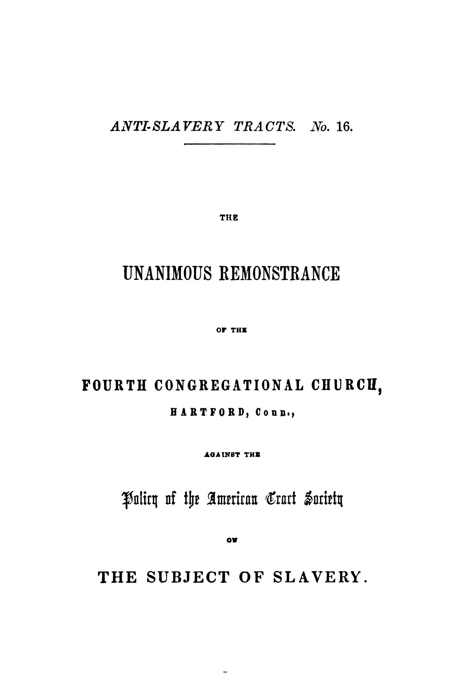
the
UNANIMOUS REMONSTRANCE
of the
FOURTH CONGREGATIONAL CHURCH,
HARTFORD, Conn.,
against the
Policy of the American Tract Society
of
THE SUBJECT OF SLAVERY.
[2]
The following unanimous Remonstrance of the Fourth Congregational Church of Hartford, Conn., was originally published and circulated to the number of several thousands by private individuals. The stereotype plates having been generously presented to the American Anti-Slavery Society, it has been adopted as a tract in their series, and for obvious reasons is published without alteration. The committee by whom it was prepared consisted of the Pastor, (Rev. Wm. W. Patton,) John Hooker, Esq., and Mr. Milo Doty.
New York, June, 1855.
[3]
LETTER OF REMONSTRANCE:
TO THE OFFICERS AND DIRECTORS OF THE AMERICAN TRACT SOCIETY.
Brethren:—
The eminent civil and religious position which many of your number hold, combined with your well-known interest in the cause of piety and philanthropy, induce us to address you, and through you the Christian community, with respect to certain relations and influences of the national benevolent society over which you preside. It is scarcely necessary for us to express our approbation of the object for which the American Tract Society was instituted, and which it has for more than a quarter of a century so successfully pursued. The fact that some of us are numbered among its life-members and life-directors, and that as a church we have for many years contributed to its funds and aided in the distribution of its publications, is evidence of our sentiments on that point. We have believed the circulation of a religious literature common to all evangelical Christians and selected from among the productions of the most eminent living and departed authors, to be an agency for good, both at home and abroad, with which the church could not wisely dispense. It has been our gratification, also, to observe the wisdom and propriety with which the operations of the society have in most respects been conducted, so that its efforts and success have surpassed those of any other benevolent publication society. The selection of books and tracts has been highly [4] judicious, the style of publication in mechanical respects has been eminently chaste and attractive, and there have been displayed on the part of those entrusted with its management, a business tact and energy which would have done credit to the most noted secular establishments. Entire perfection of method and policy during an extended work of twenty-nine years, the society would not claim, nor would we flatteringly ascribe. We have reason, also, to believe and affirm, that the operations of the society have been blessed of God to the production of the happiest Christian results in our own land and in foreign countries. The private Christian and the pastor, the home missionary and the foreign missionary, have felt themselves strengthened by its influence and have welcomed it as a most successful auxiliary; while multitudes both on earth and in heaven praise God for the agency which, by his direction, it had in their conversion. How, then, could we feel other than the deepest interest in the continued prosperity of such an organization?
It is the fact of such an interest, coupled with our regard for other aspects of the cause of Christ, that induces us to address you, the honored Officers and Directors of this honored society, upon a subject closely connected with its appropriate object and its future prospects. We come forward with friendly interest to offer a criticism upon one feature of its policy, upon which we and others have looked with pain, and which we desire to see give place to a course of action more in harmony with what we humbly conceive to be the spirit of the Gospel, the design of the society as described in its constitution, the aspects of Providence, and the growing desire of a large portion of the individuals and churches which have supplied the society’s treasury with such ample funds.
[5]
It can scarcely have escaped your observation, as you have mingled with Christian circles and have perused the contents of religious newspapers, that evidences of discontent have manifested themselves with regard to the policy which has been pursued by the American Tract Society upon the subject of American Slavery—a subject which for many years has agitated church and state, and is likely to engross the attention of God’s people in a still greater degree in time to come. As it is possible, however, that your attention has not been sufficiently turned to this point, you will pardon our more particular reference to it.
First of all, we may bear our personal testimony to the fact. From intercourse with fellow-Christians, both ministers and laymen, dwelling in all parts of the free states, we know that such a feeling as the one just indicated, extensively prevails; that it is rapidly on the increase; that while embracing not a few of the mature and experienced, it is fast possessing the minds of the younger portion of the ministry; and that it is absolutely necessary that something should be speedily done to meet and pacify it. This topic is gradually forming a prominent subject of conversation in ministerial and laic circles, and the leaven of discontent is working beneath the surface to a degree which the various officers and managers of the society do not suspect.
We next advert to the fact that this feature of the policy of the society is engaging the attention of local churches, whose members are forming and preparing to express their opinions. The action of the Congregational church in Manchester, Conn.—one of the most staid, intelligent, and influential churches of this vicinity—published in the Religious Herald of the 19th ult., is an indication of a feeling which will ere long manifest itself somewhat generally [6] among the churches of New England. This action in the Manchester church was unanimous. After expressing “deep and tender interest in the American Tract Society as an institution of great usefulness,” and concluding to forward a contribution for the present year, though decreased in amount as we understand, the church condemned “the policy of the society to maintain perfect silence on the subject of American Slavery, as wrong, and calculated, if persisted in, to alienate many of its most efficient friends, and to cause them, however reluctantly, to withdraw their confidence and support.”
As another indication of Christian opinion, we refer to the fact that the two newspapers most widely circulated and ably edited among the Congregationalists in the Eastern and Middle states—to wit: the Congregationalist, at Boston, and the Independent, at New York—have repeatedly and pointedly condemned the policy referred to, in which numerous smaller papers at the East and West concur, besides the able and influential Quarterly known as the New Englander—altogether representing a wide-spread sentiment through the free states.
Moreover, the subject has engaged the attention of the ecclesiastical bodies of the North somewhat generally, but especially among the Congregationalists, from whom larger donations, it is believed, flow into your treasury than from any other denomination. Some of these bodies have refused to take action on the subject; but, even in such cases, large and influential minorities appeared. Others have delayed action until another year, for the purpose of inquiry and consideration. Several have expressed their views decidedly in opposition to the course pursued by the society, and we will briefly refer to the action of those whose record of proceedings happens to be at hand. About two [7] years since, the Congregational Union of Fox River, Ill., adopted a letter of remonstrance to your society on this subject, ably discussing the principles applicable to it, and stating that “good men can give but a hesitating support to institutions of powerful but defective influence,” to which Rev. R. S. Cook, one of your secretaries, replied, defending the society’s policy. After a careful consideration of this reply, the Union rëaffirmed their sentiments, and declared themselves unconvinced by the secretary’s logic.
In 1853, the General Association of Massachusetts passed the following vote nearly or quite unanimously:
“Resolved, That while the General Association of Massachusetts entertain a profound regard for the large publishing societies, and rejoice in the great good they are accomplishing, they would express an earnest desire that these societies would not make the subject of slavery an exception in their efforts to rid the world of all iniquity by diffusing throughout it an evangelical literature, but would set forth in their publications the sentiments of our common Christianity on the enormous sin of slavery, with the same freedom and faithfulness with which they exhibit and rebuke all other sin.”
The present year the subject again came up, and a committee was appointed to confer with the delinquent societies.
The attention of the General Association of New York was also called at its recent meeting to the same defect, and a committee was raised to report upon it the ensuing year.
The General Association of Michigan appointed a committee in 1853, to examine and report upon this matter, which they did at the meeting the last summer, severely censuring the society. The report was adopted with but a single dissenting vote. After an earnest address from Rev. Dr. Bacon, of New Haven, Conn., who was present, [8] and who bore a very decided testimony against the society’s policy, a resolution was adopted, calling upon the society to do at least so much as to publish a tract composed of quotations from Scripture bearing on the various elements of oppression which enter into slavery.
The Council Bluffs Association, of Iowa, at its recent meeting, on the 12th inst., after expressing their gratification that the “American Board” had “decided to treat the sin of American Slavery as it would treat any other sin that so directly opposes the evangelization of the world,” passed the following:
“Resolved, That we long to see the American Tract Society, and the American Sabbath School Union, and other benevolent societies, take similar ground.”
The Central Association of Illinois have, within a few weeks, taken action to the same effect.
Not to multiply instances further, suffice it to quote the following action of the General Association of Iowa, taken in June last:
“Resolved, That our confidence in the American Tract Society and in the American Sunday School Union is greatly impaired by the course they have taken in expunging anti-slavery sentiments from their publications, and in refusing to speak out plainly against the sin of slavery, while they testify freely against every other prevailing sin.”
These facts prove, that we do not represent a small, discontented, and insignificant faction, but that a feeling of displeasure and disgust is spreading rapidly throughout the North. The words of remonstrance come from every quarter. The old Puritan state of Massachusetts raises its voice of protest, and the echo returns to us from the far-off prairies of Iowa.
[9]
We proceed then to state definitely the grounds of our dissatisfaction, that you may judge, as those accustomed to weigh evidence, whether our complaints are reasonable. In this we have nothing to do with the motives of those who have managed the society. We are quite willing to allow that it has been their intention so to administer its affairs as best to secure the end for which it was instituted. A serious mistake, however, we do allege, and one of a most mischievous nature, which, when discovered, it becomes the society immediately to rectify. However natural and excusable the original error, persistence in it will shake public confidence in the wisdom and integrity of the committee and directors.
I. The first charge which we bring against the society, is one of suppression. It has in sundry instances suppressed the anti-slavery opinions of authors whose works it has rëpublished. Those sentences which have condemned slavery as sinful, have been stricken out. This has been done not merely by way of general abridgement, but for the avowed purpose of avoiding the expression of sentiments which would be distasteful to slave-holders. Though the fact is admitted, and you are probably acquainted with some of the details, yet as many who will see this letter are not so familiar with them, we will adduce sufficient proof to exhibit the nature of the suppression alluded to.
It pleased your society to rëprint a work of that venerable Boston minister of the Puritan age, the Rev. Cotton Mather, D. D.—to wit: his “Essays to Do Good”—and in the preface you declared:
“In this edition, such portions of the original essays are omitted, and such changes have been made in the phraseology, as might be expected after the lapse of more than a century since the work was written”—
[10]
language which honestly implied that the changes and omissions were simply of obsolete phrases and of matter which had no application to any thing at the present day. What will the public say of the following alterations and suppressions on the subject of slavery—a subject which, so far from being by-gone, never attracted so much and so necessary attention as at the present time? On page 44, Tract Society’s edition, occurs this sentence:
“O that the souls of our servants were more regarded by us! that we might give a better demonstration that we despise not our own souls, by doing what we can for the souls of our servants. How can we pretend to Christianity, when we do no more to christianize our servants?”
By turning to the correct edition of the Massachusetts Sabbath School Society, page 102, it will be seen that Cotton Mather wrote “slaves,” and not “servants,” in those sentences, and that between the two you have suppressed these words:
“And not using them as if they had no souls! That the poor slaves and blacks which live with us, may by our means be made the candidates of the heavenly life!”
On the same page, a little below, you have suppressed an entire paragraph, as follows:
“But if any servant of God may be so honored by him as to be made the successful instrument of obtaining from a British Parliament ‘an Act for the Christianizing of the slaves in the plantations,’ then it may be hoped something more may be done than has yet been done, that the blood of souls may not be found in the skirts of our nation; a controversy of heaven with our colonies may be removed, and prosperity may be restored; or, however, the honorable instrument will have unspeakable peace and joy in the remembrance of his endeavors. In the mean time, the slave-trade is a spectacle that shocks humanity.
[11]
“The harmless natives basely they trepan,
And barter baubles for the souls of men;
The wretches they to Christian climes bring o’er
To serve worse heathens than they did before.”
As we do not find this book on your recent lists, and as your edition was severely criticised a few years since for doctrinal omissions and alterations, we suppose the offensiveness of those doctrinal changes has led to its entire suppression.
There is a curious fact in connection with the different editions to which we may properly refer. After its publication by the author, the work remained out of print, we believe, till issued in England, under the editorship of Rev. Mr. Burder, who undertook to modernize the phraseology. When he came to the passages above, he omitted them, stating, however, in a note at the bottom of the page, that the author had there made remarks concerning slavery, which, being happily inapplicable to that country, (England,) were omitted. Mr. Burder’s edition was followed in the rëprints in this country, all of which inserted his note. But your edition suppressed the note, and thus left the reader in ignorance of what the author had done. The English editor made omissions because they were inapplicable to his country; but you suppress the same passages because they were applicable to yours!
In the Tract Society’s edition of Mary Lundie Duncan, the following passage, found on page 67 of Carter’s edition, is suppressed:
“We have been lately much interested in the emancipation of slaves. I never heard eloquence more overpowering than that of George Thompson. I am most thankful that he has been raised up. O, that the measure soon to be proposed in Parliament, may be effectual!”
On page 87 of Carter’s edition, is found a reference by [12] the biographer, to the departure of “George Thompson, the eloquent pleader for the abolition of slavery,” to visit the United States to advocate his cause there. That reference is suppressed, as are also the stanzas, on page 80, which Mary Lundie Duncan addressed to him upon that occasion, from which we quote the third and eighth:
“Yet go, heaven-favored hero, go!
835. Pursue your glorious plan;
836.Abridge the weight of human woe,
837. And raise the slave to man.“Heaven bless your cause! your country’s prayers
839. Attend you o’er the sea!
840.Go, break the chain that slavery wears,
841. And bid the oppressed be free.”
Again, on pages 106, 107, similar suppressions are found of phrases which speak of the emancipated slaves in the West Indies, as “no more degraded lower than the brutes—no more bowed down with suffering from which there is no redress,” and as now being able to “seek the sanctuary fearless of the lash,” and “to call their children their own.”
We hear that the authoress has recently consented to have the book remain on your list thus altered, rather than have it wholly suppressed. But why did you not consent to restore the omitted passages, or at least those which did not refer to and endorse Mr. Thompson as an individual?
We learn, moreover, that the author, Mrs. Lundie, while in this country, was seen by one of your secretaries before the society rëpublished the work, and though urged to consent to this mutilation, absolutely refused, declaring that the lines sought to be suppressed, were precious to her for their sentiment and for her daughter’s sake; that the secretary then reminded her that, as there was no copyright for it in this country, the society could go on and publish it in such form as they wished; and that she replied, that [13] she knew she was in their power, and they could do as they pleased.
The society publish also an edition of J. J. Gurney’s “Habitual Exercise of Love to God;” but before consenting to do so, the committee constrained or induced the author, no doubt by the plea of greater usefulness, to consent to suppress the condemnation of slavery which his treatise contained in its remarks upon love to man. The original edition reads, page 142:
“If this love had always prevailed among professing Christians, where would have been the sword of the crusader? Where the African slave-trade? Where the odious system which permits to man a property in his fellow-men, and converts rational beings into marketable chattels?”
In the Tract Society’s edition, page 142, after the first question, it reads:
“Where the tortures of the Inquisition? Where every system of oppression and wrong by which he who has the power revels in luxury and ease at the expense of his fellow-men?”
Of such suppressions as these we complain, both on general grounds of opposition to all alteration and suppression of a writer’s peculiar sentiments, and also because of the specific wrong in connection with slavery. You will remember the agitation caused a few years since by the discovery that the Tract Society had been guilty of similar suppressions with reference to doctrinal opinions propounded in works which it rëpublished, and the virtual pledge of a different policy for the future which it gave, and to which we presume it has adhered. The principle contended for then, covers the case now before us. If the society does not like the sentiments of the author, it is under [14] no obligation to rëpublish his works; but if it does so, his opinions should stand in their integrity. This is peculiarly true in a biography, which professes to describe the individual as he was. To suppress the allusion to his peculiar principles or practice, on any point, is to do him injustice and to defraud the public. And then as to the particular direction which the policy of suppression has taken in the instance before us and in those of a like nature, we feel a special burden of grief; for, if there be any subject with reference to which the truth which has been once uttered should not be suppressed, it is American Slavery. If holy men and women have at any time been outspoken against this curse and shame of our land, in God’s name, let the fact appear! There is sufficient power enlisted in its support, and there are men enough who do and say nothing for its overthrow. Diminish no influence which is bearing against it; blot out no condemnation which pious souls have uttered. To say the least, the appearance of your suppressions is that of a subserviency to the dictation of slave-holders, such as no self-respecting men, and last of all, the conductors of a religious society, should ever evince.
II. Our second and similar charge, is, one of studied and persistent omission. It has been the deliberate policy of the Society, in its numerous tracts, volumes, and monthly papers, not to utter a direct condemnation of the most giant iniquity of our land. Slavery, which reduces three millions of fellow-men to property, deprives them of knowledge, takes away from them the Holy Scriptures, makes a race of heathen in a Christian land, robs them of liberty, compensation for their labor, the rights of marriage and of the parental relation; which sustains an internal slave-trade, equal in horror to that between Africa and Cuba, and in fifteen of our states inflicts untold cruelties and perpetuates [15] crimes of nameless abomination; slavery, which corrupts the master, degrades all honest toil, hinders all public improvement, and is a most formidable obstacle to education, religion, and the unity of our nation in its ecclesiastical and political relations—this “sum of all villanies,” as John Wesley justly termed it, has never been directly and purposely recognized by the American Tract Society as a sin deserving distinct discussion and condemnation!—And yet its Constitution declares its object to be, “to promote the interests of vital godliness and sound morality”! Is it astonishing that men of anti-slavery principles are beginning to be disgusted with such a policy? The Society has issued in the course of twenty-nine years some six hundred distinct tracts, and nearly three hundred separate volumes of various sizes, in which it has waged a Christian warfare upon almost every conceivable sin; and yet its first distinct, direct, and intended assault is yet to be made against a sin more than almost any other, open, flagrant, and ruinous—a sin which is a greater blight and corruption to our politics, literature, and religion, a greater disgrace to our country, and a greater hindrance to the universal triumph of the gospel, than any other practice which can be named! By an examination of the titles of the tracts of the Society—which, however, are a very insufficient guide to the subjects discussed—we find that the Society has been outspoken in condemnation of the following vices and immoralities, to wit: profanity, Sabbath-breaking, use of intoxicating drinks, covetousness, gambling, breaches of the seventh commandment, attendance upon the theatre, dancing, gayety and extravagance in dress, novel-reading, and sleeping in church. Now these are doubtless grave sins, and worthy of marked reprobation; and we would give due honor to the Society which has placed its condemning [16] brand upon them; but to think that these should have been selected, and slave-holding omitted! It is this contrast of treatment which makes the policy of the Society equally notorious and culpable, bringing upon it by a necessity of mental association, an application of the words of the Saviour, “Ye blind guides, who strain at (out) a gnat and swallow a camel.” If the Society did not profess to notice immoralities, if it avowedly confined itself to an inculcation of evangelical theological doctrine, the omission in question would be unnoticed; but when it deliberately enters upon the work of securing a “sound morality,” and proceeds in numerous tracts to set forth the flagrant wickedness of showy and expensive dress, of the practice of social dancing, and of the habit of sleeping in church, and then passes by American Slavery, the inconsistency is too gross to escape detection.
We are aware that in some of the earlier publications of the Society, such as Beecher on Intemperance, the writers, while discussing other sins, have dropped by a passing phrase, and, in the way of illustration, an incidental condemnation of slavery as sinful, showing that then the Society was not so rigid in its policy as now, and corroborating our statement hereafter made, that formerly there was an agreement among evangelical Christians as to the iniquity of the system. We have also perceived with pleasure, that in the commentaries on the Bible from the pen of Dr. Justin Edwards, published by the Society, he avoids placing a pro-slavery construction on any passage, and asserts general principles favorable to liberty, though he does not any where directly condemn slave-holding as sinful. Probably the officers of the Society are not themselves aware of all the incidental allusions referred to above, and would scarcely thank any officious friend who should collect and publish [17] them, so that they would meet the eye of the South. Even under a strict censorship, something will occasionally escape notice and get into print.
We cannot, however, regard such trifling and indirect reflections, occurring in rare instances in the midst of volumes on other subjects, as the discharge of duty, or as practically affecting the charge of studied omission. Especially can we not consent that the Society should have them culled out by agents at the North, and orally stated as showing an anti-slavery policy in the Society, while the Secretaries publish to the world that the Society does not and can not commit itself on this subject. The policy of the Society must be taken from the official statements of those who manage its affairs. The letter of Secretary Cook in reply to the Fox River Union, is such a statement, in which he argues for entire silence on this subject, and defends it as the policy of the Society.
We contend that such a policy is a wrong to all the parties concerned. It is a wrong to the slave; for it withholds an influence in his favor, which, if exerted, would be felt throughout the entire land, and would hasten by years the advent of his freedom. It is a wrong to the slaveholder; for it aids to perpetuate his blindness and to confirm his sin. It is a wrong to evangelical Christianity; for it virtually declares that slavery is not held by evangelical Christians to be inconsistent with “sound morality.” It is a wrong to the South; for it is a false friendship, concealing the disease which is consuming its very vitals. It is a wrong to the North; for it subjects the religious literature, the publication and circulation of which is principally paid for by Northern money, to the offensive and degrading censorship of the South. It is a wrong, you will permit us to add, to your own souls, brethren who conduct the Society; [18] for its tendency is, to induce you to overlook the woes of the slave, to fellowship the sinning master, and to cultivate a habit of sophistical reasoning in the endeavor to avoid unwelcome duty.
We are aware that those who have officially and unofficially represented the Society, have urged certain grounds of defence before the Christian public, and as we would not seem to evade arguments which some have deemed forcible, we will briefly state and answer those which have fallen under our notice:
1, It is alleged, that to publish on the subject of slavery, would be to turn aside from the specific object of the society. Were this the case, we should acknowledge the sufficiency of the defence. We would not have the society undertake a work for which it was not organized. We do not propose to have it become specifically an anti-slavery society, any more than an anti-gambling society, or a temperance society. But as it does not shrink from uttering Christian truth with respect to gambling and intemperance, as it meets them in the prosecution of its comprehensive work, so we desire it to make no exception of slavery. The specific object of the Tract Society, as set forth in its constitution, is sufficiently general to include all violations of the moral law, and whatever is offensive to genuine piety; for the first article declares, that “the object shall be to diffuse a knowledge of our Lord Jesus Christ as the Redeemer of sinners, and to promote the interests of vital godliness and sound morality.” It would seem in this day of light, to require no argument to prove that slavery is opposed to “the interests of vital godliness,” and is inconsistent with “sound morality.” But if such be its character, you are authorized and even required to publish tracts and volumes in its condemnation.
[19]
2, It is next urged, that another clause of the first article of the constitution, forbids the circulation of works which do not meet the approbation of all evangelical Christians, and that the society, according to article sixth, can publish nothing to which a single member of the publishing committee shall object. Hence it is argued, that as slavery is a disputed topic among evangelical Christians, and as different views would be entertained by different members of the publishing committee, it is not possible for the society to make any reference to it. The latter half of this objection is easily disposed of. Let it once be decided that the society will issue tracts and volumes on this subject, and it will be no difficult matter to select a publishing committee from the different denominations, who will agree upon anti-slavery works, new or old.
With reference to the former part of the objection, we would submit certain considerations which we think will entirely relieve a point which has labored in many candid minds. There need be no doubtful construction of the article in question. We rely upon well-established principles of interpretation. Where the meaning of a written document is in dispute, that interpretation which harmonizes most perfectly with the letter and spirit of the instrument, and which can appeal to uniform and long-continued practice under it, must necessarily be true; for it combines every element of correctness for which any class of interpreters, be they loose or strict constructionists, can contend. To such a test we propose to submit our view of the meaning of that part of the Tract Society’s Constitution to which reference is now had.
The first article reads as follows: “This Society shall be denominated the American Tract Society, the object of which shall be to diffuse a knowledge of our Lord Jesus [20] Christ as the Redeemer of sinners, and to promote the interests of vital godliness and sound morality, by the circulation of Religious Tracts, calculated to receive the approbation of all evangelical Christians.” That the directors of the society have not been very rigid in the construction of this article where favorite ideas were to be carried out, is evident from the fact that the words “Religious Tracts,” which have always had a definite meaning as referring to small unbound pamphlets, have been stretched to include large bound volumes on the one hand, and monthly newspapers on the other. Why those who have no scruple in thus expanding the fundamental idea of the society beyond the prescribed limits, should suddenly become so conscientious in adhering to the letter of the constitution in other respects, is not so clear as could be desired. But we are prepared to appeal to the very letter of the constitution, as permitting the publication of anti-slavery tracts, even though some who are evangelical Christians should not approve of them.
(1.) We contend that the clause in question, refers only to a doctrinal difference of a theological character, and to the sentiments of denominations rather than individuals. Almost every word in the sentence, and every fact in the origin and relations of the society, demonstrates this. The design of the society was informally to unite the various evangelical denominations in the publication of those doctrinal and practical tracts which would not come in collision with the peculiar tenets of any of the associated sects. A reference to all the explanations of the necessity and design of the society, contained in the early reports and magazines and appeals to the public, will prove this. Indeed, the fact is too notorious for denial. To express this idea was the intention of the clause in question, and no reference whatever [21] was had to merely practical points in which there might be and must be differences of judgment among individuals. The use of the word “evangelical” supports this idea, for it shows that the founders of the society were thinking only of avoiding those subjects which divided the various sects of evangelical Christians, which subjects are ecclesiastical and doctrinal in their nature, and not ethical or practical. What peculiar relation has the subject of slavery to the differences of evangelical Christians? It is neither a point in dispute between them on the one side, and heretics on the other, nor is it a dividing line between any two denominations of themselves. The fact, then, that the constitution employs the word “evangelical” in the connection, proves that no reference was had to subjects of mere practical judgment, but only to those of a doctrinal nature.
Then again the word “calculated” favors the same view. The tracts must be “calculated to receive the approbation of all evangelical Christians;” that is, they must be such as do not interfere with denominational peculiarities, and of such a Christian character as should properly commend them to all true followers of the Lord Jesus. This does not require that every individual evangelical Christian shall actually approve every sentiment published by the Society; which were absurd, and would make your whole enterprise impracticable. But it is enough, if the tracts do not theologically offend any evangelical denomination, and if their inculcations are such as ought to please sanctified minds. Anti-slavery tracts can easily be supplied, meeting these reasonable conditions.
All this is further corroborated by the sixth article, which reads thus: “To promote in the highest degree the objects of this Society, the officers and directors shall be elected [22] from different denominations of Christians; the Publishing Committee shall contain no two members from the same ecclesiastical connection; and no tract shall be published to which any member of that committee shall object.” Here again the use of the words “different denominations” and “ecclesiastical connection,” proves, that all that was aimed at in the way of exclusion was, to prevent the publication of doctrinal or ecclesiastical matter offensive to denominations as such.
(2.) To make our position invincible, and to show that these are not after-thoughts of hypercritical minds striving to extract a given idea from given words, we refer with confidence to the whole practice of the Society from the beginning to the present time, as sustaining and illustrating the distinction which we have made. Take the publications of the Society, and examine the subjects discussed and the sentiments propounded. Are they such as secure or even claim to secure the unanimous verdict in their favor of “all evangelical Christians” exercising their individual judgments? Not at all. Far from it. They avoid topics of doctrinal discussion, but not of difference of practical judgment as to duty. They do not discuss election, or baptism, or liturgies, or church government; but they do discuss practical points on which “evangelical Christians” widely differ among themselves, as individuals, and not as denominations. Thus the Society publishes over twenty tracts against the manufacture, sale, and use of intoxicating drinks as a beverage. But “all evangelical Christians” are not agreed in that position. There is not a denomination represented in the Society that does not contain members and ministers who use such liquors, and defend the practice from the Bible. Not only so, but to render the case still more decisive, it will be found, if we go abroad [23] and include the old world, that the overwhelming majority of evangelical Christians reject the sentiments taught by the Society on that point. The “evangelical Christians” of Great Britain, France, Germany, and Switzerland, have never as a body, or by more than a mere fraction, say one-tenth of their number, given in their adhesion to the doctrine that total abstinence is a Christian duty. A far larger proportion of evangelical Christians through the world are opposed to slavery, than are opposed to the use of intoxicating beverages. And yet you publish against the latter, and refuse to condemn the former! The Society publishes several tracts against dancing as a social amusement. Are “all evangelical Christians” agreed in this view? Ask our Episcopal brethren. Ask the pastors of the city churches among all the evangelical denominations. Ask the Christian world in Europe. The sentiments of many of your tracts on that subject are repudiated by thousands of “evangelical” families, even among those who contribute to your funds. The same may be said of ideas advanced in tracts against card-playing, and other forms of gambling, Sabbath-breaking, attendance on the opera and theatre, and novel-reading. No one of them would receive the approbation of all “evangelical Christians,” and some of them would even be condemned by a majority. Why then do you publish them? On what ground do you rest your defence against the charge of having violated your Constitution from the beginning? You must resort to the very distinction which we have raised. You must claim that these are not topics which divide evangelical denominations, as such, but only lead to differences among individuals irrespective of denominations. The distinction is valid, and we ask you to apply it to the [24] subject of slavery. If you attack the sin of slave-holding, you may come into conflict with individual judgments among evangelical Christians, but you will cross no denominational lines. No Methodist, nor Episcopalian, nor Presbyterian, nor Congregationalist, nor Baptist, as such, will be wounded. Why then repudiate an interpretation of your Constitution upon which you have impliedly acted from the beginning, merely to escape responsibility with reference to slavery?
(3.) We also insist, that the overwhelming majority of Christians in this country are so far agreed on this subject as to allow the publication of numerous tracts in which they would accord. They might differ as to whether a voluntary retention of the legal relation of slave-owner always involved guilt and deserved church discipline, and they might also disagree as to the best time and method of emancipation. But they are agreed with respect to the unrighteousness of the general system as defined and protected by the slave-code, and as sustained by ordinary practice. They are agreed in the condemnation of the internal slave-trade, the separation of parents and children and husbands and wives by sale, the non-existence of legal marriage, the exaction of unpaid toil, the use of the lash and other instruments of torture, the prohibition of other than oral instruction and consequent denial of the Bible to the slave, the rejection of colored testimony in the courts, depriving the slave of all legal protection, and other practices which enter into American slavery as it is. They are also united as to the duty and policy of emancipation in some way, and at as early a period as practicable. Upon each of these points a tract might be written, according with the convictions of nineteen-twentieths of the evangelical [25] Christians of the land, and running counter to no denominational peculiarity.
(4.) We furthermore urge, that such disagreement as exists upon the topics just mentioned, is entirely of recent origin, and is owing to the apostacy of the Southern churches from the common faith of evangelical Christendom; for extended proof of which fact, we refer to an able article in the last number of the New Englander, (October, 1854,) from the pen of Rev. Dr. Bacon. In 1818, the General Assembly of the Presbyterian church unanimously adopted a very strong expression of their abhorrence of the whole system, and its ordinary cruelties and wrongs. Not a minister or layman from the South voted against it, for it was then Southern as well as Northern evangelical doctrine, that slavery is of itself wrong, and should be abandoned as speedily as practicable. The sentiment was the same in other denominations. But since earnest anti-slavery men have pressed the duty which results from such a concession, the south have been driven by force of logic and conscience, either to abandon what they acknowledged to be wrong, or to take a new position, and deny the wrong. They have chosen the latter alternative, and in so doing, have apostatized from the universal faith of Christendom. But is that any reason why the American Tract Society should refuse to hold on the even tenor of its way, and abide by the faith of the Christian world? Shall it refuse to adopt as one of its tracts the unanimous declaration against slavery of the General Assembly of 1818, or John Wesley’s “Thoughts on Slavery,” once universally acceptable, because within twenty years there has been a wide-spread apostacy from the evangelical faith in one section of the land? If so, then if a similar retrogression of correct sentiment should occur with reference to the [26] sale and use of intoxicating beverages, the society would feel bound to strike all its temperance tracts from its list? Men of principle ordinarily see in the fact of apostacy from correct doctrine, an additional reason for proclaiming the truth. If, then, there was once a universal, and is now a prevailing sentiment among evangelical Christians against slavery, then the Tract Society should echo it in their publications, not swerving from the path of duty because in a certain section personal interest and the necessity of logical consistency in evil, have induced professed Christians to deny what they once admitted.
(5.) Nor is it improper that we should suggest the exceeding impolicy of the construction which you place upon the constitution of the society. Its tendency is to drive anti-slavery Christians from your support, and to make it necessary for them to sustain a new and rival society. We do not desire such a result, if it can be avoided. But if you thrust your constitution in our face, and declare that it is impossible for you to comply with our request, what alternative do you leave us, but to withdraw and sustain a more comprehensive organization?
3, But it has been contended by some who advocate the continuance of the policy of silence, that it is really open to no charge of favoring slavery; that the society simply expresses no opinion on the subject, but contents itself with preaching the gospel and thus preparing the way for the ultimate emancipation of the slave, in the mean time leaving anti-slavery societies to do the work of opposing slavery specifically. But why not in like manner leave temperance societies to do the whole work of opposing intemperance? Why does the Tract Society also publish tracts upon that subject? Why does it denounce breaches of the seventh commandment in its publications, instead of leaving [27] the subject of chastity to moral reform societies? Had the society refused to publish on those points, would it not have been charged with withholding the truth? Where a subject meets us in the field of our operations, we cannot evade it without practically assuming a part in the controversy. Hence, Christ said, “He that is not with me is against me, and he that gathereth not with me scattereth abroad.” The slave and his friends can say the same. You meet the sin of slavery in the direct prosecution of your work of “promoting the interests of vital godliness and sound morality.” Your publications go where it prevails. Two hundred and fifty of your colporteurs labor in the midst of it. You are thus necessitated to take a stand for or against it. If you are silent on the subject, that is regarded as tantamount to a tacit approval or friendly toleration, especially as the mean while you are performing acts of fellowship with those who are guilty of the sin, and are thus endorsing their Christian character and standing. In this manner you omit an influence for humanity which you are bound to exert, and throw the weight of your position as a great national Christian society into the scale of slavery.
It is sometimes attempted to compare your relation to the subject with that of the Bible Society; but they are quite different. The Bible Society has for its single object to publish and distribute the Bible without note or comment. Its naked work is to circulate Bibles. It seeks to proclaim no truth in any other way. But the Tract Society aims at the very thing which the Bible Society leaves untouched, viz: the inculcation of specific moral and religious truth, or the application of the general doctrines and precepts of the Bible to the circumstances of men. And yet even the Bible Society may so conduct its cause as to connive at slavery. If, for instance, it refuses to give the Bible to [28] such slaves as can read it, and if it refuses to condemn the laws which prohibit the teaching of slaves to read God’s Word, then it proves recreant to duty by not opposing slavery as it is met in the prosecution of the legitimate work of the society. We contend that a benevolent society is bound equally with individuals, to do all the good and remove all the evil that it can, in its natural sphere of action. As therefore slavery lies directly in your path, for your society not to notice it, is deliberately to avoid duty, and like the priest and Levite, to “pass by on the other side,” leaving your robbed and wounded “neighbor” to perish. And will not Christ say, “Inasmuch as ye did it not to one of the least of these, ye did it not to me?” The omission of good is the commission of evil, an act of disobedience to the command, “As therefore ye have opportunity, do good unto all men.” Vain is the thought of evading responsibility.
* * * “Fatal mistake! the dread account proceeds,
869.And our not doing is set down among our vilest deeds.”
4. But lastly, it is argued in defence of the Society’s past and present policy, that to publish any thing against slavery would result in the exclusion of the Society’s agents and publications from the Southern States; that thus multitudes would be left without the gospel in any form, as no part of the land is more destitute of the means of grace; so that without benefitting the slave, the gospel would be taken from the poor whites, and also from the free colored population, sacrificing a real and present good to a mere abstract principle. This, we have reason to believe, is relied upon as the strong argument in opposition to the views which we present. That it is but a broken reed upon which to lean, can be easily demonstrated.
[29]
First, let us inquire whether the position thus taken in apparent defiance of the obligations which Christian principle imposes, is not an adoption of the maxim, “Let us do evil that good may come”? We have proved that the object of the Society, the claims of religion and humanity, and a sense of consistency, require you to attack slavery as you would any other prevailing sin. Is it then a sufficient answer, to affirm that to do so would embarrass the Society, and create opposition? Is it Christian, or is it Jesuitical—is it like Paul, or is it like Ignatius Loyola—to consent to suppress part of the gospel in order to preach the remainder? If there be a plain duty of rebuke owed to the slave-holder, and of compassion and aid owed to the slave, then no possible anticipation of success can justify the neglect of that duty. The apostle declares that “the damnation is just” of all who act upon the corrupt principle of doing evil that good may come. The prior question of duty, growing out of the unchangeable and impartial law of love, must be decided, before the claims of a low expediency can have a hearing.
We cannot but regard the principle thus avowed in defence of your policy, as corrupting in the highest degree. If consistently carried out, it would lead missionaries to China to avoid condemning the use of opium; missionaries to India to be silent with reference to caste; missionaries to Turkey to refrain from attacking polygamy; missionaries to Africa to be speechless concerning the slave-trade; lest the rulers or the populace should expel them from the country. Were it not better for religion that they should be expelled, rather than a compromise should be made of principle, and the nations should be presented with an emasculated gospel, devoid of purity and power?
You will soon have an opportunity of testing the operation [30] of this principle in our own land, in a novel application of it. The territory of Utah is in the possession of the Mormons, who are rapidly filling it with cities and villages. You will of course send colporteurs to labor amid the population. The Mormon faith allows polygamy, and that sin is now extensively and publicly practised there under the protection of the authorities. Will you keep silence respecting it, lest your agents should be driven from the territory, and thus lose all opportunity of doing good? Will you expunge from your list all tracts in favor of chaste marriage, lest your Society be obnoxious to the Mormons? Will you consent to carry an antinomian gospel? To preach faith without works? To call upon men to repent, without specifying the sins which they notoriously practice? Surely you will not thus succumb to polygamy. Why then succumb to slavery upon a principle which you repudiate in its other applications?
This attempt to weigh out future consequences, and decide upon resultant good in advance, is a very hazardous matter. No man has foresight of the future sufficient to trace out all the results of a given course. Present appearances of a flattering nature are no proof whatever of the ultimate wisdom of a prescribed policy. Immediate success may be gained at the cost of eventual disaster. This fact, Swartz and other early Protestant missionaries to India unhappily demonstrated, when, to avoid conflict and secure success, they tolerated caste in the churches. Thousands were easily converted, and their policy seemed wise. But longer experience proved that they committed a disastrous error, as is now admitted by nearly all the missionaries in the field of every denomination. Converts who were allowed in a flagrant breach of the law of love, were found to be a source of weakness rather than strength. It is much safer, therefore, to be guided by general principles [31] of right, leaving God to take care of the consequences. Let us illustrate from Scripture. John the Baptist was a great favorite with King Herod, who made him court chaplain, “heard him gladly,” and even “did many things” at his suggestion. But John saw that Herod was living in gross sin, having formed an adulterous connection with his brother Philip’s wife. What course should he pursue? Perhaps some of his disciples advised him to observe a prudent silence; not indeed expressing any approbation of the sin, but being careful not explicitly to rebuke it and contenting himself with reproving other sins about which Herod was not so sensitive, and with inculcating the general duty of fearing God. Perhaps they reminded him of the favor with which he was now regarded, of the many opportunities which he consequently had of exerting a good influence at court and throughout the nation, of the improvement which Herod had already made, and of the hope that might be indulged, that eventually he would himself see the sin of his adultery, and repent of it; whereas, were John to attack that sin directly, he would be disgraced and probably imprisoned and beheaded, and thus all hope of good be lost. But John despised this timid, compromising policy. He did his duty as a preacher of righteousness, and trusted God to protect his own cause. Was he wise? Did he right? Let universal Christendom respond its approbation. True, he was beheaded, and his career as a reformer terminated; but his example of faithfulness has done more for religion in all subsequent ages than could have been accomplished by thousands of converts at the court. It has inspired heroism in those called to combat with error and sin in each succeeding century, and not a day passes in which some struggling soul is not strengthened by the memory of that stern fidelity to truth.—Brethren, will not such be your influence, if you speak for God [32] and the slave despite the frowns of the oppressor? Will not the noble testimony thereby borne to the power of Christian principle, be a means of good beyond human calculation, as the knowledge of it shall spread from land to land, and be handed down from generation to generation? On the other hand, will not your silence aid to propagate a weak and shame-faced gospel, at which infidels will scoff, and which even Christians cannot respect? Will you not assist in recognizing and perpetuating a religion tolerant of slave-holding, which is to say, a religion tolerant of a system that is prolific of ignorance, wretchedness and heathenism? Thus amid apparent success you are destroying with one hand what you build with the other. You declare that the South is the most truly missionary field in the country; but you well know that slavery makes it such. Why not attack, then, that which is the source of such moral and religious destitution?
And are you not mistaken in supposing that by simply preaching evangelical doctrine and general principles of right, you are sapping the foundation of the whole system of slavery, and preparing the way for ultimate emancipation? Are you not aware that the Southern Church of all denominations now claims that the Bible is the best defence of slavery? Is it not an obvious and significant fact, that under the preaching of such a gospel as you propose to carry, slavery has increased for two hundred years, till professed Christians are as deeply involved in the sin as others, the curse has spread over fifteen states, and its victims number three millions? If, then, you pass through the states, fellowshipping those churches and ministers, and carrying an abstract theologic gospel which is silent respecting this great iniquity, how can your influence be favorable to liberty?
But has it never occurred to you, that some such act as [33] the expulsion of your agents and the exclusion of your publications from the South for opposition to slavery, may be the very thing which is needed to usher in the dawn of freedom? Suppose the worldly politicians of the South should accomplish such an expulsion; might not the effect be, to start the conscience of good men in that section into new life? Would they not begin to inquire, what it meant, that their adhesion to slavery was thus separating them from the whole Christian world? Might they not make a stand at last against politicians, and claim the right of free discussion? There are thousands at the South who hate slavery, but are afraid to brave the wrath of the oppressor by openly laboring for its overthrow. Let your society assume an anti-slavery position, and it would instantly embolden them, and if acts of violence were resorted to against your colporteurs, the indignation of the entire North combined with the aroused action of Christian men at the South, would ere long open the field again. Remember that the actual slave-holders are but three hundred and fifty thousand in number, and that if they strain the cord of tyranny over the three millions of non-slave-holding whites at the South too far, it will snap asunder.
But theory aside, we can present facts which prove that the South will not be closed to your operations should you assume anti-slavery ground. The American Missionary Association has during the past year sustained three colporteurs in the slave states, whose business has been in large part to distribute Bibles to slaves, and to circulate anti-slavery tracts and books among the whites. This work has been pursued without serious opposition, and with encouraging success. Each year finds the field enlarging. Besides these laborers, the association has organized eight churches in Kentucky and six in North Carolina, that do not receive slave-holders to communion, and sustains four [34] clerical missionaries, who in addition to their ordinary duties, lecture frequently and in many places against the sin of slavery. If then professed abolitionists find the field open, why need your society fear exclusion from the South for beginning to discharge this long-neglected duty? Such exclusion would be at the worst only partial, and in no state could it be permanent, while so far as ground was retained or rëgained, the victory for truth would be lasting and invaluable.
We have thus, brethren, at no little expense of labor to ourselves, and we fear of patience to you, gone over the entire subject in dispute. It has been painful to us to criticise the action of a great and good organization, but fidelity to truth seemed to require it. Pardon us, if in the ardor of discussion we have spoken too warmly or seemed to censure your course too severely. Weigh carefully the facts and arguments which we have presented, nor esteem them unworthy of notice till you have prayerfully compared them with the word of God. “Faithful are the wounds of a friend.” We appreciate the work in which the Tract Society is engaged, so vast in extent, so comprehensive in scope, so successful in prosecution. Our only desire is, to aid its progress, to save it from inconsistency, and to enlarge its resources. Not for what it has done so much as for what it has not done, do we send this remonstrance, saying with the Saviour, “These ought ye to have done and not to leave the other undone.”
Wishing you all prosperity in the faithful prosecution of your work, we remain,
Your brethren in the gospel of Christ,
THE MEMBERS
Hartford, Conn.
[(35)]
Extract from a Letter of Hon. William Jay, of New York, to Rev. R. S. Cook, Corresponding Secretary of the American Tract Society.
On the whole, sir, I cannot but think that your Society has greatly mistaken its duty to God and man, in shrinking from pronouncing slavery, as well as gambling and horseracing, a moral evil. Unquestionably, the Society has acted in perfect accordance with the general policy of the northern church, both Popish and Protestant. That policy is more easily understood than vindicated. So intimate are our commercial relations with the South, and so dependent are our politicians for the most trifling office upon the support of their party by southern votes, that to ask them and our merchants to participate in measures and opinions offensive to their southern patrons, is like asking the favor of them to pluck out a right eye, or cut off a right hand. Of course, the pecuniary and party interests of these men react on the church and religious societies with which they are connected. Hence has grown up a secular and ecclesiastical alliance, offensive and defensive, with slavery. But this alliance, although undoubtedly embracing many worthy men, is nevertheless in direct antagonism with the gospel of Christ, and has consequently led, and is daily leading to, most disastrous results. It has caused the avowal, by men of high position in both church and state, of principles utterly subversive of that regard for justice and mercy, which is not only one of the peculiar and beautiful features of our holy religion, but also, and especially in a democracy, one of the strongest safeguards of person and property. Some slaveholders in Congress propose a law, the provisions of which may well have been inspired by that evil and malignant spirit that goeth about seeking whom he may devour—a law openly setting at defiance the established rules of evidence, and levelling in the dust all the barriers erected by the common law around the personal liberty of the citizen—a law requiring every man, at the summons of a miscreant slave-catcher, to assist him in his damnable work—a law seeking by fine and imprisonment to suppress the impulses of humanity and the gushings of Christian sympathy. No sooner is this accursed law proposed, than rival politicians contend for the honor of giving it their support; and no sooner is it enacted, than the two great rival parties strive to gain votes for their presidential candidates by pledging their best endeavors to carry it into execution. Many individuals, however, affirm that a law thus requiring them to participate in deeds of cruelty and injustice is at variance with the divine commands. Forthwith we have our public men and our party press sneering at the “higher law,” and insulting all who acknowledge its paramount authority to an act of Congress; worse than all, we have our ministers of the Lord Jesus Christ descanting from their pulpits on the reverence due to the “powers that be,” as ordained of God, and actually urging the duty of obedience to one of the most ungodly and execrable enactments of modern legislation. Occasionally it was indeed admitted, that under peculiar circumstances, and multiplied conditions, we ought to obey God rather than man, but at the same time it was distinctly taught, not merely that we should not forcibly resist the Fugitive Law, but that the “higher law” did not dispense with our obligation to catch slaves.
In the zeal, the rivalry, and the cruelty displayed in seizing the hapless and innocent fugitive, and hurrying him back to the house of bondage, of mental darkness and bodily suffering, lessons of cruelty and injustice have been set by the rich and moral, which will not be lost on the needy [36] and profligate. Many of our wealthy and influential gentlemen are sowing seeds which may yet yield to them and their children most bitter fruit.
The shocking insensibility of our churches, religious societies, and religious men, to the iniquities of slavery, of course involves them in gross inconsistencies, degrades the character of the gospel of Christ, and gives a mighty impulse to infidelity. Never before, in my opinion, has the American church been in such peril as at present, and from almost every portion of it comes up a cry of distress. There is no failure of money. The country is rich, and our wealthy men are liberal, and pride, and ostentation, and competition secure the erection of gorgeous and expensive churches. But there is a failure of increase of ministers and members. The population is outgrowing the church, and the love of many is waxing cold. From men like Tom Paine and most of his followers the church has little to fear. They hate the gospel because their deeds are evil. Their lives are a sufficient antidote to their doctrines. But a new class of converts to infidelity is springing up, men whose fearless and disinterested fidelity to truth, mercy, and justice extort unwilling respect. These men reject the gospel, not because it rebukes their vices, but because they are taught by certain of its clergy, and the conduct of a multitude of its professors, that it sanctions the most horrible cruelty and oppression, allowing the rich and powerful forcibly to reduce the poor and helpless to the condition of working animals, articles of commerce, and to keep their posterity in ignorance and degradation to the end of time. Every argument wrested from the Bible in behalf of slavery applies to the bondage of white men. Hence the modern pro-slavery divinity justifies the ancient villanage and the modern serfdom, and would justify their indefinite extension. If it be right to hold three millions of human beings as chattels, it is equally right to hold hundreds of millions. Hence Christianity, if it indeed authorizes this unlimited despotism of the strong over the weak—this vast indefinite annihilation of the conjugal and parental relations—this total abrogation of the rights of conscience, of property, of personal happiness, has surely little claim to our reverence, for its tendency to mitigate the sorrows and troubles of the present life. Certainly it is not wonderful that benevolent, well-meaning men should question the divine authority of a religion sanctioning such tremendous enormities, and whose professors recommend the catching of slaves, as a service acceptable to the Deity, when required by act of Congress.
[(1)]
17. Rev. Charles Beecher, “The God of the Bible against slavery,” 11 pp.↩
It seems very strange that any one should think that the Bible sanctions slavery. Yet the defenders of the system appeal to the Bible with boldness, as if its authority were on their side.
The Charleston Union Presbytery, South Carolina, declare, that “the holding of slaves, so far from being a sin in the sight of God, is nowhere condemned in his holy word.”
The Charleston Baptist Association “does not consider that the Holy Scriptures have made the fact of slavery a question of morals at all.”
The Georgia Methodist Annual Conference resolved that “slavery, as it exists in the United States, is not a moral evil.”
The Protestant Episcopal Society for the Advancement of Christianity declare in a tract, that “without a new revelation from heaven, no man is authorized to pronounce slavery wrong.”
Rev. James Smylie, of Mississippi, (endorsed by two Presbyteries,) says, “The twenty-fifth chapter of Leviticus clearly and unequivocally establishes the fact, that slavery was sanctioned by God himself, and that buying, selling, holding and bequeathing slaves, as property, are regulations which are established by himself.”
Rev. Thomas S. Witherspoon says, “I draw my warrant from the Scriptures of the Old and New Testament, to hold the slave in bondage.”
Dr. Fuller says, “I find my Bible condemning the abuses of slavery, but permitting the system itself.”
Statements like these could be brought from sources of high [2] standing, to any required amount. Now, the very boldness of this claim may stagger some minds. How could men dare appeal so earnestly to the Bible, if it was really against them? But as history shows that the worst despotisms of the Old World have been in the habit of putting forth just such claims, so it may be in the case of slavery. It may be only the instinctive effort of an evil system to stave off judgment, by clothing itself with sacredness as a Bible institution, and representing all opposition to it as infidelity. And when we reflect on the cruelty of the system, this appears quite probable; nor, if we look at the arguments used to back this claim, is the probability at all diminished.
A fair Bible argument ought to show that slavery, as defined by the slave law, is agreeable to the character of God as revealed in the Bible. If this be really friendly to the system, then, and not otherwise, is slavery upheld by the Bible. Now, this is not the usual method of the defenders of slavery. Instead of it, they usually appeal to the curse on Canaan, the practice of Abraham, the legislation of Moses, and the silence of Christ and the apostles—an argument in every point unsound, nay, even absurd, when stripped of rhetorical ornament, and stated in the plain dialect of common sense. God cursed Canaan, who settled in Asia; therefore Ham, whom God did not curse, and who lived in Africa, must be enslaved. Abraham had armed servants, free to leave his service at will; therefore we may hold slaves unarmed, and without the least power to change masters. Moses’ laws destroyed slavery in Palestine; therefore God sanctions our laws which make slavery eternal. The apostles declared masters and slaves brethren, and forbade all recourse to Roman civil law; therefore they sanction that law and its cruel offspring among us.
Let it not be said that this is a caricature. If you tear off the fleece from a wolf in sheep’s clothing, you do not caricature him; you show him as he is. So it is not a caricature to tear off rhetorical fleece from a sophism, and show it to be absurd.
Leaving, however, this point for further consideration by and by, let us now test the system of slavery by the only fair Bible argument; an argument not from disputed theological points, on which Christians may honestly disagree, but from the revealed attributes of the true God, about which there can scarcely be much difference of opinion.
[3]
What is the Bible view of God? How does he stand towards slavery as defined in the American slave code?
1. The Scriptures represent God as interested in the temporal concerns of men. Indeed, he is the Author of all really good social organization, and the only cause adequate to preserve it from corruption. He was the Founder and manifest Executive of the Hebrew commonwealth; and their system was the wisest, for the ends in view, that ever existed. All nations are held accountable to him for their laws and institutions; and whatever system is intrinsically unthrifty, disorderly, and disorganizing, must be displeasing to him.
But slavery degrades labor, discourages education, science, art; enfeebles commerce, blights agriculture, and continually works society towards barbarism. No traveller from a free to a slave state can fail to be struck with the evidence of this. The wisest southern statesmen have confessed slavery an incubus; and the fate of the Roman empire, where the experiment was tried on a magnificent scale, demonstrates the fact beyond denial.
Says Alison, “The steady growth, unequalled extent, and long duration of the Roman empire prove the wisdom of their political system; but it fell a prey at length to the dreadful evil of domestic slavery.”
Says Dr. Hague, “What caused that weakness of the empire which gave the barbarians a chance to overturn it? The answer is, The slave system within the empire corroded the core of its strength, and rendered it a mere shell, unable to resist the pressure of its enemies.”
Such a system, then, cannot be well pleasing to God.
2. God is revealed in the Bible as the Author of the family state, and the jealous defender of its purity. The family is the oldest, simplest, strongest, and most sacred institution of God on earth. All true systems have guarded it; all false systems have struck at its very life. Two of the ten commandments aim directly to establish the family,—
“Thou shalt not commit adultery.”
“Honor thy father and thy mother.”
Any system of laws, then, which nullifies the family, and legalizes concubinage, is in direct and flagrant opposition to the law of God, and must excite his deepest displeasure.
But what is slave law on this head?
[4]
“A slave cannot even contract matrimony.” (Stroud’s Sketch of Slave Laws, p. 61.) “Slaves are not entitled to the conditions of matrimony.” (Taylor’s Roman Civil Law, p. 429.) Slaves may indeed go through the usual forms, and be joined by the minister at the altar; but the laws allow no reality, no binding force, to the transaction. The law has nothing to shield any female slave from the passions of her owner; and husband and wife, parent and child, may be legally sold asunder forever, at any moment. Thus the family is completely annihilated by law, and the result is universal licentiousness.
“We southern ladies,” said the sister of President Madison, “are complimented with the name of wives; but we are only mistresses of seraglios.”
Nor is this destruction of the family an “abuse” of the system. It is an essential element of its legal being. Therefore the system of slavery must be exceedingly odious before God.
3. The Bible reveals the justice of God. He is the Creator and Father of all, and all are his offspring. All bear his image. He loves all impartially. All have equal rights before him. He is the common Judge of all, before whom all complaints must come for final decision. He is always represented as judging the cause of the poor and needy, and pleading for the oppressed. If we should extract from the Old Testament alone, to say nothing of the New, all that God says against social injustice, the accumulation of testimony would be overwhelming.
But what does slavery say of itself in its laws?
“Slaves,” says the South Carolina statute, “shall be deemed, held, taken, reputed, and adjudged in law, to be chattels personal in the hands of their owners and possessors, and their executors, administrators, and assigns, to all intents, constructions, and purposes whatsoever.”
That this is the radical doctrine of slave law throughout the South, the following statement of Mr. Goodell shows:—
“Where other usages or statutes in any of the states fail, recourse is generally had to the Roman civil law.” That law was as follows:—
“Slaves were held pro nullis, pro mortuis, pro quadrupedibus. They had no head in the state; no name, title, or register; they were not capable of being injured,” &c.
[5]
This is the root notion of slave law. A slave is counted “as a cipher, a corpse, a quadruped.” He is not a citizen. He cannot be injured or wronged, because he is so stripped of rights that he has no rights to be violated. But why? What has he done? Does he deserve this? Is there any ground for it in natural law? None. Says Blackstone, “It is repugnant to reason and the principles of natural law that such a state should exist any where.” Book I. chap. xiv. p. 423.
The slave has simply been born of a slave mother, and is thus stripped of his rights because his mother was before him; she, because her mother was; and so onward until we arrive at the original act of man-stealing in Africa, which our laws condemn as piracy, and Moses’ law punishes with death. Therefore the ablest judges confess in open court that this is intrinsically unjust. “Merely in the abstract,” says Judge Ruffin, of North Carolina, “it may well be asked, which power of the master accords with right?”
Here, again, we are not dealing with “abuses” of the system, but with the system itself, as it is in its own laws and courts; and we ask, Must not the Bible, revealing a God of infinite justice, reject such a system, and expel it from the world?
4. God is infinitely benevolent. Awful as God appeared on Sinai, the law that he revealed there was love, and in it he disclosed the deepest law of his own being; so that “he that loveth is born of God, and knoweth God, for God is love.” The gospel is a still higher unfolding of the same feeling, for “God so loved the world that he gave his beloved Son to die.” Hence no one can deny that any system which is radically selfish must be hateful to God. But slavery confesses this of itself. If we wish to hear slavery speak, we must go into southern courts, and hear the slave law utter itself through the lips of its ablest judges.
Speaking of the legal relation of master and slave, Judge Ruffin says, “This has been assimilated at the bar to the other domestic relations; and arguments drawn from the well-established principles which confer and restrain the authority of the parent over the child, the tutor over the pupil, the master over the apprentice, have been pressed on us.
“The court does not recognize their application; there is no likeness between the cases; they are in opposition to each other, and there is an impassable gulf between them. The difference is that [6] which exists between freedom and slavery, and a greater cannot be imagined. In the one, the end in view is the happiness of the youth born to equal rights with that governor on whom the duty devolves of training the young to usefulness in a station which he is afterwards to assume among freemen. * * * With slavery it is far otherwise. The end is the profit of the master, his security, and the public safety; the subject, one doomed, in his own person and his posterity, to live without knowledge, and without the capacity to make any thing his own, and to toil that another may reap the fruits. * * * The power of the master must be absolute, to render the submission of the slave perfect. I most freely confess my sense of the harshness of this proposition. I feel it as deeply as any man can; and as a principle of moral right, every person in his retirement must repudiate it; but in the actual condition of things, it must be so; there is no remedy.”
This may stand as a full and fair confession from the mouth of the slave system of its incurable selfishness. Parents may be selfish, but the relation itself of parent and child is not intrinsically selfish, but benevolent. But while, on the other hand, the master may be humane and benevolent, the legal relation existing between him and his slave is intrinsically and unchangeably selfish. Therefore the mere fact that the Bible reveals a God of infinite benevolence, is ample condemnation of such a system.
5. The character ascribed to God in the Bible is eminently undespotic; the opposite of the usual character of earthly monarchs. Abraham conversed familiarly with God as a man with his friend. Moses found him, even on Sinai, long-suffering, slow to anger, and of great mercy. The Psalms and prophecies all breathe the same spirit; while Christ, in whom dwelt the fulness of the Godhead bodily, said, “Learn of me, for I am meek and lowly in heart.”
Alluding to the tyranny of earthly lords and rulers, Jesus said, “So shall it not be among you;” and afterwards actually stooped to wash his disciples’ feet, saying, “If I, your Lord and Master, have washed your feet, ye ought also to wash one another’s feet.”
Now, is this the fundamental characteristic of the slave law? Meekness, lowliness, self-sacrifice for inferiors? Not so thought Judge Ruffin, when he said, “The power of the master must be absolute, to render the submission of the slave perfect.” It is power, not love, on which such dominion stands,—brute force, not [7] ideas. Indeed, Judge Ruffin asks in open court, “What moral considerations shall be addressed to such a being to convince him, what it is impossible but that the most stupid must feel and know can never be true, that he is to labor thus upon a principle of natural duty, or for the sake of his own personal happiness? * * * Such obedience is the consequence only of uncontrolled authority over the body.”
And this is despotism—a government not of ideas and motives, but of bodily violence. Hence Jefferson declared “the whole commerce between master and slave to be a perpetual exercise of the most unremitting despotism on the one part, and of the most degrading submission on the other.”
Therefore he adds, that the children of slaveholders “nursed, educated, and daily exercised in tyranny, cannot but be stamped by it with odious peculiarities.”
As much, then, as the character of God, as shown in Christ, is opposite to the character of a Nero or a Caligula, so much is the Bible opposed to the system of American slavery.
6. Finally, the Bible reveals God as above all other things interested in the moral elevation and renovation of men, their deliverance from darkness and sin, and their preparation for heaven. God only is Lord of the conscience. All men have from him equal religious rights. The Bible reveals to all the solemn sanctions of eternity, and summons all to the same judgment seat. To all it brings the message of salvation through a crucified Redeemer. Any system, then, which darkens the mind, and tends to prevent repentance, and faith, and holy living, must in the highest degree incur the wrath of God.
All Protestants admit this principle as applied to Romanism: consistency requires them to admit it as applied to slavery. For slaves are far more dependent on their masters, who are not even professedly Christian teachers, than Catholics on their priests, who are. It is against the law to distribute Bibles and good books to slaves. It is against the law to teach them to read. The law gives to every master full power to deprive his slave of all religious instruction, if he choose; or to determine the nature and extent of that instruction. And the result is, that the slaves are generally ignorant and demoralized. The Synod of South Carolina and Georgia, in 1833, said, “In this Christian republic, there are over two millions of human beings in the condition of heathen, and in some [8] respects in a worse condition.” * * * “They may justly be considered the heathen of this Christian country.” Similar testimony is abundant from other religious bodies at the South.
Now, if the slaves have souls; if they are in danger of eternal destruction; if Christ died for them; how great the guilt of that system which thus imperils their salvation!—a system which, not content with stripping them of all their rights here, tends directly to defeat their last hope of happiness hereafter!
With an unbeliever in future punishment this argument might have less weight. But with the majority of denominations of Christians in this country, it is an argument of inconceivable power. If God be justly indignant with pagan delusions, with papal priest-craft, and with other systems which tend to destroy the soul, how much fiercer the indignation he must feel towards this, whose malignant tendencies in this respect are unparalleled upon earth! And how can the Bible, which reveals him, fail to make war on such a system?
Now, in the face of such a Bible argument as this, an argument susceptible of unlimited expansion, an argument any single point in which ought to be conclusive, what do the defenders of the system allege?
Shall we take up again, and examine in the light of this development, their fourfold plea?
1. Noah said, “Cursed be Canaan.” We answer, that curse was executed on Canaan, all whose descendants are, in Gen. x., expressly located in Palestine. What has it to do, then, with Ham, who was not cursed, and whose descendants were located in Africa? As well call the yellow fever in New Orleans a fulfilment of Moses’ curses on the Jews.
2. Abraham had slaves. We answer, Abraham had several wives; does the Bible therefore sanction polygamy? But the fact is, Abraham’s slaves were not slaves as Southern law defines slavery. They had arms; they could leave his service at will; there was no state and national law to interfere. Indeed, instead of being in Abraham’s power, he was in theirs.
3. Moses legalized slavery. “Of them” (the heathen) “shall ye buy bondmen and bondmaids, and ye shall take them as an inheritance for your children after you, to inherit them as a possession; they shall be your bondmen forever.”—Lev. xxv. 46.
But, as Dr. Hague judiciously remarks, “this must be understood [9] in consistency with the law of the jubilee, laid down in a preceding part of the same chapter, (ver. 9, 10,) “Ye shall hallow the fiftieth year, and proclaim liberty throughout all the land unto all the inhabitants thereof.” Hence the meaning of the statute is not the entail of perpetual slavery on any class, but simply the confining the Jews in the purchase of slaves, always and forever, to the children of the heathen.”—Christianity and Statesmanship, pp. 382, 383.
A full view of all the Mosaic statutes on this subject shows conclusively that the property principle of our laws was in no wise sanctioned. Let us take a bird’s eye view. Moses found slavery in existence. He legislated not to perpetuate, but to destroy the practice. Hence, while in other nations it continued, in Israel it disappeared, so that in Christ’s time, while the Roman empire was full of slaves, in Judea there were none. Moses’ laws were the opposite of ours in this: ours favor the master, his favored the slave; ours disfranchise the slave, his made him a Jewish citizen. Kidnapping was punished with death. Every Hebrew slave and every circumcised foreign slave went free the seventh year. Every fiftieth year all went free, whether proselytes or not.
No permission was ever given to sell a slave, or bequeath them by will; nor is there any evidence in the record that such a thing was ever done. The law protected the person of the slave. The loss of an eye or a tooth set him free. If the slave ran away, all were strictly forbidden to help the master catch him. This alone destroys entirely the chattel principle. More than one third of the slave’s time was at his own disposal by law. Finally, the slave was required to be circumcised, and incorporated into the state as a citizen, with the right of intermarriage, and of equal religious privileges, and there was no prejudice of color or caste feeling to keep him down.
The contrast between such a system of legislation as this, and the American slave code, is as wide as between the things of God and the things of Cæsar. It is a contrast so entire, that if to-day the Jewish law could be substituted for our slave code, it would instantly operate as an effectual abolition of the entire system of American slavery.
4. Christ and the apostles did not condemn slavery. We answer, Christ spent his life in Palestine, where slavery had been [10] abolished. He, probably, never came in contact with Roman slavery. The argument is then narrowed to the apostles. The question now is, what stand the apostles took in their epistles to converts from paganism; for of their actual preachings to unconverted pagans we have few vestiges remaining. Paul’s sermon on Mars’ Hill, in which he declared that “God had made of one blood all nations that dwell on the earth,” is about the only specimen of an apostolic sermon to pagans.
Did, then, the apostles sanction the Roman civil code, in their letters to the churches? This is manifestly the vital point of the whole argument. For it is the Roman civil code, and not the Jewish, from which our slave code has descended.
We reply, they not only did not sanction it, but they unequivocally, and with the whole weight of their authority, condemned it. In his letter to the Corinthian converts, Paul asks, “Dare any one of you, having a matter against another, go to law before the unjust, and not before the saints?”
And again,—
“I speak to your shame. Is it so that there is not a wise man among you, no, not one that shall be able to judge between his brethren? But brother goeth to law with brother, and that before the unbelievers.” That is, in the courts of the Roman civil law.
“Now, therefore, there is utterly a fault among you because ye go to law one with another,” &c.
Christians, then, were utterly forbidden to go into Roman courts, and to appeal to Roman law; and then the whole system of slavery was in an instant annihilated, both the slavery of slaves, and the slavery of sons and of wives. For the Roman civil law gave the father absolute power of life and death over his wife and his son, as much as over his slave. And if the apostles had by silence sanctioned that law in one respect, they would have equally sanctioned it in all. But they did not. They were not silent. Says Dr. Hague, “Far from availing themselves of any power granted by the civil law to retain their brethren in bondage, their religion forbade them to refer to that law any question respecting their duties to each other.”
Hence slavery was immediately abolished in the primitive churches. For whenever a question arose between a convert and his former slave, he could no longer resort to the civil tribunals; he [11] must go to the brotherhood, and the case must be issued by them. But they had sworn allegiance to Christ. His golden rule was for them “the royal law,” “the law of Christ.” Hence, when the apostles commanded masters to love their servants as brethren, and to render to them things just and equal, we see a deep significance in those words. “Justice” and “equality” were terms not predicable under Roman law of slaves. What “justice” to a cipher, a corpse? what equality to a quadruped? Roman law must have been utterly ignored before such words could be used. Hence all the passages alluding to masters and slaves receive a new meaning, far different from that the defenders of slavery are wont to give. Does the apostle speak of slaves “who are under the yoke,” “suffering wrongfully”? It is plain they are converted slaves of unconverted masters, who have not ignored Roman law. Does he caution converted slaves “not to despise” their believing masters? It is plain emancipation has taken place, with its natural reaction from servility to unrestraint. Does an escaped slave, now a convert, wish to return to his former master, now also converted, the apostle entreats Philemon to receive him “not now as a servant, but above a servant, a brother beloved.” Such expressions the apostle could never have used, if he had not utterly repealed and ignored the Roman law, as having any thing to do with the conduct of Christians.
Such, then, is the value of the so-called Bible argument in behalf of American slavery. Noah’s curse cannot touch Ham in Africa; Abraham’s servants are insulted by the idea of chattelhood; Moses’ law is the antipode of the Roman; and the Roman, with its courts, expressly prohibited by apostolic authority.
At the same time, on every page of the Bible a glorious God of infinite order, purity, justice, benevolence, meekness, and grace, stands revealed against a system of disorder, lust, injustice, selfishness, despotism, and irreligion. Does, then, the Bible uphold Slavery? Nay, verily, it must ever be to that system a consuming fire. Either the system must be consumed, or the fire quenched. Either Slavery or the Bible must be put down.
Published, for gratuitous distribution, at the Office of the American Anti-Slavery Society, No. 138 Nassau Street, New York. Also, to be had at the Anti-Slavery Offices, No. 21 Cornhill, Boston, and No. 31 North Fifth Street, Philadelphia, and at the Anti-Slavery Depository, Salem, Columbiana Co., Ohio.
[1]
18. Anon., “The Fugitive Slave Law, and its Victims,” 48 pp.↩
THE FUGITIVE SLAVE LAW, AND ITS VICTIMS.
The Fugitive Slave Law was enacted by Congress in September, 1850, received the signature of Howell Cobb, [of Georgia,] as Speaker of the House of Representatives, of William R. King, [of Alabama,] as President of the Senate, and was “approved,” September 18th, of that year, by MILLARD FILLMORE, Acting President of the United States.
The authorship of the Bill is generally ascribed to James M. Mason, Senator from Virginia. Before proceeding to the principal object of this tract, it is proper to give a synopsis of the Act itself, which was well called, by the New York Evening Post, “An Act for the Encouragement of Kidnapping.” It is in ten sections.
SYNOPSIS OF THE LAW.
Section 1. United States Commissioners “authorized and required to exercise and discharge all the powers and duties conferred by this act.”
Sect. 2. Commissioners for the Territories to be appointed by the Superior Court of the same.
Sect. 3. United States Circuit Courts, and Superior Courts of Territories, required to enlarge the number of Commissioners, “with a view to afford reasonable facilities to reclaim fugitives from labor,” &c.
Sect. 4. Commissioners put on the same footing with Judges of the United States Courts, with regard to enforcing the Law and its penalties.
Sect. 5. United States Marshals and deputy marshals, who may refuse to act under the Law, to be fined One Thousand dollars, to the use of the claimant. If a fugitive escape from the custody of the Marshal, the Marshal to be liable for his full value. Commissioners authorized to appoint special officers, and to call out the posse comitatus, &c.
Sect. 6. The claimant of any fugitive slave, or his attorney, “may pursue and reclaim such fugitive person,” either by procuring a warrant from some judge or commissioner, “or by seizing and arresting such fugitive, where the same can be done without process;” to take such fugitive before such judge or commissioner, [2] “whose duty it shall be to hear and determine the case of such claimant in a summary manner,” and, if satisfied of the identity of the prisoner, to grant a certificate to said claimant to “remove such fugitive person back to the State or Territory from whence he or she may have escaped,”—using “such reasonable force or restraint as may be necessary under the circumstances of the case.” “In no trial or hearing under this act shall the testimony of such alleged fugitive be admitted in evidence.” All molestation of the claimant, in the removal of his slave, “by any process issued by any court, judge, magistrate, or other person whomsoever,” to be prevented.
Sect. 7. Any person obstructing the arrest of a fugitive, or attempting his or her rescue, or aiding him or her to escape, or harboring and concealing a fugitive, knowing him to be such, shall be subject to a fine of not exceeding one thousand dollars, and to be imprisoned not exceeding six months, and shall also “forfeit and pay the sum of one thousand dollars for each fugitive so lost.”
Sect. 8. Marshals, deputies, clerks, and special officers to receive usual fees; Commissioners to receive ten dollars, if fugitive is given up to claimant; otherwise, five dollars; to be paid by claimant.
Sect. 9. If claimant make affidavit that he fears a rescue of such fugitive from his possession, the officer making the arrest to retain him in custody, and “to remove him to the State whence he fled.” Said officer “to employ so many persons as he may deem necessary.” All, while so employed, to be paid out of the Treasury of the United States.”
Sect. 10. [This Section provides an additional and wholly distinct method for the capture of a fugitive; and, it may be added, one of the loosest and most extraordinary that ever appeared on the pages of Statute book.] Any person, from whom one held to service or labor has escaped, upon making “satisfactory proof” of such escape before any court of record, or judge thereof in vacation,—a record of matters so proved shall be made by such court, or judge, and also a description of the person escaping, “with such convenient certainty as may be;”—a copy of which record, duly attested, “being produced in any other State, Territory, or District,” and “being exhibited to any judge, commissioner, or other officer authorized,” &c., “shall be held and taken to be full and conclusive evidence of the fact of escape, and that the service or labor of the person escaping is due to the party in such record mentioned;” when, on satisfactory proof of identity, “he or she shall be delivered up to the claimant.” “Provided, That nothing herein contained shall be construed as requiring the production of a transcript of such record as evidence as aforesaid; but in its absence, the claim shall be heard and determined upon other satisfactory proofs competent in law.”
The names of the NORTHERN men who voted for this cruel kidnapping law should not be forgotten. Until they repent, and [3] do works meet for repentance, let their names stand high and conspicuous on the roll of infamy. Let the “slow-moving finger of scorn” point them out, when they walk among men, and the stings of shame, disappointment, and remorse continually visit them in secret, till they are forced to cry, “my punishment is greater than I can bear.” As to the Southern men who voted for the law, they only appeared in their legitimate character of oppressors of the poor—whom God will repay, in his own time. The thousand-tongued voices of their brother’s blood cry against them from the ground.
The following is the vote, in the SENATE, on the engrossment of the bill:—
Yeas.—Atchison, Badger, Barnwell, Bell, Berrien, Butler, Davis (of Mississippi), Dawson, A. C. DODGE (of Iowa), Downs, Foote, Houston, Hunter, JONES (of Iowa), King, Mangum, Mason, Pearce, Rusk, Sebastian, Soulé, Spruance, STURGEON (of Pennsylvania), Turney, Underwood, Wales, Yulee.—27.
Nays.—Baldwin, Bradbury, Chase, Cooper, Davis (of Massachusetts), Dayton, Henry Dodge (of Wisconsin), Greene, Smith, Upham, Walker, Winthrop.—12.
Absent, or Not Voting.—Benton, Borland, Bright of Indiana, Clarke of Rhode Island, Clay, Cass of Michigan, Clemens, Dickinson of New York, Douglas of Illinois, Ewing of Ohio, Felch of Michigan, Hale of New Hampshire, Hamlin of Maine, Miller of New Jersey, Morton, Norris of New Hampshire, Phelps of Vermont, Pratt, Seward of New York, Shields of Illinois, Whitcomb of Indiana. [Fifteen Northern Senators absent from the vote.]
On the final passage of the Bill in the Senate, the yeas and nays were not taken. D. S. Dickinson of New York, who had been absent when the vote was taken on the engrossment, spoke in favor of the bill. Mr. Seward was said to be absent from the city, detained by ill health.
When the Bill came up in the HOUSE OF REPRESENTATIVES, (September 12th,) JAMES THOMPSON of Pennsylvania, got the floor,—doubtless by a previous understanding with the Speaker,—and addressed the House in support of the Bill. He closed his remarks by moving the previous question! It was ordered, and thus all opportunity for reply, and for discussion of the Bill was cut off. The Bill was then passed to its third reading—equivalent to enactment—by a vote of 109 Yeas, to 75 Nays; as follows:—
[4]
YEAS.
Maine.—Thomas J. D. Fuller, of Calais; Elbridge Gerry, of Waterford; Nathaniel S. Littlefield, of Bridgton.
New Hampshire.—Harry Hibbard, of Bath; Charles H. Peaslee, of Concord.
Massachusetts.—Samuel A. Eliot, of Boston.
New York.—Hiram Walden, of Waldensville.
New Jersey.—Isaac Wildrick, of Blairstown.
Pennsylvania.—Milo M. Dimmick, of Stroudsburg; Job Mann, of Bedford; J. X. McLanahan, of Chambersburg; John Robbins, Jr., of Philadelphia; Thomas Ross, of Doylestown; James Thompson, of Erie.
Ohio.—Moses Hoagland, of Millersburg; John K. Miller, of Mount Vernon; John L. Taylor, of Chillicothe.
Michigan.—Alexander W. Buell, of Detroit.
Indiana.—Nathaniel Albertson, of Greenville; William J. Brown, of Amity; Cyrus L. Dunham, of Salem; Willis A. Gorman, of Bloomington; Joseph E. McDonald, of Crawfordsville; Edward W. McGaughey, of Rockville.
Illinois.—William H. Bissell, of Belleville; Thomas L. Harris, of Petersburg; John A. McClernand; William A. Richardson, of Quincy; Timothy R. Young, of Marshall.
Iowa.—Shepherd Leffler, of Burlington.
California.—Edward Gilbert.
[All these Northern Traitors called themselves Democrats! save three—Eliot of Massachusetts, Taylor of Ohio, and McGaughey of Indiana, who were Whigs.]
989.
NAYS.
Maine.—Otis, Sawtelle, Stetson.
New Hampshire.—Amos Tuck.
Vermont.—Hebard, Henry, Meacham.
Massachusetts.—Allen, Duncan, Fowler, Mann.
Rhode Island.—Dixon, King.
Connecticut.—Butler, Booth, Waldo.
New York.—Alexander, Bennett, Briggs, Burrows, Gott, Gould, Halloway, Jackson, John A. King, Preston King, Matteson, McKissock, Nelson, Putnam, Rumsey, Sackett, Schermerhorn, Schoolcraft, Thurman, Underhill, Silvester.
New Jersey.—Hay, King.
Pennsylvania.—Calvin, Chandler, Dickey, Freedley, Hampton, Howe, Moore, Pitman, Reed, Stevens.
Ohio.—Cable, Carter, Campbell, M. B. Corwin, Crowell, Disney, Evans, Giddings, Hunter, Morris, Root, Vinton, Whittlesey, Wood.
[5]
Michigan.—Bingham, Sprague.
Indiana.—Fitch, Harlan, Julian, Robinson.
Illinois.—Baker, Wentworth.
Wisconsin.—Cole, Doty, Durkee.
California.—Wright.
ABSENT, OR NOT VOTING.
Andrews, Ashmun (Mass.), Bokee, Brooks, Butler, Casey, Cleveland (Conn.), Clarke, Conger, Duer, Gilmore, Goodenow, Grinnell (Mass.), Levin, Nes, Newell, Ogle, Olds, Peck, Phœnix, Potter, Reynolds, Risley, Rockwell (Mass.), Rose, Schenck, Spaulding, Strong, Sweetser, Thompson (Iowa), Van Dyke, White, Wilmot (Penn.) [33—all Northern men.]
[Fifteen Southern Representatives did not vote.]
Daniel Webster was not a member of the Senate when the vote on the Fugitive Slave Bill was taken. He had been made Secretary of State, a short time previous. All, however, will remember the powerful aid which he gave to the new compromise measures, and among them to the Fugitive Slave Bill, in his notorious Seventh of March Speech, [1850.] A few extracts from that Speech will show how heavily the responsibility of the existence of this law rests upon Daniel Webster:—
“I suppose there is to be found no injunction against that relation [Slavery] between man and man, in the teachings of the Gospel of Jesus Christ, or of any of his Apostles.”—Webster’s 7th March Speech, (Authorized Edition,) p. 9.
“One complaint of the South has, in my opinion, just foundation; and that is, that there has been found at the North, among individuals and among legislators, a disinclination to perform, fully, their Constitutional duties in regard to the return of persons bound to service, who have escaped into the free States. In that respect, it is my judgment that the South is right, and the North is wrong.” * * * * “My friend at the head of the Judiciary Committee [Mr. Mason of Virginia] has a bill on the subject now before the Senate, with some amendments to it, which I propose to support, with all its provisions, to the fullest extent.”—Idem. p. 29.
He proceeded to assure the Senate that the North would, on due consideration, fulfil “their constitutional obligations” “with alacrity.” “Therefore, I repeat, sir, that here is a ground of complaint against the North well founded, which ought to be removed, which it is now in the power of the different departments of this Government to remove; which calls for the enactment of proper laws authorizing the judicature of this Government, in the several States, to do all that is necessary for the recapture of fugitive slaves, and for the restoration of them to those who claim them.
[6]
Wherever I go, and whenever I speak on the subject, and when I speak here, I desire to speak to the whole North, I say that the South has been injured in this respect, and has a right to complain; and the North has been too careless of what, I think, the Constitution peremptorily and emphatically enjoins upon her as a duty.”—Idem. p. 30.
In a speech in the United States Senate, July 17, 1850, made with an evident view to calm that Northern feeling which had been aroused and excited by his 7th of March speech, beyond the power of priest or politician wholly to subdue, Mr. Webster said there were various misapprehensions respecting the working of the proposed Fugitive Slave Bill:—
“The first of these misapprehensions,” he said, “is an exaggerated sense of the actual evil of the reclamation of fugitive slaves, felt by Massachusetts and the other New England States. What produced that? The cases do not exist. There has not been a case within the knowledge of this generation, in which a man has been taken back from Massachusetts into slavery by process of law, not one.” * * * * Not only has there been no case, so far as I can learn, of the reclamation of a slave by his master, which ended in taking him back to slavery, in this generation, but I will add, that, as far as I have been able to go back in my researches, as far as I have been able to hear and learn, in all that region there has been no one case of false claim. * * * There is no danger of any such violation being perpetrated.” [8]—Webster’s Speech on the Compromise Bill, in the United States Senate, 17th of July, 1850, edition of Gideon & Co., Washington, pp. 23-25.
With such words did Mr. Webster endeavor to allay Northern alarm, and to create the impression (which was created and which prevailed extensively with his friends) that the Fugitive Law was only a concession to Southern feeling, and that few or no attempts to enforce it were likely to be made.
But when a few months had proved him a false prophet, and the Southern chase after fugitive men, women, and children had become hot and fierce, and in one or two instances the hunter had been foiled in his attempts and had lost his prey, Mr. Webster changed his tone, as follows:—
In May, 1851, at Syracuse, N. Y., he said: “Depend upon it, the Law [the Fugitive Slave Law] will be executed in its spirit [7] and to its letter. It will be executed in all the great cities—here in Syracuse, in the midst of the next Anti-Slavery Convention, if the occasion shall arise.”
Certainly, so far as in Mr. Webster lay, so far as was in the power of Mr. Fillmore, and the officers of the United States Government generally, and of the still larger crowd of expectants of office, nothing was left undone to introduce the tactics, discipline, and customs of the Southern plantation into our Northern cities and towns, in order to enforce the Fugitive Law.
The remainder of this Tract will be devoted to a record, as complete as circumstances enable us to make, of the Victims of the Fugitive Slave Law. It is a terrible record, which the people of this country should never allow to sleep in oblivion, until the disgraceful and bloody system of Slavery is swept from our land, and with it, all Compromise Bills, all Constitutional Guarantees to Slavery, all Fugitive Slave Laws. The established and accredited newspapers of the day, without reference to party distinctions, are the authorities relied upon in making up this record, and the dates being given with each case, the reader is enabled to verify the same, and the few particulars which the compass of the Tract allows to be given with each. With all the effort which has been made to secure a good degree of completeness and exactness, the present record must of necessity be an imperfect one, and fall short of exhibiting all the enormities of the Act in question.
James Hamlet, of New York, September, 1850, was the first victim. He was surrendered by United States Commissioner Gardiner to the agent of one Mary Brown, of Baltimore, who claimed him as her slave. He was taken to Baltimore. An effort was immediately made to purchase his freedom, and in the existing state of the public feeling, the sum demanded by his mistress, $800, was quickly raised. Hamlet was brought back to New York with great rejoicings.
Near Bedford, Penn., October 1. Ten fugitives, from Virginia, were attacked in Pennsylvania—one mortally wounded, another dangerously. Next morning, both were captured. Five others entered a mountain hut, and begged relief. The woman supplied their wants. Her husband went out, procured assistance, captured the slaves, and received a reward of $255.
[8]
Harrisburg, Penn., October. Some slaves, number not stated, were brought before Commissioner M’Allister, when “the property was proven, and they were delivered to their masters, who took them back to Virginia, by railroad, without molestation.”
Detroit, 8th October. A negro was arrested under the new law, and sent to jail for a week, to await evidence. Great numbers of colored people armed themselves to rescue him. Result not known.
Henry Garnett, Philadelphia, arrested as the slave of Thomas P. Jones, of Cecil County, Maryland, and taken before Judge Grier, of the United States Supreme Court, October 18, 1850, who declared his determination to execute the law as he found it. The Judge said that the claimant had not taken the course prescribed by the fugitive act, and proceeded to explain, in a detailed manner, what the course should be in such cases. As the claimant thus failed to make out his case, the prisoner was ordered to be discharged.
Boston, about 25th October. Attempt to seize William and Ellen Craft. William Craft armed himself, and kept within his shop. Ellen was concealed in the house of a friend. Their claimants, named Hughes & Knight, were indicted for defamation of character, in calling W. C. a slave, and brought before a magistrate. The feeling excited against them was so great, that they at length fled from the city. Shortly after, it being considered hazardous for Mr. and Mrs. Craft to remain in the country, they were enabled to escape to England.
[In a letter, dated Macon, Georgia, Nov. 11, John Knight gives a particular account of the proceedings and experiences of himself and his friend Hughes, on their then recent visit to Boston for the purpose, to quote his own language, “of re-capturing William and Ellen Craft, the negroes belonging to Dr. Collins and Ira Taylor.” Willis H. Hughes also published his statement.]
New Albany, Indiana. A woman and boy given up, and taken to Louisville. They were so white that, even in Kentucky, a strong feeling arose in their favor on that ground. They were finally bought for $600, and set free.
Adam Gibson, Philadelphia, December 21, 1850. Surrendered by Edward D. Ingraham, United States Commissioner. The case was hurried through in indecent haste, testimony being admitted against him of the most groundless character. One witness swore that Gibson’s name was Emery Rice. He was taken to Elkton, Maryland. There, Mr. William S. Knight, his supposed owner, refused to receive Gibson, saying he was not the man, and he was taken back to Philadelphia.
What compensation has the United States Government ever made to Adam Gibson, for the injurious act of its agent, Ingraham? Had not the Slaveholder been more honorable than the [9] Commissioner or the makers of the Fugitive Law, Gibson would have been in Slavery for life.
Henry Long, New York, December, 1850. Brought before Commissioner Charles M. Hall, claimed as the fugitive slave of John T. Smith, of Russell County, Virginia. After five or six days’ proceedings, there being some doubt of the Commissioner’s legal right to act, the alleged fugitive, Long, was taken before Judge Judson, District Judge of the United States. The Castle Garden Union Safety Committee retained Mr. George Wood in this case, as counsel for the slave claimant. Long was surrendered by Judge Judson, and taken to Richmond, Virginia. Judge J. was complimented by the Washington Union as “a clear-headed, competent, and independent officer, who has borne himself with equal discretion, liberality, and firmness. Such judges as he,” continues the Union, “are invaluable in these times of turmoil and agitation.” At Richmond, Long was advertised to be sold at public auction. On Saturday, January 18th, he was sold, amid the jeers and scoffs of the spectators, for $750, to David Clapton, of Georgia. The auctioneers (Pullam & Slade), in commencing, said there was one condition of the sale. Bonds must be given by the purchaser that this man shall be carried South, and that he shall be kept South, and sold, if sold again, to go South; and they declared their intention to see the terms fully complied with. Long was subsequently advertised for sale at Atlanta, Georgia.
Near Coatsville, Chester County, Penn. On a writ issued by Commissioner Ingraham, Deputy Marshal Halzell and other officers, with the claimant of an alleged fugitive, at night, knocked at the door of a colored family, and asked for a light to enable them to mend their broken harness. The door being opened for this purpose, the marshal’s party rushed in, and said they came to arrest a fugitive slave. Resistance was made by the occupant of the house and others, and the marshal’s party finally driven off—the slave owner advising that course, and saying, “Well, if this is a specimen of the pluck of Pennsylvania negroes, I don’t want my slaves back.” The master of the house was severely wounded in the arm by a pistol shot; still he maintained his ground, declaring the marshal’s party should not pass except by first taking his life.
Marion, Williamson County, Ill., about December 10, 1850. Mr. O’Havre, of the city police, Memphis, Tennessee, arrested and took back to Memphis a fugitive slave, belonging to Dr. Young. He did so, as the Memphis paper states, only “after much difficulty and heavy expense,” being strongly opposed by the Free Soilers and Abolitionists, but was assisted by Mr. W. Allen, member of Congress, and other gentlemen.”
Philadelphia, about January 10, 1851. G. F. Alberti and others seized, under the Fugitive Slave Law, a free colored boy, named [10] Joel Thompson, alleging that he was a slave. The boy was saved.
Stephen Bennett, Columbia, Penn., arrested as the slave of Edward B. Gallup, of Baltimore. Taken before Commissioner Ingraham; thence, by habeas corpus, before Judge Kane. He was saved only by his freedom being purchased by his friends.
The Huntsville (Ala.) Advocate, of January 1, 1851, said that Messrs. Markwood & Chester had brought back “seven of their Slaves” from Michigan.
The Memphis (Tenn.) Eagle, of a later date, says that within a few weeks “at least five fugitive slaves have been brought back to this city, from free States, with as little trouble as would be had in recovering stray cows.” The same paper adds, “We occasionally receive letters notifying us that a slave, said to be the property of some one in this vicinity, has been lodged in jail in Illinois or Indiana, for his owner, who will please call, pay charges, and take him away.”
In Boston, end of January, 1851. A colored man, lately from North Carolina, was sought by officers, under Marshal Devens, aided by a lawyer, named Spencer, provided by the New York Union Safety Committee. The arrest was not attempted. It was found that the colored man was too strongly guarded and protected.
Mrs. Tamor, or Euphemia Williams, Philadelphia, February, 1851, mother of six children, arrested and brought before Commissioner Ingraham, as the slave Mahala, belonging to William T. J. Purnell, of Worcester County, Maryland, admitted to have been absent since 1829—twenty-two years. Children all born in Pennsylvania; oldest about seventeen—a girl. Her husband also in custody, and alleged to be the slave of another man. Under writ of habeas corpus, Mrs. Williams was taken before Judge Kane, of the United States Circuit Court. After a full hearing, she was discharged, as not being the woman alleged.
Shadrach, in Boston, February 15, 1851. Arrested in Taft’s Cornhill Coffee House, by deputies of United States Marshal Devens, on a warrant issued by George T. Curtis, United States Commissioner, on the complaint of John Caphart, attorney of John De Bree, of Norfolk, Va. Seth J. Thomas appeared as counsel for Caphart. After a brief hearing before G. T. Curtis, Commissioner, the case was adjourned to the following Tuesday. Shortly after the adjournment, the court-room was entered by a body of men, who bore away the prisoner, Shadrach. After which he was heard of in Montreal, Canada, having successfully, with the aid of many friends, escaped the snares of all kidnappers, in and out of Boston. The acting President, MILLARD FILLMORE, issued his proclamation, countersigned by Daniel Webster, Secretary of State, requiring prosecutions to be commenced against all who participated in the rescue.
[11]
Shawneetown, Illinois. A woman was claimed by Mr. Haley, of Georgia, as his slave; and was delivered up to him by two Justices of the Peace, (early in 1851.)
Madison, Indiana. George W. Mason, of Davies County, Kentucky, arrested a colored man, named Mitchum, who, with his wife and children, lived near Vernon. The case was tried before a Justice of the Peace, named Basnett, who was satisfied that Mitchum was Davis’s slave, and had left his service nineteen years before. The slave was accordingly delivered up, and was taken to Kentucky, (Feb. 1851.)
Clearfield County, Penn., about 20th January, 1851. A boy was kidnapped and taken into slavery.—Mercer (Pa.) Presbyterian.
Near Ripley, Ohio. A fugitive slave, about January 20, killed his pursuer. He was afterwards taken and carried back to slavery.
Burlington, Lawrence County, Ohio, near the end of February, 1851, four liberated slaves were kidnapped, re-enslaved, and sold. Efforts were made to bring the perpetrators of this nefarious act to punishment, and restore the victims to freedom.
At Philadelphia, early in March, 1851, occurred the case of the colored woman HELEN or HANNAH, and her son, a child of tender years. She was taken before a Commissioner, and thence, by writ of habeas corpus, before Judge Kane. An additional question arose from the fact that the woman would soon become the mother of another child. Judge Kane decided that she was the property of John Perdu, of Baltimore, together with her son, and her unborn child, and they were all surrendered accordingly, and taken into slavery.
Pittsburg, March 13, 1851. RICHARD GARDINER was arrested in Bridgewater, Beaver County, Pennsylvania, claimed as the property of Miss R. Byers, of Louisville, Kentucky. Judge Irwin, of the United States District Court, “remanded the fugitive back to his owner.” He was afterwards bought for $600, and brought into a free State.
The Wilmington (Del.) Journal, in March, 1851, says kidnapping has become quite frequent in that State; and speaks of a negro kidnapped in that city, on the previous Wednesday night, by a man who had been one of the city watchmen.
THOMAS SIMS, arrested in Boston, April 4, 1851, at first on pretence of a charge of theft. But when he understood it was as a fugitive from slavery, he drew a knife and wounded one of the officers. He was taken before Commissioner George T. Curtis. To guard against a repetition of the Shadrach rescue, the United States Marshal, Devens, aided by the Mayor (John P. Bigelow) and City Marshal (Francis Tukey) of Boston, surrounded the Court House, in Boston, with heavy chains, guarded it by a strong extra force of police officers, with a strong body of guards also within the building, where the fugitive was imprisoned as well as [12] tried. Several military companies also were called out by the city authorities, and kept in readiness night and day to act against the people, should they attempt the deliverance of Sims; Faneuil Hall itself being turned into barracks for these hirelings of slavery. Every effort was made by S. E. Sewall, Esq., Hon. Robert Rantoul, Jr., and Charles G. Loring, Esq., to save Sims from being returned into slavery, and Boston from the eternal and ineffaceable disgrace of the act. But in vain. The omnipotent Slave Power demanded of Boston a victim for its infernal sacrifices. Millard Fillmore, Daniel Webster, and their numerous tools, on the Bench, in Commissioners’ seats, and other official stations, or in hopes of gaining such stations bye and bye, had fallen upon their faces before the monster idol, and sworn that the victim should be prepared. Thomas Sims was ordered back to slavery by Commissioner G. T. Curtis, and was taken from the Court House, in Boston, early on the morning of April 11th, [1851,] to the Brig Acorn, lying at the end of Long Wharf, and thence in the custody of officers, to Savannah, Georgia.
There, after being lodged in jail, and severely and cruelly whipped, as was reported, he was at length sold, and became merged and lost in the great multitude of the enslaved population. The surrender of Sims is said to have cost the United States Government $10,000; the City of Boston about as much more; and Mr. Potter, the claimant of Sims, about $2,400, making a total of some $22,000, directly expended on the case.
Vincennes, Indiana, April, 1851. Four fugitive slaves were seized, claimed by one Mr. Kirwan, of or near Florence, Alabama. The magistrate, named Robinson, gave up the fugitives, and they were taken into slavery.
In Salisbury Township, Penn., April, 1851, an elderly man was kidnapped and carried into Maryland.
Near Sandy Hill, Chester County, Penn., in March, 1851, a very worthy and estimable colored man, named Thomas Hall, was forcibly seized, his house being broken into by three armed ruffians, who beat him and his wife with clubs. He was kidnapped.
Moses Johnson, Chicago, Illinois, brought before a United States Commissioner, discharged as not answering to the description of the man claimed.
Charles Wedley, kidnapped from Pittsburg, Pennsylvania, and taken into Maryland. He was found, and brought back.
Cincinnati, Ohio, June 3, 1851, an attempt to arrest a fugitive was made. But a scuffle ensued, in which the man escaped.
Cincinnati, Ohio. About the same time, some slaves, (number not stated,) belonging to Rev. Mr. Perry and others, of Covington, Kentucky, were taken in Cincinnati, and carried back to Kentucky.
Philadelphia, end of June, 1851, a colored man was taken away as a slave, by steamboat. A writ of Habeas Corpus was got out, [13] but the officer could not find the man. This is probably the same case with that of Jesse Whitman, arrested at Wilkesbarre.
Frank Jackson, a free colored man in Mercer, Penn., was taken, early in 1851, by a man named Charles May, into Virginia, and sold as a slave. He tried to escape, but was taken and lodged in Fincastle jail, Virginia.
Thomas Scott Johnson, free colored man, of New Bedford, was arrested near Portsmouth, Virginia, and was about to be sold as a slave; but, by the strenuous interposition of Capt. Card, certificates were obtained from New Bedford, and he was set at liberty.
Elizabeth Williams, West Chester County, Penn., delivered into slavery by Commissioner Jones. (July, 1851.)
Daniel Hawkins, of Lancaster County, Penn., (July, 1851,) was brought before Commissioner Ingraham, Philadelphia, and by him delivered to his claimant, and he was taken into slavery.
New Athens, Ohio, July 8, 1851. Eighteen slaves, who had escaped from Lewis County, Kentucky, were discovered in an old building in Adams County, Ohio. Some white men, professing to be friendly, misled them, and brought them to a house, where they were imprisoned, bound one by one, and carried back to Kentucky. [The enactment of the Fugitive Slave Law is the direct stimulating cause of all these cases of kidnapping.]
Buffalo, August, 1851. Case of Daniel ——. D. was a cook on board the steamer “Buckeye State.” He was engaged in his avocation, when Benj. S. Rust, with a warrant from United States Commissioner H. K. Smith, went on board the boat. Daniel was called up from below, and as his head appeared above the deck, Rust struck him a heavy blow, upon the head, with a large billet of wood, which knocked him back into the cook-room, where he fell upon the stove and was badly burned. In this state, he was brought before the Commissioner, “bleeding profusely at the back of the head, and at the nose, and was moreover so stupefied by the assault, that he fell asleep several times during the brief and very summary proceedings.” For most of the time he was unable to converse with his counsel, and “sat dozing, with the blood slowly oozing out of his mouth and nostrils.” After a very hurried form and mockery of a trial, Daniel was ordered to be delivered to Rust, the Agent of George H. Moore, of Louisville, Kentucky. By a writ of Habeas Corpus, Daniel was brought before Judge Conkling, of the United States Court, at Auburn, who gave a decision that set Daniel at liberty, and he was immediately hurried by his friends into Canada. Rust was indicted, in Buffalo, for his brutal assault on Daniel. It was fully proved; he afterwards plead guilty, and was let off with the paltry fine of fifty dollars.
John Bolding, arrested in Poughkeepsie, New York, claimed as the property of Barret Anderson, of Columbia, S. C. Bolding was a young man, of good character, recently married, and had a small [14] tailor’s shop in P. He said he was told, when a boy, that he was the son of a white man. He was tried before United States Commissioner Nelson, who ordered him to be delivered up to his claimants, and he was taken quietly from the city to Columbia, S. C. The sum of $2,000 was raised in New York, and paid to Bolding’s owner, who had consented to take that sum for him, and Bolding returned to his family in Poughkeepsie.
Christiana, Lancaster County, Penn., Sept. 1851. Edward Gorsuch, (represented as a very pious member of a Methodist Church in Baltimore,) with his son Dickinson, accompanied by the Sheriff of Lancaster County, Pa., and by a Philadelphia officer named Henry Kline, went to Christiana to arrest certain slaves of his, who, (as he had been privately informed by a wretch, named Wm. M. Padgett,) were living there. An attack was made upon the house, the slaveholder declaring (as was said) that he “would not leave the place alive without his slaves.” “Then,” replied one of them, “you will not leave here alive.” Many shots were fired on both sides, and the slave-hunter, Edward Gorsuch, was killed.
At a subsequent trial, a number of persons (nearly forty) were committed to take their trial for “treason against the United States, by levying war against the same, in resisting by force of arms the execution of the Fugitive Slave Law.” Castner Hanway was of the number. After suffering imprisonment and being subjected to great loss of time and heavy expenses, they were all discharged.
Syracuse, October 1, 1851. Jerry, claimed as the slave of John McReynolds, of Marion County, Missouri, was brought to trial before Commissioner J. F. Sabine. He was rescued by a large body of men from the officers who had him in custody, and was next heard of in Canada.
James R. Lawrence, a lawyer of Syracuse, acted as counsel for James Lear, attorney of McReynolds.
[N. B. Daniel Webster’s prophecy was not fulfilled.]
Columbia, Penn., (fall of 1851.) Man named Henry, arrested as the slave of Dr. Duvall, of Prince George’s County, Maryland,—taken to Harrisburg, before United States Commissioner McAllister, and by him consigned to slavery.
Judge Denning, of Illinois, discharged a negro brought before him as a fugitive slave, on the ground that the Fugitive Slave Law was unconstitutional.
Two alleged slaves arrested at Columbia, Penn., on warrant of United States Commissioner McAllister,—claimed as property of W. T. McDermott, of Baltimore. One was carried into slavery; one escaped. (November, 1851.)
Near New Philadelphia, Maryland, a woman, married to a free colored man, with whom she had lived ten years, was arrested as the slave of a Mr. Shreve, of Louisville, Kentucky. She was taken back to Kentucky.
[15]
Rachel Parker, free colored girl, kidnapped from house of Joseph S. Miller, West Nottingham, Penn., by the “notorious Elkton Kidnapper, McCreary,” Dec. 31, 1851. Mr. Miller tracked the kidnappers to Baltimore, and tried to recover the girl, but in vain. On his way home, he was induced to leave the cars, and was undoubtedly murdered,—it was supposed in revenge of the death of Gorsuch at Christiana. Mr. Miller’s body was found suspended from a tree. A suit was brought in the Circuit Court of Baltimore County, for the freedom of Rachel Parker, Jan. 1853. Over sixty witnesses, from Pennsylvania, attended to testify to her being free-born, and that she was not the person she was claimed to be; although, in great bodily terror, she had, after her capture, confessed herself the alleged slave! So complete and strong was the evidence in her favor, that, after an eight days’ trial, the claimants abandoned the case, and a verdict was rendered for the freedom of Rachel, and also of her sister, Elizabeth Parker, who had been previously kidnapped, and conveyed to New Orleans.
1076.
James Tasker, New York City, (Feb. 1852,) arrested through the treachery of Police Officer Martin, and brought before United States Commissioner George W. Morton, as the slave of Jonathan Pinckney, of Maryland. He was given up, and taken back to slavery.
Horace Preston, arrested in Williamsburg, New York, as the slave of William Reese, of Baltimore, Maryland;—Richard Busteed, of New York, being Attorney for the slaveholder. He was brought before United States Commissioner Morton, 1st April, 1852; for several days previous he had been kept a prisoner and his wife knew not what had become of him. He was given up by the Commissioner, and was carried into slavery. The same policeman, Martin, (who acted in the case of James Tasker,) was active in this case; being, doubtless, the original informant.
Preston was afterwards bought for about $1,200, and brought back.
Columbia, Penn., (end of March, 1852;) a colored man, named William Smith, was arrested as a fugitive slave in the lumber yard of Mr. Gottlieb, by Deputy Marshal Snyder, of Harrisburg, and police officer Ridgeley, of Baltimore, under a warrant from Commissioner McAllister. Smith endeavored to escape, when Ridgeley drew a pistol and shot him dead! Ridgeley was demanded by the Governor of Pennsylvania, of the Governor of Maryland, and the demand was referred to the Maryland Legislature.
[16]
Hon. J. R. Giddings proposed the erection of a monument to Smith.
James Phillips, who had resided in Harrisburg, Penn., for fourteen years, was arrested May 24, 1852, as the former slave of Dennis Hudson, of Culpepper County, Virginia, afterwards bought by Henry T. Fant, of Fauquier County. He was brought before United States Commissioner McAllister. Judge McKinney volunteered his services to defend the alleged fugitive. The Commissioner, as soon as possible, ordered the man to be delivered up; and, after fourteen years’ liberty, he was taken back to slavery in Virginia. Afterwards, bought for $900, and taken back to Harrisburg.
Wilkesbarre, Penn., (Summer of 1852.) Mr. Harvey arrested and fined for shielding a slave.
Sacramento, California; a man named Lathrop claimed another as his slave, and Judge Fry decided that the claim was good, and ordered the slave to be surrendered. Mr. Lathrop left, with his slave, for the Atlantic States.
A beautiful young woman, nearly white, was pursued by her owner [and father] to New York, (end of June, 1852.) There a large reward was offered to a police officer to discover her place of residence. It was discovered, and measures taken for her apprehension; but the alarm had been taken, and she escaped.
Sacramento, California; three men were seized by a Mr. Perkins, of Mississippi. The Court decided them to be his property, and they were carried back to Mississippi.—Standard, July 29, 1852.
Petersburg, Penn. Two fugitives from Alabama slavery were overtaken, and taken back, September, 1852.
John Henry Wilson, a lad of fourteen years, kidnapped from Danville, Pennsylvania, and taken to Baltimore, where he was offered for sale to John N. Denning. Kidnappers committed to jail, October, 1852.
[
1091.
Louisa, a colored woman, claimed by Mrs. Reese, of San Francisco, California, was seized by five armed men, and put on board Steamer Golden Gate, and carried it is not known whither. The aid of the Law was not invoked. The California Christian Advocate, from which the above is taken, says, “Two colored men, stewards on the Golden Gate, were sent back to the States on the last trip, under the State Fugitive Law.”
A mulatto woman, in San Francisco, was ordered to be delivered to her claimant, T. T. Smith, Jackson County, Missouri, by “Justice [17] Shepherd.”—San Francisco Herald—in Standard, November 4, 1852.
Sandusky, Ohio. Two men, two women, and several children were arrested and taken from a steamboat just about to leave for Detroit. Taken before Mayor Follett, by a man who claimed to be their owner. R. R. Sloane, Esq., was employed as counsel for the slaves. No one claiming custody of the slaves, or producing any writs or warrants, Mr. Sloane signified to the crowd present that there appeared to be no cause for the detention of the persons. Immediately a rush was made for the door. A man, who before had been silent, exclaimed, “Here are the papers—I own the slaves—I’ll hold you individually responsible for their escape.” The slaves escaped into Canada, October, 1852. Mr. Sloane was afterwards prosecuted for the value of the slaves, and judgment given against him to the amount of $3,950.
Thirty slaves, says the Maysville (Ky.) Eagle, “escaped from Mason and Bracken Counties, a short time ago. Some of them were captured in Ohio, by their owners, at a distance of about forty miles from the river.” “They brought the captured slaves home without encountering the least obstacle, or even an unkind word.”—Standard, November 4, 1852.
The Lemmon Slaves. At New York, eight persons, claimed by Jonathan Lemmon, of Norfolk, Virginia, as his slaves, were brought before Judge Paine, November, 1852. It appeared that they had been brought to New York by their owner, with a view of taking them to Texas, as his slaves. Mr. Louis Napoleon, a respectable colored man, of New York, procured a writ of habeas corpus, under which they were brought before the court. Their liberation was called for, under the State Law, not being fugitives, but brought into a free State by their owner. Said owner appeared, with Henry D. Lapaugh as his counsel, aided by Mr. Clinton. At their urgent request, the case was postponed from time to time, when Judge Paine, with evident reluctance, decreed the freedom of the slaves. E. D. Culver and John Jay, Esqs., were counsel for the slaves. The merchants and others of New York subscribed and paid Mr. Lemmon the sum of $5,280, for loss of his slaves. The New York Journal of Commerce was very active in raising this money. The same men were invited to contribute something for the destitute men, women, and children claimed by Lemmon. The whole amount given by them all, was two dollars. About one thousand dollars were raised for them among the better disposed but less wealthy class.
Thomas Brown alias George Bordley, Philadelphia, November, 1852, was claimed by one Andrew Pearce, Cecil County, Maryland. Given up to claimant by Commissioner Ingraham. The arrest of the man was made by the notorious kidnapper, George F. Alberti. Mr. Pettit, counsel for the claimant.
[18]
Richard Neal, free colored man, kidnapped in Philadelphia, and carried from the city in a carriage towards Maryland. A writ of habeas corpus was obtained, the kidnappers were overtaken, and Neal brought back after resistance and various hindrances. The Supreme Court of Pennsylvania discharged him. February, 1853.
Ten slaves, arrested in Indiana, and taken back to Tennessee, by W. Carney and others. Resistance was made, and W. Carney “was very badly injured during the fracas.”—Nashville Whig, March 5, 1853.
Alton, Illinois. A man claimed to belong to Walter Carrico, of Warren County, Missouri, was arrested by police officers from St. Louis. After being lodged in jail in St. Louis he made his escape, and again went into Illinois. He was pursued, found, and taken back to St. Louis.—St. Louis Republican, March, 1853. [9]
Amanda, a slave girl, was brought to St. Louis, from near Memphis, Tennessee, a year before, by a son of her master, and by him set free, without his father’s consent. After the father’s death, an attempt was made to seize Amanda, and take her back to Tennessee without trial. This was prevented by officers, the girl taken from the steamboat Cornelia, and brought before Levi Davis, United States Commissioner. He decided in favor of the claimants, (the heirs of the estate, of course.)—St. Louis Republican, March 17, 1853.
Jane Trainer, a colored child, about ten years old, in the possession of Mrs. Rose Cooper, alias Porter, (a woman admitted by her counsel to be a common prostitute,) was brought before Judge Duer, of New York City, by a writ of habeas corpus, which had been applied for by Charles Trainer, the father of the child, (a free colored man, who had followed the parties from Mobile to New York,) and who desired that the custody of his daughter’s person should be granted to him. [June, 1853, and previous.] Judge Duer decided that it was not within his jurisdiction to determine to whom the custody of the child belonged; the Supreme Court of New York must decide that. Judge D. proposed to both parties that the child should be put into his hands, and he would provide a proper person for her care and education, but the woman (Porter) would not consent to this. She evidently designed to train up the child for a life of shame, and perhaps of slavery also. The case was brought by a writ of habeas corpus, before Judge Barculo, of the Supreme Court, sitting at Brooklyn. The effort to serve the writ was at first defeated by the notorious New York bully, Captain [19] Isaiah Rynders, acting, it was said, under the advice of James T. Brady, counsel for Mrs. Porter. For this interference with the law, Rynders and some others were arrested and taken before Judge Barculo, who let them off on their making an apology! The second attempt to serve the writ on the child was more successful. After hearing counsel, Judge Barculo adjudged “that the said Charles Trainer is entitled to the care and custody of said Jane Trainer, and directing her to be delivered to him as her father,” &c. In giving his decision, Judge B. said, “It is not to be assumed that a child under fourteen years of age is possessed of sufficient discretion to choose her own guardian; a house of ill-fame is not a suitable place, nor one of its inmates a proper person for the education of such a child.” Jane Trainer’s mother was afterwards bought from slavery in Mobile, Alabama, and enabled to join her husband and child.
In 1854, Charles Trainer obtained a verdict in King’s County Court, New York, for $775 damages, against Rose Cooper.
[N. B. Though not strictly a case under the Fugitive Slave Law, this is very properly inserted here, as the whole spirit of the woman, of her counsel, and of the means he took to accomplish his base designs, was clearly instigated by that Law, and by the malignant influences it brought into action against the colored people, both slave and free.]
Basil White, Philadelphia, was summarily surrendered into slavery in Maryland, by United States Commissioner Ingraham, June 1, 1853. He was betrayed into the clutches of the kidnapper Alberti, by a colored man named John Dorsey.
Two slaves of Sylvester Singleton, living near Burlington, (Ky.?) escaped and reached Columbus, Ohio; were there overtaken by their master, who secured them and took them back with him.—Cincinnati Enquirer.
John Freeman, a free colored man, seized in Indianapolis, and claimed as the slave of Pleasant Ellington, a Methodist church-member, (Summer, 1853,) of Missouri. Freeman pledged himself to prove that he was not the person he was alleged to be. The United States Marshal consented to his having time for this, provided he would go to jail, and pay three dollars a day for a guard to keep him secure! Bonds to any amount, to secure the marshal against loss, if Freeman could go at large, were rejected. Freeman’s counsel went to Georgia, and “after many days returned with a venerable and highly respectable gentleman from Georgia, Mr. Patillo, (post-master of the place where he resides,) who had voluntarily made the long journey for the sole purpose of testifying to his knowledge of Freeman, and that he was well known to be free!” But Freeman was still kept in jail. After several days, [20] Ellington brought witnessess to prove F. to be his slave. The witnesses, and Liston (counsel for Ellington) wished to have Freeman strip himself, to be examined naked. By advise of his counsel he refused. The marshal took him to his cell, and compelled him to strip. The witnesses then swore that he was Ellington’s property. Freeman’s counsel produced further evidence that he had been known as a free man twenty years. Ellington claimed that he had escaped from him sixteen years before. The man who did escape from Ellington, just sixteen years before, was discovered to be living near Malden, Canada. Two of the Kentucky witnesses visited and recognized him. Freeman was then released, but with a large debt upon him, $1,200, which had grown up by the unusually heavy expenses of his defence and long imprisonment. Freeman brought a suit against Ellington for false imprisonment, laying damages at $10,000. A verdict for $2,000 was given in his favor, which was agreed to by Ellington’s counsel.—Indiana Free Democrat, May, 1854.
Three slaves, two men and a girl, fled from near Maysville, Kentucky, into Ohio. Were pursued by their owners and assistants, five men armed, and were overtaken, says the Maysville Weekly Express, “at the bridge over Rattlesnake Creek, on the Petersburg and Greenfield road, about ten o’clock at night,” the slaves being armed, and accompanied by a white man. Both parties fired, the negro girl was wounded, but still fled; one of the negro men was also wounded, and, says the Maysville paper, they “were tracked a mile and a half by the blood.” The other slave was secured and taken back to Kentucky, “much bruised and cut in the affray.” “The white man,” says the same paper, “was also caught and beaten in a very severe manner with a club, and strong hopes are entertained that he will die.”—Wilmington (Ohio) Republican, July 22, 1853.
A colored girl, between four and five years old, suddenly disappeared from Providence, R. I., July 13, 1853; at the same time, a mulatto woman, who had been heard to make inquiries about the child, was missing also. Believed to be a case of kidnapping.
A negro boy, says the Memphis Inquirer, “left his owner in this city,” and went on board the steamboat Aurilla Wood, bound for Cincinnati. By a telegraphic message he was intercepted, taken from the boat at Cairo, Illinois, and taken back to Memphis. (Summer, 1853.)
George W. McQuerry, Cincinnati, Ohio. A colored man, who had resided three or four years in Ohio, and married a free woman, by whom he had three children, was remanded to slavery by Judge McLean, (August, 1853.) The man was taken by the United States Marshal, with a posse, across the river to Covington, Kentucky, and there delivered to his master!
Two men kidnapped from Chicago, and taken to St. Louis. See Chicago Tribune, quoted in Standard, Aug. 27, 1853.
[21]
Three Slaves taken by Habeas Corpus, from steamboat Tropic, and brought before Judge Flinn, at Cincinnati, August, 1853. The woman Hannah expressed a wish to return to her master in the boat. Judge Flinn ordered her into the custody of the claimants without investigation. Judge F. asked Hannah if she had the custody of the child Susan, to which she answered that she had. Whereupon the Judge also ordered her back into the custody of the claimants, without examination. Mr. Jolliffe protested against ordering the child back without examination. The Court said they would take the responsibility. The examination then proceeded in the case of the man Edward. It appeared that they were purchased in Virginia, to be conveyed to Mississippi. The boat stopped at Cincinnati, and the slaves were twice taken by the agent of the owners on shore, and upon the territory of Ohio. Mr. Jolliffe commenced his argument at 7, P. M., and argued that the slaves, being brought by their owners upon free territory, were legally free. Mr. J., before finishing, was taken ill, and obliged to leave the court-room; he first begged the Court to adjourn until morning, which was refused by Judge Flinn. Judge Keys said the Ohio river was a highway for all States bordering on it, whose citizens had a right also to use the adjacent shores for purposes necessary to navigation. Mr. Zinn stated that Mr. Jolliffe had been obliged to retire, in consequence of illness, and had requested him to urge the Court to continue the case. Judge Flinn said—“The case will be decided to-night; that is decided on. We have not been sitting here four or five hours to determine whether we will decide the case or not. It will be decided, and you may come up to it sideways or square; or any way you please; you must come to it.” Mr. Zinn said he was not going to argue. He had made the request out of courtesy to a professional brother. He doubted the power of the Court to deliver the boy into slavery. Judge Flinn said—“I do not wish to hear any arguments of that nature.” The man was then ordered to be taken by the Sheriff, and delivered to claimant on board the boat,—which was done.—Cincinnati Gazette, 27th August, 1853.
Patrick Sneed, a colored waiter in the Cataract House, Niagara Falls, arrested on the pretended charge of murder committed in Savannah, Georgia. He was brought, by Habeas Corpus, before Judge Sheldon, at Buffalo, (September, 1853,) and by him ordered to be “fully discharged.”
Bill, [or William Thomas,] a colored waiter at the Phenix Hotel, Wilkesbarre, Penn., described as a “tall, noble-looking, intelligent, and active mulatto, nearly white,” was attacked by “Deputy Marshal Wynkoop,” Sept. 3, 1853, and four other persons, (three of them from Virginia.) These men came “suddenly, from behind, knocked him down with a mace, and partially shackled him.” He struggled hard against the five, shook them off, and with the handcuff, which had been secured to his right [22] wrist only, “inflicted some hard wounds on the countenances” of his assailants. Covered with blood, he broke from them, rushed from the house, and plunged in the river close by, exclaiming, “I will be drowned rather than taken alive.” He was pursued, fired upon repeatedly, ordered to come out of the water, where he stood immersed to his neck, or “they would blow his brains out.” He replied, “I will die first.” They then deliberately fired at him four or five different times, the last ball supposed to have struck on his head, for his face was instantly covered with blood, and he sprang up and shrieked. The by-standers began to cry “shame” and the kidnappers retired a short distance for consultation. Bill came out of the water and lay down on the shore. His pursuers, supposing him dying, said, “Dead niggers are not worth taking South.” Some one brought and put on him a pair of pantaloons. He was helped to his feet by a colored man named Rex; on seeing which, Wynkoop and party headed him and presented their revolvers, when Bill again ran into the river, “where he remained upwards of an hour, nothing but his head above water, covered with blood, and in full view of hundreds who lined the banks.” His claimants dared not follow him into the water, for, as he said afterward, “he would have died contented, could he have carried two or three of them down with him.” Preparations [rather slow! it would appear,] were made to arrest the murderous gang, but they had departed from the place. Bill then waded some distance up the stream, and “was found by some women flat on his face in a corn-field. They carried him to a place of safety, dressed his wounds,” and the suffering man was seen no more in Wilkesbarre.—Correspondence of New York Tribune.
Wynkoop and another were afterwards arrested in Philadelphia, on a charge of riot, the warrant issuing from a State magistrate of Wilkesbarre, on the complaint of William C. Gildersleeve, of that place. Mr. Jackson, the constable who held them in custody, was brought before Judge Grier, of the United States Supreme Court, by habeas corpus. Judge Grier, during the examination, said:—
“I will not have the officers of the United States harassed at every step in the performance of their duties by every petty magistrate who chooses to harass them, or by any unprincipled interloper who chooses to make complaints against them—for I know something of the man who makes this complaint.” “If this man Gildersleeve fails to make out the facts set forth in the warrant of arrest, I will request the Prosecuting Attorney of Luzerne County to prosecute him for perjury. * * * If any tuppenny magistrate, or any unprincipled interloper can come in, and cause to be arrested the officers of the United States, whenever they please, it is a sad affair. * * * If habeas corpuses are to be taken out after that manner, I will have an indictment sent to the United [23] States Grand Jury against the person who applies for the writ, or assists in getting it, the lawyer who defends it, and the sheriff who serves the writ. * * * I will see that my officers are protected.” On a subsequent day, Judge Grier gave an elaborate opinion, reciting the facts in the case, as stated by the prisoners, and ordering them to be discharged! He said:—“We are unable to perceive, in this transaction, anything worthy of blame in the conduct of these officers in their unsuccessful endeavors to fulfil a most dangerous and disgusting duty; except, perhaps, a want of sufficient courage and perseverance in the attempt to execute the writ!”
Wynkoop and the other were discharged by Judge Kane on the ground that they did only what their duty, under the Law, required. (May, 1854.)
A family of colored persons, at Uniontown, Pa., were claimed as slaves by a man in Virginia. They admitted that they had been his slaves, but declared that they had come into Pennsylvania with their master’s consent and knowledge, on a visit to some friends in Fayette County, and were not, therefore, fugitives. This was overruled, and the negroes were sent back by a United States Commissioner, name not given. (September, 1853.) [10] —Pittsburgh Saturday Visiter.
A desperate fight between a party of four fugitives and about double the number of whites, took place in Carroll County, Maryland. Four white men shot—none dangerously. Two of the slaves wounded, one severely. They were captured. (October, 1853.)—Westminster (Md.) Democrat.
Washington, Indiana. In April, 1853, George, a negro man, was arrested and claimed by a Mr. Rice, of Kentucky, as his slave. Judge Clemens ordered his surrender to Rice, who took him to Louisville, and there sold him to a slave-trader, who took him to Memphis, Tennessee. Here a man from Mississippi claimed that George was his slave, obtained a writ of replevin, and took possession of him.
Joshua Glover, colored man, claimed as the slave of B. S. Garland, of St. Louis County, Missouri, was arrested near Racine, Wisconsin, about the 10th of March, 1854. Arrest made by five men, who burst suddenly into his shanty, put a pistol to his head, felled him to the ground, handcuffed him, and took him in a wagon to Milwaukee jail, a distance of twenty-five miles. They swore that if he shouted or made the least noise, they would kill him instantly. When visited, says the Milwaukee Sentinel, “We [24] found him in his cell. He was cut in two places on the head; the front of his shirt and vest were soaking and stiff with his own blood.” A writ of habeas corpus was immediately issued; also a warrant for the arrest of the five men who assaulted and beat him in his shanty. Thousands of people collected around the jail and court-house, “the excitement being intense.” A vigilance committee of twenty-five persons was appointed to watch the jail at night, and see that Glover was not secretly taken away. The next day, at about five o’clock, P. M., a considerable accession of persons being made to the crowd, and it appearing that every attempt to save Glover by the laws of Wisconsin had been overruled by United States Judge Miller, a demand was made for the man. This being refused, an attack was made upon the door with axes, planks, &c. It was broken in, the inner door and wall broken through, and Glover taken from his keepers, brought out, placed in a wagon, and driven off at great speed.
S. M. Booth, editor of the Milwaukee Free Democrat, Charles Clement, of the Racine Advocate, W. H. Waterman, and George S. Wright were arrested for aiding and abetting the rescue of Glover. Booth was subsequently discharged by the Supreme Court of Wisconsin, on the ground that the Fugitive Slave Law is unconstitutional. He was, however, re-arrested, and held to answer in the United States Courts, on the same charge; the offered bail was refused, and he was lodged in jail. The case was subsequently tried before the District Court of the United States, at Milwaukee, on the question as to the right of a State judiciary to release prisoners under a writ of habeas corpus, who may be in the lawful custody of United States officers; and also to determine the constitutionality of the Fugitive Slave Law. (Washington Star, September 20, 1854.) The Attorney General, Caleb Cushing, made himself very active in pushing forward this case. Mr. Booth, early in 1855, was fined one thousand dollars and sentenced to one month’s imprisonment. John Ryecraft, for same offence, was sentenced in a fine of two hundred dollars and imprisonment for ten days. All for acts such as Christianity and Humanity enjoin. On a writ of habeas corpus, Messrs. Booth and Ryecraft were taken before the Wisconsin Supreme Court, sitting at Madison, and discharged from imprisonment. This, however, did not relieve them from the fines imposed by the United States Court. The owner of the slave brought a civil suit against Mr. Booth, claiming $1,000 damages for the loss of his slave. Judge Miller decided, July, 1855, that the $1,000 must be paid.
Edward Davis, March, 1854. As the steamboat Keystone State, Captain Hardie, from Savannah, was entering Delaware Bay, bound to Philadelphia, the men engaged in heaving the lead heard a voice from under the guards of the boat, calling for help. A rope was thrown, and a man caught it and was drawn into the boat in a greatly exhausted state. He had remained in that place from the time of leaving Savannah, the water frequently sweeping [25] over him. Some bread in his pocket was saturated with salt water and dissolved to a pulp. The captain ordered the vessel to be put in to Newcastle, Delaware, where the fugitive, hardly able to stand, was taken on shore and put in jail, to await the orders of his owner, in Savannah. Davis claimed to be a free man, and a native of Philadelphia, and described many localities there. Before Judge Bradford, at Newcastle, Davis’s freedom was fully proved, and he was discharged. He was again arrested and placed in jail on the oath of Captain Hardie, that he believed him to be a fugitive slave and a fugitive from justice. After some weeks’ delay, he was brought to trial before United States Commissioner Samuel Guthrie, who ordered him to be delivered up to his claimant on the ground that he was legally a slave, though free-born. It appeared in evidence that Davis had formerly gone from Pennsylvania to reside in Maryland, contrary to the laws of that State, which forbid free colored persons from other States to come there to reside; and being unable to pay the fine imposed for this offence (!) by the Orphan’s (!) Court of Harford County, was committed to jail and sold as a slave for life, by Robert McGaw, Sheriff of the County, to Dr. John G. Archer, of Louisiana, from whom he was sold to B. M. Campbell, who sold him to William A. Dean, of Macon, Georgia, the present claimant. Thus a free-born citizen of Pennsylvania was consigned, by law, to slavery for life.
[
1127.
Anthony Burns, arrested in Boston, May 24, 1854, as the slave of Charles F. Suttle, of Alexandria, Virginia, who was present to claim him, accompanied by a witness from Richmond, Virginia, named William Brent. Burns was arrested on a warrant granted by United States Commissioner Edward Greeley Loring, taken to the court-house in Boston, ironed, and placed in an upper story room under a strong guard. The hearing commenced the next morning before Mr. Loring, but was adjourned until Saturday, May 27, to give the counsel for A. Burns time to examine the case. On Friday evening, (26th,) an attack was made upon the court-house by a body of men, with the evident design of rescuing Burns; a door was forced in, and one of the marshal’s special guard, (named Batchelder,) was killed, whether by the assailants or by one of his own party is uncertain, it being quite dark; upon the cry of Batchelder that he was killed, the attacking party retreated and made no further attempt. The trial of the case proceeded on Saturday, again on Monday, Tuesday, and Wednesday, when the Commissioner said he would give his decision on Friday. During the trial, Burns was continually surrounded by a numerous body-guard, (said to be at least one hundred and twenty-five men,) selected by Watson Freeman, United States Marshal, from the vilest sinks of scoundrelism, corruption, and crime in the city, to be Deputy Marshals for the occasion. These men, with [26] every form of loathsome impurity and hardened villainy stamped upon their faces, sat constantly around the prisoner while in the court-room, the handles of pistols and revolvers visibly protruding from their breast pockets. A company of United States troops, from the Navy Yard, occupied the court-house, and guarded all avenues to the United States court-room. The testimony of numerous highly respectable witnesses was adduced to show that Anthony Burns was in Boston a month earlier than the time at which he was said to have left Richmond. R. H. Dana, Jr. and Charles M. Ellis, counsel for Burns, made very eloquent and able arguments in his behalf. Seth J. Thomas and E. G. Parker were the counsel for Suttle, the case being constantly watched and aided by the United States District Attorney, Benjamin F. Hallett, who was in regular telegraphic communication with the President of the United States, (F. Pierce,) at Washington. An effort was made, and followed up with much patience, to buy Burns’s freedom, Suttle having offered to sell him for $1,200. The money was raised and tendered to Suttle, when difficulties were interposed, especially by Mr. Attorney Hallett, and the attempt failed. Suttle afterwards declared he would not sell Burns for any sum, but that he should go back to Virginia. On Friday morning, June 2d, Commissioner Loring gave his decision, overriding all the testimony in Burns’s favor, using certain expressions which fell from Burns in the first heat and confusion of his arrest, as testimony against him, and concluding with ordering him to be delivered up to the claimant. Some four hours were consumed in getting Court Street, State Street, &c., in a state of readiness for the removal of the prisoner. A regiment of Massachusetts Infantry had been posted on Boston Common, under command of Col. Benjamin Franklin (!) Edmands, from an early hour of the day, in anticipation of the Commissioner’s decision. These troops, which had been called out by the Mayor, Jerome V. C. Smith, were marched to the scene of the kidnapping, and so placed as to guard every street, lane, and other avenue leading to State Street, &c., the route through which the slave procession was to pass. No individual was suffered to pass within these guards; but acts of violence were committed by them on several individuals. Court Square was occupied by two companies of United States troops, (chiefly Irishmen,) and a large field-piece was drawn into the centre. All preparations being made, Watson Freeman (United States Marshal) issued forth from the court-house with his prisoner, who walked with a firm step, surrounded by the body-guard of criminals before mentioned, with drawn United States sabres in their hands, and followed by United States troops with the aforesaid piece of artillery. Preceded by a company of Massachusetts mounted troops, under command of Colonel Isaac H. Wright, this infamous procession took its way down Court Street, State Street, and Commerce Street, (for the proprietors of Long Wharf refused to allow them to march upon their premises, though a public highway in all ordinary cases,) to the T Wharf, where the prisoner was taken on board a steam tow-boat, [27] and conveyed down the harbor to the United States Revenue Cutter Morris; in which he was transported to Virginia.
It may not be amiss to have given, in a single instance, this somewhat detailed account of the process of seizing, trying, and delivering up a man into slavery, whose only crime was that he had fled from a bondage “one hour of which is fraught with more misery than ages of that which our fathers rose in rebellion to throw off,” Thomas Jefferson, the Virginian slaveholder, himself being witness.
Anthony Burns, having been sold into North Carolina, was afterwards purchased with money subscribed in Boston and vicinity, for the purpose, and returned to Boston.
The illegality of the Mayor’s conduct in ordering out the military, and giving to the Colonel of the regiment the entire control of the same, was fully shown by different and highly competent writers, among whom was P. W. Chandler, Esq., whose two articles, in the Boston Advertiser, deserve to be remembered with respect. The Mayor’s excuse was that he desired to keep the peace. But these Massachusetts troops received pay for their day’s work from the United States Government! Judge Hoar, in a charge to the Grand Jury, declared the act of the Mayor, in calling out the militia, to be an infraction of law.
Stephen Pembroke, and his two sons, Robert and Jacob, 19 and 17 years of age, were arrested in New York almost simultaneously with the seizure of Burns in Boston; claimed as the slaves of David Smith and Jacob H. Grove, of Sharpsburg, Washington County, Maryland. They escaped May 1st, and came to New York, followed closely by their masters, who discovered their retreat in Thompson Street, and pounced upon them by night. At 8&frac1over2; o’clock, next morning, they were taken before United States Commissioner G. W. Morton, “where the case came up for the most summary and hasty hearing that has ever characterized our judicial proceedings.” Dunning and Smith were counsel for the masters, but the fugitives had no counsel; and the hearing was finished, and a warrant granted to the slave claimants before the matter became known in the city. When Mr. Jay and Mr. Culver hastened to the court-room to offer their services to the prisoners, as counsel, they were assured by officers, and by Commissioner Morton himself, that the men wanted no counsel, and were not in the building. On search, however, it was found they were in the building, locked up in a room. They said they desired counsel and the aid of friends. A writ of habeas corpus was obtained, but before it could be served the three men had been removed from the State, and were on their way to Baltimore. [See the published Card of E. D. Culver, Esq.] Stephen Pembroke was the brother, and his sons the nephews of Rev. Dr. Pennington, of New York City, Pastor of a Presbyterian (colored) Church. Stephen Pembroke was purchased and brought back to New York, ($1,000 having been contributed for that purpose,) and related his experience [28] of the slave’s life, at a public meeting, held in the Broadway Tabernacle, July 17, 1854. His sons had been sold, and remained in slavery.
James Cotes, free man of color, residing in Gibson County, Indiana, went to Jeffersonville, (Ind.,) to take the cars for Indianapolis. On going to the depot, at 6, A. M., for the morning train, he was knocked down, “beat over the head with a brick-bat, and cut with a bowie-knife, until subdued. He was then tied, and in open daylight in full view of our populace, borne off bleeding like a hog.” He was undoubtedly taken to the jail, in Louisville. On crossing the river to Louisville he met the captain of a steamboat, who knew him to be a free man. (About June 1, 1854.) The kidnapper was arrested and held to bail in the sum of $1,000, to take his trial at next Circuit Court.
Near Cedarville, Ohio, May 25, 1854, about noon, “a colored man, of middle age and respectable appearance, was walking on the Columbus and Xenia turnpike. He was alone. A man in a buggy overtook him, and invited him to ride, saying he was a friend to the colored man, and promising to assist him in obtaining his liberty.” He took the colored man to the house of one Chapman, “three miles south of Selma, in Greene county.” There Chapman and the other, (whose name was William McCord,) fell upon the colored man, struck him with a colt upon the head, so that he bled severely, and bound his hands behind him. “Soon after the negro got loose and ran down the road; McCord ran after him, crying ‘Catch the d——d horse thief,’ &c., Chapman and his son following; negro picked up a stone, the man a club and struck him on the head, so that he did not throw the stone. He was then tied, and helped by McCord and Chapman to walk to the buggy. McCord asked Chapman, the son, to accompany him to Cincinnati with the colored man, promising to give him half the reward ($200) if he would. They then started, driving very fast.” “We had not gone over two or three miles,” said Chapman, “before the negro died, and after taking him two or three miles further, put him out, and left him as now discovered,”—viz. in a thick wood, one mile south of Clifton. The above facts are taken from the testimony given at the coroner’s inquest over the body. “The jury gave in substance the following verdict:—Deceased came to his death by blows from a colt and club in the hands of one William McCord, assisted by the two Chapmans.” Chapman, the son, said that McCord made him a proposition to join and follow kidnapping for a business, stating that he knew where he could get four victims immediately. McCord was taken and lodged in Xenia jail. The Chapmans bound over to take their trial for kidnapping.—Wilmington (Ohio) Herald of Freedom.
Columbus, Indiana. A Kentuckian endeavored to entice a little negro boy to go with him, and both were waiting to take the cars, when mischief was suspected, and a crowd of people proceeded to [29] the depot, and made the kidnapper release his intended victim. (June, 1854.)—Indiana Free Democrat.
—— Brown, a resident of Henderson, Kentucky, was arrested for aiding four female slaves to escape from Union County, Kentucky, to Canada. United States Marshal Ward and Sheriff Gavitt, of Indiana, made the arrest. He was lodged in Henderson jail.—Evansville (Ind.) Journal, June 2, 1854.
Several Kentucky planters, among them Archibald Dixon, raised $500 in order to secure Brown’s conviction and sentence to penitentiary.
Nine slaves left their masters in Boone County, Kentucky, on Sunday, June 11, 1854, having three horses with them. Arrived at the river, they turned the horses back, and taking a skiff crossed at midnight to the Ohio shore. After travelling two or three miles, they hid during Monday in a clump of bushes. At night they started northward again. A man, named John Gyser, met them and promised to assist them. He took them to a stable, where they were to remain until night. He immediately went to Covington, Kentucky, learned that $1,000 reward was offered for their apprehension, and gave information of their place of concealment. At evening a strong band of Kentuckians, with United States Deputy Marshal George Thayer, assisted by three Cincinnati officers, surrounded the stable and took the nine prisoners, on a warrant issued by United States Commissioner Pendery. They were all given up to their claimants, and taken back to Kentucky.
A New Orleans correspondent of the New York Tribune, in a letter dated July 3, 1854, writes, “During a recent trip up the river I was on several steamers, and on every boat they had one or more runaway slaves, who had been caught and were being taken in irons to their masters.”
On the Steamer Alvin Adams, at Madison, Indiana, a man was arrested as a fugitive and taken to Louisville, Kentucky. He was claimed as the slave of John H. Page, of Bowling Green. The Louisville Journal, edited by a Northern man, stigmatised him as a “rascal,” for his attempt to be free. (July, 1854.) [11]
Two colored men, on their way to Chicago, were seized and taken from the cars at Lasalle, Illinois, by three men, who said they were [30] not officers. The colored men were known to be free; one was “a respectable resident of Chicago.” Some of the passengers interfered; but it being night, and very dark, and the cars starting on, the colored men were left in the hands of their kidnappers.
Chicago, Illinois. Three men from Missouri, with a warrant from the Governor of that State, to take a certain fugitive slave, seized a man whom they met in the street, bound him with a handkerchief, and to quicken his steps beat him with the butt of a pistol. He succeeded in shaking off his captors and fled, a pistol-bullet being sent after him, which did not hit him. He made good his escape. The men were arrested and held to trial for assault with deadly weapons. By an extraordinary conspiracy on the part of District Attorney Hoyne, Sheriff Bradley, and others, these men were taken from jail to be carried to Springfield, Illinois, two hundred miles distant, to appear before Chief Justice Treat, that he might inquire “whether said alleged kidnappers were justly held to bail and imprisoned.” It was so suddenly done that the counsel for the kidnapped man and for the State of Illinois had not time to reach Springfield before the men were discharged and on their way to Missouri! The Grand Jury of the County (in which Chicago is) had found a true bill against them, of which the Sheriff professed to be ignorant, (which was deemed hardly possible,)—under which bill they would probably have been convicted and sentenced to the State Prison. Thus the omnipotent Slave Power reaches forth its hand into our most Northern cities, and saves its minions from the punishment which their lawless acts have justly merited.—Chicago Daily Tribune, Sept. 21, 1854.
1145.
Henry Massey, at Philadelphia, September, 1854, was brought before United States Commissioner E. D. Ingraham, claimed by Franklin Bright, of Queen Anne’s County, Maryland, as his slave. Arrested in Harrisburg.
Harvey, arrested near Cumminsville, Ohio,—escaped,—taken again in Goshen, about ten miles from Cincinnati, and lodged in the jail of that city. An investigation of the case was had before United States Commissioner Pendery, and the slave remanded to the custody of his master.—Cincinnati Commercial, September 22, 1854.
Byberry, Pennsylvania, September 18, 1854. A carriage load of suspicious looking men came to this place in the afternoon. They waited until nightfall, when they burst into the house of a colored family, “seized the man in presence of his wife and another woman, threatening to shoot them if they interfered—dragged him out, beating him over the head with a mace. The poor fellow continued to scream for help until his voice was stifled by his groans; they forced him into their carriage and drove off, before [31] any effectual assistance could be offered.” He was a sober and industrious man, and much respected. His wife was left heartbroken, with one child.—Norristown (Pa.) Olive Branch.
The Frankfort (Ky.) Yeoman, of November 18, 1854, said:—“Kidnapping free negroes in Ohio, and deluding our slaves from their masters to recapture and sell them, is an established profession of a gang located upon the borders of the Ohio River, combining with negro-traders in the interior of this State.” The names of some employed in this business are given, two of whom, having been arrested and imprisoned, threatened to burn the city of Frankfort for interrupting their business.
Jane Moore, a free colored woman, at Cincinnati, November, 1854, seized in the house of her sister, (Sycamore Street,) beaten, and with the help of a deputy marshal from Covington, Kentucky, carried over to Covington, and lodged in jail, on pretence of her being a fugitive slave. She was taken before the Mayor of Covington, “who heard the case with impartiality.” Her freedom was established, and she released.
At Indianapolis, Indiana, December, 1854, Benjamin B. Waterhouse was indicted for harboring fugitive slaves, contrary to the provisions of the Fugitive Law. He was found guilty, but the jury recommended him “to the favorable consideration of the Court, and stated that the evidence was barely sufficient to convict.” He was fined fifty dollars and to be imprisoned one hour, and the government to pay the costs.—Chicago Tribune.
A Proposition for Kidnapping, on a large scale, was made by John H. Pope, “police officer and constable,” in a letter dated “Frederick, Maryland, United States of America, January 1, 1855,” and addressed to Mr. Hays, Sheriff of Montreal, Canada. “Vast numbers of slaves,” says Mr. Pope, “escaping from their masters or owners, succeed in reaching your Provinces, and are, therefore, without the pale of the ‘Fugitive Slave Law,’ and can only be restored by cunning, together with skill. Large rewards are offered and will be paid for their return, and could I find an efficient person to act with me, a great deal of money could be made, as I would equally divide. * * * The only apprehension we have in approaching too far into Canada is the fear of being arrested; and had I a good assistant in your city, who would induce the negroes to the frontier, I would be there to pay the cash. On your answer, I can furnish names and descriptions of negroes.”
This letter was published, doubtless at the Montreal Sheriff’s request, in the Montreal Gazette, January 13, 1855.
1156.
A warrant was issued in Boston, January 10, 1855, by United States Commissioner Charles Levi Woodbury, for the arrest of [32] John Jackson, as a fugitive from service and labor in Georgia. Mr. Jackson, who had been for some time in the city, was nowhere to be found.
Rosetta Armstead, a colored girl, was taken by writ of habeas corpus before Judge Jamison, at Columbus, Ohio. Rosetta formerly belonged to Ex-President John Tyler, who gave her to his daughter, the wife of Rev. Henry M. Dennison, an Episcopal clergyman of Louisville, Kentucky. Mrs. D. having deceased, Rosetta was to be sent back to Virginia in care of an infant child, both being placed in charge of a Dr. Miller, a friend of Mr. Dennison. Passing through Ohio, the above writ was obtained. Rosetta expressed her desire to remain in freedom in Ohio. The case was removed to Cincinnati, and was delayed until Mr. Dennison could arrive from Louisville. (Ohio State Journal, March 12, 1855.) The girl was set free; “but was again arrested by the United States Marshal upon the same warrant which Judge Parker had declared illegal; thereupon another habeas corpus was issued, which the Marshal refused to obey; when he was fined $50, and imprisoned for contempt.” Even United States Commissioner Pendery, before whom the case was brought as that of a fugitive slave, pronounced the girl free, and she was placed in the care of a guardian. The United States Marshal being taken by habeas corpus before Judge McLean, of the United States Supreme Court, was set at liberty, Judge McL. alleging that the proceedings in the State Court were null and void!
George Clark, a colored boy, eighteen years of age, in Pennsylvania, was decoyed into the house of one Thompson, (February 23, 1855,) where he was seized by three men, one of whom was Solomon Snyders, a well known ruffian and kidnapper in the neighborhood, who said to him, “Now, George, I am going to take you to your master.” The screams of George fortunately brought deliverance to him. The three men were arrested, tried, and sentenced to imprisonment for kidnapping, by the Court of Dauphin County.—Norristown (Penn.) Olive Branch.
The Norristown (Penn.) Olive Branch, (in connection with the last named case,) speaks of a case which had occurred a short time before, under the Fugitive Law, before United States Commissioner McAllister, at Harrisburg, Pennsylvania, and which has not yet been mentioned in this record. A colored man and his wife, with their infant child, were taken, “one morning, very early,” before Commissioner Richard McAllister, and before any counsel could reach the spot the case had been decided against the man and woman; but the babe, having been born in Pennsylvania, they did not “dare to send that” into slavery; “so the only alternative was to take it away from its mother,” which was done, and that evening the man and woman were taken South. No time had been allowed to bring forward witnesses in their behalf, and there was only a single witness against them, and he a boy about seventeen years old, and a relative of the slave-claimant. The woman’s [33] sufferings, on account of the separation from her child, seemed greater than for her own fate. The article from the Norristown paper is in the National Anti-Slavery Standard, June 2, 1855.
George Mitchell, a young colored man, at San Jose, California, arrested and taken before Justice Allen, April, 1855, “charged with owing service and labor to one Jesse C. Cooper, of Tennessee.” Mitchell was brought into California by his then owner, in 1849, the year before the enactment of the Fugitive Slave Law. His arrest was made under a Fugitive Slave Law of California. By habeas corpus the case was carried before Judge C. P. Hester, of the District Court. Mitchell was discharged on the ground (we believe) that the California Law was unconstitutional; also that the proceedings were “absolutely void.” On the 21st April (or May) “another attempt was made to reduce George to slavery at San Francisco.” He was brought before the United States District Court, Judge Hoffman presiding, claimed under the United States Fugitive Law as the property of the above-named Cooper. [The result of the trial not known.]—San Jose Telegraph.
At Dayville, Connecticut, June 13, 1855, an attempt was made to seize a fugitive slave; “but the citizens interfered and the fugitive escaped.” He was claimed by a resident of Pomfret, who said he had bought him in Cuba.—Hartford Religious Herald.
At Burlington, Iowa, a colored man, called Dick, was arrested and taken before United States Commissioner Frazee. “Much excitement was caused.” He was claimed as belonging to Thomas Ruthford, Clark County, Missouri. Dick was discharged as not being the man claimed. (June, 1855.)
A white girl, fourteen years of age, daughter of Mr. Samuel Godshall, of Downingtown, Chester County, Pennsylvania, while walking upon the road, was seized by two men, a plaster put upon her mouth, and she taken in a close carriage in the direction of Maryland. After going twelve miles, they put her out of the carriage, “in a secluded and woody portion of the country, threatening to kill her if she made any alarm, when they drove away as fast as they could.” Some colored people met her, got the plaster off her mouth, and aided her home. It was supposed the kidnappers mistook her for a mulatto girl; but discovering their blunder dismissed her.—Philadelphia Ledger, July 9, 1855.
The Norristown (Penn.) Herald relates a case similar to the preceding. Benjamin Johnson, a white lad of fifteen, on his way from his father’s, at Evansburg, to S. Jarrett’s, near Jeffersonville, was invited to ride by a man in a carriage. The man took him by an unusual route; night coming on, the boy was alarmed and attempted to escape, “when the villain caught him and drove off at full speed, and by threats and blows prevented him from making any alarm.” He drove to a distance of fifteen miles beyond Jeffersonville, when the boy succeeded in making his escape. (July, 1855.)
[34]
Jane Johnson, and her two sons, (colored,) brought into Philadelphia (on their way to New York and thence to Nicaragua) by John H. Wheeler. Stopped to dine at Bloodgood’s Hotel. Jane there made known her desire to be free. Information of the same was conveyed to Passmore Williamson, Secretary of the Pennsylvania Abolition Society, an old association founded by Benjamin Franklin, Benjamin Rush, and others. Mr. Williamson went to the hotel, and found that the party had gone to the steamboat, at the foot of Walnut Street. He proceeded thither, found them, and told the mother that she and her sons had been legally made free by being brought by their master into a free State. After some delay, Jane rose to leave the boat. Wheeler endeavored to detain her. Williamson held Wheeler back, and the woman went on shore, a number of colored persons taking up the boys and carrying them from the boat. They were enabled to escape. (July 18, 1855.)
The celebrated case of PASSMORE WILLIAMSON followed, before Judge Kane, of the United States District Court. (See “Case of Passmore Williamson,” reported in full, and published in Philadelphia, by Uriah Hunt & Son, 1856.) On the 27th July, Mr. Williamson was committed to Moyamensing Prison, by Judge Kane, “for a contempt of the court in refusing to answer to the writ of habeas corpus;” Mr. W. having answered that he had not, and never had had, the custody of the three alleged slaves, and therefore could not produce them in court. Mr. Williamson was kept in prison until November 3d, when he was discharged by Judge Kane, the technical “contempt” having been removed.
Celeste, a mulatto woman, claimed as a slave, before Judge Burgoyne, Cincinnati, Ohio. It appeared that she was brought to Cincinnati by her master, and she was set free.—Cincinnati Gazette, July 7, 1855.
Two fugitives, in Indiana, (September, 1855,) requested aid of the conductor of the Madison and Indianapolis Railroad. The aid given was to take them back to Madison, whence they were conveyed over the river to Kentucky. Before leaving that State they had been hunted and attacked by dogs. These they had despatched with their knives. The conductor was dismissed from his position. An agent of the express company was said to have aided him in the surrender of the men.—Madison Courier.
Jack, a colored boy, nine years of age, “claimed by Joseph Tucker, of Mobile, as his slave, was sent back to his master from Boston, in the brig Selma, Captain Rogers, on the 18th inst.” (October, 1855.)—Boston Times.
Jacob Green, a colored man, was seized near Hollidaysburg, Pennsylvania, by one Parsons, as a fugitive slave. Parsons could show no authority for detaining Green, who, with the help of some bystanders, released himself and escaped.—Hollidaysburg Standard, October 24, 1855.
[35]
Four men indicted for kidnapping at Greensburg, Indiana, in the Spring of 1855. Their names—David and Thomas Maple, Morrison, and McCloskey. Charged with kidnapping two men, whom they conveyed to a slave state, and sold as slaves. The two Maples, fearing the indictment, absconded. The other two were arrested, and brought to trial in October, 1855, at the State Court, before Judge Logan. “Defendants’ counsel moved to quash the indictment for the reason that the section of the statute of Indiana against kidnapping was in violation of the acts of Congress, and, therefore, void; and the Court accordingly quashed the indictment!”—Indianapolis Journal.
Eight fugitives from Kentucky reached Adams County, Ohio, closely followed by several Kentuckians, who attempted to search the houses of several of the citizens. “The people, indignant at this outrage, assembled with arms, and placed an injunction upon these summary proceedings.” “The men-hunters then offered $2,000 to any traitor who would betray the fugitives into their hands. But, so far as we have learned, the bribe was as unsuccessful as the attempted search.” (November, 1855.)—Carroll Free Press.
At Wilson’s Corner, Bensalem, Buck’s County, Pa., Dec. 13, 1855, a colored man in the employ of John Henderson was seized by three men, who tied him, threw him into a wagon, and drove off at full speed. They were seen, and quickly followed by men on horseback. After two hours’ hard riding, the kidnappers were overtaken. A fight ensued—the black man was released; when three pistol-shots were fired by the kidnappers, killing a horse, and wounding one of the rescuing party severely. A statement of the facts was published, as an advertisement, in the Philadelphia Ledger, signed by William Williams and John Henderson.
“Two very bright mulatto girls,” says the Staunton (Va.) Spectator, “one belonging to Mr. John Churchman, and the other to the estate of Colonel Crawford, deceased, took the cars at Staunton, on the morning of December 30, 1855, and made their way successfully to Baltimore, en route for a free State. At Baltimore they were detected just as they were about to take the train for Philadelphia, and information of their arrest was immediately forwarded to D. Churchman, of this place.” On the following Friday they were taken back to Virginia. “They were so nearly white that their success in imposing upon the conductors of the cars is not astonishing, and the only wonder is that they were detected at all. Since their return, the negro girls have been sold—Mr. Churchman’s for $1,050, and the other for $950.”
Fanny, a colored child of five years old, was taken from Chicago, Illinois, into Tennessee, and sold for $250. A man named F. M. Chapman, with his servant William R. Tracy, were arrested as the kidnappers, and taken before Justice DeWolf. Chapman claimed [36] to have owned the child in Arkansas, and to have brought her to Illinois [thereby making her free.] He procured Tracy to take the child to Tennessee and sell her. The result of the case not known. (January, 1856.)
Two fugitives, passing through Ohio, (January, 1856,) were closely pursued and nearly overtaken at Columbus, Ohio. “Ten minutes previous warning only saved the fugitives from their pursuers.” Deputy Marshal J. Underwood, being called on to act in the case, refused, and resigned his office, saying, he did not expect to be “called upon to help execute the odious Fugitive Slave Law.”—Cincinnati Commercial.
[
1180.
The House of Delegates of Virginia, early in 1856, adopted the following:—“Be it resolved by the General Assembly, That our Representatives in Congress are requested, and our Senators be and are hereby instructed, to secure the passage of a law making full compensation to all owners whose slaves have or may hereafter escape into any of the non-slaveholding States of this Union, and there be withheld from those to whom such service or labor may be due.”
Fourteen persons of color, held at Los Angelos, California, early in 1856, as the servants of one Robert Smith, were brought before Judge Benjamin Hays, on a writ of habeas corpus. Smith alleged that he formerly resided in Mississippi, where he owned these persons; was now about to remove to Texas, and designed to take these persons with him as his slaves. Judge Hays decided that they were all free, and those under twenty-one years of age were placed in the charge of the sheriff, as their special guardian.—Los Angelos Star. The opinion of Judge Hays (who was said to be a native of South Carolina,) is a very able one, and under the circumstances, of much interest. It may be found in the Standard, of April 5, 1856.
Two colored lads, named Ralls and Logan, living in Cincinnati, were kidnapped thence by two men, named Orr and Simpkins, and taken to St. Louis, Missouri, where the men tried to sell them. The men were arrested as kidnappers. (March, 1856.)
The Decatur (Illinois) Chronicle states that “a man charged with being a fugitive slave was recently arrested at that place and carried off, no one knows where. The sheriff of the county was the willing instrument in the hands of the claimants; no attempt to appeal to the law was made, the negro being carried off as if he were a stray horse or dog.” The Chicago Tribune says: “If this is a true statement of the affair, that sheriff has laid himself liable to the charge of kidnapping, and should at once be proceeded against with such rigor as his offence demands.” (April, 1856.)
[37]
Margaret Garner and seven others, at Cincinnati, Ohio, January, 1856. Of this recent and peculiarly painful case we give a somewhat detailed account, mainly taken from the Cincinnati papers of the day.
About ten o’clock on Sunday, 27th January, 1856, a party of eight slaves—two men, two women, and four children—belonging to Archibald K. Gaines and John Marshall, of Richwood Station, Boone County, Kentucky, about sixteen miles from Covington, escaped from their owners. Three of the party are father, mother, and son, whose names are Simon, Mary, and Simon, Jr.; the others are Margaret, wife of Simon, Jr., and her four children. The three first are the property of Marshall, and the others of Gaines.
They took a sleigh and two horses belonging to Mr. Marshall, and drove to the river bank, opposite Cincinnati, and crossed over to the city on the ice. They were missed a few hours after their flight, and Mr. Gaines, springing on a horse, followed in pursuit. On reaching the river shore, he learned that a resident had found the horses standing in the road. He then crossed over to the city, and after a few hours diligent inquiry, he learned that his slaves were in a house about a quarter of a mile below the Mill Creek Bridge, on the river road, occupied by a colored man named Kite.
He proceeded to the office of United States Commissioner John L. Pendery, and procuring the necessary warrants, with United States Deputy Marshal Ellis, and a large body of assistants, went on Monday to the place where his fugitives were concealed. Arriving at the premises, word was sent to the fugitives to surrender. A firm and decided negative was the response. The officers, backed by a large crowd, then made a descent. Breaking open the doors, they were assailed by the negroes with cudgels and pistols. Several shots were fired, but only one took effect, so far as we could ascertain. A bullet struck a man named John Patterson, one of the Marshal’s deputies; tearing off a finger of his right hand, and dislocating several of his teeth. No other of the officers were injured, the negroes being rendered powerless before they could reload their weapons.
On looking around, horrible was the sight which met the officers’ eyes. In one corner of the room was a nearly white child, bleeding to death. Her throat was cut from ear to ear, and the blood was spouting out profusely, showing that the deed was but recently committed. Scarcely was this fact noticed, when a scream issuing from an adjoining room drew their attention thither. A glance into the apartment revealed a negro woman holding in her hand a knife literally dripping with gore, over the heads of two little negro children, who were crouched to the floor, and uttering the cries whose agonized peals had first startled them. Quickly the knife was wrested from the hand of the excited woman, and a more close investigation instituted as to the condition of the infants. They [38] were discovered to be cut across the head and shoulders, but not very seriously injured, although the blood trickled down their backs and upon their clothes.
The woman avowed herself the mother of the children, and said that she had killed one and would like to kill the three others, rather than see them again reduced to slavery! By this time the crowd about the premises had become prodigious, and it was with no inconsiderable difficulty that the negroes were secured in carriages, and brought to the United States District Court-rooms, on Fourth Street. The populace followed the vehicle closely, but evinced no active desire to effect a rescue. Rumors of the story soon circulated all over the city. Nor were they exaggerated, as is usually the case. For once, reality surpassed the wildest thought of fiction.
The slaves, on reaching the marshal’s office, seated themselves around the stove with dejected countenances, and preserved a moody silence, answering all questions propounded to them in monosyllables, or refusing to answer at all. Simon is apparently about fifty-five years of age, and Mary about fifty. The son of Mr. Marshall, who is here, in order, if possible, to recover the property of his father, says that they have always been faithful servants, and have frequently been on this side of the river. Simon, Jr., is a young man, about twenty-two years old, of a very lithe and active form, and rather a mild and pleasant countenance. Margaret is a dark mulatto, twenty-three years of age; her countenance is far from being vicious, and her senses, yesterday, appeared partially stultified from the exciting trials she had endured. After remaining about two hours at the marshal’s office, Commissioner Pendery announced that the slaves would be removed to the custody of the United States Marshal until nine o’clock Tuesday morning, when the case would come up for examination.
The slaves were then taken down stairs to the street-door, when a wild and exciting scene presented itself; the sidewalks and the middle of the street were thronged with people, and a couple of coaches were at the door in order to convey the captives to the station-house. The slaves were guarded by a strong posse of officers, and as they made their appearance on the street, it was evident that there was a strong sympathy in their favor. When they were led to the carriage-doors, there were loud cries of “Drive on!” “Do n’t take them!” The coachmen, either from alarm or from a sympathetic feeling, put the whip to their horses, and drove rapidly off, leaving the officers with their fugitives on the sidewalk. They started on foot with their charge to the Hammond Street station-house, where they secured their prisoners for the night.
The slaves claimed that they had been on this side of the river frequently, by consent of their masters.
About three o’clock application was made to Judge Burgoyne for a writ of habeas corpus, to bring the slaves before him. This was put in the hands of Deputy Sheriff Buckingham to serve, who, [39] accompanied by several assistants, proceeded to Hammond Street station-house, where the slaves were lodged. Mr. Bennett, Deputy United States Marshal, was unwilling to give them up, and a long time was spent parleying between the marshal and the sheriff’s officers. The sheriff being determined that the writ should be executed, Mr. Bennett went out to take counsel with his friends. Finally, through the advice of Mayor Faran, Mr. Bennett agreed to lodge the slaves in the jail, ready to be taken out at the order of Judge Burgoyne. Mr. Buckingham obtained the complete control of the slaves.
On the morning of the 29th, Sheriff Brashears, being advised by lawyers that Judge Burgoyne had no right to issue his writ for the slaves, and remembering Judge McLean’s decision in the Rosetta case, made a return on the writ of habeas corpus, that the slaves were in the custody of the United States Marshal, and, therefore, without his jurisdiction. This returned the slaves to the custody of the Marshal. By agreement, the parties permitted the slaves to remain in the county jail during that day, with the understanding that their examination should commence the next morning, before Commissioner Pendery. An inquest had been held on the body of the child which was killed, and a verdict was found by the jury charging the death of the child upon the mother, who it was said would be held under the laws of Ohio to answer the charge of murder. An examination took place on Wednesday, before the United States Commissioner. Time was allowed their counsel to obtain evidence to show that they had been brought into the State at former times by their masters. A meeting of citizens was held on Thursday evening, to express sympathy with the alleged fugitives.
The Cincinnati Commercial of January 30, said:—The mother is of an interesting appearance, a mulatto of considerable intelligence of manner, and with a good address. In reply to a gentleman who yesterday complimented her upon the looks of her little boy, she said, “You should have seen my little girl that—that—[she did not like to say, was killed]—that died, that was the bird.”
The Cincinnati Gazette, of January 30, said:—We learn that the mother of the dead child acknowledges that she had killed it, and that her determination was to have killed all the children, and then destroy herself, rather than return to slavery. She and the others complain of cruel treatment on the part of their master, and allege that as the cause of their attempted escape.
The coroner’s jury, after examining the citizens present at the time of the arrest, went to the jail last evening, and examined the grandmother of the child—one of the slaves. She testified that the mother, when she saw they would be captured, caught a butcher knife and ran to the children, saying she would kill them rather than to have them return to slavery, and cut the throat of the child, calling on the grandmother to help her kill them. The grandmother said she would not do it, and hid under a bed.
The jury gave a verdict as follows:—That said child was killed by its mother, Margaret Garner, with a butcher knife, with which she cut its throat.
[40]
Two of the jurors also find that the two men arrested as fugitives were accessories to the murder.
“The murdered child was almost white, and was a little girl of rare beauty.”
The examination of witnesses was continued until Monday, February 4, when the commissioner listened to the arguments of counsel until February 7th. Messrs. Jolliffe and Gitchell appeared for the fugitives, and Colonel Chambers, of Cincinnati, and Mr. Finnell, of Covington, Kentucky, for the claimants of the slaves. A great number of assistants, (amounting very nearly to five hundred,) were employed by the United States Marshal, H. H. Robinson, from the first, making the expenses to the United States Government very large; for their twenty-eight days’ service alone, at $2.00 per day, amounting to over $22,000. February 8th, the case was closed, so far as related to the three slaves of Mr. Marshall, but the decision was postponed. The examination in regard to Margaret and her children was farther continued. It was publicly stated that Commissioner Pendery had declared that he “would not send the woman back into slavery while a charge or indictment for murder lay against her.” Colonel Chambers, counsel for the slave-claimants, in his argument, “read long extracts from a pamphlet entitled, ‘A Northern Presbyter’s Second Letter to Ministers of the Gospel of all Denominations, on Slavery, by Nathan Lord, of Dartmouth College,’ approving and recommending Dr. Lord’s views.” Colonel Chambers having alluded, in his remarks, to Mrs. Lucy Stone Blackwell, and said that she had sought to give a knife to Margaret Garner, the Court gave permission to Mrs. Blackwell to reply to Colonel C. Mrs. B. preferred not to speak at the bar, but addressed the crowded court-room directly after the adjournment. Her eloquent remarks will be found in the papers of the day. At the close of the hearing, February 14th, the commissioner adjourned his court to the 21st, afterwards to the 26th, when, he said, he would give his decision.
Meantime the case was making some progress in the State courts. Sheriff Brashears having made return to the Common Pleas Court that the fugitives were in the custody of the United States Marshal, Judge Carter said this could not be received as a true return, as they were in the County jail, under the sheriff’s control. The sheriff then amended his return, so as to state that the prisoners were in his custody, as required in the writ, and this was received by the Court. The fugitives now came fully into the charge of the State authorities. The sheriff held them “by virtue of a capias issued on an indictment by the grand jury for murder.”
The slaves declared they would go dancing to the gallows rather than to be sent back into slavery.
On the 26th February, Commissioner Pendery gave his decision. First, he refused to discharge Margaret and three others from the custody of the United States Marshal and deliver them to the Sheriff of Hamilton County, although held to answer, under the laws of Ohio, to the charge of murder. He then proceeded to [41] consider the claim of Marshall to three of the slaves, decided it to be valid, and ordered them into Marshall’s custody. He then considered Gaines’s claim to Margaret and her three surviving children, decided that also to be good and valid, and ordered them to be delivered into the possession of said Gaines.
The case of the rightful custody, as between the United States Marshal and the Ohio Sheriff also came on, February 26th, before Judge Leavitt, of the United States District Court, and was argued by counsel on both sides. On the 28th, Judge Leavitt decided that the custody was with the United States Marshal. The substance of Judge L.’s argument and decision is found in the following extract.
“Judge McLean says: ‘Neither this nor any other Court of the United States, nor Judge thereof, can issue a habeas corpus to bring up a prisoner who is in custody under the sentence or execution of a State Court, for any other purpose than to be used as a witness. And it is immaterial whether the imprisonment be under civil or criminal process.’ If it be true, as there asserted, that no Federal Court can interfere with the exercise of the proper jurisdiction of a State Court, either in a civil or criminal case, the converse of the proposition is equally true. And it results that a State Court cannot take from an officer of the United States, even on a criminal charge, the custody of a person in execution on a civil case.
It is said in argument that if these persons cannot be held by the arrest of the Sheriff under the State process, the rights and dignity of Ohio are invaded without the possibility of redress. I cannot concur in this view. The Constitution and laws of the United States provide for a reclamation of these persons, by a demand on the Executive of Kentucky. It is true, if now remanded to the claimant and taken back to Kentucky as slaves, they cannot be said to have fled from justice in Ohio; but it would clearly be a case within the spirit and intention of the Constitution and the Act of Congress, and I trust nothing would be hazarded by the prediction that upon demand properly made upon the Governor of Kentucky, he would order them to be surrendered to the authorities of Ohio to answer to its violated law. I am sure it is not going too far to say that if the strictness of the law did not require this, an appeal to comity would not be in vain.”
Mr. Chambers said his client, Mr. Gaines, authorized him to say that he would hold the woman Margaret, who had killed her child, subject to the requisition of the Governor of Ohio, to answer for any crime she might have committed in Ohio.
Judge Leavitt’s decision covered the cases of the four adult fugitives. Another legal process was going on, at the same time, before Judge Burgoyne, of the Probate Court, viz.—a hearing under a writ of habeas corpus allowed by Judge Burgoyne, alleging the illegal detention, by the United States Marshal, of the three negro children, Samuel, Thomas, and Silla Garner, which took place in the Probate Court, before Judge B., on the afternoon of February 27.
[42]
Mr. Jolliffe said he represented the infants at the request of their father and mother, who had solicited him to save the children, if possible.
Messrs. Headington and Ketchum appeared for the United States Marshal.
Judge Burgoyne intimated that, in view of the serious and important questions involved, he should require some time to render a decision. He intimated, however, that a majority of the Judges of the Supreme Court having passed on the constitutionality of the Fugitive Slave Law was no reason why he should not take up the Constitution and read it for himself, being sworn to support the Constitution of the United States and the Constitution of the State of Ohio.
Mr. Ketchum suggested that his Honor was as much bound in conscience to regard the decision of the majority of the Judges of the United States Courts as the express provisions of the Constitution itself.
Judge Burgoyne said, that however the decisions of the Judges of the United States Courts might aid him in coming to a conclusion, where the obligations of his conscience were involved, he could not screen himself behind a decision made by somebody else.
Judge Burgoyne subsequently decided that, in as far as the Fugitive Slave Law was intended to suspend the writ of habeas corpus—and he believed that it was so intended—it clearly transcended the limits prescribed by the Constitution, and is “utterly void.” Judge B. required the United States Marshal to answer to the writ on the following Friday; and on his neglect to do so, fined and imprisoned him. Judge Leavitt, of the United States Court, soon released the Marshal from prison.
The Cincinnati Columbian, of February 29, gave the following account:—The last act of the drama of the fugitives was yesterday performed by the rendition of the seven persons whose advent into the city, under the bloody auspices of murder, caused such a sensation in the community. After the decision of Judge Leavitt, Sheriff Brashears surrendered the four fugitives in his custody, under a capias from an Ohio court, to United States Marshal Robinson. An omnibus was brought to the jail, and the fugitives were led into it—a crowd of spectators looking on.
Margaret was in custody of Deputy-Marshal Brown. She appeared greatly depressed and dispirited. The little infant, Silla, was carried by Pic. Russell, the door-keeper of the United States Court, and was crying violently. Pollock, the reporter of the proceedings in the United States Court, conducted another of the fugitives, and all were safely lodged in the omnibus, which drove down to the Covington ferry-boat; but, although a large crowd followed it, no hootings or other signs of excitement or disapprobation were shown.
On arriving at the Kentucky shore, a large crowd was in attendance, which expressed its pleasure at the termination of the long proceedings in this city by triumphant shouts. The fugitives were [43] escorted to the jail, where they were safely incarcerated, and the crowd moved off to the Magnolia Hotel, where several toasts were given and drank. The crowd outside were addressed from the balcony by H. H. Robinson, Esq., United States Marshal for the Southern District of Ohio, who declared that he had done his duty and no more, and that it was a pleasure to him to perform an act that added another link to the glorious chain that bound the Union. [What a Union! For what “glorious” purposes!]
Mr. Finnell, attorney for the claimants, said he never loved the Union so dearly as now. It was proved to be a substantial reality.
Judge Flinn also addressed to the crowd one of his peculiar orations; and was followed by Mr. Gaines, owner of Margaret and the children. After hearty cheering the crowd dispersed.
Further to signalize their triumph, the slaveholders set on the Covington mob to attack Mr. Babb, reporter for one of the Cincinnati papers, on the charge of being an abolitionist, and that gentleman was knocked down, kicked, trampled on, and would undoubtedly have been murdered, but for the interference of some of the United States Deputy Marshals.
A legal irregularity on the part of the Sheriff was brought to the notice of Judge Carter on the morning of February 29. It was passed over lightly.
On the Sunday after the delivery of the slaves, they were visited in the Covington jail by Rev. P. C. Bassett, whose account of his interview, especially with Margaret, was published in the American Baptist, and may also be found in the National Antislavery Standard of March 15, 1850. Margaret confessed that she had killed the child. “I inquired,” says Mr. Bassett, “if she were not excited almost to madness when she committed the act!” ‘No,’ she replied, ‘I was as cool as I now am; and would much rather kill them at once, and thus end their sufferings, than have them taken back to slavery and be murdered by piece-meal.’ She then told the story of her wrongs. She spoke of her days of suffering, of her nights of unmitigated toil, while the bitter tears coursed their way down her cheeks.”
Governor Chase, of Ohio, made a requisition upon Governor Morehead, of Kentucky, for the surrender of Margaret Garner, charged with murder. The requisition was taken by Joseph Cooper, Esq. to Gov. Morehead, at Frankfort, on the 6th of March—an unpardonable delay in the circumstances. Gov. Morehead issued an order for the surrender of Margaret. On taking it to Louisville, Mr. Cooper found that Margaret, with her infant child, and the rest of Mr. Gaines’s slaves had been sent down the river in the steamboat Henry Lewis, to be sold in Arkansas. Thus it was that Gaines kept his pledged word that Margaret should be surrendered upon the requisition of the Governor of Ohio! On the passage down the Ohio, the steamboat, in which the slaves were embarked, came in collision with another boat, and so violently that Margaret and her child, with many others, were thrown into the water. About twenty-five persons perished. A colored man [44] seized Margaret and drew her back to the boat, but her babe was drowned! “The mother,” says a correspondent of the Louisville Courier, “exhibited no other feeling than joy at the loss of her child.” So closed another act of this terrible tragedy. The slaves were transferred to another boat, and taken to their destination. (See Mr. Cooper’s letter to Gov. Chase, dated Columbus, March 11, 1856.) Almost immediately on the above tragic news, followed the tidings that Gaines had determined to bring Margaret back to Covington, Kentucky, and hold her subject to the requisition of the Governor of Ohio. Evidently he could not stand up under the infamy of his conduct. Margaret was brought back, and placed in Covington jail, to await a requisition. On Wednesday, Mr. Cox, the prosecuting-attorney, received the necessary papers from Gov. Chase, and the next day (Thursday), two of the Sheriff’s deputies went over to Covington for Margaret, but did not find her, as she had been taken away from the jail the night before. The jailor said he had given her up on Wednesday night, to a man who came there with a written order from her master, Gaines, but could not tell where she had been taken. The officers came back and made a return ‘not found.’
The Cincinnati Gazette said,—“On Friday our sheriff received information which induced him to believe that she had been sent on the railroad to Lexington, thence via. Frankfort to Louisville, there to be shipped off to the New Orleans slave market.
He immediately telegraphed to the sheriff at Louisville (who holds the original warrant from Gov. Morehead, granted on the requisition of Gov. Chase,) to arrest her there, and had a deputy in readiness to go down for her. But he has received no reply to his dispatch. As she was taken out on Wednesday night, there is reason to apprehend that she has already passed Louisville, and is now on her way to New Orleans.
Why Mr. Gaines brought Margaret back at all, we cannot comprehend. If it was to vindicate his character, he was most unfortunate in the means he selected, for his duplicity has now placed this in a worse light than ever before, and kept before the public the miserable spectacle of his dishonor.
We have learned now, by experience, what is that boasted comity of Kentucky on which Judge Leavitt so earnestly advised Ohio to rely.”
The assertion of the Louisville Journal, that Margaret was kept in Covington jail “ten days,” and that the Ohio authorities had been notified of the same, is pronounced to be untrue in both particulars by the Cincinnati Gazette, which paper also declares that prompt action was taken by the governor of Ohio, and the attorney and sheriff of Hamilton County, as soon as the fact was known.
Here we must leave Margaret, a noble woman indeed, whose heroic spirit and daring have won the willing, and extorted the unwilling, admiration of hundreds of thousands. Alas for her! after so terrible a struggle, so bloody a sacrifice, so near to deliverance once, twice, and even a third time, to be, by the villainy [45] and lying of her “respectable” white owner again engulphed in the abyss of Slavery! What her fate is to be, it is not hard to conjecture. But friendless, heart-stricken, robbed of her children, outraged as she has been, not wholly without friends,
“Yea, three firm friends, more sure than day and night,
1234.Herself, her Maker, and the angel Death.”
Extract from a sermon recently delivered in Cleveland, Ohio, by Rev. H. Bushnell, from the following text: “And it was so, that all that saw it, said, There was no such deed done nor seen from the day that the children of Israel came up out of the land of Egypt unto this day: consider of it, take advice, and speak your minds.”—Judges XIX: 30.
A few weeks ago, just at dawn of day, might be seen a company of strangers crossing the winter bridge over the Ohio River, from the State of Kentucky, into the great city of our own State, whose hundred church-spires point to heaven, telling the travellers that in this place the God of Abraham was worshipped, and that here Jesus the Messiah was known, and his religion of love taught and believed. And yet, no one asked them in or offered them any hospitality, or sympathy, or assistance. After wandering from street to street, a poor laboring man gave them the shelter of his humble cabin, for they were strangers and in distress. Soon it was known abroad that this poor man had offered them the hospitalities of his home, and a rude and ferocious rabble soon gathered around his dwelling, demanding his guests. With loud clamor and horrid threatening they broke down his doors, and rushed upon the strangers. They were an old man and his wife, their daughter and her husband with four children; and they were of the tribe of slaves fleeing from a bondage which was worse than death. There was now no escape—the tribes of Israel had banded against them. On the side of the oppressor there is power. And the young wife and mother, into whose very soul the iron had entered, hearing the cry of the master: “Now we’ll have you all!” turning from the side of her husband and father, with whom she had stood to repel the foe, seized a knife, and with a single blow nearly severed the head from the body of her darling daughter, and throwing its bloody corpse at his feet, exclaimed, “Yes, you shall have us all! take that!” and with another blow inflicted a ghastly wound upon the head of her beautiful son, repeating, “Yes, you shall have us all—take that!” meanwhile calling upon her old mother to help her in the quick work of emancipation—for there were two more. But the pious old grandmother could not do it, and it was now too late—the rescuers had subdued and bound them. They were on their way back to the house of their bondage—a life more bitter than death! On their way through that city of churches whose hundred spires told of Jesus and the good Father above; on their [46] way amid the throng of Christian men, whose noble sires had said and sung, “Give me liberty, or give me death.”
But they all tarried in the great Queen City of the West—in chains, and in a felon’s cell. There our preacher visited them again and again. There he saw the old grandfather and his aged companion, whose weary pilgrimage of unrequited toil and tears was nearly at its end. And there stood the young father and the heroic wife “Margaret.” Said the preacher, “Margaret, why did you kill your child?” “It was my own,” she said, “given me of God, to do the best a mother could in its behalf. I have done the best I could! I would have done more and better for the rest! I knew it was better for them to go home to God than back to slavery.” “But why did you not trust in God—why not wait and hope?” “I did wait, and then we dared to do, and fled in fear, but in hope; hope fled—God did not appear to save—I did the best I could!”
And who was this woman? A noble, womanly, amiable, affectionate mother. “But was she not deranged?” Not at all—calm, intelligent, but resolute and determined. “But was she not fiendish, or beside herself with passion?” No, she was most tender and affectionate, and all her passion was that of a mother’s fondest love. I reasoned with her, said the preacher; tried to awaken a sense of guilt, and lead her to repentance and to Christ. But there was no remorse, no desire of pardon, no reception of Christ or his religion. To her it was a religion of slavery, more cruel than death. And where had she lived? where thus taught? Not down among the rice swamps of Georgia, or on the banks of Red River. No, but within sixteen miles of the Queen City of the West! In a nominally Christian family—whose master was most liberal in support of the Gospel, and whose mistress was a communicant at the Lord’s table, and a professed follower of Christ! Here, in this family, where slavery is found in its mildest form, she had been kept in ignorance of God’s will and word, and learned to know that the mildest form of American slavery, at this day of Christian civilization and Democratic liberty, was worse than death itself! She had learned by an experience of many years, that it was so bad she had rather take the life of her own dearest child, without the hope of Heaven for herself, than that it should experience its unutterable agonies, which were to be found even in a Christian family! But here are her two little boys, of eight and ten years of age. Taking the eldest boy by the hand, the preacher said to him, kindly and gently, “Come here, my boy; what is your name?” “Tom, sir.” “Yes, Thomas.” “No sir, Tom.” “Well, Tom, how old are you?” “Three months.” “And how old is your little brother?” “Six months, sir!” “And have you no other name but Tom?” “No.” “What is your father’s name?” “Have n’t got any!” “Who made you, Tom?” “Nobody!” “Did you ever hear of God or Jesus Christ?” “No, sir.” And this was slavery in its best estate. By and by the aged couple, and the young man and his wife, the remaining children, with the [47] master, and the dead body of the little one, were escorted through the streets of the Queen City of the West by a national guard of armed men, back to the great and chivalrous State of old Kentucky, and away to the shambles of the South—back to a life-long servitude of hopeless despair. It was a long, sad, silent procession down to the banks of the Ohio; and as it passed, the death-knell of freedom tolled heavily. The sovereignty of Ohio trailed in the dust beneath the oppressor’s foot, and the great confederacy of the tribes of modern Israel attended the funeral obsequies, and made ample provision for the necessary expenses! “And it was so, that all that saw it, said, There was no such deed done, nor seen from the day that the children of Israel came up out of the land of Egypt unto this day; consider of it, take advice, and speak your minds!”
With the sad case of Margaret Garner we close, for the present, the record of the Fugitive Slave Law, as its history has been daily writing itself in our country’s annals. Enactment of hell! which has marked every step of its progress over the land by suffering and by crimes,—crimes of the bloodiest dye, groanings which cannot fully be uttered; which is tracked by the dripping blood of its victims, by their terrors and by their despair; against which, and against that Wicked Nation which enacted it, and which suffers it still to stand as their LAW, the cries of the down-trodden poor go up continually into the ears of God,—cries of bitterest anguish, mingled with fiercest execrations—thousands of Rachels weeping for their children, and will not be comforted, because they are not.
Reader, is your patriotism of the kind which believes, with the supporters of old monarchies, that the Sovereign Power can do no wrong? Consider the long record which has been laid before you, and say if your country has not enacted a most wicked, cruel, and shameful law, which merits only the condemnation and abhorrence of every heart. Consider that this law was aimed at the life, liberty, and happiness of the poor and least-privileged portion of our people—a class whom the laws should befriend, protect, and raise up. What is the true character of a law, whose working, whose fruits are such as this meagre outline of its history shows? Is it fit that such deeds and such a law should have your sanction and support? Will you remain in a moment’s doubt whether to be a friend or a foe to such a law? Will you countenance or support [48] the man, in the church or in the state, who is not its open and out-spoken opponent? Will you not, rather, yourself trample it under foot, as alike the disgrace of your country, the enemy of humanity, and the enemy of God? And nobly join, with heart and hand, every honest man who seeks to load with the opprobrium they deserve, the law itself and everything that justifies and upholds it?
In this tract no mention is made of that great company of slaves who, flying from their intolerable wrongs and burdens, are overtaken before reaching the Free States—(alas, that we should mock ourselves with this empty name of free!)—and carried back into a more remote and hopeless slavery; nor of the thousands who, having fled in former years, and established themselves in industry and comfort in the Northern States, were compelled again to become fugitives, leaving their little all behind them, into a still more Northern land where, under British law, they find at last a resting-place and protection; nor to any great extent of the numerous cases of white citizens, prosecuted, fined, harassed in every way, for the crime of giving shelter and succor to the hunted wanderers. To have included these—all emphatically victims of the Fugitive Slave Law—would swell our tract into a volume. What a testimony against our land and our people is given by their accumulated weight! Every living man and woman is guilty of this great Sin, who either by apology, or by silence, lends it the least support.
1243.
Published at the office of the American Anti-Slavery Society, No. 138 Nassau Street, New York. Also to be had at the Anti-Slavery Offices, No. 21 Cornhill, Boston, and No. 31 North Fifth Street, Philadelphia; of Joel McMillan, Salem, Columbiana Co., Ohio, and of Jacob Walton, Jr., Adrian, Michigan.
[1]
19. Charles E. Whipple, “Relations of Anti-slavery to Religion,” 20 pp.↩
The Anti-Slavery movement (as conducted, for twenty-three years past, by the American Anti-Slavery Society) was at its commencement, and has ever since been, thoroughly and emphatically a religious enterprise. The earliest official documents of that Society (its Constitution and its Declaration of Sentiments, both adopted at Philadelphia in 1833) show that its prominent and preponderating appeal was to religious considerations; that Slavery, whatever else it might be, was first, “a heinous crime in the sight of God;” that immediate emancipation was the divinely imposed “duty” of the slaveholder, whether he recognized it as his pecuniary interest or not; that a public sentiment adverse to slavery was to be awakened first by “appeals to the consciences” of the people; that the elevation of the character and condition of the people of color was to be sought “by encouraging their intellectual, moral, and religious improvement;” and that it was proposed, among the means to this end, “to enlist the pulpit in the cause of the slave, and to aim at a purification of the churches from all participation in the guilt of slavery.”
It is obvious that the founders of the American Anti-Slavery Society, in this plan for the accomplishment of a religious end by religious means, confidently relied upon the support of “the pulpit.” They had attributed the silence of the clergy respecting slavery to the same source with their own former quiescence, partly thoughtlessness, partly ignorance of the essential character and the actual workings of the system, and partly preoccupation with subjects nearer home; and they had confidently expected that when a sin so gross and so widely extended, and moreover entwined so intimately and injuriously with their own ecclesiastical system, was brought to their notice, the clergy would at once take measures, first for the purification of their own churches and ecclesiastical bodies, and next for that of the community and the country. But subsequent events showed this charitable judgment not to be well founded. The great majority of ministers, of every denomination, remained utterly indifferent both to the facts and the arguments which were set forth concerning slavery, continuing to fraternize with slaveholders both in church and state; and the flocks felt no call to renounce or oppose that which their pastors allowed. Thus the church, which had been looked to as the field best prepared for the reception of Anti-Slavery truth, was found to be no more accessible than the congregation; and both church and congregation soon learned to appeal to the indifference of so pious and excellent a man as their minister, as a sufficient reason for their own indifference to the guilt and the danger involved in slavery.
The failure of their efforts in this direction wrought as a stimulus instead of a discouragement to the Abolitionists. If the disease had taken a deeper hold than even they had supposed, if slavery was to be tacitly allowed by the church as well as supported by the state, and if even the teachers of [2] religion refused to oppose it, the more need was there for strenuous and unwearied exertions on their own part. The harvest being greater and the laborers fewer than they had expected, those who were in the field must work with double diligence. And they did so work.
But they soon found that not only indifference, but opposition, was to be encountered from the clergy. Having undertaken to call the nation to repentance for a great sin, and to immediate abandonment of it, they of course preached this doctrine on Sunday as well as on Monday, Tuesday, or Wednesday; and presently they were stigmatized by the clergy as violators of the Sabbath. Making large use, as their previous culture and habits of thought dictated, of the denunciations of prophets, apostles, and evangelists against oppression, and finding these injunctions neutralized, sometimes directly and sometimes indirectly, by men who called themselves ministers of the gospel, they saw the fitness, and did not shrink from the painful duty, of quoting what was said by the same authorities against corrupt priests, false prophets, blind guides, dumb dogs that bark not, and hireling shepherds; and for this the corrupters of religion called them revilers of religion. Finally, when, having proved by indisputable argument and overwhelming evidence that slavery is the sum of all villanies, they were met by the assertion that “slavery is authorized by the Bible” they replied, “If it be so, so much the worse for the Bible,”—for this their clerical opponents declared them infidels.
Though by no means the first, or the only instance, the Anti-Slavery Society is yet a signal and noteworthy instance of an evil reputation not only coexisting with, but growing out of, a good character. The Abolitionists, after their first surprise at the recreancy of the clergy to their own principles, were very little concerned at being called ill names by those whom they had shown to be in the wrong. They could afford to be censured for recommending right things because they were right, by men who tolerated things contrary to justice and humanity because (they said) they found no prohibition of them in the Bible. They therefore went on, continuing to quote, as the supreme authority, “the higher law” of right, and have so continued till the present time, though the theologians under Moses Stuart combined with the politicians under Daniel Webster to scoff at that rule as unpractical and fanatical, avowing their own chief standard of duty (in relation to slavery) to be the Constitution of the United States.
If the systematic allowance by clergymen, and from (so called) religious considerations, of a system combining the height of oppression with the depth of meanness, be well suited to excite the tears of the weeping philosopher, the mirth of the laughing philosopher must no less be awakened by the charge of infidelity, made by the same clergymen, against persons who are vainly calling them and their people to repentance for “a heinous sin in the sight of God.”
The Abolitionists have quoted Scripture quite as much as their opponents, but with this peculiarity, that they have always quoted it on the side of right and justice. Their offence has been that they have not bowed their heads in silence when an interpretation of Scripture favoring injustice and oppression has been brought against them. Preaching to a slaveholding Union of Northern and Southern States their duty to undo the heavy burdens, to let the oppressed go free, and to break every yoke, they have cared nothing for the allegation, true or false, that Abraham and Job were slaveholders. Engaged in helping the robbed and wounded traveller, they have neither stopped to pull off their hats to the Priest and Levite passing by on [3] the other side, nor regarded the cry of “infidelity” which those reverend personages set up against them. Regarding a man as better than a sheep, they have not scrupled to pull him out of a pit, even on the Sabbath day. Finding Onesimus to have been sent back to Philemon, “not as a servant, but as a brother beloved,” they have not seen in this message any justification of the Fugitive Slave Law; and they regard the positive precept of Jesus, “Whatsoever ye would that men should do unto you, do ye even so to them,” as infinitely more weighty than the negative assertion that he is nowhere recorded to have claimed immediate emancipation for the Roman slaves, even supposing, what is yet unproved, that he ever came in contact with slaves at all.
Steadily and invariably, through the twenty-three years of its existence, the American Anti-Slavery Society has adhered to this high ground. From first to last, they have denounced the act of slaveholding as “a sin against God;” they have declared immediate emancipation to be the “duty” of every master, as well as the right of every slave; and they have steadily disregarded the overtures that have been made, sometimes from political and sometimes from ecclesiastical sources, to increase their numbers by lowering their platform, abating their denunciations against the sin, and moderating their demand upon the sinner. They have been urged in the most persevering and importunate manner, not to represent slaveholding as absolutely and invariably sinful; not to require immediate repentance and reformation; not to insist on placing popular vices in the same category with unpopular ones; and, above all, not to impugn a man’s Christian character, and fitness for church membership, on the ground of his systematically practising the “sum of all villanies.” Despite all the persuasions, promises, threats, and vituperations that have been brought to bear upon them, they have steadily insisted on bringing slavery face to face with this one test—“Whether it be right in the sight of God.”
The Anti-Slavery Society is not, and has never pretended to be, a church; neither are its principles presented to the community as covering the whole ground of Christian duty. The relation with which this association concerns itself, namely, that of self-assumed ownership on one side and compulsory chattelhood on the other, is only one of the relations of life; it has, however, extensively interwoven itself with other relations, combining a vast array of social, political, and ecclesiastical influences for its support; and the claim of the Abolitionists is, that they have followed it, through all its windings, with the touchstone of right; that they have demanded that this, like all other relations, shall be judged by Christian principles instead of by custom, or interest, or, an unjust law, or a selfish expediency; that they have felt, and spoken, and acted for those in bonds as bound with them; that they have maintained, in the face of calumny, persecution, and discouragement of every sort, the rightful supremacy of divine laws over human; and that neither bribes nor threats, neither the thunder of the state nor the anathema of the church, neither the sophistry of Webster nor of Stuart, nor yet the specious pretence of gaining more for the slave by demanding less, have for a moment prevailed with them to recede from this commanding position. They have pursued, and mean still to pursue, a Christian end by Christian means.
None have a better right than the Abolitionists to address the American people in the words of Paul to the Galatians—“Am I therefore become your enemy because I tell you the truth?” They have given the very highest evidence of disinterested sincerity in voluntarily exposing themselves to reproach and contumely to advance the end which they deem [4] most beneficial alike to the slave and the master. The very act which unreflecting people charge upon them as a fault,—the plain exposure of unfaithfulness to their duty in a class of men so popularly respected as the clergy,—is the best proof that they are really seeking the welfare of others, and not their own credit or profit. They claim, and prove, that their work in behalf of the slave is a good work, pursued in a right manner; but they may also claim, and can thoroughly prove, that in doing this work for the slave, they are collaterally doing an immense service to the cause of religion; that in plainly demonstrating wherein the professed teachers of Christianity are unfaithful to their work,—in pointing out as false prophets and blind guides those who, speaking in the name of Jesus, teach the doctrines of Daniel Webster and Franklin Pierce, and declare that, if there be any conflict between these, the latter should be obeyed in preference to the former,—they (the Abolitionists) are acting in the interest of religion not less than of Anti-Slavery; that the advancement of Christianity itself, in this country, demands the precise course they are taking; that, as the very root and essence of true religion is confidence in the infinite excellence, the absolute perfection of the Creator—as the imputation to him of injustice in his own acts, or any countenance of injustice in the laws which he has given to men, would be (in the mind that accepted such an idea) a weakening of the very foundation of Christianity—as the duty of loving and serving God results from his being good and not evil, and as both love and service will of necessity be deteriorated by the supposition that injustice forms a part, either of his character or his commands—and that, since the very first step towards reclaiming the wanderer is to show him the direction in which he has been led astray, and point out the course by which he should return,—so the indispensable preliminary to a thorough and effective preaching of the gospel in the United States is, to show the churches and congregations how, and how far, and by whom, they have been led to pervert religion to the support of slavery.
There are doubtless many persons who (having neither sought it themselves, nor read it when collected by the Abolitionists) are yet unacquainted with the immense body of evidence which exists in proof of the unfaithfulness of the clergy to their duty in relation to slavery in all the large and popular sects of this country. For the instruction of such persons, a statement, and a few specimens of this unfaithfulness, will here be given.
I charge upon the churches of all the great sects in the United States, and preëminently upon the clergy, the leaders of those churches, that, assuming to be “the salt of the earth and the light of the world,” or, in other words, assuming to be not only the chief, but the divinely constituted and authorized conservators of religion and good morals, a great and controlling majority of them in each sect hold one or another of the following positions:—
I. They make no effort, [12] by word or deed, to put a stop to slavery.
[5]
II. They throw the weight of their influence actively against those who are seeking its immediate and unconditional abolition.
III. Some of them practise slaveholding, and defend it; and others actively and thoroughly defend it, without the temptation or the opportunity to practise it.
IV. The remainder (including some who freely comment on the vicious character of slavery, and oppose its extension northward) welcome to their full fellowship, as Christians and Christian ministers, both the above-mentioned classes; namely, those who hold slaves, and those, both North and South, who maintain from the Bible the right to hold them.
V. The condition of heart and life which they recognize and inculcate as “piety,” or “evangelical Christianity,” and which qualifies a man for membership in their churches, neither excludes the practice of slaveholding, nor requires opposition to it,—the good standing of their church members being absolutely unaffected by slaveholding, slave trading, and slave breeding; while, on the other hand, the expression of any active and energetic opposition to slavery is regarded as a disturbing force, an objectionable element, in their religious meetings, and specially to be deprecated when there is most fervor and earnestness of religious feeling.
Among the evidences that the churches and clergy of the United States really hold this position in regard to slavery, namely, ignoring its anti-Christian character, acquiescing in its indefinite continuance in the South, fraternizing with those who practise and defend it, and opposing those who most directly and actively oppose it, are the following:—
1. The American Tract Society, a great incorporated body, supported by, and a fair representative of, all the sects which call themselves “Evangelical,” and declaring its purpose in the distribution of books and tracts to be to “promote the interests of vital godliness and good morals,” not only refuses to publish and distribute tracts against slavery, but persists in this refusal on the very ground that it cannot oppose what the American churches support. It also takes pains to conciliate the slaveholders by cutting out from its editions of works originally published elsewhere, such testimonials against slavery as they may incidentally contain, sometimes persuading the authors to consent to such mutilation.
2. The American Board of Commissioners for Foreign Missions, a great incorporated body, also supported by, and fairly representing, all the sects which call themselves “Evangelical,” refuses to exclude slaveholders from its mission churches, also, on the ground that it cannot oppose what the American churches support; and thus at once throws its weight into the scale of slavery, and corroborates our position respecting the corrupt state of the popular religion.
[6]
3. The American Bible Society, a great incorporated body, also supported by, and fairly representing, all the sects which call themselves “Evangelical,” has gone a step further than this, namely, it has circulated, in one of its official documents, an elaborate representation of the Bible as a pro-slavery book, characterizing this representation (Bible Society Record, November 1854 and April 1855) as an “Important document,” and an “excellent address.”
4. Every one knows the assiduity with which Daniel Webster devoted the last years of his life to advocating the perpetuity of the American Union; and every one also knows that the means by which he sought this end were exhortations to the North to “conquer their prejudices” against slavery, to consent to its indefinite continuance and extension, and to fortify it on the Northern border by the seizure and surrender of fugitive slaves. He not only gave these counsels to his political friends and the Northern people at large, but he expressly claimed that, in relation to slavery and all other matters connected with politics, the Constitution of the United States was to be reverenced and obeyed as supreme, and “the higher law” (if any such existed) set aside as subordinate. This was either asserted or taken for granted in all the speeches and political letters of that portion of his life. Here is one of the direct expressions of it:—
“When nothing else will answer, they [the abolitionists] invoke religion, and speak of the higher law. Gentlemen, this North Mountain is high, the Blue Ridge higher still, the Alleghanies higher than either, and yet this ‘higher law’ ranges further than an eagle’s flight above the highest peaks of the Alleghanies. No common vision can discern it; no common and unsophisticated conscience can feel it; the hearing of common men never learns its high behests; and therefore one would think it is not a safe law to be acted upon in matters of the highest practical moment. It is the code, however, of the abolitionists of the North.”—Speech at Capon Springs, Virginia, June 26, 1851.
What was the response of the clergy of New England to these declarations of the most prominent statesman of their time? It is to be remembered that, as the Whigs and Democrats of that period vied with each other in expressions of allegiance to the Fugitive Slave Law, there were many zealous advocates and practisers of this system of immoral philosophy in every one of the congregations to which these clergymen preached. What, then, did they say to and of Daniel Webster, when he publicly scoffed at the claim that there was a law higher than the Constitution of the United States, and when a prominent and fundamental feature of the course pursued through the last years of his life was the assumption of a right entirely to disregard religion when politics were in question?
The great majority of the New England clergy, (tacitly conceding the points assumed by Webster,) said not one word against them; of the remainder, far the greater number gave explicit testimony in favor of Webster’s position, (perhaps a hundred and fifty sermons to this effect having been printed,) while a few [13] made a prompt and manly protest against it. Professor Stuart, the most prominent in learning and station of the Orthodox clergy, took the lead in authenticating Webster’s position, elaborately arguing the case in his pamphlet entitled “Conscience and the Constitution;” [7] and long before that publication, he had advised his theological students not to speak nor pray against slavery in public. Rev. Nehemiah Adams, of Boston, takes the same position, saying, (page 128 of his “South-Side View of Slavery,”) “While it [the Constitution] remains, all our appeals to a higher law are fanaticism.”
5. The great annual meetings of the principal sects in the United States, at which their representatives, assembled from all parts of the country, discuss, in sessions continued through several days, the position, progress, purposes, desires, and modes of operation of the religious denominations which they represent, form one important criterion by which those sects should be judged. Their proceedings are published at length, from year to year, in the organs of their respective denominations, and they have, thus far, never commenced, nor even proposed, any decisive action against slavery in the South, nor ever refused to fraternize with slaveholders and defenders of slavery, as Christians.
6. The system of “caste” which, partly by law and partly by public opinion, stigmatizes colored people as an inferior race, and forcibly keeps them in a degraded social position, receives the support and coöperation of the churches as corporate bodies, of the church members in private life, and of the clergy as their leaders and teachers in both these departments, as fully as of any other classes in the community, though all these contend vigorously against a similar system, when it is practised as far off as Hindostan, and by persons out of their church communion.
Even the above statement does not express the whole truth upon this important subject. The highest type of piety recognized by the churches of the popular religion in the United States does not include, but on the contrary, does exclude, such an estimation of the rights of man as would demand for the colored man and woman equality of civil and social standing with the white. I mean to assert these two things respecting the highest type of (self-styled) “Evangelical religion” in the United States, as represented by the Park Street, Essex Street, Central, and Old South churches of Boston; first, that their most pious communicant would not find his reputation for piety in the eyes of his brethren diminished in the slightest degree by his refusal, on the ground of color or race, to receive a colored man at his table, or in his carriage or pew, or a colored child in the class at school with his children, or to sign a petition or document in aid of the recovery of civic or social rights for such persons; and next, that active interest and continuous exertion in relation to matters of this sort would unfavorably affect a man’s reputation for piety in the eyes of those churches, and any persistent attempt to elicit from them a practical recognition of this department of human rights would cause the mover to be stigmatized as a disturber of the peace of the church—a troubler of Israel.
This is neither a hasty nor a careless statement. I feel fully authorized to make it, on the grounds following: a large acquaintance, and numerous conversations, extending over a period of twenty years, with clergymen and church members, upon the subjects above mentioned; a careful notice of the attitude of these classes towards the colored people, towards the abolitionists, and towards the few of their own church members who fraternized with either abolitionists or blacks; and a careful scrutiny into the circumstances and true meaning of facts like the following:—
In the year 1830, a colored man bought and paid for a pew in Park Street church, then and since the headquarters of “orthodoxy” in Boston. He occupied it, with his family, a Sunday forenoon, but on returning in the afternoon, a constable, employed by the church committee, forcibly prevented [8] his entrance; the prudential committee wrote him a prohibitory [14] letter; and the church, in a church meeting called thereafter for the express purpose, voted that he should not be allowed to occupy his own pew. They then proceeded to discuss, in five or six meetings following, each opened and closed with prayer, the most convenient and effective way of excluding the whole colored race from equal participation in their worship. Finally, at the suggestion of one who bore, while he lived, the very highest reputation for piety in that church, a new pew deed was framed, containing a provision enabling them to effect their purpose, and the pews of that church are still held under that deed. It has been so perfectly obvious that any similar attempt would meet the like result, that the trial has never been repeated in Boston. A Baptist church, however, (Rev. Baron Stow’s, in Rowe Street,) has guarded itself against such attempts by inserting in its pew deeds the restriction that the pews shall be sold only to “respectable white persons.” Whoever of that congregation is not a saint can at least claim the credit of being a respectable white sinner.
In the earlier years of the Anti-Slavery effort in Boston, before it became absolutely certain that the clergy were to be opposers and not helpers of it, the prayers of the churches on Sundays were hundreds of times requested, in the ordinary form, by Anti-Slavery men and women, in behalf of slaves whose cases were then before the public, and hundreds of times refused. That I might assure myself whether any change had taken place in the twelve or fifteen intervening years, I made another trial, as follows.
The Old South church (Rev. Dr. Blagden’s, equally with Park Street church the headquarters of Boston orthodoxy) has for many years maintained in its vestry a daily morning prayer meeting. Finding it customary to present requests, sometimes verbal and sometimes written, that particular bodies or individuals might be made the subjects of special prayer, one morning in May, 1851, while the Boston court house was in chains, and the case of the kidnapped Sims yet unfinished, I handed in the following note:—
“The prayers of this congregation are requested in behalf of a brother who is now in imminent danger of being torn away from the religious privileges of Boston, and carried as a slave to Georgia, where the laws forbid him to read the Bible; also, that God would be pleased to arouse the churches of this city to a sense of the duty of not delivering again to his master the servant who has escaped from his master unto them.”
This note was presented during the singing of a hymn. The chairman, (Rev. Dorus Clarke,) having cast his eye over it, beckoned to Deacon Safford, who sat near him, and after he also had read the note, they held a brief whispered conference together. The purport of this I can only conjecture, but as the note was not read to the meeting, nor any allusion whatever made to it, I presume they decided that the poor man who had fallen among thieves belonged to another parish; that they were neither his “keepers” nor his “neighbors,” and that the interests of their Zion would prosper quite as well whether he were adjudged a slave or a freeman.
[9]
Not choosing, however, to content myself with inferences, I went to the desk after meeting, and asked Mr. Clarke why he had not read the note. He replied, “It was thought best not to read it; we have had nothing of this sort here for a long time, [it is perhaps quite time to begin, I suggested,] and just in the peculiar state of things among us now, [indications of a ‘revival.’] it seemed best not to introduce it.” “Is that a reason for not praying?” said I. He replied, “We thought it best, all things considered, to hold on upon it.” Another person, a constant attendant of the prayer meeting, who had read the note while we were talking, now said, “You did perfectly right, brother Clarke.”
I was not in the least surprised at these results; neither was I surprised when, on the death, some time after, of the deacon who joined the reverend chairman in rejecting Thomas Sims’s petition for prayers, the brethren of the prayer meeting united in extolling him as a pattern of pious excellence.
Now let us take a glance at the relation of the popular religion in Boston to slavery, anti-slavery, and the social position of the people of color. Park Street church turns a colored man, because he is colored, out of a pew which he has bought and paid for, and then votes that no colored man shall be allowed even to buy a pew any more among them; and their minister says nothing against it. Rowe Street church votes that only respectable white persons shall own pews among them; and their minister says nothing against it. The minister of the Old South church publicly defends slavery from the Bible, and his people agree with him. To carry out their idea of the best mode of promoting piety and good morals, they establish a daily meeting for prayer and exhortation. Whatever is “their hearts’ sincere desire” in the departments of religion and good morals, it is appropriate to express in that meeting, to God by prayer, to men by exhortation. A man, who represents himself as a member of an evangelical church in communion with them, is kidnapped in their own city, and about to be enslaved for life in a region where the laws forbid him to read the Bible. His friend asks their prayers, exhortations, and efforts in his behalf. All these are refused, jointly refused by three persons, each a representative of the highest form of piety cultivated by that church and that meeting, and refused because piety is just then in an unusually flourishing state among them. Dr. Lyman Beecher, the father of Mrs. Stowe, is one of the most constant attendants on that meeting, and one of the main pillars in its management. He knows that their form of piety excludes anti-slavery, and includes pro-slavery; yet, far from protesting against it, he fraternizes with, and supports it. He knows that the Rev. Mr. Blagden, their pastor, defends slavery from the Bible, yet he fully authenticates and recommends him as a Christian and a minister of the Gospel. A few ministers of that denomination, among whom is Henry Ward Beecher, the brother of Mrs. Stowe, hate slavery, and, though thinking themselves obliged to acquiesce in its indefinite continuance at the South, strenuously oppose its extension, and also the surrender of fugitive slaves from their own region. They all know that Dr. Blagden defends slavery from the Bible, and favors the surrender of fugitive slaves. But they all authenticate and recommend him as a Christian and a minister of the Gospel, in good as well as regular standing. Pro-slavery in their view, however unsatisfactory as a trait of character, is not anti-Christian; not incompatible with fervent piety, a truly Christian character, or the adequate fulfilment of the Christian ministry. And thus, even those among the clergy who hate slavery, throw over it the cloak of Christian charity, and join hands with its most thorough defenders.
[10]
7. Besides the numerous ordinary cases, like the above, in which the clergy fraternize with pro-slavery as perfectly compatible with the Christian character, I wish to mention two especially prominent and noteworthy cases.
Rev. Nathan Lord, a Presbyterian clergyman, President of Dartmouth College, in Hanover, N. H., has long devoted himself to the defence of slavery, reading each year a lecture to that effect before the class about to graduate from his college. In the year 1855, he extended the sphere of his operations by publishing two bulky pamphlets, addressed “To Ministers of the Gospel, of all denominations, on Slavery,” in which he stated and defended the three following propositions:—
“Slavery is an institution of God according to Natural Religion.
It is also an institution of God according to Revealed Religion.
It is also perfectly consistent with the law of love.”
No protest has been made against Dr. Lord by his sect, or by any part of it, or by any of the (self-styled) “Evangelical” sects, in communion with it. They hold, and have expressed, various opinions about the speculative correctness of his position, but do not hold it incompatible with the character of a Christian, or of a Christian minister.
In 1854, the Rev. Nehemiah Adams, pastor of the Essex Street (Orthodox Congregational) church, in Boston, and bearing the highest reputation for orthodox piety, published a book called “A South-Side View of Slavery,” in which he praises slavery, as now carried on at the South, both generally and in its most characteristic particulars, defending it from the Bible, and on religious as well as other grounds, wishing he could apply its mode of operations in Boston, seriously suggesting the advantages of a renewal of the African slave trade, and echoing Daniel Webster’s position (above referred to) in the following words, which, however well suited to the last desperate struggle of a profligate politician, are no less than amazing in the mouth of one who claims to be a minister of the Gospel.
“While it [the Constitution of the United States] remains, all our appeals to a higher law are fanaticism.”—p. 128.
The point to which I wish to direct the attention of my readers is this. Since Dr. Adams has thus identified himself, his wishes, his efforts, his reputation as a Christian minister, his influence as a writer of religious books, and his credit as an interpreter of the Bible and the Christian system, with the defence of slavery as it is now practised in the Southern States, not only has no protest been made by his sect, or any part of it, or any of the (self-styled) “Evangelical” bodies in communion with it, impeaching him as having thereby forfeited the character of a Christian, and especially that of a Christian minister, but, on the contrary, the professors, lay and clerical, of the popular religion have seemed to take especial pains to fraternize with him, and to publish to the world their undiminished confidence in him as a Christian minister. Thus, he has been chosen one of the executive committee of the American Tract Society, whose function includes the examination of books and tracts proposed for publication, each member having the absolute power of prohibition; he has preached the annual sermon before that great representative of orthodoxy, the American Board of Commissioners for Foreign Missions; he presided at the opening session of that prayer and conference meeting formed by the combined “Evangelical” churches of Boston which filled Winter Street church every morning of “Anniversary Week,” 1855; he was chosen to preach the sermon at an installation in Providence, R. I.; and to make a dedicatory prayer at the opening of the new rooms of the Mercantile Library Association in Boston; and to open [11] with prayer the May term of the United States Circuit Court in Boston, 1855; and last, not least, he was suggested by the editor of The Independent (a religious newspaper with which Mrs. Stowe and Henry Ward Beecher are connected as regular contributors) as a satisfactory person to write a tract upon slavery for the American Tract Society, and thus remove from that body the reproach—which has become somewhat burdensome of late—that they have never issued a tract upon that subject. The Independent was so considerate as to suggest to Dr. Adams that such a tract need not “meddle with the vexed question of abolition,” and so mindful of the credit of its clerical brother as to assure its readers that they might expect to find such a tract “clear, dispassionate, earnest, full of a holy unction.” (See Note at the end of this Tract.)
Let us now look at the sum of the whole matter.
The government of the United States, which has always sustained slavery, appealing to the Constitution as its sufficient authority, has of late years manifestly directed its chief power and activity to that end.
A certain proportion of the clergy of every sect buy, sell, and hold slaves; maintain from the Bible the right to do so as Christians; maintain from the Constitution the right to do so as citizens; denounce abolitionism as a compound of treason and infidelity, and exhort their people, both as Christians and citizens, to defend the system of slavery, and stand by the government which is already defending it for them.
A smaller number of the clergy, though not holding slaves themselves, occupy the same position with the former class in every other respect.
A far greater number of the clergy, amounting to a decided majority in all the principal sects, feeling no special interest in the slaves, and no impulse to join, far less to initiate, a revolutionary movement in their behalf, finding their consciences somewhat disturbed, and their quiet materially so, by the censures of the Abolitionists, and being already in bonds of ecclesiastical union with the two classes of clergymen previously mentioned, take what seems to them the easiest course,—defending their clerical allies by echoing their justification of slavery from the Bible, and doing what they can to neutralize the censures of the Abolitionists by echoing the current calumnies against them.
Lastly, the small remaining proportion of the clergy, who, with or without the aid of the abolitionists, have attained “a realizing sense” of the essential viciousness of slavery, and see how it depraves the South, injures the North, corrupts the nation at home, disgraces it abroad, obstructs education and improvement, undermines morality and subverts religion, as well as oppresses the slave, would be glad to make an energetic and uncompromising warfare with slavery, but find themselves fettered by two considerations: First, the Constitution authorizes slavery. The Constitution, the work of their venerated forefathers, the basis of their country’s laws, protects the very thing which they wish to destroy; and, though the answer to this objection seems plain enough when they remember what Peter and John said to their [15] Constitution, and though a glow of generous ardor fills their souls when they recall the answer of Shadrach and his companions to their [16] Constitution, the thought next comes up that the elder leaders of their sect, [12] the heads of their theological school, the editors of their strictest religious newspapers, all wise as well as good and pious men, take the opposite view; they do not feel like entering into a controversy with them, as well as into a war with the actual slaveholders; so they are strongly tempted to compromise the matter, as their fathers did, and to direct their active exertions only against the extension of slavery, either tacitly acquiescing in its indefinite continuance within its present boundaries, or explicitly pledging themselves, as Henry Ward Beecher did, (in Park Street church, Feb, 1854,) to abandon and discountenance all agitation, and allow to slavery and the slave trade undisturbed and indefinite continuance within their present limits, if they would desist from the occupancy of any new territories.
I say, the small number of clergymen now under consideration are strongly tempted to this compromising course by finding a decided majority, both in number and weight, of their own ecclesiastical connection arrayed against them in relation to the supremacy of the Constitution. But the second obstacle, now to be mentioned, a far more weighty one, effectually decides them to take that course. They find themselves already thoroughly committed, by the whole ecclesiastical system under which they have been living, and preaching, and making converts, and building up churches, to the concession that the men who practise and defend slavery are Christians. Slaveholders are members, in good and regular standing, of great numbers of the churches of their denomination. They practise no concealment; they were converted while slaveholders, (probably by the preaching of a slaveholding minister;) were fairly examined by the church committee, (probably slaveholders;) were accepted as regenerate men, children of God, and heirs of heaven, without a word expressed or implied in condemnation of their slaveholding, and perhaps joined a church which held slaves in its corporate capacity. How are they to be laid hold of, called to account, and subjected to discipline according to the rules of the church, for that which, equally existing five or ten years ago, was no bar to their admission then? And if they cannot be subjected to discipline, how are they to be accused at all, or how is their slaveholding position to be censured? The truth is, that how much soever they may have infringed justice, humanity, the golden rule, and the Christian system, they have not infringed the laws of the church, as understood and administered by its government.
Abolitionists would know very well what to do in this situation. They would see that the church was involved in a reductio ad absurdum; that its rules were grossly deficient, and needed immediate revision; they would set themselves to that work at once, and if, after a fair trial, their numbers, strength, and influence proved insufficient to accomplish it, they would leave that organization, and find or make a better. They would at all events keep clear of the enormous blunder of assuming the body which shelters the “sum of all villanies” in its bosom to be the “church of Christ.”
But our clergymen, not being prepared for movements so energetic and radical, not venturing even for a moment to entertain the hypothesis that their church is any thing but a church of Christ, withhold their hands from the work, leave the slave a slave, the slaveholding church members and ministers obvious but unimpeached oppressors, and the church a synagogue of Satan, and do nothing;—nothing but protest, with the whole strength of their lungs, that slavery is so thoroughly and hopelessly evil that it ought not for a moment to be admitted into Kansas. As if that which is too bad for Kansas was not just as much, and for the very same reasons, too bad for Kentucky; as if that could be too bad for Kansas which is not too bad for the church of Christ on earth, and the kingdom of God in heaven!
[13]
These things being so, what are the Abolitionists to do? For twenty-five years they have been demanding the abolition of slavery, in the name and on the grounds of Christianity. What are they to do when they find nearly the whole body of American clergy, (some by direct and open demand, and some by tacit allowance, but all effectively,) giving shelter to slavery in the church, declaring the practice of it to be perfectly consistent with piety; declaring opposition to it to be opposition to God’s system; and assuming that where piety is most fervent and effective, there opposition to slavery is most to be deprecated? What? Just what the engineer does when he finds the trunk of a tree across his railroad track!—take immediate measures for its removal, or at least towards its removal; and if a body of men in black coats and white cravats say that the tree is theirs, and that they choose to keep it in that position, apply himself, by all legitimate means, to the work of their removal.
This is what the Abolitionists have done. Finding the representatives and managers of the American religion holding towards slavery precisely the attitude described above, in the New England Anti-Slavery Convention, assembled in Boston, May 30th, 1855, they framed, fully discussed, and unanimously adopted the following preamble and resolutions:—
“Whereas, the popular religion of the land is thoroughly impregnated with the slaveholding spirit, and from the organization of the government to the present time has given its sanction to a colossal and ever enlarging system of robbery, licentiousness, heathenism, and soul murder, until the victims thereof are counted by millions; and
Whereas, an extensive revival of this religion is said to be going on in Boston, under the sanction and with the coöperation of such men as the Rev. Dr. Nehemiah Adams and the Rev. Dr. Blagden, the defenders of slavery against every assault upon it; therefore,
Resolved, That the multiplication of converts to such a religion, instead of indicating any progress in the cause of justice, freedom, and Christianity, or furnishing any occasion for congratulation, is a sure sign of moral degeneracy, judicial blindness, and pharisaical malignity, to be denounced as an imposture; and that such a ‘revival’ is only a device of time-serving hirelings to withdraw attention from the reforms of the age, and especially from the anti-slavery movement; to affect a zeal for God for the benefit of their craft; and to shield themselves from the condemnation which they deserve for their treachery to the rights of man.
Resolved, That the charge brought by Abolitionists against the Northern church, that it is the bulwark of American slavery, finds its justification in much that transpires in what are denominated the religious anniversary meetings; and as a special illustration of our meaning, we would point to the prayer meeting in the Winter Street church, which was opened with prayer by the Rev. Nehemiah Adams,—a man standing before the world as the confessed champion of slavery, and yet retaining the unimpaired confidence and fellowship of the evangelical (so called) churches. To such assemblies we commend the consideration of the 13th, 14th, and 15th verses of the 1st chapter of Isaiah: ‘Bring no more vain oblations; incense is an abomination unto me; the new moons and sabbaths, the calling of assemblies, I cannot away with; it is iniquity, even the solemn meeting.’ ‘Your new moons and your appointed feasts my soul hateth; they are a trouble unto me; I am weary to bear them.’ ‘And when ye spread forth your hands, I will hide mine eyes from you; yea, when ye make many prayers, I will not hear: your hands are full of blood.’ ”
I have selected this particular series of resolutions among many of the [14] same class that have for years past been voted by the Abolitionists, because I find here one of the strongest and fullest expressions of their judgment that the popular religion is at variance with Christianity, of the particulars in which they find such variance to exist, and of the source through which they see this corruption to have been perpetuated and to be now upheld. Founding themselves on the very essence of the system which Jesus taught, and accepting his summary of it [17] as their rule of action, and relying for the overthrow of slavery upon the clearness with which they can show its absolute contrariety to that system, and finding the power of this contrast neutralized in the public mind by a false idea already fixed there by the clergy of what Christianity is, what it necessarily implies, what it includes, and what it excludes, they see the exposure of this false teaching to be a duty imposed on them by Christianity not less than by Anti-Slavery. Yet for this very course, followed for this very purpose, they have been called infidels!
The Abolitionists have taken, and hold, and mean still to hold, until it is proved to be erroneous, just this position towards the American pro-slavery religion. Remembering those in bonds “as bound with them,” recognizing their “neighbor” and their “brother” in the black man who has fallen among thieves, and seeing the active or silent partners of those thieves in the Priest and the Levite who are passing by on the other side, they call upon the nation which practises this wickedness, and especially upon those in the nation who acknowledge their religious responsibilities and duties, to repent, immediately to repent, and immediately to commence the work of reformation. They rely solely upon what Paul called “the foolishness of preaching.” They point out plainly, in the sight of all men, who are the oppressed, and what justice and humanity require for their relief; they also point out who are the oppressors, and who their accomplices in church and state; and they cry unceasingly to the whole people, in the words of Jeremiah, “Thus saith the Lord, Execute judgment in the morning, and deliver him that is spoiled out of the hand of the oppressor.” In view of the example of prophets, apostles, and martyrs, of the plain commands of God, and of the nature of religion itself, they see not how any other course is open to them; and they say with Luther, when he was persecuted by those who called themselves successors of the apostles, “Here we stand! we can no other! God help us!”
And we know that he will help us.
NOTE.
I am happy to be able, before these pages have passed through the press, to add to them a record of the two following transactions, which, however varying in form from the statements of the tract, corroborate them in substance.
At the annual meeting of the American Tract Society, held in Boston, on Tuesday, May 27, 1856, as they were about to proceed to the election of officers, Dr. Kirk rose, and called attention to the fact, that on many of the tickets the name of Rev. Dr. Nehemiah Adams was left out, and Mr. [15] Stone’s name substituted. He wished to know whether this was designed as a chastisement of Dr. Adams for his “South-Side View of Slavery.” He did not believe Dr. A. should be chastised, and thought that to remove him would be injurious to the cause.
The balloting was then stopped, and a discussion ensued, one party strongly urging the reëlection of Dr. Adams, and the other taking the ground that it was undesirable that an extremist, an abolitionist or a defender of slavery, should be chosen on the Executive Committee, and that though Dr. Adams was as much respected as Mr. Stone, [an opposer of the extension of slavery,] and was moreover conscientious, high-minded, and pious, a man who had always done his duty well, yet since, in the matter of slavery, he did not so well represent the views of New England as Mr. Stone, the latter was the more satisfactory candidate.
Before the vote was taken, Dr. Adams rose, strongly urged his own re-election, on the ground, among others, that “he had the confidence of the South,” and caused to be read recommendations of his “South-Side View” from the “Christian Observer,” Philadelphia, the “New York Observer,” Rev. Dr. Heman Humphrey, and many other individuals and newspapers.
The old board was reëlected unanimously, with the exception of Dr. Adams. On the contested point, the vote stood:
| Whole number of votes, | 99. |
| Necessary to a choice, | 50. |
| Rev. Dr. Adams had | 43; |
| Rev. A. L. Stone had | 56; |
and was elected.
The above statement is condensed from the report in the Boston Evening Traveller, a paper which will certainly not be accused of warping its account in a manner unfavorable to Dr. Adams. I propose to look critically at this transaction, estimate its just value and significance, and see whether it indicates any thing like repentance or reformation in a body which has held, up to this time, a position auxiliary to slavery.
It will be noticed that not only does one of these parties claim for Dr. Nehemiah Adams the credit of exemplary piety and thoroughly Christian character, but the other admits this, without a syllable of dissent. The fact that he praises, heartily supports, and quotes Scripture in justification of an enormous system of oppression, does not, in their view, interfere with his claim to be regarded as a Christian; his representation of God and Christ as authorizing the strong to live on the enforced labor of the weak, paying them therefor only such wages as they pay to oxen and horses, does not, in their view, interfere with his being a faithful messenger from that God, a regenerate disciple and true minister of the Gospel of that Christ; he wishes that more Africans might be brought as slaves to South Carolina, and that the restrictions of South Carolinian slavery might be applied to certain classes in Boston; those among the voters of the Tract Society who differ with him in this, consider it a mere difference of opinion, as of one man preferring a ride and another a walk, and as not in the least detracting from his true discipleship to the Saviour, who came to break every yoke, and to let the oppressed go free; they concede him to be a pious man, and a Christian minister, and would take the Lord’s supper from his hand just as readily as if in his professional and individual life he helped, instead of hindering, the men and women who have fallen among thieves. And yet the “Independent,” which stands nearer to a reformatory position than any other (so called) “religious” paper in the country, says of this affair—“What was actually done at the meeting of the Tract Society was exactly [16] what we wished to have done.” The Italics are the editor’s. Such is the advance guard of reform in the church. I claim that the above transaction corroborates the general position taken in this tract, namely, that in relation to slavery, the clergy and the churches have been corrupters, while the Abolitionists have been defenders and preservers, of true Christianity.
If the Tract Society’s operations were conducted in advancement of the Christian, instead of the American, religion, and if its members were really solicitous that it should “promote the interests of vital godliness and good morals,” they would have voted unanimously for the exclusion of Dr. Adams, on the following grounds:—
Whereas, Dr. Adams distinctly takes and persistently holds the position, that a Christian may buy another Christian, and thus acquire the right to hold him as a piece of property; that he may keep him enrolled among his goods and chattels, and subject to the consequences of such enrolment; that he may compel him to work without his own consent either to the work itself or the compensation properly belonging to it, and that he may give or sell him, as property, to any one he pleases, thus transferring a real ownership, which may be used or again transferred at the buyer’s pleasure,—
And whereas, he distinctly takes and persistently holds the position that God authorizes, and that Christianity allows, such purchase, and ownership, and sale of one Christian by another,—
And whereas, it is obvious that this position is at once a gross libel upon the character of our Heavenly Father, and a reversal of the system taught us by his Son Jesus Christ, and ruinous to “the interests of vital godliness,” and utterly subversive of “good morals,”—
And whereas, the holder of such opinions, having renounced and denied the very essence of Christianity, namely, the recognition of a just and good God, who enjoins justice and goodness upon his creatures, necessarily shows himself incompetent to decide as to what publications will, and what will not, “promote the interests of vital godliness and good morals”; therefore,
Resolved, That the Rev. Dr. Adams be removed from the Executive Committee, as being incompetent to its work, because apostate from its principles.
Our position is, that a vote substantially like this would have been unanimously passed, if the Tract Society were doing a Christian work in a Christian manner. Instead of this, in an unusually large meeting of voters, we find them unanimous in the opposite direction, some declaring and the rest admitting, Dr. Adams to be a thoroughly pious and Christian man, while the bare majority which displaced him, did so only on the ground that he did not represent their opinions so well as the other candidate. Not a member of the Tract Society even intimated that the attempt to justify slavery by religious considerations, and to represent God and Christianity as upholding it, was reproachful to God, libellous to Christianity, and sufficient proof of unfitness for the work of selecting religious tracts. It was not at all that Dr. Adams was unfit, but that Mr. Stone was preferable, that the former was refused by a bare majority, fifty-six to forty-three.
Suppose that Dr. Adams’s book, instead of denying slavery to be a sin, had denied, at equal length and with equal thoroughness, that men were born totally depraved; that that position had been before the public for a year, and that Dr. Adams continued to defend it!—do you think that then we should have had a mere preference, by a bare majority, of some other brother in the same connection, with an express admission of Dr. Adams’s Christian character? Would the commendations of Dr. Heman Humphrey, [17] and Dr. Worcester, of Salem, and of the New York Observer, then have been forthcoming?
To enable our readers to understand how merely superficial is this rejection of Dr. Adams, and how far it is from denoting any reformation in the Tract Society, one or two more facts must be mentioned.
There are two Societies, one in Boston and one in New York, each calling itself “The American Tract Society.” Of these, the former was first founded, having been in operation a dozen years, more or less, before the establishment of the New York Society. The latter adopted the tracts already published of the Boston Society, as a basis of operations, and then took upon itself the whole business of publishing for both Societies, and the Boston depository has ever since been supplied from the New York depository. Each Society has its own board of officers, and Dr. Adams was chosen on the Executive Committee of both Societies. His displacement from the Boston committee does not in the least affect his position on the New York one. But the peculiarity of the affair is that the Boston Society, which has dropped him, does not publish any tracts of its own, but supplies itself from the depository of the New York Society, which retains him. So the distributors of tracts, whether in Boston or New York, or elsewhere, will still enjoy whatever advantage there may be in Dr. Adams’s supervision, and must still suffer the inconvenience of his absolute censorship over all matter of an anti-slavery cast in the manuscripts offered to the Tract Society.
The last week in May, (called “Anniversary Week,” from the assemblage of the clergy and other representatives of the churches to transact the annual business of their religious and sectarian associations in Boston,) came in 1856 at a time when the mass of the community was excited, to a degree never witnessed before, by recent demonstrations of outrage and violence perpetrated by the representatives of slavery in Washington and in Kansas. After “indignation meetings” had been held by laymen in Boston and many other places in reference to these two events, and the press had abounded in details of them, the clergy held a meeting in Boston. I copy the resolutions passed by it, with one specimen of accelerating and one of retarding influence, from the report in the Boston Evening Telegraph, Friday, May 30th.
“MINISTERS’ MEETING ON THE SUMNER OUTRAGE AND KANSAS AFFAIRS.
“A ministers’ meeting was held Thursday afternoon, in the Meionaon, to consider the present position of affairs with relation to the outrage committed on Senator Sumner, and the condition of the country with reference to Kansas, &c. Rev. Mr. James, of Worcester, called the meeting to order, and nominated Rev. Prof. Stowe, of Andover, to take the chair. Prayer was then offered by Rev. Mr. Wallace, of Manchester, N. H. The meeting was very large and highly respectable.
Mr. Stowe expressed his thanks to the meeting for calling him to the chair. He thought there had been too much caution with reference to the [18] slavery question. We are reaping the fruits of our own doing. Slavery is a national sin, and the work of our fathers is all to be done over again. Unless there is a different tone manifested in the churches and throughout the entire North, the outrages recently committed will prove only the beginning of troubles. The first work of the ministry is penitence for their past neglect, and the second is to see that that neglect shall exist no longer. There must be a determined resistance to the slave power. We are, said he, in just the beginning of our trials.
Rev. Mr. Dexter was appointed secretary.
On motion of Rev. Mr. Burrell, of Easton, a business committee of five was appointed to prepare resolutions for the meeting, consisting of Rev. Messrs. Russel, of Canton, James, of Worcester, Walcott, of Providence, Drummond, of Lewiston Falls, Me., and Rev. Mr. Wallace, of Manchester, N. H.
Mr. Branscomb, of Kansas, was called up by Rev. Mr. Dexter, and was received with applause. He left Lawrence on the 16th day of this month. There is no greater oppression to be heard of than that which now afflicts Kansas. He then gave a narrative of the atrocities committed in Kansas in connection with Gov. Reeder and others.
[During Mr. B.’s remarks the audience applauded; whereupon Rev. Dr. Worcester, of Salem, hoped that if any laymen had come into the meeting with the usages of political gatherings, they would remember that this was a meeting of ministers. Rev. Mr. Dexter remarked that the ministers had themselves applauded, and immediately the hall resounded with applause ten times greater than before.]
The Committee then reported, through Rev. Mr. James, the following resolutions:—
In view of the ceaseless aggression of the Slave Power in our land, and especially in view of the recent brutal attempts to extinguish free speech in the Congress of the United States, and take the lives of free men in Kansas;
We, Ministers of the Gospel, to the end that we may bear our united and efficient testimony before all men, do hereby calmly, prayerfully, and as in the sight of God, embody our deep religious convictions, and our unalterable purposes, in the following resolutions:
Resolved, That the Gospel of our Lord Jesus Christ is the only antidote for sin, and the only secure basis either of personal character or of political institutions; adapted alike to the family, the church, and the state, and precisely fitted to work out in them all the highest and noblest ends.
Resolved, That we can entertain no hope that American slavery will be done away, or its countless usurpations peacefully cease, except as the result of a widely-increased conviction of its hatefulness in the sight of God, and its inherent and inevitable antagonism to the spirit of Christ. And we do therefore pledge to each other our mutual coöperation, sympathy, and aid, in the work of developing, through the pulpit, the church, and the press, an enlightened public sentiment on this whole subject.
Resolved, That the murderous assault upon our honored senator, Charles Sumner, is not only a dastardly assault upon his person, and through him upon the right of free speech, but also a wound which we individually feel, and by which our very hearts bleed; and whether he shall recover, or sink into a martyr’s grave,—which may God avert,—we will address ourselves unto prayer and effort that this sorrowful event may become the glorious resurrection of national virtue, and the triumph of freedom.
[19]
Resolved, In view of the present crisis in our national affairs, and especially the awful perils that impend over Kansas and the land, we see a new exhibition of the essentially corrupt and corrupting spirit of slavery, and a new necessity that we, as ministers of the gospel and lovers of liberty, should gird ourselves afresh to oppose its aggressions, and secure the final triumph of freedom.
The resolutions were then taken up seriatim, and discussed.
Rev. Dr. Worcester doubted about the preamble, and thought that some different action might be proper. He had been exceedingly pained at demonstrations of applause, and thought it did not become ministers to act like political men. It would be better to have a day of fasting and prayer.”
After a long debate, the preamble and resolutions were unanimously adopted, and it was also voted that they be signed by the officers of the meeting, and sent to the Massachusetts Senators and Representatives in Washington.
The meeting then adjourned.
Now let us consider what are the weight and significance of this transaction.
The Abolitionists have for twenty-three years been trying to arouse the people (and especially the clergy and the churches) to a consciousness of the fact that slavery is a heinous sin in the sight of God, requiring immediate repentance and reformation, not only in the slaveholders, but in those who are so politically and ecclesiastically connected with it and responsible for it as the people, and especially the religious people, of the North. If this proposition be true, the clergy should have taken the lead in preaching and enforcing it. They have not done this; they have constantly maligned and obstructed the Abolitionists, who did do it; and now, after the masses of the people have emphatically spoken, without the slightest confession of their long-continued sins of omission and commission in this matter, they pledge each other their mutual coöperation, sympathy, and aid in doing what every one of them ought long since individually to have done, ex officio, from the very fact that he assumes to be a minister of the gospel.
It remains to be seen whether they will discharge even this beginning of their duty; and I beg every reader of these pages to notice whether the ministers nearest to his observation fulfil this pledge any farther than they are crowded into it by their people, moving slowly and timidly in the direction indicated by the Abolitionists.
It is highly probable that a vivid sentiment of indignation against the outrageous assaults lately perpetrated upon Sumner in Washington, and the Free State people in Kansas, felt and expressed in public meetings by so large a portion of the people, may bring out a crop of sermons upon the same topics, expressed with a warmth so unusual in those compositions as to seem like spontaneous movement and progress. It is only seeming. The sermonizers follow, not lead, the movements of the people; and whenever Charles Sumner recovers from his wounds, (if Providence shall so ordain it,) and whenever the pending question concerning Kansas shall be settled, by her becoming, possibly a free, probably a slave State, if events do not widely vary from all the analogies of the last fifty years, this hastily aroused excitement of the people will subside, (as did the almost unparalleled interest aroused by “Uncle Tom’s Cabin,”) they will return to their farms and their merchandise, will yield impunity to the outrage upon their rights inflicted through Charles Sumner, as formerly to that inflicted through Samuel Hoar, and will take an established slavery in Kansas as quietly as they now [20] do in South Carolina; and then, I say, if all analogies do not fail, the sermons will drop down to their ordinary level, and the clergy will continue to be followers, not leaders, of the people. Meantime, while the temporary fervor lasts, mark carefully to how much such sermons pledge the speakers, and to what kind and amount of action they urge the people. It is very easy to condemn a brutal and cowardly assault, but will those persons trace it to its source—slavery; condemn that system as a whole, confess their own past shortcomings in relation to it, cut off their own ecclesiastical connection with it, and urge their people to immediate action for its utter overthrow? It is very easy to condemn the violence of an armed banditti, who, in defiance of constitutional law as well as right, have controlled the freedom of elections in Kansas; but will they trace that to its source—slavery; confess their own guilt in having tacitly consented to it so long, and warn their people that, until every vestige of it is rooted out, from church and state, and social life, in every portion of our country, the like dangers will neither be prevented, nor their own duties discharged? Those who carefully note, examine, and compare in relation to these matters, will see whether I prophesy truly or not.
Another point which may be profitably noted for careful observation, during the coming year, as indicating the practical relation of the clergy to slavery, is, whether the prayers of those who pray at all for the slave, in public, are made as an appropriate and intended preliminary to action, and followed by earnest exhortations to their people, to do something, immediately, towards the overthrow of the slave power, or whether prayer is proposed merely as a substitute for action, and a means of preventing discussion. Before the mass of the people had begun to think or talk about slavery, Professor Stuart counselled his theological students not to pray about it publicly, lest “agitation,” and its follower, anti-slavery, should gain entrance into their churches; but if he were living now, as circumstances alter cases, he might pursue the same end by the very opposite means; just as Dr. Worcester, of Salem, (from whose church several members long since withdrew themselves, on account of his and its pro-slavery character,) after vainly trying to retain Dr. South-Side Adams on the Tract Society’s committee, and to frown down the applause raised for resistance to the aggressions of slavery in Kansas, at the ministers’ meeting, attempted to check even the feeble current of feeling manifested in their “Resolutions,” by proposing to substitute for them “a day of fasting and prayer.”
Perhaps we are now to find this policy practised by many of the clergy Perhaps the latest counsel of Dr. Gannett and Dr. Kirk, to wait and pray, may be found by many others the most effective means of averting Anti-Slavery action. Those who thus counsel, are blind guides in religion, not less than in Anti-Slavery. The prayer that “availeth much” is not such as the wagoner offered to Hercules, a lazy attempt to persuade God to do our duty, but is accompanied and followed by strenuous and persevering action. God helps those who help themselves.
Published for gratuitous distribution, at the Office of the American Anti-Slavery Society, No. 138 Nassau Street, New York. Also to be had at the Anti-Slavery Offices, No. 21 Cornhill, Boston, and No. 31 North Fifth Street, Philadelphia.
[1]
20. Thomas Wentworth Higginson, “A Ride Through Kansas,” 24 pp.↩
[The following letters were originally published, with the signature of Worcester, in the New York Tribune.]
I.—NEBRASKA CITY.
Nebraska City, Sept. 12, 1856.
Nebraska City is a handful of one-story cabins, interspersed with an equal number of magnificent distances, all beautifully situated on a bluff overlooking the muddy Missouri. It has one or two groves of “timber” about it, and there are noble woods on the rich bottom-land across the river. The village itself, like other Western villages, has a tavern and three or four land offices, and the principal pursuit of the inhabitants consists in sitting on the doorsteps of these structures, waiting for real estate to rise. It does rise, however, very fast, and the name of the settlement may be more veracious at some future time. At present, in this region, if a place is tolerably large, it is called a town. If otherwise, something must be done for it, and it is christened Something City.
This is a good way into the Far West. From childhood I had learned by Worcester’s Geography that Council Bluffs was the extreme verge of the imaginable horizon. When at last the stage rolled me in there, I felt as strangely as a little boy on the Canada Railway, who, as the conductor shouted the name of the little village of London, sprang up, half awake, behind me, exclaiming, “Do we really pass through LONDON, that great city!”
Set it down as a general rule that all statements of Iowa Kanzas Committees in regard to stage routes are incorrect; and in fact those of everybody else, for the only fixed rule of the Western Stage Company is to do nothing to-day, as it was done yesterday. And as each driver goes but ten or fifteen miles, and knows nothing beyond his own route, and as the agent at each end hardly knows that, it is impossible to state at any given moment what will be done. When the stage ought to go, it stops, and when it should stop, it goes. No wonder, then, if Kanzas Committees are wrong, when nobody is right. But it may save some disappointment if I say that there is not a single direct stage route across [2] Iowa to Nebraska City, of any sort, and that whether one starts from Iowa City or Mount Pleasant, it is equally necessary to bring up at Council Bluffs, and thence get down the river as one can, the best way being to take a stage which leaves twice a week for Sidney, at the convenient hour of midnight. Sidney is fifteen miles from this city, and one must choose between a private conveyance thence, and a hack which is said to run twice a week with the mails.
There is thus no stage line over the greater part of either route, and this is a great inconvenience. A route has been talked of in the newspapers, and even announced in handbills, running directly from Mount Pleasant to this place, through the second tier of Iowa counties, but I am satisfied that there is no prospect of its being opened. In the mean time, the one hope of Kanzas emigration is the Burlington and Missouri Rivers Railroad. Let Eastern capitalists remember this.
At present no person, without actually travelling across Iowa, can appreciate the injury done by the closing of the Missouri River. Emigrants must toil, week after week, beneath a burning sun, over the parched and endless “rolling prairie,” sometimes seeing no house for a day or two together, camping often without wood, and sometimes without water, and obliged to carry with them every eatable they use. It is no wonder that they often fall sick on the way; and when I consider how infinitely weary were even my four days and nights of staging, (after as many more of railroad travel,) I can only wonder at the patience and fortitude which the present emigrants have shown.
As soon as one approaches the Missouri River, even in Iowa and Nebraska, he begins to feel as if he were in France or Austria. Men are very cautious in defining their position, and wait to hear what others will say. Then, perhaps, their tongues are slightly loosed, if they think there are no spies about them. But it is no slight risk when a man may have to pay with his life, further down the river, for a free word, spoken at Council Bluffs or Sidney, both Pro-Slavery towns.
The first night I spent in this place, it seemed as if a symbolical pageant had been got up to remind me where I was. I sat writing by an open window in the beautiful moonlight. A party of boys in the street were shouting and screeching, playing “Border Ruffian,” and “storming a fort.” In a building beyond, two very inexperienced performers played martial tunes with a drum and fife. Within, the small tavern rocked with the music and dancing of a border ball. Thus I sat between tragedy and comedy.
But there is plenty of genuine tragedy. Coming from a land where milionaires think themselves generous in giving fifty dollars to Kanzas, I converse daily with men who have sacrificed all their property in its [3] service, and are ready at any hour to add their lives. Refugees come every few days from Leavenworth City, and tell, with a quiet desperation, of the wrongs and outrages there transacted. “Come, Uncle George,” says the latest informant, “have a seat on this log, and I ’ll tell you all about it.” So Uncle George sits down, takes out his long jack-knife, selects a convenient stick, and begins to whittle. The informant takes out his knife, and follows suit, and a few bystanders settle down and begin to whittle likewise. Then comes the story, “all which he saw, and part of which he was”—how the Missourians came over to vote, and voted—how enraged they were that the Free State men would not vote—how they collected in mobs at last, maddened by whiskey—how they went from house to house and shop to shop, while men took their wives and children to the fort, and fled themselves—how they tarred and feathered one of Uncle George’s friends, and ran another out of town, and murdered another—how, like devils, they behaved inside his handsome house, destroying what they could not steal, and trying at last to set it on fire. “Your loss can’t be less than $6,000, old fellow,” concludes his frank informant, who has himself lost that or more, “even if they did n’t burn your block of stores, which they allowed to do after I left.” Uncle George hears it all in silence, whittles faster or slower according to the excitement of the narrative, and quietly says at last, with a slight moisture in the corner of either eye, “Well, my old woman was out of it, anyhow.”
Meantime, in regard to Topeka and Lawrence, the accounts are somewhat confused even here, only one hundred and twenty-five miles off. The last arrival left Topeka on Friday, Sept. 5. He reports the condition of affairs such as you have doubtless had narrated before now. The fortifications around Lawrence, and so on;—the people provided with beef and potatoes, but entirely out of flour and of lead. As to the road between here and there, he saw fewer Missourians than previous parties have seen; and there is reason to think that Richardson’s bands have been drawn off for a time, to re-enter at a time agreed upon—probably when their spies report that our emigrant train is ready to set forth—though if it amounts to half their number, it is not likely that they will dare to attack it.
The train is passing through here piecemeal, on its way from a temporary encampment at Tabor to another at the Little Nemaha, twenty-five miles south of this place. The largest section of it is a party of some fifty Massachusetts and Maine men. Having personally assisted in organizing this party and starting them from Boston, I can testify to their character. Some of them own their own wagons and bring pecuniary means with them; others have only brave hearts and strong bodies; [4] and they complain of nothing but the long delay, as they left July 24. Beside these, there are smaller parties from Vermont, Ohio, Illinois, and Iowa, who bring much valuable property. When we are all collected on the Little Nemaha, I shall, perhaps, have time to write more definitely as to the numbers of the train, which will probably count up to several hundred.
Every one admits the fine appearance and excellent conduct of the whole party thus far. Even the mean editor of The Nebraska News, a little Administration paper published here, can find nothing against the emigrants, except that they look dusty and ragged. Probably he would prefer them if they had tramped across three hundred miles of prairie in ruffles and patent leather. But the article has been of use in the reaction which it has produced. Even Pro-Slavery men here see that it may injure the place, though not the emigrants, and the first citizens are signing a protest against it. The fact is, that an effort is already being made to turn the emigration through Plattsmouth, (where the ferry is better than here,) and the people of this village perceive where their interest lies. The train will spend some $2,500 or more here, first and last, and not the slightest disorder has yet been charged on a single member of the company. If the market were larger, our purchases would be larger also. I have myself bought up for the emigrants all the cowhide boots to be found in town, (except extra sizes,) and nearly all the flannel shirts and blankets.
Missouri, however, expects to rule Iowa and Nebraska, as well as Kanzas. It is openly threatened that the new steam ferry boat, now being built at St. Louis, shall never come up the river to be used in carrying emigrants; and this is fast converting the owner of the ferry, born in Missouri, and hitherto Pro-Slavery, into an Anti-Slavery man. The Missourians also threaten to attack Tabor, Iowa, which is only some twenty miles from the border, and which is an Anti-Slavery town. Indeed, the citizens of Tabor are entitled to everlasting gratitude for their unwearied kindness to our emigrants. The sick have been cared for, clothing has been made, and every house, stable, and melon-patch, has been common property. Let the Eastern States hold this thriving little village in grateful remembrance.
I am here as a sort of General Agent, to put the train through, and shall, of course, go in with it, to Kanzas.
II. NEBRASKA TO KANZAS.
Topeka, Sept. 25, 1856.
I wrote last from Nebraska City, just before the train of emigrants left that place for this. I reached here yesterday, a day or more in advance [5] of them, having pushed through, for the last two days, with a few companions. The distances on the route are about as follows:—To Camp Creek, or Worcester, twelve miles; thence to Little Nemaha River and Village, fifteen miles; to Archer, fifteen miles; to Plymouth, (Kanzas,) twelve miles; to Lexington, ten miles; to Indian Village, thirty-five miles; to Topeka, fifteen miles. This would make the whole distance one hundred and fourteen miles, and it is variously estimated from that up to one hundred and forty. The route is also somewhat circuitous, and will be shortened hereafter. The road is uniformly a good prairie road, except where a creek is to be crossed, and there is a steep pitch on each side, with a slough between. No serious accident, however, occurred to any of our teams. Of the localities above-named, Nemaha and Archer are thriving little Nebraska settlements, each with lodging-house and store. Worcester, in Nebraska, is one log-house. Plymouth consists of an earthen redoubt on a hill, and two log-houses in the distance. Lexington is a log-fort in the centre of a prairie, where seven of our brave Worcester boys were laboriously digging the best well I have seen in this region—thirty-five feet deep and nine wide. Both Plymouth and Lexington, however, are very favorable town sites, and well laid out. The companies who settled them are now returning from the seat of war, and if they can only obtain food and clothing during the winter, (a doubtful prospect,) these will yet be flourishing towns. That well of water, at least, will be a clear gain to Kanzas in all coming time.
Except these, there are no settlements over this long route till Indianola, a few miles from Topeka. There are occasional log-houses, however, and it is, on the whole, more inhabited than the western part of Iowa.
Our train included about one hundred and forty men and some twenty women and children. There were twenty-eight wagons—all but eight being horse-teams. Our nightly tents made quite a little colony, and presented a busy scene. While some watered and fed the stock, others brought wood for the fires; others prepared the tents and wagons for sleeping; others reloaded pistols or rifles, and the leaders arranged the nightly watch or planned the affairs of the morrow. Meanwhile, the cooks fried pork, made coffee, and baked bread, and a gaping crowd, wrapped in blankets, sat around the fire. Women brought their babes, and took the best places they could find, and one worthy saddler brought out his board and leather every night and made belts and holsters for the men. We slept soundly in spite of the cold and of the scarcity of wood, and each kept watch for an hour, striding in thick boots through the grass, heavy with frost. Danger always seemed before us, though [6] we never actually got into it, and we were never far from our rifles and revolvers. Truth compels the admission that my rifle was never pointed at anything more formidable than a superb hawk, which it brought down, and even that shot was disputed by a comrade, who fired at the same time. However, I have the wings.
We came through without attack from the Missourians, as General Lane assured us that we should; we had had their spies among us, but they had seen that we were well armed, and that our men, though quiet, were determined.
The one thing that discouraged our party, however, was to meet other parties, day after day, returning. Men on horseback and on foot, with wagons and without, came along in ominous numbers. All told the same story. “What the Missourians have been trying for two years to do, Governor Geary has done in two weeks at last,” said one man; “the Free State men are driven out.” It was like entering Hungary just after the treachery of Görgey. Each had his story to tell of arrests and tyrrannies; how a Pro-Slavery witness had only to point at a man as identified with any measure of public defense, and he was seized at once. Several whom we met had been arrested in person, herded with a hundred others, like cattle, on the bare prairie, been scantily fed once a day, and escaped by rolling half a mile through the grass while the sentinels’ backs were turned. The bravest young men of Lawrence were put under arrest, charged with treason, murder, arson, robbery, and what not; while not a Pro-Slavery man was seized. This was the penalty they had to pay for defending themselves vigorously at last, and clearing their own soil from the invading Missourians. “The worst enemy Kanzas had ever had,” they pronounced Governor Geary to be; and they were going into Iowa to wait for better times. “Will you give up Kanzas?” I asked. “Never!” was the reply from bronzed and bearded lips, stern and terrible as the weapons that hung to the saddle-bow. “We are scattered, starved, hunted, half-naked, but we are not conquered yet.”
Some of these were young men, whom I had seen go from prosperous homes, well clothed and cared for. I had since heard of them performing acts of heroic courage in this summer’s battles. Lane had praised them to me, and declared that there never was such courage in the world as that of the Free State men of Kanzas. “I saw one of them,” said he, “ride up alone within thirty yards of a body of a hundred and fifty men, during an engagement, take deliberate aim, and bring one down.” I now saw that very man—that boy rather, a Worcester boy—retreating from his adopted country, hungry, ragged, and almost barefooted, walking wearily on, with others hunted like himself, while some, who had been less scrupulous, rode by on horses which they had plundered from the Missourians, who had first plundered them.
[7]
It was such processions as this which welcomed us to unhappy Kanzas. And when we reached the muddy banks of the world-famous river, we found not less than nineteen wagons of emigrants, fleeing with heavy hearts from the land of promise they sought so eagerly two years ago; a sad greeting for the families we brought in. “Truly,” said our informant, again, “The Free State men are leaving Kanzas at last; Governor Geary has conquered them.”
As Hungary, having successfully resisted her natural enemy, Austria, yielded at length to the added strength of Russia; so the Kossuths of Kanzas, just as they had cleared her borders of Missourians, are subdued by the troops of the United States at last.
III.— AN ARREST.
Lawrence, Kanzas, Sept. 28, 1856.
It produces a singular effect upon the mind to awake in the morning, before daybreak, and find the house surrounded by a cordon of dragoons, each sitting silent on his horse. This was my experience this morning, followed by the information that they intended at daylight to search the house for the leaders of the party of immigrants of which I had been one of the conductors. Sallying forth and inquiring for the commanding officer, I was astonished at being accosted by name and discerning an old acquaintance. I then ascertained that the man chiefly aimed at was our common friend Redpath. Then appeared a gentlemanly young Virginian, Colonel Preston, who introduced himself to me as the marshal who was to make the arrest, and gave further elucidation.
I must go back and say that, as the emigrant train was arriving on the previous day, one hundred and forty United States dragoons had come riding through the town, followed by baggage wagons enough for a winter’s campaign. They passed us with such unconcern that we regarded them with much the same indifference; but Colonel Preston explained all that. It seems that the vigilant Governor had sent him in pursuit of an armed force of terrific numbers, said to be entering the Territory from Nebraska, under the most ferocious leaders. Therefore a special marshal was sent, clothed with almost unlimited powers, which he showed me, to arrest any or all of this party, and by all means to secure the leaders, especially Redpath. So the marshal rode past our peaceful train, looking for the warlike one, and happening to inquire at the last wagon, found that we, and none but we, were the expected army. Either the bird had flown, or it was a dove, and not a hawk. True, the dove carried a Sharp’s rifle under his wing, but it was for defensive purposes only. So Colonel Preston and Captain Walker halted their force, unloaded their baggage wagons, camped uncomfortably on the prairie, and waked sadder and wiser men next morning.
[8]
True, they still wished to arrest Redpath, but after some courteous debate with Governor Robinson and myself, it was finally agreed, especially as the victim could not be found, that he should be amicably invited to drive down to Lecompton with us, and call on the Governor. This seemed very natural and proper to me, as I had been twice arrested myself, in the same amicable manner, in the Bay State region. (Being brought before potentates in that manner suggests the same criticism made on the sedan chair with no bottom to it—“If it were not for the name of it, it is very much like walking.”)
So we four rode down behind the Governor’s pair of horses (respectable, but not dashing steeds, well worked); and the traitor and the captor rode on the back seat together, and they interchanged cigars, and Redpath, who would be on easy terms with the Great Mogul at the second whiff, joked the young Colonel rather closely, and put in little keen questions about the decay of Virginia, and the good, generous, manly Governor Robinson had always a sensible word to add; and we told our guest that we didn’t approve of stealing horses, but approved particularly of “stealing niggers,” and I really was pleased with his exemplary courtesy. I must, however, put in the brief Yankee criticism of Captain W., a staunch Free State man, on my praising these attributes in the young Virginian: “Confound him, does the manners well; so they all do, and shoot you the next minute, if they dare.”
We rode into the little village of Lecompton, caught a glimpse of the prisoners (whom I shall visit to-morrow), and found the Governor in a house pleasantly situated by the river. Poor man, there is nothing else that is pleasant in his situation.
There is much more harmony in the opinions held here about the Governor than appears to have existed a week or two ago. It does not take long to see through him. When you see that a man makes an effort to be dignified and commanding, it is all over with him. The new Governor’s eyes look at you, as a certain poet once described somebody’s to me, “with a very intensified nothing in them.” He impressed me as a man who intends to do the right thing, and is profoundly convinced that he has the full ability to do it, and is profoundly mistaken in that belief. He appears to have energy of will, without real energy of character; can do single acts of decision, and has done them already; but has neither the mental ability to understand the condition of Kanzas, nor the moral power to carry out any systematic plan for its benefit. His present plan, to coerce both parties and play a little Napoleon at Lecompton, will inevitably fail, and is failing already. Both sides will cease to respect him as soon as they understand him, and it is mere chance which he will fall out with first. But he will be the last person in the Territory to discover his own failure.
[9]
He thinks he has plenary power, commits the most despotic acts without apparently understanding what he does, sets aside the Territorial laws at pleasure, and the United States laws, and all other laws, and yet cannot be made to see that he does so. He puts Pro-Slavery militia over Free State men, and is organizing bodies of Free State men to keep down Pro-Slavery men, and all without law or precedent. So far, he has only arrested Free State men; but I shall not be at all surprised if he arrests others. Still, the Free State men cannot consistently make complaints under the Territorial laws, and they do not; and as they keep aloof from him, and are learning to despise him, he is almost wholly under the influence of the other party.
What can be expected from a man who proclaims in presence of a dozen people, as I heard him, in the most grandiloquent manner, “Gentlemen, rely upon it that I watch over you always; my information extends everywhere; my spies are everywhere; I shall spend $10,000, if necessary, in obtaining information; two men cannot talk together in the streets of Kanzas without my knowing the subject of their machinations; in fact, a man can scarcely think, without my knowing the subject of his thoughts.” Yet these are almost his precise words, not in private conversation, but delivered in an almost public manner, and written down by me directly after.
I give this description of the new Governor of Kanzas, because there is no public man in the United States whose blunders or errors may be more destructive. Of his private life I have nothing to say, and indeed know nothing; but he has undertaken a position so inconsistent and difficult that the wisest man could not fill it; and he is a great way from being the wisest.
As to Redpath’s case it was soon dismissed, but not till his keen wit had had ample play upon the lofty Governor, who did not for some time discover whom he had to deal with; and when they finally parted, Redpath assured the Governor that he need not apologise for his treatment of him, and if their positions were ever reversed, he would certainly treat him with the same generosity. It was impossible not to laugh, and his Excellency bowed us out, looking a little puzzled, and I closed the door, feeling that pity one entertains for a man not without good intentions, but who has undertaken a task utterly out of proportion to his calibre.
We came down to Lawrence that night in the Governor’s carriage, (the real Governor, who by the way made a noble speech to our emigrants, the day before, in his own simple way,) and it was through the most tremendous, sudden storm I was ever out in. It was just after sunset, and in an instant all was absolute darkness around us, and the lightning came in such intensity that we could see no more than we saw [10] without it. The hail came in sheets upon the roof of the vehicle, then the rain saturated even its interior; the horses had to be held in their fright; it was uncomfortable. But I reflected that I had come to Kanzas expecting adventures, and here was one; and then I was being driven by a Governor, in his own carriage, moist though it might be. And we arrived safely at last.
Lawrence is three times the size of Topeka, and delightfully situated; hills, river, and “timber” in plenty; more in this vicinity than I have seen anywhere else. Things look less utterly paralyzed than in Topeka, where I counted forty-four occupied buildings, and nineteen on which work had been begun and abandoned. Here there seems to be some employment, but the ruins of the large hotel, and the bare spot where Governor Robinson’s house stood, and the fortifications across some of the principal streets, tell a tale about as sad. There has also been far more suffering here. Flour has just arrived in abundance, and sells at $5.00 per sack of 100 lbs., but, where to get the money!
Never have I been in such a community as this; never seen such courage, such patience, such mutual generosity, such perfect buoyancy of spirit. Not a man nor a woman seems bent or depressed by all that they have suffered; and they speak of the attack upon the town, a fortnight ago to-day, with two thousand eight hundred Missourians outside and two hundred and fifty fighting men inside, as lightly as I can now speak of the prairie tempest last night.
IV.— THE PRISONERS.
Topeka, Sept. 30, 1856.
Yesterday I visited the prisoners of State, now under confinement at Lecompton. It was my second visit to that forlorn little Virginia town. I call it thus because the whole sensation is that of the Old Dominion. Instead of the rising school-houses and churches of Lawrence, the little street is lined with bar-rooms, whereof the chief is the “Virginia Saloon.” The tavern is true Virginia—bacon, corn-bread, and dirty negro boys and girls to wait at table. Southern provincialisms strike one’s ear at every moment, and the town is garrisoned by Colonel Titus’s militia, re-enforced yesterday by twenty-five precious youths from Georgia, in a high state of whiskey.
The Governor disavows all control over the prisoners, but Marshal Donelson was very ready to admit me to see them. In fact, they were very visible, being allowed an area of a square rod or so before their prison door, guarded by a few young Missourians, who paced up and down with loaded muskets. I met one of the poor fellows, allowed for some reason to cross the street, pursued by an evil-looking scoundrel [11] with fixed bayonet. It is singular how much alike all Slavery’s officials look. I saw half a dozen times repeated the familiar features of my Boston friend, Mr. Asa O. Butman.
The hundred and five prisoners lounged about, looking as prisoners everywhere do. They are kept in a large unfinished wooden building, without an atom of furniture of any description. They do their own cooking, with very scanty utensils, and such provisions as I shall hereafter describe. They have obtained with great difficulty fifteen straw pallets for the whole company. Some have no blankets; but the majority possess the luxury of one apiece. It was an exceedingly cold, windy day, when I was there; the exposed side of the house was unfinished, and about half its superficial extent consisted of great gaps through which the wind whistled. A few of the men lay about on the floor sick with fever and ague.
Most of them are young men, the flower of the youth of Lawrence. They are a light-hearted set of boys, and are resolved to avenge themselves on their captors by perfect indifference to captivity. It comes hard, however, on some fathers of families and owners of farms, which are alike suffering from their absence. Three weeks labor of a hundred men, all lost, in the busiest season of the year, for it is the only time to get in the hay for the Winter’s supply.
One man had left six children, all sick, and his wife accidentally absent from home; he said he supposed some of the neighbors would look after them! Another carried in his arms a child, who was, I was told, the first child born in Lawrence, and was christened with the name of the town. The poor little thing looked rather forlorn, as its pallid father carried it up and down the bare prison room; an early initiation into the sorrows of Kanzas.
Among the crowd I found two of the best emigrants whom Worcester had sent, and others who belonged to companies which I had organized. Not one of these seemed depressed, but all appeared proud of being there. At first, they said, while in the care of the United States troops, and encamped on the prairie, there were many escapes; now the guard was so close that it was almost impossible. Colonel Titus, who has charge of these men, is the head of one division of Kanzas militia, his force being chiefly from Missouri and other Southern States; he is the man whose life was humanely spared by the Free State men when they broke up his camp of outlaws. He showed his gratitude by informing his Free State prisoners that if one of them attempted to escape, he should blow the building to atoms. I looked and saw the cannon actually pointed, not upon the entrance, but so as to command the main portion of the building. There stood the emblem of despotism, with its conical pile of [12] balls beside it. I never saw but one cannon, before, that looked so detestable. That was employed in the same cause, but in Boston instead of Lecompton.
Even now, the men say that some could escape by killing a few sentinels; but this they will not do, for a true Kanzas reason—they would lose their rifles; whereas, if liberated, Governor Geary assures them that they shall be restored. I doubt this prospect, however, from the fact that out of fourteen horses, possessed by different individuals of the number when captured, only three can now be found; and a horse ranks second to a Sharp’s rifle in the affections of a Kanzas man.
All these prisoners are bound over for trial in October, on the charge of murder in the first degree. You are aware of the brilliant series of engagements in which the freemen of Kanzas had driven the invaders from their borders before Governor Geary appeared. In most of these a few Missourians were killed. In return for this, every Free State man who is accused by anybody of having taken part in those engagements is in danger of arrest. The greater part, however, were taken after the battle at Hickory Point, while of the Pro-Slavery men, who still had the black flag flying when these were taken, not one was captured.
If each of these prisoners had, in broad daylight, deliberately murdered a man, they could have been placed in no worse position than they are now, for simply defending the liberties of their country under most fearful provocation.
For instance, in the attack on Osawkee, the Free State men, on entering the Pro-Slavery fort, found a man chained to the floor, by a heavy log chain, about eight feet long, which was riveted to his leg. In this position he had been kept for six weeks, on the charge of stealing a horse. In all the exasperation produced by this discovery, no man was killed; but the Missourians were compelled to perform the labor of detaching the chain from the leg. My informant saw it done. For this affair, some of those whom I saw at Lecompton were imprisoned, and others in this place are hiding from arrest, or working on their farms with a horse ready saddled for instantaneous escape from any suspicious visitors.
All these arrests have been made by the United States troops, whom it is the present policy of the people not to resist. But this patience cannot last forever; and I only repeat, what I have every day asserted, when I say that the election of Fremont is the only thing that can avert a bloodier conflict than has ever yet stained this soil. For myself, I do not believe that even that will do it. When not a single Pro-Slavery man is arrested, how can men help seeing that the power of the Union is sustaining Missouri?
[13]
The Governor excuses himself by saying that the Free State men make no complaints. But he does not wait for complaints on the other side, and he admitted to me that he sent up to arrest the leaders of our train of emigrants without an affidavit from any one. He has been repeatedly informed of the reason why the Free State men do not make complaints—namely, that they repudiate the bogus laws and despise the Judges. But he never will understand it, if it is stated to him every day during his stay in Kanzas.
I think he means to be kind to the prisoners, and he readily consented to order some additional blankets for them, and to suggest some improvement in their fare; he also, on being requested, directed the Marshal to close up the chinks in the building above referred to.
I took down a list of the prisoners. They came from the following States: Maine three, New Hampshire one, Vermont three, Massachusetts twelve, Rhode Island two, Connecticut one, New York thirteen, Ohio twelve, Michigan five, Indiana twelve, Illinois twenty-three, Wisconsin five, Iowa nine, Missouri six; total, one hundred and seven. I took pains to collect their names and origin, from their own lips, that we of the Free States may see that these are our own fellow-citizens.
The first prisoners were captured September 10, kept by the United States troops ten days, (having on one occasion but one biscuit each for thirty-six hours,) and then transferred to their present position, of which I add a further illustration from another source.
Statement of Provisions furnished the Prisoners for their first week at Lecompton.
“Monday, Sept. 20.—Received no rations from United States Camp. Moved to Lecompton. Received at 5 o’clock, 1 sack of ‘shorts,’ baked into bread—1 do. not baked; 75 lbs. of bacon; 6 candles. 103 men. No coffee or sugar.
Tuesday Evening.—1 sack of shorts, 103 lbs. of bacon, 4 lbs. of coffee, 6 lbs. of sugar, 8 or 10 lbs. of salt, 1 lb. of saleratus, 1 gallon of molasses. 103 men.
Wednesday Evening.—1 sack of shorts, 5 lbs. of coffee, 5 lbs. of sugar, 1 gallon of molasses, 1 lb. of saleratus. 105 men.
Thursday Evening.—1 sack of flour, 50 lbs. of bacon, 6 lbs. of coffee, no sugar, 1 lb. of saleratus, 1 gallon of vinegar, 3 candles, 1 gallon of molasses. Provisions brought after dark. 105 men.
Friday, 2 o’clock.—Called on Sergeant of the Guard for provisions: was informed that he had spoken to the Marshal and that we were curtailed to two meals per day. Half past 4, Marshal came, brought 50 lbs. of bacon, fore-quarter of beef, about 110 lbs., 125 lbs. of flour, 1 bushel of green beans in the pod, 6 lbs. of coffee, no sugar, no salt; we got about 1 quart of salt from a neighbor. 7 o’clock, fresh arrival of nine prisoners. Marshal brought 3 candles for the whole amount of us, 111 men; furnished 15 mattresses to sleep on.
[14]
Saturday.—Received 25 lbs. of beef, 125 lbs. of flour, one small sack of salt, one gallon of molasses, 6 lbs. of coffee. [111 men.] Spoke to Marshal in behalf of nine men brought here yesterday, who had no blankets, and was told that it was impossible to furnish any for them. He afterwards brought three quilts for them.
Sunday.—About 100 lbs. of beef, much damaged, 125 lbs. of flour, 6 lbs. of coffee, &frac1over2; lb. saleratus, 1 peck of beans, 3 candles, 4 lbs. of sugar.
We give the above as the amount of provisions received by the prisoners since coming to Lecompton, and are willing to make oath to the same.
E. R. Falley,
Artemas H. Parker,
Commissaries for the prisoners to distribute their provisions.”
N. B.—Mr. Parker is well known to me as a worthy citizen of Clinton, Mass., who emigrated this Spring.
V.— THE PEOPLE.
Lawrence, October 4, 1856.
Ever since the rendition of Anthony Burns, in Boston, I have been looking for men. I have found them in Kanzas. The virtue of courage (for although these two words originally meant the same thing, they have become separated now) has not died out of the Anglo-American race, as some have hastily supposed. It needs only circumstances to bring it out. A single day in Kanzas makes the American Revolution more intelligible than all Sparks or Hildreth can do. The same event is still in progress here.
I have always wondered whether, in the midst of war, tumult, and death, the same daily current of life went on, and men’s hearts accommodated themselves to the occasion. In heroic races, I now see that it is so. In Kanzas, nobody talks of courage, for every one is expected to exhibit it.
Take, for instance, the Sunday attack on Lawrence, a fortnight ago. The army which approached it consisted of 2,800 by the estimate here—3,000 by Governor Geary’s estimate, and 3,200 by the statement of The Missouri Republican, in a singular article, which described the capture of the town, although it never happened. This force was in sight the greater part of the day, and though Governor Geary’s aid was invoked, it was known that it could not arrive till evening; thus allowing time for the destruction of everything.
Against this force, the number at first counted upon was one hundred; that being the supposed number of fighting men left, after the arrest of the hundred about whom I wrote to you, as prisoners. To the surprise of all, however, more than two hundred rallied to the fort. The lame came on crutches, and the sick in blankets.
Two hundred men against fourteen times their number! And the [15] fort a mere earthen redoubt, of no pretensions—for the only fort worth the name is on the hill above the town, and was at this time useless. And yet (here comes the point) I was assured by Governor Robinson and a dozen others, that among this devoted handful the highest spirits prevailed; they were laughing and joking as usual, and only intent on selling their lives as dearly as possible.
They had no regular commander, any more than at Bunker Hill; but the famous “Old Captain Brown” moved about among them, saying, “Fire low, boys; be sure to bring down your eye to the hinder sight of your rifle, and aim at the feet rather than the head.”
A few women were in the fort that day—all who could be armed. Others spent the whole Sunday making cartridges. I asked one of these how she felt: “Well, I can ’t remember that I felt any way different from usual,” answered the quiet housekeeper, after due reflection. So they all say. One young girl sat at her door, reading, a mile or so from the scene of action. “Once in a while I looked up,” she said, “when there was a louder shot than usual.”
The chief fighting was among skirmishers, and there was no actual attack on the fort. The newspapers have had the particulars before, and I only mention the affair to show the spirit of buoyant courage which almost universally prevails. It must be remembered, also, that even now these people are poorly armed, and still worse off for ammunition. On this occasion they had but a few rounds apiece.
Persons at the North who grudge their small subscriptions to Kanzas, should remember that a few dollars may sometimes save a thousand. Osawatamie was sacrificed, after one of the most heroic defences in history, for want of ammunition. Brown and twenty-seven others resisted two hundred, killing thirty-three and wounding forty-nine, (eighty-two in all, by the Pro-Slavery statement,) and then retreated through these, with the loss of but one man, shot as he was swimming the creek. A hundred dollars worth of ammunition would have prevented, on that occasion, the destruction of $60,000 worth of property.
I walked out yesterday to the scene of the last fight at Franklin, and heard the narrative from one of the Pro-Slavery men who had defended the fort. He said “he did n’t like those d—d Sharp’s rifles; did n’t mind the ball so much, but hated the whizzing of them”—just, I suppose, as the hum of a mosquito is more annoying than the bite. He said also: “As soon as they shoved up the wagon-load of hay, and set it on fire, we boys cried for quarter, and then we all ran.” I saw where the hay was taken from, a very exposed place, and where the door had been burned by it. He showed also the narrow space through which the defenders fired, and I observed that nearly all the rifle balls of the assailants [16] went above it, the tendency of Sharp’s rifles in inexperienced hands. My Pro-Slavery friend dug out one of these for me, as a memorial.
Franklin was the place where the Free State men were charged with plundering the letters from the Post-Office. I suppose it will not have the smallest effect on the Democratic newspapers when I say that this young man, the postmaster’s son, entirely denied this story. He only charged them with stealing sixty dollars worth of stamps. But as the village of Franklin consists of less than a dozen houses, and as I have found it hard to buy a dollar’s worth of stamps at much larger places in this region, I must doubt the precise accuracy of these figures, and I told him so.
Since breaking up this den of thieves, the vicinity has been quiet, except when the noble army of two thousand eight hundred, on returning, burnt a large mill close by, on which the whole neighborhood depended for meal and lumber. It is not far from here to Blanton’s Bridge, which the Grand Jury declared a nuisance, because it gave aid and comfort to Free State men. I suppose that this mill was a nuisance for the same reason. The heaps of sawdust of the building were still in flames as I stood before them.
The owner of this mill was a Pennsylvanian, named Straub. We saw his daughter, a noble looking girl of 20, but rather unnecessarily saucy and spirited in her replies, I at first thought. Presently she said, with surprise, “Why, I thought you were Missourians, and I was resolved that you should hear the truth.” This was a piece of genuine Kanzas pluck, as it was a lonely place, and we were three to one. Afterward, we found that this girl had walked alone into the midst of the Missourians, while the house and mill were burning, and demanded her horse from one of them with such spirit that the others compelled him to dismount. She mounted it and rode away—he presently followed and attempted to get the halter from her hand. She held on. He took his bowie-knife and threatened to cut her hand off; she told him to do it if he dared; he cut the rope close to her hand, and led the horse away. She slipped off, and presently two of the man’s companions rode up and brought her the horse once more. A horse is worth more than a life in this region, and you can estimate the extent of such a triumph.
As for Lawrence, it has one of the most beautiful situations I ever looked upon. It stands on a bank above a bend in the river; across the river are miles of woods, while behind the town rise two beautiful hills, which are hills, and not merely the endless swells of rolling prairie of which my Eastern eyes have grown so tired. Indeed, this whole region far surpasses, in respect to hills and forest, both Iowa and Nebraska, and even Northern Kanzas, while the prairies are richer, and coal and stone are interspersed. Give it freedom, and a few years will make Kanzas [17] the garden of America. This year the Missourians have almost ruined the corn; but never have I seen such luxuriance of melons, squashes, and pumpkins. I have seen some fine stock, too, on the more favored farms; but that kind of riches soon takes to itself legs, more dangerous, in the present state of Kanzas, than the proverbial wings.
Lawrence is three times as large as Topeka, and at present much more busy. It has, however, suffered much more from want of food. For instance, I have just talked with a man whom I knew at the East. “I came out here,” said he, “with $1,500 in money. I have served through the whole war. My wife and nine children have lived more than two weeks on green corn and squash. I have in my house no meat, no flour, no meal, no potatoes, no money to buy them, no prospect of a dollar; but I’ll live or die in Kanzas!”
Afterwards this man’s wife wrote to me in almost the same words.
Such is the spirit of multitudes, many of whom are as badly off as this man. There is the greatest generosity, and men share with each other while anything is left; but after that, what then?
The State Committee works with energy and system to relieve distress, and may be entirely relied upon, but its funds are also exhausted. The expense of sending emigrants, arms, and ammunition, through Iowa and Nebraska, has been so enormous, that but little has yet reached Kanzas in any other form; and the cost of supporting the army here has been also enormous—some $300 per day. At the very time when farm labor was most needed, all the able-bodied men have been obliged to live for weeks in camp, at the public expense—they themselves being the principal public.
This discourages and drives out the timid and lukewarm, and educates the remainder to endurance. People in Kanzas are like Indians—they eat what they can, and sleep where they can; and when they have no house and no food they wait awhile till something turns up. I can see that this state of things brings out some bad qualities, but far more good ones.
Last Sunday I preached in this place (though I must say that I am commonly known here by a title which is elsewhere considered incompatible with even the Church Militant.) It was quite an occasion; and I took for my text the one employed by the Rev. John Martin the Sunday after he fought at Bunker Hill—Neh. iv: 14; “Be not ye afraid of them; remember the Lord, which is great and terrible, and fight for your brethren, your sons and your daughters, your wives and your houses.”
To-night I speak again, and leave to-morrow for Leavenworth, there to witness a Border Ruffian election, as there is to be no voting at Lawrence.
[18]
VI.— A KANZAS ELECTION.
Leavenworth, K. T., Oct. 6, 1856.
I have come over to see the election. The road from Lawrence runs thirty-three miles through the most beautiful region of Kanzas, the Delaware Reserve. It is mostly well wooded, and all the soil is luxuriant. There are only a few Indian cabins on the way, but some points of the road have a sad celebrity. In the hospital, at Lawrence, I saw two men recovering from terrible wounds in the head, inflicted, not by P. S. Brooks, M. C., but by his humbler imitators in Missouri. The case was this. Three men were riding, unarmed, from Lawrence to Leavenworth. They were captured by a small posse of the enemy, and shot in cold blood the next morning. One had his jaw terribly broken, and was left for dead. Another lay wounded and the wretches felt his pulse, as is their practice, and finding it still beating, knocked him on the head with their guns, till life seemed extinct. These were the two I saw; the third was killed; and amid those lovely woods and fields, a pile of earth and a roadside stake are his only memorial.
We passed also the spot where Mr. Hops was murdered and scalped, for a bet of a pair of boots. Now the road is comparatively safe, or what the stage-driver calls safe; “last week there was only one man taken off the stage, who has n’t since been heard from.” But I rode across with an old farmer and his boy, unmolested, though we met a few small parties of Missourians on horseback, some of them riding double, as they occasionally do.
The Free State hotels in Leavenworth are broken up. (Do n’t be surprised to hear of a “Free State hotel” in regions where men distinguish between a Pro-Slavery and an Anti-Slavery cow.) The chief tavern at present is kept by a man named McCarty, who is building a large new brick one. He is desperately Pro-Slavery, and in conjunction with Majors and Russell, the great Government contractors, originated the late riots in the town.
Leavenworth is twice as large as Lawrence, has a fine situation on the river and fine scenery around. The landing is good, and with New England enterprise it would be destined to greatness, and by the aid of Government business it may yet attain it. But never did I see such universal drinking. There must be more than fifty liquor shops for some two thousand inhabitants; the doors of the Leavenworth Hotel are adorned with a row of whiskey casks and of barrels full of empty bottles; and the bar-room is crowded all day.
Despite this, it is said to be the quietest election-day ever known. None of the Anti-Slavery men vote, very properly declining to recognize the validity of an election under the bogus laws, and there is but one ticket running, which I send.
[19]
LAW AND ORDER TICKET.
For Congress.
Gen. J. W. WHITFIELD.
For Convention.
Legislature.
No Regular Nomination.
Four to be elected.
| W. G. Mathias, | A. Payne, |
| J. W. Martin, | D. J. Johnston, |
| Mat. Walker, | A. R. Kellum, |
| L. F. Hollingsworth, | E. M. Kennedy, |
| S. J. Kookogy, | Moses Young. |
There are local interests and jealousies for particular candidates, four only out of ten being eligible, but the Slavery question is not raised. The favorite candidate, Martin, is captain of the atrocious Kickapoo Rangers, and the character of the whole may be easily inferred.
As for the voting, nothing can be more free and easy. Strangers are pressed to take a share in it, as if it were something to drink. Nothing seems necessary except to hand in a ticket at a small office window, and announce one’s name; no questions appeared to be asked. I was urged to do this by bystanders, in spite of my assurances that I was merely a traveller, not a resident; they assured me it made no difference. I saw the same persuasions succeed with persons who obviously did not come in for the purpose. But many openly proclaimed that as the only object of their visit, and coolly debated the most available points to throw Pro-Slavery votes, just as a knot of country merchants might debate whether to go to New York or Boston for their purchases.
Indeed, there is a delightful absence of hypocrisy in all this region. They leave all that to Eastern politicians, editors, and clergymen. There is very little dispute about the main facts of the case. Every Pro-Slavery man admits the important ones, and defends them. “The end (i. e. Slavery) justifies the means.” I wish some of our beclouded and befogged Democratic brethren could sit for an hour or two on McCarty’s door steps, of an evening. For instance, last night there was general applause when a leading man said, “By ——, I wish the Abolitionists would just kill one or two of our men, moderate men, you know, not good for much, but just enough to let us claim them as ours—anything to give us a handle.” And yet the political allies of this worthy personage are every day declaring that the whole excitement is only kept up to make capital for the Fremont party.
Once the conversation began to grow rather personal. Said one man, just from Lecompton, “Tell you what, we ’ve found out one thing, there ’s a preacher going about here preaching politics.” “Fact?” and “is that so?” was echoed with virtuous indignation on all sides. “That ’s so,” continued he, “and he fixes it this way; first, he has his text and preaches religion; then he drops that and pitches into politics; and then he drops that, too, and begins about the sufferin’ niggers” (with ineffable contempt); “and what ’s more, he ’s here in Leavenworth now.” “What ’s his name?” exclaimed several, eagerly. “Just what I do n’t know,” was the sorrowful reply, “and I should n’t know him if I saw him, but he ’s here, boys, and in a day or two there ’ll be some gentlemen here that know him.” (N. B. At my last speech in [20] Lawrence, I was warned that three Missouri spies were present.) “It ’s well we ’ve got him here, to take care of him,” said one. “Wont our boys enjoy running him out of town?” added another, affectionately; while I listened with pleased attention, thinking that I might, perhaps, afford useful information. But the “gentlemen” have not yet appeared, or else are in search of higher game.
The causes of the quiet which reigns to-day are apparently the presence of a few United States troops, and the absence of provocation from the non-voting party. That the latter cause would not be alone sufficient is manifest from the fact that the last riots were produced merely by a similar refusal to vote.
I observe here a large class of young men who are evidently not Missourians, but from other Southern States—a slender, puny race, with good manners and bloated faces. One of them, a Virginian, bearing the appropriate name of Stringfellow, has apparently felt called upon, in a drunken fit, to vindicate the character of the peculiar institution, and has, therefore, just summoned before him his slave, a neat-looking boy of sixteen. “B-B-Bill,” says the representative of chivalry, “do you know me?” “Yes, mas’r,” returns Bill, respectfully. “Have you ever been in chains, Bill?” stammers out the specimen of the superior race, with the impressive seriousness of inebriation. “Never, sir.” “Ever expect to be in chains, Bill?” “Never, sir.” “G-g-good boy, Bill, take something to drink, Bill?” Which offer Bill declines, rather to my surprise, and is dismissed with a slight contempt as being after all a poor creature, chains or no chains.
A party of these gentry leave with me, to-night, in the boat for St. Louis, and I shall make further acquaintance with them.
VII.— DOWN THE RIVER.
Steamboat Cataract, Missouri River, Oct. 9, 1856.
We have left Kanzas behind, and my last association with it is of three pistol-shots which killed, in a drunken row, one of the self same company of Virginia and South Carolina youths who were swaggering in our cabin when I went to bed. I did not, however, know of the catastrophe till the next morning. I am told that the remains of the poor young man were taken into a gambling-room and laid upon a table, after which the gambling went on as before.
We are gliding down the rapid Missouri, now shouldering over a sandbank, now shuddering over a snag; while the endless woods look dewy and beautiful in early morning or moonlight, and very hot at noon. The yellow dust drifts over the bare islands which the shrinking water has left, and buzzards and wild geese shriek and soar away through its midst.
The tumultuous steamboat dinner is despatched with that rushing rapidity which is usual on such occasions, where people, having nothing to do afterward, are in a proportionate hurry to do it. As I look up and down the long table, and at the row of guests who sit with their glasses of Missouri water like tumblers of lemonade before them, it is sad to think that among those sixty men there are not half a dozen who belong to the same nation with myself. For what constitutes a common nationality except common ideas, principles, habits, and purposes? and in all these I find myself more alone than I should be among English, French, or Russians.
The majority are young men from various Southern States—Virginia, [21] Kentucky, the Carolinas, and Georgia—who have been to Kanzas expressly to fight men from Maine, Massachusetts, Vermont, New York, Michigan, Illinois, and so on. And yet people speak of civil war as only a thing that may be, when there is scarcely a State in the Union which has not been already involved in civil war, through its representatives here. The simple fact is, that slaveholders and freemen are always two nations. I could speak my whole thoughts more safely in Berlin or St. Petersburg than here, except indeed that these enemies are more susceptible of fear.
By their own account, indeed, they show a poor record in this respect. Yesterday they were declared by their lieutenant, who alone wears a military coat, to be a pack of cowards; and he further asserted that in the point of danger they had been accustomed to take a vote whether to fight or run, and always ran!
Most of them are quite young and slender, with a dull, profligate look, while a few have open, simple faces, that seem strangely out of place. They have an easy, natural politeness, and swear, chew, and play cards enormously.
They are not in the least hypocrites or doughfaces; too uninstructed for that. One of them said, naively, in my hearing, with a sort of tender regret, “Do n’t you remember when we went up the river, we were all of us drunk all the time?” “So we were,” replied another, himself not far from that condition, “and so we should be now, only we ’ve got no money.”
They proclaim openly that they went to Kanzas to fight and vote for Slavery. All finally voted at Leavenworth; and, having done that, are going home. But they complain bitterly of Atchison and others, who induced them to go; they say they were promised support for a year and fifty dollars in money, and yet they have had to support themselves almost entirely; and now very few have more than enough to take them to St. Louis, and some were unable to leave Leavenworth for want of even that. “Let me once get home,” said the same youth who made the above confession, “and I ’ll stay at home, sure. It ’s cost me the price of one good nigger, just for board and liquor, since I left home.”
“Wo unto them, for they have cast lots for my people and sold a girl for wine, that I may drink.” Let me confess that this apt bit of Scripture I obtain not from memory but from “Dred,” of which I bought an early copy at Lawrence. Several of the passengers have borrowed and examined it, with various comments, but no threatening ones. I could easily fill the margin of the book with sketches of illustrative faces, especially those of Ben Dakin, Jim Stokes, and the unfortunate Cripps. The romance reads well in the midst of the reality, though to be sure we have no actual slaves on board, except one young Topsy in a yellow apron, who stands as patiently as her nature permits, behind the chair of a stout lady, in the consecrated upper end of the long cabin. (I never saw the æsthetic inequality of the sexes so fully recognised as in a Missouri River steamboat.)
October 11.—Yesterday we spent on a sand-bank, till at nightfall the steamer F. X. Aubry came along and pulled us off. We proceeded in company till at another difficult place the two boat-loads were disembarked, and we all walked half a mile along the shore. Then came out a startling story; how H. Miles Moore, Esq., Secretary of the Kanzas State Committee, had taken passage on board the other boat—after being released from a malicious arrest at Kanzas City; how the South [22] Carolina and Virginia rowdies on the boat, finding him alone and unarmed, had threatened to hang him, and were proceeding to actual violence, when Governor Cobb, of Alabama, and the captain interfered and put him, for protection, in a state-room in the ladies’ cabin; and how all thought he actually owed his life to them. Seeking him out, I found that it was all true; although the “honor” of Governor Cobb and some of the rowdies themselves was now pledged for his safety. It appeared to me, however, that a transfer to our boat and the loan of a revolver would be a better security; and that night he availed himself of it, there being fortunately a vacant berth in my state-room. The men on our boat were quite as far gone with whiskey as those on the other, and made common cause with them; but these were fewer in number, and we had three or four very reliable New England men, who kept a good lookout. And caution was needed, for the excitement rose again as we lay at Jefferson City over night, and inquiry began to be made as to the whereabouts of Moore. But Governor Cobb got up a visit to Governor Price, on the part of the passengers; and then there was a dance in the other boat; and when, about 10&frac1over2; o’clock, the ringleaders began to whisper mischief again, part of their men were asleep and part in a worse condition, and the noble design fell through and we were undisturbed. I was glad to have him there, for I could not bear that he should owe his safety to the protection of a slaveholder.
We reached St. Louis this afternoon, four days and a half from Leavenworth, a trip which usually takes less than three. Kanzas and its perils lie behind, and there is no excitement but elections. Well, one does feel a little homesick for Kanzas, I can assure you, and at some future day The Tribune may hear again from its correspondent.
I did not, however, go out as a settler, but simply to see the country for myself. Yet if I did not live in Massachusetts, I would live in Kanzas.
VIII. THE FUTURE.
Worcester, Mass., October 20, 1856.
I find that my letters from Kanzas seem incomplete without a final appendix, in regard to the immediate future of that region. Perhaps the observation of a visitor to the Territory may have seen some things in a different light from that of its residents, or from that of those who have never been there.
Moreover, I have observed for many years that the more thorough an Abolitionist any man is, the more correct are his prophecies as to American affairs; and in this respect, at least, the present writer is pretty well qualified. I will therefore give the reasons which lead me to think, contrary to the opinions of many at the East, that the present comparative quiet of Kanzas is only the prelude to a severer struggle than any she has yet seen; that this struggle will occur soon after the Presidential election; and that it will be almost equally certain to occur, whether Fremont or Buchanan be elected.
The foundation for these opinions can be made very intelligible.
1. The real question at issue is, not the invasions of Missourians, nor the blockading of the river, but the enforcing of the bogus laws. The laws still exist, the Courts are still controlled by Missouri, and this is the real root of the difficulty, over which neither Governor Geary nor any one else (except Congress) has any legitimate control. The essential trouble, therefore, must either remain unsettled till Congress meets again, or be settled by force.
[23]
2. There is not the slightest increase of harmony between the parties, but the contrary. Both sides expect to see the contest renewed. I did not hear of a single man, on either side, except Governor Geary and his satellites, who thought otherwise.
3. Both sides are making actual preparations for a renewal. The settlers are collecting arms, ammunition, and fresh men. The Missourians are doing the same. True, men from both sides are leaving the country; but they are going, either with the design to return soon after the election, or else from personal dissatisfaction—not because they expect permanent peace.
4. Neither party desires peace, under the present auspices. The Missourians do not desire it, until they see that it involves the speedy introduction of Slavery. And the settlers do not desire it, when it means submission to the laws which a foreign State imposed upon them, and the daily arrest of their own men while Pro-Slavery men go free.
5. War always educates men to itself, disciplines them, teaches them to bear its fatigue, anxiety, and danger, and actually to enjoy them. I saw abundant instances of this on the Free State side; and I believe it to be so with the Missourians. Everybody testified that the army of two thousand eight hundred, which last besieged Lawrence, was better armed and better drilled than any previous invading force; and all agreed that at the battle of Hickory Point the Missourians showed more courage than ever before.
6. The whole tendency of Governor Geary’s policy is to exasperate both sides, and, indeed, actually to strengthen both. Take a single instance: What can be more preposterous than his plan of organizing the two parties, “man for man,” (as he expressed it to me,) into military companies? Imagine an Irish mob, and the Governor stopping them to say, “Hold on my hearties! lay down your shillelahs, while I give you Sharp’s rifles, teach you the art of war, and pick out your bravest men to lead you properly!” Yet this is precisely what Geary has done. He has organized two companies of Free State men, and two of Pro-Slavery men; he arms them, pays them, and officers them with the very leaders who have been foremost in the fray. At Lawrence, Captain Walker, who led the attack on Titus’s fort, now heads one company under the Governor’s system, while Titus heads another. Lieutenant Harvey, of the new Lawrence company, is the Colonel Harvey of Hickory Point notoriety. His men lie in prison, while he is put in office: but there is no change in him, only in the Governor. And in Topeka, with the other Free State company, the same folly is played over. The Governor may fancy this a peace measure, if he will; I call it a war measure, and confidently expect to see the conflict recommence among his own troops.
7. The reason why the strife is postponed, by tacit agreement, is easily told. The Missourians are waiting, in stronger and stronger hopes that Geary will do their work. The Free State men submit to his aggressions, only because the election is coming. That, and that only, gives them patience; precisely as the hope of flight to Canada keeps slaves from insurrection. They cling to the hope, not of escaping the contest, but of placing it on a more favorable footing. Take away the dream of Fremont, and no power could make these injured men endure a week longer the combined oppression of the Administration and of Missouri. Besides, every letter that comes to them from the East, exhorts [24] them to “endure till November, and all will be well.” Is it strange, then, if they seem almost too submissive, with such a prospect?
8. The trial of the Lecompton prisoners will furnish fuel to the flames, and perhaps the final explosion. Most of them will, no doubt, be acquitted. But the Pro-Slavery men will not submit to the liberation of all, nor the Anti-Slavery men to the execution of any.
9. Look out, therefore, for trouble in Kanzas, in November. Elect Fremont, and there will be a last desperate effort of Missouri to obtain possession of Kanzas. In this they will rely on the aid of the United States Courts and troops, and will have it, whatever Gov. Geary says. The policy of the Administration will be unchanged. It is absurd to suppose that Pierce, Cushing, and Douglass will not still bid for Southern favor, after the election of Fremont. They will have nothing else left to do. They will look out for a Pro-Slavery reaction four years afterward, (and it will come then, if not sooner,) and steer for that wave. Still, the Kanzas men will have a great advantage, for the United States troops will not in that case act against them with a will, and they have nothing else to fear.
In case of Buchanan’s election, the whole power of Missouri, backed by the whole power of the Administration, will be directed upon Kanzas. The two forces will be identified. They will be brought to bear as one; and, thank God, resisted as one. The defenders of Freedom will fight, at last, as they never yet have fought. Heretofore, they have submitted to injuries from the weakest United States official, which they would never have borne from whole armies of Missourians. They will not make this nice distinction much longer. Oppression is oppression, wherever it comes from, they will say. “If that is treason, make the most of it.”
We must have a new dictionary, and the definition of this much abused word must be: “Treason, the rope by which the real traitors seek to hang those who resist them.”
Such treason as this is fast ripening in Kanzas. Call it revolution if you please.
If the United States Government and Border-Ruffianism are to mean the same thing, the sooner the people of Kanzas have revolution the better. So they will say, and who shall gainsay it? They have borne to the utmost. Another ounce of weight, and they will bear it no longer; and a less thing than the dispersion of their Legislature, or the destruction of their hotel, will be the signal.
Before I went to Kanzas I feared that her children would gradually scatter and flee, rather than meet a final, desperate struggle. I stand corrected. They will stay and meet it. They will meet it, if need be, unaided.
Will they be unaided? Ask Governor Grimes and the thousands of freemen of Iowa. Ask every man who has a heart left in his bosom.
Kanzas may be crushed, but not without a final struggle more fearful than that of Hungary; a struggle which will convulse a continent before it is ended, and separate forever those two nations of North and South, which neither Union nor Constitution has yet welded into one.
Published, for gratuitous distribution, at the Office of the American Anti-Slavery Society, No. 138 Nassau St., New York. Also, to be had at the Anti-Slavery Offices, No. 21 Cornhill, Boston, and 31 North Fifth St., Philadelphia, and at the Anti-Slavery Depository, Salem, Columbiana Co., Ohio.
Anti-Slavery Tracts. Second Series, Nos. 1-25 (New York: American Anti-Slavery Society, 1860-62)
[1]
1. Lydia Maris, “Correspondence between Lydia Maria Child and Gov. Wise and Mrs. Mason, of Virginia”, 27 pp.↩
CORRESPONDENCE
between LYDIA MARIA CHILD,
and
GOV. WISE AND MRS. MASON, OF VIRGINIA.
NEW YORK:
PUBLISHED BY THE AMERICAN ANTI-SLAVERY SOCIETY.
1860.
[3]
CORRESPONDENCE.
LETTER TO GOV. WISE.
Wayland, Mass., Oct. 26th, 1859.
Governor Wise:
I have heard that you were a man of chivalrous sentiments, and I know you were opposed to the iniquitous attempt to force upon Kansas a Constitution abhorrent to the moral sense of her people. Relying upon these indications of honor and justice in your character, I venture to ask a favor of you. Enclosed is a letter to Capt. John Brown. Will you have the kindness, after reading it yourself, to transmit it to the prisoner?
I and all my large circle of abolition acquaintances were taken by surprise when news came of Capt. Brown’s recent attempt; nor do I know of a single person who would have approved of it, had they been apprised of his intention. But I and thousands of others feel a natural impulse of sympathy for the brave and suffering man. Perhaps God, who sees the inmost of our souls, perceives some such sentiment in your heart also. He needs a mother or sister to dress his wounds, and speak soothingly to him. Will you allow me to perform that mission of humanity? If you will, may God bless you for the generous deed!
I have been for years an uncompromising Abolitionist, and I should scorn to deny it or apologize for it as much as John Brown himself would do. Believing in peace principles, I deeply regret the step that the old veteran has taken, while I honor his humanity towards those who became his prisoners. But because it is my habit to be as open as the daylight, [4] I will also say, that if I believed our religion justified men in fighting for freedom, I should consider the enslaved every where as best entitled to that right. Such an avowal is a simple, frank expression of my sense of natural justice.
But I should despise myself utterly if any circumstances could tempt me to seek to advance these opinions in any way, directly or indirectly, after your permission to visit Virginia has been obtained on the plea of sisterly sympathy with a brave and suffering man. I give you my word of honor, which was never broken, that I would use such permission solely and singly for the purpose of nursing your prisoner, and for no other purpose whatsoever.
Yours, respectfully,
L. MARIA CHILD.
REPLY OF GOV. WISE.
Richmond, Va., Oct. 29th, 1859.
Madam:
Yours of the 26th was received by me yesterday, and at my earliest leisure I respectfully reply to it, that I will forward the letter for John Brown, a prisoner under our laws, arraigned at the bar of the Circuit Court for the county of Jefferson, at Charlestown, Va., for the crimes of murder, robbery and treason, which you ask me to transmit to him. I will comply with your request in the only way which seems to me proper, by enclosing it to the Commonwealth’s attorney, with the request that he will ask the permission of the Court to hand it to the prisoner. Brown, the prisoner, is now in the hands of the judiciary, not of the executive, of this Commonwealth.
You ask me, further, to allow you to perform the mission “of mother or sister, to dress his wounds, and speak soothingly to him.” By this, of course, you mean to be allowed to visit him in his cell, and to minister to him in the offices of humanity. Why should you not be so allowed, Madam? Virginia and Massachusetts are involved in no civil war, and [5] the Constitution which unites them in one confederacy guarantees to you the privileges and immunities of a citizen of the United States in the State of Virginia. That Constitution I am sworn to support, and am, therefore, bound to protect your privileges and immunities as a citizen of Massachusetts coming into Virginia for any lawful and peaceful purpose.
Coming, as you propose, to minister to the captive in prison, you will be met, doubtless, by all our people, not only in a chivalrous, but in a Christian spirit. You have the right to visit Charlestown, Va., Madam; and your mission being merciful and humane, will not only be allowed, but respected, if not welcomed. A few unenlightened and inconsiderate persons, fanatical in their modes of thought and action, to maintain justice and right, might molest you, or be disposed to do so; and this might suggest the imprudence of risking any experiment upon the peace of a society very much excited by the crimes with whose chief author you seem to sympathize so much. But still, I repeat, your motives and avowed purpose are lawful and peaceful, and I will, as far as I am concerned, do my duty in protecting your rights in our limits. Virginia and her authorities would be weak indeed—weak in point of folly, and weak in point of power—if her State faith and constitutional obligations cannot be redeemed in her own limits to the letter of morality as well as of law; and if her chivalry cannot courteously receive a lady’s visit to a prisoner, every arm which guards Brown from rescue on the one hand, and from lynch law on the other, will be ready to guard your person in Virginia.
I could not permit an insult even to woman in her walk of charity among us, though it be to one who whetted knives of butchery for our mothers, sisters, daughters and babes. We have no sympathy with your sentiments of sympathy with Brown, and are surprised that you were “taken by surprise when news came of Capt. Brown’s recent attempt.” His attempt was a natural consequence of your sympathy, and the errors of that sympathy ought to make you doubt its virtue from the effect on his conduct. But it is not of this I should speak. When you arrive at Charlestown, if you go there, it will be for the Court and its officers, the Commonwealth’s attorney, sheriff and jailer, to say whether you may see and wait on the prisoner. But, whether you are thus permitted [6] or not, (and you will be, if my advice can prevail,) you may rest assured that he will be humanely, lawfully and mercifully dealt by in prison and on trial.
Respectfully,
HENRY A. WISE.
MRS. CHILD TO GOV. WISE.
In your civil but very diplomatic reply to my letter, you inform me that I have a constitutional right to visit Virginia, for peaceful purposes, in common with every citizen of the United States. I was perfectly well aware that such was the theory of constitutional obligation in the Slave States; but I was also aware of what you omit to mention, viz.; that the Constitution has, in reality, been completely and systematically nullified, whenever it suited the convenience or the policy of the Slave Power. Your constitutional obligation, for which you profess so much respect, has never proved any protection to citizens of the Free States, who happened to have a black, brown, or yellow complexion; nor to any white citizen whom you even suspected of entertaining opinions opposite to your own, on a question of vast importance to the temporal welfare and moral example of our common country. This total disregard of constitutional obligation has been manifested not merely by the Lynch Law of mobs in the Slave States, but by the deliberate action of magistrates and legislators. What regard was paid to constitutional obligation in South Carolina, when Massachusetts sent the Hon. Mr. Hoar there as an envoy, on a purely legal errand? Mr. Hedrick, Professor of Political Economy in the University of North Carolina, had a constitutional right to reside in that State. What regard was paid to that right, when he was driven from his home, merely for declaring that he considered Slavery an impolitic system, injurious to the prosperity of States? What respect for constitutional rights was manifested by Alabama, when a bookseller in Mobile was compelled to flee for his life, because he had, at the special request of some of the citizens, imported a few copies of a novel that every body was curious [7] to read? Your own citizen, Mr. Underwood, had a constitutional right to live in Virginia, and vote for whomsoever he pleased. What regard was paid to his rights, when he was driven from your State for declaring himself in favor of the election of Fremont? With these, and a multitude of other examples before your eyes, it would seem as if the less that was said about respect for constitutional obligations at the South, the better. Slavery is, in fact, an infringement of all law, and adheres to no law, save for its own purposes of oppression.
You accuse Captain John Brown of “whetting knives of butchery for the mothers, sisters, daughters and babes” of Virginia; and you inform me of the well-known fact that he is “arraigned for the crimes of murder, robbery and treason.” I will not here stop to explain why I believe that old hero to be no criminal, but a martyr to righteous principles which he sought to advance by methods sanctioned by his own religious views, though not by mine. Allowing that Capt. Brown did attempt a scheme in which murder, robbery and treason were, to his own consciousness, involved, I do not see how Gov. Wise can consistently arraign him for crimes he has himself commended. You have threatened to trample on the Constitution, and break the Union, if a majority of the legal voters in these Confederated States dared to elect a President unfavorable to the extension of Slavery. Is not such a declaration proof of premeditated treason? In the Spring of 1842, you made a speech in Congress, from which I copy the following:—
“Once set before the people of the Great Valley the conquest of the rich Mexican Provinces, and you/might as well attempt to stop the wind. This Government might send its troops, but they would run over them like a herd of buffalo. Let the work once begin, and I do not know that this House would hold me very long. Give me five millions of dollars, and I would undertake to do it myself. Although I do not know how to set a single squadron in the field, I could find men to do it. Slavery should pour itself abroad, without restraint, and find no limit but the Southern Ocean. The Camanches should no longer hold the richest mines of Mexico. Every golden image which had received the profanation of a false worship, should soon be melted down into good American eagles. I would cause as much gold to cross the Rio del Norte as the mules of Mexico could carry; aye, and I would make better use of it, too, than any lazy, bigoted priesthood under heaven.”
When you thus boasted that you and your “booted loafers” would overrun the troops of the United States “like a herd of [8] buffalo,” if the Government sent them to arrest your invasion of a neighboring nation, at peace with the United States, did you not pledge yourself to commit treason? Was it not by robbery, even of churches, that you proposed to load the mules of Mexico with gold for the United States? Was it not by the murder of unoffending Mexicans that you expected to advance those schemes of avarice and ambition? What humanity had you for Mexican “mothers and babes,” whom you proposed to make childless and fatherless? And for what purpose was this wholesale massacre to take place? Not to right the wrongs of any oppressed class; not to sustain any great principles of justice, or of freedom; but merely to enable “Slavery to pour itself forth without restraint.”
Even if Captain Brown were as bad as you paint him, I should suppose he must naturally remind you of the words of Macbeth:
“We but teach
Bloody instructions, which, being taught, return
To plague the inventor: This even-handed justice
Commends the ingredients of our poisoned chalice
To our own lips.”
If Captain Brown intended, as you say, to commit treason, robbery and murder, I think I have shown that he could find ample authority for such proceedings in the public declarations of Gov. Wise. And if, as he himself declares, he merely intended to free the oppressed, where could he read a more forcible lesson than is furnished by the State Seal of Virginia? I looked at it thoughtfully before I opened your letter; and though it had always appeared to me very suggestive, it never seemed to me so much so as it now did in connection with Captain John Brown. A liberty-loving hero stands with his foot upon a prostrate despot; under his strong arm, manacles and chains lie broken; and the motto is, “Sic Semper Tyrannis;” “Thus be it ever done to Tyrants.” And this is the blazon of a State whose most profitable business is the Internal Slave-Trade!—in whose highways coffles of human chattles, chained and manacled, are frequently seen! And the Seal and the Coffles are both looked upon by other chattels, constantly exposed to the same fate! What if some Vezey, or Nat Turner, should be growing up among those apparently quiet spectators? It is in no spirit of taunt or of [9] excitation that I ask this question. I never think of it but with anxiety, sadness, and sympathy. I know that a slaveholding community necessarily lives in the midst of gunpowder; and, in this age, sparks of free thought are flying in every direction. You cannot quench the fires of free thought and human sympathy by any process of cunning or force; but there is a method by which you can effectually wet the gunpowder. England has already tried it, with safety and success. Would that you could be persuaded to set aside the prejudices of education, and candidly examine the actual working of that experiment! Virginia is so richly endowed by nature that Free Institutions alone are wanting to render her the most prosperous and powerful of the States.
In your letter, you suggest that such a scheme as Captain Brown’s is the natural result of the opinions with which I sympathize. Even if I thought this to be a correct statement, though I should deeply regret it, I could not draw the conclusion that humanity ought to be stifled, and truth struck dumb, for fear that long-successful despotism might be endangered by their utterance. But the fact is, you mistake the source of that strange outbreak. No abolition arguments or denunciations, however earnestly, loudly, or harshly proclaimed, would have produced that result. It was the legitimate consequence of the continual and constantly-increasing aggressions of the Slave Power. The Slave States, in their desperate efforts to sustain a bad and dangerous institution, have encroached more and more upon the liberties of the Free States. Our inherent love of law and order, and our superstitious attachment to the Union, you have mistaken for cowardice; and rarely have you let slip any opportunity to add insult to aggression.
The manifested opposition to Slavery began with the lectures and pamphlets of a few disinterested men and women, who based their movements upon purely moral and religious grounds; but their expostulations were met with a storm of rage, with tar and feathers, brickbats, demolished houses, and other applications of Lynch Law. When the dust of the conflict began to subside a little, their numbers were found to be greatly increased by the efforts to exterminate them. They had become an influence in the State too important to be overlooked by shrewd calculators. Political economists began to [10] look at the subject from a lower point of view. They used their abilities to demonstrate that slavery was a wasteful system, and that the Free States were taxed, to an enormous extent, to sustain an institution which, at heart, two-thirds of them abhorred. The forty millions, or more, of dollars, expended in hunting Fugitive Slaves in Florida, under the name of the Seminole War, were adduced, as one item in proof, to which many more were added. At last, politicians were compelled to take some action on the subject. It soon became known to all the people that the Slave States had always managed to hold in their hands the political power of the Union, and that while they constituted only one-third of the white population of these States, they held more than two-thirds of all the lucrative, and once honorable offices; an indignity to which none but a subjugated people had ever before submitted. The knowledge also became generally diffused, that while the Southern States owned their Democracy at home, and voted for them, they also systematically bribed the nominally Democratic party, at the North, with the offices adroitly kept at their disposal.
Through these, and other instrumentalities, the sentiments of the original Garrisonian Abolitionists became very widely extended, in forms more or less diluted. But by far the most efficient co-laborers we have ever had have been the Slave States themselves. By denying us the sacred Right of Petition, they roused the free spirit of the North, as it never could have been roused by the loud trumpet of Garrison, or the soul-animating bugle of Phillips. They bought the great slave, Daniel, and, according to their established usage, paid him no wages for his labor. By his coöperation, they forced the Fugitive Slave Law upon us, in violation of all our humane instincts and all our principles of justice. And what did they procure for the Abolitionists by that despotic process? A deeper and wider detestation of Slavery throughout the Free States, and the publication of Uncle Tom’s Cabin, an eloquent outburst of moral indignation, whose echoes wakened the world to look upon their shame.
By fillibustering and fraud, they dismembered Mexico, and having thus obtained the soil of Texas, they tried to introduce it as a Slave State into the Union. Failing to effect their purpose by constitutional means, they accomplished it by a [11] most open and palpable violation of the Constitution, and by obtaining the votes of Senators on false pretences. [2]
Soon afterward, a Southern Slave Administration ceded to the powerful monarchy of Great Britain several hundred thousands of square miles, that must have been made into Free States, to which that same Administration had declared that the United States had “an unquestionable right;” and then they turned upon the weak Republic of Mexico, and, in order to make more Slave States, wrested from her twice as many hundred thousands of square miles, to which we had not a shadow of right.
Notwithstanding all these extra efforts, they saw symptoms that the political power so long held with a firm grasp was in danger of slipping from their hands, by reason of the extension of Abolition sentiments, and the greater prosperity of Free States. Emboldened by continual success in aggression, they made use of the pretence of “Squatter Sovereignty” to break the league into which they had formerly cajoled the servile representatives of our blinded people, by which all the territory of the United States south of 36° 30′ was guaranteed to Slavery, and all north of it to Freedom. Thus Kansas became the battle-ground of the antagonistic elements in our Government. Ruffians hired by the Slave Power were sent thither temporarily, to do the voting, and drive from the polls the legal voters, who were often murdered in the process. Names, copied from the directories of cities in other States, were returned by thousands as legal voters in Kansas, in order to establish a Constitution abhorred by the people. This was their exemplification of Squatter Sovereignty. A Massachusetts Senator, distinguished for candor, courtesy, and stainless integrity, was half murdered by slaveholders, merely for having the manliness to state these facts to the assembled Congress of the nation. Peaceful emigrants from the North, who went to Kansas for no other purpose than to till the soil, erect mills, and establish manufactories, schools, and churches, were robbed, outraged, and murdered. For many months, a war more ferocious than the warfare of wild Indians was carried [12] on against a people almost unresisting, because they relied upon the Central Government for aid. And all this while, the power of the United States, wielded by the Slave Oligarchy, was on the side of the aggressors. They literally tied the stones, and let loose the mad dogs. This was the state of things when the hero of Osawatomie and his brave sons went to the rescue. It was he who first turned the tide of Border-Ruffian triumph, by showing them that blows were to be taken as well as given.
You may believe it or not, Gov. Wise, but it is certainly the truth that, because slaveholders so recklessly sowed the wind in Kansas, they reaped a whirlwind at Harper’s Ferry.
The people of the North had a very strong attachment to the Union; but, by your desperate measures, you have weakened it beyond all power of restoration. They are not your enemies, as you suppose, but they cannot consent to be your tools for any ignoble task you may choose to propose. You must not judge of us by the crawling sinuosities of an Everett; or by our magnificent hound, whom you trained to hunt your poor cripples, and then sent him sneaking into a corner to die—not with shame for the base purposes to which his strength had been applied, but with vexation because you withheld from him the promised bone. Not by such as these must you judge the free, enlightened yeomanry of New England. A majority of them would rejoice to have the Slave States fulfil their oft-repeated threat of withdrawal from the Union. It has ceased to be a bugbear, for we begin to despair of being able, by any other process, to give the world the example of a real republic. The moral sense of these States is outraged by being accomplices in sustaining an institution vicious in all its aspects; and it is now generally understood that we purchase our disgrace at great pecuniary expense. If you would only make the offer of a separation in serious earnest, you would hear the hearty response of millions, “Go, gentlemen, and
‘Stand not upon the order of your going,
But go at once!’ ”
Yours, with all due respect,
L. MARIA CHILD.
[13]
EXPLANATORY LETTER.
To the Editor of the New York Tribune:
Sir:
I was much surprised to see my correspondence with Governor Wise published in your columns. As I have never given any person a copy, I presume you must have obtained it from Virginia. My proposal to go and nurse that brave and generous old man, who so willingly gives his life a sacrifice for God’s oppressed poor, originated in a very simple and unmeritorious impulse of kindness. I heard his friends inquiring, “Has he no wife, or sister, that can go to nurse him? We are trying to ascertain, for he needs some one.” My niece said she would go at once, if her health were strong enough to be trusted. I replied that my age and state of health rendered me a more suitable person to go, and that I would go most gladly. I accordingly wrote to Captain Brown, and enclosed the letter to Governor Wise. My intention was to slip away quietly, without having the affair made public. I packed my trunk and collected a quantity of old linen for lint, and awaited tidings from Virginia. When Governor Wise answered, he suggested the “imprudence of trying any experiment upon the peace of a society already greatly excited,” &c. My husband and I took counsel together, and we both concluded that, as the noble old veteran was said to be fast recovering from his wounds, and as my presence might create a popular excitement unfavorable to such chance as the prisoner had for a fair trial, I had better wait until I received a reply from Captain Brown himself. Fearing to do him more harm than good by following my impulse, I waited for his own sanction. Meanwhile, his wife, said to be a brave-hearted Roman matron, worthy of such a mate, has gone to him, and I have received the following reply.
Respectfully yours,
L. MARIA CHILD.
Boston, Nov. 10, 1859.
[14]
MRS. CHILD TO JOHN BROWN.
Wayland, Mass., Oct. 26, 1859.
Dear Capt. Brown:
Though personally unknown to you, you will recognize in my name an earnest friend of Kansas, when circumstances made that Territory the battle-ground between the antagonistic principles of slavery and freedom, which politicians so vainly strive to reconcile in the government of the United States.
Believing in peace principles, I cannot sympathize with the method you chose to advance the cause of freedom. But I honor your generous intentions—I admire your courage, moral and physical. I reverence you for the humanity which tempered your zeal. I sympathize with you in your cruel bereavement, your sufferings, and your wrongs. In brief, I love you and bless you.
Thousands of hearts are throbbing with sympathy as warm as mine. I think of you night and day, bleeding in prison, surrounded by hostile faces, sustained only by trust in God and your own strong heart. I long to nurse you—to speak to you sisterly words of sympathy and consolation. I have asked permission of Governor Wise to do so. If the request is not granted, I cherish the hope that these few words may at least reach your hands, and afford you some little solace. May you be strengthened by the conviction that no honest man ever sheds blood for freedom in vain, however much he may be mistaken in his efforts. May God sustain you, and carry you through whatsoever may be in store for you!
Yours, with heartfelt respect, sympathy and affection,
L. MARIA CHILD.
[15]
REPLY OF JOHN BROWN.
Mrs. L. Maria Child:
My Dear Friend—
Such you prove to be, though a stranger—your most kind letter has reached me, with the kind offer to come here and take care of me. Allow me to express my gratitude for your great sympathy, and at the same time to propose to you a different course, together with my reasons for wishing it. I should certainly be greatly pleased to become personally acquainted with one so gifted and so kind, but I cannot avoid seeing some objections to it, under present circumstances. First, I am in charge of a most humane gentleman, who, with his family, has rendered me every possible attention I have desired, or that could be of the least advantage; and I am so recovered of my wounds as no longer to require nursing. Then, again, it would subject you to great personal inconvenience and heavy expense, without doing me any good. Allow me to name to you another channel through which you may reach me with your sympathies much more effectually. I have at home a wife and three young daughters, the youngest but little over five years old, the oldest nearly sixteen. I have also two daughters-in-law, whose husbands have both fallen near me here. There is also another widow, Mrs. Thompson, whose husband fell here. Whether she is a mother or not, I cannot say. All these, my wife included, live at North Elba, Essex county, New York. I have a middle-aged son, who has been, in some degree, a cripple from his childhood, who would have as much as he could well do to earn a living. He was a most dreadful sufferer in Kansas, and lost all he had laid up. He has not enough to clothe himself for the winter comfortably. I have no living son, or son-in-law, who did not suffer terribly in Kansas.
Now, dear friend, would you not as soon contribute fifty cents now, and a like sum yearly, for the relief of those very poor and deeply afflicted persons, to enable them to supply themselves and their children with bread and very plain clothing, and to enable the children to receive a common English education? Will you also devote your own energies to induce [16] others to join you in giving a like amount, or any other amount, to constitute a little fund for the purpose named?
I cannot see how your coming here can do me the least good; and I am quite certain you can do immense good where you are. I am quite cheerful under all my afflicting circumstances and prospects; having, as I humbly trust, “the peace of God which passeth all understanding” to rule in my heart. You may make such use of this as you see fit. God Almighty bless and reward you a thousand fold!
Yours in sincerity and truth,
JOHN BROWN.
LETTER OF MRS. MASON.
Alto, King George’s Co., Va., Nov. 11th, 1859.
Do you read your Bible, Mrs. Child? If you do, read there, “Woe unto you, hypocrites,” and take to yourself with two-fold damnation that terrible sentence; for, rest assured, in the day of judgment it shall be more tolerable for those thus scathed by the awful denunciation of the Son of God, than for you. You would soothe with sisterly and motherly care the hoary-headed murderer of Harper’s Ferry! A man whose aim and intention was to incite the horrors of a servile war—to condemn women of your own race, ere death closed their eyes on their sufferings from violence and outrage, to see their husbands and fathers murdered, their children butchered, the ground strewed with the brains of their babes. The antecedents of Brown’s band proved them to have been the offscourings of the earth; and what would have been our fate had they found as many sympathizers in Virginia as they seem to have in Massachusetts?
Now, compare yourself with those your “sympathy” would devote to such ruthless ruin, and say, on that “word of honor, which never has been broken,” would you stand by the bedside of an old negro, dying of a hopeless disease, to alleviate his sufferings as far as human aid could? Have you ever watched the last, lingering illness of a consumptive, to soothe, [17] as far as in you lay, the inevitable fate? Do you soften the pangs of maternity in those around you by all the care and comfort you can give? Do you grieve with those near you, even though their sorrows resulted from their own misconduct? Did you ever sit up until the “wee hours” to complete a dress for a motherless child, that she might appear on Christmas day in a new one, along with her more fortunate companions? We do these and more for our servants, and why? Because we endeavor to do our duty in that state of life it has pleased God to place us. In his revealed word we read our duties to them—theirs to us are there also—“Not only to the good and gentle, but to the froward.”—(Peter 2: 18.) Go thou and do likewise, and keep away from Charlestown. If the stories read in the public prints be true, of the sufferings of the poor of the North, you need not go far for objects of charity. “Thou hypocrite! take first the beam out of thine own eye, then shalt thou see clearly to pull the mote out of thy neighbor’s.” But if, indeed, you do lack objects of sympathy near you, go to Jefferson county, to the family of George Turner, a noble, true-hearted man, whose devotion to his friend (Col. Washington) causing him to risk his life, was shot down like a dog. Or to that of old Beckham, whose grief at the murder of his negro subordinate made him needlessly expose himself to the aim of the assassin Brown. And when you can equal in deeds of love and charity to those around you, what is shown by nine-tenths of the Virginia plantations, then by your “sympathy” whet the knives for our throats, and kindle the torch that fires our homes. You reverence Brown for his clemency to his prisoners! Prisoners! and how taken? Unsuspecting workmen, going to their daily duties; unarmed gentlemen, taken from their beds at the dead hour of the night, by six men doubly and trebly armed. Suppose he had hurt a hair of their heads, do you suppose one of the band of desperadoes would have left the engine-house alive? And did he not know that his treatment of them was his only hope of life then, or of clemency afterward? Of course he did. The United States troops could not have prevented him from being torn limb from limb.
I will add, in conclusion, no Southerner ought, after your letter to Governor Wise and to Brown, to read a line of your composition, or to touch a magazine which bears your name [18] in its lists of contributors; and in this we hope for the “sympathy,” at least of those at the North who deserve the name of woman.
M. J. C. MASON.
REPLY OF MRS. CHILD.
Wayland, Mass., Dec. 17th, 1859.
Prolonged absence from home has prevented my answering your letter so soon as I intended. I have no disposition to retort upon you the “two-fold damnation” to which you consign me. On the contrary, I sincerely wish you well, both in this world and the next. If the anathema proved a safety valve to your own boiling spirit, it did some good to you, while it fell harmless upon me. Fortunately for all of us, the Heavenly Father rules His universe by laws, which the passions or the prejudices of mortals have no power to change.
As for John Brown, his reputation may be safely trusted to the impartial pen of History; and his motives will be righteously judged by Him who knoweth the secrets of all hearts. Men, however great they may be, are of small consequence in comparison with principles; and the principle for which John Brown died is the question at issue between us.
You refer me to the Bible, from which you quote the favorite text of slaveholders:—
“Servants, be subject to your masters with all fear; not only to the good and gentle, but also to the froward.”—1 Peter, 2: 18.
Abolitionists also have favorite texts, to some of which I would call your attention:—
“Remember those that are in bonds as bound with them.”—Heb. 13: 3.
“Hide the outcasts. Bewray not him that wandereth. Let mine outcasts dwell with thee. Be thou a covert to them from the face of the spoiler.”—Isa. 16: 3, 4.
“Thou shalt not deliver unto his master the servant which is escaped from his master unto thee. He shall dwell with thee where it liketh him best. Thou shalt not oppress him.”—Deut. 23: 15, 16.
“Open thy mouth for the dumb, in the cause of all such as are appointed [19] to destruction. Open thy mouth, judge righteously, and plead the cause of the poor and needy.”—Prov. 29: 8, 9.
“Cry aloud, spare not, lift up thy voice like a trumpet, and show my people their transgression, and the house of Jacob their sins.”—Isa. 58: 1.
I would especially commend to slaveholders the following portions of that volume, wherein you say God has revealed the duty of masters:—
“Masters, give unto your servants that which is just and equal, knowing that ye also have a Master in heaven.”—Col. 4: 1.
“Neither be ye called masters; for one is your master, even Christ; and all ye are brethren.”—Matt. 23: 8, 10.
“Whatsoever ye would that men should do unto you, do ye even so unto them.”—Matt. 7: 12.
“Is not this the fast that I have chosen, to loose the bands of wickedness, to undo the heavy burdens, and to let the oppressed go free, and that ye break every yoke?”—Isa. 58: 6.
“They have given a boy for a harlot, and sold a girl for wine, that they might drink.”—Joel 3: 3.
“He that oppresseth the poor, reproacheth his Maker.”—Prov. 14: 31.
“Rob not the poor, because he is poor; neither oppress the afflicted. For the Lord will plead their cause, and spoil the soul of those who spoiled them.”—Prov. 22: 22, 23.
“Woe unto him that useth his neighbor’s service without wages, and giveth him not for his work.”—Jer. 22: 13.
“Let him that stole, steal no more, but rather let him labor, working with his hands.”—Eph. 4: 28.
“Woe unto them that decree unrighteous decrees, and that write grievousness which they have prescribed; to turn aside the needy from judgment, and to take away the right from the poor, that widows may be their prey, and that they may rob the fatherless.”—Isa. 10: 1, 2.
“If I did despise the cause of my man-servant or of my maid-servant, when they contend with me, what then shall I do when God riseth up? and when he visiteth, what shall I answer Him?”—Job 31: 13, 14.
“Thou hast sent widows away empty, and the arms of the fatherless have been broken. Therefore snares are round about thee, and sudden fear troubleth thee; and darkness, that thou canst not see.”—Job 22: 9, 10, 11.
“Behold, the hire of your laborers, who have reaped down your fields, which is of you kept back by fraud, crieth; and the cries of them which have reaped are entered into the ears of the Lord of sabaoth. Ye have lived in pleasure on the earth, and been wanton; ye have nourished your hearts as in a day of slaughter; ye have condemned and killed the just.”—James 5: 4.
If the appropriateness of these texts is not apparent, I will try to make it so, by evidence drawn entirely from Southern sources. The Abolitionists are not such an ignorant set of fanatics as you suppose. They know whereof they affirm. They are familiar with the laws of the Slave States, which are alone sufficient to inspire abhorrence in any humane heart [20] or reflecting mind not perverted by the prejudices of education and custom. I might fill many letters with significant extracts from your statute-books; but I have space only to glance at a few, which indicate the leading features of the system you cherish so tenaciously.
The universal rule of the slave State is, that “the child follows the condition of its mother.” This is an index to many things. Marriages between white and colored people are forbidden by law; yet a very large number of the slaves are brown or yellow. When Lafayette visited this country in his old age, he said he was very much struck by the great change in the colored population of Virginia; that in the time of the Revolution, nearly all the household slaves were black, but when he returned to America, he found very few of them black. The advertisements in Southern newspapers often describe runaway slaves that “pass themselves for white men.” Sometimes they are described as having “straight, light hair, blue eyes, and clear complexion.” This could not be, unless their fathers, grandfathers, and great-grandfathers had been white men. But as their mothers were slaves, the law pronounces them slaves, subject to be sold on the auction-block whenever the necessities or convenience of their masters or mistresses require it. The sale of one’s own children, brothers, or sisters, has an ugly aspect to those who are unaccustomed to it; and, obviously, it cannot have a good moral influence, that law and custom should render licentiousness a profitable vice.
Throughout the Slave States, the testimony of no colored person, bond or free, can be received against a white man. You have some laws, which, on the face of them, would seem to restrain inhuman men from murdering or mutilating slaves; but they are rendered nearly null by the law I have cited. Any drunken master, overseer, or patrol, may go into the negro cabins, and commit what outrages he pleases, with perfect impunity, if no white person is present who chooses to witness against him. North Carolina and Georgia leave a large loophole for escape, even if white persons are present, when murder is committed. A law to punish persons for “maliciously killing a slave” has this remarkable qualification: “Always provided that this act shall not extend to any slave dying of moderate correction.” We at the North find it difficult to [21] understand how moderate punishment can cause death. I have read several of your law books attentively, and I find no cases of punishment for the murder of a slave, except by fines paid to the owner, to indemnify him for the loss of his property: the same as if his horse or cow had been killed. In the South Carolina Reports is a case where the State had indicted Guy Raines for the murder of a slave named Isaac. It was proved that William Gray, the owner of Isaac, had given him a thousand lashes. The poor creature made his escape, but was caught, and delivered to the custody of Raines, to be carried to the county jail. Because he refused to go, Raines gave him five hundred lashes, and he died soon after. The counsel for Raines proposed that he should be allowed to acquit himself by his own oath. The Court decided against it, because white witnesses had testified; but the Court of Appeals afterward decided he ought to have been exculpated by his own oath, and he was acquitted. Small indeed is the chance for justice to a slave, when his own color are not allowed to testify, if they see him maimed or his children murdered; when he has slaveholders for Judges and Jurors; when the murderer can exculpate himself by his own oath; and when the law provides that it is no murder to kill a slave by “moderate correction”!
Your laws uniformly declare that “a slave shall be deemed a chattel personal in the hands of his owner, to all intents, constructions, and purposes whatsoever.” This, of course, involves the right to sell his children, as if they were pigs; also, to take his wife from him “for any intent or purpose whatsoever.” Your laws also make it death for him to resist a white man, however brutally he may be treated, or however much his family may be outraged before his eyes. If he attempts to run away, your laws allow any man to shoot him.
By your laws, all a slave’s earnings belong to his master. He can neither receive donations nor transmit property. If his master allows him some hours to work for himself, and by great energy and perseverance he earns enough to buy his own bones and sinews, his master may make him pay two or three times over, and he has no redress. Three such cases have come within my own knowledge. Even a written promise from his master has no legal value, because a slave can make no contracts.
[22]
Your laws also systematically aim at keeping the minds of the colored people in the most abject state of ignorance. If white people attempt to teach them to read or write, they are punished by imprisonment or fines; if they attempt to teach each other, they are punished with from twenty to thirty-nine lashes each. It cannot be said that the anti-slavery agitation produced such laws, for they date much further back; many of them when we were Provinces. They are the necessities of the system, which, being itself an outrage upon human nature, can be sustained only by perpetual outrages.
The next reliable source of information is the advertisements in the Southern papers. In the North Carolina (Raleigh) Standard, Mr. Micajah Ricks advertises, “Runaway, a negro woman and her two children. A few days before she went off, I burned her with a hot iron on the left side of her face. I tried to make the letter M.” In the Natchez Courier, Mr. J. P. Ashford advertises a runaway negro girl, with “a good many teeth missing, and the letter A branded on her cheek and forehead.” In the Lexington (Ky.) Observer, Mr. William Overstreet advertises a runaway negro with “his left eye out, scars from a dirk on his left arm, and much scarred with the whip.” I might quote from hundreds of such advertisements, offering rewards for runaways, “dead or alive,” and describing them with “ears cut off,” “jaws broken,” “scarred by rifle-balls,” &c.
Another source of information is afforded by your “Fugitives from Injustice,” with many of whom I have conversed freely. I have seen scars of the whip and marks of the branding-iron, and I have listened to their heart-breaking sobs, while they told of “piccaninnies” torn from their arms and sold.
Another source of information is furnished by emancipated slaveholders. Sarah M. Grimke, daughter of the late Judge Grimke, of the Supreme Court of South Carolina, testifies as follows: “As I left my native State on account of Slavery, and deserted the home of my fathers to escape the sound of the lash and the shrieks of tortured victims, I would gladly bury in oblivion the recollection of those scenes with which I have been familiar. But this cannot be. They come over my memory like gory spectres, and implore me, with resistless power, in the name of a God of mercy, in the name of a [23] crucified Saviour, in the name of humanity, for the sake of the slaveholder, as well as the slave, to bear witness to the horrors of the Southern prison-house.” She proceeds to describe dreadful tragedies, the actors in which she says were “men and women of the first families in South Carolina;” and that their cruelties did not, in the slightest degree, affect their standing in society. Her sister, Angelina Grimke, declared: “While I live, and Slavery lives, I must testify against it. Not merely for the sake of my poor brothers and sisters in bonds; for even were Slavery no curse to its victims, the exercise of arbitrary power works such fearful ruin upon the hearts of slaveholders, that I should feel impelled to labor and pray for its overthrow with my latest breath.” Among the horrible barbarities she enumerates is the case of a girl thirteen years old, who was flogged to death by her master. She says: “I asked a prominent lawyer, who belonged to one of the first families in the State, whether the murderer of this helpless child could not be indicted, and he coolly replied that the slave was Mr. ———’s property, and if he chose to suffer the loss, no one else had any thing to do with it.” She proceeds to say: “I felt there could be for me no rest in the midst of such outrages and pollutions. Yet I saw nothing of Slavery in its most vulgar and repulsive forms. I saw it in the city, among the fashionable and the honorable, where it was garnished by refinement and decked out for show. It is my deep, solemn, deliberate conviction, that this is a cause worth dying for. I say so from what I have seen, and heard, and known, in a land of Slavery, whereon rest the darkness of Egypt and the sin of Sodom.” I once asked Miss Angelina if she thought Abolitionists exaggerated the horrors of Slavery. She replied, with earnest emphasis: “They cannot be exaggerated. It is impossible for imagination to go beyond the facts.” To a lady who observed that the time had not yet come for agitating the subject, she answered: “I apprehend if thou wert a slave, toiling in the fields of Carolina, thou wouldst think the time had fully come.”
Mr. Thome, of Kentucky, in the course of his eloquent lectures on this subject, said: “I breathed my first breath in an atmosphere of Slavery. But though I am heir to a slave inheritance, I am bold to denounce the whole system as an outrage, a complication of crimes, and wrongs, and cruelties, that make angels weep.”
[24]
Mr. Allen, of Alabama, in a discussion with the students at Lane Seminary, in 1834, told of a slave who was tied up and beaten all day, with a paddle full of holes. “At night, his flesh was literally pounded to a jelly. The punishment was inflicted within hearing of the Academy and the Public Green. But no one took any notice of it. No one thought any wrong was done. At our house, it is so common to hear screams from a neighboring plantation, that we think nothing of it. Lest any one should think that the slaves are generally well treated, and that the cases I have mentioned are exceptions, let me be distinctly understood that cruelty is the rule, and kindness is the exception.”
In the same discussion, a student from Virginia, after relating cases of great cruelty, said: “Such things are common all over Virginia; at least, so far as I am acquainted. But the planters generally avoid punishing their slaves before strangers.”
Miss Mattie Griffith, of Kentucky, whose entire property consisted in slaves, emancipated them all. The noble-hearted girl wrote to me: “I shall go forth into the world penniless; but I shall work with a light heart, and, best of all, I shall live with an easy conscience.” Previous to this generous resolution, she had never read any Abolition document, and entertained the common Southern prejudice against them. But her own observation so deeply impressed her with the enormities of Slavery, that she was impelled to publish a book, called “The Autobiography of a Female Slave.” I read it with thrilling interest; but some of the scenes made my nerves quiver so painfully, that I told her I hoped they were too highly colored. She shook her head sadly, and replied: “I am sorry to say that every incident in the book has come within my own knowledge.”
St. George Tucker, Judge and Professor of Law in Virginia, speaking of the legalized murder of runaways, said: “Such are the cruelties to which a state of Slavery gives birth—such the horrors to which the human mind is capable of being reconciled by its adoption.” Alluding to our struggle in ’76, he said: “While we proclaimed our resolution to live free or die, we imposed on our fellow-men, of different complexion, a Slavery ten thousand times worse than the utmost extremity of the oppressions of which we complained.”
[25]
Governor Giles, in a Message to the Legislature of Virginia, referring to the custom of selling free colored people into Slavery, as a punishment for offences not capital, said: “Slavery must be admitted to be a punishment of the highest order; and, according to the just rule for the apportionment of punishment to crimes, it ought to be applied only to crimes of the highest order. The most distressing reflection in the application of this punishment to female offenders is, that it extends to their offspring; and the innocent are thus punished with the guilty.” Yet one hundred and twenty thousand innocent babes in this country are annually subjected to a punishment which your Governor declared “ought to be applied only to crimes of the highest order.”
Jefferson said: “One day of American Slavery is worse than a thousand years of that which we rose in arms to oppose.” Alluding to insurrections, he said: “The Almighty has no attribute that can take side with us in such a contest.”
John Randolph declared: “Every planter is a sentinel at his own door. Every Southern mother, when she hears an alarm of fire in the night, instinctively presses her infant closer to her bosom.”
Looking at the system of slavery in the light of all this evidence, do you candidly think we deserve “two-fold damnation” for detesting it? Can you not believe that we may hate the system, and yet be truly your friends? I make allowance for the excited state of your mind, and for the prejudices induced by education. I do not care to change your opinion of me; but I do wish you could be persuaded to examine this subject dispassionately, for the sake of the prosperity of Virginia, and the welfare of unborn generations, both white and colored. For thirty years, Abolitionists have been trying to reason with slaveholders, through the press, and in the halls of Congress. Their efforts, though directed to the masters only, have been met with violence and abuse almost equal to that poured on the head of John Brown. Yet surely we, as a portion of the Union, involved in the expense, the degeneracy, the danger, and the disgrace, of this iniquitous and fatal system, have a right to speak about it, and a right to be heard also. At the North, we willingly publish pro-slavery arguments, and ask only a fair field and no favor for the other side. But you will not even allow your own citizens [26] a chance to examine this important subject. Your letter to me is published in Northern papers, as well as Southern; but my reply will not be allowed to appear in any Southern paper. The despotic measures you take to silence investigation, and shut out the light from your own white population, prove how little reliance you have on the strength of your cause. In this enlightened age, all despotisms ought to come to an end by the agency of moral and rational means. But if they resist such agencies, it is in the order of Providence that they must come to an end by violence. History is full of such lessons.
Would that the veil of prejudice could be removed from your eyes. If you would candidly examine the statements of Governor Hincks of the British West Indies, and of the Rev. Mr. Bleby, long time a Missionary in those Islands, both before and after emancipation, you could not fail to be convinced that Cash is a more powerful incentive to labor than the Lash, and far safer also. One fact in relation to those Islands is very significant. While the working people were slaves, it was always necessary to order out the military during the Christmas holidays; but, since emancipation, not a soldier is to be seen. A hundred John Browns might land there, without exciting the slightest alarm.
To the personal questions you ask me, I will reply in the name of all the women of New England. It would be extremely difficult to find any woman in our villages who does not sew for the poor, and watch with the sick, whenever occasion requires. We pay our domestics generous wages, with which they can purchase as many Christmas gowns as they please; a process far better for their characters, as well as our own, than to receive their clothing as a charity, after being deprived of just payment for their labor. I have never known an instance where the “pangs of maternity” did not meet with requisite assistance; and here at the North, after we have helped the mothers, we do not sell the babies.
I readily believe what you state concerning the kindness of many Virginia matrons. It is creditable to their hearts: but after all, the best that can be done in that way is a poor equivalent for the perpetual wrong done to the slaves, and the terrible liabilities to which they are always subject. Kind masters and mistresses among you are merely lucky accidents. [27] If any one chooses to be a brutal despot, your laws and customs give him complete power to do so. And the lot of those slaves who have the kindest masters is exceedingly precarious. In case of death, or pecuniary difficulties, or marriages in the family, they may at any time be suddenly transferred from protection and indulgence to personal degradation, or extreme severity; and if they should try to escape from such sufferings, any body is authorized to shoot them down like dogs.
With regard to your declaration that “no Southerner ought henceforth to read a line of my composition.” I reply that I have great satisfaction in the consciousness of having nothing to lose in that quarter. Twenty-seven years ago, I published a book called “An Appeal in behalf of that class of Americans called Africans.” It influenced the minds of several young men, afterward conspicuous in public life, through whose agency the cause was better served than it could have been by me. From that time to this, I have labored too earnestly for the slave to be agreeable to slaveholders. Literary popularity was never a paramount object with me, even in my youth; and, now that I am old, I am utterly indifferent to it. But, if I cared for the exclusion you threaten, I should at least have the consolation of being exiled with honorable company. Dr. Channing’s writings, mild and candid as they are, breathe what you would call arrant treason. William C. Bryant, in his capacity of editor, is openly on our side. The inspired muse of Whittier has incessantly sounded the trumpet for moral warfare with your iniquitous institution; and his stirring tones have been answered, more or less loudly, by Pierpont, Lowell, and Longfellow. Emerson, the Plato of America, leaves the scholastic seclusion he loves so well, and, disliking noise with all his poetic soul, bravely takes his stand among the trumpeters. George W. Curtis, the brilliant writer, the eloquent lecturer, the elegant man of the world, lays the wealth of his talent on the altar of Freedom, and makes common cause with rough-shod reformers.
The genius of Mrs. Stowe carried the outworks of your institution at one dash, and left the citadel open to besiegers, who are pouring in amain. In the church, on the ultra-liberal side, it is assailed by the powerful battering-ram of Theodore Parker’s eloquence. On the extreme orthodox side is set a [28] huge fire, kindled by the burning words of Dr. Cheever. Between them is Henry Ward Beecher, sending a shower of keen arrows into your entrenchments; and with him ride a troop of sharp-shooters from all sects. If you turn to the literature of England or France, you will find your institution treated with as little favor. The fact is, the whole civilized world proclaims Slavery an outlaw, and the best intellect of the age is active in hunting it down.
L. MARIA CHILD.
THE TOUCHSTONE. by william allinghame.
A man there came, whence none could tell,
Bearing a touchstone in his hand,
And tested all things in the land
By its unerring spell.A thousand transformations rose,
From fair to foul, from foul to fair;
The golden crown he did not share,
Nor scorn the beggar’s clothes.Of heirloom jewels, prized so much,
Were many changed to chips and clods,
And even statues of the gods
Crumbled beneath its touch.Then angrily the people cried,
“The loss outweighs the profit far,
Our goods suffice us as they are,
We will not have them tried.”But since they could not so avail
To check his unrelenting quest,
They seized him, saying, “Let him test
How real is our jail.”But though they slew him with their swords,
And in the fire the touchstone burned,
Its doings could not be o’erturned,
Its undoings restored.And when, to stop all future harm,
They strewed his ashes to the breeze,
They little guessed each grain of these
Conveyed the perfect charm.
[1]
[2]
2. Victor Hugo et al., “Letters on American Slavery from Victor Hugo, de Tocqueville, Emile de Girardin, Carnot, Passy, Mazzini, Humboldt, O. Lafayette, etc.,” 23 pp.↩

LETTERS
on
AMERICAN SLAVERY
from
VICTOR HUGO, DE TOCQUEVILLE, EMILE DE
GIRARDIN, CARNOT, PASSY, MAZZINI,
HUMBOLDT, O. LAFAYETTE—&c.
BOSTON:
published by the american anti-slavery society.
1860.
[3]
LETTERS
VICTOR HUGO ON JOHN BROWN
To the Editor of the London News:
Sir:
When our thoughts dwell upon the United States of America, a majestic form rises before the eye of imagination. It is a Washington!
Look, then, to what is taking place in that country of Washington at this present moment.
In the Southern States of the Union there are slaves; and this circumstance is regarded with indignation, as the most monstrous of inconsistencies, by the pure and logical conscience of the Northern States. A white man, a free man, John Brown, sought to deliver these negro slaves from bondage. Assuredly, if insurrection is ever a sacred duty, it must be when it is directed against Slavery. John Brown endeavored to commence the work of emancipation by the liberation of slaves in Virginia. Pious, austere, animated with the old Puritan spirit, inspired by the spirit of the Gospel, he sounded to these men, these oppressed brothers, the rallying cry of Freedom. The slaves, enervated by servitude, made no response to the appeal. Slavery afflicts the soul with weakness. Brown, though deserted, still fought at the head of a handful of heroic men; he was riddled with balls; his two young sons, sacred martyrs, fell dead at his side, and he himself was taken. This is what they call the affair at Harper’s Ferry.
John Brown has been tried, with four of his comrades, Stephens, Coppic, Green and Copeland.
[4]
What has been the character of his trial? Let us sum it up in a few words:—
John Brown, upon a wretched pallet, with six half gaping wounds, a gun-shot wound in his arm, another in his loins, and two in his head, scarcely conscious of surrounding sounds, bathing his mattress in blood, and with the ghastly presence of his two dead sons ever beside him; his four fellow-sufferers wounded, dragging themselves along by his side; Stephens bleeding from four sabre wounds; justice in a hurry, and overleaping all obstacles; an attorney, Hunter, who wishes to proceed hastily, and a judge, Parker, who suffers him to have his way; the hearing cut short, almost every application for delay refused, forged and mutilated documents produced, the witnesses for the defence kidnapped, every obstacle thrown in the way of the prisoner’s counsel, two cannon loaded with canister stationed in the Court, orders given to the jailers to shoot the prisoners if they sought to escape, forty minutes of deliberation, and three men sentenced to die! I declare on my honor that all this took place, not in Turkey, but in America!
Such things cannot be done with impunity in the face of the civilized world. The universal conscience of humanity is an ever-watchful eye. Let the judges of Charlestown, and Hunter and Parker, and the slaveholding jurors, and the whole population of Virginia, ponder it well: they are watched! They are not alone in the world. At this moment, America attracts the eyes of the whole of Europe.
John Brown, condemned to die, was to have been hanged on the 2d of December—this very day.
But news has just reached us. A respite has been granted to him. It is not until the 16th that he is to die. The interval is a brief one. Before it has ended, will a cry of mercy have had time to make itself effectually heard?
No matter! It is our duty to speak out.
Perhaps a second respite may be granted. America is a noble nation. The impulse of humanity springs quickly into life among a free people. We may yet hope that Brown will be saved.
If it were otherwise, if Brown should die on the scaffold on the 16th of December, what a terrible calamity! The executioner of Brown, let us avow it openly (for the day of [5] the Kings is past, and the day of the peoples dawns, and to the people we are bound frankly to speak the truth)—the executioner of Brown would be neither the attorney Hunter, nor the judge Parker, nor the Governor Wise, nor the State of Virginia; it would be, though we can scarce think or speak of it without a shudder, the whole American Republic.
The more one loves, the more one admires, the more one venerates that Republic, the more heart-sick one feels at the contemplation of such a catastrophe. A single State ought not to have the power to dishonor all the rest, and in this case there is an obvious justification for a federal intervention. Otherwise, by hesitating to interfere when it might prevent a crime, the Union becomes a participator in its guilt. No matter how intense may be the indignation of the generous Northern States, the Southern States force them to share the opprobrium of this murder. All of us, no matter who we may be, who are bound together as compatriots by the common tie of a democratic creed, feel ourselves in some measure compromised. If the scaffold should be erected on the 16th of December, the incorruptible voice of history would thenceforward testify that the august Confederation of the New World, had added to all its rites of holy brotherhood a brotherhood of blood, and the fasces of that splendid Republic would be bound together with the running noose that hung from the gibbet of Brown!
This is a bond that kills.
When we reflect on what Brown, the liberator, the champion of Christ, has striven to effect, and when we remember that he is about to die, slaughtered by the American Republic, the crime assumes an importance co-extensive with that of the nation which commits it—and when we say to ourselves that this nation is one of the glories of the human race; that, like France, like England, like Germany, she is one of the great agents of civilization; that she sometimes even leaves Europe in the rear by the sublime audacity of some of her progressive movements; that she is the Queen of an entire world, and that her brow is irradiated with a glorious halo of freedom, we declare our conviction that John Brown will not die; for we recoil horror-struck from the idea of so great a crime committed by so great a people.
Viewed in a political light, the murder of Brown would be [6] an irreparable fault. It would penetrate the Union with a gaping fissure which would lead in the end to its entire disruption. It is possible that the execution of Brown might establish slavery on a firm basis in Virginia, but it is certain that it would shake to its centre the entire fabric of American democracy. You preserve your infamy, but you sacrifice your glory. Viewed in a moral light, it seems to me that a portion of the enlightenment of humanity would be eclipsed, that even the ideas of justice and injustice would be obscured on the day which should witness the assassination of Emancipation by Liberty.
As for myself, though I am but a mere atom, yet being, as I am, in common with all other men, inspired with the conscience of humanity, I fall on my knees, weeping before the great starry banner of the New World; and with clasped hands, and with profound and filial respect, I implore the illustrious American Republic, sister of the French Republic, to see to the safety of the universal moral law, to save John Brown, to demolish the threatening scaffold of the 16th of December, and not to suffer that beneath its eyes, and I add, with a shudder, almost by its fault, a crime should be perpetrated surpassing the first fratricide in iniquity.
For—yes, let America know it, and ponder on it well—there is something more terrible than Cain slaying Abel: It is Washington slaying Spartacus!
VICTOR HUGO.
Hauteville House,
Dec. 2d, 1859.
VICTOR HUGO ON AMERICAN SLAVERY.
to mrs. maria weston chapman.
Madame:
I have scarcely anything to add to your letter. I would cheerfully sign every line of it. Pursue your holy work. You have with you all great souls and all good hearts.
You are pleased to believe, and to assure me, that my voice, in this august cause of Liberty, will be listened to by the great [7] American people, whom I love so profoundly, and whose destinies, I am fain to think, are closely linked with the mission of France. You desire me to lift up my voice.
I will do it at once, and I will do it on all occasions. I agree with you in thinking that, within a definite time—that, within a time not distant—the United States will repudiate Slavery with horror! Slavery in such a country! Can there be an incongruity more monstrous? Barbarism installed in the very heart of a country, which is itself the affirmation of civilization; liberty wearing a chain; blasphemy echoing from the altar; the collar of a negro chained to the pedestal of Washington! It is a thing unheard of. I say more, it is impossible. Such a spectacle would destroy itself. The light of the Nineteenth Century alone is enough to destroy it.
What! Slavery sanctioned by law among that illustrious people, who for seventy years have measured the progress of civilization by their march, demonstrated democracy by their power, and liberty by their prosperity! Slavery in the United States! It is the duty of this republic to set such an example no longer. It is a shame, and she was never born to bow her head.
It is not when Slavery is taking leave of old nations, that it should be received by the new. What! When Slavery is departing from Turkey, shall it rest in America? What! Drive it from the hearth of Omar, and adopt it at the hearth of Franklin? No! No! No!
There is an inflexible logic which develops more or less slowly, which fashions, which redresses according to a mysterious plan, perceptible only to great spirits, the facts, the men, the laws, the morals, the people; or better, under all human things, there are things divine.
Let all those great souls who love the United States, as a country, be re-assured. The United States must renounce Slavery, or they must renounce Liberty. They cannot renounce Liberty. They must renounce Slavery, or renounce the Gospel. They will never renounce the Gospel.
Accept, Madame, with my devotion to the cause you advocate, the homage of my respect.
VICTOR HUGO.
6 Juillet, 1851,
Paris.
[8]
LETTER FROM ALEXIS DE TOCQUEVILLE.
I do not think it is for me, a foreigner, to indicate to the United States the time, the measures, or the men by whom Slavery shall be abolished.
Still, as the persevering enemy of despotism everywhere, and under all its forms, I am pained and astonished by the fact that the freest people in the world is, at the present time, almost the only one among civilized and Christian nations which yet maintains personal servitude; and this, while serfdom itself is about disappearing, where it has not already disappeared, from the most degraded nations of Europe.
An old and sincere friend of America, I am uneasy at seeing Slavery retard her progress, tarnish her glory, furnish arms to her detractors, compromise the future career of the Union which is the guaranty of her safety and greatness, and point our beforehand to her, to all her enemies, the spot where they are to strike. As a man, too, I am moved at the spectacle of man’s degradation by man, and I hope to see the day when the law will grant equal civil liberty to all the inhabitants of the same empire, as God accords the freedom of the will, without distinction, to the dwellers upon earth.
France, 1855.
LETTER FROM EMILE DE GIRARDIN.
I seize the occasion now offered me to accuse myself of having too long believed, on the faith of American citizens and French travellers, that the slavery of the blacks neither could nor ought, for their own sakes, to be abolished, without a previous initiation to liberty, by labor, instruction, economy, and redemption—an individual purchase of each one by himself.
But this belief I end by classing among those inveterate errors, which are like the rings of a chain, that even the [9] freest of men drag after them, and even the strongest find it difficult to break.
What I once believed, I believe no longer.
Of all the existing proofs that Liberty is to be conquered or gained, not given, or dealt out by halves, the strongest proof is that, in the United States, the freest of all countries, the maintenance of Slavery is not made a question of time, but of race. Now if the reasons there alleged for the perpetuating and the legalizing of Slavery are true, they will be no less true a thousand years hence than to-day; if they are false, they have no right to impose themselves for a day, for an hour, for a moment. Error has no right against truth; iniquity has no right against equity, for the same reason that the dying have no right against death.
I hold, then, as false—incontestably and absolutely false,—all that blind self-interest and limping common-place are continually repeating, in order to perpetuate and legalize Slavery in the United States; just as I hold as false all that was said and printed before 1789, to perpetuate and legitimate serfdom; and all that is still said in Russia, in favor of the same outrage of men against the nature of man. The slavery of the blacks is the opprobrium of the whites. Thus every wrong brings its own chastisement.
The punishment of the American people is to be the last of the nations, while it is also the first. It is the first, by that Liberty of which it has rolled back the limits, and it is the last by that Slavery whose inconsistency it tolerates; for there are no slaves without tyrants. What matter whether the tyrant be regal or legal?
Paris,
1855.
[10]
LETTER FROM M. CARNOT.
The question of Slavery is intimately connected with questions of general policy.
The Pagan republics had Slavery for their basis. They were so organized that they could not subsist without it; and so when Slavery was shaken down, they perished. Liberty for the few, on condition of keeping the many in servitude—such was the principle of the ancient societies.
Christianity bids another morality triumph,—that of human brotherhood. Modern societies recognize the principle that each citizen increases the domain of his own liberty by sharing it with his fellows. Republican France put this principle in practice; at her two great epochs of emancipation, she hastened to send Liberty to her colonial possessions.
North America presents a sad anomaly—a contradiction to the general rule with which we have prefaced these reflections, and thence the enemies of Liberty try to justify their departure from it.
They pretend to believe that the Republic of the United States rests on a basis analogous to that of the Pagan republics; and that the application of the new morality will be dangerous to it. But it is not so. Liberty in the United States is founded on reason, on custom, on patriotism, and on experience already old. She can but gain by diffusion even to prodigality. In the United States, Slavery is more than elsewhere a monstrosity, protected only by private interests. It is a source of corruption and barbarism which delays America in the path of European civilization. It is a fatal example that she presents to Europe, to turn her from the pursuit of American independence.
Paris, 1855.
[11]
LETTER FROM M. PASSY.
Humanity is governed by laws which continually impel it to extend, without ceasing, the sphere of its knowledge. There is no discovery which does not conduct it to new discoveries; each generation adds its own to the mass which it has received from the past, and thus from age to age are the strength and riches of civilization augmented.
Now it is one of the numerous proofs of the benevolent purposes of the Creator, that every step of mental progress strengthens the ideas of duty and justice, of which humanity makes application in its acts. Human society, as it gains light, does not merely learn thereby the better to profit by its labors. It gains, at the same time, clearer and surer notions of moral order. It discerns evil where it did not at first suspect its existence; and no sooner does it perceive the evil than it seeks the means to suppress it.
This is what, in our day, has awakened so much opposition to Slavery. Thanks to the flood of light already received, society begins to comprehend, not only its iniquity in principle, but all the degradation and suffering it scatters in the lands where it exists. A cry of reprobation arises, and associations are formed to hasten its abolition.
We may, without fear, assert that it will be with Slavery as with all the other remnants of ignorance and original barbarism. The day will come when it must disappear, with the rest of the institutions which have been found inconsistant with the moral feelings to which the development of human reason gives the mastery.
Let those reflect who, at this day, constitute themselves the defenders of Slavery. They have against them the most irresistible of all powers—that of moral truth becoming more and more distinct—that of human conceptions necessarily rising with the growth in knowledge of the divine will. Their defeat is, sooner or later, inevitable.
How much wiser would they be, did they resign themselves to the preparation for a reform, the necessity for which presents itself with such inflexible urgency. It is, doubtless, a work of difficulty. Freemen require other conditions than [12] those to which they were subjected by the lash; but the requisite changes may be effected. Wise precautions and temporary arrangements, united with the injunctions of authority, will not fail of success. Proprietors who dread emancipation! show to your people a little of that benevolence which so promptly subdues those who are unaccustomed to it, and you will find them docile and industrious as freemen. It is Slavery which corrupts and deteriorates the faculties which God has given to all for the amelioration of their destinies and the enjoyment of existence. Liberty, on the contrary, animates and develops them. Human activity rises to extend its conquests, more ingenious and energetic at her reviving breath.
May such assertions as these, conformable as they are to the experience of all ages, no longer meet in America the contradictions which are long extinct in Europe. May those States of the Union where Slavery still counts its partizans, hasten to prepare for its abolition. Storms are gathering over the seat of injustice. Prosperity, gained at the expense of humanity, flows from a source which time will necessarily dry up. There can exist no durable prosperity on earth, but in consistency with the laws of God; and his laws command men to love and serve each other as brethren.
Nice,
January 28th, 1855.
LETTER FROM MAZZINI.
London, May 1, 1854.
Dear Sir:
I have delayed to the present moment my answering your kind invitation, in the hope that I should, perhaps, be enabled to give a better answer than a written one; but I find that neither health nor business will allow me to attend. I must write, and express to you, and through you to your friends, how much I feel grateful for your having asked me to attend the first meeting of the “North of England Anti-Slavery Association;” how earnestly I sympathize with the noble aim you are going to pursue; how deeply I [13] shall commune with your efforts, and help, if I can, their success. No man ought ever to inscribe on his flag the sacred word “Liberty,” who is not prepared to shake hands cordially with those, whoever they are, who will attach their names to the constitution of your association. Liberty may be the godlike gift of all races, of all nations, of every being who bears on his brow the stamp of man, or sink to the level of a narrow and mean self-interest, unworthy of the tears of the good and the blood of the brave. I am yours, because I believe in the unity of God; yours, because I believe in the unity of mankind; yours, because I believe in the educatibility of the whole human race, and in a heavenly law of infinite progression for all; yours, because the fulfilment of this law implies the consciousness and the responsibility of the agent, and neither consciousness nor responsibility can exist in slavery; yours, because I have devoted my life to the emancipation of my own country. And I would feel unequal to this task, a mean rebel, not an apostle of truth and justice, had I not felt from my earliest years that the right and duty of revolting against lies and tyranny were grounded on a far higher sphere than that of the welfare of one single nation; that they must start from belief in a principle, which will have sooner or later to be universally applied: “One God, one humanity, one law, one love from all for all.” Blessed be your efforts, if they start from this high ground of a common faith; if you do not forget, whilst at work for the emancipation of the black race, the millions of white slaves, suffering, struggling, expiring in Italy, in Poland, in Hungary, throughout all Europe; if you always remember that free men only can achieve the work of freedom, and that Europe’s appeal for the abolition of slavery in other lands will not weigh all-powerful before God and men, whilst Europe herself shall be desecrated by arbitrary, tyrannical power, by czars, emperors, and popes.
Ever faithfully yours,
JOSEPH MAZZINI.
Rev. Dr. Beard, Manchester.
[14]
ANOTHER LETTER FROM MAZZINI.
London, March 21st, 1859.
Dear Sir:
I beg to apologize for being so late in acknowledging the receipt of $112 09, subscribed by you and others at the end of the lecture delivered at your institution by my friend, Mm. Jessie M. White Mario, toward our Italian school, &c.
I am very much pleased at my honored friend’s first success and response to her efforts in the United States, coming from Young America, to whom Young Italy looks for sympathy and support in her approaching struggle, and my thanks are the thanks of all the members, both teachers and pupils, of our Italian school.
We are fighting the same sacred battle for freedom and the emancipation of the oppressed—you, Sir, against negro, we against white slavery. The cause is truly identical; for, depend upon it, the day in which we shall succeed in binding to one freely accepted pact twenty-six millions of Italians, we shall give what we cannot now, an active support to the cause you pursue. We are both the servants of the God who says, “Before Me there is no Master, no Slave, no Man, no Woman, but only Human Nature, which must be everywhere responsible, therefore free.”
May God bless your efforts and ours! May the day soon arrive in which the word bondage will disappear from our living languages, and only point out a historical record! And, meanwhile, let the knowledge that we, all combatants under the same flag, do, through time and space, commune in love and faith, and strengthen one another against the unavoidable suffering which we must meet on the way.
Believe me, my dear Sir,
Very gratefully yours,
JOSEPH MAZZINI.
[15]
LETTER FROM N. TOURGUENEFF.
An admirable work, bearing the title, “Russia and the Russians,”—on the condition and prospects of Russia,—was published in Paris, in 1847, by Monsieur Tourgueneff. This accomplished gentlemen is a Russian Noble, (exiled and under sentence of death since 1825,) for having cast in his lot with the Serfs by advocating their emancipation while minister of Finance and member of the Imperial Council of State. He is one of those truly wise and good men whose opinions cannot fail to have great influence wherever they are known. With him, Freedom is a question of fundamental right, as well as of national policy. His testimony, therefore, in regard to the Anti-Slavery struggle in America and its advocates, is deserving of the highest consideration.
Paris, September 29, 1855.
Madame,—
Seeing you on the point of departing for America, I cannot forbear entreating you to be the bearer of my tribute of respect and admiration to one of your compatriots. Need I add that I have in view our holy cause of human freedom, and one of its most eminent defenders, Mr. Garrison? Every word he utters is dictated by the deepest sense of justice; but his recent discourse on the anniversary of British Colonial Emancipation is distinguished not only by its profound feeling of sympathy for the emancipated, but by that rigorously just reasoning, and that clear, firm, and above all, moral logic which leads him to prefer the separation of the States to the continuance of Slavery. It is by this trait that I recognize the true Abolitionist, and the truly worthy man. It was with the truest joy that I read those strong and noble words, each going straight to its end, acknowledging no law superior to the sentiment of right engraven in the human conscience by its divine Creator, and disdaining all the common-place sophistry of weakness and hypocrisy that is so often employed in these discussions.
Deeply touched by this discourse of Mr. Garrison, I feel that a Cause so holy, defended by such advocates, could not fail to triumph, if urged forward without delay. Every action, every word, which brings nearer the time of this triumph, is a blessing to millions of unfortunate beings.
[16]
May Almighty God crown with success the generous labors of all these noble men, who, after all, are but following the commands and walking in the ways traced by his holy will!
May I entreat of you, Madame, the kindness of presenting to Mr. Garrison the accompanying copy of my work, by which he will see that a co-laborer in another hemisphere has long wrought in the same vineyard of the Lord; if not with the same renown, I may, at least, venture to say with the same disinterestedness, with the same self-abnegation, with the same love for the oppressed. Even the efforts I made in their behalf they could never directly know, for exile and proscription have compelled me to live far from my own land, and to plead the cause of human rights in a language which is neither theirs nor mine. I am thoroughly persuaded that all success obtained in America in the cause of the colored race will be eminently serviceable to my poor countrymen in Russia. It is then, first as a man, and secondly as a Russian, that I hail the efforts of Mr. Garrison and his fellow-laborers for the deliverance of their country from the hideous plague-spot of Slavery.
Receive, Madame, my earnest good wishes for your voyage. May Heaven grant that in again beholding your native country, you may there find new consolations and fresh encouragements to persevere in the great Cause which you have made the principal object of your life.
Accept, at the same time, the expression of my high respect.
N. TOURGUENEFF.
To Mrs. Henry Grafton Chapman.
[17]
LETTER FROM HUMBOLDT.
In 1856, Baron von Humboldt caused the following letter to be inserted in the Spenersche Zeitung:—
“Under the title of Essai Politique sur l’ Isle de Cuba, published in Paris in 1826, I collected together all that the large edition of my Voyage aux Regions Equinoxiales du Nouveau Continent contained upon the state of agriculture and slavery in the Antilles. There appeared at the same time an English and a Spanish translation of this work, the latter entitled Ensayo Politico sobre la Isle de Cuba, neither of which omitted any of the frank and open remarks which feelings of humanity had inspired. But there appears just now, strangely enough, translated from the Spanish translation, and not from the French original, and published by Derby and Jackson, in New York, an octavo volume of 400 pages, under the title of The Island of Cuba, by Alexander Humboldt; with notes and a preliminary essay by J. S. Thrasher. The translator, who has lived a long time on that beautiful island, has enriched my work by more recent data on the subject of the numerical standing of the population, of the cultivation of the soil, and the state of trade, and, generally speaking, exhibited a charitable moderation in his discussion of conflicting opinions. I owe it, however, to a moral feeling, that is now as lively in me as it was in 1826, publicly to complain that in a work which bears my name, the entire seventh chapter of the Spanish translation, with which my essai politique ended, has been arbitrarily omitted. To this very portion of my work I attach greater importance than to any astronomical observations, experiments of magnetic intensity, or statistical statements. “I have examined with frankness (I here repeat the words I used thirty years ago) whatever concerns the organization of human society in the colonies, the unequal distribution of the rights and enjoyments of life, and the impending dangers which the wisdom of legislators and the moderation of freemen can avert, whatever may be the form of government.
It is the duty of the traveller who has been an eye-witness of all that torments and degrades human nature to cause the [18] complaints of the unfortunate to reach those whose duty it is to relieve them. I have repeated, in this treatise, the fact that the ancient legislation of Spain on the subject of slavery is less inhuman and atrocious than that of the slave States on the American continent, north or south of the equator.
A steady advocate as I am for the most unfettered expression of opinion in speech or in writing, I should never have thought of complaining if I had been attacked on account of my statements; but I do think I am entitled to demand that in the free States of the continent of America, people should be allowed to read what has been permitted to circulate from the first year of its appearance in a Spanish translation.
ALEXANDER VON HUMBOLDT.
Berlin,
July, 1856.
HUMBOLDT ON WEBSTER.
“For thirty years—for thirty years (and he counted them on his fingers)—you have made no progress about slavery; you have gone backward—very far backward in many respects about that. I think especially of your law of 1850, that law by which a man in a free State, where he ought to be free, can be made a slave of. That I always call the Webster law.
“I always before liked Mr. Webster. He was a great man. I knew him, and always till then liked him. But, ever after that, I hated him. He was the man who made it. If he wanted to prevent it, he could have done it. That is the reason why I call it the Webster law. And ever after that, I hated him.”
I made some remarks about Mr. Webster’s influence on that point not being confined to a political sphere, but of his also carrying with him that circle of literary men with whom he was connected. “Yes,” said he, “it was he who did it all; and those very men not connected with politics, who [19] ought to have stood against it, as you say, he moved with it. You came from New England, where there is so much anti-slavery feeling, and where you have learned to think slavery is bad. While you are here in Europe, you may see things which you think bad; but I know Europe, and I tell you that you will find nothing here that is one half so bad as your slavery is.”
These were the opinions of Baron Humboldt, a Christian philosopher of world-wide renown, whose views of men and of nations went further to establish their character, than any man now living. As Humboldt thought, the Christian world would think. Mr. Webster, as one of Fillmore’s Cabinet, approved the Fugitive Act, and lent his personal and official influence to sustain it. By doing that, he let down his own moral nature. He not only disgraced himself, but the nation who placed him in that conspicuous position. We would not speak unkindly of any man; but who that reads and reflects can be ignorant of the fact, that all who sustain or sanction that infamous enactment must tarnish their own characters, and degrade themselves in their own opinion, and in the opinion of all good men?
LETTER FROM O. LaFAYETTE.
Paris, April 26, 1851.
To M. Victor Schœlcher, Representative of the People.
My Dear Colleague,—
You have been so obliging as to ask for my views and impressions respecting one of the most important events of our epoch,—the Abolition of Slavery in the French Colonies. I know well that you have an almost paternal interest in this question. You have contributed more than any one to the emancipation of the blacks, in our possessions beyond the seas, and you have enjoyed the double pleasure of seeing the problem completely resolved, and resolved by the Government of the Republic. At the present time, wearied by controversy, the mind loves to repose upon [20] certain and solid progress, which future events can neither alter nor destroy, and which are justly considered as the true conquests of civilization and humanity. In examining the Emancipation of the Slaves in the French Antilles, from the point of view of the material interests of France, it may be variously appreciated; but the immense moral benefit of the act of Emancipation cannot be contested.
In one day, and as by the stroke of a wand, one hundred and fifty thousand of human beings were snatched from the degradation in which they had been held by former legislation, and resumed their rank in the great human family. And we should not omit to state, that this great event was accomplished without our witnessing any of those disorders and struggles which had been threatened, in order to perplex the consciences of the Friends of Abolition.
Will the momentary obstruction of material interests be opposed to these great results? When has it ever been possible in this world to do much good, without seeming at the same time to do a little harm?
I have sometimes heard it said that the conditions of labor in the Colonies would have been less disturbed, if the preparation and the accomplishment of the Emancipation had been left to the colonists themselves; but you know better than I, my dear Colleague, that these assertions are hardly sincere.
We cannot but recollect with what unanimity and what vehemence the colonial councils opposed, in 1844 and 1845, the Ameliorations that we sought to introduce into the condition of the Slaves.
Is it not evident that this disposition would have rendered impossible the time of a system of transition, which indeed was attempted without success in the English colonies? For myself, I am quite convinced that it would have been impossible to effect the emancipation otherwise than as it was effected, that is to say, in one day, and by a single decree. I would add also, that in my opinion the Abolition of Slavery in our colonies would have remained a long time unaccomplished, if France had not been in Revolution: and if it be easy to understand why all men of the white race do not consent to the Revolution of 1848, I cannot conceive that a single man of color can be found, who does not regard it with benedictions.
Furthermore, my dear Colleague, this great question of the [21] Abolition of Negro Slavery, which has my entire sympathy, appears to me to have established its importance throughout the world. At the present time, the States of the Peninsula, if I do not deceive myself, are the only European powers who still continue to possess Slaves; and America, while continuing to uphold Slavery, feels daily more and more how heavily this plague weighs upon her destinies.
In expressing to you, my dear Colleague, how much I rejoice in these results, I do not gratify my personal feelings alone. I obey also my family traditions.
You know the interest which my grandfather, General LaFayette, took in the emancipation of the negroes. You know what he had begun to do at the Habitation de la Gabrielle, and what he intended to do there. It was not among the least regrets of his life, that he was stopped in that enterprise.
Pardon, my dear Colleague, the details into which I have been led. I know well that I can hardly be indiscreet in speaking on this subject to you. I rely upon those sentiments of friendship which you have always testified for me, and which differences of opinion respecting other political questions cannot weaken.
With fresh assurances of my friendship and consideration,
Your obedient servant and devoted Colleague,
O. LaFAYETTE,
Representative of the People, (Seine et Maine.)
Testimony of Gen. LaFayette. ‘When I am indulging in my views of American liberty, it is mortifying to be reminded that a large portion of the people in that very country are slaves. It is a dark spot on the face of the nation.’ ‘I never would have drawn my sword in the cause of America, if I could have conceived that thereby I was helping to found a nation of slaves.’
[22]
LETTER FROM EDWARD BAINES.
To what source shall we trace the heroic deeds and immortal productions of the ancient Greeks, but to the fount of Liberty? In what mould were those men cast who made Rome the mistress of Italy, and the world but the mould of Liberty? Among whom did art, letters, and commerce revive, after the sleep of the dark ages, but among the citizens of free republics? Where was the Reformation cradled but among the sons of Liberty? What passages of the history of England are held in the fondest remembrance, if not Magna Charta, the Bill of Rights, and the charters and statutes which secure civil and religious freedom? In the history of the United States, what event yet awakens the proud enthusiasm of a whole people, in comparison with the Declaration of Independence? Among the colonies of England, what Act arouses a joy the deepest and most universal but that of Slave Emancipation? Does not every oppressed nation groan in its bondage? Does not every free nation exult in its freedom? Would not every slave leap to break his chains?
If in any nation, slavery is the most monstrous of inconsistencies, it is in a free republic; and if in any community it is the most flagrant of sins, it is in a Christian community.
Nothing is more notorious than the tendency of self-interest to blind the judgment; and it is, therefore, the part of wisdom for those who are interested, to ask in any question of difficulty the judgment of those who are disinterested. If American Christians will accept the opinion of English Christians, they will learn that it is unanimously and unhesitatingly adverse to slavery. Without distinction of party or sect, Englishmen condemn the system of slaveholding; but if any are more earnest than others in expressing this condemnation, it is those who rejoice in the establishment of American Independence, and who have most sympathy with free institutions. It is not assumed that all masters are cruel, or all slaves miserable. But it is known that masters may be cruel with impunity, and that slaves are, to the last hour of life, devoid of security for person, property, home, wife, or children. To reflect on these things shocks the understanding and heart of [23] all English Christians. They feel deeply for their Christian brethren and sisters in bondage, and it is difficult for them to believe that other Christian brethren can be the means of so great an injustice. A Christian inflicting the lash, as it is inflicted in the Slave States of America, or selling his fellow man for money, seems to them an incomprehensible thing. Be it remembered, there is no national or political prejudice in this. English Christians felt the same when the slave owners were their own countrymen, and so strongly did they feel it as to buy the freedom of the slaves at a great price. May they not, then, appeal to the Christians of the United States, to declare uncompromising hostility against the slave system? Let slavery be abolished, and the United States would rise higher in the estimation of the Old World, than if all the New World were embraced in their Union, and all were one golden California.
EDWARD BAINES.
Leeds Mercury Office,
Nov. 9th, 1856.
TESTIMONY OF DANIEL O’CONNELL.
I will now turn to a subject of congratulation: I mean the Anti-Slavery Societies of America—those noble-hearted men and women, who, through difficulties and dangers, have proved how hearty they are in the cause of abolition. I hail them all as my friends, and wish them to regard me as a brother. I wish for no higher station in the world; but I do covet the honor of being a brother with these American abolitionists. In this country, the abolitionists are in perfect safety; here we have fame and honor; we are lauded and encouraged by the good; we are smiled upon and cheered by the fair; we are bound together by godlike truth and charity; and though we have our differences as to points of faith, we have no differences as to this point, and we proceed in our useful career esteemed and honored. But it is not so with our anti-slavery friends in America: there they are vilified, there [24] they are insulted. Why, did not very lately a body of men—of gentlemen, so called—of persons who would be angry if you denied them that cognomen, and would even be ready to call you out to share a rifle and a ball—did not such “gentlemen” break in upon an Anti-Slavery Society in America; aye, upon a ladies’ Anti-Slavery Society, and assault them in a most cowardly manner? And did they not denounce the members of that Society? And where did this happen? Why, in Boston—in enlightened Boston, the capital of a non-slaveholding State. In this country, the abolitionists have nothing to complain of; but in America, they are met with the bowie-knife and lynch law! Yes! in America, you have had martyrs; your cause has been stained with blood; the voice of your brethren’s blood crieth from the ground, and riseth high, not, I trust, for vengeance, but for mercy upon those who have thus treated them. But you ought not to be discouraged, nor relax in your efforts. Here you have honor. A human being cannot be placed in a more glorious position than to take up such a cause under such circumstances. I am delighted to be one of a Convention in which are so many of such great and good men. I trust that their reception will be such as that their zeal may be greatly strengthened to continue their noble struggle. I have reason to hope that, in this assembly, a voice will be raised which will roll back in thunder to America, which will mingle with her mighty waves, and which will cause one universal shout of liberty to be heard throughout the world. O, there is not a delegate from the Anti-Slavery Societies of America, but ought to have his name, aye, her name, written in characters of immortality. The Anti-Slavery Societies in America are deeply persecuted, and are deserving of every encouragement which we can possibly give them. I would that I had the eloquence to depict their character aright; but my tongue falters, and my powers fail, while I attempt to describe them. They are the true friends of humanity, and would that I had a tongue to describe aright the mighty majesty of their undertaking!—[Extract from a speech of Daniel O’Connell, at the World’s Anti-Slavery Convention in London, 1840.]
[1]
3. Joshua Coffin, “An Account of some of the Principal Slave Insurrections, and others, which have occurred, or been attempted, in the United States and Elsewhere, during the last Two Centuries. With Various Remarks. Collected from Various Sources by Joshua Coffin,” 36 pp.↩

AN ACCOUNT
of
SOME OF THE PRINCIPAL
SLAVE INSURRECTIONS,
and others, which have occurred, or been attempted,
in the united states and elsewhere, during
the last two centuries.
WITH VARIOUS REMARKS.
COLLECTED FROM VARIOUS SOURCES BY
JOSHUA COFFIN.
NEW YORK:
published by the american anti-slavery society.
1860.
Republished by
Negro History Press - P. O. Box 5129 - Detroit, Michigan 48236
[2]
TO THE READER.
The subsequent collection of facts is presented to your notice, with the hope that they will have that effect which facts always have on every candid and ingenuous mind. They exhibit clearly the dangers to which slaveholders are always liable, as well as the safety of immediate emancipation. They furnish, in both cases, a rule which admits of no exception, as it is always dangerous to do wrong, and safe to do right. Please to examine carefully the whole account of the revolution in St. Domingo, beginning in March, 1790, and ending in 1802. That exhibits a different picture from that presented in a speech made at the Union-saving meeting lately held in Boston. A part of the truth may be so told as to have all the effect of a deliberate lie.
Paper used in this edition is
a fine acid-free, permanent durable paper
of the type commonly referred to as
“300-year” paper
[3]
SLAVE INSURRECTIONS.
And they said one to another, We are verily guilty concerning our brother, in that we saw the anguish of his soul when he besought us, and we would not hear; therefore is this distress come upon us.
—Gen. 42: 21.
Thus saith the Lord my God, Feed the flock of the slaughter, whose pastors slay them, and hold themselves not guilty; and they that sell them say, Blessed be the Lord, for I am rich; and their own shepherds pity them not.
—Zech. 11: 4, 5.
He that stealeth a man, and selleth him, or if he be found in his hand, he shall surely be put to death.
—Ex. 21: 16.
The late invasion of Virginia by Capt. John Brown and his company has, with all its concomitant circumstances, excited more attention and aroused a more thorough spirit of inquiry on the subject of slavery, than was ever before known. As this is pre-eminently a moral question, and as there is no neutral ground in morals, all intelligent men must ultimately take sides. Every such man must either cherish and defend slavery, or oppose and condemn it, and his vote, if he is an honest man, must accord with his belief. On a question of so momentous importance, “Silence is crime.” It demands and will have a thorough investigation, and all attempts to stifle discussion will only accelerate the triumph of the cause they were designed to crush. Thus the denunciation in Congress of Mr. Helper’s book, which is in substance only an abstract of facts taken from the last census of the United States, has operated as an extensive advertisement, and will be the means of circulating thousands of copies, where, without such denunciation, it would never have been known. There is in the North, as well as the South, a class of [4] men who act, apparently, on the supposition that those who foresee and foretell any calamity are as guilty as those who create it, and that the only way to obviate any impending danger is not to see it. Such persons not only refuse to see and hear themselves, but do what they can to keep their neighbors in like ignorance.
It has been truly said that “the power of slavery lies in the ignorance, the degradation, the servility of the slaves, and of the non-slaveholding whites of the South, and of the corresponding classes in the Free States. It is through this ignorance and servility that the slaveholders manage to dictate to ecclesiastical bodies, to have power to control pulpits, presses, Colleges, Theological Seminaries, and Missionary and Tract Societies.” To keep the blacks and non-slaveholding whites in ignorance is, doubtless, the reason why such pains are taken in Congress to prevent the circulation of Helper’s book at the South, which was compiled by a non-slaveholder for the special benefit of the men of his class. The population of the Free States is now about eighteen millions; of the Slave States, eight millions. The slaves number about four millions, who are held as property by only 347,545 persons, men, women and children. This number, small as it is, constituting about one sixth part of the United States, have thus far controlled the legislation of the country. How this power has been acquired is easily understood when we examine the false ideas respecting slavery which are everywhere prevalent; such as the weakness of the public conscience, in the absence of a practical and experimental knowledge of the truth of God’s word—in the atheistic notion, prevailing even in the Church and in the ministry, that the unrighteous enactments of wicked men are paramount in authority to the commandments of the Great Jehovah. Hundreds of clergymen, in all parts of the Union, profess to believe that the Bible sanctions American slavery,—a system which, of necessity, cannot exist without a continual violation of every commandment of the Decalogue.
If the Bible sanctions slavery, (as many profess to believe,) why does not the God of the Bible sanction it? In other words, if slavery is sanctioned by the revealed will of God, why are not the dispensations of his providence in accordance with that will? Could it be fairly proved that slavery is in [5] accordance with the will of God, it must necessarily follow that obedience to his will is not only highly advantageous, but perfectly safe; for, surely, no Christian can, for a moment, believe that the providence of God ever militates against the precepts of his word. As, however, the consequences of slavery have been, in all cases, when not averted by timely repentance, disastrous in the extreme, it is therefore undeniably evident that slavery is in direct opposition to the revealed will of God, and, consequently, that those who so violently oppose the abolition of slavery, for fear of supposed dangerous consequences, may truly be said “to know not what they do.” The truth on this subject is so plain, and the facts so abundant, that he who runs may read, and know to a certainty the entire safety of immediate emancipation; and that danger arises from liberty withheld, and not from liberty granted. The general opinion seems to be, that the moment you proclaim “liberty to the captive,” and make the slave a freeman, be the conditions and restrictions what they may, that moment you make him a vagabond, a thief, and a murderer, whom nothing will satisfy but the blood of those who had been so “fanatical and insane” as to treat him like a human being. Whence this opinion is derived, no one can tell; for it is in direct opposition to reason, common sense, the nature of the human mind, and is entirely unsustained by facts. Indeed, so far as the evidence of facts is concerned, the advocates of immediate abolition have a complete monopoly. All experience proves two things, viz., the entire safety of immediate emancipation, and that all danger has arisen from its indefinite postponement; for this is really the true definition of gradual emancipation.
We all know the results of slavery in Greece and Rome. Troy perished by her slaves in a single night; and as like causes always produce like effects, our obligations to our slaveholding brethren imperiously demand that we should urge on them, in the most earnest manner, the duty of immediately abolishing slavery as their only hope of safety,—the only means by which they can escape the just judgments of God. The safety of immediate emancipation has been proved by Buenos Ayres in 1816, Colombia in 1821, Guatemala in 1824, Peru and Chili in 1828, Mexico in 1829, and especially on the 1st of August, 1834, when 800,000 slaves were [6] set free in a single day in the British West India Islands; and thus far, not a single life has been lost, not a drop of blood shed, in consequence of that beneficent and righteous act. The consequences of holding slaves in bondage, and refusing to emancipate them, have always been disastrous. In our present exemption from slavery in the Free States, we have no cause of boasting, but rather of deep humiliation. We are all involved in the guilt, and must share in the punishment, unless timely and thorough repentance avert the impending blow. To do this effectually, information must be spread, the spirit of inquiry aroused, the temple of God be purified, and “the book of the law be read in the ears of all the people,” that thus the gross mistakes and misapprehensions which everywhere exist on the subject of slavery and its abolition may be corrected.
Of these mistakes, no one is more prevalent or more dangerous than the one just mentioned, that insurrection, rapine and bloodshed are the necessary consequences of immediate emancipation; and that the only way to avert the evils and the curse of slavery, is to continue in the sin for the present, promise future repentance, and in the meantime, whilst we are preparing to get ready to begin to repent, do every thing that in us lies to extinguish every good feeling, and cultivate and bring into action every bad feeling of the human heart. That such is the belief, and consequent practice, to an alarming extent, throughout our country, and that such a course is impolitic, because it is wicked and dangerous, because it is unjust, facts abundantly show.
Since the abolition of slavery in the British dominions, no trouble has arisen, no danger been feared or apprehended. A thousand John Browns, each with nineteen white men and five black men, could not cause any tumult in any part of the British West Indies. Why is it, then, that one John Brown and company have created so wide-spread an alarm and consternation throughout the Slave States? The Governor of South Carolina has sent a dispatch (Nov. 21) to Gov. Wise, tendering any amount of military aid to the defence of Virginia! Gov. Wise had several companies of the military present on the day of the execution of John Brown and others, and assured the Governor of South Carolina that Virginia is able to defend herself. What causes all this tumult and apprehension? [7] Slavery! And yet, strange as it may seem, the Virginians, with a stupidity and infatuation which no language can describe, are seriously discussing the propriety of enslaving the free negroes of that State. Such a proceeding would resemble a physician who should order a dose of arsenic to cure a patient who had taken strychnine, or attempt to extinguish a conflagration by throwing oil on the flames.
How the consequences of abolishing slavery would be dreadful and horrible, neither history nor experience informs us. Let us, then, see what they tell us of the consequences of holding men in bondage. In every instance which has fallen under my notice, insurrections have always been projected and carried on by slaves, and never (with the exception of Denmark Vesey in 1822, in Charleston, S. C.) by the free blacks.
The contest between truth and falsehood, right and wrong, justice and injustice, has always continued from the earliest ages to the present moment. More especially is it true concerning American slavery, that “sum of all villanies,” a crime which involves the continual violation of every one of the Ten Commandments. I propose, therefore, to give, with other incidents, an abstract of some of the attempts of the oppressed to throw off the yoke which held them, or threatened to hold them, in bondage.
The first instance which has come to my knowledge in this country of an insurrection on a small scale, occurred on Noddle’s Island, now East Boston, in 1638. In John Josselyn’s account of his first voyage to New England may be found the following. Having previously stated that he was a guest of “Mr. Samuel Maverick, the only hospitable man (as he says) in all the country, giving entertainment to all comers gratis,” he thus writes:—
“The second of October about 9 of the clock in the morning Mr. Maverick’s negro came to my chamber window, and in her own Countrey language and tune sung very loud and shrill. Going out to her she used a great deal of respect towards me, and willingly would have expressed her grief in English, but I apprehended it by her countenance and deportment, whereupon I repaired to my host to learn of him the cause, and resolved to intreat him on her behalf for that I [8] understood before that she had been a Queen in her own Countrey, and observed a very dutiful garb used toward her by another Negro who was her maid. Mr. Maverick was desirous to have a breed of Negroes, and therefore seeing she would not yield by persuasion to company with a Negro young man he had in his house, he commanded him, will’d she, nill’d she, to go to bed to her, but she kickt him out again. This she took in high disdain beyond her slavery, and this was the cause of her grief.”
From this statement it appears that Maverick had at least three slaves; but of the number held in the Province, no record informs us. In 1641, the Massachusetts Colony passed the following law:—
“There shall never be any bond slaverie, villinage or captivitie amongst us unless it be lawfull captives taken in just warres, and such strangers as willingly sell themselves. And these shall have all the liberties and christian usuages, which the law of God established in Isreal concerning such persons doth morally require. This exempts none from servitude, who shall be judged thereto by authority.”
“He that stealeth a man, and selleth him, or if he be found in his hand, he shall surely be put to death.”
—Ex. 21: 16.
In 1646, one James Smith, a member of Boston church, brought home two negroes from the Coast of Guinea, and had been the means of killing near a hundred more. In consequence of this conduct, the General Court passed the following order:—
“The General Court conceiving themselves bound by the first opportunity to bear witness against the heinous and crying sin of man-stealing, as also to prescribe such timely redress for what is past and such a law for the future, as may sufficiently deter all others belonging to us to have to do in such vile and odious courses, justly abhorred of all good and just men, do order that the negro interpreter with others unlawfully taken, be by the first opportunity at the charge of the country for the present, sent to his native country (Guinea) and a letter with him of the indignation of the Court thereabouts, and justice thereof desiring our honored Governor would please put this order in execution.”
[9]
From this time till about 1700, the number of slaves imported into Massachusetts was not large. In 1680, Governor Simon Bradstreet, in answer to inquiries from “the lords of his Majesties privy council,” thus writes:—
“There hath been no company of blacks or slaves brought into the country since the beginning of this plantation, for the space of 50 years, only one small vessell about two yeares since after 20 month’s voyage to Madagasca brought hither betwixt 40 and 50 negros, most women and children, sold for £10, £15 and £20 apiece, which stood the merchants in near £40 apiece one with another: now and then two or three negros are brought hither from Barbados and other of his majesties plantations, and sold here for about £20 apiece, so that there may bee within our government about 100 or 120, and it may bee as many Scots brought hither and sold for servants in the time of the war with Scotland, and most now married and living here, and about halfe so many Irish brought hither at several times as servants.”
The number of slaves at this period in the middle and southern colonies is not easily ascertained, as few books, and no newspapers, were published in North America prior to 1704. In that year, the Weekly News Letter was commenced, and in the same year the “Society for the propagation of the Gospel in foreign parts opened a catechising school for the slaves at New York, in which city there were then computed to be about 1500 negro and Indian slaves,” a sufficient number to furnish materials for the “irrepressible conflict,” which had long before begun. The catechist, whom the Society employed, was “Mr. Elias Neau, by nation a Frenchman, who, having made a confession of the Protestant religion in France, for which he had been confined several years in prison, and seven years in the gallies.” Mr. Neau entered upon his office “with great diligence, and his labors were very successful; but the negroes were much discouraged from embracing the Christian religion upon account of the very little regard showed them in any religious respect. Their marriages were performed by mutual consent only, without the blessing of the Church; they were buried by those of their own country and complexion, in the common field, without any Christian office; perhaps some ridiculous heathen [10] rites were performed at the grave by some of their own people. No notice was given of their being sick, that they might be visited; on the contrary, frequent discourses were made in conversation, that they had no souls, and perished as the beasts,” and “that they grew worse by being taught, and made Christians.”
In 1711, May 15, Gov. Gibbes, of South Carolina, in his address to the Legislature of that Province, thus speaks:—
“And, gentlemen, I desire you will consider the great quantities of negroes that are daily brought into the government, and the small number of whites that comes amongst us: how insolent and mischievous the negroes are become, and to consider the Negro Act already made, doth not reach up to some of the crimes they have lately been guilty of, therefore it might be convenient by some additional clause of said Negro Act to appoint either by gibbets or some such like way, that after executed, they may remain more exemplary than any punishment that hath been inflicted on them.”
In the next month, June, the Governor thus writes:—
“We further recommend unto you the repairs of the fortifications about Charleston, and the amending of the Negro Act, who are of late grown to that height of impudence, that there is scarce a day passes without some robbery or insolence, committed by them in one part or other of this province.”
“In the year 1712,” says the Rev. D. Humphreys, “a considerable number of negroes of the Carmantee and Pappa Nations formed a plot to destroy all the English, in order to obtain their liberty; and kept their conspiracy so secret, that there was no suspicion of it till it came to the very execution. However, the plot was by God’s Providence happily defeated. The plot was this. The negroes sat fire to a house in York city, and Sunday night in April, about the going down of the moon. The fire alarmed the town, who from all parts ran to it; the conspirators planted themselves in several streets and lanes leading to the fire, and shot or stabbed the people as they were running to it. Some of the wounded escaped, and acquainted the Government, and presently by the firing of a great gun from the fort, the inhabitants were called under arms and pretty easily scattered the negroes; they had killed [11] about 8 and wounded 12 more. In their flight some of them shot themselves, others their wives, and then themselves; some absconded a few days, and then killed themselves for fear of being taken; but a great many were taken, and 18 of them suffered death. This wicked conspiracy was at first apprehended to be general among all the negroes, and opened the mouths of many to speak against giving the negroes instruction. Mr. Neau durst hardly appear abroad for some days; his school was blamed as the main occasion of this barbarous plot. On examination, only two of all his school were so much as charged with the plot, and on full trial the guilty negroes were found to be such as never came to Mr. Neau’s school; and what is very observable, the persons, whose negroes were found to be most guilty, were such as were the declared opposers of making them Christians. However a great jealousy was now raised, and the common cry very loud against instructing the negroes.”
From the Boston Weekly Journal, of April 8th, 1724, I make the following extract:—
“Every reasonable man ought to remember their first villanous attempt at New York, and how many good innocent people were murdered by them, and had it not been for the garrison there, that city would have been reduced to ashes, and the greatest part of the inhabitants murdered.”
On the 6th of May, 1720, the negroes in South Carolina murdered Mr. Benjamin Cattle, a white woman, and a negro boy. Forces were immediately raised, and sent after them, twenty-three of whom were taken, six convicted, three executed, and three escaped.
In October, 1722, about two hundred negroes near the mouth of the Rappahannock river, Virginia, got together in a body, armed with an intent to kill the people in church, but were discovered, and fled.
On the 13th of April, 1723, Gov. Dummer issued a proclamation with the following preamble, viz.:—
“Whereas within some short time past, many fires have broke out within the town of Boston, and divers buildings have thereby been consumed: which fires have been designedly and industriously kindled by some villanous and desperate [12] Negroes, or other dissolute people, as appears by the confession of some of them (who have been examined by authority) and many concurring circumstances; and it being vehemently suspected that they have entered into a combination to burn and destroy the town, I have therefore thought fit, with the advice of his Majesty’s Council, to issue forth this Proclamation,” &c.
On the 18th of April, 1723, Rev. Joseph Sewall preached a discourse, particularly occasioned “by the late fires y
316.
t
317.have broke out in Boston, supposed to be purposely set by y
318.
e
319.Negroes.” [3]
On the next day, April 19th, the Selectmen of Boston made a report to the town on the subject, consisting of nineteen articles, of which the following is No. 9:—
“That if more than Two Indians, Negro or Molatto Servants or Slaves be found in the Streets or Highways in or about the Town, idling or lurking together unless in the service of their Master or Employer, every one so found shall be punished at the House of Correction.”
So great at that time were the alarm and danger in Boston, occasioned by the slaves, that in addition to the common watch, a military force was not only kept up, but at the breaking out of every fire, a part of the militia were ordered out under arms to keep the slaves in order!!
The report of nineteen articles, submitted to the town of Boston, was finally embodied in a Negro Act of fifteen sections, of which the 15th was as follows:—
“That no Indian, negro or mullatto, upon the breaking out of fire and the continuance thereof during the night season, shall depart from his or her master’s house, nor be found in the streets at or near the place where the fire is, upon pain of being forthwith seized and sent to the common gaol, and afterwards whipt, three days following before dismist, &c.”
From the N. E. Courant, Nov. 1724, I take the following extract:—
“It is well known what loss the town of Boston sustained [13] by fire not long since, when almost every night for a considerable time together, some building or other and sometimes several in the same night were either burned to the ground or some attempts made to do it. It is likewise well known that those villanies were carried on by Negro servants, the like whereof we never felt before from unruly servants, nor ever heard of the like happening in any place attended with the like circumstances.”
Like causes produce like effects. Since the abolition of slavery in Massachusetts, no one has felt alarmed at seeing “two or more colored men lurking together” in Boston. Prior to the abolition of slavery in the British West Indies, the militia were always called out under arms on the Christmas holidays, in order to prevent any attempts at insurrection among the slaves. Since that time, there has been no apprehension of any disturbances, and, of course, no calling out of the militia.
In 1728, an insurrection of slaves occurred in Savannah, Georgia, who were fired on twice before they fled. They had formed a plot to destroy all the whites, and nothing prevented them but a disagreement about the mode. At that time, the population consisted of 3000 whites and 2700 blacks.
In January, 1729, the slaves in Antigua conspired to destroy the English, which was discovered two or three days before the intended assault. Of the three conspirators, two were burnt alive!! “’Twas admirable,” says the account, “to see how long they stood before they died, the great wood not readily burning, and their cry was water, water!”
In August, 1730, an insurrection of blacks occurred in Williamsburgh, Va., occasioned by a report, on Col. Spotswood’s arrival, that he had direction from his Majesty to free all baptized persons. The negroes improved this to a great height. Five counties were in arms pursuing them, with orders to kill them if they did not submit.
In August, 1730, the slaves in South Carolina conspired to destroy all the whites. This was the first open rebellion in that State, where the negroes were actually armed and embodied, and took place on the Sabbath.
[14]
In the same month, a negro man plundered and burned a house in Malden, (Mass.) and gave this reason for his conduct, that his master had sold him to a man in Salem, whom he did not like.
In 1731, Capt. George Scott, of R. I. was returning from Guinea with a cargo of slaves, who rose upon the ship, murdered three of the crew, all of whom soon after died, except the captain and boy.
In 1732, Capt. John Major, of Portsmouth, N. H., was murdered, with all his crew, and the schooner and cargo seized by the slaves.
In December, 1734, Jamaica was under martial law, and two thousand soldiers ordered out after the “rebellious negroes.”
In the same year, an insurrection occurred in Burlington, (Pa.) among the blacks, whom the account styles “intestine and inhuman enemies, who in some places have been too much indulged.” Their design was as soon as the season was advanced, so that they could lie in the woods, on a certain night, agreed on by some hundreds of them, and kept secret a long time, that every negro and negress should rise at midnight, kill every master and his sons, sparing the women, kill all the draught horses, set all their houses and barns on fire, and secure all their saddle horses for flight towards the Indians in the French interest.
In 1735, the slaves of the ship Dolphin, of London, on the coast of Africa, rose upon the crew; but being overpowered, they got into the powder room, and to be revenged, blew up themselves with the crew.
In 1739, there were three formidable insurrections of the slaves in South Carolina—one in St. Paul’s Parish, one in St. Johns, and one in Charleston. In one of these, which occurred in September, they killed in one night twenty-five whites, and burned six houses. They were pursued, attacked, and fourteen killed. In two days, twenty more were killed, and forty were taken, some of whom were shot, some hanged, and some gibbeted alive! This “more exemplary” punishment, as Gov. Gibbes called it, failed of its intended effect, for the next year there was another insurrection in South Carolina. There were then above 40,000 slaves, and about twenty persons were killed before it was quelled.
[15]
In 1741, there was a formidable insurrection among the slaves in New York. At that time the population consisted of 12,000 whites and 2,000 blacks. Of the conspirators, thirteen were burned alive, eighteen hung, and eighty transported.
Those who were transported were sent to the West India islands. As a specimen of the persons who were suitable for transportation, I give the following from the Boston Gazette, Aug. 17, 1761:—
“To be sold, a parcel of likely young negroes, imported from Africa, cheap for cash. Inquire of John Avery. Also, if any person have any negro men, strong and hearty, though not of the best moral character, which are proper subjects of transportation, they may have an exchange for small negroes.”
In 1747, the slaves on board of a Rhode Island ship commanded by Capt. Beers, rose, when off Cape Coast Castle, and murdered the captain and all the crew, except the two mates, who swam ashore.
In 1754, C. Croft, Esq., of Charleston, S. C., had his buildings burned by his female negroes, two of whom were burned alive!!
In September, 1755, Mark and Phillis, slaves, were put to death at Cambridge, (Mass.) for poisoning their master, Mr. John Codman of Charlestown. Mark was hanged, and Phillis burned alive! Having ascertained that their master had, by his will, made them free at his death, they poisoned him in order to obtain their liberty so much the sooner.
In August, 1759, another insurrection was contemplated in Charleston, S. C.
In October, 1761, there was a rebellion among the slaves in Kingston, Jamaica; and in the next December, the slaves in Bermuda rebelled, and threatened to destroy all the whites. All were engaged in the plot, which was accidentally discovered. One was burned alive, one hanged, and eleven condemned.
In the same year, Capt. Nichols, of Boston, lost forty of his slaves by an insurrection, but saved his vessel.
In 1763, the Dutch settlement at Barbetias was surprised and destroyed by the negroes.
[16]
In 1764, the slaves in Jamaica projected a rebellion, and intended to destroy all the whites on the island.
In 1767, there was a rebellion among the slaves in Grenada.
In 1768, when Gen. Gage was in command of the British troops in Massachusetts, one Capt. John Wilson, of the 59th regiment, made an attempt to excite the few slaves in Boston [about 300] to rise against their masters. He assured the slaves that the foreign troops had come to procure their freedom, and that “with their assistance, they would be able to drive the Liberty Boys to the devil.” In October, the Selectmen made a complaint against him; had him arrested, and bound over for trial, but by the influence of British officials, the indictment was quashed, and Wilson fled, satisfied that Boston would not be a safe place for him.
In 1765, symptoms of a rebellious and insurrectionary spirit were manifested in various parts of the thirteen colonies, then nominally at least subjects of King George. This spirit was aroused by the passage, by the British Parliament, of the Stamp Act on the 22d of March of that year. As the British government were unable to enforce this Act, it was graciously repealed on the 22d of February, 1766, but coupled with the declaratory Act, that “the Legislature of Great Britain had authority to bind the colonies in all cases whatsoever.” On the 20th of November, 1767, the Act previously passed, imposing a duty of three pence per pound on tea, was to take effect. From this Act, with other causes combined, many commotions were excited anew among the people. On the 5th of March, 1770, the Boston massacre occurred. The skirmish at Lexington and Concord on the 19th of April, and the battle on Breed’s hill on the 17th of June, 1775, greatly increased the excitement. About the middle of July, the year Lord Dunmore, the royal governor of Virginia, ceased to exercise the functions of his office, having with his wife and children, for fear of the people, taken refuge on board the Fowey man of war. With the hope that he should succeed in reducing the Virginians to subjection, Lord Dunmore gave out that he should instigate the slaves, who were extremely numerous, to revolt against their masters. The dread of the consequences of such a revolt decided the Virginians to form a convention, in which they [17] placed great confidence. The governor expected, but in vain, that the people would rise, and take arms in favor of the king. Hoping, however, that with such force as he had, and with the frigates on that station, he should make some impression on the surrounding country, he surprised the town of Hampton, situated on the bay of the same name, and devoted it to the flames. He then proclaimed martial law, “declared free all slaves or servants, black or white, belonging to rebels, provided they would take up arms and join the royal troops.” The governor again came on shore at Norfolk, where some hundreds of loyalists and negroes joined the governor. With this motley force, aided by two hundred soldiers of the line, he made an unsuccessful attack on the provincials on the 9th of December. He again repaired on board of one of the ships, and on the first of January, 1776, the frigate Liverpool, two corvettes and the governor’s armed sloop, opened a terrible fire on the city; and at the same time, a detachment of marines landed, and set fire to the houses. In this manner was destroyed one of the most opulent and flourishing cities of Virginia.
On the 4th of July, 1776, after eleven years of unavailing negotiation and some fighting, the delegates of the thirteen Colonies, not believing the modern dogma that, however bad the laws may be, they must be obeyed till they are repealed, raised the standard of rebellion, and bade defiance to the colossal power of Great Britain, declaring that they were, and of right ought to be, free and independent, and making the following declaration, viz.:—
“We hold these truths to be self-evident: that all men are created equal; that they are endowed by their Creator with certain inalienable rights; that among these are life, liberty, and the pursuit of happiness.”
This was an insurrection on a great scale; and as the insurgents were white men, and were successful, they were, of course, right. Says Jefferson, in 1814, “What an incomprehensible machine is man! who can endure toil, famine, stripes, imprisonment, and death itself, in vindication of his own liberty; and the next moment be deaf to all those motives, whose power supported him through his trials, and inflict on his fellow-man a bondage, one hour of which is [18] fraught with more misery than ages of that which he rose in rebellion to oppose.”
The insurrection of the people of France against their king, which is generally called the French revolution, is with all its horrors too well known to require notice.
The scenes of St. Domingo next claim our attention. The incidents are given in the language of an author, whose name I do not recollect.
When the French Revolution, which decreed equality of rights to all citizens, had taken place, the free people of color of St. Domingo, many of whom were persons of large property and liberal education, petitioned the General Assembly that they might enjoy the same political privileges as the whites. At length, in March, 1790, the subject of the petition was discussed, when the Assembly adopted a decree concerning it. The decree, however, was worded so ambiguously, that the two parties in St. Domingo—the whites and the people of color—interpreted each in their own favor. This difference of interpretation gave rise to animosities between them, which were augmented by political party spirit, according as they were royalists, or partisans of the French revolution, so that disturbances took place, and blood was shed.
In the year 1791, the people of color petitioned the Assembly again, but principally for an explanation of the decree in question.
On the 15th of May, the subject was taken into consideration, and the result was another decree in more explicit terms, which determined that the people of color in all the French islands were entitled to all the rights of citizens, provided they were born of free parents on both sides. The news of this decree no sooner arrived at the Cape, than it produced an indignation almost amounting to frenzy among the whites. They directly trampled under foot the national cockade, and with difficulty were prevented from seizing all the merchant ships in the roads. After this, the two parties armed against each other. Even camps began to be formed. Horrible massacres and conflagrations followed, the reports of which, when brought to the mother country, were so terrible that the Assembly rescinded the decree in favor of the people of color in the same year.
[19]
In 1792, the news of this new decree reached St. Domingo, and produced as much irritation among the people of color, as the news of the former had done among the whites; and hostilities were renewed on both sides.
As soon as these events became known in France, the Conventional Assembly, which had then succeeded the Legislature, seeing no hope of reconciliation on either side, knew not what other course to take than to do justice, whatever the consequences might be. They resolved accordingly, in the month of April, that the decree of 1791, which had been first made and reversed by the preceding Assembly, should be made good; thus restoring to the people of color the privileges which had been before voted to them; and they appointed Santhonax, Polverel, and another to repair as Commissioners to St. Domingo, with a large body of troops, in order to enforce the decree, and to keep the peace.
In the year 1793, the same division and bloodshed continuing, notwithstanding the arrival of the commissioners, a very trivial matter, a quarrel between a mulatto and a white man, (an officer in the French marines,) gave rise to new disasters. The quarrel took place at Cape Francois on the 20th of June. On the same day, the seamen left their ships in the roads, and came on shore, and made common cause with the white inhabitants of the town. On the other side were ranged the mulattoes and other people of color, and these were afterwards joined by some insurgent blacks. The battle lasted nearly two days. During this time, the arsenal was taken and plundered, some thousands were killed in the streets, and more than half of the town was burned. The commissioners, who were witnesses of the horrible scene, and who had done all that they could to restore peace, escaped unhurt; but they were left upon a heap of ruins, and with little more power than the authority which their commission gave them. They had only about a thousand troops left in the place. They determined, therefore, under these circumstances, to call in the slaves in their neighborhood to their assistance. They issued a proclamation in consequence, by which they promised to give freedom to all the blacks who were willing to range themselves under the banner of the republic.
This was the first proclamation made by public authority [20] for emancipating slaves in St. Domingo, and was usually called the proclamation of Santhonax. The result of it was, that a considerable number of slaves came in, and were enfranchised.
Soon after this transaction, Polverel left his colleague, Santhonax, at the Cape, and went in his capacity of commissioner to Port au Prince, the capital of the West. Here he found every thing quiet, and cultivation in a flourishing state. From Port au Prince he visited Aux Cayes, the capital of the South. He had not, however, been long there, before he found that the minds of the slaves began to be in an unsettled state. They had become acquainted with what had taken place in the North; not only with the riots at the Cape, but the proclamation of Santhonax. Polverel, therefore, seeing the impression which it had begun to make on the minds of the slaves in these parts, was convinced that emancipation could neither be prevented, nor even retarded; and that it was absolutely necessary, for the personal safety of the white planters, that it should be extended to the whole island. He was so convinced of the necessity of this, that in September, 1793, he drew up a proclamation without further delay to that effect, and put it into circulation. He dated it from Aux Cayes. He exhorted the planters to patronise it. He advised them, if they wished to avoid the most serious calamities, to concur themselves in the proposition of giving freedom to their slaves. He then caused a registry to be opened at the government house, to receive the signatures of those who should approve of his advice. It was remarkable that all the proprietors in these parts inscribed their names in this book. He then caused a similar registry to be opened at Port au Prince for the West. Here the same disposition was found to prevail. All the planters, except one, gave in their signatures. They had become pretty generally convinced, by this time, that their own personal safety was connected with the measure. We may now add that, in the month of February, 1794, the Conventional Assembly of France passed a decree for the abolition of slavery throughout the whole of the French Colonies. Thus the government of the mother country confirmed freedom to those, on whom it had been bestowed by the commissioners. This decree, therefore, put the finishing stroke [21] to the whole. It completed the emancipation of the whole slave population of St. Domingo.
With regard to the conduct of those who were emancipated by Santhonax in the North, I find nothing particular to communicate. With respect to those emancipated in the South and West by Polverel, we are enabled to give a pleasing account. Colonel Malenfant, who was residing in the island at the time, has made us acquainted with their general conduct and character. “After the public act of emancipation,” says he, (by Polverel,) “the negroes remained quiet, both in the South and in the West, and they continued to work on all the plantations. There were, indeed, estates which had neither owners nor managers resident on them. Some of these had been put in prison by Mount Brun; and others, fearing the same fate, had fled to the quarter which had just been given up to the English. Yet on these estates, though abandoned, the negroes continued their labors, where there were any (even inferior) agents to guide them; and on those estates where no white men were left to direct them, they betook themselves to the planting of provisions; but on all the plantations where the whites resided, the blacks continued to labor as quietly as before.”
A little further on, in the same work, ridiculing the notion entertained in France, that the negroes would not work without compulsion, he takes occasion to allude to other negroes who had been liberated by the same proclamation, but who were more immediately under his own eye. “If,” says he, “you will take care not to speak to them of their return to slavery, but talk to them about their liberty, you may, with this latter word, chain them down to labor. How did Toussaint succeed? How did I succeed also, before his time, in the plain of the Cul de Sac, and on the plantation Gouraud, more than eight months after liberty had been granted (by Polverel) to the slaves? Let those who knew me at the time, and even the blacks themselves, be asked. They will all reply that not a single negro on that plantation, consisting of more than 460 laborers, refused to work; and yet this plantation was thought to be under the worst discipline, and the slaves the most idle in the plain. I, myself, inspired the same activity into three other plantations, of which I had the management.”
[22]
The above account is far beyond any thing that could have been reasonably expected; indeed, it is most gratifying. We find that the liberated negroes, both in the South and West, continued to work on their old plantations, and for their old masters; so that there was also a spirit of industry among them; for they are described as continuing to work as quietly as before. Such was the conduct of the negroes for the first nine months after their liberation, up to the middle of 1794. Of the conduct of the negroes during the year 1795, and part of 1796, I find no account. Had there been any outrages, they would have been mentioned. Let no one connect the outrages, which assuredly took place in St. Domingo in 1791 and 1792, with the effects of the emancipation of the slaves. The great massacres and conflagrations which at that time made so frightful a picture in the history of this unhappy island, occurred in the days of slavery, before the proclamation of Santhonax and Polverel, and before the great conventional decree of the mother country was known. They had been occasioned, too, not originally by the slaves themselves, but by quarrels between the white and colored planters, and between the royalists and the revolutionists, who, for the purpose of wreaking their vengeance on each other, called in the aid of their slaves; and as to the insurgent negroes of the North, who filled that part of the colony in those years with terror and dismay, they were originally put in motion, according to Malenfant, by the royalists themselves, to strengthen their own cause, and to put down the partisans of the French revolution.
When Jean Francois and Brasson commenced the insurrection, there were many white royalists among them, and the negroes were made to wear the white cockade.
I now come to the latter part of the year 1796, and we shall find that there was no want of industry or of obedience in those who had been emancipated. “The colony,” says Malenfant, “was flourishing under Toussaint; the whites lived happily on their estates, and the negroes continued to work for them.” Now, Toussaint came into power, being General-in-chief of the armies of St. Domingo, near the end of the year 1796, and remained in power till the year 1802, or till the invasion of the island by the French expedition by Bonaparte, under Le Clerc. Malenfant, therefore, means to [23] state that from 1796 to 1802, a period of six years, the planters and farmers kept possession of their estates; that they lived on them peacefully, and without interruption or disturbance; and that the negroes, though they had all been set free, continued to be their laborers.
Gen. La Croix, who published his “Memoirs for a History of St. Domingo” at Paris in 1819, informs us that when Santhonax returned to the colony in 1796, “he was astonished at the state in which he found it on his return.” This, says La Croix, was owing to Toussaint, who, while he had succeeded in establishing perfect order and discipline among the black troops, had succeeded in making the black laborer return to the plantation, there to resume the drudgery of cultivation.
But the same author tells us that, in the next year, 1797, the most wonderful progress had been made in agriculture. He uses these remarkable words:—“The colony marched as by enchantment to its former splendor; cultivation prospered; every day produced perceptible proofs of its progress. The city of the Cape and the plantations of the North rose up again visibly to the eye.” To effect this wonderful improvement, many circumstances conspired, but principally the fact that the negroes, being free, had a powerful motive to be industrious and obedient.
The next witness is Gen. Vincent, who was a colonel, and afterwards a general of brigade of artillery at St. Domingo, and was there during the time of Santhonax and Toussaint. He was called to Paris by Toussaint, where he arrived just at the moment of the peace of Amiens, and found, to his inexpressible surprise and grief, that Bonaparte was preparing an immense armament, to be commanded by Le Clerc, for the purpose of restoring slavery in St. Domingo! Against this expedition, the General remonstrated with the First Consul, telling him that, though the army destined for this purpose was composed of the brilliant conquerors of Europe, it would do nothing in the Antilles, and would assuredly be destroyed by the climate of St. Domingo, if not destroyed by the blacks. He stated that every thing was going on well in St. Domingo and therefore conjured him, in the name of humanity, not to attempt to reverse this beautiful order of things. His efforts were ineffectual. The armament sailed, and, arriving on the [24] shores of St. Domingo, a scene of blood and torture followed, such as history had seldom if ever before disclosed, which, though planned and executed by whites, all the barbarities said to have been perpetrated by the insurgent blacks of the North amounted comparatively to nothing. At length, the survivors of that vast army were driven from the island, with the loss of sixty thousand lives. Till that time, the planters had retained their estates; and then it was, and not till then, that they lost their all. The question may be asked, why did the First Consul make this frightful invasion? It was owing, not to the emancipated negroes, who were peaceful, industrious, and beyond example happy, but to the prejudices of their former masters—prejudices common to almost all slaveholders. Accustomed to the use of arbitrary power, they could not brook the loss of their whips. Accustomed to look down on the negroes as an inferior race of beings, as mere reptiles of the earth, they could not bear, peaceably as these had conducted themselves, to come into that familiar contact with them as free laborers, which the change in their condition required. They considered them, too, as property lost, and which was to be recovered. In an evil hour, they prevailed on Bonaparte, by false representations and promises of pecuniary support, to undertake to restore things to their former state; and the result is before the world as an example and a warning. When will our slaveholding brethren learn that the advocates of immediate emancipation are the only true friends of both slaveholders and slaves, and that the only path of safety is the path of duty, which demands the immediate repentance of all sin, and especially that “sum of all villanies,” slavery?
In the year 1800, the city of Richmond, Va., and indeed the whole slaveholding country were thrown into a state of intense excitement, consternation and alarm, by the discovery of an intended insurrection among the slaves. The plot was laid by a slave named Gabriel, who was claimed as the property of Mr. Thomas Prosser. A full and true account of this General Gabriel, and of the proceedings consequent on the discovery of the plot, has never yet been published. In 1831 a short account, which is false in almost every particular, appeared in the Albany Evening Journal under the head of “Gabriel’s Defeat.” It was the same year republished in [25] the first volume of the Liberator, and during the last year (1859) has been extensively republished in many other papers. The following is the copy of a letter dated Sept. 21, 1800, written by a gentleman of Richmond, Va., and published in the Boston Gazette, Oct. 6th:—
“By this time, you have no doubt heard of the conspiracy, formed in this country by the negroes, which, but for the interposition of Providence, would have put the metropolis of the State, and even the State itself, into their possession. A dreadful storm with a deluge of rain, which carried away the bridges and rendered the water courses every where impassable, prevented the execution of their plot. It was extensive and vast in its design. Nothing could have been better contrived. The conspirators were to have seized on the magazine, the treasury, the mills, and the bridges across James river. They were to have entered the city of Richmond in three places with fire and sword, to commence an indiscriminate slaughter, the French only excepted. They were then to have called on their fellow negroes and the friends of humanity throughout the continent, by proclamation, to rally round their standard. The magazine, which was defenceless, would have supplied them with arms for many thousand men. The treasury would have given them money, the mills bread, and the bridges would have enabled them to let in their friends, and keep out their enemies. Never was there a more propitious season for the accomplishment of their purpose. The country is covered with rich harvests of Indian corn; flocks and herds are every where fat in the fields; and the liberty and equality doctrine, nonsensical and wicked as it is, (in this land of tyrants and slaves,) is for electioneering purposes sounding and resounding through our valleys and mountains in every direction. The city of Richmond and the circumjacent country are in arms, and have been so for ten or twelve days past. The patrollers are doubled through the State, and the Governor, impressed with the magnitude of the danger, has appointed for himself three Aids de Camp. A number of conspirators have been hung, and a great many more are yet to be hung. The trials and executions are going on day by day. Poor deluded wretches! Their democratic deluders, conscious of their own guilt, and fearful of the [26] public vengeance, are most active in bringing them to punishment. “Quicquid delirant reges, plectuntur Achivi”! Two important facts have been established by the witnesses on the different trials. First, that the plan of the plot was drawn by two Frenchmen in Richmond, and by them given to the negro General Gabriel, who is not yet caught; and secondly, that in the meditated massacre, not one Frenchman was to be touched. It is moreover believed, though not positively known, that a great many of our profligate and abandoned whites (who are distinguished by the burlesque appellation of democrats) are implicated with the blacks, and would have joined them if they had commenced their operations. The particulars of this horrid affair you will probably see detailed in Davis’ paper from Richmond, but certainly in Stewart’s paper in Washington. The Jacobin printers and their friends are panic struck. Never was terror more strongly depicted in the countenances of men. They see, they feel, the fatal mischiefs that their preposterous principles and ferocious party spirit have brought upon us.”
The Virginia Gazette of Sept. 12th thus writes:—“The public mind has been much involved in dangerous apprehensions concerning an insurrection of the negroes in several of the adjoining counties. Such a thing has been in agitation by an ambitious and insidious fellow named Gabriel, the property of Mr. Thomas Prossor. * * * * Yesterday a Court was held at the Court House in this city, when six of them were convicted, and condemned to be executed this day, Sept. 12th.”
“On Thursday, Sept. 18th,” says the New York Spectator, “five more were executed near the city of Richmond, who were concerned in the insurrection.”
These eleven negroes were executed before the apprehension of Gen. Gabriel, for whose arrest Gov. Monroe offered a reward of $300. The following is a copy of a letter dated Norfolk, Sept. 25th, 1800:—
“Last Tuesday, on information being given that Gen. Gabriel was on board the three-masted schooner Mary, Richardson Taylor skipper, just arrived from Richmond, he was committed to prison in irons. It appeared on his [27] examination that he went on board on the 14th inst., four miles below Richmond, and remained on board eleven days; that when he went first on board, he was armed with a bayonet and bludgeon, both of which he threw into the river.”
“On Saturday last,” (Sept. 27th,) says a Richmond paper, “the noted Gabriel arrived here by water, under guard from Norfolk, and was committed to the Penitentiary for trial. We understand that when he was apprehended, he manifested the greatest marks of firmness and composure, showing not the least disposition to equivocate, or screen himself from justice. He denied the charge of being the first in exciting the insurrection, although he was to have had the chief command, but that there were four or five persons more materially concerned in the conspiracy, and said that he could mention several in Norfolk; but being conscious of meeting with the fate of those before him, he was determined to make no confession.”
“It was stated,” says a New York paper, “to be the best planned and most matured of any before attempted.” “Gabriel was condemned,” says another paper, “on the 3d of October, and executed on the 7th, (having been respited from the 4th,) without making any useful confession. On the 3d of October, ten more negroes were executed, and on the 7th, fifteen more—viz.: five at the Brook, five at Four Mile Creek, and four with Gabriel at the Richmond gallows.”
These fifteen, as far as we have any account, were the last who were either executed or tried. The Court, in their eager haste to apprehend and punish the conspirators, of whom five, six, ten and fifteen at a time were executed, and that only the day after trial, of whom not one had committed any overt act, and against whom no testimony appears to have been furnished by any white witness, found, after the apprehension of General Gabriel, that they had made some sad mistakes. This fact, with others, caused such a revulsion of feeling, and excited so great a sympathy in behalf of the poor creatures, that they were obliged, by a moral necessity, to pause in their course.
Under date of Oct. 13th, the Commercial Advertiser thus writes:—
[28]
“The trials of the negroes concerned in the late insurrection are suspended until the opinion of the Legislature can be had on the subject. This measure is said to be owing to the immense numbers, who are implicated in the plot, whose death, should they all be found guilty and be executed, will nearly produce the annihilation of the blacks in this part of the country.”
The next day, Oct. 14th, a correspondent from Richmond makes a similar statement with this addition:—
“A conditional amnesty is perhaps expected. At the next session of the Legislature of Virginia, they took into consideration the subject referred to them, in secret session, with closed doors. The whole result of their deliberations has never yet been made public, as the injunction of secrecy has never been removed. To satisfy the Court, the public, and themselves, they had a task so difficult to perform, that it is not surprising that their deliberations were in secret.”
From 1800 till 1816, nothing was divulged. In the spring of 1816, the Hon. Charles Fenton Mercer, in a speech delivered by him in 1833, says, “The intelligence broke in upon me, like a ray of light through the profoundest gloom, and by a mere accident, which occurred in the spring of 1816, that, upon two several occasions, the General Assembly of Virginia had invited the United States to obtain a territory beyond their limits, whereon to colonize certain portions of our colored population. For the evidence of these facts, then new to me, I was referred to the Clerk of the Senate; and in the private records I found them verified.”
On the 21st of December, 1800, the Virginia House of Delegates passed, in secret session, the following resolution:—
“Resolved, That the Governor [Monroe] be requested to correspond with the President of the United States, on the subject of purchasing land without the limits of this State, whither persons obnoxious to the laws, or dangerous to the peace of society, may be removed.”
The General Assembly of Virginia, having through their agent, Mr. Jefferson, failed in 1800, 1802 and 1804, to obtain a place of banishment for that portion of their colored population whom they were afraid to hang, and unwilling to pardon, passed on Jan. 22, 1805, still in secret session, the following resolution:—
[29]
“Resolved, That the Senators of this State in the Congress of the United States be instructed, and the Representatives be requested, to exert their best efforts for the obtaining from the General Government a competent portion of territory in the country of Louisiana, to be appropriated to the residence of such people of color as have been, or shall be, emancipated, or may hereafter become dangerous to the public safety,” &c.—
[See African Repository, June, 1832, and November, 1833.]
The Legislature of Virginia having failed in all their attempts to find a suitable Botany Bay, to which the free people of color, convicts, and other dangerous persons could be banished, passed in 1805 a law prohibiting emancipation, except on the condition that the emancipated should leave the State; or, if remaining in the State more than twelve months, should be sold by the overseers of the poor for the benefit of the Literary Fund.
Here we see another consequence of the attempt of slaves to obtain their freedom, viz., an increased persecution of the free people of color, a law to prevent their increase, and a desire to banish all of them from the State. The conspiracy of Gen. Gabriel and his coadjutors was, therefore, the occasion, if not the cause, of the formation, in 1817, of the Colonization Society, whose great object was, by removing all disturbing causes, to make slavery secure, lucrative, and perpetual. Another noticeable fact, made manifest by the intended insurrection, is the state of fearful insecurity in which the residents of a slaveholding community must feel that they are living. The late assertion of Gov. Wise, that “We, the Virginians, are in no danger from our slaves or the colored people,”—or that of Senator Mason, “We can take care of ourselves,”—or that of Miles, of South Carolina, “We are impregnable,”—betrays the depth and extent of their fear by the very attempt to conceal it; like timid boys “ejaculating through white lips and chattering teeth,” Who’s afraid? In the wide-spread panic of 1800, the slaveholders appear to have been excessively puzzled to ascertain what could have induced their slaves to engage in such a conspiracy. They, of course, could not have originated such a plot, and had been, in their opinion, so well-treated that they could have no motive to wish for their freedom. It was at first rumored that Gabriel had in his possession letters written by white men; then, that the conspiracy of the negroes was “occasioned by the circulation of some artfully written hand-bills, drawn [30] up by the noted Callender in prison, and circulated by two French people of color from Guadaloupe, aided by a United Irish pretended Methodist preacher”; then, “that the instigators of the diabolical plan wished thereby to insure the election of Adams and Pinckney, and that the blacks, as far as they were capable, reasoned on the Jeffersonian principles of emancipation.” They were, at last, unwillingly compelled to believe that the whole plot originated with slaves, and was confined to them exclusively, and that, like all other human beings, deprived by arbitrary power of all their just rights, they were determined to be free.
In a letter written in 1800, by Judge St. George Tucker, of Virginia, and published in Baltimore, he thus speaks:—
“The love of freedom is an inborn sentiment, which the God of nature has planted deep in the heart. Long may it be kept under by the arbitrary institutions of society; but, at the first favorable moment, it springs forth with a power which defies all check. This celestial spark, which fires the breast of the savage, which glows in that of the philosopher, is not extinguished in the bosom of the slave. It may be buried in the embers, but it still lives, and the breath of knowledge kindles it into a flame. Thus we find there never have been slaves in any country, who have not seized the first favorable opportunity to revolt. These, our hewers of wood and drawers of water, possess the power of doing us mischief, and are prompted to it by motives which self-love dictates, which reason justifies. Our sole security, then, consists in their ignorance of this power, and their means of using it—a security which we have lately found is not to be relied on, and which, small as it is, every day diminishes. Every year adds to the number of those who can read and write; and the increase of knowledge is the principal agent in evolving the spirit we have to fear. * * * By way of marking the prodigious change which a few years have made among that class of men, compare the late conspiracy with the revolt under Lord Dunmore. In the one case, a few solitary individuals flocked to that standard, under which they were sure to find protection. In the other, they, in a body, of their own accord, combine a plan for asserting their freedom, and rest their safety on success alone. The difference is, that then they sought freedom merely as a good; now they also claim it as a right. * * * Ignorant and illiterate as they yet are, they have maintained a correspondence, which, whether we consider its extent or duration, is truly astonishing.”
Thus far Judge Tucker.
Monday, Sept. 1st, was the day set by General Gabriel and his associates to make the attack on Richmond with fire and sword. The plot was, however, discovered only the day previous, and, as I have been informed, was made known by a slave named Ben, who was unwilling that his master (a Mr. W. who had been very kind to him) should lose his life.
[31]
The incidents of this conspiracy were embodied in a song, and set to a tune, both of which were composed by a colored man. The song is still sung.
In the New York Spectator, of Sept. 24th, 1800, is a letter dated Charleston, S. C., Sept. 13th, which says that “the negroes have rose in arms against the whites in this country, and have killed several. All the troops of light horse are ordered out by the Governor to suppress the insurrection. Some reports state the number of insurgents, who were embodied about thirty miles from the city, to be about four or five thousand strong. Others decreased this number to seven or eight hundred.”
In June, 1816, a conspiracy was formed in Camden, South Carolina; but information of the intent was given by a favorite and confidential slave of Col. Chesnut.
On May 30th, 1822, a “faithful and confidential slave” disclosed to the Intendant of Charleston, S. C., that, on Sunday evening, June 16th, the slaves had determined to rise in rebellion against the whites, “set fire to the Governor’s house, seize the Guard-house and Arsenal, and sweep the town with fire and sword, not permitting a white soul to escape.” Of the supposed conspirators, one hundred and thirty-one were committed to prison, thirty-five executed, and thirty-seven banished. Of the six ringleaders, Ned Bennet, Peter Poyas, Rolla, Batteau, Jesse, and Denmark Vesey, all were slaves, except Vesey, who had been a slave thirty-eight years, a free man twenty-two years, having in 1800 purchased his freedom.
On July 12th, two slaves were executed; July 26th, twenty-two; July 30th, four; and August 9th, one.
In 1826, the inhabitants of Newbern, Tarborough and Hillsborough were alarmed by insurrectionary movements among their slaves. The people of Newbern, being informed that forty slaves were assembled in a swamp, surrounded it, and killed the whole party!!
In August, 1831, there was an insurrection of slaves in Southampton, Virginia, headed by a slave, who called himself Gen. Nat. Turner, who declared to his associates that he was acting under inspired directions, and that the singular appearance of the sun at that time was the signal for them to commence the work of destruction; which resulted in the murder of sixty-four white persons, and more than one hundred slaves [32] were killed. The excitement extended throughout Virginia and the Carolinas. “Another such insurrection,” says the Richmond Whig, “will be followed by putting the whole race to the sword.” In the same year, insurrections occurred in Martinique, Antigua, St. Jago, Caraccas, and Tortola.
In January, 1832, James McDowell, Jr., in reply to a member who called the Nat. Turner insurrection a “petty affair,” thus spoke in the Virginia House of Delegates:—
“Now, sir, I ask you, I ask gentlemen, in conscience to say, was that a ‘petty affair’ which startled the feelings of your whole population; which threw a portion of it into alarm, a portion of it into panic; which wrung out from an affrighted people the thrilling cry, day after day, conveyed to your executive, ‘We are in peril of our lives—send us an army for defence!’ Was that a ‘petty affair,’ which drove families from their homes; which assembled women and children in crowds, without shelter, at places of common refuge, in every condition of weakness and infirmity, under every suffering which want and terror could inflict, yet willing to endure all, willing to meet death from famine, death from climate, death from hardships, preferring any thing rather than the horrors of meeting it from a domestic assassin? Was that a ‘petty affair,’ which erected a peaceful and confiding portion of the State into a military camp; which outlawed from pity the unfortunate beings whose brothers had offended; which barred every door, penetrated every bosom with fear or suspicion; which so banished every sense of security from every man’s dwelling, that, let but a hoof or horn break upon the silence of the night, and an aching throb would be driven to the heart? The husband would look to his weapon, and the mother would shudder, and weep upon her cradle! Was it the fear of Nat. Turner and his deluded, drunken handful of followers, which produced such effects? Was it this that induced distant counties, where the very name of Southampton was strange, to arm and equip for a struggle? No, sir, it was the suspicion eternally attached to the slave himself; the suspicion that a Nat. Turner might be in every family—that the same bloody deed might be acted over at any time, and in any place—that the materials for it were spread through the land, and were always ready for a like explosion. Nothing but the force of this withering apprehension, nothing but the paralyzing and deadening weight with which it falls upon and prostrates the heart of every man who has helpless dependants to protect, nothing but this could have thrown a brave people into consternation, or could have made any portion of this powerful Commonwealth, for a single instant, to have quailed and trembled.”
In the same year and month, Henry Berry, Esq., another delegate, thus spoke:—
“Sir, I believe that no cancer on the physical body was ever more certain, steady and fatal in its progress, than this cancer on the political body of Virginia. It is eating into her very vitals. And shall we admit that the evil is past remedy? Shall we act the part of a puny patient, suffering under the ravages of a fatal disease, who would say the remedy is too painful? Pass as severe laws as you will to keep these unfortunate creatures [33] in ignorance, it is in vain, unless you can extinguish that spark of intellect which God has given them. Sir, we have, as far as possible, closed every avenue by which light might enter their minds. We have only to go one step further—to extinguish the capacity to see the light—and our work will be completed. They would then be reduced to the level of the beasts of the field, and we should be safe; and I am not certain that we would not do it, if we could find out the necessary process, and that under the plea of necessity. But, sir, this is impossible; and can man be in the midst of freemen, and not know what freedom is? Can he feel that he has the power to assert his liberty, and will he not do it? Yes, sir, with the certainty of Time’s current, he will do it whenever he has the power. The data are before us all, and every man can work out the process for himself. Sir, a death-struggle must come between the two classes, [4] in which one or the other will be extinguished forever. Who can contemplate such a catastrophe as even possible, and be indifferent?”
In an essay written by Judge St. George Tucker, and published in 1796, he expresses similar sentiments, in language equally forcible, and concludes by saying:—
“I presume it is possible that an effectual remedy for the evils of slavery may at length be discovered. Whenever that happens, the golden age of our country will begin. Till then,
—————“Non hospes a hospite tutus
Non Herus a Famulis, fratrum quoque gratia rara.”
“I tremble for my country when I reflect that God is just, that his justice cannot sleep forever,” and “that the Almighty has no attribute that can take sides with us in such a contest,” viz., “an exchange of situation” [with the slaves,] are the well-known words of Jefferson.
In 1832, a general insurrection of the slaves occurred in Jamaica, when between two and three thousand slaves were killed, and a large number of whites. The loss occasioned by the rebellion was estimated at five millions of dollars, a part of which was occasioned by the burning of one hundred and fifty plantations. Now, the British West Indies are forever exempted from all danger of insurrection, while the danger of a servile war in America will, until slavery is abolished, every year increase.
In the month of June, 1839, a vessel, called the Amistad, Ramon Ferrer, Captain, sailed from Havana for Principe, about one hundred leagues distant, with fifty-four negroes and two white passengers, (Spaniards,) viz., Pedro Montez and Jose Ruiz, one of whom claimed to be the owner of the negroes, [34] who were all natives of Africa. While on board, they “suffered much from hunger and thirst.” In addition to this, there was much whipping, and “the cook told them that, when they reached land, they would all be eaten.” This “made their hearts burn.” To avoid being eaten, and to escape the bad treatment, they rose upon the crew with the design of returning to Africa. This was on June 27th, four days after leaving Havana. After killing the captain and cook, and permitting the crew to escape, they under command of Cinque, who compelled Montez to steer the ship for Africa, which he did in the day time, because the negroes could tell his course by the sun, but put the vessel about in the night. In this manner, the vessel drifted about till August 26th, when she was taken possession of by Capt. Gedney, U. S. N. After an interesting trial in Connecticut, the negroes were set free, and, under the American Missionary Association, were sent to their native country, Africa, and of whom many are now receiving religious instruction by means of missionaries who accompanied them to the Mendi country. It is in relation to these blacks that President Buchanan, in his late message, thus speaks:—“I again recommend that an appropriation be made to be paid to the Spanish Government for the purpose of distribution among the claimants in the Amistad case”!!
On the 27th of October, 1841, the Creole sailed from Richmond with one hundred and thirty-five slaves, bound for New Orleans. On November 7th, they rose on the crew, killed a passenger named Howell, and on November 9th, arrived at Nassau, New Providence, where they were all set free by the British authorities. The leader in this successful attempt to secure their freedom was Madison Washington. “The sagacity, bravery and humanity of this man,” says the Hon. William Jay, “do honor to his name, and, but for his complexion, would excite universal admiration.”
In 1846, the slaves in Santa Cruz rose in rebellion against their masters, took possession of the island, and thus obtained their freedom, but did no injury to any white person. This was remarkable, as the whites numbered 3,000, and the blacks 25,000.
Now, what is the inference from this list of conspiracies and insurrections, and scores of others which could be collected? [35] Why, (1,) that all danger arises from the continuance of slavery, and not from its abolition. And, (2,) that if the Bible sanctions slavery, the God of the Bible does not. The language of God’s providence is one and uniform, and too explicit to be misunderstood. It assures us, and writes the assurance in lines of blood, that the way of the transgressor is hard, and that though hand join in hand, the violators of God’s law shall not go unpunished. All history, ancient and modern, is full of examples and warnings on this point. Shall we slight these warnings, shut our eyes against the light, and madly rush on our own destruction? Let us remember that slavery is an unnatural state; that Nature, when her eternal principles are violated, always struggles to restore them to her true estate; and that the natural feelings accord with the sentiment of the poet,
“If I’m designed yon lordling’s slave,
By Nature’s laws designed,
Why was an independent wish
E’er planted in my mind?”
“If the Bible,” says the Rev. Albert Barnes, “could be shown to defend and countenance slavery as a good institution, it would make thousands of infidels; for there are multitudes of minds that will see more clearly that slavery is against all the laws which God has written on the human soul, than they would see that a book, sanctioning such a system, had evidence of divine origin.”
Says Charles Alcott, of Medina, Ohio, in his very able lectures on slavery:—“It is easy to show that slavery has, from first to last, been supported directly and solely by crimes, and that the commission of nearly every crime in the Bible calendar, and many crimes against the common law, are absolutely necessary to support it, and give it full effect. It is a fact equally curious and true, that crime of any kind can only be supported by crime; and that, in order to persevere in the commission of one crime, and prevent its detection and punishment, it is necessary to commit still further crimes.”
This being true, it follows conclusively that immediate repentance of the sin of slavery is the duty of every master, and immediate emancipation the right of every slave. Says Charles Alcott, “A man cannot stir, or move, or begin to act, either in support of slavery, or in opposition to its immediate [36] abolition, without committing crimes or sins of some sort or other.” He cannot be neutral. Therefore, gentle reader, in the “irrepressible conflict” that is now agitating the country, and will continue to agitate it till slavery is abolished, which side have you chosen, or do you intend to choose? Will you take the “higher law,” which is in harmony with God’s providence and his word, or act in favor of the “lower law,” which opposes both? If slavery is right, sustain, defend and justify it; but if it is a crime, do all in your power, by moral means, to overthrow the execrable system. If you are a professed Christian, remember the words of Rev. Albert Barnes:—“There is not vital energy enough, there is not power of numbers and influence enough, out of the Church, to sustain it. Let every religious denomination in the land detach itself from all connection with slavery. All that is needful is, for each Christian man, for every Christian church, to stand up in the sacred majesty of such a solemn testimony, and to free themselves from all connection with the evil, and utter a calm, deliberate voice to the world, and the work is done.”
Published at the Office of the American Anti-Slavery Society, No. 5 Beekman Street, New York. Also, to be had at the Anti-Slavery Offices, No. 21 Cornhill, Boston, and No. 107 North Fifth Street, Philadelphia.
[ii]
4. Anon. (William Lloyd Garrison), “The new ‘Reign of Terror’ in the Slaveholding States, for 1859-60”, 144 pp.↩
the
NEW “REIGN OF TERROR”
in the
SLAVEHOLDING STATES,
for
1859-60.
NEW YORK:
published by the american anti-slavery society.
1860.
[iii]
PREFACE.
“There exists,” says the New York Tribune, “at this moment, throughout the Southern States, an actual Reign of Terror. No Northern man, whatever may be his character, his opinions, or his life, but simply because he is a Northern man, can visit that region without the certainty of being subjected to a mean espionage over all his actions, and a rigid watchfulness over all his expressions of opinions; with the risk of personal indignity, and danger even to life and limb. This mortifying necessity of submission to a contemptible despotism, or suffering the penalty of any assertion of an independent and manly spirit, is confined to no condition of life, but is enforced upon every visitor, whether he be a poor mechanic like Powers, who hammers stone for a living, a merchant’s clerk like Crangale, who is paid with imprisonment for asking the settlement of a just debt, a peddler who sells books as harmless as a dictionary, or a Member of Congress, who, for words spoken in debate, may be, by the bludgeon of a bully, incapacitated for the rest of his life for following any honorable or useful career. Nor is it necessary even to cross Mason and Dixon’s line to come under this degrading compulsion. Northern merchants who sell goods for Southern consumption are called upon to square their opinions according to the plantation standard, and any recusancy on their part is visited with the discipline of the loss of trade. Editors of petty Southern newspapers hardly capable of forming an intelligent notion upon any subject, and quite incapable of writing two consecutive sentences of even tolerable English, form their Black Lists and White Lists, and compel the obedience and subsidy of large commercial houses of a great, and wealthy, and powerful city, a thousand miles distant. And, worst of all, this state of things seems accepted rather as in the natural order of events, than as a monstrous growth of an insolent tyranny on the one hand, and the subserviency of an infinitely mean, and sordid, and peddling poltroonery on the other.
And here is its latest development. A morning paper of yesterday publishes ‘a card,’ signed ‘James P. Hambleton, editor of the Southern Confederacy.’ The Black List of the Confederacy had included the name of Davis, Noble & Co., No. 87 Chambers street, and the purpose of the card is to exonerate this firm from the charge implied in that publication, the [iv] editor being now satisfied, on ‘the best evidence, that the aforesaid firm are true, constitutional men, having never been tainted with any of the Anti-Slavery isms of the day, either directly or indirectly, and that we hereby recommend them to their former patrons at the South, as a concern in every respect deserving their continued patronage and support.’ We neither know nor care what the evidence may be which has produced this change—whether it be a suit of clothes, a pair of shoes, a hat, a bill of dry goods, a bill of wet goods, or fifty dollars in current bills—the fact itself is enough. The disgraceful fact is enough that this Hambleton is at this moment in New York; that he is, while we write, making a round of calls upon tradesmen, receiving sometimes money, sometimes goods, and always the evidence of the most despicable subserviency, on condition that he will certify to that fact; and that nowhere, among all these tradesmen—men who on Sunday go to church, who are not hissed when they appear in public, who look their wives in the face, who meet their children unabashed, who go into the streets by daylight—men, moreover, whose legs have the ordinary muscular development, whose boots have the ordinary thickness, to all whose stores there is a front door—have not one of them, as yet, indignantly ejected Mr. James P. Hambleton from their premises! We honestly and sincerely think that this is a fact not to be laughed at, but one which demands our most serious consideration.”
Let us suppose the tables to be turned; suppose there existed here a little of the spirit of ’76, such as our fathers manifested in their treatment of the tories at that time, and we should catch, and tar and feather, every slaveholder coming into the North, by way of retaliation, and to show our jealous appreciation of the sacred cause of freedom—how long would “our glorious Union” hold together? How many victims would be subjected to Northern Lynch law, before the South would bring this matter to a head? And yet, there are scores of Northern men so treated at the South,—not one of them an Abolitionist, or in sympathy with their movement,—and the intelligence excites no popular indignation among us, and scarcely elicits a comment from the press. In one half of the country, there is, practically, no Constitution or Union now; there, all constitutional rights are ruthlessly violated in the persons of those who believe in the Declaration of Independence and the Golden Rule; there, a bloody usurpation holds undisputed sway. And for such atrocities there is no remedy; at least, none is looked for, none even attempted. The submission to them, on the part of the North, is as absolute as that exacted of the scourged and cowering slaves on the plantation!
People of the North! read and ponder the following record of the high-handed measures and lawless deeds referred to, and decide the question,—Of what value is the Union?
[5]
THE NEW REIGN OF TERROR.
AUTHORISED VIOLATION OF THE MAILS.
Richmond, Va., Nov. 28th, 1859.
A Postmaster in the county of Doddridge, in this State, wrote recently to Gov. Wise, asking information as to what disposition he should make of such incendiary newspapers as the New York Tribune, and others of that stamp from Ohio, received in that county. The Governor referred the matter to John Randolph Tucker, Esq., the Attorney-General for this State, and probably the ablest constitutional lawyer in the Commonwealth, for his opinion. Mr. Tucker examined the subject very carefully, and, as will be seen by his opinion, which I herewith transmit, disposed satisfactorily of the apparent conflict of jurisdiction between the State and Federal authorities involved in this question:—
Richmond, Nov. 26th, 1859.
Sir,—
The question is submitted to me for an opinion as to the effect of the law of Virginia upon the distribution of mail matter when it is of an incendiary character. A newspaper, printed in the State of Ohio, propagating abolition doctrines, is sent to a person through a post office in Virginia. What is the duty of the Postmaster in the premises?
The law of Virginia (Code of Va., chap. 198, sec. 24) provides that “If a Postmaster or Deputy Postmaster know that any such book or writing (referring to such as advise or incite negroes to rebel or make insurrection, or inculcate resistance to the right of property of masters in their slaves) [6] has been received at his office in the mail, he shall give notice thereof to some Justice, who shall inquire into the circumstances, and have such book or writing burned in his presence; if it appear to him that the person to whom it was directed subscribed therefor, knowing its character, or agreed to receive it for circulation to aid the purposes of abolitionists, the Justice shall commit such person to jail. If any Postmaster or Deputy Postmaster violate this section, he shall be fined not exceeding two hundred dollars.”
This law is obligatory upon every Postmaster and Deputy Postmaster in the Commonwealth; and it is his duty, upon being aware that such book or writing is received at his office, to notify a Justice of the fact, that he may take the proceedings prescribed in the section quoted.
This State law is entirely constitutional, and does not, properly considered, conflict with the Federal authority in the establishment of post offices and post roads. This Federal power to transmit and carry mail matter does not carry with it the power to publish or to circulate. This last is a great State power, reserved and absolutely necessary to be maintained as a security to its citizens and to their rights. If the States had surrendered this power, it would, in these important particulars, have been at the mercy of the Federal authorities.
With the transmission of the mail matter to the point of its reception, the Federal power ceases. At that point, the power of the State becomes exclusive. Whether her citizens shall receive the mail matter, is a question exclusively for her determination. Whatever her regulation upon the subject, is for her decision alone, and no one can gainsay it. Her sovereign right to make it closes the door to cavil and objection.
It is true the Postmaster is an officer of the Federal Government, but it is equally true he is a citizen of the State. By taking the Federal office, he cannot avoid his duty as a citizen; and the obligation to perform the duty of his office cannot absolve him from obedience to the laws of his Commonwealth, nor will they be found to conflict. The State, in the case supposed, holds the hand of her citizen from receiving what is sent to him, and takes it herself. No citizen has the right to receive an invitation to treason against the commands of his State, and her law forbidding it and commanding [7] it to be burned, refers to the right of the citizen to receive, not to the right of the Federal power to transmit and carry mail matter intended for him, which he does not receive, only because the law of the State forbids it.
I have no hesitation in saying that any law of Congress, impairing directly or indirectly this reserved right of the State, is unconstitutional, and that the penalty of the State law would be imposed upon a Postmaster offending against it, though he should plead his duty to obey such unconstitutional act of Congress.
If there be a conflict, therefore, between the postal regulations of Congress and this law of Virginia, it is because the former have transcended their true constitutional limits, and have trenched upon the reserved rights of the State. In such a case the citizen, though a Postmaster, must take care to obey the legitimate authority, and will not be exempt from the penalty of the State law by reason of any obligation to perform the duties of a Federal office, which are made to invade the reserved jurisdiction of the State in matters involving her safety and her peace.
It is eminently important that the provisions of the law in question should be rigidly adhered to by all the Postmasters in the State, and that the Justices to whose notice the matter may be brought should firmly execute the law, whenever a proper case presents itself for their decision.
With high respect, your obedient servant,
J. R. TUCKER.
For the Governor.
LETTER FROM THE POSTMASTER-GENERAL.
Post Office Department, Dec. 5th, 1859.
Sir,—
I am in receipt of your letter of the 2d inst., in which, after referring to the opinion of the Attorney-General of Virginia sustaining the constitutionality of the statute of that State, denouncing, under heavy penalties, the circulation [8] of books, newspapers, pamphlets, &c., tending to incite the slave population to insurrection, you ask to be instructed as to your duty in reference to such documents, should they be received through the mails for distribution at the post office of which you have charge.
The statute alluded to is in the following words:—
Sec. 23. If a free person write, print, or cause to be written or printed, any book or other writing, with intent to advise or incite negroes in this State to rebel or make insurrection, or inculcating resistance to the right of property of masters in their slaves, or if he shall, with intent to aid the purposes of any such book or writing, knowingly circulate the same, he shall be confined in the Penitentlary, not less than one nor more than five years.
Sec. 24. If any Postmaster or Deputy Postmaster know that any such book or other writing has been received at his office in the mail, he shall give notice thereof to some Justice, who shall inquire into the circumstances, and have such book or writing burned in his presence; if it appear to him that the person to whom it was directed subscribed therefor, knowing its character, or agreed to receive it for circulation to aid the purposes of Abolitionists, the Justice shall commit such person to jail. If any Postmaster or Deputy Postmaster violate this section, he shall be fined, not exceeding two hundred dollars.
The point raised by your inquiry is, whether this statute is in conflict with the act of Congress regulating the administration of this Department, which declares that “if any Postmaster shall unlawfully detain in his office any letter, package, pamphlet or newspaper, with the intent to prevent the arrival and delivery of the same to the person or persons to whom such letter, package, pamphlet or newspaper may be addressed or directed, in the usual course of the transportation of the mail along the route, he shall, on conviction thereof, be fined in a sum not exceeding five hundred dollars, and imprisoned for a term not exceeding six months, and shall moreover be forever thereafter incapable of holding the office of Postmaster in the United States.”
The question thus presented was fully decided by Attorney-General Cushing in the case of the Yazoo City post office. (Opinions of Attorney-Generals, vol. 8, 489.) He there held that a statute of Mississippi, in all respects analogous to that of Virginia as cited, was not inconsistent with the act of Congress quoted, prescribing the duties of Postmasters in regard to the delivery of mail matter, and that the latter, as good citizens, were bound to yield obedience to such State laws. [9] You are referred to the luminous discussion of the case for the arguments urged by that distinguished civilian in support of the conclusion at which he arrived. The judgment thus pronounced has been cheerfully acquiesced in by this Department, and is now recognized as one of the guides of its administration. The authority of Virginia to enact such a law rests upon that right of self-preservation which belongs to every government and people, and which has never been surrendered, nor indeed can it be. One of the most solemn constitutional obligations imposed on the Federal Government is that of protecting the States against “insurrection” and “domestic violence”—of course, none of its instrumentalities can be lawfully employed in inciting, even in the remotest degree, to this very crime, which involves in its train all others, and with the suppression of which it is specially charged. You must, under the responsibilities resting upon you as an officer and as a citizen, determine whether the books, pamphlets, newspapers, &c., received by you for distribution, are of the incendiary character described in the statute; and if you believe they are, then you are not only not obliged to deliver them to those to whom they are addressed, but you are empowered and required, by your duty to the State of which you are a citizen, to dispose of them in strict conformity to the provisions of the law referred to. The people of Virginia may not only forbid the introduction and dissemination of such documents within their borders, but, if brought there in the mails, they may, by appropriate legal proceedings, have them destroyed. They have the same right to extinguish firebrands thus impiously hurled into the midst of their homes and altars, that a man has to pluck the burning fuse from a bombshell which is about to explode at his feet.
Very respectfully, your obedient servant,
J. HOLT.
Mr. Charles A. Orton,
Postmaster at Falls Church, Va.
[10]
Post Office,
Lynchburg, Va., Dec. 2d, 1859.
Mr. Horace Greeley—Sir,—
I hereby inform you that I shall not, in future, deliver from this office the copies of the Tribune which come here, because I believe them to be of that incendiary character which are forbidden circulation alike by the laws of the land, and a proper regard for the safety of society. You will, therefore, discontinue them.
Respectfully,
R. H. GLASS, P. M.
Life in Virginia.—A private letter from a Postmaster in Virginia, whose locality we dare not indicate, for fear of exposing him to mob violence, says:—
“We are in the midst of a Reign of Terror here. There is no certainty that letters duly mailed will not be opened on their way. All men of Northern birth now here are under surveillance by the so-called Vigilance Committee; and any one suspected of thinking slavery less than divine is placed under care. Those who have been taking the New York Tribune are objects of especial ban. A company of ten came into the office last Monday, and gave notice that I must not give out any more Tribunes to the subscribers here. The law of Virginia punishes by fine and imprisonment a Postmaster who gives out what are denounced as incendiary journals. The law of the United States punishes by fine and imprisonment, and further incapacitates from ever holding the office again, any Postmaster who shall withhold or refuse to deliver any paper sent to a regular subscriber at his office. So here I am in a pretty fix.”
John C. Underwood, Esq., writing to Horace Greeley under date of “Occoquan, Prince William Co., Va., Dec. 21st, 1859,” says—“There are some ten or twelve copies of the Tribune taken at this office, and the Postmaster refuses to deliver them to the subscribers! The Attorney-General of this State has pronounced them incendiary!”
[11]
Harper’s Magazine and Weekly Proscribed.—The North Carolinian, of Fayetteville, N. C., says: “We notice these periodicals upon our streets as numerous as ever, after it is ascertained that G. W. Curtis, one of the editors, is an infamous Abolitionist, and that one of the Harpers has given a large sum of money to the Brown sympathizers. Should these papers be allowed to circulate so profusely in our midst? We notice that his Honor, Judge Saunders, put a stop to the sale of these papers in Raleigh. We would like to know why they are not stopped here. Are we to see these Abolition sheets upon our street without a word of rebuke?”
More Mob Spirit.—On Friday evening, of last week, the editor of the Peninsular News, a most excellent anti-slavery paper, published at Milford, Delaware, received an intimation that a mob of violent men were making arrangements to attack his office, and destroy the press and type. The matter having leaked out, several substantial citizens of Milford repaired to the office, and volunteered to assist in its defence. The mob collected around the office in considerable numbers, but concluded that the movement was not popular enough in that town, and retired. The attempt has created much indignation among the best portion of the citizens of Milford, who know that the News is telling the truth about slavery, and that mobs and all the efforts of Slavery-ridden Democrats will not stop the spread of such truths as it publishes.
Norris F. Stearns, of Greenfield, Mass., a straight-out Democrat, was recently driven from Georgetown, S. C., where he went to sell maps, because he was from the North; and a subscriber to the Greenfield Gazette, in Georgia, has been obliged to discontinue his subscription on account of the anti-Northern feeling there. Nothing sectional in these and similar incidents, of course! The South is composed of national men!
[12]
EXPULSIONS OF CITIZENS OF KENTUCKY.
The Cincinnati Commercial of Dec. 31st, says that thirty-six persons arrived in that city from Kentucky, on the 30th, having been warned to leave the State for the crime of believing slavery to be a sin. They are from Berea and vicinity in Madison county, neighbors, co-workers and friends of Rev. John G. Fee.
Among the exiles are Rev. J. A. R. Rogers, principal of a flourishing school at Berea, and his family; J. D. Reed and family; John S. Hanson and family. Mr. Hanson is a native of Kentucky, and a hard-working, thrifty man. He had recently erected a steam saw-mill, and owns five hundred acres of land in Madison county, Ky. The Rev. J. F. Boughton; E. T. Hayes and S. Life, carpenters; A. H. Toney, a native of Tennessee; John Smith, a native of Ohio, a farmer, who has lived in Kentucky some years. Mr. Smith is described by Mr. Fee as a gray-haired father, a man of prayer, indeed of eminent piety and usefulness. More than half of the exiles are natives of Southern States, and several are native Kentuckians. The only offence charged against any of them is that of entertaining abolition sentiments.
The movement for expelling these men arose from the excitement of the John Brown foray. At a pro-slavery meeting held at Richmond, at which, according to the Kentucky papers, the “oldest, most respectable, and law-abiding citizens were in attendance,” it was resolved on the ground of “self-preservation,” to appoint a committee of sixty-five, to remove from among them J. G. Fee, J. A. R. Rogers, and so many of their associates as in their best judgment the peace and safety of society may require. The committee were instructed to perform this duty “deliberately and humanely as may be, but most effectually.” At the meeting, a letter of J. A. R. Rogers was read, inviting any gentleman of the county who, from rumor or otherwise, has formed an unfavorable opinion of the community of Berea, to visit it, and learn its true character. He says:—
“We do not profess to be faultless, but hope that the compliments for industry, probity and good citizenship, that have been paid us by those of [13] the first rank in the county for wealth and influence, who have made our acquaintance, may be more and more deserved.
It is universally known that most of us, in common with Washington and a host of others, whom we all delight to honor, believe that slavery is a moral and political evil; that it is the duty and privilege of those holding slaves to free them at the earliest consistent moment, and in such a way as to promote the general good; and that complexion is not the true test for the regard or privileges that should be extended to a man. We believe, too, that moral and political means only should be used to remove slavery. Insurrection finds no favor here. Brother Fee never has, and if his words be known, I doubt not does not now give the least countenance to the use of force in hastening the end of slavery.
Hoping that our confidence may be fully and intelligently placed in Him who once was despised, but is now exalted to be a Prince and Saviour, I remain yours respectfully.”
The committee were ordered to carry out the designs of the meeting within ten days, and Mr. Rogers thus describes the warning which he received:—
“He was in his cottage, when a summons for him to appear was heard. On going to the door, he discovered an imposing cavalcade, sixty-five well-mounted men being drawn up in warlike array. He was informed that he had ten days in which to leave the State. This was on the 23d of December. He told them that he had not consciously violated any law of the Commonwealth, and that, if he had unconsciously done so, he would be most happy to be tried according to law. He was informed that they did not know that he had violated any law, but that his principles were incompatible with the public peace, and that he must go. The charge against him was abolitionism—the penalty, expulsion from the State.
No harsh or personally disrespectful language was used. He was even told with much courtesy of word and manner, that he was esteemed as a gentleman, but his presence was offensive on account of his principles. They laid it down as an axiom, that such sentiments as he entertained were not to be tolerated by a slaveholding people—that abolition doctrines and slaveholding were not to be permitted together—that one or the other must go under, and that they were resolved he and his friends must go. They warned him peaceably, but any amount of force necessary to carry out the objects of the Richmond meeting would be unhesitatingly employed. They appeared now in peace, but if he did not heed the warning, they would re-appear for war.”
The committee represented the wealth and respectability of Madison county, and was sustained for the most part by public sentiment. There were, however, quite a number of slaveholders residing in the vicinity, who were opposed to the proceedings of the higher law pro-slavery zealots.
The Commercial in continuation says:—
“A paper was circulated through the county for signatures, (over seven hundred of which were obtained,) endorsing the action taken by the Richmond [14] meeting, and expressive of the sense of the community, that the abolitionists must be driven out. Those who had charge of this paper do not seem to have had any objections to procuring signatures under false pretences. A slaveholder was called on, and asked whether he approved of the John Brown foray. Of course he said he did not. He was then told to sign that paper. He did so, and when he found out the nature of the document, and the real object of obtaining his signature, he was indignant, and wished to withdraw his name, but was deterred by threats from doing so. No signatures to this paper were obtained in the immediate vicinity of Berea, except in this way, a fact which indicates that the neighbors of the Free Soilers did not think them dangerous citizens.
There were some friends of the proscribed persons willing to risk everything and stand by them, but knowing that fighting would be unavailing, they concluded to be without the State within the time assigned for their removal. And they are consequently exiles in our midst, and afford a lesson of the nature of the intolerant despotism of the Slave Power, which should not be lost upon those who are solicitous as to the status of the American States.”
Before leaving, they made an appeal to Gov. Magoffin for protection, and a committee of them presented the Governor the following petition:—
To His Excellency the Governor of the State of Kentucky:
We, the undersigned, loyal citizens and residents of the State of Kentucky and county of Madison, do respectfully call your attention to the following facts:—
1. We have come from various parts of this and adjoining States to this county, with the intention of making it our home, have supported ourselves and families by honest industry, and endeavored to promote the interest of religion and education.
2. It is a principle with us to “submit to every ordinance of man for the Lord’s sake; unto governors as unto them that are sent by Him for the punishment of evil-doers, and the praise of them that do well,” and in accordance with this principle, we have been obedient in all respects to the laws of this State.
3. Within a few weeks, evil and false reports have been put into circulation, imputing to us motives, words and conduct calculated to inflame the public mind, which imputations are utterly false and groundless. These imputations we have publicly denied, and offered every facility for the fullest investigation, which we have earnestly but vainly sought.
4. On Friday, the 23d inst., a company of sixty-two men, claiming to have been appointed by a meeting of the citizens of our county, without any shadow of legal authority, and in violation of the Constitution and laws of the State and United States, called at our respective residences and places of business, and notified us to leave the county and State, and be without this county and State within ten days, and handed us the accompanying document, in which you will see that, unless the said order be promptly complied with, there is expressed a fixed determination to remove us by force.
In view of these facts, which we can substantiate by the fullest evidence, we respectfully pray that you, in the exercise of the power vested in you [15] by the Constitution, and made your duty to use, do protect us in our rights as loyal citizens of the Commonwealth of the State of Kentucky.
J. A. R. ROGERS, SWINGLEHURST LIFE, J. G. HANSON, JOHN SMITH, I. D. REED, E. T. HAYES, JAS. S. DAVIS, CHAS. E. GRIFFIN, JOHN F. BOUGHTON, A. G. W. PARKER, W. H. TORREY. Berea, Madison Co., Ky., Dec. 24th, 1859.
Gov. Magoffin, says the Commercial, received the bearers of the petition (Reed and Hayes) courteously, and advised them, for the sake of preserving the peace of the State, to leave it! He said that the public mind was deeply moved by the events in Virginia, and that until the excitement subsided, their presence in the State would be dangerous, and he could not engage to protect them from their fellow-citizens who had resolved that they must go.
He promised them security while taking their departure, and that their property should be protected. They say that, for the most part, they were treated politely by those who have driven them from their homes, and they have hopes that presently the people of Kentucky will take a sober thought, and allow them to return to their several places of abode and accustomed avocations.
It is certainly not a light matter to drive out of a State men who build steam saw-mills, improve farms, keep schools, and labor faithfully as ministers of the Gospel, and who give no provocation to any in any way—who offend against no law—who make no war upon society—and who merely hold that slavery is a sin, and teach that it should come to an end in God’s own good time. The steam-mill of Mr. Hanson was doing well until he was constrained to abandon it. The school of Mr. Rogers was in a flourishing condition, having nearly a hundred pupils during the last term, a great portion of them the children of slaveholders. Kentucky cannot afford to drive beyond her borders the men who build mills and academies.
The exiles seem in good spirits. They do not indulge even in unkind words about those who have made them homeless. They seem to be divided in opinion as to their course in future. They all hope to go back to Old Kentucky, and live, labor, and die on her soil. Some fear they cannot go back, and [16] think of looking out for employment in the free States; and they have vague ideas of appealing for protection in their rights and immunities as citizens to the Federal Government.
LETTER FROM REV. JOHN G. FEE.
The following is an extract from a letter of Mr. Fee to one of the Secretaries of the American Missionary Association, dated Germantown, Bracken County, Ky., Jan. 25th:—
“I am enduring a great trial. The floods come over me. I am again to be driven out, by a more overwhelming force than was in Madison county. Last Monday, it was supposed there came from eight hundred to a thousand people at the county seat. With almost unanimous rush, the mass gathered from the two counties, (I am near the Mason county line,) and resolved to drive me out. Some ten or twelve days are given us to leave. A committee of one hundred men are appointed to come, and warn us to go. I have sought counsel of the Lord, and of friends. There can be no human protection. I am to be driven out from one of the best communities in the State.
A few days since, I went to Germantown, to talk with the leading influential citizens. I desired to meet them face to face to talk over the positions I assume, and the evils of mob violence. Brother Humlong, a man of true excellence, went with me.
We called, and talked freely with many. A physician, of commanding position in society, speaking of the people of Bethesda, friends of the Church, said, “I wish to Heaven all Kentucky was as that neighborhood.” “The people,” said he, “are industrious, quiet, upright citizens,” and then repeated his wish! Now from this scene of thrift I must be driven, from relatives, from the dear brethren and sisters in the Church, and friends around. Also from the plan or prospect of building up churches in Kentucky, and, still harder, from the prospect of carrying to the people of Kentucky the only [17] Gospel that can save. I can understand, now, why the Saviour wept over Jerusalem, as he saw that people about to push the cup of Salvation from them. Oh, how I wish I could be with you, to tell the anguish of my heart for others, and to plan for the future! The giving up of property, home, all earthly considerations, are not so painful as the idea of giving up these churches, and the privilege of laboring directly with and for the people of Kentucky. How shall I go away, and give up this work? I cannot give it up. I must only change my place of labor for a time. For years I have had unceasing care and toil to get things so established here, that I could have a prospect of their standing. Other brethren have toiled for a like object. We hoped then to have rest of spirit, and to rejoice in that reaped growth, which we then expected to see when we should have lived down much of the opposition, and seen confidence secured. The rest has not yet come. The viper that now stings, has been nurtured into strength in the bosom of the denominations around us. Church and State have been warming into life that which is now poisoning their vitals, and ruthlessly destroying all law and order. The abomination of desolation is working. Can, oh, can this nation be roused to the work of exterminating this monster, Slavery? It can be done by means peaceful and legitimate, if Christians and philanthropists will only, at once, do their duty, in Church and State.
Brother Hanson, Griffin, Mallett, Holman, and Robinson, are ordered to leave here. Brother Davis (Rev. J. S. Davis, of Cabin Creek, Lewis Co.,) is also driven out. A tremendous meeting for that purpose preceded the one held here.”
ANOTHER EXPULSION FROM KENTUCKY.
Some of the persons lately expelled from Berea, Madison County, Kentucky, having manifested an intention of taking up their abode in Bracken and Lewis Counties, strong manifestations of displeasure have been exhibited by a portion of the inhabitants of those localities. The excitement has been [18] growing more intense for a week or two past, and at last found its vent in meetings, the proceedings of which we annex.
On Saturday, the 21st, a public meeting was held at Orangeburg, Mason County, where the following resolutions were passed:—
Whereas, Our fellow citizens of the county of Madison have recently expelled therefrom the Rev. John G. Fee—a radical Abolitionist and zealous agent and emissary of the Anti-Slavery Societies of the North—and many confederates in the dissemination of his principles, and the accomplishment of the illegal and dangerous purposes of his mission; be it, therefore,
1. Resolved, That we approve of the action of the citizens of Madison county, rendered, as we believe, necessary and justifiable by a proper regard for the protection of their property, and the safety and security of their families.
2. That no Abolitionist has a right to establish himself in the slaveholding community, and disseminate opinions and principles destructive of its tranquillity and safety.
3. That forbearance ought nor will not by us be extended to those persons who come hither with intent to, and who do actually interfere with our rights of property or domestic institutions. Our own peace, and the good of the slaves, alike demand their expulsion.
4. That Kentucky has never assailed, openly or covertly, the rights or institutions of the North, nor will she suffer, silently or unrepelled, any aggression upon those guaranteed to her, either by her own or that of the Constitution of the United States.
5. That we desire and demand to be “let alone,” leaving our officious and philanthropic friends at the North and elsewhere to work out their personal and social “salvation with fear and trembling.”
6. That the Rev. James S. Davis (a co-worker with the Rev. John G. Fee, and one of those expelled from Madison) is, as we understand, now resident on Cabin Creek, in Lewis County, Ky., and has, as we are informed, recently received for circulation a large number of “Helper’s Compendium of the Impending Crisis of the South,” a book, in the estimation of this meeting, dangerous in its spirit and tendencies. Be it, therefore, further resolved, That his presence and residence among us are highly objectionable, and that he be and is hereby advised and requested to remove from Kentucky, and that Charles Dimmitt, John R. Bean, James Francis, Samuel Hord, James Hise, Garrett Bradley, and Leonard Bean are hereby appointed a committee to inform Mr. Davis of the purpose and object of this meeting, and that he comply with said request within seven days next after the same is made him, or suffer the consequences of non-compliance therewith. Duty, safety, and the interest of the community compelling us, in the event of non-compliance, to resort to means alike painful to us and hazardous to him.
7. In case Mr. Davis does not leave, that the committee hereinbefore appointed call another public meeting to consider and determine what action shall be had in the premises.
8. That these proceedings be signed by the President and Secretary, and published in the Maysville papers.
On Monday, the 23d inst., a meeting was held at Brooksville, [19] Bracken County, the proceedings of which we give below:
A meeting of the citizens of Bracken and Mason Counties, Kentucky, called for the purpose of considering the propriety of allowing John G. Fee & Co., and others of like character, to settle among us, was held at Brooksville, Bracken County, Ky., January 23d, 1860.
On motion of John H. Boude, Col. W. Orr was elected President, and Gen. Samuel Worthington and Rudolph Black, Vice Presidents. Arthur Fox, James W. Armstrong, and J. A. Kackley were appointed Secretaries.
On motion of Judge Joseph Doniphan, a Committee of twelve were appointed to draft resolutions expressive of the sense of this meeting. The following persons were appointed as said Committee: Dr. J. Taylor Bradford, Col. A. Bledsoe, W. P. Delty, Dr. John Coburn, Judge Joseph Doniphan, Isaac Reynolds, Henry Anderson, John E. French, A. J. Coburn, Robert Coleman, R. P. Dimmitt, and Col. A. Soward.
The Committee, through their Chairman, Judge Joseph Doniphan, presented the following resolutions, which were unanimously adopted:—
Whereas, John Gregs Fee and John G. Hanson, lately expelled from Madison County, Kentucky, are now in Bracken County, preparing to make it their home. And whereas, that both Fee and Hanson are enemies to the State, dangerous to the security of our lives and property, we, the citizens of Kentucky, deem it our duty to protect our lives and property from enemies at home as well as abroad, do now solemnly declare the said John G. Fee and John G. Hanson must, by the 4th day of February next, leave this county and State.
1. That we earnestly entreat them to do so without delay, but in the event of their failure to do so by that time, they shall do so, even should it require physical force to accomplish the end.
2. That J. B. Mallett, a school teacher in District No. 27, and Wyatt Robinson and G. R. Holeman, must leave this county and State at the same time; and in the event of their failing or refusing, they shall be expelled by force; and that for the purpose of carrying out these resolves, a Committee of fifty of our citizens be appointed to notify the said Hanson, Fee, Mallett, Robinson and Holeman of the action of this meeting, and said Committee be also empowered to give notice to any other persons of like character to leave the State, and report the same to the meeting to be held in Germantown on the 6th day of February next.
3. That Dr. J. Taylor Bradford, Chairman; Rudolph Black, W. H. Reynolds, Henderson Anderson, Jonathan Hedgecock, C. A. Soward, W. Orr, Sr., John W. Terhune, Washington Ward, Jesse Holton, John Taylor, J. W. Armstrong, James Booth, W. Winter, Marcus Ware, E. W. Chinn, R. S. Thomas, John M. Walton, R. P. Dimmitt, Wm. Dougherty, J. A. Kackley, John M. Pearl, Robt. Coleman, David Brooks, Thurman Pollock, Joseph [20] Doniphan, A. D. Moore, Riley Rout, D. R. Cinville, J. H. Murry, Sen., of Bracken; A. Killgore, Gen. Samuel Worthington, J. E. French, Benjamin Kirk, Chas. Gordon, Isaac Reynolds, Col. A. Bledsoe, James Y. Reynolds, Evan Lloyd, Dr. John A. Coburn, Jacob Slack, B. W. Woods, Sr., Gen. Samuel Foreman, A. J. Coburn, C. A. Lyon, Samuel Frazee, A. Fox, R. C. Lewis, John D. Lloyd, Thornton Norris, Thomas Worthington, J. W. Reynolds, J. G. Bacon, and A. Hargot, of Mason, shall compose that Committee. That said Committee, in the event of said Fee, Hanson, Mallett, Robinson, and Holeman, failing to remove, that then the Committee report the result to a meeting to be held in Germantown, Ky., on the 6th day of February next.
4. That we deprecate the use of a church, known as the Free Church, by Abolition preachers; and we now solemnly declare that we will resist, by all possible means, the occupying said church, by such incendiary persons.
5. That the Secretaries be requested to prepare copies of the proceedings of this meeting, and furnish, one each, to The Mountain Democrat, The Richmond Messenger, The Augusta Sentinel, The Maysville Eagle, and The Maysville Express.
The meeting then adjourned.
WILLIAM ORR, President.
Arthur Fox, James W. Armstrong, J. A. Kackley, Secretaries.
In accordance with the resolutions adopted at the Bracken county meeting, a Committee representing the organized mob proceeded on Thursday, the 25th inst., to the work assigned them, and notified Fee, Hanson, Mallett, Holeman, Robinson, Griggson, and Griffin that they must be without the State on or by the 4th of February next.
They assumed an astonishing amount of pomposity. Such was the power assumed by them, that they passed through the toll-gate, and informed the keeper that “this company paid no toll.”
They first met in Germantown, and proceeded in a body to the residence of Mr. John Humlong, and called for J. B. Mallett.
He came out within a few steps of the company, when the Chairman, Dr. Bradford, called out in a stern voice, as follows: “Walk this way, Mr. Mallett; don’t have any fears, we don’t intend to hurt you.” Mr. Mallett replied, “No, he expected not; he was in the company of gentlemen, he supposed.” Dr. Bradford read the resolutions, and asked, “Do you intend to leave?” Mr. Mallett replied that he had said he intended to do so.
Mr. Mallett asked the privilege of making a few remarks, but was told that the mob had no time to listen. Mr. Humlong asked, and was also denied this privilege. However, he [21] made the inquiry, what was this for? They replied, for teaching incendiary and insurrectional sentiments. Mr. H. said he would say, to the contrary, the teaching had always been that of peace.
They then proceeded to G. G. Hanson’s, and in the same pompous manner notified his son to leave.
Mr. J. G. Hanson endeavored to get a hearing, but to no purpose. In this mob were some of his relations.
They next called at Mr. Vincent Hamilton’s, father-in-law of John G. Fee. Mr. Fee told them he had intended to leave, yet in their notice he recognized no right to require him to leave. He asked the mob to pause a moment, but the Chairman ordered them to proceed. He was previously told that he was smart enough to keep out of the hands of the law, and this was the only course to get him out. As one of the mob passed, Mr. Fee extended his hand and said:
“Do you approve of this action?”
“Yes, I do,” was the reply.
“Well,” said Mr. Fee, “we took vows together in the same Church. I expected different things of you.”
In that mob were school-mates, parents of school-mates, and life-long acquaintances.
From this they proceeded to the residence of Mr. John D. Gregg, where Mr. Holeman was stopping, in feeble health, and notified him, without a show of authority from any previous meeting, and ordered him, peremptorily, to be without the State by the 4th of February next.
J. G. Fee is a minister, and well known as being an earnest man, and esteemed by all who love and admire an honest man. J. G. Hanson is a citizen of Berea, from whence he had been driven, and was visiting at his father’s. He had never been charged with a crime, unless it was his honesty! C. E. Griffin is also a Bereau, and is noted for his quiet, peaceable character. Mr. Griffin is a quiet, unpretending laborer, and has always been noted for his amiable disposition. He is a poor man, and this blow is felt severely by him and his family. He is driven from the land of his nativity, the scenes of his childhood, and all his friends. G. R. Holeman has formerly been employed as a school-teacher, but has not been engaged in teaching this winter, on account of poor health. He is a native of Ohio. J. B. Mallett has taught [22] Locust Academy school for nearly three years. The school has the reputation of being one of the best in the country. Notwithstanding the school closed most abruptly, he received a certificate of respect, signed by the patrons of the institution. An enraged mob could not accuse, or sustain the accusation, that he was even aggressive in his teachings upon the subject of Slavery. Scholars who had attended the school six months, say they never heard the subject mentioned in the school. Yet he has ever acknowledge himself in the social circle to be an anti-slavery man. He is a native of New York State.
The people have for years sustained the reputation of being among the most honest and reliable men in the State. A prominent citizen and slaveholder said, “Would to God all Kentucky was like that neighborhood!”
The exiles left Germantown on Saturday morning. Eighteen, including women and children, made up the company of the expelled, and some of these persons arrived in this city last night. Legal advice was taken, prior to their leaving home, as to the best course to be pursued. It was found that they could only remain by resisting the mob, and this was not deemed advisable. It was therefore decided to withdraw quietly.
At Felicity, on Saturday night, a part of the exiles were present at a large meeting held in the M. E. Church.
The names of those who arrived here last night are as follows: C. E. Griffin and lady; the Rev. John G. Fee, J. G. Hanson, G. R. Holeman, J. B. Mallett, and Oliver Griggson.—Cincinnati Daily Enquirer, Jan. 31st.
A Tar and Feathering Case.—A Scotchman named Sandy Tate, having expressed himself rather too freely upon the slave question and Harper’s Ferry affair, in the village of Salisbury, North Carolina, was recently seized by a mob, and tarred and feathered, after which he was placed upon a fence rail, and carried to a neighboring duck pond, where, in the presence of an immense throng of people, he was ducked until he recanted. Upon being released, the poor fellow took to his heels, and has never been seen since.
[23]
A PREACHER ARRESTED IN NORTH CAROLINA.
Greensboro’, N. C., Dec. 26th, 1859.
On Friday, the 23d inst., Daniel Worth, a Wesleyan Methodist preacher, a native of this State, but who has been residing until within two years past in Indiana, where he was formerly a member of the Legislature of that State, was arrested by the Sheriff of this county on a charge of selling and circulating “Helper’s Impending Crisis,” and also of uttering language in the pulpit calculated to make slaves and free negroes dissatisfied with their condition, thereby offending against the laws of the State. He was brought before the magistrates of the town, and a partial hearing had, when the case was adjourned until the following afternoon at one o’clock, for the purpose of procuring the attendance of witnesses for the prosecution. The prisoner was taken to jail, bail having been refused by the magistrates.
On Saturday, at the appointed hour, the Court met. The examination was held in the old Court-House, which was crowded.
The prisoner had no counsel, but managed his own case. Messrs. Scott, Dick and McLean, of the Greensboro’ bar, were engaged in the prosecution.
Over a dozen witnesses were examined, and it was conclusively proved that Worth had on many and various occasions uttered such sentiments in the pulpit against slavery as the State of North Carolina declared to be unlawful to be uttered. It was also proved by a witness that he (the witness) had purchased from Worth a copy of “Helper’s Impending Crisis.”
Worth acknowledged during the examination that he had been engaged in circulating Helper’s book, and also a work on the “War in Kansas,” but that he did not consider it any harm to circulate them; that at first he did not intend to admit having circulated the former, but that he wanted to make them, as a lawyer would, bring evidence to substantiate the charge.
During the examination, various extracts were read from “Helper’s Impending Crisis,” some showing the modus operandi [24] by which slavery was to be got rid of in the South, and others pretending to give facts, all of which were commented on by the various counsel for the State.
It was also proved that Worth had, in the pulpit, on the Sabbath day, applied the most opprobrious epithets to the legislators of the State of North Carolina, saying that the laws ought not to be obeyed; that “they were made by a set of drunkards, gamblers and whoremongers.”
The prosecution was opened by Wm. Scott, Esq., who, in his remarks, eloquently described the inhuman tendency of the doctrines inculcated and taught in this work of Helper’s, which this traitor to the State of his birth had been engaged in circulating. He read many extracts from the book, and showed how grossly perverted were the facts pretended to be therein set forth—that they were base lies and calumnies on the South.
Robert P. Dick, Esq., made some highly effective and stirring remarks; he was glad that this case of Worth’s had come up here in old Guilford county—a county that had the reputation of being an Abolition county; that a warrant had already been issued from Raleigh for this Daniel Worth, but that this was the best place for him to be tried, that the result of this examination might now go forth as a vindication from the foul aspersion cast upon it. He spoke of Helper as a traitor to the State that had once claimed him as a North Carolinian, adding that this man who sought, in his “Impending Crisis,” to array the South against slavery, and bring about bloodshed and anarchy, and to desolate and lay waste the beautiful South, to dissolve the glorious Union, which had been given us by the wisdom of our forefathers, was obnoxious to the law under other criminal charges. He prayed and trusted that the Union would never be dissolved.
Robert McLean, Esq., took up the question at issue. The very doctrines that the prisoner had been disseminating in his remarks from the pulpit, and which were contained in “Helper’s Impending Crisis,” which book he had been proved to have circulated, were at utter variance with the laws of the State of North Carolina, and it was upon this charge that he was now undergoing his examination. He read several extracts from Helper’s work, commenting on them in a clear, forcible and telling manner. His remarks on the ways and [25] means of abolishing slavery, as set forth in the “Impending Crisis,” were very sarcastically commented on, and were much applauded by the large audience present.
He read from the “Impending Crisis,” the names of Cheever, Chapin and Bellows, of the clergy of the North, as being engaged in the advocacy of those principles which were to dismember this Republic, and the name of the Rev. Daniel Worth as a Southern co-laborer.
It was extremely difficult to restrain the applause during the delivery of the remarks of all the legal gentlemen who spoke—the Court frequently interfering, and insisting upon order being observed.
Previous to the remarks of Robert McLean, Esq., the prisoner delivered his defence. He attempted to argue the evil of slavery, and to try and convince the Court that he was right in preaching against it. He was twice requested by the Court to stick to the point at issue; that they were not here to listen to a discussion on slavery, but to hear what he had to say in reply to the charges brought against him of violating the laws of North Carolina.
The prosecution requested the Court to let him go on.
The prisoner then continued his remarks at considerable length on Abolition, until the Court told him that it had listened long enough to that strain, and desired him to speak as to the charges brought against him. The prisoner then spoke as to his course having been consistent with his calling as a preacher and as a man; that when he heard there was a warrant out for his arrest, he had started for this place to surrender himself; that in his preaching and practice, he had only been doing what others in the State had long ago been doing unmolested; that he was a peace man and a Union man; that he sought not to dissever the Union; that he did not endorse all the sentiments contained in Helper’s work; that he had formerly been a magistrate in this county; that he had been living in Indiana many years, and came back to North Carolina about two years since, to benefit the health of an invalid wife; that that wife had died, and he had married again, and had been engaged in preaching in several counties since; he was not conscious of having violated the laws of the State, either in his calling as a preacher, or as a circulator of “Helper’s Impending Crisis.”
[26]
The Court ordered him to find bail in $5,000 for his appearance at the next term of Court, and the same amount to keep the peace until that time. Bail for the first was offered, but up to the present time of writing, the other bail has not been obtained. It is said that should the prisoner be released on the above bail, he will be taken before his Honor, Judge Dick, who will refuse to take bail for him.
At the close of the examination, remarks were made by Ralph Gorrell, Esq., and Robert P. Dick, Esq., to the effect that the public mind was much excited by this examination, and that threats had been made as to a disposition of the prisoner; but that they would recommend the people to let the law take its course, and not to do any thing to militate against its authority, now that the prisoner was in its hands.
The Rev. Daniel Worth is a large, portly man, with a fine head, an intellectual and expressive countenance, and a large, commanding eye. He is fluent in speech, and the general style and manner of his speaking are calculated to win attention. He did not appear to be at all embarrassed or frightened at his position; on the contrary, he expressed his ideas and opinions with boldness and fearlessness. He complained to the Court of the unfitness of the jail for a prison, it being extremely cold weather, and no fire in the building; he had passed one night there, and was fully competent to express an opinion on the subject.
Mr. Worth was a man raised in this county, is sixty-five years old, and emigrated to Indiana and Ohio, and no doubt to Kansas. He was in the Legislature of the first-named State, acting as sub-chairman in the Convention that nominated Fremont for President.
I was glad to see that mob law was not exercised on him; but there is no doubt that the punishment prescribed for this offence by the laws of North Carolina will be fully meted out to him, which he and all others deserve who engage in such hellish work.
This man has been an eyesore to this community for eighteen months. Nothing but good feelings for the respectable family who bear his name has prevented him from incurring the same fate months ago. A clean sweep may now be expected by all who advocate such vile doctrines as those disseminated. Any man who is found with a volume of the [27] “Impending Crisis,” or the sequel to it, will be held strictly accountable how he came by it. I am fully satisfied that if the course is persisted in which has already been attempted by our Northern Abolitionists, the North will suffer much in her trade with the Southern States, to say nothing of the political consequences attending it. It is as well to state that the punishment for the first offence of this kind under the statute laws of North Carolina is thirty-nine lashes; for the second, it is death, as meted out to John Brown and his fellow-associates at Harper’s Ferry.—Correspondence of the New York Herald.
LETTER FROM A LADY TO AN OFFICER OF THE AMERICAN MISSIONARY ASSOCIATION.
Guilford County, N. C., Jan. 13th, 1860.
At present, we are circumstanced something like the children of Israel, when they started for the Land of Promise, pursued by Pharaoh and his host, with the Red Sea before them, and mountains on either hand. Still we hope to see the salvation of the Lord, relying on the arm of Jehovah for protection.
I suppose, ere this, you have seen some account of the Rev. D. Worth’s arrest and commitment to prison, in Greensboro’, Guilford County, N. C., charged with circulating incendiary books, &c., principally the “Impending Crisis,” by Helper, which seems to be attracting more attention, at present, than all other books put together.
Brother Worth was arrested on the 23d of last month, had a preliminary trial before three magistrates on the 24th, which resulted in his commitment to prison to await further decision at the Spring Term of the Superior Court. There was great excitement during his trial; three lawyers appeared in behalf of the State; the prisoner pleaded his own cause in an able manner—his enemies themselves being judges. Since then, there have been five other arrests of citizens of [28] this county for circulating “Helper,” most of them under heavy bonds, but all admitted to bail except the first. The nature of the bonds required of him was considered unreasonable. The first was a bond of $5,000 for his appearance at the Spring Term, which was complied with; the other was $5,000 also, requiring him not to preach at all. This is not complied with, yet. Not content with the above, he was arrested again, in prison, and brought out yesterday before Judge Dick, and bound in the sum of $5,000 to appear at the Spring Term, in Randolph county, in March. His enemies seem determined to push the law to the furthest extremity, but the old veteran has been happy beyond description, and filled with joy unspeakable.
His keepers observe the strictest vigilance, not allowing even his wife to speak a word to him without witnesses being present; nor do they suffer him to write a word to any person, only what passes under their inspection. They made an attempt yesterday, during his trial, to deprive him of the means of writing at all; but finally concluded to let him have two or three sheets of paper at a time, by his giving an account to the Sheriff what disposition he made of it. One object seems to be to cut off all correspondence with friends, and indeed all the friends of liberty here must suffer likewise. They say that it is against the law to say slavery is wrong, and they have pronounced the woe; the decree has gone forth against all such offenders. I trust and believe there is a remnant who will trust and fear God more than man, even in this land of intolerance and usurpation; and I hope that all who love the Lord Jesus Christ in sincerity will remember us at the Throne of Grace, that we may be able to withstand all the fiery darts of the wicked; also, that our aged minister may be delivered from wicked and unreasonable men.
Rev. Daniel Worth.—We have just heard from Mr. Worth, through his nephew, Rev. A. Worth. He is still in jail. His bail bonds would have been filed, but there were several Sheriffs hanging around the jail door from other counties, to arrest him as soon as he should come out of Greensboro’ jail. His wife and friends are not permitted to visit him. His cell is wholly unsuitable for any person to live in. [29] His only bedding is a dirty pallet. The jail is strongly guarded. Some of the Quakers who were imprisoned have given bail, and are now out of jail. Several of them were leading and influential men.—Randolph Co. (Ind.) Journal.
Whipping a Preacher.—The Christian Luminary, Cincinnati, January 12th, publishes an account, in three columns, of the whipping of Solomon M’Kinney. Mr. M’Kinney left Bloomfield, Iowa, last April, for Texas. He is about sixty years old, and has been a preacher thirty years. He is a Kentuckian, a Democrat, and understands slavery to be authorized by the Bible. While living in Texas, he boarded with Thomas Smith, a slaveholder, of Dallas Co., Texas, who was also a member of the church. Having been requested by T. Smith to preach on the relative duties of master and slave, Bro. M’Kinney did so, and reflected severely on the inhuman treatment servants sometimes receive. This resulted in the calling of a meeting, which, after having determined to “mobilize” all preachers of Mr. M’Kinney’s type, appointed a committee to whip Mr. M’Kinney and a companion of his, both having previously been lodged in jail. Mrs. M’Kinney wanted to enter the jail with her husband, but was forced back by the mob, and compelled to await the result outside of the town. After dark, seven men came and opened the jail, and took the prisoners out; then, after divesting them of all their clothing, except shirt and pantaloons, they bound their wrists firmly with cords, and one held the cords while a second took a cowhide, and administered ten lashes; then another and another, till they had administered seventy lashes. The other, William Blunt, was next taken in hand, and served in the same way, receiving eighty lashes. The shirts of both were cut into ribbons by the raw hide. They were then unbound, and left to seek their company. Bruised, mangled, and bleeding, these wretched men staggered to the place where Mrs. M’Kinney was waiting for them. Their backs were one mass of clotted blood and gore, and bruised and mangled flesh.
[30]
Mr. Blunt, it appears, is a licensed minister of the Campbellite persuasion, and for twenty-four years has been a citizen of Green County, Wisconsin. The old Democrat has sent a long memorial to the Wisconsin Legislature on the subject of his experience among his Southern brethren, and asking redress for the wrongs and outrages received at the hands of the authorities of Texas. The Madison State Journal publishes the document, which created quite a flutter on the Democratic side of the Senate when read; and no wonder, for in Wisconsin the excoriated Reverend had distinguished himself by the blatant character of his advocacy of slavery. The Journal says:—
“He was particularly ‘gifted’ in the Biblical argument in favor of slavery; and, at Republican meetings, was wont to confront the speakers with long and flatulent speeches based upon Mosaic regulations. For more than thirty years, as he tells us in his memorial, the truth of which he attests under oath, he has voted the Democratic ticket.
“Last year he went down to Texas in quest of health, expecting a cordial welcome and a comfortable stay among the Democratic brethren, whose cause he had so faithfully advocated.
“The sequel is not calculated to quicken the ardor of Northern Democrats. The Rev. William Blunt was asked by an old friend and brother to fill some of his appointments; and, not knowing that his friend had been suspected of secretly cherishing Abolition sentiments, he acceded to the request. The result was, that he too fell under the suspicion of being an Abolitionist in disguise—he, the ardent, uncompromising Blunt, a Democrat of thirty years’ standing—and therefore, as he relates with due particularity, he was set upon, arrested, his money taken from him, thrown into jail, taken out and treated to eighty lashes, and with other indignities and ‘spurnings a posteriori not to be named,’ told to leave that portion of this free and gel-lorious Republic forthwith without delay, which suggestion he proceeded to act upon with alacrity.
“In view of all the facts, he demands that the State of Wisconsin take such action as will enable him to obtain redress for the outrages perpetrated upon him.”
[31]
DESPOTISM AND ESPIONAGE IN THE SOUTH.
We are continually receiving information, through private sources, from different parts of the South, which we shall from time to time publish, showing the fearful state of things now prevailing in all the Southern States, growing out of the popular excitement against the North and against Liberty. A Reign of Terror is prevailing. The despotism of Russia does not parallel the despotism of South Carolina. A stranger with a passport can freely travel in any part of the Czar’s dominions; but no passport will guarantee safety to a Northern traveller between Richmond and New Orleans. It is no longer necessary that a man should speak against slavery to warrant his expulsion from a slave State. It is enough if he has simply been in the North, or sends his children to a Northern school, or buys his goods in New York or Boston. In almost every city, town and village south of the border slaveholding States, vigilance committees have been appointed, to put to inquisition every Northern man who makes his appearance in the place, whether as foe or friend. Even harmless young women, who have gone from Northern boarding-schools to be teachers of Southern children, have been waited upon by respectable and even clerical gentlemen, with the polite hint that the sooner they leave the State, the better for their safety. Our correspondents inform us that it is impossible to convey by description an adequate idea of the public sentiment in the extreme Southern States. The bitterness against the North is unparalleled. The common topic of talk is disunion, and the common threat of vengeance is to hang the Abolitionists. An Abolitionist, with the masses of the Southern people, is any man who does not live in a slaveholding State. If this definition were true, and the sentiment of the North were so unanimous in favor of freedom, the institution of slavery could not exist for half a year in the face of such an enlightened public opinion. We trust that the time may soon come when this shall be the strong and generous sentiment of all the free States. Such a sentiment would be a moral power for the overthrow of slavery, without violence or blood. The conduct of the South is exciting everywhere throughout the North a more intelligent, earnest and conscientious [32] anti-slavery feeling. The frenzy of the Southern leaders, and of the Southern masses who follow and urge on their leaders, is only working the destruction of the system which they are seeking to defend. The providence of God was never more visible in human affairs than in the present state of the nation. We believe that the present excitement, while it will have the incidental evils common to all excitements, will in the end produce great good in the cause of the freedom of the enslaved.
We prefix to the array of facts which our correspondents have furnished us, the following brief but significant article from the Constitution of the United States, on the rights of citizens:—
“The citizens of each State shall be entitled to all the privileges and immunities of citizens in the several States.”
The following incidents and statements will afford a commentary:—
The Northern newspapers have recently republished a brief paragraph from the Charleston Mercury, announcing, in a very nonchalant style, that a workman engaged in the State House, in Columbia, S. C., was recently seized by a mob, on account, as was alleged, of holding anti-slavery opinions, and that he received twenty-nine lashes, and was tarred and feathered, and escorted out of the State!
It took a very few lines to tell this story, according to the style of the Southern press; for it is a trait of Southern chivalry, first to practise cruelty, and then to suppress the facts.
We have seen this unfortunate man, and heard his story, and looked at his wounds. His name is James Power. He is an intelligent young man, about twenty-three years of age, a native of Wexford, Ireland, and a stone-cutter by trade. He went from Philadelphia to the South, and obtained employment in Columbia, where he had worked for nine months. The only opinion he ever expressed against slavery was that it caused a white laborer in the South to be looked upon as an inferior and degraded man. But this was enough! The remark was reported to the Vigilance Committee, (composed of twelve members,) who immediately ordered the police to arrest him. He was seized two miles away from town, in [33] attempting to escape. He was brought back, and put in a cell, where he remained for three days, during which time he was denied the use of pen and ink, and all communication with his friends outside.
At length he was taken before the Mayor. Four persons appeared and bore testimony to the remark which he had made. The evidence was conclusive. He was returned to prison, and kept locked up for six days. During this time, he was allowed only two scanty meals a day, and the food was carried to him by a negro. He was then taken out of jail in the custody of two marshals, who said to him: “You are so fond of niggers that we are going to give you a nigger escort.”
He was led through the main street, amid a great crowd, hooting and yelling, the marshals compelling two negroes to drag him through the puddles and muddy places of the street, and of the State House yard! As he was taken past the State House, three members of the Legislature, including the Speaker, stood looking on and laughing! The crowd gradually increased, until it numbered several thousand persons, headed by a troop of horse.
After a march of three miles out of the city, to a place called “the Junction,” the procession was stopped, and preparations were made for punishment. The populace cried, “Brand him!” “Burn him!” “Spike him to death!” and made threats against his life by pointing pistols at his head, and flourishing sticks in his face.
The Vigilance Committee ordered him to strip himself naked, and forced a negro to assist in taking off the clothes. A cowhide was then put into the negro’s hands, who was ordered to lay on thirty-nine lashes, (not twenty-nine, as reported,) and to draw blood with every stroke. Our informant describes the pain of this infliction as exceeding in severity any thing which he ever suffered before. His back and lower limbs are still covered with the scars of the wounds!
A bucket of tar was then brought, and two negroes were ordered to rub it upon his bleeding skin, and to cover him from head to waist. His hair and eye-brows were clotted with the tar. After this part of the ceremony was concluded, he was covered with feathers. His pantaloons were then drawn up to his waist, but he was not allowed to put on his shirt or coat. He was conducted, in this exposed condition [34] amid the shouts of the populace, to the railroad train, and was put on board the negroes’ car. The engineer blew a continuous blast on his whistle to signalize the performance.
A citizen of Charleston on the train, who saw the poor fellow’s unhappy condition, stepped into a neighboring hotel, before the starting of the cars, and brought a cup of coffee and some biscuits to relieve the sufferer’s faintness. It was a timely gift, and gratefully received. But the Southern chivalry gathered around the Southern gentleman, and threatened him with summary vengeance if he repeated his generosity. The exasperated crowd detained the train, and called for more tar and feathers, for a further infliction upon their bleeding victim. More tar was brought, but more feathers could not be found; and after fresh tar was applied, cotton was stuck upon it instead!
When the train started for Charleston, the mob bade him good-bye, and told him that when he reached this city, he would receive 130 lashes! At every station between Columbia and Charleston, the engineer blew a prolonged whistle, and gathered a mob to add fresh insults to the wounded man. At length, on arriving, he was met by the police, conveyed to prison, and detained in his cell for an entire week. Here he received, for the first time, soap and water to wash off the tar, and oil to soften his sores. A mob several times threatened to break into the prison to carry him out into the street, and make a public spectacle of him a second time. But he was kept closely confined. A physician called to see him, to examine his wounds, who told him that his case was a mild one, comparing it with that of a man who was then lying in the City Hospital from the effects of 500 lashes, which had almost put an end to his life!
On Saturday morning last, at seven o’clock, the poor workman was taken from prison, and conducted quietly on board the steamer for New York. He arrived in this city on Monday last, where he is still staying, recovering from the effects of his ill-treatment, and looking for work, which we hope he may find.
We have only one comment to make on this case. This man informed us that, in common with the great mass of Irishmen in this country, he had always voted with the Democratic party. He had long known in Philadelphia that the Democratic [35] party upheld slavery, but he never learned, until he went to South Carolina, that slavery crushed the white laborer, and that the Democratic party, in upholding slavery, is therefore the enemy of Irishmen, who are a nation of laborers. In the Southern States, work is looked upon as dishonorable, and workmen as degraded. This is what an Irish stone-cutter learned while cutting stone in South Carolina. We hope the lesson of his experience may reach the ears of his countrymen!—New York Independent.
AN IRISHMAN IMPRISONED AND BANISHED.
In the Augusta (Ga.) Evening Dispatch of the 29th ult. is the following editorial paragraph:—
“Arrested. A man named James Crangale, hailing from Columbia, S. C., was arrested by the police, last night, for giving vent to Abolition sentiments, while in a state of intoxication, and is now in durance.”
A second edition of this story is published in the Charleston (S. C.) Mercury of Dec. 31st, two days later, and is as follows:—
“Vigilance. Passengers from Augusta report that an Abolitionist was tarred and feathered in that city on Friday. His name is represented to be James Crangale, recently from Columbia.”
Mr. Crangale arrived in this city, from Charleston, on Saturday last, in the steamer Nashville. His story we have from his own lips, and we think it may be repeated to the edification of Mr. O’Conor’s countrymen who believe slavery to be an excellent institution, and who vote the Democratic ticket, and for the information of those Union-saving gentlemen who have debts to collect on account, or under judgments, at the South.
Mr. James Crangale is by birth an Irishman, educated to the law, who emigrated to this country about two and a half years since. Being under the necessity of earning a livelihood, he made an engagement, soon after his arrival in this city, to [36] go as clerk into the establishment of Messrs. Gray & Turley, Dry Goods Merchants of Savannah and Augusta. After a brief stay in the former place, in the employment of Messrs. Gray & Turley, he was sent by them to the establishment at Augusta, when they refused to retain him longer in their service. He returned to Savannah, where he soon obtained the place of Deputy Clerk to the Court of Ordinary of Chatham County, Ga. Since that time, he has lived quietly, unobtrusively and inoffensively, busy with the duties of his office, and in qualifying himself to be admitted to the bar. With the subject of slavery he never meddled, and never, in any way, expressed an opinion in regard to it.
Feeling, however, that he had been unjustly dealt with by Messrs. Gray & Turley, who had induced him to go to the South, and had then broken the engagement between them, without regard to the consequences that might ensue to him, a stranger and friendless in a strange land, he sued them for his salary under the contract. The suit was brought in a Justice’s Court, and a decision given in his favor. Appeal was made by Messrs. Gray & Turley to the Superior Court, where the decision of the Court below was confirmed, and judgment granted against the defendants. This end, however, was not gained without some difficulty. Three lawyers successively threw up his case, after delaying it for several months, and he at length carried his suit through, and brought it to a successful issue, by acting as his own counsel. But even here was not an end to the legal obstacles in the way of justice. With the judgments in his hand, he went to one after another of the officers of the law in Savannah, but could find none who would execute the duties of their office against a well-known, influential and wealthy house, in behalf of a poor and friendless Irishman. He appealed to the Solicitor-General, Julian Hartridge, to lay the conduct of these delinquent officials before the Grand Jury, but it was only to meet with a refusal from that gentleman, on the ground that an indictment against them would also involve one against the attorneys for the defendants.
Hopeless of redress in Savannah, Mr. Crangale went to Augusta, trusting that in that place, where Messrs. Gray & Turley are holders of property, he should be able to find officers who would serve the judgment of the Court against [37] them. On his arrival, he went to the United States Hotel, kept by Messrs. Dobey & Mosher, and took a room. In the course of the evening, he was waited upon by a man, calling himself John Neilly, who invited him out upon the sidewalk in front of the hotel, and there said to him that, understanding him to be an Abolitionist, he, Neilly, on behalf of the Vigilance Committee, directed him to leave town immediately. Mr. Crangale at once refused to act on this order. He was there, he said, for the purpose simply of collecting money due him on a judgment of the Superior Court, and for nothing else; and that if they could prove him to be an Abolitionist, they were welcome to hang him. He was permitted, then, to return to the bar-room of the hotel, where he presently related the summons that had been served upon him, and the conversation that ensued. Thereupon, James Hughes, the bar-keeper, came forward and stated that he knew that Crangale was an Abolitionist; that he had this information from Andrew Gray, who said that “Crangale was a damned Abolitionist and rascal, and ought to be put out of the way.” Mr. Crangale again denied the allegation. He understood now, however, the source and meaning of the accusation, for Andrew Gray is a brother of the senior partner in the house of Gray & Turley.
About two o’clock that night, when asleep in bed, his room was broken into by three constables, named Everett, King and Ramsay, accompanied by about twenty of the Vigilance Committee, who arrested him. They dragged him out of bed, and, after taking from him his overcoat and valise, hurried him off to jail. The next day he was waited upon by another constable, one Ford, who demanded his keys, which he refused to give up. Ford assured him that if no Abolition documents were found in his possession, he would be discharged; but if the charge against him should be proved, he would be hung up at the prison gates by the Vigilance Committee. To persist in refusing to give up his keys, Ford assured him, would be considered as equivalent to a confession of guilt, and he should call the committee to execute speedy judgment. Under these threats, he had no alternative but to comply with the demand for the keys, and surren lered them. In the evening of that day, Mr. Olin, a Justice of the Peace, called upon him, and informed him that Mr. Foster Blodget, Jr., the [38] Mayor of Augusta, had filed an affidavit against him, which was sufficient to swear away ten lives, if he had so many. This formidable document, which Mr. Olin showed him, asserted that he, the Mayor, had been informed and believed that the errand of Crangale at the South was to stir up an insurrection among the slaves, and that he was doing so; that he had asserted that the slaves would be justified in rising against their masters; that the people of the North would be justified in putting arms into the hands of the slaves; that the people of Massachusetts were justified in aiding and arming the “niggers” at Harper’s Ferry; and that he, the Mayor, was prepared to prove these assertions. Mr. Crangale met these charges with a flat denial. He assured Mr. Olin that the whole story was a falsehood, a fiction from beginning to end; that he had never held and had never uttered any such sentiments. Mr. Olin thereupon informed him that his trial would take place the next day, and advised him to send for and engage as his counsel Col. Cumming, a well-known lawyer, and one of the most respectable and influential citizens of Augusta. The advice was taken, and Col. Cumming applied to. He called that evening, and, after listening to Mr. Crangale’s statement, to his honor be it said, consented to defend the case.
All this time, it should be remembered, the prisoner was held under no legal process, but, though confined in the City Prison, and visited by the officers of the law, was simply in the custody of the Vigilance Committee. The next morning, he was ordered into Court, and on his way thither was arrested at the suit of the State, on a charge of endeavoring to incite an insurrection among the slaves, and was arraigned before Justices Olin and Piquet. The statute of the State which provides the penalty of death for the crime with which the prisoner was charged was read, when Col. Cumming moved that the case be carried to the Superior Court, which would sit the latter part of January, and that the prisoner be remanded to take his trial at that time. He gave as his reasons for this motion, that the present trial was held, in fact, by the Vigilance Committee, who alone constituted the audience, and who would hang the accused then and there, if the slightest shadow of suspicion could attach to him. Mr. Crangale himself, however, arose and opposed this motion. Strong in his [39] own innocence, he wished the trial to proceed, and did not fear the result. The witnesses were then called and examined. They were Charles M’Calla, John Neilly, Allen Davy, Thomas T. Fogarty, and James Hughes, the bar-keeper at the United States Hotel. Their evidence, however, was only hearsay. Not one of them knew any thing, of his own knowledge, of the prisoner; not one of them had ever heard him utter a single Abolition opinion, or any opinion whatever, upon the subject of slavery, and none of them knew any thing about him, good, bad or indifferent. The only evidence of any moment was that of Hughes, who testified, on a cross-examination, that Andrew Gray had pointed out the prisoner to him as an Abolitionist; and that of Neilly, who acknowledged that he had agreed and proposed that the prisoner should be hanged, without the formality of a trial, at the time of his arrest, upon the lamp-post opposite the United States Hotel. This admission passed even without rebuke from the Court. But the Court was more vigilant when Hughes admitted that Gray had pointed out the prisoner to him as an Abolitionist, and ruled out the evidence, on the ground that the trade of Augusta with the North would be injured should it become known that such was their method of dealing with creditors. After the witnesses had been examined, Col. Cumming addressed the Court, in a speech evidently so fearless as to have exercised a strong influence over the minds of the Court and audience, and marked by a degree of sound common sense hitherto unheard of under such circumstances. He denounced these Vigilance Committees as self-made tribunals, constituting themselves at once witnesses and judges, and as actuated by no higher motive than a determination to denounce all Northern men of property as Abolitionists, for the purpose of ruining them and dividing the spoils among themselves. The statute of Georgia, providing the penalty of death for inciting the slaves to insurrection, he said, on the other hand, though severe, was none too much so. It behooved the South to keep both its eyes and ears open to protect their property against incendiaries. But the innocent, he declared, should not be accused and subjected to persecution. Under the effect of this speech, and as no tittle of evidence could be produced against Mr. Crangale, the Court had but one course to pursue, and the prisoner was acquitted. He [40] was nevertheless condemned to pay the costs of prosecution, the fees of the Vigilance Committee who had arrested him without legal process, and the cost of the imprisonment which he had been compelled to suffer, and was remanded to jail till payment was made. On arriving at the hotel, his coat and valise, which the committee had taken from him, were produced, but the pocket-book, containing nearly a hundred dollars, and which he had left in the coat-pocket, was not to be found. Again he was taken to the Court, where he stated the circumstances to Justice Olin. But that gentleman refused to believe him. “I have,” he said, to the prisoner, “acquitted you simply for want of evidence; but I still believe you are an Abolitionist, a God d——d Abolitionist, and you had better confess it. You are,” he continued, “a fool, a God d——d fool. Have not your friends told you so? Do you not know it yourself?” He then ordered him to open his valise, declaring that if any thing was found in it to convict him, there were enough of the “boys” present to string him up. The prisoner at first refused to obey this order. The valise and the keys, he said, had been out of his possession for two days; he did not know what might have been put in the valise, and he did not choose to take the chance of being hanged on such a contingency. On the threats being repeated, however, he consented to open the valise, which fortunately had not been tampered with, and where nothing was found but his clothing and some papers relative to the debt which he had come to Augusta to collect. Word was then sent to Col. Sneed, the President of the Vigilance Committee, of the inability of the prisoner to discharge the bill of costs, and to demand its payment of him, as the representative of the party making the arrest. Col. Sneed refused. The Mayor was then sought for to make the same demand of him as prosecutor, but he could not be found. It seemed perfectly clear to the Justice that the bill had to be paid by somebody, and, as those from whom it was rightfully due could not be compelled to, he chose to act on the principle that possession is nine points of the law, and hold him responsible whom he had in his power. A new committal was made out, and Mr. Crangale returned to jail till he could pay the costs of his own false imprisonment. After suffering a further confinement of thirty-three hours, and it being evident [41] that there was no relenting on the part of his persecutors, he wrote to Col. Cumming to thank him for his generous services, and to ask for another interview on his behalf. Soon after, Mr. Alfred Cumming, a son of Col. Cumming, appeared at the jail, paid the fees demanded, and the prisoner was released. Mr. Olin had advised him to be off the moment he was out of jail, as there were “boys enough about,” he said, “to string him up.” As he had every reason to believe in the soundness of this counsel, he left immediately, and arrived, as we have already stated, in this city on Saturday.
We subjoin a copy of the bill for the non-payment of which Mr. Crangale was detained in the Augusta jail thirty-three hours; and had not this sum been generously advanced by Col. Cumming, he would, no doubt, have been still in confinement, unless, indeed, the old cry of “a la lanterne” had been fulfilled in his case, in this modern Reign of Terror.
Augusta, Ga., Dec. 31, 1859.
Mr. James Crangale,
To Richmond County Jail, Dr. For three days’ board, of self, at 50c., $ 1 50 Turnkey’s Fee, 1 20 Committing, Marshal and Constable cost, 11 58 Jailer, R. C., 1 25 Received Payment, $15 33 URIAH SLACK.
It will be observed that Mr. Crangale still owes Richmond County, Georgia, twenty cents, if he ever owed it any thing, as Mr. Uriah Slack made an error to that amount in adding up the items. It is all he has gained to carry to the credit of his account against Messrs. Gray & Turley.—New York Tribune.
The Charleston Mercury publishes a letter signed “A Merchant,” in which the paper’s New York correspondents are requested to give the names of the leading Abolition houses in New York and elsewhere. For one, the writer pledges himself not to purchase one dollar’s worth of goods from such parties as shall be designated.
[42]
AN EXILE FROM ALABAMA.
Every day, fresh instances of banishment are occurring in all parts of the South. Northern men are coming away in armies—driven out of sixteen States, and made exiles in their own country. A purser on one of the Southern steamers which arrived a few days ago in this city said, “We are having crowds of passengers, for we are bringing home all the Abolitionists.” The men who are driven away are not generally Abolitionists until they become so after their expulsion. A peaceable workman in South Carolina, who never has had a thought about slavery until a mob tars and feathers him, and sends him to New York, becomes very naturally a strong Abolitionist by the time he reaches Sandy Hook. In this way, South Carolina is now doing more to make genuine anti-slavery men than all the North together.
Since our last issue, we have been called upon at our office by a fresh exile, who was recently driven away, in a very elegant and polite style, from a very aristocratic circle of society in Alabama. The manner of the expulsion was so dainty and chivalrous, that we cannot forbear to relate the circumstances.
Dr. Meigs Case, an intelligent and educated gentleman, formerly of Otsego county, in this State, went to Salem, Alabama, in September last, to take charge of the Alabama Female College. This institution, which had formerly been prosperous, had for some years past been running down, under the inefficient management of Southern teachers. Dr. Case, on arriving at Salem, found himself welcomed by the most intelligent part of the community, who said to him, “We have to look to the North for teachers, for we never yet have found a Southern man who was not too lazy to teach a school!” Dr. C. found that the old “field-school,” or the “ten-hour” system, was in vogue in that town, as in many other parts of the State. According to this system, the scholars and teachers go to school at daylight, and stay all day in or around the school-buildings. Each scholar recites, not in a class with others, but by himself. After his lesson is over, he roams about the grounds and indulges himself in a pleasing variety of idle amusements. This constitutes, in Alabama, “a day’s schooling.”
[43]
Dr. C., after receiving assurances of aid from the chief citizens of the place, agreed to undertake the management of the institution. He immediately began making arrangements for the thorough reorganization of the establishment. His design was to begin the first term with the beginning of the New Year. To this end, he wrote to the North, and engaged the services of assistant teachers, ordered from Northern publishers the necessary school-books, and sent for other members of his family. But while the teachers, the books, and the family were just on the point of starting for the South, he was waited on by a “Committee on the safety of the Union,” who politely informed him that public opinion, during the last few months, had undergone such remarkable changes, that it was now no longer expedient to permit the residence of a Northern man in a Southern community. The time had come, they said, when Southern men must be watchful of their institutions, and must rid themselves promptly of all persons whose influence was likely to be cast, in however faint a degree, against the system of slavery. Dr. C. had never made any expression of views on either side of the question; but the fact that he was a Northern man was a sufficient pretext for his banishment. The gentlemen who had given him the most cordial welcome to the place were now the most active in procuring his summary dismissal. They stated, with true chivalric politeness, that they regretted to compel him to leave, but apologized by adding that the state of the times demanded prompt expulsion. They concluded their interview by urging him to quit the place at once, intimating that they could not be responsible for his safety if he remained longer than twenty-four hours. A leading physician in the town, who had professed great friendship for Dr. Case, said to him, in parting, “If you had been introduced to our citizens by the Governor of the State, and were as stanch a Democrat as any in Alabama, you still could not be sustained amid the excitement that now pervades all classes of the community.”
At this time, a bill was before the lower house of the Legislature, entailing a fine of $500 on any school commissioner who should give a certificate of qualification to any Northern man who had not resided ten years within the State, and who was, moreover, not an owner of slave property!
Dr. Case, perceiving that to attempt to carry out his projected [44] enterprise would not only be useless but hazardous, determined to take the most prudent course, which was to leave the State within the required time. He is now in this city, where he is in negotiation with several institutions of learning from which he has had application since his return.
If Southern men shall succeed in banishing all Northern teachers, the next generation of the chivalry will scarcely know how to read and write.—New York Independent.
TRIBULATIONS OF CONNECTICUT BOOK-AGENTS.
Two young men of this State—James J. Miller, of Hartford, seventeen years old, (large of his age, and looking older,) and Emmons J. Coe, of Meriden—have just returned from North Carolina with a rather uncomfortable experience of the manner in which some of the people of that region observe the guarantees of the Constitution.
They went to Salisbury, Rowan county, about four weeks ago, as travelling agents for L. Stebbins, publisher, of this place, to sell two large and handsomely illustrated volumes, “The History of the North American Indians,” and “The History of Christ and His Apostles.” They took a room at the Mount Vernon House, and, after thoroughly canvassing Salisbury and the vicinity, they went to Gold Hill on Monday, Nov. 22, and returned on the evening of the 23d.
On their way back, in the evening, they met two men returning from court, who asked, “Do you know Old Brown, the insurrectionist?” “No.” “Well, you look out, or you will be in jail pretty soon.” They heard nothing more until Wednesday morning, when, as they were looking at a fire which broke out in the Methodist church, Coe heard the Mayor say to a man standing by: “Yes, that’s the very man; he stops at the Mount Vernon House.” “Are you speaking of me?” said Coe. “Yes.” He handed them his card, and, with Miller, returned to the hotel, whither they [45] were followed by the man to whom the Mayor spoke. In a short time, an officer with five patrolmen, carrying heavy canes, came to their door. Miller opened it, and politely asked them in. He also offered them his trunk, his keys, papers, books, letters, &c., and invited them to satisfy themselves as to his character and business. They chose to take the young men directly to the police court.
Arriving there, accompanied by a great crowd, a scene ensued supremely ludicrous to any bystander who could have dared to laugh. Three magistrates presided. The trunks were brought in, the leaves of the books turned over and over, and laid aside for more careful study. The crowd questioned a good deal, and then swore a great deal, and then questioned and swore more. They opened carefully and shook out every shirt and pair of trowsers, but no treason appeared.
The presiding magistrate said that there was nothing against them but suspicion, yet he thought it better to bind them over for trial before the Superior Court, requiring $500 bail! They asked Miller and Coe if they were ready to give bail? “Certainly not,” said Miller; “take us to jail.”
So they went to jail, with a solemn procession of six officers around them, and ten couples in front, and six more in the rear. They sent for a lawyer, R. B. Moore, who proved himself a frank, generous, sensible friend throughout. They had crowds of visitors daily asking to see the “d—d Yankees,” or the “d—d Abolitionists.”
On Tuesday, the 29th, they were brought into the Superior Court, and the prosecuting attorney told the Court that “these young men were ignorant of the laws, and, so far as ascertained, had committed no intentional offence,” &c. The judge lectured them, for what nobody knew, and told them that on paying their jail fees, $4.12 each, they should be discharged. They paid the bill, but returned to the jail for protection from the mob of “lewd fellows of the baser sort,” who manifested great anxiety to use tar and feathers.
In the evening, the sheriff escorted them to the hotel, where they kept close. Crowds gathered at the depot, hoping to get a chance at them as they took the cars. On Wednesday evening, November 30, gatherings in the street indicated a disposition to mob them, and they armed themselves, with a [46] determination to resist, and the landlord told them, “If they tar and feather you, they shall tar and feather me also.” On Thursday at noon, they quietly took a buggy for Lexington, a station some miles distant, where they waited, appearing not to know each other, for the night train. Excepting some close questioning at Portsmouth, they met no further difficulty, and took the steamer for New York.
Among the ridiculous and wholly baseless stories against them, it was said that they had called slaves into gin shops, talked two hours with them privately, sold them books, and told them that if they would only run away somewhere “across the river,” the invading army that came to rescue Brown would take them off, and also promised to correspond with, &c. &c. They heard threats in abundance daily, but escaped without serious loss, aside from the breaking up of their business and the expenses of their defence.
We trust that the outrages of which this is but one sample out of hundreds will receive a decided rebuke on Wednesday evening from our “Union-savers.”—Hartford Press, Dec. 12.
A NEW-YORKER EXPELLED FROM KNOXVILLE.
On Monday, a man from New York, by the name of Cregar, was taken up by a committee, who waited on him, and brought him before a meeting of our citizens in the court-house, upon the charge of being an Abolitionist. He was called upon to state his own case, and he did so by saying that he had been forced to leave Asheville upon a short notice; that he was an anti-slavery man; had rode in a wagon with a slave near Asheville, and had told the negro what wages were at the North, &c. According to his own version, he is an Abolitionist; but he said that he had not tampered with any slaves—did not believe it right to run negroes out of the South, and he was opposed to getting up insurrections. His business was to sell fruit trees and shrubbery for an extensive establishment at Rochester. The excitement was very great, the crowd was large, and at one [47] time, the consequences threatened to be serious. Rev. James Park opened the meeting with a sensible address, in which he counselled moderation, and expressed the hope that the citizens would preserve their dignity, and calmly listen to reason, and not to the suggestions of passion. We considered his remarks well-timed, and his sentiments proper, and we stated to the meeting that we endorsed the sentiments of Mr. Park, and urged upon the citizens to act in keeping with their magnanimity of character, and not to inflict personal violence upon the man, unless they had other and stronger testimony against him. At this stage of the game, the sentiment of the crowd was that Cregar ought to be required to leave the State in a reasonable length of time, but that he ought not to be treated with violence. But Gen. Ramsay, the lately defeated candidate for Congress, came down upon the stand, and delivered one of the most uncalled-for, ill-timed, not to say infamous, speeches we ever listened to under the circumstances. He was for crucifying the man, as an example to others. He was grossly insulting to all who counselled moderation; he made the political party issue, and placed all who were not for violence in the attitude of hostility to the South, and launched out against the Union and in favor of dissolution.
Col. O. P. Temple followed Gen. Ramsay, and gave him a most severe, but merited, castigation for the speech he had delivered, denouncing his sentiments as worthy alone of scorn and contempt, and was loudly cheered by the audience.
Speeches were also made by James R. Cooke, Esq., and Will L. Scott, Esq., who took the proper view of the subject, and counselled moderation, deprecating the great evil of mob law prevailing to a dangerous extent in the South, and hoped that reason, moderation and justice would be acted out on this occasion.
After these speeches were delivered, the committee of three, who were out, brought in a report requiring Cregar to leave in twenty-four hours. This was, as we understood it, so amended as to allow him three days to wind up his business, and this, we are inclined to think, met with the approval of the meeting. But an unfortunate debate sprang up between Messrs. Park and Charlton, and the consequences threatened, for a time, to be fearful, as the friends of these [48] gentlemen drew weapons. But, by the interference of friends, peace was restored, the crowd dispersed, and the New-Yorker has left for his congenial North, where he ought to remain.—Knoxville (Tenn.) Whig.
TAR AND COTTON.
A case of applying these two commodities to the epidermis of an individual was practised in this city, Thursday night, under the following circumstances: Sewall H. Fisk, a dealer in boots and shoes, on Market square, of several years’ standing, has been the object of suspicion for some time, in consequence of his known abolition proclivities, which he has taken, as we are informed, some trouble to make known to our slave population. His latest acts are, enticing negroes into his cellar at night, and reading them all sorts of abolition documents, and last Sunday night was devoted especially to the history of the trial of John Brown, and a general exhortation upon the institution of slavery and the advantages of freedom. These facts, as we hear, were sworn to before a Justice of the Peace by his nephew and his clerk; and coming to the ears of some parties who have constituted themselves a quasi-vigilance committee, Mr. Fisk’s store, over or in which he sleeps, was visited, and he was called out and gagged before he could make either noise or resistance. He was then placed in a carriage, and driven a short distance from the city, and the application, as above, made to his nude person; he was then left to find his way back as best he could. His first appearance in the limits was near the hospital, where he came in sight of a watchman, who was so alarmed at the sight, that he gave a spasmodic jerk at his rattle, and took to his heels, not willing to face so dreadful an apparition. A reinforcement, however, was brave enough to approach him, when he was conducted home, the most pitiable object it is possible to imagine. Not a spot of his skin was visible, and his hair was trimmed close to his head.—Savannah (Ga.) Republican, Dec. 3d.
[49]
A BOUNTY ON KIDNAPPING.
In the Maryland Legislature, in January last, Mr. Jacobs, of Worcester, offered the following:—
“Whereas, at the 21th anniversary of the American Abolition Society, held in the City Assembly Rooms, in New York city, in May, 1857, a certain Francis Jackson, of Boston, Treasurer of the Society, reported that during the current year the receipts of the Society were $19,200, and of the auxiliary societies of New York, Pennsylvania and Michigan, $18,856; making a total of $38,162 from those sources; and,
Whereas, said American Abolition Society also received for the same year, as appears from said report, the further sum of $158,750 from the Exeter Hall Emancipation Society, in the city of London, Great Britain, and both of said two sums make an aggregate of $196,912; and,
Whereas, the London Times, a newspaper of high repute on all questions involving the policy of England towards this country, distinctly declares that this money was given as a bounty on slaves—i. e., to decoy them from their owners, and induce them to run away; and,
Whereas, a certain Hiram K. Wilson, of Worcester, in Massachusetts, did go into Canada, and take a census of all such runaway slaves during the winter of 1856, and reported their number at 35,000, since augmented to 45,000; and,
Whereas, a certain Thomas Garrett, of the city of Wilmington, in the State of Delaware, did attend the anniversary meetings as aforesaid in the city of New York, in May, 1857, and did there show by his books of record and entry, where he had stolen 2,059 slaves, and forwarded them North, per underground railroad; and,
Whereas, said Garrett did attend a meeting of Abolitionists held at the Assembly Buildings, in the city of Philadelphia, on the 17th December, 1859, whereat he stated, that by his books of entry and record, he had stolen and conveyed North by the underground railroad the further number of 386 slaves, since the report in May, 1857, making a total of 2,445 slaves stolen by said Garrett; and,
Whereas, the said sum of $196,912, bestowed upon said Garrett in May, 1857, and his large annual receipts per capita for every slave he can so steal, have made him rich in wealth, and marked him as a wicked and base traitor to man and God; and,
Whereas, most of the slaves so stolen by said Garrett belong to citizens of this State, whose rights of property the State is sacredly pledged to secure inviolate—therefore, be it
Resolved, by the General Assembly of Maryland. That the Treasurer pay, upon the order of the Comptroller, the sum of —— to any person or persons who may secure said Thomas Garrett in some one of the public jails in this State; and that the Governor of this State, on information of such fact, is hereby requested to employ the best legal ability of the State to prosecute said Garrett to conviction and punishment.”
Mr. Jacobs then entered into a detailed explanation of the resolution; of the manner in which slaves are stolen from Worcester and other counties in that vicinity. He dwelt at [50] some length upon peddlers, their tricks of trade, and the insinuating way they have of ingratiating themselves into the good-will of negroes. He was particularly hard on Garrett; said he was a traitor, and should be hung.
About having slaves run of, Mr. Jacobs had experienced loss from that cause. He now had a man in Canada who often wrote home begging for money and to be brought back. The poor devil was nearly starved, but could not come back, although he wanted to do so. Mr. Jacobs verily believed he was run off by “Old Brown.” Garrett, who sent his minions, the peddlers, throughout the country, pocketed the money for running them off. Mr. Jacobs denounced Garrett as an archtraitor, a villain, and guilty of every horrid crime. There were men that he knew who could convict the scoundrel, and he wanted him caught. As a matter of course, under the rules of the House, the resolutions of Mr. Jacobs lie over for another reading.
Subsequently, Mr. Jacobs asked a suspension of the rules, so as to call up his resolutions providing for the capture of Thomas Garrett, for running off slaves from Maryland. The rules were suspended.
Mr. Jacobs moved that the blank in his resolutions for the capture of Garrett be filled with $2,000.
Mr. McCleary moved to amend with $500.
Mr. Chaplain moved to amend the amendment by $5,000.
Mr. Gordon thought it best first to change the resolution of Mr. Jacobs, so that the bounty would not be paid until Garrett was convicted.
Mr. Dennis asked, if this man was in the State, what could be done with him?
Mr. Jacobs. Hang him. (Laughter.)
Mr. Dennis resumed. According to the gentleman’s statement yesterday, Garrett was never in Maryland. If a citizen of another State receives slaves from Maryland, and forwards them to Canada or elsewhere, he cannot be touched for violating the soil of Maryland. The thing is out of the question.
Mr. Gordon, of Allegany, said that without an examination of the questions, he was not prepared to coincide with the gentleman from Somerset. If a man stands on the Virginia bank of the Potomac, and shoots another in Maryland with a rifle, is he not amenable to the Maryland laws? Certainly. [51] If by means of emissaries, he, on the borders of another State, steals a horse, and runs him off, is he not just as amenable to the laws of the State which he violates in that manner? And so it was with negroes.
Mr. Dennis, of Somerset, replied that there was no analogy in the cases. In the one instance, there is a direct violation of the soil of the State; in the other, it is asserted that a man in another State has gotten rich from the per capita of slaves run off, as the resolutions say, from this State. Allowing that it could be proved that they were run off from Maryland, he could not be harmed. He had never been in the State. We do not know that he had emissaries, and if he had, it is a question not for decision by this House.
Mr. Gordon rejoined. He said it was admitted that Garrett sent emissaries into the State; that he had publicly boasted of having, through their instrumentality, run off slaves from Maryland. That gave the question another aspect, and it should be well considered.
Mr. Jacobs said he had no doubt but that Thomas Garrett could be convicted, if taken. He cited several instances in which the fact that he ran off slaves could be proved.
Mr. Dennis asked why Mr. Jacobs or some other gentleman had not gone before the Grand Jury and had him presented, if these statements were so notorious.
Mr. Jacobs spoke warmly; denounced the London Times and the New York Courier, and declared that before he would have Maryland become secondary to the North, he would go in for a dissolution of the Union.
Mr. Long, of Somerset, moved to refer to Committee on Judiciary.
Mr. Jacobs. Will that kill it, or not? (Laughter.)
Mr. Long. The resolutions embrace important considerations, and should be referred to the Committee. They were the creatures of the House, and their action, therefore, could either be adopted or not by the body creating them.
Mr. Jacobs. You are Chairman of that Committee, ain’t you? (Laughter.)
Mr. Long. No, sir. I am, however, on the Committee. Mr. Gordon is Chairman.
Mr. Jacobs. Ah, well, I will trust it to him. (Laughter.)
[52]
After some debate as to the propriety of referring the matter, Mr. Jacobs consented to the reference. The whole matter—resolutions and amendments—was then referred. [5]
[53]
THE REIGN OF TERROR IN VIRGINIA.
To the Editor of the New York Tribune:
Sir:
As I observe that your statements as to the risk of travelling at the South are doubted by your neighbors of the Times and Herald, permit me to relate a fact in my own experience of very recent occurrence.
[54]
For fifteen years past I have been in the habit of visiting the South, having certain interests in Tennessee which require my personal attention. In the latter part of January; I was on my way to Tennessee, with Judge Platt, of Yonkers, and Mr. Lewis Edwards, of Orient, L. I. When passing through Virginia, I fell into conversation, somewhere between Lynchburg and Bristol, with a fellow passenger. After some talk upon indifferent matters, this person asked me “if New York merchants did not feel the withdrawal of Southern trade.” I replied that it was too early in the season as yet to judge whether there had been any diminution of trade from such a cause. “I am,” he continued, “interested in two mercantile firms, and I have given orders to both that they shall purchase no goods north of Baltimore, and not even there, except of direct importation.” “You have,” I answered, “a perfect constitutional right to buy your goods where you please. We are, however, glad to deal with you as long as you pay your notes. The South,” I remarked further, on some allusion on his part to Northern sympathy for John Brown, “does not understand the feeling of the North in regard to that affair. Not a hundred people among us knew of Brown’s intention, or approved of his acts when known, however much they might admire the character of the man. And on that point,” I added, “no one has paid him a higher compliment than Gov. Wise, who said he was the pluckiest man he ever saw.”
“Sir,” said my interrogator, with a good deal of emphasis, “before having any further conversation with you, I wish to know what you think of Helper’s book.”
“I have never read it,” I replied.
“At any rate,” said he, “you cannot be ignorant of its contents. But I will tell you what it advises: it advises non-slaveholders to cease all intercourse with slaveholders; not to employ them either as physicians or lawyers, not to trade with them, nor to go to communion with them. Now, what do you think of it?”
“Have you ever read that work yourself?” I asked.
“I have not,” said he.
“Then,” said I, “I think that you are not the proper person to interrogate me upon this work, nor am I the proper person to criticise it, when we have neither of us read it.”
But this did not satisfy him. He wanted and insisted upon having a more positive answer. At length I said: “I acknowledge [55] that Virginia has a perfect constitutional right to continue or to abolish slavery as she shall see fit, and that we of the North have nothing to do with it. This should satisfy you as to my opinions of the Helper book.”
But this was not enough. He wanted a more positive expression of opinion on the book itself.
“It seems to me,” said I, “that the question is one that belongs to you alone. It is simply a quarrel among cousins. The book was written by the South, in the South, and for the South, and we commercial men at the North care very little about the matter any way.”
He burst out here with great violence and vehemence: “Sir, I believe you are a d——d Yankee Abolitionist! I am a member of the Vigilance Committee, and I will have you arrested and examined!”
“I am,” I answered, “a merchant of New York, passing through the State on my way further South, where I have large interests, and am on my lawful business.”
He continued his abuse, reiterating, “You are a d——d Abolitionist! I will have you arrested and examined!”
Presently he asked me for my address, which I gave him without hesitation. “I,” said he, “am Fayette McMullen. I have been for eight years a member of Congress from this State, and two years the Governor of Washington Territory. And you,” he repeated, “are a d——d Yankee Abolitionist, and no gentleman.” Here I turned my back upon him and took up a newspaper. Then he left me; but going through the car, he pointed me out to a number of persons as an Abolitionist. My fellow passengers were some of them Southern men, and some Northern. With many of these passengers I had travelled from Washington, and we had been together for four and twenty hours. It was to this circumstance, perhaps, that I owed it that Mr. McMullen’s attempt to get up an excitement against me was a failure. There were some muttered remarks, it is true, undoubtedly intended for me, such as “that any Abolitionist going through the South ought to be tarred and feathered;” but I was not molested. My assailant went through the other cars of the train, with the amiable intention, I presume, of having me mobbed. He failed, however, there also, and finally returned to his seat near me, and went to sleep after his labors.
New York, Feb. 23, 1860.
J. C. HAZELTON.
[56]
A GERMAN CITIZEN HANGED, BEATEN AND ROBBED.
Yesterday, (says the Quincy (Illinois) Whig, of February 25th,) a respectable German citizen of LaGrange, Missouri, Mr. Frederick Schaller, (a brother-in-law of Mr. H. Dasbach, of this city,) who has resided in LaGrange for the last twelve years, was brought to Quincy a victim to the horrors of a pro-slavery outrage, the recital of which is enough to make the blood of any man, who has a soul, boil in his veins. We called upon Mr. Schaller and obtained the statement which we publish below. We saw the bloody evidence of the horrible treatment he had undergone, heard the story of the affair as given by him, and could not help believing every word of his statement. He is a respectable and intelligent man, and his plain and simple account of the dastardly outrage, was, we venture to say, implicitly credited by the hundreds of our citizens who called at Mr. Dasbach’s yesterday.
Mr. Shaller has always voted the Democratic ticket, and we are assured by German citizens of Quincy, that in his visits to this city, he has defended the institution as it existed in Missouri. That he is innocent of the charge of assisting negroes to escape—as he asserts—we have no doubt.
We trust that our German citizens, especially those who have been in the habit of voting the Democratic ticket, will ponder well this flagitious outrage, and then determine whether they can continue to vote with a party whose cardinal principle is the spread and extension of that institution which is the parent of such damnable and brutal lawlessness.
We are under obligations to the editors of the Tribune for the translation of Mr. Schaller’s statement:—
STATEMENT OF MR. SCHALLER.
I have been a resident of Missouri for twelve years, having resided a part of the time in Palmyra and part of the time in LaGrange. In the latter place I have property. I have never meddled with slaves or slavery, and have always been a Democrat.
Late last fall or early in the winter, I heard that ten slaves [57] had run off; I knew nothing about it till I heard of it, and do not recollect of ever having seen them. I could therefore not have aided their escape. Nobody in LaGrange ever suspected me of tampering with slaves, till last Sunday. I went on that day to Canton, to invite some friends to a party that was to take place last Tuesday. On my arrival there, I was waited upon by three persons, Jim Ring, Josh. Owens and Bill Webster, who informed me of my being under suspicion of having aided the escape of a slave of Mr. —— Harris, and that I would have to return with them. At first I took the matter for a joke, but soon found that they were in earnest. On the night on which the slave ran off, who was caught again, at ten o’clock, I can prove by twelve or fourteen persons that I was in my house till twelve o’clock, consequently could not have aided the negro.
I returned with the three, satisfied of my innocence, and asked for a fair trial only, as I easily could have proven my innocence. I was taken to the LaGrange House, and asked to be tried next day, (Monday.) but was refused. Monday night an armed posse of twenty-five or thirty men came, tied our (my brother William’s, Nob. Mattis’s, who had been taken before my return from Canton) and my hands, and put us into a hack. Two others, Frank Gerlach and a Mr. Holmes, were set free, but ordered to leave town. Our hands were tied, and we were driven in the hack about three miles on the Memphis road, where the hack stopped, and I was taken out. To my question where they were taking me to, I got the answer that I was to be hanged. I asked them what for, and received as an answer, that I should tell them all about the nigger scrapes, about Vandoorn, etc.
As I knew nothing about them, had never seen or heard of Mr. Vandoorn, I could not give the answer they wanted. They took me about a quarter of a mile into the woods and hanged me. I caught the tree, but, by beating my hands with sticks, they compelled me to let go my hold. Soon I was senseless. When I came to again, I felt two persons, one on each side, whipping me with whips or cowhides. My hands were tied to the tree above my head, and I was entirely naked. The night was very cold, and soon my back was covered with a crust of frozen blood. I became weaker, and when they untied me, I fell to the ground. I heard one of them say, [58] “Now you can go, you son of a bitch!” When I put on my clothes again, I found my money ($128 in gold) and watch gone. As I could not stand, I crawled, as well as possible, to the house of my father-in-law, where Dr. Niemeyer treated me.
My brother, whom they had released, told me that they must have abused me for more than an hour.
I again say that I am as innocent of the charge as a child, and have never aided the escape of slaves.
The American (Mattis) is still in LaGrange, sick from a similar treatment.
FREDERIC SCHALLER.
Banishment of a School-Mistress. Within the last few days, an occurrence took place in one of the young ladies’ schools of this city, which shows that even Yankee school-teachers, who come South to make money, cannot keep a discreet tongue in their head. Abolition is in them, and it will gush out one way or another.
In the case in point, some of the young lady scholars were talking over the excitement of Harper’s Ferry, and one or more of them expressed an opinion, saying, “Old Brown ought to be hanged!” The teacher from down East, who, we understand, gave lessons in music and French, rebuked the young pupils for calling the Kansas murderer and robber “Old Brown,” and stated that they should name him as “Mr. Brown,” that he was engaged in a meritorious cause, and was a good and brave man, whose object was not evil, &c.
The young daughters of the South did not relish this laudation of the old sin-dyed rascal, who would incite, pay and arm negroes to maltreat or murder them; they made known the expressions of the Yankee teacher to the Principal of the Academy, who, after investigating the matter, immediately discharged the offending teacher. She made tracks for the North the same evening, but will, doubtless, make capital out of the occurrence somewhere down in Maine or Massachusetts, where every feminine, who is just able to spell “c-a-t,” thinks she can teach all Southern children.—Richmond Enquirer.
[59]
A HIRED TRAITOR IN OUR MIDST—PASS HIM ROUND.
Our attention has just been called to a copy of the Clarke Journal, (a weekly sheet, published at Berryville, Clarke Co., Va.,) bearing date the 11th inst. This journal is professedly Democratic in politics, and now keeps the following ticket at the head of its leading columns:—
For President—R. M. T. Hunter, of Va.
For Vice President—D. S. Dickinson, of N. Y.
Under color of this show of conservatism, the editor of the paper, Alexander Parkins by name, publishes as an advertisement the full prospectus of the New York Tribune, occupying an entire column, and for which, doubtless, Mr. Parkins receives a considerable moneyed compensation. That our readers may properly appreciate the nature of the inflammatory article thus paid for and published within a few miles of Harper’s Ferry, we reproduce the following sample of Greeley’s prospectus:—
“The ‘irrepressible conflict’ between Darkness and Light, Inertia and Progress, Slavery and Freedom, moves steadily onward. Isolated acts of folly and madness may for the moment give a seeming advantage to Wrong; but God still reigns, and the Ages are true to Humanity and Right. The year 1860 must witness a memorable conflict between these irreconcilable antagonists. The question, ‘Shall Human Slavery be further strengthened and diffused by the power and under the flag of the Federal Union?’ is now to receive a momentous, if not a conclusive answer. ‘Land for the Landless versus Negroes for the Negroless,’ is the battle-cry of the embodied millions, who, having just swept Pennsylvania, Ohio and the North-West, appear in the now Congress, backed by nearly every free State, to demand a recognition of every man’s right to cultivate and improve a modicum of the earth’s surface, wherever he has not been anticipated by the State’s session to another. Free Homes, and the consecration of the virgin soil of the Territories to Free Labor—two requirements, but one policy—must largely absorb the attention of our Congress through the ensuing session, as of the People in the succeeding Presidential canvass; and, whatever the immediate issue, we cannot doubt that the ultimate verdict will be in accord at once with the dictate of impartial Philanthropy and the inalienable rights of man.”
We merely suggest to the good people of Jefferson and Clarke counties that the squad of Yankee peddlers lately ordered away from their borders are emissaries of a much less dangerous description than that to which Mr. Alexander Parkins [60] belongs. A hired disseminator of Abolition treason is the very man of all others to tamper with slaves, to run them off, or, if he had the courage to do so, to lead the van of servile insurrection. Whether Mr. Parkins has not already laid himself liable to fine and imprisonment in the county jail for his complicity with Horace Greeley’s incendiary efforts, is a question which we recommend to the careful consideration of the prosecuting attorney of Clarke county. But there can be no doubt whatever that the people of Clarke and the surrounding counties owe it to their own safety to suppress this incendiary sheet. A respectful request to Mr. Parkins to leave the community, signed by all his subscribers, would perhaps prove efficacious; but don’t lynch him. The friends and supporters of Messrs. Hunter and Dickinson should especially attend to this matter. The impudence with which Parkins attempts to shelter his treason behind the names of these worthy gentlemen deserves especial reprobation.—Richmond (Va.) Enquirer, Nov. 15th.
FREE SPEECH IN VIRGINIA.
Every body in Virginia knows or ought to know that she has a set of laws for the especial government of her negro population, bond and free, one of which makes it an indictable offence, punishable by fine and imprisonment, to give utterance to Abolition language and sentiments. We know that in the so-called free States this interdict is severely commented upon; but if they will persist in sending their emissaries among us to corrupt our negroes and entice them away from their owners, they deserve themselves whatever odium may be attached to such a law, the necessity for enacting which they have enforced upon us. All we ask of strangers coming among us from those States is implicit obedience to our laws, be they good or evil in their eye; if they are not prepared to yield it, let them pack up and quit our borders; otherwise they are to expect no immunity for their disobedience. The thing is very simple, and cannot possibly be misunderstood, we should think, even by a crazy Abolitionist. Yet instances [61] of a disregard of this provision of our municipal code are by no means unfrequent; and two have occurred here since that of S. Danneberg, which we mentioned a few days ago. One was that of a clerk in a store, a young Scotchman, who strongly advocated the conduct of Old Barabbas Brown. His employer, having more compassion for him than Old Barabbas had for the wives, mothers and children of Virginia, gave him his discharge without subjecting him to an arrest, and, following the advice of a friend, he “took out in the first boat” for the North.
The other was that of a resident on Ferry Point, opposite this city, John Fletcher by name, who came from Washington City some five years ago. On Tuesday last, in the grocery store of his neighbor, Mr. James P. Jones, in the presence of ten creditable witnesses, while in conversation about the Harper’s Ferry affair, “he avowed himself an Abolitionist, and asserted that there were many in Norfolk and Portsmouth, but that they were afraid to say so; but he was free, white and twenty-one, and had no hesitation in declaring that if he had five thousand dollars, he would give one-half of it for the release or rescue of John Brown.”
The bystanders were highly indignant at such language, and immediately had information of it lodged with T. Portlock, Esq., J. P., who thereupon issued his warrant for the apprehension of Fletcher. The warrant was given to officer John M. Drury to execute, who proceeded to Fletcher’s dwelling, and knocked for admittance at the front door; but he made his appearance at a side door, and, being told by the officer that he must go with him, said he would do so, and retired to get his coat and hat; but on his return, said he had changed his mind, and was determined not to be taken. The officer then attempted to seize him, when he held the door nearly closed with one hand, while with the other he drew a knife, which he held up in a threatening manner, and said, “d——n you, if you attempt to enter, I will kill you.” Mr. Drury then went and summoned persons to his assistance; and on his return, Fletcher, after consulting with members of his family, and being threatened with a forcible entrance by the posse without, quietly surrendered and was taken off to jail, to undergo an examination.—Norfolk (Va.) Herald.
[62]
DASTARDLY OUTRAGES UPON NORTHERN CITIZENS AT THE SOUTH.
Washington, D. C., Nov. 28th, 1859.
Slavery has taken another advancing step, and this time it is free speech which has been stricken down in the capital of the country. I allude to the case of Dr. Breed, referred to in my last letter. The main facts, agreed to by all parties, are as follows: A gentleman who has lived in peace and respectability in Washington for the last seven years—who has had high office under successive administrations—a Quaker—calls upon a neighbor upon business. He there meets a stranger, and is introduced to him. The two gentlemen talk of John Brown—get excited—both say extravagant things—get cool afterward—make up—shake hands, and part. The next day, one of the parties is arrested for the expression of his sentiments respecting slavery, and he is forced to take his choice of a prison, or give $2000 bond, to keep the peace for a twelvemonth! No man swore that he was afraid Dr. Breed would attack him; not only that, but the man (one Dr. Camp) who instigated the arrest of Dr. Breed, himself threatened the life of Dr. Breed if he dared to utter certain sentiments respecting slavery.
Your correspondent attended the trial before Justice Down, and is forced to say that it was a farce from beginning to end. The two witnesses covered each other’s tracks in their testimony; one of them swore positively that he did not believe either of the gentlemen (Van Camp and Breed) knew what they said—that they were much excited—and that he did not suppose Dr. Breed meant what it is alleged he said. It was evident to every body present that it was simply an angry private discussion between two persons who call themselves gentlemen. Dr. Breed utterly denied, before Justice Down, the utterance of the sentiments imputed to him; and none of his friends here, who know him to be a Non-Resistant on principle, for a moment credited the statement of Van Camp. Justice Down seemed to have no idea of law or justice, for he bound Dr. Breed to keep the peace in the sum of $2000, on the ground that, if he had uttered his sentiments before [63] slaves, or a white audience, it would have endangered the peace of the community! What an insolent defiance of all law and justice!
In the court-room, a gang of ruffians was gathered, and threats were openly and loudly made to take the life of Dr. Breed on the spot. One man cried out in open Court: “Let’s hang him up when he goes out!” and no man reprimanded the scoundrel for his offence. The Star very candidly admits that if the police had not been present in strong numbers, Dr. Breed would have been in danger. This affair did not occur in Virginia or Naples, but in the capital of the United States! Henceforth, Washington is to be set down as a spot where freedom of speech is not allowed. Any member of Congress may be thrown into prison by this so-called Justice Down, for words uttered in private conversation, and left there till he will give bonds.
Brooks was fined three hundred dollars for making a murderous assault upon a United States Senator in his Senatorial seat; while a Northern man is held to bail in the sum of two thousand dollars, and but for the presence of a friend, would have gone to jail, upon a charge of using “seditions language.” He might have blasphemed God, or threatened to dissolve the Union, with impunity; to speak against slavery is the unpardonable sin.—Correspondence of the N. Y. Evening Post.
A NINE YEARS’ RESIDENT DRIVEN AWAY FROM ALABAMA.
We have authentic information, that a gentleman who has resided for nine years in Georgia and Alabama was driven away from home a few days ago, and forced to take a hurried passage to the North, leaving behind him his wife and children, and a thriving business, which must now go to wreck. What was his crime? He had not only never spoken against slavery, but always in favor of it. He honestly held Southern sentiments, and was always ready to avow the same, although he could never persuade himself to own a slave. [64] His profession was that of a teacher of vocal and instrumental music.
A fortnight ago, a book agent was arrested in a town in Alabama for soliciting subscribers to “Fleetwood’s Life of Christ,” published by a Northern publisher. The Methodist Conference was in session at that time, and the case was noticed on the floor of that body. The members advocated the unfortunate agent’s immediate expulsion from the place, on the ground that his continued presence would be dangerous to the existence of Southern institutions! A paper was drawn up, adopted, and published in the newspapers, setting forth the ground of their action, substantially as follows:—
“We have examined this man’s case. We find no evidence to convict him of tampering with slaves, but as he is from the North, and engaged in selling a book published at the North, we have a right to suspect him of being an Abolitionist, and we therefore recommend, in order to guard ourselves against possible danger, that he be immediately conducted by the military out of this county into the next adjoining.”
Accordingly, the militia were called out, and the poor book-peddler was summoned to receive military honors. But this was not all. The musician of whom we have spoken, a nine years’ resident, whom nobody ever suspected of being an Abolitionist, was called upon to ride at the head of the procession, and play the flute! He immediately declined, and took occasion to express his opinion that the agent had done nothing worthy of his expulsion. The procession accordingly marched without the flute player. In the evening, greatly to his surprise, he received an anonymous letter (whose source, however, he could not fail to detect) commanding him, under penalty of tar and feathers, to leave the State immediately. He knew the people too well not to be wise enough to take the hint. His wife, who was a Southern lady, and had never been in the North, was thrown into great grief on reading the letter, but advised her husband to leave before daylight, as she feared for his safety if he remained longer. So at three o’clock in the morning he saddled his horse, and taking with him what clothes he could put in his saddle-bags, galloped away—an exile from home and friends! He has since reached a Northern city, and is now making arrangements to bring his family to a place where they can breathe freer air.—N. Y. Independent.
[65]
MOB VIOLENCE IN KENTUCKY.
LETTER FROM WM. S. BAILEY, EDITOR OF THE “FREE SOUTH.”
The many reports thrown into circulation since the ungallant attacks made upon me and my principal office by certain individuals in our city, have moved many of my friends, and the friends of common justice, to inquire into the cause of such an unlawful procedure.
The cause, so far as made known to me on Friday night, October 25th, when they carried off the inside forms and destroyed them, was, that they wanted a charter for a bank in Newport, and that the Legislature would not grant them one while my paper was printed here. But it is hardly likely that the Kentucky Legislature will grant a bank charter to a party of house-breakers and sackers, to strengthen them in such fearful acts of violence.
Not a word was spoken to me on the subject until the first night of attack—the combination being a dead secret, unknown to me or any of my friends.
The next day, (Saturday, 29th,) no excuse was offered, but a demand made to enter my office again, to carry off the remainder of my printing material. I expostulated with them; told them it would be an injury to their own standing as men, a disgrace to the city of Newport, and no credit to the cause espoused, viz.: slavery. But all the pleadings of myself and family were in vain. They procured a heavy plank, and battered in the door with the end of it, entered, and took out all they could get out, and left the house a perfect wreck.
The heart-rending sorrow of my family, working so many years, night and day, so long as our physical strength would allow, and being harassed by the law for debt, (after the destruction of my former office and machine shop by incendiarism,) sued for slander because I published the truth upon a man who had acted unjustly in his official capacity as sheriff—wading through all these trials and troubles of six years duration, and beginning to live a little more comfortable, mobocratic violence has fallen upon us again, and our whole means of subsistence been destroyed. To stand by and behold these ravages filled the hearts of my family with irrepressible grief.
It is well known by the citizens of Newport that I have been among the foremost in the encouragement of all our [66] public improvements, and have spent much time and money to that end. * * * * *
The stories told about me as having correspondence with Brown at Harper’s Ferry, and the officers there having a letter from me to him, are without foundation or truth. I never saw Mr. Brown—never wrote to or received a line from him in my life, nor knew any thing about his movements until the difficulty was published in the newspapers.
Falsehoods have been thrown into circulation here by persons professing the most frantic terror at the “horrible” thing I was about to do; that I contemplated the capture of the United States Barracks of this place, intending to arm the negroes here (although there are none to arm) and commence war upon the slaveholders in the State; but how any person could be so credulous as to believe such an extravagant story is alone with the wicked plotters who destroyed my office to conceive. * * * *
On the first night of attack, a pocket-book, containing one hundred and fifty dollars, which I handed to my wife, was lost in the confusion, and has not been heard of since.
My loss in printing material and damage to the house is about three thousand dollars.
I have transgressed no law of Kentucky, nor do I intend to do so; but I ask protection from lawless violence in the legitimate publication of my paper. I dislike the taking up of arms, even in self-defence; but, for the righteousness of my cause, the dignity of my State, and the honor of my people, I shall maintain my position, and labor, and I ask the friends of true American liberty to aid me. The spirit of freedom and true greatness is beginning to be planted upon Kentucky soil, and it illy becomes the legal authorities to stand aloof and suffer the freedom of speech and of the press to be trampled under foot, to stifle that liberty which tyrants in all ages have sought to overthrow.
WM. SHREVE BAILEY.
Note. The Grand Jury of Campbell county found bills against about a score of persons for a riot, in the destruction of Mr. Bailey’s paper, the Free South. The State’s Attorney, hearing of this, argued the matter before them, taking the ground that it was the law that where a nuisance existed which could not be reached by law, the people had a right to abate it. The jury sought the opinion of Judge Moor on the question, and he told them that it was the law; whereupon they reconsidered and quashed the indictments!
[67]
VIRGINIA RUNNING OUT WHITE MEN.
Some years since, Mr. Reuben Salisbury, then of Sandy Creek, in this county, and brother of Mason Salisbury, Esq., disposed of his property, and, with his family, removed to Virginia, where he engaged in the business of farming, and where he led a peaceable and peaceful life, until the unfortunate occurrence at Harper’s Ferry. He was a quiet man, a member of the Baptist Church, and estimable in all the relations of life. Though not an advocate of, nor an apologist for, the institution of slavery, he was a man who attended to his own business, meddling with nobody’s slaves, and questioning no man’s privilege to hold them, if he was satisfied that it was right to do so. He was a man of rare integrity and moral worth, charitable, tolerant—in short, a good man.
Well, a short time since, a complaint was lodged against this gentleman, who is now about sixty years of age, some kind of a process obtained, and about twenty of Virginia’s chivalric sons deputed to execute it. They were all armed, and, visiting the premises in a body, they had no serious difficulty in capturing Mr. Salisbury. A search was then instituted for evidence to sustain the charge that had been preferred against him. His house was ransacked from cellar to garret; every nook and cranny was peered into, and his private papers fumbled over, and the hunt had well-nigh proved fruitless, when a few copies of the Albany Evening Journal, which had been sent him by his friends in Sandy Creek, were discovered, and the venerable old man was hurried off to jail. Here he remained several days, but was finally admitted to bail, and by the advice of friends, was induced to quit his home in the Old Dominion and the State of his adoption. He returned to Sandy Creek last week. His farm in Virginia he advertises for sale at auction, and expects it will go at a sacrifice of from $2,000 to $3,000.
So much for Virginia justice. We ought to add, that the magistrate before whom Mr. Salisbury was arraigned belonged to the same church with that gentleman, for that will show the kind of Christianity they have down in that section.
This occurrence has created considerable sensation and no little indignation among Mr. Salisbury’s former neighbors and [68] friends. And is it remarkable that it should? Turning to the Constitution of the United States, and learning that the object of that instrument, according to the preamble, was to “establish justice” and “secure the blessings of liberty,” they very naturally ask themselves if “liberty” and “justice” have not, in this instance, been ruthlessly trodden under foot? John Brown and four others were adjudged guilty of murder, and have been executed, for their attempts to run black men out of Virginia; what is the offence of those other men who are engaged in running white men out of the State? If it be a high crime to seek to deprive slaveholders of their property, is it a justifiable proceeding to divest non-slaveholders of theirs? Are doings of this sort calculated to increase our respect for the Union, to allay the anti-slavery feeling at the North, and bring us over to the faith of those who are opposing what they term “sectionalism”? Has the time indeed come when people living South must stop reading Northern newspapers? Shall we of the free States be denied the privilege of sending papers to our friends who have gone South to reside? Shall we stop corresponding with them, lest we get them into difficulty?
We cannot reconcile these things with our notions of justice. If a man leaves New York and takes up his residence in Virginia, we expect he will conform to the laws of the latter State, and in so doing he ought to be protected in his person and property, and we think he would be, if the head of the Government cared as much for the rights of freemen as for the wishes of the slaveholding oligarchy; in other words, if our Federal Executive was an impartial ruler. Such a ruler may we not hope to elect in 1860?—Pulaski (N. Y.) Democrat, Dec. 29.
A mob of pro-slavery men recently broke up a school taught by Robert Milliken, at Kirksville, Mo. He was conceded to be a good teacher, and personally unobjectionable, but was guilty of having a father who had incautiously expressed anti-slavery sentiments in a letter to a friend in New York!
[69]
A SHAKER CITIZEN OF COLUMBIA COUNTY EXPELLED FROM VIRGINIA.
Among the many ludicrous incidents consequent upon the raid of the eccentric and fanatical man, the late John Brown, upon the unsuspecting and peaceable citizens of Harper’s Ferry, there was one in which a resident of this county bore a very conspicuous part.
One of the peaceable and exemplary Shakers from New Lebanon, in this county, was on his yearly tour through south-western Pennsylvania and the adjacent parts of Virginia, peddling his garden seeds, or rather, supplying his old customers with their usual stock for the ensuing spring demand. While quietly moving along the highway with his horses and wagon, with a close box (painted green, probably) in which his seeds were packed, secure from rain and fogs, and without even knowing that he had passed the boundaries of Pennsylvania, and entered into the land of chivalry, he was suddenly arrested in his progress, and charged with being an incendiary Abolitionist. His vigilant captors were informed that though his closed wagon-box contained materials that would expand, if properly sowed in their gardens in the spring, they were not really of an explosive nature.
The Virginia vigilants were incredulous, strongly suspected that he was a very dangerous character, and proceeded with due care and caution (probably fearing that some “infernal machines” were mixed up with the small boxes containing seeds) to overhaul and examine the contents of the wagon. Though finding neither powder, nor Sharp’s rifles, nor warlike pikes, they were far from being satisfied that all was right—pronounced him to be a very suspicious and dangerous character, and lodged him in jail, or some other safe “lock-up,” for the night.
On the following morning, a company of brave and chivalrous militia was assembled, with muskets and bayonets in hand, and, with the soul-inspiring music of life and drum, he was safely escorted and guarded back from “Old Virginia’s shore” into the State of Pennsylvania, and the agitation and alarm caused by his presence in that part of the “Old Dominion” [70] quieted and allayed; and then did the chivalry breathe calmly and freely again.
This incident is regarded as eminently worthy of being recorded in history as the first occasion on which it was found necessary to call out a military company for the protection of the citizens of any community from the evil designs of an unoffending, unwarlike and non-combatant Shaker.—Kinderhook Rough Notes.
LYNCH LAW MEETING IN SOUTH CAROLINA.
A public meeting (says the Kingstree (S. C.) Star) of a portion of the citizens of Williamsburg District, S. C., was held at Boggy Swamp, at Mr. McClary’s store, on Tuesday, the 22d inst., for the purpose of taking the preliminary steps of ridding the community of two Northern Abolitionists, who have been for some time teaching school in said district. The two characters are W. J. Dodd and R. A. P. Hamilton.
Nothing definite is known of their Abolition or insurrectionary sentiments, but being from the North, and therefore necessarily imbued with doctrines hostile to our institutions, their presence in this section has been obnoxious, and, at any rate, very suspicious; therefore the meeting was called. On motion, Samuel W. Maurice was called to the chair, and James Potter acted as Secretary. On taking the chair, the Chairman explained the object of the meeting, whereupon, on motion, it was
Resolved, That, in the opinion of this meeting, the presence of W. J. Dodd and R. A. P. Hamilton in this community, under the present critical condition of public affairs, touching the institution of slavery, is obnoxious; and although we entertain great respect for the persons in whose employment they have been, yet we deem their longer continuance here as being so dangerous and suspicious as to be our sufficient apology for taking some coersive measures for their removal.
Resolved, That a committee of twelve be appointed to proceed forthwith to the whereabouts of said Dodd and Hamilton, and give them notice that they will have until Saturday, the 26th, to leave the District.
The chair appointed the following as a Committee to wait upon them:
R. C. Logan, Chairman; T. S. Chandler, Dr. W. L. Wallace, [71] John M. McClary, T. A. McCrea, W. H. Griggs, R. H. Shaw, James Potter, S. J. Strong, Wm. McCullough, Enoch Dudley, James C. Murphy.
Resolved, That another public meeting of all citizens in the District favorable to the move is hereby called in the court-house at Kingstree, on Saturday, the 26th, M., to hear the report of said Committee; and if said gentlemen do not quietly leave, pursuant to notice, by that time, that then such measures of a coersive character will be adopted as in the opinion of said meeting may be necessary to put them off by force.
Resolved, That these proceedings be published in the Kingstree Star.
On motion, the meeting adjourned, and the Committee proceeded to the performance of their duty instanter.
S. W. MAURICE, Chairman.
James Potter, Secretary.
PUBLIC MEETING.
At a public meeting (says the Sumter (S. C.) Watchman) of the citizens assembled on Wednesday afternoon last, at the Town Hall, Col. G. S. C. DeSchamps was called to the chair, and T. W. Dinkins, Esq., requested to act as Secretary. The Chairman having stated the object of the meeting, asked if gentlemen had prepared business for the consideration of the meeting; whereupon the Chair (in conformity with a motion to that effect) appointed the following Committee to report on business: T. W. Dinkins, D. J. Winn, H. L. Darr, A. Anderson and W. L. Pelot. The Committee, in a few minutes, reported the following preamble and resolution. After discussion, they were unanimously adopted:—
Whereas, disclosures of an inflammatory character are brought to our notice by every mail, showing that it is time for every slaveholding community to be on the alert for its own security and protection of its interests; and whereas, notwithstanding the warnings from the press growing out of the present state of the country, stragglers from the North continue to visit and tarry in our town as agents for books, medicines, &c., whose real object may be to act as spies and Abolition emissaries; therefore,
Resolved, That we, the citizens of Sumter, in public meeting assembled, do call upon and request our Town Council to institute a rigid surveillance on all such transient persons; and where full satisfaction is not given, to notify such persons that their presence in our community is not to be tolerated.
[72]
It was further moved and adopted, that a committee of five be appointed to lay the foregoing preamble and resolution before the Town Council. In accordance with which motion, the Chair appointed Messrs. W. E. Dick, L. P. Loring, H. Haynesworth, A. A. Nettles and Dr. J. L. Haynesworth a committee.
It was also resolved, that the meeting, when adjourned, be adjourned to meet again on Wednesday next, 23d inst., at 11 o’clock, and that an invitation be extended to the citizens of the District to attend and co-operate in measures for the public safety.
G. S. C. DeSCHAMPS, Chairman.
T. W. Dinkins, Secretary.
VIRGINIA INDIGNATION.
A large meeting of the citizens of Barbour and adjoining counties was held at the Court House in Phillippi, Virginia, on the 7th ult., the same being court day for said county, to express a public sentiment concerning the late insurrection at Harper’s Ferry. Among the resolutions passed were the following:—
“Whereas, we contemplate with shame and detestation the late deadly affray at Harper’s Ferry, from which it appears that a treasonable scheme has been for some time in preparation by certain instigators and emissaries of ‘Irrepressible Conflict,’ ‘Higher Law,’ and Abolition doctrines, whose end and aim is an assault and warfare upon the constitutional and guaranteed rights of the Southern States of our great confederacy; and whereas, by this attack on an arsenal of the United States, in the heart of the nation, and on the soil of our beloved Virginia, encouraged by advices and counsels from individuals in various of the Northern States, and emboldened by the appliances of money, and stores of arms and ammunition, furnished by accessories to this treacherous scheme of plunder and murder, it is evidenced to our belief [73] that no mere riot of deluded fanatics was intended, but that a great, bloody and destructive project of civil war was contemplated, in which our servants and citizens, in co-operation with their Northern leaders and abettors of this rebellion, were expected to join in the plunder and butchery of their masters and brothers; therefore,
Resolved, That we will, at all times, as Virginians and citizens of the United States, hold ourselves ready, as one man, to bear arms, even to death, if necessary, in defence of our constitutional rights, our liberties, and our homes.
Resolved, That while we deprecate this invasion of Harper’s Ferry as the ebullition of a blind and misguided fanaticism, which has resulted in bloodshed and the loss of the lives of valuable citizens of our State and country, we, notwithstanding, assert a confidence in the conservative element and spirit of the mass of the Northern people, and that our brethren there will unite with us in strengthening the bonds of government, the preservation of law and order, and in suppressing the incendiary movements and purposes of an infuriated and misguided portion of their population, who blindly plot the destruction of the Union.
Resolved, That a committee of thirteen be appointed, whose duty it shall be to notify all persons in our county, known to be Abolitionists, to leave the county of Barbour in sixty days, if there should be any in our county.”
Six Salesmen Sent Back to New York. A large and well-known business house in New York (who carry on a large trade with the South in the two articles of liquors and Union-saving) were greatly surprised to find that their great zeal in getting up the recent Union meeting had profited them nothing among their Southern customers. Six of their salesmen and agents were summarily forced to leave the South, and recently returned to their employers. Perhaps the firm will think twice before they sign a call for another meeting at the Academy of Music.
[74]
The New York Journal of Commerce says that the following incendiary handbill was received, a few days since, “by a highly respectable citizen, an American by birth, a patriot and a Christian, to whom it was addressed through the post-office. The envelope was post-marked Montgomery, Alabama, Nov. 25. The carrier who delivered it remarked to our informant that he had several others of the same appearance, addressed to other persons in his beat. It is probable that a large number of the same have been forwarded to different places at the North and West.”
[CONFIDENTIAL.]
TO THE IRISH FRIENDS OF THE SOUTH IN THE NORTHERN CITIES.
Fellow-Citizens,—
You who have always been true to the Constitution and the South—who have never degraded yourselves to the level of the African race, as the dirty Free-Soilers do—you are aware that the borders of Virginia have been profaned by the tread of the Free-Soil assassin. The South looks to its Irish friends in the large free cities to effect a diversion in its favor, and for this purpose the United Constitutional Irish Association has been formed, of which some of you are (and doubtless all will be) members. In the great cities, prominent Free-Soilers and Abolitionists own large factories, stores and granaries, in which vast sums (made out of the South) are invested. This fact furnishes a means of checking their aggressions on the South; and the Irish friends of the South are relied on to make the check effective. Property is proverbially timid. Whenever a hay-stack or cotton-gin is burned at the South by Free-Soil emissaries, let a large factory, or a plethoric store, or an immense granary, in New York or Boston, be given to the flames. To make this course safe, your Association must be true to itself and its principles; method, caution, your double secrecy, will insure the safety of the actors. Southern gentlemen will be constantly among you, amply supplied with means to remove those whose patriotism has subjected them to suspicion. Besides, many friends will be found, both among Southern steamers’ crews, railway conductors, and the police. In fact, you will find friends and funds on every hand. Be energetic, [75] therefore; go at once to your Foreman, and see if he cannot introduce you to the Association, if you are not already a member.
Let us urge you to disseminate among your fellow-laborers the idea that you have not wages proportioned to the present high scale of prices. When once the mass of your countrymen are filled with the notion that the Free-Soil capitalists are withholding the price of Irish labor, while trying to incite the negro of the South to rebellion, it will be easy enough to gather large mobs of your brethren, and when large mobs assemble, ware-houses may be burst open or fired. Be careful, however, that only the property of Abolitionists is harmed; every where protect those who are friendly to the South and true to the Constitution.
Irishmen! the South relies on you! Depend on it, that for every dollar’s worth of injury to our enemies in the Northern factories, &c. &c., by riot or the torch, the South will amply compensate, and, besides, furnish you a safe refuge and a homestead. &rightpointing1; Remember to apply at once to your Foreman, for particular instructions. If he should not be able (which is not likely) to inform you, show this privately to some Irish gentleman of intelligence, after ascertaining his feelings towards the South. Thousands of copies of this confidential circular will be sent by Irish people in the South to their friends at the North.
THE COMMITTEE.
November 23, 1859.
SHOCKING CASE.
Glastenbury, Conn., Dec. 28th, 1859.
The Rev. Mr. Alberton was brought to his home—three miles from here—last Friday, with one leg broken and his head and arm bruised, by a fall from the cars, on his way home from Alabama, where he went a few weeks since, in the employ of Mr. Stebbins, of Hartford, peddling books. He was arrested after the John Brown invasion, on suspicion of evil designs, and imprisoned twelve days. The suspicion was [76] founded on a passage found in a letter to another person, in the same business, from Mr. Stebbins. The suspicious sentence was this: “Take the best men, be faithful, do your work thoroughly; my agent in this section is the Rev. Mr. Alberton, whose head quarters is at ———.” I don’t recollect the name of the place. On this expression they founded a suspicion of treason, and sent forthwith to the place and arrested Mr. A., and the mob gathered around and cried out, “Shoot him, shoot him!” “hang him, hang him!” He was searched, tried, and false charges were brought against him, and he was thrust into prison. He was so excited that he finally had turns of derangement.
His case being reported to Mr. Stebbins, he procured the testimony of persons in Hartford, Gov. Seymour and others, who could be trusted, and he was released, and paid $60 for false imprisonment. He was put on board of a steamer on the Alabama river to Montgomery, and thence by cars came home. In a fit of derangement, he jumped out of the cars this side of New Haven, and lay from 6, P. M., Thursday, to 3, A. M., Friday, when he was found, and accompanied to Hartford.
I saw him on Monday of this week. He is very feeble, and lies prostrate, bruised and mangled, like the “man who went from Jerusalem to Jericho, and fell among thieves.” He is unable to talk much yet, he is so exhausted and excited. He has a family consisting of a wife and six children; is an Englishman by birth; has preached in this part of the town five years, and has preached in this country about ten years. He owns a house in Manchester, and suspends preaching on account of the inconvenience of moving about with a family of small children. He is a whole-souled, large-hearted Englishman and Christian; a man of unblemished moral character, and in good standing. He spent last winter in North Carolina, and preached at times on the Sabbath to his own and all other denominations.
Yours, &c.,
F. SNOW.
Helper, the author of the Impending Crisis, had a lot of his books burned at Maysville, Ky., a short time since.
[77]
THE LYNCH CODE ENFORCED.
Correspondence of the Newbern (N. C.) Daily Progress.
Salisbury, N. C., Nov. 20, 1859.
A few days ago, two Abolitionists of the most flagrant kind, from Connecticut, under the guise of book agents, were put in jail here. At their examination before Mayor Shaver, many damning facts were elicited in connection with their prowlings through Salisbury and neighborhood, in the shape of tampering variously with slaves, pulse-feeling of non-slaveholding whites, confabing with free negroes, &c.; indeed, they were arrested in a free negro house, in which it was stated they had sojourned, a la Hotel de Dumas! All this, together with the incoherent and contradictory statements made by themselves, relative to their business and movements, warranted the Mayor in ordering them to jail to await a trial. The indignation of the citizens was so wrought up that the miscreants begged piteously for protection, from the office to the jail.
On Saturday forenoon, an Irishman, named Tait, was loudly announcing to a crowd in front of the post-office that he was an Abolitionist, and that he hoped before long every slaveholder’s throat would be cut; he has been in this vicinity some eight years, and, by those who know him, is said to possess a fine school education—to have been a bookkeeper at one time here. Since I have been here, two years, he has been a common laborer, very low in his conduct and associations, and habitually drunken; he is also said to be very quarrelsome, very cowardly, and, covertly, very malicious, spiteful and revengeful. I mention these facts that you may understand the rather culpable leniency of the people here in this case. Well! continuing to express his worse than seditious sentiments and wishes, a crowd soon gathered, by whom he was seized and carried down to the yard of the Mansien Hotel, where, I really believe, had he retracted, they would have let him go, in consideration of his having been in their midst and known to them so long (an aggravation of his crime, in my mind); but when questioned, he repeated what he had before said in a mocking and spiteful manner; also acknowledged [78] to and glorified in having wrote passes for the slaves of Mr. J. Clark (one of his examiners) and others, to trade with, &c. They then proceeded to remove a luxuriant crop of dirty red hair from his head, after which they peeled him to the waist. The day being rather cold, and it being resolved to ride him out, “without horse, saddle or bridle,” they humanely replaced the articles of covering of which they had divested him with a very neat-fitting garment of North Carolina manufacture—tar is the name; but this was not enough, for the more fastidious and tasteful J. B., who, resolving to combine the ornamental with the useful, rushed into my neighbor C.’s room, seized one of his pillows, and soon had its contents all artistically attached to Tait’s new coat; it was a complete success; and I remarked to some one that, with their limited practice, they could “tar and feather” with neatness and dispatch. Now, to a man of mind, principle and honor, such a degradation would be worse than death, and he would die rather than submit to it, but of such men Abolitionists are not composed, particularly those who have been living any length of time in the South, where they have ample opportunity to know the negro and his position; their sentiments are caused by that malignant and jealous hatred and envy which is too often found to exist in the hearts of the ignorant and vicious poor towards the good, the intellectual or the wealthy, or to all combined. When they rode Tait out, he did every thing like a buffoon, to attract attention; this disgusted me so much that I did not follow. I thought that his thus glorifying in his disgrace as well as his crime would incense the parties who were carrying him out of town to such an uncontrollable degree that they would hang him, and he richly deserved it, for the necessities of the times imperatively demand terrible examples, through short trials and condign punishments, in such cases. They only ducked him two or three times in a creek, however, and let him go, he refusing to leave the State or retract any thing he had said, and, when at a safe distance, turned and threatened several of the parties with a speedy and terrible vengeance. A crowd of us went down to see the upshot of the affair, and finding him gone, and learning particulars, blamed them for their forbearance in thus letting him go, worse than he was before. Some then started after him on horseback. It was twenty-four [79] hours before they recaught him. He is now in jail, with the two precious villains from Connecticut. All irresponsible (i. e., non-property holding) parties from the North, at the present time, are naturally enough looked on with distrust by the people here, and all of them who have deeply pondered on the subject of slavery, and are still anti-conservative, should immediately leave. The peace of society here and their own personal safety require it; for the criminal suggestions of the higher law delirium, which they attribute to inspiration in their unprincipled leaders, will be viewed here as something worse than the oozing out of distempered natures and the vapors of spleen, which are the mildest terms possible by which to designate their diabolical rhodomontade.
COSMO.
NEW-YORKERS EXPELLED FROM SOUTH CAROLINA.
To the Editor of the New York Times:
I see in your Times of Monday last, I am put down as one of the unfortunate individuals lately sent away from South Carolina with a “new coat of tar and feathers.” Not quite so bad as that, but, nevertheless, I was sent away, and without the least shadow of a reason. I had gone down there like any other honest Northerner, with trunk and books, and recommendations, and, having got a place in a little village by the name of Orangeburg, went to teaching. Thinking myself perfectly secure, and having got a very good place, I began to be considerably satisfied, when suddenly my quiet was broken up, and I was ordered to take my books and recommendations and trunk, and start for the North. It was a week ago on Saturday last, about two o’clock in the afternoon. I thought it best not to confine myself too much to my room, but take a walk. Accordingly, I took a short tour of the village, stopped at the post-office, and then called on one of my friends. To avoid suspicion of being thought an insurrectionist or an emissary of John Brown, as the Southerners think [80] all the Northerners among them are, I had been especially careful not to say or do any thing that would at all alarm, not even whispering that slavery was an abominable thing, nor attending any of their “nigger meetings,” except once or twice by special request, and in company with some of my friends.
Such being the case, one would naturally think himself safe enough in any place, especially in one that professes to have reasonable men. So I thought, but, having stayed awhile at my friend’s, and read his papers, I was on my way back to my boarding-house, thinking, I believe, about Coleridge—something or other of his speculations—“Stop a minute, if you please; going up to your room?” and before me were standing Capt. Salley, Maj. Glover, and one or two others I did not know. Meaning to pass the time of day, and not expecting any such visitors, I was unprepared for receiving company; nevertheless, I gladly accompanied them to my room, and, as politely as I could, gave them seats. “Hem! We might as well commence business,” said Capt. Salley. The rest assented, and then he went on to say that they had been appointed a committee, by the citizens of Orangeburg, to inform me that I must leave the place in the next train. If he had said, Take a trip in the New York City across the Atlantic, I could not have been more astonished. “You surprise me,” I said, and wanted to know the reason of such a course. This was the contemptible thing offered as such: “They had come to the conclusion I was not exactly a proper person to be allowed among them, on account of my political sentiments.” How they knew my political sentiments was, of course, a mystery; for no one there knew them. But they chose not to reason further; “the exigencies of the times demanded it.” I “might be innocent for aught they knew; but the case was such, the innocent had to suffer with the guilty.” I asked them for a chance to vindicate myself; I asked them for time to collect my bills; I asked them to lend me money to get away with. They granted neither. I then appealed to them as men endowed with reason; showed the cruelty and foolishness of what they were doing; but the only answer to every thing was: “You must expect the consequences, or leave town by the next train,” which would be in about two hours. They did, however, at last agree to collect [81] my bills, and give me money enough to get to Charleston; and having assured me I should not be troubled by a mob, left the room.
I left it, too, a short time afterwards, considering it best to go where my own will might control the ways and means of my own body—this flesh and bones that troubled them so, because it came from the far North. I thought it best to take care of it, and not let it get broken, or bruised, or covered over with Southern slime, mixed up with prickly quills. This is the sum and substance of the affair, though I might say a good deal more of other men who were sent out in the same way, and some, alas! who got the “tar and feathers.” I do not blame all the Southerners. A good many I found whole-hearted, noble souls, whose memory I shall always cherish; but those men who sent me away, and the brainless hotheads, generally, there, I hardly know what to think of. I would have said nothing about them—not wishing myself to be connected with their little, silly, villanous affair—but they have already put it in the papers; and it is only justice to myself and friends prompts me to give as much as I have, merely a plain statement of facts.
THREATS OF EXPULSION.
Resolutions of a public meeting at Beaver Dam Depot, composed of citizens of Hanover, Louisa, Spotsylvania and Carolina Counties, Va.:—
1. Resolved, That all classes in our community have one common interest in opposing the wicked intermeddling of the Abolitionists in our affairs.
2. Resolved, That we pledge ourselves to each other to keep a strict eye on all suspicious persons, particularly on all strangers whose business is not known to be harmless, or any one whatever who may express sentiments of sympathy or toleration with Abolitionists, either directly or indirectly.
3. Resolved, That Vigilance Committees, twenty-five in number, be appointed to act in the 4th and 6th magisterial [82] districts, whose especial duty it shall be to carry out the foregoing resolutions, in which all our citizens are expected to cooperate; all suspected persons are to be brought before the chairman of each committee, who, with any two members, may act, and either bring them to trial or drive them from the neighborhood, as may be determined.
4. Resolved, That the Delegate and Senator from this county be requested to endeavor to have the law of criminal trials so amended that a Justice of the Peace may be authorized to require the Sheriff in this county to empanel a jury for the trial of any person brought before him on a charge of encouraging or promoting insurrection or insubordination among the slaves; and also to have the sentence of the jury executed without delay.
EXPERIENCE OF AN INDIANIAN IN KENTUCKY.
Cove Spring, Mercer Co., Dec. 20th, 1859.
Mr. B. R. Sulgrove:
Dear Sir,—
I will endeavor to write you a few lines, and I know it will surprise you and my friends. I started from Indianapolis last Monday, the 14th. Little did I think, when I got here, that I would be notified to leave the State, or take a coat of tar and feathers for being an Abolitionist. On Saturday, I went up to Harrodsburg from here; and when I came back, there was a company of slaveholders here to arrest me for being a negro-stealer from the North, and they notified me to leave the State. I told them I was ignorant of the laws of Kentucky, but I thought the law of the land was that before they could hang a man, they must find him guilty, and therefore I should not go until I got ready; and if they chose to apply the tar and feathers, they could pitch in; but I thought they would have a warm time of it before they got through. That is what they call Democracy here—the man that can scare and catch the most men from the North here [83] is the man they intend to run for the next Congress. But I told them I did not come from Indiana here to be run off by a pack of ruffians. I told them I lived in a free State, and was a Republican; that every man spoke his sentiments there, and, thank God, I was glad of it. They may hang me yet—I can’t say what they will do—but I want it distinctly understood that I am no negro-lover.
I was going to start back to-morrow, but I shall remain longer, to let them know that they can’t scare me: and if any thing worse occurs, I will try and let you know.
Yours,
WM. S. DEMOTT.
Since the above letter was put in type, we have seen Mr. Demott himself, who has returned home. He says he was arrested on Monday following the writing of his letter, and put in jail till the next day, when he was released on $500 bail. The charge against him was that he was tampering with some body’s slave. He was on a visit to some of his relatives, and his guilt has just the extent, and no more, of being an Indianian. His attorneys, Hon. J. F. Bell, the Opposition candidate for Governor last fall, and Mr. Fox, certify that there was no evidence of the truth of the charge. The fact is that the feeling in Kentucky, as in all the other slave States, makes criminal purposes of the mere presence of free State men; and while this feeling lasts, it is actually useless for an Indianian to visit the interior of Kentucky, unless he chooses to play the lick-spittle to their prejudices. The arrest of Mr. Demott, from all that we can learn, was nothing, and was intended to be nothing, but the most offensive mode of insulting and outraging his Republican opinions. He made no concealment of them, though he did not offensively parade them, and his imprisonment shows the appreciation that Kentuckians have of freedom of speech and opinion. People from that State will never be molested here for an expression of their opinions. May be they may learn some time that it will be wisest for them to show equal liberality.—Indianapolis Journal, Dec. 24th.
[84]
GROSS OUTRAGE.
The Belfast (Me.) Age publishes a letter from a correspondent in Georgia, giving the revolting particulars of a gross outrage committed upon a ship’s crew near Jeffersontown, in that State. The writer says:—
“The brig B. G. Chaloner, of East Machias, Me., was chartered in New York to come to Statilla Mills, on the Statilla river, to load lumber. Capt. A. V. Kinney was master, who had with him his wife, Mr. Patterson the mate, and a crew of four men.
Mr. Patterson was well acquainted with the river, having once been wrecked up White Oak Creek. At that time, while stripping the vessel, he lived with a wealthy planter, who became much attached to him. No sooner had his planter friend—Mr. Morrissey—learned that he was again on the river, than he sent a negro to conduct him to the house. Mr. Morrissey, learning that the Captain had his wife with him, sent a pressing invitation by Mr. Patterson for the Captain to come, and bring his wife with him, to take a Christmas dinner with his family.
On Sunday morning, Dec. 25th, the Captain, with his wife and mate, took the crew in the boat and started for Mr. Morrissey’s plantation, having to go about fifteen miles by water to his place of landing, from which, to the plantation, was five miles. After landing, he sent his men to Mr. Peters’ house, (he being acquainted with Mr. P.,) to tarry until his return. The crew had been in the house but a short time when six armed men came there, by the names of David Brown, and his two sons, Burrill Brown and Nathan Brown, with their brother-in-law, Thomas Harrison, and two others whose names I don’t recollect, and told them they must go to jail. The sailors, believing their innocence would appear the more apparent if they yielded, concluded to obey their orders, supposing they were authoritative. They were then taken into the woods, tied to a tree, and a negro made to give three of them fifty lashes apiece. The reserved one was a tall man, of the height of six feet three inches, whom they called ‘the captain of the crowd.’ Upon his back, they dealt one [85] hundred lashes. After he was taken down, they asked him if he would run as fast as the others had—they having been compelled to run as fast as released. As he did not at once start, one of the gang raised his gun, saying, ‘—— you, you won’t run, won’t you?’ and fired, the ball passing near his head, and lodging in a tree. With what strength remained, the suffering man then started, hastened by the profane threats of his menacing tormentors. By the kindness of Burrill Brown’s wife, the men were shown the way down, and a boat was provided to take them on board the vessel.
On Monday morning, as Capt. Kinney, his wife, and Mr. Patterson were coming down toward the landing, they were met by the men who took the sailors aboard, and told what had happened, and advised to go back to Mr. Morrissey’s and leave the woman, and then go round the other way and send a sheriff for the boat. This advice was acted upon. They had not gone more than half a mile before they were overtaken by a man on horseback, who pointed a double-barelled gun at the captain’s head, and told him to stop. Presently, old Brown and his gang came along, armed with pistols and guns, and ordered the captain and mate to take off their coats, which they refused to do. Guns were at once cocked and levelled at their heads, and compliance demanded by threatening to blow out their brains.
After they had divested themselves of their outer garments, a negro was ordered to give them fifty lashes apiece. The captain’s wife piteously interceded in behalf of her husband and companion, but they coarsely told her to stop her d—d crying, or they would give her the same number of lashes they were now giving her husband. After the negro had completed his task, old Brown, who was unable to walk without a cane, came hobbling along, and commanded the slave to give them four more for tally.
The six inquisitors then marched the sufferers before their guns to the boat, and shoved it off, leaving them to row fifteen miles, against the tide, to their vessel.
A few days after the transaction, the mate showed me his back, which was bruised and cut from his neck to his knees, as was also the case with the others who were flogged.
The only reason given for committing this outrage was, that the captain and his men were ‘damned Northerners.’ ”
[86]
A METHODIST CLERGYMAN IMPRISONED.
We have to-day to add another to the already long catalogue of outrages on the liberty of speech committed in behalf of slavery.
Rev. Mr. Howe, a Methodist clergyman in Harrison Co., Missouri, was challenged by a Kentuckian neighbor to debate the slavery question. He accepted the challenge in good faith, and the debate took place, with no unusual circumstances, about six miles from Bethany, the county seat. Immediately afterwards, Mr. Howe was arrested. A man owning $3,000 worth of slaves had made affidavit that he was “an Abolitionist,” and demanded his incarceration in the penitentiary. A prosecution so evidently malicious and absurd did not alarm Mr. Howe until his return to town, when he found that all the lawyers, with one exception, had combined to refuse to defend him. Out of this combination were selected W. G. Lewis, Circuit Attorney, and J. W. Wyatt, to conduct the prosecution. The one exception was O. L. Abbott, Esq., a native of this State, and a graduate of the Albany Law School. He undertook Mr. Howe’s defence, but was allowed no time for preparation. Notwithstanding he offered, in behalf of the prisoner, any amount of bail, and asked that the examination might be postponed, he was compelled to go on immediately, without having had an hour’s time to ascertain the nature of the case or obtain evidence, and that, too, in regard to an offence hitherto unknown to the record of crime!
During the examination, the court sustained every objection made by the prosecuting attorneys to questions which were all-important to the interests of the defence. The defendant was required to produce all the testimony in his behalf in court at midnight! At one o’clock, however, the judge, for his own convenience, having other business coming on in the morning, consented to a postponement for two days. In the mean time, all the influences that could be exerted to embarrass the defence were resorted to.
When the trial was resumed, the town was filled with people from all parts of the county. The large court room was densely crowded. The evidence closed late in the afternoon. [87] Mr. Abbott summed up his case, assisted, since no lawyer would assist him, by Rev. John S. Allen, who, though a slaveholder himself, was not willing to see his own disgraced by such tyranny against free speech. Judge Lewis followed in a fanatical pro-slavery tirade against the prisoner, his counsel, “incendiaries” and “Abolitionists” in general, and the case was submitted for decision.
That decision will be looked for with interest, even at this distance from the scene. The crime with which Mr. Howe is charged is defined as “uttering words, the tendency of which is to excite any slave to insolence and insubordination,” [Missouri R. S., vol. 1, p. 536,] although it was shown in evidence that there was not a negro, bond or free, within two miles of the place of debate! The penalty for this offence is five years’ imprisonment at hard labor in the penitentiary.
During and since the trial, threats have been freely made of “tar and feathers” against the prisoner’s counsel, and various attempts made to intimidate and drive him from the place.—Albany Evening Journal, March 7.
THE REIGN OF TERROR IN MISSOURI.
To the Editor of the New York Tribune:
Sir,—
In the Tribune of Jan. 6, you publish a letter of mine to Mr. Anthon, of New York, which has caused great excitement here, and subjected me and others to much abuse.
My son, Robert Milliken, graduated last June at Antioch College, in Ohio, and established a school here the 6th day of last month, and was doing well. He gave general satisfaction until my letter to Mr. Anthon was published in the paper here. Suspicion was fastened on him as the author of the letter, and the pro-slavery men, alias the Democrats, commenced threatening to break up his school. His assistant, a young man by the name of Ira Chamberlain, was violently [88] assaulted at a public meeting, and struck a blow on the head. Notwithstanding I came out and avowed myself the author of the letter, and they poured out a flood of abuse on me, they do not abate their persecution of my son.
Yesterday, a Methodist clergyman called upon him, and told him that money would not hire him (the clergyman) to stand in my son’s place; for, said the clergyman, your life is in danger. I hope and trust that he was mistaken. I am sure that if whiskey were let alone, there would be no danger. I have been informed by some Free-State men, who have not openly avowed their Free-State sentiments, and consequently mingle with the pro-slavery squads who are engaged in discussing this matter, that the pro-slavery men threaten to make me leave the State. What the result will be is difficult to conjecture, but I think they will hardly carry matters thus far. Still, it is hard to say what men will not do when intoxicated with modern Democracy and pro-slaveryism.
I live out of town, and have had nothing to say on political matters since I came here, for the reason that all my time has been employed in improving my farm, having made improvements costing over $2,000. It is true, when asked what party I acted with, I have answered, with the Republican, which is nearly enough to forfeit all rights as a citizen. So, there is no feeling against me except for my politics, and this letter to Mr. Anthon.
At a public meeting held at the court-house in Kirksville, the Democrats read extracts from the “Compend,” and denounced the book and me in no measured terms. What I regretted the most was, they read extracts that I could not endorse. When I get the book and read it for myself, and not have it dealt out to me in garbled extracts, it may put a different face on these passages. They could hardly find words strong enough to show their hatred to that part of the book that advises non-slaveholders not to patronize slaveholders, and all who endorsed such procedure by circulating the book. Now, the very next morning, these same men went to work in good earnest to break up my son’s school, who had circulated no Compends, but simply because I had written that letter, and that he was an anti-slavery man. They have succeeded in driving half of his scholars from his school. [89] To show the strong efforts they made to break up his school, I will here copy a letter that he received from one of his patrons:—
“Mr. Robert Milliken:
Dear Sir,—
It is with regret that I take my son from your school. It is not because of your political views, or any disrespect I have for you or any of the family, but I want to live in friendship with all men, and my friends are falling out with me. I could not send him much longer any how. To save difficulty with other men, I will take him away. Don’t think hard of me.
“Yours, with respect,
——.”
The author of the letter told a neighbor that he was in danger of being mobbed if he did not take his son out of school. Look into these statements, and you can see the men who are so shocked and outraged at Helper’s advice to non-slaveholders not to patronize slaveholders.
Slavery has crushed the spirit of ’76 in all the slave States. Since I came to Missouri, I have been astonished to see the restraint it exercised over free-labor men from the free States. To hear them say, “I know that slavery is a curse, but it will not do to say so publicly,” makes one feel that the patriots of the Revolution bled in vain for the rights secured to us in the Constitution of the United States, for their unworthy posterity are about to yield them up to satisfy the demands of slavery.
Yours, truly,
JAS. P. MILLIKEN.
Kirksville, Jan. 28, 1860.
Exclusion of Free Negroes from Mississippi. The bill for excluding free negroes from the State of Mississippi passed the House on the 7th December, by a vote of 75 to 5. It provides that they shall leave the State on or before the 1st of July, 1860; or, if they prefer to remain, that they shall be sold into slavery, with a right of choice of masters at a price assessed by three disinterested slaveholders, the proceeds to go into the treasury of the county in which the provisions of the bill may require to be executed.
[90]
ASSAULT ON HON. MR. HICKMAN.
The Hon. Mr. Edmundson, of Virginia, is well known as a most courteous and unexceptionable gentleman. But under a very quiet demeanor, he carries a chivalrous estimate of the respect due to his own personal honor and the good name of the State to which he belongs.
So it chanced a few days since, as the Hon. Mr. Hickman was leaving the House of Representatives, he was followed and accosted by Mr. Edmundson, who held him to account for the slanders uttered by him against the State and people of Virginia.
Just as Mr. Hickman said, “I did not mean to”———his disclaimer was cut short by a slap in the face from Mr. Edmundson, accompanied with the emphatic assertion that Mr. Hickman was a “d——d scoundrel.” At this moment, Messrs. Keitt and Clingman, who were leaving the Capitol at the same time, seeing from Edmundson’s manner that he intended to chastise Hickman, and knowing that they would be placarded in the Tribune next day for a conspiracy to beat an unprotected free-soiler, ran up and seized Mr. Edmundson, who struggled very violently to inflict further indignities upon the affrighted Timour.
According to our information, Hickman’s hat had been knocked off, and he had staggered back with an aspect and attitude of the most abject alarm. Mr. Keitt cried out in a loud voice to Mr. Hickman, “Pick up your hat and go away; we can’t hold this man all day!” and added to Mr. Breckenridge, who was passing at the moment, “Take him along.” The bewildered Hickman collected his hat and mechanically obeyed the conservative counsel, and soon, like one of the discomfitted heroes in Homer, “ascended the Black ships,” or took refuge in some Republican stronghold. Nor has he been since heard from, so far as we are advised, by cartel, military proclamation, or otherwise.—Washington States.
The Washington correspondent of the New York Evening Post gives the following account of this disgraceful affair:—
“The attack upon Mr. Hickman on Friday evening by Edmundson, of Virginia, creates a good deal of excitement [91] among the opposition members. The attack was entirely unprovoked, and was made by a large, stout man, accompanied by two of his friends, upon a weak, slight, sick man, who was alone. Mr. Hickman was walking down the Capitol steps, when Edmundson approached him, saying: ‘You made a speech the other night at Willard’s Hotel.’ ‘I did,’ replied Mr. Hickman. ‘And d——n you, you slandered my State, you liar and coward,’ continued Edmundson, at the same moment striking him with his cane across the head. Mr. Hickman was about to repel the assault, when he was caught by Vice President Breckenridge, who led him away; Keitt, and Bouligny, of New Orleans, taking care of Edmundson. It is reported that Keitt called out to Breckenridge, alluding to Hickman, ‘Take the hound away!’
It will be remembered that both Keitt and Edmundson were the instigators of the attack upon Sumner, and stood sentinel while Brooks did his bloody work. No one thinks Mr. Keitt had any thing to do with the recent outrage except to separate the parties. I understand that Mr. Hickman bled at the lungs freely the night and morning after the brutal attack upon him. It was remarked yesterday that Mr. Breckenridge was in the House for half an hour, and all the time he sat laughing with Edmundson, who, overcoat on and cigar in his mouth, sat upon one of the sofas in the extremity of the hall, and finally the Vice President went out with his Virginia friend, as if he meant to testify to the House his approbation of the attack on Mr. Hickman. It must be remembered that the brutal attack was unprovoked, and if the excuse be offered for Edmundson that he was tipsy, it will be replied that when sober he offered no apology. I think it is safe to say that the offence will not again be repeated this winter, for every Republican member will henceforth be prepared for any assault, at any time, even at the breakfast and dinner table; for Southern gentlemen choose most singular places and occasions to attack Northern representatives.”
A Blacksmith Driven Away. Benjamin F. Winter, a blacksmith by trade, has been ordered to leave the town of Hamilton, Harris County, Ga., by a meeting of citizens, for avowing Abolition and incendiary sentiments.
[92]
MORE SOUTHERN FANATICISM.
On Monday last, Marshal McDonald brought before the Vigilance Committee two men, named Manchester and Bishop. About the first of December last, the Vigilance Committee examined two young men who were procuring subscriptions to the American Cyclopædia. It was charged on them that they had been tampering with slaves. The Committee not deeming the evidence against them sufficient to authorize summary punishment, they were discharged, with the injunction to leave the State, and to abandon their agency, and inform the publishers or their agents that the book should not be delivered in this county, the Committee at that time thinking they were agents for Appleton’s “New American Cyclopædia,” which had been condemned by Mr. Pryor, and which was regarded by the Committee as being incendiary in its tendency.
The two men, Manchester and Bishop, notwithstanding the warning given to Smith and Tilden, undertook to sell them, whereupon they were arrested, and upon examination, a book was found in their possession entitled “Cotton is King,” which, after a careful perusal by Dr. W. S. Price, R. S. Wier, and ourself, who were appointed a Committee for that purpose, was reported as being incendiary and of a dangerous character.
It was further shown in evidence against them, that they had sold and circulated said book in this county and Newton. After much discussion as to what action the Committee should take in the premises, the vote was taken, when six present voted to turn them over to the authorities, and five voted to treat them to a coat of tar and feathers. The majority ruling, they were then turned over to R. T. Kennedy, Esq., who committed them to the county jail, to answer at the spring term of our Circuit Court.
A strong feeling on the part of the citizens to tar and feather them was manifested, and, as for our part, we think that the proper way to deal with such men. The books were burned in the street.—Enterprise (Miss.) News.
[93]
A CHIVALROUS DEMONSTRATION.
Albertis Patterson, a citizen of West Finley township, in this county, happened to be at Haineytown, a small village in Virginia, situated near the line that divides that State from this county, on or about the 25th ult., and was accosted by three of the chivalrous citizens of that region, named Seaton, Caldwell and Wherry, and interrogated as to his political opinions. He replied that he was a Know-Nothing, when his interrogators charged him with being a “Black Republican or Abolitionist,” and asked him if he did not sympathize with John Brown. To this he answered that he was a Republican; and as for John Brown, he “believed that Gov. Wise was as big a fool as he was.” Upon making this declaration, he was violently seized by Seaton and Caldwell, a rope was procured, looped and thrown around his neck, and the desperadoes immediately proceeded to strangle him, which they most unquestionably would have succeeded in doing had it not been for the interference of two men, named Armstrong and Bemer, who happened to be on the street at the time. When Patterson was rescued from his brutal assailants, his face was black from strangulation, and his neck bruised and discolored by the abrasion of the rope.
The scoundrels, we are sorry to say, escaped unpunished; but should any such demonstrations be made in future by the chivalry of that region, we are assured the ruffians will be hanged to the nearest limb. They will find that Haineytown is not Charlestown, although both villages are within the jurisdiction of the Old Dominion, where every petty postmaster and country squire is, ex officio, inquisitor of the opinions of his neighbor. But Haineytown catches some of the healthy breezes of independence from our western boundary, and it is not quite a safe experiment there to choke people to death, even for believing that his late Excellency, Gov. Wise, is a little weak in the upper story.—Washington (Pa.) Tribune.
In Charlottesville, Va., a man from the North, named Rood, has been arrested on suspicion, and papers found on him sufficiently important to warrant his imprisonment.
[94]
Two Young Ladies Driven Out of Richmond. Two intelligent young ladies, formerly well known in the choirs of churches in Boston and Hartford, went to Richmond in September last with a view of establishing a private school. They soon gained the confidence of many friends, and succeeded in starting an enterprise which gave fair prospect of speedily prospering. As soon as the recent excitement began, they were waited upon by some very respectable gentlemen, who informed them that Northern school-mistresses, however amiable and competent, were not the proper persons to teach the children of Southern parents and guardians! The ladies were forced immediately to break up their school. Wishing, on account of their health, to remain in a Southern climate, and hearing of a vacancy in a school in another city in Virginia, they made application and presented their letters. They received a reply from a clergyman, who wrote to them as follows:—
“The Board of Trustees met yesterday, and passed upon the various applications, yours among the rest. I deeply regret to say, that although your recommendations were altogether the most favorable, your proposal was immediately rejected, as soon as the fact became known that you were both from the North. The feeling is so strong, and the foolish excitement has run so high, on the subject of Northern people, that the community here seem almost blind; and if they continue in their present policy, they will lay themselves open to severe criticism, if not to censure.”
Accordingly, the ladies, being compelled to leave Richmond, and unable to find a place for the soles of their feet any where else in Virginia, and knowing the uselessness of going further south, took an early train to New York. One of them still remains in this city, where she is anxious to procure a situation as soprano singer in a choir, or as a teacher of music to private pupils. Any application sent to her through the office of the Independent, addressed “Richmond,” will be immediately forwarded to her. The name of Mr. Horace Waters, music publisher, is among her references.—New York Independent.
Pushed Off a Railroad Car. A passenger on the Mississippi Central Railroad was pushed off the train while it was in full motion, for denouncing Gov. Wise and lauding John Brown.
[95]
Expulsion of Free Negroes from Arkansas. At the late session of the Arkansas Legislature, an act was passed giving the free negroes of that State the alternative of migrating before January 1st, 1860, or of becoming slaves. As the time of probation has now expired, while some few individuals have preferred servitude, the great body of the free colored people of Arkansas are on their way northward. We learn that the upward bound boats are crowded with them, and that Seymour, Ind., on the line of the Ohio and Mississippi Railroad, affords a temporary home for others.
A party of forty, mostly women and children, arrived in this city last evening by the Ohio and Mississippi Railroad. They were welcomed by a committee of ten, appointed from the colored people of the city, by whom the refugees were escorted to the Dumas House, on McAllister street, at which place a formal reception was held. They were assured by the Chairman of the Reception Committee, Peter H. Clark, that if they were industrious and exemplary in their conduct, they would be sure to gain a good livelihood and many friends. The exiles, as before stated, are mostly women and children, the husbands and fathers being held in servitude. They report concerning the emigration, that hundreds of the free colored men of Arkansas have left for Kansas, and hundreds more are about to follow.—Cincinnati Gazette, Jan. 4th.
Two Heads Half-Shaven. The steamer Huntsville, which arrived in New York from Savannah, on Monday, Dec. 19th, brought several passengers who had been driven away from different parts of the South. Among them were two gentlemen whose heads were shared on one side! They had been exiled from the chivalrous State of South Carolina! One of the victims avowed his determination speedily to return to execute vengeance on his maltreaters.
At Danville, Va., a clerk in the Post Office saw a man throw a letter, which he had just gotten, into the stove, and, on taking it out, found it to be a proposition for running off slaves. The man was arrested.
[96]
How Two Organ-Grinders were Tarred and Feathered.—We have private intelligence from a friend in Alabama of a case of tar and feathering which is both serious and comical. Two Italian organ-grinders, who could scarcely speak a word of English, made their way from Mobile into the interior of the State, to earn a livelihood by itinerating with their poor tunes. After playing in a bar-room in a small town, and gathering all the pennies which Southern generosity was likely to bestow upon such entertainment, they asked to be directed to the next town. Whereupon, a wag took a piece of paper, and, under pretence of writing down the necessary direction, gave the poor men a fatal letter, somewhat as follows:—
“To the Knowing Ones:
Pass my Italian friends. All right. Mum’s the word.
(Signed)
869.
The music peddlers, on reaching the next town, faint and weary with the weight of their organs on their backs, went immediately to a tavern, and unwittingly presented their letter of recommendation! They were at once taken by the whiskey drinkers, stripped, threatened until they were terrified out of their wits, tarred and feathered, and ridden out of town on a rail! Such is Southern chivalry!
The New York Independent Outlawed. A correspondent in Texas, who has for years received the Independent, has written to us to stop it, as the continued sending might cost him his business and possibly his neck. No Northern publications but the New York Herald and the Nassau street Tracts are now considered safe reading on the other side of the line.—New York Independent.
Narrowly Escaped Lynching. An Italian grocer, named John Ginochio, narrowly escaped being lynched by the citizens of Petersburg, Va., last Monday, for saying that John Brown was a good and very useful man, and, instead of being hung, he ought to have been made President of the United States.
[97]
Mr. J. P. Gillespie, of New Albany, Indiana, publishes a card in the Ledger, of that city, in which he explains the circumstances connected with a recent visit which he made to Franklin, La., for the purpose of practising his profession. On his arrival there, it became noised about that he was an Abolitionist. A committee waited on him and advised him to leave the place forthwith if he wished to escape lynching. Mr. G. denied the accusation. A large crowd assembled around the hotel to carry out the threat, and Mr. G. armed himself and walked out into the crowd, demanding to know the person who made the accusation. Capt. Atkinson was given as the author, who had said that he (Gillespie) had gone into Kentucky, with an armed band of men, to rescue a “nigger” thief by the name of Bell, and that they had carried off some slaves at the same time. Mr. Gillespie left on the following day on a steamer for Berwick Bay, and then for New Orleans, accompanied by a number of persons from Franklin, who pointed him out as an Abolitionist. Immediately on his arrival at New Orleans, he took passage on an up-river boat.
We learn that Rev. George Candee, Rev. Wm. Kendrick, and Robert Jones, missionaries of the American Missionary Association, in Jackson County, Ky., (Jones, a colporteur,) were recently, near Laurel, where they were preaching, waited upon by a committee of five, and requested to leave. They were engaged to preach the next morning, but were prevented by a mob, which took them a half mile and interrogated them, then took them five miles further and left them, after shaving their hair and beards, and putting tar on their heads and faces. Mr. Kendrick was in the Union Theological Seminary of this city last year.—New York Independent.
The Sylvania (Georgia) News reports that two book agents were treated to thirty-nine lashes each, after the style of “Russian executioners,” by a planter in that vicinity, recently, because they had visited his plantation and rendered themselves not only disagreeable by their volubility, but suspicious by their conduct.
[98]
LEGISLATION IN MARYLAND.
They have a most iniquitous way of legislating on some subjects in the State of Maryland. The Commmittee on Corporations of the House of Delegates recently had an investigation into alleged frauds in the passage of the City Passenger Railway Ordinance of the city of Baltimore. Among the witnesses was Mr. Jonathan Brock, and he was questioned after the following manner. We are not able to see exactly what this has to do with railroads, but we suppose the Maryland Legislature could tell:—
Q.—Will you state whether you have any Black Republican proclivities? A.—I have not. I do not belong to that crowd. Q.—Did you ever know Passmore Williamson? A.—I do not. I would not know him, if I saw him. Q.—You never, of course, engaged in any effort to rescue him from the grasp of the law, or from punishment? A.—No, sir. Q.—Do you know whether your associates, or any of them, are Black Republicans? A.—I do not think they are; they are not politicians. Mr. Grove is an American, and sometimes takes part with the opposition. Q.—To what party do you belong? A.—The old line Whig. I have not meddled with polities since 1844; it would not do well. I am engaged in business in Florida. Q.—You mentioned Mr. Miller, of Pennsylvania. What is he; an American, or a Democrat? A.—A Democrat. He was Clerk of the Senate. Q.—No Black Republican? A.—I don’t think he is. Q.—And none of your people are tainted with it? A.—They are all Union men. Q.—It has even been charged that your wife is some connection of Lucretia Mott; did you ever see her? A.—I have seen her. Q.—Does she know you? A.—No, sir. Q.—Does your wife know her? A.—She knows her in the street, but she is no connection of hers, and no acquaintance. Q.—Your road is never used to run off negroes from Baltimore? A.—No, sir, and never shall. Q.—Has Simon Cameron directly or indirectly any interest in this road? A.—He has not. Q.—Is it understood that he is to have any, or his friends? A.—There is no promise; no understanding. He is with the other side. Q.—He and you are not friendly? A.—No, sir. Q.—You are antagonistic? [99] A.—He is here, endeavoring to get this grant after the passage of it. Q.—Is the party of which the counsel spoke known as the Black Republican or Republican party? A.—In some States, it is called the Opposition party. Q.—When was the last State election in Pennsylvania? A.—In October. Q.—Where were you at the time? A.—I do not recollect whether I was in Pennsylvania, or not. Q.—Did you vote? A.—I do not recollect that; I am not positive. Q.—Who were the candidates for State officers? A.—I do not know; I took no part in politics. Q.—Did you vote in 1856? A.—I did not vote for President, in 1856. Q.—Have you voted since the party, known as the Republican party, has been in existence? A.—It is not called the Republican party in our State. Q.—The Opposition, then? A.—I have. Q.—How did you vote then? A.—I voted a mixed ticket—for my personal friends—I did not care whether they were Americans or Democrats. Q.—Have you voted for a Congressman since that time? A.—I presume I have, but really, I do not know who the candidates were, I tell you plainly. Q.—If a Democratic Congressman were running, and an Opposition candidate, which one would you vote for? A.—Whichever was my personal friend. Q.—Suppose neither was? A.—I can’t tell; I have no decided politics. Q.—Was, or was not one of your associates elected to the City Council in a Black Republican ward? A.—I do not know that one was elected.
White Families Leaving Virginia. The New York Times says that it has reliable information when it states that, in consequence of the Harper’s Ferry affair, the heavy property-holders of Virginia begin to see that the subject of slavery is destined to produce interminable strife in that State in the future, and materially decrease the value of property. Families are accordingly preparing to leave the State; panic pervades all classes of citizens; there is no freedom of speech; suspicion and distrust are abroad; the last resort to check the progress of crime, the jury system, has become weak and corrupt; the spirit of religion is dying out, and infidelity taking its place. The country, according to this representation, is in fact but one degree removed from anarchy.
[100]
A TEACHER EXPELLED FROM ARKANSAS.
Correspondence of the Chicago Tribune.
Aurora, Illinois, Feb. 15th, 1860.
With your permission, I will occupy a small space in your paper, as a witness against the tyranny and oppression in the South. I have resided in Louisiana and Arkansas over ten years, was engaged in teaching, and am an official member of the Methodist Episcopal Church.
Since the Harper’s Ferry affair, the Southern people have a peculiar hatred against Northern and Eastern people, irrespective of party.
In January, a spy was sent to me to ascertain my political views, endeavoring to extort from me a confession that “slavery was a social, moral and political blessing,” (or sentiments to that amount,) and also to have me enlist in a military company, to be ready “to fight the North, and particularly the Yankees, in the next expected outbreak”; to “be ready to fight for the dissolution of the Union,” &c.
I informed the spy that “I could not, consistently with my convictions of right and wrong,” and further, “I would not!” that “I was proud of Yankeedom as the land of my nativity, and that I would sooner die than take up arms against my parents, brothers and sisters.”
Three days after, I was waited upon by a gentleman slaveholder, showing me resolutions, signed by nearly all the planters in that vicinity, resolving themselves into a “Vigilance Committee, for the security of their slaves, pledging themselves one to another to examine every non-slaveholder, and satisfy themselves beyond a doubt of the soundness of every person; and should they find any one of whom they should have the slightest suspicion, they would communicate at once one with another.”
The gentleman then accused me of receiving Abolition literature, saying that a Congregational Herald was found at the post-office addressed to me, and that I had correspondence and associations in the North and East. This I admitted; also that “I was anti-slavery from the bottom of my heart.” He then notified me “to leave within thirty-six hours; that [101] he would protect me that length of time, but he would not promise me my life to be safe any longer.” I consented to leave rather than lose my life. I was obliged to leave all my property, library and all, not being allowed time to collect my claims or pay my debts, or to talk with any non-slaveholder—breaking up my school, and throwing me out of employment.
I have reason to praise God that I am once more free, in a land where the truth is not muzzled, where free discussion is tolerated, and that I have emerged from that savage wilderness where reigns the prince of darkness, whose haunts are commanded by slaveholders and dealers in human flesh, where, as long as life shall last, and I have the power of expression, and as long as I can wield a pen, I shall bear testimony against that debasing system which is oppressing so many millions of our human race.
Thanks be to God that there is a party in the North, the great Republican party, that great terror to the South, who are riding forth to conquer, whose great moral influence is being felt in all the remotest parts of slavedom.
Respectfully,
H. T. TEWKSBURY.
Frightened by a Blind Girl. The Wheeling (Va.) Intelligencer publishes the statement of a blind girl, who was recently expelled from Martinsburgh, Va., on suspicion of being an Abolitionist. She says: “Some of the people treated me kindly enough, but the lady of the house insisted that I was an Abolitionist; that coming as I did from Indiana, I was not entitled to belief. A gentleman came into my room uninvited and questioned me in an impudent manner. I applied to a minister, who said he would be glad to assist me, but would advise me not to stay during the excitement. It was in consequence of this that I was compelled to leave.” In addition to this, the conductor of the train upon which the blind lady and her sister arrived, told us, in the presence of a number of gentlemen, that the ladies were not permitted to remain. He was asked if he knew them, and upon replying that he did not, was told that “they could not stay there.”
[102]
A correspondent of a Richmond paper makes the following offer:—
“$100,000 Reward.—Messrs. Editors,—I will be one of one hundred gentlemen, who will give twenty-five dollars each for the heads of the following traitors:
Henry Wilson, Massachusetts; Charles Sumner, Massachusetts; Horace Greeley, New York; John P. Hale, New Hampshire; Wendell Phillips, Henry Ward Beecher, Brooklyn; Rev. Dr. Cheever, New York; Rev. Mr. Wheelock, New Hampshire; Schuyler Colfax, Anson Burlingame, Owen Lovejoy, Amos P. Granger, Edwin B. Morgan, Galusha A. Grow, Joshua R. Giddings, Edward Wade, Calvin C. Chaffee, William H. Kelsey, William A. Howard, Henry Waldron, John Sherman, George W. Palmer, Daniel W. Gooch, Henry L. Dawes, Justin S. Morrill, I. Washburn, Jr., J. A. Bingham, William Kellogg, E. B. Washburn, Benjamin Stanton, Edward Dodd, C. B. Tompkins, John Covode, Cad. C. Washburn, Samuel G. Andrews, A. B. Olin, Sidney Dean, N. B. Durfee, Emory B. Pottle, DeWitt C. Leach, J. F. Potter, T. Davis, Massachusetts; T. Davis, Iowa; J. F. Farnsworth, C. L. Knapp, R. E. Fenton, Philemon Bliss, Mason W. Tappan, Charles Case, James Pike, Homer E. Boyce, Isaac D. Clawson, A. S. Murray, Robert B. Hall, Valentine B. Horton, Freeman H. Morse, David Kilgore, William Stewart, Samuel B. Curtis, John M. Wood, John M. Parker, Stephen C. Foster, Charles J. Gilman, C. B. Hoard, John Thompson, J. W. Sherman, William D. Braxton, James Buffington, O. B. Matteson, Richard Mott, George K. Robbins, Ezekiel P. Walton, James Wilson, S. A. Purviance, Francis E. Spinner, Silas M. Burroughs. And I will also be one of one hundred to pay five hundred dollars each ($50,000) for the head of William H. Seward, and would add a similar reward for Fred. Douglass, but regarding him head and shoulders above these traitors, will permit him to remain where he now is.
RICHMOND.”
An exhibition of wax figures, including the Savior and the Apostles, and John Brown, was burned by a mob at Milton, Florida, recently.
[103]
Expulsion of Two Mechanics. The Lafayette (Ia.) Journal has the following incident: “Two well known citizens of Lafayette, Freeman Patt and Henry Frounfelter, were driven out of Louisiana, a few days ago, on suspicion of entertaining Abolition sentiments. The two were brickmasons, and had gone there to build a sugar-house for a planter living sixty miles from New Orleans. After having worked about two weeks, they were waited upon by the planter and informed that their services were no longer required. They inquired the cause of dismissal, but received no satisfaction, further than a request to leave as soon as possible. It being near evening, and the steamboat landing about five miles from the plantation, they requested the privilege of remaining until morning, which was refused. They then proceeded to the landing, escorted by a number of persons armed to the teeth, who waited until a boat came along, when they were hurried on board, and admonished to leave the State, and not return. The hint was taken, and the two gentlemen arrived here on Wednesday night, thoroughly disgusted with life at the South.
A Philadelphia Drummer Menaced. The Griffin (Ga.) Democrat says: “A drummer from the house of H. Bancroft & Co., Philadelphia, by the name of Gonnally, insulted a gentleman connected with one of our business houses, a few days since, by the use of language not altogether understood, but, interpreted, meant opposition to slavery. The drummer, finding he had picked up the wrong customer, made an apology satisfactory to the injured party, and thereby escaped a severe flagellation, which he, no doubt, deserved. Some of these drummers have the impudence of Old Nick. It will do no harm to watch them all. Our motto, when one of them insults a Southern man, upon Southern soil, is to show him no mercy, under any circumstances, until he learns to treat with respect the rights and property of those he seeks to make money out of by a regular system of espionage in divers ways. For ourselves, we are sick and tired of submission in such cases. One or two examples of the right kind would produce a radical change in a short time. The ‘Q. V. X. Q.’s’ should be on the look out. They may have some fun.”
[104]
Treasonable Linen. We have seen a private correspondence from a Northern gentleman now travelling in the Southern States, which states that a very worthy and quiet mechanic from New England was driven away from a village in Georgia, because his valise contained a clean shirt, wrapped up in a copy of the New York Sun, containing Henry Ward Beecher’s sermon on the Harper’s Ferry affair. Whether the Georgians objected to the clean shirt or the paper is not stated; but as the Sun is in the interest of the pro-slavery Democracy, we presume the shirt was the occasion of their anger. The test of party affiliation appears to be the same at the South as at the North—clean linen being prima facie evidence of Republicanism, and the contrary of Democracy.—Grand Rapids (Mich.) Eagle.
A Trap to Catch Hon. Joshua R. Giddings. A correspondent of the Cincinnati Commercial, who has lately visited Richmond, writes from Mayfield, Ky., that while in Kentucky, he learned of a deep-laid scheme to capture J. R. Giddings, for the purpose of trying him for treason, etc., in view of his connection with the Harper’s Ferry insurgents. This scheme is founded upon the reward offered recently, anonymously, for the bringing of his person to Virginia. This amount has been raised for this purpose, and the object will be to seize him and cross the line into Kentucky and Virginia immediately. The correspondent, who writes anonymously, says further: “I would have addressed Mr. Giddings directly, but do not know his post-office. I would advise him to be ever on his guard, and keep as far from the Ohio river as possible. I offer no apology for not giving my name, living as I do in the South.”
A young man named Baker, formerly an organist and daguerreotypist at Rome, New York, and son of Rev. Mr. Baker, of Utica, was lately driven from Augusta, Georgia. Mr. Baker went to Augusta to take the position of organist in an Episcopal Church, and had played but one Sabbath, when he was warned to leave, or submit to a coat of tar and feathers.
[105]
Summary Lynching at Chappell’s Depot, South Carolina. A fearful tragedy was enacted at Chappell’s Depot, South Carolina, on the morning of February 6th. It seems that a man calling himself James C. Bungings was observed prowling about the vicinity for several days, having apparently no recognized business to detain him in the place. The Vigilance Committee watched his movements closely.
He was finally tracked, on Sunday night (the 5th), and the Committee, being satisfied of his evil intentions, arrested him: and upon examination, found any quantity of papers, showing that he was one of Brown’s associates, with a commission to go into all the South, with a view of corrupting the minds of the negroes to make as many converts as possible to the Abolition faith, and to induce as many negroes as possible to decamp for the North.
The evidence was deemed sufficient, and he was taken into custody and detained for the night. In the morning, he was led forth in front of Chappell’s Railroad Depot, and told to prepare for immediate execution. There were about fifty persons present, but not one voice was raised to save him from his terrible doom.
After offering up a long prayer, the wretched man asked to see a clergyman, but there being none present, he called on God to forgive the Vigilance Committee, if they were in error; or if he was the one who erred, to have mercy on his soul.
He was then mounted on a ladder, a rope with a slip-knot put round his neck, the other end of which was drawn over the limb of a tree. At nine o’clock, A. M., the ladder was knocked from under him, his neck was broken, and in a few minutes he was dead! The body was left hanging to the tree until twelve o’clock, the time at which the passenger train is due from Columbia. It was then cut down, and the mortal remains of James C. Bungings were given to the medical students for dissection.
The Rockville (Md.) Journal says that a man was arrested near the Great Falls, in that county, on Wednesday last, for the expression of a feeling of sympathy with the late rebellion at Harper’s Ferry. He is now in the county jail.
[106]
A Southern Outrage. A German peddler, named Moses Schlosstein, well known in this place, and who has pursued his business in this region, was the victim recently of a gross outrage in Georgia. He was selling his wares in Merriweather, one of the western counties of the State, about sixteen miles from Greenville, the county seat. He was passing a blacksmith shop, where there was a crowd gathered, and saluted them politely, as traders generally do. But the “non-intercourse” fever forbade them to reciprocate the civility. They seized him, and proceeded to beat him unmercifully. This assault was an outburst of chivalrous feeling, and then, feigning a suspicion of his having “incendiary documents” in his possession, they followed and caught him again. With their knives, they ripped open his pack, cutting his goods to pieces; they then stripped him, beat him outrageously, and left him insensible. When he returned to consciousness, he found that he was cut about the face and body, and that the thumb of the right hand was broken. He gathered together his ruined goods, and fortunately found a fearless and hospitable man, who kept him ten days, when he was able to travel. He is now staying with Mr. Myerson, his relative, in this place. Mr. Schlosstein has been in the habit of voting the Democratic ticket, but he thinks the treatment he has received from his brother Democrats has about induced him to change his mind in that regard.—Norristown Herald.
It will be remembered that we published, some weeks since, an account of the sacking of the house of John C. Underwood, of Clarke County, Va., and the assault and wounding with a bayonet of one of the women of that neighborhood, who resisted the entrance of the brutal soldiery into her house, and was thus disabled, in defence of herself and daughters from the licentious and drunken forces of Gov. Wise, in the absence of her husband. We now learn that this woman was the wife of Martin Feltner, a tenant of Mr. Underwood, a most worthy member of the Methodist Church, and the mother of fourteen living children—ten sons and four daughters. We are glad to learn that a contribution is to be made by our citizens as a testimonial to her courage and virtue.—New York Tribune.
[107]
Another Outrage. Mr. David Fuld, clothing dealer, of West Chester, having a claim to collect in Warwick, Cecil county, Md., went down, taking a free colored man, David, along as a carriage driver, when an excited crowd gathered about the house, exclaiming, “Hang the d——d northern nigger,” “shoot him,” “fine him $150,” “fine him $500,” and other expressions peculiar to that latitude. A “squire” was in the crowd, and informed Mr. Fuld that the legal fine was $20, and the costs 25 cents. (As no warrant was issued, we suppose this was for the use of the mob.) Mr. Fuld paid the fine, and took a receipt, which the constable endorsed good for five days for the “negro.” But his prompt payment seemed to annoy them. They used abusive and insulting language, and swore he should not take the “nigger” back to Pennsylvania. One man offered him $800 for the negro, and he was told that he had better take that than nothing, for he would have to go home without him. Some one suggested that it would be safest to leave, when Mr. F. and his man left, without finishing his business, and returned to Pennsylvania with exalted notions of our “ga-lo-rious” Union!—Norristown (Pa.) Republican.
Methodism Dangerous in Kentucky. It appears by the Cynthiana News, that the members of the Methodist Church, North, in Kentucky, are considered dangerous members of society. The News calls the Conference which is to meet at Germantown, Ky., on the 8th of March, Bishop Simpson to preside, an “Abolition Conference,” and quotes a denunciation of the Fugitive Slave Law from the Western Christian Advocate, when Bishop Simpson was the editor, as evidence that he is a dangerous man, at the head of a dangerous abolition association!
The Methodist Episcopal Church, North, has an Annual Conference in Kentucky, with 24 travelling preachers from Ohio, according to the News, and 31 local preachers, and 2,496 laymen, scattered along the Ohio river, from one end of the State to the other. The News insists that slaveholders should desist from driving out such small fry as Fee & Co., until they can manage “one of the most powerful abolition associations in the world, in our midst!” What next?
[108]
A few days ago, two or three gentlemen from Philadelphia took a jaunt to the home and grave of the father of his country, and were studiously watched, as if they had come armed with fire and sword, or as if they were resolved to poison the entire State. On their return, having purchased three canes cut from the homestead of Washington, which they had wrapped in a blanket shawl, they soon discovered that they had become objects of suspicion, and it became necessary for them to explain that they carried no deadly weapons. Bear in mind that the large Mount Vernon fund has been begged principally out of the North.
Georgia. The Legislature of Georgia has passed a law, making it unlawful hereafter for any itinerant person or persons to vend or sell in that State any article of value, not manufactured in Georgia, by sample or otherwise, without a license. The license is “one hundred dollars, or other sum, at the discretion of the Inferior Court of the county” in which the peddling or sales are made. An additional tax of one per cent. on one hundred dollars sold is imposed. The penalty is fine and imprisonment.
A law has also been passed providing that free negroes, wandering or strolling about, or leading an idle, immoral, or profligate course of life, shall be sold into slavery for a period not exceeding two years for the first offence; but upon conviction of a second offence, they must be sold into perpetual slavery.
The Montgomery (Ala.) Mail, of Tuesday last, says:—“Last Saturday, we devoted to the flames a large number of copies of Spurgeon’s Sermons, and the pile was graced at the top with a copy of ‘Graves’s Great Iron Wheel,’ which a Baptist friend presented for the purpose. We trust that the works of the greasy cockney vociferator may receive the same treatment throughout the South. And if the Pharisaical author should ever show himself in these parts, we trust that a stout cord may speedily find its way around his eloquent throat. He has proved himself a dirty, low-bred slanderer, and ought to be treated accordingly.”
[109]
A Methodist Preacher Driven from His Work. Benjamin Brown, a colored Methodist preacher, sent by the Conference to labor among the colored people of Milford and Slaughter Neck, was arrested, on Friday last, at the instigation of some of the citizens of Slaughter Neck, for being a non-resident. He was taken before Esq. Revill, who was compelled by the law to fine him fifty dollars. He was also ordered to leave the State in five days, or again be subject to fine and imprisonment. It seems, that besides preaching on the Sabbath, he had opened a school, in which free colored children, in great numbers, were learning to read and write; and this excited the opposition that was manifested in enforcing an inhuman law. The preacher is said to be a quiet, peaceable man. His work among the free negroes of this vicinity was elevating and improving them; but to this many white men are opposed, never seeming, while they abuse the negroes for their immoral and vicious practices, to consider that it is their ignorance and degradation that make them so, and to remove which, intelligence and moral elevation is absolutely necessary. Ignorance is the mother of vice, and knowledge is the father of virtue, among all classes of men.
Many of our citizens have since signed a petition to the Judge for this county, for a permit to allow Brown to remain and attend to the duties to which he has been assigned by Bishop Scott; but the Judge has not yet granted it. Brown was ordained a deacon in the church by Bishop Waugh, late of Baltimore, and to Elder’s orders by Bishop Baker.
A son of Brown was also engaged in teaching in Milford, but on receiving notification, he left the town, and probably the State.
“Verily I say unto you, inasmuch as ye have done it unto one of the least of these my brethren, ye have done it unto me.”—News and Advertiser, Delaware.
A correspondent of the Missouri Republican says that F. P. Blair was near being arrested by the gensdarmes of Virginia, while eating his dinner at Martinsburg. He was let off, he adds, on giving assurances that he was going to Washington as fast as the locomotive would carry him.
[110]
A New Test. The Galena (Ill.) Advertiser states that a former resident of that city, a bricklayer, had just returned from Mississippi, where he had found employment at his trade, under the following circumstances. He determined, when settled at the South, to keep his own council with regard to his views upon slavery. Acting upon this course, he managed to glide along smoothly for some time, without molestation. At last, a new test was applied to his “sympathies:”
“One rainy day, when the hands were detained in the house, a slave having failed to build as good a fire from green wood as the overseer wanted, the slave was ordered to be thrown down by the latter, and to receive one hundred and fifty lashes, as a punishment. As there was but one room for shelter, our friend was compelled to stand by and see the inhuman cruelty inflicted, or go out and stand in the rain. He promptly chose the latter, and at the end of half or three-quarters of an hour, came in, drenching wet. He was met by a laugh, and a remark by the overseer, that perhaps he did ‘not like to see such fun.’ His only reply was, that he did not, and nothing more was said on the subject. The next day, a saddled horse was brought up to the door, and he was informed that he could leave that part of the country. He was informed that he could ride into Natchez, and leave the horse and saddle at a particular livery stable. With true British pluck, he refused the service of the animal, and walked to Natchez on foot, and soon made his way back to Galena.”
A young lady from one of the hill towns of Massachusetts is now teaching in Virginia. After the John Brown affair, notice was given out that she could not have any of her letters from the post-office, until they had been opened and read, in the presence of witnesses, to see if they contained any “incendiary matter.” She immediately went to the office, and demanded that her letters should be delivered to her unopened. The Postmaster looked at her a moment, saw that she meant what she said, and delivered her letters to her. She still remains there teaching, unmolested, but says that all that saves her from a coat of tar and feathers is the fact that she is a woman.
[111]
West Chester, Feb. 18, 1860.
Mr. Walter,—
As it is two days’ journey (sometimes) from this to old Chester, and as long back again, how does it happen that you have beaten all of the four newspapers here, and furnished the Athenians with an account of some of their own doings, before they could tell it themselves? not to speak of giving such fresh news to the benighted “aboriginees” just outside, where your paper circulates pretty extensively. I leave this for you to answer at leisure.
A gentleman who left New Orleans in December, told me, a few days ago, that in coming up the great river on a steamboat, they picked up a man who has been a school-teacher, at a certain place in Kansas, for six years past. He had been kindly placed on a log, (to save his life, of course,) and was comfortably furnished with clothing suited to the times, namely, a close-fitting jacket and pants of a dark material you rarely hear of in that direction, and a well-wadded overcoat of that article sometimes treated of in works on ornithology—I like to be brief. His friends had been thus thoughtful to reward him for his sincere endeavors to teach the dark skins how to read and write, as well as in consideration of his six years’ faithful services. This gentleman also stated that in passing the mayor’s office in Macon, Georgia, he saw about a dozen rails, cushioned at the ends and sharpened in the middle, ready for use at the shortest notice, one with the mayor’s mark upon it—doubtless a two-edged one. But enough—as I want to go South some day, I had better close here.
M.
Wholesale Proscription. In the Oxford (Miss.) Mercury, of last week, we find the following:—
“We believe that if the excitement gets much higher, all Northern-born people, of whatever grade, standing, or time they have been living here, will be forced to leave. They never can hope to be considered or treated in the social circle here with the respect once shown to all people of respectability. An Englishman, or any foreign gentleman, is now more highly respected by the people of the South than a Yankee.”
[112]
Another Expulsion from Kentucky. Mr. D. B. Hamilton, of Trumbull county, removed from Ohio to Kentucky, last October, for the purpose of keeping school. He received the Western Reserve Chronicle regularly, and the New York Tribune occasionally. Mr. H. was in Medina on Thursday, having been driven out of Kentucky by the pro-slavery mobites, for a high misdemeanor, thus related by the Gazette:—
“He, on one occasion, took the New York Tribune in his pocket into the school room, and laid it on his desk, and some of the larger scholars seeing the paper in the school room, informed the citizens of the fact. The result was, that Mr. H. was arrested and tried, for introducing incendiary reading matter into the public schools, fined one hundred and fifty dollars and costs of prosecution, and warned to leave the State immediately. They kept his wages back to pay his fine, and drove him off with one dollar in his pocket, leaving his wife and children behind, not having the means to take them with him. Mr. H. is now on his way to Trumbull county, to raise the means to send for his family. He has walked all the way from Kentucky, near five hundred miles, and came into our town pretty badly used up. It is not necessary to make many comments of any kind on such proceedings, but they will show the freemen of the North what their rights are, and how much they are respected by the men-drivers of the southern part of this great republic.”
Two Days to Leave the State. An Abolitionist in Clayton, Alabama, was brought before a meeting of the citizens, whose sentence was to array him in tar and feathers, and then ride him on a rail around the town. The resolution was carried into effect, and the Abolitionist was ordered to leave the State within two days.
A correspondent of a Charleston (S. C.) paper is highly indignant at what he calls “a clear case of impertinence,” viz.: A Yankee peddler canvassing that city “with the Constitution of the United States in bronze, with gilt frame!” It is not the market for any such document as that.
[113]
Arrest of a Suspicious Character in Charlestown, Virginia. A man, who gives the name of Otis, and claims to hail from the town of Yonkers, New York, was arrested on Saturday, under suspicious circumstances. He made his appearance in the town at a late hour on Friday evening, and put up at the Carter House, and on Saturday he called on Rev. Mr. Waugh with a letter of introduction, which not being satisfactory to the reverend gentleman, he handed him over to the Mayor of the town, who had him placed under guard in one of the rooms of the hotel, where he still remains, but will probably be “shipped” to-day. He has made a variety of statements, one of which is that he had been in Washington on business, and wishing to be present at the execution, left Alexandria for Leesburg, Va., and from that place he came here in a buggy; that he came through curiosity alone, having determined not to discuss the subject of slavery while here. He also says he was not aware that the Union had been dissolved, and was under the impression that he was still in the United States, until he reached this town. Whilst conversing with the guard in relation to the hanging of Brown, he burst into a flood of tears, and on being asked the cause of his grief, he said he had lost his father a few months ago. In appearance and conversation, he is very gentlemanly, and bears up under his confinement with patience.
Men of Business Obliged to Abandon their Business.—Washington, Dec. 8th. Thirty-two gentlemen, agents of New York and Boston houses, arrived here to-day from the South, and report the feeling of indignation so great against Northerners, that they were compelled to return and abandon their business. These gentlemen have been known for years as traders in the South. They also report that Northerners of long residence in the South have been disfigured, and driven from their homes.
Eleven business men who were on their way South returned last night, after having reached a station in Virginia, being turned back by a Vigilance Committee. They say the feeling in six of the States through which they have passed is very intense against the North, and against the continuance of the Union.
[114]
The Way Abolition Emissaries are Treated in South-Western Virginia. A philanthropic pilgrim from the land of wooden nutmegs, supposed to be an agent of some Abolition Aid Society or underground railroad, was arrested the other day in the neighboring county of Pulaski, and dealt with in the most summary manner by his captors; one of the most influential and worthy citizens of the county acting as judge, jury, and executioner. After ordering him to be hung by the neck, he very coolly proceeded to execute the sentence. Having hung him up until the “vital spark” was nearly extinct, he cut him down and gave him a breathing spell. When sufficiently restored to undergo another swinging, he was again haltered, and suspended for a few moments. After having undergone this process five times, (once each for old Brown, Coppick, Cook, Stevens, and Hazlett,) he was kindly permitted to retrace his steps to a more congenial clime, but not until he had been fairly admonished that if ever caught in Virginia again, he would have to take the sixth and fatal leap. It is said by those who witnessed the whole proceeding, that when the fellow got loose, he ran like a quarter nag.—Wytheville (Va.) Telegraph.
A Man Indicted for Expressing Sympathy with Brown.—The Grand Jury of Norfolk, Va., have found a true bill on an indictment against S. Daneburg, who keeps a clothing and shoe store in that city, for seditious language, calculated to incite insurrection. The Day Book says:—
“The first count charged him with having used the words, ‘John Brown was a good man, and was fighting in a good cause, and did nothing but what any honest man would do.’ And the second count charged that he had used the following expressions: ‘John Brown was fighting in a good cause,’ (meaning that he was fighting in the cause of the slave against the master,) ‘and that owners have no right of property in their slaves’; and said that ‘Brown did nothing but what any other honest man would do.’ Daneburg left the city a few days ago, having an intimation that he had got himself into trouble. His case will come on early in the present term of the Superior Court, now in session.”
[115]
A Conservative Minister Driven from North Carolina. The Rev. B. C. Smith, of Prattsburgh, is sojourning temporarily in the “Old North State,” having the double object in view of benefitting his health, and laboring in his calling with such ability as is left to him. He went out under the auspices of the Southern Aid Society, after having correspondence with a prominent public functionary of North Carolina. At Washington he was warmly welcomed by Hon. John A. Gilmer, of that State, and furnished with kindly passports to the confidence of that gentleman’s family and friends. He carries with him the earnest hope of troops of friends that the mild Southern skies may be beneficial to him, and that there, as here, he may have strength to proclaim those essential doctrines of Christianity which he so well understands, and which alone constitute “the glorious Gospel of the blessed God.”
We copy the above from the last Advocate. Before its publication, the Rev. B. C. Smith had returned from the “Old North State,” without “having proclaimed” to its citizens “those essential doctrines of Christianity which he so well understands,” and without having materially benefitted his health. Notwithstanding he went thither under the auspices of the Southern Aid Society, and with “passports” from Hon. John A. Gilmer, the fact that he had breathed the air of freedom was an insuperable objection, and he was not allowed to enter a pulpit. Learning that a Methodist brother was in “durance vile” across the way, on suspicion of entertaining anti-slavery sentiments, the Rev. B. C. Smith bade adieu to “mild Southern skies,” and returned to his Northern home. Mr. Smith was regarded here by a portion of his congregation as “pro-slavery,” and would have been the last man in the world to give offence to the advocates of the peculiar institution, but he has returned the victim of, if not a firm believer in, the “irrepressible conflict.”—Northern Christian Advocate.
A suspicious man is in jail at Union, Monroe Co., Virginia. He has but one arm, says he is from Baltimore, and that his name is Nicholas Mitchell.
[116]
The Virginia Fright. The panic has seized all classes of the people, and most exaggerated reports are in circulation. Some think that hordes of Northerners are on their way to invade the State which has given birth to Presidents and statesmen. Petersburg has been divided into patrol districts, and fines of $25 and $50 are to be imposed upon those who disobey orders to perform patrol duty whenever Major Davenport, the officer left to protect the city, may call for their services. Seven men each from eight companies were on patrol duty last night, and a special detachment was sent to guard the powder magazine on the other side of the river Appomatox. These warlike preparations are, of course, a serious interruption to all business in the city, and the suspicions which are excited by them contribute to the same result.
If five or six negroes are seen talking together, they are speedily magnified by rumor into a hundred, armed with pitchforks and scythe blades. Beggars are arrested and put into jail, and strangers, if they happen to be poorly dressed, are accosted by the police and examined. Two of this class, who were found a night or two ago, had in their possession a tin cup and a whiskey-flask, with a little spirits in it, supposed to be of Northern manufacture, an old jack-knife, and a piece of string. They were ordered to leave the city immediately; but before they had time to comply with the injunction, they were again taken into custody.—Letter from Petersburg, Va.
In North Carolina, Rev. Alfred Vestal has been forced to leave his work, by the spirit of violence which has recently broken out there. He is now in Indiana. A Christian sister in North Carolina writes that the immediate cause of his leaving was his having learned that warrants for his arrest, on charges similar to those against Mr. Worth, were issued, both in Randolph and Guilford counties.
At Charlestown, Virginia, the military authorities not only held possession of the telegraph, but also interfered with the mails. Letters directed to certain of the New York papers were not forwarded; and packages of newspapers from New York were suppressed.
[117]
Vigilance Committees are being organized in every county, town and village of the Commonwealth. The following preamble and resolutions, adopted at a highly respectable meeting of the citizens of the counties of Madison and Culpepper, held recently at a place called Locust Dale, will suffice to show the object of these Vigilance Committees. The sentiments they express may be esteemed a fair index of those uttered at meetings held elsewhere for a similar purpose, and, in fact, of the general sentiment of the State:—
Whereas, in view of the present troubled state of the times, and the outrageous inroad made upon our peace and happiness by recent occurrences in our midst, and in view of the fact that we have reason to believe that our country is traversed throughout its whole extent by Abolition emissaries in the guise of peddlers and venders of patent rights, qunck nostrums, &c., we, a part of the citizens of Madison and Culpepper, deem it a duty to ourselves, to the welfare of our country, and more especially to the protection of our peculiar institutions, to adopt the following resolutions, to wit:—
1. That a Vigilance Committee be appointed, whose duty it shall be to examine all suspicious persons who cannot give a satisfactory account of themselves, and to dispose of said persons as may seem to them to be expedient.
2. That it be considered the duty of each member of this meeting to exercise the utmost vigilance in arresting every individual of suspicious character, and in handing him over to the Vigilance Committee, and that every citizen be requested to co-operate with them. A third resolution, naming twenty-six gentlemen as a Vigilance Committee, was then adopted.
A similar meeting was held in Luray, Page county, and a Vigilance Committee, consisting of thirty-two, appointed for the same purpose. Meetings have also been held in Rockingham, Shenandoah, Orange, and several other counties, each of which has organized its Vigilance Committee. Volunteer companies are also being rapidly organized in every town and village of the State—Virginia correspondent of New York Herald.
Personal. Several Cincinnati ladies were travelling down the Mississippi, and while the steamer was letting off freight at a station, went ashore for a walk. Dr. Horton, the owner of the plantation, sent a negro to order them off, to which they paid no attention, when the chivalric Doctor himself informed the ladies that he “didn’t want people, male or female, from so abolition a hole as Cincinnati, prowling about his premises.” The ladies retired.
[118]
First be sure of public opinion before you express your own in a free country! Because he did not keep this sound maxim in mind, Mr. T. A. Salvo has had his head shaved gratis on one side, been treated to a coat of tar and feathers, ridden on a rail, and compelled to listen to a lecture. All this happened at Hamburg—not in Germany, for they are not enlightened there, but in—South Carolina. Mr. Salvo’s offence was his expression of the opinion that slavery was not a good thing. Strong as were the arguments made use of to convince him of his error, we doubt if his sentiments have undergone any change. What a terrible cry there would be if a Palmetto man should be tarred and feathered in Massachusetts for saying slavery is a good thing! Yet the deed would be in no respect different from what has just been done in South Carolina, because a man said he thought slavery was not a good thing.—Boston Traveller.
A correspondent of the Charleston Mercury, writing from Blackville, in that State, after narrating the circumstance connected with the tarring of Salvo, says: “On the 14th, we sent off a foot-traveller, who was passing through the country with an air-gun, a dice-box, and some stereoscopic views; and last night we started back to Charleston a man named Jones, who came here with his wife direct from Vermont, for the professed purpose of taking ambrotypes. Having no use for such vagabond characters, when they hail from Abolition territory, we advise them to keep away.”
Two persons, whose presence was considered undesirable on account of Abolitionism, were ridden on a rail at Kingstree, South Carolina, not long since. One was an old man, and the other a young man of good personal appearance. They were carried about the village, borne by negroes, and compelled to sing while travelling in this manner. They were then turned loose. They took the noon train for Charleston, but the other passengers refusing to ride with them, they were put out of the cars at St. Stephen’s station.
[119]
More Incendiarism. The States and Union keeps up its vile and incendiary appeals against this office, in its issue of Monday, as follows:—
“The police should have a scrutinizing eye on all suspicious, evil-looking persons who may take shelter in the city. The railroad depot should be closely observed. The incendiary printing offices should be closely watched. The ‘devil’s den,’ or Black Republican Association Lodge, should not escape attention.
If Black Republicanism had in its service John Brown, who risked so much upon an expedition to take Harper’s Ferry, what may not be undertaken with such shelter as may be afforded by the league of Black-Brown spirits who infest this community? The price of public security, like that of public liberty, is eternal vigilance.”
—National Era, Wash.
An Abolitionist Caught in Alabama. We heard on Saturday that an Abolitionist emissary had been detected at Prattville, in Autauga County, on the previous day, and rather summarily dealt with by the citizens of that village. He was immediately arrested and put upon his trial, which resulted in his being bound over in the sum of $10,000. It is stated that this fellow had in his possession several letters from some of Brown’s men in the North, relative to the plans of that infamous band of rebellionists, and containing advice as to how he should act—what point to fix upon as headquarters, &c. &c. He was first arrested on suspicion of being the murderer of McCrabb, and, on examination, these incendiary documents were found about his person. We hope to be able to give full particulars of this affair in our issue of Tuesday. The plot, indeed, seems to thicken.—Montgomery Advertiser, Nov. 28th.
The Warrentown (Va.) Flag, having been informed that over twenty copies of the New York Tribune are taken at the post-offices of Prince William county, suggests that those receiving them should not only be presented before the Grand Jury and fined heavily, but dealt with even more severely.
[120]
Sent Away. No less than four men, suspected of being Abolition emissaries, were arrested in our city on Friday and Saturday, examined before a committee appointed by the citizens, and finally discharged, with an injunction to leave, with their faces turned Northward—which injunction they seemed to obey, not only readily, but thankfully. We understand that there was no strong, positive evidence of very improper conduct on the part of any of them, and, therefore, we refrain from giving a description of them. It is best for all transient Northern men to have a known and honest business when they come South just now, and we do not condemn the disposition to expel them if they cannot exhibit such “credentials;” nevertheless, we trust that the people of this and every other Southern community will continue to act coolly and cautiously—that they will not inflict personal violence without sufficient proof that it is deserved—Columbus (Ga.) Enquirer.
Arkansas has been extending her pro-slavery courteous hospitalities to a Democratic citizen of Clark county, Ohio, who was on a visit to that State, in connection with the sale of fruit trees. He registered himself at Napoleon from Springfield, Ohio. This was enough to excite suspicion. The mob gathered, he exhibited letters from prominent Democrats of Ohio, among them Hon. W. S. Groesbeck, but these, and his tree talk, were no go. His credentials were returned, he was escorted to the boat, and the nursery agent hurried up the Mississippi as a “d—d abolitionist!”
Mr. Ashley, a Republican member of Congress from Ohio, went to Charlestown, Va., and witnessed the execution of John Brown. Some hours before the execution, he was discovered to be a spy, and he plainly avowed himself to the crowd to be a Republican member of Congress. His intrepidity alone saved his life. He was insulted, his life was threatened a hundred times, but by cool bearing, he put his panic-stricken foes to shame, and they did not venture to attack him.
[121]
The “Irrepressible Conflict” a Two-Edged Sword.—The South is laying about with its anti-abolition weapons with such blind fury that friends as well as foes are struck down. An incident illustrative of this recently occurred at Columbus, Mississippi. The agent of a Northern mercantile house visiting the city was suspected of being an Abolitionist in disguise, and having left town for a day or two, Mr. James Blair searched his trunk for proof of his treasonable character. He found, on opening the trunk, a copy of a letter to a friend, which commenced by saying that it was “all right with him and the Brown family;” then Mr. Blair’s excitement was reported to have been very great, and he threw down the letter, confident that he had detected treason.
A bystander picked up the letter, and upon a further perusal, discovered that the “Brown family” in question was not that of Osawatomie, but was the family of old Mr. and Mrs. Brown, who had a certain daughter that had captivated the unfortunate drummer; then followed an overhauling of the correspondence of the unfortunate swain, which resulted in some very interesting developments in the way of soft sentiments. At this juncture of affairs, Dr. Shepherd came up, and pronounced the procedure an outrage; Mr. Blair replied with a curse, saying that if he took sides with the Northern agents, he was no better than one of them. Shepherd then told him that he would have to answer for his remarks, or something to that effect, and, arming himself with a walking-stick, for a day or two was on the watch for Blair to show himself in the streets. That individual, however, kept out of the way until the second night after the words were passed, when they met, and Shepherd commenced caning Blair, whereupon Blair drew a pistol, and shot him three times, Shepherd continuing to cane him until he fell dead. Thus was the Doctor’s life sacrificed to a blind rage against Abolitionists. Dr. Shepherd formerly resided in Texas, and held the position of Secretary of the Navy under Gen. Houston, in the time of the Texan Republic. He was the special friend of Commodore Moore, of the Texan Navy.
Two alleged Abolitionists have been arrested in Mobile, Alabama, and compelled to give bonds or leave the State.
[122]
More Arrests and Expulsions. The Charleston Mercury, of the 17th ult., says that a man, supposed to be an Abolitionist, of dark complexion, with black hair and a scar over the left eye, about five feet eleven inches in height, and calling himself James W. Rivers, was taken up on the 13th by the Vigilance Committee, tarred and feathered, and the right side of his head shaven.
We learn that two men arrived in this city yesterday morning, having been dismissed from Sumter. Confident in the honesty of their intentions, and feeling innocent of any misdemeanor, they will endeavor to regain their residence at Sumter.
During last week, a few young men, in a frolicking spirit, agreed to play Vigilance Committee, and cause the first man they should meet to give a strict account of himself. They had not proceeded far ere they met a Charleston gentleman, who, surmising that nothing but sport was at the bottom of it, submitted to their catechism, and told them distinctly that he was a South Carolinian and a Charlestonian. One of the self-constituted Vigilants, in the pride of his position, hinted that the matter might be all right; but that an unprejudiced evidence, other than the examined gentleman, was necessary to satisfy him. This was too much, even for the good nature of the impressed gentleman, who squared off, and, by a well-directed blow, landed his persistent examiner in the middle of the street. As his comrades picked him up, he exclaimed, “I reckon he’s a Southerner; let’s go along!” This was the end of that Vigilance Committee.
Itinerant teachers, peddlers, drummers, &c., are so numerous in Frederick County, Md., that the people fear a second Harper’s Ferry affair, and have set a watch over the barracks, where seven hundred stand of arms are deposited, lest they should be broken into or taken possession of.
In South Easton, Pa., on the 22d of February, an itinerant peddler of the “Life of John Brown” was treated to a dozen lashes on the back, and ordered out of town!
[123]
Another Mechanic Driven from the South. Mr. Perley Seaver, of Oxford, a year ago last May, went to South Carolina to superintend a steam saw mill, his employer also being an Oxford man. By industry and economy, he accumulated sufficient funds to purchase a house, and he thought himself settled for life. Mr. Seaver, says the Worcester (Mass.) Transcript, was a quiet, religious man, and as there was no preaching or other religious exercises in the place, he was wont to call his neighbors together on the Sabbath to read the Bible and hear a sermon. A rumor got round the village that “Seaver preached Abolition sermons,” but nothing was done about it until Saturday night, Christmas Eve. At 1 o’clock in the morning, he was waited upon by a large delegation, who, after ransacking his papers and books, and obtaining from him an admission that five negroes had attended his meetings—how many whites attended is not stated—ordered him to leave within twenty days. Seaver offered to go at once, if they would buy his place, but this they refused, and he came away within the specified time, finding it impossible to dispose of his property.
Arrest of Suspected Emissaries. A correspondent of the Baltimore Sun, writing from Rockville, Md., under the date of Nov. 25, says:—
“We have one of Brown’s sympathizers with us, a man calling himself Wm. McDougal, or Dougal. He was committed to our jail on the 23d inst., and had a second hearing on the 24th, before Squire Braddock, of our town, after which he was recommitted, for uttering sympathy sentiments for ‘Old Brown.’ The language used was that he thought Brown was doing right, and that he ought to free every negro in the South. He says he was born in Franklin County, Pa., but for the last twelve or fifteen years, has been working in Maryland and Virginia. His wife and child are in Cumberland, Maryland, and his brothers and sisters live in Monroe county, Ohio. He says he had no idea of doing any harm in saying what he did. He was arrested on the Chesapeake and Ohio Canal, near Seneca. I suppose he is about 30 or 35 years of age, about 5 feet, 6 or 7 inches high, and not very stoutly made.
B.”
[124]
Another Alarm—Torpedoes Discovered. The Richmond Enquirer reports another important discovery:—
“Among the thousand rumors which we have heard daily of revengeful acts, as being in contemplation by the hardened sinners, the friends, admirers and abettors of Old Brown and Company, is the following:
When all chances for making a successful rescue fail the Abolitionists, they will strive to get satisfaction for the deaths of the miserable beings at Charlestown by sending parcels of death-dealing and explosive materials to the most prominent parties in Virginia, who were in favor of the letter of the law being strictly carried out in regard to the condemned prisoners.
These ‘torpedoes,’ or ‘infernal machines,’ are generally made up in most deceptive packages, and labelled so as to prevent all suspicion of danger on the part of the receiver. The latter naturally undoes the package in a hurry, and, in pulling off the lid or cover, starts some concealed spring, or other igniting contrivance, and the whole affair explodes, with the sound and fury of a bomb-shell, dealing death and destruction around.
Such a killing conception is truly worthy of the demons who would lend money, means and succor, to incite our Southern slaves to rise in rebellion, with midnight dagger, poison and incendiary’s torch, to destroy their owners and protectors, with our wives and children!”
Sent. Off. We learn from a gentleman just arrived from Unionville, that the citizens of that place are exercising a commendable vigilance with regard to suspicious characters among them. At a meeting of the Town Council, on Wednesday last, three persons, whose movements have been regarded with some suspicion, were ordered to leave the place, within twenty-four hours, or be dealt with summarily. Our informant states that they complied with the order immediately, without even bidding their landlord adieu.
We also learn from the Kingstree Star that two printers, caught in the company of some negroes at the depot in that place, were treated to a ride on a rail, and sent out of town.—Columbia (S. C.) Guardian.
[125]
A Fulmination from Virginia. The Richmond Whig publishes the following amiable exhortation:—
Buckingham, Wednesday, Nov. 9, 1859.
To the Editor of the Whig:—
In yesterday’s Whig, I notice a paragraph, about eight lines in length, which I do think is worth all that I have seen about Harper’s Ferry altogether. You have hit the nail exactly on the head! The article is headed “Abolition Emissaries,” and the part which pleases us most is this:
“The truth is, we have no longer any use for the vagabond tourists or itinerant peddlers, of unknown characters, who have heretofore found free course among us. And it becomes our citizens to hold all such to account.”
Now, that’s sense. Them’s my sentiments, and I go in for getting rid of the whole crew. A plague upon their whole mas! Don’t encourage them; don’t buy any thing from them; don’t employ them in any way—I mean the whole of them, of every description, style, caste and color. If they don’t leave, why, starve them out! Any thing, any way to get rid of them. Amen!
A SUBSCRIBER.
Two young men (brothers) took letters from —— ——, a noted Democrat of Woodstock, Connecticut, to Governor Letcher, of Virginia, stating that they were all right, i. e., “sound on the goose” in regard to slavery. But, (mark this!) they were mechanics—carpenters—and, of course, “had no rights that slaveholders were bound to respect”; consequently, they were watched in words and actions. One day, some of the butterfly troops of Virginia were on parade, and a remark was made by one of the brothers that they were a fine-looking set of men! The other replied, Yes, they were; but twenty Yankees would drive them all into the swamp; which observation was overheard by a slaveholder, who instantly had the mob upon them, and they barely escaped with their lives, glad to get home to old Woodstock—changed in their views in regard to the peculiar institution and Democracy.—Correspondent of the Boston Liberator.
[126]
Two Trenton Mechanics Driven from Virginia. Two tinsmiths of Trenton, who had been hired to go to the vicinity of Charlestown, Va., to do some roofing, returned a few days ago, having been prevented from doing their work, and driven by threats of arrest to leave the place. An account of the affair, which appears to be authentic, is as follows:—
“A wealthy gentleman of New Jersey, understood to be a Mr. H. J. Garrison, formerly a dry goods merchant at Trenton, who removed to a locality near Charlestown in 1854, or about that time, having concluded to remain permanently at the latter place, had partly built a house, which he designed to cover with a metallic roof. Preferring the work of Northern mechanics, or finding it impracticable to get it done without incurring the considerable expense of bringing them so great a distance, he came on to Trenton and engaged two tin-workers, who had been employed in the hardware establishment of G. Brearly & Co., of that city. Taking them with him, he returned to his Southern home, and the work was about being commenced. But the Virginians had no idea of allowing any such proceeding; nobody knew but that this was a contrivance of the Abolitionists—at any rate, it could not be permitted. So they threatened the tin-workers they would arrest them and deal summarily with them, if they did not forthwith depart, and the mechanics, to avoid trouble, concluded to go home. Their employer was at the same time informed that his house might remain for ever uncovered, if he could not get it roofed without sending to the North for Abolitionists to do the work.”
Not a Safe Place for Yankees. On the day that John Brown was in possession of Harper’s Ferry, the Superintendent of the Harper’s Ferry Armory was in Springfield, Mass., to get a new master armorer for that establishment, and engaged Mr. Salmon Adams, the clerk and assistant of the master armorer at the Government shops in Springfield. But since he has got home, he writes back cancelling the engagement, for the reason that the people there are so exasperated with the Yankees, that they would not stand one of them in the place of master armorer. They would butcher him, he says, should Mr. Adams come on and take the place!
[127]
Excitement in Talbot County, Md. On Sunday last, an incendiary letter was picked up in St. Michael’s, which purports to give the outlines of an extended insurrectionary movement in Maryland and Virginia. It states the very improbable fact, that over 12,000 men are engaged in the crusade, who can instantly recognize each other by a look in the eyes whenever they meet. The plot contemplates the capture of the city of Baltimore, by the aid of 40,000 men from the North, the time to be fixed by a State Convention of the crusaders, to be held in this city. The name and date of the letter were both torn off. This ridiculous document created great excitement among the good people of Talbot. Patrols were immediately formed in the St. Michael’s district, and a strong guard placed in Easton on Sunday night. A public meeting of the citizens of the county took place in the court-house at Easton, yesterday afternoon, to take into consideration the existing state of affairs, but we have not learned the result of their deliberations.—Baltimore Republican, November 30.
Col. S. A. Cooley, of this city, was in Charlestown, Va., last week. Mr. Penfield, agent of Sharpe’s Rifle Company, was also there. Both were placed under arrest, but were treated kindly. Mr. Penfield showed a letter of introduction from the Secretary of War, Mr. Floyd. Col. Cooley protested that he was no Abolitionist. But all availed nothing. The officer said, “Gentlemen, we have no reason to believe that either of you meditate harm; but the authorities have directed that the movements of all strangers shall be guarded; this is absolutely necessary for our safety; persons pretending to be friendly have been among us for some time, and our horses and cattle have been poisoned at night; our barns and sheds and haystacks have been destroyed by fire; the property of some of the jurors in John Brown’s case has been burnt by incendiaries; we have only stopped these alarming proceedings by the most decided action in permitting no strangers to be staying about here in idleness.” Messrs. Cooley and Penfield, seeing the absolute necessity for the regulations which had been established, then left the place.—Hartford Times, Dec. 14th.
[128]
A Reward Offered for the Head of Mr. Giddings.—The following advertisement appears in the Richmond Whig:
Ten Thousand Dollars Reward.—Joshua R. Giddings, having openly declared himself a traitor in a lecture at Philadelphia, on the 28th of October, and there being no process, strange to say, by which he can be brought to justice, I propose to be one of one hundred to raise $10,000 for his safe delivery in Richmond, or $5,000 for the production of his head. I do not regard this proposition, extraordinary as it may at first seem, either unjust or unmerciful. The law of God and the Constitution of his country both condemn him to death.
For satisfactory reasons, I withhold my name from the public, but it is in the hands of the editor of the Richmond Whig. There will be no difficulty, I am sure, in raising the $10,000, upon a reasonable prospect of getting the said Giddings to this city.
Richmond, Nov. 1, 1859.
The Providence Journal says:—“We lately mentioned that a twelve pound cannon ball had been found here in a bale of cotton, and we then took occasion to remark, that the substitution of iron for sand as an article to increase the weight of the bale showed a slight moral improvement in the dishonest packers. But something worse even than sand has been found in a bale which recently arrived. That is, lucifer matches. They were in a pine box, which was partially broken, so that they could not fail to ignite in passing through the picker. Had they not been accidentally discovered, they might have caused the destruction of one of the most valuable mills in this State.”
A dentist, who has advertised himself for the last eighteen months in Charleston, S. C., as desiring to cure tooth-ache without pain, was waited upon, on the 17th ult., by a committee, who were fortified by the oaths of two reliable citizens before a magistrate, and notified that, considering his avowed Abolitionism, he must select another residence. He left.
[129]
In a Dilemma. A young gentleman, whose parents reside in a neighboring county in an adjoining State, is just now in rather an unpleasant dilemma in Kentucky, the result of the jealousy induced by the persistent attempts of Abolitionists to excite a servile insurrection, which culminated by the invasion at Harper’s Ferry. The facts came to our knowledge to-day, and are vouched for by men of veracity, though the name of the young man was not given. He was, it seems, employed as a teacher, and was in the full tide of success, and quite popular among the patrons of his school, until the fact became known that he frequently received letters from Oberlin, about which he was extremely shy. The excitement about the Harper’s Ferry invasion, and rumors of contemplated attempts in Kentucky, awakened so much suspicion, that the young man was finally taken into custody, and placed in the hands of a committee of citizens to investigate his case, about which suspicion was very much increased upon his refusal to divulge the nature of his correspondence with Oberlin.—Adrian (Mich.) paper.
Literature in Leechville. Somewhere down in the tar and rosin State is a shambling sort of a hamlet called Leechville. They have a post-office in Leechville. The man who overhauls the mails at this out-of-the-way spot is one Augustus Latham. From the Blue Book, it appears that the annual receipts of this post-office are thirty-one dollars, whereof Latham pockets twenty-one for his salary, leaving ten to replenish the Federal Treasury, which probably pays some Democratic contractor a hundred dollars per annum for going off the main road in search of Leechville, and stopping long enough for the contractor’s horse to catch breath, and the contractor’s driver to imbibe a draught of whiskey, while Latham peers into the half-dozen letters and newspapers, more or less, in the mail bag. One would suppose that the arrival in this desolate locality of a half-dozen speeches, bearing the frank of some U. S. Senator, would be hailed as a godsend, even if only for the novelty of the thing. It seems that there is a resident in Leechville, permanent or temporary, who is pursuing knowledge under difficulties—one Thomas Dunbar, the [130] senior of that name. Hearing (we confess we are at a loss to guess how) that Senator Wilson had delivered a speech exposing the Disunion schemes of the Democracy, Mr. Dunbar wrote to that gentleman, requesting him to send him two or three copies of that speech; which, of course, Mr. Wilson did. The return mail brings to the Senator a missive from Mr. Holt’s man Latham. We print it as an average specimen of Southern respect for law, Southern manners and Southern grammar:—
Leechville, Feb 16 1860.
Sir Your speeches and your Black Republican friends cannot circulate your Abolition speeches through this Post office so you need not send any more to Thomas Dunbar senr
Yours &c
AUGUSTUS LATHAM P M”
Latham’s orthography is inimitable; so, in that particular, we fall back upon Webster.
In all seriousness, there has been quite enough of this sort of mail robbery under the rule of Mr. Holt. If he does n’t stop it promptly and peremptorily, he should be impeached. Such creatures as this Latham should be dismissed instanter. If Mr. Holt, on due notice, refuses to have this done, then the House of Representatives should immediately take the initial step toward degrading him from office.—New York Tribune.
Dr. Mulroe, of South Carolina, the owner of two plantations, and negroes sufficient to work them, was arrested a few days ago, as a suspicious character, by a Vigilance Committee, in Eufala, Ala. The Doctor was peddling ploughs, and it was hard to believe that so wealthy a man would turn “travelling Yankee.” A friend, who knew the Doctor at home, happened to be in town, however, and hearing of the difficulty he was in, went to the place where the committee were trying him, and when he entered, and found Dr. M. occupying a chair, and undergoing an examination, under such peculiar circumstances, he was so astonished that he exclaimed, “Why, Dr. Mulroe!” and burst out in a loud laugh, while the Doctor, overcome with his feelings, burst into tears, and the sympathy was so intense, that the whole committee were soon in tears! As a finale, all pledged themselves to sell as many ploughs as they could.
[131]
The Excitement Against Northern Men in Virginia.—The Richmond correspondent of the New York Herald, writing on the 18th, says:—
“A gentleman from Baltimore, who was on his way South upon a tour for the benefit of his health, informed me, last evening, that however great might be the advantages of the trip, he would forego it, sooner than submit to the suspicions and scrutinies of which he was the object at various points upon his passage through Virginia. He travelled through some portions of the interior of the Commonwealth, before reaching here. I know an instance in which the presentation of a Massachusetts bank note at a tavern in the country, by a gentleman who resides in Virginia, and is sound upon the State, was nearly subjecting him to serious indignities and inconveniences. His recognition by a gentleman of the locality, as he emerged from the tavern, was the only thing that saved him from a disagreeable overhauling. The gentleman assured me that he was well armed, and determined that the first man who laid hands upon him should die. I have had myself some little experience in this sort of treatment, and I can therefore appreciate its disadvantages. While standing in the hall of a hotel, in North Carolina, some year or two ago, awaiting the meeting of an assembly whose proceedings I had gone to report for the Herald, I was rudely seized by two ruffians, who planted themselves on each side of me, and carried me into the street, there to ascertain what my purpose in coming to town was, and to administer due punishment, if it was not in keeping with their views. By this time, we were approached by several persons, amongst whom, most fortunately for me, was a distinguished gentleman of that State, who instantly recognized me. The observance of the recognition by these ruffians caused them immediately to release me. Being then without any means of defence, I was forced to submit to this indignity.”
The surest way, and perhaps the only way, to prevent such resorts to that justly reprobated code—lynch law—is, for those philanthropists who cannot restrain the expression of their anti-slavery sentiments, to leave the benighted communities of the South, and make their homes in more congenial regions.—Savannah News.
[132]
There is a College at Roanoke, Va., and, of course, its students had to improve John Brown’s raid. ’Twas thus they did it, on the 3d of December:—
“Forasmuch, as the sacred soil of Virginia has been invaded, her citizens incarcerated, and innocent blood shed by a band of monomaniac fanatics, instigated to the desperate deed by individuals beyond the reach of law and justice, therefore,
Resolved, 1st, That we, the students of Roanoke College, under the protection of the laws of Virginia, do express our sentiments towards Wm. H. Seward, Joshua R. Giddings, and Wendell Phillips, by casting upon them the infamous stigma of burning them in effigy.
Resolved, 2d, That we fire a cannon as each image is consumed by the flames, and give three cheers for our intrepid, indefatigable, vigilant Governor, Henry A. Wise.
Resolved, 3d, That we shall ever be ready to enlist under the standard of our State, to defend Virginia and her rights, under all emergencies.”
John Brown in Florida. A gentleman, who is spending the winter in Florida for the benefit of his health, writes:—
“The news of the John Brown affair reached Florida before we did, and a party of chivalrous citizens had an indignation meeting, and threatened to tar and feather any Abolitionist who might venture among them. I understood from one of the residents of the place, that not one of the indignant citizens aforesaid owned a slave, or had money enough to buy one. They appointed a committee to wait on a poor Jersey minister, half dead with bronchitis, but the only thing they could find against him was, that he had been seen to shake hands with a nigger, so they only warned him.”
A book agent, named Day, who made his appearance in the village yesterday afternoon, was ordered to leave on the one one o’clock train for Columbia. Before the arrival of the cars, however, he was seen giving leg bail along the railroad, in the direction of Charleston.—Orangeburg (S. C.) Southron.
[133]
“Let us prepare for disunion; not precipitate it. Between this and the 4th of March, 1861, the Union cannot harm us. In the meanwhile, let us enact laws of retaliation and non-intercourse, and establish a direct trade, and, consequently, friendly relations, with Europe. Let us charge heavy license for the sale of all goods from the North, whether produced there, or imported from abroad; let us send our cotton, rice and tobacco, directly to Europe; let us establish a stricter espionage over all visitors from the North, and a stricter espionage over all Virginians who deal or associate with them.
We may treat such Northerners as we please as persons of ill fame, improper company for Virginians, and recognize, fine and imprison our own citizens, who deal or associate with them. Thus we might expel all the itinerant quacks and peddlers and teachers from the most inimical Northern States,—and from all of those States, if experience proved it necessary to our safety. We might also punish our citizens who shipped grain by Yankee vessels, or procured goods of any sort by them.
The election of a Black Republican as President in 1860, unless that party adopts new leaders and a new platform, will render disunion inevitable on the 4th of March, 1861. We should delay it until that time, preparing for its consequences.”—Richmond Enquirer.
The Cincinnati Commercial states that anonymous letters in mourning envelopes are being sent through the Newport (Ky.) post-office, to Republican residents of that town, warning them to take their leave of the soil of Kentucky. Mr. J. R. Whittemore, a gentleman who resides in Newport, and does business in Cincinnati, recently received notice to leave, on or before the first day of December, 1859.
Four individuals, who were regarded as “rather noxious to the community,” have recently been ordered to leave Orangeburg, S. C. The first was a school teacher, a young man calling himself D. Heagle, from New York. The next were two young men, house painters, one by the name of Mahon, who also hailed from the State of New York, and the other, who signed his name as Clarkson, from North Carolina. The fourth was a book agent, named Day. Each was compelled to take the first train which left town after the warning.
[134]
A Kentucky Sympathizer in Trouble. The Cincinnati Commercial, of Nov. 29, has the following:—
“We learn that a man by the name of Brown, late a conductor on the Lexington and Danville Railroad, happening to be in May’s grocery in Lexington, last week, was bantered by the proprietor on his name, and asked whether he was ‘any relation of old Osawatomie.’ He replied that he was not, but took occasion to say that he endorsed his sentiments as to slavery. Thereupon the bystanders put him out of doors by violence. Shortly after, he was called on by some pretended friends, who invited him to go to Beard’s stable, in Lexington, which he did, and there found a lot of men, who demanded that he should repeat what he had said about slavery. On doing so, the crowd became very much excited, and told him he had better leave Lexington, and the State.
We are also told that he received an anonymous letter, signed, ‘Many Citizens,’ warning him to leave within three days, with a threat of summary measures being used to eject him, if he failed to comply. He left and came to Covington, on Saturday, where he met some of the employees of the railroad, who pretended to sympathize with him, but soon advised him not to stay longer in Kentucky.
He has left for the West, although he would have preferred remaining in Kentucky, had it not been for this intolerant and persecuting spirit. Brown is spoken of by the Superintendent of the Lexington and Danville Railroad, as a sober intelligent and steady man.”
An Abolitionist Arraigned. The Charlotte (N. C.) Carolina Bulletin says: “We learn that on yesterday, before the county court, now in session, a Mr. Franklin Davis, residing in Farrelltown, about ten miles north of Charlotte, sitting as grand juryman, was, on motion of Solicitor D. B. Rea, expelled from the jury, for having expressed sentiments in opposition to the institution of slavery, and he was immediately bound over in the penal sum of one thousand dollars for his appearance at the next sitting of the Superior Court. The facts will all appear at the trial in May next. We take great pleasure in commending Mr. Rea for the prompt and faithful manner in which he has discharged his duty.
[135]
Excitement at Abbeville, Mississippi. The Oxford Mercury of Thursday, Jan. 24th, says:—
“Considerable excitement was produced in our neighboring town of Abbeville, last Sunday and Monday, by a gang of ten peddlers. Some stories represent them to us as having been Irish or German, and others that they were Abolitionists, endeavoring to stir up an insurrection. The neighborhood became greatly alarmed when they appeared, as so many of that kind of traders do not often travel together. They were, the whole ten, arrested on Monday, and taken to Abbeville and examined, but no proof was elicited against them, except that several were operating without license. They were ordered to leave the State within a given time.
One of Brown’s Map Men. A book peddler, named Albritton, was arrested in Marion, Ala., on the 3d inst. The American says: “He was arrested about 8 o’clock this morning, and carried to Cahaba, where, it is reported, they have the documents showing him to be one of the original men to be stationed on the line of the published Brown Map. We learn from Marshal Curtis, that there is sufficient proof, found in the prisoner’s trunk, to convict him, beyond a shadow of a doubt, of being an emissary. If so, the Lord have mercy on his soul (?), for we know the people of Cahaba well enough to feel confident that they will give him full justice, terrible as it may be.”—Richmond Dispatch.
A negro barber, named Wilson, went, a few days since, from his home in Chattanooga to Knoxville, Tenn., to make a few purchases. He was followed closely and keenly watched by two men of stern visage, one of whom finally drew a fearful knife, and rushed at him, exclaiming, “You’re Fred Douglass!” In peril of his life, Wilson took to his heels, hotly pursued by a constantly increasing rabble, and barely escaping a terrible fate by dodging behind a fence and permitting his followers to pass by. He went home by the first train. The next morning, the two gentlemen addressed the Mayor for papers for the arrest of Fred. Douglass.
[136]
A Political Refugee.—Is this a Free Country? A gentleman of good address, bearing the evidences of sincerity and respectability, called upon us yesterday, saying that he was an exile from Kentucky. His name is E. J. Dean, and his story is as follows:—
“I have been a resident of Kentucky for the last seven years, all of which time I have been engaged in teaching. Latterly, say since September, I have been living near Richmond, the county seat of Madison county, where I had a school, in which I supposed I gave my patrons good satisfaction. I do not know that during the whole time that I lived in the State, I ever said a single word in condemnation of slavery. Certainly I have never been a brawler about that or any other political matter. To the best of my ability, I discharged the duties which I had undertaken for pay; and I declare that never have I tampered with any slave or in any way attempted to make a negro dissatisfied with his lot. What then was my surprise, on Saturday morning last, to receive from a man who represented himself as the chairman of the County Vigilance Committee, a warning to immediately give up my employment and quit the State. In answer to my inquiry—‘Of what crime am I accused, that I should be punished thus?’ I had only this answer, ‘None, only that you are a d——d Abolitionist!’ Pleading my inability to settle my little affairs in five minutes’ time, I was graciously permitted to remain in Richmond until Monday, when, in obedience to the mandate which I was not at liberty to disobey, without bringing upon myself great indignity and peril, I set out, and arrived here this morning. This is a plain and perfectly truthful account of my expulsion, and, so far as I have been informed, of the causes which led thereto. In conclusion, I have only this inquiry to make—Is this a free country? If so, where and what is despotism?”
Madison is one of the wealthiest, most populous and civilized counties in Kentucky, but mob law is administered there with a degree of vigor that is without parallel in all the United States. From that county, Rev. John G. Fee and his associates—twenty-eight in all—as peaceable, orderly, industrious, Christian men and women as there are in Kentucky—were driven out. In that county, C. M. Clay—brave Cassius—has [137] been subjected to dangers which have more than once put his life in peril, and to a series of petty annoyances which have for years made that life a perpetual torture. The people of Madison are naturally kind and hospitable; but the majority are possessed of that purely American devil—the intolerant, rampant, persecuting spirit of slavery; and under its influence, all within its reach are subjected to a despotism, compared with which the rule of King Bomba at Naples was a government of which his subjects might be proud.
Well may Mr. Dean ask—“Is this a free country?”—Chicago Press and Tribune.
How the South Respects the Constitution. An ebullition of Southern chivalry was witnessed at Demossville, Pendleton county, on Saturday last, which resulted in the driving away of a peaceable citizen, for no other crime than possessing convictions, and having the manhood to express them.
According to Mr. Payne’s version of the singular proceeding, he was at the depot when the cars were detained by an accident, a few days since, when a gentleman from Covington approached him, and questioned him as to his politics. Mr. Payne replied that he was a Republican. “Of what kind?” continued his interrogator. “One of the blackest,” was the reply. During this conversation, several of Mr. P.’s friends were present, and the matter rested until Saturday morning, when he received the following notice, handed him by Dr. Cummins:—
Demossville, Ky., Dec. 10, 1859.
Mr. Charles Payne—Dear Sir:—
You having declared yourself an Abolitionist of the blackest character, we give you the limit of twenty minutes to leave this town; if not, you will be dealt with as we think proper.
Citizens of Demossville,
Pendleton Co., Ky.
A large and excited mob gathered around at the same time, and he was compelled to leave, in obedience to the warning. He has long been known as a Republican, and was the candidate of that party for Congress, two years ago. He has a family, who are yet in Demossville. He purposes returning home in a day or two, there to await the progress of the “irrepressible conflict.”—Cincinnati Commercial.
[138]
Arrest and Imprisonment of a Kentucky Pioneer in Virginia. We received a visit, yesterday, from a gray-haired Kentuckian, just from the “inhospitable shores” of Virginia, where he has been incarcerated in jail for two weeks, for having the presumption to be an American citizen, and attempting to cross the State by way of the Baltimore and Ohio Railroad. The old gentleman is a citizen of Oldham county, Ky.,—73 years of age,—had been on to Washington to see about some land, which fell to him under the act of Congress making provision for the soldiers of 1812, and on his return, was seized at Martinsburg (as the train West stopped at that place) by the vigilant military stationed at that place, and incarcerated in the jail. He was suspected of having conceived the “deep design” of rescuing “Old Osawatomie” Brown, and accordingly, this regiment of soldiery, aided by two or three “peace officers,” instituted a vigilant search of the old man’s wardrobe. Each boot-leg, in the heated imagination of the Virginians, contained a knife or pike, and every pocket a revolver. The only article that was left him was a cake of soap, which he had thoughtfully provided himself with, having been duly advised of the impurity of the Federal city.
He remained in jail two weeks, and on the 2d of December, after the last ghost of fear of a rescue of old John Brown—that is to say, after the hour of 11 o’clock and 15 minutes, A. M.—he was released, first being graciously furnished with a pass, of which the following is a verbatim copy:—
Martinsburg, Dec. 2d, 1859.
To Capt. of any patrol or military company in Virginia:
You will pass James C. Gardner through the State of Virginia without molestation. He has been under arrest here for two weeks, and is all right. He was dis charged this morning, by order of the Commandant of the battalion stationed at this point.
GEO. H. MURPHY,
Attorney for the Commonwealth for Berkley Co.
How the blood in the veins of this pioneer on the “Dark and Bloody Ground” boiled at such indignity, those who still have faith in the existence of chivalry, generosity, and honesty of purpose, can best imagine. The old gentleman arrived in our city last evening. Through the kindness of the officers of the Ohio and Mississippi Railroad, he has been furnished with a pass over the road to Louisville, for which place he will depart this morning.—Cincinnati Gazette.
[139]
Incendiary Documents in Virginia. In our last paper, under the head of “Political and Personal,” we briefly noticed the arrest of John H. Gargas and Thomas Cruix, in Fairfax County, Virginia, charged with circulating incendiary documents, Helper’s book particularly. They were held to bail in large sums to answer at court. We learn from the last number of the Fairfax News, that Mr. Gargas was tried for the offence before a “called court,” consisting of five justices. It appears that Mr. Gargas is a Postmaster in Fairfax county, and handed out one of Helper’s books, received by mail, to a citizen of the neighborhood, being of course ignorant of what it was. This coming to the ears of the Virginians, they determined to act at once in the spirit of Postmaster General Holt’s decision, authorizing the robbery of the mails. However, at the trial, after hearing the testimony, the court concluded to discharge Mr. Gargas. Mr. G. is nearly connected with the Geil and Gargas families, living near Doylestown, being a nephew of Abraham Gargas, of Warrington. His father moved to Fairfax county many years ago, and held a post-office, in which he was succeeded by his son. The other suspected person, Mr. Cruix, who was held in $2,500 to appear at court, has forfeited his bond by making his escape from the Commonwealth.—Bucks County (Pa.) Intelligencer.
Sergeant Birney Driven out of the South. The Virginia panic, since the shooting of the cow, seems to have extended into other States. Sergeant Birney, whose career in this city, as a policeman, was brought to a termination some months since, has just arrived on the Columbia, from Charleston.
It seems that the sergeant has been pursuing the business of a merchant, in the State of Georgia, and that, since John Brown’s capture of Harper’s Ferry, the people of his neighborhood have been coasting about to discover any enemies lurking in among them, and suspicion fell upon the sergeant. He was questioned, and, his answers not proving satisfactory to his inquisitors, he was notified to leave. Our informant states that the alternative was a coat of tar and feathers.—Evening Post.
[140]
Gov. Wise Warns the South to Rouse—Yankee Peddlers, &c. The following brief letter from Gov. Wise shows what he considers the necessity of the times. We learn that very stringent measures have been adopted in South Carolina, Alabama, and in some portions of our State, against peddlers, showmen and others, who are reasonably suspected of hostility to our institutions. Scarcely a day passes, that we do not hear of some itinerant, unable to prove himself to be of reliable character, having been expelled from Southern communities. Here is the letter of the Virginia Governor:—
Richmond, Va., Nov. 25th, 1859.
My Dear Sir:—
I have time only to acknowledge yours. Say to your father, and all others, that there are serious times here. We are arming, and have need to do so; and the Southern States all had better be rousing. Drive out peddlers and schoolmasters (not well known) from Yankeedom.
Yours, &c.,
HENRY A. WISE.
William Scott, Esq.
—Atlanta (Ga.) News.
As an illustration of the annoyance and persecution to which strangers are subjected in the sacred district of Virginia, it is stated that a Mr. Charles Grattan, of Easton, Md., hired a house and shop at Harper’s Ferry, and he went there with his wife and family, and with goods to open a millinery shop. On his arrival, he was dragged at once to the arsenal, and kept in custody, and was subjected to such annoyances for several days, that he concluded Harper’s Ferry was not a pleasant place to live in, and packed up his goods again and retreated back to Easton, cursing the stupidity and cowardice of the Virginians.
The Columbus (Geo.) Sun mentions the arrest, in that city, of Wm. Scott, a member of the firm of Charles Scott & Co., dealers in embroideries, linens, &c., New York. An open expression of sympathy for “Old Brown,” and the possession of Beecher’s incendiary sermons, were the occasion of the arrest. He received “notice to quit,” and took his departure by the first train.
[141]
The Norristown (Pa.) Republican says:—“Christian Stout, a good Democrat, long a resident of Upper Dublin, and for a year or two of Plymouth township, removed to Maryland a few years ago, to work a farm for Wm. Earnest, Hon. John McNair, and others, and has resided there ever since. About two weeks ago, he appeared amongst us again, and informed us that he was a fugitive from his home. He says that a short time after the opening of Congress, and the introduction of Clark’s resolution, a wealthy Englishman, his neighbor, handed him Helper’s book to read. He read it, and then seeing his neighbor, he told him that he was done with it, and desired him to take it; but he said, ‘No, never mind giving it to me, hand it to one of your neighbors.’ He did so, and shortly afterwards the Englishman was arrested, as were some others. He was then informed that the slaveholders had sixty-two names on their paper of persons who were to be arrested for circulating Helper’s book, uttering Abolition sentiments, and sympathizing with Brown. As his name was among the proscribed, he suddenly left for Pennsylvania. The Englishman was bailed in the sum of $2,500, and immediately left for New York, intending to forfeit the bail, and abandon the State. Before Stout left, he consulted a lawyer, who told him that although they might perhaps not convict him, they would probably keep him in jail a year or two, and put him to much cost, so he concluded he had better leave. He is now waiting the result of the trial of others.”
A Southern Opinion of the Rev. Mr. Spurgeon. A newspaper published at Jacksonville, Florida, has a very savage attack upon the New York publishers of Mr. Spurgeon’s works, apropos to the statement that “they stand ready to publish any thing that he may say on the subject of slavery.” The following language, which is more forcible than elegant, is applied to Mr. Spurgeon and his publishers:—“If Messrs. ——— intend to publish the insane conceits of a beef-eating, puffed-up, vain, over-righteous, pharisaical, English, blab-mouth, ranting preacher of doctrine not found in the Bible, and worse, if possible, than the infamous book of Helper, then we think the South should know it, and bestow their patronage accordingly.”
[142]
The Harper’s Ferry raid demonstrates the necessity of the Northern people, in a body, and with one voice, putting down and crushing out such miserable, incendiary Abolition wretches as Giddings, Garrison, Fred. Douglass, Wendell Phillips, Seward, Wilson and Sumner. These are all schemers and conspirators against the peace of the Union.
All the powers of the Federal Government and the Government of Virginia should be employed in bringing them to a speedy justice. If there is evidence showing the complicity of Giddings, Douglass, or Thayer, or any other person in this affair, let them be arrested, tried and convicted, and punished.
As to the prisoners who were caught in the act, let them be hung, and that forthwith. There should be no temporizing and no fiddling on the part either of the President or of Governor Wise. The insurgents are nothing more nor less than pirates and murderers, entitled to none of the courtesies of war nor clemencies of law. Immediate shooting or hanging, without trial, is the punishment they merit, and the only punishment which will have the desired effect, either at the North or the South. In regard to such offenders, a just and safe principle is to hang them, and try them afterwards.—Richmond Whig.
The Staunton Virginian tells this story:—“One of our townsmen, Mr. George W. Dilliard, was involved in great danger at Harper’s Ferry. He had gone there on business on the day after the capture of Old Brown and his party, and in walking along in the vicinity of the Ferry, enjoying the splendid scenery, with one of the pikes in his hand, and two or three blank commissions in his pocket, taken from the insurgents, and which Gov. Wise had given him the day before, he was pursued and captured by a party who were hunting for Cook. Mr. Dilliard was immediately charged with being one of Cook’s men; the pike was satisfactory evidence, and the cry was raised of ‘shoot him! shoot him!’ and several loaded guns were pointed at his breast. Fortunately, Mr. Dilliard retained his self-possession so well that the party at last yielded to his request that he should be taken to the Superintendent at the Ferry, and there be permitted to prove his innocence. Mr. Dilliard said it was about the most trying half hour or more he ever spent.
[143]
The Charleston Mercury, of Tuesday, says that two Abolitionists left town on that day for the North, by steamer. One of them was taken in charge several weeks since, and has been earning his living for a month, by cracking stones for the city, agreeable to sentence imposed by the Mayor. He has acquired his trade, and leaves without a single regret. The other was received from Georgetown, where he had expressed obnoxious sentiments.
We learn from the Auburn Signal, that some short time ago, near Society Hill, Macon County, Alabama, a man named L. Stearns, claiming to be from Montgomery, was caught tampering with a Mr. Richardson’s negroes. He was driven off, and a party of citizens caught and whipped him. Two or three nights afterwards, Mr. Richardson had a lot of cotton set on fire.
Abolitionists. As it is becoming evident that we have numerous Abolitionists in our midst, tampering with our slaves, it will behoove the planters to be strict with their servants, and not allow them too much latitude during the coming holidays. We are not alarmists, and would not create unnecessary excitement, but we warn the people to be on the alert, and hope that “a word to the wise will be sufficient.”—Vicksburg (Miss.) Southern Sun, Nov. 22.
The Western Christian Advocate publishes the following from a Postmaster in Virginia:—
Wayne, C. H. Va., Feb. 28, 1860.
To the Editor of the Western Chreston Advocate.
Sir you will Please Discontinue sending your paper to this office as it has bin found to contain incindary matter, and burnt.
Yours &c
J. M. FERGUSON.
The porter of the steamship Marion, named Francis Mitchell, has been tried at Charleston, S. C., for aiding a slave in trying to escape, found guilty, and sentenced to be hanged!
[144]
A New York Captain Fined. The Richmond Enquirer, of Nov. 30, says: “The schooner L. Waterbury, Capt. S. A. Swinnerton, of New York, last July violated the inspection laws of Virginia, and escaped, doubtless believing inspection laws were the greatest of humbugs. She returned to our port last week, when that ever-vigilant Yankee-hunter, W. H. Parker, Chief Inspector, pounced upon the L. Waterbury, at this port, and her captain was compelled to pay $528 fine. The L. Waterbury’s cargo was about $750 in lumber from Florida. Rather an unprofitable voyage for an “enterprising” Yankee.
“This, added to the previous line, swells the amount to $3,000, besides the costs, recovered since last October, for violations of Inspection laws.”
A letter from a Boston gentleman who has gone South for his health, states that on the first day out from Washington, he had a pistol held to his head, and that he was dogged by four Southern men for hundreds of miles, annoyed and insulted until he challenged the whole crowd of them to fight him, whereupon they backed out. All his newspapers from Boston have been withheld from him, and his letters have been broken open before they reached the post-office to which they were sent.
Louisville, March 27th.
A man named Hanson, who was recently expelled from Berea, Madison county, Ky., with J. G. Fee, returned to Berea, whereupon a committee waited upon him, for the purpose of again ordering him from the county. Hanson, with twenty-five or thirty associates, armed with rifles, fired upon the committee, but without injuring any one. Hanson’s party then retreated, and barricaded themselves in a house. The committee, which is composed of twenty-five or thirty men, are armed with revolvers.
[2]
5. Daniel O’Connell, “Daniel O’Connell upon American Slavery: with Other Irish Testimonies,” 48 pp.↩
DANIEL O’CONNELL
upon
AMERICAN SLAVERY:
with
OTHER IRISH TESTIMONIES.
NEW YORK:
PUBLISHED BY THE AMERICAN ANTI-SLAVERY SOCIETY.
1860.
[3]
PREFACE.
Among all the distinguished and eloquent advocates of negro emancipation, on either side of the Atlantic, perhaps no one has ever surpassed in earnestness of zeal, or potency of speech, the late Daniel O’Connell, the “Irish Liberator.” Especially was his soul filled with horror and disgust in view of the existence and rapid growth of slavery in America. Whenever he heard our boasts of freedom and equality, and read our Heaven-attested Declaration of Independence, that “all men are created equal, and endowed by their Creator with certain inalienable rights, among which are life, liberty, and the pursuit of happiness,” and then saw us shamelessly putting millions of an unfortunate race under the lash of the slave-driver, trafficking in their bodies and souls, and depriving them of every human right, a mighty moral conflagration instantly kindled within him! It was then that the flames of his indignation burst out in awful grandeur and with consuming power, the intensity of which, spreading over the vast Atlantic, was felt in every section of our guilty land. To quote his own words:—“It is not England alone that is stained with the crime of oppression: the democratic republic of America shares in the guilt. Oh, the inconsistency of these apostles of liberty, talking of freedom, while they basely and wickedly continue the slavery of their fellowmen! A republican is naturally proud and high-minded, and we may make the pride of the North American republicans the very weapon with which to break down slavery.” Such, too, was the spirit of Ireland’s native poet, Thomas Moore, as expressed in the following lines, descriptive of this terribly paradoxical republic:—
“Who can, with patience, for a moment see
The medley mass of pride and misery,
Of whips and charters, manacles and rights,
Of slaving blacks and democratic whites,
And all the piebald policy that reigns
In free confusion o’er Columbia’s plains?
To think that man, thou just and gentle God!
Should stand before thee with a tyrant’s rod,
O’er creatures like himself, with souls from thee,
Yet dare to boast of perfect liberty!
[4]
Away! away! I ’d rather hold my neck
By doubtful tenure from a Sultan’s beck,
In climes where liberty has scarce been nam’d,
Nor any right but that of ruling claim’d,
Than thus to live where boasted Freedom waves
Her fustian flag in mockery over slaves!
Where motley laws, (admitting no degree
Betwixt the basely slav’d and madly free,)
Alike the bondage and the license suit—
The brute made ruler, and the man made brute!”
There was something sublime in the attitude maintained by O’Connell upon the question of American slavery. If he had courted popularity in this country, he would either have flattered our vices or extenuated our crimes; but he loved uncompromising justice more than he did the transient reputation which general corruption bestows upon its apologist, and impartial liberty more than fame. Every effort was made by the leading Irishmen in the United States, through their “Repeal Associations,” to bribe or to bully him into silence on this subject; but he nobly defied their malice, rebuked their baseness, and spurned their blood-stained money. He rightly predicted that the real friends of freedom on this side of the Atlantic would sympathize with him, and rejoice that he had the moral courage to “tear down the image of liberty from the recreant hand of America, and condemn her as the vilest of hypocrites, the greatest of liars.”
Such was the spirit of Daniel O’Connell—brave, ingenuous, disdaining every trammel, scorning every bribe, soaring above all national and all personal considerations!—“I do not hesitate,” he said, “to declare my opinions. I never faltered in my own sentiments. We might have shrunk from the question of American slavery, but I would consider such a course unworthy of me. We may not get money from America after this declaration; but we do not want blood-stained money. Those who commit, and those who countenance the crime of slavery, I regard as the enemies of Ireland, and I desire to have no sympathy or support from them. I am not bound to look to consequences, but to justice and humanity. Wherever slavery rears its head, I am the enemy of the system. I will take my part in the anti-slavery meeting; and though it should be a blow against Ireland, it is a blow in favor of human liberty, and I will strike that blow. In America, let them execrate me—let their support be taken from Ireland—slavery, I denounce you, wherever you are! Come freedom, come slavery to Ireland—let Ireland be as she may—I will have my conscience clear before my God.”
In the following pages are embodied numerous extracts from the speeches of O’Connell, in reprobation of American slavery, and of all its abettors. Irishmen of America! will you not give heed to these testimonies, and unite as one man in espousing the cause of those in bondage?
[5]
EXTRACTS FROM THE SPEECHES OF O’CONNELL.
I now come to America, the boasted land of freedom; and here I find slavery, which they not only tolerate but extend, justified and defended as a legacy left them by us. It is but too true. But I would say unto them, you threw off the allegiance you owed us, because you thought we were oppressing you with the Stamp Act. You boasted of your deliverance from slavery. On what principle, then, do you now continue your fellow-men in bondage, and render that bondage even more galling by ringing in the ears of the sufferers from your tyranny, what you have done, what you have suffered, for freedom? They may retaliate upon us. They may reply by allusions to the slaveries we have established or encouraged. But what would be thought of that man who should attempt to justify the crime of sheep-stealing, by alleging that another stole sheep too? Would such a defence be listened too? Oh, no; and I will say unto you, freemen of American and the press will convey it to you almost as swift as the wind, that God understands you; that you are hypocrites tyrants and unjust men; that you are degraded and dishonored; and I say unto you, dare not to stand up boasting of your freedom or your privileges, while you continue to the men, redeemed by the same blood, as the mere creatures of your will; for while you do so, there is a blot upon your escutcheon which all the waters of the Atlantic cannot wash out.
* * * * * *
Of all men living, an American citizen, who is the owner of slaves, is the most despicable. He is a political hypocrite [6] of the very worst description. The friends of humanity and liberty, in Europe, should join in one universal cry of shame on the American slaveholders! “Base wretches,” should we shout in chorus—“base wretches, how dare you profane the temple of national freedom, the sacred fane of republican rites, with the presence and the sufferings of human beings in chains and slavery?”—Speech delivered at an Anti-Slavery Meeting in 1829.
I speak of liberty in commendation. Patriotism is a virtue, but it can be selfish. Give me the great and immortal Bolivar, the savior and regenerator of his country. He found her a province, and he has made her a nation. His first act was to give freedom to the slaves upon his own estate. (Hear, hear.) In Colombia, all castes and all colors are free and unshackled. But how I like to contrast him with the far-famed northern heroes! George Washington! that great and enlightened character,—the soldier and the statesman,—had but one blot upon his character. He had slaves, and he gave them liberty when he wanted them no longer. (Loud cheers.) Let America, in the fullness of her pride, wave on high her banner of freedom and its blazing stars. I point to her, and say, There is one foul blot upon it; you have negro slavery. They may compare their struggles for freedom to Marathon and Leuctra, and point to the rifleman with his gun, amidst her woods and forests, shouting for liberty and America. In the midst of their laughter and their pride, I point them to the negro children screaming for the mother from whose bosom they have been torn. America, it is a foul stain upon your character! (Cheers.) This conduct, kept up by men who had themselves to struggle for freedom, is doubly unjust. Let them hoist the flag of liberty, with the whip and rack on one side, and the star of freedom upon the other. The Americans are a sensitive people; in fifty-four years they have increased their population from three millions to twenty millions; they have many glories that surround them, but their beams are partly shorn, for they have slaves. (Cheers.) Their hearts do not beat so strong for liberty as mine. * * * * * I will call for justice, in the name of the living God, and I shall find an echo in the breast of every human being. (Cheers.)—Speech delivered at the Annual Meeting of the Cork Anti-Slavery Society, 1829.
[7]
Ireland and Irishmen should be foremost in seeking to effect the emancipation of mankind. (Cheers.) * * * * * The Americans alleged that they had not perpetrated the crime, but inherited it from England. This, however, fact as it was, was still a paltry apology for America, who, asserting liberty for herself, still used the brand and the lash against others. (Hear.) He taunted America with the continuance of slavery; and the voice with which he there uttered the taunt would be wafted on the wings of the press, until it would be heard in the remote wilds of America; it would be wafted over the waters of the Missouri and those of the Mississippi; and even the slaves upon the distant banks of the Ohio would make his words resound in the ears of their heartless masters, and tell them to their face, that they were the victims of cruelty, injustice, and foul oppression. (Cheers.) Bright as was the page of American history, and brilliant as was the emblazonment of her deeds, still, negro slavery was a black, a “damning spot” upon it. Glorious and splendid as was the star-spangled banner of republican America, still it was stained with the deep, foul blot of human blood.—Speech delivered at a Meeting of the Dublin Anti-Slavery Society, 1830.
Man cannot have property in man. Slavery is a nuisance, to be put down, not to be compromised with; and to be assailed without cessation and without mercy by every blow that can be levelled at the monster. * * * * * Let general principles be asserted. And as it is the cause of religion and liberty, all that is wanted is the unwearied repetition of zealous advocacy to make it certainly triumphant. Let every man, then, in whatever position he may be placed, do his duty in crushing that hideous tyranny, which rends the husband from the wife, the children from their parents; which enables one human being, at his uncontrolled will, to apply the lash to the back of his fellow-man.—Speech delivered at the London Anti-Slavery Society, 1830.
We are responsible for what we do, and also for the influence of our example. Think you that the United States of America would be able to hold up their heads among the nations,—the United States, who shook off their allegiance to [8] their sovereign, and declared that it was the right of every man to enjoy freedom—of every man, whether black, white, or red; who made this declaration before the God of armies, and then, when they had succeeded in their enterprise, forgot their vow, and made slaves, and used the lash and the chain,—would they dare to take their place among the nations, if it were not that England countenances them in the practice?—Speech delivered at the General Meeting of the British Anti-Slavery Society, 1831.
My claim to be heard on this occasion is included in one sentence—I am an Abolitionist. (Cheering.) I am for speedy, immediate abolition. (Renewed cheers.) I care not what caste, creed, or color, slavery may assume. Whether it be personal or political, mental or corporeal, intellectual or spiritual, I am for its total, its instant abolition. (Great applause.) I enter into no compromise with slavery. I am for justice, in the name of humanity, and according to the law of the living God.
* * * * * *
The time has now come, when every man who has honest feelings should declare himself the advocate of abolition. He who consents to tolerate crime is a criminal; and never will I lose the slightest opportunity, whether here or in the legislature, or any where else, to raise my voice for liberty,—for the extinction of slavery. (Great applause.) Humanity, justice and religion combine to call upon us to abolish this foul blot. But it is not England or Britain alone that is stained with the crime. The democratic Republic of America shares in the guilt. Oh! the inconsistency of these apostles of liberty talking of freedom, while they basely and wickedly continue the slavery of their fellow-men, the negroes of Africa! A republican is naturally proud and high-minded, and we may make the pride of the North American republicans the very weapon by which to break down slavery; for, if the example of England were gone, they could not, in the face of the world, continue the odious and atrocious system one moment longer. (Cheers.) Abolish it throughout the British colonies, and away it goes in America. (Renewed cheers.)
* * * * * *
[9]
Slavery is a crime, a high crime against Heaven, and its annihilation ought not to be postponed. We have lately heard a good deal of the iniquity of the East India Company getting money from the poor, infatuated wretches who throw themselves beneath the wheel of Juggernaut’s car. This is lamentable indeed; but what care I, whether the instrument of torture be a wheel or a lash? (Applause.) I am against Juggernaut, both in the East Indies and West Indies, and am determined, therefore, not to assist in perpetuating slavery. Is it possible, that where humanity, benevolence and religion are combined, there can be doubt of success? The priests of Juggernaut are respectable persons compared with those who oppose such a combination (applause); and I entreat you to assist in the great work by becoming its apostles.—Speech delivered before the London Anti-Slavery Society, 1831.
I will now go to America. I have often longed to go there, in reality; but, so long as it is tarnished by slavery, I will never pollute my foot by treading on its shores. (Cheers.) In the course of my Parliamentary duty, a few days ago, I had to arraign the conduct of the despot of the North, for his cruelty to the men, women and children of Poland; and I spoke of him with the execration he merits. But, I confess, that although I hate him with as much hatred as one Christian man can hate another human being, viz.: I detest his actions with abhorrence, unutterable and indescribable; yet there is a climax in my hatred. I would adopt the language of the poet, but reverse the imagery, and say,
“In the deepest hell, there is a depth still more profound,”
and that is to be found in the conduct of the American slave-owners. (Cheers.) They are the basest of the base—the most execrable of the execrable. I thank God, that upon the wings of the press, the voice of so humble an individual as myself will pass against the western breeze—that it will reach the rivers, the lakes, the mountains, and the glens of America—and that the friends of liberty there will sympathize with me, and rejoice that I here tear down the image of Liberty from the recreant hand of America, and condemn [10] her as the vilest of hypocrites—the greatest of liars. (Long continued cheers.)
When this country most unjustly and tyrannically oppressed its colonies, and insisted that a Parliament of borough-mongers in Westminster should have the power of putting their long fingers across the Atlantic into the pockets of the Americans, taking out as much as they pleased, and, if they found any thing, leaving what residuum they chose—America turned round, and appealed to justice, and she was right; appealed to humanity, and she was right; appealed to her own brave sword, and she was right, and I glory in it. At that awful period, when America was exciting all the nations of the world; when she was declaring her independence, and her inhabitants pledged their lives, their fortunes, and their sacred honor, and invoked the God of charity (whom they foolishly called the God of battles, which he is not, any more than he is the God of murder)—at that awful period, when they laid the foundation of their liberty, they began with these words: “We hold these truths to be self-evident; that all men are created equal; that they are endowed by their Creator with certain inalienable rights; that among these are life, liberty, and the pursuit of happiness.” Thus the American has acknowledged what he cannot deny, viz., that God the Creator has endowed man with those inalienable rights. But it is not the white man, it is not the copper-colored man, nor is it the black man alone, who is thus endowed; it is all men who are possessed of these inalienable rights. The man, however, who cannot vote in any State assembly without admitting this as the foundation of his liberty, has the atrocious injustice, the murderous injustice, to trample upon these inalienable rights; as it were, to attempt to rob the Creator of his gifts, and to appropriate to himself his brother man, as if he could be his slave. (Cheers.) Shame be upon America! eternal shame be upon her escutcheon! (Loud cheers.)
Shortly there will not be a slave in the British colonies. Five lines in an Act of Parliament, the other night, liberated nearly 500,000 slaves in the East Indies, at a single blow. The West Indians will be obliged to grant emancipation, in spite of the paltry attempts to prevent it; and we will then turn to America, and to every part of Europe, and require emancipation. [11] (Cheers.) No! they must not think that they can boast of their republican institutions—that they can talk of their strength and their glory. Unless they abolish slavery, they must write themselves down liars, or call a general convention of the States, and blot out the first sentence of their Declaration of Independence, and write in its place, “Liberty in America means the power to flog slaves, and to work them for nothing.” (Loud applause.) * * * *
The voice of Europe will proclaim the slave’s deliverance, and will say to him, “Shed no blood, but take care that your blood be not shed.” I tell the American slave-owner, that he shall not have silence; for, humble as I am, and feeble as my voice may be, yet deafening the sound of the westerly wave, and riding against the blast as thunder goes, it shall reach America, telling the black man that the time for his emancipation has come, and the oppressor that the period of his injustice is soon to terminate! (Cheers.)—Speech delivered at the Great Anti-Colonization Meeting in London, 1833.
Mr. O’Connell presented himself to the meeting, amid the most enthusiastic cheers. After some remarks of a general nature, the Hon. and learned gentleman proceeded to speak in terms of severe censure of the conduct of the Americans, in continuing to keep in bondage the black population in many of their States. He did not wonder at the death-plagues of New Orleans, or the devastation of its people, many of whom enjoyed health and vigor at morn, and were lifeless at noon, when they had committed or countenanced crimes which could only be registered with the annals of Nicholas and the curses of Poland.
The Hon. and learned gentleman read several extracts from an American slaveholding Act, in which it was enjoined that no judge, legislative member, barrister or preacher, should speak or write any thing against slavery, under the pain of being sentenced to not less than three years, and not more than twenty-one years’ imprisonment, or death, at the discretion of the court!!! And that no American should teach a slave to read or write, under pain of not less than three months, and not more than twelve months’ imprisonment. (Hear, hear.) The Hon. and learned gentleman flung this [12] black dishonor on the star-spangled banner of America—in vain did it wave over every sea, proclaiming the honor of the boasted republic of modern times—those who fought under it were felons to the human race, (hear, hear,) traitors to liberty, to their own honor, and blasphemers of the Almighty. “The red arm of God,” continued the Hon. and learned gentleman, “is bared; and let the enemies of those whom his Son died to save, the black man as well as the white man, beware of its vengeance! The lightning careers through the troubled air resistless, amidst the howling of the tempest and rolling of the thunder. Oh, for one moment of poetic inspiration, that my words, with the fire of indignation with which my bosom burns, may be borne on the western breeze across the wide Atlantic, light on their shores, reverberate among their mountains, and be wafted down the rivers of America!”—Speech delivered at an Anti-Slavery Meeting in London, 1835.
He had given the Americans some severe but merited reproofs; for which they had paid him wages in abuse and scurrility. He was satisfied that they had done so. He was accustomed to receive such wages in return for his labors. He had never done good but he was villified for his pains; and he felt that he could not sleep soundly were such opponents to cease abusing him. (Cheers.) He would continue to earn such wages. (Cheers.) By the blessing of God, he would yet trample on the serpent of slave-owning cupidity, and triumph over the hiss of the foul reptile, which marked its agony, and excited his contempt. The Americans, in their conduct towards their slaves, were traitors to the cause of human liberty, and foul detractors of the democratic principle, which he had cherished throughout his political life, and blasphemers of that great and sacred name which they pretended to reverence. In reprobation of their disgraceful conduct, his public voice had been heard across the wide Atlantic. Like the thunder-storm in its strength, it had careered against the breeze, armed with the lightning of Christian truth. (Great cheering.) And, let them seek to repress it as they may; let them murder and assassinate in the true spirit of lynch law; the storm would wax louder and louder around them, till the claims of justice became too strong to be withstood, [13] and the black man would stand up, too big for his chains. It seemed, indeed—he hoped what he was about to say was not profanation—as if the curse of the Almighty had already overtaken them. For the first time in their political history, disgraceful tumult and anarchy had been witnessed in their cities. Blood had been shed without the sanction of law, and even Sir Robert Peel had been enabled—but he was here in danger of becoming political. (Cries of No, no—Go on, and cheers.) Well, then, even Sir Robert Peel had been enabled to taunt the Americans with gross inconsistency and lawless proceedings. He differed from Sir Robert Peel on many points. (Laughter.) Every body knew that. (Renewed laughter.) It was no doubt presumption in him to differ from so great a man, but yet such was the fact. (Laughter.) On one point, however, he fully agreed with him. Let the proud Americans learn, that all parties in this country unite in condemnation of their conduct; and let them also learn that the worst of all aristocracies is that which prevails in America—an aristocracy which had been aptly denominated that of the human skin. The most insufferable pride was that shown by such an aristocracy. And yet he must confess that he could not understand such pride. He could understand the pride of noble descent. He could understand why a man should plume himself on the success of his ancestors in plundering the people some centuries ago. He could understand the pride arising from immense landed possessions. He could even understand the pride of wealth, the fruit of honest and careful industry. Yet when he thought of the color of the skin making men aristocratic, he felt his astonishment to vie with his contempt. Many a white skin covered a black heart; yet an aristocrat of the skin was the proudest of the proud. Republicans were proverbially proud, and therefore he delighted to taunt the Americans with the superlative meanness, as well as injustice, of their assumed airs of superiority over their black fellow-citizens. (Cheers.) He would continue to hurl his taunts across the Atlantic. And, oh!—but perhaps it was his pride that dictated the hope—that some black O’Connell might rise among his fellow slaves, (tremendous cheers,) who would cry, Agitate, agitate, (renewed cheering,) till the two millions and a half of his fellow-sufferers learned the secret of their [14] strength—learned that they were two millions and a half. (Enthusiastic cheers.) If there was one thing which more than another could excite his hatred, it was the laws which the Americans had framed to prevent the instruction of their slaves. To be seen in company with a negro who could write, was visited with imprisonment, (shame!) and to teach a slave the principles of freedom was punished with death. Were these human laws, it might be asked? Were they not laws made by wolves of the forest?—No—they were made by a congregation of two-legged wolves—American wolves—monsters in human shape, who boast of their liberty and of their humanity, while they carry the hearts of tigers within them. (Cheers.)—Speech delivered at the Presentation of the Emancipation Society’s Address to Mr. O’Connell, 1835.
I hate slavery in all countries—the slavery of the Poles in Russia under their miscreant tyrant, and the slavery of the unfortunate men of color under their fellow-men, the boasted friends of liberty in the United States. Let the slave leap up for joy when he hears of the meeting of this day (cheers); let him have the prospect of freedom to cheer him in the decline of life. (Cheers.) We ought to make our exertions strongly, immediately, and unanimously. (Cheers.) Remember what is taking place elsewhere. Only cast your eyes across the Atlantic, and see what is taking place on the American shores. (Cheers.) Behold those pretended sons of freedom—those who declared that every man was equal in the presence of his God—that every man had an inalienable right to liberty—behold them making, in the name of honor, their paltry honor, an organized resistance in Southern Slave States against the advocates of emancipation. Behold them aiding in the robbery committed on an independent State. See how they have seized upon the territory of Texas, taking it from Mexico, Mexico having totally abolished slavery without apprenticeship, (loud cheers,) in order to make it a new market for slavery. (Shame!) Remember how they have stolen, cheated, swindled, robbed that country, for the audacious and horrible purpose of perpetuating negro slavery. (Cries of “Shame!”) Remember that there is now a treaty on foot, in contemplation at least, between the Texians and the President of the United States, and that it is only postponed till this robbery [15] of Texas from Mexico can be completed. Oh! raise the voice of humanity against these horrible crimes! (Cheers.) There is about republicans a sentiment of pride—a feeling of self-exaltation. Let us tell these republicans, that instead of their being the highest in the scale of humanity, they are the basest of the base, the vilest of the vile. (Tremendous cheers.) My friends, there is a community of sentiment all over the world, borne on the wings of the press; and what the humble individual who is now addressing you may state, will be carried across the waves of the Atlantic; it will go up the Missouri—it will be wafted along the banks of the Mississippi—it will reach infernal Texas itself. (Immense cheering.) And though that pandemonium may scream at the sound, they shall suffer from the lash of human indignation applied to their horrible crime. (Cheers.) If they are not arrested in their career of guilt, four new States in America will be filled with slaves. Oh, hideous breeders of human beings for slavery! Such are the horrors of that system in the American States, that it is impossible, in this presence, to describe them; the mind is almost polluted by thinking of them. Should the measures now contemplated by the Americans be accomplished, these horrors will be increased fourfold; and men, with the human soul degraded, will be in a worse state even than the physical degradation of human bodies. (Cheers.) What have we to look to? Their honor—their generosity! We must expect nothing from their generosity. (Cheers.) Sir, I cannot restrain myself. It was only the other day, I read a letter in The Morning Chronicle, from their Philadelphia correspondent. A person, whose Indian name I forget, (a voice, “Osceola,”) but who was called Powell, had carried on a war at the head of the Seminoles, and other Florida tribes, against the people of Florida. He behaved nobly, and bravely fought for his country; and he would have been deified as a hero had he fought in a civilized nation, and testimonials would have been reared to commemorate his deeds, as great and numerous as those which have been raised to a Napoleon or a Wellington. But what happens to this warrior? Why, these Americans, having made a truce with him, invited him to a conference. He comes under the protection of that truce. Thus confiding in their honor, is he allowed to return? Oh no! He is not [16] allowed to return, but is taken prisoner, and carried captive to the fort. (Shame, shame!) Oh, cry out shame, and let that cry be heard across the waves of the mighty ocean! (Cheers.) We are the teachers of humanity, we are the friends of humanity. What does it signify to us, that the crime is not committed on British soil? Wherever it is committed, we are its enemies. (Cheers.) The American, it is true, boasts of having been the first to abolish the slave trade carried on in foreign vessels. Why, he was. But what was the consequence? Every one of his own slaves at home was made of more value to him. It was a swindling humanity. It was worse than our twenty millions scheme. It had the guise of humanity, but had really the spirit of avarice and oppression. (Cheers.) I, perhaps, ought to apologize for detaining you (No, no! Go on!); but we are all children of the same Creator, heirs to the same promise, purchased by the blood of the same Redeemer, and what signifies of what caste, color or creed we may be? (Cheers.) It is our duty to proclaim that the cause of the negro is our cause, and that we will insist upon doing away, to the best of our human ability, the stain of slavery, not only from every portion of this mighty empire, but from the face of the whole earth. (Cheers.) If there be in the huts of Africa, or amidst the swamps of Texas, a human being panting for liberty, let it be proclaimed to him that he has friends and supporters among the great British nation. (Cheers.)—Speech delivered at a Public Meeting of Anti-Slavery Delegates in London, 1837.
It is utterly impossible that any thing should exist more horrible than the American slave-breeding. The history of it is this: The Americans abolished the foreign slave trade earlier than England, but with this consolation—no small comfort to so money-loving a race as the slaveholders—that by such abolition, they enhanced the price of the slaves then in America, by stopping the competition in the home market of newly imported slaves. Why, otherwise, was not the home trade stopped as well as the foreign? The reply is obvious.
To supply the home slave trade, an abominable, a most hideous, most criminal, and most revolting practice of breeding negroes exclusively for sale, has sprung up, and especially, we are told, in Virginia. There are breeding plantations for [17] producing negroes, as there are with us breeding farms for producing calves and lambs. And as our calf and lamb breeders calculate the number of males of the flock to the females, similar calculations are made by the traffickers in human flesh. One instance was mentioned to me of a human breeding farm in America, which was supplied with two men and twelve women. Why should I pollute my page with a description of all that is immoral and infamous in such practice? But only think of the wretched mothers, whom nature compels to love their children—children torn from them for ever, just at the period that they could requite their mother’s love! The wretched, wretched mother! Who can depict the mother’s distraction and madness? “But their maternal feelings are,” says a modern writer, “treated with as much contemptuous indifference, as those of the cows and ewes whose calves and lambs are sent to the English market.”
That it is which stains the character of the American slaveholder, and leaves the breeder of slaves the most detestable of human beings; especially when that slaveholder is a republican, boasting of freedom, shouting for liberty, and declaring, as the charter of his liberal institutions, these are self-evident truths, “that all men are created equal—that they are endowed by their Creator with certain inalienable rights—that among these rights are life, liberty, and the pursuit of happiness.”
My sole object in my speech at Birmingham, and present object, is to rouse the attention of England and of Europe to all that is cruel, criminal, and, in every sense of the word, infamous, in the system of negro slavery in North America. My deliberate conviction is, that until that system is abolished, no American slaveholder ought to be received on a footing of equality by any of the civilized inhabitants of Europe.—Letter of Mr. O’Connell to the Editor of the London Morning Chronicle, 1838.
I have no superfluous tears to shed for Ireland, and shall show my love of my country by continuing my exertions to obtain for her justice and good government; but I feel that I have something Irish at my heart, which makes me sympathize with all those who are suffering under oppression, and forces me to give to universal man the benefit of the exertions [18] which are the consequence. (Cheers.) And what adds peculiarly to the claim of Ireland for sympathy and support is, that in the great cause of suffering humanity, no voice was ever raised, but Ireland was found ready to afford relief and succor.—Speech delivered at a Meeting of the British India Society, London, 1839.
He then came to North America, and there, thank God, he found much reason for congratulation. There were now present forty representatives of American Abolition Societies to aid them in the great struggle for human liberty. Let them be honored, in proportion as the slaveholders were execrated. Oh! they had a hard battle to fight! In place of being honored as they were in this land, they had to encounter coolness and outrage; the bowie-knife and lynch law threatened them; they were Abolitionists at the risk of their lives. (Cheers.) Glory to them! A year or two since, he made some observations upon the conduct of the American Minister; he charged him with breeding slaves for sale; he denied it; and, in order to prove who was right, he sent him [Mr. O’Connell] a challenge to fight a duel. (Laughter.) He did not accept it. Nothing would ever induce him to commit murder. God had forbidden it, and he would obey him. (Cheers.) The American Minister denied the charge, but he admitted that he had slaves, and he admitted that he did afterwards sell some; so let him have the benefit of such a denial. (A laugh.) He added, however, that he did not believe that slaves were bred for sale in Virginia. Now, he would read some few extracts from Judge Jay’s book, published in New York, in 1839. He would call Mr. Stevenson’s attention to page 88 of that book, and that would prove to him, not only that slave-breeding existed in Virginia, but within twenty-five miles of his own residence. [The Honorable Gentleman read several extracts, proving the practice; also several advertisements of lots of slaves wanted for ready money, for shipment to New Orleans, and dated in Richmond, the very place of Mr. Stevenson’s residence.] He had established against the Ambassador, that slave-raising did exist in Virginia. Yet all these things took place in a civilized country—a civilized age—advertisements of human flesh for sale, and written in even a more contemptuous manner than if the subjects of [19] them were cattle. The traffic in slaves from the North to the Southern States was immense. In the latter, they were put to the culture of sugar—a horrible culture, that swept off the whole in seven years—every seven years there was a new generation wanted. This was in a community calling themselves civilized. Why, they were worse than the savage beasts of the desert, for they only mangled when driven to it by hunger; but this horrible practice is carried on by well-fed Americans for paltry pecuniary profit—for that low and base consideration, they destroy annually their tens and twenty thousands.
These scenes took place in a country, which, in all other respects, had a fair claim to be called civilized—in a country which had nobly worked out its own freedom—in a country where the men were brave and the women beautiful. Amongst the descendants of Englishmen—even amongst such was to be found a horrible population, whose thirst for gold could only be gratified at the expense of such scenes of human suffering; a population who were insensible to the wrath of God, who were insensible to the cries and screams of mothers and children, torn from each other for ever. But there was one thing they would not be insensible to—they dare not, they would not be insensible to the contempt of Europe. (Loud cheers.) While they embraced the American Abolitionists as friends and brothers, let none of the slave-owners, dealers in human flesh, dare to set a foot upon our free soil. (Cheering.) Let them call upon the Government to protest to America, that they would not receive any slaveholding ambassador. (Loud cheering.) Let them declare that no slave-owner can be admitted into European society; and then Calhoun and Clay, and men like them, who stand up putting forth their claims to be President of the great Republic, must yield to the public, universal opinion. He had made mention of those two men—he would only say that Calhoun was branded with the blood issuing from the stripes of the slave, and Clay drowned in the tears of the mothers and the children. (Cheers.) Let the people of Europe say to slave-owners, “Murderers, you belong not to us! Away to the desert, and herd with kindred savages!” (Cheers.) He begged pardon of the savage. (Laughter.) Sometimes in anger he committed heinous crimes, but he was incapable of [20] coolly calculating how long or how hard he could work a human being with a profit,—sometimes granting him a boon for the purpose of obtaining a year or two more of labor out of him. Well, are we to remain passive as hitherto? (Loud cries of “No, no!”) Let our declaration also go abroad. Let this Society adopt it—let the benevolence and good sense of Englishmen make that declaration. If an American addresses you, find out at once if he be a slaveholder. (Hear, hear.) He may have business with you, and the less you do with him, the better (a laugh)—but the moment that is over, turn from him as if he had the cholera or the plague (cheers)—for there is a moral cholera and a political plague upon him. (Cheers.) He belongs not to your country or your clime—he is not within the pale of civilization or Christianity. (Cheers.) Let us rally for the liberty of the human race (applause)—no matter in what country or in what clime he is found, the slave is entitled to our protection; no matter of what caste, of what creed, of what color, he is your fellow-man—he is suffering injustice; and British generosity, which has done so much already, ought to be cheered to the task by the recollection of the success it has already attained. (Cheers.) * * * I am zealous in the cause, to be sure, but inefficient—acknowledging the humility of the individual, I am still swelled by the greatness of the cause. My bosom expands, and I glory in the domestic struggle for freedom which gave me a title to stand among you, and to use that title in the best way I can, to proclaim humanity to man, and the abolition of slavery all over the world.—Speech delivered at the Anniversary of the British and Foreign Anti-Slavery Society, 1840.
From this spot, I wish to rouse all the high and lofty pride of the American mind. Republicanism necessarily gives a higher and prouder tone to the human mind than any other form of government. I am not comparing it with any thing else at present; but all history shows there is a pride about republicanism, which, perhaps, is a consolation to the republican for any privations he may suffer, and a compensation for many things in which he may possibly be inferior; but from this spot, I repeat, I wish to rouse all the honesty and pride of American youth and manhood; and would that the voice [21] of civilized Europe would aid me in the appeal, and swell my feeble voice to one shout of honest indignation; and when these Americans point to their boasted Declaration of Independence, exclaim, “Look at your practice!” Can there be faith in man, or reliance placed in human beings, who thus contrast their action with their declarations? * * * That was the first phrase of their boasted Declaration of Independence. What was the last?—“To these principles we solemnly pledge our lives,” (invoking the name of the great God, and calling for his aid,) “we solemnly pledge our lives, our fortunes, and our sacred honor.” It has the solemnity without the profaneness of an oath; it speaks in the presence of the living God; it pledges life, fortune, and sacred honor to the principles they assert. How can they lay claim to “sacred honor,” with this dark, emphatic, and diabolical violation of their principles staring them in the face? No! America must know that all Europe is looking at her, and that her Senate, in declaring that there is property in human beings, has violated her oath to God, and “sacred honor” to men. Will the American come down upon me, then, with his republicanism? I will meet him with the taunt, that he has mingled perjury with personal disgrace and dishonor, and inflicted both with a double barb into the character of any man who claims property in any human being. France, and even England, might possibly adopt such a resolution without violating their national honor, because they have made no such declarations as America, and therefore she is doubly dyed in disgrace by the course she has taken, in open opposition to her own charter of Independence. * * * I rejoice to hear the present agitation is striking terror into the hearts of the slave-mongers, whose selfish interests, vile passions, and predominant pride, with all that is bad and unworthy commingled, make them willing to retain their hold of human property, and to work with the bones and blood of their fellow-creatures; whilst a species of democratic aristocracy, the filthiest aristocracy that ever entered into civilized society, is set up in the several States—an aristocracy that wishes to have property without the trouble and toil of earning it, and to set themselves above men, only to plunder them of their natural rights, and to live solely upon their labor. Thus, the gratification of every bad passion, and every base emotion of the human [22] mind, is enlisted in defence of the slaveholder’s right. When we turn our eyes upon America, we see in her Declaration of Independence the display of the democratic elements of popular feeling against every thing like tyranny or oppression. But when I come to the District of Columbia, there I see in the capital and temple of freedom, the negro chained to his toil, and writhing beneath the lash of his taskmaster, and the negress doomed to all the horrors of slavery. There I see their infant, yet unable to understand what it is that tortures its father, or distracts its mother; while that mother is cursing its existence, because it is not a man, but a slave; and almost wishing—oh! what a wringing thought to a mother’s heart—that the child might sink into an early grave, rather than become the property of an excruciating tyrant, and the instrument of wealth to others, without being able to procure comfort and happiness for itself. That is America; that is the land of the free; these are the illustrations of the glorious principles laid down in the Declaration of American Independence! These evils, inflicted as they are by the democratic aristocracy of the States, are worse than ever were inflicted by the most kingly aristocracy, or the most despotic tyranny. I do not mean any thing offensive to our American friends present, but I do say, there is written in letters of blood upon the American escutcheon, robbery and murder, and plunder of human beings. I recognize no American as a fellow-man, except those who belong to anti-slavery societies. Those who uphold slavery are not men as we are, they are not honest as we are; and I look upon a slaveholder as upon a pickpocket, who violates the common laws of property and honesty.
They say that, by their Constitution, they are prevented from emancipating the slaves in the slaveholding States; but I look in the Declaration of Independence, and the Constitution of 1787, and I defy them to find a single word about slavery, or any provision for holding property in man.
No man can deny the personal courage of the American people. With the recollection of the battles of Bunker’s Hill and Saratoga,—of which, indeed, I might be reminded by the portrait which hangs opposite to me, of one of the officers who took an active part in those conflicts, (the Earl of Moira,)—with the recollection, I say, of those battles, it would be disgraceful and dishonest to deny to the American people personal [23] courage and bravery. There exists not a braver people upon the face of the earth. But, amongst all those who composed the Convention of 1787, there was not one man who had the moral courage—I was about to say the immoral courage—to insert the word slavery in the Constitution. No! they did not dare pronounce the word; and if they did not dare to use the word slavery, are they to be allowed to adopt the thing? Is America to shake her star-spangled banner in the breeze, and boast of liberty, while she is conscious that that banner floats over the heads of slaves? Oh, but they call it “persons held to labor”—that is the phrase they use in their Constitution; but dare any one say that slavery is implied in those words? The term applies to any person who enters into a contract to labor, for a given period, as by the month or year, or for an equivalent; but his doing so does not constitute him a slave, surely; the very term is disgraceful to nature, and an affront to nature’s God. No wonder the word was not in their Declaration; you would not look to find words of injustice and cruelty in a declaration of honesty and humanity. I repeat it, they have not used the word. They meant slavery: they intended to have slaves, but they dared not employ the word; and “persons held to labor” was as near as they dared approach to it. Can you conceive of a deeper crime than slavery? A crime which includes in it injustice and cruelty, which multiplies robberies and murders! Ay, there is one thing worse even than this, and that is hypocrisy added to it. Let hypocrisy be superinduced on injustice, and you have, indeed, a character fit to mingle with the murky powers of darkness; and the Americans (I speak not of them all, there are many noble exceptions) have added hypocrisy to their other accomplishments. They say they have no power to emancipate their slaves: is that the real reason? It may be, that they have not power to do so in some particular States; but then, what shall be said of the District of Columbia? There they are not bound by any restriction; yet in that District there are slaves, and there they furnish further proof of their hypocrisy. Oh, say they, we are the finest gentlemen, the wisest statesmen, the most profound legislators in the world. We are ardent lovers of liberty, we detest slavery, and we lament that we have not the power to make all free. Then I whisper, Columbia! [24] Columbia! You have the power there, you have the authority there, to remove this foul blot; you have the means and opportunities; you have, in short, every thing but the will: the will alone is wanting; and, with all your professions, you are hypocrites.
But I will now turn to a subject of congratulation: I mean the Anti-Slavery Societies of America—those noble-hearted men and women, who, through difficulties and dangers, have proved how hearty they are in the cause of abolition. I hail them all as my friends, and wish them to regard me as a brother. I wish for no higher station in the world; but I do covet the honor of being a brother with these American Abolitionists. In this country, the Abolitionists are in perfect safety: here we have fame and honor; we are lauded and encouraged by the good; we are smiled upon and cheered by the fair; we are bound together by godlike truth and charity; and though we have our differences as to points of faith, we have no differences as to this point, and we proceed in our useful career esteemed and honored. But it is not so with our anti-slavery friends in America: there they are villified, there they are insulted. Why, did not very lately a body of men—of gentlemen, so called—of persons who would be angry if you denied them that cognomen, and would even be ready to call you out to share a rifle and a ball—did not such “gentlemen” break in upon an Anti-Slavery Society in America; aye, upon a ladies’ Anti-Slavery Society, and assault them in a most cowardly manner? And did they not denounce the members of that Society? And where did this happen? Why, in Boston—in enlightened Boston, the capital of a non-slaveholding State. In this country, the Abolitionists have nothing to complain of; but in America, they are met with the bowie-knife and lynch law! Yes! in America, you have had martyrs; your cause has been stained with blood; the voice of your brethren’s blood crieth from the ground, and riseth high, not, I trust, for vengeance, but for mercy, upon those who have thus treated them. But you ought not to be discouraged, or relax in your efforts. Here you have honor. A human being cannot be placed in a more glorious position than to take up such a cause under such circumstances. I am delighted to be one of a Convention in which are so many of such great and good men. I trust that [25] their reception will be such as that their zeal may be greatly strengthened to continue their noble struggle. I have reason to hope that, in this assembly, a voice will be raised which will roll back in thunder to America, which will mingle with her mighty waves, and which will cause one universal shout of liberty to be heard throughout the world. Oh, there is not a delegate from the Anti-Slavery Societies of America, but ought to have his name, aye, her name, written in characters of immortality! The Anti-Slavery Societies in America are deeply persecuted, and are deserving of every encouragement which we can possibly give them. I would that I had the eloquence to depict their character aright; but my tongue falters, and my powers fail, while I attempt to describe them. They are the true friends of humanity, and would that I had a tongue to describe aright the mighty majesty of their undertaking! I love and honor America and the Americans. I respect their great principles; their untiring industry; their lofty genius; their social institutions; their morals, such morals as can exist with slavery—God knows they cannot be many—but I respect all in them or about them that is good. But, at the same time, I denounce and anathematize them as slaveholders, and hold them up to the scorn of all civilized Europe. I would that the government of this country would tell the United States of America, that they must send no more slaveholding negotiators here!
I will tell you a little anecdote. Last year, I was accosted with great civility by a well-dressed, gentleman-like person, in the lobby of the House of Commons. He stated that he was from America, and was anxious to be admitted to the House. “From what State do you come?” “From Alabama.” “A slaveholder, perhaps?” “Yes.” “Then,” said I, “I beg to be excused;” and so I bowed and left him. Now, that is an example which I wish to be followed. Have no intercourse with a slaveholder. You may, perhaps, deal with him as a man of business, but, even then, you must act with caution, as you would with a pickpocket and a robber. You ought to be very scant of courtesy towards him, at least until he has cleared himself of the foul imputation. Let us beware of too much familiarity with such men; and let us plainly and honestly tell them, as a Convention, what we think of them. I am not for the employment of force; no—let [26] all be done by the statement of indisputable facts; by the diffusion of information; by the union of benevolent minds; by our bold determination to expose tyranny and cruelty; by proclaiming to the slaveholders that, so long as they have any connection with the accursed traffic in human beings, we hold them to be a different race. Why should it not be so? Why should we not shrink from them, as we would with shuddering from the approach of the vilest reptiles? The declaration of such views and feelings from such a body of men as are now before me, will make the slaveholders tremble. My voice is feeble; but I have no doubt that what I say will reach them, and that it will have some influence upon them. They must feel that they cannot much longer hold the sway. One of the great objects of my hope is to affright the Americans by laying hold upon their pride, their vanity, their self-esteem, by commending what is excellent in them, and by showing how very far they come short in those proprieties upon which they boast themselves. I would have this Convention avail themselves of all such aids, and to urge them by every possible argument to abandon the horrid vice by which their character is so foully disfigured. * * * We have proof this day that there are those who love the cause of freedom in every part of the globe. And why should it not be so? Why should not all unite in such a glorious cause? We are all formed by the same Creator; we are alike the objects of the same watchful Providence; we are all the purchase of the same redeeming blood; we have one common Savior; and our hearts beat high with the same immortal hopes. And why should any portion of the human race be shut out from our affection and regard? * * * O, let our word go forth from this place, that we do not deem the Americans Christians, by whatever name they are called, whether Episcopalians, or Baptists, or Independents, or Methodists, or whatever other name,—that we regard them not as Christians at all, unless they cordially unite with us in this great work. We honor all that is really good in America, and would have it all on our side in this glorious struggle—in this holy cause. Let us unite and persevere, and, by the blessing of God, and the aid of good men, freedom will, ere long, wave her triumphant banner over emancipated America, and we shall unite with the whole world to rejoice in the result.—Speech at the World’s Anti-Slavery Convention, held in Freemason’s Hall, London, June, 1840.
[27]
At a special meeting of the Loyal National Repeal Association, held in the Great Room, Corn Exchange, Dublin, May 9, 1843,—James Haughton, Esq., in the chair,—
Mr. O’Connell said—The Association had adjourned to that day for the purpose of receiving a communication with which they had been honored from the Anti-Slavery Society of America—a body of men whom they most entirely respect—whose objects should be cherished in their hearts’ core—whose dangers enhanced their virtues—and whose persevering patriotism would either write their names on the pages of temporal history, or impress them in a higher place, where eternal glory and happiness would be the reward of their exertions. (Cheers.) His impressions were so strong in favor of the Anti-Slavery Society of America, that he thought it would not be so respectful as he would desire, if he brought forward that document in the routine of business on the last day, when it could not be so much attended to as it deserved. (Hear, hear.) It was out of respect to the people who sent that document, that they had adjourned; and he might say, that personal respect for the Chairman was mixed up with that consideration. (Cheers.) They could not have sent a better message, or a more sincere one; and, if he now had the kindness to make the communication, they would receive it with the respect it deserved. (Cheers.)
The Anti-Slavery Address having been read,—
Mr. O’Connell then said:—I rise with the greatest alacrity to move that that most interesting document be inserted on the minutes, and that the fervent thanks of the Repeal Association of Ireland be by acclamation voted to the writers of it. I never in my life heard any thing read that imposed more upon my feelings, and excited a deeper sympathy and sorrow within me. I never, in fact, before knew the horrors of slavery in their genuine colors. It is a production framed in the purest effort of simplicity, but, at the same time, powerful in its sentiments, so at once to reach the human heart, and stir up the human feelings to sorrow and execration,—sorrow for the victims, and execration for the tyrants. (Loud cries of hear, hear, and cheers.) It will have its effect throughout Ireland; for the Irish people did not know what [28] was, alas! familiar to you, Sir, and to me,—the real state of slavery in America, and of the unequalled evils it inflicts; for slavery, wherever it exists, is the bitterest potion that can be commended to the lips of man. Let it be presented in any shape, and it must disgust, for a curse inherent to it grows with it, and inflicts oppression and cruelty wherever it descends. (Hear, hear, and cheers.) We proclaim it an evil; and though, as a member of this Association, I am not bound to take up any national quarrel, still, I do not hesitate to declare my opinions; I never paltered in my own sentiments. (Cheers.) I never said a word in mitigation of slavery in my life; and I would consider myself the most criminal of human beings if I had done so. (Hear, and cheers.)
Yes, I will say, shame upon every man in America, who is not an anti-slavery man; shame and disgrace upon him! I don’t care for the consequences. I will not restrain my honest indignation of feeling. I pronounce every man a faithless miscreant, who does not take a part for the abolition of slavery. (Tremendous cheering for several minutes.) It may be said that offence will be taken at these words. Come what may from them, they are my words. (Renewed applause.) The question never came regularly before us until now. We had it introduced collaterally; we had it mentioned by persons who were friends of ours, and who were endeavoring to maintain good relations between us and the slaveholders, but it is only now that it comes directly before us. We might have shrunk from the question by referring the document to a committee; but, I would consider such a course unworthy of me, enjoying as I do the confidence of the virtuous, the religious, and the humane people of Ireland; for I would be unfit to be what I desire to consider myself, the representative of the virtues of the people, if I were not ready to make every sacrifice for them, rather than to give the least sanction to human slavery.
They say that the slaves are worse treated, since the cry of the Abolitionists has been raised in their favor, as it has made their masters more suspicious of them, and more severe against them; but has that any weight with me? How often was I told, during our agitation, that “the Catholics would be emancipated but for the violence of that O’Connell”! (Laughter.) Why, one of the cleverest men in the country wrote a [29] pamphlet in 1827, in which he stated that the Protestants of Ireland would have emancipated their Catholic countrymen long before, but for me, and fellows of my kind; and yet, two years after, I got emancipation in spite of them. (Cheers.) But it is clearly an insult to the understanding to speak so. When did tyranny relax its gripe merely because it ought to do so? (Hear.) As long as there was no agitation, the masters enjoyed the persecution of their slaves in quietness; but the moment the agitation commenced, they cried out, “Oh, it is not the slaves we are flogging, but we are flogging through his back the anti-slavery men.” (Laughter.) But the subject is too serious for ridicule. I am afraid they will never give up slavery until some horrible calamity befalls their country; and I here warn them against the event, for it is utterly impossible that slavery can continue much longer. (Hear, hear.) But, good Heaven! can Irishmen be found to justify, or rather to palliate, (for no one could dare attempt to justify,) a system which shuts out the book of human knowledge, and seeks to reduce to the condition of a slave, 2,500,000 human beings;—which closes against them not only the light of human science, but the rays of divine revelation, and the doctrines which the Son of God came upon the earth to plant! The man who will do so belongs not to my kind. (Hear, hear.) Over the broad Atlantic I pour forth my voice, saying, “Come out of such a land, you Irishmen; or, if you remain, and dare countenance the system of slavery that is supported there, we will recognize you as Irishmen no longer.” (Hear, hear, and cheers.) * *
I say the man is not a Christian,—he cannot believe in the binding law of the Decalogue. He may go to the chapel or the church, and he may turn up the whites of his eyes, but he cannot kneel as a Christian before his Creator, or he would not dare to palliate such an infamous system. No, America! the black spot of slavery rests upon your star-spangled banner; and no matter what glory you may acquire beneath it, the hideous, damning stain of slavery rests upon you, and a just Providence will sooner or later avenge itself for your crime. (Loud and continued cheers.) Sir, I have spoken the sentiments of the Repeal Association. (Renewed cheers.) There is not a man amongst the hundreds of thousands that belong to our body, or amongst the millions that [30] will belong to it, who does not concur in what I have stated. We may not get money from America after this declaration; but even if we should not, we do not want blood-stained money. (Hear, hear.) If they make it the condition of our sympathy, or if there be implied any submission to the doctrine of slavery on our part, in receiving their remittance, let them cease sending it at once. But there are wise and good men every where, and there are wise and good men in America,—and that document which you have read, Sir, is a proof, among others, that there are; and I would wish to cultivate the friendship of such men; but the criminals and the abettors,—those who commit, and those who countenance the crime of slavery,—I regard as the enemies of Ireland, and I desire to have no sympathy or support from them. (Cheers.)
I have the honor to move that this document be inserted in full upon our minutes, and that the most grateful thanks of the Repeal Association be given to the Anti-Slavery Society of America who sent it to us, and, in particular, to the two office-bearers, whose names are signed to it.
At a meeting of the Loyal National Repeal Association, in Dublin, August 8, 1843, Mr. O’Connell, in the course of a powerful Anti-Slavery speech, said—
A disposition was evinced in America to conciliate the opinion of that Association in favor of the horrid system of slavery, but they refused, of course, to show any sanction to it. (Hear, and cheers.)
He had taken an active part in the Anti-Slavery Society from the moment that he was competent to discover any one body of men acting for the extinction of slavery all over the world; and he stood in that Association as the representative of the Irish people, who had themselves suffered centuries of persecution, because they were attached to humanity, and to what justice and reason demanded; for if they had chosen to be silent, and had bowed to authority—if they had acquiesced in the dictation of their masters and tyrants, they would have escaped many temporary sufferings, but they would not have acquired the glory of having adhered with religious fidelity to their principles. Standing as their representative, [31] he could not act otherwise than he had done, though the liberty of Ireland, the repeal of the Union itself, were to abide the result. He was bound not to look to consequences, but to justice and humanity; and come what would, he did not hesitate to throw heart and soul into his opposition to the system that would treat human beings as brute beasts of the field. He spoke distinctly and emphatically, for as he wanted to make an impression, he used harsher words than he would have done, if he did not know that harsh words were necessary to rouse the selfish temperament of the domineering master of slaves. And he did make that sensation, and he was glad of it.
At a meeting of the Loyal National Repeal Association, held in Conciliation Hall, Dublin, Sept. 29th, 1845, Mr. O’Connell, speaking on the subject of American slavery, said—
I have been assailed for attacking the American institution, as it is called, negro slavery. I am not ashamed of that attack—I do not shrink from it. I am the advocate of civil and religious liberty all over the globe, and wherever tyranny exists, I am the foe of the tyrant; wherever oppression shows itself, I am the foe of the oppressor; wherever slavery rears its head, I am the enemy of the system, or the institution, call it by what name you will. (Great cheering.) I am the friend of liberty in every clime, class, and color:—my sympathy with distress is not confined within the narrow bounds of my own green island—no, it extends itself to every corner of the earth—my heart walks abroad, and wherever the miserable is to be succored, and the slave is to be set free, there my spirit is at home, and I delight to dwell in its abode. (Enthusiastic cheering.) It has been asked, What business has O’Connell to interfere with American slavery? Why, do not the Americans show us their sympathy for our struggles, and why should we not show a sympathy in efforts for liberty amongst themselves? (Cheers.) But I confess I have another strong reason for desiring to abolish slavery in America. In no monarchy on the face of the earth is there such a thing as domestic slavery. It is true, in some colonies belonging to monarchies, slavery exists; but in no European [32] country is there slavery at all—for the Russian serf is far different from the slave of America, and therefore I do not wish that any lover of liberty should be able to draw a contrast between the democratic republic of America and the despotic States of Europe. (Hear, hear.) I am in favor of the democratic spirit, and I wish to relieve it from the horrors of slavery. (Cheers.) I do not wish to visit America with force and violence—I would be the last man in the world to consent to it. I would not be for making war to free the negro—at least, not for the war of knife, and lash, and sword; but I would be for the moral warfare—I would be for the arms of argument and humanity to procure the extinction of tyranny, and to hurl contempt and indignation on those who call themselves freemen, and yet keep others in slavery. I would bring elements of that kind to bear upon the system, until the very name of slavery should be regarded with horror in the republic of America. (Cheers.) * * *
In the year ’25, when I left my profession and went over to England, there was an anti-slavery meeting, at which I was present and spoke; and afterwards, when I went to Parliament, another meeting was appointed, greater in magnitude. The West India interest was 27 strong in the House of Commons—the Algerine bill was carried through the House by a majority of 19—therefore, the emancipation bill was in the power of the West India interest; but when they sent a respected friend of mine—the Knight of Kerry—to me, to ask why I did not take a certain course with regard to it, what was my answer? “I represent the Irish people here, and I will act as the Irish people will sanction. Come liberty, come slavery to myself, I will never countenance slavery, at home or abroad!” (Cheers.) I said I came here on principle; the Irish people sent me here to carry out their principles; their principles are abhorrent of slavery; and, therefore, I will take my part at that anti-slavery meeting; and though it should be a blow against Ireland, it is a blow in favor of human liberty, and I will strike that blow. (Cheers.) So far was I from cultivating the slavery interest, that I adopted that course, though I regretted to lose their votes. But I must do them the credit to say, that I did not lose them. They acted nobly, and said they would not revenge upon Ireland my attack upon them. (Cheers.) * * * * [33] Let them blame me—in America let me be execrated by them—let their support be taken from Ireland—Slavery, I denounce you wherever you are! (Loud cheers.) Come freedom, come oppression to Ireland—let Ireland be as she may—I will have my conscience clear before my God. (Continued cheers.) * * * *
They were told that the speech he made in that room would put an end to the remittances from America, and that the Americans would not again contribute to the funds of the Association. If they should never get one shilling from America, his course was plain, his path was obvious. He was attached to liberty; he was the uncompromising hater of slavery wherever it was to be found. (Cheers.)
Have I traduced the Americans, when I talked of the horrors of domestic slavery? I happened to receive a New Orleans paper, published in the centre of domestic slavery—it is called the Jeffersonian Republic, and I shall read an extract from it. By that I perceive that, in connection with the institution of slavery in New Orleans—for I find that, in America, they call it an institution—there are public whipping places—men are licensed to keep shambles of torture, (Hear, hear,)—the master sends his slave to those shambles, there to get one hundred lashes, and the man gets the hundred lashes, or whatever degree of punishment his master desires. (Hear, hear.) There are actually shambles kept there for the torture of slaves, and there are persons who earn a livelihood—what a hideous livelihood!—by flogging human beings at the instance of those who are called their masters. (Hear, hear.) Am I to blame if I attack a system of that kind? (Hear, hear.) Male or female—young or old—whipped at the discretion of a man whose only limit is not actually killing the individual! (Hear, hear.) They would thus make the slave declare whether he is guilty of a theft or not. Are they, I ask, Christian men who endure to see these scenes going on around them? (Hear, hear.) Recollect that this is not the statement of a calumniator, or a libeller, or foreign emissary, but it is the statement published in the darkest hole of slavery, New Orleans itself. (Hear, hear.)—Speech before the Dublin Repeal Association, September, 1844.
[34]
TESTIMONY OF JOHN O’CONNELL, ESQ.
Extract from a speech delivered by John O’Connell, M. P., at a meeting of the Loyal National Repeal Association, held in Dublin, Nov. 23d, 1840:—
He had to perform a duty which he had imposed upon himself, and a duty in which he was sure he would have their concurrence that he ought to discharge, to bring before the Association the atrocities practised upon the miserable slaves in the United States of America. He was of opinion they would think he ought to discharge it, because it was right that, when putting forward their claims to become a nation, they should be able to put forth a claim upon this ground also, that they had shown their sympathy for the slaves.
[Here Mr. O’Connell read to the meeting several cases of slaveholding barbarity in America.]
He thought, when he produced such details of atrocity as these, he would be acquitted of the charge of bringing forward a subject which was not well worthy the attention of the Association. Nothing could be more shameful—nothing more unjust—nothing more cruel—nothing more atrocious and demoralizing—than the treatment of the black slaves in America, while the people boasted of their adhesion to universal liberty. But, not only did they suffer such enormities to be perpetrated against slaves, but against free people also. In the Northern States, where slavery did not exist, the free people of color were subject to the greatest indignities. In the railway trains, there were separate places for them; in the churches, they were not permitted to sit in the same pews; nay, in the grave-yards, (for they carried their dislike and contempt for the negro even there, where one would suppose all distinctions should cease,) there were separate places for the interment of negroes. (Hear.) And yet the country which did this called itself free. He alluded to this matter at present, because the American journals which arrived that day had brought intelligence that the Irish in America, and [35] their descendants, were joining in the rally for repeal, and that meetings had been held, at which subscriptions were collected to aid the objects of that Association. (Cries of “hear, hear,” and cheers.) Every testimony of sympathy in their struggles was grateful to their feelings; and it was delightful to know that, among the new associations which Irishmen formed in other lands, they and their descendants were not forgetful of the older associations they had left at home. (Hear, hear.) But while they hold out to us the hand of brotherhood, we tell them that they come from a suspected land,—a land that holds man in bondage; and if they have any connection with, or if they approve of that bondage, then we reject their proffer: we have neither kindred nor sympathy for them, if they participate in the most degrading, demoralizing, wicked, and atrocious system which ever was maintained by man. (Hear, hear.) Talk of freedom, indeed! they spurned their association, if they had any thing to do with this system,—nay, if they were passive observers of the atrocity; for, if it was incumbent upon this nation to express their abhorrence at what they did not themselves witness, it was doubly incumbent upon those who were witnesses of it to oppose the system, and to take part with the Abolitionists. If they did not take part against the system, they were equally culpable with those who upheld it. (Hear, hear.) Therefore, if they wish us to receive their aid and sympathy, let them join with the Abolitionists; if not, we shall reject and refuse all connection with them. (Hear, hear.) It has been attempted to mix up Catholicity with the system, and the name of a distinguished individual in the Southern States had been alluded to. But he would not now speak of him more than to express a hope that the allegation was untrue; but there was no one who knew what Catholicity was, that did not know, not only that its tenets did not allow of slavery, but proclaimed that it was criminal in those who had any participation in the system. (Hear, hear, and loud cheers.)
Reply of John O’Connell, M. P., to a letter from James Haughton, Esq.:—
30, Merrion Square, 27th Jan., 1842.
My Dear Sir,—
I beg to assure you, and the other gentlemen of the Committee, that there is no abatement of zeal on [36] the part of the Repeal Association in the blessed cause of negro freedom. You would have easily seen this, had you been at our meeting of Monday week, when my father alluded, in strong terms, to slavery in America, and met the warmest approbation of the assembly. The most effectual means, too, of spreading abroad the knowledge and the detestation of that hideous system have been taken, by the collection together, by order of the Association, of all the extracts I read at former meetings on the subject of negro slavery, with a view to publish them in the form of a report, and to distribute them with our reports. I have prepared a short introduction to be prefixed to these extracts, and I think you will find it to speak the Association’s sentiments as to slavery, in terms not to be mistaken. * * *
I trust we now stand acquitted of the charge, that our “cry for liberty is a mere selfish affair.” We do not and did not deserve this charge. Our warmest exertions are ready to be given, and, whenever the occasion offers, are given, freely and heartily, to every movement in favor of the liberty and happiness of any and all the branches of the universal family of man. If we have been more before the public in our particular character as Repealers of the legislative union between England and Ireland, it is because our first duty is to our native land; but, we have never refused nor neglected an opportunity of raising our voices in support and vindication of the rights of others; and one of the strongest incitements that we have to labor for the restoration of our country’s legislative independence is, that hers will then be the potential voice of a nation, and no longer the unheeded cry of a mendicant province, upraised in the cause of liberty and of Christianity.
I remain, my dear sir, ever faithfully yours,
JOHN O’CONNELL.
James Haughton, Esq.
[37]
ADDRESS FROM THE MEMBERS OF THE CUFFE-LANE TEMPERANCE SOCIETY TO THEIR BRETHREN IN AMERICA.
Dublin, February, 1847.
To Irishmen in America:
Countrymen:—
From recent information that we have received on the subject of slavery, as it exists in the country of your adoption, our hearts have been warmed afresh with zeal on behalf of freedom, and our sympathies re-kindled in favor of the American slave, who is deprived of all his rights, and subjected to the irresponsible will of his master.
Countrymen! our hearts burn with indignation at the thoughts of this injustice to our fellow-creatures, who are children of the same God as we are, and destined to a similar glorious end.
We have heard, fellow-countrymen, with feelings of deep sorrow, that many of you are indifferent to the wrongs of the slave, and that some are to be found even in the ranks of those who chain, and whip, and lacerate him; and who, without pity or remorse, forcibly separate husbands and wives, parents and children, selling them at the auction-table to the highest bidder!
By all your memories of Irishmen, by all your love of Fatherland, we entreat you not to disgrace the land of your birth, by aiding the tyrant in the land of your adoption to rivet the chains on his victim!
What right have you to enslave the colored man? Did not God create him in His own image, as well as you? If you are authorized to keep him in bondage, show us your license from the Lord of earth and heaven!
God has placed an instinct within your bosoms, which tells you that “man is created free and equal, and that all are alike entitled to life, liberty, and the pursuit of happiness.”
Countrymen! we appeal to you, in the name of the Declaration of Independence, which guarantees to every inhabitant of the United States of America the priceless boon of liberty, [38] but which instrument has been basely trampled under foot, in relation to three millions of the people of that republic.
On the fourth day of July, every year, you and every citizen of America celebrate your freedom from political servitude. Perform this act of hypocrisy no more, until the colored man can unite in the joyful hymn of thanksgiving.
In a word, countrymen, we call upon you to be true to the principles of Liberty and Justice. Pursue a contrary course, and you will disgrace your country, and impede her advancement on the road of freedom.
We need your sympathy, as you need ours, for the promotion of the principles of Truth and Justice at home and abroad; and neither of us can help the other, if we are false to God’s light in our own hearts.
We remain, Countrymen and Friends,
Faithfully yours,
JOHN SPRATT, D. D., President of the Society,
Chapel House, Angier St., Dublin.
JAMES HAUGHTON—and 881 others.
ADDRESS FROM THE PEOPLE OF IRELAND, TO THEIR COUNTRYMEN AND COUNTRYWOMEN IN AMERICA!
Dear Friends:—
You are at a great distance from your native land! A wide expanse of water separates you from the beloved country of your birth—from us and from the kindred whom you love, and who love you, and pray for your happiness and prosperity in the land of your adoption.
We regard America with feelings of admiration: we do not look upon her as a strange land, nor upon her people as aliens from our affections. The power of steam has brought us nearer together; it will increase the intercourse between us, so that the character of the Irish people and of the American people must in future be acted upon by the feelings and dispositions of each.
[39]
The object of this address is to call your attention to the subject of slavery in America—that foul blot upon the noble institution and the fair fame of your adopted country. But for this one stain, America would indeed be a land worthy your adoption; but she will never be the glorious country that her free constitution designed her to be, so long as her soil is polluted by the foot-prints of a single slave.
Slavery is the most tremendous invasion of the natural, inalienable rights of man, and of some of the noblest gifts of God, “life, liberty, and the pursuit of happiness.” What a spectacle does America present to the people of the earth! A land of professing Christian republicans, uniting their energies for the oppression and degradation of three millions of innocent human beings, the children of one common Father, who suffer the most grievous wrongs and the utmost degradation, for no crime of their ancestors or their own! Slavery is a sin against God and man. All who are not for it must be against it. None can be neutral. We entreat you to take the part of justice, religion, and liberty.
It is in vain that American citizens attempt to conceal their own and their country’s degradation under this withering curse. America is cursed by slavery! We call upon you to unite with the abolitionists, and never to cease your efforts until perfect liberty be granted to every one of her inhabitants, the black man as well as the white man. We are all children of the same gracious God; all equally entitled to life, liberty, and the pursuit of happiness.
We are told that you possess great power, both moral and political, in America. We entreat you to exercise that power and that influence for the sake of humanity.
You will not witness the horrors of slavery in all the States of America. Thirteen of them are free, and thirteen are slave States. But in all, the pro-slavery feeling, though rapidly decreasing, is still strong. Do not unite with it: on the contrary, oppose it by all the peaceful means in your power. Join with the abolitionists every where. They are the only consistent advocates of liberty. Tell every man that you do not understand liberty for the white man, and slavery for the black man: that you are for liberty for all, of every color, creed, and country.
The American citizen proudly points to the National [40] Declaration of Independence, which declares that all mankind are born free and equal, and are alike entitled to life, liberty, and the pursuit of happiness. Aid him to carry out this noble declaration, by obtaining freedom for the slave.
Irishmen and Irishwomen! treat the colored people as your equals, as brethren. By all your memories of Ireland, continue to love liberty—hate slavery—cling by the abolitionists—and in America you will do honor to the name of Ireland.
[Signed by]
DANIEL O’CONNELL,
THEOBALD MATHEW,
And sixty thousand other inhabitants of Ireland.
A large and overwhelming meeting of citizens of Boston was held in Faneuil Hall, on the evening of Friday, January 28, 1842, at which this Address was read, and received by the immense assemblage with cheers and loud acclamations of applause. A large number of the Irish inhabitants of Boston and vicinity were present, who responded to the sentiments of the Address, and to those which were uttered by the various speakers, in the most enthusiastic manner.
Wendell Phillips, Esq. offered the following resolutions, which he very eloquently advocated, and which were adopted by acclamation:—
Resolved, That the voice of O’Connell, which now shakes the three kingdoms, has poured across the waters a thunder-peal for the cause of Liberty in our own land; and that Father Mathew, having lifted, with one hand, five millions of his own countrymen into moral life, has stretched forth the other—which may Heaven make equally potent!—to smite off the fetters of the American slave.
Resolved, That we receive, with the deepest gratitude, the names of the sixty thousand Irishmen, who, in the trial-hour of their own struggle for liberty, have not forgotten the slave on this side of the water; that we accept with triumphant exultation the Address they have forwarded to us, and pledge ourselves to circulate it through the length and breadth of our land, till the pulse of every man, and especially every man who claims Irish parentage, beats true to the claims of patriotism and humanity.
Among those who eloquently addressed the meeting was James Cannings Fuller, a highly esteemed Quaker, of New York, who said—My heart is too full of emotion to permit me to speak. I am an old countryman myself, and the hope of meeting you here to-night has brought me several hundred [41] miles. (Cheers.) Irishmen! I stood in our Irish House of Peers when Castlereagh took the bribe for the betrayal of Ireland, (groans, and cries of “Yes, and went home and cut his throat!”) and I know what feelings and sufferings bring an Irishman to America. What did you come from the other side for? Oppression drove you here, and you came for universal liberty. (Great cheering.) I must be a radical reformer here, as I was in the old country. My Irish friends know what that means. (Cheers, and cries of “Yes, yes!”) Hard-handed laborers! see to it that not one of you bows down to this deadly influence of slavery. You will labor for the Anti-Slavery cause. (An Irish hand was stretched up to his from the dense crowd. Shaking it warmly, Mr. Fuller said)—I knew you would! (Deafening cheers.)
LETTER FROM JAMES HAUGHTON, ESQ.
To Irishmen in America:
Countrymen:—
My heart often prompts me to address you in a few words of kindly remonstrance. I wish you so to conduct yourselves in the distant land you have made your home, as that your conduct may reflect honor on the loved country you have left behind you, and cause you to be really respected by the people among whom you now dwell. These advantages can be secured only by a steady adherence, on your part, to the principles of truth and honor, which you should make the guiding star of your life.
You love liberty for yourselves. Be consistent in your advocacy of this universal right of the human race; and claim it as the inalienable privilege of all men,—of the colored man, as well as the white man.
I fear too many of you have forgotten your duty, in this respect, and that thus the fame of Ireland—which we should shield from the breath of dishonor—is sullied in the eyes of those who should only see reflected in your conduct, evidence of the firm determination of your countrymen to stand fast by the noble principles of Christian rectitude.
In the twelfth century, the synod of Armagh proclaimed [42] liberty to every captive in Ireland, and since then, a slave has never polluted our green isle.
Remember the faithfulness of O’Connell. Let his memory, which is embalmed in many of our hearts, and his whole life, which was a consistent course in favor of civil and religious liberty, be a beacon-light guiding you in your career. Demand, as he did, that freedom for all which you claim as your own birthright.
Thus, and thus alone, can you secure true respect for yourselves, and cause the stranger to say of your country, “If I were not an American, I should be proud to be an Irishman.”
By all your pleasant memories of Ireland; by her glorious mountains and her beautiful valleys; by her verdant plains, which are watered by the streams in which you loved to disport yourselves in childhood; by your love of these things; by your affection for your kindred and friends, and by your reverence for Almighty God,—I appeal to you, and I ask you to love your fellow-men of all complexions and of all creeds, and to demand for them all, the exact measure of justice you claim for yourselves.
The sad moan of four millions of slaves comes across the broad ocean, and it sounds painfully in our ears. I ask you to aid in turning their sorrow into joy—to aid in enabling the fathers and mothers of the colored race in America to clasp their little ones, and feel all the happiness and all the responsibility of being their guardians and their guides, from infancy up to manhood. Turn not a deaf ear to the cry of the slave, but let him feel, in future and for evermore, that in every Irishman he has a friend.
Whatever may be your rank or condition in the land of your adoption, believe me, countrymen, you can only acquire and maintain an honorable reputation there, by such a course of conduct as I recommend; and whatever may be your practice, whether in consonance with, or in opposition to these sentiments, I feel assured that you will say in your hearts, “He is right.” I entreat you to act manfully in accordance with your convictions, and I beg to subscribe myself,
Faithfully yours,
JAMES HAUGHTON.
Dublin,
35 Eccles Street.
[43]
THE AMERICAN COLONIZATION SOCIETY.
SENTIMENTS OF DANIEL O’CONNELL.
A great Anti-Colonization Meeting was held at Exeter Hall, London, July 13, 1833, at which Daniel O’Connell was one of the speakers. In the course of his speech, he said:
When reflecting on the subject, I formerly had some consolation. I thought there were humane men in America, employed in mitigating these evils, and establishing the principles of universal emancipation. I heard of the Colony of Liberia; I read puffs of it in the newspapers; I saw, day after day, declarations of its importance towards liberating the slave. (Hear, hear.) I was waited upon by grave personages, who appeared to detest slavery as much as I did. They told me of the principles of the American Colonization Society—that it aimed at the destruction of slavery—and I took them at their word, and was glad to have another corps in the cause of humanity. I had not then read the real history, nor the real character of the Society; but you, Mr. Chairman, have enlightened me, and I thank you for it. I find one passage that answers my purpose, and I will refer you to the work from which I make the quotation. It will be found in the third volume of the African Repository, page 107, and is in these words: “It is no Abolition Society; it addresses, as yet, arguments to no master.” What harm would it do to argue with the master? (Cheers.) What an admirable Society is this, that will not, for fear of offending the gentility of the master, tell him that he ought not to have a slave! It is too polite for that. (A laugh.) And this is the Society that has the insolence to come before the British public, and represent itself as an instrument of humanity! (Hear, hear.) Words, it is said, break no bones; and what mischief could they do to these fellows by arguing with them? They might, to be sure, by shewing them that they were neither honest men nor Christians, make them sleep the worse until their consciences became case-hardened. (Cheers.) “And disavows with horror the idea of offering temptations to any slave”—temptations to be free! to have a right to go with [44] his wife and family where he pleases! to have a right to remain together, and to work for themselves, and not for any body else! (Cheers.) O! the poor Negro, who toils from rising sun to sun-down; who labors in the cultivation of a crop, the profits of which he shall never reap; who comes home weary, and faint, and distressed, and heart-sick, to find in his little hut creatures that are to run in the same career as himself—will they not tell him of the arrival of a period when his toil shall be at an end? Will they not tell him of the love of Him who sustained creation’s curse, that he might soften their pillow on their journey to the skies? (Cheers.) O! no, not a word! “Offering temptations to any slave”! They will yet have temptations enough! “It denies the design of attempting emancipation, either partial or general.” This is the Society we are called upon to support! We are told that men who can endure slavery, cannot endure freedom. The West Indians tell us that the moment the negroes get their freedom, that moment they will rebel. They do not rebel while they are tortured by the whip, but the instant you attempt to mitigate their sufferings, they will evince a disposition to rebellion. (Hear, hear.) The West Indians say, they will not have sudden emancipation; but this Society is worse—for, “It denies the design of attempting emancipation, either partial or general.”
Now, am I right in asking you to disclaim the agent of the American Colonization Society? In this country, the aristocracy and the oligarchy have got up an admirable scheme for transporting the peasants of England. They do not like to have them standing between “the wind and their nobility”—(a laugh)—and accordingly, you have the emigration scheme. The press has been teeming, for the last eight or ten years, with publications containing the most beautiful descriptions of Canada—just as if no man can enjoy health who is not six months out of the twelve in the snow, and as if going into the woods and wilds of a desert is better than inhabiting the great towns of England! (Laughter and cheers.) You read of parishes every day transporting Englishmen for the crime of being poor; and the American Colonization Society is taking up the same principle. “We have done injustice,” it says, “to the black man—we are doing injustice to him—shall we now do him justice? O, no; we will transport him to Africa!” That is just the scheme they have got up. (Cheers.)
[45]
The American Colonization Society has been branded with many names already. There is, however, one which it has not yet received, but which it richly deserves. I knew a gentleman, of an imaginative mind, who went out to Sierra Leone; and on his return, he told a friend of mine that a cargo of bars of iron, which had been sent to that Colony, was found, after it had lain in a store two months, to be completely worm-eaten. (Laughter.) “Why,” said my friend, “what kind of worms eat iron?” “Oh,” said he, “they were as like bugs as any worms you can see.” My friend, who had a little Irish drollery about him, remarked, “We have bugs of that kind in Ireland, but we call them humbugs.” (Loud cheers.) Now, the American Colonization Society is a bug of that description—it is a humbug. (Renewed and long-continued cheers.) It will eat iron like any thing; it will digest it like an ostrich; there is nothing too hard for the stomach of the American Colonization Society. (Cheers.) It is the most ludicrous Society that ever yet was dreamed of. Am I to be told that my talented and reverend friend, (the Rev. Mr. Paul,) who stood where I stand, and became the advocate of the rights of his own race—the man who would draw the veil of humanity over the crimes of others—is to be persecuted on account of his sable hue? It reminds me of an anecdote respecting the celebrated Burckhardt, who, in the course of his travels, penetrated into the depths of Abyssinia, In the heart of that country he went to market, where he met a young woman—of course, perfectly black—who had a basket of eggs for sale. The moment she saw the white man, she exclaimed, “How ugly! The devil! the devil!” (A laugh.) She dropped her basket, broke her eggs, and ran away at the sight of a white man. There is no reason for removing the negro from America but his color; and I wish the American Colonization Society may meet with a few black girls, who will exclaim regarding it (and which they may do with more propriety) as the black girl did with respect to Burckhardt—“The devil! the devil!” (Cheers.)
I told you that there was, in my native music, a mixture of melancholy and of joy—that when sorrow saddens our minds, there is a revulsion in favor of nobler sentiments—and I trust that revulsion is seldom or never mixed with [46] any other feelings than those which soothe that sorrow, and advance that principle, which would extinguish it for ever.
By my humble advocacy here, I come before the British public to tell them of a wretched delusion—of a scheme which, instead of emancipating the slave, would transport him from that which has become his native clime to a distant colony, without the party having been guilty of any crime. I come to proclaim the absurdity of giving credit to men who are not for emancipation, either partial or general. I come to stop the ever open hand of charity, which, when appealed to in this country, pours out the horn of plenty in aid of the wretched and distressed, no matter what their clime may be. I wish not to have it deluded or mistaken: I wish to have it directed to a proper object—the object of obtaining liberty for every one of the human race. As we have now arrived at a period when the Genthoo in India is about to have a government that shall cease to be terrific; as we have arrived at a period when the first effort in civilization is making for hundreds of millions of the inhabitants of that country who are entrusted to our care; I trust our exertions, on behalf of the black man in the East Indies, will be like the stream that flows from one of my own native mountains, which, though insignificant and trivial at the commencement, as it descends the mountain unites with other springs, until in the valley it spreads itself abroad, diffusing beauty and fertility to every approaching object. [Cheers.] The words I throw out here may be instrumental in forming a Society in this country, which shall see that the East, as well as the West Indies, have justice done them; and as future ages will trumpet forth the glory of the Anti-Slavery Society in this country, so another Anti-Slavery Society, springing up as another mighty oak of the same stock, may shed its branches over the American States, and work for the black man there, as we have worked for him in the West Indies. As we, by an act of justice, are striking off the fetters from 800,000 of our fellow-creatures; so, in the name of justice, I stand before you as arraigning America for her crime in perpetuating slavery, and as arraigning, above all, the American Colonization Society, as ludicrous and absurd, and as diverting from their legitimate course those streams of benevolence which flow around us in such munificent splendor. [Long-continued cheering.]
[47]
SLAVERY NOT A DEBATABLE QUESTION.
An American gentleman waited upon me this morning, and I asked him, with some anxiety, “What part of America do you come from?” “I came from Boston.” “Do me the honor to shake hands. You came from a State that has never been tarnished with slavery—a State to which our ancestors fled from the tyranny of England, and the worst of all tyrannies, the odious attempt to interfere between a man and his God; a tyranny that I have in principle helped to put down in this country, and wish to put down in every country upon the face of the globe. (Cheers.) It is odious and insolent to interfere between a man and his God; to fetter with law the choice which the conscience makes of its mode of adoring the eternal and adorable God. I cannot talk of toleration, because it supposes that a boon has been given to a human being, in allowing him to have his conscience free. (Cheers.) It was in that struggle,” I said, “that your fathers left England, and I rejoice to see an American from Boston; but I should be sorry to be contaminated by the touch of a man from those States where slavery is continued.” (Cheers.) “Oh,” said he, “you are alluding to slavery: though I am no advocate for it, yet, if you will allow me, I will discuss that question with you.” I replied, that if a man should propose to me a discussion on the propriety of picking pockets, I would turn him out of my study, for fear he should carry his theory into practice. (Laughter and cheers.) “And, meaning you no sort of offence,” I added, “which I cannot mean to a gentleman who does me the honor to pay me a civil visit, I would as soon discuss the one question with you as the other.” The one is a paltry theft:
“He who steals my purse, steals trash; ’tis something, nothing;
’Twas mine, ’tis his, and has been slave to thousands”—
but he who thinks he can vindicate the possession of one human being by another—the sale of soul and body—the separation of father and mother—the taking of the mother from the infant at her breast, and selling the one to one master and the other to another—is a man whom I will not answer with words—nor yet with blows, for the time for the latter has not yet come. (Cheers.)—Daniel O’Connell.
[48]
TRIBUTE TO THE MEMORY OF O’CONNELL.
[From the Annual Report of the Massachusetts A. S. Society, 1847.]
The last year has been marked in the annals of Ireland, and of the world, by the death of the great O’Connell. This is no place to recount his history or to pronounce his eulogy. It is for others to tell his labors in behalf of the great movements for the Relief of his Religion, for the Reform of Parliament, and for the Repeal of the Union. But to his earnestness in the cause of West Indian Emancipation, his readiness to denounce the Colonization imposture when exposed to him by Mr. Garrison, his indignant contempt of slaveholders and their apologists, and his consistent hatred of Slavery and readiness to coöperate with the Abolitionists, we may be permitted to pay the tribute of our admiration and gratitude. He died at Genoa, on the 15th of May, 1847, in the 72d year of his age, while upon a pilgrimage to the metropolis of his ancient Faith, of which he was ever a zealous votary and a duteous son. But his frame was too much shattered by his toils and sufferings to permit him to reach the Head of his Church. Few men have left behind them a more famous name, or one that excites more opposite emotions in the hearers’ minds. No one of his times was better hated and better loved than he. No man’s character was submitted to such opposite constructions. But when the evil and the good that he has left behind him shall be pondered in the impartial balance of posterity, we believe that his services in the cause of civil and religious liberty, his recognition of moral power and the renunciation of violence and bloodshed of his later years, will be found to outweigh his errors, and that he will be recognized as among the foremost of the friends of mankind.
Published at the Office of the American Anti-Slavery Society, No. 5 Beekman Street, New York. Also, to be had at the Anti-Slavery Offices, No. 21 Cornhill, Boston, and No. 107 North Fifth Street, Philadelphia.
[2]
6. L Maria Child, “The Right Way the Save Way, proved by Emancipation in the British West Indies, and Elsewhere,” 95 pp.↩
THE
RIGHT WAY THE SAFE WAY,
proved by
EMANCIPATION IN THE BRITISH WEST INDIES,
AND ELSEWHERE.
BY L. MARIA CHILD.
“The world is beginning to understand, that injuring one class, for the immediate benefit of another, is ultimately injurious to that other; and that to secure prosperity to a community, all interests must be consulted.”
—Dr. Davy.
NEW YORK:
PUBLISHED AND FOR SALE AT 5 BEEKMAN STREET.
1860.
[3]
CHAPTER I. THE WEST INDIES BEFORE THE ABOLITION OF SLAVERY.
It is a common idea that the British West Indies were a mine of wealth before the abolition of slavery, and since that event have been sinking into ruin. To correct those erroneous impressions, I have carefully collected the following facts from authentic sources:—
Official Reports, returned to the British Parliament, prove that the outcry about ruin in the West Indies began long before the abolition of slavery, and even before the abolition of the slave trade; and we ought, moreover, never to forget that this outcry related solely to the ruin of the masters; nobody expended a thought upon the ruin of their 800,000 laborers.
As early as 1792, a Report to Parliament stated that, in the course of the preceding twenty years, one hundred and seventy-seven estates in Jamaica had been sold for the payment of debts; the cultivation of fifty-five had been abandoned; ninety-two were in the hands of creditors; and 80,021 executions, amounting to £22,500,000 sterling ($109,012,500), had been lodged in the provost marshal’s office. In 1805, the Reports described the condition of the West India planters as one of “increasing embarrassment, and impending ruin.” The Reports in 1807, 1808, 1812, 1830, and 1832, were still more lamentable. In 1830, four years before emancipation, Lord Chandos presented to Parliament a petition from West India planters and merchants, setting forth “the extreme distress under which they labored.” In his speech, in support of the petition, he said, “They are reduced to a state in which they are obliged earnestly to solicit relief from Parliament. It is not possible for them to stand up against such a pressure any longer.” Mr. Bright said: “The distress of the West India Colonies [4] is unparalleled in the country. Many families, who formerly lived in comparative affluence, are reduced to absolute penury.” The West India Reporter also quoted thus from a Report on the commercial state of the Colonies: “There are strong concurrent testimonies and proofs that, unless some speedy and efficient measures of relief are adopted, the ruin of a great number of the planters must inevitably take place.” An able writer in the Edinburgh Review informs us that, “In the small island of St. Lucia an Encumbered Estate Court was established in 1833, and, small as that island is, [6]in the first eighteen months, liabilities were recorded to the enormous amount of £1,089,965 ($5,280,880); all debts incurred under slavery. Nor did that island stand alone. In each one of them the same state of things prevailed.” The laborers were decreasing rapidly. The Edinburgh Review declares: “What gave the death-blow to slavery, in the minds of British statesmen, was the appalling fact that the Population Returns, from only eleven of the Colonies, showed that, in the course of twelve years, the slaves had decreased 60,219. Had similar returns been procured from the other seven Colonies, they must have shown a decrease of little, if at all, less than 100,000. Had the same rate of decrease gone on, one century would have seen the extinction of slavery by the extinction of the slaves.” Production was also decreasing. A table of exports, in the Appendix to Mr. Bigelow’s work on Jamaica, shows that, in the ten years ending 1830, there was a decrease in that island, of 201,843 hogsheads of sugar, from the amount in the ten years ending with 1820. In view of these, and similar facts, the Edinburgh Review says: “Plainly, the artificial, arbitrary interference of law with the freedom of man, and freedom of trade, was bringing about the extinction of the working-class, and was whirling their masters along to utter ruin.” [7]
[5]
At the time when the planters were complaining of such excessive embarrassments, they had a monopoly of the sugar market in Great Britain, so close that not even the East India Colonies were allowed to compete with them; a monopoly, which cost the comsumers $25,000,000 annually. They paid no wages to their laborers; and furnished them merely with rags to tie about their loins, and enough of coarse food to keep them in working condition. Yet while they produced from a prolific soil the great staples of commerce, without paying for the labor, and with an enormous premium from the consumers in Great Britain, they were so nearly reduced to “ruin,” that they were compelled “earnestly to solicit relief from Parliament.”
A few facts will help to explain this apparent anomaly. In the first place, the system of slavery contravenes all the laws of human nature, and therefore contains within itself the seed of ultimate ruin. It takes away the motive power from the laborers, who naturally desire to shirk as much as possible of the work, which brings them no pay; consequently, overseers and drivers must be hired to force out of them their unwilling toil. It makes them indifferent to the destruction of property on estates, in whose prosperity they have no interest. It stimulates them to theft, by perpetual privations, from which they have no prospect of relief. It kills their ingenuity and enterprise, by rendering them utterly unavailing for any improvement in their own condition; while all their faculties are stupefied by the extreme ignorance in which they must necessarily be kept in order to be held in slavery. The effects on the white population are quite as injurious, though in a different way. Slavery unavoidably renders labor a degradation, and consequently, it is a matter of pride with them to live in idleness. Extravagance and dissipation follow of course. All, who have examined into the subject, are aware that intemperance, licentiousness, and gambling, are fearfully prevalent in slave-holding countries. One hint will suffice to suggest the immoral condition of the West Indies, during slavery. It is a well-known fact that the white subordinates employed by planters were very liable to lose their situations if they married; because it was for the interest of the proprietors to have them live with slaves, and raise up laborers for the [6] estates. As for the slaves, being regarded as animals, and treated like live-stock, they unavoidably lived like animals. Modesty and self-respect were impossible to their brutalized condition. In this Tract, I merely aim at presenting a business-view of the subject. Therefore, I will not describe the cruelties, which were continually practised, and which kept the worst passions of both masters and slaves in perpetual excitement. The barbarities recorded were the same that always must prevail, under a system of coerced labor and irresponsible power.
In addition to the unavoidable expenses, and inevitable deterioration involved in the very nature of slavery, the West India planters had another difficulty to contend with. “Nearly the whole of the sugar estates were owned by absentees, the greater part of whom never set foot in the islands.” This involved the necessity of hiring managers and attorneys to look after the property. Mr. Bigelow computes the average annual expense of an estate to have been $3,000, solely to pay for the absence of the proprietor. The Rev. Henry Bleby, who was a missionary in the West Indies before emancipation, and has resided there ever since, says: “Let us look at the condition of a West India estate under slavery. There were four or five hundred slaves. True, there was little expended for their food; but their masters had to supply them with so many yards of cloth a year, and several other small articles. That was one item of expense. Then, to superintend the labor of these slaves, there must be four bookkeepers, as they were called; one to superintend the still, another the boiling-house, another the cattle on the estate, and another, sometimes two or three others, to superintend the people in the field. All these had to be fed and salaried. Then there was the overseer, with his harem, living at considerable expense out of the estate, and at a high salary. Over all these was the attorney, who took his commission out of every thing the estate produced, and lived in the great house with his servants and harem. Then there was the proprietor living with his family in princely style, in France or England. All this was to be drawn out of the produce of one estate! I should like to know whether there is any property that would not be brought to ruin, with so many living upon it, and out of it.”
[7]
Everybody knows how property is cared for, when there are none but hirelings to look after it. All accounts of the West Indies abound with the complaints of proprietors concerning the neglect, wastefulness, and fraud of their subordinates. Accumulation of salaries being the principal object in view, one manager often superintended many estates. Dr. Davy, in his work on the West Indies, speaks of twenty-three estates in Montserrat, managed by one agent. He reports nineteen of them as “imperfectly cultivated,” or “abandoned;” which is by no means surprising, under the circumstances. Mr. Bigelow met in Jamaica, a gentleman who had come from England to ascertain why he was always sinking more and more money upon his estate. Upon inquiry, he discovered that his manager lived sixty miles from the property, and had never seen it.
With such drains upon their income, the proprietors were, of course, obliged to borrow money continually. Year after year, a gambling game was carried on between them and the merchants of London. The merchant would advance money to the planter, on condition that all the produce of the estate should be consigned to his house, and that whatever was needed on the estate, in his line of business, should be bought of him. The merchant charged what price he pleased for his own articles, and took what commission he pleased for selling the produce. “Thus,” says Mr. Bigelow, “the planter’s candle was burning at both ends.” If there was a hurricane, or a severe drought, or an insurrection of the slaves, which caused a failure of the crops, the proprietor was obliged to mortgage his lands to get the necessary supply of money. Thus a great many of the estates passed into the hands of British merchants, and had a heavy interest to pay in addition to other expenses.
Such was the state of things, when the British people, ignorant of this financial chaos, and actuated solely by motives of justice and humanity, started the idea of abolishing slavery. When the planters became aware that the measure might be carried, they met it with a furious storm of opposition. They characterized it as an “impertinent interference with their rights,” and threatened to withdraw from the British government, unless the project were relinquished. Still they petitioned for relief; any kind of relief, [8] except from the destructive system, which had brought them to the verge of ruin. To that they swore they never would submit. Missionaries, who went to the West Indies to impart religious instruction to the slaves, were assaulted with brickbats and imprisoned on false pretences. Their houses were attacked, and their chapels demolished. A Colonial Union was formed, the object of which was to drive away every instructor of the negroes. Those in England, who sought to help on the cause of emancipation, were hated with inconceivable intensity. Women in the West Indies expressed a wish to get hold of Wilberforce “that they might pull his heart out.” With these wrathful vociferations were mingled every form of lamentable prediction concerning the ruin “fanatical philanthropists” were bringing on the Colonies. They said if their mad designs were carried into execution, the masters would all have their throats cut, and their houses burned. What they seemed especially concerned about was that “the negroes could not possibly take care of themselves.” They were too lazy to work without the whip. They would abscond to the woods, and live there like animals. The few, who might be willing to work, would be robbed by the others; that would lead to continual fighting, and there would be prodigious slaughter. Thousands also would die of disease, from want of the fostering care of their masters. In short, blacks and whites would all be swallowed up in one great gulf of swift destruction.
The Colonial press was, of course, on the side of slavery. There was all manner of suppression of truth, and propagation of every sort of falsehood on the subject. But through all these obstacles, the work of reform went slowly and steadily on. It took twenty years of hard labor and violent agitation to abolish the slave-trade; then eleven years, still more stormy, to abolish the system. But, at last, the Act of Emancipation was passed, and went into effect in 1834. The slaves received nothing from the British government for centuries of unrequited toil. But £20,000,000 ($96,900,000) were paid to the masters, for ceasing to extort labor by the lash. That was called Compensation. With the idea of preparing the bondmen for freedom, the Act of Emancipation was unfortunately clogged with an Apprenticeship [9] System, by which it was ordained that the emancipated laborers were to work six years for their masters, without wages, as before. But they were to work nine hours a day, instead of twelve; and were to have half of Friday, and the whole of Saturday, for themselves. The power of punishing was also taken from masters, and transferred to magistrates. Household slaves were to become entirely free in 1838, and field slaves in 1840.
Men long accustomed to arbitrary power are not easily convinced that it is both right and politic to relinquish the exercise of it. Moreover, we are all, more or less, the creatures of custom and prejudice. Therefore, it is not surprising that the great body of the planters were opposed to emancipation, until the eventful crisis had actually passed. Up to the last month, they remonstrated, and threatened, and entreated the Home Government not to consign them to such inevitable destruction. Many judicious and kindly men among them thought otherwise. They were convinced that the present system was certainly bringing ruin upon the Colonies, and they felt persuaded that nothing worse could come in its place. Their belief in the safety of emancipation was partly founded upon general principles of human nature, and partly upon their experimental knowledge of the docility of the negroes, when justly and humanely treated. But very few of these individuals dared, however, to express such opinions; for the community was in such an excited state, that they were sure to suffer for it, in some form or other.
Mr. James Scotland, of St. John’s, Antigua, said to Mr. Thome: “Whoever was known or suspected of being an advocate for freedom, became an object of vengeance, and was sure to suffer by a loss of business, if in no other way. Every attempt was made to deprive my son of business, as a lawyer; and I was thrown into prison, without any form of trial, or any opportunity of saying one word in my own defence. There I remained, till discharged by the peremptory orders of the Colonial Secretary, to whom I appealed for relief. The opinions of the clergymen and missionaries, with the exception of a few of the clergy, were favorable to emancipation; but neither in their conduct, preaching, nor prayers, did they declare themselves openly, until the measure [10] of abolition was determined on. The missionaries felt restrained by their instructions from home; and the clergy thought it did not comport with their order to take part in politics. I never heard of a single planter, who was favorable, until about three months before emancipation took place; when some few of them began to perceive that it would be advantageous to their interest.”
Mr. Thome, in his work on the West Indies, says: “We were informed that, some time previous to the abolition of slavery, a meeting of the influential men in Antigua was called at St. John’s, to memorialize Parliament against the measure of abolition. When the meeting convened, the Hon. Samuel O. Baijer, who had been the champion of the opposition, was called upon to propose a plan of procedure. To the consternation of the pro-slavery meeting, their leader rose and spoke to the following effect: ‘Gentlemen, my previous sentiments on this subject are well known to you all. Be not surprised to learn that they have undergone an entire change. I have not altered my views without deliberation. For several days past I have been making calculations with regard to the probable results of emancipation; and I have ascertained, beyond a doubt, that I can cultivate my estate at least one-third cheaper by free labor, than by slave labor.’ The honorable gentleman proceeded to draw out the details of his calculations, and he presented an array of pecuniary considerations altogether new and imposing to the majority of the assembly. After he had finished his remarks, Mr. S. Shands, Member of Assembly, and a wealthy proprietor, observed that he entertained precisely the same views with those just expressed; but he thought the honorable gentleman had been unwise to utter them in so public a manner; for should these sentiments reach the ear of Parliament, it might induce them to withhold compensation. Colonel Edwards, Member of Assembly, rose and said he had long been opposed to slavery, but had not dared to avow his sentiments.”
When the question came before the Colonial Assembly similar discussions ensued. The abolition of slavery was now seen to be inevitable. The only alternative presented to the colonists was the apprenticeship system, or immediate, unconditional emancipation. When the question came to [11] this issue in the Antigua Assembly, both bodies unanimously passed a bill in favor of immediate emancipation; on the ground that it was the wisest policy.
The first of August, 1834, was the day fixed by Parliament for the Abolition Act to go into effect. As the time approached, a heavy cloud lowered over the minds of most of the white population. A merchant of St. John’s told Mr. Thome that several American vessels which had lain in the harbor, weighed anchor on the 31st of July, through actual fear that the island would be destroyed on the following day; and they earnestly entreated the merchant to escape with them, if he valued his life. Many planters believed it would be unsafe to go out in the evening, after emancipation. Some timid families did not venture to go to bed on the night of the 31st. They waited anxiously for the hour of midnight, fearing that the same bell which proclaimed “Liberty throughout the land, to all the inhabitants thereof,” would prove the signal for general conflagration, and massacre of the white inhabitants. [8]
[12]
CHAPTER II. ANTIGUA, AFTER IMMEDIATE, UNCONDITIONAL EMANCIPATION.
When the clock began to strike twelve, on the 31st of July, 1834, there were nearly 30,000 slaves in the island of Antigua; when it ceased to strike, they were all freemen!
I extract from Thome’s West Indies the following account of that glorious transition: “The Wesleyans kept ‘watch-night’ in all their chapels. One of the missionaries gave us an account of the watch-meeting at the chapel in St. John’s. The spacious house was filled with the candidates for liberty. All was animation and eagerness. A mighty chorus of voices swelled the song of expectation and joy; and, as they united in prayer, the voice of the leader was drowned in the universal acclamations of thanksgiving, and praise, and blessing, and honor, and glory to God, who had come down for their deliverance. In such exercises the evening was spent, until the hour of twelve approached. The missionary then proposed that when the cathedral clock should begin to strike, the whole congregation should fall on their knees, and receive the boon of freedom in silence. Accordingly, as the loud bell tolled its first note, the crowded assembly prostrated themselves. All was silence! save the quivering, half-stifled breath of the struggling spirit. Slowly the tones of the clock fell upon the waiting multitude. Peal on peal, peal on peal, rolled over the prostrate throng, like angels’ voices, thrilling their weary heart-strings. Scarcely had the last tone sounded, when lightning flashed vividly, and a loud peal of thunder rolled through the sky. It was God’s pillar of fire! His trump of Jubilee! It was followed by a moment of profound silence. Then came the outburst! They shouted ‘Glory! Hallelujah!’ They clapped their hands, they leaped up, they fell down, they [13] clasped each other in their free arms, they cried, they laughed, they went to and fro, throwing upward their unfettered hands. High above all, a mighty sound ever and anon swelled up. It was the utterance of gratitude to God, in broken negro dialect.
“After this gush of excitement had spent itself, the congregation became calm, and religious exercises were resumed. The remainder of the night was spent in singing and prayer, in reading the Bible, and in addresses from the missionaries, explaining the nature of the freedom just received, and exhorting the people to be industrious, steady, and obedient to the laws, and to show themselves in all things worthy of the high boon God had conferred upon them.
“The first of August came on Friday; and a release from all work was proclaimed, until the next Monday. The great mass of the negroes spent the day chiefly in the churches and chapels. The clergy and missionaries, throughout the island, actively seized the opportunity to enlighten the people on all the duties and responsibilities of their new relation. We were assured that, in every quarter, the day was like a sabbath. A sabbath indeed! when ‘the wicked ceased from troubling, and the weary were at rest.’ Many of the planters informed us that they went to the chapels where their own people were assembled, and shook hands with them, and exchanged hearty good wishes.
“At Grace Hill, a Moravian missionary station, the emancipated negroes begged to have a sunrise meeting on the first of August, as they had been accustomed to have at Easter; and as it was the Easter Morning of their freedom, the request was granted. The people all dressed in white, and walked arm in arm to the chapel. There a hymn of thanksgiving was sung by the whole congregation kneeling. The singing was frequently interrupted by the tears and sobs of the melted people, until finally, they were overwhelmed by a tumult of emotion. The missionary, who was present, said the scene was indescribable.
“Planters and missionaries, in every part of the island, told us there was not a single dance, by night or day; not even so much as a fiddle played. There were no drunken carousals, no riotous assemblies. The emancipated were as [14] far from dissipation and debauchery, as they were from violence and carnage. Gratitude was the absorbing emotion. From the hill-tops and the valleys, the cry of a disenthralled people went upward, like the sound of many waters: ‘Glory to God! Glory to God!’
“Dr. Daniell, who has been long resident in Antigua, and has the management of several estates, told us that after such a prodigious change in the condition of the negroes, he expected some irregularities would ensue. He anticipated some relaxation from labor, during the week that followed emancipation. But on Monday morning, he found all his hands in the field; not one missing. The same day, he received a message from another estate, of which he was proprietor, that the negroes, to a man, had refused to go into the field. He immediately rode to the estate, and found the laborers, with hoes in their hands, doing nothing. Accosting them in a friendly manner, he inquired, ‘What is the meaning of this? How is it that you are not at work this morning?’ They immediately replied, ‘It’s not because we don’t want to work, massa; but we wanted to see you, first and foremost, to know what the bargain would be.’ As soon as that matter was settled, the whole body of negroes turned out cheerfully, without a moment’s cavil. Mr Bourne, manager of Millar’s estate, informed us that the largest gang he had ever seen in the field, on his property, turned out the week after the emancipation.”
In the days of slavery, it had always been customary to order out the militia, during the Christmas holidays, when the negroes were in the habit of congregating in large numbers, to enjoy the festivities of the season. But the December after emancipation, the Governor issued a proclamation, that, “in consequence of the abolition of slavery,” there was no furtherneed of taking that precaution. And it is a fact that there have been no soldiers out at Christmas, from that day to this. The Legislature of Antigua subsequently passed “an Act for the better organizing of the militia, the preamble of which reads thus: “Whereas the abolition of slavery, in this island, renders it expedient to provide against an unnecessary augmentation of the militia,” etc. The public security and confidence were also strikingly indicated by the following military advertisement in 1836: “Recruits [15] wanted! The freed men of Antigua are now called upon to show their gratitude to King William, for the benefits he has conferred on them and their families, by volunteering their services as soldiers in his First West India Regiment. By doing this, they will acquire a still higher rank in society, by being placed on a footing of perfect equality with the other troops in his majesty’s service, and receive the same bounty, pay, clothing, rations, and allowances.”
TESTIMONY OF PLANTERS IN ANTIGUA, IN 1837.
The Rev. James A. Thome, son of a slaveholder in Kentucky, visited the British West Indies in the autumn of 1836, and returned to this country in the summer of 1837. He published a book, soon after, from which I quote the following extracts:—
“We delivered a letter of introduction to Mr. James Howell, manager of Thibou Jarvis’ estate. He told us that before emancipation took place, he had been strongly opposed to it; being exceedingly unwilling to give up his power of command. ‘But,’ said he, ‘I shall never forget how differently I felt when freedom took place. I rose from my bed exclaiming, “I am free! I am free! I was the greatest slave on the estate; and now I am free.” ’ He said that planters, who retained their harsh manner, did not succeed under the new system; but he never had any difficulty in managing his people. He found by experience that kindness and forbearance armed him with sufficient authority. The laborers on the estates he managed had been considerably reduced, [9] but the grounds had never been in a finer state of cultivation than at present. He said there would be a failure of crops, not from any fault of the laborers, but on account of a drought more prolonged, than he had known for thirty-six years. He said, ‘When my work is backward, I give it out in jobs; and it is always done in half the usual time. Emancipation has almost wholly put an end to sulking, or pretending to be sick. That was a thing which [16] caused a vast deal of trouble during slavery. Every Monday morning, regularly, I used to find ten or a dozen round the door, waiting for my first appearance, to beg that they might be let off from work, on account of sickness. It was seldom that one-fourth of them were really unwell; but every one maintained he was sick; and, as it was hard to contend with them, they were sent off to the sick-house. Now, that is done away with. The hospitals on many estates are put to other uses. Mine is converted into a chapel. At first, the negroes showed some disposition to put on airs of independence; but that soon disappeared. They are always respectful in their manners. In that particular, there has been mutual improvement. Planters treat their laborers more like fellow-men, and that leads them to be respectful, in their turn. They have now a growing regard for character; a feeling unknown to them in the days of slavery. Their religious and moral condition was formerly very low, notwithstanding the efforts of the missionaries; but now it is rapidly improving.
“Mr. Armstrong, manager of Fitch’s Creek estate, said to us: ‘During slavery, I often used to lie sleepless in my bed, thinking of my dangerous situation; the only white person on the premises, far from help and surrounded by slaves. I have spent hours devising plans of defence, in case my house should be attacked by the negroes. I said to myself it would be useless to fire upon them. My only hope was to frighten the superstitious fellows, by covering myself with a white sheet, and rushing into the midst of them, like a ghost. But now I have the utmost confidence in my people. They have no motive now to prompt them to insurrection. They show great shrewdness in every thing that concerns their own interest. They are very exact in keeping their accounts with the manager. To a stranger, it must be incredible how they contrive to live on such small wages.’ Mr. A. informed us that the spirit of enterprise, formerly dormant in Antigua, had been roused since emancipation. Planters were now beginning to inquire as to the best modes of cultivation, and to propose measures of general improvement. One of these measures was the establishment of Free Villages, in which the laborers from all the neighboring estates might dwell, by paying a small rent. Real estate has [17] risen, and mercantile business greatly improved. Several missionaries were present while we talked with Mr. A.; and the whole company heartily joined in assuring us that a knowledge of the actual working of abolition in Antigua would be altogether favorable to the cause of freedom. They all agreed that the more thorough was our knowledge of the facts in the case, the more perfect would be our confidence in immediate emancipation.
“Dr. Ferguson, of St. John’s called on us. He is a Member of Assembly, and one of the first physicians on the island. He said it had always appeared to him that if a man is peaceable while he is a slave, he would certainly be so when he was a freeman. But though he had anticipated beneficial results from the abolition of slavery, the reality had exceeded his most sanguine expectations. Had it not been for the unprecedented drought, the island would now be in a state of prosperity unequalled in any period of its history. The mercantile business of the town had increased astonishingly. He thought stores and shops had multiplied in a ratio of ten to one. Mechanical pursuits were likewise in a flourishing condition. A general spirit of enterprise was pervading the island. The streets and roads, in town and county, were much improved. The moral character of the white population was brightening; one proof of it was that the old custom of concubinage was becoming disreputable. Emancipation was working admirably; especially for the planters. The credit of the island had decidedly improved. Immediate freedom was infinitely better policy than slavery, or the apprenticeship either.
“We visited Green Castle estate, about three miles from St. John’s. The manager, Samuel Barnard Esq., received us kindly. He had been on the island forty-four years, engaged in the management of estates. He is now the owner of one estate, the manager of two, and attorney for six. He has grown old in the practice of slave-holding, and has survived the wreck of the system. Stripped of arbitrary power, he now lives among the freed people, who were once his slaves, in the house where his grandfather was murdered in his bed by his slaves. The testimony of such a man is invaluable. He said the transition from slavery to freedom was like passing suddenly out of a dark dungeon into the sunlight. [18] He thought the Assembly had acted wisely in adopting immediate emancipation. The endless altercations and troubles of the apprenticeship system had thus been avoided. The negroes made no riot or disturbance when they received their freedom; and he had no difficulty about their working. Some estates had suffered for a short time. There was a pretty general fluctuation, for a month or two, owing to the laborers leaving one estate and going to another; but that was because the planters overbid each other, to get the best hands. The negroes had a very strong attachment to their homes, and would rarely leave them, unless harshly treated. Very few of his people had left him. There were some inconveniences connected with the present system, but they were incomparably less than those connected with slavery.
“Dr. Daniell, manager of the Weatherill estate, has long been a resident of Antigua, and is thoroughly acquainted with its internal policy. He is a Member of the Council, owns an estate, manages another, and is attorney for six. Being a prominent member of one branch of the body which gave immediate emancipation to the slaves, his testimony is entitled to great weight. He said, ‘We all violently resisted abolition, when it began to be agitated in England. We regarded it as an outrageous interference with our property and our rights. But now we are rejoiced that slavery is abolished.’ He did not think the system of apprenticeship had any tendency to prepare the slaves for freedom. The arbitrary control of a master could never be a preparation for freedom. Sound, wholesome legal restraints were the only preparation. Apprenticeship vexed and harrassed the negroes, and kept them in a state of suspense. The reflection that they had been cheated out of their expected liberty six years would sour their minds; and when they at last obtained freedom, they would be less likely to be grateful. The planters in Antigua had secured the attachment of their people by conferring upon them immediate emancipation. There had been no deficiency of labor. Estates throughout the island were never in more advanced condition. Nothing was wanted but rain. He frequently employed his people by the job, for short periods, and always with gratifying results. The negroes accomplished twice as much as when they worked for daily wages, because they made more money. [19] On some days they made three shillings; three times the ordinary wages. He managed them altogether by mildness, and found it extremely easy. He had quite as much influence over them, as he ever had during slavery. But where managers persisted in habits of arbitrary command, they failed. He had been obliged to discharge a manager from one of his estates, on account of his overbearing disposition. If he had not dismissed him, the people would have abandoned the estate. Love of home was such a passion with negroes, that nothing but bad treatment could force them away. He did not know of more than one or two planters on the whole island, who did not consider emancipation a decided advantage to all parties.
“Dr. Nugent, manager of Lyon’s estate, has long been Speaker of the Assembly, and is favorably known in Europe as a man of science. No man in Antigua stands higher. He owns one estate and manages another. He told us that, previous to emancipation, no man dared to express opposition to slavery, if he wished to maintain a respectable standing. Planters might have their hopes but they could not make them public, without incurring general odium, and being denounced as enemies of their country. The most general prediction was that the negroes would not work after they were free; but time had proved there was no foundation for that apprehension. The estates were never in better order than at present. On account of the stimulus of wages, there was far less feigned sickness, than during slavery. The sick-house used to be thronged with real or pretended invalids; now the negroes don’t go near it. The one on his estate was now used for a stable. He thought the capabilities of the blacks for education and for trades, were conspicuous. Emancipation had proved a blessing to the masters, and as for the advantages to the slave, they were too obvious to need to be pointed out. Insurrection or revenge was in no case dreaded; not even by those planters who had been most cruel. After slavery was abolished, there remained no motive for rebellion. The expenses of cultivation were greatly diminished, and machinery and cattle more generally used than formerly.
“Mr. Hatly, manager of Frey’s estate, told us the improved industry and efficiency of his people had encouraged [20] him to bring several additional acres under cultivation. They did not require such constant watching as formerly. They took much more interest in the prosperity of the estate, than they did when they were slaves. He showed us his accounts for the last year of slavery, and the first year of freedom; they proved a reduction of expenses more than one-third. He said, ‘The old habit of feigning sickness is broken up. During slavery, this was more or less the case every week, sometimes every day, and it was exceedingly annoying. One would come, carrying his arm on his hand, declaring it had such a mighty pain in it, he couldn’t use the hoe no way; another would make his appearance with both hands on his breast, and, with a rueful look, complain of a great pain in his stomach; a third came limping along, with a dreadful rheumatiz in his knees; and so on, for a dozen or more. It was in vain to dispute with them, though it was often manifest that nothing on earth ailed them. They would say, “Ah, me, massa, you no tink how bad me feel. It’s deep in, massa.” But we have no feigned sickness now, and much less actual illness than formerly. My people now say they have no time to be sick. We formerly had strong prejudices against the plough; but now it is beginning to be extensively used, and we find it greatly reduces the necessary amount of labor. I have already seen such decided benefits growing out of the free labor system, that I never wish to see the face of slavery again. We are relieved from the painful task of flogging. Formerly, it was nothing but whip, whip, whip. Now we know no more of the lash.’
“David Cranstoun, Esq., manager of Athill’s estate, and a magistrate, said to us: ‘I get my work done better than formerly, and with incomparably more cheerfulness. I employ fewer laborers, but my estate was never in a finer state of cultivation. My people are always ready and willing to work. I occasionally employ them at jobs, and always with great success. When I give out a job, it is accomplished in half the time it would have taken, if paid by the day. On such occasions, I have known them turn out before three o’clock in the morning, and work by moonlight: and when the moon was not shining, they sometimes kindled fires among the dry cane leaves to work by. They would continue [21] working all day, till four o’clock; stopping only for breakfast, and dispensing with the usual intermission from twelve to two. During slavery, the weekly expenses on the estate averaged £45 ($218.02). After emancipation, they averaged £20 ($96.90). The negroes are a remarkably temperate people. I have rarely seen one intoxicated. We have no cause to fear insurrections now. Emancipation has freed us from all danger on that score. Among the advantages of the present system is the greater facility of managing estates. It saves us from a world of trouble and perplexity. I have found that the negroes are easily controlled by law; more so, perhaps, than the laboring classes in other countries. I do not know of a single planter, who would be willing to have slavery restored. We feel that it was a great curse; a curse to the planter, as well as the slave.’
“We breakfasted at the Villa estate, within half a mile of St. John’s. We found the manager less sanguine in his views of emancipation, than the planters generally were. This is easily accounted for. The estate is situated so near the seaport town, that his people have many temptations to leave their work, from which those on more distant estates are exempt. He admitted, however, that the danger of insurrection was removed, that crime was lessened, and the moral condition of society rapidly improving.
“Mr. Bourne, manager of Millar’s estate, said: ‘Fearing the consequences of emancipation, I reduced my cultivation in 1834; but soon finding that my people would work as well as ever, I brought it up to the customary extent, the next year; and this year, I have added fifteen acres of new land. I have no hesitation in saying that, if I have a supply of cash, I can take off any crop it may please God to send. Nothing but bad treatment ever makes the negroes leave estates on which they have been accustomed to live; and in such cases, a change of management has almost uniformly proved sufficient to induce them to return. They are decidedly less prone to be insolent now, than during slavery. The expense of managing estates has diminished one-third. Before emancipation, very little was thought about expedients for saving manual labor; but many improvements have already been introduced, and more are suggested. Emancipation has proved an incalculable blessing [22] to the planters, by releasing them from an endless complication of responsibilities, perplexities, temptations, and anxieties; especially, because it has relieved them from the bondage of the whip. It was hard work to be a Christian in the days of slavery. Yes, I assure you, sir, it was very hard to be a Christian in those days.’
“Ralph Higinbotham, Esq., U. S. Consul at Antigua, in 1837, bore the following testimony: ‘The general conduct of the negroes has been worthy of much praise; especially considering the sudden transition from slavery to unrestricted freedom. Their demeanor is peaceable and orderly. Whatever may have been the dissatisfaction of the planters at the commencement of the present system, they are now well satisfied that their properties are better worked, and their laborers more contented and cheerful, than in the time of slavery.’ ”
Some difficulties always attend every change in the structure of society; but if the change is based on true principles, the difficulties are always temporary. They are like a stony pathway from a cavern into sunlight. So it proved in Antigua. Mr. James Scotland, the venerable merchant already alluded to, said to Mr. Thome: “The troubles attending emancipation resulted almost entirely from the perseverance of the planters in their old habits of dominion. Their pride was wounded by seeing their slaves elevated to equal rights, and they were jealous lest they should aspire to be on the same footing in all respects. In the early stage of freedom, they frequently used their power as employers to the annoyance and injury of their laborers. For the slightest misconduct, and sometimes without any reason whatever, the poor negroes were dragged before magistrates (who were planters, or the friends of planters), mulcted in their wages, fined otherwise, and committed to jail, or the house of correction. Yet those harrassed people remained patient, orderly, and submissive. Their treatment has now much improved; for the planters have happily discovered that they sacrificed their own interests by keeping the cultivators of their lands in agitation and suffering.”
[23]
TESTIMONY OF MAGISTRATES AND TEACHERS, IN ANTIGUA, IN 1837.
Mr. Thome says: “The governor spoke to us unreservedly of the past and present condition of Antigua, and stated various particulars in which the Colony had been greatly improved by emancipation. He said planters from every part of the island assured him that the negroes were industriously disposed. They all conceded that emancipation had proved a blessing to the island, and he did not know a single individual who wished to return to the old system. He said that, during the recent Christmas holidays, the Police Reports did not return a single case of arrest. He had been acquainted with the country districts in England, and travelled extensively in Europe; and he had never yet found such a peaceable, orderly, law-abiding peasantry, as those of Antigua. The great crime of the island, and indeed, of all the West India Colonies, had been licentiousness; but they were certainly fast improving in that particular.
“By invitation of the Governor, we attended him to the annual examination of the parochial school in St. John’s. He requested that all the children emancipated on the first of August, 1834, might be called up. It was a most interesting and beautiful sight. Nearly one hundred children, from black to the clearest white, who two years ago were slaves, stood there before us free. When we spoke to them of emancipation, their animated looks and gestures, and their lively tones in answering our questions, showed that they felt it was a blessing to be free. There was as much respectfulness, attention, and general intelligence, as we ever saw in scholars of the same age. His Excellency expressed himself highly pleased with the appearance and proficiency of the school. Turning to us, he said, in a tone of pleasantry, ‘You see, gentlemen, those children have souls.’
“Teachers, missionaries, clergymen, and planters, uniformly testified that the negroes were as capable of receiving instruction as any people in the world; and it was confirmed beyond all doubt by facts we ourselves witnessed. We were happy to learn that the emancipated negroes manifested great anxiety for the education of their children. They encouraged them to go to school, and labored to support [24] them, though they had strong temptation to detain them at home to work. They also contributed a small weekly sum for the maintenance of schools.”
Concerning the moral condition of Antigua, Mr. Thome furnishes a quantity of Police Reports, from which I quote the following, as fair samples of the whole: “St. John’s, Sept. 1835. Capital offences have much decreased in number, as well as all minor ones. The principal crimes lately submitted for the investigation of the magistrates seem to consist chiefly in trifling offences, and breaches of contract.
“Oct. 1835. Although instances do occur of breaches of contract, they are not very frequent; and, in many cases, I have been induced to believe that the offence has originated more in want of a proper understanding of the time, intent, and meaning of the contract into which the laborers have entered, than from the actual existence of any dissatisfaction on their part.
“Jan. 1836. (Immediately after the Christmas holidays.) At this period, when several successive days of idleness occur among the laboring classes, I cannot but congratulate your Honor on the quiet demeanor and general good order, which has happily been maintained throughout the island. During the holidays I had only one prisoner committed to my charge, and his offence was of a minor nature.
“Feb. 1836. I beg leave to congratulate your Honor on the vast diminution of all minor misdemeanors, and the total absence of capital offences.
“Sept. 1836. The agricultural laborers continue a steady and uniform line of conduct, and, with some few exceptions, afford general satisfaction to their employers. Every friend to this country, and to the liberties of the world, must view with satisfaction the gradual improvement in the character and behavior of this class of the community, under the constant operation of the local enactments.
“Jan. 1837. (After the Christmas holidays.) I cordially congratulate your Excellency on the regular and steady behavior maintained by all ranks of society, at this particular season of the year. Not one crime of a heinous nature has been discovered. I proudly venture to declare my opinion that in no part of his Majesty’s dominions has a population of 30,000 conducted themselves with more strict [25] propriety, at this annual festival, or been more peaceably obedient to the laws.
“Feb. 1837. Crimes of any heinous nature are very rare among the laborers. I may venture to say that petty thefts, breaking sugar canes to eat, and offences of the like description, principally swell the calendars of our Quarterly Courts of Sessions. In general, the laborers are peaceable, orderly, and civil; not only to those who move in higher spheres of life, but also to each other.”
The foregoing Reports are all signed by “Richard S. Wickham, Superintendent of Police.”
TESTIMONY OF CLERGY AND MISSIONARIES IN ANTIGUA, IN 1837.
Rev. Mr. Jones, Rector of St. Phillips, said to Mr. Thome:—“The planters have always been opposed to improvements, until they were effected, and the good results became manifest. They first said that the abolition of the slave-trade would ruin the Colonies; next they said the abolition of slavery would be the certain destruction of the islands; and now they deprecate the education of the emancipated children, as a measure fraught with disastrous consequences. But emancipation has proved a great blessing to the people, and the planters in this part of the island are gratified with the working of the system. The benefits of education are extending, and religious privileges greatly increasing. There has been manifest improvement in the morals and manners of the children, since education has become general. With regard to marriage, there has been a complete revolution in the habits of the people.
“The Superintendent of the Wesleyan Mission informed us that the collection in the several Wesleyan Chapels, in 1836, independent of occasional contributions to Sunday Schools, missionary objects, etc., amounted to more than $6,000. Besides giving liberally, according to their small means, to the Bible Society, the emancipated slaves formed several Branch Associations among themselves, for the circulation of the Scriptures. The contributions from Antigua and Bermuda, the only two islands which had then adopted entire freedom, were double those from any other two islands. [26] Among the Wesleyans, the freed negroes had formed four Friendly Societies, to help the aged and infirm, nurse the sick, and encourage sobriety and industry. In 1836, they raised money themselves and expended for those objects £700 currency ($2,100). In 1837, they had £600 ($1,800) in their treasury.” To estimate this liberality properly, it must be remembered that the wages of these poor people was only a shilling a day, about twenty-four cents: and that they boarded themselves; also, that, until the last three years, they had received no wages at all for their labor. There was no public poorhouse in Antigua; a fact highly creditable to the emancipated people.
A Report published by the Wesleyan Brethren, alluding to the emancipated slaves, says: “They always show a readiness to contribute to the support of the Gospel. With the present low wages, and the entire charge of self-maintenance, they have but little to spare. Parham and Sion Hill (taken as specimens) have societies composed almost entirely of rural blacks; about 1,350 in number. In 1836, these contributed above $1,650, in little weekly subscriptions; besides giving to special objects occasionally, and contributing for the support of schools.”
The West India Association for Advancement of Christian Faith, in its Report for 1836, makes a statement which shows that marriages in one year, at that time, were twice as numerous as in ten years, during slavery.
TESTIMONY OF THE EMANCIPATED SLAVES IN ANTIGUA, IN 1837.
Mr. Thome says: “A young negro, who had been a slave, rowed us across the harbor of St. John’s. We asked him about the first of August, 1834. He said: ‘Dar was more religious on dat day, dan you can tink of.’ When we questioned him about the laws, he said the law was his friend. If there was no law to take his part, a strong man might knock him down; but now everybody feared the law. The masters would sometimes slash a fellow, let him do his best; but the law never hurt anybody that behaved well.
“We asked an old negro what he did on the first of August. [27] He replied: ‘Massa, we went to church, and tank de Lord for make a we all free.’
“We asked two men, who were masons on an estate, how they liked liberty. They replied: ‘O sir, it is very comfortable; very comfortable indeed. The day when freedom come, we was as happy as though we was just going to Heaven. We used to think very much about being free; but we did not hope it would ever be, till death delivered us from bondage. Now we’ve got free we wouldn’t sell ourselves for any money. The money would soon be gone; but freedom will last as long as we live.’ We asked if they wouldn’t be willing to sell themselves to a man they were sure would treat them well. They immediately replied: ‘We should be willing to serve such a man; but we wouldn’t sell ourselves to the best man in the world.’ They said they were very desirous to have their children learn all they could, while they were young; for education was a great thing.
“On our way to Grace Bay, we met some negro men at work on the road, and stopped to chat with them. We asked them if they danced on the first of August. They quickly replied, ‘Oh! oh! no fiddling den! No, me massa. All go to church dat day.’ One of them said, ‘I always thought much about freedom, but I no hope eber to be free. One morning, bout four o’clock, I was walking along de road, all lone, and I prayed dat de Saviour would make me free; for den I could be so happy! I don’t know what made me pray so; for I wasn’t looking for de free; but in one month de free come.’ They told us they worked a great deal better, since they were paid for it. I asked one of them whether he wouldn’t be willing to be a slave again, if he could always be sure of a good master. He exclaimed: ‘Heigh! me massa! Me nebber be slave, no more! A good massa a bery good ting; but freedom till better.’ They told us it was a great blessing to have their children go to school.
“An intelligent colored gentleman informed us that while the negroes were slaves, they used to spend, during the Christmas holidays, all the money they got during the year; but now they saved it carefully, to buy small tracts of kind for their own cultivation.”
[28]
At the examination of one of the schools, several women who worked on the estates, who had children in the school, put on their Sunday’s best, and went to hear the classes recite. When Mr. Thome spoke to one of them about the privileges her children enjoyed, her eyes filled with tears, and she replied, “Yes, massa, we do tank de good Lord for bring de free. Never can be too tankful.” She said she had seven children present, and it made her feel happy to have them learn to read. Another said, when she heard the children reading so well, she wanted “to take de words out of da mouts, and put ’em in her own.” She added, “I tell you, massa, it do my old heart good to come here.”
“Old Grandfather Jacob, who had been a deacon in one of the Moravian churches, told us of the dungeons in which the slaves used to be confined; and with much feeling, said his wife had once been put into a damp dungeon. Some got sick there, and were never well afterward. He knew one that died there. He had been flogged twice for leaving his work to bury the dead. ‘Can’t put we in dungeon now!’ exclaimed Grandfather Jacob, with a triumphant look. ‘No lick we! If dey no like we, tell we to go away; dat’s all.’ We asked if he was provided for by the manager. He said no, his children supported him. ‘Now, when ole man die, him children make coffin, and put him in de ground!’ We asked whether it was not better for an old man to be a slave, so as to get food and clothing from the manager. He darted a quick look at us, and said, ‘Radder be free.’
“Mr. and Mrs. Möhne, Moravian missionaries, told us that, though the low rate of wages was scarcely sufficient to support life, they had never seen a single individual, who desired to be a slave again. Even the aged and infirm, who sometimes suffered, from neglect of the planters, and the inability of their relatives to provide adequately for them, expressed the liveliest gratitude for the great blessing the Lord had given them. They would often say, ‘Missus, ole sinner just sinkin in de grave; but de good Lord let me ole eyes see dis blessed sun.” ’
[29]
CHAPTER III. THE WINDWARD ISLANDS, DURING THE APPRENTICESHIP—TESTIMONY OF PLANTERS IN BARBADOES, IN 1837. [10]
Mr. Thome says: “Soon after we arrived in Barbadoes we visited Mr. C., manager of Lear’s estate, about four miles from Bridgetown. He had been a planter for thirty-six years. He was attorney for two other large estates, and had under his superintendence more than a thousand apprenticed laborers. He said, ‘I often wished that slavery might be abolished, and other planters of my acquaintance had the same feelings; but we did not dare to express them. Most of the planters were so violently opposed to emancipation, that even up to the 31st of July, they declared it could not and should not take place. Now, these very men see and acknowledge the benefits which are resulting from the new system. Slavery was a reign of terror. I have often started up from a dream in which I thought my room was filled with armed slaves. But all such fears have passed away. There is no motive for insurrection now. On the first of August, 1834, the people labored on the estates the same as usual. If a stranger had gone over the island, he would not have suspected that any change had taken place. I told my people, the day before, that under the new laws they were to turn out at six o’clock in the morning, instead of at five, as formerly. I did not expect they would go to work that day; but, at the appointed hour, they were all in the field; not one was missing. They do more work in the nine hours required by present laws, than they did in the twelve hours, exacted under slavery. They are more faithful, than when they were slaves. They take more interest [30] in the prosperity of the estate, and in seeing that things are not destroyed. There is less theft, because they begin to have some respect for character. They can now appeal to the law for protection; and their respect for law is very great. They are always willing to work for me during their own time, for which I pay them twenty-five cents a day. I have planted thirty additional acres this year, and have taken a larger crop than I have ever taken. The island has never been under such good cultivation, and it is becoming better every year. Real estate has increased in value more than thirty per cent. Emancipation was a great blessing, to the master, as well as the slave. It was emancipation to me. You cannot imagine the responsibilities and anxieties that were swept away with the extinction of slavery. There are many annoying circumstances connected with slavery, which have a pernicious effect on the master. There is continual jealousy and suspicion between him and his slaves. They look upon each other as natural enemies. A perpetual system of plotting and counterplotting is kept up. Flogging was a matter of course throughout the island, while slavery existed. It was as common to strike a slave, as to strike a horse. Very often, it was merely because the master happened to be in an irritable mood, and the slave had no idea what he was punished for. I have myself, more than once, ordered slaves to be flogged, when I was in a passion, and after I was cool I would have given guineas not to have done it. I believe emancipation will save the souls of many planters. If it is hard for a rich man to enter the kingdom of heaven, it is much harder for a planter. I sometimes wonder at myself, when I think how long I was connected with slavery; but self-interest and custom blinded me to its enormities. I lately met with a planter, who, up to the last of July, had maintained that the mother country could not be so mad as to take a step that would inevitably ruin her Colonies. Now, he would be the last man to vote for the restoration of slavery. He even wants to get rid of the apprenticeship, and adopt immediate, unconditional emancipation, as they did in Antigua. Such changes of opinion are very common among the planters. I think the expenses under apprenticeship are about the same as during slavery; but calculations [31] I have made convince me that under an entirely free system, I could cultivate this estate for $3,000 a year less than it formerly cost. I have no doubt the negroes will work, when their freedom comes in 1840. There may be a little excited, experimenting feeling, for a short time, but I am confident that things generally will move on peaceably and prosperously. The slaves were well acquainted with the efforts made in England for their emancipation. They used to watch the arrival of every packet with extreme anxiety. If Parliament had refused to abolish slavery, there would have been a general insurrection. While there was hope, they waited peaceably for release; but if hope had been destroyed, slavery would have been buried in blood. The apprenticeship caused some dissatisfaction among them. They thought they ought to be entirely free, and they suspected that their masters were deceiving them. At first, they could not understand the conditions of the new system; and there was some murmuring among them; but they concluded it was better to wait six years more for the desired boon, than to lose it by revolt.’
“Samuel Hinkston, Esq., manager of Colliton estate, and one of the local magistrates, gave an account similar in all respects, to that given by the manager of Lear’s. He had been a planter for thirty-six years, and was universally esteemed for his humane character, and close attention to business. He said his apprentices never refused to work in the hours required by law, and during their own time, they were always ready to work for him, for wages, whenever he needed them. When he had no occasion for them, they often let themselves out to work on other people’s grounds. Real estate had risen very much, and it was universally conceded that the island had never been under better cultivation. In every respect, the new system worked better than the old; but he looked forward with pleasure to the still better change that would come in 1840. He believed unconditional freedom would remove all annoyances. His only regret was that it could not come sooner.
“We were invited to visit Col. Ashby, an aged and experienced planter, who resides in the southernmost part of the island. He told us he had been a practical planter ever since 1795. He had violently opposed abolition, and regarded [32] the anti-slavery members of Parliament with unmingled hatred. He thought no punishment, either in this life, or the life to come, was too bad for Wilberforce. When he told us this, he exclaimed, ‘But, oh, how mistaken I was about that man! I am convinced of it now. The abolition of slavery has proved an incalculable blessing.’ He dwelt much on the trustiness and strong attachment of the negroes, when they were well treated. They were never disposed to leave their employer, unless he was intolerably passionate and hard with them. He said he avoided, as much as possible, carrying his apprentices before a special magistrate; and he always found it easy to settle difficulties himself by a conciliatory course.”
Mr. Thome was introduced to one planter, whose name he does not mention, probably because his neighbors gave him the character of having been a cruel master, during slavery. He retained the prejudices natural to that class of men. “He complained that the negroes were an ungrateful, perverse set; the more they were indulged, the more lazy and insolent they became. He said he knew that by his own experience. One fault he had to find with all his apprentices, both in the house and in the field; they all held him to the letter of the law, and were always ready to arraign him before a special magistrate for any infraction of it. He also considered it a great grievance that women with young babies were unwilling to work in the field, as they did formerly; now ‘they spent half their time taking care of their brats.’ He however acknowledged that his apprentices were willing to work, that his estates were never under better cultivation, and that he could say the same for estates all over the island.”
Dr. Bell, a planter from Demerara, was on a visit to Barbadoes, and Mr. Thome made some inquiries concerning the results of abolition there. “He said the Colony was now suffering for want of laborers; but after the apprentices were free, in 1840, there would doubtless be increased emigration thither, from older and less productive Colonies. The planters were making arrangements for cultivating sugar on a larger scale than ever before, and estates were selling at very high prices. Every thing indicated the [33] fullest confidence that the prosperity of the country would be permanent and progressive.”
Mr. Thome says: “We had repeated interviews with gentlemen, who were well acquainted with the adjacent islands; one of them was proprietor of a sugar estate in St. Vincent’s. They all assured us that in those islands there reigned the same tranquillity that we saw in Barbadoes. Sir Evan McGregor, Governor-General of all the Windward Colonies, and of course thoroughly informed respecting their internal condition, gave us the same assurances. From these authentic sources, we learned enough to satisfy ourselves, that in all the Colonies, conciliatory and equitable management has never failed to secure peace and industry.”
TESTIMONY OF MAGISTRATES IN BARBADOES, IN 1837.
Mr. Thome says: “The Governor, Sir Evan McGregor, told us he had been five years in the West Indies, and had resided at Antigua and Dominica before he received his present appointment; he had also visited several other islands. He said that in no place he had visited had things gone on so quietly and satisfactorily, to all classes, as in Antigua. The apprenticeship system was vexatious to both parties. It kept up a constant state of warfare between master and apprentice, and engendered bitter feeling on both sides. To some extent, that was the case in Barbadoes; but it would doubtless pass away with the present impolitic system. He was so well satisfied that unconditional freedom was better, both for the masters and the laborers, that, if he had the power, he would emancipate every apprentice to-morrow.
“Hon. R. B. Clarke, Solicitor General, candidly owned that while abolition was pending in Parliament, he had declared, publicly and repeatedly that it would ruin the Colonies; but the results had proved so different, that he was ashamed of his forebodings. He said there were many fears about the first of August. He rose early that morning, and rode twelve miles over the most populous part of the island; and when he saw all the negroes peaceably at their work, he felt satisfied that all would go well.”
[34]
Major Colthurst, Special Magistrate, gave a written testimony to Mr. Thome, from which I extract the following: “The number of apprenticed laborers in my district, is 9,480. In consequence of its vicinity to the large seaport of Bridgetown, it is perhaps the most troublesome district in the island. In the more rural districts, not above half as many complaints are made to the magistrates. There has been no trouble in my district, occasioned by the apprentices refusing to work. They work manfully and cheerfully, wherever they are treated with humanity and consideration. I have never known an instance to the contrary. When the conductor of the estate is wanting in this respect, disinclination to perform their duties is the natural consequence; but the interference of the magistrate soon sets matters right. The number of complaints brought before me are much fewer than last year, and their character is also greatly improved. Nine complaints out of ten are for small impertinences and saucy answers; which, considering the former and present condition of the parties, is naturally to be expected; but the number even of such complaints is much diminished. It is amazing how few material breaches of the law occur in so extraordinary a community. Occasionally, there are a few cases of crime; but when it is considered that the population of this island is nearly as dense as that of any part of China, and wholly uneducated, either by precept or example, this absence of frequent crime excites our wonder, and is highly creditable to the negroes. I do not hesitate to say that perfect tranquillity exists in this Colony, though passing through one of the most momentous changes, that ever took place in any age, or country; the passage of nearly 80,000 slaves from bondage to freedom. The apprentices are inclined to purchase their discharge; especially when misunderstandings occur with their masters. When they obtain it, they generally labor in the trades and occupations, to which they were previously accustomed, and conduct themselves well. They seldom take to drinking. Indeed, the black and colored population are the most temperate people I ever knew. The experience of nearly forty years, in various public situations, confirms me in this very important fact.”
Testimony similar to the above is adduced from a number [35] of magistrates and police officers. They all agreed that vice and crime had diminished, and were disminishing; that the feeling of security was universal; that land was rising; and that even the most prejudiced planters would not return to the old system, if they could.
TESTIMONY OF CLERGY AND MISSIONARIES IN BARBADOES, IN 1837.
Mr. Thome says: “Rev. Edward Elliott, the Archdeacon at Barbadoes, informed us that the number of clergymen and churches had increased since emancipation; religious meetings were more fully attended, and the instructions given manifestly had greater influence. Increased attention was paid to education also. The clergy, and the Moravian and Wesleyan Missionaries had put forth new efforts, and were opening schools in various parts of the island. Before emancipation, the planters opposed education, and, as far as possible, prevented teachers from coming on their estates. Now, they encouraged it in many instances, and where they did not directly encourage it, they made no opposition. He said the number of marriages had very much increased. He was convinced that no bad results would have followed, if entire freedom had been granted in 1834, as in Antigua. While slavery continued, people did fear insurrections; but he did not think five planters on the island had any fear now.
“Rev. Mr. Fidler, Superintendent of the Wesleyan Missions, told us the Methodists had been violently persecuted in Barbadoes, during the reign of slavery. Their chapel in Bridgetown had been utterly demolished by a mob, and some of the missionaries obliged to fly for their lives. But things had very much altered since emancipation. Several estates were now open to the missionaries, and churches were being built in various parts of the country. One man, who helped to pull down the chapel, had now given land to build a new one, and had offered the free use of one of his buildings, for religious meetings and a school, until it could be erected.
“Rev. Mr. Cummins, Curate of St. Paul’s, in Bridgetown, [36] told us his sabbath school had greatly increased since emancipation. The negroes manifested an increasing desire for religious instruction, and he was convinced they had as much capacity for learning, as the whites. All the churches were now crowded, and there was an increasing demand for more. Their morals had greatly improved; especially with respect to marriage.
“We visited an infant school, connected with the Episcopal church, established two weeks previous, for the children of the apprenticed laborers. The teacher, who has been for many years an instructor, told us he found them as quick to learn, as any children he ever taught. He had been surprised to see how soon the instructions of the schoolroom were carried home to the parents. The very first night, after the school closed, he heard the children repeating what they had been taught, and the parents learning the songs from their lips.
“Rev. Mr. Walton, from Montserrat, told us the planters on that island were getting tired of the apprenticeship, and, from mere considerations of interest and comfort, were adopting free labor. There had been repeated instances of planters emancipating all their apprentices. He said a new impulse had been given to education. Schools were springing up in all parts of the island. Marriages were occurring every week. The planters now encouraged missionaries to labor among their people, and were ready to give land for chapels, which were fast multiplying.”
NEGRO TESTIMONY IN BARBADOES, IN 1837.
Mr. Thome says: “The tender of the sugar-mill at Lear’s was an old negro, with furrowed brow and thin gray locks. We asked him how they were getting along under the new system. He replied, ‘Bery well, massa, tank God. All peaceable and good.’ ‘Then you like apprenticeship better than slavery?’ ‘Great deal better, massa. We’se doing well, now.’ ‘You like apprenticeship as well as freedom, don’t you?’ ‘Oh, no, me massa. Freedom till better.’ ‘What would you do, if you were entirely free?’ ‘We mus work, massa. All hab to work, when de free come. [37] ‘How are you treated now?’ ‘Bery well, tank God.’ No flogging, no shutting up in dungeon, now.’ ‘But what makes you want freedom? You are so old, you couldn’t enjoy it long.’ ‘Me want to die free, massa. It good ting to die free. And me want to see children free, too.’ ”
[38]
CHAPTER IV. TESTIMONY CONCERNING THE WEST INDIES, FROM 1840 TO 1859.
Joseph J. Gurney, of England, visited the British West Indies in 1840. At St. Christopher’s, the Solicitor General of the Colony told him that a small estate on the island sold shortly before emancipation, with all the slaves on it, for £2,000. He said, six years afterward, it would sell, without the slaves for £6,000. Mr. Gurney adds: “This remarkable rise in the value of property is by no means confined to particular estates.” “In this island, the negroes perform a far greater amount of work in a given time, than could be obtained from them under slavery. One of my informants said, ‘They will do an infinity of work for wages.’ ”
Sir William Colebrook, Governor of Antigua, and Mr. Gilbert, a clergyman, both gave the following testimony to Mr. Gurney: “At the lowest computation, the land, without a single slave upon it, is fully as valuable now, as it was, including all the slaves, before emancipation.” Mr. Gilbert told Mr. Gurney that the compensation he received for his slaves, from the British government, was “a mere present put into his pocket; a gratuity, on which he had no reasonable claim. For his land, without the slaves, was at least of the same value that it formerly was with the slaves; and since emancipation, his profits had increased.”
At Dominica, Mr. Gurney found the emancipated laborers “working cheerfully, and cheaply to their employers, as compared with slavery.”
Concerning the islands he visited, Mr. Gurney says: “The change for the better, in the dress, demeanor, and welfare of the people, is prodigious. The imports are vastly increased. The duties on imports in St. Christopher’s [39] were £1,000 more in 1838 than they were in 1837; and in 1839, they were double what they were in 1838, within £150. This surprising increase is owing to the demand, on the part of the freed laborers for imported goods; especially for articles of dress.”
In May, 1846, Dr. John Davy, author of a work on the West Indies, and brother of the celebrated Sir Humphrey Davy, wrote from Barbadoes, where he was residing, in official and professional employment, to the well-known Mr. George Combe, of Edinburgh. The letter was published in The Liberty Bell, for 1847, and I make the following extracts from it:—
“I could wish that those who still approve of slavery, or who may consider it a necessary evil, would pay a visit to the West Indies, especially to this island, and witness the effects of emancipation. I am much mistaken if they would not go back satisfied that the abolition of slavery has here been, in every respect, advantageous; to the negroes, to the planters, and to the population generally. I have been in Barbadoes very nearly a year, and I have conversed on the subject with proprietors of estates, who formerly owned slaves, with merchants, and with colored people, who had been slaves. Among them all, there seemed to be but one feeling; that emancipation was a blessing, and that were it possible to bring back slavery, all would be opposed to it.
“When slavery existed, there was always fear of insurrection, especially in times of danger, whether connected with war, or other calamities, such as fires and hurricanes. Then, it was necessary to have a standing militia, always ready to act. It was necessary to have beacons and forts, to give the alarm and afford defence. Now, there is a perfect feeling of security. The population is considered as one; bound together by common rights and common interests. The militia has been disbanded, and is not likely to be re-organized, except on a threatening of war. Forts are no longer required. Some of them have been dismantled and are forgotten. Some are converted into stations for the police; a body chiefly composed of colored men. Prior to abolition, from what I can learn, crime of every kind was more prevalent; especially robbery. Then, there was always at large a certain number of runaway slaves, who [40] supported themselves by nightly depredations, and, occasionally collecting into large parties, broke into and plundered the houses of the opulent. Since the abolition of slavery, I have not heard of the murder of a white man, nor of any instance of revenge taken by the liberated for cruel treatment inflicted before liberation. I have not heard of any instances of house breaking, or of robbery, except of a petty kind, commonly designated as pilfering. The security, as to property, in which the opulent live here is remarkable. But it is not surprising, when we reflect on the easy condition of the people generally. Want is almost unknown, beggars are almost unknown; yet there are no poor laws, and no provision made by law for the support of paupers.
“The freed laborers are contented with a shilling sterling (twenty-four cents) a day for their work, men and women alike. This is sufficient to supply their wants, and to enable them to have some comforts, and even luxuries, where the ordinary articles of diet are cheap, and where most laborers have a portion of land, for which they pay rent. Commonly, on every estate requiring over a hundred laborers, there is a village, where those who work on the estate reside. To be near their work is an advantage to both laborers and proprietors; and it being for the interest of the latter to attach the former to them, they are dealt with kindly and liberally. If other treatment is experienced, the laborers seek employment elsewhere, and have no difficulty in finding it. This, it must be admitted, is a happy change, and worth some pecuniary sacrifices; but it is doubtful whether it entailed any such. I have been assured by many managers of estates, well acquainted with the minute details of expenditure under the former and the present systems of slave labor and free labor, that free labor is more economical. I admit that in some of the islands, especially the smaller ones, the landed proprietors have been great sufferers, and their estates have become depreciated in a remarkable manner, owing to a new direction of labor. But I am disposed to think that their misfortunes have, in great part, been brought on themselves, by their injudicious conduct. In the first instance, they paid the freed laborers at a low rate, and thus tempted them to emigrate to the [41] larger Colonies, where higher remuneration was offered for labor; as in Trinidad and Demerara. Next, they endeavored to keep them at home, by allowing them to have as much land as they chose, and to keep as many cattle as they chose, without payment. This did, indeed, keep them at home; but its tendency was to keep them from laboring on the estates of the proprietors. They found it more for their interest to cultivate land on their own account.
“Sometimes, a single fact will prove more convincing than a multiplicity of arguments. I will state one fact, of which I am assured on the best authority. The value of land in Barbadoes is so much increased since emancipation, that an estate will now sell for as much as it did formerly, when the slaves necessary for its cultivation were included in the purchase. Who would have believed this to be possible, before slavery was abolished?
Now let us compare the moral condition of the population with what it was previous to emancipation. It is admitted that, in the time of slavery, planters, attorneys, managers, merchants, etc., were licentious. Concubinage was common, and not held in discredit. There was a looseness of conduct and conversation, which could not fail to have an injurious effect on the mind. Youth was particularly exposed to this degrading and enervating influence, when there was no check to indulgence, no call to exercise control; when too often a gentleman’s house was a kind of brothel, and when instances occurred of planters keeping in slavery their own offspring by slave mothers. From what I have seen and heard, the higher classes of the white population now appear to be exemplary in their conduct. A natural change has also taken place with regard to the emancipated race. Formerly, a colored woman esteemed it an honor to be the kept mistress of a white man. Now, she considers it disreputable; and few such connections are found. Marriage is more common among the black and colored people. The understanding is, that marriage is right, and concubinage wrong. There is still a good deal of irregular connection among them; the marriage tie is loose, and the senses little under the control of principle. But these remarks apply to the older portion of the population, whose habits were formed in slavery, when the marriage ceremony was not [42] permitted, and when chastity was not known, even by name. I believe they do not apply to the rising generation, a certain proportion of whom have come under the influence of moral and religious training. The children of the laborers manifest great facility in learning at school; and the men have great aptitude in learning whatever they take an interest in, belonging to their trades and occupations; such as the use of implements in husbandry, and improved methods in the useful arts.”
Dr. Davy states that three-fourths of the laborers in Antigua had cottages of their own, and small freeholds. Small as that island is, there were, at the time he wrote, about eighty-seven villages, all built by emancipated laborers, near the estates on which they were formerly chattels. He says: “It is a mistake, often committed, to suppose the African is by nature indolent, less inclined to work than the European. He who has witnessed, as I have, their indefatigable and provident industry, will be disposed perhaps to overrate, rather than underrate, the activity of the negroes.”
In 1857, the Governor of Tobago published this statement: “I deny that the peasantry are abandoned to slothful habits. On the contrary, I assert that a more industrious class does not exist in the world; at least, when they are working for themselves.”
When Louis Philippe sent Commissioners to the British West Indies, to inquire into the state of things, with a view to emancipation in the French Colonies, they published a Report, from which I translate the following extract: “In Guiana, some planters declare the impossibility of getting along with the existing system. Others, on the contrary, assure us that they never want for laborers; they praise the assiduity of the blacks, and say they produce as much as under the former system. So much for the old planters. But when we consult the new planters, men who know coerced labor only by tradition, we find among them entire unanimity. They all tell us that the labor is satisfactory, and that their agricultural operations succeed well.”
Rev. Henry Bleby has been a missionary in the West Indies for thirty years. He resided there before emancipation and since. On the 1st of August, 1858, he delivered [43] an address at Abington, Mass., from which I extract the following: “Since I have been here, I have heard that emancipation is understood to have been a failure. I am prepared to give that statement an unqualified contradiction. In no sense whatever has the emancipation of the slaves in the British Colonies proved a failure. I am at present laboring as a minister among the colored churches in Barbadoes, and I can tell you that never, even in the most palmy days of slavery, was there such prosperity as now. This year, a long drought has lessened the crop of sugar; yet they have raised more than double the amount of produce they ever raised under slavery; and with no greater amount of labor, than in the time of slavery. You cannot get an acre of land, in any part of the island, for less than four or five hundred dollars. In my own neighborhood an estate of not more than two or three hundred acres was sold for nearly $90,000 in your money; paid in cash. The case is the same in Antigua, where I lived three years. A member of my own church there bought an estate, which was sold under a decree of Chancery for $24,225. He has taken off three valuable crops, which have more than repaid the original purchase money; and he has been offered $48,450 for the property, and refused to take it. That is the kind of ruin that has come upon the West Indies because of emancipation!
“As for the moral condition of Barbadoes, I believe the criminal statistics, for the last five or six years, would compare, without disadvantage, with any country under heaven. We seldom hear of any thing like serious crimes. Intemperance is not prevalent among the people. I have a membership of seventeen hundred colored persons, and, during the last two years, I have not had one single case of intemperance reported to me. Every sabbath our churches are crowded with people anxious to receive instruction. I know of no people in the world who will make such efforts, and exercise such self-denial, to obtain education for their children, as the people of Barbadoes. One of my colored church members had just finished manufacturing his little portion of sugar, grown on part of the half-acre of land on which his house stood, and on which he raised provisions for his family; and he brought me six dollars in advance, as [44] school fees for his four children the next twelve months. It is the only instance I ever knew of a man in his condition pre-paying the education of his children for a year. It is a falsehood that emancipation has failed to improve the condition of the colored race. Throughout the West Indies, in every island, the condition of the people is incomparably superior to what it was in slavery. Some say if it has not ruined the laborers, it has ruined the planters. I deny that statement, as plainly as I deny the other. Emancipation proved a blessing, instead of a curse, to the proprietors. What I have told you concerning the prices of land are facts that speak volumes in regard to the sort of ruin brought upon British planters by emancipation.”
Lord Stanley, now Earl of Derby, in a despatch, dated February, 1842, says: “Experience has shown, what reason would anticipate, that the industry of the negro, like that of all mankind, is drawn out just in proportion to the interest he has in his labor.” Lord John Russell declared in one of his public speeches: “None of the most inveterate opponents of our recent measures of emancipation allege that the negroes have turned robbers, or plunderers, or bloodthirsty insurgents. What appears from their statements is that they have become shopkeepers and petty traders, hucksters, and small freeholders. A blessed change this, which Providence has enabled us to accomplish!”
Sir Francis Hincks, formerly Prime Minister of Canada, is Governor of the Windward Islands, which comprise Barbadoes, St. Vincent, Grenada, St. Lucia, and Tobago. He is distinguished for financial ability, and practical good sense as a statesman. Being on a visit to England, he was present at an anniversary meeting in London, August 1st, 1859; on which occasion, he offered the following resolution: “That, on the twenty-fifth anniversary of the abolition of slavery in the British Colonies, this meeting joyfully records its satisfaction in the retrospect of that great act of national justice and sound policy; and emphatically affirm that the emancipated population of those Colonies have triumphantly vindicated their right to freedom, and the justice of the Act of Emancipation, by the signal progress they have since made, morally, religiously, and politically.”
[45]
In speaking to this Resolution, His Excellency said: “It is not denied by anybody in the West Indies that the good results of emancipation on the social condition of the people have been very great. In Barbadoes, the progress has been especially marked. I know of no people of the laboring class anywhere, who have done so much for the education of their children, as the people of Barbadoes; and results of the most gratifying character are to be seen in the social habits and mental acquirements of the people. I believe the planters themselves are convinced of the good results of emancipation. There can be no doubt in the minds of any, who investigate the subject, that slave labor is much dearer than free labor. I wish it to be understood that I have formed my opinion after full inquiry into the circumstances of every British Colony, regarding which I could obtain information.
“Let me deal at once with the popular delusion that the African Creole is naturally indolent; for that it is a delusion, I have no doubt whatever. My opinion is in accordance with all that I have heard from the clergymen of the various Protestant churches, as well as from those of the Church of Rome. It is likewise in accordance with the opinions expressed by the stipendiary magistrates generally, as I have found them in official documents. A Barbadoes proprietor, who stands high in the estimation of all who know him, writes to me thus: ‘There never was a greater mistake, than to suppose the negro will not work for hire. No man is more sensitive to that stimulus, or works more readily, more cheerfully, or more effectually, for the hope of reward. It is perfectly astonishing how much a negro can do, when he is under the influence of a wholesome stimulus; and how little he will do, when that is removed.’ ” Gov. Hincks said: “I willingly admit that there has been a considerable withdrawal of labor from sugar cultivation in some of the Colonies, owing to a variety of causes. Among those causes, I am inclined to think that, next to the tenure of land, the insolvency of the proprietors has been the chief. I have never been able to trace an instance in which an estate has gone out of cultivation owing to want of labor; but I have heard of many cases in which estates have been abandoned for want of capital; and of some estates on which the laborers [46] have been dismissed with wages several months in arrear. The only wonder is, that with such a land-tenure as that which exists in the West Indies, a single laborer has remained on the sugar estates. It is a tenure by the month, subject to ejectment by the owner. If the tenant has notice to quit, while his crops are growing, he is obliged to take for them whatever price the proprietor appraises them at. If the tenant himself gives notice of intention to leave, he is obliged to sacrifice his crops altogether. The obvious tendency of this is to drive laborers from sugar cultivation to places where they can get land of their own. If I were proprietor of a sugar estate, I would devote one-fourth, or one-third, of the cane land on the estate to the laborers. I would give them a good tenure; for instance, leases renewable forever, with a right to buy, at such a number of years’ purchase as might be agreed upon. I would make it the interest of my laborers to occupy, or buy, land near my cane lands, instead of at a distance. I would trust to their admitted sagacity to cultivate the product that would pay them best. I would have a labor market at my door; and I would have the spare time of my laborers employed in growing a a product, which must be brought to my works to be manufactured. Even if the result should be that all my land was rented or sold, I should still make ample profit by my manufactory. Such, however, in my opinion, would not be the case. The large proprietor would still be the principal cultivator of the land, and the small one would combine labor on the estates with labor on his own land in growing the cane; as is the case in Barbadoes. But this common-sense view of the subject has not been generally taken. In Barbadoes alone, so far as my knowledge extends, the laborers on the large estates cultivate the sugar cane on their own grounds; and this is one of the reasons why the laborers in Barbadoes cannot be attracted elsewhere. There, the laborer is dependent on the proprietor for the manufacture of his little crop of canes, while the proprietor is dependent on him for labor, when it is required. This mutual dependence has produced the best results.”
When Gov. Hincks visited Canada, April, 1859, he received an address from the Association for the Education of the Colored People. I make the following extract from [47] his reply: “While it is my own deliberate opinion that a very large amount of labor now wasted in the West Indies, or less profitably employed, could be obtained for the cultivation of sugar, I am not prepared to admit that the success of the great measure of emancipation is to be tested in this way. The true test, it seems to me, is the progress of the African race. The best proof of the industry of that race is that large numbers have acquired, and are acquiring, large properties. They are amenable to the laws, anxious for the education of their children, and good and loyal subjects to the queen. There is still vast room for improvement; but I certainly concur in the following statement by the Lord Bishop of Barbadoes, a prelate esteemed and respected by all who have the advantage of his friendship: ‘I certainly think we have great reason to say, especially in Barbadoes, that the advantages resulting from the abolition of slavery have been quite as great as we could reasonably expect, in so short a time; much greater, indeed, than the most sanguine among us, I believe, ever anticipated.’ ”
Mr. Charles Tappan, of Boston, visited the West Indies, in the autumn of 1857; and in January, 1858, Gov. Hincks wrote him a letter, dated Barbadoes, in answer to some questions that had been addressed to him. It was published in the National Era, and some other papers. I make the following extracts from it. “With regard to the complaint against the negroes, that they are indolent, and have abandoned the sugar plantations, I admit that, in several of the British Colonies, the planters would generally vehemently maintain the correctness of the charge. I am, however, bound to affirm that, after a most patient investigation, I have been unable to arrive at such a conclusion. There is no doubt that the condition of the laboring class in Barbadoes ought to be worse than in any of the other Colonies; for land is exorbitantly dear, being from $400 to $600 an acre; while wages are from tenpence to a shilling (twenty-four cents) a day. There are only five working days in the week, except during crop time. With all these disadvantages, the small proprietors in Barbadoes, those holding less than five acres of land, have increased in sixteen years, from about 1,100 to 3,537. I doubt very much whether such a proof of industrious habits could be furnished with regard to a [48] similar class of laborers in any other country in the world. I adduce this remarkable fact to prove that there has been no want of industry in this island, on the part of the Creoles of African descent.
“In all those Colonies where the sugar estates have been partially abandoned, we must look to other causes than the indolence of the laborers. In all those Colonies, land is abundant and comparatively cheap; and I need not remind any one acquainted with the settlement of land in America, that where land is abundant and cheap, labor will be scarce and dear. The negroes in Guiana and Trinidad pursue the same course as poor Irish emigrants in Canada, or the United States; they endeavor to get land of their own, and to become proprietors instead of laborers. Unfortunately, the planters have never adopted a policy calculated to retain laborers on their plantations. At least, such is my opinion. I am fully convinced that the abandonment of the estates is more owing to the tenure, on which alone planters would lease land, than to any other cause.
“In this island, there can be no doubt whatever, that emancipation has been a great boon to all classes. The estates are much better cultivated, and more economically. Real estate has increased in price, and is a more certain and advantageous investment, than in the time of slavery. The proprietor of an estate, containing three hundred acres of land, twelve miles from the shipping port, informs me that the estate, during slavery, required two hundred and thirty slaves, and produced on an average, one hundred and forty hogheads of sugar. It is now worked by ninety free laborers, and the average product the last seven years has been one hundred and ninety hogheads. During slavery, this estate was worth £15,000 ($72,675); under the apprenticeship, it was sold for £25,000 ($121,125); the present proprietor purchased it a few years ago, for £30,000 ($145,350), which I have no doubt he could obtain for it at any moment. I could multiply instances, where the results have been similar.
“The improvement which has taken place in the religious condition of all classes, and the progress of education, are quite equal to what could have been reasonably expected. You have yourself made the acquaintance of men, who were [49] once slaves, who are now in independent circumstances, and enjoying a large share of public respect. It is impossible to compare the present statistics of crime with those during slavery; for then the great bulk of ordinary offences, such as petty thefts and assaults, were not brought before magistrates, but summarily punished by managers and overseers on the estates. That there is much greater security for person and property now, than during slavery, does not admit of a doubt.”
Never was an experiment more severely tested, than that of emancipation in the West Indies. It seems as if God intended to prove to the world that the vitality of freedom was indestructible. In addition to the general state of insolvency to which slavery has reduced the planters, and the difficulties attending the commencement of all great changes in the social system, there were an unusual number of fortuitous calamities. In 1843, an earthquake made dreadful devastation in the Leeward Islands. Out of one hundred and seventy-two sugar mills in Antigua, one hundred and seventeen were demolished, or nearly so. A third of the houses in St. John’s were flung down, and the remainder too much injured to be habitable. Then came a hurricane which blew down churches, uprooted trees, destroyed a great many houses and huts, did immense damage to the sugar canes. And the crowning misfortune of all, was a series of severe droughts, year after year. Between 1840 and 1849, there were only two seasons when the crops did not suffer terribly for rain. Under such a combination of disasters the anxieties and sufferings of West India proprietors must have been very severe indeed; and there, as elsewhere, there were plenty of people ready and eager to attribute all their troubles to emancipation. Yet such is the recuperative power of freedom, that Commissioners who went to Guiana in 1850, to inquire into the condition of things, reported: “Every symptom of change for the better is apparent. Cultivation has extended and crops increased. The laboring population are working more steadily, and evince signs of speedy improvement.”
In the first part of this Tract it has been mentioned that in twelve years, during slavery, the laboring class in eleven of the islands had decreased more than 60,000. In the [50] twelve years following emancipation, in ten Colonies there was an increase of more than 54,000. That fact alone is a significant indication of the vast change for the better in their condition.
The following statistics I copy from an able article in the Edinburgh Review, April, 1859. They are quoted from the Colonial Reports:—
Barbadoes. In ten years, “between 1842 and 1852, increase of sugar exported, is 27,240 hogheads.” The Report for 1851, states, “There has been more sugar shipped from this island this year, than in any one year since it has been peopled; and it is a remarkable fact that there will be more laborers’ sugar made this year, than previously. By laborers’ sugar is meant that raised by the negroes on their own patches of ground, and sent to the proprietor’s mill for manufacture.” The Report for 1853 announces “vast increase in trade. So far the success of cultivation by free labor is unquestionable.” Report for 1858: “A great increase in the value of the exports.” “The large proportion of land acquired by the laboring classes furnishes striking evidence of their industry.”
Bahamas. In 1851, the Governor reports, “a great and important change for the better,” in the condition of the people; which he mainly attributes to “improved education.” The rapidity with which these islands are advancing is indicated by the fact that the exports and imports increased in one year, from 1854 to 1855, £102,924 ($498,666.78).
Grenada. Returns in 1851 and 1852, show an increase of trade, amounting to £88,414 ($428,355.83). Report of 1858: “Contentment appears to pervade all classes of the community.” “A proprietary body, of considerable magnitude and importance, has already risen from the laboring class.” “State of the finances most satisfactory.” “A greatly extended surface is covered by sugar cultivation.” A considerable increase is noted in the exports of sugar, rum, and cocoa. Some remarks on the want of labor.
Antigua.—Reports for 1858: “Satisfactory evidence is afforded, by the Revenue Returns, of increase of trade and mercantile business, consequent upon the revival of agricultural prosperity.” (There had been a depression in consequence of a great fall in the price of sugar in 1847.)
Dominica.—Report for 1853: “The steady maintenance of production is full of promise as to the future.” Report for 1857: “The exports show a considerable increase.” “Very considerable increase in revenue, and an equally marked improvement in the amount of imports.” In the Report for 1858, the Governor speaks of the growing independence of the laborers, manifested [51] “in the small patches of canes, and little wooden mills here and there dotting the plains around.”
Guiana.—In 1852, the Governor reports that the fall in the price of sugar, in 1847 and 1848 (owing to the repeal of the tariff), was “so sudden and enormous, as to have almost annihilated the Colony, at that crisis.” But he goes on to state that “the revenue is now flourishing, population augmenting, education spreading, crime diminishing, and trade increasing.”
Montserrat.—In 1853, the Governor reports “increase of confidence, enterprise, and industry.” “The improved and improving state of the community is allowed on all hands.” “No island in these seas exhibits a more decisive tendency to social and moral regeneration and improvement. The rural population are quiet, contented, and orderly.”
Nevis.—(This is a very small island; about the size of a common New England town.) Report for 1857: “The roads appear as if the greater part of the population had new clothed themselves; and in the harbor, so often deserted, I now count ten ships of considerable burden.” “There appears now to be at work an industrious spirit of improvement.”
St. Kitts.—Report for 1856: A larger quantity of sugar is produced now than in the time of slavery” (though on a smaller area). Report for 1858: “The agricultural prospects of the island are most encouraging. Its financial condition continues satisfactory; so do the education returns. Attendance in schools is steadily increasing. Crime is steadily diminishing. In one year, from 1856 to 1857, trade increased £106,233” ($514,642.88).
St. Lucia.—Report for 1853: “At no period of her history, has there been a greater breadth of land under cultivation, than at the present moment.” Between the four years ending 1842, and the four years ending 1856, the increase of sugar exported was 1,803,618 pounds.
St. Vincent.—In 1857, the Governor describes “a really sound and healthy state of the Colony at present, and a cheering and promising prospect for the future.” He describes the rising villages, the growing number of freeholders and leaseholders, and the steady progressive increase in the value of imports. In one year, from 1856 to 1857, imports and exports increased £156,633 ($758,886.88); and he expressly attributes it to “increased cultivation and prosperity.” In 1858, he describes the Colony as “in a most satisfactory state.” “Agricultural operations largely extended.” “Anticipations of continued progress and prosperity fully realized.”
Tobago.—The accounts had been dismal in 1852 and 1853; but an improved financial system was adopted in 1856, the result of which was a Report in 1858 announcing a “marked improvement [52] in the revenue returns.” The Governor describes the laborers as “well-behaved and industrious.”
Tortola.—This island, under slavery, exported 15,559 cwt. of sugar. Now it exports none at all. But the change is wholly an advantage. It is remarkably well adapted for the raising of stock. “The people, with few exceptions, are owners of cattle, which they dispose of to great advantage.” “The laborers appear fully sensible of the advantages of education to their children, and the latter manifest a great desire to benefit by the opportunities offered them.”
Trinidad is highly flourishing. In 1852, the crop was the largest ever shipped from the island; and it has been extending since. The whole trade greatly increased since slavery. The Report for 1853 speaks of “marked improvement in the cultivation of the sugar estates.” Export of sugar rose from an average of 310,797 cwt. under slavery, to 426,042 cwt. in the seven years ending 1854.
The writer in the Edinburgh Review says: “These specific accounts of the several islands are borne out by the statistics and Reports that relate to our West Indies en masse. Lest it should be thought that these extracts are carefully culled, to produce a particular impression, and that if the reader had the whole Reports before him, he would find complaints and lamentations, we may at once say that they appear to us to be fair samples of the views entertained by the Governors, and also by other gentlemen acquainted with the West Indies. The language of complaint is no longer heard. Throughout these Colonies, hope and congratulation seem to have taken the place of irritation and despair. In all cases, the later the Report, the more gratifying it is found to be.
“To men of business, one fact will seem almost enough by itself to show the sound commercial state of these Colonies; viz., that, in the year 1857, the Colonial Bank received bills from the West Indies to the amount of more than £1,300,000 ($6,298,500); and less than £8,000 ($38,760) were returned. Nor was there a single failure in the West India trade, during the severe commercial crisis of that year. Furthermore, coffee, cotton, wool, sugar, rum, and cocoa, are all exported in increasing quantities. The total exports from Great Britain to the West Indies in 1857 were valued at [53] half a milliom more ($2,422,500) than the average of the preceding ten years.”
Mr. C. Buxton made a speech in the British House of Commons, March, 1859, in which he said: “Because labor is free, and trade is free, the West Indies are now rising to a pitch of wealth and happiness unknown before. It would be impossible for me to lay before the House the immense mass of evidence, which demonstrates that fact. I am assured of it by mercantile men, I find it strongly set forth in the Reports from the Governors of the Islands, and in the statistics furnished by the Board of Trade. In the four years between 1853 and 1857, there has been an increase in the exports and imports of the West Indies and Guiana of £4,500,000 ($21,802,500). Considering what mere specks these islands look on the map of America, it is astonishing that their trade to and fro, in the year 1857, should actually amount to £10,735,000 ($52,011,075). It is altogether absurd to suppose this prosperity is owing to the immigration of a few thousand laborers; and in fact the islands which have received no immigrants are quite as flourishing as those that have. Interested parties describe the negroes as barbarous and idle; but I find ample evidence that they are living in a high degree of industry and comfort; though I admit that they somewhat prefer working on freeholds they have purchased, to laboring for hire.”
The Edinburgh Review concludes its array of evidence, by saying: “A long and thorough investigation of the case has borne us irresistibly to the conclusion that, merely as a dry question of economy, emancipation has paid; that it was an act of prudence, for which we, as a nation of shopkeepers, need not blush before that golden god, whom we are thought to worship so eagerly. Slavery and monopoly were bearing the West Indies to ruin. Under free labor and free trade they are rising to wealth. They are yearly enriching us more and more with the wealth of their fertile soil. Instead of being the plague of statesmen and the disgrace of England, they are becoming invaluable possessions of the British crown. Never did any deed of any nation show more signally that to do right is the truest prudence, than the great deed of Emancipation.”
[54]
CHAPTER V. JAMAICA. [11]
I have placed Jamaica in a section by itself, because emancipation has there worked less prosperously than elsewhere, and the reasons for it need some explanation. I have already mentioned causes which were bringing all the West Indies to ruin, previous to emancipation. These operated as powerfully in Jamaica as elsewhere. They were cursed with the same coercive system, which seems ingeniously contrived to make laborers lazy and shiftless, and to array them in the most stubborn opposition to their employers. There was among the white population the same haughty contempt for useful occupations, which inevitably brings extravagance and dissipation in its train. There was the same expensive retinue of attorneys, managers, and bookkeepers, with their mistresses, servants, and horses, to be supported out of the estate. There was the same neglect and fraud, arising from the absence of proprietors; for “nine-tenths of the land in Jamaica was owned by absentees, mostly residing in England.” There was the same injudicious system of apportioning the soil into large plantations, to the utter exclusion of small farmers; for slavery always renders the existence of a middling class impossible. There was the same desperate game of borrowing and mortgaging, ending in universal insolvency. Mr. Bigelow, one of the editors of the New York Evening Post, visited Jamaica in 1850, and carefully examined into the state of things. He says: “The island was utterly insolvent the day the Emancipation Bill passed. Nearly every estate was mortgaged for more than it was worth, and was liable for more interest than it could possibly pay. It will not be disputed [55] by any, who are at all informed on the subject, that the whole real estate under culture in Jamaica, in 1832, would not have sold for enough to pay off encumbrances. This fact must have been disclosed sooner or later, even if slavery had been permitted to continue. Bankruptcy was inevitable; and the rapid depreciation of real estate would, of course, have been one of the first fruits of such a catastrophe. The Emancipation Act did not cause, it only precipitated, a result, which was inevitable. It compelled a balance to be struck between the debtors and the creditors, which revealed, rather than begat, the poverty which now no effort can conceal.”
The Export Tables show a decrease of sugar, in ten years, ending 1830, of 201,843 hogsheads.
These drawbacks Jamaica had in common with the other Colonies; except, perhaps, that the load of debt was somewhat heavier there than elsewhere. Why then have her complaints been so much louder and more prolonged, than those of her neighbors? I think the strongest reason is to be found in the fact that the spirit of slavery was more violent and unyielding there than in the other Colonies. There was more bitter hostility between masters and slaves; manifesting itself in shocking barbarities on one side, and frequent riots and insurrections on the other. There was a more furious opposition to abolition, and a more stubborn determination to make it operate badly, if possible. The great body of the planters had predicted ruin, and they seemed resolved that they would be ruined, rather than prove false prophets. Dr. Coke, one of the missionaries, says: “The persecutions we have experienced in Jamaica far exceed, very far, all the persecutions we have experienced in all the other islands unitedly considered.” Those who opened their houses to these religious teachers, in many instances, narrowly escaped being stoned to death. Rev. Mr. Bleby says: “Being determined to perpetuate slavery, they resolved to do all they could to get rid of Christianity, and keep their people in heathen darkness. The whole white population of Jamaica banded themselves together in an Association, which they called The Colonial Union; the avowed object of which was to drive every instructor of the negroes from the island. Eighteen of our [56] churches were levelled with the ground. They dragged the missionaries to prison, got false witnesses to swear against them, treated them with brutal violence, and did every thing they could to put an end to their labors.” One of the Methodist missionaries died in a dungeon, in consequence of the brutal treatment he had received from violent pro-slavery men.
Another cause for the slow progress of improvement in Jamaica is assigned by the writer in the Edinburgh Review; viz., “the superlative badness of its government.” Taxation has been, and is oppressive, and the financial arrangements are said to be very injudicious. As late as 1854, the Governor, Sir Charles Grey, declared, “There is no system or consistency whatever in the conduct of the financial affairs of the Colony; nor any recognized organ of government, or legislature, which has the power to bring about effective and comprehensive changes.”
There was a small minority of planters and merchants, who regretted the violence and blind policy of the majority; but they would have risked their property, if not their lives, by venturing to express disapprobation. The excitement was prodigiously increased in 1832, by a formidable attempt at insurrection, in consequence of the numerous meetings and inflamed speeches of the planters, from which the slaves got the idea that the British government had made them free, and that their masters were acting in opposition to it.
Such was the community into which the modified freedom called apprenticeship was ushered on the 1st of August, 1834. In an address delivered in Massachusetts, 1858, the Rev. Mr. Bleby said: “I was in Jamaica when slavery was abolished. This day twenty-four years ago, I stood up late at night in one of the churches under my charge. It was a very large church; and the aisles, the gallery stairs, the communion place, the pulpit stairs, were all crowded; and there were thousands of people round the building, at every open door and window, looking in. It was ten o’clock at night, on the 31st of July. We thought it right and proper that our Christian people should receive their freedom, as a boon from God, in the house of prayer; and we gathered them together in the church for a midnight service. Our mouths had been closed about slavery up to that time. [57] We could not quote a passage that had reference even to spiritual emancipation, without endangering our lives. The planters had a law of ‘constructive treason,’ that doomed any man to death, who made use of language tending to excite a desire for liberty among the slaves; and they found treason in the Bible, and sedition in the hymns of Watts and Wesley; and we had to be very careful how we used them. You may imagine with what feelings I saw myself emancipated from this thraldom, and free to proclaim ‘liberty to the captive, and the opening of prison doors to them that were bound.’ I took for my text, ‘Proclaim liberty throughout all the land, unto all the inhabitants thereof! It shall be a jubilee unto you.’ A few minutes before midnight, I requested all the people to kneel down in silent prayer to God, as befitting the solemnity of the hour. I looked down upon them as they knelt. The silence was broken only by sobs of emotion, which it was impossible to repress. The clock began to strike. It was the knell of slavery, in all the British possessions! It proclaimed liberty to 800,000 human beings! When I told them they might rise, what an outburst of joy there was among that mass of people! The clock had ceased to strike, and they were slaves no longer! Mothers were hugging their babes to their bosoms, old white-headed men embracing their children, and husbands clasping their wives in their arms. By and by, all was still again, and I gave out a hymn. You may imagine the feelings with which these people, just emerging into freedom, shouted—for they literally shouted,
“ ‘Send the glad tidings o’er the sea!
His chains are broke, the slave is free!’ ”
THE PLANTERS’ STATE OF MIND, IN 1837.
Three years after this event, Mr. Thome visited Jamaica. He constantly encountered men full of the old slave-holding prejudices. They gave doleful pictures of the ingratitude and laziness of the negroes. Things were bad enough, they said, but they were sure they would be much worse when the laborers were entirely free, in 1840. It was in vain to try to comfort them by telling them how well immediate emancipation [58] had worked in Antigua. They listened incredulously, and returned to their old statement, that negroes would not work, unless they were flogged. When they were freed, they would, of course, rob, murder, starve, do any thing, rather than labor. “There would be scenes of carnage and ruin, unparalleled in modern times.” Mr. Thomson, one of the local magistrates of St. Andrews, belonged to this old school, who up to the last moment had resisted any change of system. Yet he wound up his direful predictions by denouncing slavery. He said man was naturally a tyrant, and it could not be denied that under slavery the most horrible cruelties had been practised. He admitted that he had formerly been very averse to sleeping on any of his estates in the country. If circumstances compelled him to spend a night there in the midst of his slaves, he not only bolted the door, but took the precaution to barricade it. Now, he had no fears. One thing he was ready to say in favor of negroes; they were a very temperate people; it was a rare thing to see one of them drunk. Similar admissions were made by other planters of the old school; but they all persisted in the opinion that there would be trouble, in 1840, when the masters lost what restraining power they now had. The very best thing to be expected was that the negroes “would all retire to the woods, plant merely yams enough to keep them alive, and before long all retrograde into African barbarism.”
It is obvious that men so completely under the dominion of passion and prejudice were not likely to use power judiciously; and, unfortunately, the apprenticeship system, which was intended as a salutary preparation for freedom, proved nothing but a source of exasperation to both parties. It took from the slaves certain privileges, which the laws and customs had previously secured to them, and it did not compensate for this by giving them the stimulus and the advantages of wages. On the other hand, the new system fettered the masters, to a degree that kept them in a state of irritation, while it left them power enough to manifest their ill-temper by perpetual annoyances to their servants. In the preceding pages I have given the opinion of various planters and magistrates, that this system worked badly in all the Colonies; but it was pre-eminently mischievous in [59] Jamaica, because there the disease of slavery was of a peculiarly malignant type. The laborers were no longer property; and, with hard masters, no other claim to consideration remained when that was gone. They had made up their minds that the negroes would all quit work in 1840, and all they cared for was to get all they could out of their bones and sinews before that time. All children under six years old were unconditionally free. What consequence was it to the planters, whether “the little black devils” (as they called them) lived or died? Among the apprenticed laborers was a mother, who was let out by her master. Her child became alarmingly ill; and her employer said it was not his business to provide doctor or nurse. With the little sufferer in her arms, she went to her master for aid; but he turned her into the streets. It was the business of the people to take care of their own “brats,” now. She obtained shelter in the house of a colored man, and there the child died before morning.
A continual system of provocation was kept up. Masters and their white subordinates would take produce from the provision-grounds of the apprentices without paying them. In fits of anger, they would sometimes destroy their little gardens, or take them away when the crops were growing. The magistrates were overwhelmed with complaints, most of them of a petty character. An overseer would call out, “Work faster, you black rascal! or I’ll strike you.” If the apprentice answered, “You can’t strike me now,” he was dragged before a magistrate, and punished for insolence. The fact that the power of punishment was transferred by law from master to magistrates proved very insufficient protection; for the magistrates were generally planters, or the friends of planters. If one of them manifested a disposition to be humane, or even just, toward the apprentices, machinations were immediately on foot to get him turned out of office. The result was, that a large proportion of them were unprincipled men, the mere selfish tools of despotism. The negroes expressed it concisely by saying: “If massa say flog ’em, he flog ’em; if massa say send ’em to de tread-mill, he send ’em.” Their common complaint of magistrates was, “Dey be poisoned wid massa’s turtle-soup;” that being their way of defining the influence of good dinners. One of [60] the missionaries complained to Mr. Thome, of a whipping machine ingeniously contrived for torture, and placed very near his house. He said when news came that the Governor was about to visit the village, the magistrate caused the machine to be removed and hidden among the bushes. Mr. Thome was present at a weekly court, where a just and humane magistrate presided. He says: “Managers, overseers, and bookkeepers, all set upon him like bloodhounds on a stag. They seemed to gnash their teeth upon him in their impotent rage. He assured us that he met with similar indignities on most of the estates, every time he held his courts. From what we saw that day, we were convinced that only very fearless and conscientious men could be faithful magistrates in Jamaica.” Mr. Thome tells an anecdote related to him by the special magistrate in whose presence it occurred. It shows how hard it was, for men long accustomed to arbitrary power, to submit to the salutary restraints of law. The magistrate had fined a manager $108 for various acts of oppression complained of and proved by his apprentices. The culprit requested permission to speak; which being granted, he broke forth, in an agony of passion, “O my God! Has it come to this? Is my conduct to be questioned by these people? Is my authority to be interfered with by strangers? O my God! my God!” He fell back into the arms of one of his bookkeepers, and was carried out of court in a convulsion fit.
The Rev. James Phillipo, who was a Baptist Missionary in Jamaica for twenty years, says: “During the short period of two years, 60,000 apprentices received in the aggregate one quarter of a million of lashes; and fifty thousand other punishments by the tread-wheel, the chain-gang, and other modes of legalized torture. Instead of diminution of the miseries of the negro population, there was a frightful addition to them; inducing a degree of discontent and exasperation never manifested even under the previous system. Had it not been for the influence of the Governor, the missionaries, and some of the special magistrates, it would probably have broken out into open and general rebellion.”
[61]
THE NEGROES’ STATE OF MIND, IN 1837.
While Mr. Thome was travelling in the rural districts, he talked with many of the apprentices. He says: “They all thought the apprenticeship very hard; but still, on the whole it was rather better than slavery. Then they were ‘killed too bad.’ It was all slash, slash! Now, they couldn’t be flogged unless the magistrate said so. Still, some masters were very hard; and many of the apprentices were so badly used, that they ran away into the woods. They should all be glad when freedom came.
“They gave a heart-sickening account of the cruelties of the tread-mill. Sometimes their wives were tied on the wheel when they were in a state of pregnancy. They suffered a great deal from that; but they couldn’t help it. We asked why they didn’t complain to the magistrates. They replied, that the magistrates wouldn’t take any notice of their complaints; and besides, it only made the masters treat them worse. One of them said, ‘We go to de magistrate, and den, when we come back, massa do all him can to vex us. He wingle (tease) us, and wingle us, and wingle us; de bookkeeper curse us and treaten us; de constable he scold us and call us hard names; and dey all try to make we mad; so we sometimes say someting wrong, and den dey take we to de magistrate for insolence.’
“We asked them what they thought of the household slaves being free in 1838, while they had to remain apprentices two years longer. They said, ‘It bad enough; but we know de law make it so; and for peace’ sake, we will be satisfy. But we murmur in we minds.’ One of the magistrates told us that on several estates the house servants announced their determination to remain apprentices until the field hands were all free; giving as a reason, that they wanted all to have a jubilee together.
“We inquired whether they expected to do as they pleased when they were free. They answered, ‘We couldn’t live widout de law. In other countries, where dey is free, don’t dey have de law?’ We asked what they expected to do with the old and infirm. They said, ‘We will support dem. Dey brought us up when we was pickaniny, and now we come trong, we must take care of dem.’ We asked [62] whether they would work when they were free. They replied, ‘In slavery time, we work, even wid de whip; now we work till better; what tink we will do when we free? Wont we work when we get paid!’ It was said so earnestly, we couldn’t help acknowledging ourselves convinced. Some of them had to travel too far to market, to get back till Sunday. One of them said to us with tears in his eyes, ‘I declare to you, massa, if de Lord only spare we to be free, we be much more ’ligious. We be wise to many more tings.’ ”
FAVORABLE TESTIMONY OF PLANTERS, IN 1837.
“At Amity Hall, Mr. Kirkland, the manager of the estate, introduced us to his wife and several lovely children. It was the first and the last family circle we saw in that licentious Colony. The motley groups of colored children which we found on other estates, revealed the domestic manners of the planters. Mr. Kirkland considered the abolition of slavery a great blessing to the Colony. He said the apprenticeship was a wretchedly bad system; but things moved smoothly on his estate. He said the negroes of Amity Hall had formerly borne the character of being the worst gang in the parish; and when he came to the estate, he found that half the truth had not been told of them. But they had become remarkably peaceful and subordinate. He said he looked forward to 1840, with the most sanguine hope. He believed complete freedom would be the regeneration of the island. Forty freemen would accomplish as much as eighty slaves. If any of the estates were abandoned by the laborers, it would be on account of the harsh treatment they received. He knew many cruel overseers, and he shouldn’t be surprised if they lost a part of their laborers, or all of them.
“Mr. Gordon, the manager of Williamsfield estate, is among the fairest specimens of planters. He has a naturally generous disposition, which, like that of Mr. Kirkland, has outlived the witherings of slavery. He informed us that his people worked as well as they had done under slavery; and he had every reason to believe they would do still better after they were completely free. He said he often hired his people on Saturdays, and it was wonderful, [63] with what increased vigor they worked when they were to receive wages. Fifty free men would do as much as a hundred slaves. He condemned the driving system, which was resorted to by a great many planters.
“Andrew Wright, Esq., proprietor of Green Wall estate, was described to us as a very amiable, kind man, who was never known to quarrel with any person in his life. He had a hundred and sixty apprentices at work, and said they were as peaceable and industrious as he could wish. He said where there was trouble with the people, he believed it was owing to bad management. He was quite confident that his laborers would not leave him after 1840.
“Mr. Briant, manager of Belvidere estate, said he had had no trouble with his apprentices. They did as much work, for the length of time, as they did during slavery; but the law allowed them a day and a half for themselves, and did not require them to work so early in the morning, or so late at night. He said the apprentices were not willing to work for their masters on Saturday, for the customary wages, which were about a quarter of a dollar. Upon inquiry, we ascertained that the reason was, they could make twice or three times as much by cultivating their provision-grounds and carrying the produce to market. At night, when they couldn’t work on their grounds, he said they worked very cheerfully for their masters. Where there was mild management, he had no doubt the negroes would remain and work well.
“In Bath, we met with the proprietor of a coffee estate, who gave a very favorable account of his laborers. He said they were as orderly and industrious as he could desire; he had their confidence, and had no doubt he should retain it after they were entirely free. He felt assured that if the planters would only conduct in a proper manner, emancipation would prove a blessing to the whole Colony.”
TESTIMONY OF MAGISTRATES.
William H. Anderson, Esq., Solicitor General, made a written statement, from which I extract the following: “A very material change for the better has taken place in the sentiments of the community, since slavery was abolished. [64] Religion and education were formerly opposed, as subversive of the security of property; now, they are encouraged, in the most direct manner, as its best support. Many proprietors give land for schools and chapels; also subscriptions to a large amount. Had the negroes been entirely emancipated in 1834, they would have been much further advanced in 1840, than they can be at the end of the apprenticeship, through which both masters and servants are laboring heavily. That the negroes will work, if moderately compensated, no candid man can doubt. Their endurance for the sake of a very little gain is quite amazing; and they are very desirous to procure for themselves and families as large a share as possible of the comforts and decencies of life. I have not heard one man assert that it would be an advantage to return to slavery, even if it were practicable; and I believe the public begin to be convinced that slave labor is not the cheapest. In my opinion, the negroes are very acute in their perceptions of justice and injustice. They fully appreciate the benefits of equitable legislation, and would unreservedly submit to it, where they felt confidence in the purity of its administration. They are ardently attached to the British government, and would be so to the Colonial, were it to indicate any purposes of kindness or protection toward them; but hitherto the enactments with reference to them have been almost wholly coercive. They are very desirous for education and religious instruction; no man who has attended to the matter can gainsay that. Marriage was formerly unknown among them. Their masters considered them as so many brutes for labor and increase, and I fear they came to regard themselves so. But now concubinage is becoming quite disreputable, and many are marrying those with whom they formerly lived in that relation. The partial modification of slavery has been attended with so much improvement in all that constitutes the welfare and respectability of society, that I cannot doubt there would be an increase of the benefits, if there were a total abolition of all the old restrictions.”
“Cheney Hamilton, Esq., one of the Special Magistrates for Port Royal, said there were three thousand apprentices in his district. They were as quiet and industrious as they ever were, and were always willing to work in their own time [65] for wages. The district was never under better cultivation. The masters were doing nothing for the education of the apprentices. Their only object seemed to be to get as much work out of them as possible. The complaints brought before him mostly originated with the planters and were of a trivial nature, such as petty thefts and absence from work. He said if we would compare the complaints brought by overseers and apprentices against each other, we should see for ourselves which party was the most peaceable and law-abiding. Real estate is more valuable than before emancipation. Property is more secure, and capitalists, consequently, more ready to invest their funds.”
From the written testimony of E. B. Lyon, Esq., Special Justice, I extract the following: “The estates of the Blue Mountain Valley, over which I preside, contain 4,227 apprentices. When I assumed the duties of a special magistrate, they were the most disorderly on the island. They were almost desperate from disappointment in finding their trammels under the new law nearly as burdensome as under the old, and their condition in many respects much more intolerable. But they submitted, in many instances, with the most extraordinary patience, to evils which were the more onerous, because inflicted under the affected sanction of a law, whose advent they expected would have been attended with a train of blessings. I succeeded in making satisfactory arrangements between the masters and apprentices; and no peasantry, in the most favored country on the globe, can have been more irreproachable in morals and conduct, than the majority of apprentices in that district, since the beginning of 1835. It has been my pleasant duty to report to the Governor, month after month, improvement in their manners and condition, and a greater amount of work than during slavery. That proprietors have confidence in the future is evinced by the expensive repair of buildings on various estates, the enlargement of works, and the high prices given for land, which would scarcely have commanded a purchaser at any price, during slavery. In my district, the apprentices are invariably willing to work on the estates for hire, during their own time. In no community in the world, is crime less prevalent. The offences brought before me are mostly of a trivial description; such as turning out [66] late, or answering impatiently. In fact, the majority of apprentices on estates have quietly performed their duty and respected the laws. The apprenticeship has, I fear, retarded the rapidity with which civilization should have advanced, and sown the seeds of a feeling even more bitter than that which slavery had engendered.”
TESTIMONY OF MISSIONARIES, IN 1837.
Rev. Mr. Crookes, of the Wesleyan Mission, said to Mr. Thome: “In many respects there has been a great improvement since the abolition of slavery. The obstacles to religious effort have been considerably diminished; but we owe that mainly to the protection of British law. I believe many of the planters would still persecute the missionaries, and tear down their chapels, if they dared. I abominate the apprentice system. At best, it is only mitigated slavery. I am convinced that immediate and entire emancipation would have been far better policy.” The Rev. Jonathan Edmonson, and Rev. Mr. Wooldridge agreed in testifying that the planters generally, were doing “comparatively nothing to prepare the negroes for freedom.” “Their sole object seemed to be to get as much work as possible out of them before 1840.” “Their conduct was calculated to make the apprentices their bitter enemies.”
The Wesleyan Missionary at Bath said: “There are some bad characters among the negroes, as there are everywhere, among all classes of people. But generally they are docile and well behaved. They are eager for instruction. After working all day, they come several miles to our evening schools, and stay cheerfully till nine o’clock. Mothers with sucking babes in their arms stand, night after night, in our classes, learning the alphabet. If they can obtain even the leaf of a book they make it their constant companion. They are very easily won by acts of kindness. Sometimes they burst into tears and say to the missionaries, ‘Massa so kind! Me heart full.’ ”
Mr. Thome says: “While we were at Garden River Valley, we attended service in the Baptist Chapel, on the summit of a high mountain, overlooking the sea. Seen from the valley below, it appears to topple on the brink of a [67] frightful precipice. As we ascended the steep and winding road, we saw throngs of apprentices, coming from many miles round, in every direction. The men halted in the thick woods to put on their shoes, which they brought in their hands up the mountain, and the women to draw on their white stockings. Mr. Kingdon, the pastor asked us to address his people, and we cannot soon forget the scene that followed. We had scarcely uttered a sentence, expressive of our sympathy with their condition, and our interest in their temporal and spiritual welfare, before the whole audience began to weep. Some sobbed, others cried aloud; insomuch that for a time we were unable to proceed. When we spoke of it afterwards to their pastor, he said, ‘The idea that a stranger and a foreigner should take an interest in their welfare stirred the deep fountains of their hearts. They are so unaccustomed to hear such language from white people, that it fell upon them like rain on the parched earth.’ ”
JAMAICA BETWEEN 1837 AND 1846.
As time passed on, the conviction deepened in the minds of magistrates, missionaries, and the more reflecting among the planters, that slavery, by its very nature, did not admit of any modification. The apprenticeship system proved “hateful to the slave, obnoxious to the master, and perplexing to the magistrates.” Some of the apprentices bought their time; and their orderly, industrious habits afterward confirmed the growing impression that entire emancipation was the best policy. The Marquis of Sligo, the humane and just Governor of Jamaica, was a large proprietor, and he manifested his sentiments by liberating all his apprentices. His example had great influence. Public opinion was again roused in England. Petitions from all classes poured into Parliament, begging that the apprenticeship might be abolished; on the ground that the planters had violated the contract; that they did not use the system as a preparation for freedom, but for purposes of continued oppression. The result of these combined influences was that the field-laborers were not held in apprenticeship till 1840, but were entirely emancipated, with the household slaves, on the first day of August, 1838. Rev. James Phillippo, Baptist Missionary [68] in Jamaica, thus describes the day: “On the preceding evening, the missionary stations throughout the island were crowded with people, filling all the places of worship. They remained at their devotions till the day of liberty dawned, when they saluted it with joyous acclamations. Then they dispersed through the towns and villages, singing ‘God save the queen’ and rending the air with their shouts: ‘Freedom’s come!’ ‘We’re free! We’re free!’ ‘Our wives and children are free!’ During the day, the places of worship were crowded to suffocation. The scenes presented exceeded all description. Joyous excitement pervaded the whole island. At Spanish Town, the Governor, Sir Lionel Smith, addressed the emancipated people, who formed a procession of 7,000, and escorted the children of the schools, about 2,000 in number, to the Government House. They bore banners and flags with various inscriptions, of which the following are samples. ‘Education, Religion, and Social Order.’ ‘August First, 1838; the Day of our Freedom.’ ‘Truth and Justice have at last prevailed.’ The children sang before the Government House, and His Excellency made a speech characterized by simplicity and affection, which was received with enthusiastic cheers. The procession then escorted their pastor to his house. In front of the Baptist Chapel were three triumphal arches, decorated with leaves and flowers, and surmounted by flags, bearing the inscriptions, ‘Freedom has come!’ ‘Slavery is no more!’ ‘The chains are broken, Africa is free!’ The enthusiasm of the multitude was wound up to the highest pitch. They wanted to greet all the flags; many of which bore the names of their benefactors, ‘Sturge,’ ‘Brougham,’ ‘Sligo,’ etc. The flags were unfurled, and for nearly an hour the air rang with exulting shouts, in which the shrill voices of the 2,000 children joined: ‘We’re free! We’re free!’ ‘Our wives and our children are free!’ ”
Several of the kindly disposed planters gave rural fêtes to the laborers. Long tables were spread in the lawns; arches of evergreens were festooned with flowers; and on the trees floated banners, bearing the names of those who had been most conspicuous in bringing about this blessed result. Songs were sung, speeches made, prayers offered, and a plentiful repast eaten. Mr. Phillippo says: “The conduct [69] of the newly emancipated peasantry would have done credit to Christians of the most civilized country in the world. They were clean in their persons, and neat in their attire. Their behavior was modest, unassuming, and decorous in a high degree. There was no crowding, no vulgar familiarity, but all were courteous and obliging to each other, as members of one harmonious family. There was no dancing, gambling, or carousing. All seemed to have a sense of the obligations they owed to their masters, to each other, and to the civil authorities. The masters who were present at these fêtes congratulated their former dependents on the boon they had received, and hopes were mutually expressed that all past differences and wrongs might be forgiven. Harmony and cheerfulness smiled on every countenance; and the demon of discord disappeared, for a season. On some of the estates where these festivals were held, the laborers, with few individual exceptions, went to work as usual on the following day. Many of them gave their first week of free labor as an offering of good-will to their masters. Thus the period, from which many of the planters had apprehended the worst consequences, passed away in peace and harmony. Not a single instance of violence or insubordination, of serious disagreement or of intemperance, occurred in any part of the island.”
After this safe transition to a better state of things, the public were informed of no troubles in Jamaica for several years, except deficiency of labor, and diminished production of sugar. Pro-slavery presses, both in England and America, eagerly proclaimed these deficiencies as the results of emancipation. But enough has been already said to prove, to any candid and reflecting mind, that these effects were attributable to other causes. First. Emancipation found nearly all the estates on the island heavily mortgaged; most of them for more than they were worth. The compensation money, received from the British government, was soon swallowed up, the planters hardly knew how. It helped them to pay off a portion of their long-accumulating arrears, but left them still involved in pecuniary difficulties. Many of them had not money to pay for labor; and some, who had it, retained too much of the spirit of slave-holding to be scrupulous about paying the negroes for their work. [70] Rev. Mr. Bleby says: “I know hundreds of colored laborers in Jamaica, who labored on the sugar plantations, and were defrauded of their wages. I knew a man who had a salary of one thousand pounds ($4,845) from an office under government, who employed two or three hundred laborers several months, then took the benefit of the Insolvent Act, and never paid them a cent. One of those great planting attorneys, who had fifty or sixty estates under his management, boasted to a friend of mine, that he made them profitable, by cheating the laborers out of half their wages, by one method or another. It is surprising that the colored people should prefer to raise produce on a few acres of their own, to working on the plantations without wages? I was in Kingston when the railroad was made. It was done entirely by the colored people. The manager told me he could not desire laborers to work better. And what was the reason? Every Saturday night he paid them their wages.”
Second. The tenure by which land was held was very precarious, as has already been explained by Governor Hincks. Planters in such a perverse state of mind as many were in Jamaica, were, of course, not slow to avail themselves of this instrument of oppression. When the emancipated laborers hired a hut and a bit of land on the estates where they had been accustomed to work, they were required to pay rent several times over. According to the statement of the Rev. Mr. Bleby, “The employer, would say to the husband, ‘You must pay in labor, for the rent of your house.’ Then he would say the same to the wife; and perhaps to other adult members of the family. Thus they manageed to get rent paid twice, and sometimes four times over.” If the tenant expressed dissatisfaction, or gave offence in any way, or if his capricious landlord merely wanted to make him feel that he was still in his power, he was ejected at once, and obliged to take for his crops whatever the despotic employer saw fit to value them at. Such tyrannical proceedings were common all over the island. If a majority of the planters had intended to drive the negroes away from their estates, and force them “to skulk in the woods and live upon yams,” as they had predicted, they could not have adopted a policy better suited to their purpose. [71] The negroes, notwithstanding their strong local attachments, were driven from the sugar estates by these persecutions; but they did far better than “skulk in the woods, and retrograde to barbarism,” as I shall presently show.
Rev. Mr. Phillipo, writing in 1843, says: “The planters persisted in their designs, and, at last multitudes of laborers were compelled to sacrifice their feelings of attachment to their domiciles, and to establish themselves in freeholds of of their own. Hence, and from no other cause, arose those reports of insolence and idleness, so widely and perseveringly circulated against the peasantry. It is delightful to add that the injustice and impolicy of such conduct have now become generally manifest; so that the causes of mutual dissatisfaction are now, to a considerable extent, extinct.”
An intelligent gentleman in St. Thomas said to Mr. Thome, “The planters have set their hearts upon the ruin of the island, and they will be sorely disappointed, if it shouldn’t come.” But this disappointment was in reserve for them, and no ingenuity of theirs could prevent it. As individuals, they suffered for their blind and narrow policy; but public prosperity began to move steadily onward.
The Lord Bishop of Jamaica, in a circular recommending the establishment of schools for the emancipated peasantry, dated November, 1838, makes the following statement: “The peaceable demeanor of the objects of our instruction, and their generally acknowledged good behavior, are the natural fruits of being made better acquainted with the saving truths of the gospel; and no stronger proof can be given of their desire to obtain this knowledge than the fact that their choice in fixing their settlements is often influenced by the opportunities afforded for acquiring moral and religious instruction for themselves and their children.”
Early in 1839, Sir Lionel Smith, Governor of the island, made the following statement, in an official document: “I have sent numerous testimonies to England, to show that where labor has been encouraged by fair remuneration and kind treatment, it has nowhere been wanting.”
A part of the outcry concerning want of labor, and the depreciation of property arose from managers and attorneys, who conducted affairs for absentee proprietors. They [72] wanted to buy estates themselves, at a low price; therefore, they irritated and discouraged the laborers, with the intention of driving them from the estates; and in some cases, they burned the sugar cane after it was gathered; giving as a reason that, from scarcity of labor, they could not convert it into sugar, except at prices which would entail a loss. The statements of such interested and unprincipled men were eagerly republished by pro-slavery papers in England and America; but, in this country, it was impossible for friends of freedom to procure any extensive republication of such testimony as the following, from the Rev. D. S. Ingraham, pastor of a church near Kingston, Jamaica, who visited the United States in 1840, and gave the following written testimony for publication: “Emancipation has greatly improved the value of all kinds of property. Land near my residence, which sold for fifteen dollars an acre a short time before emancipation, has been sold recently for sixty dollars an acre; and had there been ten times as much for sale, it would have sold readily for that price. I know of much land that now leases for more money in one year, than it would have sold for under slavery. Peace and safety have been promoted by emancipation. It was formerly thought necessary to have six regiments of soldiers, to keep the slaves in subjection, and also for the militia to meet monthly in each parish. Since freedom was declared, half of the soldiers have been removed; and where I live, the militia have entirely ceased to muster. [12] Emancipation has diminished crime. Jails formerly well filled, and often crowded, now have few tenants. A part of the house of correction in my parish is converted into a hospital, and the bloody old treadmill is incrusted with rust. Emancipation has promoted industry. A gentleman, who has been a planter in Jamaica for twenty years, told me there was undoubtedly far more work done in the island now than ever before. Indeed, any one can see that such is the case. Wherever you look, you see the forests giving place to gardens and cornfields, and numbers of comfortable houses growing up under the hand [73] of industry and perseverance. Many villages have been built up entirely since freedom by those who were formerly slaves. A spirit of improvement has been called forth. Roads and streets are being McAdamized; there are many new markets in different parts of the country. Agricultural Societies are forming; and ploughs are coming into use. An overseer lately told me that he now ploughed upland for canes at one dollar and seventy-five cents per acre, instead of paying fifteen dollars an acre, to have it dug up, as formerly. There is a universal desire for knowledge among the emancipated people. They often send twenty miles in search of a preacher, or teacher. They have come to me and pleaded with an eloquence that no Christian could resist, saying: ‘Minister, do come and see we! We all ignorant; and so much big pickaniny, that don’t know nothing. Do try for get we a teacher! We will take care of him.’ ”
Joseph J. Gurney, who visited Jamaica in 1840, says: “The imports of the island are rapidly increasing; trade improving; towns thriving; new villages rising up in every direction; property is much enhanced in value; well-managed estates are productive and profitable; expenses of management diminished; short methods of labor adopted; provisions cultivated on a larger scale than ever; and the people, wherever they are properly treated, are industrious, contented, and gradually accumulating wealth. Above all, the morals of the community are improving, and education is rapidly spreading.
“Under slavery, two hundred slaves were supported on the Papine estate; it is now worked by forty-three laborers. The estate of Halberstadt used to support one hundred and seventy slaves; now fifty-four laborers do all the work required. The support of the slaves on this estate cost £850 annually; the annual wages of the free laborers amount to £607 10s. 3d.
“ ‘Do you see that excellent new stone wall round the field below us?’ said a young physician. ‘The necessary labor could not have been hired under slavery, or the apprenticeship, at less than thirteen dollars per chain; under freedom it cost only four dollars per chain. Still more remarkable is the fact that the whole of it was built, under the stimulus of job-work, by an invalid negro, who, under [74] slavery, had been given up to total inaction.’ Such was the fresh blood infused into the veins of this decrepit person by the genial hand of freedom, that he had executed a noble work, greatly improved his master’s property, and realized for himself a handsome sum of money.”
Dr. Stewart said to Mr. Gurney, “I believe, in my conscience, that property in Jamaica, without the slaves, is as valuable as it formerly was with them; and I believe its value would be doubled by sincerely turning away from all relics of slavery to the honest free working of a free system.”
A despatch from Sir Charles Metcalfe, read in the House of Commons, 1842, declares: “The present condition of the peasantry of Jamaica is very striking. They are much improved in their habits, and are generally well-ordered and free from crime. They subscribe for their respective churches, and are constant in their attendance on divine worship, wearing good clothes, and many of them riding on horses. They send their children to school, and pay for their schooling.” “It appears wonderful how so much has been accomplished in the island, in building, planting, digging, and making fences. The number of freeholders, who have become freeholders by their own industry and accumulation, amounted in 1840 to 7,340.”
The Jamaica Morning Journal in February, 1843, says: “It is gratifying to observe the impetus which has been given to agricultural and literary societies. We do not recollect ever to have seen such vigorous efforts put forth for the improvement of the people and of agriculture, as have been within the last few months.”
Rev. Mr. Phillippo, writing in the same year, says: “The term indolent can only be applied to the black population in the absence of remunerating employment; and even then they worked on their own provision-grounds. Jamaica peasants are seldom seen lounging about, loitering along the roads, or spending their money at taverns and other similar places of resort. As for the great bulk of the people, making allowance for climate, no peasantry in the world can display more cheerful and persevering industry. In the time of slavery, unrestrained licentiousness was the order of the day. Every estate and every negro hut was a [75] brothel. Now, marriage is the rule and concubinage the exception. Although every trifling infraction of the laws (contrary to former usage) is now publicly known and punished by magistrates, empty jails, and the absence of serious offences from the calendar of the courts, are sufficient evidence of the general decrease of crime.”
The Jamaica Morning Journal, March, 1843, says: “Our readers will be surprised and pleased to learn that for the last five days not a single prisoner has been committee to the cage in this city [Kingston]. We record this fact with great pleasure, as we believe such a circumstance never before occurred since the building of the city.”
Rev. Mr. Bleby says: “Before I left Jamaica (which was previous to 1848), no less than 50,000 colored people had become freeholders, as the fruit of their own industry. We are told these people will not work. How did they obtain these freeholds then? Some of them have mahogany bedsteads and side-boards in their houses. How do they get such furniture, except as the result of their own toil?”
JAMAICA AFTER 1846.
Now we are coming upon sad times. It has been stated that the West Indies had the monopoly of sugar in the British market, at an immense cost to the consumers. This had frequently called out remonstrances from the British people; and in 1846 government repealed the tariff, which excluded other countries from competition. The result was a sudden and great fall in the price of sugar. “In 1840, sugar sold in bond at 49s. a cwt. ($11.86.) In 1848, it had sunk to 23s. 5d. ($5.65.”) The result was many millions of dollars less in the receipts for their crops; and that was far from being the worst feature in the case. Business in the West Indies had for generations been carried on upon credit; and now credit was gone. The writer in the Edinburgh thus states the case: “The vast capital requisite for the production of sugar had been annually advanced by merchants in London, on the security of the crops. But, of course, when it was known that sugar had fallen so enormously in value, the merchants took fright, and the credit of the planter was gone. He was embarked in [76] transactions on which a vast capital had been laid out, and which required a vast capital to carry them on; and capital he could not obtain.” The suffering was dreadful. Thousands of families accustomed to the luxuries of wealth were reduced to poverty, without any of the habits that would have enabled them to bear it bravely. Their cry of distress resounded through the world. Pro-slavery presses in England and America exultingly proclaimed, “Behold the effects of emancipation?” and people without examining the subject, echoed the railing accusation. But one very important circumstance was overlooked; viz., that when this cry of distress arose, slavery had been abolished fourteen years, and the apprenticeship had been abolished ten years. By a little examination they might have ascertained that, previous to the repeal of the tariff, things were going on prosperously in the West Indies; which is sufficiently indicated by the fact that just before the blow came, they had been making an outlay to produce larger crops; a circumstance which rendered the blow all the heavier. Even Jamaica, with all her wretched mismanagement and financial disorders, was beginning to be prosperous, in consequence of emancipation, as we have shown.
Of the fall of property, subsequent to the repeal of the tariff some estimate may be formed from the following item. In 1838, the La Grange estate was sold for £25,000 ($121,125); and in 1840 the Windsor Forest estate sold for £40,000 ($193,800). In 1850, both those estates sold together for £11,000 ($53,295).
Mr. Bigelow, of the New York Evening Post, who visited Jamaica in 1850, says: “It is difficult to exaggerate, and still more difficult to define the poverty and industrial prostration of Jamaica. The natural wealth and spontaneous productiveness of the island are so great, that no one can starve, and yet it seems as if the faculty of accumulation were suspended. The productive power of the soil is running to waste; the finest land in the world may be had almost for the asking; labor receives no compensation; and the product of labor does not seem to know the way to market.”
The soil still continued to be owned chiefly by absentees; an unincumbered estate of any size or value was hardly to [77] be found; and since the depreciation of property, it was impossible to borrow money, to any considerable extent, on Jamaica estates.
Mr. Bigelow informs us that “Jamaica imports, annually, 70,000 barrels of flour; 90,000 bushels of corn; 300,000 pounds of tobacco; and 10 or 12,000,000 feet of lumber and sawed stuff. They have magnificent forests, but not a sawmill on the island. Even their bricks they import. They pay extravagant prices for articles, which could be cultivated in Jamaica with the utmost ease and abundance. Butter is 37&frac1over2; cts. a pound; milk 18&frac3over4; cts. a quart; flour from sixteen to eighteen dollars a barrel; etc. Nothing apparently can be more unnatural than for the people of this island, in their present poverty-stricken condition, to be paying such prices for daily food; yet nothing is more inevitable, so long as the land is held in such large quantities, and by absentee landlords. Till recently, such a thing was never known as a small farm of fifty or a hundred acres to be put under culture for profit.”
As the planters and their advocates were continually complaining that wages were ruinously high, Mr. Bigelow made it a subject of special inquiry. He says: “To my utter surprise, I learned that the wages of men on the sugar and coffee plantations ranged from eighteen to twenty-four cents a day; and proportionably less for women and children. Out of these wages the laborers have to board themselves. Now, when it is considered that flour is eighteen dollars a barrel, eggs from three to five cents a piece, and ham twenty-five cents a pound, does not this cry of high wages appear absurd? Was the wolf’s complaint of the lamb, for muddying the stream below him, more unreasonable? Are wages lower in any quarter of the civilized world? Four-fifths of all the grain consumed in Jamaica is grown in the United States, on fields where labor costs more than four times this price, and where every kind of provision, except fruit, is less expensive. The fact is, the negro cannot live on such wages, unless he ekes them out by stealing, or owns a lot of three or five acres. He is driven by necessity to purchase land and cultivate it for himself. He finds such labor so much better rewarded than that he bestows on the lands of others, that he naturally takes care [78] of his own first, and gives his leisure to the properties of others.
“Of course, it requires no little energy and self-denial for a negro, upon such wages, to lay up enough to purchase a little estate; but if he does get one, he never parts with it, except for a larger or better one. I was greatly surprised to find the number of these colored proprietors already considerably over 100,000, and continually increasing. When one reflects that only sixteen years ago there was scarcely a colored landholder on the island, it is unnecessary to say that this class of the population appreciate the privileges of free labor and a homestead far more correctly than might be expected; more especially when it is borne in mind that seven-tenths of them were born in slavery, and spent many years as bondmen. Their properties average, I should think, about three acres. They have a direct interest in cultivating them economically and intelligently. The practice of planning their own labor, encouraged by the privilege of reaping its rewards, exerts upon them the most important educational influence; the results of which will soon be much more apparent than they now are.”
Pro-slavery writers declare that these negro farmers have not raised five pounds of sugar a year for exportation. But does that prove they are lazy? Where butter is 37&frac1over2; cts. a pound, eggs from three to five cents a piece, onions 12&frac1over2; cts. a pound, and other provisions at the same rate, they can turn their land to better account, than to enter into competition with sugar makers. When the same system is introduced that Gov. Hincks mentions in Barbadoes, they will doubtless turn their attention to raising sugar canes.
There is much evidence that there is no actual want of labor in Jamaica, though it has doubtless been alienated from the large sugar plantations. Firstly, by the harsh and unjust treatment of many of the planters. Secondly, by the state of bankruptcy in which emancipation found them, and which rendered them unable to pay for work. Thirdly, and probably the strongest cause for all, was the inability of the laborers to hire land on their estates, with any degree of security. Mr. Charles Tappan, of Boston, who visited Jamaica in 1858, says: “The alleged want of labor is a false cry. Where labor is said to be deficient, it can be [79] traced to causes within the planters’ control to remove. Of these, insufficient wages, unpunctual payment of the same, or no payment at all, are stated to be the chief.” “In conversing with planters, I learned that laborers can easily be obtained for a fair compensation and kind treatment. But it is a fact that the emancipated much prefer to work on their own few acres of land.” Mr. S. B. Slack, an old native resident of Jamaica, writes thus to Mr. Tappan in 1858: “With few exceptions the planters now acknowledge that emancipation was a blessing. Some soreness was felt at the commencement; and it was manifested in the injudicious acts of ejecting laborers from the cottages they had occupied since infancy, and destroying their provision-grounds, which led them to purchase freeholds of their own, and thus become independent of their labor on the estates. But if the negroes are as lazy as they are represented, how is it that in the construction of a new road across the island more laborers can be obtained than are required? How is it that the Water Works Company are sure to have competitors for employment? How does it happen that the Railway Company are equally well off for labor? The answer is, because the laborers are liberally and punctually paid; and they are willing to work, when they are sure to obtain the reward.”
Sir Charles Grey, who was Governor of Jamaica, in 1850, says: “There are few races of men who will work harder, or more perseveringly, than the negroes, when they are sure of getting the produce of their labor.”
The Free Villages, which have sprung up since emancipation are described by all travellers as a new and most pleasing feature in the scenery of the West Indies. In the days of slavery, laborers generally lived in thatched hovels, with mud walls, thrown together without any order or arrangement. A few calabashes, a water jar, and a mortar for pounding corn, mainly constituted their furniture. As the women were driven into the fields to toil early and late, they had no time for household cleanliness. These negro dwellings looked picturesque in the distance, nestling among palm-trees and tamarind groves; but, like slavery itself, they would not bear a close inspection. As you come near them, the senses were offended by decaying vegetables, and [80] nauseous effluvia. Now, the laborers live in Free Villages, regularly laid out. The houses are small, many of them, built of stone or wood, with shingled roofs, green blinds, and verandahs, to shield them from the sun. Most of them are neatly thatched, and generally plastered and whitewashed outside and in. They now have looking-glasses, chairs, and side-boards decorated with pretty articles of glass and crockery. Each dwelling has its little plot of vegetables, generally neatly kept, and many of them have flower-gardens in front, glowing with all the bright hues of the tropics. In 1843, Mr. Phillippo said that, by a rough estimate, the number of these villages in Jamaica was about two hundred, and the number of acres of land purchased was not less than 100,000. It was estimated that in the course of four years, the emancipated apprentices had paid £170,000 ($823,650) for land and buildings. And that was done when wages were from eighteen to twenty-four cents a day, out of which they boarded themselves! And these were the people who, the slave-holders were so sure would “skulk in the woods, and live on yams,” rather than work, after they ceased to be flogged!
The names of these villages give pleasant indication of the gratitude of the colored people toward their benefactors. They are called Clarkson, Wilberforce, Buxton, Brougham, Macaulay, Thompson, Gurney, Sligo, etc. The names given to their own little homes have almost a poetic interest, so touching and expressive is their simplicity. The following are samples: “Happy Retreat;” “Thank God for it;” “A Little of my Own;” “Liberty and Content;” “Thankful Hill;” “Come and See.”
Joseph J. Gurney visited Clarkson Town in the winter of 1839, and has recorded that he was “delighted with its appearance, and with the manners, intelligence, and hospitality of the people.” Mr. Phillippo, who was familiar with these villages, says: “The groups often presented are worthy of the painter’s pencil, or the poet’s song. Amid the stillness of a Sabbath evening, many families, after their return from the house of God, may be seen gathered together in the shadow of the trees, which overhang their cottages, singing hymns, or listening to the reading of the Scriptures, with none to molest or make them afraid.”
[81]
Mr. Charles Tappan says: “On landing at Kingston, I must confess I was half inclined to believe the story so industriously circulated, that the emancipated slave is more idle and vicious than any other of God’s intelligent creatures; but when I rode through the valleys and over the mountains, and found everywhere an industrious, sober people, I concluded all the vagabonds of the island had moved to the sea-shore, to pick up a precarious living by carrying baggage, begging, etc.; and such, upon inquiry, I found to be the fact. Wherever I went in the rural districts, I found contented men and women, cultivating sugar cane, and numerous vegetables and fruits, on their own account. Their neat, well-furnished cottages compared well with the dwellings of pioneers in our own country. I found in them mahogany furniture, crockery and glass ware, and shelves of useful books. I saw Africans, of unmixed blood, grinding their own sugar cane in their own mills, and making their own sugar. I attended a large meeting called to decide the question about inviting a schoolmaster to settle among them. There was only one man who doubted the expediency of taking the children from work and sending them to school. One said: ‘My little learning enabled me to see that a note, given to me in payment for a horse, was not written according to contract.’ Another said: ‘I should have been wronged out of forty pounds of coffee I sold in Kingston, the other day, if I hadn’t known how to cipher.’ Another said: ‘I shall not have much property to leave my children, but if they have learning, they can get propperty.’ Another said: ‘Those that can read will be more likely to get religion.’ All these people had been slaves, or were the children of slaves. I saw no intoxicated person in Jamaica; and when it is considered that every man there can make rum, it strikes me as very remarkable.”
Here we have the germ of that middling class, which is the best reliance in every community, and which can never co-exist with slavery.
The fall of sugar as we have said prostrated the West Indies for a time; and no Colony was so badly situated to sustain it as Jamaica, with her overwhelming debts, her wretched management, her financial disorders, and her laborers alienated from the sugar estates by persistence in [82] treating freemen as if they were slaves. Lord Sligo stated, in an official report, that many of the planters threw estates out of cultivation in 1832, because they were so sure that the negroes would not work after the Act of Emancipation had passed. Then, when the fall of sugar came in 1847 a great many planters were obliged to abandon their estates, from inability to borrow money to carry them on. Mr. Bigelow states that, in 1850, there were 400,000 acres of sugar and coffee plantations abandoned to weeds and underbush.
But there is a recuperative power in Free Trade, as there is in Free Labor. The West Indies soon began to rise from the severe but temporary pressure, occasioned by the repeal of the Tariff. In some cases property passed out of the fettered hands of bankrupts to those, who being unincumbered, could take a fair start; while some of the old proprietors learned wisdom from experience, and managed more judiciously. Even Jamaica is coming in for her share in these beneficial changes. That her waste places are beginning to be restored is indicated by the following article from the Kingston Morning Journal, 1857: “On Monday last, the roads leading to Great Valley estate presented a lively appearance. Men and women, old and young, strong and weak, were all hastening toward a common point of attraction. Gaudy handkerchiefs were flying from flagpoles, the people were singing and dancing, and every thing gave token of a day much honored by the peasantry. It was no wedding or merry-making. They were in working clothes, with hoes and pickaxes on their shoulders. From every track and by-path came individuals to increase the crowd. All seemed happy and in haste. All were sweeping toward the gate of the Great Valley works. We said to an old man, whose head was white with the frost of eighty winters: ‘Hallo! where are all these people going?’ Taking off his cap, he answered, ‘Me good buckra, me neber expect to see him Great Valley da rise. Him goin’ for ’tablish cane; make sugar agin. Good for we all. Eberybody for help.’ ‘But you are too old to do any thing.’ ‘Da true, me massa. Me no hab trong. But me must do someting. Me fetch water. Me heart trong, do me han’ weak.’ To another we said: ‘Where are you taking that [83] cart-load of cane-tops to, my man?’ ‘To the Great Valley, sir. They are going to establish the sugar estate again; and I am carrying them all the cane-tops I have, to plant.’ We said to a woman with a great bundle of cane-tops on her head, ‘Are you going to the Great Valley, too?’ ‘Yes, sir. It’s a great day for us all. Everybody must help.’ To another, who headed a group of seventy or eighty children, we said, ‘Where are you going, my friend?’ ‘I am the master of Pondside school, sir. The girls and boys all begged a holiday, to carry cane-tops to the Great Valley, and help them dig cane-holes. A new proprietor has bought the estate, and everybody wants to help him.’ ‘But don’t you think there will be difficulty in procuring labor?’ ‘No, sir, not a bit; if the people are treated honestly and kindly. The new proprietor has a kindly way with him, and treats the people encouragingly; and a kind word goes a great way with our people. But I must follow my scholars. You can hear by their noise that they have already joined the digging party, there where the flags are flying.’ And sure enough the ringing sound of children’s shouts and laughter was borne joyously on the breeze.
“Great Valley is a noble estate of 4,000 acres, pleasantly situated between hills. It was formerly considered the second estate in the parish of Hanover. Now the works looked like some venerable ruin. Windows broken, chimneys tumbling, roofs falling in, lightning-rod swinging to and fro, carts and trucks rotting in the middle of the yard, the noble tank filled up with weeds, among which wild ducks were floating. But these ruined walls are to be rebuilt. The solitary places, now musty with mould and decay, will soon be filled with a busy throng, and the pleasant perfume of sugar-boiling will replace the unwholesome vapors. It is a pleasant prospect; and seems an omen of more prosperous days for our Island of Jamaica.”
Between 1853 and 1855, there was an increase in exports to the amount of £166,049 ($804,507.40).
The Governor, in his report for 1855, says: “I feel more confident of the ultimate restoration of prosperity than I ever did before.”
The Governor, in his speech at the opening of the Legislature, 1858, says: “A still progressive increase, both in [84] the quantity of the staple exports, and in the amount of revenue derived from duties on articles of consumption, indicate a gradual improvement in the productive industry of the Colony.” He alludes to a succession of dry seasons, that have diminished the crops; and yet with that very serious drawback, the exports were increasing. He admits that complaints still came from the old plantations of a deficiency of continuous labor; which he says he can readily believe, from the “admitted fact that the portion of the agricultural peasantry, who, with their families, industriously and systematically apply themselves to the independent production of sugar, and other staples, is day by day increasing.”
When Lord Belmore, the Governor in 1832, said to the Jamaica Assembly, “Depend upon it, gentlemen, the resources of this fine island will never be fully developed, until slavery is abolished,” he gave them very great offence. The grandsons of the men he offended will see his prediction verified. Even amid all the desolation and discouragement in 1850, Mr. Bigelow says: “I made extensive inquiry, but I did not find a man upon the island who regretted the Emancipation Act, or who, if I may take their own professions, would have restored slavery, if it had been in their power.”
Ernst Noel, who writes from Jamaica to the New York Times, in the winter of 1860, says: “It is an undoubted fact that the exportation of coffee in Jamaica has declined from twenty-five and thirty millions to five and six millions; but it is also an undoubted fact that where one pound was used in the island prior to emancipation ten are used now. [Every laborer has his cup of coffee now.] It is my firm conviction that there is no such great discrepancy between the amount grown at the time of emancipation, and the amount now grown; especially when the extent of exhausted coffee land is taken into account. The same statement will apply with much greater force to provisions of every description. It is undoubtedly true that most of the large coffee properties formerly in cultivation have been abandoned, or turned to other uses. Coffee requires new land; and the clearance of fifty acres of wood is a Herculean enterprise for coffee planters, among whom want of capital [85] prevails as much as among sugar planters. But whatever large coffee planters may say about their profits and losses, it is a notorious fact that thousands and thousands of settlers grow the delicious berry to advantage; as any merchant engaged in the trade will be able to testify. They come to the towns and villages with one, two, six, or a dozen bags, and in this way many a cargo is made up for foreign ports.”
The same writer says that several experienced planters, to whom he proposed questions concerning investment of capital in that island, assured him that profits from ten to twenty per cent might be securely counted upon.
[86]
CHAPTER VI. EMANCIPATION SAFE IN EVERY INSTANCE.
“Right never comes wrong.”
—Old Maxim.
Whenever immediate emancipation is urged, the “horrors of St. Domingo” are always brought forward to prove it dangerous. This is one of numerous misstatements originating in prejudice, and afterward taken for granted by those who have not examined the subject. The first troubles between the white and black races in St. Domingo were the result of oppressive and unlawful treatment of the free colored population, who were numerous, and many of them wealthy proprietors. The whites were determined to wrest from them certain rights which the French government had secured to them. The next troubles were occasioned by an attempt to restore slavery, after it had been for some years abolished. It was never the granting of rights to the colored people that produced bloodshed or disturbance. All the disasters to the whites came in consequence of withholding those rights, in the first instance, and afterward from a forcible attempt to take them away, after they had long been peacefully and prosperously enjoyed under the protection of French laws.
In 1793, the National Assembly proclaimed liberty to all slaves under the dominion of France; more than 600,000 in number; and history shows that the measure proved safe. In St. Domingo emancipation was both peaceful and prosperous in its results. Col. Malenfant, a slave-holder resident in the island at the time, published “A Historical and Political Memoir of the Colonies,” in which he says: “After this public act of emancipation the negroes remained quiet, both in the south and west. There were estates which had [87] neither owners nor managers upon them; yet upon those estates, though abandoned, the negroes continued their labors, where there were any of the inferior agents left to guide them; and where there was no white man, in any capacity, to take direction of affairs, they betook themselves to planting provisions. Several of my neighbors, proprietors or managers, were in prison; and the negroes on their plantations were in the habit of coming to me to direct them in their work. If you will take care not to talk to them of the restoration of slavery, but to talk to them of freedom, you may with that word chain them to their labor. In the plain of the Cul de Sac, on the plantation Gouraud, I managed four hundred and fifty laborers for more than eight months after liberty had been granted them. Not one of them refused to work. Yet that plantation was reputed to have been under the worst discipline, and the slaves the most idle of any in the plain. I inspired the same activity into three other plantations, of which I had the management. Ninety-nine out of a hundred blacks are perfectly well aware that labor is the process by which they can obtain means to gratify their wants and their tastes; and therefore they are desirous to work.” In describing the latter part of 1796, Col. Malenfant says: “The Colony is flourishing. The whites live peacefully and happily upon their estates, and the negroes continue to work for them.” Gen. Lecroix, who published “Memoirs for a History of St. Domingo,” speaks of wonderful progress in agriculture in 1797. He says: “The Colony marched, as by enchantment, toward its ancient splendor; cultivation prospered, and every day furnished perceptible proofs of progress.”
Such was the effect of Emancipation in St. Domingo!
In 1801, Gen. Vincent, a proprieter of estates in St. Domingo, went to France to lay before the government the plan of a new Constitution for the island. He found Napoleon Bonaparte, then First Consul, preparing to send out an armament to restore slavery in St. Domingo. General Vincent earnestly remonstrated against the expedition. He assured the Consul that the negroes were orderly and industrious, and that every thing was going on peacefully and prosperously for all parties; that it was unnecessary, and [88] therefore cruel, to attempt to reverse this happy state of things. But there was a class of old despotic planters who clamored for the restoration of the arbitrary power, which they had most cruelly abused. Unfortunately, Bonaparte considered it good policy to conciliate that class; and he persisted in his purpose. He tried to restore slavery, by military force, and the consequence was that the French were driven out of the island, with great bloodshed.
In Guadaloupe, where liberty was proclaimed at the same time as in St. Domingo, the sudden transition took place with perfect safety. The reports from the Governors, for successive years, bear testimony that the emancipated laborers were universally industrious and submissive to the laws.
Gen. Lafayette, the consistent friend of human freedom, made a practical experiment of emancipation, as early as 1785. In the French Colony of Cayenne, most of the soil belonged to the crown, and he was able to obtain it on easy terms. He expended $30,000 in purchasing land and slaves. He employed an amiable and judicious gentleman to take the management. The first thing the agent did, when he arrived in Cayenne, was to call the slaves together, and in their presence burn all the whips and other instruments of punishment. He informed them that their owner, Gen. Lafayette had bought them for the purpose of enabling them to obtain their freedom. He then stated to them the laws and regulations by which the estate would be governed, and the pecuniary advantages that would be granted, according to degrees of industry. This stimulus operated like a charm. The energy of the laborers redoubled, and they were obedient to the wishes of their managers. He died from the effects of the climate. But when the slaves in all the French Colonies were emancipated in 1793, the laborers on this estate in Cayenne waited upon the new agent, and said if the land still belonged to Gen. Lafayette they wished to resume their labor for him on the old terms, giving as a reason that they were “desirous to promote the interests of one who had treated them like men, and cheered their toil by making it a certain means of freedom.”
In 1811 the British authorities emancipated all the slaves in Java. This also proved a complete success; as any one [89] can ascertain by examining the account given by Sir Stamford Raffles, who was Governor of the island.
At successive periods, between 1816 and 1828, the South American Republics, Buenos Ayres, Chili, Bolivia, Peru, Colombia and Guatemala emancipated all their slaves. In some of those States means were taken for the instruction of young slaves, who were enfranchised on arriving at a certain age. In other States, slaves of all ages were emancipated after a certain date, fixed by law. In no one instance were these changes productive of any injury to life or property.
In 1828 the British government emancipated all the slaves in Cape Colony. 30,000 Hottentot Helots were admitted by law to all the rights and privileges of the white inhabitants. The slave-holders in the Colony remonstrated vehemently against this measure. They declared that the Hottentots were stupid, sensual, brutal, vicious, and totally incapable of taking care of themselves. They predicted awful outrages, as the consequence of emancipating a horde of such degraded wretches. But the event proved quite otherwise. The poor creatures were grateful for their freedom, and tried to behave as well as they knew how. All went on as peaceably as before, as concerned the white inhabitants, and much more peaceably, as concerned the blacks, who had previously suffered shocking barbarities at the hands of their masters. In the sunlight of freedom even the Hottentots have been gradually emerging out of barbarism. Year by year they pay more for British manufactures, because they wear calico and woollen cloth, instead of sheepskin mantles. They have horses and wagons, and flocks of their own, and their small weekly contributions to the Missionary Societies at the Cape amount to many hundreds of dollars.
From the time that Mexico became independent of Spain, in 1821, there was an increasing conviction in the public mind, that the existence of slavery was inconsistent with their professed principles as a Republic. This feeling soon manifested itself in laws. The prices of slaves were fixed by magistrates, and they were required to work, at stipulated wages, till they had paid for themselves. Protective laws were passed, enabling the servants to work for others, [90] if they were not justly and humanely treated by their masters. Transfers of service might also take place to accommodate the masters; but never without consent of the servants. Mr. Ward, the British Minister to Mexico, in his work on that country, speaks very highly of the beneficial effects produced by these regulations. He says they gave a powerful stimulus to industry, and rapidly increased agricultural prosperity. A Mississippi slave-holder, who went to reside in Matamoras, was also so much pleased with the results of this experiment, that he wrote of it with enthusiasm, as an example highly important to the United States. He declared that the value of plantations was soon increased by the introduction of free labor. He says: “No one was made poor by it. It gave property to the servant, and increased the riches of the master.” Free labor commended itself so much in this process, that, in 1859, the government of Mexico published the following proclamation: “Slavery is forever abolished in this Republic. Consequently, all those individuals, who, until this day have been considered slaves, are free!” No interruption of public peace or prosperity followed this just decree.
In 1831, the South African Commercial Advertiser gave an account of 3,000 prize negroes, taken from slave traders. It says: “They all received their freedom; 400 in one day. No difficulty or disorder occurred. Servants found masters; masters hired servants; all gained homes; and at night scarcely an idler was to be seen.”
In 1848, the French government, after careful examination into the state of things in the British West Indies, decreed immediate emancipation to all the slaves in their Colonies. M. Arago, formerly member of the Provisional Government, wrote thus, in 1851: “Much has been said of the ruin which the Act of Emancipation has scattered over our Colonies. But it should be remembered that they were in a deplorable condition for a long time previous-The Chamber of Deputies resounded daily with their lamentations. Extreme and utterly inadmissible measures for their relief were continually proposed. The Act of Emancipation cut peacefully one of the most complicated questions our social state afforded. Free labor has taken the place of slave labor without much resistance. So far, it has been [91] attended with results sufficiently favorable, and these cannot fail to grow better.” O. Lafayette, grandson of General Lafayette, member of the Chamber of Deputies, wrote thus, in 1851: “In one day, as by the stroke of a wand, 150,000 human beings were snatched from the degradation, in which they had been held by former legislation, and resumed their rank in the great human family. And this great event occurred without any of those disorders and struggles, which had been threatened, in order to perplex the consciences of the friends of abolition.”
In 1857, the Dutch abolished slavery in their West India Colonies. The government paid a certain sum to the masters, and took the entire control of the slaves, who were to work till they repaid the sum advanced for their freedom. Children under five years were free at once, and moderate prices were fixed by law for all the slave population, graduated according to their ages. As soon as the stipulated price was offered by any slave, he became a freeman. Wages were also fixed by law; and in case any planters refused to submit to the prescribed regulations, rural settlements were formed where the colored people could find employment, under the superintendence of managers appointed by government, aided by colleagues who were elected by the laborers. Of course, the success of this experiment will greatly depend on the good-temper and good judgment of the men who manage it. I have no means of ascertaining the degree of financial prosperity in the Dutch West India Colonies since emancipation began to take effect; but I know that before the abolition of slavery, they were complaining of “ruin” and begging for “relief.” The Colony of Surinam, under slavery, made this statement. “Out of nine hundred and seventeen, plantations, six hundred and thirty-six have been totally abandoned. Of the remainder, sixty-five grow nothing but wood and provisions.” The small balance of estates not included in this description, were declared to be on the road to destruction. Whether free labor works better results, time will show. But one thing is already certain; the transition was made with perfect safety. In 1859, the Dutch abolished slavery in all their East India possessions; where it had existed under a comparatively mild form. There was one very remarkable and [92] beautiful feature in this transaction. The government offered an assessed compensation to the masters; but many of them refused to take it, while others took it and gave it to the emancipated slaves, who had worked so many years without wages.
History proves that emancipation has always been safe. It is an undeniable fact, that not one white person has ever been killed, or wounded, or had life or property endangered by any violence attendant upon immediate emancipation, in any of the many cases where the experiment has been tried. On the contrary, it has always produced a feeling of security in the public mind.
[93]
CHAPTER VII. CONCLUDING REMARKS.
I appeal to candid readers whether I have not, in the preceding pages, fairly made out a case in favor of immediate emancipation. I have not advanced opinions, or theories; I have simply stated facts. In view of these facts, is it not unjust and irrational to persist in calling immediate emancipation a “fanatical” idea? Leaving the obvious considerations of justice and humanity entirely out of the question, I ask whether experience has not proved it to be a measure of plain, practical good sense, and sound policy. The trouble in forming a correct estimate on this subject arises mainly from our proneness to forget that negroes are men, and, consequently, governed by the same laws of human nature, which govern all men. Compulsion always excites resistance; reward always stimulates exertion. Kindness has upon the human soul an influence as renovating as sunshine upon the earth; and no race is so much and so easily influenced by it as the negroes. Jamaica overseers, blinded by the long habit of considering slaves as cattle, said to them, after they became apprentices, “Work faster, you black rascal! or I’ll flog you.” That excited the apprentice to remind them they had no power to do it. The retort enraged the overseers; and the magistrate was called upon to punish the laborer for his insolence in expressing the feelings of a man. The Antigua planters acted with more enlightened policy. They wisely gave up their power into the hands of the law. If they chanced to see a laborer rather dilatory, they said, “We expect better things of freemen:” and that simple appeal to their manhood, we are told, invariably quickened their motions, while it gratified their feelings.
Free labor has so obviously the advantage, in all respects, over slave labor, that posterity will marvel to find in the history [94] of the nineteenth century any record of a system so barbarous, so clumsy, and so wasteful. Let us make a very brief comparison. The slave is bought, sometimes at a very high price; in free labor there is no such investment of capital. The slave does not care how slowly or carelessly he works; it is the freeman’s interest to do his work well and quickly. The slave is indifferent how many tools he spoils; the freeman has a motive to be careful. The slave’s clothing is indeed very cheap, but it is provided by his master, and it is of no consequence to him how fast it is destroyed; the hired laborer pays more for his garments, but he has a motive for making them last six times as long. The slave contrives to spend as much time as he can in the hospital; the free laborer has no time to spare to be sick. Hopeless poverty and a sense of being unjustly dealt by, impels the slave to steal from his master, and he has no social standing to lose by indulging the impulse; with the freeman pride of character is a powerful inducement to be honest. A salary must be paid to an overseer to compel the slave to work; the freeman is impelled by a desire to increase his property, and add to the comforts of himself and family. We should question the sanity of a man who took the main-spring out of his watch, and hired a boy to turn the hands round. Yet he who takes from laborers the natural and healthy stimulus of wages, and attempts to supply its place by the driver’s whip, pursues a course quite as irrational.
When immediate emancipation is proposed, those who think loosely are apt to say, “But would you turn the slaves loose upon society?” There is no sense in such a question. Emancipated slaves are restrained from crime by the same laws that restrain other men; and experience proves that a consciousness of being protected by legislation inspires them with respect for the laws.
But of all common questions, it seems to me the most absurd one is, “What would you do with the slaves, if they were emancipated?” There would be no occasion for doing any thing with them. Their labor is needed where they are; and if white people can get along with them, under all the disadvantages and dangers of slavery, what should hinder their getting along under a system that would make them [95] work better and faster, while it took from them all motive to rebellion?
It is often asked, “What is your plan?” It is a very simple one; but it would prove as curative as the prophet’s direction, “Go wash, and be clean.” It is merely to stimulate laborers by wages, instead of driving them by the whip. When that plan is once adopted, education and religious teaching, and agricultural improvements will soon follow, as matters of course.
It is not to be supposed that the transition from slavery to freedom would be unattended with inconveniences. All changes in society involve some disadvantages, either to classes or individuals. Even the introduction of a valuable machine disturbs for a while the relations of labor and capital. But it is important to bear in mind that whatever difficulties might attend emancipation would be slight and temporary; while the difficulties and dangers involved in the continuance of slavery are permanent, and constantly increasing. Do you ask in what way it is to be accomplished? I answer, That must finally be decided by legislators. It is my business to use all my energies in creating the will to do it; because I know very well that “Where there is a will there is a way;” and I earnestly entreat all who wish well to their country to aid me in this work.
[1]
7. Anon., “Testimonies of John Brown, at Harper’s Ferry, with his Address to the Court,” 16 pp.↩
TESTIMONIES
of
CAPT. JOHN BROWN,
at
HARPER’S FERRY,
with his
ADDRESS TO THE COURT.
“He, being dead, yet speaketh.”
NEW YORK:
PUBLISHED BY THE AMERICAN ANTI-SLAVERY SOCIETY.
1860.
[2]
[3]
EXTRACTS FROM THE LETTERS OF CAPT. JOHN BROWN.
“I feel quite cheerful in the assurance that God reigns, and will overrule all for his glory and the best possible good. I feel no consciousness of guilt in the matter, nor even mortification on account of my imprisonment and irons; and I feel perfectly assured that very soon no member of my family will feel any possible disposition to ‘blush on my account.’ Already, dear friends at a distance, with kindest sympathy, are cheering me with the assurance that posterity, at least, will do me justice. I shall commend you all together, with my beloved, but bereaved, daughters-in-law, to their sympathies, which I have no doubt will soon reach you. I also commend you all to Him ‘whose mercy endureth for ever’—to the God of my fathers, ‘whose I am, and whom I serve.’ ‘He will never leave you nor forsake you,’ unless you forsake Him. Finally, my dearly beloved, be of good comfort. Be sure to remember and to follow my advice, and my example too, so far as it has been consistent with the holy religion of Jesus Christ, in which I remain a most firm and humble believer. Never forget the poor, nor think any thing you bestow on them to be lost to you, even though they may be as black as Ebedmelech, the Ethiopian eunuch, who cared for Jeremiah in the pit of the dungeon, or as black as the one to whom Philip preached Christ. Be sure to entertain strangers, for thereby some have —— ‘Remember them that are in bonds as bound with them.’ I am in charge of a jailer like the one who took charge of Paul and Silas, and you may rest assured that both kind hearts and kind faces are more or less about me, whilst thousands are thirsting for my [4] blood. ‘These light afflictions, which are but for a moment, shall work out for us a far more exceeding and eternal weight of glory.’ ”
“When and in what form death may come is of but small moment. I feel just as content to die for God’s eternal truth, and for suffering humanity, on the scaffold, as in any other way. And I do not say this from any disposition to ‘brave it out.’ No; I would readily own my wrong, were I in the least convinced of it. I have now been confined over a month, with a good opportunity to look the whole thing as ‘fair in the face’ as I am capable of doing; and I now feel it most grateful that I am counted in the least possible degree worthy to suffer for the truth. I want you all to ‘be of good cheer.’ This life is intended as a season of training, chastisement, temptation, affliction, and trial, and ‘the righteous shall come out of’ it all. O, my dear children, let me again entreat you all to ‘forsake the foolish and live.’ What can you possibly lose by such a course? ‘Godliness with contentment is great gain, having the promise of the life that now is, and of that which is to come.’ ‘Trust in the Lord and do good, so shalt thou dwell in the land; and verily thou shalt be fed.’ I have enjoyed life much; why should I complain on leaving it? . . . ‘To God and the word of his grace I commend you all.’ ”
“It is solely my own fault, in a military point of view, that we met with our disaster—I mean, that I mingled with our prisoners, and so far sympathized with them and their families, that I neglected my duty in other respects. But God’s will, not mine, be done.
“You know that Christ once armed Peter. So also in my case; I think he put a sword into my hand, and there continued it, so long as he saw best, and then kindly took it from me. I mean when I first went to Kansas. I wish you could know with what cheerfulness I am now wielding the ‘sword of the Spirit’ on the right hand and on the left. I bless God that it proves ‘mighty to the pulling down of strongholds.’ ”
“I do not feel conscious of guilt in taking up arms; and had it been in behalf of the rich and powerful, the intelligent, [5] the great,—as men count greatness,—of those who form enactments to suit themselves and corrupt others, or some of their friends, that I interfered, suffered, sacrificed and fell, it would have been doing very well. But enough of this.
“These light afflictions, which endure for a moment, shall work out for me a far more exceeding and eternal weight of glory. . . . God will surely attend to his own cause in the best possible way and time, and he will not forget the work of his own hands.”
“I am quite cheerful, having, as I trust, the peace of God, which ‘passeth all understanding,’ to ‘rule in my heart,’ and the testimony (in some degree) of a good conscience that I have not lived altogether in vain. I can trust God with both the time and the manner of my death, believing, as I now do, that for me at this time to seal my testimony for God and humanity with my blood, will do vastly more towards advancing the cause I have earnestly endeavored to promote, than all I have done in my life before. I beg of you all meekly and quietly to submit to this; not feeling yourselves in the least degraded on that account. Remember, dear wife and children all, that Jesus of Nazareth suffered a most excruciating death on the cross as a felon, under the most aggravating circumstances. Think, also, of the prophets, and apostles, and Christians of former days, who went through greater tribulations than you or I, and (try to) be reconciled. May God Almighty comfort all your hearts, and soon wipe away all tears from your eyes! To Him be endless praise! Think, too, of the crushed millions who ‘have no comforter.’ I charge you all never, in your trials, to forget the griefs of ‘the poor that cry, and of those that have none to help them.’
“ ‘Finally, my beloved, be of good comfort.’ May all your names be ‘written on the Lamb’s book of life’—may you all have the purifying and sustaining influence of the Christian religion—is the earnest prayer of your affectionate husband and father.
“I cannot remember a night so dark as to have hindered the coming day, nor a storm so furious or dreadful as to prevent the return of warm sunshine and a cloudless sky. But, [6] beloved ones, do remember that this is not your rest, that in this world you have no abiding-place or continuing city. To God and his infinite mercy I always commend you.”
“I am gaining in health slowly, and am quite cheerful in view of my approaching end, being fully persuaded that I am worth inconceivably more to hang than for any other purpose.
“Say to my poor boys never to grieve for one moment on my account; and should many of you live to see the time when you will not blush to own your relation to Old John Brown, it will not be more strange than many things that have happened. I feel a thousand times more on account of my sorrowing friends than on my own account. So far as I am concerned, I ‘count it all joy.’ ‘I have fought the good fight,’ and have, as I trust, ‘finished my course.’ My love to all; and may God, in his infinite mercy, for Christ’s sake, bless and save you all.”
“I do certainly feel that through divine grace I have endeavored to be ‘faithful in a very few things,’ mingling with even these much of imperfection. I am certainly ‘unworthy even to suffer affliction with the people of God;’ yet in infinite grace he has thus honored me. May the same grace enable me to serve him in a ‘new obedience,’ through my little remainder of this life, and to rejoice in him for ever. I cannot feel that God will suffer even the poorest service we may any of us render him or his cause to be lost or in vain. I do feel, ‘dear brother,’ that I am wonderfully ‘strengthened from on high.’ May I use that strength in ‘showing his strength unto this generation,’ and his power to every one that is to come.”
“I have many opportunities for faithful plain dealing with the more powerful, influential, and intelligent classes in this region, which I trust are not entirely misimproved. I humbly trust that I firmly believe that ‘God reigns,’ and I think I can truly say, ‘Let the earth rejoice.’ May God take care of his own cause, and of his own great name, as well as of those who love their neighbors.”
“Notwithstanding ‘my soul is amongst lions,’ still I believe that ‘God in very deed is with me.’ You will not, therefore, [7] feel surprised when I tell you that I am ‘joyful in all my tribulations’; that I do not feel condemned of him whose judgment is just, nor of my own conscience. Nor do I feel degraded by my imprisonment, my chain, or prospect of the gallows. I have not only been (though utterly unworthy) permitted to ‘suffer affliction with God’s people,’ but have also had a great many rare opportunities for ‘preaching righteousness in the great congregation.’ I trust it will not all be lost. The jailer in whose charge I am, and his family and assistants, have all been most kind; and, notwithstanding he was one of the bravest of all who fought me, he is now being abused for his humanity. So far as my observation goes, none but brave men are likely to be humane to a fallen foe. Cowards prove their courage by their ferocity. It may be done in that way with but little risk.”
“Christ, the great Captain of liberty as well as of salvation, and who began his mission, as foretold of him, by proclaiming it, saw fit to take from me a sword of steel, after I had carried it for a time; but he has put another in my hand, ‘the sword of the Spirit’; and I pray God to make me a faithful soldier wherever he may send me—not less on the scaffold, than when surrounded by my warmest sympathizers.
“My dear old friend, I do assure you that I have not forgotten our last meeting, nor our retrospective look over the route by which God had then led us; and I bless his name that he has again enabled me to hear your words of cheering and comfort at a time when I, at least, am on the ‘brink of Jordan.’ (See Bunyan’s Pilgrim.) God in infinite mercy grant us soon another meeting on the opposite shore. I have often passed under the rod of Him whom I call my Father; and certainly no son ever needed it oftener; and yet I have enjoyed much of life, as I was enabled to discover the secret of this somewhat early. It has been in making the prosperity and the happiness of others my own; so that really I have had a great deal of prosperity. I am very prosperous still, and looking forward to a time when ‘peace on earth and good will to men’ shall every where prevail; I have no murmuring thoughts or envious feelings to fret my mind. ‘I’ll praise my Maker with my breath.’ ”
“As I believe most firmly that God reigns, I cannot believe that any thing I have done, suffered, or may yet suffer, [8] will be lost to the cause of God or of humanity. And before I began my work at Harper’s Ferry, I felt assured that in the worst event, it would certainly pay. I often expressed that belief, and can now see no possible cause to alter my mind. I am not as yet, in the main, at all disappointed. I have been a good deal disappointed as regards myself in not keeping up to my own plans; but I now feel entirely reconciled to that, even; for God’s plan was infinitely better, no doubt, or I should have kept to my own. Had Samson kept to his determination of not telling Delilah wherein his great strength lay, he would probably never have overturned the house. I did not tell Delilah; but I was induced to act very contrary to my better judgment; and I have lost my two noble boys, and other friends, if not my two eyes.
“But ‘God’s will, not mine, be done.’ I feel a comfortable hope that, like that erring servant of whom I have just been writing, even I may, through infinite mercy in Christ Jesus, yet ‘die in faith.’ As to both the time and manner of my death, I have but very little trouble on that score, and am able to be, as you exhort, ‘of good cheer.’ ”
“Let me say a word about the effort to educate our daughters. I am no longer able to provide means to help towards that object, and it therefore becomes me not to dictate in the matter. I shall gratefully submit the direction of the whole thing to those whose generosity may lead them to undertake it in their behalf, while I give anew a little expression of my own choice respecting it. You, my wife, perfectly well know that I have always expressed a decided preference for a very plain, but perfectly practical, education for both sons and daughters. I do not mean an education so very miserable as that you and I received in early life, nor as some of our children enjoyed. When I say plain, but practical, I mean enough of the learning of the schools to enable them to transact the common business of life comfortably and respectably, together with that thorough training to good business habits which best prepares both men and women to be useful, though poor, and to meet the stern realities of life with a good grace. You well know that I always claimed that the music of the broom, wash-tub, needle, spindle, loom, axe, scythe, hoe, flail, &c., should first be learned at all events, and that of the piano, [9] &c., afterwards. I put them in that order as most conducive to health of body and mind; and for the obvious reason that, after a life of some experience and of much observation, I have found ten women, as well as ten men, who have made their mark in life right, whose early training was of that plain, practical kind, to one who had a more popular and fashionable early training.”
“Tell your father that I am quite cheerful; that I do not feel myself in the least degraded by my imprisonment, my chains, or the near prospect of the gallows. Men cannot imprison, or chain, or hang the soul. I go joyfully in behalf of millions that ‘have no rights’ that this great and glorious, this Christian Republic is ‘bound to respect.’ Strange change in morals, political as well as Christian, since 1776! I look forward to other changes to take place in God’s good time, fully believing that the ‘fashion of this world passeth away.’ ”
“I am ‘joyful in all my tribulations,’ even since my confinement, and I humbly trust that ‘I know in whom I have trusted.’ A calm peace, perhaps like that which your own dear mother felt, in view of her last change, seems to fill my mind by day and by night. Of this, neither the powers of ‘earth or hell’ can deprive me. Do not, dear children, any of you, grieve for a single moment on my account. As I trust my life has not been thrown away, so I also humbly trust that my death shall not be in vain. God can make it to be a thousand times more valuable to his own cause than all the miserable service, at best, that I have rendered it during my life. . . . I know of nothing you can any of you now do for me, unless it is to comfort your own hearts, and cheer and encourage each other to trust in God, and Jesus Christ, whom he hath sent. If you will keep his sayings, you shall certainly ‘know of his doctrine, whether it be of God or no.’ Nothing can be more grateful to me than your earnest sympathy, except it be to know that you are fully persuaded to be Christians.”
“I am not a stranger to the way of salvation by Christ. From my youth, I have studied much on that subject, and at [10] one time hoped to be a minister myself; but God had another work for me to do. To me it is given, in behalf of Christ, not only to believe on him, but also to suffer for his sake. But while I trust that I have some experimental and saving knowledge of religion, it would be a great pleasure to me to have some one better qualified than myself to lead my mind in prayer and meditation, now that my time is so near a close. You may wonder, are there no ministers of the gospel here? I answer, No. There are no ministers of Christ here. These ministers who profess to be Christian, and hold slaves or advocate slavery, I cannot abide them. My knees will not bend in prayer with them while their hands are stained with the blood of souls.
“The subject you mention as having been preaching on, the day before you wrote to me, is one which I have often thought of since my imprisonment. I think I feel as happy as Paul did when he lay in prison. He knew if they killed him, it would greatly advance the cause of Christ; that was the reason he rejoiced so. On that same ground ‘I do rejoice, yea, and will rejoice.’ Let them hang me; I forgive them, and may God forgive them, for they know not what they do. I have no regret for the transaction for which I am condemned. I went against the laws of men, it is true; but ‘whether it be right to obey God or men, judge ye.’ Christ told me to remember them that are in bonds as bound with them, to do towards them as I would wish them to do towards me in similar circumstances. My conscience bade me do that. I tried to do it, but failed. Therefore I have no regret on that score. I have no sorrow, either, as to the result, only for my poor wife and children. They have suffered much, and it is hard to leave them uncared for. But God will be a husband to the widow, and a father to the fatherless.”
“I have had many interesting visits from pro-slavery persons, almost daily, and I endeavor to improve them faithfully, plainly and kindly. I do not think I ever enjoyed life better than since my confinement here. For this I am indebted to Infinite Grace, and kind letters from friends from different quarters. I wish I could only know that all my poor family were as composed and as happy as I. I think [11] nothing but the Christian religion could ever make any one so composed.
“ ‘My willing soul would stay
In such a frame as this.’ ”
“Although I have not been at all low-spirited nor cast down in feeling since being imprisoned and under sentence, which I am fully aware is soon to be carried out, it is exceedingly gratifying to learn from friends that there are not wanting in this generation some to sympathize with me and appreciate my motive, even now that I am whipped. Success is in general the standard of all merit. I have passed my time here quite cheerfully, still trusting that neither my life nor my death will prove a total loss. As regards both, however, I am liable to mistake. It affords me some satisfaction to feel conscious of having at least tried to better the condition of those who are always on the under-hill side, and I am in hope of being able to meet the consequences without a murmur. I am endeavoring to get ready for another field of action, where no defeat befalls the truly brave. That ‘God reigns,’ and most wisely, and controls all events, might, it would seem, reconcile those who believe it to much that appears to be very disastrous. I am one who has tried to believe that, and still keep trying. Those who die for the truth may prove to be courageous at last; so I continue ‘hoping on,’ till I shall find that the truth must finally prevail. I do not feel in the least degree despondent nor degraded by my circumstances, and I entreat my friends not to grieve on my account.”
“I will add, if the Court will allow me, that I look upon it as a miserable artifice and pretext of those who ought to take a different course in regard to me, if they took any at all, and I view it with contempt more than otherwise. Insane persons, so far as my experience goes, have but little ability to judge of their own sanity; and if I am insane, of course I should think I knew more than all the rest of the world. But I do not think so. I am perfectly unconscious of insanity, and I reject, so far as I am capable, any attempts to interfere in my behalf on that score.”
[12]
“The great bulk of mankind estimate each other’s actions and motives by the measure of success or otherwise that attends them through life. By that rule, I have been one of the worst and one of the best of men. I do not claim to have been one of the latter; and I leave it to an impartial tribunal to decide whether the world has been the worse or the better for my living and dying in it. My present great anxiety is to get as near in readiness for a different field of action as I well can, since being in a good measure relieved from the fear that my poor, broken-hearted wife and children would come to immediate want. May God reward, a thousand fold, all the kind efforts made in their behalf!
“I have enjoyed remarkable cheerfulness and composure of mind ever since my confinement; and it is a great comfort to feel assured that I am permitted to die for a cause, not merely to pay the debt of nature, as all must. I feel myself to be most unworthy of so great distinction. The particular manner of dying assigned to me gives me but very little uneasiness. I wish I had the time and the ability to give you, my dear friend, some little idea of what is daily, and, I might almost say, hourly, passing within my prison-walls; and could my friends but witness only a few of those scenes, just as they occur, I think they would feel very well reconciled to my being here just what I am, and just as I am. My whole life before had not afforded me one half the opportunity to plead for the right. In this, also, I find much to reconcile me both to my present condition and my immediate prospect. I may be very insane (and I am so, if insane at all); but if that be so, insanity is like a very pleasant dream to me. I am not in the least degree conscious of any ravings, of any fears, or of any terrible visions whatever; but fancy myself entirely composed, and that my sleep, in particular, is as sweet as that of a healthy, joyous little infant. I pray God that he will grant me a continuance of the same calm, but delightful, dream, until I come to know of those realities which ‘eyes have not seen, and which ears have not heard.’ I have scarce realized that I am in prison, or in irons, at all. I certainly think I was never more cheerful in my life.”
“I am waiting the hour of my public murder with great composure of mind and cheerfulness, feeling the strong [13] assurance, that in no other possible way could I be used to so much advantage to the cause of God and of humanity, and that nothing that either I or all my family have sacrificed or suffered will be lost. The reflection that a wise and merciful, as well as a just and holy God, rules not only the affairs of this world, but of all worlds, is a rock to set our feet upon under all circumstances—even those more severely trying ones into which our own feelings and wrongs have placed us. I have now no doubt but that our seeming disaster will ultimately result in the most glorious success. So, my dear shattered and broken family, be of good cheer, and believe and trust in God with all your heart, and with all your soul, for he doeth all things well. Do not feel ashamed on my account, nor for one moment despair of the cause or grow weary of well doing. I bless God I never felt stronger confidence in the certain and near approach of a bright morning and glorious day than I have felt, and do now feel, since my confinement here. I am endeavoring to return, like a poor prodigal as I am, to my Father, against whom I have always sinned, in the hope that he may kindly and forgivingly meet me, though a very great way off.
“O, my dear wife and children, would to God you could know how I have been travailing in birth for you all, that no one of you may fail of the grace of God through Jesus Christ; that no one of you may be blind to the truth and glorious light of his Word, in which life and immortality are brought to light.”
“My dear young children, will you listen to this last poor admonition of one who can only love you? O, be determined at once to give your whole heart to God, and let nothing shake or alter that resolution. You need have no fears of regretting it. Do not be vain and thoughtless, but sober-minded; and let me entreat you all to love the whole remnant of our once great family. Try and build up again your broken walls, and to make the utmost of every stone that is left. Nothing can so tend to make life a blessing as the consciousness that your life and example bless and leave you the stronger. Still, it is ground of the utmost comfort to my mind to know that so many of you as have had the opportunity have given some proof of your fidelity to the great family of men. Be faithful unto death; from the exercise of [14] habitual love to man, it cannot be very hard to love his Maker.”
“Be sure to owe no man any thing, but to love one another. John Rogers wrote to his children, ‘Abhor that arrant whore of Rome.’ John Brown writes to his children to abhor, with undying hatred also, that sum of all villanies, slavery. Remember, he that is slow to anger is better than the mighty, and he that ruleth his spirit than he that taketh a city. Remember, also, that they, being wise, shall shine, and they that turn many to righteousness, as the stars for ever and ever.”
“I am very cheerful, in hopes of entering on a better state of existence in a few hours, through infinite grace in ‘Christ Jesus, my Lord.’ Remember the ‘poor that cry,’ and ‘them that are in bonds as bound with them.’ ”
[15]
JOHN BROWN’S LAST SPEECH.
I have, may it please the Court, a few words to say.
In the first place, I deny every thing but what I have all along admitted—the design on my part to free the slaves. I intended certainly to have made a clear thing of that matter, as I did last winter, when I went into Missouri, and there took slaves without the snapping of a gun on either side, moved them through the country, and finally left them in Canada. I designed to have done the same thing again, on a larger scale. That was all I intended. I never did intend murder, or treason, or the destruction of property, or to excite or incite slaves to rebellion, or to make insurrection.
I have another objection: and that is, it is unjust that I should suffer such a penalty. Had I interfered in the manner which I admit, and which I admit has been fairly proved—(for I admire the truthfulness and candor of the greater portion of the witnesses who have testified in this case)—had I so interfered in behalf of the rich, the powerful, the intelligent, the so-called great, or in behalf of any of their friends, either father, mother, brother, sister, wife, or children, or any of that class, and suffered and sacrificed what I have in this interference, it would have been all right, and every man in this Court would have deemed it an act worthy of reward rather than punishment.
This Court acknowledges, as I suppose, the validity of the Law of God. I see a book kissed here which I suppose to be the Bible, or, at least, the New Testament. That teaches me that all things “whatsoever I would that men should do unto me, I should do even so to them.” It teaches me, further, to “remember them that are in bonds as bound with them.” I endeavored to act up to that instruction. I say, I am yet too young to understand that God is any respecter of persons. I believe that to have interfered as I have done, as I have always freely admitted I have done, in behalf of His despised poor, was not wrong, but right. Now, if it is deemed necessary that I should forfeit my life for the furtherance of the ends of justice, and mingle my blood further with the blood of my children, and with the blood of millions in this slave country whose rights are disregarded by [16] wicked, cruel, and unjust enactments, I submit: so let it be done!
Let me say one word further.
I feel entirely satisfied with the treatment I have received on my trial. Considering all the circumstances, it has been more generous than I expected. But I feel no consciousness of guilt. I have stated from the first what was my intention and what was not. I never had any design against the life of any person, nor any disposition to commit treason, or excite slaves to rebel, or make any general insurrection. I never encouraged any man to do so, but always discouraged any idea of that kind.
Let me say, also, a word in regard to the statements made by some of those connected with me. I hear it has been stated by some of them that I have induced them to join me. But the contrary is true. I do not say this to injure them, but as regretting their weakness. There is not one of them but joined me of his own accord, and the greater part at their own expense. A number of them I never saw, and never had a word of conversation with, till the day they came to me, and that was for the purpose I have stated.
Now I have done.
[2]
8. Wendell Phillips, “The Philosophy of the Abolition Movement,” 46 pp.↩
THE
PHILOSOPHY
of the
ABOLITION MOVEMENT.
by
WENDELL PHILLIPS.
NEW YORK:
published by the american anti-slavery society.
1860.
[3]
SPEECH OF WENDELL PHILLIPS, AT THE MELODEON, BOSTON, JAN. 27, 1853.
Mr. Chairman,—
I have to present, from the Business Committee, the following resolution:—
Resolved, That the object of this Society is now, as it has always been, to convince our countrymen, by arguments addressed to their hearts and consciences, that slaveholding is a heinous crime, and that the duty, safety and interest of all concerned, demand its immediate abolition, without expatriation.
I wish, Mr. Chairman, to notice some objections that have been made to our course, ever since Mr. Garrison began his career, and which have been lately urged again, with considerable force and emphasis, in the columns of the London Leader, the able organ of a very respectable and influential class in England. I hope, Sir, you will not think it waste of time to bring such a subject before you. I know these objections have been made a thousand times; that they have been often answered; though we have generally submitted to them in silence, willing to let results speak for us. But there are times when justice to the slave will not allow us to be silent. There are many in this country, many in England, who have had their attention turned, recently, to the Anti-Slavery cause. They are asking, “Which is the best and most efficient method of helping it?” Engaged ourselves in an effort for the slave, which time has tested and success [4] hitherto approved, we are, very properly, desirous that they should join us in our labors, and pour into this channel the full tide of their new zeal and great resources. Thoroughly convinced ourselves that our course is wise, we can honestly urge others to adopt it. Long experience gives us a right to advise. The fact that our course, more than all other efforts, has caused that agitation which has awakened these new converts, gives us a right to counsel them. They are our spiritual children: for their sakes, we would free the cause we love and trust from every seeming defect and plausible objection. For the slave’s sake, we reiterate our explanations, that he may lose no tittle of help by the mistakes or misconceptions of his friends.
All that I have to say on these points will be to you, Mr. Chairman, very trite and familiar; but the facts may be new to some, and I prefer to state them here, in Boston, where we have lived and worked, because, if our statements are incorrect, if we claim too much, our assertions can be easily answered and disproved.
The charges to which I refer are these: That in dealing with slaveholders and their apologists, we indulge in fierce denunciations, instead of appealing to their reason and common sense by plain statements and fair argument;—that we might have won the sympathies and support of the nation, if we would have submitted to argue this question with a manly patience; but instead of this, we have outraged the feelings of the community by attacks, unjust and unnecessarily severe, on its most valued institutions, and gratified our spleen by indiscriminate abuse of leading men, who were often honest in their intentions, however mistaken in their views;—that we have utterly neglected the ample means that lay around us to convert the nation, submitted to no discipline, formed no plan, been guided by no foresight, but hurried on in childish, reckless, blind and hot-headed zeal—bigots in the narrowness of our views, and fanatics in our blind fury of invective and malignant judgment of other men’s motives.
There are some who come upon our platform, and give us the aid of names and reputations less burdened than ours with popular odium, who are perpetually urging us to exercise charity in our judgments of those about us, and to consent to argue these questions. These men are ever parading [5] their wish to draw a line between themselves and us, because they must be permitted to wait—to trust more to reason than feeling—to indulge a generous charity—to rely on the sure influence of simple truth, uttered in love, &c. &c. I reject with scorn all these implications that our judgments are uncharitable,—that we are lacking in patience,—that we have any other dependence than on the simple truth, spoken with Christian frankness yet with Christian love. These lectures, to which you, Sir, and all of us, have so often listened, would be impertinent, if they were not rather ridiculous for the gross ignorance they betray of the community, of the cause, and of the whole course of its friends.
The article in the Leader to which I refer is signed “Ion,” and may be found in the Liberator of December 17, 1852. The writer is cordial and generous in his recognition of Mr. Garrison’s claim to be the representative of the Anti-Slavery movement, and does entire justice to his motives and character. The criticisms of “Ion” were reprinted in the Christian Register, of this city, the organ of the Unitarian denomination. The editors of that paper, with their usual Christian courtesy, love of truth, and fair-dealing, omitted all “Ion’s” expressions of regard for Mr. Garrison and appreciation of his motives, and reprinted only those parts of the article which undervalue his sagacity and influence, and endorse the common objections to his method and views. You will see in a moment, Mr. President, that it is with such men and presses, “Ion” thinks Mr. Garrison has not been sufficiently wise and patient, in trying to win their help for the Anti-Slavery cause. Perhaps, were he on the spot, it would tire even his patience and puzzle even his sagacity to make any other use of them than that of the drunken Helot—a warning to others how disgusting mean vice is. Perhaps, were he here, he would see that the best and only use to be made of them is to let them unfold their own characters, and then show the world how rotten our Politics and Religion are, that they naturally bear such fruit. “Ion” quotes Mr. Garrison’s original declaration, in the Liberator:—
“I am aware that many object to the severity of my language; but is there not cause for severity? I will be as harsh as truth, and as uncompromising as justice. I am in earnest—I will not equivocate—I will not excuse—I will not retreat a single inch—and I will be heard.
[6]
It is pretended that I am retarding the cause of emancipation by the coarseness of my invective and the precipitancy of my measures. The charge is not true. On this question, my influence, humble as it is, is felt at this moment to a considerable extent, and shall be felt in coming years—not perniciously, but beneficially—not as a curse, but as a blessing; and posterity will bear testimony that I was right. I desire to thank God that he enables me to disregard ‘the fear of man which bringeth a snare,’ and to speak his truth in its simplicity and power.”
He then goes on to say:—
“This is a defence which has been generally accepted on this side of the Atlantic, and many are the Abolitionists among us whom it has encouraged in honesty and impotence, and whom it has converted into conscientious hindrances. * * *
We would have Mr. Garrison to say, ‘I will be as harsh as progress, as uncompromising as success.’ If a man speaks for his own gratification, he may be as ‘harsh’ as he pleases; but if he speaks for the down-trodden and oppressed, he must be content to put a curb upon the tongue of holiest passion, and speak only as harshly as is compatible with the amelioration of the evil he proposes to redress. Let the question be again repeated: Do you seek for the slave vengeance or redress? If you seek retaliation, go on denouncing. But distant Europe honors William Lloyd Garrison because it credits him with seeking for the slave simply redress. We say, therefore, that ‘uncompromising’ policy is not to be measured by absolute justice, but by practical amelioration of the slave’s condition. Amelioration as fast as you can get it—absolute justice as soon as you can reach it.”
He quotes the sentiment of Confucius, that he would choose for a leader “a man who would maintain a steady vigilance in the direction of affairs, who was capable of forming plans, and of executing them,” and says:—
“The philosopher was right in placing wisdom and executive capacity above courage; for down to this day, our popular movements are led by heroes who fear nothing, and who win nothing. * * *
There is no question raised in these articles as to the work to be done, but only as to the mode of really doing it. The platform resounds with announcements of principle, which is but asserting a right, while nothing but contempt is showered on policy, which is the realization of right. The air is filled with all high cries and spirited denunciations; indignation is at a premium; and this is called advocacy. * * * But to calculate, to make sure of your aim, is to be decried as one who is too cold to feel, too genteel to strike.”
Further on, he observes:—
“If an artillery officer throws shell after shell which never reach the enemy, he is replaced by some one with a better eye and a surer aim. But in the artillery battle of opinion, to mean to hit is quite sufficient; and if you have a certain grand indifference as to whether you hit or not, you may count on public applause. * * *
[7]
A man need be no less militant, as the soldier of facts, than as the agent of swords. But the arena of argument needs discipline, no less than that of arms. It is this which the Anti-Slavery party seem to me not only to overlook, but to despise. They do not put their valor to drill. Neither on the field nor the platform has courage any inherent capacity of taking care of itself.”
The writer then proceeds to make a quotation from Mr. Emerson, the latter part of which I will read:—
“Let us withhold every reproachful, and, if we can, every indignant remark. In this cause, we must renounce our temper, and the risings of pride. If there be any man who thinks the ruin of a race of men a small matter compared with the last decorations and completions of his own comfort—who would not so much as part with his ice-cream to save them from rapine and manacles—I think I must not hesitate to satisfy that man, that also his cream and vanilla are safer and cheaper by placing the negro nation on a fair footing than by robbing them. If the Virginian piques himself on the picturesque luxury of his vassalage, on the heavy Ethiopian manners of his house servants, their silent obedience, their hue of bronze, their turbaned heads, and would not exchange them for the more intelligent but precarious hired services of whites, I shall not refuse to show him that when their free papers are made out, it will still be their interest to remain on his estates; and that the oldest planters of Jamaica are convinced that it is cheaper to pay wages than to own slaves.”
The critic takes exception to Mr. Garrison’s approval of the denunciatory language in which Daniel O’Connell rebuked the giant sin of America, and concludes his article with this sentence:—
“When William Lloyd Garrison praises the great Celtic Monarch of invective for this dire outpouring, he acts the part of the boy who fancies that the terror is in the war-whoop of the savage, unmindful of the quieter muskets of the civilized infantry, whose unostentatious execution blows whoop and tomahawk to the devil.”
Before passing to a consideration of these remarks of “Ion,” let me say a word in relation to Mr. Emerson. I do not consider him as endorsing any of these criticisms on the Abolitionists. His services to the most radical Anti-Slavery movement have been generous and marked. He has never shrunk from any odium which lending his name and voice to it would incur. Making fair allowance for his peculiar taste, habits and genius, he has given a generous amount of aid to the Anti-Slavery movement, and never let its friends want his cordial “God-speed.”
“Ion’s” charges are the old ones, that we Abolitionists are hurting our own cause—that, instead of waiting for the [8] community to come up to our views, and endeavoring to remove prejudice and enlighten ignorance, by patient explanation and fair argument, we fall at once, like children, to abusing every thing and every body—that we imagine zeal will supply the place of common sense—that we have never shown any sagacity in adapting our means to our ends, have never studied the national character, or attempted to make use of the materials which lay all about us, to influence public opinion, but by blind, childish, obstinate fury and indiscriminate denunciation, have become “honestly impotent, and conscientious hindrances.”
These, Sir, are the charges which have uniformly been brought against all reformers in all ages. “Ion” thinks the same faults are chargeable on the leaders of all the “popular movements” in England, which, he says, “are led by heroes who fear nothing and who win nothing.” If the leaders of popular movements in Great Britain for the last fifty years have been losers, I should be curious to know what party, in “Ion’s” opinion, have won? My Lord Derby and his friends seem to think Democracy has made, and is making, dangerous headway. If the men who, by popular agitation, outside of Parliament, wrung from a powerful oligarchy Parliamentary Reform, and the Abolition of the Test Acts, of High Post Rates, of Catholic Disability, of Negro Slavery and the Corn Laws, did “not win any thing,” it would be hard to say what winning is. If the men who, without the ballot, made Peel their tool and conquered the Duke of Wellington, are considered unsuccessful, pray what kind of a thing would success be? Those who now, at the head of that same middle class, demand the separation of Church and State, and the Extension of the Ballot, may well guess, from the fluttering of Whig and Tory dovecotes, that soon they will “win” that same “nothing.” Heaven grant they may enjoy the same ill success with their predecessors! On our side of the ocean, too, we ought deeply to sympathize with the leaders of the Temperance movement in their entire want of success! If “Ion’s” mistakes about the Anti-Slavery cause lay as much on the surface as those I have just noticed, it would be hardly worth while to reply to him; for as to these, he certainly exhibits only “the extent and variety of his mis-information.”
[9]
His remarks upon the Anti-Slavery movement are, however, equally inaccurate. I claim, before you who know the true state of the case, I claim for the Anti-Slavery movement with which this Society is identified, that, looking back over its whole course, and considering the men connected with it in the mass, it has been marked by sound judgment, unerring foresight, the most sagacious adaptation of means to ends, the strictest self-discipline, the most thorough research, and an amount of patient and manly argument addressed to the conscience and intellect of the nation, such as no other cause of the kind, in England or this country, has ever offered. I claim, also, that its course has been marked by a cheerful surrender of all individual claims to merit or leadership—the most cordial welcoming of the slightest effort, of every honest attempt to lighten or to break the chain of the slave. I need not waste time by repeating the superfluous confession that we are men, and therefore do not claim to be perfect. Neither would I be understood as denying that we use denunciation, and ridicule, and every other weapon that the human mind knows. We must plead guilty, if there be guilt in not knowing how to separate the sin from the sinner. With all the fondness for abstractions attributed to us, we are not yet capable of that. We are fighting a momentous battle at desperate odds—one against a thousand. Every weapon that ability or ignorance, wit, wealth, prejudice or fashion can command, is pointed against us. The guns are shotted to their lips. The arrows are poisoned. Fighting against such an array, we cannot afford to confine ourselves to any one weapon. The cause is not ours, so that we might, rightfully, postpone or put in peril the victory by moderating our demands, stifling our convictions, or filing down our rebukes, to gratify any sickly taste of our own, or to spare the delicate nerves of our neighbor. Our clients are three millions of Christian slaves, standing dumb suppliants at the threshold of the Christian world. They have no voice but ours to utter their complaints, or to demand justice. The press, the pulpit, the wealth, the literature, the prejudices, the political arrangements, the present self-interest of the country, are all against us. God has given us no weapon but the truth, faithfully uttered, and addressed, with the old prophets directness, to the conscience of [10] the individual sinner. The elements which control public opinion and mould the masses are against us. We can but pick off here and there a man from the triumphant majority. We have facts for those who think, arguments for those who reason; but he who cannot be reasoned out of his prejudices must be laughed out of them; he who cannot be argued out of his selfishness must be shamed out of it by the mirror of his hateful self held up relentlessly before his eyes. We live in a land where every man makes broad his phylactery, inscribing thereon, “All men are created equal”—“God hath made of one blood all nations of men.” It seems to us that in such a land there must be, on this question of Slavery, sluggards to be awakened as well as doubters to be convinced. Many more, we verily believe, of the first, than of the last. There are far more dead hearts to be quickened than confused intellects to be cleared up—more dumb dogs to be made to speak, than doubting consciences to be enlightened. (Loud cheers.) We have use, then, sometimes, for something beside argument.
What is the denunciation with which we are charged? It is endeavoring, in our faltering human speech, to declare the enormity of the sin of making merchandise of men—of separating husband and wife—taking the infant from its mother, and selling the daughter to prostitution—of a professedly Christian nation denying, by statute, the Bible to every sixth man and woman of its population, and making it illegal for “two or three” to meet together, except a white man be present! What is this harsh criticism of motives with which we are charged? It is simply holding the intelligent and deliberate actor responsible for the character and consequences of his acts. Is there any thing inherently wrong in such denunciation or such criticism? This we may claim—we have never judged a man but out of his own mouth. We have seldom, if ever, held him to account, except for acts of which he and his own friends were proud. All that we ask the world and thoughtful men to note are the principles and deeds on which the American pulpit and American public men plume themselves. We always allow our opponents to paint their own pictures. Our humble duty is to stand by and assure the spectators, that what they would take for a [11] knave or a hypocrite is really, in American estimation, a Doctor of Divinity or Secretary of State. [13]
The South is one great brothel, where half a million of women are flogged to prostitution, or, worse still, are degraded to believe it honorable. The public squares of half our great cities echo to the wail of families torn asunder at the auction-block—no one of our fair rivers that has not closed [12] over the negro seeking in death a refuge from a life too wretched to bear—thousands of fugitives skulk along our highways, afraid to tell their names, and trembling at the sight of a human being—free men are kidnapped in our streets, to be plunged into that hell of slavery, and now and then one, as if by miracle, after long years, returns to make men aghast with his tale. The Press says, “It is all right;” and the Pulpit cries, “Amen.” We print the Bible in every tongue in which man utters his prayers; and get the money to do so by agreeing never to give the book, in the language our mothers taught us, to any negro, free or bond, south of Mason and Dixon’s line. The Press says, “It is all right;” and the Pulpit cries, “Amen.” The slave lifts up his imploring eyes, and sees in every face, but ours, the face of an enemy. Prove to me now that harsh rebuke, indignant denunciation, scathing sarcasm, and pitiless ridicule, are wholly and always unjustifiable; else we dare not, in so desperate a case, throw away any weapon which ever broke up the crust of an ignorant prejudice, roused a slumbering conscience, shamed a proud sinner, or changed, in any way, the conduct of a human being. Our aim is to alter public opinion. Did we live in a market, our talk should be of dollars and cents, and we would seek to prove only that slavery was an unprofitable investment. Were the nation one great, pure Church, we would sit down and reason of “righteousness, temperance, and judgment to come.” Had slavery fortified itself in a College, we would load our cannons with cold facts, and wing our arrows with arguments. But we happen to live in the world—the world made up of thought and impulse, of self-conceit and self-interest, of weak men and wicked. To, conquer, we must reach all. Our object is not to make every man a Christian or a philosopher, but to induce every one to aid in the abolition of slavery. We expect to accomplish our object long before the nation is made over into saints, or elevated into philosophers. To change public opinion, we use the very tools by which it was formed. That is, all such as an honest man may touch.
All this I am not only ready to allow, but I should be ashamed to think of the slave, or to look into the face of my fellow-man, if it were otherwise. It is the only thing that justifies us to our own consciences, and makes us able to say we have done, or at least tried to do, our duty.
[13]
So far, however you distrust my philosophy, you will not doubt my statements. That we have denounced and rebuked with unsparing fidelity will not be denied. Have we not also addressed ourselves to that other duty, of arguing our question thoroughly—of using due discretion and fair sagacity in endeavoring to promote our cause? Yes, we have. Every statement we have made has been doubted. Every principle we have laid down has been denied by overwhelming majorities against us. No one step has ever been gained but by the most laborious research and the most exhausting argument. And no question has ever, since Revolutionary days, been so thoroughly investigated or argued here, as that of Slavery. Of that research and that argument, of the whole of it, the old-fashioned, fanatical, crazy Garrisonian Anti-Slavery movement has been the author. From this band of men has proceeded every important argument or idea that has been broached on the Anti-Slavery question from 1830 to the present time. (Cheers.) I am well aware of the extent of the claim I make. I recognize, as fully as any one can, the ability of the new laborers—the eloquence and genius with which they have recommended this cause to the nation, and flashed conviction home on the conscience of the community. I do not mean, either, to assert that they have in every instance borrowed from our treasury their facts and arguments. Left to themselves, they would probably have looked up the one, and originated the other. As a matter of fact, however, they have generally made use of the materials collected to their hands. But there are some persons about us, sympathizers, to a great extent, with “Ion,” who pretend that the Anti-Slavery movement has been hitherto mere fanaticism, its only weapon angry abuse. They are obliged to assert this, in order to justify their past indifference or hostility. At present, when it suits their purpose to give it some attention, they endeavor to explain the change by alleging that now it has been taken up by men of thoughtful minds, and its claims are urged by fair discussion and able argument. My claim, then, is this: that neither the charity of the most timid of sects, the sagacity of our wisest converts, nor the culture of the ripest scholars, though all have been aided by our twenty years’ experience, has yet struck out any new method of reaching the public mind, or originated [14] any new argument or train of thought, or discovered any new fact bearing on the question. When once brought fully into the struggle, they have found it necessary to adopt the same means, to rely on the same arguments, to hold up the same men and the same measures to public reprobation, with the same bold rebuke and unsparing invective that we have used. All their conciliatory bearing, their pains-taking moderation, their constant and anxious endeavor to draw a broad line between their camp and ours, have been thrown away. Just so far as they have been effective laborers, they have found, as we have, their hands against every man, and every man’s hand against them. The most experienced of them are ready to acknowledge that our plan has been wise, our course efficient, and that our unpopularity is no fault of ours, but flows necessarily and unavoidably from our position. “I should suspect,” says old Fuller, “that his preaching had no salt in it, if no galled horse did wince.” Our friends find, after all, that men do not so much hate us as the truth we utter and the light we bring. They find that the community are not the honest seekers after truth which they fancied, but selfish politicians and sectarian bigots, who shiver, like Alexander’s butler, whenever the sun shines on them. Experience has driven these new laborers back to our method. We have no quarrel with them—would not steal one wreath of their laurels. All we claim is, that if they are to be complimented as prudent, moderate, Christian, sagacious, statesmanlike reformers, we deserve the same praise; for they have done nothing that we, in our measures, did not attempt before. (Cheers.)
I claim this, that the cause, in its recent aspect, has put on nothing but timidity. It has taken to itself no new weapons of recent years; it has become more compromising—that is all! It has become neither more persuasive, more learned, more Christian, more charitable, nor more effective, than for the twenty years preceding. Mr. Hale, the head of the Free Soil movement, after a career in the Senate that would do honor to any man—after a six years’ course which entitles him to the respect and confidence of the Anti-Slavery public—can put his name, within the last month, to an appeal from the city of Washington, signed by a Houston and a Cass, for a monument to be raised to Henry Clay! If that [15] be the test of charity and courtesy, we cannot give it to the world. (Loud cheers.) Some of the leaders of the Free Soil party of Massachusetts, after exhausting the whole capacity of our language to paint the treachery of Daniel Webster to the cause of liberty, and the evil they thought he was able and seeking to do,—after that, could feel it in their hearts to parade themselves in the funeral procession got up to do him honor! In this we allow we cannot follow them. The deference which every gentleman owes to the proprieties of social life, that self-respect and regard to consistency which is every man’s duty, these, if no deeper feelings, will ever prevent us from giving such proofs of this newly-invented Christian courtesy. (Great cheering.) We do not play politics; Anti-Slavery is no half-jest with us; it is a terrible earnest, with life or death, worse than life or death, on the issue. It is no law-suit, where it matters not to the good feeling of opposing counsel which way the verdict goes, and where advocates can shake hands after the decision as pleasantly as before. When we think of such a man as Henry Clay, his long life, his mighty influence cast always into the scale against the slave; of that irresistible fascination with which he moulded every one to his will; when we remember that, his conscience acknowledging the justice of our cause, and his heart open on every other side to the gentlest impulses, he could sacrifice so remorselessly his convictions and the welfare of millions to his low ambition: when we think how the slave trembled at the sound of his voice, and that, from a multitude of breaking hearts, there went up nothing but gratitude to God when it pleased him to call that great sinner from this world,—we cannot find it in our hearts, we could not shape our lips, to ask any man to do him honor. (Great sensation.) No amount of eloquence, no sheen of official position, no loud grief of partisan friends, would ever lead us to ask monuments or walk in fine processions for pirates; and the sectarian zeal or selfish ambition which gives up, deliberately and in full knowledge of the facts, three million of human beings to hopeless ignorance, daily robbery, systematic prostitution, and murder, which the law is neither able nor undertakes to prevent or avenge, is more monstrous, in our eyes, than the love of gold which takes a score of lives with merciful quickness on the high seas. Haynau on the [16] Danube is no more hateful to us than Haynau on the Potomac. Why give mobs to one, and monuments to the other?
If these things be necessary to courtesy, I cannot claim that we are courteous. We seek only to be honest men, and speak the same of the dead as of the living. If the grave that hides their bodies could swallow also the evil they have done and the example they leave, we might enjoy at least the luxury of forgetting them. But the evil that men do lives after them, and Example acquires ten-fold authority when it speaks from the grave. History, also, is to be written. How shall a feeble minority, without weight or influence in the country, with no jury of millions to appeal to,—denounced, vilified, and contemned,—how shall we make way against the overwhelming weight of some colossal reputation, if we do not turn from the idolatrous Present, and appeal to the Human Race; saying to your idols of to-day, “Here we are defeated; but we will write our judgment with the iron pen of a century to come, and it shall never be forgotten, if we can help it, that you were false in your generation to the claims of the slave!” (Loud cheers.)
At present, our leading men, strong in the support of large majorities, and counting safely on the prejudices of the community, can afford to despise us. They know they can overawe or cajole the Present; their only fear is the judgment of the Future. Strange fear, perhaps, considering how short and local their fame! But however little, it is their all. Our only hold upon them is the thought of that bar of posterity, before which we are all to stand. Thank God! there is the elder brother of the Saxon race across the water—there is the army of honest men to come! Before that jury we summon you. We are weak here—out-talked, out-voted. You load our names with infamy, and shout us down. But our words bide their time. We warn the living that we have terrible memories, and that their sins are never to be forgotten. We will gibbet the name of every apostate so black and high that his children’s children shall blush to bear it. Yet we bear no malice—cherish no resentment. We thank God that the love of fame, “that last infirmity of noble mind,” is shared by the ignoble. In our necessity, we seize this weapon in the slave’s behalf, and teach caution to the living by meting out relentless justice to the dead. How [17] strange the change death produces in the way a man is talked about here! While leading men live, they avoid as much as possible all mention of slavery, from fear of being thought Abolitionists. The moment they are dead, their friends rake up every word they ever contrived to whisper in a corner for liberty, and parade it before the world; growing angry, all the while, with us, because we insist on explaining these chance expressions by the tenor of a long and base life. While drunk with the temptations of the present hour, men are willing to bow to any Moloch. When their friends bury them, they feel what bitter mockery, fifty years hence, any epitaph will be, if it cannot record of one living in this era some service rendered to the slave! These, Mr. Chairman, are the reasons why we take care that “the memory of the wicked shall rot.”
I have claimed that the Anti-Slavery cause has, from the first, been ably and dispassionately argued, every objection candidly examined, and every difficulty or doubt any where honestly entertained, treated with respect. Let me glance at the literature of the cause, and try not so much, in a brief hour, to prove this assertion, as to point out the sources from which any one may satisfy himself of its truth.
I will begin with certainly the ablest and perhaps the most honest statesman who has ever touched the slave question. Any one who will examine John Quincy Adams’s speech on Texas, in 1838, will see that he was only seconding the full and able exposure of the Texas plot, prepared by Benjamin Lundy; to one of whose pamphlets Dr. Channing, in his “Letter to Henry Clay,” has confessed his obligation. Every one acquainted with those years will allow that the North owes its earliest knowledge and first awakening on that subject to Mr. Lundy, who made long journeys and devoted years to the investigation. His labors have this attestation, that they quickened the zeal and strengthened the hands of such men as Adams and Channing.
Look next at the Right of Petition. Long before any member of Congress had opened his mouth in its defence, the Abolition presses and lecturers had examined and defended the limits of this right, with profound historical research and eminent constitutional ability. So thoroughly had the work been done, that all classes of the people had made up their [18] minds about it, long before any speaker of eminence had touched it in Congress. The politicians were little aware of this. When Mr. Adams threw himself so gallantly into the breach, it is said he wrote anxiously home to know whether he would be supported in Massachusetts; little aware of the outburst of popular gratitude that the Northern breeze was even then bringing him, deep and cordial enough to wipe away the old grudge Massachusetts had borne him so long. Mr. Adams himself was only in favor of receiving the petitions, and advised to refuse their prayer, which was the abolition of slavery in the District. He doubted the power of Congress. His doubts were examined by Mr. William Goodell, in two letters of most able and acute logic, and of masterly ability. If Mr. Adams still retained his doubts, it is certain, at least, that he never expressed them afterward. When Mr. Clay paraded the same objections, the whole question of the power of Congress over the District was treated by Theodore D. Weld, in the fullest manner, and with the widest research: indeed, leaving nothing to be added: an argument which Dr. Channing characterized as “demonstration,” and pronounced the Essay “one of the ablest pamphlets from the American press.” No answer was ever attempted. The best proof of its ability is, that no one since has presumed to doubt the power. Lawyers and statesmen have tacitly settled down into its full acknowledgment.
The influence of the Colonization Society on the welfare of the colored race was the first question our movement encountered. To the close logic, eloquent appeals, and fully sustained charges of Mr. Garrison’s Letters on that subject, no answer was ever made. Judge Jay followed with a work full and able, establishing every charge by the most patient investigation of facts. It is not too much to say of these two volumes, that they left the Colonization Society hopeless at the North. It dares never show its face before the people, and only lingers in some few nooks of sectarian pride, so secluded from the influence of present ideas as to be almost fossil in their character.
The practical working of the slave system, the slave laws, the treatment of slaves, their food, the duration of their lives, their ignorance and moral condition, and the influence of Southern public opinion on their fate, have been spread [19] out in a detail and with a fullness of evidence which no subject has ever received before in this country. Witness the works of Phelps, Bourne, Rankin, Grimke, the “Anti-Slavery Record,” and, above all, that encyclopædia of facts and storehouse of arguments, the “Thousand Witnessess” of Mr. Theodore D. Weld. He also prepared that full and valuable tract for the World’s Convention called “Slavery and the Internal Slave Trade in the United States,” published in London, 1841. Unique in Anti-Slavery literature is Mrs. Child’s “Appeal,” one of the ablest of our weapons, and one of the finest efforts of her rare genius.
The Princeton Review, I believe, first challenged the Abolitionists to an investigation of the teachings of the Bible on slavery. That field had been somewhat broken by our English predecessors. But in England, the pro-slavery party had been soon shamed out of the attempt to drag the Bible into their service, and hence the discussion there had been short and somewhat superficial. The pro-slavery side of the question has been eagerly sustained by Theological Reviews and Doctors of Divinity without number, from the half-way and timid faltering of Wayland up to the unblushing and melancholy recklessness of Stuart. The argument on the other side has come wholly from the Abolitionists; for neither Dr. Hague nor Dr. Barnes can be said to have added any thing to the wide research, critical acumen, and comprehensive views of Theodore D. Weld, Beriah Green, J. G. Fee, and the old work of Duncan.
On the constitutional questions which have at various times arisen,—the citizenship of the colored man, the soundness of the “Prigg” decision, the constitutionality of the old Fugitive Slave Law, the true construction of the slave-surrender clause,—nothing has been added, either in the way of fact or argument, to the works of Jay, Weld, Alvan Stewart, E. G. Loring, S. E. Sewall, Richard Hildreth, W. I. Bowditch, the masterly Essays of the Emancipator at New York, and the Liberator at Boston, and the various addresses of the Massachusetts and American Societies for the last twenty years. The idea of the Anti-Slavery character of the Constitution—the opiate with which Free Soil quiets its conscience for voting under a pro-slavery government—I heard first suggested by Mr. Garrison in 1838. It was elaborately [20] argued in that year in all our anti-slavery gatherings, both here and in New York, and sustained with great ability by Alvan Stewart, and in part by T. D. Weld. The Anti-Slavery construction of the Constitution was ably argued in 1836, in the “Anti-Slavery Magazine,” by Rev. Samuel J. May; one of the very first to seek the side of Mr. Garrison, and pledge to the slave his life and efforts—a pledge which thirty years of devoted labors have nobly redeemed. If it has either merit or truth, they are due to no legal learning recently added to our ranks, but to some of the old and well-known pioneers. This claim has since received the fullest investigation from Mr. Lysander Spooner, who has urged it with all his unrivalled ingenuity, laborious research, and close logic. He writes as a lawyer, and has no wish, I believe, to be ranked with any class of anti-slavery men.
The influence of slavery on our government has received the profoundest philosophical investigation from the pen of Richard Hildreth, in his invaluable essay on “Despotism in America”—a work which deserves a place by the side of the ablest political disquisitions of any age.
Mrs. Chapman’s survey of “Ten Years of Anti-Slavery Experience,” was the first attempt at a philosophical discussion of the various aspects of the Anti-Slavery cause, and the problems raised by its struggles with sect and party. You, Mr. Chairman, [Edmund Quincy, Esq.,] in the elaborate Reports of the Massachusetts Anti-Slavery Society for the last ten years, have followed in the same path, making to American literature a contribution of the highest value, and in a department where you have few rivals and no superior. Whoever shall write the history either of this movement, or any other attempted under a Republican Government, will find nowhere else so clear an insight and so full an acquaintance with the most difficult part of his subject.
Even the vigorous mind of Rantoul, the ablest man, without doubt, of the Democratic party, and perhaps the ablest politician in New England, added little or nothing to the storehouse of Anti-Slavery argument. The grasp of his intellect and the fullness of his learning, every one will acknowledge. He never trusted himself to speak on any subject till he had dug down to its primal granite. He laid a most generous contribution on the altar of the Anti-Slavery [21] cause. His speeches on our question, too short and too few, are remarkable for their compact statement, iron logic, bold denunciation, and the wonderful light thrown back upon our history. Yet how little do they present which was not familiar for years in our anti-slavery meetings!
Look, too, at the last great effort of the idol of so many thousands, Mr. Senator Sumner; a discussion of a great national question, of which it has been said that we must go back to Webster’s Reply to Hayne, and Fisher Ames on the Jay Treaty, to find its equal in Congress;—praise which we might perhaps qualify, if any adequate report were left us of some of those noble orations of Adams. No one can be blind to the skillful use he has made of his materials, the consummate ability with which he has marshalled them, and the radiant glow which his genius has thrown over all. Yet, with the exception of his reference to the anti-slavery debate in Congress in 1817, there is no train of thought or argument, and no single fact in the whole speech, which has not been familiar in our meetings and essays for the last ten years.
Before leaving the Halls of Congress, I have great pleasure in recognizing one exception to my remarks, Mr. Giddings. Perhaps he is no real exception, since it would not be difficult to establish his claim to be considered one of the original Abolition party. But whether he would choose to be so considered or not, it is certainly true that his long presence at the seat of government, his whole-souled devotedness, his sagacity and unwearied industry, have made him a large contributor to our anti-slavery resources.
The relations of the American Church to slavery, and the duties of private Christians,—the whole casuistry of this portion of the question, so momentous among descendants of the Puritans,—have been discussed with great acuteness and rare common sense by Messrs. Garrison, Goodell, Gerrit Smith, Pillsbury, and Foster. They have never attempted to judge the American Church by any standard except that which she has herself laid down—never claimed that she should be perfect, but have contented themselves with demanding that she should be consistent. They have never judged her except out of her own mouth, and on facts asserted by her own presses and leaders. The sundering of the Methodist and Baptist denominations, and the universal agitation of the religious [22] world, are the best proof of the sagacity with which their measures have been chosen, the cogent arguments they have used, and the indisputable facts on which their criticisms have been founded.
In nothing have the Abolitionists shown more sagacity or more thorough knowledge of their countrymen, than in the course they have pursued in relation to the Church. None but a New Englander can appreciate the power which church organizations wield over all that share the blood of the Puritans. The influence of each sect over its own members is overwhelming, often shutting out, or controlling, all other influences. We have Popes here, all the more dangerous because no triple crown puts you on your guard, The Methodist priesthood brings Catholicism very vividly to mind. That each local church is independent of all others, we have been somewhat careful to assert, in theory and practice. The individual’s independence of all organizations that place themselves between him and his God, some few bold minds have asserted in theory, but most even of those have stopped there.
In such a land, the Abolitionists early saw, that for a moral question like theirs, only two paths lay open: to work through the church—that failing, to join battle with it. Some tried long, like Luther, to be Protestants, and yet not come out of Catholicism; but their eyes were soon opened. Since then, we have been convinced that, to come out from the Church, to hold her up as the Bulwark of Slavery, and to make her shortcomings the main burden of our appeals to the religious sentiment of the community, was our first duty and best policy. This course alienated many friends, and was a subject of frequent rebuke from such men as Dr. Channing. But nothing has ever more strengthened the cause, or won it more influence; and it has had the healthiest effect on the Church itself. British Christians have always sanctioned it, whenever the case has been fairly presented to them. Mr. John Quincy Adams, a man far better acquainted with his own times than Dr. Channing, recognized the soundness of our policy. I do not know that he ever uttered a word in public on the delinquency of the churches; but he is said to have assured his son, at the time the Methodist Church broke asunder, that other men might be more startled by the eclat [23] of political success, but nothing, in his opinion, promised more good, or showed more clearly the real strength of the Anti-Slavery movement, than that momentous event. [14]
In 1838, the British Emancipation in the West Indies opened a rich field for observation, and a full harvest of important facts. The Abolitionists, not willing to wait for the official reports of the government, sent special agents through those islands, whose reports they scattered, at great expense and by great exertion, broadcast through the land. This was at a time when no newspaper in the country would either lend or sell them the aid of its columns to enlighten the nation on an experiment so vitally important to us. And even now, hardly a press in the country cares or dares to bestow a line or communicate a fact toward the history of that remarkable revolution. The columns of the Anti-Slavery Standard, Pennsylvania Freeman, and Ohio Bugle, have been for years full of all that a thorough and patient advocacy of our cause demands. And the eloquent lips of many whom I see around me, and whom I need not name here, have done their share toward pressing all these topics on public attention.
I remember that when, in 1845, the present leaders of the Free Soil party, with Daniel Webster in their company, met to draw up the Anti-Texas Address of the Massachusetts Convention, they sent to Abolitionists for anti-slavery facts and history, for the remarkable testimonies of our Revolutionary great men which they wished to quote. (“Hear, hear.”) When, many years ago, the Legislature of Massachusetts wished to send to Congress a resolution affirming the duty of immediate emancipation, the Committee sent to William Lloyd Garrison to draw it up, and it stands now on our statute-book as he drafted it.
How vigilantly, how patiently did we watch the Texas plot from its commencement! The politic South felt that its first move had been too bold, and thenceforward worked underground. For many a year, men laughed at us for entertaining any apprehensions. It was impossible to rouse the North to its peril. David Lee Child was thought crazy, because he [24] would not believe there was no danger. His elaborate “Letters on Texan Annexation” are the ablest and most valuable contribution that has been made towards a history of the whole plot. Though we foresaw and proclaimed our conviction that Annexation would be, in the end, a fatal step for the South, we did not feel at liberty to relax our opposition, well knowing the vast increase of strength it would give, at first, to the Slave Power. I remember being one of a Committee which waited on Abbott Lawrence, a year or two only before Annexation, to ask his countenance to some general movement, without distinction of party, against the Texas scheme. He smiled at our fears, begged us to have no apprehensions; stating that his correspondence with leading men at Washington enabled him to assure us Annexation was impossible, and that the South itself was determined to defeat the project. A short time after, Senators and Representatives from Texas took their seats in Congress!
Many of these services to the slave were done before I joined his cause. In thus referring to them, do not suppose me merely seeking occasion of eulogy on my predecessors and present co-laborers. I recall these things only to rebut the contemptuous criticism which some about us make the excuse for their past neglect of the movement, and in answer to “Ion’s” representation of our course as reckless fanaticism, childish impatience, utter lack of good sense, and of our meetings as scenes only of excitement, of reckless and indiscriminate denunciation. I assert that every social, moral, economical, religious, political, and historical aspect of the question has been ably and patiently examined. And all this has been done with an industry and ability which have left little for the professional skill, scholarly culture and historical learning of the new laborers to accomplish. If the people are still in doubt, it is from the inherent difficulty of the subject, or a hatred of light, not from want of it.
So far from the Anti-Slavery cause having lacked a manly and able discussion, I think it will be acknowledged hereafter that this discussion has been one of the noblest contributions to a literature really American. Heretofore, not only has our tone been but an echo of foreign culture, but the very topics discussed and the views maintained have been too often pale reflections of European politics and European philosophy. [25] No matter what dress we assumed, the voice was ever “the voice of Jacob.” At last we have stirred a question thoroughly American; the subject has been looked at from a point of view entirely American; and it is of such deep interest, that it has called out all the intellectual strength of the nation. For once, the nation speaks its own thoughts, in its own language, and the tone also is all its own. It will hardly do for the defeated party to claim that, in this discussion, all the ability is on their side.
We are charged with lacking foresight, and said to exaggerate. This charge of exaggeration brings to my mind a fact I mentioned last month, at Horticultural Hall. The theatres, in many of our large cities, bring out, night after night, all the radical doctrines and all the startling scenes of “Uncle Tom.” They preach immediate emancipation, and slaves shoot their hunters to loud applause. Two years ago, sitting in this hall, I was myself somewhat startled by the assertion of my friend, Mr. Pillsbury, that the theatres would receive the gospel of anti-slavery truth earlier than the churches. A hiss went up from the galleries, and many in the audience were shocked by the remark. I asked myself whether I could endorse such a statement, and felt that I could not. I could not believe it to be true. Only two years have passed, and what was then deemed rant and fanaticism, by seven out of ten who heard it, has proved true. The theatre, bowing to its audience, has preached immediate emancipation, and given us the whole of “Uncle Tom”; while the pulpit is either silent or hostile, and in the columns of the theological papers, the work is subjected to criticism, to reproach, and its author to severe rebuke. Do not, therefore, friends, set down as extravagant every statement which your experience does not warrant. It may be that you and I have not studied the signs of the times quite as accurately as the speaker. Going up and down the land, coming into close contact with the feelings and prejudices of the community, he is sometimes a better judge than you are of its present state. An Abolitionist has more motives for watching and more means of finding out the true state of public opinion, than most of those careless critics who jeer at his assertions to-day, and are the first to cry. “Just what I said,” when his prophecy becomes fact to-morrow.
[26]
Mr. “Ion” thinks, also, that we have thrown away opportunities, and needlessly outraged the men and parties about us. Far from it. The Anti-Slavery movement was a patient and humble suppliant at every door whence any help could possibly be hoped. If we now repudiate and denounce some of our institutions, it is because we have faithfully tried them, and found them deaf to the claims of justice and humanity. Our great Leader, when he first meditated this crusade, did not
“At once, like a sunburst, his banner unfurl.”
O, no! he sounded his way warily forward. Brought up in the strictest reverence for church organizations, his first effort was to enlist the clergymen of Boston in the support of his views. On their aid he counted confidently in his effort to preach immediate repentance of all sin. He did not go, with malice prepense, as some seem to imagine, up to that “attic” where Mayor Otis with difficulty found him. He did not court hostility or seek exile. He did not sedulously endeavor to cut himself off from the sympathy and countenance of the community about him. O, no! A fervid disciple of the American Church, he conferred with some of the leading clergy of the city, and laid before them his convictions on the subject of slavery. [15]He painted their responsibility, and tried to induce them to take from his shoulders the burden of so mighty a movement. He laid himself at their feet. He recognized the colossal strength of the Church; he knew that against their opposition it would be almost desperate to attempt to relieve the slave. He entreated them, therefore, to take up the cause. But the Church turned away from [27] him! They shut their doors upon him! They bade him compromise his convictions—smother one half of them, and support the Colonization movement, making his own auxiliary to that, or they would have none of him. Like Luther, he said—“Here I stand; God help me; I can do nothing else!” But the men who joined him were not persuaded that the case was so desperate. So they returned, each to his own local sect, and remained in them until some of us, myself among the number—later converts to the Anti-Slavery movement—thought they were slow and faltering in their obedience to conscience, and that they ought to have cut loose much sooner than they did. But a patience, that old sympathies would not allow to be exhausted, and associations, planted deeply in youth, and spreading over a large part of manhood, were too strong for any mere argument to dislodge them. So they still persisted in remaining in the Church. Their zeal was so fervent and their labors so abundant, that in some towns large societies were formed, led by most of the clergymen, and having almost all the church members on their lists. In those same towns now, you will not find one single Abolitionist, of any stamp whatever. They excuse their falling back by alleging that we have injured the cause by our extravagance and denunciation, and by the various other questions with which our names are associated. This might be a good reason why they should not work with us, but does it excuse their not working at all? These people have been once awakened, thoroughly instructed in the momentous character of the movement, and have acknowledged the rightful claim of the slave on their sympathy and exertions. It is not possible that a few thousand persons, however extravagant, could prevent devoted men from finding some way to help such a cause, or at least manifesting their interest in it. But they have not only left us, they have utterly deserted the slave, in the hour when the interests of their sects came across his cause. Is it uncharitable to conjecture the reason? At the early period, however, to which I have referred, the Church was much exercised by the persistency of the Abolitionists in not going out from her. When I joined the anti-slavery ranks, sixteen years ago, the voice of the clergy was, “Will these pests never leave us? Will they still remain to trouble us? If you do not like us, there [28] is the door!” When our friends had exhausted all entreaty, and tested the Christianity of that body, they shook off the dust of their feet, and came out of her.
At the outset, Mr. Garrison called on the head of the Orthodox denomination—a man, compared with whose influence on the mind of New England, that of the statesman whose death you have just mourned was, I think, but as dust in the balance—a man who then held the Orthodoxy of Boston in his right hand, and who has since taken up the West by its four corners, and given it so largely to Puritanism—I mean the Rev. Dr. Lyman Beecher. Mr. Garrison was one of those who bowed to the spell of the matchless eloquence that then fulmined over our Zion. He waited on his favorite divine, and urged him to give to the new movement the incalculable aid of his name and countenance. He was patiently heard. He was allowed to unfold his plans and array his facts. The reply of the veteran was, “Mr. Garrison, I have too many irons in the fire to put in another.” My friend said, “Doctor, you had better take them all out and put this one in, if you mean well either to the religion or to the civil liberty of our country.” (Cheers.)
The great Orthodox leader did not rest with merely refusing to put another iron into his fire; he attempted to limit the irons of other men. As President of Lane Theological Seminary, he endeavored to prevent the students from investigating the subject of slavery. The result, we all remember, was a strenuous resistance on the part of a large number of the students, led by that remarkable man, Theodore D. Weld. The Right triumphed, and Lane Seminary lost her character and noblest pupils at the same time. She has languished ever since, even with such a President. Why should I follow Dr. Beecher into those Ecclesiastical Conventions where he has been tried, and found wanting, in fidelity to the slave? He has done no worse, indeed, he has done much better, than most of his class. His opposition has always been open and manly.
But, Mr. Chairman, there is something in the blood, which, men tell us, brings out virtues and defects, even when they have lain dormant for a generation. Good and evil qualities are hereditary, the physicians say. The blood whose warm currents of eloquent aid my friend solicited in vain in [29] that generation, has sprung voluntarily to his assistance in the next—both from the pulpit and the press—to rouse the world by the vigor and pathos of its appeals, (Enthusiastic cheers.) Even on that great triumph I would say a word. Marked and unequalled as has been that success, remember, in explanation of the phenomenon—for “Uncle Tom’s Cabin” is rather an event than a book—remember this: if the old Anti-Slavery movement had not roused the sympathies of Mrs. Stowe, the book had never been written; if that movement had not raised up hundreds of thousands of hearts to sympathize with the slave, the book had never been read, (Cheers.) Not that the genius of the author has not made the triumph all her own; not that the unrivalled felicity of its execution has not trebled, quadrupled, increased ten-fold, if you please, the number of readers; but there must be a spot even for Archimedes to rest his lever upon, before he can move the world, (cheers,) and this effort of genius, consecrated to the noblest purpose, might have fallen dead and unnoticed in 1835. It is the Anti-Slavery movement which has changed 1835 to 1852. Those of us familiar with Anti-Slavery literature know well that Richard Hildreth’s “Archy Moore,” now “The White Slave,” was a book of eminent ability; that it owed its want of success to no lack of genius, but only to the fact that it was a work born out of due time; that the Anti-Slavery cause had not then aroused sufficient numbers, on the wings of whose enthusiasm even the most delightful fiction could have risen into world-wide influence and repute. To the cause which had changed 1835 to 1852 is due something of the influence of “Uncle Tom’s Cabin.”
The Abolitionists have never overlooked the wonderful power that the wand of the novelist was yet to wield in their behalf over the hearts of the world. Frederika Bremer only expressed the common sentiment of many of us, when she declared that “the fate of the negro was the romance of our history.” Again and again, from my earliest knowledge of the cause, have I heard the opinion, that in the debateable land between Freedom and Slavery, in the thrilling incidents of the escape and sufferings of the fugitive, and the perils of his friends, the future Walter Scott of America would find the “border-land” of his romance, and the most touching incidents [30] of his “sixty years since”; and that the literature of America would gather its freshest laurels from that field.
So much, Mr. Chairman, for our treatment of the Church. We clung to it as long as we hoped to make it useful. Disappointed in that, we have tried to expose its paltering and hypocrisy on this question, broadly and with unflinching boldness, in hopes to purify and bring it to our aid. Our labors with the great religious societies, with the press, with the institutions of learning, have been as untiring, and almost as unsuccessful. We have tried to do our duty to every public question that has arisen, which could be made serviceable in rousing general attention. The Right of Petition, the Power of Congress, the Internal Slave Trade, Texas, the Compromise Measures, the Fugitive Slave Law, the motions of leading men, the tactics of parties, have all been watched and used with sagacity and effect as means to produce a change in public opinion. Dr. Channing has thanked the Abolition party, in the name of all the lovers of free thought and free speech, for having vindicated that right, when all others seemed ready to surrender it; vindicated it at the cost of reputation, ease, property, even life itself. The only blood that has ever been shed, on this side the ocean, in defence of the freedom of the press, was the blood of Lovejoy, one of their number. In December, 1836, Dr. Channing spoke of their position in these terms:—
“Whilst, in obedience to conscience, they have refrained from opposing force to force, they have still persevered, amidst menace and insult, in bearing their testimony against wrong, in giving utterance to their deep convictions. Of such men, I do not hesitate to say, that they have rendered to freedom a more essential service than any body of men among us. The defenders of freedom are not those who claim and exercise rights which no one assails, or who win shouts of applause by well-turned compliments to liberty in the days of her triumph. They are those who stand up for rights which mobs, conspiracies, or single tyrants put in jeopardy; who contend for liberty in that particular form which is threatened at the moment by the many or the few. To the Abolitionists this honor belongs. The first systematic effort to strip the citizen of freedom of speech, they have met with invincible resolution. From my heart I thank them. I am myself their debtor. I am not sure that I should this moment write in safety, had they shrunk from the conflict, had they shut their lips, imposed silence on their presses, and hid themselves before their ferocious assailants. I know not where these outrages would have stopped, had they not met resistance from their first destined victims. The newspaper press, with a few exceptions, uttered no genuine indignant rebuke of the wrongdoers, but rather countenanced by its gentle censures the reign of Force. The mass of the people looked supinely on this new tyranny, under which [31] a portion of their fellow-citizens seemed to be sinking. A tone of denunciation was beginning to prescribe all discussion of slavery; and had the spirit of violence, which selected associations as its first objects, succeeded in this preparatory enterprise, it might have been easily turned against any and every individual, who might presume to agitate the unwelcome subject. It is hard to say to what outrage the fettered press of the country might not have been reconciled. I thank the Abolitionists that, in this evil day, they were true to the rights which the multitude were ready to betray. Their purpose to suffer, to die, rather than surrender their dearest liberties, taught the lawless that they had a foe to contend with whom it was not safe to press, whilst, like all manly appeals, it called forth reflection and sympathy in the better portion of the community. In the name of freedom and humanity, I thank them.”
No one, Mr. Chairman, deserves more of that honor than he whose chair you now occupy. Our youthful city can boast of but few places of historic renown; but I know of no one which coming time is more likely to keep in memory, than the roof which Francis Jackson offered to the anti-slavery women of Boston, when Mayor Lyman confessed he was unable to protect their meeting, and when the only protection the laws could afford Mr. Garrison was the shelter of the common jail.
Sir, when a nation sets itself to do evil, and all its leading forces, wealth, party, and piety, join in the career, it is impossible but that those who offer a constant opposition should be hated and maligned, no matter how wise, cautious and well-planned their course may be. We are peculiar sufferers in this way. The community has come to hate its reproving Nathan so bitterly, that even those whom the relenting part is beginning to regard as standard-bearers of the anti-slavery host, think it unwise to avow any connection or sympathy with him. I refer to some of the leaders of the political movement against slavery. They feel it to be their mission to marshal and use as effectively as possible the present convictions of the people. They cannot afford to encumber themselves with the odium which twenty years of angry agitation have engendered in great sects sore from unsparing rebuke, parties galled by constant defeat, and leading men provoked by unexpected exposure. They are willing to confess, privately, that our movement produced theirs, and that its continued existence is the very breath of their life. But, at the same time, they would fain walk on the road, without being soiled by too close contact with the rough pioneers who threw [32] it up. They are wise and honorable, and their silence is very expressive.
When I speak of their eminent position and acknowledged ability, another thought strikes me. Who converted these men and their distinguished associates? It is said we have shown neither sagacity in plans, nor candor in discussion, nor ability. Who, then, or what, converted Burlingame and Wilson, Sumner and Adams, Palfrey and Mann, Chase and Hale, and Phillips and Giddings? Who taught the Christian Register, the Daily Advertiser, and that class of prints, that there were such things as a slave and a slaveholder in the land, and so gave them some more intelligent basis than their mere instincts to hate William Lloyd Garrison? (Shouts and laughter.) What magic wand was it whose touch made the toadying servility of the land start up the real demon that it was, and at the same time gathered into the slave’s service the professional ability, ripe culture and personal integrity that grace the Free Soil ranks? We never argue! These men, then, were converted by simple denunciation! They were all converted by the “hot,” “reckless,” “ranting,” “bigoted,” “fanatic” Garrison, who never troubled himself about facts, nor stopped to argue with an opponent, but straightway knocked him down! (Roars of laughter and cheers.) My old and valued friend, Mr. Sumner, often boasts that he was a reader of the Liberator before I was. Do not criticise too much the agency by which such men were converted. That blade has a double edge. Our reckless course—our empty rant—our fanaticism, has made Abolitionists of some of the best and ablest men in the land. We are inclined to go on, and see if even with such poor tools we cannot make some more. (Enthusiastic applause.) Anti-slavery zeal and the roused conscience of the “godless come-outers” made the trembling South demand the Fugitive Slave Law, and the Fugitive Slave Law “provoked” Mrs. Stowe to the good work of “Uncle Tom.” That is something! (Cheers.) Let me say, in passing, that you will nowhere find an earlier or more generous appreciation, or more flowing eulogy, of these men and their labors, than in the columns of the Liberator. No one, however feeble, has ever peeped or muttered, in any quarter, that the vigilant eye of the Pioneer has not recognized him. He has stretched out [33] the right hand of a most cordial welcome the moment any man’s face was turned Zionward. (Loud cheers.)
I do not mention these things to praise Mr. Garrison; I do not stand here for that purpose. You will not deny—if you do, I can prove it—that the movement of the Abolitionists converted these men. Their constituents were converted by it. The assault upon the right of petition, upon the right to print and speak of slavery, the denial of the right of Congress over the District, the annexation of Texas, the Fugitive Slave Law, were measures which the Anti-Slavery movement provoked, and the discussion of which has made all the Abolitionists we have. The Anti-Slavery cause, then, converted these men; it gave them a constituency; it gave them an opportunity to speak, and it gave them a public to listen. The Anti-Slavery cause gave them their votes, gave them their offices, furnished them their facts, gave them their audience. If you tell me they cherished all these principles in their own breasts before Mr. Garrison appeared, I can only say, if the Anti-Slavery movement did not give them their ideas, it surely gave them the courage to utter them.
In such circumstances, is it not singular that the name of William Lloyd Garrison has never been pronounced on the floor of the United States Congress, linked with any epithet but that of contempt! No one of those men who owe their ideas, their station, their audience, to him, have ever thought it worth their while to utter one word in grateful recognition of the power that called them into being. When obliged, by the course of their argument, to treat the question historically, they can go across the water to Clarkson and Wilberforce—yes, to a safe salt-water distance. (Laughter.) As Daniel Webster, when he was talking to the farmers of Western New York, and wished to contrast slave labor and free labor, did not dare to compare New York with Virginia,—sister States, under the same government, planted by the same race, worshipping at the same altar, speaking the same language,—identical in all respects, save that one in which he wished to seek the contrast; but, no; he compared it with Brazil—(cheers and laughter)—the contrast was so close! (Renewed cheers.) Catholic—Protestant; Spanish—Saxon; despotism—municipal institutions; readers of Lope de Vega and of Shakspeare; mutterers of the Mass—children of the [34] Bible! But Virginia is too near home! So is Garrison! One would have thought there was something in the human breast that would sometimes break through policy. These noble-hearted men whom I have named must surely have found quite irksome the constant practice of what Dr. Gardner used to call “that despicable virtue, prudence”!—(laughter)—one would have thought, when they heard that name spoken with contempt, their ready eloquence would have leaped from its scabbard to avenge even a word that threatened him with insult. But it never came—never! (Sensation.) I do not say I blame them. Perhaps they thought they should serve the cause better by drawing a broad black line between themselves and him. Perhaps they thought the devil could be cheated;—I do not think he can. (Laughter and cheers.)
We are perfectly willing—I am for one—to be the dead lumber that shall make a path for these men into the light and love of the people. We hope for nothing better. Use us freely, in any way, for the slave. When the temple is finished, the tools will not complain that they are thrown aside, let who will lead up the nation to “put on the topstone with shoutings.” But while so much remains to be done, while our little camp is beleagured all about, do nothing to weaken his influence, whose sagacity, more than any other single man’s, has led us up hither, and whose name is identified with that movement which the North still heeds, and the South still fears the most. After all, Mr. Chairman, this is no hard task. We know very well, that, notwithstanding this loud clamor about our harsh judgment of men and things, our opinions differ very little from those of our Free Soil friends, or of intelligent men generally, when you really get at them. It has even been said that one of that family which has made itself so infamously conspicuous here, in executing the Fugitive Slave Law, a Judge, whose earnest defence of that Law we all heard in Faneuil Hall, did himself, but a little while before, arrange for a fugitive to be hid till pursuit was over. I hope it is true—it would be an honorable inconsistency. And if it be not true of him, we know it is of others. Yet it is base to incite others to deeds, at which, whenever we are hidden from public notice, our own hearts recoil! But thus we see that when men lay aside [35] the judicial ermine, the senator’s robe, or the party collar, and sit down in private life, you can hardly distinguish their tones from ours. Their eyes seem as anointed as our own. As in Pope’s day—
——“A all we laugh they laugh, no doubt,
The only difference is, we dare laugh out.”
Caution is not always good policy in a cause like ours. It is said that when Napoleon saw the day going against him, he used to throw away all the rules of war, and trust himself to the hot impetuosity of his soldiers. The masses are governed more by impulse than conviction; and even were it not so, the convictions of most men are on our side, and this will surely appear, if we can only pierce the crust of their prejudice or indifference. I observe that our Free Soil friends never stir their audience so deeply as when some individual leaps beyond the platform, and strikes upon the very heart of the people. Men listen to discussions of laws and tactics with ominous patience. It is when Mr. Sumner, in Faneuil Hall, avows his determination to disobey the Fugitive Slave Law, and cries out. “I was a man before I was a Commissioner,”—when Mr. Giddings says of the fall of slavery, quoting Adams, “Let it come; if it must come in blood, yet I say, let it come!”—that their associates on the platform are sure they are wrecking the party—while many a heart beneath beats its first pulse of anti-slavery life.
These are brave words. When I compare them with the general tone of Free Soil men in Congress, I distrust the atmosphere of Washington and of politics. These men move about, Sauls and Goliaths among us, taller by many a cubit. There they lose port and stature. Mr. Sumner’s speech in the Senate unsays no part of his Faneuil Hall pledge. But, though discussing the same topic, no one would gather from any word or argument that the speaker ever took such ground as he did in Faneuil Hall. It is all through, the law, the manner of the surrender, not the surrender itself, of the slave, that he objects to. As my friend Mr. Pillsbury so forcibly says, so far as any thing in the speech shows, he puts the slave behind the jury trial, behind the habeas corpus act, and behind the new interpretation of the Constitution, and says to the slave claimant—“You must get through all [36] these, before you reach him; but if you can get through all these, you may have him!” It was no tone like this which made the old Hall rock! Not if he got through twelve jury trials, and forty habeas corpus acts, and Constitutions built high as yonder monument, would he permit so much as the shadow of the little finger of the slave claimant to touch the slave! (Loud applause.) At least, so he was understood. In an elaborate discussion by the leader of the political Anti-Slavery party, of the whole topic of fugitive slaves, you do not find one protest against the surrender itself, one frank expression on the constitutional clause, or any indication of the speaker’s final purpose, should any one be properly claimed under that provision. It was under no such uncertain trumpet that the anti-slavery host was originally marshalled. The tone is that of the German soldiers whom Napoleon routed. They did not care, they said, for the defeat, but only that they were not beaten according to rule. (Laughter and cheers.) Mr. Mann, in his speech February 15, 1850, says:—“The STATES BEING SEPARATED, I would as soon return my own brother or sister into bondage, as I would return a fugitive slave. Before God, and Christ, and all Christian men, they are my brothers and sisters.” What a condition! from the lips, too, of a champion of the Higher Law! Whether the States be separate or united, neither my brother nor any other man’s brother shall, with my consent, go back to bondage. (Enthusiastic cheers.) So speaks the heart—Mr. Mann’s version is that of the politician.
Mr. Mann’s recent speech in August, 1852, has the same non-committal tone to which I have alluded in Mr. Sumner’s. While professing, in the most eloquent terms, his loyalty to the Higher Law, Mr. Sutherland asked—“Is there, in Mr. Mann’s opinion, any conflict between that Higher Law and the Constitution? If so, what is it? If not so, why introduce an irrelevant topic into the debate?” Mr. Mann avoided any reply, and asked not to be interrupted! Is that the frankness which becomes an Abolitionist? Can such concealment help any cause? The design of Mr. Sutherland is evident. If Mr. Mann had allowed there was no conflict between the Higher Law and the Constitution, all his remarks were futile and out of order. But if he asserted that [37] any such conflict existed, how did he justify himself in swearing to support that instrument?—a question our Free Soil friends are slow to meet. Mr. Mann saw the dilemma, and avoided it by silence!
The same speech contains the usual deprecatory assertions that Free Soilers have no wish to interfere with slavery in the States; that they “consent to let slavery remain where it is.” If he means that he, Horace Mann, a moral and accountable being, “consents to let slavery remain where it is,” all the rest of his speech is sound and fury, signifying nothing. If he means that he, Horace Mann, as a politician and party man, consents to that, but, elsewhere and otherwise, will do his best to abolish this “all-comprehending wickedness of slavery, in which every wrong and every crime has its natural home”—then he should have plainly said so. Otherwise, his disclaimer is unworthy of him, and could have deceived no one. He must have known that all the South care for is the action, not in what capacity the deed is done.
Mr. Giddings is more careful in his statement; but, judged by his speech on the “Platforms,” how little does he seem to understand either his own duty, or the true philosophy of the cause he serves! He says—
“We, Sir, would drive the slave question from discussion in this Hall. It never had a constitutional existence here. Separate this Government from all interference with slavery; let the Federal Power wash its hands from that institution; let us purify ourselves from its contagion; leave it with the States, who alone have the power to sustain it—then, Sir, will agitation cease in regard to it here; then we shall have nothing more to do with it; our time will be no more occupied with it; and, like a band of freemen, a band of brothers, we could meet here, and legislate for the prosperity, the improvement of mankind, for the elevation of our race.”
Mr. Sumner speaks in the same strain. He says—
“The time will come when Courts or Congress will declare, that nowhere under the Constitution can man hold property in man. For the Republic, such a decree will be the way of peace and safety. As slavery is banished from the national jurisdiction, it will cease to vex our national politics. It may linger in the States as a local institution, but it will no longer endanger national animosities when it no longer demands national support.” * * * “For himself, he knows no better arm under the Constitution than to bring the Government back to the precise position which it occupied” when it was launched.
This seems to me a very mistaken strain. Whenever slavery is banished from our national jurisdiction, it will be a [38] momentous gain, a vast stride. But let us not mistake the half-way house for the end of the journey. I need not say that it matters not to Abolitionists under what special law slavery exists. Their battle lasts while it exists any where, and I doubt not Mr. Sumner and Mr. Giddings feel themselves enlisted for the whole war. I will even suppose, what neither of these gentlemen states, that their plan includes, not only that slavery shall be abolished in the District and Territories, but that the slave basis of representation shall be struck from the Constitution, and the slave-surrender clause construed away. But even then, does Mr. Giddings or Mr. Sumner really believe that slavery, existing in its full force in the States, “will cease to vex our national politics”? Can they point to any State where a powerful oligarchy, possessed of immense wealth, has ever existed, without attempting to meddle in the government? Even now, do not manufacturing, banking and commercial capital perpetually vex our politics? Why should not slave capital exert the same influence? Do they imagine that a hundred thousand men, possessed of two thousand millions of dollars, which they feel the spirit of the age is seeking to tear from their grasp, will not eagerly catch at all the support they can obtain by getting the control of the Government? In a land where the dollar is almighty, “where the sin of not being rich is only atoned for by the effort to become so,” do they doubt that such an oligarchy will generally succeed? Besides, banking and manufacturing capital are not urged by despair to seek a controlling influence in politics. They know they are about equally safe, whichever party rules—that no party wishes to legislate their rights away. Slave property knows that its being allowed to exist depends on its having the virtual control of the Government. Its constant presence in politics is dictated, therefore, by despair as well as by the wish to secure fresh privileges. Money, however, is not the only strength of the Slave Power. That, indeed, were enough, in an age when capitalists are our feudal barons. But, though driven entirely from national shelter, the slaveholders would have the strength of old associations, and of peculiar laws in their own States, which gives those States wholly into their hands. A weaker prestige, fewer privileges, and less comparative wealth, have enabled the British aristocracy to rule [39] England for two centuries, though the root of their strength was cut at Naseby. It takes ages for deeply-rooted institutions to die; and driving slavery into the States will hardly be our Naseby. Whoever, therefore, lays the flattering unction to his soul, that while slavery exists any where in the States, our legislators will sit down “like a band of brothers,”—unless they are all slaveholding brothers,—is doomed to find himself wofully mistaken. Mr. Adams, ten years ago, refused to sanction this doctrine of his friend, Mr. Giddings, combating it ably and eloquently in his well-known reply to Ingersoll. Though Mr. Adams touches on but one point, the principle he lays down has many other applications.
But is Mr. Giddings willing to sit down with slaveholders, “like a band of brothers,” knowing all the time that they are tyrants at home, and not seek to use the common strength to protect their victims? Does he not know that it is impossible for Free States and Slave States to unite under any form of Constitution, no matter how clean the parchment may be, without the compact resulting in new strength to the slave system? It is the unimpaired strength of Massachusetts and New York, and the youthful vigor of Ohio, that, even now, enable bankrupt Carolina to hold up the institution. Every nation must maintain peace within her limits. No government can exist which does not fulfil that function. When we say the Union will maintain peace in Carolina, that being a Slave State, what does “peace” mean? It means keeping the slave beneath the heel of his master. Now, even on the principle of two wrongs making a right, if we put this great weight of a common government into the scale of the slaveholder, we are bound to add something equal to the slave’s side. But, no; Mr. Giddings is content to give the slaveholder the irresistible and organic help of a common government, and bind himself to utter no word, and move not a finger, in his civil capacity, to help the slave! An Abolitionist would find himself not much at home, I fancy, in that “band of brothers”!
And Mr. Sumner “knows no better aim, under the Constitution, than to bring back the Government” to where it was in 1789! Has the voyage been so very honest and prosperous a one, in his opinion, that his only wish is to start again with the same ship, the same crew, and the same sailing orders? [40] Grant all he claims as to the state of public opinion, the intentions of leading men, and the form of our institutions at that period; still, with all these checks on wicked men, and helps to good ones, here we are, according to his own showing, ruled by slavery, tainted to the core with slavery, and binding the infamous Fugitive Slave Law like an honorable frontlet on our brows! The more accurate and truthful his glowing picture of the public virtue of 1789, the stronger my argument. If even all those great patriots, and all that enthusiasm for justice and liberty, did not avail to keep us safe in such a Union, what will? In such desperate circumstances, can his statesmanship devise no better aim than to try the same experiment over again, under precisely the same conditions? What new guarantees does he propose to prevent the voyage from being turned into a piratical slave-trading cruise? None! Have sixty years taught us nothing? In 1660, the English thought, in recalling Charles II., that the memory of that scaffold which had once darkened the windows of Whitehall, would be guarantee enough for his good behavior. But, spite of the spectre, Charles II. repeated Charles I., and James outdid him. Wiser by this experience, when the nation, in 1689, got another chance, they trusted to no guarantees, but so arranged the very elements of their government that William III. could not repeat Charles I. Let us profit by the lesson. These mistakes of leading men merit constant attention. Such remarks as those I have quoted, uttered from the high places of political life, however carefully guarded, have a sad influence on the rank and file of the party. The Anti-Slavery awakening has cost too many years and too much labor to risk letting its energy be turned into a wrong channel, or balked by fruitless experiments. Neither the slave nor the country must be cheated a second time.
Mr. Chairman, when I remember the grand port of these men elsewhere, and witness this confusion of ideas, and veiling of their proud crests to party necessities, they seem to me to lose in Washington something of their old giant proportions. How often have we witnessed this change! It seems the inevitable result of political life under any government, but especially under ours; and we are surprised at it in these men, only because we fondly hoped they would be exceptions [41] to the general rule. It was Chamfort, I think, who first likened a Republican Senate House to Milton’s Pandemonium;—another proof of the rare insight French writers have shown in criticising Republican institutions. The Capitol at Washington always brings to my mind that other Capitol, which in Milton’s great Epic “rose like an exhalation” “from the burning marl”—that towered palace, “with starry lamps and blazing cressets” hung—with “roof of fretted gold” and stately height, its hall “like a covered field.” You remember, Sir, the host of archangels gathered round it, and how thick the airy crowd
“Swarmed and were straitened; till, the signal given,
Behold a wonder! They but now who seemed
In bigness to surpass earth’s giant sons,
Now less than smallest dwarfs, in narrow room
Throng numberless, like that pygmean race
Beyond the Indian mount; or fairy elves,
Whose midnight revels, by a forest side
Or fountain, some belated peasant sees.
* * * * * * * *
Thus incorporeal spirits to smallest forms
Reduced their shapes immense, and were at large,
Though without number still, amid the hall
Of that infernal court.”
Mr. Chairman, they got no farther than the hall! (Cheers.) They were not, in the current phrase, “a healthy party!” The healthy party,—the men who made no compromise in order to come under that arch,—Milton describes further on, where he says—
—— “But far within,
And in their own dimensions, like themselves,
The great seraphic lords and cherubim
In close recess and secret conclave, sat;
A thousand demi-gods on golden seats
Frequent and full.”
These were the healthy party! (Loud applause.) These are the Casses and the Houstons, the Footes and the Soulés, the Clays, the Websters and the Douglases, that bow no lofty forehead in the dust, but can find ample room and verge enough under the Constitution. Our friends go down there, and must be dwarfed into pigmies before they can find space within the lists! (Cheers.)
[42]
It would be superfluous to say that we grant the entire sincerity and true-heartedness of these men. But in critical times, when a wrong step entails most disastrous consequences, to “mean well” is not enough. Sincerity is no shield for any man from the criticism of his fellow-laborers. I do not fear that such men as these will take offence at our discussion of their views and conduct. Long years of hard labor, in which we have borne at least our share, have resulted in a golden opportunity. How to use it, friends differ. Shall we stand courteously silent, and let these men play out the play, when, to our thinking, their plan will slacken the zeal, balk the hopes, and waste the efforts of the slave’s friends? No! I know Charles Sumner’s love for the cause so well, that I am sure he will welcome my criticism whenever I deem his counsel wrong; that he will hail every effort to serve our common client more efficiently. (Great cheering.) It is not his honor nor mine that is at issue; not his feeling nor mine that is to be consulted. The only question for either of us is, What in these golden moments can be done—where can the hardest blow be struck? (Loud applause.) I hope I am just to Mr. Sumner; I have known him long, and honor him. I know his genius—I honor his virtues; yet if, from his high place, he sends out counsels which I think dangerous to the cause, I am bound to raise my voice against them. I do my duty in a private communication to him first, then in public to his friends and mine. The friendship that will not bear this criticism is but the frost-work of a winter’s morning, which the sun looks upon and it is gone. His friendship will survive all that I say of him, and mine will survive all that he shall say of me; and this is the only way in which the Anti-Slavery cause can be served. Truth, success, victory, triumph over the obstacles that beset us—this is all either of us wants. (Cheers.)
If all I have said to you is untrue, if I have exaggerated, explain to me this fact. In 1831, Mr. Garrison commenced a paper advocating the doctrine of immediate emancipation. He had against him the thirty thousand churches and all the clergy of the country—its wealth, its commerce, its press. In 1831, what was the state of things? There was the most entire ignorance and apathy on the slave question. If men [43] knew of the existence of slavery, it was only as a part of picturesque Virginia life. No one preached, no one talked, no one wrote about it. No whisper of it stirred the surface of the political sea. The Church heard of it occasionally, when some Colonization agent asked funds to send the blacks to Africa. Old school books tainted with some anti-slavery selections had passed out of use, and new ones were compiled to suit the times. Soon as any dissent from the prevailing faith appeared, every one set himself to crush it. The pulpits preached at it: the press denounced it: mobs tore down houses, threw presses into the fire and the stream, and shot the editors: religious conventions tried to smother it: parties arrayed themselves against it. Daniel Webster boasted in the Senate, that he had never introduced the subject of slavery to that body, and never would. Mr. Clay, in 1839, makes a speech for the Presidency, in which he says, that to discuss the subject of slavery is moral treason, and that no man has a right to introduce the subject into Congress. Mr. Benton, in 1844, laid down his platform, and he not only denies the right, but asserts that he never has and never will discuss the subject. Yet Mr. Clay, from 1839 down to his death, hardly made a remarkable speech of any kind, except on slavery. Mr. Webster, having indulged now and then in a little easy rhetoric, as at Niblo’s and elsewhere, opens his mouth in 1840, generously contributing his aid to both sides, and stops talking about it only when death closes his lips. Mr. Benton’s six or eight speeches in the United States Senate have all been on the subject of slavery in the southwestern section of the country, and form the basis of whatever claim he has to the character of a statesman, and he owes his seat in the next Congress somewhat, perhaps, to anti-slavery pretensions! The Whig and Democratic parties pledged themselves just as emphatically against the anti-slavery discussion—against agitation and free speech. These men said, “It shan’t be talked about, it won’t be talked about!” These are your statesmen!—men who understand the present, that is, and mould the future! The man who understands his own time, and whose genius moulds the future to his views, he is a statesman, is he not? These men devoted themselves to banks, to the tariff, to internal improvements, to constitutional [44] and financial questions. They said to Slavery—“Back! no entrance here! We pledge ourselves against you.” And then there came up a humble printer boy, who whipped them into the traces, and made them talk, like Hotspur’s starling, nothing but Slavery. He scattered all these gigantic shadows—tariff, bank, constitutional questions, financial questions—and Slavery, like the colossal head in Walpole’s romance, came up and filled the whole political horizon! (Enthusiastic applause.) Yet you must remember he is not a statesman; he is a “fanatic.” He has no discipline—Mr. “Ion” says so; he does not understand the “discipline that is essential to victory”! This man did not understand his own time—he did not know what the future was to be—he was not able to shape it—he had no “prudence”—he had no “foresight”! Daniel Webster says, “I have never introduced this subject, and never will”—and died broken-hearted because he had not been able to talk enough about it. Benton says, “I will never speak of slavery”—and lives to break with his party on this issue! Mr. Clay says it is “moral treason” to introduce the subject into Congress, and lives to see Congress turned into an Anti-Slavery Debating Society, to suit the purpose of one “too powerful individual”!
These were statesmen, mark you! Two of them have gone to their graves covered with eulogy; and our national stock of eloquence is all insufficient to describe how profound and far-reaching was the sagacity of Daniel Webster! Remember who it was that said, in 1831, “I am in earnest—I will not equivocate—I will not excuse—I will not retreat a single inch—and I will be heard!” (Repeated cheers.) That speaker has lived twenty-two years, and the complaint of twenty-three millions of people is, “Shall we never hear of any thing but slavery?” (Cheers.) I heard Dr. Kirk, of Boston, say in his own pulpit, when he returned from London—where he had been as a representative to the “Evangelical Alliance”—“I went up to London, and they asked me what I thought of the question of immediate emancipation! They examined us all. Is an American never to travel any where in the world but men will throw this troublesome question in his face?” Well, it is all his fault [pointing to Mr. Garrison.] (Enthusiastic cheers.)
[45]
Now, when we come to talk of statesmanship, of sagacity in choosing time and measures, of endeavor, by proper means, to right the public mind, of keen insight into the present and potent sway over the future, it seems to me that the Abolitionists, who have taken—whether for good or for ill, whether to their discredit or to their praise—this country by the four corners, and shaken it until you can hear nothing but slavery, whether you travel in railroad or steamboat, whether you enter the hall of legislation or read the columns of a newspaper—it seems to me that such men may point to the present aspect of the nation, to their originally avowed purpose, to the pledges and efforts of all your great men against them, and then let you determine to which side the credit of sagacity and statesmanship belongs. Napoleon busied himself, at St. Helena, in showing how Wellington ought not to have conquered at Waterloo. The world has never got time to listen to the explanation. Sufficient for it that the Allies entered Paris. In like manner, it seems hardly the province of a defeated Church and State to deny the skill of measures by which they have been conquered!
It may sound strange to some, this claim for Mr. Garrison of a profound statesmanship. Men have heard him styled a mere fanatic so long, that they are incompetent to judge him fairly. “The phrases men are accustomed,” says Goethe, “to repeat incessantly, end by becoming convictions, and ossify the organs of intelligence.” I cannot accept you, therefore, as my jury. I appeal from Festus to Cæsar; from the prejudice of our streets to the common sense of the world, and to your children.
Every thoughtful and unprejudiced mind must see that such an evil as slavery will yield only to the most radical treatment. If you consider the work we have to do, you will not think us needlessly aggressive, or that we dig down unnecessarily deep in laying the foundations of our enterprise. A money power of two thousand millions of dollars, as the prices of slaves now range, held by a small body of able and desperate men; that body raised into a political aristocracy by special constitutional provisions; cotton, the product of slave labor, forming the basis of our whole foreign commerce, and the commercial class thus subsidized; the press bought [46] up, the pulpit reduced to vassalage, the heart of the common people chilled by a bitter prejudice against the black race; our leading men bribed, by ambition, either to silence or open hostility—in such a land, on what shall an Abolitionist rely? On a few cold prayers, mere lip service, and never from the heart? On a Church Resolution, hidden often in its records, and meant only as a decent cover for servility in daily practice? On political parties, with their superficial influence at best, and seeking, ordinarily, only to use existing prejudices to the best advantage? Slavery has deeper root here than any aristocratic institution has in Europe; and Politics is but the common pulse beat of which Revolution is the fever spasm. Yet we have seen European aristocracy survive storms which seemed to reach down to the primal strata of European life. Shall we then trust to mere Politics, where even Revolution has failed? How shall the stream rise above its fountain? Where shall our church organizations or parties get strength to attack their great parent and moulder, the Slave Power? Shall the thing formed say to him that formed it, Why hast thou made me thus? The old jest of one who tried to lift himself in his own basket, is but a tame picture of the man who imagines that, by working solely through existing sects and parties, he can destroy slavery. Mechanics say nothing but an earthquake, strong enough to move all Egypt, can bring down the Pyramids.
Experience has confirmed these views. The Abolitionists who have acted on them have a “short method” with all unbelievers. They have but to point to their own success, in contrast with every other man’s failure. To waken the nation to its real state, and chain it to the consideration of this one duty, is half the work. So much we have done. Slavery has been made the question of this generation. To startle the South to madness, so that every step she takes, in her blindness, is one step more toward ruin, is much. This we have done. Witness Texas and the Fugitive Slave Law. To have elaborated for the nation the only plan of redemption, pointed out the only Exodus from this “sea of troubles,” is much. This we claim to have done in our motto of Immediate, Unconditional Emancipation on the Soil. The closer any statesmanlike mind looks into the question, the [47] more favor our plan finds with it. The Christian asks fairly of the Infidel, “If this Religion be not from God, how do you explain its triumph, and the history of the first three centuries?” Our question is similar. If our agitation has not been wisely planned and conducted, explain for us the history of the last twenty years! Experience is a safe light to walk by, and he is not a rash man who expects success in future from the same means which have secured it in times past.
[2]
9. L. Maria Child, “The Duty of Disobedience to the Fugitive Slave Act: An Appeal to the Legislators of Massachusetts” 35 pp.↩
THE
DUTY OF DISOBEDIENCE
to the
FUGITIVE SLAVE ACT:
an appeal to the
LEGISLATORS OF MASSACHUSETTS.
By L. MARIA CHILD.
“Thou shalt not deliver unto his master the servant which is escaped from his master unto thee.”
—Deut. 23: 15.
BOSTON:
published by the american anti-slavery society.
1860.
[3]
APPEAL TO THE LEGISLATORS OF MASSACHUSETTS.
I feel there is no need of apologizing to the Legislature of Massachusetts because a woman addresses them. Sir Walter Scott says: “The truth of Heaven was never committed to a tongue, however feeble, but it gave a right to that tongue to announce mercy, while it declared judgment.” And in view of all that women have done, and are doing, intellectually and morally, for the advancement of the world, I presume no enlightened legislator will be disposed to deny that the “truth of Heaven” is often committed to them, and that they sometimes utter it with a degree of power that greatly influences the age in which they live.
I therefore offer no excuses on that score. But I do feel as if it required some apology to attempt to convince men of ordinary humanity and common sense that the Fugitive Slave Bill is utterly wicked, and consequently ought never to be obeyed. Yet Massachusetts consents to that law! Some shadow of justice she grants, inasmuch as her Legislature have passed what is called a Personal Liberty Bill, securing trial by jury to those claimed as slaves. Certainly it is something gained, especially for those who may get brown by working in the sunshine, to prevent our Southern masters from taking any of us, at a moment’s notice, and dragging us off into perpetual bondage. It is something gained to require legal proof that a man is a slave, before he is given up to arbitrary torture and unrecompensed toil. But is that [4] the measure of justice becoming the character of a free Commonwealth? “Prove that the man is property, according to your laws, and I will drive him into your cattle-pen with sword and bayonet,” is what Massachusetts practically says to Southern tyrants. “Show me a Bill of Sale from the Almighty!” is what she ought to say. No other proof should be considered valid in a Christian country.
One thousand five hundred years ago, Gregory, a Bishop in Asia Minor, preached a sermon in which he rebuked the sin of slaveholding. Indignantly he asked, “Who can be the possessor of human beings save God? Those men that you say belong to you, did not God create them free? Command the brute creation; that is well. Bend the beasts of the field beneath your yoke. But are your fellow-men to be bought and sold, like herds of cattle? Who can pay the value of a being created in the image of God? The whole world itself bears no proportion to the value of a soul, on which the Most High has set the seal of his likeness. This world will perish, but the soul of man is immortal. Show me, then, your titles of possession. Tell me whence you derive this strange claim. Is not your own nature the same with that of those you call your slaves? Have they not the same origin with yourselves? Are they not born to the same immortal destinies?”
Thus spake a good old Bishop, in the early years of Christianity. Since then, thousands and thousands of noble souls have given their bodies to the gibbet and the stake, to help onward the slow progress of truth and freedom; a great unknown continent has been opened as a new, free starting point for the human race; printing has been invented, and the command, “Whatsoever ye would that men should do unto you, do ye even so unto them,” has been sent abroad in all the languages of the earth. And here, in the noon-day light of the nineteenth century, in a nation claiming to be the freest and most enlightened on the face of the globe, a portion of the population of fifteen States have thus agreed among themselves: “Other men shall work for us, without wages, while we smoke, and drink, and gamble, and race horses, and fight. We will have their wives and daughters for concubines, and sell their children in the market with horses and pigs. If they make any objection to this arrangement, we [5] will break them into subjection with the cow-hide and the bucking-paddle. They shall not be permitted to read or write, because that would be likely to ‘produce dissatisfaction in their minds.’ If they attempt to run away from us, our blood-hounds shall tear the flesh from their bones, and any man who sees them may shoot them down like mad dogs. If they succeed in getting beyond our frontier, into States where it is the custom to pay men for their work, and to protect their wives and children from outrage, we will compel the people of those States to drive them back into the jaws of our blood-hounds.”
And what do the people of the other eighteen States of that enlightened country answer to this monstrous demand? What says Massachusetts, with the free blood of the Puritans coursing in her veins, and with the sword uplifted in her right hand, to procure “peaceful repose under liberty”? Massachusetts answers: “O yes. We will be your blood-hounds, and pay our own expenses. Only prove to our satisfaction that the stranger who has taken refuge among us is one of the men you have agreed among yourselves to whip into working without wages, and we will hunt him back for you. Only prove to us that this woman, who has run away from your harem, was bought for a concubine, that you might get more drinking-money by the sale of the children she bears you, and our soldiers will hunt her back with alacrity.”
Shame on my native State! Everlasting shame! Blot out the escutcheon of the brave old Commonwealth! Instead of the sword uplifted to protect liberty, let the slave-driver’s whip be suspended over a blood-hound, and take for your motto, Obedience to tyrants is the highest law.
Legislators of Massachusetts, can it be that you really understand what Slavery is, and yet consent that a fugitive slave, who seeks protection here, shall be driven back to that dismal house of bondage? For sweet charity’s sake, I must suppose that you have been too busy with your farms and your merchandise ever to have imagined yourself in the situation of a slave. Let me suppose a case for you; one of a class of cases occurring by hundreds every year. Suppose your father was Governor of Carolina and your mother was a slave. The Governor’s wife hates your mother, and is ingenious in inventing occasions to have you whipped. You [6] don’t know the reason why, poor child! but your mother knows full well. If they would only allow her to go away and work for wages, she would gladly toil and earn money to buy you. But that your father will not allow. His laws have settled it that she is his property, “for all purposes whatsoever,” and he will keep her as long as suits his convenience. The mistress continually insists upon her being sold far away South; and after a while, she has her will. Your poor mother clings to you convulsively; but the slave-driver gives you both a cut of his whip, and tells you to stop your squalling. They drive her off with the gang, and you never hear of her again; but, for a long time afterward, it makes you very sad to remember the farewell look of those large, loving eyes. Your poor mother had handsome eyes; and that was one reason her mistress hated her.
You also are your father’s property; and when he dies, you will be the property of your whiter brother. You black his shoes, tend upon him at table, and sleep on the floor in his room, to give him water if he is thirsty in the night. You see him learning to read, and you hear your father read wonderful things from the newspapers. Very naturally, you want to read, too. You ask your brother to teach you the letters. He gives you a kick, calls you a “damned nig,” and informs his father, who orders you to be flogged for insolence. Alone on the hard floor at night, still smarting from your blows, you ponder over the great mystery of knowledge, and wonder why it would do you any more harm than it does your brother. Henceforth, all scraps of newspapers you can find are carefully laid by. Helplessly you pore over them, at stolen moments, as if you expected some miracle would reveal the meaning of those printed signs. Cunning comes to your aid. It is the only weapon of the weak against the strong. When you see white boys playing in the street, you trace a letter in the sand, and say, “My young master calls that B.” “That ain’t B, you dammed nigger. That ’s A”! they shout. Now you know what shape is A; and diligently you hunt it out, wherever it is to be found on your scraps of newspaper. By slow degrees you toil on, in similar ways, through all the alphabet. No student of Greek or Hebrew ever deserved so much praise for ingenuity and diligence. But the years pass on, and still you cannot read. Your master-brother [7] now and then gives you a copper. You hoard them, and buy a primer; screening yourself from suspicion, by telling the bookseller that your master wants it for his sister’s little boy. You find the picture of a cat, with three letters by its side; and now you know how cat is spelt. Elated with your wonderful discovery, you are eager to catch a minute to study your primer. Too eager, alas! for your mistress catches you absorbed in it, and your little book is promptly burned. You are sent to be flogged, and your lacerated back is washed with brine to make it heal quickly. But in spite of all their efforts, your intelligent mind is too cunning for them. Before twenty years have passed, you have stumbled along into the Bible; alone in the dark, over a rugged road of vowels and consonants. You keep the precious volume concealed under a board in the floor, and read it at snatches, by the light of a pine knot. You read that God has created of one blood all the nations of the earth; and that his commandment is, to do unto others as we would that they should do unto us. You think of your weeping mother, torn from your tender arms by the cruel slave-trader; of the interdicted light of knowledge; of the Bible kept as a sealed book from all whose skins have a tinge of black, or brown, or yellow; of how those brown and yellow complexions came to be so common; of yourself, the son of the Governor, yet obliged to read the Bible by stealth, under the penalty of a bleeding back washed with brine. These and many other things revolve in your active mind, and your unwritten inferences are worth whole folios of theological commentaries.
As youth ripens into manhood, life bears for you, as it does for others, its brightest, sweetest flower. You love young Amy, with rippling black hair, and large dark eyes, with long, silky fringes. You inherit from your father, the Governor, a taste for beauty warmly-tinted, like Cleopatra’s. You and Amy are of rank to make a suitable match; for you are the son of a Southern Governor, and she is the daughter of a United States Senator, from the North, who often shared her master’s hospitality; her handsome mother being a portion of that hospitality, and he being large-minded enough to “conquer prejudices.” You have good sympathy in other respects also, for your mothers were both slaves; [8] and as it is conveniently and profitably arranged for the masters that “the child shall follow the condition of the mother,” you are consequently both of you slaves. But there are some compensations for your hard lot. Amy’s simple admiration flatters your vanity. She considers you a prodigy of learning because you can read the Bible, and she has not the faintest idea how such skill can be acquired. She gives you her whole heart, full of the blind confidence of a first love. The divine spark, which kindles aspirations for freedom in the human soul, has been glowing more and more brightly since you have emerged from boyhood, and now her glances kindle it into a flame. For her dear sake, you long to be a free man, with power to protect her from the degrading incidents of a slave-girl’s life. Wages acquire new value in your eyes, from a wish to supply her with comforts, and enhance her beauty by becoming dress. For her sake, you are ambitious to acquire skill in the carpenter’s trade, to which your master-brother has applied you as the best investment of his human capital. It is true, he takes all your wages; but then, by acquiring uncommon facility, you hope to accomplish your daily tasks in shorter time, and thus obtain some extra hours to do jobs for yourself. These you can eke out by working late into the night, and rising when the day dawns. Thus you calculate to be able in time to buy the use of your own limbs. Poor fellow! Your intelligence and industry prove a misfortune. They charge twice as much for the machine of your body on account of the soul-power which moves it. Your master-brother tells you that you would bring eighteen hundred dollars in the market. It is a large sum. Almost hopeless seems the prospect of earning it, at such odd hours as you can catch when the hard day’s task is done. But you look at Amy, and are inspired with faith to remove mountains. Your master-brother graciously consents to receive payment by instalments. These prove a convenient addition to the whole of your wages. They will enable him to buy a new race horse, and increase his stock of choice wines. While he sleeps off drunkenness, you are toiling for him, with the blessed prospect of freedom far ahead, but burning brightly in the distance, like a Drummond Light, guiding the watchful mariner over a midnight sea.
When you have paid five hundred dollars of the required [9] sum, your lonely heart so longs for the comforts of a home, that you can wait no longer. You marry Amy, with the resolution of buying her also, and removing to those Free States, about which you have often talked together, as invalids discourse of heaven. Amy is a member of the church, and it is a great point with her to be married by a minister. Her master and mistress make no objection, knowing that after the ceremony, she will remain an article of property, the same as ever. Now come happy months, during which you almost forget that you are a slave, and that it must be a weary long while before you can earn enough to buy yourself and your dear one, in addition to supporting your dissipated master. But you toil bravely on, and soon pay another hundred dollars toward your ransom. The Drummond Light of Freedom burns brighter in the diminished distance.
Alas! in an unlucky hour, your tipsy master-brother sees your gentle Amy, and becomes enamored of her large dark eyes, and the rich golden tint of her complexion. Your earnings and your ransom-money make him flush of cash. In spite of all your efforts to prevent it, she becomes his property. He threatens to cowhide you, if you ever speak to her again. You remind him that she is your wife; that you were married by a minister. “Married, you damned nigger!” he exclaims; “what does a slave’s marriage amount to? If you give me any more of your insolence, you ’ll get a taste of the cowhide.”
Anxious days and desolate nights pass. There is such a heavy pain at your heart, it is a mystery to yourself that you do not die. At last, Amy contrives to meet you, pale and wretched as yourself. She has a mournful story to tell of degrading propositions, and terrible threats. She promises to love you always, and be faithful to you till death, come what may. Poor Amy! When she said that, she did not realize how powerless is the slave, in the hands of an unprincipled master. Your interview was watched, and while you were sobbing in each other’s arms, you were seized and ordered to receive a hundred lashes. While you are lying in jail, stiff with your wounds, your master-brother comes to tell you he has sold you to a trader from Arkansas. You remind him of the receipt he has given you for six hundred dollars, and ask him to return the money. He laughs in your face, and [10] tells you his receipt is worth no more than so much brown paper; that no contracts with a slave are binding. He coolly adds, “Besides, it has taken all my spare money to buy Amy.” Perhaps you would have killed him in that moment of desperation, even with the certainty of being burnt to cinders for the deed, but you are too horribly wounded by the lash to be able to spring upon him. In that helpless condition, you are manacled and carried off by the slave-trader. Never again will Amy’s gentle eyes look into yours. What she suffers you will never know. She is suddenly wrenched from your youth, as your mother was from your childhood. The pall of silence falls over all her future. She cannot read or write; and the post-office was not instituted for slaves.
Looking back on that dark period of desolation and despair, you marvel how you lived through it. But the nature of youth is elastic. You have learned that law offers colored men nothing but its penalties; that white men engross all its protection; still you are tempted to make another bargain for your freedom. Your new master seems easy and good-natured, and you trust he will prove more honorable than your brother has been. Perhaps he would; but unfortunately, he is fond of cards; and when you have paid him two hundred dollars, he stakes them, and you also, at the gaming-table, and loses. The winner is a hard man, noted for severity to his slaves. Now you resolve to take the risk of running away, with all its horrible chances. You hide in a neighboring swamp, where you are bitten by a venomous snake, and your swollen limb becomes almost incapable of motion. In great anguish, you drag it along, through the midnight darkness, to the hut of a poor plantation-slave, who binds on a poultice of ashes, but dares not, for fear of his life, shelter you after day has dawned. He helps you to a deep gully, and there you remain till evening, half-famished for food. A man in the neighborhood keeps blood-hounds, well trained to hunt runaways. They get on your track, and tear flesh from the leg which the snake had spared. To escape them, you leap into the river. The sharp ring of rifles meets your ear. You plunge under water. When you come up to take breath, a rifle ball lodges in your shoulder, and you plunge again. Suddenly, thick clouds throw [11] their friendly veil over the moon. You swim for your life, with balls whizzing round you. Thanks to the darkness and the water, you baffle the hounds, both animal and human. Weary and wounded, you travel through the forests, your eye fixed hopefully on the North Star, which seems ever beckoning you onward to freedom, with its bright glances through the foliage. In the day-time, you lie in the deep holes of swamps, concealed by rank weeds and tangled vines, taking such rest as can be obtained among swarms of mosquitoes and snakes. Through incredible perils and fatigues, footsore and emaciated, you arrive at last in the States called Free. You allow yourself little time to rest, so eager are you to press on further North. You have heard the masters swear with peculiar violence about Massachusetts, and you draw the inference that it is a refuge for the oppressed. Within the borders of that old Commonwealth, you breathe more freely than you have ever done. You resolve to rest awhile, at least, before you go to Canada. You find friends, and begin to hope that you may be allowed to remain and work, if you prove yourself industrious and well behaved. Suddenly, you find yourself arrested and chained. Soldiers escort you through the streets of Boston, and put you on board a Southern ship, to be sent back to your master. When you arrive, he orders you to be flogged so unmercifully, that the doctor says you will die if they strike another blow. The philanthropic city of Boston hears the bloody tidings, and one of her men in authority says to the public: “Fugitive slaves are a class of foreigners, with whose rights Massachusetts has nothing to do. It is enough for us, that they have no right to be here.” [16] And the merchants of Boston cry, Amen.
Legislators of Massachusetts! if you had been thus continually robbed of your rights by the hand of violence, what would you think of the compact between North and South to perpetuate your wrongs, and transmit them to your posterity? Would you not regard it as a league between highwaymen, who had “no rights that you were bound to respect”? I put the question plainly and directly to your consciences and your common sense, and they will not allow you to answer, No. [12] Are you, then, doing right to sustain the validity of a law for others, which you would vehemently reject for yourselves, in the name of outraged justice and humanity?
The incidents I have supposed might happen to yourselves, if you were slaves, are not an imaginary accumulation of horrors. The things I have described are happening in this country every day. I have talked with many “fugitives from injustice,” and I could not, within the limits of these pages, even hint at a tithe of the sufferings and wrongs they have described. I have also talked with several slaveholders, who had emancipated themselves from the hateful system. Being at a safe distance from lynching neighbors, they could venture to tell the truth; and their statements fully confirm all that I have heard from the lips of slaves. If you read Southern Laws, you will need very small knowledge of human nature to be convinced that the practical results must inevitably be utter barbarism. In view of those laws, I have always wondered how sensible people could be so slow in believing the actual state of things in slaveholding communities.
There are no incidents in history, or romance, more thrilling than the sufferings, perils, and hair-breadth escapes of American slaves. No Puritan pilgrim, or hero of ’76, has manifested more courage and perseverance in the cause of freedom, than has been evinced, in thousands of instances, by this persecuted race. In future ages, popular ballads will be sung to commemorate their heroic achievements, and children more enlightened than ours will marvel at the tyranny of their white ancestors.
All of you have doubtless read some accounts of what these unhappy men and women have dared and endured. Do you never put yourselves in their stead, and imagine how you would feel, under similar circumstances? Not long ago, a young man escaped from slavery by clinging night and day to the under part of a steamboat, drenched by water, and suffering for food. He was discovered and sent back. If the Constitution of the United States sanctioned such an outrage upon you, what would you think of those who answered your entreaties and remonstrances by saying, “Our fathers made an agreement with the man who robs you of your wages and your freedom. It is law; and it is your duty to submit to it [13] patiently”? I think you would then perceive the necessity of having the Constitution forthwith amended; and if it were not done very promptly, I apprehend you would appeal vociferously to a higher law.
A respectable lady, who removed with her family from Virginia to New York, some years ago, had occasion to visit the cook’s cabin, to prepare suitable nourishment for a sick child, during the voyage. This is the story she tells: “The steward kindly assisted me in making the toast, and added a cracker and a cup of tea. With these on a small waiter, I was returning to the cabin, when, in passing the freight, which consisted of boxes, bags, &c., a little tawny, famished-looking hand was thrust out between the packages. The skeleton fingers, agitated by a convulsive movement, were evidently reached forth to obtain the food. Shocked, but not alarmed by the apparition, I laid the cracker on the hand, which was immediately withdrawn. No one observed the transaction, and I went swiftly to the cabin. In the afternoon, I went to the steward again, in behalf of the little invalid. Finding he was a father, I gave him presents for his children, and so ingratiated myself into his favor, that I had free access to the larder. Whatever I could procure, I divided with the famished hand, which had become to me a precious charge. As all was tranquil on board, it was evident that I alone was aware of the presence of the fugitive. I humbly returned thanks to God for the privilege of ministering to the wants of this his outcast, despised and persecuted image. That the unfortunate being was a slave, I doubted not. I knew the laws and usages in such cases. I knew the poor creature had nothing to expect from the captain or crew; and again and again I asked myself the agonizing question whether there would be any way of escape. I hoped we should arrive in the night, that the fugitive might go on shore unseen, under favor of the darkness. I determined to watch and assist the creature thus providentially committed to my charge. We had a long passage. On the sixth day, I found that the goods were being moved to come at something which was wanted. My heart seemed to die within me; for the safety of the sufferer had become dear to me. When we sat down to dinner, the dishes swam before my eyes. The tumbling of the freight had not ceased. I felt [14] that a discovery must take place. At length, I heard a sudden, Hallo! Presently, the steward came and whispered to the captain, who laid down his knife and fork, and went on deck. One of the passengers followed him, but soon returned. In a laughing manner, he told us that a small mulatto boy, who said he belonged to Mr. ——, of Norfolk, had been found among the freight. He had been concealed among the lumber on wharves for two weeks, and had secreted himself in the schooner the night before we sailed. He was going to New York, to find his father, who had escaped two years before. ‘He is starved to a skeleton,’ said he, ‘and is hardly worth taking back.’ Many jokes were passed as to the manner of his being renovated, when he should fall into the hands of his master.
“The unfortunate child was brought on deck, and we all left the cabin to look at him. I stood some time in the companion-way before I could gain strength to move forward. As soon as he discovered me, a bright gleam passed over his countenance, and he instantly held out to me that famished hand. My feelings could no longer be controlled. There stood before me a child, not more than eleven or twelve years of age, of yellow complexion, and a sad countenance. He was nearly naked; his back was seared with scars, and his flesh was wasted to the bone. I burst into tears, and the jeers of others were for a moment changed into sympathy. It began, however, to be suspected that I had brought the boy away; and in that case, the vessel must put back, in order to give me up also. But I related the circumstances, and all seemed satisfied with the truth of my statement.
“I asked to be allowed to feed the boy, and the request was granted. He ate voraciously, and, as I stood beside him, he looked into my face at every mouthful. There was something confiding in his look. When he had finished his meal, as I took the plate, he rubbed his fingers softly on my hand, and leaned his head toward me, like a weary child. O that I could have offered him a place of rest! that I could have comforted and protected him! a helpless child! a feeble, emaciated, suffering, innocent child, reserved for bondage and torture!
“The captain informed us that the vessel had been forbidden to enter the port with a fugitive slave on board. She [15] must discharge her cargo where she lay, and return, with all possible dispatch, to Norfolk. Accordingly, we came to anchor below the city, and the passengers were sent up in a boat. I said to the captain, ‘There is a great ado about a poor helpless child.’ He replied, ‘The laws must be obeyed.’ I could not help exclaiming, ‘Is this the land of boasted freedom?’ Here was an innocent child treated like a felon; manacled, and sent back to slavery and the lash; deprived of the fostering care which even the brute is allowed to exercise toward its young. The slender boy was seeking the protection of a father. Did humanity aid him? No. Humanity was prevented by the law, which consigns one portion of the people to the control and brutality of the other. Humanity can only look on and weep. ‘The laws must be obeyed.’ ”
Legislators of Massachusetts! suppose for one moment that poor abused boy was your own little Johnny or Charley, what would you say of the law then? Truly, if we have no feeling for the children of others, we deserve to have our own children reserved for such a fate; and I sometimes think it is the only lesson that will teach the North to respect justice and humanity.
It is not long ago, since a free colored man in Baltimore was betrothed to a young slave of eighteen, nearly white, and very beautiful. If they married, their children would be slaves, and he would have no power to protect his handsome wife from any outrages an unprincipled master, or his sons, might choose to perpetrate. Therefore, he wisely resolved to marry in a land of freedom. He placed her in a box, with a few holes in it, small enough not to attract attention. With tender care, he packed hay around her, that she might not be bruised when thrown from the cars with other luggage. The anxiety of the lover was dreadful. Still more terrible was it, when waiting for her in Philadelphia, he found that the precious box had not arrived. They had happened to have an unusual quantity of freight, and the baggage-master, after turning the box over, in rough, railroad fashion, had concluded to leave it till the next train. The poor girl was thrown into a most uneasy position, without the power of changing it. She was nearly suffocated for want of air; the hay-seed fell into her eyes and nostrils, and it required almost superhuman efforts to refrain from sneezing or [16] choking. Added to this was terror lest her absence should be discovered, and the heavy box examined. In that state of mind and body, she remained more than two hours, in the hot sun, on the railroad platform. At last, the box arrived in Philadelphia, and the lover and his friends conveyed it to a place of safety as speedily as possible. Those who were present at the opening, say it was the most impressive scene they ever witnessed. Silently, almost breathlessly, they drew out the nails, expecting to find a corpse. When the cover was lifted, she smiled faintly in the anxious face of her lover. “O God, she is alive!” he exclaimed, and broke down in a paroxysm of sobs. She had a terrible brain fever, and when she recovered from it, her glossy hair was sprinkled with gray, and the weight of ten years was added to her youthful face. Thanks to the vigilance and secrecy of friends, the hounds of the United States, who use the Constitution for their kennel, did not get a chance to lap the blood of this poor trembling hare.
Legislators of Massachusetts! suppose this innocent girl had been your own Mary or Emma, would you not straightway demand amendment of the Constitution, in no very measured terms? And if it could not be obtained right speedily, would you not ride over the Constitution roughshod? If you would not, you do not deserve to have such blessings as lovely and innocent daughters.
You have all heard of Margaret Garner, who escaped from Kentucky to Ohio, with her father and mother, her husband and four children. The Cincinnati papers described her as “a dark mulatto, twenty-three years of age, of an interesting appearance, considerable intelligence, and a good address.” Her husband was described as “about twenty-two years old, of a very lithe, active form, and rather a mild, pleasant countenance.” These fugitives were sheltered by a colored friend in Ohio. There the hounds in pay of the United States, to which “price of blood” you and I and all of us contribute, ferreted them out, and commanded them to surrender. When they refused to do so, they burst open the door, and assailed the inmates of the house with cudgels and pistols. They defended themselves bravely, but were overpowered by numbers and disarmed. When Margaret perceived that there was no help for her and her little ones, she [17] seized a knife and cut the throat of her most beautiful child. She was about to do the same by the others, when her arm was arrested. The child killed was nearly white, and exceedingly pretty. The others were mulattoes, and pretty also. What history lay behind this difference of complexion, the world will probably never know. But I have talked confidentially with too many fugitive women not to know that very sad histories do lie behind such facts. Margaret Garner knew very well what fate awaited her handsome little daughter, and that nerved her arm to strike the death-blow. It was an act that deserves to take its place in history by the side of the Roman Virginius.
The man who claimed this unfortunate family as chattels acknowledged that they had always been faithful servants. On their part, they complained of cruel treatment from their master, as the cause of their attempt to escape. They were carried to the United States Court, under a strong guard, and there was not manhood enough in Cincinnati to rescue them. What was called law decided that they were property, and they were sent back to the dark dungeon of interminable bondage. The mother could not be induced to express any regret for the death of her child,—her “pretty bird,” as she called her. With tears streaming from her eyes, she told of her own toils and sufferings, and said, “It was better they should be killed at once, and end their misery, than to be taken back to slavery, to be murdered by inches.” To a preacher, who asked her, “Why did you not trust in God? Why did n’t you wait and hope?” she answered, “We did wait; and when there seemed to be no hope for us, we run away. God did not appear to help us, and I did the best I could.”
These poor wretches were escorted through the streets by a National Guard, the chivalry of the United States. There was not manhood enough in the Queen City of the West to attempt a rescue; though they are very fond of quoting for themselves, “Give me Liberty, or give me Death!” Men satisfied themselves by saying it was all done according to law. A powerful plea, truly, for a people who boast so much of making their own laws!
These slaves were soon after sent down the Mississippi to be sold in Arkansas. The boat came in collision with another [18] boat, and many were drowned. The shock threw Margaret overboard, with a baby in her arms. She was too valuable a piece of property to lose, and they drew her out of the water; but the baby was gone. She evinced no emotion but joy, still saying it was better for her children to die than to be slaves.
The man who could not afford to let this heroic woman own her little ones, was very liberal in supporting the Gospel, and his wife was a member of the church. Do you think that mother had a murderer’s heart? Nay, verily. Exceeding love for her children impelled her to the dreadful deed. The murder was committed by those human hounds, who drove her to that fearful extremity, where she was compelled to choose between Slavery or Death for her innocent offspring.
Again I ask, what would be your judgment of this law, if your own daughter and infant grand-daughter had been its victims? You know very well, that had it been your own case, such despotism, calling itself law, would be swept away in a whirlwind of indignation, and men who strove to enforce it would be obliged to flee the country.
—— “They are slaves most base,
Whose love of right is for themselves, and not for all the race.”
I was lately talking with Friend Whittier, whose poetry so stirs the hearts of the people in favor of freedom and humanity. He told me he thought the greatest pain he ever suffered was in witnessing the arrest of a fugitive slave in Philadelphia. The man had lived there many years; he bore a good character, and was thriving by his industry. He had married a Pennsylvania woman, and they had a fine family of children. In the midst of his prosperity and happiness, the blood-hounds of the United States tracked him out. He was seized and hurried into court. Friend Whittier was present, and heard the agonized entreaties of his wife and children. He saw them clinging to the half frantic husband and father, when the minions of a wicked law tore him away from them for ever. That intelligent, worthy, industrious man was ruthlessly plunged into the deep, dark grave of slavery, where tens of thousands perish yearly, and leave no record of their wrongs. “A German emigrant, who witnessed the scene, poured out such a tornado of curses as I [19] never before heard,” said Whittier; “and I could not blame the man. He came here supposing America to be a free country, and he was bitterly disappointed. Pity for that poor slave and his bereaved family agonized my heart; and my cheeks burned with shame that my country deserved the red-hot curses of that honest German; but stronger than either of those feelings was overpowering indignation that people of the Free States were compelled by law to witness such barbarities.”
Many of you have heard of William and Ellen Crafts, a pious and intelligent couple, who escaped from bondage some years ago. She disguised herself in male attire, and passed for a white gentleman, taking her darker colored husband with her as a servant. When the Fugitive Slave Act went into operation, they received warning that the hounds were on their track. They sought temporary refuge in the house of my noble-hearted friend, Ellis Gray Loring, who then resided in the vicinity of Boston. He and his family were absent for some days; but a lady in the house invited Mr. Crafts to come in and stay till they returned. “No, I thank you,” he replied. “There is a heavy fine for sheltering fugitives; and it would not be right to subject Mr. Loring to it without his consent.” “But you know he is a true friend to the slaves,” urged the lady. “If he were at home, I am sure he would not hesitate to incur the penalty.” “Because he is such a good friend to my oppressed race, there is all the more reason why I should not implicate him in my affairs, without his knowledge,” replied this nobleman of nature. His wife had slept but little the previous night, having been frightened by dreams of Daniel Webster chasing her husband, pistol in hand. The evening was stormy, and she asked him if they could not remain there till morning. “It would not be right, Ellen,” he replied; and with tears in her eyes, they went forth into the darkness and rain. Was that a man to be treated like a chattel? How many white gentlemen are there, who, in circumstances as perilous, would have manifested such nicety of moral perception, such genuine delicacy of feeling? England has kindly received that worthy and persecuted couple. All who set foot on her soil are free. Would to God it were so in Massachusetts!
It is well known that Southerners have repeatedly declared [20] they do not demand fugitives merely to recover articles of property, or for the sake of making an example of them, to inspire terror in other runaways; that they have a still stronger motive, which is, to humiliate the North; to make them feel that no latitude limits their mastership. Have we no honest pride, that we so tamely submit to this? What lethargic disease has fallen on Northern souls, that they dare not be as bold for Freedom as tyrants are for Slavery? It was not thus with our fathers, whose sepulchres we whiten. If old Ben Franklin had stood as near Boston Court House as his statue does, do you believe he would have remained passive, while Sims, the intelligent mechanic, was manacled and driven through the streets, guiltless of any crime, save that of wishing to be free? My belief is that the brave old printer of ’76 would have drawn down the lightning out of heaven upon that procession, with a vengeance.
What satisfactory reasons can be alleged for submitting to this degradation? What good excuse can be offered? Shall we resort to the Old Testament argument, that anodyne for the consciences of “South-Side” divines? Suppose the descendants of Ham were ordained to be slaves to the end of time, for an offence committed thousands of years ago, by a progenitor they never heard of. Still, the greatest amount of theological research leaves it very uncertain who the descendants of Ham are, and where they are. I presume you would not consider the title even to one acre of land satisfactorily settled by evidence of such extremely dubious character; how much less, then, a man’s ownership of himself! Then, again, if we admit that Africans are descendants of Ham, what is to be said of thousands of slaves, advertised in Southern newspapers as “passing themselves for white men, or white women”? Runaways with “blue eyes, light hair, and rosy complexions”? Are these sons and daughters of our Presidents, our Governors, our Senators, our Generals, and our Commodores, descendants of Ham? Are they Africans?
If you turn to the favorite New Testament argument, you will find that Paul requested Philemon to receive Onesimus, “no longer as a servant, but as a brother beloved.” Is that the way Southern masters receive the “fugitives from injustice” whom we drive back to them? Is it the way we expect [21] they will be received? In 1851, the intelligent young mechanic, named Thomas Sims, escaped from a hard master, who gave him many blows and no wages. By his own courage and energy, he succeeded in reaching our Commonwealth, where mechanics are not compelled by law to work without wages. But the authorities of Boston decreed that this man was “bound to such service or labor.” So they ordered out their troops and sent him back to his master, who caused him to be tied up and flogged, till the doctor said, “If you strike another blow, you will kill him.” “Let him die,” replied the master. He did nearly die in prison, but recovered to be sold farther South. Was this being received as “a brother beloved”? Before we send back any more Onesimuses, it is necessary to have a different set of Philemons to deal with. The Scripture is clearly not obeyed, under present circumstances.
If you resort to the alleged legal obligation to return fugitives, it has more plausibility, but has it in reality any firm foundation? Americans boast of making their own laws, and of amending them whenever circumstances render it necessary. How, then, can they excuse themselves, or expect the civilized world to excuse them, for making, or sustaining, unjust and cruel laws? The Fugitive Slave Act has none of the attributes of law. If two highwaymen agreed between themselves to stand by each other in robbing helpless men, women and children, should we not find it hard work to “conquer our prejudices” so far as to dignify their bargain with the name of law? That is the light in which the compact between North and South presents itself to the minds of intelligent slaves, and we should view it in the same way, if we were in their position. Law was established to maintain justice between man and man; and this Act clearly maintains injustice. Law was instituted to protect the weak from the strong; this Act delivers the weak completely into the arbitrary power of the strong. “Law is a rule of conduct, prescribed by the supreme power, commanding what is right, and forbidding what is wrong.” This is the commonly received definition of law, and obviously, none more correct could be substituted for it. The application of it would at once annul the Fugitive Slave Act, and abolish slavery. That Act reverses the maxim. It commands what is wrong, [22] and forbids what is right. It commands us to trample on the weak and defenceless, to persecute the oppressed, to be accomplices in defrauding honest laborers of their wages. It forbids us to shelter the homeless, to protect abused innocence, to feed the hungry, to “hide the outcast.” Let theological casuists argue as they will, Christian hearts will shrink from thinking of Jesus as surrendering a fugitive slave; or of any of his apostles, unless it be Judas. Political casuists may exercise their skill in making the worse appear the better reason, still all honest minds have an intuitive perception that no human enactment which violates God’s laws is worthy of respect. By what law of God can we justify the treatment of Margaret Garner? the surrender of Sims and Burns? the pitiless persecution of that poor little “famished hand”?
There is another consideration, which ought alone to have sufficient weight with us to deter us from attempting to carry out this tyrannical enactment. All history, and all experience, show it to be an immutable law of God, that whosoever injures another, injures himself in the process. These frequent scuffles between despotism and freedom, with despotism shielded by law, cannot otherwise than demoralize our people. They unsettle the popular mind concerning eternal principles of justice. They harden the heart by familiarity with violence. They accustom people to the idea that it is right for Capital to own Labor; and thus the reverence for Liberty, which we inherited from our fathers, will gradually die out in the souls of our children. We are compelled to disobey our own consciences, and repress all our humane feelings, or else to disobey the law. It is a grievous wrong done to the people to place them between these alternatives. The inevitable result is to destroy the sanctity of law. The doctrine that “might makes right,” which our rulers consent to teach the people, in order to pacify slaveholders, will come out in unexpected forms to disturb our own peace and safety. There is “even-handed justice” in the fact that men cannot aid in enslaving others, and themselves remain free; that they cannot assist in robbing others, without endangering their own security.
Moreover, there is wrong done, even to the humblest individual, when he is compelled to be ashamed of his country. [23] When the judge passed under chains into Boston Court House, and when Anthony Burns was sent back into slavery, I wept for my native State, as a daughter weeps for the crimes of a beloved mother. It seemed to me that I would gladly have died to have saved Massachusetts from that sin and that shame. The tears of a secluded woman, who has no vote to give, may appear to you of little consequence. But assuredly it is not well with any Commonwealth, when her daughters weep over her degeneracy and disgrace.
In the name of oppressed humanity, of violated religion, of desecrated law, of tarnished honor, of our own freedom endangered, of the moral sense of our people degraded by these evil influences, I respectfully, but most urgently, entreat you to annul this infamous enactment, so far as the jurisdiction of Massachusetts extends. Our old Commonwealth has been first and foremost in many good works; let her lead in this also. And deem it not presumptuous, if I ask it likewise for my own sake. I am a humble member of the community; but I am deeply interested in the welfare and reputation of my native State, and that gives me some claim to be heard. I am growing old; and on this great question of equal rights I have toiled for years, sometimes with a heart sickened by “hope deferred.” I beseech you to let me die on Free Soil! Grant me the satisfaction of saying, ere I go hence—
“Slaves cannot breathe among us. If their lungs
Receive our air, that moment they are free!
They touch our country, and their shackles fall!”
If you cannot be induced to reform this great wickedness, for the sake of outraged justice and humanity, then do it for the honor of the State, for the political welfare of our own people, for the moral character of our posterity. For, as sure as there is a Righteous Ruler in the heavens, if you continue to be accomplices in violence and fraud, God will not “save the Commonwealth of Massachusetts.”
L. MARIA CHILD.
[24]
CONSTITUTIONALITY OF THE FUGITIVE SLAVE ACT.
The Hon. Robert Rantoul, Hon. Horace Mann, Hon. Charles Sumner, and other able men, have argued against the Constitutionality of the Fugitive Slave Bill, proving it to be not only contrary to the spirit and meaning of the Constitution, but also to be unauthorized by the letter of that document. That this nefarious Bill is contrary to the spirit and intention of the Constitution is shown by the published opinions of those who framed it; by the debates at the time of its adoption; and by its Preamble, which sets forth that it was ordained to “establish justice, ensure domestic tranquillity, promote the general welfare, and secure the blessings of liberty.” The arguments adduced to prove that this bill is unauthorized by the letter of the Constitution, I will endeavor to compress into a few words.
Article 10 of the Amendments to the Constitution expressly provides that
“Powers not delegated to the United States by the Constitution, nor prohibited by it to the States, are reserved to the States respectively, or to the people.”
Article 4 of the Constitution contains four compacts. The first is:
“Full faith and credit shall be given in each of the States to the public acts, records, and judicial proceedings of every other State. And the Congress may, by general laws, prescribe the manner in which such acts, records and proceedings shall be proved, and the effect thereof.”
Here, power is expressly delegated by the Constitution to the United States.
The second compact is:
“The citizens of each State shall be entitled to all privileges and immunities of citizens in the several States.”
Under this provision, an attempt was made to obtain some action of Congress for the protection of colored seamen in slaveholding ports; but it was decided that Congress had no power to act on the subject, because the Constitution had not delegated any power to the United States in the clause referred to. Slaveholders are very strict in adherence to the Constitution, whenever any question of protection to colored [25] people is involved in their decisions; but for purposes of oppression, they have no scruples. They reverse the principle of Common Law, that “in any question under the Constitution, every word is to be construed in favor of liberty.”
The third compact is:
“A person charged in any State with treason, felony, or other crime, who shall flee from justice, or be found in another State, shall, on demand of the Executive authority of the State from which he fled, be delivered up, to be removed to the State having jurisdiction of the crime.”
It has never been pretended that Congress has any power to act in such cases. There is no clause delegating any power to the United States; consequently, all proceedings on the subject have been left to the several States.
The fourth compact is:
“No person held to service or labor in one State, under the laws thereof, escaping into another, shall, in consequence of any law or regulation therein, be discharged from such service or labor, but shall be delivered up on claim of the party to whom such service or labor may be due.”
If the framers of the Constitution had meant that Congress should have power to pass a law for delivering up fugitives “held to service or labor,” they would have inserted a clause delegating such power, as they did in the compact concerning “public acts and records.” The Constitution does not delegate any such power to the United States. Consequently, Congress had no constitutional right to pass the Fugitive Slave Bill, and the States are under no constitutional obligation to obey it.
The Hon. Horace Mann, one of Massachusetts’ most honored sons, in his able speech on this subject in Congress, 1851, said:—“In view of the great principles of civil liberty, out of which the Constitution grew, and which it was designed to secure, my own opinion is that this law cannot be fairly and legitimately supported on constitutional grounds. Having formed this opinion with careful deliberation, I am bound to speak from it and to act from it. I have read every argument and every article in defence of the law, from whatever source emanating. Nay, I have been more anxious to read the arguments made in its favor, than the arguments against it; and I think I have seen a sound legal answer to all the former.” * * * “It is a law that might be held [26] constitutional by a bench of slaveholders, whose pecuniary interests connect them directly with slavery; or by those who have surrendered themselves to a pro-slavery policy from political hopes. But if we gather the opinions of unbiassed and disinterested men, of those who have no money to make, and no office to hope for, through the triumph of this law, then I think the preponderance of opinion is decidedly against its constitutionality. It is a fact universally known, that gentlemen who have occupied and adorned the highest judicial stations in their respective States, together with many of the ablest lawyers in the whole country, have expressed opinions against the constitutionality of this law.” * * * “When I am called upon to support such a law as this, while it lasts, or to desist from opposing it in all constitutional ways, my response is, Repeal the law! that I may no longer be called upon to support it. I demand it, because it is a law which conflicts with the Constitution of the country, and with all the judicial interpretations of that Constitution, wherever they have been applied to the white race. Because it is a law abhorrent to the moral and religious sentiments of a vast majority of the community called upon to enforce it. Because it is a law which, if executed in the Free States, divests them of the character of Free States, and makes them voluntary participators in the guilt of slaveholding. Because it is a law which disgraces our country in the eyes of the whole civilized world, and gives plausible occasion to the votaries of despotic power to decry republican institutions. Because it is a law which forbids us to do unto others as we would have them do unto us, and which makes it a crime to feed the hungry, to clothe the naked, and to visit and succor the sick and imprisoned. Because it is a law which renders the precepts of the Gospel and the teachings of Jesus Christ seditious; and were the Savior and his band of disciples now on earth, there is but one of them who would escape its penalties by pretending to ‘conquer his prejudices.’ ” * * * “Suppose the whole body of the white population should be as much endangered by this law, as the colored people now are, would the existence of the law be tolerated for an hour? Would there not be a simultaneous and universal uprising of the people against it, and such a yell of execration as never before burst from mortal lips?”
[27]
The Hon. Charles Sumner, always true to the right, as the needle to the pole, in his learned and able speech in Congress, 1852, said:—“The true principles of our political system, the history of the National Convention, the natural interpretation of the Constitution, all teach that this Act is a usurpation by Congress of powers that do not belong to it, and an infraction of rights secured to the States. It is a sword, whose handle is at the National Capital, and whose point is every where in the States. A weapon so terrible to personal liberty the nation has no power to grasp.” * * * “In the name of the Constitution, which it violates; of my country, which it dishonors; of humanity, which it degrades; of Christianity, which it offends, I arraign this enactment, and now hold it up to the judgment of the Senate and the world.” * * * *
“The Slave Act violates the Constitution, and shocks the public conscience. With modesty, and yet with firmness, let me add, it offends against the Divine Law. No such enactment can be entitled to support. As the throne of God is above every earthly throne, so are his laws and statutes above all the laws and statutes of man. To question these, is to question God himself. But to assume that human laws are above question, is to claim for their fallible authors infallibility. To assume that they are always in conformity with those of God, is presumptuously and impiously to exalt man to an equality with God. Clearly, human laws are not always in such conformity; nor can they ever be beyond question from each individual. Where the conflict is open, as if Congress should demand the perpetration of murder, the office of conscience, as final arbiter, is undisputed. But in every conflict, the same queenly office is hers. By no earthly power can she be dethroned. Each person, after anxious examination, without haste, without passion, solemnly for himself must decide this great controversy. Any other rule attributes infallibility to human laws, places them beyond question, and degrades all men to an unthinking, passive obedience. The mandates of an earthly power are to be discussed; those of Heaven must at once be performed; nor can any agreement constrain us against God. Such is the rule of morals. And now the rule is commended to us. The good citizen, as he thinks of the shivering fugitive, [28] guilty of no crime, pursued, hunted down like a beast, while praying for Christian help and deliverance, and as he reads the requirements of this Act, is filled with horror. Here is a despotic mandate, ‘to aid and assist in the prompt and efficient execution of this law.’ Let me speak frankly. Not rashly would I set myself against any provision of law. This grave responsibility I would not lightly assume. But here the path of duty is clear. By the Supreme Law, which commands me to do no injustice; by the comprehensive Christian Law of Brotherhood; by the Constitution, which I have sworn to support, I am bound to disobey this Act. Never, in any capacity, can I render voluntary aid in its execution. Pains and penalties I will endure; but this great wrong I will not do.” * * * “For the sake of peace and tranquillity, cease to shock the public conscience! For the sake of the Constitution, cease to exercise a power which is nowhere granted, and which violates inviolable rights expressly secured. Repeal this enactment! Let its terrors no longer rage through the land. Mindful of the lowly, whom it pursues; mindful of the good men perplexed by its requirements; in the name of charity, in the name of the Constitution, repeal this enactment, totally, and without delay! Be admonished by these words of Oriental piety: ‘Beware of the groans of the wounded souls. Oppress not to the utmost a single heart; for a solitary sigh has power to overset a whole world.’ ”
Robert Rantoul, Jr., whose large heart was so true to Democratic principles, that the party wanted to expel him from their ranks, (as parties are prone to do with honest men,) opposed the Fugitive Slave Bill with all the power of his strong intellect. In a speech delivered in 1851, he said: “I am as devotedly attached as any other man to the Union of these States, and the Constitution of our government; but I admire and love them for that which they secure to us. The Constitution is good, and great, and valuable, and to be held for ever sacred, because it secures to us what was the object of the Constitution. I love the Union and the Constitution, not for themselves, but for the great end for which they were created—to secure and perpetuate liberty; not the liberty of a class, superimposed upon the thraldom of groaning multitudes: not the liberty of a ruling race, cemented [29] by the tears and blood of subject races, but human liberty, perfect liberty, common to the whole people of the United States and to their posterity. It is because I believe all this, that I love the Union and the Constitution. If it were not for that, the Union would be valueless, and the Constitution not worth the parchment on which it is written. God-given Liberty is above the Union, and above the Constitution, and above all the works of man.”
TESTIMONIES AGAINST THE FUGITIVE SLAVE ACT.
The Hon. Josiah Quincy, senior, whose integrity, noble intellect, and long experience in public life, give great weight to his opinions, made a speech at a Whig Convention in Boston, 1854, from which I extract the following:—“The circumstances in which the people of Massachusetts are placed are undeniably insupportable. What has been seen, what has been felt, by every man, woman and child in this metropolis, and in this community? and virtually by every man, woman and child in Massachusetts? We have seen our Court House in chains, two battalions of dragoons, eight regiments of artillery, twelve companies of infantry, the whole constabulary force of the city police, the entire disposable marine of the United States, with its artillery loaded for action, all marching in support of a Prætorian Band, consisting of one hundred and twenty friends and associates of the U. S. Marshal, with loaded pistols and drawn swords, and in military costume and array; and for what purpose? To escort and conduct a poor trembling slave from a Boston Court House to the fetters and lash of his master!
“This scene, thus awful, thus detestable, every inhabitant of this metropolis, nay, every inhabitant of this Commonwealth, may be compelled again to witness, at any time, and every day in the year, at the will or the whim of the meanest and basest slaveholder of the South. Is there a man in Massachusetts with a spirit so low, so debased, so corrupted [30] by his fears, or his fortune, that he is prepared to say this is a condition of things to be endured in perpetuity by us? and that this is an inheritance to be transmitted by us to our children, for all generations? For so long as the fugitive-slave clause remains in the Constitution, unobliterated, it is an obligation perpetual upon them, as well as upon us.
“The obligation incumbent upon the Free States must be obliterated from the Constitution, at every hazard. I believe that, in the nature of things, by the law of God, and the laws of man, that clause is at this moment abrogated, so far as respects common obligation. In 1789, the Free States agreed to be field-drivers and pound-keepers for the Slaveholding States, within the limits, and according to the fences, of the old United States. But between that year and this &ad; 1854, the slaveholders have broken down the old boundaries, and opened new fields, of an unknown and indefinite extent. [17] They have multiplied their slaves by millions, and are every day increasing their numbers, and extending their field into the wilderness. Under these circumstances, are we bound to be their field-drivers and pound-keepers any longer? Answer me, people of Massachusetts! Are you the sons of the men of 1776? Or do you ‘lack gall, to make oppression bitter?’
“I have pointed out your burden. I have shown you that it is insupportable. I shall be asked how we are to get rid of it. It is not for a private individual to point the path which a State is to pursue, to cast off an insupportable burden; it belongs to the constituted authorities of that State. But this I will say, that if the people of Massachusetts solemnly adopt, as one man, in the spirit of their fathers, the resolve that they will no longer submit to this burden, and will call upon the Free States to concur in this resolution, and carry it into effect, the burden will be cast off; the fugitive-slave clause will be obliterated, not only without the dissolution of the Union, but with a newly-acquired strength to the Union.”
In the spring of 1860, there was a debate on this subject [31] in the Legislature of New York. In the course of it, Mr. Smith, of Chatauqua, said:—“How came slavery in this country? It came here without law; in violation of all law. It came here by force and violence; by the force of might over right; and it remains here to-day by no better title. And now we are called upon, by the ruling power at Washington, not merely to tolerate it, but to legalize it all over the United States! By the Fugitive Slave Bill, we are forbidden to shelter or assist the forlornest stranger who ever appealed for sympathy or aid. We are required by absolute law to shut out every feeling of compassion for suffering humanity. Fines and imprisonment impend over us, for exercising one of the holiest charities of our religion. Virtue and humanity are legislated into crime. Let us meet the issue like men! Let us assert our utter abhorrence of all human laws, that compel us to violate the common law of humanity and justice; and by so acting assert the broad principles of the Declaration of American Independence, and the letter and spirit of the Constitution. If the North was as devoted to the cause of Freedom as the South is to Slavery, our national troubles would vanish like darkness before the sun. Our country would then become what it should be,—free, happy, prosperous, and respected by all the world. Then we could say, truthfully, that she is the home of the free, the land of the brave, the asylum of the oppressed.”
In the same debate, Mr. Maxson, of Alleghany, said:—“All laws, whether Constitutions or statutes, that invade human rights, are null. A community has no more power to strike down the rights of man by Constitutions, than by any other means. Do those who give us awfully solemn lessons about the inviolability of compacts, mean that one man is bound to rob another because he has agreed to? In this age of schools, of churches and of Bibles, do they mean to teach us that an agreement to rob men of their rights, in whatever solemn form that agreement may be written out, is binding? Has the morality of the nineteenth century culminated in this, that a mere compact can convert vice into virtue? These advocates of the rightfulness of robbery, because it has been agreed to, and that agreement has been written down, have come too late upon the stage, by more than two [32] hundred years. Where does the proud Empire State wish to be recorded in that great history, which is being so rapidly filled out with the records of this “irrepressible conflict”? For myself, a humble citizen of the State, I ask no prouder record for her than that, in the year 1860, she enacted that the moment a man sets foot on her soil, he is free, against the world!”
Wendell Phillips, one of earth’s bravest and best, made a speech at Worcester, 1851, from which I make the following extract:—“Mr. Mann, Mr. Giddings, and other leaders of the Free Soil party, are ready to go to the death against the Fugitive Slave Law. It never should be enforced, they say. It robs men of the jury trial, it robs them of habeas corpus, and forty other things. This is a very good position. But how much comfort would it have been to Ellen Crafts, if she had been sent back to Macon, to know that it had been done with a scrupulous observance of all the forms of habeas corpus and jury trial? When she got back, some excellent friend might have said to her, ‘My dear Ellen, you had the blessed privilege of habeas corpus and jury trial. What are you grieving about? You were sent back according to law and the Constitution. What could you want more?’ From the statements of our Free Soil friends, you would suppose that the habeas corpus was the great safeguard of a slave’s freedom; that it covered him as with an angel’s wing. But suppose habeas corpus and jury trial granted, what then? Is any man to be even so surrendered, with our consent? No slave shall be sent back—except by habeas corpus. Stop half short of that! No slave shall be sent back!”
Rev. A. D. Mayo, of Albany, is one of those clergymen who believe that a religious teacher has something to do with questions affecting public morality; and his preaching is eloquent, because he is fearlessly obedient to his own convictions. In a Sermon on the Fugitive Slave Bill, he said:—“Remember that despotism has no natural rights on earth that any man is bound to respect. I know there is no political party, no Christian sect, no Northern State, as a whole, yet fully up to this. But the Christian sentiment of the country will finally bring us all to the same conclusion.”
[33]
NO SLAVE HUNT IN OUR BORDERS!
What asks the Old Dominion? If now her sons have proved
False to their fathers’ memory, false to the faith they loved;
If she can scoff at Freedom, and its Great Charter spurn,
Must we of Massachusetts from truth and duty turn?We hunt your bondmen, flying from Slavery’s hateful hell?
Our voices, at your bidding, take up the blood-hound’s yell?
We gather, at your summons, above our fathers’ graves,
From Freedom’s holy altar-horns to tear your wretched slaves?Thank God! not yet so vilely can Massachusetts bow,
The spirit of her early time is with her even now.
Dream not, because her Pilgrim blood moves slow, and calm, and cool,
She thus can stoop her chainless neck, a sister’s slave and tool!For ourselves and for our children, the vow which we have given
For Freedom and Humanity, is registered in Heaven.
No slave-hunt in our borders! No pirate on our strand!
No fetters in the Bay State! No slave upon our land!J. G. Whittier.
THE HIGHER LAW.
Man was not made for forms, but forms for man;
And there are times when Law itself must bend
To that clear spirit, that hath still outran
The speed of human justice. In the end,
Potentates, not Humanity, must fall.
Water will find its level; fire will burn;
The winds must blow around this earthly ball;
This earthly ball by day and night must turn.
Freedom is typed in every element.
Man must be free! If not through law, why then
Above the law! until its force be spent,
And justice brings a better. When, O, when,
Father of Light! shall the great reckoning come,
To lift the weak, and strike the oppressor dumb?C. P. Cranch.
[34]
ON THE SURRENDER OF A FUGITIVE SLAVE.
Look on who will in apathy, and stifle, they who can,
The sympathies, the hopes, the words, that make man truly man;
Let those whose hearts are dungeoned up, with interest or with ease,
Consent to hear, with quiet pulse, of loathsome deeds like these.I first drew in New England’s air, and from her hardy breast
Sucked in the tyrant-hating milk, that will not let me rest;
And if my words seem treason to the dullard and the tame,
’Tis but my Bay State dialect—our fathers spake the same.Shame on the costly mockery of piling stone on stone
To those who won our liberty! the heroes dead and gone!
While we look coldly on and see law-shielded ruffians slay
The men who fain would win their own! the heroes of to-day!Are we pledged to craven silence? O, fling it to the wind,
The parchment wall that bars us from the least of human kind!
That makes us cringe, and temporize, and dumbly stand at rest,
While Pity’s burning flood of words is red-hot in the breast!We owe allegiance to the State; but deeper, truer, more,
To the sympathies that God hath set within our spirit’s core.
Our country claims our fealty; we grant it so; but then
Before Man made us citizens, great Nature made us men!Though we break our fathers’ promise, we have nobler duties first,
The traitor to Humanity is the traitor most accurst.
Man is more than Constitutions. Better rot beneath the sod,
Than be true to Church and State, while we are doubly false to God!James Russell Lowell.
[35]
STANZAS FOR THE TIMES.
Shall tongues be mute, when deeds are wrought
Which well might shame extremest hell?
Shall freemen lock the indignant thought?
Shall Pity’s bosom cease to swell?
Shall Honor bleed? Shall Truth succumb?
Shall pen, and press, and soul be dumb?What! shall we guard our neighbor still,
While woman shrieks beneath his rod,
And while he tramples down, at will,
The image of a common God?
Shall watch and ward be round him set
Of Northern nerve and bayonet?And shall we know, and share with him,
The danger and the growing shame?
And see our Freedom’s light grow dim,
Which should have filled the world with flame?
And, writhing, feel, where’er we turn,
A world’s reproach around us burn?No! By each spot of haunted ground,
Where Freedom weeps her children’s fall;
By Plymouth’s rock, and Bunker’s mound;
By Griswold’s stained and shattered wall;
By Warren’s ghost; by Langdon’s shade;
By all the memories of our dead;By their enlarging souls, which burst
The bands and fetters round them set;
By the free Pilgrim spirit, nursed
Within our bosoms yet;
By all above, around, below,
Be ours the indignant answer—NO!J. G. Whittier.
[36]
VERMONT PERSONAL LIBERTY LAW.
An Act to secure Freedom to all Persons within this State.
It is hereby enacted, &c.:
Sec. 1. No person within this State shall be considered as property, or subject, as such, to sale, purchase, or delivery; nor shall any person, within the limits of this State, at this time, be deprived of liberty or property without due process of law.
Sec. 2. Due process of law, mentioned in the preceding section of this Act shall, in all cases, be defined to mean the usual process and forms in force by the laws of this State, and issued by the courts thereof; and under such process, such person shall be entitled to a trial by jury.
Sec. 3. Whenever any person in this State shall be deprived of liberty, arrested, or detained, on the ground that such person owes service or labor to another person, not an inhabitant of this State, either party may claim a trial by jury; and, in such case, challenges shall be allowed to the defendant agreeably to sections four and five of chapter one hundred and eleven of the compiled statutes.
Sec. 4. Every person who shall deprive or attempt to deprive any other person of his or her liberty, contrary to the preceding sections of this Act, shall, on conviction thereof, forfeit and pay a fine not exceeding two thousand dollars nor less than five hundred dollars, or be punished by imprisonment in the State Prison for a term not exceeding ten years: Provided, that nothing in said preceding sections shall apply to, or affect the right to arrest or imprison under existing laws for contempt of court.
Sec. 5. Neither descent near or remote from an African, whether such African is or may have been a slave or not, nor color of skin or complexion, shall disqualify any person from being, or prevent any person from becoming, a citizen of this State, nor deprive such person of the rights and privileges thereof.
Sec. 6. Every person who may have been held as a slave, who shall come, or be brought, or be in this State, with or without the consent of his or her master or mistress, or who shall come, or be brought, or be, involuntarily or in any way in this State, shall be free.
Sec. 7. Every person who shall hold, or attempt to hold, in this State, in slavery, or as a slave, any person mentioned as a slave in the sixth section of this act, or any free person, in any form, or for any time, however short, under pretence that such person is or has been a slave, shall, on conviction thereof, be imprisoned in the State Prison for a term not less than one year, nor more than fifteen years, and be fined not exceeding two thousand dollars.
Sec. 8. All Acts and parts of Acts inconsistent with the provisions of this Act are hereby repealed.
Sec. 9. This Act shall take effect from its passage.
November 25, 1858.
[2]
10. William Lloyd Garrison, “The “Infidelity” of Abolitionism,” 12 pp.↩
THE
“INFIDELITY”
of
ABOLITIONISM.
BY
WILLIAM LLOYD GARRISON.
NEW YORK:
PUBLISHED BY THE AMERICAN ANTI-SLAVERY SOCIETY.
1860.
[3]
THE “INFIDELITY” OF ABOLITIONISM.
Every great reformatory movement, in every age, has been subjected alike to popular violence and to religious opprobrium. The history of one is essentially that of every other. Its origin is ever in obscurity; its earliest supporters are destitute of resources, uninfluential in position, without reputation; it is denounced as fanatical, insane, destructive, treasonable, infidel. The tactics resorted to for its suppression are ever the same, whether it be inaugurated by the prophets, by Jesus and his apostles, by Wickliffe, Luther, Calvin, Fox, or any of their successors. Its opponents have scornfully asked, as touching its pedigree, “Is not this the carpenter’s son?” They have patriotically pronounced it a seditious attempt to play into the hands of the Romans, to the subversion of the state and nation. They have piously exclaimed against it as open blasphemy. They have branded it as incomparably more to be feared and abhorred than robbery and murder.
No other result has been possible, under the circumstances. The wrong assailed has grown to a colossal size: its existence not only implies, but demonstrates, universal corruption. It has become organic—a part of the habits and customs of the times. It is incorporated into the State; it is nourished by the Church. Its support is the test of loyalty, patriotism, piety. It holds the reins of government with absolute mastery—rewarding the venal, stimulating the ambitious, terrifying the weak, inflaming the brutal, satisfying the pharisaical, ostracizing the incorruptible. It has its temple, its ritual, its priesthood, its divine paternity, in the prevailing religion, no matter what may be the title or pretension thereof.
[4]
Now, to attack such a wrong, without fear or compromise,—to strip off the mask, and exhibit it in all its naked deformity,—to demand its immediate suppression, at whatever cost to reputation or worldly interest,—must, of necessity, put the reformer seemingly in antagonism to public quietude and good order, and make the whole social, political and religious structure tremble to its foundations. He cannot be a good citizen; for he refuses to be law-abiding, and treads public opinion, legislative enactment, and governmental edict, alike under his feet. He cannot be sane; for he arraigns, tries and condemns, as the greatest sinners and the worst criminals, the most reputable, elevated, revered, and powerful members of the body politic. He cannot love his country; for he declares it to be “laden with iniquity,” and liable to the retributive judgments of Heaven. He cannot possess humility; for he pays no regard to usage, precedent, authority, or public sentiment, but defies them all. He cannot be disinterested; for it is not supposable that he is actuated by any higher motive than the love of notoriety, a disposition to be factious, or the consummation of some ulterior design. He cannot be virtuous; for he is seen in the company of publicans and sinners, and is shunned by the chief priests, scribes and pharisees. He cannot be righteously sound in the faith; for he impeaches whatever is popularly accounted piety as but an empty observance, a lifeless tradition, a sanctified villany, or a miserable delusion. He ought not to live; for “it is better that one man should die, than that a whole nation should perish.”
Every nation has its “peculiar institution,” its vested interest, its organized despotism, its overmastering sin, distinct from every other nation. The conflict of reform is ever geographical as an issue, because the evil assailed is never world-wide: it may be universal in its tendencies, but it is local in its immediate results. It is easy to denounce Monarchy in America, Slavery in Europe, Protestantism in Italy, Democracy in Russia, Judaism in Turkey; because it is to take the popular side in every such case. An iniquitous system, which, if vigorously assailed in one country, may excite a bloody persecution, and cause the whole land to tremble with consternation and fury, in another country may be denounced not only with impunity, but to general acceptance; [5] for the special abomination thus opposed not existing therein, it is seen in its true character. Hence, what may serve to reveal the exact moral condition of one people may not be applicable in any other case. Kossuth found that pleading for “material aid” in America was quite a different thing from contending with Austrian despotism in Hungary.
The one great, distinctive, all-conquering sin in America is its system of chattel slavery—co-existent with the settlement of the country—for a considerable time universally diffused—at first, tolerated as a necessary evil—subsequently, deplored as a calamity—now, defended in every slave State as a most beneficent institution, upheld by natural and revealed religion—in its feebleness, able to dictate terms in the formation of the Constitution—in its strength, controlling parties and sects, courts and legislative assemblies, the army and navy, Congress, the National Executive, the Supreme Court—and having at its disposal all the offices, honors and revenues of the government, wherewith to defy all opposition, and to extend its dominion indefinitely. Gradually abolished in six of the thirteen States which formed the Union, it has concentrated itself in the southern and southwestern portion of the Republic, covering more than one-half of the national territory, and aiming at universal empire.
The victims of this terrible system being of African extraction, it has engendered and established a complexional caste, unknown to European civilization; pervading all parts of the United States like a malaria-tainted atmosphere; in its development, more malignant at the North than at the South; poisoning the life-blood of the most refined and the most depraved alike; and making the remotest connection with the colored race a leprous taint. Its spirit is as brutal as it is unnatural; as mean as it is wicked; as relentless as it is monstrous. It is capable of committing any outrage upon the person, mind or estate of the negro, whether bond or free. It carries with it the venom of the rattlesnake, the rapacity of the wolf, the fury of the tiger. It is “set on fire of hell,” and the flame is never quenched. No religious creed, no form of worship, no evangelical discipline, no heretical liberality, either mitigates or restrains it. Christian and Infidel, Calvinist and Universalist, Trinitarian and Unitarian, Episcopalian and Methodist, Baptist and [6] Swedenborgian, Old School and New School Presbyterian, Orthodox and Hicksite Quaker, all are infected by it, and equally ready to make an innocent natural distinction the badge of eternal infamy, and a warrant for the most cruel proscription. As a nation sows, so shall it also reap. The retributive justice of God was never more strikingly manifested than in this all-pervading negrophobia, the dreadful consequence of chattel slavery.
The vitality, the strength, the invulnerability of slavery are found in the prevailing religious sentiment and teaching of the people. While it has been pronounced an evil, a calamity, wrong in the abstract, as a system to be deplored, and gradually to be exterminated,—the act of individual and general slaveholding, the right to have property in man, has been universally recognized as compatible with Christian faith and fellowship, and sanctioned by the Holy Scriptures. More than half a million of slaves at the South are owned by ministers, office-bearers, and church members, who buy, sell, bequeath, inherit, mortgage, divide, and barter slave property, as they do any other portion of their personal or real estate. At the North, every sect, desirous of national extension, can secure it only by acknowledging slaveholders as brethren in Christ. All the great, controlling ecclesiastical bodies and religious denominations in the land,—constituting the American Church, comprehensively speaking,—are one in sentiment on the subject. All the leading Bishops, Doctors of Divinity, Theological Professors, ministers, and religious journalists, find ample justification for slaveholding at the South. Professor Stuart, of Andover, found it in the Decalogue—Bishop Hedding, in the Golden Rule! Rev. Dr. Lord, President of Dartmouth College, finds it in natural and revealed religion—Rev. Dr. Nehemiah Adams, in the beneficent workings of slavery, suppressing pauperism, preventing mobocratic violence, upholding law and order, nourishing affection, cultivating the religious sentiment, and extending the kingdom of God on earth! Rev. Dr. Spring avows that if, by offering up a single prayer, he could emancipate every slave in America, he would deem it a rash and censurable act!
Such, then, was the system,—so buttressed and defended,—to be assailed and conquered by the Abolitionists. And who [7] were they? In point of numbers, as drops to the ocean: without station or influence; equally obscure and destitute of resources. Originally, they were generally members of the various religious bodies, tenacious of their theological views, full of veneration for the organized church and ministry, but ignorant of the position in which these stood to “the sum of all villanies.” What would ultimately be required of them, by a faithful adherence to the cause of the slave, in their church relations, their political connections, their social ties, their worldly interest and reputation, they knew not. Instead of seeking a controversy with the pulpit and the church, they confidently looked to both for efficient aid to their cause. Instead of suddenly withdrawing from the pro-slavery religious and political organizations with which they were connected, they lingered long and labored hard to bring them to repentance. They were earnest, but well-balanced; intrepid, but circumspect; importunate, but long-suffering. Their controversy was neither personal nor sectional; their object, neither to arraign any sect nor to assail any party, primarily. They sought to liberate the slave, by every righteous instrumentality—and nothing more. But to their grief and amazement, they were gradually led to perceive, by the terrible revelations of the hour, that the religious forces on which they had relied were all arrayed on the side of the oppressor; that the North was as hostile to emancipation as the South; that the spirit of slavery was omnipresent, invading every sanctuary, infecting every pulpit, controlling every press, corrupting every household, and blinding every vision; that no other alternative was presented to them, except to wage war with “principalities, and powers, and spiritual wickedness in high places,” and to separate themselves from every slaveholding alliance, or else to daub with untempered mortar, substitute compromise for principle, and thus betray the rights and liberties of the millions in thraldom, at a fearful cost to their own souls. If some of them faltered, and perished by the way; if others deserted the cause, and became its bitterest enemies; if others still withdrew from the ranks, their sectarian attachment overmastering their love of humanity, and leading them basely to misrepresent and revile their old associates; the main body proved fearless and incorruptible, and, through the American Anti-Slavery Society [8] and its auxiliaries, have remained steadfast to the present hour. Either by way of distinction or of opprobrium, they are technically styled “Garrisonian Abolitionists.” The Southern flesh-mongers brand them as an “infidel” party; the Northern pulpits and religious bodies join in the same outcry. Those who have treacherously seceded, but yet wear an anti-slavery mask, sedulously propagate the calumny; and they have resorted to every device that malice could suggest, or bigotry execute, at home and abroad, to cripple their resources, and destroy their influence. In England and Scotland, especially, extraordinary pains have been taken, in public and in private, by an artful appeal to sectarian narrowness, to hold up the American Anti-Slavery Society as unworthy of aid or countenance in any degree, on account of its “infidel” character. Contributions designed for its treasury have been withheld, or directed into hostile channels; and the most devoted advocates of the slave treated with coldness, suspicion, or contempt.
In all this, no strange thing has happened. It is an old device to divert attention from the true issue. It is a malicious fabrication—a “mad-dog” outcry to effect the death of the hated object.
Religion is, in every land, precisely and only what is popularly recognized as such. To pronounce it corrupt, spurious, oppressive, and especially to demonstrate it to be so, is ever a proof of “infidelity”—whether among Pagans or Mahommedans, Jews or Christians, Catholics or Protestants. In the United States, it is the bulwark of slavery—the untiring enemy of Abolitionism. How, then, has it been possible for the Abolitionists to establish a religious character, or to avoid the imputation of infidelity, while in necessary and direct conflict with such a religion? To say that they ought not to assail it, is to denounce them for refusing to go with the multitude to do evil, for being governed by the standard of eternal justice, for adhering to the Golden Rule.
To what, or to whom, have they been infidel? If to the cause of the enslaved, let it be shown. But this is not pretended; and yet this is the only test by which they are to be tried. They have but one bond of agreement—the inherent sinfulness of slavery, and, consequently, the duty of immediate emancipation. As individuals, they are of all theological [9] and political opinions; having an undeniable right to advocate those opinions, and to make as many converts to them as possible. As an organization, they meet for a common object in which they are agreed, to endorse nothing but the right of the slave to himself as paramount to every other claim, and to apply no other principle as a rule whereby to measure sects, parties, institutions and men. No sectarian, no party exaction can be made, without destroying unity of spirit and general coöperation. The Episcopalian, the Presbyterian, the Baptist, the Methodist, the “Infidel,” surrender not one jot or tittle of their right to be such, by uniting together for the abolition of slavery. No sectarian or party object can be sought, without a breach of good faith, and a perversion of the object ostensibly aimed at. No member can justly complain of any other member, or seek to weaken his testimony against slavery and its abettors, on account of any opinions held or promulgated by him on his individual responsibility.
Whence, then, this outcry of “infidelity” against the American Anti-Slavery Society? It has never proceeded from a manly spirit; it has never been raised by any one truly remembering the slave as bound with him; unless, indeed, it be true, that that Society has perfidiously turned aside from its original object, to accomplish some ulterior purpose, still assuming to be unchanged and undeviating. But it is not true:—though the charge has been repeated ten thousand times, at home and abroad, it is ten thousand times a calumny, uttered either through ignorance, sectarian enmity, personal jealousy, or pro-slavery malice. The Society has never arraigned or criticised any religious body, on account of its peculiar creed; it has never taken any action on theological matters; it has never discussed, never attempted to settle the question, whether the Bible is plenarily inspired, or whether the first day of the week is the Sabbath, or any other question foreign to its avowed purpose. Of the Sabbath it has declared, as Jesus did, that it is as lawful and obligatory to heal the sick, release the bound, and plead for the oppressed, on that day, as it is to succor cattle in distress. Of the Bible, as an anti-slavery instrumentality, it has made a constant and most powerful use against the pro-slavery interpretations of a time-serving clergy; though not deriving the [10] rights of man from any book, but from his own nature. Of the true Church it has ever spoken with veneration, and vindicated it as animated and controlled by the spirit of impartial liberty, to the exclusion of all tyrants. Of the Gospel it has proclaimed, that in all its doctrines, teachings and examples, it is utterly at war with slavery, and for universal freedom. Of Jesus it has affirmed, that he is ever with the down-trodden and oppressed, whose case he has literally made his own, [18] and that he has gloriously vindicated the brotherhood of the human race, to the confusion of all who desecrate the image of God. Its appeals have been unceasingly to the conscience and the heart; it has called to repentance a guilty nation, as the only condition of salvation; it has refused to compromise with sin.
If, therefore, it be an infidel Society, it is so only in the sense in which Jesus was a blasphemer, and the Apostles were “pestilent and seditious fellows, seeking to turn the world upside down.” It is infidel to Satan, the enslaver; it is loyal to Christ, the redeemer. It is infidel to a Gospel which makes man the property of man; it is bound up with the Gospel which requires us to love our neighbors as ourselves, and to call no man master. It is infidel to a Church which receives to its communion the “traffickers in slaves and the souls of men;” it is loyal to the Church which is not stained with blood, nor polluted by oppression. It is infidel to the Bible as a pro-slavery interpreted volume; it is faithful to it as construed on the side of justice and humanity. It is infidel to the Sabbath, on which it is hypocritically pronounced unlawful to extricate the millions who lie bound and bleeding in the pit of slavery; it is true to the Sabbath, on which it is well-pleasing to God to bind up the broken-hearted, and to let the oppressed go free. It is infidel to all blood-stained compromises, sinful concessions, unholy compacts, respecting the system of slavery; it is devotedly attached to whatever is honest, straightforward, invincible for the right. No Society has ever erected a higher moral standard, or more disinterestedly pursued its object, or more unfalteringly walked by faith, or more confidingly trusted in the living God for succor in every extremity, and a glorious [11] victory at last. At the jubilee, its vindication shall be triumphant and universal.
In view of the treatment of the Reformer in all ages, and of the ultimate success of his cause, the Scottish poet, Mackay, well says:—
“The man is thought a knave or fool,
Or bigot, plotting crime,
Who, for the advancement of his kind,
Is wiser than his time.
For him the hemlock shall distil;
For him the axe be bared;
For him the gibbet shall be built;
For him the stake prepared;
Him shall the scorn and wrath of men
Pursue with deadly aim;
And malice, envy, spite and lies,
Shall desecrate his name.
But truth shall conquer at the last;
For round and round we run,
And ever the right comes uppermost,
And ever is justice done.”
Genuine Abolitionism is not a hobby, got up for personal or associated aggrandizement; it is not a political ruse; it is not a spasm of sympathy, which lasts but for a moment, leaving the system weak and worn; it is not a fever of enthusiasm; it is not the fruit of fanaticism; it is not a spirit of faction. It is of heaven, not of men. It lives in the heart as a vital principle. It is an essential part of Christianity, and aside from it there can be no humanity. Its scope is not confined to the slave population of the United States, but embraces mankind. Opposition cannot weary it out, force cannot put it down, fire cannot consume it. It is the spirit of Jesus, who was sent “to bind up the broken-hearted, to proclaim liberty to the captives, and the opening of the prison to them that are bound; to proclaim the acceptable year of the Lord and the day of vengeance of our God.”
[12]
SONNET TO LIBERTY.
They tell me, Liberty! that, in thy name,
I may not plead for all the human race;
That some are born to bondage and disgrace,
Some to a heritage of wo and shame,
And some to power supreme, and glorious fame.
With my whole soul, I spurn the doctrine base,
And, as an equal brotherhood, embrace
All people, and for all fair freedom claim!
Know this, O man! whate’er thy earthly fate—
God never made a tyrant nor a slave:
Wo, then, to those who dare to desecrate
His glorious image!—for to all He gave
Eternal rights, which none may violate;
And by a mighty hand th’ oppressed He yet shall save.W. L. Garrison.
SONNET.
Who talks of weariness in Freedom’s cause,
Knows nothing of its life-sustaining power;
Who in the conflict for the right would pause,
Beneath a tyrant’s rod was made to cower;
Who something loves more than his brother man,—
Holds it more sacred, at a higher price,—
Fails to discern Redemption’s glorious plan,
Or in what sense Christ is our sacrifice;
Who stands aloof from those who are agreed
In charity to aid and bless mankind,
Because they walk not by his narrow creed,
Himself among the fallen spirits shall find;
Who would show loyalty to God must be
At all times true in man’s extremity.W. L. Garrison.
[1]
11. John Hossack, “Speech of John Hossack. convicted of a Violation of the Fugitive Slave Law, before Judge Drummond, of the United States District Court, Chicago, Ill.”, 12 pp.↩
SPEECH
of
JOHN HOSSACK,
convicted of a
VIOLATION OF THE FUGITIVE SLAVE LAW,
BEFORE JUDGE DRUMMOND,
of the
UNITED STATES DISTRICT COURT, CHICAGO, ILL.
NEW YORK:
PUBLISHED BY THE AMERICAN ANTI-SLAVERY SOCIETY.
1860.
[2]
[3]
SPEECH OF JOHN HOSSACK.
[At the February term of the U. S. District Court for the Northern District of Illinois, John Hossack and Joseph Stout, of Ottawa, were convicted of having aided in rescuing a fugitive slave from the custody of the U. S. Deputy Marshal at Ottawa, Oct. 20, 1859, and sentenced by Judge Drummond to pay a fine of one hundred dollars, and be imprisoned ten days. Mr. Hossack is a Scotchman by birth, but spent many years of his life in Quebec, following the occupation of a baker. About twenty years since, he removed to Ottawa, Illinois, and assisted in the construction of the Illinois and Michigan Canal. He has been for some years past a prominent dealer in grain, has acquired a competency by enterprise and industry, and is considered one of the most upright and intelligent citizens in the community. The following Plea, made by him before the Court, evinces true nobility of soul, the highest moral integrity, the most generous humanity, and genuine manly eloquence. Let it be read in every household, so that the execution of the infamous Fugitive Slave Act, in every part of the North, shall be rendered impracticable by a regenerated public sentiment.]
May it please the Court:
I have a few words to say why sentence should not be pronounced against me. I am found guilty of a violation of the Fugitive Slave Law, and it may appear strange to your Honor that I have no sense of guilt. I came, Sir, from the tyranny of the Old World, when but a lad, and landed upon the American shores, having left my kindred and native land in pursuit of some place where men of toil would not be crushed by the property-holding class. Commencing the struggle of life at the tender age of twelve years, a stranger in a strange land, having to earn my bread by the sweat of [4] my brow, your Honor will bear with me. Unaccustomed as I am to appear in Courts, much less to address them, I have feared that I might fail in bearing myself on this occasion worthy of the place and the position I occupy, and the great principles involved in the case before you. I say to your Honor, therefore, if I fail in observing the usual forms of the place, it will be from a want of judgment and error of the head, and not of the heart. Therefore I do not think I shall fare worse at the hands of your Honor, if I state plainly my views and feelings on the great question of the age—the rights of man. I feel that it is a case that will be referred to long after you and I have gone to meet the great Judge of all the earth.
It has been argued by the prosecution that I, a foreigner, protected by the laws of my adopted country, should be the last to disobey those laws; but in this I find nothing that should destroy my sympathy for the crushed, struggling children of toil in all lands.
Surely, I have been protected. The fish in the rivers, the quail in the stubble, the deer in the forest, have been protected. Shall I join hands with those who make wicked laws, in crushing out the poor black man, for whom there is no protection but in the grave, where the wicked cease from troubling, and the weary are at rest?
It is true, Sir—I am a foreigner. I first saw the light among the rugged but free hills of Scotland; a land, Sir, that never was conquered, and where a slave never breathed. Let a slave set foot on that shore, and his chains fall off for ever, and he becomes what God made him—a man. In this far-off land, I heard of your free institutions, your prairie lands, your projected canals, and your growing towns. Twenty-two years ago, I landed in this city. I immediately engaged on the public works, on the canal then building that connects this city with the great river of the West. In the process of time, the State failed to procure money to carry on the public works. I then opened a prairie farm to get bread for my family, and I am one of the men who have made Chicago what it is to-day, having shipped some of the first grain that was exported from this city. I am, Sir, one of the pioneers of Illinois, who have gone through the many hardships of the settlement of a new country. I have spent [5] upon it my best days, the strength of my manhood. I have eleven children, who are natives of this my adopted country. No living man, Sir, has greater interest in its welfare; and it is because I am opposed to carrying out wicked and ungodly laws, and love the freedom of my country, that I stand before you to-day.
Again, Sir, I ought not to be sentenced because, as has been argued by the prosecution, I am an Abolitionist. I have no apologies to make for being an Abolitionist. When I came to this country, like the mass from beyond the sea, I was a Democrat; there was a charm in the name. But, Sir, I soon found that I had to go beyond the name of a party in this country, in order to know any thing of its principles or practice. I soon found that however much the great parties of my adopted country differed upon banks, tariffs and land questions, in one thing they agreed, in trying which could stoop the lowest to gain the favor of the most cursed system of slavery that ever swayed an iron rod over any nation, the Moloch which they had set up, to which they offered as human sacrifice millions of the children of toil. As a man who had fled from the crushing aristocracy of my native land, how could I support a worse aristocracy in this land? I was compelled to give my humble name and influence to a party who proposed, at least, to embrace in its sympathies all classes of men, from all quarters of the globe. In this choice, I found myself in the company of Clarkson and Wilberforce in my native land, and of Washington and Franklin, and many such, in this boasted land of the free; and more than all these, the Redeemer in whom I humbly trust for acceptance with my God, who came to heal the broken-hearted, to preach deliverance to the captives, to set at liberty those who were bruised; yea, this very religion binds me to those in bonds as bound with them. Tell me, Sir, with these views, can I be any thing but an Abolitionist? Surely, for this I ought not to be sentenced.
Again, Sir, I ought not to be sentenced, because the Fugitive Slave Law, under which I am torn from my family and business by the supple tools of the Slave Power, the slave-breeder and the slave-hunter, is at variance with both the spirit and letter of the Constitution. Sir, I place myself upon the Constitution, in the presence of a nation who have [6] the Declaration of Independence read to them every Fourth of July, and profess to believe it. Yea, in the presence of civilized man, I hold up the Constitution of my adopted country as clear from the blood of men, and from a tyranny that would make crowned heads blush. The parties who prostitute the Constitution to the support of slavery are traitors—traitors not only to the liberties of millions of enslaved countrymen, but traitors to the Constitution itself which they have sworn to support. A foreigner upon your soil, I go not to the platforms of contending parties to find truth. I go, Sir, to the Constitution of my country: the word slave is not to be found. I read, “We, the people of the United States, in order to form a more perfect Union, establish justice,”—yes, Sir, establish justice—“to promote the general welfare, and to secure the blessings of liberty to ourselves and our posterity, do ordain and establish this Constitution for the United States of America.” These were the men who had proclaimed to the world that all men were created equal; that they were endowed by their Creator with certain inalienable rights—life, liberty, and the pursuit of happiness; and contended even unto death for seven long years. Can it be, Sir, that these great men, under cover of those hallowed words, intended to make a government that should outrage justice and trample upon liberty as no other government under the whole heavens has ever done? This dreadful power, that has compelled the great political parties of the country to creep in the dust for its favor; that has debauched to a large extent the Christianity of the nation; that bids a craven priesthood stand with Golden Rule in hand, and defend the robbing of mothers of their babes, and husbands of their wives; that bids courts decree injustice; Sir, I plant myself upon the Constitution, and demand justice and liberty, and say to this bloody Moloch, Away! Sir, the world has never furnished so great a congregation of hypocrites as those that formed the Constitution, if they designed to make it the greatest slaveholder, slave-breeder and slave-catcher on earth. He is a great slaveholder that has a thousand slaves; but if this law is a true exponent of the Constitution, this Government, ordained for justice and liberty, holds four millions of slaves.
No, Sir! no! for the honor of the fathers of my country, [7] I appeal from the bloody slaveholding statute to the liberty-loving Constitution. While these fathers lived, State after State, in carrying out the spirit of the Constitution, put an end to the dreadful system. The great Washington, in his last will and testament, carried out the spirit of the Constitution.
But, sir, the law under which you may sentence me violates both the letter and the spirit of the Constitution. I have a word to say upon the articles of the Constitution which it is claimed the Fugitive Slave Law is designed to carry out.
“No person held to service or labor in one State, under the laws thereof, escaping into another, shall in consequence of any law or regulation therein, be discharged from such service or labor, but shall be delivered up on the claim of the party to whom such service or labor is due.”
That is the provision that is claimed transforms the Government into a monster of iniquity. I have read, over and over, that article, interpreted by all laws of language known to a plain man. How these three or four lines can transform this Government, ordained to secure justice, into a mean tool to aid the plunderers of cradles, the destroyers of home, the ravishers of women, and the oppressors of men, to carry on their hellish work—how it can do this thing, I cannot see. That article binds the several States separately not to pass a certain law, but where in it do we find a Fugitive Slave Law? Where do you find a Commissioner? Where do you find that the Government is to hunt up and return, at its own expense, a slave that flees from his cruel and bloody master? Where in those lines is the authority to compel me to be a partaker in the crimes of the man-stealer? The General Government is not once mentioned; but the States in their separate sovereignties are named. But, Sir, this article expressly provides that the party making the claim shall have owed him service or labor due from the party claimed. If Jim Gray owed service, or labor, or money, to Phillips, I am the last man in the world to raise my voice or hand to prevent Phillips, or any man, from obtaining his dues. What I would grant to the devil himself, I would not withhold even from the slaveholder—his due. Jim Gray claims that he does not owe Phillips a day’s work or a dollar of money. Phillips claims that he owes him every day’s work that has [8] been deposited in his bones and sinews; yea, the toil of his body and mind both, till death shall end the period of stipulated toil. Here is a question for legal examination and judicial discussion. Does the man Gray owe this man Phillips any thing? The Constitution is very clear and very plain in pointing out the way this question is to be settled.
Article V. provides that no person shall be deprived of life, liberty or property without due process of law. That Jim Gray is a person, is admitted on all hands. Phillips admits it; the blood-hounds, marshals and attorneys that hunt him, say he is a person—a person held to service. The amount in dispute is the liberty and life-long toil of a man just entering into the full maturity of manhood. A great question lies between these men. But Gray, standing on soil covered by this Constitution, can be robbed of liberty, or the wages of his toil, only by due process of law.
Article VII. says, expressly, in suits at common law, when the value in controversy shall exceed twenty dollars, the right of trial by jury shall be preserved. Here, sir, is a case involving the question of liberty, and hundreds of dollars of money. The law, Sir, under which I appear before you, overrides these plain provisions, and commits this whole question to one man, and offers him a bribe to trample right and liberty under foot. I know, Sir, it may be said that Jim Gray was a slave, and not entitled to these humane provisions. Had he never worn the chain of the oppressor, nor felt the lash of the bloody task-master—had he been born in Canada, or any where else on the globe—had he been a citizen of one of the States of this Union, and never been enslaved, it would have been all the same. His liberty would have been stricken down, and he been given to the party claiming his life-long toil, and your Commissioner would have pocketed the bribe offered by this law for doing such a crime against humanity and the plainest provisions of the Constitution.
No, sir; in a Court of the United States, where the Constitution provides for trial by jury, I ought not to be sentenced for raising my hand to rescue a fellow-man from a mob that would strip him of his liberty and life-long toil without due process of law, without trial by jury. Sir, this law tramples so flagrantly upon the spirit and letter of the Constitution, that I ought not to be sentenced.
[9]
Before passing from the Constitutional objections to this law, I would call the attention of your Honor to the partiality of the law, which is so at variance with the designs of the Fathers in organizing this Government. No man can read the Constitution—in which the word slave cannot be found; from which the idea that a man could be reduced to a thing, and held as property, was carefully excluded—no man, I say, can read that Constitution, and come to the conclusion that slavery was to be fostered, guaranteed and protected far beyond every thing else in the country. Admit that Jim Gray was Phillips’s property, how comes it that that particular property is more sacred than any other property? Phillips’s horse escapes from him, and is found in a distant State; but the President of the United States, and every department of Government, are not put on the track to find the horse, and return him to Phillips’s stable, and then pay the whole bill from the National Treasury. No, Sir. But his slave escapes—he runs away, and, for some reason, his property in man is so much more holy and sacred, that the whole Government is bound to take the track and hunt the poor panting fugitive down, and carry him back to his chains and bondage at the Government’s expense.
Sir, under a Constitution unstained by the word slave, we have a law magnifying slave property above all other property in the nation—a law giving it guarantees that no other property could possibly obtain. Sir, the partiality of this law is so great, that it stands opposed to a Constitution that guarantees equal justice and protection to all.
John G. Fee is driven out of his Kentucky home, and robbed of the fruits of his life-long toil. There is no power to secure him his home, or protect him in his rights of property or opinion. But had John G. Fee only owned a slave, and his slave escaped, the Government, under this law, would have followed his slave to the utmost limit of the United States, and returned his slave to him at its own expense. Your Honor will pardon me, (if I need pardon,) but I cannot, for the life of me, see what there is in robbing a man of his inalienable rights and enslaving him for life, that should entitle it to the special and peculiar protection of national law.
I am aware, Sir, that I shall be reminded that judges, [10] marshals, attorneys, and many citizens, regard this law as Constitutional, and stand ready to execute it, though it trample every principle of the Declaration of Independence in the dust. Sir, no law can be enacted so bad but that it will find men deluded or base enough to execute it. The law of Egypt that consigned the new-born babe to the slaughter found tools for its execution. The bloody decree of Herod found men ready to obey the law of the country, though it commanded the slaughter of the innocents of a province. Sir, tell me not of men ready and willing to execute the law! My Redeemer, whose name I am hardly worthy to speak, and yet whose name is all my trust, although he knew no sin, yet he was crucified by law.
Again, Sir, it will be said that some whom the world calls Doctors of Divinity and Doctors of Law have undertaken to prove that slavery was guaranteed by the Constitution. If that be so, in the name of the Most High God, tear out the red strip of blood; it was not written by the Angel Gabriel, nor nailed to the throne of the Almighty. If slavery is in it, it is “a covenant with death, and an agreement with hell.”
But, Sir, I have one consideration more that I will urge why sentence ought not to be pronounced against me. This law, which I think I have proved outrageous to the rights of man, is so obviously at variance with the law of that God who commands me to love Him with all my soul, mind, might and strength, and my neighbor as myself, and the Redeemer who took upon him my nature and the nature of poor Jim Gray has been so particular in telling me who my neighbor is, that the path of duty is plain to me. This law so plainly tramples upon the divine law, that it cannot be binding upon any human being under any circumstances to obey it. The law that bids me do to other men as I would have other men do to me, is too plain, too simple to be misunderstood. But, Sir, I am not now left to the general law of love in searching for my duty in this particular case. Permit me to refer your Honor to the oldest law-book in existence. Though it may not be in use in this Court, yet I think it better authority than Blackstone or any law-book that ever was written. It is the book of books. In that book, I find some special enactments given to the Hebrew commonwealth, that leave me in no doubt as to my duty in reference to this law. [11] “He that stealeth a man and selleth him, or if he be found in his hands, he shall surely be put to death.” Again: “Thou shalt not deliver unto his master the servant that has escaped from his master unto thee; he shall dwell with thee, even among you, in that place he shall choose in one of thy gates where it liketh him best; thou shalt not oppress him.” These plain statutes, with many more that I might give, leave me in no doubt as to the mind of the unchanging Jehovah, in reference to man-stealing and slave-hunting. Sir, the whole system of slavery originated in man-stealing, and is perpetuated by fraud and violence and plunder. Others may have their doubts as to their duty under this law; I, Sir, have none. This law is just as binding on me as was the law of Egypt to slaughter Hebrew children; just as binding as the law that said, Worship the golden image, worship not God; just as binding as the law forbidding Christ and his Apostles to preach the Gospel. Send me a law bidding me rob or murder my neighbor, I must decline to obey it. I can suffer, but I must not do wrong. Send me a law bidding me join hands in robbing my fellow-men of their freedom, I cannot do so great a wrong. Yea, send me a law bidding me stop my ears to the cry of the poor, I can suffer the loss of all these hands have earned, I can suffer bonds and imprisonment—yes, God helping me, I can give up my life—but I cannot knowingly trample upon the law of my God, nor upon the bleeding, prostrate form of my fellow-man. I go not to Missouri to relieve oppressed humanity, for my duty has called me nearer home; but when He that directs the steps of man conducts a poor, oppressed, panting fugitive to my door, and there I hear his bitter cry, I dare not close my ear against it, lest in my extremity I cry for mercy, and shall not be heard. Sir, this law so flagrantly outrages the divine law, that I ought not to be sentenced under it.
A single remark, and I have done. From the testimony, (part of which is false,) and from your rendering and interpretation of the law, the jury have found me guilty; yes, guilty of carrying out the great principles of the Declaration of Independence; yes, guilty of carrying out the still greater principles of the Son of God. Great God! can these things be? Can it be possible? What country is this? Can it be that I live in a land boasting of freedom, of morality, of [12] Christianity? How long, O, how long shall the people bow down and worship this great image set up in this nation? Yes, the jury say guilty, but recommend me to the mercy of the Court. Mercy, Sir, is kindness to the guilty. I am guilty of no crime, I therefore ask for no mercy. No, Sir, I ask for no mercy; I ask for justice. Mercy is what I ask of my God. Justice in the Courts of my adopted country is all I ask. It is the inhuman and infamous law that is wrong, not me.
My feelings are at my home. My wife and my children are dear to my heart. But, Sir, I have counted the cost. I am ready to die, if need be, for the oppressed of my race. But slavery must die; and when my country shall have passed through the terrible conflict which the destruction of slavery must cost, and when the history of the great struggle shall be candidly written, the rescuers of Jim Gray will be considered as having done honor to God, to humanity, and to themselves.
I am told there is no appeal from this Court; yet I do appeal to the Court of High Heaven, when Judge Drummond and Judge Caton, the rescuer and the rescued, shall all have to stand at the judgment-seat of the Most High.
I have, Sir, endeavored to obey the Divine law and all the laws of my country that do not conflict with the laws of my God. My humble wish is, that it may then appear that I have done my duty. All I wish to be written on my tombstone is, “He feared God and loved his fellow-men.”
[2]
12. L. Maria Child, “The Patriarchal Institution, as described by Members if its Own Family”, 55 pp.↩
THE
PATRIARCHAL INSTITUTION,
as described by
MEMBERS OF ITS OWN FAMILY.
compiled by l. maria child.
“Have ye chosen, O my people, on whose party ye shall stand, Ere the doom, from its worn sandals, shakes the dust against our land?”
J. R. Lowell.
NEW YORK:
published by the american anti-slavery society.
1860.
[3]
THE PATRIARCHAL INSTITUTION.
SOUTHERN PROPHECIES.
“Can the liberties of a nation be thought secure, when we have removed their only firm basis, a conviction in the minds of the people that these liberties are the gift of God?”—Thomas Jefferson.
“I have no hope that the stream of general liberty will for ever flow unpolluted through the mire of partial bondage.”
“That the dangerous consequences of this system of bondage have not as yet been felt, does not prove that they never will be. To me, nothing, for which I have not the evidence of my senses, is more clear than that it will one day destroy that reverence for liberty, which is the vital principle of a Republic.”—William Pinkney, of Maryland, in 1789.
“Is it not amazing, that at a time when the rights of humanity are defined with precision, in a country above all others fond of liberty, that in such an age, and in such a country, we find men, professing a religion the most humane and gentle, adopting a principle as repugnant to humanity, as it is inconsistent with the Bible, and destructive to liberty? I could say many things on this subject, a serious view of which gives a gloomy prospect for future times.”—Letter of Patrick Henry, of Virginia.
“Slavery is inconsistent with the genius of republicanism, and has a tendency to destroy those principles on which it is supported; as it lessens the sense of the equal rights of mankind, and habituates us to tyranny and oppression.”—Luther Martin, of Maryland, in 1787.
[4]
“It is a fact too well known, at least by the poor, to admit of successful controversy, that the man who will oppress and abuse his own slaves, will also, when an opportunity is afforded, oppress his indigent neighbor, or any one else, over whom he may have gained an advantage. This principle strikes at the root of our Republican institutions, and if suffered to become sufficiently strong, it will overturn even our liberty itself.”—Address of William Swaim, Guildford Co., N. C., 1830.
SOUTHERN FULFILMENT OF THE PRECEDING PROPHECIES.
“I do not believe in the fanfaronade that all men are by nature equal.”—Mr. Roane, of Virginia—Debate in Legislature, 1832.
“Many in the South once believed that slavery was a moral and political evil; but that folly and delusion are gone. We now see it in its true light, and regard it as the most safe and stable basis for free institutions.”—Hon. John C. Calhoun, of S. C., U. S. Senate, 1838.
“The substance of the wild and extravagant notions which many seem to entertain respecting liberty is contained in that rhetorical flourish of Mr. Jefferson, in which he says: ‘We hold these truths to be self-evident; that all men are created equal; that they are endowed by their Creator with certain unalienable rights; that among these are life, liberty, and the pursuit of happiness.’ Upon this proposition, false as it is, rests the wild theories of liberty held by so many. We are told that men are not only born equal, but free. The very reverse of this is true.”—The Southern Christian Herald, Columbia, S. C.
“The eminent advantage of slavery over free institutions is that the continuance of the association is systematic. The hireling’s association is a variable one, whose functions are climates, soils, idiosyncracies, race, education, morality, and religion. The free laborer thus works when he pleases, for whom he pleases, and for what he pleases. But the slave works not as he pleases, but as his master pleases. Indeed, slavery is nothing more than labor obeying unchecked, unregulated [5] and irresponsible capital.”—Report of the Southern Commercial Convention, at Vicksburg, Mississippi, May, 1859.
“In all social systems, there must be a class to do the menial duties, to perform the drudgery of life; a class requiring but a low order of intellect, and little skill. It constitutes the mud-sill of society and of political government. * * * Your whole class of manual hireling laborers at the North, and your ‘operatives,’ as you call them, are essentially slaves.”—Mr. Hammond, of South Carolina—Speech in Congress.
“Domestic slavery is the only institution I know of which can secure the spirit of equality among freemen, so necessary to the true and genuine feeling of republicanism, without propelling the body politic into the dangerous vices of agrarianism, and legislative intermeddling between the laborer and the capitalist.”—George McDuffie, Governor of South Carolina, 1835.
“Slavery is the corner-stone of our Republican edifice. * * * It supersedes the necessity of an order of nobility.”—Gov. McDuffie.
“I endorse, without reserve, that much-abused sentiment of Gov. McDuffie, that ‘Slavery is the corner-stone of our Republican edifice’; while I repudiate, as ridiculously absurd, that much-lauded, but nowhere accredited, dogma of Mr. Jefferson, that ‘all men are born equal.’ ”—Gov. Hammond, of South Carolina.
“I had as lief be bitten by a black mule as a white one. When petitions come from the white slaves of the North, then it is that I feel excited and alarmed.”—Henry A. Wise, of Virginia, in Congress.
“The Declaration of Independence is exuberantly false and arborescently fallacious. Life and liberty are not unalienable. Men are not born entitled to equal rights. It would be far nearer the truth to say, that some are born with saddles on their backs, and others booted and spurred to ride them; and the riding does them good; they need the reins, the bit, and the spur.”—George Fitzhugh, of Virginia.
[6]
“He that holdeth the plough cannot get wisdom.”—Prof. Dew, of Virginia.
“Two hundred years of liberty have made white laborers a pauper banditti. Free society is a failure. We slaveholders say you must recur to domestic slavery, the oldest, the best, and the most common form of socialism.”
“Free society is a monstrous abortion, and slavery is the healthy, beautiful, and natural state of being.”—“Sociology for the South; or the Failure of Free Society”; published at Richmond, Virginia, 1854, by George Fitzhugh.
“Human experience shows the universal success of slave society, and the universal failure of free society. * * * The little experiment of free society in Western Europe has been, from the beginning, a cruel failure, and symptoms of failure are abundant in our North. * * * Free society, in the long run, is an impracticable form of society; it is every where starving, demoralized, and insurrectionary.”—Richmond Enquirer, Virginia.
“The principle of slavery is in itself right, and does not depend on difference of complexion.”—Richmond Enquirer.
“Make the laboring man the slave of one man, instead of the slave of society, and he would be far better off.” “Slavery, black or white, is right and necessary.” “Nature has made the weak in mind or body for slaves.”—“Sociology for the South,” by George Fitzhugh, of Virginia.
“The great evil of Northern Society is, that it is burdened with a servile class of mechanics and laborers, unfit for self-government, and yet clothed with the attributes and powers of citizens. Master and slave is a relation in society as necessary as that of parent and child, and the Northern States will yet have to introduce it. The theory of free government is a delusion. Slavery is the natural and normal condition of the laboring man, white or black.”—A Democratic paper in South Carolina, 1856.
“Free society! We sicken of the name. What is it but a conglomoration of greasy mechanics, filthy operatives, small-fisted farmers, and moon-struck theorists? All the Northern States, and especially the New England States, are devoid of [7] society fitted for well-bred gentlemen. The prevailing class one meets with is that of mechanics struggling to be genteel, and small farmers, who do their own drudgery; and yet who are hardly fit for association with a gentleman’s body servant. That is your free society!”—The Muscogee Herald, a Democratic paper in Alabama.
“Free society has failed; and that which is not free must be substituted.”—Senator Mason, of Virginia.
“We have got to hating every thing with the prefix free; from free negroes, down and up, through the whole catalogue. Free farms, free labor, free society, free will, free thinking, free children, and free schools, all belong to the same brood of damnable isms. But the worst of all these abominations is the modern system of free schools. The New England system of free schools has been the cause and prolific source of the infidelities and treasons that have turned her cities into Sodoms and Gomorrahs, and her land into the common nestling-places of howling bedlamites. We abominate the system, because the schools are free.”—Richmond Examiner, Virginia, 1856.
“The Northern States, in dispensing with slavery, have destroyed order, and removed the strongest argument to prove the existence of Deity, the author of that order.”—Richmond Enquirer, 1855.
In 1818, the Rev. Mr. Gruber, a Methodist minister in Maryland, was tried for an attempt to incite insurrection, because he preached a sermon against slavery, in which he quoted from the Declaration of Independence. Roger A. Taney, Esq., of Maryland, contemporary with William Pinkney, was employed as his attorney. In his defence, he said: “Mr. Grubner did quote the language of our great act of national independence; he did insist on the principles contained in that venerated instrument; and we are prepared to maintain the same principles, and if necessary to use the same language, here in the temple of justice. * * Slavery is a blot upon our national character, and every real lover of freedom confidently hopes that it will be effectually wiped away. And until it shall be accomplished, until the time shall come when we can point without a blush to the language [8] held in the Declaration of Independence, every friend of humanity will seek to lighten the galling chain of slavery, and better, to the utmost of his power, the wretched condition of the slave.”
In 1856, when the same Roger A. Taney was Chief Justice of the Supreme Court of the United States, he made the famous Dred Scott decision, in which he said: “The enslaved African race were not intended to be included in the Declaration of Independence.” * * “They have never been supposed to possess any political rights which the dominant race might not withhold or grant at their pleasure.”
SOUTHERN STATEMENTS OF THE HAPPINESS OF SLAVES.
“Our slaves are well compensated. There is no starvation, no begging, no want of employment, and not too much employment either.” “The status in which we have placed them is an elevation. They are happy, contented, and unaspiring.”—Mr. Hammond, of South Carolina, in Congress.
“It is now almost universally believed, in the South, that slavery is ennobling to both races, white and black.”—Mr. Mason, of Virginia, in U. S. Senate. [He subsequently stated that elevating would have been a more appropriate word than ennobling.]
“Civilization and Christianity have spread over slavery their humanizing influence.”—Charleston Courier, South Carolina.
“The slave population of the South are peculiarly susceptible to religious influences. Their mere residence among Christian people has wrought a great and happy change in their condition. They have been raised from the night of heathenism to the light of Christianity.”—Judge Baker, of Virginia.
“Under this relation of master and slave, the two races have long lived in peace and prosperity.”—Hon. J. C. Calhoun, of South Carolina, U. S. Senate, 1836.
[9]
“Among no people in the world are the affections of the heart more cherished and more gratified, than among the slaves at the South.”—Mr. Preston, of South Carolina.
“Domestic slavery contributes to form and preserve the chivalrous and high-minded character of our people, and gives to the African race, domesticated among us, Christianity, civilization, and peace.”—Charleston Courier, South Carolina.
“Slavery is with us a parental relation.”—Charleston Courier, South Carolina.
“The tender care and protection of the master elicit an affectionate attachment from the slave, which will be looked for in vain from the hired servant of a more Northern clime.”—Charleston Courier, South Carolina.
“The slaves are governed far better than the free laborers of the North. Our slaves are not only better off as to physical comfort than free laborers, but their moral condition is better.”—Richmond Enquirer, Virginia.
“Contrasting the condition of white slaves in New England with our slaves in the South, is like comparing Egyptian bondage with millennial glory. Mild slavery at the South is heaven on earth, compared to the tyranny of the spindle at the North.”—Rev. J. C. Postell, of South Carolina.
SOUTHERN PROOFS THAT SLAVES ARE “HAPPY AND CONTENTED.”
“In case any person shall wilfully cut out the tongue, put out the eye, cruelly scald, burn, or deprive any slave of any limb, or member, or shall inflict any other cruel punishment, otherwise than by whipping, or beating, with a horsewhip, cowskin, switch, or small stick, or by putting on irons, or confining, or imprisoning such slave, every such person, for every such offence shall forfeit one hundred pounds, current money.”—Law of South Carolina.
In the laws of North Carolina, the murder of a slave is pronounced punishable the same as the murder of a free man, except when the slave offers any resistance to his owner; or [10] when his owner publicly proclaims him outlawed as a runaway; or when he “dies under moderate correction.” The laws of Tennessee and Georgia make the same proviso concerning “dying of moderate correction.”
Throughout the Slave States, slaves are forbidden, by law, to testify against any white man, under any circumstances.
“Vicinity to non-slaveholding States must for ever render this sort of property precarious and insecure.”—Judge Upshur, of Virginia, in Convention, 1829.
Hon. Bushrod Washington, nephew of Gen. Washington, and Supreme Judge of the United States, sold fifty-four slaves, to be carried to Louisiana, in 1831. In a letter published in the Baltimore Telegraph, Sept. 18, 1831, he says: “I had good reason to anticipate the escape to the Northern States of all the laboring men of any value, as soon as I should leave home.”
In the Convention that framed the Constitution of Virginia, Mr. Campbell said: “In 1814, all the militia east of the Blue Ridge were chiefly employed in patrolling the counties on the sea-board, and generally east of the Ridge, to prevent insurrection among your own discontented population.”
“For the past month, the journals from different Southern States have been filled with numberless alarms respecting contemplated risings of the negro population. In Tennessee, Missouri, Virginia, and Alabama, the danger has been deemed so imminent, that the most severe measures have been adopted to prevent their congregating, or visiting, after night; to suppress their customary attendance at neighborhood preachings; and to keep a vigilant watch upon all their movements, by an efficient patrolling system. This is, assuredly, a most lamentable condition for the slave States; for nothing causes such terror upon the plantations as the bare suspicion of these insurrections.”—Missouri Democrat, Dec. 4, 1856.
“$100 Reward. Ranaway from my plantation, a negro man, copper colored, very straight; has some scars on his back that show above the skin plain, caused by the whip.” James H. Cousar, Victoria, Mississippi. From the Jefferson Enquirer, Nov. 27, 1852.
[11]
“$25, with the payment of all necessary expenses, for the apprehension of my man Charles; about twenty-seven years old, a well-proportioned mulatto, very active and sensible. He has a mild, submissive look, and if taken, will no doubt show the marks of a recent whipping.” R. H. DeJarrett. From the South-Side Democrat, Virginia, Oct. 25, 1852.
$100 Reward for my negro Glasgow, and Kate, his wife. Glasgow is twenty-four years old; has marks of the whip on his back. Kate is twenty-six years old; has a scar on her cheek, and several marks of the whip.” L. E. Cooner. From the Macon Messenger, South Carolina, May 25, 1837.
“Committed to jail, a negro boy named John, about seventeen years old; his back badly marked with the whip; under lip and chin severely bruised.” John H. Hand, Jailer. From the Francisville Journal, July 6, 1837.
“Committed, a mulatto fellow. His back shows lasting impressions of the whip, and leaves no doubt of his being a slave.” John A. Rowland, Jailer. From the Fayetteville (N. C.) Observer, June 20, 1838.
“Ranaway from the plantation of James Surgette, the following negroes: Randal—has one ear cropped; Bob—has lost one eye; Kentucky Tom—has one jaw broken.” F. L. C. Edwards. From the Southern Telegraph, Sept. 25, 1837.
“Ranaway, a negro man, named Henry; his left eye out; scars from a dirk on and under his left arm; much scarred with the whip.” William Overstreet, Benton, Mississippi. From the Lexington Observer, Ky., July 22, 1838.
“Ranaway, Ben. He ran off without any known cause. I suppose he is aiming to go to his wife, who was carried from the neighborhood last winter.” John Hunt. From the Richmond Compiler, Va., Sept. 8, 1837.
“Ranaway, my negro man Frederic, about twenty years of age. He is no doubt near the plantation of G. W. Corprew, Esq., of Noxubee Co., Mississippi, as his wife belongs to that gentleman, and he followed her from my residence.”—Kerkman Lewis. From the Southern Argus, Ala., Oct. 31, 1837.
[12]
“$25 Reward. Ranaway from the Eagle Tavern, a negro fellow, named Nat; a carpenter by trade, and has an intelligent countenance. He is a shrewd, sensible negro, and is no doubt attempting to follow his wife, who was sold to a speculator named Redmond.” Mrs. Lucy M. Downman, Sussex Co., Va.
“$50 Reward. Ranaway from the subscriber, his negro man Paul. Gen. R. Y. Hayne has purchased his wife and children, and has them now on his plantation at Goose Creek, where no doubt the fellow is frequently lurking.” T. Davis, Charleston, S. C.
“Ranaway, a negro fellow named Ben, eighteen years of age, rather thin in flesh. As I have traced him out in several places in town, I am certain he is harbored. This notice is given that I am determined, whenever he is taken, to punish him till he informs me who has given him food and protection; and I shall apply the law of Judge Lynch, to my own satisfaction, on those concerned in his concealment.” A. Watson. From the Florida Herald, June 23, 1838.
“If any person, or persons, shall cut or break any iron collar, which any master of slaves shall have used, in order to prevent the running away, or escape, of any such slave or slaves, such person or persons, so offending, shall, on conviction, be fined not less than $200, nor more than $1000, and suffer imprisonment for a term not exceeding two years, nor less than six months.”—Louisiana Act of Assembly, 1819.
“Was committed to jail, a negro boy; had on a large neck iron with a huge pair of horns, and a large bar or band of iron on his left leg.”—H. Gridley, Sheriff, Adams Co., Mississippi. From the Memphis Times, Tenn., Sept., 1834.
“Ranaway, the negro George. He had on his neck an iron collar, the branches of which had been taken off.” Ferdinand Lemos. From the New Orleans Bee, Jan. 29, 1838.
“Committed to jail, a man who calls himself John; has a clog of iron on his right foot, which will weigh four or five pounds.”—B. W. Hodges, Jailer. From the Montgomery Advertiser, Sept. 29, 1837.
[13]
“$25 Reward. Absconded from the subscriber, a negro man named Ned. He is branded on the forehead with the letters A. M., and on each cheek with the letters J. G.” Anthony M. Minter. From the Free Press, Ala., Sept. 18, 1846.
“Committed to jail, a negro man; says his name is Josiah; much scarred by the whip, and branded J. M. on the thigh and hips, in several places. The rim of his right ear has been bit or cut off.” J. L. Jolley, Sheriff. From the Clinton Gazette, Mississippi, July 23, 1836.
“Negro Dogs. The undersigned, having bought the entire pack of negro dogs, (of the Hays and Allen stock,) he now proposes to catch runaway negroes. His charge will be $3 per day for hunting, and $15 for catching a runaway.” Wm. Gambrel. From the Alabama papers, Nov. 6, 1845.
“Negro Dogs. The undersigned having an excellent pack of hounds for trailing and catching runaway slaves, informs the public that his prices will be,” &c. P. Black. From the Dadeville Banner, Ala., Nov. 10, 1852.
“Negro Dogs. The undersigned respectfully informs the citizens of Ouachita and adjacent parts, that he has a fine pack of dogs for catching negroes.” M. C. Goff. From the Ouachita Register, La., June 1, 1852.
“Was committed, a negro man; has a scar on his right side, by a burn; one on his knee, and one on the calf of his leg, by the bite of a dog.” Stephen M. Jackson. From the Vicksburg Register, March 10, 1827.
“Ranaway, Isham; has a scar upon the breast and upon the under lip, from the bite of a dog.” Samuel Ragland. From the Huntsville Advocate, Dec. 23, 1837.
“Ranaway, Bill; has a scar over one eye; also, one on his leg, from the bite of a dog; has a burn on his buttock, from a piece of hot iron, in shape of a T.” John L. Dillahunty. From the New Orleans Commercial Bulletin, July 21, 1837.
“Committed to the jail of Shelby County, a negro boy of bright complexion, about twenty-five years of age; says his name is James W. Loyd; claims to be free. He has three [14] scars on his left leg, caused by a dog bite. If he has any master, he is notified to come forward, prove property, pay charges, and take him away, or he will be dealt with as the law directs. [19] W. H. Eames, Jailer. From the Louisville Daily Journal, Ky., Oct. 23, 1852.
“Any person may lawfully kill a slave who has been outlawed for running away, lurking in swamps,” &c.—Haywood’s Manual of the Laws of North Carolina.
Form of Outlawry. “Whereas, complaint upon oath hath this day been made to us, by William D. Cobb, of Jones Co., that two negro slaves belonging to him, named Ben and Rigdon, have absented themselves from their master’s service, and are supposed to be lurking about in this County, committing acts of felony, or other misdeeds, these are to command said slaves to surrender themselves and return home to their master. And we do hereby, by virtue of the Act of Assembly, in such cases made and provided, declare that if the said slaves do not return home immediately, any person or persons may kill and destroy said slaves, by such means as he or they may think fit, without incurring any penalty or forfeiture thereby.” B. Coleman and James Jones, Justices of the Peace, Lenoir County. From the Newbern Spectator, North Carolina.
“$200 Reward. Ranaway from the subscriber, about three years ago, a negro man named Ben; also, another negro, by the name of Rigdon, who ranaway on the 8th of this month. I will give $100 reward for each of the above negroes, to be delivered to me, or confined in the jail of Lenoir or Jones Co., or for the killing of them, so that I can see them.” W. D. Cobb. From the Newbern (N. C.) Spectator, Nov. 12, 1836.
“To the Owners of Runaway Negroes. A large mulatto man, between thirty-five and forty years old, six feet in height, having a high forehead, and hair slightly grey, was [15] killed near my plantation. He would not surrender, but assaulted Mr. Bowen, who killed him in self-defence. If the owner desires further information, he can obtain it from the subscriber.” Edmund S. McGehee. From the Macon Messenger, Georgia, June 14, 1838.
“About the 1st of March last, the negro man Ransom left me, without the least provocation whatever. I will give $20 for said negro, if taken, dead or alive.” Bryant Johnson. From the Macon Telegraph, Georgia, May 28, 1838.
“Ranaway, my negro man Richard. A reward of $25 will be paid for his apprehension, dead or alive. Satisfactory proof will only be required of his having been killed. He has with him, in all probability, his wife, Eliza, who ran away from Col. Thompson, now a resident in Alabama.” Durant H. Rhodes. From the Wilmington Advertiser, July 13, 1838.
“$100 will be paid to any person who may apprehend a negro man named Alfred. The same reward will be paid for satisfactory evidence of his having been killed. He has one or more scars on one of his hands, caused by his having been shot.” The Citizens of Onslow. From the Wilmington (N. C.) Advertiser, July 13, 1838.
“$300 Reward. Ranaway from the subscriber, his two negro men, Billy and Pompey. Billy is twenty-five years old, and known as the patroon of my boat for many years. In all probability, he may resist; in that event, $50 will be paid for his head.” From the Charleston (S. C.) Courier, Feb. 20, 1836.
“A negro’s head was picked up on the railroad yesterday, which the owner can have by calling at this office and paying for advertisement.” From the Mississippi Daily Free Trader, Feb. 12, 1838.
“Ranaway, my man Fountain. He has holes in his ears, a scar on his forehead, has been shot in the hind part of his legs, and is marked on the back by the whip.” Robert Beasly. From the Georgia Messenger, July 27, 1837.
“Ranaway, Mary, a black woman; has a scar on her back and on the right arm, near the shoulder, caused by a rifle [16] ball. Asa B. Metcalf. From the Natchez Courier, June 15, 1832.
“Ranaway, my negro man, Dennis; said negro has been shot in the left arm, between the shoulders and elbow, which has paralyzed the left hand.” R. W. Sizer. From the Grand Gulf Advertiser, Mississippi, July 8, 1837.
$20 Reward. Ranaway, a negro man named Harrison. It is supposed he will make for South Carolina, in pursuit of his wife, in possession of Capt. D. Bird. Cornelius Beazly. From the Florida Watchman, May 12, 1838.
“Ranaway, Sam. He was shot through the hand a short time since, and has several shots in his left arm and side.” O. W. Lains. From the Helena Journal, Arkansas, June 1, 1833.
“Dealing in slaves has become a large business. Establishments are made at several places in Maryland and Virginia, at which they are sold like cattle. These places are strongly built, and well supplied with thumbscrews, gags, cowskins, and other whips, oftentimes bloody. But the laws permit the traffic, and it is suffered.”—Niles’s Register, published in Baltimore, vol. 35, p. 4.
“Avarice alone can drive, as it does drive, this infernal traffic, and the wretched victims of it, like so many post horses whipped to death in a mail coach. Ambition has its cover-sluts, in ‘the pride, pomp and circumstance of glorious war;’ but what are the trophies of avarice? The handcuff, the manacle, the blood-stained cowhide! What man is worse received in society for being a hard master? Who denies the hand of a sister or a daughter to such monsters?”—John Randolph, of Virginia, in Congress.
“The master may, and often does, inflict upon his slave all the severity of punishment that the human body is capable of bearing.”—Mr. Rice, in the Kentucky Convention, 1790.
“The situation of the slaves is insupportable. Misery inhabits their cabins and pursues them into the field. Inhumanly beaten, they often fall sacrifices to the turbulent tempers of their masters.” Dr. George Buchanan, of Maryland. Oration at Baltimore, July 4, 1791.
[17]
“No one, who has not been an integral part of a slaveholding community, can have any idea of its abominations. It is a whited sepulchre, full of dead men’s bones and all uncleanness.”—Angelina Grimke, daughter of Judge Grimke, of South Carolina—1839.
“In the ordinary course of the business of the country, the punishment of relations frequently happens on the same farm, and in view of each other. The father often sees his beloved son, the son sees his venerable sire, the mother sees her much-loved daughter, the daughter sees her affectionate parent, the husband sees the wife of his bosom, and she sees the husband of her affection, cruelly bound up, without delicacy or mercy, and punished with all the extremity of incensed rage, and all the rigor of unrelenting severity, while they dare not interpose in each other’s behalf. All is silent horror.” From the Maryland Journal and Baltimore Advertiser, May 30, 1788.
“The laws confine the slave in misery.” * * * “He is consigned to a bottomless gulf of wretchedness.”—Mr. Rice, of Kentucky, 1790.
“The condition of slaves in the Southwestern States is second only to that of the wretched creatures in hell.” From the Maryville Intelligencer, Tenn., Oct., 1835.
“No man ever yet depicted the wretchedness of the situation of slaves in colors too dark for the truth. I know that many good people are not aware of the treatment to which slaves are usually subjected; nor have they any just idea of the extent of the evil.”—Nathan Cole, St. Louis, Missouri, July 2, 1834.
“There are now in our land two millions of human beings exposed, defenceless, to every insult and every injury, short of maiming or death, which their fellow-men may choose to inflict. They suffer all that can be inflicted by wanton caprice, grasping avarice, brutal lust, malignant spite, and insane anger. Their happiness is the sport of every whim, and the prey of every passion, that may occasionally, or habitually, infest the master’s bosom. If we could calculate the amount of woe endured by ill-treated slaves, it would overwhelm every compassionate heart, and move even the [18] obdurate to sympathy. Brothers and sisters, parents and children, husbands and wives, are torn asunder, and permitted to see each other no more. These acts are daily occurring in the midst of us. The shrieks and the agony often proclaim, with trumpet tongue, the iniquity and cruelty of our system.”—Address of the Presbyterian Synod of Kentucky, 1836.
“In the slave system, the laborer himself is property. The man himself is a negotiable chattel. His soul is ignored. He is a brute. He can be sheared like a sheep, branded like a mule, yoked like an ox, hobbled like a horse, marked like a hog, and maimed like a cur; he can be butchered like a beef, skinned like a buck, or scalded like a shoat; he can be hurled into a fish-pond, to fatten and flavor lampreys, or smeared with tar and set on fire to light ungodly dances.”—Report of the Southern Commercial Convention, at Vicksburg, Mississippi, May 10, 1859.
“It is slavery itself, and not cruelties merely, that makes slaves unhappy. Even those that are the most kindly treated are generally far from happy. The slaves in my father’s family are almost as kindly treated as slaves can be; but they pant for liberty.”—William T. Allen, son of a Presbyterian clergyman in Huntsville, Ala., 1839.
“The slave entails his own miserable condition on the endless generations proceeding from him.”—Thomas Jefferson, in his published Correspondence.
“When the measure of their tears is full, when their groans have involved heaven itself in darkness, doubtless a God of justice will awaken to their distress.”—Thomas Jefferson, Notes on Virginia.
[19]
SOUTHERN PROOFS OF THE “CHIVALROUS AND HIGH-MINDED CHARACTER” PRODUCED BY SLAVERY.
“A slave shall be deemed a chattel personal, in the hands of the owner, to all intents, constructions and purposes whatsoever.”—Stroud’s Laws of the Slave States.
“I have lately purchased four women and ten children, in whom I thought I had a great bargain; for I supposed they were my own property, as were my brood-mares.”—Mr. Gholson, of Virginia, in the Legislature, 1832.
“The gentleman has spoken of the increase of female slaves as a part of the profit. It is an increasing practice, in parts of Virginia, to rear slaves for market. How can an honorable mind, a patriot, and a lover of his country, bear to see this Ancient Dominion, illustrious by the noble devotion of her sons in the cause of liberty, converted into one grand menagerie, where men are reared for the market, like oxen for the shambles?”—Thomas Jefferson Randolph, grandson of President Jefferson, in the Virginia Legislature, 1832.
“For sale, a girl about twenty years of age, raised in Virginia; remarkably strong and healthy; with her two female children, one four years old, the other two years; fine, healthy children. She is very prolific in her generating qualities, and affords a rare opportunity to any person who wishes to raise a family of strong and healthy servants.” From the Charleston Mercury, South Carolina, May 16, 1839.
“Raffle. The celebrated dark bay horse, Star, age five years, square trotter, and warranted sound; with a new, light trotting-buggy and harness; also, the stout mulatto girl, Sarah, age about twenty; general house-servant; valued at $900; will be raffled for, at any hotel selected by the subscribers.” Joseph Jennings. From the True Delta, New Orleans, Jan. 11, 1853.
“The subscriber has just arrived from Petersburg, Virginia, with 120 likely young negroes; among them, several women with children; small girls, suitable for nurses; and [20] small boys without their mothers.” Benjamin Davis, Hamburg, S. C., Sept. 28, 1838. A standing advertisement in the Charleston papers.
“$10 reward for Lilby, about thirty years old; very much scarred about the neck and ears, occasioned by whipping. She had a handkerchief tied round her ears, as she commonly wears it, to hide the scars.” Robert Nicoll. From the Commercial Advertiser, Mobile, Ala.
“Lost Child. Came to the brick house, corner of Third and Elm street, a black female child, about seven or eight years of age; marked and branded on its head; face, nose, ears, lips, chin, breast, back, sides, shoulders, arms, hands, fingers, hips, thighs, knees, legs, ankles, feet, heels and toes, marked by what appears to have been a cowhide, or some other humane instrument. If not called for soon, it will be turned over to the Court, to be dealt with as the law directs.” [That is, sold at auction.]—St. Louis paper, June 18, 1845.
“Notice. Committed to the jail of Washington Co., D. C., as a runaway, a negro woman, by the name of Polly Leiper, and her infant child, William; says she was set free by John Campbell, of Richmond, Va., in 1818. The owner of the above-mentioned woman and child, if any, is requested to come and prove them, and take them away, or they will be sold for their jail fees, and other expenses, as the law directs.” Tench Ringgold, Marshal. From the National Intelligencer, Washington, May 19, 1827.
“A negro woman, belonging to George M. Garrison, of Polk Co., killed four of her children, by cutting their throats while they were asleep. Her master knows of no cause for the horrid act, unless it be that she heard him speaking of selling her and two of her children, and keeping the others.” This paragraph went the rounds of the Southern papers in 1853.
“$20 Reward. Ranaway from the subscriber, a negro woman and two children. A few days before she went off, I burnt her with a hot iron on the left side of her face; I tried to make the letter M. Her children are both boys; the oldest in his 7th year; he is a mulatto, and has blue eyes. The youngest is black, and is in his 5th year.” Micajah [21] Ricks, Nash Co. From the North Carolina Standard, July 18, 1838.
“$20 Reward. Ranaway from the subscriber, a negro girl named Molly, sixteen or seventeen years of age; lately branded R on the left cheek; a piece taken off of her ear, on the same side; the same letter on the inside of both her legs.” Abner Ross. From the Charleston (S. C.) Courier, 1825.
“Ranaway, the negro wench, Betsy, about twenty-two years of age; handsome faced and good countenance; has the mark of the whip behind her neck, and several others on her rump.” P. Abdie. From the New Orleans Bee, Jan. 29, 1838.
“$500 for Celia, a bright, copper-colored negress, fine figure, and very smart. On examining her back, you will find marks caused by the whip.” James T. DeJarnett. From the Pensacola Gazette, Florida, July 14, 1838.
“Ranaway, Maria, about eighteen years old; very far advanced with child.” A reward offered for whoever will commit the young girl, in that condition, to jail. John C. Beasly. From the Huntsville Democrat, Alabama, Aug. 1, 1837.
“Eloped from my residence, a young negress, twenty-two years old, of a brown color. She had a very singular mark, which, to the best of my recollection, covered a part of her breasts, body and limbs. When her neck and arms are uncovered, it is very perceptible.” William Robinson. From the National Intelligencer, Washington, D. C., Oct. 2, 1837.
“Detained at the police jail, the negro wench, Myra; has several marks of lashing, and has irons on her feet.” P. Bayhi, Captain of Police. From the New Orleans Bee, June 9, 1838.
“$50 Reward. Ranaway, a negro girl, named Caroline, eighteen years of age; far advanced in child-bearing. The above reward will be paid for her delivery at either of the jails of the city.” J. H. Leverick & Co. From the New Orleans Bulletin, Jan. 22, 1839.
[22]
“Ranaway, Betsy. When she left, she had on an iron collar.” Charles Kernin. From the New Orleans Bee, Aug. 11, 1837.
“Ranaway, a negro girl, called Mary; has a small scar over her eye, a good many teeth missing, and the letter A branded on her cheek and forehead.” J. P. Ashford. From the Natchez Courier, Mississippi, Aug. 24, 1838.
“In Staunton, Va., at the house of Mr. Robert McDowell, a merchant of that place, I saw a colored woman, of intelligent and dignified appearance, who appeared to be attending to the business of the house, with an iron collar round her neck, with horns or prongs extending out on either side, and up, until they met at something like a foot above her head, at which point there was a bell attached. This yoke, as they called it, I understood was to prevent her running away, or to punish her for having done so. I had frequently seen men with iron collars, but this was the first instance I recollect of having seen a woman thus degraded.”—John M. Nelson, Esq., a native of Virginia, 1839.
Sale of Women. “Girl is sound, I suppose?” carelessly inquired a purchaser. “Wind and limb,” responded the trader; “but strip her naked and examine every inch of her, if you wish; I never have any disguises with my customers.” Conversation in Mr. Corbin Thompson’s negro yard, at St. Louis, Missouri, June, 1856.
Woman at Auction. Early in March, 1833, there was, within ten feet of the Richmond Enquirer, in Virginia, an auction flag, on which was the following advertisement: “By virtue of an order of the Hustings Court for the city of Richmond, pronounced on the 22d of February, will be sold, in front of the high constable’s office, on Monday, the 11th inst., one bright mulatto woman, also some empty barrels, and sundry old candle boxes, &c., to satisfy the above attachment, and all costs attending the same.” This was dated March 1st, and regularly signed. “Do you want to buy a woman?” was the question pressed upon every passer by. “Very likely woman; stout and healthy; good cook; excellent seamstress; as fine a woman as was ever under the hammer. Who bids? Speak quick!” &c.
[23]
“A negro woman, twenty-four years old, with her two children, one eight years old, the other three years; said negroes will be sold together, or separately, as desired. The woman is a good seamstress. She will be sold low for cash, or exchanged for groceries.” Mayhew Bliss & Co. From the New Orleans Bulletin, June 2, 1838.
“Will be sold before the Court House door, in the town of Irwinton, one negro girl, about two years old, named Rachel, belonging to the estate of William Chambers, deceased. Sold for the benefit of the heirs and creditors of said estate.” Samuel Bell and Jesse Peacock, Executors. From the Milledgeville Journal, Geo., Dec. 26, 1837.
“To be sold, one negro girl, eighteen months old, belonging to the estate of William Chambers, deceased. Sold for the purpose of distribution.” Jethro Dean and Samuel Beall, Executors. From the Georgia Journal, Nov. 7, 1837.
“Will be sold, the following property, to wit: one child, by the name of James, about eight months old; levied on as the property of Gabriel Gunn.” From the Georgia Journal, Jan. 2, 1838.
“The subscriber will give $20 for the apprehension of his negro woman, Maria. She is known to be lurking in or about Chuckatuch, in the County of Nansemond, where she formerly belonged, and where she has a husband.” From the Norfolk Beacon, Virginia, March 31, 1838.
“Mr. Hedding, of Chatham County, held a slave woman. In order to prevent her running away, a child about seven years of age was connected with her by a long chain fastened to her neck. In this situation, she was compelled, all the day, to grub up the roots of herbs and saplings, to prepare ground for the plough. I travelled past Heddings’ as often as once in two weeks, in the winter of 1828, and I always saw her.” Hiram White, of Chatham Co., North Carolina, now in Illinois.
“My uncle used to tie his ‘house-wench’ to a peach tree in the yard, and whip her till there was no sound place to lay another stroke; and he repeated it so often, that her back was continually sore. Whipping females round the legs was [24] a favorite mode of punishment with him. They must stand and hold up their clothes, while he plied his hickory.” William Leftwich, of Virginia, now in Ohio.
“Taken and committed to jail, a negro girl, named Nancy. She is about thirty years old, and is a lunatic. The owner is requested to come forward, prove property, pay charges, and take her away, or she will be sold to pay her jail fees.” Frederic Home, Jailer. From the Fayetteville Observer, North Carolina, June 27, 1838.
“A handsome mulatto woman, eighteen or twenty years of age, whose independent spirit could not brook the degradation of slavery, was in the habit of running away. For this offence, she had been repeatedly sent by her master and mistress to be whipped by the keeper of the Charleston Work House. This had been done with such inhuman severity as to lacerate her back in the most shocking manner. A finger could not be laid between the cuts. But the love of liberty was too strong to be annihilated by torture. As a last resort, she was whipped at several different times, and kept a close prisoner. A heavy iron collar, with three long prongs projecting from it, was placed round her neck, and a sound front tooth was extracted, to serve as a mark to describe her, in case of escape. Her sufferings were agonizing. She could lie in no position but on her back, which was sore from scourgings, as I can testify from personal inspection; and her only place of rest was the floor, on a blanket. These outrages were committed in a family where the mistress daily read the Scriptures, and assembled the family for worship. She was a charitable woman, tender-hearted to the poor, so far as alms-giving was concerned. Yet this suffering slave, who was the seamstress of the family, was sitting in her chamber, with her bleeding back, her mutilated mouth, and her heavy iron collar, without, so far as appeared, exciting any feelings of compassion.” Sarah M. Grimke, daughter of Judge Grimke, of South Carolina.
[25]
SOUTHERN PROOFS THAT SLAVERY IS A “PARENTAL RELATION.”
“The child shall follow the condition of the mother.”—Laws of the Slave States.
“Detained in jail, Maria; pretending herself free; round face, clear white complexion.”—P. Bayhi, Captain of the Watch. From the New Orleans Bee, July 4, 1837.
“Ranaway, a light mulatto woman; has long, black, straight hair, and usually keeps it in good order. She generally dresses neatly, is very intelligent, converses well, and can read print.”—U. McAllister. From the Southern Standard, Mississippi, Oct. 16, 1852.
“Ranaway from the subscriber, a very bright mulatto boy, twenty-two years old, named Wash. He might pass himself for a white man, as he is very bright, has sandy hair, blue eyes, and a fine set of teeth.” George O. Ragland. From the Chattanooga Gazette, Tenn., Oct. 5, 1852.
“Ranaway, Joe, a yellow man, about twenty years of age; has a Roman nose; was raised near New Orleans, and speaks French and English.” From the Capitolian Vis-a-Vis, La., Nov. 1, 1852.
“Ranaway, a bright mulatto woman, named Julia, about twenty-five years old. She is nearly white, and very likely may attempt to pass for white. She is a good seamstress, dresses fine, and can read a little. $200 reward, if caught in any Free State, and put into any good jail in Kentucky or Tennessee.” A. W. Johnson. From the Republican Banner and Nashville Whig, Tenn., July 14, 1849.
“$100 reward will be given for my negro, Edmund Kenny. He has straight hair, and a complexion so nearly white that it is believed a stranger would suppose there was no African blood in him. A short time since, he was in Norfolk with my boy Dick, and offered him for sale. He was apprehended, but escaped under pretence of being a white man.” Anderson Bowles. From the Richmond Whig, Va., Jan. 6, 1836.
[26]
“Ranaway, a bright mulatto man named Alfred; about eighteen years old; has blue eyes, light flaxen hair, and skin disposed to freckle. He will try to pass himself as free born.”—S. G. Stewart, Green Co., Ala.
“Ranaway from me, a negro woman, named Fanny. She is as white as most white women; with straight light hair, and blue eyes, and can pass herself for a white woman. She is very intelligent; can read and write, and so forge passes for herself. She is very pious, prays a great deal, and was, as supposed, contented and happy. I will give $500 for her delivery to me.”—John Balch, Tuscaloosa, Alabama, May 29, 1845.
“Ranaway from the subscriber, a bright mulatto slave, named Sam; light sandy hair, blue eyes, ruddy complexion. He is so white as to pass very easily for a free white man.” Edwin Peck, Mobile, Ala., April 22, 1837.
“$500 Reward. Ranaway from the subscriber, the quadroon girl, Elizabeth; sixteen years old; very bright color; has a handsome head of hair, and is very likely.”—Isaac F. Wood, Laurel Hill, La., March 20, 1837.
“$10 reward for the apprehension of William Dubberly, a slave belonging to the estate of Sacker Dubberly, deceased. He is about nineteen years old, quite white, and would not be readily taken for a slave.” John J. Lane. From the Newbern Spectator, N. C., March 13, 1837.
“Ranaway, a white negro man, about thirty-five years old; has blue eyes, very fair skin, and yellow woolly head.” From the New Orleans Picayune, Sept. 2, 1846.
“$25 Reward. Ranaway from the plantation of Madame Duplantier, a bright mulatto, named Ned, about thirty-five years old; speaks French and English. He may try to pass himself for a white man, as he is of a very clear color, and has sandy hair.” From the New Orleans Picayune, Sept. 2, 1846.
“$25 Reward. Ranaway from the chain-gang in New Orleans, a negro boy, named Stephen; a very light mulatto, with blue eyes, and brownish hair; very strongly built and muscular. He is an habitual runaway, and was shot in the [27] ankle, while endeavoring to escape from Baton Rouge jail.”—A. L. Bingaman, New Orleans.
“Two very bright mulatto girls, one belonging to Mr. John Churchman, and the other to the estate of Col. Crawford, deceased, took the cars at Staunton, on the morning of Dec. 30th, and made their way successfully to Baltimore, en route for a Free State. At Baltimore, they were detected, just as they were about to take the train for Philadelphia; and information of their arrest was immediately forwarded to D. Churchman, of this place. On the following Friday, they were taken back to Virginia. They were so nearly white, that their success in imposing upon the conductors of the cars is not astonishing. The only wonder is, that they were detected at all. Since their return, the negro girls have been sold; Mr. Churchman’s for $1050, the other for $950.” From the Staunton Spectator, Va., Jan., 1856.
“On my way from Washington to Richmond, not long since, I found in the cars a negro trader, with half a dozen sons and daughters of the descendants of Ham, whom he had purchased in Maryland, and was on his way with them to the New Orleans market. I was particularly struck by the beauty of a white girl, about seventeen years old, with white, rosy, transparent complexion, finely chiselled features, and auburn tresses. I concluded she must be the young and handsome daughter of the trader; but he told me he had paid $1200 for her up in Maryland, to a man whose wife had become jealous of her. This story fully explained the mystery of the gold rings that hung from her ears and encircled her fingers.”—Correspondent of the Wheeling Intelligencer, Va., Jan., 1860.
“A steamer, on her way from this place to Natchez, had, on her last trip, forty-seven slaves on board. Our informant states that among these was a beautiful young girl of thirteen, who, he learned with astonishment and pity, was a slave; as hopelessly in slavery as the blackest of her companions, all of whom were in charge of traders, on their way to New Orleans. The girl was nearly white, with straight hair, blooming complexion, attractive shape, and gentle bearing. She is the daughter of a merchant on Missouri river, whose well-known intention was to emancipate her. But he died, [28] and his executors, or heirs, thought it would not do any longer to bring her up together with the merchant’s other daughter, her white sister; therefore she has been sold away into the South.”—The St. Louis Democrat, Mo., Feb., 1860.
“We had, not long since, a striking illustration of the Patriarchal Institution of Slavery. A Mississippi gentleman came to this State to supply his plantation, and made his head-quarters in this city. Among the two or three dozen he bought was a little girl, about nine years old, whose complexion was as fair as the average of white children. She attracted some attention, and the purchaser related her history. She was the child of a handsome mulatto woman, and her father was the Hon. Mr. ———, [20] Member of Congress from this State. Her mother was not the slave of Mr.——, but was owned by a neighbor. I believe it is a custom among the Patriarchs to make an interchange of civilities of this kind. A strange coincidence happened in bringing her to this city. She came with her master down the river in a steamboat, and among the passengers was her father. He conversed with her owner about her, and said he would have bought her himself, were it not for his wife. I had this information from the owner of the girl. She was kept in a slave-pen on Sixth street, and was visited by numbers, who learned her history. Here was a child of tender age, apparently white, driven off with a gang of slaves to a distant land, never again to know a mother’s love, but to be thenceforth the victim of a tyrant’s lash or lust, while her father, in the august Senate of the United States, declaims of Liberty!”—Correspondent of the N. Y. Tribune, St. Louis, Missouri, Oct. 31st, 1859.
“It is impossible to deny that amalgamation prevails to a fearful extent throughout the South. The testimony is of too positive and personal a character to be overcome. Neither is it to be found only in the lower order of the white population. It pervades the entire society. Its followers are to be found among all ranks, occupations and professions. The female slave, however fair she may have become by various comminglings of her progenitors, or whatever her [29] mental and moral acquirements may be, knows that she is a slave, and, as such, powerless beneath the whims or fancies of her master. If he casts upon her a desiring eye, she knows that she must submit; and her only thought is, that the more gracefully she yields, the stronger and longer hold she may perchance retain upon the brutal appetite of her master. Still, she feels her degradation, and so do others with whom she is connected. She has parents, brothers, sisters, a lover, perhaps, who all suffer through her and with her. White mothers and daughters of the South have suffered under this custom for years; they have seen their dearest affections trampled on, their hopes of domestic happiness destroyed. I cannot use too strong language on this subject, for I know it will meet a heartfelt response from every Southern woman. They know the fact, and their hearts bleed under its knowledge, however they may have attempted to conceal their discoveries.”—Mrs. Margaret Douglass, born in the city of Washington, long resident in Charleston, S. C., whence she removed to Norfolk, Va.
“It is not the character of the mistress alone that is injured by the possession and exercise of despotic power; nor is it merely the degradation and suffering to which the slave is continually subject; but another important consideration is, that in consequence of the dreadful state of morals at the South, the wife and the daughter sometimes find their homes a scene of the most mortifying, heart-rending preference of the degraded domestic, or the colored daughter of the head of the family. There are, alas! too many families of which the contentions in Abraham’s household are a fair example. But we forbear to lift the veil of private life any higher. Let these few hints suffice to give you some idea of what is daily passing behind that curtain, which has been so carefully drawn before the scenes of domestic life in slaveholding America.”—Angelina Grimke, daughter of Judge Grimke, of South Carolina.
[30]
SOUTHERN PROOFS THAT “THE MORAL CONDITION OF SLAVES IS BETTER THAN THAT OF NORTHERN LABORERS.”
Laws of Virginia. Section 31. “Every assemblage of negroes for the purpose of religious worship, when such worship is conducted by a negro, and every assemblage of negroes for the purpose of instruction in reading or writing, shall be an unlawful assembly. Any Justice may issue his warrant to any officer, or other person, to enter any such assemblage and seize any negro therein; and he or any other Justice may order such negro to be punished with stripes.”
Section 32. “If a white person assemble with negroes for the purpose of instructing them to read or write, or if he associate with them, in an unlawful assembly, he shall be confined in jail not exceeding six months, and fined not exceeding one hundred dollars.”
“Mrs. Margaret Douglass, formerly of Charleston, S. C., was arraigned one day last week and tried before Judge Baker, at Norfolk city, on a charge of teaching negro children to read and write, contrary to the statute made and provided, and against the peace and dignity of the Commonwealth.” From the Petersburg Express, Va., Nov. 30, 1853.
Mrs. Douglass, from motives of benevolence, instructed, at her own house, a few free colored children, who greatly desired to learn to read and write. For that offence “against the peace and dignity of the Commonwealth,” she was imprisoned a month in Norfolk jail; the term prescribed by law being shortened, in consideration of her being a woman.
While South Carolina was yet a British Province, a fine of one hundred pounds was imposed upon any person who should attempt to teach a slave to read or write. It is provided by the laws of that State, that “any religious assembly, not consisting of a majority of white persons,” may be broken in upon by police officers, and “twenty-five lashes” inflicted upon every slave who is present. There are similar laws in all the Slave States. The necessity for such laws is explained, with great simplicity, in the following preamble to one of the laws of North Carolina: “Whereas, teaching slaves to [31] read and write has a tendency to excite dissatisfaction in their minds, and to produce insurrection and rebellion,” &c.
No places of worship are built for negroes. By sufferance of indulgent masters, when no peculiar cause for alarm exists in the community, religious slaves meet at each other’s cabins to sing and pray; or they listen to the rude eloquence of some brother slave, preaching from a stump in the fields. In pious white families, there is sometimes a chaplain employed, part of whose duty it is to give oral instruction to the slaves on the plantation; to teach them to read would be offensive to the community. House servants are not unfrequently allowed a place in the same church where their masters attend. How carefully the instruction they receive is adapted to their peculiar circumstances, is shown by the following extracts from the published Sermons of Bishop Meade, an Episcopal clergyman in Virginia: “You are to be obedient and subject to your masters in all things. * * When correction is given you, whether you deserve it or not, it is your duty, and God Almighty requires, that you bear it patiently. * * Your masters and mistresses are God’s overseers. If you are faulty toward them, God himself will punish you severely for it in the next world, unless you repent of it, and strive to make amends by your faithfulness and diligence for the time to come. * * Almighty God hath been pleased to make you slaves here, and to give you nothing but labor and poverty in this world, which you are obliged to submit to, as it is His will that it should be so. Your bodies, you know, are not your own; they are at the disposal of those you belong to. But your precious souls are still your own, which nothing can take from you, if it be not your own fault. Think within yourselves what a terrible thing it would be, after all your labors and sufferings in this life, to be turned into hell in the next life, and after wearing out your bodies in service here, to go into a far worse slavery when this is over, and your poor souls be delivered over into the possession of the Devil, to become his slaves for ever in hell, without any hope of ever getting free from it!”
What is the practical result of the mental and moral instruction obtainable by slaves may be inferred from the following extracts: “The negro children cannot be hearers of the law, for oral instruction is but sparingly afforded to the [32] mass of them; and, on the other hand, they cannot search the Scriptures, for a knowledge of letters they have not, and cannot legally obtain. The remarks on the religious instruction of children apply with equal force to adults.” * * “They are a nation of heathen in our very midst.” * * “Their depravity, their spiritual ignorance and destitution, are amazingly and awfully great.” * * “When the charge of the intellectual and moral degradation of the negroes is preferred against us, we are inclined to put the best face on affairs, knowing that this is the darkest feature and the most vulnerable point. That they are in a degraded state is a fact universally conceded, so far as my knowledge extends.” * * “As a class, the negroes are overlooked by us in our benevolent regards and efforts.” * * “Such a general corruption of morals as would blast the reputation of any white community is known to exist among them; yet how unaffected we are by it! Indeed, the habit of our minds is to consider them in a state of moral degradation.” * * “Whatever is idle, dissolute, criminal and worthless, attaches to them.” * * “We are surprised to find Christianity in absolute conjunction with a people, yet conferring so few benefits.” * * “To say they fare as well as their masters, does not settle the question; for great numbers of their masters have very few or no religious privileges at all.”—Rev. C. C. Jones, of Savannah, Ga.
“In our State, many Christians no more think of instructing their slaves, than they do their horses. This may seem a strong expression, and it is; but it just contains the simple truth, and nothing more.”—From the St. Louis Observer, Missouri, May 7, 1835.
“Who would credit it, in these years of benevolent and successful Missionary effort, that there are in this Christian Republic over two millions of human beings in the condition of heathen, and in some respects in a worse condition?. From long-continued and close observation, we believe that their moral and religious condition is such, that they may justly be regarded as the heathen of this Christian country.”—Report of the Synod of South Carolina and Georgia, 1833.
“After making all reasonable allowances, our colored population can be considered, at the best, but semi-heathen.”—Kentucky Circular to Ministers in that State, 1834.
[33]
“After all, what is the utmost amount of instruction given to slaves? Those who enjoy the most of it are fed but with the crumbs of knowledge which fall from their master’s table. * * Slavery deranges and ruins the moral machinery of man; it cuts the sinews of the soul; it extracts from human nature the salt that purifies and preserves it, and leaves it a corrupting mass of appetite and passion. * * It diffuses a moral pestilence among its subjects, tending to wither and blight every thing that is naturally beautiful and good in the character of man.”—Address of the Presbyterian Synod of Kentucky, 1836.
“Seeing his master wholly engrossed by his own advantage, the slave naturally pursues the same selfish course, and, when not restrained by higher principle, becomes deceitful and thievish. The master takes no pains to conceal that he takes it for granted the negro will steal and lie; and when the slave is tempted to do either, he feels that he has no character to lose.”—Thomas Clay’s Address before the Presbytery of Georgia.
“Thousands of fellow-creatures within our State are destitute of every real protection afforded them by law, either in their persons or property; without any law to guard their marriage rights, and without the law’s having any knowledge of marriage among them. Such is the fact with regard to the whole slave-population among us.”—Oration by Amos Weaver, of North Carolina, 1829.
“Negro marriages are neither recognized by law nor protected by law. The negroes receive no instruction on the nature, sacredness, or perpetuity of the system.”—Rev. C. C. Jones, of Savannah, Ga.
“Legal marriage is unknown among the slaves. They sometimes have a marriage form; generally, however, none at all. The pastor of the Presbyterian Church at Huntsville, Ala., had two families of slaves, when I left there. One couple were married by a negro preacher; but, a number of months afterward, the man was robbed of his wife by her owner. The other couple took up together without any form of marriage. They are both members of the church; the man is a Baptist Deacon, sober and correct in his deportment. [34] They have a large family, all children of concubinage, living in a minister’s family.”—Rev. William T. Allen, son of a slaveholder in Alabama.
“How important for Southern Sultans that the objects of their criminal passions should be kept in utter ignorance and degradation! They must not read the Bible, because that teaches them the sin of their masters. They must not learn to read and write, for every mental and moral improvement tends to bring out and improve those feelings and emotions that already repel this gross system of sensuality and licentiousness. Is it to be supposed that the ordinary teachings of nature do not tell the sable sons and daughters of the South that this custom is inhuman and ungodly? Will not the natural impulses rebel against what becomes with them a matter of force? For the female slave knows she must submit to the caprices of her master; that there is no way of escape. And when a man, black though he be, knows that he may be compelled, at any moment, to hand over his wife, his sister, or his daughter, to the loathed embraces of the man whose chains he wears, how can it be expected he will submit without feelings of hatred and revenge taking possession of his heart?”—Mrs. Margaret Douglass, of South Carolina.
“I say nothing of the baneful effects of slavery on our moral character, because I know you have long been sensible of this point.”—Judge Tucker, of Virginia; Letter to the Legislature, 1801.
“Slavery, even in its mildest form, is cruel and unnatural. Its injurious effect on our morals and habits is mutually felt.”—William H. Fitzhugh, of Virginia.
“In December, 1830, a report was raised that the slaves were going to rise on Christmas day. In consequence of this, patrolling captains were appointed in every district. I went two nights, and then refused to patrol, for this reason: Orders were given to search every negro house for books or prints of any kind. Bibles and Hymn Books were particularly mentioned; and should we find any, orders were given to whip the slave till he informed who gave them to him, or how he came by them.”—Hiram White, of North Carolina.
[35]
“I may paint the agony of kindred torn from each others’ arms, to meet no more in time; I may depict the inflictions of the blood-stained lash; but I cannot describe the daily, hourly, ceaseless torture endured by the heart that is constantly trampled under the foot of despotic power. It mocks all power of language. Who can describe the anguish of that mind, which feels itself impaled upon the iron of arbitrary power, a living, writhing, helpless victim? Every human susceptibility tortured, its sympathies torn, and stung, and bleeding! Always feeling the death-weapon in its heart, and yet not so deep as to kill that humanity which is made the curse of its existence!”—Angelina Grimke, daughter of Judge Grimke, of South Carolina.
SOUTHERN PROOFS THAT “THE PHYSICAL CONDITION OF SLAVES IS BETTER THAN THAT OF NORTHERN LABORERS.”
Laws. “All that a slave possesses belongs to his master. He possesses nothing of his own, except the sum of money, or the moveable estate, which his master chooses he should possess.” “The earnings of slaves, and the price of their service, belong to their owners.” The law prescribes a fine for any master who permits a slave to hire himself out for his own benefit; and it is “made the duty of the Sheriff to apprehend such slave.” Slaves have no legal right to any bequest or donation. Slaves can make no contract; and no contract with them is binding by law. “The testimony of no colored person, bond or free, is ever received against any white person.”—Stroud’s Laws of the Slave States.
One of the Acts of South Carolina contains the following preamble: “Whereas, by reason of the extent and distance of plantations in this Province, the inhabitants are far removed from each other, and many cruelties may be committed on slaves, because no white person may be present to give evidence of the same,” &c.
[36]
“Benjamin James Harris, a wealthy tobacconist of Richmond, Va., whipped a slave girl, fifteen years old, to death. The verdict of the Coroner’s Inquest was, ‘Died of excessive whipping.’ He was tried in Richmond, and acquitted. I attended the trial. Some years after, this same Harris whipped a slave man to death. He was tried, and again acquitted, because none but blacks saw it done.”—Testimony, in 1839, of William Poe, a native of Virginia.
The amount of labor performed by a slave practically depends on the master’s will; but there is a law imposing a fine on any master who keeps a slave at work “more than fifteen hours” a day in summer, or “more than fourteen hours” a day in winter. The law has the following preamble: “Whereas, many owners of slaves, and others who have the management and overseeing of slaves, do confine them so closely to hard labor, that they have not sufficient time for natural rest,” &c.
In North Carolina, the law prescribes “a quart of corn a day” for the food of a field slave. In Louisiana, if a master does not allow his slaves a bit of land to cultivate on their own account, the law requires him to give each of them “one shirt and pair of pantaloons for summer, and one shirt, one pair of woollen pantaloons, and a woollen great coat for winter.” In most of the States, food and clothing are not regulated by law, but left to the will of the master. Some laws have been passed to guard against an insufficient supply of food and clothing; but there are two obstacles in the way of carrying such laws into effect: No colored person is allowed to testify; and if a man is accused by his white neighbors of starving his negroes, the law allows him, in the absence of evidence, to exculpate himself on his own oath.
“A single peck of corn a week, or the like measure of rice, is the ordinary quantity of provision for a hard-working slave; to which a small quantity of meat is occasionally, though rarely, added.”—Maryland Journal and Baltimore Advertiser, May 30, 1788.
“The usual allowance of food was a quart of corn a day, with a modicum of salt; kind masters allowed a peck of corn a week.”—Capt. William Ladd, formerly a slaveholder in Florida.
[37]
“From March till August, the subsistence of the slaves consists of corn ground into grits, or made into hominy, or baked into corn bread. The other six months, they are fed upon sweet potatoes. Meat, when given, is only by way of indulgence or favor.”—Hon. Robert Turnbull, S. C.
“The corn is ground in a hand-mill by the slave, after his task is done. Generally, there is but one mill on a plantation, and, as but one can grind at a time, the mill is going sometimes very late at night.”—W. C. Gildersleeve, a native of Georgia.
“The quantity of food allowed by custom is a peck of corn a week. * * The present economy of the slave system is to get all you can from the slave, and give in return as little as will barely support him. Even where there is no direct intention to abridge his comforts, they are but little consulted. * * From various causes, the slave’s allowance of food is often not adequate to the support of a laboring man.”—Thomas Clay’s Address to the Presbytery of Georgia, 1833.
“In the eastern part of North Carolina, the slaves considerably outnumber the free population, and their situation is wretched beyond description. The master, impoverished by mismanagement, unable to support his own grandeur and maintain his slaves, puts the unfortunate wretches upon short allowance, scarcely sufficient for their sustenance; so that a great part of them go half-naked and half-starved much of the time. Generally, throughout the State, the African is an abused and a monstrously outraged creature.”—Moses Swain, of S. C.
“The slaves, naked and starved, often fall victims to the inclemency of the weather.”—Dr. George Buchanan, of Maryland; Oration at Baltimore, 1791.
“I know that many negroes die from exposure to bad weather. They are clad in a flimsy fabric, that will turn neither wind nor water.”—Hon. T. T. Bouldin, of Va., in Congress, 1835.
“I have frequently seen those who had not attained the age of twelve go naked.”—Lemuel Sapington, of Maryland.
[38]
“It is an every-day sight to see women, as well as men, with no other covering than a few filthy rags fastened above the hips, reaching midway to the ankles. Children of both sexes, from infancy to ten years, are seen in companies, on the plantations, in a state of perfect nudity. This was so common, that the most refined and delicate beheld them unmoved. * * I know the slaves are overworked. It was customary for the overseer to call out the gangs long before day; say three o’clock, in the winter, while dressing out the crops. Such work was provided as could be done by firelight.”—W. C. Gildersleeve, a native of Georgia.
“From dawn till dark, the slaves are required to bend to their constant toil, wrung out by fear. Their food is scanty, and taken without comfort. The young children, until they can work, often go naked until warm weather. The dwellings of the slaves are log huts, ten or twelve feet square, aften without windows, doors, or floors. They have neither chairs, table, nor bedstead. I have lived in Alabama, Tennessee and Kentucky, and I know the condition of the slaves to be that of unmixed wretchedness and degradation; and on the part of the slaveholders, there is cruelty untold.”—Wm. Leftwich, a native of Virginia.
“The dwellings of the slaves were huts of stakes and poles, thatched with palmetto leaf. They built them themselves, after task, or on Sundays. They had no floors, and no separate apartments.”—Capt. Wm. Ladd, formerly of Florida.
“The negro quarters are without floors, and not sufficient to keep off the inclemency of the weather.”—Lemuel Sapington, of Maryland.
“Their huts are sometimes comfortable, but generally they are miserable hovels, where males and females are herded promiscuously together. Their clothing is in many cases comfortable, but in many cases it is far from being so. I have very often seen slaves, whose tattered rags were neither comfortable nor decent.”—Rev. William T. Allen, a native of Alabama.
“When they return to their miserable huts at night, they find there no means of comfortable rest. They must lie on [39] the cold ground, and shiver while they slumber.”—Rev. John Rankin, a native of Tennessee.
“I have seen almost nothing of slavery on plantations. My testimony relates exclusively to house-servants. The utter disregard of the comfort of the slave can scarcely be conceived by those who have not been a component part of slaveholding communities. Bedsteads and bedding are rarely provided for any of the slaves. They commonly lie down at night on the bare floor, with a small blanket wrapped round them in winter, in summer, a coarse sheet, or nothing. Only two meals a day are allowed to house slaves; the first at twelve o’clock. I am sure there must be a good deal of suffering from hunger, particularly the children. Besides this, they are often kept from their meals by way of punishment. I never saw slaves seated round a table to partake of any meal. Each takes his tin pan and iron spoon, and holds it in the hand or on the lap.”—Angelina Grimke, of South Carolina.
“Let any man of spirit and feeling cast his thoughts for a moment over the land of slavery; think of the nakedness of some, the hungry yearnings of others; the flowing tears and heaving sighs of parting relations, the wailings of lamentation and woe; the bloody cut of the keen lash, and the frightful scream that rends the very skies! and all this to gratify ambition, lust, pride, avarice, vanity, and other depraved feelings of the human heart. Indeed, the worst is not generally known. Were all the miseries, the horrors of slavery, to burst at once into view, a peal of seven-fold thunder could scarce strike greater alarm.”—Benjamin Swaim, a distinguished lawyer of North Carolina, 1830.
[40]
SOUTHERN PROSPECTS FOR NORTHERN LABORERS AND MECHANICS.
“Wanted to purchase, two first-rate seamstresses, not over twenty-two years old.” Douglass & Philpot. From the Morning Chronicle, Mobile, Ala., June 8th, 1838.
“Great Bargains! A full set of first-rate mechanics; a large stock of horses, mules, &c.” H. Stidger. From the Vicksburgh Register, Mississippi, Sept. 26, 1836.
“For sale, a man who is well acquainted with running a steam saw-mill.” Thomas H. Merrill. From the North Alabamian, May 11, 1838.
“The subscriber will pay the highest price for mechanics, such as blacksmiths and carpenters.” Seth Woodroof. From the Daily Virginian, Nov. 19, 1852.
“The subscriber will sell, by public auction, stock of all kinds, belonging to the estate of William Galt, deceased. Some carpenters and blacksmiths, 33 mules, 200 hogs,” &c. James Galt. From the Richmond Whig, Virginia.
“Will be sold at auction, Andrew, twenty-four years of age, bricklayer and plasterer; a thorough workman. George, twenty-two years of age, one of the best barbers in the State. James, nineteen years of age, an excellent painter. These boys are sold for no fault whatever.” From the South Carolinian, Dec. 4, 1852.
“The undersigned has just arrived from Virginia with a very likely lot of field hands, men and women; also, house servants; three cooks and a carpenter. A fine buggy horse. Call and see. Thomas G. James, Natchez, Mississippi, Sept. 28, 1852.
“The subscriber will sell at auction, &c., able-bodied field hands, good cooks, house servants, an excellent blacksmith, hogs, mules, and neat cattle.” M. C. Gray. From the Newberry Sentinel, South Carolina.
“Ranaway, my boy George, about thirty-five years old; a bright mulatto, tall and quite likely; very intelligent; a [41] good carpenter. He was brought, about three years ago, from St. Mary’s, and had a wife there, $250 reward for his confinement in some jail in the State.” W. J. Sassnet. From the Savannah Georgian, Sept. 6, 1852.
“Ranaway, Harry, forty years old; yellow complexion, stout built; a carpenter by trade. He has a free mulatto woman for a wife, who lives in that part of Wilmington called Texas, where he will be likely to be lurking. $125 will be given for his confinement in any jail, or $150 for his head.” Guildford Horn.
“If said Harry does not return to his master immediately, any person may kill said slave, by such means as he may think fit,” &c. James T. Miller and W. C. Bettencourt, Justices of the Peace. From the Wilmington (N. C.) Journal, Dec. 13, 1850.
SOUTHERN TESTIMONY CONCERNING THE EFFECTS OF SLAVERY ON STATES.
“If there be one who believes in the harmless character of this institution, let him compare the condition of the slave-holding portion of this Commonwealth, barren, desolate, and seared as it were by the avenging hand of Heaven, with the descriptions we have of this country from those who first broke its soil. To what is the change ascribable? Alone to the withering and blasting effects of slavery; to that vice in the organization of society, by which one half of its inhabitants are arrayed in interest and feeling against the other half. Let me refer the incredulous to the two States of Kentucky and Ohio. No difference of soil, no diversity of climate, no diversity in the original settlement of those two States, can account for the remarkable disproportion in their national advancement. Separated by a river alone, they seem to have been purposely and providentially designed to exhibit in their future histories the difference which necessarily results from a country free from the curse of slavery, [42] and a country afflicted with it. The same may be said of the two States of Missouri and Illinois.”—C. J. Faulkner, of Virginia, in the Legislature, 1832.
“The most potent cause of the more rapid advancement of Cincinnati than Louisville is the absence of slavery. The same influences that have made Ohio the young giant of the West, and are advancing Indiana to a higher grade than Kentucky, have operated in the Queen City. They have no dead weight to carry, and consequently have the advantage in the race.”—Louisville Gazette, Kentucky.
“As I descended the Chesapeake, the other day, I thought of the early descriptions of Virginia, by the followers of Raleigh and Smith, and I said to myself, how much it has lost of its primitive loveliness! Does the eye dwell with most pleasure on its wasted fields, or its stunted forests of secondary growth of pine and cedar? Can we dwell but with mournful regret on the temples of religion sinking into ruin, and those spacious dwellings, whose doors, once opened by the hand of liberal hospitality, are now fallen upon their portals, or closed in tenantless silence? Except on the banks of its rivers, the march of desolation saddens this once beautiful country. The cheerful notes of population have ceased. The wolf and wild deer, no longer scared from their ancient haunts, have descended from the mountains to the plains. They look on the graves of our ancestors, and traverse their former paths.”—Hon. C. F. Mercer, in the Virginia Convention, 1829.
“The evils of this system cannot be enumerated. They glare upon us at every step. When the owner looks to his wasted estate, he knows and feels them. When the statesman examines the condition of his country, and finds her moral influence gone, her physical strength diminished, her political power waning, he sees and must confess them.”—Mr. Sumner, in the Virginia Legislature, 1832.
“Slavery discourages arts and manufactures. The poor despise labor when it is performed by slaves. They prevent the emigration of whites, who really enrich and strengthen a country. They produce a most pernicious effect on manners.”—Col. George Mason, in the Virginia Convention, 1829.
[43]
“Slavery is ruinous to the whites. It retards improvement, roots out an industrious population, banishes the yeomanry of the country, deprives the spinner, the weaver, the smith, the shoemaker, the carpenter, of employment and support.”—Thomas Marshall, in the Virginia Legislature, 1832.
“It is slavery which, more than any other cause, keeps us back in the career of improvement. It stifles industry, and represses enterprise; it is fatal to economy and providence; it impairs our strength as a community; it poisons morals at the fountain-head.”—Address of Judge Gaston, of North Carolina.
“Within the pestilential atmosphere of slavery, nothing succeeds. Progress and prosperity are unknown; inanition and slothfulness ensue; every thing becomes dull, dismal and unprofitable; wretchedness and desolation stand, or lie, in bold relief, throughout the land; an aspect of most melancholy inactivity and dilapidation broods over every city and town; ignorance and prejudice sit enthroned over the minds of the people.”—H. R. Helper, of North Carolina.
“I can show you, with sorrow, in the older portions of Alabama, and in my native County of Madison, the sad memorials of the artless and exhausting culture of cotton. Our small planters, after taking the cream off their lands, unable to restore them by rest, manures, or otherwise, are going further West and South, in search of other virgin lands, which they may and will despoil in like manner.”—Hon. C. C. Clay, U. S. Senator from Alabama.
“Slavery is a mildew, which has blighted every region it has touched, ever since the creation of the world. Illustrations from the history of other countries and other times might be instructive; but we have evidence nearer at hand in the short histories of the different States of this confederacy, which are impressive in their admonitions and conclusive in their character.”—Mr. Broadnax, in the Virginia Legislature, 1832.
“Of the multitude who seek an asylum in the empire of liberty, how many turn their steps to the region of the slave? None. There is a malaria in the atmosphere of those regions, witnessed in a sparse population of freemen, deserted habitations, [44] and fields without culture. Even the wolf, after the lapse of a hundred years, returns to howl over the desolations of slavery.”—Mr. Custis, in the Virginia Legislature, 1832.
“We have been outstripped by States to whom nature has been far less liberal. It is painful to consider what might have been, under other circumstances, the amount of general wealth in Virginia.”—Thomas M. Randolph, Governor of Virginia; Address to the Legislature, 1820.
“We have found that this evil has preyed upon the very vitals of the Union, and has been prejudicial to all the States in which it has ever existed.”—President Munroe, in the Convention of Virginia.
General Washington, in a letter to Sir John Sinclair, speaks of the exhausted condition of much of the land in Maryland and Virginia, particularly in the vicinity of Mount Vernon, where plantations were not worth more than five dollars an acre. He states that the price of land in Pennsylvania averaged more than twice that amount; giving as a reason, that emigrants were attracted thither, “because there are in Pennsylvania laws for the gradual abolition of slavery, which neither Maryland nor Virginia have at present; but which nothing is more certain than that they must have, and at a period not remote.”
“The value of land per acre in New Jersey, which is a second-rate Free State, is $28.76. The value of land in South Carolina, which is, par excellence, the model Slave State, is $1.32.”—H. R. Helper.
“Let it be admitted that the white inhabitants of the Slaveholding States are amply competent to hold the slaves in secure and pacific subjection. Are we to sit down content because, from our own vigilance and courage, the torch of the incendiary and the dagger of the midnight assassin may never be applied? Impossible! No people can live in a state of perpetual excitement and apprehension, although real danger may be long deferred. Such a condition of the public mind is destructive of all social happiness, and consequently must prove essentially injurious to the prosperity of a community that has the weakness to suffer under a continual panic.”—Report of the Legislature of South Carolina, 1835.
[45]
“If slavery can be eradicated, let us get rid of it. If it cannot, let that melancholy fact be distinctly ascertained, and let those who are now awaiting, with painful solicitude, the result of your deliberations, pack up their household goods, and find among the prairies of the West that security and repose which their native State does not afford.”—Mr. McDowell, in the Virginia Legislature, 1832.
At a Convention held in Philadelphia, in 1856, Mr. John C. Underwood, of Western Virginia, after drawing a deplorable picture of the consequences of slavery in that State, said: “This is the work which Virginia is doing to-day. Shall the same infamous work curse the future States to spring up in the West, which were destined to be the homes of freemen? Shall these homes, dedicated to you and your children, and your children’s children for ever, become the habitations of freedom and happiness, or the habitations of cruel oppression and misery? I appeal to you to let the fate of Virginia be a warning. Let us all remember the admonitions of Jefferson. Let us remember that the curse of Heaven ever is, and must be, upon oppression.”
SOUTHERN OPINIONS CONCERNING THE EXTENSION OF SLAVERY.
“I have long considered negro slavery a most serious evil, both socially and politically, and I should rejoice in any scheme to get rid of such a burden. The Congress of 1787 adopted an ordinance which prohibits the existence of involuntary servitude in our North West Territories for ever. I consider it a wise measure. It met the assent and approval of nearly every member from the States more immediately interested in slave labor. The prevailing opinion of Virginia is against the spread of slavery in our new Territories; and I trust we shall have a confederacy of Free States.”—Gen. Washington, to Lafayette.
[46]
In an Address before the Colonization Society, the Hon. Henry Clay, speaking of an attempt, more than sixty years ago, to adopt gradual emancipation in Kentucky, said: “We were overpowered by numbers, and submitted to the decision of the majority. But I never have, and never shall, cease to regret a decision, the effect of which has been to place us in the rear of our neighbors, who are exempt from slavery, in the state of agriculture, the progress of manufactures, the advance of improvement, and the general prosperity of society.”
In the year 1850, he said in the U. S. Senate: “Coming from a Slave State, as I do, I owe it to myself, I owe it to truth, to say that no earthly power shall compel me to vote for the introduction of slavery, where it had not previously existed. While we reproach, and justly too, our British ancestors for the introduction of this institution upon the continent of America, I, for one, am unwilling that the posterity of the present inhabitants of California and New Mexico shall reproach us for doing just what we reproach Great Britain for doing to ourselves. So long as God allows the vital current to flow through my veins, I will never, never, never, by word or thought, by mind or will, aid in admitting one rood of Free Territory to the everlasting curse of human bondage!”
“One of the occasions on which I saw Henry Clay rise higher than I ever saw him before, was in the debate on the admission of California, when he declared that for no earthly consideration would he carry slavery into places where it did not exist before. It was a great and proud day for Mr. Clay. I could have wished that I had spoken the same words. I speak them now, telling you they were his, and adopting them as my own.”—Hon. Thomas H. Benton, of Missouri.
[47]
SOUTHERN AND NORTHERN DEMOCRATS NOW LEAGUED FOR THE EXTENSION OF SLAVERY.
“The determination of the South is fixed and unalterable, that they will have an expansion of Slave Territory.” * * “There is but one mode by which, in my humble judgment, the institution of slavery can be perpetuated for any considerable number of years. That mode is by expansion.”—Hon. Mr. Singleton, of Mississippi.
“Free society has failed, and that which is not free must be substituted.”—Senator Mason, of Virginia.
“Policy and humanity alike forbid the extension of the evils of free society to new people and coming generations.”—Richmond Enquirer, Virginia.
“Slavery should pour itself abroad without restraint, and find no limit but the Southern Ocean.” “I would introduce it into the very heart of the North.”—Hon. Henry A. Wise, of Virginia.
“We will call the roll of our slaves on Bunker Hill.”—Hon. Mr. Toombs, of Georgia.
“I want Cuba, I want Tamaulipas, Potosi, and one or two others of the Mexican States; and I want them all for the same reason: for the planting and spreading of slavery. I would spread the blessing of slavery, like the religion of the Divine Master, to the uttermost ends of the earth. Rebellious and wicked as the Yankees have been, I would extend it even to them.” * * “I would make a refusal to acquire territory, because it was to be slave-territory, a cause for disunion.—Hon. Mr. Brown, of Mississippi.
“There is no hope for the South, other than the Democratic party.”—Hon. Mr. Toombs, of Georgia.
“The Democrats of the South, in the present canvass, cannot rely on the old grounds of defence and excuse for slavery; for they seek not merely to retain it where it is, but to extend it into regions where it is unknown. Much less can they rely on the mere Constitutional guarantees of slavery; for such reliance is pregnant with the admission that [48] slavery is wrong, and, but for the Constitution, should be abolished. If we stop there, we weaken our cause; for we propose to introduce into new Territory human beings, whom we assert to be unfit for liberty, self-government, and equal association with other men. We must go a step further. We must show that African slavery is a moral, religious, natural, and probably, in the general, a necessary institution of society. This is the only line of argument that will enable Southern Democrats to maintain the doctrines of State equality and slavery extension.” * * “Northern Democrats need not go thus far. They do not seek to extend slavery, but only to agree to its extension, as a matter of right on our part.”—Richmond Enquirer, Virginia.
“Shall the Democratic Party fear this issue? No indeed! There is not a single Democrat in the North who is opposed to the extension of Southern society, or so-called extension of slavery.”—N. Y. Day Book, a Democratic paper.
“I trust that the day will come when the principles of Democracy, as understood and practised at the South, will prevail over the entire country.”—Senator Evans, of S. C.
“We rejoice in our candidates as national; in our principles as national; the same every where.”—Senator Bright, of Indiana.
“The platform on which we have placed our candidates is broad enough to cover, and does cover, the whole Union. Its principles are the same in the Free States as in the Slave States.”—Senator Hunter, of Virginia.
“The Democracy is the same every where—North, South, East and West. It seeks the ascendancy of the same principles, and the success of the same measures, in all sections.”—The Washington Union, D. C.
“The Democracy is national. It is the same in Maine and Massachusetts, that it is in Virginia and South Carolina.”—The Albany Argus, New York.
[49]
CONCLUDING REMARKS.
Human nature is essentially the same in all nations and ages; being modified only by the laws that control and regulate it, and the social conditions under which it is developed. Hence laws and social institutions are of immense importance. In all countries, there are men who do not scruple to build up their own fortunes at the expense of their neighbors. Anger, lust and avarice are powerful passions, and glaring manifestations of them abound every where. But every intelligent and reflecting reader of the preceding pages will readily perceive that countries blest with the institution of slavery have an advantage peculiar to themselves. In all such communities, capital is irresponsible by law. Encroachments on the laborer cannot be punished by law, for the simple reason that the laborer is a chattel, and having no legal rights, he can have no wrongs that can be legally redressed. It is true that the degree of Patriarchal discipline is regulated by law, when it is administered in public; that inconvenience is, however, trifling; for history shows that Judge Lynch rides over all such regulations, whenever he sees fit; and as for discipline in private, over that the law assumes no control whatsoever. Slaves cannot testify in court, even if murder is committed in the presence of a dozen of them. This circumstance renders the regulation of labor exceedingly convenient; it being placed entirely in the hands of “unchecked, unregulated, and irresponsible capital.”
Communities incommoded by free institutions cannot enjoy these inestimable advantages. The enlightened and chivalrous minority have no such facilities for compelling “greasy mechanics, filthy operatives, and small-fisted farmers,” to toil for them without wages. Doubtless, some of them would like such facilities extremely well; nor would they object to including within their privileges the possession of their neighbors’ wives and daughters, as “brood mares.” But, unfortunately, in Free States, the laws come in the way of such arragements; and when such experiments are attempted, both law and public opinion become troublesome. No wonder that state of society is pronounced a “complete failure,” where there are so many impediments in the way of “capital,” [50] that seeks to be “unchecked, unregulated, and irresponsible”!
To laborers, also, the “Patriarchal Institution” offers many inducements, though they are not so obvious as the advantages to capitalists. In the first place, the South sets a high value upon them. The Greenville Enterprise, a paper published in South Carolina, lately announced that “George, a likely fellow, said to be a good joined and carpenter, was bought by the Rev. J. P. Boyce for $3,500; and Mr. Boyce was afterward offered $4,000 for him.” How satisfied and proud laborers must be in a community that estimates them so highly!
Don’t your mouth water for the situation? It is true you would receive no wages for your valuable services; but, to balance that, you would be relieved from all the cares and responsibilities entailed upon property. Your dwellings might not be the most comfortable; but then you would have neither rent nor taxes to pay. If you should happen to have a generous master, you might be dressed as fine as “Dandy Jim”; and if your owner deemed a “few tattered rags about the loins” sufficient, you would at least have the advantage of having no tailor’s bills to pay. “A peck of corn a week” half the year, and sweet potatoes the other half, might seem rather monotonous provender; but then you would be almost sure not to die of repletion, or dyspepsia. The frequency and severity of your floggings would depend entirely on the temper and disposition of your master and mistress, or of the overseer they employed; but if you should happen to be killed in the course of customary discipline, it would be a great satisfaction to surviving friends to know that you “died of moderate correction.” A chattel has also the advantage of being relieved from all family cares and expenses. He who is allowed to hold no property will not be troubled with bills for crinolines or new-fashioned bonnets. It might be a little unpleasant to see your wife examined on the auction-block; but you would soon conquer prejudices on that point, knowing that the proceeding was according to law. She might happen to be sold into a State far distant from the place where your own lot was cast; but the separation would offer advantages to both. The proverb says, “Variety is the spice of life”; and you could both forthwith form new connections, [51] without the formality or expense of weddings. You would have neither law nor public opinion to trouble you; for you would not be “persons,” in the eye of the law, and your characters would belong to your masters. It would be for his interest to lend you one of his handmaids, that you might raise up a crop of children, whose market value would be increased by the infusion of Anglo-Saxon blood. This would be peculiarly the case if they were girls; for the virtuous horror of amalgamation is entirely overcome by the consideration that “crossing the breed” often produces specimens of rare beauty. It might at first pain you a little to see your daughters held as property; but if they were good-looking, they might find so much favor in the eyes of the master, that he would bestow upon them gold rings for ears and fingers; symbols of a connection “ennobling to both” parties. If this arrangement should excite the jealousy of his wife, the worst that could happen would be the having your daughter sold to some trader, making up a herd of “brood mares” for the market; and he would be sure to treat her respectfully and kindly, modesty and tender-heartedness being the inevitable results of his dignified vocation. Your grand-children might be sold by the sheriff, at “eight months old”; but then the blessings of involuntary servitude would be just as safely secured to them, as if they remained with their mothers. As for scruples on any of these subjects, you would soon be effectually taught that the whole of religious and moral obligation is comprised in the injunction, “Servants, obey your masters in all things.” What a convenience to have all questions of conscience thus simplified to a unity! It might at first trouble you to have your children forbidden to learn to read and write, under penalty of “twenty lashes”; but you know it is a time-honored maxim that “ignorance is bliss”; and in their situation, they would have no use for knowledge. If they knew how to read about free countries, it might excite “dissatisfaction in their minds”; for, to the young and inexperienced, freedom appears to be a blessing, though in reality it is not. If they knew how to write, they might be tempted to forge permissions from their masters to go and see their mothers, or sisters; and it is a great inconvenience to have mechanics, laborers, or house-servants, form a taste for travelling about; they might carry it too far. [52] You of course perceive there would be no need of their learning arithmetic; for those who can make no contracts, and hold no property, are released from all necessity of ciphering.
Don’t despair because it happens to be your misfortune to be born under free institutions! That can be remedied; if not for yourselves, at least for your children; and measures are actively in train for it. Neither your complexion nor your intelligence need to be any hindrance. The Power that rules the nation has announced its decision, that the right to hold slaves “does not depend on difference of complexion”; and advertisements show that “very intelligent” men and women, with “clear white complexions, blue eyes, and sandy hair,” are continually sold upon the auction-block. In 1834, I talked with a blue-eyed Irish girl, named Mary Gilmore, who was claimed as a slave, and was with difficulty proved to have been free-born. A few weeks ago, I saw a notice in the papers of an Irishman in the Western States, who was claimed as a slave, and was foolishly trying to prove himself free. In 1855, a white girl, fourteen years old, daughter of Mr. Samuel Goodshall, of Downington, Chester Co., Penn., while walking in the road, was seized by two men, a plaster put upon her mouth, hurried into a carriage, and driven furiously toward Maryland. They threatened to kill her if she made any noise. But she was taken from them by a company of colored men on the road, and was restored to her parents. About the same time, an attempt was made to carry off, by violence, a white lad of fifteen; but he succeeded in making his escape, after the darkness of evening came on.
It is very possible that our opportunities for enjoying the beneficent institution of slavery will not long be limited to the chances of kidnapping successfully. The blessing seems to be in a fair way to be universally disseminated. Gov. Wise, of Virginia, wants it to have “no limit but the ocean,” and kindly wishes to carry it into “the heart of the North.” Mr. Toombs, of Georgia, holds out to us the cheering prospect of “calling the roll of his slaves on Bunker Hill”; and Mr. Brown, of Mississippi, is so benevolent, that, “rebellious and wicked as the Yankees have been, he would extend the blessings of slavery even to them.” We know [53] also the encouraging fact that the Democratic Party, North and South, are leagued together, to “stop the extension of the evils of free society.”
But those who are impatient to become slaves need not wait for the result of political movements. I dare say Gov. Wise and Mr. Brown would kindly raise a subscription for paying their expenses South. Would it not be a judicious move for our “greasy mechanics, filthy operatives, and small-fisted farmers,” to apply to them immediately for the privileges of the auction-block? How happy they would be, having enlightened owners to vote for them, and with no necessity of troubling their own heads about laws or elections! With no wives to clothe, and no families to care for! Knowing that their children will be sure to grow up in blessed ignorance, and that their daughters will be cared for as tenderly as “brood mares”! How enviable would be their situation, working in those sunny fields from dawn till dark, with the fragrance of orange blossoms on the air, and the varied melodies of the mocking-bird, occasionally accompanied by the quick staccato movement of a kind driver’s whip!
The question is fairly before the American people. It is for them to decide whether our fathers were mistaken in considering Freedom a blessing; whether our Declaration of Independence embodies eternal principles, or is a mere “rhetorical flourish.” Slavery and Freedom are antagonistic elements. One must inevitably destroy the other. Which do you choose? Momentous issues are at stake on your decision.
“Once, to every man and nation, comes the moment to decide,
In the strife of Truth with Falsehood, for the good or evil side;
Some great cause, God’s new Messiah, offers each the bloom or blight,
And the choice goes by for ever ’twixt that darkness and that light.”
[54]
APPENDIX.
WHAT A SOUTHERN LL.D. THINKS OF SLAVERY.
The Southern statesman vindicates the institution of slavery on the ground that it finds the negro race already so degraded as to unfit it for a state of freedom. He does not argue that it is right to seize those who, by the possession of cultivated intellects and pure morals, (!) are fit for freedom, and debase them in order to prepare them for social bondage. He does not imagine that it is ever right to shoot, burn, or corrupt, in order to reduce any portion of the enlightened universe to a state of servitude. He merely insists that those only who are already unfit for a higher and nobler state than one of slavery, should be held by society in such a state. This position, although it is so prominently set forth by every advocate of slavery at the South, is almost invariably overlooked by the Northern Abolitionists. They talk, and reason and declaim, indeed, just as if we had caught a bevy of black angels, as they were winging their way to some island of purity and bliss here upon earth, and reduced them from their heavenly state, by the most diabolical cruelties and oppressions, to one of degradation, misery and servitude. They forget that Africa is not yet a paradise, and that Southern servitude is not quite a hell. They forget—in the heat and haste of their argument they forget—that the institution of slavery is designed by the South not for the enlightened and the free, but only for the ignorant and the debased. They need to be constantly reminded that the institution of slavery is not the mother, but the daughter, of ignorance and degradation. It is, indeed, the legitimate offspring of that intellectual and moral debasement which, for so many thousand years, has been accumulating and growing upon the African race. And if the Abolitionists at the North will only invent some method by which all this frightful mass of degradation [55] may be blotted out at once, then will we most cheerfully consent to “the immediate abolition of slavery.” * *
The precept which requires us to do as we would be done by, was intended to enlighten the conscience. It is used by Abolitionists to hoodwink and deceive the conscience. This precept directs us to conceive ourselves placed in the condition of others, in order that we may the more clearly perceive what is due to them. The Abolitionist employs it to convince us that, because we desire liberty for ourselves, we should extend it to all men, even to those who are not qualified for its enjoyment, and to whom it would prove “the greatest possible injury.” He employs it, not to show us what is due to others, but to persuade us to injure them! He may deceive himself; but so long as we believe what even he admits as highly probable—namely, that the “abolition of slavery would be the greatest possible injury to the slaves themselves”—we shall never use the divine precept as an instrument of delusion and of wrong. What! inflict the greatest injury on our neighbor, and that, too, out of pure Christian charity?—From “An Essay on Liberty and Slavery,” by Albert Taylor Bledsoe, LL.D., Professor of Mathematics in the University of Virginia.
&rightpointing1; The New York Tribune briefly states that the general issue of the campaign is as follows: “Shall human slavery be, or not be, further extended and fortified under the protection and by the virtual sanction and aid of the government?” This is the question with the Republicans. They would reduce the labor system of the South to the same degrading standard with that of the North. They revile slavery in the abstract, when even a casual observer cannot fail to see that the white slavery of these Abolitionists is infinitely worse than the black slavery of the Southerners. They do not recognize that they are the very worst of slaveholders, and that their system of labor is infinitely more oppressive to the laboring classes than any thing that is known at the South. These Linconists would not extend negro slavery into the territories, but they would perpetuate the slavery of the poor white race in all the States. Beautiful philanthropy! Adorable philosophy!—Baltimore Clipper.
[2]
13. Wendell Phillips, Wm. Lloyd Garrison, and Charles C. Burleigh, “No Slave Hunting in the Old Bay State: An Appeal to the People and Legislature of Massachusetts,” 22 pp.↩
NO
SLAVE-HUNTING
in the
OLD BAY STATE:
AN APPEAL
to the
PEOPLE AND LEGISLATURE OF MASSACHUSETTS.
“For us, and for our children, the vow which we have given
For Freedom and Humanity is registered in heaven:—
No slave-hunt in our borders—no pirate on our strand—
No fetter in the Bay State—no slave upon our land!”J. G. Whittier.
NEW YORK:
PUBLISHED BY THE AMERICAN ANTI-SLAVERY SOCIETY.
1860.
[3]
NO SLAVE-HUNTING IN THE BAY STATE.
EXTRACTS FROM A SPEECH BY WENDELL PHILLIPS,
Before the Committee on Federal Relations of the Massachusetts Legislature, February 17, 1859.
Massachusetts was the first recognized sovereignty to abolish negro slavery by solemn act. It is therefore with good reason that we now ask you, a Massachusetts Legislature, to occupy that same van to-day. I think we have a right to claim it of such a government.
Why do we ask it, gentlemen? We ask it for this reason, that within the last few years, we have sent nearly four hundred fugitives from Massachusetts. We did not dare to advise them to stay. We could not take it upon our consciences to ask them to undergo the risk of remaining under your laws. Whatever we might have done individually, we could not ask another man to risk his liberty. Within a few years, nearly four hundred, probably many more unknown to us, have quitted this Commonwealth. Now, who are these fugitives? They are men and women, who have shown a better title to liberty than we have, for we were only born free; they were born as free, essentially, though under slave laws, and, taking life and danger in their right hands, have vindicated their title to freedom by enduring perils that make the blood curdle even to hear. Brave men and tender women, feeling the breath of hounds upon their naked limbs, bearing musket shot in their still bleeding flesh, risking death by angry floods, or frozen rivers, by starvation, in boxes, on railroad cars, deep in the hold of heavy laden ships—mothers bringing the little child’s body who has sunk to death in their arms—daughters flying from a fate worse than death,—these showing forth a manhood which only the highest hours of history can equal,—at last set foot upon the soil of this [4] Commonwealth. Is there any nobler exile that the State can welcome? Is it not enough to shame a Massachusetts man, that such men and women, the noblest blood of the earth, are not safe under her laws? Can a man be blamed for wishing that the statute-book should welcome and protect them, instead of obliging them to avoid the Commonwealth? In 1641, our fathers, just landed, proclaimed that Massachusetts had open arms for all exiles, all fugitives from tyranny and oppression; “to such,” says Bancroft, “she offered a free welcome and aid at the public cost. The nation, by a special statute, made the fugitive and the persecuted the guests of the Commonwealth.” [21]
That, Mr. Chairman and gentlemen, is the civilization which you represent. It is in the spirit of that statute, it is following the great constitutional movement of 1780, that we ask your action on that petition to-day. We want you to go further than Vermont does—we want you specifically to enact, that any person seized, or in custody in this Commonwealth, by virtue of any process under the so-called Fugitive Slave Act, shall be liberated by habeas corpus, issuing from the Supreme Bench of this Commonwealth. We ask you, in distinct words, to set at nought the unconstitutional enactment of the United States.
Is the statute we ask for constitutional, under the Constitution of 1787? I am perfectly ready to admit that there have been extreme theories of constitutional law, which make this claim of the petitioners unconstitutional. I am perfectly willing to allow—and I never wish the Committee for a moment to forget it—that Mr. Webster, in the great debate with Hayne, claimed a stereotyped fixedness for constitutional law which shuts out the possibility of the action we ask. No doubt of it, gentlemen. But theory is one thing; practice is [5] another. Let me read you an extract from a speech which that same Mr. Webster made in 1851, (at Capon Springs.) After he had stated, in a previous part of the speech, as strongly as possible, his views in regard to this very question of the obligation of the North, under the Constitution, to return fugitive slaves, and you may therefore suppose him to have had that point specially in his mind, what does he say?
“To preserve that Union, we must observe, in good faith, the Constitution and all its parts. If that Constitution be not observed, and its provisions set aside, the whole of it ceases to be binding. It would be absurd to suppose that either the North or the South has the power or the right to violate any part of that Constitution, and then claim from the other observance of its provisions. If the South were to violate any part of the Constitution, would the North be any longer bound by it? and if the North were deliberately to violate any part of it, would the South be bound any longer to observe its obligation? How absurd it would be to suppose, when different parties enter into a compact for certain purposes, that either can disregard any one provision, and expect the other to observe it!”
This is the practical application of the doctrine of constitutional obligation, by the jurist himself. He lays down the principle, that we are to obey the Constitution at any rate; he says that the slave clause is in the Constitution, and therefore the North is bound to obey it. Then, he asks—he is talking of the obligation of the South to obey the Constitution, if the North has violated it—allowing the North has violated the Constitution, is the South bound to keep it? Not a bit of it! If two parties make a compact, and one breaks it, the other is not bound by it. That is the practical doctrine of Daniel Webster.
I had once the honor of a conversation with John Quincy Adams on this very subject. I asked him if he ever intended to assist in sending back a fugitive. “No,” was the reply. “How,” I inquired, “do you reconcile that with your oath to support the Constitution of the United States?” “O, the South has violated the Constitution.” Whenever there comes an actual conflict of opinion, the stringent theory of obedience cracks, and these statesmen acknowledge the common law principle, resting on a higher and broader basis, that the violation of a contract by one of the parties absolves the other, to a great extent, if not entirely.
So Mr. Adams, in 1819, when Missouri was about to be admitted, (as reported in his life, by Hon. Josiah Quincy,) [6] declared that Congress, by their sanction of the Missouri Constitution, by admitting that State into the Union without excepting against that article which disfranchised a portion of the citizens of Massachusetts, had violated the Constitution of the United States. “Therefore, until that portion of the citizens of Massachusetts whose rights were violated by the article in the Missouri Constitution should be redintegrated in the full enjoyment and possession of those rights, no clause or article of the Constitution of the United States should, within the Commonwealth of Massachusetts, be so understood as to authorize any person whatsoever to claim the property or possession of a human being as a slave; and he would prohibit by law the delivery of any fugitive upon the claim of his master.”
That was the opinion of Mr. Adams in 1819; and throughout the whole argument, Mr. Adams claimed that the Missouri Compromise was a violation of a fundamental provision of the Constitution on the part of the South, and by that violation, Massachusetts and the North stood absolved from all obligation to any clause of the Constitution which they choose to repudiate. You see, gentlemen, that we are sailing under very good captainship. If you do not like our constitutional law, try the edge of your critical sword upon them, and not upon us.
“If I were a member of the Legislature of one of these States,” said Mr. Adams,—(why, gentlemen, we stand here, as the Spiritualists would say, the mediums of John Quincy Adams)—“I would move for a declaratory act, that so long as the article in the Constitution of Missouri, depriving the colored citizens of the State (say) of Massachusetts of their rights as citizens of the United States within the State of Missouri, should subsist, so long the white citizens of Missouri should be held as aliens within the Commonwealth of Massachusetts, and not entitled to claim or enjoy, within the same, any right or privilege of a citizen of the United States.”
Thus, gentlemen, we put ourselves upon this ground. If the constitutional clause is binding, in your view, then, according to very excellent constitutional authority, the unlimited violation of the Constitution of the United States, on the part of the Southern States, frees you from any moral obligation to the observance of that clause. You will not contend, [7] in 1859, that Mr. Webster in 1851, or Mr. Adams in 1819, had stronger instances to cite of the violation of the Constitution than we have to-day. I have only to recall to your minds, Texas, Missouri, and the Fugitive Slave Bill itself, and the agents of this Commonwealth kicked out of South Carolina, and the door barred by a statute making it a penal offence, punishable in the State Prison, for Massachusetts to send a citizen to that State to bring a case before the Supreme Court for the defence of one of her own colored seamen,—I have only to point you to these repeated acts of aggression, to bring the case we are considering entirely within the rule laid down by Adams and Webster. I might cite also the language of Joshua R. Giddings, in a letter to his constituents, covering the same legal issue, but it is not necessary.
I claim this as the well-recognized principle of the nation’s existence, that any act which the organized authority sanctions, and the people acquiesce in, is the law of the land. The whole of our law grows out of that principle. You cannot vindicate, on sacred charter principles, one single act in the normal history of the States; there is not a constitutional act that is clean. We claim that principle in our behalf to-day. We want the State of Massachusetts to risk this statute, even if it is outside of the Constitution. We ask her to say to the Union, “You have been enacting laws for sixty years; we are going to try our hand at it. Massachusetts is good at patents; we do not intend other States shall have a monopoly in this.” By what right do the Republicans of the Senate sit side by side with the Senators of Texas to-day,—every one of them pledged to the principle that Texas has no right in this Union, that it was an illegal act that brought her in, and one half of them pledged to this day to the doctrine that we have no right to acquire territory? By the right and in virtue of the principle, that public acquiescence makes its law.
Now, we claim that principle of you, to-day. Shall it be everlastingly said that “Despotism does great things illegally, and Liberty does nothing according to law”? Let us, for once, vindicate the right of Liberty, in this free scramble for power, to get her share. We ask you, if it be unconstitutional, to say to the people of the Commonwealth: “That is Justice; that is what the heart of the Commonwealth demands; [8] we will enact it, and see whether the people of Massachusetts will say ‘Amen!’ ” If they do, it is the law of the State; and then we shall not have to say, with our faces veiled in shame, to the proud specimen of manhood, the William Tell or Wallace of a grander struggle than the Swiss or Scotch hero ever knew, when he touches the pavement of Boston, “There is no protection for you in Massachusetts.” If you will give us that law, we can put these representatives of the noblest heroism and the sublimest courage the world has ever seen,—the apostles and saints of this modern Liberty Crusade,—in this State House or in old State street, and say to them: “Flash back your name on these telegraphic wires, which a son of Massachusetts invented, to your master at the South, tell him you have chosen to reside in Boston, and bid him welcome to the news.” And the invention of law which makes it possible for him to proclaim this, will outshine the invention of the telegraph which girdles the globe.
But the answer will be, “The Supreme Court will set aside the law.” I do not know that. You passed a liquor bill some years ago; the Supreme Court set it aside. The Legislature, by one giant stride, enacted a ten fold stronger law, and the Supreme Court did not set it aside—they leapt ahead of it. That decision does not come from the law books; it does not come from between calf-skin: it comes from the public opinion of the Commonwealth, which has set the vanes of that legal spire in the right direction, since your first attempt at legislation. I trust I have a due respect for the Supreme Bench of Massachusetts, and for those who hold places upon it; but they are men; they are not stereotyped cast-iron machines, speaking by steam. They are warm flesh, living blood, and there must circulate through their veins the life and vitality of the Commonwealth. Enact that bill, and if it is set aside, enact it again; and if it is again set aside, enact it a third time, and be certain that when the statute floats forth from the arches of the Capitol, if the people do not make it effectual through the Supreme Court, they will make it effectual over that Court; for the humanity of the people will be represented by the institutions of Massachusetts, in some form or other.
Then, again, gentlemen, I have another point to present, [9] and it is this: After all, is there any such slave clause as that we are talking about? I am sometimes reminded of that story in old times, of the first light-house that was built at Alexandria—a marble column, flashing its light, five hundred feet high, on the blue sky of the Mediterranean. Ptolemy, who filled the throne of Egypt, bade the architect, Sostratus, write on the frieze—“Ptolemy, to the gods, saviors of seamen.” And Sostratus chiselled, apparently, the name of the reigning king. But after a while, the crumbling plaster and frail lime dropped out, and beneath, in the eternal marble, the centuries saw carved, “Sostratus, son of Deiphanes, to the gods, saviors of seamen.” So with that Constitution. Our fathers tried to plaster it over, so some men say, with slavery,—with equivocal phrases, with immoral compacts, with compromises that no man dared utter, but each man hid in his heart; and the claim of some jurists, to-day, is, that the crumbling plaster has dropped out, the “untempered mortar” is gone, and there flashes forth from the eternal purpose of the Constitution the fiat—“Thou shalt not return unto his master the servant that has escaped from his master unto thee!”
Let us hope, in God’s name, that it is so, Mr. Chairman; and if it be so,—and I am told a large proportion of those who occupy these seats believe it is,—enact your legal theories into statutes. If you come here believing, as we are told you do, that there is no slavery in the United States Constitution, then I tell you that the law we ask, instead of being unconstitutional, is the purest and best constitutional law in the world, and it is your duty to enact it, since wicked men are perverting your noble Constitution to cover such awful iniquities. There are men who sit in these seats, anti-slavery men, who, when we fanatics ask them, “How can you bow beneath that oath to the Constitution?” reply, “It is high as heaven; it is broad as the pillars of the universe. There is no slavery there. We cannot find it.” Very well; then vote for this law!
If there is an Abolitionist in your Legislature who says, “I hate slavery; I will never help execute the Fugitive Slave Act; I would cut off my right hand before I would do it; but I have bound myself by an oath not to pass such a law in this Legislature,”—I ask, “By what right do you [10] sit here? Anti-slavery man, lover of liberty, by what right do you bind yourself by an oath not to execute your high functions in behalf of justice? By what right do you assume power which you allow forbids you to do what you acknowledge to be just, and obliges you to aid in doing what you confess is infamously base? Put your hat on your head and go out of that door! You cannot vindicate that oath as a moral, Christian, anti-slavery man. You have no right to assume a power, and oust others from it, which you cannot use for the protection of the fugitive.” These are the two horns of the dilemma. Those of you, legislators, who say, “We can come here, because we do not find slavery in the Constitution,” vote for that law! If there is no slavery in the Constitution, the Fugitive Slave Bill is a monster even worse than on the other supposition. If there is no fugitive slave clause, then the Sims case and the Anthony Burns case were the most monstrous enormities ever perpetrated in the city of Boston; worse than if we suppose there is such a clause. Go as far as Franklin advised in the first petition to Congress on this subject, “Go to the extreme verge of your constitutional power to put down this system.” If you have got the power, exercise it. If you turn round and say, “I have not got the power,” then I ask you how, as a man, a Christian, an anti-slavery person, can you vindicate your right to sit here in the Legislature, when you have bound yourself not to legislate justly, but both passively and actively aid in wrong-doing?
It is no answer to my request to say, that you will grant a jury trial, that you will hedge the citizen with such safeguards that none but a real fugitive can ever be delivered up. That is not the Massachusetts we want, and not the Massachusetts we have a right to claim. If the South has violated the Constitution repeatedly, palpably, avowedly, defiantly, atrociously, for her own purposes,—to get power in the government, to perpetuate her system, to control the nation,—we claim of you that you should exercise the privilege which that violation has given you. We claim of you that you should give us a Massachusetts worthy of its ancient name. Give us a State that is not disgraced by the trial, in the nineteenth century, in the midst of so-called Christian churches, of the issue, “Is this man a chattel?” We will not rest [11] until it is decided as the law of this Commonwealth, that a human being, immortal, created by the hand of God, shall not be put upon trial in the Commonwealth, and required to prove that he is not property. It shall not be competent for the courts of the Commonwealth to insult the civilization of the nineteenth century by asking that question, or making it the subject of evidence and proof. Give us a law tantamount to this: the moment a man sets his foot in Massachusetts, he is free against the world!
Can the image of God be owned and sold? What a question for a Christian republic to try! Decree that no Court sitting in Massachusetts shall ever entertain the question whether a human being can be property. He is a man, therefore he is free. Provide not only that no Court which you set up shall entertain that question, but that no Court sitting on your soil shall insult Heaven by trying such an issue. What your own Judges may not do, shall not by any man be done within your limits. We read, gentlemen, of days when to say, “I am a Roman citizen,” opened prison doors and disarmed lawless power. Earn for our Commonwealth a nobler fame. Let history tell that on our soil to say, “I am a man,” unlocked every chain and shrivelled unholy parchments to ashes, while over the emancipated head flashed the mailed arm of the Commonwealth with its protecting legend, “Sub Libertate Quietem.”
EXTRACTS FROM A SPEECH BY WM. LLOYD GARRISON,
Before the same Committee, February 24, 1859.
Let me say a word in regard to the petitioners as a body. I know that, in this hall, a member of your own legislative body has undertaken, in advance, to pour contempt upon them; to represent them as fanatics, incendiaries and traitors; to identify them with the class known as radical Abolitionists. Now, gentlemen, you have but to examine these petitions to see how utterly false is such a charge. They have been signed without distinction of party, and with no reference to the Anti-Slavery movement as such. I mean that [12] men and women have put their names to the petition, as people rush out in common to put out a conflagration which is threatening to consume the city; that there is no fanaticism in it; that the persons who have signed it are not agreed in their views in regard to the best method of attacking slavery in our country, and of effecting its ultimate abolition. On many points we are divided; but on this one point of making Massachusetts free soil to every human being planting his foot upon it, there is but one opinion among the people, and that opinion will prevail. No insult, no ridicule, no menace, on the part of any man or body of men, as against these petitioners, will avail any thing. I know the heart of the Commonwealth; I know what are the pulsations of the people; I know that if there be one thing, more than another, which unites them at this hour, cost what it may, it is this proposition to consecrate our soil to freedom by giving shelter to every hunted fugitive slave who may come to us for protection. Whoever in this Legislature shall seek to vote down the prayer of these petitioners, will have an account to settle with the people, and the people will have an account to settle with him; and none can doubt which way the balance will turn.
A member of this House, in the spirit of demagogueism, has raised the outcry, that to grant the prayer of this petition will be to come under the dictation of the Abolitionists; that the Abolitionists boast that whatever they decree is enacted by the Legislature; and you are summoned, by every feeling of self-respect and manhood, to stand your ground, and not be driven by such “fanatical agitators.” Now, gentlemen, if this be true, that, hitherto, all that the Abolitionists have asked of the Legislature has been granted—and it is true—then one of two things is also true:—either that the Abolitionists of the Commonwealth are a large majority of the people, and so it is the popular and all-pervading sentiment of our State which is branded as fanaticism; or else that the Abolitionists, few in number, have always been so wise, so sagacious, so just, so humane, in every request they have yet made, that the people have been constrained to say “Amen” to it. And this, gentlemen, is the simple fact. The Abolitionists, though held up as fanatics and madmen by priest and demagogue, have no fanaticism and no madness, either as to [13] their object or the spirit which animates them. We believe in the Declaration of American Independence; and all our fanaticism, from the beginning to this hour, has consisted in this—in meaning just what we say of that Declaration; but, alas! the nation is hypocritical and perfidious. We believe in the inalienable rights of man, and our crime has been, that we have refused to compromise these rights to accommodate any party or sect, or to sustain any law, constitution, or compact. We shall surely be vindicated at the court of conscience and at the tribunal of God, and the verdict of posterity will be,—The Abolitionists were in the right, and the nation was in the wrong.
Let us see, gentlemen, whether there is any cause for blushing, on the part of the Legislature, that it has “bowed to the dictation of the Abolitionists,” and done certain things at “their command.” We first asked the Legislature to record a strong and solemn protest against the existence of slavery in the District of Columbia—not a slave State, but territory owned by the whole nation, and under the exclusive jurisdiction of Congress, and for the government of which the nation is responsible. Our petition was promptly responded to by the Legislature, and it has no need to be ashamed of its action.
We asked, again, that there might be an expression of sentiment, in behalf of the State, against the inter-State slave trade, which presents more than the horrors of the foreign; for there are circumstances attending it which are peculiarly distressing and revolting; and the Legislature again responded to the appeal in strong language. Is this to be ashamed of?
Next, when the daring attempt was made to override the forms of constitutional law, and transcend the powers of the national government, in order to secure the extension of slavery by the annexation of a foreign slave State to our own—Texas—we petitioned the Legislature to place on record the protest of Massachusetts against that lawless and wicked deed. It did so. Is it any thing to be ashamed of?
Again: when South Carolina and Louisiana undertook to imprison such of our colored seamen as were found in their ports,—not only to imprison, but also in various instances to send them to the auction-block, and sell them as slaves to pay their jail fees,—we called upon the Legislature to protest [14] against this perfidious and oppressive treatment, and to send agents to those States to seek legal redress by taking an appeal to the Supreme Court of the United States. The request was complied with—with what success, gentlemen, you well know. But, surely, the Commonwealth has no reason to be ashamed of its course in this matter—only ashamed that it has been intimidated from making a fresh effort to protect the rights of our outraged colored citizens.
Again: In some sections of the State, especially in Boston, colored children were illegally excluded from the benefit of public schools, and compelled to herd together as a separate and despised caste. For a long time, the aristocracy of Boston was contumacious and defiant toward the popular feeling of the State on this point, and resolved that there should be no blending of white and colored children in the common schools of the city. We asked the Legislature to decree, in unmistakable terms, the abolition of all complexional distinctions in the schools. It did so: and in Boston, to-day, the blackest child sits quietly and honorably by the side of the whitest. Gentlemen, there is no cause for regret or shame in this act.
Again: the protest of the Legislature has been requested, and granted, against that “bill of abominations,” the Fugitive Slave Law, the passage of which excited a thrill of horror throughout the civilized world; and also against the infamous Dred Scott decision, and the swindling Kansas and Nebraska act. What true son of Massachusetts has cause to blush at what has been done in these particulars?
The last thing we have asked, what we are now asking, is, that every fugitive slave coming to this State shall be protected, and that no person from the South may be allowed to hunt him on our soil as though he were a wild beast. All the other requests have been granted, and is this to be denied? Is there any doubt with regard to the public opinion on this subject? Do the people still rule in the Old Bay State? I take it they do; and I affirm that they are ready for this measure. They want no delay, no paltering, no dodging; but they want a decree, simple, plain, explicit, which shall protect every fugitive slave coming within our borders. I trust, gentlemen, that your report will be unanimous, and that you will bring in a bill which shall be most effectual for this purpose.
[15]
Gentlemen, the petition implies that Massachusetts now allows slave-hunting on her soil as constitutional. This is either true or it is not. If it be true, then the people of Massachusetts are a commonwealth of kidnappers by constitutional agreement. Hence, every man who does not protest against the deed is to be put into the category of kidnappers. He may be a gentlemanly man, but he is a gentlemanly kidnapper. He may be a Republican, but he is a Republican kidnapper. He may be a Democrat, but he is a Democratic kidnapper. He may be a Presbyterian, Methodist, or Unitarian, but he is a Methodist, Unitarian, or Presbyterian kidnapper. Every man who is not for putting an end to this nefarious business becomes an accomplice in it, and, of course, reveals his true character. He shows that, in that direction, and to that extent, his heart has been turned to stone, and that he is willing to trample upon the law of God, and disregard all the claims of bleeding humanity. If it be true that slave-hunters are permitted to go through the Commonwealth, and seize their victims wherever they can find them, then it is time, and the people now say it is time, to put an end to this for ever. But if it is not true that there is any law binding us, any contract compelling us to allow this, then, of course, it is the greater shame to us that we have allowed it so long, and there can be no valid objection to the passage of the desired decree. We stand here in the name of the living God to say, that no matter what your parchments may be, or how many contracts you may have made to seize the fugitive, to “bewray the wanderer,” the law of God is paramount over all; and your iniquitous parchments are to be given to the consuming fire, your unrighteous pledges are not to be kept, and justice is to be maintained at all hazards. “Your covenant with death shall be annulled, and your agreement with hell shall not stand.” If we have made any such covenant, or entered into any such agreement, shame to us that we have kept it so long; it will be to our honor and glory when we trample it beneath our feet.
You will be admonished, doubtless, by those who are unscrupulous in their devotion to Southern interests, that you have taken an oath to sustain the Constitution of the United States. Well, gentlemen, what is that oath? Does it bind you to give up the fugitive slave, or to consent that he shall [16] be hunted on Massachusetts soil with impunity? If it does, put that oath under your feet, and dare not to carry it out, as you regard your own soul’s salvation. That oath is not binding upon you for a moment. But there is an oath which harmonizes with the law of God; which is on the side of humanity and justice; and which you have taken upon your souls to see fulfilled, as pertaining to the rights of man. It is this:—
“Article 1. All men are born free and equal, and have certain natural, essential, and inalienable rights: among which may be reckoned the rights of enjoying and defending their lives and liberties; that of acquiring, possessing and protecting property; in fine, that of seeking and obtaining their safety and happiness.”
The oath lies upon your souls, to-day, gentlemen, to maintain these rights. It is an oath that you can and must carry out; an oath that the people of this State are resolved shall be carried out; and if this Legislature will not do it, another one will be chosen which will assuredly stereotype public sentiment into law.
I have referred to the plea of the South, that she is shut up to the terrible necessity of disregarding all her relations and agreements with us, in order to perpetuate her slave system. Now, I would have nothing done by way of vindictive retaliation; but I would say, as the very worst thing I would have done to the South, for the atrocious injustice she has done to us and our citizens,—I would say, in the language of Whittier—
“Have they wronged us? Let us then
Render back nor threats nor prayers;
Have they chained our free-born men?
Let us unchain theirs!”
Pass the law, then; not in anger, nor by way of retaliation—no, but that Massachusetts, in this respect, may stand at least by the side of Austria;—Austria, which proclaims that the moment any slave, from any part of the world, shall touch the deck of an Austrian ship, or any part of the Austrian soil, his chains shall burst asunder, and he shall be protected against recapture or harm by the whole power of the nation. Let the old Bay State try to reach the position of Austria! If the Courts shall nullify what you may [17] enact—it is surmised that they will, but that is to beg the question, and we ought not hastily to conclude that our judges are ravening wolves—but if they should do so, you will have done your duty. You are not responsible for the action of the Courts, and the people will settle the matter with them.
Gentlemen, I conclude by saying that all opposition to this movement will be unavailing, because it is “of heaven, not of men.” It is the conscience of the people of the Commonwealth in insurrection against satanic wickedness. The Anti-Slavery struggle is for the freedom of man, without distinction of race or color. It is God who inspires and guides it, who bears it upward and onward; and it is impossible for Him to be overcome or vanquished. No matter who the man may be that shall try his hand against this movement, he will fail in the end. No matter what party may attempt to put it down; that party will be dashed in pieces. It is a rock; and “whosoever shall fall thereon shall be broken, but on whomsoever it shall fall, it shall grind him to powder.”
I ask you, gentlemen, to join with the people in crying out, in thunder tones, that all the nation may hear, in the language of our own Lowell—
“From being slave, or making slave,
God save the Commonwealth!”
EXTRACTS FROM A SPEECH BY C. C. BURLEIGH,
At the Annual Meeting of the Massachusetts Anti-Slavery Society, January 28, 1859.
The Commonwealth of Massachusetts is to be called on, through its Legislature, this winter, to enact that no slave shall be taken back to bondage from its jurisdiction. I can easily suppose that the objection will be urged there which we hear elsewhere—“the Constitution and the Union!” I have shown that the Constitution, whereinsoever it conflicts with the moral law, is not and cannot be binding; that it is not only our right but our duty to trample upon it; but I have this further reason, that the party in interest against [18] the claims of justice and humanity has already forfeited even its apparent claim, upon the ground of the compact of the Constitution. Whenever men make bargains, they make them with the understanding of mutuality—there is not only a benefit, but an obligation on both sides of the bargain. If I say to you, This farm shall pass into your possession for so much money to pass into mine, and you give me your note of hand and receive the deed, when the time comes for the payment of the note of hand, if you refuse to pay it, I am under no obligation any longer to recognize your right to the property, but have a right to use such means as will be effectual to bring that property back into my possession; or, if the note is to be paid before the deed is given, I have a right to refuse the deed. You all understand the principle well enough, and I think you already know enough of our relations to the Slave Power to see the application of that principle in the case before us. The bargain, we are told, was this: that for certain considerations, we of the Commonwealth of Massachusetts will give up to the slaveholder his fugitive from slavery. Well, so the bond, if it do not exactly so read, has been, by common consent, interpreted. But, in the first place, the bargain rested upon these considerations: that, whatever rights were guaranteed to us in the Constitution, we shall be permitted to enjoy without molestation; and, second, (if not expressed, yet necessarily implied in the absence of any terms extending the obligations further,) that we should not be obliged to surrender slaves carried from any part of the earth that was not covered by the terms of the compact. Now, in both of these particulars, the Slave Power has violated the terms of its compact, and has thus released us from our obligation, if it were possible that a compact so immoral could impose any obligation at the beginning. The slaveholders have not been true to the terms of the bargain we made. The Constitution has guaranteed to us the privileges and immunities of citizenship, go where we will within the compass of this Union. If I go to Carolina, I am a citizen of the United States, and, by virtue of my citizenship, I have a right to free speech and a free press, and to use my moral and religious influence in favor of whatever my moral and religious nature tells me I ought to endeavor to promote. I have a right, then—just as good a right in Carolina as in [19] Massachusetts—to assail slavery with all the weapons of the moral armory; I have a right to call upon the people of the South, in the name of justice and Christianity, in the name of humanity, in the name of sound policy, in the name of good economy, to abolish the slave system; I have a right to say that it is unjust, anti-Christian and inhuman, and that it is emphatically uneconomical. I have a right to show its waste of the energies of the people, its waste of the resources of national wealth, its violation of the essential rights of human nature, its opposition to the laws of God and the teachings of Christ. Can I do it? Will Carolina let me do it? I go there with the Constitution spread all over me as my shield of protection, I go there with my legal rights piled up before me as an impregnable fortress of defence, and one breath dissolves it into nothing, and melts the parchment into thin particles of impalpable vapor. Where is my constitutional protection, if I dare to speak for humanity, for truth, for justice to the enslaved? If I dare to undertake the application of Christianity to the daily life of Carolina, if I even dare to quote “Poor Richard’s Almanac,” in application to the wasteful and desolating system of slavery, I do it at the peril of my life; and the very best fate I can hope is the privilege of going into instant banishment from the territory of the sovereign empire of Carolina. Well, I come home to Massachusetts, and the next day,—having been banished by Carolina from her soil, in defiance of the terms of the compact,—I must turn round and catch Anthony Burns, and, tying him hands and feet, hurry him back into Carolina bondage. Even waiving the question of the original immorality of the compact, am I bound, having been robbed of the benefits that were to accrue to me, still to bear all the burdens that were imposed upon me? I tell you, no.
I might go on and recite one particular after another in which the Constitution has been violated by the Slave Power, not under the influence of passion, not in moments of high excitement, but deliberately, systematically, on a preconcerted plan, and with an unanimity throughout the slave States so complete as to leave no possible doubt of their entire harmony of sympathy and feeling, and concert of purpose and action.
I have yet one word more to say. I go to the people of Massachusetts, and I ask them, one by one, if you please, in [20] the confidence of social communion by the fireside, “What do you think of catching runaway slaves?” “Think of it! It is abominable. No man shall be taken from my house.” So says one. Says another, “I will help the slave to the utmost of my ability. I never mean to permit the recapture of a fugitive, if I can help it.” Among the Berkshire hills, in the Hampshire valley, along the banks of the Connecticut, in the heart of the Commonwealth, down here upon the shores of Essex and Plymouth and Barnstable, wherever I go, they tell me, “We don’t mean to permit a slave to be taken away from our soil again. They got away Anthony Burns, because they had the neighborhood of the Navy Yard, and the cannon and bayonets of the United States marines to help them; but these will not aid them any where else. Let them get away from the convenient vicinage of Charlestown Navy Yard, and they will try in vain to take any man from the soil of Massachusetts.” Now, I am not inquiring whether that proud boast will be verified in the day of trial; that is not essential to the argument; all I have to say is, that in these declarations, we learn the settled purpose of the people of Massachusetts not to permit the capture of runaway slaves. They do not mean to do it, let the Constitution be what it may. Let Judge Taney or Judge Shaw say what he pleases, let Benj. F. Hallett and his brother Commissioners do whatever dirty work they find congenial to their souls, and let Benj. R. Curtis, with whatever congeniality there is in him, ratify the work, the people of Massachusetts do not mean to let the slave be taken back to bondage.
This, of itself, is a distinct, and, as it seems to me, potent argument; one strong link in the chain by which I would bind your consciences and your hearts to the deed I ask of you this day. If, I say, the people of Massachusetts, from the hills of Berkshire to the sands of Cape Cod, from the borders of the Green Mountain State to the line of the Connecticut, do not mean to send back the runaway slave, or permit him to be sent back; if they mean to shelter him, to feed him, to hide him, and speed him on his way to Canada, if he cannot be safe here; in other words, if they mean to violate what they acknowledge to be a provision of the Constitution; if they mean to transgress what they understand to be the requirements of the statute; if they mean to tread [21] under foot the precedents of the Supreme Court, and of the inferior Courts, then what right have they to lie to the South, and to lie to the world, even though that lie should cover ten pages of the statute-book with a tissue of circumlocutions that darken counsel by words without knowledge? What right have they to say they will do the thing somehow, which they do not mean to do anyhow?—that the only difficulty there is, is about the mode, when in the heart of them they know the difficulty is about the thing? Why not be honest, manly? Why not be frank and open? Why not speak out to the world what they cherish in their own hearts? Is it not time to verify the declaration of Scripture, “that what is spoken in the ear shall be proclaimed from the house-top”? Is it not time for us to get hold here of the two Massachusetts extremities of the Underground Railroad, and lift it up into daylight? Nay, is it not time to go yet a little further than that, and break the connection between the Underground Railroad of Massachusetts and that of Vermont or New Hampshire, and establish here the terminus, right under the shadow of our State House? Let that granite obelisk yonder upon Bunker Hill be the boundary which says, “Hitherto, but no further!” Nay, rather, only to him who comes along the ocean track let this be the terminus, but just as soon as the land traveller crosses the line of Connecticut, and the air of Massachusetts breathes into the open windows of the car, let it be understood the journey is ended. (Renewed applause.)
Is not that the true response to the demands of the Slave Power for larger concessions to slavery, when, with Chief Justice Taney for her mouthpiece, she asks you to permit her to carry—no, not asks you to permit her, but insolently demands that you accede to her claim—a claim not included in the terms of the Constitution—to carry her slaves all over the Free States,—to Bunker Hill and Faneuil Hall, to every place consecrated by the blood of freemen, and sacred to the memories of the past—demands the right of carrying slaves wherever she will, and of holding them as property wherever they are borne—is not this the fit response: “No man shall be recognized as property on the soil of Massachusetts; no man shall be taken as property from the soil of Massachusetts!” The people mean it, the people desire it, the people [22] have deliberately purposed it in their heart of hearts, and why should they not say so? That is the avowal of each of the parties, and of all, taken singly; why should it not be the avowal of all, speaking collectively? Lest the voice of the Commonwealth, expressed through so many organs of speech, should fail to reach the ears of the farthest South, why not utter it in one grand blast through the speaking trumpet of your Legislature? Carolina, Florida, Texas, can hear that, for they tremble sometimes at even the faint whispers it has heretofore uttered.
But the argument is not complete by this statement of it; and so I go back to the starting-point by the next statement which I make. I ask all these people of Massachusetts who tell me that they do not mean to give up a runaway slave, “Why, do you dare disobey a law of the land?” You are “a law-abiding people.” I have learned that from your earliest history. It is in the very bones and blood of your Anglo-Saxon race to be “a law-abiding people.” A Saxon man is only a section of a circle, a fraction of an integer, and the recognition of the State is essential to his completeness, and he acknowledges its authority accordingly. He is “a law-abiding” man. But, somehow, you have come into a position here which reveals another side of that Saxon character. You are practically contemning the law; doing it secretly, if you will, not because you are ashamed to do it openly, but because only so can you do it effectively; you say that you do not go about this work of charity and mercy and humanity and justice, in the manner one would go about robbing hen-roosts and stealing sheep, because you think there is any thing germane in it to such transactions, but because so only can you make the benefit effectual that you desire to confer. Very good; then comes my question—“Law-abiding as you are,—constitutionally, traditionally, educationally, habitually law-abiding as you are, why do you now break away from the ties which constitution and tradition and education and habit have imposed upon you, and tread the law under your feet, break away from the constitutional requirements, and give liberty to him whom law and Constitution have branded as a chattel and property?” There is but just one answer you can make; there is but just one answer which measures itself adequately with the terms of [23] the question, and that is—Conscience—God! You know it as well as I. “God and Conscience will not let us do otherwise. We are not law-abiding, because we are law-abiding. We are not abiding by the lower law, because we are cognizant of the higher.”
I began by showing you that this compact is not binding by reason of its immorality; I conclude by showing you that you feel it not to be binding by reason of your consciousness of its immorality.
[ii]
14. Anon., “A Fresh Catalogue of Southern Outrages upon Northern Citizens”, 71 pp.↩
a
FRESH CATALOGUE
of
SOUTHERN OUTRAGES
upon
NORTHERN CITIZENS.
NEW YORK:
PUBLISHED BY THE AMERICAN ANTI-SLAVERY SOCIETY.
1860.
[iii]
PREFACE.
Of the new series of Tracts, in process of publication by the American Anti-Slavery Society, the fourth number, (issued only a few months ago,) comprising no less than 144 pages, was wholly occupied with a list of lawless and barbarous outrages committed at the South, within a short period, upon the rights and persons of Northern citizens visiting that part of the Union, guiltless of any wrong, on the malicious pretence that they were either secretly or openly opposed to slavery, and therefore unsafe to be tolerated on Southern soil! To this long catalogue of deeds worthy of fiends, we now add the following fresh atrocities; and these are sure to be multiplied, almost to any extent, in the future. At the present time, in no part of the world are human life and liberty so insecure as in the Southern States. All freedom of speech is denied—the rights of conscience are not recognized—worse than savage barbarism prevails in every quarter—and the entire population seem to be on the verge of lunacy, if not thoroughly demonized. Nor is it Abolitionists alone who are thus given over to the horrible process of lynch law: indeed, of the multitudinous victims from the North who have been imprisoned, scourged, trampled under foot, tarred and feathered, hanged, or driven out by murderous violence, it is not known that more than one or two ever pretended to be Abolitionists, or regarded the Anti-Slavery movement with favor. On the contrary, it is known that some of them have always been pro-slavery in spirit and purpose, and others wholly indifferent to the cries of the perishing bondmen at the South. Hence, the real truth is, that scores of innocent men,—innocent even in the Southern meaning of the term,—have been subjected to the most humiliating and savage treatment, without legal arraignment or trial, and without the slightest proof of criminality. No Northern man, suspected of entertaining the sentiments avowed by Washington, Jefferson, Wythe, Pinkney, and Patrick Henry, in regard to the wrongfulness of slavery, is safe for one moment beyond the Potomac. If he be from Massachusetts, his peril is greatly increased. In vain does he assert his innocency—in vain does he demand to be tried as an American citizen—in vain does he seek protection under his country’s flag—in vain does he claim his rights under the National Constitution—he is beaten, hunted, outlawed, in the most ferocious manner, as though he were a wild beast, or a felon of the deepest dye!
[iv]
It is astonishing with what comparative indifference these daily multiplying atrocities are regarded by the people of the North—thus inviting to fresh outrages continually! A vast majority of the newspapers merely record them as items of intelligence, without comment, as though they were of no particular significance; and their readers are apparently as little affected by the perusal as though they related to the treatment of iron and granite! Is the manhood of the North clean gone for ever? Has it lost all self-respect, all reverence for justice, all appreciation of constitutional liberty? What is its connection with the South but one of criminal complicity, of cowardly submission, of selfish subserviency, of degrading vassalage? What additional insults and outrages will arouse it to assert its rights, and to demand justice at any cost?
To the South may be fitly applied the language of the prophet:—“Howl ye; for the day of the Lord is at hand; it shall come as a destruction from the Almighty. Therefore shall all hands be faint, and every man’s heart shall melt; and they shall be afraid; pangs and sorrows shall take hold of them; they shall be in pain as a woman that travaileth: they shall be amazed one at another; their faces shall be as flames. Behold, the day of the Lord cometh, cruel both with wrath and fierce anger, to lay the land desolate: and he shall destroy the sinners thereof out of it. For the stars of heaven and the constellations thereof shall not give their light: the sun shall be darkened in his going forth, and the moon shall not cause her light to shine. And I will punish the world for their evil, and the wicked for their iniquity; and I will cause the arrogancy of the proud to cease, and will lay low the haughtiness of the terrible. I will make a man more precious than fine gold; even a man than the golden wedge of Ophir. Every one that is found shall be thrust through; and every one that is joined unto them shall fall by the sword. Their children also shall be dashed to pieces before their eyes; their houses shall be spoiled, and their wives ravished.”
Such is the terrible retribution for which the bloody oppressors of the South are preparing themselves, by every device of cruelty, by every devilish deed, which they are capable of conceiving or executing. Their hands are full of blood, their feet run to evil, and their consciences are seared as with a hot iron. In proportion to their tyranny must be their punishment; for “God is just, and his justice will not sleep for ever.”
“The end will come—it will not wait—
Bonds, yokes and scourges have their date;
Slavery itself must pass away,
And be a tale of yesterday.”
[5]
SOUTHERN OUTRAGES.
AN EDITOR MOBBED FOR GOING FOR LINCOLN AND HAMLIN.
King’s Hotel, July 8th, 1860.
To the Editors of the Missouri Democrat:
Gentlemen,—
I arrived here last night from Lexington, Mo., where I was publishing the Citizen’s Public Advertiser, and whence I was driven, on Friday afternoon, by a mob of infuriated individuals, for the following cause.
On Friday morning, I inserted the names of the Republican candidates for President and Vice President, and underneath remarked, as well as I can remember, these words: “We hoist the names of our candidates for President and Vice President this morning, and will give our reasons for this step to-morrow.”
In about one hour after the edition of the paper was printed, and immediately after the city circulation had been distributed, E. Winser, Insurance Agent, sent his little boy to my office with a copy of the paper, and directions not to send any more papers to his office; and shortly after, Mr. Winser himself appeared, and brought with him a notice that my policy of insurance on my office, in the Ætna Company, would be cancelled that day (Friday) at noon. I said to him, “I am sorry to have given you cause of offence, Mr. Winser, but will explain to-morrow the reason of the course I took this morning.” He replied, “There will never be another paper issued out of your office,” and departed. Shortly after, about fifteen of the strongest and most violent [6] pro-slavery men in Lafayette county made their appearance in my office, with this same Winser and an employé of William Limrick, of the name of Shields, heading them, and Winser and Shields (for they both spoke at once) acting as spokesmen. They denounced me as publishing a paper that injured and endangered their slave property, and declared their determination that the paper should never appear again in Lexington, either as neutral or Republican; that I should send away my office before night, or they would throw it in the river, and that I would have to leave the city, under the penalty of personal violence. They then seized the edition of my paper, just ready for mailing, declaring that such a paper should never be sent from Lexington. This man Winser is a member of the M. E. Church South, a Free Mason, and any man would have taken him to be an order-loving, law-abiding citizen; and yet he was foremost in inciting the mob, and thus endangering the property which, as agent for the Ætna, he had insured, and after having done so, cancelled the policy! Shields was half drunk, and so was another one of the crowd.
I closed my office, and went down among the crowd that was assembled in front of it on the sidewalk, when some of them wanted I should tell them there what I would have published on Saturday morning, and elevated me in their midst for that purpose; and I was about to proceed, when they fell to quarreling among themselves, and the most violent of them succeeded in preventing me from explaining my views and sentiments. I then asked them if they were going to permit the Republicans of Lafayette County to vote their ticket in November. Several voices in the crowd: “We will die before those names go on the poll-books.”
I do not know what was done with my office. I incline to the opinion that they destroyed it, because most of them are drinking men, and when they would raise their courage, resort to the bottle; and most of them possessed some notoriety gained in one way or another by their brave forays in Kansas during the troubles in the territory. A great, double-fisted fellow, by the name of Brooks, was very anxious that I should give them credit for not injuring me personally.
Such is the manner in which free speech is treated in Lafayette County. They dare not let truth be spoken in soberness.
[7]
There were some noble exceptions to the ruffians who acted such a disgraceful part on Friday, and my heart warms to them for sympathy expressed in such decided terms.
I have been in Lexington over three years, and had been publishing a neutral paper up to Friday morning last.
S. HARBAUGH.
SLAVEHOLDING BARBARITY.
an illinoisian whipped to death—a german’s experience in texas.
[Correspondence of the Chicago Press and Tribune.]
Le Roy, McLean County, Ill., Sept. 18, 1860.
I am induced by a friend to send you the following account of my recent experience in the Democratic State of Texas. I am a German, and emigrated to this country nearly fourteen years ago. I was naturalized in Texas in 1856. Something over two years ago, I settled at Henderson, Rusk County, Texas, and established myself in the merchant tailoring business. During my residence there, I always behaved myself as a good citizen, and was diligent and attentive to my business. Feeling it to be my interest to keep on good terms with the people, I was particularly careful not to say any thing to any one against slavery. I never uttered one solitary word to any human being while there against the prevailing opinion. I was frequently talked to about slavery, and when pushed about the matter, as I often was, I always evaded the subject in the best way I could.
The first intimation which I ever received that I was in any way obnoxious to the people originated in this way. A young man from Illinois, by the name of Evans, came to Henderson, and while there was incautious enough to say that he thought free States were preferable to slave States, and that he thought slavery was wrong. These statements, so far as I heard them, he made in the mildest manner, and that only when pressed into the subject by the young men about [8] town. I am satisfied that he never said or thought of saying any thing, except when conversation on the subject was forced upon him. I had but a slight acquaintance with the young man, but I told him that he ought not to allow himself to be dragged into talking on the subject. But he was not careful. In December last, this young man was taken out by a mob, without any trial of any kind, and whipped to death! The Henderson New Era, a paper published in Henderson, justified the infamous murder, on the ground that Evans was a common thief, an Abolitionist, &c. I was shown the whip which I was informed had been the instrument of his death. It was covered with blood. I also saw what I was informed was the dead body of Evans, about three-quarters of a mile from town. It was so decayed and swollen that I did not recognize it. The hogs and buzzards were eating it. It had never been buried! This was the first occasion upon which I was even incautious. I had no tie binding me to Evans more than to any other human being whom I might casually meet, but I felt so indignant that I boldly and recklessly denounced mob law, and at the same time said that Evans had been a fool for not keeping his mouth closed on the subject of slavery.
I soon learned that I had offended the secret demon of mob law. I might well have known it. Seeing that they would soon be upon me, I armed myself for a desperate resistance. On the morning of the 9th of January, between one and two o’clock, the mob came to murder me. They sent six men to my shop to take me out, but finding me wide awake and fully armed, they skulked away. In the morning, when I went out of my door, I found a rope which, in their flight, the cowards had dropped, with which, I suppose, I was to have been tied. During the day, I denounced the dastardly attempt in vehement language publicly on the street, and defied them to prove that I had ever uttered opinions unfriendly to slavery. A committee of five was appointed, before which I appeared, armed with a dagger, and fortified with the purpose to sell my life dearly, if they should attempt any violence. On the trial, they proved nothing at all. The following are copies of the committee’s “two reports”:—
“In the case of F. Amthor, referred to the undersigned committee, under charge of uttering abolition sentiments, we report that the evidence [9] submitted to us is not sufficient to authorize us in regarding him as dangerous to our interest as a slaveholding community.
J. M. Dobson, A. J. Smith, Erasmus Redwine, B. T. McDonough. January 9th, 1860.
”“I, Thomas M. Yates, one of the committee chosen by F. Amthor, desent with the majority, and ask for the said Amthor to leave within three days, agreeable to his own offer.
Thomas M. Yates.”
I had hoped that after the report was made, I should be let alone. The men who made this first report were among the first men of the community, and would doubtless have been glad to have seen me protected. But they were powerless. You may judge of Mr. Yates by the fact that, when in Kentucky, he was foreman of the jury that acquitted Matt. Ward for killing young Butler in Louisville. After the trial, I had intimations that I could rely on, that, although acquitted by the committee, the mob was not done with me. My life being no longer safe, I gave it to be understood that I would leave and go to Cuba. I am satisfied, that if I had given it out that I would go North, I never should have got away at all.
In order that your readers may have a true insight into my condition, I will give one more scene, which was to me one full of anxious and thrilling interest. On the night of the 15th of January, 1860, a company of scoundrels, the leading men of which were from Marshall, Texas, held a conference in Henderson, in an old house which had been a law office, at which also a good many planters, living near Henderson, were present. The meeting was held at midnight. Getting wind of the matter, and being satisfied that they had met to consider my case, I determined, if possible, to learn their purpose. I went to the building, crawled under it, and overheard every thing. I will not take up space in your columns by retailing all the infamous plans which only cowards could meditate. They paid me some very pretty compliments. They said I was an intelligent, bold, reckless man, and might kill some good citizen, and for this reason I should leave. Not one of them said I had uttered abolition sentiments.
Then came up the question about my leaving, and I then learned the good policy of giving it abroad that I should go [10] to Cuba. Some of them said that I ought never to be permitted to leave the country, for I would go North, and do just what I am now doing; that is, publish their villany to the world. Then came a cool, deliberate proposition to assassinate me. To carry out this design, it was proposed to raise $1,500, to which one of them, a man worth $60,000, proposed to add $1,000, making in all $2,500. On the night of the 16th, I discovered at my door the man, Murphy, who was the chosen murderer, armed with a Sharp’s rifle. This was after midnight, between two and three o’clock. Supposing he intended to shoot me through the window, I got out of bed, and with a loaded pistol in my teeth, crawled on my hands and feet to the window, with a determination to meet the scoundrel, but he discovered me and fled. On the 18th of January, I left in as private a way as I could. By being driven off in this cowardly manner, I have sustained heavy losses.
This is a plain, unvarnished relation of deeds, the infamy of which needs no comment.
A Deputy Marshal of the United States resided in Henderson. I applied to him for protection, and he told me he could do nothing. This is the protection afforded in a free country to an injured citizen by a Democratic Administration.
FREDERICK AMTHOR.
OUTRAGE ON A MASSACHUSETTS MAN.
To the Editor of the New York Tribune:
Sir,—
At the urgent solicitation of many friends, and with the desire that the citizens of the North may be informed of what reception they are likely to meet at the South, should duty call them thither, I have concluded to publish a more explicit account of my recent experience of mob law in Northern Alabama than the press has yet made known.
Some months since, an esteemed friend, and well-known teacher, W. R. Ellis, Esq., of Kingston, Mass., received a [11] letter from an old acquaintance, Mr. J. J. Giers, of Valhermoso, Morgan Co., Ala., offering him the position of principal in an academy at Somerville, in his neighborhood. This offer Mr. Ellis thought fit to decline, but recommended me in his stead. September 4, I received a communication from Mr. Giers, requesting me, if I desired the situation in question, to visit the South at once. As I had been suffering for some time from pulmonary disease, my friends thought that a warmer climate than ours might prove beneficial to my health, and advised me to accept the offer. I started from Boston, Sept. 3, for Northern Alabama, via Charleston, S. C. Among the few passengers upon the steamer South Carolina, there was one Boston merchant. I made the acquaintance of several teachers who had taught in the South, and alluded in conversation with them to my prospective situation at Somerville, but cautiously avoided any reference to the subject of slavery. On arriving at Charleston, I took the cars, and, after a tedious ride through South Carolina and Georgia, reached Valhermoso Sept. 15, and was received by Mr. Giers and his excellent family in the most hospitable manner. Mr. Giers, who is himself a slaveholder, recommended me to the Trustees of the Somerville Academy as a suitable person for Principal, and in a few weeks, I was duly notified of my appointment. I entered upon my duties Thursday, Oct. 4. Friday morning, I was summoned before Judge William H. Campbell, on the charge of being an abolition emissary, who had come to incite the slaves to murder and rapine, upon the evidence of the following letter:
Charleston, S. C., Sept. 13, 1860.
To Col. Rather, Decatur, near Somerville, Ala.:
Dear Sir,—
Although personally unacquainted with you, we take leave, on a question of grave public import, to communicate certain facts, which, in your discretion, you may use as you think advisable. In the present state of the political world, we hold that Southern men should fee their interests to be identical—as they are—and feel bound to do all the fraternal regard dictates for their mutual welfare and protection.
Yesterday, in conversation with a gentleman who had just arrived in our city by the steamship South Carolina, from Boston, we accidentally procured the following information:—
Our informant, avowedly “a Northern man with Southern principles,” related that on the voyage from Boston to Charleston, he had an “amusing fellow-passenger, a live Yankee,” &c. In describing the peculiarities and idiosyncracies of this “fellow-passenger,” our informant lightly touched [12] on the slavery question. We naturally asked if he—the fellow-passenger—was an Abolitionist. The answer was immediately given in these words: “Of the worst sort; a regular Garrison, Wendell Phillips man.” Also, that “he disgusted every one on board; and if he had not been very sick on the passage, would have been whipped before he reached Charleston.” On inquiring where he was staying in Charleston—for we had heard enough to convince us, and really thought that the sea voyage back to Boston would improve his health—we were informed that he had taken the train, and was en route for your town; that he is by profession a school-teacher, and was going to Somerville to take charge of your village school, under contract. We inquired his name. Our informant here asked why we wanted to know so much about the man. We stated that we intended to write to some discreet and respectable citizen of Somerville, and through him warn the community of this Wendell Phillips rascal. Our informant, for private reasons—connected with his Boston home, we supposed—begged not to be pressed any further on the subject. Knowing that if you were warned of this schoolmaster, and had a list of the passengers of the South Carolina—which list we enclose—you would have no difficulty in identifying the individual, we allowed our informant, the “Northern man with Southern principles,” to be silent on this point.
Any comment on this subject from us would be impertinent and in bad taste. We write jointly, because both joined in the conversation, and were similarly affected by it.
It remains only for us to say, that we hold ourselves responsible for any and every thing herein contained. Should our apprehensions prove groundless, or should we have been the means of warding off danger from your midst, we, in either event, shall be gratified.
Very respectfully,
CHARLES INGLEBY,
WM. S. McCOY.
When the Judge finished reading the letter, there arose from the crowd a general yell of execration, with cries of “Hang him!” “Shoot him!”
As soon as I could make my voice audible, I demanded my right as an American citizen to be heard in self-defence, and offered, if opportunity were given me, to vindicate myself from an accusation so utterly false. The Honorable Judge replied in the following language: “You are a G—d d—d black-hearted Abolitionist. You came from Boston, and that is proof enough against you! You need n’t try to vindicate yourself, for you can ’t do it.”
I requested him to send for Mr. Giers, and inquire for what purpose I came South, and ask the various negroes, with whom I had ridden hours about the country, if I had spoken to them of freedom, or tampered with them in any way.
The Judge answered: “I know you have done nothing [13] amiss as yet. You are more sly than your fellows in Texas. You want to insinuate yourself into the confidence of our unsuspecting people, by pretending to be a teacher, and then by and by give our negroes strychnine to put into the water of the village.”
When the Judge had ended, a young lawyer named Patterson mounted a sugar-box, and spoke substantially as follows:—“Fellow-citizens, have you not heard of the horrible outrages in Texas, caused by the d—d Abolitionist teachers? Have you not heard of the plots in Telledga County, to poison the springs and murder our fellow-citizens, all caused by the d—d Yankees? And now, fellow-citizens, into our quiet village comes another of this d—d black-hearted crew to incite our niggers to deeds of violence. The enemy is in our midst—what shall we do with him?” (Cries of “Kill him!” “Hang him!” “Put him through!”) “Yes, we will put him through.” Then, turning to me, he said, “Go back to them who sent you here, and tell them we wish no Bostonians among us. Fellow-citizens, all who are in favor of this man’s leaving this town in two hours will say Aye.” There was no vote in the negative. I observed, however, that quite a number abstained from voting. Though they may have thought that I was unjustly treated, no one dared to lisp a word in my defence.
After listening to other abusive and threatening language from the Honorable Judge and the bystanders, and convinced of the utter folly of attempting to reason with an infuriated mob, I consented to leave town.
Much of the two hours given me were spent in vain endeavors to procure a conveyance for myself and trunk to Valhermoso. Returning to the village from my fruitless search, I was met by a mob, headed by lawyer Patterson, who commanded me to open my trunk. Refusing to do so, unless by legal authority, it was broken open. Its contents were thoroughly examined, and the sides of the trunk sounded for concealed drawers. My books were ransacked to find something of an incendiary character. The newspapers which I had wrapped about my shoes were carefully scrutinized. One of these was a copy of the Boston Herald, which was taken to be a Black Republican sheet, and when discovered to be a Douglas organ, was pronounced by the bystanders [14] “a d—d sight worse than a Black Republican paper.” There was also a copy of the Boston Traveller, with one of Henry Ward Beecher’s sermons, which, however, contained no allusion to slavery. The name of Beecher added to the excitement; but the climax was reached when they found among my letters, one written by the Hon. Charles Sumner, in 1854. For a few moments, I thought my time had come.
Taking what papers they thought suspicious, the mob left, cursing me with the foulest oaths that ever disgraced human lips.
On collecting my scattered property, I discovered that several articles of clothing were missing. What there was of an incendiary character about my shirts, I cannot imagine. I trust they may have been the means of bringing clean linen into fashion in a region where, according to my observation, it is seldom seen.
I finally bargained with a person to convey my trunk to Valhermoso on the following morning, and immediately set out for that place on foot. Exhausted in body and sick at heart, I dragged my weary limbs, under a burning mid-day sun, over the rugged mountain road. I had gone about three miles, when I heard a hallooing behind me, and presently, three men on horseback rode up at full speed, ordered me to stop, and dismounting, approached me. One of them, who held in his hand a long leather thong or lasso, with a slip-noose at the end, said, “We are come to hang you; so now prepare yourself.” I replied, “I am ready,” and, folding my arms, awaited the result. After the outrage and indignity I had already suffered, worn out by anxiety and bodily fatigue, I felt in the same passive state which a man sometimes feels on the deck of a sinking ship, when the last hope of escape has died out in his breast. The ruffians were apparently about to put their threats into execution, when the eldest, a man of fifty, cried out, “Hold on, boys, let ’s talk with him a spell first.” Accosting me with the numberless oaths with which the Alabamians seem wont to garnish their elegant speech, but which I do not care to repeat, he asked, “What sent you down South to murder us all?” I told him I came by invitation of a slaveholder, and if they would go with me, I would prove my innocence of any design against their slaves. This was received with jeers.
[15]
Finally they said, “If you will confess the truth, that you came to stir up the slaves, and tell us who sent you, we will let you go scot-free; if not, we will kill you.” I told them they could kill me if they pleased, but I should not perjure myself. As I remained calm, and evinced no fears of death, the villains supposed that I was armed, and commanded me to give up my pistols. When I told them I had no weapons of defence, they seized me and threw me into a pond of water by the roadside. The pond was one of those so common in the South—a mere bog-hole, abounding in venomous reptiles. I sank knee-deep in the mud at the bottom. The chief ruffian cut a large pole, with which he threatened to split my skull unless I attempted to walk across, well knowing that I could not extricate myself in the deep water. I refused to move, however, and at length my valiant assailants turned to leave me, calling out to me to go home and tell my Northern friends that they would hang any one who went down there. The ruffians were Charles England, his eldest son, and Thomas H. Morrow, son of the postmaster at Somerville.
After a time I succeeded, God only knows how, in reaching the house of Mr. Giers. He was himself absent, but the Christian kindness manifested toward me by his family, at a moment when I so much needed it, will never be forgotten by me. As my assailants had threatened to burn down Mr. Gier’s house if he sheltered me, word was sent to several planters in the neighborhood, who came armed with guns. I slept that night for the first time with a loaded revolver under my pillow, which weapon was given me by a noble-hearted youth, himself the son of an extensive slave-owner, with the advice to shoot the first man who should offer to molest me. Several planters expressed their regret that I should leave Alabama with so unfavorable an impression of their State, but could not advise me, under the circumstances, to remain. I left at once, and arrived at Boston Friday, Oct. 12, about the time that the distinguished Alabamian orator, Mr. Yancey, was instructing the Bostonians as to their political duties, and depicting in glowing colors the beauties of that “peculiar institution,” the debasing and brutalizing effect of which I had just been compelled so painfully to experience in the orator’s own State.
[16]
Such is my story. All of the statements herein made I hold myself in readiness to substantiate. In all essential particulars, my tale is confirmed by an article copied into the Charleston Courier from the Somerville Democrat, which gives a detailed account of the occurrence. To this article, I beg leave to refer those who may be disposed to question the truth of my narrative.
WILLIAM J. BREWSTER.
Boston, Oct. 17, 1860.
EXPULSION FROM SOUTH CAROLINA.
To the Editor of the Boston Journal:
I noticed in your paper of last evening an article on my return home from South Carolina. The impression left by it was mainly correct. One or two inaccuracies I might notice. I should prefer, however, if one case out of many is sufficiently interesting to your readers, to give them a more detailed account of the treatment I received.
I arrived at Blackville, ninety miles from Charleston, at 8 o’clock on Monday evening, Nov. 5. Stepping upon the platform, I was almost immediately surrounded by a group of young men. Finding that they were a Vigilance Committee, I answered their questions, until they asked, “What are your political opinions? Are you in favor of Mr. Lincoln’s election?” My answer was, “I beg your pardon, gentlemen; I have nothing to say to you on political matters.” They asked me to stop, examined my trunk and a chest containing my library, until late Monday night, and for an hour or two Tuesday morning. The examination was conducted with politeness and delicacy. They found little against me—nothing, as they told me—which materially changed their impression. However, I was a Northern man—that was sufficient. The chief of the Vigilance Committee told me privately that such was the feeling, that were it not for several circumstances, “I should not have been let go with a whole skin.” However, they would send me home safe, pay my passage, and keep my books until the money was refunded.
[17]
This feeling, so strong then, gradually changed. A feeling sprung up and gained ground that I should be sent on to my employer. The meeting broke up without being able to agree. I was informed of this by one of the members, who advised me to proceed. I told him “No; I’m not going to run away. I was stopped officially, and I must have official notice that I may leave. This I presently received.” Thus the storm, I thought, had passed away.
At Barnwell, ten miles distant, I enjoyed the hospitality of the Baptist minister. In the afternoon, my employer (from a neighboring town) called. While conversing with him, I was unexpectedly called upon by gentlemen who wished my attendance in the village. We proceeded to the Court House. I shall not be likely to forget that occasion; many circumstances invested it with interest. It was Barnwell Court House, from which, years ago, under memorable circumstances, they sent away the venerable Judge Hoar. It was an assembly composed of the most respectable men of the place. There were the educated men, one minister (at least), and the physicians of the town. There were the principal slaveholders, and a large planter of 5000 acres sat in the chair. The proceedings were parliamentary and courteous throughout. I stood at the table—(a little Massachusetts man, the shortest, I believe, in my class at Harvard)—and interrogatories were put me one by one. What were my sentiments on slavery, its extension, Mr. Lincoln’s election, the higher law, irrepressible conflict, &c. &c. I answered them fairly. When I could reply with effect, I did so; when I could not, I declined to answer. Speeches were made—for and against. All expressed their admiration at the able and honest manner in which I had borne myself throughout. Many who did so, said that convictions of duty compelled them to vote against my stay. The vote stood 22 to 9. The Vigilance Committee generously raised the money on the spot to pay my expenses home.
Thus far, I had met only courtesy and considerate treatment. After a day spent under the roof of Rev. Mr. Perry—himself a slaveholder—I returned to Blackville. On the train, I was insulted by a fellow, who dragged me into the negro car, (there was no one to say nay,) and persisted in sitting by my side, threatened me with whipping, [18] paddling and hanging, and who, on my refusal to answer his questions, drew his knife to cut off my ear. A pretended friend offered me a pistol, telling me I should need it before I reached Charleston. Of course, I declined it. At Bambergs, where they had hanged a man shortly before, “the fellow” went out and called the Vigilance Committee, several of whom entered and seized me, and endeavored by main strength to force me from the car to hang me. I had good hold, and they couldn’t move me, but they tore my coat badly in the struggle. The cars, moreover, were starting; they tried in vain to get them stopped, and were forced to desist. The conductor quietly extended all the protection, as I think, which he thought safe for him to do. Arriving at Charleston, he procured me an officer, who conducted me to the guard-house. It was not safe, the Chief of Police told me, to go abroad until the boat was about to start. They congratulated me on my narrow escape. Next day, the officer attended me to the boat.
Here ends the story. It is only just to say, that in addition to the election and secession excitement, the people have been exasperated by several cases of well-poisoning and slave arming. But extreme Abolitionists are not the only Northern men who have fanned the excitement. The editors of those journals North who have misrepresented the designs of the Republican party have done quite as much, I think, to produce the result. What mischief makers! Even the personelle of the Republican candidates has been misrepresented. Why, in South Carolina they really believe that Senator Hamlin, Vice President elect, is a mulatto man!
If I have not already left the impression, I wish to state, that I have the best reasons for saying that my return is owing to no imprudence on my part. I could not change any act done or recall any sentence uttered before the two Vigilance Committees. I say this for two reasons—first, in justice to myself; second, to show that no Northern man with Northern principles, however prudent and well-intentioned, is wanted in South Carolina to-day; I was told that distinctly many times.
Yours, very truly,
WM. C. WOOD.
West Roxbury, Nov. 15, 1860.
[19]
EXCITEMENT IN SOUTH CAROLINA.
At Clio, S. C., October 10th, two men, named Hitchings, were arrested under circumstances that led to the belief that they were abolition incendiaries, and a Vigilant Committee was organized to investigate the matter. Early the next day, a large crowd assembled at Bennettsville, anxiously anticipating the result. Between ten and eleven o’clock, the Committee from Clio, with the suspected parties, arrived in the Court House Square. The Court was in session. The crowd eagerly pressed around to hear the report, which was to the effect that ample proof had been elicted to convict the accused. Upon this announcement, the wildest enthusiasm ensued. The cry arose, “Hang them!—hang them to the nearest tree!” But moderate councils finally prevailed, and a further and fuller examination was determined upon. Among the papers and correspondence of the prisoners were found invoices of double and single-barrel guns, pistols, revolvers, bowie-knives, balls, cartridges, caps, powder, shot, &c., to the amount of a little over $1200, bought by Hitchings from J. Merrin, agent of the Hartford Fire Arms Manufacturing Company, in New York, on the 20th of July last. Every item was priced, the sums extended, and the column added up; but there was no receipt at the bottom, or indications whether the articles were paid for by note or cash. There were also among the papers, letters of introduction and recommendation to railroad companies, setting forth that Hitchings was an experienced railroad contractor—that he had had various extensive contracts, all of which he had faithfully and satisfactorily performed. These letters purported to be signed by Railroad Presidents in New York and elsewhere. One was signed by a Mr. Hunt, of New York, as President of some Railroad Company.
The two Hitchings are father and son—the former between fifty and sixty years of age—the latter, perhaps, about twenty. The elder Hitchings is an Englishman, was naturalized in 1838, and has lived mostly in the State of New York. He came to Pekin, Montgomery county, N. C., about 1856, where he has resided since. He was there at and before the date of some of the above letters; and it is known [20] that when he first came, and ever since, he has lived in great poverty. His conduct was so bad at Pekin, as a negro-trader, that he was severely whipped by the citizens of that place some eighteen months or two years ago. After that, he left his family at that place, and put up a small wagonmaker’s shop at Floral College; and at the time of his arrest, was about putting up another little shop of the same kind, at Clio, in Marlboro’ District. It is well known, both at Pekin and Floral College, that he had no ostensible means to pay for any part of these invoices.
The only explanation Hitchings offers is, that he has a son whose occupation is to escort emigrants from St. Louis, or some other point in Missouri, across the Plains to Santa Fé, New Mexico, &c., and that the arms and ammunition were intended for him.
The old man assumes to be as deaf and stoical as old John Brown, but his son shows much concern, and appears to be in great trepidation.
Clio is near the spot marked in Marlboro’ district on old John Brown’s maps. This is a significant fact.
The trial of the Hitchings came off on the 19th October, at Bennettsville, and before a Committee of seventy persons, selected from the several beat companies in the District. They were acquitted by a vote of eleven for hanging, and fifty against it. In addition to the fact of their having acknowledged the purchase of the arms, and the arrival of part of them at this place, and the further fact that the elder Hitchings had been corresponding with Wm. H. Seward and Horace Greeley, two gentlemen from Pekin appeared as witnesses, one of whom, Dr. Hadley, offered to testify that he had heard the elder Hitchings declare his intention to array the North against the South, so far as was in his power, on the question of slavery.
The Committee, however, in view of the fact that the evidence against the accused was solely circumstantial, decided that the death penalty, in this case, should not be inflicted. They determined, nevertheless, that the two Hitchings should leave the State, and appointed a sub-committee of six, who forthwith performed the duty of conducting them to the North Carolina line, notwithstanding Dr. Hadley’s application to one or more magistrates for a warrant for their arrest, [21] which was not granted. Where they will go next, and what further attempts they may make to aid in the bloody work of assisting the minions of Lincoln to crush the South into obedience to his hellish programme, time alone can disclose. It is to be hoped, however, that the citizens of South Carolina will take proper care of them. If they should ever dare to come over this side of the river to recover their arms, their hardihood will be repaid by a speedy application of the halter. The arms are still held here as trophies of Black Republican discomfiture. They will, of course, be confiscated, and applied to the service of the State.—Correspondence of the Charleston Mercury.
A Citizen of Maine Whipped in South Carolina.—The Charleston Mercury of the 18th Sept. has the following, under the head, “Served Him Right”:—
“A man named Wm. S. McClure, hailing from the State of Maine, was on Saturday last, by order of the Vigilance Committee, whipped by a negro, at Grahamville, for tampering with slaves in that vicinity. McClure was then placed on the cars of the Charleston and Savannah Railroad, and arrived in the city yesterday, and was given into the charge of the Mayor, who will ship him by the first conveyance to the North.”
The Wilkesbarre (Pa.) Record has the following account of the tarring and feathering of an Ohio man on a steamboat at Natchez:—
“Mr. David Levi has just returned from Arizona. Coming up the Mississippi, as the boat stopped at Natchez, a vote was taken for Presidential preferences among the passengers. One very respectable looking merchant from Ohio voted for Lincoln, with the remark that it was useless for him to attempt to disguise his sentiments. The other passengers immediately stripped him, covered him with tar and feathers, and set him afloat in a canoe.”
[22]
EXPULSION OF A HAYTIEN COMMISSIONER.
A few weeks since, a Commissioner from the Governor of Hayti visited one of our Southern ports for the purpose of inviting emigrants to that island. He was not received with the distinction usually accorded to foreign embassies. The Southerners sent him to the right about with more haste than dignity. The Mobile Advertiser thus makes fun of his mission:—
“We learn that a full grown and blown Haytien, black as ebony, and bearing extraordinary powers from the august Geffrard of Hayti, made his appearance in Mobile yesterday, and attracted considerable attention. His business here was to promote the emigration of free negroes to Hayti, and he represented that a vessel was in readiness to transport such emigrants thither as might choose to avail themselves of the opportunity. We understand that the agent waited upon His Honor the Mayor, who politely directed him to the Sheriff of Mobile, who informed him that the laws of the State of Alabama did not recognize or look favorably upon the objects of his embassy, and advised him that a speedy departure from within the limits of this Commonwealth would probably best comport with the tenor and spirit of the statutes thereof. The Haytien improved the hint, made his way, under escort of the Chief of Police, to the small-boat, and by the time this reaches the eye of the reader, will probably be in the Crescent City. The press of Louisiana favor the project as a good way of getting rid of the worthless free negroes that formerly infested that State, but were warned off by the severe statutes recently enacted by the Legislature.”
The Chicot (Ark.) Press of November 1st, furnishes accounts of the hanging of four negroes, (what for is not stated,) the discovery of a runaway negro encampment, and the flogging of an Irishman for telling the negroes with whom he was picking cotton, that they were fools to work for nothing, and “using other insidious language.”
[23]
MAINE SEAMEN FLAYED.
The following communication appears in the Savannah News, where it is headed, “Abolitionists dealt with in Camden County”:—
“At a meeting of the citizens of Camden County, held on the 6th inst., (Nov.) at Jeffersonton, a Committee was appointed to examine the brig Julia E. Arey, of Bangor, Me., and collect proof in relation to certain charges made against her master, E. W. Ryder, and her second mate, Joseph E. Ryder, both of South Orrington, Me. The Committee executed that duty, and reported to an adjourned meeting of the citizens on the following day, and the prisoners were brought before them.
The citizens of Camden County having deliberately resolved to hang the first Abolitionist they could convict, and not being satisfied with the evidence then before them, adjourned their meeting to the 8th inst., that all the evidence could be elicited, and they could calmly and quietly deliberate upon the guilt or innocence of the prisoners. A jury of twelve men, composed of our best citizens, was then empanneled, and the evidence under oath submitted. It appears beyond doubt that a man, said to be a mulatto, has secretly passed through our county, representing to our negroes that Lincoln was to be elected, and that then they were to be prepared for a strike for freedom. It was also proved that the prisoners had held improper and dangerous conversation and intimacy with negroes; but the testimony not being sufficiently conclusive, the jury were compelled to render a verdict not to hang, but to flay the prisoners; to confine them in jail until their brig could be dropped down to the Sound, where a Committee was appointed to see them safely off, with orders never to return, which sentence was duly and promptly executed.
It was also resolved, that our thanks be returned to Mr. Naylor, of the S. A. and G. Railroad, for his kind notice of certain rumors; that we solicit all such information, although we have every confidence in the perfect subordination of our negroes. It was further resolved, that our Senator and Representatives in the Legislature be requested to urge on that [24] body the enactment of a law to prohibit our citizens from permitting their slaves to enter any Northern vessel as pilot, stevedore or in any other capacity; to allow us the right of search of all such vessels, and the right of selling into slavery all free negroes who enter our waters—which rights we claim in self-defence, and which we mean to exercise at all hazards.
It was resolved that these proceedings be published in the Savannah papers.
DUNCAN L. CLINCH, Chairman.
W. L. Bird, Secretary.”
Arrest of a Female Abolitionist in South Carolina.—At Charleston, S. C., in October last, an examination was held by Major Macbeth of one Mrs. Catherine Bottsford, charged by several respectable citizens with uttering and disseminating among the slave population seditious sentiments. During the investigation, she admitted entertaining the abolition sentiments attributed to her, and being an admirer of John Brown. She denied, however, any attempt to circulate her opinions. The evidence and affidavits submitted showed to the contrary, and she was required to give bail in the sum of $300 for her good behavior. Failing in this, she was committed to jail. The accused stated that she had resided in the city about nine months, during which time she had followed the occupation of a seamstress. She also stated that she had hoped to obtain the situation of a teacher. The case will probably undergo investigation at the January term of the Court of General Sessions.
A Northern homœopathic doctor, named Thayer, residing in Augusta, Ga., having been charged with uttering abolition sentiments, was waited upon by a crowd on the afternoon of Nov. 9th, and ordered to leave the city. Upon his refusing, the crowd were about proceeding to violence, when some citizens present managed to get him to the rear of the hotel, where they let him escape. It is presumed that he is safely out of the State.
[25]
THE COMMOTIONS IN TEXAS.
Lawrence, Kansas, Oct. 14.
The present commotions in Texas are in no way caused by an attempted insurrection among the blacks, nor by any collusion among the Abolitionists and negroes. Neither is it especially a raid against the Methodists in that State, as the papers have generally told us.
I have recently travelled through several of the counties of Southern Kansas, and there learned the most that I know of these matters. I was surprised to find in nearly every neighborhood families who are fugitives from Texas, and have lately arrived in Kansas, where they intend to remain, as the most accessible place that will give them protection. They are generally persons of middle age, who have left property in Texas, and many have left their families there, being obliged to flee for their lives. Those I saw were very intelligent, civil and gentlemanly in their appearance, and would seem the last persons to disturb the quiet of any community.
From these persons, I learned some of the most cruel and heart-rending tales I ever listened to. In some cases, they would equal any of the ruffian barbarities that have made our own history so memorable in the past. But a small proportion of these enormities have yet appeared in print, and in several cases I met with, it was the request of the parties that I should withhold the facts for a few weeks, lest it might be carried to the ears of their oppressors, and thus interfere with purposes they were still hoping to accomplish, relative to the recovery of property or friends. In nearly every case, these fugitives have arrived without money—generally with hardly a team.
It appears that a large district in Texas—a dozen or more counties—is at present under the espionage of the Slave-King, who rules with a rod of iron. The citizens are thoroughly organized into District Committees, and all are expected to join them who believe in the divinity of slavery. All who do not swear by their creed are marked, hunted down by the Committee, tried by what is but a mockery of a court of justice, and often sentenced to death. Every species [26] of false charges are brought against any one they desire to put to death, and no inquisition was ever more absurd or oppressive than some of these proceedings.
In Bourbon County, I met a Mr. S——, who had arrived in the Territory some two weeks before, leaving in Texas his family and over $20,000 worth of property. He had always been an industrious, law-observing citizen; had a large store of goods, kept a hotel, owned 800 acres of valuable land, and 600 cattle. He never took any part in politics, seldom voted, but was a conservative Free State man. He was no Methodist, but a Universalist in sentiment. Such a man seemed an alien to the Commonwealth of Texas, and some plan must be devised to prove him an outlaw.
An old law exists in the Texas statutes, forbidding any person from trading with the slaves; but no one regards it in their neighborhood dealings, any more than the people of Indiana do the “Black Law.” Nevertheless, here was a hiding-place. So, a negro was sent to the store of Mr. S—— to sell a ham, and he unsuspectingly bought it. His foot was in. He was arrested, tried by the Committee, and condemned to be hung for violating a law of the State, and also for being an Abolitionist. He was not hung, but is now in Kansas, without a dollar of his money, and with no prospect of meeting his family again at present, perhaps never.
I also saw the wife of Rev. Thos. M. Willette, of Torren Co., Texas. He was a minister of the Methodist Church North, and had labored in Texas and Arkansas for several years. He was never regarded as a radical upon any question, but acknowledged himself to be a moderate Free State man. He had always been at peace with his neighbors, and was every where regarded as an intelligent, inoffensive citizen, until Texas undertook to drive out or hang every Abolitionist—as they term all who disbelieve in the divine origin of slavery. Since last February, he and his family have been driven from pillar to post, without a house or home. He was first taken and tried by the Committee and sentenced to be hung, but another Committee learned of the case, came to his rescue, and tried him again and acquitted him, on condition that he would leave the country immediately. He left, and went to Washington County, Arkansas, where he had formerly preached, supposing that he would be safe among [27] his old congregation. But he soon discovered that the same organizations, the same committees, with the same objects, existed there as in Texas, and that they were in constant communication with each other. He was, therefore, obliged to take refuge again in the mountains with his family, for they were in hot pursuit of him, and his life alone would pay the forfeit if taken. They covertly held communication with the “outer world” awhile, and saw the same steps being taken as in Texas to drive out and hang every one charged with Abolitionism. They there resolved to find refuge in some free Territory, and it was agreed that they would start for Kansas. Mrs. Willette and her brother, George Parsons, started together in the morning, in a lumber wagon, and Mr. Willette was to leave in the evening, as soon as he could travel safely, in company with a young man, and they were to ride ponies. They were to meet at Fort Scott, and those who got there first should wait for the others. She had been in the Territory two weeks when I saw her, and nothing was heard of her husband. She was in the most distressing suspense, and could not speak of him without great agitation. It was her premonition that he was hung, as he had been so often threatened with that fate. He was an old friend of Rev. Mr. Bewley, whose death by hanging for the same offence has been widely published, and they were but eighteen miles apart when ambushed in the mountains of Arkansas. It was rumored that they wanted them both to take back to Texas as an example. One they have had, and I fear for the other.
After leaving Mrs. Willette, I learned from a gentleman who had just been across the line into Missouri of an incident that may or may not have application to the same case. He said that down some seventy-five miles in the State, a man and a boy had recently been seized on suspicion, and urged to confess their business and destination. After being choked several times, the boy at last told them that they were going to Kansas, and that the man had a wife there he was going to meet. “Well,” said the Missourians, “that is crime enough anyhow, and we ’ll take him back for that, if for nothing else”; and he was taken back to Arkansas—it was said, to be hung. They were both on horseback, and I have great fears that we shall know no more of Mr. Willette alive.
[28]
Mrs. Willette was determined to never set her foot on slave soil again, she had been so tormented the last three years, and all who get away have the same feelings. She said they had not been permitted to take their religious papers. The Christian Advocate had been kept from them for months, and public sentiment forbade their holding the regular prayer-meetings. They could not assemble together as Northern people for any purpose, unless some were among them who believed slavery to be a divine institution. At present, a Northern man does not dare to speak there, and they are fast hanging or driving away all they suspect to be unsound on the great question.
Their hatred is not confined to persons of Northern extraction, or who have recently emigrated to Texas, but it strikes at all classes and all ages. One case was related of a very worthy and industrious gentleman who emigrated to Texas many years ago from Illinois. He had opened a large farm, made valuable improvements, educated a large family of interesting children, had finished his work, died and was buried there on the homestead. His children had risen to fill useful positions in society, and were esteemed by a wide circle of acquaintances as among the most respected citizens of the county. This raid upon Free State men commenced the past year, and they were driven from the country. They have even been banished from the grave of their lamented father for opinion’s sake. Indeed, this is the “irrepressible conflict.”
Every man and woman I saw protested solemnly against there being a word of truth about the thousand rumors of slave insurrections, burning of houses, fomenting troubles, and the like, by the Abolitionists. In some cases, it was believed they had fired their own buildings, to furnish a pretext for these false charges.
What, then, is the grand secret of this conflict? I asked. I invariably had the same answer from every fugitive I saw. It is, that the time is near when Texas intends to be divided into two or more States, according to the terms of her annexation; that the portion away from the Gulf is largely mixed with people from the free States, who prefer freedom to slavery, and the Slave Power wants all the strength it can get by dividing the State, but dares not risk the Northern portion [29] until it has been purged of all traces of its freedom-loving population. So they prefer to use the sovereign arm of the undivided State, knowing it has the power to wield any force that may be required to defend her idol institution. This power they are using to kidnap, hang, or drive into free territory just that portion of her population that they want to be rid of when the proposed division shall take place. It is not Methodism, but Republicanism, that they war against. They combat every fundamental principle on which the permanency of our government depends. Even free thought is not tolerated—much less free speech. Here, then, at the present hour, is the fullest exhibition of the madness and folly that is slowly but surely bringing us all to the realization of duty. How long can such a conflict be repressible? Go into Southern Kansas, to-day, where these incidents are recited, and ask, How long?—Correspondence of the N. Y. Times.
THE STORY OF A CINCINNATI MERCHANT.
Cincinnati, Friday, Nov. 2, 1860.
To the Editor of the Cincinnati Gazette:
An article in your paper of this morning induces me to offer you the essential facts in regard to my recent experience in the South.
I arrived at Rome, Ga., Saturday evening; attended church and Sabbath-School the day following; called on the merchants on Monday, and left, when ready, on the evening train. At this place, much of the bitter disunion spirit was constantly revealing itself; and here, in the Courier, originated the article which proved a leading instrumentality in bringing on the trouble in which I became involved in Montgomery. At Marietta, Griffin, West Point and La Grange, Ga., all on whom I called acted the part of gentlemen.
I arrived at Montgomery, Ala., on Friday noon, 26th ult., and put up at the Exchange Hotel, one of the largest and most deservedly popular houses in this country. At night, I [30] went to hear a speech from Senator Toombs, which was full of treason, and admirably calculated to arouse the most violent feelings of all who heard him towards the people of the free States, and prepare them for the part some of them acted during the afternoon of the following day. I can give the substance of this speech from my notes, if desired.
This Breckinridge rally called to Montgomery an unusual number of the followers of Messrs. Yancey, Toombs & Co., who had no better business on hand than retailing the senseless falsehoods in regard to Republican complicity in the destruction of life and property in Texas, (which Gen. Sam Houston says, in his Austin, Texas, speech, never occurred by any agency,) indulging freely in strong drinks, and working themselves up into an earnest desire to take the lives of some members of the party they believed about to wrest from them the power so long held and so basely abused. Under these peculiar circumstances, one of the leading merchants on whom I called very imprudently questioned me in regard to my political views, etc., not thinking that he was kindling an excitement among those who listened that it might soon be impossible to control or subdue. Passing over incidents which, though of much interest, as showing the progress of mobs, the management of Vigilance Committees, etc. etc., would occupy too much space, we arrive at the searching of my trunk by members of the Vigilance Committee, the declarations of outsiders, intermingled with the most horrid oaths, that they would gladly shoot me down on the street as though a mad dog, cut me up with knives, and amuse themselves in various ways at the expense of my life, and pass on to the time when the members of this Committee, numbering thirty-five, and including some of the wealthiest and most popular citizens, who had me in charge, and the proprietors of the Exchange Hotel, became seriously alarmed for my safety.
During all this time, the apparent danger which threatened my life seemed like a dream to me, though I saw evidence in the very looks and all the actions of those who sought to protect me, that it must be real to them. My extraordinary composure, even when threatened with being sent to a plantation a few miles out, ornamented with ball and chain, to work in place of a slave that had escaped to Ohio, till our people would return him, seemed to enrage my persecutors. The [31] scene of excitement my slavery would cause, which rose before my mental vision, was so ludicrous as to render it difficult to conceal my mirth. It was almost as amusing as the Montgomery Advertiser’s description of my nose and whiskers.
But I must leave incidents, and hasten to a close. After hiding me away for some time, in an unfrequented part of the hotel, away from light, or any thing to reveal my locality, and assuring the crowd of my innocence of “incendiary documents,” with promises that the Vigilance Committee would give me my deserts, the mob reluctantly and slowly dispersed.
Mr. Hargrove and others, who were most active in securing my protection, advised me by all means to leave on the night train for some other place, (allowing me to go where I pleased afterward,) assuring me my life would probably be the forfeiture if I had the imprudence to stay longer. To this I, of course, consented, and they took me from a private rear door into a carriage, proceeded by a circuitous route to the neighborhood of the depot; waited there more than an hour; left the carriage and walked (two by one route, and two by another, to avoid notice) to the depot; seated me where least likely to attract attention; one checked my trunk, and another purchased my ticket, which one of them brought to me; waited till the train was about to move, bade me good night, and departed.
Respectfully, &c.,
S. STRAIGHT.
An Abolitionist Hung in Alabama. The Montgomery (Ala.) Mail of Nov. 2d says:—
“A man by the name of Palmer, a daguerrean artist, has been detected at Opelika, Ala., tampering with the slaves of John Smith and others, between Opelika and Auburn. He gave several negroes bowie knives, and otherwise attempted to instil into their minds seditious acts. He was detected, pursued and apprehended, and the proof being positive, he is to be hung at Auburn to-day.”
[32]
A PHILADELPHIAN THREATENED WITH TAR AND FEATHERS.
We yesterday had an interview with a gentleman returned on the same morning from Georgia. His adventures for the last few days have been rather exciting than pleasurable. For the sake of a handle, we call him Mr. G——. Mr. G. was engaged as a salesman by a business man in the interior of Georgia, and is well known in this city—his place of nativity—as a useful and conservative citizen. In Georgia, it appears, a different opinion was formed of him by some of the canaille of the town in which he resided.
Last week, a committee of five roughs called at the store in which he was engaged. Scowling upon him, they imparted the information that his presence in town could no longer be permitted, and that in the event of his remaining, they would not be responsible for his early decease.
Mr. G. was very much surprised. “Why,” said he, “I am as much in favor of Southern rights as you are. I voted for Douglas, and exerted my personal influence to secure his election.”
“That makes no difference,” was the curt reply. “You are a Philadelphian, and you must leave. Forty-eight hours hence, if you are still here, you ’ll receive a coat of tar and feathers.”
“But,” remonstrated Mr. G., “my principal is absent. I can’t desert him in this way. I will not go till he returns, and the man who lays a finger on me shall rue it.”
The committee took their departure, and Mr. G. armed himself. A friend aroused him during the night, and informed him that a crowd of ruffians were on their way to assault him. He immediately left, and made his way to Savannah. Will it be credited that the ruffians, angered at his escape, telegraphed to Savannah his description as an expelled Abolitionist? Such is the fact, and on his arrival at Savannah, it required all his ingenuity to make his way to the steamer without receiving violence.
Mr. G. arrived in the city yesterday morning, no longer a Douglas man, but a decided Lincoln man. But this isn’t all the story. By the same steamer arrived a gentleman and [33] lady driven from Georgia by the same menaces. The gentleman had taken his wife there by the advice of medical men, that peculiar climate being considered of benefit to her. They were quietly sojourning at a hotel, minding their own business, when the same committee who had visited Mr. G. also gave them notice to quit.
The ruffians thus acting, we understand, are the canaille of the place, yet, just at present, their fiat seems to overawe the conservative portion of the people. In neither of these cases were the banished parties the adherents of the Republican party, though henceforth it will be hard to find them on any other side.—Philadelphia North American, Nov. 15.
REIGN OF TERROR IN GEORGIA.
To the Editor of the New York Tribune:
Sir,—
In the Boston Journal of the 16th, I saw an article copied from the Tribune of the 15th, in regard to my late expulsion from the city of Augusta, where I have resided for some years. That justice may be done all parties, I deem it my duty to relate the facts in the case.
For five years, I have resided in Augusta, but, owing to the impaired state of my health, I left there one year ago and came North, where I remained until the 31st of October. I then sailed from Boston, per steamer South Carolina, and arrived in Augusta on Monday, the 5th inst. Every thing passed pleasantly until Friday morning, when I received a note, as follows:—
Dr. Thayer:
You are hereby notified to leave the city at the earliest possible time, or abide the consequences.
—— PHILLIP.
I. M. HILL.
Being sick in bed, I sent for a friend, who came at once and took the note to the Mayor. He called at once, and said every effort should be made to stop the thing. Suffice it to say, the authorities did all in their power to suppress the excitement, but all to no effect. At 3&frac1over2;, P. M., I was attacked [34] by three ruffians in front of the Planters’ Hotel, who used every exertion to put me into a carriage and take me to Hamburg, S. C., where my fate would have been sealed. They could not succeed, and began to drag me along the walk, when my wife and daughter heard the noise, and came to my rescue. They caught me one on either side, and begged them to release me, which, after using many oaths, they did, saying, “Madam, you being a woman, we will give up.” She thanked them. We then returned to our room, where our friends came to our relief in great numbers. From this time, the excitement increased rapidly; a large crowd had gathered around the house; speeches were made by the most influential men of the city, and every effort used to disperse the mob; but all to no effect. They seemed like so many hungry wolves.
At 5&frac1over2;, P. M., my friends decided that my only safety was immediate flight, as it was impossible to control the mob, which then amounted to some 500 and more, and defend us. A carriage was brought to the rear of the house on the back street, to which we were conducted and driven rapidly away, leaving our baggage behind. We were accompanied by some of the most responsible men of the city, who took us ten miles on the Savannah road, where we arrived at 8, P. M. Here we waited till 1 o’clock, when we got on the cars for Savannah, where we arrived at 7&frac1over2;, A. M. We went directly to the steamer Alabama and took our room, and kept close till the sailing of the boat at 4, P. M.
In regard to the cause of my expulsion, I have no doubts that two Northern men, both from Massachusetts, were the instigators of the trouble. One of them took a solemn oath that if I made him pay his bill, he would ruin me, so that I could not live in Augusta. His bill was settled by a third party, who gave me $50 more than I had offered to take. The other was also incensed at a bill for medical attendance, though less than the law allowed me to charge, and has since done all in his power to injure me by circulating various reports without the least foundation. His name was given in court as an evidence to appear against me to prove my abolition sentiments. Such are the characters of many Northern men who go South, and the people of the North are judged by them.
[35]
Let me say here, that these Vigilance Committees and mobs are composed of the lowest, most drunken and irresponsible class of the community, and the instigators are often Northern men. That no blame may be attached to the respectable and responsible portion of the citizens, I will say that they extended the hand of sympathy and friendship, and volunteered their services and lives to defend me from an infuriated mob. They have my sympathies, and ever shall have. Nobler hearts never beat than those of the true whole-souled Southerner. Would to God there were more like them! I omit calling any names, for, by so doing, I might involve some of my friends in trouble.
Since my arrival North, I am informed that my baggage has been forwarded to me, by express, and will come safely to hand.
F. R. THAYER, M. D.
Worcester, Mass., Nov. 16, 1860.
Narrow Escape of an Editor. The Cleveland Plain Dealer says that Mr. David Wentworth, formerly one of the editors of the Buffalo Express, recently started for California by the overland route. At Fayetteville, Arkansas, a few nights since, while the stage horses were being changed, the passengers commenced talking politics, and Wentworth participated. He said he regarded Lincoln as the best man in the field, and should support him. He followed this observation with several other remarks of a still more inflammable nature, when the landlord, who peregrinates on the half-horse, half-alligator principle, walked round David several times, and then said:
“Stranger, ar’ you a Black Republican?”
“Yes, sir.”
“Well, just stand still till I look at you agin. I never saw one before. Eff the boys up stairs ain’t too tired, I ’ll get ’em up, and we ’ll give you a coat of tar and feathers!”
Wentworth earnestly declined the generous offer, and as the passengers (who were mostly Southern men, by the way) interceded in his behalf, he was not troubled. Our informant is a gentleman directly from Arkansas, who was a passenger with Mr. Wentworth. Like Iago, Dave “spoke no more.”
[36]
THE REIGN OF TERROR IN GEORGIA.
The steamer Alabama, which arrived here on Tuesday from Savannah, brought about twenty-four cabin passengers, one half of whom were banished from that city because of their Northern birth. One of these persons, John Devinney, has called upon us, and from him we gather some facts in relation to this new phase of the Reign of Terror. Mr. Devinney was in the employ of Harnden & Co., Expressmen, in Savannah, and received, on Saturday morning, a notice that he must leave the city immediately. A notice was served, at the same time, upon Mr. Coe, an employé in the same office, that he also must leave. Expostulations were useless; the assurances of both men that they had in no way interfered with Southern institutions, and had no intention of doing so, were not listened to for a moment, and they were threatened with immediate death unless they departed at once. As no alternative, therefore, was left them but either to face death or leave, they left on the afternoon of the same day. Their only fault was that they were Northern men, Devinney being a native of Philadelphia, and Coe of one of the Eastern States.
The man who was most instrumental in their banishment was one James White, master of transportation on the Georgia Central Railroad. This White is himself a Northern man, but having lived for some years in Georgia, and become a slaveholder, he is so far trusted as to be permitted to prove his faithfulness by such villanous services as these. Three of the passengers on board the Alabama were a gentleman, his wife and daughter, who have resided in Augusta several years. This gentleman is a physician, and the hue and cry was raised against him by one of whom he endeavored to collect a debt. This method of settling pecuniary claims is a favorite one in Augusta, as our readers will remember. This gentleman barely escaped with his life, and neither he nor his family were permitted to bring away any thing but the clothes on their backs. Another of the passengers was from Lexington, Georgia, but all except these four were from Savannah, and all were banished, without any other reason given than that of Northern birth.—N. Y. Tribune.
[37]
A GEORGIAN BANISHED FROM HIS NATIVE STATE.
Hitherto, it has been a sufficient pretence at the South for almost any outrage, that its victim was a Northern man. The enormity of the thing in hand would be still more increased if he came from New England; while, if he hailed from Massachusetts, he was sure to be visited by a double quantity of the diabolical. But things have now changed a little. At least, there is an exception to the rule. The South, with an ingratitude as well as inhumanity that is almost without precedent, has now turned upon its own blood and bone, and perpetrated an outrage upon one of its own citizens. The particulars are as follows:—
The steamer Joseph Whitney, Capt. Loveland, which arrived at this port yesterday from Savannah, brought as passengers Joseph Wm. Ribero and family, consisting of himself, wife and two children. Ribero is a native of Savannah, but has forcibly been sent to Boston, and for no crime whatever—hardly a pretence of any. He is a carpenter, and so far as appears, or is known, is a worthy man. A few days since, he was at work repairing a bridge, ten miles from Savannah, over the Skiddaway river. He had eight negroes in his employ. On the 8th inst., a man named Simmons gave Ribero a newspaper, and he sat down on a log to read it, shortly after which, the following dialogue occurred between him and a slave:
“Massa Joe, what ’s de news?” “Oh, nothing but politics,” he replied. “What ’s politics?” asked the negro. “Voting and so on,” said Ribero; “the North is fighting for freedom, and the South for slavery.” “Well, will the nigger be free if Lincoln is elected?” asked the negro. “I don’t know; that is more than I am able to tell you,” said Ribero. The negro returned to his work, and Ribero kept on reading.
As was subsequently ascertained, some of the negroes told their overseer that Ribero said the negroes would be free if Lincoln was elected. The overseer informed his employer, and the planter presented the case before the “Regulators” of Savannah. On the first of last week, the planters of the [38] vicinity, armed with revolvers and bowie knives, met to try Mr. Ribero for his offence. They empanelled a jury of thirteen men for the purpose, although some were for shooting him, and others for hanging him, without any preliminary ceremony whatever. The farcical sitting was held, but without giving Mr. Ribero any notice. In the course of an hour, the verdict of the jury was communicated to him, the decision being that he should receive thirty-nine lashes, have one side of his hair and whiskers cut close, and be sent to Boston. A man named Dr. Waring acted as barber, and cut off his hair and whiskers, which were very heavy, on the left side, leaving the other side. He was then tied to the top of a sapling bent over for the purpose, stretched up until his toes barely touched the ground, stripped to the skin, and whipped by two negroes. His wife says that his side is cut like meat scored for the oven. They then took him to the Isle of Hope, and kept him there until dusk. He was then placed in a carriage and carried to Savannah, and put immediately on board the steamer, without opportunity to communicate with any of his friends.
The captain of the steamer refused to take him under these circumstances, and when the Committee who had charge of him found that out, they told him, “All right;” he might go ashore if he wanted to. He did not dare to do this, he says, and he signed a paper which declared that he left the place of his own free will. On these representations, aided by the paper, the captain consented to take him. The next day, permission came for him to go on shore, but he declined to do so, as his life would have been in danger. He, however, in the meanwhile, was enabled to join company with his wife and two children, and they accompanied him to this city. The evening previous to the boat leaving, some men called on Mrs. Ribero, at her house in Savannah, and asked her if she was ready to go to Boston. “To Boston!” said she; “who with and what for?” “With your husband,” said they; “he is going.” “No, he is not,” said she; “my husband is at work at Skiddaway.” They told her that she did n’t know half as much about her husband as she pretended to; that they knew all about him, and that he was already on board the Joseph Whitney. She packed up a few things, bid a hasty adieu to her friends, and joined her husband aboard the boat.
[39]
Mr. Ribero could not obtain his tools, and his family were obliged to leave Savannah with little preparation for abandoning their home. They are poor, and of course without means of a livelihood. He expresses a willingness to work, and, we doubt not, will procure it in our city. It becomes the charitably disposed, and all who abhor outrage and injustice, to aid this victim of Southern oppression.
Among the schemes suggested for punishing the prisoner, when he was seized, a few were in favor of giving him over to the city authorities. But this suggestion was voted down, and the “Regulators” seemed to think, after they had got Ribero aboard the steamer, that they had done a very bold act without authority. Some of them brandished their pistols and knives, and said they wished he had attempted to run away from them. The whole thing was the work of a lawless mob.
Ribero is thirty-two years old. His wife is about the same age. Her feelings, while upon the wharf yesterday, among perfect strangers, broke out in the most touching manner. The oldest boy is twelve, the youngest four. They are bright looking.
The audacity of this whole thing is only surpassed by its cold-blooded inhumanity.—Boston Atlas, Nov. 20.
SOUTHERN OUTRAGE ON A NORTHERN MAN.
Boston, Nov. 20, 1860.
To the Editor of the Boston Journal:
The following extract is taken from a letter received in this city this morning, dated Atlanta, Ga., Nov. 12:—
“I wrote you when at Augusta, and then intended to stay there through the winter, but the excitement grew so great, and so much indignation was felt against Northern men, that all were ordered to leave, and I knew that if I stayed there, although I had not lisped a word on political topics, I should be in danger of being strung up. I am at this hotel, and if I had signed my name as coming from the North, I should not have got off short of seventy-five lashes. Democratic [40] papers North talk that this lynching is all false, but it is not so. Men have been whipped and driven from the city of Atlanta—a place of 20,000 inhabitants. I saw a man who had been a practising physician for five years, against whom suspicions arose, and while on his way to the Court House to have the thing looked into—as they knew he was innocent, but wanted to have his blood—a mob of five hundred seized the horses, knocked off the driver, took the physician out, and started to drag him across the river into South Carolina, where they would have hung him in five minutes. They were prevented by the entreaties of the Mayor and other prominent citizens. There is no such thing as law here. It is the most desperate country I ever travelled in. Why, they would take the life of a Northerner as quick as that of a puppy. It would frighten you if you could hear the barroom talk of the roughs. I shake in my boots for fear they will detect me. For God’s sake, don’t write me till I get settled.”
In a postcript added, he says:
“I enclose ——— dollars, with which you will oblige me by settling my bill at the ——— House, which in my hurry I forgot to pay.”
This letter was opened by some one at the hotel or post-office in Atlanta, the money taken from it, and the following written therein:—
“This man is a d——d rascal and traitor, denies his country. I have opened this letter and looked at the contents—suspecting the same from that section—and send you per his request. What a coward and traitor to principle is he!
[Signature] ROGERS.”
Whether he has been arrested, or what has been done with him, it is impossible to tell now. However, comment on the above is unnecessary.
Being personally acquainted with the writer of the letter, I have no doubt of its correctness in every particular. He left this city two weeks ago to engage in business at Augusta, but was obliged to leave, for reasons already given in his letter. When it becomes common for letters to be broken open, then the sooner the mails are discontinued the better.
Yours, truly,
ORONO.
[41]
The Way Northern Men are Welcomed at the South. The Utica Herald of the 21st September has an account of the reception which Mr. John H. Keating, of that city, received recently at Savannah. Mr. Keating went to Georgia to canvass the State with a patent spring bed. He was a good Douglas Democrat, but he is now a Republican. The circumstances which caused him to change his politics are thus set forth in the Herald:—
“He sailed from New York on the 7th for Savannah, as has been stated. On the voyage, a canvass of the passengers was taken to learn their political predilections, as is common in these days. Mr. K. announced himself for Douglas; one of the passengers, a slaveholder, voted for Lincoln, and the rest were for Breckinridge and Bell. Arrived at Savannah, and having located himself at his hotel, Mr. Keating and several persons from New York were sent for by the authorities, and questioned as to their business, their residence and their destination. They were acquitted of any suspicion of being abolition emissaries or distributors of incendiary documents, but they were notified that they must leave by the return of the steamer which brought them thither. No pedlers or sellers of patent rights from the North would be permitted at present to go through the State in the pursuit of their calling. This despotic command was rendered the more rigorous by facts which came to the ears of Mr. Keating and his companions. A Northern man at Aiken had been caught reading the New York Tribune, and was tarred and feathered. An old resident of Savannah, who refused to join a club to supervise the opinions and conduct of citizens and strangers, and was therefore suspected of lacking zeal for the punishment of offenders against slavery, was compelled to abandon his business and migrate, to escape personal indignity and violence. So warned and commanded, Mr. Keating found it necessary to leave the State to which his business had called him. Rather than return home, he determined to go to Louisiana, and had taken passage for New Orleans, when the captain of the vessel on which he was to sail warned him that he would find no less obstacles there in his way. It only remained for him to return to a State where men may go where they list, and pursue an honest calling unshackled and free from such despotic surveillance.”
[42]
More Hanging in Texas. The reader will remember that a few weeks since we stated, on the authority of a letter received at Fairview, that Dr. Shreeves and Mr. Foster, with their families, had been warned by the ruffians who hold sway in Texas to leave that State, and were making preparations to return to Illinois. On Thursday last, Mr. William Bybee, a resident of Texas, well known to many of our citizens as a dealer in cattle and horses, arrived in that State, and brought to the friends of Fairview the melancholy intelligence that Dr. Shreeves and Mrs. Foster had fallen victims to the spirit of outrage which runs riot in Texas.
The two families, it seems, had complied with the ruthless command expelling them from their homes, and were on their way toward this State, when they were overtaken by their persecutors, and Dr. Shreeves and Mrs. Foster summarily secured and hung to a tree. Mr. Foster and the remainder of the two families escaped.
We get the news from Dr. Shreeves, of Fairview, a nephew of the Dr. Shreeves above referred to, and who has no doubt as to its authenticity. He says Mr. Bybee was a friend and neighbor of his uncle’s, and an acquaintance of fifteen years’ standing.
No letters have been received from Dr. Shreeves or Mr. Foster for eight weeks, by their friends at Fairview, a circumstance of fearful portent, as heretofore they have been prompt correspondents. At no previous time have they permitted letters to them to remain so long unanswered.
In our sympathy for the afflicted friends of these martyrs to the cause of free labor, we have no disposition to bestow upon the authors of this enormous crime those denunciations which their guilt deserves. “Vengeance is mine,” saith the Lord; and these ruffian murderers cannot escape the malediction which made Cain a wanderer and an outcast upon the earth.
We will remark, by way of explanation, that Dr. Shreeves was not only not an Abolitionist, but we are informed by his connections at Fairview, was in favor of slavery, and was preparing to make investments in negroes. When he left this State, he was a Douglas man. The only ground for disturbing him was his being a Northern man, and coming from a section where free white labor is respected.—Canton (Ill.) Register, Oct. 23d.
[43]
Another Northern Refugee. Another instance of intolerance has been brought to our notice. A young man named George B. Eddy, a pianoforte tuner, was sent out to Augusta, Ga., by one of our largest houses in the trade, at the request of their agent in that city. Mr. Eddy reached Augusta on the 10th of October, and entered the employ of a good Southerner. At one of the houses which he visited, he entered into conversation with two ladies, who appeared to have been instigated by some one to draw the young man out. He expressed his preference for the Bell and Everett party, but said nothing to warrant the harsh usage which he subsequently received. His replies to interrogatories by the ladies were, however, either falsely reported to the editor of the Independent South, a fire-eating newspaper printed in Waynesboro’, Ga., or were maliciously construed by him into a bold and defiant attack upon the South and her institutions. An article—being a tissue of falsehoods, with scarcely a statement of truth therein—appeared in the issue of that paper of Nov. 7, which excited the public against Mr. Eddy, who received the following abrupt and compulsory notice:—
Augusta, Ga., Nov. 8, 1860.
Mr. Eddy:
You are ordered to leave the city immediately for expressing abolition sentiments in Burke county notice the Independent South published in Waynesboro where you will see the charge brought against you.
(Signed) Many Citizens.
Mr. Eddy left Augusta on the 8th inst., by a circuitous route, in order to avoid any attentions which might be paid to him, and arrived in this city on Tuesday morning, (Nov. 13th.)—Boston Journal.
Southern Hospitality. The brother-in-law of Rev. C. M. Tyler, of this place, embarked for Georgia on the steamer from Philadelphia. Though very discreet in the expression of his opinion, he was not permitted to remain a day in the city of Savannah without imprisonment, being as terrible as an army with banners. He returned by the next steamer, much impressed by Southern liberality and political liberty.—Natick (Mass.) Observer.
[44]
Three Maine Mechanics Driven out of Texas. If more evidence were wanted to prove the barbarism of slavery, three of our Belfast mechanics, who have just arrived at the North from Texas, having barely escaped with their lives, can give the testimony. One of them has just arrived here, and the others are on their way. They were at Chapel Hill, Texas, at house carpenter work, pursuing their business peaceably and quietly, avoiding all possible occasions of given offence either by word or deed to the slaveholders. While at work one day, a few weeks since, shingling a building, they were interrupted by several armed ruffians, who told them they were wanted up town. They dropped their tools and obeyed, and were taken to a grog shop, where a large number were assembled. Here they were kept from nine o’clock until four in the afternoon. A meeting had been held in the meantime, and a Committee chosen, who told them they must leave forthwith. They demanded to know the charges against them, protesting that they had never interfered with slavery or slaves. But they were told they were Northerners, and their presence would not be tolerated in the State. They then pleaded for time to settle up their business, alleging that one of their employers was absent, and no settlement could be had till his return. The Committee allowed them just four days to pack up and get off, notifying them that they would be mobbed if they were found in the State after that time had expired. They waited four days, and their employer did not return. He was in debt to them $800, and but one of them had a single dollar in the world to get home with. On the night of the fourth day, while they were in bed, a mob surrounded the house. They got up and went out, and were taken into custody, amid the threats and execrations of the mob. Fortunately, a gentleman living near, for whom they had previously done a small job of work, on hearing the tumult, came down, and after much persuasion, succeeded in procuring their release. He advised them to leave immediately that night, which they did, leaving their wages behind. One of them had a small sum of money, and with that they succeeded in getting out of the State.—Belfast (Me.) Age.
[45]
A Troy Journeyman Printer Driven out of South Carolina. A young man named Pasco, well known in Troy as a former employé in the office of the Family Journal, and a leading officer of the Printers’ Association, a few days since left this city and went to South Carolina, where he had been offered a situation on the Charleston Mercury. When he reached there, he found it would be some days before the work promised him would be ready, and he was advised to go out to a neighboring village, where a printer was wanted, and where he could be employed meanwhile. This he started to do, on foot. On the way, he met two men in a buggy, and inquired of them the route. They asked him whether he was a stranger, where he came from, and what was his employment. He told them he was a printer from New York, and in the course of his remarks, happened to mention that he had once worked on the Tribune. The men asked him to get in and ride with them, and took him before a Justice near at hand, by whom he was ordered to be locked up in a filthy cell, as an “abolition emissary.” After remaining in durance forty-eight hours, during which time he was subjected to the most cruel treatment, he was brought out for trial. His friends from the Mercury office, who were present, represented the fact that he was not an Abolitionist, and they would be responsible for his good behavior. They were allowed to take him, on condition that he should leave the State in twenty-four hours, otherwise he was to be publicly flogged, and locked up and fed on bread and water for thirty days. Pasco had not said one word on the subject of slavery, or on politics in any form. His only offence was that he had been a New York printer, and had worked on the N. Y. Tribune.—Troy Times.
Brutal Treatment of a Lincoln Voter. The Alexandria Gazette says that on the Wednesday after election, at Fairfax Court House, Va., a man named Gartrel, who had voted for Lincoln, was seized by a party while he was coming out of the court-house, and carried a short distance from the village, where he was blacked completely with printer’s ink, mounted on his horse, and started for his house in as uncomfortable a situation as one would wish to be in.
[46]
Persecution of a Northern Bookseller in Arkansas.—Henry A. Marsh, who lately escaped hanging by an Arkansas mob, has published an account of his adventures. He was located at Camden in that State as a dealer in books and periodicals. After the Texas excitement commenced in August, the authorities at Camden forbade his selling any Northern publications, except the New York Herald and Day Book. Finding himself an object of suspicion and his business ruined, he resolved to sell out his stock and remove; but the people saved him the trouble by burning the balance of his stock, school books and all, and advised him to leave at once. He went with his wife and children to Memphis, Tenn. He had been there about three weeks, when Dr. Hughey and two other men from Camden visited him, and on some false pretence got him on board a steamer, when they made him their prisoner, and took him back to Camden, where he was examined by a Vigilance Committee on a charge of being an Abolitionist from Texas, where he had formerly resided.
Finding no evidence against him, the committee put him in a canoe on the Wachita river at night, and told him to escape if he could. They refused to go before the people and declare that no evidence had been found against him. Mr. Marsh rowed across the river, and for the next twenty-eight hours travelled constantly, without rest, food or sleep, being pursued by men who were enraged at his unexplained escape. Four times he swam the Saline river to throw the men and dogs off his track, and three nights he slept without covering on the cold, wet ground. Finally, on the fourth day, with blistered feet, he reached a steamboat landing on the Arkansas river, and made the best of his way to a land of safety.
Arrest of an Abolitionist. A man who gave his name as Daniel Donagan was arrested in this city yesterday for tampering with slaves. He was heard to say to a negro that to-day Lincoln would be elected, and the slaves of the South would be free. He was promptly arrested, and will be disposed of to-day in some way not agreeable, perhaps, to the Black Republican disciple. The community should be on its guard against the machinations of such wretches.—Pensacola Daily Observer.
[47]
Murder of a Clergyman. Rev. H. W. South, a clergyman of the Methodist Episcopal Church South, writes the Texas Christian Advocate as follows, fully confirming the report (heretofore denied) of the murder of the Rev. Anthony Bewley, of the Methodist Episcopal Church, by a pro-slavery mob in Texas:—
Editor Advocate,—I was in the vicinity of Fort Worth yesterday, and since my last trip up to this region of country, things have undergone a change which makes it strictly necessary for me to write you these hasty lines, that you may be fully set right in your information from this country. I see in your paper of Sept. 17, an extract from a letter from me in relation to Rev. Mr. Bewley, of Fort Worth notoriety. At the time I wrote, I gave you what were the facts at my late visit to Fort Worth vicinity. But I wrote after returning to Alta Spring, over one hundred miles from Fort Worth. I now find, on this visit to this country, that since I was here before, the said Mr. Bewley was followed to the vicinity of Springfield, Mo., taken and brought back to Fort Worth, and on the 13th of September, 1860, was hung on the same limb of the tree on which Mr. Crawford had been hung before. The letter found near Fort Worth, and published in your paper some time ago, was certainly addressed to Rev. Mr. Bewley. It is further said here, that the son-in-law of Mr. Bewley, Rev. Mr. Willette, has been taken in Missouri, and is now on his way back to Fort Worth, where he will hang on the same limb. This part of the information is by letter from the eastward to a gentleman in Fort Worth. The information in relation to Mr. Bewley is true. I regret that the thing has got into confusion. At the time I was here prior to this, I wrote the facts; but he has been brought back since, and was hung, I suppose, about the date of my letter to you, or perhaps a few days prior to that time.
Forty-seven returned steerage passengers arrived at New York in the steamer Nashville, from Charleston, Nov. 24. The Charleston and Savannah boats will not, until further notice, take steerage passengers.
[48]
More Southern Proscription. The excitement in regard to Abolitionism continues at the South. There was a thorough alarm, a few weeks since, at Silver Hill, in the Beaufort District in South Carolina, from the startling intelligence that a large gang of free negroes were assembled on the plantation of a Mr. John N. Smith. A committee forthwith waited upon said Smith, with the request that the entire gang should be removed within forty-eight hours. Thinking—mistaken man!—that he was master of his own plantation, he declared that he would do no such thing. Gradually the report got in circulation, that he had declared himself opposed to slavery, and forthwith the Vigilance Society set themselves in earnest to look after him. A large company of armed men proceeded to Smith’s plantation, and seized him and his sons. Having secured them, they summoned a general council of all the Vigilants in the district, which met September 25, and ordered that he should be taken out of the State in the shortest possible time, and be hung if he returned. The father and sons were accordingly escorted by twenty-five armed men to the Charleston and Savannah Railroad, carried thence to Savannah, and put on board a steamer, and the citizens manifested their joy by firing twenty-five guns at their departure.
Jesse Whelen was indicted a few days ago in the Superior Court of Guilford County, N. C., on the charge of circulating incendiary documents. The case, however, was compromised on the defendant’s paying costs and promising to leave the State immediately. Mr. W. is a native of the county, and has held the office of county surveyor and magistrate, and yet is driven from the place of his nativity for no better reason, probably, than for subscribing to some Northern newspaper.
A Bell-Everett man, of Uniontown, Ala., was flogged for declaring that in case of disunion, he would shoulder his musket, go North, and fight against the South.
[49]
A NEW HAVEN LAWYER DRIVEN OUT OF NORTH CAROLINA.
One of those incidents which impress Northern people with the value of the Union, and lead them to respect their chivalric brethren at the other end of the Union, occurred last Friday, at a place in North Carolina, of some 800 inhabitants, called Wilson.
Joseph Sheldon, Esq., a gentleman educated at Yale College, and of respectable prominence at our bar, started on an extended collection tour through the Southern and Western States, as is the practice of his firm every year. He proceeded in safety (though not without being amused with the occasional exhibitions of the peculiarities of Southern character) until he arrived at this town of Wilson. At this place, he had for his business the adjustment of some financial transactions of the carriage-making firm of G. & D. Cook & Co., of this city, who had, in their confidence in Southern honor, trusted the denizens of the town with several carriages. His intercourse with the business men and reputable people of the place was satisfactory. He was offered in payment of a claim a note of one farmer, and requested to inquire as to his responsibility. He did so, and in the course of his investigations encountered the Clerk of the Court of that region, who was a chatty, clever sort of a man, with that inquisitiveness peculiar to North Carolina. As the two were of the same profession, the Free-Masonry of the craft was taken advantage of by the Wilsonian County Clerk, to question Mr. Sheldon about the effect of Lincoln’s election. Mr. S. told him he did not come to talk politics, but Mr. Davis (that is the Wilsonian’s name) pressed him for an impartial opinion. Mr. S. told him that he thought Lincoln would administer the Fugitive Slave Law thoroughly, and give the South better satisfaction than Mr. Buchanan, and in this vein the conversation continued. When Mr. S. had concluded his business, and was about to leave, he went to the Post-Office to mail a letter home. While writing a postcript there, he found the room rapidly filling up with a rough and uncouth set of mortals, one of whom suddenly broke in upon him with the remark that he was charged with being a Black Republican. [50] Mr. S. asked who authorized that charge. The red-faced man who questioned him said Mr. Davis drew it out of him. After discussion, Mr. S. proposed to take the train to Wilmington, but was prevented by a mob which had then assembled. Returning to his hotel, under orders to go North, his room was burst open by a crowd of thirty or more rough looking fellows, apparently intent on personal violence, but who were kept in tolerable decency by Mr. Sheldon’s imperturbable good humor, until a crowd which had collected outside demanded that he should be brought out, ridden on a rail, &c.
Two or three respectable people of the place now made their appearance, and offered their services to protect Mr. S. from bodily harm, professing at the same time their objection to the conduct of the “boys,” who had been drinking. When the time came, Mr. S. took his carpet-bag, and was escorted between his two respectable friends to the cars, surrounded by about as peculiar a crowd as a white man ever saw, blowing tin horns, beating drums and tin pans, and shouting what it thought opprobrious epithets, the principal one of which was calling Mr. S. “Abe Lincoln.” Somebody decorated him with a blue cockade, and when he got on the train, which was occupied by South Carolinians, the passengers gave three cheers for Wilson and the Wilsonians, and three cheers for South Carolina. A committee of two escorted him to the frontier of the turpentine State.—New Haven Journal, Nov. 28th.
A lady of this city, who recently visited Virginia, (in the slave section,) informs us that while there, not only was she not permitted to receive a Pittsburgh paper, but private letters were found to have been opened by the postmaster or his clerk, for fear that something “incendiary” might be going on. Is this freedom—such freedom as we would desire to extend into the Territories? The meanest tyranny of Europe is not worse than this—that even a woman cannot receive a paper, or be secure against the sneaking and prying into her private letters by “dirty-dogs” in the post-office.—Pittsburgh Dispatch.
[51]
HELLISH SOUTHERN OUTRAGE.
Last evening’s Plaindealer contains a letter from a correspondent in Memphis, Tenn., in which, in an unfeeling manner, he detailed the most savage act of cowardly brutality ever committed by any community on the face of the earth—the barrelling up of a citizen of Ohio, and rolling him into the Mississippi! Can it be possible that such heathenish—worse than heathenish—cruelty is being practised in this professedly Christian land?
But read the extracts which we publish below. It will be borne in mind that this account is written by a pro-slavery man to a pro-slavery paper, consequently it cannot be charged that the story is a Republican invention:—
Memphis, Nov. 6, 1860.
Dear Gray,—
I have been for a few days in this city, and am much pleased with the state of affairs. They have a Vigilance Committee as a consequence of the election of Lincoln, and this Committee are vigilant in making Northerners hie to their homes. As an instance of the intensity of feeling here against the Northern abolition emissaries, they took an Ohioan, a few days since, at the Point just below the city, and being satisfied that he was “one of ’em,” after consultation, they put him in a barrel, headed him up, and rolled the barrel down the bluff into the Mississippi river, and that was the last of him. * * * The Arkansas people opposite here have fired into several of the Cincinnati steamers which have attempted to land, and will not allow Ohio boats to land at all.
Last week, a Cincinnati merchant took $15,000 and went to New Orleans to purchase sugar and molasses, but could not purchase a dollar’s worth, and was ordered to leave the city in five hours. He secreted himself in the house of a friend, and got his friend guardedly to do the purchasing and shipping for him. He then left in the night by the express train for the North.
All along the river, strangers are asked where they are from, and if they say “North,” they are ordered forthwith to leave.
If our people are being thus tortured and murdered by such a remorseless race of savages as now exist in some localities of the South, it is high time that steps be taken by the Governor and Legislature of Ohio to protect its citizens. The cruelties of the Southern mobs equal those of the Roman Catholic Inquisition.—Cleveland Leader.
[52]
RECENT LYNCHINGS OF NEW YORK MEN IN SAVANNAH.
Among the passengers by the steamer Alabama from Savannah was Mr. James Sinclair, a native and life-time resident of this city. The account which he gives of his reception and treatment by the hospitable citizens of Savannah is interesting, as showing the fraternal feeling evinced by them towards all people who have the misfortune of hailing from New York. The statement of Mr. Sinclair is as follows:—
“My name is James Sinclair, and I was born in this city. Having a brother in Augusta, Ga., and being out of employment, I went to Savannah about the 8th of November, intending to go on to Augusta, in the hope of obtaining work in my regular line of carpentry. I took up my temporary lodging at the City Hotel in Savannah. While there, numerous inquiries were made concerning me and my business, which not being satisfactorily answered, eventuated in an order from the Vigilance Committee commanding my immediate departure from the city. This order did not commend itself to my idea of propriety, and I declined obeying. A few hours subsequently, a man came into the hotel and desired a few moments private conversation with me. Confidingly I followed him, and upon my stepping upon the sidewalk, his treachery became apparent. About thirty men surrounded me—each man drew a revolver, and each man drew a bowie-knife—each man vehemently demanded my company, and each man made it his duty to see that I complied with the united demand. Powerless and indignant, I was dragged along the street. On the way to the place of torture, I was constantly assailed by the most blasphemous and obscene epithets, the mob dwelling particularly on the fact that I was a New York Yankee. Quids of tobacco were thrown into my eyes, blinding my sight and causing intense pain. My efforts to relieve my eyes brought blows from the butt of a pistol and threats of instant death.
“They took me through the streets, on and on, until we reached the City Park. There they ordered me to undress, and as I did not deem it desirable to obey their indelicate suggestion, they one and severally forcibly removed my coat, [53] my pants, and even my under clothing. In vain did I appeal to the police, both mounted and on foot; they dared not interfere; and, indeed, just prior to our arrival at the Park, one of them told me he would not do it for his right arm. I then appealed, again and again, to the leaders of the gang, who were, to all external appearance, gentlemen, to know why they were thus dealing with me; and the only and unvarying reply would be, that I had tampered with slaves—a charge utterly unfounded in truth, and incapable of proof. Having torn my clothes from my body, they compelled me first to kneel, and then forced me to lie upon the ground—my face being turned downwards—whereupon they lashed me with exceeding severity with a cat-o-nine tails, bruising the skin, lacerating the flesh, and causing sensations such as I never before experienced. This treatment was varied by an occasional kick in the face from a heavy boot, or a rap on the head with the butt end of a pistol. After they had finished the castigation, they permitted me to put on my torn and tattered garments, and then told me to run for my life; that they should give me ten yards start, after which they should fire upon me. I started—I ran—they pointed their revolvers and shouted—I jumped a fence, and they yelled with rage. Frantic with pain, with head half turned and body sore, I returned by side-paths to my hotel, the proprietor of which told me it would not be safe for me to remain, or well for him to retain me. I stayed all that night with him, and the next night (Friday) applied to Capt. Schenck, of the Alabama, which was to sail on Saturday, for permission to pay my passage and go on board. He declined to receive me, saying that if he did, the mob would tear his ship to pieces. I did n’t know what to do. I was not safe at the hotel; I could n’t remain in the streets; I knew no friend, and had it not been for a Mr. Sherman, who took me to a sailor’s boarding-house, I don’t know what would have become of me. On Saturday, I went to the Alabama, and the purser told me Capt. Schenck had given orders to put me on shore if I went on board, as he was afraid people would do violence to the ship if I was allowed to remain. Notwithstanding that, I went below, and was hid until after the steamer had got far out to sea.”
[54]
The foregoing statement, we have every reason to believe, is correct. Mr. Sinclair made it to us in our office, and having been requested to strip, did so, and showed us the yet unhealed sores made by the application of the cat-and-nine-tails, the boots and pistols of the members of the Vigilance Committee of the city of Savannah.
The other victim of these lawless outrages, who was arrested at the same time, and treated in the same inhuman manner, also escaped with his life, and reached the home of his widowed mother in this city on Tuesday. He is so badly injured, that he has been confined to his bed ever since. He was a weak and rather a delicate man. When he sufficiently recovers to do so, he will relate the particulars of the outrages he has suffered for having been a New York Yankee.
Still another case was personally related to us by Mr. Wm. T. Reynolds, the son of a respectable New York merchant. He states that on Sunday, Nov. 18, while boarding at the City Hotel, he received the following notice:—
“Savannah, Nov. 18, 1860.
Sir,—
Understanding you to be an Abolitionist, and believing you to be such, you are requested to leave town on or before Tuesday next, or else to suffer the consequences.
By favor of the Southern Rights Association.”
Mr. Reynolds, with a Savannah gentleman (P. G. Thomas, Esq.,) called upon Charles C. Jones, Jr., Mayor of Savannah, who told him to pay no attention to the notice, and, if he was attacked, to protect himself. He was troubled no further until Thursday, Nov. 22, when a Committee, calling themselves the “Vigilance Committee of Savannah,” waited upon him at the Scriven House, and told him unless he could give good references as to character, etc., they would give him a “tight jacket”; but he was to meet them at their rooms the next day at 12 o’clock, and convince them he was a good citizen.
He presented the following “Pass,” which saved his life:
“This is to state that, so far as my knowledge of Mr. Reynolds is concerned (and probably I have seen as much of him as any man in the city of Savannah,) he has always conducted himself as becomes a gentleman, and a good and orderly citizen, and never in my hearing, or to my knowledge, [55] has he uttered one word derogatory to Southern institutions or Southern rights.
Yours, respectfully,
JAMES BILBO.
Savannah,
Nov. 23, 1860.
To the extent of my knowledge, I endorse the above.
P. G. THOMAS.
So far as my acquaintance with Mr. Reynolds has extended, I do freely, and with pleasure, endorse the within statements and facts.
G. W. LAWTON, Bluffton, S. C.
Savannah,
Nov. 23, 1860.
After being discharged from custody on the strength of the above “Pass,” he was assured by the President and officers of this Vigilance Committee that hereafter he could consider himself “their brother.” Two hours afterwards, he learned that they were in search for him, having determined to hang him.
A confirmation of these facts will be given shortly by our correspondent, “Grapeshot,” who was cognizant of these and other atrocities.
Mr. R. T. Sherman, of this city, and recently Clerk at the Pulaski House, Savannah, and one of the Minute Men of that city, gives us the following account of the brutal treatment and subsequent death of a respectable grocer of Savannah, whose crime consisted in being a native of this State.
The Vigilance Committee, which is composed of wealthy and respectable members of society, having learned that Mr. John Byler, a grocer in West Broad street, was a native of New York, determined to get rid of him. An accusation of tampering with slaves, and of allowing them to sit at his table, was trumped up against him, and he was ordered to leave the city. He did not obey. Consequently, on Saturday, the 17th of November, the Committee called on him, took him to some little distance from the city, stripped him, and then applied a coating of hot tar and cold cotton. They then started him on a run, and he, fearing that his life depended upon his legs, ran to so good purpose that he had nearly reached, tired and exhausted, a place of safety, when a brutal policeman overhauled him, and struck him heavily upon the back of the head with his pistol, fracturing his skull, and forcing him upon the ground.
This was on the 17th November, and on Saturday, the 24th, he was buried.—New York Times, Nov. 29th.
[56]
VISITING ONE’S RELATIVES IN VIRGINIA.
A NEW YORKER THREATENED WITH LYNCHING BY HIS OLD SCHOOLMATE.
We have received a call from a builder, an old resident of this city, who has just returned from an exceedingly unpleasant visit to his birthplace in Virginia. A fortnight ago, he started from home to make a pilgrimage to Norfolk County, in Virginia, and on arriving there received a welcome from a bevy of uncles, aunts and cousins. His intention was to spend a few days in visits to his father’s grave, to the places where he passed his early years, and to the haunts that had been familiar to him. All these little projects could have been fulfilled but for the interruption occasioned by the sudden appearance of one of his old schoolmates, mounted, and riding in hot haste.
Pulling up at the house in which the New Yorker had found lodging, and where he was surrounded by relatives, this emissary announced himself as the agent of a committee of citizens, commissioned to catechize the unhappy visitor. “We have reason to believe”—so the message ran—“that you are an Abolitionist emissary, and by —— we have made up our minds that no man can come here from the North unless he shows himself all right on our institutions.” There was more talk to the same effect. Our informant, who is a consistent member of the Methodist Church, was moved with indignation at the profanity with which his fellow-professor and old schoolmate plentifully spiced his lively conversation, and proceeded to labor with him, as a friend labors with a friend. He obtained an admission that the hard swearing was perhaps unnecessary, but was unable so far to gain the confidence of his quondam associate as to get permission to stay. “He was an Abolitionist, he meant to make mischief, and he must leave or take the consequences.” Visions of summary punishment flitted before the eye of the unhappy man, and as there was no help for it, he left that rural district before sundown, went to Norfolk, and came home last Thursday.
The name of this gentleman is in our possession. For obvious [57] reasons, we do not publish it. As soon as Lincoln is elected, he intends to go back to Virginia.
The indignation of our friend exceeded all bounds. “I am a Methodist,” he said, “and I hope I am a Christian man; but I confess that I didn’t like to feel that I had to endure all this. I didn’t like to have all the manhood in me squelched. It was not pleasant to have one’s old schoolfellows come around him, swearing at him and abusing him.”
“Good gracious!” he continued, “has it come to that pass, that a man can’t open his head South as he does North?”
“So they say,” remarked some one.
“Well, then, all I have to say is, that it’s a burning shame and an outrageous disgrace. Why, there I was, right among my old neighbors, not a gunshot away from my father’s grave—all my aunts and cousins were around me—people I had known ever since I was a little boy, and who knew me. I told W——, when he said I was suspected of being an Abolitionist, that I wasn’t; but he would not believe me. He said to me, ‘How’s politics at the North?’ I told him I didn’t know. ‘Ah, pshaw! yes, you do, too.’ Then I said, ‘Parties are so mixed up that it’s hard to tell what is what.’ ‘That won’t do,’ he said, ‘you know you are going to vote for Lincoln, and you know you’ve come down here to corrupt our niggers.’ I denied that I meant to do any harm to his niggers; but he gave me the lie, and then began to swear at me again. I didn’t know what they might do, and so I concluded to leave. They were just as likely as not to catch me some dark night and stick a coat of tar and feathers on me. That wasn’t pleasant to think of, and so I left.”
“You are an old resident of New York, you say?”
“An old resident, sir! I should think I was. I’m well known all around here, and besides that, I have managed to make a little something. To be sure, I don’t dress very well, [exhibiting the inside of a drab coat which had indubitably seen better days,] and I look poor, but I’m worth $70,000, and I live in as good style, in Twenty-sixth street, as most people.”
Here the honest man’s benevolent face was mantled by a comfortable expression. Then he continued: “I don’t care to have my name published, because you see, I mean to go back there some day, and they might have a grudge against [58] me. But they will live to be wiser, and it won’t always be the case that the stars and strips will fail to protect a peaceful man, at the South or any where else.”
We parted from our excellent friend, the builder, with a profound impression of the justice of his conclusion. We give his conversation and the narrative of his experiences precisely as they fell from his lips.—N. Y. Evening Post.
OUTRAGEOUS TREATMENT OF A CITIZEN OF PITTSBURGH IN NEW ORLEANS.
We have been shown a letter from Mr. Harris, the agent of B. A. Fahnestock & Co., who was rudely expelled from New Orleans by a mob, for the sole offence of being a Northern man.
It is not true, as stated in the Chronicle yesterday, that Mr. Harris voted for Lincoln, nor did he boast that he had so voted and was glad of it. Mr. Harris did not vote at all, not being at home at the time of the election, but was a Bell man, with strong Breckinridge proclivities.
The expulsion took place on the 27th ult. He had been in the city a day or two, attending to the business of the firm, and was sitting in his room at the hotel, when he was waited on by a Committee, who compelled him to go down stairs, where he met an excited crowd, and was presented by the foreman of the Committee, who said: “Look at him, and see if he is the man you want.” The mob shouted, “Yes, that’s him, the d—d Abolitionist;” “out with him;” “we’ll fix him;” “lynch him,” etc.
But the speaker, or, as he proved to be, the Chairman of the Vigilance Committee, proceeded: “Mr. Harris is accused of being an Abolitionist—of being the agent of an Abolition house—of having said he was glad of Lincoln’s election—that he voted for him, and was proud of it. He is represented as being an unfit person to remain in this community. We will examine him.” [A voice—“Examine the devil—hang him!”]
[59]
A Mr. Nathans was then presented as witness, who stated that he met him in Morrison’s store, that he did not deny being a Black Republican, and that he said: “Let the South secede, nobody cares; the North can get along very well without the South, and he for one wanted to show them who will suffer the most; and he wasn’t afraid of the South—no indeed, not he.”
Mr. Harris denied all these allegations, sent for Mr. Morrison to show that they were not true, and made a speech to the crowd, in which he admitted that he was in favor of secession, as the quickest way of settling the difficulty. When Mr. Morrison arrived, the crowd was so great that the proprietor of the hotel insisted that the Committee should go with Morrison and Harris to Harris’s room, and report the result of their investigation to the crowd. This was done, and for the rest, we leave Mr. H. to tell his own story:—
“Here I threw open for their inspection some of my private correspondence, letters of introduction, &c., several of which letters being from men well known to the Committee, they expressed their entire satisfaction, and in fact, my position gained the full approval of my accuser, Mr. Nathans. All of Mr. Morrison’s testimony was also in my favor. The report of the Committee was: ‘Harris is all right.’ But that wouldn’t do. Harris must leave town, to say the least about it—and a majority were in favor of lynching him, under the circumstances. I was therefore told: ‘The cars leave in 40 or 45 minutes; can you get ready?’ I said ‘Yes,’ and at once packed my trunk. * * * A carriage was ordered at an alley, in the rear of the hotel, and I smuggled through the back way, unknown to the crowd. When once in the carriage, the horses galloped at top speed to the depot, arriving just in time to get aboard the cars. As the train moved off, I felt some relief, as may be supposed.”
We learn that several other Pittsburghers have been expelled in like manner. In fact, New Orleans seems to be given up to the dominion of the mob, who hunt out every Northerner who arrives and compel him to leave. New Orleans ought to prosper under such dominion as this. We do not wonder to hear that there were ten commercial failures there in one day, and that the business of the city is dull.—Pittsburgh Gazette, Dec. 11th.
[60]
THE REIGN OF TERROR.
It is a fact (says the Boston Journal) which strikingly indicates the excitement of feeling at the South, that one of the most eminent scientific men now living at the North—a man who was born at the South, and is thoroughly conservative—recently had a narrow escape from being hung as an Abolitionist, while passing through Mississippi! His offence was the expression of a hope that the Union would be preserved! We presume that the following, from the Providence Journal, refers to the same gentleman, who made to a friend of ours similar statements with regard to society at the South:—
“An intelligent gentleman, whose name we are not at liberty to mention, but who is well known throughout the whole country, has recently returned from a tour through some of the Southern States. He is himself a native of a slave State, and so far as he has any prepossessions in favor of either section of the country, they are partial to the South rather than to the North. He has travelled extensively in Europe, and he says that he never saw, even in Austria, such a reign of terrorism, such a despotism, as he has just witnessed in his journey. Conservative, Union-loving men are awed into silence. A gloom hangs like a pall over society. Men who in their hearts dissent from the opinions of the secessionists are now ruled as with a rod of iron, and speak in whispers, and with the utmost caution.
“Our friend says that on reaching a certain place, he saw a number of men near the telegraph office talking earnestly about some item of news which had just been received, and he ventured to ask what it was. He was told that some of the federal office-holders at Charleston had resigned. He mildly expressed his regret that they had done so. What was his astonishment to see a gigantic fellow approach him, and with oaths threaten to hang him as an Abolitionist. He explained that he was no Abolitionist, and that he was a Southerner by birth, and was allowed to go on his way at last. But for a while, danger looked imminent, and not a man among all the company of bystanders uttered a word of remonstrance against the giant who threatened him.
[61]
“The testimony of our friend is only a confirmation of evidence which comes from many sources, that freedom of speech and of thought is now denied in many parts of the South, not only to Northern men, but also to Southern men who are in favor of the Union. This is the price that the South is paying for following the lead of its Yanceys and Toombses. How delightful must be a permanent residence in such a country! Does any one suppose that independent and high-minded men will consent to remain long under such a tyranny? And yet there are men at the South who are expecting a large emigration from the North in case of secession.”
Expulsions from the South. The pilot of a Cincinnati steamer was fined $50 at Memphis, Tenn., December 13th, for being found in a kitchen in that city with the negroes, and ordered to leave the city immediately and never return.
On December 12th, a New Englander named Marvin, a singing master, was ridden on a rail through the streets of Jackson, Tenn., and required to leave the place. The excitement grew out of the fact that several negro daguerreotypes, as well as several suspicious letters, were found in Marvin’s trunk.
Jeptha B. Dunn, a carpenter by trade, and a native of New Jersey, was sent away from Lake Village, Arkansas, on the 3d of December, for uttering abolition sentiments. Money was given him to defray his travelling expenses.
The Chicago Tribune states that on Friday evening last, a party of six men, who had just been driven out of the South, after being subjected to inconceivable indignities, passed through that city on their way to Rhode Island, where most of them reside. They report that in the cotton States, the mob, organized in vigilance committees or bands of minute men, are making a clean sweep of all who have the misfortune to have been born in the North. If a half of what they assert is true, hundreds of Northern men are reduced there to terrible extremities.
Henry Clarke, a compositor in a Charleston printing office, was shipped northward on the 15th of December for expressing abolition sentiments.
[62]
OUTRAGE IN THE SOUTH.
A respectable looking man, named William Smithyman, a native of England, and for several years a resident of Wisconsin, arrived in this city on Tuesday, from Memphis. Mr. Smithyman was driven from Mississippi last week, after suffering severe injuries for crimes alleged against him, but of which he declares his entire innocence. He was formerly employed in this city for a while as a miller, in the Planter’s Mills, on Franklin avenue, and went to Mississippi for employment in June last. He obtained work in Panola and De Soto counties, near the Tennessee line. He worked for several parties, dressing millstones, and met with no opposition from any quarter whatever, till a week ago, when he started from Looxahomie, De Soto county, for Senatobia station, on the Tennessee and Mississippi railroad, seven miles distant, employing a negro to carry himself and trunk in a wagon to the railroad. Arriving at Senatobia after dark, he proceeded to look up some freight for the negro’s owner, and in so doing, went into the freight depot. While there, three or four persons approached him, and asked him where he was going and what he was doing. He told them that he was looking for some freight for Looxahomie, but they charged him with being an Abolitionist and a suspicious person, and seized him and threw him into a freight car, which they locked, and then went into the village to tell the story. The negro was also arrested, and, as it afterwards appeared, was threatened with instant death if he did not confess that the man in the freight car had endeavored to persuade him to run off. The negro, thinking probably to save himself from torture, said that such was the case, but notwithstanding the confession, he was severely flogged.
About ten o’clock, a crowd of thirty or forty returned to the railroad station, and took him into the woods. There they stripped him naked, notwithstanding the weather was intensely cold, and gave him a large number of stripes, the victim thinks two hundred, with a thick leather belt, sometimes flat and sometimes with the edge. A man, who appeared to be a doctor, then advised them to desist, saying they would finish the job the next day. They then put him [63] back in the freight car, with nothing but his clothes and an old rug to protect him during the night. In the morning, he was released, and permitted to pay fifty cents for a cup of coffee.
An armed force, styling themselves “Minute Men,” then took him into custody afresh, went into the woods again, made him strip, tied his hands around a tree, and then shaved his head as close as they could. The crowd urged him to tell all about his doings in the interior, said they knew he was guilty of exciting slaves to insurrection, had tampered with them, and all that. Three or four said that if he would confess, his life would be spared, but if he would not, he should be strung up. By this time, Smithyman was half dead from exhaustion and fright, and believing that it was his only chance for safety from hanging, he boldly avowed that he had tampered with slaves. With a shout, the eager listeners seized him, and some were for hanging him.
An attempt was made to get a rope around his neck, but others were so anxious for another operation, that the would-be executioners failed. Smithyman was stripped, and liquid tar, almost hot enough to scald, was poured over his head, and half blinded as he was, the victim was not allowed to put his hands to his eyes to keep the tar from blinding him altogether. They then stuck him all over with loose cotton. After this was through, they told him that he must start for Memphis immediately—forty miles off—and not stop till he reached that city. They gave him five minutes to put on his clothes, and while he was trying to pull off some of the cotton, several of the mob stood by kicking his limbs with their thick boots, the marks of which kicking he still bears. They then allowed him to start. Smithyman walked all the way to Memphis, and took the boat to this city.—St. Louis Democrat.
A New Orleans correspondent of the Cincinnati Enquirer states that not a boat lands from any port above that is not visited by a Vigilance Committee, and also that many merchants from northwestern cities, who came to buy groceries, had been obliged to go home without making purchases.
[64]
Intense Abolition Excitement at Friar’s Point, Mississippi. The following letter (says the Memphis Argus) from Friar’s Point, written by Mr. Samuel J. Halle, of the firm of Berlin & Halle, clothiers, on Front Row, in this city, fully explains itself:—
“Friar’s Point, Miss., Dec. 11, 1860.
To the Editor of the Daily Argus:
There is great excitement in this community. The people are in arms against the Northern men who have been in the country but a few months. On yesterday evening, two gins and a negro quarter were fired simultaneously, doubtless by the procurement of these wretches. The night was lit up for miles around. The Vigilance Committee were soon under arms, and proceeded to the room of three carpenters, one by the name of Hamlin, the others unknown, and took them and hung them to the first tree, and afterward cut them down and burned them. The town is now under arms, the military are parading the streets, and all is excitement and alarm. This morning, the remainder of the Northern men were sent up the river in the steamer Peytona; some of them were branded with the letters G. B. (gin burner) before being shipped. Fourteen gins have been burned in this county during the last six weeks, and the people have determined to stop it.
An Abolitionist was hanged, barreled up and rolled into the river at this Point last week, and it was probably to avenge his death that the last gins were fired. A negro implicated the men who were hung. He said that they had told him the negroes were to be free next March, when Lincoln becomes President, and that there would be a general rising of the negroes then.
The Vigilance Committee have sworn to hang every Northern man who comes here from this time until the 4th of March, and all such had better be in h—l than Friar’s Point.
SAMUEL J. HALLE.”
Several steamboat captains on the Mississippi river have been compelled to leave their commands or be hung, on the allegation of being Lincoln men.
[65]
Excitement in Americus. Our community have been under considerable excitement for the last four or five days, growing out of a public investigation (commencing on Monday last, and terminated yesterday) of several individuals charged with having been engaged in the promulgation of abolition sentiments. It seems that a man by the name of Wm. B. Hall, generally known as Batey Hall, has been busily engaged in getting up what he called a Poor Man’s Society, under the guise of a Mechanics’ Society, and having succeeded in seducing a number of the ignorant workmen to join him, he proceeded to develop more particularly his plans, which from the proof elicited upon the trial extended to the exclusion by force of our negroes from all employment except the cotton field, and the use of force to get work and bread. Some of our more intelligent mechanics, having obtained a sufficient knowledge of his intent, disclosed his object and course to the community. Whereupon the mechanics held a public meeting on Monday last, and invited all our citizens to attend. This meeting, after hearing the report of their committee, turned the whole matter over to the citizens, who investigated the matter in hand, appointed a committee of ten, and instructed them to investigate the case in full. A great mass of testimony was, we understand, elicited by the committee, and the result was, that upon the report of the committee, the said Batey Hall and two of his confederates, Thomas Faircloth and William Griffin were ordered to leave the city immediately. It was in proof that they had used very intemperate language, utterly inconsistent with the safety of the institution of slavery and the peace of the South.—Sumpter (Ga.) Republican.
Another Instance of Persecution. The North Bridgwater Gazette reports that Mr. Charles E. Faxon, of that town, who has been teaching music in Brandon, Miss., for the past few months, has arrived home, having been crowded out of the South by the intense hatred of Northern men and institutions. He received no violence, but was warned that if his stay should be prolonged, the consequences might be dangerous.
[66]
Attempt to Hang a Man. The Milledgeville correspondent of the Savannah Republican writes thus, under date of the 22d inst.:—
“Last night, a mob collected in the streets of this city, on receipt of the news that a man was talking in favor of Lincoln’s election. The mob got hold of a Northern man, who, it seems, had been travelling on foot through this and the adjoining counties, who had for his baggage a portmanteau with one shirt in it, and could give no satisfactory account of himself. He was without money, and could not satisfy any one as to his occupation. Reports were current of his having announced himself a ‘Lincoln man.’ The crowd attempted to get a rope to hang him, but could not find one; they then took a handkerchief and tied it around his neck, and proceeded to take him to a stove pipe near at hand to swing him up. The Marshal of this city, in company with a posse comitatus, made a rush upon the crowd, and took the man out of the hands of the mob, and put him in the jail for safety. This is the statement I received from an eye-witness. The man is now in jail.”
Two Hundred and Eighteen Exiles in Eight Days.—The steamship Alabama arrived at New York from Savannah Tuesday. She brought thirty-four steerage passengers, who were not permitted to land. No steerage passengers are permitted to land in Savannah. The same course is pursued there as in Charleston; all steerage passengers are sent back by the authorities. The steamship Columbia arrived at New York Monday. She brought forty-seven steerage passengers, who were sent back by the Mayor of Charleston.
It will be remembered that the Nashville brought forty-seven and the Adger thirty-two, and the forty-seven of the Columbia made one hundred and twenty-six that have been sent from the port of Charleston alone, and have arrived within eight days. Add to these the thirty brought by the Augusta, the twenty-eight by the Florida, and the thirty-four brought by the Alabama from Savannah, (ninety-two,) and we have a total of two hundred and eighteen exiles from the two ports, who have arrived at New York within the eight days specified.
[67]
The Columbia is commanded by Captain Berry; and Captain Berry is the gentleman who was honored by the citizens of Charleston for raising the Palmetto flag on leaving New York for Charleston. It seems, however, that notwithstanding the gallant captain sailed under the secession colors, and notwithstanding he was presented with a gold-headed cane in consequence, the authorities of Charleston had not faith enough in the captain’s zeal, nor respect enough for their own flag, to allow the captain’s passengers to set foot on the soil of the new Republic; and the pleasure the captain derives from looking at his testimonial must be slightly embittered by the reflection that his avowed devotion to South Carolina, and his expressed hope “that it would not be long before he could enroll himself in some capacity that would sustain that flag,” were not sufficient to ensure decent treatment to the forty-seven men under his charge.
The refusal of the Southern cities to permit Northern passengers to land is exciting much comment and indignation among all classes.—N. Y. Evening Post.
The following extract of a private letter from a lady in Mississippi (says the New York Tribune) comes to us from a source which renders its authenticity certain. Under existing circumstances, it will be read with interest:—
“We have had a great excitement about an insurrection that has been in contemplation among the negroes in our State. Last night was a dreadful night with some people here. They couldn’t sleep, sat up all night watching, expecting every minute the negroes would come in and kill them all. We have a lady staying here (a Miss B., late of Kentucky) who was badly frightened. I couldn’t prevail on her to undress.
I would hate awfully to be on a big plantation with two or three hundred negroes on it.
In W—— County, about twenty miles from us, the excitement was greater than here. There were several white men implicated, and a good many negroes. They hung some, and whipped others nearly to death.”
[68]
Outrage in New Orleans. A correspondent of the New York Tribune, writing from New Orleans, under date of 16th Nov., says:—“The mere rumor of a man’s having views favorable to the Lincoln administration is enough to stamp him as an Abolitionist. A man by the name of Wm. Strought was arrested yesterday, and arraigned before Recorder Long. The accused was a stevedore, and had been residing in this city for several years past. He got talking politics in a public place to a crowd of listeners, and gave his opinion with considerable bravado, ‘that even here in Louisiana, a negro had as good a right to vote as a white man.’ This impudent assertion threw the crowd into a violent state of excitement. He was knocked down and trampled upon, amid cries of ‘Hang him!’ ‘Hang him!’ Somebody procured a rope, which was thrown over a lamp-post, and Mr. Strought would have finished his earthly career in a rather ignominious manner, if several policemen had not appeared and rescued him from the crowd. Upon hearing of his arrest, several of his friends came to give bail for him, but declined doing so when they heard what sentiments he had expressed. The case was postponed, and it is said that the more serious charge of tampering with slaves will be brought against him.”
Got Shaved. Two young men, hailing from New York, were arrested in Columbia, about ten days ago, on suspicion of being pickpockets. They were held by the authorities for a week, and while the people were morally certain of their guilt, there was no proof to convict them. On being released by the chief of police, the Vigilance Committee took them in hand, and administered to each a good whipping, shaved their heads, and placed them in the cars for Charleston, where they arrived on the one o’clock train on Monday. A dispatch from Columbia, advising Capt. Bass of their shipment, reached Charleston after the cars had arrived; so the worthy pair were at large until last evening, when officer Schouboe arrested them and took them to the guard-house. They will appear before the Mayor this morning, and will probably be shipped to the North in the first steamer.—Charleston Mercury.
[69]
Old Abe’s Likeness in a Shop Window at New Orleans. Mr. Ryback, an Austrian importer of neck-ties, kid gloves, &c., who has been an occasional resident of New Orleans, La., for the past three years, has had a show case in front of the bookstore of W. F. Goldthwaite, in that city, which show case was partly occupied by John Staub, a lad of seventeen, for the sale of daguerreotype medals of the Presidential candidates. On the 9th inst., some customer found a likeness of Mr. Lincoln, which young Staub had not noticed, and instantly a crowd began to assemble. The lad Staub tried to explain the matter, but he was attacked and badly beaten, and only saved his life by a timely flight. Mr. Ryback, who had been temporarily absent, was then assailed, his show case smashed, and, through the interference of a police officer and a few friends, he was safely taken to a police station house, where the whole matter was satisfactorily explained to the lieutenant of police, and the crowd dispersed.
Two Hundred and Fifty Persons Hanged in Texas.—The Mobile Mercury of Thursday says:—“We saw a gentleman yesterday direct from Texas. He came from the region of country where the hanging process was rife some while back. He says the distant public is not informed of the extent of the hanging. He is a member of a Vigilance Committee, which has been in correspondence with the Committees of other counties, and estimates that no less than two hundred and fifty persons have suffered death at a rope’s end.”
The Charleston Courier says:—“On Saturday evening, a party of lads, or young men, assisted by a negro boy of Mr. T. Hamlin, were engaged in burning effigies of Lincoln and Hamlin at Mount Pleasant. They were assaulted by John M. Barre, who fired on them a double-barreled gun, wounding all of them more or less, and it is supposed destroying the eyes of one of the lads. According to our information, these lads were not trespassing. The Vigilance Committee of Mount Pleasant arrested Barre, and have him now in confinement, after applying forty lashes.”
[70]
More Lynchings. A party of men just driven out of Louisiana, after having been subjected to atrocities that wild Indians would be ashamed to perpetrate, passed through this city Saturday, on their way home to Fond du Lac, Wis. We did not see the persons to whom we refer, but are told that their story will, when related to the public, make every American blush. A Douglas Democrat who saw their scars, and also heard their relation of the way in which their wounds were received, advised them to present themselves at the office of the Chicago Times, as a commentary on the denial in that paper that Northern men are driven away from the South. Their crime was their residence in the North—in Wisconsin, where a Personal Liberty Law is on the statute-book, unrepealed.—Chicago Journal.
Another Northerner Sent Home. Mr. P. S. Chase, of Haverhill, who, with a party of other mechanics, went to Charleston on the last trip of the Massachusetts, came back in the same steamer, which arrived at this port from Charleston early yesterday morning. The officers of the steamer say that nothing but secession will satisfy the South Carolinians, and that in Charleston, in particular, old and staid citizens have become wrought up to the highest pitch of excitement against the North. Many of them show their contempt for the Union by trampling under foot the American ensign. They keep close watch on all Northern steamers, and suspected passengers are thoroughly catechised. Mr. Chase was closely watched, and hints were dropped that the North was much safer than the South.—Boston Atlas.
Expelled from New Orleans. The Pittsburgh Gazette says that J. W. Kountz, a citizen of that place, and commander of the steamer Memphis, was recently ordered to leave New Orleans within six hours. The Captain is a Republican, and his endorsement of the views of that party being brought to the attention of a Vigilance Committee, led to his expulsion.
[71]
Warned Off. The Northampton Free Press states that a lady from New Orleans, in which city she has resided during the last forty years, who has been stopping in Northampton during the summer, left town a short time since for the purpose of returning home in a few weeks, but while in Newark, N. J., she was informed by her friends that it would be unsafe for her to do so, as the Vigilance Committee had classed her among a list of persons who entertained anti-slavery opinions, and she would be warned to leave as soon as she returned from the North. She has returned to Northampton.
The Milledgeville correspondent of the Southern Guardian says:—“We had a little excitement here last night, owing to a New Jersey gentleman having expressed his opinions rather too freely in relation to the Legislature, the ‘institution,’ and the South generally. He was allowed to progress until ‘forbearance ceased to be a virtue,’ when a rope was procured and fastened about his neck, and, but for the interference of some of the older citizens, would have undoubtedly been hung. His plea was that he was drunk. He was confined in the calaboose, and it is thought he may thank his stars if he gets off with as mild a reproof as a coat of tar and feathers, and a good flogging.”
Southern Outrages. L. D. Rockwell, of Danbury, Connecticut, has been driven out of Kingston, North Carolina, because, as the vigilants charged, he was suspected of saying something detrimental to the “institution.” He claims to have been, while in Connecticut, an American and Democrat.
Two men named Waters, and a mulatto, have been whipped and had their heads shaved by the good people of Mosely Hall, a village in North Carolina.
A New Englander passed through Alexandria, Va., a few days since, in charge of a committee of two. The offender, charged with being an Abolitionist, had his head shaved and his face blacked.
[72]
Freedom of Speech South. A straggling fellow, passing himself off as a white man, but believed to be a free negro, was soundly whipped at Kingsville, yesterday, between two and three o’clock in the afternoon, by Mr. B. Franklin Cole, of the firm of Strous, Hartman, Hofflin & Co., of Baltimore. Mr. Cole overheard Hare say that Maryland was an abolition State, in a boastful way. He immediately gave it the lie, and made toward him. Some words ensued, during which the true-hearted Baltimorean manfully stood his ground, and the straggler gave abundant evidence of his being an Abolitionist of the most low and dirty character. Soon it was suspicioned that he was but an impudent free negro, from some Northern locality. This he acknowledged, upon being pushed up a little. Mr. Cole then took him aside, into an apartment of the Kingsville Hotel, made him peel off, and gave him the limit of the law, well-filled, pressed down and shaken together, upon his bare back.—Sumter (S. C.) Watchman, May 7th.
Proscription in New Orleans. Mr. George Foester, editor of the New Orleans German Gazette, recently received the following anonymous note, while in the discharge of his duties:—
New Orleans, November 13.
Sir,—
Your anti-Southern feelings and principles being well known, and as persons of your character are becoming obnoxious to our population, we would advise you to leave the city within one week from date. If you have any regard for your corporeal welfare, it would be proper for you to comply promptly with our request.
(Signed,) Southerners of the Blue Cockade.
Mr. Geo. Foester, Editor of the German Gazette, New Orleans.
Mr. F. paid no attention to the warning, until his friends urged him to leave, as his remaining would endanger his life, when he left, and went to St. Louis. He was denounced by a rival editor, named Sebastian Seiler.
A Methodist preacher was hung near Osccola, Arkansas, a few days since, on the ground that he was a dangerous man, having been employed in preaching to negroes.
[1]
15. Anon., “The Fugitive Slave Law and its Victims. Revised and enlarged edition,” 168 pp.↩
THE
FUGITIVE SLAVE LAW
and
ITS VICTIMS.
revised and enlarged edition.
“Thou shalt not deliver unto his master the servant which is escaped from his master unto thee: He shall dwell with thee, even among you, in that place which he shall choose in one of thy gates, where it liketh him best: thou shalt not oppress him.”
—Deut. 23:15, 16.
NEW YORK:
PUBLISHED BY THE AMERICAN ANTI-SLAVERY SOCIETY.
1861.
[2]
In a record like the present, dealing so largely with facts and dates, perfect accuracy is hardly to be expected, although great pains have been taken to make it strictly correct. Any information, on good authority, which will help to make the record more exact, or mere complete, will be gratefully received. It should be addressed to Samuel May, Jr., 221 Washington Street, Boston.
[3]
THE FUGITIVE SLAVE LAW AND ITS VICTIMS.
The Fugitive Slave Law was enacted by Congress in September, 1850, received the signature of Howell Cobb, [of Georgia,] as Speaker of the House of Representatives, of William R. King, [of Alabama,] as President of the Senate, and was “approved,” September 18th, of that year, by MILLARD FILLMORE, [of New York,] Acting President of the United States.
The authorship of the Bill is generally ascribed to James M. Mason, Senator from Virginia. Before proceeding to the principal object of this tract, it is proper to give a synopsis of the Act itself, which was well called, by the New York Evening Post, “An Act for the Encouragement of Kidnapping.” It is in ten sections.
SYNOPSIS OF THE LAW.
Section 1. United States Commissioners “authorized and required to exercise and discharge all the powers and duties conferred by this act.”
Sect. 2. Commissioners for the Territories to be appointed by the Superior Court of the same.
Sect. 3. United States Circuit Courts, and Superior Courts of Territories, required to enlarge the number of Commissioners, “with a view to afford reasonable facilities to reclaim fugitives from labor,” &c.
Sect. 4. Commissioners put on the same footing with Judge of the United States Courts, with regard to enforcing the Law and its penalties.
Sect. 5. United States Marshals and Deputy Marshals, who may refuse to act under the Law, to be fined one thousand dollars, to the use of the claimant. If a fugitive escape from the custody of a Marshal, the Marshal to be liable for his full value. Commissioners authorized to appoint special officers, and to call out the posse comitatus, &c.
Sect. 6. The claimant of any fugitive slave, or his attorney, “may [4] pursue and reclaim such fugitive person,” either by procuring a warrant from some Judge or Commissioner, “or by seizing and arresting such fugitive, where the same can be done without process;” to take such fugitive before such Judge or Commissioner, “whose duty it shall be to hear and determine the case of such claimant in a summary manner,” and, if satisfied of the identity of the prisoner, to grant a certificate to said claimant to “remove such fugitive person back to the State or Territory from whence he or she may have escaped,”—using “such reasonable force or restraint as may be necessary under the circumstances of the case.” “In no trial or hearing under this act shall the testimony of such alleged fugitive be admitted in evidence.” All molestation of the claimant, in the removal of his slave, “by any process issued by any court, judge, magistrate, or other person whomsoever,” prohibited.
Sect. 7. Any person obstructing the arrest of a fugitive, or attempting his or her rescue, or aiding him or her to escape, or harboring and concealing a fugitive, knowing him to be such, shall be subject to a fine of not exceeding one thousand dollars, and to be imprisoned not exceeding six months, and shall also “forfeit and pay the sum of one thousand dollars for each fugitive so lost.”
Sect. 8. Marshals, deputies, clerks and special officers to receive usual fees; Commissioners to receive ten dollars, if fugitive is given up to claimant; otherwise, five dollars; to be paid by claimant.
Sect. 9. If claimant make affidavit that he fears a rescue of such fugitive from his possession, the officer making the arrest to retain him in custody, and “to remove him to the State whence he fled.” Said officer “to employ so many persons as he may deem necessary.” All, while so employed, to be paid out of the Treasury of the United States.”
Sect. 10. [This section provides an additional and wholly distinct method for the capture of a fugitive; and, it may be added, one of the loosest and most extraordinary that ever appeared on the pages of a statute book.] Any person, from whom one held to service or labor has escaped, upon making “satisfactory proof” of such escape before any court of record, or judge thereof in vacation,—a record of matters so proved shall be made by such court, or judge, and also a description of the person escaping, “with such convenient certainty as may be;”—a copy of which record, duly attested, “being produced in any other State, Territory or District,” and “being exhibited to any Judge, Commissioner, or other officer authorized,”—shall be held and taken to be full and conclusive evidence of the fact of escape, and that the service or labor of the person escaping is due to the party in such record mentioned;” when, on satisfactory proof of identity, “he or she shall be delivered up to the claimant.” “Provided, That nothing herein contained shall be construed as requiring the production of a transcript of such record as evidence as aforesaid; but in its absence, the claim shall be heard and determined upon other satisfactory proofs competent in law.”
The names of the NORTHERN men who voted for this infamous kidnapping law should not be forgotten. Until they repent, and do works meet for repentance, their names will stand high and conspicuous on the roll of infamy. Let the “slow-moving finger of scorn” point them out, when [5] they walk among men, and the stings of shame, disappointment and remorse continually visit them in secret, till they are forced to cry, “my punishment is greater than I can bear.” As to the Southern men who voted for the Law, they only appeared in their legitimate character of oppressors of the poor—whom God will repay, in his own time. The thousand-tongued voices of their brother’s blood cry against them from the ground.
The following is the vote, in the SENATE, on the engrossment of the bill:—
Yeas.—Atchison, Badger, Barnwell, Bell, Berrien, Butler, Davis (of Mississippi), Dawson, A. C. DODGE (of Iowa), Downs, Foote, Houston, Hunter, JONES (of Iowa), King, Mangum, Mason, Pearce, Rusk, Sebastian, Soulé, Spruance, STURGEON (of Pennsylvania), Turney, Underwood, Wales, Yulee—27.
Nays.—Baldwin, Bradbury, Chase, Cooper, Davis (of Massachusetts), Dayton, Henry Dodge (of Wisconsin), Greene, Smith, Upham, Walker, Winthrop—12.
Absent, or not Voting.—Benton, Borland, Bright of Indiana, Clarke of Rhode Island, Clay, Cass of Michigan, Clemens, Dickinson of New York, Douglas of Illinois, Ewing of Ohio, Felch of Michigan, Hale of New Hampshire, Hamlin of Maine, Miller of New Jersey, Morton, Norris of New Hampshire, Phelps of Vermont, Pratt, Seward of New York, Shields of Illinois, Whitcomb of Indiana. [Fifteen Northern Senators absent from the vote.]
On the final passage of the bill in the Senate, the yeas and nays were not taken. D. S. Dickinson, of New York, who had been absent when the vote was taken on the engrossment, spoke in favor of the bill. Mr. Seward was said to be absent from the city, detained by ill health.
When the Bill came up in the HOUSE OF REPRESENTATIVES, (September 12th,) JAMES THOMPSON, of Pennsylvania, got the floor,—probably by a previous understanding with the Speaker,—and addressed the House in support of the Bill. He closed his remarks by moving the previous question! It was ordered, and thus all opportunity for reply, and for discussion of the Bill, was cut off. The Bill was then passed to its third reading—equivalent to [6] enactment—by a vote of 109 Yeas to 75 Nays; as follows:—
YEAS.
Maine.—Thomas J. D. Fuller, of Calais; Elbridge Gerry, of Waterford; Nathaniel S. Littlefield, of Bridgton.
New Hampshire.—Harry Hibbard, of Bath; Charles H. Peaslee, of Concord.
Massachusetts.—Samuel A. Eliot, of Boston.
New York.—Hiram Walden, of Waldensville.
New Jersey.—Isaac Wildrick, of Blairstown.
Pennsylvania.—Milo M. Dimmick, of Stroudsburg; Job Mann, of Bedford; J. X. McLanahan, of Chambersburg; John Robbins, Jr., of Philadelphia; Thomas Ross, of Doylestown; James Thompson, of Erie.
Ohio.—Moses Hoagland, of Millersburg; John K. Miller, of Mt. Vernon; John L. Taylor, of Chillicothe.
Michigan.—Alexander W. Buell, of Detroit.
Indiana.—Nathaniel Albertson, of Greenville; William J. Brown, of Amity; Cyrus L. Dunham, of Salem; Willis A. Gorman, of Bloomington; Joseph E. McDonald, of Crawfordsville; Edward W. McGaughey, of Rockville.
Illinois.—William H. Bissell, of Belleville; Thomas L. Harris, of Petersburg; John A. McClernand; William A. Richardson, of Quincy; Timothy R. Young, of Marshall.
Iowa.—Shepherd Leffler, of Burlington.
California.—Edward Gilbert.
[All these Northern tools of Slavery call themselves Democrats! save three—Eliot, of Massachusetts, Taylor, of Ohio, and McGaughey, of Indiana, who were Whigs.]
&rightpointing1; Every Representative of a slaveholding State, who voted at all, voted YEA. Their names are needless, and are omitted.
NAYS.
Maine.—Otis, Sawtell, Stetson.
New Hampshire.—Amos Tuck.
Vermont.—Hebard, Henry, Meacham.
Massachusetts.—Allen, Duncan, Fowler, Mann.
Rhode Island.—Dixon, King.
Connecticut.—Butler, Booth, Waldo.
New York.—Alexander, Bennett, Briggs, Burrows, Gott, Gould, Halloway, Jackson, John A. King, Preston King, Matteson, McKissock, Nelson, Putnam, Rumsey, Sackett, Schermerhorn, Schoolcraft, Thurman, Underhill, Silvester.
New Jersey.—Hay, King.
Pennsylvania.—Calvin, Chandler, Dickey, Freedley, Hampton, Howe, Moore, Pitman, Reed, Stevens.
Ohio.—Cable, Carter, Campbell, M. B. Corwin, Crowell, Disney, Evans, Giddings, Hunter, Morris, Root, Vinton, Whittlesey, Wood.
Michigan.—Bingham, Sprague.
[7]
Indiana.—Fitch, Harlan, Julian, Robinson.
Illinois.—Baker, Wentworth.
Wisconsin.—Cole, Doty, Durkee.
California.—Wright.
ABSENT, OR NOT VOTING.
Andrews, Ashmun (Mass.), Bokee, Brooks, Butler, Casey, Cleveland (Conn.), Clarke, Conger, Duer, Gilmore, Goodenow, Grinnell (Mass.), Levin, Nes, Newell, Ogle, Olds, Peck, Phœnix, Potter, Reynolds, Risley, Rockwell (Mass.), Rose, Schenck, Spaulding, Strong, Sweetser, Thompson (Iowa), Van Dyke, White, Wilmot (Penn.) [33—all Northern men.]
[Fifteen Southern Representatives did not vote.]
Daniel Webster was not a member of the Senate when the vote on the Fugitive Slave Bill was taken. He had been made Secretary of State a short time previous. All, however, will remember the powerful aid which he gave to the new compromise measures, and among them to the Fugitive Slave Bill, in his notorious Seventh of March speech, [1850.] A few extracts from that Speech will show how heavily the responsibility for the existence of this Law rests upon Daniel Webster:—
“I suppose there is to be found no injunction against that relation [slavery] between man and man, in the teachings of the Gospel of Jesus Christ, or of any of his Apostles.”—Webster’s 7th March Speech, (authorized edition,) p. 9.
“One complaint of the South has, in my opinion, just foundation; and that is, that there has been found at the North, among individuals and among legislators, a disinclination to perform, fully, their Constitutional duties in regard to the return of persons bound to service, who have escaped into the free States. In that respect, it is my judgment that the South is right, and the North is wrong.” * * * * “My friend at the head of the Judiciary Committee [Mr. Mason, of Virginia] has a bill on the subject now before the Senate, with some amendments to it, which I propose to support, with all its provisions, to the fullest extent.”—Idem, p. 29.
Mr. Webster proceeded to assure the Senate that the North would, on due consideration, fulfil “their constitutional obligations” “with alacrity.” “Therefore, I repeat, sir, that here is a ground of complaint against the North well [8] founded, which ought to be removed, which it is now in the power of the different departments of this Government to remove; which calls for the enactment of proper laws authorizing the judicature of this Government, in the several States, to do all that is necessary for the recapture of fugitive slaves, and for the restoration of them to those who claim them. Wherever I go, and whenever I speak on the subject, and when I speak here, I desire to speak to the whole North, I say that the South has been injured in this respect, and has a right to complain; and the North has been too careless of what, I think, the Constitution peremptorily and emphatically enjoins upon her as a duty.”—Idem, p. 30.
In a speech in the United States Senate, July 17, 1850, made with an evident view to calm that Northern feeling which had been aroused and excited by his 7th of March speech beyond the power of priest or politician wholly to subdue, Mr. Webster said there were various misapprehensions respecting the working of the proposed Fugitive Slave Bill:—
“The first of these misapprehensions,” he said, “is an exaggerated sense of the actual evil of the reclamation of fugitive slaves, felt by Massachusetts and the other New England States. What produced that? The cases do not exist. There has not been a case within the knowledge of this generation, in which a man has been taken back from Massachusetts into slavery by process of law—not one.” * * * * “Not only has there been no case, so far as I can learn, of the reclamation of a slave by his master, which ended in taking him back to slavery, in this generation, but I will add, that, as far as I have been able to go back in my researches, as far as I have been able to hear and learn, in all that region, there has been no one case of false claim. * * * There is no danger of any such violation being perpetrated.” [22] —Webster’s Speech on the Compromise Bill, in the U. S. Senate, 17th of July, 1850, edition of Gideon & Co., Washington, pp. 23-25.
[9]
With such words did Mr. Webster endeavor to allay Northern alarm, and to create the impression (which was created, and which prevailed extensively with his friends) that the Fugitive Law was only a concession to Southern feeling, and that few or no attempts to enforce it were likely to be made.
But when a few months had proved him a false prophet, and the Southern chase after fugitive men, women and children had become hot and fierce, and in one or two instances the hunter had been foiled in his attempts, and had lost his prey, Mr. Webster (having become, meantime, Secretary of State, and an aspirant for higher office) changed his tone. In May, 1851, at Syracuse, N. Y., he said:—
“Depend upon it, the Law [the Fugitive Slave Law] will be executed in its spirit and to its letter. It will be executed in all the great cities—here in Syracuse, in the midst of the next Anti-Slavery Convention, if the occasion shall arise.”
Certainly, so far as in Mr. Webster lay, so far as was in the power of Mr. Fillmore, and the officers of the United States Government generally, and of the still larger crowd of expectants of office, nothing was left undone to introduce the tactics, discipline and customs of the Southern plantation into our Northern cities and towns, in order to enforce the Fugitive Law.
And what the administration of Millard Fillmore, of New York, began, the administrations of Franklin Pierce, of New Hampshire, and of James Buchanan, of Pennsylvania, emulated, and, if possible, surpassed; Whig and Democrat vieing with each other in showing loyalty to the Union, by aiding to sustain this cruel and iniquitous Law. That fearful test question of eighteen centuries ago was asked again of this people and of its government, “Whom will ye that I release unto you? Barabbas, or Jesus which is called Christ?”—Christ, [10] in the person of his little ones, a hungered and athirst, strangers and houseless, or Barabbas, the robber and the murderer of these? And the answer came again, as of old, “Not this man, but Barabbas!” “Give us our union, our glorious union, with the slaveholder, and as for the slave—crucify him, crucify him!” Yet, thanks to God for what of justice and tender compassion were developed in the consciences and hearts of the people, making them strong to despise the Law and its penalties, and prompt to succor and save the faint and flying fugitives! It is our sustaining faith, that, let men enact and decree what iniquity they please, God will never leave Himself without a witness in the land, and in the hearts of the people, against whose monitions and impulses and availing power the wrath of man will rage in vain.
The remainder of this tract will be devoted to a record, as complete as circumstances enable us to make, of the Victims of the Fugitive Slave Law. It is a terrible record, which the people of this country should never allow to sleep in oblivion, until the disgraceful and bloody system of Slavery is swept from our land, and with it, all Compromise Bills, all Constitutional Guarantees to Slavery, all Fugitive Slave Laws. The established and accredited newspapers of the day, without reference to party distinctions, are the authorities relied upon in making up this record, and the dates being given with each case, the reader is enabled to verify the same, and the few particulars which the compass of the tract allows to be given with each. With all the effort which has been made to secure a good degree of completeness and exactness, [11] the present record must of necessity be an imperfect one, and fall short of exhibiting all the enormities of the Act in question.
James Hamlet, of New York, September, 1850, was the first victim. He was surrendered by United States Commissioner Gardiner to the agent of one Mary Brown, of Baltimore, who claimed him as her slave. He was taken to Baltimore. An effort was immediately made to purchase his freedom, and in the existing state of the public feeling, the sum demanded by his mistress, $800, was quickly raised. Hamlet was brought back to New York with great rejoicings.
Near Bedford, Penn., October 1. Ten fugitives, from Virginia, were attacked in Pennsylvania—one mortally wounded, another dangerously. Next morning, both were captured. Five others entered a mountain hut, and begged relief. The woman supplied their wants; her husband went out, procured assistance, captured the slaves, and received a reward of $255.
Harrisburg, Penn., October. Some slaves, number not stated, were brought before Commissioner M’Allister, when “the property was proven, and they were delivered to their masters, who took them back to Virginia, by railroad, without molestation.”
Detroit, 8th October. A negro was arrested under the new law, and sent to jail for a week, to await evidence. Great numbers of colored people armed themselves to rescue him. Result not known.
Henry Garnett, Philadelphia, arrested as the slave of Thomas P. Jones, of Cecil County, Maryland, and taken before Judge Grier, of the United States Supreme Court, October 18, 1850, who declared his determination to execute the law as he found it. The Judge said that the claimant had not taken the course prescribed by the Fugitive Act, and proceeded to explain, in a detailed manner, what the course should be in such cases. As the claimant thus failed to make out his case, the prisoner was ordered to be discharged.
[12]
Boston, about 25th October. Attempt to seize William and Ellen Craft. William Craft armed himself, and kept within his shop; Ellen was concealed in the house of a friend. Their claimants, named Hughes and Knight, were indicted for defamation of character, in calling W. C. a slave, and brought before a magistrate. The feeling excited against them was so great, that they at length fled from the city. Shortly after, it being considered hazardous for Mr. and Mrs. Craft to remain in the country, they were enabled to escape to England.
[In a letter, dated Macon, Georgia, Nov. 11, John Knight gives a particular account of the proceedings and experiences of himself and his friend Hughes, on their then recent visit to Boston for the purpose, to quote his own language, “of recapturing William and Ellen Craft, the negroes belonging to Dr. Collins and Ira Taylor.” Willis H. Hughes also published his statement.]
New Albany, Indiana. A woman and boy given up, and taken to Louisville. They were so white that, even in Kentucky, a strong feeling arose in their favor on that ground. They were finally bought for $600, and set free.
Adam Gibson, Philadelphia, December 21, 1850. Surrendered by Edward D. Ingraham, United States Commissioner. The case was hurried through in indecent haste, testimony being admitted against him of the most groundless character. One witness swore that Gibson’s name was Emery Rice. He was taken to Elkton, Maryland. There, Mr. William S. Knight, his supposed owner, refused to receive Gibson, saying he was not the man, and he was taken back to Philadelphia.
What compensation has the United States Government ever made to Adam Gibson for the injurious act of its agent, Ingraham? Had not the slaveholder been more honorable than the Commissioner or the makers of the Fugitive Law, Gibson would have been in slavery for life.
Henry Long, New York, December, 1850. Brought before Commissioner Charles M. Hall, claimed as the fugitive slave of John T. Smith, of Russell County, Virginia. After [13] five or six days’ proceedings, there being some doubt of the Commissioner’s legal right to act, the alleged fugitive, Long, was taken before Andrew T. Judson, [23] District Judge of the United States. The Castle Garden Union Safety Committee volunteered their disinterested aid, and retained Mr. George Wood in this case, as counsel for the slave claimant! Long was surrendered by Judge Judson, and taken to Richmond, Virginia. Judge J. was complimented by the Washington Union as a “clear-headed, competent, and independent officer, who has borne himself with equal discretion, liberality and firmness. Such judges as he,” continues the Union, “are invaluable in these times of turmoil and agitation.” At Richmond, Long was advertised to be sold at public auction. On Saturday, January 18th, he was sold, amid the jeers and scoffs of the spectators, for $750, to David Clapton, of Georgia. The auctioneers, (Pullam & Slade,) in commencing, said there was one condition of the sale: bonds must be given by the purchaser that this man shall be carried South, and that he shall be kept South, and sold, if sold again, to go South; and they declared their intention to see the terms fully complied with. Long was subsequently advertised for sale at Atlanta, Georgia.
Near Coatsville, Chester County, Penn. On a writ issued by Commissioner Ingraham, Deputy Marshal Halzel and other officers, with the claimant of an alleged fugitive, at night, knocked at the door of a colored family, and asked for a light to enable them to mend their broken harness. The door being opened for this purpose, the marshal’s party rushed in, and said they came to arrest a fugitive slave. Resistance was made by the occupant of the house and others, and the marshal’s party finally driven off—the slave owner advising that course, and saying, “Well, if this is a specimen of the pluck of Pennsylvania negroes, I don’t want my slaves back.” The master of the house was severely wounded in the arm by a pistol shot; still he maintained his ground, declaring the marshal’s party should not pass except by first taking his life.
[14]
Marion, Williamson County, Illinois, about December 10, 1850. Mr. O’Havre, of the city police, Memphis, Tennessee, arrested and took back to Memphis a fugitive slave, belonging to Dr. Young. He did so, as the Memphis paper states, only “after much difficulty and heavy expense,” being strongly opposed by the Free Soilers and Abolitionists, but “was assisted by Mr. W. Allen, Member of Congress, and other gentlemen.”
Philadelphia, about January 10, 1851. G. F. Alberti and others seized, under the Fugitive Slave Law, a free colored boy, named Joel Thompson, alleging that he was a slave. The boy was saved.
Stephen Bennett, Columbia, Penn., arrested as the slave of Edward B. Gallup, of Baltimore. Taken before Commissioner Ingraham; thence, by habeas corpus, before Judge Kane. He was saved only by his freedom being purchased by his friends.
The Huntsville (Ala.) Advocate of January 1, 1851, said that Messrs. Markwood & Chester had brought back “seven of their slaves” from Michigan.
The Memphis (Tenn.) Eagle, of a later date, says that within a few weeks, “at least five fugitive slaves have been brought back to this city, from free States, with as little trouble as would be had in recovering stray cows.” The same paper adds, “We occasionally receive letters notifying us that a slave, said to be the property of some one in this vicinity, has been lodged in jail in Illinois or Indiana, for his owner, who will please call, pay charges, and take him away.”
Mrs. Tamor, or Euphemia Williams, Philadelphia, February, 1851, mother of six children, arrested and brought before Commissioner Ingraham, as the slave Mahala, belonging to William T. J. Purnell, of Worcester County, Maryland, admitted to have been absent since 1829—twenty-two years. Children all born in Pennsylvania; oldest about seventeen—a girl. Her husband also in custody, and alleged to be the slave of another man. Under writ of habeas corpus, Mrs. Williams was taken before Judge Kane, of the United States Circuit Court. After a full hearing, she was discharged, as not being the woman alleged.
[15]
Shadrach, in Boston, February 15, 1851. Arrested in Taft’s Cornhill Coffee House, by deputies of United States Marshal Devens, on a warrant issued by George T. Curtis, United States Commissioner, on the complaint of John Caphart, attorney of John De Bree, of Norfolk, Va. Seth J. Thomas appeared as counsel for Caphart. After a brief hearing before G. T. Curtis, Commissioner, the case was adjourned to the following Tuesday. Shortly after the adjournment, the court-room was entered by a body of men, who bore away the prisoner, Shadrach; after which, he was heard of in Montreal, Canada, having successfully, with the aid of many friends, escaped the snares of all kidnappers, in and out of Boston. The acting President, MILLARD FILLMORE, issued his proclamation, countersigned by Daniel Webster, Secretary of State, requiring prosecutions to be commenced against all who participated in the rescue. A series of annoying and irritating “rescue trials” followed.
Shawneetown, Ill. A woman was claimed by Mr. Haley, of Georgia, as his slave; and was delivered up to him by two Justices of the Peace, (early in 1851.)
Madison, Indiana. George W. Mason, of Davies County, Ky., arrested a colored man, named Mitchum, who, with his wife and children, lived near Vernon. The case was tried before a Justice of the Peace, named Basnett, who was satisfied that Mitchum was Davis’s slave, and had left his service nineteen years before. The slave was accordingly delivered up, and was taken to Kentucky, (Feb. 1851.)
Clearfield County, Penn., about 20th January, 1851. A boy was kidnapped and taken into slavery.—Mercer (Penn.) Presbyterian.
Near Ripley, Ohio. A fugitive slave, about January 20, killed his pursuer. He was afterwards taken and carried back to slavery.
Burlington, Lawrence County, Ohio, near the end of February, 1851, four liberated slaves were kidnapped, re-enslaved, and sold. Efforts were made to bring the perpetrators of this nefarious act to punishment, and restore the victims to freedom.
[16]
At Philadelphia, early in March, 1851, occurred the case of the colored woman Helen or Hannah, and her son, a child of tender years. She was taken before a Commissioner, and thence, by writ of habeas corpus, before Judge Kane. An additional question arose from the fact that the woman would soon become the mother of another child. Judge Kane decided that she was the property of John Perdu, of Baltimore, together with her son, and her unborn child, and they were all surrendered accordingly, and taken into slavery.
Pittsburg, March 13, 1851. Richard Gardiner was arrested in Bridgewater, Beaver County, Pennsylvania, claimed as the property of Miss R. Byers, of Louisville, Ky. Judge Irwin, of the United States District Court, “remanded the fugitive back to his owner.” He was afterwards bought for $600, and brought into a free State.
The Wilmington (Del.) Journal, in March, 1851, says kidnapping has become quite frequent in that State, and speaks of a negro kidnapped in that city, on the previous Wednesday night, by a man who had been one of the city watchmen.
Thomas Sims, arrested in Boston, April 4, 1851, at first on pretence of a charge of theft; but when he understood it was as a fugitive from slavery, he drew a knife and wounded one of the officers. He was taken before Commissioner George T. Curtis. To guard against a repetition of the Shadrach rescue, the United States Marshal, Devens, aided by the Mayor (John P. Bigelow) and City Marshal (Francis Tukey) of Boston, surrounded the Court House, in Boston, with heavy chains, guarded it by an extra force of police officers, with a body of guards also within the building, where the fugitive was imprisoned as well as tried. Several military companies, also, were called out by the city authorities, and kept in readiness night and day to act against the people, should they attempt the deliverance of Sims; Faneuil Hall itself being turned into barracks for these hirelings of slavery. Every effort was made by S. E. Sewall, Esq., Hon. Robert Rantoul, Jr., and Charles G. Loring, Esq., to save Sims from being returned into slavery, and Boston from the eternal and ineffaceable disgrace of the act. But in vain. [17] The omnipotent Slave Power demanded of Boston a victim for its infernal sacrifices. Millard Fillmore, Daniel Webster, and their numerous tools, on the Bench, in Commissioners’ seats, and other official stations, or in hopes of gaining such stations bye and bye, had fallen upon their faces before the monster idol, and sworn that the victim should be prepared. Thomas Sims was ordered back to slavery by Commissioner George T. Curtis, and was taken from the Court House, in Boston, early on the morning of April 11th, [1851,] to the brig Acorn, lying at the end of Long Wharf, and thence, in the custody of officers, to Savannah, Georgia. There, after being lodged in jail, and severely and cruelly whipped, as was reported, he was at length sold, and became merged and lost in the great multitude of the enslaved population. The surrender of Sims is said to have cost the United States Government $10,000; the city of Boston about as much more; and Mr. Potter, the claimant of Sims, about $2,400,—making a total of some $22,000, directly expended on the case.
On this subject of the cost of recovering fugitive slaves, and especially in this case, read the following from the Macon (Georgia) Journal, which was also copied approvingly by the Nashville (Tennessee) Whig:—
“Some of the papers even pretend that Mr. Potter was compelled to pay all, or nearly all, of the costs and charges in the case of Sims. This is not the fact. Every item of the necessary expenses, incident to the return, was paid by the General Government, as required by law. It even paid the expenses of the half dozen police officers who guarded him to Savannah. When Messrs. Bacon and De Lyon, the agents, applied to Seth Thomas, Esq., their attorney, to know the amount of his fee, his reply was that it had been settled by the people of Boston. The truth is, that it costs the owner less, in many respects, to reclaim a runaway under the late law, than it would to recover one from Kentucky; because he gets rid of many expenses at the North which are necessarily incurred at the South, and under our own laws.”
Vincennes, Indiana, April, 1851. Four fugitive slaves were seized, claimed by one Mr. Kirwan, of or near Florence, Alabama. The magistrate, named Robinson, gave up the fugitives, and they were taken into slavery.
Moses Johnson, Chicago, Illinois, brought before a United States Commissioner, and discharged as not answering to the description of the man claimed.
[18]
In Salisbury Township, Penn., April, 1851, an elderly man was kidnapped and carried into Maryland.
Near Sandy Hill, Chester County, Penn., in March, 1851, a very worthy and estimable colored man, named Thomas Hall, was forcibly seized, his house being broken into by three armed ruffians, who beat him and his wife with clubs. He was kidnapped.
Charles Wedley, kidnapped from Pittsburg, Penn., and taken into Maryland. He was found, and brought back.
Cincinnati, Ohio, June 3, 1851, an attempt to arrest a fugitive was made; but a scuffle ensued, in which the man escaped.
Cincinnati, Ohio. About the same time, some slaves, (number not stated,) belonging to Rev. Mr. Perry and others, of Covington, Ky., were taken in Cincinnati, and carried back to Kentucky.
Philadelphia, end of June, 1851, a colored man was taken away as a slave, by steamboat. A writ of habeas corpus was got out, but the officer could not find the man. This is probably the same case with that of Jesse Whitman, arrested at Wilkesbarre.
Frank Jackson, a free colored man in Mercer, Penn., was taken, early in 1851, by a man named Charles May, into Virginia, and sold as a slave. He tried to escape, but was taken and lodged in Fincastle jail, Virginia.
Thomas Scott Johnson, free colored man, of New Bedford, Mass., was arrested near Portsmouth, Virginia, and was about to be sold as a slave; but, by the strenuous interposition of Capt. Card, certificates were obtained from New Bedford, and he was set at liberty.
Elizabeth Williams, West Chester County, Penn., delivered into slavery by Commissioner Jones. (July, 1851.)
Daniel Hawkins, of Lancaster County, Penn., (July, 1851,) was brought before Commissioner Ingraham, Philadelphia, and by him delivered to his claimant, and he was taken into slavery.
[19]
New Athens, Ohio, July 8, 1851. Eighteen slaves, who had escaped from Lewis County, Ky., were discovered in an old building in Adams County, Ohio. Some white men, professing to be friendly, misled them, and brought them to a house, where they were imprisoned, bound one by one, and carried back to Kentucky. [The enactment of the Fugitive Slave Law is the direct stimulating cause of all these cases of kidnapping.]
Buffalo, August, 1851. Case of Daniel ——. D. was a cook on board the steamer “Buckeye State.” He was engaged in his avocation, when Benj. S. Rust, with a warrant from United States Commissioner H. K. Smith, went on board the boat. Daniel was called up from below, and as his head appeared above the deck, Rust struck him a heavy blow, upon the head, with a large billet of wood, which knocked him back into the cook-room, where he fell upon the stove, and was badly burned. In this state, he was brought before the Commissioner, “bleeding profusely at the back of the head, and at the nose, and was, moreover, so stupefied by the assault, that he fell asleep several times during the brief and very summary proceedings.” For most of the time, he was unable to converse with his counsel, and “sat dozing, with the blood slowly oozing out of his mouth and nostrils.” After a very hurried form and mockery of a trial, Daniel was ordered to be delivered to Rust, the agent of George H. Moore, of Louisville, Kentucky. By a writ of habeas corpus, Daniel was brought before Judge Conkling, of the United States Court, at Auburn, who gave a decision that set Daniel at liberty, and he was immediately hurried by his friends into Canada. Rust was indicted, in Buffalo, for his brutal assault on Daniel. It was fully proved; he afterwards plead guilty, and was let off with the paltry fine of fifty dollars.
John Bolding, arrested in Poughkeepsie, N. Y., claimed as the property of Barret Anderson, of Columbia, S. C. Bolding was a young man, of good character, recently married, and had a small tailor’s shop in P. He said he was told, when he was a boy, that he was the son of a white man. He was tried before United States Commissioner Nelson, who ordered him to be delivered up to his claimants, and he was taken quietly from the city to Columbia, S. C. The sum of [20] $2,000 was raised in New York, and paid to Bolding’s owner, who had consented to take that sum for him, and Bolding returned to his family in Poughkeepsie.
Christiana, Lancaster County, Penn., Sept., 1851. Edward Gorsuch, (represented as a very pious member of a Methodist Church in Baltimore!) with his son Dickinson, accompanied by the Sheriff of Lancaster County, Penn., and by a Philadelphia officer named Henry Kline, went to Christiana to arrest certain slaves of his, who (as he had been privately informed by a wretch named Wm. M. Padgett) were living there. An attack was made upon the house, the slaveholder declaring (as was said) that he “would not leave the place alive without his slaves.” “Then,” replied one of them, “you will not leave here alive.” Many shots were fired on both sides, and the slave-hunter, Edward Gorsuch, was killed.
At a subsequent trial, a number of persons (nearly forty) were committed to take their trial for “treason against the United States, by levying war against the same, in resisting by force of arms the execution of the Fugitive Slave Law.” Castner Hanway was of the number. After suffering imprisonment, and being subjected to great loss of time and heavy expenses, they were all discharged.
Syracuse, October 1, 1851. Jerry, claimed as the slave of John McReynolds, of Marion County, Missouri, was brought to trial before Commissioner J. F. Sabine. He was rescued by a large body of men from the officers who had him in custody, and was next heard of in Canada.
James R. Lawrence, a lawyer of Syracuse, acted as counsel for James Lear, attorney of McReynolds.
[N. B. Daniel Webster’s prophecy (see page 9) was not fulfilled.]
Columbia, Penn., (fall of 1851.) Man named Henry, arrested as the slave of Dr. Duvall, of Prince George’s County, Maryland; taken to Harrisburg, before United States Commissioner M’Allister, and by him consigned to slavery.
Judge Denning, of Illinois, discharged a negro brought before him as a fugitive slave, on the ground that the Fugitive Slave Law was unconstitutional.
[21]
Two alleged slaves arrested at Columbia, Penn., on warrant of United States Commissioner M’Allister,—claimed as property of W. T. McDermott, of Baltimore. One was carried into slavery; one escaped. (November, 1851.)
Near New Philadelphia, Maryland, a woman, married to a free colored man, with whom she had lived ten years, was arrested as the slave of a Mr. Shreve, of Louisville, Ky. She was taken back to Kentucky.
Rachel Parker, free colored girl, kidnapped from house of Joseph S. Miller, West Nottingham, Penn., by the “notorious Elkton Kidnapper, McCreary,” Dec. 31, 1851. Mr. Miller tracked the kidnappers to Baltimore, and tried to recover the girl, but in vain. On his way home, he was induced to leave the cars, and was undoubtedly murdered—it was supposed, in revenge for the death of Gorsuch, at Christiana. Mr. Miller’s body was found suspended from a tree. A suit was brought in the Circuit Court of Baltimore County, for the freedom of Rachel Parker, Jan., 1853. Over sixty witnesses, from Pennsylvania, attended to testify to her being free-born, and that she was not the person she was claimed to be; although, in great bodily terror, she had, after her capture, confessed herself the alleged slave! So complete and strong was the evidence in her favor, that, after an eight days’ trial, the claimants abandoned the case, and a verdict was rendered for the freedom of Rachel, and also of her sister, Elizabeth Parker, who had been previously kidnapped, and conveyed to New Orleans.
&rightpointing1; McCreary was demanded by Gov. Bigler, of Pennsylvania, to be delivered up for trial on a charge of kidnapping; but Gov. Lowe, of Maryland, refused to surrender him. See National Anti-Slavery Standard, July 2, 1853.
James Tasker, New York City, (Feb., 1852,) arrested through the treachery of Police Officer Martin, and brought before United States Commissioner George W. Morton, as the slave of Jonathan Pinckney, of Maryland. He was given up, and taken back to slavery.
Horace Preston, arrested in Williamsburg, New York, as the slave of William Reese, of Baltimore, Maryland—Richard [22] Busteed, of New York, being attorney for the slaveholder. He was brought before United States Commissioner Morton, 1st April, 1852; for several days previous, he had been kept a prisoner, and his wife knew not what had become of him. He was given up by the Commissioner, and was carried into slavery. The same policeman, Martin, who acted in the case of James Tasker, was active also in this case; being, doubtless, the original informant.
Preston was afterwards bought for about $1,200, and brought back.
Columbia, Penn., (end of March, 1852;) a colored man, named William Smith, was arrested as a fugitive slave in the lumber yard of Mr. Gottlieb, by Deputy Marshal Snyder, of Harrisburg, and Police Officer Ridgeley, of Baltimore, under a warrant from Commissioner M’Allister. Smith endeavored to escape, when Ridgeley drew a pistol, and shot him dead! Ridgeley was demanded by the Governor of Pennsylvania, of the Governor of Maryland, and the demand was referred to the Maryland Legislature.
Hon. J. R. Giddings proposed the erection of a monument to Smith.
James Phillips, who had resided in Harrisburg, Penn., for fourteen years, was arrested May 24, 1852, as the former slave of Dennis Hudson, of Culpepper County, Virginia, afterwards bought by Henry T. Fant, of Fauquier County. He was brought before United States Commissioner M’Allister. Judge McKinney volunteered his services to defend the alleged fugitive. The Commissioner, as soon as possible, ordered the man to be delivered up; and, after fourteen years’ liberty, he was taken back to slavery, in Virginia. Afterwards, bought for $900, and taken back to Harrisburg.
Wilkesbarre, Penn., (summer of 1852.) Mr. Harvey arrested and fined, for shielding a slave.
Sacramento, California; a man named Lathrop claimed another as his slave, and Judge Fry decided that the claim was good, and ordered the slave to be surrendered. Mr. Lathrop left, with his slave, for the Atlantic States.
A beautiful young woman, nearly white, was pursued by her owner [and father] to New York, (end of June, 1852.) [23] There a large reward was offered to a police officer to discover her place of residence. It was discovered, and measures taken for her apprehension; but the alarm had been taken, and she escaped.
Sacramento, California; three men were seized by a Mr. Perkins, of Mississippi. The Court decided them to be his property, and they were carried back to Mississippi.—Standard, July 29, 1852.
Petersburg, Penn. Two fugitives from Alabama slavery were overtaken, and taken back, September, 1852.
John Henry Wilson, a lad of fourteen years, kidnapped from Danville, Penn., and taken to Baltimore, where he was offered for sale to John N. Deming. Kidnappers committed to jail, October, 1852.
[&rightpointing1; DANIEL WEBSTER, the endorser of the Fugitive Slave Law, died at Marshfield, Mass., October 24th, 1852, in the very height of the Law’s triumphant operation.]
Louisa, a colored woman, claimed by Mrs. Reese, of San Francisco, Cal., was seized by five armed men, and put on board Steamer Golden Gate, and carried, it is not known whither. The aid of the Law was not invoked. The California Christian Advocate, from which the above is taken, says:—“Two colored men, stewards on the Golden Gate, were sent back to the States on the last trip, under the State Fugitive Law.”
A mulatto woman, in San Francisco, was ordered to be delivered to her claimant, T. T. Smith, Jackson County, Mo., by “Justice Shepherd.”—San Francisco Herald—in Standard, November 4, 1852.
Sandusky, Ohio. Two men, two women, and several children were arrested, and taken from a steamboat just about to leave for Detroit. Taken before Mayor Follett, by a man who claimed to be their owner. R. R. Sloane, Esq., was employed as counsel for the slaves. No one claiming custody of the slaves, or producing any writs or warrants, Mr. Sloane signified to the crowd present that there appeared to be no cause for the detention of the persons. Immediately a rush [24] was made for the door. A man, who before had been silent, exclaimed:—“Here are the papers—I own the slaves—I’ll hold you individually responsible for their escape.” The slaves escaped into Canada, October, 1852. Mr. Sloane was afterwards prosecuted for the value of the slaves, and judgment given against him, to the amount of $3,950.
“Thirty slaves,” says the Maysville (Ky.) Eagle, “escaped from Mason and Bracken Counties, a short time ago. Some of them were captured in Ohio, by their owners, at a distance of about forty miles from the river.” “They brought the captured slaves home without encountering the least obstacle, or even an unkind word.”—Standard, November 4, 1852.
The Lemmon Slaves. At New York, eight persons, claimed by Jonathan Lemmon, of Norfolk, Va., as his slaves, were brought before Judge Paine, November, 1852. It appeared that they had been brought to New York by their owner, with a view of taking them to Texas, as his slaves. Mr. Louis Napoleon, a respectable colored man, of New York, procured a writ of habeas corpus, under which they were brought before the Court. Their liberation was called for, under the State law, not being fugitives, but brought into a free State by their owner. Said owner appeared, with Henry D. Lapaugh as his counsel, aided by Mr. Clinton. At their urgent request, the case was postponed from time to time, when Judge Paine decreed the freedom of the slaves. E. D. Culver and John Jay, Esqs., were counsel for the slaves. The merchants and others of New York subscribed and paid Mr. Lemmon the sum of $5,280, for loss of his slaves. The New York Journal of Commerce was very active in raising this money. The same men were invited to contribute something for the destitute men, women and children claimed by Lemmon. The whole amount given by them all was two dollars. About one thousand dollars were raised for them among the better disposed, but less wealthy class. In October, 1857, the case being still before the Supreme Court of New York, John Jay, Esq., moved the Court that the case be dismissed, inasmuch as the plaintiffs, the Lemmons, really had no interest at stake, they having been fully remunerated for the loss of their slaves, by a public subscription. The Court gave a decision, affirming the original decision of Judge Paine, which declared the slaves free. See Standard, December 12, 1857.
[25]
Thomas Brown, alias George Bordley, Philadelphia, November, 1852, was claimed by one Andrew Pearce, Cecil County, Md. Given up to claimant by Commissioner Ingraham. The arrest of the man was made by the notorious kidnapper, George F. Alberti. Mr. Pettit, counsel for the claimant.
Richard Neal, free colored man, kidnapped in Philadelphia, and carried from the city in a carriage, towards Maryland. A writ of habeas corpus was obtained, the kidnappers were overtaken, and Neal brought back, after resistance and various hindrances. The Supreme Court of Pennsylvania discharged him. February, 1853.
Ten slaves, arrested in Indiana, and taken back to Tennessee, by W. Carney and others. Resistance was made, and W. Carney “was very badly injured during the fracas.”—Nashville Whig, March 5, 1853.
Alton, Illinois. A man claimed to belong to Walter Carrico, of Warren County, Mo., was arrested by police officers from St. Louis. After being lodged in jail in St. Louis, he made his escape, and again went into Illinois. He was pursued, found, and taken back to St. Louis.—St. Louis Republican, March, 1853.
Amanda, a slave girl, was brought to St. Louis, from near Memphis, Tenn., a year before, by a son of her master, and by him set free, without his father’s consent. After the father’s death, an attempt was made to seize Amanda, and take her back to Tennessee, without trial. This was prevented by officers, the girl taken from the steamboat Cornelia, and brought before Levi Davis, United States Commissioner. He decided in favor of the claimants, (the heirs of the estate, of course.)—St. Louis Republican, March 17, 1853.
Jane Trainer, a colored child, about ten years old, in the possession of Mrs. Rose Cooper, alias Porter, (a woman admitted by her counsel to be a common prostitute,) was brought before Judge Duer, of New York City, by a writ of habeas corpus, which had been applied for by Charles Trainer, the father of the child, (a free colored man, who had followed the parties from Mobile to New York,) and who desired that the custody of his daughter’s person should be granted to him. [26] [June, 1853, and previous.] Judge Duer decided that it was not within his jurisdiction to determine to whom the custody of the child belonged; the Supreme Court of New York must decide that. Judge D. proposed to both parties that the child should be put into his hands, and he would provide a proper person for her care and education, but the woman (Porter) would not consent to this. She evidently designed to train up the child for a life of shame, and perhaps of slavery also. The case was brought by a writ of habeas corpus before Judge Barculo, of the Supreme Court, sitting at Brooklyn. The effort to serve the writ was at first defeated by the notorious New York bully, Captain Isaiah Rynders, acting, it was said, under the advice of James T. Brady, counsel for Mrs. Porter. For this interference with the law, Rynders and some others were arrested and taken before Judge Barculo, who let them off on their making an apology! The second attempt to serve the writ on the child was more successful. After hearing counsel, Judge Barculo adjudged “that the said Charles Trainer is entitled to the care and custody of said Jane Trainer, and directing her to be delivered to him as her father,” &c. In giving his decision, Judge B. said:—“It is not to be assumed that a child under fourteen years of age is possessed of sufficient discretion to choose her own guardian; a house of ill-fame is not a suitable place, nor one of its inmates a proper person, for the education of such a child.” Jane Trainer’s mother was afterwards bought from slavery in Mobile, Ala., and enabled to join her husband and child.
In 1854, Charles Trainer obtained a verdict in King’s County Court, N. Y., for $775 damages, against Rose Cooper.
[N. B. Though not strictly a case under the Fugitive Slave Law, this is very properly inserted here, as the whole spirit of the woman, of her counsel, and of the means he took to accomplish his base designs, was clearly instigated by that Law, and by the malignant influences it brought into action against the colored people, both slave and free.]
Two slaves of Sylvester Singleton, living near Burlington, (Ky.?) escaped and reached Columbus, Ohio; were there overtaken by their master, who secured them, and took them back with him.—Cincinnati Enquirer.
[27]
Basil White, Philadelphia, was summarily surrendered into slavery in Maryland, by United States Commissioner Ingraham, June 1, 1853. He was betrayed into the clutches of the kidnapper Alberti by a colored man named John Dorsey.
John Freeman, a free colored man, seized in Indianapolis, and claimed as the slave of Pleasant Ellington, a Methodist church-member, (summer, 1853,) of Missouri. Freeman pledged himself to prove that he was not the person he was alleged to be. The United States Marshal consented to his having time for this, provided he would go to jail, and pay three dollars a day for a guard to keep him secure! Bonds to any amount, to secure the Marshal against loss, if Freeman could go at large, were rejected. Freeman’s counsel went to Georgia, and “after many days, returned with a venerable and highly respectable gentleman from Georgia, Mr. Patillo, (postmaster of the place where he resides,) who voluntarily made the long journey for the sole purpose of testifying to his knowledge of Freeman, and that he was well known to be free!” But Freeman was still kept in jail. After several days, Ellington brought witnesses to prove F. to be his slave. The witnesses and Liston, (counsel for Ellington,) wished to have Freeman strip himself, to be examined naked. By advice of his counsel, he refused. The Marshal took him to his cell, and compelled him to strip. The witnesses then swore that he was Ellington’s property. Freeman’s counsel produced further evidence that he had been known as a free man twenty years. Ellington claimed that he had escaped from him sixteen years before. The man who did escape from Ellington, just sixteen years before, was discovered to be living near Malden, Canada. Two of the Kentucky witnesses visited and recognized him. Freeman was then released, but with a large debt upon him, $1,200, which had grown up by the unusually heavy expenses of his defence and long imprisonment. Freeman brought a suit against Ellington for false imprisonment, laying damages at $10,000. A verdict for $2,000 was given in his favor, which was agreed to by Ellington’s counsel.—Indiana Free Democrat, May, 1854.
Three slaves, two men and a girl, fled from near Maysville, Ky., into Ohio. Were pursued by their owners and assistants, [28] five men armed, and were overtaken, says the Maysville Weekly Express, “at the bridge over Rattlesnake Creek, on the Petersburg and Greenfield road, about ten o’clock at night,” the slaves being armed, and accompanied by a white man. Both parties fired, the negro girl was wounded, but still fled; one of the negro men was also wounded, “and,” says the Maysville paper, they “were tracked a mile and a half by the blood.” The other slave was secured and taken back to Kentucky, “much bruised and cut in the affray.” “The white man,” says the same paper, “was also caught and beaten in a very severe manner with a club, and strong hopes are entertained that he will die.”—Wilmington (Ohio) Republican, July 22, 1853.
A colored girl, between four and five years old, suddenly disappeared from Providence, R. I., July 13, 1853; at the same time, a mulatto woman, who had been heard to make inquiries about the child, was missing also. Believed to be a case of kidnapping.
A negro boy, says the Memphis Inquirer, “left his owner in this city,” and went on board the steamboat Aurilla Wood, bound for Cincinnati. By a telegraphic message he was intercepted, taken from the boat at Cairo, Ill., and taken back to Memphis. (Summer, 1853.)
George Washington McQuerry, Cincinnati, Ohio. A colored man, who had resided three or four years in Ohio, and married a free woman, by whom he had three children, was remanded to slavery by Judge John McLean, (August, 1853.) The man was taken by the United States Marshal, with a posse, across the river to Covington, Ky., and there delivered to his master! Judge McLean, in his decision, pronounced the Fugitive Slave Law to be constitutional.
Two men kidnapped from Chicago, and taken to St. Louis. See Chicago Tribune, quoted in Standard, August 27, 1853.
Three slaves taken by habeas corpus from steamboat Tropic, and brought before Judge Flinn, at Cincinnati, August, 1853. The woman Hannah expressed a wish to return to her master in the boat. Judge Flinn ordered her into the custody of the claimants, without investigation. Judge F. asked Hannah if she had the custody of the child Susan, to which she answered [29] that she had. Whereupon the Judge also ordered her back into the custody of the claimants, without examination. Mr. Jolliffe protested against ordering the child back without examination. The Court said it would take the responsibility. The examination then proceeded in the case of the man Edward. It appeared that they were purchased in Virginia, to be conveyed to Mississippi. The boat stopped at Cincinnati, and the slaves were twice taken by the agent of the owners on shore, and upon the territory of Ohio. Mr. Jolliffe commenced his argument at 7, P. M., and argued that the slaves, being brought by their owners upon free territory, were legally free. Mr. J., before finishing, was taken ill, and obliged to leave the court-room; he first begged the Court to adjourn until morning, which was refused by Judge Flinn. Judge Keys said the Ohio river was a highway for all States bordering on it, whose citizens had a right also to use the adjacent shores for purposes necessary to navigation. Mr. Zinn stated that Mr. Jolliffe had been obliged to retire, in consequence of illness, and had requested him to urge the Court to continue the case. Judge Flinn said—“The case will be decided to-night; that is decided on. We have not been sitting here four or five hours to determine whether we will decide the case or not. It will be decided, and you may come up to it sideways or square, or any way you please; you must come to it.” Mr. Zinn said he was not going to argue. He had made the request out of courtesy to a professional brother. He doubted the power of the Court to deliver the boy into slavery. Judge Flinn said—“I do not wish to hear any arguments of that nature.” The man was then ordered to be taken by the Sheriff, and delivered to claimant on board the boat—which was done.—Cincinnati Gazette, 27th August, 1853.
Patrick Sneed, a colored waiter in the Cataract House, Niagara Falls, arrested on the pretended charge of murder committed in Savannah, Georgia. He was brought, by habeas corpus, before Judge Sheldon, at Buffalo, (September, 1853,) and by him ordered to be “fully discharged.”
Bill, [or William Thomas,] a colored waiter at the Phœnix Hotel, Wilkesbarre, Penn., described as a “tall, noble-looking, intelligent, and active mulatto, nearly white,” was [30] attacked by “Deputy Marshal Wynkoop,” Sept. 3, 1853, and four other persons, (three of them from Virginia.) These men came “suddenly, from behind, knocked him down with a mace, and partially shackled him.” He struggled hard against the five, shook them off, and with the handcuff, which had been secured to his right wrist only, “inflicted some hard wounds on the countenances” of his assailants. Covered with blood, he broke from them, rushed from the house, and plunged in the river close by, exclaiming, “I will be drowned rather than taken alive.” He was pursued, fired upon repeatedly, ordered to come out of the water, where he stood immersed to his neck, or “they would blow his brains out.” He replied, “I will die first.” They then deliberately fired at him four or five different times, the last ball supposed to have struck on his head, for his face was instantly covered with blood, and he sprang up and shrieked. The bystanders began to cry shame, and the kidnappers retired a short distance for consultation. Bill came out of the water and lay down on the shore. His pursuers, supposing him dying, said, “Dead niggers are not worth taking South.” Some one brought and put on him a pair of pantaloons. He was helped to his feet by a colored man named Rex; on seeing which, Wynkoop and party headed him and presented their revolvers, when Bill again ran into the river, “where he remained upwards of an hour, nothing but his head above water, covered with blood, and in full view of hundreds who lined the banks.” His claimants dared not follow him into the water, for, as he said afterward, “he would have died contented, could he have carried two or three of them down with him.” Preparations [rather slow, it would appear!] were made to arrest the murderous gang, but they had departed from the place. Bill then waded some distance up the stream, and “was found by some women flat on his face in a corn-field. They carried him to a place of safety, dressed his wounds,” and the suffering man was seen no more in Wilkesbarre.—Correspondence of New York Tribune.
Wynkoop and another were afterwards arrested in Philadelphia, on a charge of riot, the warrant issuing from a State magistrate of Wilkesbarre, on the complaint of William C. Gildersleeve, of that place. Mr. Jackson, the constable who held them in custody, was brought before Judge Grier, of the [31] United States Supreme Court, by habeas corpus. Judge Grier, during the examination, said:—
“I will not have the officers of the United States harassed at every step in the performance of their duties by every petty magistrate who chooses to harass them, or by any unprincipled interloper who chooses to make complaints against them—for I know something of the man who makes this complaint.” “If this man Gildersleeve fails to make out the facts set forth in the warrant of arrest, I will request the Prosecuting Attorney of Luzerne County to prosecute him for perjury. * * * If any tuppenny magistrate, or any unprincipled interloper can come in, and cause to be arrested the officers of the United States, whenever they please, it is a sad affair. * * * If habeas corpuses are to be taken out after that manner, I will have an indictment sent to the United States Grand Jury against the person who applies for the writ, or assists in getting it, the lawyer who defends it, and the sheriff who serves the writ. * * * I will see that my officers are protected.”
On a subsequent day, Judge Grier gave an elaborate opinion, reciting the facts in the case, as stated by the prisoners, and ordering them to be discharged! He said:—
“We are unable to perceive, in this transaction, any thing worthy of blame in the conduct of these officers, in their unsuccessful endeavors to fulfil a most dangerous and disgusting duty; except, perhaps, a want of sufficient courage and perseverance in the attempt to execute the writ”!
Wynkoop and the other were discharged by Judge Kane, on the ground that they did only what their duty, under the Law, required. (May, 1854.)
A family of colored persons, at Uniontown, Pa., were claimed as slaves by a man in Virginia. They admitted that they had been his slaves, but declared that they had come into Pennsylvania with their master’s consent and knowledge, on a visit to some friends in Fayette County, and were not, therefore, fugitives. This was overruled, and the negroes were sent back by a United States Commissioner, name not given. (September, 1853.)—Pittsburg Saturday Visiter.
[32]
A desperate fight between a party of four fugitives and about double the number of whites, took place in Carroll County, Maryland. Four white men shot—none dangerously. Two of the slaves wounded, one severely. They were captured. (October, 1853.)—Westminster (Md.) Democrat.
Washington, Indiana. In April, 1853, George, a negro man, was arrested and claimed by a Mr. Rice, of Kentucky, as his slave. Judge Clemens ordered his surrender to Rice, who took him to Louisville, and there sold him to a slave-trader, who took him to Memphis, Tenn. Here a man from Mississippi claimed that George was his slave, obtained a writ of replevin, and took possession of him.
Joshua Glover, colored man, claimed as the slave of B. S. Garland, of St. Louis County, Missouri, was arrested near Racine, Wisconsin, about the 10th of March, 1854. Arrest made by five men, who burst suddenly into his shanty, put a pistol to his head, felled him to the ground, handcuffed him, and took him in a wagon to Milwaukee jail, a distance of twenty-five miles. They swore that if he shouted or made the least noise, they would kill him instantly. When visited, says the Milwaukee Sentinel, “We found him in his cell. He was cut in two places on the head; the front of his shirt and vest were soaking and stiff with his own blood.” A writ of habeas corpus was immediately issued; also a warrant for the arrest of the five men who assaulted and beat him in his shanty. Thousands of people collected around the jail and Court House, “the excitement being intense.” A vigilance committee of twenty-five persons was appointed to watch the jail at night, and see that Glover was not secretly taken away. The next day, at about five o’clock, P. M., a considerable accession of persons being made to the crowd, and it appearing that every attempt to save Glover by the laws of Wisconsin had been overruled by United States Judge Miller, a demand was made for the man. This being refused, an attack was made upon the door with axes, planks, &c. It was broken in, the inner door and wall broken through, and Glover taken from his keepers, brought out, placed in a wagon, and driven off at great speed.
S. M. Booth, editor of the Milwaukee Free Democrat, Charles Clement, of the Racine Advocate, W. H. Waterman, [33] and George S. Wright, were arrested for aiding and abetting the rescue of Glover. Booth was subsequently discharged by the Supreme Court of Wisconsin, on the ground that the Fugitive Slave Law is unconstitutional. He was, however, re-arrested, and held to answer in the United States Court, on the same charge; the offered bail was refused, and he was lodged in jail. The case was subsequently tried before the District Court of the United States, at Milwaukee, on the question as to the right of a State judiciary to release prisoners, under a writ of habeas corpus, who may be in the lawful custody of United States officers; and also to determine the constitutionality of the Fugitive Slave Law. (Washington Star, September 20, 1854.) The Attorney General, Caleb Cushing, made himself very active in pushing forward this case. Mr. Booth, early in 1855, was fined one thousand dollars and sentenced to one month’s imprisonment. John Ryecraft, for same offence, was sentenced in a fine of two hundred dollars and imprisonment for ten days. All for acts such as Christianity and Humanity enjoin. On a writ of habeas corpus, Messrs. Booth and Ryecraft were taken before the Wisconsin Supreme Court, sitting at Madison, and discharged from imprisonment. This, however, did not relieve them from the fines imposed by the United States Court. The owner of the slave brought a civil suit against Mr. Booth, claiming $1,000 damages for the loss of his slave. Judge Miller decided, July. 1855, that the $1,000 must be paid.
Edward Davis, March, 1854. As the steamboat Keystone State, Captain Hardie, from Savannah, was entering Delaware Bay, bound to Philadelphia, the men engaged in heaving the lead heard a voice from under the guards of the boat, calling for help. A rope was thrown, and a man caught it and was drawn into the boat in a greatly exhausted state. He had remained in that place from the time of leaving Savannah, the water frequently sweeping over him. Some bread in his pocket was saturated with salt water and dissolved to a pulp. The captain ordered the vessel to be put in to Newcastle, Delaware, where the fugitive, hardly able to stand, was taken on shore and put in jail, to await the orders of his owners, in Savannah. Davis claimed to be a free [34] man, and a native of Philadelphia, and described many localities there. Before Judge Bradford, at Newcastle, Davis’s freedom was fully proved, and he was discharged. He was again arrested and placed in jail, on the oath of Capt. Hardie that he believed him to be a fugitive slave and a fugitive from justice. After some weeks’ delay, he was brought to trial before United States Commissioner Samuel Guthrie, who ordered him to be delivered up to his claimant, on the ground that he was legally a slave, though free-born. It appeared in evidence that Davis had formerly gone from Pennsylvania to reside in Maryland, contrary to the laws of that State, which forbid free colored persons from other States to come there to reside; and being unable to pay the fine imposed for this offence (!) by the Orphan’s (!) Court of Hartford County, was committed to jail and sold as a slave for life, by Robert McGaw, Sheriff of the County, to Dr. John G. Archer, of Louisiana, from whom he was sold to B. M. Campbell, who sold him to William A. Dean, of Macon, Georgia, the present claimant. Thus a free-born citizen of Pennsylvania was consigned, by law, to slavery for life.
[&rightpointing1; In May, 1854, the Kansas-Nebraska Bill was enacted, another triumph of Slavery, repealing the Missouri Compromise, and opening the whole vast Territory of the United States to slavery.]
Anthony Burns, arrested in Boston, May 24, 1854, as the slave of Charles F. Suttle, of Alexandria, Virginia, who was present to claim him, accompanied by a witness from Richmond, Virginia, named William Brent. Burns was arrested on a warrant granted by United States Commissioner Edward Greeley Loring, taken to the Court House in Boston, ironed, and placed in an upper story room, under a strong guard. The hearing commenced the next morning before Mr. Loring, but was adjourned until Saturday, May 27th, to give the counsel for A. Burns time to examine the case. On Friday evening, (26th,) an attack was made upon the Court House by a body of men, with the evident design of rescuing Burns; a door was forced in, and one of the Marshal’s special guard (named Batchelder) was killed; whether by the [35] assailants or by one of his own party is uncertain, it being quite dark. Upon the cry of Batchelder that he was killed, the attacking party retreated, and made no further attempt. The trial of the case proceeded on Saturday, again on Monday, Tuesday, and Wednesday, when the Commissioner said he would give his decision on Friday. During the trial, Burns was continually surrounded by a numerous body-guard, (said to be at least one hundred and twenty-five men,) taken chiefly from the vilest sinks of scoundrelism, corruption and crime in the city, and made Deputy Marshals for the occasion, by Watson Freeman, United States Marshal. These men, with every form of loathsome impurity and hardened villainy stamped upon their faces, sat constantly round the prisoner while in the court-room, the handles of pistols and revolvers visibly protruding from their breast pockets. A company of United States troops, from the Navy Yard, occupied the Court House, and guarded all avenues to the United States court-room. The testimony of numerous highly respectable witnesses was adduced to show that Anthony Burns was in Boston a month earlier than the time at which he was said to have left Richmond. R. H. Dana, Jr., and Charles M. Ellis, counsel for Burns, made very eloquent and able arguments in his behalf. Seth J. Thomas and Edward G. Parker were the counsel for Suttle, the case being constantly watched and aided by the United States District Attorney, Benjamin F. Hallett, who was in regular telegraphic communication with the President of the United States, (F. Pierce,) at Washington. An effort was made, and followed up with much perseverance, to buy Burns’s freedom, Suttle having offered to sell him for $1,200. The money was raised and tendered to Suttle, when difficulties were interposed, especially by Mr. Attorney Hallett, and the attempt failed. Suttle afterwards declared he would not sell Burns for any sum, but that he should go back to Virginia. On Friday morning, June 2d, Commissioner Loring gave his decision, overriding all the testimony in Burns’s favor, using certain expressions which fell from Burns in the first heat and confusion of his arrest as testimony against him, and concluding with ordering him to be delivered up to the claimant. Some four hours were consumed in getting Court street, State street, &c., in a state of readiness for the removal of the prisoner. [36] A regiment of Massachusetts Infantry had been posted on Boston Common, under command of Col. Benjamin Franklin (!) Edmands, from an early hour of the day, in anticipation of the Commissioner’s decision. These troops, which had been called out by the Mayor, Jerome V. C. Smith, were marched to the scene of the kidnapping, and so placed as to guard every street, lane, and other avenue leading to Court street, State street, &c., the route through which the slave procession was to pass. No individual was suffered to pass within these guards, and acts of violence were committed by them on several individuals. Court Square was occupied by two companies of United States troops, and a large field-piece was drawn into the centre. All preparations being made, Watson Freeman (United States Marshal) issued forth from the Court House with his prisoner, who walked with a firm step, surrounded by the body-guard of vile men before mentioned, with drawn United States sabres in their hands, and followed by United States troops with the aforesaid piece of artillery. Preceded by a company of Massachusetts mounted troops, under command of Col. Isaac H. Wright, this infamous procession took its way down Court street, State street, and Commerce street, (for the proprietors of Long Wharf refused to allow them to march upon their premises, though a public highway in all ordinary cases,) to the T Wharf, where the prisoner was taken on board a steam tow-boat, and conveyed down the harbor to the United States Revenue Cutter Morris, in which he was transported to Virginia.
It may not be amiss to have given, in a single instance, this somewhat detailed account of the process of seizing, trying, and delivering up a man into slavery, whose only crime was that he had fled from a bondage “one hour of which is fraught with more misery than ages of that which our fathers rose in rebellion to throw off,” as Thomas Jefferson, the Virginia slaveholder, himself declared.
Anthony Burns, having been sold into North Carolina, was afterwards purchased with money subscribed in Boston and vicinity for the purpose, and returned to Boston, free.
The illegality of the Mayor’s conduct in ordering out the military, and giving to the Colonel of the regiment the entire control of the same, was fully shown by different and highly [37] competent writers, among whom was P. W. Chandler, Esq., whose two articles, in the Boston Advertiser, deserve to be remembered with respect. The Mayor’s excuse was, that he desired to keep the peace! But these Massachusetts troops received pay for their day’s work from the United States Government! Judge Hoar, in a charge to the Grand Jury, declared the act of the Mayor, in calling out the militia, to be an infraction of law. Men, assaulted and injured by the military force on that day, brought actions against the Mayor and the Colonel of the regiment, but obtained no redress.
Stephen Pembroke, and his two sons, Robert and Jacob, 19 and 17 years of age, were arrested in New York almost simultaneously with the seizure of Burns in Boston; claimed as the slaves of David Smith and Jacob H. Grove, of Sharpsburg, Washington County, Md. They escaped May 1st, and came to New York, followed closely by their masters, who discovered their retreat in Thompson street, and pounced upon them by night. At 8&frac1over2; o’clock, next morning, they were taken before United States Commissioner G. W. Morton, “where the case came up for the most summary and hasty hearing that has ever characterized our judicial proceedings.” Dunning and Smith were counsel for the masters, but the fugitives had no counsel; and the hearing was finished, and a warrant granted to the slave claimants, before the matter became known in the city. When Mr. Jay and Mr. Culver hastened to the court-room to offer their services to the prisoners, as counsel, they were assured by officers, and by Commissioner Morton himself, that the men wanted no counsel, and were not in the building. On search, however, it was found they were in the building, locked up in a room. They said they desired counsel, and the aid of friends. A writ of habeas corpus was obtained, but before it could be served, the three men had been removed from the State, and were on their way to Baltimore. [See the published card of E. D. Culver, Esq.] Stephen Pembroke was the brother, and his sons the nephews, of Rev. Dr. Pennington, of New York city, Pastor of a Presbyterian (colored) Church. Stephen Pembroke was purchased and brought back to New York, ($1,000 having been contributed for that purpose,) and related his experience of the slave’s life at a public meeting, held in the [38] Broadway Tabernacle, July 17, 1854. His sons had been sold, and remained in slavery.
Akron, Ohio. On Thursday of last week, says the Salem (Ohio) Bugle, a bold and outrageous attempt was made to kidnap a colored citizen of Akron. The kidnappers had been prowling about Cleveland for a week previous, but the colored people and their friends were on their guard, and they met with no success there. They next made a descent upon Akron, and visited a colored barber, named James Worthington, pretending a wish to buy his house. On a subsequent day, at 6 o’clock, A. M., they went to Worthington’s house, and arrested him on a charge of counterfeiting, and took him to the railroad depot. W. begged his friends to get him counsel; the alarm was given, and an immense crowd assembled. A paper, which the kidnappers produced as a writ, was examined, and found to be totally worthless. The excited crowd refused to let the man be taken away; and the scoundrels were suffered to go away, alone. One of them was said to be from Louisville, Ky.; another, a United States officer, from Cleveland.—Bugle, May 27, 1854.
Near Cedarville, Ohio, May 25, 1854, about noon, “a colored man, of middle age and respectable appearance, was walking on the Columbus and Xenia turnpike. He was alone. A man in a buggy overtook him, and invited him to ride, saying he was a friend to the colored man, and promising to assist him in obtaining his liberty.” He took the colored man to the house of one Chapman, “three miles south of Selma, in Greene County.” There Chapman and the other, (whose name was William McCord,) fell upon the colored man, struck him with a colt upon the head, so that he bled severely, and bound his hands behind him. “Soon after the negro got loose, and ran down the road; McCord ran after him, crying:—‘Catch the d—d horse thief,’ &c., Chapman and his son following; negro picked up a stone, the man a club, and struck him on the head, so that he did not throw the stone. He was then tied, and helped by McCord and Chapman to walk to the buggy. McCord asked Chapman, the son, to accompany him to Cincinnati with the colored man, promising to give him half the reward ($200) if he would. They then started, driving very fast.” “We had not gone over two or [39] three miles,” said Chapman, “before the negro died, and after taking him two or three miles further, put him out, and left him as now discovered:”—viz., in a thick wood, one mile south of Clifton. The above facts are taken from the testimony given at the coroner’s inquest over the body. The jury gave in substance the following verdict:—“Deceased came to his death by blows from a colt and club in the hands of one William McCord, assisted by the two Chapmans.” Chapman, the son, said that McCord made him a proposition to join and follow kidnapping for a business, stating that he knew where he could get four victims immediately. McCord was taken and lodged in Xenia jail. The Chapmans bound over to take their trial for kidnapping.—Wilmington (Ohio) Herald of Freedom.
James Cotes, free man of color, residing in Gibson County, Indiana, went to Jeffersonville, (Ind.,) to take the cars for Indianapolis. On going to the depot at 6, A. M., for the morning train, he was knocked down, “beat over the head with a brick-bat, and cut with a bowie-knife, until subdued. He was then tied, and in open daylight, in full view of our populace, borne off, bleeding like a hog.” He was undoubtedly taken to the jail in Louisville. On crossing the river to Louisville, he met the captain of a steamboat, who knew him to be a free man. (About June 1, 1854.) The kidnapper was arrested and held to bail, in the sum of $1,000, to take his trial at next Circuit Court.
Columbus, Indiana. A Kentuckian endeavored to entice a little negro boy to go with him, and both were waiting to take the cars, when mischief was suspected, and a crowd of people proceeded to the depot, and made the kidnapper release his intended victim. June, 1854.—Indiana Free Democrat.
—— Brown, a resident of Henderson, Ky., was arrested for aiding four female slaves to escape from Union County, Ky., to Canada. United States Marshal Ward and Sheriff Gavitt, of Indiana, made the arrest. He was lodged in Henderson jail.—Evansville (Ind.) Journal, June 2, 1854.
Several Kentucky planters, among them Archibald Dixon, raised $500, in order to secure Brown’s conviction and sentence to penitentiary.
[40]
Nine slaves left their masters in Burlington, Boone County, Ky., on Sunday, June 11, 1854, having three horses with them. Arrived at the river, they turned the horses back, and taking a skiff, crossed at midnight to the Ohio shore. After travelling two or three miles, they hid during Monday in a clump of bushes. At night, they started northward again. A man, said to be a colored man, named John Gyser, met them, and promised to assist them. He took them to a stable, where they were to remain until night. He meanwhile went to Covington, Ky., learned that $1,000 reward was offered for their apprehension, and gave information of their place of concealment. At evening, a strong band of Kentuckians, with United States Deputy Marshal George Thayer, assisted by three Cincinnati officers, surrounded the stable, and took the nine prisoners, on a warrant issued by United States Commissioner Pendery. They were all handcuffed and taken to Cincinnati. Their names are thus given in the New York Tribune of June 20, 1854:—Shadrack, aged 60 years, claimed by Jonas Crisler; Susan, his wife, 29 years of age, and two boys, Wesley and John, 9 and 7 years of age; Almeda, aged 26 years, and her child, Sarah Jane, aged 3 years; Lewis, aged 24 years, all of whom, except Shadrack, were claimed by William Walton; Lee, aged 21 years, husband of Almeda, claimed by John Gaines, as guardian of Elizabeth Ann and Jasper Blackenbecker; Anderson, aged 22 years, claimed by John P. Scott. They were all given up to their claimants, and taken back to Kentucky.
A New Orleans correspondent of the New York Tribune, in a letter dated July 3, 1854, writes:—“During a recent trip up the river, I was on several steamers, and on every boat they had one or more runaway slaves, who had been caught, and were being taken in irons to their masters.”
On the steamer Alvin Adams, at Madison, Ind., a man was arrested as a fugitive, and taken to Louisville, Ky. He was claimed as the slave of John H. Page, of Bowling Green. The Louisville Journal, edited by a Northern man, stigmatized him as a “rascal,” for his attempt to be free. (July, 1854.)
Two colored men, on their way to Chicago, were seized and taken from the cars at Lasalle, Ill., by three men, who said they were not officers. The colored men were known to be [41] free; one was “a respectable resident of Chicago.” Some of the passengers interfered; but it being night, and very dark, and the cars starting on, the colored men were left in the hands of their kidnappers.
Chicago, Illinois. Three men from Missouri, with a warrant from the Governor of that State, to take a certain fugitive slave, seized a man whom they met in the street, bound him with a handkerchief, and to quicken his steps, beat him with the butt of a pistol. He succeeded in shaking off his captors and fled, a pistol bullet being sent after him, which did not hit him. He made good his escape. The men were arrested and held to trial, for assault with deadly weapons. By an extraordinary conspiracy on the part of District Attorney Hoyne, Sheriff Bradley, and others, these men were taken from jail to be carried to Springfield, Ill., two hundred miles distant, to appear before Chief Justice Treat, that he might inquire “whether said alleged kidnappers were justly held to bail and imprisoned.” It was so suddenly done, that the counsel for the kidnapped man and for the State of Illinois had not time to reach Springfield before the men were discharged, and on their way to Missouri! The Grand Jury of the County (in which Chicago is) had found a true bill against them, of which the Sheriff professed to be ignorant, (which was deemed hardly possible,)—under which bill they would probably have been convicted, and sentenced to the State Prison. Thus the omnipotent Slave Power reaches forth its hand into our most Northern cities, and saves its minions from the punishment which their lawless acts have justly merited.—Chicago Daily Tribune, September 21, 1854.
&rightpointing1; The three kidnappers published a statement in the St. Louis Republican of September 26. [24]
[42]
Henry Massey, at Philadelphia, September, 1854, was brought before United States Commissioner, E. D. Ingraham, claimed by Franklin Bright, of Queen Anne’s County, Md., as his slave. Arrested in Harrisburg.
Harvey, arrested near Cumminsville, Ohio,—escaped,—taken again in Goshen, about ten miles from Cincinnati, and lodged in the jail of that city. An investigation of the case was had before United States Commissioner Pendery, and the slave remanded to the custody of his master.—Cincinnati Commercial, September 22, 1854.
Byberry, Pennsylvania, September 18, 1854. A carriage load of suspicious looking men came to this place in the afternoon. They waited until nightfall, when they burst into the house of a colored family, “seized the man in presence of his wife and another woman, threatening to shoot them if they interfered,—dragged him out, beating him over the head with a mace. The poor fellow continued to scream for help, until his voice was stifled by his groans; they forced him into their carriage and drove off, before any effectual assistance could be offered.” He was a sober and industrious man, and much respected. His wife was left heart-broken, with one child.—Norristown (Penn.) Olive Branch.
The Frankfort (Ky.) Yeoman, of November 18, 1854, said:—“Kidnapping free negroes in Ohio, and deluding our slaves from their masters, to re-capture and sell them, is an established profession of a gang located upon the borders of the Ohio river, combining with negro-traders in the interior of this State.” The names of some employed in this business are given, two of whom, having been arrested and imprisoned, threatened to burn the city of Frankfort for interrupting their business.
Jane Moore, a free colored woman, at Cincinnati, November, 1854, seized in the house of her sister, (Sycamore street,) beaten, and with the help of a deputy marshal from Covington, Ky., carried over to Covington, and lodged in jail, on pretence of her being a fugitive slave. She was taken before the Mayor of Covington, “who heard the case with impartiality.” Her freedom was established, and she released.
[43]
At Indianapolis, Indiana, December, 1854, Benjamin B. Waterhouse was indicted for harboring fugitive slaves, contrary to the provisions of the Fugitive Law. He was found guilty, but the jury recommended him “to the favorable consideration of the Court, and stated that the evidence was barely sufficient to convict.” He was fined fifty dollars and to be imprisoned one hour, and the government to pay the costs.—Chicago Tribune.
A proposition for Kidnapping, on a large scale, was made by John H. Pope, “police officer and constable,” in a letter dated “Frederick, Md., United States of America, January 1, 1855,” and addressed to Mr. Hays, Sheriff of Montreal, Canada. “Vast numbers of slaves,” says Mr. Pope, “escaping from their masters or owners, succeed in reaching your Provinces, and are, therefore, without the pale of the ‘Fugitive Slave Law,’ and can only be restored by cunning, together with skill. Large rewards are offered, and will be paid for their return, and could I find an efficient person to act with me, a great deal of money could be made, as I would equally divide. * * * The only apprehension we have in approaching too far into Canada is the fear of being arrested; and had I a good assistant in your city, who would induce the negroes to the frontier, I would be there to pay the cash. On your answer, I can furnish names and descriptions of negroes.”
This letter was published, doubtless at the Montreal Sheriff’s request, in the Montreal Gazette, January 13, 1855.
&rightpointing1; The Montreal Gazette, of February 3, published a second letter from J. H. Pope.
A warrant was issued in Boston, January 10, 1855, by United States Commissioner Charles Levi Woodbury, for the arrest of John Jackson, as a fugitive from service and labor in Georgia. Mr. Jackson, who had been for some time in the city, was nowhere to be found.
Rosetta Armstead, a colored girl, was taken by writ of habeas corpus before Judge Jamison, at Columbus, Ohio. Rosetta formerly belonged to Ex-President John Tyler, who gave her to his daughter, the wife of Rev. Henry M. Dennison, an Episcopal clergyman of Louisville, Ky. Mrs. D. having deceased, Rosetta was to be sent back to Virginia, in [44] care of an infant child, both being placed in charge of a Dr. Miller, a friend of Mr. Dennison. Passing through Ohio, the above writ was obtained, by some Ohio citizens, who were informed of the circumstances. Rosetta expressed her desire to remain in freedom in Ohio. The case was removed to Cincinnati, and was delayed until Mr. Dennison could arrive from Louisville. (Ohio State Journal, March 12, 1855.) The girl was set free; “but was again arrested by the United States Marshal, upon the same warrant which Judge Parker had declared illegal; thereupon another habeas corpus was issued, which the Marshal refused to obey, when he was fined $50, and imprisoned for contempt.” Even United States Commissioner Pendery, before whom the case was brought as that of a fugitive slave, pronounced the girl free, and she was placed in the care of a guardian. The United States Marshal being taken by habeas corpus before Judge McLean, of the United States Supreme Court, was set at liberty, Judge McL. alleging that the proceedings in the State Court were null and void! A correspondent of the Ohio Columbian, writing from Dark County, Ohio, April 8, 1855, says:—
“While the ‘right’ of Rosetta was undergoing the forms of trial, in the Cincinnati courts, there were ten of the human species passed near that city, on their road to Canada. They consisted of two women and their five children, and two young men, and one boy, of 12 or 14 years of age. The mothers and their children were bright mulattoes; one of the women was the daughter of a slaveholder, and so white was she, that any person, without a close inspection, would take her to be of pure Anglo-Saxon blood. On the question being asked what induced them to leave their Southern homes, they replied that their masters had a few months since sold to the South both their husbands, and as they had no friends or relatives left, they determined on the hazardous undertaking of escaping from a land of chains.”
George Clark, a colored boy, eighteen years of age, in Pennsylvania, was decoyed into the house of one Thompson, (February 23, 1855,) where he was seized by three men, one of whom was Solomon Snyders, a well-known ruffian and kidnapper in the neighborhood, who said to him, “Now, George, I am going to take you to your master.” The screams of George fortunately brought deliverance to him. The three men were arrested, tried, and sentenced to imprisonment for kidnapping, by the Court of Dauphin County.—Norristown (Penn.) Olive Branch.
[45]
The Norristown (Penn.) Olive Branch, (in connection with the last-named case,) speaks of a case which had occurred a short time before, under the Fugitive Law, before United States Commissioner M’Allister, at Harrisburg, Penn., and which has not yet been mentioned in this record. A colored man and his wife, with their infant child, were taken, “one morning, very early,” before Commissioner Richard M’Allister, and before any counsel could reach the spot, the case had been decided against the man and woman; but the babe, having been born in Pennsylvania, they did not “dare to send that” into slavery; “so the only alternative was to take it away from its mother,” which was done, and that evening the man and woman were taken South. No time had been allowed to bring forward witnesses in their behalf, and there was only a single witness against them, and he a boy about seventeen years old, and a relative of the slave-claimant. The woman’s sufferings, on account of the separation from her child, seemed greater than for her own fate. The article from the Norristown paper is in the National Anti-Slavery Standard, June 2, 1855.
George Mitchell, a young colored man, at San Jose, California, arrested and taken before Justice Allen, April, 1855, “charged with owing service and labor to one Jesse C. Cooper, of Tennessee.” Mitchell was brought into California by his then owner, in 1849, the year before the enactment of the Fugitive Slave Law. His arrest was made under a Fugitive Slave Law of California. By habeas corpus the case was carried before Judge C. P. Hester, of the District Court. Mitchell was discharged, on the ground (we believe) that the California Law was unconstitutional; also, that the proceedings were “absolutely void.” On the 21st April (or May), “another attempt was made to reduce George to slavery, at San Francisco.” He was brought before the United States District Court, Judge Hoffman presiding, claimed under the United States Fugitive Law as the property of the above-named Cooper. [The result of the trial not known.]—San Jose Telegraph.
At Dayville, Connecticut, June 13, 1855, an attempt was made to seize a fugitive slave; “but the citizens interfered, and the fugitive escaped.” He was claimed by a resident of [46] Pomfret, who said he had bought him in Cuba.—Hartford Religious Herald.
At Burlington, Iowa, a colored man, called Dick, was arrested and taken before United States Commissioner Frazee. “Much excitement was caused.” He was claimed as belonging to Thomas Ruthford, Clark County, Missouri. Dick was discharged as not being the man claimed. (June, 1855.)
A white girl, fourteen years of age, daughter of Mr. Samuel Godshall, of Downingtown, Chester County, Penn., while walking upon the road, was seized by two men, a plaster put upon her mouth, and she taken in a close carriage in the direction of Maryland. After going twelve miles, they put her out of the carriage, “in a secluded and woody portion of the country, threatening to kill her if she made any alarm, when they drove away as fast as they could.” Some colored people met her, got the plaster off her mouth, and aided her home. It was supposed the kidnappers mistook her for a mulatto girl, but discovering their blunder, dismissed her.—Philadelphia Ledger, July 9, 1855.
The Norristown (Penn.) Herald relates a case similar to the preceding. Benjamin Johnson, a white lad of fifteen, on his way from his father’s, at Evansburg, to S. Jarrett’s, near Jeffersonville, was invited to ride by a man in a carriage. The man took him by an unusual route; night coming on, the boy was alarmed, and attempted to escape, “when the villain caught him and drove off at full speed, and by threats and blows prevented him from making any alarm.” He drove to a distance of fifteen miles beyond Jeffersonville, when the boy succeeded in making his escape. (July, 1855.)
Jane Johnson, and her two sons, (colored,) brought into Philadelphia (on their way to New York and thence to Nicaragua) by John H. Wheeler. Stopped to dine at Bloodgood’s Hotel. Jane there made known her desire to be free. Information of the same was conveyed to Passmore Williamson, Secretary of the Pennsylvania Abolition Society, an old association, founded by Benjamin Franklin, Benjamin Rush, and others. Mr. Williamson went to the hotel, and [47] found that the party had gone to the steamboat, at the foot of Walnut street. He proceeded thither, found them, and told the mother that she and her sons had been legally made free by being brought by their master into a free State. After some delay, Jane rose to leave the boat. Wheeler endeavored to detain her. Williamson held Wheeler back, and the woman went on shore, a number of colored persons taking up the boys and carrying them from the boat. They were enabled to escape. (July 18, 1855.)
The celebrated case of Passmore Williamson followed, before Judge Kane, of the United States District Court. (See “Case of Passmore Williamson,” reported in full, and published in Philadelphia, by Uriah Hunt & Son, 1856.) On the 27th July, Mr. Williamson was committed to Moyamensing Prison, by Judge Kane, “for a contempt of the Court in refusing to answer to the writ of habeas corpus,”—Mr. W. having answered that he had not, and never had had, the custody of the three alleged slaves, and therefore could not produce them in Court. Mr. Williamson was kept in prison until November 3d, when he was discharged by Judge Kane, the technical “contempt” having been removed.
Five colored men, who were charged with assisting Jane Johnson and children from the boat, were committed to prison, excessive bail being demanded (viz., $6000 in one instance, $7000 in two instances, and $9000 in the other two) by Alderman James B. Freeman, who was afterwards prosecuted by the said five men for corrupt and malicious conduct in the case. See Standard, May 24, 1856.
Celeste, a mulatto woman, claimed as a slave, before Judge Burgoyne, Cincinnati, Ohio. It appeared that she was brought to Cincinnati by her master, and she was set free.—Cincinnati Gazette, July 7, 1855.
Two fugitives, in Indiana, (September, 1855,) requested aid of the conductor of the Madison and Indianapolis Railroad. The aid given was to take them back to Madison, whence they were conveyed over the river to Kentucky. Before leaving that State, they had been hunted and attacked by dogs. These they had despatched with their knives. The conductor was dismissed from his position. An agent of [48] the express company was said to have aided him in the surrender of the men.—Madison Courier.
Jack, a colored boy, nine years of age, “claimed by Joseph Tucker, of Mobile, as his slave, was sent back to his master from Boston, in the brig Selma, Captain Rogers, on the 18th inst.” (October, 1855.)—Boston Times.
Jacob Green, a colored man, was seized near Hollidaysburg, Pennsylvania, by one Parsons, as a fugitive slave. Parsons could show no authority for detaining Green, who, with the help of some bystanders, released himself and escaped.—Hollidaysburg Standard, October 24, 1855.
Four men indicted for kidnapping at Greensburg, Ind., in the spring of 1855. Their names—David and Thomas Maple, Morrison, and McCloskey. Charged with kidnapping two men, whom they conveyed to a slave State, and sold as slaves. The two Maples, fearing the indictment, absconded. The other two were arrested, and brought to trial in October, 1855, at the State Court, before Judge Logan. “Defendants’ counsel moved to quash the indictment, for the reason that the section of the statute of Indiana against kidnapping was in violation of the acts of Congress, and, therefore, void; and the Court accordingly quashed the indictment!”—Indianapolis Journal.
Eight fugitives from Kentucky reached Adams County, Ohio, closely followed by several Kentuckians, who attempted to search the houses of several of the citizens. “The people, indignant at this outrage, assembled with arms, and placed an injunction upon these summary proceedings.” “The men-hunters then offered $2,000 to any traitor who would betray the fugitives into their hands. But, so far as we have learned, the bribe was as unsuccessful as the attempted search.”—(November, 1855.)—Carroll Free Press.
At Wilson’s Corner, Bensalem, Bucks County, Penn., Dec. 13, 1855, a colored man in the employ of John Henderson was seized by three men, who tied him, threw him into a wagon, and drove off at full speed. They were seen, and quickly followed by men on horseback. After two hours’ hard riding, the kidnappers were overtaken. A fight ensued—the black man was released; but three pistol shots were [49] fired by the kidnappers, killing a horse, and wounding one of the rescuing party severely. A statement of the facts was published, as an advertisement, in the Philadelphia Ledger, signed by William Williams and John Henderson.
“Two very bright mulatto girls,” says the Staunton (Va.) Spectator, “one belonging to Mr. John Churchman, and the other to the estate of Colonel Crawford, deceased, took the cars at Staunton, on the morning of December 30, 1855, and made their way successfully to Baltimore, en route for a free State. At Baltimore, they were detected just as they were about to take the train for Philadelphia, and information of their arrest was immediately forwarded to D. Churchman, of this place.” On the following Friday, they were taken back to Virginia. “They were so nearly white, that their success in imposing upon the conductors of the cars is not astonishing, and the only wonder is, that they were detected at all. Since their return, the girls have been sold—Mr. Churchman’s for $1,050, and the other for $950.”
Fanny, a colored child of five years old, was taken from Chicago, Ill., into Tennessee, and sold for $250. A man named F. M. Chapman, with his servant, William R. Tracy, were arrested as the kidnappers, and taken before Justice DeWolf. Chapman claimed to have owned the child in Arkansas, and to have brought her to Illinois [thereby making her free.] He procured Tracy to take the child to Tennessee, and sell her. The result of the case not known. (January, 1856.)
Two fugitives, passing through Ohio, (January, 1856,) were closely pursued and nearly overtaken, at Columbus, Ohio. “Ten minutes previous warning only, saved the fugitives from their pursuers.” Deputy Marshal J. Underwood, being called on to act in the case, refused, and resigned his office, saying, he did not expect to be “called upon to help execute the odious Fugitive Slave Law.”—Cincinnati Commercial.
&rightpointing1; The following may, not improperly, find a place here. Where will the demands of slavery be stayed?
The House of Delegates of Virginia, early in 1856, adopted the following:—“Be it Resolved, by the General Assembly, [50] That our Representatives in Congress are requested, and our Senators be and are hereby instructed, to secure the passage of a law making full compensation to all owners whose slaves have, or may hereafter, escape into any of the non-slaveholding States of this Union, and there be withheld from those to whom such service or labor may be due.”
Margaret Garner and seven others, at Cincinnati, Ohio, January, 1856. Of this peculiarly painful case, we give a somewhat detailed account, mainly taken from the Cincinnati papers of the day. It strikingly illustrates the manner in which, in nearly all instances, the laws and authority of the free States are swept away before those which the National Government enacts in behalf of slavery; and how little protection the poor and the oppressed can expect from either.
About ten o’clock on Sunday, 27th January, 1856, a party of eight slaves—two men, two women, and four children—belonging to Archibald K. Gaines and John Marshall, of Richwood Station, Boone County, Ky., about sixteen miles from Covington, escaped from their owners. Three of the party are father, mother, and son, whose names are Simon, Mary, and Simon, Jr.; the others are Margaret, wife of Simon, Jr., and her four children. The three first are the property of Marshall, and the others of Gaines.
They took a sleigh and two horses belonging to Mr. Marshall, and drove to the river bank, opposite Cincinnati, and crossed over to the city on the ice. They were missed a few hours after their flight, and Mr. Gaines, springing on a horse, followed in pursuit. On reaching the river shore, he learned that a resident had found the horses standing in the road. He then crossed over to the city, and after a few hours diligent inquiry, he learned that his slaves were in a house about a quarter of a mile below the Mill Creek Bridge, on the river road, occupied by a colored man, named Kite.
He proceeded to the office of United States Commissioner John L. Pendery, and procuring the necessary warrants, with United States Deputy Marshal Ellis, and a large body of assistants, went on Monday to the place where his fugitives were concealed. Arriving at the premises, word was sent to [51] the fugitives to surrender. A firm and decided negative was the response. The officers, backed by a large crowd, then made a descent. Breaking open the doors, they were assailed by the negroes with cudgels and pistols. Several shots were fired, but only one took effect, so far as we could ascertain. A bullet struck a man named John Patterson, one of the Marshal’s deputies, tearing off a finger of his right hand, and dislocating several of his teeth. No other of the officers were injured, the negroes being disarmed before they could reload their weapons.
On looking around, horrible was the sight which met the officers’ eyes. In one corner of the room was a nearly white child, bleeding to death. Her throat was cut from ear to ear, and the blood was spouting out profusely, showing that the deed was but recently committed. Scarcely was this fact noticed, when a scream issuing from an adjoining room drew their attention thither. A glance into the apartment revealed a negro woman, holding in her hand a knife literally dripping with gore, over the heads of two little negro children, who were crouched to the floor, and uttering the cries whose agonized peals had first startled them. Quickly the knife was wrested from the hand of the excited woman, and a more close investigation instituted as to the condition of the infants. They were discovered to be cut across the head and shoulders, but not very seriously injured, although the blood trickled down their backs and upon their clothes.
The woman avowed herself the mother of the children, and said that she had killed one, and would like to kill the three others, rather than see them again reduced to slavery! By this time the crowd about the premises had become prodigious, and it was with no inconsiderable difficulty that the negroes were secured in carriages, and brought to the United States District Court-rooms, on Fourth Street. The populace followed the vehicle closely, but evinced no active desire to effect a rescue. Rumors of the story soon circulated all over the city. Nor were they exaggerated, as is usually the case. For once, reality surpassed the wildest thought of fiction.
The slaves, on reaching the Marshal’s office, seated themselves around the stove with dejected countenances, and preserved a moody silence, answering all questions propounded to them in monosyllables, or refusing to answer at all. Simon [52] is apparently about fifty-five years of age, and Mary about fifty. The son of Mr. Marshall, who is here, in order, if possible, to recover the property of his father, says that they have always been faithful servants, and have frequently been on this side of the river. Simon, Jr., is a young man, about twenty-two years old, of a very lithe and active form, and rather a mild and pleasant countenance. Margaret is a dark mulatto, twenty-three years of age; her countenance is far from being vicious, and her senses, yesterday, appeared partially stupified from the exciting trials she had endured. After remaining about two hours at the Marshal’s office, Commissioner Pendery announced that the slaves would be removed, in the custody of the United States Marshal, until nine o’clock Tuesday morning, when the case would come up for examination.
The slaves were then taken down to the street door, when a wild and exciting scene presented itself; the sidewalks and the middle of the street were thronged with people, and a couple of coaches were at the door, in order to convey the captives to the station-house. The slaves were guarded by a strong posse of officers, and as they made their appearance on the street, it was evident that there was a strong sympathy in their favor. When they were led to the carriage doors, there were loud cries of “Drive on!” “Don’t take them!” The coachmen, either from alarm, or from a sympathetic feeling, put the whip to their horses, and drove rapidly off, leaving the officers with their fugitives on the sidewalk. They started on foot with their charge to the Hammond street station-house, where they secured their prisoners for the night.
The slaves claimed that they had been on this side of the river frequently, by consent of their masters.
About three o’clock, application was made to Judge Burgoyne for a writ of habeas corpus, to bring the slaves before him. This was put in the hands of an Ohio officer, Deputy Sheriff Buckingham, to serve, who, accompanied by several assistants, proceeded to Hammond street station-house, where the slaves were lodged. Mr. Bennett, Deputy United States Marshal, was unwilling to give them up to the State authorities, and a long time was spent parleying between the Marshal and the sheriff’s officers. The sheriff being determined that the writ should be executed, Mr. Bennett went out to take counsel [53] with his friends. Finally, through the advice of Mayor Faran, Mr. Bennett agreed to lodge the slaves in the jail, ready to be taken out at the order of Judge Burgoyne. Mr. Buckingham obtained the complete control of the slaves.
On the morning of the 29th, Sheriff Brashears, being advised by lawyers that Judge Burgoyne had no right to issue his writ for the slaves, and remembering Judge McLean’s decision in the Rosetta case, made a return on the writ of habeas corpus, that the slaves were in the custody of the United States Marshal, and, therefore, without his jurisdiction. This returned the slaves to the custody of the Marshal. By agreement, the parties permitted the slaves to remain in the County jail during that day, with the understanding that their examination should commence the next morning, before Commissioner Pendery. Thus the State of Ohio was made the jailor of these slaves, while her officer, Sheriff Brashears, lyingly pretended they were not within the State’s jurisdiction. An inquest had been held on the body of the child which was killed, and a verdict was found by the jury charging the death of the child upon the mother, who, it was said, would be held under the laws of Ohio, to answer the charge of murder. An examination took place on Wednesday, before the United States Commissioner. Time was allowed their counsel to obtain evidence to show that they had been brought into the State at former times by their masters. A meeting of citizens was held on Thursday evening, to express sympathy with the alleged fugitives.
The Cincinnati Commercial, of January 30, said:—“The mother is of an interesting appearance, a mulatto of considerable intelligence of manner, and with a good address. In reply to a gentleman who yesterday complimented her upon the looks of her little boy, she said, ‘You should have seen my little girl that—that—[she did not like to say, was killed]—that died; that was the bird.’ ”
The Cincinnati Gazette, of January 30, said:—“We learn that the mother of the dead child acknowledges that she killed it, and that her determination was to have killed all the children, and then destroy herself, rather than return to slavery. She and the others complain of cruel treatment on the part of their master, and allege that as the cause of their attempted escape.”
[54]
The jury gave a verdict as follows:—“That said child was killed by its mother, Margaret Garner, with a butcher knife, with which she cut its throat.”
Two of the jurors also find that the two men arrested as fugitives were accessories to the murder.
“The murdered child was almost white, and was a little girl of rare beauty.”
The examination of witnesses was continued until Monday, February 4; when the Commissioner listened to the arguments of counsel, until February 7th. Messrs. Jolliffe and Gitchell appeared for the fugitives, and Colonel Chambers, of Cincinnati, and Mr. Finnell, of Covington, Ky., for the claimants of the slaves. A great number of assistants (amounting very nearly to five hundred) were employed by the United States Marshal, H. H. Robinson, from the first, making the expenses to the United States Government very large; for their twenty-eight days’ service alone, at $2,00 per day, amounting to over $22,000. February 8th, the case was closed, so far as related to the three slaves of Mr. Marshall, but the decision was postponed. The examination in regard to Margaret and her children was further continued. It was publicly stated that Commissioner Pendery had declared that he “would not send the woman back into slavery, while a charge or indictment for murder lay against her.” Colonel Chambers, counsel for the slave claimants, in his argument, “read long extracts from a pamphlet entitled, ‘A Northern Presbyter’s Second Letter to Ministers of the Gospel of all Denominations, on Slavery, by Nathan Lord, of Dartmouth College,’ he himself approving and recommending Dr. Lord’s views.” Colonel Chambers having alluded, in his remarks, to Mrs. Lucy Stone Blackwell, and said that she had sought to give a knife to Margaret Garner, the Court gave permission to Mrs. Blackwell to reply to Colonel C. Mrs. B. preferred not to speak at the bar, but addressed the crowded court-room directly after the adjournment. Her eloquent remarks will be found in the papers of the day. At the close of the hearing, February 14th, the Commissioner adjourned his court to the 21st, afterwards to the 26th, when, he said, he would give his decision.
Meantime, the case was making some progress in the State courts. Sheriff Brashears having made return to the Common Pleas Court, that the fugitives were in the custody of the [55] United States Marshal, Judge Carter said this could not be received as a true return, as they were in the County jail, under the sheriff’s control. The sheriff then amended his return, so as to state that the prisoners were in his custody, as required in the writ, and this was received by the Court. The fugitives now came fully into the charge of the State authorities. The sheriff held them “by virtue of a capias issued on an indictment by the Grand Jury for murder.”
The slaves declared they would go dancing to the gallows, rather than to be sent back into slavery.
On the 26th February, Commissioner Pendery gave his decision. First, he refused to discharge Margaret and three others from the custody of the United States Marshal, and deliver them to the Sheriff of Hamilton County, although held to answer, under the laws of Ohio, to the charge of murder. He then proceeded to consider the claim of Marshall to three of the slaves, decided it to be valid, and ordered them into Marshall’s custody. He then considered Gaines’s claim to Margaret and her three surviving children, decided that also to be good and valid, and ordered them to be delivered into the possession of said Gaines.
The case of the rightful custody, as between the United States Marshal and the Ohio Sheriff also came on, February 26th, before Judge Leavitt, of the United States District Court, and was argued by counsel on both sides. On the 28th, Judge Leavitt decided that the custody was with the United States Marshal. The substance of Judge L.’s argument and decision is found in the following extract:—
“Judge McLean says:—‘Neither this nor any other Court of the United States, nor Judge thereof, can issue a habeas corpus to bring up a prisoner who is in custody, under the sentence or execution of a State Court, for any other purpose than to be used as a witness. And it is immaterial whether the imprisonment be under civil or criminal process.’ If it be true, as there asserted, that no Federal Court can interfere with the exercise of the proper jurisdiction of a State Court, either in a civil or criminal case, the converse of the proposition is equally true. And it results that a State Court cannot take from an officer of the United States, even on a criminal charge, the custody of a person in execution on a civil case.
[56]
“It is said in argument that if these persons cannot be held by the arrest of the Sheriff, under the State process, the rights and dignity of Ohio are invaded without the possibility of redress. I cannot concur in this view. The Constitution and laws of the United States provide for a reclamation of these persons, by a demand on the Executive of Kentucky. It is true, if now remanded to the claimant and taken back to Kentucky, as slaves, they cannot be said to have fled from justice in Ohio; but it would clearly be a case within the spirit and intention of the Constitution and the Act of Congress, and I trust nothing would be hazarded by the prediction that upon demand properly made upon the Governor of Kentucky, he would order them to be surrendered to the authorities of Ohio, to answer to its violated law. I am sure it is not going too far to say, that if the strictness of the law did not require this, an appeal to comity would not be in vain.”
Mr. Chambers said his client, Mr. Gaines, authorized him to say that he would hold the woman Margaret, who had killed her child, subject to the requisition of the Governor of Ohio, to answer for any crime she might have committed in Ohio.
Judge Leavitt’s decision covered the cases of the four adult fugitives. Another legal process was going on, at the same time, before Judge Burgoyne, of the Probate Court, viz:—a hearing, under a writ of habeas corpus allowed by Judge Burgoyne, alleging the illegal detention, by the United States Marshal, of the three negro children, Samuel, Thomas, and Silla Garner, which took place in the Probate Court, before Judge B., on the afternoon of February 27.
Mr. Jolliffe said he represented the infants at the request of their father and mother, who had solicited him to save the children, if possible.
Messrs. Headington and Ketchum appeared for the United States Marshal.
Judge Burgoyne said that, in view of the serious and important questions involved, he should require some time to render a decision. He intimated, however, that a majority of the Judges of the Supreme Court having passed on the constitutionality of the Fugitive Slave Law was no reason why he should not take up the Constitution and read it for himself, being sworn to support the Constitution of the United States and the Constitution of the State of Ohio.
[57]
Mr. Ketchum suggested that his Honor was as much bound in conscience to regard the decision of the majority of the Judges of the United States Courts as the express provisions of the Constitution itself.
Judge Burgoyne said, that however the decisions of the Judges of the United States Courts might aid him in coming to a conclusion, where the obligations of his conscience were involved, he could not screen himself behind a decision made by somebody else.
Judge Burgoyne subsequently decided that, in as far as the Fugitive Slave Law was intended to suspend the writ of habeas corpus—and he believed that it was so intended—it clearly transcended the limits prescribed by the Constitution, and is “utterly void.” Judge B. required the United States Marshal to answer to the writ on the following Friday; and on his neglect to do so, fined and imprisoned him. Judge Leavitt, of the United States Court, soon released the Marshal from prison.
The Cincinnati Columbian, of February 29, gave the following account:—“The last act of the drama of the fugitives was yesterday performed by the rendition of the seven persons whose advent into the city, under the bloody auspices of murder, caused such a sensation in the community. After the decision of Judge Leavitt, Sheriff Brashears surrendered the four fugitives in his custody under a capias from an Ohio court, to United States Marshal Robinson. An omnibus was brought to the jail, and the fugitives were led into it—a crowd of spectators looking on.
“Margaret was in custody of Deputy-Marshal Brown. She appeared greatly depressed and dispirited. The little infant, Silla, was carried by Pic. Russell, the door-keeper of the United States Court, and was crying violently. Pollock, the reporter of the proceedings in the United States Court, conducted another of the fugitives, and all were safely lodged in the omnibus, which drove down to the Covington ferryboat; but, although a large crowd followed it, no hootings or other signs of excitement or disapprobation were shown.
“On arriving at the Kentucky shore, a large crowd was in attendance, which expressed its pleasure at the termination of the long proceedings in this city by triumphant shouts. The fugitives were escorted to the jail, where they were [58] safely incarcerated, and the crowd moved off to the Magnolia Hotel, where several toasts were given and drank. The crowd outside were addressed from the balcony by H. H. Robinson, Esq., United States Marshal for the Southern District of Ohio, who declared that he had done his duty and no more, and that it was a pleasure to him to perform an act that added another link to the glorious chain that bound the Union. [What a Union! For what ‘glorious’ purposes!]
“Mr. Finnell, attorney for the claimants, said he never loved the Union so dearly as now. It was proved to be a substantial reality.
“Judge Flinn also addressed to the crowd one of his peculiar orations; and was followed by Mr. Gaines, owner of Margaret and the children. After hearty cheering, the crowd dispersed.
“Further to signalize their triumph, the slaveholders set on the Covington mob to attack Mr. Babb, reporter for one of the Cincinnati papers, on the charge of being an Abolitionist, and that gentleman was knocked down, kicked, trampled on, and would undoubtedly have been murdered, but for the interference of some of the United States Deputy Marshals.”
On the Sunday after the delivery of the slaves, they were visited in the Covington jail by Rev. P. C. Bassett, whose account of his interview, especially with Margaret, was published in the American Baptist, and may also be found in the National Anti-Slavery Standard, of March 15, 1850. Margaret confessed that she had killed the child. “I inquired,” says Mr. Bassett, “if she were not excited almost to madness when she committed the act? ‘No,’ she replied, ‘I was as cool as I now am; and would much rather kill them at once, and thus end their sufferings, than have them taken back to slavery, and be murdered by piecemeal.’ She then told the story of her wrongs. She spoke of her days of unmitigated toil, of her nights of suffering, while the bitter tears coursed their way down her cheeks.”
Governor Chase, of Ohio, made a requisition upon Governor Morehead, of Kentucky, for the surrender of Margaret Garner, charged with murder. The requisition was taken by Joseph Cooper, Esq., to Gov. Morehead, at Frankfort, on the 6th of March—an unpardonable delay. Gov. Morehead issued an order for the surrender of Margaret. On taking it to Louisville, Mr. Cooper found that Margaret, with her [59] infant child, and the rest of Mr. Gaines’s slaves, had been sent down the river, in the steamboat Henry Lewis, to be sold in Arkansas. Thus it was that Gaines kept his pledged word that Margaret should be surrendered upon the requisition of the Governor of Ohio! On the passage down the Ohio, the steamboat, in which the slaves were embarked, came in collision with another boat, and so violently, that Margaret and her child, with many others, were thrown into the water. About twenty-five persons perished. A colored man seized Margaret and drew her back to the boat, but her babe was drowned! “The mother,” says a correspondent of the Louisville Courier, “exhibited no other feeling than joy at the loss of her child.” So closed another act of this terrible tragedy. The slaves were transferred to another boat, and taken to their destination. (See Mr. Cooper’s letter to Gov. Chase, dated Columbus, March 11, 1856.) Almost immediately on the above tragic news, followed the tidings that Gaines had determined to bring Margaret back to Covington, Ky., and hold her subject to the requisition of the Governor of Ohio. Evidently he could not stand up under the infamy of his conduct. Margaret was brought back, and placed in Covington jail, to await a requisition. On Wednesday, Mr. Cox, the Prosecuting Attorney, received the necessary papers from Gov. Chase, and the next day (Thursday,)—again a culpable delay—two of the Sheriff’s deputies went over to Covington for Margaret, but did not find her, as she had been taken away from the jail the night before. The jailor said he had given her up on Wednesday night, to a man who came there with a written order from her master, Gaines, but could not tell where she had been taken. The officers came back and made a return, ‘not found.’ ”
The Cincinnati Gazette said:—“On Friday, our Sheriff received information which induced him to believe that she had been sent on the railroad to Lexington, thence via Frankfort to Louisville, there to be shipped off to the New Orleans slave market.
“He immediately telegraphed to the sheriff at Louisville (who holds the original warrant from Gov. Morehead, granted on the requisition of Gov. Chase) to arrest her there, and had a deputy in readiness to go down for her. But he has received no reply to his dispatch. As she was taken out on Wednesday [60] night, there is reason to apprehend that she has already passed Louisville, and is now on her way to New Orleans.
“Why Mr. Gaines brought Margaret back at all, we cannot comprehend. If it was to vindicate his character, he was most unfortunate in the means he selected, for his duplicity has now placed this in a worse light than ever before, and kept before the public the miserable spectacle of his dishonor.
“We have learned now, by experience, what is that boasted comity of Kentucky, on which Judge Leavitt so earnestly advised Ohio to rely.”
The assertion of the Louisville Journal, that Margaret was kept in Covington jail “ten days,” and that the Ohio authorities had been notified of the same, is pronounced to be untrue in both particulars, by the Cincinnati Gazette, which paper also declares that prompt action was taken by the Governor of Ohio, and the Attorney and Sheriff of Hamilton County, as soon as the fact was known.
Here we must leave Margaret, a noble woman indeed, whose heroic spirit and daring have won the willing, or extorted the unwilling, admiration of hundreds of thousands. Alas for her! after so terrible a struggle, so bloody a sacrifice, so near to deliverance once, twice, and even a third time, to be, by the villainy and lying of her “respectable” white owner, again engulphed in the abyss of Slavery! What her fate is to be, it is not hard to conjecture. But friendless, heart-stricken, robbed of her children, outraged as she has been, not wholly without friends,
“Yea, three firm friends, more sure than day and night,
Herself, her Maker, and the angel Death.”
At the risk of too far extending the record of this most painful yet instructive case, we give the following eloquent extract from a sermon delivered in Cleveland, Ohio, by Rev. H. Bushnell, from the following text:—“And it was so, that all that saw it, said, There was no such deed done nor seen from the day that the children of Israel came up out of the land of Egypt unto this day; consider of it, take advice, and speak your minds.”—Judges 19: 30.
“A few weeks ago, just at dawn of day, might be seen a company of strangers crossing the winter bridge over the Ohio River, from the State [61] of Kentucky, into the great city of our own State, whose hundred church-spires point to heaven, telling the travellers that in this place the God of Abraham was worshipped, and that here Jesus the Messiah was known, and his religion of love taught and believed. And yet, no one asked them in, or offered them any hospitality, or sympathy, or assistance. After wandering from street to street, a poor laboring man gave them the shelter of his humble cabin, for they were strangers and in distress. Soon it was known abroad that this poor man had offered them the hospitalities of his home, and a rude and ferocious rabble soon gathered around his dwelling, demanding his guests. With loud clamor and horrid threatening they broke down his doors, and rushed upon the strangers. They were an old man and his wife, their daughter and her husband, with four children; and they were of the tribe of slaves, fleeing from a bondage which was worse than death. There was now no escape—the tribes of Israel had banded against them. On the side of the oppressor there is power. And the young wife and mother, into whose very soul the iron had entered, hearing the cry of the master, ‘Now we ’ll have you all!’ turning from the side of her husband and father, with whom she had stood to repel the foe, seized a knife, and with a single blow, nearly severed the head from the body of her darling daughter, and throwing its bloody corpse at his feet, exclaimed, ‘Yes, you shall have us all! take that!’ and with another blow inflicted a ghastly wound upon the head of her beautiful son, repeating, ‘Yes, you shall have us all—take that!’ meanwhile calling upon her old mother to help her in the quick work of emancipation—for there were two more. But the pious old grandmother could not do it, and it was now too late—the rescuers had subdued and bound them. They were on their way back to the house of their bondage—a life more bitter than death! On their way through that city of churches whose hundred spires told of Jesus and the good Father above; on their way amid the throng of Christian men, whose noble sires had said and sung, ‘Give me liberty, or give me death!’
But they all tarried in the great Queen City of the West—in chains, and in a felon’s cell. There our preacher visited them again and again. There he saw the old grandfather and his aged companion, whose weary pilgrimage of unrequited toil and tears was nearly at its end. And there stood the young father and the heroic wife ‘Margaret.’ Said the preacher, ‘Margaret, why did you kill your child?’ ‘It was my own,’ she said; ‘given me of God, to do the best a mother could in its behalf. I have done the best I could! I would have done more and better for the rest! I knew it was better for them to go home to God than back to slavery.’ ‘But why did you not trust in God—why not wait and hope?’ ‘I did wait, and then we dared to do, and fled in fear, but in hope; hope fled—God did not appear to save—I did the best I could!’
And who was this woman? A noble, womanly, amiable, affectionate mother. ‘But was she not deranged?’ Not at all—calm, intelligent, but resolute and determined. ‘But was she not fiendish, or beside herself with passion?’ No, she was most tender and affectionate, and all her passion was that of a mother’s fondest love. I reasoned with her, said the preacher; tried to awaken a sense of guilt, and lead her to repentance and to Christ. But there was no remorse, no desire of pardon, no reception of Christ or his religion. To her it was a religion of slavery, more cruel than death. And where had she lived? where thus taught? Not down among the rice swamps of Georgia, or on the banks of Red River. No, but within sixteen miles of the Queen City of the West! In a nominally Christian family—whose master was most liberal in support of the Gospel, and [62] whose mistress was a communicant at the Lord’s table, and a professed follower of Christ! Here, in this family, where slavery is found in its mildest form, she had been kept in ignorance of God’s will and word, and learned to know that the mildest form of American slavery, at this day of Christian civilization and Democratic liberty, was worse than death itself! She had learned by an experience of many years, that it was so bad, she had rather take the life of her own dearest child, without the hope of heaven for herself, than that it should experience its unutterable agonies, which were to be found even in a Christian family! But here are her two little boys, of eight and ten years of age. Taking the eldest boy by the hand, the preacher said to him, kindly and gently, ‘Come here, my boy; what is your name?’ ‘Tom, sir.’ ‘Yes, Thomas.’ ‘No sir, Tom.’ ‘Well, Tom, how old are you?’ ‘Three months.’ ‘And how old is your little brother?’ ‘Six months, sir!’ ‘And have you no other name but Tom?’ ‘No.’ ‘What is your father’s name?’ ‘Have n’t got any!’ ‘Who made you, Tom?’ ‘Nobody!’ ‘Did you ever hear of God or Jesus Christ?’ ‘No, sir.’ And this was slavery in its best estate. By and by the aged couple, and the young man and his wife, the remaining children, with the master, and the dead body of the little one, were escorted through the streets of the Queen City of the West by a national guard of armed men, back to the great and chivalrous State of old Kentucky, and away to the shambles of the South—back to a life-long servitude of hopeless despair. It was a long, sad, silent procession down to the banks of the Ohio; and as it passed, the death-knell of freedom tolled heavily. The sovereignty of Ohio trailed in the dust beneath the oppressor’s foot, and the great confederacy of the tribes of modern Israel attended the funeral obsequies, and made ample provision for the necessary expenses! ‘And it was so, that all that saw it, said, There was no such deed done nor seen from the day that the children of Israel came up out of the land of Egypt unto this day; consider of it, take advice, and speak your minds.”
Fourteen persons of color, held at Los Angelos, Cal., early in 1856, as the servants of one Robert Smith, were brought before Judge Benjamin Hays, on a writ of habeas corpus. Smith alleged that he formerly resided in Mississippi, where he owned these persons; was now about to remove to Texas, and designed to take these persons with him as his slaves. Judge Hays decided that they were all free, and those under twenty-one years of age were placed in the charge of the sheriff, as their special guardian.—Los Angelos Star.
The opinion of Judge Hays, (who is said to be a native of South Carolina,) is a very able one, and in the circumstances, of much interest. It may be found in the Standard of April 5, 1856.
Two colored lads, named Ralls and Logan, living in Cincinnati, were kidnapped thence by two men, named Orr and Simpkins, and taken to St. Louis, Mo., where the men tried to sell them. The men were arrested as kidnappers. (March, 1856.)
[63]
The Decatur (Illinois) Chronicle states that “a man charged with being a fugitive slave was recently arrested at that place, and carried off, no one knows where. The sheriff of the county was the willing instrument in the hands of the claimants; no attempt to appeal to the law was made, the negro being carried off as if he was a stray horse or dog.” The Chicago Tribune says:—“If this is a true statement of the affair, that sheriff has laid himself liable to the charge of kidnapping, and should at once be proceeded against with such rigor as his offence demands.” (April, 1856.)
&rightpointing1; The Assault upon Senator CHARLES SUMNER, in the United States Senate Chamber, by the South Carolina ruffians and Representatives, Preston S. Brooks and Lawrence M. Keitt, took place May 22, 1856.
Cincinnati, Ohio. Another Outrage. Last Sunday, as the steamer Jacob Strader rounded to the dock at Cincinnati, a free negro, who happened to be on board, was arrested by her officers, and immediately conveyed across the river to Covington. He exhibited to his captors papers which proved his freedom; but they paid no heed to his remonstrance. After lying in jail at Covington all night, he was taken out in the morning, and, after a careful hearing, discharged. What makes the matter worse, is the fact that the poor man got on board the boat at a town in Illinois, which was a proof that he was free. This outrage upon the dignity of our laws should be properly avenged. Let the captain and officers of the Strader be arrested on a charge of kidnapping; and, if they be found guilty, let them all be sent to the Penitentiary. There is no use in playing with such men. We apprehend, however, that the officers of justice in Cincinnati will pocket the insult to their State, and say nothing more about the matter. What are we coming to?—Cleveland Leader, May, 1856.
British Bark Intrinsic, Captain Macfarlane, on her voyage from Charleston, S. C., to Liverpool, had on board John, “the property of Dr. Carrere,” of Charleston. After being several days at sea, the captain discovered the fugitive, and, says the Charleston Mercury, “very correctly put his vessel about,” and headed for Charleston. Falling in with the British [64] schooner Victory, from Nassau, the fugitive John was transferred to the latter, and taken to Charleston.—Charleston Mercury, June 10, 1856.
James Peck, cook of steamer Ella, plying between Cincinnati and Nashville, together with the stewardess of the boat, were arrested for concealing and feeding a fugitive slave on board, and thrown into prison at Hawesville, Ky., to be taken back to Nashville. What their fate has been we have never learned; a long imprisonment at least, and, possibly, slavery for life, and the fugitive himself cast into a lower deep of the hell from which he had vainly essayed to escape. The stewardess was a mother, with a babe of a few months old.—Frederick Douglass’s Paper, June, 1856.
Boston, July, 1856. Bark Growler arrived in Boston harbor, from Mobile, having a fugitive slave on board. He was discovered, when four days out,—was then in a nearly starving condition, and much care was needed to restore him. He asked leave to go ashore at Boston, which the Captain refused, and undertook to confine him, with a view to returning him, as supposed, to Mobile. Whereupon the fugitive jumped overboard, and made for the shore; he was unable to contend with the current, and was picked up by a boat ordered out by the captain. These movements being noticed and understood on shore, a writ of habeas corpus was obtained, and the man forthwith taken before Judge Metcalf, of the Supreme Court. John A. Andrew, Esq., who acted as counsel for the prisoner, moved the Court that he be discharged. The Judge simply said, without note or comment, “Let Johnson be discharged;” which was immediately done, and he was soon beyond the reach of any designs upon his liberty.—Correspondent of N. Y. Tribune.
Some months later, the bark Growler again making a Southern trip, the owner of Johnson, says the Mobile Tribune, “Mr. R. Sheridan, pounced on her captain for the value of the slave, and got it—the owner’s agent paying Mr. S. $1200.”
“A Grand Hunt for Negroes came off in Greene County, Penn., the week before last, in which no less than fifty armed white men were engaged in the pursuit of nine negroes, who had left Booth’s Creek, Harrison County, Va., a few days [65] before. The fugitives—three men, and half-a-dozen boys, some of the latter but twelve or fifteen years old—escaped, and the “nigger-hunters” earned, not the reward of fifteen-hundred dollars they so anxiously sought, but the contempt of all honorable men. In one township, half-a-dozen of them drew their pistols on an unarmed woman, who refused to allow them to search her house for the runaways.”—Pittsburg Dispatch, August 6, 1856.
Fauquier County, Virginia, summer of 1856. A Virginia paper says:—“A party of men from Frederick County arrested eight of a party of ten negroes, runaways from Fauquier County, near Bloomery, on the borders of Hampshire County. The negroes showed fight, were well armed with guns, &c. A desperate fellow drew his gun on Mr. Coohus, the muzzle nearly touching Mr. C.’sbreast; the gun missed fire, at the same time Mr. C. snapped a pistol at the negro; the negro dropped his gun, drew a butcher’s knife, and made at Mr. C., when another of Mr. C.’s party came up and knocked the fellow down with a stone, when he was secured. The other fellows were arrested after a show of resistance. Two of the party escaped. The negroes were lodged in jail at Romney.”
Horrible Death of a Fugitive. A letter in F. Douglass’s Paper, dated September 17, 1856, (“names omitted for obvious reasons”) has the following:—“We had a fearful slave case here, a few days since, and which we dare not make public. A slave man was closely packed in a box at ———; the box was marked as goods, and consigned to a friend at this place, care of Adams & Co.’s Express. When the box was opened, the poor wretch was found dead, his countenance horribly contorted, and his body drawn into a knot. It appeared on examination that the box had no air-holes. Peace to his ashes! ‘O, Lord! O, Lord! how long? O, that thou wouldst rend the heavens and come down! O, let the sighings of the prisoner come before thee! We are given up as sheep to the slaughter! We are killed all day long! O, Lord, avenge us of our adversaries!’ ”
Steamer Roanoke, on her trip from Norfolk, Va., to New York, October 5, 1856, brought the slave Morocco concealed in a box. He was discovered, however, before the vessel’s [66] arrival at New York, and was, by order of Capt. Skinner, conveyed on board a vessel bound for Richmond, Va., and taken back to Norfolk. The Norfolk Herald says:—“The boxing up of the negro was done in a house in Foster’s Lane, not more than one hundred and fifty yards from the wharf of the New York steamers, and by two white men belonging to an Eastern schooner, who had the box conveyed on board the Roanoke; and the inspector, whose duty it is to prevent the escape of negroes, was sitting on it, while keeping watch to prevent them from coming on board. Too much credit cannot be awarded to Captain Skinner and Purser Smith, of the Roanoke, for their prompt and judicious agency in securing the fugitive, and returning him to his owner.” Hard as the case of the slave was, there is no doubt that Skinner and Smith were the chief slaves, and the basest, in the case.
Carlisle, Penn. The Loudon (Va.) Mirror says that the citizens of Carlisle, Penn., behaved very handsomely (!) a few days since, when a party of Virginians went to that place to capture some slaves who had run away. It says:—“When the fugitives were arrested and taken to the cars, an attempt was made by the free negroes and a few white men present to rescue them, but the United States Marshal was promptly in attendance, and took them into custody. The Mayor of Carlisle then addressed the crowd, and told them that the citizens of a sister State were there, in pursuance of law, to recover their property, and that they must not be molested. The great majority of the audience heartily seconded his remarks, and declared that they would sustain him. The slaves were removed by the officers without the slightest disturbance.”—Standard, November 1, 1856.
New Albany, Indiana. Two fugitives were captured at Salem, Indiana, while stopping for breakfast at a public house. “It appears that they crossed the river on Sunday, and travelled on the railroad track all Sunday night. Having arrived within five miles of Salem, they gave a boy three dollars to take them to that place.” Having asked for a private room, suspicion was awakened, and a man named McKinney demanded their free papers—[free papers in Indiana!] The negro immediately drew a pistol and pointed it at McK.’s breast, but it missed fire. The bystanders then [67] seized him, and his companion ran away, but was pursued and taken. They were both sent back to Louisville, Ky., whence they came.—New Albany (Ind.) Ledger, Dec. 3, 1856.
“Jeffersonville, Indiana, Feb. 7, 1857. If our city can boast of nothing more, she can at least boast of one of the most rapacious negro-catching Marshals that this State or any other can afford. Only a few days ago, he captured in this city, and lodged in the Louisville jail, a negro man—John Tatson—who asserts that he was born free in Virginia, where he was bound out until of age; after which he came to this State, where he has resided more than one year, as an upright working man, and as such is known to many of our citizens. He is now in jail, awaiting the clemency of the Christian laws of Kentucky, where, if he is not claimed by some pretended owner, or his friends in Virginia do not intercede for him, he will doubtless be sold into slavery.”—Correspondent of N. Y. Tribune.
Kidnappers in Boston. “It was ascertained last evening that certain persons were in this city in pursuit of fugitive slaves. They applied to the wrong source for information, by which means the colored people were notified of the fact, and it was announced at the meetings of the colored churches, in order that they might place their brethren on their guard.”—Boston Telegraph, April 9, 1857.
Slave-Catcher in Wisconsin. “A slave-catcher by the name of J——, of Virginia, has been prowling about this State after one of his escaped victims, a girl about eighteen years old. * * The chattel is on free soil, and the blood-hounds, official and volunteer, of this city can give him no help.”—Milwaukee Free Democrat, April 21, 1857.
John Jolliffe, Esq., an eminent lawyer of Cincinnati, “extensively known as the friend and advocate of the slave, in cases arising under the Fugitive Slave Law,” (says the Cincinnati Gazette of June 1, 1857,) “on Saturday last was mobbed in Covington [a town in Kentucky directly opposite Cincinnati] and driven out of that town.” Going over there to a friend’s house, he was accosted in the street with profane and abusive epithets, by a man who gave his name as Gaines, the master and “owner” of Margaret Garner, in whose ever-memorable [68] case (given in preceding pages) Mr. Jolliffe had nobly and indefatigably labored, as her counsel. Gaines called Mr. Jolliffe “a d——d nigger thief,” and collected a mob around him. Gaines repeatedly assaulted Mr. J., and very serious violence would have been done to him, had not Mr. Warnock (an ex-United States Marshal) come up, took Mr. J. by the arm, and guaranteed to see him safely to the boat. Marshal Lett, having arrived, took the other arm, and they walked towards the ferry, Gaines and the crowd following, using every kind of threatening and insulting language. A large man walking with Gaines cried out, “Get a cowhide and cowhide him,” and Gaines inquired at every house they passed for a cowhide. He finally got a whip, and struck Mr. Jolliffe with it over the shoulders, when Marshal Lett turned and arrested Gaines. A German then came forward to assist in protecting Mr. J., and he arrived safely at the ferry-boat. Gaines was to be tried the next day. These facts are condensed from the Cincinnati Gazette.
Addison; near Mechanicsburg, Ohio. Addison was a fugitive slave from Kentucky, where he left a wife and children, free, but too poor to get to him; he had been living in the neighborhood of Mechanicsburg, Champaign County, about six months, working to get “enough to send for his wife and children.” A letter was written to his wife, which was probably intercepted, and thus information of Addison’s whereabouts reached his master. On a Tuesday morning in the latter part of May, 1857, a party composed of five Kentuckians and two Deputy U. S. Marshals, made a descent upon the cabin of Mr. Hyde, where Addison resided. Addison took refuge in the loft of the cabin, through a hole barely sufficient to admit his body, being a very large and stout man. One of the Kentuckians mounted the ladder, with a double-barreled gun in hand. He had scarcely got his head and shoulders through the hole, when Addison fired upon him, the ball striking the gun in front of the Kentuckian’s breast, and glancing off, whereby he narrowly escaped a fatal wound. He immediately descended, fired his gun up the hole, and retreated from the house. Meantime, quite a crowd had been collected, and the party, alarmed, hastily left the neighborhood. Addison took his immediate departure, and [69] was helped on his way by the Old School Covenanter Synod, who were holding a meeting at Northwood, in the adjoining county of Logan.
But the matter was not to end thus. The disappointed man-hunters returned to Cincinnati, and obtained a warrant from the United States District Judge, Humphrey H. Leavitt, for the arrest of four men, Hyde, Gurtridge, and two named Taylor, on the charge of aiding in the fugitive’s escape; and on Wednesday, Deputy U. S. Marshal Churchill, from Cincinnati, arrested the parties above named in Champaign County, and started with them for Cincinnati. On application, a writ of habeas corpus was issued by Judge Baldwin, of the Probate Court of Champaign, for the relief of the prisoners, and put into the hands of the Sheriff, who made pursuit, and overtook them at Vienna, Clarke County. The Marshal and his posse refused to obey the writ, and there being a question of the Sheriff’s right to enforce it out of his own County, the latter proceeded to Springfield, and put the warrant into the hands of Sheriff Layton, of Clarke County, who at once proceeded, with one assistant, named Compton, after the Marshal, and overtook him and his captives near South Charleston, where, without calling further aid, they attempted to arrest them. The Marshal and his company numbered some dozen men, and all made resistance; several shots were fired, none of which took effect, but the Marshal and his gang set upon Sheriff Layton, and beat him so badly that he was disabled, when they proceeded on. At Charleston, a warrant was got out against the Marshal and his posse, for assault upon Sheriff Layton, with intent to kill. This, with the writ of habeas corpus, was put into the hands of Sheriff Lewis, of Greene County, and he, with a respectable posse of selected men, started and overtook Marshal Churchill and party near Lamberton, and arrested them without difficulty; two of Churchill’s gang, however, Bunker and Starr by name, effected their escape into the woods and got clear. The Sheriff took his prisoners to Xenia, and thence took the Marshal and posse to Charleston, to answer the charge of assaulting Sheriff Layton. The four men whom the Marshal had arrested were taken back to Urbana, in Champaign County, in obedience to the habeas corpus. These four men, while prisoners of the Marshal, Churchill, [70] had been handcuffed and treated with all manner of indignity; and were threatened with having their brains instantly blown out if they opened their mouths to tell any body they were under arrest, or for what. “Such brutal conduct,” said the Xenia News, “by United States officers, towards free white citizens of Ohio, deserves to be punished with the highest penalties of the law.” Sheriff Layton was found to be badly hurt in the head and back, but not mortally; three or four of the Marshal’s gang set on him at once, and one gave him repeated heavy blows with a colt. Sheriff Lewis had instructed his party, which consisted of some twenty resolute young men, thoroughly armed, that in case he (Lewis) was shot by Churchill, they were to fire at once. Churchill at first threatened to fire. Mr. Lewis told him if he did so, his whole party would be shot, when he submitted. His force, also, was well armed.
Churchill and party were examined and committed to jail in Springfield. They immediately telegraphed to U. S. Marshal Leifert, at Cincinnati, who in turn telegraphed to Washington for instructions. A writ of habeas corpus was issued by District Judge Leavitt, to bring Churchill and his men to Cincinnati, and Deputy Marshal Patton, with ten or twelve assistants, went to execute it. Meantime, Churchill and party were brought before Justice Christie, at Springfield, and arraigned on two charges,—one for assaulting Deputy Sheriff Compton, the other for assaulting Sheriff Layton, with intent to murder. Messrs. Churchill and Elliott asked, through their counsel, that the amount of bail might be fixed for their appearance at the next term of Common Pleas. Their bail was then fixed at $2,500 each, on both charges. The balance of the party, eight in number, were required to give bail in the sum of $10,000, and, refusing to do so, were all committed to jail. Two days after, Judge Leavitt’s writ of habeas corpus arrived, when the Clarke County Sheriff gave up the prisoners, who were taken to Cincinnati for examination.
The above statement has been compiled chiefly from the Xenia News of May 29, 1857, the Cincinnati Commercial of May 30, and the Cincinnati Gazette. The course and language of the Cincinnati Enquirer, in this case, merits special reprobation.
[71]
On the 9th of June, the case of the United States Marshals, brought by Judge Leavitt’s habeas corpus to Cincinnati, came on before the said Judge. George E. Pugh (U. S. Senator from Ohio) and C. L. Vallandigham (Representative in Congress) together with John O’Neil and Stanley Matthews, were counsel for the Marshals; for Sheriff Layton and the State, appeared Attorney General Wolcott, Rodney Mason, and James C. Good. The evidence showed a greater degree and amount of brutality and violence, on the part of the U. S. officials, than has been described in the foregoing account; the most of the Marshal’s party drank frequently and deeply, and were much intoxicated. The evidence is too long for this tract, but may be found, taken from Cincinnati papers, in the National Anti Slavery Standard for June 20, 1857. The Standard says:—
“The Man-Hunt in Ohio. We publish this week a synopsis of the testimony taken in the U. S. District Court at Cincinnati in the case of the Marshals, who ask that Court to release them from the custody of the State Judiciary. The evidence presents a picture of official ruffianism and brutality, at sight of which every American citizen may well hang his head for shame. The character of the American Government is fitly symbolized in the conduct of its agents. We shall see whether Judge Leavitt (an Elder in the Church and a member of the late Old School General Assembly) will extend judicial protection to these drunken scoundrels, or leave them to answer before the proper tribunal for their offences against the laws of the State of Ohio. We trust that Governor Chase will not fail in this case to vindicate the sovereignty of the State. The Columbus State Journal of the 6th inst. says:—
‘We understand that Gov. Chase, at the earliest possible moment after reaching the city yesterday from Cincinnati, had an interview with Messrs. Mason & Good, who represent the Prosecuting Attorney of Clarke County in the case before the Federal Judge at Cincinnati, involving the right of the State to enforce her own criminal laws within her own jurisdiction, against violators, whether Federal, official, or other; and that he immediately telegraphed to Attorney-General Wolcott to appear in the case on the part of the State, in conjunction with these gentlemen.
‘In this prompt action we are certain that the Governor only fulfils the wishes of nine-tenths of the people of Ohio. Party discipline may restrain the expression of the real sentiments of the heart in some cases, but we do not believe there are many citizens of this State who desire to see her laws outraged, and her Sheriffs assaulted, beaten, and almost murdered, with impunity, by insolent Federal officials.’ ”
On the 9th of July, Judge Leavitt gave his decision, discharging all the Deputy Marshals from the custody of the Sheriff of Clarke County, declaring the Marshals to be right in resisting the State process, and that they had used no unnecessary violence! Shameful!
[72]
A large meeting of citizens of Clarke County was held at South Charleston, wherein they fully supported the course of their Sheriff and the other officers, who arrested the U. S. Marshals—declared themselves ready to submit to any writ legally executed by decent, sober Marshals—denounced those partizan editors, who had misrepresented and slandered the citizens of Clarke County, “conspicuous among which editors for venom and meanness, is the editor of the Cincinnati Enquirer,” &c.
On the 28th June, another descent was made on Mechanicsburg; in this case, by eight Deputy U. S. Marshals, with a view to arrest Messrs. Hyde and Charles Taylor, but they had both sufficient warning to enable them to escape the clutches of the hounds, who, being foiled, hurried away at early sunrise.
At various times, mostly early in July, the following persons, charged with obstructing the U. S. Marshals in the Mechanicsburg slave case, were all brought before United States Commissioner Newhall, at Cincinnati, and held to bail in the sum of $1,500 each, to appear and answer said charge at the October term of the United States Circuit Court, viz: Ichabod Corwin, A. L. Mann, Price Morris, residents of Mechanicsburg; Samuel Lewis, Sheriff of Greene County, Sheriff John E. Layton, Deputy Sheriff James Fleming, Justice J. S. Christie, Attorney J. S. Hawk, Constable Alexander Temple, Deputy Sheriff William H. Compton, John C. Miller, and Constable E. Crossland, of Springfield. Thus was the sovereignty of Ohio ignominiously trailed in the dust before the power of slavery, incarnated in the Federal Government. And where was Governor Chase? And what use or meaning was there in having a State Government in Ohio?
At the assembling of the Court, Judge Leavitt instructed the Grand Jury as to what constitutes the violation of the Fugitive Slave Law. See Standard, November 21, 1857.
In April, 1858, nearly a year after the origin of the case, the prosecutions against the Ohio sheriffs and others were dismissed in the United States District Court, the District Attorney moving a nolle prosequi. And so Ohio was allowed to go out of Court, and went without the slightest remedy for all the violence and indignities which had been heaped upon her officers. It was said that the suits were discontinued by order [73] of President Buchanan, Gov. Chase having advised that course, and saying the people of Ohio would not bear their prosecution.
Another Slave-Hunt in Cincinnati. While the affair last described was yet remaining unsettled, the U. S. officers were summoned by one Col. C. A. Withers to arrest two of his slaves, Irwin and Angelina Broadus, (man and wife,) who had escaped from him in Kentucky. The following account of the matter is abridged from the Cincinnati Commercial and Times, of June 13 and 15, 1857:—
“About ten o’clock Saturday morning, a bloody affair took place on Vine street, a few doors above Fourth. Deputy United States Marshal J. C. Elliott was severely stabbed by a runaway negro whom he was attempting to arrest, and the negro shot and desperately wounded by another of the United States Marshal’s posse. It appears that two negroes, slaves of Colonel C. A. Withers, of Covington, Superintendent of the Covington and Lexington Railroad, had for some days been concealed in room No. 18 of the building adjoining the Gazette office on the north, which apartment was rented as a lodging-room by W. M. Connelly, reporter for the Daily Commercial. Friday night, the room was watched, and Saturday morning, warrants having been procured for the arrest of the fugitives, Deputy United States Marshals John B. Anderson, B. P. Churchill, J. C. Elliott, J. K. Lowe, James Woodward and E. B. Carty, proceeded to bag the game which had been treed. Woodward was stationed at the trap-door on the roof of the house, to prevent the possibility of escape in that direction. The others approached the room by the stairs. One of the party knocked for admittance. It was denied, when Elliott knocked out one of the panels of the door, when the negro man made a plunge at him with a dirk cane, inflicting a wound just below the third rib on the left breast.
“One of the party, said to be Withers, the owner of the slaves, then fired at the negro, the ball taking effect just below the breast bone. Elliott, as soon as he was stabbed, walked down the steps and across the street to the Custom-House, with a pistol in his hand. He was noticed by some bystanders, and assisted up the steps into one of the offices back of the District Court-room. The negro and his wife were all [74] brought over to the Custom-House, and placed in one of the rooms.
“Elliott received two wounds, one in the breast, near the left shoulder, the other in the left arm, near the elbow. The negro was shot in the abdomen. The instrument with which Mr. Elliott was wounded was a sword cane, the blade of which was bloody for eight inches. Dr. Blackman attended Mr. Elliott, and found that internal hemorrhage ensued from the breast wound.
“The captive negroes were taken at once before the United States Commissioner, E. R. Newhall, and in a remarkably short space of time were ascertained to his satisfaction to be fugitive slaves belonging to Col. Withers, and remanded to their master, to whom they were despatched in hot haste, the woman accompanying the Colonel in an omnibus, guarded by two Deputy United States Marshals, and the man being moved in an express wagon, with a guard of three of the Marshals. A warrant was issued for Connelly, in whose room the fugitives were found, but at the latest accounts, his whereabouts had not been discovered.
“We saw Marshal Elliott last evening. He was still in the office of the United States Marshal. He was using an American flag for bed-clothing, and evidently suffering much, dozing and moaning. At 9 o’clock last evening, Dr. Blackman reported him as improving, with prospects of recovery.”
The wounded negro was taken from Covington to Cynthiana, Ky., where, after lingering a time, he died of his wounds. The ball, it was found, passed through his stomach, and entered his lung. “Freed at last,” says the Ohio Anti-Slavery Bugle.
“Nashville, Washington County, Illinois, July 4, 1857. The citizens of this place have been engaged in celebrating the anniversary of Independence (!!) by holding an inquest on the dead body of a fugitive slave, shot last night in this vicinity. It appears that three runaway slaves from near Pilot Knob, Mo., were in the neighborhood, and last night a large crowd started out in search of them. After scouring the country for several hours in vain, the most of the crowd returned, but a detached party of six men encountered the fugitives, and ordered them to surrender. One of the negroes [75] made fight, with a pistol in each hand, and was shot by one of the party named Mansfield, in self-defence. (!) The negro died in an hour and a half. The other two made their escape.” An inquest was held on the dead body at Nashville, (which is in that part of Illinois called Egypt, on account of the prevalent ignorance and pro-slavery character of the population,) and on the day following “the grocery rabble carried the corpse out for burial, singing and drumming on the coffin the tune of ‘Old Uncle Ned.’ Subsequently, a part of this same crew assisted the kidnapper to exhume the body, when the head was drawn across the corner of the coffin, and with an axe was dissevered from the corrupting remains, and being placed in a vessel of spirits, was taken to Missouri. * * * The honest German, from whose shop the axe was taken, was so horrified at the act, that he refused to receive the axe again upon his premises.” (From the Chicago Tribune.) “We can hardly believe,” says the St. Louis Republican, “the latter part of the story. It is too atrocious to be enacted by any man, unless in a moment of ungovernable passion. One thing is certain, that it will find no justification—no palliation—among any considerable portion of our people”—with more to the same effect. A horrible thing, it seems, to cut off a dead man’s head for exhibition, but nothing calling for especial censure or remark to give chase to him with murderous weapons, and to shoot him dead—and all for the crime of loving liberty! Nothing is said of the other two slaves, and we may hope, therefore, that they made good their escape. See Standard, July 18, August 1, and August 8, 1857.
Camp Point, Illinois, July 15, 1857. A negro woman and three small children escaped from her master, living at La Grange, Mo., and came over into Illinois. They hid in the woods several days, until hunger drove the mother to the vicinity of the house of James Welsh. Meanwhile, it had been reported that a reward of $1,000 was offered for the apprehension of these fugitives. A daughter of Welsh, seeing the mother and children, decoyed them to her father’s house, by telling them she was a friend, and would give them food, &c. “The distracted mother accepted this offer for her starving children, and, without suspicion, went to the house. Before they had time to appease their hunger, the sable mother, [76] and poor, helpless children, were surrounded by a dozen stout men, all armed; a hack was procured, and the poor creatures were soon fast returning to their bondage.—Chicago Daily Tribune.
Philadelphia, July 27, 1857. A negro man, named Jim, who had accompanied his master, Charles Parlange, from New Orleans, left the said master for the purpose of tasting the sweets of freedom. Mr. Parlange endeavored to secure the aid of the police, by representing that Jim had stolen two tin boxes, one of which contained money. A telegraphic operator, named David Wunderly, was very officious in the case, saying that $100 (the reward offered) did not come along every day. Probably Jim found friends, and his freedom was secured.
Springfield, Illinois. Commissioner Corneau sent back into slavery an elderly negro, about sixty years of age. He had been a slave in Kentucky; in 1847 was sold by a Mr. Clemans, of Union County, in that State, to a neighbor named M’Elroy, with the express condition that he should be free at the expiration of seven years. When this period had elapsed, M’Elroy agreed to pay him wages as a free man. His wife and children have resided at Atlanta, in Illinois, free, for several years. A few months since, the man came to visit his family, and staying longer than usual, M’Elroy sent a fellow named Markham with M’Elroy, Jr., after him, who arrested the old man while working in a harvest field. A Democratic lawyer espoused the cause of the man-hunters, but objected to any counsel being allowed to the alleged slave! This was overruled. William H. Herndon, Esq., of Springfield, volunteered to act as the slave’s counsel, and with assistance of Mr. J. E. Rosette, contested every inch of ground with ability and zeal. But it availed nothing.—Correspondent of Chicago Tribune, August, 1857.
“Cairo, Illinois, July 27, 1857. On Sunday morning, a party of Missourians, supposed to be nearly fifty in number, came over from the Missouri shore, to search for fugitive slaves—some ten or fifteen slaves having recently escaped from that part of the State. They surrounded and searched several negro cabins, but at length the free negro residents, [77] excited by their threats and insulting language, determined to permit no further search without a warrant, and offered determined resistance. A party of white men attacked a house near the Methodist Church. A number of shots were exchanged, and a Missourian, named Wilson, had his jaw blown off; the furniture of the house was entirely demolished, and about a dozen pistol-balls were left in it. The Mayor assembled a posse, and arrested three of the rioters, named J. Q. Stancil, Thomas Ewing, and—Gatilin. These were examined on Tuesday, before a Police magistrate, and were held to bail to answer a charge of kidnapping.”—Cincinnati Gazette, and other papers.
It also appears that these men-hunters were very willing to diversify their sport by seizing occasionally free colored men. Two free negroes, about this time, had been forced across the river to be sold; one of them escaped, swam the Mississippi, and returned naked to Cairo, beaten and mangled about the head.
“Negro-Stealers in New Jersey. On Monday evening last, three persons visited Belvidere, for the purpose of identifying certain negroes, (four in number,) resident in this neighborhood, who were suspected to have escaped from the patriarchal bondage of the South. Finding their papers to be defective and informal, they were compelled to return on Tuesday morning for further vouchers. In the meantime, the suspected fugitives got wind of the danger, and fled to a place of safety. Among these fugitives from home and friends was an old and respected negro, who has resided in Belvidere for thirty-seven years, gathering around him a family, and acquiring considerable property, and being a worthy and respected member of the Methodist Church in this place. These cases were ferreted out by one John M. Bryan, residing in Belvidere, who conferred with the masters, living in Delaware, and thus sold himself to this nefarious business, for about as many pieces of silver as Judas received for the betrayal of his Master.”—Belvidere (N. J.) Intelligencer; in Standard, August 22, 1857.
Wheeling, Virginia. “Two black girls, owned by Hugh Nichols, of Wheeling, succeeded in escaping to the Ohio side of the river. Immediate pursuit was made, the girls were [78] overtaken between Bridgeport and Martinsville, and carried back to slavery.”
“Appeal to the Benevolent. Mr. William Cockerel, an American slave, who was whipped, imprisoned, hunted and caught by bloodhounds, shot, robbed of wife, children, education, wages, every thing,—and who, after his escape from Southern bondage, was twice arrested in Illinois, incarcerated in a felon’s prison, sold out at auction, in pursuance of Illinois law, and at last made his final escape to Canada, is in this city, for the purpose of obtaining the means of redeeming his only son from bondage. His case appeals strongly to the benevolent.”—Boston Traveller; in Standard, September 19, 1857.
A young white woman, who came from Kansas with a man named Halliburton, was sold by him as a slave, in Carrolton, La., to a trader named White. She fled from his domicil, and sought protection in a neighboring parish. She represented that she was an orphan, and left in charge of a guardian, who went to California; that Halliburton informed her that he had received a letter from her guardian, requesting him to take the girl to New Orleans, and send her on to him in California. The case is surrounded by mystery.—New Orleans Correspondent of the St. Louis Leader.
[Though not strictly a case under the Fugitive Slave Law, this is inserted as one of a great number recorded in the journals of both men and women turning kidnappers of children and others; the occurrence of which may be in a great measure ascribed to that law, and to the mercenary, lustful and diabolical spirit it nurtures.]
A Methodist Church fleeing to a City of Refuge. Under this head the New York Independent details a case of a very touching character, which it has responsible authority for saying may be relied upon in all its facts. It is too instructive to be withheld, and does not admit of abridgement:—
“A few days since, I was travelling in the neighborhood of the great road, (once governmental, when it was constitutional for the General Government to have roads or build them,) leading from the capital of the Union to the ‘frontier.’ Here I saw what the historic page describes, but which I hoped my eyes and heart would never be pained with seeing—a [79] church fleeing for refuge. Some on foot, leading their children by the hand, others in wagons, and following the ‘leading of the better Providence,’ were forsaking their homes, lands, neighbors, and the church of their adoption, to find, under the flag of the Crown, that ‘liberty and the pursuit of happiness’ denied them under the stars and stripes.
Tears and sorrows were their companions. Yet, hidden by their heaving bosoms were hearts strong in the faith of the covenant-keeping God, that under a colder sky, and on a more congenial soil, His blessed manifestations they should enjoy, and their blood, and the blood of their kindred and children, no man should dare to claim. True, they had left farms and firesides, homes and friends, but they were carrying with them the altar in the heart, and the Shekinah.
As I wished them a hearty God speed, I remembered that at the last quarterly meeting of the Methodist Episcopal Church, I had seen them surround the altar, and there commune, with myself and others, at the table of the Lord. I thought, as I ran over the names of the remnant left, and behold, here was a large moiety of the Church—enough to form a new church, ‘fleeing into the wilderness.’ I thought, too, of Pastor Robinson’s church, in the Mayflower—that Puritan church, from the West of England, among whom were my maternal ancestors; of that church which fled to Holland, numbering with it my paternal ancestors; of the Huguenots, who found in the Georgians that freedom to worship God which France denied. A host of worthy examples came crowding into my mind; the Holy Family, too, who had sought and obtained in Egypt, liberty and life, that the constituted authorities of the Fatherland had refused them; and I said to myself, they are in good company. Better to cast in my lot with these, than with the Herods, and Henrys, and Harleses, and other oppressors of God’s people.
The pursuer was on their track; they were the hunted, panting fugitives. So, too, the minions of Herod sought for my infant Lord. I could not be ashamed of them. Before them were the wilds of Canada, and hardships, poverty, and suffering. But Liberty, blessed spirit, was there also. Behind them was the hated rice-field and cotton, and slavery.
I knew where they were from, and who claimed them, and my duties under the Constitution, in the mind of their claimant; but I remembered who owned them, having purchased them with His own blood; and no Marshal’s baton, no power on earth, should have persuaded or forced me to detain them a moment. Let no man talk to me of law, and my duties as a law-abiding subject. I am a law-abiding and law-loving subject, as were all my fathers before me; but my mothers have been scourged, fined, imprisoned, for refusing to obey the laws of the crown of England—self-constituted authorities of God—and their descendant honors and venerates them for their disobedience. Their blood flows freely and hotly in his veins. It curdles at the Fugitive Slave Law, and will spill the last drop, before yielding the slightest obedience to it. Law must commend itself to my conscience, before I can conscientiously obey it. My conscience is not the creature of the law, but above it, beyond it, could exist without it. A violated conscience, what law can heal? Yet I would not resist by force this law, however hateful or odious, nor would I resist any law. It is one thing to resist, and another thing to refuse to obey. A refusal to obey may call for penalties, and stripes may be gloried in, and a dungeon become the paradise of God.
r. p. s.”
See also Salem (Ohio) Anti-Slavery Bugle, September 20, 1857.
[80]
Cincinnati, Ohio. Two Cincinnati officers discovered at the river side a number of men endeavoring to force a negro man, whom they accused of having stolen a carpet-bag, across the river to the Kentucky side. The officers took the negro into custody, and placed him in a station-house; but after keeping him there awhile, and no one appearing to claim him, he was discharged. The negro said he had been a slave, but was liberated by his master in Cincinnati, who had then unexpectedly returned and claimed ownership, and had forced him to the river, when the officers took him in charge.—Cincinnati Commercial, September 28, 1857.
Washington, October, 1857. Matilda Smith, the slave of a Mr. Martin, of Maryland, had been manumitted by the latter in the summer of 1856, on receiving the sum of $75 from Mr. Lewis Clephane, a well-known anti-slavery gentleman of Washington; it being then supposed that the said Matilda was in or near Boston. She was an elderly person, and blind of one eye. About Christmas, 1856, Matilda appeared in Washington, which fact becoming known to her former master, Martin, he caused her to be arrested as a fugitive slave and brought before a magistrate, alleging that she had never been in Boston at all, but had been concealed in Washington. His deed of manumission being produced, he declared it to be worthless, as the woman had never belonged to him, but to his wife, and that he had no right to sell her! Case postponed a few days.—Corr. of N. Y. Tribune, Oct. 20, 1857.
Ben (or Benjamin Chelsom), a slave near Lexington, Ky., was emancipated in 1840, by will of his master, and went to Ohio to live. The heirs of his master were unwilling to lose so valuable a piece of property, and tried various schemes to get possession of him. At length, they employed a negro man to decoy him to a place on the shore of the Ohio River; and there his kidnappers were lying in wait for him. They pounced upon Ben, who “fought with the desperation of a man who had tasted the sweets of liberty, after having spent half a life in slavery, and it was not until he had been several times brought to the ground with a stick, and his head severely cut and bruised, that he yielded to his captors, who bound him, and took him to Covington jail, whence he [81] was sent to A. M. Robinson, Estil County, Kentucky.”—Cincinnati Gazette, Oct. 26 and 27, 1857.
Newtown, Somerset Co., New Jersey. A colored boy named Henry Edwards, kidnapped by two men, and carried rapidly away in a wagon, arriving at Bordentown at 4, A. M. Here the boy contrived, by kicking against the side of the wagon, to call attention, when two of the bridge men came and discovered him, bound and gagged. They took him from the wagon, when his kidnappers applied the whip to the horse and drove off at full speed. The boy, on being freed, started for home on foot, which he reached on Saturday evening, having been carried off on Wednesday evening.—New York Tribune; in Standard, Nov. 14, 1857.
Cincinnati, Ohio. Three slaves, brought by their master, a Mr. Withers of Virginia, stopped at the Cincinnati landing on their way to St. Louis; while the boat lay there, the slaves were taken by a writ of habeas corpus, granted by Judge Burgoyne of the Probate Court, and brought before Judge B. on a Monday afternoon. By request of counsel, the examination was continued to the next day, and the slaves meantime committed to the care of Mr. Eggleston, as guardian, according to an Ohio law. But on Tuesday morning, Withers obtained another writ of habeas corpus, from Judge Carter, of the Common Pleas Court, alleging his slaves to be illegally detained. They were brought before Judge Carter, when the following conversation occurred: Judge C. “Are you a slave?” Ans. “I am.” Judge C. “Do you wish to go with your master?” Ans. “I do.” Judge C. “You are at liberty to go where you please.” The same questions were put to the others, with like answers; when Judge C. directed the Sheriff to hand over the slaves to the custody of Mr. Withers, and they were immediately rushed out of the court-room, put into an express-wagon waiting at the door, and driven with speed to the Vine Street Ferry, put on board the steamer Queen City, and in a few minutes were landed on the Kentucky side.
The sly, under-handed way in which the re-delivery of the slaves was made at the Court-House probably prevented a scene of excitement. An attempt was made, by Mr. Jolliffe, to obtain from Judge Burgoyne a writ against Alfred George [82] Washington Carter (the Judge), for a contempt of Court. Judge Burgoyne declined this, on account of the clashing of jurisdiction, although he said he felt bound to protect the process of his Court. He ordered an attachment upon the slaves to be issued at once. Judge Burgoyne further stated, that Judge Carter had said he should take no further action in the matter until the proceeding in the Probate Court was disposed of!—Boston Journal; in Standard, Nov. 21, 1857.
Judge Burgoyne caused proceedings to be instituted against the lawyer, J. J. Dennis, who sued out the second writ of habeas corpus, while the first was still undisposed of. Mr. Dennis was brought before Judge Burgoyne, and it was shown that he had procured an adjournment of the Court of Common Pleas, under pretence of preparing for trial as counsel for Million, claimant of other slaves, and then, with Judge Carter as an accomplice, smuggling eight human beings into Kentucky slavery. The Ohio Bugle says:—“Judge Burgoyne has in this and in the Margaret Garner case, shown more manhood and self-respect than any other representative of the vaunted sovereignty of Ohio, and has alone attempted to maintain the dignity and authority of his Court. For such an intolerable offence against the peace and dignity of slaveholding rule, he is now to be pursued with prosecutions and vexatious suits, got up by kidnappers and their abetting attorneys and judges. This process has been commenced, as we learn by the following paragraph from the Cincinnati Gazette of Monday last:
“The recent proceedings in the case of alleged contempt of the Probate Court, growing out of the return of the eight slaves to Kentucky, has given rise to a prosecution in another shape. Yesterday afternoon, about 4 o’clock, Constable McLaughlin arrested Judge Burgoyne on a warrant issued by J. J. McFall, Esq., and took him before that officer, to answer a charge of oppression in office.
“The affidavit upon which the warrant was granted was made by J. J. Dennis, Esq. The particular ground of complaint we understand to be the infliction of the fine of $500 upon that gentleman, for the alleged contempt of the Probate Court, the refusal to permit Mr. D. to say any thing in his own defence at the time the sentence was passed, and various acts of oppression connected with the hearing of the case.
[83]
“Judge Burgoyne was taken before Justice McFall, who held him in bonds of $1,000 for his appearance for examination.”—Bugle, Dec. 12, 1857.
David Wait, of Adams County, Ohio, indicted for aiding, abetting, and harboring fugitive slaves, was brought for trial before the United States Court in Cincinnati; Judge Leavitt presiding. In this trial, Mr. B. Million, of Kentucky, the alleged owner of the slaves, (eight in number,) and the principal witness against Wait, gave testimony so contradictory to what he had avowed to several persons previously, that he was immediately put on trial for perjury. It was proved by credible witnesses that he had declared that the negroes had crossed the river with his consent, in order to get them beyond the reach of his creditors. Judge Leavitt, in charging the jury, said that, if the slaves left Kentucky by consent of their master, the verdict should be in their (the slaves’) favor. The jury were out one day and night, could not agree, and were discharged. It was underderstood they were nine for conviction, and but three for acquittal!
James Puntney, also, was arrested on complaint of said Million for harboring his eight slaves, and was held to bail in $500 to answer to the charge. B. Million, being brought before Commissioner Lee, on the charge of perjury, was discharged!—Cincinnati Gazette; and Standard, of Nov. 21 and 28, 1857.
Geneva (N. Y.) Kidnapping Case. This case is so illustrative of the spirit engendered by the Fugitive Slave Law, as to demand notice in a publication like this:
Two young colored men, or lads, 18 or 20 years of age, residing in Geneva, New York, were induced, by the promise of liberal wages, to leave that place for Columbus, Ohio, to work in a hotel there. Their names were Daniel Prue and John F. Hite. The man who offered them the wages, and who was to accompany them to Columbus, was Napoleon B. Van Tuyl, only some 21 years of age, a clerk in a dry goods store at Geneva, and son of a respectable citizen of Penn Yan, N. Y. He was, says the Yates County Chronicle, “the only remaining child of his parents, and had hitherto maintained an honest character; he was also a professor of [84] religion and a member of a religious church.” [The distinction between a religious and a Christian church is suggested by these words,—a distinction exceedingly important to be borne in mind.] We copy now from the Cincinnati Gazette, of several dates from 3d of December, 1857, onward:
The history in brief is thus: On the cars from Cleveland, Van Tuyl, the kidnapper of the negroes, fell in company with three Kentuckians, Barton W. Jenkins, of Port Royal, Henry County, and Henry Giltner and George W. Metcalf, of Carroll County, to whom he represented the boys as runaway slaves, and solicited their aid in getting them back to Tennessee, from which State Van Tuyl asserted they had escaped. The three gentlemen named, placing implicit reliance in the story of the kidnapper, who gave his name as Paul Lensington, rendered him such assistance as was in their power, and when the boy Daniel Prue, who, it seems, had overheard a part of the false tale of Van Tuyl, and who had also learned that the cars had passed Columbus, where he expected to stop, attempted to get off the cars at Carlisle, Mr. Jenkins made an effort to keep him on, which Prue resisted and knocked him down, and escaped and went back to Columbus on foot. Jenkins subsequently went back with Van Tuyl in search of him, and was afterwards arrested at Franklin on charge of kidnapping, but discharged for want of evidence.
The other boy (John Hite) remained on board the cars, still believing that the men were acting in good faith, and that every thing would be satisfactory. He was brought to this city, (Cincinnati,) conveyed across the river to Covington, and from there shipped down the river and placed in jail at Carrolton, Ky.
Certified copies of the freedom papers of Hite were forwarded to Judge Wilcox, of Columbus, together with a letter from Hon. Sam’l F. Vinton, giving a full description of him. He had been a servant in Mr. Vinton’s family in Washington, where his father now lives. The free papers and Mr. Vinton’s letter were given to Judge Calvin Walker, who went to Kentucky, by authority of the Governor of New York, to ferret out the matter, accompanied by Mr. Robert Lay, of Geneva, for whom Hite had formerly worked, and who could therefore readily identify him.
[85]
But to return to the order of the narrative:
Van Tuyl (or Lensington, as he was known to the Kentuckians) came to Kentucky a day or two after, and made a sale of the boy to Jenkins for $500, alleging, in the bill which has been shown us [Editors of Gazette], that he was “19 years of age, of copper color; that he was the true and lawful owner of said boy, and that he was a slave for life,” which he signed “Paul Lensington.” The bill of sale was made out for $750, but $500 only was paid, the balance being voluntarily deducted by Van Tuyl for the trouble of the purchaser in aiding him to secure his “property.” Subsequently, the negro was sold to Lorenzo Graves, Esq., by Mr. Jenkins, for $750, who took him to Warsaw, Ky., but afterwards sent him to Louisville, to be confined until he should require his services elsewhere. This brings the history of the case down to the arrival of Mr. Walker with the requisition from the Governor of New York.
On the arrival of the two New York officers at Warsaw, they had no difficulty in finding Mr. Graves, and on explaining to him their business, and exhibiting the evidence in their possession that the negro was free, that gentleman replied, “I am satisfied he is a free negro, and that he has been kidnapped. I am a Kentuckian and a slaveholder, but I would as soon poison my mother as to purchase a negro I knew to be free. I pledge you my honor that the boy shall be placed in your hands, and safely conveyed to a free State.” Like an honorable man, he kept his word in every particular.
Mr. Graves immediately had horses saddled for the party, and proceeded to the residence of Mr. Jenkins, who had made the sale to Mr. Graves, and that gentleman was as much astonished as had been Mr. Graves, that he had been so foully imposed upon by the rascal Van Tuyl, and immediately refunded to Mr. Graves the amount of the purchase money, putting to his private loss account the $500 paid to Van Tuyl, merely reminding the officers, if any portion of the amount could be obtained from “Mr. Lensington,” that it should be forwarded. Matters being satisfactorily arranged thus far, the whole party started for Louisville, where Hite was still in confinement, and Mr. Graves not only opened the prison doors of the captive, with his own hands, and delivered him to Mr. Walker, but he accompanied the gentlemen with [86] the boy to this city, gave the latter money to spend on the way, and on his arrival here, bought several acceptable presents to send to the boy’s mother at Geneva. In reply to Mr. Walker, as he was about leaving for home on the mail boat Saturday noon, who thanked him for the trouble he had taken in the matter, and for his honorable conduct throughout, Mr. Graves said, “I promised that you should have the boy on free territory, unmolested, and I have kept my word. I was satisfied a foul wrong had been committed, and I have done what I could to right it. I only hope the laws of New York will be equally prompt in punishing the guilty party.
“Honor to whom honor is due,” and surely in this case the Kentucky slaveholder appears in high and honorable contrast with the “religious church” member from the North.
After selling young Hite, and getting his $500, Van Tuyl returned to Dayton, Ohio, from which place he wrote a letter to a lady in Geneva, which letter was intercepted. Supposing his villainy to be undiscovered, he came to Niagara Falls, N. Y., and there was arrested and taken to Geneva. “He was met at the Geneva railroad station,” says the Albany Journal, “by an immense crowd of intensely excited and indignant citizens, most of whom were black, and, but for the presence of a number of officers, would probably have been subjected to harsh treatment.” “As it was,” says the Cortland Republican, “one colored girl aimed a blow at his head with a bar of iron, which fortunately shattered a lantern into a thousand pieces, instead of laying open his skull.”
Prue was summoned as a witness from Ohio, and a purse was raised there to enable him to return.
Of Van Tuyl’s release we find no account, but in the following April (1858), we find him in New Orleans, where he was recognized by the Kentuckian to whom he sold the boy Hite. Van Tuyl there went by the name of Edwin Read. He was arrested and taken to Kentucky, and being tried at Frankfort, on a charge of obtaining money by false pretences, was acquitted by the jury. He was immediately handed over to New York officers, to be tried in that State for kidnapping.
Brooklyn, New York. A man, nearly white, owned as a slave by a planter in Georgia, arrived at the port of New York on Saturday last, in the steamship Florida, from [87] Savannah. The captain was not aware that he was on board until he was several days out, and on his arrival in New York secured the services of two policemen, who took the man (who is called John Smith) to the house of Thomas McNulty, at Red Hook Point, where he was guarded night and day by four persons employed for that purpose. The fact became known to Mr. Lewis Tappan, who applied to Judge Culver, of the Brooklyn City Court, for a writ of habeas corpus, which was granted. Constable Oliver served the writ, and brought the fugitive before the Judge, at his house in Williamsburg, where the case was disposed of, and it is understood that he was discharged. It is also understood that an action will be commenced against those who retained Smith in their custody. Smith was to have embarked for Georgia yesterday. It is not probable that he went in that direction.—N. Y. Tribune.
&rightpointing1; A fuller account of this case may be found in the Anti-Slavery Standard of Dec. 12, 1857.
Wholesale Capture of Fugitives in Nebraska. The St. Joseph (Mo.) Gazette relates the following account of a wholesale capture of runaway negroes:—
During the past week, we heard, through a gentleman living near this city, the following interesting account of the capture of eleven runaways:
About a fortnight since, a gentleman stayed at our informant’s house on his return from Iowa, whither he had been in pursuit of the fugitives above alluded to. The negroes made their escape from Clay, Jackson, and Platte Counties several months since, and have eluded all pursuit until the last three weeks. The gentleman of whom we speak, we believe, lives in Clay or Platte, and owns five of the negroes. He relates that he first heard of them at or near Topeka, Kansas, some time since, whither he went to capture them. The people of that famous burgh succeeded in defeating his efforts to get his property. He then applied to the authorities for a force which was sufficient to effect his purpose. When this was ascertained, the negroes were secreted and assisted to again escape. He then hired a free negro of Jackson County to pursue them. This fellow being shrewd, and having some knowledge of the character of an [88] Abolitionist, went to Topeka and represented himself as a fugitive. This he knew to be the key to the hearts of negro lovers. A horse was furnished him, and information given where he might join the party he was in quest of.
The master, after receiving this information, again made pursuit, and overtook his negroes, in company with six others, about two weeks since, in Iowa, in a bend of the Missouri River near Nebraska City. In company with three other gentlemen, he proceeded at once to capture them, as they had determined upon resistance. The leader of the negroes fired three times without effect, when he was shot down. The other negroes were summoned to give up their arms, when they threw down thirty odd revolvers, and surrendered themselves. The negro who did the shooting is the same who killed Myers, at Brownsville, under similar circumstances, some six months since. It is not ascertained whether he was fatally wounded or not. The whole party of negroes, we understand, passed through this city, under the convoy of their capturers, about two weeks ago.
Indianapolis, Indiana. A colored man by the name of West was recently several days on trial, before a United States Commissioner, as to his right to liberty, Dr. Austin W. Vallandingham, of Frankfort, Ky., claiming him as his chattel. This claim was established to the satisfaction of the Commissioner, Ray, who gave him up to Kentucky slavery. Subsequently, the case was brought before Judge Wallace, of the State Court, who decided that the Commissioner’s writ was the paramount law of the land in the case, and the poor fellow was sent back to Kentucky, under guard of United States officials, and at United States’ expense.
While the trial was in progress, Dr. Vallandingham had his chivalric nerves somewhat shocked by an arrest for kidnapping, and that, too, on the affidavit of Samuel Williams, a colored man. On this charge, he was brought before the Mayor, who required bonds for his appearance for trial at a later day—and at the time of trial, finally released him. The only defence set up was that Williams, being a colored man, was not competent to file an affidavit or give evidence against a white man, the Constitution of the State of Indiana prohibiting the testimony of such persons!!
[89]
Thus, by a decision of a State Judge, corroborated incidentally by the Mayor of Indianapolis, the sovereignty of Indiana is laid in the dust beside that of Ohio, and the dictum of a fugitive slave Commissioner is recognized as the supreme law of the land. Thus does a miserable slave oligarchy rule in our State capitals, as well as at Washington; and our enslaved and mammon-worshipping people love to have it so.—Ohio Bugle, Dec. 12, 1857.
The Indianapolis Journal gives the following account of the termination of the case:—
“About half-past five o’clock on Saturday afternoon, the negro West was taken from the Democratic head-quarters at the Palmer House to the Union Depot, and placed in the room above the ticket office, to wait for the departure of the Jeffersonville train. A little before 7 o’clock, the negro, with a slavery-loving Democrat having hold of each arm, one pushing him behind, another pioneering the way, with thirty or forty others making the ‘body guard,’ was brought down the stairs and placed on the train. Like a wild beast when he is caged, the negro was shoved in, thrust into a seat, and the blinds let down to prevent the crowd from looking into the car.
A large crowd was present to see the exit of West out of the city. No demonstration was made towards preventing the Marshal and his posse from putting the negro aboard the train. Smiles of contempt played upon the faces of many who witnessed the loyalty of the distinguished posse of the Marshal.”
West arrived at Louisville, Ky., on Sunday night, and was immediately placed in jail for safe keeping.
Ann Arbor, Michigan. Several detectives, among whom we have only the names of Officers Sprague and Wilcoxson, took a supply of small arms, handcuffs, &c., and went to Ann Arbor for the purpose of catching a couple of fugitive slaves there. They had arranged for an amicable partition of the reward. Not being able to keep their errand quite to themselves, word was got to the poor fellows, who were at work in a field, and they betook themselves forthwith to a place of greater security.—Detroit Tribune.
Slave-Hunting in Kansas. Another of those outrageous and tyrannical acts which are peculiar to the slavery-fostering [90] government of the United States was perpetrated in this town on the night of Wednesday last. A file of soldiers, at the dead of night, were marched up to the residence of Mr. John Richey, immediately on the outskirts of the town, headed by that pusillanimous tool of bogus law and slave-catchers, Deputy Marshal Butcher, who, it will be remembered, made us a similar visit about three weeks ago. The object of this visit, as before, was to capture some alleged fugitive slaves, whom the Deputy, and one Mills, their pretended owner, believed to be secreted here.
Without presenting a writ or other evidence of his acting in any official capacity, the Deputy, true to the instincts of that Border-Ruffianism which he serves, attempted at once to forcibly enter Mr. R.’s house, by breaking open the door with an axe, but was brought to a stand by the click of some sharp-shooters, and was compelled to obtain an increased force to secure an entrance. It is needless to say that no “niggers” were found. The Garvey House was afterwards searched by them, with the same result.
How long our citizens are to be harrassed in this way, the sanctity of their dwellings outraged, and themselves subjected to pillage and insult, is a question yet to be answered. Its continuance or cessation depends entirely upon the answer which the people themselves shall give to it. Time was, when a man’s house was his castle, into which no power could venture with impunity, without due process of law. Shall that time ever return? It is for the people of Kansas to say whether a band of assassins and mountebanks, who pretend to administer law in this Territory, shall continue to desecrate their dwellings, prostitute justice, and set at nought the most sacred and inalienable of rights. Let Deputy Marshal Butcher, or any other man who shall attempt to violate the sacredness of the home circle, as has been done in this instance, feel at once the vengeance of a sovereign citizen, and the extent of the peril which he thereby incurs.—Topeka Tribune, in Bugle, Dec. 19, 1857.
Ann Arbor, Michigan. Two men from North Carolina spent much time in efforts to secure two negro brothers, called Tom and David, living in the neighborhood of Ann Arbor. The brothers, suspecting the plot, went over into [91] Canada, where, it is said, their “owner” visited them, and endeavored to persuade them to go with him; but not succeeding in his plan, he left and returned home.—Detroit Free Press.
Philadelphia; Case of Jacob Dupen. Jacob (30 years of age) was arrested, near Harrisburg, by Deputy Marshals Jenkins and Stewart. He was in a field ploughing, and made no resistance. He was taken to Philadelphia, and on the morning of December 18, 1857, brought before Judge Kane. The only witnesses examined before Judge Kane were Thomas John Chew, of Calvert Co., Md., and Officer Stewart. Chew testified that he knew the boy Jacob—that he was the slave of Wm. M. Edelin, of Baltimore Co., Md.—and that he knew him 14 years in that county. Officer Stewart testified to making the arrest, and to contradictory statements made by Jacob.
Jacob, do you hear what is said?
Yes.
Do you want to ask him any questions?
I don’t know what to ask him.
Well, does he tell the truth?
I don’t know what he said.
Was Mr. Edelin your master?
Yes, sir.
Do you want to go home with him?
I want to go somewhere.
Who brought you from home?
No answer.
Don’t you want to answer?
No answer.
You are not obliged to answer. Where did you live in Maryland?
No answer.
Was it in Calvert County?
Yes, sir.
The necessary papers were then made out, and Jacob was handed over to the custody of his master. There was no excitement in the court-room; indeed, no one present, except the officers of the Court and the parties.
[92]
At this stage of the case, Wm. M. Bull, Esq., came into Court, and stated that he had been employed by the friends of Jacob to defend him.
Judge Kane remarked that the case had been heard, and that he had remanded the fugitive to the custody of his master.
The counsel asked if it was not unusual for cases to be heard at so early an hour in the morning?
Judge Kane—There is no rule of Court which fixes a time for the hearing of cases. In the fugitive slave cases, there is often an attempt made to interfere with the execution of the law, and for that reason, they should be peremptorily heard.
Mr. Bull—That is the case, your Honor, in others besides fugitive slave cases. I did not know that in any case the defendant had not a right to be represented by counsel.—Philadelphia Bulletin, Dec. 18, 1857.
What a mockery of law was this, to say nothing of justice! What a sight it was, indeed, to witness this Judge and District Attorney helping each other to get admissions from the lips of this poor fellow, who had neither friend nor counsel to advise him,—and whose case was hurried indecently to its end,—violating even the Fugitive Law itself, in obtaining and using the accused man’s witness to his own harm! Here was a gross violation of the rights of the fugitive;—enough to have caused the impeachment of both officers. The Judge, even while informing the accused that he is not obliged to answer, urges and shapes his questions to extort from the friendless man an admission that he had lived in a slave State. Dark days were these, when on the side of the oppressor there was power, and men in high places did wickedly, and no man cared for the oppressed.
David W. Bell and son, of Indiana, were forcibly abducted from their home and carried across the river into Kentucky, on suspicion of having aided the escape of a slave belonging to a Mr. Ditto. The kidnapping men first came to Mr. Bell’s house as friends, and were entertained there. Having thus played the part of spies, and laid their plans, a posse of Kentuckians was brought across the river from Brandenburg, and at 10 o’clock at night they forcibly carried them to Kentucky, and lodged them in jail.—Indiana State Journal.
[93]
After they had lain in Brandenburg jail nearly a year, two other sons of Mr. Bell, lately returned from California, went across the river, on a day when the men of Brandenburg were mostly absent at a barbecue, demanded the jail keys, took out their father and brother, armed them with revolvers, and all succeeded in getting safely over to Indiana, though pursued by nearly twenty persons.—Standard, August 28, 1858.
Slave Chase in Nebraska Territory. Sometime in 1857, three colored men passed through Nemaha City northward. Some persons suspected them to be fugitive slaves, and having no better business than to be kidnappers’ hounds, collected a party of men, who, on horse and mule-back, followed their prey, and overtook them. “One negro was shot through the right arm by two white men, and captured, because he could not swim the Missouri River. The other two negroes shot William Myers and killed him, and finding themselves surrounded, without hope of escape except by an extraordinary movement, seized, mounted, and rode off two of the enemy’s horses. Neither horses nor negroes have been recovered. The wounded negro was detained in jail in Nemaha County, at an expense of about $300, until our recent November term of the District Court, when, upon affidavit, his trial was transferred to Otoe County; and there, about a week ago, the poor negro, with one arm, was returned to his master without a trial.”—Nemaha City Journal, January, 1858.
Sandoval, Illinois. “Three well-dressed and manly-looking negroes were arrested at Sandoval, at the junction of the Illinois Central and Ohio & Mississippi Railroad, last week, and locked up in the Salem jail. They were supposed to be fugitive slaves. Notice of their capture being given, a man calling himself their ‘master’ appeared, and took them in charge, as we understand, without process of law, and carried them to Missouri and bondage.”—Chicago Tribune, January 25, 1858.
Free man kidnapped from New York. Under date January 24, 1858, the Mayor of Richmond, Va., (Joseph Mayo, Esq.,) wrote to the Mayor of New York, saying that a man named Mason Thomas had been brought before him, charged with kidnapping from New York City a negro named George [94] Anderson, and selling him as a slave; and that Anderson, being questioned, said he was a free man, and had been hired by Thomas in New York, to work for wages in Pennsylvania. The Richmond Mayor desired evidence, if it could be had, of the truth or falsehood of Anderson’s story. Mayor Tiemann, of New York, caused the needful inquiries to be made, when it was found that George Anderson’s account of himself was “correct in every particular.” The necessary papers, affidavits, &c., were immediately forwarded to Richmond.—Standard, February 6, 1858.
Gov. King, of New York, sent officers to Richmond, with a requisition for both Thomas and Anderson; they were delivered up, and brought to New York. Thomas, in default of bonds, was imprisoned to take his trial for kidnapping.
Case of William M. Connelly, of Cincinnati. “On Monday of last week, as Deputy Marshal Elliott, of this city, was on his way home from Washington, he stopped in New York City, and requested Marshal Rynders, of that district, to aid him in the arrest of William M. Connelly, who is under indictment here for harboring the slaves of Col. Withers, of Kentucky, while they were in this city in June last. The Marshal designated one of his deputies, named O’Keefe, who was to meet Elliott at 7 o’clock in the evening, to proceed to the office of the daily paper upon which Connelly was employed as a reporter, to make the arrest. O’Keefe went to the office in advance of the time agreed upon, and sent to an upper room for Connelly. The latter came down at once, and the arrest was made. Connelly expressed his willingness to accompany the officer, but requested permission to return to his room to arrange his papers. He was permitted to do so, the officer remaining below, who, after waiting a reasonable time, and the prisoner not returning, proceeded to the upper room, and found that Connelly had made his escape through another entrance into the street, and has not since been heard of. Marshal Rynders has offered a reward of $50 for his arrest.”—Cincinnati Gazette, February, 1858.
Connelly was subsequently arrested, and taken to Cincinnati; he was tried and convicted in May, although it was proved that the slaves in question had been in the habit of [95] coming to Cincinnati with their master’s consent, thus becoming free by the laws of Ohio. Mr. Connelly was fined ten dollars, and to be imprisoned twenty days;—not even Judge Leavitt venturing a severer sentence.
Kidnapping at Pittsburg, Penn. The Pittsburg Post, of February 13, 1858, and other Pittsburg papers of that time, represent that, some five years previously, a light mulatto man, named George W. Farris, escaped from his master, a wealthy planter by the name of Reiglan, (in some accounts called Ruggles,) near Tuscumbia, Alabama, said master being also the reputed father of Farris. He was a fine mechanic, came to Pittsburg, married, and settled. A fellow mechanic, named George Shaw, who had worked on the same plantation with Farris, followed him to Pittsburg, and endeavored to entice him back into the slave States, but without success, until about a year since, when, by showing him a forged letter or letters, he induced him to go to St. Louis, and from there, to a small town named Brunswick, to work as a bricklayer. Here Farris was arrested by the United States authorities, and carried back to Alabama. Farris’s wife (a white woman) remained in Pittsburg, with one child, a little girl of three years old, white, and attractive. Soon the mother had reason to think that Shaw was planning to get possession of her child, with a view to carrying her also into slavery, being in league, for that purpose, with a man named Cassel, employed at the Pittsburg Theatre; and, on her complaint before the Mayor, Shaw and Cassel were arrested, and held for trial. Shaw had boasted that he had been in pursuit of Farris for five years, and had received considerable sums of money in payment for his services. His principal employer seems to have been a son of Reiglan the elder—consequently a half-brother of Farris, against whom the villainous plot was laid. This statement Shaw had made to John B. Nessle, of Lowellville, Ohio, as was declared by a correspondent of the Pittsburg Gazette, in a letter dated February 22d. He told Nessle he had received five hundred dollars and his expenses, being then on his way home from Tuscumbia, where he had been to deliver up Farris.
The Pittsburg Gazette of February 16 gives further particulars, from which the following is taken:—
[96]
“We noticed in brief yesterday morning the case of a man named Farris, who used to work in this city, having been entrapped by a wretch named Shaw, and returned to the hands of a slave-driver named Raglan, or Ruggles. George W. Farris was a white man, to all appearance. He married a white woman, and being a skillful mechanic, was able to earn a good living. He is one of the men you may meet every day at the South, bought and sold like old shoes, who perhaps have a right to claim some Colonel, or General, or Senator, for a father. These great men have a natural horror for all Abolitionists, because the Colonels, &c., &c., do say that the ‘Abolitioners’ are in favor of amalgamation! Humph! His wife’s maiden name was Mary Ann Wickham, and her mother now lives in this city, on Fifth street. In March, last year, Farris and his wife separated, he going to St. Louis, with a troupe of singers. His wife had one child, a daughter, by him, which is said to be very fair, and even beautiful, now three years of age. The man Shaw, who is now arrested in this city, charged with attempting to kidnap this child, as it is alleged he has the father, and returned him to this Raglan, or whatever his name may be, in Alabama, is said to be the same who made some excitement here over two years ago, (in July, 1855.) He was at that time arrested on the premises of Mrs. Gardiner, in the 9th ward, with matches, augurs, chloroform, and all the necessary arrangements for burglary and plunder. He appears, from boasts he has made and from facts that have transpired in reference to his actual thefts and this attempted one, to belong to the class of pimps, burglars and slave-catchers, one equally as honorable as the other.”
Shaw remained in jail in Pittsburg, unable to find bail, until the autumn, when he was tried and found guilty on four of the six counts of the indictment.
This case, like others in these pages, shows how closely allied the hunting of fugitive slaves is to the stealing of free persons, adults or children, colored or white.
Kidnapping in New York City. James P. Finlay, alias Haley A. Howard, (said to be a Canadian,) and his reputed wife, Anna Brainard, alias Anna Howard, made an attempt (which came near being a successful one) to kidnap and sell [97] as a slave, a colored girl named Sarah Harrison, the daughter of poor but respectable parents living in New York, corner of Baxter and Broome streets. They pretended they wished the child to go and live with them as a servant in Newark, N. J. She went with them in the cars, but instead of stopping at Newark, they took her directly to Washington, where they arrived the next morning, March 9th. It is alleged that Finlay immediately offered the girl to a slave-driver in that city for $600, but it appears did not make a bargain.
The girl, having become alarmed, went to Mr. Willard (Willard’s Hotel) and claimed his protection. The kidnappers, thus exposed, suddenly left for Baltimore, and Mr. Willard opened a correspondence with the Mayor of New York, and soon obtained proof of the truth of the girl’s story. Gov. King sent a requisition to Maryland, and Finlay and his wife were arrested at Ellicott’s Mills and brought back to New York. Dr. C. F. Clay, of New York, was also arrested as an accomplice. He at first denied all knowledge of the matter, but subsequently made a full disclosure of the plot.
The above account is obtained from the Evening Post of March 24, and the Standard of April 3, 1858.
Finlay was sentenced to two years’ imprisonment in the penitentiary; but, when about eight months of the sentence had expired, was pardoned out by Gov. Morgan, on the alleged ground that F. was a tool of others.—Standard, Jan. 29, 1859.
A Daring Attempt to Kidnap two colored women, and sell them into slavery, was made in Chicago by an Englishman named Thomas Radcliffe, stopping at the Massasoit House in that city. He had come from Toronto, bringing one of the women, named Hannah Blackson, with him, as his servant. The plot, however, was discovered by a man whom he (Radcliffe) had endeavored to make an accomplice.—Chicago Journal.
Archy, at San Francisco, Cal. This case, which created intense excitement in San Francisco, may be found fully detailed in the New York Evening Post; also in the Anti-Slavery Standard of April 24, 1858. The principal facts in the case are these:—
A Mr. Stovall, of Mississippi, being in feeble health, [98] in 1857 made the journey to California overland, taking with him his slave Archy, 19 years of age; with the intention, as he announced, of returning to Mississippi again, after an absence of a year and a half, or thereabouts. On arriving at San Francisco, he hired Archy out for over a month. After the lapse of some months, Stovall proposed to send Archy back to Mississippi in care of an agent; Archy escaped, but was arrested again by an officer of San Francisco. The Chief of Police, however, refused to deliver up Archy, as a slave, to Stovall, who demanded him. On these facts, the case went before the Supreme Court of California.
To the surprise of all, Archy was ordered into the custody of Stovall. The Sacramento Union said: “The law of comity,—the operation of the State Constitution,—in fact, all the law of the case, was ruled against the petitioner [Stovall], and yet, because he is young, in bad health, and this being the first case, and the petitioner may not have been advised (!!) of the constitutional provision being in operation, he is permitted to take Archy back to Mississippi.” [“O, learned Judge! Mark, Jew; a learned Judge!”]
Stovall attempted to take him away in the Steamer Orizaba, which sailed from San Francisco March (?) 5th. Great crowds assembled, and officers with writs for both Archy and Stovall went on board both the steamers which were to sail that day. But Archy was nowhere to be found. Presently it was rumored that he was concealed at a point down the harbor, and was to be put on board as the steamer passed. The officers remained on board, with boats and boatmen attending, and kept quiet watch as the steamer proceeded down the bay. Presently a boat was seen approaching the steamer, in which, as it drew nearer, the officers recognized Stovall, and, as the boat came alongside the ship, saw Archy also crouching in the bottom of the boat. Lees, one of the officers, sprang into the boat and seized Archy, whom he passed up to Thompson, another officer. Great efforts were made by a portion of those on board to prevent the officers from serving their writs, and Stovall and his friends threatened vengeance and violence; but the officers were calm and firm, and did their duty manfully. Stovall himself was next arrested, on a charge of kidnapping, and the officers, with their prisoners, returned to the city,—having received all needful help from the officers of the steamer.
[99]
On a writ of habeas corpus, Archy was taken before Judge Freelon, of the County Court, who ordered his discharge. But he was immediately re-arrested by the U. S. Marshal, Stovall swearing that he was a fugitive slave (!), had escaped from Mississippi (!), and fled into California (!).
Archy, at this point, screamed out at the top of his voice, “I’ll die first—I’s free man, sir—I’ll never be carried into slavery.” At these words, all order in the Court was at an end, and a general rush took place towards the prisoner. It was with the greatest difficulty, and in the midst of constant blows and fights, that the officers got Archy into the U. S. Marshal’s office,—he himself resisting with all his strength.
Easton, Washington Co., N. Y. An attempt was made to take a fugitive man in this village, but it was foiled by the vigilance and united sentiment of the people. The intended victim was a large and powerful man. A correspondent of the Albany Evening Journal said: “Two of these slave pursuers are said to reside in Albany. For their benefit, and the benefit of all whom it may concern, I would say that said fugitive is here and intends to remain.”—Standard, May 1, 1858.
Petersburg, Virginia. Five slaves (four men and one woman) sought to escape from Petersburg in the schooner Keziah, Capt. Wm. B. Baylis, of Wilmington, Delaware. The schooner had reached Norfolk, and was nearly out at sea, when overtaken by a steamer sent from Petersburg with officers, who searched the Keziah, found the slaves, and took all back to Petersburg, including the vessel and crew, which consisted only of the captain and mate. The exasperation of the mob was so great, that it was with difficulty that Baylis and the mate were got to the jail.—Standard, June 12, 1858.
Capt. Baylis was convicted, and sentenced to the penitentiary for forty years,—eight years for each slave found on board his vessel. Mr. Baylis is about 60 years of age. The schooner was confiscated.
&rightpointing1; Capt. Baylis died in the Virginia penitentiary in the summer of 1859.—Lynchburg Virginian.
Sandusky, Ohio. “A colored waiter at the St. Lawrence Hotel, Sandusky, was, a day or two since, captured by a [100] Kentucky slaveholder, accompanied by a United States Marshal. They got him as far as the railroad depot, but the crowd of people who went along to witness his departure was very large, and got very much “mixed up” with the Marshal’s party. In the confusion, the “fugitive” disappeared. The Marshal fired a pistol through a man’s hat, whereupon he was arrested, and gave bail for trial.”—Standard, June 12, 1858.
New Albany, Indiana. Mrs. Bonner, wife of Matthew Bonner, was arrested on a charge of selling a free mulatto girl, three years old, into slavery. The child had been brought from Vicksburg, Mississippi, by a white woman, who stated that its mother was dead, and that the child was free. The child was left with a Mrs. Haney, who subsequently gave it to Mrs. Bonner, who took it to Louisville, and sold it to a family, about to remove to Missouri, for $250. Suspicion arising, an officer went to Louisville, and obtained such information as led to Mrs. Bonner’s arrest. She was allowed to go at large on $500 bonds, and at the appointed hour for examination was missing. The child had gone to Missouri, but its recovery was expected.—New Albany Tribune, June 10, 1858.
James L. Bowers, a Quaker, of Charleston, Maryland, on bare suspicion of having aided slaves to escape, (having been tried and acquitted of the act,) was inveigled from his house in the evening, on the pretence that a traveller had broken his carriage and required assistance,—was then hurried off to some woods half a mile distant, stripped, tarred and feathered, and then suffered to depart, but not until a promise to leave the State within twenty-four hours had been exacted. A colored woman in the neighborhood, named Tillison, on a like suspicion, had the upper part of her body tarred and feathered; and a colored man, in whose house she was found, was severely flogged. This case, though not strictly a case under the Fugitive Law, is so clearly one of the multifarious spawn of that hideous and brutal enactment,—the shame of our land and of our people—as of necessity to have a place here, amidst kindred barbarities, lies, and villainies.—See Charleston (Md.) News, June 26, 1858.
In the Anti-Slavery Standard of July 24th are fuller [101] particulars, showing the above statement to be within the truth. The following persons had been identified, under oath, by Mr. Bowers, and were put under bonds, in $500 each, to appear at next Court:—George H. Handy, Josiah Ringgold, Harris Beck, William P. Francis, Isaac Perkins, Samuel Baker, William T. Baker, Frisby Brown. There were about thirty persons engaged in the outrage, but Mr. Bowers could identify only the above eight. In the Standard of November 6, 1858, may be found further notices of Mr. Bowers.
Attempt to Kidnap in New York. On Sunday morning, Aug. 8th, (1858,) says the New York Evening Post, a colored lad, named Isaac Moore, residing with his mother at 231 Second street, appeared at the Eleventh Precinct Station House, and stated that early on the previous Wednesday morning, he was accosted by a man in Houston street, who took him by force on board of the schooner Ann Ellis, then lying at the foot of Third street. Here he was confined in the hold of the vessel four days, with a plaster upon his mouth to keep him from making a noise. On Sunday morning, the captain sent him above for a glass of water, when he succeeded in making his escape. A police officer was despatched to the vessel, but she had left and gone to sea. The vessel was from Virginia. “The boy is full-blooded, very black, but intelligent.”
Terre Haute, Indiana. An elderly negro passing near this place was arrested by some men from Evansville, “on suspicion,” as they said, of his being a fugitive! The captive was taken to the jail, but the jailor refused to receive him without the proper writ. He was then taken to a U. S. Commissioner’s office. While waiting, an attempt was made to rescue the old man from the kidnappers; but in the confusion, officer Jones slipped him away, and, it is stated, put him on board a wood-train going South, and, in connection with the Evansville man, carried him off.—Terre Haute Express.
Shawneetown, Illinois. Kidnapping and Murder. On Sunday, Aug. 15, 1858, a likely negro boy, some 18 or 20 years of age, was arrested as a fugitive slave by two or three persons, near this town, and brought here. The boy declared [102] himself to be free, born in Vigo County, Indiana, and showed himself acquainted with persons and places in that vicinity. The mass of our citizens believed him to be free. His captors had no legal process, and they were told they could not take the boy away without a Magistrate’s certificate. But notwithstanding this, the boy was forced across the river by his captors, with the assistance of a few others, in the face of the assembled crowd. The next day, it was reported that the boy had escaped and could not be found. The day following, he was found dead in the river, lying on the Kentucky beach opposite this town.—Shawneetown Illinoian.
The Ingram Slaves, at Cincinnati. Two slaves, 22 and 25 years of age, escaped from Robert M. Ingram, (or Ingraham,) of Dover, Mason Co., Ky., on the 5th of March last, and succeeded in getting to Canada. In the latter part of August, they came to Cincinnati, with a view, it is said, of helping some eight or ten others to freedom. Their master was notified by a colored man, who knew their object, that they were in Cincinnati; he came hither, obtained a writ, and secured the services of Deputy Marshals B. P. Churchill and W. L. Manson, and others, who served a writ on the fugitives as they were about leaving the city for New Richmond. The victims were taken to the United States Court House, and Commissioner Newhall’s services called for. He objected to examining the case at that hour of night, but Mr. Ingram insisted upon his right to an immediate examination; whereupon Mr. Newhall acceded to the demand, [Is not the North pliant and cringing enough to suit the South? What do they want?] heard the case, ordered the slaves into the custody of the master, and they were immediately taken across to Covington and lodged in jail.—Cincinnati Commercial, August 28, 1858.
Kidnapping in Delaware. Two negro boys were entrapped by some persons in Sussex County, says the Wilmington Commonwealth, and, being secured, were kidnapped and sold into slavery in Virginia. They were traced to the neighborhood of Richmond, Va., and immediate measures taken for their release.—Chester County (Pa.) Times, September, 1858.
[103]
Creek Indian Kidnapped and Enslaved. A Creek Indian, whose father was a mulatto, and who was making ox-yokes at Quindaro, Kansas, was, when driving his team in Kansas, surrounded by a band of Missourians, and taken as a slave to Independence, Missouri. The Creek had a certificate of his freedom from the Indian Agent.—Cincinnati Gazette, Sept., 1858.
The Oberlin-Wellington Rescue Case, so called, of itself makes a thick volume. In this tract, we can give but the barest outline of it, and must leave untouched many of its aspects. It was a long-protracted effort on the part of the United States Government, prostituted in all its branches to the service of slavery—that “sum of all villainies,” which assimilates to itself all that enlist in its defence and service,—to harass and punish a large body of peaceable, moral, and highly respectable citizens of Northern Ohio, simply because they could not sit quietly down and see a worthy-young man of their town snatched from all the privileges of his home and of freedom, by a ruthless gang of man-stealers. Among their number were several students of the College at Oberlin, one of the Professors in it, and the rest were citizens of the town and neighborhood, both white and colored.
On Saturday, Sept. 11, 1858, two slave-hunters came to the house of Lewis D. Boynton, near Oberlin, Ohio, and remained there over two nights. Monday morning, a son of Boynton, only twelve years of age, took the horse and buggy of his father and proceeded to the village of Oberlin. He found the colored man John, sometimes called Little John, and told him his father wished to hire him to dig potatoes. The unsuspecting John agreed to go, and to accompany the boy back. When about one half a mile from the village, a carriage from a cross-road came behind the buggy, when the Boynton lad stopped, and the first that John knew of the snare set for him was to find himself seized from behind by the arms, dragged from the buggy, pinioned, and placed in the carriage between his brave Kentucky captors. Fortunately for the kidnapped John, he was recognized, while being driven rapidly away, by an Oberlin student who was passing, and who made haste to give the alarm along the road and at Oberlin. The Boynton boy returned to his [104] father’s house with a golden reward for his part in the inhuman betrayal of a fellow-man into slavery. Can it be believed, even in this slaveholding and demoralized land, that this same Lewis D. Boynton, the hired accomplice in this work of kidnapping, should have been selected and allowed to act as one of the Grand Jurors by whom the rescuers of John were subsequently indicted?
To return: a large body of Oberlin residents responded to the alarm-call, and in various vehicles and well-armed, took the road for Wellington, the nearest station on the Cleveland and Cincinnati Railroad. Their numbers increased as they went, and on arriving at W., they found the slave-hunters, with U. S. officers, at the hotel, waiting the coming of the train. U. S. Marshal Lowe produced some papers, and read them. The crowd demanded that the man be brought out. Some State officers assured the crowd that, if they would be patient, the U. S. Marshal and company should be arrested as kidnappers. But the afternoon wore away, and nothing being done, and a sight of the prisoner at an upper window being obtained, the crowd would wait no longer. A ladder was placed by which men reached the balcony, entered the house and gained the attic story; and the prisoner was borne out, and down among the crowd, in a very short time. “No one was hurt, not a shilling’s damage was done, not a shot fired, and the boy saved.” The Marshal asked if his life would be spared; and the answer was, it would be, provided he would not visit those parts on the same errand again. The rescuers returned home in triumph.
On the 8th December following, some thirty-six of the rescuers, having been previously indicted, fourteen of them appeared at the United States Circuit Court at Cleveland, to answer to the charge of “rescuing, or aiding, abetting and assisting to rescue, a fugitive from service and labor.”
The following are the persons indicted:—Henry E. Peck, James M. Fitch, Ralph Plumb, Charles Langston, John Watson, John Copeland, Simeon Bushnell, Lorin Wordsworth, Robert Windsor, James K. Shephard, John H. Scott, J. Manderville, Ansel W. Lyman, Matthew De Wolf, William E. Lincoln, Jeremiah Fox, Henry Evans, Wilson Evans, David Watson, Eli Boyce, Wm. E. Scrimiger, Lewis [105] Hines, James Bartlett, James H. Bartlett, Abner Loveland, Matthew Guillett, Thomas Gena, Walter Sawles, William Scriples, Robert R. Cummings, Oliver S. B. Wall, Henry D. Niles, Daniel Williams, Chauncey Goodyear, Franklin Lewis, William Watson, John Hartwell,—thirty-seven in all. It was spoken of, in the Cleveland papers, as a very singular circumstance, that, although quite a number of Democrats were prominent in the rescue, and some boasted openly of the active part in it they had taken, yet not a single Democrat was indicted! “Why this discrimination?” they asked; and answered, “No man who has read the charge of Judge Wilson, heard of the conduct of Marshal Johnson, and known the circumstances under which Lewis D. Boynton was selected and served upon the Grand Jury, will be at a loss for an answer.”
At 2, P. M., fourteen of the indicted persons,—all who were then present, (their names appear above in italics,)—were arraigned before the Court. Hon. R. P. Spaulding, Hon. A. J. Riddle, and S. O. Griswold, Esq., appeared as their counsel, undertaking their defence free of charge. Judge Spaulding announced that the accused were ready for trial, and requested trial immediately. This evidently disconcerted the District Attorney, Judge Belden, and he was obliged to admit that he was not ready for trial, and asked a delay of a fortnight to obtain witnesses from Kentucky. Judge Spaulding asked if it was “reasonable that citizens of Ohio should be thrown into jail, to await the movements of Kentucky slave-catchers.” The Court, however, granted a continuance, and stated that the defendants would be held to bail in the sum of five hundred dollars each. “We give no bail, may it please the Court, and the prisoners are here subject to the order of the Court.” Again, both Court and prosecuting officer seemed confounded; but, after consultation, it was decided to discharge the prisoners on their own recognizance to appear at the March term.
In the course of the winter, a young man, a student in Oberlin College, went to the neighborhood of Columbus to teach a school. His name was Lincoln, and he was one of the number (see list above) indicted for participating in the rescue. He is described by Prof. Peck as “a person of excellent character and deportment.” One day, when engaged [106] in his school, he was summoned to the door by a man named Samuel Davis, (“a bailiff in the U. S. Court,”) who informed him he had a writ for him, and produced handcuffs, which he proceeded to apply. Mr. Lincoln objected to being pinioned, said he should make no resistance, but would go with him at once. But Davis, who was one of the men who got badly frightened at Wellington, at the time of the rescue, insisted on putting the irons upon Mr. Lincoln’s hands, and bore him away. He was taken 12 miles to Columbus, put in a foul cell, where vermin came, and no food given him until 3 o’clock next morning. To his cell came two or three visitors, to insult him; among them, a man named Dayton, who also had been a helper of U. S. Marshal Lowe at the time of the Oberlin kidnapping. The next day, the said Lowe took Mr. Lincoln to Cleveland, where Judge Wilson discharged him on his own recognizance to appear at the March Court. These facts are from a spirited letter of Prof. Peck to the Columbus State Journal, copied in Standard, Feb. 5, 1859.
The Grand Jury of Loraine County unanimously found bills of indictment against Anderson, Jennings and R. P. Mitchell, of Kentucky, and Jacob Lowe, (Deputy U. S. Marshal,) and Samuel Davis, of Columbus, Ohio, for attempting to kidnap John Rice from Oberlin.
The trial of the indicted thirty-seven came on, in Cleveland, in April, 1859. After a trial of ten days or more, upon the single case of Lorin Bushnell, the jury brought in a verdict of guilty. The name of Mr. Langston was called next. The counsel objected to his trial going on before the same jury which had just heard and determined the case of Bushnell. Judge Wilson gave it to be understood that no other jury would be called. Judge Spaulding and the counsel then declined arguing the case. The Judge said the prisoners would be allowed to go on their parole to return on Monday morning. The prisoners declined to give either recognizance or parole, and were taken to jail; where the officer declined to incarcerate them in the cells, but made them as comfortable as he could in his own house.
At this stage of the case, the prisoners applied to the Supreme Court of the State of Ohio for a writ of habeas corpus, to take them out of the custody of the U. S. Marshal. This was heard by the full bench, and the writ refused, on [107] the ground, it would appear, of comity (!) to the U. S. courts. In this decision three judges agreed, the other two (Brinkerhoff and Sutliff) dissenting. A report of the decision may be found in Standard of June 11, 1859. For C. H. Langston’s address to the Court, before sentence, see Standard, June 25, 1859.
As the time for trial drew nigh of the four “kidnappers,” indicted (as before stated) by the Grand Jury of Loraine County, and they saw no escape for them from the Ohio Penitentiary, a proposition to compromise the whole matter was made, and agreed upon,—by which the United States agreed to abandon all the prosecutions against the rescuers, and the Ohio State authorities agreed to abandon the suits against Jennings, Lowe, Mitchell, and Davis, the arresting officers! Law and Justice, indeed! Thus terminated, in July, 1859, the Oberlin Rescue case.
William Brodie, a free colored sailor, of the Bark Overman, of New York, was arrested in Darien, Georgia, charged with assisting slaves to gain their freedom, and, after such a trial as Southern laws condescend to allow a black man in such cases, was sentenced to be sold as a slave for such a period as would suffice to reimburse the purchaser for the amount of his fine and the costs of suit—$535. “Mr. James B. Stripling, of Talbot County, Maryland, offered to pay this amount for sixty-five years of service, and the man was knocked down to him to be his slave—virtually for life.”—Standard, Oct. 2, 1858.
New London, Conn. “On the 20th September, a vessel left Wilmington, N. C., for a port in this vicinity. The captain had paid three dollars at Wilmington, as a search-fee for fugitives; notwithstanding which, when six days out, a fugitive man was discovered on board. He had subsisted till that time on some crackers and cheese brought with him. On arriving at the entrance of Mystic river, the captain went ashore in a boat, to get an officer to take the fugitive in charge. On returning, the fugitive was missing, having jumped overboard and swam ashore. The captain then went to New London, six miles distant, to make efforts for his recapture, and saw the fugitive in a store. He took the negro prisoner, and led him to the U. S. Custom House, and brought [108] him before Collector Mather, U. S. Commissioner. Judge Brandegee, of the Police Court, hearing of the case, went to the Custom House. Ascertaining that there was no claimant of the fugitive present, and no legal papers in the case, Judge B. asked the man if he wished to remain there or go free. The man expressed his strong desire to leave immediately. ‘Go, then,’ said the Judge. The Custom House officials attempted to stop him, but the crowd being large, their efforts were unavailing, and the man was seen there no more.”—New London Chronicle.
Chicago, Illinois. Two fugitives from Missouri were closely pursued, and traced to a house on Madison street. While the house was watched, the two were taken out at a rear passage, secreted, and ultimately helped on their way. They were a man about 30 years of age, an intelligent mulatto, and his wife, about 19 years of age, quite light colored. They had been pursued nearly two weeks, and $700 offered for their capture.—Chicago Democrat, Oct., 1858.
Lowell, Mass. A man named Keyes brought two colored women, mother and daughter, to Lowell; the mother had been, in all but form, the wife of Jesse Cornwell, a Mississippi planter, and the daughter was his daughter. They had been left in Keyes’s care, by Cornwell, on his death-bed. Cornwell charged him to take the two women to a free State, and there see them comfortably located. For this special service, Keyes was directed to take $5000, cash, $4000 of which were to be equally divided between the mother and daughter, and $1000 to be retained by Keyes for his own services. Instead of faithfully performing this last dying request of his friend, Keyes, as alleged and consistently testified by his victims, immediately on the death of Cornwell, took the mother and daughter, and hired them out at $100 a year for six years, when he finally brought them to the North, arriving in Lowell in May, 1858. Here they remained in Keyes’s family under strict surveillance. Sometime in October, the two women appeared before Isaac Morse, Esq., and told their story and entered a complaint. Keyes was arrested and held to bail in the sum of $6000. Keyes claimed that Cornwell gave him the women,—a very improbable story, [109] of which no evidence whatever existed.—Lowell Vox Populi.
&rightpointing1; A compromise was made between the parties, the women consenting to it, on account of the difficulty of getting evidence from Mississippi, and because of their own want of means to prosecute the case. Keyes obligated himself to provide an annuity for them, and gave them a small tenement in Lowell.
Capt. Horace Bell, of Harrison County, Indiana, (whose father and brother were kidnapped by Kentuckians, lodged in Brandenburg jail, and kept there for nine months or more, and who were taken from the jail by two other sons, of whom Horace was one, as already related in these pages,) was seized in the street of New Albany, by several men, hurried across the river into Kentucky, and lodged in an interior jail, in Meade County. The citizens of Harrison County being extremely excited by this outrage, and there being every reason to believe that serious difficulties would arise, Capt. Bell was released on bail, and returned to New Albany, October 29th. [Fuller particulars in Standard, Nov. 6 and 13, 1858.]—New Albany Tribune; Ledger; &c.
Harrisburg, Pa. “A young colored man, named Weaver, disappeared from Harrisburg some weeks ago, and has not been heard of since. There is a strong suspicion that he was kidnapped. The business of abducting colored persons and carrying them into slave States seems to have become quite common, and is said to be practised to a considerable extent in York, Dauphin, and Cumberland Counties.”—Standard, Nov. 13, 1858.
Lawrence, Kansas. Two desperate attempts to kidnap two colored men, one a barber, named Charles Fisher, were made in Lawrence by a party from Missouri. One of the men was secured and carried some distance, but he managed to escape from a house, where he was confined in an upper room, during the night. Samuel Fry, a hackman, indicted as an accomplice, was released by Judge Elmore, on the ground that persons of African extraction are incapable of giving testimony.—Lawrence Republican, Nov. 11, 1858.
[110]
Zanesville, Ohio. A letter in the Free South gives an account of a hard and close chase after seven fugitives in that city, and of the colored people arming to defend their friends and themselves.—Standard, December 11, 1858.
Boston, Dec. 28, 1858. Brig W. Purrington, from Wilmington, N. C., was boarded by Officer Irish, with a writ of habeas corpus for a slave, alleged to be on board. The fugitive could not be found, however, and it was declared by the captain that, on the previous night (depth of winter!), he had leapt overboard and swam ashore, to Lovell’s Island. For a more full account of this interesting case, see Boston Bee of Dec. 19th, and Standard of Jan. 8th, following.
Ten Fugitives from Virginia escaped in one company. They were pursued by a larger company of slaveholders, and overtaken in Pennsylvania, when a desperate conflict took place, one of the slaves interposing to save the life of his old master at the risk of his own; the slaves triumphed, and passed on through Northern Ohio into Canada.—Painesville (Ohio) Telegraph, December, 1858.
Nebraska Territory. Mr. S. F. Nuckolls came from Missouri to Nebraska, bringing slaves with him, and established himself at Omaha, opposite the Iowa shore. The slaves, finding free soil so near, thought they would venture over, and did so,—found friends,—were pursued from place to place, but succeeded in eluding pursuit. The outrages perpetrated in searching for these slaves exceed, if possible, in villainy and meanness, those recorded in most of the cases in this tract. Houses were entered, searched, torn down in revenge at their disappointment in not finding the slaves,—one boy was whipped almost to death, another boy was hanged and kept hanging till life was almost extinct, to “force a confession out of them.” Canes and pistols were freely used, the slave-catchers declaring it their right to hunt for niggers wherever they thought fit.—Omaha News, Dec. 16, 1858; and Chicago Journal; in Standard, Feb. 5, 1859.
But the case had a sequel. In the Chicago Press of June 13, 1860, a year and a half after the occurrence of the above outrages, we find the following:—
“One R. S. Williams—of course a pestilent ‘Abolitionist, [111] with just enough effrontery to maintain that he has rights that even nigger-catchers are bound to respect—seems not to have liked the proceedings of these marauders. He sued the would-be master, the owner of the flying chattels; and we see by an Iowa paper that he has recovered $8000 damages, in full, we suppose, for the insults and injuries to which he and his family were subjected by the barbarous clan. That’s good. We like it; and if the same discipline could be enforced in the Egyptian Counties of this State, Illinois would make a new and long approach to freedom. We commend the case to the consideration of our friends in the Southern tier, where the nigger-catchers do most abound.”—Chicago Press, June 13.
Charles Fisher, at Leavenworth, Kansas. He was the same man upon whom an attempt to kidnap was made in Lawrence, Kansas, as already mentioned. He had got employment as barber, &c., at the Planter’s Hotel, in Leavenworth. In the night, his sleeping-room was entered by two police-officers, who, revolver in hand, threatened him with instant death if he did not yield. They handcuffed him, but instead of taking him to prison, put him into a skiff and rowed him across to the Missouri side. The cries of the kidnapped man aroused several persons, who were told “it was only an Irishman, who had been arrested for fighting.” The next night he escaped from his captors, handcuffed as he was, got into a skiff, and floated three miles down the river. In attempting to land, he got into deep water, and was near being drowned; but “with the last effort of his failing strength, succeeded in reaching Kansas soil,” and returned to Leavenworth. “A large meeting was held to welcome him back, and it was agreed on all hands he was worthy of freedom.” He was, however, re-arrested, on charge of being a fugitive, and committed to prison. An attempt was made to serve a writ of habeas corpus, which was repelled by the officers of the jail; a second attempt was more successful, and Fisher was taken by Deputy Sheriff Boyle to the house of Judge Gardner. The Leavenworth Times of January 15, 1859, from which the above is taken, says that Fisher was a free man from birth. The Liberator of September 2, 1859, [112] states that Charles Fisher was again entrapped, forced over into Missouri, and, after a cruel whipping, sold to the South.
[&rightpointing1; An account of a remarkable interview had by J. Miller McKim, Esq., of Philadelphia, with the notorious slave-catcher, George F. Alberti, may be found in the National Anti-Slavery Standard of Feb. 19, 1859.]
The Dr. Doy Case. Lawrence, Kansas, Jan. 27, 1859. A force of kidnappers, from Missouri mostly, but aided by certain residents in Kansas, carried off negroes from Oskaloosa, Kansas, to Western Missouri, as runaway slaves. Three white men, also, who were with the negroes, were carried off. These were Dr. John Doy, his son Charles Doy, and —— Clough. These last were examined, and, in default of the high bail of $5000, were committed to the county jail. None of these men had been to Missouri, and were in no sense “stealers” of the human property. A letter of Dr. Doy, in the Leavenworth Times of Feb. 14, (see also Standard. Feb. 26, 1859,) represents that, as he was conveying these negroes through Kansas, he and his party were set upon by ten or fifteen persons, fully armed and mounted, who, with pistols charged, captured and bound them. The principal actors in this outrage were Benjamin Wood, Mayor of Weston, Mo.; Fielding H. Lewis, Deputy Marshal at same place; Doctor Garvin, Postmaster at Lawrence, Kansas; Mr. Whitley (a Boston man), and two M’Gees, of Lawrence; and the notorious Jake Hurd, of Lecompton. They were brutally treated while in Platte County Jail. See Weston (Mo.) Argus, and Lawrence (K.) Republican. On trial, Charles Doy and Clough were released, but Dr. Doy was convicted. The Judge, however, granted him a new trial.
&rightpointing1; On the evening of the 23d of July following, a company of resolute men came to the jail, and, by a stratagem, effected an entrance; they then told the jailor they had come to release Doctor Doy; the jailor saw he was in their power, and yielded. Dr. Doy’s cell was opened, he came forth, and the whole party left before any alarm could be started. This bold act greatly exasperated the Platte County people, and a reward of $1000 was offered by the Sheriff for Doy’s rearrest, but without success.
[113]
Boston, February 19, 1859. A placard appeared in the streets, stating that Charles L. Hobson, of Richmond, Virginia, was in Boston,—named the hotel at which he was staying,—gave a very minute and certainly not “flattering” description of his personal appearance, and indicated the probable object of his visit,—the recovery of a slave who had fled from him. Said fugitive being in Boston, recognized the said Hobson one day in the street, accompanied by two neighbors, named Payne and Henderson. Hobson had offered, in Richmond, a large reward for the recovery of his slave—who was his own foster-brother.—D. Y.’s Boston letter in Standard, March 12, 1859.
The United States Supreme Court, early in March, 1859, gave a decision against the Supreme Court of Wisconsin, on account of its action in protecting Sherman M. Booth, who had aided in rescuing an alleged slave, Joshua Glover, from prison in Milwaukee, as already recorded in these pages. The United States Court unanimously decided that the whole course of the Wisconsin Court was totally illegal (!), and virtually revolutionary; that the Marshal had a right, and it was his duty, to resist by force any such interference on the part of the State powers (!!); and that the Fugitive Slave Act was clearly constitutional (!).
The Wisconsin Supreme Court immediately adopted several strong resolutions; among others, that it regarded the action of the U. S. Court “as an arbitrary act of power, unauthorized by the Constitution,” and is “without authority, void, and of no force.”—Standard, April 2, 1859.
In the autumn of 1859, the United States District Attorney appeared before the Supreme Court of Wisconsin, and made a motion that the mandate of the U. S. Supreme Court, (which reversed the decision of the Wisconsin Supreme Court, that the Fugitive Slave Law is unconstitutional,) be filed in the Wisconsin Court. Had this motion been granted by the Court, it would have, in effect, acknowledged itself in error in its previous decision, and submitted to the law as a constitutional one. The motion, however, failed,—Chief Justice Dixon favoring it, but Judge Cole dissenting, and Judge Paine (who had formerly been counsel in this case, arguing the law to be unconstitutional) being constrained to leave the matter in the hands of his colleagues.
[114]
Sherman M. Booth, the original defendant in this Wisconsin case, was re-arrested, March 1, 1860, by the U. S. Marshal for Wisconsin, in obedience to a process issued by the U. S. District Court, and imprisoned in the United States Custom House at Milwaukee. The Wisconsin Supreme Court refused to release him by habeas corpus. Mr. Booth brought a suit for false imprisonment against U. S. District Judge Miller, and the Marshal, J. H. Lewis.
In the Standard of July 14, 1860, may be found Mr. Booth’s statement of his own case; written from his prison in the Custom House. About the middle of July, another application was made to the Wisconsin Supreme Court for Mr. Booth’s release, which was refused, the Court being equally divided. (See Standard, August 11, 1860.)
On the 1st of August, (a day consecrated to emancipation!) Mr. Booth was taken out of his cell in the Custom House by a small band of resolute and armed men, while a portion of his guard were at dinner, and the officer left in charge locked up in his stead. Means had been provided for conveying Mr. Booth immediately out of town.—Idem.
On the 8th of October, 1860, Mr. Booth was re-arrested at Berlin, Wisconsin; he was rapidly taken to Milwaukee, and again incarcerated in his old cell in the Custom House.
Is the Slave Power always to be omnipotent in America?
Southern Indiana. About this time (March, 1859), two fugitive slaves were captured, and taken to Louisville, Ky., and thrown into prison. They made a desperate resistance, shooting one of their pursuers, and wounding him so badly as to make his recovery doubtful. One of the negroes was shot in the shoulder, and otherwise injured by blows. The slaves were said to be from South Carolina.
Mason Barbour, near Columbus, Ohio, 45 years of age, arrested as a fugitive, by U. S. Deputy Marshal Jacob K. Lowe,—brought to Cincinnati,—the needful papers obtained,—and then taken to Kentucky by Lowe, and delivered up to his owner, a Virginian named Absalom Ridgely, living about 20 miles from Wheeling.—Cincinnati Press, March 26, 1859.
Lewis Early, Cincinnati. “In April, 1856, a negro named Lewis Early left the premises of George Killgore, of [115] Cabell County, Va., and came to Ohio, and has since been at work in this State, a part of the time for Mr. Robinson, a relative of Mr. Killgore’s, residing in Ross County, in this State. On the 17th of January last, Mr. K. gave to his son, James Killgore, residing in Kentucky, a power of attorney to pursue and bring back the fugitive. With this view, a new warrant was procured from Commissioner Charles C. Brown, of this city, armed with which document, Deputy U. S. Marshal Manson, accompanied by Mr. Killgore and another party, proceeded to Ross County, and effected the arrest. The negro was found chopping wood for a farmer, in company with another colored man, who immediately mounted a horse and gave the alarm that Lewis had been kidnapped and was about being conveyed out of the State by force of arms.
“The party then started on foot for the nearest station. Arrived in Buckskin township, Ross County, they were met by a constable and a large posse of men, armed with a warrant issued by Robert Coyner, Justice of the Peace, charging that ‘three strangers’ had kidnapped a colored man named Lewis Early, and commanding the officer to bring said ‘three strangers’ before his tribunal at once.
“The Deputy Marshal had no idea of contending against a force so much superior, and, with his companions, immediately submitted to the authority of the warrant, and proceeded to the office of the Justice, where he found a crowd of several hundred persons assembled. Justice Coyner demanded by what authority they sought to convey to other parts the body of the said Lewis. The warrant issued by the U. S. Commissioner was exhibited, and its genuineness satisfactorily proven, when Justice Coyner stated to the crowd that he felt himself bound to recognize the broad seal of Uncle Sam, and as his was an inferior Court, he should dismiss the charge of kidnapping, and set the prisoners free. This was accordingly done, and the Marshal, with the negro, succeeded in reaching this city by the train on Saturday morning.
The case is now in course of examination before Commissioner Brown of Cincinnati. The testimony, as far as taken, tends to show that the negro had been emancipated by a man to whom Killgore some years since gave a bill of sale of him.”—Cincinnati Gazette, March 29, 1859.
[116]
Daniel Webster, of Harrisburg, Pa., April, 1859. “Assistant United States Marshal Jenkins, of Philadelphia, aided by Officer Taggart, attached to Recorder Even’s office, and James Stewart, a police officer, all of Philadelphia, arrested a black man, about 35 years of age, near the Market-House, Harrisburg, on a charge of absconding from his master, a planter residing in the State of Virginia. He made a stout and vigorous resistance, and cried out lustily for help to save him, but no attempt was made to rescue him, notwithstanding there was a large crowd of people present attending market. The officers instantly took their prisoner down to the railroad, and got him into the Philadelphia railroad train, without molestation. Jenkins and the slave-owner had been here all the previous day on the look-out for Daniel Webster. He has a wife and two or three children, one of whom was buried last Sunday. He was a peaceable, honest, and industrious laboring man, and had been in the service of Senator Rutherford four or five years. This event has created great excitement, not only among the citizens of this borough, but also in the Legislature, where it immediately led to a warm debate.
On Monday, in Philadelphia, the case came up before U. S. Commissioner Longstreth. The excitement was very great, a large crowd being in attendance in and around the Commissioner’s Office, among whom were many well-known anti-slavery ladies. The colored people were of course largely represented. The alleged fugitive was represented by Edward Hopper, W. S. Pierce and George H. Earle, and Benjamin H. Brewster, Esq., appeared on behalf of the claimant. Many technical and legal points were raised, and there was a good deal of sparring among counsel.
A long examination followed, continuing through the entire night, the ladies above-named sitting patiently all the while. The trial is very fully detailed in the Standard of April 16, 1859. From the report, as given in the New York Tribune, the following is selected:
J. H. Gulick objected to swearing on conscientious grounds, as he was a member of the Baptist Church. He said that the claimant in this case was his mother-in-law, and his wife one of her heirs. The cross-examination elicited the fact that the witness had been to Philadelphia, before the man was arrested, [117] and submitted his papers to the Commissioner, who advised him to get others, as under those he would be compelled to release the fugitive. New papers accordingly were procured, and then the witness went to Harrisburg. He says:
“I first saw Daniel in Harrisburg on the 22d of February; did not speak to him; did not wish to speak to him; I stopped at Harrisburg for a day or two, for the purpose of spying out Daniel; there was a rumor got up in Loudoun County in relation to Daniel’s being in Harrisburg; I concluded to spend an afternoon in Harrisburg on my way North; I circulated around in the city, and while there I saw Daniel; I stepped away after recognizing him; did not want him to see me; I called on Radebo, a constable; he referred me to Snyder; I could not find Snyder; I then wrote to Mr. Rogers, my brother-in-law, telling him I had found Daniel, and if he wanted him, he might come after him; when I returned to Harrisburg, I commenced circulating around after him; was within one hundred yards of Daniel; I said a great many things to the people to stop any excitement; I said he was a burglar—at least, I intimated as much; I was much confused; I walked up to him, and discovering a scar, took hold of him.”
The counsel for the prisoner, Mr. Earle, reminding the Court that the witness was a church-member, and of so tender a conscience that he could not take an oath, called attention to this deliberate lie, declaring that the man was arrested for burglary.
On Tuesday, the evidence for defence was brought forward. One witness, an intelligent colored man, swore that he met Daniel in Baltimore as a free man in 1848, in Philadelphia in 1849, and in Harrisburg in June, 1853. His evidence was straightforward, and was not shaken by a rigid cross-examination.
On Wednesday, the testimony being all in, the Commissioner said his duty as an officer was a plain and simple one, laid down by law. At an early stage of the case, he was satisfied that it was intended more as a show case, but he believed in the largest liberty of speech. After explaining his connection with the case before the arrest of the fugitive, which was merely in accordance with law, he said there were three things to be proved by the claimant, to wit: debt of labor, the escape of the slave, and his identity. He reviewed the testimony on both sides, and believed that the two first points were satisfactorily proven. He disagreed with the counsel of the claimant on the matter of the time of the escape. It was material in this case, and in evidence, that the [118] claimant says that the escape was made in November, 1854, while it was proven that Daniel was in Harrisburg at least in the Winter of 1853, or the Spring of 1854. The power of attorney was also defective. In the point of the height of the negro, there was a difference of three inches. He confessed he was not satisfied with the identity. The prisoner was discharged.
The decision was greeted with immense applause. Daniel was carried on the shoulders of his friends through the streets amid a large crowd, intense excitement prevailing in the city.—New York Tribune, April 8, 1859.
Columbus Jones escaped from Pensacola, Fla., in the brig Roleson, about the first of May, 1859. John Orlando, the mate, had the command of the vessel, which was bound for Boston,—the captain, Gorham Crowell, being at the time in Massachusetts. When some time at sea, Jones was discovered, and Orlando ordered him put in irons, and kept him twenty-four hours without food or water. On the voyage, he broke three sets of handcuffs, but was finally chained up in the caboose.
The brig arrived at Hyannis, Sunday, May 8th, and Orlando went on shore to communicate with Captain Crowell. During his absence, Jones got free from his chains, got into a passing boat, and had nearly reached the shore, when Crowell and Orlando, in another boat, intercepted him and took him back to the brig, representing that the people on shore were his enemies, and would return him at once to slavery.
A schooner named the Elizabeth B. lay at Hyannis, about to sail for Philadelphia. Crowell and Orlando applied to the captain of this schooner, Bacon by name, to go out of his course, and take Jones to Norfolk, Virginia, which Bacon agreed to do, it was said, for $500. The schooner sailed next day, with the slave on board, and got away before the people of Hyannis had learned of the matter.
The Roleson then sailed for Boston, and on her arrival, Crowell and Orlando were arrested and taken before the Police Court. They waived an examination, and gave bail for their appearance at the September term of the Superior Court to be held in Barnstable County.
Subsequently, the Grand Jury of Barnstable County returned bills of indictment against Crowell, Orlando, and [119] Bacon, and J. W. Baker, of Boston, owner of the brig. Caleb Cushing was retained as senior counsel for these men.
The trial came on at Barnstable, Nov. 15th, and lasted several days. But it suffices to say that the kidnappers were enabled to break through all the meshes of the law, and, notwithstanding the cruel act they had done on the very shores of Massachusetts,—an act abhorrent to every humane heart,—to get off free and clear, on mere legal technicalities! The shameless and craven doctrines laid down in the trial by Caleb Cushing are especially to be remembered.—See Liberator, June 24, Sept. 9 and 16, and Dec. 2, 1859.
Jackson; Zanesville, Ohio. The emboldened men-stealers have again polluted the soil of Ohio, and borne off another victim. Jackson, the fugitive seized at Zanesville, had resided in Belmont County, Ohio, for the last three years. A few days ago, a miscreant named Honeycutt decoyed Jackson, through the agency of another negro, to Zanesville, where he was betrayed into the hands of Deputy U. S. Marshal Cox, who manacled him and bore him before U. S. Commissioner Cochran. The U. S. Commissioner immediately heard the case in his office, with the door locked, and remanded the negro to slavery. This secrecy added to the excitement, and after the prisoner was committed to jail, a writ of habeas corpus was obtained and served on the Sheriff, and the case was brought before Judge Marsh. After discussion by counsel, the Judge ordered the irons to be removed, and declared the prisoner at liberty. The Courier says:
“No sooner were these words out of the mouth of the Judge, than Mr. Cox, whose posse surrounded the negro, pounced upon him, declaring him his prisoner, &c., and calling on everybody present to aid him in keeping possession of him, &c. He was ironed and taken through the back door of the Court House to Fourth street, where a hack was in waiting, placed in it, and conveyed to the depot for the purpose of taking the train then nearly due for Wheeling—guarded by a large force of special deputies, all armed with loaded and cocked revolvers and other paraphernalia appropriate to their delectable occupation. A large number of blacks had preceded the carriage to the depot, and on its arrival there, an assault was made, with a view of rescuing the prisoner. [120] Many of the assailants fought bravely, but they were speedily dispersed—the bystanders, without reference to political preferences, voluntarily aiding the officers in maintaining possession of the fugitive. In the affray, every weapon that could be secured was brought into requisition, and clubs and stones were freely used on both sides, and some three or four shots were fired by the officers, but without serious results.”
After the excitement at the depot, a writ of habeas corpus was served on the Marshal.
The Cleveland Leader says,—“The fugitive was held by the Marshal and his posse until the next morning, when he was placed on board a train and conveyed back to slavery, thus saving the Union!” The Courier remarks:
“The only practical result of the proceeding, aside from sending a human being into life-long bondage, was the disgust inspired in the bosom of all intelligent and well-disposed people for an institution which required such disgraceful proceedings to sustain it, and to transform those who, for a paltry pittance became its willing creatures, into
“ ‘—— fixed figures for the hand of scorn
To point its slow, unmoving finger at.’ ”
—New York Tribune, May 10, 1859.
&rightpointing1; For his action in the above case, Marshal Cox (said to be the father of Hon. S. S. Cox, M. C. from Ohio,) was expelled from the Baptist Church in Zanesville, Ohio, to which he belonged.
Five colored boys missing from Detroit, and supposed to have been enticed away by a lame white man, also suddenly missing. One of the boys was a son of William Jones, who is in the employ of the city. June, 1859.—Detroit Advertiser.
Free Man Imprisoned as a Fugitive. A colored man residing near Ottaway, Illinois, started for Pike’s Peak in Kansas, being employed for that purpose by Mr. Aaron Daniels. Passing up the Missouri river, he was arrested and thrown into jail at St. Joseph’s, Mo., as a fugitive from slavery; and unless redeemed by friends, was to be sold to pay the jail fees. June, 1859.—Ottawa Republican.
[121]
Edmund Day, of Salem, Ohio. This young colored man, a son of Ellis Day, of Salem, Ohio, is “well known to most of our citizens, and was free-born,” says the Salem Republican. Being in Cincinnati, and on board the steamer Glendale, he was seized by the mate of the steamer and two other men, on the pretence that he was a fugitive slave. He was thrown into the bottom of a skiff, held down by violence, and nearly choked; then taken to Covington jail. The next morning, he was taken by a Cincinnati officer back to that city, and efforts were made by his friends to commence a suit for kidnapping. June, 1859.—Cincinnati Gazette.
Mount Holly Springs, Penn. A respectable colored man was kidnapped at this place, and carried off into Maryland. June, 1859.
Agnes Robinson, and child Mary, were arrested in Washington city, charged with being fugitives from slavery in Maryland. They were claimed by one David Witmer, whose counsel was John H. McCutchen, and were ordered to be given into Witmer’s custody by Judge Merrick.—Washington States, June 24, 1859.
See, also, article from Intelligencer, in Standard, July 9, 1859.
&rightpointing1; On a trial in Washington County, Md., it was decided that she was a free woman, the case being tried by jury.—Standard, Jan. 21, 1860.
The Andersons, and Scott; Chicago. The cool and deliberate villainy displayed in the conspiracy for abducting these men has its parallel only with pirates and friends of the Fugitive Slave Law.
Washington Anderson, 21 years of age, James Anderson, his brother, 18, and Henry Scott, “articles of personal property belonging to D. M. Frost, of St. Louis,” left that city and came to Chicago to reside,—the last named having a brother in that city. Rewards for their apprehension, in all amounting to $2500, were offered. These rewards coming to the knowledge of two men, who had once been employed by the city as “detectives,” they formed a scheme to entrap the fugitives and deliver them back, all three, into slavery. [122] These men were Charles Noyes and Charles W. Smith. They bribed a colored man, named Turner, and brought from St. Louis a boy, named Charles Oertman, who knew the fugitives and could identify them. Through Turner, Noyes and Smith got access to the Andersons and Scott, and commenced operations. Noyes pretended to be the owner of a large farm in the western part of the State, and desired to engage all three men to work for him; he offered tempting wages, and Smith, as his friend, was loud in praise of the many advantages they would enjoy. To make the thing work more smoothly, the colored men were taken round to various agricultural stores, where tools of various kinds, seeds, &c., were examined and bought, the men being consulted as to the best kinds, and allowed to select each his own hoe, rake, axe, scythe, &c., they appearing much pleased at the confidence placed in them. Thus influenced, they agreed to accompany Noyes, and went to his rooms, where Turner (acting as his servant) prepared a meal for them, and congratulated them on their good prospects. Meantime, Noyes and Smith hired an entire second-class car through to St. Louis, on the Illinois Central Railroad, for $150; and on the same night, the kidnappers took their victims on board the cars, bound for St. Louis. So quietly and skilfully had the thing been executed, that no suspicion had been aroused, nor were any inquiries started, until a private telegraphic despatch brought word that three fugitive slaves from Chicago had been landed on Bloody Island, opposite St. Louis. Subsequently, a colored woman arrived from St. Louis, who declared the three men to be the two Andersons and Scott, who were well known to her, that they were left on Bloody Island, and were there “cruelly whipped.”
A few days later, Noyes and Smith returned to Chicago, and almost immediately, the former was offering for sale in the street a draft on St. Louis for $2350,—the price of blood! He soon obtained the money. But by this time the plot so craftily laid had been pretty thoroughly sifted and exposed. Turner, in great fear, had got himself placed in prison for safety from the vengeance of the colored people and others. Warrants were sworn out against Noyes, Smith, Turner, and Oertman. Smith and Oertman were soon arrested, Turner was already locked up, but Noyes, the leading [123] spirit and special villain of the plot, “was unfortunately and shamefully allowed to escape capture, carrying with him the $2300.” Officers of reputed vigilance pursued him. Before Justice Milliken, Smith waived an examination, and gave bonds in $3000 to appear at the Recorder’s Court in August. Turner and Oertman, in default of bail, were committed to jail. The Illinois statute makes the offence in question kidnapping, and the penalty imprisonment not less than one year nor more than seven years. But “the Democratic lawyers” of Chicago contended that, these being fugitive slaves, “there is no crime in taking them back to servitude.”—Chicago Press, July 21, and Journal, July 22, 1859.
D. M. Frost, in a letter to the Chicago Times, pronounces the story of the “cruel whipping” entirely false. The whole letter may be found in the Standard, Aug. 27, 1859.
Zanesville, Ohio. Slave-hunters from Parkersburg, Va., sought a victim, or victims, in this neighborhood, but their “prey had escaped them.” August, 1859.—Zanesville Courier.
A Negro Man arrests a White Man as a Fugitive. Near Edwardsville, Ill., on the Springfield road, one Isaac Dickson (a carpenter and white) was met by a negro, named William Brown, who presented a pistol at Dickson’s head, and ordered him to yield. Brown, with the aid of a white man named Samuel Cobine, marched Dickson back to Edwardsville, and there informed him that he was arrested as a runaway slave, for whom a reward of $200 had been offered. Fortunately for Dickson, he was known to persons in E., on whose evidence he was released. The negro had been previously active in the work of capturing and returning fugitives.—Edwardsville Journal, August, 1859.
Cincinnati, Ohio, August, 1859. A negro boy legally free, and a resident of Cincinnati, was taken on Saturday evening, Aug. 27th, in the street, by two city officers, Slater and Leonard, and locked up in an engine house in Sixth street. He told them he was a slave, from Kentucky, and wished to be returned to his master. After a time, they came and took him to the river side, made a signal, and soon a skiff appeared, with a man in it, who proved to be Deputy U. S. Marshal [124] Butts, of Kentucky. The boy was placed in the skiff, accompanied by Butts and Slater, and rowed across the river, and placed in Covington jail. It afterwards appeared that the whole was a trap laid for the two officers, who had fallen into it; of which, being informed, they were greatly alarmed, and did not rest until the boy was brought back to Cincinnati.—Cincinnati Gazette, Aug. 30, 1859.
Oliver Anderson, a colored man residing near Chillicothe, Ohio, was dragged from his own house on the night of October 12, 1859, torn from his family, and hurried off to Kentucky. The kidnappers were a Kentuckian and two Ohio negro-hunters. The Kentuckian claimed the negro as his slave; and in order to get away without molestation, he was put in the bottom of a wagon and covered with hay, while the claimant suffered himself to be handcuffed by his fellow kidnappers, who represented that he was a counterfeiter they were taking to Kentucky on a requisition from the Governor. The Columbus State Journal says:
“The kidnappers of Anderson were brought to trial, in Chillicothe, and were last week acquitted, on the principle of the decision of the Supreme Court in the Prigg case: That ‘the master of a fugitive slave has the Constitutional right to pursue his slave into any State of the Union, and to recapture him, and to return him thence to the State whence he escaped, without process of law, State or National, and that he may call assistance, and use all necessary force on the slave, or other persons attempting to rescue the slave,’ and any law which interferes with these rights is void.
It is practically established, therefore, that any Southerner may come here, fix upon a ‘likely negro boy,’ or handsome girl, and summoning a force of ruffians to his assistance, may tear asunder all the ties of home and kindred, and carry unmolested his victim into hopeless slavery. It is not necessary that he should have any claim to his human prey under the atrocious fictions of Southern law. Let him say: ‘This is my slave. Help me, you; and, you, stand back!’ If the colored freeman resist, he shall be overpowered. If a white freeman interfere to save him, he may be shot down.”
The Anti-Slavery Bugle of Jan. 21, 1860, gives the following additional intelligence:
[125]
“Oliver Anderson, the negro who was kidnapped at Chillicothe, on the night of October 12, 1859, and carried into Kentucky slavery, has demonstrated a problem in triunes. Oliver was unlawfully, infernally, and Deputy-United-States-Marshally dragged from his family and thrust into the bondage of negro slavery. But Oliver knew a thing or two, and instructed two fellow-slaves (one, his brother) in the knowledge, and one frosty night, the trio set their peepers upon the North Star, and their locomotive agents into action, and made tracks for Ohio. They reached the U. G. R. R. in good time, and were rushed through on the express train, getting to Columbus Friday morning. Don’t start, brother Lowe! even your keen scent for human blood will avail nothing—the quarry is in Canada. This ought to be quite satisfactory to the managers of the U. G. R. R—two hundred per cent. on the original investment, and expenses paid by the kidnappers.”
[The ever-memorable seizure of Harper’s Ferry Armory, and town, in Virginia, by the brave and self-sacrificing Captain John Brown, and his little company, in behalf of the enslaved, took place on the night of the 15th of October, 1859.]
Henry Seaton, a colored man, was seized in Cleveland, by Deputy U. S. Marshal Manson, mainly through the agency of a spy and traitor named George Hartman. The Cleveland Leader (Nov. 1859) states that Hartman stayed in the jail during Wednesday night, not caring to trust himself outside. The jail was watched by a party of negroes, who would have given him a rough reception if he had ventured out. Yesterday morning, about 9 o’clock, he left the jail as stealthily as possible, in the hope of getting to the New England House, where he boarded. Sharp eyes, however, saw him, and he was compelled to take refuge in Andrew’s Saloon on Seneca street. This not being permanent quarters, he endeavored to escape through the back yard, but was caught by Andrew’s big dog, which would have speedily disabled him, if he had not been called off. Hartman soon made his escape from here and succeeded in reaching the New England House, though closely followed by incensed negroes. Here he armed himself, and suffered no further molestation. He probably left the city upon the 7.40 Columbus train last evening.
[126]
The negro was hurried to Cincinnati, immediately taken before U. S. Commissioner Brown, and before it was known outside the court-room what was transpiring, the man was a captive on the slave soil of Kentucky.—Cincinnati Gazette, Nov. 12, 1859.
Kidnapping at Columbus, Ohio. “A mulatto man was seized at the railroad depot yesterday morning, forced on board the 8.40 train for Cincinnati, and carried off. The seizure was made by Deputy Marshal Jacob Lowe, who also holds the office of Deputy Sheriff of Franklin County, and Robert Mitchell, Constable of this city, and a number of helpers. No warrant or authority of any kind was shown. They told the bystanders that he had been robbing somebody. Although the man was seized by as many as could find a place to take hold, being a powerful man, he threw them off, and it was only after a contest that lasted, we are credibly informed, half or three quarters of an hour, that they succeeded in subduing him so as to force him into the cars; during the struggle, Deputy Lowe taking every available chance to hit him on the head with a heavy cane.
A colored man named Henry Alfred relates the following circumstances:—“He and Rice lived at Mount Gilead. A man by the name of D. C. Watson, who had been here several days, engaged Rice and himself to come to Columbus to be employed in a refreshment saloon that he was going to set up. They started together on Thursday for Columbus. The colored men stayed over night at Delaware, where Rice had relatives; but Watson came on to Columbus, and met them with the gang when they arrived in the morning. Alfred was not seized, but was roughly handled to prevent his interference. People at Xenia, where the train was due at 12 o’clock, were informed of the matter by telegraph, and we are advised that officers got on the cars there with a writ of habeas corpus, but were carried off.
“Alfred states that Rice had lived in the neighborhood of Mt. Gilead near eight years, and has a wife and one child there. Incidents like this among us leave no room for indignation or horror at John Brown’s invasion.”—Columbus Journal, Autumn of 1859. Also, see Liberator, Nov. 18.
[127]
Kidnapping Case, and Suit at Law. “Our readers will remember the case of a Marylander named Myers, who kidnapped some colored men at Carlisle, in this State, and carried them into Maryland, and who was afterwards arrested on this side of the Pennsylvania line and held to answer. At the November term of the Cumberland County Court, he was indicted for kidnapping, and put upon his trial.
“The three men arrested at or near Carlisle by Myers, who is a professional slave-catcher, were arrested upon the pretence that they were fugitive slaves, and were delivered to those who claimed to be their owners. Myers, after delivering them up, was enticed over the line, near which he resides, by a flaming handbill offering large rewards for more fugitives, and was there arrested by the Sheriff of Cumberland County. It was a part of the plea of the defence that he was enticed over by ‘fraud and deception.’
Upon the trial, which came off last week, it was proved and admitted that one of the negroes was the slave of Hoffman, of Frederick County, and that Myers was duly authorized to capture him; that he did so, and restored him to his owner. It was also proved and admitted that the two other slaves were manumitted in 1854 by the will of their owner, but that in February, 1858, the Orphans’ Court of Frederick County, under the law of Maryland, passed an order directing the executor to sell them for a term of years to pay debts, and that shortly after the passage of such order, the negroes ran away; that Myers was duly authorized to take them, which he did, and restored them to their owner.
The Court held, and so instructed the jury, that the question for them to try was whether in fact and in law the negroes were slaves when they escaped from Maryland; that it was proved that they were manumitted under rule; that if afterwards they went at large with the assent of the executor, such going at large amounted to an assent to their legacy of freedom, which made them entitled to their freedom in Maryland, on the authority of Fenwick vs. Chapman, and that therefore the defendant was guilty of kidnapping; that the order and decree of the Orphans’ Court was conclusive evidence only that the negroes were ordered to be sold, but not that they were slaves, or that the court had any right to pass any such order. If the negroes were free, the decree would not make them slaves.
[128]
The jury was out for some time, but finally rendered a verdict of guilty. The conviction renders Myers liable to confinement in the penitentiary for not less than five nor more than twelve years, and a fine of not less than $600 for each negro kidnapped. He was convicted of taking two.
The court and jury having decided that these negroes were free from the time of their arrest, the question arises, will the Governor of Pennsylvania demand their surrender as kidnapped citizens of this State? If they were white, he undoubtedly would.
The Maryland papers talk of taking this case up on a writ of error to the U. S. Supreme Court; but we do not see, exactly, how it is to be done. In the meantime, Myers will go to the penitentiary, where he ought to have been long ago. Whether the ruling of the court shall turn out to be good or bad law, the justice of Myers’ sentence cannot fairly be questioned. The penitentiary is the right place for him and all of his tribe.”—Pittsburg Gazette; in Bugle, Dec. 3, 1859.
At Chicago, January, 1860, “the Grand Jury of the United States District Court indicted eight citizens of Ottawa, Illinois, under the Fugitive Slave Law, for participating in the rescue of Jim, claimed as a slave, before Judge Catron.”—Standard, Jan. 7, 1860.
The Chicago Press and Tribune, of Feb. 29, 1860, (see Standard, March 10,) adds that Dr. Stout and brother, and John Hossack, (who were among the number indicted,) were arrested and lodged in jail in Chicago. Afterwards, E. W. Chamberlain, Henry King, and Claudius B. King, all of Ottawa, were brought to Chicago and imprisoned. Their trial did not come on until October, when they were convicted of the “crime” of helping a man to his freedom, says the Chicago Congregational Herald, of Oct. 11th, 1860. John Hossack was sentenced to ten days’ imprisonment, and fined $100. This carried with it costs of prosecution, said to be $591 more. Dr. Stout was sentenced to ten days’ imprisonment, and fined $50; his costs were $802.21. C. B. King’s sentence was one day’s imprisonment and $10 fine and costs. Mr. Hossack and Dr. Stout were to lie in Cook County jail until fines and costs were paid. Dr. Stout was wholly unable to pay the amount for which he was held, and Mr. Hossack, [129] though having some property as a farmer, has a large family to support. Mr. Hossack, on being asked by Judge Drummond if he had aught to say why sentence should not be pronounced upon him, addressed the Court in a very noble and truly Christian manner, taking the high ground of moral and religious obligation. His speech is published as one of the tracts of the American Anti-Slavery Society, in the same series with this tract. Mayor Wentworth, of Chicago, took an active interest in the case of Messrs. Hossack and Stout, and before long the whole amount necessary to pay their obligations was raised, and they were liberated.
James Lewes, son of Abner Lewes, of Masten’s Corner, Del., was caught in a lonely place, at dark, on his return home to his employer’s, (Wm. Minner’s,) by a man named Lemuel C. Morris, and kidnapped into Maryland. Here Morris tried to sell the boy to a Mr. Fountain. Mr. F., suspecting all was not right, told Morris to return in a day or two, when he should have his money or the boy. Inquiry being made, Fountain was persuaded of the boy’s having been kidnapped, and wrote a note to his employer. The boy was returned, and Morris, who came for his money, was arrested and put in jail at Dover.—Milford (Del.) News, January, 1860.
Free Man Sold as a Slave. “The following particulars concerning the selling into slavery of a free negro were yesterday related to us by a legal gentleman, in whose hands the matter has been placed for the prosecution of the offending parties. Some time since, a telegraphic despatch was received by a detective officer of this city, [St. Louis,] requesting him to arrest and retain in custody a negro acting in the capacity of cook on board a steamboat plying between this city and Cincinnati. The despatch set forth that he (the negro) was a runaway slave, the property of a gentleman named Overton, residing about a hundred miles from this city. The officer fulfilled the orders, and placed the supposed runaway in jail. A couple of days after this, Mr. Overton came here and identified the negro as a slave of his; and afterwards placed him in the hands of a slave-trader, who disposed of him to a Southern gentleman named Wiseman, for a very round sum of money. Wiseman took the negro to New Orleans, [130] and there sold him for $3000. Shortly after this last transaction, it was ascertained that the negro was in reality a free man. He was born a slave in North Carolina. He afterwards moved, with his master, to Mobile, where he was emancipated.
“After his emancipation, he moved to Ohio, and engaged himself as cook on board a river steamboat. He left his free papers in Ohio, not dreaming, as he says, that any person would claim him as a slave. By some means, his emancipator heard of his enslavement, and immediately interested himself in his behalf. His free papers were taken to New Orleans, and by due form of law, he was declared a free man. Prosecution has already been commenced against some parties in New Orleans for being concerned in the selling of the free negro, and in a short time, suit will be brought against individuals in this State for the same offence. A legally gotten up warrantee deed was given to Mr. Wiseman, stating the negro to be a slave for life, and the same kind of instrument was produced by the gentleman who purchased him in New Orleans, as proof that he (the purchaser) had committed no crime.”—Missouri Democrat, Jan., 1860. See also Anti-Slavery Bugle, Jan. 14.
New York City, January, 1860. A recently-arrived fugitive, weak from confinement and insufficient food on board a vessel, was found by a policeman in the street, who, supposing him intoxicated, took him to a station-house. Here the man imprudently confessed that he was a fugitive from slavery. Officer Terhune took him before Justice Brennan on a complaint of drunkenness, and then hurried to U. S. Marshal Rynders to inform him of the new slave case. As speedily as might be, Marshal R. sent a note to the Justice, desiring him to hold the prisoner, as he was a fugitive slave. But, alas! some friendly persons had just been before the Justice and paid the man’s fine on the charge of drunkenness, whereupon he was discharged, and thus narrowly escaped the net spread for him.
“In consequence of this occurrence,” says the National Anti-Slavery Standard of Jan. 28, 1860, “a Republican member of the Board of Police Commissioners introduced in that body a resolution to forbid policemen from engaging in [131] the business of slave-catching. It was voted down, however, (!) so that the police, provided for this city [New York] by a Republican Legislature, is liable henceforth to be employed as an agency for the arrest of fugitive slaves. (!)”
Iowa City. “A miserable apology for a man, answering to the name of Curtis, was arrested in Iowa City on a charge of kidnapping. It was satisfactorily proved that he had undertaken to carry into Missouri, and there sell, two free colored girls. He was held in $1000 bail to answer the charge. These attempts at kidnapping are becoming common in the West.”—Standard, Feb. 18, 1860.
Curtis compromised the case in Court, agreeing to adopt the two girls, give them his name, and educate them.—Iowa City Republican; in Standard, March 10, 1860.
Lawrence, Kansas. The Lawrence Republican, Feb. 16, 1860, details the circumstances of an attempt of “a pack of human hounds,”—one of them being the infamous Jake Hurd,—to kidnap a woman living at Mr. Monteith’s, in Lawrence. A sharp contest took place, resulting in the utter discomfiture of the “hounds.”—See Standard, March 3, 1860.
Springfield, Illinois. A fugitive slave who was arrested in Springfield, and taken upon the cars for St. Louis by a Deputy U. S. Marshal and assistants, attempted to kill one of his captors, but failed.—Standard, March 3, 1860.
Kidnapping a Free Man in Pennsylvania. On the night of the second of March, 1860, a free colored man by the name of John Brown, residing in one of the tenant houses of J. Williams Thorne, Sadsbury Township, Lancaster Co., Pa., was kidnapped.
Four men entered his house at 10 o’clock at night, and commanded him to go with them, on a charge of robbing a store. No warrant was shown. Two of them gave their names as Gilmer Hull and Frank Wilson, neighbors well known by him, who assured him that no harm should come to him, but that they would return him the following evening. Being thus deceived, and naturally of a quiet, easy disposition, he permitted himself to be taken by the ruffians to a carriage, a few rods distant, without making any resistance or giving the least alarm.
[132]
Pursuit was made as soon as the alarm was given, and they were followed to the Mount Vernon Hotel, where it was ascertained that a carriage had passed, driving at full speed. Here the pursuit was given up, and nothing, up to the present writing, has been heard from them.
John Brown is a man of upwards of thirty years of age, large size and very dark, and is positively known to be a free man, having been raised near Downingtown, but has resided for many years in this vicinity.
Two arrests have been made, in the persons of Gilmer Hull and Frank Wilson, residing in the neighborhood, as aiding in the kidnapping. A hearing was had to-day before ’Squire Slocum, of Christiana, which resulted in the identification of the former by the wife of the victim. He was sent forthwith to Lancaster jail, in default of the required bail (six thousand dollars). Wilson was released.—Standard, March 10, 1860.
After several days’ absence, Brown returned home. His story agrees with the foregoing in every essential particular. He further states that his captors said they should take him to Lancaster. Wilson said he would bail him and bring him back on the next day. He states that they took him out into the woods and put him into a carriage. Frank Wilson, with two other men, got in the carriage, and after going a short distance, Wilson got out. Before putting him in, they tied him. One of the men said he was his master, and would take him to Virginia; they told him if he did not keep quiet, they would blow him through, and pointed pistols at him. Edward Mackey got into the carriage after Wilson got out, and they drove him (Brown) to McCall’s Ferry, where they kept him tied in a garret, at Fisher’s tavern, all the next day. Brown says he told Fisher he was a free man. Fisher replied, “Never mind, they won’t hurt you.”
In the evening, about 7 or 8 o’clock, Fisher came up into the garret and told the men who had Brown they might bring him down, “he had got the people all out of the barroom.” They then took him across the river and on to Baltimore, in the same carriage they had started with. After reaching Baltimore, he was lodged in a jail, and left there for six or seven hours; he was then moved to another jail, where the keepers asked where he was from. He told them [133] he was raised in Chester County, Pa., by a man named John Baldwin, and that he was a free negro, never having been a slave. The keeper then said he would have nothing to do with him, unless they could identify him as a slave.
After he had been some time in this jail, a man by the name of Wm. Bond came in, who had been acquainted with Brown, and at once recognized him. Bond told the keepers of this jail, or slave-pen, that Brown was a free man, and prevailed upon them to let him go. They sent with him the following written statement:
Baltimore, March 5, 1860.
The bearer of this, John Brown, is supposed to be a free man, brought here by some men, and offered for sale as a slave, and we, believing him to have been kidnapped, send him back to Lancaster County, where he says he came from.
JOSEPH S. DONOVAN.”
Hull, Wilson and Mackey have been arrested.—Lancaster Express.
Hull was bound over in the sum of $5000 to take his trial for kidnapping. Fisher, also, the tavern-keeper, was bound over in $3000 to appear for trial at the April term.—Lancaster Union, March 21, 1860.
&rightpointing1; In the following autumn, the barn of Mr. Thorne (the employer of the colored man in the above case, and who had been active in bringing his kidnappers to justice) was set on fire and destroyed, and it was with great difficulty that his house was saved from the flames. There were fresh tracks of horse and man near Mr. Thorne’s barn, which, being followed, led to the house of Wilson, one of the indicted kidnappers, who was thereupon arrested on a charge of incendiarism.
Hull and Wilson were convicted of the crime of kidnapping, and sentenced each to pay a fine of $200, (half to go to John Brown, and the balance to the county,) and to undergo imprisonment in the Lancaster County prison for the term of five years.—Standard, Dec. 15, 1860.
Moses Horner returned to slavery from Philadelphia, April, 1860. Is this the same case of which the Anti-Slavery Bugle of April 7, 1860, thus speaks?—
“A fugitive slave who was captured in Harrisburg was brought before Judge Cadwallader, of Philadelphia, for trial, [134] and by him adjudged guilty of being held to service or labor in Virginia, under the laws thereof, and accordingly remanded. An ineffectual attempt was made to rescue him; but instead of giving to the poor fellow the liberty which the Declaration of Independence says belongs to him, ten of the attempted rescuers were arrested, and committed to prison. This will furnish business to the U. S. Courts, and add another to the many illustrations our history furnishes of the kind of blessings the North derives from her ill-assorted union with slaveholders and despots. We shall learn the lesson in time; and though it may require many a flogging to beat it into our brains, the South is no whit inclined to spoil us by sparing the rod.”
&rightpointing1; In the famous Lemmon Case, (recorded in the earlier pages of this tract,) a decision was reached in the New York Court of Appeals, in April, 1860, affirming the decision of the Court below, whereby Jonathan Lemmon, of Virginia, was declared not entitled to bring his slaves into the State of New York, and hold them in slavery there, while on his way from one slave State to another. Five Judges concurred in this opinion,—Denio, Wright, Wells, Bacon, Davies;—while three Judges dissented, viz.—Clark, Selden, Comstock.
Allen Graff and Josiah Hay were arrested in New York city, and with much secrecy brought before U. S. Commissioner Betts, who ordered them into the custody of their claimants, two men from Frederick County, Maryland. Hay, on being brought up, appeared very much overcome; he sat, with his head leaning down on his breast, weeping constantly; Graff seemed indifferent.—Standard, May 5, 1860.
Charles Nalle, claimed as the slave of B. W. Hansborough, of Culpepper County, Virginia, and to have escaped thence in 1858, was arrested in Troy, N. Y., April 27th, 1860, and taken before U. S. Commissioner Miles Beach. The examination was very brief. Nalle was remanded to his owner, and the necessary papers handed to the Marshal. But some exciting scenes followed. An immense crowd collected around the office, and at length Nalle, in charge of officers, came forth. A fight ensued, the result of which was [135] that Nalle was rescued, through greatly bruised and his clothes nearly rent from his person. For a full and detailed account, see the Troy papers, April 28th, &c., and the Standard, May 5th, 1860. In this rescue, a colored woman was prominent, very active and persevering, until success crowned their efforts,—a woman known among the colored people extensively as “Moses,” because she has led so many of their number out of worse than Egyptian bondage into the goodly land of freedom.
An effort was made in Troy to raise $1000, to be paid to the “owner” of Nalle. The Troy Arena, of May 1st, said that $500 was immediately subscribed. The sum needed was obtained, and Nalle returned to Troy a free man.
New Albany, Indiana. Marshal Akers went on board several steamers to search for an alleged fugitive. On board the Baltic, he found a man named Tom Bishop, whom he arrested as the slave of a Mr. Miller, living about five miles from Louisville, Ky. He is said to have acknowledged himself a slave, and to have declared his determination to runaway again. He was taken to Kentucky without any “disturbance.”—New Albany Ledger, April 30, 1860.
Aurora, Illinois. Two colored men at this place were arrested by officers, without warrant or papers of any kind, and on the bare suspicion that they were fugitives from slavery, in the hope that a reward would be offered. “They were taken to Lawrenceburg, to be placed in the county jail, but the jail officers refused to recognize the authority of the captors. They were then carried back to Aurora, and there threatened and abused until the indignation of the community against the men who had arrested them began to be expressed in such unmistakeable terms that they let their prisoners go. The latter had not passed the corporation limits, however, before they were pursued by a rowdy mob, against whom they bravely defended themselves, levelling a number of their assailants to the ground. Being at last overcome, they were bound with cords, and horribly beaten with brass knuckles. Soon after, their master (a Baptist preacher of Boone County, Kentucky) arrived, but was so shocked at the treatment his men had received, that he refused to give any reward to their captors, and said “he had much rather the runaways [136] had gone to Canada than received such inhuman abuse.”—Cincinnati Commercial, May 10, 1860.
Audacious Attempt to Kidnap a Free Man. “A bold attempt to kidnap a free negro and carry him across the river for the purpose of selling him into servitude was made yesterday afternoon, at the river landing, but very fortunately the ruse of the miscreant who made the effort proved unsuccessful.
“The name of the man is Jeremiah Johnson, and of the negro, James Upson. Johnson met Upson at the landing, and asked him if he wished a situation on the river. Upson said that he did, and accompanied Johnson to the Walnut street ferry landing. Johnson then said that the ferry-boat was the craft that wished to engage a hand; but the negro, too wide awake to trust his person upon that boat, demurred to going on board, at which Johnson seized him by the neck, and, pointing a revolver in his face, told him that if he made the slightest resistance, or refused to board the boat, he would blow his brains out. This gentle admonition to the negro, who hesitated not a second between liberty and death, was, however, disregarded, and, shrieking at the top of his voice, he soon gathered about him a large crowd. Johnson affirmed to the crowd that the negro was a fugitive, and offered twenty dollars to any one who would help to place him on the ferry-boat and secure his transit across the river. The negro, during all this, was begging piteously to be rescued, and stated that he was not a fugitive, nor had he ever been a slave. At this juncture, two gentlemen passed along the levee in a carriage, one of whom shouted to Johnson to let the negro go, whereupon Johnson called them d—d abolitionists, with other insulting language. The gentleman to whom Johnson’s words were especially directed immediately jumped from the carriage, and, seizing the would-be kidnapper by the hair, pulled him to the ground, and administered a severe beating. Officers Colby, Chumley and Brockington here arrived, and, releasing Johnson from the fury of the insulted gentleman, conveyed him to the Hammond street station-house. The negro Upson is well known in this city.
Against Johnson there seems to be the most positive case. He will be taken before the Police Court this morning for preliminary examination.”—Cincinnati Gazette, May 29.
[137]
Slave-Hunter Attacked by Negroes. “On Monday night last, the usually quiet borough of Blairsville, Pennsylvania, was the scene of a disgraceful riot, caused by the appearance of a Virginian in that place, in search of fugitive slaves. It appears that six slaves had left their masters in Hampshire County, Virginia, two of whom had first broken open the store of their master, and helped themselves to some ready-made clothing; two others had each stolen a good rifle-gun, and one of these had helped himself to a suit of his master’s clothes. R. H. Patterson, of Springfield, Va., who has been constable for a number of years, together with another person whose name is not given, were despatched after the fugitives, and traced them to a point near Johnstown, in Cambria County. Mr. Patterson received a despatch from Ebensburgh, stating that the fugitives had made their way to Blairsville, and he arrived there on Monday, stopped at the Market House, and made such exploration about town as satisfied him that the fugitives were not in that place, and intended leaving for Johnstown on Tuesday morning. On Monday night, near 10 o’clock, on coming down street to his hotel, in company with another person, and when not far distant from it, he was attacked by a band of negroes, who asked him a question or two about his business, but almost instantly knocked him down. He escaped with his life with great difficulty.”
James Waggoner, a Free Man, sold as a Slave. “About six months ago, a colored man named Waggoner was carried across the river from Cincinnati, and found his way into the Newport (Ky.) jail, as a fugitive from labor. About the same time, two men were arrested and committed to the same jail upon the charge of kidnapping Waggoner. When these men were brought up for trial, no one appeared against them, and they were discharged. Waggoner remained in jail, however. No one claimed his service, but the law requires that he shall prove his freedom. This he has not done, and hence he is to be sold on Monday next to the highest bidder. If a man commits murder, or is arrested upon the charge of murder, the State is required to prove him guilty, failing in which, the prisoner is set at liberty; but if a negro is charged with the crime of being a slave, he is required to prove that he is a freeman, failing in which, he is sold at auction and consigned [138] to slavery for life! Waggoner, it appears, has worked in this city. His parents reside in Bantam, Clermont County, Ohio. They have visited him, and recognized him as their son. But, being black, their testimony is worthless in a slave State. To prevent the sale, the right of Waggoner to freedom must be established by the evidence of white citizens; and, even then, it will require two or three hundred dollars to get him out of the net that the avaricious officials of Kentucky have thrown around him. It is hardly possible that the citizens of Kentucky will countenance this impending outrage; but, however this may be, the friends of humanity should see that Waggoner does not lose his freedom, if two or three hundred dollars will save him from the auction-block.”
The Consummation. “James Waggoner has been sold into slavery, with what attendant circumstances of disregard to law, unfairness and cheating generally, a full account in our local columns will show. If any one of our readers can read that account and be unmoved to anger and detestation, he possesses a temperament which nothing could excite. Here is a free man, a man born of parents legally freed and residing as free in Ohio, kidnapped, kept in jail six months, and finally sold for jail fees, while his kidnappers were allowed to escape. Of the disgraceful alacrity to enslave a human being, which certain individuals in Newport have manifested, we cannot trust ourselves to speak.
“Not only has a grievous and irreparable wrong been done to Waggoner, but the honor of the great State of Kentucky, in whose name the wrong was committed, has been sullied, and the dignity of the State of Ohio insulted; for an Ohioan has been made a slave by tricks which would disgrace a ‘shyster’ before the lowest of human tribunals, the Toombs Police Court in New York.”—Cincinnati Gazette.
Fuller particulars may be found in the Standard, June 23, 1860. On his trial before the Newport Mayor, although the evidence of his being a free man was of the strongest character, he was declared to be a slave. He was immediately hurried off to a neighboring town and sold to Dr. J. Q. A. Foster, of Newport, for $700, on his note, with an endorser, said to be irresponsible. Waggoner was sent to Lexington, Ky., and placed for sale in the “negro-pens of that city.”
Efforts were made to save Waggoner from the terrible pit [139] into which he had fallen; and not without success, though the obstacles were neither few nor small. His suit for freedom came up before the Circuit Court in Newport, Ky., on the 15th, and it was clearly established that the alleged fugitive was born in 1840, in Brown County, Ohio, of free parents. The Court took time to consider its decision whether the free citizen of that State shall be again permitted to enjoy the liberty slavery has for nearly a year defrauded him of.
Later. “The Kentucky Court declared James Waggoner a free man—free to go where he pleased. Yet only two months since, he was sold in Kentucky on the auction-block as a slave! How is he to obtain justice for the wrongs done to him by the accursed institution of human slavery?”—Cleveland Leader, August, 1860.
Kidnapping at Washington, Fayette County, Ohio, June 27, 1860. A negro man, named John Marshall, was kidnapped from this place by three “gentlemen” who came by the midnight train from Cincinnati; they seized the negro early in the morning, and bore him away by railroad, without calling on any officers or authorities of the place. Marshall had lived five years in Washington, and, though once a slave, had been emancipated, and then removed to Brown County, Ohio. He was about 28 years of age. In August, says the Cincinnati Commercial, river Policemen Colby and Chumley arrested two brothers named James and Thomas Heise, on a charge of being concerned in the abduction of Marshall.
New York Citizen carried into Slavery. George Armstrong, a free colored man, born in Jefferson County, New York, left that neighborhood about three weeks since, in the employ of a man named Benjamin. Nothing more was heard from George, until his sister received a letter, on the 5th inst., from Carusi & Miller, lawyers of Washington city, saying that George was in jail there as a fugitive slave. Governor Morgan at once despatched an agent to Washington, with authority to act in the case.—Albany Evening Journal, July 7, 1860.
Man Kidnapped in Southern Illinois. “An advertisement in the Jonesboro’ Gazette brings to our notice the last kidnapping case in Egypt. It announces that a colored man, [140] ‘weighing 190 pounds,’ is in the custody of the postmaster of Dongola, Union County, Ill. The said negro is embellished with cuts which may have been made with a knife or whip, and several gunshot wounds adorn his person—the latest one having been inflicted by his captor, the postmaster aforesaid! The advertisement states that he was apprehended by Mr. Postmaster and carried to Cape Girardeau, Missouri, for the purpose of finding his ‘owner,’ but no person appearing to claim him, he was brought back to Dongola. While on the way to the latter place, he attempted to escape from his captor, but was brought to by the prompt use of a shot gun!”—Chicago Press and Tribune, July 19.
More Illinois Freemen Kidnapped at Clifton. So interesting is the account which follows, and so remarkable and so fortunate the experience of one of the victims, that it is given unabridged, notwithstanding its length. The slaveholder’s heart shall yet be reached, and the last may yet be among the first.
Southern Illinois has been for a long time the hunting-ground of the men-stealers, and it is stated that within the past ten years, scores, perhaps hundreds, of freemen have been kidnapped. The law is powerless to punish the villains, or to bring the captives back. There are dozens of counties in which no man of color is safe, and there are men who live by making negroes their prey. The Chicago Tribune says “there is hope in the future,” and gives the following interesting account of the recent kidnapping case at Clifton, Illinois.
On Sunday, June 3d, 1860, three colored men, living in or near Clifton—a village near Ashkum, a station on the Illinois Central road about sixty miles from Chicago—were enticed by seven or eight whites into a country store or grocery, and when there, were pounced upon by their armed decoys, now turned assailants, and under threats of instant death from revolvers pointed at their breasts, were compelled to submit to the commands of those who by force and fraud had overpowered them. They were instantly hurried off to Ashkum, and their captors, having timed their movements to correspond with the motions of the down train, thrust their prey, still guarded by an array of pistols and bowie knives, into the cars, and bore the poor men off. All this was accomplished [141] without a process of any sort—by brute force alone, illegally and diabolically. The indignation of the quiet community in which this occurred was thoroughly aroused by the outrage; but all parties—the wronged and the wrong doers—were gone—hid in a slave State, under the shadow of the institution that justifies all such atrocities, and everybody despaired of being able to bring the captives back, or the scoundrels to the punishment that they had richly earned.
The kidnapped men were carried to St. Louis as fast as steam could convey them; jealously guarded all the way. Arrived there, they were thrust into a negro-pen, which still disgraces that free soil city, and the work, with a view to the profits of the great crime, was commenced. In answer to the inquiry directed to each, “Who is your master?” one averred that he was then, and always had been, a free man; another refused to answer; while the third, the man Jim, said that he had been the property of Aime Pernard, a farmer near Carondelet, seven miles from the city. The man who claimed to be free and his silent fellow-prisoner were tied up and cruelly flogged, the one to refresh his recollection of the servitude that his captors suspected, and the other to open his mouth to a confession which he would not make. Whipping proving of no avail, other forms of cruelty, hunger the most potent, were tried, but with no better success. At last, both of these men—one torn ruthlessly from his wife and children, and the other from a neighborhood in which his industry had made him respected, and each from a life of freedom and enjoyment—were sent South and sold. They were prisoners of war, and as such, in this time of peace, were compelled to submit to the captors’ will. In a State which permits the buying and selling of men and women, and accounts it patriotism, what could they do? Poor, friendless, and black, adjudged to have no rights that white men are bound to respect, what could they do? The tide that has overwhelmed four millions of their kind has overborne them. They sunk into the great vortex, never to be heard of more. A “nigger funeral”—perchance of some unfortunate creature who has died under the lash for his repeated attempts to regain freedom, or of one whom a rifle shot sent into the swamp had killed, or of a man prematurely worn out by labor, and the whip, hunger, and the branding iron—will close [142] the earthly career of each. There is a hereafter. “Blessed are the poor in spirit, for theirs is the kingdom of heaven; blessed are they that mourn, for they shall be comforted!”
While this whipping, shipping and selling was going on, Aime Pernard, the owner of Jim, was visited by one of the kidnappers. He went with offers to buy Jim, running—buy the chances of a capture, after five years of absence. One hundred dollars was the sum named for this fugitive piece of flesh and blood. But it was indignantly refused. The sum was doubled, trebled, quadrupled, and at last multiplied by ten; but all temptations failed to get them a legal title to their prey. They served this purpose, however. The owner’s suspicions were aroused by the amount offered by the scoundrels, and their unconcealed eagerness to effect a trade. On Saturday, a week after the capture, he sent a negro woman into St. Louis—the woman being the mother of Jim—to make the inquiries that the case seemed to demand. Her mother’s instinct led her to the right place. Admitted to the pen, she recognized her son, learned from his lips his suffering and danger; and then with such speed as she could command, hurried back to the master’s house. Her story sent him into the city and to the slave-pen direct. Jim’s story was repeated with such emphasis and particularity that every drop of that master’s blood tingled in his veins. His haggard appearance, his wound and marks of stripes, attested to the master’s sight the truth of the words that fell upon his ears. He called the keeper of the place, commanded the humane treatment of his charge, and left with the promise he would return and relieve him of his charge. This was on Sunday morning. Bright and early on the day following, Aime Pernard appeared again at the prison gate. To pay the sum ($100) allowed by the law of the State to the captors of a fugitive, the jail fees, amounting to $35 more, and to rig Jim out in a new suit which his master had brought along, was but a half hour’s work. When done, the two went back to Carondelet, Jim yet doubtful of his fate. But after a day or two, his case was talked over between his master and himself; and when we state the result, we afford proof of Jim’s eloquence and the generosity and nobleness of the master’s heart. Jim’s free papers were made out, his stock of money was considerably increased, a ticket to Clifton [143] was put in his hand, and walking by the side of his late master, now protector and friend, the two crossed the Mississippi into Illinois. Here, seating him in the Northern train, the master, with tears flowing down his cheeks and a warm pressure of the hand, bade Jim good bye, and invoked for him God’s blessing to speed him on the way!
On Wednesday evening, Jim made his appearance suddenly and without warning at Clifton, whence he had been carried off. He was waving his free paper over his head. A little crowd collected around him, and he briefly related his adventures, and the kindness of that master. A gentleman harnessed a horse to take him to the farm where he had been employed, and another, with rare consideration, rode off to warn Jim’s wife of his return and coming. “Niggers have no feeling; it don’t hurt ’em to have their domestic life made the plaything of white men’s cupidity and lust,” say the man-sellers. That strong woman’s cry of joy as she clasped her husband in her arms; her devout thanksgiving to God that her life was not left all dark; her breaking down under the flood of emotion which the glad event aroused; her sobs and plaints, interrupted only by unuttered prayers to the Father of white and black alike; the deep feeling Jim displayed; that delicious joy ennobled by the new consciousness of freedom and security in the possession of a wife and home,—these, leaving not a dry eye in that little crowd of lookers-on, disprove the slander. And to-day, the relation of the scene at that meeting, even in Clifton, where it is a thrice-told tale, brings tears from eyes that are unused to weep.
There is not much to add to this narrative. The ladies of Clifton, moved by the rare generosity of Aime Pernard, united in a letter thanking him in warm terms for what he had done, and inviting him to pay them a visit at his earliest convenience, that they might in person point out to him the evidence of the good he had done.
Mr. Pernard’s reply to the ladies was a very honorable and noble one, which, but for its length, would have been inserted here.
High-handed Outrage on a Free Man in Philadelphia. The following is taken from the Philadelphia North American of Monday, July 30, 1860:—
“On Friday afternoon last, three men arrived in this city [144] from Georgetown, D. C. They exhibited a power of attorney to the U. S. Marshal, and announced that they were authorized to undertake the rendition to servitude of one Ben Hurd, a slave who had escaped to Philadelphia from one Joshua Bateman, of Georgetown, his lawful owner.
A warrant was obtained from Judge Cadwallader for the capture of the alleged runaway, and on Saturday morning, Deputy Marshals Sharkey and Jenkins, in company with the three negro-hunters, started in pursuit of the concealed fugitive. Supposing, very naturally, that the runaway had obtained employment as a waiter in one of the hotels, they started upon a tour of discovery among the various hotels. They had almost given up the search, when, between 8 and 9 A. M. on Saturday, in passing up Fifth street, near Market, a stalwart colored man, driving a dray towards them, burst upon their delighted view. A shout of exultation went up from the Georgetown men, as they hastily examined the negro. ‘That’s the rascal!’ said one. ‘The very nigger!’ exclaimed the other. ‘Catch the runaway, Mr. Marshal!’ cried the third; and without another word, Messrs. Sharkey and Jenkins seized the horse by the head. The ‘nigger’ was taken by the leg and the coat collar, and lifted off his dray in a very decided hurry. His wrists were then placed in nippers, and, long before the poor fellow precisely understood what all the proceedings meant, he was hustled into the Marshal’s office, at Fifth and Chestnut streets.
A crowd collected, and not a few persons, commiserating the condition of the black man, as they looked at his pinioned hands and rent garments, wanted to know upon what charge the arrest was made, and what was meant by the whole business. The prisoner very naturally united in the request, and demanded to know why he had been assaulted and imprisoned. At this juncture, several citizens came voluntarily forward and informed the officers that they had made a mistake; that the man in their custody, so far from being a fugitive from labor, had been a resident of Philadelphia for many years. When confronted with the outraged man, the Georgetown men were obliged to yield their point, and with shamed faces acknowledged that the present prisoner was not their man!!
Of course, after this, the prisoner was discharged. His [145] name is James Valentine, who came from a free parentage in Salem, N. J., is now fifty years of age, and has lived in this city since 1826. He has driven a dray for the last twenty-six years, has made some property, and resides in his own house in Whitehall street. We understand that Valentine will bring a suit against the Marshals for the assault upon him—a suit whose burden has been thrown upon the Marshals, the Georgetowners having shaken the dust from their shoes and vacated the city. The Simon-pure Ben Hurd by this time has probably started for Canada, and the representatives of Mr. Bateman may as well give up his capture as a bad job.”
On the foregoing case, the Philadelphia correspondent of the Anti-Slavery Standard thus remarks:
“It was another Adam Gibson case. The bloodhounds of the law mistook their man. Happily, the slave-master was not entirely devoid of honesty; otherwise, the poor fellow might to-day be in the pen of a Southern slave-trader.
This circumstance illustrates anew the atrocity of the Fugitive Slave Bill. No man is safe under its operation. Our most respectable citizens, if their skins be dark, are liable, like James Valentine, to be seized, manacled, and dragged before heartless officials, with little hope of deliverance, except it be found in the tender mercies of the slaveholder. For since Judge Cadwallader has taken the place of Commissioner Ingraham, and Jenkins and Sharkey have undertaken to do the work of George Alberti, the captured black man has but little to hope for from our Philadelphia officials.
We had hoped that our city had seen an end to slave-catching, but since the accession of Cadwallader to the bench, and owing, perhaps, to the ease with which a slave-warrant may now be obtained, the infamous business seems to have acquired a new lease of existence.
Steps have been taken to bring the perpetrators of this outrage to justice, which I trust will prove successful. They should be prosecuted to the uttermost.”—Standard, August 4, 1860.
Stealing Free Negroes in Maryland, &c. This barbarism of slavery appears to be carried on quite extensively by Virginia dealers in human flesh about Alexandria. We learn by [146] the Baltimore Clipper that recently ten free negroes, seven men, and three women, were unlawfully abducted from the State of Maryland and taken to Alexandria. Five of the men and three women were sold to go South, and being helpless and friendless, were carried off into life servitude. The Mayor of Alexandria, hearing of the outrage, sent a detective to the negro jails of the city, and found two of the abducted men, who had been left at the establishment of Price, Burch & Co., for safe keeping. Proceedings were instituted, and the two free men were returned to Baltimore. Of course, the kidnappers go free of proper punishment in Virginia.—Cleveland Leader, August, 1860.
Virginia Law, Chivalry, and Dignity! The following illustrates too clearly the kidnapping and man-stealing spirit engendered by the Fugitive Slave Law to be omitted here:
Over Eleven Hundred Free Negroes for Sale. “On Thursday, in front of the Court House, eleven hundred and ninety-three free negroes will be offered for sale, for a sufficient time to enable them by their allowance per diem to pay their taxes. Some of these negroes are indebted as much as $25 to the city, and as they generally sell for ten cents a day, their value will no doubt be made out of them. All of them are lazy rascals, showing conclusively that their freedom is a drawback upon them, and proving how worthless is the race, if unguided by the hand of the white man. The sale is to commence at ten o’clock.”—Petersburg (Va.) Express.
The Petersburg (Va.) Free Negro Sale. The Petersburg Express says:—“The decisive measures of the officers of the tax regime brought all free negrodom up standing. Out of the entire number who were to be sold for their taxes, only one hundred and forty-nine were disposed of; three hundred and fifty came forward and paid their taxes, and the rest found no purchasers. The sales varied from ten to twenty-five cents per diem, the purchaser to own the negro until his wages, at such rates, should pay his delinquent taxes, and thus free him from bondage. There were many who came to pay up at the eleventh hour, who were sold to themselves at as high as one dollar a day.”
More Virginia Chivalry, with a Clerical Sample! Some five years ago, Mr. Duval, of Chesterfield, missed one of his [147] likeliest negro men, and though repeated endeavors were made to discover his whereabouts, he still remained at large. A few days ago, Mr. Duval learned that he would probably capture the runaway by a strict alert in or about Richmond, and pursuing this course, with the assistance of some of the Richmond police, he succeeded. Yesterday morning, when he was about to take him from that city, and had arrived at the Petersburg depot, the negro broke away and fought with terrific fury against his master and the police officers who accompanied him. He was finally subdued, handcuffed and safely placed on board the train. At the half-way station, Mr. Duval left the cars with his negro, and placing him in a buggy, drove towards home. They had not proceeded far before the negro succeeded in getting one of the handcuffs off, and assailed his master with desperation, evidently with the intention to kill or seriously injure him. But Mr. Duval being a resolute man, of firm calibre, and a quick eye, met the assault, and for upwards of half an hour the master and slave scuffled and fought in the buggy. They proceeded thus for about half a mile, the fight growing more fearful as they continued, when they were met by the Rev. Charles T. Friend. This circumstance was fortunate for Duval, who would no doubt have been finally overpowered. He called to Mr. Friend to assist him. In a short time, the negro was overpowered and tied firmly with ropes and spare reins; but the giant strength of the refractory slave had rather increased than diminished, and he snapped the ropes that were twisted about his arms like so much twine, and again offered a fearful resistance. They were now without any other immediate means of securing him, although they quickly succeeded in overpowering him. Fortunately, Mrs. Friend, who witnessed the scene with firmness and without fear, having in her carriage fifteen yards of cotton cloth, which she had purchased, suggested that that would answer for a rope, and at once producing it, folded it, with her husband’s aid, to sufficient size for the purpose, and with it the negro was tied beyond all possibility of escape. He was then taken safely home. Both Mr. Duval’s and the negro’s clothing was almost completely stripped from them, such had been the fight.—Petersburg (Va.) Express, August, 1860.
A pretty business for a Reverend and a Reverend’s wife to [148] engage in, says the Anti-Slavery Bugle of August 25. A professed ambassador of Christ catching negroes! A woman tying up fugitive slaves!
Kidnapping on a Large Scale in Kansas. So long as the Fugitive Slave Law exists, practices and deeds of darkness like the following (the account of which, though requiring space to record, must not be omitted) will continue both to abound and to increase. Into what a depth of heathenism and barbarity has the nation sunk! “For cold-blooded atrocity and diabolical cruelty,” says the Lawrence (K.) Republican, “the cases here narrated by a reliable correspondent at Wyandot stand preëminent.”
Wyandot, K. T., August 4, 1860.
Editor Republican:
Dear Sir,—
A deep sense of duty impels me to make a few suggestions, and give some information, touching the present condition of our Territory—especially the Missouri border—relative to a class of human beings, created in God’s own image, who are so unfortunate as to be even suspected of being of African descent.
Within the last few weeks, our county has been made the theatre for the transaction of some of the boldest, most revolting and tragic scenes that have ever occurred in our midst—the principal actors in which are men living in our own midst, some of them holding both United States and Territorial offices. Not long since, a man by the name of Hope, with scarcely a drop of African blood running in his veins, and never a slave, was most brutally kidnapped, in open day, from Joe Armstrong’s—a Delaware Indian, living just on the edge of the prairie, about twelve miles west of our city. Poor Hope was lashed to a horse and hurried to the Kaw bottoms, whipped until his back was one mass of gore, and when night came, was hurried off to Missouri, and finally wound up in the St. Joseph jail, and soon was sold for twelve hundred dollars to a “Southern trader,” destined to perpetual bondage. This same Hope was kidnapped two years ago, and placed in the jail at Independence, from whence he was taken by a writ of habeas corpus, through the exertions of Judge Wright—since which time, the St. Joseph jail has become [149] the slave mart for the use of all the devils incarnate that desire to rob, murder, kidnap or steal.
A few weeks since, two negroes were decoyed from a German boarding-house in Wyandot, by false pretences, and taken to Kansas City—the perpetrators stating on their return that they were slaves, and that their masters gave them two hundred and fifty dollars for their recovery. It turns out, however, that these two men were never slaves, but that just before reaching Kansas City, they were inhumanly whipped, to make them state who were their owners, which they failed to do—the negroes choosing to die under the torturing strap, rather than own to a lie. (I may as well state here, lest I forget it, that the method pursued by all these fiends of hell in the shape of kidnappers, is to whip their unfortunate victims on their bare backs, while their hands and feet are heavily loaded down with irons, and their mouths gagged, until they acknowledge that they are slaves, and state who were their masters—no matter who—some name must be selected. There are very few who can refrain, while under this exquisite torture, and when a horrible death seems certain at the hands of their hardened tormentors, from speaking some name. After this, the weak and bleeding victim is hurried off to Missouri—first to the St. Jo. jail, thence by “traders” to the blackness and darkness of Southern bondage.) From the Kaw bottoms, where these men were whipped, they were taken to their pretended master in Kansas City, who turned out to be the notorious Jake Hurd. Thence they were taken to the St. Joseph jail, where, ten days ago, Jake Hurd was still trying to sell them into Southern slavery; and unless ere this some Doy rescuers have liberated them, they have gone to the dank, lone rice swamps of the South.
On the 18th of July, a man by the name of C. W. Jones—with straight hair, not having a drop of African blood in him, and never a slave, his ancestors having been all white, excepting one of his great grandfathers, four generations back, who came from and was a native of the island of Madagascar, but on arriving in this country, married a white English woman—this man Jones was living with his mother, sister, brother, and two of his own little light-haired girls, at Charles Armstrong’s (a Delaware Indian living near Joe Armstrong’s, spoken of above). They had taken some land to cultivate, [150] and were gaining an honest living in peace and contentment. Late in the evening of the 18th ult., four men stopped at Armstrong’s for the night. Armstrong was gone. About midnight, these men desired to leave. Jones assisted them in preparing their horses and wagon, and just as he was turning to ask Mrs. Armstrong the amount of their bill, he was seized, choked, gagged and pounded until he was senseless, from which condition he awoke, finding himself in the laps of two of his captors, driving with all speed on the open prairie, in the two-horse wagon, while the other two rode on horseback. The first sounds he heard were the voices of these wretches bewailing their loss, fearing that their booty was dead. He also found himself secured with heavy iron handcuffs. To be brief, this Jones was taken that night to within two miles of this place, into the Kaw bottoms, to an empty log cabin. The next morning, a young Indian, passing with his gun in pursuit of squirrels, found Samuel Forsyth, Ex-Sheriff of Wyandot County, now Deputy U. S. Marshal, and one of the County Commissioners of this county, watching at the door of the cabin, and poor Jones, manacled and sore, prostrate within. Soon, Louis M. Cox, a resident of this place, appears. They state to the young Indian that “the nigger” was a horse thief, and that they caught him stealing Lowe’s horse; and after exciting the Indian’s sympathies against the pretended thief, they hire him for a dollar to watch him, while they go away. They now take Jones away further into the deep, lone woods, into a dark ravine, beneath a fallen tree, where no human eye could find him, and there chain him with a heavy chain and lock to a tree—leaving directions to blow his brains out, if he moves or speaks. Honest Indian, never suspecting wrong, obeys with all fidelity. About noon, his captors return with two fresh recruits, who take him away, saying they are going to Leavenworth to try him; and the Indian goes home, being told never to say a word about the matter. The nigger-stealers hurry poor Jones into a still deeper and darker solitude, where they lay bare his back, and tell him that they will whip him “to death, unless he owns up to having a master.” They lay Jones upon his face on the ground, and with a pistol belt whip and beat him until they are exhausted themselves; then rest, and whip him again—but no master’s name comes from the lips of the [151] helpless mass of living gore before them. With curses they now stoop to feel his pulse, and ask who owned his father? Jones in feeble tones answers, “My father was always free.” Again the dripping scourge falls upon the quivering flesh. “Who, now, owned your father, you d——d lying nigger? Who was his father?” With a broken voice, expecting soon to die, poor Jones whispers, “Drury Jennins was my father’s father.” (Drury Jennins, a white man of Tennessee, was Jones’s grandfather, and never a slave.) Tired with their exercise, they now cover the clotted back with the poor man’s clothes, and wait for darkness to hide them from the eye of man, (but the Eye that slumbereth not, nor sleepeth, was watching them). As soon as it was safe, the party proceeded down through Wyandot, to just above the Kansas ferry—avoiding all the public streets—where they set across the Kansas river, and thence on to Kansas City, Mo.—Jones being bareheaded all this time, save going through this city, when Cox lent him his hat, for fear some one would meet them and notice poor Jones’s head, which had been closely sheared. From Kansas City, Jones was taken by one of the party in a two-horse buggy to the jail in St. Joseph. Here Jones found Jake Hurd and kindred spirits. He remained in jail several days, being daily examined by traders, to whom he told his story, and constantly inquired for pen, ink and paper, showing that he was educated. The traders, after examining him, would exclaim that they “wanted a little nigger blood in the slaves they bought!” In a few days, it becoming evident that no money could be made out of Jones, Messrs. Cox and Forsyth, who had been hanging around St. Joseph for a day or two, made their appearance before Jones, telling him they were mistaken in their man, and that he could go, desiring to take him back. Jones, however, preferred being his own conductor, fearing that foul play was intended, inasmuch as he was strongly advised by them that it would be much better for him not to go back into the Territory. Jones, however, managed to arrive in a few days in Quindaro, and soon made an affidavit which brought Messrs. Cox and Forsyth before Justices Chadwick and Duncan, of Quindaro, where proof as positive as Holy Writ was shown against said Forsyth and Cox—showing that from first to last they were the prime movers in this diabolical outrage. After hearing the evidence [152] of Jones, Gen. A. C. Davis, counsel for defence, for his clients waived any further examination, and gave bonds for their appearance before the next District Court.
But the scene does not close here. Poor Jones must not be left to tell his story to the world. Immediately after the Court adjourned, Mr. Davis swore out a writ against Jones, stating that about the 18th of July, said Jones passed counterfeit money; and Jones is hurried off to Wyandot, to wait an examination before P. S. Post, acting as U. S. Commissioner. On the next day, at the hour for trial, half a dozen of our best lawyers appeared as counsel for the prisoner; but no witnesses could be found for the prosecution. Something must be done, else Jones would again be at large, and tell of his wrongs. Mr. Attorney-General Davis makes an affidavit for a continuance, on the ground that one James Lester, to whom said Jones gave a counterfeit gold dollar, was in Missouri, and other evidence was absent. A continuance was granted until this date, and Mr. Jones was let out on one hundred dollars bail. At the appointed hour, three witnesses made their appearance, and were duly sworn, to wit: Louis M. Cox, James Lester, and Cornelius Sager. The moment James Lester and Cornelius Sager were seen by Mr. Jones, they were recognized as being the men who assisted Cox and Forsyth when he was cruelly whipped, and Lester as the man who took him in a buggy from Kansas City to the St. Joseph jail. These were the men that Gen. Davis had for witnesses, to swear poor Jones into criminal bondage—the same men having failed to kidnap him into the bondage of slavery. Cox and Lester swore positively to taking a counterfeit two-dollar-and-a-half gold piece and two counterfeit half-dollar pieces from Jones on the 19th of July; but on cross-examination, swore that this was done while Jones was their prisoner, handcuffed, and away alone near the log cabin in the Kaw bottoms. Sager took alarm, and left secretly before his turn for swearing came. Immediately after Lester had told his story, he ran to the Kansas river, sprang into a boat evidently prepared for him, and kept loose by a little boy, and shoved out into the stream. Officer Sawyer, who had writs for both Lester and Sager, for kidnapping Jones, was in close pursuit, but supposed Lester was going to the ferry, and thus lost sight of him until he (Lester) was well under way. Taking [153] another boat, with three men, he however commenced the chase. Sawyer rapidly gained upon the brigand thief, and when nearly half a mile down the Missouri river—into which Lester had rowed, hoping to gain the Missouri State line—the officer’s boat came within a few feet of the kidnapper’s. At this time, the brigand, being heavily armed, threatened to blow out the brains of the man that pulled the next oar. The man at the oars—there being but one pair—instantly dropped them, and fled to the back part of the boat, and no power could induce either of his two companions to raise a finger in further pursuit. The brave Sawyer, whose mettle has been tried before, and never fails, sprang to the oar and pulled with all his might and main; but the current was swift, and the boat large and heavily laden, in comparison with Lester’s light skiff, and the time lost by the cowardly refusal of the rower to continue his efforts, before the officer could get the boat under way again, was so great that the brigand thief was within the jurisdiction of Kansas City, his Missouri home, before he could be overtaken, and thus was lost. It is to be hoped, however, for her credit as well as safety, that Kansas City will rid herself of the numerous Jake Hurds, Tobe Owens, Jim Lesters, and a large lot more of kindred pimps that now make that city their head-quarters. It is ascertained beyond a doubt that there exists in that city, and in various parts of Kansas Territory, a large and dangerous band of men—many of them holding high positions in community—who are banded together for the purpose of kidnapping free men, and selling them into slavery; of stealing slaves, and selling them still further South; and of keeping them in confinement until a large reward is offered, and then taking them back and obtaining the reward. A portion of them make counterfeiting their business, while still another enrich their purses by stealing horses. No community in Kansas or Missouri is safe from these villains.
Too much credit cannot be given to those of our lawyers who dared to do right, and perform the duty of defending Jones against the last attempt, by fraud and perjury, to place him where he could have no contact with the world, and to throw around an innocent and harmless man the garb of the criminal—thus hoping to blast his character, and relieve others from the dark load of guilt and crime they now carry on their shoulders.
[154]
Mr. Post, after listening patiently to the evidence and pleas of counsel, decided very promptly that no evidence of crime had been shown on the part of Mr. Jones, and the prisoner was instantly discharged, to the entire satisfaction of every honest man who heard the evidence, and knew the facts in the case.
Yours, for justice, *
Minneapolis, Minnesota. Extract of a letter from a friend in Minneapolis (Minnesota), dated Aug. 20th, 1860:
“One week ago yesterday, a slave was set free in this place. She is still in safe hands, and probably will not be retaken without the shedding of blood. The many slaveholders, and their base and servile panderers, who are here at this time, will, undoubtedly, make an effort to kidnap her, if they can learn her whereabouts. There is great excitement here in regard to the matter, and violence is threatened. A forcible but unsuccessful attempt was made to kidnap the released slave the night after her freedom was decreed.”—Liberator.
Attempted Kidnapping at Cincinnati, Sept. 1860. A mulatto of Cincinnati, named A. W. Thompson, in company with James Franklin, a blind white man of Columbia, South Carolina, have been arrested at Memphis, Tennessee, for attempting to sell a free negro into bondage. The Memphis Enquirer says:
“James Franklin is said to be a man of means, living in Columbia, S. C., and a little fast in his expenditures for a blind man. It is supposed that the wily Cincinnati free negro conceived the idea of selling his dusky-hued brother into slavery, and then inveigled Franklin into it. Fortunately, they are all in jail, and the guilty party will be made to suffer the full penalty of the law.”
Fugitive Slave Remanded—Collision between U. S. Officers and the People. Cincinnati, Sept. 23d, 1860. On Thursday last, the U. S. Marshal, with two Deputies and eight or ten men, went to Iberia, Monroe County, in this State, to arrest three slaves, brothers, who ran away from Germantown, Ky., about four months since. One was captured by the Marshal, and after an examination by the Commissioner, Newhall, was remanded to the custody of his former master.
[155]
One of the Deputies, in attempting to capture another negro, was set upon by the crowd, who tore off his clothing, and took away his warrant and money, and threatened to hang or shoot him; but after cropping his hair, they allowed him to depart without the negro. The other Deputy was fired upon while attempting to arrest the third negro, and returning the fire, shot the fingers off the hand of one of the rioters, but was obliged to leave without the negro.—Boston Transcript.
Subsequently, the Rev. George Gordon, James Hammond, Ashbury Parker, Calvin Rowland, Joseph T. Baldwin, E. D. Ashbury, and Jonathan McLarew, were indicted by the Grand Jury of the United States Circuit Court of Northern Ohio, for obstructing the United States Marshal and his Deputies, at Iberia, Monroe County, on the 20th of September last, in their efforts to secure, by legal process, a fugitive slave. The same parties are also indicted for assaulting the owners of the negro and their assistants, with a view to prevent the reclamation of the slave, under the Fugitive Slave Law.
United States Marshal Johnson, assisted by Deputies White and Given, spent two days in and about Iberia, in searching for persons indicted by the Grand Jury of the United States Court, as the rescuers in the above case. They arrested three persons,—Archibald Brownlee, Robert McLaren, and Hiram Dunn. Rev. George Gordon, who also had been indicted, had been compelled to flee, it was said, to Canada. Messrs. Brownlee and McLaren gave bonds, in $2000 each, to appear at the March term (1861) of the Court. Mr. Dunn was incarcerated in Cleveland jail. The Cleveland National Democrat (!) exults in the arrest of these men, as of persons who had committed some aggravated wickedness.
Kidnapping Free Persons in Galena, Illinois. Another case of kidnapping has occurred in Illinois. On the 28th ultimo, a person representing himself as the agent of parties in Canada, went to Galena to hire men and women to work on a farm and in a hotel in Southern Iowa, expressing his preference for colored persons. He succeeded in engaging Johnny Boyd, a free mulatto, his wife, a colored girl fourteen years old, and the party took with them a small white [156] child two or three years old. Boyd was subsequently found murdered, his body lying by the road-side. The circumstances attending his departure from Galena leave no other belief than that he was enticed away with the intention of enslaving him, and that, becoming suspicious of the intentions of his employer, he was put to death to make sure of the others of the party. The citizens have offered a reward of $500 for the apprehension of the kidnapper and murderer.
A Slave Remanded to his Master. Ex parte application of David Gibbs in the matter of a habeas corpus issued to try the question of freedom of the boy Henson, about twelve years of age, and alleged to be illegally deprived of his liberty.
Lewis Bruce, in answer to the writ, stated that he was the owner of the boy, and was taking him from Virginia, his former residence, to Missouri; that the boat on which he was travelling had stopped at Cincinnati Landing, and tied up to the shore against his wishes.
Jolliffe argued the case for applicant, claiming that the boy was found within our jurisdiction, and, as slavery could not exist in Ohio under her Constitution and laws, he must be declared free.
Judge Gholson (elected last year by the Republicans) announced the decision, (the other members of the Court, Judges Carter, Mallon and Collins, concurring,) and held that although the jurisdiction of our Courts extended for many purposes to boats on the Ohio river, the citizens of Virginia and other States bordering on the south had a right to the free navigation of the river; that the stopping of boats and tying up at the Landing was a necessary incident to the right of free navigation, and as such rested on a higher basis than the mere jurisdiction of the river.
In the course of the decision, it was remarked that, while we should carefully maintain our own rights, yet the Courts must also see to it that the rights of our neighbors were not infringed. The Sheriff was directed to return the boy to his owner on the boat.—Cincinnati Enquirer, October, 1860.
Six Negroes Kidnapped near Sandusky. The Sandusky (Ohio) Register of the 15th October, 1860, says that on Friday evening, at about 9 o’clock, two cabins situated on the [157] “Mills lot,” a little south of the Castalia road, about three miles from Sandusky, were surprised by a party of some ten or fifteen kidnappers, and Mr. Marshall and wife, and Mr. Hutchins, wife (a free woman) and two children were taken from their homes, dragged to the railroad, and put on board the night train for Cincinnati, which left Sandusky at ten, P. M. The neighbors were aroused and went to Castalia station to stop the party, but could not find them in the cars. After the cars started, it was discovered that a dark car was attached, and that the kidnappers and their victims had entered that car at Venice siding, near where the assault had been committed. The Register says:—
“There were found evidences of pretty severe scuffling about the cabins. Some report that blood was found, and that the course of the party could be traced by blood along the way.
The children were each about six months old, and were born in Ohio. These persons first came here in December last, as we are told, and some time during the winter rented 30 acres of wild land for five years, put up cabins, and moved on to it in March last. In the spring, they cleared seven acres and put out crops, and the cultivated land is now covered with a fine crop of corn, etc., sufficient for their winter’s supply.”
The Cincinnati Gazette says that the seizure was made by “Deputy United States Marshal Manson and seven aids,”—and that the “four fugitive slaves and two free children were all sent, with the help of a U. S. Commissioner, into slavery in Mason County, Ky., whence the four adults had escaped.”
Slave-Hunting in Illinois. In Chicago, the other day, a negro woman named Eliza, who had escaped from slavery in the Territory of Nebraska a short time before, was arrested as a fugitive slave. The United States Marshal, in taking the woman to jail, was stopped in the street by an excited crowd, and was compelled to give the woman to the city police, who lodged her in the Armory for safe keeping. The next morning, a Justice issued his warrant against her for a breach of the peace, and she was taken out of the Armory by the Sheriff of the County, and while he was on the way with her to the office of the magistrate, she was rescued by a [158] company of people of her own color and carried off—the wise ones only know whither. The Justice who issued the warrant, the Sheriff who executed it, and seven other persons, have been indicted in the United States District Court for violating the accursed Fugitive Slave Law. Thus is the “irrepressible conflict” kept up!—Standard, November 24, 1860.
The Chicago Tribune thus speaks of this case:—
“The Great Case. The arrest of nine of the alleged rescuers of the negro woman Eliza, who is claimed under the Dred Scot decision as a slave by a citizen of Nebraska, whence she escaped, already excites much interest among the members of the bar in this city. The Times and Herald, with indecent haste and upon its own motion, has already tried the case, given the opinion of the Judge, sentenced the prisoners, and restored the serenity of the public mind. We beg our sapient contemporary to observe that its eagerness to impose fines, visit with imprisonment, and settle grave questions of law, is not likely to be gratified. The men under indictment will make a struggle in the Courts, and long before their trials are concluded, the attention of the nation will be devoted to them. That journal will find that the guarantees of freedom in the Territories will not be readily given up.
Gross Act of Kidnapping a Free Man. While the South is clamoring for the repeal of Northern Personal Liberty Laws, the North is constantly reminded, by outrages committed upon unoffending persons within her borders, that the freedom of the citizen cannot be too carefully guarded. A notable case in point is that of the colored man, John Thomas, kidnapped the other day in this city, confined in the United States Grand Jury room, and conveyed to Virginia without any warrant or process whatever! This man, who, by the act of his master in sending him into a free State, is no longer a slave, but a free man, is boldly seized and borne off to slavery. At the last advices, the man was in custody, at Richmond, awaiting the arrival of his late master from Kentucky. This is a case of which Marshal Rynders, District Attorney Roosevelt, and all the United States Commissioners, deny all knowledge. And yet the man was kept a prisoner, without a warrant, in the Grand Jury room of the [159] building which they occupy, and, as we learn, when the habeas corpus was applied for in his behalf, was hurried out of the State by one of the Assistant United States Marshals. This act is in flagrant violation of the law of this State. Whether the kidnapped man be free or slave, his abductor has committed a crime punishable by imprisonment in Sing Sing.—New York Tribune.
The following is the report of the proceedings on the habeas corpus before Judge Mullin:—
“Mr. Vail went to the place designated by John Thomas (the United States Grand Jury room in Chambers street.) It appears that John had contrived to notify Mr. Vail by dropping a note from the window on Reade street, telling a boy where to take it.
Upon Mr. Vail’s arrival, he found John in charge of a person, but whether he was a Marshal’s assistant or not is not known. Another person was in the room, and he showed Mr. Vail a power of attorney duly executed in Louisville, and authorizing him to act in behalf of Mr. Winter, the master. John begged his employer to endeavor to purchase him, and, with the hope of gaining time, Mr. Vail consented. A writ of habeas corpus was obtained from Judge Ingraham, sitting at the Supreme Court Chambers, and it was served upon Marshal Rynders.
This morning, Nov. 21st, that officer appeared before Judge Mullin, and said that he was ready to make a return to a writ of habeas corpus issued to him, and in accordance with its directions, he had brought with him the person named in the writ (pointing to a colored man in the rear of the court-room.)
A young gentleman from Capron & Lake’s office appeared as representing the interest of John Thomas. He stated that the return was unsatisfactory, inasmuch as the person produced here was not the one mentioned in the petition—it was a different person altogether.
His name is John Thomas, and he is in my custody.
The counsel replied that the coincidence was extraordinary as well as convenient, but the person sought had not been produced.
I have no other man by that name in my custody.
[160]
Then, sir, you will have to make a return to that effect.
I have so stated.
It is right that the return should be made in writing.
Deputy Marshal Thompson then made the required addition to the return.
The return being satisfactory, the counsel could not press the matter further, and the parties left the court-room.
The day following these proceedings, a despatch from Richmond announced the arrival in that city of the fugitive John Thomas, in the custody of two of Marshal Rynders’s deputies. He was put in prison to await the orders of his master at St. Louis. It is said, we presume with truth, that he was carried off without any legal process whatever. Having been sent to a free State by his master, he was not a fugitive from service, according to the provision of the United States Constitution; and if his case had been brought before a Commissioner, and properly argued, he must have been discharged as a free man. It is a clear case of kidnapping, but we doubt very much whether the kidnappers will ever be brought to justice.—Standard, Dec. 1, 1860.
Another Kidnapping Attempt in New York. A colored boy named William Percival, 14 years old, recently arrived here in the schooner Napoleon from Trinidad. He says that the captain of the schooner, D. D. Sirmond, (a native of Charleston,) induced him to leave his parents and ship as cabin boy. Learning that the schooner was bound for Charleston, he was afraid of being sold as a slave, and therefore ran away from the boarding-house where the captain had placed him. The captain employed a police officer to hunt him up, but when, after arresting him, the officer heard his story, he called the attention of the Superintendent to the matter, and the boy was finally placed under the care of the British Consul, to be sent to his parents in Trinidad. There is too much reason to believe that Capt. Sirmond meant to consign the boy to a life of slavery. The mate of the schooner told the police officer that William had been indentured to the captain, who had bound himself in $500 to return him; but the captain did not present the indenture, as he would probably have [161] done if he had possessed such a paper. The boy’s story is doubtless true, and if so, he has had a narrow escape from a doom worse than death.—Standard, Dec. 15, 1860.
Another Fugitive Slave Surrendered. A negro man who had run away from a plantation near Louisville, Tenn., eight months ago, was taken into custody at Cincinnati, a few days since, and delivered to the claimant on showing proof that he was a slave. The Gazette of that city remarks:—
“In this case, the anxious politicians of the country may see with what alacrity the Fugitive Slave Law is executed by the citizens of Ohio. This case is a fair illustration of the majority that have occurred during the past three years, as, during this time, not a colored person arrested on a warrant of a United States Commissioner has been set free again or rescued.”—Boston Traveller, Dec. 29, 1860.
&rightpointing1; This statement of the Cincinnati Gazette might be made, with truth, vastly stronger. In the whole period of ten years since the Fugitive Slave Law was enacted, the number of persons arrested as fugitives, and set free, or rescued, is so insignificant as barely to form a feature in the case; while the number of actually free persons, stolen, kidnapped from the Northern States, and, in utter defiance of law and justice alike, hurried into slavery, is to be reckoned by hundreds. The slaveholders have ever been the aggressors, the usurpers, the bold and reckless violators of compacts; and have ever practised the policy of calling attention away from past outrage, by inaugurating some new one to throw the former into shadow. The North has been disgracefully, servilely, basely compliant to the Fugitive Slave Law and its iniquitous provisions, and is utterly without excuse for her shame.
Here we close, for the present, the record of the Fugitive Slave Law, as its history has been daily writing itself in our country’s annals. Enactment of hell! which has marked every step of its progress over the land by suffering and by crimes,—crimes of the bloodiest dye, sufferings which can never fully be told; which is tracked by the dripping blood [162] of its victims, by their terrors and by their despair; against which, and against that Wicked Nation which enacted it, and which suffers it still to stand as their LAW, the cries of the poor go up continually into the ears of God,—cries of bitterest anguish, mingled with fiercest execrations—thousands of Rachels weeping for their children, and will not be comforted, because they are not.
No one can fail to observe how numerous the cases of Kidnapping Free Persons become in the latter half of this tract. The number of persons thus seized and carried into slavery, and the brutality and murderous spirit of those engaged in the work, are startling and fearful. The Fugitive Slave Law has built up a regular Northern Slave Trade; and it threatens to victimize every person in whom a suspicion of African blood exists; and it assuredly will not stop with them, as many well authenticated cases already prove.
Judge Leavitt, of Cincinnati, in his charge to the jury, in the case of Wm. M. Connelly, (May, 1858,) said that “Christian charity was not within the meaning or intent of the Fugitive Slave Law, and it would not, therefore, answer as a defence for violating the law.” “This is an admission,” says the New York Independent, “which shows the infamous nature of that law in a clearer light than any of its enemies have ever depicted it.” Does it not also show the counterfeit character of that which extensively passes for piety and Christianity in this country? Judge Leavitt is a member, in good standing, of the Presbyterian Church, and is reputed a very pious man; yet is constantly engaged in enforcing the Fugitive Law, whose character and intent he describes as above.
Reader, is your patriotism of the kind which believes, with the supporters of old despotisms, that the Sovereign Power can do no wrong? Consider the long record which has been laid before you, and say if your country has not enacted a most wicked, cruel and shameful law, which merits only the condemnation and abhorrence of every heart. Consider that this law was aimed at the life, liberty and happiness of the poorest and least-privileged portion of our people—a class whom the laws should befriend, protect, and raise up. What is the true character of a law, whose working, whose fruits are such as this mere outline of its history shows? Is it fit [163] that such deeds and such a law should have your sanction and support? Will you remain in a moment’s doubt whether to be a friend or a foe to such a law? Will you countenance or support the man, in the Church or in the State, who is not its open and out-spoken opponent? Will you not, rather, yourself trample it under foot, as alike the disgrace of your country, the foe of humanity, and the foe of God, and nobly join, with heart and hand, every honest man who seeks to load with the opprobrium they deserve, the law itself, and every one that justifies and upholds it?
For, interpret the Constitution as we may, delude ourselves as we please with the idea that because a law is such, it is therefore right and binding on us, we cannot, in conscience or in common sense, escape from the conclusion that the Fugitive Slave Law is a most wicked law, a crying shame to our land, a monstrous deformity in our social system, which must surely draw down upon us, as a people, the heaviest retributions of a righteous, a justly-offended, a long-suffering God. The proofs lie before us in this tract, with overwhelming force of demonstration, that this Law corrupts the fountains of individual character, and poisons the stream of our national life; that it demoralizes our public men and sears the conscience of all concerned in administering it, hardening the heart of the educated judge, and rendering more brutal the lowest tipstaff on whom it devolves to enforce it; that it offers a bounty upon every act of inhuman daring, and drives the better-disposed to prevarication and stratagem to evade its cruel demands; altogether a curse and a disgrace to us as a nation, and deserving not to live another hour. Let every honest heart freely execrate it, and let it be consigned speedily to an infamous and eternal grave! In the words of Daniel Webster, uttered in his better days, concerning the Slave Trade, “It is not fit that the land should bear the shame longer.” Let us at once and for ever disown it, as no law to us, and wash our hands of all complicity in this blasphemous defiance of Heaven, this heartless insult to whatever is honorable and good in man!
In this tract, no mention is made of that great company of slaves who, flying from their intolerable wrongs and burdens, are overtaken before reaching the Free States—(alas, that we should mock ourselves with this empty name of free!)—and [164] carried back into a more remote and hopeless slavery; nor of the thousands who, having fled in former years, and established themselves in industry and comfort in the Northern States, are compelled again to become fugitives, leaving their homes behind them, into a still more Northern land, where, under British law, they find at last a resting-place and protection; nor to any great extent of the numerous cases of white citizens, prosecuted, fined, harassed in every way, for the crime of giving shelter and succor to the hunted wanderers. To have included these—all emphatically victims of the Fugitive Slave Law—would swell our tract into a large volume. What a testimony against our land and our people is given by their accumulated weight! Every living man and woman is guilty of this great Sin, who either by apology or by silence lends it the least support.
[165]
INDEX.
A
Addison, Mechanicsburg, O., p. Page. 68
Akron, O., p. 38
Alabama, Seven Slaves to, p. 14
Alberti, Geo. F. (slave-catcher), p. 112
Alton, Ill., p. 25
Amanda, St. Louis, p. 25
Anderson, George (free man), p. 93
Anderson, Oliver, Ohio, p. 124
Andersons and Scott, Chicago, p. 121
Ann Arbor, Mich., p. 89, 90
Archy, San Francisco, p. 97
Armstead, Rosetta, Ohio, p. 43
Armstrong, Geo., N. Y., (free), p. 139
Aurora, Ill., (brutality), p. 135
B
Baltimore, (white girls), p. 49
Barbour, Mason, Ohio, p. 114
Bark Growler, Boston, p. 64
Baylis, W. B. (dies in prison), p. 99
Bedford, Pa., (ten persons), p. 11
Bell, D. W. & son, Abduction of, p. 92
Bell, Capt. Horace, Abduction of, p. 109
Belvidere, N. J., (4 persons), p. 77
Bennett, Stephen, Penn., p. 14
Betrayal, Heartless, p. 75
Bolding, John, Poughkeepsie, New York, p. 19
Booth, Sherman M., p. 32, 113
Bordley, alias Brown, Phil., p. 25
Boston, Kidnappers in, p. 67
Boston, (Escape), p. 110
Boston, Virginians in, p. 113
Bowers, J. L. (Maryland mob), p. 100
Brandegee, Judge, N. Lon., Ct., p. 107
British captain returns slave, p. 63
Broadus, Irwin and wife, p. 73
Brodie, Wm. (free sailor sold), p. 107
Brooklyn, N. Y., (Savannah Steamer), p. 86
Brown, of Ky., (imprisoned), p. 39
Brown, J. (free man kidnapped), p. 131
Burgoyne, Judge (arrested), p. 82
Burlington, Ky. (9 slaves), p. 40
Burlington, Ohio, (4 free persons), p. 15
Burns, Anthony, Boston, p. 34
Byberry, Pa., Outrage at, p. 42
C
Cadwallader, Judge, his course, p. 144
Cairo, Ill., (boy), p. 28
Cairo, Ill., Raid after Slaves, p. 76
Camp Point, Ill., (mother and 3 children), p. 75
Carlisle, Pa., p. 66
Carroll Co., Md. (4 slaves), p. 32
Cedarville, Ohio, p. 38
Celeste, Cincinnati, p. 47
Chelsom, Ben, p. 80
Chicago, Ill., (2 men), p. 28
Chicago, Ill., (2 men), p. 40
Chicago, Ill., (man and woman), p. 108
Christiana, Pa., p. 20
Clarke, George, Pa., p. 44
Clearfield Co., Pa., p. 15
Clifton, Ill., (3 men), p. 140
Coatsville, Pa., (fight), p. 12
Cockerel, Wm., p. 78
Columbia, Pa., p. 20, 21, 22
Columbus, Ind., p. 39
Columbus, Ohio, p. 26
Columbus, Ohio, (kidnapping), p. 126
Conductor, Inhuman, p. 47
Conflict of Ohio and United States, p. 68, 103, 114
Connelly, Wm. M. (reporter), p. 73, 94
Cornwell, (two women), p. 108
Cotes, Jas., Ind., (free man), p. 39
Craft, Wm. and Ellen, p. 12
Creek Indian Enslaved, p. 103
D
Daniel, Buffalo, N. Y., p. 19
Davis, Edward, Delaware Bay, (free man), p. 33
Day, Edmund, Ohio, (free), p. 121
[166]
Dayville, Ct., p. 45
Dead body decapitated, p. 74
Death of a Fugitive, p. 65
Decatur, Ill., p. 63
Delaware, Kidnapping in, p. 102
Denning’s, Judge, decision (Ill.), p. 20
Deputy Marshal Resigns, p. 49
Detroit, (boys missing), p. 120
Dick, Iowa, (wrong man), p. 46
Doctor Doy and Son, Case of, p. 112
Dupen, Jacob, Philadelphia, p. 91
E
Early, Lewis, Ohio, p. 114
Easton, N. Y., p. 99
Edwards, Henry, New Jersey, p. 81
Eleven Fugitives, Nebraska, p. 87
Eliza, Chicago, (rescue), p. 157
F
Fanny, Chicago, (child), p. 49
Farris, George W., Pittsburg, p. 95
Fined for Helping Slaves, p. 20, 22, 24, 43.
Finlay, James P. (kidnapper), p. 96
Fisher, Charles, Kansas, p. 109, 111
Flinn’s, Judge, Conduct, Cin., p. 29
Freeman, John, Indianapolis, (free), p. 27
Free man seized as a Slave, p. 63, 120
Free boy taken from Cincinnati, p. 123
Free men sold as Slaves, p. 129, 137
Free Negroes, Sale of at Auction, in Virginia, p. 146
Fugitive Slave Law, Abstract of, p. 3
Fugitive Slave Law, Congressional history of, p. 3
G
Gaines, (“owner” of Margaret Garner), p. 67
Galena, Ill., (kidnapping and murder), p. 155
Gardiner, Richard, Penn., p. 16
Garner, Margaret, and seven others, Cincinnati, p. 50
Garnett, Henry, Philadelphia, p. 11
Geneva (N. Y.) Kidnapping Case, p. 83
George, Indiana, p. 32
Gibson, Adam, Phil., (wrong man), p. 12
Girls pursued and seized, p. 77
Glover, Joshua, Wisconsin, p. 32
Godshall’s daughter, Pennsylvania, (white), p. 46
Gorsuch, Edward, (slaveholder killed), p. 20
Graff and Hay, New York, p. 134
Grand Hunt for Negroes, Penn., p. 64
Green, Jacob, Pa., p. 48
Grier’s, Judge, course, p. 11, 30
H
Hamlet, James, (first victim), p. 11
Hannah, Phil., (children), p. 16
Hannah, Cincinnati, (and two others), p. 28
Hanway, Castner, Case of, p. 20
Harrisburg and Virginia, p. 11
Harrison, Sarah (free), p. 96
Harvey, Cincinnati, p. 42
Hawkins, Daniel, Penn., p. 18
Hays, Judge, California, p. 62
Henry, Columbia, Pa., p. 20
Henson, boy, at Cincinnati, p. 156
Hope, Kansas, (free), p. 148
Hossack, John, and others, p. 128
Hurd, Ben, Phil., (wrong man), p. 143
Hyannis Kidnapping Case, p. 118
I
Iberia, Ohio, (contest), p. 154
Illinois man kidnapped, p. 139
Illinois men, more, kidnapped., p. 140
Imprisoned for helping fugitives, p. 20, 39, 47, 99
Indian, Creek, kidnapped, p. 103
Indiana, (10 persons), p. 25
Indiana, (2 slaves, fight), p. 114
Indianapolis, (Com. Ray), p. 88
Ingraham, Commissioner, Penn., p. 12 13, 14.
Ingram Slaves, Cincinnati, p. 102
Iowa City, (two free girls), p. 131
J
Jack, Boston, (child), p. 48
Jackson, Frank, Penn., p. 18
Jackson, John, Boston, p. 43
Jackson, John, Zanesville, O., p. 119
Jerry, Syracuse, N. Y., p. 20
Jim, Philadelphia, p. 76
Jim, Ottawa, Ill., p. 128
Johnson, Moses, Chicago, p. 17
Johnson, T. Scott, Mass. (free), p. 18
Johnson, Jane, and two sons, Philadelphia, p. 46
Johnson, Benjamin, Pa. (white), p. 46
Jolliffe, John, Esq., Cin., p. 29, 67
Jones, Columbus, Hyannis, Ms., p. 118
Jones, C. W., Kansas, (extreme cruelty), p. 149
Judson, Andrew T., Judge, p. 13
K
Kane, Judge, Phil., p. 16, 47, 91
Kansas, Topeka, p. 90
[167]
Kansas, Leavenworth, p. 111
Kansas, Kidnapping on Large Scale, p. 148
Kidnapped Man Murdered, p. 38
Kidnapping free persons, p. 14, 15, 16, 18, 21, 23, 25, 28, 38, 39, 40, 42, 43, 44, 46, 48, 49, 62, 63, 67, 76, 77, 80, 83, 93, 95, 96, 100, 101, 102, 103, 109, 121, 123, 126, 129, 131, 135, 136, 137, 139, 140, 143, 145, 148, 154, 155, 156, 158.
L
Lawrence, Kansas, (free woman), p. 131
Lemmon Slaves, New York, p. 24, 134
Lewes, James, Delaware, p. 129
Long, Henry, New York, p. 12
Los Angelos, Cal., (14 persons), p. 62
Louisa, San Francisco, p. 23
Lowell, Mass., (villainy), p. 108
M
Madison, Ind., p. 40
Marion, Ill., p. 14
Marshal, John, Ohio, p. 139
Maryland, Free Negroes Stolen in, p. 145
Massey, Henry, Philadelphia, p. 42
Master’s life saved by fugitive, p. 110
Maysville, Ky., (30 slaves), p. 24
Maysville, Ky., (3 slaves), p. 27
McLean’s, Judge John, decision, p. 28
McQuerry, Geo. W., Cincinnati, p. 28
Memphis, Tenn., (5 slaves), p. 14
Methodist Church Fleeing, p. 78
Minneapolis, Minnesota, p. 154
Miller, Joseph S. (murdered), p. 21
Mitchell, Geo., California, p. 45
Mitchum, Madison, Ind., p. 15
Moore, Jane (free), p. 42
Moore, Isaac (free lad), p. 101
Morocco, New York (in box), p. 65
Mother and babe separated, p. 45
Mount Holly Springs, Pa., p. 121
Myers, of Maryland, (convicted kidnapper), p. 127
N
Nalle, Charles, Troy, N. Y., (rescue), p. 134
Nashville, Ill., (Fourth of July), p. 74
Neal, Richard, Phil., (free), p. 25
Nebraska, (eleven captives), p. 87
Nebraska, (pursuer shot), p. 93
Nebraska, (high-handed outrage), p. 110
New Albany, Ind., p. 12, 66, 100, 109, 135.
New Athens, Ohio, (18 persons), p. 19
New London, Ct., p. 107
New Philadelphia, Md., p. 21
New York Police Volunteering to be Slave-catchers), p. 130
Northern Slave Trade, The, p. 162
Northup, Solomon, New York, p. 41
Nuckols’s, S. F., Slaves, Nebraska, p. 110
O
Oberlin Rescue Case, p. 103
Ohio Authorities disabled by U. S. Officers, p. 69
P
Parker, Rachel, Penn., (free), p. 21
Peck, James, p. 64
Pembroke, Stephen and sons, p. 37
Percival, Wm., New York, (free lad), p. 160
Pernard, Aime, a “Generous Master,”, p. 141
Petersburg, Pa., p. 23
Phillips, James, Penn., p. 22
Preston, Horace, New York, p. 21
Proposition for Kidnapping to a Canada Sheriff, p. 43
Providence, R. I., (girl), p. 28
Puntney, James, Ohio, p. 83
R
Radcliffe, Thomas (kidnapper), p. 97
Ralls and Logan, (lads), p. 62
Republican Judges Serving Slaveholders, p. 156
Rice, John, Oberlin, Ohio, p. 103
Richmond, (Va.) Mayor of, p. 93
Ripley, Ohio, p. 15
Robinson, Agnes & child, (free), p. 121
S
Sacramento, Cal., (3 persons), p. 23
Sadsbury, Pa., (free man), p. 131
Salisbury, Pa., p. 18
San Francisco, Cal., (4 persons), p. 23
Sandoval, Ill., p. 93
Sandusky, O., p. 23
Sandusky, O., (rescue), p. 99
Sandusky, O., (6 persons kidnapped), p. 156
Sandy Hill, Pa., p. 18
Seaton, Henry, Cleveland, O., p. 125
Shadrach, Boston, (rescue), p. 15
Shawneetown, Ill., p. 15
Shawneetown, Ill., (free boy murdered), p. 101
[168]
Sims, Thomas, Boston, p. 16
Slave-hunter attacked by Negroes, p. 137
Smith, Matilda, Wash., D. C., p. 80
Smith, William (shot), p. 22
Sneed, Patrick, Niagara Falls, p. 29
Springfield, Ill., p. 76, 131
T
Tasker, James, New York, p. 21
Tatson, John, Indiana, p. 67
Ten Virginia Fugitives (fight), p. 110
Terre Haute, Ind., p. 101
Thomas, John, New York, p. 158
Thomas, Wm., Wilkesbarre, Pa., p. 29
Thompson, Joel (free), p. 14
Trainer, Jane, N. Y., (child), p. 25
U
Uniontown, Pa., p. 31
Upson, James, Cincinnati, p. 136
V
Vincennes, Ind., (4 persons), p. 17
Virginia Resolve on Compensation for Fugitives, p. 49
Virginia Chivalry and Law, (two cases), p. 146
W
Waggoner, Jas., Cin., (free), p. 137
Wait, David, Ohio, (indicted), p. 83
Webster, Daniel, his Support of the Fugitive Law, p. 7
Webster, Daniel, his prophecy not fulfilled, p. 20
Webster, Daniel, his death, p. 23
Webster, Daniel, Another, also a Victim, p. 116
Weaver, Harrisburg, Pa., p. 109
Wedley, Chas., Pittsburg, (free), p. 18
West, Indiana, p. 88
White man arrested by black man as Slave, p. 123
White, Basil, Philadelphia, p. 27
Whitman, Jesse, Philadelphia, p. 18
Wilkesbarre, Pa., (great cruelty), p. 22
Williams, Mrs. Tamar (wrong woman), p. 14
Williams, Elizabeth, Penn., p. 18
Williamson, Passmore, Case of, p. 47
Wilmington, Del., p. 16
Wilson, John H. (free lad), p. 23
Wisconsin, State Action, p. 67, 113
Withers Slaves, The, Cincinnati, p. 81
Worthington, James, Akron, O., p. 38
Y
Young White Woman sold, p. 78
Z
Zanesville, O., (7 fugitives), p. 110
Zanesville, O., (Marshal Cox), p. 119
Zanesville, O., (Virginians), p. 123
This Tract is for sale and to be obtained at the Anti-Slavery Offices, 5 Beekman Street, New York; 107 North Fifth Street, Philadelphia; 15 Steuben Street, Albany; and 221 Washington Street, Boston. Price---12 cts. single; $10 per hundred.
[1]
16. Anon., “Tribute of William Ellery Channing to the American Abolitionists, for their Vindication of Freedom of Speech,” 24 pp.↩
TRIBUTE
of
WILLIAM ELLERY CHANNING
to the
AMERICAN ABOLITIONISTS,
for their vindication of
FREEDOM OF SPEECH.
“Living, I shall assert the right of Free Discussion; dying, I shall assert it; and should I leave no other inheritance to my children, by the blessing of God, I will leave them the inheritance of Free Principles, and the example of a manly and independent defence of them.”
—Daniel Webster.
NEW YORK:
PUBLISHED BY THE AMERICAN ANTI-SLAVERY SOCIETY.
1861.
[2]
In a speech delivered in Niblo’s Garden, New York, in 1837, Daniel Webster said, with an emphasis which elicited from the vast assembly almost deafening cheers—“On the general question of Slavery, a great portion of the community is already strongly excited. The question has not only attracted attention as a question of politics, but it has struck a far deeper chord. It has arrested the religious feeling of the country; it has taken strong hold of the consciences of men. He is a rash man indeed, little conversant with human nature, and especially has he a very erroneous estimate of the character of the people of this country, who supposes that a feeling of this kind is to be trifled with or despised. IT WILL ASSUREDLY CAUSE ITSELF TO BE RESPECTED. It may be reasoned with; . . . but, to coerce it into silence—to endeavor to restrain its free expression—to seek to compress and confine it, warm as it is, and more heated as such endeavors would inevitably render it—should all this be attempted, I know nothing in the Constitution, OR IN THE UNION ITSELF, which would not be endangered by the explosion which might follow.”
This estimate of the spirit which animates and controls the Anti-Slavery movement is justified by all the facts connected with the rise and progress of that movement.
[3]
CHANNING’S TRIBUTE TO THE ABOLITIONISTS.
It is not my purpose to speak of the Abolitionists as Abolitionists. They now stand before the world in another character, and to this I shall give my present attention. Of their merits and demerits as Abolitionists, I have formerly spoken. In my short work on Slavery, I have expressed my fervent attachment to the great end to which they are pledged, and at the same time my disapprobation, to a certain extent, of their spirit and measures. I have no disposition to travel over this ground again. Had the Abolitionists been left to pursue their object with the freedom which is guaranteed to them by our civil institutions; had they been resisted only by those weapons of reason, rebuke, reprobation, which the laws allow, I should have no inducement to speak of them again, either in praise or censure. But the violence of their adversaries has driven them to a new position. Abolitionism forms an era in our history, if we consider the means by which it has been opposed. Deliberate, systematic efforts have been made, not here or there, but far and wide, to wrest from its adherents that liberty of speech and the press, which our fathers asserted unto blood, and which our National and State Governments are pledged to protect as our most sacred right. Its most conspicuous advocates have been hunted and stoned, its meetings scattered, its presses broken up, and nothing but the patience, constancy and intrepidity of its members has saved it from extinction. The Abolitionists, then, not only appear in the character of the champions of the colored race. In their persons, the most sacred rights of the white man and the free man have been assailed. They are sufferers for the liberty of thought, speech, and the press; and, in maintaining this liberty amid insult and violence, [4] they deserve a place among its most honorable defenders. In this character I shall now speak of them.
In regard to the methods adopted by the Abolitionists of promoting emancipation, I might find much to censure; but when I regard their firm, fearless assertion of the rights of free discussion, of speech and the press, I look on them with unmixed respect. I see nothing to blame, and much to admire. To them has been committed the most important bulwark of liberty, and they have acquitted themselves of the trust like men and Christians. No violence has driven them from their post. Whilst, in obedience to conscience, they have refrained from opposing force to force, they have still persevered amidst menace and insult, in bearing their testimony against wrong, in giving utterance to their deep convictions. Of such men, I do not hesitate to say, that they have rendered to freedom a more essential service than any body of men among us. The defenders of freedom are not those who claim and exercise rights which no one assails, or who win shouts of applause by well-turned compliments to liberty in the days of her triumph. They are those who stand up for rights which mobs, conspiracies, or single tyrants put in jeopardy; who contend for liberty in that particular form which is threatened at the moment by the many or the few. To the Abolitionists this honor belongs. The first systematic effort to strip the citizen of freedom of speech, they have met with invincible resolution. From my heart I thank them. I am myself their debtor. I am not sure that I should this moment write in safety, had they shrunk from the conflict, had they shut their lips, imposed silence on their presses, and hid themselves before their ferocious assailants. I know not where these outrages would have stopped, had they not met resistance from their first destined victims. The newspaper press, with a few exceptions, uttered no genuine indignant rebuke of the wrong-doers, but rather countenanced, by its gentle censures, the reign of Force. The mass of the people looked supinely on this new tyranny, under which a portion of their fellow-citizens seemed to be sinking. A tone of denunciation was beginning to proscribe all discussion of slavery; and had the spirit of violence, which selected associations as its first object, succeeded in this preparatory enterprise, it might have been easily turned against any and every individual who might presume to agitate the unwelcome [5] subject. It is hard to say to what outrage the fettered press of the country might not have been reconciled. I thank the Abolitionists that, in this evil day, they were true to the rights which the multitude were ready to betray. Their purpose to suffer, to die, rather than surrender their dearest liberties, taught the lawless that they had a foe to contend with, whom it was not safe to press, whilst, like all manly appeals, it called forth reflection and sympathy in the better portion of the community. In the name of freedom and humanity, I thank them. Through their courage, the violence, which might have furnished a precedent fatal to freedom, is to become, I trust, a warning to the lawless of the folly as well as crime of attempting to crush opinion by force.
Of all powers, the last to be intrusted to the multitude of men is that of determining what questions shall be discussed. The greatest truths are often the most unpopular and exasperating; and were they to be denied discussion, till the many should be ready to accept them, they would never establish themselves in the general mind. The progress of society depends on nothing more than on the exposure of time-sanctioned abuses, which cannot be touched without offending multitudes, than on the promulgation of principles, which are in advance of public sentiment and practice, and which are consequently at war with the habits, prejudices, and immediate interests of large classes of the community. Of consequence, the multitude, if once allowed to dictate or proscribe subjects of discussion, would strike society with spiritual blindness and death. The world is to be carried forward by truth, which at first offends, which wins its way by degrees, which the many hate, and would rejoice to crush. The right of free discussion is, therefore, to be guarded by the friends of mankind with peculiar jealousy. It is at once the most sacred and most endangered of all our rights. He who would rob his neighbor of it should have a mark set on him as the worst enemy of freedom.
I do not know that our history contains a page more disgraceful to us as freemen, than that which records the violences against the Abolitionists. As a people, we are chargeable with other and worse misdeeds, but none so flagrantly opposed to the spirit of liberty, the very spirit of our institutions, and of which we make our chief boast. Who, let me [6] ask, are the men whose offences are so aggravated, that they must be denied the protection of the laws, and be given up to the worst passions of the multitude? Are they profligate in principle and life, teachers of impious or servile doctrines, the enemies of God and their race? I speak not from vague rumor, but from better means of knowledge, when I say, that a body of men and women, more blameless than the Abolitionists in their various relations, or more disposed to adopt a rigid construction of the Christian precepts, cannot be found among us. Of their judiciousness and wisdom, I do not speak; but I believe they yield to no party in moral worth. Their great crime, and one which, in this land of liberty, is to be punished above all crimes, is this, that they carry the doctrine of human equality to its full extent, that they plead vehemently for the oppressed, that they assail wrong-doing, however sanctioned by opinion or intrenched behind wealth and power, that their zeal for human rights is without measure, that they associate themselves fervently with the Christians and philanthropists of other countries against the worst relic of barbarous times. Such is the offence against which mobs are arrayed, and which is counted so flagrant, that a summary justice, too indignant to wait for the tardy process of tribunals, must take the punishment into its own hands.
How strange, in a free country, that the men from whom the liberty of speech is to be torn, are those who use it in pleading for freedom, who devote themselves to the vindication of human rights! What a spectacle is presented to the world by a republic, in which sentence of proscription is passed on citizens who labor, by addressing men’s consciences, to enforce the truth, that slavery is the greatest of wrongs! Through the civilized world, the best and greatest men are bearing joint witness against slavery. Christians of all denominations and conditions, rich and poor, learned and ignorant, are bound in a holy league against this most degrading form of oppression. But in free America, the language which despots tolerate must not be heard. One would think that freemen might be pardoned, if the view of fellow-creatures stripped of all human rights should move them to vehemence of speech. But whilst, on all other subjects, the deeply-stirred feelings may overflow in earnest remonstrance, on slavery, the freeman must speak in whispers, or pay the penalty of persecution for the natural utterance of strong emotion.
[7]
I am aware that the outrages on the Abolitionists are justified or palliated by various considerations; nor is this surprising; for when did violence ever want excuse? It is said that Abolitionism tends to stir up insurrection at the South, and to dissolve the Union. Of all pretences for resorting to lawless force, the most dangerous is the tendency of measures or opinions. Almost all men see ruinous tendencies in whatever opposes their particular interests or views. All the political parties which have convulsed our country have seen tendencies to national destruction in the principles of their opponents. So infinite are the connections and consequences of human affairs, that nothing can be done in which some dangerous tendency may not be detected. There is a tendency in arguments against any old establishment to unsettle all institutions, because all hang together. There is a tendency in the laying bare of deep-rooted abuses to throw a community into a storm. Liberty tends to licentiousness, government to despotism. Exclude all enterprises which may have evil results, and human life will stagnate. Wise men are not easily deterred by difficulties and perils from a course of action which promises great good. Especially when justice and humanity cry aloud for the removal of an enormous social evil, it is unworthy of men and Christians to let the imagination run riot among possible dangers, instead of rousing every energy of mind to study how the evil may be taken away, and the perils which accompany beneficial changes may be escaped.
As to the charge brought against the Abolitionists, of stirring up insurrection at the South, I have never met the shadow of a proof that this nefarious project was meditated by a single member of their body. The accusation is repelled by their characters and principles, as well as by facts; nor can I easily conceive of a sane man giving it belief. As to the “tendency” of their measures to this result, it is such only as we have seen to belong to all human affairs, and such as may easily be guarded against. The truth is, that any exposition of slavery, no matter from whom it may come, may chance to favor revolt. It may chance to fall into the hands of a fanatic, who may think himself summoned by Heaven to remove violently this great wrong; or it may happen to reach the hut of some intelligent, daring slave, who may think himself called to be the avenger of his race. All [8] things are possible. A casual, innocent remark in conversation may put wild projects into the unbalanced or disordered mind of some hearer. Must we then live in perpetual silence? Do such chances make it our duty to shut our lips on the subject of an enormous wrong, and never to send from the press a reprobation of the evil? The truth is, that the great danger to the slaveholder comes from slavery itself, from the silent innovations of time, from political conflicts and convulsions, and not from the writings of strangers. I readily grant that the Abolitionists, in consequence of their number and their systematic and public efforts, are more likely to be heard of by the slave, than a solitary individual who espouses his cause. But when I consider how steadily they have condemned the resort to force on the part of the oppressed; when I consider what power the master possesses of excluding incendiary influences, if such are threatened from abroad; when I remember that, during the late unparalleled excitement at the South, not a symptom of revolt appeared; and when to all this I add the strongly manifested purpose of the Free States to put forth their power, if required, for the suppression of insurrection, it seems to me that none but the most delicate nerves can be disturbed by the movements of the Abolitionists. Can any man, who has a sense of character, affect to believe that the tendency of Abolitionism to stir up a servile war is so palpable and resistless as to require the immediate application of force for its suppression, as to demand the substitution of mobs for the action of law, as to justify the violation of the most sacred right of the citizen?
As to the other charge, that the measures of the Abolitionists endanger our National Union, and must therefore be put down by any and every means, it is weaker than the former. Against whom has not this charge been hurled? What party among us has not been loaded with this reproach? Do not we at the North almost unanimously believe that the spirit and measures of nullification have a direct and immediate tendency to dissolve the Union? But are we therefore authorized to silence the nullifier by violence? Should a leader of that party travel among us, is he to be mobbed? Let me further ask, how is it that the Abolitionists endanger the Union? The only reply which I have heard is, that they exasperate the South. And is it a crime to exasperate men? Who, [9] then, so criminal as the Founder and primitive teachers of our faith? Have we yet to learn that, in cases of exasperation, the blame is as apt to lie with those who take, as with those who occasion, offence? How strange the doctrine, that men are to be proscribed for uttering language which gives offence, are to be outlawed for putting their neighbors into a passion! Let it also be considered that the Abolitionists are not the only people who exasperate the South. Can the calmest book be written on slavery, without producing the same effect? Can the Chief Justice of Massachusetts expound the Constitution and laws of that Commonwealth according to their free spirit, and of course in opposition to slavery, without awakening indignation? Is not the doctrine, that Congress has the right of putting an end to slavery in the District of Columbia denounced as fiercely as the writings and harangues of Abolitionists? Where, then, shall mobs stop, if the crime of exasperating the South is so heinous as to deserve their vengeance? If the philanthropist and Christian must be silenced on the subject of slavery, lest they wound the sensitive ears of the South, ought the judge and legislator to be spared? Who does not see that these apologies for lawless force, if they have any validity, will bring every good man under its iron sway?
In these remarks, you learn my abhorrence of the violence offered to the Abolitionists, and my admiration of the spirit they have opposed to it. May they vindicate to the end, the rights which in their persons have been outraged!
* * * * *
We have those whose opposition to Abolitionism has been wicked, and merits reprobation. Such are to be found in all classes, forming indeed a minority in each, yet numerous enough to deserve attention, and to do much harm. Such are to be found in what is called the highest class of society, that is, among the rich and fashionable; and the cause is obvious. The rich and fashionable belong to the same caste with the slaveholder; and men are apt to sympathize with their own caste more readily than with those beneath them. The slave is too low, too vulgar, to awaken interest in those who abhor vulgarity more than oppression or crime, and who found all their self-admiration on the rank they occupy in the social scale. Far be it from me to charge on the rich and fashionable, as a class, this moral degradation; but among them are [10] the worshippers of high degree, who would think their dignity soiled by touching the cause of a menial, degraded race, and who load its advocates with ridicule and scorn.
Then, in the commercial class, there are unworthy opposers of Abolitionism. There are those whose interests rouse them to withstand every movement which may offend the South. They have profitable connections with the slaveholder, which must not be endangered by expressions of sympathy with the slave. Gain is their god, and they sacrifice on this altar, without compunction, the rights and happiness of their fellow-creatures. To such, the philanthropy which would break every chain is fanaticism, or a pretence. Nothing in their own souls helps them to comprehend the fervor of men who feel for the wronged, and who hazard property and life in exposing the wrong. This, however, cannot surprise us. Our present civilization is characterized and tainted by a devouring greediness of wealth; and a cause which asserts right against wealth must stir up bitter opposition, especially in cities where this divinity is most adored. Every large city will furnish those who would sooner rivet the chain on the slave than lose a commission, or retrench an expenditure. I would on no account intimate that such men constitute the majority of the commercial class. I rejoice to know that a more honorable spirit prevails in the community which falls more immediately under my notice. Still, the passion for gain is everywhere sapping pure and generous feeling, and everywhere raises up bitter foes against any reform which may threaten to turn aside a stream of wealth. I sometimes feel as if a great social revolution were necessary to break up our present mercenary civilization, in order that Christianity, now repelled by the almost universal worldliness, may come into new contact with the soul, and may reconstruct society, after its own pure and disinterested principles.
In another class, which contains many excellent people, may also be found unworthy opposers of all anti-slavery movements. I refer to the conservative class, to those who are tremblingly alive to the spirit of innovation now abroad in the world, who have little or no faith in human progress, who are anxious to secure what is now gained rather than to gain more, to whom that watchword of the times, Reform, sounds like a knell. Among these are to be found individuals, who, from no benevolent interest in society, but simply [11] because they have drawn high prizes in the lottery of life, are unwilling that the most enormous abuses should be touched, lest the established order of things, so propitious to themselves, should be disturbed. A palsying, petrifying order, keeping things as they are, seems to them the ideal of a perfect community, and they have no patience with the rude cry of reformers for the restoration of human beings to their long-lost rights.
I will only add the politicians, as another class which has furnished selfish assailants of Abolitionism. Among our politicians are men, who regard public life as a charmed circle, into which moral principle must not enter, who know no law but expediency, who are prepared to kiss the feet of the South for Southern votes, and who stand ready to echo all the vituperations of the slaveholder against the active enemies of slavery in the Free States.
For these various descriptions of selfish opponents of Abolitionism, I make no apology. Let them be visited with just rebuke. * * *
I lay down no rule for others, which I do not feel to be binding on myself. What I should do in the hour of peril may be uncertain; but what I ought to do is plain. What I desire to do is known to the Searcher of all hearts. It is my earnest desire that prosperity may not unnerve me, that no suffering may shake my constancy in a cause which my heart approves. I sometimes indeed fear for myself when I think of untried persecutions. I know not what weaknesses the presence of great danger may call forth. But in my most deliberate moments, I see nothing worth living for but the divine virtue which endures and surrenders all things for truth, duty, and mankind. I look on reproach, poverty, persecution, and death, as light evils compared with unfaithfulness to pure and generous principles, to the spirit of Christ, and to the will of God. With these impressions, I ought not to be deterred by self-distrust, or by my distance from danger, from summoning and cheering others to conflict with evil. Christianity, as I regard it, is designed throughout to fortify us for this warfare. Its great lesson is self-sacrifice. Its distinguishing spirit is Divine Philanthropy suffering on the cross. The Cross, the Cross, this is the badge and standard of our religion. I honor all who bear it. I look with scorn on the selfish greatness of this world, and with pity on the most [12] gifted and prosperous in the struggle for office and power; but I look with reverence on the obscurest man who suffers for the right, who is true to a good but persecuted cause.
* * * * *
In another view, the North sustains relation to slavery. Slavery is our near neighbor; and not a few among us grow hardened to it by familiarity. It perverts our moral sense. We cannot hold intimate connection, national union, with a region where so great an abuse is legalized, and yet escape contamination. To say nothing of friendly, domestic intercourse, our commercial relations with the Slave States give to not a few a pecuniary interest in the institution. The slave is mortgaged to the Northern merchant. The slaves’ toil is the Northern merchant’s wealth, for it produces the great staple on which all the commercial dealings of the country turn. As our merchants and manufacturers cast their eyes southward, what do they see? Cotton, Cotton, nothing but Cotton. This fills the whole horizon of the South. What care they for the poor human tools by whom it is reared? Their sympathies are with the man with whom they deal, who trusts them and is trusted by them, and not with the bondmen, by whose sweat they thrive. What change do they desire in a system so gainful? Under these various influences, the moral feeling of the North in regard to slavery is more or less palsied. Men call it in vague language an evil, just as they call religion a good; in both cases giving assent to a lifeless form of words, which they forget whilst they utter them, and which have no power over their lives. * * * *
But, it is said, the South is passionate, and threatens to secede, if we agitate this subject of slavery. Is this no cause of alarm? To this argument, I would offer two answers. First, the South, passionate as it may be, is not insane. Does not the South know, that, in abandoning us on the ground of slavery, it would take the surest step towards converting the Free States to intense and overwhelming abolitionism? Would not slavery become from that moment the grand distinctive idea of the Southern Republic? And would not its Northern rival, by instinct and necessity, found itself on the antagonist principle? In such an event, there would be no need of anti-slavery societies, of abolition agitations, to convert the North. The blow that would sever the Union for [13] this cause, would produce an instantaneous explosion to shake the whole land. The moral sentiment against slavery, now kept down by the interests and duties which grow out of union, would burst its fetters, and be reinforced by the whole strength of the patriotic principle, as well as by all the prejudices and local passions which would follow disunion. Does not the South see that our exemption from the taint of slavery would, in this case, become our main boast? that we should cast the reproach of this institution into her teeth, in very different language from what is now used? that what is now tolerated in sister States, would be intensely hated in separate, rival communities? Let disunion on this ground take place, and then the North may become truly dangerous to the South. * * * *
I have now considered the objections to the free discussion of slavery at the North. This discussion is safe; still more, it is a duty, and must go on; and, under this and other influences, the anti-slavery spirit must spread, and must prevail. Mr. Clay’s speech will but aid the movement. The anti-slavery spirit may triumph slowly, but triumph it must and will. It may be thought, that, from my own showing, the success of this cause is not so sure as its friends are accustomed to boast. But, notwithstanding all the obstacles which I have frankly stated, anti-slavery principles have made great progress, have become deep convictions in many souls, within a few years; and the impulse, far from being spent, continually gains strength. There are those who hope that the present movement is a temporary fanaticism. We are even told, that a distinguished Senator from the South, on the close of Mr. Clay’s speech, repaid this effort for slavery with unbounded applause, and declared that “Abolitionism was now down.” But such men have not studied our times. Strange, that in an age when great principles are stirring the human soul, and when the mass of men, who have hitherto slept, are waking up to thought, it should be imagined that an individual, a name, a breath, can arrest the grand forward movements of society. When will statesmen learn, that there are higher powers than political motives, interests and intrigues? When will they learn the might which dwells in truth? When will they learn, that the great moral and religious Ideas, which have now seized on and are working in men’s souls, are the most efficient, durable forces, which [14] are acting in the world? When will they learn, that the past and present are not the future, but that the changes already wrought in society are only forerunners, signs, and springs of mightier revolutions? * * *
In the great conflict between the Oriental and the Western World, which was decided at Thermopylæ and Marathon; in the last great conflict between Polytheism and Theism, begun by Jesus Christ, and carried on by his followers; in the Reformation of Luther; in the American Revolution; in these grandest epochs of history, what was it which won the victory? What were the mighty, all-prevailing powers? Not political management, not self-interest, not the lower principles of human nature; but the principles of freedom and religion, moral power, moral enthusiasm, the divine aspirations of the human soul. Great thoughts and great emotions have a place in human history, which no historian has hitherto given them, and the future is to be more determined by these than the past. The anti-slavery spirit is not, then, to die under the breath of an orator. As easily might that breath blow out the sun. * * * *
Allow me to say a few words on a topic which has given me many painful thoughts, the more painful, because so few have seemed to share my feelings. I refer to that gross outrage on rights and liberty, the burning of the Hall of Freedom in Philadelphia. I have felt this the more, because this Hall was erected for free discussion, was dedicated to Liberty of Speech. Undoubtedly, it was especially designed to give the Abolitionists a chance of being heard; but it was also intended to give the same privilege to others, who, in consequence of having adopted unpopular opinions, might be excluded from the places commonly devoted to public meetings. This building was associated with the dearest right of an intelligent, spiritual being, that of communicating thought, and receiving such communication in return,—more intimately associated with it than any other edifice in the country. And this was stormed by a mob; a peaceful assemblage was driven from its walls; and afterwards it was levelled to the earth by fire.
Various circumstances conspired to take this out of the class of common crimes. It was not the act of the coarse, passionate multitude. It was not done in a transport of fury. The incendiaries proceeded leisurely in their work, and distinctly [15] understood that they were executing the wish and purpose of a great majority of the people. Passionate outbreaks may be forgiven. An act performed by the reckless few does not alarm us, because we know that a moral force subsists in the community to counteract it. But when individuals, to whom we look for a restraining moral power, undertake deliberately the work of the reckless and violent, then the outrage on law and right wears a singularly dark and menacing aspect. Such a community may well feel the foundations of social order tottering beneath them. After the mob of Philadelphia, who wonders at the mob of Harrisburg?
Another aggravation of this act was, that the blameless character of those who had erected and were occupying the Hall of Freedom was distinctly understood. The assemblage thronging this edifice was not made up of profligates, of the false, the lawless, the profane. On that occasion were met together citizens of Philadelphia and visitors from other cities and States, who were second to none in purity of life; and they had convened in obedience to what they believed, however erroneously, the will of God, and to accomplish what seemed to them a great work of justice and humanity. I doubt whether, at that hour, there were collected in any other single spot of the land, so many good and upright men and women, so many sincere friends of the race. In that crowd was John G. Whittier, a man whose genius and virtues would do honor to any city, whose poetry bursts from the soul with the fire and indignant energy of an ancient prophet, and whose noble simplicity of character is said to be the delight of all who know him. In that crowd was Lucretia Mott, that beautiful example of womanhood. Who that has heard the tones of her voice, and looked on the mild radiance of her benign and intelligent countenance, can endure the thought, that such a woman was driven by a mob from a spot to which she had gone, as she religiously believed, on a mission of Christian sympathy? There were many others, worthy associates of those whom I have named, religious men, prepared to suffer in the cause of humanity, devoted women, whose hearts were burdened with the infinite indignities heaped on their sex by slavery. Such were the people who were denied the protection of the laws; denied the privilege granted to the most profligate political party, and even [16] to a meeting of Atheists; treated as outcasts, as the refuse and offscouring of the world. In them was revived the experience of the first witnesses to the Christian faith. Happily, Christianity has not wholly failed to improve society. At first, the disciple himself was destroyed; now only his edifice; and this is certainly some progress of the world.
And what was the mighty cause of this outrage? A general reply is, that the Abolitionists were fanatics. Be it so. Is fanaticism a justification of this summary justice? What more common than this fever in our churches? How does it infect whole sects! What more common in our political meetings? Must the walls within which fanatics meet be purged by desolating fire? Will not then the whole land be lighted by the flames? Shall I be told, that the fanaticism of Abolitionists is of peculiar atrocity? that they are marked, set apart, by the monstrousness of their doctrines? These doctrines are, the brotherhood of the human race, and the right of every human being to his own person, and to the protection of equal laws. Such are the heresies that must be burned out with fire, and buried under the ruins of the temple where they are preached! Undoubtedly, there may be crimes, so unnatural, so terrible to a community, that a people may be forgiven, if, deeming the usual forms of justice too slow, they assume the perilous office of inflicting speedy punishment. But that the processes of law, that the chartered rights of a free people, should be set aside, to punish men who come together to protest against the greatest wrong in the land, and whose fanaticism consists in the excess of their zeal for the oppressed—this is a doctrine which puts to shame the dark ages, and which cannot long keep its ground in our own.
This outrage, if viewed in its political aspects, deserves severe reprobation. Mob-law, in this country, ought always to be frowned down. It is an invasion of the fundamental principle of our institutions, of the sovereignty of the people, and the more dangerous, because it seems to the multitude to be an assertion of the principle which it overthrows. The sovereignty of the people has here but one mode of manifestation, and that is, the laws. It can express itself in no other way; and, consequently, a mob, in forcibly suspending the laws, and in substituting its own will for that which the legitimate organs of the people have proclaimed, usurps, for [17] a time, the sovereignty of the State, and is virtually rebellion. In a despotism, the laws are of less moment than in a free country, because in the former there is a force above the laws, an irresistible will, which has at its disposal a subservient soldiery and summary punishments, to maintain something like order in the State. But in a republic there is nothing higher than the laws; and, in shaking the authority of these, the whole social edifice is shaken. Reverence for the laws is the essential spirit, the guardian power, of a free State. Take this away, and no physical force can take its place. The force is in the excited multitude, and, in proportion as it is roused against law, it prepares the way, and constitutes a demand for a more regular, despotic power, which, bad as it is, is better than the tyranny of crowds. There is, indeed, as I have intimated, one case where popular commotion does, comparatively, little harm. I mean, that which is excited by some daring crime, which the laws sternly forbid, and which sends an electric thrill of horror through a virtuous community. In such a case, the public without law do the work of law, and enforce those natural, eternal principles of right, on which all legislation should rest. Even this violence, however, is dangerous. But, be it ever so blameless, who can bring under this head the outrage offered to Abolitionists, men who had broken no law, and whose distinction was, that they had planted themselves on the ground of natural and everlasting right?
This outrage against the Abolitionists made little impression on the country at large. It was pronounced wrong, of course; but, then, we were told that the Abolitionists were so imprudent, so fierce, so given to denunciation, so intolerant towards all who differ from them, that they had no great claim to sympathy! Everywhere the excesses of the Abolitionists are used to palliate the persecution which they suffer. But are they the only intolerant people in the country? Is there a single political party, which does not deal as freely in denunciation? Is there a religious sect, which has not its measure of bitterness? I ask, as before, if fierce denunciation is to be visited with flames, where will the conflagration stop? * * *
We must endure enthusiasm with its excesses, or sink into a lifeless monotony. These excesses we ought to rebuke and discourage; but we must not hunt them down as the greatest [18] crimes. We must take heed, lest in our war against rashness, we quench all the generous sentiments of human nature. It is natural to desire that evils should be removed gently, imperceptibly, without agitation; and the more of this quiet process, the better. But it is not ordinarily by such processes that the mysterious providence of God purifies society. Religion and freedom have made their way through struggles and storms. Established evils naturally oppose an iron front to reform; and the spirit of reform, gathering new vehemence from opposition, pours itself forth in passionate efforts. Man is not good enough yet to join invincible courage, zeal, and struggle, with all-suffering meekness. But must conflict with evil cease, because it will be marred with human imperfection? Must the burning spirit lock up its sympathies with suffering humanity, because not sure of being always self-possessed? Do we forgive nothing to the warm-hearted? Should we not labor to temper and guide aright excessive zeal in a virtuous cause, instead of persecuting it as the worst of crimes? * * *
Because I see among the Abolitionists somewhat to fear and blame, must I shut my eyes on more which I ought to commend? Must not men of pure and lofty aims be honored, because, like everything human, they are not free from fault? I respect the Abolitionists for maintaining great principles with courage and fervor, amidst scorn and violence. Can men have a higher claim to respect? In their body, amidst prejudiced, narrow-minded, conceited, self-seeking members, such as are found in all associations, there is a large proportion of uncompromising, single-hearted friends of truth, right, and freedom; and such men are securities against the adoption of criminal ends or criminal means. In their front rank, perhaps at their head, is Gerrit Smith; a man worthy of all honor for his overflowing munificence, for his calm yet invincible moral courage, for his Christian liberality, embracing men of every sect and name, and for his deep, active, inexhaustible sympathy with the sinful, suffering and oppressed. In their ranks may also be found our common friend, Charles Follen, that genuine man, that heroic spirit, whose love of freedom unites, in rare harmony, the old Roman force with Christian love, in whom we see the generous, rash enthusiasm of his youth, tempered by time and trial into a most sweet and winning virtue. I could name others, [19] honored and dear. I do not, for the sake of such, shut my eyes on the defects of the association; but that it should be selected for outrage and persecution is a monstrous wrong, against which solemn testimony ought to be borne.
There is one consolation attending persecution. It often exalts the spirit of the sufferer, and often covers with honor those whom it had destined to shame. Who made Socrates the most venerable name of antiquity? The men who mixed for him the cup of hemlock, and drove him as a criminal from the world which he had enlightened. Providence teaches us the doctrine of retribution very touchingly in the fact, that future ages guard with peculiar reverence the memories of men, who, in their own times, were contemned, abhorred, hunted like wild beasts, and destroyed by fire or sword, for their fidelity to truth. That the Abolitionists have grown strong under outrage, we know; and in this I should rejoice, were their cause ever so bad; because persecution must be worse, and its defeat must be a good. I wish that persecution, if not checked by principle, may be stayed, by seeing that it fights against itself, and builds up those whom it toils to destroy. How long the Abolitionists will be remembered, I know not; but as long as they live in history, they will wear as a crown the sufferings which they have so firmly borne. Posterity will be just to them; nor can I doubt what doom posterity will pronounce on the mobs or single men who have labored to silence them by brutal force. I should be glad to see them exchanging their array of affiliated societies for less conspicuous and artificial means of action. But let them not do this from subserviency to opinion, or in opposition to their sense of right. Let them yield nothing to fear. Let them never be false to that great cause which they have fought for so manfully, Freedom of Speech. Let them never give countenance to the doctrine, which all tyrants hold, that material power, physical pain, is mightier than the convictions of Reason, than the principle of Duty, than the love of God and mankind. Sooner may they pine and perish in prisons, sooner bleed or be strangled by the executioner, than surrender their deliberate principles to lawless violence. * *
The civilized world will heap just reproaches on a free nation, in which mobs pour forth their fury on the opposers of slavery. These mobs are, indeed, most dishonorable to us [20] as a people, because they have been too much the expression of public sentiment. Against this sentiment I feel bound to bear earnest and indignant testimony. The language which filled the country at the time of these disturbances was such as should never have passed the lips of freemen. Nothing was more common than to hear it said, “These mobs are bad, but they will put down Anti-Slavery.” Why was it that these mobs ruled our largest city for several successive nights? Because there was a willingness that the anti-slavery movement should be put down by force. The mobs, considered in themselves, were of secondary importance. In the present low condition of society, every great city has materials for them. But the spirit of the community which gave them scope, and which wished them success, deserves the severest reprobation of the philanthropist and the Christian. The truth is, that, as a people, we are indifferent to the greatest of wrongs and calamities, that is, slavery, and therefore, whilst we can tolerate all other excesses, we cannot away with the excesses of the friends of emancipation. There is no sympathy with those who are wounded and stung with the injuries of the slave, and therefore we are willing that the dearest right of freemen, that of free discussion, should be wrested from them. It is this state of feeling in the community which is far more melancholy than a vulgar mob. It is impossible to read the newspapers of the country, without seeing the profound unconcern which pervades the country on the subject of slavery. In truth, New England has been disgraced by publications going to reconcile us to the evil. It is said, again and again, that we have no right to meddle with slavery at the South. What! is it meddling, to discuss a great question, one which involves the happiness of millions, and to spread abroad neglected truth? * * * *
The New England Anti-Slavery Society has celebrated its anniversary. Yesterday I was present at one of its meetings, and you may be gratified by some observations on its proceedings. * * * My principal object in attending it was to judge for myself of the spirit of this Society. * *
The most gratifying circumstance at the meeting was a short address from a colored man. His complexion led me to think he was of pure African blood, and his diction, his countenance, his gestures, his thoughts, his whole bearing, must have convinced every hearer that the African is a man, [21] in the highest sense of that word. I felt that he was a partaker with me of that humanity for which I unceasingly thank my Creator. I felt on this occasion, as I perhaps never felt before, what an amount of intellectual and moral energy is crushed, is lost to the human race, by slavery. Among the two or three millions doomed by this system to brutal ignorance, and denied the means of developing their powers, how many men and women are there, who, under the culture and self-respect which belong to American freedom, would become blessings and ornaments to society, by their intelligence and virtue!
I was much struck, at this meeting, with the life which seemed to possess its members. Nothing was said or done mechanically. There was no forced zeal, no effort of the leaders to whip up the lagging spirit of the mass. It is easy, on entering a meeting, to tell at once whether it is a living or a dead one—whether people have come together from habit, from a cold sense of propriety or duty, or from a deep, irresistible impulse. You know by instinct whether you are surrounded by life or death. This body was alive. I am sure that, if the stirrers up of mobs could have looked into the souls of these Abolitionists, they would have seen the infinite folly of attempting to put them down by such persecutions as they can bring to bear on them. Nothing but the inquisition, the stake, the scaffold, nothing but extermination, can do the work. All other measures do but minister new life to the spirit which they are employed to subdue. Abolitionism has nothing to fear, but from indifference. The only policy which can avail against it, is to let it alone. The vehemence of the South has given it an importance and energy which the struggles of years could not have won for it.
* * * * *
And has it come to this? Has Boston fallen so low? May not its citizens be trusted to come together to express the great principles of liberty, for which their fathers died? Are our fellow-citizens to be murdered in the act of defending their property, and of asserting the right of free discussion; and is it unsafe, in this metropolis, once the refuge of liberty, to express abhorrence of the deed? If such be our degradation, we ought to know the awful truth; and those among us who retain a portion of the spirit of our ancestors should set themselves to work to recover their degenerate posterity. [22] But I do not believe in this degeneracy. The people of Boston may be trusted. There is a moral soundness in this community on the great points involved in the petition which has been rejected. There is among us a deep abhorrence of the spirit of violence which is spreading through our land; and from this city ought to go forth a voice to awaken the whole country to its danger, to the growing peril of the substitution of lawless force for the authority of the laws.
* * * * *
“The times are changed, and we change with them.” Are there no signs, is there nothing to make us fear, that the freedom of speech and the press, regarded as a right and a principle, is dying out of the hearts of this people? It is not a sufficient answer to say that the vast majority speak and publish their thoughts without danger. The question is, whether this freedom is distinctly and practically recognized as every man’s right. Unless it stands on this ground, it is little more than a name; it has no permanent life. To refuse it to a minority, however small, is to loosen every man’s hold of it, to violate its sacredness, to break up its foundation. A despotism too strong for fear, may, through its very strength, allow to the mass great liberty of utterance; but in conceding it as a privilege, and not as a right, and by withholding it at pleasure from offensive individuals, the despot betrays himself as truly as if he had put a seal on every man’s lips. That State must not call itself free, in which any party, however small, cannot safely speak its mind; in which any party is exposed to violence for the exercise of a universal right; in which the laws, made to protect all, cannot be sustained against brute force. The freedom of speech and the press seems now to be sharing the lot of all great principles. History shows us that all great principles, however ardently espoused for a time, have a tendency to fade into traditions, to degenerate into a hollow cant, to become words of little import, and to remain for declamation, when their vital power is gone. At such a period, every good citizen is called to do what in him lies to restore their life and power. To some, it may be a disheartening thought, that the battle of liberty is never to end, that its first principles must be established anew, on the very spots where they seemed immovably fixed. But it is the law of our being, that no true good can be made sure without struggle; and it should cheer us to think, that to struggle for [23] the right is the noblest use of our powers, and the only means of happiness and perfection. * * *
We are told, by the South, that slavery is no concern of ours, and, consequently, that the less we say of it, the better. What! shall the wrong-doer forbid lookers-on to speak, because the affair is a private one, in which others must not interfere? Whoever injures a man binds all men to remonstrate, especially when the injured is too weak to speak in his own behalf. Let none imagine, that, by seizing a fellow-creature and setting him apart as a chattel, they can sever his ties to God or man. Spiritual connections are not so easily broken. You may carry your victim never so far; you may seclude him on a plantation or in a cell; but you cannot transport him beyond the sphere of human brotherhood, or cut him off from his race. The great bond of humanity is the last to be dissolved. Other ties, those of family and civil society, are severed by death. This, founded as it is on what is immortal in our nature, has an everlasting sacredness, and is never broken; and every man has a right, and, still more, is bound to lift up his voice against its violation.
There are many whose testimony against slavery is very much diluted by the fact of its having been so long sanctioned, not only by usage, but by law, by public force, by the forms of civil authority. They bow before numbers and prescription. But in an age of inquiry and innovation, (when other institutions must make good their title to continuance,) it is a suspicious tenderness which fears to touch a heavy yoke, because it has grown by time into the necks of our fellow-creatures. Do we not know that unjust monopolies, cruel prejudices, barbarous punishments, oppressive institutions, have been upheld by law for ages? Majorities are prone to think that they can create right by vote, and can legalize gainful crimes by calling the forms of justice to their support. But these conspiracies against humanity, these insults offered to the majesty and immutableness of truth and rectitude, are the last forms of wickedness to be spared. Selfish men, by combining into a majority, cannot change tyranny into right. The whole earth may cry out, that this or that man was made to be owned and used as a chattel, or a brute, by his brother; but his birthright as a man, as a rational creature of God, cleaves to him untouched by the [24] clamor. Crimes, exalted into laws, become therefore the more odious; just as the false gods of heathenism, when set up of old on the altar of Jehovah, shocked his true worshippers the more by usurping so conspicuously the honors due to Him alone.
It is important that we should, each of us, bear our conscientious testimony against slavery, not only to swell that tide of public opinion which is to sweep it away, but that we may save ourselves from sinking into silent, unsuspected acquiescence in the evil. A constant resistance is needed to this downward tendency, as is proved by the tone of feeling in the Free States. What is more common among ourselves than a courteous, apologetic disapprobation of slavery, which differs little from taking its part? This is one of its worst influences. It taints the whole country. The existence, the perpetual presence of a great, prosperous, unrestrained system of wrong in a community, is one of the sorest trials to the moral sense of the people, and needs to be earnestly withstood. The idea of justice becomes unconsciously obscured in our minds. Our hearts become more or less seared to wrong. The South says, that slavery is nothing to us at the North. But, through our trade, we are brought into constant contact with it; we grow familiar with it; still more, we thrive by it; and the next step is easy, to consent to the sacrifice of human beings by whom we prosper. The dead know not their want of life; and so a people, whose moral sentiments are palsied by the interweaving of all their interests with a system of oppression, become degraded without suspecting it. In consequence of this connection with slave countries, the idea of Human Rights, that great idea of our age, and on which we profess to build our institutions, is darkened, weakened, among us, so as to be to many little more than a sound.
[1]
17. Wendell Phillips, “Argument of Wendell Phillips against the Repeal of the Personal Liberty Law, before the Committee of the Legislature, Tuesday, January 29, 1861,” 24 pp.↩
ARGUMENT
of
WENDELL PHILLIPS, ESQ.
against the repeal of the
PERSONAL LIBERTY LAW,
before the
COMMITTEE OF THE LEGISLATURE,
TUESDAY, JANUARY 29, 1861.
phonographic report by j. m. w. yerrinton.
BOSTON:
PUBLISHED BY R. F. WALLCUT,
No. 221 WASHINGTON STREET.
1861.
[2]
[3]
ARGUMENT.
Mr. Chairman, and Gentlemen of the Committee:
What are we here to consider? It is the claim, or request, of some citizens of the Commonwealth, and some influences outside of it, that one of our statutes should be repealed. What is the cause of that request, and what is the statute? It is a statute to secure—so it is named—the personal liberty of individuals within the Commonwealth. Why do any persons ask its repeal? Because it is supposed to conflict with a statute of the United States, termed the Fugitive Slave Bill. What is that bill? It is a bill to carry out a clause of the Constitution of the United States, which says that persons bound to service or labor in one State, shall not be freed from that bond by escaping to another State, but shall be delivered up on claim.
What is the objection to this Fugitive Slave Bill, that men are so anxious to have it countervailed, resisted, curbed, by the laws of Massachusetts? It seems to me, there is where our investigation commences.
What is this Fugitive Slave Bill, and why do we hate it? For I am willing to allow, Mr. Chairman, at the outset, that I value this Personal Liberty Bill not only for the protection that it gives to the free natives of Massachusetts, but for the measure of protection that it gives to fugitive slaves within the Commonwealth. I claim that, with one limitation,—that of the Constitution of the United States,—Massachusetts has a right to protect every human being within her borders, slave whether he may have been previously, or not. I wish it, therefore, understood, at the outset, that it is no objection, in my mind, that this Personal Liberty Bill does cover certain liabilities and dangers of fugitive slaves. And again, Mr. Chairman, I wish to speak to you, to-day, as under the Constitution, as I would address persons sworn to support the Constitution of the United States. I repudiate that Constitution; but I come to address a Legislature which stands under that law, and, of course, I wish to offer them such arguments as they are authorized to consider. What is, then, the Fugitive Slave Bill? It is a bill, as you know, that puts a man on trial for something more valuable than life, not before a judge, but before an officer whom a judge appoints, and may remove to-morrow.
[4]
It says that his liberty may be sacrificed, on the affidavit of nobody knows whom, taken nobody knows where, before nobody knows what. No opportunity to cross-examine that witness, no opportunity, even, to know whether the apparent judge who signs the affidavit is a judge, whether the person who makes it is a living being, no means of cross-examination or scrutiny whatever. And on the faith of such a witness, and, if the Commissioner pleases, without any further proof, even of identity, a man is to be taken from a place where he has lived twenty years,—for aught you know, where he was born,—and carried away a thousand miles, or three thousand. Then he will have a trial somewhere, perhaps, if somebody permits.
It is not necessary to refer here to such a time-honored principle, for which we have fought for centuries, for which the Constitution of the United States contains a guarantee, as that a man on trial shall be confronted with his witnesses; that he shall be tried by due process of law, which every legal authority, from Coke down to Story, says means a jury. Beside that, witness Hancock and Adams, witness all the arguments of the Revolution, that he shall be tried in the vicinage where he is found, other things being equal. I say, this statute violates all these provisions. I need not go into argument upon this point. It is a statute that made the blood of the Christian world run cold.
Massachusetts having, in 1855, affirmed by the unanimous voice of her Legislature, that the Fugitive Slave Bill was unconstitutional—reasonably alarmed at the peril to which it exposed her citizens, puts on her statute book a law to curb it as far as possible. Now timid men say to the Commonwealth, “Take that law off.” Well, gentlemen, do you know what you are curbing? We have had Simms cases and Burns cases, where men, without, I might almost say, even the form of a trial, without a tittle of what the common law calls evidence, have been carried down our most public streets, in express and contemptuous defiance of the wish of Massachusetts—of the spirit of her institutions, of all her history.
But that is not all, gentlemen. The slave Commissioner sits omnipotent, and his certificate is final. Nobody can overlook it. It admits no appeal. What does it mean? It means that the slave-hunter may take his slave man or woman, and do what with them? Do you know what he may do, Mr. Chairman? The slave-hunter left the city of Boston, in those cases, in three hours, “because he feared the people”; but it is not necessary he should leave in three hours—he may stay a reasonable time—twelve hours—twenty-four—the time necessary for the usual arrangements to quit a State. What may he do in that time, sir? Let me tell you what he may do. The Prigg case says—and that is the foundation case, on this [5] question—the Prigg case says, this Fugitive Slave clause “puts the right to service or labor on the same ground and to the same extent”—(please mark the phrase)—“on the same ground and to the same extent”—in every other State, as in the State from which the slave escapes.” That is, a Virginian comes to Boston, and when he puts his hand on the shoulder of his slave in this city, he has, identically, unqualifiedly, the same right to him that he has in Virginia. This is what Judge Story says—“On the same ground and to the same extent.”
Again, the Judge, speaking for the Supreme Court, asserts—“That any State law which interrupts, limits, delays, postpones the right of the owner to the immediate possession of the slave, and the immediate command of his service, operating, pro tanto, as a discharge, is unconstitutional.”
Observe, therefore, when Mr. Suttle takes Anthony Burns, or when Ira Taylor puts his hand on the shoulder of Ellen Craft, he will have the same right for those twelve hours in the Commonwealth of Massachusetts, to the same extent that he had in Georgia or in Richmond. Any law that “limits or postpones that right” is void. Suppose he had said to Ellen Craft, “This is my chamber, come and occupy it with me!” will you say that no law in the Commonwealth of Massachusetts can limit or postpone that Georgian right? And yet you do say so when you submit to the ruling of the Court in the Prigg case, and to the Fugitive Slave Bill.
Suppose he had taken Anthony Burns in front of the Revere House, and publicly whipped him,—so that it be moderate correction, and not endangering his life, which the law of Virginia allows, and which, according to the Prigg case, no law of Massachusetts has a right to limit or postpone,—do you submit to that? May he put his hand on man for punishment, and on woman for degradation, and is the Commonwealth of Massachusetts bound to stand by a fettered and silent witness? If so, then of such a group the slave is the only one who is not forever and unutterably degraded.
Do you say the Court will never sanction such acts, though their language does cover them? I reply, the whole history of this slave clause shows the contrary. The Courts have pushed it far beyond its original meaning, and allowed the slaveholder under it rights of which the fathers never dreamed. They have never showed any reluctance to put into relentless practice the harshest provisions of the Fugitive Slave Bill itself. Do you say the slave-hunter will never dare so to insult Boston? Why not? Has our city manifested any such persevering opposition to any demand of the Slave Power, however degrading to ourselves?
The Daily Advertiser said, in 1850, in two or three successive [6] articles, that the Fugitive Slave Bill could not be passed; and today that Daily Advertiser warns you to repeal every statute in opposition to it. The whole Commonwealth of Massachusetts scouted the idea that that bill could ever become a law. To-day, with one or two exceptions, the whole press of Boston warns you, implores you, not to touch a tittle or iota of that very statute! I tell you, if the slave-hunter chooses to use his slave, in the city of Boston, to the extent of his rights under the Prigg case, there is no police in Boston that will prevent it; nothing but a rebellion of Christian hearts can prevent it.
This, then, is the law, as the Supreme Court affirms it. I do not know, gentlemen, that the Commonwealth can curb or restrain it—can save herself from such dishonor; but she can try. This Personal Liberty Bill is, in one view, such an effort. In another view, it is an effort to save our free men from being enslaved under the heedless and cruel provisions of the Fugitive Slave Bill. I wish the Committee and the Commonwealth to understand, if we take from our statute-book this curb on the Fugitive Slave Bill, and Fugitive Slave Bill decisions, what we submit to, and how far we get down on our knees before the Slave Power. The Fugitive Slave Bill is, in fact, nothing less than making the slave law of the South the law of Massachusetts—that is its exact purpose and effect.
Massachusetts has placed this Personal Liberty Law on her statute-book. For what purpose? To hold and cover all the ground she possibly can, under the Constitution, against the ruthless demands of this last Fugitive Slave Bill. Ever since 1791, our history is full of protests by State Legislatures and State Courts against the slave clause, and the laws Congress has made under it. This last Bill exacts more than has ever been asked before. Laws, however carefully worded at first, have their operation qualified and limited by subsequent legislation and the construction of courts, as events require. This Bill has been recognized as law and held constitutional by the Supreme Court in one case. But courts often change their minds, and reverse their decisions. At any rate, perhaps the Court will, on more mature consideration, see reason to limit and restrain some of the broad provisions of this Bill. To afford means for this revision of the Court’s opinion, to try whether some exceptions may not be allowed to the provisions of the Bill, and to prevent the possibility of a free man being confounded, by its carelessness, with the slave, Massachusetts enacts this Personal Liberty Law. It claims only what the common law has allowed her for centuries towards the protection of her free citizens. She will not without a struggle relinquish one tittle of such rights. If any provision conflicts with United States law, the proper courts will set it aside. But the very question of such conflict affords a fresh opportunity [7] of re-arguing the validity of the Fugitive Slave Bill, or of obtaining some qualification of its harshest features.
What is this Personal Liberty Bill? Its provisions are simply these: that in case a man is arrested under the Fugitive Slave Law, the Supreme Court may grant a habeas corpus. What is that? It is a command, substantially, that whoever holds a man in custody shall come before the court, and tell it why he holds him. If the court think the arrest illegal, on the face of it, they order the man to be discharged. If the court find facts stated, about which there is some dispute, they may summon a jury to decide such facts. This, gentlemen, is the substance of the whole Personal Liberty Law, and specially of the 19th, 20th and 21st sections, which are the only ones relied on to show that the law conflicts with the Fugitive Slave Bill.
Why, then, should such a statute be repealed?
In the first place, who asks us to repeal it? It is said South Carolina asks us; but she does not,—she has not asked any thing of the kind. Who does ask us to repeal it? Why, the Mayor and Aldermen of Boston,—a body which keeps every law, except those which protect liberty and hinder intemperance! I do not think their voices ought to be very potent in changing laws until they learn to obey them.
Other influences have been sent to Washington. Compromise fills the air. I desire to be respectful to every man, before the Commonwealth. One Slave Commissioner urges the Legislature, before another Committee, to compromise. He did so yesterday. I do not think he is to be taken as an indication of the moral sense of the Commonwealth of Massachusetts. I remember, gentlemen, that when Robespierre was pleading for his life against the National Convention, a voice cried, “The blood of Danton chokes you!” When George T. Curtis asks the Legislature of Massachusetts to compromise, the blood of Thomas Simms chokes his utterance. These, and others like them, are the counsellors of repeal.
Why do they ask us, in fact, to repeal? Our Personal Liberty Law is no new law, gentlemen. My esteemed friend, Mr. Sewall, referred to it as subsequent to 1850. So it is, technically; but Massachusetts has never been without a statute of this kind—never! Pardon me a moment, Mr. Chairman, while I look back to the history. We had this slave clause in ’89, in ’91; and certain men kidnapping a colored person in Pennsylvania, Governor Mifflin and George Washington had a correspondence together on the subject, which led to the enactment of the law of 1793. What did the States immediately begin to do? The States, by their courts and by their statutes, immediately began the effort to curb that power within the narrowest constitutional limits. If you trace the doctrine down [8] through Sargeant and Rawle, through Wendell and the whole of the New York Reports, through the statute-books of New Jersey and this State, you will find that every Commonwealth instantly indicated its purpose to uphold the Constitution, but not one iota more, not one. When, in 1836, our revisers dropped the personal replevin out of the statute-book, one of your Committee recollects, as well as I do, that the best lawyer of his age in the State, James C. Alvord, in an argument which has never been answered, replaced that statute, for the express and avowed purpose of curbing that law of 1793. That was in 1837. We come to ’43. Then came the Latimer Bill; in 1850, the Joint Resolves of the Legislature; then the statutes of 1852, 1855 and 1858. It is an unbroken line of statutes. The evident intention of this Commonwealth, like her sisters, was to grasp every thing she could consistently with her loyalty to the Constitution.
Now, all we ask you to do to-day, gentlemen, is to follow in those same footsteps—not to turn back upon the course of sixty or seventy years. You talk of erasing this statute, but in fact you change the legislation of Massachusetts for sixty years; for that has been the essence of it—that a slave should have the protection of the common law. Our Constitution says that the Executive, Judicial and Legislative functions shall be kept separate. If your predecessors in these legislative halls have passed unconstitutional acts, it is the duty of the Judiciary, not yours, to set them aside. Who calls on you to sit in judgment on the constitutionality of the doings of sixty preceding Legislatures?
Again, gentlemen, before I proceed to give you some reasons why I think this statute should stand, let me refer to another consideration. It is said this Fugitive Slave Bill is constitutional. The Supreme Court of our State and of the United States say so. It is very true that our Supreme Court did say so, in the Simms case; but it said so, as my friends have shown; not on reason, but simply on precedent. Chief Justice Shaw said, the law of ’93 has been held constitutional; this law is very like it; therefore, this is constitutional. He assigned no reasons. As a precedent, therefore, this decision has that force, and no more. In 1858, the Supreme Court of the United States (in Ableman vs. Booth) decided this Fugitive Slave Law to be constitutional. Granted. How much shall we yield to a precedent? How far are we bound to yield to it? I do not go to the extreme length of the Democratic doctrine, and say that we shall yield nothing. You know our Democratic party have claimed almost the French law, that precedents are of no weight whatever. But I do claim this, that judicial decisions, on a new point, but once argued, made in troubled times, under grave suspicion of being influenced by political considerations, are not [9] final and conclusive. What does James Buchanan say—and certainly he may be considered some authority, southernwise, on such a question as this—speaking of the banks—in 1841?
“Even if the judiciary had settled the question, I should never hold myself bound by their decision while acting in a legislative character. Unlike the Senator from Massachusetts (Mr. Bates), I shall never consent to place the liberties of the people in the hands of any judicial tribunal.”
“No man holds in higher esteem than I do the memory of Chief Justice Marshall; but I should never have consented to make even him the final arbiter between the government and the people of this country on questions of constitutional liberty.”
Sitting here as legislators, you are not bound by an unbroken line of precedents from the judicial bench. But here is only a single precedent—a late one—only two or three years old.
How does South Carolina herself behave in such a case? She is the State that is making the trouble on this occasion. Let me tell you a piece of her history. In 1820, she passed an act providing that any colored cooks or stewards of vessels coming into the State should be imprisoned during their stay, that the captain should pay their jail fees, and that if he did not, he should be liable to a thousand dollars fine, and the negro men, if they remained there, should be sold into slavery. Mr. Justice Johnson, of the Supreme Court, in 1823, ruled the law unconstitutional. Mr. John Quincy Adams, at the request of the British government, brought the unconstitutionality of the law to the notice of South Carolina. Did she repeal it? Not a bit of it. Massachusetts sent Hon. Samuel Hoar there, later down, to test the constitutionality of that law, and try the case; she mobbed him out of Charleston, and passed a law that if Massachusetts sent any body else to do the same thing, she would put him in the State Prison. And then she waited, with that law, a little modified, but unrepealed, essentially, on the statute-book, until 1856, when the Dred Scott decision is supposed to have made it constitutional. South Carolina kept an unconstitutional law which she valued for thirty years, until she brought the Supreme Court round to her opinion. In spite of foreign governments, in spite of sister States, in spite of the Supreme Court, she kept the statute there. She said, “I believe it constitutional; it is necessary for the safety and the police regulations of my State. I will wait, until the Supreme Court has opportunity, on argument, to revise or substantiate its position.” And she has conquered. Now, what do we ask? All we ask is—suppose the whole statute is held to be constitutional by the present Supreme Court—all we ask is, wait a year or two, and give us an opportunity for re-argument, and see if the Supreme Court mean maturely to adhere. That would be no offence. Even then we should be only following the course which the Southern States have universally followed in regard to the Supreme Court.
[10]
But they say “our law is not constitutional.” The lawyers doubt; some are on one side, and some on another. Governor Andrew says it is not unconstitutional; Mr. Charles G. Loring, perhaps the highest authority, says it is not unconstitutional. With a single—and perhaps not even one—exception, Judge Thomas thinks it is not unconstitutional; and his decision is the more weighty, because on political grounds he thinks it should be repealed. Again, no lawyer believes it to be unconstitutional, except on the ground that the Fugitive Slave Law is constitutional. No man says it conflicts with the Constitution. All over the free States, this talk of unconstitutionality means that it conflicts with the Fugitive Slave Bill, and not with the clause of the Constitution.
That is the only point of Mr. Joel Parker. He is another person who asks us to repeal it—a person who said, in the Journal, day before yesterday, speaking of the Simms case,—in which a man was arrested by a lie, by a policeman of Boston, for theft, and when he was got into custody was turned over to the fugitive slave claimant—a falsehood that in any decent court would have vitiated the arrest,—and then tried, as you know, behind bayonets, and our Supreme Court crawling under a chain to its own room—Mr. Joel Parker says of that week, of the efforts of Charles G. Loring to make the Supreme Court issue its habeas corpus, of the unanswered and unanswerable argument of Robert Rantoul for the same purpose, he says “it was an amusing week.” It is the only phrase he has for that black week—it was an amusing week!
But even he, in all his argument, has no basis for his objection to the Personal Liberty Law, except the constitutionality of the Fugitive Slave Bill. Now, on that should I say too much when I stand in front of Charles Sumner and Horace Mann and Robert Rantoul and Charles G. Loring, and Franklin Dexter,—the glories of the Suffolk Bar,—and two-thirds of the profession throughout the Free States—should I say too much if I said that no man whose voice was not angered by disappointment, corrupted by politics, or choked by bribes, ever held it constitutional?
But, putting that aside, gentlemen, look at the provision itself. Here it is. The man who is arrested as a fugitive slave shall have a right to trial by jury. How can a man be arrested as a fugitive slave? He can be arrested in three ways; first, the slave-hunter can come to the streets of Boston, and take him, as he would a stray horse, without warrant or officer, or asking leave or aid of any court. The Prigg case, and all the decisions say he may come, and take him where he can find him, put him in a carriage, and drive him out of the Commonwealth, and need not apply to anybody. That is the first method of arrest, undenied on all sides.
Now, as Mr. Charles G. Loring says, (I am using his argument, [11] as well as that of others,) if a man does that, of course the Supreme Court of Massachusetts has a right to issue its habeas corpus. There is no lawyer, anywhere, that denies it. This right of manucaption, as it is called, seizing fugitive slaves as one does stray cattle, comes from the common law, and is wholly independent of statutes. Whoever avails himself of it is liable to the writ of habeas corpus; and the slave so arrested may have trial by jury. About this there is no dispute. So far, our Personal Liberty Bill is undoubtedly and unquestionably constitutional. But do slave-hunters often avail themselves of this right? In two-thirds of the cases. It is the existence of such a right that makes the kidnapping of negroes so easy and common.
This, then, is one case in which the law is undoubtedly constitutional,—if a man comes, puts his hand upon a slave, and, without appealing to anybody, tries to take him out of the State. It has been done in our harbor, four times, to my knowledge. It was done in the harbor of Cape Cod—you know it—the man carried the supposed slave away; and the parties indicted for assisting him were acquitted for want of jurisdiction. I know a case where the captain of a schooner from North Carolina, at our South Boston wharf, was keeping a black man in the hold of his vessel until he could get word to Boston, where there was a power of attorney for him (which had been sent on by mail) to act as the agent of the master; and had we not heard of it, and got on board the schooner, and taken him off, the man would never have touched Massachusetts soil, though he floated in Massachusetts water. Suppose the captain of that vessel had stood at the gangway and refused us entrance, would there have been no use in having Judge Bigelow’s writ allowing us to go on board, and see who this captain was, and who was the man whom he was taking the responsibility of carrying back to North Carolina? We have had several of these cases in the harbor of Boston, and I regret to say that, in a majority of them, the black man has been carried back without the possibility of interference.
Then there is the second method of arrest. Suppose a man seizes his slave, with intent to carry him before a Commissioner. In another case, where a black man was rescued, I rejoice to say, by the interference of friends, the captain had got him in the hold of his vessel, and had sent to Mr. Hallett, for the purpose of having the papers prepared for carrying him away. But Mr. Hallett could not be found, and he was obliged to wait some twenty-four hours. Suppose that, during that time, or while the man was being carried up from the wharf, while there was neither warrant nor other process under the Fugitive Slave Bill, one of the Judges of the Supreme Court had issued this writ, would he not have had a right to do so? [12] Perfectly legal. Our statute, therefore, is undoubtedly and unquestionably constitutional in these two cases—and they apply largely.
A man cannot always get his papers before he finds his slave. He finds the man first, and gets him into safe custody. Usually, he bribes a policeman to arrest the fugitive as a thief, and hold him on that charge until the papers are properly certified; and I am glad to say that we have made this infamy of acting under the Fugitive Slave Bill so intolerable, that in some cases the master has to run from one Commissioner to another, for a long time, before he finds one ready to serve. During that long interval, (I hope the growing indignation of the community will make it longer and longer,) the provisions of our Liberty Law apply, and are in no conflict with the Constitution or the Fugitive Slave Bill.
We come now to still another case—the third method of getting fugitives back. The master has got the slave into the hands of Commissioner Curtis, and has obtained a certificate. You say, “Well, it is all done; there is the man, and there is the certificate.” How do you know it is finished? Are you sure the certificate is regular? It is a hideous statute. It will take its place above the code of Draco. It makes Jeffries a decent man in comparison. It says this certificate—of course, meaning this certificate, if regular—is unappealable; you cannot touch it; it is conclusive and final. But His Excellency has told you, in his address, that he knows of one case in Boston, in which the person claimed was sent back where the warrant against him did not purport to be issued by the proper officer. Suppose the Supreme Court had issued its habeas, and the Marshal had laid his papers on the desk of the Judges, and they had said—“Mr. Marshal, you meant to get a certificate, but you have not got one; let that man go”—is not that legal? Such cases are not rare. One of the first cases before the infamous Judge Grier in Philadelphia was so blunderingly conducted, that even Grier had to send the claimant out of court, and took the opportunity of instructing such hounds how to proceed in future. In Cincinnati, a Marshal persevered in arresting a fugitive on a warrant which a State Judge had just declared illegal; and in Buffalo, Judge Conkling, of the United States Court, discharged a man whom a Commissioner had surrendered, probably on this ground.
Again, gentlemen, there are many cases where we need to construe a law. And here I come to a point to which I ask the particular attention of the Committee. How do we ever curb statutes? By getting them construed. Under our doctrine of precedents, that is the only sheet-anchor of justice. When there comes a bad judicial precedent, as Gibbon says in his history, “the ingenuity of humane men is employed beneficially in undermining wicked laws.” The whole history of the English government is a history of that [13] undermining, if they could not directly contest, decisions. Here sits the man [Samuel E. Sewall, Esq.] whose fame as a lawyer I would rather have than that of ten Chief Justices, for one single fact, and that is this. For fifty years in this Commonwealth, we so carelessly scrutinized the Constitution and that fugitive-slave clause, that whether a man had escaped or was brought to Boston, it did not matter; the District Court returned him all the same. Nobody put on his spectacles of humanity, and proved that the law said “escaped,” not “being brought into.” My friend Mr. Sewall, in opposition to the whole bar of Suffolk, started the point that the word “escaping” had a loophole large enough to save every slave that was brought into the Commonwealth. In the first case, I believe, the Court refused to sanction his distinction. But the Med case came very soon. By Mr. Sewall’s side there stood Ellis Gray Loring, who almost at the same moment had adopted the idea, and sustained it with rare ability. And in defiance of the profession, and the first impression of the Bench itself, they carried their point, and established the Somerset case of Massachusetts—the Med case—Commonwealth vs. Aves. Who does not generously envy a man the look back upon such a life! That is one instance of an attempt to scrutinize laws, and oblige Courts to construe them.
To the same legal sagacity and sleepless vigilance, we owe another humane decision. Slaveholders were wont to bring here young slaves to wait on them, and in such cases the holders claimed that as quasi guardians they could carry the slaves back, the children themselves being too young to make their election between staying here and returning South. But, on argument, our Court held that Massachusetts, considering such children too young to make so momentous a choice, would keep them here under guardianship until, full-grown, they were fit to decide so great a question. Here is another instance of beneficent construction.
Let me mention yet another. My friend, (I am proud to call him so,) James C. Alvord, in the report to which I have referred, in 1837, makes an argument to show that no State officer has a right, or is bound, at any rate, to act under the statute of 1793. New Jersey, New York, and Pennsylvania had held the same argument. It remained in that unsettled state,—every body saying, “You can never change the statute of ’93; Congress will not act; the Courts will not act.” Do you know, gentlemen, that statute never got a judicial construction until the Prigg case, in 1842? It floated carelessly, and never went up to the Bench until fifty years after its enactment. The moment we got a case before the Supreme Court, they endorsed the argument of Mr. Alvord. They held, a State officer is not bound to act; and some of the judges said he cannot act. We had conquered our point; the gain was great. You see [14] there would sometimes be only two judges authorized to act in the whole State, and the slave-hunter could not find them. His slave might be in Newburyport, and he must go a hundred miles to get an officer to help him. It was an immense gain. The Supreme Court cut off all the facilities that the master had in calling upon State officers to assist him; and when Judge Story came home with that decision,—I called it infamous then, as I call it now,—infamous enough to dim a reputation ten times as bright as that of Judge Story,—when he came here, he called it on this account “the safeguard of the fugitive slave.”
Now, just what the Abolitionists did with that statute of 93, just what my friend [Mr. Sewall] did with the careless legislation of Massachusetts, which returned slaves brought here, as escaping fugitives, we want to do now. We want the opportunity of carrying up to the Supreme Court of the United States these doubtful questions. We want the opportunity of making the Supreme Court define itself; of appealing from the ignorant, hasty, heedless decisions of a slave Commissioner to the judicial Bench. Such an opportunity these sections of our Liberty Law give us. Without such a law, no matter how clear a law point may be—no matter how universal the opinion of lawyers that a fit judge would give relief in the case supposed, the Commissioner’s certificate is final, and admits no appeal. Let me illustrate my meaning, gentlemen. In doing so, I will suppose first a case which brings to my mind the saddest feature of the Prigg case. The saddest feature,—and that is saying a great deal, for no man who loved Judge Story, or wished to respect our Supreme Bench, could ever read that case without tears,—the saddest feature is one I noticed publicly years ago, and, so far as I know, Richard Hildreth is the only one who has touched on it beside. By a decision of the Supreme Court of Pennsylvania, in the 2d of Sargeant and Rawle, 305, it was held that any child born of a fugitive slave in Pennsylvania, more than a year after the coming of the mother into the State, was free;—that if a fugitive slave was permitted, by the laches, by the indifference of the master, to remain in the State, and a child was born to her after the lapse of a year, that child was a native of Pennsylvania; it never escaped from slavery, and therefore could not be returned. This Mr. Prigg took back Margaret Morgan, and two or three children, one of whom, it appeared by the statement of facts in the case, was born over a year after the escape of the mother into Pennsylvania; but you may read through the decisions of those seven judges—each one giving an opinion—and you will not find one word that alludes to that child! She is given up as though she were a piece of waste paper, not worth considering. No judge referred enough to the decisions of Pennsylvania to even detect or set [15] aside this principle. They never thought it worth while to try to see if the child could not be saved, nor even to notice it. She was given up unregarded like her mother’s shawl or shoes. Not one of the judges of the United States Court, through the whole of these lengthened decisions, deemed the principle worth a line—not worth a word!
Now, gentlemen, I have here, among the very few cases I have collected, one where the slave had been a fugitive twenty-two years; another nineteen years; another sixteen years; another fourteen years; and another ten. In one case, the slave had two children; another had six. Now, suppose such a case in Massachusetts. Suppose a master lets his slave woman come here and live twenty years, and she has a family of children. Then Mr. George T. Curtis signs his certificate, and the mother and all her children are given up—as was done in a case tried before Judge Kane, in Philadelphia—with no line of the Supreme Court to authorize their being surrendered—do you mean to say that our Supreme Court may not issue the habeas corpus, and say to the Supreme Court of the United States, “This point is worth arguing; we want to know whether you really hold to that.” There is this overlooked point of the children born into a free State by the laches of the master. Is not that worth arguing? We claim of you, the Legislature of Massachusetts, that you give us the means of carrying up that point. Ought you not to give it to us? Probably there are hundreds of such children of fugitive slave women in New England. Are they not worth an effort to save them, natives of New England?
Again, as my friend Mr. Burt has said, there is the Med case. That case, which decided that a slave brought here was free, places Shaw’s name by the side of Mansfield. So legislate that we may still further use it to curb the Fugitive Slave Bill, and its worth shall dazzle us blind to that slave-chain under which Judge Shaw once stooped to enter his own Court. That girl resides in this Commonwealth. Suppose George T. Curtis should receive an affidavit from Alabama or Mississippi of ownership; an affidavit of escape—with their view of the law that can be made technically; proof of identity—that is easy; and he issues his certificate authorizing the claimant to take her from the city of Boston. “She was mine in 1834,” says the certificate; “she left Mississippi; I can show you that she is the identical person.” “Yes; take her,” says the slave-hound Commissioner. Med takes the certificate, carries it before the Chief Justice of Massachusetts, and says, “On your record, it is shown that I was brought here; I did not escape. That certificate, formal as it is, is a lie, according to Massachusetts.” Has not Massachusetts a right to say—“This is a [16] hard statute; and, in 1858, the Supreme Court have said, generally, that it is constitutional; but here is a new point; we would like to know whether they mean to carry it to this extent; perhaps they do not; it is worth arguing.”
What did Massachusetts do when grass grew in State street, under the embargo? The Supreme Court deemed it constitutional. She sent Sam Dexter to argue it. He argued it, was defeated, and we sat down to become bankrupt. But we were not going to be bankrupt until we had argued the question. Neither are we going to surrender Med until we have a chance to argue the point.
Whence came the famous Dred Scott case, gentlemen? The South made it up to settle the question of slavery in the Territories. What is the history of the well-known Lemmon case now pending? Mr. Lemmon, of Virginia, brought his slaves into the free State of New York. Judge Paine held them emancipated. Now the State of Virginia retains Mr. O’Conor, the head of the New York Bar, to contest the point, and is carrying it up through all its stages to the last appeal. Has not Massachusetts the same right? May she not do for liberty what Virginia does for slavery? Mr. Chairman, this is all we are asking you to do. What we want is, to save the opportunity of testing such questions as I have specified. If the arrest is made without a warrant, the habeas corpus is clearly constitutional. If with a warrant, even after a certificate, I have suggested a dozen cases where Massachusetts might legally and loyally bring a case before the Supreme Court, and have them construe the law. It is a new law as yet; and if we are going to compromise—if, as Mr. George T. Curtis would have us, we are to yield up every thing to South Carolina, and to exist hereafter as a dependency of that slaveholding dynasty and despotism—let us at least provide the material to know how heavy the chains are, and how they hang.
Do not say I am supposing impossible, or even improbable cases. Slaves free by law, in consequence of being brought into free States, have been claimed and surrendered in several instances—once in Cincinnati, twice in Pennsylvania.
Again, when Anson Burlingame was in this Legislature, four of your citizens were taken out of a vessel in one of the ports of Texas, and sold as slaves, to pay their jail fees. You will find the case stated in the Resolves of 1852; but I have no knowledge that anything was ever done for them; certainly, the men were not redeemed. Suppose that one of them should escape, and could show that he was born free, and under a law that nobody can say is constitutional, was sold in Texas. Do not say, now, I am supposing a case. I can cite you this very case in Delaware. It is a very striking one. The first that was known of him, he was heard calling for help from [17] the guards of the steamboat, on which he had made his escape from Savannah. On looking over the bows, he was seen, and drawn on board. He had been holding on to the ropes for several days, the water frequently sweeping over him. The provisions in his pocket were saturated with salt water, and dissolved to a pulp. This was in Delaware Bay. The captain ordered the vessel to be put into Newcastle, where the man was lodged in jail. He claimed to be a freeman, born in Philadelphia; and, brought even before a Delaware Judge, his claim was established, his freedom fully proved, and he was set free. That very man was re-arrested, under the Fugitive Slave Law, and surrendered by Commissioner Guthrie, and is now in the slave States. It appears he went from Philadelphia to Maryland to reside, contrary to the law of that State, was fined for the offence, and being unable to pay the fine, was sold as a slave for life! and on this showing the Commissioner sent him to Georgia, where he had been sold. Now, suppose that very case occurred in regard to one of our stewards from Texas—will you say that you do not want to keep in your statute-book the means of framing a question to be carried up to the Supreme Court, for its decision?
Then there is the case of a mistake of form. I referred, a moment ago, to one case of that character, mentioned by His Excellency in his Address. Suppose a certificate is not regular; and that is a case that has actually occurred, not only in the case cited by Gov. Andrew, as occurring in this Commonwealth, but in another case, in Ohio. A U. S. Marshal actually produced a certificate that was not regular; a State Judge set it aside as irregular. The Marshal arrested the man a second time on the same certificate, in defiance of the State authority; and I am ashamed to say that Judge McLean, when the Marshal was brought before him, on a claim for damages by the State authority, for defying the State, set him free. He actually defied the Judge on the bench who had noticed the mistake of form. Now, sir, in a case of that kind, is not the Supreme Court to issue its writ, and look into the papers, and see if they are correct? That is all. The habeas corpus should be kept alive for that purpose, if for no other.
Another case. When Anthony Burns was here, he was under a lease for a year. The year had not expired. The question was, whether his master or the temporary lessee had the right of claim. This is a nice question, I admit, but we want it settled. It is a nice question; but in that finest specimen of judicial eloquence, when Mortimer claimed his peerage, the Judge said, “In a case like this, of ancestral honors, I will take hold of a twig or a twine thread to uphold it.” Will you not take hold even of the slightest twig for God’s immortal soul? I know it is a difficult, a nice question, but [18] it is one that was raised; and if Edward Greeley Loring had been a Judge, and not a Commissioner, he would have allowed us to argue it.
Again: the United States Constitution says, “Any person held to service or labor in any State, under the laws thereof.” Mark you, “in any State.” The Supreme Court of the United States has ruled that the District of Columbia is not a State.
Now, as the District is not a State, if a slave escapes from the District, he does not escape from a State, and, consequently, he cannot be recovered. The Fugitive Slave Bill, in spite of this decision, says, “Any person held to service or labor in any State or Territory, or in the District,” &c. Is that constitutional? It has never yet been so decided. Shall we the free States surrender so large and base a privilege without argument? Hold on to your Liberty Bill, which alone affords us the chance.
I am not dealing in technicalities, Mr. Chairman. When Judge Story came home from giving that decision in the Prigg case, in Charles Sumner’s office, Mr. Sumner (he told me the anecdote the next week,) said to him, “How could you rule the act of ’93 constitutional, when it does not give us the jury trial?” Said the Judge, “That point was not raised in the argument; or, if it was, it was not treated at any length. I should like to hear argument on that point. If another case arises, I hope it will be elaborately presented.” Mr. Sumner made that statement to me the week after, as I have said; and you will find it preserved in Judge Story’s Life, by his son. In the same spirit, we say that this decision in the case of Ableman vs. Booth, is a general decision. We want to preserve the mere power of narrowing that decision. It is the honorable policy of the State. Every atom of the bond, but not a hair’s breadth beyond it!
Take another point. I have in this book cases of slaves who have escaped twenty-two years, nineteen, sixteen, fourteen, ten years. Why, gentlemen, if you let a piece of land in the city of Boston alone twenty years, you lose your title. If you let a note of hand alone six years, you lose your title. How long does slavery hold on to a man? Does time never bar it? Is there a principle of law which holds that titles are quiet for land after twenty years, and for a note of hand after six years, and no principle that quiets the title to a man? Are all the principles of the law to be sacrificed? We will not believe it till after further struggles.
In 1428, that law of Edward the Confessor, which made all fugitive slaves free who had resided one year and one day in London, unclaimed by their masters, was solemnly confirmed and extended to all cities, walled boroughs and castles in the realm. From that privilege, long enjoyed, London took the name of the “Free Chamber of the King.” Shall we, in the nineteenth century, admit no such [19] principle as the Confessor established? Let a slave stay, unclaimed, twenty years, and still retain your merciless rights over him! This is a serious question of what the law calls laches—neglect. The law holds to the quieting of titles. Let us claim that element of it now.
Do not say, gentlemen, they are merely technical points. Suppose a man resides in Billerica twenty years, marries, and has children. He is a day laborer, and earns his six dollars a week. Of course, he does not lay up anything. Slavery swoops him up, and his children come upon the town. Has not Billerica something to say against the right of a master to let his slave live in the town twenty years, burden it with a family, and still have the right to come and take him?
Here is a man who escaped sixteen years ago. Suppose I have employed him as a mechanic. There is such a man in this very hall, a carpenter—a master-workman. Suppose I have employed him; he is in my debt; he has insured his life; I know if he lives he will pay me. I do not know he is a fugitive; I am not bound to know it. He has lived in my street ten years. Slavery comes and takes him, and my debt with him. Have I no claim for laches? He has been mixed up with the affairs of a town many years, and become possessed of the knowledge of facts vital to some suit of mine. On his testimony may turn some claim of mine to thousands of dollars. I found him an intelligent and faithful neighbor. I was not bound to know, could not know, he was a fugitive. His master, whose neglect has brought me into this position of trusting him, carries him away. Have we no right to claim that this neglect of years, perilling thus our interests, forfeits the master’s rights? May not the point be raised? He has married. Having established a good character by years of diligence, he marries. Has the slaveholder such an unlimited right that he may make this wife—guilty of no neglect or imprudence in forming the relation—a widow? The slaveholder has been neglectful; she has not. Suppose we grant so horrid a supposition—absurdity—as that, legally, their rights, wife’s and slaveholder’s, are equal—which shall give way? Of course, he who has been guilty of laches. May we not raise the question? There are a thousand questions that can be raised. He has committed crime; he murdered my brother, or set fire to my house. He is in the State Prison. Can the master take him out, or can Massachusetts hold him? Shall George T. Curtis override the criminal law of Massachusetts, or shall he not? We want to put the question to Mr. Chief Justice Taney. You know, gentlemen, there was never a statute drawn that you could not drive the Worcester rail-train through it. How do we curb a statute? Why, by putting somebody forward who is able to raise these questions.
You may say, this is claiming a great deal. We mean to claim [20] a great deal—every thing that can possibly be gotten. I need not go further. I might cover half a dozen other points. I know slaves who have fled here, and then bought themselves. Some, meaning never to venture within a slave State, do not trouble themselves to comply with slave laws, and have their free papers certified and recorded in their county courts. Of such a man an unprincipled slaveholder might bring all the evidence of ownership, escape and identity before a Commissioner—and there being no evidence to the contrary which the Commissioner is bound, which, indeed, he is authorized to notice—such a man must be taken back.
Another case. I am telling you cases that have actually occurred—here is another. George, a negro man, was arrested in Washington, Indiana, and claimed by a Mr. Rice, of Kentucky, as his slave. Judge Clemens ordered his surrender under the Fugitive Slave Act. It was done, and Mr. Rice took him to Louisville, and there sold him to a slave-trader, who took him to Memphis, Tennessee. Here a man from Mississippi saw him, and said, “This is my slave; he is not Mr. Rice’s”; brought the case before a court, and got him. Now, suppose before Mr. Rice left Washington, Indiana, with the certificate of the Judge, George had escaped and come to Massachusetts, and his claimant had followed and recaptured him, and the Mississippi man had seen him here, and said, “This is not your slave; he is mine.” Mr. George T. Curtis might say, “He is not; you cannot prove title to him.” He says, “He is; I owned him in Mississippi, and he escaped from me there.” If a negro is to be enslaved, he may much prefer one master to another. Why hurry him to Texas at a day’s notice, when he really belongs to Maryland? Let him have chance to get to his real home, if it must be a slave one. In the conflict, he may save his liberty. I know it is very improbable; but Judge Taney will die sometime, his Court will be reorganized, and we may get a decision that would do honor to Lord Holt or Lord Mansfield. My friend has alluded to the Somerset case, in England. Granville Sharpe worked ten years, in opposition to the whole bench and bar of England, before he subdued Lord Mansfield; but finally he came over to the opinion of the war-office clerk, Granville Sharpe, and immortalized himself by a decision that Granville Sharpe taught him.
I know slavery owns a great deal, but she does not own the State House; she cannot absolutely clean out the Commonwealth. There must be a pause somewhere—we only want to find out where it is. Therefore, I propose, in regard to this habeas corpus, even in regard to the man who has got George T. Curtis’s certificate, that with it the, Supreme Court shall have the right to raise questions that cannot be raised otherwise. We waited until 1842 before we could get the question properly before the Supreme Court on [21] that law of ’93. This is the machinery to do it. Massachusetts has pledged herself for sixty years to just this class of legislation. You may think this is interfering with constitutional rights; but seeking to know and define one’s legal rights is not disloyalty to the Constitution. To try suits on doubtful points is not unconstitutional. It is what the profession exists for. It is the only thing that justifies such a nuisance.
Who asks us to repeal this law? They say South Carolina asks it. If she does, I can only say, it used to be a principle, “When you ask equity, you must do equity. You must come into Court with clean hands.” At this very moment, South Carolina has her statute-book covered with unconstitutional laws about our seamen. South Carolina complain of our Personal Liberty Bill! I undertake to say that the merchants of Boston have paid, in the harbor of Charleston, more unconstitutional jail fees than would buy all the slaves that ever escaped from South Carolina. South Carolina ask you to change your statute-book! I would like to see one member of this Legislature trust his person in the State of South Carolina to-day—one of them! Vote even for the repeal of this statute, take a certificate from Governor Andrew that you voted for it, with the broad seal of the State on it, go down there, and you will never come back—never—if they only know that you come from Massachusetts! And such is the State that comes into our High Court of Judicature, and asks you to repeal this Personal Liberty Bill!
After all, the objections to this Personal Liberty Bill as unconstitutional are based on the idea that you hold the Fugitive Slave Bill constitutional. If you do not, there is no need of a word of answer. If you do not, it is a hideous monster, which you are bound to have every possible weapon in your armory ready to resist. This machinery you are bound to provide for the protection of the fugitive on your soil. You must not say, Possibly the United States may interpose. We do not want possibilities; we are not bound to wait for the U. S. Government; Massachusetts, our own State, is bound herself to furnish means adequate to the protection of all on her soil. She may not trust that some other government will do it, and so herself omit it.
Then, gentlemen, who says the Fugitive Slave Bill is constitutional? Massachusetts solemnly says it is not. Who says it is? Well, the forefront of the argument is borne by a Professor at Cambridge. It seems a former Legislature refused to pay a large bill of his, and, in consequence, he took that side of the argument. By his side stand who? Nobody who could have an office in Massachusetts to-day;—no, not one. Who stands on the other side? Every great name of which we are proud. You may repeal [22] this law, but unless you shovel Massachusetts into the ocean, you cannot keep it repealed. It has been on the statute-book ever since 1784; it will go back there when you leave these halls. It cannot be hindered. It is not a momentary spasm. It is the inbred and imbedded purpose of the Commonwealth.
Who says that this law should be repealed? Republicans? How do you sit here, gentlemen? You sit here under an oath to the Constitution of the United States. Does one of you mean to obey that Fugitive Slave Bill? You are going to change that statute-book at the bidding of the Fugitive Slave Bill. Do you mean to obey it yourselves? Mr. Joel Parker, who thought the Simms case “amusing”—says, after he has finished his argument on the constitutionality of that Bill, if a man should ask him to aid in enforcing it,—what? He won’t do it! Every man in this Legislature, Mr. Chairman, will say the same—you know it. Why will you say the same? Because you think the law good? You will say the same for one of two reasons; either because, like Charles Sumner, you do not believe there is a fugitive slave clause in the Constitution—some of you take that position—and if there is no fugitive slave clause, there is no Fugitive Slave Bill; or because, though admitting that the Courts declare it constitutional, personally you will never obey it. Those of you who take the first position, who say, “We came up here and swore to support the Constitution, believing that there is no fugitive slave clause”—by what right do you repeal that law—our only barrier against infamous usurpation? One half of you say that. The other half say—“The Courts say it is constitutional, and we cannot actually wipe it out, but personally we will never obey it.” Then we claim of you, if personally you are ashamed to obey it, that, legislating, you shall give every kind of machinery possible under the Constitution to curb it, to make it as inoffensive as possible, to test it again and again, to carry it up again and again. What did the South do on the question of banks? They carried it up again and again, until they got the Supreme Court on their side.
One word more. The only other section of our Personal Liberty Law which is objected to is that which provides that if the party arrested as a fugitive slave is found not to be a slave, the person or persons arresting him shall be punished. Judge Thomas says that, perhaps, ought to be qualified, so as to read that if done dishonestly, it is criminal—still he does not think the clause unconstitutional. Mr. Loring does not think any change necessary; the word “pretence” is sufficient, to meet Judge Thomas’s objection. But look at it, Mr. Chairman. Men in our harbor are not bound to assist a master in arresting his fugitive; they do it for money. He usually bribes a policeman to take off his star, or a constable to drop his special [23] character, and get possession of the man somehow, and then bribes the rowdies of North street to come up and guard him. Or he goes down the harbor, and bribes a captain not to tell that a slave is on board his ship, and to carry him back without letting any one know. Within the sound of my voice lives a ship-owner (John H. Pearson) who kept an alleged fugitive in his ship several days, and sent him back without letting any one inquire whether he was a fugitive slave or not. Now, the law says—what? “Mr. Pearson, if you take that responsibility, you do it at your peril. If you defy the law of the Commonwealth, and hide a man in the hold of your ship, and undertake to settle whether he is a slave or not, you do it at your peril. If it turns out, by any providential good fortune, that it can be proved that the negro was not a slave, you shall suffer for it. You were not bound to keep him there. You might have set him in the streets of Boston, and let the law deal with him.” Massachusetts says to those ship-owners who volunteer to become kidnappers, “If you choose to keep a black man, by violence, in the hold of your ship, you take the responsibility. If it turns out he was not a slave, you shall be punished. Nobody asks you to take the responsibility.” Is not this fair? It is a horrible thing. It is taking a man whom Massachusetts holds to be free, and dooming him to slavery. That is worse than death. Whoever volunteers, with indecent haste, to make a man a slave, surely Massachusetts may say to him, “Sir, do it! take the responsibility! But if you do it, recollect this, that in 1784, seventy-five years ago, Massachusetts said, whoever assists in kidnapping a man from Massachusetts goes to the State Prison! She had a right to say it. Three of her citizens had just been kidnapped. She marked it then a crime. The only exception to that crime is the single isolated limit of the Fugitive Slave Bill. Mind you, that you get your feet on to it. It is on your own responsibility. Put your feet on that ‘marl’ of hell, for if you do not, Massachusetts sends you to the State Prison.” Has she not a right to say it? Is she not bound to say it? Nobody asks him to help—nothing but money. When a deed except in one single case is crime, when a man is not called or bound to do it, and when without due inquiry he hurries forward to volunteer it, the law may infer malice. More especially when the act is one in its nature base, one which every honorable, right-minded man spurns, one that inflicts endless woe on its victim. To go forward to such an act without absolute knowledge, is proof of that crassa negligentia which proves malice.
That is why I would keep that provision in the Law. It is to warn men whose hearts are cankered with gold, who would do anything for a dollar, that if they undertake to send a man into slavery, they must walk on the line—like the silken thread that, in Mahomet’s [24] fable, carries the believer safe over hell—they must walk on the line of the Fugitive Slave Bill; if they lose their foothold on that single thread, Massachusetts bids them beware of the State Prison.
I am sorry, Mr. Chairman, to have taken so much of your time; but we spent weeks and months to put that law of ’43 on the statute-book. Forty thousand petitioners, if I remember right, asked for it. You are asked to repeal what has been the avowed purpose of the State for seventeen years, and its policy for seventy-five years. We have spent hours, years, life, in making Massachusetts stereotype that intention on her statute-book; at least, we have a right to remonstrate; at least, we have a right to say to our Legislature, Consider, before you undo what seventeen Legislatures have said was legal, and that they wished it done! You may repeal it, gentlemen; you may offer that holocaust to South Carolina; but, as Pascal said, when Louis XIV. thundered at the gates of their monastery, and his comrades offered to compromise their principles—“You may compromise your principles; you will never save the Port Royal.” So I say to you, gentlemen, you may disgrace Massachusetts by repealing this bill, but you will never save South Carolina.
[1]
18. Anon., “The Loyalty and Devotion of Colored Americans in the Revolution and War of 1812,” 24 pp.↩
THE
LOYALTY AND DEVOTION
of
COLORED AMERICANS
in the
REVOLUTION AND WAR OF 1812.
BOSTON:
PUBLISHED BY R. F. WALLCUT,
No. 221 WASHINGTON STREET.
1861.
[2]
[3]
PATRIOTISM OF COLORED AMERICANS.
At a Mass Convention of the colored citizens of Ohio, held at Cleveland, Sept. 9th, 1852, the orator of the occasion, William H. Day, Esq., in the course of his address, said:—
“ ‘Of the services and sufferings of the colored soldiers of the Revolution,’ says one writer, ‘no attempt has, to our knowledge, been made to preserve a record.’ This is mainly true. Their history is not written. It lies upon the soil watered with their blood: who shall gather it? It rests with their bones in the charnel-house: who shall exhume it? Their bodies, wrapped in sacks, have dropped from the decks where trod a Decatur and a Barry, in a calm and silence broken only by the voice of the man of God—‘We commit this body to the deep;’ and the plunge and the ripples passing, the sea has closed over their memory forever. Ah! we have waited on shore and have seen the circle of that ripple. We know, at least, where they went down; and so much, to-day, we come to record.
We have had in Ohio, until very recently, and if they are living, have here now, a few colored men who have thus connected us with the past. I have been told of one, recently, in the southern portion of the State.
Another, of whom we all know, has resided, for many years, near Urbana, Champagne county. He was invited to, and expected at, this meeting. Father Stanup (as he is familiarly called) has lived to a good old age. He has been afflicted with recent sickness, and it may have prostrated him permanently. The frosts of a hundred winters will shrivel [4] any oak; the blasts of a century will try any vitality. The aged soldier must soon die. O, that liberty, for which he fought, might be bequeathed to his descendants! The realization of that idea would smooth his dying pillow, and make the transit from this to another sphere a pleasant passage. I am credibly informed, that the age of Mr. Stanup is one hundred and nine; that he was with General Washington; and that his position, in this respect, has been recognized by officers of the Government.”
Further on, Mr. Day said:—“I think we have demonstrated this point, that if colored people are among your Pompeys, and Cuffees, and Uncle Toms, they are also among your heroes. They have been on Lakes Erie and Champlain, upon the Mediterranean, in Florida with the Creeks, at Schuylkill, at Hickory Ground, at New Orleans, at Horse Shoe Bend, and at Pensacola. The presence of some of them here to-day is a living rebuke to this land.”
Addressing the large crowd of white citizens present, Mr. Day said:—“We can be, as we have always been, faithful subjects, powerful allies, as the documents read here to-day prove: an enemy in your midst, we would be more powerful still. We ask for liberty; liberty here—liberty on the Chalmette Plains—liberty wherever floats the American flag. We demand for the sons of the men who fought for you, equal privileges. We bring to you, to-day, the tears of our fathers,—each tear is a volume, and speaks to you. To you, then, we appeal. We point you to their blood, sprinkled upon your door-posts in your political midnight, that the Destroying Angel might pass over. We take you to their sepulchres, to see the bond of honor between you and them kept, on their part, faithfully, even until death.”
The following extracts from an address delivered, in 1842, before the Congregational and Presbyterian Anti-Slavery Society, at Francestown, N. H., by Dr. Harris, a Revolutionary veteran, will be read with great interest:—
“I sympathize deeply,” said Dr. Harris, “in the objects of this Society. I fought, my hearers, for the liberty which you enjoy. It surprises me that every man does not rally at the sound of liberty, and array himself with those who are [5] laboring to abolish slavery in our country. The very mention of it warms the blood in my veins, and, old as I am, makes me feel something of the spirit and impulses of ’76.
“Then liberty meant something. Then liberty, independence, freedom, were in every man’s mouth. They were the sounds at which they rallied, and under which they fought and bled. They were the words which encouraged and cheered them through their hunger, and nakedness, and fatigue, in cold and in heat. The word slavery then filled their hearts with horror. They fought because they would not be slaves. Those whom liberty has cost nothing, do not know how to prize it.
I served in the Revolution, in General Washington’s army, three years under one enlistment. I have stood in battle where balls, like hail, were flying all around me. The man standing next to me was shot by my side—his blood spouted upon my clothes, which I wore for weeks. My nearest blood, except that which runs in my veins, was shed for liberty. My only brother was shot dead instantly in the Revolution. Liberty is dear to my heart; I cannot endure the thought that my countrymen should be slaves.
When stationed in the State of Rhode Island, the regiment to which I belonged was once ordered to what was called a flanking position,—that is, upon a place which the enemy must pass in order to come round in our rear, to drive us from the fort. This pass was every thing, both to them and to us; of course, it was a post of imminent danger. They attacked us with great fury, but were repulsed. They reinforced, and attacked us again, with more vigor and determination, and again were repulsed. Again they reinforced, and attacked us the third time, with the most desperate courage and resolution, but a third time were repulsed. The contest was fearful. Our position was hotly disputed and as hotly maintained.
But I have another object in view in stating these facts. I would not be trumpeting my own acts; the only reason why I have named myself in connection with this transaction is, to show that I know whereof I affirm. There was a black regiment in the same situation. Yes, a regiment of negroes, fighting for our liberty and independence,—not a white man among them but the officers,—stationed in this same dangerous [6] and responsible position. Had they been unfaithful, or given way before the enemy, all would have been lost. Three times in succession were they attacked, with most desperate valor and fury, by well disciplined and veteran troops, and three times did they successfully repel the assault, and thus preserve our army from capture. They fought through the war. They were brave, hardy troops. They helped to gain our liberty and independence.
Now, the war is over, our freedom is gained—what is to be done with these colored soldiers, who have shed their best blood in its defence? Must they be sent off out of the country, because they are black? or must they be sent back into slavery, now they have risked their lives and shed their blood to secure the freedom of their masters? I ask, what became of these noble colored soldiers? Many of them, I fear, were taken back to the South, and doomed to the fetter and the chain.
And why is it, that the colored inhabitants of our nation, born in this country, and entitled to all the rights of freemen, are held in slavery? Why, but because they are black? I have often thought that, should God see fit, by a miracle, to change their color, straighten their hair, and give their features and complexion the appearance of the whites, slavery would not continue a year. No, you would then go and abolish it with the sword, if it were not speedily done without. But is it a suitable cause for making men slaves, because God has given them such a color, such hair and such features, as he saw fit?”
Dr. Clarke, in the Convention which revised the Constitution of New York, in 1821, speaking of the colored inhabitants of the State, said:—
“My honorable colleague has told us, that, as the colored people are not required to contribute to the protection or defence of the State, they are not entitled to an equal participation in the privileges of its citizens. But, Sir, whose fault is this? Have they ever refused to do military duty when called upon? It is haughtily asked, Who will stand in the ranks shoulder to shoulder with a negro? I answer, No one, in time of peace; no one, when your musters and trainings [7] are looked upon as mere pastimes; no one, when your militia will shoulder their muskets and march to their trainings with as much unconcern as they would go to a sumptuous entertainment or a splendid ball. But, Sir, when the hour of danger approaches, your white ‘militia’ are just as willing that the man of color should be set up as a mark to be shot at by the enemy, as to be set up themselves. In the War of the Revolution, these people helped to fight your battles by land and by sea. Some of your States were glad to turn out corps of colored men, and to stand ‘shoulder to shoulder’ with them.
In your late war, they contributed largely towards some of your most splendid victories. On Lakes Erie and Champlain, where your fleets triumphed over a foe superior in numbers and engines of death, they were manned, in a large proportion, with men of color. And, in this very house, in the fall of 1814, a bill passed, receiving the approbation of all the branches of your government, authorizing the Governor to accept the services of a corps of two thousand free people of color. Sir, these were times which tried men’s souls. In these times, it was no sporting matter to bear arms. These were times, when a man who shouldered his musket did not know but he bared his bosom to receive a death wound from the enemy ere he laid it aside; and, in these times, these people were found as ready and as willing to volunteer in your service as any other. They were not compelled to go; they were not drafted. No; your pride had placed them beyond your compulsory power. But there was no necessity for its exercise; they were volunteers; yes, Sir, volunteers to defend that very country from the inroads and ravages of a ruthless and vindictive foe, which had treated them with insult, degradation and slavery.
Volunteers are the best of soldiers. Give me the men, whatever be their complexion, that willingly volunteer, and not those who are compelled to turn out. Such men do not fight from necessity, nor from mercenary motives, but from principle.”
The Hon. Tristam Burges, of Rhode Island, in a speech in Congress, January, 1828, said:—“At the commencement of the Revolutionary War, Rhode Island had a number of [8] slaves. A regiment of them were enlisted into the Continental service, and no braver men met the enemy in battle; but not one of them was permitted to be a soldier until he had first been made a freeman.”
“In Rhode Island,” says Governor Eustis, in his able speech against slavery in Missouri, 12th December, 1820, “the blacks formed an entire regiment, and they discharged their duty with zeal and fidelity. The gallant defence of Red Bank, in which the black regiment bore a part, is among the proofs of their valor.”
In this contest, it will be recollected that four hundred men met and repulsed, after a terrible and sanguinary struggle, fifteen hundred Hessian troops, headed by Count Donop. The glory of the defence of Red Bank, which has been pronounced one of the most heroic actions of the war, belongs in reality to black men; yet who now hears them spoken of in connection with it? Among the traits which distinguished the black regiment was devotion to their officers. In the attack made upon the American lines, near Croton river, on the 13th of May, 1781, Col. Greene, the commander of the regiment, was cut down and mortally wounded; but the sabres of the enemy only reached him through the bodies of his faithful guard of blacks, who gathered around him to protect him, and every one of whom was killed.
The celebrated Charles Pinckney, of South Carolina, in his speech on the Missouri question, and in defence of the slave representation of the South, made the following admissions:—
“At the commencement of our Revolutionary struggle with Great Britain, all the States had this class of people. The New England States had numbers of them; the Northern and Middle States had still more, although less than the Southern. They all entered into the great contest with similar views. Like brethren, they contended for the benefit of the whole, leaving to each the right to pursue its happiness in its own way. They thus nobly toiled and bled together, really like brethren. And it is a remarkable fact, that, notwithstanding, in the course of the Revolution, the Southern States were continually overrun by the British, and every [9] negro in them had an opportunity of running away, yet few did. They then were, as they still are, as valuable a part of our population to the Union as any other equal number of inhabitants. They were in numerous instances the pioneers, and in all, the laborers of your armies. To their hands were owing the erection of the greatest part of the fortifications raised for the protection of our country. Fort Moultrie gave, at an early period of the inexperience and untried valor of our citizens, immortality to American arms. And in the Northern States, numerous bodies of them were enrolled, and fought, side-by-side with the whites, the battles of the Revolution.”
Said Martindale, of New York, in Congress, 22d of January, 1828:—“Slaves, or negroes who had been slaves, were enlisted as soldiers in the War of the Revolution; and I myself saw a battalion of them, as fine martial-looking men as I ever saw, attached to the Northern army, in the last war, on its march from Plattsburg to Sackett’s Harbor.”
The Burlington Gazette gives the following account of an aged colored resident of that city, which will be read with much interest:—
“The attention of many of our citizens has, doubtless, been arrested by the appearance of an old colored man, who might have been seen, sitting in front of his residence, in East Union street, respectfully raising his hat to those who might be passing by. His attenuated frame, his silvered head, his feeble movements, combine to prove that he is very aged; and yet, comparatively few are aware that he is among the survivors of the gallant army who fought for the liberties of our country, ‘in the days which tried men’s souls.’
On Monday last, we stopped to speak to him, and asked him how old he was. He asked the day of the month, and, upon being told that it was the 24th of May, replied, with trembling lips, ‘I am very old—I am a hundred years old to-day.’
His name is Oliver Cromwell, and he says that he was born at the Black Horse, (now Columbus,) in this county, in the family of John Hutchin. He enlisted in a company commanded by Capt. Lowery, attached to the Second New [10] Jersey Regiment, under the command of Col. Israel Shreve. He was at the battles of Trenton, Princeton, Brandywine, Monmouth, and Yorktown, at which latter place, he told us, he saw the last man killed. Although his faculties are failing, yet he relates many interesting reminiscences of the Revolution. He was with the army at the retreat of the Delaware, on the memorable crossing of the 25th of December, 1776, and relates the story of the battles on the succeeding days with enthusiasm. He gives the details of the march from Trenton to Princeton, and told us, with much humor, that they ‘knocked the British about lively’ at the latter place. He was also at the battle of Springfield, and says that he saw the house burning in which Mrs. Caldwell was shot, at Connecticut Farms.”
I further learn, (says the author of “The Colored Patriots of the Revolution,”) that Cromwell was brought up a farmer, having served his time with Thomas Hutchins, Esq., his maternal uncle. He was, for six years and nine months, under the immediate command of Washington, whom he loved affectionately. “His discharge,” says Dr. M’Cune Smith, “at the close of the war, was in Washington’s own hand-writing, of which he was very proud, often speaking of it. He received, annually, ninety-six dollars pension. He lived a long and honorable life. Had he been of a little lighter complexion, (he was just half white,) every newspaper in the land would have been eloquent in praise of his many virtues.”
Jack Grove, of Portland, while steward of a brig, sailing from the West Indies to Portland, in 1812, was taken by a French vessel, whose commander placed a guard on board. Jack urged his commander to make an effort to retake the vessel, but the captain saw no hope. Says Jack, “Captain McLellan, I can take her, if you will let me go ahead.” The captain checked him, warning him not to lisp such a word,—there was danger in it; but Jack, disappointed, though not daunted, rallied the men on his own hook. Captain McLellan and the rest, inspired by his example, finally joined them, and the attempt resulted in victory. They weighed anchor, and took the vessel into Portland.
[11]
FORMATION OF A COLORED REGIMENT IN RHODE ISLAND.
State of Rhode Island and Providence Plantations, in General Assembly. February Session, 1778.
Whereas, for the preservation of the rights and liberties of the United States, it is necessary that the whole power of Government should be exerted in recruiting the Continental battalions; and, whereas, His Excellency, General Washington, hath inclosed to this State a proposal made to him by Brigadier General Varnum, to enlist into the two battalions raising by this State such slaves as should be willing to enter into the service; and, whereas, history affords us frequent precedents of the wisest, the freest and bravest nations having liberated their slaves and enlisted them as soldiers to fight in defence of their country; and also, whereas, the enemy have, with great force, taken possession of the capital and of a great part of this State, and this State is obliged to raise a very considerable number of troops for its own immediate defence, whereby it is in a manner rendered impossible for this State to furnish recruits for the said two battalions without adopting the said measures so recommended,—
It is Voted and Resolved, That every able-bodied negro, mulatto, or Indian man-slave in this State may enlist into either of the said two battalions, to serve during the continuance of the present war with Great Britain;—That every slave so enlisting shall be entitled to and receive all the bounties, wages and encouragements allowed by the Continental Congress to any soldiers enlisting into this service.
It is further Voted and Resolved, That every slave so enlisting shall, upon his passing muster by Col. Christopher Greene, be immediately discharged from the service of his master or mistress, and be absolutely free, as though he had never been incumbered with any kind of servitude or slavery. And in case such slave shall, by sickness or otherwise, be rendered unable to maintain himself, he shall not be chargeable to his master or mistress, but shall be supported at the expense of the State.
And, whereas, slaves have been by the laws deemed the property of their owners, and therefore compensation ought to be made to the owners for the loss of their service,—
[12]
It is further Voted and Resolved, That there be allowed and paid by this State to the owners, for every such slave so enlisting, a sum according to his worth, at a price not exceeding one hundred and twenty pounds for the most valuable slave, and in proportion for a slave of less value,—provided the owner of said slave shall deliver up to the officer who shall enlist him the clothes of the said slave, or otherwise he shall not be entitled to said sum.
And for settling and ascertaining the value of such slaves,—It is further Voted and Resolved, That a committee of five shall be appointed, to wit,—one from each county, any three of whom to be a quorum,—to examine the slaves who shall be so enlisted, after they shall have passed muster, and to set a price upon each slave, according to his value as aforesaid.
It is further Voted and Resolved, That upon any able-bodied negro, mulatto or Indian slave enlisting as aforesaid, the officer who shall so enlist him, after he has passed muster as aforesaid, shall deliver a certificate thereof to the master or mistress of said negro, mulatto, or Indian slave, which shall discharge him from the service of said master or mistress.
It is further Voted and Resolved, That the committee who shall estimate the value of the slave aforesaid, shall give a certificate of the sum at which he may be valued to the owner of said slave, and the general treasurer of this State is hereby empowered and directed to give unto the owner of said slave his promissory note for the sum of money at which he shall be valued as aforesaid, payable on demand, with interest,—which shall be paid with the money from Congress.
A true copy, examined,
HENRY WARD, Sec’y.
Among the brave blacks who fought in the battles for American liberty was Major Jeffrey, a Tennesseean, who, during the campaign of Major-General Andrew Jackson in Mobile, filled the place of “regular” among the soldiers. In the charge made by General Stump against the enemy, the Americans were repulsed and thrown into disorder,—Major Stump being forced to retire, in a manner by no means desirable, under the circumstances. Major Jeffrey, who was but a common soldier, seeing the condition of his comrades, and [13] comprehending the disastrous results about to befall them, rushed forward, mounted a horse, took command of the troops, and, by an heroic effort, rallied them to the charge,—completely routing the enemy, who left the Americans masters of the field. He at once received from the General the title of “Major,” though he could not, according to the American policy, so commission him. To the day of his death, he was known by that title in Nashville, where he resided, and the circumstances which entitled him to it were constantly the subject of popular conversation.
Major Jeffrey was highly respected by the whites generally, and revered, in his own neighborhood, by all the colored people who knew him.
A few years ago, receiving an indignity from a common ruffian, he was forced to strike him in self-defence; for which act, in accordance with the laws of slavery in that, as well as many other of the slave States, he was compelled to receive, on his naked person, nine and thirty lashes with a raw hide! This, at the age of seventy odd, after the distinguished services rendered his country,—probably when the white ruffian for whom he was tortured was unable to raise an arm in its defence,—was more than he could bear; it broke his heart, and he sank to rise no more, till summoned by the blast of the last trumpet to stand on the battle-field of the general resurrection.
Lieutenant-Colonel Barton, of the Rhode Island militia, planned a bold exploit for the purpose of surprising and taking Major-General Prescott, the commanding officer of the royal army at Newport. Taking with him, in the night, about forty men, in two boats, with oars muffled, he had the address to elude the vigilance of the ships of war and guard boats, and, having arrived undiscovered at the General’s quarters, they were taken for the sentinels, and the General was not alarmed till his captors were at the door of his lodging chamber, which was fast closed. A negro man, named Prince, instantly thrust his head through the panel door, and seized the victim while in bed. The General’s aid-de-camp leaped from a window undressed, and attempted to escape, but was taken, and, with the General, brought off in safety. [25]
[14]
Swett, in his “Sketches of Bunker Hill Battle,” alludes to the presence of a colored man in that fight. He says:—“Major Pitcairn caused the first effusion of blood at Lexington. In that battle, his horse was shot under him, while he was separated from his troops. With presence of mind, he feigned himself slain; his pistols were taken from his holsters, and he was left for dead, when he seized the opportunity, and escaped. He appeared at Bunker Hill, and, says the historian, ‘Among those who mounted the works was the gallant Major Pitcairn, who exultingly cried out, “The day is ours!” when a black soldier named Salem shot him through, and he fell. His agonized son received him in his arms, and tenderly bore him to the boats.’ A contribution was made in the army for the colored soldier, and he was presented to Washington as having performed this feat.”
Besides Salem, there were quite a number of colored soldiers at Bunker Hill. Among them, Titus Coburn, Alexander Ames, and Barzilai Lew, all of Andover; and also Cato Howe, of Plymouth—each of whom received a pension.
Samuel Charlton was born in the State of New Jersey, a slave, in the family of Mr. M., who owned, also, other members belonging to his family—all residing in the English neighborhood. During the progress of the war, he was placed by his master (as a substitute for himself) in the army then in New Jersey, as a teamster in the baggage train. He was in active service at the battle of Monmouth, not only witnessing, but taking a part in, the struggle of that day. He was also in several other engagements in different sections of that part of the State. He was a great admirer of General Washington, and was, at one time, attached to his baggage train, and received the General’s commendation for his courage and devotion to the cause of liberty. Mr. Charlton was about fifteen or seventeen years of age when placed in the army, for which his master rewarded him with a silver dollar. At the expiration of his time, he returned to his master, to serve again in bondage, after having toiled, fought and bled for liberty, in common with the regular soldiery. Mr. M., at his death, by will, liberated his slaves, and provided a pension for Charlton, to be paid during his lifetime.
Quack Matrick, of Stoughton Corner, was a regular Revolutionary soldier, and drew a pension.
[15]
In the engravings of Washington crossing the Delaware, of the evening previous to the battle of Trenton, Dec. 25th, 1779, a colored soldier is seen, on horseback, quite prominent, near the Commander-in-Chief,—the same figure that, in other sketches, is seen pulling the stroke oar in that memorable crossing. This colored soldier was Prince Whipple, body-guard to Gen. Whipple, of New Hampshire, who was Aid to General Washington.
The names of the two brave men of color who fell, with Ledyard, at the storming of Fort Griswold, were Lambo Latham and Jordan Freeman. When Major Montgomery, one of the leaders in the expedition against the Americans, was lifted upon the walls of the fort by his soldiers, flourishing his sword and calling on them to follow him, Jordan Freeman received him on the point of a pike, and pinned him dead to the earth.
Ebenezer Hills died at Vienna, New York, August, 1849, aged one hundred and ten. He was born a slave, in Stonington, Connecticut, and became free when twenty-eight years of age. He served through the Revolutionary War, and was at the battles of Saratoga and Stillwater, and was present at the surrender of Burgoyne.
In Washington’s Will, special provision is made for his “mulatto man William, calling himself William Lee,” granting him his immediate freedom, an annuity of thirty dollars during his natural life, or support, if he preferred (being incapable of walking or any active employment) to remain with the family. “This I give him,” says Washington, “as a testimony of my sense of his attachment to me, and for his faithful services during the Revolutionary War.”
Simon Lee, the grandfather of William Wells Brown, on his mother’s side, was a slave in Virginia, and served in the War of the Revolution. Although honorably discharged, with the other Virginia troops, at the close of the war, he was sent back to his master, where he spent the remainder of his life toiling on a tobacco plantation.
Jonathan Overton, (says the Edenton Whig,) a colored man, and a soldier of the Revolution, died at this place, at the advanced age of one hundred and one years. The deceased served under Washington, and was at the battle of Yorktown, besides other less important engagements. He [16] was deservedly held in great respect by our citizens; for, apart from the feeling of veneration which every American must entertain for the scanty remnant of Revolutionary heroes, of which death is fast depriving us, the deceased was personally worthy of the esteem and consideration of our community. He has lived among us longer than the ordinary period allotted to human life, and always sustained a character for honesty, industry, and integrity.
James Easton, of Bridgewater, a colored man, participated in the erection of the fortifications on Dorchester Heights, under command of Washington, which the next morning so greatly surprised the British soldiers then encamped in Boston.
Job Lewis, of Lancaster, (formerly a slave,) enlisted for two terms of three years each; and a third time for the remainder of the war. He died in November, 1797.
Prince Richards, of East Bridgewater, was a pensioned Revolutionary soldier.
Thomas Hollen, of Dorset county, Maryland, was in the Revolutionary War, attached to the regiment of Col. Charles Gouldsbury, and was wounded by a musket ball in the calf of his leg. He died in 1816, aged seventy two, at the town of Blackwood, N. J., and was buried in the Snowhill churchyard, east of Woodbury.
The Legislature of Virginia, in 1783, emancipated several slaves who had fought in the Revolutionary War, and the example was followed by some individuals, who wished to exhibit a consistency of conduct rare even in those early days of our country’s history. The Baltimore papers of September 8th, 1790, make mention of the fact that Hon. General Gates, before taking his departure, with his lady, for their new and elegant seat on the banks of the East River, summoned his numerous family and slaves about him, and, amidst their tears of affection and gratitude, gave them their freedom; and, what was still better, made provision that their liberty should be a blessing to them.
During the Revolutionary War, the Legislature of New York passed an Act granting freedom to all slaves who should serve in the army for three years, or until regularly discharged. (See 1 Kent’s Com., p. 255.)
[17]
Rev. Theodore Parker, in a letter to the author of “The Colored Patriots of the American Revolution,” says:—
“Not long ago, while the excavations for the vaults of the great retail dry goods store of New York were going on, a gentleman from Boston noticed a large quantity of human bones thrown up by the workmen. Everybody knows the African countenance: the skulls also bore unmistakable marks of the race they belonged to. They were shovelled up with the earth which they had rested in, carted off and emptied into the sea to fill up a chasm, and make the foundation of a warehouse.
On inquiry, the Bostonian learned that these were the bones of colored American soldiers, who fell in the disastrous battles of Long Island, in 1776, and of such as died of the wounds then received. At that day, as at this, spite of the declaration that ‘all men are created equal,’ the prejudice against the colored man was intensely strong. The black and the white had fought against the same enemy, under the same banner, contending for the same ‘unalienable right’ to life, liberty, and the pursuit of happiness. The same shot with promiscuous slaughter had mowed down Africans and Americans. But in the grave, they must be divided. On the battle-field, the blacks and whites had mixed their bravery and their blood, but their ashes must not mingle in the bosom of their common mother. The white Saxon, exclusive and haughty even in his burial, must have his place of rest proudly apart from the grave of the African he had once enslaved.
Now, after seventy-five years have passed by, the bones of these forgotten victims of the Revolution are shovelled up by Irish laborers, carted off, and shot into the sea, as the rubbish of the town. Had they been white men’s relics, how would they have been honored with sumptuous burial anew, and the purchased prayers and preaching of Christian divines! Now, they are the rubbish of the street!
True, they were the bones of Revolutionary soldiers,—but they were black men; and shall a city that kidnaps its citizens, honor a negro with a grave? What boots it that he fought for our freedom; that he bled for our liberty; that he died for you and me? Does the ‘nigger’ deserve a tomb? Ask the American State—the American Church!
[18]
Three quarters of a century have passed by since the retreat from Long Island. What a change since then! From the Washington of that day to the world’s Washington of this, what a change! In America, what alterations! What a change in England! The Briton has emancipated every bondman; slavery no longer burns his soil on either Continent, the East or West. America has a population of slaves greater than the people of all England in the reign of Elizabeth. Under the pavement of Broadway, beneath the walls of the Bazaar, there still lie the bones of the colored martyrs to American Independence. Dandies of either sex swarm gaily over the threshold, heedless of the dead African, contemptuous of the living. And while these faithful bones were getting shovelled up and carted to the sea, there was a great slave-hunt in New York: a man was kidnapped and carried off to bondage by the citizens, at the instigation of politicians, and to the sacramental delight of ‘divines.’
Happy are the dead Africans, whom British shot mowed down! They did not live to see a man kidnapped in the city which their blood helped free.”
The poor requital for the colored man’s valor was forcibly alluded to by Henry H. Garnet at the anniversary of the Anti-Slavery Society, in New York city, May, 1840. “It is with pride,” said he, “that I remember, that in the earliest attempts to establish democracy in this hemisphere, colored men stood by the side of your fathers, and shared with them the toils of the Revolution. When Freedom, that had been chased over half the world, at last thought she had here found a shelter, and held out her hands for protection, the tearful eye of the colored man, in many instances, gazed with pity upon her tattered garments, and ran to her relief. Many fell in her defence, and the grateful soil received them affectionately into its bosom. No monumental piles distinguish their ‘dreamless beds’; scarcely an inch on the page of history has been appropriated to their memory; yet truth will give them a share of the fame that was reaped upon the fields of Lexington and Bunker Hill; truth will affirm that they participated in the immortal honor that adorned the brow of the illustrious Washington.”
[19]
GEN. JACKSON’S PROCLAMATION.
“Headquarters, Seventh Military District,
Mobile, September 21, 1814. }
To the Free Colored Inhabitants of Louisiana:
Through a mistaken policy, you have been heretofore deprived of a participation in the glorious struggle for national rights in which our country is engaged. This no longer shall exist.
As sons of freedom, you are now called upon to defend our most inestimable blessing. As Americans, your country looks with confidence to her adopted children for a valorous support, as a faithful return for the advantages enjoyed under her mild and equitable government. As fathers, husbands, and brothers, you are summoned to rally around the standard of the eagle to defend all which is dear in existence.
Your country, although calling for your exertions, does not wish you to engage in her cause without remunerating you for the services rendered. Your intelligent minds are not to be led away by false representations. Your love of honor would cause you to despise the man who should attempt to deceive you. With the sincerity of a soldier and the language of truth I address you.
To every noble-hearted freeman of color volunteering to serve during the present contest with Great Britain, and no longer, there will be paid the same bounty, in money and lands, now received by the white soldiers of the United States, viz: one hundred and twenty-four dollars in money, and one hundred and sixty acres of land. The non-commissioned officers and privates will also be entitled to the same monthly pay, daily rations and clothes furnished to any American soldier.
On enrolling yourselves in companies, the Major-General commanding will select officers for your government from your white fellow-citizens. Your non-commissioned officers will be appointed from among yourselves.
Due regard will be paid to the feelings of freemen and soldiers. You will not, by being associated with white men in the same corps, be exposed to improper comparison or [20] unjust sarcasm. As a distinct, independent battalion or regiment, pursuing the path of glory, you will, undivided, receive the applause and gratitude of your countrymen.
To assure you of the sincerity of my intentions, and my anxiety to engage your invaluable services to our country, I have communicated my wishes to the Governor of Louisiana, who is fully informed as to the manner of enrolments, and will give you every necessary information on the subject of this address.
ANDREW JACKSON,
Major-General Commanding.
December 18, 1814, General Jackson issued, in the French language, the following address to the colored members of his army:—
“Soldiers!—
When, on the banks of the Mobile, I called you to take up arms, inviting you to partake the perils and glory of your white fellow-citizens, I expected much from you; for I was not ignorant that you possessed qualities most formidable to an invading enemy. I knew with what fortitude you could endure hunger and thirst, and all the fatigues of a campaign. I knew well how you loved your native country, and that you, as well as ourselves, had to defend what man holds most dear—his parents, wife, children, and property. You have done more than I expected. In addition to the previous qualities I before knew you to possess, I found among you a noble enthusiasm, which leads to the performance of great things.
Soldiers! the President of the United States shall hear how praiseworthy was your conduct in the hour of danger, and the representatives of the American people will give you the praise your exploits entitle you to. Your General anticipates them in applauding your noble ardor.
The enemy approaches; his vessels cover our lakes; our brave citizens are united, and all contention has ceased among them. Their only dispute is, who shall win the prize of valor, or who the most glory, its noblest reward.
By order,
THOMAS BUTLER, Aid-de-Camp.”
[21]
The New Orleans Picayune, in an account of the celebration of the Battle of New Orleans, in that city, in 1851, says:—
“Not the least interesting, although the most novel feature of the procession yesterday, was the presence of ninety of the colored veterans who bore a conspicuous part in the dangers of the day they were now for the first time called to assist in celebrating, and who, by their good conduct in presence of the enemy, deserved and received the approbation of their illustrious commander-in-chief. During the thirty-six years that have passed away since they assisted to repel the invaders from our shores, these faithful men have never before participated in the annual rejoicings for the victory which their valor contributed to gain. Their good deeds have been consecrated only in their memories, or lived but to claim a passing notice on the page of the historian. Yet, who more than they deserve the thanks of the country, and the gratitude of succeeding generations? Who rallied with more alacrity in response to the summons of danger? Who endured more cheerfully the hardships of the camp, or faced with greater courage the perils of the fight? If, in that hazardous hour, when our homes were menaced with the horrors of war, we did not disdain to call upon the colored population to assist in repelling the invading horde, we should not, when the danger is past, refuse to permit them to unite with us in celebrating the glorious event, which they helped to make so memorable an epoch in our history. We were not too exalted to mingle with them in the affray; they were not too humble to join in our rejoicings.
Such, we think, is the universal opinion of our citizens. We conversed with many yesterday, and, without exception, they expressed approval of the invitation which had been extended to the colored veterans to take part in the ceremonies of the day, and gratification at seeing them in a conspicuous place in the procession.
The respectability of their appearance, and the modesty of their demeanor, made an impression on every observer, and elicited unqualified approbation. Indeed, though in saying so we do not mean disrespect to any one else, we think that they constituted decidedly the most interesting portion of the pageant, as they certainly attracted the most attention.”
[22]
The editor, after further remarks upon the procession, and adding of its colored members, “We reflected, that beneath their dark bosoms were sheltered faithful hearts, susceptible of the noblest impulses,” thus alludes to the free colored population of New Orleans:—
“As a class, they are peaceable, orderly, and respectable people, and many of them own large amounts of property among us. Their interests, their homes, and their affections are here, and such strong ties are not easily broken by the force of theoretical philanthropy, or imaginative sentimentality. They have been true hitherto, and we will not do them the injustice to doubt a continuance of their fidelity. While they may be certain that insubordination will be promptly punished, deserving actions will always meet with their due reward in the esteem and gratitude of the community.”
Yet, if five, even of these veterans, should at any time be seen talking together, they are liable to be arrested for conspiracy, according to the laws of Louisiana!
Hon. Robert C. Winthrop, in his speech in Congress, on the Imprisonment of Colored Seamen, September, 1850, bore this testimony to the gallant conduct of the colored soldiers at New Orleans:—
“I have an impression that, not, indeed, in these piping times of peace, but in the time of war, when quite a boy, I have seen black soldiers enlisted, who did faithful and excellent service. But, however it may have been in the Northern States, I can tell the Senator what happened in the Southern States at this period. I believe that I shall be borne out in saying, that no regiments did better service, at New Orleans, than did the black regiments, which were organized under the direction of General Jackson himself, after a most glorious appeal to the patriotism and honor of the people of color of that region; and which, after they came out of the war, received the thanks of General Jackson, in a proclamation which has been thought worthy of being inscribed on the pages of history.”
Chalmette Plains, the scene of the famous Battle of New Orleans, are five miles below that city, on the left bank of the [23] Mississippi. There is an elaborate engraving of this battle, eighteen by twenty inches, executed by M. Hyacinth Laclotte, the correctness of which was certified to by eleven of the superior officers residing in New Orleans, July 15, 1815, when the drawing was completed.
The report “No. 8,” from the American Army, corroborates the following interesting statements, which were furnished to the author of “The Colored Patriots of the American Revolution” by Wm. H. Day, Esq., of Cleveland:—
“From an authenticated chart, belonging to a soldier friend, I find that, in the Battle of New Orleans, Major-General Andrew Jackson, Commander-in-Chief, and his staff, were just at the right of the advancing left column of the British, and that very near him were stationed the colored soldiers. He is numbered 6, and the position of the colored soldiers, 8. The chart explanation of No. 8 reads thus:—‘8. Captains Dominique and Bluche, two 24 pounders; Major Lacoste’s battalion, formed of the men of color of New Orleans, and Major Daquin’s battalion, formed of the men of color of St. Domingo, under Major Savary, second in command.’
They occupied no mean place, and did no mean service.
From other documents in my possession, I am able to state the number of the ‘battalion of St. Domingo men of color’ to have been one hundred and fifty; and of ‘Major Lacoste’s battalion of Louisiana men of color,’ two hundred and eighty.
Thus were over four hundred ‘men of color’ in that battle. When it is remembered that the whole number of soldiers claimed by Americans to have been in that battle reached only 3,600, it will be seen that the ‘men of color’ were present in much larger proportion than their numbers in the country warranted.
Neither was there colorphobia then. Major Planche’s battalion of uniformed volunteer companies, and Major Lacoste’s ‘men of color,’ wrought together; so, also, did Major Daquin’s ‘men of color,’ and the 44th, under Captain Baker.
Great Britain had her colored soldiers in that battle; the United States had hers. Great Britain’s became freemen and citizens: those of the United States continued only half-free and slaves.”
[24]
During the war of 1812, Capt. Perry, writing to Commodore Chauncy, the senior officer, said—“The men that came by Mr. Champlin are a motley set—blacks, soldiers, and boys. I am, however, pleased to see any thing in the shape of a man.” The following letter was sent by Commodore Chauncy in reply:—
“On Board the Pike, off Burlington Bay,
July 13th. }
Sir,—
I have been duly honored with your letters of the 23d and 26th ultimo, and notice your anxiety for men and officers. I am equally anxious to furnish you, and no time shall be lost in sending officers and men to you, as soon as the public service will allow me to send them from this lake. I regret that you are not pleased with the men sent you by Messrs. Champlin and Forrest; for, to my knowledge, a part of them are not surpassed by any seamen we have in the fleets; and I have yet to learn that the color of the skin, or the cut and trimmings of the coat, can affect a man’s qualifications or usefulness. I have nearly fifty blacks on board this ship, and many of them are among my best men; and those people you call soldiers have been to sea from two to seventeen years, and I presume that you will find them as good and useful as any men on board of your vessel; at least, if I can judge by comparison, for those which we have on board this ship are attentive and obedient, and, as far as I can judge, many of them excellent seamen; at any rate, the men sent to Lake Erie have been selected with a view of sending a fair proportion of petty officers and seamen, and I presume, upon examination, it will be found they are equal to those upon this lake.”
During the Dorr excitement, the colored population of Rhode Island received high encomiums from the papers of the State for their conduct. The New York Courier and Enquirer said:—“The colored people of Rhode Island deserve the good opinion and kind feeling of every citizen of the State, for their conduct during the recent troublous times in Providence. They promptly volunteered their services for any duty to which they might be useful in maintaining law and order. Upwards of a hundred organized themselves for the purpose of acting as a city guard for the protection of the city, and to extinguish fires, in case of their occurrence, while the citizens were absent on military duty. The fathers of these people were distinguished for their patriotism and bravery in the war of the Revolution, and the Rhode Island colored regiment fought, on one occasion, until half their number were slain. There was not a regiment in the service which did more soldierly duty, or showed itself more devotedly patriotic.”
[1]
19. “The Abolition of Slavery the Right of Government under the War Power,” 24 pp.↩
THE
ABOLITION OF SLAVERY
the
RIGHT OF THE GOVERNMENT
under the
WAR POWER.
BOSTON:
PUBLISHED BY R. F. WALLCUT,
No. 221 WASHINGTON STREET.
1862.
[2]
[3]
EMANCIPATION UNDER THE WAR POWER.
Extracts from the Speech of John Quincy Adams, delivered in the U. S. House of Representatives, April 14 and 15, 1842, on War with Great Britain and Mexico:—
What I say is involuntary, because the subject has been brought into the House from another quarter, as the gentleman himself admits. I would leave that institution to the exclusive consideration and management of the States more peculiarly interested in it, just as long as they can keep within their own bounds. So far, I admit that Congress has no power to meddle with it. As long as they do not step out of their own bounds, and do not put the question to the people of the United States, whose peace, welfare and happiness are all at stake, so long I will agree to leave them to themselves. But when a member from a free State brings forward certain resolutions, for which, instead of reasoning to disprove his positions, you vote a censure upon him, and that without hearing, it is quite another affair. At the time this was done, I said that, as far as I could understand the resolutions proposed by the gentleman from Ohio, (Mr. Giddings,) there were some of them for which I was ready to vote, and some which I must vote against; and I will now tell this House, my constituents, and the world of mankind, that the resolution against which I would have voted was that in which he declares that what are called the slave States have the exclusive right of consultation on the subject of slavery. For that resolution I never would vote, because I believe [4] that it is not just, and does not contain constitutional doctrine. I believe that, so long as the slave States are able to sustain their institutions without going abroad or calling upon other parts of the Union to aid them or act on the subject, so long I will consent never to interfere. I have said this, and I repeat it; but if they come to the free States, and say to them, you must help us to keep down our slaves, you must aid us in an insurrection and a civil war, then I say that with that call comes full and plenary power to this House and to the Senate over the whole subject. It is a war power. I say it is a war power; and when your country is actually in war, whether it be a war of invasion or a war of insurrection, Congress has power to carry on the war, and must carry it on, according to the laws of war; and by the laws of war, an invaded country has all its laws and municipal institutions swept by the board, and martial law takes the place of them. This power in Congress has, perhaps, never been called into exercise under the present Constitution of the United States. But when the laws of war are in force, what, I ask, is one of those laws? It is this: that when a country is invaded, and two hostile armies are set in martial array, the commanders of both armies have power to emancipate all the slaves in the invaded territory. Nor is this a mere theoretic statement. The history of South America shows that the doctrine has been carried into practical execution within the last thirty years. Slavery was abolished in Columbia, first, by the Spanish General Morillo, and, secondly, by the American General Bolivar. It was abolished by virtue of a military command given at the head of the army, and its abolition continues to be law to this day. It was abolished by the laws of war, and not by the municipal enactments; the power was exercised by military commanders, under instructions, of course, from their respective Governments. And here I recur again to the example of Gen. Jackson. What are you now about in Congress? You are about passing a grant to refund to Gen. Jackson the amount of a certain fine imposed upon him by a Judge, under the laws of the State of Louisiana. You are going to refund him the money, with interest; and this you are going to do because the imposition of the fine was unjust. And why was it unjust? Because Gen. Jackson was acting under the laws of war, and because the [5] moment you place a military commander in a district which is the theatre of war, the laws of war apply to that district.
* * * * *
I might furnish a thousand proofs to show that the pretensions of gentlemen to the sanctity of their municipal institutions under a state of actual invasion and of actual war, whether servile, civil or foreign, is wholly unfounded, and that the laws of war do, in all such cases, take the precedence. I lay this down as the law of nations. I say that military authority takes, for the time, the place of all municipal institutions, and slavery among the rest; and that, under that state of things, so far from its being true that the States where slavery exists have the exclusive management of the subject, not only the President of the United States, but the Commander of the Army, has power to order the universal emancipation of the slaves. I have given here more in detail a principle which I have asserted on this floor before now, and of which I have no more doubt than that you, sir, occupy that chair. I give it in its development, in order that any gentleman from any part of the Union may, if he thinks proper, deny the truth of the position, and may maintain his denial; not by indignation, not by passion and fury, but by sound and sober reasoning from the laws of nations and the laws of war. And if my position can be answered and refuted, I shall receive the refutation with pleasure; I shall be glad to listen to reason, aside, as I say, from indignation and passion. And if, by the force of reasoning, my understanding can be convinced, I here pledge myself to recant what I have asserted.
Let my position be answered; let me be told, let my constituents be told, the people of my State be told—a State whose soil tolerates not the foot of a slave—that they are bound by the Constitution to a long and toilsome march under burning summer suns and a deadly Southern clime for the suppression of a servile war; that they are bound to leave their bodies to rot upon the sands of Carolina, to leave their wives widows and their children orphans; that those who cannot march are bound to pour out their treasures while their sons or brothers are pouring out their blood to suppress a servile, combined with a civil or a foreign war, and yet that there exists no power beyond the limits of the slave State [6] where such war is raging to emancipate the slaves. I say, let this be proved—I am open to conviction; but till that conviction comes, I put it forth, not as a dictate of feeling, but as a settled maxim of the laws of nations, that, in such a case, the military supersedes the civil power; and on this account I should have been obliged to vote, as I have said, against one of the resolutions of my excellent friend from Ohio, (Mr. Giddings,) or should at least have required that it be amended in conformity with the Constitution of the United States.
THE WAR POWER OVER SLAVERY.
We published, not long ago, an extract from a speech delivered by John Quincy Adams in Congress in 1842, in which that eminent statesman confidently announced the doctrine, that in a state of war, civil or servile, in the Southern States, Congress has full and plenary power over the whole subject of slavery; martial law takes the place of civil laws and municipal institutions, slavery among the rest, and “not only the President of the United States, but the Commander of the Army, has power to order the universal emancipation of the slaves.”
Mr. Adams was, in 1842, under the ban of the slaveholders, who were trying to censure him or expel him from the House for presenting a petition in favor of the dissolution of the Union. Lest it may be thought that the doctrine announced at this time was thrown out hastily and offensively, and for the purpose of annoying and aggravating his enemies, and without due consideration, it may be worth while to show that six years previous, in May, 1836, Mr. Adams held the same opinions, and announced them as plainly as in 1842. Indeed, it is quite likely that this earlier announcement of these views was the cause of the secret hostility to the ex-President, which broke out so rancorously in 1842. We have before us a speech by Mr. Adams, on the joint resolution for distributing rations to the distressed fugitives from Indian hostilities in the States of Alabama and Georgia, delivered in the House of Representatives, May 25, 1836, and [7] published at the office of the National Intelligencer. We quote from it the following classification of the powers of Congress and the Executive:—
“There are, then, Mr. Chairman, in the authority of Congress and of the Executive, two classes of powers, altogether different in their nature, and often incompatible with each other—the war power and the peace power. The peace power is limited by regulations and restricted by provisions prescribed within the Constitution itself. The war power is limited only by the laws and usages of nations. This power is tremendous: it is strictly constitutional, but it breaks down every barrier so anxiously erected for the protection of liberty, of property, and of life. This, sir, is the power which authorizes you to pass the resolution now before you, and, in my opinion, no other.” [26]
After an interruption, Mr. Adams returned to this subject, and went on to say:—
“There are, indeed, powers of peace conferred upon Congress which also come within the scope and jurisdiction of the laws of nations, such as the negotiation of treaties of amity and commerce, the interchange of public ministers and consuls, and all the personal and social intercourse between the individual inhabitants of the United States and foreign nations, and the Indian tribes, which require the interposition of any law. But the powers of war are all regulated by the laws of nations, and are subject to no other limitation. . . . . It was upon this principle that I voted against the resolution reported by the slavery committee, ‘that Congress possess no constitutional authority to interfere, in any way, with the institution of slavery in any of the States of this Confederacy,’ to which resolution most of those with whom I usually concur, and even my own colleagues in this House, gave their assent. I do not admit that there is, even among the peace powers of Congress, no such authority; but in war, there are many ways by which Congress not only have the authority, but are bound to interfere with the institution of slavery in the States. The existing law prohibiting the importation of slaves into the United States from foreign countries is itself an interference with the institution of slavery in the States. It was so considered by the founders of the Constitution of the United States, in which it was stipulated that Congress should not interfere, in that way, with the institution, prior to the year 1808.
[8]
During the late war with Great Britain, the military and naval commanders of that nation issued proclamations, inviting the slaves to repair to their standard, with promises of freedom and of settlement in some of the British colonial establishments. This surely was an interference with the institution of slavery in the States. By the treaty of peace, Great Britain stipulated to evacuate all the forts and places in the United States, without carrying away any slaves. If the Government of the United States had no power to interfere, in any way, with the institution of slavery in the States, they would not have had the authority to require this stipulation. It is well known that this engagement was not fulfilled by the British naval and military commanders; that, on the contrary, they did carry away all the slaves whom they had induced to join them, and that the British Government inflexibly refused to restore any of them to their masters; that a claim of indemnity was consequently instituted in behalf of the owners of the slaves, and was successfully maintained. All that series of transactions was an interference by Congress with the institution of slavery in the States in one way—in the way of protection and support. It was by the institution of slavery alone that the restitution of slaves, enticed by proclamations into the British service, could be claimed as property. But for the institution of slavery, the British commanders could neither have allured them to their standard, nor restored them otherwise than as liberated prisoners of war. But for the institution of slavery, there could have been no stipulation that they should not be carried away as property, nor any claim of indemnity for the violation of that engagement.”
If this speech had been made in 1860 instead of 1836, Mr. Adams would not have been compelled to rely upon these comparatively trivial and unimportant instances of interference by Congress and the President for the support and protection of slavery. For the last twenty years, the support and protection of that institution has been, to use Mr. Adams’s words at a later day, the vital and animating spirit of the Government; and the Constitution has been interpreted and administered as if it contained an injunction upon all men, in power and out of power, to sustain and perpetuate slavery. Mr. Adams goes on to state how the war power may be used:—
“But the war power of Congress over the institution of slavery in the States is yet far more extensive. Suppose the case of a servile war, complicated, as to some extent it is even now, with an Indian war; suppose Congress were called to raise armies, to supply money from the whole Union to suppress a servile insurrection: would they have no authority to interfere with the institution of slavery? The issue of a servile war may be disastrous; it may become [9] necessary for the master of the slave to recognize his emancipation by a treaty of peace; can it for an instant be pretended that Congress, in such a contingency, would have no authority to interfere with the institution of slavery, in any way, in the States? Why, it would be equivalent to saying that Congress have no constitutional authority to make peace. I suppose a more portentous case, certainly within the bounds of possibility—I would to God I could say, not within the bounds of probability—”
Mr. Adams here, at considerable length, portrays the danger then existing of a war with Mexico, involving England and the European powers, bringing hostile armies and fleets to our own Southern territory, and inducing not only a foreign war, but an Indian, a civil, and a servile war, and making of the Southern States “the battle-field upon which the last great conflict will be fought between Slavery and Emancipation.” “Do you imagine (he asks) that your Congress will have no constitutional authority to interfere with the institution of slavery, in any way, in the States of this Confederacy? Sir, they must and will interfere with it—perhaps to sustain it by war, perhaps to abolish it by treaties of peace; and they will not only possess the constitutional power so to interfere, but they will be bound in duty to do it, by the express provisions of the Constitution itself. From the instant that your slaveholding States become the theatre of a war, civil, servile, or foreign, from that instant, the war powers of Congress extend to interference with the institution of slavery, in every way by which it can be interfered with, from a claim of indemnity for slaves taken or destroyed, to the cession of States burdened with slavery to a foreign power.”—New York Tribune.
THE WAR IN ITS RELATION TO SLAVERY.
To the Editor of the New York Tribune:
Sir,—
Our country is opening up a new page in the history of governments. The world has never witnessed such a spontaneous uprising of any people in support of free institutions as that now exhibited by the citizens of our Northern States.
[10]
I observe that the vexed question of slavery still has to be met, both in the Cabinet and in the field. It has been met by former Presidents, by former Cabinets, and by former military officers. They have established a train of precedents that may be well followed at this day. I write now for the purpose of inviting attention to those principles of international law which are regarded by publicists and jurists as proper guides in the exercise of that despotic and almost unlimited authority called the “war power.” A synopsis of these doctrines was given by Major General Gaines, at New Orleans, in 1838.
General Jessup had captured many fugitive slaves and Indians in Florida, and had ordered them to be sent west of the Mississippi. At New Orleans they were claimed by the owners, under legal process; but Gen. Gaines, commanding that military district, refused to deliver them to the sheriff, and appeared in court, stating his own defence.
He declared that these people (men, women and children) were captured in war, and held as prisoners of war: that as commander of that military department or district, he held them subject only to the order of the National Executive: that he could recognize no other power in time of war, or by the laws of war, as authorized to take prisoners from his possession.
He asserted that, in time of war, all slaves were belligerents as much as their masters. The slave men, said he, cultivate the earth and supply provisions. The women cook the food, nurse the wounded and sick, and contribute to the maintenance of the war, often more than the same number of males. The slave children equally contribute whatever they are able to the support of the war. Indeed, he well supported General Butler’s declaration, that slaves are contraband of war.
The military officer, said he, can enter into no judicial examination of the claim of one man to the bone and muscle of another as property. Nor could he, as a military officer, know what the laws of Florida were while engaged in maintaining the Federal Government by force of arms. In such case, he could only be guided by the laws of war; and whatever may be the laws of any State, they must yield to the safety of the Federal Government. This defence of General [11] Gaines may be found in House Document No. 225, of the Second Session of the 25th Congress. He sent the slaves West, where they became free.
Louis, the slave of a man named Pacheco, betrayed Major Dade’s battalion, in 1836, and when he had witnessed their massacre, he joined the enemy. Two years subsequently, he was captured. Pacheco claimed him; General Jessup said if he had time, he would try him before a court-martial and hang him, but would not deliver him to any man. He however sent him West, and the fugitive slave became a free man, and is now fighting the Texans. General Jessup reported his action to the War Department, and Mr. Van Buren, then President, with his Cabinet, approved it. Pacheco then appealed to Congress, asking that body to pay him for the loss of his slave; and Mr. Greeley will recollect that he and myself, and a majority of the House of Representatives, voted against the bill, which was rejected. All concurred in the opinion that General Jessup did right in emancipating the slave, instead of returning him to his master.
In 1838, General Taylor captured a number of negroes said to be fugitive slaves. Citizens of Florida, learning what had been done, immediately gathered around his camp, intending to secure the slaves who had escaped from them. General Taylor told them that he had no prisoners but “prisoners of war.” The claimants then desired to look at them, in order to determine whether he was holding their slaves as prisoners. The veteran warrior replied that no man should examine his prisoners for such a purpose; and he ordered them to depart. This action being reported to the War Department, was approved by the Executive. The slaves, however, were sent West, and set free.
In 1836, General Jessup wanted guides and men to act as spies. He therefore engaged several fugitive slaves to act as such, agreeing to secure the freedom of themselves and families if they served the Government faithfully. They agreed to do so, fulfilled their agreement, were sent West, and set free. Mr. Van Buren’s Administration approved the contract, and Mr. Tyler’s Administration approved the manner in which General Jessup fulfilled it by setting the slaves free.
In December, 1814, General Jackson impressed a large number of slaves at and near New Orleans, and kept them [12] at work erecting defences, behind which his troops won such glory on the 8th of January, 1815. The masters remonstrated. Jackson disregarded their remonstrances, and kept the slaves at work until many of them were killed by the enemy’s shots; yet his action was approved by Mr. Madison and Cabinet, and by Congress, which has ever refused to pay the masters for their losses.
But in all these cases, the masters were professedly friends of the Government; and yet our Presidents and Cabinets and Generals have not hesitated to emancipate their slaves whenever in time of war it was supposed to be for the interest of the country to do so. This was done in the exercise of the “war power” to which Mr. Adams referred in Congress, and for which he had the most abundant authority. But I think no records of this nation, nor of any other nation, will show an instance in which a fugitive slave has been sent back to a master who was in rebellion against the very Government who held his slave as captive.
From these precedents I deduce the following doctrines:—
1. That slaves belonging to an enemy are now and have ever been regarded as belligerents; may be lawfully captured and set free, sent out of the State, or otherwise disposed of at the will of the Executive.
2. That as slaves enable an enemy to continue and carry on the war now waged against our Government, it becomes the duty of all officers and loyal citizens to use every proper means to induce the slaves to leave their masters, and cease lending aid and comfort to the rebels.
3. That in all cases it becomes the duty of the Executive, and of all Executive officers and loyal citizens, to aid, assist and encourage those slaves who have escaped from rebel masters to continue their flight and maintain their liberty.
4. That to send back a fugitive slave to a rebel master would be lending aid and assistance to the rebellion. That those who arrest and send back such fugitives identify themselves with the enemies of our Government, and should be indicted as traitors.
J. R. GIDDINGS.
Montreal, June 6, 1861.
[13]
RETALIATION.
The New York Courier and Enquirer, in an editorial, apparently from Gen. Webb’s own hand, discourses as follows:—
“Most assuredly these madmen are calling down upon themselves a fearful retribution. We are no Abolitionists, as the columns of the Courier and Enquirer, for the whole period of its existence, now thirty-four years, will abundantly demonstrate. And for the whole of that period, except the first six months of its infancy, it has been under our exclusive editorial charge.
Never, during that long period, has an Abolition sentiment found its way into our columns; and for the good reason, that we have respected, honored and revered the Constitution, and recognized our duty to obey and enforce its mandates. But Rebellion stalks through the land. A confederacy of slave States has repudiated that Constitution; and, placing themselves beyond its pale, openly seeks to destroy it, and ruin all whom it protects. They no longer profess any obedience to its requirements; and, of course, cannot claim its protection. By their own act, our duty to respect their rights, under that Constitution, ceases with their repudiation of it; and our right to liberate their slave property is as clear as would be our right to liberate the slaves of Cuba in a war with Spain.
A band of pirates threaten and authorize piracy upon Northern commerce; and from the moment that threat is carried into execution, the fetters will fall from the manacled limbs of their slaves, and they will be encouraged and aided in the establishment of their freedom. Suppose Cuba were to issue letters of marque against our commerce, and, according to the Charleston Mercury, seize ‘upon the rich prizes which may be coming from foreign lands,’ does any sane man doubt that we should at once invade that island, and liberate her slaves? Or does any statesman or jurist question our right so to do? And why, then, should we hesitate to pursue a similar course in respect to the so-called Southern Confederacy?
[14]
Spain, as a well-established nation, and recognized as such by all the powers of the world, would have the right, according to the laws of nations, to adopt such a course of proceeding; but she would do it at her peril, and well weighing the consequences. But the rebel government of the slave States possesses no such right. The act would be no more or less than piracy; and we should not only hang at the yard-arm all persons caught in the practice, but we should be compelled, in self-defence, to carry the war into Africa, and deal with the slaves of the Confederacy precisely as we should, under similar circumstances, deal with those of Cuba.
‘The richly laden ships of the North,’ says the Mobile Advertiser, ‘swarm on every sea, and are absolutely unprotected. The harvest is ripe.’ We admit it; but gather it if you dare. Venture upon the capture of the poorest of those ‘richly laden ships,’ and, from that moment, your slaves become freemen, doing battle in Freedom’s cause. ‘Hundreds and hundreds of millions of the property of the enemy invite us to spoil him—to spoil these Egyptians,’ says the same paper. True, but you dare not venture upon the experiment; or, if you should be so rash as to make the experiment, your fourteen hundred millions of slave property will cease to exist, and you will find four millions of liberated slaves in your midst, wreaking upon their present masters the smothered vengeance of a servile race, who, for generation after generation, have groaned under the lash of the negro-driver and his inhuman employer.
‘The risk of the privateer,’ says the same organ of the rebel confederacy, ‘will still be trifling; but he will continue to reap the harvest.’ His risk will only be his neck, and his ‘harvest’ will be a halter. But the risk, nay, the certainty of the punishment to be visited upon the slave confederacy, will be far greater—of infinitely greater magnitude than they can well conceive; because it will be no more or less than the loss of all their slave property, accompanied with the necessity of contending, hand to hand, for their lives, with the servile race so long accustomed to the lash, and the torture, and the branding and maiming of their inhuman masters; a nation of robbers, who now, in the face of the civilized world, repudiate their just debts, rob banks and mints, sell freemen [15] captured in an unarmed vessel into perpetual slavery, trample upon law and order, insult our flag, capture our forts and arsenals, and, finally, invite pirates to prey upon our commerce!
Such a nest of pirates may do some mischief, and greatly alarm the timid. But the men of the North know how to deal with them; and we tell them, once for all, that, if they dare grant a solitary letter of marque, and the person or persons acting under it venture to assail the poorest of our vessels in the peaceful navigation of the ocean, or the coasts and rivers of our country—from that moment their doom is sealed, and slavery ceases to exist. We speak the unanimous sentiment of our people; and to that sentiment all in authority will be compelled to bow submissively. So let us hear no more of the idle gasconade of ‘the Chivalry’ of a nest of robbers, who seek to enlarge the area of their public and private virtues, &c.”
This is very plain talk, and cannot easily be misapprehended by those whom it concerns.
O. A. BROWNSON ON THE WAR.
There is neither reason nor justice in Massachusetts, New York, New Jersey, Pennsylvania and the great States northwest of the Ohio pouring out their blood and treasure for the gratification of the slaveholding pretensions of Maryland, Kentucky or Missouri. The citizens of these States who own slaves are as much bound, if the preservation of the Union requires it, to give up their property in slaves, as we at the farther North are to pour out our blood and treasure to put down a rebellion which threatens alike them and us. If they love their few slaves more than they do the Union, let them go out of the Union. We are stronger to fight the battles of the Union without them than we are with them.
But we have referred only to the slaves in the rebellious States, and if it is, or if it becomes, a military necessity to [16] liberate all the slaves of the Union, and to treat the whole present slave population as freemen and citizens, it would be no more than just and proper that, at the conclusion of the war, the citizens of loyal States, or the loyal citizens of loyal sections of the rebellious States, should be indemnified at a reasonable rate for the slaves that may have been liberated. The States and sections of States named have not a large number of slaves, and if the Union is preserved, it would not be a very heavy burden on it to pay their ransom; and to paying it, no patriot or loyal citizen of the free States would raise the slightest objection. The objection therefore urged, though grave, need not be regarded as insuperable; and we think the advantages of the measure, in a military point of view, would be far greater than any disadvantage we have to apprehend from it.
Whether the time for this important measure has come or not, it is for the President, as Commander-in-Chief of our armies, to determine. But, in our judgment, no single measure could be adopted by the government that would more effectually aid its military operations, do more to weaken the rebel forces, and to strengthen our own.
It seems to us, then, highly important, in every possible view of the case, that the Federal Government should avail itself of the opportunity given it by the Southern rebellion to perform this act of justice to the negro race; to assimilate the labor system of the South to that of the North; to remove a great moral and political wrong; and to wipe out the foul stain of slavery, which has hitherto sullied the otherwise bright escutcheon of our Republic. We are no fanatics on the subject of slavery, as is well known to our readers, and we make no extraordinary pretensions to modern philanthropy; but we cannot help fearing that, if the government lets slip the present opportunity of doing justice to the negro race, and of placing our republic throughout in harmony with modern civilization, God, who is especially the God of the poor and the oppressed, will never give victory to our arms, or suffer us to succeed in our efforts to suppress rebellion and restore peace and integrity in the Union.
[17]
THE NEW YORK HERALD ON THE WAR.
With the secession of Virginia, there is going to be enacted on the banks of the Potomac one of the most terrible conflicts the world has ever witnessed; and Virginia, with all her social systems, will be doomed, and swept away.—New York Herald, April 19.
We must also admonish the people of Maryland that we of the North have the common right of way through their State to our National Capital. But let her join the revolutionists, and her substance will be devoured by our Northern legions as by an Arabian cloud of locusts, and her slave population will disappear in a single campaign.
A Northern invasion of Virginia and of Kentucky, if necessary, carrying along with it the Canadian line of African freedom, as it must do from the very nature of civil war, will produce a powerful Union reaction. The slave population of the border States will be moved in two directions. One branch of it, without the masters, will be moved Northward, and the other branch, with the masters, will be moved Southward, so that, by the time the Northern army will have penetrated to the centre of the border slave States, they will be relieved of the substance and abstract rights of slave property for all time to come.
Finally, the revolted States having appealed to the sword of revolution to redress their wrongs, may soon have to choose between submission to the Union or the bloody extinction of slavery, from the absence of any law, any wish, any power for its protection.—Ibid, April 20.
By land and water, if she places herself in the attitude of rebellion, Maryland may be overrun and subdued in a single week, including the extinction of slavery within her own borders; for war makes its own laws.
We are less concerned about Washington than about Maryland. Loyal to the Union, she is perfectly safe, negroes and all; disloyal to the Union, she may be crushed, including her institution of slavery. Let her stand by the Union, and the Union will protect and respect her—slavery and all.—Ibid, April 21.
[18]
Accordingly, let old Virginia begin to put her house in order, and pack up for the removal of her half million of slaves, for fear of the impending storm. She has invited it, and only a speedy repentance will save her from being dashed to pieces among the rocks and surging billows of this dreadful revolution.—Ibid, April 22.
Virginia, next to Maryland, will be subjected to this test. She has seceded, and hence she will probably risk the breaking of every bone in her body. If so, we fear that every bone in her body will be broken, including her backbone of slavery. The day is not far off when the Union men of the revolted States will be asked to come to the relief of their misguided brethren, for, otherwise, the war which they have chosen to secure their institution of slavery may result in wiping it out of existence.—Ibid, April 23.
In advance of this movement, President Lincoln should issue his proclamation, guaranteeing the complete protection of all loyal Union men and their property, but warning the enemies of the Government of the dangers of confiscation, negroes included.
If Virginia resists, the contest cannot last very long, considering her large slave population, which will either become fugitives or take up arms against their masters.—Ibid, April 24.
That we are to have a fight, that Virginia and Maryland will form the battle-ground, that the Northern roughs will sweep those States with fire and sword, is beyond peradventure. They have already been excited to the boiling point by the rich prospect of plunder held out by some of their leaders, and will not be satisfied unless they have a farm and a nigger each. There is no sort of exaggeration about these statements, as the people of the border States will shortly ascertain to their cost. The character of the coming campaign will be vindictive, fierce, bloody, and merciless beyond parallel in ancient or modern history.—Ibid, April 28.
The class of population which is recruiting in our large cities, the regiments forming for service in behalf of the Union, can never be permanently worsted. They will pour down upon the villages and cities of Virginia and Maryland, and leave a desolate track behind them, and inspire terror in whatever vicinity they approach.—Ibid, April 29.
[19]
The rebellion must be put down by some means or another, else it will put us down; and if nothing else will do, even to proclaim the abolition of slavery would be legitimate. All is fair in war. . . . Gen. Frémont and the other Generals must act according to circumstances, and their own judgment, unless when otherwise ordered. . . . If he is acting on his own responsibility, he is only carrying out the Confiscation Act, so far as the slaves are concerned. . . . We have no fear of the result.—Ibid, Sept. 3.
THE SLAVES AS A MILITARY ELEMENT.
The total white population of the eleven States now comprising the confederacy is six million, and, therefore, to fill up the ranks of the proposed army (600,000) about ten per cent. of the entire white population will be required. In any other country than our own, such a draft could not be met, but the Southern States can furnish that number of men, and still not leave the material interests of the country in a suffering condition. Those who are incapacitated for bearing arms can oversee the plantations, and the negroes can go on undisturbed in their usual labors. In the North, the case is different; the men who join the army of subjugation are the laborers, the producers, and the factory operatives. Nearly every man from that section, especially those from the rural districts, leaves some branch of industry to suffer during his absence. The institution of slavery in the South alone enables her to place in the field a force much larger in proportion to her white population than the North, or indeed any country which is dependent entirely on free labor. The institution is a tower of strength to the South, particularly at the present crisis, and our enemies will be likely to find that the “moral cancer,” about which their orators are so fond of prating, is really one of the most effective weapons employed against the Union by the South. Whatever number of men may be needed for this war, we are confident our people stand ready to furnish. We are all enlisted for the war, and there must be no holding back until the independence of the South is fully acknowledged.—Montgomery (Ala.) Adv.
[20]
EMANCIPATION BY MARTIAL LAW.
Extracts from the speech of Hon. Charles Sumner before the Republican State Convention, at Worcester, October 1, 1861:—
But there is another agency that may be invoked, which is at the same time under the Constitution and above the Constitution: I mean Martial Law. It is under the Constitution, because the war power to which it belongs is positively recognized by the Constitution. It is above the Constitution, because, when set in motion, like necessity, it knows no other law. For the time, it is law and Constitution. The civil power, in mass and in detail, is superseded, and all rights are held subordinate to this military magistracy. All other agencies, small and great, executive, legislative and even judicial, are absorbed in this transcendent triune power, which, for the time, declares its absolute will, while it holds alike the scales of justice and the sword of the executioner. The existence of this power nobody questions. If it has been rarely exercised in our country, and never in an extended manner, the power none the less has a fixed place in our political system. As well strike out the kindred law of self-defence, which belongs alike to States and individuals. Martial law is only one form of self-defence.
That this law might be employed against slavery was first proclaimed in the House of Representatives by a Massachusetts statesman, who was a champion of freedom, John Quincy Adams. His authority is such that I content myself with placing the law under the sanction of his name, which becomes more authoritative when we consider the circumstances under which he first put it forth, then repeated and then again vindicated it. * * *
It was a Massachusetts General who first in this conflict proclaimed that our camps could not contain a slave; and it was an illustrious Massachusetts statesman who first unfolded the beneficent principle by virtue of which, constitutionally, legally, and without excess of any kind, the President or a Commanding General may become more than a conqueror, even a liberator.
[21]
SECRETARY CAMERON’S OPINION.
Those who make war against the government, justly forfeit all rights of property, privilege, or security, derived from the Constitution and laws against which they are in armed rebellion; and as the labor and service of their slaves constitute the chief property of the rebels, such property should share the common fate of war to which they have devoted the property of loyal citizens.
It is as clearly a right of the government to arm slaves, when it may become necessary, as it is to use gunpowder taken from the enemy. Whether it is expedient to do so is purely a military question. The right is unquestionable by the laws of war. The expediency must be determined by circumstances, keeping in view the great object of overcoming the rebels, reëstablishing the laws, and restoring peace to the nation.
It is vain and idle for the government to carry on this war, or hope to maintain its existence against rebellious force, without employing all the rights and powers of war. As has been said, the right to deprive the rebels of their property in slaves and slave labor is as clear and absolute as the right to take forage from the field, or cotton from the warehouse, or powder and arms from the magazine. To leave the enemy in the possession of such property as forage and cotton and military stores, and the means of constantly reproducing them, would be madness. It is, therefore, equal madness to leave them in peaceful and secure possession of slave property, more valuable and efficient to them for war than forage, cotton, and military stores.
PROCLAMATION OF GEN. FREMONT.
Headquarters, Western Division,
St. Louis, Aug. 30, 1861. }
Circumstances, in my judgment, are of sufficient urgency to render it necessary that the Commanding General of this Department should assume administrative powers of the [22] State. Its disorganized condition, helplessness of civil authority, and the total insecurity of life and devastation of property by bands of murderers and marauders, who infest nearly every county in the State, and avail themselves of public misfortunes and the vicinity of a hostile force to gratify private and neighborhood vengeance, and who find an enemy wherever they find plunder, finally demand the severest measures to repress the daily increasing crimes and outrages which are driving off the inhabitants and ruining the State. In this condition, the public safety and the success of our arms require unity of purpose, without let or hindrance, to the prompt administration of affairs. In order, therefore, to suppress disorder, maintain the public peace, and give security to the persons and property of loyal citizens, I do hereby extend and declare martial law throughout the State of Missouri.
The lines of the army occupation in this State are, for the present, declared to extend from Leavenworth by way of posts to Jefferson City, Rolla and Ironton, to Cape Girardeau, on the Mississippi river. All persons who shall be taken with arms in their hands, within these lines, shall be tried by court martial, and, if found guilty, shall be shot.
Real and personal property, owned by persons who shall take up arms against the United States, or who shall be directly proven to have taken an active part with the enemy in the field, is declared confiscated to public use, and their slaves, if any they have, are hereby declared free men. All persons who shall be proven to have destroyed, after the publication of this order, railroad tracks, bridges or telegraph lines, shall suffer the extreme penalty of the law. All persons engaged in treasonable correspondence, in giving or procuring aid to the enemy, in fomenting turmoils and disturbing public tranquillity by creating or circulating false reports or incendiary documents, are warned that they are exposing themselves. All persons who have been led away from allegiance are requested to return to their homes forthwith. Any such absence, without sufficient cause, will be held to be presumptive evidence against them.
The object of this declaration is to place in the hands of the military authorities power to give instantaneous effect to the existing laws, and to supply such deficiencies as the conditions of the war demand; but it is not intended to suspend [23] the ordinary tribunals of the country where law will be administered by civil officers in the usual manner, and with their customary authority, while the same can be peaceably administered.
The Commanding General will labor vigilantly for the public welfare, and, by his efforts for their safety, hopes to obtain not only acquiescence, but the active support of the people of the country.
(Signed,) J. C. FREMONT,
Major-General Commanding.
CIRCULAR.
The undersigned having prepared with care and after mature deliberation the accompanying petition on the subject of “Emancipation,” recommend it to the public for general adoption and circulation. Copies may be obtained from either of the subscribers.
| W. C. Bryant, | Wm. Curtiss Noyes, |
| H. A. Hartt, M. D., | J. W. Edmonds, |
| James McKaye, | Oliver Johnson, |
| Wm. Goodell, | J. E. Ambrose, |
| Samuel R. Davis, | Edward Gilbert, |
| Nathan Brown, | Mansfield French, |
| Edgar Ketcham, | Andrew W. Morgan, |
| Andrew Bowdoin, | James Higgins, |
| John T. Wilson, | Geo. B. Cheever, D. D., |
| S. S. Jocelyn, | J. R. W. Sloane, |
| Theodore Tilton, | Dexter Fairbank, |
| James Freeland, | Samuel Wilde, |
| Charles Gould, | Alexander Wilder, |
| William C. Russell. | |
New York, December, 1861.
PETITION.
To the President of the United States and to Congress:
The People of the United States represent: That they recognize as lying at the very foundation of our government, [24] on which has been erected the fabric of our free institutions, the solemn and undying truth, that by nature all men are endowed with an inalienable right to liberty.
That so far as this great truth has been in any respect departed from by any of our people, or by any course of events, the toleration of such departure has been caused by an overshadowing attachment to the Union, and by conscientious fidelity to those with whom we had voluntarily united in forming a great example of free government.
That such departure—whether willing or unwilling, whether excusable or censurable—has, nevertheless, given birth to a mighty power in our midst—a power which has consigned four millions of our people to slavery and arrayed six millions in rebellion against the very existence of our government; which, for three quarters of a century, has disturbed the peace and harmony of the nation, and which has now armed nearly half a million of people against that Union which has been hitherto so dear to the lovers of freedom throughout the world.
That by the very act of the Slave Power itself, we have, all of us, been released from every obligation to tolerate any longer its existence among us.
That we are admonished—and day by day the conviction is gathering strength among us—that no harmony can be restored to the nation, no peace brought back to the people, no perpetuity secured to our Union, no permanency established for our government, no hope elicited for the continuance of freedom, until slavery shall be wiped out of the land utterly and forever.
Therefore, we do now address you as co-heirs with you in the great inheritance of freedom, and as freemen of America, most earnestly urge upon the President and upon Congress—
That, amid the varied events which are constantly occurring, and which will more and more occur during the momentous struggle in which we are engaged, such measures may be adopted as will insure emancipation to all the people throughout the whole land, and thus complete the work which the Revolution began.
[1]
20. Anon., “The War and Slavery; or, Victory only through Emancipation,” 8 pp.↩
THE
WAR AND SLAVERY;
or,
VICTORY
only through
EMANCIPATION.
BOSTON:
PUBLISHED BY R. F. WALLCUT,
No. 221 WASHINGTON STREET.
1861.
[2]
[3]
VICTORY ONLY THROUGH EMANCIPATION.
It is undeniable that the Southern rebellion is a war for slavery through the overthrow of the Federal Government. Its antecedents, its inception, the speeches and official papers of Davis and Stephens, its history thus far, all show it. Slavery is not only the object of the rebellion, but it is the right arm of its strength. The slaves, by their toil, furnish the sinews of the war the rebels are waging. Without their labor, they could not carry forward their project. The slaves not only till their soil and produce their supplies, but they build their fortifications, strengthen their columns, perform the menial service of their camps, and in a thousand ways contribute to their power, comfort and success. No matter how many men they put into the field, they do not weaken their agricultural force, for the whites do not labor, but almost every man who enters the Northern army is taken from some department of productive labor, and, by so much, diminishes our resources for conducting the war.
If this rebellion, therefore, is to be put down, it will be found necessary to strike the decisive blow at the vulnerable and vital point to be found in the system of slavery. Not only is this necessary to weaken the power of the rebels, but, until it is done, there cannot be that unity, enthusiasm and strength in our own effort that is equal to the task we have in hand to accomplish. There has always been a large class at the North who have believed it to be the duty of the government, at all times, to suppress slavery. To this class, tens of thousands have recently been added, who, while they have had scruples as to the right of the government to do it before, believe it to be both its right and duty to do it now. [4] They know that whatever protection the slaveholders might claim for their institution while loyal to the Constitution, now that they have rebelled against that Constitution, the government is not only absolved from every obligation to protect it, but is bound by its duty to the imperilled nationality—to say nothing here of its duty to the poor slaves themselves—to put an end to the curse and scourge at once and for ever. When, therefore, the government rises to the level of this now almost universal feeling of the people, it will call out that unity of effort and overwhelming enthusiasm that will sweep like an avalanche of power against the rebel forces, and annihilate their strength and scatter them like chaff before the whirlwind, while a mighty phalanx of eight hundred thousand emancipated and able-bodied bondmen would meet them in the rear to finish the glorious victory. But the dallying policy of the government on this subject causes the spirit of the people to flag in the contest, while the moral support of England, France, and other European governments is well nigh lost to our cause, but which a bold and decisive measure of emancipation would fully and effectually secure. Can we hope to succeed in our struggle without evoking the highest type of the heroic endeavor of the people? without calling to our side the moral force of the nations? without rallying the slaves themselves to the standard of the Union and Freedom? If it were possible to gain a bare victory over the rebel forces, and plant our standard once more on our stolen forts and arsenals, and yet leave slavery untouched and the slaveholding oligarchy in possession of its former power, its insolence and domination and the “irrepressible conflict” would still continue, and leave us without any substantial victory or abiding peace, ever and anon to be torn by political convulsions, Kansas raids and slaveholding lynchings and outrages, until the flames of civil war become again enkindled, and we resort once more to the arbitrament of the sword, with this same question confronting us for a settlement. So much for the military and political reasons for emancipation.
But there is other and higher reason to doubt even the temporary success of our arms, while we endeavor to fight rebellion and at the same time preserve for the rebel South their darling institution—while we profess to be fighting for [5] civilization, and yet shield the sternest despotism and the vilest barbarism the world has ever known. That higher reason is found in the fact, that God still governs this world; and he has said, “At what instant I shall speak concerning a nation to build and to plant it, if it do evil in my sight, that it obey not my voice, then I will repent of the good wherewith I said I would benefit them, and I will pluck them up and destroy them.” He has pledged himself to the cause of the oppressed, to “hear their cry,” and to “break in pieces the oppressor.” Now, while the Federal Government holds its present attitude on the subject of slavery, it is as really the oppressor as the rebel South, and God will hold us to the responsibility, and cause us to share the penalties of the transgression. The government has admitted the right of slavery in the States; has protected the inter-State slave trade; has assumed the duty of returning fugitives, and has ever held itself ready to quell the efforts of the slaves to throw off their bondage; and even now, its generals, fighting for the government which slavery is seeking to destroy, pledge themselves beforehand to “put down slave insurrections with an iron hand.” Now, as before God, though constitutional obligations were piled heaven high, no government could be justified in doing these things, for His authority is supreme for governments as well as for individuals, and the nation that discards this principle and proceeds to acts of tyranny and injustice from a fancied political necessity, is on the high road to destruction, and, without repentance, its doom is inevitable.
The history of all oppressive governments in the past shows that our statement is not the utterance of fanaticism. Where is mighty Babylon, with her “golden cities,” her magnificent palaces, her “hanging gardens,” and boundless glory and wealth? And where is rich and luxurious Persia, with her “hundred and twenty-seven provinces,” stretching “from India over to Ethiopia,” and commanding armies of millions? And warlike Greece, famed for her world-wide conquests? And iron-booted and brazen-helmeted Rome, with her millions of slaves, symbolized in the vision of the old prophet by a monster beast, “dreadful and terrible, having great iron teeth, devouring and breaking in pieces, and stamping the residue with his feet,” where is she? And [6] Egypt, with her atheistic King, who said, “Who is the Lord that I should obey his voice to let Israel go?” and then commanded the bondmen “back to their burdens”—where is she? Where are they all? In the language of another of the old Seers, “They have all gone down to hell with their weapons of war, with their iniquities upon their bones, though they were the terror of the mighty in the land of the living.” And wherefore are they fallen? They were murderous and oppressive governments—“they destroyed their land and slew their people,” and according to the decree of the Almighty, He has “swept them with the besom of destruction.” And shall the American government, persevering in its oppression of millions of its people, constitute the solitary exception in the history of the world of a nation escaping the just penalty of its deeds? Not till the fixed laws of God are abolished, and His throne shall take the side of the oppressor.
Therefore, though the Constitution should forbid emancipation, it should nevertheless be done. But it does not forbid, it demands it. It was “ordained to establish justice, and secure the blessings of liberty.” But apart from this, no one has attempted to deny the right of the government, now in a state of war for its very existence, to abolish slavery as a means of preserving that existence. Neither the President, nor Congress, nor the Judiciary has gainsayed this doctrine. If, therefore, the government fails now to act, where its duty is clear and its right undisputed, it must be from the most cowardly or jesuitical policy, involving the most gratuitous, and, therefore, the wickedest complicity with the crime of slaveholding. We now have an opportunity thrust upon us, in the providence of God—that we may be without the shadow of an excuse for not doing it—to redeem the oath, made eighty-five years ago, that, if God would give us victory over our enemy, we would found a government on the doctrine declared to be “self-evident,” that “God has created all men equal, and endowed them with certain inalienable rights, among which are life, liberty and the pursuit of happiness.” I say we made oath to do this, for when we put forth the Declaration and entered upon the struggle to make it good, we “appealed to the Searcher of hearts for the rectitude of our intentions.” Not having fulfilled [7] this pledge, so solemnly made, we stand before God a perjured nation to-day. For eighty-five years we have endeavored to cement the Union with the blood of the slaves, to bind it together by laws for their capture and return to bondage, and to fortify it with compromises, leaving our oath unaccomplished; and the “Searcher of hearts” has seen it. Now behold the retribution! These bloody sacrifices to the Slave Power have whetted its appetite for dominion and cruelty, and more blood, and now it seeks to satiate itself by slaughtering the very people who have officiated at its altar in these bloody rites; not now to cement the Union, but in diabolical effort to destroy it for ever. If we are not a nation of atheists, how can we hope for success in this war until we free our soul of perjury by “establishing justice and bidding the oppressed go free”? The war, itself, is a retribution for our complicity with slavery. By compromise and concession we have strengthened the Slave Power, and now it demands supreme sovereignty, and lays hold of conspiracy and treason to compass its ends. This is God’s law of compensation. We have “sown the wind,” and now we “reap the whirlwind.”
The loyal souls who take this view of the case, though they mourn over the loss of brave men slaughtered at Big Bethels and Bull Runs, and hide their faces in shame at the defeat and disgrace of our arms, yet they accept it all as a divine chastisement of the nation, and they will expect disaster upon disaster until the National Government, clothed as it is with national responsibilities towards all its subjects, shall “proclaim liberty throughout all the land, unto all the inhabitants thereof.” But instead of doing this, in the very hour of the nation’s defeat, disgrace and great calamity, in which the voice of the Almighty seemed as audible as when He spoke in the “tempest and thunderings” of Sinai, Congress proceeds to declare “that the war is not for the overthrow of the institution of any State,” meaning thereby slavery. One would have thought that if the bombardment of Sumter, the massacres of Big Bethel and Vienna, and the assassinations of Baltimore, were not enough to prevent further compromises, at least the enemy’s cannon of Bull Run and the rebel barbarities of that battle scene would have silenced the voice of concession and called forth stern measures [8] of retribution against that iniquitous system that had hatched the foul treason into existence and made strong the conspirators for their work of destruction and overthrow.
The rebellion is now so formidable, so defiant, so murderous in its character, that all attempts at conciliation are not only useless, but are actually affording aid and comfort to the foe, and placing the government in the ridiculous posture of exerting itself against its own cause. This is plainly a war of slavery against freedom, of a bloated aristocracy against the equal rights and dignity of the poor and laboring many, and the government should boldly meet the enemy on his own issue, and strike for the freedom of all; restore the national sovereignty wherever the slave oligarchy has caused it to trail in the dust. How long shall we by concessions and half-measures weaken our own cause only to provoke the contempt of our foe? Strike, in the name of God, at his vulnerable point, free the slaves and let them swell the army of freedom, and thus save the lives of our brave men, and prevent the utter bankruptcy of the people, by bringing the war to a speedy and triumphal close. All the blood and treasure that are expended, that emancipation would save, the government is responsible for. Dare it take this responsibility any longer? Had it rather welcome bloody battles, disgraceful and ruinous defeats, and the lamentation and mourning of the people, than to lay its crushing hand upon that accursed thing, named human slavery? If so, God will give us battle, defeat and mourning to our full. North and South will both suffer until the one great object for which God means the war is accomplished—the freedom of the enslaved.
New York, August 28th, 1861.
[2]
21. Garrison, Phillips, May, “In Memoriam. Testimonials to the Life and Character of the Late Francis Jackson,” 36 pp.↩
In Memoriam.
TESTIMONIALS
to the
LIFE AND CHARACTER
of the late
FRANCIS JACKSON.
“Friend of the Slave, and yet the friend of all;
Lover of peace, yet ever foremost when
The need of battling Freedom called for men
To plant the banner on the outer wall.”
BOSTON:
PUBLISHED BY R. F. WALLCUT
No. 221 WASHINGTON STREET.
1861.
[3]
FUNERAL OF FRANCIS JACKSON, ESQ. [27]
On Monday forenoon, November 18th, the residence of the late Francis Jackson, Esq., in Hollis Street, Boston, was thronged by an admiring and sympathizing gathering of relatives, friends, neighbors, and fellow-citizens, (Music Hall could readily have been crowded with such, had an opportuty been given,) to pay the last sad tribute of affection and respect to his character and memory.
In reference to the funeral services, Mr. Jackson left the following request, which, of course, was complied with to the letter:—
“At my decease and burial, I desire that forms and ceremonies may be avoided, and all emblems of mourning and processions to the grave. Such irrational and wasteful customs rest on fashion or superstition; certainly, not on reason or common sense. The dead body is of no more consequence than the old clothes that covered it. Nothing should be wasted on the dead, when there is so much ignorance and suffering among the living.”
Addresses were made by Wm. Lloyd Garrison, Wendell Phillips, and Samuel May, Jr., in the following order.
REMARKS OF WILLIAM LLOYD GARRISON.
Such is my reverence for the memory of the redeemed and disenthralled spirit whose mortal remains lie before us, waiting for their interment—such my knowledge of the simplicity, integrity and grandeur of his character—that I feel I [4] must carefully measure my words on this occasion, lest, in the fulness of my feelings, I should seem to exceed the bounds of moderation, or overrun the time appropriate to these obsequies.
In itself considered, the present bereavement is marked by nothing peculiar; for, so populous has our world become, that, with every swing of the pendulum, a soul takes its exit therefrom, casting aside its earthly habilaments, and assuming an incorruptible body, in accordance with the conditions of immortal life. What has been the lot of the myriads who have gone before—what is, in due time, as surely to be the lot of all now living, and of all who are yet to dwell upon the earth—cannot, therefore, be other than an infinitely wise and beneficent arrangement, conducive to the welfare and advancement of all, and for the noblest purposes of creation.
Such was the view taken of this great change by our departed friend, who has now experienced it for himself. By evidence which to him was of a strongly demonstrative character, he joyfully recognized the truth of the affirmation—
“There is no death! What seems so is transition:
This life of mortal breath
Is but a suburb of the life elysian,
Whose portal we call death.”
Hence, there was no doubt in his mind, no cloud upon his prospects; and he waited for “the inevitable hour” which should liberate his willing spirit, with rational and unfaltering trust, with philosophic serenity, with cheerful readiness, with Christian assurance. To quote his own pleasant words, in a private letter to a friend—“Heaven is all around us! So there is to be no separation between us. I am for both spheres, and all the spheres, ‘however bounded.’ In whatever sphere, we shall together sing that good old Methodist hymn—in substance:—
‘When we’ve been there ten thousand years,
Bright shining as the sun,
We’ve no less days to sing God’s praise
Than when we first begun.’ ”
There is, then, no darkness here, nothing but light supernal; no sting of death, but death swallowed up in victory. Nevertheless, human nature is not stony insensibility. Regrets [5] at the separation, tears of affection, emotions of sorrow for our own temporary loss, these are not incompatible with absolute trust and reverent acquiescence; for
“There is a tear for all who die,
A mourner o’er the humblest grave.”
Only let there be nothing morbid or superstitious in the treatment of an event like this; no gloomy meditation; no talk of a mysterious Providence; no sorrowing as do those who have no hope.
“Clay to clay, and dust to dust!
Let them mingle,—for they must!
Give to earth the earthly clod,
For the spirit’s fled to God.Look aloft! The spirit’s risen;
Death cannot the soul imprison;
’Tis in heaven that spirits dwell,
Glorious, though invisible.”
And now, what shall I say of the life of our beloved and widely-honored friend, whose mortal hand we are never again to clasp, whose outward form we are soon to commit to the sheltering tomb? I feel restricted and oppressed for utterance between my desire to award him the high meed of praise he deserves as a husband, father, relative, friend, neighbor, citizen, cosmopolitan, philanthropist, reformer, and my consciousness of his modest estimate of himself, and his great repugnance to any laudation being made of his efforts to leave the world better than he found it. I seem to hear him saying—“Award to me nothing more than a conscientious desire and a ruling purpose to know myself; to be true to my convictions of duty; to be led in the right way; to increase in light and knowledge; to contribute something to the stock of human happiness by lessening the sum of human misery; to lead a manly life and set a manly example; to be with the right, at whatever odds or however forsaken; to be lifted above that ‘fear of man which bringeth a snare,’ my feet planted on the rock of eternal truth; to espouse the cause of the down-trodden and oppressed as my own; to uphold the democratic idea of human equality, without regard to sex or complexion, tribe or people; to show my abhorrence of caste in the most practical manner; to uproot priestcraft, [6] bigotry, a ceremonial religion, and every form of usurpation over the mind and conscience; to encourage freedom of speech and inquiry, in the spirit of the apostolic injunction, ‘Prove all things, hold fast that which is good’; and to save and bless my native land, and through her the whole world, by inducing the abolition of her all-blighting and fearfully demoralizing slave system, by which she is shorn of her moral power, and made a proverb in all other lands. If I have been instrumental in the furtherance of any good work, or the success of any righteous enterprise, I have simply tried to do my duty; but spare me, even though now out of the body, the bestowal of any encomiums—for how could I have done less? Alas! that I was able to achieve so little!”
Though I am sure that I correctly interpret the feelings and wishes of our departed friend,—departed in one sense, and yet with us at this hour, I doubt not, for he “still lives,”—yet, admitting that no flesh can glory in the Divine Presence, and that no one can exceed the requirements of faith, hope, charity, I am persuaded that it is allowable to recognize extraordinary virtue and shining worth, both as a matter of justice, and as an incentive to the attainment of a similar moral elevation. How splendid the tribute paid by Jesus, when, assuming to be an outcast and felon as the representative of suffering humanity, he said to those who had succored and befriended him, “Come, ye blessed of my Father, inherit the kingdom prepared for you from the foundation of the world”! Of course, they disclaimed having done any thing answering to this high award; otherwise, they would have shown themselves unworthy of it.
To Francis Jackson are singularly applicable the descriptive lines of Sir Henry Wotton:—
“How happy is he born or taught,
Who serveth not another’s will;
Whose armor is his honest thought,
And simple truth his highest skill:Whose passions not his masters are;
Whose soul is still prepared for death;
Not tied unto the world with care
Of public fame or private breath:Who God doth late and early pray
More of His grace than goods to lend;
And walks with man, from day to day,
As with a brother and a friend.”
[7]
And not less applicable are the lines of Whittier:—
“Such was our friend. Formed on the good old plan,
A true and brave and downright honest man!
He blew no trumpet in the market-place,
Nor in the church, with hypocritic face,
Supplied with cant the lack of Christian grace:
Loathing pretence, he did with cheerful will
What others talked of while their hands were still!
And while ‘Lord, Lord!’ the pious tyrants cried,
Who, in the poor, their Master crucified,
His daily prayer, far better understood
In acts than words, was simply doing good.
So calm, so constant was his rectitude,
That by his loss alone we know its worth,
And feel how how true a man has walked with us on earth!”
In the prime of manhood, he took an active part in the municipal affairs of this city, and, to some extent, in public life; but, whether in the hall of legislation or in the council chamber, or as one of his country’s defenders at Fort Warren in the war of 1812-14, he was always characterized for the faithful performance of every trust, in the spirit of disinterested patriotism, as well as for remarkable solidity of judgment, a wise forecast, great circumspection and rare good sense, blended with equal courage, determination, and untiring perseverance.
Firmness of opinion and purpose was a conspicuous trait, because he did nothing impulsively, and had no self-seeking in view; yet he was always ready to reëxamine the ground on which he stood, and if he saw that duty required him to advance, (for he never took a step backward,) he had no pride of consistency to deter him, but boldly went forward, rejoicing in progress.
His personal integrity was of the highest order. No one ever questioned his sincerity, or thought him capable of intimidation or faltering. He believed what he said, spoke with caution and deliberation, and proved his faith by his works. Economical in his habits on principle, he was liberal and unstinted in his hospitality, and munificent in the aggregate of his charities and contributions, especially in reference to the Anti-Slavery cause, to the promotion of which the last twenty-six years of his life were particularly consecrated. Other reformatory enterprises were also liberally aided by him. An early teetotaller, he was a steadfast friend of the [8] temperance cause, and maintained a consistent example of abstinence to the end. Regarding even the life of the criminal as sacred, and capital punishment as equally inexpedient and demoralizing, he gave his countenance and support to the movement for the abolition of the gallows in this Commonwealth, and in other parts of the country. In the cause of peace, in its most radical form, he took a growing interest; being deeply impressed by the moral sublimity of its doctrines and the martyr-heroism of its spirit. “At the first Woman’s Rights Convention I attended, many years ago,” he wrote to a friend, “Wendell Phillips said, in the course of his speech, that ‘the movement was the greatest reform of the age.’ I thought that an extravagant declaration. I did not then believe it. It served, however, to call my attention more earnestly to the subject. I soon became convinced that the declaration of my highly esteemed friend was true. I now believe that the movement for woman’s rights is the most important reform of the age, and still more important for the ages to come. It includes man’s rights in the truest sense, not only for this generation, but for all succeeding generations. I do not believe it possible for man to attain or enjoy his highest rights until woman gets hers. I do not see how it is possible to inaugurate a reform more world-wide or more just. I have always believed in the progress of the human race. In this reform, I see the way opening, broad and beautiful, towards the summit of human progress; but both sexes must travel it abreast, or it will never be reached.”
Such was the strength of his conviction, such his emphasis of expression; for it was his nature to be thorough and complete in whatever he undertook, and, having once put his hands to the plough, not to look back, but to cut his furrows beam deep, and sow his seed broadcast.
In theology, he was on the liberal side, thinking more of character than of creeds, and judging men by their lives rather than by their professions. As a lover of fair play, and abhorring all religious persecution, he nobly stood by Theodore Parker, when it was first resolved by a chosen few that he should have an opportunity to be heard in Boston, in spite of the proscriptive efforts to prevent it. It was a struggle for religious freedom and independence against sectarian exclusiveness and dogmatism, and he could not be an indifferent [9] spectator. It was the presentation of the cross in a new shape, but it had for him no terrors.
Prior to this, animated by the same noble spirit, he gave a warm and generous support to his honored friend, Rev. John Pierpont, in the long protracted, hotly contested, and memorable struggle, on the part of a few wealthy and conservative parishioners, to oust him from the Hollis Street pulpit on account of his temperance and anti-slavery views.
In the veins of Mr. Jackson ran the best blood of the Revolution. His father, Timothy Jackson, Esq., at the age of eighteen, joined a company of “Minute Men,” in Newton, raised in January, 1775, “who verified their claim to the name they assumed, on the morning of the Lexington fight, to the letter.” He was a corporal in the company. On the morning of that ever-memorable day, he heard the signal guns which announced that the British troops were in motion. He went to the Captain’s house at the break of day, and received orders to warn the company to meet upon their parade ground forthwith, which order he promptly executed on horseback, and before eight o’clock, the company were on the march to join their regiment at Watertown meeting-house, and from thence took their march for Lexington and Concord. They encountered Lord Percy’s reserve at Concord, and continued to hang upon the flank and rear of the British troops until night-fall, receiving the thanks of Gen. Warren for their zeal and bravery. He subsequently participated in other battles, was captured, and suffered much by confinement in those floating hells called prison ships.
The love of liberty, therefore, seemed to be inborn in the person of our deceased friend. As soon as his attention was called to the subject of slavery, he became an avowed Abolitionist, with his customary zeal and courage. In the month of October, 1835, the memorable mob of so-called “gentlemen of property and standing” furiously assailed a meeting of the Boston Female Anti-Slavery Society, convened at 46 Washington street, and caused its dispersion. Though hazarding his personal safety and property by the act, (such was the phrenzy of the times,) Mr. Jackson promptly and openly invited the ladies to hold a meeting in these very parlors; to which invitation more than a hundred of them responded, (among whom was the distinguished writer, Harriet Martineau, [10] of England,) and a thrilling occasion it proved. Grateful for such an overture in a crisis so perilous, the Rev. Samuel J. May, who was then the General Agent of the Massachusetts Anti-Slavery Society, was requested by the ladies to communicate their appreciation of it in a letter to Mr. Jackson, which elicited from the latter the following soul-stirring reply:—
Boston, Nov. 25, 1835.
* * * In tendering the anti-slavery ladies the use of my dwelling-house, Sir, I not only had in view their accommodation, but also, according to my humble measure, to recover and perpetuate the right of free discussion, which has been shamefully trampled on. A great principle has been assailed; one which lies at the very foundation of our republican institutions.
If a large majority of this community choose to turn a deaf ear to the wrongs which are inflicted upon their countrymen in other portions of the land—if they are content to turn away from the sight of oppression, and ‘pass by on the other side’—so it must be. But when they undertake in any way to impair or annul my right to speak, write and publish upon any subject, and more especially upon enormities which are the common concern of every lover of his country and his kind, so it must not be—so it shall not be, if I, for one, can prevent it. Upon this great right, let us hold at all hazards. And should we, in its exercise, be driven from public halls to private dwellings, one house at least shall be consecrated to its preservation. And if, in defence of this sacred privilege, which man did not give me, and shall not (if I can help it) take from me, this roof and these walls shall be levelled to the earth, let them fall, if they must. They cannot crumble in a better cause. They will appear of very little value to me, after their owner shall have been whipt into silence.
Mobs and gag-laws, and the other contrivances by which fraud or force would stifle inquiry, will not long work well in this community. They betray the essential rottenness of the cause they are meant to strengthen. These outrages are doing their work with the reflecting.
Happily, one point seems already to be gaining universal assent, that slavery cannot long survive free discussion. Hence the efforts of the friends and apologists of slavery to break down this right. And hence the immense stake which the enemies of slavery hold, in behalf of freedom and mankind, in its preservation. The contest is, therefore, substantially between Liberty and Slavery.
As Slavery cannot exist with free discussion, so neither can Liberty breathe without it. Losing this, we, too, shall be no longer freemen indeed, but little, if at all, superior to the millions we now seek to emancipate.
With the highest respect, your friend,
FRANCIS JACKSON.
Rev. S. J. May, Cor. Sec. Mass. A. S. Society.”
[11]
Worthy to be printed in letters of gold, and handed down with Magna Charta and the Declaration of Independence to the latest posterity! Worthy of Hampden and Sydney, of Jay and Franklin, of Martin Luther and George Fox, of the Mayflower and Lexington, of the noblest patriots and the bravest heroes of any age or country! Now, happily, so altered is the state of public sentiment on the subject of slavery, it is impossible for those who have since come upon the stage of life to realize the moral grandeur and sublime, self-sacrificing spirit of an act like this—its immense service to the cause of freedom—the imminent danger that attended it, (such was “the madness of the hour,”) for the probability was that this consecrated dwelling would be levelled to the ground by a demonized mob, and its owner subjected to personal outrage. The whole country was in such an inflammatory state, at that time, that the uncompromising advocate of emancipation, like an apostle of old, could speak of being “in perils of robbers, in perils by mine own countrymen, in perils in the city, in perils in the wilderness, in perils among false brethren.” But that “reign of terror” has passed away—the spirit of freedom is abroad in the land, with great majesty and power—and there is cheering evidence that the demonic slaveholding spirit which has so long and so brutally held sway will speedily be cast out, to the redemption of us all, and the joy of heaven and earth.
As another illustration of his scrupulous regard to his conscientious convictions—Mr. Jackson resigned his commission as a Justice of the Peace, in a letter written July 4th, 1844, addressed to His Excellency George N. Briggs, in which, objecting to the Constitution of the United States as “containing provisions calculated and intended to foster, cherish, uphold and perpetuate slavery,” he expressed his belief that it would be morally wrong for him any longer to support it—adding, “I am not in this matter constituting myself a judge of others. I do not say that no honest man can take such an oath, and abide by it. I only say that I would not now deliberately take it; and that, having inconsiderately taken it, I can no longer suffer it to lie upon my soul. The burdens that the Constitution lays upon me, while it is held up by others, I shall endeavor to bear patiently, yet acting with reference to a higher law, and distinctly declaring that, while I [12] retain my own liberty, I will be a party to no compact which helps to rob any other man of his.”
Such personal integrity is, alas! rarely to be found in history. It breathes of that spirit which of old exclaimed, “Whether it be right in the sight of God to hearken unto you more than unto God, judge ye”; and of that kindred spirit which asked, “What fellowship hath righteousness with unrighteousness? and what communion hath light with darkness? and what concord hath Christ with Belial?” Whether that step was really called for or not, all must admire the conscientiousness which prompted it.
So it was with our honored friend in all things. Desiring neither conspicuity nor notoriety, he was, nevertheless, ever ready to “stand in the gap” when gap-men were wanting, and to brave all obloquy in the cause of unpopular truth. Like Niagara or Mount Washington, his character impresses us the more deeply, the more it is contemplated. Symmetrical, massive, grand, it challenges admiration, it excites wonder, it prompts to high aims, it is a model for imitation.
Farewell! truest of friends, safest of counsellors, bravest of heroes, noblest of exemplars!
Farewell! shelterer and defender of the hunted fugitive slave, foe of oppression, lover of justice, friend of humanity!
Farewell! veteran in years, crowned with the glories of a philanthropic life, and the honors of a spotless career!
Hail, ascended spirit, no longer held by the trammels of earth! Lead us onward and upward in the path of everlasting progress, and inspire us with thy unfaltering trust in the truth and the right, whatever may be the trial, or however heavy may be the cross!
REMARKS OF WENDELL PHILLIPS, ESQ.
Let me, friends, add a word, however needless it may seem, to what Mr. Garrison has told us. Here lies the body of one of whom it may be justly said, he was the best fruit of New England institutions. If we had been set to choose a specimen of what the best New England ideas and training could do, there are few men we should have selected before him. [13] Broad views, long foresight, tireless industry, great force, serene faith in principles, parent of constant effort to reduce them to practice—contempt of mere wealth, that led him in middle life to give up getting, and devote his whole strength to ideas and the welfare of the race: entirely unselfish, perfectly just; thrifty, that he might have to give—fearing not the face of man—tolerant of other men’s doubts and fears—tender and loving—are not these the traits that have given us the inheritance we value? None will deny they were eminently his.
My only hesitation in describing him is lest I be thought to flatter. What men have themselves seen, they believe; all further is set down to the blind partiality of friendship. Few have been privileged to know men like Francis Jackson. To such men, in fulness of years, there is no death. There seems no place for tears here. Our friend has only laid down this body, the worn tool God lent him, and passed on to nearer service and a higher sphere. He had fought a good fight, and certainly finished his work here.
We have known him so long, looked up to him for so many years, trusted his judgment, leaned on his friendship, counted on his strength so constantly, that, like the child losing a parent, we seem left without some wonted shelter under the high, cold heaven—something we nestled under is gone.
I said he was all that our institutions ought to breed—yes, having regard to his plans and purpose of life, he was one of the most thoroughly educated men I ever knew. All he professed and needed to know, he knew thoroughly. Though enjoying but scanty opportunities of education in early life, he was thoroughly dowered by patient training, carefully gathered information, and most mature thought: he was in every sense a wise man. And wise men valued him. My friend, Mr. Garrison, has quoted Theodore Parker. All of you who knew Theodore Parker intimately, will recollect that when he wished to illustrate cool courage, indomitable perseverance, sound sense, rare practical ability, utter disinterestedness, and spotless integrity, he named Francis Jackson; and when in moments of difficulty he needed such qualities in a stanch friend, he found them in Francis Jackson.
Every character has some pervading quality, some keynote; our friend’s, I think, was decision, serene self-reliance [14] and perseverance. He was the kind of man you involuntarily called to mind when men spoke of “one, on God’s side, being a majority.” Such a one sufficed to outweigh masses, and outlive the opposition of long years. Francis Jackson’s will did not seem a mere human will or purpose—it reminded you of some law or force of nature—like gravity or the weight of the globe—hopeless to resist it. I cannot describe it better than by quoting some sentences of John Foster’s sketch of Howard—you will see how closely they fit our friend:—
“The energy of his determination was so great, that if instead of being habitual, it had been shown only for a short time on particular occasions, it would have appeared a vehement impetuosity; but by being uninterrupted, it had an equability of manner which scarcely appeared to exceed the tone of a calm constancy, it was so totally the reverse of any thing like turbulence or agitation. It was the calmness of an intensity kept uniform by the nature of the human mind forbidding it to be more, and by the character of the individual forbidding it to be less.” * * * * * * *
“The moment of finishing his plans in deliberation, and commencing them in action, was the same. I wonder what must have been the amount of that bribe in emolument or pleasure, that would have detained him a week after their final adjustment. The law which carries water down a declivity was not more unconquerable and invariable than the determination of his feelings towards the main object. * * * There was an inconceivable severity of conviction, that he had one thing to do, and that he who would do some great thing in this short life, must apply himself to the work with such a concentration of his forces, as to idle spectators, who live only to amuse themselves, looks like insanity. * * *
As his method referred every thing he did and thought to the same end, and his exertion did not relax for a moment, he made the trial, so seldom made, what is the utmost effect which may be granted to the last possible efforts of a human agent: and therefore what he did not accomplish, he might conclude to be placed beyond the sphere of mortal activity, and calmly leave to the immediate disposal of Omnipotence.”
Add to this quality of decision his other trait,—tireless activity,—and it explains his life. Indeed, he needs no words of ours: “his own right hand has carved his epitaph.” As Mr. Garrison has told us, he withdrew long ago from office—stood outside of the political machine. But when History records the struggling birth of those changes and ideas which make our epoch and city famous, whose name will she put before his? And God has graciously permitted [15] him to see of the labor of his hands. These walls said to the wave that beat down all law and authority in Boston in 1835, “Thus far; no further.” That word of rebuke was the first faint sighing of the tempest that now sweeps over the continent, “scourging before it the lazy elements, which had long stagnated into pestilence.” Some men would say he flung away the honors of life. No; who has reaped so many? The roar of the streets, the petty inefficiency of mayors, never turned him one hair’s breadth from his path, or balked him of his purpose. Brave, calm, tirelessly at work, he outlived Mayors and Governors—the mere drift-wood of this Niagara,—and wrote his will on the Statute-Books of States.
Three years ago, he brought me five thousand dollars, to be used in securing the rights of women. The only charge he laid on me was, to keep the name of the donor secret, until what has now happened, his death. Already that fund has essentially changed the Statute-Book of the Empire State, altered materially the laws of two other Commonwealths, and planted the seed of radical reform in the young sovereignty of Kansas. This unseen hand moved the lever which, afar off, lifts the burdens of one-half of the people of great States. And you all knew how every man, friend or foe, confidently expected to see his calm brow on every platform which advocated a humane and an unpopular idea. I remember, years ago, at the very first meeting ever held in this city to abolish the use of the whip in the navy, a timidly conservative merchant refused to attend, saying, “Why, I know whom I shall see there—just Francis Jackson, of course, and his set.”
But he was not only a Reformer, nor wholly absorbed in what narrow men call useful. Our broad city avenue to Roxbury is half hid by noble trees, because, thirty years ago, he, a member of the City Government, saw to it, unaided at first, that they were planted. And he found time to save for history a sketch of his native town—a volume the result of great labor, and which ranks among the best of our town histories.
Rarest of all, this pitiless toiler in constant work, this tremendous energy of purpose, was wholly unsavored with arrogance. He was eminently tolerant. It was not only that his perfect justice made allowance,—no, his ready sympathy helped to give fair, full weight to all that should excuse [16] or make us patient with others. Indeed, his was that very, very rare mixture,—iron will and a woman’s tenderness,—so seldom found in our race. Those who saw him only at work, little knew how keenly he felt, and how highly he valued, the kind words and tender messages of those he loved. He not only served the needy and the fugitive slave, but his genial sympathy was as precious a gift as the shelter of this roof or the liberal alms he was sure to bestow. Some men are only modest from indifference, and the energy of some is only ambition in a mask. Mr. Jackson’s modesty had no taint of indolence; his enterprise was no cloak for ambition.
Highest of all, he was emphatically an honest man, in the full, sublime sense of those common words. “Boston,” as the Tribune says, “has lost her honestest man.” If I speak again of the opposition he encountered, it is not because he cared for it. He took fortune’s buffets and rewards with equal thanks—with a serene indifference. But it is just to him to consider that malignant opposition in another light. The pitiless storm of public hate beat upon him for thirty years. Malice—personal, political, religious—watched his every act, dogged his every step, and yet no breath of suspicion ever touched his character. Out of that ordeal he comes, with no smell of fire on his garments: the boldest malice never gathered courage to invent an accusation. Son, brother, husband, father, neighbor, friend, reformer, in private life, in business, or holding office, no man ever suspected him of any thing but the bravery of holding opinions which all hated, none could confute, and of acting them out at the risk of property and life, and the actual sacrifice of all common men love. How few have such an epitaph! We who knew him, when we read of Hampden resisting ship money, or Sidney going to the block, feel that we have walked and lived with their fellow. Scholars watched him, and thought of Plutarch. Narrow sectarians scrutinized him, and wondered how one lacking their shibboleth wore, so naturally, graces they only prayed for. Active, stanch friend, wise counsellor, liberal hand, serene worker, like the stars, “without haste, without rest!” Let us thank God for the sight, for the example. He would tell us to spare our words, saying he had only tried to use his powers honestly. His best praise is our [17] following his example, and each fearlessly obeying his own conscience, and doing, with his might, whatever his hand finds to do for his fellow-man. Let us so do him honor. And as the great Englishman said of his friend, “There’s none to make his place good—let us go to the next best,” so of thee, dear comrade and leader of many years, thy place is sacred forever to thy memory. We go to the next best, till God gives us to see thee once again, face to face.
Samuel May, Jr., General Agent of the Massachusetts Anti-Slavery Society, said:—
I will occupy one moment on this occasion to read an extract from a letter written by our friend Francis Jackson, which I hold in my hand. Last winter, when he was so ill, he desired and purposed to resign the offices which he held, of Treasurer in one Anti-Slavery Society and President of the other. He felt that he must resign those offices, for his strength was not sufficient to warrant his retaining them. This letter was written by him, communicating that purpose. It is unnecessary to say, that the urgent entreaties of the Massachusetts Anti-Slavery Society induced him to consent to remain the President of that Society, and he did retain that office, with the pledge that the active duties should be discharged by others; the other office he gave up, and he also resigned the office of Treasurer of the Vigilance Committee. But in regard to fugitive slaves, he says—
“I cannot withhold my aid from fugitive slaves, who for the last twelve or fifteen years have had much of my time and assistance. I cannot deny them, while I have any strength left. They and the millions they have left are my system of Theology, my Religion, my Atonement. I have helped to enslave them—my father helped; unknowingly, it may be, nevertheless, helped. I believe in this kind of Atonement; my reason accepts no other. I believe the slaves are God’s chosen people.”
The services here closed, and, after many a lingering look at the placid features of the deceased, on the part of those present, the company separated, and the mortal remains were taken to Newton for burial.
[18]
IN MEMORIAM.
I have just heard of the death of our dear and honored friend, Francis Jackson. It was not unexpected, for his physical strength had long been failing. The vital forces rallied wonderfully, from time to time, a constitution naturally strong being aided by the temperate habits of his life; but the friends who saw him often have felt, for months past, that he would not much longer remain visibly present among them. Yet, though the thought of separation had long been familiar, the tidings oppressed me with a sense of bereavement.
Thirty years ago, I realized that I was bound to the early, uncompromising Abolitionists in bonds stronger than any mere natural ties; and looking round upon what still remains of that noble and faithful band, I say in my soul, “Behold my brethren! For whosoever shall do the will of my Father which is in heaven, the same is my brother, and sister, and mother.” I said, what remains of the noble band. Alas! though I believe the departed are still working with us, I cannot feel otherwise than sad to see how rapidly the tried and true are falling around me. There is something of melancholy in the reaping of grain, though we know full well that there is within the gathered sheaves the germs of future life and harvests yet to come.
As the evening shadows lengthen on our earthly pilgrimage, separations become more and more frequent. Every circling of the seasons, within the last ten years, has left vacant the places of some whom I reverenced for the love and truth made manifest in their lives. All of us in Boston cherish the memory of dear Catherine Sargent, whose unpretending goodness concealed itself in “life’s shadiest coverts.” Every Saturday, some poor widow in her neighborhood received a joint of meat for a comfortable Sunday’s dinner; her fingers were always busy making garments for poor invalids; her purse was always ready to help the fugitive slave, or to sustain those who were pleading for him. Almost her last words were directions concerning garments for the poor, which failing strength compelled her to leave unfinished. But the world knew nothing of all this. It was [19] imperfectly known even to the few friends whom she cherished with unwearied kindness; for her spirit was at home in the Valley of Humility. She would have disclaimed, most sincerely, any power of penetration, yet few detected shams so easily, and “what within was good and true, she saw it with her heart.” Her natural relations with the world brought her into frequent communication with the conservative and the worldly wise; but her honest soul recognized the presence of evil, whatsoever gloss might varnish its surface, and no fog of sophistry could obscure her perception of plain, simple truths. They told me that after death her aged countenance became youthful, and shone with a heavenly expression. I, who knew her intimately, did not wonder at this reflection of angelic radiance.
Then Ellis Gray Loring, in the ripeness of his years, with stores of intellectual acquisition garnered up for noble and beneficent uses, passed suddenly away from us. For more than a quarter of a century, he was always true to the cause of the slave, which he aided by wise counsels and liberal donations. His private relations were the beau ideal of love and friendship. He was always sincere, reliable, forgiving and affectionate. The bond between him and Francis Jackson was very strong. Their intellectual paths diverged widely, but each loved and honored perfect uprightness and truth in the other.
Next, the large-hearted, open-handed Charles F. Hovey departed from us. He had no faith in much that is believed by the theological world, but he was always striving to obey those great principles of truth, justice and humanity, which constitute the essence of Deity. He took fatherly interest in the great numbers of people he employed. If a poor seamstress was absent from her accustomed seat on account of illness, he personally administered to her comfort, and ordered her wages to be continued till she was able to return to her work. He thoroughly believed in the brotherhood of mankind. Nothing pleased him more than to have his domestics at the same table with him. Had Christianity been as it was in the days of the twelve fishermen, he would undoubtedly have been a member of the community. As it was, he judged ecclesiastical shams somewhat severely, while he worshipped God in the form of love to his neighbor, and especially [20] recognized as such those who had “fallen among thieves.” In his reverence for principles, he was more religious than he knew of.
Then the mighty spirit of Theodore Parker dropped the earthly garment, which perpetual energetic use had worn out before its time. He wielded the hammer of Thor in our moral battle, while his great heart was filled with love for every little child.
Then was parted from our side that lovely and beloved companion, Eliza Lee Follen. At the very outset of our great struggle with despotism, she stood bravely by the side of her noble husband, and both laid unreservedly upon the altar of our unpopular cause all their uncommon powers of mind, all the sympathies of their great warm hearts. Allied by birth to wealth and conservatism, she kept alive her natural affections, without losing a ray of her spiritual life. To her latest hour, she remained steadfast and earnest in her advocacy of the Anti-Slavery cause. Amid the raging of mobs and the cold scorn of worldlings, she was always cheerful and strong, full of faith that right must prevail, and that it was a blessed privilege to work and suffer for that result. Always and everywhere she was “fervent in spirit, and spoke and taught diligently the things of the Lord.” That soft white hair, and those large blue eyes, that looked out upon the world so honestly and lovingly, are before me now. It is a lovely vision; like an angel’s face, surrounded by fleecy clouds.
Her dearly beloved sister, Susan Cabot, through all the long years, was her faithful helper in all good words and works. To her skilful fingers we owed many of the most beautiful and tasteful articles sold at our Fairs, and her natural vein of facetiousness enlivened us all, even in the darkest and most wearisome hours. By an argument clothed in a pun, she overcame my extreme reluctance to have my likeness engraved among a circle of Anti-Slavery women. She summed up the matter in her witty way by saying, “When a righteous cause is unpopular, it is a duty to give your countenance to it.” Truly, these excellent and highly endowed sisters were “lovely in their lives,” and it may almost be said that “in their deaths they were not divided.” She dreaded the first anniversary of Mrs. Follen’s departure, and [21] said she wished she could sleep through it. Before the day arrived, Death, the beneficent “brother of Sleep,” laid his hand gently upon her eyelids, and she awoke no more to a sense of earthly sorrows.
I forget when we missed Mrs. Remond from the band of the faithful; but well do I remember her intelligent remarks, her lady-like deportment, and that handsome brown face, with its lustrous dark eyes.
Lately, news reaches us that we have lost Nathan Winslow, the unwavering friend of our principles, and a munificent patron in our early days, when liberal donations were scarce.
More recently still, a dear young spirit has crossed the dark river—Lucia Weston, whose image presents itself to my memory, in its youthful beauty, fresh as a rose in June. She was one of a pleasant band of talented and devoted sisters, who simultaneously laid upon the altar of universal freedom their rare endowments, moral and mental. To a cold taken in working for our Fairs she probably owed the disease which terminated her mortal life. Very pleasant and dear was she to all; ever to be remembered and blessed as a fragrant flower blooming on the rugged and toilsome pathway of reform.
And now there is hidden from our sight the countenance of Francis Jackson, on which sturdy honesty and practical good sense were so plainly written, that no passer by could mistake the inscription. When Boston “gentlemen of property and standing,” in defence of King Cotton, mobbed a meeting of Anti-Slavery women, in 1835, the manly soul of Mr. Jackson was roused to outspoken indignation. In a memorable letter, he invited the persecuted friends of an unpopular cause to hold their meetings in his house, if the enlightened city of Boston could furnish them with no more convenient place of gathering. Some people reminded him that the same spirit which hurled brickbats at women was capable of demolishing his dwelling. He replied, “I shall place no value on my house, if free speech cannot be uttered there.” From that period to the hour of his death, he was the indefatigable and generous friend of the Anti-Slavery refering and of others kindred with it. It would not be easy to number the fugitive slaves he helped with his money and his counsel; and every friend of the slave found a welcome in [22] his hospitable mansion. He was more thoroughly a democrat than any man I ever knew. Of course, I do not call him so in the party sense of that term. The words Christian and Democrat have both been applied to such base purposes, that they have become “damaged phraseology,” as Theodore Parker was wont to say. But democrat, in the good sense of the term, he was, most thoroughly. He was instinctively a friend and brother of the people, without reference to nation or complexion. By an ungenteel occupation, he had industriously worked his way upward in the social scale. He became wealthy, and influential men trusted him greatly, on account of his sterling good sense and strict integrity. His brother William became a member of Congress, and bore himself bravely and honestly in the midst of that truckling, compromising body. Prosperity and honors never excited in Francis Jackson a thought of concealing that he and his family had been working men. He never obtruded it ostentatiously, as some people do, in proof of their own wonderful capabilities. He alluded to it, if the conversation naturally suggested it, or he forgot it, just as it happened. To him, it was simply a fact of no importance. The manner in which he habitually ignored mere artificial distinction would have seemed very absurd and undignified to self-conscious worldlings. I once met at his house an English traveller of considerable pretension, who was very desirous to have it known that he was acquainted with Lord Brougham. His conversations with that distinguished personage were aired upon every occasion for the benefit of listeners, and there was always a superabundant sprinkling of his title. “I said to his lordship, my lord, when I last had the honor of meeting your lordship, your lordship was pleased to remark,” &c. It chanced that this lord-worshipper had been riding in the dust, and upon entering the house, he asked for water to wash. The domestic went up stairs to see that water and fresh towels were in readiness. Whether Mr. Jackson was aware of her mission, I never knew. Probably he was not. There was in the kitchen a sink used solely for personal bathing, and a clean, coarse roller was suspended above it. When the domestic returned to escort the gentleman to his room, she found him wiping his hands on the kitchen roller. What the English traveller might say to “my lord” about American customs, when he next “had the honor of conversing with his lordship,” [23] never occurred to Mr. Jackson’s mind, neither did he care to have him know that there were plenty of fine damask towels in his house. He forgot all about it, just as he might have forgotten if his guest had been a dusty fugitive slave. Ah! the honest, great soul! so strong in simplicity and truth! How I love and reverence his memory!
I saw him several times, during the months preceding his departure from this world. I always found him calm and collected, willing, nay, desirous to go. When I expressed a hope that he would recover, he replied, “You ought not to wish it. Why should I outlive my usefulness? My work here is done. Ellis Gray Loring, my brother William, Charles Hovey, Theodore Parker, and a host of other faithful friends, are waiting for me on the other side. I don’t want to keep them waiting.” When I said that the effects of his labors would remain long after he had left the world, he replied, “I hope so. As I sit here in my chamber, unable to move about, I have abundant time for reflection. The years of my life pass in review before me. I find much that I could mend with the light I now have, and some things I am ashamed of. Why, in my youth, I spent a deal of time and money in militia trainings! What foolish business that was! What I fall back upon as my greatest consolation, in these hours of retrospection, is what I have done for the slaves; and what I am most thankful for in my pilgrimage is the friendships I have formed with Abolitionists. They have increased my respect for human nature, and intercourse with them has made my soul larger and freer.” When I saw him a few days before his death, he raised his pale, emaciated face, and looked at me earnestly, as he asked, “Do you believe this dreadful war will end in the emancipation of the slaves?” When I told him that I did think so, he answered, “I hope so; for I love my country, and no otherwise can it be saved.” Freighted with that sublime hope, the soul of the just man went to his home above.
During the interval I have mentioned, we have lost many efficient helpers, who never belonged to our Society, but were always ready to give us sympathy and aid. To allude to them all would fill columns. Among those to whom I was personally attached, I most frequently remember Miss Mary Osgood, of Medford. She was well known as a lady of great learning, singularly racy conversation, and marked individuality [24] of character. It was exciting to come in contact with her immediately after some fresh compromise of principle by politicians. On such occasions, she obeyed the injunction of the most vigorous of our poets—
“Keep back no syllable of fire!
Plunge deep the rowels of thy speech!”
Her great contempt of insincerity, and shams of all sorts, produced a degree of bluntness, which to strangers seemed like roughness; but within the apparently hard shell there was a very soft kernel. She sympathized with suffering as earnestly as she battled with wrong. Religion, education, reform, all agencies that help on the progress of the human race, received from her most liberal and efficient aid; and when she died, all the poor in the town mourned for her, as for a sister.
Among these memories, I cannot pass by Mrs. Abby B. Francis, wife of Dr. Francis, of Cambridge, whose name and influence were freely used in our cause. Physical debility and suffering crippled her energies for years, but she was always ready to use all the strength she had for the relief of the poor and the oppressed. She died when the lurid signs of civil war first began to appear on the political horizon. Her last intelligible words to the devoted daughter who was watching over her were, “O, Abby, what will become of the poor slaves?”
Can a cause that lies so deep in thinking minds and feeling hearts fail of its accomplishment? Assuredly not. To doubt its triumph would be to doubt that a just God rules over human affairs. The New York Herald exults over the fact that the Garrisonian Abolitionists are growing old and dying off. It apparently comforts itself with the idea that the pestilent heresy of our Declaration of Independence will pass away with them. Such a hope is unphilosophical and delusive. Those who work for conscience sake never work in vain. Scattered seeds of truth are never wasted. After the twelve apostles were persecuted unto death, the doctrines they preached became the religion of nations; and from the ashes of Huss and Wickliffe rose an army of Puritans, to whom England is mainly indebted for her civil and religious freedom.
L. MARIA CHILD.
[25]
TRIBUTES OF AFFECTION AND RESPECT.
On Sunday, Nov. 24, Rev. Wm. R. Alger delivered a discourse at the Music Hall, Boston, before the Twenty-Eighth Congregational Society, on “Reform and Reformers,” at the close of which he paid the following tribute to the memory of Francis Jackson:—
“With this sentence, I should have closed my discourse. But since you last met here, a member of your Society has been buried, who was so admirable a representative of what a Christian Reformer should be, and who was furthermore so honored and beloved by you, that I feel it would be a breach of decorum to let this meeting dissolve without at least some passing mention of him. After the touching and lofty tributes paid at his funeral by those whose intimate friendship, kindred spirit and allied services made them the fit eulogizers of his worth, I, a comparative stranger, shrink from the obtrusion of laying any formal offering on his grave. Yet one or two words I may say without impropriety, leaving the more tender and domestic aspects of his life unapproached in their sacredness.
It was a luxury to us, it was a rare service to the community, to have before the public sight for half a century a man who, in every sterling virtue, in weight and height of character, towered above the degenerate times like an adamantine Cato. He was so grounded in principles that you always knew where to find him; of such massive equipoise that you might always lean on him without the shadow of a misgiving. Most men are social vanes, showing which way the popular wind blows: he was rather a secluded magnet, steadily pointing to the eternal heights of heaven. Many even of our public teachers, veering to the dominant moods of the day, are like electrometers, that dance about with every disturbance of atmospheric equilibrium: he was steadfastly rooted in certain primary convictions, the fundamental truths of morality, and remained, through every shock of argument or odium, immovable as a granite mountain socketed to the centre. Such a character forms a remarkable landmark, to be looked up to with honor and gratitude.
[26]
It was a beautiful trait in him, that he grew in grace and goodness to the last, becoming ever freer, broader, more charitable. His whole life was a criticism on himself, seeing where he fell short to-day, that he might remedy the defect to-morrow. A Christian reformer indeed, who began with himself, and thence worked abroad on the world. Thus, instead of keeping stationary or falling off, he improved. And surely, friends, this is the true success and victory of man over time and decay. For old age is a tragedy when it contracts and sours us, makes us crabbed, peevish, misanthropic: but old age is a blessing and a glory when it expands and sweetens our sympathies, deepens and elevates our wisdom, renders us genial and content, ripening and mellowing us for the skies. Then, like him, we may bid the years fly as fast as they will, since they shall leave us greater and better than they found us, and we have no fear of the future.
Now I will intrude no further words of my own, but conclude with a citation, which may give you some conception of what your late Pastor would say, were he standing here to-day to speak of his prized and faithful parishioner. The second edition of the Speeches and Addresses of the first and last minister of this Society contains a dedication, written by him in Europe, while the sentence of death which he bore within him was hastening to its fulfilment. That dedication is in these words:—
To Francis Jackson, the foe ’gainst every form of wrong; the friend of justice, whose wide humanity contends for woman’s natural and unalienable right; against his nation’s cruelty protects the slave; in the criminal beholds a brother to be reformed; goes to man fallen among thieves, whom priests and Levites sacramentally pass by, and seeks to soothe and heal and bless them that are ready to perish; with admiration for his unsurpassed integrity, his courage which nothing scares, and his true religion that would bring peace on earth, and good will to man, these volumes are thankfully dedicated by his minister and friend,
THEODORE PARKER.”
“Let these graphic and characteristic words, which were an honest testimony to him when he was yet alive, stand as his just eulogy now that he is dead. The wintry sea rolls between their parted graves in Florence and New England. No ocean, either of space or time, sunders their friendly spirits, already met in heaven and eternity.”
[27]
RESOLUTIONS
ADOPTED BY THE BOARD OF MANAGERS OF THE MASSACHUSETTS ANTI-SLAVERY SOCIETY.
At a special meeting of the Board of Managers of the Massachusetts Anti-Slavery Society, held on Tuesday forenoon, Nov. 19, the following Resolutions, presented by Samuel May, Jr., were unanimously adopted:—
Resolved, That, admonished as we have been, for several years past, by his failing health, that the Massachusetts Anti-Slavery Society must at no distant day lose the services of its beloved and respected President, Francis Jackson, yet, now that that event has occurred, and we have been compelled to say to him our last farewells on earth, we find the separation a very grievous one, and feel the loss to be exceeding heavy to our Society, to ourselves individually, and the great cause of Human Progress and Brotherhood, not only in this community, but throughout the land.
Resolved, That we deem it one of the highest honors which our Society has enjoyed or ever can enjoy, and one of the most signal proofs which it could possibly give to the world of the integrity and nobleness of its aims and purposes, that Francis Jackson was its active friend and steadfast supporter for upwards of a quarter of a century, and that he continued such even to the moment of his departure.
Resolved, That if we loved Francis Jackson as a personal friend, and valued him as a most efficient officer and fellow-laborer in the Anti-Slavery cause, we did not less respect and honor him as a Man, in whom no high and noble quality which dignifies and ennobles our nature was lacking; who, to great clearness of moral judgment, sense of duty and power of will, added a remarkable independence of popular opinion, and rare fearlessness in both speech and action, and combined with them all an habitual modesty and absence of self-esteem, which have made him, in our judgment, one of the best and truest men it has ever been our privilege to know.
Resolved, That in the many offices and duties of a public and private nature which have been laid upon him, in the discharge of the many and most responsible trusts which have been confided to his hands, no words can better describe his constant life and character than these—“Faithful Forever.”
Resolved, That to his remaining family, with whom we have so long been associated in respect for their honored father, and in the promotion of works dear to his heart, we tender our most sincere and respectful sympathy in this hour, which, if one of temporary bereavement, is nevertheless full of the highest consolations and causes of gratitude.
[28]
RESOLUTIONS
ADOPTED BY THE EXECUTIVE COMMITTEE OF THE AMERICAN ANTI-SLAVERY SOCIETY.
The following Resolutions were unanimously adopted at a special meeting of the Executive Committee of the American Anti-Slavery Society, held in Boston, Tuesday forenoon, Nov. 19:—
Resolved, That among the numerous bereavements which the Anti-Slavery cause has sustained since its inception in this country, no one has left a larger space of usefulness to be filled, or touched more loving hearts, or made a more profound impression, than that occasioned by the recent death of Francis Jackson, Esq., our honored and revered coadjutor, who has for so long a series of years so faithfully filled the office of Treasurer of the American Anti-Slavery Society, and been so constant and efficient an attendant at the deliberations of this Committee.
Resolved, That he deserves to be held in grateful remembrance as among the truest of patriots, the most unselfish of philanthropists, and the most radical of reformers; for the grand simplicity and rare integrity of his character; for the extent of his private charities and public benefactions, ministering to every variety of human wretchedness; for his early, long continued, generous and hearty espousal of the Abolition movement, as well as of other kindred enterprises; for the serenity and bravery of his spirit in the midst of all-abounding violence and universal proscription; for his life, (covering more than three score years and ten,) so admirable in all the relations of society, so distinguished for manly independence, moral worth and public spirit, so symmetrical and well-balanced, so earnest in its noble purposes, so thoroughly devoted to the cause of “liberty, equality, fraternity,” in its highest significance and minutest application.
Resolved, That while it was not permitted him to see the fruition of his efforts and sacrifices, in the utter abolition of slavery, yet we rejoice to believe that, above the roar of cannon, the clash of arms, and the smoke of battle, he heard the song of jubilee and the shouts of redeemed millions, as a swiftly approaching consummation of that glorious struggle for universal emancipation in which he bore so important and conspicuous a part.
Voted, That the tenderest sympathies and highest consolations are proffered by this Committee to the surviving members of his family, and relatives, in view of their great bereavement.
[29]
Death of Francis Jackson, Esq. Boston has lost one of her most useful and esteemed citizens in the death of Francis Jackson, Esq., which took place at his residence in Hollis street, on Thursday morning last. He was born in Newton, March 7th, 1789, and was, consequently, in the 73d year of his age. The city owes much of its enlargement to his enterprise and perseverance, as the Tremont Road and the South Cove sufficiently testify. As early as 1835, he became warmly interested in the cause of the enslaved millions in our land, and has ever since been conspicuous in the ranks of the uncompromising Abolitionists; giving liberally of his substance to aid that cause, and to promote the success of kindred reformatory and beneficent enterprises. A man of eminent integrity and uprightness of character, he was firm in the execution of his purposes, and conscientiously adhered to his convictions of duty, at whatever cost.
He was for many years President of the Massachusetts Anti-Slavery Society, and also Treasurer of the American A. S. Society; but, though deeply consecrated to the liberation of the oppressed, his benevolent interest extended to every form of distress, and multitudes have been succored and blest by his charities. However unpopular his anti-slavery opinions and position, he always commanded the highest respect for his solid character and sterling worth, and will long be remembered as among the many who have done honor to Boston and the Commonwealth.—Boston Traveller.
A Good Man Departed. We record this week the decease of one of the truest and wisest friends of the Anti-Slavery cause in all the land—one who gave himself without reserve to that cause for more than a quarter of a century, and who, by his noble qualities of head and heart, his wisdom in counsel and unshrinking boldness in action, won the admiration and the love of all his associates. The venerable and beloved Francis Jackson died at his residence in Boston, on Thursday morning, Nov. 14th, after a long and painful illness. It belongs to other pens and lips than ours to utter a fit eulogy of our departed friend.—National Anti-Slavery Standard.
[30]
&rightpointing1; Francis Jackson, a well-known citizen of Boston, died in that city on Thursday morning. His death was sudden, at last, from an attack of acute disease, though he has been an invalid for several years. Mr. Jackson was best known to the public from his long and devoted adherence to the Anti-Slavery cause. When, nearly thirty years ago, the “broad-cloth” mob of Boston undertook to suppress all expression of anti-slavery sentiment by an attempt to hang Mr. Garrison, Mr. Jackson, from pure love of fair play and free speech, threw open his house to the devoted women whose meeting was the immediate cause of the mob. Since that day, his door has never been closed to those who suffered persecution, whether black or white, and especially has his home been a haven of refuge to those flying slaves whom neither man befriended nor the law protected; but though Mr. Jackson has been for so many years conspicuous among the advocates of more than one cause of reform, a very large circle has known him in quite other relations, where the tenderness of Christian sympathy and the generous openness of Christian charity were the qualities brought into action, rather than the sterner virtues of the reformer. Mr. Jackson was a natural democrat, who was literally no respecter of persons, and saw no difference between man and man, but who possessed that large pity for human suffering of every nature that was never appealed to in vain. Hunger and nakedness, whether of soul or of body, whether in the high or the low, found in him a ready helper, and his winning simplicity and kindliness, his wisdom and his benevolence, made him the centre of a circle who held him in such reverence and love as are given to not many men in a generation. While all Boston will bear testimony—in spite of the fact that she has pointed her finger at him so often on the anti-slavery platform—that her honestest man has died, there will be a deep and silent sorrow among very many people who will mourn a benefactor as wise and kind as he was unassuming.—N. Y. Tribune.
[31]
LETTER FROM FRANCIS JACKSON, ESQ.,
RESIGNING HIS COMMISSION AS JUSTICE OF THE PEACE.
Boston, 4th July, 1844.
To His Excellency George N. Briggs:
Sir—
Many years since, I received from the Executive of the Commonwealth a commission as Justice of the Peace. I have held the office that it conferred upon me till the present time, and have found it a convenience to myself and others. It might continue to be so, could I consent longer to hold it. But paramount considerations forbid, and I herewith transmit to you my commission, respectfully asking you to accept my resignation.
While I deem it a duty to myself to take this step, I feel called on to state the reasons that influence me.
In entering upon the duties of the office in question, I complied with the requirements of the law, by taking an oath “to support the Constitution of the United States.” I regret that I ever took that oath. Had I then as maturely considered its full import, and the obligations under which it is understood and meant to lay those who take it, as I have done since, I certainly never would have taken it, seeing, as I now do, that the Constitution of the United States contains provisions calculated and intended to foster, cherish, uphold and perpetuate slavery. It pledges the country to guard and protect the slave system so long as the slaveholding States choose to retain it. It regards the slave code as lawful in the States which enact it. Still more, “it has done that, which, until its adoption, was never before done for African slavery. It took it out of its former category of municipal law and local life, adopted it as a national institution, spread around it the broad and sufficient shield of national law, and thus gave to slavery a national existence.” Consequently, the oath to support the Constitution of the United States is a solemn promise to do that which is morally wrong; that which is a violation of the natural rights of man, and a sin in the sight of God.
I am not in this matter constituting myself a judge of others. I do not say that no honest man can take such an oath, and abide by it. I only say that I would not now deliberately [32] take it; and that, having inconsiderately taken it, I can no longer suffer it to lie upon my soul. I take back the oath, and ask you, Sir, to receive back the commission, which was the occasion of my taking it. * * *
Passing by that clause of the Constitution which restricted Congress for twenty years from passing any law against the African slave trade, and which gave authority to raise a revenue on the stolen sons of Africa, I come to that part of the fourth article which guarantees protection against “domestic violence,” which pledges to the South the military force of the country to protect the masters against their insurgent slaves, and binds us and our children to shoot down our fellow-countrymen who may rise, in emulation of our revolutionary fathers, to vindicate their inalienable “right to life, liberty, and the pursuit of happiness:” this clause of the Constitution, I say distinctly, I never will support.
That part of the Constitution which provides for the surrender of fugitive slaves I never have supported, and never will. I will join in no slave hunt. My door shall stand open, as it has long stood, for the panting and trembling victim of the slave-hunter. When I shut it against him, may God shut the door of his mercy against me! Under this clause of the Constitution, and designed to carry it into effect, slavery has demanded that laws should be passed, and of such a character as have left the free citizen of the North without protection for his own liberty. The question, whether a man seized in a free State as a slave is a slave or not, the law of Congress does not allow a jury to determine, but refers it to the decision of a Judge of a United States Court, or even of the humblest State magistrate, it may be, upon the testimony or affidavit of the party most deeply interested to support the claim. By virtue of this law, freemen have been seized and dragged into perpetual slavery; and should I be seized by a slave-hunter in any part of the country where I am not personally known, neither the Constitution nor laws of the United States would shield me from the same destiny.
These, Sir, are the specific parts of the Constitution of the United States which, in my opinion, are essentially vicious—hostile at once to the liberty and to the morals of the nation. And these are the principal reasons of my refusal any longer to acknowledge my allegiance to it, and of my determination to revoke my oath to support it. I cannot, in order to keep [33] the law of man, break the law of God, or solemnly call him to witness my promise that I will break it.
It is true that the Constitution provides for its own amendment, and that by this process all the guarantees of slavery may be expunged. But it will be time enough to swear to support it when this is done. It cannot be right to do so until these amendments are made. * * * *
With all our veneration for our constitutional fathers, we must admit—for they have left on record their own confession of it—that in this part of their work, they intended to hold the shield of their protection over a wrong, knowing that it was a wrong. They made a “compromise” which they had no right to make—a compromise of moral principle for the sake of what they probably regarded as “political expediency.” I am sure they did not know—no man could know, or can now measure—the extent or the consequences of the wrong that they were doing. In the strong language of John Quincy Adams, [28] in relation to the article fixing the basis of representation, “Little did the members of the Convention from the free States imagine or foresee what a sacrifice to Moloch was hidden under the mask of this concession.”
I verily believe that, giving all due consideration to the benefits conferred upon this nation by the Constitution,—its national unity, its swelling masses of wealth, its power, and the external prosperity of its multiplying millions,—yet the moral injury that has been done by the countenance shown to slavery—by holding over that tremendous sin the shield of the Constitution, and thus breaking down, in the eyes of the nation, the barrier between right and wrong; by so tenderly cherishing slavery as, in less than the life of a man, to multiply her children from half a million to nearly three millions; by exacting oaths from those who occupy prominent stations in society that they will violate at once the rights of man and the law of God; by substituting itself as a rule of right in place of the moral laws of the universe, thus in effect dethroning the Almighty in the hearts of this people, and setting up another sovereign in its stead—more than outweighs it all. A melancholy and monitory lesson this to all time-serving and temporizing statesmen!—a striking illustration of the impolicy of sacrificing right to any considerations of [34] expediency! Yet what better than the evil effects that we have seen could the authors of the Constitution have reasonably expected from the sacrifice of right, in the concessions they made to slavery? Was it reasonable in them to expect that, after they had introduced a vicious element into the very Constitution of the body politic which they were calling into life, it would not exert its vicious energies? Was it reasonable in them to expect that, after slavery had been corrupting the public morals for a whole generation, their children would have too much virtue to use for the defence of slavery a power which they themselves had not too much virtue to give? It is dangerous for the sovereign power of a State to license immorality—to hold the shield of its protection over any thing that is not “legal in a moral view.” Bring into your house a benumbed viper, and lay it down upon your warm hearth, and soon it will not ask you into which room it may crawl. Let slavery once lean upon the supporting arm and bask in the fostering smile of the State, and you will soon see, as we now see, both her minions and her victims multiply apace, till the politics, the morals, the liberties, even the religion of the nation, are brought completely under her control.
To me it appears that the virus of slavery, introduced into the Constitution of our body politic by a few slight punctures, has now so pervaded and poisoned the whole system of our National Government, that literally there is no health in it. The only remedy that I can see for the disease is to be found in the dissolution of the patient.
The Constitution of the United States, both in theory and practice, is so utterly broken down by the influence and effects of slavery,—so imbecile for the highest good of the nation, and so powerful for evil,—that I can give no voluntary assistance in holding it up any longer.
Henceforth it is dead to me, and I to it. I withdraw all profession of allegiance to it, and all my voluntary efforts to sustain it. The burdens that it lays upon me, while it is held up by others, I shall endeavor to bear patiently, yet acting with reference to a higher law, and distinctly declaring that while I retain my own liberty, I will be a party to no compact which helps to rob any other man of his.
Very respectfully, your friend,
FRANCIS JACKSON.
[35]
WILL OF THE LATE FRANCIS JACKSON.
The Will of the late Francis Jackson, of this city, has been presented for probate. It is a lengthy document, and was signed on the 28th of January last. His brother, Edmund Jackson, is made executor of the Will.
He gives $100 each to Stephen S. Foster, Abby Kelley Foster, Charles C. Burleigh, Parker Pillsbury, Lucy Stone, Lydia Maria Child, Oliver Johnson, Charles Lenox Remond, Charles K. Whipple, and Robert F. Wallcut, “as a token of esteem for their fidelity to moral principle and their devotion to the cause of human freedom.”
For a like reason, he gives to Wm. Lloyd Garrison the sum of $4000, to be used in support of himself and wife, and the education of Francis J. Garrison at Harvard College, after he shall have left the public schools of Boston.
He appoints Wm. Lloyd Garrison, Wendell Phillips, Edmund Quincy, Maria W. Chapman, Edmund Jackson, William I. Bowditch, Samuel May, Jr., and Charles K. Whipple, a Board of Trustees to receive funds designated in the Will to be used to create a public sentiment in favor of putting an end to negro slavery—leaving a bequest of $10,000 in their hands for this purpose.
He constitutes Mr. Phillips as President, Mr. E. Jackson as Treasurer, and Mr. Whipple as Secretary of this Board.
He also gives to this Board $2000, to be used in aid of fugitive slaves, and in this connection speaks as follows:—
“Disregarding the self-evident declaration of 1776, repeated in her own Constitution of 1780, that ‘all men are born free and equal,’ Massachusetts has since, in the face of those solemn declarations, deliberately entered into a conspiracy with other States, to aid in enslaving millions of innocent persons. I have long labored to help my native State out of her deep iniquity and her barefaced hypocrisy in this matter—I now enter my last protest against her inconsistency, her injustice and her cruelty toward an unoffending people. God save the fugitive slaves that escape to her borders, whatever may become of the Commonwealth of Massachusetts!”
He appoints Wendell Phillips, Lucy Stone, and Susan B. Anthony, a Board of Trustees, and gives them $5000, to be [36] used to secure the passage of laws granting women the right to vote, hold office, &c.
He says that he has given each of his three children eight thousand dollars heretofore. The balance of his estate is to be divided into three equal parts. The income of one part is to be given to a daughter and her children, and at their decease, the principal is to go to the Trustees having charge of the Woman’s Rights Fund. The income of the other two thirds to his other children, and their children, and at their decease, the principal is to be given to the Trustees who have in charge the matter of creating a public sentiment in favor of the abolition of negro slavery.—Boston Traveller.
FAREWELL LINES.
“Servant of God, well done!
Rest from thy loved employ;
The battle fought, the victory won,
Enter thy Master’s joy.The voice at midnight came,
He started up to hear;
A mortal arrow pierced his frame,
He fell, but felt no fear.Tranquil amidst alarms,
It found him on the field,
A veteran, slumbering on his arms,
Beneath his red-cross shield.His spirit with a bound
Burst its encumbering clay,
His tent, at morning, on the ground,
A darkened ruin lay.The pains of death are past,
Labor and sorrow cease;
And, life’s long warfare closed at last,
His soul is found in peace.”
[2]
22. “The Spirit of the South towards Northern Freemen and Soldiers defending the American Flag,” 24 pp.↩
THE
SPIRIT OF THE SOUTH
towards
NORTHERN FREEMEN AND SOLDIERS
defending
THE AMERICAN FLAG
against
TRAITORS OF THE DEEPEST DYE.
BOSTON:
PUBLISHED BY R. F. WALLCUT,
No. 221 washington street.
1861.
[3]
THE SPIRIT OF THE SOUTH.
Southern Humanity and Refinement. The following is one specimen only of a class of letters which are almost daily received by Gov. Andrew, of Massachusetts, from “chivalrous” gentlemen (?) in the Southern States:—
Union Springs, Alabama,
Confederate States,
May 6, 1861.
Gov. Andrew:
Sir,—
We see in a New York paper that you have requested the authorities of Baltimore to send the bodies of the soldiers of your regiment that were killed at Baltimore back to Boston packed in ice, at the expense of the Commonwealth. We also see that you anticipate sending 200,000 men to coerce the South, to march from Washington City to Pensacola. Now, as it is very probable that some of these soldiers will be killed, we propose to take a contract for sending back their dead bodies, so as to be much cheaper to your people and give general satisfaction to their kindred. The following is our proposition:—
| For the first thousand, | $50.00 per head. |
| For ten thousand, | 37.50 per head. |
| For thirty thousand, | 25.00 per head. |
| For one hundred thousand, | 15.00 per head. |
We pledge ourselves to have them packed as quickly as possible after they are shot, so that the corpse will retain as much of his native bloom as possible.
In all instances, commissioned officers will be charged double the above rates.
Should your Excellency be pleased to give us the contract, we will thank you to notify us immediately, or as soon as the [4] Northern army crosses Mason and Dixon’s line, for it will be necessary for whoever takes the contract to begin at that point, as Lee and Beauregard and Ben McCulloch and Jefferson Davis will be there to receive them, and will be very apt to kill a few—and we would regard it a great calamity for the Northern soldier to spoil; besides, we Southerners, in our hot climate, dislike offensive smells. After due reflection, and some little Christian consideration, we will be pleased to hear from you.
Very respectfully,
TONEY & WAUGH.”
Ravings of a Virginia Editor. The Richmond (Va.) Examiner indulges in this highly amusing view of the North and its soldiers:—
“The North has no officers to command or drill the cowardly, motley crew of starving foreigners and operatives that it proposes to send South to fill ditches and as food for cannon, because it has no room in its penitentiaries and poor houses to receive or sustain them. The regular troops of the Union, since the resignation of the Southerners, are deficient in officers; and who are to drill and command the 75,000 militia sheep?
If we except Benedict Arnold, there never was a Northern man who was fitted to command, if you would give him a chance to run. Like cowardly boys, when pent up on shipboard without a chance of escape, they gather courage from despair, and fight desperately. But with ninety-nine Northern men in a hundred, on all occasions, duty, honor, patriotism, has ever been considered a mere matter of profit and loss. Since the days of Washington, they have ever deemed that course of conduct by which most money is made and least risk incurred, the most virtuous and honorable.
They will not come to Washington, they cannot be handcuffed and driven to Washington, if we only precede them, and let them see that they will have to fight for glory, and not for spoils and plunder. They never did fight, and never will fight, except for pay, for pillage and plunder. Once satisfy them that no money is to be made, no plunder to be gotten by invading the South, and no power on earth can lash and kick them south of Mason and Dixon’s line.”
[5]
“Weeping Warriors.” Under this caption, the New Orleans Bulletin indulges in the following effusion:—
“If we can credit the Northern journals, there must be in old Abe’s officers very little of that sterner stuff soldiers are supposed to possess. Whenever or wherever they make their appearance, it is, like Niobe, all in tears. They weep when they surrender; weep when reinforced at some invested post; weep when ordered into service; weep for not being ordered into service, and weep even when the recipients of a great popular ovation. By the Rood, these Northern Paladins are o’er given to the melting mood. From the Lieutenant-General down to Lieut. Jones, who, in one night, ran all the way from Harper’s Ferry to Carlisle Barracks, Pa., there rains such a flood of tears,
That were the world on fire,
They might have drowned the wrath of Heaven,
And quenched the mighty ruin.”“But the latest and most affecting of all these exhibitions is the following, from the Providence Journal:—
“ ‘We learn that when the Massachusetts troops arrived at Fort Munroe, the commander of the fort was moved to tears. He exclaimed, seizing the hand of their Colonel, “in Heaven’s name, where did you get such noble-looking fellows as these?” He shook every man by the hand.’
“Well, if the greasy operatives of Lowell and Lawrence, and the smutty shoemakers of Lynn, be ‘noble-looking fellows,’ then language has lost its meaning. Probably the weeping commander, being a kind-hearted man, used the language attributed to him in the sense that Wordsworth somewhere says “the meanest things can call up thoughts that do often lie too deep for tears.”
“Let patriotic citizens, then, go forth upon the trackless war paths of the ocean to fight for their country in the most effective manner. Hundreds and hundreds of millions of the property of the enemy invite them to spoil him—to ‘spoil these Egyptians’ of the North, who would coerce us to staying when we strove peaceably to make our exodus to independence of their oppressive thrall; to go forth from degrading fellowship with them. The richly laden ships of the [6] enemy swarm on every sea, and are absolutely unprotected. The harvest is ripe; let it be gathered, and we will strike the enemy to the heart—for we hit his pocket, his most sensitive part. His treasure ships, laden with California wealth, traverse Southern waters. Let them be the prize of the bravest and most enterprising.
His commerce is the very life of the enemy’s solvency and financial vitality. Strike it, and you lay the axe to the root of his power—you rend away the sinews of war. Let the flags of privateers show themselves on the seas, and the blockade will be raised. Lincoln’s fleet will scatter over the world to protect the commerce of his citizens. But they cannot protect it, though they try. They are numerous enough for the blockade, but not to guard the ocean. The risk of the privateer will still be trifling, and he will continue to reap the harvest, laughing at the few scarecrows which would fright him from his profitable employment.
It is easy to put privateers afloat. There are an abundance of brave men among us ready to volunteer to fight any where. There are many among us ready to give money to the cause of their country, not looking for return. In this privateering, the most enormous returns are promised, with but trifling risk. Let the men of means fit out privateers if they would best serve their country and advance their own interests. Let companies be formed to embark capital in privateering. If they can’t get the craft here, they can get them somewhere. It is a pursuit of honor, patriotism, profit. Let us scour the sea, and sweep their commerce from it with the besom of destruction.”—Montgomery Advertiser.
“We predict that Jeff. Davis will be on the banks of the Hudson within thirty days; that Mr. Lincoln will fly, with what little may be scraped together from a bankrupt Treasury, from Washington, and that Gen. Scott will bear him company; that nothing will be left a month hence of the Old Union, except possibly New England; and that the special session of Congress, called for the Fourth of July, will not meet nearer Washington than Portland, Maine, if it ever ets at all.”—Memphis Avalanche.
[7]
“The proceedings of the brutal mobs in Philadelphia, New York, &c., are, of course, what might be expected of those sewers into which the whole world has poured its superfluous filth and scum. The action of these church-burning, flour-plundering, swinish groundlings, has no terrors for any but their Northern masters, the cowardly conservatives, or conservative cowards, who succumbed at the first onset of their white slaves. It is not only easy, but delightful, for bestial and craven natures to be ferocious and blood-thirsty where there is no danger, and Philadelphia, New York, &c., being supposed to be perfectly secure from bombardment, of course the dogs, wolves, hyenas, &c., had it all their own way.
But upon the barbarians who compose the lower orders of the Northern cities, and who are much inferior in humanity and refinement to African negroes, it is a waste of ammunition to exhaust a single invective. The grossness and bestialities of these ‘lewd fellows of the baser sort’ are all upon the surface, and, therefore, bad as they are, they are not as contemptible as their masters. With some exceptions, the wealthy classes of the Northern cities are reptiles who have emerged from the same Stygian mud in which the more demonstrative and unclean mob are now wallowing, and in no wise differ from them except in their wealth, which has no power to confer elevated sentiments or purity of character.
Consequently, as their own newspapers testify, the classes of those cities called conservative, which is but another name for men of money, are the most depraved and ignorant of any society in the world which pretends to social elevation and influence. It is believed that Paris, in its worst days, never equalled the corruptions of society among the fashionable classes in the Northern cities.
For true conservatism, we have the most profound respect; and Heaven forbid that, in forming a new government, the South should have root or branch of the accursed levelling and agrarian spirit which has brought this country to its present ruin. But for the whited political and moral sepulchres of the North, called conservatives, simply because they have money in their purses, and seek to conserve it at the cost of a nation’s peace and happiness, we have no sentiments but those of profound loathing and abhorrence.”—Richmond (Va.) Dispatch.
[8]
That the brutal fanatics who sit in the high places at Washington are ready to plunge the whole country into contest and blood, we have never doubted. It was a thorough conviction of their treacherous and desperate hatred of the South that compelled us to urge, as the only course of safety for the South, a prompt and eternal separation from their power.
Events have shown that our estimation of this brutal and bloody faction was correct. Large portions of the people of the seceding States did not believe it. The frontier slave States have not believed it. They have still believed that there were feelings of respect, feelings of fraternity toward the people of the South, from the great body of the people of the North. Hence they have lingered in the foul embraces of a Union mastered by Abolitionism, whose one great policy was the subjugation of the South to the dominion of the North—whose one great passion was to destroy the South. Slowly, but surely, time has lifted the veil from the hideous and loathsome features of Abolitionism enthroned in Washington. Its inauguration by cannon and bayonets manifested at once its principle and its reliance for success—despotism and force. Oliver Cromwell, praying whilst Charles the First’s head was being cut off, was the example of its bloody hypocrisy.
With Lincoln’s proclamation, and his requisition for troops to march upon the South, the standard for the conquest of the South is at last unfurled. Thirty years’ agitation and hate at last breaks forth in its eager cries for blood. It is most natural. Thank God, the consummation is in our day, whilst yet we have the power to resist—the capacity to save ourselves from its meditated devastation, insurrection and horrors.
But will Northern hate and fanaticism fail in its prey? Will it not at least carry through the South one long track of blood, which will tell to future ages its fierce invasion, and stern efforts for conquest? We answer, no!
Fortunately for the world, it is never all mad. The first great result of the meditated invasion of the South will be to unite the South together. United together, the South is invincible. The North knows this as well as the South. On this account, we rejoice at the late demonstrations in Charleston Bay, and the war policy declared at Washington. [9] Virginia will soon be with us; and the other frontier States will follow her lead. They are forced to take sides by the Abolition government at Washington. They must help to conquer us, or aid us in our defence. We cannot doubt the result. The miserable fanatics and charletans at Washington are pursuing the very course of policy we most earnestly desire them to pursue, and will defeat and destroy their power for evil in their effort to exercise it. We deprecate war; but we frankly confess, that if war is necessary to consolidate the South, it is far preferable to the slaveholding States being divided. It is very far preferable to a mixed confederacy of slave and free States. The demonstration of war upon the South will, however, prevent war, by raising up such a power to meet it, through a united South, as will ensure its defeat.”—Charleston Mercury.
A Model Letter from a Baltimore Secessionist. One of the valiant secessionists of Baltimore has written the following curious letter to his brother, a Union man:—
Baltimore, Md., April 25, 1861.
My Dear Brother,—
I received your letter yesterday. All glad to hear from you. We have had stirring times in Baltimore since last Friday. We have driven back the hordes of negro worshippers from the North. It is really laughable to read the extracts from the New York papers about sacking and burning our city, when we have fed the half-starved slaves of Lincoln. On last Monday, we sent three car-loads of bread to the Pennsylvania paupers sent to attack us, and Baltimore told Lincoln to order them home, and he obeyed her. You have no idea of the war spirit here. Man and boy are all ready for the attempt to destroy us. In twelve hours, we could have sixty thousand men under arms, all eager for the fray. New York is a ruined city; the South is done with her for ever; her attitude towards her will not be forgotten soon. Maryland is out of the hateful Union—this will be the battle-ground. I beseech you not to volunteer against your native State. Your brothers and nephews will be in the ranks of old Maryland. I am so much excited, that I cannot write any more. I am a rebel.
Your affectionate brother,
* * *.”
[10]
“The rapid enlistment at the North of ‘Dead Rabbits, Plug Uglies,’ ‘Blood Tubs,’ ‘Jakies,’ ‘Soap Locks,’ ‘Barroom Loungers,’ ‘Loafers,’ ‘Wharf-Rats,’ ‘Thieves,’ and ‘Pickpockets,’ reminds us that it is time we had begun to organize, and prepare to defend our wives, our sisters, and our little ones from the menaces of a lawless horde that is now preparing for a descent upon our sacred hearthstones. Thousands of vagabonds at the North, with nothing else to do, are enlisting, not only for their bread, but the plunder that they expect to place their lawless grip upon. Men who have nothing to lose make the best thieves, and the outlawed scoundrels who are now filling the ranks of the Black Republican army are men who have no interest in common with humanity. Their nature is to prey upon their species, and they are prepared, like all other freebooters, to cut the throats of their neighbors, their fathers, or their brothers, for the sake of gold!
To call them Judases would be a compliment, for that fallen disciple must have been possessed of the devil, and was prompted to betray and deliver the body of Christ, more by the influence of his Satanic Majesty than for the sake of the filthy lucre. But these mercenary hirelings, these Arnolds, are influenced alone by the thirty pieces of silver, and are not possessed of a sentiment half so sublime as that which the devil placed in the bosom of Judas.
Is it to be supposed, then, that the Cut-Throats and Assassins, who sell themselves to the Typhon at Babylonish Washington, for Gold, for Booty, and for Beauty, will spare our homes and our household goods? Let no man lay that ‘flattering unction to his soul,’ but rather let us prepare for their defence, and wall them in with bristling bayonets, determined hearts and willing hands.”—Norfolk Day-Book.
The people of the North are either scared half out of their senses, or they are endeavoring to frighten us with their war bluster. By all accounts, they are raking their country from one extreme to the other, to catch every poor vagabond that they can either coax, buy or force to enlist.”—Savannah News.
[11]
“We are ready for action—they are getting ready to prepare to act. They may raise plenty of men—men who prefer enlisting to starvation, scurvy fellows from the back slums of cities, whom Falstaff would not have marched through Coventry with; but these recruits are not soldiers, least of all, the soldiers to meet the hot-blooded, thoroughbred, impetuous men of the South. Trencher soldiers, who enlisted to war on their rations, not on men, they are—such as marched through Baltimore—squalid, wretched, ragged and half-naked, as the newspapers of that city report them. Fellows who do not know the breech of a musket from its muzzle, and had rather filch a handkerchief than fight an enemy in manly combat. White slaves, peddling wretches, small-change knaves and vagrants, the dregs and off-scourings of the populace—these are the levied ‘forces’ whom Lincoln suddenly arrays as candidates for the honor of being slaughtered by gentlemen such as Mobile sent to battle yesterday. Let them come South, and we will put our negroes to the dirty work of killing them. But they will not come South. Not a wretch of them will live on this side of the border longer than it will take us to reach the ground, and drive them over.
Mobile is sending forth to wage this war of independence, the noblest and bravest of her sons. It is expensive, extravagant, to put such material against the riff-raff of mercenaries whom the abolition power has called out to war upon us. We could almost hope that a better class of men would fall into the Northern ranks, that our gentlemen might find foemen worthy of their steel, whom it would be more difficult to conquer, and whose conquering would be more honorable. For the present, however, we need not expect to find any foe worth fighting, with the exception of a few regiments, for the North is now getting ready, and will likely be whipped before it is ready.”—Mobile Evening News.
It is said that affairs in New York are in a very gloomy state, and that the people have no hopes of a better future state. Of course they haven’t—Heaven was not intended for Black Republicans.”—New Orleans Delta.
[12]
A writer in DeBow’s Review, the ablest of the Southern magazines, gets quite beside himself in talking of the North. Hear him!
“Our Southern women are all conservatives, moral, religious, and sensitively modest, and abhor the North for infidelity, gross immorality, licentiousness, anarchy and agrarianism. ’T is they and the clergy who lead and direct the disunion movement. It is a gross mistake to suppose that abolition alone is the cause of dissension between the North and South. The Cavaliers, Jacobites and Huguenots, who settled the South, naturally hate, condemn and despise the Puritans, who settled the North. The former are master races—the latter a slave race, the descendants of the Saxon serfs. The former are Mediterranean races, descendants of the Romans; for Cavaliers and Jacobites are of Norman descent, and so were the Huguenots. The Saxons and Anglos, the ancestors of the Yankees, came from the cool and marshy regions of the North, where man is little more than a cold-blooded, amphibious biped.
We are the most aristocratic people in the world. Pride of caste and color and privilege makes every man an aristocrat in feeling. Aristocracy is the only safeguard of liberty, the only power watchful and strong enough to exclude monarchical despotism. At the North, the progress and tendency of opinion is to pure democracy, less government, anarchy and agrarianism. Their hatred of the South will accelerate this noxious current of opinion, and anarchy will soon wind up in military despotism. There will be as many little despots as there are now States, for no usurper will wield means sufficient to conquer or fuse into one several States. It will be a great improvement in Northern affairs, and is far preferable to Northern Democracy, agrarianism, infidelity and free love.”
Virginia is the particular object of abolition envy, hatred and arrogance. As the doomed and damned of Tophet hate the blessed in Paradise, so do the mean, hungry, avaricious, lying, cheating, hypocritical, cunning, cowardly Yankees hate the high-toned, elevated Southerner, but, above all, the Virginian.”—Richmond Examiner.
[13]
Men in Buckram. The New Orleans True Delta says:
“It is really refreshing this ardent weather to read the lucubrations of the Northern journals, each one of them, from the infamous Herald to the slimy Journal of Commerce, trying to outdo its mendacious neighbor in lying upon the most stupendous and patriotic scale. The immense armies these individuals proclaim as springing like Macgregor’s clansmen from every bunch of heather, eager to devour these States, niggers and all, are, in our opinion, in buckram only; mighty upon muster rolls, but few and far between upon marching occasions. That a good many can be got to go to Washington, we do not doubt; pastures thereabout are pleasant, and when open gratis to all visitors, agreeable and welcome; but when it comes to the turn of Patterson, or Butler, or Cushing, honest Caleb, to try their ’prentice hands at war making to the South of the Potomac, our belief is that they will be missing.
Virginia, we think, can hold her own against all the armies this description of men will lead against her, without any other aid than her own fighting resources will furnish; still, as her climate is inviting, and her hospitality of worldwide recognition, we would wish our gallant young soldiers now sickening upon the Metaire ridge an early safe deliverance from that locality and its execrable commissariat, and to get the route for Richmond. When there, if Butler and Cushing should find followers from the Massachusetts men, or the terrible New York Seventh, other than such deserters, the country will be delighted, and for once in their lives these worthies will have a chance of meeting that retribution which sooner or later never fails to reach the betrayer of principle, the enemy of right, the venal conspirator, and the traitor, in all of which characters they have appeared and flourished. Let the Abolition and Breckinridge Democratic journals of the North continue to call for the destruction of the South; it inspires no more uneasiness than the incoherent gibberish of the drivelling idiot, for they well know it means nothing, and that those who most vociferously unite in making the cry will be the very last to undertake the experiment of putting it into execution. The people are bewildered, but their enemies tremble in the presence of the spirit they have raised.”
[14]
The New Orleans Delta—the organ of the buccaneering horde which makes that city its head quarters—thus speaks of the enlightened masses of the free States. The last we heard from the Delta, (says the Boston Transcript,) its agent was in Boston soliciting subscribers, on the ground that it was a Union paper. He obtained about a hundred names, at ten dollars each. That paper now says:—
“There is no doubt that the Northern people are at this moment fit representatives of the barbarian hordes which formerly devastated the world. They are furnishing the very best evidence that they are incapable of thorough civilization; that they possess only the outward symbols of modern enlightenment, while they are by nature cruel, blood-thirsty, arrogant and boastful. But there is really very little danger to be feared from them. Civilization no longer stands in dread of barbarism. One race of savages has already been expelled from the country; but not that it may fall into the hands of another. The Northern people may exhibit all the ferocity of the Huns, but they will never find an Attila to lead them to the conquest of the South.”
The following article, copied from the Richmond Examiner, is a choice specimen of the appeals put forth to concentrate a rebel force on Washington:—
“The capture of Washington city is perfectly within the power of Virginia and Maryland, if Virginia will only make the proper effort by her constituted authorities; nor is there a single moment to lose. The entire population pant for the onset; there never was half the unanimity amongst the people before, not a tithe of the zeal, upon any subject, that is now manifested to take Washington, and drive from it every Black Republican who is a dweller there. From the mountain tops and valleys to the shores of the sea, there is one wild shout of fierce resolve to capture Washington at all and every human hazard. The filthy cage of unclean birds must and will assuredly be purified by fire. The people are determined upon it, and are clamorous for a leader to conduct them to the onslaught. That leader will assuredly arise, aye, and that right speedily.
[15]
It is not to be endured that this flight of Abolition harpies shall come down from the black North for their roosts in the heart of the South, to defile and brutalize the land. They come as our enemies—they act as our most deadly foes—they promise us bloodshed and fire, and this is the only promise they have ever redeemed. The fanatical yell for the immediate subjugation of the whole South is going up hourly from the united voices of all the North; and for the purpose of making their work sure, they have determined to hold Washington city as the point from whence to carry on their brutal warfare.
Our people can take it—they will take it—and Scott, the arch traitor, and Lincoln, the beast, combined, cannot prevent it. The just indignation of an outraged and deeply injured people will teach the Illinois Ape to repent his course, and retrace his journey across the borders of the free negro States still more rapidly than he came; and Scott, the traitor, will be given an opportunity at the same time to try the difference between ‘Scott’s tactics’ and the Shanghai drill for quick movements.
Great cleansing and purification are needed, and will be given to the festering sink of iniquity, that wallow of Lincoln and Scott—the desecrated city of Washington—and many indeed will be the carcasses of dogs and catiffs that will blacken the air upon the gallows, before the great work is accomplished. So let it be.”
“It seems that Washington City is the destination of most of Lincoln’s levies. He is evidently determined to secure the protection of his own person against the approaches of the ‘secessionists,’ who doubtless haunt his midnight dreams. He could not play his card more effectually in the interests of the South. When he collects as many of his trainbands around him as he may deem essential to his safety, the armies of the South will close in upon them, as the hunter draws his net upon the luckless covey that find their way into its folds in the blindness of ignorance and fear. Maryland and Virginia have joined the South in time to participate in this rare sport.”—Jackson Mississippian.
[16]
“A squad of Massachusetts militia, confronted by an equal number of Mississippi riflemen, would make better time than ever Lexington made over the Metaire course. Massachusetts pluck and prowess are terrible on paper, but on paper only. The down-easters of Massachusetts are now avowing their ability and their intention of whipping the Southerners, to use their own classic language, ‘to all darnation.’ When it comes to the pinch, they will simmer down more quickly than the well-known individual, whose call for the man that struck Billy Patterson was so promptly and unexpectedly answered. The South, so it is threatened, is to be invaded by an army of codfish and onion-fed warriors from the State of Maine. At the first fire from Bragg’s or Beauregard’s battery, they will scatter like a parcel of young chickens when they see the hungry hawk swooping down on them from the upper air.”—New Orleans Crescent.
“The cowardly ‘eighteen millions’ North told us we should not leave the Union. We did it openly and boldly, and they humbly acknowledge our government ‘as a necessity.’ They shouted the praises of the ‘stars and stripes,’ and dared the ‘chivalry’ ‘to touch the sacred emblem.’ We have torn it down; we have placed in its stead the flag of the Confederate States; we have dared them to ‘coerce’ us and resent the insult; we have invited their vaunted numbers to the field; but the only cry that comes from the craven dogs is, ‘military necessity’; ‘give up the forts’; ‘withdraw the troops’; let us ‘eat dirt and live.’ It is sickening to think of ever having lived in the same government with such a people; but let us rejoice at our separation, and look southward. The game North is beneath contempt, while Mexico invites us, by invasion of Texas, to reënact our former achievements.”—Houston (Texas) Patriot.
Wanted—5000 Washerwomen, with broomsticks, to whip back Governor Sprague’s regiment from Rhode Island, lately offered to Lincoln.
CODFISH & INGUNS.
—Augusta (Ga.) paper.
[17]
More Southern “Honor.” The following is a copy of a letter received by Mr. Lyman Dike, a shoe dealer in Boston. It needs no comment: such specimens of Southern honor and honesty have become too common to excite much remark:—
Columbia, S. C., May, 1861.
Lyman Dike, Esq.,—
I have collected three hundred dollars and twenty-three cents for you, and also for O. M. Hitchings three hundred and seventy-eight dollars and twenty-six cents, the notes for which said amounts were given; you have my receipt for collection. The above amounts are deposited in the Branch of the Bank of the State of South Carolina at Columbia. I noticed, some time ago, that the citizens of Boston were paying twenty dollars per month for hirelings to invade and subjugate the South. I will retain the above sums in my hands to assist in the payment for powder and ball expended upon your city hirelings, and the balance will be applied to give them a more decent burial than they would probably get at home.
Yours, &c.,
J. H. PIERSON.”
The Mobile Register of May 1st cheats itself and its readers with the following delectable romances:—
“The Massachusetts troops which were so roughly handled by the people of Baltimore were half armed, badly clothed, and nearly starved. Their colonel behaved like a dastard, gave his men the order to ‘run,’ and sheltered himself under the wing of the Mayor.
At Gosport, where by Lincoln’s order the public property was burned, all the accounts show that the naval and military officers and men to whom that vandal work was entrusted, behaved in a most cowardly manner, and all hands were drunk, from Commodore Macaulay down.
The five thousand rowdies who seized Cairo are represented as the scourings of the city of Chicago and other Western towns, and they amuse themselves with stopping unarmed boats and stealing hen-coops. An eye-witness says that one thousand firm Southern men could run them from the town, unless the mosquitoes and chills and fever save them [18] the trouble in the meantime. Throughout the war, so far, not one act of courage, not one symptom of generalship and soldierly feeling or ability, have been displayed. Lincoln himself is frightened to death, keeps up his spirits by pouring spirits down, sleeps with his boots on, and his ‘cap and cloak’ at hand, with his palace filled with armed men to guard his sacred person. The Government, and the military and the press in its service, are exhibiting at every step unmistakable signs of trepidation.
Woe be to the Northern battalions that meet the first shock and outburst of the fiery valor and fierce indignation that have fused in one compact mass the entire Southern mind and heart! If the war lasts five years, the terms of peace will be dictated at the gates of Boston. But the war will not last so long. The day is not far distant when the North will sue for peace. Until it does, the policy as well as the will of the South is to give them war to their hearts’ content—war to the knife and to the hilt.”
“Gypsies and free negroes have many amiable, noble, and generous traits; Yankees, sourkrout Germans and Canadians none. Senator Wade says, and Seward, too, that the North will absorb Canada. They are half true; the vile, sensual, animal, brutal, infidel, superstitious democracy of Canada and the Yankee States will coalesce; and Senator Johnson, of Tennessee, will join them. But when Canada and Western New York, and New England, and the whole beastly, puritanic, ‘sourkrout,’ free negro, infidel, superstitious, licentious, democratic population of the North become the masters of New York—what then? Outside of the city, the State of New York is Yankee and Puritanical; composed of as base, unprincipled, superstitious, licentious, and agrarian and anarchical population as any on earth. Nay, we do not hesstate to say that it is the vilest population on earth. If the city does not secede and erect a separate republic, this population, aided by the ignorant, base, brutal, sensual German infidels of the Northwest, the stupid democracy of Canada, (for Canada will in some way coalesce with the North,) and the arrogant and tyrannical people of New England, will become masters of the destinies of New York.”—De Bow’s Review.
[19]
The sort of stuff which passes for news in the Southern States seems to be growing more and more absurd. For instance, in the Charleston Courier, of April 29, we find these items:—
“We learn from a passenger from Philadelphia, that one day last week, at Havre-de-Grace, three of the Northern volunteers who were marched from the North refused to go any further, assigning as a reason that they did not volunteer to go into a war of invasion upon the South. An officer who was standing by instantly cut and hacked two of the men to pieces. A third, who took the same ground, gave vent to a similar expression for the Union, cut his own throat from ear to ear, rather than allow himself to be hacked to pieces.
Mob law [in New York city] is triumphant, and Southern men, or those known to sympathize with the South, are in constant danger of their lives. Vigilance committees visit the houses of the wealthy, and every man is heavily assessed for the support of the families of those who have volunteered their services to the Administration. Assessments of $5,000, $3,000 and $2,000 on large houses are said to be very common. Those merchants who refuse, or make the slightest hesitation, are threatened with the cleaning out of their stores, and several already have been emptied by the mob.
Three men were set upon in Florence Hotel, New York, and two killed, for expressing sympathy with the South.
Merchants are packing off their clerks, and it is said that several large manufactories have been stopped with a view of forcing the operatives into the ranks of the volunteer soldiery.”
The Raleigh (N. C.) Banner, urging an attack upon Washington, says:—
“The army of the South will be composed of the best material that ever yet made up an army; whilst that of Lincoln will be gathered from the sewers of the cities—the degraded, beastly offscourings of all quarters of the world will serve for pay, and run away just as soon as they can, when danger threatens them.”
[20]
The following insulting letter has been sent to the President, who is in frequent receipt of such malignant effusions:
Demopolis, Alabama, } Confederate States of America,
April, 1861.
His Excellency, Abraham Lincoln:
Sir,—
I have just read your proclamation calling for 75,000 mercenaries to invade these States. With all proper respect, I offer you a wager of $50,000, that we meet you half way, and whip you and your Yankee hosts.
Respectfully,
ALFRED HATCH.
P. S. If the bet is accepted, the money will be deposited in the Farmers’ Bank of Virginia.”
A Polite Invitation. Troops from the South and Southwest continue to pour into Virginia. They all go armed and equipped, and when Abraham orders his mercenaries to invade Old Virginia, they will be met by not less than 100,000 well drilled and thoroughly disciplined troops, and after the first battle, won’t the vultures have a good time feeding on Yankee carcasses? Come on, Abraham, you are wanted! Old Scott, we hope, will head the invading force. If so, his bones will be apt to rot on the soil which he has disgraced by his treachery.—Newbern Progress.
The Poisoning Policy. A letter from Pensacola to a Mobile paper gives an account of an interview between a U. S. officer on board of the Powhatan, and a Capt. Thompson, whose craft had been overhauled, wherein the officer expressed a desire to purchase fresh butter, eggs, vegetables, &c. The writer adds—
“Here’s a chance now to play old Greeley’s game—strychnine the last rascal of an officer; rat soup the marines, and drench the sailors with chain-lightning whisky. Any thing, any thing to get rid of these hateful ships and their crews.”
[21]
A correspondent of the Charleston Courier, writing from Richmond, anticipates an attack upon that city, “the gem of the State, the Koh-i-noor upon which Lincoln and that twin-hearted brother of his, the recreant Scott, are feasting their gaze as the richest prize of the South.” “Possibly,” he says, “the ‘glorious Seventh,’ that orchestra of military virtues, will lead the vanguard—‘glorious’ in their clean faces, languishing side whiskers, good clothes, white kids and patent leather boots; and possibly they may be received, but not as before. It will be a ‘welcome with bloody hands to hospitable graves.’ Zouaves, rowdies, New York thieves and cut-throats, mingled with a hodge-podge of Jerseymen, Rhode Islanders, Massachusetts men, wooden-nutmeg Yankees and Down-Easters, may also come—a solid, gaping phalanx; but they will be met by a wall of Southern hearts, who will turn them in their tracks, or annihilate them from their soil. There is a great difference between fighting for wages or for an abstract idea, and fighting for mothers, wives and sisters. ‘Beauty and booty’ may be a tempting motto with which to invade your neighbor’s fireside, but it is one which wipes out all the landmarks of civilized warfare, and will secure for its follower the fate of the brute.”
The Memphis Avalanche says:—“It is painful to see the Chair at Washington disgraced by such a degraded, drunken wretch as Abe Lincoln. Our reverence for the Father of his Country makes us anxious to see the city bearing his honored name rid of such a caricature of a President.” The same print persistently accuses “old Abe”—as honest an old teetotaller as ever lived—of habitual drunkenness, and says the President became addicted to this vice in this way:—“The cares of place affected his nervous system so much that he could not sleep. His physician administered to him large quantities of opium and brandy each evening until stupidity would ensue, and then he would fall into profound slumber. In the morning, his prostration would become so great that liquor would be resorted to; and thus, by a frequent repetition of this treatment, he has become so demoralized by the use of liquors as to be perfectly imbecile, and thoroughly indifferent to what is passing around him.”
[22]
“We have much to do. We shall be necessitated to whip them soundly—to burn a few of their towns—to capture Washington as a city, or enter it as a heap of ruins; we will have to cripple their commerce with privateers; burn their factories, and reduce them to the condition of begging peace, instead of graciously condescending to grant us a separate existence with peace, as we have besought. Every thing leads to this opinion. They are distracted among themselves. Their resources are crippled; their toiling millions are suffering already; their sober, thinking men acknowledge that madness rules their every movement, and none who view things as they are can for a moment believe that success will crown their efforts.
“On our part, we have hundreds of thousands of men well armed, ready to take the field at a moment’s warning. We are united in every way, with the consciousness of a just cause, and, above all, with millions of dollars at our command.”—Montgomery corr. Charleston Courier.
“The people of the Monumental City were right in arresting the progress of an army raised to shoot down their Southern brethren. We hope they will keep up the good work, and even strike at home for their honor and independence. There are slumbering fires, not only in Maryland but in States north of her, that await only an opportunity to burst forth, and when they appear, we may look out for a revolution that the world now little expects. Thank God! the time has arrived when these minions of Abolition can never plant a foot south of the Potomac. Virginia will see to it, if tried, that they repent the experiment.”—Savannah Republican.
All to be Butchered. The leading papers of the Lincoln party at the North declare that the people of the South shall be butchered like dogs, and their property divided out among the soldiers who fight for Lincoln. They threaten our wives and our little ones with the most inhuman butchery, and talk of setting fire to our dwellings and wiping us from the very face of the earth.—Milledgeville Federal Union.
[23]
The Tallahassee Sentinel has just learned how Mr. Lincoln lives. It says:—
“Lincoln keeps five men in his room to guard him by night, and Mrs. Lincoln two to guard her. Old Abe, in order to keep his spirits and courage up, ‘pours the spirits down,’ and is half drunk all the time. For fear of being poisoned, Mrs. Lincoln has turned cook, and prepares all the food they eat. Some ministers of the Gospel recently called to see him, to entreat him to desist from his mad policy of coercion, when the indignant Abe cursed them away, swearing that the Southerners should wade knee-deep in blood before entering Washington city.”
“But one course is left for all honorable Southern men to pursue: that is, to get ready for battle. The man that doubts is damned; he that dallies is a dastard. We feel no apprehension as to the patriotism of the people of the Confederate States. An army of seventy-five thousand men, backed by volunteers from the Border States, will soon be organized by President Davis. But we must not only be ready to defend our homes, our families and firesides: we must carry the war into Africa. We must attack the Black Republican citadel, and drive out its infamous garrison. Let Washington city be the point of attack, and an army of 100,000 men be marched against it.”—Federal Union, Milledgeville, Ga.
The following is an extract of a letter from New Orleans, dated April 10:—
“I start in a few days at the head of a thousand of the best men you ever saw, with Maynard rifles and Colt’s navy revolvers. We think we can whip five Abolitionists to one of us. We may meet some of you at Washington—if so, look out for the top of your heads at a thousand yards.”
“We learn from a gentleman who saw this regiment [the Massachusetts 6th] at Baltimore, that it is composed of the meanest-looking, whiskey-swilling, ruin-head ragamuffins that he had ever seen.”—Montgomery Mail.
[24]
“Our citizens feel considerable relief at getting rid of Gen. Butler—in other words, Picayune or Strychnine Butler—who was in command for some days of this military division. A more conceited or bigger fool has not appeared in Baltimore since the National Democratic Convention last spring, when the same popinjay coxcomb was here figuring as a great Breckinridge man. Our citizens of intelligence and polite attainments, who were obliged to come in official contact with him, were absolutely disgusted. Supreme respect for law and order alone prevented his getting into difficulty. Fancy the old mush-head seated upon a charger, armed with sword and pistols, a cigar in his mouth and half tight, surrounded by his staff and body guard, riding the streets in open day, blustering like a swelled frog, assuming importance much beyond what that reptile did when it swelled to bursting at beholding the ox. Thank fortune, ‘Picayune Butler’ has gone from town, as is well understood, at the bidding of his master, and left a gentleman—Gen. Cadwallader—to adorn the position he cumbered with a mountebank.”—Baltimore corr. Charleston Courier.
The Charleston Mercury, after saying that the officers clothed with power by the voice of the people “would fly like rats out of a burning barn,” out-Herods Herod thus:—
“Let them go. Do not pollute the soil of Virginia or Maryland with their mean blood. Let them go. To keep them in Washington, after Virginia and Maryland have seceded, you will have to put them in a three-story jail. Do not dignify them by chasing them—much less killing them.”
“If one half the Northern people feel and think as we infer from their papers—and they represent a vast majority in every State—we would as soon confederate with the cannibals of the South Sea or the Thugs of India as with them. They have forced us to the separation, and now, we say, let it be for ever—and even beyond that time, should God in his providence permit. We want nothing to do with such a people, either in time or eternity.”—Savannah Republican.
[1]
23. “Southern Hatred of the American Government, the People of the North, and Free Institutions,” 36 pp. [mispagination between pp. 24-37]↩
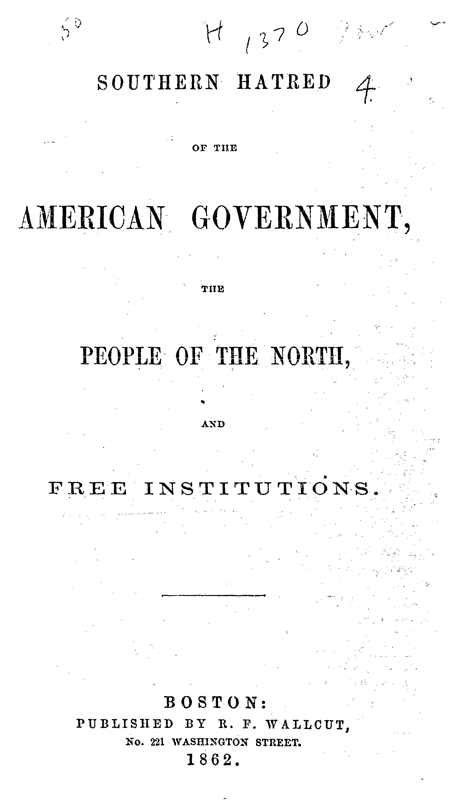
SOUTHERN HATRED
of the
AMERICAN GOVERNMENT,
the
PEOPLE OF THE NORTH,
and
FREE INSTITUTIONS.
BOSTON:
PUBLISHED BY R. F. WALLCUT,
No. 221 washington street.
1862.
[2]
PREFACE.
This tract is supplemental to a tract of 24 duodecimo pages which was published last year by R. F. Wallcut, 221 Washington Street, Boston, entitled “The Spirit of the South towards Northern Freemen and Soldiers defending the American Flag against Traitors of the deepest Dye.” As far as practicable, both of these tracts should be carefully bound together for future reference, and as a matter of historical importance. To these should be added another, published by the American Anti-Slavery Society in 1860, entitled “The Patriarchal Institution, as described by Members of its own Family—compiled by L. Maria Child.”
All these tracts furnish overwhelming evidence, drawn from Southern sources, that it is not against Abolitionism or Republicanism, per se, but against free institutions and the democratic theory of government universally, that the South has risen in rebellion for the overthrow of the American Union, and the establishment of a hostile independent confederacy, based on oligarchic and despotic principles. The spirit by which she is animated, in her treasonable career, is comprehensively embodied in the following venomous statement of the Richmond Examiner:—
“We have got to hating everything with the prefix free; from free negroes, down and up, through the whole catalogue. Free farms, free labor, free society, free will, free thinking, free children, and free schools, all belong to the same brood of damnable isms. But the worst of all these abominations is the modern system of free schools. The New England system of free schools has been the cause and prolific source of the infidelities and treasons that have turned her cities into Sodoms and Gomorrahs, and her land into the common nestling-places of howling bedlamites. We abominate the system, because the schools are free.”
Also, in the following extract from the Muscogee (Alabama) Herald:—
“Free society! We sicken of the name. What is it but a conglomeration of greasy mechanics, filthy operatives, small-fisted farmers, and moonstruck theorists? All the Northern States, and especially the New England States, are devoid of society fitted for well-bred gentlemen. The prevailing class one meets with is that of mechanics struggling to be genteel, and small farmers, who do their own drudgery; and yet who are hardly fit for association with a gentleman’s body servant [slave]. This is your free society!”
What delusion or hypocrisy it is, then, to represent that the South has no objection to anything at the North but its Abolitionism! Read and ponder what she says of the Government, and of the People, Soldiers, and Institutions of the North!
[3]
SOUTHERN HATRED OF FREE INSTITUTIONS.
Though last, not least, the new Constitution has put at rest forever all the agitating questions relating to our peculiar institutions—African slavery as it exists among us, the proper status of the negro in our form of civilization. This was the immediate cause of the late rupture, and of the present revolution. Jefferson, in his forecast, had anticipated this as the rock upon which the old Union would split. He was right. What was conjecture with him is now a realized fact. But, whether he fully comprehended the great truth upon which that rock stood, and stands, may be doubted. The prevailing ideas entertained by him, and most of the leading statesmen at the time of the formation of the old Constitution, were that the enslavement of the African race was in violation of the laws of nature; that it was wrong in principle, socially, morally, and politically. It was an evil they knew not well how to deal with; but the general opinion of the men of that day was, that, somehow or other, in the order of Providence, the institution would be evanescent, and pass away. * * * * Those ideas, however, were fundamentally wrong. They rested upon the assumption of the equality of races. This was an error. It was a sandy foundation, and the idea of a government built upon it, when the storm came, and wind blew, it fell.
Our new Government is founded upon exactly the opposite ideas; its foundations are laid, its corner-stone rests, on the general truth, that the negro is not equal to the white man; that slavery, subordination to the superior race, is his natural [4] and normal condition. This, our new Government, is the first in the history of the world, based upon this great physical, philosophical and moral truth. * * * * *
The negro, by nature or the curse of Canaan, is fitted for the condition which he occupies in our system. The architect, in the construction of a building, lays the foundation with the proper material—the granite—then comes the brick or the marble. The substratum of our society is made of the material by nature best fitted for it, and by experience we know it is best, not only for the superior but the inferior race, that it should be so. It is, indeed, in conformity with the Creator. It is not for us to inquire into the wisdom of His ordinances, or to question them. * * * * *
The great objects of humanity are best attained when conformed to His laws and decrees in the formation of governments, as well as in all things else. Our Confederacy is founded on principles in strict conformity with these laws. This stone, which was rejected by the builders, is become the chief stone of the corner of our new edifice.
* * * * * *
These people are now warring against that principle, and attempting to govern us as King George did; it is, therefore, an unnatural and irrational and a suicidal war, and you cannot count upon its duration. When a people becomes mad, there is no telling what they will do. It is so in the history of other empires; it was so in France. They say we are revolutionists; they call us rebels. I think it will be a revolution before it is over; but if a change of government makes revolution, the revolution is at the North.
I tell you the revolution is at the North. There is where constitutional liberty has been destroyed; and if you wish to know my judgment about the history of this war, you may read it in the history of the French Jacobins. They have become a licentious and cowardly mob, and I shall not at all be surprised if, in less than three years, the leaders in this war, if Lincoln and his Cabinet, its head, came to the gallows or guillotine, just as those who led the French war; for human passions, when once aroused, are as uncontrollable as the elements above us. The only hope of mankind rests in the restraints of constitutional law, and the day they framed and ratified these lawless measures of Lincoln, they dug their [5] own graves. They may talk of freedom and liberty, but I tell you no people without rulers restrained by constitutional law can be free. They may be nominally free, but they are vassals and slaves, and this unbridled mob, when they attempt to check it, Lincoln and the rest will be dealt with just as I tell you it was in France.—Extracts from a speech of Alexander H. Stephens, Vice-President of the Confederacy.
“Liberty or Death!” This was the cry of Patrick Henry in the great struggle for our national independence. We believe, at this moment, it animates the hearts of all true Virginians. Indeed, we have never seen nor imagined anything comparable in the feeling which pervades this Commonwealth at this time. Since the foul invaders have polluted our soil with their footsteps, an irrepressible eagerness to give them bloody graves pervades all classes. Old and young, women and children, all share in the exciting and universal emotion. Death to the tyrants is not only on the lips, but in the hearts of our whole population. The restraints of military discipline are scarcely thought of in the intense and restless anxiety to rush on the foe, and avenge in blood the outrage on our honor and freedom.
We confess to a thorough sympathy with this patriotic ardor, and know no refreshing sleep on account of the restless desire to be butchering the invading ruffians. But it is an impatience which we know should be moderated, and reduced to subordination to military discipline. Its unrestrained indulgence may bring more mischief on ourselves than on the enemy. We fear some such catastrophe. Let us, while we cherish an ardor and determination to resist to the death, remember that we have able military leaders, and put implicit confidence in the wisdom of their measures. They are cheerful and confident at the prospect before us. Let not the people be discouraged by any petty and temporary reverses that may befall us. The enemy have some advantages to start with; but we have advantages—the advantages of a brave and free people fighting for their firesides and freedom—against which all the hosts of despotism cannot prevail. We may be worsted to-day, but, cheered by [6] Liberty’s manly voice, we will rally with redoubled energy for the fight to-morrow.
Let the bright example of Jackson of Alexandria animate every heart, and the memory of his sad fate impel the avenging steel of every Virginian. See in every Yankee the murderer of that patriot martyr!—Richmond Whig.
Do these besotted fanatics flatter themselves that Alexandria is to be kept in chains, like those which bind poor Baltimore to the car of the Federal despotism? The “bloody and brutal” purpose of the Abolitionists, to subjugate and exterminate the Southern people, stands confessed by this flagrant outrage upon Virginia soil.
Virginians, arise in your strength, and welcome the invader with “bloody hands to hospitable graves.” The sacred soil of Virginia, in which repose the ashes of so many of the illustrious patriots who gave independence to their country, has been desecrated by the hostile tread of an armed enemy, who proclaims his malignant hatred of Virginia because she will not bow her proud neck to the humiliating yoke of Yankee rule. Meet the invader at the threshold. Welcome him with bayonet and bullet. Swear eternal hatred of a treacherous foe, whose only hope of safety is in your defeat and subjugation.
Virginia will be the Moscow of the Abolitionists—our armies are gathering to the prey, and so surely as the patriot-freemen of the Southern army come in conflict with the mercenary hordes of the North, so surely will they give the world another example of the invincibility of a free people fighting on their own soil for all that is dear to man.—Richmond Enquirer.
We rejoice at the death of Ellsworth, and only regret that every man who followed him did not share his fate; we lament the sacrifice of the gallant Virginian. * * * We trust that every colonel in the Federal service will meet his Jackson, and that every Hessian will find his grave upon her soil.—Lexington (Ky.) Statesman.
[7]
Our Women and Children. The newspaper organs of Lincoln are constantly fulminating the most atrocious threats against the women and children of the South. They tell us that these tender objects of our hearts’ dearest affections are to be subjected to indiscriminate massacre, and to outrage worse than death. With fiendish satisfaction they gloat over the anticipated ruin of Southern homes, and the murder of the helpless and innocent.
These cowardly threats are neither disavowed nor rebuked by the Washington Administration. They are suffered to pass uncontradicted as authentic expositions of their purpose and policy. They are read by Lincoln’s soldiers, as incentives to deeds of cowardly cruelty, and intimations of the blood-thirsty wishes of their employers. They will not be lost on the rabble of vagabonds and cut-throats enlisted by Lincoln’s agents, to execute his foul purposes. We cannot doubt that they will be faithfully executed by these minions of the Administration, if they get an opportunity. The drunken ruffian who heads this degraded Administration, and the imbecile but wicked men who compose it, are perfectly willing to turn loose on the South these armies of mercenaries, with instructions to spare neither age nor sex.
A government that begins a war upon those whom it claims to be its own subjects, with the avowal of such atrocious designs, merits only the abhorrence and execrations of mankind, and puts itself outside the pale of civilized and Christian powers. Repudiating the merciful code of modern warfare, by which all Christian governments are restrained in the conduct of war, it classes itself with the Thugs and Sepoys of India, and the merciless savages of America, and is entitled to no more respect or quarter.
Abe Lincoln and his minions think to frighten the Southern people into submission by these horrible threats, but they only rouse them to more determined resistance. Southern men will only fight with more desperate valor, knowing that they are battling for their wives and little ones, whose lives are threatened by an atrocious and insolent invader. They will meet Lincoln’s mercenaries on the field of battle as they would robbers and murderers assailing the safety and sanctity of their homes. They give the atrocious Washington cliques full credit for sincerity, in their avowed wish and intention [8] to wage a war of extermination against the Southern women and children, but instead of being exterminated, they are only exasperated to wage against them an uncompromising war.
The Southern people are now satisfied that there was no safety for them under Lincoln’s Government, and that they have not thrown off its yoke any too soon. Those who were inclined to judge it leniently, and to tolerate it longest, now see that it is the bitter and unscrupulous enemy of their section, aiming at the degradation and enslavement of the South, and capable of any deed of hellish perfidy, of atrocious cruelty, of damning infamy, to accomplish its ends. Since it has thrown off the mask, and shown itself in its true colors, exhibiting its real purposes, and the unparalleled treachery, injustice, oppression and unkindness of which it is capable, it has awakened in the breast of all true Southern men feelings of unutterable loathing and contempt, and of undying hatred. Upon the altar of their country they have sworn eternal enmity to the detested tyranny—none the less detested that it dares to threaten, with dastardly cowardice and inconceivable meanness, the safety and lives of our women and babes.—Memphis Avalanche.
The Northern people have gone mad—stark, staring, raving mad. As to New York city, it is nothing better than a vast mad-house. In no other way can their extraordinary and unparalleled circumsaltation be explained, in no other way can the supremacy gained by their brutal and bloody instincts over their boasted enlightenment and humanity be excused or extenuated. There is no doubt that the Northern people are at this moment fit representatives of the barbarian hordes which formerly devastated the world. They are furnishing the very best evidences that they are incapable of thorough civilization; that they possess only the outward symbols of modern enlightenment, while they are, by nature, cruel, blood-thirsty, arrogant and boastful. But there is really very little danger to be feared from them. Civilization no longer stands in dread of barbarism. One race of savages has already been expelled from the country; but not that it may fall into the hands of another.—New Orleans Delta.
[9]
About 1850, when the great northeastern deluge, of which mention has been made, swept over our commonwealth and laid waste our long-cherished institutions, it was very much the fashion for the “dear friend of the people” to hold up the Yankees as the models of every virtue. They were the thriftiest, the shrewdest, the ’cutest, the most enterprising, the most industrious, and the most money-getting people in the world. But their wealth, their stinginess, their venality, their dexterity paled before their unmatchable fecundity. Behold how they multiply! They are as multitudinous as the stars in the heaven, or the sand on the sea-shore. Malthus, never a favorite with the sentimentalist, though teeming with profoundest wisdom, was universally discarded as a humbug and charlatan. The great Yankee nation, which doubles itself every five years, was the true exemplar of all political science, and the only model of political greatness. It is very true that the Yankees are, without a doubt, eminently endowed with the procreative faculty. Their men are lecherous as monkeys, and the women, scraggy, scrawny and hard as whip-cord, breed like Norway rats, and they fill all the brothels on the continent. It is not presumable that the tender emotions of love ever penetrate their bony bosoms; but they indulge passion because it smacks of the savor of forbidden fruit, which is sweet to their sinful natures. But they multiply,—the only scriptural precept they obey,—and boast their millions. So do the Chinese; so do the Apisdæ, and all other pests of the animal kingdom. Pull the bark from a decayed log, and you will see a mass of maggots full of vitality, in constant motion and eternal gyration, one crawling over one, and another creeping under another, all precisely alike, all intently engaged in preying upon one another, and you have an apt illustration of Yankee numbers, Yankee equality, and Yankee prowess.
This war will test the physical virtues of mere numbers. Southern soldiers ask no better odds than one to three Western, and one to six of the Eastern Yankees. Some go so far as to say that, with equal weapons and on equal grounds, they would not hesitate to encounter twenty times their number of the last. In respect to administrative talent, the world has never seen such a failure. With a Government thoroughly organized in their hands, complete in all its [10] branches, they have well-nigh smashed the whole concern in less than twelve months. So numbers do not make either warriors or statesmen.
In regard to the moral, the effects are by no means encouraging. We doubt if any society since that of Sodom and Gomorrah has ever been more thoroughly steeped in every species of vice than that of the Yankees. Infanticide is one of the established customs of the oriental Chinese; and it is by no means certain that it has not extensive prevalence among their brethren of the moral North. But this imputation need not be laid to their charge: they are bad enough without it. There is no one virtue cherished among them, except money-getting, if that can be called a virtue, pursued as it is by them to the stifling of every sentiment of generosity and honor. With envy and malignity, they pursue every excellence that shows itself among them, unconnected with money; and a gentleman there stands no more chance of existence than a dog does in the Grotto del Cano.—Richmond Whig.
When the Yankees go to Lord John Russell, and tell him that Virginia, which inaugurated civilization and freedom on this continent, is one of their rebel provinces—why, his lordship, who is as thin-visaged as a razor and as scant of flesh as an Egyptian mummy, will give them a grin, which will last them a lifetime. They, the makers and venders of tin cups and wooden clocks, the liege lords of the Old Dominion—the sovereign and independent State of Virginia! If anything could inflame the indignation and scorn which this atrocious war excites, it would be this Yankee pretension to superiority and supremacy. To be under the dominion of a lady, like Queen Victoria, distinguished by every virtue, would constitute a favorable exchange for the vulgar rule of a brutish blackguard, like Lincoln. To be conquered in open and manly fight by a nation of gentlemen, and subjected to their sway, might not drive us raving distracted with rage and shame; but for Yankees—the most contemptible and detestable of God’s creation—the vile wretches, whose daily sustenance consists in the refuse of all other people—for they eat nothing that anybody else will buy—for [11] them to lord it over us—the English language must be enlarged, new words must be invented, to express the extent and depth of our feelings of mortification and shame. No, it is not possible that we can be reduced to a state which there are no words to describe. Instead of this, we must bring these enfranchised slaves back to their true condition. They have long, very properly, looked upon themselves as our social inferiors—as our serfs; their mean, niggardly lives—their low, vulgar, and sordid occupations, have ground this conviction into them. But, of a sudden, they have come to imagine that their numerical strength gives them power—and they have burst the bonds of servitude, and are running riot with more than the brutal passions of a liberated wild beast. Their uprising has all the characteristics of a ferocious servile insurrection. Their first aim is demolition—the destruction of everything which has the appearance of superior virtue, which excites their envy and hate, and which, by contrast, exposes the shameful deformity of their own lives. They have suggested to us the invasion of their territory, and the robbery of their banks and jewelry stores. We may profit by the suggestion, so far as the invasion goes—for that will enable us to restore them to their normal condition of vassalage, and teach them that cap in hand is the proper attitude of the servant before his master. A cock for a sailor, a goose for a soldier—a Yankee for a gentleman—images incongruous and unnatural!!!—Richmond Whig.
Abe Lincoln is a fit successor and representative of the cruel king who thirsted for the blood of the infant Jesus. His cowardly and murderous heart prompts him to wreak his mean and hellish spite upon helpless children, rather than to encounter men in open and manly fight. He will never be caught in that scrape; he will sooner fly than face an enemy. * * * We would be guilty of injustice to the doomed spirits of hell, were we to style these assassins of infants fiends, demons, or devils. Those apostate angels, we may well believe, have too much pride to wreak their immortal hate on such victims. A respectable devil would blush at such a crime.—Memphis Avalanche.
[12]
The rout and dispersion, at the great pitched battle near Manassas, bring into bold relief the great fact, that the Yankees are humbugs, and that the white people of the slaveholding States are the true masters—the real rulers of this continent. Under every disadvantage on our side, the preparations for the combat were made. The Northern States had seized upon all the common property of the partnership, had monopolized the whole navy and army, and all the material, with the entire machinery of government in full operation; and boasted that they had an inexhaustible supply of men and money to wage an interminable war. For months, with all these advantages, they have been diligently engaged in organizing their forces.
Under the direction of the most vaunted military character of the age,—not of their creation, though, for they never produced a genius capable of anything beyond arranging a hotel or working a steam engine, or directing some mechanical contrivance,—they expended millions of money and drilled armies of three hundred thousand, and equipped them in a style unheard of in the annals of war. They met the rude and poorly equipped volunteers of the Southern States, drawn from their peaceful vocations for the first time, to the theatre of war, and they are routed and slain by the thousand, and driven like chaff before a high wind. Though guided by the highest military talent, (of Virginia short-grass growth,) they have nothing to rely upon but their numbers, and that, in the fight, proves an element of weakness.
The fact is, the Yankees are very little better than the Chinese. They lay the same stress on the jingle of their dollars that the Celestials do on the noise of their gongs. Originally endowed with no single amiable trait, they have cultivated the arts of money-getting and cheating, until gain has become their God, and they imagine it to be omnipotent. With money in their pockets, won from a generous and chivalrous race, and multitudinous as Norway rats, they are swollen with conceit, and fancied that they were fit for empire. And yet they do not possess one gentlemanly attribute, nor a single talent that qualifies them for war. Of the very first element they are destitute. They don’t even know how to ride a horse—a talent only to be acquired in youth, amid gentle avocations. And as to arms, ninety-nine out of a [13] hundred never shot a gun; and we have it on very good authority that Old Scott lost all patience in attempting to teach them how to load a gun. The vile old wretch! he reaps a just reward for his treason and his talents misapplied.
The break down of the Yankees, their utter unfitness for empire, forces dominion upon us of the South. We are compelled to take the sceptre, and it is our duty to prepare ourselves for our destinies. We must elevate our race, every man of it—breed them up to arms, to command—to empire. The art military should constitute a leading part of every white man’s education. The right of voting should be a high privilege, to be enjoyed by those only who are worthy to exercise it. In a word, the whole white population of the South should be brought into a high-toned aristocracy, duly impressed with a sense of its own functions, and its obligations to freedom and civilization.—Richmond Whig.
Lincoln’s War Policy. The policy which dictated and directs the war now waged by the North against the South is one of unmatched and unmitigated atrocity. The ordinary sentiments of humanity and the benevolent principles of the Christian religion are stifled and ignored. Schemes of hellish cruelty and outrage, such as never before were conceived by the most bloody tyrants or relentless savages, are freely and shamelessly discussed and advocated by the satanic press of the North; and an administration, whose folly is only surpassed by its intense and boundless wickedness, hastens to adopt and carry into execution these diabolical counsels.
Lincoln’s programme of this war presents, as its most prominent features, indiscriminate massacre and pillage, the murder of defenceless women and unoffending children, the sacking and burning of Southern homes, towns and cities, the extermination of an entire people, and the utter desolation of a land, whose inhabitants are guiltless of any crime, save the assertion of the sacred right of self-government, bequeathed to them by their fathers.
A brutal soldiery, raked from the sewers of vice and crime, the scum of the population of Northern cities, and a servile race to be incited to insurrection, have been selected as the [14] instruments to carry out this peace programme of the infamous Lincoln and his junta of co-assassins. The Lincoln organs, appealing to the brutal instincts of the ruffian minions of despotism, sent to subjugate the South, tell them that “beauty and booty” shall be their reward; that to each of them shall be parcelled out one hundred and sixty acres of the confiscated lands of Southern planters, with a slave to wait upon him; that a gold watch, filched from the pocket of a murdered Southerner, shall be thrown in as a perquisite, and that license will be given them to pillage whatever they can lay their hands upon, and to burn and butcher until their savage natures shall be satiated with vengeance and blood.
This is no fancy sketch, but a truthful outline of the code of instructions to Lincoln’s troops, reiterated by the Northern newspapers from day to day. The government which has projected and is seeking to carry out this scheme of stupendous crime, is one professing to have been instituted for the good, and to derive all its just powers from the consent of the governed—the paternal guardian of the safety and rights of those whom it conspires to rob and murder.—Memphis Avalanche.
The Chinese and the Yankees are exceedingly alike, and we have always thought that they were much more nearly related than the Japanese and the almond-eyed people of the Flowery Kingdom.
When a Chinaman prepares for war—measuring his enemy’s courage by his own—he attempts to work upon his fears. He puts on a hideous mask, arms himself with a huge shield, upon which he paints some unearthly monster; and, when thus accoutered, he goes forth in cold sweat to encounter the enemy. As soon as he beholds his adversary, he utters a fearful roar, broadsides his shield, and if his opponent does not at once take to his heels, John Chinaman always does.
The wars of New England have always been conducted upon the Chinese plan. To hear their orators and read their newspapers, one would suppose that he was looking at a Chinaman clothed with all the pomp and circumstance of mask, shield, and stink-pot. The Yankee orators are only [15] equalled by the Yankee editors in deeds of valor. Let war be breathed, and the first swear to a man that they are ready and anxious to exterminate creation, whilst the latter, not content, like Alexander, to sigh for more worlds to conquer, threaten to destroy the laws of gravity, and lay violent hands upon the whole planetary system. Yet, these war mandarins are all members of the Peace Society, and would no more think of resenting a blow on the cheek, the seduction of a wife, or the dishonor of a daughter, than they would of flying. We have not forgotten how all Massachusetts collected in Boston, when Anthony Burns was to be delivered to his Virginia master, and swore that it should not be done. A single file of soldiers, however, marched the fugitive from State street to the lower end of Long Wharf, through miles of streets packed with valorous fanatics, who did nothing but sing old Puritan hymns, with a most hideous and barbarous disregard to metre.—Richmond Examiner.
John Forsyth, editor of the Mobile Register, vents his indignation upon the North in this way:—
“The cry of the North is for war! War to save the Union, to defend the United States flag, ‘to show that we have a government.’ These are the pretences of sheer hypocrisy. They are the patriotic gloss given to a false cause. The cement that unites the North is rage at the inevitable mischief that has been done to Northern property by the loss of the trade and tribute of ten, perhaps twelve, of the richest and most productive States of the late Union.
If they want war, give it to them to their heart’s content—to the knife and the hilt. Give them battle every morning and every evening, whenever we can marshal a force for the fight. Nor should we stop to receive it. It ought to be sought for and invited. Nor wait to drive them from confederate soil, but force the war to their own borders. We hold that the enemy should be driven from Washington—not because we want Washington, but because it is in a slave State, and because our brethren in Maryland should be released from the iron heel of military power that is upon their necks. Whose blood does not boil to read of the proud men [16] of Maryland overrun and subdued by the outcasts of Massachusetts, under the lead of that scoundrel, Gen. Butler, who played his part in the political disturbances that were the immediate cause of this revolution? Maryland should be freed at all hazards, and the enemy driven beyond the Susquehanna.
Defensive aggression is the Southern policy in this war. The surest and the safest way to defend our homes is to meet the enemy at a distance from them—to keep away the havoc and devastation of conflict from our women and children as far as possible. The North has undertaken to conquer the South. We must make up our minds to conquer the North, at least so far as to dictate the terms of peace. To this end, every man must devote himself to arms. Nothing else is of value, nothing worthy to be thought of in comparison to the sacred duty of defending the liberties of our country in this atrocious war. We must become a nation of soldiers, and every man ready to take the field when called upon. An active and desperate war is always a short one. We cannot make this war too bloody or too desperate.”
They are alarmed for Washington, but they have not yet begun to tremble for New York and Boston. As England and France knew that there would be no stable peace with the treacherous, knavish, cowardly and cruel Chinese, short of Pekin, so we know that there can be no lasting peace with the Chinese counterparts on this continent until Confederate cannon overawe New York, and Confederate legions bivouac on Boston Common. Boston is the Pekin of the Western China; and “On to Pekin” is the watchword of Southern armies. Washington is a mere circumstance. We don’t want it, any further than to dislodge the obscene birds that now infest it. Baltimore, too, which inspires the tyrants with so much terror, is not worth a moment’s consideration—beyond breaking the fetters (in passing) of that outraged people. Our true goal is Pekin—the headquarters of the genuine Tartar horde, with their gongs and stink-guns. The military occupation of the Yankee capital can alone give indemnity for the past and security for the future. Then up with the universal shout, “On to Pekin!”—Richmond Whig.
[17]
The rapidity with which Northern society has been demoralized is almost incredible. All the domestic relations are affected by it; husband and wife, parent and child, live together there, or rather apart, in a manner which is an outrage in the sight of Heaven, and of the great Eye of Humanity. We do truly hold that it is, perhaps, from utter despair at a state of things of which they seem at once the unavoidable occasion, if not cause, and the victims, that so many of the better sex have singly, or in bands, perpetrated of late years so many extravagancies in that region. They deserve pity rather than condemnation. * * *
The system of education at the North, which is being introduced among us, has been much criticised, and with justice. It contains much that is bad. Indeed, contemplated in some of its aspects and relations, particularly with reference to its effects, we do not think we go further than truth warrants, when we say that it would be a curse in any country. * * * *
It is very evident, to many of those who are at all conversant with the details of life at the North, that the people of that section are, whether from the effects of climate acting upon the idiosyncracy of race, or from some other cause, wonderfully predisposed to insanity. Legislators, theologians, judges, lawyers, physicians, merchants, in very respectable standing, have exhibited characteristics, and used language and performed actions, indicative of a morbid condition of the functions usually attributed to the brain. Here is a society almost wholly touched with an epidemic mental disorder of such a nature as to seem contagious. The very crimes that are committed in all that part of the Union, when not the acts of acknowledged madmen, have something about them in the details and circumstances of their development which similar crimes of other culprits never exhibit.—Richmond Literary Messenger.
If the hungry and ravenous pack of hyenas who are sent upon their hellish missions of plunder and rapine are driven back into their dens, they will turn upon their silly betrayers, only to make them the victims of their devouring wrath.—Memphis Appeal.
[18]
The experiment of republican institutions is lost at the North, and it can only be saved at the South by maintaining as strict non-intercourse with the moral Sodom and political Pandemonium on our borders as the nature of the case will permit. We are willing to agree to the cessation of hostilities; but if any foreign mediation shall exact concessions of intercourse, and commercial and political privilege, as a bargain and stipulation, it will exact what cannot be granted without destruction to our social, political and commercial integrity.
The case, therefore, is not one for arbitration. The South cannot refer so grave a question as that of her independence to any arbitration, much less to that of a foreign potentate. Did ever two litigants refer to arbitration the question of either one’s slavery? Independence is a question that cannot be referred by the South, and that is, in fact, the only question really involved in the present contest. The Yankee may become sick of the war, and is capable of descending from a demand of our service and fealty to begging the privilege of peddling his wooden nutmegs and bark clocks through our country; but neither of these demands are proper for mediation, and we should be very wary of granting treaty privileges of trade. Despairing of conquering the South by open hostilities, they will try the artifice of the Greeks before Troy, and attempt to introduce, by means of trade privileges, the wooden horse into our midst. It is only some purpose of this sort that mediation can accomplish; and we should distrust and eschew such schemes, as the Trojans learned to distrust their enemies, even when bearing pretended gifts.—Richmond Dispatch.
The New Orleans Advocate, a religious paper, of which Rev. C. C. Gillespie, D. D., is editor, says:—“Davis is the very soul of courage, honor, chivalry; Lincoln is a cowardly sneak. In the midst of the present storm, Davis is calm, cool, generally cheerful, comprehensive in observation, rigidly keeping his own counsel. Lincoln is filled with abject fear, drunk half the time, occasionally foolishly facetious, whistling to keep his courage up!”
[19]
When a long course of class legislation, directed not to the general welfare, but to the aggrandizement of the Northern section of the Union, culminated in a warfare on the domestic institutions of the Southern States—when the dogmas of a sectional party, substituted for the provisions of the constitutional compact, threatened to destroy the sovereign rights of the States—six of those States, withdrawing from the Union, confederated together to exercise the right and perform the duty of instituting a government which would better secure the liberties, for the preservation of which that Union was established.
Whatever of hope some may have entertained that a returning sense of justice would remove the danger with which our rights were threatened, and render it possible to preserve the Union of the Constitution, must have been dispelled by the malignity and barbarity of the Northern States in the prosecution of the existing war. The confidence of the most hopeful among us must have been destroyed by the disregard they have recently exhibited for all the time-honored bulwarks of civil and religious liberty. Bastiles filled with prisoners, arrested without civil process or indictment duly found; the writ of habeas corpus suspended by Executive mandate; a State Legislature controlled by the imprisonment of members whose avowed principles suggested to the Federal Executive that there might be another added to the list of seceded States; elections held under threats of a military power; civil officers, peaceful citizens and gentle women incarcerated for opinion’s sake, proclaimed the incapacity of our late associates to administer a government as free, liberal and humane as that established for our common use.
The people of the States now confederated became convinced that the government of the United States had fallen into the hands of a sectional majority, who would pervert that most sacred of all trusts to the destruction of the rights which it was pledged to protect. They believed that to remain longer in the Union would subject them to a continuance of a disparaging discrimination, submission to which would be inconsistent with their welfare, and intolerable to a proud people. They therefore determined to sever its bonds, and establish a new confederacy for themselves.
The experiment instituted by our Revolutionary fathers, of [20] a voluntary union of sovereign States for purposes specified in a solemn compact, had been perverted by those who, feeling power and forgetting right, were determined to respect no law but their own will. The government had ceased to answer the ends for which it was ordained and established. To save ourselves from a revolution which, in its silent but rapid progress, was about to place us under the despotism of numbers, and to preserve in spirit, as well as in form, a system of government we believe to be peculiarly fitted to our condition, and full of promise for mankind, we determined to make a new association, composed of States homogeneous in interest, in policy, and in feeling.—Extract from Jefferson Davis’s Inaugural Address.
Slaves with the Rebel Army. We clip the following from the New Orleans Crescent:—
“Tom, the slave of our citizen, James H. Phelps, took a fancy to go soldiering, and his master willingly gratified him, and Tom was engaged by Capt. Kountz of the De Soto Rifles to attend him through the war. There are hundreds of other slaves like Tom gone to kill the Yankees. Tom’s highest ambition appears to be to kill a Yankee. He writes to his mother, who is owned in the family of Mr. Phelps, the letter below. We hope he will be gratified in hunting up and obtaining a Yankee’s scalp:—
Yorktown, Va., July 4, 1861.
Dear Mother,—
I take this opportunity of writing to you to let you know that I am well and doing well, and I hope that this letter will find you as well as I am now in Yorktown. I will leave at 4 o’clock p. m. to-day for a scout about the woods for the Yankees. Well, we are only six miles from the Yankees at Young’s Mill, where my captain is now, and I am going out to-day at 4 o’clock to find him. I left him at Warwick Court-House, nine miles from Yorktown. I came back to get some blankets, and then moved on to Young’s Mill. We are looking out for a fight on the 5th of July by the 5th Regiment Louisiana volunteers. Give my love to Mistress and Master Jim Phelps, and to all of them in New Orleans. You must excuse this bad writing. I am writing in a hurry. I have not time to write. I am about to leave for the Mill. So good by to all. No more at present.
Your devoted son,
THOMAS A. PHELPS.
P. S.—Good by to the white folks until I kill a Yankee. T. A. P.’ ”
[21]
Treasonable Southern Piety. The Southern Presbyterian is edited by a Presbyterian minister, and is published at Columbia, S. C., the seat of the State College, and of the Presbyterian Theological Seminary. Its editorial columns bristle with lying paragraphs like these:—
“The phrensy of the North, demoniac in its wrath and its purposes against the South, seems to be unabated, and troops for our subjugation continue to be collected in larger numbers at Washington and central points in the Northern States. The fanatical leaders of the North are impatient at a moment’s delay in the march of their legions into our borders, and their most prominent papers openly threaten Lincoln, if he falter an instant, that he will be deposed from his office, and the reins of power put into more faithful hands. To this length has the disorganization of the Northern mind already gone. Law and order, reason and common sense, have fled from the presence of the reign of terror which seems about to overthrow every vestige of free and constitutional government.
The most brutal and blood-thirsty spirit towards the South prevails at the North. The purpose is openly avowed to plunder, devastate and destroy our country. Placards are put up in New York, calling for volunteers for the invasion of the South, with the heading ‘Booty and Beauty.’
The battle-cry through the North is, ‘Overrun the South; raise a servile insurrection; proclaim freedom to the slaves; arm them against the whites; and wipe the accursed slavocracy from the face of the earth!’ ”
A correspondent of the same paper says:—
“Hordes of Northern Goths and Vandals, savage as the barbarians of old, inspired not with a mere lust of rapine, but with vindictive hate and fury, threaten to invade our land, to desecrate the temples of religion, to lay waste our peaceful homes, to murder and destroy our people, to summon our slaves to insurrection, and to make our country a desolation. And among those who encourage and applaud these ruthless designs of the infuriated North are our own ecclesiastical brethren, the venerable, pious, calm, moderate patriarchs of the Old Presbyterian Church! Surely madness is in their hearts. Surely this is the time foretold when [22] it is said, ‘Woe to the inhabiters of the earth and of the sea, for the devil is come down unto you, having great wrath, because he knoweth that he hath but a short time!’
Nothing would satisfy the North but our implicit submission to be governed by it on its own terms and in its own way. And now they unanimously proclaim their purpose to compel us at the point of the sword to yield that submission; to make our land a desert, and our homes a desolation, if we will not. They will slaughter us at the cannon’s mouth, or hang us on the gallows; they will burn us, and drown us, and sweep us from the face of the earth. But they will not allow us to be ‘free and independent.’
But, God help us, and we will! We desire not war. We have done everything possible to be done to avert it, except submit. And, if it must come, we can only meet it as it has often been met before by a brave and a Christian people. The threats of the North do not terrify us, fearful as they are. Their ferocious clamor for vengeance only nerves the Southern heart for resistance to the last extremity, and will convert every Southern man into a martyr.”
Columbus, (Ga.,) Sept. 17.
Dear Cousin,—
I received your letter the other night, and I make haste to write you another. The war-dogs will be upon us, and that soon. Our Governor is making great preparation for coast defences. He has called out all the militia, and calls upon every one to be ready at a moment’s notice. When I read your letter to Sis, and came to the part where you said you would write me a letter in blood, she shuddered, and said she did not like to hear such. But I do, and if I ever go to war, I shall bring me a scalp home; and if you have a fight, I want you to send me one, and I will hang it up in my room, and gaze upon and pity the poor mortal that would dare fight against Southern chivalry. I am all for the war, and mourn over my lot that I am not allowed to go; but soon eight months will pass away, and then I can go, if the war continues. I will be in, and I will show them what I can do. I pray not for the destruction of my enemies, but would that I could shoot down six, and see [23] them fall and hear their death-shriek, and then I would be satisfied. I would then rest from the scenes of war, but not until every enemy is driven from our shores. But I hope I will have a hand in the show here at home, when they invade our State—the Empire State of the South. Times are very dull here. Sister is teaching school now, and she wrote you a letter the day before I received yours. May this find you still alive, and when the time comes for you to lay down your life in the cause of your country, may you lay it down to ascend to the right hand of Jesus Christ and of our Father, where there will be no more wars, or strife, or sorrow, or tears; and may we all be gathered around the Throne, where we will praise the Father, and the Son, and the Holy Ghost forever. Amen!
From your well-wishing cousin,
H. T. Everett.
To Arms! To Arms! Unless we win the battle, Virginia is really quite ruined. The people who will seize on her are relentless, coarse, greedy and bloody. They will pillage our houses, violate our women, insult and murder defenceless citizens. The truest patriots of the State, who have not had the good sense to get themselves bravely killed in some battle, will die by the hands of lawless and irresponsible ruffians, or on the gallows after mockery of trial, or drag out a poor and miserable remnant of life in exile. The land called Virginia will remain; but so changed, so utterly revolutionized, inhabited by a population sprung from such ruthless confiscations and proscriptions, that it will be not more recognizable than Italy after its partition between the Goths and the Vandals. To prevent the imminent wretchedness, the indescribable calamity that hangs over us, there is but one thing to do—and that is, to hurry up the troops to the places of rendezvous, and to concentrate the armies who must save us, if saved we can be. Virginia alone is perfectly able to turn the current of invasion; and she will do it perfectly well, if her force is handled with decision and intelligence. She can meet and beat an army of fifty thousand volunteers with absolute certainty; and that is more than the North can get here before the crisis of the danger has passed.—Richmond Examiner.
[24]
The Mulatto Vice-President. The Memphis Avalanche has an article on the “mulatto” Vice-President of the North. It remarks: “We have only been able to account for the remarkable lukewarmness of Hannibal Hamlin, in regard to this abolition war, by attributing it to the general distrust of abolition sincerity entertained by his race. With a decided infusion of African blood in his veins, a fact never successfully controverted, we may suppose that he shares the sentiments and feelings of his African kin. Neither is it improbable that an instinctive sense of incongruity and impropriety of an individual of negro extraction ruling over white people induces his reticence and modesty. Every well-bred negro or mulatto would shrink from such an anomalous position as unbecoming; and Hannibal may be supposed to be well-bred, having received an education superior to that usually bestowed on free mulattoes.”
The spring of hope must now, with the Yankees, die upon the winter winds. Already the black flag has been hoisted upon the soil of South Carolina, and war to the knife, and knife to the hilt, and thence to the shoulder, been proclaimed by her noble sons as the only booty which Yankee hireling invaders shall receive at their hands. This is right. It is the only way to conquer a peace with a people so lost and degraded as those which compose the grand army of the rump government. We look anxiously for news from the sunny South; hopefully, prayerfully, with no misgivings. Now that the rallying-cry is, “No quarter to the invaders of our soil,” may we not believe that the course inaugurated by South Carolina will be followed up by our whole army, and thus end the war? “So mote it be.”—Petersburg (Va.) Express.
The intelligence of yesterday, that the myrmidons of Federal power had advanced upon the soil of Virginia produced an electrifying effect in our community, and among the soldiery. Every eye brightened, and every heart beat high with stern delight that the hour of vengeance was at hand.—Richmond Dispatch.
[37]
ADDRESS TO THE PEOPLE OF GEORGIA.
Fellow-Citizens,—
In a few days, the Provisional Government of the Confederate States will live only in history. With it we shall deliver up the trust we have endeavored to use for your benefit, to those more directly selected by yourselves. The public record of our acts is familiar to you, and requires no further explanation at our hands. Of those matters which policy has required to be secret, it would be improper now to speak. This address, therefore, will have no personal reference. We are well assured that there exists no necessity for us to arouse your patriotism, nor to inspire your confidence. We rejoice with you in the unanimity of our State, in its resolution and its hopes. And we are proud with you that Georgia has been “illustrated,” and we doubt not will be illustrated again by her sons in our holy struggle. The first campaign is over; each party rests in place, while the winter’s snow declares an armistice from on high. The results in the field are familiar to you, and we will not recount them. To some important facts we call your attention:—
First. The moderation of our own government and the fanatical madness of our enemies have dispersed all differences of opinion among our people, and united them forever in the war of independence. In a few border States, a waning opposition is giving way before the stern logic of daily developing facts. The world’s history does not give a parallel instance of a revolution based upon such unanimity among the people.
Second. Our enemy has exhibited an energy, a perseverance, and an amount of resources which we had hardly expected, and a disregard of Constitution and laws (!!) which we can hardly credit. The result of both, however, is that power, which is the characteristic element of despotism, and renders it as formidable to its enemies as it is destructive to its subjects.
Third. An immense army has been organized for our destruction, which is being disciplined to the unthinking stolidity of regulars. With the exclusive possession of the seas, our enemy is enabled to throw upon the shores of every [38] State the nucleus of an army. And the threat is made, and doubtless the attempt will follow in early spring, to crush us with a giant’s grasp by a simultaneous movement along our entire borders.
Fourth. With whatever alacrity our people may rush to arms, and with whatever energy our Government may use its resources, we cannot expect to cope with our enemy either in numbers, equipments or munitions of war. To provide against these odds, we must look to desperate courage, unflinching daring, and universal self-sacrifice.
Fifth. The prospect of foreign interference is at least a remote one, and should not be relied on. If it comes, let it be only auxiliary to our own preparations for freedom. To our God and ourselves alone we should look.
These are stern facts; perhaps some of them are unpalatable. But we are deceived in you if you would have us conceal them in order to deceive you. The only question for us and for you is, as a nation and individually, what have we to do? We answer,—
First. As a nation we should be united, forbearing to one another, frowning upon all factious opposition and censorious criticisms, and giving a trustful and generous confidence to those selected as our leaders in the camp and the council chamber.
Second. We should excite every nerve and strain every muscle of the body politic to maintain our financial and military healthfulness, and, by rapid aggressive action, make our enemies feel, at their own firesides, the horrors of a war brought on by themselves.
The most important matter for you, however, is your individual duty. What can you do?
The foot of the oppressor is on the soil of Georgia. He comes with lust in his eye, poverty in his purse, and hell in his heart. He comes a robber and a murderer. How shall you meet him? With the sword, at the threshold! With death for him or for yourself! But more than this—let every woman have a torch, every child a firebrand—let the loved homes of our youth be made ashes, and the fields of our heritage be made desolate. Let blackness and ruin mark your departing steps, if depart you must, and let a desert more terrible than Sahara welcome the Vandals. Let every [39] city be levelled by the flame and every village be lost in ashes. Let your faithful slaves share your fortune and your crust. Trust wife and children to the sure refuge and protection of God—preferring even for these loved ones the charnel-house as a home, than loathsome vassalage to a nation already sunk below the contempt of the civilized world. This may be your terrible choice, and determine at once and without dissent as honor and patriotism and duty to God require.
Fellow-citizens, lull not yourselves into a fatal security. Be prepared for every contingency. This is our only hope for a sure and honorable peace. If our enemy was, to-day, convinced that the feast herein indicated would welcome him in every quarter of this Confederacy, we know his base character well enough to be assured that he would never come. Let, then, the smoke of your homes, fired by women’s hands, tell the approaching foe that over sword and bayonet they will rush only to fire and ruin.
We have faith in God and faith in you. He is blind to every indication of Providence who has not seen an Almighty hand controlling the events of the past year. The wind, the wave, the cloud, the mist, the sunshine and the storm have all ministered to our necessities, and frequently succored us in our distresses. We deem it unnecessary to recount the numerous instances which have called forth our gratitude. We would join you in thanksgiving and praise. “If God be for us, who can be against us?”
Nor would we condemn your confident look to our armies, when they can meet a foe not too greatly their superior in numbers. The year past tells a story of heroism and success, of which our nation will never be ashamed. These considerations, however, should only stimulate us to greater deeds and nobler efforts. An occasional reverse we must expect—such as has depressed us within the last few days. This is only temporary.
We have no fears of the result—the final issue. You and we may have to sacrifice our lives in the holy cause; but our honor will be saved untarnished, and our children’s children will rise up to call us “blessed.”
Howell Cobb,
M. J. Crawford,
R. Toombs,
Thos. R. R. Cobb.
[40]
The Hand-Writing on the Wall. The North is at blood-heat from Maine to Nebraska. Every city, village and county is in arms. One continuous roll of drums sweeps the land. They outnumber the South more than two to one. They boast of untold millions of wealth, and exhaustless provisions at command. They are armed and equipped; they have monopolized always the manufacture of arms on this continent; and, besides this, while they were professing peace two months ago to the South, they had an agent in Europe buying 500,000 more arms of the most approved pattern. These are being received by every steamer. And what is the spirit that moves the vast North? Revenge and hate stream through every column of their journals. Conciliation, peace and mercy are banished words. “War to the knife,” “extermination of the rebels,” “crush the traitors,” are the common forms of their expression. The South is to be overrun and crushed forever; her proud spirit broken, her property confiscated, her families scattered and slaughtered, and then to remain, through all time, a dependency on the “free and sovereign” North. Powerful armies of fanatics and plunderers are to be quartered in our cities and towns in the South, dictating to us laws at the point of the bayonet, and the slaves to be turned loose with more than savage atrocity on helpless women and children. Every friend we had in the North is silenced, the entire press is against us, and the ministers of religion, without distinction, are praying for the “holy cause,”—the utter reduction of the rebels. At the bottom of all this lies the insane idea, held by many of the leaders, that it is their religious duty to exterminate slavery, and make the “Irrepressible-Conflict” doctrine universal. The men who have acted with and for the South,—Pierce, Buchanan, Fillmore, Cass, Everett and Dickinson,—all have bowed before the torrent of fanaticism; all have left us, and chime their voices in the fearful chorus of Northern indignation. Aged ministers of the gospel, presidents of colleges, and editors of religious newspapers,—all, without exception, so far as we know, urge on the maddened and bloody populace. The vast North staggers under its load of wrath, waiting only for orders from the usurper Lincoln to overwhelm the South with blood and chains.—Nashville (Tenn.) paper.
[41]
The Yankees are the lineal descendants of the Vi-Kings, the sea-rovers and land-robbers of Norway and Denmark. They retain all the qualities and characteristics of their illustrious ancestry. They are the best privateers, the best pirates, the best fillibusters, and the best kidnappers in the world. They are, besides, the wire-grass of nations, and gradually and insidiously worm themselves among the people of various countries, and cheat them out of their lands, when they are not strong enough to rob them of them.
Yet, they would have a monopoly of dishonesty, and insist that what is honorable and reputable in themselves, is highly unbecoming in other people. For a Yankee to be a sharp fellow and half a rogue is all right, for it is his metier; but the chivalrous and honorable Southron disgraces himself, in Yankee eyes, when he takes to Yankee ways. This is all perfectly right. Stealing, lying and cheating are creditable in a Yankee, disgraceful to a Southron. But retaliation is not theft, any more than killing, in self-defence, is murder.
The Yankee threatened, and is attempting to sack, plunder and burn our cities; to stir up our slaves to insurrection; to steal our lands, and to violate our women. When he had done all this, and not until he had done it, we turn round to him, and to make him stay his hand, propose to issue letters of marque and reprisal, to meet him on his favorite element, and to compete with him in his favorite and time-honored pursuit. Instead of admiring our fairness and our chivalry, and complimenting us on the occasion, he sets up a howl of abuse and indignation that pandemonium, let loose, could hardly emulate.—Richmond Examiner.
Eternal Hate to the North. The National Intelligencer says a subscriber writes from Athens, Georgia, May 8, 1861, as follows:—“There is now no Union or reconstruction party in the South. My business brings me in intimate connection with the best men of this State, also with the masses. One universal remark is, ‘undying hate to the North.’ I have been for the Union, but now I am for eternal hate to the North. I will advocate, at the next Legislature, a bill making it penal to purchase anything made at the North, except [42] munitions of war and things taken in war. This is no personal feeling on my individual part, but the feeling of the masses, and I only write to you that you may honestly know how the people stand. The whole State is in arms, and if we fail, many persons propose to desolate the country and retreat; and if that will not do, to offer the country to England as a colony. Anybody, anything, rather than the North. This is the universal opinion of the people. I lately met the prominent men of the State at the executive meeting of the Agricultural Society of the State. We gave all our cash ($4500) to the State; we sold some silver plate for the same purpose. We cut up our large canvass tents to make soldiers’ tents, and most of the members present said they belonged to military companies. An old man, seventy-two years of age, who was a sergeant at Lundy’s Lane and Chippewa, has joined a company and is now in Virginia, with three sons, all in the Georgia army. I mention this that you may know the eternal hate which inspires our people.”
Yankee “Lions” and Spies. It will scarcely be believed abroad that, in times of flagrant war, while the soil of Virginia is pressed by the foot of a blood-thirsty and murderous foe, the most tender and unceasing attentions are yet offered in Richmond, not only to the vagrant Yankees who have come here on suspicious errands, but actually to those whose mission toward us was to cut our throats, burn our houses, and defile our families with the brutal lusts of war. The evidences of this disposition are patent and brazen enough. The case of Dr. King, a Rhode Islander, who was permitted to come here and take away a son, who had been taken as our prisoner in the battle at Manassas, and to pass his time here in receiving calls from and paying visits to certain social pretenders and jackals who made a “lion” of him, is an illustration of the disgrace that is fastening upon our city, not only for the laxity of the authorities of the government, but for the subserviency and social demoralization of its manners.
The half has not been told of the exploitation of the Yankee family of Kings in the society of Richmond. We are [43] credibly informed that the young cut-throat and murderer, who was taken fighting against us at Manassas, was actually taken from the hospital and tenderly nursed in the family of a physician in this city. Could not these good Samaritans have found some poor Confederate soldier languishing in the hospitals, an object for their solicitude and kindness, into whose wounds they might have poured oil, rather than the Yankee whom they took into their family circle to nurse, to pet, and to restore to his New England home?—Richmond Examiner.
Choice Extracts. The following choice extracts are taken from the Richmond Dispatch:—
“Preparing with rapid strides to meet the Illinois baboon and his co-workers of iniquity on the borders of our once happy old State, to welcome them with ‘bloody hands to hospitable graves.’ * * * Stepped forward to drive back the half-starved Lincolnites, who, with open mouths, are seeking to devour us with eager avidity. * * * Well, let them come—those minions of the North. We’ll meet them in a way they least expect; we’ll glut our carrion crows with their beastly carcasses. Yes, from the peaks of the Blue Ridge to tide-water, will we strew our plains, and leave their bleaching bones to enrich our soil. * * * Colonel Corcoran has found it very easy to swallow an oath, binding him to come to Virginia to cut our throats, and steal the poor negro from his comfortable home. * * * Lincoln seems to still persist in refusing not only Confederate States’ ships permission to pass Old Point, but he demurs in granting British ships that privilege, and in all probability will continue to do so until the Old Lion gets fully mad, springs to his feet, and brings a roar that will make the Ape quake with terror, and his rotten fleet return home. * * * No honest man or nation can do otherwise than execrate the whole batch of politicians, spawned into existence from Black Republican stools. * * * They are all in good spirits, and determined to give Old Abe’s canailles a warm reception, if they come to invade the Valley.”
[44]
Proclamation of Governor Pickens. On the 26th of April, 1861, the Governor of South Carolina issued his Proclamation “to the volunteer regiments of the State,” which concludes with the following flourish:—
“Soldiers of South Carolina! hold yourselves in readiness to march at the word to the tomb of Washington, and swear that no Northern Goths and Vandals shall ever desecrate its sacred precincts, and that you will make of it an American Mecca, to which the votaries of freedom and independence, from the South, shall make their pilgrimage through all time to come. Let the sons of South Carolina answer to the call from the sons of Col. Howard, who led the Maryland line in triumph over the bloody battle-field of Cowpens. Let them know that we will return that blood with full interest, and let them feel that they are now, as they were then, our brothers. March to Virginia, and lay your heads upon the bosom of this mother of States, and hear her great heart beat with new impulses for a renewed and glorious independence.
Surely the good and the virtuous of the Northern States cannot sanction the lawless and brutal despotism now inaugurated at Washington.
Be ready! Stand by your arms,—mark time to the tap of independence, and at the word, march forward and onward to the Borders. Our glorious old sister, North Carolina, is with you, and her freemen are in arms. Join them in the struggle for defence; and let tyrants know that there are men who can make them hear the ring and feel the weight of Southern steel. I shall endeavor not to expose our own State, and shall only march you beyond our borders under pressing emergency; but wherever the Confederate flag floats, there too is our country, now and forever.
F. F. Pickens.”
Premature Boasting. Among the papers found on the Pea Ridge battle-ground was a letter from a Texas captain to his wife, written just before the battle, in which the writer said:—“Thank God, dear Mary, we’ve got the Yankees in a trap at last. They cannot escape us now. We have more [45] than twice as many men as they, and we have a plan to cut them off, and annihilate them. Before a week has passed, you will hear of a terrible defeat of the Lincolnites, such an one as will offset to some extent our mortifying surrender at Donelson. We are certain of success, and I hope I will be able to bring five or six Yankee prisoners to Galveston next summer. The Northern men will not fight when they can avoid it; but we intend to make them this time, or cut their throats. The coming battle will free Arkansas and Missouri from the invaders, and we will then march on to St. Louis, and take that Abolition city, and give the oppressed Southerners there an opportunity to be free once more. We hear that we would be welcomed in St. Louis by at least 50,000 people, who have long suffered from the tyranny of the mercenary Dutch.”
What the War is, South. That Northern readers may see a little of the spirit of the South, we publish an extract from the Richmond Dispatch, and we could fill a volume every day with similar extracts from the Southern press:—
“It is not a war of punctilio between sovereigns; nor of conflicting interests between rival nations—admitting of adjustment and compromise. It is a war of fanaticism and subjugation on the part of the North; of scorn and contemptuous hatred on the part of the South.
These angry passions are uncontrollable, transporting and irrepressible. The South would sacrifice everything it holds dear, before it would succumb to the authority of the despised North; and the North will forget all schemes of gain, and throw its ledgers into the fire, to indulge its fanatical hatred of slavery, to ‘crush out’ the slaveholder. * * *
We cannot build conclusions in regard to the duration of this war upon considerations of interests. The foes we have to fight are madmen. The madness which we combat is the same madness which has for thirty years been abusing and villifying the best customers of the people it possessed, which has spread discord and hatred throughout the land, which has diabolically cut the bonds of Union, and pulled down the pillars of the fairest government that ever blessed mankind.”
[46]
Challenge to the Soldiers of Massachusetts. The following document (says the Boston Traveller) was received at this office by mail. The envelope bore the post-mark of Charleston, S. C., and we therefore have no doubt that it is genuine:—
Charleston, S. C., April 19, 1861.
To the Editors of the Boston Traveller:
“Gentlemen,—
On behalf of the South Carolina Volunteers, I am deputed to request Gov. Andrew, of Massachusetts, through you, that the military contingent of your State be sent to South Carolina. In making this request, I assure you I but express the wish of every man, woman and child in our State. We number about 10,000 men, well armed and accoutred, and anxious for a fight, and cordially invite any number from your section to give us a meeting. Do not, however, send them in the fleet that appeared off Charleston harbor during the bombardment of Fort Sumter, for fear their timidity will interfere with their landing. Send all Massachusetts men—none from Pennsylvania, for the regiment of that State flunked at Cerro Gordo; nor from New York, for at Cherubusco, (although they claimed and received the right from the Palmetto Regiment,) at the first fire, the gallant New Yorkers fell back, and hid behind a barn; nor from Indiana, for at Palo Alto, the nimble regiment from that State fled in inglorious confusion. Send your Sumners, your Wilsons, your Burlingames, and a host of similar notables, and we pledge our honors, our lives, and all that we hold sacred, that none others but the Palmetto Boys shall interfere with them. We want them exclusively for our own use.
“This request is made in good faith, and on signifying your acceptance of our offer, every arrangement will be made to give you a safe passport to our shores.
On Behalf of the S. C. Volunteers.”
The Drunken Mutineers. We would enter into no negotiation now with Lincoln, unless a cannon were planted behind us, prepared to sweep him from the earth, upon the first [47] indication of perfidy. This is the flag of truce under whose protection we would trust ourselves. None other would be heeded by Abraham Lincoln.
This same man is engaged now in another fraud. He tells us that the thirty thousand mercenaries that defile the Capital are for its defence—nothing more. Who believes him? Not we. They are designed for offensive operations. They are intended to menace Virginia, and will make a descent somewhere upon our soil. Very well. Let the drunken mutineers at Washington drive on in their crazy craft. The breakers are ahead, and they must evince more statesmanship than they have yet indicated if they weather the storm that is gathering.—Lynchburgh Virginian.
More Southern Rascality. The following is a copy of a letter received by a manufacturer of boots and shoes in Haverhill:—
Richmond, Va., April 18, 1861.
Messrs. ——, Haverhill, Mass.:
Owing to the declaration of war against our beloved South, and the necessity of our arming and fighting, instead of pursuing the peaceful avocations of commerce, we have given up ourselves fully and freely to the work before us, and our resources are to be held at the disposal of the State until the issue is finally determined, when, if we have sufficient availabilities or assets left to meet our liabilities, it shall be done.
But untilt his fratricidal war is closed, we shall decline paying any of our debts due to parties in the North, where they have drawn the sword against us. Hence the protest of our note in your favor this day, which we have the funds in bank to meet.
Very truly yours,
(Signed) Weston & Williams.”
This is an exact copy, underlined as they underlined it. They owe different parties here to the amount of several thousand dollars.—Boston Journal.
[48]
Is the North peopled with Christians or with savages? Is the light that shone from Calvary’s bloody summit extinguished, and are our Northern foes only guided by the dark and lurid flame that pilots devils to their carnivals? Has the Congress of Hell had its session, and have they commissioned all the legions of the damned to demonize our enemies? Has Lucifer given a furlough to all his infernal cohorts? Has he established his church in every Black Republican’s heart, and has he ordained Belial and Moloch his high priests? Are we to have war with men or with devils? These questions must be answered. Our implacable foes, goaded on by a hatred that is remorseless and unrelenting, because they have insulted and injured us, have already answered them. They have inaugurated a war of extermination—a war in which no mercy is to be shown or quarter given. Let it be so! The South has never asked a favor of her enemies. She asks none now.—Vicksburg Whig.
Virginia is invaded. The horde of thieves, robbers and assassins in the pay of Abraham Lincoln, commonly known as the army of the United States, have rushed into the peaceful streets of a chief city of the State, and stained the hearth of Virginian homes with the blood of her sons.
One trait of true heroism has signalized this unhappy affair. A citizen of Alexandria, named Jackson, lacked the prudence to haul down the flag of his country, which streamed over his dwelling. That band of execrable cut-throats and jail-birds, known as the “Zouaves,” of New York, under the chief of all scoundrels, called Col. Ellsworth, surrounded the house of this Virginian, and broke open the door to tear down the flag of the South. The courageous owner of that house neither fled nor submitted. He met the favorite hero of every Yankee there in his hall, he alone, against thousands, and shot him through the heart!—Richmond Examiner.
[1]
24. “Extract from a Speech by Alexander H. Stephens”, 4 pp.↩
EXTRACT FROM A SPEECH BY ALEXANDER H. STEPHENS, VICE-PRESIDENT OF THE CONFEDERATE STATES, Delivered in the Secession Convention of Georgia, January, 1861.
This step, [the secession of Georgia,] once taken, can never be recalled; and all the baleful and withering consequences that must follow, (as you will see,) will rest on the Convention for all coming time. When we and our posterity shall see our lovely South desolated by the demon of war which this act of yours will inevitably invite and call forth; when our green fields of waving harvests shall be trodden down by the murderous soldiery and fiery car of war sweeping over our land; our temples of justice laid in ashes; all the horrors and desolations of war upon us—who but this Convention will be held responsible for it? and who but him who shall have given his vote for this unwise and ill-timed measure (as I honestly think and believe) shall be held to strict account for this suicidal act, by the present generation, and probably cursed and execrated by posterity for all coming time, for the wide and desolating ruin that will inevitably follow this act you now propose to perpetrate?
Pause, I entreat you, and consider for a moment what reasons you can give that will even satisfy yourselves in calmer moments—what reasons you can give to your fellow-sufferers in the calamity that it will bring upon us? What reason can you give to the nations of the earth to justify it? They will be the calm and deliberate judges in the case; and to what cause or one overt act can you name or point, on which to rest the plea of justification? What right has the North assailed? What interest of the South has been invaded? What justice has been denied? and what claim founded in justice and right has been withheld? Can either of you to-day name one governmental act of wrong, deliberately and purposely done by the government of Washington, of which the South has a right to complain? I challenge the answer! While, on the other hand, let me show the facts, (and believe me, gentlemen, I am not here the advocate of the North; but I am here the friend, the firm friend and [2] lover of the South and her institutions, and for this reason I speak thus plainly and faithfully, for yours, mine, and every other man’s interest, the words of truth and soberness,) of which I wish you to judge, and I will only state facts which are clear and undeniable, and which now stand as records authentic in the history of our country.
When we of the South demanded the slave trade, or the importation of Africans for the cultivation of our lands, did they not yield the right for twenty years? When we asked a three-fifths representation in Congress for our slaves, was it not granted? When we asked and demanded the return of any fugitive from justice, or the recovery of those persons owing labor or allegiance, was it not incorporated in the Constitution? and again ratified and strengthened in the Fugitive Slave Law of 1850?
But do you reply, that in many instances they have violated this compact, and have not been faithful to their engagements? As individuals and local communities they may have done so; but not by the sanction of government; for that has always been true to Southern interests. Again, gentlemen, look at another fact: when we have asked that more territory should be added, that we might spread the institution of slavery, have they not yielded to our demands in giving us Louisiana, Florida and Texas, out of which four States have been carved, and ample territory for four more to be added in due time, if you by this unwise and impolitic act do not destroy this hope, and, perhaps, by it lose all, and have your last slave wrenched from you by stern military rule, as South America and Mexico were; or by the vindictive decree of a universal emancipation, which may reasonably be expected to follow?
But, again, gentlemen, what have we to gain by this proposed change of our relation to the general government? We have always had the control of it, and can, yet, if we remain in it, and are as united as we have been. We have had a majority of the Presidents chosen from the South; as well as the control and management of most of those chosen from the North. We have had sixty years of Southern Presidents to their twenty-four, thus controlling the Executive department. So of the judges of the Supreme Court, we have had eighteen from the South, and but eleven from the North; although nearly four-fifths of the judicial business has arisen in the Free States, yet a majority of the Court has always been from the South. This we have required so as to guard against any interpretation of the Constitution unfavorable to us. In like manner we have been equally watchful to guard our interests in the Legislative branch of government. In choosing the presiding Presidents (pro tem.) of the Senate, we have had twenty-four to their eleven. Speakers of the House, we have had twenty-three, and they twelve. While the majority of the Representatives, from their greater population, have always been from the North, yet we have so generally secured the Speaker, because he, to a great extent, shapes and controls the legislation of the country. Nor have we had less control in every other department of the general government. Attorney-Generals we have had fourteen, while the North have had but five. Foreign ministers we have had eighty-six, and they but fifty-four. [3] While three-fourths of the business which demands diplomatic agents abroad is clearly from the Free States, from their greater commercial interests, yet we have had the principal embassies, so as to secure the world markets for our cotton, tobacco and sugar on the best possible terms. We have had a vast majority of the higher offices of both army and navy, while a larger proportion of the soldiers and sailors were drawn from the North. Equally so of Clerks, Auditors and Comptrollers filling the Executive department; the records show for the last fifty years, that of the three thousand thus employed, we have had more than two-thirds of the same, while we have but one-third of the white population of the Republic.
Again, look at another item, and one, be assured, in which we have a great and vital interest; it is that of revenue, or means of supporting government. From official documents, we learn that a fraction over three-fourths of the revenue collected for the support of government has uniformly been raised from the North.
Pause, now, while you can, gentlemen, and contemplate carefully and candidly these important items. Look at another necessary branch of government, and learn from stern statistical facts how matters stand in that department. I mean the mail and post-office privileges that we now enjoy under the general government, as it has been for years past. The expense for the transportation of the mail in the Free States was, by the report of the Postmaster General for the year 1860, a little over $13,000,000, while the income was $19,000,000. But in the Slave States, the transportation of the mail was $11,716,000, while the revenue from the same was $8,001,026, leaving a deficit of $6,115,735, to be supplied by the North for our accommodation, and without it we must have been entirely cut off from this most essential branch of government.
Leaving out of view, for the present, the countless millions of dollars you must expend in a war with the North; with tens of thousands of your sons and brothers slain in battle, and offered up as sacrifices upon the altar of your ambition,—and for what, we ask again? Is it for the overthrow of the American government, established by our common ancestry, cemented and built up by their sweat and blood, and founded on the broad principles of Right, Justice, and Humanity? And, as such, I must declare here, as I have often done before, and which has been repeated by the greatest and wisest of statesmen and patriots in this and other lands, that it is the best and freest government—the most equal in its rights—the most just in its decisions—the most lenient in its measures, and the most inspiring in its principles to elevate the race of men, that the sun of heaven ever shone upon.
Now, for you to attempt to overthrow such a government as this, under which we have lived for more than three quarters of a century—in which we have gained our wealth, our standing as a nation, our domestic safety while the elements of peril are around us, with peace and tranquillity accompanied with unbounded prosperity and rights unassailed—is the height of madness, folly and wickedness, to which I can neither lend my sanction nor my vote.
[4]
VIEWS OF JEFFERSON DAVIS IN 1860.
In a debate which took place in the Senate of the United States, in May, 1860, between Jefferson Davis and Stephen A. Douglas, with reference to slavery in the Territories, the former scouted the charge that there was any design at the South to dissolve the Union, in the following terms:—
The last point which I will notice is his reference to the Southern League. He reads from the Southern League constitution, or whatever it is—I do not know—to show that there was an organization to dissolve the Union. Does the Senator believe there was a lodge in that Southern League outside of the State of Alabama?
Mr. Douglas. I did suppose so, for the reason that Mr. Yancey refers to it in his letter to Slaughter in terms of approval; and in the letter to Pryor, explaining the Slaughter letter, he says there is a well-matured plan throughout the Southern States, and approved by the best men in Virginia; evidently referring to the Southern League as spreading throughout the Southern States, and then existing in Virginia, with the approval of the best men.
Mr. Davis. I know very little about other people’s secrets, and have very few of my own to keep; but I will say, that it there was a lodge outside of Alabama, I do not know of it. Further, I will say, that I do not believe there was. And more, I will say, from the best information I have, there was not one hundred in the organization in Alabama; I have been told, about seventy-five. I do not think the Union was in any danger from them. I have great confidence in the strength of the Union. Every now and then I hear that it is about to tumble to pieces, that somebody is going to introduce a new plank into the platform, and if he does, the Union must tumble down; until at last I begin to think it is such a rickety old platform that it is impossible to prop it up; but then I bring my own judgment to bear, instead of relying on witnesses, and I come to the conclusion that the Union is strong and safe—strong in its power, as well as in the affections of the people; that it holds high prizes yet, and the danger is that it will overwhelm the States by its wide-spread patronage. The danger is consolidation; and I wish it was in my power to-day to strike three-fifths of the patronage of this Government from it, that the States might rise in their relative dignity, and the Union be less strong than it is—more strong perhaps in the affections of a virtuous people, but less powerful in its influence upon those who follow in the wake of spoils. But, sir, I have very little apprehension that the Union is about to be destroyed by seventy-five men anywhere; very little apprehension that this great Government can be crushed by a secret organization. No, sir; it will require men, brave men, intelligent men, united and acting openly, defending their firesides, under the promptings of the highest motive that sustained our fathers in the Revolution, whenever war shall successfully be waged against this Government.
[1]
25. E.L. Pierce, “The Negroes at Port Royal. Report of E.L. Pierce, Government Agent, to the Hon. Salmon P. Chase, Secretary of the Treasury,” 36 pp.↩
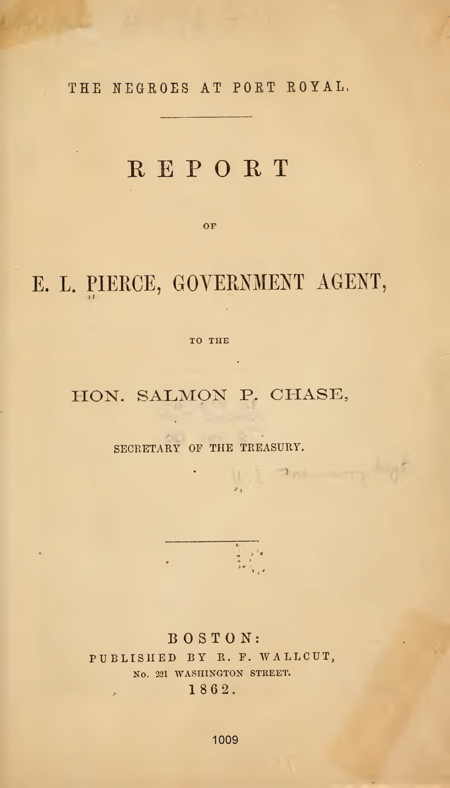
THE NEGROES AT PORT ROYAL.
REPORT
of
E. L. PIERCE, GOVERNMENT AGENT,
to the
HON. SALMON P. CHASE,
SECRETARY OF THE TREASURY.
BOSTON:
PUBLISHED BY R. F. WALLCUT,
No. 221 washington street.
1862.
[2]
[3]
REPORT.
Port Royal, February 3, 1862.
To the Hon. Salmon P. Chase,
Secretary of the Treasury:
Dear Sir,—
My first communication to you was mailed on the third day after my arrival. The same day, I mailed two letters to benevolent persons in Boston, mentioned in my previous communications to you, asking for contributions of clothing, and for a teacher or missionary to be sent, to be supported by the charity of those interested in the movement, to both of which favorable answers have been received. The same day, I commenced a tour of the largest islands, and ever since have been diligently engaged in anxious examinations of the modes of culture—the amount and proportions of the products—the labor required for them—the life and disposition of the laborers upon them—their estimated numbers—the treatment they have received from their former masters, both as to the labor required of them, the provisions and clothing allowed to them, and the discipline imposed—their habits, capacities, and desires, with special reference to their being fitted for useful citizenship—and generally whatever concerned the well-being, present and future, of the territory and its people. Visits have also been made to the communities collected at Hilton Head and Beaufort, and conferences held with the authorities, both naval and military, and other benevolent persons interested in the welfare of these people, and the wise and speedy reörganization of society [4] here. No one can be impressed more than myself with the uncertainty of conclusions drawn from experiences and reflections gathered in so brief a period, however industriously and wisely occupied. Nevertheless, they may be of some service to those who have not been privileged with an equal opportunity.
Of the plantations visited, full notes have been taken of seventeen, with reference to number of negroes in all; of field hands; amount of cotton and corn raised, and how much per acre; time and mode of producing and distributing manure; listing, planting, cultivating, picking and ginning cotton; labor required of each hand; allowance of food and clothing; the capacities of the laborers; their wishes and feelings, both as to themselves and their masters. Many of the above points could be determined by other sources, such as persons at the North familiar with the region, and publications. The inquiries were, however, made with the double purpose of acquiring the information and testing the capacity of the persons inquired of. Some of the leading results of the examination will now be submitted.
An estimate of the number of plantations open to cultivation, and of the persons upon the territory protected by the forces of the United States, if only approximate to the truth, may prove convenient in providing a proper system of administration. The following islands are thus protected, and the estimated number of plantations upon each is given:—
| Port Royal, | 65 |
| Ladies’, | 30 |
| Parry, including Horse, | 6 |
| Cat, | 1 |
| Cane, | 1 |
| Dathaw, | 4 |
| Coosaw, | 2 |
| Morgan, | 2 |
| St. Helena, | 50 |
| Hilton Head, | 16 |
| Pinckney, | 5 |
| Bull, including Barratria, | 2 |
| Daufuskie, | 5 |
| Hutchinson and Fenwick, | 6 |
| 195 | |
| Or about two hundred in all. | |
There are several other islands thus protected, without plantations, as Otter, Pritchard, Fripp, Hunting and Phillips. Lemon and Daw have not been explored by the agents engaged in collecting cotton.
The populous island of North Edisto, lying in the direction of Charleston, and giving the name to the finest cotton, is [5] still visited by the rebels. A part near Botany Bay Island is commanded by the guns of one of our war vessels, under which a colony of one thousand negroes sought protection, where they have been temporarily subsisted from its stores. The number has within a few days been stated to have increased to 2300. Among these, great destitution is said to prevail. Even to this number, as the negroes acquire confidence in us, large additions are likely every week to be made. The whole island can be safely farmed as soon as troops can be spared for the purpose of occupation. But not counting the plantations of this island, the number on Port Royal, Ladies’, St. Helena, Hilton Head, and the smaller islands, may be estimated at 200 plantations.
In visiting the plantations, I endeavored to ascertain with substantial accuracy the number of persons upon them, without, however, expecting to determine the precise number. On that of Thomas Aston Coffin, at Coffin Point, St. Helena, there were 260, the largest found on any one visited. There were 130 on that of Dr. J. W. Jenkins, 120 on that of the Eustis estate, and the others range from 80 to 38, making an average of 81 to a plantation. These, however, may be ranked among the best peopled plantations, and forty to each may be considered a fair average. From these estimates, a population of 8000 negroes on the islands, now safely protected by our forces, results.
Of the 600 at the camp at Hilton Head, about one-half should be counted with the aforesaid plantations whence they have come. Of the 600 at Beaufort, one-third should also be reckoned with the plantations. The other fraction in each case should be added to the 8000 in computing the population now thrown on our protection.
The negroes on Ladies’ and St. Helena Islands have quite generally remained on their respective plantations, or if absent, but temporarily, visiting wives or relatives. The dispersion on Port Royal and Hilton Head Islands has been far greater, the people of the former going to Beaufort in considerable numbers, and of the latter to the camp at Hilton Head.
Counting the negroes who have gone to Hilton Head and Beaufort from places now protected by our forces as still attached to the plantations, and to that extent not swelling [6] the 8000 on plantations, but adding thereto the usual negro population of Beaufort, as also the negroes who have fled to Beaufort and Hilton Head from places not yet occupied by our forces, and adding also the colony at North Edisto, and we must now have thrown upon our hands, for whose present and future we must provide, from 10,000 to 12,000 persons—probably nearer the latter than the former number. This number is rapidly increasing. This week, forty-eight escaped from a single plantation near Grahamville, on the main land, held by the rebels, led by the driver, and after four days of trial and peril, hidden by day and threading the waters with their boats by night, evading the rebel pickets, joyfully entered our camp at Hilton Head. The accessions at Edisto are in larger number, and according to the most reasonable estimates, it would only require small advances by our troops, not involving a general engagement or even loss of life, to double the number which would be brought within our lines.
A fact derived from the Census of 1860 may serve to illustrate the responsibility now devolving on the Government. This County of Beaufort had a population of slaves in proportion of 82&frac8over10; of the whole,—a proportion only exceeded by seven other counties in the United States, viz.: one in South Carolina, that of Georgetown; three in Mississippi, those of Bolivar, Washington and Issequena; and three in Louisiana, those of Madison, Tensas and Concordia.
An impression prevails that the negroes here have been less cared for than in most other rebel districts. If this be so, and a beneficent reform shall be achieved here, the experiment may anywhere else be hopefully attempted.
The former white population, so far as can be ascertained, are rebels, with one or two exceptions. In January, 1861, a meeting of the planters on St. Helena Island was held, of which Thomas Aston Coffin was chairman. A vote was passed, stating its exposed condition, and offering their slaves to the Governor of South Carolina, to aid in building earth mounds, and calling on him for guns to place upon them. A copy of the vote, probably in his own handwriting, and signed by Mr. Coffin, was found in his house.
It is worthy of note that the negroes now within our lines are there by the invitation of no one; but they were on the [7] soil when our army began its occupation, and could not have been excluded, except by violent transportation. A small proportion have come in from the main land, evading the pickets of the enemy and our own,—something easily done in an extensive country, with whose woods and creeks they are familiar.
The only exportable crop of this region is the long staple Sea Island cotton, raised with more difficulty than the coarser kind, and bringing a higher price. The agents of the Treasury Department expect to gather some 2,500,000 pounds of ginned cotton the present year, nearly all of which had been picked and stored before the arrival of our forces. Considerable quantities have not been picked at all, but the crop for this season was unusually good. Potatoes and corn are raised only for consumption on the plantations,—corn being raised at the rate of only twenty-five bushels per acre.
Such features in plantation life as will throw light on the social questions now anxiously weighed deserve notice.
In this region, the master, if a man of wealth, is more likely to have his main residence at Beaufort, sometimes having none on the plantation, but having one for the driver, who is always a negro. He may, however, have one, and an expensive one, too, as in the case of Dr. Jenkins, at St. Helena, and yet pass most of his time at Beaufort, or at the North. The plantation in such cases is left almost wholly under the charge of an overseer. In some cases, there is not even a house for an overseer, the plantation being superintended by the driver, and being visited by the overseer living on another plantation belonging to the same owner. The houses for the overseers are of an undesirable character. Orchards of orange or fig trees are usually planted near them.
The field hands are generally quartered at some distance—eighty or one hundred rods—from the overseer’s or master’s house, and are ranged in a row, sometimes in two rows, fronting each other. They are sixteen feet by twelve, each appropriated to a family, and in some cases divided with a partitition. They numbered, on the plantations visited, from ten to twenty, and on the Coffin plantation, they are double, numbering twenty-three double houses, intended for forty-six families. The yards seemed to swarm with children, the negroes coupling at an early age.
[8]
Except on Sundays, these people do not take their meals at a family table, but each one takes his hominy, bread, or potatoes, sitting on the floor or a bench, and at his own time. They say their masters never allowed them any regular time for meals. Whoever, under our new system, is charged with their superintendence, should see that they attend more to the cleanliness of their persons and houses, and that, as in families of white people, they take their meals together at a table—habits to which they will be more disposed when they are provided with another change of clothing, and when better food is furnished and a proper hour assigned for meals.
Upon each plantation visited by me, familiar conversations were had with several laborers, more or less, as time permitted—sometimes inquiries made of them, as they collected in groups, as to what they desired us to do with and for them, with advice as to the course of sobriety and industry which it was for their interest to pursue under the new and strange circumstances in which they were now placed. Inquiries as to plantation economy, the culture of crops, the implements still remaining, the number of persons in all, and of field hands, and the rations issued, were made of the drivers, as they are called, answering as nearly as the two different systems of labor will permit to foremen on farms in the free States. There is one on each plantation—on the largest one visited, two. They still remained on each visited, and their names were noted. The business of the driver was to superintend the field-hands generally, and see that their tasks were performed fully and properly. He controlled them, subject to the master or overseer. He dealt out the rations. Another office belonged to him. He was required by the master or overseer, whenever he saw fit, to inflict corporal punishment upon the laborers; nor was he relieved from this office when the subject of discipline was his wife or children. In the absence of the master or overseer, he succeeded to much of their authority. As indicating his position of consequence, he was privileged with four suits of clothing a year, while only two were allowed to the laborers under him. It is evident, from some of the duties assigned to him, that he must have been a person of considerable judgment and knowledge of plantation economy, not differing essentially from that required of the foreman of a farm in the free States. He [9] may be presumed to have known, in many cases, quite as much about the matters with which he was charged as the owner of the plantation, who often passed but a fractional part of his time upon it.
The driver, notwithstanding the dispersion of other laborers, quite generally remains on the plantation, as already stated. He still holds the keys of the granary, dealing out the rations of food, and with the same sense of responsibility as before. In one case, I found him in a controversy with a laborer to whom he was refusing his peck of corn, because of absence with his wife on another plantation when the corn was gathered,—it being gathered since the arrival of our army. The laborer protested warmly that he had helped to plant and hoe the corn, and was only absent as charged because of sickness. The driver appealed to me, as the only white man near, and learning from other laborers that the laborer was sick at the time of gathering, I advised the driver to give him his peck of corn, which he did accordingly. The fact is noted as indicating the present relation of the driver to the plantation, where he still retains something of his former authority.
This authority is, however, very essentially diminished. The main reason is, as he will assure you, that he has now no white man to back him. Other reasons may, however, concur. A class of laborers are generally disposed to be jealous of one of their own number promoted to be over them, and accordingly some negroes, evidently moved by this feeling, will tell you that the drivers ought now to work as field hands, and some field hands be drivers in their place. The driver has also been required to report delinquencies to the master or overseer, and upon their order to inflict corporal punishment. The laborers will, in some cases, say that he has been harder than he need to have been, while he will say that he did only what he was forced to do. The complainants who have suffered under the lash may be pardoned for not being sufficiently charitable to him who has unwillingly inflicted it, while, on the other hand, he has been placed in a dangerous position, where a hard nature, or self-interest, or dislike for the victim, might have tempted him to be more cruel than his position required. The truth, in proportions impossible for us in many cases to fix, may lie with both parties. [10] I am, on the whole, inclined to believe that the past position of the driver and his valuable knowledge, both of the plantations and the laborers, when properly advised and controlled, may be made available in securing the productiveness of the plantations and the good of the laborers. It should be added that, in all cases, the drivers were found very ready to answer inquiries and communicate all information, and seemed desirous that the work of the season should be commenced.
There are also on the plantations other laborers, more intelligent than the average, such as the carpenter, the plowman, the religious leader, who may be called a preacher, a watchman or a helper,—the two latter being recognized officers in the churches of these people, and the helpers being aids to the watchman. These persons, having recognized positions among their fellows, either by virtue of superior knowledge or devotion, when properly approached by us, may be expected to have a beneficial influence on the more ignorant, and help to create that public opinion in favor of good conduct which, among the humblest as among the highest, is most useful. I saw many of very low intellectual development, but hardly any too low to be reached by civilizing influences, either coming directly from us or mediately through their brethren. And while I saw some who were sadly degraded, I met also others who were as fine specimens of human nature as one can ever expect to find.
Beside attendance on churches on Sundays, there are evening prayer-meetings on the plantations as often as once or twice a week, occupied with praying, singing, and exhortations. In some cases, the leader can read a hymn, having picked up his knowledge clandestinely, either from other negroes or from white children. Of the adults, about one-half, at least, are members of churches, generally the Baptist, although other denominations have communicants among them. In the Baptist Church on St. Helena Island, which I visited on the 22d January, there were a few pews for the proportionally small number of white attendants, and the much larger space devoted to benches for colored people. On one plantation there is a negro chapel, well adapted for the purpose, built by the proprietor, the late Mrs. Eustis, whose memory is cherished by the negroes, and some of whose sons [11] are now loyal citizens of Massachusetts. I have heard among the negroes scarcely any profane swearing—not more than twice—a striking contrast with my experience among soldiers in the army.
It seemed a part of my duty to attend some of their religious meetings, and learn further about these people what could be derived from such a source. Their exhortations to personal piety were fervent, and, though their language was many times confused, at least to my ear, occasionally an important instruction or a felicitous expression could be recognized. In one case, a preacher of their own, commenting on the text, “Blessed are the meek,” exhorted his brethren not to be “stout-minded.” On one plantation on Ladies’ Island, where some thirty negroes were gathered in the evening, I read passages of Scripture, and pressed on them their practical duties at the present time with reference to the good of themselves, their children, and their people. The passages read were the 1st and 23d Psalms; the 61st chapter of Isaiah, verses 1-4; the Beatitudes in the 5th chapter of Matthew; the 14th chapter of John’s Gospel, and the 5th chapter of the Epistle of James. In substance, I told them that their masters had rebelled against the Government, and we had come to put down the rebellion; that we had now met them, and wanted to see what was best to do for them; that Mr. Lincoln, the President or Great Man at Washington, had the whole matter in charge, and was thinking what he could do for them; that the great trouble about doing anything for them was that their masters had always told us, and had made many people believe, that they were lazy, and would not work unless whipped to it; that Mr. Lincoln had sent us down here to see if it was so; that what they did was reported to him, or to men who would tell him; that where I came from all were free, both white and black; that we did not sell children or separate man and wife, but all had to work; that if they were to be free, they would have to work, and would be shut up or deprived of privileges if they did not; that this was a critical hour with them, and if they did not behave well now and respect our agents and appear willing to work, Mr. Lincoln would give up trying to do anything for them, and they must give up all hope for anything better, and their children and grand-children a hundred [12] years hence would be worse off than they had been. I told them they must stick to their plantations and not run about and get scattered, and assured them that what their masters had told them of our intentions to carry them off to Cuba and sell them was a lie, and their masters knew it to be so, and we wanted them to stay on the plantations and raise cotton, and if they behaved well, they should have wages—small, perhaps, at first; that they should have better food, and not have their wives and children sold off; that their children should be taught to read and write, for which they might be willing to pay something; that by-and-by they would be as well off as the white people, and we would stand by them against their masters ever coming back to take them. The importance of exerting a good influence on each other, particularly on the younger men, who were rather careless and roving, was urged, as all would suffer in good repute from the bad deeds of a few. At Hilton Head, where I spoke to a meeting of two hundred, and there were facts calling for the counsel, the women were urged to keep away from the bad white men, who would ruin them. Remarks of a like character were made familiarly on the plantations to such groups as gathered about. At the Hilton Head meeting, a good-looking man, who had escaped from the southern part of Barnwell District, rose and said, with much feeling, that he and many others should do all they could by good conduct to prove what their masters said against them to be false, and to make Mr. Lincoln think better things of them. After the meeting closed, he desired to know if Mr. Lincoln was coming down here to see them, and he wanted me to give Mr. Lincoln his compliments, with his name, assuring the President that he would do all he could for him. The message was a little amusing, but it testified to the earnestness of the simple-hearted man. He had known Dr. Brisbane, who had been compelled some years since to leave the South because of his sympathy for slaves. The name of Mr. Lincoln was used in addressing them, as more likely to impress them than the abstract idea of government.
It is important to add that in no case have I attempted to excite them by insurrectionary appeals against their former masters, feeling that such a course might increase the trouble of organizing them into a peaceful and improving system, [13] under a just and healthful temporary discipline; and besides that, it is a dangerous experiment to attempt the improvement of a class of men by appealing to their coarser nature. The better course toward making them our faithful allies, and therefore the constant enemies of the rebels, seemed to be to place before them the good things to be done for them and their children, and sometimes reading passages of Scripture appropriate to their lot, without, however, note or comment, never heard before by them, or heard only when wrested from their just interpretation; such, for instance, as the last chapter of St. James’s Epistle, and the Glad Tidings of Isaiah: “I have come to preach deliverance to the captive.” Thus treated and thus educated, they may be hoped to become useful coadjutors, and the unconquerable foes of the fugitive rebels.
There are some vices charged upon these people which deserve examination. Notwithstanding their religious professions, in some cases more emotional than practical, the marriage relation, or what answers for it, is not, in many instances, held very sacred by them. The men, it is said, sometimes leave one wife and take another,—something likely to happen in any society where it is permitted or not forbidden by a stern public opinion, and far more likely to happen under laws which do not recognize marriage, and dissolve what answers for it by forced separations, dictated by the mere pecuniary interest of others. The women, it is said, are easily persuaded by white men,—a facility readily accounted for by the power of the master over them, whose solicitation was equivalent to a command, and against which the husband or father was powerless to protect, and increased also by the degraded condition in which they have been placed, where they have been apt to regard what ought to be a disgrace as a compliment, when they were approached by a paramour of superior condition and race. Yet often the dishonor is felt, and the woman, on whose several children her master’s features are impressed, and through whose veins his blood flows, has sadly confessed it with an instinctive blush. The grounds of this charge, so far as they may exist, will be removed, as much as in communities of our own race, by a system which shall recognize and enforce the marriage relation among them, protect them against the solicitations of [14] white men as much as law can, still more by putting them in relations were they will be inspired with self-respect and a consciousness of their rights, and taught by a pure and plain-spoken Christianity.
In relation to the veracity of these people, so far as my relations with them have extended, they have appeared, as a class, to intend to tell the truth. Their manner, as much as among white men, bore instinctive evidence of this intention. Their answers to inquiries relative to the management of the plantations have a general concurrence. They make no universal charges of cruelty against their masters. They will say, in some cases, that their own was a very kind one, but another one in that neighborhood was cruel. On St. Helena Island they spoke kindly of “the good William Fripp,” as they called him, and of Dr. Clarence Fripp; but they all denounced the cruelty of Alvira Fripp, recounting his inhuman treatment of both men and women. Another concurrence is worthy of note. On the plantations visited, it appeared from the statements of the laborers themselves, that there were, on an average, about 133 pounds of cotton produced to the acre, and five acres of cotton and corn cultivated to a hand, the culture of potatoes not being noted. An article of the American Agriculturist, published in Turner’s Cotton Manual, pp. 132, 133, relative to the culture of Sea Island Cotton, on the plantation of John H. Townsend, states that the land is cultivated in the proportion of 7-12th cotton, 3-12ths corn, and 2-12ths potatoes—in all, less than six acres to a hand—and the average yield of cotton per acre is 135 pounds. I did not take the statistics of the culture of potatoes, but about five acres are planted with them on the smaller plantations, and twenty, or even thirty, on the larger; and the average amount of land to each hand, planted with potatoes, should be added to the five acres of cotton and corn, and thus results not differing substantially are reached in both cases. Thus the standard publications attest the veracity and accuracy of these laborers.
Again, there can be no more delicate and responsible position, involving honesty and skill, than that of pilot. For this purpose, these people are every day employed to aid our military and naval operations in navigating these sinuous channels. They were used in the recent reconnoisance in [15] the direction of Savannah; and the success of the affair at Port Royal Ferry depended on the fidelity of a pilot, William, without the aid of whom, or of one like him, it could not have been undertaken. Further information on this point may be obtained of the proper authorities here. These services are not, it is true, in all respects, illustrative of the quality of veracity, but they involve kindred virtues not likely to exist without it.
It is proper, however, to state that expressions are sometimes heard from persons who have not considered these people thoughtfully, to the effect that their word is not to be trusted, and these persons, nevertheless, do trust them, and act upon their statements. There may, however, be some color for such expressions. These laborers, like all ignorant people, have an ill-regulated reason, too much under the control of the imagination. Therefore, where they report the number of soldiers, or relate facts where there is room for conjecture, they are likely to be extravagant, and you must scrutinize their reports. Still, except among the thoroughly dishonest,—no more numerous among them than in other races,—there will be found a colorable basis for their statements, enough to show their honest intention to speak truly.
It is true also that you will find them too willing to express feelings which will please you. This is most natural. All races, as well as all animals, have their appropriate means of self-defence, and where the power to use physical force to defend one’s self is taken away, the weaker animal, or man, or race, resorts to cunning and duplicity. Whatever habits of this kind may appear in these people are directly traceable to the well-known features of their past condition, without involving any essential proneness to deception in the race, further than may be ascribed to human nature. Upon this point, special inquiries have been made of the Superintendent at Hilton Head, who is brought in direct daily association with them, and whose testimony, truthful as he is, is worth far more than that of those who have had less nice opportunities of observation, and Mr. Lee certifies to the results here presented. Upon the question of the disposition of these people to work, there are different reports, varied somewhat by the impression an idle or an industrious laborer, brought into immediate relation with the witness, may have [16] made on the mind. In conversations with them, they uniformly answered to assurances that if free they must work, “Yes, massa, we must work to live; that’s the law”; and expressing an anxiety that the work of the plantations was not going on. At Hilton Head, they are ready to do for Mr. Lee, the judicious Superintendent, whatever is desired. Hard words and epithets are, however, of no use in managing them, and other parties for whose service they are specially detailed, who do not understand or treat them properly, find some trouble in making their labor available, as might naturally be expected. In collecting cotton, it is sometimes, as I am told, difficult to get them together, when wanted for work. There may be something in this, particularly among the young men. I have observed them a good deal; and though they often do not work to much advantage,—a dozen doing sometimes what one or two stout and well-trained Northern laborers would do, and though less must always be expected of persons native to this soil than those bred in Northern latitudes, and under more bracing air,—I have not been at all impressed with their general indolence. As servants, oarsmen, and carpenters, I have seen them working faithfully and with a will. There are some peculiar circumstances in their condition, which no one who assumes to sit in judgment upon them must overlook. They are now, for the first time, freed from the restraint of a master, and like children whose guardian or teacher is absent for the day, they may quite naturally enjoy an interval of idleness. No system of labor for them, outside of the camps, has been begun, and they have had nothing to do except to bale the cotton when bagging was furnished, and we all know that men partially employed are, if anything, less disposed to do the little assigned them than they are to perform the full measure which belongs to them in regular life, the virtue of the latter case being supported by habit. At the camps, they are away from their accustomed places of labor, and have not been so promptly paid as could be desired, and are exposed to the same circumstances which often dispose soldiers to make as little exertion as possible. In the general chaos which prevails, and before the inspirations of labor have been set before them by proper superintendents and teachers who understand their disposition, and show by their conduct [17] an interest in their welfare, no humane or reasonable man would subject them to austere criticism, or make the race responsible for the delinquencies of an idle person, who happened to be brought particularly under his own observation. Not thus would we have ourselves or our own race judged; and the judgment which we would not have meted to us, let us not measure to others.
Upon the best examination of these people, and a comparison of the evidence of trustworthy persons, I believe that when properly organized, and with proper motives set before them, they will, as freemen, be as industrious as any race of men are likely to be in this climate.
The notions of the sacredness of property as held by these people have sometimes been the subject of discussion here. It is reported they have taken things left in their masters’ houses. It was wise to prevent this, and even where it had been done to compel a restoration, at least of expensive articles, lest they should be injured by speedily acquiring, without purchase, articles above their condition. But a moment’s reflection will show that it was the most natural thing for them to do. They had been occupants of the estates; had had these things more or less in charge, and when the former owners had left, it was easy for them to regard their title to the abandoned property as better than that of strangers. Still, it is not true that they have, except as to very simple articles, as soap or dishes, generally availed themselves of such property. It is also stated that in camps where they have been destitute of clothing, they have stolen from each other, but the Superintendents are of opinion that they would not have done this if already well provided. Besides, those familiar with large bodies collected together, like soldiers in camp life, also know how often these charges of mutual pilfering are made among them, often with great injustice. It should be added, to complete the statement, that the agents who have been intrusted with the collection of cotton have reposed confidence in the trustworthiness of the laborers, committing property to their charge—a confidence not found to have been misplaced.
To what extent these laborers desire to be free, and to serve us still further in putting down the rebellion, has been a subject of examination. The desire to be free has been [18] strongly expressed, particularly among the more intelligent and adventurous. Every day, almost, adds a fresh tale of escapes, both solitary and in numbers, conducted with a courage, a forecast, and a skill, worthy of heroes. But there are other apparent features in their disposition which it would be untruthful to conceal. On the plantations, I often found a disposition to evade the inquiry whether they wished to be free or slaves; and though a preference for freedom was expressed, it was rarely in the passionate phrases which would come from an Italian peasant. The secluded and monotonous life of a plantation, with strict discipline and ignorance enforced by law and custom, is not favorable to the development of the richer sentiments, though even there they find at least a stunted growth, irrepressible as they are. The inquiry was often answered in this way: “The white man do what he pleases with us; we are yours now, massa.” One, if I understood his broken words rightly, said that he did not care about being free, if he only had a good master. Others said they would like to be free, but they wanted a white man for a “protector.” All of proper age, when inquired of, expressed a desire to have their children taught to read and write, and to learn themselves. On this point, they showed more earnestness than on any other. When asked if they were willing to fight, in case we needed them, to keep their masters from coming back, they would seem to shrink from that, saying that “black men have been kept down so like dogs that they would run before white men.” At the close of the first week’s observation, I almost concluded that on the plantation there was but little earnest desire for freedom, and scarcely any willingness for its sake to encounter white men. But as showing the importance of not attempting to reach general conclusions too hastily, another class of facts came to my notice the second week. I met then some more intelligent, who spoke with profound earnestness of their desire to be free, and how they had longed to see this day. Other facts, connected with the military and naval operations, were noted. At the recent reconnoisance toward Pulaski, pilots of this class stood well under the fire, and were not reluctant to the service. When a district of Ladies’ Island was left exposed, they voluntarily took such guns as they could procure, and stood sentries. Also at North Edisto, [19] where the colony is collected under the protection of our gunboats, they armed themselves and drove back the rebel cavalry. An officer here high in command reported to me some of these facts, which had been officially communicated to him. The suggestion may be pertinent that the persons in question are divisible into two classes. Those who, by their occupation, have been accustomed to independent labor, and schooled in some sort of self-reliance, are more developed in this direction; while others, who have been bound to the routine of plantation life, and kept more strictly under surveillance, are but little awakened. But even among these last there has been, under the quickening inspiration of present events, a rapid development, indicating that the same feeling is only latent.
There is another consideration which must not be omitted. Many of these people have still but little confidence in us, anxiously looking to see what is to be our disposition of them, It is a mistake to suppose that, separated from the world, never having read a Northern book or newspaper relative to them, or talked with a Northern man expressing the sentiments prevalent in his region, they are universally and with entire confidence welcoming us as their deliverers. Here, as everywhere else, where our army has met them, they have been assured by their masters that we were going to carry them off to Cuba. There is probably not a rebel master, from the Potomac to the Gulf, who has not repeatedly made this assurance to his slaves. No matter what his religious vows may have been, no matter what his professed honor as a gentleman, he has not shrunk from the reiteration of this falsehood. Never was there a people, as all who know them will testify, more attached to familiar places than they. Be their home a cabin, and not even that cabin their own, they still cling to it. The reiteration could not fail to have had some effect on a point on which they were so sensitive. Often it must have been met with unbelief or great suspicion of its truth. It was also balanced by the consideration that their masters would remove them into the interior, and perhaps to a remote region, and separate their families, about as bad as being taken to Cuba, and they felt more inclined to remain on the plantations, and take their chances with us. They have told me that they reasoned in [20] this way. But in many cases they fled at the approach of our army. Then one or two bolder returning, the rest were reässured and came back. Recently, the laborers at Parry Island, seeing some schooners approaching suspiciously, commenced gathering their little effects rapidly together, and were about to run, when they were quieted by some of our teachers coming, in whom they had confidence. In some cases, their distrust has been increased by the bad conduct of some irresponsible white men, of which, for the honor of human nature, it is not best to speak more particularly. On the whole, their confidence in us has been greatly increased by the treatment they have received, which, in spite of many individual cases of injury less likely to occur under the stringent orders recently issued from the naval and military authorities, has been generally kind and humane. But the distrust which to a greater or less extent may have existed on our arrival, renders necessary, if we would keep them faithful allies, and not informers to the enemy, the immediate adoption of a system which shall be a pledge of our protection and of our permanent interest in their welfare.
The manner of the laborers toward us has been kind and deferential, doing for us such good offices as were in their power, as guides, pilots, or in more personal service, inviting us on the plantations to lunch of hominy and milk, or potatoes, touching the hat in courtesy, and answering politely such questions as were addressed to them. If there have been exceptions to this rule, it was in the case of those whose bearing did not entitle them to the civility.
Passing from general phases of character or present disposition, the leading facts in relation to the plantations and the mode of rendering them useful and determining what is best to be done, come next in order.
The laborers on St. Helena and Ladies’ Islands very generally remain on their respective plantations. This fact, arising partially from local attachment and partially because they can thus secure their allowance of corn, is important, as it will facilitate their reörganization. Some are absent, temporarily visiting a wife, or relative, on another plantation, and returning periodically for their rations. The disposition to roam, so far as it exists, mainly belongs to the younger people. On Port Royal and Hilton Head Islands, there is [21] a much greater dispersion, due in part to their having been the scene of more active military movements, and in part to the taking in greater measure on these islands of the means of subsistence from the plantations. When the work recommences, however, there is not likely to be any indisposition to return to them.
The statistics with regard to the number of laborers, field hands, acres planted to cotton and corn, are not presented as accurate statements, but only as reasonable approximations, which may be of service.
The highest number of people on any plantation visited was on Coffin’s, where there are 260. Those on the plantation of Dr. Jenkins number 130; on that of the Eustis estate, 120; and the others, from 80 to 38. The average number on each is 81. The field hands range generally from one-third to one-half of the number, the rest being house servants, old persons, and children. About five acres of cotton and corn are planted to a hand; and to potatoes, about five acres in all were devoted on the smaller plantations, and from twenty to thirty on the larger.
The number of pounds in a bale of ginned cotton ranges from 300 to 400—the average number being not far from 345 pounds per bale. The average yield per acre on fifteen plantations was about 133 pounds.
The material for compost is gathered in the periods of most leisure—often in July and August, after the cultivation of the cotton plant is ended, and before the picking has commenced. Various materials are used, but quite generally mud and the coarse marsh grass, which abounds on the creeks near the plantations, are employed. The manure is carted upon the land in January and February, and left in heaps, two or three cart-loads on each task, to be spread at the time of listing. The land, by prevailing custom, lies fallow a year. The cotton and corn are planted in elevated rows or beds. The next step is the listing, done with the hoe, and making the bed where the alleys were at the previous raising of the crop, and the alleys being made where the beds were before. In this process, half the old bed is hauled into the alley on the one side, and the other half into the alley on the other. This work is done mainly in February, being commenced sometimes the last of January. A “task” is [22] 105 feet square, and contains twenty-one or twenty-two beds or rows. Each laborer is required to list a task and a half, or if the land is moist and heavy, a task and five or seven beds, say one-fourth or three-eighths of an acre.
The planting of cotton commences about the 20th or last of March, and of corn about the same time or earlier. It is continued through April, and by some planters it is not begun till April. The seeds are deposited in the beds, a foot or a foot and a half apart on light land, and two feet apart on heavy land, and five or ten seeds left in a place. After the plant is growing, the stalks are thinned so as to leave together two on high land and one on low or rich land. The hoeing of the early cotton begins about the time that the planting of the late has ended. The plant is cultivated with the hoe and plow during May, June and July, keeping the weeds down and thinning the stalks. The picking commences the last of August. The cotton being properly dried in the sun, is then stored in houses, ready to be ginned. The ginning, or cleaning the fibre from the seed, is done either by gins operated by steam, or by the well-known foot-gins—the latter turning out about 30 pounds of ginned cotton per day, and worked by one person, assisted by another, who picks out the specked and yellow cotton. The steam-engine carries one or more gins, each turning out 300 pounds per day, and requiring eight or ten hands to tend the engine and gins, more or less, according to the number of the gins. The footgins are still more used than the gins operated by steam,—the latter being used mainly on the largest plantations, on which both kinds are sometimes employed. I have preserved notes of the kind and number of gins used on the plantations visited, but it is unnecessary to give them here. Both kinds can be run entirely by the laborers, and after this year, the ginning should be done entirely here—among other reasons, to avoid transportation of the seed, which makes nearly three-fourths of the weight of the unginned cotton, and to preserve in better condition the seed required for planting.
The allowance of clothing to the field hands in this district has been two suits per year, one for summer and another for winter. That of food has been mainly vegetable—a peck of corn a week to each hand, with meat only in June, when the work is hardest, and at Christmas. No meat was [23] allowed in June, on some plantations, while on a few, more liberal, it was dealt out occasionally—as once a fortnight, or once a month. On a few, molasses was given at intervals. Children, varying with their ages, were allowed from two to six quarts of corn per week. The diet is more exclusively vegetable here than almost anywhere in the rebellious regions, and in this respect should be changed. It should be added, that there are a large quantity of oysters available for food in proper seasons.
Besides the above rations, the laborers were allowed each to cultivate a small patch of ground, about a quarter of an acre, for themselves, when their work for their master was done. On this, corn and potatoes, chiefly the former, were planted. The corn was partly eaten by themselves, thus supplying in part the deficiency in rations; but it was, to a great extent, fed to a pig, or chickens, each hand being allowed to keep a pig and chickens or ducks, but not geese or turkeys. With the proceeds of the pig and chickens, generally sold to the masters, and at pretty low rates, extra clothing, coffee, sugar, and that necessary of life with these people, as they think, tobacco, were bought.
In the report thus far, such facts in the condition of the territory now occupied by the forces of the United States have been noted as seemed to throw light on what could be done to reörganize the laborers, prepare them to become sober and self-supporting citizens, and secure the successful culture of a cotton-crop, now so necessary to be contributed to the markets of the world. It will appear from them that these people are naturally religious and simple-hearted—attached to the places where they have lived, still adhering to them both from a feeling of local attachment and self-interest in securing the means of subsistence; that they have the knowledge and experience requisite to do all the labor, from the preparation of the ground for planting until the cotton is baled, ready to be exported; that they, or the great mass of them, are disposed to labor, with proper inducements thereto; that they lean upon white men, and desire their protection, and could, therefore, under a wise system, be easily brought under subordination; that they are susceptible to the higher considerations, as duty, and the love of offspring, and are not in any way inherently vicious, their defects coming from their [24] peculiar condition in the past or present, and not from constitutional proneness to evil beyond what may be attributed to human nature; that they have among them natural chiefs, either by virtue of religious leadership or superior intelligence, who, being first addressed, may exert a healthful influence on the rest. In a word, that, in spite of their condition, reputed to be worse here than in many other parts of the rebellious region, there are such features in their life and character, that the opportunity is now offered to us to make of them, partially in this generation, and fully in the next, a happy, industrious, law-abiding, free and Christian people, if we have but the courage and patience to accept it. If this be the better view of them and their possibilities, I will say that I have come to it after anxious study of all peculiar circumstances in their lot and character, and after anxious conference with reflecting minds here, who are prosecuting like inquiries, not overlooking what, to a casual spectator, might appear otherwise, and granting what is likely enough, that there are those among them whose characters, by reason of bad nature or treatment, are set, and not admitting of much improvement. And I will submit further, that, in common fairness and common charity, when, by the order of Providence, an individual or a race is committed to our care, the better view is entitled to be first practically applied. If this one shall be accepted and crowned with success, history will have the glad privilege of recording that this wicked and unprovoked rebellion was not without compensations most welcome to our race.
What, then, should be the true system of administration here?
It has been proposed to lease the plantations and the people upon them. To this plan there are two objections—each conclusive. In the first place, the leading object of the parties bidding for leases would be to obtain a large immediate revenue—perhaps to make a fortune in a year or two. The solicitations of doubtful men, offering the highest price, would impose on the leasing power a stern duty of refusal, to which it ought not unnecessarily to be subjected. Far better a system which shall not invite such men to harass the leasing power, or excite expectations of a speedy fortune, to be derived from the labor of this people. Secondly: No man, [25] not even the best of men, charged with the duties which ought to belong to the guardians of these people, should be put in a position where there would be such a conflict between his humanity and his self-interest—his desire, on the one hand, to benefit the laborer, and, on the other, the too often stronger desire to reap a large revenue—perhaps to restore broken fortunes in a year or two. Such a system is beset with many of the worst vices of the slave system, with one advantage in favor of the latter, that it is for the interest of the planter to look to permanent results. Let the history of British East India, and of all communities where a superior race has attempted to build up speedy fortunes on the labor of an inferior race occupying another region, be remembered, and no just man will listen to the proposition of leasing, fraught as it is with such dangerous consequences. Personal confidence forbids me to report the language of intense indignation which has been expressed against it here by some occupying high places of command, as also by others who have come here for the special purpose of promoting the welfare of these laborers. Perhaps it might yield to the treasury a larger immediate revenue, but it would be sure to spoil the country and its people in the end. The Government should be satisfied if the products of the territory may be made sufficient for a year or two to pay the expenses of administration and superintendence, and the inauguration of a beneficent system which will settle a great social question, ensure the sympathies of foreign nations, now wielded against us, and advance the civilization of the age.
The better course would be to appoint superintendents for each large plantation, and one for two or three smaller combined, compensated with a good salary, say $1,000 per year, selected with reference to peculiar qualifications, and as carefully as one would choose a guardian for his children, clothed with an adequate power to enforce a paternal discipline, to require a proper amount of labor, cleanliness, sobriety, and better habits of life, and generally to promote the moral and intellectual culture of the wards, with such other inducements, if there be any, placed before the superintendent as shall inspire him to constant efforts to prepare them for useful and worthy citizenship. To quicken and ensure the fidelity of the superintendents, there should a director-general or [26] governor, who shall visit the plantations, and see that they are discharging these duties, and, if necessary, he should be aided by others in the duty of visitation. This officer should be invested with liberal powers over all persons within his jurisdiction, so as to protect the blacks from each other and from white men, being required in most important cases to confer with the military authorities in punishing offences. His proposed duties indicate that he should be a man of the best ability and character: better if he have already, by virtue of public services, a hold on the public confidence. Such an arrangement is submitted as preferable for the present to any cumbersome territorial government.
The laborers themselves, no longer slaves of their former masters, or of the Government, but as yet in large numbers unprepared for the full privileges of citizens, are to be treated with sole reference to such preparation. No effort is to be spared to work upon their better nature and the motives which come from it—the love of wages, of offspring, and family, the desire of happiness, and the obligations of religion. And when these fail,—and fail they will, in some cases,—we must not hesitate to resort, not to the lash, for as from the department of war so also from the department of labor, it must be banished, but to the milder and more effective punishments of deprivation of privileges, isolation from family and society, the workhouse, or even the prison. The laborers are to be assured at the outset that parental and conjugal relations among them are to be protected and enforced; that children, and all others desiring, are to be taught; that they will receive wages; and that a certain just measure of work, with reference to the ability to perform it, if not willingly rendered, is to be required of all. The work, so far as the case admits, shall be assigned in proper tasks, the standard being what a healthy person of average capacity can do, for which a definite sum is to be paid. The remark may perhaps be pertinent, that, whatever may have been the case with women or partially disabled persons, my observations, not yet sufficient to decide the point, have not impressed me with the conviction that healthy persons, if they had been provided with an adequate amount of food, and that animal in due proportion, could be said to have been overworked heretofore on these islands, the main trouble having [27] been that they have not been so provided, and have not had the motives which smooth labor. Notwithstanding the frequent and severe chastisements which have been employed here in exacting labor, they have failed, and naturally enough, of their intended effects. Human beings are made up of so much more of spirit than of muscle, that compulsory labor, enforced by physical pain, will not exceed or equal, in the long run, voluntary labor with just inspirations; and the same law in less degree may be seen in the difference between the value of a whipped and jaded beast, and one well disciplined and kindly treated.
What should be the standard of wages where none have heretofore been paid, is less easy to determine. It should be graduated with reference to the wants of the laborer and the ability of the employer or Government; and this ability being determined by the value of the products of the labor, and the most that should be expected being, that for a year or two the system should not be a burden on the Treasury. Taking into consideration the cost of food and clothing, medical attendance and extras, supposing that the laborer would require rations of pork or beef, meal, coffee, sugar, molasses and tobacco, and that he would work 300 days in the year, he should receive about forty cents a day in order to enable him to lay up $30 a year; and each healthy woman could do about equally well. Three hundred days in a year is, perhaps, too high an estimate of working days, when we consider the chances of sickness and days when, by reason of storms and other causes, there would be no work. It is assumed that the laborer is not to pay rent for the small house tenanted by him. This sum, when the average number of acres cultivated by a hand, and the average yield per acre are considered with reference to market prices, or when the expense of each laborer to his former master, the interest on his assumed value and on the value of the land worked by him,—these being the elements of what it has cost the master before making a profit,—are computed, the Government could afford to pay, leaving an ample margin to meet the cost of the necessary implements, as well as of superintendence and administration. The figures on which this estimate is based are at the service of the Department if desired. It must also be borne in mind that the plantations will in the end be carried [28] on more scientifically and cheaply than before, the plough taking very much the place of the hoe, and other implements being introduced to facilitate industry and increase the productive power of the soil.
It being important to preserve all former habits which are not objectionable, the laborer should have his patch of ground on which to raise corn or vegetables for consumption or sale.
As a part of the plan proposed, missionaries will be needed to address the religious element of a race so emotional in their nature, exhorting to all practical virtues, and inspiring the laborers with a religious zeal for faithful labor, the good nurture of their children, and for clean and healthful habits. The benevolence of the Free States, now being directed hither, will gladly provide these. The Government should, however, provide some teachers specially devoted to teaching reading, writing and arithmetic, say some twenty-five, for the territory now occupied by our forces, and private benevolence might even be relied on for these.
The plan proposed is, of course, not presented as an ultimate result: far from it. It contemplates a paternal discipline for the time being, intended for present use only, with the prospect of better things in the future. As fast as the laborers show themselves fitted for all the privileges of citizens, they should be dismissed from the system and allowed to follow any employment they please, and where they please. They should have the power to acquire the fee simple of land, either with the proceeds of their labor or as a reward of special merit; and it would be well to quicken their zeal for good behavior by proper recognitions. I shall not follow these suggestions, as to the future, further, contenting myself with indicating what is best to be done at once with a class of fellow-beings now thrown on our protection, entitled to be recognized as freemen, but for whose new condition the former occupants of the territory have diligently labored to unfit them.
But whatever is thought best to be done, should be done at once. A system ought to have been commenced with the opening of the year. Beside that, demoralization increases with delay. The months of January and February are the months for preparing the ground by manuring and listing, and the months of March and April are for planting. Already, [29] important time has passed, and in a very few weeks it will be too late to prepare for a crop, and too late to assign useful work to the laborers for a year to come. I implore the immediate intervention of your Department to avert the calamities which must ensue from a further postponement.
There is another precaution most necessary to be taken. As much as possible, persons enlisted in the army and navy should be kept separate from these people. The association produces an unhealthy excitement in the latter, and there are other injurious results to both parties which it is unnecessary to particularize. In relation to this matter, I had an interview with the Flag-Officer, Com. Dupont, which resulted in an order that “no boats from any of the ships of the squadron can be permitted to land anywhere but at Bay Point and Hilton Head, without a pass from the Fleet Captain,” and requiring the commanding officers of the vessels to give special attention to all intercourse between the men under their command and the various plantations in their vicinity. Whatever can be accomplished to that end by this humane and gallant officer, who superadds to skill and courage in his profession the liberal views of a statesman, will not be left undone. The suggestion should also be made that, when employment is given to this people, some means should be taken to enable them to obtain suitable goods at fair rates, and precautions taken to prevent the introduction of ardent spirits among them.
A loyal citizen of Massachusetts, Mr. Frederick A. Eustis, has recently arrived here. He is the devisee in a considerable amount under the will of the late Mrs. Eustis, who owned the large estate on Ladies’ Island, and also another at Pocotaligo, the latter not yet in possession of our forces. The executors are rebels, and reside at Charleston. Mr. Eustis has as yet received no funds by reason of the devise. There are two other loyal devisees and some other devisees resident in rebellious districts, and the latter are understood to have received dividends. Mr. Eustis is a gentleman of humane and liberal views, and, accepting the present condition of things, desires that the people on these plantations should not be distinguished from their brethren on others, but equally admitted to their better fortunes. The circumstances of this case, though of a personal character, may furnish a useful [30] precedent. With great pleasure and confidence, I recommend that this loyal citizen be placed in charge of the plantation on Ladies’ Island, which he is willing to accept—the questions of property and rights under the will being reserved for subsequent determination.
A brief statement in relation to the laborers collected at the camps at Hilton Head and Beaufort may be desirable. At both places, they are under the charge of the Quartermaster’s Department. At Hilton Head, Mr. Barnard K. Lee, Jr., of Boston, is the Superintendent, assisted by Mr. J. D. McMath of Alleghany City, Penn., both civilians. The appointment of Mr. Lee is derived from Captain R. Saxton, Chief Quartermaster of the Expeditionary Corps, a humane officer, who is deeply interested in this matter. The number at this camp are about 600, the registered number under Mr. Lee being 472, of which 137 are on the pay-roll. Of these 472, 279 are fugitives from the main land, or other points, still held by the rebels; 77 are from Hilton Head Island; 62 from the adjacent island of Pinckney; 38 from St. Helena; 8 from Port Royal; 7 from Spring, and one from Daufuskie. Of the 472, the much larger number, it will be seen, have sought refuge from the places now held by rebels; while the greater proportion of the remainder came in at an early period, before they considered themselves safe elsewhere. Since the above figures were given, forty-eight more, all from one plantation, and under the lead of the driver, came in together from the main land. Mr. Lee was appointed November 10th last, with instructions to assure the laborers that they would be paid a reasonable sum for their services, not yet fixed. They were contented with the assurance, and a quantity of blankets and clothing captured of the rebels was issued to them without charge. About December 1st, an order was given that carpenters should be paid $8 per month, and other laborers $5 per month. Women and children were fed without charge, the women obtaining washing and receiving the pay, in some cases in considerable sums, not, however, heretofore, very available, as there was no clothing for women for sale here. It will be seen that, under the order, laborers, particularly those with families, have been paid with sufficient liberality. There were 63 laborers on the pay-roll on December 1st, and $101.50 were [31] paid to them for the preceding month. On January 1st, there were for the preceding month 127 on the pay-roll, entitled to $468.59. On February 1st, there were for the preceding month 137 on the pay-roll, entitled to something more than for the month of January; making in all due them not far from $1000. This delay of payment, due, it is stated, to a deficiency of small currency, has made the laborers uneasy, and affected the disposition to work.
On January 18th, a formal order was issued by General Sherman, regulating the rate of wages, varying from $12 to $8 per month for mechanics, and from $8 to $4 for other laborers. Under it, each laborer is to have, in addition, a ration of food. But from the monthly pay are to be deducted rations for his family, if here, and clothing both for himself and family. Commodious barracks have been erected for these people, and a guard protects their quarters.
I have been greatly impressed by the kindness and good sense of Mr. Lee and his assistant, in their discipline of these people. The lash, let us give thanks, is banished at last. No coarse words or profanity are used toward them. There has been less than a case of discipline a week, and the delinquent, if a male, is sometimes made to stand on a barrel, or, if a woman, is put in a dark room, and such discipline has proved successful. The only exception, if any, is in the case of one woman, and the difficulty there was conjugal jealousy, she protesting that she was compelled by her master, against her will, to live with the man.
There is scarcely any profanity among them, more than one-half of the adults being members of churches. Their meetings are held twice or three times on Sundays, also on the evenings of Tuesday, Thursday and Friday. They are conducted with fervent devotion by themselves alone or in presence of a white clergyman, when the services of one are procurable. They close with what is called “a glory shout,” one joining hands with another, together in couples singing a verse and beating time with the foot. A fastidious religionist might object to this exercise; but being in accordance with usage, and innocent enough in itself, it is not open to exception. As an evidence of the effects of the new system in inspiring self-reliance, it should be noted that the other evening they called a meeting of their own accord, and voted, the [32] motion being regularly made and put, that it was now but just that they should provide the candles for their meetings, hitherto provided by the Government. A collection was taken at a subsequent meeting, and $2.48 was the result. The incident may be trivial, but it justifies a pleasing inference. No school, it is to be regretted, has yet been started, except one on Sundays, but the call for reading books is daily made by the laborers. The suggestion of Mr. Lee, in which I most heartily concur, should not be omitted—that with the commencement of the work on the plantations, the laborers should be distributed upon them, having regard to the family relations and the places whence they come.
Of the number and condition of the laborers at Beaufort, less accurate information was attainable, and fewer statistics than could be desired. They have not, till within a few days, had a General Superintendent, but have been under the charge of persons detailed for the purpose from the army. I saw one whose manner and language toward them was, to say the least, not elevating. A new Quartermaster of the post has recently commenced his duties, and a better order of things is expected. He has appointed as Superintendent Mr. Wm. Harding, a citizen of Daufuskie Island. An enrollment has commenced, but is not yet finished. There are supposed to be about six hundred at Beaufort. The number has been larger, but some have already returned to the plantations in our possession from which they came. At this point, the Rev. Solomon Peck, of Roxbury, Mass., has done great good in preaching to them and protecting them from the depredations of white men. He has established a school for the children, in which are sixty pupils, ranging in age from six to fifteen years. They are rapidly learning their letters and simple reading. The teachers are of the same race with the taught, of ages respectively of twenty, thirty, and fifty years. The name of one is John Milton. A visit to the school leaves a remarkable impression. One sees there those of pure African blood, and others ranging through the lighter shades, and among them brunettes of the fairest features. I taught several of the children their letters for an hour or two, and during the recess heard the three teachers, at their own request, recite their spelling-lessons of words of one syllable, and read two chapters of Matthew. It seemed to be a morning [33] well spent. Nor have the efforts of Dr. Peck been confined to this point. He has preached at Cat, Cane and Ladies’ Island, anticipating all other white clergymen, and on Sunday, February 2d, at the Baptist Church on St. Helena, to a large congregation, where his ministrations have been attended with excellent effects. On my visits to St. Helena, I found that no white clergyman had been there since our military occupation began, that the laborers were waiting for one, and there was a demoralization at some points which timely words might arrest. I may be permitted to state, that it was at my own suggestion that he made the appointment on this island. I cannot forbear to give a moment’s testimony to the nobility of character displayed by this venerable man. Of mild and genial temperament, equally earnest and sensible, enjoying the fruits of culture, and yet not dissuaded by them from the humblest toil, having reached an age when most others would have declined the duty, and left it to be discharged by younger men; of narrow means, and yet in the main defraying his own expenses, this man of apostolic faith and life, to whose labors both hemispheres bear witness, left his home to guide and comfort this poor and shepherdless flock; and to him belongs, and ever will belong, the distinguished honor of being the first minister of Christ to enter the field which our arms had opened.
The Rev. Mansfield French, whose mission was authenticated and approved by the Government, prompted by benevolent purposes of his own, and in conference with others in the city of New York, has been here two weeks, during which time he has been industriously occupied in examining the state of the islands and their population, in conferring with the authorities, and laying the foundation of beneficent appliances with reference to their moral, educational, and material wants. These, having received the sanction of officers in command, he now returns to commend to the public, and the Government will derive important information from his report. Beside other things, he proposes, with the approval of the authorities here, to secure authority to introduce women of suitable experience and ability, who shall give industrial instruction to those of their own sex among these people, and who, visiting from dwelling to dwelling, shall strive to improve their household life, and give such [34] counsels as women can best communicate to women. All civilizing influences like these should be welcomed here, and it cannot be doubted that many noble hearts among the women of the land will volunteer for the service.
There are some material wants of this territory requiring immediate attention. The means of subsistence have been pretty well preserved on the plantations on St. Helena; so also on that part of Ladies’ adjacent to St. Helena. But on Port Royal Island, and that part of Ladies’ near to it, destitution has commenced, and will, unless provision is made, become very great. Large amounts of corn for forage, in quantities from fifty to four or five hundred bushels from a plantation, have been taken to Beaufort. On scarcely any within this district is there enough to last beyond April, whereas it is needed till August. On others, it will last only two or three weeks, and on some it is entirely exhausted. It is stated that the forage was taken because no adequate supply was at hand, and requisitions for it were not seasonably answered. The further taking of the corn in this way has now been forbidden; but the Government must be prepared to meet the exigency which it has itself created. It should be remembered that this is not a grain-exporting region, corn being produced in moderate crops only for consumption. Similar destitution will take place on other islands, from the same cause, unless provision is made.
The horses, mules and oxen, in large numbers, have been taken to Beaufort and Hilton Head as means of transportation. It is presumed that they, or most of them, are no longer needed for that purpose, and that they will be returned to those who shall have charge of the plantations. Cattle to the number of a hundred, and in some cases less, have been taken from a plantation and slaughtered, to furnish fresh beef for the army. Often cattle have been killed by irresponsible foraging parties, acting without competent authority. There can be no doubt that the army and navy have been in great want of the variation of the rations of salt beef or pork; but it also deserves much consideration, if the plantations are to be permanently worked, how much of a draught they can sustain.
The garden seeds have been pretty well used up, and I inclose a desirable list furnished me by a gentleman whose [35] experience enables him to designate those adapted to the soil, and useful too for army supplies. The general cultivation of the islands also requires the sending of a quantity of ploughs and hoes.
It did not seem a part of my duty to look specially after matters which had been safely entrusted to others; but it is pleasing, from such observation as was casually made, to testify that Lieutenant-Colonel William H. Reynolds, who was charged with the preservation of the cotton and other confiscated property, notwithstanding many difficulties in his way, has fulfilled his duties with singular fidelity and success.
Since the writing of this report was commenced, some action has been taken which will largely increase the numbers of persons thrown on the protection of the Government. To-day, February 10th, the 47th Regiment New York Volunteers has been ordered to take military occupation of North Edisto Island, which is stated to have had formerly a population of 5000 or 6000, and a large number of plantations, a movement which involves great additional responsibility. Agents for the collection of cotton are to accompany it.
Herewith is communicated a copy of an order by General Sherman, dated February 6th, 1862, relative to the disposition of the plantations and of their occupants. It is an evidence of the deep interest which the Commanding General takes in this subject, and of his conviction that the exigency requires prompt and immediate action from the Government.
I leave for Washington, to add any oral explanations which may be desired, expecting to return at once, and, with the permission of the Department, to organize the laborers on some one plantation, and superintend them during the planting season, and upon its close, business engagements require that I should be relieved of this appointment.
I am, with great respect,
Your friend and servant,
EDWARD L. PIERCE.
[36]
EDUCATIONAL COMMISSION.
The Committee on Teachers and on Finance would call the attention of the friends of the Commission to the importance of additional subscription to its funds.
There are at Port Royal and other places, many thousands of colored persons, lately slaves, who are now under the protection of the U. S. Government. They are a well-disposed people, ready to work, and eager to learn. With a moderate amount of well-directed, systematic labor, they would very soon be able to raise crops more than sufficient for their own support. But they need aid and guidance in their first steps towards the condition of self-supporting, independent laborers.
It is the object of the Commission to give them this aid, by sending out, as agents, intelligent and benevolent persons, who shall instruct and care for them. These agents are called teachers, but their teaching will by no means be confined to intellectual instruction. It will include all the more important and fundamental lessons of civilization,—voluntary industry, self-reliance, frugality, forethought, honesty and truthfulness, cleanliness and order. With these will be combined intellectual, moral and religious instruction.
The plan is approved by the U. S. Government, and Mr. Edward L. Pierce, the Special Agent of the Treasury Department, is authorized to accept the services of the agents of this Commission, and to provide for them transportation, quarters and subsistence. Their salaries are paid by the Commission.
More than one hundred and fifty applications have been received by the Committee on Teachers, and thirty-five able and efficient persons have been selected. Twenty-nine of these sailed for Port Royal in the Atlantic, on the 3d instant. Three were already actively employed at that place, and the others are to follow by the next steamer. Some of these are volunteers, who gratuitously devote their time and labor to this cause. Others receive a monthly salary from the Commission.
The funds in the treasury, derived from voluntary and almost unsolicited contributions, are sufficient to support those now in service for two or three months. But the Commission is as yet only on the threshold of its undertaking. It is stated by Mr. Pierce that at least one hundred and fifty teachers could be advantageously employed in the vicinity of Port Royal alone.
Subscriptions may be sent to Mr. William Endicott, Jr., Treasurer, No. 33 Summer street, or to either of the Committee on Finance.
| George B. Emerson, | Edward Atkinson, |
| Le Baron Russell, | Martin Brimmer, |
| Loring Lothrop, | William Endicott, Jr., |
| Charles F. Barnard, | James T. Fisher, |
| H. F. Stevenson, | William I. Bowditch, |
| Committee on Teachers. | Committee on Finance. |
Boston, March 14, 1862.
Endnotes to Volume 1↩
[2] One half the net proceeds of sale goes to the State Colonization Society!
[3] In Baltimore and Annapolis it is only necessary that the meeting should be held “with the written permission of a white licensed ordained preacher.”
[4] Extracts from a letter to the writer from a gentleman in Washington:—
“Williams & Co., of this city, sold a woman and two children to a slave-dealing house in Alexandria. While they were imprisoned, she murdered the children, and the purchaser sued the vender for selling him a vicious slave.”
“Williams & Co., (I think—perhaps their predecessors) of this city, bought a mother and two children near Rockville, Maryland, brought them here, and put them in their own prison on Seventh Street and Maryland Avenue. The mother murdered her two children, and then took her own life. My authority was a dark intimation in the National Intelligencer that a horrid deed had occurred in the city; and this was explained to me by the people here as referring to this murder and suicide. No one here ever doubted the facts, so far as I have information, though I had no other proof than that stated.”
“Another was that of a young woman who threw herself from the long bridge. The story has been poetically told by Grace Greenwood. Another was the case of a young man employed in a restaurant in one of the lower rooms of the Capitol. He learned that his master had sold him; he fled, was overtaken, and while his captors were preparing the irons, he took a knife from his pocket and cut his throat. This occurred some two years since.”
[5] The Rev. Nehemiah Adams, D. D., in his “South Side View,” page 128, says, “There is a law of the land, a Constitution, to which we must submit, or employ suitable means to change it. While it remains, all our appeals to a ‘higher law’ are fanaticism.”
[6] Entered according to Act of Congress, in the year 1852, by John P. Jewett & Co., in the Clerk’s Office of the District Court of the District of Massachusetts.
[7] For the local offices, see bottom of page 12.
[8] See also Mr. Webster’s Letter to the Citizens of Newburyport, dated May 15th, 1850, wherein he urges the same point, with great pains of argument.
[9] The Slaveholders of Kentucky begin forming associations for mutual protection against loss of runaway slaves. The preamble of the plan of association, proposed at a meeting at Minerva, Kentucky, held in the winter of 1852-53, is as follows:—“Whereas it has become absolutely necessary for the slave-owners of Kentucky to take such steps as will secure their property, we, the citizens of Mason and Bracken counties, do recommend,” &c.
[10] A correspondent of the New York Evening Post, writing from Columbus, Ohio, September 1, 1853, states that a very large number of fugitive slaves are continually passing through that State; that they are generally armed; and that they find increasing sympathy among the people on the road, and the boatmen on the lakes.
[11] The case of Solomon Northup, though not under the Fugitive Law, is so striking an illustration of the power which created that law, and of the constant danger which impends over every colored citizen of the Northern States, fast threatening to include white citizens also, that it must not be passed over without mention. He was kidnapped in 1841, from the State of New York, and kept in slavery twelve years. Two men, named Merrill and Russell, were arrested and tried as his kidnappers, and the fact fully proven. But the case was got into the United States Courts, and the criminals went unpunished.
[12] This may be illustrated by the position of the Rev. Dr. Lyman Beecher. Probably no clergyman has been a more thorough representative of the system called “Evangelical,” or “Orthodox,” for the last thirty years, than he. He was at the zenith of his reputation when the Anti-Slavery movement commenced. But not only had he never commenced it, not only had he never been moved by his religion to say one word against the slaveholders with whom he was then, as now, in ecclesiastical connection, nor one word for the relief of the slaves, whom he knew to be unjustly held in bondage by his orthodox “brethren;” he declined acting in that direction at all, even incidentally, even so much as he has acted against intemperance, when such action was formally proposed to him. Twenty years ago, before Anti-Slavery had become complicated with the calumnious accusations that are now poured upon its advocates, when Mr. Garrison, then believing in the honesty and purity of the clergy, was appealing to them to aid in exposing the abominations of slavery, and in rousing at least the church to free herself from the disgrace of sustaining it, and when, seeing that the great champion of orthodoxy did not spontaneously recognize the claims of two millions of slaves upon the church under whose shadow they were oppressed, Mr. Garrison made it a special business to seek him, spread before him the facts, and urge him to do something in opposition to slavery; he declined, on the ground that he was occupied with other things of more consequence; and in the quarter of a century which has since elapsed, during which he has been actively fraternizing with slaveholders, and building up the form of religion which authenticates them as Christians, he seems to have advanced no farther in opposition to slavery than the discovery that it is undesirable for Kansas and Nebraska. I quote Dr. Beecher as a fair specimen of the influence of the popular religion upon a popular sin like slavery.
On the other hand, I wish distinctly to testify that a few clergymen (most of whom bear the stigma of heterodoxy as well as of anti-slavery) have stood, and still stand, prominent among the boldest, truest, firmest, and most self-sacrificing friends of the slave.
[13] Dr. Edward Beecher enumerates eighteen clergymen (taking in New York and New Jersey with New England) who have published sermons or other addresses to this effect. Doubtless there were more, and a larger number not published. But what are these among so many of the opposite character? The exceptions prove the rule.
[14]
Boston, March 6, 1830.
Mr. Frederick Brinsley.
Sir:
The Prudential Committee of Park Street Church notify you not to occupy any pew on the lower floor of Park Street Meeting House on any Sabbath, or on any other day during the time of divine worship, after this date; and if you go there with such intent, you hazard the consequences. The pews in the upper galleries are at your service.
GEORGE ODIORNE,
for the Committee.
[15] “Whether it be right in the sight of God to hearken unto you more than unto God, judge ye. We cannot but speak.”
[16] “Our God whom we serve is able to deliver us from the burning fiery furnace, and he will deliver us. But if not, be it known unto thee, O king, that we will not serve thy gods, nor worship the golden image which thou hast set up.”
[17] Matt. vii. 12, and xxii. 37 to 40.
Endnotes to Volume 2↩
[2] The following Senators, Mr. Niles, of Connecticut, Mr. Dix, of New York, and Mr. Tappan, of Ohio, published statements that their votes had been obtained by false representations; and they declared that the case was the same with Mr. Heywood, of North Carolina.
[3] Diary of Rev. Samuel Dexter.
[4] “Irrepressible Conflict.”
[5] In a letter from this widely known and greatly esteemed Quaker philanthropist, published in a Delaware paper, with reference to the malicious and absurd things charged against him by Jacobs, in the Maryland Legislature, friend Garrett says:—
“In order to disabuse the public mind, I will state a few facts to show that the charges made by said Jacobs are false. I am charged with having acknowledged that I had stolen over two thousand slaves from their masters, at so much per head, which, with the large receipts from Great Britain and other sources, amounted to the handsome sum of one hundred and ninety-six thousand nine hundred and twelve dollars, which had made me rich in wealth, and marked me as a wicked and base traitor to God and man. If there was any truth in the above statement, I ought to be rich, at any rate. I will now give the facts respecting the above statement, and those who know me, I feel confident, will put implicit confidence in what I say: those who do not know me may doubt my veracity; that I cannot help, and shall give myself no concern about it. As to the stealing of slaves, I utterly deny the charge. I never, since I came to the State of Delaware, thirty-seven years ago, asked or persuaded a slave to leave his master or mistress, neither have I, in a single instance, sent a peddler, or any other human being, to persuade, entice, or bring away a slave, much as I detest slavery; but I have made it an invariable rule, if called on for advice or assistance by a slave, or any one in distress, to render such assistance and give such advice as I thought they needed. This I have never denied. And if I found a slaveholder in distress, needing assistance, I would endeavor to aid him; but should be very apt to let him know, before we parted, that I looked upon slaveholding as the venerable John Wesley did, as the sum of all villanies.
I will now state what I solemnly affirm to be true, that I have expended in clothing and in different ways, for the comfort and assistance of colored people, voluntarily, several thousand dollars, and that I have never received from Great Britain, and all other sources together, one thousand dollars, to assist God’s poor.
In addition to the above sum, which I have at different times expended, some years since, I took a family of colored people out of Newcastle jail, by habeas corpus, before Judge Booth, Chief Justice of Delaware, who, in consequence of the commitment being defective, released them all. The parents admitted their two eldest children were slaves, but assured the judge, sheriff, attorney, and myself, that the father, mother and four younger children were free. It was raining at the time; the family wished to go to Wilmington; a hack was hired, at my suggestion, to take the mother and four small children to Wilmington. I forbade the hackman to take the father and two eldest boys. He insisted on taking them all with one horse, and I told him, before he left, if he took the father and two sons, he must took to them for pay, as I would only pay the price agreed upon for taking the mother and small children; and to this day, I have never paid him more than the price agreed upon. One of them was eight months, the other three years old,—a cripple with white swelling, that could not walk a step. Suit was brought against me, first under the law of 1793, where the fine was $500 each for aiding a slave; and then, after being fined by Judge Taney, before whom I was tried, $3,500, suit was brought by the slaveholder’s attorney, James A. Bayard, for the value of the slaves; and the agent of the mistress of the mother and four young children was called on by Judge Tuney to fix the value on the whole lot, and the jury awarded, as their value, $1,960 more, making $5,100 fine in all. I think he admitted that the mistress of the woman had offered to sell her time to her husband, several years before, for $100, but said she was worth $300 to sell to the traders. If I am not wrong in my recollection, he also stated that the mistress lived nearly twenty miles from the family, that the father had maintained the four young children from their birth, and that the mother had not lived with her mistress for about ten years; but he stated the mistress always intended to claim the children after they were old enough to become valuable. There was no charge of crime against me but the hiring a conveyance to bring them from Newcastle to Wilmington. I was tried for aiding the two eldest while I was sick in bed, in consequence of which my attorney declined defending me, and of course I was convicted, and fined $500 each, when I had no more to do with violating the law than Judge Taney himself, or James A. Bayard, the prosecuting attorney.
From the above statement of facts, the public may see how much truth there is in the statement of my friend Jacobs, that I had become rich by the aiding of slaves to escape.
THOMAS GARRETT.”
[6] It is about as large as eight common New England towns.
[7] It must not be inferred from this statement that the system of slavery was more cruel in the West Indies, than in other sugar-growing Colonies and States. Wherever sugar is produced by slave-labor, there is always an awful destruction of negro life, owing to the severely hard pressure of work, continued night and day, during one particular season of the crops.
[8] There were in Antigua, at that time, 1,980 whites; 29,537 slaves; and 3,895 free colored people.
[9] This is accounted for, in many instances, by the women being withdrawn from field labor, to attend to their households; and by children being sent to school.
[10] The population of Barbadoes was 14,959 whites; 82,807 slaves; 5,146 free colored people.
[11] The population of Jamaica, at the time of emancipation, was 37,000 whites; 311,692 slaves; 55,000 free colored people.
[12] During slavery, the military defence of the West Indies annually cost England £2,000,000 ($9,960,000). For the single insurrection of 1832, in Jamaica, it cost the government $800,000: and private property was destroyed, to the amount of $6,000,000.
[13] A paragraph from the New England Farmer, of this city, has gone the rounds of the press, and is generally believed. It says:—
“We learn, on rellable authority, that Mr. Webster confessed to a warm political friend, a short time before his death, that the great mistake of his life was the famous seventh of March speech, in which, it will be remembered, he defended the Fugitive Slave Law, and fully committed himself to the Compromise Measures. Before taking his stand on that occasion, he is said to have corresponded with Prof. Stuart and other eminent divines, to ascertain how far the religious sentiment of the North would sustain him in the position he was about to assume.”
Some say this “warm political friend” was a clergyman! Consider a moment the language of this statement, the form it takes on every lip and in every press. “The great mistake of his life”! Seventy years old, brought up in New England churches, with all the culture of the world at his command, his soul melted by the repeated loss of those dearest to him, a great statesman, with a heart, according to his admirers, yet tender and fresh, one who bent in such agony over the death-bed of his first daughter—he looks back on this speech, which his friends say changed the feelings of ten millions of people, and made it possible to enact and execute the Fugitive Slave Law. He sees that it flooded the hearthstones of thousands of colored men with wretchedness and despair—crazed the mother, and broke the heart of the wife—putting the virtue of woman and the liberty of man in the power of the vilest—and all, as he at least now saw, for nothing. Yet one who, according to his worshippers, was “the grandest growth of our soil and our institutions,” looked back on such an act, and said what? With one foot in the grave, said what of it? “I did wrong”? “I committed a foul outrage on my brother man”? “I sported too carelessly with the welfare of the poor”? Was there no moral chord in that heart, “the grandest growth of our soil and our institutions”? No! He said, “I made a mistake!” Not, “I was false in my stewardship of these great talents and this high position!” No! But on the chess-board of the political game, I made a bad move! I threw away my chances! A gambler, I did not understand my cards! And to whom does he offer this acknowledgment? To a clergyman! the representative of the moral sense of the community! What a picture! We laugh at the lack of heart in Talleyrand, when he says, “It is worse than a crime, a blunder.” Yet all our New Englander can call this momentous crime of his life is, a mistake!
Whether this statement be entirely true or not, we all know it is exactly the tone in which all about us talk of that speech. If the statement be true, what an entire want of right feeling and moral sensibility it shows in Mr. Webster! If it be unfounded, still the welcome it has received, and the ready belief it has gained, show the popular appreciation of him, and of such a crime. Such is the public with whom Abolitionists have to deal.
[14] Note to this Edition. Henry Clay attached the same importance to the ecclesiastical influence and divisions. See his “Interview with Rev. Dr. Hill, of Louisville, Ky.,” Anti-Slavery Standard, July 14, 1860.
[15] “The writer accompanied Mr. Garrison, in 1829, in calling upon a number of prominent ministers in Boston, to secure their coöperation in this cause. Our expectations of important assistance from them were, at that time, very sanguine.”—Testimony of William Goodell, in a recent work entitled “Slavery and Anti-Slavery.”
In an address on Slavery and Colonization, delivered by Mr. Garrison, in the Park Street Church, Boston, July 4, 1829, (which was subsequently published in the National Philanthropist,) he said—“I call on the ambassadors of Christ, every where, to make known this proclamation, ‘Thus saith the Lord God of the Africans, Let this people go, that they may serve me.’ I ask them to ‘proclaim liberty to the captive, and the opening of the prison to them that are bound.’ I call on the churches of the living God to LEAD in this great enterprise.”
[16] Said by the U. S. Commissioner, George Ticknor Curtis, at a Union Meeting, in the Old Cradle of Liberty.
[17] The Hon. Josiah Quincy, while in Congress, always opposed the annexation of foreign territory to the United States, on the ground of its unconstitutionality.
[18] See Matthew, chap. xxv.
[19] Slavery is such an inestimable boon, that the law always supposes a man to be a slave, till he proves himself free. If by any accident he fails to procure proof in season, he is sold at auction; and even if he proves himself free, if he cannot procure money to pay the expenses of his imprisonment, he is sold to pay his jail fees.
[20] Our correspondent, who is a most reliable man, gives the name in full, which will be imparted to any one entitled to ask for it.”—Editor Tribune.
[21] “If any strangers or people of other nations, professing the true Christian religion, shall fly to us from the tyranny or oppression of their persecutors, or from famine, wars, or the like necessary and compulsory cause, they shall be entertained and succoured amongst us according to that power and prudence God shall give us.
“Every person within this jurisdiction, whether inhabitant or stranger, shall enjoy the same law and justice, that is general for this jurisdiction, which we constitute and execute one towards another, in all cases proper to our cognizance, without partiality or delay.”—Massachusetts’ Statutes, 1641.
[22] See also Mr. Webster’s Letter to the Citizens of Newburyport, dated May 15, 1850, wherein he urges the same point, with great pains of argument.
[23] Notorious for being the leader of the mob which broke up Miss Crandall’s school for colored girls in Canterbury, Ct.
[24] The case of Solomon Northup, though not under the Fugitive Law, is so striking an illustration of the power which created that Law, and of the constant danger which impends over every colored citizen of the Northern States, fast threatening to include white citizens also, that it must not be passed over without mention. He was kidnapped in 1841, from the State of New York, and kept in slavery twelve years. Two men, named Merrill and Russell, were arrested and tried as his kidnappers, and the fact fully proven. But the case was got into the United States Courts, and the criminals went unpunished.
[25] Thacher’s Military Journal, August 3, 1777.
[26] Mr. Adams had just before remarked—“Sir, in the authority given to Congress by the Constitution of the United States to declare war, all the powers incidental to war are, by necessary implication, conferred upon the Government of the United States. Now, the powers incidental to war are derived, not from their internal municipal source, but from the laws and usages of nations.”—Editor.
[27] Mr. Jackson was born in Newton, (Mass.) March 7, 1789, and died in Boston, Nov. 14th, 1861, aged 72 years and 8 months.
[28] See his report on the Massachusetts Resolutions.